Frequently Asked Questions
We hope that this page provides answers to your questions about the University Secretary, the University, Trustees, Boards of Advisors, Commencement, Diplomas, Honorary Degrees, and University Council.
Office of the University Secretary:
- Ensures the continuity of Penn's dedicated and diverse volunteer leadership through board cultivation and development, and board member engagement
- Supports effective University governance; managing the work of the University Trustees, its leadership and its committees; Penn's 15 School and Center Boards of Advisors; and University Council
- Directs key institutional and ceremonial programs including Commencement and Convocation, oversees the Honorary Degree, Medal of Distinguished Achievement and Commencement speaker selection processes, issues all University diplomas, provides visitor protocol assistance, and manages other special events
- Maintains custody of the University seal and regulates the use of Penn's name, trademarks and insignia
The Office manages key institutional and ceremonial programs includingCommencement,Convocation andPresidential Inaugurations.
The University:
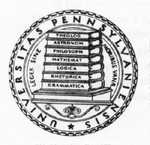
The Trustees of the University of Pennsylvania have an official seal that is, in effect, the signature of the corporation. It had its origin at a meeting of the Board of Trustees in 1755 with Benjamin Franklin as Chairman. Though the seal underwent changes over the years, the most recent design, approved in 1932 and adopted in 1933, returned it to virtually its original form.
The seal is composed of seven books stacked on a slanted desk top with the books bearing the following titles, representing the curriculum of the day, in the order from top to bottom: Theolog, Astronom, Philosoph, Mathemat, Logica, Rhetorica, Grammatica. On the periphery of the stack of books appears the University motto Leges Sine Moribus Vanae and the whole is encircled with the inscription Universitas Pennsylvaniensis.
The Penn coat-of-arms was derived by combining the coat-of-arms of Benjamin Franklin and that of William Penn's family. The dolphin on the red chief was part of Franklin's coat-of-arms and the three silver plates on the blue chevron were part of Penn's. The two were combined on a white shield along with two open volumes representing the University's educational purpose.
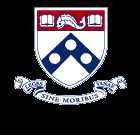
The motto of the University,Leges Sine Moribus Vanae, means "Laws without morals are useless (in vain)." It comes from the longer quotation from Horace, "Quid leges sine moribus vanae proficient" the sense of which is "of what avail are empty laws without (good) morals."
Eighteenth century American academic institutions did not have colors. The earliest known representation of the combined Penn colors, red and blue, is based on the incised lid of the 1871 College Hall corner stone.
One legend traces their origin to an early track meet at Saratoga, New York, between Penn, Harvard, and Yale. When asked by the officials what colors would be representing the Penn team, the captain reportedly replied, "We're going to be wearing the colors of the teams we beat," i.e. Harvard Crimson and Yale Blue. We shall assume that Penn was victorious and thus remained loyal to the red and blue.
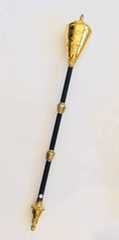
The University Mace, the symbol of authority of the University, is carried by the Vice President & University Secretary. It was a gift of the family of William Murray Gordon, M.D. 1910. The Mace is adorned with the seal and arms of the University, the William Penn and Benjamin Franklin family coats-of-arms, a depiction of the Rittenhouse Orrery, and a thistle symbolizing the early ties of the University with the University of Edinburgh in Scotland. The University Mace is exhibited in the display cases on the main floor of College Hall. It weighs 4 pounds and is 3 feet 4 inches long.
Please visitUse of University Name.
Trustees:
Formal institutional governance and fiduciary responsibility for the University of Pennsylvania rest solely with its Board of Trustees. The trustees delegate the responsibility for the day-to-day management of the University of Pennsylvania to the administration and, in particular, to the president. For this reason, one of the most important responsibilities of the trustees is the selection, retention, and replacement of the president. The trustees, however, seek to support and reinforce the administration in several ways. They serve as a bridge between the University and the world; on the one hand, interpreting the institution to the public, and on the other hand, bringing in experience and perceptions gained outside the University. The trustees provide leadership in the identification and development of financial resources. They oversee the University's relations with other institutions, the private sector, government bodies, and the media. In consultation with the president, the trustees determine the long-range allocation of resources, making decisions in the context of the needs and expectations of the University's constituencies and of society.
For a current roster, go to theTrustees.
Pictured below, The University Trustees circa 1965.

Trustees are chosen in one of three ways, depending on what class of Trustee they are.
Term Trustees are selected by the Nominating Committee of the Trustees and elected at a Stated Meeting.
Alumni Trustees are elected by the alumni in accordance with rules established by Penn Alumni.
Commonwealth Trustees are four non-elected officials appointed by the following representatives of the Pennsylvania General Assembly: President Pro Tempore of the Senate, the Minority Leader of the Senate, the Speaker of the House of Representatives, and the Minority Leader of the House of Representatives.
Please go to thetrustee meeting schedule.
If it's within 30 days, we should have the schedule set. Please go toopen meeting times.
Most meetings are open to anyone, but certain ones are closed. It varies from meeting to meeting. Please go to theopen meeting schedule.
Boards of Advisors:
Boards of Advisors are volunteer bodies to the dean of a school or the director of a major University unit. Please view the current rosters of theBoard Membership by Centers andBoard Membership by Schools. There are approximately 400 members of the Boards of Advisors at Penn, the majority of whom are Penn alumni.
At Penn, Board of Advisors provide long- and short-term advice to deans and directors regarding the achievement of strategic objectives and priorities. Board members serve as bridges between Penn's schools and centers and the community beyond campus boundaries. Although Boards of Advisors do not have fiduciary responsibility, the President, Provost and Board of Trustees rely heavily on these boards to help inform the work of the schools and centers.
Power of appointment to the Boards of Advisors rests with the Trustees of the University, who act upon recommendations by the President and the Chair of the Trustees. Nominations are submitted to the Office of the University Secretary through the schools and centers. Typically, a person nominated to serve as board member has had a long-standing relationship with the school or center, providing philanthropic support, professional expertise, and serving as an ambassador to the general public. Board members serve a three-year renewable term (not to exceed three terms, unless in special circumstances).
Commencement:
Upcoming Commencement dates can be viewed on thePenn Academic Calendar. Commencement is scheduled 3 years in advance, so dates beyond those on the calendar are not yet available. Please note that the schedule of individual school ceremonies is not on the calendar and is generally not known until March of that year.
We have been following the Monday schedule for many years and have determined that it works best for the University and the majority of the faculty, staff, students and parents. In 2000 we revisited the possibility of moving the ceremony to Sunday, but determined that a change would negatively impact the individual school graduation ceremonies, as well as the Baccalaureate ceremony.
Approximately 6000.
The President of the University and other administrative associates may wear the "Red & Blue" gown, as may holders of a Penn doctorate level degree.
Diplomas:
The University issues diplomas three times per year: May, August and December. You should receive your diploma, via U.S. Postal Service, approximately two months after you graduate.
Pictured: Doctor of Medicine, circa 1771. Collection of theUniversity Archives and Records Center.

Our office does not frame diplomas. Please refer to the Penn Book store: (215) 898-7595.
The size of the diploma is 9 5/8 inches by 12 1/4 inches.
The TEXT of the diploma is written in Latin and has been since the founding of the University.
No, we do not print diplomas in any language other than Latin. However, an English translation of the diploma should have been enclosed when it was mailed to you. If for legal reason, you require a certified translation of the diploma, you can order one from the Office of the University Secretary by following the procedure for diploma translation.
No, the University of Pennsylvania does not keep copies of diplomas. You can order a duplicate or replacement diploma by following the diploma replacement procedure.
You should receive your duplicate diploma within 8 to 12 weeks.
Yes, but additional charges apply.
Yes, but additional charges apply.
No, for legal reasons we can't issue duplicate diplomas to anyone but the graduate.
No, Penn does not distribute diplomas in electronic format.
To get information on Apostilles please visit theDiplomas web page.
Honorary Degrees:
Anyone can be nominated for an honorary degree. To submit a candidate for consideration you may fill out the nomination form. Please explaining why the individual deserves an honorary degree and include any helpful background.
Please go to the list ofpast honorary degree recipients.
Yes, Ben Franklin was granted a posthumous Ph.N.D. in 1976.
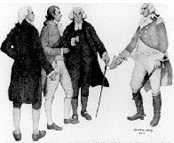
Pictured: General George Washington, Honorary LL.D. 1783.
University Council:
Members of University Council Committees are selected by each individual constituent group, namely the Faculty Senate, the Undergraduate Assembly, the Graduate and Professional Student Association, the Weekly-Paid Professional Staff Association, and the Penn Professional Staff Assembly.
The monthly meetings of University Council are open to members of the University. If you would like to attend please notify the Office of the University Secretary viaucouncil@pobox.upenn.edu.
Address
Office of the University Secretary
1 College Hall, Room 211
Philadelphia, PA 19104-6303
Phone
Phone (215) 898-7005
Fax (215) 898-0103
Contact Us
Office of the University Secretary
Location
Campus Map