
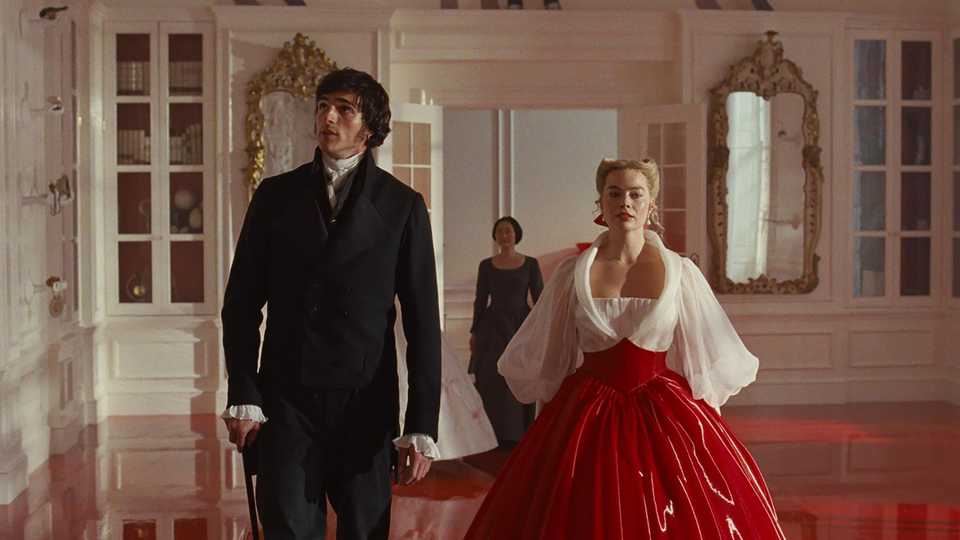

By her own admission, Emerald Fennell's fast and loose adaptation ofWuthering Heights is more of an emotional recall of the filmmaker's first impressions of Emily Brontë's sole novel rather than a faithful reimagining.The title alone is in quotes; don't take it too seriously, she seems to say, this is just what itfeels like to me.To make this plain, Linus Sandgren's cinematography lingers on the tactile: nails scratching on a plush wall, the scars of lashes across Jacob Elordi's sweating back, the broken yolks of eggs in bedsheets, the silken taste of chocolate, the lingering smell of Lily of the Valley, and the thick, opaque layers of fog on the Yorkshire moors.
The colors of the film are garish, bold, and plastic. So, too, are the anachronistic dresses Cathy (Margot Robbie) adorns once she marries into wealth. Bubblegum pinks and blood reds, sequins and 1960s cateye sunglasses. So, too, is the film's racial representation, belligerently casting aside Heathcliff's racial makeup of the novel, yet casting Hong Chau and Shazad Latif in trifling side roles. Everything — from the overt sexuality, to the shots of horse riding on the cliffs —has the distinct, preening texture of an airport novel, or one of those cheap erotic romances you can pick up in the stationery aisle of a CVS.
"Wuthering Heights"suggests the work of a person who was enamored with the book's SparkNotes as a high school student and then chose to never reacquaint herself with it in the writing of the script. No filmmaker should necessarily feel beholden to the source material, but it is strange to call your film what it is called only to be callously flippant with its richest details. Casting a white lead in an adaptation of a novel that is, predominantly, about racial violence, is only the film's first error.Despite some moments of wondrous physical beauty — or, perhaps, because of them — Wuthering Heights is flavorless, skin-deep and oddly staid.
Emerald Fennell's Callous Adaptation Lacks Brontë's Emotional and Sociological Depth
The film is ordinary in spite of the fact that it begins with a public hanging and an environment of unrelenting debauchery. It's a cold open which neatly suggests arrested development and sexual promiscuity, both of which are realized to some extent, but never in the fleshed-out way you'd expect from the same filmmaker who madePromising Young Woman andSaltburn. A man's death is cheered on as he hangs, his postmortem erection causing a wave of orgiastic behavior from the townsfolk. Brontë would never, but Fennell certainly would, and if this isn't to be a faithful adaptation, perhaps it will at least be filthy and ridiculous.
It is not. Not really. But, it also isn't an innocent film. In fact, Fennell has focused her attention on the textured feel of being alive, in love and sexually repressed at a time when freedom of bodily expression doesn't exactly come gratis. In a world where women, in particular, are forced to tamp down any feelings that may be untoward, and where sexual difference is considered a mental disability, does physical punishment lead to a widespread taste for sadomasochism? Maybe the real virus of the time wasn't the Black Plague, but the pervasive idea that pleasure is a reprimandable sin. It's why Cathy, caught masturbating behind a giant rock, blames Heathcliff for corruption rather than admitting her own burgeoning desires. "This is allyour doing."
In this socially regressive environment, Fennell introduces us to Wuthering Heights, where the financially struggling Earnshaw's live in a level of respectable squalor that refuses to acknowledge impending ruin. Yet one more form of repression. Mr. Earnshaw (Martin Clunes) raises his sole daughter, Cathy (Charlotte Mellington), with the help of her close-of-age footwoman, Nelly (Vy Nguyen), while spending most of his evenings at the local pub getting thrashed.
One day, Earnshaw returns home with a young boy (Owen Cooper, fresh off his awards season sweep forAdolescence). He has more or less stolen him from a drunken father in the town square, in an apparently selfless attempt to spare the child from the rod of an abusive parent. Cathy immediately clings to the child and proclaims him her own. "He shall be your pet," her father declares, and she takes this to heart, naming him after her lost brother, Heathcliff.
Heathcliff and Cathy grow up as something between siblings and unrequited lovers. They flit about the estate, frolic in the rain, and protect each other from their father's wrath. Their young love is well observed, if brief, and their connection is efficiently established as one equally defined by a mutual sense of safety as it is lustful attraction. But, in adulthood, the film shifts into a weak understanding of romanticism, and of melodrama.
Two changes from the book are notable here — one, that Cathy's older brother Hindley is not a key player but a distant memory, and two, that it is Cathy who names Heathcliff rather than Earnshaw. Both choices contribute to Fennell's fundamental reinterpretation of Brontë's themes of discrimination and jealousy. In the former, removing an integral actor in Heathcliff's repeated degradation makes his lifelong bitterness seem to derive from nowhere; in the latter, casting the children's inevitable tryst as predicated on uneven social footing.
But it is the latter choice that feels harebrained considering Elordi's casting. It is especially so as the children grow up and Earnshaw takes Heathcliff in with the same aplomb he raises his daughter — that is to say, if not with kindness, with ownership. There is never a question of Heathcliff's belonging in this family, despite the repeated beatings. And if that is true, and Hindley is not present to tamp him down, and he is also a conventionally attractive White man, it is difficult to see where the so-called uneven social footing between him and Cathy exists.
Fennell has been in the business lately of having to defend her decision to cast Elordi as the Byronic hero. Heathcliff is described in the book as "a dark-skinned gipsy" [sic] and "a little Lascar." The former is a racist term for a Romani person; the latter for someone emanating from regions as vast and as disparate as Somaliland, the Indian subcontinent, or, really, anyone from Arab lands. But an equal head-scratching decision is her casting of Robbie as a character who spends the bulk of the book between the ages of 16 and 19. Watching Robbie parade around like a petulant child is uncomfortable, even inside a film that foregrounds the idea that the willful ignorance of sex can lead to stunted adulthood.
Robbie is never convincing in her naivety, never believable in her innocence. Sheis believable as money-hungry. Because of the growing mountain of unpaid bills, Cathy is immediately pulled by the glowing sheen of their new neighbors, the Lintons, who are clearly, extremely, wealthy. Edgar (Shazad Latif) takes an immediate liking to her neighbor, especially after she purposefully crash lands right outside their gate, and his younger, wilder, weirder sister, Isabella (Alison Oliver), views her as her designated new best friend. Oliver is the film's clear winner, as the only actor that seems perched at the right fever pitch for Fennell's wonky vision.
Despite her obvious love for Heathcliff, Cathy decides to accept Edgar's marriage proposal, especially after Nelly (Hong Chau) is unable to give her the absolution of guilt she seeks. Robbie painfully evokes Cathy's impossible internal dilemma, but the scene rings strangely. In the book, Cathy's torment is due, in no small part, to the implied social degradation she will face upon marrying someone who isn't White; Fennell makes it all about the money. She communicates class differences through color and plastic, plastic as a material but also as a theme.
She also makes this moment of pain directly attributable to Nelly's vindictiveness. The longtime mistress is either jealous of Cathy and Heathcliff's passionate love, or else slapping back at Cathy for being churlish and rude. Whatever the case, Fennell is clearly running with Nelly's status as an unreliable narrator. Perhaps she is this way because she, too, is repressed and lonely.
Subscribe to our newsletter for sharper film criticism
But the decision is antithetical to the text and changes the entire scope of the story. If the novel is about characters whose main barrier to eternal love is the external pressures of class, race and jealousy, the film reroutes everything to craft a story of internal blockage, sex, and outright foolishness. One is a tragedy of the lack of social progress, the other is an inconsequential, bland, frustrating romance.
The chemistry between Robbie and Elordi is palpable, yet restrained, and, either way, out of touch with the tempestuousness of the source material. Even when the two begin a torrid affair, nothing feels dangerous, or earned, because Fennell has so defanged Edgar Linton as a weak-willed priss who is frequently never to be seen nor heard from. It isn't that Elordi and Robbie aren't dialed in to their respective roles, with the latter especially captivating as her desperation reaches a breaking point, but that whatever love they have built for each other is built on a crumbling foundation.
The rest of the film is devoted to posh, gorgeously designed interiors, with montages in which Cathy plays in her new dollhouse set to Charli XCX's original songs. In one of the film's multiple, obvious and obnoxious needle drops, XCX'sChains of Love plays over footage of the young woman parading around endless candy-colored rooms with jewelry. "I shouldn't feel like a prisoner,"XCX belts, in ways that suggest Fennell has never heard of subtext, nor subtlety.
Ultimately, the problem with Fennell's film isn't a disregard for literary faithfulness but what that disregard reveals about her and what it translates into on the screen. It's extremely telling that Fennell's imagination re-cast a person of color as a hot white guy. Most people will sadly overlook that. What they cannot ignore is that the film is otherwise still lacking. For all the epithets one could throw out aboutWuthering Heights, the most surprising may be that it is an abject snooze, and that its nonchalance about color-specific casting reveals a filmmaker completely insensitive to the implications of race in the late 18th century. Most damning though, is that without much of the provided context, Cathy and Heathcliff's affair seems solely attributable to lust. And, like anything based only on tactile pleasure, it is bound to fade. So, too, will Fennell's film.
"Wuthering Heights"releases theatrically on February 13th, 2026.


- Release Date
- February 13, 2026
- Runtime
- 136 Minutes
- Director
- Emerald Fennell
- Writers
- Emerald Fennell, Emily Brontë
- Producers
- Margot Robbie, Tom Ackerley, Emerald Fennell, Josey McNamara
Cast
 Catherine Earnshaw
 Jacob ElordiHeathcliff
Another film adaptation of Emily Brontë's classic novel, delving into the passionate and tumultuous relationship between Heathcliff and Catherine Earnshaw, set against the evocative backdrop of the Yorkshire moors.


