
A toolbox for estimating vector fields from intensive longitudinal data, and construct potential landscapes thereafter. The vector fields can be estimated with two nonparametric methods: the Multivariate Vector Field Kernel Estimator (MVKE) by Bandi & Moloche (2018)https://doi.org/10.1017/S0266466617000305 and the Sparse Vector Field Consensus (SparseVFC) algorithm by Ma et al. (2013)https://doi.org/10.1016/j.patcog.2013.05.017. The potential landscapes can be constructed with a simulation-based approach with thesimlandr package (Cui et al., 2021)https://doi.org/10.31234/osf.io/pzva3, or the Bhattacharya et al. (2011) method for path integrationhttps://doi.org/10.1186/1752-0509-5-85.
Installation
You can install the development version offitlandr fromGitHub with:
# install.packages("devtools")devtools::install_github("Sciurus365/fitlandr")Example
We use the following bistable dynamic system to illustrate the use offitlandr. The test data set is created as follows.
single_output_grad<-simlandr::sim_fun_grad(length=200, seed=1614)library(tidyverse)ggplot(data=single_output_grad%>%as_tibble())+geom_path(aes(x=1:200, y=x), color="blue")+geom_path(aes(x=1:200, y=y), color="red")+theme_bw()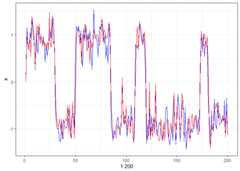
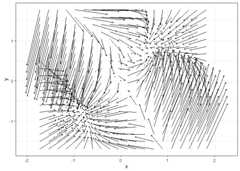
Fit the vector field with MVKE (see?MVKE for the explanations of parameters):
Fit the potential landscape:
future::plan("multisession")set.seed(1614)l2<-fit_3d_vfld(v2, .sim_vf_options=sim_vf_options(chains=16, stepsize=1, forbid_overflow=TRUE), .simlandr_options=simlandr_options(adjust=5, Umax=4))#> ℹ Simulating the model✔ Simulating the model [28.8s]#> ℹ Constructing the landscape✔ Constructing the landscape [2.5s]plot(l2,2)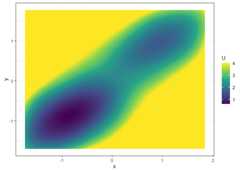
# equivalent:# s2 <- sim_vf(v2, chains = 16, stepsize = 1, forbid_overflow = TRUE)# l2 <- simlandr::make_3d_static(s2, x = "x", y = "y", lims = v2$lims, adjust = 5, Umax = 4)