
It is useful to be able to simulate data with a specified structure. Thefaux package provides some functions to make this process easier. See thevignettes for more details.
Installation
You can install the released version of faux fromCRAN with:
install.packages("faux")And the development version fromGitHub with:
# install.packages("devtools")devtools::install_github("scienceverse/faux")Quick overview
Simulate data for a factorial design
See theSimulate by Design vignette for more details.
between<-list(pet=c(cat="Cat Owners", dog="Dog Owners"))within<-list(time=c("morning","noon","evening","night"))mu<-data.frame( cat=c(10,12,14,16), dog=c(10,15,20,25), row.names=within$time)df<-sim_design(within,between, n=100, mu=mu, sd=5, r=.5)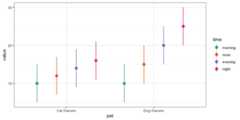
p1<-plot_design(df)p2<-plot_design(df,"pet","time")cowplot::plot_grid(p1,p2, nrow=2, align="v")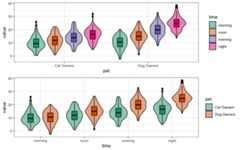
Simulate new data from an existing data table
See theSimulate from Existing Data vignette for more details.
new_iris<-sim_df(iris,50, between="Species")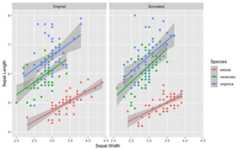
Simulate data for a mixed design
You can build up a cross-classified or nested mixed effects design using piped functions. See thecontrasts vignette for more details.
# simulate 20 classes with 20 to 30 students per classdata<-add_random(class=20)%>%add_random(student=sample(20:30,20, replace=TRUE), .nested_in="class")%>%add_between(.by="class", school_type=c("private","public"), .prob=c(5,15))%>%add_between(.by="student", gender=c("M","F","NB"), .prob=c(.49,.49,.02))| school_type | gender | n |
|---|---|---|
| private | M | 73 |
| private | F | 55 |
| private | NB | 1 |
| public | M | 168 |
| public | F | 201 |
| public | NB | 8 |
Other simulation packages
I started this project as a collection of functions I was writing to help with my own work. It’s one of many, many simulation packages in R; here are some others. I haven’t used most of them, so I can’t vouch for them, but if faux doesn’t meet your needs, one of these might.
- SimDesign: generate, analyse and summarise data from models or probability density functions
- simstudy: Simulation of Study Data
- simr: Power Analysis of Generalised Linear Mixed Models by Simulation
- simulator: streamlines the process of performing simulations by creating a common infrastructure that can be easily used and reused across projects
- lsasim: Simulate large scale assessment data
- simmer: Trajectory-based Discrete-Event Simulation (DES
- parSim: Parallel Simulation Studies