Ther2d3 package provides a suite of tools for usingD3 visualizations with R, including:
Translating R objects into D3 friendly data structures
Rendering D3 scripts within theRStudio Viewer andR Notebooks
Publishing D3 visualizations to the web
Incorporating D3 scripts intoR Markdown reports, presentations, and dashboards
Creating interactive D3 applications withShiny
Distributing D3 basedhtmlwidgets in R packages
Withr2d3, you can bind data from R to D3 visualizations like the ones found onhttps://github.com/d3/d3/wiki/Gallery,https://bl.ocks.org/, andhttps://vida.io/explore:
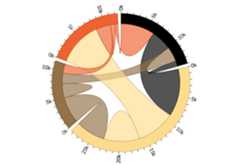
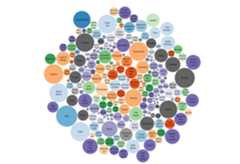
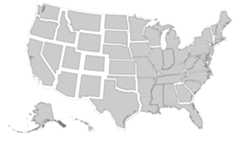
D3 visualizations created withr2d3 work just like R plots within RStudio, R Markdown documents, and Shiny applications.
Getting Started
First, install the package from GitHub as follows:
devtools::install_github("rstudio/r2d3")Next, install thepreview release of RStudio v1.2 of RStudio (you need this version of RStudio to take advantage of various integrated tools for authoring D3 scripts with r2d3).
Once you’ve installed the package and the RStudio v1.2 preview release you have the tools required to work withr2d3. Below, we’ll describe basic workflow within RStudio and techniques for including visualizations in R Markdown and Shiny applications.
About D3
Creating data visualizations withr2d3 requires lots of custom SVG graphics programming (similar to creating custom grid graphics in R). It’s therefore a good fit when you need highly custom visualizations that aren’t covered by existing libraries. If on the other hand you are looking for pre-fabricated D3 / JavaScript visualizations, check out the packages created usinghtmlwidgets, which provide a much higher level interface.
If you are completely new to D3, you may also want to check out the article onLearning D3 before proceeding further.
D3 Scripts
To user2d3, write a D3 script and then pass R data to it using ther2d3() function. For example, here’s a simple D3 script that draws a bar chart (“barchart.js”):
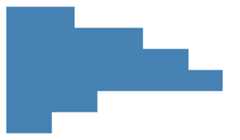
// !preview r2d3 data=c(0.3, 0.6, 0.8, 0.95, 0.40, 0.20)var barHeight=Math.floor(height/data.length);svg .selectAll("rect") .data(data) .enter() .append("rect") .attr("width",function (d){return d* width;}) .attr("height", barHeight) .attr("y",function (d, i){return i* barHeight;}) .attr("fill","steelblue");To render the script within R you call ther2d3() function:
Which results in the following visualization:
D3 Variables
Note that data is provided to the script using thedata argument to ther2d3() function. This data is then automatically made available to the D3 script. There are a number of other special variables available within D3 scripts, including:
data- The R data converted to JavaScript.svg- The svg container for the visualizationwidth- The current width of the containerheight- The current height of the containeroptions- Additional options provided by the usertheme- Colors for the current theme
When you are learning D3 or translating D3 examples for use with R it’s important to keep in mind that D3 examples will generally include code to load data, create an SVG or other root element, and establish a width and height for the visualization.
On the other hand withr2d3, these variables areprovided automatically so do not need to be created. The reasons these variables are provided automatically are:
So that you can dynamically bind data from R to visualizations; and
So thatr2d3 can automatically handle dynamic resizing for your visualization. Most D3 examples have a static size. This if fine for an example but not very robust for including the visualization within a report, dashboard, or application.
D3 Preview
TheRStudio v1.2 preview release of RStudio includes support for previewing D3 scripts as you write them. To try this out, create a D3 script using the new file menu:
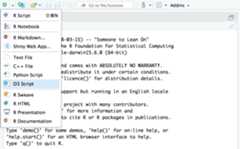
A simple template for a D3 script (the barchart.js example shown above) is provided by default. You can use thePreview command (Ctrl+Shift+Enter) to render the visualization:
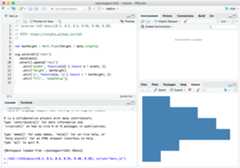
You might wonder where the data comes from for the preview. Note that there is a special comment at the top of the D3 script:
This comment enables you to specify the data (along with any other arguments to ther2d3() function) to use for the preview.
R Markdown
You can include D3 visualizations in an R Markdown document or R Notebook. You can do this by calling ther2d3() function from within an R code chunk:
---output: html_document---```{r}library(r2d3)r2d3(data=c(0.3, 0.6, 0.8, 0.95, 0.40, 0.20), script = "barchart.js")```
You can also include D3 visualization code inline using thed3 R Markdown engine:
```{r setup}library(r2d3)bars <- c(10, 20, 30)``````{d3 data=bars, options=list(color = 'orange')}svg.selectAll('rect') .data(data) .enter() .append('rect') .attr('width', function(d) { return d * 10; }) .attr('height', '20px') .attr('y', function(d, i) { return i * 22; }) .attr('fill', options.color);```
Note that in order to use thed3 engine you need to addlibrary(r2d3) to the setup chunk (as illustrated above).
Shiny
TherenderD3() andd3Output() functions enable you to include D3 visualizations within Shiny applications:
library(shiny)library(r2d3)ui<-fluidPage(inputPanel(sliderInput("bar_max", label="Max:", min=0.1, max=1.0, value=0.2, step=0.1)),d3Output("d3"))server<-function(input,output){output$d3<-renderD3({r2d3(runif(5,0,input$bar_max), script=system.file("examples/baranims.js", package="r2d3"))})}shinyApp(ui=ui, server=server)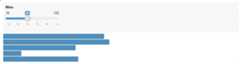
See the article onUsing r2d3 with Shiny to learn more (including how to create custom Shiny inputs that respond to user interaction with D3 visualizations).
Learning More
To learn the basics of D3 and see some examples that might inspire your own work, check out:
Learning D3 - Suggested resources for learning how to create D3 visualizations.
Gallery of Examples - Learn from a wide variety of example D3 visualizations.
For next steps on learning on how to user2d3, see these articles:
- Customize the conversion of R objects to D3-friendly JSON.
- Control various aspects of D3 rendering and expose user-level options for your D3 script.
- Recommended tools and workflow for developing D3 visualizations.
- Publish D3 visualizations as HTML, a static PNG image, or within R Markdown documents and Shiny applications.
Once you are familar with the basics, check out these articles on more advanced topics:
Using r2d3 with Shiny - Deriving insights from data is streamlined when users are able to modify a Shiny input, or click on a D3 visualization, and that action produces new results.
CSS and JavaScript Dependencies
- Incorporating external CSS styles and JavaScript libraries into your visualizations.
Advanced Rendering with Callbacks
- An alternate way to organize D3 scripts that enables you to distinguish between initialization and re-rendering based on new data, as well as handle resizing more dynamically.
Package Development – Create re-usable D3 visualizations by including them in an R package.
Links
- Download from CRAN at
https://cloud.r-project.org/package=r2d3 - Browse source code at
https://github.com/rstudio/r2d3/ - Report a bug at
https://github.com/rstudio/r2d3/issues
License
Developers
- Nick Strayer
Author, maintainer - Javier Luraschi
Author - JJ Allaire
Author - All authors...

