
giscoR is anR package that provides a simple interface toGISCO data from Eurostat. It allows you to download and work with global and European geospatial datasets — such as country boundaries, NUTS regions, coastlines, and labels — directly inR.
Key features
- RetrieveGISCO files for countries, regions, and administrative units.
- Access data at multiple resolutions:
60M,20M,10M,03M,01M. - Choose from three projections:EPSG 4326,3035, or3857.
- Works seamlessly withsf objects for spatial analysis.
- Includescaching for faster repeated access.
Installation
InstallgiscoR fromCRAN:
install.packages("giscoR")You can install the development version ofgiscoR with:
# install.packages("pak")pak::pak("rOpenGov/giscoR")Alternatively, you can installgiscoR viar-universe:
install.packages("giscoR", repos=c("https://ropengov.r-universe.dev","https://cloud.r-project.org"))Quick Example
This script highlights some features ofgiscoR :
library(giscoR)library(sf)library(dplyr)# Download The Netherlands boundaries at different resolutionsnl_all<-lapply(c("60","20","10","03"),function(r){gisco_get_countries(country="Netherlands", year=2024, resolution=r)|>mutate(res=paste0(r,"M"))})|>bind_rows()glimpse(nl_all)#> Rows: 4#> Columns: 13#> $ CNTR_ID <chr> "NL", "NL", "NL", "NL"#> $ CNTR_NAME <chr> "Nederland", "Nederland", "Nederland", "Nederland"#> $ NAME_ENGL <chr> "Netherlands", "Netherlands", "Netherlands", "Netherlands"#> $ NAME_FREN <chr> "Pays-Bas", "Pays-Bas", "Pays-Bas", "Pays-Bas"#> $ ISO3_CODE <chr> "NLD", "NLD", "NLD", "NLD"#> $ SVRG_UN <chr> "UN Member State", "UN Member State", "UN Member State", "UN…#> $ CAPT <chr> "Amsterdam", "Amsterdam", "Amsterdam", "Amsterdam"#> $ EU_STAT <chr> "T", "T", "T", "T"#> $ EFTA_STAT <chr> "F", "F", "F", "F"#> $ CC_STAT <chr> "F", "F", "F", "F"#> $ NAME_GERM <chr> "Niederlande", "Niederlande", "Niederlande", "Niederlande"#> $ geometry <MULTIPOLYGON [°]> MULTIPOLYGON (((7.208935 53..., MULTIPOLYGON (((7.202794 53.…#> $ res <chr> "60M", "20M", "10M", "03M"# Plot with ggplot2library(ggplot2)ggplot(nl_all)+geom_sf(fill="#AD1D25")+facet_wrap(~res)+labs( title="The Netherlands boundaries at different resolutions", subtitle="Year: 2024", caption=gisco_attributions())+theme_minimal()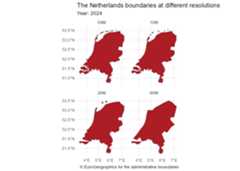
Advanced Example: Thematic maps
This example shows a thematic map created with theggplot2 package. The data are obtained via theeurostat package. This follows the approach presented byMilos Popovic inthis post.
We start by extracting the corresponding geographic data:
library(giscoR)library(dplyr)library(eurostat)library(ggplot2)# Get sf objectsnuts3<-gisco_get_nuts( year=2021, epsg=3035, resolution=10, nuts_level=3)# Get country lines (NUTS 0 level)country_lines<-gisco_get_nuts( year=2021, epsg=3035, resolution=10, spatialtype="BN", nuts_level=0)We now download the data from Eurostat:
# Use eurostatpopdens<-get_eurostat("demo_r_d3dens")|>filter(TIME_PERIOD=="2021-01-01")Finally, we merge and manipulate the data to create the final plot:
# Merge datanuts3_sf<-nuts3|>left_join(popdens, by="geo")# Breaks and labelsbr<-c(0,25,50,100,200,500,1000,2500,5000,10000,30000)labs<-prettyNum(br[-1], big.mark=",")# Label function used in the plot, mainly for NAslabeller_plot<-function(x){ifelse(is.na(x),"No Data",x)}nuts3_sf<-nuts3_sf|># Cut with labelsmutate(values_cut=cut(values,br, labels=labs))# Palettepal<-hcl.colors(length(labs),"Lajolla")# Plotggplot(nuts3_sf)+geom_sf(aes(fill=values_cut), linewidth=0, color=NA, alpha=0.9)+geom_sf(data=country_lines, col="black", linewidth=0.1)+# Center in Europe: EPSG 3035coord_sf( xlim=c(2377294,7453440), ylim=c(1313597,5628510))+# Legendsscale_fill_manual( values=pal,# Label for NA labels=labeller_plot, drop=FALSE, guide=guide_legend(direction="horizontal", nrow=1))+# Themingtheme_void()+# Themetheme( plot.title=element_text( color=rev(pal)[2], size=rel(1.5), hjust=0.5, vjust=-6), plot.subtitle=element_text( color=rev(pal)[2], size=rel(1.25), hjust=0.5, vjust=-10, face="bold"), plot.caption=element_text(color="grey60", hjust=0.5, vjust=0), legend.text=element_text(color="grey20", hjust=.5), legend.title=element_text(color="grey20", hjust=.5), legend.position="bottom", legend.title.position="top", legend.text.position="bottom", legend.key.height=unit(.5,"line"), legend.key.width=unit(2.5,"line"))+# Annotate and labslabs( title="Population density in 2021", subtitle="NUTS-3 level", fill="people per sq. kilometer", caption=paste0("Source: Eurostat, ",gisco_attributions(),"\nBased on Milos Popovic: ","https://milospopovic.net/how-to-make-choropleth-map-in-r/"))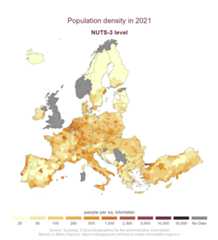
Caching
Large datasets (e.g., LAU or high-resolution files) can exceed 50MB. Use:
gisco_set_cache_dir("./path/to/location")Files will be stored locally for faster access.
Contribute
Check the GitHub page forsource code.
Contributions are welcome:
- Use issue tracker for feedback and bug reports.
- Send pull requests
- Star us on the GitHub page
Citation
To cite ‘giscoR’ in publications use:
Hernangómez D (2025).giscoR: Download Map Data from GISCO API - Eurostat.doi:10.32614/CRAN.package.giscoRhttps://doi.org/10.32614/CRAN.package.giscoR,https://ropengov.github.io/giscoR/.
A BibTeX entry for LaTeX users is
@Manual{R-giscoR, title= {{giscoR}: Download Map Data from GISCO API- Eurostat}, doi= {10.32614/CRAN.package.giscoR}, author= {Diego Hernangómez}, year= {2025}, version= {1.0.0}, url= {https://ropengov.github.io/giscoR/}, abstract= {Tools to download data from theGISCO (Geographic Information System of the Commission) Eurostat database<https://ec.europa.eu/eurostat/web/gisco>. Global and European map data available. This package isin no way officially related to or endorsed by Eurostat.},}General copyright
Eurostat’s general copyright notice and licence policy applies. Moreover, there are specific rules that apply to some of the following datasets available for downloading. The download and use of these data are subject to these rules being accepted. See ouradministrative units andstatistical units for more details.
