GaleriaValeriaDiocletian
An Online Encyclopedia of Roman Emperors Diocletian ( 284-305 A.D.)
Ralph W. Mathisen
University of South Carolina
The Emperor Gaius Aurelius Valerius Diocletianus (A.D. 284-305) put anend to the disastrous phase of Roman history known as the "Military Anarchy"or the "Imperial Crisis" (235-284). He established an obvious militarydespotism and was responsible for laying the groundwork for the secondphase of the Roman Empire, which is known variously as the "Dominate,"the "Tetrarchy," the "Later Roman Empire," or the "Byzantine Empire." Hisreforms ensured the continuity of the Roman Empire in the east for morethan a thousand years. Summary and Introduction
Diocletian was born ca. 236/237 on the Dalmatian coast, perhaps at Salona.He was of very humble birth, and was originally named Diocles. He wouldhave received little education beyond an elementary literacy and he wasapparently deeply imbued with religious piety He had a wifePriscaand a daughterValeria, both of whom reputedlywere Christians. During Diocletian's early life, the Roman empire was inthe midst of turmoil. In the early years of the third century, emperorsincreasingly insecure on their thrones had granted inflationary pay raisesto the soldiers. The only meaningful income the soldiers now received wasin the form of gold donatives granted by newly acclaimed emperors. Beginningin 235, armies throughout the empire began to set up their generals asrival emperors. The resultant civil wars opened up the empire to invasionin both the north, by the Franks, Alamanni, and Goths, and the east, bythe Sassanid Persians. Another reason for the unrest in the army was thegreat gap between the social background of the common soldiers and theofficer corps. Diocletian's Early Life and Reign
Diocletian sought his fortune in the army. He showed himself to be ashrewd, able, and ambitious individual. He is first attested as "Duke ofMoesia" (an area on the banks of the lower Danube River), with responsibilityfor border defense. He was a prudent and methodical officer, a seeker ofvictory rather than glory. In 282, the legions of the upper Danube proclaimedthe praetorian prefectCarusas emperor. Diocletian found favor under the new emperor, and was promotedto Count of the Domestics, the commander of the cavalry arm of the imperialbodyguard. In 283 he was granted the honor of a consulate.
In 284, in the midst of a campaign against the Persians,Caruswas killed, struck by a bolt of lightning which one writer noted mighthave been forged in a legionary armory. This left the empire in the handsof his two young sons,Numerianin the east andCarinusin the west. Soon thereafter,Numeriandied under mysterious circumstances near Nicomedia, and Diocletian wasacclaimed emperor in his place. At this time he changed his name from Dioclesto Diocletian. In 285Carinuswas killed in a battle near Belgrade, and Diocletian gained control ofthe entire empire.
As emperor, Diocletian was faced with many problems. His most immediateconcerns were to bring the mutinous and increasingly barbarized Roman armiesback under control and to make the frontiers once again secure from invasion.His long-term goals were to restore effective government and economic prosperityto the empire. Diocletian concluded that stern measures were necessaryif these problems were to be solved. He felt that it was the responsibilityof the imperial government to take whatever steps were necessary, no matterhow harsh or innovative, to bring the empire back under control. Diocletian's Administrative and Military Reforms
Diocletian was able to bring the army back under control by making severalchanges. He subdivided the roughly fifty existing provinces into approximatelyone hundred. The provinces also were apportioned among twelve "dioceses,"each under a "vicar," and later also among four "prefectures," each undera "praetorian prefect." As a result, the imperial bureaucracy became increasinglybloated. He institutionalized the policy of separating civil and militarycareers. He divided the army itself into so-called "border troops," actuallyan ineffective citizen militia, and "palace troops," the real field army,which often was led by the emperor in person.
Following the precedent of Aurelian (A.D.270-275), Diocletian transformedthe emperorship into an out-and-out oriental monarchy. Access to him becamerestricted; he now was addressed not asFirst Citizen (Princeps)or the soldierlygeneral (Imperator), but asLord andMaster (Dominus Noster) . Those in audience were required toprostrate themselves on the ground before him.
Diocletian also concluded that the empire was too large and complexto be ruled by only a single emperor. Therefore, in order to provide animperial presence throughout the empire, he introduced the "Tetrarchy,"or "Rule by Four." In 285, he named his lieutenantMaximianus"Caesar," and assigned him the western half of the empire. This practicebegan the process which would culminate with thede facto splitof the empire in 395. Both Diocletian andMaximianusadopted divine attributes. Diocletian was identified with Jupiter andMaximianuswith Hercules. In 286, Diocletian promotedMaximianusto the rank of Augustus, "Senior Emperor," and in 293 he appointed twonew Caesars,Constantius(the father ofConstantineI), who was given Gaul and Britain in the west, andGalerius,who was assigned the Balkans in the east.
By instituting his Tetrarchy, Diocletian also hoped to solve anotherproblem. In the Augustan Principate, there had been no constitutional methodfor choosing new emperors. According to Diocletian's plan, the successorof each Augustus would be the respective Caesar, who then would name anew Caesar. Initially, the Tetrarchy operated smoothly and effectively.
Once the army was under control, Diocletian could turn his attentionto other problems. The borders were restored and strengthened. In the earlyyears of his reign, Diocletian and his subordinates were able to defeatforeign enemies such as Alamanni, Sarmatians, Saracens, Franks, and Persians,and to put down rebellions in Britain and Egypt. The easter frontier wasactually expanded.
.
Another problem was the economy, which was in an especially sorry state.The coinage had become so debased as to be virtually worthless. Diocletian'sattempt to reissue good gold and silver coins failed because there simplywas not enough gold and silver available to restore confidence in the currency.A "Maximum Price Edict" issued in 301, intended to curb inflation, servedonly to drive goods onto the black market. Diocletian finally acceptedthe ruin of the money economy and revised the tax system so that it wasbased on payments in kind . The soldiers too came to be paid in kind. Diocletian's Economic Reforms
In order to assure the long term survival of the empire, Diocletianidentified certain occupations which he felt would have to be performed.These were known as the "compulsory services." They included such occupationsas soldiers, bakers, members of town councils, and tenant farmers. Thesefunctions became hereditary, and those engaging in them were inhibitedfrom changing their careers. The repetitious nature of these laws, however,suggests that they were not widely obeyed. Diocletian also expanded thepolicy of third-century emperors of restricting the entry of senators intohigh-ranking governmental posts, especially military ones.
Diocletian attempted to use the state religion as a unifying element.Encouraged by the CaesarGalerius,Diocletian in 303 issued a series of four increasingly harsh decrees designedto compel Christians to take part in the imperial cult, the traditionalmeans by which allegiance was pledged to the empire. This began the so-called"Great Persecution."
On 1 May 305, wearied by his twenty years in office, and determined toimplement his method for the imperial succession, Diocletian abdicated.He compelled his co-regentMaximianusto do the same.ConstantiusandGaleriusthen became the newAugusti, and two new Caesars were selected,Maximinus (305-313)in the east andSeverus(305- 307) in the west. Diocletian then retired to his palace at Spliton the Croatian coast. In 308 he declined an offer to resume the purple,and the aged ex-emperor died at Split on 3 December 316. Diocletian's Resignation and Death
Prisca, Galeria Valeria, and Candidianus
Michael DiMaio, Jr.
Salve Regina University
GaleriaValeria
Prisca was the wife of the EmperorDiocletian.She bore him a daughter named Valeria, who was apparently the second wifeof the EmperorGalerius.Although she was a Christian or favorably disposed to Christianity, shewas forced to sacrifice to the gods during the Great Persecution of 303.Her husband had built her a home in Nicomedeia. WhenGaleriusdied in 311, she and her daughter were exiled to Syria by the EmperorMaximinusDaia. She was later arrested and beheaded by the EmperorLiciniusin 315.
Valeria, like her mother a Christian or Christian sympathizer, seemsto have marriedGaleriusin 293 and, perhaps in November 308, was raised to the rank ofAugustaandMater Castrorum. Her husband named a province after her. Sheadopted Candidianus,Galerius'sillegitimate son, as her own child; he was betrothed to the daughter ofMaximinus Daia. Valeria and her mother Prisca fled fromLicinius, to whose care they had been entrusted, to the realm ofDaiaafterGaleriusdied in 311. When Valeria did not accede toDaia'swishes to marry him, the emperor took possession of all her propertyand exiled Valeria and her mother to Syria. When he died,Liciniussentenced her to death. Valeria escaped from his clutches and survivedin hiding for over a year.Liciniuseventually captured her and had her put to deathca. 315along with Candidianus.
Arnheim, M.T.W.The Senatorial Aristocracy in the Later Roman EmpireOxford, 1972. Bibliography
Barnes,Timothy D.The New Empire of Diocletian and Constantine.Cambridge, 1982.
Brauer, George C.The Age of the Soldier Emperors Park Ridge,N.J. 1982.
Brown, Peter.The World of Late Antiquity. From Marcus Aurelius toMohammed. London, 1971.
Chastagnol, A. "Un nouveau prefet du pretoire de Diocletien: AureliusHermogenianus."ZPE 78(1989): 165-168
Ensslin, Wm. "Prisca(3)."RE 22.2: col. 2560.
________. "Valeria (3)."RE 7A: col. 2282.
Jones, A.H.MThe Later Roman Empire 284-602. A Social, Economic,and Administrative Survey. Norman, 1964.
_________., J.R. Martindale, and J. Morris. "Candidianus 1."TheProsopography of the Later Roman Empire, Cambridge, 1971, 1.178.
________, J.R. Martindale, and J. Morris. "Prisca 1."The Prosopographyof the Later Roman Empire, Cambridge, 1971, 1.726.
________., J.R. Martindale, and J. Morris. "Galeria Valeria"TheProsopography of the Later Roman Empire, Cambridge, 1971, 1.937.
Kienast, Dietmar.Römische Kaisertabelle: Grundzüge einerrömischen Kaiserchronologie. Darmstadt, 1990.
Seston, W.Diocletien et la tetrarchie. Paris, 1946.
Sutherland, C.H.V. "The State of the Imperial Treasury at the Deathof Diocletian."JRS 25(1935)
________. "Diocletian's Reform of the Coinage,"JRS 45(1955)
________. "The Denarius and Sestertius in Diocletian's Coinage Reform,"JRS 51(1961).
Williams, Stephen.Diocletian and the Roman Recovery. New York,1985.
Copyright (C) 1996, Ralph W. Mathisen and Michael DiMaio, Jr.. This setof files may be copied on the condition that the entire contents, includingthe header and this copyright notice, remain intact.
Comments to:Ralph W. Mathisen.
Updated: 17 February 1997
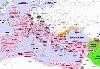
For more detailed geographical information, please use theDIR/ORBAntiqueand Medieval Atlas below. Click on the appropriate part of the map belowto access large area maps.