TsallisQGaussianDistribution[μ,β,q]
represents a Tsallis -Gaussian distribution with meanμ, scale parameterβ, and deformation parameterq.
TsallisQGaussianDistribution[q]
represents a Tsallis -Gaussian distribution with mean 0 and scale parameter 1.


TsallisQGaussianDistribution
TsallisQGaussianDistribution[μ,β,q]
represents a Tsallis -Gaussian distribution with meanμ, scale parameterβ, and deformation parameterq.
TsallisQGaussianDistribution[q]
represents a Tsallis -Gaussian distribution with mean 0 and scale parameter 1.
Details

- TsallisQGaussianDistribution allowsμ to be any real number,β to be any positive real number, andq to be any real number less than 3.
- TsallisQGaussianDistribution allowsμ andβ to be any quantities of the same unit dimensions, andλ to be a dimensionless quantity.»
- TsallisQGaussianDistribution can be used with such functions asMean,CDF, andRandomVariate.
Background & Context
- TsallisQGaussianDistribution[μ,β,q] represents a continuous statistical distribution parametrized by a positive real numberβ (called a "scale parameter") and by real numbersμ and
 (the mean of the distribution and a "deformation parameter", respectively), which together determine the overall behavior of its probability density function (PDF). In general, the PDF of a Tsallis
 -Gaussian distribution is unimodal with a single "peak" (i.e. a global maximum), though its overall shape (its support, its height, its spread, and the horizontal location of its maximum) is determined by the values ofμ,β, and
 . In addition, the tails of the PDF (which are defined only when
 ) are typically "fat" (i.e. the PDF decreases non-exponentially for large values
 ) but are "thin" (i.e. the PDF decreases exponentially for large
 ) for
) for . (When defined, this behavior can be made quantitatively precise by analyzing theSurvivalFunction of the distribution.) The Tsallis
 -Gaussian distribution is often referred to merely as the
 -Gaussian distribution, while the one-parameter formTsallisQGaussianDistribution[q] is equivalent toTsallisQGaussianDistribution[0,1,q] and is sometimes referred to as the standard
 -Gaussian distribution.
 - The Tsallis
 -Gaussian distribution is named for Brazilian physicist Constantino Tsallis and is derived via maximization of the so-called Tsallis entropy (in statistical mechanics) subject to certain conditions. Along with the related
 -exponential distribution, the
 -Gaussian distribution is one of a family of probability distributions referred to collectively as Tsallis distributions and derived according to the above-mentioned process. The
 -Gaussian distribution has also been used to model phenomena like wealth distribution and asset pricing in fields such as economics, finance, and actuarial science.
 - RandomVariate can be used to give one or more machine- or arbitrary-precision (the latter via theWorkingPrecision option) pseudorandom variates from a
 -Gaussian distribution.Distributed[x,TsallisQGaussianDistribution[μ,β,q]], written more concisely asxTsallisQGaussianDistribution[μ,β,q], can be used to assert that a random variablex is distributed according to a
 -Gaussian distribution. Such an assertion can then be used in functions such asProbability,NProbability,Expectation, andNExpectation.
 - The probability density and cumulative distribution functions for
 -Gaussian distributions may be given usingPDF[TsallisQGaussianDistribution[μ,β,q],x] andCDF[TsallisQGaussianDistribution[μ,β,q],x]. The mean, median, variance, raw moments, and central moments may be computed usingMean,Median,Variance,Moment, andCentralMoment, respectively.
 - DistributionFitTest can be used to test if a given dataset is consistent with a
 -Gaussian distribution,EstimatedDistribution to estimate a parametric
 -Gaussian distribution from given data, andFindDistributionParameters to fit data to a
 -Gaussian distribution.ProbabilityPlot can be used to generate a plot of the CDF of given data against the CDF of a symbolic
 -Gaussian distribution, andQuantilePlot to generate a plot of the quantiles of given data against the quantiles of a symbolic
 -Gaussian distribution.
 - TransformedDistribution can be used to represent a transformed
 -Gaussian distribution,CensoredDistribution to represent the distribution of values censored between upper and lower values, andTruncatedDistribution to represent the distribution of values truncated between upper and lower values.CopulaDistribution can be used to build higher-dimensional distributions that contain a
 -Gaussian distribution, andProductDistribution can be used to compute a joint distribution with independent component distributions involving
 -Gaussian distributions.
 - TsallisQGaussianDistribution is related to a number of other distributions.TsallisQGaussianDistribution is an immediate generalization ofNormalDistribution, in the sense that the PDF ofTsallisQGaussianDistribution[μ,β,1] is precisely the same as that ofNormalDistribution[μ,β] (for
 ).TsallisQGaussianDistribution can be realized as an instance ofCauchyDistribution, in thatTsallisQGaussianDistribution[μ,β,2] is equivalent toCauchyDistribution[μ,β
 ] and is also closely related toTsallisQExponentialDistribution,ExponentialDistribution,StudentTDistribution, andWeibullDistribution.
Examples
open allclose allBasic Examples (4)
Scope (8)
Generate a sample of pseudorandom numbers from a -Gaussian distribution:
Compare the histogram to the PDF:
Distribution parameters estimation:
Estimate the distribution parameters from sample data:
Compare the density histogram of the sample with the PDF of the estimated distribution:
Different moments with closed forms as functions of parameters:
Closed form for symbolic order:
Hazard function for some fixedq values:
Quantiles can be evaluated in closed form for certain rational values ofq:
Consistent use ofQuantity in parameters yieldsQuantityDistribution:
Applications (1)
The -Gaussian distribution can be used to model differences in log returns of stock prices:
Fit the distribution to the data and compare to the fit withNormalDistribution:
Compare the histogram of the data to the PDF:
Inspect the heavy-tail behavior:
Find the probability that the log-difference in price is above $0.1:
Simulate the log-difference in price for 30 consecutive days:
Properties & Relations (5)
The -Gaussian distribution is closed under scaling and translation:
Forq that is close to 1,TsallisQGaussianDistribution resemblesNormalDistribution:
Relationships to other distributions:
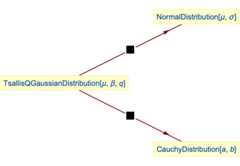
The -Gaussian distribution simplifies toNormalDistribution for
 :
:
The -Gaussian distribution simplifies toCauchyDistribution for
 :
:
Possible Issues (2)
TsallisQGaussianDistribution is not defined whenμ is not a real number:

TsallisQGaussianDistribution is not defined whenβ is not a positive real number:

TsallisQGaussianDistribution is not defined whenq is not a real number less than 3:

Substitution of invalid parameters into symbolic outputs gives results that are not meaningful:
Tech Notes
Related Guides
Text
Wolfram Research (2012), TsallisQGaussianDistribution, Wolfram Language function, https://reference.wolfram.com/language/ref/TsallisQGaussianDistribution.html (updated 2016).
CMS
Wolfram Language. 2012. "TsallisQGaussianDistribution." Wolfram Language & System Documentation Center. Wolfram Research. Last Modified 2016. https://reference.wolfram.com/language/ref/TsallisQGaussianDistribution.html.
APA
Wolfram Language. (2012). TsallisQGaussianDistribution. Wolfram Language & System Documentation Center. Retrieved from https://reference.wolfram.com/language/ref/TsallisQGaussianDistribution.html
BibTeX
@misc{reference.wolfram_2025_tsallisqgaussiandistribution, author="Wolfram Research", title="{TsallisQGaussianDistribution}", year="2016", howpublished="\url{https://reference.wolfram.com/language/ref/TsallisQGaussianDistribution.html}", note=[Accessed: 17-February-2026]}
BibLaTeX
@online{reference.wolfram_2025_tsallisqgaussiandistribution, organization={Wolfram Research}, title={TsallisQGaussianDistribution}, year={2016}, url={https://reference.wolfram.com/language/ref/TsallisQGaussianDistribution.html}, note=[Accessed: 17-February-2026]}
[8]ページ先頭