Pointers and Objects in Python

If you’ve ever worked with lower-level languages like C or C++, then you may have heard ofpointers. Pointers are essentially variables that hold the memory address of another variable. They allow you to create great efficiency in parts of your code but can lead to various memory management bugs.
You’ll learn aboutPython’s object model and see why pointers in Python don’t really exist. For the cases where you need to mimic pointer behavior, you’ll learn ways to simulate pointers in Python without managing memory.
In this course, you’ll:
- Learn whypointers in Python don’t exist
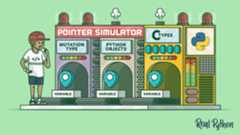
- Explore the difference betweenC variables andPython names
- Simulate pointers in Python
- Experiment with real pointers using
ctypes
What’s Included:
- 12 Lessons
- Video Subtitles and Full Transcripts
- 2 Downloadable Resources
- Accompanying Text-Based Tutorial
- Q&A With Python Experts: Ask a Question
- Certificate of Completion
Downloadable Resources:
Related Learning Paths:
Pointers and Objects in Python
12 Lessons 47m
- 1. Pointers and Objects in Python (Overview)01:48
- 2. Pointers in C09:15
- 3. Pointers Analogy03:10
- 4. Python Doesn't Have Pointers02:56
- 5. Immutable vs Mutable Objects03:45
- 6. Variables in C vs Python06:06
- 7. Intern Objects02:54
- 8. Object Passing in Python05:54
- 9. Simulated Pointers With Mutable Types01:37
- 10. Simulated Pointers With Classes02:34
- 11. Real Pointers With ctypes06:25
- 12. Pointers and Objects in Python (Summary)00:59
AboutAustin Cepalia
Austin is a video tutorial author at Real Python. He graduated with a BS in CS from Rochester Institute of Technology in 2023, and now he writes software to support the semiconductor industry.
» More about Austin



Participant Comments

Mark
Great course, Austin. I’ve watched it three times to drill it in, and just wanted to drop a comment saying you’re a good teacher. All writers here on Real Python strike me as good, but I found you stood out. I’ll be looking for content from you in the future. I just felt compelled to pat you on the back for this course. Good job!

Ghani
Very informative and clear; thank you so much!