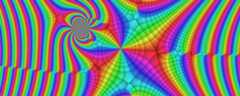
With the R packageviscomplexr you can create phase portraits of functions on the complex number plane. While the main purpose of this package are scientific, educational, and technical applications, the sheer beauty of phase portraits may be motivation enough to explore the fascinating realm of complex functions. The package is embedded in the framework of R base graphics and allows for print quality graphics files. To a great deal,viscomplexr follows the conventions published by Wegert (2012). Since version 1.1.0, the package also facilitates two-color plots based on polar chessboards.
For a detailed step-by-step introduction seethis article or the package’s vignette. After installingviscomplexr on your machine, you can view the vignette by calling
vignette("viscomplexr-vignette")at the R command line. Besides making you acquainted with how to work with the package, the vignette also tells you more about some shenanigans going on behind the scenes; among them parallel processing andviscomplexr’s temporary file system.
Installation
In order to work withviscomplexr you require an installation of R (version >= 4.0) on your system. The installation files for R itself are availablehere. The released version ofviscomplexr can be installed fromCRAN at the R command line with:
install.packages("viscomplexr")And the development version fromGitHub with:
# install.packages("devtools")devtools::install_github("PeterBiber/viscomplexr")Example
Let’s plot a phase portrait of the functionf(z)=sin(z^3/(z-1i+2)). This function is portrayed in the banner above, and the code below produces exactly that banner. The workhorse function ofviscomplexr is calledphasePortrait, and besides its specific input variables, it also accepts all parameters that are accepted by R’splot.default function, likeaxes,xaxs, andyaxs in the example below. Other often useful ones aremain,xlab, andylab, especially for scientific, technical or educational applications.
# Make a phase portrait of the function# f(z) = sin(z^3/(z - 1i + 2))# in the domain [-6, 6] (real), and [-2.4, 2.4] (imaginary)library(viscomplexr)# You can open any R graphics device here (bmp, jpeg, png, tiff, pdf,# windows, x11, ...), see R documentation if you are not familiar with these.# This example, as it is, plots into the default graphics device.# reduce plot margin to 0, store previous graphics parameter settings in opop<-par(mar=c(0,0,0,0))# call the function phasePortraitphasePortrait("sin(z^3/(z - 1i + 2))",# define the function xlim=c(-6,6), ylim=c(-2.4,2.4),# define the domain axes=FALSE,# suppress axes xaxs="i", yaxs="i")# no empty zone around plot# set graphics parameters to previous valuespar(op)# If you have initially opened a graphics device that plots into a file, you# must close it here with# dev.off()While there are many options and a few useful supporting functions (seethis article or the vignette, and the package’s documentation), this example shows the core way of plotting phase portraits. It could even be reduced to just the function to be portrayed (here provided as a character string) and the parametersxlim andylim. The other parameters in the example, and also the omission of the plot margins before callingphasePortrait, were only used in order to obtain a pretty banner for this README.
Acknowledgments
While this package is a leisure project, it would have been a mission impossible without the background of my (P.B.) daily work with R as a Forest Scientist at the Technical University of Munich (TUM). Fortunately, I have a job that allows me to learn about Nature by asking her questions (or trying to simulate what she is doing) with ever-improving methods and tools. I would like to thank everyone at the Chair of Forest Growth and Yield Science at TUM who keep me involved in discussions like:How can this be solved in R …
switch(1+trunc(runif(1,0,6)),"... at all?","... in a quick-and-dirty way?","... in Hadley-Wickham-style?","... without a loop?","... without nested loops?","... in a way somebody can understand?")Veronika Biber provided expert advice for improving the vignette.Johannes Biber turned out the most patient pre-release tester one can imagine, boosting things with his high-end gaming machine. Thanks, guys! Also thanks toGregor Seyer for his helpful review of the CRAN submission.
Clearly, programming in R would not be what it is, weren’t there some R titans who generously share their knowledge online. While I keep learning from all of them, I would like to thank especiallyHadley Wickham andDirk Eddelbüttel.
Links
- Download from CRAN at
https://cloud.r-project.org/package=viscomplexr - Browse source code at
https://github.com/PeterBiber/viscomplexr/


