WO2022229851A1 - Compositions and methods for using slucas9 scaffold sequences - Google Patents
Compositions and methods for using slucas9 scaffold sequencesDownload PDFInfo
- Publication number
- WO2022229851A1 WO2022229851A1PCT/IB2022/053878IB2022053878WWO2022229851A1WO 2022229851 A1WO2022229851 A1WO 2022229851A1IB 2022053878 WIB2022053878 WIB 2022053878WWO 2022229851 A1WO2022229851 A1WO 2022229851A1
- Authority
- WO
- WIPO (PCT)
- Prior art keywords
- composition
- sequence
- seq
- slucas9
- vector
- Prior art date
- Legal status (The legal status is an assumption and is not a legal conclusion. Google has not performed a legal analysis and makes no representation as to the accuracy of the status listed.)
- Ceased
Links
Classifications
- C—CHEMISTRY; METALLURGY
- C12—BIOCHEMISTRY; BEER; SPIRITS; WINE; VINEGAR; MICROBIOLOGY; ENZYMOLOGY; MUTATION OR GENETIC ENGINEERING
- C12N—MICROORGANISMS OR ENZYMES; COMPOSITIONS THEREOF; PROPAGATING, PRESERVING, OR MAINTAINING MICROORGANISMS; MUTATION OR GENETIC ENGINEERING; CULTURE MEDIA
- C12N15/00—Mutation or genetic engineering; DNA or RNA concerning genetic engineering, vectors, e.g. plasmids, or their isolation, preparation or purification; Use of hosts therefor
- C12N15/09—Recombinant DNA-technology
- C12N15/11—DNA or RNA fragments; Modified forms thereof; Non-coding nucleic acids having a biological activity
- C12N15/113—Non-coding nucleic acids modulating the expression of genes, e.g. antisense oligonucleotides; Antisense DNA or RNA; Triplex- forming oligonucleotides; Catalytic nucleic acids, e.g. ribozymes; Nucleic acids used in co-suppression or gene silencing
- C—CHEMISTRY; METALLURGY
- C12—BIOCHEMISTRY; BEER; SPIRITS; WINE; VINEGAR; MICROBIOLOGY; ENZYMOLOGY; MUTATION OR GENETIC ENGINEERING
- C12N—MICROORGANISMS OR ENZYMES; COMPOSITIONS THEREOF; PROPAGATING, PRESERVING, OR MAINTAINING MICROORGANISMS; MUTATION OR GENETIC ENGINEERING; CULTURE MEDIA
- C12N15/00—Mutation or genetic engineering; DNA or RNA concerning genetic engineering, vectors, e.g. plasmids, or their isolation, preparation or purification; Use of hosts therefor
- C12N15/09—Recombinant DNA-technology
- C12N15/10—Processes for the isolation, preparation or purification of DNA or RNA
- C12N15/102—Mutagenizing nucleic acids
- C—CHEMISTRY; METALLURGY
- C12—BIOCHEMISTRY; BEER; SPIRITS; WINE; VINEGAR; MICROBIOLOGY; ENZYMOLOGY; MUTATION OR GENETIC ENGINEERING
- C12N—MICROORGANISMS OR ENZYMES; COMPOSITIONS THEREOF; PROPAGATING, PRESERVING, OR MAINTAINING MICROORGANISMS; MUTATION OR GENETIC ENGINEERING; CULTURE MEDIA
- C12N9/00—Enzymes; Proenzymes; Compositions thereof; Processes for preparing, activating, inhibiting, separating or purifying enzymes
- C12N9/14—Hydrolases (3)
- C12N9/16—Hydrolases (3) acting on ester bonds (3.1)
- C12N9/22—Ribonucleases [RNase]; Deoxyribonucleases [DNase]
- C—CHEMISTRY; METALLURGY
- C12—BIOCHEMISTRY; BEER; SPIRITS; WINE; VINEGAR; MICROBIOLOGY; ENZYMOLOGY; MUTATION OR GENETIC ENGINEERING
- C12N—MICROORGANISMS OR ENZYMES; COMPOSITIONS THEREOF; PROPAGATING, PRESERVING, OR MAINTAINING MICROORGANISMS; MUTATION OR GENETIC ENGINEERING; CULTURE MEDIA
- C12N2310/00—Structure or type of the nucleic acid
- C12N2310/10—Type of nucleic acid
- C12N2310/20—Type of nucleic acid involving clustered regularly interspaced short palindromic repeats [CRISPR]
Definitions
- the present disclosurerelates to the field of CRISPR-based gene editing using a Cas9 nuclease.
- CRISPR-based genome editingcan provide sequence-specific cleavage of genomic DNA using a Cas9 and a guide RNA.
- the approximately 20 nucleotides at the 5' end of the guide RNAserves as the guide or spacer sequence that can be any sequence complementary to one strand of a genomic target location that has an adjacent protospacer adjacent motif (PAM).
- the PAM sequenceis a short sequence adjacent to the Cas9 nuclease cut site that the Cas9 molecule requires for appropriate binding.
- Certain nucleotides of the guide RNA that are 3’ of the guide or spacer sequenceserve as a scaffold sequence for interacting with Cas9. When expressed as a single molecule, a guide RNA is typically termed sgRNA.
- a guide RNAWhen expressed as more than one molecule, a guide RNA is typically termed dual guide RNA. When a guide RNA and a Cas9 are expressed, the guide RNA will bind to Cas9 and direct it to the sequence complementary to the guide sequence, where it will then initiate a double-stranded break (DSB). To repair these breaks, cells typically use an error prone mechanism of non-homologous end joining (NHEJ) which can lead to disruption of function in the target gene through insertions or deletion of codons, shifts in the reading frame, or result in a premature stop codon triggering nonsense- mediated decay.
- NHEJnon-homologous end joining
- compositions and methods utilizing scaffold sequences for Cas9 from Staphylococcus lugdunensis(SluCas9).
- a compositioncomprising a nucleic acid encoding a guide RNA comprising a scaffold sequence selected from any one of: SEQ ID NOs: 4-20.
- the scaffold sequenceis 3’ of a guide sequence.
- the guide RNAis capable of directing a Staphylococcus lugdunensis Cas9 (SluCas9) to create an edit in a target sequence.
- compositioncomprising a guide RNA comprising in 5’ to 3’ direction: (a) a nucleic encoding a guide sequence; and (b) a nucleic acid encoding a scaffold sequence selected from any one of: SEQ ID NOs: 4-20.
- compositions described hereinmay further comprise a nucleic acid encoding a Staphylococcus lugdunensis Cas9 (SluCas9).
- the gRNAmay be an sgRNA.
- the guide RNAmay be modified.
- the modificationalters one or more 2’ positions and/or phosphodiester linkages.
- the modificationalters one or more or all of the first three nucleotides of the guide RNA.
- the modificationalters one or more, or all, of the last three nucleotides of the guide RNA.
- the modification of the guide RNAmay include includes one or more of a phosphorothioate modification, a 2’-OMe modification, a 2’-0-M0E modification, a 2’-F modification, a 2'-0-methine-4' bridge modification, a 3'-thiophosphonoacetate modification, or a 2’- deoxy modification.
- the compositionis associated with a lipid nanoparticle.
- the nucleic acid encoding the guide RNA and the nucleic acid encoding the SluCas9are provided in a viral vector.
- the viral vectormay be, but is not limited to, an adeno- associated virus vector, a lentiviral vector, an integrase-deficient lentiviral vector, an adenoviral vector, a vaccinia viral vector, an alphaviral vector, or a herpes simplex viral vector.
- the viral vectormay be an adeno-associated vims vector (e.g., an AAV1, AAV2, AAV3, AAV4, AAV5, AAV6, AAV7, AAV8, AAVrhlO, AAVrh74, or AAV9 vector, wherein the number following AAV indicates the AAV serotype).
- the AAV vectormay be an AAV serotype 9 vector, an AAVrhlO vector or an AAVrh74 vector.
- the viral vectormay further comprise a tissue specific promoter.
- the viral vectormay comprise a muscle-specific promoter, optionally wherein the muscle-specific promoter is a muscle creatine kinase promoter, a desmin promoter, an MHCK7 promoter, an SPc5-12 promoter, or a CK8e promoter.
- the SluCas9may comprise the amino acid sequence of SEQ ID NO: 1 or a variant thereof.
- the SluCas9may be a variant of the amino acid sequence of SEQ ID NO: 1.
- the SluCas9may comprise an amino acid sequence selected from any one of SEQ ID NOs: 23-25.
- the scaffold sequencemay comprise SEQ ID NO: 4 or SEQ ID NO: 5.
- any of the compositions provided hereinmay further comprise a pharmaceutically acceptable excipient.
- a method of gene editingthe method comprising delivering to a cell any composition provided herein.
- a method of gene editingcomprising delivering to a cell a composition comprising: (a) a guide RNA comprising in 5’ to 3’ direction: a nucleic acid encoding a guide sequence and (ii) a nucleic acid encoding a scaffold sequence selected from any one of SEQ ID NOs 4-20; and (b) a nucleic acid encoding a Staphylococcus lugdunensis Cas9 (SluCas9); thereby producing a gene edit in the cell.
- the SluCas9may comprise the amino acid sequence of SEQ ID NO: 1 or may be a variant of the amino acid sequence of SEQ ID NO: 1.
- the SluCas9may comprise an amino acid sequence selected from any one of SEQ ID NOs: 23- 25.
- the scaffold sequencemay comprise SEQ ID NO: 4 or SEQ ID NO: 5.
- FIG. 1Ashows the nucleotide composition and RNA secondary structure of the stem- loop I in different SluCas9 single-guide RNA scaffolds. Key differences in the sequence and secondary structure between Slu-VCGT-4.5, Slu-VCGT-4 and Slu-VCGT-5 are depicted. Squares and triangles show the difference in the secondary structure in the upper stem. Diamond and pentagon shapes show the single nucleotide change in the bottom stem.
- FIG. IBis a histogram showing the percentage of different types of indels generated by two SluCas9 sgRNA candidates.
- three scaffoldswere tested, including Slu- VCGT-4.5, Slu-VCGT-4 and Slu-VCGT-5.
- Each sgRNAwas tested at three different RNP doses.
- the exact amounts of SluCas9 protein and sgRNA testedwere: 6.75 pmol:37.5pmol for low dose, 12.5pmol:75pmol for middle dose, and 25pmol: 150pmol for high dose.
- the different colors of the bars in the histogramrepresent different types of indels generated by sgRNAs. Black represents the percentage of +1 bp insertions.
- Whiterepresents the percentage of other insertions and deletions that have the potential to restore the reading frame of particular DMD patient mutations of interest. These are referred to as “RF other”, which represents the sum of 2, 5, 8, 11 bp deletions within the alignment window of -20bp to +20bp around the Cas9 cut site. The remaining indels shown in gray are classified as “Other indels”.
- nucleic acidrefers to a multimeric compound comprising nucleosides or nucleoside analogs which have nitrogenous heterocyclic bases or base analogs linked together along a backbone, including conventional RNA, DNA, mixed RNA-DNA, and polymers that are analogs thereof.
- a nucleic acid “backbone”can be made up of a variety of linkages, including one or more of sugar-phosphodiester linkages, peptide- nucleic acid bonds (“peptide nucleic acids” or PNA; PCT No. WO 95/32305), phosphorothioate linkages, methylphosphonate linkages, or combinations thereof.
- Sugar moieties of a nucleic acidcan be ribose, deoxyribose, or similar compounds with substitutions, e.g., 2’ methoxy or 2’ halide substitutions.
- Nitrogenous basescan be conventional bases (A, G, C, T, U), analogs thereof (e.g., modified uridines such as 5-methoxyuridine, pseudouridine, or Nl-methylpseudouridine, or others); inosine; derivatives of purines or pyrimidines (e.g., N 4 -methyl deoxyguanosine, deaza- or aza-purines, deaza- or aza-pyrimidines, pyrimidine bases with substituent groups at the 5 or 6 position (e.g., 5- methylcytosine), purine bases with a substituent at the 2, 6, or 8 positions, 2-amino-6- methylaminopurine, 0 6 -methylguanine, 4-thio-pyrimidines, 4-amino
- Nucleic acidscan include one or more “abasic” residues where the backbone includes no nitrogenous base for position(s) of the polymer (US Pat. No. 5,585,481).
- a nucleic acidcan comprise only conventional RNA or DNA sugars, bases and linkages, or can include both conventional components and substitutions (e.g., conventional bases with 2’ methoxy linkages, or polymers containing both conventional bases and one or more base analogs).
- Nucleic acidincludes “locked nucleic acid” (LNA), an analogue containing one or more LNA nucleotide monomers with a bicyclic furanose unit locked in an RNA mimicking sugar conformation, which enhance hybridization affinity toward complementary RNA and DNA sequences (Vester and Wengel, 2004, Biochemistry 43(42): 13233-41).
- LNAlocked nucleic acid
- RNA and DNAhave different sugar moieties and can differ by the presence of uracil or analogs thereof in RNA and thymine or analogs thereof in DNA.
- RNArefers to either a crRNA (also known as CRISPR RNA), or the combination of a crRNA and a trRNA (also known as tracrRNA).
- the crRNA and trRNAmay be associated as a single RNA molecule (single guide RNA, sgRNA) or in two separate RNA molecules (dual guide RNA, dgRNA).
- sgRNAsingle guide RNA
- dgRNAdual guide RNA
- guide RNArefers to each type.
- the trRNAmay be a naturally -occurring sequence, or a trRNA sequence with modifications or variations compared to naturally -occurring sequences.
- a “spacer sequence,” sometimes also referred to herein and in the literature as a “spacer,” “protospacer,” “guide sequence,” or “targeting sequence”refers to a sequence within a guide RNA that is complementary to a target sequence and functions to direct a guide RNA to a target sequence for cleavage by a Cas9.
- a guide sequencecan be 24, 23, 22, 21, 20 or fewer base pairs in length, e.g., in the case of Staphylococcus lugdunensis (i.e., SluCas9) and related Cas9 homologs/orthologs.
- shorter or longer sequencescan also be used as guides, e.g., 15-, 16-, 17-, 18-, 19-, 20-, 21-, 22-, 23-, 24-, or 25-nucleotides in length.
- the target sequenceis in a gene or on a chromosome, for example, and is complementary to the guide sequence.
- the degree of complementarity or identity between a guide sequence and its corresponding target sequencemay be about 75%, 80%, 85%, 90%, 95%, 96%, 97%, 98%, 99%, or 100%.
- the guide sequence and the target regionmay be 100% complementary or identical. In other embodiments, the guide sequence and the target region may contain at least one mismatch.
- the guide sequence and the target sequencemay contain 1, 2, 3, or 4 mismatches, where the total length of the target sequence is at least 17, 18, 19, 20 or more base pairs.
- the guide sequence and the target regionmay contain 1-4 mismatches where the guide sequence comprises at least 17, 18, 19, 20 or more nucleotides.
- the guide sequence and the target regionmay contain 1, 2, 3, or 4 mismatches where the guide sequence comprises 20 nucleotides.
- the guide sequence and the target regiondo not contain any mismatches.
- Target sequences for Cas9sinclude both the positive and negative strands of genomic
- DNAi.e., the sequence given and the sequence’s reverse compliment
- a nucleic acid substrate for a Cas9is a double stranded nucleic acid.
- the guide sequencemay direct a guide RNA to bind to the reverse complement of a target sequence.
- the guide sequenceis identical to certain nucleotides of the target sequence (e.g., the target sequence not including the PAM) except for the substitution of U for T in the guide sequence.
- ribonucleoproteinor “RNP complex” refers to a guide RNA together with a Cas9.
- the guide RNAguides the Cas9 such as Cas9 to a target sequence, and the guide RNA hybridizes with and the agent binds to the target sequence, which can be followed by cleaving or nicking (in the context of a modified “nickase” Cas9).
- a first sequenceis considered to “comprise a sequence with at least X% identity to” a second sequence if an alignment of the first sequence to the second sequence shows that X% or more of the positions of the second sequence in its entirety are matched by the first sequence.
- the sequence AAGAcomprises a sequence with 100% identity to the sequence AAG because an alignment would give 100% identity in that there are matches to all three positions of the second sequence.
- RNA and DNAgenerally the exchange of uridine for thymidine or vice versa
- nucleoside analogssuch as modified uridines
- adenosine for all of thymidine, uridine, or modified uridineanother example is cytosine and 5- methylcytosine, both of which have guanosine or modified guanosine as a complement.
- sequence 5’-AXGwhere X is any modified uridine, such as pseudouridine, N1 -methyl pseudouridine, or 5-methoxyuridine, is considered 100% identical to AUG in that both are perfectly complementary to the same sequence (5’-CAU).
- exemplary alignment algorithmsare the Smith- Waterman and Needleman-Wunsch algorithms, which are well-known in the art.
- Needleman-Wunsch algorithmwith default settings of the Needleman-Wunsch algorithm interface provided by the EBI at the www.ebi.ac.uk web server is generally appropriate.
- mRNAis used herein to refer to a polynucleotide that is not DNA and comprises an open reading frame that can be translated into a polypeptide (i.e., can serve as a substrate for translation by a ribosome and amino-acylated tRNAs).
- mRNAcan comprise a phosphate-sugar backbone including ribose residues or analogs thereof, e.g., 2’-methoxy ribose residues.
- the sugars of an mRNA phosphate-sugar backboneconsist essentially of ribose residues, 2’-methoxy ribose residues, or a combination thereof.
- a “target sequence”refers to a sequence of nucleic acid in a target gene that has complementarity to at least a portion of the guide sequence of the guide RNA. The interaction of the target sequence and the guide sequence directs a Cas9 to bind, and potentially nick or cleave (depending on the activity of the agent), within the target sequence.
- a “pharmaceutically acceptable excipient”refers to an agent that is included in a pharmaceutical formulation that is not the active ingredient.
- Pharmaceutically acceptable excipientsmay e.g., aid in drug delivery or support or enhance stability or bioavailability.
- Staphylococcus lugdunensis Cas9may also be referred to as SluCas9, and includes wild type SluCas9 (e.g., SEQ ID NO: 1) and variants thereof.
- a variant of SluCas9comprises one or more amino acid changes as compared to SEQ ID NO: 1 , including insertion, deletion, or substitution of one or more amino acids, or a chemical modification to one or more amino acids.
- RNA compositionscomprising scaffold sequences for use with a Staphylococcus lugdunensis Cas9 (SluCas9).
- the scaffold sequences disclosed hereinmay be incorporated into any guide RNA for use with a SluCas9.
- a compositioncomprising: a nucleic acid encoding a guide RNA comprising a sequence selected from any one of SEQ ID NOs: 4-20.
- a compositioncomprising a guide RNA comprising in 5’ to 3’ direction: a) a nucleic acid encoding a guide sequence; and b) a nucleic acid encoding a sequence selected from any one of SEQ ID NOs: 4-20.
- the sequence selected from SEQ ID NOs: 4-20is for use with a Staphylococcus lugdunensis Cas9 (SluCas9) or a nucleic acid encoding a Staphylococcus lugdunensis Cas9 (SluCas9).
- a compositioncomprising a nucleic acid encoding a guide RNA comprising a sequence selected from any one of SEQ ID NOs: 4-20, wherein the guide RNA is capable of directing a SluCas9 to edit a target sequence.
- the sequence selected from SEQ ID NOs: 4-20is for use with a Staphylococcus lugdunensis Cas9 (SluCas9) or a nucleic acid encoding a Staphylococcus lugdunensis Cas9 (SluCas9).
- a compositioncomprising: (a) a guide RNA comprising in 5’ to 3’ direction: i) a nucleic acid encoding a guide sequence; and ii) a nucleic acid encoding a sequence selected from any one of SEQ ID NOs: 4-20; and (b) a nucleic acid encoding a Staphylococcus lugdunensis Cas9 (SluCas9).
- the guide RNAis an sgRNA. In some embodiments, the guide RNA is modified.
- a guide RNAmay comprise a guide sequence and additional nucleotides to form or encode a crRNA.
- the crRNAcomprises (5’ to 3’) at least a spacer sequence and a first complementarity domain.
- the first complementary domainis sufficiently complementary to a second complementarity domain, which may be part of the same molecule in the case of an sgRNA or in a tracrRNA in the case of a dual or modular gRNA, to form a duplex. See, e.g., US 2017/0007679 for detailed discussion of crRNA and gRNA domains, including first and second complementarity domains.
- a single-molecule guide RNAcan comprise, in the 5' to 3' direction, an optional spacer extension sequence, a spacer sequence, a minimum CRISPR repeat sequence, a single-molecule guide linker, a minimum tracrRNA sequence, a 3' tracrRNA sequence and/or an optional tracrRNA extension sequence.
- the optional tracrRNA extensioncan comprise elements that contribute additional functionality (e.g., stability) to the guide RNA.
- the single-molecule guide linkercan link the minimum CRISPR repeat and the minimum tracrRNA sequence to form a hairpin structure.
- the optional tracrRNA extensioncan comprise one or more hairpins.
- scaffold sequences suitable for use with SluCas9 to follow the guide sequence at its 3’ endare shown in Table 1 in the 5’ to 3’ orientation:
- the scaffold sequenceis selected from any one of SEQ ID NOs: 4- 20 in 5’ to 3 orientation (see Table 1).
- an exemplary sequenceis a sequence that is at least 65%, 70%, 75%, 80%, 85%, 90%, 91%, 92%, 93%, 94%, 95%, 96%, 97%, 98%, 99% or 100% identical to any one off SEQ ID NOs: 4-20, or a sequence that differs from any one of SEQ ID NOs: 4-20 by no more than 1, 2, 3, 4, 5, 10, 15, 20, or 25 nucleotides.
- the scaffold sequence suitable for use with SluCas9 to follow the guide sequence at its 3’ endis selected from any one of SEQ ID NOs: 4-20 in 5’ to 3 orientation (see Table 1).
- an exemplary sequence for use with SluCas9 to follow the 3’ end of the guide sequenceis a sequence that is at least 65%, 70%, 75%, 80%, 85%, 90%, 91%, 92%, 93%, 94%, 95%, 96%, 97%, 98%, 99% or 100% identical to any one off SEQ ID NOs: 4-20, or a sequence that differs from any one of SEQ ID NOs: 4-20 by no more than 1, 2, 3, 4, 5, 10, 15, 20, or 25 nucleotides.
- the nucleic acid encoding the gRNAcomprises a scaffold sequence comprising SEQ ID NO: 4. In some embodiments, the nucleic acid encoding the gRNA comprises a scaffold sequence comprising SEQ ID NO: 5. In some embodiments, the nucleic acid encoding the gRNA comprises a scaffold sequence comprising SEQ ID NO: 6. In some embodiments, the nucleic acid encoding the gRNA comprises a scaffold sequence comprising SEQ ID NO: 7. In some embodiments, the nucleic acid encoding the gRNA comprises a scaffold sequence comprising SEQ ID NO: 8. In some embodiments, the nucleic acid encoding the gRNA comprises a scaffold sequence comprising SEQ ID NO: 9.
- the nucleic acid encoding the gRNAcomprises a scaffold sequence comprising SEQ ID NO: 10. In some embodiments, the nucleic acid encoding the gRNA comprises a scaffold sequence comprising SEQ ID NO: 11. In some embodiments, the nucleic acid encoding the gRNA comprises a scaffold sequence comprising SEQ ID NO: 12. In some embodiments, the nucleic acid encoding the gRNA comprises a scaffold sequence comprising SEQ ID NO: 13. In some embodiments, the nucleic acid encoding the gRNA comprises a scaffold sequence comprising SEQ ID NO: 14. In some embodiments, the nucleic acid encoding the gRNA comprises a scaffold sequence comprising SEQ ID NO: 15.
- the nucleic acid encoding the gRNAcomprises a scaffold sequence comprising SEQ ID NO: 16. In some embodiments, the nucleic acid encoding the gRNA comprises a scaffold sequence comprising SEQ ID NO: 17. In some embodiments, the nucleic acid encoding the gRNA comprises a scaffold sequence comprising SEQ ID NO: 18. In some embodiments, the nucleic acid encoding the gRNA comprises a scaffold sequence comprising SEQ ID NO: 19. In some embodiments, the nucleic acid encoding the gRNA comprises a scaffold sequence comprising SEQ ID NO: 20.
- the scaffold sequencecomprises one or more alterations in the stem loop 1 as compared to the stem loop 1 of a wildtype SluCas9 scaffold sequence (e.g., a scaffold comprising the sequence of SEQ ID NO: 2) or a reference SluCas9 scaffold sequence (e.g., a scaffold comprising the sequence of SEQ ID NO: 5).
- a wildtype SluCas9 scaffold sequencee.g., a scaffold comprising the sequence of SEQ ID NO: 2
- a reference SluCas9 scaffold sequencee.g., a scaffold comprising the sequence of SEQ ID NO: 5
- the scaffold sequencecomprises one or more alterations in the stem loop 2 as compared to the stem loop 2 of a wildtype SluCas9 scaffold sequence (e.g., a scaffold comprising the sequence of SEQ ID NO: 2) or a reference SluCas9 scaffold sequence (e.g., a scaffold comprising the sequence of SEQ ID NO: 5).
- a wildtype SluCas9 scaffold sequencee.g., a scaffold comprising the sequence of SEQ ID NO: 2
- a reference SluCas9 scaffold sequencee.g., a scaffold comprising the sequence of SEQ ID NO: 5
- the scaffold sequencecomprises one or more alterations in the tetraloop as compared to the tetraloop of a wildtype SluCas9 scaffold sequence (e.g., a scaffold comprising the sequence of SEQ ID NO: 2) or a reference SluCas9 scaffold sequence (e.g., a scaffold comprising the sequence of SEQ ID NO: 5).
- the scaffold sequencecomprises one or more alterations in the repeat region as compared to the repeat region of a wildtype SluCas9 scaffold sequence (e.g., a scaffold comprising the sequence of SEQ ID NO: 2) or a reference SluCas9 scaffold sequence (e.g., a scaffold comprising the sequence of SEQ ID NO: 5).
- the scaffold sequencecomprises one or more alterations in the anti-repeat region as compared to the anti-repeat region of a wildtype SluCas9 scaffold sequence (e.g., a scaffold comprising the sequence of SEQ ID NO: 2) or a reference SluCas9 scaffold sequence (e.g., a scaffold comprising the sequence of SEQ ID NO: 5).
- a wildtype SluCas9 scaffold sequencee.g., a scaffold comprising the sequence of SEQ ID NO: 2
- a reference SluCas9 scaffold sequencee.g., a scaffold comprising the sequence of SEQ ID NO: 5
- the scaffold sequencecomprises one or more alterations in the linker region as compared to the linker region of a wildtype SluCas9 scaffold sequence (e.g., a scaffold comprising the sequence of SEQ ID NO: 2) or a reference SluCas9 scaffold sequence (e.g., a scaffold comprising the sequence of SEQ ID NO: 5). See, e.g., Nishimasu et al., 2015, Cell, 162:1113-1126 for description of regions of a scaffold.
- a tracrRNAcomprises (5’ to 3’) a second complementary domain and a proximal domain.
- guide sequencestogether with additional nucleotides (e.g., SEQ ID Nos: 4-20) form or encode a sgRNA.
- an sgRNAcomprises (5’ to 3’) at least a spacer sequence, a first complementary domain, a linking domain, a second complementary domain, and a proximal domain.
- a sgRNA or tracrRNAmay further comprise a tail domain.
- the linking domainmay be hairpin-forming. See, e.g., US 2017/0007679 for detailed discussion and examples of crRNA and gRNA domains, including second complementarity domains, linking domains, proximal domains, and tail domains.
- the U residues in any of the RNA sequences described hereinmay be replaced with T residues
- the T residuesmay be replaced with U residues
- a compositioncomprising a guide RNA, or nucleic acid encoding a guide RNA, wherein the guide RNA further comprises a scaffold sequence comprising a trRNA.
- the crRNAcomprising the spacer sequence
- trRNAmay be associated as a single RNA (sgRNA) or may be on separate RNAs (dgRNA).
- sgRNAsingle RNA
- dgRNAseparate RNAs
- the crRNA and trRNA componentsmay be covalently linked, e.g., via a phosphodiester bond or other covalent bond.
- the nucleic acid moleculemay be a vector.
- the vectoris a viral vector.
- the viral vectoris a non-integrating viral vector (i.e., that does not insert sequence from the vector into a host chromosome).
- the viral vectoris an adeno-associated vims vector (AAV), a lentiviral vector, an integrase-deficient lentiviral vector, an adenoviral vector, a vaccinia viral vector, an alphaviral vector, or a herpes simplex viral vector.
- the vectorcomprises a muscle-specific promoter.
- Exemplary muscle-specific promotersinclude a muscle creatine kinase promoter, a desmin promoter, an MHCK7 promoter, or an SPc5-12 promoter. See US 2004/0175727 Al; Wang et al., Expert Opin Drug Deliv. (2014) 11, 345-364; Wanget al., Gene Therapy (2008) 15, 1489-1499, which are incorporated herein by reference in their entirety.
- the muscle-specific promoteris a CK8 promoter.
- the muscle-specific promoteris a CK8e promoter.
- the vectormay be an adeno-associated vims vector (AAV).
- the muscle specific promoteris the CK8 promoter.
- the CK8 promoterhas the following sequence (SEQ ID NO. 21):
- the muscle-cell cell specific promoteris a variant of the CK8 promoter, called CK8e.
- the CK8e promoterhas the following sequence (SEQ ID NO. 22):
- the nucleic acid encoding the Cas9 proteinis under the control of a CK8e promoter.
- the vectoris AAV9.
- the nucleic acid encoding SluCas9encodes a SluCas9 comprising an amino acid sequence that is at least 80%, 85%, 90%, 91%, 92%, 93%, 94%, 95%, 96%, 97%, 98%, 99% or 100% identical to the sequence of SEQ ID NO: 1:
- the SluCas9is a variant of the amino acid sequence of SEQ ID NO: 1.
- a variant of SluCas9comprises one or more amino acid changes as compared to SEQ ID NO: 1, including insertion, deletion, or substitution of one or more amino acids, or a chemical modification to one or more amino acids.
- the SluCas9comprises an amino acid other than an Q at the position corresponding to position 781 of SEQ ID NO: 1.
- the SluCas9comprises an amino acid other than an R at the position corresponding to position 1013 of SEQ ID NO: 1.
- the SluCas9comprises a K at the position corresponding to position 781 of SEQ ID NO: 1. In some embodiments, the SluCas9 comprises a K at the position corresponding to position 966 of SEQ ID NO: 1. In some embodiments, the SluCas9 comprises an H at the position corresponding to position 1013 of SEQ ID NO: 1. In some embodiments, the SluCas9 comprises an amino acid other than an Q at the position corresponding to position 781 of SEQ ID NO: 1; and an amino acid other than an R at the position corresponding to position 1013 of SEQ ID NO: 1.
- the SluCas9comprises a K at the position corresponding to position 781 of SEQ ID NO: 1; a K at the position corresponding to position 966 of SEQ ID NO: 1; and an H at the position corresponding to position 1013 of SEQ ID NO: 1.
- the SluCas9comprises an amino acid other than an R at the position corresponding to position 246 of SEQ ID NO: 1. In some embodiments, the SluCas9 comprises an amino acid other than an N at the position corresponding to position 414 of SEQ ID NO: 1. In some embodiments, the SluCas9 comprises an amino acid other than a T at the position corresponding to position 420 of SEQ ID NO: 1. In some embodiments, the SluCas9 comprises an amino acid other than an R at the position corresponding to position 655 of SEQ ID NO: 1.
- the SluCas9comprises an amino acid other than an R at the position corresponding to position 246 of SEQ ID NO: 1; an amino acid other than an N at the position corresponding to position 414 of SEQ ID NO: 1; an amino acid other than a T at the position corresponding to position 420 of SEQ ID NO: 1; and an amino acid other than an R at the position corresponding to position 655 of SEQ ID NO: 1.
- the SluCas9comprises an A at the position corresponding to position 246 of SEQ ID NO: 1.
- the SluCas9comprises an A at the position corresponding to position 414 of SEQ ID NO: 1.
- the SluCas9comprises an A at the position corresponding to position 420 of SEQ ID NO: 1. In some embodiments, the SluCas9 comprises an A at the position corresponding to position 655 of SEQ ID NO: 1. In some embodiments, the SluCas9 comprises an A at the position corresponding to position 246 of SEQ ID NO: 1; an A at the position corresponding to position 414 of SEQ ID NO: 1; an A at the position corresponding to position 420 of SEQ ID NO: 1; and an A at the position corresponding to position 655 of SEQ ID NO: 1.
- the SluCas9comprises an amino acid other than an R at the position corresponding to position 246 of SEQ ID NO: 1; an amino acid other than an N at the position corresponding to position 414 of SEQ ID NO: 1; an amino acid other than a T at the position corresponding to position 420 of SEQ ID NO: 1; an amino acid other than an R at the position corresponding to position 655 of SEQ ID NO: 1; an amino acid other than an Q at the position corresponding to position 781 of SEQ ID NO: 1; a K at the position corresponding to position 966 of SEQ ID NO: 1; and an amino acid other than an R at the position corresponding to position 1013 of SEQ ID NO: 1.
- the SluCas9comprises an A at the position corresponding to position 246 of SEQ ID NO: 1; an A at the position corresponding to position 414 of SEQ ID NO: 1; an A at the position corresponding to position 420 of SEQ ID NO: 1 ; an A at the position corresponding to position 655 of SEQ ID NO: 1; a K at the position corresponding to position 781 of SEQ ID NO: 1; a K at the position corresponding to position 966 of SEQ ID NO: 1; and an H at the position corresponding to position 1013 of SEQ ID NO: 1.
- the SluCas9comprises an amino acid sequence that is at least 80%, 85%, 90%, 91%, 92%, 93%, 94%, 95%, 96%, 97%, 98%, 99% or 100% identical to the sequence of SEQ ID NO: 23 (designated herein as SluCas9-KH or SLUCAS9KH): NQKFILGLDIGITSVGYGLIDYETKNIIDAGVRLFPEANVENNEGRRSKRGSRRLKRRRIHRLE
- the SluCas9comprises an amino acid sequence that is at least 80%, 85%, 90%, 91%, 92%, 93%, 94%, 95%, 96%, 97%, 98%, 99% or 100% identical to the sequence of SEQ ID NO: 24 (designated herein as SluCas9-HF):
- the SluCas9comprises an amino acid sequence that is at least 80%, 85%, 90%, 91%, 92%, 93%, 94%, 95%, 96%, 97%, 98%, 99% or 100% identical to the sequence of SEQ ID NO: 25 (designated herein as SluCas9-HF-KH):
- any of the guide RNA or scaffold sequences disclosed hereinis chemically modified.
- a guide RNA or scaffold sequence comprising one or more modified nucleosides or nucleotidesis called a “modified” or “chemically modified” guide RNA or scaffold sequence, to describe the presence of one or more non-naturally and/or naturally occurring components or configurations that are used instead of or in addition to the canonical A, G, C, and U residues.
- a modified guide RNA or scaffold sequenceis synthesized with a non-canonical nucleoside or nucleotide, is here called “modified.”
- Modified nucleosides and nucleotidescan include one or more of: (i) alteration, e.g., replacement, of one or both of the non-linking phosphate oxygens and/or of one or more of the linking phosphate oxygens in the phosphodiester backbone linkage (an exemplary backbone modification); (ii) alteration, e.g., replacement, of a constituent of the ribose sugar, e.g., of the 2' hydroxyl on the ribose sugar (an exemplary sugar modification); (iii) wholesale replacement of the phosphate moiety with “dephospho” linkers (an exemplary backbone modification); (iv) modification or replacement of a naturally occurring nucleobase, including with a non-canonical nucleobase (an exemplary base modification); (v) replacement or modification of
- modified guide RNAs or scaffold sequencescomprising nucleosides and nucleotides (collectively “residues”) that can have two, three, four, or more modifications.
- a modified residuecan have a modified sugar and a modified nucleobase, or a modified sugar and a modified phosphodiester.
- every base of a guide RNA or scaffold sequenceis modified, e.g., all bases have a modified phosphate group, such as a phosphorothioate group.
- all, or substantially all, of the phosphate groups of a guide RNA molecule or scaffold sequenceare replaced with phosphorothioate groups.
- modified guide RNAs or scaffold sequencescomprise at least one modified residue at or near the 5' end of the RNA or scaffold sequence. In some embodiments, modified guide RNAs comprise at least one modified residue at or near the 3' end of the RNA or scaffold sequence.
- the guide RNA or scaffold sequencecomprises one, two, three or more modified residues.
- at least 5%e.g. , at least 5%, at least 10%, at least 15%, at least 20%, at least 25%, at least 30%, at least 35%, at least 40%, at least 45%, at least 50%, at least 55%, at least 60%, at least 65%, at least 70%, at least 75%, at least 80%, at least 85%, at least 90%, at least 95%, or 100%
- modified nucleosides or nucleotidesare modified nucleosides or nucleotides.
- Unmodified nucleic acidscan be prone to degradation by, e.g., intracellular nucleases or those found in serum.
- nucleasescan hydrolyze nucleic acid phosphodiester bonds.
- the guide RNAs or scaffold sequences described hereincan contain one or more modified nucleosides or nucleotides, e.g., to introduce stability toward intracellular or serum- based nucleases.
- the modified guide RNA molecules or scaffold sequences described hereincan exhibit a reduced innate immune response when introduced into a population of cells, both in vivo and ex vivo.
- the term “innate immune response”includes a cellular response to exogenous nucleic acids, including single stranded nucleic acids, which involves the induction of cytokine expression and release, particularly the interferons, and cell death.
- the phosphate group of a modified residuecan be modified by replacing one or more of the oxygens with a different substituent.
- the modified residuee.g., modified residue present in a modified nucleic acid
- the backbone modification of the phosphate backbonecan include alterations that result in either an uncharged linker or a charged linker with unsymmetrical charge distribution.
- modified phosphate groupsinclude, phosphorothioate, phosphoroselenates, borano phosphates, borano phosphate esters, hydrogen phosphonates, phosphoroamidates, alkyl or aryl phosphonates and phosphotriesters.
- the phosphorous atom in an unmodified phosphate groupis achiral. However, replacement of one of the non-bridging oxygens with one of the above atoms or groups of atoms can render the phosphorous atom chiral.
- the stereogenic phosphorous atomcan possess either the “R” configuration (herein Rp) or the “S” configuration (herein Sp).
- the backbonecan also be modified by replacement of a bridging oxygen, (/. ⁇ ?..
- the oxygen that links the phosphate to the nucleosidewith nitrogen (bridged phosphoroamidates), sulfur (bridged phosphorothioates) and carbon (bridged methylenephosphonates).
- the replacementcan occur at either linking oxygen or at both of the linking oxygens.
- the phosphate groupcan be replaced by non-phosphorus containing connectors in certain backbone modifications.
- the charged phosphate groupcan be replaced by a neutral moiety.
- moieties which can replace the phosphate groupcan include, without limitation, e.g. , methyl phosphonate, hydroxylamino, siloxane, carbonate, carboxymethyl, carbamate, amide, thioether, ethylene oxide linker, sulfonate, sulfonamide, thioformacetal, formacetal, oxime, methyleneimino, methylenemethylimino, methylenehydrazo, methylenedimethylhydrazo and methy leneoxy methy limino .
- Scaffolds that can mimic nucleic acidscan also be constructed wherein the phosphate linker and ribose sugar are replaced by nuclease resistant nucleoside or nucleotide surrogates. Such modifications may comprise backbone and sugar modifications.
- the nucleobasescan be tethered by a surrogate backbone. Examples can include, without limitation, the morpholino, cyclobutyl, pyrrolidine and peptide nucleic acid (PNA) nucleoside surrogates.
- the modified nucleosides and modified nucleotidescan include one or more modifications to the sugar group, i.e. at sugar modification.
- the 2' hydroxyl group (OH)can be modified, e.g. replaced with a number of different “oxy” or “deoxy” substituents.
- modifications to the 2' hydroxyl groupcan enhance the stability of the nucleic acid since the hydroxyl can no longer be deprotonated to form a 2'-alkoxide ion.
- Examples of 2' hydroxyl group modificationscan include alkoxy or aryloxy (OR, wherein “R” can be, e.g., alkyl, cycloalkyl, aryl, aralkyl, heteroaryl or a sugar); polyethyleneglycols (PEG), 0(CH 2 CH 2 0) n CH 2 CH 2 0R wherein R can be, e.g. , H or optionally substituted alkyl, and n can be an integer from 0 to 20 (e.g.
- the 2' hydroxyl group modificationcan be 2'-0-Me. In some embodiments, the 2' hydroxyl group modification can be a 2'-fluoro modification, which replaces the 2' hydroxyl group with a fluoride.
- the 2' hydroxyl group modificationcan include “locked” nucleic acids (LNA) in which the 2' hydroxyl can be connected, e.g., by a Ci-e alkylene or Ci-e heteroalky lene bridge, to the 4' carbon of the same ribose sugar, where exemplary bridges can include methylene, propylene, ether, or amino bridges; O- amino (wherein amino can be, e.g., N3 ⁇ 4; alkylamino, dialkylamino, heterocyclyl, arylamino, diary lamino, heteroarylamino, or diheteroarylamino, ethylenediamine, or polyamino) andaminoalkoxy, 0(CH 2 ) n -amino, (wherein amino can be, e.g., N3 ⁇ 4; alkylamino, dialkylamino, heterocyclyl, arylamino, diarylamino, heteroarylamino, or any combination of the
- the 2' hydroxyl group modificationcan include "unlocked" nucleic acids (UNA) in which the ribose ring lacks the C2'-C3' bond.
- the 2' hydroxyl group modificationcan include the methoxyethyl group (MOE), (OCH2CH2OCH3, e.g., a PEG derivative).
- “Deoxy” 2' modificationscan include hydrogen (i.e . deoxyribose sugars, e.g., at the overhang portions of partially dsRNA); halo (e.g., bromo, chloro, fluoro, or iodo); amino (wherein amino can be, e.g., NEh; alkylamino, dialkylamino, heterocyclyl, arylamino, diarylamino, heteroarylamino, diheteroarylamino, or amino acid); NH(CH2CH2NH) n CH2CH2- amino (wherein amino can be, e.g.
- -NHC(0)R(wherein R can be, e.g. , alkyl, cycloalkyl, aryl, aralkyl, heteroaryl or sugar), cyano; mercapto; alkyl-thio-alkyl; thioalkoxy; and alkyl, cycloalkyl, aryl, alkenyl and alkynyl, which may be optionally substituted with e.g. , an amino as described herein.
- the sugar modificationcan comprise a sugar group which may also contain one or more carbons that possess the opposite stereochemical configuration than that of the corresponding carbon in ribose.
- a modified nucleic acidcan include nucleotides containing e.g., arabinose, as the sugar.
- the modified nucleic acidscan also include abasic sugars. These abasic sugars can also be further modified at one or more of the constituent sugar atoms.
- the modified nucleic acidscan also include one or more sugars that are in the L form, e.g. L- nucleosides.
- the modified nucleosides and modified nucleotides described herein, which can be incorporated into a modified nucleic acid,can include a modified base, also called a nucleobase.
- a modified basealso called a nucleobase.
- nucleobasesinclude, but are not limited to, adenine (A), guanine (G), cytosine (C), and uracil (U). These nucleobases can be modified or wholly replaced to provide modified residues that can be incorporated into modified nucleic acids.
- the nucleobase of the nucleotidecan be independently selected from a purine, a pyrimidine, a purine analog, or pyrimidine analog.
- the nucleobasecan include, for example, naturally -occurring and synthetic derivatives of a base.
- each of the crRNA and the tracr RNAcan contain modifications. Such modifications may be at one or both ends of the crRNA and/or tracr RNA.
- one or more residues at one or both ends of the sgRNAmay be chemically modified, and/or internal nucleosides may be modified, and/or the entire sgRNA may be chemically modified.
- Certain embodimentscomprise a 5' end modification.
- Certain embodimentscomprise a 3' end modification.
- nucleotide sugar ringsAnother chemical modification that has been shown to influence nucleotide sugar rings is halogen substitution.
- 2’-fluoro (2’-F) substitution on nucleotide sugar ringscan increase oligonucleotide binding affinity and nuclease stability. Modifications of 2’-fluoro (2’-F) are encompassed.
- Phosphorothioate (PS) linkage or bondrefers to a bond where a sulfur is substituted for one nonbridging phosphate oxygen in a phosphodiester linkage, for example in the bonds between nucleotides bases.
- PSPhosphorothioate
- the modified oligonucleotidesmay also be referred to as S-oligos.
- Abasic nucleotidesrefer to those which lack nitrogenous bases.
- Inverted basesrefer to those with linkages that are inverted from the normal 5 ’ to 3 ’ linkage
- An abasic nucleotidecan be attached with an inverted linkage.
- an abasic nucleotidemay be attached to the terminal 5’ nucleotide via a 5’ to 5’ linkage, or an abasic nucleotide may be attached to the terminal 3’ nucleotide via a 3’ to 3’ linkage.
- An inverted abasic nucleotide at either the terminal 5’ or 3 ’ nucleotidemay also be called an inverted abasic end cap.
- one or more of the first three, four, or five nucleotides at the 5' terminus, and one or more of the last three, four, or five nucleotides at the 3' terminusare modified.
- the modificationis a 2’-0-Me, 2’-F, inverted abasic nucleotide, PS bond, or other nucleotide modification well known in the art to increase stability and/or performance.
- the first four nucleotides at the 5' terminus, and the last four nucleotides at the 3' terminusare linked with phosphorothioate (PS) bonds.
- the first three nucleotides at the 5' terminus, and the last three nucleotides at the 3' terminuscomprise a 2'-0-methyl (2'-0-Me) modified nucleotide. In some embodiments, the first three nucleotides at the 5' terminus, and the last three nucleotides at the 3' terminus comprise a 2'-fluoro (2'-F) modified nucleotide.
- a compositioncomprising: a) one or more guide RNAs comprising a scaffold sequence comprising any one of SEQ ID NOs: 4-20 and b) SluCas9, or any of the variant Cas9 proteins disclosed herein.
- the guide RNA together with a Cas9is called a ribonucleoprotein complex (RNP).
- RNPribonucleoprotein complex
- chimeric Cas9 (SluCas9) nucleasesare used, where one domain or region of the protein is replaced by a portion of a different protein.
- a Cas9 nuclease domainmay be replaced with a domain from a different nuclease such as Fokl.
- a Cas9 nucleasemay be a modified nuclease.
- the Cas9is modified to contain only one functional nuclease domain.
- the agent proteinmay be modified such that one of the nuclease domains is mutated or fully or partially deleted to reduce its nucleic acid cleavage activity.
- a conserved amino acid within a Cas9 protein nuclease domainis substituted to reduce or alter nuclease activity.
- a Cas9 nucleasemay comprise an amino acid substitution in the RuvC or RuvC-like nuclease domain.
- Exemplary amino acid substitutions in the RuvC or RuvC-like nuclease domaininclude D 10A (based on the S. pyogenes Cas9 protein). See, e.g., Zetsche et al. (2015) Cell Oct 22:163(3): 759-771.
- the Cas9 nucleasemay comprise an amino acid substitution in the HNH or HNH-like nuclease domain.
- Exemplary amino acid substitutions in the HNH or HNH-like nuclease domaininclude E762A, H840A, N863A, H983 A, and D986A (based on the S. pyogenes Cas9 protein). See, e.g., Zetsche et al. (2015). Further exemplary amino acid substitutions include D917A, E1006A, and D1255A (based on the Francisella novicida U112 Cpfl (FnCpfl) sequence (UniProtKB - A0Q7Q2 (CPF1 FRATN)). Further exemplary amino acid substitutions include D10A and N580A (based on the S. aureus Cas9 protein). See, e.g., Friedland et al., 2015, Genome Biol., 16:257. Corresponding substitutions to any of those preceding substitutions may be made to the SluCas9 protein.
- the Cas9lacks cleavase activity.
- the Cas9comprises a dCas DNA-binding polypeptide.
- a dCas polypeptidehas DNA-binding activity while essentially lacking catalytic (cleavase/nickase) activity.
- the dCas polypeptideis a dCas9 polypeptide.
- the Cas9 lacking cleavase activity or the dCas DNA- binding polypeptideis a version of a Cas nuclease (e.g., a Cas9 nuclease discussed above) in which its endonucleolytic active sites are inactivated, e.g., by one or more alterations (e.g., point mutations) in its catalytic domains. See, e.g., US 2014/0186958 Al; US 2015/0166980 Al which are incorporated herein by reference in their entirety.
- the Cas9comprises one or more heterologous functional domains (e.g., is or comprises a fusion polypeptide).
- the heterologous functional domainmay facilitate transport of the Cas9 into the nucleus of a cell.
- the heterologous functional domainmay be a nuclear localization signal (NLS).
- the Cas9may be fused with 1-10 NLS(s).
- the Cas9may be fused with 1-5 NLS(s).
- the Cas9may be fused with one NLS. Where one NLS is used, the NLS may be attached at the N-terminus or the C-terminus of the Cas9 sequence and may be directly attached or attached via a linker. It may also be inserted within the Cas9 sequence. In other embodiments, the Cas9 may be fused with more than one NLS.
- the Cas9may be fused with 2, 3, 4, or 5 NLSs. In some embodiments, the Cas9 may be fused with two NLSs. In certain circumstances, the two NLSs may be the same (e.g. , two SV40 NLSs) or different. In some embodiments, the Cas9 protein is fused with an SV40 NLS. In some embodiments, the SV40 NLS comprises the amino acid sequence of SEQ ID NO: 26 (PKKKRKV). In some embodiments, the Cas9 protein (e.g., the SluCas9 protein) is fused to a nucleoplasmin NLS.
- the Cas9 proteine.g., the SluCas9 protein
- the nucleoplasmin NLScomprises the amino acid sequence of SEQ ID NO: 27 (KRPAATKKAGQAKKKK).
- the Cas9is fused to two SV40 NLS sequences linked at the carboxy terminus. In some embodiments, the Cas9 may be fused with two NLSs, one linked at the N-terminus and one at the C-terminus. In some embodiments, the Cas9 may be fused with 3 NLSs. In some embodiments, the Cas9 may be fused with no NLS. In some embodiments, the Cas9 protein is fused to an SV40 NLS and to a nucleoplasmin NLS.
- the SV40 NLSis fused to the C-terminus of the Cas9, while the nucleoplasmin NLS is fused to the N-terminus of the Cas9 protein. In some embodiments, the SV40 NLS is fused to the N-terminus of the Cas9, while the nucleoplasmin NLS is fused to the C-terminus of the Cas9 protein. In some embodiments, the SV40 NLS is fused to the Cas9 protein by means of a linker. In some embodiments, the nucleoplasmin NLS is fused to the Cas9 protein by means of a linker.
- the heterologous functional domainmay be capable of modifying the intracellular half-life of the Cas9. In some embodiments, the half-life of the Cas9 may be increased. In some embodiments, the half-life of the Cas9 may be reduced. In some embodiments, the heterologous functional domain may be capable of increasing the stability of the Cas9. In some embodiments, the heterologous functional domain may be capable of reducing the stability of the Cas9. In some embodiments, the heterologous functional domain may act as a signal peptide for protein degradation. In some embodiments, the protein degradation may be mediated by proteolytic enzymes, such as, for example, proteasomes, lysosomal proteases, or calpain proteases.
- proteolytic enzymessuch as, for example, proteasomes, lysosomal proteases, or calpain proteases.
- the heterologous functional domainmay comprise a PEST sequence.
- the Cas9may be modified by addition of ubiquitin or a polyubiquitin chain.
- the ubiquitinmay be a ubiquitin-like protein (UBL).
- ULBubiquitin-like protein
- Non-limiting examples of ubiquitin-like proteinsinclude small ubiquitin-like modifier (SUMO), ubiquitin cross-reactive protein (UCRP, also known as interferon- stimulated gene-15 (ISG15)), ubiquitin-related modifier-1 (URM1), neuronal-precursor-cell-expressed developmentally downregulated protein-8 (NEDD8, also called Rubl in S.
- FUB1human leukocyte antigen F-associated
- AAT8autophagy-8
- AG12autophagy-8
- -12ATG12
- Fau ubiquitin-like proteinFUB1
- MUBmembrane-anchored UBL
- UFM1ubiquitin fold-modifier- 1
- UDL5ubiquitin-like protein-5
- the heterologous functional domainmay be a marker domain.
- marker domainsinclude fluorescent proteins, purification tags, epitope tags, and reporter gene sequences.
- the marker domainmay be a fluorescent protein.
- suitable fluorescent proteinsinclude green fluorescent proteins (e.g.
- the marker domainmay be a purification tag and/or an epitope tag.
- Non-limiting exemplary tagsinclude glutathione-S-transferase (GST), chitin binding protein (CBP), maltose binding protein (MBP), thioredoxin (TRX), poly(NANP), tandem affinity purification (TAP) tag, myc, AcV5, AU1, AU5, E, ECS, E2, FLAG, HA, nus, Softag 1, Softag 3, Strep, SBP, Glu-Glu, HSV, KT3, S, St, T7, V5, VSV-G, 6xHis, 8xHis, biotin carboxyl carrier protein (BCCP), poly -His, and calmodulin.
- GSTglutathione-S-transferase
- CBPchitin binding protein
- MBPmaltose binding protein
- TRXthioredoxin
- poly(NANP)tandem affinity purification
- TAPtandem affinity
- Nonlimiting exemplary reporter genesinclude glutathione-S-transferase (GST), horseradish peroxidase (HRP), chloramphenicol acetyltransferase (CAT), beta-galactosidase, beta-glucuronidase, luciferase, or fluorescent proteins.
- GSTglutathione-S-transferase
- HRPhorseradish peroxidase
- CATchloramphenicol acetyltransferase
- beta-galactosidasebeta-glucuronidase
- luciferaseor fluorescent proteins.
- the heterologous functional domainmay target the Cas9 to a specific organelle, cell type, tissue, or organ. In some embodiments, the heterologous functional domain may target the Cas9 to muscle.
- the heterologous functional domainmay be an effector domain.
- the effector domainmay modify or affect the target sequence.
- the effector domainmay be chosen from a nucleic acid binding domain or a nuclease domain (e.g., a non- Cas nuclease domain).
- the heterologous functional domainis a nuclease, such as a Fokl nuclease. See, e.g., US Pat. No. 9,023,649, which is incorporated by reference herein in its entirety.
- any of the compositions described hereinmay be administered to a subject in need thereof.
- the compositionis administered for the purpose of making a double strand break in a target sequence.
- a method of gene editingis provided, the method comprising delivering to a cell any one or more of the compositions described herein.
- a method of gene editingcomprising delivering to a cell a composition comprising: (a) a guide RNA comprising in 5’ to 3’ direction: (i) a nucleic acid encoding a guide sequence; and (ii) a nucleic acid encoding a sequence selected from any one of SEQ ID NOs: 4-20; and (b) a nucleic acid encoding a Staphylococcus lugdunensis Cas9 (SluCas9); thereby producing a gene edit in the cell.
- the nucleic acid encoding Slu Cas9comprises the amino acid sequence of SEQ ID NO: 1.
- the nucleic acid encoding Slu Cas9is a variant of the amino acid sequence of SEQ ID NO: 1. In some embodiments, the nucleic acid encoding Slu Cas9 comprises an amino acid sequence selected from any one of SEQ ID NOs: 23-25. In some embodiments, the nucleic acid encoding the gRNA comprises a scaffold sequence comprising SEQ ID NO: 4. In some embodiments, the nucleic acid encoding the gRNA comprises a scaffold sequence comprising SEQ ID NO: 5. In some embodiments, the nucleic acid encoding the gRNA comprises a scaffold sequence comprising SEQ ID NO: 6.
- the nucleic acid encoding the gRNAcomprises a scaffold sequence comprising SEQ ID NO: 7. In some embodiments, the nucleic acid encoding the gRNA comprises a scaffold sequence comprising SEQ ID NO: 8. In some embodiments, the nucleic acid encoding the gRNA comprises a scaffold sequence comprising SEQ ID NO: 9. In some embodiments, the nucleic acid encoding the gRNA comprises a scaffold sequence comprising SEQ ID NO: 10. In some embodiments, the nucleic acid encoding the gRNA comprises a scaffold sequence comprising SEQ ID NO: 11. In some embodiments, the nucleic acid encoding the gRNA comprises a scaffold sequence comprising SEQ ID NO: 12.
- the nucleic acid encoding the gRNAcomprises a scaffold sequence comprising SEQ ID NO: 13. In some embodiments, the nucleic acid encoding the gRNA comprises a scaffold sequence comprising SEQ ID NO: 14. In some embodiments, the nucleic acid encoding the gRNA comprises a scaffold sequence comprising SEQ ID NO: 15. In some embodiments, the nucleic acid encoding the gRNA comprises a scaffold sequence comprising SEQ ID NO: 16. In some embodiments, the nucleic acid encoding the gRNA comprises a scaffold sequence comprising SEQ ID NO: 17. In some embodiments, the nucleic acid encoding the gRNA comprises a scaffold sequence comprising SEQ ID NO: 18. In some embodiments, the nucleic acid encoding the gRNA comprises a scaffold sequence comprising SEQ ID NO: 19. In some embodiments, the nucleic acid encoding the gRNA comprises a scaffold sequence comprising SEQ ID NO: 20.
- An “edit”, such as a “gene edit”, as used hereinrefers to any insertion, deletion, or substitution in the target sequence.
- a gene editincludes various types of indels, e.g., indels disclosed herein.
- the methods and uses disclosed hereinmay use any suitable approach for delivering the guide RNAs and compositions described herein.
- Exemplary delivery approachesinclude vectors, such as viral vectors; lipid nanoparticles; transfection; and electroporation.
- vectors or LNPs associated with the single-vector guide RNAs/Cas9’s disclosed hereinare for use in preparing a medicament for treating DM1.
- a vectormay be a viral vector, such as a non-integrating viral vector.
- the viral vectoris an adeno-associated vims vector, a lentiviral vector, an integrase- deficient lentiviral vector, an adenoviral vector, a vaccinia viral vector, an alphaviral vector, or a herpes simplex viral vector.
- the viral vectoris an adeno-associated vims (AAV) vector.
- AAVadeno-associated vims
- the AAV vectoris an AAV1, AAV2, AAV3, AAV4, AAV5, AAV6, AAV7, AAV8, AAVrhlO (see, e.g., SEQ ID NO: 81 of US 9,790,472, whichis incorporated by reference herein in its entirety), AAVrh74 (see, e.g., SEQ ID NO: 1 of US 2015/0111955, which is incorporated by reference herein in its entirety), or AAV9 vector, wherein the number following AAV indicates the AAV serotype.
- Any variant of an AAV vector or serotype thereof, such as a self-complementary AAV (scAAV) vector,is encompassed within the general terms AAV vector, AAV1 vector, etc.
- the vector(e.g., viral vector, such as an adeno-associated viral vector) comprises a tissue-specific (e.g., muscle-specific) promoter, e.g., whichis operatively linked to a sequence encoding the guide RNA.
- the muscle-specific promoteris a muscle creatine kinase promoter, a desmin promoter, an MHCK7 promoter, or an SPc5-12 promoter.
- the muscle-specific promoteris a CK8 promoter.
- the muscle- specific promoteris a CK8e promoter.
- tissue-specific promotersare described in detail, e.g., in US2004/0175727 Al; Wang et al., Expert Opin Drug Deliv. (2014) 11, 345-364; Wang et al., Gene Therapy (2008) 15, 1489-1499.
- the tissue-specific promoteris a neuron-specific promoter, such as anenolase promoter. See, e.g., Naso et al., BioDrugs 2017; 31:317-334; Dashkoff et al., Mol Ther Methods Clin Dev. 2016;3: 16081, and references cited therein for detailed discussion of tissue-specific promoters including neuron-specific promoters.
- the vectorsfurther comprise nucleic acids that do not encode guide RNAs.
- Nucleic acids that do not encode guide RNA and Cas9include, but are not limited to, promoters, enhancers, and regulatory sequences.
- the vectorcomprises one or more nucleotide sequence(s) encoding a crRNA, a trRNA, or a crRNA and trRNA.
- Lipid nanoparticlesare a known means for delivery of nucleotide and protein cargo, and may be used for delivery of the guide RNAs, compositions, or pharmaceutical formulations disclosed herein.
- the LNPsdeliver nucleic acid, protein, or nucleic acid together with protein.
- Electroporationis a well-known means for delivery of cargo, and any electroporation methodology may be used for delivering the single vectors disclosed herein.
- the inventioncomprises a method for delivering any one of the single vectors disclosed herein to an ex vivo cell, wherein the guide RNA is encoded by a vector, associated with an LNP, or in aqueous solution.
- the guide RNA/LNP or guide RNAis also associated with a Cas9 or sequence encoding Cas9 (e.g., in the same vector, LNP, or solution).
- the present disclosurerelates, in particular, to the following non limiting compositions and methods.
- composition 1provides a composition comprising a nucleic acid encoding a guide RNA comprising a scaffold sequence selected from any one of: SEQ ID NOs: 4-20.
- composition 2provides a composition according to composition 1, wherein the sequence is 3’ of a guide sequence.
- composition 2provides a composition according to composition 1 or composition 2, wherein the guide RNA is capable of directing a Staphylococcus lugdunensis Cas9 (SluCas9) to create an edit in a target sequence.
- the guide RNAis capable of directing a Staphylococcus lugdunensis Cas9 (SluCas9) to create an edit in a target sequence.
- composition 4provides a composition comprising a guide RNA comprising in 5’ to 3’ direction: (a) a nucleic encoding a guide sequence; and (b) a nucleic acid encoding a scaffold sequence selected from any one of: SEQ ID NOs: 4-20.
- Composition 5provides a composition according to any one of Compositions 1-4, further comprising a nucleic acid encoding a Staphylococcus lugdunensis Cas9 (SluCas9).
- Composition 6the present disclosure provides a composition according to any one of Compositions 1-5, wherein the guide RNA is an sgRNA.
- Composition 7provides a composition according to any one of Compositions 1-6, wherein the guide RNA is modified.
- composition 8the present disclosure provides a composition according to Composition 7, wherein the modification alters one or more 2’ positions and/or phosphodiester linkages.
- composition 9the present disclosure provides a composition according to any one of Compositions 7-8, wherein the modification alters one or more, or all, of the first three nucleotides of the guide RNA.
- composition 10provides a composition according to any one of Compositions 7-9, wherein the modification alters one or more, or all, of the last three nucleotides of the guide RNA.
- composition 11provides a composition according to any one of Compositions 7-10, wherein the modification includes one or more of a phosphorothioate modification, a 2’-OMe modification, a 2’-0-M0E modification, a 2’-F modification, a 2'-0-methine-4' bridge modification, a 3 '-thiophospho noacetate modification, or a 2’-deoxy modification.
- the modificationincludes one or more of a phosphorothioate modification, a 2’-OMe modification, a 2’-0-M0E modification, a 2’-F modification, a 2'-0-methine-4' bridge modification, a 3 '-thiophospho noacetate modification, or a 2’-deoxy modification.
- composition 12the present disclosure provides a composition according to any one of Compositions 1-11, wherein the composition is associated with a lipid nanoparticle (LNP).
- LNPlipid nanoparticle
- composition 13the present disclosure provides a composition according to any one of Compositions 1-11, wherein the nucleic acid encoding the guide RNA and the nucleic acid encoding the SluCas9 is in a viral vector.
- composition 14provides a composition according Composition 13, wherein the viral vector is an adeno-associated vims vector, a lentiviral vector, an integrase-deficient lentiviral vector, an adenoviral vector, a vaccinia viral vector, an alphaviral vector, or a herpes simplex viral vector.
- the viral vectoris an adeno-associated vims vector, a lentiviral vector, an integrase-deficient lentiviral vector, an adenoviral vector, a vaccinia viral vector, an alphaviral vector, or a herpes simplex viral vector.
- Composition 15the present disclosure provides a composition according to Composition 14, wherein the viral vector is an adeno-associated vims (AAV) vector.
- Composition 16the present disclosure provides a composition according to Composition 15, wherein the AAV vector is an AAV1, AAV2, AAV3, AAV4, AAV5, AAV6, AAV7, AAV8, AAVrhlO, AAVrh74, or AAV9 vector, wherein the number following AAV indicates the AAV serotype.
- composition 17the present disclosure provides a composition according to Composition 16, wherein the AAV vector is an AAV serotype 9 vector.
- composition 18the present disclosure provides a composition according to Composition 16, wherein the AAV vector is an AAVrhlO vector.
- composition 19provides a composition according to Composition 16, wherein the AAV vector is an AAVrh74 vector.
- composition 20provides a composition according to any one of Compositions 13-19, wherein the viral vector comprises a tissue-specific promoter.
- Composition 21provides a composition according to any one of Compositions 13-20, wherein the viral vector comprises a muscle-specific promoter, optionally wherein the muscle-specific promoter is a muscle creatine kinase promoter, a desmin promoter, an MHCK7 promoter, an SPc5-12 promoter, or a CK8e promoter.
- the viral vectorcomprises a muscle-specific promoter, optionally wherein the muscle-specific promoter is a muscle creatine kinase promoter, a desmin promoter, an MHCK7 promoter, an SPc5-12 promoter, or a CK8e promoter.
- composition 22provides a composition according to any one of Compositions 1-21, wherein the SluCas9 comprises the amino acid sequence of SEQ ID NO: 1.
- Composition 23the present disclosure provides a composition according to any one of Compositions 1-21, wherein the SluCas9 is a variant of the amino acid sequence of SEQ ID NO: 1.
- Composition 24the present disclosure provides a composition according to any one of Compositions 1-21, wherein the SluCas9 comprises an amino acid sequence selected from any one of SEQ ID NOs: 23-25.
- Composition 25the present disclosure provides a composition according to any one of Compositions 1-24, wherein the scaffold sequence comprises SEQ ID NO: 4.
- Composition 26the present disclosure provides a composition according to any one of Compositions 1-24, wherein the scaffold sequence comprises SEQ ID NO: 5.
- Composition 27the present disclosure provides a composition according to any one of Compositions 1-24 and a pharmaceutically acceptable excipient.
- Method 28the present disclosure provides a method of gene editing, the method comprising delivering to a cell the composition according to any one of Compositions 1-27.
- Method 29the present disclosure provides a method of gene editing, the method comprising delivering to a cell a composition comprising: (a) a guide RNA comprising in 5’ to 3’ direction: (i) a nucleic acid encoding a guide sequence; and (ii) a nucleic acid encoding a scaffold sequence selected from any one of SEQ ID NOs: 4-20; and (b) a nucleic acid encoding a Staphylococcus lugdunensis Cas9 (SluCas9); thereby producing a gene edit in the cell.
- a guide RNAcomprising in 5’ to 3’ direction: (i) a nucleic acid encoding a guide sequence; and (ii) a nucleic acid encoding a scaffold sequence selected from any one of SEQ ID NOs: 4-20; and (b
- Method 30provides a method according to Method 29, wherein the SluCas9 comprises the amino acid sequence of SEQ ID NO: 1.
- Method 31the present disclosure provides a method according to any one of Methods 29-30, wherein the SluCas9 is avariant of the amino acid sequence of SEQ ID NO: 1.
- Method 32the present disclosure provides a method according to any one of Methods 29-31, wherein the SluCas9 comprises an amino acid sequence selected from any one of SEQ ID NOs: 23-25.
- Method 33provides a method according to any one of Methods 29-32, wherein the scaffold sequence comprises SEQ ID NO: 4.
- Method 34provides a method according to any one of Methods 29-32, wherein the scaffold sequence comprises SEQ ID NO: 5.
- HsMMPrimary human skeletal muscle myoblasts
- Lonza CC-2580lot# 20TL070666, P0
- SkBM®-2 Skeletal Muscle Myoblast Basal Medium plus SkGM®- 2 SingleQuotsCC-3246, CC-3244; Lonza
- CC-3246, CC-3244; LonzaSingleQuots
- the cellswere harvested for SluCas9 ribonucleoprotein (RNP) delivery. After thawing, the cells were passaged once before SluCas9 RNP delivery.
- RNPSluCas9 ribonucleoprotein
- SluCas9 RNPsTo form SluCas9 RNPs, the appropriate amount of synthetic sgRNA (Synthego: SO# 7292552) and recombinant SluCas9 protein (Aldevron: Lot# M22536-01) were mixed in supplemented P5 Primary Cell nucleofection solution (Lonza V4XP-5032). In total, three sgRNA: SluCas9 doses were tested, including a low dose with 37.5pmol:6.25pmol, a middle dose 75pmol: 12.5pmol, and a high dose 150:25. The sgRNAs and SluCas9 proteins were incubated for at least 10 minutes at room temperature for Cas9-sgRNA RNP formation.
- HsMMswere rinsed with HEPES buffered saline solution, dissociated from tissue culture flasks by trypsin, and centrifuge at 90xg for 10 minutes. The cell pellets were resuspended in fresh, pre-warmed, complete growth medium. The number of cells were counted. Appropriate number of cells were transfer into a new centrifuge tube, pelleted by centrifugation at 90xg for 10 minutes, and resuspended in supplemented nucleofection solution. About 200,000 cells in 15m1 nucleofection solution were mixed with about 7m1 of preformed SluCas9:sgRNA RNP complex.
- genomic DNA from HsMMsthe cells were washed with saline buffer, trypsinized and centrifuged. The cell pellets were treated with lysis buffer from the Maxwell RSC Blood DNA Kit (Promega #AS1400), and genomic DNAs were extracted using a Maxwell® RSC48 instrument (Promega #AS8500) according to the manufacturer’s instruction. The concentrations of genomic DNAs were determined using QubitTM lx dsDNA HS Assay Kit (Thermo Fisher Scientific Q33231) according to the manufacturer’s instruction.
- the genomic DNAswere amplified using primers flanking the DMD exon 45 genomic region.
- the following primer sequenceswere used: MiSeq_hE45_F TCGTCGGCAGCGTCAGATGTGTATAAGAGACAGgtctttctgtcttgtatcctttgg (SEQ ID NO: 31) and MiSeq_hE45_R GTCTCGTGGGCTCGGAGATGTGTATAAGAGACAGaatgttagtgcctttcaccc (SEQ ID NO: 32).
- the size of the ampliconswas verified by analyze a small amount of the PCR products on 2% E-gels (Thermo Fisher Scientific). A portion of the PCR product and the forward primer were then sent for sanger sequencing at Genewiz.
- sgRNAsingle-guide RNA
- HsMMhuman skeletal muscle myoblasts
- Three scaffold sequenceswere tested: Slu-VCGT-4.5 (SEQ ID NO: 3 (DNA); SEQ ID NO: 28 (RNA)), Slu-VCGT-4 (SEQ ID NO: 4 (DNA); SEQ ID NO: 29 (RNA)), Slu-VCGT-5 (SEQ ID NO: 5 (DNA); SEQ ID NO: 30 (RNA)).
- Table 2Exemplary sgRNAs fortesting
- the three scaffold sequencesdiffer by the nucleotide identity, and thus the stem-loop I in RNA secondary structure (FIG. 1A).
- Slu-VCGT-4.5lacks the last nucleotide U at the 3’ end of Stem 3 (not shown). The results indicate that, Slu-VCGT-5 scaffold produces higher editing efficiency compared to guides with a V4 or V4.5 scaffold in most conditions tested (shown in FIG. IB).
Landscapes
- Life Sciences & Earth Sciences (AREA)
- Health & Medical Sciences (AREA)
- Engineering & Computer Science (AREA)
- Genetics & Genomics (AREA)
- Chemical & Material Sciences (AREA)
- Organic Chemistry (AREA)
- Bioinformatics & Cheminformatics (AREA)
- Biomedical Technology (AREA)
- Wood Science & Technology (AREA)
- Zoology (AREA)
- Biotechnology (AREA)
- General Engineering & Computer Science (AREA)
- Molecular Biology (AREA)
- Microbiology (AREA)
- Biochemistry (AREA)
- General Health & Medical Sciences (AREA)
- Physics & Mathematics (AREA)
- Biophysics (AREA)
- Plant Pathology (AREA)
- Medicinal Chemistry (AREA)
- Crystallography & Structural Chemistry (AREA)
- Micro-Organisms Or Cultivation Processes Thereof (AREA)
Abstract
Description
COMPOSITIONS AND METHODS FOR USING SLUCAS9 SCAFFOLD SEQUENCES
CROSS-REFERENCE TO RELATED APPLICATION
[0001] This application claims the benefit of U.S. Provisional Application No. 63/179,853, filed April 26, 2021, the disclosure of which is hereby incorporated by reference in its entirety.
INCORPORATION BY REFERENCE OF SEQUENCE LISTING
[0002] This application contains a Sequence Listing that has been submitted in ASCII format via EFS-Web and is hereby incorporated by reference in its entirety. The ASCII copy, created on April 25, 2022, is named 100867-725781_Sequence_Listing_ST25.txt, and is about 51,000 bytes in size.
FIELD
[0003] The present disclosure relates to the field of CRISPR-based gene editing using a Cas9 nuclease.
BACKGROUND
[0004] CRISPR-based genome editing can provide sequence-specific cleavage of genomic DNA using a Cas9 and a guide RNA. The approximately 20 nucleotides at the 5' end of the guide RNA serves as the guide or spacer sequence that can be any sequence complementary to one strand of a genomic target location that has an adjacent protospacer adjacent motif (PAM). The PAM sequence is a short sequence adjacent to the Cas9 nuclease cut site that the Cas9 molecule requires for appropriate binding. Certain nucleotides of the guide RNA that are 3’ of the guide or spacer sequence serve as a scaffold sequence for interacting with Cas9. When expressed as a single molecule, a guide RNA is typically termed sgRNA. When expressed as more than one molecule, a guide RNA is typically termed dual guide RNA. When a guide RNA and a Cas9 are expressed, the guide RNA will bind to Cas9 and direct it to the sequence complementary to the guide sequence, where it will then initiate a double-stranded break (DSB). To repair these breaks, cells typically use an error prone mechanism of non-homologous end joining (NHEJ) which can lead to disruption of function in the target gene through insertions or deletion of codons, shifts in the reading frame, or result in a premature stop codon triggering nonsense- mediated decay.
SUMMARY
[0005] Provided herein are compositions and methods utilizing scaffold sequences for Cas9 from Staphylococcus lugdunensis (SluCas9).
[0006] In various aspects, a composition is provided comprising a nucleic acid encoding a guide RNA comprising a scaffold sequence selected from any one of: SEQ ID NOs: 4-20. In various aspects, the scaffold sequence is 3’ of a guide sequence. [0007] In some aspects, the guide RNA is capable of directing a Staphylococcus lugdunensis Cas9 (SluCas9) to create an edit in a target sequence.
[0008] In various aspects, another composition is provided, the composition comprising a guide RNA comprising in 5’ to 3’ direction: (a) a nucleic encoding a guide sequence; and (b) a nucleic acid encoding a scaffold sequence selected from any one of: SEQ ID NOs: 4-20.
[0009] Any of the compositions described herein may further comprise a nucleic acid encoding a Staphylococcus lugdunensis Cas9 (SluCas9).
[0010] In any of the compositions herein, the gRNA may be an sgRNA. In various aspects, the guide RNA may be modified. In some aspects, the modification alters one or more 2’ positions and/or phosphodiester linkages. In some aspects, the modification alters one or more or all of the first three nucleotides of the guide RNA. In some aspects, the modification alters one or more, or all, of the last three nucleotides of the guide RNA.
[0011] In further aspects, the modification of the guide RNA may include includes one or more of a phosphorothioate modification, a 2’-OMe modification, a 2’-0-M0E modification, a 2’-F modification, a 2'-0-methine-4' bridge modification, a 3'-thiophosphonoacetate modification, or a 2’- deoxy modification.
[0012] In various aspects, the composition is associated with a lipid nanoparticle.
[0013] In various aspects, the nucleic acid encoding the guide RNA and the nucleic acid encoding the SluCas9 are provided in a viral vector. The viral vector may be, but is not limited to, an adeno- associated virus vector, a lentiviral vector, an integrase-deficient lentiviral vector, an adenoviral vector, a vaccinia viral vector, an alphaviral vector, or a herpes simplex viral vector.
[0014] For example, in some aspects, the viral vector may be an adeno-associated vims vector (e.g., an AAV1, AAV2, AAV3, AAV4, AAV5, AAV6, AAV7, AAV8, AAVrhlO, AAVrh74, or AAV9 vector, wherein the number following AAV indicates the AAV serotype). As an example, the AAV vector may be an AAV serotype 9 vector, an AAVrhlO vector or an AAVrh74 vector.
[0015] In any of the aspects herein, the viral vector may further comprise a tissue specific promoter. For example, the viral vector may comprise a muscle-specific promoter, optionally wherein the muscle-specific promoter is a muscle creatine kinase promoter, a desmin promoter, an MHCK7 promoter, an SPc5-12 promoter, or a CK8e promoter.
[0016] In any of the compositions provided herein, the SluCas9 may comprise the amino acid sequence of SEQ ID NO: 1 or a variant thereof. For example, the SluCas9 may be a variant of the amino acid sequence of SEQ ID NO: 1. In some aspects, the SluCas9 may comprise an amino acid sequence selected from any one of SEQ ID NOs: 23-25.
[0017] In any of the compositions provided herein, the scaffold sequence may comprise SEQ ID NO: 4 or SEQ ID NO: 5.
[0018] In various aspects, any of the compositions provided herein may further comprise a pharmaceutically acceptable excipient. [0019] Further provided herein is a method of gene editing, the method comprising delivering to a cell any composition provided herein.
[0020] In one aspect, a method of gene editing is provided, the method comprising delivering to a cell a composition comprising: (a) a guide RNA comprising in 5’ to 3’ direction: a nucleic acid encoding a guide sequence and (ii) a nucleic acid encoding a scaffold sequence selected from any one of SEQ ID NOs 4-20; and (b) a nucleic acid encoding a Staphylococcus lugdunensis Cas9 (SluCas9); thereby producing a gene edit in the cell. In various aspects, the SluCas9 may comprise the amino acid sequence of SEQ ID NO: 1 or may be a variant of the amino acid sequence of SEQ ID NO: 1. In another aspect, the SluCas9 may comprise an amino acid sequence selected from any one of SEQ ID NOs: 23- 25. In various aspects, the scaffold sequence may comprise SEQ ID NO: 4 or SEQ ID NO: 5.
FIGURE DESCRIPTIONS
[0021] FIG. 1A shows the nucleotide composition and RNA secondary structure of the stem- loop I in different SluCas9 single-guide RNA scaffolds. Key differences in the sequence and secondary structure between Slu-VCGT-4.5, Slu-VCGT-4 and Slu-VCGT-5 are depicted. Squares and triangles show the difference in the secondary structure in the upper stem. Diamond and pentagon shapes show the single nucleotide change in the bottom stem.
[0022] FIG. IB is a histogram showing the percentage of different types of indels generated by two SluCas9 sgRNA candidates. For each guide RNA, three scaffolds were tested, including Slu- VCGT-4.5, Slu-VCGT-4 and Slu-VCGT-5. Each sgRNA was tested at three different RNP doses. The exact amounts of SluCas9 protein and sgRNA tested were: 6.75 pmol:37.5pmol for low dose, 12.5pmol:75pmol for middle dose, and 25pmol: 150pmol for high dose. The different colors of the bars in the histogram represent different types of indels generated by sgRNAs. Black represents the percentage of +1 bp insertions. White represents the percentage of other insertions and deletions that have the potential to restore the reading frame of particular DMD patient mutations of interest. These are referred to as “RF other”, which represents the sum of 2, 5, 8, 11 bp deletions within the alignment window of -20bp to +20bp around the Cas9 cut site. The remaining indels shown in gray are classified as “Other indels”.
DETAILED DESCRIPTION
[0023] Reference will now be made in detail to certain embodiments of the invention, examples of which are illustrated in the accompanying drawings. While the invention is described in conjunction with the illustrated embodiments, it will be understood that they are not intended to limit the invention to those embodiments. On the contrary, the invention is intended to cover all alternatives, modifications, and equivalents, which may be included within the invention as defined by the appended claims and included embodiments.
[0024] Before describing the present teachings in detail, it is to be understood that the disclosure is not limited to specific compositions or process steps, as such may vary. It should be noted that, as used in this specification and the appended claims, the singular form “a”, “an” and “the” include plural references unless the context clearly dictates otherwise. Thus, for example, reference to “a guide” includes a plurality of guides and reference to “a cell” includes a plurality of cells and the like.
[0025] Numeric ranges are inclusive of the numbers defining the range. Measured and measurable values are understood to be approximate, taking into account significant digits and the error associated with the measurement. Also, the use of “comprise”, “comprises”, “comprising”, “contain”, “contains”, “containing”, “include”, “includes”, and “including” are not intended to be limiting. It is to be understood that both the foregoing general description and detailed description are exemplary and explanatory only and are not restrictive of the teachings.
[0026] Unless specifically noted in the specification, embodiments in the specification that recite “comprising” various components are also contemplated as “consisting of’ or “consisting essentially of’ the recited components; embodiments in the specification that recite “consisting of’ various components are also contemplated as “comprising” or “consisting essentially of’ the recited components; and embodiments in the specification that recite “consisting essentially of’ various components are also contemplated as “consisting of’ or “comprising” the recited components (this interchangeability does not apply to the use of these terms in the claims). The term “or” is used in an inclusive sense, i.e., equivalent to “and/or,” unless the context clearly indicates otherwise.
[0027] The section headings used herein are for organizational purposes only and are not to be construed as limiting the desired subject matter in any way. In the event that any material incorporated by reference contradicts any term defined in this specification or any other express content of this specification, this specification controls. While the present teachings are described in conjunction with various embodiments, it is not intended that the present teachings be limited to such embodiments. On the contrary, the present teachings encompass various alternatives, modifications, and equivalents, as will be appreciated by those of skill in the art.
I. Definitions
[0028] Unless stated otherwise, the following terms and phrases as used herein are intended to have the following meanings:
[0029] “Polynucleotide,” “nucleic acid,” and “nucleic acid molecule,” are used herein to refer to a multimeric compound comprising nucleosides or nucleoside analogs which have nitrogenous heterocyclic bases or base analogs linked together along a backbone, including conventional RNA, DNA, mixed RNA-DNA, and polymers that are analogs thereof. A nucleic acid “backbone” can be made up of a variety of linkages, including one or more of sugar-phosphodiester linkages, peptide- nucleic acid bonds (“peptide nucleic acids” or PNA; PCT No. WO 95/32305), phosphorothioate linkages, methylphosphonate linkages, or combinations thereof. Sugar moieties of a nucleic acid can be ribose, deoxyribose, or similar compounds with substitutions, e.g., 2’ methoxy or 2’ halide substitutions. Nitrogenous bases can be conventional bases (A, G, C, T, U), analogs thereof (e.g., modified uridines such as 5-methoxyuridine, pseudouridine, or Nl-methylpseudouridine, or others); inosine; derivatives of purines or pyrimidines (e.g., N4-methyl deoxyguanosine, deaza- or aza-purines, deaza- or aza-pyrimidines, pyrimidine bases with substituent groups at the 5 or 6 position (e.g., 5- methylcytosine), purine bases with a substituent at the 2, 6, or 8 positions, 2-amino-6- methylaminopurine, 06-methylguanine, 4-thio-pyrimidines, 4-amino-pyrimidines, 4- dimethylhydrazine-pyrimidines, and 04-alkyl-pyrimidines; US Pat. No. 5,378,825 and PCT No. WO 93/13121). For general discussion see The Biochemistry of the Nucleic Acids 5-36, Adams et al, ed., 11th ed., 1992). Nucleic acids can include one or more “abasic” residues where the backbone includes no nitrogenous base for position(s) of the polymer (US Pat. No. 5,585,481). A nucleic acid can comprise only conventional RNA or DNA sugars, bases and linkages, or can include both conventional components and substitutions (e.g., conventional bases with 2’ methoxy linkages, or polymers containing both conventional bases and one or more base analogs). Nucleic acid includes “locked nucleic acid” (LNA), an analogue containing one or more LNA nucleotide monomers with a bicyclic furanose unit locked in an RNA mimicking sugar conformation, which enhance hybridization affinity toward complementary RNA and DNA sequences (Vester and Wengel, 2004, Biochemistry 43(42): 13233-41). RNA and DNA have different sugar moieties and can differ by the presence of uracil or analogs thereof in RNA and thymine or analogs thereof in DNA.
[0030] “Guide RNA”, “guide RNA”, “gRNA”, and simply “guide” are used herein interchangeably to refer to either a crRNA (also known as CRISPR RNA), or the combination of a crRNA and a trRNA (also known as tracrRNA). The crRNA and trRNA may be associated as a single RNA molecule (single guide RNA, sgRNA) or in two separate RNA molecules (dual guide RNA, dgRNA). “Guide RNA” or “guide RNA” refers to each type. The trRNA may be a naturally -occurring sequence, or a trRNA sequence with modifications or variations compared to naturally -occurring sequences.
[0031] As used herein, a “spacer sequence,” sometimes also referred to herein and in the literature as a “spacer,” “protospacer,” “guide sequence,” or “targeting sequence” refers to a sequence within a guide RNA that is complementary to a target sequence and functions to direct a guide RNA to a target sequence for cleavage by a Cas9. A guide sequence can be 24, 23, 22, 21, 20 or fewer base pairs in length, e.g., in the case of Staphylococcus lugdunensis (i.e., SluCas9) and related Cas9 homologs/orthologs. Shorter or longer sequences can also be used as guides, e.g., 15-, 16-, 17-, 18-, 19-, 20-, 21-, 22-, 23-, 24-, or 25-nucleotides in length. In some embodiments, the target sequence is in a gene or on a chromosome, for example, and is complementary to the guide sequence. In some embodiments, the degree of complementarity or identity between a guide sequence and its corresponding target sequence may be about 75%, 80%, 85%, 90%, 95%, 96%, 97%, 98%, 99%, or 100%. In some embodiments, the guide sequence and the target region may be 100% complementary or identical. In other embodiments, the guide sequence and the target region may contain at least one mismatch. For example, the guide sequence and the target sequence may contain 1, 2, 3, or 4 mismatches, where the total length of the target sequence is at least 17, 18, 19, 20 or more base pairs. In some embodiments, the guide sequence and the target region may contain 1-4 mismatches where the guide sequence comprises at least 17, 18, 19, 20 or more nucleotides. In some embodiments, the guide sequence and the target region may contain 1, 2, 3, or 4 mismatches where the guide sequence comprises 20 nucleotides. In some embodiments, the guide sequence and the target region do not contain any mismatches.
[0032] Target sequences for Cas9s include both the positive and negative strands of genomic
DNA (i.e., the sequence given and the sequence’s reverse compliment), as a nucleic acid substrate for a Cas9 is a double stranded nucleic acid. Accordingly, where a guide sequence is said to be “complementary to a target sequence”, it is to be understood that the guide sequence may direct a guide RNA to bind to the reverse complement of a target sequence. Thus, in some embodiments, where the guide sequence binds the reverse complement of a target sequence, the guide sequence is identical to certain nucleotides of the target sequence (e.g., the target sequence not including the PAM) except for the substitution of U for T in the guide sequence.
[0033] As used herein, “ribonucleoprotein” (RNP) or “RNP complex” refers to a guide RNA together with a Cas9. In some embodiments, the guide RNA guides the Cas9 such as Cas9 to a target sequence, and the guide RNA hybridizes with and the agent binds to the target sequence, which can be followed by cleaving or nicking (in the context of a modified “nickase” Cas9).
[0034] As used herein, a first sequence is considered to “comprise a sequence with at least X% identity to” a second sequence if an alignment of the first sequence to the second sequence shows that X% or more of the positions of the second sequence in its entirety are matched by the first sequence. For example, the sequence AAGA comprises a sequence with 100% identity to the sequence AAG because an alignment would give 100% identity in that there are matches to all three positions of the second sequence. The differences between RNA and DNA (generally the exchange of uridine for thymidine or vice versa) and the presence of nucleoside analogs such as modified uridines do not contribute to differences in identity or complementarity among polynucleotides as long as the relevant nucleotides (such as thymidine, uridine, or modified uridine) have the same complement (e.g., adenosine for all of thymidine, uridine, or modified uridine; another example is cytosine and 5- methylcytosine, both of which have guanosine or modified guanosine as a complement). Thus, for example, the sequence 5’-AXG where X is any modified uridine, such as pseudouridine, N1 -methyl pseudouridine, or 5-methoxyuridine, is considered 100% identical to AUG in that both are perfectly complementary to the same sequence (5’-CAU). Exemplary alignment algorithms are the Smith- Waterman and Needleman-Wunsch algorithms, which are well-known in the art. One skilled in the art will understand what choice of algorithm and parameter settings are appropriate for a given pair of sequences to be aligned; for sequences of generally similar length and expected identity >50% for amino acids or >75% for nucleotides, the Needleman-Wunsch algorithm with default settings of the Needleman-Wunsch algorithm interface provided by the EBI at the www.ebi.ac.uk web server is generally appropriate.
[0035] “mRNA” is used herein to refer to a polynucleotide that is not DNA and comprises an open reading frame that can be translated into a polypeptide (i.e., can serve as a substrate for translation by a ribosome and amino-acylated tRNAs). mRNA can comprise a phosphate-sugar backbone including ribose residues or analogs thereof, e.g., 2’-methoxy ribose residues. In some embodiments, the sugars of an mRNA phosphate-sugar backbone consist essentially of ribose residues, 2’-methoxy ribose residues, or a combination thereof.
[0036] As used herein, a “target sequence” refers to a sequence of nucleic acid in a target gene that has complementarity to at least a portion of the guide sequence of the guide RNA. The interaction of the target sequence and the guide sequence directs a Cas9 to bind, and potentially nick or cleave (depending on the activity of the agent), within the target sequence.
[0037] A “pharmaceutically acceptable excipient” refers to an agent that is included in a pharmaceutical formulation that is not the active ingredient. Pharmaceutically acceptable excipients may e.g., aid in drug delivery or support or enhance stability or bioavailability.
[0038] The term “about” or “approximately” means an acceptable error for a particular value as determined by one of ordinary skill in the art, which depends in part on how the value is measured or determined.
[0039] As used herein, “ Staphylococcus lugdunensis Cas9” may also be referred to as SluCas9, and includes wild type SluCas9 (e.g., SEQ ID NO: 1) and variants thereof. A variant of SluCas9 comprises one or more amino acid changes as compared to SEQ ID NO: 1 , including insertion, deletion, or substitution of one or more amino acids, or a chemical modification to one or more amino acids.
II. Compositions
[0040] Provided herein are guide RNA compositions comprising scaffold sequences for use with a Staphylococcus lugdunensis Cas9 (SluCas9). The scaffold sequences disclosed herein may be incorporated into any guide RNA for use with a SluCas9.
[0041] In some embodiments, a composition is provided comprising: a nucleic acid encoding a guide RNA comprising a sequence selected from any one of SEQ ID NOs: 4-20. In some embodiments, a composition is provided comprising a guide RNA comprising in 5’ to 3’ direction: a) a nucleic acid encoding a guide sequence; and b) a nucleic acid encoding a sequence selected from any one of SEQ ID NOs: 4-20. In some embodiments, the sequence selected from SEQ ID NOs: 4-20 is for use with a Staphylococcus lugdunensis Cas9 (SluCas9) or a nucleic acid encoding a Staphylococcus lugdunensis Cas9 (SluCas9).
[0042] In some embodiments, a composition is provided comprising a nucleic acid encoding a guide RNA comprising a sequence selected from any one of SEQ ID NOs: 4-20, wherein the guide RNA is capable of directing a SluCas9 to edit a target sequence. In some embodiments, the sequence selected from SEQ ID NOs: 4-20 is for use with a Staphylococcus lugdunensis Cas9 (SluCas9) or a nucleic acid encoding a Staphylococcus lugdunensis Cas9 (SluCas9).
[0043] In some embodiments, a composition is provided comprising: (a) a guide RNA comprising in 5’ to 3’ direction: i) a nucleic acid encoding a guide sequence; and ii) a nucleic acid encoding a sequence selected from any one of SEQ ID NOs: 4-20; and (b) a nucleic acid encoding a Staphylococcus lugdunensis Cas9 (SluCas9). In some embodiments, the guide RNA is an sgRNA. In some embodiments, the guide RNA is modified.
[0044] A guide RNA may comprise a guide sequence and additional nucleotides to form or encode a crRNA. In some embodiments, the crRNA comprises (5’ to 3’) at least a spacer sequence and a first complementarity domain. The first complementary domain is sufficiently complementary to a second complementarity domain, which may be part of the same molecule in the case of an sgRNA or in a tracrRNA in the case of a dual or modular gRNA, to form a duplex. See, e.g., US 2017/0007679 for detailed discussion of crRNA and gRNA domains, including first and second complementarity domains. [0045] A single-molecule guide RNA (sgRNA) can comprise, in the 5' to 3' direction, an optional spacer extension sequence, a spacer sequence, a minimum CRISPR repeat sequence, a single-molecule guide linker, a minimum tracrRNA sequence, a 3' tracrRNA sequence and/or an optional tracrRNA extension sequence. The optional tracrRNA extension can comprise elements that contribute additional functionality (e.g., stability) to the guide RNA. The single-molecule guide linker can link the minimum CRISPR repeat and the minimum tracrRNA sequence to form a hairpin structure. The optional tracrRNA extension can comprise one or more hairpins.
[0046] Exemplary scaffold sequences suitable for use with SluCas9 to follow the guide sequence at its 3’ end are shown in Table 1 in the 5’ to 3’ orientation:
[0047] Table 1: Additional Exemplary SluCas9 Scaffold Sequences
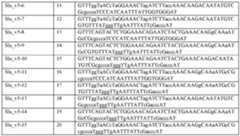


[0048] In some embodiments, the scaffold sequence is selected from any one of SEQ ID NOs: 4- 20 in 5’ to 3 orientation (see Table 1). In some embodiments, an exemplary sequence is a sequence that is at least 65%, 70%, 75%, 80%, 85%, 90%, 91%, 92%, 93%, 94%, 95%, 96%, 97%, 98%, 99% or 100% identical to any one off SEQ ID NOs: 4-20, or a sequence that differs from any one of SEQ ID NOs: 4-20 by no more than 1, 2, 3, 4, 5, 10, 15, 20, or 25 nucleotides.
[0049] In some embodiments, the scaffold sequence suitable for use with SluCas9 to follow the guide sequence at its 3’ end is selected from any one of SEQ ID NOs: 4-20 in 5’ to 3 orientation (see Table 1). In some embodiments, an exemplary sequence for use with SluCas9 to follow the 3’ end of the guide sequence is a sequence that is at least 65%, 70%, 75%, 80%, 85%, 90%, 91%, 92%, 93%, 94%, 95%, 96%, 97%, 98%, 99% or 100% identical to any one off SEQ ID NOs: 4-20, or a sequence that differs from any one of SEQ ID NOs: 4-20 by no more than 1, 2, 3, 4, 5, 10, 15, 20, or 25 nucleotides.
[0050] In some embodiments, the nucleic acid encoding the gRNA comprises a scaffold sequence comprising SEQ ID NO: 4. In some embodiments, the nucleic acid encoding the gRNA comprises a scaffold sequence comprising SEQ ID NO: 5. In some embodiments, the nucleic acid encoding the gRNA comprises a scaffold sequence comprising SEQ ID NO: 6. In some embodiments, the nucleic acid encoding the gRNA comprises a scaffold sequence comprising SEQ ID NO: 7. In some embodiments, the nucleic acid encoding the gRNA comprises a scaffold sequence comprising SEQ ID NO: 8. In some embodiments, the nucleic acid encoding the gRNA comprises a scaffold sequence comprising SEQ ID NO: 9. In some embodiments, the nucleic acid encoding the gRNA comprises a scaffold sequence comprising SEQ ID NO: 10. In some embodiments, the nucleic acid encoding the gRNA comprises a scaffold sequence comprising SEQ ID NO: 11. In some embodiments, the nucleic acid encoding the gRNA comprises a scaffold sequence comprising SEQ ID NO: 12. In some embodiments, the nucleic acid encoding the gRNA comprises a scaffold sequence comprising SEQ ID NO: 13. In some embodiments, the nucleic acid encoding the gRNA comprises a scaffold sequence comprising SEQ ID NO: 14. In some embodiments, the nucleic acid encoding the gRNA comprises a scaffold sequence comprising SEQ ID NO: 15. In some embodiments, the nucleic acid encoding the gRNA comprises a scaffold sequence comprising SEQ ID NO: 16. In some embodiments, the nucleic acid encoding the gRNA comprises a scaffold sequence comprising SEQ ID NO: 17. In some embodiments, the nucleic acid encoding the gRNA comprises a scaffold sequence comprising SEQ ID NO: 18. In some embodiments, the nucleic acid encoding the gRNA comprises a scaffold sequence comprising SEQ ID NO: 19. In some embodiments, the nucleic acid encoding the gRNA comprises a scaffold sequence comprising SEQ ID NO: 20.
[0051] In some embodiments, the scaffold sequence comprises one or more alterations in the stem loop 1 as compared to the stem loop 1 of a wildtype SluCas9 scaffold sequence (e.g., a scaffold comprising the sequence of SEQ ID NO: 2) or a reference SluCas9 scaffold sequence (e.g., a scaffold comprising the sequence of SEQ ID NO: 5). In some embodiments, the scaffold sequence comprises one or more alterations in the stem loop 2 as compared to the stem loop 2 of a wildtype SluCas9 scaffold sequence (e.g., a scaffold comprising the sequence of SEQ ID NO: 2) or a reference SluCas9 scaffold sequence (e.g., a scaffold comprising the sequence of SEQ ID NO: 5). In some embodiments, the scaffold sequence comprises one or more alterations in the tetraloop as compared to the tetraloop of a wildtype SluCas9 scaffold sequence (e.g., a scaffold comprising the sequence of SEQ ID NO: 2) or a reference SluCas9 scaffold sequence (e.g., a scaffold comprising the sequence of SEQ ID NO: 5). In some embodiments, the scaffold sequence comprises one or more alterations in the repeat region as compared to the repeat region of a wildtype SluCas9 scaffold sequence (e.g., a scaffold comprising the sequence of SEQ ID NO: 2) or a reference SluCas9 scaffold sequence (e.g., a scaffold comprising the sequence of SEQ ID NO: 5). In some embodiments, the scaffold sequence comprises one or more alterations in the anti-repeat region as compared to the anti-repeat region of a wildtype SluCas9 scaffold sequence (e.g., a scaffold comprising the sequence of SEQ ID NO: 2) or a reference SluCas9 scaffold sequence (e.g., a scaffold comprising the sequence of SEQ ID NO: 5). In some embodiments, the scaffold sequence comprises one or more alterations in the linker region as compared to the linker region of a wildtype SluCas9 scaffold sequence (e.g., a scaffold comprising the sequence of SEQ ID NO: 2) or a reference SluCas9 scaffold sequence (e.g., a scaffold comprising the sequence of SEQ ID NO: 5). See, e.g., Nishimasu et al., 2015, Cell, 162:1113-1126 for description of regions of a scaffold.
[0052] Where a tracrRNA is used, in some embodiments, it comprises (5’ to 3’) a second complementary domain and a proximal domain. In the case of a sgRNA, guide sequences together with additional nucleotides (e.g., SEQ ID Nos: 4-20) form or encode a sgRNA. In some embodiments, an sgRNA comprises (5’ to 3’) at least a spacer sequence, a first complementary domain, a linking domain, a second complementary domain, and a proximal domain. A sgRNA or tracrRNA may further comprise a tail domain. The linking domain may be hairpin-forming. See, e.g., US 2017/0007679 for detailed discussion and examples of crRNA and gRNA domains, including second complementarity domains, linking domains, proximal domains, and tail domains.
[0053] In general, in the case of a DNA nucleic acid constmct encoding a guide RNA, the U residues in any of the RNA sequences described herein may be replaced with T residues, and in the case of a guide RNA constmct encoded by a DNA, the T residues may be replaced with U residues.
[0054] In some embodiments, a composition is provided comprising a guide RNA, or nucleic acid encoding a guide RNA, wherein the guide RNA further comprises a scaffold sequence comprising a trRNA. In each composition and method embodiment described herein, the crRNA (comprising the spacer sequence) and trRNA may be associated as a single RNA (sgRNA) or may be on separate RNAs (dgRNA). In the context of sgRNAs, the crRNA and trRNA components may be covalently linked, e.g., via a phosphodiester bond or other covalent bond.
[0055] In any embodiment comprising a nucleic acid molecule encoding a guide RNA and/or a Cas9, the nucleic acid molecule may be a vector.
[0056] Any type of vector, such as any of those described herein, may be used. In some embodiments, the vector is a viral vector. In some embodiments, the viral vector is a non-integrating viral vector (i.e., that does not insert sequence from the vector into a host chromosome). In some embodiments, the viral vector is an adeno-associated vims vector (AAV), a lentiviral vector, an integrase-deficient lentiviral vector, an adenoviral vector, a vaccinia viral vector, an alphaviral vector, or a herpes simplex viral vector. In some embodiments, the vector comprises a muscle-specific promoter. Exemplary muscle-specific promoters include a muscle creatine kinase promoter, a desmin promoter, an MHCK7 promoter, or an SPc5-12 promoter. See US 2004/0175727 Al; Wang et al., Expert Opin Drug Deliv. (2014) 11, 345-364; Wanget al., Gene Therapy (2008) 15, 1489-1499, which are incorporated herein by reference in their entirety. In some embodiments, the muscle-specific promoter is a CK8 promoter. In some embodiments, the muscle-specific promoter is a CK8e promoter. In any of the foregoing embodiments, the vector may be an adeno-associated vims vector (AAV). [0057] In some embodiments, the muscle specific promoter is the CK8 promoter. The CK8 promoter has the following sequence (SEQ ID NO. 21):
1 CTAGACTAGC ATGCTGCCCA TGTAAGGAGG CAAGGCCTGG GGACACCCGA GATGCCTGGT
61 TATAATTAAC CCAGACATGT GGCTGCCCCC CCCCCCCCAA CACCTGCTGC CTCTAAAAAT
121 AACCCTGCAT GCCATGTTCC CGGCGAAGGG CCAGCTGTCC CCCGCCAGCT AGACTCAGCA
181 CTTAGTTTAG GAACCAGTGA GCAAGTCAGC CCTTGGGGCA GCCCATACAA GGCCATGGGG
241 CTGGGCAAGC TGCACGCCTG GGTCCGGGGT GGGCACGGTG CCCGGGCAAC GAGCTGAAAG
301 CTCATCTGCT CTCAGGGGCC CCTCCCTGGG GACAGCCCCT CCTGGCTAGT CACACCCTGT
361 AGGCTCCTCT ATATAACCCA GGGGCACAGG GGCTGCCCTC ATTCTACCAC CACCTCCACA
421 GCACAGACAG ACACTCAGGA GCCAGCCAGC
[0058] In some embodiments, the muscle-cell cell specific promoter is a variant of the CK8 promoter, called CK8e. The CK8e promoter has the following sequence (SEQ ID NO. 22):
1 TGCCCATGTA AGGAGGCAAG GCCTGGGGAC ACCCGAGATG CCTGGTTATA ATTAACCCAG
61 ACATGTGGCT GCCCCCCCCC CCCCAACACC TGCTGCCTCT AAAAATAACC CTGCATGCCA
121 TGTTCCCGGC GAAGGGCCAG CTGTCCCCCG CCAGCTAGAC TCAGCACTTA GTTTAGGAAC
181 CAGTGAGCAA GTCAGCCCTT GGGGCAGCCC ATACAAGGCC ATGGGGCTGG GCAAGCTGCA 241 CGCCTGGGTC CGGGGTGGGC ACGGTGCCCG GGCAACGAGC TGAAAGCTCA TCTGCTCTCA
301 GGGGCCCCTC CCTGGGGACA GCCCCTCCTG GCTAGTCACA CCCTGTAGGC TCCTCTATAT
361 AACCCAGGGG CACAGGGGCT GCCCTCATTC TACCACCACC TCCACAGCAC AGACAGACAC
421 TCAGGAGCCA GCCAGC
[0059] In some embodiments, the nucleic acid encoding the Cas9 protein is under the control of a CK8e promoter. In some embodiments, the vector is AAV9.
[0060] In some embodiments, the nucleic acid encoding SluCas9 encodes a SluCas9 comprising an amino acid sequence that is at least 80%, 85%, 90%, 91%, 92%, 93%, 94%, 95%, 96%, 97%, 98%, 99% or 100% identical to the sequence of SEQ ID NO: 1:
NQKFILGLDIGITSVGYGLIDYETKNIIDAGVRLFPEANVENNEGRRSKRGSRRLKRRRIHRLE
RVKKLLEDYNLLDQSQIPQSTNPYAIRVKGLSEALSKDELVIALLHIAKRRGIHKIDVIDSNDD
VGNELSTKEQLNKNSKLLKDKFVCQIQLERMNEGQVRGEKNRFKTADIIKEIIQLLNVQKNFH
QLDENFINKYIEL VEMRREYFEGPGKGSPY GWEGDPKAWYETLMGHCTYFPDELRS VKY AY
SADI .FNAI ,NDI ,NNΪ .VIQRDGI.SKI .F.YHF.K YH 11 F.N VFI<QI<I<I<PTI .KOI ANF.INVNPF.DIKGYRI
TKSGKPQFTEFKLYHDLKSVLFDQSILENEDVLDQIAEILTIYQDKDSIKSKLTELDILLNEEDK
ENIAQLTGYTGTHRLSLKCIRLVLEEQWYSSRNQMEIFTHLNIKPKKINLTAANKIPKAMIDEF
IL SP WKRTF GQ AINLINKIIEKY G VPEDIIIEL ARENN SKDKQKFINEMQKKNENTRKRINEIIG
KYGNQNAKRLVEKIRLHDEQEGKCLYSLESIPLEDLLNNPNHYEVDHIIPRSVSFDNSYHNKV
LVKQSENSKKSNLTPYQYFNSGKSKLSYNQFKQHILNLSKSQDRISKKKKEYLLEERDINKFE
VQKEFINRNLVDTRYATRELTNYLKAYFSANNMNVKVKTINGSFTDYLRKVWKFKKERNH
GYKHHAEDALIIANADFLFKENKKLKAVNSVLEKPEIETKQLDIQVDSEDNYSEMFIIPKQVQ
DIKDFRNFKYSHRVDKKPNRQLINDTLYSTRKKDNSTYIVQTIKDIYAKDNTTLKKQFDKSPE
KFLMY QHDPRTFEKLE VIMKQY ANEKNPL AKYFIEETGEYLTKY SKKNN CPI VKSLKYIGNK
LGSHLDVTHQFKSSTKKLVKLSIKPYRFDVYLTDKGYKFITISYLDVLKKDNYYYIPEQKYDK
LKLGKAIDKNAKFIASFYKNDLIKLDGEIYKIIGVNSDTRNMIELDLPDIRYKEYCELNNIKGEP
RIKKTIGKKVNSIEKLTTDVLGNVFTNTQYTKPQLLFKRGN.
[0061] In some embodiments, the SluCas9 is a variant of the amino acid sequence of SEQ ID NO: 1. A variant of SluCas9 comprises one or more amino acid changes as compared to SEQ ID NO: 1, including insertion, deletion, or substitution of one or more amino acids, or a chemical modification to one or more amino acids. In some embodiments, the SluCas9 comprises an amino acid other than an Q at the position corresponding to position 781 of SEQ ID NO: 1. In some embodiments, the SluCas9 comprises an amino acid other than an R at the position corresponding to position 1013 of SEQ ID NO: 1. In some embodiments, the SluCas9 comprises a K at the position corresponding to position 781 of SEQ ID NO: 1. In some embodiments, the SluCas9 comprises a K at the position corresponding to position 966 of SEQ ID NO: 1. In some embodiments, the SluCas9 comprises an H at the position corresponding to position 1013 of SEQ ID NO: 1. In some embodiments, the SluCas9 comprises an amino acid other than an Q at the position corresponding to position 781 of SEQ ID NO: 1; and an amino acid other than an R at the position corresponding to position 1013 of SEQ ID NO: 1. In some embodiments, the SluCas9 comprises a K at the position corresponding to position 781 of SEQ ID NO: 1; a K at the position corresponding to position 966 of SEQ ID NO: 1; and an H at the position corresponding to position 1013 of SEQ ID NO: 1.
[0062] In some embodiments, the SluCas9 comprises an amino acid other than an R at the position corresponding to position 246 of SEQ ID NO: 1. In some embodiments, the SluCas9 comprises an amino acid other than an N at the position corresponding to position 414 of SEQ ID NO: 1. In some embodiments, the SluCas9 comprises an amino acid other than a T at the position corresponding to position 420 of SEQ ID NO: 1. In some embodiments, the SluCas9 comprises an amino acid other than an R at the position corresponding to position 655 of SEQ ID NO: 1. In some embodiments, the SluCas9 comprises an amino acid other than an R at the position corresponding to position 246 of SEQ ID NO: 1; an amino acid other than an N at the position corresponding to position 414 of SEQ ID NO: 1; an amino acid other than a T at the position corresponding to position 420 of SEQ ID NO: 1; and an amino acid other than an R at the position corresponding to position 655 of SEQ ID NO: 1. In some embodiments, the SluCas9 comprises an A at the position corresponding to position 246 of SEQ ID NO: 1. In some embodiments, the SluCas9 comprises an A at the position corresponding to position 414 of SEQ ID NO: 1. In some embodiments, the SluCas9 comprises an A at the position corresponding to position 420 of SEQ ID NO: 1. In some embodiments, the SluCas9 comprises an A at the position corresponding to position 655 of SEQ ID NO: 1. In some embodiments, the SluCas9 comprises an A at the position corresponding to position 246 of SEQ ID NO: 1; an A at the position corresponding to position 414 of SEQ ID NO: 1; an A at the position corresponding to position 420 of SEQ ID NO: 1; and an A at the position corresponding to position 655 of SEQ ID NO: 1.
[0063] In some embodiments, the SluCas9 comprises an amino acid other than an R at the position corresponding to position 246 of SEQ ID NO: 1; an amino acid other than an N at the position corresponding to position 414 of SEQ ID NO: 1; an amino acid other than a T at the position corresponding to position 420 of SEQ ID NO: 1; an amino acid other than an R at the position corresponding to position 655 of SEQ ID NO: 1; an amino acid other than an Q at the position corresponding to position 781 of SEQ ID NO: 1; a K at the position corresponding to position 966 of SEQ ID NO: 1; and an amino acid other than an R at the position corresponding to position 1013 of SEQ ID NO: 1. In some embodiments, the SluCas9 comprises an A at the position corresponding to position 246 of SEQ ID NO: 1; an A at the position corresponding to position 414 of SEQ ID NO: 1; an A at the position corresponding to position 420 of SEQ ID NO: 1 ; an A at the position corresponding to position 655 of SEQ ID NO: 1; a K at the position corresponding to position 781 of SEQ ID NO: 1; a K at the position corresponding to position 966 of SEQ ID NO: 1; and an H at the position corresponding to position 1013 of SEQ ID NO: 1.
[0064] In some embodiments, the SluCas9 comprises an amino acid sequence that is at least 80%, 85%, 90%, 91%, 92%, 93%, 94%, 95%, 96%, 97%, 98%, 99% or 100% identical to the sequence of SEQ ID NO: 23 (designated herein as SluCas9-KH or SLUCAS9KH): NQKFILGLDIGITSVGYGLIDYETKNIIDAGVRLFPEANVENNEGRRSKRGSRRLKRRRIHRLE
RVKKLLEDYNLLDQSQIPQSTNPYAIRVKGLSEALSKDELVIALLHIAKRRGIHKIDVIDSNDD
VGNELSTKEQLNKNSKLLKDKFVCQIQLERMNEGQVRGEKNRFKTADIIKEIIQLLNVQKNFH
QLDENFINKYIEL VEMRREYFEGPGKGSPY GWEGDPKAWYETLMGHCT YFPDELRS VKY AY
SADLFNALNDLNNLVIQRDGLSKLEYHEKYHIIENVFKQKKKPTLKQIANEINVNPEDIKGYRI
TKSGKPQFTEFKLYHDLKSVLFDQSILENEDVLDQIAEILTIYQDKDSIKSKLTELDILLNEEDK
ENIAQLTGYTGTHRLSLKCIRLVLEEQWYSSRNQMEIFTHLNIKPKKINLTAANKIPKAMIDEF
IL SP WKRTF GQ AINLINKIIEKY G VPEDIIIEL ARENN SKDKQKFINEMQKKNENTRKRINEIIG
KYGNQNAKRLVEKIRLHDEQEGKCLYSLESIPLEDLLNNPNHYEVDHIIPRSVSFDNSYHNKV
LVKQSENSKKSNLTPYQYFNSGKSKLSYNQFKQHILNLSKSQDRISKKKKEYLLEERDINKFE
VQKEFINRNLVDTRYATRELTNYLKAYFSANNMNVKVKTINGSFTDYLRKVWKFKKERNH
GYKHHAEDALIIANADFLFKENKKLKAVNSVLEKPEIETKQLDIQVDSEDNYSEMFIIPKQVQ
DIKDFRNFKYSHRVDKKPNRKLINDTLY STRKKDN STYIVQTIKDIYAKDNTTLKKQFDKSPE
KFLMYQHDPRTFEKLEVIMKQYANEKNPLAKYHEETGEYLTKYSKKNNGPIVKSLKYIGNK
LGSHLDVTHQFKSSTKKLVKLSIKPYRFDVYLTDKGYKFITISYLDVLKKDNYYYIPEQKYDK
LKLGKAIDKNAKFIASFYKNDLIKLDGEIYKIIGVNSDTRNMIELDLPDIRYKEYCELNNIKGEP
HIKKTIGKKVNSIEKLTTDVLGNVFTNTQYTKPQLLFKRGN.
[0065] In some embodiments, the SluCas9 comprises an amino acid sequence that is at least 80%, 85%, 90%, 91%, 92%, 93%, 94%, 95%, 96%, 97%, 98%, 99% or 100% identical to the sequence of SEQ ID NO: 24 (designated herein as SluCas9-HF):
NQKFILGLDIGITSVGYGLIDYETKNIIDAGVRLFPEANVENNEGRRSKRGSRRLKRRRIHRLE
RVKKLLEDYNLLDQSQIPQSTNPYAIRVKGLSEALSKDELVIALLHIAKRRGIHKIDVIDSNDD
VGNELSTKEQLNKNSKLLKDKFVCQIQLERMNEGQVRGEKNRFKTADIIKEIIQLLNVQKNFH
QLDENFINKYIEL VEMRREYFEGPGKGSPY GWEGDPKAWYETLMGHCT YFPDEL AS VKY AY
SADI ,FNA1.NO I ,NNΪ .VIQRDGI.SKI EYHEK YHTTENVFKOKKKPTl .KOI ANF.INVNPF.DIKGYRI
TKSGKPQFTEFKLYHDLKSVLFDQSILENEDVLDQIAEILTIYQDKDSIKSKLTELDILLNEEDK
ENIAQLTGYTGTHRLSLKCIRLVLEEQWYSSRAQMEIFAHLNIKPKKINLTAANKIPKAMIDEF
IL SP WKRTF GQ AINLINKIIEKY G VPEDIIIEL ARENN SKDKQKFINEMQKKNENTRKRINEIIG
KYGNQNAKRLVEKIRLHDEQEGKCLYSLESIPLEDLLNNPNHYEVDHIIPRSVSFDNSYHNKV
LVKQSENSKKSNLTPYQYFNSGKSKLSYNQFKQHILNLSKSQDRISKKKKEYLLEERDINKFE
VQKEFINRNLVDTRYATAELTNYLKAYFSANNMNVKVKTINGSFTDYLRKVWKFKKERNH
GYKHHAEDALIIANADFLFKENKKLKAVNSVLEKPEIETKQLDIQVDSEDNYSEMFIIPKQVQ
DIKDFRNFKYSHRVDKKPNRQLINDTLYSTRKKDNSTYIVQTIKDIYAKDNTTLKKQFDKSPE
KFLMYQHDPRTFEKLEVIMKQYANEKNPLAKYHEETGEYLTKYSKKNNGPIVKSLKYIGNK
LGSHLDVTHQFKSSTKKLVKLSIKPYRFDVYLTDKGYKFITISYLDVLKKDNYYYIPEQKYDK
LKLGKAIDKNAKFIASFYKNDLIKLDGEIYKIIGVNSDTRNMIELDLPDIRYKEYCELNNIKGEP
RIKKTIGKKVNSIEKLTTDVLGNVFTNTQYTKPQLLFKRGN. [0066] In some embodiments, the SluCas9 comprises an amino acid sequence that is at least 80%, 85%, 90%, 91%, 92%, 93%, 94%, 95%, 96%, 97%, 98%, 99% or 100% identical to the sequence of SEQ ID NO: 25 (designated herein as SluCas9-HF-KH):
NQKFILGLDIGITSVGYGLIDYETKNIIDAGVRLFPEANVENNEGRRSKRGSRRLKRRRIHRLE
RVKKLLEDYNLLDQSQIPQSTNPYAIRVKGLSEALSKDELVIALLHIAKRRGIHKIDVIDSNDD
VGNELSTKEQLNKNSKLLKDKFVCQIQLERMNEGQVRGEKNRFKTADIIKEIIQLLNVQKNFH
QLDENFINKYIEL VEMRREYFEGPGKGSPY GWEGDPKAWYETLMGHCT YFPDEL AS VKY AY
SADI .FNAI ,NDI ,NNT .VIQRDGI .SKI .F.YHF.K YH 11 F.N VFI<QI<I<I<PTI .KOI ANF.INVNPF.DIKGYRI
TKSGKPQFTEFKLYHDLKSVLFDQSILENEDVLDQIAEILTIYQDKDSIKSKLTELDILLNEEDK
ENIAQLTGYTGTHRLSLKCIRLVLEEQWYSSRAQMEIFAHLNIKPKKINLTAANKIPKAMIDEF
IL SP WKRTF GQ AINLINKIIEKY G VPEDIIIEL ARENN SKDKQKFINEMQKKNENTRKRINEIIG
KYGNQNAKRLVEKIRLHDEQEGKCLYSLESIPLEDLLNNPNHYEVDHIIPRSVSFDNSYHNKV
LVKQSENSKKSNLTPYQYFNSGKSKLSYNQFKQHILNLSKSQDRISKKKKEYLLEERDINKFE
VQKEFINRNLVDTRYATAELTNYLKAYFSANNMNVKVKTINGSFTDYLRKVWKFKKERNH
GYKHHAEDALIIANADFLFKENKKLKAVNSVLEKPEIETKQLDIQVDSEDNYSEMFIIPKQVQ
DIKDFRNFKYSHRVDKKPNRKLINDTLYSTRKKDNSTYIVQTIKDIYAKDNTTLKKQFDKSPE
KFLMYQHDPRTFEKLEVIMKQYANEKNPLAKYHEETGEYLTKYSKKNNGPIVKSLKYIGNK
LGSHLDVTHQFKSSTKKLVKLSIKPYRFDVYLTDKGYKFITISYLDVLKKDNYYYIPEQKYDK
LKLGKAIDKNAKFIASFYKNDLIKLDGEIYKIIGVNSDTRNMIELDLPDIRYKEYCELNNIKGEP
HIKKTIGKKVNSIEKLTTDVLGNVFTNTQYTKPQLLFKRGN.
Modified guide RNAs
[0067] In some embodiments, any of the guide RNA or scaffold sequences disclosed herein is chemically modified. A guide RNA or scaffold sequence comprising one or more modified nucleosides or nucleotides is called a “modified” or “chemically modified” guide RNA or scaffold sequence, to describe the presence of one or more non-naturally and/or naturally occurring components or configurations that are used instead of or in addition to the canonical A, G, C, and U residues. In some embodiments, a modified guide RNA or scaffold sequence is synthesized with a non-canonical nucleoside or nucleotide, is here called “modified.” Modified nucleosides and nucleotides can include one or more of: (i) alteration, e.g., replacement, of one or both of the non-linking phosphate oxygens and/or of one or more of the linking phosphate oxygens in the phosphodiester backbone linkage (an exemplary backbone modification); (ii) alteration, e.g., replacement, of a constituent of the ribose sugar, e.g., of the 2' hydroxyl on the ribose sugar (an exemplary sugar modification); (iii) wholesale replacement of the phosphate moiety with “dephospho” linkers (an exemplary backbone modification); (iv) modification or replacement of a naturally occurring nucleobase, including with a non-canonical nucleobase (an exemplary base modification); (v) replacement or modification of the ribose-phosphate backbone (an exemplary backbone modification); (vi) modification of the 3' end or 5' end of the oligonucleotide, e.g., removal, modification or replacement of a terminal phosphate group or conjugation of a moiety, cap or linker (such 3' or 5' cap modifications may comprise a sugar and/or backbone modification); and (vii) modification or replacement of the sugar (an exemplary sugar modification).
[0068] Chemical modifications such as those listed above can be combined to provide modified guide RNAs or scaffold sequences comprising nucleosides and nucleotides (collectively “residues”) that can have two, three, four, or more modifications. For example, a modified residue can have a modified sugar and a modified nucleobase, or a modified sugar and a modified phosphodiester. In some embodiments, every base of a guide RNA or scaffold sequence is modified, e.g., all bases have a modified phosphate group, such as a phosphorothioate group. In certain embodiments, all, or substantially all, of the phosphate groups of a guide RNA molecule or scaffold sequence are replaced with phosphorothioate groups. In some embodiments, modified guide RNAs or scaffold sequences comprise at least one modified residue at or near the 5' end of the RNA or scaffold sequence. In some embodiments, modified guide RNAs comprise at least one modified residue at or near the 3' end of the RNA or scaffold sequence.
[0069] In some embodiments, the guide RNA or scaffold sequence comprises one, two, three or more modified residues. In some embodiments, at least 5% (e.g. , at least 5%, at least 10%, at least 15%, at least 20%, at least 25%, at least 30%, at least 35%, at least 40%, at least 45%, at least 50%, at least 55%, at least 60%, at least 65%, at least 70%, at least 75%, at least 80%, at least 85%, at least 90%, at least 95%, or 100%) of the positions in a modified guide RNA or scaffold sequence are modified nucleosides or nucleotides.
[0070] Unmodified nucleic acids can be prone to degradation by, e.g., intracellular nucleases or those found in serum. For example, nucleases can hydrolyze nucleic acid phosphodiester bonds. Accordingly, in one aspect the guide RNAs or scaffold sequences described herein can contain one or more modified nucleosides or nucleotides, e.g., to introduce stability toward intracellular or serum- based nucleases. In some embodiments, the modified guide RNA molecules or scaffold sequences described herein can exhibit a reduced innate immune response when introduced into a population of cells, both in vivo and ex vivo. The term “innate immune response” includes a cellular response to exogenous nucleic acids, including single stranded nucleic acids, which involves the induction of cytokine expression and release, particularly the interferons, and cell death.
[0071] In some embodiments of a backbone modification, the phosphate group of a modified residue can be modified by replacing one or more of the oxygens with a different substituent. Further, the modified residue, e.g., modified residue present in a modified nucleic acid, can include the wholesale replacement of an unmodified phosphate moiety with a modified phosphate group as described herein. In some embodiments, the backbone modification of the phosphate backbone can include alterations that result in either an uncharged linker or a charged linker with unsymmetrical charge distribution.
[0072] Examples of modified phosphate groups include, phosphorothioate, phosphoroselenates, borano phosphates, borano phosphate esters, hydrogen phosphonates, phosphoroamidates, alkyl or aryl phosphonates and phosphotriesters. The phosphorous atom in an unmodified phosphate group is achiral. However, replacement of one of the non-bridging oxygens with one of the above atoms or groups of atoms can render the phosphorous atom chiral. The stereogenic phosphorous atom can possess either the “R” configuration (herein Rp) or the “S” configuration (herein Sp). The backbone can also be modified by replacement of a bridging oxygen, (/.<?.. the oxygen that links the phosphate to the nucleoside), with nitrogen (bridged phosphoroamidates), sulfur (bridged phosphorothioates) and carbon (bridged methylenephosphonates). The replacement can occur at either linking oxygen or at both of the linking oxygens.
[0073] The phosphate group can be replaced by non-phosphorus containing connectors in certain backbone modifications. In some embodiments, the charged phosphate group can be replaced by a neutral moiety. Examples of moieties which can replace the phosphate group can include, without limitation, e.g. , methyl phosphonate, hydroxylamino, siloxane, carbonate, carboxymethyl, carbamate, amide, thioether, ethylene oxide linker, sulfonate, sulfonamide, thioformacetal, formacetal, oxime, methyleneimino, methylenemethylimino, methylenehydrazo, methylenedimethylhydrazo and methy leneoxy methy limino .
[0074] Scaffolds that can mimic nucleic acids can also be constructed wherein the phosphate linker and ribose sugar are replaced by nuclease resistant nucleoside or nucleotide surrogates. Such modifications may comprise backbone and sugar modifications. In some embodiments, the nucleobases can be tethered by a surrogate backbone. Examples can include, without limitation, the morpholino, cyclobutyl, pyrrolidine and peptide nucleic acid (PNA) nucleoside surrogates.
[0075] The modified nucleosides and modified nucleotides can include one or more modifications to the sugar group, i.e. at sugar modification. For example, the 2' hydroxyl group (OH) can be modified, e.g. replaced with a number of different “oxy” or “deoxy” substituents. In some embodiments, modifications to the 2' hydroxyl group can enhance the stability of the nucleic acid since the hydroxyl can no longer be deprotonated to form a 2'-alkoxide ion.
[0076] Examples of 2' hydroxyl group modifications can include alkoxy or aryloxy (OR, wherein “R” can be, e.g., alkyl, cycloalkyl, aryl, aralkyl, heteroaryl or a sugar); polyethyleneglycols (PEG), 0(CH2CH20)nCH2CH20R wherein R can be, e.g. , H or optionally substituted alkyl, and n can be an integer from 0 to 20 (e.g. , from 0 to 4, from 0 to 8, from 0 to 10, from 0 to 16, from 1 to 4, from 1 to 8, from 1 to 10, from 1 to 16, from 1 to 20, from 2 to 4, from 2 to 8, from 2 to 10, from 2 to 16, from 2 to 20, from 4 to 8, from 4 to 10, from 4 to 16, and from 4 to 20). In some embodiments, the 2' hydroxyl group modification can be 2'-0-Me. In some embodiments, the 2' hydroxyl group modification can be a 2'-fluoro modification, which replaces the 2' hydroxyl group with a fluoride. In some embodiments, the 2' hydroxyl group modification can include “locked” nucleic acids (LNA) in which the 2' hydroxyl can be connected, e.g., by a Ci-e alkylene or Ci-e heteroalky lene bridge, to the 4' carbon of the same ribose sugar, where exemplary bridges can include methylene, propylene, ether, or amino bridges; O- amino (wherein amino can be, e.g., N¾; alkylamino, dialkylamino, heterocyclyl, arylamino, diary lamino, heteroarylamino, or diheteroarylamino, ethylenediamine, or polyamino) andaminoalkoxy, 0(CH2)n-amino, (wherein amino can be, e.g., N¾; alkylamino, dialkylamino, heterocyclyl, arylamino, diarylamino, heteroarylamino, or diheteroarylamino, ethylenediamine, or polyamino). In some embodiments, the 2' hydroxyl group modification can include "unlocked" nucleic acids (UNA) in which the ribose ring lacks the C2'-C3' bond. In some embodiments, the 2' hydroxyl group modification can include the methoxyethyl group (MOE), (OCH2CH2OCH3, e.g., a PEG derivative).
[0077] “Deoxy” 2' modifications can include hydrogen ( i.e . deoxyribose sugars, e.g., at the overhang portions of partially dsRNA); halo (e.g., bromo, chloro, fluoro, or iodo); amino (wherein amino can be, e.g., NEh; alkylamino, dialkylamino, heterocyclyl, arylamino, diarylamino, heteroarylamino, diheteroarylamino, or amino acid); NH(CH2CH2NH)nCH2CH2- amino (wherein amino can be, e.g. , as described herein), -NHC(0)R (wherein R can be, e.g. , alkyl, cycloalkyl, aryl, aralkyl, heteroaryl or sugar), cyano; mercapto; alkyl-thio-alkyl; thioalkoxy; and alkyl, cycloalkyl, aryl, alkenyl and alkynyl, which may be optionally substituted with e.g. , an amino as described herein. [0078] The sugar modification can comprise a sugar group which may also contain one or more carbons that possess the opposite stereochemical configuration than that of the corresponding carbon in ribose. Thus, a modified nucleic acid can include nucleotides containing e.g., arabinose, as the sugar. The modified nucleic acids can also include abasic sugars. These abasic sugars can also be further modified at one or more of the constituent sugar atoms. The modified nucleic acids can also include one or more sugars that are in the L form, e.g. L- nucleosides.
[0079] The modified nucleosides and modified nucleotides described herein, which can be incorporated into a modified nucleic acid, can include a modified base, also called a nucleobase. Examples of nucleobases include, but are not limited to, adenine (A), guanine (G), cytosine (C), and uracil (U). These nucleobases can be modified or wholly replaced to provide modified residues that can be incorporated into modified nucleic acids. The nucleobase of the nucleotide can be independently selected from a purine, a pyrimidine, a purine analog, or pyrimidine analog. In some embodiments, the nucleobase can include, for example, naturally -occurring and synthetic derivatives of a base.
[0080] In embodiments employing a dual guide RNA, each of the crRNA and the tracr RNA can contain modifications. Such modifications may be at one or both ends of the crRNA and/or tracr RNA. In embodiments comprising sgRNA, one or more residues at one or both ends of the sgRNA may be chemically modified, and/or internal nucleosides may be modified, and/or the entire sgRNA may be chemically modified. Certain embodiments comprise a 5' end modification. Certain embodiments comprise a 3' end modification.
[0081] Modifications of 2’ -O-methyl are encompassed.
[0082] Another chemical modification that has been shown to influence nucleotide sugar rings is halogen substitution. For example, 2’-fluoro (2’-F) substitution on nucleotide sugar rings can increase oligonucleotide binding affinity and nuclease stability. Modifications of 2’-fluoro (2’-F) are encompassed.
[0083] Phosphorothioate (PS) linkage or bond refers to a bond where a sulfur is substituted for one nonbridging phosphate oxygen in a phosphodiester linkage, for example in the bonds between nucleotides bases. When phosphorothioates are used to generate oligonucleotides, the modified oligonucleotides may also be referred to as S-oligos.
[0084] Abasic nucleotides refer to those which lack nitrogenous bases.
[0085] Inverted bases refer to those with linkages that are inverted from the normal 5 ’ to 3 ’ linkage
(i.e., either a 5’ to 5’ linkage or a 3’ to 3’ linkage).
[0086] An abasic nucleotide can be attached with an inverted linkage. For example, an abasic nucleotide may be attached to the terminal 5’ nucleotide via a 5’ to 5’ linkage, or an abasic nucleotide may be attached to the terminal 3’ nucleotide via a 3’ to 3’ linkage. An inverted abasic nucleotide at either the terminal 5’ or 3 ’ nucleotide may also be called an inverted abasic end cap.
[0087] In some embodiments, one or more of the first three, four, or five nucleotides at the 5' terminus, and one or more of the last three, four, or five nucleotides at the 3' terminus are modified. In some embodiments, the modification is a 2’-0-Me, 2’-F, inverted abasic nucleotide, PS bond, or other nucleotide modification well known in the art to increase stability and/or performance.
[0088] In some embodiments, the first four nucleotides at the 5' terminus, and the last four nucleotides at the 3' terminus are linked with phosphorothioate (PS) bonds.
[0089] In some embodiments, the first three nucleotides at the 5' terminus, and the last three nucleotides at the 3' terminus comprise a 2'-0-methyl (2'-0-Me) modified nucleotide. In some embodiments, the first three nucleotides at the 5' terminus, and the last three nucleotides at the 3' terminus comprise a 2'-fluoro (2'-F) modified nucleotide.
Ribonucleoprotein complex
[0090] In some embodiments, a composition is encompassed comprising: a) one or more guide RNAs comprising a scaffold sequence comprising any one of SEQ ID NOs: 4-20 and b) SluCas9, or any of the variant Cas9 proteins disclosed herein. In some embodiments, the guide RNA together with a Cas9 is called a ribonucleoprotein complex (RNP). [0091] In some embodiments, chimeric Cas9 (SluCas9) nucleases are used, where one domain or region of the protein is replaced by a portion of a different protein. In some embodiments, a Cas9 nuclease domain may be replaced with a domain from a different nuclease such as Fokl. In some embodiments, a Cas9 nuclease may be a modified nuclease.
[0092] In some embodiments, the Cas9 is modified to contain only one functional nuclease domain. For example, the agent protein may be modified such that one of the nuclease domains is mutated or fully or partially deleted to reduce its nucleic acid cleavage activity.
[0093] In some embodiments, a conserved amino acid within a Cas9 protein nuclease domain is substituted to reduce or alter nuclease activity. In some embodiments, a Cas9 nuclease may comprise an amino acid substitution in the RuvC or RuvC-like nuclease domain. Exemplary amino acid substitutions in the RuvC or RuvC-like nuclease domain include D 10A (based on the S. pyogenes Cas9 protein). See, e.g., Zetsche et al. (2015) Cell Oct 22:163(3): 759-771. In some embodiments, the Cas9 nuclease may comprise an amino acid substitution in the HNH or HNH-like nuclease domain. Exemplary amino acid substitutions in the HNH or HNH-like nuclease domain include E762A, H840A, N863A, H983 A, and D986A (based on the S. pyogenes Cas9 protein). See, e.g., Zetsche et al. (2015). Further exemplary amino acid substitutions include D917A, E1006A, and D1255A (based on the Francisella novicida U112 Cpfl (FnCpfl) sequence (UniProtKB - A0Q7Q2 (CPF1 FRATN)). Further exemplary amino acid substitutions include D10A and N580A (based on the S. aureus Cas9 protein). See, e.g., Friedland et al., 2015, Genome Biol., 16:257. Corresponding substitutions to any of those preceding substitutions may be made to the SluCas9 protein.
[0094] In some embodiments, the Cas9 lacks cleavase activity. In some embodiments, the Cas9 comprises a dCas DNA-binding polypeptide. A dCas polypeptide has DNA-binding activity while essentially lacking catalytic (cleavase/nickase) activity. In some embodiments, the dCas polypeptide is a dCas9 polypeptide. In some embodiments, the Cas9 lacking cleavase activity or the dCas DNA- binding polypeptide is a version of a Cas nuclease (e.g., a Cas9 nuclease discussed above) in which its endonucleolytic active sites are inactivated, e.g., by one or more alterations (e.g., point mutations) in its catalytic domains. See, e.g., US 2014/0186958 Al; US 2015/0166980 Al which are incorporated herein by reference in their entirety.
[0095] In some embodiments, the Cas9 comprises one or more heterologous functional domains (e.g., is or comprises a fusion polypeptide).
[0096] In some embodiments, the heterologous functional domain may facilitate transport of the Cas9 into the nucleus of a cell. For example, the heterologous functional domain may be a nuclear localization signal (NLS). In some embodiments, the Cas9 may be fused with 1-10 NLS(s). In some embodiments, the Cas9 may be fused with 1-5 NLS(s). In some embodiments, the Cas9 may be fused with one NLS. Where one NLS is used, the NLS may be attached at the N-terminus or the C-terminus of the Cas9 sequence and may be directly attached or attached via a linker. It may also be inserted within the Cas9 sequence. In other embodiments, the Cas9 may be fused with more than one NLS. In some embodiments, the Cas9 may be fused with 2, 3, 4, or 5 NLSs. In some embodiments, the Cas9 may be fused with two NLSs. In certain circumstances, the two NLSs may be the same (e.g. , two SV40 NLSs) or different. In some embodiments, the Cas9 protein is fused with an SV40 NLS. In some embodiments, the SV40 NLS comprises the amino acid sequence of SEQ ID NO: 26 (PKKKRKV). In some embodiments, the Cas9 protein (e.g., the SluCas9 protein) is fused to a nucleoplasmin NLS. In some embodiments, the nucleoplasmin NLS comprises the amino acid sequence of SEQ ID NO: 27 (KRPAATKKAGQAKKKK). In some embodiments, the Cas9 is fused to two SV40 NLS sequences linked at the carboxy terminus. In some embodiments, the Cas9 may be fused with two NLSs, one linked at the N-terminus and one at the C-terminus. In some embodiments, the Cas9 may be fused with 3 NLSs. In some embodiments, the Cas9 may be fused with no NLS. In some embodiments, the Cas9 protein is fused to an SV40 NLS and to a nucleoplasmin NLS. In some embodiments, the SV40 NLS is fused to the C-terminus of the Cas9, while the nucleoplasmin NLS is fused to the N-terminus of the Cas9 protein. In some embodiments, the SV40 NLS is fused to the N-terminus of the Cas9, while the nucleoplasmin NLS is fused to the C-terminus of the Cas9 protein. In some embodiments, the SV40 NLS is fused to the Cas9 protein by means of a linker. In some embodiments, the nucleoplasmin NLS is fused to the Cas9 protein by means of a linker.
[0097] In some embodiments, the heterologous functional domain may be capable of modifying the intracellular half-life of the Cas9. In some embodiments, the half-life of the Cas9 may be increased. In some embodiments, the half-life of the Cas9 may be reduced. In some embodiments, the heterologous functional domain may be capable of increasing the stability of the Cas9. In some embodiments, the heterologous functional domain may be capable of reducing the stability of the Cas9. In some embodiments, the heterologous functional domain may act as a signal peptide for protein degradation. In some embodiments, the protein degradation may be mediated by proteolytic enzymes, such as, for example, proteasomes, lysosomal proteases, or calpain proteases. In some embodiments, the heterologous functional domain may comprise a PEST sequence. In some embodiments, the Cas9 may be modified by addition of ubiquitin or a polyubiquitin chain. In some embodiments, the ubiquitin may be a ubiquitin-like protein (UBL). Non-limiting examples of ubiquitin-like proteins include small ubiquitin-like modifier (SUMO), ubiquitin cross-reactive protein (UCRP, also known as interferon- stimulated gene-15 (ISG15)), ubiquitin-related modifier-1 (URM1), neuronal-precursor-cell-expressed developmentally downregulated protein-8 (NEDD8, also called Rubl in S. cerevisiae), human leukocyte antigen F-associated (FAT10), autophagy-8 (ATG8) and -12 (ATG12), Fau ubiquitin-like protein (FUB1), membrane-anchored UBL (MUB), ubiquitin fold-modifier- 1 (UFM1), and ubiquitin- like protein-5 (UBL5).
[0098] In some embodiments, the heterologous functional domain may be a marker domain. Nonlimiting examples of marker domains include fluorescent proteins, purification tags, epitope tags, and reporter gene sequences. In some embodiments, the marker domain may be a fluorescent protein. Nonlimiting examples of suitable fluorescent proteins include green fluorescent proteins (e.g. , GFP, GFP- 2, tagGFP, turboGFP, sfGFP, EGFP, Emerald, Azami Green, Monomeric Azami Green, CopGFP, AceGFP, ZsGreenl), yellow fluorescent proteins (e.g., YFP, EYFP, Citrine, Venus, YPet, PhiYFP, ZsYellowl), blue fluorescent proteins (e.g., EBFP, EBFP2, Azurite, mKalamal, GFPuv, Sapphire, T- sapphire,), cyan fluorescent proteins (e.g., ECFP, Cerulean, CyPet, AmCyanl, Midoriishi-Cyan), red fluorescent proteins (e.g., mKate, mKate2, mPlum, DsRed monomer, mCherry, mRFPl, DsRed- Express, DsRed2, DsRed-Monomer, HcRed-Tandem, HcRedl, AsRed2, eqFP611, mRasberry, mStrawberry, Jred), and orange fluorescent proteins (mOrange, mKO, Kusabira-Orange, Monomeric Kusabira-Orange, mTangerine, tdTomato) or any other suitable fluorescent protein. In other embodiments, the marker domain may be a purification tag and/or an epitope tag. Non-limiting exemplary tags include glutathione-S-transferase (GST), chitin binding protein (CBP), maltose binding protein (MBP), thioredoxin (TRX), poly(NANP), tandem affinity purification (TAP) tag, myc, AcV5, AU1, AU5, E, ECS, E2, FLAG, HA, nus, Softag 1, Softag 3, Strep, SBP, Glu-Glu, HSV, KT3, S, St, T7, V5, VSV-G, 6xHis, 8xHis, biotin carboxyl carrier protein (BCCP), poly -His, and calmodulin. Nonlimiting exemplary reporter genes include glutathione-S-transferase (GST), horseradish peroxidase (HRP), chloramphenicol acetyltransferase (CAT), beta-galactosidase, beta-glucuronidase, luciferase, or fluorescent proteins.
[0099] In additional embodiments, the heterologous functional domain may target the Cas9 to a specific organelle, cell type, tissue, or organ. In some embodiments, the heterologous functional domain may target the Cas9 to muscle.
[00100] In further embodiments, the heterologous functional domain may be an effector domain. When the Cas9 is directed to its target sequence, e.g., when a Cas9 is directed to a target sequence by a guide RNA, the effector domain may modify or affect the target sequence. In some embodiments, the effector domain may be chosen from a nucleic acid binding domain or a nuclease domain (e.g., a non- Cas nuclease domain). In some embodiments, the heterologous functional domain is a nuclease, such as a Fokl nuclease. See, e.g., US Pat. No. 9,023,649, which is incorporated by reference herein in its entirety.
III. Methods of Gene Editing
[00101] The disclosure provides methods for gene editing. In some embodiments, any of the compositions described herein may be administered to a subject in need thereof. In some embodiments, the composition is administered for the purpose of making a double strand break in a target sequence. [00102] In some embodiments, a method of gene editing is provided, the method comprising delivering to a cell any one or more of the compositions described herein.
[00103] In some embodiments, a method of gene editing is provided, the method comprising delivering to a cell a composition comprising: (a) a guide RNA comprising in 5’ to 3’ direction: (i) a nucleic acid encoding a guide sequence; and (ii) a nucleic acid encoding a sequence selected from any one of SEQ ID NOs: 4-20; and (b) a nucleic acid encoding a Staphylococcus lugdunensis Cas9 (SluCas9); thereby producing a gene edit in the cell. In some embodiments, the nucleic acid encoding Slu Cas9 comprises the amino acid sequence of SEQ ID NO: 1. In some embodiments, the nucleic acid encoding Slu Cas9 is a variant of the amino acid sequence of SEQ ID NO: 1. In some embodiments, the nucleic acid encoding Slu Cas9 comprises an amino acid sequence selected from any one of SEQ ID NOs: 23-25. In some embodiments, the nucleic acid encoding the gRNA comprises a scaffold sequence comprising SEQ ID NO: 4. In some embodiments, the nucleic acid encoding the gRNA comprises a scaffold sequence comprising SEQ ID NO: 5. In some embodiments, the nucleic acid encoding the gRNA comprises a scaffold sequence comprising SEQ ID NO: 6. In some embodiments, the nucleic acid encoding the gRNA comprises a scaffold sequence comprising SEQ ID NO: 7. In some embodiments, the nucleic acid encoding the gRNA comprises a scaffold sequence comprising SEQ ID NO: 8. In some embodiments, the nucleic acid encoding the gRNA comprises a scaffold sequence comprising SEQ ID NO: 9. In some embodiments, the nucleic acid encoding the gRNA comprises a scaffold sequence comprising SEQ ID NO: 10. In some embodiments, the nucleic acid encoding the gRNA comprises a scaffold sequence comprising SEQ ID NO: 11. In some embodiments, the nucleic acid encoding the gRNA comprises a scaffold sequence comprising SEQ ID NO: 12. In some embodiments, the nucleic acid encoding the gRNA comprises a scaffold sequence comprising SEQ ID NO: 13. In some embodiments, the nucleic acid encoding the gRNA comprises a scaffold sequence comprising SEQ ID NO: 14. In some embodiments, the nucleic acid encoding the gRNA comprises a scaffold sequence comprising SEQ ID NO: 15. In some embodiments, the nucleic acid encoding the gRNA comprises a scaffold sequence comprising SEQ ID NO: 16. In some embodiments, the nucleic acid encoding the gRNA comprises a scaffold sequence comprising SEQ ID NO: 17. In some embodiments, the nucleic acid encoding the gRNA comprises a scaffold sequence comprising SEQ ID NO: 18. In some embodiments, the nucleic acid encoding the gRNA comprises a scaffold sequence comprising SEQ ID NO: 19. In some embodiments, the nucleic acid encoding the gRNA comprises a scaffold sequence comprising SEQ ID NO: 20.
[00104] An “edit”, such as a “gene edit”, as used herein refers to any insertion, deletion, or substitution in the target sequence. A gene edit includes various types of indels, e.g., indels disclosed herein.
IV. Delivery of Guide RNA Compositions
[00105] The methods and uses disclosed herein may use any suitable approach for delivering the guide RNAs and compositions described herein. Exemplary delivery approaches include vectors, such as viral vectors; lipid nanoparticles; transfection; and electroporation. In some embodiments, vectors or LNPs associated with the single-vector guide RNAs/Cas9’s disclosed herein are for use in preparing a medicament for treating DM1.
[00106] Where a vector is used, it may be a viral vector, such as a non-integrating viral vector. In some embodiments, the viral vector is an adeno-associated vims vector, a lentiviral vector, an integrase- deficient lentiviral vector, an adenoviral vector, a vaccinia viral vector, an alphaviral vector, or a herpes simplex viral vector. In some embodiments, the viral vector is an adeno-associated vims (AAV) vector. In some embodiments, the AAV vector is an AAV1, AAV2, AAV3, AAV4, AAV5, AAV6, AAV7, AAV8, AAVrhlO (see, e.g., SEQ ID NO: 81 of US 9,790,472, whichis incorporated by reference herein in its entirety), AAVrh74 (see, e.g., SEQ ID NO: 1 of US 2015/0111955, which is incorporated by reference herein in its entirety), or AAV9 vector, wherein the number following AAV indicates the AAV serotype. Any variant of an AAV vector or serotype thereof, such as a self-complementary AAV (scAAV) vector, is encompassed within the general terms AAV vector, AAV1 vector, etc. See, e.g., McCarty et al., Gene Ther. 2001;8:1248-54, Naso et al, BioDrugs 2017; 31:317-334, and references cited therein for detailed discussion of various AAV vectors.
[00107] In some embodiments, the vector (e.g., viral vector, such as an adeno-associated viral vector) comprises a tissue-specific (e.g., muscle-specific) promoter, e.g., whichis operatively linked to a sequence encoding the guide RNA. In some embodiments, the muscle-specific promoter is a muscle creatine kinase promoter, a desmin promoter, an MHCK7 promoter, or an SPc5-12 promoter. In some embodiments, the muscle-specific promoter is a CK8 promoter. In some embodiments, the muscle- specific promoter is a CK8e promoter. Muscle-specific promoters are described in detail, e.g., in US2004/0175727 Al; Wang et al., Expert Opin Drug Deliv. (2014) 11, 345-364; Wang et al., Gene Therapy (2008) 15, 1489-1499. In some embodiments, the tissue-specific promoter is a neuron-specific promoter, such as anenolase promoter. See, e.g., Naso et al., BioDrugs 2017; 31:317-334; Dashkoff et al., Mol Ther Methods Clin Dev. 2016;3: 16081, and references cited therein for detailed discussion of tissue-specific promoters including neuron-specific promoters.
[00108] In some embodiments, in addition to guide RNA and Cas9 sequences, the vectors further comprise nucleic acids that do not encode guide RNAs. Nucleic acids that do not encode guide RNA and Cas9 include, but are not limited to, promoters, enhancers, and regulatory sequences. In some embodiments, the vector comprises one or more nucleotide sequence(s) encoding a crRNA, a trRNA, or a crRNA and trRNA.
[00109] Lipid nanoparticles (LNPs) are a known means for delivery of nucleotide and protein cargo, and may be used for delivery of the guide RNAs, compositions, or pharmaceutical formulations disclosed herein. In some embodiments, the LNPs deliver nucleic acid, protein, or nucleic acid together with protein.
[00110] Electroporation is a well-known means for delivery of cargo, and any electroporation methodology may be used for delivering the single vectors disclosed herein.
[00111] In some embodiments, the invention comprises a method for delivering any one of the single vectors disclosed herein to an ex vivo cell, wherein the guide RNA is encoded by a vector, associated with an LNP, or in aqueous solution. In some embodiments, the guide RNA/LNP or guide RNA is also associated with a Cas9 or sequence encoding Cas9 (e.g., in the same vector, LNP, or solution).
VI. Specific Compositions and Methods of the Disclosure
[00112] Accordingly, the present disclosure relates, in particular, to the following non limiting compositions and methods.
[00113] In a first composition, Composition 1, the present disclosure provides a composition comprising a nucleic acid encoding a guide RNA comprising a scaffold sequence selected from any one of: SEQ ID NOs: 4-20.
[00114] In another composition, Composition 2, the present disclosure provides a composition according to composition 1, wherein the sequence is 3’ of a guide sequence.
[00115] In another composition, Composition 2, the present disclosure provides a composition according to composition 1 or composition 2, wherein the guide RNA is capable of directing a Staphylococcus lugdunensis Cas9 (SluCas9) to create an edit in a target sequence.
[00116] In another composition, Composition 4, the present disclosure provides a composition comprising a guide RNA comprising in 5’ to 3’ direction: (a) a nucleic encoding a guide sequence; and (b) a nucleic acid encoding a scaffold sequence selected from any one of: SEQ ID NOs: 4-20.
[00117] In another composition, Composition 5, the present disclosure provides a composition according to any one of Compositions 1-4, further comprising a nucleic acid encoding a Staphylococcus lugdunensis Cas9 (SluCas9).
[00118] In another composition, Composition 6, the present disclosure provides a composition according to any one of Compositions 1-5, wherein the guide RNA is an sgRNA.
[00119] In another composition, Composition 7, the present disclosure provides a composition according to any one of Compositions 1-6, wherein the guide RNA is modified.
[00120] In another composition, Composition 8, the present disclosure provides a composition according to Composition 7, wherein the modification alters one or more 2’ positions and/or phosphodiester linkages.
[00121] In another composition, Composition 9, the present disclosure provides a composition according to any one of Compositions 7-8, wherein the modification alters one or more, or all, of the first three nucleotides of the guide RNA.
[00122] In another composition, Composition 10, the present disclosure provides a composition according to any one of Compositions 7-9, wherein the modification alters one or more, or all, of the last three nucleotides of the guide RNA.
[00123] In another composition, Composition 11, the present disclosure provides a composition according to any one of Compositions 7-10, wherein the modification includes one or more of a phosphorothioate modification, a 2’-OMe modification, a 2’-0-M0E modification, a 2’-F modification, a 2'-0-methine-4' bridge modification, a 3 '-thiophospho noacetate modification, or a 2’-deoxy modification.
[00124] In another composition, Composition 12, the present disclosure provides a composition according to any one of Compositions 1-11, wherein the composition is associated with a lipid nanoparticle (LNP).
[00125] In another composition, Composition 13, the present disclosure provides a composition according to any one of Compositions 1-11, wherein the nucleic acid encoding the guide RNA and the nucleic acid encoding the SluCas9 is in a viral vector.
[00126] In another composition, Composition 14, the present disclosure provides a composition according Composition 13, wherein the viral vector is an adeno-associated vims vector, a lentiviral vector, an integrase-deficient lentiviral vector, an adenoviral vector, a vaccinia viral vector, an alphaviral vector, or a herpes simplex viral vector.
[00127] In another composition, Composition 15, the present disclosure provides a composition according to Composition 14, wherein the viral vector is an adeno-associated vims (AAV) vector. [00128] In another composition, Composition 16, the present disclosure provides a composition according to Composition 15, wherein the AAV vector is an AAV1, AAV2, AAV3, AAV4, AAV5, AAV6, AAV7, AAV8, AAVrhlO, AAVrh74, or AAV9 vector, wherein the number following AAV indicates the AAV serotype.
[00129] In another composition, Composition 17, the present disclosure provides a composition according to Composition 16, wherein the AAV vector is an AAV serotype 9 vector.
[00130] In another composition, Composition 18, the present disclosure provides a composition according to Composition 16, wherein the AAV vector is an AAVrhlO vector.
[00131] In another composition, Composition 19, the present disclosure provides a composition according to Composition 16, wherein the AAV vector is an AAVrh74 vector.
[00132] In another composition, Composition 20, the present disclosure provides a composition according to any one of Compositions 13-19, wherein the viral vector comprises a tissue-specific promoter.
[00133] In another composition, Composition 21, the present disclosure provides a composition according to any one of Compositions 13-20, wherein the viral vector comprises a muscle-specific promoter, optionally wherein the muscle-specific promoter is a muscle creatine kinase promoter, a desmin promoter, an MHCK7 promoter, an SPc5-12 promoter, or a CK8e promoter.
[00134] In another composition, Composition 22, the present disclosure provides a composition according to any one of Compositions 1-21, wherein the SluCas9 comprises the amino acid sequence of SEQ ID NO: 1.
[00135] In another composition, Composition 23, the present disclosure provides a composition according to any one of Compositions 1-21, wherein the SluCas9 is a variant of the amino acid sequence of SEQ ID NO: 1. [00136] In another composition, Composition 24, the present disclosure provides a composition according to any one of Compositions 1-21, wherein the SluCas9 comprises an amino acid sequence selected from any one of SEQ ID NOs: 23-25.
[00137] In another composition, Composition 25, the present disclosure provides a composition according to any one of Compositions 1-24, wherein the scaffold sequence comprises SEQ ID NO: 4. [00138] In another composition, Composition 26, the present disclosure provides a composition according to any one of Compositions 1-24, wherein the scaffold sequence comprises SEQ ID NO: 5. [00139] In another composition, Composition 27, the present disclosure provides a composition according to any one of Compositions 1-24 and a pharmaceutically acceptable excipient.
[00140] In another Method, Method 28, the present disclosure provides a method of gene editing, the method comprising delivering to a cell the composition according to any one of Compositions 1-27. [00141] In another Method, Method 29, the present disclosure provides a method of gene editing, the method comprising delivering to a cell a composition comprising: (a) a guide RNA comprising in 5’ to 3’ direction: (i) a nucleic acid encoding a guide sequence; and (ii) a nucleic acid encoding a scaffold sequence selected from any one of SEQ ID NOs: 4-20; and (b) a nucleic acid encoding a Staphylococcus lugdunensis Cas9 (SluCas9); thereby producing a gene edit in the cell.
[00142] In another Method, Method 30, the present disclosure provides a method according to Method 29, wherein the SluCas9 comprises the amino acid sequence of SEQ ID NO: 1.
[00143] In another Method, Method 31, the present disclosure provides a method according to any one of Methods 29-30, wherein the SluCas9 is avariant of the amino acid sequence of SEQ ID NO: 1. [00144] In another Method, Method 32, the present disclosure provides a method according to any one of Methods 29-31, wherein the SluCas9 comprises an amino acid sequence selected from any one of SEQ ID NOs: 23-25.
[00145] In another Method, Method 33, the present disclosure provides a method according to any one of Methods 29-32, wherein the scaffold sequence comprises SEQ ID NO: 4.
[00146] In another Method, Method 34, the present disclosure provides a method according to any one of Methods 29-32, wherein the scaffold sequence comprises SEQ ID NO: 5.
EXAMPLES
[00147] The following examples are provided to illustrate certain disclosed embodiments and are not to be construed as limiting the scope of this disclosure in any way.
Example 1: Testing of sgRNA Scaffold Sequences A. Materials and Methods
[00148] Primary human skeletal muscle myoblasts (HsMM; Lonza CC-2580: lot# 20TL070666, P0) were recovered and passaged in SkBM®-2 Skeletal Muscle Myoblast Basal Medium plus SkGM®- 2 SingleQuots (CC-3246, CC-3244; Lonza) in the incubator at 37°C with 5% C02. When HsMM culture reached approximately 80% to 90% confluence and were actively proliferating, the cells were harvested for SluCas9 ribonucleoprotein (RNP) delivery. After thawing, the cells were passaged once before SluCas9 RNP delivery.
[00149] To form SluCas9 RNPs, the appropriate amount of synthetic sgRNA (Synthego: SO# 7292552) and recombinant SluCas9 protein (Aldevron: Lot# M22536-01) were mixed in supplemented P5 Primary Cell nucleofection solution (Lonza V4XP-5032). In total, three sgRNA: SluCas9 doses were tested, including a low dose with 37.5pmol:6.25pmol, a middle dose 75pmol: 12.5pmol, and a high dose 150:25. The sgRNAs and SluCas9 proteins were incubated for at least 10 minutes at room temperature for Cas9-sgRNA RNP formation.
[00150] While the SluCas9 RNP was forming, HsMMs were rinsed with HEPES buffered saline solution, dissociated from tissue culture flasks by trypsin, and centrifuge at 90xg for 10 minutes. The cell pellets were resuspended in fresh, pre-warmed, complete growth medium. The number of cells were counted. Appropriate number of cells were transfer into a new centrifuge tube, pelleted by centrifugation at 90xg for 10 minutes, and resuspended in supplemented nucleofection solution. About 200,000 cells in 15m1 nucleofection solution were mixed with about 7m1 of preformed SluCas9:sgRNA RNP complex.
[00151] Approximately 20m1 of the cell and RNP mix were transferred into a 16-well nucleofection strip tube, and then nucleofected with the DS-158 program in a 4D-Nucleofector (Lonza). Immediately after nucleofection, about 80m1 pre-warmed media were added into the each nucleocuvette and incubated at 37 degrees for 10 minutes. The contents (IOOmI) of each nucleocuvette were transferred into one well in a 12-well plate filled with 2ml media and incubated at 37 degrees for 48 hours.
[00152] To determine cell viability 48 hours after nucleofection, the cells were stained withHoechst and Propidium Iodide (Life Technologies). Cell viability was then assessed using ImageXpress Micro (Molecular Devices). In general, samples with an overall cell viability above 70% were harvested and analyzed for indel analysis.
[00153] To isolate genomic DNA from HsMMs, the cells were washed with saline buffer, trypsinized and centrifuged. The cell pellets were treated with lysis buffer from the Maxwell RSC Blood DNA Kit (Promega #AS1400), and genomic DNAs were extracted using a Maxwell® RSC48 instrument (Promega #AS8500) according to the manufacturer’s instruction. The concentrations of genomic DNAs were determined using Qubit™ lx dsDNA HS Assay Kit (Thermo Fisher Scientific Q33231) according to the manufacturer’s instruction.
[00154] To determine the gene editing efficiency, the genomic DNAs were amplified using primers flanking the DMD exon 45 genomic region. The following primer sequences were used: MiSeq_hE45_F TCGTCGGCAGCGTCAGATGTGTATAAGAGACAGgtctttctgtcttgtatcctttgg (SEQ ID NO: 31) and MiSeq_hE45_R GTCTCGTGGGCTCGGAGATGTGTATAAGAGACAGaatgttagtgcctttcaccc (SEQ ID NO: 32). The size of the amplicons was verified by analyze a small amount of the PCR products on 2% E-gels (Thermo Fisher Scientific). A portion of the PCR product and the forward primer were then sent for sanger sequencing at Genewiz.
[00155] The sequencing results that pass the quality filter were used to determine editing efficiency and indel profile using the TIDE (Tracking of Indels by DEcomposition) algorithm. An appropriate version of the algorithm was used for analysis with the appropriate sgRNA sequence, the default analysis parameters, and a mock nucleofected sample as the control. Percentage of other insertions and deletions that have the potential to restore the reading frame of particular DMD patient mutations of interest were referred to as “RF other”. This represents the sum of 2, 5, 8, 11 bp deletions within the alignment window of -20bp to +20bp around the Cas9 cut site. The editing efficiency (% mutation) outputs for +lbp insertion, RF. Other, and other indels from TIDE were then plotted using Prism 9.
B. Results
[00156] To optimize and improve gene editing efficiency of the top SluCas9 single-guide RNA (sgRNA) candidates, two different sgRNA scaffold sequences were tested in primary human skeletal muscle myoblasts (HsMM) using synthetic sgRNAs as shown in Table 2 below. Three scaffold sequences were tested: Slu-VCGT-4.5 (SEQ ID NO: 3 (DNA); SEQ ID NO: 28 (RNA)), Slu-VCGT-4 (SEQ ID NO: 4 (DNA); SEQ ID NO: 29 (RNA)), Slu-VCGT-5 (SEQ ID NO: 5 (DNA); SEQ ID NO: 30 (RNA)).
Table 2: Exemplary sgRNAs fortesting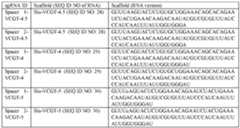 [00157] The three scaffold sequences differ by the nucleotide identity, and thus the stem-loop I in RNA secondary structure (FIG. 1A). In addition to differences in stem-loop I, Slu-VCGT-4.5 lacks the last nucleotide U at the 3’ end of Stem 3 (not shown). The results indicate that, Slu-VCGT-5 scaffold produces higher editing efficiency compared to guides with a V4 or V4.5 scaffold in most conditions tested (shown in FIG. IB).

[00158] This description and exemplary embodiments should not be taken as limiting. For the purposes of this specification and appended embodiments, unless otherwise indicated, all numbers expressing quantities, percentages, or proportions, and other numerical values used in the specification and embodiments, are to be understood as being modified in all instances by the term “about,” to the extent they are not already so modified. Accordingly, unless indicated to the contrary, the numerical parameters set forth in the following specification and attached embodiments are approximations that may vary depending upon the desired properties sought to be obtained. At the very least, and not as an attempt to limit the application of the doctrine of equivalents to the scope of the embodiments, each numerical parameter should at least be construed in light of the number of reported significant digits and by applying ordinary rounding techniques.
[00159] It is noted that, as used in this specification and the appended embodiments, the singular forms “a,” “an,” and “the,” and any singular use of any word, include plural referents unless expressly and unequivocally limited to one referent. As used herein, the term “include” and its grammatical variants are intended to be non-limiting, such that recitation of items in a list is not to the exclusion of other like items that can be substituted or added to the listed items.
Claims
1. A composition comprising a nucleic acid encoding a guide RNA comprising a scaffold sequence selected from any one of: SEQ ID NOs: 4-20.
2. The composition of claim 1, wherein the scaffold sequence is 3’ of a guide sequence.
3. The composition of claim 1 or claim 2, wherein the guide RNA is capable of directing a Staphylococcus lugdunensis Cas9 (SluCas9) to create an edit in a target sequence.
4. A composition comprising a guide RNA comprising in 5 ’ to 3 ’ direction: a. a nucleic encoding a guide sequence; and b. a nucleic acid encoding a scaffold sequence selected from any one of: SEQ ID NOs: 4- 20
5. The composition of any one of claims 1-4, further comprising a nucleic acid encoding a Staphylococcus lugdunensis Cas9 (SluCas9).
6. The composition of any one of claims 1-5, wherein the guide RNA is an sgRNA.
7. The composition of any one of claims 1-6, wherein the guide RNA is modified.
8. The composition of claim 7, wherein the modification alters one or more 2’ positions and/or phosphodiester linkages.
9. The composition of any one of claims 7-8, wherein the modification alters one or more, or all, of the first three nucleotides of the guide RNA.
10. The composition of any one of claims 7-9, wherein the modification alters one or more, or all, of the last three nucleotides of the guide RNA.
11. The composition of any one of claims 7-10, wherein the modification includes one or more of a phosphorothioate modification, a 2’-OMe modification, a 2’-0-MOE modification, a 2’-F modification, a 2'-0-methine-4' bridge modification, a 3'-thiophosphonoacetate modification, or a T- deoxy modification.
12. The composition of any one of claims 1-11, wherein the composition is associated with a lipid nanoparticle (LNP).
13. The composition of any one of claims 1-11, wherein the nucleic acid encoding the guide RNA and the nucleic acid encoding the SluCas9 is in a viral vector.
14. The composition of claim 13, wherein the viral vector is an adeno-associated vims vector, a lentiviral vector, an integrase-deficient lentiviral vector, an adenoviral vector, a vaccinia viral vector, an alphaviral vector, or a herpes simplex viral vector.
15. The composition of claim 14, wherein the viral vector is an adeno-associated vims (AAV) vector.
16. The composition of claim 15, wherein the AAV vector is an AAV1, AAV2, AAV3, AAV4, AAV5, AAV6, AAV7, AAV8, AAVrhlO, AAVrh74, or AAV9 vector, wherein the number following AAV indicates the AAV serotype.
17. The composition of claim 16, wherein the AAV vector is an AAV serotype 9 vector.
18. The composition of claim 16, wherein the AAV vector is an AAVrhlO vector.
19. The composition of claim 16, wherein the AAV vector is an AAVrh74 vector.
20. The composition of any one of claims 13-19, wherein the viral vector comprises a tissue- specific promoter.
21. The composition of any one of claims 13-20, wherein the viral vector comprises a muscle- specific promoter, optionally wherein the muscle-specific promoter is a muscle creatine kinase promoter, a desmin promoter, an MHCK7 promoter, an SPc5-12 promoter, or a CK8e promoter.
22. The composition of any one of claims 1-21, wherein the SluCas9 comprises the amino acid sequence of SEQ ID NO: 1.
23. The composition of any one of claims 1-21, wherein the SluCas9 is a variant of the amino acid sequence of SEQ ID NO: 1.
24. The composition of any one of claims 1-21, wherein the SluCas9 comprises an amino acid sequence selected from any one of SEQ ID NOs: 23-25.
25. The composition of any one of claims 1-24, wherein the scaffold sequence comprises SEQ ID NO: 4.
26. The composition of any one of claims 1-24, wherein the scaffold sequence comprises SEQ ID NO: 5.
27. The composition of any one of claims 1-24 and a pharmaceutically acceptable excipient.
28. A method of gene editing, the method comprising delivering to a cell the composition of any one of claims 1-27.
29. A method of gene editing, the method comprising delivering to a cell a composition comprising: a. a guide RNA comprising in 5 ’ to 3 ’ direction: i. a nucleic acid encoding a guide sequence; and ii. a nucleic acid encoding a scaffold sequence selected from any one of SEQ ID NOs:4-20; and b. a nucleic acid encoding a Staphylococcus lugdunensis Cas9 (SluCas9); thereby producing a gene edit in the cell.
30. The method of claim 29, wherein the SluCas9 comprises the amino acid sequence of SEQ ID NO: 1.
31. The method of any one of claims 29-30, wherein the SluCas9 is a variant of the amino acid sequence of SEQ ID NO: 1.
32. The method of any one of claims 29-31, wherein the SluCas9 comprises an amino acid sequence selected from any one of SEQ ID NOs: 23-25.
33. The method of any one of claims 29-32, wherein the scaffold sequence comprises SEQ ID NO:
4.
34. The method of any one of claims 29-32, wherein the scaffold sequence comprises SEQ ID NO:
5.
Applications Claiming Priority (2)
| Application Number | Priority Date | Filing Date | Title |
|---|---|---|---|
| US202163179853P | 2021-04-26 | 2021-04-26 | |
| US63/179,853 | 2021-04-26 |
Publications (1)
| Publication Number | Publication Date |
|---|---|
| WO2022229851A1true WO2022229851A1 (en) | 2022-11-03 |
Family
ID=81585203
Family Applications (1)
| Application Number | Title | Priority Date | Filing Date |
|---|---|---|---|
| PCT/IB2022/053878CeasedWO2022229851A1 (en) | 2021-04-26 | 2022-04-26 | Compositions and methods for using slucas9 scaffold sequences |
Country Status (1)
| Country | Link |
|---|---|
| WO (1) | WO2022229851A1 (en) |
Cited By (2)
| Publication number | Priority date | Publication date | Assignee | Title |
|---|---|---|---|---|
| WO2024102434A1 (en) | 2022-11-10 | 2024-05-16 | Senda Biosciences, Inc. | Rna compositions comprising lipid nanoparticles or lipid reconstructed natural messenger packs |
| US12390538B2 (en) | 2023-05-15 | 2025-08-19 | Nchroma Bio, Inc. | Compositions and methods for epigenetic regulation of HBV gene expression |
Citations (16)
| Publication number | Priority date | Publication date | Assignee | Title |
|---|---|---|---|---|
| WO1993013121A1 (en) | 1991-12-24 | 1993-07-08 | Isis Pharmaceuticals, Inc. | Gapped 2' modified oligonucleotides |
| US5378825A (en) | 1990-07-27 | 1995-01-03 | Isis Pharmaceuticals, Inc. | Backbone modified oligonucleotide analogs |
| WO1995032305A1 (en) | 1994-05-19 | 1995-11-30 | Dako A/S | Pna probes for detection of neisseria gonorrhoeae and chlamydia trachomatis |
| US5585481A (en) | 1987-09-21 | 1996-12-17 | Gen-Probe Incorporated | Linking reagents for nucleotide probes |
| US20040175727A1 (en) | 2002-11-04 | 2004-09-09 | Advisys, Inc. | Synthetic muscle promoters with activities exceeding naturally occurring regulatory sequences in cardiac cells |
| US20140186958A1 (en) | 2012-12-12 | 2014-07-03 | Feng Zhang | Engineering and optimization of systems, methods and compositions for sequence manipulation with functional domains |
| US20150111955A1 (en) | 2012-02-17 | 2015-04-23 | The Children's Hospital Of Philadelphia | Aav vector compositions and methods for gene transfer to cells, organs and tissues |
| US9023649B2 (en) | 2012-12-17 | 2015-05-05 | President And Fellows Of Harvard College | RNA-guided human genome engineering |
| US20150166980A1 (en) | 2013-12-12 | 2015-06-18 | President And Fellows Of Harvard College | Fusions of cas9 domains and nucleic acid-editing domains |
| US20170007679A1 (en) | 2014-03-25 | 2017-01-12 | Editas Medicine Inc. | Crispr/cas-related methods and compositions for treating hiv infection and aids |
| US9790472B2 (en) | 2001-11-13 | 2017-10-17 | The Trustees Of The University Of Pennsylvania | Method of detecting and/or identifying adeno-associated virus (AAV) sequences and isolating novel sequences identified thereby |
| WO2019118935A1 (en)* | 2017-12-14 | 2019-06-20 | Casebia Therapeutics Limited Liability Partnership | Novel rna-programmable endonuclease systems and their use in genome editing and other applications |
| WO2019183150A1 (en)* | 2018-03-19 | 2019-09-26 | Casebia Therapeutics Limited Liability Partnership | Novel rna-programmable endonuclease systems and uses thereof |
| WO2020112908A2 (en)* | 2018-11-28 | 2020-06-04 | Casebia Therapeutics Limited Liability Partnership | OPTIMIZED mRNA ENCODING CAS9 FOR USE IN LNPs |
| WO2020264254A1 (en)* | 2019-06-28 | 2020-12-30 | Crispr Therapeutics Ag | Materials and methods for controlling gene editing |
| WO2022056000A1 (en)* | 2020-09-09 | 2022-03-17 | Vertex Pharmaceuticals Incorporated | Compositions and methods for treatment of duchenne muscular dystrophy |
- 2022
- 2022-04-26WOPCT/IB2022/053878patent/WO2022229851A1/ennot_activeCeased
Patent Citations (16)
| Publication number | Priority date | Publication date | Assignee | Title |
|---|---|---|---|---|
| US5585481A (en) | 1987-09-21 | 1996-12-17 | Gen-Probe Incorporated | Linking reagents for nucleotide probes |
| US5378825A (en) | 1990-07-27 | 1995-01-03 | Isis Pharmaceuticals, Inc. | Backbone modified oligonucleotide analogs |
| WO1993013121A1 (en) | 1991-12-24 | 1993-07-08 | Isis Pharmaceuticals, Inc. | Gapped 2' modified oligonucleotides |
| WO1995032305A1 (en) | 1994-05-19 | 1995-11-30 | Dako A/S | Pna probes for detection of neisseria gonorrhoeae and chlamydia trachomatis |
| US9790472B2 (en) | 2001-11-13 | 2017-10-17 | The Trustees Of The University Of Pennsylvania | Method of detecting and/or identifying adeno-associated virus (AAV) sequences and isolating novel sequences identified thereby |
| US20040175727A1 (en) | 2002-11-04 | 2004-09-09 | Advisys, Inc. | Synthetic muscle promoters with activities exceeding naturally occurring regulatory sequences in cardiac cells |
| US20150111955A1 (en) | 2012-02-17 | 2015-04-23 | The Children's Hospital Of Philadelphia | Aav vector compositions and methods for gene transfer to cells, organs and tissues |
| US20140186958A1 (en) | 2012-12-12 | 2014-07-03 | Feng Zhang | Engineering and optimization of systems, methods and compositions for sequence manipulation with functional domains |
| US9023649B2 (en) | 2012-12-17 | 2015-05-05 | President And Fellows Of Harvard College | RNA-guided human genome engineering |
| US20150166980A1 (en) | 2013-12-12 | 2015-06-18 | President And Fellows Of Harvard College | Fusions of cas9 domains and nucleic acid-editing domains |
| US20170007679A1 (en) | 2014-03-25 | 2017-01-12 | Editas Medicine Inc. | Crispr/cas-related methods and compositions for treating hiv infection and aids |
| WO2019118935A1 (en)* | 2017-12-14 | 2019-06-20 | Casebia Therapeutics Limited Liability Partnership | Novel rna-programmable endonuclease systems and their use in genome editing and other applications |
| WO2019183150A1 (en)* | 2018-03-19 | 2019-09-26 | Casebia Therapeutics Limited Liability Partnership | Novel rna-programmable endonuclease systems and uses thereof |
| WO2020112908A2 (en)* | 2018-11-28 | 2020-06-04 | Casebia Therapeutics Limited Liability Partnership | OPTIMIZED mRNA ENCODING CAS9 FOR USE IN LNPs |
| WO2020264254A1 (en)* | 2019-06-28 | 2020-12-30 | Crispr Therapeutics Ag | Materials and methods for controlling gene editing |
| WO2022056000A1 (en)* | 2020-09-09 | 2022-03-17 | Vertex Pharmaceuticals Incorporated | Compositions and methods for treatment of duchenne muscular dystrophy |
Non-Patent Citations (10)
| Title |
|---|
| "The Biochemistry of the Nucleic Acids", 1992, pages: 5 - 36 |
| DASHKOFF ET AL., MOL THER METHODS CLIN DEV, vol. 3, 2016, pages 16081 |
| FRIEDLAND ET AL., GENOME BIOL., vol. 16, 2015, pages 257 |
| HU ZIYING ET AL: "Discovery and engineering of small SlugCas9 with broad targeting range and high specificity and activity", BIORXIV, 29 September 2020 (2020-09-29), pages 1 - 22, XP055889448, Retrieved from the Internet <URL:https://www.biorxiv.org/content/10.1101/2020.09.29.316661v1.full.pdf> [retrieved on 20220209], DOI: 10.1101/2020.09.29.316661* |
| MCCARTY ET AL., GENE THER., vol. 8, 2001, pages 1248 - 54 |
| NASO ET AL., BIODRUGS, vol. 31, 2017, pages 317 - 334 |
| NISHIMASU ET AL., CELL, vol. 163, no. 3, 2015, pages 1113 - 1126 |
| VESTERWENGEL, BIOCHEMISTRY, vol. 43, no. 42, 2004, pages 13233 - 41 |
| WANG ET AL., EXPERT OPIN DRUG DELIV., vol. 11, 2014, pages 345 - 364 |
| WANG ET AL., GENE THERAPY, vol. 15, 2008, pages 1489 - 1499 |
Cited By (2)
| Publication number | Priority date | Publication date | Assignee | Title |
|---|---|---|---|---|
| WO2024102434A1 (en) | 2022-11-10 | 2024-05-16 | Senda Biosciences, Inc. | Rna compositions comprising lipid nanoparticles or lipid reconstructed natural messenger packs |
| US12390538B2 (en) | 2023-05-15 | 2025-08-19 | Nchroma Bio, Inc. | Compositions and methods for epigenetic regulation of HBV gene expression |
Similar Documents
| Publication | Publication Date | Title |
|---|---|---|
| US20220354967A1 (en) | Compositions and methods for transgene expression from an albumin locus | |
| US20220096606A1 (en) | Compositions and Methods for Treatment of Duchenne Muscular Dystrophy | |
| GB2617658A (en) | Class II, type V CRISPR systems | |
| US20230414648A1 (en) | Compositions and Methods for Treatment of DM1 with SLUCAS9 and SACAS9 | |
| WO2022229851A1 (en) | Compositions and methods for using slucas9 scaffold sequences | |
| US20250163411A1 (en) | Tandem Guide RNAs (TG-RNAs) and Their Use in Genome Editing | |
| US20240252683A1 (en) | Precise Excisions of Portions of Exon 51 for Treatment of Duchenne Muscular Dystrophy | |
| US20240173432A1 (en) | Compositions and Methods for Treatment of Myotonic Dystrophy Type 1 with CRISPR/SluCas9 | |
| WO2022234519A1 (en) | Compositions and methods for using sacas9 scaffold sequences | |
| KR20250054234A (en) | Class II, V-type CRISPR system | |
| US20240415984A1 (en) | Precise Excisions of Portions of Exons for Treatment of Duchenne Muscular Dystrophy | |
| US20250090686A1 (en) | Precise Excisions of Portions of Exon 44, 50, and 53 for Treatment of Duchenne Muscular Dystrophy | |
| US20240181081A1 (en) | Compositions and Methods for Treatment of Myotonic Dystrophy Type 1 with CRISPR/SACAS9 | |
| WO2025184186A1 (en) | Excision of exon 53 for treatment of duchenne muscular dystrophy | |
| AU2021342057A1 (en) | Compositions and methods for treatment of duchenne muscular dystrophy | |
| US20240228577A1 (en) | Programmed Cell Death Protein 1 (PD1) Compositions and Methods for Cell-Based Therapy | |
| US20250002946A1 (en) | Methods And Compositions For Increasing Homology-Directed Repair | |
| US20240344059A1 (en) | Gene Editing of Regulatory Elements | |
| CN116529365A (en) | Compositions and methods for treating duchenne muscular dystrophy | |
| WO2025137598A1 (en) | Promoters and trna constructs | |
| WO2025132755A1 (en) | Compositions and methods for delivering transgenes |
Legal Events
| Date | Code | Title | Description |
|---|---|---|---|
| 121 | Ep: the epo has been informed by wipo that ep was designated in this application | Ref document number:22721870 Country of ref document:EP Kind code of ref document:A1 | |
| NENP | Non-entry into the national phase | Ref country code:DE | |
| 122 | Ep: pct application non-entry in european phase | Ref document number:22721870 Country of ref document:EP Kind code of ref document:A1 |