WO2016140717A1 - Combination of a pd-1 antagonist and a vegfr/fgfr/ret tyrosine kinase inhibitor for treating cancer - Google Patents
Combination of a pd-1 antagonist and a vegfr/fgfr/ret tyrosine kinase inhibitor for treating cancerDownload PDFInfo
- Publication number
- WO2016140717A1 WO2016140717A1PCT/US2015/063796US2015063796WWO2016140717A1WO 2016140717 A1WO2016140717 A1WO 2016140717A1US 2015063796 WUS2015063796 WUS 2015063796WWO 2016140717 A1WO2016140717 A1WO 2016140717A1
- Authority
- WO
- WIPO (PCT)
- Prior art keywords
- cancer
- lenvatinib
- antagonist
- pembrolizumab
- pharmaceutically acceptable
- Prior art date
- Legal status (The legal status is an assumption and is not a legal conclusion. Google has not performed a legal analysis and makes no representation as to the accuracy of the status listed.)
- Ceased
Links
- QGOQOIVJDCDNPZ-UHFFFAOYSA-NCCNC(Nc(c(Cl)c1)ccc1Oc1c(cc(C(NOC)=O)c(OC)c2)c2ncc1)=OChemical compoundCCNC(Nc(c(Cl)c1)ccc1Oc1c(cc(C(NOC)=O)c(OC)c2)c2ncc1)=OQGOQOIVJDCDNPZ-UHFFFAOYSA-N0.000description1
Classifications
- A—HUMAN NECESSITIES
- A61—MEDICAL OR VETERINARY SCIENCE; HYGIENE
- A61K—PREPARATIONS FOR MEDICAL, DENTAL OR TOILETRY PURPOSES
- A61K31/00—Medicinal preparations containing organic active ingredients
- A61K31/33—Heterocyclic compounds
- A61K31/395—Heterocyclic compounds having nitrogen as a ring hetero atom, e.g. guanethidine or rifamycins
- A61K31/435—Heterocyclic compounds having nitrogen as a ring hetero atom, e.g. guanethidine or rifamycins having six-membered rings with one nitrogen as the only ring hetero atom
- A61K31/47—Quinolines; Isoquinolines
- A—HUMAN NECESSITIES
- A61—MEDICAL OR VETERINARY SCIENCE; HYGIENE
- A61K—PREPARATIONS FOR MEDICAL, DENTAL OR TOILETRY PURPOSES
- A61K39/00—Medicinal preparations containing antigens or antibodies
- A61K39/395—Antibodies; Immunoglobulins; Immune serum, e.g. antilymphocytic serum
- A61K39/39533—Antibodies; Immunoglobulins; Immune serum, e.g. antilymphocytic serum against materials from animals
- A61K39/39541—Antibodies; Immunoglobulins; Immune serum, e.g. antilymphocytic serum against materials from animals against normal tissues, cells
- A—HUMAN NECESSITIES
- A61—MEDICAL OR VETERINARY SCIENCE; HYGIENE
- A61K—PREPARATIONS FOR MEDICAL, DENTAL OR TOILETRY PURPOSES
- A61K39/00—Medicinal preparations containing antigens or antibodies
- A61K39/395—Antibodies; Immunoglobulins; Immune serum, e.g. antilymphocytic serum
- A61K39/39533—Antibodies; Immunoglobulins; Immune serum, e.g. antilymphocytic serum against materials from animals
- A61K39/39558—Antibodies; Immunoglobulins; Immune serum, e.g. antilymphocytic serum against materials from animals against tumor tissues, cells, antigens
- A—HUMAN NECESSITIES
- A61—MEDICAL OR VETERINARY SCIENCE; HYGIENE
- A61K—PREPARATIONS FOR MEDICAL, DENTAL OR TOILETRY PURPOSES
- A61K45/00—Medicinal preparations containing active ingredients not provided for in groups A61K31/00 - A61K41/00
- A61K45/06—Mixtures of active ingredients without chemical characterisation, e.g. antiphlogistics and cardiaca
- A—HUMAN NECESSITIES
- A61—MEDICAL OR VETERINARY SCIENCE; HYGIENE
- A61P—SPECIFIC THERAPEUTIC ACTIVITY OF CHEMICAL COMPOUNDS OR MEDICINAL PREPARATIONS
- A61P35/00—Antineoplastic agents
- C—CHEMISTRY; METALLURGY
- C07—ORGANIC CHEMISTRY
- C07K—PEPTIDES
- C07K16/00—Immunoglobulins [IGs], e.g. monoclonal or polyclonal antibodies
- C07K16/18—Immunoglobulins [IGs], e.g. monoclonal or polyclonal antibodies against material from animals or humans
- C07K16/28—Immunoglobulins [IGs], e.g. monoclonal or polyclonal antibodies against material from animals or humans against receptors, cell surface antigens or cell surface determinants
- C07K16/2803—Immunoglobulins [IGs], e.g. monoclonal or polyclonal antibodies against material from animals or humans against receptors, cell surface antigens or cell surface determinants against the immunoglobulin superfamily
- C07K16/2818—Immunoglobulins [IGs], e.g. monoclonal or polyclonal antibodies against material from animals or humans against receptors, cell surface antigens or cell surface determinants against the immunoglobulin superfamily against CD28 or CD152
- C—CHEMISTRY; METALLURGY
- C07—ORGANIC CHEMISTRY
- C07K—PEPTIDES
- C07K16/00—Immunoglobulins [IGs], e.g. monoclonal or polyclonal antibodies
- C07K16/18—Immunoglobulins [IGs], e.g. monoclonal or polyclonal antibodies against material from animals or humans
- C07K16/28—Immunoglobulins [IGs], e.g. monoclonal or polyclonal antibodies against material from animals or humans against receptors, cell surface antigens or cell surface determinants
- C07K16/2803—Immunoglobulins [IGs], e.g. monoclonal or polyclonal antibodies against material from animals or humans against receptors, cell surface antigens or cell surface determinants against the immunoglobulin superfamily
- C07K16/2827—Immunoglobulins [IGs], e.g. monoclonal or polyclonal antibodies against material from animals or humans against receptors, cell surface antigens or cell surface determinants against the immunoglobulin superfamily against B7 molecules, e.g. CD80, CD86
- A—HUMAN NECESSITIES
- A61—MEDICAL OR VETERINARY SCIENCE; HYGIENE
- A61K—PREPARATIONS FOR MEDICAL, DENTAL OR TOILETRY PURPOSES
- A61K39/00—Medicinal preparations containing antigens or antibodies
- A61K2039/505—Medicinal preparations containing antigens or antibodies comprising antibodies
- A—HUMAN NECESSITIES
- A61—MEDICAL OR VETERINARY SCIENCE; HYGIENE
- A61K—PREPARATIONS FOR MEDICAL, DENTAL OR TOILETRY PURPOSES
- A61K2300/00—Mixtures or combinations of active ingredients, wherein at least one active ingredient is fully defined in groups A61K31/00 - A61K41/00
- C—CHEMISTRY; METALLURGY
- C07—ORGANIC CHEMISTRY
- C07K—PEPTIDES
- C07K2317/00—Immunoglobulins specific features
- C07K2317/70—Immunoglobulins specific features characterized by effect upon binding to a cell or to an antigen
- C07K2317/76—Antagonist effect on antigen, e.g. neutralization or inhibition of binding
Definitions
- Combination therapies useful for the treatment of cancerare disclosed.
- a combination therapywhich comprises an antagonist of a Programmed Death 1 protein (PD-1) and a multiple receptor tyrosine kinase (multi-RTK) inhibitor is disclosed.
- PD-1Programmed Death 1 protein
- multi-RTKmultiple receptor tyrosine kinase
- a tumor therapeutic agentcontaining a combination of a quinoline derivative that exhibits a multi-tyrosine kinase inhibitory action and an anti-PD-1 antibody.
- PD-1is recognized as an important player in immune regulation and the maintenance of peripheral tolerance. PD-1 is moderately expressed on naive T-, B- and Natural killer T (NKT)- cells and up-regulated by T/B- cell receptor signaling on lymphocytes, monocytes and myeloid cells (1).
- NKTNatural killer T
- PD-L1B7-H1
- PD-L2B7-DC
- PD-L1 expressioncorrelated with poor prognosis and reduced overall survival irrespective of subsequent treatment (2-13).
- PD-1 expression on tumor infiltrating lymphocyteswas found to mark dysfunctional T cells in breast cancer and melanoma (14-15) and to correlate with poor prognosis in renal cancer (16).
- PD-L1 expressing tumor cellsinteract with PD-1 expressing T cells to attenuate T cell activation and evasion of immune surveillance, thereby contributing to an impaired immune response against the tumor. Therefore, an antibody directed against either the PD-1 receptor or the PD-L1 ligand can inhibit the binding therebetween, resulting in an increased immune action on the tumor cells (23).
- Tyrosine kinasesare involved in the modulation of growth factor signaling and thus are an important target for cancer therapies.
- Lenvatinib mesilatediscovered and developed by Eisai Co., Ltd., is an oral receptor tyrosine kinase (RTK) inhibitor that selectively inhibits the kinase activities of vascular endothelial growth factor (VEGF) receptors (VEGFR1 (FLT1), VEGFR2 (KDR) and VEGFR3 (FLT4)), and fibroblast growth factor (FGF) receptors FGFR1 , 2, 3 and 4 in addition to other proangiogenic and oncogenic pathway-related RTKs (including the platelet-derived growth factor (PDGF) receptor PDGFRa; KIT; and the RET proto-oncogene (RET)) involved in tumor proliferation.
- VEGFvascular endothelial growth factor
- FLT1vascular endothelial growth factor receptors
- KDRVEGFR2
- FLT4fibro
- Lenvatinib mesilatewas recently approved in the United States for the treatment of patients with locally recurrent or metastatic, progressive, radioactive iodine-refractory differentiated thyroid cancer. Its chemical name is 4-[3-chloro-4- (cyclopropylaminocarbonyl) aminophenoxy]-7-methoxy-6-quinolinecarboxamide methanesulfonate. Eisai was granted Orphan Drug Designation (ODD) for lenvatinib mesilate in various types of thyroid cancer in the United States, Japan, and Europe.
- ODDOrphan Drug Designation
- Lenvatinib mesilateis under investigation in thyroid, hepatocellular, endometrial, non-small cell lung cancer, renal cell carcinoma (RCC), melanoma, glioblastoma, and other solid tumor types.
- the compound represented by Formula (I) belowhas anti-angiogenic actions (17), inhibitory effects ( 18-21) against tyrosine kinases which are reported to be involved in malignant alteration of tumors and the like.
- R 1is C] _6 alkyl or C3.8 cycloalkyl.
- R 2is a hydrogen atom or Cj.g alkoxy.
- R 3is a hydrogen atom or a halogen atom.
- tumor therapeutic agentsare often not effective for all of the patients when administered individually.
- attemptshave been made to increase the cure rate of such therapeutic agents by combining them (22).
- a method for treating a cancer in an individualthat includes administering to the individual a combination therapy which comprises a PD-1 antagonist, which is not MPDL3280A, and a multi-RTK inhibitor.
- the individualis a human.
- the cancermay be a solid tumor, a non-small cell lung cancer (NSCLC), RCC, endometrial cancer, urothelial cancer, squamous cell carcinoma of head and neck or melanoma.
- the PD-1 antagonist of the methodmay be a monoclonal antibody or an antigen binding fragment thereof. In some instances, the antagonist is an anti-PD- 1 antibody.
- the antagonistmay be pembrolizumab or nivolumab.
- the multi-RTK inhibitor of the methodmay be a compound or
- R 1is C x . 6 alkyl or C 3 . 8 cycloalkyl
- R 2is a hydrogen atom or alkoxy
- R 3is a hydrogen atom or a halogen atom.
- the compound represented by Formula (I)may be one or more of the following compounds: 4-[3-chloro-4-(cyclopropylaminocarbonyl)aminophenoxy]-7-methoxy-6- quinolinecarboxamide:
- the compound represented by Formula (I)is 4-[3-chloro-4-
- the PD-1 antagonist of the methodis pembrolizumab and the multi-RTK inhibitor is lenvatinib or a pharmaceutically acceptable salt thereof.
- Administration of pembrolizumabmay occur after the administration of lenvatinib in some treatment regimens. In some instances, the lenvatinib is administered after the
- a kitincludes a first container, a second container and a package insert.
- the first container of the kitincludes at least one dose of a medicament comprising a PD-1 antagonist, which is not MPDL3280A, and the second container includes at least one dose of a medicament comprising a multi-RTK inhibitor.
- the package insertincludes instructions for treating an individual for cancer using the medicaments.
- the instructions of the kitmay state that the medicaments are intended for use in treating an individual having a cancer that tests positive for PD-L1 expression by an
- immunohistochemical (IHC) assayIn some instances, the individual may be a human.
- the multi-RTK inhibitor of the kitmay be is a compound or pharmaceutically acceptable salt thereof represented by Formula (I):
- R 1is Ci.g alkyl or C3.8 cycloalkyl
- R 2is a hydrogen atom or Ci assignment 6 alkoxy
- R 3is a hydrogen atom or a halogen atom.
- the compound represented by Formula (I)may be one or more of the following compounds:
- the compound represented by Formula (I)may be 4-[3- chloro-4-(cyclopropylaminocarbonyl)aminophenoxy]-7-methoxy-6-quinolinecarboxamide:
- the PD-1 antagonist provided by the kitmay be pembrolizumab formulated as a liquid medicament which comprises 25 mg/ml pembrolizumab, 7% (w/v) sucrose, 0.02% (w/v) polysorbate 80 in 10 mM histidine buffer pH 5.5, and the multi-RTK inhibitor may be lenvatinib or a pharmaceutically acceptable salt thereof formulated as a 4 mg or 10 mg lenvatinib capsule comprising calcium carbonate, mannitol, microcrystalline cellulose, hydroxypropylcellulose, low-substituted hydroxypropylcellulose, and talc.
- the medicaments included with the kitmay be applied to treat NSCLC, RCC, endometrial cancer, urothelial cancer, squamous cell carcinoma of head and neck or melanoma.
- a method for treating a human individual diagnosed with a cancercomprising administering to the individual a combination therapy for at least 24 weeks.
- the combination therapyincludes pembrolizumab and lenvatinib or a pharmaceutically acceptable salt thereof.
- Lenvatinib or a pharmaceutically acceptable salt thereofmay be administered at a daily dose of 24 mg, 20 mg or 14 mg, each as lenvatinib, and
- pembrolizumabmay be administered at a dose of 200 mg Q3W.
- a medicamentcomprising a PD-1 antagonist for use in combination with a multi-RTK inhibitor for treating a cancer.
- a medicamentcomprising a multi-RTK inhibitor for use in combination with a PD-1 antagonist for treating a cancer.
- a useis also provided of a PD-1 antagonist in the manufacture of medicament for treating a cancer in an individual when administered in combination with a multi-RTK inhibitor and use of a multi-RTK inhibitor in the manufacture of a medicament for treating a cancer in an individual when administered in combination with a PD-1 antagonist.
- kitscan comprise a package insert comprising instructions for - Si - using the PD- 1 antagonist in combination with a multi-RTK inhibitor to treat a cancer in an individual.
- the kitmay include a pharmaceutical composition comprising a compound or pharmaceutically acceptable salt thereof represented by the above Formula (I) and a vehicle.
- the kitmay include a pharmaceutical composition comprising an anti-PD-1 antibody and a vehicle.
- the PD-1 antagonistinhibits the binding of PD-L1 to PD-1 , and preferably also inhibits the binding of PD-L2 to PD-1.
- the PD-1 antagonistis a monoclonal antibody, or an antigen binding fragment thereof, which specifically binds to PD-1 or to PD-L1 and blocks the binding of PD-L1 to PD-1.
- the PD-1 antagonistcan be an anti-PD-1 antibody which comprises a heavy chain and a light chain, and wherein the heavy and light chains comprise the amino acid sequences shown in Figure 6 (SEQ ID NO:21 and SEQ ID NO:22).
- the anti-PD-1 antibodymay be combined with a compound or pharmaceutically acceptable salt thereof represented by the above Formula (I) for therapy of a tumor.
- the anti-PD-1 antibodymay be combined with a compound or pharmaceutically acceptable salt thereof represented by the above Formula (I).
- a method of treating a tumoris disclosed that can include the combined use of a compound or pharmaceutically acceptable salt thereof represented by the above Formula (I) and an anti-PD-1 antibody.
- RTK inhibitorinhibits the kinase activities of at least each of the following RTKs: (i) VEGFR2, (ii) at least one FGFR selected from the group consisting of FGFRl, 2, 3 and 4; and (iii) RET.
- the multi-RTK inhibitoralso inhibits the kinase activities of VEGFRl , VEGFR3, fibroblast growth factor (FGF) receptors FGFRl , 2, 3 and 4, platelet- derived growth factor (PDGF) receptor alpha (PDGFRa); and KIT.
- RTK inhibitoris lenvatinib or a pharmaceutically acceptable salt thereof, such as lenvatinib mesilate.
- the individualis a human and the cancer is a solid tumor and in some instances, the solid tumor is bladder cancer, breast cancer, clear cell kidney cancer, squamous cell carcinoma of head and neck, lung squamous cell carcinoma, malignant melanoma, NSCLC, ovarian cancer, pancreatic cancer, prostate cancer, RCC, small-cell lung cancer (SCLC) or triple negative breast cancer.
- the cancermay be NSCLC, endometrial cancer, urothelial cancer, squamous cell carcinoma of head and neck or melanoma.
- the individualcan be a human and the cancer is a heme malignancy and in some instances, the heme malignancy is acute lymphoblastic leukemia (ALL), acute myeloid leukemia (AML), chronic lymphocytic leukemia (CLL), chronic myeloid leukemia (CML), diffuse large B-cell lymphoma
- ALLacute lymphoblastic leukemia
- AMLacute myeloid leukemia
- CLLchronic lymphocytic leukemia
- CMLchronic myeloid leukemia
- DLBCLEBV-positive DLBCL
- primary mediastinal large B-cell lymphomaT- cell/histiocyte-rich large B-cell lymphoma
- follicular lymphomaHodgkin's lymphoma (HL), mantle cell lymphoma (MCL), multiple myeloma (MM), myeloid cell leukemia- 1 protein (Mcl-1 ), myelodysplastic syndrome (MDS), non-Hodgkin's lymphoma (NHL), or small lymphocytic lymphoma (SLL).
- HLHodgkin's lymphoma
- MCLmantle cell lymphoma
- MMmultiple myeloma
- Mcl-1myeloid cell leukemia- 1 protein
- MDSmyelodysplastic syndrome
- NHLnon-Hodgkin's lymphoma
- SLLsmall lymphocytic lymphoma
- any of the above treatment methods, medicaments and usescan be utilized if the cancer tests positive for the expression of one or both of PD-Ll and PD-L2. In still other instances, the cancer has elevated PD-Ll expression.
- the individualis a human
- the cancer tests positive for human PD-Llis selected from the group consisting of NSCLC, endometrial cancer, urothelial cancer, squamous cell carcinoma of head and neck, or melanoma.
- RTK inhibitoris a compound or pharmaceutically acceptable salt thereof represented by Formula (I):
- the tumor therapeutic agentmay administer simultaneously or separately a compound or pharmaceutically acceptable salt thereof represented by the above Formula (I) and an anti-PD- 1 antibody.
- the tumor therapeutic agentmay be administered simultaneously or separately.
- a compositioncan comprise a compound or pharmaceutically acceptable salt thereof represented by the above Formula (I), and a composition comprising an anti-PD-1 antibody.
- the tumor therapeutic agentmay include a compound or pharmaceutically acceptable salt thereof represented by the above Formula (I), and an anti-PD-1 antibody.
- a compound or pharmaceutically acceptable salt thereofis disclosed that is represented by the Formula (I) for combined use with an anti-PD- 1 antibody.
- the compound or pharmaceutically acceptable salt thereof represented by the Formula (I)may be used for therapy of a tumor by combined use with an anti-PD-1 antibody.
- a pharmaceutical compositionmay include a compound or pharmaceutically acceptable salt thereof represented by the above Formula (I), an anti-PD-1 antibody, and a vehicle.
- the compound represented by the above Formula (I)is preferably one or more of the following compounds:
- the compound represented by the above Formula (I)is more preferably 4-[3- chloro-4-(cyclopropylaminocarbonyl)aminophenoxy]-7-methoxy-6-quinolinecarboxamide:
- a tumor therapeutic agentis provided for combined use of a compound having a multi-tyrosine kinase inhibitory action and an anti-PD-1 antibody.
- Such a tumor therapeutic agentexhibits an excellent anti-tumor effect compared to cases where these are individually used, and may exhibit anti-tumor effects against various cancer types.
- FIGURE 1shows amino acid sequences of the light chain and heavy chain CDRs for an exemplary anti-PD-1 monoclonal antibody (SEQ ID NOs: 1-6).
- FIGURE 2shows amino acid sequences of the light chain and heavy chain
- FIGURE 3shows amino acid sequences of the heavy chain variable region and full length heavy chain for an exemplary anti-PD-1 monoclonal antibody (SEQ ID NO: 13 and SEQ ID NO: 14).
- FIGURE 4shows amino acid sequences of alternative light chain variable regions for an exemplary anti-PD-1 monoclonal antibody (SEQ ID NOs: 15- 17).
- FIGURES 5A and 5Bshow amino acid sequences of alternative light chains for an exemplary anti-PD-1 monoclonal antibody, with FIG. 5 A showing the amino acid sequences for the K09A-L-1 1 and K09A-L-16 light chains (SEQ ID NOs: 18 and 19, respectively) and FIG. 5B showing the amino acid sequence for the K09A-L-17 light chain (SEQ ID NO:20).
- FIGURE 6shows amino acid sequences of the heavy and light chains for pembrolizumab (SEQ ID NOs. 21 and 22, respectively).
- FIGURE 7shows amino acid sequences of the heavy and light chains for nivolumab (SEQ ID NOS: 23 and 24, respectively).
- FIGURE 8is a diagram illustrating anti-tumor effects of lenvatinib, an anti-
- PD-1 antibodyRMP 1-14
- LLclsubcutaneous LL/2 transplantation model
- FIGURE 9shows the anti-cancer or -tumor effect on the eleventh day since commencing treatment in a mouse model with colon cancer as disclosed herein.
- FIGURE 10is a graph of the tumor volume plotted by days subsequent to administration for the control group, lenvatinib or PD-Ll individually, and a combination of lenvatinib and PD-Ll as disclosed herein.
- “About” when used to modify a numerically defined parametermeans that the parameter may vary by as much as 10% below or above the stated numerical value for that parameter. For example, a dose of about 20 mg may vary between 18 mg and 22 mg.
- "Preferably”means a more desirable choice. For example, when used to modify a numerically defined parameter it indicates that the preferred parameter provides an improved result over another value for the parameter. This meaning of "preferably” only applies outside of the United States.
- administeringrefers to contact of an exogenous pharmaceutical, therapeutic, diagnostic agent, or composition to the animal, human, subject, cell, tissue, organ, or biological fluid.
- Treatment of a cellencompasses contact of a reagent to the cell, as well as contact of a reagent to a fluid, where the fluid is in contact with the cell.
- administeringand “treatment” also means in vitro and ex vivo treatments, e.g., of a cell, by a reagent, diagnostic, binding compound, or by another cell.
- subjectincludes any organism, preferably an animal, more preferably a mammal (e.g., rat, mouse, dog, cat, rabbit) and most preferably a human.
- antibodyrefers to any form of antibody that exhibits the desired biological or binding activity. Thus, it is used in the broadest sense and specifically covers, but is not limited to, monoclonal antibodies (including full length monoclonal antibodies), polyclonal antibodies, multispecific antibodies (e.g., bispecific antibodies), humanized, fully human antibodies, chimeric antibodies, and camelized single domain antibodies.
- Monoclonal antibodiesincluding full length monoclonal antibodies
- polyclonal antibodiesinclude multispecific antibodies (e.g., bispecific antibodies), humanized, fully human antibodies, chimeric antibodies, and camelized single domain antibodies.
- Parental antibodiesare antibodies obtained by exposure of an immune system to an antigen prior to modification of the antibodies for an intended use, such as humanization of an antibody for use as a human therapeutic.
- the basic antibody structural unitcomprises a tetramer.
- Each tetramerincludes two identical pairs of polypeptide chains, each pair having one "light” (about 25 kDa) and one "heavy” chain (about 50-70 kDa).
- the amino-terminal portion of each chainincludes a variable region of about 100 to 110 or more amino acids primarily responsible for antigen recognition.
- the carboxy-terminal portion of the heavy chainmay define a constant region primarily responsible for effector function.
- human light chainsare classified as kappa and lambda light chains.
- human heavy chainsare typically classified as mu, delta, gamma, alpha, or epsilon, and define the antibody's isotype as IgM, IgD, IgG, IgA, and IgE, respectively.
- the variable and constant regionsare joined by a "J" region of about 12 or more amino acids, with the heavy chain also including a "D” region of about 10 more amino acids. See generally,
- variable regions of each light/heavy chain pairform the antibody binding site.
- an intact antibodyhas two binding sites.
- the two binding sitesare, in general, the same.
- variable domains of both the heavy and light chainscomprise three hypervariable regions, also called complementarity determining regions (CDRs), which are located within relatively conserved framework regions (FR).
- CDRscomplementarity determining regions
- FRframework regions
- the CDRsare usually aligned by the framework regions, enabling binding to a specific epitope.
- both light and heavy chains variable domainscomprise FR1 , CDR1 , FR2, CDR2, FR3, CDR3 and FR4.
- the assignment of amino acids to each domainis, generally, in accordance with the definitions of SEQUENCES OF PROTEINS OF IMMUNOLOGICAL INTEREST, Kabat, et ai; National Institutes of Health, Bethesda, Md.
- hypervariable regionrefers to the amino acid residues of an antibody that are responsible for antigen-binding.
- the hypervariable regioncomprises amino acid residues from a "complementarity determining region” or "CDR" (i. e. CDRL1 , CDRL2 and CDRL3 in the light chain variable domain and CDRH 1 , CDRH2 and CDRH3 in the heavy chain variable domain).
- CDRcomplementarity determining region
- antibody fragmentor “antigen binding fragment” refers to antigen binding fragments of antibodies, i.e. antibody fragments that retain the ability to bind specifically to the antigen bound by the full-length antibody, e.g. fragments that retain one or more CDR regions.
- antibody binding fragmentsinclude, but are not limited to, Fab, Fab', F(ab')2, and Fv fragments; diabodies; linear antibodies; single-chain antibody molecules, e.g., sc-Fv; nanobodies and multispecific antibodies formed from antibody fragments.
- An antibody that "specifically binds to" a specified target proteinis an antibody that exhibits preferential binding to that target as compared to other proteins, but this specificity does not require absolute binding specificity. An antibody is considered
- Antibodies, or binding fragments thereof,will bind to the target protein with an affinity that is at least two fold greater, preferably at least ten times greater, more preferably at least 20- times greater, and most preferably at least 100-times greater than the affinity with non-target proteins.
- an antibodyis said to bind specifically to a polypeptide comprising a given amino acid sequence, e.g. the amino acid sequence of a mature human PD-1 or human PD-L1 molecule, if it binds to polypeptides comprising that sequence but does not bind to proteins lacking that sequence.
- Chimeric antibodyrefers to an antibody in which a portion of the heavy and/or light chain is identical with or homologous to corresponding sequences in an antibody derived from a particular species (e.g., human) or belonging to a particular antibody class or subclass, while the remainder of the chain(s) is identical with or homologous to
- Human antibodyrefers to an antibody that comprises human
- human antibodymay contain murine carbohydrate chains if produced in a mouse, in a mouse cell, or in a hybridoma derived from a mouse cell.
- mouse antibodyor “rat antibody” refer to an antibody that comprises only mouse or rat immunoglobulin sequences, respectively.
- Humanized antibodyrefers to forms of antibodies that contain sequences from non-human ⁇ e.g., murine) antibodies as well as human antibodies. Such antibodies contain minimal sequence derived from non-human immunoglobulin.
- the humanized antibodywill comprise substantially all of at least one, and typically two, variable domains, in which all or substantially all of the hypervariable loops correspond to those of a non-human immunoglobulin and all or substantially all of the FR regions are those of a human immunoglobulin sequence.
- the humanized antibodyoptionally also will comprise at least a portion of an immunoglobulin constant region (Fc), typically that of a human immunoglobulin.
- Fcimmunoglobulin constant region
- the prefix "hum”, "hu” or “h”is added to antibody clone designations when necessary to distinguish humanized antibodies from parental rodent antibodies.
- the humanized forms of rodent antibodieswill generally comprise the same CDR sequences of the parental rodent antibodies, although certain amino acid substitutions may be included to increase affinity, increase stability of the humanized antibody, or for other reasons.
- Anti -tumor responsewhen referring to a cancer patient treated with a therapeutic regimen, such as a combination therapy described herein, means at least one positive therapeutic effect, such as for example, reduced number of cancer cells, reduced tumor size, reduced rate of cancer cell infiltration into peripheral organs, reduced rate of tumor metastasis or tumor growth, or progression free survival.
- Positive therapeutic effects in cancercan be measured in a number of ways (See, W. A. Weber, J. Null. Med. 50: 1 S-10S (2009); Eiseiihauer et al., supra).
- an anti-tumor response to a combination therapy described hereinis assessed using RECIST 1.1 criteria (response evaluation criteria in solid tumors), bidimentional irRC (immune related response criteria), or unidimensional irRC.
- RECIST 1.1 criteriaresponse evaluation criteria in solid tumors
- bidimentional irRCimmune related response criteria
- unidimensional irRCunidimensional irRC.
- an anti-tumor responseis any of SD, PR, CR, PFS, or DFS.
- Bidimensional irRCrefers to the set of criteria described in Wolchok .ID, et al. "Guidelines for the evaluation of immune therapy activity in solid tumors: immune-related response criteria," Clin Cancer Res. 2009; 15(23): 7412-7420. These criteria utilize bidimensional tumor measurements of target lesions, which are obtained by multiplying the longest diameter and the longest perpendicular diameter (cm 2 ) of each lesion.
- Biotherapeutic agentmeans a biological molecule, such as an antibody or fusion protein, that blocks ligand / receptor signaling in any biological pathway that supports tumor maintenance and/or growth or suppresses the anti-tumor immune response.
- Classes of biotherapeutic agentsinclude, but are not limited to, antibodies to VEGF, epidermal growth factor receptor (EGFR), Her2/neu, other growth factor receptors, CD20, CD40, CD-40L, CTLA-4, OX-40, 4-1BB, and ICOS.
- cancerrefers to or describe the physiological condition in mammals that is typically characterized by unregulated cell growth.
- cancerinclude but are not limited to, carcinoma, lymphoma, leukemia, blastoma, and sarcoma.
- cancersinclude squamous cell carcinoma, myeloma, small-cell lung cancer, non-small cell lung cancer, glioma, hodgkin's lymphoma, non-hodgkin's lymphoma, acute myeloid leukemia (AML), multiple myeloma, adenoma, neurilemmoma, gastrointestinal (tract) cancer, gastric cancer, renal cancer, gallbladder cancer, ovarian cancer, liver cancer, lymphoblastic leukemia, lymphocytic leukemia, colorectal cancer, endometrial cancer, kidney cancer, prostate cancer, thyroid cancer, melanoma, chondrosarcoma, neuroblastoma, pancreatic cancer, glioblastoma multiforme, cervical cancer, brain cancer, stomach cancer, bladder cancer, hepatoma, breast cancer, colon carcinoma, endometrial cancer, uterine body cancer, uterine cervical cancer, and head and neck cancer.
- AMLacute mye
- medicaments, and disclosed usesinclude those characterized by elevated expression of one or both of PD-L1 and PD-L2 in tested tissue samples.
- CBRClinical Benefit Rate
- CDRcomplementarity determining region(s) in a immunoglobulin variable region, defined using the Kabat numbering system, unless otherwise indicated.
- “Chemotherapeutic agent”is a chemical compound useful in the treatment of cancer.
- Classes of chemotherapeutic agentsinclude, but are not limited to: alkylating agents, antimetabolites, kinase inhibitors, spindle poison plant alkaloids, cytoxic/antitumor antibiotics, topisomerase inhibitors, photosensitizers, anti-estrogens and selective estrogen receptor modulators (SERMs), anti-progesterones, estrogen receptor down-regulators (ERDs), estrogen receptor antagonists, leutinizing hormone-releasing hormone agonists, anti- androgens, aromatase inhibitors, EGFR inhibitors, VEGF inhibitors, and anti-sense oligonucleotides that inhibit expression of genes implicated in abnormal cell proliferation or tumor growth.
- Chemotherapeutic agents useful in the treatment methods disclosed hereininclude cytostatic and/or cytotoxic agents.
- Chothiaas used herein means an antibody numbering system described in Al-Lazikani et al, JMB 273: 927-948 (1997).
- Constantly modified variantsor “conservative substitution” refers to substitutions of amino acids in a protein with other amino acids having similar characteristics (e.g. charge, side-chain size, hydrophobicity/hydrophilicity, backbone conformation and rigidity, etc.), such that the changes can frequently be made without altering the biological activity or other desired property of the protein, such as antigen affinity and/or specificity.
- Those of skill in this artrecognize that, in general, single amino acid substitutions in nonessential regions of a polypeptide do not substantially alter biological activity ⁇ see, e.g., Watson et al. (1987) Molecular Biology of the Gene, The Benjamin/Cummings Pub. Co., p. 224 (4th Ed.)).
- substitutions of structurally or functionally similar amino acidsare less likely to disrupt biological activity. Exemplary conservative substitutions are set forth in Table 1 below.
- Consists essentially ofand variations such as “consist essentially of or “consisting essentially of,” as used throughout the specification and claims, indicate the inclusion of any recited elements or group of elements, and the optional inclusion of other elements, of similar or different nature than the recited elements, that do not materially change the basic or novel properties of the specified dosage regimen, method, or
- a PD-1 antagonist that consists essentially of a recited amino acid sequencemay also include one or more amino acids, including substitutions of one or more amino acid residues, which do not materially affect the properties of the binding compound.
- DCRor "Disease Control Rate” means CR + PR + SD.
- Diagnostic anti-PD-L monoclonal antibodymeans a mAb which specifically binds to the mature form of the designated PD-L (PD-Ll or PDL2) that is expressed on the surface of certain mammalian cells.
- a mature PD-Llacks the presecretory leader sequence, also referred to as leader peptide
- the terms "PD-L” and “mature PD-L”are used interchangeably herein, and will be understood to mean the same molecule unless otherwise indicated or readily apparent from the context.
- a diagnostic anti-human PD-L1 mAb or an anti-hPD-Ll mAbrefers to a monoclonal antibody that specifically binds to mature human PD-L1.
- a mature human PD-L1 moleculeconsists of amino acids 19-290 of the following sequence:
- diagnostic anti-human PD-L1 mAbsuseful as diagnostic mAbs for IHC detection of PD-L1 expression in FFPE tumor tissue sections are antibody
- DSDRor "Durable Stable Disease Rate” means SD for > 23 weeks.
- Framework regionor "FR” as used herein means the immunoglobulin variable regions excluding the CDR regions.
- Homologyrefers to sequence similarity between two polypeptide sequences when they are optimally aligned.
- a position in both of the two compared sequencesis occupied by the same amino acid monomer subunit, e.g., if a position in a light chain CDR of two different Abs is occupied by alanine, then the two Abs are homologous at that position.
- the percent of homologyis the number of homologous positions shared by the two sequences divided by the total number of positions compared ⁇ 100. For example, if 8 of 10 of the positions in two sequences are matched or homologous when the sequences are optimally aligned then the two sequences are 80% homologous.
- the comparisonis made when two sequences are aligned to give maximum percent homology.
- the comparisoncan be performed by a Basic Local Alignment Search Tool (BLAST®) algorithm, which is a registered mark of the National Library of Medicine, wherein the parameters of the algorithm are selected to give the largest match between the respective sequences over the entire length of the respective reference sequences.
- BLAST®Basic Local Alignment Search Tool
- BLAST® algorithmsoften used for sequence analysis: BLAST ALGORITHMS: Altschul, S.F., et al, (1990) J. Mol. Biol. 215:403-410; Gish, W., et al, (1993) Nature Genet. 3:266-272; Madden, T.L., et al , (1996) Meth. Enzymol. 266: 131 -141 ; Altschul, S.F., et al, (1997) Nucleic Acids Res.
- isolated antibodyand “isolated antibody fragment” refers to the purification status and in such context means the named molecule is substantially free of other biological molecules such as nucleic acids, proteins, lipids, carbohydrates, or other material such as cellular debris and growth media. Generally, the term “isolated” is not intended to refer to a complete absence of such material or to an absence of water, buffers, or salts, unless they are present in amounts that substantially interfere with experimental or therapeutic use of the binding compound as described herein.
- “Kabat” as used hereinmeans an immunoglobulin alignment and numbering system pioneered by Elvin A. Kabat ((1991 ) SEQUENCES OF PROTEINS OF IMMUNOLOGICAL INTEREST, 5th Ed. Public Health Service, National Institutes of Health, Bethesda, Md.).
- “Monoclonal antibody” or “mAb” or “Mab”, as used herein,refers to a population of substantially homogeneous antibodies, i.e., the antibody molecules comprising the population are identical in amino acid sequence except for possible naturally occurring mutations that may be present in minor amounts.
- conventional (polyclonal) antibody preparationstypically include a multitude of different antibodies having different amino acid sequences in their variable domains, particularly their CDRs, which are often specific for different epitopes.
- the modifier "monoclonal”indicates the character of the antibody as being obtained from a substantially homogeneous population of antibodies, and is not to be construed as requiring production of the antibody by any particular method.
- the monoclonal antibodies to be used in accordance with the treatment methods, medicaments, and disclosed usesmay be made by the hybridoma method first described by Kohler et al.
- Non-responsder patientwhen referring to a specific anti-tumor response to treatment with a combination therapy described herein, means the patient did not exhibit the anti-tumor response.
- ORRor "objective response rate” refers in some instances to CR + PR
- ORR(week 24)refers to CR and PR measured using irRECIST in each patient in a cohort after 24 weeks of treatment with lenvatinib mesilate in combination with pembrolizumab.
- Patientor “subject” refers to any single subject for which therapy is desired or that is participating in a clinical trial, epidemiological study or used as a control, including humans and mammalian veterinary patients such as cattle, horses, dogs, and cats.
- PD-1 antagonistmeans any chemical compound or biological molecule that blocks binding of PD-L1 expressed on a cancer cell to PD-1 expressed on an immune cell (T cell, B cell or NKT cell) and preferably also blocks binding of PD-L2 expressed on a cancer cell to the immune-cell expressed PD-1.
- Alternative names or synonyms for PD-1 and its ligandsinclude: PDCDl , PDl , CD279 and SLEB2 for PD-1 ; PDCDILI , PDLl, B7H1 , B7-4, CD274 and B7-H for PD-L1 ; and PDCDl L2, PDL2, B7-DC, Btdc and CD273 for PD-L2.
- the PD-1 antagonistblocks binding of human PD-Ll to human PD-1 , and preferably blocks binding of both human PD-Ll and PD-L2 to human PD-1.
- Human PD-1 amino acid sequencescan be found in NCBI Locus No.: NP_005009.
- Human PD-Ll and PD-L2 amino acid sequencescan be found in NCBI Locus No. : NP_054862 and NPJ379515, respectively.
- the PD-1 antagonistis not anti-PD-Ll monoclonal antibody MPDL3280A.
- PD-1 antagonists useful in the any of the treatment methods, medicaments and disclosed usesinclude a monoclonal antibody (mAb), or antigen binding fragment thereof, which specifically binds to PD-1 or PD-Ll , and preferably specifically binds to human PD-1 or human PD-Ll .
- the mAbmay be a human antibody, a humanized antibody or a chimeric antibody, and may include a human constant region.
- the human constant regionis selected from the group consisting of IgG 1 , IgG2, IgG3 and IgG4 constant regions, and preferably the human constant region is an IgGl or IgG4 constant region.
- the antigen binding fragmentis selected from the group consisting of Fab, Fab'-SH, F(ab')2, scFv and Fv fragments.
- pembrolizumabalso known as MK-3475
- Specific anti-human PD-Ll mAbs useful as the PD-1 antagonist in the treatment methods, medicaments and disclosed usesinclude MPDL3280A, BMS-936559, MEDI4736, MSB0010718C and an antibody which comprises the heavy chain and light chain variable regions of SEQ ID NO:24 and SEQ ID NO:21, respectively, of WO2013/019906.
- PD-1 antagonists useful in the any of the treatment methods, medicaments and disclosed usesinclude an immunoadhesin that specifically binds to PD-1 or PD-L1 , and preferably specifically binds to human PD-1 or human PD-L1 , e.g., a fusion protein containing the extracellular or PD-1 binding portion of PD-L1 or PD-L2 fused to a constant region such as an Fc region of an immunoglobulin molecule.
- immunoadhesion molecules that specifically bind to PD-1are described in WO2010/027827 and WO201 1/066342.
- Specific fusion proteins useful as a PD-1 antagonist in the treatment methods, medicaments and uses described hereininclude AMP-224 (also known as B7- DCIg), which is a PD-L2-FC fusion protein and binds to human PD-1.
- the treatment methods, medicaments and disclosed usesprovide for the PD-1 antagonist to be a monoclonal antibody, or antigen binding fragment thereof, which comprises: (a) light chain CDRs SEQ ID NOs: 1, 2 and 3 and heavy chain CDRs SEQ ID NOs: 4, 5 and 6; or (b) light chain CDRs SEQ ID NOs: 7, 8 and 9 and heavy chain CDRs SEQ ID NOs: 10, 1 1 and 12.
- the treatment methods, medicaments and disclosed usesprovide for the PD-1 antagonist to be a monoclonal antibody, or antigen binding fragment thereof, which specifically binds to human PD-1 and comprises (a) a heavy chain variable region comprising SEQ ID NO: 13 or a variant thereof, and (b) a light chain variable region comprising an amino acid sequence selected from the group consisting of SEQ ID NO: 15 or a variant thereof; SEQ ID NO: 16 or a variant thereof; and SEQ ID NO: 17 or a variant thereof.
- a variant of a heavy chain variable region sequenceis identical to the reference sequence except having up to 17 conservative amino acid substitutions in the framework region (i.e., outside of the CDRs), and preferably has less than ten, nine, eight, seven, six or five conservative amino acid substitutions in the framework region.
- a variant of a light chain variable region sequenceis identical to the reference sequence except having up to five conservative amino acid substitutions in the framework region (i.e., outside of the CDRs), and preferably has less than four, three or two conservative amino acid substitution in the framework region.
- the PD-1 antagonist for any of the treatment methods, medicaments and disclosed usescan be a monoclonal antibody which specifically binds to human PD-1 and comprises (a) a heavy chain comprising SEQ ID NO: 14 and (b) a light chain comprising SEQ ID NO: 18, SEQ ID NO: 19 or SEQ ID NO:20.
- the treatment methods, medicaments and disclosed usesprovide for the PD-1 antagonist to be a monoclonal antibody which specifically binds to human PD-1 and comprises (a) a heavy chain comprising SEQ ID NO: 14 and (b) a light chain comprising SEQ ID NO: 18.
- Table 2below provides a list of the amino acid sequences of exemplary anti- PD-1 mAbs for use in the treatment methods, medicaments and disclosed uses, and the sequences are shown in Figures 1 -5B.
- CDRL1SEQ ID NO: 1
- CDRL2SEQ ID NO:2
- CDRL3SEQ ID NO: 3
- CDRL1SEQ ID NO: 7
- PD-Llor "PD-L2" expression as used herein means any detectable level of expression of the designated PD-L protein on the cell surface or of the designated PD-L mRNA within a cell or tissue.
- PD-L protein expressionmay be detected with a diagnostic PD-L antibody in an IHC assay of a tumor tissue section or by flow cytometry.
- PD-L protein expression by tumor cellsmay be detected by positron emission tomography (PET) imaging, using a binding agent (e.g., antibody fragment, affibody and the like) that specifically binds to the desired PD-L target, e.g., PD-Ll or PD-L2.
- a binding agente.g., antibody fragment, affibody and the like
- Techniques for detecting and measuring PD-L mRNA expressioninclude RT-PCR and realtime quantitative RT-PCR.
- PD-Ll expressionwith a positive result defined in terms of the percentage of tumor cells that exhibit histologic evidence of cell-surface membrane staining.
- a tumor tissue section is counted as positive for PD-Ll expressionis at least 1 %, and preferably 5% of total tumor cells.
- PD-L1 expression in the tumor tissue sectionis quantified in the tumor cells as well as in infiltrating immune cells, which predominantly comprise lymphocytes. The percentage of tumor cells and infiltrating immune cells that exhibit membrane staining are separately quantified as ⁇ 5%, 5 to 9%, and then in 10% increments up to 100%.
- PD-L1 expressionis counted as negative if the score is ⁇ 5% score and positive if the score is > 5%.
- PD-L1 expression in the immune infiltrateis reported as a semi-quantitative measurement called the adjusted inflammation score (AIS), which is determined by multiplying the percent of membrane staining cells by the intensity of the infiltrate, which is graded as none (0), mild (score of 1 , rare lymphocytes), moderate (score of 2, focal infiltration of tumor by lymphohistiocytic aggregates), or severe (score of 3, diffuse infiltration).
- AISadjusted inflammation score
- the level of PD-L mRNA expressionmay be compared to the mRNA expression levels of one or more reference genes that are frequently used in quantitative RT- PCR, such as ubiquitin C.
- a level of PD-L1 expression (protein and/or mRNA) by malignant cells and/or by infiltrating immune cells within a tumoris determined to be "overexpressed” or “elevated” based on comparison with the level of PD-L1 expression (protein and/ or mRNA) by an appropriate control.
- a control PD-L1 protein or mRNA expression levelmay be the level quantified in nonmalignant cells of the same type or in a section from a matched normal tissue (i.e. non-malignant tissue).
- PD-L1 expression in a tumor sampleis preferably determined to be elevated if PD-L1 protein (and/or PD-L1 mRNA) in the sample is at least 10%, 20%, or 30% greater than in the control.
- a "pembrolizumab biosimilar”means a biological product manufactured by an entity other than Merck & Co., Inc. d.b.a. Merck Sharp and Dohme (MSD) and which is approved by a regulatory agency in any country for marketing as a pembrolizumab biosimilar.
- a pembrolizumab biosimilarmay include as the drug substance a pembrolizumab variant or an antibody with the same amino acid sequence as pembrolizumab.
- a "pembrolizumab variant”means a monoclonal antibody which comprises heavy chain and light chain sequences that are identical to those in pembrolizumab, except for having three, two or one conservative amino acid substitutions at positions that are located outside of the light chain CDRs and six, five, four, three, two or one conservative amino acid substitutions that are located outside of the heavy chain CDRs, e.g, the variant positions are located in the FR regions and/or the constant region.
- pembrolizumab and a pembrolizumab variantcomprise identical CDR sequences, but differ from each other due to having a conservative amino acid substitution at no more than three or six other positions in their full length light and heavy chain sequences, respectively.
- a pembrolizumab variantis substantially the same as pembrolizumab with respect to the following properties: binding affinity to PD-1 and ability to block the binding of each of PD- Ll and PD-L2 to PD-1.
- RECIST 1.1 Response Criteriameans the definitions set forth in Eisenhauer et al., E.A. et al., Eur. J Cancer 45:228-247 (2009) for target lesions or nontarget lesions, as appropriate based on the context in which response is being measured.
- Responsder patientwhen referring to a specific anti-tumor response to treatment with a combination therapy described herein, means the patient exhibited the anti- tumor response.
- sustained responsemeans a sustained therapeutic effect after cessation of treatment with a therapeutic agent, or a combination therapy described herein.
- the sustained responsehas a duration that is at least the same as the treatment duration, or at least 1.5, 2.0, 2.5 or 3 times longer than the treatment duration.
- tissue Sectionrefers to a single part or piece of a tissue sample, e.g., a thin slice of tissue cut from a sample of a normal tissue or of a tumor.
- Treating" or “treating” a cancer as used hereinmeans to administer a combination therapy of a PD-1 antagonist and a multi-RTK inhibitor to a subject having a cancer, or diagnosed with a cancer, to achieve at least one positive therapeutic effect, such as for example, reduced number of cancer cells, reduced tumor size, reduced rate of cancer cell infiltration into peripheral organs, or reduced rate of tumor metastasis or tumor growth.
- Positive therapeutic effects in cancercan be measured in a number of ways ⁇ See, W. A. Weber, J. Nucl. Med. 50: 1 S-10S (2009)).
- a T/C ⁇ 42%is the minimum level of anti-tumor activity.
- response to a combination therapy described hereinis assessed using RECIST 1.1 criteria or irRC (bidimensional or unidimensional) and the treatment achieved by a combination of a multi-RTK inhibitor and a PD-1 antagonist is any of PR, CR, OR, PFS, DFS and OS.
- PFSalso referred to as "Time to Tumor Progression" indicates the length of time during and after treatment that the cancer does not grow, and includes the amount of time patients have experienced a CR or PR, as well as the amount of time patients have experienced SD.
- DFSrefers to the length of time during and after treatment that the patient remains free of disease.
- OSrefers to a prolongation in life expectancy as compared to naive or untreated individuals or patients.
- response to a combination of a multi-RTK inhibitor and a PD- 1 antagonistis any of PR, CR, PFS, DFS, OR and OS that is assessed using RECIST 1.1 response criteria.
- the treatment regimen for the disclosed combination that is effective to treat a cancer patientmay vary according to factors such as the disease state, age, and weight of the patient, and the ability of the therapy to elicit an anti-cancer response in the subject.
- the treatment methods, medicaments, and disclosed usesmay not be effective in achieving a positive therapeutic effect in every subject, they should do so in a statistically significant number of subjects as determined by any statistical test known in the art such as the Student's t-test, the chi 2 -test, the U-test according to Mann and Whitney, the Kruskal-Wallis test (litest), Jonckheere-Terpstra-test and the Wilcoxon-test.
- any statistical test known in the artsuch as the Student's t-test, the chi 2 -test, the U-test according to Mann and Whitney, the Kruskal-Wallis test (litest), Jonckheere-Terpstra-test and the Wilcoxon-test.
- treatment regimenused interchangeably to refer to the dose and timing of administration of each therapeutic agent in a combination of a multi-RTK inhibitor and a PD- 1 antagonist.
- Tumoras it applies to a subject diagnosed with, or suspected of having, a cancer refers to a malignant or potentially malignant neoplasm or tissue mass of any size, and includes primary tumors and secondary neoplasms.
- a solid tumoris an abnormal growth or mass of tissue that usually does not contain cysts or liquid areas. Different types of solid tumors are named for the type of cells that form them. Examples of solid tumors are sarcomas, carcinomas, and lymphomas. Leukemias (cancers of the blood or heme cancers) generally do not form solid tumors (National Cancer Institute, Dictionary of Cancer Terms).
- Tumor burdenalso referred to as “tumor load” refers to the total amount of tumor material distributed throughout the body. Tumor burden refers to the total number of cancer cells or the total size of tumor(s), throughout the body, including lymph nodes and bone narrow. Tumor burden can be determined by a variety of methods known in the art, such as, e.g. by measuring the dimensions of tumor(s) upon removal from the subject, e.g., using calipers, or while in the body using imaging techniques, e.g., ultrasound, bone scan, computed tomography (CT) or magnetic resonance imaging (MRI) scans.
- CTcomputed tomography
- MRImagnetic resonance imaging
- tumor sizerefers to the total size of the tumor which can be measured as the length and width of a tumor. Tumor size may be determined by a variety of methods known in the art, such as, e.g. by measuring the dimensions of tumor(s) upon removal from the subject, e.g., using calipers, or while in the body using imaging techniques, e.g., bone scan, ultrasound, CT or MRI scans.
- imaging techniquese.g., bone scan, ultrasound, CT or MRI scans.
- Variable regionsor "V region” as used herein means the segment of IgG chains which is variable in sequence between different antibodies. It extends to Kabat residue 109 in the light chain and 1 13 in the heavy chain.
- Multi-RTK Inhibitormeans a small molecule compound that inhibits the kinase activities of at least each of the following RTKs: (i) VEGFR2, (ii) at least one FGFR selected from the group consisting of FGFR1 , 2, 3 and 4; and (iii) RET.
- the multi-RTK inhibitormay also inhibit the kinase activities of VEGFRl , VEGFR3, fibroblast growth factor (FGF) receptors FGFR1 , 2, 3 and 4, platelet-derived growth factor (PDGF) receptor alpha (PDGFRa); and KIT.
- the multi-RTK inhibitormay have the structure represented by Formula (I):
- R 1is Ci_6 alkyl or C3.8 cycloalkyl
- R 2is a hydrogen atom or Cj.6 alkoxy
- R 3is a hydrogen atom or a halogen atom.
- RTK inhibitoras the compound, of the following structure:
- lenvatinibwhich is known as lenvatinib, or a pharmaceutically acceptable salt thereof (e.g. lenvatinib mesilate).
- a method for treating a cancer in an individualcomprises administering to the individual a combination therapy which comprises a PD-1 antagonist and a multi-RTK inhibitor.
- the combination therapymay also comprise one or more additional therapeutic agents.
- the additional therapeutic agentmay be, e.g., a chemotherapeutic other than a multi-RTK inhibitor, a biotherapeutic agent, an immunogenic agent (for example, attenuated cancerous cells, tumor antigens, antigen presenting cells such as dendritic cells pulsed with tumor derived antigen or nucleic acids, immune stimulating cytokines (for example, IL-2, IFNa2, GM-CSF), and cells transfected with genes encoding immune stimulating cytokines such as but not limited to GM-CSF).
- an immunogenic agentfor example, attenuated cancerous cells, tumor antigens, antigen presenting cells such as dendritic cells pulsed with tumor derived antigen or nucleic acids
- immune stimulating cytokinesfor example, IL-2, IFNa2, GM-CSF
- cells transfected with genes encoding immune stimulating cytokinessuch as but not limited to GM-CSF.
- chemotherapeutic agentsinclude alkylating agents such as thiotepa and cyclosphosphamide; alkyl sulfonates such as busulfan, improsulfan and piposulfan; aziridines such as benzodopa, carboquone, meturedopa, and uredopa;
- ethylenimines and methylamelaminesincluding altretamine, triethylenemelamine, trietylenephosphoramide, triethylenethiophosphoramide and trimethylolomelamine;
- acetogeninssuch as bullatacin and bullatacinone); a camptothecin (including the synthetic analogue topotecan); bryostatin; callystatin; CC-1065 (including its adozelesin, carzelesin and bizelesin synthetic analogues); cryptophycins (particularly cryptophycin 1 and cryptophycin 8); dolastatin; duocarmycin (including the synthetic analogues, KW-2189 and CBI-TMI); eleutherobin; pancratistatin; a sarcodictyin; spongistatin; nitrogen mustards such as chlorambucil, chlornaphazine, cholophosphamide, estramustine, ifosfamide,
- calicheamicin phillsee, e.g., Agnew, Chem. Intl. Ed. Engl., 33: 183-186 (1994); dynemicin, including dynemicin A; bisphosphonates, such as clodronate; an esperamicin; as well as neocarzinostatin chromophore and related chromoprotein enediyne antibiotic
- chromomophoresaclacinomysins, actinomycin, authramycin, azaserine, bleomycins, cactinomycin, carabicin, caminomycin, carzinophilin, chromomycins, dactinomycin, daunorubicin, detorubicin, 6-diazo-5-oxo-L-norleucine, doxorubicin (including morpholino- doxorubicin, cyanomorpholino-doxorubicin, 2-pyrrolino-doxorubicin and deoxydoxombicin), epirubicin, esorubicin, idambicin, marcellomycin, mitomycins such as mitomycin C, mycophenolic acid, nogalamycin, olivomycins, peplomycin, potfiromycin, puromycin, quelamycin, rodombicin, streptonigrin, streptozocin, tubercidin, ubenimex,
- etoglucidgallium nitrate; hydroxyurea; lentinan; lonidamine; maytansinoids such as maytansine and ansamitocins; mitoguazone; mitoxantrone; mopidamol; nitracrine;
- pentostatinphenamet
- pirarubicinlosoxantrone
- podophyllinic acid2-ethylhydrazide
- procarbazinerazoxane; rhizoxin; sizofuran; spirogeiTnanium; tenuazonic acid; triaziquone; 2, 2',2"-trichlorotriethylamine; trichothecenes (such as T-2 toxin, verracurin A, roridin A and anguidine); urethan; vindesine; dacarbazine; mannomustine; mitobronitol; mitolactol;
- pipobromangacytosine; arabinoside ("Ara-C”); cyclophosphamide; thiotepa; taxoids, e.g. paclitaxel and doxetaxel; chlorambucil; gemcitabine; 6-thioguanine; mercaptopurine;
- methotrexateplatinum analogs such as cisplatin and carboplatin; vinblastine; platinum; etoposide (VP-16); ifosfamide; mitoxantrone; vincristine; vinorelbine; novantrone;
- teniposideedatrexate; daunomycin; aminopterin; xeloda; ibandronate; CPT-11 ;
- topoisomerase inhibitor RFS 2000difluoromethylornithine (DMFO); retinoids such as retinoic acid; capecitabine; and pharmaceutically acceptable salts, acids or derivatives of any of the above.
- anti-hormonal agentsthat act to regulate or inhibit hormone action on tumors such as anti-estrogens and selective estrogen receptor modulators (SERMs), including, for example, tamoxifen, raloxifene, droloxifene, 4-hydroxytamoxifen, trioxifene, keoxifene, LY117018, onapristone, and toremifene (Fareston); aromatase inhibitors that inhibit the enzyme aromatase, which regulates estrogen production in the adrenal glands, such as, for example, 4(5)-imidazoles, aminoglutethimide, megestrol acetate, exemestane, formestane, fadrozole, vorozole, letrozole, and anastrozo
- Each therapeutic agent in a combination therapy disclosed hereinmay be administered either alone or in a medicament (also referred to herein as a pharmaceutical composition) which comprises the therapeutic agent and one or more pharmaceutically acceptable carriers, excipients and diluents, according to standard pharmaceutical practice.
- a medicamentalso referred to herein as a pharmaceutical composition
- Each thereapeutic agentmay be prepared by formulating a compound or pharmaceutically acceptable salt thereof represented by Formula (I), and an anti-PD-1 antibody separately, and the both may be administered either at the same time or separately. Further, the two formulations may be placed in a single package, to provide the so called kit formulation. In some configurations, both compounds may be contained in a single formulation.
- the compound or pharmaceutically acceptable salt thereof represented by Formula (I)can be produced by the method described in Reference 17.
- the pharmaceutically acceptable saltinclude salts with inorganic acids, salts with organic acids, salts with inorganic bases, salts with organic bases, and salts with acidic or basic amino acids.
- Preferred examples of the salts with inorganic acidsinclude salts with hydrochloric acid, hydrobromic acid, sulfuric acid, nitric acid, phosphoric acid and the like.
- Preferred examples of the salts with organic acidsinclude salts with acetic acid, succinic acid, fumaric acid, maleic acid, tartaric acid, citric acid, lactic acid, stearic acid, benzoic acid, methanesulfonic acid, ethanesulfonic acid, p-toluenesulfonic acid and the like.
- Preferred examples of the salts with inorganic basesinclude alkaline metal salts such as a sodium salt and a potassium salt; alkaline earth metal salts such as a calcium salt and a magnesium salt; an aluminum salt; and an ammonium salt.
- Preferred examples of the salts with organic basesinclude salts with diethylamine, diethanolamine, meglumine, ⁇ , ⁇ -dibenzylethylenediamine and the like.
- Preferred examples of the salts with acidic amino acidsinclude salts with aspartic acid, glutamic acid and the like.
- Preferred examples of the salts with basic amino acidsinclude salts with arginine, lysine, ornithine and the like.
- More preferred pharmaceutically acceptable saltsare salts with organic acids and especially preferred pharmaceutically acceptable salts are salts with methanesulfonic acid.
- Each therapeutic agent in a combination therapy disclosed hereinmay be administered simultaneously (i.e., in the same medicament), concurrently (i.e., in separate medicaments administered one right after the other in any order) or sequentially in any order.
- Sequential administrationis particularly useful when the therapeutic agents in the combination therapy are in different dosage forms (one agent is a tablet or capsule and another agent is a sterile liquid) and/or are administered on different dosing schedules, e.g., a chemotherapeutic that is administered at least daily and a biotherapeutic that is administered less frequently, such as once weekly, once every two weeks, or once every three weeks.
- the multi-RTK inhibitoris administered before
- the multi-RTK inhibitoris administered after administration of the PD-1 antagonist.
- At least one of the therapeutic agents in the combination therapyis administered using the same dosage regimen (dose, frequency and duration of treatment) that is typically employed when the agent is used as monotherapy for treating the same cancer.
- the patientreceives a lower total amount of at least one of the therapeutic agents in the combination therapy than when the agent is used as
- monotherapye.g., smaller doses, less frequent doses, and/or shorter treatment duration.
- Each small molecule therapeutic agent in a combination therapy disclosed hereincan be administered orally in the form of a solid formulation such as a tablet, granule, fme granule, powder or capsule, or in the form of a liquid, jelly, syrup, or the like.
- Each small molecule therapeutic agent in a combination therapy disclosed hereinmay be administered parenterally, including the intravenous, intramuscular, intraperitoneal, subcutaneous, rectal, topical, and transdermal routes of administration.
- a combination therapy disclosed hereinmay be used prior to or following surgery to remove a tumor and may be used prior to, during or after radiation therapy.
- a combination therapy disclosed hereinis administered to a patient who has not been previously treated with a biotherapeutic or chemotherapeutic agent, i.e., is treatment-na ' ive.
- the combination therapyis administered to a patient who failed to achieve a sustained response after prior therapy with a biotherapeutic or chemotherapeutic agent, i.e., is treatment-experienced.
- a combination therapy disclosed hereinis typically used to treat a tumor that is large enough to be found by palpation or by imaging techniques well known in the art, such as magnetic resonance imaging (MRI), ultrasound, or computerized axial tomography (CAT) scan.
- imaging techniquessuch as magnetic resonance imaging (MRI), ultrasound, or computerized axial tomography (CAT) scan.
- a combination therapy disclosed hereinis preferably administered to a human patient who has a cancer that tests positive for PD-L1 expression.
- PD-L1 expressionis detected preferably using a diagnostic anti-human PD-L1 antibody, or antigen binding fragment thereof, in an IHC assay on an FFPE or frozen tissue section of a tumor sample removed from the patient.
- the patient's physicianwould order a diagnostic test to determine PD-L1 expression in a tumor tissue sample removed from the patient prior to initiation of treatment with the PD-1 antagonist and the multi-RTK inhibitor, but it is envisioned that the physician could order the first or subsequent diagnostic tests at any time after initiation of treatment, such as for example after completion of a treatment cycle.
- a dosage regimenfor a combination therapy disclosed herein depends on several factors, including the serum or tissue turnover rate of the entity, the level of symptoms, the immunogenicity of the entity, and the accessibility of the target cells, tissue or organ in the individual being treated.
- a dosage regimenmaximizes the amount of each therapeutic agent delivered to the patient consistent with an acceptable level of side effects.
- the dose amount and dosing frequency of each biotherapeutic and chemotherapeutic agent in the combinationdepends in part on the particular therapeutic agent, the severity of the cancer being treated, and patient characteristics. Guidance in selecting appropriate doses of antibodies, cytokines, and small molecules are available.
- Determination of the appropriate dosage regimenmay be made by the clinician, e.g., using parameters or factors known or suspected in the art to affect treatment or predicted to affect treatment, and will depend, for example, the patient's clinical history (e.g., previous therapy), the type and stage of the cancer to be treated and biomarkers of response to one or more of the therapeutic agents in the combination therapy.
- Biotherapeutic agents in a combination therapy disclosed hereinmay be administered by continuous infusion, or by doses at intervals of, e.g., daily, every other day, three times per week, or one time each week, two weeks, three weeks, monthly, bimonthly, etc.
- a total weekly doseis generally at least 0.05 ⁇ g/kg, 0.2 ⁇ g/kg, 0.5 ⁇ g/kg, 1 ⁇ g kg, 10 ⁇ g/kg, 100 ⁇ g/kg, 0.2 mg/kg, 1.0 mg/kg, 2.0 mg/kg, 10 mg/kg, 25 mg/kg, 50 mg/kg body weight or more. See, e.g., Yang et al. (2003) New Engl. J. Med.
- the dose of the compound or pharmaceutically acceptable salt thereof represented by Formula (I)may be appropriately selected depending on the degrees of symptoms, age, sex, and body weight of the patient, difference in sensitivity, route, time and interval of administration, type of pharmaceutical formulation, and/or the like. Typically, in cases where oral administration is carried out for an adult (60 kg body weight), the dose is 1 to 600 rag, preferably 5 to 400 mg, more preferably 5 to 200 mg per day. The dose may be administered at one time or divided into smaller doses provided 2 to 3 times per day.
- the dosing regimenwill comprise administering the anti-human PD-1 mAb at a dose of 1 , 2, 3, 5 or lOmg/kg at intervals of about 14 days ( ⁇ 2 days) or about 21 days ( ⁇ 2 days) or about 30 days ( ⁇ 2 days) throughout the course of treatment.
- the dosage of an anti-PD-1 antibodycan be appropriately selected in the same manner as above.
- the doseis 2 mg/kg on a schedule of once every 3 weeks on a 6- week cycle (a total of 2 doses).
- the antibodyis administered for 1 to 10 cycles at an appropriate interval.
- the dosing regimenwill comprise administering the anti-human PD-1 mAb at a dose of from about 0.005 mg/kg to about 10 mg/kg, with intra- patient dose escalation.
- the interval between dosescan be progressively shortened, e.g., about 30 days ( ⁇ 2 days) between the first and second dose, about 14 days ( ⁇ 2 days) between the second and third doses.
- the dosing intervalwill be about 14 days ( ⁇ 2 days), for doses subsequent to the second dose.
- a subjectwill be administered an intravenous (IV) infusion of a medicament comprising any of the PD-1 antagonists described herein.
- IVintravenous
- the PD-1 antagonist in the combination therapyis preferably nivolumab in some instances, which is administered intravenously at a dose selected from the group consisting of: 1 mg/kg Q2W, 2 mg/kg Q2W, 3 mg/kg Q2W, 5 mg/kg Q2W, 10 mg Q2W, 1 mg/kg Q3W, 2 mg/kg Q3W, 3 mg/kg Q3W, 5 mg/kg Q3W, and 10 mg Q3W.
- the PD-1 antagonist in the combination therapypreferably is pembrolizumab, a pembrolizumab variant or a pembrolizumab biosimilar in some instances, which is administered in a liquid medicament at a dose selected from the group consisting of 1 mg/kg Q2W, 2 mg/kg Q2W, 3 mg/kg Q2W, 5 mg/kg Q2W, 10 mg Q2W, 1 mg/kg Q3W, 2 mg/kg Q3W, 3 mg/kg Q3W, 5 mg/kg Q3W, 10 mg Q3W and flat-dose equivalents of any of these doses, i.e., such as 200 mg Q3W.
- pembrolizumabis provided as a liquid medicament which comprises 25 mg/ml pembrolizumab, 7% (w/v) sucrose, 0.02% (w/v) polysorbate 80 in 10 mM histidine buffer pH 5.5. [00182] In some instances, the selected dose of pembrolizumab is administered by IV infusion over a time period of between 25 and 40 minutes, or about 30 minutes.
- the optimal dose for pembrolizumab in combination with lenvatinib or a pharmaceutically acceptable salt thereofmay be identified by dose escalation or dose de-escalation of one or both of these agents.
- the combination therapycomprises a 21 day treatment cycle in which pembrolizumab is administered at 200 mg Q3W by IV and lenvatinib mesilate is administered at (a) 24 mg per day orally, (b) 20 mg per day orally or (c) 14 mg per day orally, each as lenvatinib.
- a patientis treated first with 200 mg of pembrolizumab Q3W by IV and 24 mg (as lenvatinib) of lenvatinib mesilate per day orally until at least one DLT is observed and then the dosage of lenvatinib mesilate is reduced to 20 or 14 mg (each as lenvatinib) per day while the pembrolizumab dose is continued at 200 mg of pembrolizumab Q3W.
- lenvatinib or a pharmaceutically acceptable salt thereofcan be administered with water orally once a day, with or without food, in 21 day cycles at approximately the same time each day.
- Lenvatinib or a pharmaceutically acceptable salt thereofcan be provided as 4 mg and 10 mg (each as lenvatinib) capsules.
- lenvatinib or a pharmaceutically acceptable salt thereofcan be administered approximately within 1 hour after completion of pembrolizumab administration.
- Pembrolizumabmay be provided as a sterile, preservative-free, white to off-white lyophilized powder in single-use vials.
- Each vialcan be reconstituted and diluted for intravenous infusion.
- Each 2 mL of reconstituted solutionmay contain approximately 50 mg of prembrolizumab.
- pembrolizumabmay be provided as a sterile, preservative-free, clear to slightly opalescent, colorless to slightly yellow solution that requires dilution for intravenous infusion.
- Each vialmay contain 100 mg of pembrolizumab in 4 mL of solution.
- Each 1 mL of solutionmay contain 25 mg of pembrolizumab.
- Pembrolizumabmay be administered as a dose of 200 mg as a 30-minute intravenous infusion, Q3W (25 minmutes to 40 minutes, for example).
- a pharmaceutically acceptable vehicleand, as required, a binder, disintegrator, lubricant, coloring agent, flavoring agent and/or the like may be added to the principal component, that is, a compound or pharmaceutically acceptable salt thereof represented by Formula (I), and an anti-PD-1 antibody, to prepare, thereafter, a tablet, granule, fine granule, powder, capsule or the like according to a conventional method.
- the vehicleinclude lactose, corn starch, white soft sugar, glucose, sorbitol, crystalline cellulose and silicon dioxide.
- the binderinclude polyvinyl alcohol, ethylcellulose, methylcellulose, gum Arabic,
- hydroxypropylcellulose and hydroxypropylmethylcelluloseexamples include magnesium stearate, talc, and silica.
- the coloring agentexamples include titanium oxide, iron sesquioxide, yellow iron sesquioxide, cochineal, cannine, and riboflavin.
- flavoring agentexamples include cocoa powder, ascorbic acid, tartaric acid, peppermint oil, borneol, and cinnamon powder. These tablets and granules may be coated as may be required.
- the patientis treated with the combination therapy for at least 24 weeks, e.g., eight 3-week cycles. In some instances, treatment with the combination therapy continues until the patient exhibits evidence of PD or a CR.
- the patient selected for treatment with the combination therapy disclosed hereinif the patient has been diagnosed with NSCLC, RCC, endometrial cancer, urothelial cancer, squamous cell carcinoma of head and neck or melanoma.
- a medicamentwhich comprises a PD-1 antagonist as described above and a pharmaceutically acceptable excipient.
- the PD-1 antagonistis a biotherapeutic agent, e.g., a mAb
- the antagonistmay be produced in CHO cells using conventional cell culture and recovery/purification technologies.
- a medicamentcomprising an anti-PD-1 antibody as the PD-
- WO 1 antagonistmay be provided as a liquid formulation or prepared by reconstituting a lyophilized powder with sterile water for injection prior to use.
- WO 1 antagonistmay be provided as a liquid formulation or prepared by reconstituting a lyophilized powder with sterile water for injection prior to use.
- a medicament comprising pembrolizumabis provided in a glass vial which contains about 100 mg of pembrolizumab in 4 ml of solution.
- a glass vialwhich contains about 100 mg of pembrolizumab in 4 ml of solution.
- Each 1 mL of solutioncontains 25 mg of pembrolizumab and is formulated in: L-histidine (1.55 mg), polysorbate 80 (0.2 mg), sucrose (70 mg), and Water for Injection, United States Pharmacopeial (USP) Convention.
- L-histidine(1.55 mg
- polysorbate 800.2 mg
- sucrose70 mg
- USPWater for Injection
- a pH adjustor, buffering agent, suspending agent, solubilizer, stabilizer, isotonic agent, preservative and/or the likemay be added as required to the principal component, to prepare an intravenous, subcutaneous or intramuscular injection, or an intravenous drip infusion.
- thesemay be prepared into lyophilized products by conventional methods.
- the suspending agentinclude methylcellulose, polysorbate 80, hydroxyethylcellulose, gum Arabic, powdered tragacanth, sodium carboxymethylcellulose, and polyoxyethylene sorbitan monolaurate.
- solubilizerexamples include polyoxyethylene hydrogenated castor oil, polysorbate 80, nicotinamide, polyoxyethylene sorbitan monolaurate, macrogol, and glycerin fatty acid ester.
- stabilizerexamples include sodium sulfite and sodium metabisulfite.
- preservativeexamples include methyl parahydroxybenzoate, ethyl parahydroxybenzoate, sorbic acid, phenol, cresol, and chlorocresol.
- a medicamentwhich comprises lenvatinib or a pharmaceutically acceptable salt thereof (e.g. lenvatinib mesilate) and a pharmaceutically acceptable excipient.
- lenvatinib or a pharmaceutically acceptable salt thereofe.g. lenvatinib mesilate
- lenvatinib mesilateis provided as a 4 mg or 10 mg (each as lenvatinib) capsule and formulated with calcium carbonate, mannitol, microcrystalline cellulose, hydroxypropylcellulose, low- substituted hydroxypropylcellulose, and talc.
- the PD-1 antagonist and lenvatinib or a pharmaceutically acceptable salt thereof (e.g. lenvatinib mesilate) medicaments described hereinmay be provided as a kit which comprises a first container and a second container and a package insert.
- the first containercontains at least one dose of a medicament comprising a PD-1 antagonist
- the second containercontains at least one dose of a medicament comprising a multi-RTK inhibitor
- the package insert, or labelwhich comprises instructions for treating a patient for cancer using the medicaments.
- the first and second containersmay be comprised of the same or different shape (e.g., vials, syringes and bottles) and/or material (e.g., plastic or glass).
- the kitmay further comprise other materials that may be useful in administering the medicaments, such as diluents, filters, IV bags and lines, needles and syringes.
- the kitmay preferably provide for the PD-1 antagonist to be an anti-PD-1 antibody and the instructions may state that the medicaments are intended for use in treating a patient having a cancer that tests positive for PD-L1 expression by an IHC assay.
- a method for treating a cancer in an individualcomprising administering to the individual a combination therapy which comprises a PD-1 antagonist and a multi-RTK inhibitor.
- a medicamentcomprising a PD-1 antagonist, which is not MPDL3280A, for use in combination with a multi-RTK inhibitor for treating a cancer in an individual, wherein the PD-1 antagonist is a monoclonal antibody, or an antigen binding fragment thereof.
- a medicamentcomprising a multi-RTK inhibitor for use in combination with a PD-1 antagonist, which is not MPDL3280A, for treating a cancer in an individual.
- a PD-1 antagonistwhich is not MPDL3280A, in the manufacture of medicament for treating a cancer in an individual when administered in combination with a multi-RTK inhibitor.
- a PD-1 antagonistwhich is not MPDL3280A, and a multi-RTK inhibitor in the manufacture of medicaments for treating a cancer in an individual.
- a kitwhich comprises a first container, a second container and a package insert, wherein the first container comprises at least one dose of a medicament comprising an anti- PD-1 antagonist, which is not MPDL3280A, the second container comprises at least one dose of a medicament comprising a multi-RTK inhibitor, and the package insert comprises instructions for treating an individual for cancer using the medicaments.
- kits of embodiment 8wherein the instructions state that the medicaments are intended for use in treating an individual having a cancer that tests positive for PD-Ll expression by an immunohistochemical (IHC) assay.
- IHCimmunohistochemical
- the method, medicament, use or kit of embodiment 13, wherein the monoclonal antibody, or antigen binding fragment thereofcomprises: (a) light chain CDRs of SEQ ID NOs: 1, 2 and 3 and heavy chain CDRs of SEQ ID NOs: 4, 5 and 6; or (b) light chain CDRs of SEQ ID NOs: 7, 8 and 9 and heavy chain CDRs of SEQ ID NOs: 10, 1 1 and 12.
- the PD-1 antagonistis an anti-PD-1 monoclonal antibody which comprises a heavy chain and a light chain, and wherein the heavy chain comprises SEQ ID NO:21 and the light chain comprises SEQ ID NO:22.
- the PD-1 antagonistis an anti-PD-1 monoclonal antibody which comprises a heavy chain and a light chain, and wherein the heavy chain comprises SEQ ID NO:23 and the light chain comprises SEQ ID NO:24.
- canceris bladder cancer, breast cancer, clear cell kidney cancer, head/neck squamous cell carcinoma, lung squamous cell carcinoma, malignant melanoma, non-small-cell lung cancer (NSCLC), ovarian cancer, pancreatic cancer, prostate cancer, renal cell carcinoma (RCC), small-cell lung cancer (SCLC) or triple negative breast cancer.
- NSCLCnon-small-cell lung cancer
- SCLCsmall-cell lung cancer
- lymphocytic leukemiaCLL
- chronic myeloid leukemiaCML
- diffuse large B-cell lymphomaDLBCL
- follicular lymphomaHodgkin's lymphoma (HL), mantle cell lymphoma (MCL), multiple myeloma (MM), myeloid cell leukemia- 1 protein (Mcl-1), myelodysplastic syndrome (MDS), non-Hodgkin's lymphoma (NHL), or small lymphocytic lymphoma (SLL).
- the PD-1 antagonistis pembrolizumab, a pembrolizumab variant, a pembrolizumab biosimilar or nivolumab.
- pembrolizumabis formulated as a liquid medicament which comprises 25 mg/ml pembrolizumab, 7% (w/v) sucrose, 0.02% (w/v) polysorbate 80 in 10 mM histidine buffer pH 5.5.
- mutli-RTK inhibitoris lenvatinib mesilate and is formulated with calcium carbonate, mannitol, microcrystalline cellulose, hydroxypropylcellulose, low-substituted hydroxypropylcellulose, and talc.
- a method for treating a human individual diagnosed with a cancercomprising administering to the individual a combination therapy which comprises pembrolizumab and lenvatinib or a pharmaceutically acceptable salt thereof (e.g. lanvatinib mesilate), wherein lenvatinib or a pharmaceutically acceptable salt thereof (e.g. lanvatinib mesilate) is administered at a daily dose of 24 mg, 20 mg or 14 mg, each as lenvatinib, and
- pembrolizumabis administered at 200 mg Q3 W.
- a medicamentcomprising pembrolizumab for use in combination with lenvatinib or a pharmaceutically acceptable salt thereof (e.g. lanvatinib mesilate) for treating a cancer in a human individual by a method comprising administering to the individual lenvatinib or a pharmaceutically acceptable salt thereof (e.g. lanvatinib mesilate) at a daily dose of 24 mg, 20 mg or 14 mg, each as lenvatinib, and pembrolizumab at 200 mg Q3W.
- lenvatinib or a pharmaceutically acceptable salt thereofe.g. lanvatinib mesilate
- a medicamentcomprising lenvatinib or a pharmaceutically acceptable salt thereof (e.g. lanvatinib mesilate) for use in combination with pembrolizumab for treating a cancer in a human individual by a method comprising administering to the individual lenvatinib or a pharmaceutically acceptable salt thereof (e.g. lanvatinib mesilate) at a daily dose of 24 mg, 20 mg or 14 mg, each as lenvatinib, and pembrolizumab at 200 mg Q3 W.
- lenvatinib or a pharmaceutically acceptable salt thereofe.g. lanvatinib mesilate
- Monoclonal, polyclonal, and humanized antibodiescan be prepared (see, e.g.,
- Animalscan be immunized with cells bearing the antigen of interest. Splenocytes can then be isolated from the immunized animals, and the splenocytes can fused with a myeloma cell line to produce a hybridoma (see, e.g., Meyaard et al. (1997) Immunity 7:283-290; Wright et al. (2000) Immunity 13:233-242; Preston et al, supra; Kaithamana et al. (1999) J. Immunol. 163:5157-5164).
- Antibodiescan be conjugated, e.g., to small drug molecules, enzymes, liposomes, polyethylene glycol (PEG).
- Antibodiesare useful for therapeutic, diagnostic, kit or other purposes, and include antibodies coupled, e.g., to dyes, radioisotopes, enzymes, or metals, e.g. , colloidal gold (see, e.g. , Le Doussal et al. (1991 ) J. Immunol. 146: 169-175; Gibellini et al. (1998) J. Immunol. 160:3891 -3898; Hsing and Bishop (1999) J. Immunol. 162:2804-281 1 ; Everts et al. (2002) J. Immunol. 168:883-889).
- colloidal goldsee, e.g. , Le Doussal et al. (1991 ) J. Immunol. 146: 169-175; Gibellini et al. (1998) J. Immunol. 160:3891 -3898; Hsing and Bishop (1999) J. Immunol. 162:2804-281 1
- FACSFluorescence Activated Cell Sorting
- Fluorescent reagents suitable for modifying nucleic acidsincluding nucleic acid primers and probes, polypeptides, and antibodies, for use, e.g., as diagnostic reagents, are available (Molecular Probesy (2003) Catalogue, Molecular Probes, Inc., Eugene, OR; Sigma-Aldrich (2003) Catalogue, St. Louis, MO).
- Table 3provides a brief description of the sequences in the sequence listing.
- Example 1Anti-tumor Effect by Administration of lenvatinib and anti-PD-1
- a DMEM culture mediumhigh-glucose type
- FBSfetal bovine serum
- penicillin/streptomycinpenicillin/streptomycin was used to culture a mouse lung cancer cell line LL/2 (LLcl ) (ATCC number: CRL-1642).
- PBSphosphate buffered saline
- the cell suspensionwas subcutaneously transplanted at a dose of 0.1 mL on the right lateral side of the body of each of 7-week-old mice (C57BL/6J, female, Charles River Laboratories Japan Inc.).
- an electronic digital caliperDigimatic (TM) Caliper; Mitutoyo Corporation was used to measure the short and long diameters of a tumor of interest. The following equation was used to calculate the tumor volume TV.
- Tumor Volume TV (mm 3 )Long Diameter (mm) Short Diameter (mm)
- 0.2 mL of an administration sample containing 2.5 mg/mL of an anti- mouse-PD-1 antibody(Clone: RMP1 -14, BioXCell, Catalog#: BE0146), which had been diluted with PBS, was intraperitoneally administered (at a dosage of 500 g/head) once every 3 days a total of 5 times (day 1 , day 4, day 7, day 10, and day 13, with the day of the grouping set to day 1).
- Otsuka water for injectionwas orally administered at a dose of 0.2 mL/20 g mouse body weight once daily for 14 days. Each group including 5 mice was used to conduct the experiment.
- the respective tumor volumes (TV)were determined for the control group, the lenvatinib administration group, the anti-mouse-PD-1 antibody administration group, and the combination administration group.
- the values obtained by logarithmically transforming the tumor volumeswere used to carry out statistical analysis.
- the combination of lenvatinib and the anti-mouse-PD-1 antibodyexhibited a significantly higher anti-tumor effect than either administered alone.
- the combination grouphad greater than two and half fold less tumor volume compared to the control group and the anti- PD-1 group and over one and a half fold less tumor volume compared to the lenvatinib group.
- the daily change in the tumor volumeis shown in Table 1.
- the tumor volumes the day after the final administrationare shown in Figure 8.
- Figure 9shows the anti-cancer or -tumor effect on the eleventh day since commencing treatment in a mouse model with colon cancer.
- a RPMI1640 culture medium containing 10% FBS and penicillin/streptomycinwas used to culture a mouse colon carcinoma cell line CT26.WT (ATCC number: CRL-2638).
- Hank's Balanced Salt Solution (HBSS)was used to prepare a cell suspension having a concentration of 3.0 x 10 7 cells/mL.
- the cell suspensionwas subcutaneously transplanted at a dose of 0.1 mL on the right lateral side of the body of each of 7-week-old mice (BALB/cAnNCrlCrlj, female, Charles River Laboratories Japan Inc.). 8 days after the transplantation, an electronic digital caliper (Digimatic (TM) Caliper; Mitutoyo Corporation) was used to measure the short and long diameters of a tumor of interest. The following equation was used to calculate the tumor volume TV.
- TMMono-
- Tumor Volume TV (mm 3 )Long Diameter (mm) Short Diameter (mm) Short Diameter (mm) / 2.
- PD-1 Ab only treatment group and simultaneous combination treatment group0.2 mL of an administration sample containing 2.5 mg/mL of an anti-mouse-PD-1 antibody (Clone: RMP1 -14, BioXCell, Catalog#: BE0146), which had been diluted with PBS, was intraperitoneally administered (at a dosage of 500 g/head) once every 3 days a total of 5 times (day 1 , day 4, day 7, day 10, and day 13, with the day of the grouping set to day 1).
- an anti-mouse PD-1 antibodywas intraperitoneally administrated once every 3 days a total of 3 times from day8 (day8, dayl 1 , dayl4).
- Otsuka water for injectionwas orally administered at a dose of 0.2 mL/20 g mouse body weight once daily for 14 days. Each group including 5 mice was used to conduct the experiment. The day (day 15) after the final administration, the respective tumor volumes TV were determined for the control group, the lenvatinib administration group, the anti-mouse-PD-1 antibody administration group, and the combination administration group. The values obtained by logarithmically transforming the tumor volumes were used to carry out statistical analysis.
- the combination of lenvatinib and anti-PD-1demonstrates a synergistic effect between the two.
- the administration of lenvatinib only for 7 days followed by administration of lenvatinib and anti-PD-1showed an even greater effect on reducing tumor volume thant the combined administration of lenvatinib and anti-PD-1.
- Example 2Anti-tumor effect by co-administration of lenvatinib mesilate and anti-PD-Ll antibody
- HBSSHank's Balanced Salt Solution
- the cell suspensionwas subcutaneously transplanted at a dose of 0.1 mL on the right lateral side of the body of each of 7-week-old mice (BALB/cAnNCrlCrlj, female, Charles River Laboratories Japan Inc.). 8 days after the transplantation, an electronic digital caliper (Digimatic (TM) Caliper; Mitutoyo Corporation) was used to measure the short and long diameters of a tumor of interest. The following equation was used to calculate the tumor volume TV.
- Tumor Volume TV (mm 3 )Long Diameter (mm) Short Diameter (mm) Short Diameter (mm) / 2.
- groupingwas carried out such that the average values of the tumor volumes were almost the same.
- a 1 mg/ml solution of lenvatinib mesilatewas prepared using water for injection (Otsuka Pharmaceutical Co., Ltd.) and was orally administered at a dose of 0.2 mL/20 g mouse body weight once daily for 14 days.
- Otsuka water for injectionwas orally administered at a dose of 0.2 mL/20 g mouse body weight once daily for 14 days. Each group including 5 mice was used to conduct the experiment.
- the respective tumor volumes TVwere determined for the control group, the lenvatinib administration group, the anti- mouse-PD-Ll antibody administration group, and the combination administration group.
- the values obtained by logarithmically transforming the tumor volumeswere used to carry out statistical analysis.
- the combination of lenvatinib mesilate and the anti-mouse-PD-Ll antibodyexhibited a significantly higher antitumor effect than either administered alone.
- the combination grouphad a tumor volume that was at least two-fold less than the groups that received treatment with lenvatinib or anti-PD-Ll .
- the daily change in the tumor volumeis shown in Table 2.
- the tumor volumes the day after the final administrationare shown in Figure 8.
- Figure 10shows a graph of the tumor volume plotted by days subsequent to administration for the control group, lenvatinib or PD-L1 individually, and a combination of lenvatinib and PD-L1.
- the combination of PD-L1 with lenvatinibexhibited a synergistic effect with respect to the tumor volume. The effect is noticeable at four days post commencement of treatment an very pronounced by days 8 and 1 1 , with mice who received the combined lenvatinib and PD-L1 treatment showing a tumor volume nearly one third the size of the control group's tumor volume on day 1 1.
Landscapes
- Health & Medical Sciences (AREA)
- Chemical & Material Sciences (AREA)
- Immunology (AREA)
- Life Sciences & Earth Sciences (AREA)
- Medicinal Chemistry (AREA)
- General Health & Medical Sciences (AREA)
- Organic Chemistry (AREA)
- Veterinary Medicine (AREA)
- Animal Behavior & Ethology (AREA)
- Public Health (AREA)
- Pharmacology & Pharmacy (AREA)
- Epidemiology (AREA)
- Engineering & Computer Science (AREA)
- Proteomics, Peptides & Aminoacids (AREA)
- Biophysics (AREA)
- Molecular Biology (AREA)
- Genetics & Genomics (AREA)
- Biochemistry (AREA)
- Bioinformatics & Cheminformatics (AREA)
- Mycology (AREA)
- Microbiology (AREA)
- Biomedical Technology (AREA)
- Oncology (AREA)
- Nuclear Medicine, Radiotherapy & Molecular Imaging (AREA)
- General Chemical & Material Sciences (AREA)
- Chemical Kinetics & Catalysis (AREA)
- Medicines Containing Antibodies Or Antigens For Use As Internal Diagnostic Agents (AREA)
- Pharmaceuticals Containing Other Organic And Inorganic Compounds (AREA)
- Medicines That Contain Protein Lipid Enzymes And Other Medicines (AREA)
- Medicinal Preparation (AREA)
- Peptides Or Proteins (AREA)
- Endocrinology (AREA)
Abstract
Description
COMBINATION OF A PD-1 ANTAGONIST AND A VEGFR/FGFR/RET TYROSINE KINASE INHIBITOR FOR TREATING CANCER
CROSS REFERENCE TO RELATED APPLICATIONS
[0001] This application claims benefit to Japan Application JP 2015-042683 filed on
March 4, 2015, Japan Application JP 2015-1 14890 filed on June 5, 2015, U.S. Provisional Applications No. 62/128,232 filed March 4, 2015, and U.S. Provisional Application 62/171 ,615 filed on June 5, 2015.
SEQUENCE LISTING
[0002] Also attached is a sequence listing comprising SEQ ID NOs: 1-25, which is herein incorporated by reference in its entirety.
TECHNICAL FIELD
[0003] Combination therapies useful for the treatment of cancer are disclosed. In particular, a combination therapy which comprises an antagonist of a Programmed Death 1 protein (PD-1) and a multiple receptor tyrosine kinase (multi-RTK) inhibitor is disclosed.
Even more particularly, disclosed is a tumor therapeutic agent containing a combination of a quinoline derivative that exhibits a multi-tyrosine kinase inhibitory action and an anti-PD-1 antibody.
BACKGROUND
[0004] PD-1 is recognized as an important player in immune regulation and the maintenance of peripheral tolerance. PD-1 is moderately expressed on naive T-, B- and Natural killer T (NKT)- cells and up-regulated by T/B- cell receptor signaling on lymphocytes, monocytes and myeloid cells (1).
[0005] Two known ligands for PD-1 , PD-L1 (B7-H1) and PD-L2 (B7-DC), are expressed in human cancers arising in various tissues. In large sample sets of e.g. ovarian, renal, colorectal, pancreatic, liver cancers and melanoma, it was shown that PD-L1 expression correlated with poor prognosis and reduced overall survival irrespective of subsequent treatment (2-13). Similarly, PD-1 expression on tumor infiltrating lymphocytes was found to mark dysfunctional T cells in breast cancer and melanoma (14-15) and to correlate with poor prognosis in renal cancer (16). It has been proposed that PD-L1 expressing tumor cells interact with PD-1 expressing T cells to attenuate T cell activation and evasion of immune surveillance, thereby contributing to an impaired immune response against the tumor. Therefore, an antibody directed against either the PD-1 receptor or the PD-L1 ligand can inhibit the binding therebetween, resulting in an increased immune action on the tumor cells (23).
[0006] Several monoclonal antibodies that inhibit the interaction between PD-1 and one or both of its ligands PD-L1 and PD-L2 are in clinical development for treating cancer. It has been proposed that the efficacy of such antibodies might be enhanced if administered in combination with other approved or experimental cancer therapies, e.g., radiation, surgery, chemotherapeutic agents, targeted therapies, agents that inhibit other signaling pathways that are disregulated in tumors, and other immune enhancing agents.
[0007] Tyrosine kinases are involved in the modulation of growth factor signaling and thus are an important target for cancer therapies. Lenvatinib mesilate, discovered and developed by Eisai Co., Ltd., is an oral receptor tyrosine kinase (RTK) inhibitor that selectively inhibits the kinase activities of vascular endothelial growth factor (VEGF) receptors (VEGFR1 (FLT1), VEGFR2 (KDR) and VEGFR3 (FLT4)), and fibroblast growth factor (FGF) receptors FGFR1 , 2, 3 and 4 in addition to other proangiogenic and oncogenic pathway-related RTKs (including the platelet-derived growth factor (PDGF) receptor PDGFRa; KIT; and the RET proto-oncogene (RET)) involved in tumor proliferation. In particular, lenvatinib possesses a new binding mode (Type V) to VEGFR2, as confirmed through X-ray crystal structural analysis, and exhibits rapid and potent inhibition of kinase activity, according to kinetic analysis.
[0008] Lenvatinib mesilate was recently approved in the United States for the treatment of patients with locally recurrent or metastatic, progressive, radioactive iodine-refractory differentiated thyroid cancer. Its chemical name is 4-[3-chloro-4- (cyclopropylaminocarbonyl) aminophenoxy]-7-methoxy-6-quinolinecarboxamide methanesulfonate. Eisai was granted Orphan Drug Designation (ODD) for lenvatinib mesilate in various types of thyroid cancer in the United States, Japan, and Europe. Lenvatinib mesilate is under investigation in thyroid, hepatocellular, endometrial, non-small cell lung cancer, renal cell carcinoma (RCC), melanoma, glioblastoma, and other solid tumor types. The compound represented by Formula (I) below has anti-angiogenic actions (17), inhibitory effects ( 18-21) against tyrosine kinases which are reported to be involved in malignant alteration of tumors and the like.

R1 is C] _6 alkyl or C3.8 cycloalkyl. R2 is a hydrogen atom or Cj.g alkoxy. R3 is a hydrogen atom or a halogen atom.
[0009] In general, tumor therapeutic agents are often not effective for all of the patients when administered individually. Thus, attempts have been made to increase the cure rate of such therapeutic agents by combining them (22).
SUMMARY
[0010] As disclosed herein, administration of a combination of a compound represented by Formula (I) and a PD-1 receptor antibody attains an unexpectedly excellent anti-tumor effect.
[0011] A method is provided for treating a cancer in an individual that includes administering to the individual a combination therapy which comprises a PD-1 antagonist, which is not MPDL3280A, and a multi-RTK inhibitor. In some instances, the individual is a human. The cancer may be a solid tumor, a non-small cell lung cancer (NSCLC), RCC, endometrial cancer, urothelial cancer, squamous cell carcinoma of head and neck or melanoma.
[0012] The PD-1 antagonist of the method may be a monoclonal antibody or an antigen binding fragment thereof. In some instances, the antagonist is an anti-PD- 1 antibody. The antagonist may be pembrolizumab or nivolumab.
[0013] The multi-RTK inhibitor of the method may be a compound or
pharmaceutically acceptable salt thereof represented by Formula (I):


4-[3-chloro-4-(methylaminocarbonyl)aminophenoxy]-7-methoxy-6-quinolinecarboxamide:


[0014] More specifically, the compound represented by Formula (I) is 4-[3-chloro-4-
(cyclopi pylaminocarbonyl)aminophenoxy]-7-methoxy-6-quinolinecarboxamide:

Administration of pembrolizumab may occur after the administration of lenvatinib in some treatment regimens. In some instances, the lenvatinib is administered after the
pembrolizumab.
[0016] A kit is provided that includes a first container, a second container and a package insert. The first container of the kit includes at least one dose of a medicament comprising a PD-1 antagonist, which is not MPDL3280A, and the second container includes at least one dose of a medicament comprising a multi-RTK inhibitor. The package insert includes instructions for treating an individual for cancer using the medicaments. The instructions of the kit may state that the medicaments are intended for use in treating an individual having a cancer that tests positive for PD-L1 expression by an
immunohistochemical (IHC) assay. In some instances, the individual may be a human.
[0017] The multi-RTK inhibitor of the kit may be is a compound or pharmaceutically acceptable salt thereof represented by Formula (I):

4-[3-chloro-4-(cyclopropylaminocarbonyl)aminophenoxy]-7-methoxy-6- quinolinecarboxamide :

4-[3-chloro-4-(methylaminocarbonyl)aminophenoxy]-7-methoxy-6-quinolinecarboxamide:

4-[3-chloro-4-(ethylaminocarbonyl)aminophenoxy]-7-methoxy-6-quinolinecarboxamide:

N6-methoxy-4-(3-chloro-4- { [(cyclopropylamino)carbonyl)amino]phenoxy} -7-methoxy-6- quinolinecarboxamide:


[0019] The PD-1 antagonist provided by the kit may be pembrolizumab formulated as a liquid medicament which comprises 25 mg/ml pembrolizumab, 7% (w/v) sucrose, 0.02% (w/v) polysorbate 80 in 10 mM histidine buffer pH 5.5, and the multi-RTK inhibitor may be lenvatinib or a pharmaceutically acceptable salt thereof formulated as a 4 mg or 10 mg lenvatinib capsule comprising calcium carbonate, mannitol, microcrystalline cellulose, hydroxypropylcellulose, low-substituted hydroxypropylcellulose, and talc.
[0020] The medicaments included with the kit may be applied to treat NSCLC, RCC, endometrial cancer, urothelial cancer, squamous cell carcinoma of head and neck or melanoma.
[0021] A method is provided for treating a human individual diagnosed with a cancer, comprising administering to the individual a combination therapy for at least 24 weeks. The combination therapy includes pembrolizumab and lenvatinib or a pharmaceutically acceptable salt thereof. Lenvatinib or a pharmaceutically acceptable salt thereof may be administered at a daily dose of 24 mg, 20 mg or 14 mg, each as lenvatinib, and
pembrolizumab may be administered at a dose of 200 mg Q3W.
[0022] A medicament is provided comprising a PD-1 antagonist for use in combination with a multi-RTK inhibitor for treating a cancer.
[0023] A medicament is also provided comprising a multi-RTK inhibitor for use in combination with a PD-1 antagonist for treating a cancer.
[0024] A use is also provided of a PD-1 antagonist in the manufacture of medicament for treating a cancer in an individual when administered in combination with a multi-RTK inhibitor and use of a multi-RTK inhibitor in the manufacture of a medicament for treating a cancer in an individual when administered in combination with a PD-1 antagonist.
[0025] Also provided is an use of a PD-1 antagonist and a multi-RTK inhibitor in the manufacture of medicaments for treating a cancer in an individual. Said medicaments can comprise a kit, and the kit can also comprises a package insert comprising instructions for - Si - using the PD- 1 antagonist in combination with a multi-RTK inhibitor to treat a cancer in an individual. The kit may include a pharmaceutical composition comprising a compound or pharmaceutically acceptable salt thereof represented by the above Formula (I) and a vehicle. The kit may include a pharmaceutical composition comprising an anti-PD-1 antibody and a vehicle.
[0026] In all of the above treatment methods, medicaments and uses, the PD-1 antagonist inhibits the binding of PD-L1 to PD-1 , and preferably also inhibits the binding of PD-L2 to PD-1. In some of the above treatment methods, medicaments and uses, the PD-1 antagonist is a monoclonal antibody, or an antigen binding fragment thereof, which specifically binds to PD-1 or to PD-L1 and blocks the binding of PD-L1 to PD-1. For example, the PD-1 antagonist can be an anti-PD-1 antibody which comprises a heavy chain and a light chain, and wherein the heavy and light chains comprise the amino acid sequences shown in Figure 6 (SEQ ID NO:21 and SEQ ID NO:22). The anti-PD-1 antibody may be combined with a compound or pharmaceutically acceptable salt thereof represented by the above Formula (I) for therapy of a tumor. The anti-PD-1 antibody may be combined with a compound or pharmaceutically acceptable salt thereof represented by the above Formula (I). Also provided is a method of treating a tumor is disclosed that can include the combined use of a compound or pharmaceutically acceptable salt thereof represented by the above Formula (I) and an anti-PD-1 antibody.
[0027] In all of the above treatment methods, medicaments and uses herein, the multi-
RTK inhibitor inhibits the kinase activities of at least each of the following RTKs: (i) VEGFR2, (ii) at least one FGFR selected from the group consisting of FGFRl, 2, 3 and 4; and (iii) RET. In some instances, the multi-RTK inhibitor also inhibits the kinase activities of VEGFRl , VEGFR3, fibroblast growth factor (FGF) receptors FGFRl , 2, 3 and 4, platelet- derived growth factor (PDGF) receptor alpha (PDGFRa); and KIT.
[0028] In some of the above treatment methods, medicaments and uses, the multi-
RTK inhibitor is lenvatinib or a pharmaceutically acceptable salt thereof, such as lenvatinib mesilate.
[0029] In the above treatment methods, medicaments and uses, the individual is a human and the cancer is a solid tumor and in some instances, the solid tumor is bladder cancer, breast cancer, clear cell kidney cancer, squamous cell carcinoma of head and neck, lung squamous cell carcinoma, malignant melanoma, NSCLC, ovarian cancer, pancreatic cancer, prostate cancer, RCC, small-cell lung cancer (SCLC) or triple negative breast cancer. The cancer may be NSCLC, endometrial cancer, urothelial cancer, squamous cell carcinoma of head and neck or melanoma.
[0030] In the above treatment methods, medicaments and uses, the individual can be a human and the cancer is a heme malignancy and in some instances, the heme malignancy is acute lymphoblastic leukemia (ALL), acute myeloid leukemia (AML), chronic lymphocytic leukemia (CLL), chronic myeloid leukemia (CML), diffuse large B-cell lymphoma
(DLBCL), EBV-positive DLBCL, primary mediastinal large B-cell lymphoma, T- cell/histiocyte-rich large B-cell lymphoma, follicular lymphoma, Hodgkin's lymphoma (HL), mantle cell lymphoma (MCL), multiple myeloma (MM), myeloid cell leukemia- 1 protein (Mcl-1 ), myelodysplastic syndrome (MDS), non-Hodgkin's lymphoma (NHL), or small lymphocytic lymphoma (SLL).
[0031] Also, any of the above treatment methods, medicaments and uses can be utilized if the cancer tests positive for the expression of one or both of PD-Ll and PD-L2. In still other instances, the cancer has elevated PD-Ll expression.
[0032] In some of the above treatment methods, medicaments and uses, the individual is a human, the cancer tests positive for human PD-Ll and is selected from the group consisting of NSCLC, endometrial cancer, urothelial cancer, squamous cell carcinoma of head and neck, or melanoma.
[0033] In some of the above treatment methods, medicaments and uses, the multi-
RTK inhibitor is a compound or pharmaceutically acceptable salt thereof represented by Formula (I):

wherein R1 is Ci_6 alkyl or C3.8 cycloalkyl, R2 is a hydrogen atom or Ci„6 alkoxy, and R3 is a hydrogen atom or a halogen atom. The tumor therapeutic agent may administer simultaneously or separately a compound or pharmaceutically acceptable salt thereof represented by the above Formula (I) and an anti-PD- 1 antibody. The tumor therapeutic agent may be administered simultaneously or separately. For example, a composition can comprise a compound or pharmaceutically acceptable salt thereof represented by the above Formula (I), and a composition comprising an anti-PD-1 antibody. The tumor therapeutic agent may include a compound or pharmaceutically acceptable salt thereof represented by the above Formula (I), and an anti-PD-1 antibody.
[0034] A compound or pharmaceutically acceptable salt thereof is disclosed that is represented by the Formula (I) for combined use with an anti-PD- 1 antibody. The compound or pharmaceutically acceptable salt thereof represented by the Formula (I) may be used for therapy of a tumor by combined use with an anti-PD-1 antibody.
[0035] A pharmaceutical composition is disclosed that may include a compound or pharmaceutically acceptable salt thereof represented by the above Formula (I), an anti-PD-1 antibody, and a vehicle.
[0036] The compound represented by the above Formula (I) is preferably one or more of the following compounds:
[0037] 4-[3-chloro-4-(cyclopropylaminocarbonyl)aminophenoxy]-7-methoxy-6- quinolinecarboxamide:

[0038] 4-[3-chloro-4-(methylaminocarbonyl)aminophenoxy]-7-methoxy-6- quinolinecarboxamide:

[0039] 4-[3-chloro-4-(ethylaminocarbonyl)aminophenoxy]-7-methoxy-6- quinolinecarboxamide:

[0040] N6-methoxy-4-(3-chloro-4- {[(cyclopropylamino)carbonyl)amino]phenoxy} -
7-methoxy-6-quinolinecarboxamide:
[0041 ] And N6-methoxy-4-(3-chloro-4- { [(ethylamino)carbonyl] amino } phenoxy)-7- methoxy-6-quinolinecarboxamide:

[0042] The compound represented by the above Formula (I) is more preferably 4-[3- chloro-4-(cyclopropylaminocarbonyl)aminophenoxy]-7-methoxy-6-quinolinecarboxamide:

(hereinafter, also sometimes indicated as lenvatinib).
[0043] A tumor therapeutic agent is provided for combined use of a compound having a multi-tyrosine kinase inhibitory action and an anti-PD-1 antibody. Such a tumor therapeutic agent exhibits an excellent anti-tumor effect compared to cases where these are individually used, and may exhibit anti-tumor effects against various cancer types.
BRIEF DESCRIPTION OF THE DRAWINGS
[0044] FIGURE 1 shows amino acid sequences of the light chain and heavy chain CDRs for an exemplary anti-PD-1 monoclonal antibody (SEQ ID NOs: 1-6).
[0045] FIGURE 2 shows amino acid sequences of the light chain and heavy chain
CDRs for another exemplary anti-PD-1 monoclonal antibody (SEQ ID NOs:7-12).
[0046] FIGURE 3 shows amino acid sequences of the heavy chain variable region and full length heavy chain for an exemplary anti-PD-1 monoclonal antibody (SEQ ID NO: 13 and SEQ ID NO: 14).
[0047] FIGURE 4 shows amino acid sequences of alternative light chain variable regions for an exemplary anti-PD-1 monoclonal antibody (SEQ ID NOs: 15- 17).
[0048] FIGURES 5A and 5B show amino acid sequences of alternative light chains for an exemplary anti-PD-1 monoclonal antibody, with FIG. 5 A showing the amino acid sequences for the K09A-L-1 1 and K09A-L-16 light chains (SEQ ID NOs: 18 and 19, respectively) and FIG. 5B showing the amino acid sequence for the K09A-L-17 light chain (SEQ ID NO:20).
[0049] FIGURE 6 shows amino acid sequences of the heavy and light chains for pembrolizumab (SEQ ID NOs. 21 and 22, respectively). [0050] FIGURE 7 shows amino acid sequences of the heavy and light chains for nivolumab (SEQ ID NOS: 23 and 24, respectively).
[0051] FIGURE 8 is a diagram illustrating anti-tumor effects of lenvatinib, an anti-
PD-1 antibody (RMP 1-14), and a combination of both in a subcutaneous LL/2 (LLcl ) transplantation model.
[0052] FIGURE 9 shows the anti-cancer or -tumor effect on the eleventh day since commencing treatment in a mouse model with colon cancer as disclosed herein.
[0053] FIGURE 10 is a graph of the tumor volume plotted by days subsequent to administration for the control group, lenvatinib or PD-Ll individually, and a combination of lenvatinib and PD-Ll as disclosed herein.
DETAILED DESCRIPTION
Abbreviations. Throughout the detailed description and examples the following abbreviations will be used:
[0054] BOR Best overall response
[0055] BID One dose twice daily
[0056] CBR Clinical Benefit Rate
[0057] CDR Complementarity determining region
[0058] CHO Chinese hamster ovary
[0059] CR Complete Response
[0060] DCR Disease Control Rate
[0061] DFS Disease free survival
[0062] DLT Dose limiting toxicity
[0063] DOR Duration of Response
[0064] DSDR Durable Stable Disease Rate
[0065] FFPE Formalin-fixed, paraffin-embedded
[0066] FR Framework region
[0067] IgG Immunoglobulin G
[0068] IHC Immunohistochemistry or immunohistochemical
[0069] irRC Immune related response criteria [0070] IV Intravenous
[0071] MTD Maximum tolerated dose
[0072] NCBI National Center for Biotechnology Information
[0073] NCI National Cancer Institute
[0074] ORR Objective response rate
[0075] OS Overall survival
[0076] PD Progressive disease
[0077] PD-1 Programmed Death 1
[0078] PD-L1 Programmed Cell Death 1 Ligand 1
[0079] PD-L2 Programmed Cell Death 1 Ligand 2
[0080] PFS Progression free survival
[0081] PR Partial response
[0082] Q2W One dose every two weeks
[0083] Q3W One dose every three weeks
[0084] QD One dose per day
[0085] RECIST Response Evaluation Criteria in Solid Tumors
[0086] SD Stable disease
[0087] VH Immunoglobulin heavy chain variable region
[0088] VK Immunoglobulin kappa light chain variable region
I. DEFINITIONS
[0089] So that the methods, compositions, and uses may be more readily understood, certain technical and scientific terms are specifically defined below. Unless specifically defined elsewhere in this document, all other technical and scientific terms used herein have the meaning commonly understood by one of ordinary skill in the art.
[0090] "About" when used to modify a numerically defined parameter (e.g., the dose of a PD-1 antagonist or a multi-RTK inhibitor, or the length of treatment time with a combination therapy described herein) means that the parameter may vary by as much as 10% below or above the stated numerical value for that parameter. For example, a dose of about 20 mg may vary between 18 mg and 22 mg. [0091] "Preferably" means a more desirable choice. For example, when used to modify a numerically defined parameter it indicates that the preferred parameter provides an improved result over another value for the parameter. This meaning of "preferably" only applies outside of the United States.
[0092] As used herein, including the appended claims, the singular forms of words such as "a," "an," and "the," include their corresponding plural references unless the context clearly dictates otherwise.
[0093] "Administration" and "treatment," as it applies to an animal, human, experimental subject, cell, tissue, organ, or biological fluid, refers to contact of an exogenous pharmaceutical, therapeutic, diagnostic agent, or composition to the animal, human, subject, cell, tissue, organ, or biological fluid. Treatment of a cell encompasses contact of a reagent to the cell, as well as contact of a reagent to a fluid, where the fluid is in contact with the cell. "Administration" and "treatment" also means in vitro and ex vivo treatments, e.g., of a cell, by a reagent, diagnostic, binding compound, or by another cell. The term "subject" includes any organism, preferably an animal, more preferably a mammal (e.g., rat, mouse, dog, cat, rabbit) and most preferably a human.
[0094] As used herein, the term "antibody" refers to any form of antibody that exhibits the desired biological or binding activity. Thus, it is used in the broadest sense and specifically covers, but is not limited to, monoclonal antibodies (including full length monoclonal antibodies), polyclonal antibodies, multispecific antibodies (e.g., bispecific antibodies), humanized, fully human antibodies, chimeric antibodies, and camelized single domain antibodies. "Parental antibodies" are antibodies obtained by exposure of an immune system to an antigen prior to modification of the antibodies for an intended use, such as humanization of an antibody for use as a human therapeutic.
[0095] In general, the basic antibody structural unit comprises a tetramer. Each tetramer includes two identical pairs of polypeptide chains, each pair having one "light" (about 25 kDa) and one "heavy" chain (about 50-70 kDa). The amino-terminal portion of each chain includes a variable region of about 100 to 110 or more amino acids primarily responsible for antigen recognition. The carboxy-terminal portion of the heavy chain may define a constant region primarily responsible for effector function. Typically, human light chains are classified as kappa and lambda light chains. Furthermore, human heavy chains are typically classified as mu, delta, gamma, alpha, or epsilon, and define the antibody's isotype as IgM, IgD, IgG, IgA, and IgE, respectively. Within light and heavy chains, the variable and constant regions are joined by a "J" region of about 12 or more amino acids, with the heavy chain also including a "D" region of about 10 more amino acids. See generally,
FUNDAMENTAL IMMUNOLOGY Ch. 7 (Paul, W., ed., 2nd ed. Raven Press, N.Y. (1989).
[0096] The variable regions of each light/heavy chain pair form the antibody binding site. Thus, in general, an intact antibody has two binding sites. Except in bifunctional or bispecific antibodies, the two binding sites are, in general, the same.
[0097] Typically, the variable domains of both the heavy and light chains comprise three hypervariable regions, also called complementarity determining regions (CDRs), which are located within relatively conserved framework regions (FR). The CDRs are usually aligned by the framework regions, enabling binding to a specific epitope. In general, from N- terminal to C-terminal, both light and heavy chains variable domains comprise FR1 , CDR1 , FR2, CDR2, FR3, CDR3 and FR4. The assignment of amino acids to each domain is, generally, in accordance with the definitions of SEQUENCES OF PROTEINS OF IMMUNOLOGICAL INTEREST, Kabat, et ai; National Institutes of Health, Bethesda, Md. ; 5th ed.; NIH Publ. No. 91 -3242 (1991); Kabat ( 1978) Adv. Prot. Chem. 32: 1 -75; Kabat, et ai, (1977) J. Biol. Chem. 252: 6609-6616; Chothia, et ai, (1987) JMol. Biol. 196: 901 -917 or Chothia, et ai, (1989) Nature 342: 878-883.
[0098] As used herein, the term "hypervariable region" refers to the amino acid residues of an antibody that are responsible for antigen-binding. The hypervariable region comprises amino acid residues from a "complementarity determining region" or "CDR" (i. e. CDRL1 , CDRL2 and CDRL3 in the light chain variable domain and CDRH 1 , CDRH2 and CDRH3 in the heavy chain variable domain). See Kabat et al. ( 1991) SEQUENCES OF PROTEINS OF IMMUNOLOGICAL INTEREST, 5th Ed. Public Health Service, National Institutes of Health, Bethesda, Md. (defining the CDR regions of an antibody by sequence); see also Chothia and Lesk (1987) J. Mol. Biol. 196: 901 -917 (defining the CDR regions of an antibody by structure). As used herein, the term "framework" or "FR" residues refers to those variable domain residues other than the hypervariable region residues defined herein as CDR residues. [0099] As used herein, unless otherwise indicated, "antibody fragment" or "antigen binding fragment" refers to antigen binding fragments of antibodies, i.e. antibody fragments that retain the ability to bind specifically to the antigen bound by the full-length antibody, e.g. fragments that retain one or more CDR regions. Examples of antibody binding fragments include, but are not limited to, Fab, Fab', F(ab')2, and Fv fragments; diabodies; linear antibodies; single-chain antibody molecules, e.g., sc-Fv; nanobodies and multispecific antibodies formed from antibody fragments.
[00100] An antibody that "specifically binds to" a specified target protein is an antibody that exhibits preferential binding to that target as compared to other proteins, but this specificity does not require absolute binding specificity. An antibody is considered
"specific" for its intended target if its binding is determinative of the presence of the target protein in a sample, e.g. without producing undesired results such as false positives.
Antibodies, or binding fragments thereof, will bind to the target protein with an affinity that is at least two fold greater, preferably at least ten times greater, more preferably at least 20- times greater, and most preferably at least 100-times greater than the affinity with non-target proteins. As used herein, an antibody is said to bind specifically to a polypeptide comprising a given amino acid sequence, e.g. the amino acid sequence of a mature human PD-1 or human PD-L1 molecule, if it binds to polypeptides comprising that sequence but does not bind to proteins lacking that sequence.
[00101] "Chimeric antibody" refers to an antibody in which a portion of the heavy and/or light chain is identical with or homologous to corresponding sequences in an antibody derived from a particular species (e.g., human) or belonging to a particular antibody class or subclass, while the remainder of the chain(s) is identical with or homologous to
corresponding sequences in an antibody derived from another species (e.g., mouse) or belonging to another antibody class or subclass, as well as fragments of such antibodies, so long as they exhibit the desired biological activity.
[00102] "Human antibody" refers to an antibody that comprises human
immunoglobulin protein sequences only. A human antibody may contain murine carbohydrate chains if produced in a mouse, in a mouse cell, or in a hybridoma derived from a mouse cell. Similarly, "mouse antibody" or "rat antibody" refer to an antibody that comprises only mouse or rat immunoglobulin sequences, respectively. [00103] "Humanized antibody" refers to forms of antibodies that contain sequences from non-human {e.g., murine) antibodies as well as human antibodies. Such antibodies contain minimal sequence derived from non-human immunoglobulin. In general, the humanized antibody will comprise substantially all of at least one, and typically two, variable domains, in which all or substantially all of the hypervariable loops correspond to those of a non-human immunoglobulin and all or substantially all of the FR regions are those of a human immunoglobulin sequence. The humanized antibody optionally also will comprise at least a portion of an immunoglobulin constant region (Fc), typically that of a human immunoglobulin. The prefix "hum", "hu" or "h" is added to antibody clone designations when necessary to distinguish humanized antibodies from parental rodent antibodies. The humanized forms of rodent antibodies will generally comprise the same CDR sequences of the parental rodent antibodies, although certain amino acid substitutions may be included to increase affinity, increase stability of the humanized antibody, or for other reasons.
[00104] "Anti -tumor response" when referring to a cancer patient treated with a therapeutic regimen, such as a combination therapy described herein, means at least one positive therapeutic effect, such as for example, reduced number of cancer cells, reduced tumor size, reduced rate of cancer cell infiltration into peripheral organs, reduced rate of tumor metastasis or tumor growth, or progression free survival. Positive therapeutic effects in cancer can be measured in a number of ways (See, W. A. Weber, J. Null. Med. 50: 1 S-10S (2009); Eiseiihauer et al., supra). In some instances, an anti-tumor response to a combination therapy described herein is assessed using RECIST 1.1 criteria (response evaluation criteria in solid tumors), bidimentional irRC (immune related response criteria), or unidimensional irRC. In some instances, an anti-tumor response is any of SD, PR, CR, PFS, or DFS.
[00105] "Bidimensional irRC" refers to the set of criteria described in Wolchok .ID, et al. "Guidelines for the evaluation of immune therapy activity in solid tumors: immune-related response criteria," Clin Cancer Res. 2009; 15(23): 7412-7420. These criteria utilize bidimensional tumor measurements of target lesions, which are obtained by multiplying the longest diameter and the longest perpendicular diameter (cm2) of each lesion.
[00106] "Biotherapeutic agent" means a biological molecule, such as an antibody or fusion protein, that blocks ligand / receptor signaling in any biological pathway that supports tumor maintenance and/or growth or suppresses the anti-tumor immune response. Classes of biotherapeutic agents include, but are not limited to, antibodies to VEGF, epidermal growth factor receptor (EGFR), Her2/neu, other growth factor receptors, CD20, CD40, CD-40L, CTLA-4, OX-40, 4-1BB, and ICOS.
[00107] The terms "cancer," "cancerous," "tumor," or "malignant" refer to or describe the physiological condition in mammals that is typically characterized by unregulated cell growth. Examples of cancer include but are not limited to, carcinoma, lymphoma, leukemia, blastoma, and sarcoma. More particular examples of such cancers include squamous cell carcinoma, myeloma, small-cell lung cancer, non-small cell lung cancer, glioma, hodgkin's lymphoma, non-hodgkin's lymphoma, acute myeloid leukemia (AML), multiple myeloma, adenoma, neurilemmoma, gastrointestinal (tract) cancer, gastric cancer, renal cancer, gallbladder cancer, ovarian cancer, liver cancer, lymphoblastic leukemia, lymphocytic leukemia, colorectal cancer, endometrial cancer, kidney cancer, prostate cancer, thyroid cancer, melanoma, chondrosarcoma, neuroblastoma, pancreatic cancer, glioblastoma multiforme, cervical cancer, brain cancer, stomach cancer, bladder cancer, hepatoma, breast cancer, colon carcinoma, endometrial cancer, uterine body cancer, uterine cervical cancer, and head and neck cancer. Another particular example of cancer includes renal cell carcinoma. A further particular example of cancer includes clear cell kidney cancer.
Cancers that may be treated in accordance with the disclosed treatment methods,
medicaments, and disclosed uses include those characterized by elevated expression of one or both of PD-L1 and PD-L2 in tested tissue samples.
[00108] "CBR" or "Clinical Benefit Rate" means CR + PR + durable SD.
{00109] "CDR" or "CDRs" as used herein means complementarity determining region(s) in a immunoglobulin variable region, defined using the Kabat numbering system, unless otherwise indicated.
[00110] "Chemotherapeutic agent" is a chemical compound useful in the treatment of cancer. Classes of chemotherapeutic agents include, but are not limited to: alkylating agents, antimetabolites, kinase inhibitors, spindle poison plant alkaloids, cytoxic/antitumor antibiotics, topisomerase inhibitors, photosensitizers, anti-estrogens and selective estrogen receptor modulators (SERMs), anti-progesterones, estrogen receptor down-regulators (ERDs), estrogen receptor antagonists, leutinizing hormone-releasing hormone agonists, anti- androgens, aromatase inhibitors, EGFR inhibitors, VEGF inhibitors, and anti-sense oligonucleotides that inhibit expression of genes implicated in abnormal cell proliferation or tumor growth. Chemotherapeutic agents useful in the treatment methods disclosed herein include cytostatic and/or cytotoxic agents.
[00111] "Chothia" as used herein means an antibody numbering system described in Al-Lazikani et al, JMB 273: 927-948 (1997).
[00112] "Comprising" or variations such as "comprise", "comprises" or "comprised of are used throughout the specification and claims in an inclusive sense, i.e., to specify the presence of the stated features but not to preclude the presence or addition of further features that may materially enhance the operation or utility of any of thedisclosed treatment methods, medicaments, and disclosed uses, unless the context requires otherwise due to express language or necessary implication.
[00113] "Conservatively modified variants" or "conservative substitution" refers to substitutions of amino acids in a protein with other amino acids having similar characteristics (e.g. charge, side-chain size, hydrophobicity/hydrophilicity, backbone conformation and rigidity, etc.), such that the changes can frequently be made without altering the biological activity or other desired property of the protein, such as antigen affinity and/or specificity. Those of skill in this art recognize that, in general, single amino acid substitutions in nonessential regions of a polypeptide do not substantially alter biological activity {see, e.g., Watson et al. (1987) Molecular Biology of the Gene, The Benjamin/Cummings Pub. Co., p. 224 (4th Ed.)). In addition, substitutions of structurally or functionally similar amino acids are less likely to disrupt biological activity. Exemplary conservative substitutions are set forth in Table 1 below.
[00114] TABLE 1. Exemplary Conservative Amino Acid Substitutions


[00115] "Consists essentially of," and variations such as "consist essentially of or "consisting essentially of," as used throughout the specification and claims, indicate the inclusion of any recited elements or group of elements, and the optional inclusion of other elements, of similar or different nature than the recited elements, that do not materially change the basic or novel properties of the specified dosage regimen, method, or
composition. As a non-limiting example, a PD-1 antagonist that consists essentially of a recited amino acid sequence may also include one or more amino acids, including substitutions of one or more amino acid residues, which do not materially affect the properties of the binding compound.
[00116] "DCR" or "Disease Control Rate" means CR + PR + SD.
[00117] "Diagnostic anti-PD-L monoclonal antibody" means a mAb which specifically binds to the mature form of the designated PD-L (PD-Ll or PDL2) that is expressed on the surface of certain mammalian cells. A mature PD-L lacks the presecretory leader sequence, also referred to as leader peptide The terms "PD-L" and "mature PD-L" are used interchangeably herein, and will be understood to mean the same molecule unless otherwise indicated or readily apparent from the context. [00118] As used herein, a diagnostic anti-human PD-L1 mAb or an anti-hPD-Ll mAb refers to a monoclonal antibody that specifically binds to mature human PD-L1. A mature human PD-L1 molecule consists of amino acids 19-290 of the following sequence:
MRIFAVFI FMTYWHLLNAFTVTVPKDLYVVEYGSN IECKFPVEKQLDLAALIVYWE EDK NIIQFVHGEEDLKVQHSSYRQRARLLKDQLSLGNAALQITDVKLQDAGVYRCMISYGGADYK RITVKVNAPYNKINQRILVVDPVTSEHELTCQAEGYPKAEVI TSSDHQVLSGKTTTTNSKR EEKLFNV S LRI TTTNEI FYC FRRLDPEENHTAELVI PELPLAHPPNERTHLVILGA1L LCLGVAL FI FRLRKGRMMDVKKCGIQDTNSKKQSDTHLEET (SEQ ID NO:25).
[00119] Specific examples of diagnostic anti-human PD-L1 mAbs useful as diagnostic mAbs for IHC detection of PD-L1 expression in FFPE tumor tissue sections are antibody
20C3 and antibody 22C3, which are described in the copending international patent application PCT/US 13/075932, filed 18 December 2013 and published as WO2014/100079 on 26 June 2014. Another anti-human PD-L1 mAb that has been reported to be useful for IHC detection of PD- Ll expression in FFPE tissue sections (Chen, B.J. et al., Clin Cancer Res 19: 3462-3473 (2013)) is a rabbit anti-human PD-L1 mAb publicly available from Sino Biological, Inc. (Beijing, P.R. China; Catalog number 10084-R015).
[00120] "DSDR" or "Durable Stable Disease Rate" means SD for > 23 weeks.
[00121] "Framework region" or "FR" as used herein means the immunoglobulin variable regions excluding the CDR regions.
[00122] "Homology" refers to sequence similarity between two polypeptide sequences when they are optimally aligned. When a position in both of the two compared sequences is occupied by the same amino acid monomer subunit, e.g., if a position in a light chain CDR of two different Abs is occupied by alanine, then the two Abs are homologous at that position. The percent of homology is the number of homologous positions shared by the two sequences divided by the total number of positions comparedχ 100. For example, if 8 of 10 of the positions in two sequences are matched or homologous when the sequences are optimally aligned then the two sequences are 80% homologous. Generally, the comparison is made when two sequences are aligned to give maximum percent homology. For example, the comparison can be performed by a Basic Local Alignment Search Tool (BLAST®) algorithm, which is a registered mark of the National Library of Medicine, wherein the parameters of the algorithm are selected to give the largest match between the respective sequences over the entire length of the respective reference sequences.
[00123] The following representative references relate to BLAST® algorithms often used for sequence analysis: BLAST ALGORITHMS: Altschul, S.F., et al, (1990) J. Mol. Biol. 215:403-410; Gish, W., et al, (1993) Nature Genet. 3:266-272; Madden, T.L., et al , (1996) Meth. Enzymol. 266: 131 -141 ; Altschul, S.F., et al, (1997) Nucleic Acids Res.
25:3389-3402; Zhang, J., et al, (1997) Genome Res. 7:649-656; Wootton, J.C., et al , (1993) Comput. Chem. 17: 149-163; Hancock, J.M. et al, (1994) Comput. Appl. Biosci. 10:67-70; ALIGNMENT SCORING SYSTEMS: Dayhoff, M.O., et al, "A model of evolutionary change in proteins." IN ATLAS OF PROTEIN SEQUENCE AND STRUCTURE, (1978) vol. 5, suppl. 3. M.O. Dayhoff (ed.), pp. 345-352, Natl. Biomed. Res. Found., Washington, DC; Schwartz, R.M., et al. , "Matrices for detecting distant relationships." IN ATLAS OF PROTEIN SEQUENCE AND STRUCTURE, (1978) vol. 5, suppl. 3." M.O. Dayhoff (ed.), pp. 353-358, Natl. Biomed. Res. Found., Washington, DC; Altschul, S.F., (1991) J. Mol. Biol. 219:555-565; States, D.J., et al , (1991) Methods 3:66-70; Henikoff, S., et al, (1992) Proc. Natl. Acad. Sci. USA 89: 10915-10919; Altschul, S.F., et al, (1993) J. Mol. Evol. 36:290-300; ALIGNMENT STATISTICS: Karlin, S., et al, (1990) Proc. Natl. Acad. Sci. USA 87:2264-2268; Karlin, S., et al, (1993) Proc. Natl. Acad. Sci. USA 90:5873-5877; Dembo, A., et al, (1994) Ann. Prob. 22:2022-2039; and Altschul, S.F. "Evaluating the statistical significance of multiple distinct local alignments." IN THEORETICAL AND COMPUTATIONAL METHODS IN GENOME RESEARCH (S. Suhai, ed.), (1997) pp. 1-14, Plenum, New York.
[00124] "Isolated antibody" and "isolated antibody fragment" refers to the purification status and in such context means the named molecule is substantially free of other biological molecules such as nucleic acids, proteins, lipids, carbohydrates, or other material such as cellular debris and growth media. Generally, the term "isolated" is not intended to refer to a complete absence of such material or to an absence of water, buffers, or salts, unless they are present in amounts that substantially interfere with experimental or therapeutic use of the binding compound as described herein.
[00125] "Kabat" as used herein means an immunoglobulin alignment and numbering system pioneered by Elvin A. Kabat ((1991 ) SEQUENCES OF PROTEINS OF IMMUNOLOGICAL INTEREST, 5th Ed. Public Health Service, National Institutes of Health, Bethesda, Md.). [00126] "Monoclonal antibody" or "mAb" or "Mab", as used herein, refers to a population of substantially homogeneous antibodies, i.e., the antibody molecules comprising the population are identical in amino acid sequence except for possible naturally occurring mutations that may be present in minor amounts. In contrast, conventional (polyclonal) antibody preparations typically include a multitude of different antibodies having different amino acid sequences in their variable domains, particularly their CDRs, which are often specific for different epitopes. The modifier "monoclonal" indicates the character of the antibody as being obtained from a substantially homogeneous population of antibodies, and is not to be construed as requiring production of the antibody by any particular method. For example, the monoclonal antibodies to be used in accordance with the treatment methods, medicaments, and disclosed uses may be made by the hybridoma method first described by Kohler et al. (1975) Nature 256: 495, or may be made by recombinant deoxyribonucleic acid (DNA) methods (see, e.g., U.S. Pat. No. 4,816,567). The "monoclonal antibodies" may also be isolated from phage antibody libraries using the techniques described in Clackson et al. (1991) Nature 352: 624-628 and Marks et al. (1991) J. Mol. Biol. 222: 581-597, for example. See also Presta (2005) J Allergy Clin. Immunol. 116:731.
[00127] "Non-responsder patient", when referring to a specific anti-tumor response to treatment with a combination therapy described herein, means the patient did not exhibit the anti-tumor response.
[00128] "ORR" or "objective response rate" refers in some instances to CR + PR, and
ORR(week 24) refers to CR and PR measured using irRECIST in each patient in a cohort after 24 weeks of treatment with lenvatinib mesilate in combination with pembrolizumab.
[00129] "Patient" or "subject" refers to any single subject for which therapy is desired or that is participating in a clinical trial, epidemiological study or used as a control, including humans and mammalian veterinary patients such as cattle, horses, dogs, and cats.
[00130] "PD-1 antagonist" means any chemical compound or biological molecule that blocks binding of PD-L1 expressed on a cancer cell to PD-1 expressed on an immune cell (T cell, B cell or NKT cell) and preferably also blocks binding of PD-L2 expressed on a cancer cell to the immune-cell expressed PD-1. Alternative names or synonyms for PD-1 and its ligands include: PDCDl , PDl , CD279 and SLEB2 for PD-1 ; PDCDILI , PDLl, B7H1 , B7-4, CD274 and B7-H for PD-L1 ; and PDCDl L2, PDL2, B7-DC, Btdc and CD273 for PD-L2. In any of the treatment methods, medicaments and disclosed uses in which a human individual is being treated, the PD-1 antagonist blocks binding of human PD-Ll to human PD-1 , and preferably blocks binding of both human PD-Ll and PD-L2 to human PD-1. Human PD-1 amino acid sequences can be found in NCBI Locus No.: NP_005009. Human PD-Ll and PD-L2 amino acid sequences can be found in NCBI Locus No. : NP_054862 and NPJ379515, respectively. The PD-1 antagonist is not anti-PD-Ll monoclonal antibody MPDL3280A.
[00131] PD-1 antagonists useful in the any of the treatment methods, medicaments and disclosed uses include a monoclonal antibody (mAb), or antigen binding fragment thereof, which specifically binds to PD-1 or PD-Ll , and preferably specifically binds to human PD-1 or human PD-Ll . The mAb may be a human antibody, a humanized antibody or a chimeric antibody, and may include a human constant region. The human constant region is selected from the group consisting of IgG 1 , IgG2, IgG3 and IgG4 constant regions, and preferably the human constant region is an IgGl or IgG4 constant region. In some instances, the antigen binding fragment is selected from the group consisting of Fab, Fab'-SH, F(ab')2, scFv and Fv fragments.
[00132] Examples of mAbs that bind to human PD-1 , and useful in the treatment methods, medicaments and disclosed uses, are described in US7488802, US7521051 , US8008449, US8354509, US8168757, WO2004/004771 , WO2004/072286,
WO2004/056875, and US201 1/0271358. Specific anti-human PD-1 mAbs useful as the PD- 1 antagonist in the treatment methods, medicaments and disclosed usesinclude:
pembrolizumab (also known as MK-3475), a humanized IgG4 mAb with the structure described in WHO Drug Information, Vol. 27, No. 2, pages 161 -162 (2013) and which comprises the heavy and light chain amino acid sequences shown in Figure 6, nivolumab (BMS-936558), a human IgG4 mAb with the structure described in WHO Drug Information, Vol. 27, No. 1 , pages 68-69 (2013) and which comprises the heavy and light chain amino acid sequences shown in Figure 7, pidilizumab, a humanized monoclonal antibody, AMP- 224, and AMP-514; the humanized antibodies h409Al 1 , h409A16 and h409A17, which are described in WO2008/156712, and AMP-514, which is being developed by Medlmmune.
[00133] Examples of mAbs that bind to human PD-Ll , and useful in the treatment methods, medicaments and disclosed uses, are described in WO2013/019906,
W02010/077634 Al and US8383796. Specific anti-human PD-Ll mAbs useful as the PD-1 antagonist in the treatment methods, medicaments and disclosed uses include MPDL3280A, BMS-936559, MEDI4736, MSB0010718C and an antibody which comprises the heavy chain and light chain variable regions of SEQ ID NO:24 and SEQ ID NO:21, respectively, of WO2013/019906.
[00134] Other PD-1 antagonists useful in the any of the treatment methods, medicaments and disclosed uses include an immunoadhesin that specifically binds to PD-1 or PD-L1 , and preferably specifically binds to human PD-1 or human PD-L1 , e.g., a fusion protein containing the extracellular or PD-1 binding portion of PD-L1 or PD-L2 fused to a constant region such as an Fc region of an immunoglobulin molecule. Examples of immunoadhesion molecules that specifically bind to PD-1 are described in WO2010/027827 and WO201 1/066342. Specific fusion proteins useful as a PD-1 antagonist in the treatment methods, medicaments and uses described herein include AMP-224 (also known as B7- DCIg), which is a PD-L2-FC fusion protein and binds to human PD-1.
[00135] The treatment methods, medicaments and disclosed uses provide for the PD-1 antagonist to be a monoclonal antibody, or antigen binding fragment thereof, which comprises: (a) light chain CDRs SEQ ID NOs: 1, 2 and 3 and heavy chain CDRs SEQ ID NOs: 4, 5 and 6; or (b) light chain CDRs SEQ ID NOs: 7, 8 and 9 and heavy chain CDRs SEQ ID NOs: 10, 1 1 and 12.
[00136] The treatment methods, medicaments and disclosed uses provide for the PD-1 antagonist to be a monoclonal antibody, or antigen binding fragment thereof, which specifically binds to human PD-1 and comprises (a) a heavy chain variable region comprising SEQ ID NO: 13 or a variant thereof, and (b) a light chain variable region comprising an amino acid sequence selected from the group consisting of SEQ ID NO: 15 or a variant thereof; SEQ ID NO: 16 or a variant thereof; and SEQ ID NO: 17 or a variant thereof. A variant of a heavy chain variable region sequence is identical to the reference sequence except having up to 17 conservative amino acid substitutions in the framework region (i.e., outside of the CDRs), and preferably has less than ten, nine, eight, seven, six or five conservative amino acid substitutions in the framework region. A variant of a light chain variable region sequence is identical to the reference sequence except having up to five conservative amino acid substitutions in the framework region (i.e., outside of the CDRs), and preferably has less than four, three or two conservative amino acid substitution in the framework region. [00137] The PD-1 antagonist for any of the treatment methods, medicaments and disclosed uses, can be a monoclonal antibody which specifically binds to human PD-1 and comprises (a) a heavy chain comprising SEQ ID NO: 14 and (b) a light chain comprising SEQ ID NO: 18, SEQ ID NO: 19 or SEQ ID NO:20.
[00138] The treatment methods, medicaments and disclosed usesprovide for the PD-1 antagonist to be a monoclonal antibody which specifically binds to human PD-1 and comprises (a) a heavy chain comprising SEQ ID NO: 14 and (b) a light chain comprising SEQ ID NO: 18.
[00139] Table 2 below provides a list of the amino acid sequences of exemplary anti- PD-1 mAbs for use in the treatment methods, medicaments and disclosed uses, and the sequences are shown in Figures 1 -5B.
Table 2. EXEMPLARY ANTI-HUMAN PD-1 MONOCLONAL ANTIBODIES
A. Comprises light and heavy chain CDRs of hPD-1.08A in WO2008/156712
CDRL1 SEQ ID NO: 1
CDRL2 SEQ ID NO:2
CDRL3 SEQ ID NO: 3
CDRH1 SEQ ID NO:4
CDRH2 SEQ ID NO: 5
CDRH3 SEQ ID NO: 6
B. Comprises light and heavy chain CDRs of hPD-1.09A in WO2008/156712
CDRL1 SEQ ID NO: 7
CDRL2 SEQ ID NO: 8
CDRL3 SEQ ID NO: 9
CDRH1 SEQ ID NO: 10 CDRH2 SEQ ID NO: 1 1
CDRH3 SEQ ID NO: 12
C. Comprises the mature hl09A heavy chain variable region and one of the mature K09A light chain variable regions in WO2008/156712
Heavy chain VR SEQ ID NO: 13
Light chain VR SEQ ID NO: 15 or SEQ ID NO: 16 or SEQ ID NO: 17
D. Comprises the mature 409 heavy chain and one of the mature K09A light chains in WO2008/156712
Heavy chain SEQ ID NO: 14
Light chain SEQ ID NO: 18 or SEQ ID NO: 19 or SEQ ID NO:20
[00140] "PD-Ll" or "PD-L2" expression as used herein means any detectable level of expression of the designated PD-L protein on the cell surface or of the designated PD-L mRNA within a cell or tissue. PD-L protein expression may be detected with a diagnostic PD-L antibody in an IHC assay of a tumor tissue section or by flow cytometry. Alternatively, PD-L protein expression by tumor cells may be detected by positron emission tomography (PET) imaging, using a binding agent (e.g., antibody fragment, affibody and the like) that specifically binds to the desired PD-L target, e.g., PD-Ll or PD-L2. Techniques for detecting and measuring PD-L mRNA expression include RT-PCR and realtime quantitative RT-PCR.
[00141] Several approaches have been described for quantifying PD-Ll protein expression in IHC assays of tumor tissue sections. See, e.g., Thompson, R. H., et al., PNAS 101 (49); 17174-17179 (2004); Thompson, R. H. et al., Cancer Res. 66:3381 -3385 (2006); Gadiot, J., et al, Cancer 117:2192-2201 (2011); Taube, J. M. et al, Sci Transl Med , 127ra37 (2012); and Toplian, S. L. et al., New Eng. J Med. 366 (26): 2443-2454 (2012).
[00142] One approach employs a simple binary end-point of positive or negative for
PD-Ll expression, with a positive result defined in terms of the percentage of tumor cells that exhibit histologic evidence of cell-surface membrane staining. A tumor tissue section is counted as positive for PD-Ll expression is at least 1 %, and preferably 5% of total tumor cells. [00143] In another approach, PD-L1 expression in the tumor tissue section is quantified in the tumor cells as well as in infiltrating immune cells, which predominantly comprise lymphocytes. The percentage of tumor cells and infiltrating immune cells that exhibit membrane staining are separately quantified as < 5%, 5 to 9%, and then in 10% increments up to 100%. For tumor cells, PD-L1 expression is counted as negative if the score is < 5% score and positive if the score is > 5%. PD-L1 expression in the immune infiltrate is reported as a semi-quantitative measurement called the adjusted inflammation score (AIS), which is determined by multiplying the percent of membrane staining cells by the intensity of the infiltrate, which is graded as none (0), mild (score of 1 , rare lymphocytes), moderate (score of 2, focal infiltration of tumor by lymphohistiocytic aggregates), or severe (score of 3, diffuse infiltration). A tumor tissue section is counted as positive for PD-L1 expression by immune infiltrates if the AIS is > 5.
[00144] The level of PD-L mRNA expression may be compared to the mRNA expression levels of one or more reference genes that are frequently used in quantitative RT- PCR, such as ubiquitin C.
[00145] In some instances, a level of PD-L1 expression (protein and/or mRNA) by malignant cells and/or by infiltrating immune cells within a tumor is determined to be "overexpressed" or "elevated" based on comparison with the level of PD-L1 expression (protein and/ or mRNA) by an appropriate control. For example, a control PD-L1 protein or mRNA expression level may be the level quantified in nonmalignant cells of the same type or in a section from a matched normal tissue (i.e. non-malignant tissue). PD-L1 expression in a tumor sample is preferably determined to be elevated if PD-L1 protein (and/or PD-L1 mRNA) in the sample is at least 10%, 20%, or 30% greater than in the control.
[00146] A "pembrolizumab biosimilar" means a biological product manufactured by an entity other than Merck & Co., Inc. d.b.a. Merck Sharp and Dohme (MSD) and which is approved by a regulatory agency in any country for marketing as a pembrolizumab biosimilar. A pembrolizumab biosimilar may include as the drug substance a pembrolizumab variant or an antibody with the same amino acid sequence as pembrolizumab.
[00147] As used herein, a "pembrolizumab variant" means a monoclonal antibody which comprises heavy chain and light chain sequences that are identical to those in pembrolizumab, except for having three, two or one conservative amino acid substitutions at positions that are located outside of the light chain CDRs and six, five, four, three, two or one conservative amino acid substitutions that are located outside of the heavy chain CDRs, e.g, the variant positions are located in the FR regions and/or the constant region. In other words, pembrolizumab and a pembrolizumab variant comprise identical CDR sequences, but differ from each other due to having a conservative amino acid substitution at no more than three or six other positions in their full length light and heavy chain sequences, respectively. A pembrolizumab variant is substantially the same as pembrolizumab with respect to the following properties: binding affinity to PD-1 and ability to block the binding of each of PD- Ll and PD-L2 to PD-1.
[00148] "RECIST 1.1 Response Criteria" as used herein means the definitions set forth in Eisenhauer et al., E.A. et al., Eur. J Cancer 45:228-247 (2009) for target lesions or nontarget lesions, as appropriate based on the context in which response is being measured.
[00149] "Responsder patient" when referring to a specific anti-tumor response to treatment with a combination therapy described herein, means the patient exhibited the anti- tumor response.
[00150] "Sustained response" means a sustained therapeutic effect after cessation of treatment with a therapeutic agent, or a combination therapy described herein. In some instances, the sustained response has a duration that is at least the same as the treatment duration, or at least 1.5, 2.0, 2.5 or 3 times longer than the treatment duration.
[00151] "Tissue Section" refers to a single part or piece of a tissue sample, e.g., a thin slice of tissue cut from a sample of a normal tissue or of a tumor.
[00152] "Treat" or "treating" a cancer as used herein means to administer a combination therapy of a PD-1 antagonist and a multi-RTK inhibitor to a subject having a cancer, or diagnosed with a cancer, to achieve at least one positive therapeutic effect, such as for example, reduced number of cancer cells, reduced tumor size, reduced rate of cancer cell infiltration into peripheral organs, or reduced rate of tumor metastasis or tumor growth. Positive therapeutic effects in cancer can be measured in a number of ways {See, W. A. Weber, J. Nucl. Med. 50: 1 S-10S (2009)). For example, with respect to tumor growth inhibition, according to NCI standards, a T/C≤42% is the minimum level of anti-tumor activity. A T/C < 10% is considered a high anti -tumor activity level, with T/C (%) = Median tumor volume of the treated/Median tumor volume of the control x 100. In some instances, response to a combination therapy described herein is assessed using RECIST 1.1 criteria or irRC (bidimensional or unidimensional) and the treatment achieved by a combination of a multi-RTK inhibitor and a PD-1 antagonist is any of PR, CR, OR, PFS, DFS and OS. PFS, also referred to as "Time to Tumor Progression" indicates the length of time during and after treatment that the cancer does not grow, and includes the amount of time patients have experienced a CR or PR, as well as the amount of time patients have experienced SD. DFS refers to the length of time during and after treatment that the patient remains free of disease. OS refers to a prolongation in life expectancy as compared to naive or untreated individuals or patients. In some instances, response to a combination of a multi-RTK inhibitor and a PD- 1 antagonist is any of PR, CR, PFS, DFS, OR and OS that is assessed using RECIST 1.1 response criteria. The treatment regimen for the disclosed combination that is effective to treat a cancer patient may vary according to factors such as the disease state, age, and weight of the patient, and the ability of the therapy to elicit an anti-cancer response in the subject. The treatment methods, medicaments, and disclosed uses may not be effective in achieving a positive therapeutic effect in every subject, they should do so in a statistically significant number of subjects as determined by any statistical test known in the art such as the Student's t-test, the chi2-test, the U-test according to Mann and Whitney, the Kruskal-Wallis test (litest), Jonckheere-Terpstra-test and the Wilcoxon-test.
[00153] The terms "treatment regimen", "dosing protocol" and "dosing regimen" are used interchangeably to refer to the dose and timing of administration of each therapeutic agent in a combination of a multi-RTK inhibitor and a PD- 1 antagonist.
[00154] "Tumor" as it applies to a subject diagnosed with, or suspected of having, a cancer refers to a malignant or potentially malignant neoplasm or tissue mass of any size, and includes primary tumors and secondary neoplasms. A solid tumor is an abnormal growth or mass of tissue that usually does not contain cysts or liquid areas. Different types of solid tumors are named for the type of cells that form them. Examples of solid tumors are sarcomas, carcinomas, and lymphomas. Leukemias (cancers of the blood or heme cancers) generally do not form solid tumors (National Cancer Institute, Dictionary of Cancer Terms).
[00155] "Tumor burden" also referred to as "tumor load", refers to the total amount of tumor material distributed throughout the body. Tumor burden refers to the total number of cancer cells or the total size of tumor(s), throughout the body, including lymph nodes and bone narrow. Tumor burden can be determined by a variety of methods known in the art, such as, e.g. by measuring the dimensions of tumor(s) upon removal from the subject, e.g., using calipers, or while in the body using imaging techniques, e.g., ultrasound, bone scan, computed tomography (CT) or magnetic resonance imaging (MRI) scans.
[00156] The term "tumor size" refers to the total size of the tumor which can be measured as the length and width of a tumor. Tumor size may be determined by a variety of methods known in the art, such as, e.g. by measuring the dimensions of tumor(s) upon removal from the subject, e.g., using calipers, or while in the body using imaging techniques, e.g., bone scan, ultrasound, CT or MRI scans.
[00157] "Unidimensional irRC refers to the set of criteria described in Nishino M,
Giobbie-Hurder A, Gargano M, Suda M, Ramaiya NH, Hodi FS. "Developing a Common Language for Tumor Response to Immunotherapy: Immune-related Response Criteria using Unidimensional measurements," Clin Cancer Res. 2013, 19(14): 3936-3943). These criteria utilize the longest diameter (cm) of each lesion.
[00158] "Variable regions" or "V region" as used herein means the segment of IgG chains which is variable in sequence between different antibodies. It extends to Kabat residue 109 in the light chain and 1 13 in the heavy chain.
[00159] "Multi-RTK Inhibitor" means a small molecule compound that inhibits the kinase activities of at least each of the following RTKs: (i) VEGFR2, (ii) at least one FGFR selected from the group consisting of FGFR1 , 2, 3 and 4; and (iii) RET. The multi-RTK inhibitor may also inhibit the kinase activities of VEGFRl , VEGFR3, fibroblast growth factor (FGF) receptors FGFR1 , 2, 3 and 4, platelet-derived growth factor (PDGF) receptor alpha (PDGFRa); and KIT. The multi-RTK inhibitor may have the structure represented by Formula (I):

[00160] The treatment methods, medicaments and disclosed uses provide for the multi-
RTK inhibitor as the compound, of the following structure:

II. METHODS, USES AND MEDICAMENTS
[00161] In one aspect, a method for treating a cancer in an individual is provided that comprises administering to the individual a combination therapy which comprises a PD-1 antagonist and a multi-RTK inhibitor.
[00162] The combination therapy may also comprise one or more additional therapeutic agents. The additional therapeutic agent may be, e.g., a chemotherapeutic other than a multi-RTK inhibitor, a biotherapeutic agent, an immunogenic agent (for example, attenuated cancerous cells, tumor antigens, antigen presenting cells such as dendritic cells pulsed with tumor derived antigen or nucleic acids, immune stimulating cytokines (for example, IL-2, IFNa2, GM-CSF), and cells transfected with genes encoding immune stimulating cytokines such as but not limited to GM-CSF).
[00163] Examples of chemotherapeutic agents include alkylating agents such as thiotepa and cyclosphosphamide; alkyl sulfonates such as busulfan, improsulfan and piposulfan; aziridines such as benzodopa, carboquone, meturedopa, and uredopa;
ethylenimines and methylamelamines including altretamine, triethylenemelamine, trietylenephosphoramide, triethylenethiophosphoramide and trimethylolomelamine;
acetogenins (such as bullatacin and bullatacinone); a camptothecin (including the synthetic analogue topotecan); bryostatin; callystatin; CC-1065 (including its adozelesin, carzelesin and bizelesin synthetic analogues); cryptophycins (particularly cryptophycin 1 and cryptophycin 8); dolastatin; duocarmycin (including the synthetic analogues, KW-2189 and CBI-TMI); eleutherobin; pancratistatin; a sarcodictyin; spongistatin; nitrogen mustards such as chlorambucil, chlornaphazine, cholophosphamide, estramustine, ifosfamide,
mechlorethamine, mechlorethamine oxide hydrochloride, melphalan, novembichin, phenesterine, prednimustine, trofosfamide, uracil mustard; nitrosureas such as carmustine, chlorozotocin, fotemustine, lomustine, nimustine, ranimustine; antibiotics such as the enediyne antibiotics (e.g. calicheamicin, preferrably calicheamicin gammall and
calicheamicin phill, see, e.g., Agnew, Chem. Intl. Ed. Engl., 33: 183-186 (1994); dynemicin, including dynemicin A; bisphosphonates, such as clodronate; an esperamicin; as well as neocarzinostatin chromophore and related chromoprotein enediyne antibiotic
chromomophores), aclacinomysins, actinomycin, authramycin, azaserine, bleomycins, cactinomycin, carabicin, caminomycin, carzinophilin, chromomycins, dactinomycin, daunorubicin, detorubicin, 6-diazo-5-oxo-L-norleucine, doxorubicin (including morpholino- doxorubicin, cyanomorpholino-doxorubicin, 2-pyrrolino-doxorubicin and deoxydoxombicin), epirubicin, esorubicin, idambicin, marcellomycin, mitomycins such as mitomycin C, mycophenolic acid, nogalamycin, olivomycins, peplomycin, potfiromycin, puromycin, quelamycin, rodombicin, streptonigrin, streptozocin, tubercidin, ubenimex, zinostatin, zorubicin; anti-metabolites such as methotrexate and 5-fluorouracil (5-FU); folic acid analogues such as denopterin, methotrexate, pteropterin, trimetrexate; purine analogs such as fludarabine, 6-mercaptopurine, thiamiprine, thioguanine; pyrimidine analogs such as ancitabine, azacitidine, 6-azauridine, carmofur, cytarabine, dideoxyuridine, doxifluridine, enocitabine, floxuridine; androgens such as calusterone, dromostanolone propionate, epitiostanol, mepitiostane, testolactone; anti-adrenals such as aminoglutethimide, mitotane, trilostane; folic acid replenisher such as frolinic acid; aceglatone; aldophosphamide glycoside; aminolevulinic acid; eniluracil; amsacrine; bestrabucil; bisantrene; edatraxate; defofamine; demecolcine; diaziquone; elformithine; elliptinium acetate; an epothilone;
etoglucid; gallium nitrate; hydroxyurea; lentinan; lonidamine; maytansinoids such as maytansine and ansamitocins; mitoguazone; mitoxantrone; mopidamol; nitracrine;
pentostatin; phenamet; pirarubicin; losoxantrone; podophyllinic acid; 2-ethylhydrazide;
procarbazine; razoxane; rhizoxin; sizofuran; spirogeiTnanium; tenuazonic acid; triaziquone; 2, 2',2"-trichlorotriethylamine; trichothecenes (such as T-2 toxin, verracurin A, roridin A and anguidine); urethan; vindesine; dacarbazine; mannomustine; mitobronitol; mitolactol;
pipobroman; gacytosine; arabinoside ("Ara-C"); cyclophosphamide; thiotepa; taxoids, e.g. paclitaxel and doxetaxel; chlorambucil; gemcitabine; 6-thioguanine; mercaptopurine;
methotrexate; platinum analogs such as cisplatin and carboplatin; vinblastine; platinum; etoposide (VP-16); ifosfamide; mitoxantrone; vincristine; vinorelbine; novantrone;
teniposide; edatrexate; daunomycin; aminopterin; xeloda; ibandronate; CPT-11 ;
topoisomerase inhibitor RFS 2000; difluoromethylornithine (DMFO); retinoids such as retinoic acid; capecitabine; and pharmaceutically acceptable salts, acids or derivatives of any of the above. Also included are anti-hormonal agents that act to regulate or inhibit hormone action on tumors such as anti-estrogens and selective estrogen receptor modulators (SERMs), including, for example, tamoxifen, raloxifene, droloxifene, 4-hydroxytamoxifen, trioxifene, keoxifene, LY117018, onapristone, and toremifene (Fareston); aromatase inhibitors that inhibit the enzyme aromatase, which regulates estrogen production in the adrenal glands, such as, for example, 4(5)-imidazoles, aminoglutethimide, megestrol acetate, exemestane, formestane, fadrozole, vorozole, letrozole, and anastrozole; and anti-androgens such as flutamide, nilutamide, bicalutamide, leuprolide, and goserelin; and pharmaceutically acceptable salts, acids or derivatives of any of the above.
[00164] Each therapeutic agent in a combination therapy disclosed herein may be administered either alone or in a medicament (also referred to herein as a pharmaceutical composition) which comprises the therapeutic agent and one or more pharmaceutically acceptable carriers, excipients and diluents, according to standard pharmaceutical practice. Each thereapeutic agent may be prepared by formulating a compound or pharmaceutically acceptable salt thereof represented by Formula (I), and an anti-PD-1 antibody separately, and the both may be administered either at the same time or separately. Further, the two formulations may be placed in a single package, to provide the so called kit formulation. In some configurations, both compounds may be contained in a single formulation.
[00165] The compound or pharmaceutically acceptable salt thereof represented by Formula (I) can be produced by the method described in Reference 17. Examples of the pharmaceutically acceptable salt include salts with inorganic acids, salts with organic acids, salts with inorganic bases, salts with organic bases, and salts with acidic or basic amino acids. Preferred examples of the salts with inorganic acids include salts with hydrochloric acid, hydrobromic acid, sulfuric acid, nitric acid, phosphoric acid and the like. Preferred examples of the salts with organic acids include salts with acetic acid, succinic acid, fumaric acid, maleic acid, tartaric acid, citric acid, lactic acid, stearic acid, benzoic acid, methanesulfonic acid, ethanesulfonic acid, p-toluenesulfonic acid and the like. Preferred examples of the salts with inorganic bases include alkaline metal salts such as a sodium salt and a potassium salt; alkaline earth metal salts such as a calcium salt and a magnesium salt; an aluminum salt; and an ammonium salt. Preferred examples of the salts with organic bases include salts with diethylamine, diethanolamine, meglumine, Ν,Ν-dibenzylethylenediamine and the like.
Preferred examples of the salts with acidic amino acids include salts with aspartic acid, glutamic acid and the like. Preferred examples of the salts with basic amino acids include salts with arginine, lysine, ornithine and the like. More preferred pharmaceutically acceptable salts are salts with organic acids and especially preferred pharmaceutically acceptable salts are salts with methanesulfonic acid.
[00166] Each therapeutic agent in a combination therapy disclosed herein may be administered simultaneously (i.e., in the same medicament), concurrently (i.e., in separate medicaments administered one right after the other in any order) or sequentially in any order. Sequential administration is particularly useful when the therapeutic agents in the combination therapy are in different dosage forms (one agent is a tablet or capsule and another agent is a sterile liquid) and/or are administered on different dosing schedules, e.g., a chemotherapeutic that is administered at least daily and a biotherapeutic that is administered less frequently, such as once weekly, once every two weeks, or once every three weeks.
[00167] In some intances, the multi-RTK inhibitor is administered before
administration of the PD-1 antagonist, while in other instnaces, the multi-RTK inhibitor is administered after administration of the PD-1 antagonist.
[00168] In some instances, at least one of the therapeutic agents in the combination therapy is administered using the same dosage regimen (dose, frequency and duration of treatment) that is typically employed when the agent is used as monotherapy for treating the same cancer. In other instances, the patient receives a lower total amount of at least one of the therapeutic agents in the combination therapy than when the agent is used as
monotherapy, e.g., smaller doses, less frequent doses, and/or shorter treatment duration.
[00169] Each small molecule therapeutic agent in a combination therapy disclosed herein can be administered orally in the form of a solid formulation such as a tablet, granule, fme granule, powder or capsule, or in the form of a liquid, jelly, syrup, or the like. Each small molecule therapeutic agent in a combination therapy disclosed herein may be administered parenterally, including the intravenous, intramuscular, intraperitoneal, subcutaneous, rectal, topical, and transdermal routes of administration.
[00170] A combination therapy disclosed herein may be used prior to or following surgery to remove a tumor and may be used prior to, during or after radiation therapy.
[00171] In some instances, a combination therapy disclosed herein is administered to a patient who has not been previously treated with a biotherapeutic or chemotherapeutic agent, i.e., is treatment-na'ive. In other instances, the combination therapy is administered to a patient who failed to achieve a sustained response after prior therapy with a biotherapeutic or chemotherapeutic agent, i.e., is treatment-experienced.
[00172] A combination therapy disclosed herein is typically used to treat a tumor that is large enough to be found by palpation or by imaging techniques well known in the art, such as magnetic resonance imaging (MRI), ultrasound, or computerized axial tomography (CAT) scan.
[00173] A combination therapy disclosed herein is preferably administered to a human patient who has a cancer that tests positive for PD-L1 expression. PD-L1 expression is detected preferably using a diagnostic anti-human PD-L1 antibody, or antigen binding fragment thereof, in an IHC assay on an FFPE or frozen tissue section of a tumor sample removed from the patient. Typically, the patient's physician would order a diagnostic test to determine PD-L1 expression in a tumor tissue sample removed from the patient prior to initiation of treatment with the PD-1 antagonist and the multi-RTK inhibitor, but it is envisioned that the physician could order the first or subsequent diagnostic tests at any time after initiation of treatment, such as for example after completion of a treatment cycle.
[00174] Selecting a dosage regimen (also referred to herein as an administration regimen) for a combination therapy disclosed herein depends on several factors, including the serum or tissue turnover rate of the entity, the level of symptoms, the immunogenicity of the entity, and the accessibility of the target cells, tissue or organ in the individual being treated. Preferably, a dosage regimen maximizes the amount of each therapeutic agent delivered to the patient consistent with an acceptable level of side effects. Accordingly, the dose amount and dosing frequency of each biotherapeutic and chemotherapeutic agent in the combination depends in part on the particular therapeutic agent, the severity of the cancer being treated, and patient characteristics. Guidance in selecting appropriate doses of antibodies, cytokines, and small molecules are available. See, e.g., Wawrzynczak (1996) ANTIBODY THERAPY, Bios Scientific Pub. Ltd, Oxfordshire, UK; Kresina (ed.) (1991) MONOCLONAL ANTIBODIES, CYTOKINES AND ARTHRITIS, Marcel Dekker, New York, NY; Bach (ed.) (1993)
MONOCLONAL ANTIBODIES AND PEPTIDE THERAPY IN AUTOIMMUNE DISEASES, Marcel Dekker, New York, NY; Baert et al. (2003) New Engl. J. Med. 348: 601-608; Milgrom et al. (1999) New Engl. J. Med. 341 : 1966-1973; Slamon et al. (2001) New Engl. J. Med. 344: 783- 792; Beniaminovitz et al. (2000) New Engl. J. Med. 342: 613-619; Ghosh et al. (2003) New Engl. J. Med. 348: 24-32; Lipsky et al. (2000) New Engl. J. Med. 343: 1594-1602;
PHYSICIANS' DESK REFERENCE 2003 (Physicians' Desk Reference, 57th Ed.); Medical Economics Company; ISBN: 1563634457; 57th edition (November 2002). Determination of the appropriate dosage regimen may be made by the clinician, e.g., using parameters or factors known or suspected in the art to affect treatment or predicted to affect treatment, and will depend, for example, the patient's clinical history (e.g., previous therapy), the type and stage of the cancer to be treated and biomarkers of response to one or more of the therapeutic agents in the combination therapy.
[00175] Biotherapeutic agents in a combination therapy disclosed herein may be administered by continuous infusion, or by doses at intervals of, e.g., daily, every other day, three times per week, or one time each week, two weeks, three weeks, monthly, bimonthly, etc. A total weekly dose is generally at least 0.05 μg/kg, 0.2 μg/kg, 0.5 μg/kg, 1 μg kg, 10 μg/kg, 100 μg/kg, 0.2 mg/kg, 1.0 mg/kg, 2.0 mg/kg, 10 mg/kg, 25 mg/kg, 50 mg/kg body weight or more. See, e.g., Yang et al. (2003) New Engl. J. Med. 349: 427-434; Herold et al. (2002) New Engl. J. Med. 346: 1692-1698; Liu et al. (1999) J. Neurol. Neurosurg. Psych. 67: 451 -456; Portielji et al. (20003) Cancer Immunol. Immunother. 52: 133-144.
[00176] The dose of the compound or pharmaceutically acceptable salt thereof represented by Formula (I) may be appropriately selected depending on the degrees of symptoms, age, sex, and body weight of the patient, difference in sensitivity, route, time and interval of administration, type of pharmaceutical formulation, and/or the like. Typically, in cases where oral administration is carried out for an adult (60 kg body weight), the dose is 1 to 600 rag, preferably 5 to 400 mg, more preferably 5 to 200 mg per day. The dose may be administered at one time or divided into smaller doses provided 2 to 3 times per day. [00177] In some instances that employ an anti-human PD-1 mAb as the PD-1 antagonist in the combination therapy, the dosing regimen will comprise administering the anti-human PD-1 mAb at a dose of 1 , 2, 3, 5 or lOmg/kg at intervals of about 14 days (± 2 days) or about 21 days (± 2 days) or about 30 days (± 2 days) throughout the course of treatment. The dosage of an anti-PD-1 antibody can be appropriately selected in the same manner as above. Typcially, in cases where intravenous administration is carried out for an adult (60 kg body weight), the dose is 2 mg/kg on a schedule of once every 3 weeks on a 6- week cycle (a total of 2 doses). The antibody is administered for 1 to 10 cycles at an appropriate interval.
[00178] In other instances that employ an anti-human PD- 1 mAb as the PD-1 antagonist in the combination therapy, the dosing regimen will comprise administering the anti-human PD-1 mAb at a dose of from about 0.005 mg/kg to about 10 mg/kg, with intra- patient dose escalation. The interval between doses can be progressively shortened, e.g., about 30 days (± 2 days) between the first and second dose, about 14 days (± 2 days) between the second and third doses. In certain embodiments, the dosing interval will be about 14 days (± 2 days), for doses subsequent to the second dose.
[00179] In specific instances, a subject will be administered an intravenous (IV) infusion of a medicament comprising any of the PD-1 antagonists described herein.
[00180] The PD-1 antagonist in the combination therapy is preferably nivolumab in some instances, which is administered intravenously at a dose selected from the group consisting of: 1 mg/kg Q2W, 2 mg/kg Q2W, 3 mg/kg Q2W, 5 mg/kg Q2W, 10 mg Q2W, 1 mg/kg Q3W, 2 mg/kg Q3W, 3 mg/kg Q3W, 5 mg/kg Q3W, and 10 mg Q3W.
[00181] The PD-1 antagonist in the combination therapy preferably is pembrolizumab, a pembrolizumab variant or a pembrolizumab biosimilar in some instances, which is administered in a liquid medicament at a dose selected from the group consisting of 1 mg/kg Q2W, 2 mg/kg Q2W, 3 mg/kg Q2W, 5 mg/kg Q2W, 10 mg Q2W, 1 mg/kg Q3W, 2 mg/kg Q3W, 3 mg/kg Q3W, 5 mg/kg Q3W, 10 mg Q3W and flat-dose equivalents of any of these doses, i.e., such as 200 mg Q3W. In some instances, pembrolizumab is provided as a liquid medicament which comprises 25 mg/ml pembrolizumab, 7% (w/v) sucrose, 0.02% (w/v) polysorbate 80 in 10 mM histidine buffer pH 5.5. [00182] In some instances, the selected dose of pembrolizumab is administered by IV infusion over a time period of between 25 and 40 minutes, or about 30 minutes.
[00183] The optimal dose for pembrolizumab in combination with lenvatinib or a pharmaceutically acceptable salt thereof (e.g. lenvatinib mesilate) may be identified by dose escalation or dose de-escalation of one or both of these agents. In some instances, the combination therapy comprises a 21 day treatment cycle in which pembrolizumab is administered at 200 mg Q3W by IV and lenvatinib mesilate is administered at (a) 24 mg per day orally, (b) 20 mg per day orally or (c) 14 mg per day orally, each as lenvatinib. In an embodiment, a patient is treated first with 200 mg of pembrolizumab Q3W by IV and 24 mg (as lenvatinib) of lenvatinib mesilate per day orally until at least one DLT is observed and then the dosage of lenvatinib mesilate is reduced to 20 or 14 mg (each as lenvatinib) per day while the pembrolizumab dose is continued at 200 mg of pembrolizumab Q3W.
[00184] As an example dosing regimen, lenvatinib or a pharmaceutically acceptable salt thereof can be administered with water orally once a day, with or without food, in 21 day cycles at approximately the same time each day. Lenvatinib or a pharmaceutically acceptable salt thereof can be provided as 4 mg and 10 mg (each as lenvatinib) capsules. On Day one (Dl) of each cycle, lenvatinib or a pharmaceutically acceptable salt thereof can be administered approximately within 1 hour after completion of pembrolizumab administration. Pembrolizumab may be provided as a sterile, preservative-free, white to off-white lyophilized powder in single-use vials. Each vial can be reconstituted and diluted for intravenous infusion. Each 2 mL of reconstituted solution may contain approximately 50 mg of prembrolizumab. In some instances, pembrolizumab may be provided as a sterile, preservative-free, clear to slightly opalescent, colorless to slightly yellow solution that requires dilution for intravenous infusion. Each vial may contain 100 mg of pembrolizumab in 4 mL of solution. Each 1 mL of solution may contain 25 mg of pembrolizumab.
Pembrolizumab may be administered as a dose of 200 mg as a 30-minute intravenous infusion, Q3W (25 minmutes to 40 minutes, for example).
[00185] In cases where an oral solid formulation is prepared, a pharmaceutically acceptable vehicle, and, as required, a binder, disintegrator, lubricant, coloring agent, flavoring agent and/or the like may be added to the principal component, that is, a compound or pharmaceutically acceptable salt thereof represented by Formula (I), and an anti-PD-1 antibody, to prepare, thereafter, a tablet, granule, fine granule, powder, capsule or the like according to a conventional method. Examples of the vehicle include lactose, corn starch, white soft sugar, glucose, sorbitol, crystalline cellulose and silicon dioxide. Examples of the binder include polyvinyl alcohol, ethylcellulose, methylcellulose, gum Arabic,
hydroxypropylcellulose and hydroxypropylmethylcellulose. Examples of the lubricant include magnesium stearate, talc, and silica. Examples of the coloring agent include titanium oxide, iron sesquioxide, yellow iron sesquioxide, cochineal, cannine, and riboflavin.
Examples of the flavoring agent include cocoa powder, ascorbic acid, tartaric acid, peppermint oil, borneol, and cinnamon powder. These tablets and granules may be coated as may be required.
[00186] In some instances, the patient is treated with the combination therapy for at least 24 weeks, e.g., eight 3-week cycles. In some instances, treatment with the combination therapy continues until the patient exhibits evidence of PD or a CR.
[00187] In some instances, the patient selected for treatment with the combination therapy disclosed herein if the patient has been diagnosed with NSCLC, RCC, endometrial cancer, urothelial cancer, squamous cell carcinoma of head and neck or melanoma.
[00188] A medicament is provided which comprises a PD-1 antagonist as described above and a pharmaceutically acceptable excipient. When the PD-1 antagonist is a biotherapeutic agent, e.g., a mAb, the antagonist may be produced in CHO cells using conventional cell culture and recovery/purification technologies.
[00189] In some instances, a medicament comprising an anti-PD-1 antibody as the PD-
1 antagonist may be provided as a liquid formulation or prepared by reconstituting a lyophilized powder with sterile water for injection prior to use. For example, WO
2012/135408 describes the preparation of liquid and lyophilized medicaments comprising pembrolizumab that are suitable for any treatment methods, medicatments, and disclosed uses. In some instances, a medicament comprising pembrolizumab is provided in a glass vial which contains about 100 mg of pembrolizumab in 4 ml of solution. Each 1 mL of solution contains 25 mg of pembrolizumab and is formulated in: L-histidine (1.55 mg), polysorbate 80 (0.2 mg), sucrose (70 mg), and Water for Injection, United States Pharmacopeial (USP) Convention. The solution requires dilution for IV infusion. [00190] In cases where an injection is prepared, a pH adjustor, buffering agent, suspending agent, solubilizer, stabilizer, isotonic agent, preservative and/or the like may be added as required to the principal component, to prepare an intravenous, subcutaneous or intramuscular injection, or an intravenous drip infusion. As required, these may be prepared into lyophilized products by conventional methods. Examples of the suspending agent include methylcellulose, polysorbate 80, hydroxyethylcellulose, gum Arabic, powdered tragacanth, sodium carboxymethylcellulose, and polyoxyethylene sorbitan monolaurate. Examples of the solubilizer include polyoxyethylene hydrogenated castor oil, polysorbate 80, nicotinamide, polyoxyethylene sorbitan monolaurate, macrogol, and glycerin fatty acid ester. Examples of the stabilizer include sodium sulfite and sodium metabisulfite. Examples of the preservative include methyl parahydroxybenzoate, ethyl parahydroxybenzoate, sorbic acid, phenol, cresol, and chlorocresol.
[00191] A medicament is provided which comprises lenvatinib or a pharmaceutically acceptable salt thereof (e.g. lenvatinib mesilate) and a pharmaceutically acceptable excipient. In some instances, lenvatinib or a pharmaceutically acceptable salt thereof (e.g. lenvatinib mesilate) is provided as a 4 mg or 10 mg (each as lenvatinib) capsule and formulated with calcium carbonate, mannitol, microcrystalline cellulose, hydroxypropylcellulose, low- substituted hydroxypropylcellulose, and talc.
[00192] The PD-1 antagonist and lenvatinib or a pharmaceutically acceptable salt thereof (e.g. lenvatinib mesilate) medicaments described herein may be provided as a kit which comprises a first container and a second container and a package insert. The first container contains at least one dose of a medicament comprising a PD-1 antagonist, the second container contains at least one dose of a medicament comprising a multi-RTK inhibitor, and the package insert, or label, which comprises instructions for treating a patient for cancer using the medicaments. The first and second containers may be comprised of the same or different shape (e.g., vials, syringes and bottles) and/or material (e.g., plastic or glass). The kit may further comprise other materials that may be useful in administering the medicaments, such as diluents, filters, IV bags and lines, needles and syringes. The kit may preferably provide for the PD-1 antagonist to be an anti-PD-1 antibody and the instructions may state that the medicaments are intended for use in treating a patient having a cancer that tests positive for PD-L1 expression by an IHC assay. [00193] These and other aspects disclosed herein, including the exemplary specific treatment methods, medicaments, and uses listed below, will be apparent from the teachings contained herein.
Specific Treatment Methods, Medicaments, and Uses
1. A method for treating a cancer in an individual comprising administering to the individual a combination therapy which comprises a PD-1 antagonist and a multi-RTK inhibitor.
2. The method of embodiment 1, wherein the PD-1 antagonist is a monoclonal antibody, or an antigen binding fragment thereof.
3. The method of embodiment 1 or 2, wherein the multi-RTK inhibitor is lenvatinib or a pharmaceutically acceptable salt thereof, and the PD-1 antagonist is not MPDL3280A.
4. A medicament comprising a PD-1 antagonist, which is not MPDL3280A, for use in combination with a multi-RTK inhibitor for treating a cancer in an individual, wherein the PD-1 antagonist is a monoclonal antibody, or an antigen binding fragment thereof.
5. A medicament comprising a multi-RTK inhibitor for use in combination with a PD-1 antagonist, which is not MPDL3280A, for treating a cancer in an individual.
6. The medicament of embodiment 4 or 5, which further comprises a pharmaceutically acceptable excipient.
7. Use of a PD-1 antagonist, which is not MPDL3280A, in the manufacture of medicament for treating a cancer in an individual when administered in combination with a multi-RTK inhibitor.
6. Use of a multi-RTK inhibitor in the manufacture of a medicament for treating a cancer in an individual when administered in combination with a PD-1 antagonist, which is not MPDL3280A.
7. Use of a PD-1 antagonist, which is not MPDL3280A, and a multi-RTK inhibitor in the manufacture of medicaments for treating a cancer in an individual.
8. A kit which comprises a first container, a second container and a package insert, wherein the first container comprises at least one dose of a medicament comprising an anti- PD-1 antagonist, which is not MPDL3280A, the second container comprises at least one dose of a medicament comprising a multi-RTK inhibitor, and the package insert comprises instructions for treating an individual for cancer using the medicaments.
9. The kit of embodiment 8, wherein the instructions state that the medicaments are intended for use in treating an individual having a cancer that tests positive for PD-Ll expression by an immunohistochemical (IHC) assay.
10. The method, medicament, use or kit of any of embodiments 1 to 9, wherein the individual is a human and the PD-1 antagonist is a monoclonal antibody, or an antigen binding fragment thereof, which specifically binds to human PD-Ll and blocks the binding of human PD-Ll to human PD-1.
11. The method, medicament, use or kit of embodiment 9, wherein the PD-1 antagonist is BMS-936559, MEDI4736, or MSB0010718C.
12. The method, medicament, use or kit of any of embodiments 1 to 9, wherein the individual is a human, and the PD-1 antagonist is a monoclonal antibody, or an antigen binding fragment thereof, which specifically binds to human PD-1 and blocks the binding of human PD-Ll to human PD-1.
13. The method, medicament, use or kit of embodiment 12, wherein the PD-1 antagonist also blocks binding of human PD-L2 to human PD-1.
14. The method, medicament, use or kit of embodiment 13, wherein the monoclonal antibody, or antigen binding fragment thereof, comprises: (a) light chain CDRs of SEQ ID NOs: 1, 2 and 3 and heavy chain CDRs of SEQ ID NOs: 4, 5 and 6; or (b) light chain CDRs of SEQ ID NOs: 7, 8 and 9 and heavy chain CDRs of SEQ ID NOs: 10, 1 1 and 12.
15. The method, medicament, use or kit of embodiment 13, wherein the monoclonal antibody, or antigen binding fragment thereof, comprises light chain CDRs of SEQ ID NOs: 7, 8 and 9 and heavy chain CDRs of SEQ ID NOs: 10, 11 and 12.
16. The method, medicament, use or kit of embodiment 13, wherein the PD-1 antagonist is an anti-PD-1 monoclonal antibody which comprises a heavy chain and a light chain, and wherein the heavy chain comprises SEQ ID NO:21 and the light chain comprises SEQ ID NO:22.
17. The method, medicament, use or kit of embodiment 13, wherein the PD-1 antagonist is an anti-PD-1 monoclonal antibody which comprises a heavy chain and a light chain, and wherein the heavy chain comprises SEQ ID NO:23 and the light chain comprises SEQ ID NO:24.
18. The method, medicament, use or kit of any of embodiments 10-17, wherein the cancer is a solid tumor.
19. The method, medicament, use or kit of any of embodiments 10-17, wherein the cancer is bladder cancer, breast cancer, clear cell kidney cancer, head/neck squamous cell carcinoma, lung squamous cell carcinoma, malignant melanoma, non-small-cell lung cancer (NSCLC), ovarian cancer, pancreatic cancer, prostate cancer, renal cell carcinoma (RCC), small-cell lung cancer (SCLC) or triple negative breast cancer.
20. The method, medicament, use or kit of any of embodiments 10-17, wherein the cancer is NSCLC, RCC, endometrial cancer, urothelial cancer, squamous cell carcinoma of head and neck or melanoma.
21. The method, medicament, use or kit of any of embodiments 10-17, wherein the individual has not been previously treated for NSCLC, RCC, endometrial cancer, urothelial cancer, squamous cell carcinoma of head and neck or melanoma.
23. The method, medicament, use or kit of any of embodiments 10-17, wherein the cancer is acute lymphoblastic leukemia (ALL), acute myeloid leukemia (AML), chronic
lymphocytic leukemia (CLL), chronic myeloid leukemia (CML), diffuse large B-cell lymphoma (DLBCL), follicular lymphoma, Hodgkin's lymphoma (HL), mantle cell lymphoma (MCL), multiple myeloma (MM), myeloid cell leukemia- 1 protein (Mcl-1), myelodysplastic syndrome (MDS), non-Hodgkin's lymphoma (NHL), or small lymphocytic lymphoma (SLL).
24. The method, medicament, use or kit of any of embodiments 10-23, the cancer tests positive for human PD-L1.
25. The method, medicament, use or kit of embodiment 24, wherein the human PD-L1 expression is elevated.
26. The method, medicament, use or kit of embodiment 13, wherein the PD-1 antagonist is pembrolizumab, a pembrolizumab variant, a pembrolizumab biosimilar or nivolumab. 27. The method, medicament, use or kit of embodiment 26, wherein pembrolizumab is formulated as a liquid medicament which comprises 25 mg/ml pembrolizumab, 7% (w/v) sucrose, 0.02% (w/v) polysorbate 80 in 10 mM histidine buffer pH 5.5.
28. The method, medicament, use or kit of any of embodiments 1 to 27, wherein the mutli-RTK inhibitor is lenvatinib or a pharmaceutically acceptable salt thereof (e.g.
lanvatinib mesilate).
29. The method, medicament, use or kit of any of embodiments 1 to 28, wherein the mutli-RTK inhibitor is lenvatinib mesilate and is formulated with calcium carbonate, mannitol, microcrystalline cellulose, hydroxypropylcellulose, low-substituted hydroxypropylcellulose, and talc. 30. A method for treating a human individual diagnosed with a cancer, comprising administering to the individual a combination therapy which comprises pembrolizumab and lenvatinib or a pharmaceutically acceptable salt thereof (e.g. lanvatinib mesilate), wherein lenvatinib or a pharmaceutically acceptable salt thereof (e.g. lanvatinib mesilate) is administered at a daily dose of 24 mg, 20 mg or 14 mg, each as lenvatinib, and
pembrolizumab is administered at 200 mg Q3 W.
31. A medicament comprising pembrolizumab for use in combination with lenvatinib or a pharmaceutically acceptable salt thereof (e.g. lanvatinib mesilate) for treating a cancer in a human individual by a method comprising administering to the individual lenvatinib or a pharmaceutically acceptable salt thereof (e.g. lanvatinib mesilate) at a daily dose of 24 mg, 20 mg or 14 mg, each as lenvatinib, and pembrolizumab at 200 mg Q3W.
32. A medicament comprising lenvatinib or a pharmaceutically acceptable salt thereof (e.g. lanvatinib mesilate) for use in combination with pembrolizumab for treating a cancer in a human individual by a method comprising administering to the individual lenvatinib or a pharmaceutically acceptable salt thereof (e.g. lanvatinib mesilate) at a daily dose of 24 mg, 20 mg or 14 mg, each as lenvatinib, and pembrolizumab at 200 mg Q3 W.
33. The method or medicament of any of embodiments 30 to 32, wherein the cancer is NSCLC, RCC, endometrial cancer, urothelial cancer, squamous cell carcinoma of head and neck or melanoma. 34. The method or medicament of embodiment 33, wherein the individual has not been previously treated for NSCLC, RCC, endometrial cancer, urothelial cancer, squamous cell carcinoma of head and neck or melanoma.
35. The method or medicament of any of embodiments 31 to 34, wherein a tissue section of the cancer removed from the individual prior to administration of the combination therapy tested positive for PD-L1 expression.
36. The method or medicament of embodiment 35, wherein at least 50% of the tumor cells in the tissue section tested positive for PD-L1 expression by an immunohistochemical (IHC) assay.
37. The method or medicament of embodiment 36, wherein the IHC assay employed the antibody 22C3 to detect PD-L1 expression.
38. The method or medicament of any of embodiments 31 to 37, wherein pembrolizumab is administered by IV infusion for 25 to 40 minutes or about 30 minutes.
GENERAL METHODS
[00194] Standard methods in molecular biology are described Sambrook, Fritsch and
Maniatis (1982 & 1989 2nd Edition, 2001 3rd Edition) MOLECULAR CLONING, A LABORATORY MANUAL, Cold Spring Harbor Laboratory Press, Cold Spring Harbor, NY; Sambrook and Russell (2001) MOLECULAR CLONING, 3rd ed., Cold Spring Harbor Laboratory Press, Cold Spring Harbor, NY; Wu (1993) RECOMBINANT DNA, Vol. 217, Academic Press, San Diego, CA). Standard methods also appear in Ausbel, et al. (2001) Current Protocols in Molecular Biology, Vols. 1-4, John Wiley and Sons, Inc. New York, NY, which describes cloning in bacterial cells and DNA mutagenesis (Vol. 1), cloning in mammalian cells and yeast (Vol. 2), glycoconjugates and protein expression (Vol. 3), and bioinformatics (Vol. 4).
[00195] Methods for protein purification including immunoprecipitation,
chromatography, electrophoresis, centrifugation, and crystallization are described (Coligan, et al. (2000) CURRENT PROTOCOLS IN PROTEIN SCIENCE, Vol. 1 , John Wiley and Sons, Inc., New York). Chemical analysis, chemical modification, post-translational modification, production of fusion proteins, glycosylation of proteins are described (see, e.g., Coligan, et al. (2000) Current PROTOCOLS IN PROTEIN SCIENCE, Vol. 2, John Wiley and Sons, Inc., New York; Ausubel, et al. (2001) CURRENT PROTOCOLS IN MOLECULAR BIOLOGY, Vol. 3, John Wiley and Sons, Inc., NY, NY, pp.16.0.5-16.22.17; Sigma-Aldrich, Co. (2001) PRODUCTS FOR LIFE SCIENCE RESEARCH, St. Louis, MO; pp.45-89; Amersham Pharmacia Biotech (2001) BioDirectory, Piscataway, N.J., pp.384-391). Production, purification, and fragmentation of polyclonal and monoclonal antibodies are described (Coligan, et al. (2001) CURRENT PROTCOLS IN IMMUNOLOGY, Vol.1 , John Wiley and Sons, Inc., New York; Harlow and Lane (1999) USING ANTIBODIES, Cold Spring Harbor Laboratory Press, Cold Spring Harbor, NY; Harlow and Lane, supra). Standard techniques for characterizing
ligand/receptor interactions are available (see, e.g., Coligan, et al. (2001) CURRENT
PROTOCOLS IN IMMUNOLOGY, Vol.4, John Wiley, Inc., New York).
[00196] Monoclonal, polyclonal, and humanized antibodies can be prepared (see, e.g.,
Sheperd and Dean (eds.) (2000) Monoclonal Antibodies, Oxford Univ. Press, New York, NY; Kontermann and Dubel (eds.) (2001) Antibody Engineering, Springer-Verlag, New York; Harlow and Lane (1988) Antibodies A Laboratory Manual, Cold Spring Harbor Laboratory Press, Cold Spring Harbor, NY, pp.139-243; Carpenter, et al. (2000) J. Immunol.165:6205; He, etal. (1998) J Immunol.160:1029; Tang et al. (1999) J. Biol. Chem.274:27371-27378; B&c&etal. (1997) J. Biol. Chem.272:10678-10684; Chothia etal. (19&9) Nature 342:877- 883; Foote and Winter (1992) J. Mol. Biol.224:487-499; U.S. Pat. No.6,329,511).
[00197] An alternative to humanization is to use human antibody libraries displayed on phage or human antibody libraries in transgenic mice (Vaughan et al. (1996) Nature
Biotechnol.14:309-314; Barbas (1995) Nature Medicine 1:837-839; Mendez et al. (1997)
Nature Genetics 15:146-156; Hoogenboom and Chames (2000) Immunol. Today 21:371-377; Barbas et al. (2001) Phage Display: A Laboratory Manual, Cold Spring Harbor Laboratory Press, Cold Spring Harbor, New York; Kay etal. (1996) Phage Display of Peptides and Proteins: A Laboratory Manual, Academic Press, San Diego, CA; de Bruin et al. (1999) Nature Biotechnol.17:397-399).
[00198] Purification of antigen is not necessary for the generation of antibodies.
Animals can be immunized with cells bearing the antigen of interest. Splenocytes can then be isolated from the immunized animals, and the splenocytes can fused with a myeloma cell line to produce a hybridoma (see, e.g., Meyaard et al. (1997) Immunity 7:283-290; Wright et al. (2000) Immunity 13:233-242; Preston et al, supra; Kaithamana et al. (1999) J. Immunol. 163:5157-5164). [00199] Antibodies can be conjugated, e.g., to small drug molecules, enzymes, liposomes, polyethylene glycol (PEG). Antibodies are useful for therapeutic, diagnostic, kit or other purposes, and include antibodies coupled, e.g., to dyes, radioisotopes, enzymes, or metals, e.g. , colloidal gold (see, e.g. , Le Doussal et al. (1991 ) J. Immunol. 146: 169-175; Gibellini et al. (1998) J. Immunol. 160:3891 -3898; Hsing and Bishop (1999) J. Immunol. 162:2804-281 1 ; Everts et al. (2002) J. Immunol. 168:883-889).
[00200] Methods for flow cytometry, including fluorescence activated cell sorting
(FACS), are available (see, e.g. , Owens, et al. (1994) Flow Cytometry Principles for Clinical Laboratory Practice, John Wiley and Sons, Hoboken, NJ; Givan (2001 ) Flow Cytometry, 2nd ed.; Wiley-Liss, Hoboken, NJ; Shapiro (2003) Practical Flow Cytometjy, John Wiley and Sons, Hoboken, NJ). Fluorescent reagents suitable for modifying nucleic acids, including nucleic acid primers and probes, polypeptides, and antibodies, for use, e.g., as diagnostic reagents, are available (Molecular Probesy (2003) Catalogue, Molecular Probes, Inc., Eugene, OR; Sigma-Aldrich (2003) Catalogue, St. Louis, MO).
[00201] Standard methods of histology of the immune system are described (see, e.g. , Muller-Harmelink (ed.) (1986) Human Thymus: Histopathology and Pathology, Springer Verlag, New York, NY; Hiatt, et al. (2000) Color Atlas of Histology, Lippincott, Williams, and Wilkins, Phila, PA; Louis, et al. (2002) Basic Histology: Text and Atlas, McGraw-Hill, New York, NY).
[00202] Software packages and databases for determining, e.g., antigenic fragments, leader sequences, protein folding, functional domains, glycosylation sites, and sequence alignments, are available (see, e.g., GenBank, Vector NTI® Suite (Informax, Inc, Bethesda, MD); GCG Wisconsin Package (Accelrys, Inc., San Diego, CA); DeCypher® (TimeLogic Corp., Crystal Bay, Nevada); Menne, et al. (2000) Bioinformatics 16: 741 -742; Menne, et al. (2000) Bioinformatics Applications Note 16:741 -742; Wren, et al. (2002) Comput. Methods Programs Biomed. 68: 177-181 ; von Heijne (1983) Eur. J. Biochem. 133: 17-21 ; von Heijne (1986) Nucleic Acids Res. 14:4683-4690).
Table 3 provides a brief description of the sequences in the sequence listing.
SEQ ID NO: Description
1 hPD-1.08A light chain CDR1 SEQ ID NO: Description
2 hPD-1.08A light chain CDR2
3 hPD-1 -08 A light chain CDR3
4 hPD-1.08A heavy chain CDR1
5 hPD-1.08A heavy chain CDR2
6 hPD-1.08A heavy chain CDR3
7 hPD-1.09A light chain CDR1
8 hPD-1.09A light chain CDR2
9 hPD-1.09A light chain CDR3
10 hPD-1.09 A heavy chain CDR1
11 hPD-1.09 A heavy chain CDR2
12 hPD-1.09A heavy chain CDR3
13 109A-H heavy chain variable region
14 409A-H heavy chain full length
15 K09A-L-1 1 light chain variable region
16 K09A-L-16 light chain variable region
17 K09A-L-17 light chain variable region
18 K09A-L-1 1 light chain full length
19 K09A-L-16 light chain full length
20 K09A-L-17 light chain full length
21 Pembrolizumab Heavy chain
22 Pembrolizumab Light chain
23 Nivolumab Heavy chain
24 Nivolumab light chain
25 Human PD-L1
III. EXAMPLES
[00203] Example 1 : Anti-tumor Effect by Administration of lenvatinib and anti-PD-1
Antibody [00204] A DMEM culture medium (high-glucose type) containing 10% fetal bovine serum (FBS) and penicillin/streptomycin was used to culture a mouse lung cancer cell line LL/2 (LLcl ) (ATCC number: CRL-1642). Next, phosphate buffered saline (PBS) was used to prepare a cell suspension having a concentration of 2.0 x 10⁷ cells/mL. The cell suspension was subcutaneously transplanted at a dose of 0.1 mL on the right lateral side of the body of each of 7-week-old mice (C57BL/6J, female, Charles River Laboratories Japan Inc.). Eight (8) days after the transplantation, an electronic digital caliper (Digimatic (TM) Caliper; Mitutoyo Corporation) was used to measure the short and long diameters of a tumor of interest. The following equation was used to calculate the tumor volume TV.
Tumor Volume TV (mm3) = Long Diameter (mm) Short Diameter (mm)
Short Diameter (mm) / 2.
[00205] Based on the tumor volumes on the first day of administration, grouping was carried out such that the average values of the tumor volumes were almost the same. A 1 mg/ml solution of lenvatinib was prepared using water for injection (Otsuka Pharmaceutical Co., Ltd.) and was orally administered at a dose of 0.2 mL/20 g mouse body weight once daily for 14 days. 0.2 mL of an administration sample containing 2.5 mg/mL of an anti- mouse-PD-1 antibody (Clone: RMP1 -14, BioXCell, Catalog#: BE0146), which had been diluted with PBS, was intraperitoneally administered (at a dosage of 500 g/head) once every 3 days a total of 5 times (day 1 , day 4, day 7, day 10, and day 13, with the day of the grouping set to day 1). To the control group, Otsuka water for injection was orally administered at a dose of 0.2 mL/20 g mouse body weight once daily for 14 days. Each group including 5 mice was used to conduct the experiment. The day (day 15) after the final administration, the respective tumor volumes (TV) were determined for the control group, the lenvatinib administration group, the anti-mouse-PD-1 antibody administration group, and the combination administration group. The values obtained by logarithmically transforming the tumor volumes were used to carry out statistical analysis.
[00206] In the subcutaneous LL/2 (LLcl) transplantation model, the combination of lenvatinib and the anti-mouse-PD-1 antibody exhibited a significantly higher anti-tumor effect than either administered alone. For example, at day 15, the combination group had greater than two and half fold less tumor volume compared to the control group and the anti- PD-1 group and over one and a half fold less tumor volume compared to the lenvatinib group. The daily change in the tumor volume is shown in Table 1. In addition, the tumor volumes the day after the final administration are shown in Figure 8.
[00207] Table 1

Tumor Volume TV (mm3) = Long Diameter (mm) Short Diameter (mm) Short Diameter (mm) / 2.
[00209] Based on the tumor volumes on the first day of administration, grouping was earned out such that the average values of the tumor volumes were almost the same. For each of lenvatinib only treatment group, simultaneous combination treatment group, and lenvatinib then PD- 1 Ab group, 1 mg/ml solution of lenvatinib mesilate was prepared using water for injection (Otsuka Pharmaceutical Co., Ltd.) and was orally administered at a dose of 0.2 mL/20 g mouse body weight once daily for 14 days. For PD-1 Ab only treatment group and simultaneous combination treatment group, 0.2 mL of an administration sample containing 2.5 mg/mL of an anti-mouse-PD-1 antibody (Clone: RMP1 -14, BioXCell, Catalog#: BE0146), which had been diluted with PBS, was intraperitoneally administered (at a dosage of 500 g/head) once every 3 days a total of 5 times (day 1 , day 4, day 7, day 10, and day 13, with the day of the grouping set to day 1). For lenvatinib then PD-1 Ab group, the same dose of an anti-mouse PD-1 antibody was intraperitoneally administrated once every 3 days a total of 3 times from day8 (day8, dayl 1 , dayl4).
[00210] To the control group, Otsuka water for injection was orally administered at a dose of 0.2 mL/20 g mouse body weight once daily for 14 days. Each group including 5 mice was used to conduct the experiment. The day (day 15) after the final administration, the respective tumor volumes TV were determined for the control group, the lenvatinib administration group, the anti-mouse-PD-1 antibody administration group, and the combination administration group. The values obtained by logarithmically transforming the tumor volumes were used to carry out statistical analysis.
Consistent with the above experiments, the combination of lenvatinib and anti-PD-1 demonstrates a synergistic effect between the two. Unexpectedly, the administration of lenvatinib only for 7 days followed by administration of lenvatinib and anti-PD-1 showed an even greater effect on reducing tumor volume thant the combined administration of lenvatinib and anti-PD-1.
[00211] Example 2: Anti-tumor effect by co-administration of lenvatinib mesilate and anti-PD-Ll antibody
[00212] A RPMI1640 culture medium containing 10% FBS and
penicillin/streptomycin was used to culture a mouse colon carcinoma cell line CT26.WT (ATCC number: CRL-2638). Hank's Balanced Salt Solution (HBSS) was used to prepare a cell suspension having a concentration of 3.0 x 10⁷ cells/mL. The cell suspension was subcutaneously transplanted at a dose of 0.1 mL on the right lateral side of the body of each of 7-week-old mice (BALB/cAnNCrlCrlj, female, Charles River Laboratories Japan Inc.). 8 days after the transplantation, an electronic digital caliper (Digimatic (TM) Caliper; Mitutoyo Corporation) was used to measure the short and long diameters of a tumor of interest. The following equation was used to calculate the tumor volume TV.
Tumor Volume TV (mm3) = Long Diameter (mm) Short Diameter (mm) Short Diameter (mm) / 2. [00213] Based on the tumor volumes on the first day of administration, grouping was carried out such that the average values of the tumor volumes were almost the same. A 1 mg/ml solution of lenvatinib mesilate was prepared using water for injection (Otsuka Pharmaceutical Co., Ltd.) and was orally administered at a dose of 0.2 mL/20 g mouse body weight once daily for 14 days. 0.2 mL of an administration sample containing 2.5 mg/mL of an anti-mouse-PD-Ll antibody, which had been diluted with PBS, was intraperitoneally administered (at a dosage of 500 g/head) once every 3 days a total of 5 times (day 1 , day 4, day 7, day 10, and day 13, with the day of the grouping set to day 1 ). To the control group, Otsuka water for injection was orally administered at a dose of 0.2 mL/20 g mouse body weight once daily for 14 days. Each group including 5 mice was used to conduct the experiment. The day (day 15) after the final administration, the respective tumor volumes TV were determined for the control group, the lenvatinib administration group, the anti- mouse-PD-Ll antibody administration group, and the combination administration group. The values obtained by logarithmically transforming the tumor volumes were used to carry out statistical analysis.
[00214] In the subcutaneous CT26.WT transplantation model, the combination of lenvatinib mesilate and the anti-mouse-PD-Ll antibody exhibited a significantly higher antitumor effect than either administered alone. For example, the combination group had a tumor volume that was at least two-fold less than the groups that received treatment with lenvatinib or anti-PD-Ll . The daily change in the tumor volume is shown in Table 2. In addition, the tumor volumes the day after the final administration are shown in Figure 8.
[00215] Table 2

[00216] Figure 10 shows a graph of the tumor volume plotted by days subsequent to administration for the control group, lenvatinib or PD-L1 individually, and a combination of lenvatinib and PD-L1. The combination of PD-L1 with lenvatinib exhibited a synergistic effect with respect to the tumor volume. The effect is noticeable at four days post commencement of treatment an very pronounced by days 8 and 1 1 , with mice who received the combined lenvatinib and PD-L1 treatment showing a tumor volume nearly one third the size of the control group's tumor volume on day 1 1.
REFERENCES
1. Sharpe, A.H, Wherry, E.J., Ahmed R., and Freeman G.J. The function of programmed cell death 1 and its ligands in regulating autoimmunity and infection. Nature Immunology (2007); 8:239-245.
2. Dong H et al. Tumor-associated B7-H1 promotes T-cell apoptosis: a potential mechanism of immune evasion. Nat Med. 2002 Aug;8(8):793-800. 3. Yang et al. PD-1 interaction contributes to the functional suppression of T-cell responses to human uveal melanoma cells in vitro. Invest Ophthalmol Vis Sci. 2008 Jun;49(6 (2008): 49: 2518-2525.
4. Ghebeh et al. The B7-H1 (PD-L1) T lymphocyte-inhibitory molecule is expressed in breast cancer patients with infiltrating ductal carcinoma: correlation with important high-risk prognostic factors. Neoplasia (2006) 8: 190-198.
5. Hamanishi J et al. Programmed cell death 1 ligand 1 and tumor-infiltrating CD8+ T lymphocytes are prognostic factors of human ovarian cancer. Proceeding of the National Academy of Sciences (2007): 104: 3360-3365.
6. Thompson RH et al. Significance of B7-H1 overexpression in kidney cancer. Clinical genitourin Cancer (2006): 5: 206-21 1. 7. Nomi, T. Sho, M., Akahori, T., et al. Clinical significance and therapeutic potential of the programmed death- 1 ligand/programmed death- 1 pathway in human pancreatic cancer. Clinical Cancer Research (2007); 13:2151 -2157. 8. Ohigashi Y et al. Clinical significance of programmed death-1 ligand-1 and programmed death-1 ligand 2 expression in human esophageal cancer. Clin. Cancer Research (2005): 1 1 : 2947-2953.
9. Inman et al. PD-Ll (B7-H1) expression by urothelial carcinoma of the bladder and BCG- induced granulomata: associations with localized stage progression. Cancer (2007): 109: 1499-1505. 10. Shimauchi T et al. Augmented expression of programmed death-1 in both neoplasmatic and nonneoplastic CD4+ T-cells in adult T-cell Leukemia/ Lymphoma. Int. J. Cancer (2007): 121 :2585-2590.
1 1. Gao et al. Overexpression of PD-Ll significantly associates with tumor aggressiveness and postoperative recurrence in human hepatocellular carcinoma. Clinical Cancer Research
(2009) 15: 971-979.
12. Nakanishi J. Overexpression of B7-H1 (PD-Ll) significantly associates with tumor grade and postoperative prognosis in human urothelial cancers. Cancer Immunol Immunother. (2007) 56: 1173- 1182.
13. Hino et al. Tumor cell expression of programmed cell death-1 is a prognostic factor for malignant melanoma. Cancer (2010): 00: 1-9. 14. Ghebeh H. Foxp3+ tregs and B7-H1+/PD-1+ T lymphocytes co-infiltrate the tumor tissues of high-risk breast cancer patients: implication for immunotherapy. BMC Cancer. 2008 Feb 23;8:57.
15. Ahmadzadeh M et al. Tumor antigen-specific CD8 T cells infiltrating the tumor express high levels of PD-1 and are functionally impaired. Blood (2009) 1 14: 1537-1544. 16. Thompson RH et al. PD-1 is expressed by tumor infiltrating cells and is associated with poor outcome for patients with renal carcinoma. Clinical Cancer Research (2007) 15: 1757- 1761. 17. US Patent Application Publication No. 2004-053908.
18. US Patent Application Publication No. 2004-253205.
19. US Patent Application Publication No. 2010-105031.
20. US Patent Application Publication No. 2009-209580.
21. US Patent Application Publication No. 2009-264464. 22. US Patent Application Publication No. 2004-259834.
23. Iwai et al., PNAS, 2002, 99 (19), 12293-7.
[00217] All references cited herein are incorporated by reference to the same extent as if each individual publication, database entry (e.g. Genbank sequences or GenelD entries), patent application, or patent, was specifically and individually indicated to be incorporated by reference. This statement of incorporation by reference is intended by Applicants, pursuant to 37 C.F.R. § 1.57(b)(1), to relate to each and every individual publication, database entry (e.g. Genbank sequences or GenelD entries), patent application, or patent, each of which is clearly identified in compliance with 37 C.F.R. § 1.57(b)(2), even if such citation is not immediately adjacent to a dedicated statement of incorporation by reference. The inclusion of dedicated statements of incorporation by reference, if any, within the specification does not in any way weaken this general statement of incorporation by reference. Citation of the references herein is not intended as an admission that the reference is pertment prior art, nor does it constitute any admission as to the contents or date of these publications or documents.
Claims
1. A method for treating a cancer in an individual comprising administering to the individual a combination therapy which comprises an antagonist of a Programmed Death 1 protein (PD-1) and a multiple receptor tyrosine kinase (multi-RTK) inhibitor, wherein the antagonist is not MPDL3280A.
2. The method of claim 1, wherein the individual is a human.
3. The method of claim 1 or 2, wherein the cancer is a solid tumor.
4. The method of claim 1 or 2, wherein the cancer is thyroid cancer, hepatocellular carcinoma(HCC), non-small cell lung cancer (NSCLC), renal cell carcinoma (RCC), endometrial cancer, urothelial cancer, squamous cell carcinoma of head and neck, glioblastoma, or melanoma.
5. The method of any of claims 1 to 4, wherein the antagonist is a monoclonal antibody, or an antigen binding fragment thereof.
6. The method of any of claims 1 to 5, wherein the antagonist is an anti-PD-1 antibody.
7. The method of any of claims 1 to 6, wherein the antagonist is pembrolizumab or nivolumab.
8. The method of any of claims 1 to 7, wherein the multi-RTK inhibitor is 4-[3-chloro-4- (cyclopropylaminocarbonyl)aminophenoxy] -7-methoxy-6-quinolinecarboxamide having the structure:

9. The method of any of claims 1 to 8, wherein the antagonist is pembrolizumab and the multi-RTK inhibitor is lenvatinib or a pharmaceutically acceptable salt thereof.
10. The method of claim 9, wherein the combination therapy which comprises pembrolizumab and lenvatinib or a pharmaceutically acceptable salt thereof is admininstered after an administration of lenvatinib or a pharmaceutically acceptable salt thereof.
1 1. The method of claim 10, wherein the combination therapy which comprises pembrolizumab and lenvatinib or a pharmaceutically acceptable salt thereof is admininstered after an administration of lenvatinib or a pharmaceutically acceptable salt thereof for at least 7 days.
12. The method of claim 9, wherein the combination therapy which comprises pembrolizumab and lenvatinib or a pharmaceutically acceptable salt thereof is administered after an administration of pembrolizumab.
13. A kit which comprises a first container, a second container and a package insert, wherein the first container comprises at least one dose of a medicament comprising an antagonist of a Programmed Death 1 protein (PD-1), the second container comprises at least one dose of a medicament comprising a multi-RTK inhibitor, and the package insert comprises instructions for treating an individual for cancer using the medicaments, wherein the antagonist is not MPDL3280A.
14. The kit of claim 13, wherein the instructions state that the medicaments are intended for use in treating an individual having a cancer that tests positive for PD-L1 expression by an immunohistochemical (IHC) assay.
15. The kit of claim 13 or 14, wherein the individual is a human.
16. The kit of any of claims 13 to 15, wherein the multiple receptor tyrosine kinase (multi-RTK) inhibitor is 4-[3-chloro-4-(cyclopropylaminocarbonyl)aminophenoxy]-7- methoxy-6-quinolinecarboxamide having the structure: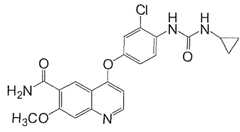

or a pharmaceutically acceptable salt thereof.
17. The kit of any of claims 13 to 16, wherein the antagonist is pembrolizumab formulated as a liquid medicament which comprises 25 mg/ml pembrolizumab, 7% (w/v) sucrose, 0.02% (w/v) polysorbate 80 in 10 niM histidine buffer pH 5.5, and the multi-RTK inhibitor is lenvatinib or a pharmaceutically acceptable salt thereof formulated as a 4 mg or 10 mg lenvatinib capsule comprising calcium carbonate, mannitol, microcrystalline cellulose, hydroxypropylcellulose, low-substituted hydroxypropylcellulose, and talc.
18. The kit of any of claims 13 to 17, wherein the cancer is thyroid cancer, HCC, NSCLC, RCC, endometrial cancer, urothelial cancer, squamous cell carcinoma of head and neck, glioblastoma or melanoma.
19. A method for treating a human individual diagnosed with a cancer, comprising administering to the individual a combination therapy for at least 24 weeks, wherein the combination therapy comprises pembrolizumab and lenvatinib or a pharmaceutically acceptable salt thereof, wherein lenvatinib or a pharmaceutically acceptable salt thereof is administered at a daily dose of 24 mg, 20 mg or 14 mg, each as lenvatinib, and
pembrolizumab is administered at a dose of 200 mg once every three weeks.
Priority Applications (5)
| Application Number | Priority Date | Filing Date | Title |
|---|---|---|---|
| KR1020177027616AKR102662228B1 (en) | 2015-03-04 | 2015-12-03 | Combination of PD-1 antagonists and VEGFR/FGFR/RET tyrosine kinase inhibitors to treat cancer |
| KR1020257001727AKR20250020678A (en) | 2015-03-04 | 2015-12-03 | Combination of a pd-1 antagonist and a vegfr/fgfr/ret tyrosine kinase inhibitor for treating cancer |
| CA2978226ACA2978226A1 (en) | 2015-03-04 | 2015-12-03 | Combination of a pd-1 antagonist and a vegfr/fgfr/ret tyrosine kinase inhibitor for treating cancer |
| AU2015384801AAU2015384801B2 (en) | 2015-03-04 | 2015-12-03 | Combination of a PD-1 antagonist and a VEGFR/FGFR/RET tyrosine kinase inhibitor for treating cancer |
| KR1020247013916AKR20240064733A (en) | 2015-03-04 | 2015-12-03 | Combination of a pd-1 antagonist and a vegfr/fgfr/ret tyrosine kinase inhibitor for treating cancer |
Applications Claiming Priority (8)
| Application Number | Priority Date | Filing Date | Title |
|---|---|---|---|
| US201562128232P | 2015-03-04 | 2015-03-04 | |
| US62/128,232 | 2015-03-04 | ||
| JP2015042683AJP2016196411A (en) | 2015-03-04 | 2015-03-04 | Tumor treatment |
| JP2015-042683 | 2015-03-04 | ||
| US201562171615P | 2015-06-05 | 2015-06-05 | |
| JP2015-114890 | 2015-06-05 | ||
| JP2015114890 | 2015-06-05 | ||
| US62/171,615 | 2015-06-05 |
Publications (1)
| Publication Number | Publication Date |
|---|---|
| WO2016140717A1true WO2016140717A1 (en) | 2016-09-09 |
Family
ID=56848768
Family Applications (2)
| Application Number | Title | Priority Date | Filing Date |
|---|---|---|---|
| PCT/US2015/063796CeasedWO2016140717A1 (en) | 2015-03-04 | 2015-12-03 | Combination of a pd-1 antagonist and a vegfr/fgfr/ret tyrosine kinase inhibitor for treating cancer |
| PCT/US2016/020747CeasedWO2016141218A1 (en) | 2015-03-04 | 2016-03-03 | Combination of a pd-1 antagonist and a vegfr/fgfr/ret tyrosine kinase inhibitor for treating cancer |
Family Applications After (1)
| Application Number | Title | Priority Date | Filing Date |
|---|---|---|---|
| PCT/US2016/020747CeasedWO2016141218A1 (en) | 2015-03-04 | 2016-03-03 | Combination of a pd-1 antagonist and a vegfr/fgfr/ret tyrosine kinase inhibitor for treating cancer |
Country Status (6)
| Country | Link |
|---|---|
| US (3) | US11547705B2 (en) |
| JP (3) | JP6788600B2 (en) |
| KR (3) | KR102662228B1 (en) |
| AU (1) | AU2015384801B2 (en) |
| CA (1) | CA2978226A1 (en) |
| WO (2) | WO2016140717A1 (en) |
Cited By (17)
| Publication number | Priority date | Publication date | Assignee | Title |
|---|---|---|---|---|
| WO2019049956A1 (en)* | 2017-09-08 | 2019-03-14 | 大鵬薬品工業株式会社 | Antitumor agent and antitumor effect potentiator |
| WO2019094832A1 (en)* | 2017-11-10 | 2019-05-16 | Lsk Biopharma | A combination therapy with apatinib for the treatment of cancer |
| US10478494B2 (en) | 2015-04-03 | 2019-11-19 | Astex Therapeutics Ltd | FGFR/PD-1 combination therapy for the treatment of cancer |
| WO2019218928A1 (en) | 2018-05-15 | 2019-11-21 | 北京诺诚健华医药科技有限公司 | Indoline-1-formamide compound, preparation method therefor, and medical use thereof |
| US10513558B2 (en) | 2015-07-13 | 2019-12-24 | Cytomx Therapeutics, Inc. | Anti-PD1 antibodies, activatable anti-PD1 antibodies, and methods of use thereof |
| WO2020135878A1 (en)* | 2018-12-29 | 2020-07-02 | 南京明德新药研发有限公司 | Imidazopyridine derivative as fgfr and vegfr dual inhibitor |
| WO2020187188A1 (en)* | 2019-03-15 | 2020-09-24 | 南京明德新药研发有限公司 | Application of combination of quinoline derivative and immunomodulator in preparation of antitumor drugs |
| WO2021047623A1 (en)* | 2019-09-11 | 2021-03-18 | Beigene, Ltd. | Treatment of cancer using a combination comprising multi-tyrosine kinase inhibitor and immune checkpoint inhibitor |
| WO2021160763A1 (en)* | 2020-02-12 | 2021-08-19 | Janssen Pharmaceutica Nv | Fgfr tyrosine kinase inhibitors and anti-pd1 agents for the treatment of urothelial carcinoma |
| US11110062B2 (en) | 2017-02-15 | 2021-09-07 | Taiho Pharmaceutical Co., Ltd. | Pharmaceutical composition |
| WO2021178657A1 (en)* | 2020-03-05 | 2021-09-10 | Merck Sharp & Dohme Corp. | Methods for treating cancer using a combination of a pd-1 antagonist, a ctla4 antagonist, and lenvatinib or a pharmaceutically acceptable salt thereof |
| KR20220004020A (en)* | 2019-03-21 | 2022-01-11 | 광저우 리우슌 바이오테크놀로지 컴퍼니 리미티드 | Multi-target kinase inhibitors, pharmaceutical compositions and methods and applications for manufacturing multi-target kinase inhibitors |
| RU2783759C2 (en)* | 2017-09-08 | 2022-11-16 | Тайхо Фармасьютикал Ко., Лтд. | Antitumor agent and antitumor effect amplifier |
| US11633476B2 (en) | 2017-05-02 | 2023-04-25 | Merck Sharp & Dohme Llc | Stable formulations of programmed death receptor 1 (PD-1) antibodies and methods of use thereof |
| EP4031179A4 (en)* | 2019-11-11 | 2023-10-04 | Cstone Pharmaceuticals (Suzhou) Co., Ltd. | Pharmaceutical combination and use thereof |
| US11845798B2 (en) | 2017-05-02 | 2023-12-19 | Merck Sharp & Dohme Llc | Formulations of anti-LAG3 antibodies and co-formulations of anti-LAG3 antibodies and anti-PD-1 antibodies |
| US12319735B2 (en) | 2018-11-07 | 2025-06-03 | Merck Sharp & Dohme Llc | Co-formulations of anti-LAG3 antibodies and anti-PD-1 antibodies |
Families Citing this family (29)
| Publication number | Priority date | Publication date | Assignee | Title |
|---|---|---|---|---|
| CN102131828B (en) | 2007-06-18 | 2015-06-17 | 默沙东有限责任公司 | Antibody against human programmed death receptor PD-1 |
| JP6038128B2 (en) | 2011-06-03 | 2016-12-07 | エーザイ・アール・アンド・ディー・マネジメント株式会社 | A biomarker for predicting and evaluating the reactivity of thyroid and renal cancer subjects to lenvatinib compounds |
| JO3783B1 (en) | 2014-08-28 | 2021-01-31 | Eisai R&D Man Co Ltd | High purity quinoline derivative and method for its production |
| BR112017017428A2 (en) | 2015-02-25 | 2018-04-03 | Eisai R&D Management Co., Ltd. | A bitter taste inhibition method of a quinoline derivative |
| WO2016140717A1 (en) | 2015-03-04 | 2016-09-09 | Merck Sharp & Dohme Corp. | Combination of a pd-1 antagonist and a vegfr/fgfr/ret tyrosine kinase inhibitor for treating cancer |
| KR102705821B1 (en) | 2015-06-16 | 2024-09-12 | 가부시키가이샤 프리즘 바이오랩 | Anticancer drug |
| SG11201801083UA (en) | 2015-08-20 | 2018-03-28 | Eisai R&D Man Co Ltd | Tumor therapeutic agent |
| KR102486722B1 (en) | 2015-12-17 | 2023-01-11 | 에자이 알앤드디 매니지먼트 가부시키가이샤 | breast cancer treatment |
| WO2018058125A1 (en)* | 2016-09-26 | 2018-03-29 | Ensemble Group Holdings | Methods of assessing and treating cancer in subjects having dysregulated lymphatic systems |
| BR112019014127A2 (en) | 2017-02-08 | 2020-02-11 | Eisai R&D Management Co., Ltd. | PHARMACEUTICAL COMPOSITION FOR TUMOR TREATMENT |
| WO2018212202A1 (en) | 2017-05-16 | 2018-11-22 | Eisai R&D Management Co., Ltd. | Treatment of hepatocellular carcinoma |
| US11559504B2 (en) | 2017-06-02 | 2023-01-24 | The Penn State Research Foundation | Ceramide nanoliposomes, compositions and methods of using for immunotherapy |
| US20210123919A1 (en)* | 2018-05-14 | 2021-04-29 | Merck Sharp & Dohme Corp. | Biomarkers for a combination therapy comprising lenvatinib and a pd-1 antagonist |
| AU2019285641A1 (en) | 2018-06-15 | 2021-04-08 | The Board Of Regents Of The University Of Texas System | Methods of treating and preventing melanoma with s-equol |
| JP7329860B2 (en) | 2018-06-15 | 2023-08-21 | ボード オブ レジェンツ,ザ ユニバーシティ オブ テキサス システム | Method for treating and preventing breast cancer using S-equol |
| CN112566661B (en)* | 2018-07-18 | 2024-02-02 | 正大天晴药业集团股份有限公司 | Pharmaceutical combination of quinoline derivatives with antibodies |
| WO2020151759A1 (en)* | 2019-01-25 | 2020-07-30 | 正大天晴药业集团股份有限公司 | Combined pharmaceutical composition for treating tumor |
| CN111617243B (en)* | 2019-02-28 | 2023-12-19 | 正大天晴药业集团股份有限公司 | Pharmaceutical combination of quinoline derivatives with antibodies |
| JP7691418B2 (en)* | 2019-10-29 | 2025-06-11 | エーザイ・アール・アンド・ディー・マネジメント株式会社 | Combination of a pd-1 antagonist, a vegfr/fgfr/ret tyrosine kinase inhibitor, and a cbp/beta-catenin inhibitor for treating cancer - Patents.com |
| CN113491695A (en)* | 2020-03-18 | 2021-10-12 | 上海博志研新药物技术有限公司 | Lovatinib pharmaceutical composition, preparation method and application thereof |
| US20210403568A1 (en)* | 2020-06-29 | 2021-12-30 | Cai Gu Huang | Biopharmaceutical formulation of anti-pd-1, anti-pd-l1, and anti-vegfr therapeutic monoclonal antibodies and method for treating nsclc by inhalation |
| KR20230066401A (en) | 2020-09-09 | 2023-05-15 | 쉔젠 칩스크린 바이오사이언스 씨오., 엘티디. | Use of Chiauranib in Combination with Immune Checkpoint Inhibitors in Antitumor Therapy |
| WO2022052926A1 (en)* | 2020-09-09 | 2022-03-17 | 广州再极医药科技有限公司 | Aromatic ethylene compound and preparation method therefor, and intermediate, pharmaceutical composition, and application thereof |
| MX2023003032A (en)* | 2020-09-15 | 2023-06-01 | Merck Sharp & Dohme Llc | Combination therapy of a pd-1 antagonist and lag3 antagonist and lenvatinib or a pharmaceutically acceptable salt thereof for treating patients with cancer. |
| TW202233185A (en)* | 2020-10-28 | 2022-09-01 | 日商衛材R&D企管股份有限公司 | Pharmaceutical composition for treating tumors |
| CN115227812A (en)* | 2021-04-22 | 2022-10-25 | 上海君实生物医药科技股份有限公司 | Use of anti-PD-1 antibody combined with first-line chemotherapy in the treatment of advanced NSCLC |
| WO2022247881A1 (en)* | 2021-05-28 | 2022-12-01 | 凯复(苏州)生物医药有限公司 | Combination therapy for treating tumor |
| CN115463217B (en)* | 2021-06-11 | 2024-03-12 | 深圳埃格林医药有限公司 | Application of hydroxyprogesterone caproate in enhancing tumor treatment effect |
| WO2024248535A1 (en)* | 2023-06-02 | 2024-12-05 | 아주대학교산학협력단 | Glycerol dehydratase variant and use thereof |
Citations (23)
| Publication number | Priority date | Publication date | Assignee | Title |
|---|---|---|---|---|
| US4816567A (en) | 1983-04-08 | 1989-03-28 | Genentech, Inc. | Recombinant immunoglobin preparations |
| US6329511B1 (en) | 1998-12-01 | 2001-12-11 | Protein Design Labs, Inc. | Humanized antibodies to γ-interferon |
| WO2004004771A1 (en) | 2002-07-03 | 2004-01-15 | Ono Pharmaceutical Co., Ltd. | Immunopotentiating compositions |
| US20040053908A1 (en) | 2000-10-20 | 2004-03-18 | Yasuhiro Funahashi | Nitrogen-containing aromatic derivatives |
| WO2004056875A1 (en) | 2002-12-23 | 2004-07-08 | Wyeth | Antibodies against pd-1 and uses therefor |
| WO2004072286A1 (en) | 2003-01-23 | 2004-08-26 | Ono Pharmaceutical Co., Ltd. | Substance specific to human pd-1 |
| US20040253205A1 (en) | 2003-03-10 | 2004-12-16 | Yuji Yamamoto | c-Kit kinase inhibitor |
| US20040259834A1 (en) | 2003-06-17 | 2004-12-23 | Kasprzyk Philip G. | Therapeutic composition containing at least diflomotecan and capecitabine |
| WO2008156712A1 (en) | 2007-06-18 | 2008-12-24 | N. V. Organon | Antibodies to human programmed death receptor pd-1 |
| US20090209580A1 (en) | 2006-05-18 | 2009-08-20 | Eisai R & D Management Co., Ltd. | Antitumor agent for thyroid cancer |
| US20090264464A1 (en) | 2006-08-28 | 2009-10-22 | Eisai R & D Management Co., Ltd. | Antitumor agent for undifferentiated gastric cancer |
| WO2010027827A2 (en) | 2008-08-25 | 2010-03-11 | Amplimmune, Inc. | Targeted costimulatory polypeptides and methods of use to treat cancer |
| US20100105031A1 (en) | 2005-08-01 | 2010-04-29 | Esai R & D Management Co., Ltd. | Method for prediction of the efficacy of vascularization inhibitor |
| WO2010077634A1 (en) | 2008-12-09 | 2010-07-08 | Genentech, Inc. | Anti-pd-l1 antibodies and their use to enhance t-cell function |
| WO2011066342A2 (en) | 2009-11-24 | 2011-06-03 | Amplimmune, Inc. | Simultaneous inhibition of pd-l1/pd-l2 |
| US8008449B2 (en) | 2005-05-09 | 2011-08-30 | Medarex, Inc. | Human monoclonal antibodies to programmed death 1 (PD-1) and methods for treating cancer using anti-PD-1 antibodies alone or in combination with other immunotherapeutics |
| US20110271358A1 (en) | 2008-09-26 | 2011-11-03 | Dana-Farber Cancer Institute, Inc. | Human anti-pd-1, pd-l1, and pd-l2 antibodies and uses therefor |
| US8168757B2 (en) | 2008-03-12 | 2012-05-01 | Merck Sharp & Dohme Corp. | PD-1 binding proteins |
| WO2012135408A1 (en) | 2011-03-31 | 2012-10-04 | Merck Sharp & Dohme Corp. | Stable formulations of antibodies to human programmed death receptor pd-1 and related treatments |
| WO2013019906A1 (en) | 2011-08-01 | 2013-02-07 | Genentech, Inc. | Methods of treating cancer using pd-1 axis binding antagonists and mek inhibitors |
| US8383796B2 (en) | 2005-07-01 | 2013-02-26 | Medarex, Inc. | Nucleic acids encoding monoclonal antibodies to programmed death ligand 1 (PD-L1) |
| US20140079706A1 (en)* | 2012-03-08 | 2014-03-20 | Hoffmann-La Roche Inc. | Combination therapy of antibodies against human csf-1r and uses thereof |
| WO2014100079A1 (en) | 2012-12-21 | 2014-06-26 | Merck Sharp & Dohme Corp. | Antibodies that bind to human programmed death ligand 1 (pd-l1) |
Family Cites Families (347)
| Publication number | Priority date | Publication date | Assignee | Title |
|---|---|---|---|---|
| US1878751A (en) | 1931-03-05 | 1932-09-20 | Axt Joseph | Spirit level |
| US2192863A (en) | 1937-03-12 | 1940-03-05 | Pennsylvania Res Corp | Electronic indicator for investigating impulses, vibrations, and the like |
| CU22545A1 (en) | 1994-11-18 | 1999-03-31 | Centro Inmunologia Molecular | OBTAINING A CHEMICAL AND HUMANIZED ANTIBODY AGAINST THE RECEPTOR OF THE EPIDERMAL GROWTH FACTOR FOR DIAGNOSTIC AND THERAPEUTIC USE |
| GB1458148A (en) | 1974-04-19 | 1976-12-08 | Wyeth John & Brother Ltd | Carbocyclic-fused ring quinoline derivatives |
| JPS57123267A (en) | 1981-01-23 | 1982-07-31 | Kansai Paint Co Ltd | Thermosetting paint composition |
| US4526988A (en) | 1983-03-10 | 1985-07-02 | Eli Lilly And Company | Difluoro antivirals and intermediate therefor |
| EP0154434B1 (en) | 1984-02-17 | 1993-01-27 | Genentech, Inc. | Human transforming growth factor and precursor or fragment thereof, cells, dna, vectors and methods for their production, compositions and products containing them, and related antibodies and diagnostic methods |
| US4582789A (en) | 1984-03-21 | 1986-04-15 | Cetus Corporation | Process for labeling nucleic acids using psoralen derivatives |
| DE8411409U1 (en) | 1984-04-11 | 1984-08-30 | Dr.-Ing. Walter Frohn-Betriebe, 8000 München | DEGASSING VALVE FOR STORAGE AND / OR TRANSPORT CONTAINERS |
| US4563417A (en) | 1984-08-31 | 1986-01-07 | Miles Laboratories, Inc. | Nucleic acid hybridization assay employing antibodies to intercalation complexes |
| DE3474040D1 (en) | 1984-11-22 | 1988-10-20 | Holsten Brauerei Ag | Beer and process for its preparation |
| CA1264738A (en) | 1984-12-04 | 1990-01-23 | Eli Lilly And Company | Treatment of tumors in mammals |
| JPS61148115A (en) | 1984-12-21 | 1986-07-05 | Tooa Eiyoo Kk | Sustained-release preparations for poorly soluble drugs and their manufacturing method |
| JPS62168137A (en) | 1985-12-20 | 1987-07-24 | Fuji Photo Film Co Ltd | Silver halide color photographic sensitive material and its processing method |
| CH656535A5 (en) | 1986-01-24 | 1986-07-15 | Spirig Ag | Process for the production of stable pharmaceutical tablets which disintegrate rapidly in water |
| JPH07106295B2 (en) | 1986-07-22 | 1995-11-15 | エーザイ株式会社 | Humidifier |
| US4743450A (en) | 1987-02-24 | 1988-05-10 | Warner-Lambert Company | Stabilized compositions |
| CA1339136C (en) | 1987-07-01 | 1997-07-29 | Sailesh Amilal Varia | Amorphous form of aztreonam |
| US5009894A (en) | 1988-03-07 | 1991-04-23 | Baker Cummins Pharmaceuticals, Inc. | Arrangement for and method of administering a pharmaceutical preparation |
| AU4128089A (en) | 1988-09-15 | 1990-03-22 | Rorer International (Overseas) Inc. | Monoclonal antibodies specific to human epidermal growth factor receptor and therapeutic methods employing same |
| US5143854A (en) | 1989-06-07 | 1992-09-01 | Affymax Technologies N.V. | Large scale photolithographic solid phase synthesis of polypeptides and receptor binding screening thereof |
| US4983615A (en) | 1989-06-28 | 1991-01-08 | Hoechst-Roussel Pharmaceuticals Inc. | Heteroarylamino- and heteroaryloxypyridinamine compounds which are useful in treating skin disorders |
| EP0408496A3 (en) | 1989-07-12 | 1992-07-01 | Ciba-Geigy Ag | Solid dosage form for pharmaceutical substances |
| US5120548A (en) | 1989-11-07 | 1992-06-09 | Merck & Co., Inc. | Swelling modulated polymeric drug delivery device |
| US5180818A (en) | 1990-03-21 | 1993-01-19 | The University Of Colorado Foundation, Inc. | Site specific cleavage of single-stranded dna |
| US5210015A (en) | 1990-08-06 | 1993-05-11 | Hoffman-La Roche Inc. | Homogeneous assay system using the nuclease activity of a nucleic acid polymerase |
| AU1248292A (en) | 1990-12-06 | 1992-07-08 | Affymax Technologies N.V. | Sequencing by hybridization of a target nucleic acid to a matrix of defined oligonucleotides |
| GB9105677D0 (en) | 1991-03-19 | 1991-05-01 | Ici Plc | Heterocyclic compounds |
| US5367057A (en) | 1991-04-02 | 1994-11-22 | The Trustees Of Princeton University | Tyrosine kinase receptor flk-2 and fragments thereof |
| EP0584222B1 (en) | 1991-05-10 | 1997-10-08 | Rhone-Poulenc Rorer International (Holdings) Inc. | Bis mono-and bicyclic aryl and heteroaryl compounds which inhibit egf and/or pdgf receptor tyrosine kinase |
| US5710158A (en) | 1991-05-10 | 1998-01-20 | Rhone-Poulenc Rorer Pharmaceuticals Inc. | Aryl and heteroaryl quinazoline compounds which inhibit EGF and/or PDGF receptor tyrosine kinase |
| US5721237A (en) | 1991-05-10 | 1998-02-24 | Rhone-Poulenc Rorer Pharmaceuticals Inc. | Protein tyrosine kinase aryl and heteroaryl quinazoline compounds having selective inhibition of HER-2 autophosphorylation properties |
| US5750376A (en) | 1991-07-08 | 1998-05-12 | Neurospheres Holdings Ltd. | In vitro growth and proliferation of genetically modified multipotent neural stem cells and their progeny |
| US5211951A (en) | 1991-07-24 | 1993-05-18 | Merck & Co., Inc. | Process for the manufacture of bioerodible poly (orthoester)s and polyacetals |
| JPH05194259A (en) | 1991-08-30 | 1993-08-03 | Mitsubishi Kasei Corp | Anti-peptic ulcer agent |
| US5200194A (en) | 1991-12-18 | 1993-04-06 | Alza Corporation | Oral osmotic device |
| CA2137275A1 (en) | 1992-06-03 | 1993-12-09 | Richard L. Eckert | Bandage for continuous application of biologicals |
| TW271400B (en) | 1992-07-30 | 1996-03-01 | Pfizer | |
| GB9221220D0 (en) | 1992-10-09 | 1992-11-25 | Sandoz Ag | Organic componds |
| GB9323290D0 (en) | 1992-12-10 | 1994-01-05 | Zeneca Ltd | Quinazoline derivatives |
| DK0680320T3 (en) | 1993-01-19 | 1999-10-25 | Warner Lambert Co | Stable oral CI-981 preparation and method of preparation thereof |
| US6027880A (en) | 1995-08-02 | 2000-02-22 | Affymetrix, Inc. | Arrays of nucleic acid probes and methods of using the same for detecting cystic fibrosis |
| US6156501A (en) | 1993-10-26 | 2000-12-05 | Affymetrix, Inc. | Arrays of modified nucleic acid probes and methods of use |
| JPH07176103A (en) | 1993-12-20 | 1995-07-14 | Canon Inc | Magneto-optical recording / reproducing system, magnetic head and magneto-optical recording medium used therefor |
| GB9326136D0 (en) | 1993-12-22 | 1994-02-23 | Erba Carlo Spa | Biologically active 3-substituted oxindole derivatives useful as anti-angiogenic agents |
| IL112249A (en) | 1994-01-25 | 2001-11-25 | Warner Lambert Co | Pharmaceutical compositions containing di and tricyclic pyrimidine derivatives for inhibiting tyrosine kinases of the epidermal growth factor receptor family and some new such compounds |
| US6811779B2 (en) | 1994-02-10 | 2004-11-02 | Imclone Systems Incorporated | Methods for reducing tumor growth with VEGF receptor antibody combined with radiation and chemotherapy |
| JP3660391B2 (en) | 1994-05-27 | 2005-06-15 | 株式会社東芝 | Manufacturing method of semiconductor device |
| JPH0848078A (en) | 1994-08-05 | 1996-02-20 | Nippon Paper Ind Co Ltd | Heat-sensitive recorder |
| GB9510757D0 (en) | 1994-09-19 | 1995-07-19 | Wellcome Found | Therapeuticaly active compounds |
| US5656454A (en) | 1994-10-04 | 1997-08-12 | President And Fellows Of Harvard College | Endothelial cell-specific enhancer |
| JP3207058B2 (en) | 1994-11-07 | 2001-09-10 | 財団法人国際超電導産業技術研究センター | Superconductor thin film and method of manufacturing the same |
| IL115256A0 (en) | 1994-11-14 | 1995-12-31 | Warner Lambert Co | 6-Aryl pyrido (2,3-d) pyrimidines and naphthyridines and their use |
| JPH08176138A (en) | 1994-12-19 | 1996-07-09 | Mercian Corp | Isocoumarin derivative |
| US5948438A (en) | 1995-01-09 | 1999-09-07 | Edward Mendell Co., Inc. | Pharmaceutical formulations having improved disintegration and/or absorptivity |
| US5658374A (en) | 1995-02-28 | 1997-08-19 | Buckman Laboratories International, Inc. | Aqueous lecithin-based release aids and methods of using the same |
| US5624937A (en) | 1995-03-02 | 1997-04-29 | Eli Lilly And Company | Chemical compounds as inhibitors of amyloid beta protein production |
| US6579314B1 (en) | 1995-03-10 | 2003-06-17 | C.R. Bard, Inc. | Covered stent with encapsulated ends |
| WO1996030347A1 (en) | 1995-03-30 | 1996-10-03 | Pfizer Inc. | Quinazoline derivatives |
| GB9508538D0 (en) | 1995-04-27 | 1995-06-14 | Zeneca Ltd | Quinazoline derivatives |
| US5880141A (en) | 1995-06-07 | 1999-03-09 | Sugen, Inc. | Benzylidene-Z-indoline compounds for the treatment of disease |
| US5654005A (en) | 1995-06-07 | 1997-08-05 | Andrx Pharmaceuticals, Inc. | Controlled release formulation having a preformed passageway |
| EP0831829B1 (en) | 1995-06-07 | 2003-08-20 | Pfizer Inc. | Heterocyclic ring-fused pyrimidine derivatives |
| JPH0923885A (en) | 1995-07-12 | 1997-01-28 | Dai Ichi Seiyaku Co Ltd | Gene expression library and its production |
| GB9514265D0 (en) | 1995-07-13 | 1995-09-13 | Wellcome Found | Hetrocyclic compounds |
| AR004010A1 (en) | 1995-10-11 | 1998-09-30 | Glaxo Group Ltd | HETERO CYCLIC COMPOUNDS |
| GB9520822D0 (en) | 1995-10-11 | 1995-12-13 | Wellcome Found | Therapeutically active compounds |
| US6346398B1 (en) | 1995-10-26 | 2002-02-12 | Ribozyme Pharmaceuticals, Inc. | Method and reagent for the treatment of diseases or conditions related to levels of vascular endothelial growth factor receptor |
| DE69622183D1 (en) | 1995-11-07 | 2002-08-08 | Kirin Brewery | CHINOLINE DERIVATIVES AND CHINAZOLE DERIVATIVES, WHICH INHIBIT THE AUTOPHOSPHORYLATION OF THE GROWTH FACTOR RECEPTOR DERIVING FROM BLOOD PLATPLES AND THEIR PHARMACEUTICAL COMPOSITIONS CONTAINING THEM |
| US5849759A (en) | 1995-12-08 | 1998-12-15 | Berlex Laboratories, Inc. | Naphthyl-substituted benzimidazole derivatives as anti-coagulants |
| GB9604361D0 (en) | 1996-02-29 | 1996-05-01 | Pharmacia Spa | 4-Substituted pyrrolopyrimidine compounds as tyrosine kinase inhibitors |
| JPH09234074A (en) | 1996-03-04 | 1997-09-09 | Sumitomo Electric Ind Ltd | Adapter double-stranded DNA and DNA amplification method using the same |
| IL126610A0 (en) | 1996-04-17 | 1999-08-17 | Du Pont Pharm Co | N-(amidinophenyl)-n'-(subst.)-3h-2,4-benzodiazepin-3- one derivatives as factor xa inhibitors |
| AU3568897A (en) | 1996-06-07 | 1998-01-05 | Eos Biotechnology, Inc. | Immobilised linear oligonucleotide arrays |
| CA2258093A1 (en) | 1996-06-28 | 1998-01-08 | Mark E. Duggan | Fibrinogen receptor antagonists |
| PL331154A1 (en) | 1996-07-13 | 1999-06-21 | Glaxo Group Ltd | Bicyclic heteroaromatic compounds as inhibitors of proteinous tyrosine kinase |
| ES2186908T3 (en) | 1996-07-13 | 2003-05-16 | Glaxo Group Ltd | HETEROCICICLES CONDENSED COMPOUNDS AS INHIBITORS OF PPROTEINA-TIROSINA-QUINASAS. |
| HRP970371A2 (en) | 1996-07-13 | 1998-08-31 | Kathryn Jane Smith | Heterocyclic compounds |
| JPH10147524A (en) | 1996-09-20 | 1998-06-02 | Nippon Kayaku Co Ltd | Preparation of oral and pharmaceutical preparations containing forskolin derivatives |
| ATE300521T1 (en) | 1996-09-25 | 2005-08-15 | Astrazeneca Ab | QUINOLINE DERIVATIVES THAT DELAY THE EFFECT OF GROWTH FACTORS LIKE VEGF |
| AU725138B2 (en) | 1996-09-30 | 2000-10-05 | Nihon Nohyaku Co., Ltd. | 1,2,3-thiadiazole derivatives and salts thereof, disease controlling agents for agricultural and horticultural use, and method for the use thereof |
| JPH10114655A (en) | 1996-10-09 | 1998-05-06 | Kyowa Hakko Kogyo Co Ltd | Solid preparation |
| EP0837063A1 (en) | 1996-10-17 | 1998-04-22 | Pfizer Inc. | 4-Aminoquinazoline derivatives |
| KR20000057228A (en) | 1996-11-27 | 2000-09-15 | 디. 제이. 우드, 스피겔 알렌 제이 | Fused bicyclic pyrimidine derivatives |
| TW486370B (en) | 1996-12-25 | 2002-05-11 | Yamanouchi Pharma Co Ltd | Rapidly disintegrable pharmaceutical composition |
| CA2275777A1 (en) | 1997-01-29 | 1998-07-30 | Louise Richman Levine | Treatment for premenstrual dysphoric disorder |
| CO4950519A1 (en) | 1997-02-13 | 2000-09-01 | Novartis Ag | PHTHALAZINES, PHARMACEUTICAL PREPARATIONS THAT UNDERSTAND THEM AND THE PROCESS FOR THEIR PREPARATION |
| EP0968206B8 (en) | 1997-02-19 | 2007-01-24 | Berlex, Inc. | N-heterocyclic derivatives as nos inhibitors |
| US6090556A (en) | 1997-04-07 | 2000-07-18 | Japan Science & Technology Corporation | Method for quantitatively determining the expression of a gene |
| AU7526798A (en) | 1997-04-18 | 1998-11-27 | Smithkline Beecham Plc | Acetamide and urea derivatives, process for their preparation and their use in the treatment of cns disorders |
| JPH10316576A (en) | 1997-05-13 | 1998-12-02 | Nissui Pharm Co Ltd | Chitosan-containing tablet |
| EP1019040B1 (en) | 1997-05-23 | 2004-09-29 | Bayer Corporation | Aryl ureas for the treatment of inflammatory or immunomodulatory diseases |
| US6093742A (en) | 1997-06-27 | 2000-07-25 | Vertex Pharmaceuticals, Inc. | Inhibitors of p38 |
| AU8283898A (en) | 1997-06-30 | 1999-01-25 | University Of Maryland At Baltimore | Heparin binding-epidermal growth factor in the diagnosis of interstitial cystitis |
| BE1011251A3 (en) | 1997-07-03 | 1999-06-01 | Ucb Sa | Pharmaceutical administrable oral, including an active substance and cyclodextrin. |
| CO4940418A1 (en) | 1997-07-18 | 2000-07-24 | Novartis Ag | MODIFICATION OF A CRYSTAL OF A DERIVATIVE OF N-PHENYL-2-PIRIMIDINAMINE, PROCESSES FOR ITS MANUFACTURE AND USE |
| JP3765918B2 (en) | 1997-11-10 | 2006-04-12 | パイオニア株式会社 | Light emitting display and driving method thereof |
| JP4194678B2 (en) | 1997-11-28 | 2008-12-10 | キリンファーマ株式会社 | Quinoline derivative and pharmaceutical composition containing the same |
| DK1043995T3 (en) | 1997-12-22 | 2007-03-05 | Bayer Pharmaceuticals Corp | Inhibition of p38 kinase activity using aryl- and heteroaryl-substituted heterocyclic ureas |
| TR200002616T2 (en) | 1997-12-22 | 2000-11-21 | Bayer Corporation | Inhibition of raf kinase using symmetric and asymmetrically substituted diphenyl ureas |
| WO1999032106A1 (en) | 1997-12-22 | 1999-07-01 | Bayer Corporation | Inhibition of raf kinase using substituted heterocyclic ureas |
| ES2154253T3 (en) | 1997-12-22 | 2012-01-27 | Bayer Healthcare Llc | INHIBITION OF THE ACTIVITY OF P38 CINASA USING REPLACED HETEROCYCLIC UREAS. |
| GB9800575D0 (en) | 1998-01-12 | 1998-03-11 | Glaxo Group Ltd | Heterocyclic compounds |
| RS49779B (en) | 1998-01-12 | 2008-06-05 | Glaxo Group Limited, | BICYCLIC HETEROAROMATIC COMPOUNDS AS PROTEIN TYROSINE KINASE INHIBITORS |
| EA003876B1 (en) | 1998-02-25 | 2003-10-30 | Дженетикс Инститьют, Ллс | Inhibitors of phospholipase enzymes |
| ATE219658T1 (en) | 1998-03-06 | 2002-07-15 | Eurand Int | QUICKLY DISSOLVING TABLET |
| DE19814257A1 (en) | 1998-03-31 | 1999-10-07 | Asta Medica Ag | effervescent formulations |
| JPH11322596A (en) | 1998-05-12 | 1999-11-24 | Shionogi & Co Ltd | Anticancer agent containing platinum complex and cyclic phosphoric ester amide |
| UA60365C2 (en) | 1998-06-04 | 2003-10-15 | Пфайзер Продактс Інк. | Isothiazole derivatives, a method for preparing thereof, a pharmaceutical composition and a method for treatment of hyperproliferative disease of mammal |
| US6653341B1 (en) | 1998-06-17 | 2003-11-25 | Eisai Co., Ltd. | Methods and compositions for use in treating cancer |
| US8097648B2 (en) | 1998-06-17 | 2012-01-17 | Eisai R&D Management Co., Ltd. | Methods and compositions for use in treating cancer |
| IL139960A0 (en) | 1998-06-17 | 2002-02-10 | Eisai Co Ltd | Macrocylic analogs and methods of their use and preparation |
| WO2000019985A2 (en) | 1998-10-01 | 2000-04-13 | Novartis Ag | New sustained release oral formulations |
| US6344455B1 (en) | 1998-11-19 | 2002-02-05 | Warner-Lambert Company | N-[4-(3-chloro-4-fluoro-phenylamino)-7-(3-morpholin-4-yl-propoxy)-quinazolin-6-yl]-acrylamide, and irreversible inhibitor of tyrosine kinases |
| TWI230618B (en) | 1998-12-15 | 2005-04-11 | Gilead Sciences Inc | Pharmaceutical compositions of 9-[2-[[bis[(pivaloyloxy)methyl]phosphono]methoxy]ethyl]adenine and tablets or capsules containing the same |
| WO2000042012A1 (en) | 1999-01-13 | 2000-07-20 | Bayer Corporation | φ-CARBOXYARYL SUBSTITUTED DIPHENYL UREAS AS RAF KINASE INHIBITORS |
| UA73492C2 (en) | 1999-01-19 | 2005-08-15 | Aromatic heterocyclic compounds as antiinflammatory agents | |
| DE60033857T2 (en) | 1999-01-22 | 2007-10-25 | Kirin Beer K.K. | Derivatives of the N - ((quinolinyl) oxy) phenyl) urea and the N - ((quinazolinyl) oxy) -phenyl) urea with antitumor activity |
| UA71945C2 (en) | 1999-01-27 | 2005-01-17 | Pfizer Prod Inc | Substituted bicyclic derivatives being used as anticancer agents |
| JP3270834B2 (en) | 1999-01-27 | 2002-04-02 | ファイザー・プロダクツ・インク | Heteroaromatic bicyclic derivatives useful as anticancer agents |
| CZ305827B6 (en) | 1999-02-10 | 2016-03-30 | Astrazeneca Ab | Indole derivatives |
| GB9904103D0 (en) | 1999-02-24 | 1999-04-14 | Zeneca Ltd | Quinoline derivatives |
| RS49836B (en) | 1999-03-31 | 2008-08-07 | Pfizer Products Inc., | Process and intermediates for preparing anti-cancer compounds |
| HK1045700B (en) | 1999-04-28 | 2007-07-27 | 德克萨斯大学董事会 | Compositions an methods for cancer treatment by selectively inhibiting vegf |
| WO2000071097A1 (en) | 1999-05-20 | 2000-11-30 | Takeda Chemical Industries, Ltd. | Composition containing ascorbic acid salt |
| JP4304357B2 (en) | 1999-05-24 | 2009-07-29 | 独立行政法人理化学研究所 | How to create a full-length cDNA library |
| PE20010306A1 (en) | 1999-07-02 | 2001-03-29 | Agouron Pharma | INDAZOLE COMPOUNDS AND PHARMACEUTICAL COMPOSITIONS CONTAINING THEM USEFUL FOR THE INHIBITION OF PROTEIN KINASE |
| JP2001047890A (en) | 1999-08-06 | 2001-02-20 | Toyota Motor Corp | Control device for vehicle power plant |
| AU6762400A (en) | 1999-08-12 | 2001-03-13 | Cor Therapeutics, Inc. | Inhibitors of factor xa |
| CO5200835A1 (en) | 1999-09-28 | 2002-09-27 | Bayer Corp | PIRIDINES AND REPLACED PIRIDACINES WITH ANGIOGENESIS INHIBITION ACTIVITY |
| US6762180B1 (en) | 1999-10-13 | 2004-07-13 | Boehringer Ingelheim Pharma Kg | Substituted indolines which inhibit receptor tyrosine kinases |
| UA75054C2 (en) | 1999-10-13 | 2006-03-15 | Бьорінгер Інгельхайм Фарма Гмбх & Ко. Кг | Substituted in position 6 indolinones, producing and use thereof as medicament |
| JP2001131071A (en) | 1999-10-29 | 2001-05-15 | Meiji Seika Kaisha Ltd | Amorphous substance and medical composition containing amorphous substance |
| JP2003525595A (en) | 1999-11-01 | 2003-09-02 | キュラゲン コーポレイション | Differentially expressed gene involved in angiogenesis, polypeptide encoded thereby, and method using the same |
| US20080241835A1 (en) | 1999-11-01 | 2008-10-02 | Genentech, Inc. | Differentially expressed genes involved in angiogenesis, the polypeptides encoded thereby, and methods of using the same |
| DE60036726T2 (en) | 1999-11-16 | 2008-02-07 | Boehringer Ingelheim Pharmaceuticals, Inc., Ridgefield | UREA DERIVATIVES AS ANTI-INFLAMMATORY AGENTS |
| UA75055C2 (en) | 1999-11-30 | 2006-03-15 | Пфайзер Продактс Інк. | Benzoimidazole derivatives being used as antiproliferative agent, pharmaceutical composition based thereon |
| US20020010203A1 (en) | 1999-12-22 | 2002-01-24 | Ken Lipson | Methods of modulating c-kit tyrosine protein kinase function with indolinone compounds |
| DE60018216T2 (en) | 1999-12-24 | 2006-02-16 | Kyowa Hakko Kogyo Co., Ltd. | CONDENSED PURE DERIVATIVES |
| US7135466B2 (en) | 1999-12-24 | 2006-11-14 | Kirin Beer Kabushiki Kaisha | Quinoline and quinazoline derivatives and drugs containing the same |
| ES2290117T3 (en) | 2000-02-15 | 2008-02-16 | Sugen, Inc. | PROTEIN QUINASE 2-INDOLIN INHIBITORS REPLACED WITH PIRROL. |
| JP3657203B2 (en) | 2000-04-21 | 2005-06-08 | エーザイ株式会社 | Copper chlorophyllin salt-containing liquid composition |
| CN1116047C (en) | 2000-06-05 | 2003-07-30 | 华中科技大学 | Liver-protecting functional food made from loach and preparation method thereof |
| EP1287029A2 (en) | 2000-06-09 | 2003-03-05 | Corixa Corporation | Compositions and methods for the therapy and diagnosis of colon cancer |
| WO2002016348A1 (en) | 2000-08-09 | 2002-02-28 | Astrazeneca Ab | Antiangiogenic bicyclic derivatives |
| TWI283575B (en) | 2000-10-31 | 2007-07-11 | Eisai Co Ltd | Medicinal compositions for concomitant use as anticancer agent |
| EP1810715A3 (en) | 2000-11-22 | 2009-12-16 | Novartis AG | Combination comprising an agent decreasing VEGF activity and an agent decreasing EGF activity |
| WO2002044156A2 (en) | 2000-11-29 | 2002-06-06 | Glaxo Group Limited | Benzimidazole derivatives useful as tie-2 and/or vegfr-2 inhibitors |
| US6544552B2 (en) | 2001-01-11 | 2003-04-08 | Particle And Coating Technologies, Inc. | Method of producing porous tablets with improved dissolution properties |
| WO2002070751A1 (en) | 2001-03-02 | 2002-09-12 | University Of Pittsburgh Of The Commonwealth System Of Higher Education | Pcr method |
| US6960580B2 (en) | 2001-03-08 | 2005-11-01 | Millennium Pharmaceuticals, Inc. | Nitrogenous heterocyclic substituted quinoline compounds |
| SG152906A1 (en) | 2001-04-06 | 2009-06-29 | Wyeth Corp | Antineoplastic combinations such as rapamycin together with gemcitabine or fluorouracil |
| WO2002085926A2 (en) | 2001-04-19 | 2002-10-31 | GESELLSCHAFT FüR BIOTECHNOLOGISCHE FORSCHUNG MBH (GBF) | Method for producing stable, regeneratable antibody arrays |
| JP3602513B2 (en) | 2001-04-27 | 2004-12-15 | 麒麟麦酒株式会社 | Quinoline derivatives and quinazoline derivatives having an azolyl group |
| IL158459A0 (en) | 2001-04-27 | 2004-05-12 | Kirin Brewery | Quinoline derivatives and quinazoline derivatives having azolyl group |
| JP2003026576A (en) | 2001-05-09 | 2003-01-29 | Eisai Co Ltd | Medicine having improved taste |
| US6812341B1 (en) | 2001-05-11 | 2004-11-02 | Ambion, Inc. | High efficiency mRNA isolation methods and compositions |
| PL392652A1 (en) | 2001-05-16 | 2010-12-06 | Novartis Ag | A combination consisting of N-{5-[4-(4-methyl-piperazine-methyl)-benzoiloamido]-2-methylphenyl} -4-(3-pyridyl)-2-pyrimidine-amine and the chemotherapeutic agent, the use thereof, pharmaceutical composition containing thereof a kit containing such a combination |
| US6599902B2 (en) | 2001-05-30 | 2003-07-29 | Sugen, Inc. | 5-aralkysufonyl-3-(pyrrol-2-ylmethylidene)-2-indolinone derivatives as kinase inhibitors |
| EP2088141A3 (en) | 2001-06-22 | 2009-11-18 | Kirin Pharma Kabushiki Kaisha | Quinoline derivatives and quinazoline derivatives capable of inhibiting autophosphorylation of hepatocyte growth factor receptors, and pharmaceutical composition comprising the same |
| US20030013208A1 (en) | 2001-07-13 | 2003-01-16 | Milagen, Inc. | Information enhanced antibody arrays |
| GB0117144D0 (en) | 2001-07-13 | 2001-09-05 | Glaxo Group Ltd | Process |
| JP4827154B2 (en) | 2001-07-25 | 2011-11-30 | 株式会社オーイズミ | Game equipment |
| GB0119467D0 (en) | 2001-08-09 | 2001-10-03 | Smithkline Beecham Plc | Novel compound |
| WO2003022028A2 (en) | 2001-09-10 | 2003-03-20 | Meso Scale Technologies, Llc | Methods, reagents, kits and apparatus for protein function analysis |
| DE60228278D1 (en) | 2001-09-20 | 2008-09-25 | Ab Science | THE USE OF POTENTIALS, SELECTIVE AND NONTOXIC C-THICKNESSES FOR THE TREATMENT OF INTERSTITIAL BUBBLE IGNITION |
| WO2003028711A2 (en) | 2001-09-27 | 2003-04-10 | Novartis Ag | Use of c-kit inhibitors for the treatment of myeloma |
| WO2003027102A1 (en) | 2001-09-27 | 2003-04-03 | Allergan, Inc. | 3-(arylamino)methylene-1, 3-dihydro-2h-indol-2-ones as kinase inhibitors |
| US20040191254A1 (en) | 2001-10-09 | 2004-09-30 | Fagin James Alexander | Method of treatment of thyroid cancer |
| US7521053B2 (en) | 2001-10-11 | 2009-04-21 | Amgen Inc. | Angiopoietin-2 specific binding agents |
| US7658924B2 (en) | 2001-10-11 | 2010-02-09 | Amgen Inc. | Angiopoietin-2 specific binding agents |
| WO2003033472A1 (en) | 2001-10-17 | 2003-04-24 | Kirin Beer Kabushiki Kaisha | Quinoline or quinazoline derivatives inhibiting auto- phosphorylation of fibroblast growth factor receptors |
| JP2005514384A (en) | 2001-11-27 | 2005-05-19 | ワイス・ホールディングズ・コーポレイション | 3-Cyanoquinolines as inhibitors of EGF-R and HER2 kinase |
| GB0201508D0 (en) | 2002-01-23 | 2002-03-13 | Novartis Ag | Organic compounds |
| WO2003075840A2 (en) | 2002-03-04 | 2003-09-18 | Imclone Systems Incorporated | Human antibodies specific to kdr and uses thereof |
| JP2003252737A (en) | 2002-03-04 | 2003-09-10 | Shin Etsu Chem Co Ltd | Oral composition |
| AU2003211594A1 (en) | 2002-03-05 | 2003-09-16 | Eisai Co., Ltd. | Antitumor agent comprising combination of sulfonamide-containing heterocyclic compound with angiogenesis inhibitor |
| WO2003077842A2 (en) | 2002-03-12 | 2003-09-25 | Bristol-Myers Squibb Company | Palatable oral suspension and method |
| AU2003226676A1 (en) | 2002-03-20 | 2003-09-29 | Dana-Farber Cancer Institute Inc. | Methods and compositions for the identification, assessment, and therapy of small cell lung cancer |
| US6790852B2 (en) | 2002-04-18 | 2004-09-14 | Hoffmann-La Roche Inc. | 2-(2,6-dichlorophenyl)-diarylimidazoles |
| US7598258B2 (en) | 2002-05-01 | 2009-10-06 | Kirin Beer Kabushiki Kaisha | Quinoline derivatives and quinazoline derivatives inhibiting autophosphorylation of macrophage colony stimulating factor receptor |
| AR037647A1 (en) | 2002-05-29 | 2004-12-01 | Novartis Ag | USED DIARILUREA DERIVATIVES FOR THE TREATMENT OF DEPENDENT DISEASES OF THE PROTEIN KINase |
| UA77303C2 (en) | 2002-06-14 | 2006-11-15 | Pfizer | Derivatives of thienopyridines substituted by benzocondensed heteroarylamide useful as therapeutic agents, pharmaceutical compositions and methods for their use |
| AU2003251968A1 (en) | 2002-07-16 | 2004-02-02 | Children's Medical Center Corporation | A method for the modulation of angiogenesis |
| US7074880B2 (en) | 2002-07-22 | 2006-07-11 | Aspen Aerogels, Inc. | Polyimide aerogels, carbon aerogels, and metal carbide aerogels and methods of making same |
| US7169936B2 (en) | 2002-07-23 | 2007-01-30 | Boehringer Ingelheim Pharma Gmbh & Co. Kg | Indolinone derivatives substituted in the 6-position, their preparation and their use as medicaments |
| US7252976B2 (en) | 2002-08-28 | 2007-08-07 | Board Of Regents The University Of Texas System | Quantitative RT-PCR to AC133 to diagnose cancer and monitor angiogenic activity in a cell sample |
| MXPA05001536A (en) | 2002-08-30 | 2005-04-19 | Eisai Co Ltd | Azaarene derivatives. |
| GB0223380D0 (en) | 2002-10-09 | 2002-11-13 | Astrazeneca Ab | Combination therapy |
| EP1551378A4 (en) | 2002-10-09 | 2006-09-06 | Kosan Biosciences Inc | Epo d + 5-fu/gemcitabine |
| JP4749660B2 (en) | 2002-10-16 | 2011-08-17 | 武田薬品工業株式会社 | Stable solid formulation |
| US8697094B2 (en) | 2002-10-16 | 2014-04-15 | Takeda Pharmaceutical Company Limited | Stable solid preparations |
| CA2500083A1 (en) | 2002-10-21 | 2004-04-29 | Warner-Lambert Company Llc | Tetrahydroquinoline derivatives as crth2 antagonists |
| US20080207617A1 (en) | 2002-10-29 | 2008-08-28 | Kirin Beer Kabushiki Kaisha | Quinoline Derivatives and Quinazoline Derivatives Inhibiting Autophosphrylation of Flt3 and Medicinal Compositions Containing the Same |
| DE10250711A1 (en) | 2002-10-31 | 2004-05-19 | Degussa Ag | Pharmaceutical and cosmetic preparations |
| CA2502979A1 (en) | 2002-11-06 | 2004-05-21 | Cyclacel Limited | Pharmaceutical composition comprising a cdk inhibitor and gemcitabine |
| GB0226434D0 (en) | 2002-11-13 | 2002-12-18 | Astrazeneca Ab | Combination product |
| ITSV20020056A1 (en) | 2002-11-14 | 2004-05-15 | Alstom Transp Spa | DEVICE AND METHOD OF VERIFICATION OF LOGIC SOFTWARE MOTORS TO COMMAND RAILWAY SYSTEMS, IN PARTICULAR OF STATION SYSTEMS |
| AR042042A1 (en) | 2002-11-15 | 2005-06-08 | Sugen Inc | COMBINED ADMINISTRATION OF AN INDOLINONE WITH A CHEMOTHERAPEUTIC AGENT FOR CELL PROLIFERATION DISORDERS |
| ATE552236T1 (en) | 2003-01-14 | 2012-04-15 | Cytokinetics Inc | COMPOUNDS, COMPOSITIONS AND METHODS FOR TREATING HEART FAILURE |
| JP3581361B1 (en) | 2003-02-17 | 2004-10-27 | 株式会社脳機能研究所 | Brain activity measurement device |
| CA2514875A1 (en) | 2003-02-19 | 2004-09-02 | Biovail Laboratories International Srl | Rapid absorption selective 5-ht agonist formulations |
| NZ541861A (en) | 2003-02-26 | 2009-05-31 | Sugen Inc | Aminoheteroaryl compounds as protein kinase inhibitors |
| CN101053558A (en) | 2003-03-05 | 2007-10-17 | 细胞基因公司 | Diphenylethylene compounds and uses thereof |
| TWI344955B (en) | 2003-03-14 | 2011-07-11 | Ono Pharmaceutical Co | Heterocyclic rinf having nitrogen atom derivatives and medicament containing the derivatives as active ingredient |
| WO2004081047A1 (en) | 2003-03-14 | 2004-09-23 | Taisho Pharmaceutical Co., Ltd. | Monoclonal antibody and hybridoma producing the same |
| EA200501552A1 (en) | 2003-04-02 | 2006-04-28 | Плива-Истраживанье И Развой Д.О.О. | PHARMACEUTICAL COMPOSITIONS WITH LESS EXPRESSED BITTER TASTE |
| US20050014753A1 (en) | 2003-04-04 | 2005-01-20 | Irm Llc | Novel compounds and compositions as protein kinase inhibitors |
| WO2004101526A1 (en) | 2003-04-22 | 2004-11-25 | Eisai Co., Ltd. | Polymorphous crystal of 4-(3-chloro-4-(cyclopropylaminocarbonyl)aminophenoxy)-7-methoxy-6-qunolinecarboxamide and method for preparation thereof |
| EP1473043A1 (en) | 2003-04-29 | 2004-11-03 | Boehringer Ingelheim Pharma GmbH & Co.KG | Pharmaceutical combination for the treatment of diseases involving cell proliferation, migration or apotosis of myeloma cells, or angiogenesis |
| US7107104B2 (en) | 2003-05-30 | 2006-09-12 | Medtronic, Inc. | Implantable cortical neural lead and method |
| JP2007526886A (en) | 2003-07-10 | 2007-09-20 | アストラゼネカ アクチボラグ | Use of quinazoline derivative ZD6474 in combination with platinum-based antitumor agents and optional ionizing radiation in the treatment of diseases associated with angiogenesis and / or increased vascular permeability |
| DE602004013792D1 (en) | 2003-08-15 | 2008-06-26 | Ab Science | USE OF C-KIT INHIBITORS FOR THE TREATMENT OF TYPE-2 DIABETES |
| ATE413395T1 (en) | 2003-08-21 | 2008-11-15 | Osi Pharm Inc | N-SUBSTITUTED PYRAZOLYL-AMIDYL-BENZIMIDAZOLYL-C KIT INHIBITOR N |
| US7485658B2 (en) | 2003-08-21 | 2009-02-03 | Osi Pharmaceuticals, Inc. | N-substituted pyrazolyl-amidyl-benzimidazolyl c-Kit inhibitors |
| KR20060121818A (en) | 2003-08-21 | 2006-11-29 | 오에스아이 파마슈티컬스, 인코포레이티드 | N-substituted benzimidazolyl C-VIT inhibitors |
| US7312243B1 (en)* | 2003-08-29 | 2007-12-25 | Jay Pravda | Materials and methods for treatment of gastrointestinal disorders |
| EP1682181A2 (en) | 2003-09-23 | 2006-07-26 | Novartis AG | Combination of a vegf receptor inhibitor with a chemotherapeutic agent |
| ES2466818T3 (en) | 2003-09-26 | 2014-06-11 | Exelixis, Inc. | C-Met modulators and methods of use |
| KR200340552Y1 (en) | 2003-10-08 | 2004-02-11 | 주식회사 엘지화학 | Double window frame easy to install blind and security window therein |
| JP2005124034A (en) | 2003-10-20 | 2005-05-12 | Nippon Telegr & Teleph Corp <Ntt> | Line setting method that enables identification of caller and call back to caller |
| CN100450998C (en) | 2003-11-11 | 2009-01-14 | 卫材R&D管理有限公司 | Process for the preparation of urea derivatives |
| US20080312192A1 (en) | 2003-11-28 | 2008-12-18 | Guido Bold | Diaryl Urea Derivatives in the Treatment of Protein Kinase Dependent Diseases |
| BRPI0417302A (en) | 2003-12-05 | 2007-03-06 | Compound Therapeutics Inc | type 2 vascular endothelial growth factor receptor inhibitors |
| CN101337931B (en) | 2003-12-25 | 2010-09-29 | 卫材R&D管理有限公司 | The crystallization (I) of the acetate of the mesylate of quinoline carboxamide and its preparation method |
| WO2007011955A2 (en) | 2005-07-18 | 2007-01-25 | The Trustees Of The University Of Pennsylvania | Drug-containing implants and methods of use thereof |
| TW200536851A (en) | 2004-01-23 | 2005-11-16 | Amgen Inc | Compounds and methods of use |
| AU2005217328B2 (en) | 2004-02-27 | 2007-10-04 | Eisai R & D Management Co., Ltd. | Novel pyridine derivative and pyrimidine derivative (2) |
| KR20050091462A (en) | 2004-03-12 | 2005-09-15 | 한국과학기술연구원 | Furopyrimidine compound and ddr2 tyrosine kinase activity inhibitor comprising the same |
| JP4341454B2 (en) | 2004-04-08 | 2009-10-07 | トヨタ自動車株式会社 | Method for producing solid oxide fuel cell |
| US7459562B2 (en) | 2004-04-23 | 2008-12-02 | Bristol-Myers Squibb Company | Monocyclic heterocycles as kinase inhibitors |
| JP2008502721A (en) | 2004-05-21 | 2008-01-31 | ノバルティス ヴァクシンズ アンド ダイアグノスティクス, インコーポレイテッド | Substituted quinoline derivatives as mitotic kinesin inhibitors |
| WO2005117887A1 (en) | 2004-06-03 | 2005-12-15 | F. Hoffmann-La Roche Ag | Treatment with gemcitabine and an egfr-inhibitor |
| ES2748200T3 (en) | 2004-06-03 | 2020-03-13 | Eisai R&D Man Co Ltd | Intermediates for the preparation of Halondondrin B |
| CA2570501A1 (en) | 2004-06-18 | 2006-01-26 | Gergely Szakacs | Methods for the identification and use of compounds suitable for the treatment of drug resistant cancer cells |
| US20050288290A1 (en) | 2004-06-28 | 2005-12-29 | Borzilleri Robert M | Fused heterocyclic kinase inhibitors |
| US20050288521A1 (en) | 2004-06-29 | 2005-12-29 | Phytogen Life Sciences Inc. | Semi-synthetic conversion of paclitaxel to docetaxel |
| EP1773826A4 (en) | 2004-07-02 | 2009-06-03 | Exelixis Inc | C-met modulators and method of use |
| US8772269B2 (en) | 2004-09-13 | 2014-07-08 | Eisai R&D Management Co., Ltd. | Use of sulfonamide-including compounds in combination with angiogenesis inhibitors |
| EP2364699A1 (en) | 2004-09-13 | 2011-09-14 | Eisai R&D Management Co., Ltd. | Joint use of sulfonamide based compound with angiogenesis inhibitor |
| CN101001629B (en) | 2004-09-17 | 2010-05-05 | 卫材R&D管理有限公司 | Pharmaceutical composition |
| US20060079494A1 (en) | 2004-09-27 | 2006-04-13 | Santi Daniel V | Specific kinase inhibitors |
| EP1806129A1 (en) | 2004-10-01 | 2007-07-11 | Eisai R&D Management Co., Ltd. | Composition containing fine particles and process for producing the same |
| MX2007004247A (en) | 2004-10-19 | 2007-06-12 | Amgen Inc | Angiopoietin-2 specific binding agents. |
| JP2008520746A (en) | 2004-11-22 | 2008-06-19 | キング・ファーマシューティカルズ・リサーチ・アンド・デベロプメント・インコーポレイティッド | Accelerated treatment of cancer and HIF-1 mediated diseases using an adenosine A3 receptor antagonist |
| CA2552766C (en) | 2004-11-23 | 2010-08-17 | Dong Wha Pharmaceutical Ind. Co., Ltd. | N-hydroxy-4- {5- [4- (5-isopropyl-2-methyl-1,3-thiazol-4-yl)phenoxy]pentoxy} benzamidine bis(methanesulfonate) |
| JP2008521900A (en) | 2004-11-30 | 2008-06-26 | アムジエン・インコーポレーテツド | Quinolines and quinazoline analogues and their use as medicaments for the treatment of cancer |
| CN100341504C (en) | 2004-12-01 | 2007-10-10 | 鲁南制药集团股份有限公司 | Zolmitriptan quick-release formulation |
| EP1824843A2 (en) | 2004-12-07 | 2007-08-29 | Locus Pharmaceuticals, Inc. | Inhibitors of protein kinases |
| KR101017301B1 (en) | 2004-12-21 | 2011-02-28 | 메드임뮨 리미티드 | Antibodies to Angiopoietin-2 and Uses thereof |
| JP2006230816A (en) | 2005-02-25 | 2006-09-07 | H & A Investment:Kk | Sandal holder |
| JP5106098B2 (en) | 2005-02-28 | 2012-12-26 | エーザイ・アール・アンド・ディー・マネジメント株式会社 | New combination of sulfonamide compounds with anticancer agents |
| US20080286282A1 (en) | 2005-02-28 | 2008-11-20 | Eisai R & D Management Co., Ltd. | Novel Use of Sulfonamide Compound in Combination with Angiogenesis Inhibitor |
| ME01222B (en) | 2005-02-28 | 2013-06-20 | Eisai R&D Man Co Ltd | Novel combinational use of a sulfonamide compound in the treatment of cancer |
| MX2007014377A (en) | 2005-05-17 | 2008-02-06 | Plexxikon Inc | Pyrrol (2,3-b) pyridine derivatives protein kinase inhibitors. |
| UA95244C2 (en) | 2005-06-22 | 2011-07-25 | Плексикон, Инк. | Compounds and methods for kinase modulation, and indications therefor |
| US7550483B2 (en) | 2005-06-23 | 2009-06-23 | Eisai R&D Management Co., Ltd. | Amorphous salt of 4-(3-chloro-4-(cyclopropylaminocarbonyl)aminophenoxy)-7-methoxy-6-quinolinecarboxamide and process for preparing the same |
| AU2006260148B9 (en) | 2005-06-23 | 2009-09-17 | Eisai R&D Managment Co., Ltd. | Amorphous salt of 4-(3-chloro-4-(cyclopropylaminocarbonyl)aminophenoxy)- 7-methoxy-6-quinolinecarboxamide and process for producing the same |
| US20090305994A1 (en) | 2005-06-29 | 2009-12-10 | D Andrea Lucas Domenico | Compounds Modulating Vegf Receptor and Uses Thereof |
| CA2614526A1 (en) | 2005-07-11 | 2006-10-12 | Nycomed Danmark Aps | Benzimidazole formulation |
| US8101799B2 (en) | 2005-07-21 | 2012-01-24 | Ardea Biosciences | Derivatives of N-(arylamino) sulfonamides as inhibitors of MEK |
| US8648116B2 (en) | 2005-07-21 | 2014-02-11 | Ardea Biosciences, Inc. | Derivatives of N-(arylamino) sulfonamides including polymorphs as inhibitors of MEK as well as compositions, methods of use and methods for preparing the same |
| JP2009502960A (en) | 2005-07-27 | 2009-01-29 | ザ・ボード・オブ・リージェンツ・オブ・ザ・ユニバーシティ・オブ・テキサス・システム | Combination comprising gemcitabine and tyrosine kinase inhibitor for the treatment of pancreatic cancer |
| JP4989476B2 (en) | 2005-08-02 | 2012-08-01 | エーザイ・アール・アンド・ディー・マネジメント株式会社 | Methods for assaying the effects of angiogenesis inhibitors |
| EP1889836B1 (en) | 2005-08-24 | 2013-06-12 | Eisai R&D Management Co., Ltd. | Novel pyridine derivative and pyrimidine derivative (3) |
| CN102716490A (en) | 2005-09-01 | 2012-10-10 | 卫材R&D管理有限公司 | Method for improving disintegration of pharmaceutical composition |
| CN1308012C (en) | 2005-11-02 | 2007-04-04 | 广州中医药大学第二附属医院 | Chinese medicine composition for treating cerebral hemorrhage and its prepn |
| WO2007052850A1 (en) | 2005-11-07 | 2007-05-10 | Eisai R & D Management Co., Ltd. | USE OF COMBINATION OF ANTI-ANGIOGENIC SUBSTANCE AND c-kit KINASE INHIBITOR |
| WO2007061127A1 (en) | 2005-11-22 | 2007-05-31 | Eisai R & D Management Co., Ltd. | Anti-tumor agent for multiple myeloma |
| US7825137B2 (en) | 2005-12-05 | 2010-11-02 | Pfizer Inc. | Method of treating abnormal cell growth |
| AR059066A1 (en) | 2006-01-27 | 2008-03-12 | Amgen Inc | COMBINATIONS OF THE ANGIOPOYETINE INHIBITOR -2 (ANG2) AND THE VASCULAR ENDOTELIAL GROWTH FACTOR INHIBITOR (VEGF) |
| KR100728926B1 (en) | 2006-03-20 | 2007-06-15 | 삼성전자주식회사 | Portable electronic device with three axis hinge structure |
| US7321241B1 (en) | 2006-06-15 | 2008-01-22 | California Micro Devices | Bidirectional buffer with slew rate control and method of bidirectionally transmitting signals with slew rate control |
| ATE535520T1 (en) | 2006-08-23 | 2011-12-15 | Eisai R&D Man Co Ltd | SALT OF A PHENOXYPYRIDINE DERIVATIVE OR CRYSTAL THEREOF AND METHOD FOR THE PRODUCTION THEREOF |
| US7790885B2 (en) | 2006-08-31 | 2010-09-07 | Eisai R&D Management Co., Ltd. | Process for preparing phenoxypyridine derivatives |
| WO2008029123A1 (en) | 2006-09-07 | 2008-03-13 | Astrazeneca Ab | Method for evaluating patients for treatment with drugs targeting ret receptor tyrosine kinase |
| JP2009184925A (en) | 2006-11-02 | 2009-08-20 | Dai Ichi Seiyaku Co Ltd | 5-(1h-1,2,3-triazol-4-yl)-1h-pyrazole derivative |
| AU2008205847A1 (en) | 2007-01-19 | 2008-07-24 | Eisai R & D Management Co., Ltd. | Composition for treatment of pancreatic cancer |
| ES2547303T3 (en) | 2007-01-19 | 2015-10-05 | Ardea Biosciences, Inc. | MEK inhibitors |
| CN101600694A (en) | 2007-01-29 | 2009-12-09 | 卫材R&D管理有限公司 | Composition for treatment of undifferentiated gastric cancer |
| AU2008217931A1 (en) | 2007-02-23 | 2008-08-28 | Eisai R & D Management Co., Ltd. | Pyridine or pyrimidine derivative having excellent cell growth inhibition effect and excellent anti-tumor effect on cell strain having amplification of HGFR gene |
| TW200901960A (en) | 2007-03-05 | 2009-01-16 | Kyowa Hakko Kogyo Kk | Pharmaceutical composition |
| WO2008111441A1 (en) | 2007-03-05 | 2008-09-18 | Kyowa Hakko Kirin Co., Ltd. | Pharmaceutical composition |
| GB2448181B (en) | 2007-04-05 | 2011-11-09 | Ford Global Tech Llc | Vehicle headlight beam controls |
| US7901888B2 (en) | 2007-05-09 | 2011-03-08 | The Regents Of The University Of California | Multigene diagnostic assay for malignant thyroid neoplasm |
| US7807172B2 (en) | 2007-06-13 | 2010-10-05 | University Of Washington | Methods and compositions for detecting thyroglobulin in a biological sample |
| PE20090368A1 (en) | 2007-06-19 | 2009-04-28 | Boehringer Ingelheim Int | ANTI-IGF ANTIBODIES |
| CN101883763B (en) | 2007-10-03 | 2016-04-20 | 卫材R&D管理有限公司 | Intermediates and methods for the synthesis of halichondrin B analogs |
| CA2704000C (en) | 2007-11-09 | 2016-12-13 | Eisai R&D Management Co., Ltd. | Combination of anti-angiogenic substance and anti-tumor platinum complex |
| JP2009132660A (en) | 2007-11-30 | 2009-06-18 | Eisai R & D Management Co Ltd | Composition for treating esophageal cancer |
| EP2248804A4 (en) | 2008-01-29 | 2014-09-10 | Eisai R&D Man Co Ltd | Combined use of angiogenesis inhibitor and taxane |
| GB2456907A (en) | 2008-01-30 | 2009-08-05 | Astrazeneca Ab | Method for determining subsequent VEGFR2 inhibitor therapy comprising measuring baseline VEGF level. |
| AU2009221765B2 (en) | 2008-03-05 | 2015-05-07 | Vicus Therapeutics, Llc | Compositions and methods for mucositis and oncology therapies |
| US8044240B2 (en) | 2008-03-06 | 2011-10-25 | Ardea Biosciences Inc. | Polymorphic form of N-(S)-(3,4-difluoro-2-(2-fluoro-4-iodophenylamino)-6-methoxyphenyl)-1-(2,3-dihydroxypropyl)cyclopropane-1-sulfonamide and uses thereof |
| BRPI0911297A2 (en) | 2008-04-14 | 2019-09-24 | Ardea Biosciences Inc | composition and methods for preparation and use thereof |
| WO2009137649A2 (en) | 2008-05-07 | 2009-11-12 | The Trustees Of The University Of Pennsylvania | Methods for treating thyroid cancer |
| MX2010012290A (en) | 2008-05-14 | 2011-02-21 | Amgen Inc | Combinations vegf(r) inhibitors and hepatocyte growth factor (c-met) inhibitors for the treatment of cancer. |
| WO2009150255A2 (en) | 2008-06-13 | 2009-12-17 | Institut National De La Sante Et De La Recherche Medicale (Inserm) | Markers for predicting response and survival in anti-egfr treated patients |
| WO2010006225A1 (en) | 2008-07-11 | 2010-01-14 | Novartis Ag | Combination of (a) a phosphoinositide 3-kinase inhibitor and (b) a modulator of ras/raf/mek pathway |
| EP2350663A2 (en) | 2008-10-21 | 2011-08-03 | Bayer HealthCare LLC | Identification of signature genes associated with hepatocellular carcinoma |
| WO2010086964A1 (en) | 2009-01-28 | 2010-08-05 | 株式会社 静岡カフェイン工業所 | Combination therapy for treating cancer |
| AU2010279359A1 (en) | 2009-08-07 | 2012-02-16 | The Wistar Institute | Compositions containing JARID1B inhibitors and methods for treating cancer |
| CN102470133B (en) | 2009-08-19 | 2013-08-28 | 卫材R&D管理有限公司 | Pharmaceutical composition containing quinoline derivative |
| EP2467491A4 (en)* | 2009-08-21 | 2014-04-02 | Sinai School Medicine | METHODS OF USING CD44 FUSION PROTEINS TO TREAT CANCER |
| EP2293071A1 (en) | 2009-09-07 | 2011-03-09 | Universität Zu Köln | Biomarker for colorectal cancer |
| MX2012008510A (en) | 2010-01-26 | 2012-11-21 | Eisai R&D Man Co Ltd | Furo [3, 2 -b] pyrane derivatives useful in the synthesis of halichondrin b analogs. |
| BR112012032462A2 (en) | 2010-06-25 | 2016-11-08 | Eisai R&D Man Co Ltd | antitumor agent employing compounds which, in combination, have kinase inhibiting effect. |
| EP2594566A4 (en) | 2010-07-16 | 2014-10-01 | Kyowa Hakko Kirin Co Ltd | Nitrogenated aromatic heterocyclic ring derivative |
| EP2596364B1 (en) | 2010-07-19 | 2015-12-16 | F.Hoffmann-La Roche Ag | Blood plasma biomarkers for bevacizumab combination therapies for treatment of pancreatic cancer |
| CN103109189A (en) | 2010-07-19 | 2013-05-15 | 霍夫曼-拉罗奇有限公司 | Method of identifying patients with increased likelihood of responding to anticancer therapy |
| MX2013000676A (en) | 2010-07-19 | 2013-02-27 | Hoffmann La Roche | Method to identify a patient with an increased likelihood of responding to an anti-cancer therapy. |
| BR112013001423A2 (en) | 2010-07-19 | 2016-05-24 | Hoffmann La Roche | method, in vitro method, use and useful kit to perform the method |
| WO2012019300A1 (en) | 2010-08-10 | 2012-02-16 | Siu K W Michael | Endometrial cancer biomarkers and methods of identifying and using same |
| US20120077837A1 (en)* | 2010-09-24 | 2012-03-29 | Eisai R&D Management Co., Ltd. | Anti-tumor agent |
| US20120184452A1 (en) | 2011-01-13 | 2012-07-19 | Universidade De Santiago De Compostela | Methods for diagnosing follicular thyroid cancer |
| SG190735A1 (en) | 2011-02-28 | 2013-07-31 | Calitor Sciences Llc | Substituted quinoline compounds and methods of use |
| WO2012119095A1 (en) | 2011-03-02 | 2012-09-07 | Board Of Regents, The University Of Texas System | Fus1/tusc2 therapies |
| JP6322413B2 (en) | 2011-03-10 | 2018-05-09 | プロヴェクタス ファーマテック,インク. | Combination of local and systemic immunomodulatory therapy for improved cancer treatment |
| US8962650B2 (en) | 2011-04-18 | 2015-02-24 | Eisai R&D Management Co., Ltd. | Therapeutic agent for tumor |
| WO2012154935A1 (en) | 2011-05-12 | 2012-11-15 | Eisai R&D Management Co., Ltd. | Biomarkers that are predictive of responsiveness or non-responsiveness to treatment with lenvatinib or a pharmaceutically acceptable salt thereof |
| WO2012157672A1 (en) | 2011-05-17 | 2012-11-22 | エーザイ・アール・アンド・ディー・マネジメント株式会社 | Method for predicting effectiveness of angiogenesis inhibitor |
| JP6038128B2 (en) | 2011-06-03 | 2016-12-07 | エーザイ・アール・アンド・ディー・マネジメント株式会社 | A biomarker for predicting and evaluating the reactivity of thyroid and renal cancer subjects to lenvatinib compounds |
| US20130071403A1 (en)* | 2011-09-20 | 2013-03-21 | Vical Incorporated | Synergistic anti-tumor efficacy using alloantigen combination immunotherapy |
| JP6448533B2 (en)* | 2012-05-15 | 2019-01-09 | ブリストル−マイヤーズ スクイブ カンパニーBristol−Myers Squibb Company | Cancer immunotherapy by disrupting PD-1 / PD-L1 signaling |
| JP2015517511A (en) | 2012-05-16 | 2015-06-22 | ベーリンガー インゲルハイム インターナショナル ゲゼルシャフト ミット ベシュレンクテル ハフツング | Combined use of CD37 antibody and ICE (ifosfamide, carboplatin, etoposide) |
| DK2904011T3 (en)* | 2012-10-02 | 2017-12-04 | Bristol Myers Squibb Co | COMBINATION OF ANTI-KIR ANTIBODIES AND ANTI-PD-1 ANTIBODIES FOR TREATMENT OF CANCER |
| BR112015009004A8 (en)* | 2012-12-21 | 2021-07-20 | Eisai R&D Man Co Ltd | amorphous form of quinoline derivative and method of production thereof |
| AU2014207342C1 (en) | 2013-01-18 | 2019-04-04 | Foundation Medicine, Inc. | Methods of treating cholangiocarcinoma |
| RU2659219C2 (en) | 2013-02-28 | 2018-06-29 | Эйсай Ар Энд Ди Менеджмент Ко., Лтд. | Tetrahydroimidazo[1,5-d][1,4]oxazepine derivative |
| KR20230070054A (en) | 2013-03-15 | 2023-05-19 | 제넨테크, 인크. | Biomarkers and methods of treating pd-1 and pd-l1 related conditions |
| CA2912219C (en) | 2013-05-14 | 2021-11-16 | Eisai R&D Management Co., Ltd. | Biomarkers for predicting and assessing responsiveness of endometrial cancer subjects to lenvatinib compounds |
| WO2014208774A1 (en) | 2013-06-26 | 2014-12-31 | Eisai R&D Management Co., Ltd. | Use of eribulin and lenvatinib as combination therapy for treatment of cancer |
| US9948862B2 (en) | 2013-11-12 | 2018-04-17 | Casio Computer Co., Ltd. | Data display apparatus which controls display of a plurality of data, image display apparatus which individually displays a series of images, data display method, image display method, and storage medium |
| JP6287148B2 (en) | 2013-12-10 | 2018-03-07 | いすゞ自動車株式会社 | Engine supercharging system |
| US9174998B2 (en) | 2013-12-25 | 2015-11-03 | Eisai R&D Management Co., Ltd. | (6S,9aS)-N-benzyl-6-[(4-hydroxyphenyl)methyl]-4,7-dioxo-8-({6-[3-(piperazin-1-yl)azetidin-1-yl]pyridin-2-yl}methyl)-2-(prop-2-en-1-yl)-octahydro-1H-pyrazino[2,1-c][1,2,4]triazine-1-carboxamide compound |
| JOP20200094A1 (en)* | 2014-01-24 | 2017-06-16 | Dana Farber Cancer Inst Inc | Antibody Molecules of PD-1 and Their Uses |
| KR20160108568A (en)* | 2014-02-04 | 2016-09-19 | 인사이트 코포레이션 | Combination of a pd-1 antagonist and an ido1 inhibitor for treating cancer |
| JO3783B1 (en) | 2014-08-28 | 2021-01-31 | Eisai R&D Man Co Ltd | High purity quinoline derivative and method for its production |
| WO2016140717A1 (en) | 2015-03-04 | 2016-09-09 | Merck Sharp & Dohme Corp. | Combination of a pd-1 antagonist and a vegfr/fgfr/ret tyrosine kinase inhibitor for treating cancer |
| WO2016196389A1 (en) | 2015-05-29 | 2016-12-08 | Bristol-Myers Squibb Company | Treatment of renal cell carcinoma |
| KR102705821B1 (en) | 2015-06-16 | 2024-09-12 | 가부시키가이샤 프리즘 바이오랩 | Anticancer drug |
| ES2870013T3 (en) | 2015-06-23 | 2021-10-26 | Eisai R&D Man Co Ltd | Crystal of (6S, 9aS) -N-benzyl-8 - ({6- [3- (4-ethylpiperazin-1-yl) azetidin-1-yl] pyridin-2-yl} methyl) -6- (2- fluoro-4-hydroxybenzyl) -4,7-dioxo-2- (prop-2-en-1-yl) hexahydro-2H-pyrazino [2,1-c] [1,2,4] triazin-1 (6H ) -carboxamide |
| CN107305202B (en) | 2016-04-22 | 2020-04-17 | 北京睿创康泰医药研究院有限公司 | HPLC method for analyzing impurities of levovatinib mesylate and preparation thereof and application of impurities as reference standard |
| BR112019014127A2 (en) | 2017-02-08 | 2020-02-11 | Eisai R&D Management Co., Ltd. | PHARMACEUTICAL COMPOSITION FOR TUMOR TREATMENT |
| EP3384901B1 (en) | 2017-04-04 | 2024-08-14 | Synthon B.V. | Pharmaceutical composition comprising lenvatinib mesylate |
| US10583133B2 (en) | 2018-03-12 | 2020-03-10 | Shilpa Medicare Limited | Pharmaceutical compositions of lenvatinib |
| EP4147689A1 (en) | 2021-09-13 | 2023-03-15 | Lotus Pharmaceutical Co., Ltd. | Lenvatinib formulation |
- 2015
- 2015-12-03WOPCT/US2015/063796patent/WO2016140717A1/ennot_activeCeased
- 2015-12-03AUAU2015384801Apatent/AU2015384801B2/enactiveActive
- 2015-12-03KRKR1020177027616Apatent/KR102662228B1/enactiveActive
- 2015-12-03KRKR1020247013916Apatent/KR20240064733A/enactivePending
- 2015-12-03CACA2978226Apatent/CA2978226A1/enactivePending
- 2015-12-03KRKR1020257001727Apatent/KR20250020678A/enactivePending
- 2016
- 2016-03-03JPJP2017546133Apatent/JP6788600B2/enactiveActive
- 2016-03-03USUS15/554,577patent/US11547705B2/enactiveActive
- 2016-03-03WOPCT/US2016/020747patent/WO2016141218A1/ennot_activeCeased
- 2020
- 2020-10-30JPJP2020182679Apatent/JP2021035962A/enactivePending
- 2021
- 2021-10-15USUS17/502,962patent/US12083112B2/enactiveActive
- 2022
- 2022-10-06JPJP2022161848Apatent/JP7507209B6/enactiveActive
- 2024
- 2024-09-06USUS18/826,658patent/US20250000853A1/enactivePending
Patent Citations (26)
| Publication number | Priority date | Publication date | Assignee | Title |
|---|---|---|---|---|
| US4816567A (en) | 1983-04-08 | 1989-03-28 | Genentech, Inc. | Recombinant immunoglobin preparations |
| US6329511B1 (en) | 1998-12-01 | 2001-12-11 | Protein Design Labs, Inc. | Humanized antibodies to γ-interferon |
| US20040053908A1 (en) | 2000-10-20 | 2004-03-18 | Yasuhiro Funahashi | Nitrogen-containing aromatic derivatives |
| WO2004004771A1 (en) | 2002-07-03 | 2004-01-15 | Ono Pharmaceutical Co., Ltd. | Immunopotentiating compositions |
| US7488802B2 (en) | 2002-12-23 | 2009-02-10 | Wyeth | Antibodies against PD-1 |
| US7521051B2 (en) | 2002-12-23 | 2009-04-21 | Medimmune Limited | Methods of upmodulating adaptive immune response using anti-PD-1 antibodies |
| WO2004056875A1 (en) | 2002-12-23 | 2004-07-08 | Wyeth | Antibodies against pd-1 and uses therefor |
| WO2004072286A1 (en) | 2003-01-23 | 2004-08-26 | Ono Pharmaceutical Co., Ltd. | Substance specific to human pd-1 |
| US20040253205A1 (en) | 2003-03-10 | 2004-12-16 | Yuji Yamamoto | c-Kit kinase inhibitor |
| US20040259834A1 (en) | 2003-06-17 | 2004-12-23 | Kasprzyk Philip G. | Therapeutic composition containing at least diflomotecan and capecitabine |
| US8008449B2 (en) | 2005-05-09 | 2011-08-30 | Medarex, Inc. | Human monoclonal antibodies to programmed death 1 (PD-1) and methods for treating cancer using anti-PD-1 antibodies alone or in combination with other immunotherapeutics |
| US8383796B2 (en) | 2005-07-01 | 2013-02-26 | Medarex, Inc. | Nucleic acids encoding monoclonal antibodies to programmed death ligand 1 (PD-L1) |
| US20100105031A1 (en) | 2005-08-01 | 2010-04-29 | Esai R & D Management Co., Ltd. | Method for prediction of the efficacy of vascularization inhibitor |
| US20090209580A1 (en) | 2006-05-18 | 2009-08-20 | Eisai R & D Management Co., Ltd. | Antitumor agent for thyroid cancer |
| US20090264464A1 (en) | 2006-08-28 | 2009-10-22 | Eisai R & D Management Co., Ltd. | Antitumor agent for undifferentiated gastric cancer |
| US8354509B2 (en) | 2007-06-18 | 2013-01-15 | Msd Oss B.V. | Antibodies to human programmed death receptor PD-1 |
| WO2008156712A1 (en) | 2007-06-18 | 2008-12-24 | N. V. Organon | Antibodies to human programmed death receptor pd-1 |
| US8168757B2 (en) | 2008-03-12 | 2012-05-01 | Merck Sharp & Dohme Corp. | PD-1 binding proteins |
| WO2010027827A2 (en) | 2008-08-25 | 2010-03-11 | Amplimmune, Inc. | Targeted costimulatory polypeptides and methods of use to treat cancer |
| US20110271358A1 (en) | 2008-09-26 | 2011-11-03 | Dana-Farber Cancer Institute, Inc. | Human anti-pd-1, pd-l1, and pd-l2 antibodies and uses therefor |
| WO2010077634A1 (en) | 2008-12-09 | 2010-07-08 | Genentech, Inc. | Anti-pd-l1 antibodies and their use to enhance t-cell function |
| WO2011066342A2 (en) | 2009-11-24 | 2011-06-03 | Amplimmune, Inc. | Simultaneous inhibition of pd-l1/pd-l2 |
| WO2012135408A1 (en) | 2011-03-31 | 2012-10-04 | Merck Sharp & Dohme Corp. | Stable formulations of antibodies to human programmed death receptor pd-1 and related treatments |
| WO2013019906A1 (en) | 2011-08-01 | 2013-02-07 | Genentech, Inc. | Methods of treating cancer using pd-1 axis binding antagonists and mek inhibitors |
| US20140079706A1 (en)* | 2012-03-08 | 2014-03-20 | Hoffmann-La Roche Inc. | Combination therapy of antibodies against human csf-1r and uses thereof |
| WO2014100079A1 (en) | 2012-12-21 | 2014-06-26 | Merck Sharp & Dohme Corp. | Antibodies that bind to human programmed death ligand 1 (pd-l1) |
Non-Patent Citations (129)
| Title |
|---|
| "A Phase 1 Study of BMS-936558 Plus Sunitinib or Pazopanib in Subjects With Metastatic Renal Cell Carcinoma", 15 November 2011 (2011-11-15), XP002754433, Retrieved from the Internet <URL:https://clinicaltrials.gov/archive/NCT01472081/2011_11_15> [retrieved on 20160216]* |
| "A Phase I/II Study to Assess the Safety and Efficacy of Pazopanib and MK 3475 in Subjects With Advanced Renal Cell Carcinoma", 17 December 2013 (2013-12-17), XP002754432, Retrieved from the Internet <URL:https://clinicaltrials.gov/archive/NCT02014636/2013_12_17> [retrieved on 20160201]* |
| "Antibody Engineering", 2001, SPRINGER-VERLAG |
| "Catalogue", 2003 |
| "FUNDAMENTAL IMMUNOLOGY", 1989, RAVEN PRESS |
| "Human Thymus: Histopathology and Pathology", 1986, SPRINGER VERLAG |
| "M ANTIBODIES, C AND ARTHRITIS", 1991, MARCEL DEKKER |
| "M NOC O ANTIBODIES AND P E THERAPY IN A DISEASES", 1993, MARCEL DEKKER |
| "Molecular Probesy", 2003, CATALOGUE, MOLECULAR PROBES, INC. |
| "Monoclonal Antibodies", 2000, OXFORD UNIV. PRESS |
| "P ' DESK REFERENCE 2003", November 2002, MEDICAL ECONOMICS COMPANY |
| "PRODUCTS FOR LIFE SCIENCE RESEARCH", 2001, MO, pages: 45 - 89 |
| AGNEW, CHEM. INTL. ED. ENGL., vol. 33, 1994, pages 183 - 186 |
| AHMADZADEH M ET AL.: "Tumor antigen-specific CD8 T cells infiltrating the tumor express high levels of PD-1 and are functionally impaired", BLOOD, vol. 114, 2009, pages 1537 - 1544 |
| AL-LAZIKANI ET AL., JMB, vol. 273, 1997, pages 927 - 948 |
| ALTSCHUL, S.F. ET AL., J. MOL. BIOL., vol. 215, 1990, pages 403 - 410 |
| ALTSCHUL, S.F. ET AL., J. MOL. EVOL., vol. 36, 1993, pages 290 - 300 |
| ALTSCHUL, S.F. ET AL., NUCLEIC ACIDS RES., vol. 25, 1997, pages 3389 - 3402 |
| ALTSCHUL, S.F., J. MOL. BIOL., vol. 219, 1991, pages 555 - 565 |
| ALTSCHUL, S.F.: "THEORETICAL AND COMPUTATIONAL METHODS IN GENOME RESEARCH", 1997, PLENUM, article "Evaluating the statistical significance of multiple distinct local alignments.", pages: 1 - 14 |
| ASIM AMIN ET AL.: "Nivolumab (anti-PD-1; BMS-936558, ONO-4538) in combination with sunitinib or pazopanib in patients (pts) with metastatic renal cell carcinoma (mRCC).", JOURNAL OF CLINICAL ONCOLOGY, vol. 32, no. 15 suppl, 5010, May 2014 (2014-05-01), XP002754434, ISSN: 1527-7755, Retrieved from the Internet <URL:http://hwmaint.meeting.ascopubs.org/cgi/content/abstract/32/15_suppl/5010> [retrieved on 20160202]* |
| AUSBEL ET AL.: "Current Protocols in Molecular Biology", vol. 1-4, 2001, JOHN WILEY AND SONS, INC |
| AUSUBEL ET AL.: "CURRENT PROTOCOLS IN MOLECULAR BIOLOGY", vol. 3, 2001, JOHN WILEY AND SONS, INC., pages: 16.0.5 - 16.22.17 |
| BACA ET AL., J BIOL. CHEM., vol. 272, 1997, pages 10678 - 10684 |
| BAERT ET AL., NEW ENGL. J. MED., vol. 348, 2003, pages 601 - 608 |
| BARBAS ET AL.: "Phage Display: A Laboratory Manual", 2001, COLD SPRING HARBOR LABORATORY PRESS |
| BARBAS, NATURE MEDICINE, vol. 1, 1995, pages 837 - 839 |
| BENIAMINOVITZ ET AL., NEW ENGL. J. MED., vol. 342, 2000, pages 613 - 619 |
| BIODIRECTORY, 2001, pages 384 - 391 |
| CARPENTER ET AL., J. IMMUNOL., vol. 165, 2000, pages 6205 |
| CHEN, B.J. ET AL., CLIN CANCER RES, vol. 19, 2013, pages 3462 - 3473 |
| CHOTHIA ET AL., J MOL. BIOL., vol. 196, 1987, pages 901 - 917 |
| CHOTHIA ET AL., NATURE, vol. 342, 1989, pages 877 - 883 |
| CHOTHIA ET AL., NATURE, vol. 342, 1989, pages 878 - 883 |
| CHOTHIA; LESK, J MOL. BIOL., vol. 196, 1987, pages 901 - 917 |
| CLACKSON ET AL., NATURE, vol. 352, 1991, pages 624 - 628 |
| COLIGAN ET AL.: "CURRENT P OLS IN IMMUNOLOGY", vol. 1, 2001, JOHN WILEY AND SONS, INC. |
| COLIGAN ET AL.: "CURRENT PROTOCOLS IN IMMUNOLOGY", vol. 4, 2001, JOHN WILEY, INC. |
| COLIGAN ET AL.: "CURRENT PROTOCOLS IN PROTEIN SCIENCE", vol. 1, 2000, JOHN WILEY AND SONS, INC. |
| COLIGAN ET AL.: "Current PROTOCOLS IN PROTEIN SCIENCE", vol. 2, 2000, JOHN WILEY AND SONS, INC. |
| DAYHOFF, M.O. ET AL.: "IN ATLAS OF PROTEIN SEQUENCE AND STRUCTURE", vol. 5, 1978, NATL. BIOMED. RES. FOUND., article "A model of evolutionary change in proteins.", pages: 345 - 352 |
| DE BRUIN ET AL., NATURE BIOTECHNOL., vol. 17, 1999, pages 397 - 399 |
| DEMBO, A. ET AL., ANN. PROB., vol. 22, 1994, pages 2022 - 2039 |
| DONG H ET AL.: "Tumor-associated B7-H1 promotes T-cell apoptosis: a potential mechanism of immune evasion", NAT MED., vol. 8, no. 8, August 2002 (2002-08-01), pages 793 - 800 |
| EISENHAUER ET AL., EUR. J CANCER, vol. 45, 2009, pages 228 - 247 |
| ELVIN A. KABAT: "SEQUENCES OF PROTEINS OF IMMUNOLOGICAL INTEREST", 1991, NATIONAL INSTITUTES OF HEALTH |
| EVERTS ET AL., J IMMUNOL., vol. 168, 2002, pages 883 - 889 |
| FOOTE; WINTER, J. MOL. BIOL., vol. 224, 1992, pages 487 - 499 |
| GADIOT, J. ET AL., CANCER, vol. 117, 2011, pages 2192 - 2201 |
| GAO ET AL.: "Overexpression of PD-L1 significantly associates with tumor aggressiveness and postoperative recurrence in human hepatocellular carcinoma", CLINICAL CANCER RESEARCH, vol. 15, 2009, pages 971 - 979 |
| GHEBEH ET AL.: "The B7-Hl (PD-Ll) T lymphocyte-inhibitory molecule is expressed in breast cancer patients with infiltrating ductal carcinoma: correlation with important high-risk prognostic factors", NEOPLASIA, vol. 8, 2006, pages 190 - 198 |
| GHEBEH H: "Foxp3+ tregs and B7-Hl+/PD-1+ T lymphocytes co-infiltrate the tumor tissues of high-risk breast cancer patients: implication for immunotherapy", BMC CANCER, vol. 8, 23 February 2008 (2008-02-23), pages 57 |
| GHOSH ET AL., NEW E GL. J. MED., vol. 348, 2003, pages 24 - 32 |
| GIBELLINI ET AL., J. IMMUNOL., vol. 160, 1998, pages 3891 - 3898 |
| GISH, W. ET AL., NATURE GENET., vol. 3, 1993, pages 266 - 272 |
| GIVAN: "Flow Cytometry", 2001, WILEY-LISS |
| GURU SONPAVDE ET AL: "Fibroblast growth factor receptors as therapeutic targets in clear-cell renal cell carcinoma", EXPERT OPINION ON INVESTIGATIONAL DRUGS, vol. 23, no. 3, 3 January 2014 (2014-01-03), UK, pages 305 - 315, XP055250650, ISSN: 1354-3784, DOI: 10.1517/13543784.2014.871259* |
| HAMANISHI J ET AL.: "Programmed cell death 1 ligand 1 and tumor-infiltrating CD8+ T lymphocytes are prognostic factors of human ovarian cancer", PROCEEDING OF THE NATIONAL ACADEMY OF SCIENCES, vol. 104, 2007, pages 3360 - 3365 |
| HANCOCK, J.M. ET AL., COMPUT. APPL. BIOSCI., vol. 10, 1994, pages 67 - 70 |
| HARLOW; LANE: "Antibodies A Laboratory Manual", 1988, COLD SPRING HARBOR LABORATORY PRESS, pages: 139 - 243 |
| HARLOW; LANE: "USING ANTIBODIES", 1999, COLD SPRING HARBOR LABORATORY PRESS |
| HE ET AL., J IMMUNOL., vol. 160, 1998, pages 1029 |
| HENIKOFF, S. ET AL., PROC. NATL. ACAD. SCI. USA, vol. 89, 1992, pages 10915 - 10919 |
| HEROLD ET AL., NEW ENGL. J. MED., vol. 346, 2002, pages 1692 - 1698 |
| HIATT ET AL.: "Color Atlas of Histology", 2000, LIPPINCOTT, WILLIAMS, AND WILKINS |
| HINO ET AL.: "Tumor cell expression of programmed cell death-1 is a prognostic factor for malignant melanoma", CANCER, vol. 00, 2010, pages 1 - 9 |
| HOOGENBOOM; CHAMES, INIMUNOL. TODAY, vol. 21, 2000, pages 371 - 377 |
| HSING; BISHOP, J. IMMUNOL., vol. 162, 1999, pages 2804 - 2811 |
| INMAN ET AL.: "PD-Ll (B7-Hl) expression by urothelial carcinoma of the bladder and BCG-induced granulomata: associations with localized stage progression", CANCER, vol. 109, 2007, pages 1499 - 1505 |
| IWAI ET AL., PNAS, vol. 99, no. 19, 2002, pages 12293 - 12297 |
| KABAT ET AL., J BIOL. CHEM., vol. 252, 1977, pages 6609 - 6616 |
| KABAT ET AL.: "SEQUENCES OF PROTEINS OF IMMUNOLOGICAL INTEREST", 1991, NATIONAL INSTITUTES OF HEALTH |
| KABAT, ADV. PROTO CHEM., vol. 32, 1978, pages 1 - 75 |
| KAITHAMANA ET AL., J IMMUNOL., vol. 163, 1999, pages 5157 - 5164 |
| KARLIN, S. ET AL., PROC. NATL. ACAD. SCI. USA, vol. 87, 1990, pages 2264 - 2268 |
| KARLIN, S. ET AL., PROC. NATL. ACAD. SCI. USA, vol. 90, 1993, pages 5873 - 5877 |
| KAY ET AL.: "Phage Display of Peptides and Proteins: A Laboratory Manual", 1996, ACADEMIC PRESS |
| KOHLER ET AL., NATURE, vol. 256, 1975, pages 495 |
| KREPLER C ET AL: "Highlights of melanoma research presented at the 49th annual meeting of the American Society of Clinical Oncology in Chicago, 2013", PIGMENT CELL & MELANOMA RESEARCH, WILEY INTERSCIENCE, UNITED STATES, DENMARK, vol. 27, no. 1, 1 January 2014 (2014-01-01), pages E1 - E5, XP008179035, ISSN: 1755-1471, [retrieved on 20131101], DOI: DOI:10.1111/PCMR.12182* |
| LE DOUSSAL ET AL., J IMMUNOL., vol. 146, 1991, pages 169 - 175 |
| LIPSKY ET AL., NEW ENGL. J. MED., vol. 343, 2000, pages 1594 - 1602 |
| LIU ET AL., J. NEUROL. NEUROSURG. PSYCH., vol. 67, 1999, pages 451 - 456 |
| LOUIS ET AL.: "Basic Histology: Text and Atlas", 2002, MCGRAW-HILL |
| MADDEN, T.L. ET AL., METH. ENZYMOL., vol. 266, 1996, pages 131 - 141 |
| MARKS ET AL., J MOL. BIOL., vol. 222, 1991, pages 581 - 597 |
| MENDEZ ET AL., NATURE GENETICS, vol. 15, 1997, pages 146 - 156 |
| MENNE ET AL., BIOINFORMATICS APPLICATIONS NOTE, vol. 16, 2000, pages 741 - 742 |
| MENNE ET AL., BIOINFORMATICS, vol. 16, 2000, pages 741 - 742 |
| MEYAARD ET AL., IMMUNITY, vol. 7, 1997, pages 283 - 290 |
| MILGROM ET AL., NEW ENGL. J MED., vol. 341, 1999, pages 1966 - 1973 |
| NAKANISHI J.: "Overexpression of B7-H1 (PD-Ll) significantly associates with tumor grade and postoperative prognosis in human urothelial cancers", CANCER IMMUNOL IMMUNOTHER, vol. 56, 2007, pages 1173 - 1182 |
| NISHINO M; GIOBBIE-HURDER A; GARGANO M; SUDA M; RAMAIYA NH; HODI FS: "Developing a Common Language for Tumor Response to Immunotherapy: Immune-related Response Criteria using Unidimensional measurements", CLIN CANCER RES, vol. 19, no. 14, 2013, pages 3936 - 3943 |
| NOMI, T.; SHO, M.; AKAHORI, T. ET AL.: "Clinical significance and therapeutic potential of the programmed death- 1 ligand/programmed death-1 pathway in human pancreatic cancer", CLINICAL CANCER RESEARCH, vol. 13, 2007, pages 2151 - 2157 |
| OHIGASHI Y ET AL.: "Clinical significance of programmed death-1 ligand-1 and programmed death- ligand 2 expression in human esophageal cancer", CLIN. CANCER RESEARCH, vol. 11, 2005, pages 2947 - 2953 |
| OWENS ET AL.: "Flow Cytornetry Principles for Clinical Laboratory Practice", 1994, JOHN WILEY AND SONS |
| PORTIELJI ET AL., CANCER-IMMUNOL. IMMUNOTHER, vol. 52, 2003, pages 133 - 144 |
| PRESTA, J ALLERGY CLIN. IMMUNOL., vol. 116, 2005, pages 731 |
| SAMBROOK; FRITSCH; MANIATIS: "MOLECULAR CLONING, A LABORATORY MANUAL", 1982, COLD SPRING HARBOR LABORATORY PRESS |
| SAMBROOK; RUSSELL: "MOLECULAR CLONING", 2001, COLD SPRING HARBOR LABORATORY PRESS |
| SCHWARTZ, R.M. ET AL.: "IN ATLAS OF PROTEIN SEQUENCE AND STRUCTURE", vol. 5, 1978, NATL. BIOMED. RES. FOUND., article "Matrices for detecting distant relationships", pages: 353 - 358 |
| SHAPIRO: "Practical Flow Cytometry", 2003, JOHN WILEY AND SONS |
| SHARPE, A.H; WHERRY, E.J.; AHMED R.; FREEMAN G.J.: "The function of programmed cell death 1 and its ligands in regulating autoimmunity and infection", NATURE IMMUNOLOGY, vol. 8, 2007, pages 239 - 245 |
| SHIMAUCHI T ET AL.: "Augmented expression of programmed death- in both neoplasmatic and nonneoplastic CD4+ T-cells in adult T-cell Leukemia/ Lymphoma", INT. J CANCER, vol. 121, 2007, pages 2585 - 2590 |
| SLAMON ET AL., NEW ENGL. J MED., vol. 344, 2001, pages 783 - 792 |
| STATES, D.J. ET AL., METHODS, vol. 3, 1991, pages 66 - 70 |
| TANG ET AL., J. BIOL. CHEM., vol. 274, 1999, pages 27371 - 27378 |
| TAUBE, J. M. ET AL., SCI TRANSL MED, vol. 4, 2012, pages 127RA37 |
| THOMPSON RH ET AL.: "PD-1 is expressed by tumor infiltrating cells and is associated with poor outcome for patients with renal carcinoma", CLINICAL CANCER RESEARCH, vol. 15, 2007, pages 1757 - 1761 |
| THOMPSON RH ET AL.: "Significance of B7-H overexpression in kidney cancer", CLINICAL GENITOURIN CANCER, vol. 5, 2006, pages 206 - 211 |
| THOMPSON, R. H. ET AL., CANCER RES., vol. 66, 2006, pages 3381 - 3385 |
| THOMPSON, R. H. ET AL., PNAS, vol. 101, no. 49, 2004, pages 17174 - 17179 |
| TOPLIAN, S. L. ET AL., NEW ENG. JMED., vol. 366, no. 26, 2012, pages 2443 - 2454 |
| VAUGHAN ET AL., NATURE BIOTECHNOL., vol. 14, 1996, pages 309 - 314 |
| VON HEIJNE, EUR. J BIOCHEM., vol. 133, 1983, pages 17 - 21 |
| VON HEIJNE, NUCLEIC ACIDS RES., vol. 14, 1986, pages 4683 - 4690 |
| W. A. WEBER, J NULL. MED., vol. 50, 2009, pages IS-10S |
| W. A. WEBER, J. NUCL. MED., vol. 50, 2009, pages 1S - 10S |
| WATSON ET AL.: "Molecular Biology of the Gene", 1987, THE BENJAMIN/CUMMINGS PUB. CO., pages: 224 |
| WAWRZYNCZAK: "ANTIBODY THERAPY", 1996, BIOS SCIENTIFIC PUB. LTD |
| WHO DRUG INFORMATION, vol. 27, no. 2, 2013, pages 161 - 162 |
| WHO DRUG LNFORMATION, vol. 27, no. 1, 2013, pages 68 - 69 |
| WOLCHOK . ET AL.: "Guidelines for the evaluation of immune therapy activity in solid tumors: immune-related response criteria", CLIN CANCER RES., vol. 15, no. 23, 2009, pages 7412 - 7420 |
| WOOTTON, J.C. ET AL., COMPUT. CHEM., vol. 17, 1993, pages 149 - 163 |
| WREN ET AL., COMPUT. METHODS PROGRAMS BIOMED., vol. 68, 2002, pages 177 - 181 |
| WRIGHT ET AL., IMMUNITY, vol. 13, 2000, pages 233 - 242 |
| WU: "R M DNA", vol. 217, 1993, ACADEMIC PRESS |
| YANG ET AL., NEW ENGL. J MED., vol. 349, 2003, pages 427 - 434 |
| YANG ET AL.: "PD-1 interaction contributes to the functional suppression of T-cell responses to human uveal melanoma cells in vitro", INVEST OPHTHALMOL VIS SCI., vol. 49, no. 6, June 2008 (2008-06-01), pages 2518 - 2525 |
| ZHANG, J. ET AL., GENOME RES., vol. 7, 1997, pages 649 - 656 |
Cited By (26)
| Publication number | Priority date | Publication date | Assignee | Title |
|---|---|---|---|---|
| US10478494B2 (en) | 2015-04-03 | 2019-11-19 | Astex Therapeutics Ltd | FGFR/PD-1 combination therapy for the treatment of cancer |
| US10513558B2 (en) | 2015-07-13 | 2019-12-24 | Cytomx Therapeutics, Inc. | Anti-PD1 antibodies, activatable anti-PD1 antibodies, and methods of use thereof |
| US11110062B2 (en) | 2017-02-15 | 2021-09-07 | Taiho Pharmaceutical Co., Ltd. | Pharmaceutical composition |
| US12144892B2 (en) | 2017-02-15 | 2024-11-19 | Taiho Pharmaceutical Co., Ltd. | Pharmaceutical composition |
| US11845798B2 (en) | 2017-05-02 | 2023-12-19 | Merck Sharp & Dohme Llc | Formulations of anti-LAG3 antibodies and co-formulations of anti-LAG3 antibodies and anti-PD-1 antibodies |
| US11633476B2 (en) | 2017-05-02 | 2023-04-25 | Merck Sharp & Dohme Llc | Stable formulations of programmed death receptor 1 (PD-1) antibodies and methods of use thereof |
| AU2018329881B2 (en)* | 2017-09-08 | 2021-12-02 | Taiho Pharmaceutical Co., Ltd. | Antitumor agent and antitumor effect potentiator |
| JPWO2019049956A1 (en)* | 2017-09-08 | 2020-10-01 | 大鵬薬品工業株式会社 | Antitumor agent and antitumor effect enhancer |
| WO2019049956A1 (en)* | 2017-09-08 | 2019-03-14 | 大鵬薬品工業株式会社 | Antitumor agent and antitumor effect potentiator |
| US12280045B2 (en) | 2017-09-08 | 2025-04-22 | Taiho Pharmaceutical Co., Ltd. | Antitumor agent and antitumor effect potentiator |
| JP7074760B2 (en) | 2017-09-08 | 2022-05-24 | 大鵬薬品工業株式会社 | Anti-tumor agent and anti-tumor effect enhancer |
| RU2783759C2 (en)* | 2017-09-08 | 2022-11-16 | Тайхо Фармасьютикал Ко., Лтд. | Antitumor agent and antitumor effect amplifier |
| WO2019094832A1 (en)* | 2017-11-10 | 2019-05-16 | Lsk Biopharma | A combination therapy with apatinib for the treatment of cancer |
| US12391666B2 (en) | 2018-05-15 | 2025-08-19 | Beijing Innocare Pharma Tech Co., Ltd. | Indoline-1-formamide compound, preparation method therefor, and medical use thereof |
| WO2019218928A1 (en) | 2018-05-15 | 2019-11-21 | 北京诺诚健华医药科技有限公司 | Indoline-1-formamide compound, preparation method therefor, and medical use thereof |
| US12319735B2 (en) | 2018-11-07 | 2025-06-03 | Merck Sharp & Dohme Llc | Co-formulations of anti-LAG3 antibodies and anti-PD-1 antibodies |
| WO2020135878A1 (en)* | 2018-12-29 | 2020-07-02 | 南京明德新药研发有限公司 | Imidazopyridine derivative as fgfr and vegfr dual inhibitor |
| WO2020187188A1 (en)* | 2019-03-15 | 2020-09-24 | 南京明德新药研发有限公司 | Application of combination of quinoline derivative and immunomodulator in preparation of antitumor drugs |
| KR20220004020A (en)* | 2019-03-21 | 2022-01-11 | 광저우 리우슌 바이오테크놀로지 컴퍼니 리미티드 | Multi-target kinase inhibitors, pharmaceutical compositions and methods and applications for manufacturing multi-target kinase inhibitors |
| KR102743503B1 (en)* | 2019-03-21 | 2024-12-16 | 광저우 리우 바이오테크놀로지 컴퍼니 리미티드 | Multi-target kinase inhibitors, pharmaceutical compositions and methods for preparing and applying multi-target kinase inhibitors |
| EP4041304A4 (en)* | 2019-09-11 | 2023-09-27 | BeiGene, Ltd. | TREATMENT OF CANCER USING A COMBINATION COMPRISING A MULTI-TYROSINE KINASE INHIBITOR AND IMMUNE BULLETIN INHIBITOR |
| WO2021047623A1 (en)* | 2019-09-11 | 2021-03-18 | Beigene, Ltd. | Treatment of cancer using a combination comprising multi-tyrosine kinase inhibitor and immune checkpoint inhibitor |
| EP4031179A4 (en)* | 2019-11-11 | 2023-10-04 | Cstone Pharmaceuticals (Suzhou) Co., Ltd. | Pharmaceutical combination and use thereof |
| CN115087446A (en)* | 2020-02-12 | 2022-09-20 | 詹森药业有限公司 | FGFR tyrosine kinase inhibitor and anti-PD 1 agent for treating urothelial cancer |
| WO2021160763A1 (en)* | 2020-02-12 | 2021-08-19 | Janssen Pharmaceutica Nv | Fgfr tyrosine kinase inhibitors and anti-pd1 agents for the treatment of urothelial carcinoma |
| WO2021178657A1 (en)* | 2020-03-05 | 2021-09-10 | Merck Sharp & Dohme Corp. | Methods for treating cancer using a combination of a pd-1 antagonist, a ctla4 antagonist, and lenvatinib or a pharmaceutically acceptable salt thereof |
Also Published As
| Publication number | Publication date |
|---|---|
| AU2015384801B2 (en) | 2022-01-06 |
| JP2021035962A (en) | 2021-03-04 |
| KR20170122809A (en) | 2017-11-06 |
| US20180092901A1 (en) | 2018-04-05 |
| US11547705B2 (en) | 2023-01-10 |
| JP2018512391A (en) | 2018-05-17 |
| AU2015384801A1 (en) | 2017-09-07 |
| JP6788600B2 (en) | 2020-11-25 |
| JP7507209B6 (en) | 2024-07-12 |
| KR20240064733A (en) | 2024-05-13 |
| JP2023039448A (en) | 2023-03-20 |
| US20220023285A1 (en) | 2022-01-27 |
| US12083112B2 (en) | 2024-09-10 |
| US20250000853A1 (en) | 2025-01-02 |
| WO2016141218A1 (en) | 2016-09-09 |
| CA2978226A1 (en) | 2016-09-09 |
| KR102662228B1 (en) | 2024-05-02 |
| KR20250020678A (en) | 2025-02-11 |
| JP7507209B2 (en) | 2024-06-27 |
Similar Documents
| Publication | Publication Date | Title |
|---|---|---|
| US12083112B2 (en) | Combination of a PD-1 antagonist and a VEGFR/FGFR/RET tyrosine kinase inhibitor for treating cancer | |
| US20220324979A1 (en) | Combination of a pd-1 antagonist and a vegfr inhibitor for treating cancer | |
| US10695426B2 (en) | Combination of a PD-1 antagonist and an ALK inhibitor for treating cancer | |
| US20190270812A1 (en) | Combination of a pd-1 antagonist and an ido1 inhibitor for treating cancer | |
| EP3035964B1 (en) | Treating cancer with a combination of a pd-1 antagonist and dinaciclib | |
| AU2015264528A1 (en) | Combination of an anti-CCR4 antibody and a 4-1BB agonist for treating cancer | |
| HK40010365B (en) | Combination of a pd-1 antagonist and a vegfr inhibitor for treating cancer | |
| HK40010365A (en) | Combination of a pd-1 antagonist and a vegfr inhibitor for treating cancer | |
| HK1232153B (en) | Combination of a pd-1 antagonist and an ido1 inhibitor for treating cancer |
Legal Events
| Date | Code | Title | Description |
|---|---|---|---|
| 121 | Ep: the epo has been informed by wipo that ep was designated in this application | Ref document number:15817645 Country of ref document:EP Kind code of ref document:A1 | |
| ENP | Entry into the national phase | Ref document number:2978226 Country of ref document:CA | |
| NENP | Non-entry into the national phase | Ref country code:DE | |
| ENP | Entry into the national phase | Ref document number:2015384801 Country of ref document:AU Date of ref document:20151203 Kind code of ref document:A | |
| ENP | Entry into the national phase | Ref document number:20177027616 Country of ref document:KR Kind code of ref document:A | |
| 122 | Ep: pct application non-entry in european phase | Ref document number:15817645 Country of ref document:EP Kind code of ref document:A1 | |
| WWP | Wipo information: published in national office | Ref document number:1020257001727 Country of ref document:KR |