US9923269B1 - Phase position verification system and method for an array antenna - Google Patents
Phase position verification system and method for an array antennaDownload PDFInfo
- Publication number
- US9923269B1 US9923269B1US14/788,360US201514788360AUS9923269B1US 9923269 B1US9923269 B1US 9923269B1US 201514788360 AUS201514788360 AUS 201514788360AUS 9923269 B1US9923269 B1US 9923269B1
- Authority
- US
- United States
- Prior art keywords
- power
- phase
- amplifier
- channel
- variable gain
- Prior art date
- Legal status (The legal status is an assumption and is not a legal conclusion. Google has not performed a legal analysis and makes no representation as to the accuracy of the status listed.)
- Active, expires
Links
Images

Classifications
- H—ELECTRICITY
- H01—ELECTRIC ELEMENTS
- H01Q—ANTENNAS, i.e. RADIO AERIALS
- H01Q3/00—Arrangements for changing or varying the orientation or the shape of the directional pattern of the waves radiated from an antenna or antenna system
- H01Q3/26—Arrangements for changing or varying the orientation or the shape of the directional pattern of the waves radiated from an antenna or antenna system varying the relative phase or relative amplitude of energisation between two or more active radiating elements; varying the distribution of energy across a radiating aperture
- H01Q3/267—Phased-array testing or checking devices
- G—PHYSICS
- G01—MEASURING; TESTING
- G01R—MEASURING ELECTRIC VARIABLES; MEASURING MAGNETIC VARIABLES
- G01R25/00—Arrangements for measuring phase angle between a voltage and a current or between voltages or currents
- G01R25/005—Circuits for comparing several input signals and for indicating the result of this comparison, e.g. equal, different, greater, smaller, or for passing one of the input signals as output signal
- H—ELECTRICITY
- H01—ELECTRIC ELEMENTS
- H01Q—ANTENNAS, i.e. RADIO AERIALS
- H01Q3/00—Arrangements for changing or varying the orientation or the shape of the directional pattern of the waves radiated from an antenna or antenna system
- H01Q3/26—Arrangements for changing or varying the orientation or the shape of the directional pattern of the waves radiated from an antenna or antenna system varying the relative phase or relative amplitude of energisation between two or more active radiating elements; varying the distribution of energy across a radiating aperture
- H01Q3/28—Arrangements for changing or varying the orientation or the shape of the directional pattern of the waves radiated from an antenna or antenna system varying the relative phase or relative amplitude of energisation between two or more active radiating elements; varying the distribution of energy across a radiating aperture varying the amplitude
- H—ELECTRICITY
- H01—ELECTRIC ELEMENTS
- H01Q—ANTENNAS, i.e. RADIO AERIALS
- H01Q3/00—Arrangements for changing or varying the orientation or the shape of the directional pattern of the waves radiated from an antenna or antenna system
- H01Q3/26—Arrangements for changing or varying the orientation or the shape of the directional pattern of the waves radiated from an antenna or antenna system varying the relative phase or relative amplitude of energisation between two or more active radiating elements; varying the distribution of energy across a radiating aperture
- H01Q3/30—Arrangements for changing or varying the orientation or the shape of the directional pattern of the waves radiated from an antenna or antenna system varying the relative phase or relative amplitude of energisation between two or more active radiating elements; varying the distribution of energy across a radiating aperture varying the relative phase between the radiating elements of an array
- H01Q3/34—Arrangements for changing or varying the orientation or the shape of the directional pattern of the waves radiated from an antenna or antenna system varying the relative phase or relative amplitude of energisation between two or more active radiating elements; varying the distribution of energy across a radiating aperture varying the relative phase between the radiating elements of an array by electrical means
- H01Q3/36—Arrangements for changing or varying the orientation or the shape of the directional pattern of the waves radiated from an antenna or antenna system varying the relative phase or relative amplitude of energisation between two or more active radiating elements; varying the distribution of energy across a radiating aperture varying the relative phase between the radiating elements of an array by electrical means with variable phase-shifters
- G—PHYSICS
- G01—MEASURING; TESTING
- G01R—MEASURING ELECTRIC VARIABLES; MEASURING MAGNETIC VARIABLES
- G01R21/00—Arrangements for measuring electric power or power factor
- G01R21/06—Arrangements for measuring electric power or power factor by measuring current and voltage
Definitions
- the present disclosurerelates generally to the field of antenna systems. More specifically, the present disclosure relates generally to the field of antenna arrays including but not limited to, phased array antenna systems or electronically scanned array (ESA) antenna systems, such as active electronically scanned array (AESA) antenna systems.
- ESAelectronically scanned array
- AESAactive electronically scanned array
- transceiverrefers to an electronic device embodied as a transmitter, a receiver or a transmitter/receiver.
- the antenna arraycan be steered by using variable phase shifters coupled to respective antenna elements in the antenna array to direct the antenna at a pointing angle.
- the phase shifterscan be variable phase shifters which provide a set of phase delays in response to a set of commands to direct the antenna to appropriate pointing angles without physically moving the antenna elements.
- Validating beam parameterscan be important in radar systems, ground communication systems, satellite communication systems, and sensors. Certain applications have certification requirements that mandate that several beam parameters be verified during operation. Phase errors can have deleterious effects on beam parameters.
- Monitoring beam patterns using conventional techniquesadds to the size, cost, power, and weight of transceiver systems. Such conventional techniques often require measurement circuitry at each element and require a radio frequency reference source.
- an AESA-based or other phased array antenna-based system with transmit/received excitation phase monitoringe.g., at the radiation aperture
- transmit/received excitation phase monitoringe.g., at the radiation aperture
- the inventive concepts disclosed hereinare directed to a system and method that verifies phase shifter operation in an electronically steerable antenna system.
- the systemcan include and the method can use a number of antenna elements, and a number of phase shifters.
- Each of the phase shiftersis associated with the respective antenna element of the antenna elements and includes a power amplifier circuit.
- the systemalso can include and the method can also use a number of power sensors in communication with the phase shifters.
- Each of the phase shifterscan be associated with a respective power sensor and the power sensor can be configured to detect power associated with the power amplifier circuit.
- the inventive concepts disclosed hereinare directed to an electronically steerable antenna system.
- the systemincludes a number of antenna elements, and a number of phase shifters.
- Each of the phase shiftersis associated with the respective antenna element of the antenna elements and includes a power amplifier circuit.
- the systemalso includes a number of power sensors in communication with the phase shifters.
- Each of the phase shifterscan be associated with a respective power sensor and the power sensor can be configured to detect power associated with the power amplifier circuit.
- the systemalso includes a control circuit for calculating a phase parameter associated with each phase shifter using the power sensor.
- inventive concepts disclosed hereinare directed to a method of verifying phase associated with an antenna element in an electronically scanned antennae array.
- the methodincludes providing a phase shift command to a phase shifter associated with the antenna element, providing power to a first amplifier channel in accordance with the phase shift command, and measuring first power provided to the antenna element using the first amplifier channel with a power sensor integrated with the phase shifter.
- the methodalso includes providing power to a second amplifier channel in accordance with the phase shift command, measuring second power provided to the antenna element using the second amplifier channel or using both the first amplifier channel and the second amplifier with the power sensor, and determining a phase parameter from the first power parameter and the second power parameter to verify phase associated with the antenna element.
- inventive concepts disclosed hereinare directed to a method of verifying phase shifter operation associated with an antenna element in an electronically scanned antennae array.
- the methodincludes measuring first power provided to the antenna element using a first amplifier channel without a second amplifier channel using a plurality of first phase shift commands for the first amplifier channel. The first power is measured with a power sensor integrated with the phase shifter.
- the methodalso includes measuring second power provided to the antenna element using the second amplifier channel without the first amplifier channel using a plurality of second phase shift commands for the second amplifier channel. The second power is measured with the power sensor.
- the methodalso includes comparing the first power to the second power across a spectrum of the first phase shift commands and the second phase shift commands to verify phase shifter operation.
- inventive concepts disclosed hereinare directed to a system for verifying phase in an antenna array.
- the systemincludes a verification module receiving power parameters associated with phase shifters associated with the antenna array and using the power parameters to verify the phase.
- the power parametersare measured at each antenna element of the antenna phase array with a respective sensor integrated with the respective phase shifter.
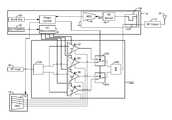
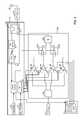
- FIG. 1is a general block diagram of a transceiver, an antenna system including a set of phase shifters, and a beam control module including a phase verification circuit in accordance with some embodiments of the inventive concepts disclosed herein;
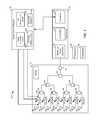
- FIG. 2Ais a more detailed block diagram of one of the phase shifters illustrated in FIG. 1 and the phase verification circuit illustrated in FIG. 1 in a transit mode in accordance with some embodiments of the inventive concepts disclosed herein;
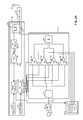
- FIG. 2Bis a more detailed block diagram of one of the phase shifters illustrated in FIG. 1 and the phase verification circuit illustrated in FIG. 1 in a received mode in accordance with some embodiments of the inventive concepts disclosed herein;
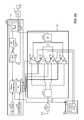
- FIG. 3is a more detailed block diagram of one of the phase shifters illustrated in FIG. 1 and the phase verification circuit illustrated in FIG. 1 in accordance with some embodiments of the inventive concepts disclosed herein;
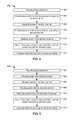
- FIG. 4is a diagram of an operational flow for phase verification in the system illustrated in FIG. 1 in accordance with some embodiments of the inventive concepts disclosed herein;
- FIG. 5is a diagram of an operational flow for phase verification in the system illustrated in FIG. 1 in accordance with some embodiments of the inventive concepts disclosed herein;
- FIG. 6is a diagram of an operational flow for phase shifter operation verification in the system illustrated in FIG. 1 in accordance with some embodiments of the inventive concepts disclosed herein;
- FIG. 7is a diagram of an operational flow for phase verification in the system illustrated in FIG. 1 in accordance with some embodiments of the inventive concepts disclosed herein;
- FIG. 8is a diagram of an operational flow for phase shifter operation verification in the system illustrated in FIG. 1 in accordance with some embodiments of the inventive concepts disclosed herein;
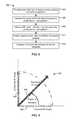
- FIG. 9is a chart showing phase with respect to channel power for the phase shifter illustrated in FIG. 2 in accordance with some embodiments of the inventive concepts disclosed herein;
- FIG. 10is a chart showing radio frequency output power with respect to control input power for two channels used in the phase shifter illustrated in FIG. 2 in accordance with some embodiments of the inventive concepts disclosed herein;
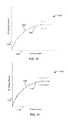
- FIG. 11is a chart showing channel output power with respect to desired power for a healthy phase shifter illustrated in FIG. 2 in accordance with some embodiments of the inventive concepts disclosed herein;
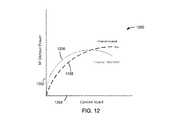
- FIG. 12is a chart showing channel output power with respect to desired power for an unhealthy phase shifter illustrated in FIG. 2 in accordance with some embodiments of the inventive concepts disclosed herein;
- inventive concepts disclosed hereininclude, but are not limited to a novel structural combination of components and circuits, and not to the particular detailed configurations thereof. Accordingly, the structure, methods, functions, control and arrangement of components and circuits have, for the most part, been illustrated in the drawings by readily understandable block representations and schematic diagrams, in order not to obscure the disclosure with structural details which will be readily apparent to those skilled in the art, having the benefit of the description herein. Further, the inventive concepts disclosed herein are not limited to the particular embodiments depicted in the exemplary diagrams, but should be construed in accordance with the language in the claims.
- a transceiver and an antenna systemis shown and described that may be used in radar, sensor and communications systems.
- the transceiver and antenna systemcan utilize antenna arrays (e.g., electronically steerable antenna arrays).
- antenna arrayse.g., electronically steerable antenna arrays
- the systems and methods describedcan be utilized in communication, sensing and/or radar systems, such as, military radar systems or weather radar systems, electronic intelligence (ELINT) receivers, electronic counter measure (ECM) systems, electronic support measure (ESM) systems, targeting systems or other systems.
- the systems and methodsare utilized to provide an ultra-wide band (UWB) system.
- the steerable antenna arrayscan include but are not limited to phased-array antenna systems, electronically scanned array antenna systems, or electronically scanned array (ESA) antenna systems, such as active electronically-scanned array (AESA) antenna systems.
- AESAactive electronically-scanned array
- phase and/or amplitude sensing of radio frequency excitations at the apertureensure real time radiation performance monitoring which enables self-calibration and self-healing of AESA systems.
- the phase and amplitude of each radiating elemente.g., antenna element
- the phase and amplitude of each radiating elementis verified which allows the beam formed in space to be verified due to the physics of the ASEA.
- integrated hardware for radio frequency and direct current power measurementsare advantageously employed to infer the phase of each phase shifting element, thereby reducing development time and size, weight, cost, and power, eliminating performance degradation from the addition of measurement elements.
- a system 10includes an antenna system 12 , a transceiver 14 , and a beam control module 16 .
- the system 10operates in a receive mode, transceiver mode or a transmit mode in some embodiments.
- the beam control module 16can be provided within the antenna system 12 , the transceiver 14 , or as a discrete system. In some embodiments, parts of the beam control module 16 are integrated with the antenna system 12 and other parts of the beam control module 16 are integrated with the transceiver 12 .
- the system 10can be or can be part of a sensing system, radar system, and communication system.
- the system 10can be part of an electronic intelligence (ELINT) receiver, an electronic countermeasure (ECM) system, a weather radar system, an electronic support measure (ESM) system, and/or hybrids thereof.
- ELINTelectronic intelligence
- ECMelectronic countermeasure
- weather radarweather radar
- ESMelectronic support measure
- the system 10can employ multi-chip modules discussed in U.S. application Ser. No. 13/760,964 filed Feb. 6, 2013, Ser. No. 13/781,449, filed Feb. 28, 2013, and Ser. No. 13/837,934 filed Mar. 15, 2013, all of which are incorporated herein by reference in their entireties.
- the system 10can include components described in U.S. application Ser. No. 13/714,209 filed Dec. 13, 2012 and Ser. No. 13/737,777 filed Jan. 9, 2013, both incorporated herein by reference in their entireties.
- the antenna system 12can be a two-dimensional array or a single dimensional array in some embodiments.
- the antenna system 12is utilized to point electronically at angles in one-dimensional or two-dimensional space in some embodiments.
- beamsmay be aimed from an antenna system (e.g., an AESA antenna) by emitting waves that interfere constructively at certain angles in front of the antenna system 12 .
- the antenna system 12includes various components including apertures, power amplifiers, low noise amplifiers, phase shifters, transmit/receive switches, temperature sensing equipment, radio frequency (RF) power and phase delay sensing components, digital control and a beam steering computer in some embodiments.
- the two-dimensional array or a single dimensional array of the antenna system 12is circular, cylindrical, spherical, etc. and can be an arbitrarily curved surface, conformal to a vehicle surface, etc.
- the antenna system 12can be embodied as a Balanced Antipodal Vivaldi Array (BAVA) aperture, or other antenna system in certain embodiments.
- array elements 20are embodied as a dual polarization array, such as, the array shown in U.S. Pat. No. 8,466,846.
- U.S. Pat. No. 8,466,846is incorporated herein by reference in its entirety.
- the antenna system 12includes an array of antenna elements 20 , an array of phase shifters 22 , radio frequency power detection circuit 44 , and a set of power dividers 24 .
- each of the antenna elements 20is associated with a respective phase shifter 22 .
- the antenna system 12can be a two-dimensional array, or a single dimensional array.
- the phase shifters 22are controlled by the beam control module 16 which includes a phase verification circuit 26 , a direct current measurement circuit 38 , a radio frequency power detection circuit 44 , and a phase verification circuit 36 .
- Radio frequency amplifierscan be provided before and after the phase shifters 22 in some embodiments.
- the power dividers 24can be arranged in various fashions to communicate signals between the elements 20 and transceiver 14 .
- the power dividers 24are power splitters or directional couplers in some embodiments.
- the power dividers 24are passive elements in some embodiments.
- the antenna system 12can include the components described in U.S. application Ser. No. 14/300,021, filed on Jun. 6, 2014 West et al.,) U.S. application Ser. No. 14/300,074, filed on Jun. 6, 2014 by West et al., and U.S. application Ser. No. 14/300,055, filed on Jun. 6, 2014 by West el.
- the phase shifters 22can effect a set of phase shifts or phase delays so that appropriate constructive interference is obtained.
- a set of control signals or commandscan be provided from the beam control module 16 to control inputs on the phase shifters 22 .
- the control commandsset the appropriate phase shifts for the phase shifters 22 to point the antenna system 12 at a pointing angle.
- the transceiver 14is provided on one or more RF integrated circuits, or modules in some embodiments.
- the transceiver 14includes a block up/down converter 30 , an analog-to-digital converter/digital-to-analog converter circuit 32 , and an operational processor 34 . Signals are transmitted to the antenna system 12 and received from the antenna system 12 through the block up/down converter 30 .
- the block up/down converter 30up converts transmitted signals from the converter circuit 32 and down converts signals received from the antenna system 12 in some embodiments.
- Signals for transmission from the operational processor 34are converted to analog signals in the converter circuit 32 for the converter 30 in some embodiments.
- Received signals from the converter 30are converted to digital signals in the converter circuit 32 for the operational processor 34 in some embodiments.
- the transceiver 14can be a receiver only, transmitter only, or both a transmitter/receiver.
- the transceiver 14can be embodied as a hard wired circuit, ASIC, programmable logic device, operational processor or combination thereof.
- the transceiver 14is coupled to antenna system 12 at a node 15 between converter 30 one of the dividers 24 .
- the beam control module 16can be a software module operating on a computer platform or the operational processor 34 , an ASIC, a programmable logic device, a hardware circuitry, or a mixture of thereof.
- the beam control module 16provides a set of phase shift commands to the phase shifters 22 to effect the pointing angle in some embodiments.
- the set of phase shift commandsare provided in response to a beam pointing angle parameter and a frequency parameter.
- the set of phase shift commandsare provided in response to a beam pointing angle parameter, an environmental parameter, and a frequency parameter.
- the beam control module 16includes a phase verification circuit 36 , a direct current measurement circuit 38 , and a radio frequency power detection circuit 44 .
- a direct current measurement circuit 38measures power used in the phase shifter 22 to infer an amount of power provided by the phase shifter 22 .
- the direct current measurement circuit 38can be integrated with the phase shifters 22 or can be distinct components in some embodiments.
- the direct current measurement circuit 38can be an integrated circuit component configured to monitor current provided to amplifying components in the phase shifter 22 .
- the direct current measurement circuit 38is partially located in the beam control module 16 , the phase shifter 22 , or both in some embodiments.
- the term current measurement circuit as used hereinrefers to an electronic component capable of detecting a level of power, current, or voltage associated with a signal.
- the radio frequency power detection circuit 44can be integrated with the phase shifters 22 or can be distinct components in some embodiments.
- the radio frequency power detection circuit 44can measure the power at respective antenna elements 20 and provide a measurement signal or data to the beam control module 16 in some embodiments.
- the radio frequency power detection circuit 44can be a radio frequency coupled device coupled at a location associated with its respective antenna element 20 in some embodiments. (e.g., before or after the phase shifters 22 ).
- the radio frequency power detection circuit 44is partially located in the beam control module 16 , the phase detector 22 , or both in some embodiments.
- the radio frequency power detection circuit 44can be tunable to the frequency associated with its respective antenna element 20 to provide a signal or data indicative of the power of the radio frequency signal at its respective antenna element 20 in some embodiments.
- the radio frequency power detection circuit 44include an amplifier indirectly coupled to a conductor supplying the antenna element 20 within the radio frequency integrated circuit associated with the phase detector 22 .
- the term power detector as used hereinrefers to an electronic component capable of detecting a level of power, current, or voltage associated with a signal. Power levels can be derived from current and voltage levels according to circuit principles.
- the phase verification circuit 36can measure the phase associated with each of the antenna elements 20 and the phase detectors 22 and compare the measured phase to the phase shift command to determine a phase error. The comparison can be made by subtracting the measured phase by the phase associated with the phase command.
- the phase errorcan be used by beam control module 16 to adjust the phase shift command to reduce the error in some embodiments.
- the phase errorcan also be reported as part of a maintenance report in some embodiments.
- the phase shift commandscan be stored in memory and selected in response to the beam pointing angle parameter and at least one of the environmental parameter and the frequency parameter.
- a look-up tablecan be used to provide a set of phase shift commands in response to the beam pointing angle, the frequency parameter, the phase error and/or the environmental parameter.
- a biascan be applied to the phase shift commands in response to the phase error, environmental parameter or the frequency.
- the phase verification circuit 36verifies phase and/or phase shifter operations according to several techniques in some embodiments.
- the phase verification circuit 36verifies phase using power signals from one or both of the radio frequency power detection circuit 44 or the direct current measurement circuit 38 .
- the phase verification circuit 36uses power signals from both the radio frequency power detection circuit 44 and the direct current measurement circuit 38 to verify phase and the quadrant of the phase.
- the phase verification circuit 36verifies phase shifter operation using power signals from one or both of the radio frequency power detection circuit 44 or the direct current measurement circuit 38 across a spectrum of phase control inputs.
- a test signal generator 46provides a radio frequency signal between the antenna element 20 and the phase shifter 22 .
- the phase verification circuit 36measures power using the radio frequency power detection circuit 44 to determine the phase shift provided by the phase shifter 22 .
- the test signal generator 46can be used when received signals are not of sufficient magnitude to adequately measure in the receive mode.
- the test signal generator 46can also be used in the transmit mode.
- a phase shifter 122can be used as the phase shifter 22 of system 10 ( FIG. 1 ).
- the phase shifter 122is coupled to the beam steering module 16 which includes radio frequency power detector circuit 44 , phase verification circuit 36 , direct current measurement circuit 38 and a set of digital to analog converters 114 in some embodiments.
- the phase verification circuit 36 , the direct current measurement circuit 38 , the serial bus 80 , the radio frequency power detector circuit 44 , and the direct current power bus 82are part of the phase shifter 122 .
- FIG. 2Ashows the phase shifter 122 for operation in a transmit mode while FIG. 2B shows a phase shifter 122 for operation in receive mode.
- Transmit modes and receive modescan be implemented using receiver switches or using separate circuits.
- the beam steering module 16can be part of the transceiver 14 or can be discrete components in some embodiments.
- the phase verification circuit 36 and the direct current measurement circuit 38can be embodied as a computer platform (e.g., an operational processor and memory) configured via software.
- a computer platforme.g., an operational processor and memory
- hard wired circuitry, ASICS, programmable logic devices, software, and mixtures thereofcan be used to embody the phase verification circuit 36 , the direct current measurement circuit 38 , and the radio frequency power detector circuit 44 .
- the phase shifter 122includes one or amplifiers, such as a positive in-phase (I) amplifier 92 , a negative in-phase amplifier 94 , a positive quadrature (Q) phase amplifier 96 , and a negative quadrature amplifier 98 , a phase delay element 100 , and a summer 104 in some embodiments.
- the phase delay element 100provides an 80 to 100 degree phase delay for the quadrature channel associated with the positive quadrature phase amplifier 96 and the negative quadrature amplifier 98 and no phase delay for the in-phase channel associated with the positive in-phase amplifier 92 and the negative in-phase amplifier 94 .
- the phase delaycan be 90 degrees; however, other phase delay values can be utilized without departing from the inventive concepts disclosed herein.
- a non-inverting input of the positive in-phase amplifier 92receives the radio frequency signal from a radio frequency input 40
- an inverting input of the negative in-phase amplifier 94receives the radio frequency signal from the radio frequency input 40 in some embodiments.
- a non-inverting input of the positive quadrature amplifier 96receives the radio frequency signal from the radio frequency input 40 via the phase delay element 100
- an inverting input of the negative quadrature amplifier 98receives the radio frequency signal from the radio frequency input 40 via the phase delay element 100 in some embodiments.
- the outputs of the positive in-phase amplifier 92 , the negative in-phase amplifier 94 , the positive quadrature phase amplifier 96 , and the negative quadrature amplifier 98are provided to the summer 104 for provision as a combined signal at a conductor 107 .
- the summer 104is a passive summer or an active summer.
- the radio frequency input 40can by a pin or terminal for the radio frequency integrated circuit associated with the phase shifter 122 .
- the digital-to-analog converters 114provide gain control signals to the positive in-phase amplifier 92 , the negative in-phase amplifier 94 , the positive quadrature phase amplifier 96 , and the negative quadrature amplifier 98 to effect the phase of the radio frequency signals provided at the radio frequency output 110 in accordance with the phase command.
- in-phase and quadrature channelsare discussed herein, other channel types can be utilized.
- direct current beam control signalsone for each channel, are provided to a selected pair of positive in-phase amplifier 92 , negative in-phase amplifier 94 , positive quadrature phase amplifier 96 , and negative quadrature amplifier 98 .
- the positive in-phase amplifier 92 , the negative in-phase amplifier 94 , the positive quadrature phase amplifier 96 , and the negative quadrature amplifier 98are variable gain control radio frequency amplifiers in some embodiments.
- the positive in-phase amplifier 92 , the negative in-phase amplifier 94 , the positive quadrature phase amplifier 96 , and the negative quadrature amplifier 98can cooperate to provide the radio frequency signal with a phase parameter in one of all four quadrants (e.g., 0-360 degrees).
- Power from the direct current power bus 82 for each of the positive in-phase amplifier 92 , the negative in-phase amplifier 94 , the positive quadrature phase amplifier 96 , and the negative quadrature amplifier 98can be individually monitored using the direct current measurement circuit 38 .
- the direct current measurement circuit 38can monitor power provided to each of the positive in-phase amplifier 92 , the negative in-phase amplifier 94 , the positive quadrature phase amplifier 96 , and the negative quadrature amplifier 98 .
- the direct current measurement circuit 38provides an indication of such power or current to the phase verification circuit 36 .
- the direct current power bus 82is a pin or terminal for the radio frequency integrated circuit associated with the phase shifter 122 .
- power provided in the quadrature channel and the in-phase channelis estimated based upon the current measured by the direct current measurement circuit 38 .
- the direct current measurement circuit 38 or the power verification circuit 36can include a look-up table defining phase channel power levels based upon sensed current. The data for the look up table is empirically determined in some embodiments. In some embodiments, the look up table provides 1 to 1 mapping for phase control input commands, direct current sensed by the direct current measurement circuit 38 , and radio frequency phase.
- the radio frequency power detector 44includes an analog-to-digital convert 46 , a radio frequency power sensor 48 , and a radio frequency coupling 106 in some embodiments.
- the radio frequency power sensor 48detects a sense signal associated with the current, voltage or power at the radio frequency output 110 via the radio frequency coupling 106 associated with the conductor 107 ( FIG. 2A ) between the radio frequency output 110 and the phase shifter 122 or a conductor 207 ( FIG. 2B ) between the radio frequency output 210 and the phase shifter 122 .
- a node 108 ( FIG. 2A ) or a node 208 ( FIG. 2B )can be coupled to the radio frequency power sensor 48 .
- the radio frequency power sensor 48provides the sense signal to the analog-to-digital converter 46 and is a power measurement circuit having wide dynamic range in some embodiments.
- the conductors 107 and 207are an integrated circuit path between a pin and terminal (e.g., the radio frequency output 110 or 210 ) of the integrated circuit associated with the phase shifter 122 in some embodiments.
- the radio frequency power sensor 48provides the sense signal to the analog-to-digital converter 46 .
- the radio frequency input 40is a pin or terminal for the radio frequency integrated circuit associated with the phase shifter 122 and is coupled to one of the splitters 24 ( FIG. 1 ) in some embodiments.
- the radio frequency input 240 in FIG. 2Bis coupled to the antenna element 20
- the radio frequency output 210 in FIG. 2Bis coupled to the splitter 24 in some embodiments.
- the digital-to-analog converters 114provide gain control signals to the positive in-phase amplifier 92 , the negative in-phase amplifier 94 , the positive quadrature phase amplifier 96 , and the negative quadrature amplifier 98 to effect the phase of the radio frequency signals provided at the radio frequency output 110 in accordance with the phase command.
- in-phase and quadrature channelsare discussed herein, other channel types can be utilized.
- the phase verification circuit 36receives digital data representative of the power detected by the radio frequency power detector 44 associated with a the radio frequency output 110 coupled to the antenna element 20 .
- the phase verification circuit 46uses the digital data representative of the power detected by the radio frequency power detector 44 to determine phase error and/or other operation errors.
- the phase verification circuit 46uses the digital data to determine a phase parameter associated with the phase shifter 122 and compares it to the phase associated with the digital phase command used to provide gain control signals to the digital-to-analog converters 114 .
- the phase verification circuit 46uses the digital data to determine channel power response over a spectrum of phase commands and compares it to the expected channel power response.
- the phase verification circuit 46uses the digital data and direct current measurements provided by the direct current measurement circuit 38 to determine a phase parameter associated with the phase shifter 122 and compares it to the phase associated with the digital phase command provided to the digital-to-analog converters 114 . In some embodiments, the phase verification circuit 46 uses the direct current measurements provided by direct current measurement circuit data to determine a phase parameter associated with the phase shifter 122 and compares it to the phase associated with the digital phase command provided to the digital-to-analog converters 114 .
- the positive in-phase amplifier 92 , the negative in-phase amplifier 94 , the positive quadrature phase amplifier 96 , and the negative quadrature amplifier 98are variable gain control radio frequency amplifiers in some embodiments.
- the positive in-phase amplifier 92 , the negative in-phase amplifier 94 , the positive quadrature phase amplifier 96 , and the negative quadrature amplifier 98can cooperate to provide a phase parameter in all four quadrants (e.g., 0-360 degrees).
- a phase parameter in all four quadrantse.g., 0-360 degrees.
- a phase shifter 222is similar to the phase shifter 122 and can be used as the phase shifter 22 in system 10 ( FIG. 1 ).
- the phase shifter 222includes a switching element 202 , a switching element 204 , and a summer 206 instead of summer 104 ( FIG. 2 ).
- the switching element 202chooses an output from one of the positive in-phase amplifier 92 , and the negative in-phase amplifier 94 for receipt by the summer 206
- the switching element 204chooses an output from one of the positive quadrature amplifier 98 , and the negative quadrature amplifier 96 for receipt by the summer 206 .
- the summer 206provides the combined signal to the conductor 107 .
- the switch elements 202 and 204prevent the non-chosen amplifier from affecting the output from the summer 206 .
- the summer 206is a passive summer or an active summer.
- the phase shifter 222can replace the phase shifter 122 in FIG. 2A .
- a similar phase shifter 222can replace the phase shifter 122 in FIG. 2B .
- a phasecan be set for one or more antenna elements 20 using a digital phase shift command from the beam control module 16 .
- the digital phase shift commandis used to set the phase for the I-channel and Q channel by providing amplifier gain signals via the digital to analog converters 114 .
- the quadrature channelis turned off either via the switch element 202 ( FIG. 3 ) under control of the beam control module 16 , by setting the gain for both the positive quadrature amplifier 96 , and the negative quadrature amplifier 98 to zero, or by terminating power to both the positive quadrature amplifier 96 , and the negative quadrature amplifier 98 to zero using the respective conductors 112 , or combinations thereof in some embodiments.
- other techniquescan be used to disable or remove signals from the positive quadrature amplifier 96 , and the negative quadrature amplifier 98 .
- the radio frequency signalis provided with the in-phase channel only.
- poweris measured in the in-phase channel.
- the powercan be measured or inferred by sensing the direct current power using the direct current measurement circuit 38 or by measuring radio frequency power using the radio frequency power sensor 44 .
- the I channelis turned off either via the switch element 202 ( FIG. 3 ) under control of the beam control module 16 , by setting the gain for both the positive in-phase amplifier 92 and the negative in phase amplifier 94 to zero, or by terminating power to both the positive in-phase amplifier 92 and the negative in-phase amplifier 94 to zero using respective conductors 112 , or combinations thereof in some embodiments.
- other techniquescan be used to disable or remove signals from the positive in-phase amplifier 92 , and the negative in-phase amplifier 94 .
- the radio frequency signalis provided with the quadrature channel only.
- poweris measured in the in-phase channel.
- the powercan be measured by sensing the direct current power using the direct current measurement circuit 38 or by measuring radio frequency power using the radio frequency power sensor 44 .
- the phaseis calculated from the measured power in the I channel and the measured power in the Q channel.
- other methods of determining phase from I and Q channel measurementsare used, including, but not limited to other trigonometric functions or using empirically determined look-up table data.
- the phase calculated in operation 412can be compared to the phase associated with the digital phase command to determine a phase error. Operations 412 and 414 can be performed by the beam control module 16 (e.g., the phase verification circuit 36 ).
- a phasecan be set for one or more antenna elements 20 using a digital phase shift command.
- the digital phase shift commandis used to set the phase for the I channel and Q channel by providing amplifier gain signals via the digital to analog converters 114 .
- Amplifier gain signalscan be negative (e.g., attenuative) or positive (e.g., amplifying).
- the quadrature channelis turned off either via the switch element 204 ( FIG. 3 ) under control of the beam control module 16 , by setting the gain for both the positive quadrature amplifier 96 , and the negative quadrature amplifier 98 to zero, or by terminating power to both the positive quadrature amplifier 96 , and the negative quadrature amplifier 98 to zero using the respective conductors 112 , or combinations thereof in some embodiments.
- other techniquescan be used to disable or remove signals from the positive quadrature amplifier 96 and the negative quadrature amplifier 98 .
- the radio frequency signalis provided with the in-phase channel only.
- poweris measured in the in-phase channel.
- the powercan be measured by sensing the direct current power using the direct current measurement circuit 38 or by measuring radio frequency power using the radio frequency power sensor 44 .
- the Q channelis turned on and the radio frequency signal is provided with the in-phase channel and quadrature channel.
- poweris measured.
- the powercan be measured by sensing the direct current power using the direct current measurement circuit 38 or by measuring radio frequency power using the radio frequency power sensor 44 .
- the phaseis calculated from the measured power in the I channel and the power measured in both channels.
- the phase calculated in operation 512can be compared to the phase associated with the digital phase command.
- the in phase channelis turned off using similar techniques to operation 504 and the output of the Q channel is determined using an operation similar to operation 506 .
- the phaseis calculated from the measured power in the Q channel and the power measured in both channels.
- PhaseARCSINE P Q /P T where Phase is the phase angle in degrees; P I is the power from the direct current measurement circuit 36 or the radio frequency detector 44 with the quadrature channel off; and P T is the power from the direct current measurement circuit 36 or the radio frequency detector 44 in operation 510 .
- Operations 512 and 514can be performed by the beam control module 16 (e.g., the phase verification circuit 36 ).
- the quadrant for the phase parametercan be determined by identifying which of the positive in-phase amplifier 92 , the negative in-phase amplifier 94 , the positive quadrature phase amplifier 96 , and the negative quadrature amplifier 98 are on or have a gain signal. For example, if the positive in-phase amplifier 92 , and the negative quadrature amplifier 98 are on or have a gain signal, the phase is in quadrant 4 . For example, if the negative in-phase amplifier 94 , and the negative quadrature amplifier 98 are on, the phase is in quadrant 3 . For example, if the positive in-phase amplifier 92 and the positive quadrature amplifier 96 are on, the phase in in quadrant 1 .
- the phaseis in quadrant 3 .
- the phase command signalcan be used to determine which of the positive in-phase amplifier 92 , the negative in-phase amplifier 94 , the positive quadrature phase amplifier 96 , and the negative quadrature amplifier 98 are on in some embodiments.
- the direct current measurements by the direct current measurement circuit 38can be used to determine which of the positive in-phase amplifier 92 , the negative in-phase amplifier 94 , the positive quadrature phase amplifier 96 , and the negative quadrature amplifier 98 are on in some embodiments.
- a phasecan be set across a spectrum of power inputs for one or more antenna elements 20 using a digital phase shift command.
- the digital phase shift commandis used to set the phase for the I-channel and Q channel by providing amplifier gain signals via the digital to analog converters 114 .
- the quadrature channelis turned off either via the switch element 204 under control of the beam control module 16 , by setting the gain for both the positive quadrature amplifier 96 and the negative quadrature amplifier 98 to zero, or by terminating power to both the positive quadrature amplifier 96 , and the negative quadrature amplifier 98 to zero using the respective conductors 112 , or combinations thereof in some embodiments.
- other techniquescan be used to disable or remove signals from the positive quadrature amplifier 96 and the negative quadrature amplifier 98 .
- the radio frequency signalis provided with the in-phase channel only across the spectrum of phase values.
- poweris measured in the in-phase channel across the spectrum of phase values.
- the spectrumcan include 2, 4, 6, 8, 10, 20, 40, etc. different phase commands (e.g., the phase values being at every 1 degree, every 10 degrees, every 45 degrees, etc.).
- the powercan be measured by sensing the direct current power using direct the current measurement circuit 38 or by measuring radio frequency power using the radio frequency power sensor 44 .
- the in-phase channelis turned off either via the switch element 202 ( FIG. 3 ) under control of the beam control module 16 , by setting the gain for both the positive in-phase amplifier 92 , and the negative in-phase amplifier 94 to zero, or by terminating power to both the positive in-phase amplifier 92 and the negative in-phase amplifier 94 to zero using the respective conductors 112 , or combinations thereof in some embodiments.
- other techniquescan be used to disable or remove signals from the positive in-phase amplifier 92 and the negative in-phase amplifier 94 .
- the radio frequency signalis provided with the quadrature channel only across the spectrum of phase values.
- poweris measured in the-phase channel in across the spectrum of phase values.
- the spectrumcan include 2, 4, 6, 8, 10, 20, 40, etc. phase positions.
- the spectrum in operation 612is the same as the spectrum of operation 608 .
- the powercan be measured by sensing the direct current power using the direct current measurement circuit 38 or by measuring radio frequency power using the radio frequency power sensor 44 .
- phase response for the in-phase channel and quadrature channelare compared.
- Matching phase responsesindicate a properly working phase shifter 122 .
- Various curve matching, curve fitting, polynomial matching algorithmscan be used to compare responses. Operation 614 can be performed by the beam control module 16 (e.g., phase verification circuit 36 ).
- a phasecan be set for one or more antenna elements 20 using a digital phase shift command.
- the digital phase shift commandis used to set the phase for the in-phase channel and quadrature channel by providing amplifier gain signals via the digital to analog converters 114 .
- the radio frequency signalis provided using the in-phase channel and the quadrature phase channel.
- poweris measured in the in-phase channel. The power can be measured by sensing the direct current power using the direct current measurement circuit 38 using the conductors 112 that are associated with the positive in-phase amplifier 92 and the negative in-phase amplifier 94 .
- poweris measured in the quadrature channel.
- the powercan be measured by sensing the direct current power using the direct current measurement circuit 38 using the conductors 112 that are associated with the positive quadrature amplifier 96 and the negative quadrature amplifier 98 .
- Operations 706 and 708are performed simultaneously in some embodiments.
- Operation 710power is measured using the radio frequency power sensor 44 . Operation 710 is performed simultaneously with operations 706 and 708 in some embodiments.
- the phaseis calculated from the measured power in operations 706 , 708 and 710 . Values of power from operations 706 and 708 are converted to be compatible with levels of power determined in operation 710 in some embodiments.
- Phasecan be calculated and compared applying trigonometry to the power from operations 706 and 708 , power from operations 708 and 710 , and/or the power from operations 706 and 710 .
- the calculated phase or phasesare compared to the phase associated with phase command in some embodiments.
- the phase calculated in operation 712can be compared to the phase associated with the digital phase command. Operations 712 and 714 can be performed by the beam control module 16 (e.g., the phase verification circuit 36 ).
- a phasecan be set across a spectrum for one or more antenna elements 20 using a digital phase shift command.
- the digital phase shift commandis used to set the phase for the in-phase channel and quadrature channel by providing amplifier gain signals via the digital to analog converters 114 .
- the quadrature channelis turned off either via the switch element 204 under control of the beam control module 16 , by setting the gain for both the positive quadrature amplifier 96 and the negative quadrature amplifier 98 to zero, or by terminating power to both the positive quadrature amplifier 96 and the negative quadrature amplifier 98 to zero using respective conductors 112 , or combinations thereof in some embodiments.
- other techniquescan be used to disable or remove signals from the positive quadrature amplifier 96 and the negative quadrature amplifier 98 .
- the radio frequency signalis provided with the in-phase channel only across the spectrum of phase values.
- poweris measured in the-phase channel in across the spectrum of phase values.
- the spectrumcan include 2, 4, 6, 8, 10, 20, 40, etc. degree positions.
- the powercan be measured by sensing the direct current power using the direct current measurement circuit 38 .
- the poweris measured using the radio frequency power detector 44 in the in-phase channel in across the spectrum of phase values.
- Operations 806 and 808can be performed simultaneously. In some embodiments, operation 806 is not performed. In some embodiments, operation 808 is not performed.
- Operation 812operations similar to operations 804 - 808 are performed for the quadrature channel.
- operation 814the quadrature channel response and the in-phase channel response are compared. Matching phase responses in both channels indicate a properly working phase shifter 122 .
- Operation 814can be performed by beam control module 16 (e.g., phase verification circuit 36 ).
- a chart 900includes an X axis 902 representing in-phase channel power and a Y axis 904 representing quadrature power.
- a vector 906is a resultant vector representing phase and amplitude. Operational flows 400 , 500 and 700 can use chart 900 to determine phase in some embodiments.
- a chart 1000includes an X axis 1004 representing phase input and a Y axis 1002 representing radio frequency output power.
- a line 1006represents the phase to power response for the quadrature channel, and a line 1006 represents the phase to power response for the in-phase channel.
- the response of lines 1006 and 10008can be determined using operational flows 600 and 800 .
- the close matching of lines 10006 and 1008indicates proper operation of phase shifter 122 .
- a chart 1100includes an X axis 1104 representing phase control input and a Y axis 1102 representing radio frequency output power in an in-phase channel or a quadrature channel.
- a line 1106represents the desired phase to power response and a line 1108 represents the measured phase to power response.
- the close identity of lines 1106 and 1108indicates a healthy phase shifter 122 .
- Line 1108can be created from measurements associated with operational flows 600 or 800 . In some embodiments, responses for both channels or combined channels can be compared to expected responses.
- a chart 1200includes an X axis 1204 representing phase control input and a Y axis 1202 radio frequency output power in an in-phase channel or a quadrature channel.
- a line 1208represents the desired phase to power response, and a line 1206 represents the measured phase to power response.
- the unmatched nature of lines 1106 and 1108indicates a non-healthy phase shifter 122 .
- Embodiments of the inventive concepts disclosed hereinmay be implemented using existing computer operational flows, or by a special purpose computer operational flows for an appropriate system, incorporated for this or another purpose, or by a hardwired system.
- Embodiments within the scope of the inventive concepts disclosed hereininclude program products comprising machine-readable media for carrying or having machine-executable instructions or data structures stored thereon. Such machine-readable media can be any available media that can be accessed by a special purpose computer or other machine with an operational flow.
- machine-readable mediacan comprise RAM, ROM, EPROM, EEPROM, CD-ROM or other optical disk storage, magnetic disk storage or other magnetic storage devices, or any other medium which can be used to carry or store desired program code in the form of machine-executable instructions or data structures and which can be accessed by a general purpose or special purpose computer or other machine with an operational flow.
- a network or another communications connectioneither hardwired, wireless, or a combination of hardwired or wireless
- any such connectionis properly termed a machine-readable medium.
- Machine-executable instructionsinclude, for example, instructions and data which cause a special purpose computer, or special purpose operational flowing machines to perform a certain function or group of functions.
Landscapes
- Physics & Mathematics (AREA)
- General Physics & Mathematics (AREA)
- Variable-Direction Aerials And Aerial Arrays (AREA)
Abstract
Description
This application is related to U.S. application Ser. No. 14/300,021, filed on Jun. 6, 2014 West et al., U.S. application Ser. No. 14/300,074, filed on Jun. 6, 2014 by West et al., and U.S. application Ser. No. 14/300,055, filed on Jun. 6, 2014 by West et el., all assigned to the Assignee of the present application and hereby incorporated by reference in their entireties.
The present disclosure relates generally to the field of antenna systems. More specifically, the present disclosure relates generally to the field of antenna arrays including but not limited to, phased array antenna systems or electronically scanned array (ESA) antenna systems, such as active electronically scanned array (AESA) antenna systems.
Antenna arrays are utilized with transceivers. As used in this application, the term transceiver refers to an electronic device embodied as a transmitter, a receiver or a transmitter/receiver. The antenna array can be steered by using variable phase shifters coupled to respective antenna elements in the antenna array to direct the antenna at a pointing angle. The phase shifters can be variable phase shifters which provide a set of phase delays in response to a set of commands to direct the antenna to appropriate pointing angles without physically moving the antenna elements.
Validating beam parameters can be important in radar systems, ground communication systems, satellite communication systems, and sensors. Certain applications have certification requirements that mandate that several beam parameters be verified during operation. Phase errors can have deleterious effects on beam parameters. Monitoring beam patterns using conventional techniques adds to the size, cost, power, and weight of transceiver systems. Such conventional techniques often require measurement circuitry at each element and require a radio frequency reference source.
Thus, there is a need for an in-situ method of monitoring an antenna system which does not add to the size, cost, power, and/or weight of the transceiver system. Further, there is a need for a flight critical AESA-based system that uses monitoring for achieving increased mean time between failures, dispatchibility, reliability, and availability. Further still, there is a need for a robust AESA-based or other phased array antenna-based system with in-situ beam pattern monitoring. Further still, there is a need for an AESA-based or other phased array antenna-based system with real time beam pattern monitoring. Further still, there is a need for an AESA-based or other phased array antenna-based system with transmit/received excitation phase monitoring (e.g., at the radiation aperture) that ensures radiation performance and enables self-calibration, and/or self-healing. Yet further still, there is a need for an AESA-based or other phased array antenna-based system with phase monitoring.
It would be desirable to provide a system and/or method that provides one or more of these or other advantageous features. Other features and advantages will be made apparent from the present specification. The teachings disclosed extend to those embodiments that fall within the scope of the appended claims, regardless of whether they accomplish one or more of the aforementioned needs.
In one aspect, the inventive concepts disclosed herein are directed to a system and method that verifies phase shifter operation in an electronically steerable antenna system. The system can include and the method can use a number of antenna elements, and a number of phase shifters. Each of the phase shifters is associated with the respective antenna element of the antenna elements and includes a power amplifier circuit. The system also can include and the method can also use a number of power sensors in communication with the phase shifters. Each of the phase shifters can be associated with a respective power sensor and the power sensor can be configured to detect power associated with the power amplifier circuit.
In another aspect, the inventive concepts disclosed herein are directed to an electronically steerable antenna system. The system includes a number of antenna elements, and a number of phase shifters. Each of the phase shifters is associated with the respective antenna element of the antenna elements and includes a power amplifier circuit. The system also includes a number of power sensors in communication with the phase shifters. Each of the phase shifters can be associated with a respective power sensor and the power sensor can be configured to detect power associated with the power amplifier circuit. The system also includes a control circuit for calculating a phase parameter associated with each phase shifter using the power sensor.
In yet another aspect the inventive concepts disclosed herein are directed to a method of verifying phase associated with an antenna element in an electronically scanned antennae array. The method includes providing a phase shift command to a phase shifter associated with the antenna element, providing power to a first amplifier channel in accordance with the phase shift command, and measuring first power provided to the antenna element using the first amplifier channel with a power sensor integrated with the phase shifter. The method also includes providing power to a second amplifier channel in accordance with the phase shift command, measuring second power provided to the antenna element using the second amplifier channel or using both the first amplifier channel and the second amplifier with the power sensor, and determining a phase parameter from the first power parameter and the second power parameter to verify phase associated with the antenna element.
In still another aspect, the inventive concepts disclosed herein are directed to a method of verifying phase shifter operation associated with an antenna element in an electronically scanned antennae array. The method includes measuring first power provided to the antenna element using a first amplifier channel without a second amplifier channel using a plurality of first phase shift commands for the first amplifier channel. The first power is measured with a power sensor integrated with the phase shifter. The method also includes measuring second power provided to the antenna element using the second amplifier channel without the first amplifier channel using a plurality of second phase shift commands for the second amplifier channel. The second power is measured with the power sensor. The method also includes comparing the first power to the second power across a spectrum of the first phase shift commands and the second phase shift commands to verify phase shifter operation.
In another aspect, the inventive concepts disclosed herein are directed to a system for verifying phase in an antenna array. The system includes a verification module receiving power parameters associated with phase shifters associated with the antenna array and using the power parameters to verify the phase. The power parameters are measured at each antenna element of the antenna phase array with a respective sensor integrated with the respective phase shifter.
Embodiments of the inventive concepts disclosed herein will become more fully understood from the following detailed description, taken in conjunction with the accompanying drawings, wherein like reference numerals refer to like elements, in which:
Before describing in detail embodiments of the inventive concepts disclosed herein, it should be observed that the inventive concepts disclosed herein include, but are not limited to a novel structural combination of components and circuits, and not to the particular detailed configurations thereof. Accordingly, the structure, methods, functions, control and arrangement of components and circuits have, for the most part, been illustrated in the drawings by readily understandable block representations and schematic diagrams, in order not to obscure the disclosure with structural details which will be readily apparent to those skilled in the art, having the benefit of the description herein. Further, the inventive concepts disclosed herein are not limited to the particular embodiments depicted in the exemplary diagrams, but should be construed in accordance with the language in the claims.
Referring generally to the figures, a transceiver and an antenna system is shown and described that may be used in radar, sensor and communications systems. The transceiver and antenna system can utilize antenna arrays (e.g., electronically steerable antenna arrays). For example, the systems and methods described can be utilized in communication, sensing and/or radar systems, such as, military radar systems or weather radar systems, electronic intelligence (ELINT) receivers, electronic counter measure (ECM) systems, electronic support measure (ESM) systems, targeting systems or other systems. In some embodiments, the systems and methods are utilized to provide an ultra-wide band (UWB) system. The steerable antenna arrays can include but are not limited to phased-array antenna systems, electronically scanned array antenna systems, or electronically scanned array (ESA) antenna systems, such as active electronically-scanned array (AESA) antenna systems.
In some embodiments, phase and/or amplitude sensing of radio frequency excitations at the aperture ensure real time radiation performance monitoring which enables self-calibration and self-healing of AESA systems. In some embodiments, the phase and amplitude of each radiating element (e.g., antenna element) is verified which allows the beam formed in space to be verified due to the physics of the ASEA. In some embodiments, integrated hardware for radio frequency and direct current power measurements are advantageously employed to infer the phase of each phase shifting element, thereby reducing development time and size, weight, cost, and power, eliminating performance degradation from the addition of measurement elements.
With reference toFIG. 1 , asystem 10 includes anantenna system 12, atransceiver 14, and abeam control module 16. Thesystem 10 operates in a receive mode, transceiver mode or a transmit mode in some embodiments. Thebeam control module 16 can be provided within theantenna system 12, thetransceiver 14, or as a discrete system. In some embodiments, parts of thebeam control module 16 are integrated with theantenna system 12 and other parts of thebeam control module 16 are integrated with thetransceiver 12.
Thesystem 10 can be or can be part of a sensing system, radar system, and communication system. In some embodiments, thesystem 10 can be part of an electronic intelligence (ELINT) receiver, an electronic countermeasure (ECM) system, a weather radar system, an electronic support measure (ESM) system, and/or hybrids thereof.
In some embodiments, thesystem 10 can employ multi-chip modules discussed in U.S. application Ser. No. 13/760,964 filed Feb. 6, 2013, Ser. No. 13/781,449, filed Feb. 28, 2013, and Ser. No. 13/837,934 filed Mar. 15, 2013, all of which are incorporated herein by reference in their entireties. In some embodiments, thesystem 10 can include components described in U.S. application Ser. No. 13/714,209 filed Dec. 13, 2012 and Ser. No. 13/737,777 filed Jan. 9, 2013, both incorporated herein by reference in their entireties.
Theantenna system 12 can be a two-dimensional array or a single dimensional array in some embodiments. Theantenna system 12 is utilized to point electronically at angles in one-dimensional or two-dimensional space in some embodiments. For example, beams may be aimed from an antenna system (e.g., an AESA antenna) by emitting waves that interfere constructively at certain angles in front of theantenna system 12. Theantenna system 12 includes various components including apertures, power amplifiers, low noise amplifiers, phase shifters, transmit/receive switches, temperature sensing equipment, radio frequency (RF) power and phase delay sensing components, digital control and a beam steering computer in some embodiments. In some embodiments, the two-dimensional array or a single dimensional array of theantenna system 12 is circular, cylindrical, spherical, etc. and can be an arbitrarily curved surface, conformal to a vehicle surface, etc.
Theantenna system 12 can be embodied as a Balanced Antipodal Vivaldi Array (BAVA) aperture, or other antenna system in certain embodiments. In some embodiments,array elements 20 are embodied as a dual polarization array, such as, the array shown in U.S. Pat. No. 8,466,846. U.S. Pat. No. 8,466,846 is incorporated herein by reference in its entirety.
Theantenna system 12 includes an array ofantenna elements 20, an array ofphase shifters 22, radio frequencypower detection circuit 44, and a set ofpower dividers 24. In some embodiments, each of theantenna elements 20 is associated with arespective phase shifter 22. Theantenna system 12 can be a two-dimensional array, or a single dimensional array. Thephase shifters 22 are controlled by thebeam control module 16 which includes aphase verification circuit 26, a directcurrent measurement circuit 38, a radio frequencypower detection circuit 44, and aphase verification circuit 36. Radio frequency amplifiers can be provided before and after thephase shifters 22 in some embodiments.
Thepower dividers 24 can be arranged in various fashions to communicate signals between theelements 20 andtransceiver 14. Thepower dividers 24 are power splitters or directional couplers in some embodiments. Thepower dividers 24 are passive elements in some embodiments. Theantenna system 12 can include the components described in U.S. application Ser. No. 14/300,021, filed on Jun. 6, 2014 West et al.,) U.S. application Ser. No. 14/300,074, filed on Jun. 6, 2014 by West et al., and U.S. application Ser. No. 14/300,055, filed on Jun. 6, 2014 by West el.
Thephase shifters 22 can effect a set of phase shifts or phase delays so that appropriate constructive interference is obtained. A set of control signals or commands can be provided from thebeam control module 16 to control inputs on thephase shifters 22. The control commands set the appropriate phase shifts for thephase shifters 22 to point theantenna system 12 at a pointing angle.
Thetransceiver 14 is provided on one or more RF integrated circuits, or modules in some embodiments. Thetransceiver 14 includes a block up/downconverter 30, an analog-to-digital converter/digital-to-analog converter circuit 32, and an operational processor34. Signals are transmitted to theantenna system 12 and received from theantenna system 12 through the block up/downconverter 30. The block up/downconverter 30 up converts transmitted signals from theconverter circuit 32 and down converts signals received from theantenna system 12 in some embodiments. Signals for transmission from the operational processor34 are converted to analog signals in theconverter circuit 32 for theconverter 30 in some embodiments. Received signals from theconverter 30 are converted to digital signals in theconverter circuit 32 for the operational processor34 in some embodiments.
Thetransceiver 14 can be a receiver only, transmitter only, or both a transmitter/receiver. Thetransceiver 14 can be embodied as a hard wired circuit, ASIC, programmable logic device, operational processor or combination thereof. Thetransceiver 14 is coupled toantenna system 12 at anode 15 betweenconverter 30 one of thedividers 24.
Thebeam control module 16 can be a software module operating on a computer platform or the operational processor34, an ASIC, a programmable logic device, a hardware circuitry, or a mixture of thereof. Thebeam control module 16 provides a set of phase shift commands to thephase shifters 22 to effect the pointing angle in some embodiments. In some embodiments, the set of phase shift commands are provided in response to a beam pointing angle parameter and a frequency parameter. In some embodiments, the set of phase shift commands are provided in response to a beam pointing angle parameter, an environmental parameter, and a frequency parameter. Thebeam control module 16 includes aphase verification circuit 36, a directcurrent measurement circuit 38, and a radio frequencypower detection circuit 44.
A directcurrent measurement circuit 38 measures power used in thephase shifter 22 to infer an amount of power provided by thephase shifter 22. The directcurrent measurement circuit 38 can be integrated with thephase shifters 22 or can be distinct components in some embodiments. In some embodiments, the directcurrent measurement circuit 38 can be an integrated circuit component configured to monitor current provided to amplifying components in thephase shifter 22. The directcurrent measurement circuit 38 is partially located in thebeam control module 16, thephase shifter 22, or both in some embodiments. The term current measurement circuit as used herein refers to an electronic component capable of detecting a level of power, current, or voltage associated with a signal.
The radio frequencypower detection circuit 44 can be integrated with thephase shifters 22 or can be distinct components in some embodiments. The radio frequencypower detection circuit 44 can measure the power atrespective antenna elements 20 and provide a measurement signal or data to thebeam control module 16 in some embodiments. In some embodiments, the radio frequencypower detection circuit 44 can be a radio frequency coupled device coupled at a location associated with itsrespective antenna element 20 in some embodiments. (e.g., before or after the phase shifters22). The radio frequencypower detection circuit 44 is partially located in thebeam control module 16, thephase detector 22, or both in some embodiments. The radio frequencypower detection circuit 44 can be tunable to the frequency associated with itsrespective antenna element 20 to provide a signal or data indicative of the power of the radio frequency signal at itsrespective antenna element 20 in some embodiments. The radio frequencypower detection circuit 44 include an amplifier indirectly coupled to a conductor supplying theantenna element 20 within the radio frequency integrated circuit associated with thephase detector 22. The term power detector as used herein refers to an electronic component capable of detecting a level of power, current, or voltage associated with a signal. Power levels can be derived from current and voltage levels according to circuit principles.
Thephase verification circuit 36 can measure the phase associated with each of theantenna elements 20 and thephase detectors 22 and compare the measured phase to the phase shift command to determine a phase error. The comparison can be made by subtracting the measured phase by the phase associated with the phase command. The phase error can be used bybeam control module 16 to adjust the phase shift command to reduce the error in some embodiments. The phase error can also be reported as part of a maintenance report in some embodiments.
The phase shift commands can be stored in memory and selected in response to the beam pointing angle parameter and at least one of the environmental parameter and the frequency parameter. In some embodiments, a look-up table can be used to provide a set of phase shift commands in response to the beam pointing angle, the frequency parameter, the phase error and/or the environmental parameter. Alternatively, a bias can be applied to the phase shift commands in response to the phase error, environmental parameter or the frequency.
Thephase verification circuit 36 verifies phase and/or phase shifter operations according to several techniques in some embodiments. Thephase verification circuit 36 verifies phase using power signals from one or both of the radio frequencypower detection circuit 44 or the directcurrent measurement circuit 38. In some embodiments, thephase verification circuit 36 uses power signals from both the radio frequencypower detection circuit 44 and the directcurrent measurement circuit 38 to verify phase and the quadrant of the phase. In some embodiments, thephase verification circuit 36 verifies phase shifter operation using power signals from one or both of the radio frequencypower detection circuit 44 or the directcurrent measurement circuit 38 across a spectrum of phase control inputs.
In some embodiments, atest signal generator 46 provides a radio frequency signal between theantenna element 20 and thephase shifter 22. Thephase verification circuit 36 measures power using the radio frequencypower detection circuit 44 to determine the phase shift provided by thephase shifter 22. Thetest signal generator 46 can be used when received signals are not of sufficient magnitude to adequately measure in the receive mode. Thetest signal generator 46 can also be used in the transmit mode.
With reference toFIGS. 2A and 2B , aphase shifter 122 can be used as thephase shifter 22 of system10 (FIG. 1 ). Thephase shifter 122 is coupled to thebeam steering module 16 which includes radio frequencypower detector circuit 44,phase verification circuit 36, directcurrent measurement circuit 38 and a set of digital toanalog converters 114 in some embodiments. In some embodiments, thephase verification circuit 36, the directcurrent measurement circuit 38, theserial bus 80, the radio frequencypower detector circuit 44, and the directcurrent power bus 82 are part of thephase shifter 122.
Thebeam steering module 16 can be part of thetransceiver 14 or can be discrete components in some embodiments. Thephase verification circuit 36 and the directcurrent measurement circuit 38 can be embodied as a computer platform (e.g., an operational processor and memory) configured via software. Alternatively, hard wired circuitry, ASICS, programmable logic devices, software, and mixtures thereof can be used to embody thephase verification circuit 36, the directcurrent measurement circuit 38, and the radio frequencypower detector circuit 44.
Thephase shifter 122 includes one or amplifiers, such as a positive in-phase (I)amplifier 92, a negative in-phase amplifier 94, a positive quadrature (Q)phase amplifier 96, and anegative quadrature amplifier 98, aphase delay element 100, and asummer 104 in some embodiments. In some embodiments, thephase delay element 100 provides an 80 to 100 degree phase delay for the quadrature channel associated with the positivequadrature phase amplifier 96 and thenegative quadrature amplifier 98 and no phase delay for the in-phase channel associated with the positive in-phase amplifier 92 and the negative in-phase amplifier 94. The phase delay can be 90 degrees; however, other phase delay values can be utilized without departing from the inventive concepts disclosed herein.
A non-inverting input of the positive in-phase amplifier 92 receives the radio frequency signal from aradio frequency input 40, and an inverting input of the negative in-phase amplifier 94 receives the radio frequency signal from theradio frequency input 40 in some embodiments. A non-inverting input of thepositive quadrature amplifier 96 receives the radio frequency signal from theradio frequency input 40 via thephase delay element 100, and an inverting input of thenegative quadrature amplifier 98 receives the radio frequency signal from theradio frequency input 40 via thephase delay element 100 in some embodiments. The outputs of the positive in-phase amplifier 92, the negative in-phase amplifier 94, the positivequadrature phase amplifier 96, and thenegative quadrature amplifier 98 are provided to thesummer 104 for provision as a combined signal at aconductor 107. Thesummer 104 is a passive summer or an active summer. Theradio frequency input 40 can by a pin or terminal for the radio frequency integrated circuit associated with thephase shifter 122.
The digital-to-analog converters 114 provide gain control signals to the positive in-phase amplifier 92, the negative in-phase amplifier 94, the positivequadrature phase amplifier 96, and thenegative quadrature amplifier 98 to effect the phase of the radio frequency signals provided at theradio frequency output 110 in accordance with the phase command. Although in-phase and quadrature channels are discussed herein, other channel types can be utilized. In some embodiments, direct current beam control signals, one for each channel, are provided to a selected pair of positive in-phase amplifier 92, negative in-phase amplifier 94, positivequadrature phase amplifier 96, andnegative quadrature amplifier 98.
The positive in-phase amplifier 92, the negative in-phase amplifier 94, the positivequadrature phase amplifier 96, and thenegative quadrature amplifier 98 are variable gain control radio frequency amplifiers in some embodiments. The positive in-phase amplifier 92, the negative in-phase amplifier 94, the positivequadrature phase amplifier 96, and thenegative quadrature amplifier 98 can cooperate to provide the radio frequency signal with a phase parameter in one of all four quadrants (e.g., 0-360 degrees).
Power from the directcurrent power bus 82 for each of the positive in-phase amplifier 92, the negative in-phase amplifier 94, the positivequadrature phase amplifier 96, and thenegative quadrature amplifier 98 can be individually monitored using the directcurrent measurement circuit 38. The directcurrent measurement circuit 38 can monitor power provided to each of the positive in-phase amplifier 92, the negative in-phase amplifier 94, the positivequadrature phase amplifier 96, and thenegative quadrature amplifier 98. The directcurrent measurement circuit 38 provides an indication of such power or current to thephase verification circuit 36. Voltage can be sensed across respective bias element associated withrespective conductors 112 to determine power provided to the positive in-phase amplifier 92, the negative in-phase amplifier 94, the positivequadrature phase amplifier 96, and thenegative quadrature amplifier 98 in some embodiments. In some embodiments, other types of power sensors are utilized. In some embodiments, the directcurrent power bus 82 is a pin or terminal for the radio frequency integrated circuit associated with thephase shifter 122.
In some embodiments, power provided in the quadrature channel and the in-phase channel is estimated based upon the current measured by the directcurrent measurement circuit 38. The directcurrent measurement circuit 38 or thepower verification circuit 36 can include a look-up table defining phase channel power levels based upon sensed current. The data for the look up table is empirically determined in some embodiments. In some embodiments, the look up table provides1 to1 mapping for phase control input commands, direct current sensed by the directcurrent measurement circuit 38, and radio frequency phase.
The radiofrequency power detector 44 includes an analog-to-digital convert 46, a radiofrequency power sensor 48, and aradio frequency coupling 106 in some embodiments. The radiofrequency power sensor 48 detects a sense signal associated with the current, voltage or power at theradio frequency output 110 via theradio frequency coupling 106 associated with the conductor107 (FIG. 2A ) between theradio frequency output 110 and thephase shifter 122 or a conductor207 (FIG. 2B ) between theradio frequency output 210 and thephase shifter 122. In some embodiments, a node108 (FIG. 2A ) or a node208 (FIG. 2B ) can be coupled to the radiofrequency power sensor 48. The radiofrequency power sensor 48 provides the sense signal to the analog-to-digital converter 46 and is a power measurement circuit having wide dynamic range in some embodiments. Theconductors radio frequency output 110 or210) of the integrated circuit associated with thephase shifter 122 in some embodiments. The radiofrequency power sensor 48 provides the sense signal to the analog-to-digital converter 46.
Theradio frequency input 40 is a pin or terminal for the radio frequency integrated circuit associated with thephase shifter 122 and is coupled to one of the splitters24 (FIG. 1 ) in some embodiments. Theradio frequency input 240 inFIG. 2B is coupled to theantenna element 20, and theradio frequency output 210 inFIG. 2B is coupled to thesplitter 24 in some embodiments.
The digital-to-analog converters 114 provide gain control signals to the positive in-phase amplifier 92, the negative in-phase amplifier 94, the positivequadrature phase amplifier 96, and thenegative quadrature amplifier 98 to effect the phase of the radio frequency signals provided at theradio frequency output 110 in accordance with the phase command. Although in-phase and quadrature channels are discussed herein, other channel types can be utilized.
In some embodiments, thephase verification circuit 36 receives digital data representative of the power detected by the radiofrequency power detector 44 associated with a theradio frequency output 110 coupled to theantenna element 20. Thephase verification circuit 46 uses the digital data representative of the power detected by the radiofrequency power detector 44 to determine phase error and/or other operation errors. In some embodiments, thephase verification circuit 46 uses the digital data to determine a phase parameter associated with thephase shifter 122 and compares it to the phase associated with the digital phase command used to provide gain control signals to the digital-to-analog converters 114. In some embodiments, thephase verification circuit 46 uses the digital data to determine channel power response over a spectrum of phase commands and compares it to the expected channel power response. In some embodiments, thephase verification circuit 46 uses the digital data and direct current measurements provided by the directcurrent measurement circuit 38 to determine a phase parameter associated with thephase shifter 122 and compares it to the phase associated with the digital phase command provided to the digital-to-analog converters 114. In some embodiments, thephase verification circuit 46 uses the direct current measurements provided by direct current measurement circuit data to determine a phase parameter associated with thephase shifter 122 and compares it to the phase associated with the digital phase command provided to the digital-to-analog converters 114.
The positive in-phase amplifier 92, the negative in-phase amplifier 94, the positivequadrature phase amplifier 96, and thenegative quadrature amplifier 98 are variable gain control radio frequency amplifiers in some embodiments. The positive in-phase amplifier 92, the negative in-phase amplifier 94, the positivequadrature phase amplifier 96, and thenegative quadrature amplifier 98 can cooperate to provide a phase parameter in all four quadrants (e.g., 0-360 degrees). When DC current is zero for a selected one or more of positive in-phase amplifier 92, negative in-phase amplifier 94, positivequadrature phase amplifier 96, andnegative quadrature amplifier 98, there is full attenuation or no signal. By measuring current associated with each of the positive in-phase amplifier 92, the negative in-phase amplifier 94, the positivequadrature phase amplifier 96, and thenegative quadrature amplifier 98, the quadrant can be determined using trigonometric principles.
With reference toFIG. 3 , aphase shifter 222 is similar to thephase shifter 122 and can be used as thephase shifter 22 in system10 (FIG. 1 ). Thephase shifter 222 includes aswitching element 202, aswitching element 204, and asummer 206 instead of summer104 (FIG. 2 ). The switchingelement 202 chooses an output from one of the positive in-phase amplifier 92, and the negative in-phase amplifier 94 for receipt by thesummer 206, and theswitching element 204 chooses an output from one of thepositive quadrature amplifier 98, and thenegative quadrature amplifier 96 for receipt by thesummer 206. Thesummer 206 provides the combined signal to theconductor 107. Theswitch elements summer 206. Thesummer 206 is a passive summer or an active summer. Thephase shifter 222 can replace thephase shifter 122 inFIG. 2A . Asimilar phase shifter 222 can replace thephase shifter 122 inFIG. 2B .
With reference toFIGS. 2A-B and4, thesystem 10 can utilize anoperational flow 400. At anoperation 402, a phase can be set for one ormore antenna elements 20 using a digital phase shift command from thebeam control module 16. The digital phase shift command is used to set the phase for the I-channel and Q channel by providing amplifier gain signals via the digital toanalog converters 114.
At anoperation 404, the quadrature channel is turned off either via the switch element202 (FIG. 3 ) under control of thebeam control module 16, by setting the gain for both thepositive quadrature amplifier 96, and thenegative quadrature amplifier 98 to zero, or by terminating power to both thepositive quadrature amplifier 96, and thenegative quadrature amplifier 98 to zero using therespective conductors 112, or combinations thereof in some embodiments. Alternatively, other techniques can be used to disable or remove signals from thepositive quadrature amplifier 96, and thenegative quadrature amplifier 98. Atoperation 404, the radio frequency signal is provided with the in-phase channel only.
At anoperation 406, power is measured in the in-phase channel. The power can be measured or inferred by sensing the direct current power using the directcurrent measurement circuit 38 or by measuring radio frequency power using the radiofrequency power sensor 44.
Atoperation 408, the I channel is turned off either via the switch element202 (FIG. 3 ) under control of thebeam control module 16, by setting the gain for both the positive in-phase amplifier 92 and the negative inphase amplifier 94 to zero, or by terminating power to both the positive in-phase amplifier 92 and the negative in-phase amplifier 94 to zero usingrespective conductors 112, or combinations thereof in some embodiments. Alternatively, other techniques can be used to disable or remove signals from the positive in-phase amplifier 92, and the negative in-phase amplifier 94. The radio frequency signal is provided with the quadrature channel only.
At anoperation 410, power is measured in the in-phase channel. The power can be measured by sensing the direct current power using the directcurrent measurement circuit 38 or by measuring radio frequency power using the radiofrequency power sensor 44.
At anoperation 412, the phase is calculated from the measured power in the I channel and the measured power in the Q channel. Phase=ARC TAN PQ/PIwhere Phase is the angle in degrees; PQis the power derived from directcurrent measurement circuit 38 or measured by theradio frequency detector 44 inoperation 406; and PIis the power derived from the directcurrent measurement circuit 38 or measured by theradio frequency detector 44 inoperation 410. In some embodiments, other methods of determining phase from I and Q channel measurements are used, including, but not limited to other trigonometric functions or using empirically determined look-up table data. At anoperation 414, the phase calculated inoperation 412 can be compared to the phase associated with the digital phase command to determine a phase error.Operations
With reference toFIGS. 2A-B and5, thesystem 10 can utilize anoperational flow 500. At anoperation 502, a phase can be set for one ormore antenna elements 20 using a digital phase shift command. The digital phase shift command is used to set the phase for the I channel and Q channel by providing amplifier gain signals via the digital toanalog converters 114. Amplifier gain signals can be negative (e.g., attenuative) or positive (e.g., amplifying).
Atoperation 504, the quadrature channel is turned off either via the switch element204 (FIG. 3 ) under control of thebeam control module 16, by setting the gain for both thepositive quadrature amplifier 96, and thenegative quadrature amplifier 98 to zero, or by terminating power to both thepositive quadrature amplifier 96, and thenegative quadrature amplifier 98 to zero using therespective conductors 112, or combinations thereof in some embodiments. Alternatively, other techniques can be used to disable or remove signals from thepositive quadrature amplifier 96 and thenegative quadrature amplifier 98. The radio frequency signal is provided with the in-phase channel only.
At anoperation 506, power is measured in the in-phase channel. The power can be measured by sensing the direct current power using the directcurrent measurement circuit 38 or by measuring radio frequency power using the radiofrequency power sensor 44.
Atoperation 508, the Q channel is turned on and the radio frequency signal is provided with the in-phase channel and quadrature channel.
At anoperation 510, power is measured. The power can be measured by sensing the direct current power using the directcurrent measurement circuit 38 or by measuring radio frequency power using the radiofrequency power sensor 44.
At anoperation 512, the phase is calculated from the measured power in the I channel and the power measured in both channels. Phase=ARCOS PI/PTwhere Phase is the phase angle in degrees; P1is the power derived from the directcurrent measurement circuit 38 or measured by theradio frequency detector 44 inoperation 506; and PTis the power derived from the directcurrent measurement circuit 38 or measured by theradio frequency detector 44 inoperation 510. At anoperation 514, the phase calculated inoperation 512 can be compared to the phase associated with the digital phase command.
In some embodiments, the in phase channel is turned off using similar techniques tooperation 504 and the output of the Q channel is determined using an operation similar tooperation 506. The phase is calculated from the measured power in the Q channel and the power measured in both channels. Phase=ARCSINE PQ/PTwhere Phase is the phase angle in degrees; PIis the power from the directcurrent measurement circuit 36 or theradio frequency detector 44 with the quadrature channel off; and PTis the power from the directcurrent measurement circuit 36 or theradio frequency detector 44 inoperation 510.Operations
The quadrant for the phase parameter can be determined by identifying which of the positive in-phase amplifier 92, the negative in-phase amplifier 94, the positivequadrature phase amplifier 96, and thenegative quadrature amplifier 98 are on or have a gain signal. For example, if the positive in-phase amplifier 92, and thenegative quadrature amplifier 98 are on or have a gain signal, the phase is in quadrant4. For example, if the negative in-phase amplifier 94, and thenegative quadrature amplifier 98 are on, the phase is in quadrant3. For example, if the positive in-phase amplifier 92 and thepositive quadrature amplifier 96 are on, the phase in inquadrant 1. For example, if the negative in-phase amplifier 94 and thepositive quadrature amplifier 96 are on, the phase is in quadrant3. The phase command signal can be used to determine which of the positive in-phase amplifier 92, the negative in-phase amplifier 94, the positivequadrature phase amplifier 96, and thenegative quadrature amplifier 98 are on in some embodiments. The direct current measurements by the directcurrent measurement circuit 38 can be used to determine which of the positive in-phase amplifier 92, the negative in-phase amplifier 94, the positivequadrature phase amplifier 96, and thenegative quadrature amplifier 98 are on in some embodiments.
With reference toFIGS. 2 and 6 , thesystem 10 can utilize anoperational flow 600. At anoperation 604, a phase can be set across a spectrum of power inputs for one ormore antenna elements 20 using a digital phase shift command. The digital phase shift command is used to set the phase for the I-channel and Q channel by providing amplifier gain signals via the digital toanalog converters 114.
Atoperation 604, the quadrature channel is turned off either via theswitch element 204 under control of thebeam control module 16, by setting the gain for both thepositive quadrature amplifier 96 and thenegative quadrature amplifier 98 to zero, or by terminating power to both thepositive quadrature amplifier 96, and thenegative quadrature amplifier 98 to zero using therespective conductors 112, or combinations thereof in some embodiments. Alternatively, other techniques can be used to disable or remove signals from thepositive quadrature amplifier 96 and thenegative quadrature amplifier 98. The radio frequency signal is provided with the in-phase channel only across the spectrum of phase values.
At anoperation 606, power is measured in the in-phase channel across the spectrum of phase values. The spectrum can include 2, 4, 6, 8, 10, 20, 40, etc. different phase commands (e.g., the phase values being at every 1 degree, every 10 degrees, every 45 degrees, etc.). The power can be measured by sensing the direct current power using direct thecurrent measurement circuit 38 or by measuring radio frequency power using the radiofrequency power sensor 44.
Atoperation 608, the in-phase channel is turned off either via the switch element202 (FIG. 3 ) under control of thebeam control module 16, by setting the gain for both the positive in-phase amplifier 92, and the negative in-phase amplifier 94 to zero, or by terminating power to both the positive in-phase amplifier 92 and the negative in-phase amplifier 94 to zero using therespective conductors 112, or combinations thereof in some embodiments. Alternatively, other techniques can be used to disable or remove signals from the positive in-phase amplifier 92 and the negative in-phase amplifier 94. The radio frequency signal is provided with the quadrature channel only across the spectrum of phase values.
At anoperation 612, power is measured in the-phase channel in across the spectrum of phase values. The spectrum can include 2, 4, 6, 8, 10, 20, 40, etc. phase positions. In some embodiments, the spectrum inoperation 612 is the same as the spectrum ofoperation 608. The power can be measured by sensing the direct current power using the directcurrent measurement circuit 38 or by measuring radio frequency power using the radiofrequency power sensor 44.
At anoperation 614, the phase response for the in-phase channel and quadrature channel are compared. Matching phase responses indicate a properly workingphase shifter 122. Various curve matching, curve fitting, polynomial matching algorithms can be used to compare responses.Operation 614 can be performed by the beam control module16 (e.g., phase verification circuit36).
With reference toFIGS. 2A-B and7, thesystem 10 can utilize anoperational flow 700. At anoperation 702, a phase can be set for one ormore antenna elements 20 using a digital phase shift command. The digital phase shift command is used to set the phase for the in-phase channel and quadrature channel by providing amplifier gain signals via the digital toanalog converters 114.
Atoperation 704, the radio frequency signal is provided using the in-phase channel and the quadrature phase channel. At anoperation 706, power is measured in the in-phase channel. The power can be measured by sensing the direct current power using the directcurrent measurement circuit 38 using theconductors 112 that are associated with the positive in-phase amplifier 92 and the negative in-phase amplifier 94.
Atoperation 708, power is measured in the quadrature channel. The power can be measured by sensing the direct current power using the directcurrent measurement circuit 38 using theconductors 112 that are associated with thepositive quadrature amplifier 96 and thenegative quadrature amplifier 98.Operations
At anoperation 710, power is measured using the radiofrequency power sensor 44.Operation 710 is performed simultaneously withoperations
At anoperation 712, the phase is calculated from the measured power inoperations operations operation 710 in some embodiments. Phase can be calculated and compared applying trigonometry to the power fromoperations operations operations operation 714, the phase calculated inoperation 712 can be compared to the phase associated with the digital phase command.Operations
With reference toFIGS. 2A-B and8, thesystem 10 can utilize anoperational flow 800. At anoperation 804, a phase can be set across a spectrum for one ormore antenna elements 20 using a digital phase shift command. The digital phase shift command is used to set the phase for the in-phase channel and quadrature channel by providing amplifier gain signals via the digital toanalog converters 114.
Atoperation 804, the quadrature channel is turned off either via theswitch element 204 under control of thebeam control module 16, by setting the gain for both thepositive quadrature amplifier 96 and thenegative quadrature amplifier 98 to zero, or by terminating power to both thepositive quadrature amplifier 96 and thenegative quadrature amplifier 98 to zero usingrespective conductors 112, or combinations thereof in some embodiments. Alternatively, other techniques can be used to disable or remove signals from thepositive quadrature amplifier 96 and thenegative quadrature amplifier 98. The radio frequency signal is provided with the in-phase channel only across the spectrum of phase values.
Atoperation 806, power is measured in the-phase channel in across the spectrum of phase values. The spectrum can include 2, 4, 6, 8, 10, 20, 40, etc. degree positions. The power can be measured by sensing the direct current power using the directcurrent measurement circuit 38.
At anoperation 808, the power is measured using the radiofrequency power detector 44 in the in-phase channel in across the spectrum of phase values.Operations operation 806 is not performed. In some embodiments,operation 808 is not performed.
Atoperation 812, operations similar to operations804-808 are performed for the quadrature channel. At anoperation 814, the quadrature channel response and the in-phase channel response are compared. Matching phase responses in both channels indicate a properly workingphase shifter 122.Operation 814 can be performed by beam control module16 (e.g., phase verification circuit36).
With reference toFIG. 9 , achart 900 includes anX axis 902 representing in-phase channel power and aY axis 904 representing quadrature power. Avector 906 is a resultant vector representing phase and amplitude.Operational flows
With reference toFIG. 10 , achart 1000 includes anX axis 1004 representing phase input and aY axis 1002 representing radio frequency output power. Aline 1006 represents the phase to power response for the quadrature channel, and aline 1006 represents the phase to power response for the in-phase channel. The response oflines 1006 and10008 can be determined usingoperational flows lines 10006 and1008 indicates proper operation ofphase shifter 122.
With reference toFIG. 11 , a chart1100 includes anX axis 1104 representing phase control input and aY axis 1102 representing radio frequency output power in an in-phase channel or a quadrature channel. Aline 1106 represents the desired phase to power response and aline 1108 represents the measured phase to power response. The close identity oflines healthy phase shifter 122.Line 1108 can be created from measurements associated withoperational flows
With reference toFIG. 12 , achart 1200 includes anX axis 1204 representing phase control input and aY axis 1202 radio frequency output power in an in-phase channel or a quadrature channel. Aline 1208 represents the desired phase to power response, and aline 1206 represents the measured phase to power response. The unmatched nature oflines non-healthy phase shifter 122.
The construction and arrangement of the systems and methods as shown in the various exemplary embodiments are illustrative only. Although only a few embodiments have been described in detail in this disclosure, many modifications are possible (e.g., variations in sizes, dimensions, structures, shapes and proportions of the various elements, values of parameters, mounting arrangements, use of materials, colors, orientations, etc.). For example, the position of elements may be reversed or otherwise varied and the nature or number of discrete elements or positions may be altered or varied. Accordingly, all such modifications are intended to be included within the scope of the inventive concepts disclosed herein. The order or sequence of any operational flow or method operations may be varied or re-sequenced according to alternative embodiments. Other substitutions, modifications, changes, and omissions may be made in the design, operating conditions and arrangement of the exemplary embodiments without departing from the broad scope of the inventive concepts disclosed herein.
The present disclosure contemplates methods, systems and program products on any machine-readable media for accomplishing various operations. Embodiments of the inventive concepts disclosed herein may be implemented using existing computer operational flows, or by a special purpose computer operational flows for an appropriate system, incorporated for this or another purpose, or by a hardwired system. Embodiments within the scope of the inventive concepts disclosed herein include program products comprising machine-readable media for carrying or having machine-executable instructions or data structures stored thereon. Such machine-readable media can be any available media that can be accessed by a special purpose computer or other machine with an operational flow. By way of example, such machine-readable media can comprise RAM, ROM, EPROM, EEPROM, CD-ROM or other optical disk storage, magnetic disk storage or other magnetic storage devices, or any other medium which can be used to carry or store desired program code in the form of machine-executable instructions or data structures and which can be accessed by a general purpose or special purpose computer or other machine with an operational flow. When information is transferred or provided over a network or another communications connection (either hardwired, wireless, or a combination of hardwired or wireless) to a machine, the machine properly views the connection as a machine-readable medium. Thus, any such connection is properly termed a machine-readable medium. Combinations of the above are also included within the scope of machine-readable media. Machine-executable instructions include, for example, instructions and data which cause a special purpose computer, or special purpose operational flowing machines to perform a certain function or group of functions.
Claims (20)
1. An antennae system, comprising:
a plurality of antenna elements;
a plurality of phase shifters comprising respective power amplifier circuits, each of the respective power amplifier circuits comprising a first inverted variable gain power amplifier, a second inverted variable gain power amplifier, a first non-inverted variable gain power amplifier, a second non-inverted variable gain power amplifier, the plurality of phase shifters associated with the plurality of antenna elements;
a plurality of power sensors being in communication with the plurality of phase shifters, each of the plurality of power sensors being associated with a respective phase shifter of the plurality of phase shifters and being configured to detect power associated with a respective power amplifier circuit of the power amplification circuits; and a control circuit configured to calculate a phase parameter associated with each of the plurality of phase shifters using the power detected by the plurality of power sensors, wherein the control circuit is configured to:
(a). turn off the first inverted variable gain power amplifier and the first non-inverted variable gain power amplifier for each of the phase shifters, and receive a first power parameter of power provided to each of the power amplification circuits at a phase command with the first inverted variable gain power amplifier and the first non-inverted variable gain power amplifier turned off;
(b). turn on the first inverted variable gain power amplifier and the first non-inverted variable gain power amplifier for each of the phase shifters, and receive a second power parameter of the power provided to each of the power amplification circuits at a phase command with the first inverted variable gain power amplifier and the first non-inverted variable gain power amplifier turned on; and
(c). determine a phase parameter for each phase shifter using the first power parameter and the second power parameter from each respective power sensor.
2. The system ofclaim 1 , wherein the plurality of power sensors are integrated on an integrated circuit associated with the power amplifier circuits of the plurality of phase shifters.
3. The system ofclaim 1 , further comprising a conductor between the antenna elements and the control circuit wherein the plurality of power sensors comprise radio frequency detectors in communication with the conductor.
4. The system ofclaim 1 , wherein the first inverted variable gain power amplifier is an in-phase amplifier, and second inverted variable gain power amplifier is a quadrature amplifier.
5. The system ofclaim 1 , wherein the control circuit compares a phase command to the phase parameter to detect a phase error.
6. The system ofclaim 5 , wherein the phase parameter is between 0 and 360 degrees.
7. The system ofclaim 6 , wherein the amplifier circuit comprises two in-phase channel amplifiers and two quadrature channel amplifiers.
8. The system ofclaim 7 , wherein the control circuit turns off the in-phase channel amplifiers by operation of a switch at outputs of the in-phase channel amplifiers.
9. The system ofclaim 7 , wherein the control circuit turns off the in-phase channel amplifiers by removing direct current power supplied to the in-phase channel amplifiers.
10. A method of verifying phase associated with an antenna element in an antennae array, the method comprising:
providing a phase shift command to a phase shifter associated with an antenna element, the phase shifter comprises a first amplifier channel and a second amplifier channel;
providing a first RF signal to the antenna element using the first amplifier channel comprising an inverted in phase variable gain power amplifier and an inverted quadrature variable gain power amplifier in accordance with the phase shift command without providing power to the second amplifier channel comprising a non-inverted in-phase variable gain power amplifier and a non inverted quadrature variable gain power amplifier;
measuring first power provided to the antenna element using the first amplifier channel with a power sensor and providing a first power parameter;
providing a second RF signal to the antenna element using only the second amplifier channel or both the first amplifier channel and the second amplifier in accordance with the phase shift command;
measuring second power provided to the antenna element using only the second amplifier channel or using both the first amplifier channel and the second amplifier with the power sensor and providing a second power parameter; and
determining a phase parameter from the first power parameter and the second power parameter to verify phase associated with the antenna element.
11. The method ofclaim 9 further comprising determining a phase quadrant to the phase parameter.
12. The method ofclaim 11 wherein the first power and the second power are measured from a direct current bus in each respective channel.
13. The method ofclaim 11 wherein the first amplifier channel and the second amplifier channel together comprise four power amplifiers each having outputs coupled to a passive summer, the passive summer being coupled to the power sensor.
14. The method ofclaim 11 wherein the first amplifier channel and the second amplifier channel together comprise four power amplifiers, wherein outputs of the four power amplifiers are coupled to a pair of switches, the pair of switches being coupled to the power sensor through a passive summer.
15. The method ofclaim 10 wherein the power sensor is a radio frequency detector coupled to a conductive path coupled to the antenna element.
16. The method ofclaim 10 wherein the phase shifter is a vector modulator phase shifter.
17. A method of verifying phase shifter operation associated with an antenna element in an electronically scanned antennae array, the method comprising:
measuring first power from an amplification circuit comprising a first amplifier channel and a second amplifier channel, wherein the first power is measured when a first RF signal is provided to the antenna element using the first amplifier channel without providing power from the second amplifier channel, wherein the first power is measured for a plurality of first phase shift commands, wherein the first power is measured with a power sensor;
measuring second power from the amplification circuit wherein the second power is measured when a second RF signal is provided to the antenna element using the second amplifier channel without providing power from the first amplifier channel, wherein the second power is measured for a plurality of second phase shift commands, wherein the second power is measured with the power sensor; and
comparing the first power to the second power across a spectrum of the first phase shift commands and the second phase shift commands to verify phase shifter operation.
18. The method ofclaim 17 wherein the first phase shifter commands are identical to the second phase shifter commands.
19. The method ofclaim 18 further comprising determining an operational error by determining a non-matching response of the first power and the second power to the spectrum.
20. The method ofclaim 17 , wherein the power sensor is a radio frequency detector or a direct current sensor circuit.
Priority Applications (2)
| Application Number | Priority Date | Filing Date | Title |
|---|---|---|---|
| US14/788,360US9923269B1 (en) | 2015-06-30 | 2015-06-30 | Phase position verification system and method for an array antenna |
| US14/849,491US9673846B2 (en) | 2014-06-06 | 2015-09-09 | Temperature compensation system and method for an array antenna system |
Applications Claiming Priority (1)
| Application Number | Priority Date | Filing Date | Title |
|---|---|---|---|
| US14/788,360US9923269B1 (en) | 2015-06-30 | 2015-06-30 | Phase position verification system and method for an array antenna |
Publications (1)
| Publication Number | Publication Date |
|---|---|
| US9923269B1true US9923269B1 (en) | 2018-03-20 |
Family
ID=61598600
Family Applications (1)
| Application Number | Title | Priority Date | Filing Date |
|---|---|---|---|
| US14/788,360Active2035-10-16US9923269B1 (en) | 2014-06-06 | 2015-06-30 | Phase position verification system and method for an array antenna |
Country Status (1)
| Country | Link |
|---|---|
| US (1) | US9923269B1 (en) |
Cited By (12)
| Publication number | Priority date | Publication date | Assignee | Title |
|---|---|---|---|---|
| US10852392B2 (en)* | 2015-07-08 | 2020-12-01 | Lg Innotek Co., Ltd. | Self-calibration device and self-calibration method for vehicle radar |
| EP3783810A1 (en)* | 2019-08-21 | 2021-02-24 | Rockwell Collins, Inc. | Electronically scanned array leaky wave phase shift network |
| CN112558024A (en)* | 2019-09-10 | 2021-03-26 | 半导体元件工业有限责任公司 | Radar array phase shifter verification |
| US10979150B2 (en) | 2018-04-16 | 2021-04-13 | Samsung Electronics Co., Ltd. | Method of testing RF integrated circuit |
| WO2021179160A1 (en)* | 2020-03-10 | 2021-09-16 | 京东方科技集团股份有限公司 | Antenna and manufacturing method therefor, and antenna system |
| EP4020002A1 (en)* | 2020-12-22 | 2022-06-29 | NXP USA, Inc. | Method and device for determining the phase error of a phase rotator |
| FR3118539A1 (en)* | 2020-12-30 | 2022-07-01 | Thales | METHOD FOR CALIBRATION OF AN ANTENNA, POINTER AND ANTENNA |
| US11496122B2 (en) | 2020-07-17 | 2022-11-08 | Nxp Usa, Inc. | Phase rotator calibration apparatus and method therefor |
| US11609247B2 (en)* | 2020-10-21 | 2023-03-21 | Qualcomm Incorporated | System and method for active S11 detection in phased array transceivers |
| US11656330B2 (en) | 2019-06-21 | 2023-05-23 | Nxp Usa, Inc. | Built in self test transmitter phase calibration |
| US11705974B2 (en) | 2020-05-29 | 2023-07-18 | Rockwell Collins, Inc. | Efficient in-situ radiative loop-back AESA calibration and prognostic health monitoring |
| US11750427B1 (en)* | 2022-05-04 | 2023-09-05 | L3Harris Technologies, Inc. | Low-noise highly-linear wideband vector modulators |
Citations (44)
| Publication number | Priority date | Publication date | Assignee | Title |
|---|---|---|---|---|
| US4800390A (en) | 1979-05-23 | 1989-01-24 | Stc Plc | Adaptive antenna arrays for frequency hopped systems |
| US4870374A (en)* | 1988-04-13 | 1989-09-26 | E-Systems, Inc. | Modulator producing phase modulation by combining amplitude modulated signals |
| US5013979A (en) | 1989-12-29 | 1991-05-07 | Texas Instrument Incorporated | Phased frequency steered antenna array |
| US5063529A (en)* | 1989-12-29 | 1991-11-05 | Texas Instruments Incorporated | Method for calibrating a phased array antenna |
| US5414433A (en) | 1994-02-16 | 1995-05-09 | Raytheon Company | Phased array radar antenna with two-stage time delay units |
| US5592179A (en) | 1995-08-02 | 1997-01-07 | Martin Marietta Corp. | Frequency-hopping array antenna system |
| US5680141A (en) | 1995-05-31 | 1997-10-21 | The United States Of America As Represented By The Secretary Of The Army | Temperature calibration system for a ferroelectric phase shifting array antenna |
| US5721556A (en) | 1996-11-08 | 1998-02-24 | Northrop Grumman Corporation | Fiberoptic manifold and time delay arrangement for a phased array antenna |
| US5873026A (en) | 1995-07-07 | 1999-02-16 | Reames; James B. | Battery powered voice transmitter and receiver tuned to an RF frequency by the receiver |
| US6081241A (en) | 1997-05-26 | 2000-06-27 | Telefonaktiebolaget Lm Ericsson | Microwave antenna transmission device having a stripline to waveguide transition via a slot coupling |
| US6133868A (en)* | 1998-06-05 | 2000-10-17 | Metawave Communications Corporation | System and method for fully self-contained calibration of an antenna array |
| US6191735B1 (en) | 1997-07-28 | 2001-02-20 | Itt Manufacturing Enterprises, Inc. | Time delay apparatus using monolithic microwave integrated circuit |
| US6413896B1 (en) | 1998-06-22 | 2002-07-02 | Sumitomo Special Metals Co., Ltd. | Method for producing dielectric porcelain composition for electronic device |
| US20020093453A1 (en) | 2000-12-12 | 2002-07-18 | Harris Corporation | Phased array antenna including an antenna module temperature sensor and related methods |
| US6531935B1 (en) | 1998-07-10 | 2003-03-11 | Commissariat A L'energie Atomique | Vector modulator |
| US20030189515A1 (en) | 2001-11-21 | 2003-10-09 | Jacomb-Hood Anthony W. | Scaleable antenna array architecture using standard radiating subarrays and amplifying/beamforming assemblies |
| US20050270219A1 (en) | 2004-06-08 | 2005-12-08 | Dwelly Wesley H | Short pulse/stepped frequency radar system |
| US20050275585A1 (en) | 2004-06-15 | 2005-12-15 | Fujitsu Ten Limited | Radar apparatus |
| US6989788B2 (en) | 2002-09-16 | 2006-01-24 | Continental Microwave & Tool Co., Inc. | Antenna array having apparatus for producing time-delayed microwave signals using selectable time delay stages |
| US20060068707A1 (en)* | 2004-09-24 | 2006-03-30 | Bae Systems Information And Electronic Systems Integration, Inc. | Frequency selective leveling loop for multi-signal phased array transmitters |
| US20060164284A1 (en) | 2005-01-25 | 2006-07-27 | Pauplis Barbara E | Adaptive array |
| WO2007023371A1 (en) | 2005-08-24 | 2007-03-01 | Reutech Radar Systems (Proprietary) Limited | Grating lobe assisted search radar system utilising antenna with multiple elements |
| US20080306723A1 (en) | 2007-06-08 | 2008-12-11 | Luca De Ambroggi | Emulated Combination Memory Device |
| US20090134940A1 (en)* | 2005-09-09 | 2009-05-28 | Pioneer Corporation | Balanced amplifier and electronic circuit |
| US20090231197A1 (en)* | 2008-03-13 | 2009-09-17 | Cubic Corporation | Digital beamforming antenna and datalink array |
| US20090251357A1 (en) | 2008-04-04 | 2009-10-08 | Toyota Motor Engineering & Manufacturing North America, Inc. | Dual-band antenna array and rf front-end for mm-wave imager and radar |
| US20090251368A1 (en)* | 2008-04-04 | 2009-10-08 | Matsushita Electric Industrial Co., Ltd. | Phased array receivers and methods employing phase shifting downconverters |
| US20100117917A1 (en) | 2008-11-12 | 2010-05-13 | Kindt Rickie W | Wavelength-scaled ultra-wideband antenna array |
| US7808798B2 (en) | 2006-08-03 | 2010-10-05 | International Business Machines Corporation | Versatile Si-based packaging with integrated passive components for mmWave applications |
| US20100259446A1 (en)* | 2009-04-13 | 2010-10-14 | Viasat, Inc. | Active butler and blass matrices |
| US20110109507A1 (en) | 2009-11-09 | 2011-05-12 | Linear Signal, Inc. | Apparatus, system, and method for integrated modular phased array tile configuration |
| US20110122011A1 (en) | 2009-11-25 | 2011-05-26 | Itt Manufacturing Enterprises, Inc. | Digital multi-channel ecm transmitter |
| US20110299456A1 (en) | 2010-06-03 | 2011-12-08 | Georg Schmidt | Active antenna array and method for relaying radio signals |
| US20110305258A1 (en) | 2008-09-09 | 2011-12-15 | Mohamed Boutchich | Planar Thermopile Infrared Microsensor |
| US20120277590A1 (en) | 2011-04-26 | 2012-11-01 | Samsung Electronics Co., Ltd. | Beamforming method and apparatus, and medical imaging system |
| US20120326781A1 (en) | 2010-03-04 | 2012-12-27 | Mitsubishi Electric Corporation | Transmission module and phased array antenna apparatus |
| US8466846B1 (en) | 2010-09-29 | 2013-06-18 | Rockwell Collins, Inc. | Ultra wide band balanced antipodal tapered slot antenna and array with edge treatment |
| US20130235962A1 (en)* | 2010-11-17 | 2013-09-12 | Socowave Technologies Limited | Mimo antenna calibration device, integrated circuit and method for compensating phase mismatch |
| US8659499B1 (en) | 2010-01-15 | 2014-02-25 | Lockheed Martin Corporation | Fastener-less joint for radar array |
| US8903342B1 (en) | 2013-01-09 | 2014-12-02 | Rockwell Collins, Inc. | High dynamic range precision variable amplitude controller |
| US8907817B1 (en) | 2008-03-07 | 2014-12-09 | Rockwell Collins, Inc. | System for and method of displaying levels of turbulence |
| US9083350B1 (en) | 2013-02-12 | 2015-07-14 | Aethercomm, Inc. | Method and apparatus for a digital non-linear loop control circuit |
| US9116244B1 (en) | 2013-02-28 | 2015-08-25 | Rockwell Collins, Inc. | System for and method of weather phenomenon detection using multiple beams |
| US9391375B1 (en) | 2013-09-27 | 2016-07-12 | The United States Of America As Represented By The Secretary Of The Navy | Wideband planar reconfigurable polarization antenna array |
- 2015
- 2015-06-30USUS14/788,360patent/US9923269B1/enactiveActive
Patent Citations (44)
| Publication number | Priority date | Publication date | Assignee | Title |
|---|---|---|---|---|
| US4800390A (en) | 1979-05-23 | 1989-01-24 | Stc Plc | Adaptive antenna arrays for frequency hopped systems |
| US4870374A (en)* | 1988-04-13 | 1989-09-26 | E-Systems, Inc. | Modulator producing phase modulation by combining amplitude modulated signals |
| US5013979A (en) | 1989-12-29 | 1991-05-07 | Texas Instrument Incorporated | Phased frequency steered antenna array |
| US5063529A (en)* | 1989-12-29 | 1991-11-05 | Texas Instruments Incorporated | Method for calibrating a phased array antenna |
| US5414433A (en) | 1994-02-16 | 1995-05-09 | Raytheon Company | Phased array radar antenna with two-stage time delay units |
| US5680141A (en) | 1995-05-31 | 1997-10-21 | The United States Of America As Represented By The Secretary Of The Army | Temperature calibration system for a ferroelectric phase shifting array antenna |
| US5873026A (en) | 1995-07-07 | 1999-02-16 | Reames; James B. | Battery powered voice transmitter and receiver tuned to an RF frequency by the receiver |
| US5592179A (en) | 1995-08-02 | 1997-01-07 | Martin Marietta Corp. | Frequency-hopping array antenna system |
| US5721556A (en) | 1996-11-08 | 1998-02-24 | Northrop Grumman Corporation | Fiberoptic manifold and time delay arrangement for a phased array antenna |
| US6081241A (en) | 1997-05-26 | 2000-06-27 | Telefonaktiebolaget Lm Ericsson | Microwave antenna transmission device having a stripline to waveguide transition via a slot coupling |
| US6191735B1 (en) | 1997-07-28 | 2001-02-20 | Itt Manufacturing Enterprises, Inc. | Time delay apparatus using monolithic microwave integrated circuit |
| US6133868A (en)* | 1998-06-05 | 2000-10-17 | Metawave Communications Corporation | System and method for fully self-contained calibration of an antenna array |
| US6413896B1 (en) | 1998-06-22 | 2002-07-02 | Sumitomo Special Metals Co., Ltd. | Method for producing dielectric porcelain composition for electronic device |
| US6531935B1 (en) | 1998-07-10 | 2003-03-11 | Commissariat A L'energie Atomique | Vector modulator |
| US20020093453A1 (en) | 2000-12-12 | 2002-07-18 | Harris Corporation | Phased array antenna including an antenna module temperature sensor and related methods |
| US20030189515A1 (en) | 2001-11-21 | 2003-10-09 | Jacomb-Hood Anthony W. | Scaleable antenna array architecture using standard radiating subarrays and amplifying/beamforming assemblies |
| US6989788B2 (en) | 2002-09-16 | 2006-01-24 | Continental Microwave & Tool Co., Inc. | Antenna array having apparatus for producing time-delayed microwave signals using selectable time delay stages |
| US20050270219A1 (en) | 2004-06-08 | 2005-12-08 | Dwelly Wesley H | Short pulse/stepped frequency radar system |
| US20050275585A1 (en) | 2004-06-15 | 2005-12-15 | Fujitsu Ten Limited | Radar apparatus |
| US20060068707A1 (en)* | 2004-09-24 | 2006-03-30 | Bae Systems Information And Electronic Systems Integration, Inc. | Frequency selective leveling loop for multi-signal phased array transmitters |
| US20060164284A1 (en) | 2005-01-25 | 2006-07-27 | Pauplis Barbara E | Adaptive array |
| WO2007023371A1 (en) | 2005-08-24 | 2007-03-01 | Reutech Radar Systems (Proprietary) Limited | Grating lobe assisted search radar system utilising antenna with multiple elements |
| US20090134940A1 (en)* | 2005-09-09 | 2009-05-28 | Pioneer Corporation | Balanced amplifier and electronic circuit |
| US7808798B2 (en) | 2006-08-03 | 2010-10-05 | International Business Machines Corporation | Versatile Si-based packaging with integrated passive components for mmWave applications |
| US20080306723A1 (en) | 2007-06-08 | 2008-12-11 | Luca De Ambroggi | Emulated Combination Memory Device |
| US8907817B1 (en) | 2008-03-07 | 2014-12-09 | Rockwell Collins, Inc. | System for and method of displaying levels of turbulence |
| US20090231197A1 (en)* | 2008-03-13 | 2009-09-17 | Cubic Corporation | Digital beamforming antenna and datalink array |
| US20090251368A1 (en)* | 2008-04-04 | 2009-10-08 | Matsushita Electric Industrial Co., Ltd. | Phased array receivers and methods employing phase shifting downconverters |
| US20090251357A1 (en) | 2008-04-04 | 2009-10-08 | Toyota Motor Engineering & Manufacturing North America, Inc. | Dual-band antenna array and rf front-end for mm-wave imager and radar |
| US20110305258A1 (en) | 2008-09-09 | 2011-12-15 | Mohamed Boutchich | Planar Thermopile Infrared Microsensor |
| US20100117917A1 (en) | 2008-11-12 | 2010-05-13 | Kindt Rickie W | Wavelength-scaled ultra-wideband antenna array |
| US20100259446A1 (en)* | 2009-04-13 | 2010-10-14 | Viasat, Inc. | Active butler and blass matrices |
| US20110109507A1 (en) | 2009-11-09 | 2011-05-12 | Linear Signal, Inc. | Apparatus, system, and method for integrated modular phased array tile configuration |
| US20110122011A1 (en) | 2009-11-25 | 2011-05-26 | Itt Manufacturing Enterprises, Inc. | Digital multi-channel ecm transmitter |
| US8659499B1 (en) | 2010-01-15 | 2014-02-25 | Lockheed Martin Corporation | Fastener-less joint for radar array |
| US20120326781A1 (en) | 2010-03-04 | 2012-12-27 | Mitsubishi Electric Corporation | Transmission module and phased array antenna apparatus |
| US20110299456A1 (en) | 2010-06-03 | 2011-12-08 | Georg Schmidt | Active antenna array and method for relaying radio signals |
| US8466846B1 (en) | 2010-09-29 | 2013-06-18 | Rockwell Collins, Inc. | Ultra wide band balanced antipodal tapered slot antenna and array with edge treatment |
| US20130235962A1 (en)* | 2010-11-17 | 2013-09-12 | Socowave Technologies Limited | Mimo antenna calibration device, integrated circuit and method for compensating phase mismatch |
| US20120277590A1 (en) | 2011-04-26 | 2012-11-01 | Samsung Electronics Co., Ltd. | Beamforming method and apparatus, and medical imaging system |
| US8903342B1 (en) | 2013-01-09 | 2014-12-02 | Rockwell Collins, Inc. | High dynamic range precision variable amplitude controller |
| US9083350B1 (en) | 2013-02-12 | 2015-07-14 | Aethercomm, Inc. | Method and apparatus for a digital non-linear loop control circuit |
| US9116244B1 (en) | 2013-02-28 | 2015-08-25 | Rockwell Collins, Inc. | System for and method of weather phenomenon detection using multiple beams |
| US9391375B1 (en) | 2013-09-27 | 2016-07-12 | The United States Of America As Represented By The Secretary Of The Navy | Wideband planar reconfigurable polarization antenna array |
Non-Patent Citations (21)
| Title |
|---|
| Buffer 2. (2011 ). The American Heritage Dictionary of the English Language (5th ed.). Boston, MA: Houghton Mifflin. Retrieved from http://search.credoreference.com/content/entry/hmdictenglang/buffer-2/0. |
| Buffer 2. (2011 ). The American Heritage Dictionary of the English Language (5th ed.). Boston, MA: Houghton Mifflin. Retrieved from http://search.credoreference.com/content/entry/hmdictenglang/buffer—2/0. |
| Carchon et al. "Thin Film Technologies for Millimeter-Wave Passives and Antenna Integration" imec EuMW 2008 38th European Microwave Conference, pp. 1-46. |
| Final Office Action for U.S. Appl. No. 14/300,021 dated Jul. 10, 2017. 23 pages. |
| Final Office Action on U.S. Appl. No. 14/300,074, dated Sep. 27, 2016, 21 pages. |
| Final Office Action on U.S. Appl. No. 14/849,491, dated Oct. 21, 2016, 5 pages. |
| Kraus, J.D. et al., Antennas for All Applications, Third Edition, McGraw-Hill Higher Education, p. 109, 2002. |
| Molisch, A.F. et al., Time Hopping and Frequency Hopping in Ultrawideband Systems, IEEE Pacific Rim Conference on Communications, Computers and Signal Processing, p. 541-544, 2003. |
| Non-Final Office Action for U.S. Appl. No. 14/300,021 dated Nov. 24, 2017. 22 pages. |
| Non-Final Office Action on 14/300,055, dated Sep. 27, 2016, 7 pages. |
| Non-Final Office Action on U.S. Appl. No. 14/300,021, dated Mar. 21, 2017, 19 pages. |
| Non-Final Office Action on U.S. Appl. No. 14/300,074, dated Apr. 22, 2016, 20 pages. |
| Non-Final Office Action on U.S. Appl. No. 14/849,491, dated May 24, 2016, 11 pages. |
| Notice of Allowance on U.S. Appl. No. 14/300,055, dated Apr. 5, 2017, 7 pages. |
| Notice of Allowance on U.S. Appl. No. 14/300,074, dated Jan. 12, 2017, 9 pages. |
| Notice of Allowance on U.S. Appl. No. 14/849,491, dated Jan. 13, 2017, 5 pages. |
| U.S. Appl. No. 13/714,209, filed Dec. 13, 2012, Wyse et al. |
| U.S. Appl. No. 13/837,934, filed Mar. 15, 2013, West et al. |
| U.S. Appl. No. 14/300,021, filed Jun. 9, 2014, West et al. |
| U.S. Appl. No. 14/300,055, filed Jun. 9, 2014, West et al. |
| U.S. Appl. No. 14/300,074, filed Jun. 9, 2014, West et al. |
Cited By (19)
| Publication number | Priority date | Publication date | Assignee | Title |
|---|---|---|---|---|
| US10852392B2 (en)* | 2015-07-08 | 2020-12-01 | Lg Innotek Co., Ltd. | Self-calibration device and self-calibration method for vehicle radar |
| US10979150B2 (en) | 2018-04-16 | 2021-04-13 | Samsung Electronics Co., Ltd. | Method of testing RF integrated circuit |
| US11656330B2 (en) | 2019-06-21 | 2023-05-23 | Nxp Usa, Inc. | Built in self test transmitter phase calibration |
| EP3783810A1 (en)* | 2019-08-21 | 2021-02-24 | Rockwell Collins, Inc. | Electronically scanned array leaky wave phase shift network |
| CN112558024A (en)* | 2019-09-10 | 2021-03-26 | 半导体元件工业有限责任公司 | Radar array phase shifter verification |
| WO2021179160A1 (en)* | 2020-03-10 | 2021-09-16 | 京东方科技集团股份有限公司 | Antenna and manufacturing method therefor, and antenna system |
| CN113646967B (en)* | 2020-03-10 | 2023-09-26 | 京东方科技集团股份有限公司 | Antenna and manufacturing method thereof, antenna system |
| US12424741B2 (en) | 2020-03-10 | 2025-09-23 | Boe Technology Group Co., Ltd. | Antenna, manufacturing method of the same and antenna system |
| US11942693B2 (en) | 2020-03-10 | 2024-03-26 | Boe Technology Group Co., Ltd. | Antenna, manufacturing method of the same and antenna system |
| CN113646967A (en)* | 2020-03-10 | 2021-11-12 | 京东方科技集团股份有限公司 | Antenna, method of making the same, and antenna system |
| US11705974B2 (en) | 2020-05-29 | 2023-07-18 | Rockwell Collins, Inc. | Efficient in-situ radiative loop-back AESA calibration and prognostic health monitoring |
| US11496122B2 (en) | 2020-07-17 | 2022-11-08 | Nxp Usa, Inc. | Phase rotator calibration apparatus and method therefor |
| US11609247B2 (en)* | 2020-10-21 | 2023-03-21 | Qualcomm Incorporated | System and method for active S11 detection in phased array transceivers |
| EP4020002A1 (en)* | 2020-12-22 | 2022-06-29 | NXP USA, Inc. | Method and device for determining the phase error of a phase rotator |
| US12061282B2 (en) | 2020-12-22 | 2024-08-13 | Nxp Usa, Inc. | Method, device, and radar system |
| EP4020003A1 (en)* | 2020-12-22 | 2022-06-29 | NXP USA, Inc. | Method and device for determining the phase error of a phase rotator |
| EP4024613A1 (en)* | 2020-12-30 | 2022-07-06 | Thales | Method for calibrating an antenna, pointer and antenna |
| FR3118539A1 (en)* | 2020-12-30 | 2022-07-01 | Thales | METHOD FOR CALIBRATION OF AN ANTENNA, POINTER AND ANTENNA |
| US11750427B1 (en)* | 2022-05-04 | 2023-09-05 | L3Harris Technologies, Inc. | Low-noise highly-linear wideband vector modulators |
Similar Documents
| Publication | Publication Date | Title |
|---|---|---|
| US9923269B1 (en) | Phase position verification system and method for an array antenna | |
| US12095171B2 (en) | Antenna array calibration systems and methods | |
| US8730111B2 (en) | Antenna evaluation apparatus for evaluating multiple wave of radio waves transmitted from scatterer antennas with function of calibration for the same apparatus | |
| US11177567B2 (en) | Antenna array calibration systems and methods | |
| JP5718950B2 (en) | Calibration | |
| CN106450796B (en) | Array antenna system and antenna calibration method | |
| US20140111373A1 (en) | Calibration System and Technique For A Scalable, Analog Monopulse Networks | |
| US11171416B2 (en) | Multi-element antenna array with integral comparison circuit for phase and amplitude calibration | |
| US11367953B2 (en) | Antenna device and calibration method | |
| Kim et al. | Phased array calibration system with high accuracy and low complexity | |
| US9287616B2 (en) | Calibrating a retro-directive array for an asymmetric wireless link | |
| Hong et al. | Free-space phased-array characterization and calibration using code-modulated embedded test | |
| US20230275347A1 (en) | Beamformer rfic calibration method therefor | |
| US11575198B2 (en) | Systems and methods for automated testing and calibration of phased array antenna systems | |
| CN110797660B (en) | Direction finding antenna and direction finding method | |
| EP4020003B1 (en) | Method and device for determining the phase error of a phase rotator | |
| Campo et al. | Antenna weighting system for a uniform linear array based on software defined radio | |
| Kim et al. | Cost-effective and highly accurate antenna with built-in calibration for V2X communications | |
| Hutar et al. | Amplitude-monopulse design considerations for WiFi direction finding applications | |
| KR102275777B1 (en) | Method for calibrating phased array antenna using coupling between antennas | |
| JP2019138687A (en) | Wireless terminal active antenna estimating method and wireless terminal measuring device | |
| TW201837482A (en) | Wireless base station and self-detection method for array antenna thereof capable of providing a simplified array antenna self-detection platform to perform a simple function test on the array antenna | |
| US9685989B1 (en) | Radio frequency power output control and detection for electronically scanned array system | |
| Lee et al. | Phased array antenna calibration technique based on center-null-tracking (CNT) method | |
| Hong et al. | Hierarchical Code-Modulated Embedded Test and Calibration on a 64-Element Phased Array |
Legal Events
| Date | Code | Title | Description |
|---|---|---|---|
| AS | Assignment | Owner name:ROCKWELL COLLINS, INC., IOWA Free format text:ASSIGNMENT OF ASSIGNORS INTEREST;ASSIGNORS:HAGEMAN, MICHAEL L.;WEST, JAMES B.;WYSE, RUSSELL D.;REEL/FRAME:035999/0529 Effective date:20150629 | |
| STCF | Information on status: patent grant | Free format text:PATENTED CASE | |
| MAFP | Maintenance fee payment | Free format text:PAYMENT OF MAINTENANCE FEE, 4TH YEAR, LARGE ENTITY (ORIGINAL EVENT CODE: M1551); ENTITY STATUS OF PATENT OWNER: LARGE ENTITY Year of fee payment:4 | |
| MAFP | Maintenance fee payment | Free format text:PAYMENT OF MAINTENANCE FEE, 8TH YEAR, LARGE ENTITY (ORIGINAL EVENT CODE: M1552); ENTITY STATUS OF PATENT OWNER: LARGE ENTITY Year of fee payment:8 |