US9849238B2 - Drug-delivery pump with intelligent control - Google Patents
Drug-delivery pump with intelligent controlDownload PDFInfo
- Publication number
- US9849238B2 US9849238B2US14/035,702US201314035702AUS9849238B2US 9849238 B2US9849238 B2US 9849238B2US 201314035702 AUS201314035702 AUS 201314035702AUS 9849238 B2US9849238 B2US 9849238B2
- Authority
- US
- United States
- Prior art keywords
- delivery
- volume
- pump
- fluid
- drug
- Prior art date
- Legal status (The legal status is an assumption and is not a legal conclusion. Google has not performed a legal analysis and makes no representation as to the accuracy of the status listed.)
- Expired - Fee Related, expires
Links
Images



Classifications
- A—HUMAN NECESSITIES
- A61—MEDICAL OR VETERINARY SCIENCE; HYGIENE
- A61M—DEVICES FOR INTRODUCING MEDIA INTO, OR ONTO, THE BODY; DEVICES FOR TRANSDUCING BODY MEDIA OR FOR TAKING MEDIA FROM THE BODY; DEVICES FOR PRODUCING OR ENDING SLEEP OR STUPOR
- A61M5/00—Devices for bringing media into the body in a subcutaneous, intra-vascular or intramuscular way; Accessories therefor, e.g. filling or cleaning devices, arm-rests
- A61M5/14—Infusion devices, e.g. infusing by gravity; Blood infusion; Accessories therefor
- A61M5/168—Means for controlling media flow to the body or for metering media to the body, e.g. drip meters, counters ; Monitoring media flow to the body
- A61M5/172—Means for controlling media flow to the body or for metering media to the body, e.g. drip meters, counters ; Monitoring media flow to the body electrical or electronic
- A—HUMAN NECESSITIES
- A61—MEDICAL OR VETERINARY SCIENCE; HYGIENE
- A61M—DEVICES FOR INTRODUCING MEDIA INTO, OR ONTO, THE BODY; DEVICES FOR TRANSDUCING BODY MEDIA OR FOR TAKING MEDIA FROM THE BODY; DEVICES FOR PRODUCING OR ENDING SLEEP OR STUPOR
- A61M5/00—Devices for bringing media into the body in a subcutaneous, intra-vascular or intramuscular way; Accessories therefor, e.g. filling or cleaning devices, arm-rests
- A61M5/14—Infusion devices, e.g. infusing by gravity; Blood infusion; Accessories therefor
- A61M5/142—Pressure infusion, e.g. using pumps
- A61M5/14244—Pressure infusion, e.g. using pumps adapted to be carried by the patient, e.g. portable on the body
- A—HUMAN NECESSITIES
- A61—MEDICAL OR VETERINARY SCIENCE; HYGIENE
- A61M—DEVICES FOR INTRODUCING MEDIA INTO, OR ONTO, THE BODY; DEVICES FOR TRANSDUCING BODY MEDIA OR FOR TAKING MEDIA FROM THE BODY; DEVICES FOR PRODUCING OR ENDING SLEEP OR STUPOR
- A61M5/00—Devices for bringing media into the body in a subcutaneous, intra-vascular or intramuscular way; Accessories therefor, e.g. filling or cleaning devices, arm-rests
- A61M5/14—Infusion devices, e.g. infusing by gravity; Blood infusion; Accessories therefor
- A61M5/142—Pressure infusion, e.g. using pumps
- A61M5/14244—Pressure infusion, e.g. using pumps adapted to be carried by the patient, e.g. portable on the body
- A61M5/14248—Pressure infusion, e.g. using pumps adapted to be carried by the patient, e.g. portable on the body of the skin patch type
- A—HUMAN NECESSITIES
- A61—MEDICAL OR VETERINARY SCIENCE; HYGIENE
- A61M—DEVICES FOR INTRODUCING MEDIA INTO, OR ONTO, THE BODY; DEVICES FOR TRANSDUCING BODY MEDIA OR FOR TAKING MEDIA FROM THE BODY; DEVICES FOR PRODUCING OR ENDING SLEEP OR STUPOR
- A61M5/00—Devices for bringing media into the body in a subcutaneous, intra-vascular or intramuscular way; Accessories therefor, e.g. filling or cleaning devices, arm-rests
- A61M5/14—Infusion devices, e.g. infusing by gravity; Blood infusion; Accessories therefor
- A61M5/142—Pressure infusion, e.g. using pumps
- A61M5/14244—Pressure infusion, e.g. using pumps adapted to be carried by the patient, e.g. portable on the body
- A61M5/14276—Pressure infusion, e.g. using pumps adapted to be carried by the patient, e.g. portable on the body specially adapted for implantation
- A—HUMAN NECESSITIES
- A61—MEDICAL OR VETERINARY SCIENCE; HYGIENE
- A61M—DEVICES FOR INTRODUCING MEDIA INTO, OR ONTO, THE BODY; DEVICES FOR TRANSDUCING BODY MEDIA OR FOR TAKING MEDIA FROM THE BODY; DEVICES FOR PRODUCING OR ENDING SLEEP OR STUPOR
- A61M5/00—Devices for bringing media into the body in a subcutaneous, intra-vascular or intramuscular way; Accessories therefor, e.g. filling or cleaning devices, arm-rests
- A61M5/14—Infusion devices, e.g. infusing by gravity; Blood infusion; Accessories therefor
- A61M5/142—Pressure infusion, e.g. using pumps
- A61M5/145—Pressure infusion, e.g. using pumps using pressurised reservoirs, e.g. pressurised by means of pistons
- A61M5/1452—Pressure infusion, e.g. using pumps using pressurised reservoirs, e.g. pressurised by means of pistons pressurised by means of pistons
- A61M5/14526—Pressure infusion, e.g. using pumps using pressurised reservoirs, e.g. pressurised by means of pistons pressurised by means of pistons the piston being actuated by fluid pressure
- A—HUMAN NECESSITIES
- A61—MEDICAL OR VETERINARY SCIENCE; HYGIENE
- A61M—DEVICES FOR INTRODUCING MEDIA INTO, OR ONTO, THE BODY; DEVICES FOR TRANSDUCING BODY MEDIA OR FOR TAKING MEDIA FROM THE BODY; DEVICES FOR PRODUCING OR ENDING SLEEP OR STUPOR
- A61M5/00—Devices for bringing media into the body in a subcutaneous, intra-vascular or intramuscular way; Accessories therefor, e.g. filling or cleaning devices, arm-rests
- A61M5/14—Infusion devices, e.g. infusing by gravity; Blood infusion; Accessories therefor
- A61M5/142—Pressure infusion, e.g. using pumps
- A61M5/145—Pressure infusion, e.g. using pumps using pressurised reservoirs, e.g. pressurised by means of pistons
- A61M5/148—Pressure infusion, e.g. using pumps using pressurised reservoirs, e.g. pressurised by means of pistons flexible, e.g. independent bags
- A—HUMAN NECESSITIES
- A61—MEDICAL OR VETERINARY SCIENCE; HYGIENE
- A61M—DEVICES FOR INTRODUCING MEDIA INTO, OR ONTO, THE BODY; DEVICES FOR TRANSDUCING BODY MEDIA OR FOR TAKING MEDIA FROM THE BODY; DEVICES FOR PRODUCING OR ENDING SLEEP OR STUPOR
- A61M5/00—Devices for bringing media into the body in a subcutaneous, intra-vascular or intramuscular way; Accessories therefor, e.g. filling or cleaning devices, arm-rests
- A61M5/14—Infusion devices, e.g. infusing by gravity; Blood infusion; Accessories therefor
- A61M5/168—Means for controlling media flow to the body or for metering media to the body, e.g. drip meters, counters ; Monitoring media flow to the body
- A61M5/16804—Flow controllers
- A—HUMAN NECESSITIES
- A61—MEDICAL OR VETERINARY SCIENCE; HYGIENE
- A61M—DEVICES FOR INTRODUCING MEDIA INTO, OR ONTO, THE BODY; DEVICES FOR TRANSDUCING BODY MEDIA OR FOR TAKING MEDIA FROM THE BODY; DEVICES FOR PRODUCING OR ENDING SLEEP OR STUPOR
- A61M5/00—Devices for bringing media into the body in a subcutaneous, intra-vascular or intramuscular way; Accessories therefor, e.g. filling or cleaning devices, arm-rests
- A61M5/14—Infusion devices, e.g. infusing by gravity; Blood infusion; Accessories therefor
- A61M5/168—Means for controlling media flow to the body or for metering media to the body, e.g. drip meters, counters ; Monitoring media flow to the body
- A61M5/16804—Flow controllers
- A61M5/16809—Flow controllers by repeated filling and emptying of an intermediate volume
- A—HUMAN NECESSITIES
- A61—MEDICAL OR VETERINARY SCIENCE; HYGIENE
- A61M—DEVICES FOR INTRODUCING MEDIA INTO, OR ONTO, THE BODY; DEVICES FOR TRANSDUCING BODY MEDIA OR FOR TAKING MEDIA FROM THE BODY; DEVICES FOR PRODUCING OR ENDING SLEEP OR STUPOR
- A61M5/00—Devices for bringing media into the body in a subcutaneous, intra-vascular or intramuscular way; Accessories therefor, e.g. filling or cleaning devices, arm-rests
- A61M5/178—Syringes
- A61M5/31—Details
- A61M5/3146—Priming, e.g. purging, reducing backlash or clearance
- G06F19/3468—
- G—PHYSICS
- G16—INFORMATION AND COMMUNICATION TECHNOLOGY [ICT] SPECIALLY ADAPTED FOR SPECIFIC APPLICATION FIELDS
- G16H—HEALTHCARE INFORMATICS, i.e. INFORMATION AND COMMUNICATION TECHNOLOGY [ICT] SPECIALLY ADAPTED FOR THE HANDLING OR PROCESSING OF MEDICAL OR HEALTHCARE DATA
- G16H20/00—ICT specially adapted for therapies or health-improving plans, e.g. for handling prescriptions, for steering therapy or for monitoring patient compliance
- G16H20/10—ICT specially adapted for therapies or health-improving plans, e.g. for handling prescriptions, for steering therapy or for monitoring patient compliance relating to drugs or medications, e.g. for ensuring correct administration to patients
- G16H20/17—ICT specially adapted for therapies or health-improving plans, e.g. for handling prescriptions, for steering therapy or for monitoring patient compliance relating to drugs or medications, e.g. for ensuring correct administration to patients delivered via infusion or injection
- A—HUMAN NECESSITIES
- A61—MEDICAL OR VETERINARY SCIENCE; HYGIENE
- A61M—DEVICES FOR INTRODUCING MEDIA INTO, OR ONTO, THE BODY; DEVICES FOR TRANSDUCING BODY MEDIA OR FOR TAKING MEDIA FROM THE BODY; DEVICES FOR PRODUCING OR ENDING SLEEP OR STUPOR
- A61M5/00—Devices for bringing media into the body in a subcutaneous, intra-vascular or intramuscular way; Accessories therefor, e.g. filling or cleaning devices, arm-rests
- A61M5/14—Infusion devices, e.g. infusing by gravity; Blood infusion; Accessories therefor
- A61M5/142—Pressure infusion, e.g. using pumps
- A61M2005/14204—Pressure infusion, e.g. using pumps with gas-producing electrochemical cell
- A—HUMAN NECESSITIES
- A61—MEDICAL OR VETERINARY SCIENCE; HYGIENE
- A61M—DEVICES FOR INTRODUCING MEDIA INTO, OR ONTO, THE BODY; DEVICES FOR TRANSDUCING BODY MEDIA OR FOR TAKING MEDIA FROM THE BODY; DEVICES FOR PRODUCING OR ENDING SLEEP OR STUPOR
- A61M5/00—Devices for bringing media into the body in a subcutaneous, intra-vascular or intramuscular way; Accessories therefor, e.g. filling or cleaning devices, arm-rests
- A61M5/14—Infusion devices, e.g. infusing by gravity; Blood infusion; Accessories therefor
- A61M5/142—Pressure infusion, e.g. using pumps
- A61M5/14244—Pressure infusion, e.g. using pumps adapted to be carried by the patient, e.g. portable on the body
- A61M5/14248—Pressure infusion, e.g. using pumps adapted to be carried by the patient, e.g. portable on the body of the skin patch type
- A61M2005/14252—Pressure infusion, e.g. using pumps adapted to be carried by the patient, e.g. portable on the body of the skin patch type with needle insertion means
- A—HUMAN NECESSITIES
- A61—MEDICAL OR VETERINARY SCIENCE; HYGIENE
- A61M—DEVICES FOR INTRODUCING MEDIA INTO, OR ONTO, THE BODY; DEVICES FOR TRANSDUCING BODY MEDIA OR FOR TAKING MEDIA FROM THE BODY; DEVICES FOR PRODUCING OR ENDING SLEEP OR STUPOR
- A61M5/00—Devices for bringing media into the body in a subcutaneous, intra-vascular or intramuscular way; Accessories therefor, e.g. filling or cleaning devices, arm-rests
- A61M5/14—Infusion devices, e.g. infusing by gravity; Blood infusion; Accessories therefor
- A61M5/142—Pressure infusion, e.g. using pumps
- A61M5/145—Pressure infusion, e.g. using pumps using pressurised reservoirs, e.g. pressurised by means of pistons
- A61M2005/14513—Pressure infusion, e.g. using pumps using pressurised reservoirs, e.g. pressurised by means of pistons with secondary fluid driving or regulating the infusion
- A—HUMAN NECESSITIES
- A61—MEDICAL OR VETERINARY SCIENCE; HYGIENE
- A61M—DEVICES FOR INTRODUCING MEDIA INTO, OR ONTO, THE BODY; DEVICES FOR TRANSDUCING BODY MEDIA OR FOR TAKING MEDIA FROM THE BODY; DEVICES FOR PRODUCING OR ENDING SLEEP OR STUPOR
- A61M2205/00—General characteristics of the apparatus
- A61M2205/02—General characteristics of the apparatus characterised by a particular materials
- A61M2205/0222—Materials for reducing friction
- A—HUMAN NECESSITIES
- A61—MEDICAL OR VETERINARY SCIENCE; HYGIENE
- A61M—DEVICES FOR INTRODUCING MEDIA INTO, OR ONTO, THE BODY; DEVICES FOR TRANSDUCING BODY MEDIA OR FOR TAKING MEDIA FROM THE BODY; DEVICES FOR PRODUCING OR ENDING SLEEP OR STUPOR
- A61M2205/00—General characteristics of the apparatus
- A61M2205/02—General characteristics of the apparatus characterised by a particular materials
- A61M2205/0238—General characteristics of the apparatus characterised by a particular materials the material being a coating or protective layer
- A—HUMAN NECESSITIES
- A61—MEDICAL OR VETERINARY SCIENCE; HYGIENE
- A61M—DEVICES FOR INTRODUCING MEDIA INTO, OR ONTO, THE BODY; DEVICES FOR TRANSDUCING BODY MEDIA OR FOR TAKING MEDIA FROM THE BODY; DEVICES FOR PRODUCING OR ENDING SLEEP OR STUPOR
- A61M2205/00—General characteristics of the apparatus
- A61M2205/33—Controlling, regulating or measuring
- A61M2205/3331—Pressure; Flow
- A—HUMAN NECESSITIES
- A61—MEDICAL OR VETERINARY SCIENCE; HYGIENE
- A61M—DEVICES FOR INTRODUCING MEDIA INTO, OR ONTO, THE BODY; DEVICES FOR TRANSDUCING BODY MEDIA OR FOR TAKING MEDIA FROM THE BODY; DEVICES FOR PRODUCING OR ENDING SLEEP OR STUPOR
- A61M2205/00—General characteristics of the apparatus
- A61M2205/33—Controlling, regulating or measuring
- A61M2205/3331—Pressure; Flow
- A61M2205/3334—Measuring or controlling the flow rate
- A—HUMAN NECESSITIES
- A61—MEDICAL OR VETERINARY SCIENCE; HYGIENE
- A61M—DEVICES FOR INTRODUCING MEDIA INTO, OR ONTO, THE BODY; DEVICES FOR TRANSDUCING BODY MEDIA OR FOR TAKING MEDIA FROM THE BODY; DEVICES FOR PRODUCING OR ENDING SLEEP OR STUPOR
- A61M2205/00—General characteristics of the apparatus
- A61M2205/33—Controlling, regulating or measuring
- A61M2205/3331—Pressure; Flow
- A61M2205/3341—Pressure; Flow stabilising pressure or flow to avoid excessive variation
- A—HUMAN NECESSITIES
- A61—MEDICAL OR VETERINARY SCIENCE; HYGIENE
- A61M—DEVICES FOR INTRODUCING MEDIA INTO, OR ONTO, THE BODY; DEVICES FOR TRANSDUCING BODY MEDIA OR FOR TAKING MEDIA FROM THE BODY; DEVICES FOR PRODUCING OR ENDING SLEEP OR STUPOR
- A61M2205/00—General characteristics of the apparatus
- A61M2205/33—Controlling, regulating or measuring
- A61M2205/3368—Temperature
- A—HUMAN NECESSITIES
- A61—MEDICAL OR VETERINARY SCIENCE; HYGIENE
- A61M—DEVICES FOR INTRODUCING MEDIA INTO, OR ONTO, THE BODY; DEVICES FOR TRANSDUCING BODY MEDIA OR FOR TAKING MEDIA FROM THE BODY; DEVICES FOR PRODUCING OR ENDING SLEEP OR STUPOR
- A61M2205/00—General characteristics of the apparatus
- A61M2205/50—General characteristics of the apparatus with microprocessors or computers
- A—HUMAN NECESSITIES
- A61—MEDICAL OR VETERINARY SCIENCE; HYGIENE
- A61M—DEVICES FOR INTRODUCING MEDIA INTO, OR ONTO, THE BODY; DEVICES FOR TRANSDUCING BODY MEDIA OR FOR TAKING MEDIA FROM THE BODY; DEVICES FOR PRODUCING OR ENDING SLEEP OR STUPOR
- A61M2205/00—General characteristics of the apparatus
- A61M2205/82—Internal energy supply devices
- A61M2205/8206—Internal energy supply devices battery-operated
- A—HUMAN NECESSITIES
- A61—MEDICAL OR VETERINARY SCIENCE; HYGIENE
- A61M—DEVICES FOR INTRODUCING MEDIA INTO, OR ONTO, THE BODY; DEVICES FOR TRANSDUCING BODY MEDIA OR FOR TAKING MEDIA FROM THE BODY; DEVICES FOR PRODUCING OR ENDING SLEEP OR STUPOR
- A61M2205/00—General characteristics of the apparatus
- A61M2205/82—Internal energy supply devices
- A61M2205/8218—Gas operated
- A61M2205/8231—Gas operated using electrochemical gas generating device for the driving gas
- A—HUMAN NECESSITIES
- A61—MEDICAL OR VETERINARY SCIENCE; HYGIENE
- A61M—DEVICES FOR INTRODUCING MEDIA INTO, OR ONTO, THE BODY; DEVICES FOR TRANSDUCING BODY MEDIA OR FOR TAKING MEDIA FROM THE BODY; DEVICES FOR PRODUCING OR ENDING SLEEP OR STUPOR
- A61M2205/00—General characteristics of the apparatus
- A61M2205/82—Internal energy supply devices
- A61M2205/8293—Solar
- A—HUMAN NECESSITIES
- A61—MEDICAL OR VETERINARY SCIENCE; HYGIENE
- A61M—DEVICES FOR INTRODUCING MEDIA INTO, OR ONTO, THE BODY; DEVICES FOR TRANSDUCING BODY MEDIA OR FOR TAKING MEDIA FROM THE BODY; DEVICES FOR PRODUCING OR ENDING SLEEP OR STUPOR
- A61M2210/00—Anatomical parts of the body
- A61M2210/06—Head
- A61M2210/0612—Eyes
- A—HUMAN NECESSITIES
- A61—MEDICAL OR VETERINARY SCIENCE; HYGIENE
- A61M—DEVICES FOR INTRODUCING MEDIA INTO, OR ONTO, THE BODY; DEVICES FOR TRANSDUCING BODY MEDIA OR FOR TAKING MEDIA FROM THE BODY; DEVICES FOR PRODUCING OR ENDING SLEEP OR STUPOR
- A61M2210/00—Anatomical parts of the body
- A61M2210/06—Head
- A61M2210/0693—Brain, cerebrum
- A—HUMAN NECESSITIES
- A61—MEDICAL OR VETERINARY SCIENCE; HYGIENE
- A61M—DEVICES FOR INTRODUCING MEDIA INTO, OR ONTO, THE BODY; DEVICES FOR TRANSDUCING BODY MEDIA OR FOR TAKING MEDIA FROM THE BODY; DEVICES FOR PRODUCING OR ENDING SLEEP OR STUPOR
- A61M31/00—Devices for introducing or retaining media, e.g. remedies, in cavities of the body
- A61M31/002—Devices for releasing a drug at a continuous and controlled rate for a prolonged period of time
- A—HUMAN NECESSITIES
- A61—MEDICAL OR VETERINARY SCIENCE; HYGIENE
- A61M—DEVICES FOR INTRODUCING MEDIA INTO, OR ONTO, THE BODY; DEVICES FOR TRANSDUCING BODY MEDIA OR FOR TAKING MEDIA FROM THE BODY; DEVICES FOR PRODUCING OR ENDING SLEEP OR STUPOR
- A61M5/00—Devices for bringing media into the body in a subcutaneous, intra-vascular or intramuscular way; Accessories therefor, e.g. filling or cleaning devices, arm-rests
- A61M5/14—Infusion devices, e.g. infusing by gravity; Blood infusion; Accessories therefor
- A61M5/142—Pressure infusion, e.g. using pumps
- A61M5/145—Pressure infusion, e.g. using pumps using pressurised reservoirs, e.g. pressurised by means of pistons
- A61M5/14586—Pressure infusion, e.g. using pumps using pressurised reservoirs, e.g. pressurised by means of pistons pressurised by means of a flexible diaphragm
- A—HUMAN NECESSITIES
- A61—MEDICAL OR VETERINARY SCIENCE; HYGIENE
- A61M—DEVICES FOR INTRODUCING MEDIA INTO, OR ONTO, THE BODY; DEVICES FOR TRANSDUCING BODY MEDIA OR FOR TAKING MEDIA FROM THE BODY; DEVICES FOR PRODUCING OR ENDING SLEEP OR STUPOR
- A61M5/00—Devices for bringing media into the body in a subcutaneous, intra-vascular or intramuscular way; Accessories therefor, e.g. filling or cleaning devices, arm-rests
- A61M5/14—Infusion devices, e.g. infusing by gravity; Blood infusion; Accessories therefor
- A61M5/142—Pressure infusion, e.g. using pumps
- A61M5/145—Pressure infusion, e.g. using pumps using pressurised reservoirs, e.g. pressurised by means of pistons
- A61M5/14586—Pressure infusion, e.g. using pumps using pressurised reservoirs, e.g. pressurised by means of pistons pressurised by means of a flexible diaphragm
- A61M5/14593—Pressure infusion, e.g. using pumps using pressurised reservoirs, e.g. pressurised by means of pistons pressurised by means of a flexible diaphragm the diaphragm being actuated by fluid pressure
- A—HUMAN NECESSITIES
- A61—MEDICAL OR VETERINARY SCIENCE; HYGIENE
- A61M—DEVICES FOR INTRODUCING MEDIA INTO, OR ONTO, THE BODY; DEVICES FOR TRANSDUCING BODY MEDIA OR FOR TAKING MEDIA FROM THE BODY; DEVICES FOR PRODUCING OR ENDING SLEEP OR STUPOR
- A61M5/00—Devices for bringing media into the body in a subcutaneous, intra-vascular or intramuscular way; Accessories therefor, e.g. filling or cleaning devices, arm-rests
- A61M5/14—Infusion devices, e.g. infusing by gravity; Blood infusion; Accessories therefor
- A61M5/142—Pressure infusion, e.g. using pumps
- A61M5/145—Pressure infusion, e.g. using pumps using pressurised reservoirs, e.g. pressurised by means of pistons
- A61M5/155—Pressure infusion, e.g. using pumps using pressurised reservoirs, e.g. pressurised by means of pistons pressurised by gas introduced into the reservoir
- A—HUMAN NECESSITIES
- A61—MEDICAL OR VETERINARY SCIENCE; HYGIENE
- A61M—DEVICES FOR INTRODUCING MEDIA INTO, OR ONTO, THE BODY; DEVICES FOR TRANSDUCING BODY MEDIA OR FOR TAKING MEDIA FROM THE BODY; DEVICES FOR PRODUCING OR ENDING SLEEP OR STUPOR
- A61M5/00—Devices for bringing media into the body in a subcutaneous, intra-vascular or intramuscular way; Accessories therefor, e.g. filling or cleaning devices, arm-rests
- A61M5/14—Infusion devices, e.g. infusing by gravity; Blood infusion; Accessories therefor
- A61M5/168—Means for controlling media flow to the body or for metering media to the body, e.g. drip meters, counters ; Monitoring media flow to the body
- A61M5/16831—Monitoring, detecting, signalling or eliminating infusion flow anomalies
- A61M5/16854—Monitoring, detecting, signalling or eliminating infusion flow anomalies by monitoring line pressure
Definitions
- the present inventionrelates to drug-delivery devices, and in particular to control of piston- or plunger-driven drug-pump devices for accurate dosing.
- Subcutaneous drug deliveryis employed for treatment of conditions such as diabetes, and typically involves modalities such as syringe injections, pre-filled pen injectors and patient-filled portable insulin pumps.
- Pre-filled pen injectorsprovide accurate manual insulin dosing using, for example, a pre-filled, bubble-free glass cartridge. Since the glass cartridges are bubble-free, the priming process is simple for the patient. Since the injection is performed manually, however, patient compliance is a challenge; the patient may not observe proper injection timing and/or fail to follow the dosing prescription.
- Portable insulin pumpscan provide fully controlled insulin delivery, improving patient compliance, and reduced numbers of injections (once every 3 days, for example) and programmable dosing schedules enhance the patient's quality of life.
- Patch pumps with low pump profilescan be attached to the patient's skin without interfering with daily activities such as including showering, sleeping, and exercising. Because these pumps are typically filled by patients, however, risks arise during the priming procedure. Improperly primed reservoirs may contain large air bubbles and cause the pump to inject too much air into the subcutaneous tissue, which poses serious safety concerns.
- portable pumps with small footprints and pre-filled drug reservoirscan address various problems including those discussed above.
- One of the challenges for pumps utilizing glass vials as drug reservoirsis to provide controlled and accurate drug delivery. This challenge arises due to varying stiction/friction forces between the surface of the plunger and glass vial. Even under the same driving pressure, these variable forces may cause the drug to be delivered at different flow rates for basal (continuous) delivery. It will also make bolus delivery (i.e., delivery of a discrete dose over a short time period) unpredictable from one bolus to the next.
- Embodiments of the present inventionutilize a closed-loop feedback control system to ensure accurate drug delivery.
- This control systemmay, for example, utilize a flow sensor to measure the volume of delivery and an intelligent control algorithm to anticipate and compensate for overdoses and underdoses.
- Feedback control systems in accordance herewithcan be applied to any piston- or plunger-driven pump system (hereafter, collectively, “driven” pumps) utilizing sensors that measure flow directly or indirectly.
- An advantage to this approachis adaptation of the control algorithm to the pump's output, ultimately resulting in extremely accurate drug delivery.
- a driven pump device in accordance herewithtypically includes a cylindrical vial or cartridge with an outlet, and a piston or plunger movable therein.
- the piston/plungerdivides the interior of the vial into a front chamber that is filled with liquid drug and, thus, forms the drug reservoir, and a back chamber that contains the pump mechanism that drives the piston.
- the back chamber, or “pump chamber”may contain a pair of electrodes and an electrolyte from which, upon application of a drive current to the electrodes, electrolysis gas evolves, building up pressure in the chamber that pushes the piston forward so as to expel drug through the outlet.
- Other pump mechanismse.g., osmotic, electrochemical, motor-driven, etc. may also be used.
- the drug flow rate of a piston pump devicecan be regulated via the drive force/pressure applied by the pump; for electrolytically driven pump devices, for example, this is, in turn, a function of the drive current.
- the pumpcan be operated continuously to dispense drug at a desired steady flow rate, or in a “pulsed” manner (i.e., turning the pump on and off at certain intervals for specific periods of time) to deliver a series of discrete drug volumes. (Which mode of operation is used often depends on the drug regimen.
- This tailcan be strongly affected, in addition, by fluid viscosity, which can vary with the particular drug composition as well as the temperature at administration.
- the actual drug volume deliveredis larger than the “set” volume, which is the set flow rate during pump operation multiplied by the time period of operation
- Embodiments of the present inventionaddress these inaccuracies by measuring the flow rate of drug (with any suitable flow-rate sensor disposed at the drug reservoir outlet or in a cannula, needle, or other fluid conduct downstream thereof) and adjusting pump operation based thereon in real time.
- the “tail volume”i.e., the volume of liquid delivered during the residual tail described above
- the “set volume”decreased such that the sum of tail volume and set volume equals the desired dosage.
- the set volume for each pulseis adjusted based on the average tail volume of a number of immediately preceding pulses.
- the accumulated delivered volumemay be repeatedly measured for a time window, and deviations of the measured volume from the target volume (i.e., the target flow rate times the length of the time window) are compensated for by adjusting the set flow rate for the next time window (typically between upper and lower flow-rate boundaries).
- the inventionpertains drug pump device.
- the devicecomprises a drug reservoir; an exit member for fluidically connecting the reservoir with a drug injection site; a sensor; an electrolysis pump comprising a pump chamber in mechanical communication with the drug reservoir via an intervening displacement member, where the electrolysis pump is operable to exert pressure to drive the displacement member toward the exit member and thereby force therethrough fluid in the drug chamber; and control circuitry for (i) storing one or more delivery parameters and target values therefor, (ii) operating the electrolysis pump in a priming stage to force a volume of fluid from the drug reservoir into the exit member but substantially without any fluid leaving the exit member, (iii) based on signals received from the sensor, determining a deviation between a target value of one or more delivery parameters and a measured value thereof, and (iv) based at least in part on the determined deviation, operating the pump in a delivery stage to force the target volume of fluid from the drug reservoir out through the exit member.
- the sensoris at least
- the delivery parameter(s)may be flow volume and/or flow rate.
- the the measured valuemay be obtained directly or indirectly from the sensor signals.
- the electrolysis pumpis operable to force fluid from the drug reservoir into the exit member in pulses, each having a time window defined by a pump-start time when pumping begins and a pump-stop time when the pump is shut off.
- the time windowcorresponds to the target delivered volume at the expected flow rate
- the control circuitryadjusts the pulse based at least in part on the determined deviation in order to force the target volume of fluid from the drug reservoir out through the exit member.
- at least one pulsecorresponds to a non-therapeutic dose as defined below.
- the delivery parameter(s)may be flow volume, which includes a pulse volume expelled during the pulse and an additional tail volume expelled after the pulse, and the pulse adjustment may be based on the measured pulse volume and tail volume.
- control circuitrycauses delivery of a single bolus during the delivery stage.
- target delivered volumeis dispensed through the exit member over a sequence of time-separated pulses occurring over a time interval.
- the inventionin another aspect, relates to a method of controlling an actual delivery volume of fluid to conform to a target delivery volume in a drug pump device comprising a drug reservoir, an exit member for fluidically connecting the reservoir with a drug injection site, and an electrolysis pump operable to exert a pressure to drive the displacement member toward the exit member and thereby force therethrough fluid in the drug chamber.
- the methodcomprises operating the electrolysis pump in a priming stage to force fluid from the drug reservoir into the exit member but substantially without any fluid leaving the exit member;
- the delivery parameter(s)may be flow volume and/or flow rate, for example.
- fluidis forced from the drug reservoir into the exit member in pulses having a time window defined by a pump-start time when pumping begins and a pump-stop time when the pump is shut off.
- the time windowcorresponds to the target delivered volume at the expected flow rate and the pump is operated during the delivery stage for an adjusted pulse time based at least in part on the determined deviation in order to force the target volume of fluid from the drug reservoir out through the exit member.
- the delivery parameter(s)is flow volume, which includes a pulse volume expelled during the pulse and an additional tail volume expelled after the pulse.
- the adjusted pulse timemay be based on the measured pulse volume and tail volume.
- a single bolusmay be expelled during the delivery stage or the target delivered volume may be dispensed through the exit member over a sequence of time-separated pulses occurring over a time interval. At least one of the pulses may correspond to a non-therapeutic dose.
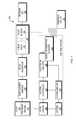
- FIG. 1is a block diagram illustrating the various functional components of electrolytic drug pump devices in accordance with various embodiments
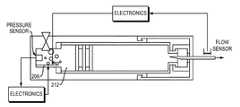
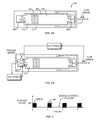
- FIGS. 2A and 2Bare schematic side views of piston pump devices in accordance with various embodiments
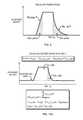
- FIG. 3illustrates how repeated, alternating pulses and non-delivery periods can be combined to obtain an averaged flow rate equal to a targeted flow
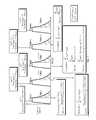
- FIGS. 4A-4Egraphically depict operation of an adaptive control algorithm for overcoming a flow “tail”
- FIG. 5like FIG. 3 , illustrates an example of discrete basal delivery achieved by multiple pulse/time deliveries
- FIG. 6graphically depicts computation and use of average tail volumes in a compensating flow scheme at the priming stage
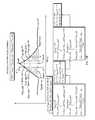
- FIG. 7graphically depicts computation and use of average tail volumes in a compensating flow scheme at the delivery stage
- FIG. 8graphically depicts the operation of an adaptive control algorithm for continuous basal delivery
- FIG. 9graphically depicts the operation of an adaptive control algorithm for bolus delivery at the priming stage.
- FIG. 10Agraphically depicts the delivery stage of the bolus algorithm
- FIG. 10Bgraphically depicts the delivery stage of the bolus algorithm in a situation where the bolus volume is small and the peak flow rate never reaches the maximum dosing rate.
- FIG. 1illustrates, in block diagram form, the main functional components of a drug pump device 100 in accordance with various embodiments of the present invention.
- the pump device 100includes a drug reservoir 102 that interfaces with an electrolysis pump 104 via a displaceable member 106 .
- the displaceable member 106may be, for example, a piston, diaphragm, bladder, or plunger.
- the drug reservoir 102is filled with medication in liquid form, and pressure generated by the pump 104 moves or expands the displaceable member 106 so as to push the liquid drug out of the reservoir 102 .
- a cannula, needle, or other exit member 108 connected to an outlet of the drug reservoir 102conducts the liquid to an infusion set 109 .
- the infusion set 109may include a catheter fluidically connected to the cannula 108 for delivering the drug to a subcutaneous tissue region.
- a lancet and associated insertion mechanismmay be used to drive the catheter through the skin.
- the infusion set 109may include another type of drug-delivery vehicle, e.g., a sponge or other means facilitating drug absorption through the skin surface.
- the electrolysis pump 104generally includes an electrolyte-containing chamber (hereinafter also referred to as the “pump chamber”) and, disposed in the chamber, one or more pairs of electrodes that are driven by a direct-current power source to break the electrolyte into gaseous products.
- Suitable electrolytesinclude water and aqueous solutions of salts, acids, or alkali, as well as non-aqueous ionic solutions. The electrolysis of water is summarized in the following chemical reactions:
- the pressure generated by the drug pump 104may be regulated via a pump driver 110 by a system controller 112 (e.g., a microcontroller).
- the controller 112may set the drive current and thereby control the rate of electrolysis, which, in turn, determines the pressure.
- the amount of gas generatedis proportional to the drive current integrated over time, and can be calculated using Faraday's law of electrolysis. For example, creating two hydrogen and one oxygen molecule from water requires four electrons; thus, the amount (measured in moles) of gas generated by electrolysis of water equals the total electrical charge (i.e., current times time), multiplied by a factor of 3 ⁇ 4 (because three molecules are generated per four electrons), divided by Faraday's constant.
- the system controller 112may execute a drug-delivery protocol programmed into the drug pump device 100 , and may be responsive to one or more sensors 113 , 114 that measure an operational parameter of the device 100 , such as the pressure in the pump chamber 104 or the flow rate through (or pressure in) the cannula 108 .
- the controller 112may adjust the current supplied to the electrolysis electrodes based on the pressure inside the pump chamber to achieve a target pressure.
- the target pressuremay be calculated based on a desired flow rate, using a known relationship between flow rate and pressure (as determined, e.g., by calibration).
- pressure sensorssuch as, e.g., MEMS sensors as used in the automotive industry
- this optionis particularly advantageous for pumps designed for quick drug delivery.
- two or more pressure sensors 113may be placed in the pump chamber to simultaneously monitor pressure therein; this redundancy provides additional feedback to the controller 112 , improves accuracy of information, and serves as a backup in case of malfunction of one of the sensors.
- the rate of drug flow out of the reservoir 102may be measured directly and in real-time, using a flow sensor 114 integrated in the exit member 108 in a conventional manner.
- the total delivered dosecan be computed by integrating the flow rate over time, and may serve as a control parameter for the electrolysis current as described in greater detail below.
- a pressure sensor 113 inside the pump chamberis used in combination with a flow sensor 114 in the cannula to increase the accuracy and precision of the feedback control loop.
- the use of multiple sensorsalso ensures that, in case the flow sensor 114 fails, the pressure sensor 113 would be able to detect high drug delivery rates, and shut the pump 104 down to avoid administration of an overdose to the patient or damage to the pump device.
- the combination of flow and pressure sensors 114 , 113can also detect a violation in the drug reservoir 102 if pressure is measured in the pump chamber but no flow is measured in the cannula 108 , indicating a potential leak.
- the sensors used to measure various pump parametersmay be flow, thermal, time of flight, pressure, or other sensors known in the art, and may be fabricated (at least in part) from parylene—a biocompatible, thin-film polymer.
- the cannula 108may also include a check valve 116 that prevents accidental drug delivery and backflow of liquid into the drug reservoir 112 ; like the sensor 114 , the check valve 116 may be made of parylene.
- silicon or glassare used in part for the flow sensor 114 and valve 116 construction.
- the drug pump device 100may include electronic circuitry 118 (which may, but need not, be integrated with the system controller 112 ) for conditioning and further processing the sensor signal(s) and, optionally, providing pump status information to a user by means of LEDs, other visual displays, vibrational signals, or audio signals.
- the controller 112may be used to control other components of the drug pump system; for example, it may trigger insertion of the lancet and catheter.
- the system controller 112may be a microcontroller, i.e., an integrated circuit including a processor core, memory (e.g., in the form of flash memory, read-only memory (ROM), and/or random-access memory (RAM)), and input/output ports.
- the memorymay store firmware that directs operation of the drug pump device.
- the devicemay include read-write system memory 120 .
- the system controller 112is a general-purpose microprocessor that communicates with the system memory 120 .
- the system memory 120(or memory that is part of a microcontroller) may store a drug-delivery protocol in the form of instructions executable by the controller 112 , which may be loaded into the memory at the time of manufacturing, or at a later time by data transfer from a hard drive, flash drive, or other storage device, e.g., via a USB, Ethernet, or firewire port.
- the system controller 112comprises analog circuitry designed to perform the intended function.
- the pump driver 110 , system controller 112 , and electronic circuitry 118may be powered, via suitable battery electronics, by a battery 122 .
- Suitable batteries 122include non-rechargeable lithium batteries approximating the size of batteries used in wristwatches, as well as rechargeable Li-ion, lithium polymer, thin-film (e.g., Li-PON), nickel-metal-hydride, and nickel cadmium batteries.
- Other devices for powering the drug pump device 100such as a capacitor, solar cell or motion-generated energy systems, may be used either in place of the battery 122 or supplementing a smaller battery. This can be useful in cases where the patient needs to keep the drug-delivery device 100 on for several days or more.
- the drug pump device 100includes, as part of the electronic circuitry 118 or as a separate component, a signal receiver 124 (for uni-directional telemetry) or a transmitter/receiver 124 (for bi-directional telemetry) that allows the device to be controlled and/or re-programmed remotely by a wireless handheld device 150 , such as a customized remote control or a smartphone.
- a wireless handheld device 150such as a customized remote control or a smartphone.
- the handheld device 150 and pump device 100communicate over a (uni- or bidirectional) infrared (IR) link, which may utilize one or more inexpensive IR light-emitting diodes and phototransistors as transmitters and receivers, respectively. Communication between the drug pump device 100 and the handheld device 150 may also occur at radio frequencies (RF), using, e.g., a copper coil antenna as the transmitter/receiver component 124 .
- RFradio frequencies
- the drug-delivery device 100may be manually activated, e.g., toggled on and off, by means of a switch integrated into the pump housing.
- the patientmay cause a needle to pierce the enclosure of the drug reservoir 102 (e.g., the septum of a drug vial, as explained below with respect to FIGS. 2A and 2B ) to establish a fluidic connection between the reservoir 102 and the cannula 108 ; priming of the pump can then begin.
- a needlepierce the enclosure of the drug reservoir 102 (e.g., the septum of a drug vial, as explained below with respect to FIGS. 2A and 2B ) to establish a fluidic connection between the reservoir 102 and the cannula 108 ; priming of the pump can then begin.
- liquidis pumped from the reservoir through the fluid path, ideally displacing air with liquid up to the tip of the injection needle.
- the lancet and catheter of the infusion set 109may be inserted by manually releasing a mechanical insertion mechanism. In some embodiments, insertion of the lancet and catheter automatically triggers electronic activation of a pump, e.g., by closing an electronic circuit. Alternatively, the pump and/or insertion set may be activated remotely by wireless commands.
- the drug pump deviceis integrated into a patch adherable to the patient's skin.
- Suitable adhesive patchesare generally fabricated from a flexible material that conforms to the contours of the patient's body and attaches via an adhesive on the backside surface that contacts a patient's skin.
- the adhesivemay be any material suitable and safe for application to and removal from human skin. Many versions of such adhesives are known in the art, although utilizing an adhesive with gel-like properties may afford a patient particularly advantageous comfort and flexibility.
- the adhesivemay be covered with a removable layer to preclude premature adhesion prior to the intended application. As with commonly available bandages, the removable layer preferably does not reduce the adhesion properties of the adhesive when removed.
- the drug pump deviceis of a shape and size suitable for implantation.
- the various components of the drug pump devicemay be held within a housing mounted on the skin patch.
- the devicemay either be fully self-contained, or, if implemented as discrete, intercommunicating modules, reside within a spatial envelope that is wholly within (i.e., which does not extend beyond in any direction) the perimeter of the patch.
- the housingmay provide mechanical integrity and protection of the components of the drug pump device 100 , and prevent disruption of the pump's operation from changes in the external environment (such as pressure changes).
- the control system components 110 , 112 , 118 , 120 , 122may be mounted on a circuit board, which may be flexible and/or may be an integral part of the pump housing. In some embodiments, the control system components are integrated with the electrolysis electrodes into self-contained unit.
- Drug pump devices 100 in accordance herewithmay be designed for single or repeated use.
- Multi-use pumpsgenerally include a one-way check valve and a flow sensor, as described above, in the cannula.
- the drug reservoir of a multi-use pumpmay be refillable via a refill port, using, e.g., a standard syringe.
- the drug pump device 100is removed from the patient's skin for re-filling.
- the patientmay, for example, place the drug pump device 100 and cartridge containing the new drug into a home refill system, where the pump device and cartridge may be aligned using, e.g., a press-machine mechanism.
- the patientmay then press a button to trigger automatic insertion of a needle that draws liquid drug from the cartridge to the cannula in order to activate the electronics and begin priming the pump.
- the electrolysis pump 104 and drug reservoir 102may be arranged within the device 100 in different ways, the two most common being a piston-pump configuration, in which the pump chamber and reservoir are formed within an elongated vial and separated by a piston movable along the axis of the vial, and the diaphragm-pump configuration, in which the reservoir is disposed on top of the pump chamber and separated therefrom by a flexible diaphragm. Both configurations are described in detail in U.S. patent application Ser. No. 13/091,047, filed on Apr. 20, 2011, which is hereby incorporated herein by reference in its entirety.
- FIG. 2Aschematically illustrates an exemplary piston pump device 200 .
- the pump device 200includes a cylindrical (or, more generally, tubular) vial 202 with a piston 204 movably positioned therein and an electrolysis electrode structure 206 mounted to one end.
- a septum 208may be disposed at the other end to seal the vial 202 .
- Both the piston 204 and the septum 208may be made of an elastomeric polymer material, such as a synthetic or natural rubber; in some embodiments, silicone rubber (i.e., polydiorganosiloxane, e.g., polydimethylsiloxane) is used.
- the piston 204separates the interior of the vial 202 into a drug reservoir 210 and a pump chamber 212 .
- a needle 214pierces the septum 208 to allow fluid egress from the drug reservoir 210 ; a cannula (not shown) connected to the needle 214 may conduct the fluid to the infusion set (not shown).
- the piston pump device 200is enclosed in a protective housing 216 , e.g., made of a hard plastic.
- the electrodes 206may be made of any suitable metal, such as, for example, platinum, titanium, gold, or copper, and may form a pair of parallel wires or plates. Alternatively, to improve electrolysis efficiency, the electrodes can have non-traditional shapes. For example, they may be interdigitated, or individually wound up into a spiral configuration (and oriented so as to face each other). Further, the electrodes 206 may be embedded in a hydrophilic absorbent material (e.g., a cotton ball) that ensures continuous contact with the electrolyte.
- a hydrophilic absorbent materiale.g., a cotton ball
- the vial 202may be fabricated from a glass, polymer, or other materials that are inert with respect to the stability of the drug and, preferably, biocompatible.
- Polymer vialse.g., made of polypropylene or parylene, may be suitable for certain drugs that degrade faster when in contact with glass, such as protein drugs.
- glassis the preferred material. Glass is commonly used in commercially available and FDA-approved drug vials and containers from many different manufacturers. As a result, there are well-established and approved procedures for aseptically filling and storing drugs in glass containers, which may accelerate the approval process for drug pump devices that protect the drug in a glass container, and avoid the need to rebuild a costly aseptic filling manufacturing line.
- Suitable glass materials for the vialmay be selected based on the chemical resistance and stability as well as the shatterproof properties of the material. For example, to reduce the risk of container breakage, type-II or type-III soda-lime glasses or type-I borosilicate materials may be used.
- the interior surface of the vialmay have a specialized coating.
- coatingsinclude chemically bonded, invisible, ultrathin layers of silicon dioxide or medical-grade silicone emulsions.
- coatingssuch as silicone emulsions may provide for lower and more uniform friction between the piston and vial.
- the piston pump device 200is manufactured by fitting a conventional, commercially available glass or polymer drug vial, which may already be validated for aseptic filling, with the piston 204 and electrolysis pump components.
- a screw-in needle cassettemay be placed over the septum 208 , and a mechanical actuation mechanism may serve to screw the cassette into the vial 202 such that the cassette needle 214 punctures the septum 208 and establishes a connection with the cannula at the time the patient desires to use the pump.
- the vial 202is, in some embodiments, longer than typical commercially available vials, but maintains all other properties such that validated filling methods and the parameters of existing aseptic filling lines need not be changed.
- the drug pump devicemay be furnished with a prefilled vial. If a glass vial is used, the drugs can be stored in the pump device for long-term shelf life without the need to change the labeling on the drug.
- FIG. 2Billustrates the pump 200 with a pressure sensor located in the pump chamber 212 . Signals from the flow sensor and the pressure sensor are received by programmable circuitry and may be used to regulate pump operation as described in detail below.
- Closed-loop feedback control in accordance herewithensures accurate drug delivery in driven pumps.
- a pump systemdelivers drug in discrete doses or pulses, resulting in flow rates that are much lower than the continuous delivery capabilities of the pump. Due to the effect of the stiction of the plunger and glass wall of the cartridge at such a low flow rate, each small discrete dose of drug is generated after the plunger is pushed to overcome the stiction force. Each discrete delivery may overshoot to a flow rate higher than a targeted flow rate, followed by an abrupt stop of the plunger movement causing the flow rate to cease for certain interval.
- FIG. 3shows a discrete dose mode in which the peak flow rate for each pulse is 500 nL/min, the duration for each pulse is 4 min, and the average flow rate representing a continuous constant delivery mode is 33.3 nL/min.
- FIGS. 4A-4Eillustrate the general concept of an adaptive control algorithm suitable for addressing this problem.
- FIG. 4Ashows an ideal discrete dose of 0.05 U (which deviates from a perfectly rectangular pulse due to a necessary ramp-up time, which represents proper pump operation and does not vary significantly);
- FIG. 4Bshows the actual delivered dose with additional volume “tail”;
- FIG. 4Cillustrates measurement of the tail at 0.02 U, which totals 0.07 U delivered; the pump stops delivery early at 0.03 U, which accounts for the unwanted tail of 0.02 U shown in FIG. 4D (i.e., the pulse is adjusted so that the tail volume becomes part of the intended delivery volume rather than a deviation therefrom);
- FIG. 4Eillustrates performance in accordance with embodiments of the present invention, which results in a delivered dose that more accurately tracks the target dose shown in FIG. 4A .
- a typical insulin pumpshould be able to provide bolus and background basal delivery rates over a wide range in order to serve different patients' needs.
- a prefilled insulin pump in accordance herewithcan successfully provide suitable basal and bolus ranges.
- delivery accuraciescan be compromised if corrections for such variation are not made.
- a real-time intelligent control algorithmmay be used to compensate for the variation and maintain a very accurate dosage for both basal and bolus delivery.
- the volume of the tailis measured from the previous few (e.g., three) doses the average is determined.
- the system controller 112then adjusts the target volume for the next dose based on this average.
- the following equationsmay be used by the controller to determine the proper correction.
- V set ⁇ ( n )V target ⁇ ( n ) - V Tail ⁇ ⁇ _ ⁇ ⁇ Avg ( 2 )
- V Tail _ Avgis the average tail volume
- V Tailis the individual tail volume
- V setis the predicted volume to be delivered excluding the tail volume
- V targetis the the total expected volume.
- a similar approachmay be used for continuous delivery.
- the system controller 112adjusts the overall flow rate (on a pulse-by-pulse basis) to correct for the previous delivery error during the next time period.
- FIG. 5illustrates an example of discrete basal delivery achieved by multiple pulse/time deliveries. As shown, there are four bolus deliveries in an hour and the equivalent flow rate is 33.3 nL/min. To generate these small pulses, the pressure in the electrolysis chamber is quickly released at the end of each pulse to accurately obtain the targeted volume for each small pulse. If the pressure is not promptly released, the high pressure will prevent the pump flow from stopping and result in a large over-delivery. Meanwhile, due to residual pressure induced from the plunger/glass interaction and the compliance of the plunger, a “tail” is produced that degrades the accuracy of basal delivery.
- the system controller 112executes an adaptive control algorithm (ACA) during a priming stage and during a delivery stage.
- ACAadaptive control algorithm
- a number n of predetermined pulsese.g., 0.05 U/pulse
- the pressureis released and the tail volumes measured.
- the system controller 112collects these tail volumes from a number N p of pulses to determine an average tail volume. This averaged volume is taken into account in adjusting the time width of the subsequent pulse during the delivery stage.
- the priming tailsare averaged and stored as V tail _ prime _ avg for future usage. This is illustrated in FIG.
- V tail _ prime (n)corresponds to the n th tail volume generated by the n th pulse in the priming stage
- V tail _ prime _ avgcorresponds to the average tail volume of the discrete pulses in the priming stage.
- the discrete basal target volumeis adjusted according to the average volume of the previous n tails.
- the first discrete basal pulse, Set Volume or V set (n)is established as follows. After the tail volumes from the n pulses during the priming stage are averaged, V tail _ prime _ avg is subtracted from V target (the original target volume of the pulse) to give V set ( 1 ) (i.e., the adjusted volume for the pulse).
- V set ( 1 )i.e., the adjusted volume for the pulse.
- V pulse _ targetis the target volume to be delivered in each pulse
- V tail (n)is the tail volume produced by each pulse
- V cumulativeis the actual cumulative volume delivered over time
- V tail _ avgis the average tail of the previous n discrete basal pulses.
- V setis negative. This means that there is an overdose from a previous delivery such that the next scheduled pulse should deliver a negative volume to achieve the desired target volume, V target _ overall .
- the systemsets V set to 0, which causes the controller 112 to skip the pulse in an effort to correct for a previous over-delivery and achieve the correct overall target volume, V target _ overall .
- the systemcan set a maximum tolerance volume to be delivered at each pulse (V max _ tor ). The V set volume never exceeds V max _ tor . If it does, the system controller 112 will coerce V set to be equal to V max _ tor . This ensures overall profile stability, and also ensures the absence of dramatic change in overdose and underdose caused by frequent over-delivery and missed pulses.
- the tail volumecan vary over the lifetime of the pump or even during an operating cycle based on various factors. Accordingly, calibration is typically performed periodically rather than, for example, a single time when the pump is first used. For example, the response of an electrolysis-driven pump to a given input current supplied to the electrolysis electrodes depends on how much liquid is remaining in the drug reservoir and the gas/liquid ratio in the electrolysis chamber. Other factors can cause the response of the pump to change over time including, for example, degradation of electrolysis electrodes, changes in the concentration of the electrolyte in the electrolysis chamber, changes in the flow characteristics of valves in the fluid path, and restrictions that form at the exit port due to tissue growth or some other mechanism.
- continuous basal deliveryfaces challenges due to the plunger and glass-wall friction. Ordinarily it is not necessary to deliver a pulse pattern in continuous basal delivery (as contrasted with discrete basal delivery), and during continuous pumping, the plunger operates above its stiction range. Nonetheless, a continuous adaptive control algorithm can increase the accuracy of drug delivery by minimizing the errors caused by interaction between the plunger and the glass wall.
- a continuous adaptive control routinecontinuously monitors the accumulated volume and its deviation from the target volume.
- the routinesets a time window, ⁇ T, and maximum tolerable flow rate range, ⁇ Q max _ tor .
- the routinecalculates the actual volume delivered during ⁇ T and its deviation from the target volume. Based on the deviation, a target flow rate, Q set ( 2 ), for the next ⁇ T window is determined in order to compensate for the error in delivery during the first ⁇ T window.
- the maximum tolerance, ⁇ Q max _ torcomes into play when there is too much error in delivery during the first ⁇ T and Q set ( 2 ) has been raised or decreased beyond the physiological range from Q set _ initial .
- Q set ( 2 )is coerced to equal Q set _ initial ⁇ Q max _ tor , depending on the delivery error during previous sampling time. This process repeats throughout continuous basal delivery to ensure the overall stability of the flow profile and delivery accuracy.
- Q set _ initialif the cumulative delivered volume did not deviate from the cumulative target volume by more than an acceptable percentage (e.g., 5%) at the end of the sampling period ⁇ T, then the system will set Q set to Q set _ initial , which is the initial flow-rate set point. If the actual delivered volume exceeds the target volume by more than the acceptable percentage (e.g., 5%), Q set is set to Q set ⁇ Q max _ tor for the next time window ⁇ T. If the actual delivered volume falls below the target volume by more than the acceptable percentage (e.g., 5%), Q set is set to Q set + ⁇ Q max _ tor for the next time window ⁇ T.
- an acceptable percentagee.g., 5%
- a continuous spectrum of Q set (n) valuesis used.
- ⁇ Tis a predefined time window
- Q set (n)is the target flow rate during the time window
- Q set _ initialis the initial target flow rate (which is also equal to Q set , the overall target flow rate)
- V cumulativeis the actual cumulative volume delivered over time
- V targetis the target cumulative volume over time
- % errorrepresents the error percentage (i.e., the deviation from V target ) by volume
- ⁇ Q max _ toris the maximum flow rate that Q set cannot exceed.
- Each Q set (n) valueinversely corresponds to a percentage deviation above or below the target delivery volume from the previous sampling period. If the cumulative delivered volume exceeds the cumulative target volume by more than an acceptable percentage (% error), Q set (n) is set to Q set _ initial ⁇ % error ⁇ Q max _ tor for the next time window ⁇ T. If the actual delivered volume falls below the target volume by more than % error, Q set (n) is set to Q set _ initial +% error ⁇ Q max _ tor for the next time window ⁇ T.
- the Q set (n)can never go below Q set _ initial ⁇ Q max _ tor or above Q set _ initial + ⁇ Q max _ tor , or the system will coerce the Q set (n) to be set at Q set _ initial ⁇ Q max _ tor or Q set _ + ⁇ Q max _ tor .
- various algorithms and controllerscan be used to adjust pump operation through monitoring and adjustment during time windows.
- a closed-loop control schemesuch as proportional-integral-derivative (“PID”) controller, on-off controller, fuzzy logic controller, proportional controller, and/or linear controller can be applied to maintain as constant a target delivery parameter such as flow rate.
- PIDproportional-integral-derivative
- the constant target delivery parametercan be altered based on the comparison result from the previous time window
- a PID controllermay be used during a timing interval, while a different algorithm, such as the ACA, may be used between time windows to alter the PID controller settings (e.g., the constant target delivery flow rate, the acceptable upper and lower ranges of flow rates, and constants for positional, integral, and derivative calculations).
- parameters that can be monitored and adjustedinclude flow rate, pressure, volume, current, and voltage.
- the integration or differentiation of any one or more of these parametersmay be monitored and adjusted.
- Bolus deliveryfaces the same accuracy challenges caused by the tail volume as the discrete basal pulses.
- bolusesare delivered on demand, and the accuracy of each individual bolus cannot be compensated by another bolus.
- bolusesare usually preceded and followed by a background basal delivery; for example, a bolus may be administered just before mealtime, after which insulin is delivered at the background basal rate until the next bolus.
- the bolus adaptive control algorithmcan be relatively simple, as it may be based solely on tail volume to achieve overall accuracy.
- the flow profilemay be more complex and/or unpredictable; for example, the rate of drug administration may be varied periodically or continuously based on the monitored value of a physiologic, environmental or blood-borne chemical concentration parameter.
- the real-time bolus adaptive control algorithminvolves a priming stage and a delivery stage.
- a boluse.g., 1 U
- the tail volumeis measured until the flow rate reaches zero.
- This bolusis sufficient in volume to allow the system to pump the flow rate up to its maximum dosing rate (e.g., 30 U/Hr for insulin pump). If the user selects a smaller bolus volume, the peak bolus flow rate may never reach the maximum dosing rate (e.g., 30 U/Hr).
- the peak bolus target flow ratecan be kept at the maximum dosing rate (e.g., 30 U/Hr) using a flow-sensor-based closed-loop control system as described, for example, in copending application Ser. No. 13/680,828, filed on Nov. 19, 2012 (the entire disclosure of which is hereby incorporated by reference); it simply takes longer to finish the bolus.
- V set _ primei.e., the desired volume to be delivered. Additional flow during ramp-up (V rise _ prime ) and during the tail (V tail _ prime ) is modeled by fitted curves Q fit _ Rise (t) (flow rate vs. time during the ramp-up stage) and Q fit _ Rise (t) (representing the tail after V set _ prime has completed). The areas under these fitted curves corrrespond to V rise _ prime (the volume delivered during ramp-up) and V tail _ prime (the volume delivered during the tail segment). After obtaining the tail volume information and its curve, interpolation can be used to predict the tail volume for different boluses with different potential peak flow rates. The interpolated curve and the peak flow rate at the end of the bolus can be used to predict the tail volume.
- FIGS. 10A and 10BTwo delivery-stage scenarios are illustrated, respectively, in FIGS. 10A and 10B .
- the flow patterncorresponds to that shown in FIG. 9 , with a peak flow rate is that is substantially constant (flat).
- a calibrated tail volume V tail _ avg _ calibis used to calculate the actual delivery bolus volume, which is equal to the difference between the target volume V target and the total predicted tail volume (including the background basal cumulative volume); thus, the calibrated set volume V set _ calib is equal to V target ⁇ V tail _ avg _ calib ⁇ V BkgndBasal .
- the total bolus volume V total actually deliveredequal to V set _ calib +V tail _ calib , where V tail _ calib is the actual run-time tail volume (this time ignoring the background basal cumulative volume).
- a curve-fitting techniquemay be used to predict the peak flow rate as illustrated in FIG. 10B ; here the tail volume is estimated between the predicted peak flow rate and the (actual) background basal flow rate. This can give a very accurate prediction of the tail volume, and during the actual delivery this is used to compensate for the effect of the tail effect.
- T 0is the bolus start time
- T Qpeakis the time at which the bolus reaches the maximum peak set flow rate Q peak
- ⁇ Tis an adjustment time set to create a fitted curve as shown in FIG.
- T 1is the time when Q tail _ calib (t) (the fitted tail curve) reaches Q tail _ calib ⁇ (T Qpeak ⁇ T);
- T 2is the time when Q tail _ calib (t) reaches Q tail _ calib ⁇ (T Qpeak ⁇ 2 ⁇ T);
- T BkgndBasalis the time when Q tail _ calib (t) reaches the background basal flow rate.
- the tail volumeis stored in memory along with the estimated (fitted) curve. This historical tail behavior may be used to predict the tail volume for future boluses delivered from the same cartridge.
- the priming stageis typically employed to evacuate air from the fluid path of the device, preventing air and/or debris from being injected into the target site, and also wets any sensors in the fluid path. Because of the faults that priming is designed to remediate, calibrating during the priming stage may not be ideal. In some embodiments, therefore, a non-therapeutic dose is dispensed by the pump following priming, and this dose is used instead of or in addition to the priming stage for calibration purposes. For example, it may be necessary to use the non-therapeutic dose for calibration if the sensor used therefor is in the fluid path and must be wet to operate properly.
- the term “non-therapeutic dose”means a volume of drug less than a therapeutic dose, and in some embodiments, a dose small enough to avoid any therapeutic effect or clinically significant effect.
- a dose-selection mechanismmay allow the user to select the dosage, which is programmed into memory within the controller 112 .
- This interfacemay be or include a switch, dial, buttons, touch screen, or a variety of user-interface components.
- the dosagemay also be pre-set by the manufacturer, clinician, pharmacist, or other non-patient entity, and locked for security purposes.
Landscapes
- Health & Medical Sciences (AREA)
- Engineering & Computer Science (AREA)
- General Health & Medical Sciences (AREA)
- Public Health (AREA)
- Vascular Medicine (AREA)
- Veterinary Medicine (AREA)
- Animal Behavior & Ethology (AREA)
- Life Sciences & Earth Sciences (AREA)
- Hematology (AREA)
- Heart & Thoracic Surgery (AREA)
- Biomedical Technology (AREA)
- Anesthesiology (AREA)
- Physics & Mathematics (AREA)
- Fluid Mechanics (AREA)
- Dermatology (AREA)
- Primary Health Care (AREA)
- Medical Informatics (AREA)
- Epidemiology (AREA)
- Medicinal Chemistry (AREA)
- Bioinformatics & Cheminformatics (AREA)
- Chemical & Material Sciences (AREA)
- Infusion, Injection, And Reservoir Apparatuses (AREA)
Abstract
Description
This is a continuation-in-part of U.S. Ser. No. 12/858,808, filed on Aug. 18, 2010, and also claims priority to, and the benefits of, U.S. Ser. Nos. 61/704,946, filed on Sep. 24, 2012; the entire disclosures of these applications are hereby incorporated by reference.
The present invention relates to drug-delivery devices, and in particular to control of piston- or plunger-driven drug-pump devices for accurate dosing.
Subcutaneous drug delivery is employed for treatment of conditions such as diabetes, and typically involves modalities such as syringe injections, pre-filled pen injectors and patient-filled portable insulin pumps. Pre-filled pen injectors provide accurate manual insulin dosing using, for example, a pre-filled, bubble-free glass cartridge. Since the glass cartridges are bubble-free, the priming process is simple for the patient. Since the injection is performed manually, however, patient compliance is a challenge; the patient may not observe proper injection timing and/or fail to follow the dosing prescription. Portable insulin pumps can provide fully controlled insulin delivery, improving patient compliance, and reduced numbers of injections (once every 3 days, for example) and programmable dosing schedules enhance the patient's quality of life. Patch pumps with low pump profiles can be attached to the patient's skin without interfering with daily activities such as including showering, sleeping, and exercising. Because these pumps are typically filled by patients, however, risks arise during the priming procedure. Improperly primed reservoirs may contain large air bubbles and cause the pump to inject too much air into the subcutaneous tissue, which poses serious safety concerns.
Accordingly, portable pumps with small footprints and pre-filled drug reservoirs can address various problems including those discussed above. One of the challenges for pumps utilizing glass vials as drug reservoirs is to provide controlled and accurate drug delivery. This challenge arises due to varying stiction/friction forces between the surface of the plunger and glass vial. Even under the same driving pressure, these variable forces may cause the drug to be delivered at different flow rates for basal (continuous) delivery. It will also make bolus delivery (i.e., delivery of a discrete dose over a short time period) unpredictable from one bolus to the next.
Embodiments of the present invention utilize a closed-loop feedback control system to ensure accurate drug delivery. This control system may, for example, utilize a flow sensor to measure the volume of delivery and an intelligent control algorithm to anticipate and compensate for overdoses and underdoses. Feedback control systems in accordance herewith can be applied to any piston- or plunger-driven pump system (hereafter, collectively, “driven” pumps) utilizing sensors that measure flow directly or indirectly. An advantage to this approach is adaptation of the control algorithm to the pump's output, ultimately resulting in extremely accurate drug delivery.
In general overview, a driven pump device in accordance herewith typically includes a cylindrical vial or cartridge with an outlet, and a piston or plunger movable therein. The piston/plunger divides the interior of the vial into a front chamber that is filled with liquid drug and, thus, forms the drug reservoir, and a back chamber that contains the pump mechanism that drives the piston. For example, in electrolytic drug pump devices, the back chamber, or “pump chamber,” may contain a pair of electrodes and an electrolyte from which, upon application of a drive current to the electrodes, electrolysis gas evolves, building up pressure in the chamber that pushes the piston forward so as to expel drug through the outlet. Other pump mechanisms (e.g., osmotic, electrochemical, motor-driven, etc.) may also be used.
In general, the drug flow rate of a piston pump device can be regulated via the drive force/pressure applied by the pump; for electrolytically driven pump devices, for example, this is, in turn, a function of the drive current. The pump can be operated continuously to dispense drug at a desired steady flow rate, or in a “pulsed” manner (i.e., turning the pump on and off at certain intervals for specific periods of time) to deliver a series of discrete drug volumes. (Which mode of operation is used often depends on the drug regimen. For instance, diabetes patients usually need a continuous, low “basal” rate of insulin, in addition to high-rate, short-duration “bolus” deliveries before or after meals.) Sometimes, frequent small-volume bolus injections are used to provide, on average, a very low basal rate; this is called “discrete basal delivery.” As explained above, the actual mechanics of piston pump devices can undermine the accuracy of drug delivery. One problem is the variable stiction/friction between the piston and glass vial, which can cause unstable flow rates despite constant drive pressure. Another problem is the compression of the piston (which is usually made of a rubber-like material) during pump operation, which results, after the pump has been turned off, in a residual “tail” of drug flow as the piston relaxes from its compressed state. This tail can be strongly affected, in addition, by fluid viscosity, which can vary with the particular drug composition as well as the temperature at administration. As a result of this tail, the actual drug volume delivered is larger than the “set” volume, which is the set flow rate during pump operation multiplied by the time period of operation
Embodiments of the present invention address these inaccuracies by measuring the flow rate of drug (with any suitable flow-rate sensor disposed at the drug reservoir outlet or in a cannula, needle, or other fluid conduct downstream thereof) and adjusting pump operation based thereon in real time. For bolus deliveries, the “tail volume” (i.e., the volume of liquid delivered during the residual tail described above) may be measured during a priming stage (before drug is injected into the patient), and the “set volume” decreased such that the sum of tail volume and set volume equals the desired dosage. Similarly, for discrete basal delivery, the set volume for each pulse is adjusted based on the average tail volume of a number of immediately preceding pulses. For “continuous basal delivery” (or simply “continuous delivery”), in which fluid is dispensed continuously rather than in discrete pulses, the accumulated delivered volume may be repeatedly measured for a time window, and deviations of the measured volume from the target volume (i.e., the target flow rate times the length of the time window) are compensated for by adjusting the set flow rate for the next time window (typically between upper and lower flow-rate boundaries).
Accordingly, in a first aspect, the invention pertains drug pump device. In various embodiments, the device comprises a drug reservoir; an exit member for fluidically connecting the reservoir with a drug injection site; a sensor; an electrolysis pump comprising a pump chamber in mechanical communication with the drug reservoir via an intervening displacement member, where the electrolysis pump is operable to exert pressure to drive the displacement member toward the exit member and thereby force therethrough fluid in the drug chamber; and control circuitry for (i) storing one or more delivery parameters and target values therefor, (ii) operating the electrolysis pump in a priming stage to force a volume of fluid from the drug reservoir into the exit member but substantially without any fluid leaving the exit member, (iii) based on signals received from the sensor, determining a deviation between a target value of one or more delivery parameters and a measured value thereof, and (iv) based at least in part on the determined deviation, operating the pump in a delivery stage to force the target volume of fluid from the drug reservoir out through the exit member. In various embodiments, the sensor is at least one pressure sensor. In other embodiments, the sensor is at least one flow sensor, and in still other embodiments the sensor comprises or consists of at least one flow sensor and at least one pressure sensor.
The delivery parameter(s) may be flow volume and/or flow rate. The the measured value may be obtained directly or indirectly from the sensor signals. In various embodiments, the electrolysis pump is operable to force fluid from the drug reservoir into the exit member in pulses, each having a time window defined by a pump-start time when pumping begins and a pump-stop time when the pump is shut off. The time window corresponds to the target delivered volume at the expected flow rate, and the control circuitry adjusts the pulse based at least in part on the determined deviation in order to force the target volume of fluid from the drug reservoir out through the exit member. In some embodiments, at least one pulse corresponds to a non-therapeutic dose as defined below. The delivery parameter(s) may be flow volume, which includes a pulse volume expelled during the pulse and an additional tail volume expelled after the pulse, and the pulse adjustment may be based on the measured pulse volume and tail volume.
In some modes of operation, the control circuitry causes delivery of a single bolus during the delivery stage. In other embodiments, the target delivered volume is dispensed through the exit member over a sequence of time-separated pulses occurring over a time interval.
In another aspect, the invention relates to a method of controlling an actual delivery volume of fluid to conform to a target delivery volume in a drug pump device comprising a drug reservoir, an exit member for fluidically connecting the reservoir with a drug injection site, and an electrolysis pump operable to exert a pressure to drive the displacement member toward the exit member and thereby force therethrough fluid in the drug chamber. In various embodiments, the method comprises operating the electrolysis pump in a priming stage to force fluid from the drug reservoir into the exit member but substantially without any fluid leaving the exit member;
during the priming stage, determining a deviation between an expected value of one or more delivery parameters and a measured value thereof; and based at least in part on the determined deviation, operating the pump in a delivery stage to force the target volume of fluid from the drug reservoir out through the exit member. The delivery parameter(s) may be flow volume and/or flow rate, for example.
In various embodiments, fluid is forced from the drug reservoir into the exit member in pulses having a time window defined by a pump-start time when pumping begins and a pump-stop time when the pump is shut off. The time window corresponds to the target delivered volume at the expected flow rate and the pump is operated during the delivery stage for an adjusted pulse time based at least in part on the determined deviation in order to force the target volume of fluid from the drug reservoir out through the exit member.
In some embodiments, the delivery parameter(s) is flow volume, which includes a pulse volume expelled during the pulse and an additional tail volume expelled after the pulse. The adjusted pulse time may be based on the measured pulse volume and tail volume.
In accordance with this aspect of the invention, a single bolus may be expelled during the delivery stage or the target delivered volume may be dispensed through the exit member over a sequence of time-separated pulses occurring over a time interval. At least one of the pulses may correspond to a non-therapeutic dose.
These and other objects, along with advantages and features of the present invention herein disclosed, will become more apparent through reference to the following description, the accompanying drawings, and the claims. Furthermore, it is to be understood that the features of the various embodiments described herein are not mutually exclusive and can exist in various combinations and permutations. As used herein, the term “substantially” means ±10% and, in some embodiments, ±5%. A “measure” or “measurement” may be direct or indirect, i.e., a value derived from a directly measured value.
In the drawings, like reference characters generally refer to the same parts throughout the different views. Also, the drawings are not necessarily to scale, with an emphasis instead generally being placed upon illustrating the principles of the invention. In the following description, various embodiments of the present invention are described with reference to the following drawings, in which:
1. Pump Architecture
The electrolysis pump104 generally includes an electrolyte-containing chamber (hereinafter also referred to as the “pump chamber”) and, disposed in the chamber, one or more pairs of electrodes that are driven by a direct-current power source to break the electrolyte into gaseous products. Suitable electrolytes include water and aqueous solutions of salts, acids, or alkali, as well as non-aqueous ionic solutions. The electrolysis of water is summarized in the following chemical reactions:

The net result of these reactions is the production of oxygen and hydrogen gas, which causes an overall volume expansion of the drug chamber contents. Gas evolution occurs even in a pressurized environment (reportedly at pressures of up to 200 MPa, corresponding to about 30,000 psi). As an alternative (or in addition) to water, ethanol may be used as an electrolyte, resulting in the evolution of carbon dioxide and hydrogen gas. Ethanol electrolysis is advantageous due to its greater efficiency and, consequently, lower power consumption, compared with water electrolysis. Electrolysis pumps in accordance with several embodiments are described in detail further below.
The pressure generated by thedrug pump 104 may be regulated via apump driver 110 by a system controller112 (e.g., a microcontroller). Thecontroller 112 may set the drive current and thereby control the rate of electrolysis, which, in turn, determines the pressure. In particular, the amount of gas generated is proportional to the drive current integrated over time, and can be calculated using Faraday's law of electrolysis. For example, creating two hydrogen and one oxygen molecule from water requires four electrons; thus, the amount (measured in moles) of gas generated by electrolysis of water equals the total electrical charge (i.e., current times time), multiplied by a factor of ¾ (because three molecules are generated per four electrons), divided by Faraday's constant.
Thesystem controller 112 may execute a drug-delivery protocol programmed into thedrug pump device 100, and may be responsive to one ormore sensors device 100, such as the pressure in thepump chamber 104 or the flow rate through (or pressure in) thecannula 108. For example, thecontroller 112 may adjust the current supplied to the electrolysis electrodes based on the pressure inside the pump chamber to achieve a target pressure. The target pressure, in turn, may be calculated based on a desired flow rate, using a known relationship between flow rate and pressure (as determined, e.g., by calibration). Due to the low cost of pressure sensors (such as, e.g., MEMS sensors as used in the automotive industry), this option is particularly advantageous for pumps designed for quick drug delivery. Indeed, two ormore pressure sensors 113 may be placed in the pump chamber to simultaneously monitor pressure therein; this redundancy provides additional feedback to thecontroller 112, improves accuracy of information, and serves as a backup in case of malfunction of one of the sensors. Alternatively, the rate of drug flow out of thereservoir 102 may be measured directly and in real-time, using aflow sensor 114 integrated in theexit member 108 in a conventional manner. The total delivered dose can be computed by integrating the flow rate over time, and may serve as a control parameter for the electrolysis current as described in greater detail below.
In some embodiments, apressure sensor 113 inside the pump chamber is used in combination with aflow sensor 114 in the cannula to increase the accuracy and precision of the feedback control loop. The use of multiple sensors also ensures that, in case theflow sensor 114 fails, thepressure sensor 113 would be able to detect high drug delivery rates, and shut thepump 104 down to avoid administration of an overdose to the patient or damage to the pump device. Conversely, the combination of flow andpressure sensors drug reservoir 102 if pressure is measured in the pump chamber but no flow is measured in thecannula 108, indicating a potential leak. In general, the sensors used to measure various pump parameters may be flow, thermal, time of flight, pressure, or other sensors known in the art, and may be fabricated (at least in part) from parylene—a biocompatible, thin-film polymer. Thecannula 108 may also include acheck valve 116 that prevents accidental drug delivery and backflow of liquid into thedrug reservoir 112; like thesensor 114, thecheck valve 116 may be made of parylene. In other embodiments, silicon or glass are used in part for theflow sensor 114 andvalve 116 construction.
Thedrug pump device 100 may include electronic circuitry118 (which may, but need not, be integrated with the system controller112) for conditioning and further processing the sensor signal(s) and, optionally, providing pump status information to a user by means of LEDs, other visual displays, vibrational signals, or audio signals. In addition to controlling thedrug pump 104, thecontroller 112 may be used to control other components of the drug pump system; for example, it may trigger insertion of the lancet and catheter. Thesystem controller 112 may be a microcontroller, i.e., an integrated circuit including a processor core, memory (e.g., in the form of flash memory, read-only memory (ROM), and/or random-access memory (RAM)), and input/output ports. The memory may store firmware that directs operation of the drug pump device. In addition, the device may include read-write system memory 120. In certain alternative embodiments, thesystem controller 112 is a general-purpose microprocessor that communicates with thesystem memory 120. The system memory120 (or memory that is part of a microcontroller) may store a drug-delivery protocol in the form of instructions executable by thecontroller 112, which may be loaded into the memory at the time of manufacturing, or at a later time by data transfer from a hard drive, flash drive, or other storage device, e.g., via a USB, Ethernet, or firewire port. In alternative embodiments, thesystem controller 112 comprises analog circuitry designed to perform the intended function.
Thepump driver 110,system controller 112, andelectronic circuitry 118 may be powered, via suitable battery electronics, by abattery 122.Suitable batteries 122 include non-rechargeable lithium batteries approximating the size of batteries used in wristwatches, as well as rechargeable Li-ion, lithium polymer, thin-film (e.g., Li-PON), nickel-metal-hydride, and nickel cadmium batteries. Other devices for powering thedrug pump device 100, such as a capacitor, solar cell or motion-generated energy systems, may be used either in place of thebattery 122 or supplementing a smaller battery. This can be useful in cases where the patient needs to keep the drug-delivery device 100 on for several days or more.
In certain embodiments, thedrug pump device 100 includes, as part of theelectronic circuitry 118 or as a separate component, a signal receiver124 (for uni-directional telemetry) or a transmitter/receiver124 (for bi-directional telemetry) that allows the device to be controlled and/or re-programmed remotely by awireless handheld device 150, such as a customized remote control or a smartphone. In certain embodiments, thehandheld device 150 andpump device 100 communicate over a (uni- or bidirectional) infrared (IR) link, which may utilize one or more inexpensive IR light-emitting diodes and phototransistors as transmitters and receivers, respectively. Communication between thedrug pump device 100 and thehandheld device 150 may also occur at radio frequencies (RF), using, e.g., a copper coil antenna as the transmitter/receiver component 124.
The drug-delivery device 100 may be manually activated, e.g., toggled on and off, by means of a switch integrated into the pump housing. In some embodiments, using the toggle switch or another mechanical release mechanism, the patient may cause a needle to pierce the enclosure of the drug reservoir102 (e.g., the septum of a drug vial, as explained below with respect toFIGS. 2A and 2B ) to establish a fluidic connection between thereservoir 102 and thecannula 108; priming of the pump can then begin. During priming, liquid is pumped from the reservoir through the fluid path, ideally displacing air with liquid up to the tip of the injection needle. Coupling insertion of the needle into thereservoir 102 with the activation of the pump device ensures the integrity of thereservoir 102, and thus protects the drug, up to the time when the drug is injected; this is particularly important for pre-filled drug pump devices. Similarly, the lancet and catheter of the infusion set109 may be inserted by manually releasing a mechanical insertion mechanism. In some embodiments, insertion of the lancet and catheter automatically triggers electronic activation of a pump, e.g., by closing an electronic circuit. Alternatively, the pump and/or insertion set may be activated remotely by wireless commands.
The functional components of drug pump devices as described above may be packaged and configured in various ways. In certain preferred embodiments, the drug pump device is integrated into a patch adherable to the patient's skin. Suitable adhesive patches are generally fabricated from a flexible material that conforms to the contours of the patient's body and attaches via an adhesive on the backside surface that contacts a patient's skin. The adhesive may be any material suitable and safe for application to and removal from human skin. Many versions of such adhesives are known in the art, although utilizing an adhesive with gel-like properties may afford a patient particularly advantageous comfort and flexibility. The adhesive may be covered with a removable layer to preclude premature adhesion prior to the intended application. As with commonly available bandages, the removable layer preferably does not reduce the adhesion properties of the adhesive when removed. In some embodiments, the drug pump device is of a shape and size suitable for implantation.
The various components of the drug pump device may be held within a housing mounted on the skin patch. The device may either be fully self-contained, or, if implemented as discrete, intercommunicating modules, reside within a spatial envelope that is wholly within (i.e., which does not extend beyond in any direction) the perimeter of the patch. The housing may provide mechanical integrity and protection of the components of thedrug pump device 100, and prevent disruption of the pump's operation from changes in the external environment (such as pressure changes). Thecontrol system components
Theelectrolysis pump 104 anddrug reservoir 102 may be arranged within thedevice 100 in different ways, the two most common being a piston-pump configuration, in which the pump chamber and reservoir are formed within an elongated vial and separated by a piston movable along the axis of the vial, and the diaphragm-pump configuration, in which the reservoir is disposed on top of the pump chamber and separated therefrom by a flexible diaphragm. Both configurations are described in detail in U.S. patent application Ser. No. 13/091,047, filed on Apr. 20, 2011, which is hereby incorporated herein by reference in its entirety.
Theelectrodes 206 may be made of any suitable metal, such as, for example, platinum, titanium, gold, or copper, and may form a pair of parallel wires or plates. Alternatively, to improve electrolysis efficiency, the electrodes can have non-traditional shapes. For example, they may be interdigitated, or individually wound up into a spiral configuration (and oriented so as to face each other). Further, theelectrodes 206 may be embedded in a hydrophilic absorbent material (e.g., a cotton ball) that ensures continuous contact with the electrolyte. This solves a problem frequently encountered with conventional electrolysis pumps, in which the electrodes are simply submerged in liquid electrolyte: as gaseous electrolysis products are generated, they push the piston towards the outlet end of the drug reservoir, thereby increasing the volume of the electrolysis chamber, which causes a decrease in the level of the electrolyte. Depending on the orientation of the device, one or both electrodes may, as a result, gradually emerge from the electrolyte and become surrounded by the gas, eventually forming an open circuit and, thus, causing the electrolysis reaction to cease. This problem can be avoided in various ways, one of which is to surround the electrodes with a hydrophilic absorbent material such as (but not limited to) a hydrogel, cotton ball, sponge, or super-absorbent polymer. The electrolyte stays inside the hydrophilic absorbent material, which efficiently expels the generated gas and keeps the electrodes replenished with electrolyte.
Thevial 202 may be fabricated from a glass, polymer, or other materials that are inert with respect to the stability of the drug and, preferably, biocompatible. Polymer vials, e.g., made of polypropylene or parylene, may be suitable for certain drugs that degrade faster when in contact with glass, such as protein drugs. For many other drugs, glass is the preferred material. Glass is commonly used in commercially available and FDA-approved drug vials and containers from many different manufacturers. As a result, there are well-established and approved procedures for aseptically filling and storing drugs in glass containers, which may accelerate the approval process for drug pump devices that protect the drug in a glass container, and avoid the need to rebuild a costly aseptic filling manufacturing line. Using glass for the reservoir further allows the drug to be in contact with similar materials during shipping. Suitable glass materials for the vial may be selected based on the chemical resistance and stability as well as the shatterproof properties of the material. For example, to reduce the risk of container breakage, type-II or type-III soda-lime glasses or type-I borosilicate materials may be used.
To enhance chemical resistance and maintain the stability of enclosed drug preparations, the interior surface of the vial may have a specialized coating. Examples of such coatings include chemically bonded, invisible, ultrathin layers of silicon dioxide or medical-grade silicone emulsions. In addition to protecting the chemical integrity of the enclosed drugs, coatings such as silicone emulsions may provide for lower and more uniform friction between the piston and vial.
In certain embodiments, thepiston pump device 200 is manufactured by fitting a conventional, commercially available glass or polymer drug vial, which may already be validated for aseptic filling, with thepiston 204 and electrolysis pump components. A screw-in needle cassette may be placed over theseptum 208, and a mechanical actuation mechanism may serve to screw the cassette into thevial 202 such that thecassette needle 214 punctures theseptum 208 and establishes a connection with the cannula at the time the patient desires to use the pump. To accommodate the electrolysis pump, thevial 202 is, in some embodiments, longer than typical commercially available vials, but maintains all other properties such that validated filling methods and the parameters of existing aseptic filling lines need not be changed. The drug pump device may be furnished with a prefilled vial. If a glass vial is used, the drugs can be stored in the pump device for long-term shelf life without the need to change the labeling on the drug.
2. Feedback Control
Closed-loop feedback control in accordance herewith ensures accurate drug delivery in driven pumps. In one delivery scheme, a pump system delivers drug in discrete doses or pulses, resulting in flow rates that are much lower than the continuous delivery capabilities of the pump. Due to the effect of the stiction of the plunger and glass wall of the cartridge at such a low flow rate, each small discrete dose of drug is generated after the plunger is pushed to overcome the stiction force. Each discrete delivery may overshoot to a flow rate higher than a targeted flow rate, followed by an abrupt stop of the plunger movement causing the flow rate to cease for certain interval. Combining these repeated, alternating pulses and non-delivery periods results in an averaged flow rate theoretically equal to the targeted flow rate and the amount of dose volume equal to the volume obtained from continuous delivery mode. This approach is illustrated inFIG. 3 , which shows a discrete dose mode in which the peak flow rate for each pulse is 500 nL/min, the duration for each pulse is 4 min, and the average flow rate representing a continuous constant delivery mode is 33.3 nL/min.
The mechanics of actually delivering these discrete doses, however, can result in inaccuracy (such as an overdose or underdose relative to the desired target delivery). When electrolysis occurs in an electrolytically driven plunger pump, pressure builds up behind the plunger, causing it to compress. When electrolysis stops, however, the plunger relaxes from this compressed state. The relaxation of the plunger material continues to push fluid out of the drug reservoir, causing a prolonged “tail” of the flow rate. This residual flow eventually ceases after the plunger returns to its natural state. The flow sensor enables the system to determine the actual dose delivered, triggering a control algorithm (such as an artificial neural network, fuzzy logic, etc.) that accounts for deviations from the target dose. In other embodiments, a pressure sensor in the pump chamber is used instead of, or in addition to, the flow sensor, since pressure readings are readily correlated with the volume of fluid expelled from the reservoir.
A typical insulin pump should be able to provide bolus and background basal delivery rates over a wide range in order to serve different patients' needs. A prefilled insulin pump in accordance herewith can successfully provide suitable basal and bolus ranges. However, due to the nature of prefilled cartridge pumps, in particular the varying friction between the rubber plunger and glass wall among different cartridges, delivery accuracies can be compromised if corrections for such variation are not made. Thus, a real-time intelligent control algorithm may be used to compensate for the variation and maintain a very accurate dosage for both basal and bolus delivery.
Due to the unpredictable interaction between the plunger and glass cartridge of a driven pump, many variables can contribute to dosing inaccuracies. Since an initial stiction (initial static friction) exists between the plunger and glass vial, the pump must achieve a minimum pressure before the plunger can move smoothly to deliver a truly continuous flow rate. In this situation, only dynamic friction occurs between plunger and the glass container. On the other hand, the initial stiction (or static friction) may limit the minimum flow rate that the pump can offer and make it very difficult to deliver small amount of drug. To deliver at flow rates below this threshold, a discrete delivery scheme herein termed “discrete basal delivery” may be utilized. In this scheme, the target flow rate is converted to a target volume delivery in a given time period. Several small pulses of insulin are delivered throughout the given time span to achieve the target volume delivery, which fulfills the targeted average flow rate as described in the following equation.
In one representative embodiment, the the volume of the tail is measured from the previous few (e.g., three) doses the average is determined. Thesystem controller 112 then adjusts the target volume for the next dose based on this average. The following equations may be used by the controller to determine the proper correction.
where VTail_Avgis the average tail volume, VTailis the individual tail volume, Vsetis the predicted volume to be delivered excluding the tail volume, and Vtargetis the the total expected volume.
A similar approach may be used for continuous delivery. In particular, after analyzing the pump's previous average delivery during a given time period, thesystem controller 112 adjusts the overall flow rate (on a pulse-by-pulse basis) to correct for the previous delivery error during the next time period.
In one embodiment that corrects for these errors, thesystem controller 112 executes an adaptive control algorithm (ACA) during a priming stage and during a delivery stage. At the priming stage, a number n of predetermined pulses (e.g., 0.05 U/pulse) is scheduled every t minutes. After reaching the target volume for each pulse, the pressure is released and the tail volumes measured. Throughout the priming stage, the system controller112 (seeFIG. 1 ) collects these tail volumes from a number Npof pulses to determine an average tail volume. This averaged volume is taken into account in adjusting the time width of the subsequent pulse during the delivery stage. The priming tails are averaged and stored as Vtail_prime_avgfor future usage. This is illustrated inFIG. 6 , in which Npis the number of discrete basal pulses to be delivered during the priming stage, Vtail_prime(n) corresponds to the nthtail volume generated by the nthpulse in the priming stage, and Vtail_prime_avgcorresponds to the average tail volume of the discrete pulses in the priming stage.
At the delivery stage, as illustrated inFIG. 7 , the discrete basal target volume is adjusted according to the average volume of the previous n tails. The first discrete basal pulse, Set Volume or Vset(n), is established as follows. After the tail volumes from the n pulses during the priming stage are averaged, Vtail_prime_avgis subtracted from Vtarget(the original target volume of the pulse) to give Vset(1) (i.e., the adjusted volume for the pulse). InFIG. 7 , Vpulse_targetis the target volume to be delivered in each pulse, Vtail(n) is the tail volume produced by each pulse, Vcumulativeis the actual cumulative volume delivered over time, and Vtail_avgis the average tail of the previous n discrete basal pulses.
For each subsequent discrete basal pulse, the system uses the previous n tail volumes in calculating the average tail volume to be used in determining the Vsetfor the current discrete basal pulse. For example, if there are three discrete pulses delivered during the priming stage (n=3), Vtail_avgfor the first pulse in the delivery stage corresponds to the average of these three previous tails, which in this case is the average of these three tail volumes during the priming stage. Next, the value of Vtail_avgfor the second pulse in the delivery stage corresponds to the average of the three previous tails. However, the three previous tails are the second and third discrete basal pulses in the priming stage and the first pulse of the delivery stage. Vtail_avgfor the third pulse in the delivery stage corresponds to the average of the third tail in the priming stage and the first and second tails of the delivery stage, and so forth.
A special case arises when Vsetis negative. This means that there is an overdose from a previous delivery such that the next scheduled pulse should deliver a negative volume to achieve the desired target volume, Vtarget_overall. Of course, drug pumps ordinarily cannot operate to withdraw fluid from the patient. Instead, the system sets Vsetto 0, which causes thecontroller 112 to skip the pulse in an effort to correct for a previous over-delivery and achieve the correct overall target volume, Vtarget_overall. Also, to reduce any over-delivery caused by missing multiple pulses, the system can set a maximum tolerance volume to be delivered at each pulse (Vmax_tor). The Vsetvolume never exceeds Vmax_tor. If it does, thesystem controller 112 will coerce Vsetto be equal to Vmax_tor. This ensures overall profile stability, and also ensures the absence of dramatic change in overdose and underdose caused by frequent over-delivery and missed pulses.
It should be noted that the tail volume can vary over the lifetime of the pump or even during an operating cycle based on various factors. Accordingly, calibration is typically performed periodically rather than, for example, a single time when the pump is first used. For example, the response of an electrolysis-driven pump to a given input current supplied to the electrolysis electrodes depends on how much liquid is remaining in the drug reservoir and the gas/liquid ratio in the electrolysis chamber. Other factors can cause the response of the pump to change over time including, for example, degradation of electrolysis electrodes, changes in the concentration of the electrolyte in the electrolysis chamber, changes in the flow characteristics of valves in the fluid path, and restrictions that form at the exit port due to tissue growth or some other mechanism.
Similar to discrete basal delivery, continuous basal delivery faces challenges due to the plunger and glass-wall friction. Ordinarily it is not necessary to deliver a pulse pattern in continuous basal delivery (as contrasted with discrete basal delivery), and during continuous pumping, the plunger operates above its stiction range. Nonetheless, a continuous adaptive control algorithm can increase the accuracy of drug delivery by minimizing the errors caused by interaction between the plunger and the glass wall.
In one embodiment, a continuous adaptive control routine continuously monitors the accumulated volume and its deviation from the target volume. The routine sets a time window, ΔT, and maximum tolerable flow rate range, ΔQmax_tor. The routine calculates the actual volume delivered during ΔT and its deviation from the target volume. Based on the deviation, a target flow rate, Qset(2), for the next ΔT window is determined in order to compensate for the error in delivery during the first ΔT window. The maximum tolerance, ΔQmax_tor, comes into play when there is too much error in delivery during the first ΔT and Qset(2) has been raised or decreased beyond the physiological range from Qset_initial. In such case, Qset(2) is coerced to equal Qset_initial±ΔQmax_tor, depending on the delivery error during previous sampling time. This process repeats throughout continuous basal delivery to ensure the overall stability of the flow profile and delivery accuracy.
There are many ways to raise the Qsetfor the next ΔT time window. A simple example is to have only three possible values for Qset: Qset_initial, Qset_initial+ΔQmax_tor, and Qset_min−ΔQmax_tor. In one embodiment, if the cumulative delivered volume did not deviate from the cumulative target volume by more than an acceptable percentage (e.g., 5%) at the end of the sampling period ΔT, then the system will set Qsetto Qset_initial, which is the initial flow-rate set point. If the actual delivered volume exceeds the target volume by more than the acceptable percentage (e.g., 5%), Qsetis set to Qset−ΔQmax_torfor the next time window ΔT. If the actual delivered volume falls below the target volume by more than the acceptable percentage (e.g., 5%), Qsetis set to Qset+ΔQmax_torfor the next time window ΔT.
In another embodiment, illustrated inFIG. 8 , a continuous spectrum of Qset(n) values is used. In the figure, ΔT is a predefined time window, Qset(n) is the target flow rate during the time window, Qset_initialis the initial target flow rate (which is also equal to Qset, the overall target flow rate), Vcumulativeis the actual cumulative volume delivered over time, and Vtargetis the target cumulative volume over time, % error represents the error percentage (i.e., the deviation from Vtarget) by volume, and ΔQmax_toris the maximum flow rate that Qsetcannot exceed.
Each Qset(n) value inversely corresponds to a percentage deviation above or below the target delivery volume from the previous sampling period. If the cumulative delivered volume exceeds the cumulative target volume by more than an acceptable percentage (% error), Qset(n) is set to Qset_initial−% error×ΔQmax_torfor the next time window ΔT. If the actual delivered volume falls below the target volume by more than % error, Qset(n) is set to Qset_initial+% error×ΔQmax_torfor the next time window ΔT. Once again, the Qset(n) can never go below Qset_initial−ΔQmax_toror above Qset_initial+ΔQmax_tor, or the system will coerce the Qset(n) to be set at Qset_initial−ΔQmax_toror Qset_+ΔQmax_tor.
More generally, various algorithms and controllers can be used to adjust pump operation through monitoring and adjustment during time windows. During a time window, for example, a closed-loop control scheme, such as proportional-integral-derivative (“PID”) controller, on-off controller, fuzzy logic controller, proportional controller, and/or linear controller can be applied to maintain as constant a target delivery parameter such as flow rate. In the next time window, the constant target delivery parameter can be altered based on the comparison result from the previous time window For example, a PID controller may be used during a timing interval, while a different algorithm, such as the ACA, may be used between time windows to alter the PID controller settings (e.g., the constant target delivery flow rate, the acceptable upper and lower ranges of flow rates, and constants for positional, integral, and derivative calculations). Accordingly, parameters that can be monitored and adjusted include flow rate, pressure, volume, current, and voltage. Moreover, the integration or differentiation of any one or more of these parameters may be monitored and adjusted.
Bolus delivery faces the same accuracy challenges caused by the tail volume as the discrete basal pulses. However, boluses are delivered on demand, and the accuracy of each individual bolus cannot be compensated by another bolus. In the case of insulin delivery, boluses are usually preceded and followed by a background basal delivery; for example, a bolus may be administered just before mealtime, after which insulin is delivered at the background basal rate until the next bolus. In such applications the bolus adaptive control algorithm can be relatively simple, as it may be based solely on tail volume to achieve overall accuracy. In other scenarios, however, the flow profile may be more complex and/or unpredictable; for example, the rate of drug administration may be varied periodically or continuously based on the monitored value of a physiologic, environmental or blood-borne chemical concentration parameter.
In one embodiment, the real-time bolus adaptive control algorithm involves a priming stage and a delivery stage. During the priming stage, a bolus (e.g., 1 U) is delivered and the tail volume is measured until the flow rate reaches zero. This bolus is sufficient in volume to allow the system to pump the flow rate up to its maximum dosing rate (e.g., 30 U/Hr for insulin pump). If the user selects a smaller bolus volume, the peak bolus flow rate may never reach the maximum dosing rate (e.g., 30 U/Hr). If the user selects a large bolus volume, the peak bolus target flow rate can be kept at the maximum dosing rate (e.g., 30 U/Hr) using a flow-sensor-based closed-loop control system as described, for example, in copending application Ser. No. 13/680,828, filed on Nov. 19, 2012 (the entire disclosure of which is hereby incorporated by reference); it simply takes longer to finish the bolus.
Operation during the priming stage is illustrated inFIG. 9 . The white rectangle represents Vset_prime, i.e., the desired volume to be delivered. Additional flow during ramp-up (Vrise_prime) and during the tail (Vtail_prime) is modeled by fitted curves Qfit_Rise(t) (flow rate vs. time during the ramp-up stage) and Qfit_Rise(t) (representing the tail after Vset_primehas completed). The areas under these fitted curves corrrespond to Vrise_prime(the volume delivered during ramp-up) and Vtail_prime(the volume delivered during the tail segment). After obtaining the tail volume information and its curve, interpolation can be used to predict the tail volume for different boluses with different potential peak flow rates. The interpolated curve and the peak flow rate at the end of the bolus can be used to predict the tail volume.
Two delivery-stage scenarios are illustrated, respectively, inFIGS. 10A and 10B . InFIG. 10A , the flow pattern corresponds to that shown inFIG. 9 , with a peak flow rate is that is substantially constant (flat). A calibrated tail volume Vtail_avg_calibis used to calculate the actual delivery bolus volume, which is equal to the difference between the target volume Vtargetand the total predicted tail volume (including the background basal cumulative volume); thus, the calibrated set volume Vset_calibis equal to Vtarget−Vtail_avg_calib−VBkgndBasal. The total bolus volume Vtotalactually delivered equal to Vset_calib+Vtail_calib, where Vtail_calibis the actual run-time tail volume (this time ignoring the background basal cumulative volume).
If the bolus volume is small and the peak flow rate never reaches the maximum dosing rate (e.g., 30 U/Hr) before the target bolus volume has been delivered, a curve-fitting technique may be used to predict the peak flow rate as illustrated inFIG. 10B ; here the tail volume is estimated between the predicted peak flow rate and the (actual) background basal flow rate. This can give a very accurate prediction of the tail volume, and during the actual delivery this is used to compensate for the effect of the tail effect. InFIG. 10B , T0is the bolus start time; TQpeakis the time at which the bolus reaches the maximum peak set flow rate Qpeak; ΔT is an adjustment time set to create a fitted curve as shown inFIG. 10B (and may range from, e.g., 1 ms to 1 s depending on the application in order to balance acceptable error and power restrictions that determine the sample rate and, in turn, the duration of the sample time interval); T1is the time when Qtail_calib(t) (the fitted tail curve) reaches Qtail_calib×(TQpeak−ΔT); T2is the time when Qtail_calib(t) reaches Qtail_calib×(TQpeak−2ΔT); and TBkgndBasalis the time when Qtail_calib(t) reaches the background basal flow rate.
After delivery is complete, the tail volume is stored in memory along with the estimated (fitted) curve. This historical tail behavior may be used to predict the tail volume for future boluses delivered from the same cartridge.
As discussed above, the priming stage is typically employed to evacuate air from the fluid path of the device, preventing air and/or debris from being injected into the target site, and also wets any sensors in the fluid path. Because of the faults that priming is designed to remediate, calibrating during the priming stage may not be ideal. In some embodiments, therefore, a non-therapeutic dose is dispensed by the pump following priming, and this dose is used instead of or in addition to the priming stage for calibration purposes. For example, it may be necessary to use the non-therapeutic dose for calibration if the sensor used therefor is in the fluid path and must be wet to operate properly. As used herein, the term “non-therapeutic dose” means a volume of drug less than a therapeutic dose, and in some embodiments, a dose small enough to avoid any therapeutic effect or clinically significant effect.
It should be emphasized that, although the preceding discussion has focused on a single target dosage, this need not be the case. Many medications, including monoclonal antibodies, require dosages based on the patient's weight or the severity of the diseases. Accordingly, pumps in accordance herewith may have the ability to deliver a range of target dosages; in some embodiments, a dose-selection mechanism is incorporated—for example, a dose-selection interface may allow the user to select the dosage, which is programmed into memory within thecontroller 112. This interface may be or include a switch, dial, buttons, touch screen, or a variety of user-interface components. The dosage may also be pre-set by the manufacturer, clinician, pharmacist, or other non-patient entity, and locked for security purposes.
Certain embodiments of the present invention were described above. It is, however, expressly noted that the present invention is not limited to those embodiments, but rather the intention is that additions and modifications to what was expressly described herein are also included within the scope of the invention. Moreover, it is to be understood that the features of the various embodiments described herein were not mutually exclusive and can exist in various combinations and permutations, even if such combinations or permutations were not made express herein, without departing from the spirit and scope of the invention. In fact, variations, modifications, and other implementations of what was described herein will occur to those of ordinary skill in the art without departing from the spirit and the scope of the invention. As such, the invention is not to be defined only by the preceding illustrative description.
Claims (19)
1. A drug pump device comprising:
a drug reservoir containing a fluid;
an exit member for fluidically connecting the reservoir with a drug injection site;
a sensor;
an electrolysis pump comprising a pump chamber in mechanical communication with the drug reservoir via an intervening displacement member, the electrolysis pump being operable to exert a pressure to drive the intervening displacement member toward the exit member and thereby force therethrough the fluid in the drug reservoir; and
control circuitry for (i) storing one or more delivery parameters and target values therefor, (ii) operating the electrolysis pump in a priming stage to force a volume of the fluid from the drug reservoir into the exit member but substantially before any delivery of fluid from the exit member, (iii) based on signals received from the sensor during the priming stage before substantially any delivery of fluid from the exit member, determining a deviation between a target value of one or more delivery parameters and a measured value thereof for delivery of a target volume of fluid, and (iv) based at least in part on the determined deviation, operating the pump in a delivery stage to force the target volume of fluid from the drug reservoir out through the exit member.
2. The device ofclaim 1 , wherein the sensor is at least one pressure sensor.
3. The device ofclaim 1 , wherein the sensor is at least one flow sensor.
4. The device ofclaim 1 , wherein the sensor comprises at least one flow sensor and at least one pressure sensor.
5. The device ofclaim 1 , wherein the one or more delivery parameters are at least one of flow volume or flow rate.
6. The device ofclaim 1 , wherein the measured value is obtained directly or indirectly from the sensor signals.
7. The device ofclaim 1 , wherein the electrolysis pump is operable to force fluid from the drug reservoir into the exit member in pulses having time windows each defined by a pump-start time when pumping begins and a pump-stop time when the pump is shut off, the control circuitry being configured to operate the pump during the time windows at a maximum dosing and to adjust the time window during the delivery stage based at least in part on the deviation determined during the priming stage in order to force the target volume of fluid from the drug reservoir out through the exit member.
8. The device ofclaim 7 , wherein at least one pulse corresponds to a non-therapeutic dose.
9. The device ofclaim 7 , wherein the one or more delivery parameters is flow volume, the measured flow volume including a pulse volume expelled during the pulse and an additional tail volume expelled after the pulse, the determined deviation corresponding to the tail volume.
10. The device ofclaim 1 , wherein the control circuitry causes delivery of a single bolus during the delivery stage.
11. The device ofclaim 1 , wherein the target volume of fluid from the drug reservoir is dispensed through the exit member over a sequence of time-separated pulses occurring over a time interval.
12. The device ofclaim 1 , wherein the intervening displacement member comprises a piston, a diaphragm, a bladder, or a plunger.
13. A method of controlling an actual delivery volume of fluid in a drug pump device comprising a drug reservoir containing a fluid, an exit member for fluidically connecting the reservoir with a drug injection site, and an electrolysis pump operable to exert a pressure to drive the displacement member toward the exit member and thereby force therethrough the fluid in the drug reservoir to conform to a target delivery volume, the method comprising: operating the electrolysis pump in a priming stage to force a volume of the fluid from the drug reservoir into the exit member but substantially before any delivery of fluid from the exit member; during the priming stage before substantially any delivery of fluid from the exit member, receiving signals from a sensor and, based thereon, determining a deviation between an expected value of one or more delivery parameters and a measured value thereof for delivery of the target delivery volume; and based at least in part on the determined deviation, operating the pump in a delivery stage to force the target delivery volume of fluid from the drug reservoir out through the exit member.
14. The method ofclaim 13 , wherein the one or more delivery parameters are at least one of flow volume or flow rate.
15. The method ofclaim 14 , wherein the one or more delivery parameters is flow volume, the measured flow volume including a pulse volume expelled during the pulse and an additional tail volume expelled after the pulse, the determined deviation corresponding to the tail volume.
16. The method ofclaim 13 , wherein fluid is forced from the drug reservoir into the exit member in pulses having time windows each defined by a pump-start time when pumping begins and a pump-stop time when the pump is shut off, the pump being operated during the time windows at a maximum dosing rate, the time window during the delivery stage being adjusted based at least in part on the deviation determined during the priming stage in order to force the target volume of fluid from the drug reservoir out through the exit member.
17. The method ofclaim 16 , wherein at least one pulse corresponds to a non-therapeutic dose.
18. The method ofclaim 13 , wherein a single bolus is expelled during the delivery stage.
19. The method ofclaim 13 , wherein the target delivery volume is dispensed through the exit member over a sequence of time-separated pulses occurring over a time interval.
Priority Applications (5)
| Application Number | Priority Date | Filing Date | Title |
|---|---|---|---|
| US14/035,835US9333297B2 (en) | 2008-05-08 | 2013-09-24 | Drug-delivery pump with intelligent control |
| US14/035,702US9849238B2 (en) | 2008-05-08 | 2013-09-24 | Drug-delivery pump with intelligent control |
| PCT/US2014/057158WO2015048093A2 (en) | 2013-09-24 | 2014-09-24 | Drug-delivery pump with intelligent control |
| JP2016518093AJP2016535607A (en) | 2013-09-24 | 2014-09-24 | Drug delivery pump with intelligent control |
| EP14792621.6AEP3049129A2 (en) | 2013-09-24 | 2014-09-24 | Drug-delivery pump with intelligent control |
Applications Claiming Priority (11)
| Application Number | Priority Date | Filing Date | Title |
|---|---|---|---|
| US5142208P | 2008-05-08 | 2008-05-08 | |
| US19775108P | 2008-10-30 | 2008-10-30 | |
| US19776908P | 2008-10-30 | 2008-10-30 | |
| US19813108P | 2008-11-03 | 2008-11-03 | |
| US19809008P | 2008-11-03 | 2008-11-03 | |
| US12/463,265US9623174B2 (en) | 2008-05-08 | 2009-05-08 | Implantable pumps and cannulas therefor |
| US23474209P | 2009-08-18 | 2009-08-18 | |
| US12/858,808US9199035B2 (en) | 2008-05-08 | 2010-08-18 | Drug-delivery pumps with dynamic, adaptive control |
| US201261704946P | 2012-09-24 | 2012-09-24 | |
| US14/035,835US9333297B2 (en) | 2008-05-08 | 2013-09-24 | Drug-delivery pump with intelligent control |
| US14/035,702US9849238B2 (en) | 2008-05-08 | 2013-09-24 | Drug-delivery pump with intelligent control |
Related Parent Applications (1)
| Application Number | Title | Priority Date | Filing Date |
|---|---|---|---|
| US12/858,808Continuation-In-PartUS9199035B2 (en) | 2008-05-08 | 2010-08-18 | Drug-delivery pumps with dynamic, adaptive control |
Publications (2)
| Publication Number | Publication Date |
|---|---|
| US20140094770A1 US20140094770A1 (en) | 2014-04-03 |
| US9849238B2true US9849238B2 (en) | 2017-12-26 |
Family
ID=51844817
Family Applications (2)
| Application Number | Title | Priority Date | Filing Date |
|---|---|---|---|
| US14/035,702Expired - Fee RelatedUS9849238B2 (en) | 2008-05-08 | 2013-09-24 | Drug-delivery pump with intelligent control |
| US14/035,835Expired - Fee RelatedUS9333297B2 (en) | 2008-05-08 | 2013-09-24 | Drug-delivery pump with intelligent control |
Family Applications After (1)
| Application Number | Title | Priority Date | Filing Date |
|---|---|---|---|
| US14/035,835Expired - Fee RelatedUS9333297B2 (en) | 2008-05-08 | 2013-09-24 | Drug-delivery pump with intelligent control |
Country Status (4)
| Country | Link |
|---|---|
| US (2) | US9849238B2 (en) |
| EP (1) | EP3049129A2 (en) |
| JP (1) | JP2016535607A (en) |
| WO (1) | WO2015048093A2 (en) |
Cited By (4)
| Publication number | Priority date | Publication date | Assignee | Title |
|---|---|---|---|---|
| US20140147246A1 (en)* | 2011-06-23 | 2014-05-29 | Debiotech S.A. | Method and system for detecting malfunction of a mems micropump |
| US11278665B2 (en) | 2016-11-22 | 2022-03-22 | Eitan Medical Ltd. | Method for delivering a therapeutic substance |
| US11357909B2 (en) | 2018-10-05 | 2022-06-14 | Eitan Medical Ltd. | Triggering sequence |
| US11908562B2 (en) | 2017-02-07 | 2024-02-20 | Medtronic Minimed, Inc. | Infusion system consumables and related calibration methods |
Families Citing this family (25)
| Publication number | Priority date | Publication date | Assignee | Title |
|---|---|---|---|---|
| WO2009086112A2 (en) | 2007-12-20 | 2009-07-09 | University Of Southern California | Apparatus and methods for delivering therapeutic agents |
| JP5719767B2 (en)* | 2008-05-08 | 2015-05-20 | ミニパンプス, エルエルシー | Implantable pump and cannula therefor |
| US9849238B2 (en) | 2008-05-08 | 2017-12-26 | Minipumps, Llc | Drug-delivery pump with intelligent control |
| KR101697388B1 (en) | 2009-08-18 | 2017-01-17 | 미니펌프스, 엘엘씨 | Electrolytic drug-delivery pump with adaptive control |
| JP7051293B2 (en) | 2013-10-24 | 2022-04-11 | アムジエン・インコーポレーテツド | Drug delivery system with temperature sensing control |
| US9610402B2 (en) | 2014-03-24 | 2017-04-04 | Medtronic Minimed, Inc. | Transcutaneous conduit insertion mechanism with a living hinge for use with a fluid infusion patch pump device |
| CN106267435B (en)* | 2015-06-26 | 2018-06-26 | 佘钊炜 | A kind of infusion accessory of detectable transfusion liquid parameter and the method for detecting transfusion liquid parameter |
| US20170128672A1 (en)* | 2015-11-09 | 2017-05-11 | Nxp B.V. | Medical device |
| EP3405232B1 (en) | 2016-01-20 | 2023-10-18 | Medtronic MiniMed, Inc. | Ambulatory infusion devices and associated methods |
| US11246984B2 (en) | 2016-11-01 | 2022-02-15 | Sanofi-Aventis Deutschland Gmbh | Volume measuring arrangement |
| WO2018094193A1 (en)* | 2016-11-21 | 2018-05-24 | Cardiac Pacemakers, Inc. | Delivery devices and wall apposition sensing |
| US11833330B2 (en) | 2017-12-20 | 2023-12-05 | Sanofi | Pressure sensor for injection devices |
| CN108175904A (en)* | 2018-01-31 | 2018-06-19 | 王桂娟 | A kind of intelligent transfusion ancillary equipment and control system |
| DE102018105605A1 (en)* | 2018-03-12 | 2019-09-12 | Tricumed Medizintechnik Gmbh | Gas-powered infusion pump and method of operating such an infusion pump |
| WO2019200281A1 (en) | 2018-04-12 | 2019-10-17 | DiaTech Diabetic Technologies, LLC | Systems and methods for detecting disruptions in fluid delivery devices |
| WO2020046929A1 (en)* | 2018-08-28 | 2020-03-05 | Bayer Healthcare Llc | Utilizing pressure measurements to detect reuse of patient lines |
| US11460020B2 (en)* | 2019-02-19 | 2022-10-04 | MicroMED Co., Ltd. | Micro-delivery device |
| EP3934714A1 (en) | 2019-03-05 | 2022-01-12 | Eitan Medical Ltd. | Infusion pump with valve compensation |
| US12318576B2 (en) | 2019-03-05 | 2025-06-03 | Eitan Medical Ltd. | Infusion pump with toggling capability |
| GB2587804A (en)* | 2019-09-27 | 2021-04-14 | West Pharmaceutical Services Il Ltd | Multi-rate drug delivery device and method of controlling the device |
| WO2021102242A1 (en)* | 2019-11-21 | 2021-05-27 | Bayer Healthcare Llc | System and method for fluid delivery using pressure-based motor control for fluid injector devices |
| TWI741949B (en)* | 2020-02-21 | 2021-10-01 | 潔霺生醫科技股份有限公司 | Electrochemical pump and delivery device |
| TWI806182B (en)* | 2020-11-18 | 2023-06-21 | 潔霺生醫科技股份有限公司 | Multi-stage gas actuated medicine supply device and method |
| CN113299364B (en)* | 2021-05-20 | 2024-06-04 | 辛艳丽 | Intravenous drug dispensing machine, operation control method and computer readable storage medium |
| US20250205418A1 (en)* | 2022-03-25 | 2025-06-26 | Terumo Kabushiki Kaisha | Sustained administration device and medical system |
Citations (314)
| Publication number | Priority date | Publication date | Assignee | Title |
|---|---|---|---|---|
| US2445477A (en) | 1945-03-12 | 1948-07-20 | Marvin L Folkman | Ampoule |
| US3175558A (en) | 1962-03-14 | 1965-03-30 | James C Caillonette | Thermal therapeutic pack |
| US3731681A (en) | 1970-05-18 | 1973-05-08 | Univ Minnesota | Implantable indusion pump |
| US3760805A (en) | 1971-01-13 | 1973-09-25 | Alza Corp | Osmotic dispenser with collapsible supply container |
| GB1345764A (en) | 1970-05-18 | 1974-02-06 | Univ Minnesota | Implantable infusion pump |
| US3894538A (en) | 1972-08-10 | 1975-07-15 | Siemens Ag | Device for supplying medicines |
| US3916899A (en) | 1973-04-25 | 1975-11-04 | Alza Corp | Osmotic dispensing device with maximum and minimum sizes for the passageway |
| US3977404A (en) | 1975-09-08 | 1976-08-31 | Alza Corporation | Osmotic device having microporous reservoir |
| IE38474B1 (en) | 1971-12-06 | 1978-03-29 | Mpl Inc | Liquid dispenser and apparatus for filling same |
| US4140122A (en) | 1976-06-11 | 1979-02-20 | Siemens Aktiengesellschaft | Implantable dosing device |
| US4140121A (en) | 1976-06-11 | 1979-02-20 | Siemens Aktiengesellschaft | Implantable dosing device |
| US4150673A (en) | 1977-02-03 | 1979-04-24 | Pharmachem Corporation | Coded entry system for blood bag |
| US4164560A (en) | 1977-01-05 | 1979-08-14 | Folkman Moses J | Systems for the controlled release of macromolecules |
| US4180375A (en) | 1977-01-21 | 1979-12-25 | Altex Scientific, Inc. | Liquid chromatography pump |
| US4203441A (en) | 1978-12-18 | 1980-05-20 | Alza Corporation | Osmotically triggered device with gas generating means |
| US4237881A (en) | 1978-12-26 | 1980-12-09 | Anatros Corporation | Device for the intravenous or enteric infusion of liquids into the human body at a predetermined constant rate |
| US4300554A (en) | 1979-02-22 | 1981-11-17 | Intermedicat Gmbh | Portable infusion apparatus |
| US4373527A (en) | 1979-04-27 | 1983-02-15 | The Johns Hopkins University | Implantable, programmable medication infusion system |
| WO1984001718A1 (en) | 1982-11-04 | 1984-05-10 | Univ Johns Hopkins | Fluid handling system for medication infusion system |
| US4543088A (en) | 1983-11-07 | 1985-09-24 | American Hospital Supply Corporation | Self-sealing subcutaneous injection site |
| US4553973A (en) | 1982-07-12 | 1985-11-19 | Alza Corporation | Process for preparing osmotic device |
| WO1986007269A1 (en) | 1985-06-10 | 1986-12-18 | Drug Delivery Systems Inc. | Programmable control and mounting system for transdermal drug applicator |
| EP0209677A1 (en) | 1985-06-07 | 1987-01-28 | Ivac Corporation | Electrochemically-driven pulsatile drug dispenser |
| US4692145A (en) | 1984-10-15 | 1987-09-08 | American Hospital Supply Corporation | Power system for infusion pumps |
| EP0251680A2 (en) | 1986-06-25 | 1988-01-07 | Iolab, Inc | Controlled release bioerodible drug delivery system |
| US4738657A (en) | 1985-09-30 | 1988-04-19 | Mcghan Medical Corporation | Self-sealing injection reservoir |
| US4751926A (en) | 1986-09-12 | 1988-06-21 | Dow Corning Wright Corporation | Instrument for subcutaneous insertion of an injection reservoir |
| US4760837A (en) | 1987-02-19 | 1988-08-02 | Inamed Development Company | Apparatus for verifying the position of needle tip within the injection reservoir of an implantable medical device |
| US4781675A (en) | 1985-11-27 | 1988-11-01 | White Thomas C | Infusion cannula |
| US4781695A (en) | 1986-07-11 | 1988-11-01 | Dalton Michael J | Implantable fluid dispenser |
| US4838887A (en) | 1987-12-15 | 1989-06-13 | Shiley Infusaid Inc. | Programmable valve pump |
| US4853224A (en) | 1987-12-22 | 1989-08-01 | Visionex | Biodegradable ocular implants |
| US4886499A (en) | 1986-12-18 | 1989-12-12 | Hoffmann-La Roche Inc. | Portable injection appliance |
| US4886514A (en) | 1985-05-02 | 1989-12-12 | Ivac Corporation | Electrochemically driven drug dispenser |
| US4888176A (en) | 1984-05-21 | 1989-12-19 | Massachusetts Institute Of Technology | Controlled drug delivery high molecular weight polyanhydrides |
| US4902278A (en) | 1987-02-18 | 1990-02-20 | Ivac Corporation | Fluid delivery micropump |
| DE3915708A1 (en) | 1988-08-12 | 1990-02-22 | Medizin Labortechnik Veb K | Safety valve for minute flow rates - with magnetised diaphragm fusing magnetic outflow disc of opposite polarity |
| US4923457A (en) | 1985-11-22 | 1990-05-08 | Industrikontakt Ing. O. Ellingsen & Co. | Artificial gland for implantation in a human body |
| US4944659A (en) | 1987-01-27 | 1990-07-31 | Kabivitrum Ab | Implantable piezoelectric pump system |
| US4959217A (en) | 1986-05-22 | 1990-09-25 | Syntex (U.S.A.) Inc. | Delayed/sustained release of macromolecules |
| US4969874A (en) | 1987-05-18 | 1990-11-13 | Disetronic Ag | Infusion device |
| US5062834A (en) | 1989-02-24 | 1991-11-05 | Product Development (S.G.Z.) Ltd | Device for dispensing a liquid particularly useful for delivering medicaments at a predetermined rate |
| US5066276A (en) | 1988-06-21 | 1991-11-19 | Alcon Laboratories, Inc. | Method and apparatus for injecting viscous fluid into the eye to lift pre-retinal and post-retinal membrane with linear pressure control |
| US5067491A (en) | 1989-12-08 | 1991-11-26 | Becton, Dickinson And Company | Barrier coating on blood contacting devices |
| US5090963A (en) | 1990-10-19 | 1992-02-25 | Product Development (Z.G.S.) Ltd. | Electrochemically driven metering medicament dispenser |
| US5108372A (en) | 1990-12-12 | 1992-04-28 | Houston Advanced Research Center | Intravenous fluid temperature regulation method and apparatus |
| US5135499A (en) | 1989-07-12 | 1992-08-04 | Apcis | Device for delivering a pharmacologically active principle by electrolytic pumping |
| US5135498A (en) | 1990-04-02 | 1992-08-04 | Kam Robert J | Controlled release infusion device |
| US5147647A (en) | 1986-10-02 | 1992-09-15 | Sohrab Darougar | Ocular insert for the fornix |
| US5163909A (en) | 1991-01-28 | 1992-11-17 | Alan E. Jordan | Medical fluid delivery system |
| US5164188A (en) | 1989-11-22 | 1992-11-17 | Visionex, Inc. | Biodegradable ocular implants |
| US5171213A (en) | 1991-08-14 | 1992-12-15 | Price Jr Francis W | Technique for fistulization of the eye and an eye filtration prosthesis useful therefor |
| US5178604A (en) | 1990-05-31 | 1993-01-12 | Iovision, Inc. | Glaucoma implant |
| US5207227A (en) | 1990-03-02 | 1993-05-04 | Powers Alexandros D | Multiprobes with thermal diffusion flow monitor |
| US5213568A (en) | 1990-03-30 | 1993-05-25 | Medtronic Inc. | Activity controlled electrotransport drug delivery device |
| US5242406A (en) | 1990-10-19 | 1993-09-07 | Sil Medics Ltd. | Liquid delivery device particularly useful for delivering drugs |
| US5242408A (en) | 1992-09-23 | 1993-09-07 | Becton, Dickinson And Company | Method and apparatus for determining pressure and detecting occlusions in a syringe pump |
| US5252192A (en) | 1992-10-19 | 1993-10-12 | Hughes Aircraft Company | Electrolytic pump |
| US5279607A (en) | 1991-05-30 | 1994-01-18 | The State University Of New York | Telemetry capsule and process |
| US5318557A (en) | 1992-07-13 | 1994-06-07 | Elan Medical Technologies Limited | Medication administering device |
| US5318540A (en) | 1990-04-02 | 1994-06-07 | Pharmetrix Corporation | Controlled release infusion device |
| US5354264A (en) | 1991-10-24 | 1994-10-11 | Insutech, Inc. | Gas pressure driven infusion system by hydrogel electrolysis |
| US5368571A (en) | 1993-02-03 | 1994-11-29 | Pharmetrix Corporation | Electrochemical controlled dispensing assembly and method |
| US5399166A (en) | 1992-11-23 | 1995-03-21 | Laing; David H. | Portable infusion device |
| EP0646381A1 (en) | 1993-10-04 | 1995-04-05 | OPTON Feintechnik Kiel GmbH | Infusion pump |
| US5407441A (en) | 1992-06-04 | 1995-04-18 | Greenbaum; Scott | Ophthalmologic cannula |
| WO1995013838A1 (en) | 1993-11-18 | 1995-05-26 | Elan Medical Technologies Limited | Intradermal drug delivery device |
| US5425716A (en) | 1991-08-09 | 1995-06-20 | Atom Kabushiki Kaisha | Infusion apparatus |
| US5443505A (en) | 1993-11-15 | 1995-08-22 | Oculex Pharmaceuticals, Inc. | Biocompatible ocular implants |
| US5458095A (en) | 1993-09-15 | 1995-10-17 | Energy Reductions Systems, Inc. | Air pump-assisted hydrogen/oxygen fuel cell for use with internal combustion engine |
| US5462739A (en) | 1991-11-21 | 1995-10-31 | Yeda Research And Development Co., Ltd. | Microdelivery device and method for enhanced drug administration to the eye |
| US5472436A (en) | 1994-07-26 | 1995-12-05 | Fremstad; Daria A. | Ocular appliance for delivering medication |
| US5474527A (en) | 1993-03-29 | 1995-12-12 | Bettinger; David S. | Positive displacement transdermal system |
| US5476445A (en) | 1990-05-31 | 1995-12-19 | Iovision, Inc. | Glaucoma implant with a temporary flow restricting seal |
| US5505697A (en) | 1994-01-14 | 1996-04-09 | Mckinnon, Jr.; Charles N. | Electrically powered jet injector |
| DE4436540A1 (en) | 1994-10-13 | 1996-04-25 | Fresenius Ag | Continuous dosing system for administering medication |
| US5553741A (en) | 1993-08-06 | 1996-09-10 | River Medical, Inc. | Liquid delivery device |
| WO1996041159A1 (en) | 1995-06-07 | 1996-12-19 | Ceramatec, Inc. | Gas amplifier |
| US5616219A (en) | 1995-06-13 | 1997-04-01 | Patterson; James A. | System and method for electrolysis and heating of water |
| US5629008A (en) | 1992-06-02 | 1997-05-13 | C.R. Bard, Inc. | Method and device for long-term delivery of drugs |
| US5676651A (en) | 1992-08-06 | 1997-10-14 | Electric Boat Corporation | Surgically implantable pump arrangement and method for pumping body fluids |
| US5697153A (en) | 1993-10-04 | 1997-12-16 | Research International, Inc. | Method for manufacturing a fluid flow regulator |
| US5704520A (en) | 1993-07-19 | 1998-01-06 | Elan Medical Technologies, Limited | Liquid material dispenser and valve |
| EP0815896A2 (en) | 1996-06-27 | 1998-01-07 | Mauro Del Giglio | A method and system for the treatment of hyperkinetic atrial arrhythmia |
| US5707499A (en) | 1995-10-06 | 1998-01-13 | Ceramatec, Inc. | Storage-stable, fluid dispensing device using a hydrogen gas generator |
| US5713857A (en) | 1996-06-28 | 1998-02-03 | Becton Dickinson France, S.A. | Sequential stopper |
| US5725017A (en) | 1997-01-27 | 1998-03-10 | Medtronic, Inc. | In-line pressure check valve for drug-delivery systems |
| US5725493A (en) | 1994-12-12 | 1998-03-10 | Avery; Robert Logan | Intravitreal medicine delivery |
| US5741275A (en) | 1992-06-15 | 1998-04-21 | Wyssmann; Max | Device for the intentional and controllable distribution of a liquid or viscous material |
| US5782799A (en) | 1997-02-07 | 1998-07-21 | Sarcos, Inc. | Method for automatic dosing of drugs |
| US5785688A (en) | 1996-05-07 | 1998-07-28 | Ceramatec, Inc. | Fluid delivery apparatus and method |
| US5788682A (en)* | 1995-04-28 | 1998-08-04 | Maget; Henri J.R. | Apparatus and method for controlling oxygen concentration in the vicinity of a wound |
| US5798115A (en) | 1996-02-15 | 1998-08-25 | Santerre; Paul J. | Bioresponsive pharmacologically-active polymers and articles made therefrom |
| US5798114A (en) | 1996-04-30 | 1998-08-25 | Medtronic Incorporated | Refillable body powered drug delivery techniques |
| US5800420A (en) | 1994-11-04 | 1998-09-01 | Elan Medical Technologies Limited | Analyte-controlled liquid delivery device and analyte monitor |
| US5836935A (en) | 1994-11-10 | 1998-11-17 | Ashton; Paul | Implantable refillable controlled release device to deliver drugs directly to an internal portion of the body |
| US5868697A (en) | 1995-05-14 | 1999-02-09 | Optonol Ltd. | Intraocular implant |
| US5891097A (en) | 1994-08-12 | 1999-04-06 | Japan Storage Battery Co., Ltd. | Electrochemical fluid delivery device |
| WO1999017749A1 (en) | 1997-10-02 | 1999-04-15 | Iep Group, Inc. | A micromachined valve for fluid applications |
| US5904144A (en) | 1996-03-22 | 1999-05-18 | Cytotherapeutics, Inc. | Method for treating ophthalmic diseases |
| WO1999038552A1 (en) | 1998-02-02 | 1999-08-05 | Medtronic, Inc. | Implantable drug infusion device having a flow regulator |
| US5951538A (en) | 1997-08-07 | 1999-09-14 | Ceramatec, Inc. | Gas generating device for delivering beneficial agents to a body cavity |
| US5989579A (en) | 1986-10-02 | 1999-11-23 | Escalon Medical Corp. | Ocular insert with anchoring protrusions |
| US5993374A (en) | 1997-06-17 | 1999-11-30 | Radiance Medical Systems, Inc. | Microcapsules for site-specific delivery |
| US5993414A (en) | 1998-04-23 | 1999-11-30 | Medtronic, Inc. | Implantable device |
| WO1999062576A1 (en) | 1998-06-04 | 1999-12-09 | Elan Corporation, Plc | Gas driven drug delivery device |
| US6048328A (en) | 1998-02-02 | 2000-04-11 | Medtronic, Inc. | Implantable drug infusion device having an improved valve |
| WO2000026367A2 (en) | 1998-10-29 | 2000-05-11 | The University Of Iowa Research Foundation | Therapeutics and diagnostics for ocular abnormalities |
| WO2000040089A1 (en) | 1999-01-05 | 2000-07-13 | Massachusetts Eye And Ear Infirmary | Targeted transscleral controlled release drug delivery to the retina and choroid |
| US6129696A (en) | 1983-08-18 | 2000-10-10 | Drug Delivery Systems Inc. | Transdermal drug applicator |
| US6144106A (en) | 1996-10-04 | 2000-11-07 | Dow Corning Corporation | Electronic coatings |
| WO2000072900A1 (en) | 1999-05-28 | 2000-12-07 | Minimed, Inc. | Gas driven infusion device with threshold valve at medication outlet |
| WO2000074751A1 (en) | 1999-06-08 | 2000-12-14 | Medical Research Group, Inc. | Method and apparatus for infusing liquids using a chemical reaction in an implanted infusion device |
| WO2001012158A1 (en) | 1999-08-16 | 2001-02-22 | Thomas Jefferson University | Implantable drug delivery catheter system with capillary interface |
| WO2001021234A1 (en) | 1999-09-17 | 2001-03-29 | Baxter International Inc. | Fluid dispenser with stabilized fluid flow |
| WO2001026706A2 (en) | 1999-10-13 | 2001-04-19 | Biocardia, Inc. | Drug delivery catheters that attach to tissue and methods for their use |
| US6240962B1 (en) | 1998-11-16 | 2001-06-05 | California Institute Of Technology | Parylene micro check valve and fabrication method thereof |
| US6254586B1 (en) | 1998-09-25 | 2001-07-03 | Minimed Inc. | Method and kit for supplying a fluid to a subcutaneous placement site |
| US6264971B1 (en) | 1999-11-04 | 2001-07-24 | Btg International Limited | Ocular insert |
| WO2001056634A1 (en) | 2000-02-03 | 2001-08-09 | Medtronic, Inc. | Variable infusion rate catheter |
| US6281192B1 (en) | 1999-03-01 | 2001-08-28 | Vista Scientific Llc | Mucin containing ophthalmic preparations |
| US6287295B1 (en) | 1997-07-25 | 2001-09-11 | Alza Corporation | Osmotic delivery system, osmotic delivery system semimpermeable body assembly, and method for controlling delivery rate of beneficial agents from osmotic delivery systems |
| WO2001066173A1 (en) | 1998-02-02 | 2001-09-13 | Medtronic, Inc. | Drive circuit having improved energy efficiency for implantable beneficial agent infusion or delivery device |
| WO2001094784A1 (en) | 2000-06-05 | 2001-12-13 | Mohsen Shahinpoor | Synthetic muscle based diaphragm pump apparatuses |
| US20020016569A1 (en) | 1999-11-24 | 2002-02-07 | Critchlow Richard G. | Injectors, injector systems and injector control |
| US20020026176A1 (en) | 2000-08-30 | 2002-02-28 | Varner Signe Erickson | Devices for intraocular drug delivery |
| US20020040208A1 (en) | 2000-10-04 | 2002-04-04 | Flaherty J. Christopher | Data collection assembly for patient infusion system |
| US6370970B1 (en) | 1998-03-18 | 2002-04-16 | Satoshi Hosokawa | Cargo handling machine including force control |
| US6375972B1 (en) | 2000-04-26 | 2002-04-23 | Control Delivery Systems, Inc. | Sustained release drug delivery devices, methods of use, and methods of manufacturing thereof |
| US6390791B1 (en) | 1997-08-20 | 2002-05-21 | Westonbridge International Limited | Micro pump comprising an inlet control member for its self-priming |
| WO2002040083A2 (en) | 2000-11-09 | 2002-05-23 | Insulet Corporation | Transcutaneous delivery means |
| US6408878B2 (en) | 1999-06-28 | 2002-06-25 | California Institute Of Technology | Microfabricated elastomeric valve and pump systems |
| US6416777B1 (en) | 1999-10-21 | 2002-07-09 | Alcon Universal Ltd. | Ophthalmic drug delivery device |
| US20020103412A1 (en) | 2001-02-01 | 2002-08-01 | William Trimmer | Micro pump |
| WO2002067688A1 (en) | 2001-02-23 | 2002-09-06 | Marcio Marc Abreu | Noninvasive measurements of chemical substances |
| US20020156462A1 (en) | 2001-04-18 | 2002-10-24 | Stultz Mark R. | Programmable implantable pump with accessory reservoirs and multiple independent lumen catheter |
| US6491684B1 (en) | 2001-05-22 | 2002-12-10 | Durect Corporation | Fluid delivery device having a water generating electrochemical/chemical pump and associated method |
| US20020188282A1 (en) | 2001-02-13 | 2002-12-12 | Robert Greenberg | Implantable drug delivery device |
| WO2003002170A2 (en) | 2001-06-27 | 2003-01-09 | Durect Corporation | Minimally invasive drug delivery catheter |
| US20030014036A1 (en) | 2001-06-12 | 2003-01-16 | Varner Signe Erickson | Reservoir device for intraocular drug delivery |
| US20030014014A1 (en) | 2000-02-10 | 2003-01-16 | Zvi Nitzan | Drug delivery device and method |
| WO2003009774A2 (en) | 2001-07-23 | 2003-02-06 | Alcon, Inc. | Ophthalmic drug delivery device |
| US6527744B1 (en) | 1997-08-27 | 2003-03-04 | Science Incorporated | Fluid delivery device with light activated energy source |
| US6537268B1 (en) | 1998-06-18 | 2003-03-25 | Medtronic Minimed, Inc. | Medical infusion device with a source of controlled compliance |
| WO2003024360A1 (en) | 2001-09-17 | 2003-03-27 | Durect Corporation | Implantable devices and methods for treatment of pain by delivery of fentanyl and fentanyl congeners |
| US20030064088A1 (en) | 2001-08-29 | 2003-04-03 | Carvalho Ricardo Azevedo Pontes De | Implantable and sealable system for unidirectional delivery of therapeutic agents to tissues |
| US20030069560A1 (en) | 2001-05-03 | 2003-04-10 | Massachusetts Eye And Ear Infirmary | Implantable drug delivery device and use thereof |
| US6589205B1 (en) | 1999-12-17 | 2003-07-08 | Advanced Bionica Corporation | Externally-controllable constant-flow medication delivery system |
| US20030141618A1 (en) | 2001-11-30 | 2003-07-31 | Cambridge Polymer Group, Inc. | Layered aligned polymer structures and methods of making same |
| WO2003072193A1 (en) | 2002-02-28 | 2003-09-04 | Cochlear Limited | Connector for drug delivery system in cochlear implant |
| JP2003299732A (en) | 2002-04-12 | 2003-10-21 | Terumo Corp | Medicine solution injection apparatus and medicine solution container |
| WO2003090509A2 (en) | 2002-04-23 | 2003-11-06 | Insulet Corporation | Transcutaneous fluid delivery system |
| WO2004002878A2 (en) | 2002-06-26 | 2004-01-08 | California Institute Of Technology | Microfluidic devices and methods with electrochemically actuated sample processing |
| US20040028655A1 (en) | 1999-08-06 | 2004-02-12 | Nelson Kevin D. | Drug releasing biodegradable fiber for delivery of therapeutics |
| WO2004014969A1 (en) | 2002-08-09 | 2004-02-19 | Ottawa Health Research Institute | Bio-synthetic matrix and uses thereof |
| US6697694B2 (en) | 1998-08-26 | 2004-02-24 | Electronic Materials, L.L.C. | Apparatus and method for creating flexible circuits |
| US6699394B2 (en) | 1997-11-12 | 2004-03-02 | California Institute Of Technology | Micromachined parylene membrane valve and pump |
| US6713081B2 (en) | 2001-03-15 | 2004-03-30 | The United States Of America As Represented By The Department Of Health And Human Services | Ocular therapeutic agent delivery devices and methods for making and using such devices |
| WO2004026281A2 (en) | 2002-09-23 | 2004-04-01 | Microchips, Inc. | Micro-reservoir osmotic release systems and microtube array device |
| US20040096410A1 (en) | 2002-07-29 | 2004-05-20 | Maley Joseph C. | Methods and compositions for treatment of dermal conditions |
| US20040100528A1 (en) | 2002-11-25 | 2004-05-27 | Hitachi Printing Solutions America, Inc. | Obtaining high frequency performance by controlling chamber pressure |
| US20040126253A1 (en) | 2002-12-26 | 2004-07-01 | John Gray | Infusion device and driving mechanism and process for same with actuator for multiple infusion uses |
| US20040143221A1 (en) | 2002-12-27 | 2004-07-22 | Shadduck John H. | Biomedical implant for sustained agent release |
| WO2004066871A2 (en) | 2003-01-24 | 2004-08-12 | Doheny Retina Institute | Reservoirs with subretinal cannula for subretinal drug delivery |
| WO2004067066A1 (en) | 2003-02-02 | 2004-08-12 | Silex Projects Ltd. | Drug infusion device |
| WO2004073551A2 (en) | 2003-02-18 | 2004-09-02 | Massachusetts Eye And Ear Infirmary | Transscleral drug delivery device and related methods |
| US20040175410A1 (en) | 2000-04-26 | 2004-09-09 | Control Delivery Systems, Inc. | Sustained release device and method for ocular delivery of carbonic anhydrase inhibitors |
| US20040188648A1 (en) | 2003-01-15 | 2004-09-30 | California Institute Of Technology | Integrated surface-machined micro flow controller method and apparatus |
| US20040199130A1 (en) | 2003-04-03 | 2004-10-07 | Chornenky Victor I. | Apparatus and method for treatment of macular degeneration |
| US20040208910A1 (en) | 2000-04-26 | 2004-10-21 | Control Delivery Systems, Inc. | Sustained release device and method for ocular delivery of adrenergic agents |
| US6817252B2 (en) | 2000-03-08 | 2004-11-16 | Rosemount Inc. | Piston position measuring device |
| US20040228734A1 (en) | 2001-01-08 | 2004-11-18 | President And Fellows Of Harvard College | Valves and pumps for microfluidic systems and method for making microfluidic systems |
| US20050010175A1 (en) | 2003-02-27 | 2005-01-13 | Beedon Daniel E. | Piston assembly for syringe |
| US6852106B2 (en) | 2000-12-14 | 2005-02-08 | Control Delivery Systems, Inc. | Implantable refillable and ported controlled release drug delivery device |
| US6852097B1 (en) | 1999-06-24 | 2005-02-08 | Fulton, Iii Richard E. | Mechanically active infusion catheter |
| US20050065500A1 (en) | 2002-10-02 | 2005-03-24 | Couvillon Lucien Alfred | Electroactive polymer actuated medication infusion pumps |
| US20050076242A1 (en) | 2003-10-01 | 2005-04-07 | Rolf Breuer | Wireless access management and control for personal computing devices |
| WO2005034814A1 (en) | 2003-10-02 | 2005-04-21 | Ams Research Corporation | Fluid reservoirs for penile implant devices and methods of manufacturing |
| US20050096707A1 (en) | 2000-09-26 | 2005-05-05 | Medtronic, Inc. | Method and system for monitoring and controlling systemic and pulmonary circulation during a medical procedure |
| US20050106225A1 (en) | 2003-09-16 | 2005-05-19 | Roger Massengale | Fluid medication delivery device |
| WO2005046769A2 (en) | 2003-11-12 | 2005-05-26 | Vidacare Corporation | Reusable intraosseous device and method for accessing bone marrow in the sternum |
| US6899137B2 (en) | 1999-06-28 | 2005-05-31 | California Institute Of Technology | Microfabricated elastomeric valve and pump systems |
| US20050175708A1 (en) | 2002-05-02 | 2005-08-11 | Carrasquillo Karen G. | Drug delivery systems and use thereof |
| US20050187515A1 (en) | 2004-02-19 | 2005-08-25 | Advanced Neuromodulation Systems, Inc. | Reduced size programmable drug pump |
| US20050209562A1 (en) | 2002-02-08 | 2005-09-22 | Yong-Nyun Kim | Liquid supply apparatus |
| US6948918B2 (en) | 2002-09-27 | 2005-09-27 | Novo Nordisk A/S | Membrane pump with stretchable pump membrane |
| US20050214129A1 (en) | 2004-03-26 | 2005-09-29 | Greene Howard L | Medical infusion pump with closed loop stroke feedback system and method |
| US6955670B2 (en) | 2001-06-15 | 2005-10-18 | Martin Francis J | Nanopump system |
| US6973718B2 (en) | 2001-05-30 | 2005-12-13 | Microchips, Inc. | Methods for conformal coating and sealing microchip reservoir devices |
| US20060004330A1 (en)* | 2004-02-20 | 2006-01-05 | Carlisle Jeffrey A | Automated fluid flow control system |
| US20060012280A1 (en) | 2004-07-15 | 2006-01-19 | Chang-Ho Kang | Deposition mask and method for manufacturing organic light emitting display using the same |
| US20060014793A1 (en) | 1994-05-16 | 2006-01-19 | Merrell Pharmaceuticals Inc. | Process and diastereomeric salts useful for the optical resolution of racemic alpha-(4-(1, 1-dimethylethyl) phenyl] -4- (hydroxydiphenylmethyl) -1-piperidinebutanol and derivative compounds |
| WO2006012280A1 (en) | 2004-06-29 | 2006-02-02 | Becton, Dickinson And Company | Single-use syringe |
| WO2006014793A1 (en) | 2004-07-26 | 2006-02-09 | Clarity Corporation | Implantable device having reservoir with controlled release of medication and method of manufacturing the same |
| DE102004036358A1 (en) | 2004-07-27 | 2006-02-16 | Giesecke & Devrient Gmbh | Implantable dosing equipment for controlled release of medicinal substances, is connected to external unit by radio frequency transponder |
| US20060047538A1 (en) | 2004-08-25 | 2006-03-02 | Joseph Condurso | System and method for dynamically adjusting patient therapy |
| US20060052768A1 (en) | 2002-05-01 | 2006-03-09 | Microlin, L.C. | Fluid delivery device having an electrochemical pump with an ion-exchange membrane and associated method |
| WO2006026768A1 (en) | 2004-09-01 | 2006-03-09 | Microchips, Inc. | Multi-cap reservoir devices for controlled release or exposure of reservoir contents |
| US20060052666A1 (en) | 2004-09-03 | 2006-03-09 | Atul Kumar | Electromagnetically controlled tissue cavity distending system |
| US20060075016A1 (en) | 2002-09-24 | 2006-04-06 | Sanyo Denki Co., Ltd. | Combination equipment selection system using network |
| EP1649884A1 (en) | 2004-10-25 | 2006-04-26 | Codman Neuro Sciences Sàrl | Implantable pump with detection of the placement of a refill instrument |
| US20060116641A1 (en)* | 2002-05-01 | 2006-06-01 | Microlin, L.C. | Fluid delivery device having an electrochemical pump with an ion-exchange membrane and associated method |
| WO2006060586A1 (en) | 2004-12-01 | 2006-06-08 | Medtronic, Inc. | Methods and systems for accessing the pericardial space |
| WO2006075016A1 (en) | 2005-01-17 | 2006-07-20 | Novo Nordisk A/S | Fluide delivery device with integrated monitoring of physiological characteristics |
| US20060178655A1 (en) | 2001-01-09 | 2006-08-10 | Santini John T Jr | Implantable, tissue conforming drug delivery device |
| US20060200073A1 (en) | 2003-07-08 | 2006-09-07 | Novo Nordisk A/S | Portable drug delivery device having an encapsulated needle |
| US20060259015A1 (en) | 2005-05-10 | 2006-11-16 | Palion Medical Corporation | Implantable pump with infinitely variable resistor |
| US20060258994A1 (en) | 2005-05-12 | 2006-11-16 | Avery Robert L | Implantable delivery device for administering pharmacological agents to an internal portion of a body |
| WO2006121921A2 (en) | 2005-05-06 | 2006-11-16 | Medtronic Minimed, Inc. | Infusion device and method with disposable portion |
| US20060271020A1 (en) | 2005-05-24 | 2006-11-30 | Huang Joseph Z | Portable drug delivery device including a detachable and replaceble administration or dosing element |
| US20070021735A1 (en) | 2005-07-15 | 2007-01-25 | Sai Bhavaraju | Dual membrane electro-osmotic fluid delivery device |
| US20070060870A1 (en) | 2005-08-16 | 2007-03-15 | Tolle Mike Charles V | Controller device for an infusion pump |
| US20070066939A1 (en) | 2005-09-19 | 2007-03-22 | Lifescan, Inc. | Electrokinetic Infusion Pump System |
| WO2007035621A1 (en) | 2005-09-16 | 2007-03-29 | (Osi) Eyetech, Inc. | Ophthalmic syringe |
| US20070084765A1 (en) | 2005-10-13 | 2007-04-19 | Wst International (Holdings) Limited | Apparatus for piercing garbage bags and collecting nonrigid, elongate objects and powder |
| US20070093752A1 (en) | 2005-09-19 | 2007-04-26 | Lifescan, Inc. | Infusion Pumps With A Position Detector |
| US20070106218A1 (en) | 2005-11-07 | 2007-05-10 | Ofer Yodfat | Systems and methods for sustained medical infusion and devices related thereto |
| US20070106557A1 (en) | 2001-04-12 | 2007-05-10 | Kivin Varghese | Advertisements with Compensation for Attention |
| US20070106199A1 (en) | 1998-01-29 | 2007-05-10 | Daniel Krivoy | Implantable pump apparatuses |
| US20070112328A1 (en) | 2005-05-10 | 2007-05-17 | Palyon Medical Corporation | Variable flow infusion pump system |
| US20070118066A1 (en) | 2004-12-03 | 2007-05-24 | Leonard Pinchuk | Glaucoma Implant Device |
| US7225683B2 (en) | 2002-07-31 | 2007-06-05 | Sandia National Laboratories | Composition pulse time-of-flight mass flow sensor |
| WO2007065944A1 (en) | 2005-12-08 | 2007-06-14 | Novo Nordisk A/S | Medical system comprising a sensor device |
| WO2007084765A2 (en) | 2006-01-19 | 2007-07-26 | Potentia Pharmaceuticals, Inc. | Injectable combination therapy for eye disorders |
| US20070173900A1 (en) | 2006-01-24 | 2007-07-26 | Medtronic, Inc. | Transobturator lead implantation for pelvic floor stimulation |
| US20070191770A1 (en) | 1998-10-29 | 2007-08-16 | Medtronic Minimed, Inc. | Method and apparatus for detecting occlusions in an ambulatory infusion pump |
| WO2007106557A2 (en) | 2006-03-14 | 2007-09-20 | University Of Southern California | Mems device for delivery of therapeutic agents |
| US7276050B2 (en) | 2004-03-02 | 2007-10-02 | Alan Franklin | Trans-scleral drug delivery method and apparatus |
| WO2007112328A2 (en) | 2006-03-24 | 2007-10-04 | University Of Utah Research Foundation | Measurement of thickness of dielectric films on surfaces |
| US20070228071A1 (en)* | 2006-02-09 | 2007-10-04 | Dean Kamen | Fluid delivery systems and methods |
| EP1841491A1 (en) | 2004-12-02 | 2007-10-10 | Hewlett-Packard Development Company, L.P. | Transdermal drug delivery device |
| US20070255235A1 (en) | 2006-04-28 | 2007-11-01 | Olsen James M | Septum monitoring system and method for an implantable therapeutic substance delivery device |
| US20070255233A1 (en) | 2006-04-28 | 2007-11-01 | Haase James M | Implantable therapeutic substance delivery system with catheter access port control and method of use |
| US20070255250A1 (en) | 2006-04-28 | 2007-11-01 | Moberg Sheldon B | Remote monitoring for networked fluid infusion systems |
| US20070255261A1 (en) | 2006-04-27 | 2007-11-01 | Haase James M | Infusion device with active and passive check valves |
| WO2007125456A2 (en) | 2006-04-28 | 2007-11-08 | Koninklijke Philips Electronics N. V. | Micropump with at least one gas releasing material |
| US20070269487A1 (en) | 2006-03-31 | 2007-11-22 | Forsight Labs, Llc | Drug Delivery Methods, Structures, and Compositions for Nasolacrimal System |
| US20070275384A1 (en) | 2004-01-21 | 2007-11-29 | University Of Utah Research Foundation | Mutant Sodium Channel Nav1.7 and Methods Related Thereto |
| WO2007138590A2 (en) | 2006-05-30 | 2007-12-06 | Yossi Gross | Implantable pump for drug delivery to treat erectile dysfunction |
| US20080015494A1 (en) | 2006-07-11 | 2008-01-17 | Microchips, Inc. | Multi-reservoir pump device for dialysis, biosensing, or delivery of substances |
| US20080022789A1 (en) | 2006-07-28 | 2008-01-31 | Smc Kabushiki Kaisha | Position Detecting Sensor |
| US20080033255A1 (en) | 2005-02-02 | 2008-02-07 | Matthias Essenpreis | Ambulatory Medical Device and Method for Communication Between Medical Devices |
| US20080039768A1 (en) | 2006-08-10 | 2008-02-14 | Medtronic, Inc. | Implantable devices with photocatalytic surfaces for treating hydrocephalus |
| WO2008024808A2 (en) | 2006-08-23 | 2008-02-28 | Medtronic Minimed, Inc. | Portable infusion pumps of the skin-patch type |
| US7351303B2 (en) | 2002-10-09 | 2008-04-01 | The Board Of Trustees Of The University Of Illinois | Microfluidic systems and components |
| US20080097412A1 (en) | 2006-09-01 | 2008-04-24 | Shuros Allan C | Method and apparatus for endolymphatic drug delivery |
| US20080102119A1 (en) | 2006-11-01 | 2008-05-01 | Medtronic, Inc. | Osmotic pump apparatus and associated methods |
| WO2008054788A2 (en) | 2006-10-31 | 2008-05-08 | Chrono Therapeutics, Inc. | Transdermal delivery techniques for drugs, nutraceuticals and other active substances |
| US20080119707A1 (en) | 2006-10-23 | 2008-05-22 | Gary Ashley Stafford | Flexible patch for fluid delivery and monitoring body analytes |
| US20080125702A1 (en) | 2001-03-01 | 2008-05-29 | Advanced Neuromodulation Systems, Inc. | Non-constant pressure infusion pump |
| US20080170936A1 (en) | 2005-02-21 | 2008-07-17 | Koninklijke Philips Electronics, N.V. | Micro-Fluidic Systems Based On Actuator Elements |
| US20080181930A1 (en) | 2007-01-31 | 2008-07-31 | Alcon Research, Ltd. | Punctal Plugs and Methods of Delivering Therapeutic Agents |
| US20080194053A1 (en) | 2005-05-18 | 2008-08-14 | Kolo Technologies, Inc. | Methods for Fabricating Micro-Electro-Mechanical Devices |
| US20080234637A1 (en) | 2007-03-24 | 2008-09-25 | Mcconnell Susan | Valves, Valved Fluid Transfer Devices and Ambulatory Infusion Devices Including The Same |
| US7429258B2 (en) | 2001-10-26 | 2008-09-30 | Massachusetts Institute Of Technology | Microneedle transport device |
| US20080243071A1 (en) | 2007-03-30 | 2008-10-02 | Quijano Rodolfo C | Intragastric balloon system and therapeutic processes and products |
| US20080269678A1 (en)* | 2007-02-26 | 2008-10-30 | Pierre Rebours | Automatic relay pump system & method |
| US20080269664A1 (en) | 2005-01-18 | 2008-10-30 | Koninklijke Philips Electronics, N.V. | System and Method For Controlling Traversal of an Igested Capsule |
| US20080275384A1 (en) | 2007-04-25 | 2008-11-06 | Mastrototaro John J | Closed loop/semi-closed loop therapy modification system |
| WO2008139460A2 (en) | 2007-05-11 | 2008-11-20 | Medingo Ltd. | A modular skin-patch type medical fluid delivery device |
| WO2008151667A1 (en) | 2007-06-13 | 2008-12-18 | Maquet Critical Care Ab | A safety system for a breathing apparatus for delivering an anesthetic agent |
| US20080312584A1 (en) | 2007-06-15 | 2008-12-18 | Animas Corporation | Systems and methods to pair a medical device and a remote controller for such medical device |
| US7470267B2 (en) | 2002-05-01 | 2008-12-30 | Microlin, Llc | Fluid delivery device having an electrochemical pump with an anionic exchange membrane and associated method |
| WO2009015389A2 (en) | 2007-07-26 | 2009-01-29 | Entra Pharmaceuticals Inc. | Skin-patch pump comprising a changing-volume electrochemical actuator |
| US20090041624A1 (en) | 2005-01-05 | 2009-02-12 | Gernot Hochmuth | Fluidic structure and method for production of a fluid structure |
| US7517440B2 (en) | 2002-07-17 | 2009-04-14 | Eksigent Technologies Llc | Electrokinetic delivery systems, devices and methods |
| WO2009048144A1 (en) | 2007-10-10 | 2009-04-16 | Olympus Corporation | Medicinal solution dispenser |
| US20090112188A1 (en) | 1999-08-18 | 2009-04-30 | Microchips, Inc. | Device for controlling exposure of reservoir contents to surroundings |
| US7537590B2 (en) | 2004-07-30 | 2009-05-26 | Microchips, Inc. | Multi-reservoir device for transdermal drug delivery and sensing |
| US7544190B2 (en) | 2001-09-28 | 2009-06-09 | Hewlett-Packard Development Company, L.P. | Cutaneous administration system |
| WO2009086112A2 (en) | 2007-12-20 | 2009-07-09 | University Of Southern California | Apparatus and methods for delivering therapeutic agents |
| US20090192493A1 (en) | 2008-01-03 | 2009-07-30 | University Of Southern California | Implantable drug-delivery devices, and apparatus and methods for refilling the devices |
| US20090188576A1 (en) | 2006-03-30 | 2009-07-30 | Wayne State University | Check valve diaphragm micropump |
| US20090205399A1 (en) | 2008-02-15 | 2009-08-20 | Bayer Healthcare, Llc | Auto-calibrating test sensors |
| US20090227855A1 (en) | 2005-08-16 | 2009-09-10 | Medtronic Minimed, Inc. | Controller device for an infusion pump |
| US20090234594A1 (en) | 2008-03-14 | 2009-09-17 | Fluidnet Corporation | Impulse analysis for flow sensor-based fluid control system |
| US20090234366A1 (en) | 2008-03-12 | 2009-09-17 | George Tsai | Method and Device for Inserting an Intraocular Lens |
| US20090259176A1 (en) | 2008-04-09 | 2009-10-15 | Los Gatos Research, Inc. | Transdermal patch system |
| US7606615B2 (en) | 2001-01-17 | 2009-10-20 | Medtronic Vascular, Inc. | Methods and apparatus for acute or chronic delivery of substances or apparatus to extravascular treatment sites |
| WO2009137780A2 (en) | 2008-05-08 | 2009-11-12 | Replenish Pumps, Llc | Implantable pumps and cannulas therefor |
| US20090281528A1 (en) | 2008-05-12 | 2009-11-12 | Medtronic, Inc. | Osmotic pump apparatus and associated methods |
| US20090306633A1 (en) | 2005-01-18 | 2009-12-10 | Koninklijke Philips Electronics, N.V. | Electronically controlled capsule |
| US20090306594A1 (en) | 2008-05-08 | 2009-12-10 | Changlin Pang | Drug-delivery pumps and methods of manufacture |
| US20090306595A1 (en) | 2008-05-08 | 2009-12-10 | Jason Shih | Implantable drug-delivery devices, and apparatus and methods for filling the devices |
| US20090308752A1 (en) | 2004-10-19 | 2009-12-17 | Evans Christine E | Electrochemical Pump |
| US20100030550A1 (en) | 2003-02-21 | 2010-02-04 | Motionpoint Corporation | Synchronization of web site content between languages |
| US20100049120A1 (en) | 2006-10-31 | 2010-02-25 | Koninklijke Philips Electronics N.V. | Design of swallowable multi-nozzle dosing device for releasing medicines in the gastrointestinal tract |
| US20100101670A1 (en) | 2006-11-03 | 2010-04-29 | Mcgill University | Electrical microvalve and method of manufacturing thereof |
| US20100114002A1 (en) | 2004-04-08 | 2010-05-06 | O'mahony John J | Method and apparatus for an extracorporeal control of blood glucose |
| US20100143448A1 (en) | 2006-09-29 | 2010-06-10 | Koninklijke Philips Electronics N. V. | Multiple nozzle transdermal drug delivery system |
| US20100222769A1 (en) | 2009-02-20 | 2010-09-02 | University Of Southern California | Mems electrochemical bellows actuator |
| US20100234805A1 (en) | 2007-10-11 | 2010-09-16 | Roche Diagnostics International Ag | Carrier for an infusion system |
| US20100241103A1 (en) | 2007-10-01 | 2010-09-23 | Roche Diagnostics International Ag | Cartridge adapter for use in an infusion system |
| US20100292557A1 (en)* | 2007-03-19 | 2010-11-18 | Benny Pesach | Method and device for substance measurement |
| US20100292635A1 (en) | 2007-09-17 | 2010-11-18 | Satish Sundar | High Precision Infusion Pump Controller |
| US7867203B2 (en) | 2003-09-05 | 2011-01-11 | Codman & Shurtleff, Inc. | Implantable pump with adjustable flow rate |
| WO2011022484A1 (en) | 2009-08-18 | 2011-02-24 | Replenish Pumps. Llc | Electrolytic drug-delivery pump with adaptive control |
| WO2011025913A1 (en) | 2009-08-31 | 2011-03-03 | Hospira, Inc. | Method of monitoring an automated point-of-care fluid testing system |
| WO2011028997A1 (en) | 2009-09-04 | 2011-03-10 | Minipumps Llc | Adhesive skin patch with pump for subcutaneous drug delivery |
| US7931643B2 (en) | 2005-07-22 | 2011-04-26 | Medtronic, Inc. | Miniature pump for drug delivery |
| US20110144586A1 (en) | 2009-07-30 | 2011-06-16 | Tandem Diabetes Care, Inc. | Infusion pump system with disposable cartridge having pressure venting and pressure feedback |
| US20110184342A1 (en) | 2007-12-18 | 2011-07-28 | Benny Pesach | Drug delivery device with sensor for closed-loop operation |
| US20110190702A1 (en) | 2007-11-21 | 2011-08-04 | Michael Stumber | Medication dosing device for administering a liquid medication |
| WO2011133724A2 (en) | 2010-04-20 | 2011-10-27 | Minipumps, Llc | Electrolytically driven drug pump devices |
| US20120046651A1 (en) | 2009-04-17 | 2012-02-23 | Uwe Beyer | Medical device for glucose monitoring or regulation |
| US20120222488A1 (en) | 2011-03-06 | 2012-09-06 | Alexander Henry Slocum | Rolling diaphragm pressure sensor |
| US20120283691A1 (en) | 2011-05-05 | 2012-11-08 | Carefusion 303, Inc. | Automated pressure limit setting method and apparatus |
| WO2013075109A2 (en) | 2011-11-18 | 2013-05-23 | Minipumps, Llc | Accurate flow control in drug pump devices |
| US20130178792A1 (en) | 2011-11-18 | 2013-07-11 | Minipumps, Llc. | Accurate flow control in drug pump devices |
| US20130184640A1 (en) | 2010-04-20 | 2013-07-18 | Minipumps, Llc | Accurate flow control in drug pump devices |
| US8585648B2 (en) | 2010-07-19 | 2013-11-19 | Minipumps, Llc | Catheter drug pump |
| WO2014047657A2 (en) | 2012-09-24 | 2014-03-27 | Minipumps, Llc | Drug pump devices and needle-insertion mechanisms |
| US20140088554A1 (en) | 2012-09-24 | 2014-03-27 | Po-Ying Li | Drug-delivery pump with intelligent control |
| US20140094771A1 (en) | 2008-05-08 | 2014-04-03 | Po-Ying Li | Drug-delivery pump with intelligent control |
- 2013
- 2013-09-24USUS14/035,702patent/US9849238B2/ennot_activeExpired - Fee Related
- 2013-09-24USUS14/035,835patent/US9333297B2/ennot_activeExpired - Fee Related
- 2014
- 2014-09-24EPEP14792621.6Apatent/EP3049129A2/ennot_activeWithdrawn
- 2014-09-24JPJP2016518093Apatent/JP2016535607A/enactivePending
- 2014-09-24WOPCT/US2014/057158patent/WO2015048093A2/enactiveApplication Filing
Patent Citations (377)
| Publication number | Priority date | Publication date | Assignee | Title |
|---|---|---|---|---|
| US2445477A (en) | 1945-03-12 | 1948-07-20 | Marvin L Folkman | Ampoule |
| US3175558A (en) | 1962-03-14 | 1965-03-30 | James C Caillonette | Thermal therapeutic pack |
| US3731681A (en) | 1970-05-18 | 1973-05-08 | Univ Minnesota | Implantable indusion pump |
| GB1345764A (en) | 1970-05-18 | 1974-02-06 | Univ Minnesota | Implantable infusion pump |
| US3760805A (en) | 1971-01-13 | 1973-09-25 | Alza Corp | Osmotic dispenser with collapsible supply container |
| IE38474B1 (en) | 1971-12-06 | 1978-03-29 | Mpl Inc | Liquid dispenser and apparatus for filling same |
| GB1452104A (en) | 1972-08-10 | 1976-10-13 | Siemens Ag | Device for supplying medicaments |
| US3894538A (en) | 1972-08-10 | 1975-07-15 | Siemens Ag | Device for supplying medicines |
| US3916899A (en) | 1973-04-25 | 1975-11-04 | Alza Corp | Osmotic dispensing device with maximum and minimum sizes for the passageway |
| US3977404A (en) | 1975-09-08 | 1976-08-31 | Alza Corporation | Osmotic device having microporous reservoir |
| US4140122A (en) | 1976-06-11 | 1979-02-20 | Siemens Aktiengesellschaft | Implantable dosing device |
| US4140121A (en) | 1976-06-11 | 1979-02-20 | Siemens Aktiengesellschaft | Implantable dosing device |
| US4164560A (en) | 1977-01-05 | 1979-08-14 | Folkman Moses J | Systems for the controlled release of macromolecules |
| US4180375A (en) | 1977-01-21 | 1979-12-25 | Altex Scientific, Inc. | Liquid chromatography pump |
| US4150673A (en) | 1977-02-03 | 1979-04-24 | Pharmachem Corporation | Coded entry system for blood bag |
| US4203441A (en) | 1978-12-18 | 1980-05-20 | Alza Corporation | Osmotically triggered device with gas generating means |
| US4237881A (en) | 1978-12-26 | 1980-12-09 | Anatros Corporation | Device for the intravenous or enteric infusion of liquids into the human body at a predetermined constant rate |
| US4300554A (en) | 1979-02-22 | 1981-11-17 | Intermedicat Gmbh | Portable infusion apparatus |
| US4373527A (en) | 1979-04-27 | 1983-02-15 | The Johns Hopkins University | Implantable, programmable medication infusion system |
| US4373527B1 (en) | 1979-04-27 | 1995-06-27 | Univ Johns Hopkins | Implantable programmable medication infusion system |
| US4553973A (en) | 1982-07-12 | 1985-11-19 | Alza Corporation | Process for preparing osmotic device |
| WO1984001718A1 (en) | 1982-11-04 | 1984-05-10 | Univ Johns Hopkins | Fluid handling system for medication infusion system |
| US6129696A (en) | 1983-08-18 | 2000-10-10 | Drug Delivery Systems Inc. | Transdermal drug applicator |
| US4543088A (en) | 1983-11-07 | 1985-09-24 | American Hospital Supply Corporation | Self-sealing subcutaneous injection site |
| US4888176A (en) | 1984-05-21 | 1989-12-19 | Massachusetts Institute Of Technology | Controlled drug delivery high molecular weight polyanhydrides |
| US4692145A (en) | 1984-10-15 | 1987-09-08 | American Hospital Supply Corporation | Power system for infusion pumps |
| US4886514A (en) | 1985-05-02 | 1989-12-12 | Ivac Corporation | Electrochemically driven drug dispenser |
| EP0209677A1 (en) | 1985-06-07 | 1987-01-28 | Ivac Corporation | Electrochemically-driven pulsatile drug dispenser |
| WO1986007269A1 (en) | 1985-06-10 | 1986-12-18 | Drug Delivery Systems Inc. | Programmable control and mounting system for transdermal drug applicator |
| US4738657A (en) | 1985-09-30 | 1988-04-19 | Mcghan Medical Corporation | Self-sealing injection reservoir |
| US4923457A (en) | 1985-11-22 | 1990-05-08 | Industrikontakt Ing. O. Ellingsen & Co. | Artificial gland for implantation in a human body |
| US4781675A (en) | 1985-11-27 | 1988-11-01 | White Thomas C | Infusion cannula |
| US4959217A (en) | 1986-05-22 | 1990-09-25 | Syntex (U.S.A.) Inc. | Delayed/sustained release of macromolecules |
| EP0251680A2 (en) | 1986-06-25 | 1988-01-07 | Iolab, Inc | Controlled release bioerodible drug delivery system |
| US4781695A (en) | 1986-07-11 | 1988-11-01 | Dalton Michael J | Implantable fluid dispenser |
| US4751926A (en) | 1986-09-12 | 1988-06-21 | Dow Corning Wright Corporation | Instrument for subcutaneous insertion of an injection reservoir |
| US5147647A (en) | 1986-10-02 | 1992-09-15 | Sohrab Darougar | Ocular insert for the fornix |
| US5989579A (en) | 1986-10-02 | 1999-11-23 | Escalon Medical Corp. | Ocular insert with anchoring protrusions |
| US4886499A (en) | 1986-12-18 | 1989-12-12 | Hoffmann-La Roche Inc. | Portable injection appliance |
| US4944659A (en) | 1987-01-27 | 1990-07-31 | Kabivitrum Ab | Implantable piezoelectric pump system |
| US4902278A (en) | 1987-02-18 | 1990-02-20 | Ivac Corporation | Fluid delivery micropump |
| US4760837A (en) | 1987-02-19 | 1988-08-02 | Inamed Development Company | Apparatus for verifying the position of needle tip within the injection reservoir of an implantable medical device |
| US4969874A (en) | 1987-05-18 | 1990-11-13 | Disetronic Ag | Infusion device |
| US4838887A (en) | 1987-12-15 | 1989-06-13 | Shiley Infusaid Inc. | Programmable valve pump |
| US4853224A (en) | 1987-12-22 | 1989-08-01 | Visionex | Biodegradable ocular implants |
| US5066276A (en) | 1988-06-21 | 1991-11-19 | Alcon Laboratories, Inc. | Method and apparatus for injecting viscous fluid into the eye to lift pre-retinal and post-retinal membrane with linear pressure control |
| DE3915708A1 (en) | 1988-08-12 | 1990-02-22 | Medizin Labortechnik Veb K | Safety valve for minute flow rates - with magnetised diaphragm fusing magnetic outflow disc of opposite polarity |
| US5062834A (en) | 1989-02-24 | 1991-11-05 | Product Development (S.G.Z.) Ltd | Device for dispensing a liquid particularly useful for delivering medicaments at a predetermined rate |
| US5135499A (en) | 1989-07-12 | 1992-08-04 | Apcis | Device for delivering a pharmacologically active principle by electrolytic pumping |
| US5164188A (en) | 1989-11-22 | 1992-11-17 | Visionex, Inc. | Biodegradable ocular implants |
| US5067491A (en) | 1989-12-08 | 1991-11-26 | Becton, Dickinson And Company | Barrier coating on blood contacting devices |
| US5207227A (en) | 1990-03-02 | 1993-05-04 | Powers Alexandros D | Multiprobes with thermal diffusion flow monitor |
| US5213568A (en) | 1990-03-30 | 1993-05-25 | Medtronic Inc. | Activity controlled electrotransport drug delivery device |
| US5318540A (en) | 1990-04-02 | 1994-06-07 | Pharmetrix Corporation | Controlled release infusion device |
| US5135498A (en) | 1990-04-02 | 1992-08-04 | Kam Robert J | Controlled release infusion device |
| US5178604A (en) | 1990-05-31 | 1993-01-12 | Iovision, Inc. | Glaucoma implant |
| US5476445A (en) | 1990-05-31 | 1995-12-19 | Iovision, Inc. | Glaucoma implant with a temporary flow restricting seal |
| US5242406A (en) | 1990-10-19 | 1993-09-07 | Sil Medics Ltd. | Liquid delivery device particularly useful for delivering drugs |
| US5090963A (en) | 1990-10-19 | 1992-02-25 | Product Development (Z.G.S.) Ltd. | Electrochemically driven metering medicament dispenser |
| US5108372A (en) | 1990-12-12 | 1992-04-28 | Houston Advanced Research Center | Intravenous fluid temperature regulation method and apparatus |
| US5527288A (en) | 1990-12-13 | 1996-06-18 | Elan Medical Technologies Limited | Intradermal drug delivery device and method for intradermal delivery of drugs |
| US5163909A (en) | 1991-01-28 | 1992-11-17 | Alan E. Jordan | Medical fluid delivery system |
| US5279607A (en) | 1991-05-30 | 1994-01-18 | The State University Of New York | Telemetry capsule and process |
| US5425716A (en) | 1991-08-09 | 1995-06-20 | Atom Kabushiki Kaisha | Infusion apparatus |
| US5171213A (en) | 1991-08-14 | 1992-12-15 | Price Jr Francis W | Technique for fistulization of the eye and an eye filtration prosthesis useful therefor |
| US5354264A (en) | 1991-10-24 | 1994-10-11 | Insutech, Inc. | Gas pressure driven infusion system by hydrogel electrolysis |
| US5462739A (en) | 1991-11-21 | 1995-10-31 | Yeda Research And Development Co., Ltd. | Microdelivery device and method for enhanced drug administration to the eye |
| US5629008A (en) | 1992-06-02 | 1997-05-13 | C.R. Bard, Inc. | Method and device for long-term delivery of drugs |
| US5407441A (en) | 1992-06-04 | 1995-04-18 | Greenbaum; Scott | Ophthalmologic cannula |
| US5741275A (en) | 1992-06-15 | 1998-04-21 | Wyssmann; Max | Device for the intentional and controllable distribution of a liquid or viscous material |
| US5318557A (en) | 1992-07-13 | 1994-06-07 | Elan Medical Technologies Limited | Medication administering device |
| US5676651A (en) | 1992-08-06 | 1997-10-14 | Electric Boat Corporation | Surgically implantable pump arrangement and method for pumping body fluids |
| US5242408A (en) | 1992-09-23 | 1993-09-07 | Becton, Dickinson And Company | Method and apparatus for determining pressure and detecting occlusions in a syringe pump |
| US5252192A (en) | 1992-10-19 | 1993-10-12 | Hughes Aircraft Company | Electrolytic pump |
| US5399166A (en) | 1992-11-23 | 1995-03-21 | Laing; David H. | Portable infusion device |
| US5368571A (en) | 1993-02-03 | 1994-11-29 | Pharmetrix Corporation | Electrochemical controlled dispensing assembly and method |
| US5474527A (en) | 1993-03-29 | 1995-12-12 | Bettinger; David S. | Positive displacement transdermal system |
| US5704520A (en) | 1993-07-19 | 1998-01-06 | Elan Medical Technologies, Limited | Liquid material dispenser and valve |
| US5553741A (en) | 1993-08-06 | 1996-09-10 | River Medical, Inc. | Liquid delivery device |
| US5458095A (en) | 1993-09-15 | 1995-10-17 | Energy Reductions Systems, Inc. | Air pump-assisted hydrogen/oxygen fuel cell for use with internal combustion engine |
| US5697153A (en) | 1993-10-04 | 1997-12-16 | Research International, Inc. | Method for manufacturing a fluid flow regulator |
| EP0646381A1 (en) | 1993-10-04 | 1995-04-05 | OPTON Feintechnik Kiel GmbH | Infusion pump |
| US5443505A (en) | 1993-11-15 | 1995-08-22 | Oculex Pharmaceuticals, Inc. | Biocompatible ocular implants |
| US5824072A (en) | 1993-11-15 | 1998-10-20 | Oculex Pharmaceuticals, Inc. | Biocompatible ocular implants |
| WO1995013838A1 (en) | 1993-11-18 | 1995-05-26 | Elan Medical Technologies Limited | Intradermal drug delivery device |
| US5505697A (en) | 1994-01-14 | 1996-04-09 | Mckinnon, Jr.; Charles N. | Electrically powered jet injector |
| US20060014793A1 (en) | 1994-05-16 | 2006-01-19 | Merrell Pharmaceuticals Inc. | Process and diastereomeric salts useful for the optical resolution of racemic alpha-(4-(1, 1-dimethylethyl) phenyl] -4- (hydroxydiphenylmethyl) -1-piperidinebutanol and derivative compounds |
| US5472436A (en) | 1994-07-26 | 1995-12-05 | Fremstad; Daria A. | Ocular appliance for delivering medication |
| US5891097A (en) | 1994-08-12 | 1999-04-06 | Japan Storage Battery Co., Ltd. | Electrochemical fluid delivery device |
| DE4436540A1 (en) | 1994-10-13 | 1996-04-25 | Fresenius Ag | Continuous dosing system for administering medication |
| US5800420A (en) | 1994-11-04 | 1998-09-01 | Elan Medical Technologies Limited | Analyte-controlled liquid delivery device and analyte monitor |
| US5836935A (en) | 1994-11-10 | 1998-11-17 | Ashton; Paul | Implantable refillable controlled release device to deliver drugs directly to an internal portion of the body |
| US5830173A (en) | 1994-12-12 | 1998-11-03 | Avery; Robert Logan | Intravitreal medicine delivery |
| US5725493A (en) | 1994-12-12 | 1998-03-10 | Avery; Robert Logan | Intravitreal medicine delivery |
| US6251090B1 (en) | 1994-12-12 | 2001-06-26 | Robert Logan Avery | Intravitreal medicine delivery |
| US5788682A (en)* | 1995-04-28 | 1998-08-04 | Maget; Henri J.R. | Apparatus and method for controlling oxygen concentration in the vicinity of a wound |
| US5868697A (en) | 1995-05-14 | 1999-02-09 | Optonol Ltd. | Intraocular implant |
| WO1996041159A1 (en) | 1995-06-07 | 1996-12-19 | Ceramatec, Inc. | Gas amplifier |
| US5616219A (en) | 1995-06-13 | 1997-04-01 | Patterson; James A. | System and method for electrolysis and heating of water |
| US5707499A (en) | 1995-10-06 | 1998-01-13 | Ceramatec, Inc. | Storage-stable, fluid dispensing device using a hydrogen gas generator |
| US5798115A (en) | 1996-02-15 | 1998-08-25 | Santerre; Paul J. | Bioresponsive pharmacologically-active polymers and articles made therefrom |
| US5904144A (en) | 1996-03-22 | 1999-05-18 | Cytotherapeutics, Inc. | Method for treating ophthalmic diseases |
| US5798114A (en) | 1996-04-30 | 1998-08-25 | Medtronic Incorporated | Refillable body powered drug delivery techniques |
| US5785688A (en) | 1996-05-07 | 1998-07-28 | Ceramatec, Inc. | Fluid delivery apparatus and method |
| EP0815896A2 (en) | 1996-06-27 | 1998-01-07 | Mauro Del Giglio | A method and system for the treatment of hyperkinetic atrial arrhythmia |
| US5713857A (en) | 1996-06-28 | 1998-02-03 | Becton Dickinson France, S.A. | Sequential stopper |
| US6144106A (en) | 1996-10-04 | 2000-11-07 | Dow Corning Corporation | Electronic coatings |
| US5725017A (en) | 1997-01-27 | 1998-03-10 | Medtronic, Inc. | In-line pressure check valve for drug-delivery systems |
| US5782799A (en) | 1997-02-07 | 1998-07-21 | Sarcos, Inc. | Method for automatic dosing of drugs |
| US5993374A (en) | 1997-06-17 | 1999-11-30 | Radiance Medical Systems, Inc. | Microcapsules for site-specific delivery |
| US6287295B1 (en) | 1997-07-25 | 2001-09-11 | Alza Corporation | Osmotic delivery system, osmotic delivery system semimpermeable body assembly, and method for controlling delivery rate of beneficial agents from osmotic delivery systems |
| US5951538A (en) | 1997-08-07 | 1999-09-14 | Ceramatec, Inc. | Gas generating device for delivering beneficial agents to a body cavity |
| US6390791B1 (en) | 1997-08-20 | 2002-05-21 | Westonbridge International Limited | Micro pump comprising an inlet control member for its self-priming |
| US6527744B1 (en) | 1997-08-27 | 2003-03-04 | Science Incorporated | Fluid delivery device with light activated energy source |
| WO1999017749A1 (en) | 1997-10-02 | 1999-04-15 | Iep Group, Inc. | A micromachined valve for fluid applications |
| US6699394B2 (en) | 1997-11-12 | 2004-03-02 | California Institute Of Technology | Micromachined parylene membrane valve and pump |
| US20070106199A1 (en) | 1998-01-29 | 2007-05-10 | Daniel Krivoy | Implantable pump apparatuses |
| WO1999038552A1 (en) | 1998-02-02 | 1999-08-05 | Medtronic, Inc. | Implantable drug infusion device having a flow regulator |
| US6203523B1 (en) | 1998-02-02 | 2001-03-20 | Medtronic Inc | Implantable drug infusion device having a flow regulator |
| US6048328A (en) | 1998-02-02 | 2000-04-11 | Medtronic, Inc. | Implantable drug infusion device having an improved valve |
| US7070577B1 (en) | 1998-02-02 | 2006-07-04 | Medtronic, Inc | Drive circuit having improved energy efficiency for implantable beneficial agent infusion or delivery device |
| WO2001066173A1 (en) | 1998-02-02 | 2001-09-13 | Medtronic, Inc. | Drive circuit having improved energy efficiency for implantable beneficial agent infusion or delivery device |
| US6370970B1 (en) | 1998-03-18 | 2002-04-16 | Satoshi Hosokawa | Cargo handling machine including force control |
| US5993414A (en) | 1998-04-23 | 1999-11-30 | Medtronic, Inc. | Implantable device |
| WO1999062576A1 (en) | 1998-06-04 | 1999-12-09 | Elan Corporation, Plc | Gas driven drug delivery device |
| US6537268B1 (en) | 1998-06-18 | 2003-03-25 | Medtronic Minimed, Inc. | Medical infusion device with a source of controlled compliance |
| US6697694B2 (en) | 1998-08-26 | 2004-02-24 | Electronic Materials, L.L.C. | Apparatus and method for creating flexible circuits |
| US6254586B1 (en) | 1998-09-25 | 2001-07-03 | Minimed Inc. | Method and kit for supplying a fluid to a subcutaneous placement site |
| US20070191770A1 (en) | 1998-10-29 | 2007-08-16 | Medtronic Minimed, Inc. | Method and apparatus for detecting occlusions in an ambulatory infusion pump |
| WO2000026367A2 (en) | 1998-10-29 | 2000-05-11 | The University Of Iowa Research Foundation | Therapeutics and diagnostics for ocular abnormalities |
| US7766873B2 (en) | 1998-10-29 | 2010-08-03 | Medtronic Minimed, Inc. | Method and apparatus for detecting occlusions in an ambulatory infusion pump |
| US6240962B1 (en) | 1998-11-16 | 2001-06-05 | California Institute Of Technology | Parylene micro check valve and fabrication method thereof |
| US20050208103A1 (en) | 1999-01-05 | 2005-09-22 | Adamis Anthony P | Targeted transscleral controlled release drug delivery to the retina and choroid |
| WO2000040089A1 (en) | 1999-01-05 | 2000-07-13 | Massachusetts Eye And Ear Infirmary | Targeted transscleral controlled release drug delivery to the retina and choroid |
| US6281192B1 (en) | 1999-03-01 | 2001-08-28 | Vista Scientific Llc | Mucin containing ophthalmic preparations |
| US6458102B1 (en) | 1999-05-28 | 2002-10-01 | Medtronic Minimed, Inc. | External gas powered programmable infusion device |
| WO2000072900A1 (en) | 1999-05-28 | 2000-12-07 | Minimed, Inc. | Gas driven infusion device with threshold valve at medication outlet |
| WO2000074751A1 (en) | 1999-06-08 | 2000-12-14 | Medical Research Group, Inc. | Method and apparatus for infusing liquids using a chemical reaction in an implanted infusion device |
| US6520936B1 (en) | 1999-06-08 | 2003-02-18 | Medtronic Minimed, Inc. | Method and apparatus for infusing liquids using a chemical reaction in an implanted infusion device |
| US6852097B1 (en) | 1999-06-24 | 2005-02-08 | Fulton, Iii Richard E. | Mechanically active infusion catheter |
| US6408878B2 (en) | 1999-06-28 | 2002-06-25 | California Institute Of Technology | Microfabricated elastomeric valve and pump systems |
| US6899137B2 (en) | 1999-06-28 | 2005-05-31 | California Institute Of Technology | Microfabricated elastomeric valve and pump systems |
| US20040028655A1 (en) | 1999-08-06 | 2004-02-12 | Nelson Kevin D. | Drug releasing biodegradable fiber for delivery of therapeutics |
| WO2001012158A1 (en) | 1999-08-16 | 2001-02-22 | Thomas Jefferson University | Implantable drug delivery catheter system with capillary interface |
| US20090112188A1 (en) | 1999-08-18 | 2009-04-30 | Microchips, Inc. | Device for controlling exposure of reservoir contents to surroundings |
| WO2001021234A1 (en) | 1999-09-17 | 2001-03-29 | Baxter International Inc. | Fluid dispenser with stabilized fluid flow |
| CN1321096A (en) | 1999-09-17 | 2001-11-07 | 巴克斯特国际公司 | Fluid dispenser with stabilized fluid flow |
| US6413238B1 (en)* | 1999-09-17 | 2002-07-02 | Baxter International Inc | Fluid dispenser with stabilized fluid flow |
| WO2001026706A2 (en) | 1999-10-13 | 2001-04-19 | Biocardia, Inc. | Drug delivery catheters that attach to tissue and methods for their use |
| US6669950B2 (en) | 1999-10-21 | 2003-12-30 | Alcon, Inc. | Ophthalmic drug delivery device |
| US6416777B1 (en) | 1999-10-21 | 2002-07-09 | Alcon Universal Ltd. | Ophthalmic drug delivery device |
| US6264971B1 (en) | 1999-11-04 | 2001-07-24 | Btg International Limited | Ocular insert |
| US20020016569A1 (en) | 1999-11-24 | 2002-02-07 | Critchlow Richard G. | Injectors, injector systems and injector control |
| US6589205B1 (en) | 1999-12-17 | 2003-07-08 | Advanced Bionica Corporation | Externally-controllable constant-flow medication delivery system |
| WO2001056634A1 (en) | 2000-02-03 | 2001-08-09 | Medtronic, Inc. | Variable infusion rate catheter |
| US20030014014A1 (en) | 2000-02-10 | 2003-01-16 | Zvi Nitzan | Drug delivery device and method |
| US6817252B2 (en) | 2000-03-08 | 2004-11-16 | Rosemount Inc. | Piston position measuring device |
| US20040208910A1 (en) | 2000-04-26 | 2004-10-21 | Control Delivery Systems, Inc. | Sustained release device and method for ocular delivery of adrenergic agents |
| US20040175410A1 (en) | 2000-04-26 | 2004-09-09 | Control Delivery Systems, Inc. | Sustained release device and method for ocular delivery of carbonic anhydrase inhibitors |
| US6375972B1 (en) | 2000-04-26 | 2002-04-23 | Control Delivery Systems, Inc. | Sustained release drug delivery devices, methods of use, and methods of manufacturing thereof |
| WO2001094784A1 (en) | 2000-06-05 | 2001-12-13 | Mohsen Shahinpoor | Synthetic muscle based diaphragm pump apparatuses |
| US6719750B2 (en) | 2000-08-30 | 2004-04-13 | The Johns Hopkins University | Devices for intraocular drug delivery |
| US20020026176A1 (en) | 2000-08-30 | 2002-02-28 | Varner Signe Erickson | Devices for intraocular drug delivery |
| US20050096707A1 (en) | 2000-09-26 | 2005-05-05 | Medtronic, Inc. | Method and system for monitoring and controlling systemic and pulmonary circulation during a medical procedure |
| US20020040208A1 (en) | 2000-10-04 | 2002-04-04 | Flaherty J. Christopher | Data collection assembly for patient infusion system |
| WO2002040083A2 (en) | 2000-11-09 | 2002-05-23 | Insulet Corporation | Transcutaneous delivery means |
| US6852106B2 (en) | 2000-12-14 | 2005-02-08 | Control Delivery Systems, Inc. | Implantable refillable and ported controlled release drug delivery device |
| US20040228734A1 (en) | 2001-01-08 | 2004-11-18 | President And Fellows Of Harvard College | Valves and pumps for microfluidic systems and method for making microfluidic systems |
| US20060178655A1 (en) | 2001-01-09 | 2006-08-10 | Santini John T Jr | Implantable, tissue conforming drug delivery device |
| US7606615B2 (en) | 2001-01-17 | 2009-10-20 | Medtronic Vascular, Inc. | Methods and apparatus for acute or chronic delivery of substances or apparatus to extravascular treatment sites |
| US20020103412A1 (en) | 2001-02-01 | 2002-08-01 | William Trimmer | Micro pump |
| US20020188282A1 (en) | 2001-02-13 | 2002-12-12 | Robert Greenberg | Implantable drug delivery device |
| WO2002067688A1 (en) | 2001-02-23 | 2002-09-06 | Marcio Marc Abreu | Noninvasive measurements of chemical substances |
| US20080125702A1 (en) | 2001-03-01 | 2008-05-29 | Advanced Neuromodulation Systems, Inc. | Non-constant pressure infusion pump |
| US6713081B2 (en) | 2001-03-15 | 2004-03-30 | The United States Of America As Represented By The Department Of Health And Human Services | Ocular therapeutic agent delivery devices and methods for making and using such devices |
| US20070106557A1 (en) | 2001-04-12 | 2007-05-10 | Kivin Varghese | Advertisements with Compensation for Attention |
| US20020156462A1 (en) | 2001-04-18 | 2002-10-24 | Stultz Mark R. | Programmable implantable pump with accessory reservoirs and multiple independent lumen catheter |
| US20030069560A1 (en) | 2001-05-03 | 2003-04-10 | Massachusetts Eye And Ear Infirmary | Implantable drug delivery device and use thereof |
| US6491684B1 (en) | 2001-05-22 | 2002-12-10 | Durect Corporation | Fluid delivery device having a water generating electrochemical/chemical pump and associated method |
| US6973718B2 (en) | 2001-05-30 | 2005-12-13 | Microchips, Inc. | Methods for conformal coating and sealing microchip reservoir devices |
| US20030014036A1 (en) | 2001-06-12 | 2003-01-16 | Varner Signe Erickson | Reservoir device for intraocular drug delivery |
| US6955670B2 (en) | 2001-06-15 | 2005-10-18 | Martin Francis J | Nanopump system |
| WO2003002170A2 (en) | 2001-06-27 | 2003-01-09 | Durect Corporation | Minimally invasive drug delivery catheter |
| WO2003009774A2 (en) | 2001-07-23 | 2003-02-06 | Alcon, Inc. | Ophthalmic drug delivery device |
| US20030064088A1 (en) | 2001-08-29 | 2003-04-03 | Carvalho Ricardo Azevedo Pontes De | Implantable and sealable system for unidirectional delivery of therapeutic agents to tissues |
| WO2003024360A1 (en) | 2001-09-17 | 2003-03-27 | Durect Corporation | Implantable devices and methods for treatment of pain by delivery of fentanyl and fentanyl congeners |
| US7544190B2 (en) | 2001-09-28 | 2009-06-09 | Hewlett-Packard Development Company, L.P. | Cutaneous administration system |
| US7429258B2 (en) | 2001-10-26 | 2008-09-30 | Massachusetts Institute Of Technology | Microneedle transport device |
| US20030141618A1 (en) | 2001-11-30 | 2003-07-31 | Cambridge Polymer Group, Inc. | Layered aligned polymer structures and methods of making same |
| US20050209562A1 (en) | 2002-02-08 | 2005-09-22 | Yong-Nyun Kim | Liquid supply apparatus |
| WO2003072193A1 (en) | 2002-02-28 | 2003-09-04 | Cochlear Limited | Connector for drug delivery system in cochlear implant |
| JP2003299732A (en) | 2002-04-12 | 2003-10-21 | Terumo Corp | Medicine solution injection apparatus and medicine solution container |
| WO2003090509A2 (en) | 2002-04-23 | 2003-11-06 | Insulet Corporation | Transcutaneous fluid delivery system |
| US20060116641A1 (en)* | 2002-05-01 | 2006-06-01 | Microlin, L.C. | Fluid delivery device having an electrochemical pump with an ion-exchange membrane and associated method |
| US20060052768A1 (en) | 2002-05-01 | 2006-03-09 | Microlin, L.C. | Fluid delivery device having an electrochemical pump with an ion-exchange membrane and associated method |
| US7470267B2 (en) | 2002-05-01 | 2008-12-30 | Microlin, Llc | Fluid delivery device having an electrochemical pump with an anionic exchange membrane and associated method |
| US20050175708A1 (en) | 2002-05-02 | 2005-08-11 | Carrasquillo Karen G. | Drug delivery systems and use thereof |
| WO2004002878A2 (en) | 2002-06-26 | 2004-01-08 | California Institute Of Technology | Microfluidic devices and methods with electrochemically actuated sample processing |
| US7517440B2 (en) | 2002-07-17 | 2009-04-14 | Eksigent Technologies Llc | Electrokinetic delivery systems, devices and methods |
| US20040096410A1 (en) | 2002-07-29 | 2004-05-20 | Maley Joseph C. | Methods and compositions for treatment of dermal conditions |
| US7225683B2 (en) | 2002-07-31 | 2007-06-05 | Sandia National Laboratories | Composition pulse time-of-flight mass flow sensor |
| WO2004014969A1 (en) | 2002-08-09 | 2004-02-19 | Ottawa Health Research Institute | Bio-synthetic matrix and uses thereof |
| US20040106914A1 (en) | 2002-09-23 | 2004-06-03 | Coppeta Jonathan R. | Micro-reservoir osmotic release systems and microtube array device |
| WO2004026281A2 (en) | 2002-09-23 | 2004-04-01 | Microchips, Inc. | Micro-reservoir osmotic release systems and microtube array device |
| US20060075016A1 (en) | 2002-09-24 | 2006-04-06 | Sanyo Denki Co., Ltd. | Combination equipment selection system using network |
| US6948918B2 (en) | 2002-09-27 | 2005-09-27 | Novo Nordisk A/S | Membrane pump with stretchable pump membrane |
| US20050065500A1 (en) | 2002-10-02 | 2005-03-24 | Couvillon Lucien Alfred | Electroactive polymer actuated medication infusion pumps |
| US7351303B2 (en) | 2002-10-09 | 2008-04-01 | The Board Of Trustees Of The University Of Illinois | Microfluidic systems and components |
| US20040100528A1 (en) | 2002-11-25 | 2004-05-27 | Hitachi Printing Solutions America, Inc. | Obtaining high frequency performance by controlling chamber pressure |
| US20040126253A1 (en) | 2002-12-26 | 2004-07-01 | John Gray | Infusion device and driving mechanism and process for same with actuator for multiple infusion uses |
| US20040143221A1 (en) | 2002-12-27 | 2004-07-22 | Shadduck John H. | Biomedical implant for sustained agent release |
| US20040188648A1 (en) | 2003-01-15 | 2004-09-30 | California Institute Of Technology | Integrated surface-machined micro flow controller method and apparatus |
| US20060200097A1 (en) | 2003-01-24 | 2006-09-07 | Doheny Retina Institute | Reservoirs with subretinal cannula for subretinal drug delivery |
| WO2004066871A2 (en) | 2003-01-24 | 2004-08-12 | Doheny Retina Institute | Reservoirs with subretinal cannula for subretinal drug delivery |
| US7524304B2 (en) | 2003-02-02 | 2009-04-28 | Steadymed, Ltd. | Drug infusion device |
| WO2004067066A1 (en) | 2003-02-02 | 2004-08-12 | Silex Projects Ltd. | Drug infusion device |
| WO2004073551A2 (en) | 2003-02-18 | 2004-09-02 | Massachusetts Eye And Ear Infirmary | Transscleral drug delivery device and related methods |
| US20060167435A1 (en) | 2003-02-18 | 2006-07-27 | Adamis Anthony P | Transscleral drug delivery device and related methods |
| US20100030550A1 (en) | 2003-02-21 | 2010-02-04 | Motionpoint Corporation | Synchronization of web site content between languages |
| US20050010175A1 (en) | 2003-02-27 | 2005-01-13 | Beedon Daniel E. | Piston assembly for syringe |
| US20040199130A1 (en) | 2003-04-03 | 2004-10-07 | Chornenky Victor I. | Apparatus and method for treatment of macular degeneration |
| US20060200073A1 (en) | 2003-07-08 | 2006-09-07 | Novo Nordisk A/S | Portable drug delivery device having an encapsulated needle |
| US7867203B2 (en) | 2003-09-05 | 2011-01-11 | Codman & Shurtleff, Inc. | Implantable pump with adjustable flow rate |
| US20050106225A1 (en) | 2003-09-16 | 2005-05-19 | Roger Massengale | Fluid medication delivery device |
| US20050076242A1 (en) | 2003-10-01 | 2005-04-07 | Rolf Breuer | Wireless access management and control for personal computing devices |
| WO2005034814A1 (en) | 2003-10-02 | 2005-04-21 | Ams Research Corporation | Fluid reservoirs for penile implant devices and methods of manufacturing |
| WO2005046769A2 (en) | 2003-11-12 | 2005-05-26 | Vidacare Corporation | Reusable intraosseous device and method for accessing bone marrow in the sternum |
| US20070275384A1 (en) | 2004-01-21 | 2007-11-29 | University Of Utah Research Foundation | Mutant Sodium Channel Nav1.7 and Methods Related Thereto |
| US20050187515A1 (en) | 2004-02-19 | 2005-08-25 | Advanced Neuromodulation Systems, Inc. | Reduced size programmable drug pump |
| US20060004330A1 (en)* | 2004-02-20 | 2006-01-05 | Carlisle Jeffrey A | Automated fluid flow control system |
| US7276050B2 (en) | 2004-03-02 | 2007-10-02 | Alan Franklin | Trans-scleral drug delivery method and apparatus |
| US20050214129A1 (en) | 2004-03-26 | 2005-09-29 | Greene Howard L | Medical infusion pump with closed loop stroke feedback system and method |
| US20100114002A1 (en) | 2004-04-08 | 2010-05-06 | O'mahony John J | Method and apparatus for an extracorporeal control of blood glucose |
| WO2006012280A1 (en) | 2004-06-29 | 2006-02-02 | Becton, Dickinson And Company | Single-use syringe |
| US20060012280A1 (en) | 2004-07-15 | 2006-01-19 | Chang-Ho Kang | Deposition mask and method for manufacturing organic light emitting display using the same |
| WO2006014793A1 (en) | 2004-07-26 | 2006-02-09 | Clarity Corporation | Implantable device having reservoir with controlled release of medication and method of manufacturing the same |
| DE102004036358A1 (en) | 2004-07-27 | 2006-02-16 | Giesecke & Devrient Gmbh | Implantable dosing equipment for controlled release of medicinal substances, is connected to external unit by radio frequency transponder |
| US7537590B2 (en) | 2004-07-30 | 2009-05-26 | Microchips, Inc. | Multi-reservoir device for transdermal drug delivery and sensing |
| US20060047538A1 (en) | 2004-08-25 | 2006-03-02 | Joseph Condurso | System and method for dynamically adjusting patient therapy |
| WO2006026768A1 (en) | 2004-09-01 | 2006-03-09 | Microchips, Inc. | Multi-cap reservoir devices for controlled release or exposure of reservoir contents |
| US20060052666A1 (en) | 2004-09-03 | 2006-03-09 | Atul Kumar | Electromagnetically controlled tissue cavity distending system |
| US20090308752A1 (en) | 2004-10-19 | 2009-12-17 | Evans Christine E | Electrochemical Pump |
| EP1649884A1 (en) | 2004-10-25 | 2006-04-26 | Codman Neuro Sciences Sàrl | Implantable pump with detection of the placement of a refill instrument |
| US20060089619A1 (en) | 2004-10-25 | 2006-04-27 | Alec Ginggen | Implantable pump with integrated refill detection |
| WO2006060586A1 (en) | 2004-12-01 | 2006-06-08 | Medtronic, Inc. | Methods and systems for accessing the pericardial space |
| EP1841491A1 (en) | 2004-12-02 | 2007-10-10 | Hewlett-Packard Development Company, L.P. | Transdermal drug delivery device |
| US20070118066A1 (en) | 2004-12-03 | 2007-05-24 | Leonard Pinchuk | Glaucoma Implant Device |
| US20090041624A1 (en) | 2005-01-05 | 2009-02-12 | Gernot Hochmuth | Fluidic structure and method for production of a fluid structure |
| WO2006075016A1 (en) | 2005-01-17 | 2006-07-20 | Novo Nordisk A/S | Fluide delivery device with integrated monitoring of physiological characteristics |
| US20080269664A1 (en) | 2005-01-18 | 2008-10-30 | Koninklijke Philips Electronics, N.V. | System and Method For Controlling Traversal of an Igested Capsule |
| US20090306633A1 (en) | 2005-01-18 | 2009-12-10 | Koninklijke Philips Electronics, N.V. | Electronically controlled capsule |
| US20080033255A1 (en) | 2005-02-02 | 2008-02-07 | Matthias Essenpreis | Ambulatory Medical Device and Method for Communication Between Medical Devices |
| US20080170936A1 (en) | 2005-02-21 | 2008-07-17 | Koninklijke Philips Electronics, N.V. | Micro-Fluidic Systems Based On Actuator Elements |
| WO2006121921A2 (en) | 2005-05-06 | 2006-11-16 | Medtronic Minimed, Inc. | Infusion device and method with disposable portion |
| US20060259015A1 (en) | 2005-05-10 | 2006-11-16 | Palion Medical Corporation | Implantable pump with infinitely variable resistor |
| US20070112328A1 (en) | 2005-05-10 | 2007-05-17 | Palyon Medical Corporation | Variable flow infusion pump system |
| US20060258994A1 (en) | 2005-05-12 | 2006-11-16 | Avery Robert L | Implantable delivery device for administering pharmacological agents to an internal portion of a body |
| US20080194053A1 (en) | 2005-05-18 | 2008-08-14 | Kolo Technologies, Inc. | Methods for Fabricating Micro-Electro-Mechanical Devices |
| US20060271020A1 (en) | 2005-05-24 | 2006-11-30 | Huang Joseph Z | Portable drug delivery device including a detachable and replaceble administration or dosing element |
| US20070021735A1 (en) | 2005-07-15 | 2007-01-25 | Sai Bhavaraju | Dual membrane electro-osmotic fluid delivery device |
| US7931643B2 (en) | 2005-07-22 | 2011-04-26 | Medtronic, Inc. | Miniature pump for drug delivery |
| US20090227855A1 (en) | 2005-08-16 | 2009-09-10 | Medtronic Minimed, Inc. | Controller device for an infusion pump |
| US20070060870A1 (en) | 2005-08-16 | 2007-03-15 | Tolle Mike Charles V | Controller device for an infusion pump |
| WO2007035621A1 (en) | 2005-09-16 | 2007-03-29 | (Osi) Eyetech, Inc. | Ophthalmic syringe |
| US20070066939A1 (en) | 2005-09-19 | 2007-03-22 | Lifescan, Inc. | Electrokinetic Infusion Pump System |
| US20070093752A1 (en) | 2005-09-19 | 2007-04-26 | Lifescan, Inc. | Infusion Pumps With A Position Detector |
| US20070084765A1 (en) | 2005-10-13 | 2007-04-19 | Wst International (Holdings) Limited | Apparatus for piercing garbage bags and collecting nonrigid, elongate objects and powder |
| US20070106218A1 (en) | 2005-11-07 | 2007-05-10 | Ofer Yodfat | Systems and methods for sustained medical infusion and devices related thereto |
| WO2007065944A1 (en) | 2005-12-08 | 2007-06-14 | Novo Nordisk A/S | Medical system comprising a sensor device |
| WO2007084765A2 (en) | 2006-01-19 | 2007-07-26 | Potentia Pharmaceuticals, Inc. | Injectable combination therapy for eye disorders |
| US20070173900A1 (en) | 2006-01-24 | 2007-07-26 | Medtronic, Inc. | Transobturator lead implantation for pelvic floor stimulation |
| US20070228071A1 (en)* | 2006-02-09 | 2007-10-04 | Dean Kamen | Fluid delivery systems and methods |
| WO2007106557A2 (en) | 2006-03-14 | 2007-09-20 | University Of Southern California | Mems device for delivery of therapeutic agents |
| US7887508B2 (en) | 2006-03-14 | 2011-02-15 | The University Of Southern California | MEMS device and method for delivery of therapeutic agents |
| US20080039792A1 (en)* | 2006-03-14 | 2008-02-14 | Ellis Meng | Mems device and method for delivery of therapeutic agents |
| US20100305550A1 (en) | 2006-03-14 | 2010-12-02 | Ellis Meng | Mems device and method for delivery of therapeutic agents |
| WO2007112328A2 (en) | 2006-03-24 | 2007-10-04 | University Of Utah Research Foundation | Measurement of thickness of dielectric films on surfaces |
| US20090188576A1 (en) | 2006-03-30 | 2009-07-30 | Wayne State University | Check valve diaphragm micropump |
| US20070269487A1 (en) | 2006-03-31 | 2007-11-22 | Forsight Labs, Llc | Drug Delivery Methods, Structures, and Compositions for Nasolacrimal System |
| US20070255261A1 (en) | 2006-04-27 | 2007-11-01 | Haase James M | Infusion device with active and passive check valves |
| US20070255233A1 (en) | 2006-04-28 | 2007-11-01 | Haase James M | Implantable therapeutic substance delivery system with catheter access port control and method of use |
| WO2007125456A2 (en) | 2006-04-28 | 2007-11-08 | Koninklijke Philips Electronics N. V. | Micropump with at least one gas releasing material |
| US20070255235A1 (en) | 2006-04-28 | 2007-11-01 | Olsen James M | Septum monitoring system and method for an implantable therapeutic substance delivery device |
| US20070255250A1 (en) | 2006-04-28 | 2007-11-01 | Moberg Sheldon B | Remote monitoring for networked fluid infusion systems |
| WO2007138590A2 (en) | 2006-05-30 | 2007-12-06 | Yossi Gross | Implantable pump for drug delivery to treat erectile dysfunction |
| US20080015494A1 (en) | 2006-07-11 | 2008-01-17 | Microchips, Inc. | Multi-reservoir pump device for dialysis, biosensing, or delivery of substances |
| US20080022789A1 (en) | 2006-07-28 | 2008-01-31 | Smc Kabushiki Kaisha | Position Detecting Sensor |
| US20080039768A1 (en) | 2006-08-10 | 2008-02-14 | Medtronic, Inc. | Implantable devices with photocatalytic surfaces for treating hydrocephalus |
| WO2008024808A2 (en) | 2006-08-23 | 2008-02-28 | Medtronic Minimed, Inc. | Portable infusion pumps of the skin-patch type |
| US20080097412A1 (en) | 2006-09-01 | 2008-04-24 | Shuros Allan C | Method and apparatus for endolymphatic drug delivery |
| US20100143448A1 (en) | 2006-09-29 | 2010-06-10 | Koninklijke Philips Electronics N. V. | Multiple nozzle transdermal drug delivery system |
| US20080119707A1 (en) | 2006-10-23 | 2008-05-22 | Gary Ashley Stafford | Flexible patch for fluid delivery and monitoring body analytes |
| US20100049120A1 (en) | 2006-10-31 | 2010-02-25 | Koninklijke Philips Electronics N.V. | Design of swallowable multi-nozzle dosing device for releasing medicines in the gastrointestinal tract |
| WO2008054788A2 (en) | 2006-10-31 | 2008-05-08 | Chrono Therapeutics, Inc. | Transdermal delivery techniques for drugs, nutraceuticals and other active substances |
| US20080102119A1 (en) | 2006-11-01 | 2008-05-01 | Medtronic, Inc. | Osmotic pump apparatus and associated methods |
| US20100101670A1 (en) | 2006-11-03 | 2010-04-29 | Mcgill University | Electrical microvalve and method of manufacturing thereof |
| US20080181930A1 (en) | 2007-01-31 | 2008-07-31 | Alcon Research, Ltd. | Punctal Plugs and Methods of Delivering Therapeutic Agents |
| US20080269678A1 (en)* | 2007-02-26 | 2008-10-30 | Pierre Rebours | Automatic relay pump system & method |
| US20100292557A1 (en)* | 2007-03-19 | 2010-11-18 | Benny Pesach | Method and device for substance measurement |
| US20080234637A1 (en) | 2007-03-24 | 2008-09-25 | Mcconnell Susan | Valves, Valved Fluid Transfer Devices and Ambulatory Infusion Devices Including The Same |
| US20080243071A1 (en) | 2007-03-30 | 2008-10-02 | Quijano Rodolfo C | Intragastric balloon system and therapeutic processes and products |
| US20080275384A1 (en) | 2007-04-25 | 2008-11-06 | Mastrototaro John J | Closed loop/semi-closed loop therapy modification system |
| WO2008139460A2 (en) | 2007-05-11 | 2008-11-20 | Medingo Ltd. | A modular skin-patch type medical fluid delivery device |
| WO2008151667A1 (en) | 2007-06-13 | 2008-12-18 | Maquet Critical Care Ab | A safety system for a breathing apparatus for delivering an anesthetic agent |
| US20080312584A1 (en) | 2007-06-15 | 2008-12-18 | Animas Corporation | Systems and methods to pair a medical device and a remote controller for such medical device |
| WO2009015389A2 (en) | 2007-07-26 | 2009-01-29 | Entra Pharmaceuticals Inc. | Skin-patch pump comprising a changing-volume electrochemical actuator |
| US7828771B2 (en) | 2007-07-26 | 2010-11-09 | Entra Pharmaceuticals, Inc. | Systems and methods for delivering drugs |
| US20090028824A1 (en)* | 2007-07-26 | 2009-01-29 | Entra Pharmaceuticals, Inc. | Systems and methods for delivering drugs |
| US8147447B2 (en) | 2007-09-17 | 2012-04-03 | Satish Sundar | High precision infusion pump controller |
| US20100292635A1 (en) | 2007-09-17 | 2010-11-18 | Satish Sundar | High Precision Infusion Pump Controller |
| US20100241103A1 (en) | 2007-10-01 | 2010-09-23 | Roche Diagnostics International Ag | Cartridge adapter for use in an infusion system |
| WO2009048144A1 (en) | 2007-10-10 | 2009-04-16 | Olympus Corporation | Medicinal solution dispenser |
| US20100234805A1 (en) | 2007-10-11 | 2010-09-16 | Roche Diagnostics International Ag | Carrier for an infusion system |
| US20110190702A1 (en) | 2007-11-21 | 2011-08-04 | Michael Stumber | Medication dosing device for administering a liquid medication |
| US20110184342A1 (en) | 2007-12-18 | 2011-07-28 | Benny Pesach | Drug delivery device with sensor for closed-loop operation |
| US20090240215A1 (en) | 2007-12-20 | 2009-09-24 | Mark Humayun | Apparatus and methods for delivering therapeutic agents |
| WO2009086112A2 (en) | 2007-12-20 | 2009-07-09 | University Of Southern California | Apparatus and methods for delivering therapeutic agents |
| US20130289497A1 (en) | 2007-12-20 | 2013-10-31 | University Of Southern California | Apparatus and methods for delivering therapeutic agents |
| US20130296810A1 (en) | 2007-12-20 | 2013-11-07 | University Of Southern California | Apparatus and methods for delivering therapeutic agents |
| US20090192493A1 (en) | 2008-01-03 | 2009-07-30 | University Of Southern California | Implantable drug-delivery devices, and apparatus and methods for refilling the devices |
| US20090205399A1 (en) | 2008-02-15 | 2009-08-20 | Bayer Healthcare, Llc | Auto-calibrating test sensors |
| US20090234366A1 (en) | 2008-03-12 | 2009-09-17 | George Tsai | Method and Device for Inserting an Intraocular Lens |
| US20090234594A1 (en) | 2008-03-14 | 2009-09-17 | Fluidnet Corporation | Impulse analysis for flow sensor-based fluid control system |
| US20090259176A1 (en) | 2008-04-09 | 2009-10-15 | Los Gatos Research, Inc. | Transdermal patch system |
| US20140074058A1 (en) | 2008-05-08 | 2014-03-13 | Jason Shih | Drug-delivery pump with dynamic, adaptive control |
| EP2320989B1 (en) | 2008-05-08 | 2015-03-11 | MiniPumps, LLC | Implantable pumps and cannulas therefor |
| US20090306595A1 (en) | 2008-05-08 | 2009-12-10 | Jason Shih | Implantable drug-delivery devices, and apparatus and methods for filling the devices |
| US20100004639A1 (en) | 2008-05-08 | 2010-01-07 | Changlin Pang | Drug-delivery pumps and methods of manufacture |
| US20090311133A1 (en) | 2008-05-08 | 2009-12-17 | Changlin Pang | Drug-delivery pumps and methods of manufacture |
| US8231609B2 (en) | 2008-05-08 | 2012-07-31 | Minipumps, Llc | Drug-delivery pumps and methods of manufacture |
| WO2009137780A2 (en) | 2008-05-08 | 2009-11-12 | Replenish Pumps, Llc | Implantable pumps and cannulas therefor |
| US20110202032A1 (en) | 2008-05-08 | 2011-08-18 | Jason Shih | Drug-delivery pumps with dynamic, adaptive control |
| US20090306594A1 (en) | 2008-05-08 | 2009-12-10 | Changlin Pang | Drug-delivery pumps and methods of manufacture |
| US20140094771A1 (en) | 2008-05-08 | 2014-04-03 | Po-Ying Li | Drug-delivery pump with intelligent control |
| US20090312742A1 (en) | 2008-05-08 | 2009-12-17 | Changlin Pang | Drug-delivery pumps and methods of manufacture |
| US20090306585A1 (en) | 2008-05-08 | 2009-12-10 | Changlin Pang | Implantable pumps and cannulas therefor |
| US20130276974A1 (en) | 2008-05-08 | 2013-10-24 | Changlin Pang | Drug-delivery pumps and methods of manufacture |
| CN104353150A (en) | 2008-05-08 | 2015-02-18 | 迷你泵有限责任公司 | Implantable pums and cannulas therefor |
| CN102202719B (en) | 2008-05-08 | 2014-11-26 | 迷你泵有限责任公司 | Implantable pumps and cannulas for implantable pumps |
| US20090281528A1 (en) | 2008-05-12 | 2009-11-12 | Medtronic, Inc. | Osmotic pump apparatus and associated methods |
| US20100222769A1 (en) | 2009-02-20 | 2010-09-02 | University Of Southern California | Mems electrochemical bellows actuator |
| US20120046651A1 (en) | 2009-04-17 | 2012-02-23 | Uwe Beyer | Medical device for glucose monitoring or regulation |
| US20110144586A1 (en) | 2009-07-30 | 2011-06-16 | Tandem Diabetes Care, Inc. | Infusion pump system with disposable cartridge having pressure venting and pressure feedback |
| EP2467797A1 (en) | 2009-08-18 | 2012-06-27 | MiniPumps, LLC | Electrolytic drug-delivery pump with adaptive control |
| CN102576385A (en) | 2009-08-18 | 2012-07-11 | 迷你泵有限责任公司 | Electrolytic drug-delivery pump with adaptive control |
| WO2011022484A1 (en) | 2009-08-18 | 2011-02-24 | Replenish Pumps. Llc | Electrolytic drug-delivery pump with adaptive control |
| WO2011025913A1 (en) | 2009-08-31 | 2011-03-03 | Hospira, Inc. | Method of monitoring an automated point-of-care fluid testing system |
| WO2011028997A1 (en) | 2009-09-04 | 2011-03-10 | Minipumps Llc | Adhesive skin patch with pump for subcutaneous drug delivery |
| WO2011133724A2 (en) | 2010-04-20 | 2011-10-27 | Minipumps, Llc | Electrolytically driven drug pump devices |
| US20130184640A1 (en) | 2010-04-20 | 2013-07-18 | Minipumps, Llc | Accurate flow control in drug pump devices |
| CN103108665A (en) | 2010-04-20 | 2013-05-15 | 迷你泵有限责任公司 | Electrolytically driven drug pump devices |
| US20110270188A1 (en) | 2010-04-20 | 2011-11-03 | Minipumps, Llc | Fill-status sensors for drug pump devices |
| US20110275410A1 (en) | 2010-04-20 | 2011-11-10 | Minipumps, Llc | Remote-controlled drug pump devices |
| US8920376B2 (en) | 2010-04-20 | 2014-12-30 | Minipumps, Llc | Fill-status sensors for drug pump devices |
| US20110275987A1 (en) | 2010-04-20 | 2011-11-10 | Minipumps, Llc | Piston-driven drug pump devices |
| US20120041427A1 (en) | 2010-04-20 | 2012-02-16 | Minipumps, Llc | Electrolytically driven drug pump devices |
| EP2560703A2 (en) | 2010-04-20 | 2013-02-27 | MiniPumps, LLC | Electrolytically driven drug pump devices |
| WO2011133724A3 (en) | 2010-04-20 | 2012-01-05 | Minipumps, Llc | Electrolytically driven drug pump devices |
| US8285328B2 (en) | 2010-04-20 | 2012-10-09 | Minipumps, Llc | Remote-controlled drug pump devices |
| US8585648B2 (en) | 2010-07-19 | 2013-11-19 | Minipumps, Llc | Catheter drug pump |
| US20120222488A1 (en) | 2011-03-06 | 2012-09-06 | Alexander Henry Slocum | Rolling diaphragm pressure sensor |
| US20120283691A1 (en) | 2011-05-05 | 2012-11-08 | Carefusion 303, Inc. | Automated pressure limit setting method and apparatus |
| US20130184641A1 (en) | 2011-11-18 | 2013-07-18 | MiniPumps,LLC. | Accurate flow control in drug pump devices |
| US8939930B2 (en) | 2011-11-18 | 2015-01-27 | Minipumps, Llc | Accurate flow control in drug pump devices |
| WO2013075109A2 (en) | 2011-11-18 | 2013-05-23 | Minipumps, Llc | Accurate flow control in drug pump devices |
| US20130178792A1 (en) | 2011-11-18 | 2013-07-11 | Minipumps, Llc. | Accurate flow control in drug pump devices |
| JP2015502785A (en) | 2011-11-18 | 2015-01-29 | ミニパンプス, エルエルシー | Precision flow control in drug pump device |
| WO2013075109A3 (en) | 2011-11-18 | 2013-10-17 | Minipumps, Llc | Accurate flow control in drug pump devices |
| WO2013075109A9 (en) | 2011-11-18 | 2013-07-11 | Minipumps, Llc | Accurate flow control in drug pump devices |
| EP2780055A2 (en) | 2011-11-18 | 2014-09-24 | Minipumps, LLC | Accurate flow control in drug pump devices |
| US20130178826A1 (en) | 2011-11-18 | 2013-07-11 | Minipumps, Llc. | Accurate flow control in drug pump devices |
| WO2014047657A3 (en) | 2012-09-24 | 2014-07-24 | Minipumps, Llc | Drug pump devices and needle-insertion mechanisms |
| WO2014047657A2 (en) | 2012-09-24 | 2014-03-27 | Minipumps, Llc | Drug pump devices and needle-insertion mechanisms |
| US20140088555A1 (en) | 2012-09-24 | 2014-03-27 | Po-Ying Li | Systems and Methods for Electrolysis Pump Control |
| WO2014047638A1 (en) | 2012-09-24 | 2014-03-27 | Minipumps, Llc | Drug-delivery pump with intelligent control |
| US20140088554A1 (en) | 2012-09-24 | 2014-03-27 | Po-Ying Li | Drug-delivery pump with intelligent control |
| WO2015048093A2 (en) | 2013-09-24 | 2015-04-02 | Replenish, Inc. | Drug-delivery pump with intelligent control |
Non-Patent Citations (73)
| Title |
|---|
| "Krupin Eye Valve with Scleral Buckle, Krupin Eye Valve With Disk", Hood Laboratories Catalogue, F 079 Rev., Nov. 1992, 4 pages. |
| "The Optimed Advantage—Glaucoma Pressure Regulator", Optimed Advertising Brochure, Journal of Glaucoma, vol. 2, No. 3, 1993, 4 pages. |
| Chen et al., "Floating-Disk Parylene Micro Check Valve", Micro Electro Mechanical Systems, MEMS, IEEE 20th International Conference, Jan. 21-25, 2007, pp. 453-456. |
| Chen et al., "Floating-Disk Parylene Microvalve for Self-Regulating Biomedical Flow Controls", Micro Electro Mechanical Systems, MEMS, IEEE 21st International Conference., Jan. 13-17, 2008, pp. 575-578. |
| Chen et al., "Surface-Micromachined Parylene Dual Valves for On-Chip Unpowered Microflow Regulation", Journal of Microelectromechanical Systems, vol. 16, No. 2, Apr. 2007, pp. 223-231. |
| Choudhri et al., "A Comparison of Dorzolamide-Timolol Combination Versus the Concomitant Drugs", American Journal of Ophthalmology, vol. 130, No. 6, Dec. 2000, pp. 832-833. |
| Durham, N.C., "FDA Approves an Industry FIRST!—The MED-EL Cochlear Implant System is FDA Approved for Use With Magnetic Resonance Imaging (MRI)", PR Newswire, Jun. 18, 2003, 3 pages. |
| Eliason et al., "An Ocular Perfusion System", Investigate Ophthalmology Visual Science, vol. 19, No. 1, Jan. 1980, pp. 102-105. |
| Examination Report in European Patent Application No. 07753177.0, dated Feb. 5, 2010, 3 pages. |
| Examination Report in European Patent Application No. 07753177.0, dated Jan. 29, 2009, 6 pages. |
| Examination Report in European Patent Application No. 11153618.1, dated Oct. 14, 2013, 5 pages. |
| Examination Report in Mexican Patent Application No. MX/a/2008/011714, dated Jan. 19, 2012. |
| Examination Report in Mexican Patent Application No. MX/A/2010/012213, dated Jan. 16, 2014. |
| Examination Report received for Chinese Patent Application No. 200980126549.2 dated Apr. 28, 2014, 3 pages. |
| Examination Report Received for Chinese Patent Application No. 201080046911.8 dated Dec. 3, 2014, 6 pages (In accordance with 37 CFR § 1.98(a) (3)). |
| Examination Report received for Chinese Patent Application No. 201080046911.8 dated May 6, 2014, 8 pages. |
| Examination Report received for Chinese Patent Application No. 201180030341.8 dated Jul. 2, 2014, 7 pages. |
| Examination Report Received for European Patent Application No. 10760475.3, dated Apr. 7, 2015, 7 pages. |
| Examination Report received for Japanese Patent Application No. 2012-525667 dated Jun. 6, 2014, 9 pages (5 pages of English Translation and 4 pages). |
| Examination Report Received for Mexican Patent App. No. MX/A/2012/012133 dated Sep. 25, 2014. |
| Examination Report received for Mexican Patent Application No. MX/a/2010/012213 dated Apr. 16, 2014. |
| Examination Report Received for Mexican Patent Application No. MX/a/2010/012213 dated Jan. 5, 2015. |
| Examination Report Received for Mexican Patent Application No. MX/a/2012/002063 dated Feb. 27, 2015. |
| Examination Report received for Mexican Patent Application No. MX/a/2013/013831 dated Mar. 26, 2014, 1 page. |
| Examiner Report received for Japanese Application No. 2011-508709 dated Mar. 4, 2014, 5 pages (3 pages of English Translation and 2 pages of Office Action). |
| Extended Search Report issued for European Patent Application No. 11153615.7, dated Dec. 15, 2011, 8 pages. |
| Extended Search Report issued for European Patent Application No. 11153618.1, dated Dec. 12, 2011, 9 pages. |
| Extended Search Report issued for European Patent Application No. 13168508.3, dated Oct. 24, 2013, 7 pages. |
| First Examiner Report received for Australian Application No. 2010284216 dated Mar. 20, 2014, 5 pages. |
| Hashizoe et al., "Scleral Plug of Biodegradable Polymers for Controlled Drug Release in the Vitreous", Arch Ophthalmology, vol. 112, No. 10, Oct. 1994, pp. 1380-1384. |
| International Application No. PCT/US2012/065874, International Preliminary Report on Patentability dated May 30, 2014, 7 pages. |
| International Application No. PCT/US2012/065874, International Search Report and Written Opinion dated Aug. 7, 2013, 13 pages. |
| International Application No. PCT/US2013/061443, International Search Report dated Jan. 21, 2014, 3 pages. |
| International Application No. PCT/US2013/061494, International Search Report and Written Opinion dated May 28, 2014, 21 pages. |
| International Application Serial No. PCT/US2007/006530, International Search Report and Written Opinion dated Nov. 12, 2007, 15 pages. |
| International Application Serial No. PCT/US2007/006530, Invitation to Pay Additional Fees and Partial International Search dated Jul. 31, 2007, 7 pages. |
| International Application Serial No. PCT/US2008/087690, International Search Report and Written Opinion dated Aug. 11, 2009, 15 pages. |
| International Application Serial No. PCT/US2008/087690, Invitation to Pay Additional Fees and Partial International Search dated May 15, 2009, 5 pages. |
| International Application Serial No. PCT/US2009/030019, International Search Report and Written Opinion dated Jul. 20, 2009, 16 pages. |
| International Application Serial No. PCT/US2009/030019, Invitation to Pay Additional Fees and Partial International Search dated Jun. 5, 2009, 5 pages. |
| International Application Serial No. PCT/US2009/043313, International Search Report and Written Opinion dated Feb. 25, 2010, 16 pages. |
| International Application Serial No. PCT/US2009/043313, Invitation to Pay Additional Fees and Partial International Search dated Nov. 16, 2009, 6 pages. |
| International Application Serial No. PCT/US2009/043317, International Search Report and Written Opinion dated Feb. 16, 2010, 15 pages. |
| International Application Serial No. PCT/US2009/043317, Invitation to Pay Additional Fees and Partial International Search, dated Nov. 16, 2009, 5 pages. |
| International Application Serial No. PCT/US2009/043325, International Search Report and Written Opinion dated Nov. 12, 2009, 18 pages. |
| International Application Serial No. PCT/US2010/045897, International Search Report and Written Opinion dated Dec. 28, 2010, 12 pages. |
| International Application Serial No. PCT/US2010/047811, Invitation to Pay Additional Fees and Partial Search Report dated Dec. 2, 2010, 8 pages. |
| International Application Serial No. PCT/US2011/033329, International Search Report and Written Opinion dated Nov. 23, 2011, 16 pages. |
| International Application Serial No. PCT/US2011/033329, Invitation to Pay Additional Fees and Partial Search Report, dated Aug. 4, 2011, 5 pages. |
| International Application Serial No. PCT/US2011/044508, International Search Report and Written Opinion dated Dec. 1, 2011, 11 pages. |
| International Application Serial No. PCT/US2013/061494, Invitation to Pay Additional Fees and Partial Search Report, dated Jan. 28, 2014, 6 pages. |
| Jabs, Douglas A., "Treatment of Cytomegalovirus Retinitis—1992", Arch Ophthalmology, vol. 110, No. 2, Feb. 1992, pp. 185-187. |
| Khouri et al., "Use of Fixed-Dose Combination Drugs for the Treatment of Glaucoma", Drugs & Aging, vol. 24, No. 12, Dec. 2007, pp. 1007-1016. |
| Kimura et al., "A New Vitreal Drug Delivery System Using an Implantable Biodegradable Polymeric Device", Investigative Ophthalmology & Visual Science, vol. 35, No. 6, May 1994, pp. 2815-2819. |
| Lo et al., "A Refillable Polymer Drug Delivery Device for Treatment of Ocular Diseases", The Royal Society of Chemistry, Jan. 1, 2007, 28 pages. |
| Michelson et al., "Experimental EndophtalmitisTreated With an Implantable Osmotic Minipump", Arch. Ophthalmology, vol. 97, Jul. 1979, pp. 1345-1346. |
| Miki et al., "A Method for Chronic Drug Infusion Into the Eye", Japanese Journal of Ophthalmology, vol. 28, No. 2, 1984, pp. 140-146. |
| Notice of Allowance received for Chinese Patent Application No. 200980126549.2, dated Aug. 6, 2014, 4 pages (2 pages of original and 2 pages of English translation). |
| Office Action dated Apr. 9, 2013 for Japanese Patent Application No. 2010-539873, English translation of "Notification of Reason for Rejection", 6 pages. |
| PCT International Patent Application No. PCT/US2010/045897, International Preliminary Report on Patentability dated Mar. 1, 2012, 9 pages. |
| PCT International Patent Application No. PCT/US2011/033329, International Preliminary Report on Patentability dated Nov. 1, 2012, 13 pages. |
| PCT International Patent Application No. PCT/US2013/061443, International Preliminary Report on Patentability dated Mar. 24, 2015, 9 pages. |
| PCT International Patent Application No. PCT/US2013/061494, International Preliminary Report on Patentability dated Mar. 24, 2015, 13 pages. |
| PCT International Patent Application No. PCT/US2014/057158, International Search Report and Written Opinion dated Mar. 30, 2015, 14 pages. |
| Pincus et al., "Why are Only 50% of Courses of Anti-Tumor Necrosis Factor Agents Continued for Only 2 Years in Some Settings? Need for Longterm Observations in Standard Care to Compliment Clinical Trials", Journal of Reumatoloqy, vol. 33, No. 12, Dec. 2006, pp. 2372-2375. |
| Pope et al., "MRI in Patients with High-Grade Gliomas Treated with Bevacizumab and Chemotherapy", Neurology, vol. 66, No. 8, Apr. 2006, pp. 1258-1260. |
| Rubsamen et al., "Prevention of Experimental Proliferative Vitreoretinopathy With a Biodegradable Intravitreal Implant for the Sustained Release of Fluorouracil", Arch. Ophthalmology, vol. 112, No. 3, Mar. 1994, pp. 407-413. |
| Sanborn et al., "Sustained-Release Ganciclovir Therapy for Treatment of Cytomegalovirus Retinitis", Arch Ophthmology, vol. 110, No. 2, Feb. 1992, pp. 188-195. |
| Smith et al., "Intravitreal Sustained-Release Ganiclovir", Arch Ophthlmology, vol. 110, No. 2, Feb. 1992, pp. 255-258. |
| Stark-Vance, "Bevacizumab and CPT-11 in the Treatment of Relapsed Malignant Glioma", Neuro Oncology, vol. 7, No. 3, Abstract from the World Federation of Neuro-Oncology Second Quadrennial Meeting and Sixth Meeting of the European Association for Neuro-Oncology, May 5-8, 2005, Abstract 342, Jul. 2005, p. 369. |
| Steyer, Robert, "Alcon Eye-Drug Setback Raises the Stakes", Available online at <http://www.thestreet.com/story/10187873/1/alcon-eye-drug-setback-raises-the-stakes.html>, Oct. 14, 2004, 4 pages. |
| Strohmaier et al., "The Efficacy and Safety of the Dorzolamide-Timolol Combination Versus the Concomitant Administration of its Components", Ophthalmology, vol. 105, No. 10, Oct. 1998, pp. 1936-1944. |
| Xie et al., "An Electrochemical Pumping System for On-Chip Gradient Generation", Analytical Chemistry, vol. 76, No. 13, May 2004, pp. 3756-3763. |
Cited By (7)
| Publication number | Priority date | Publication date | Assignee | Title |
|---|---|---|---|---|
| US20140147246A1 (en)* | 2011-06-23 | 2014-05-29 | Debiotech S.A. | Method and system for detecting malfunction of a mems micropump |
| US10286144B2 (en)* | 2011-06-23 | 2019-05-14 | Debiotech S.A. | Method and system for detecting malfunction of a MEMS micropump |
| US10850027B2 (en) | 2011-06-23 | 2020-12-01 | Debiotech S.A. | Method and system for detecting malfunction of a MEMS micropump |
| US11278665B2 (en) | 2016-11-22 | 2022-03-22 | Eitan Medical Ltd. | Method for delivering a therapeutic substance |
| US11908562B2 (en) | 2017-02-07 | 2024-02-20 | Medtronic Minimed, Inc. | Infusion system consumables and related calibration methods |
| US11357909B2 (en) | 2018-10-05 | 2022-06-14 | Eitan Medical Ltd. | Triggering sequence |
| US11701464B2 (en) | 2018-10-05 | 2023-07-18 | Eitan Medical Ltd. | Drawing drug from a vial |
Also Published As
| Publication number | Publication date |
|---|---|
| WO2015048093A3 (en) | 2015-06-18 |
| JP2016535607A (en) | 2016-11-17 |
| WO2015048093A2 (en) | 2015-04-02 |
| US20140094770A1 (en) | 2014-04-03 |
| US9333297B2 (en) | 2016-05-10 |
| EP3049129A2 (en) | 2016-08-03 |
| US20140094771A1 (en) | 2014-04-03 |
Similar Documents
| Publication | Publication Date | Title |
|---|---|---|
| US9849238B2 (en) | Drug-delivery pump with intelligent control | |
| US20140088554A1 (en) | Drug-delivery pump with intelligent control | |
| US8939930B2 (en) | Accurate flow control in drug pump devices | |
| US11554209B2 (en) | Systems, apparatuses and methods for fluid infusion into a body | |
| US20130184640A1 (en) | Accurate flow control in drug pump devices | |
| US8285328B2 (en) | Remote-controlled drug pump devices | |
| JP7122948B2 (en) | drug delivery device | |
| EP2780055A2 (en) | Accurate flow control in drug pump devices | |
| US20230122652A1 (en) | Flexible linkage for positive displacement pumps | |
| US20110257907A1 (en) | Pressure-based temperature estimation for implantable fluid delivery devices | |
| CN110141721B (en) | Infusion device, infusion method, computer device and computer-readable storage medium |
Legal Events
| Date | Code | Title | Description |
|---|---|---|---|
| AS | Assignment | Owner name:MINIPUMPS, LLC, CALIFORNIA Free format text:ASSIGNMENT OF ASSIGNORS INTEREST;ASSIGNORS:LI, PO-YING;LI, SHENGTAO;LEE, JONATHAN K.;AND OTHERS;SIGNING DATES FROM 20140307 TO 20140609;REEL/FRAME:033584/0828 | |
| STCF | Information on status: patent grant | Free format text:PATENTED CASE | |
| FEPP | Fee payment procedure | Free format text:MAINTENANCE FEE REMINDER MAILED (ORIGINAL EVENT CODE: REM.); ENTITY STATUS OF PATENT OWNER: LARGE ENTITY | |
| LAPS | Lapse for failure to pay maintenance fees | Free format text:PATENT EXPIRED FOR FAILURE TO PAY MAINTENANCE FEES (ORIGINAL EVENT CODE: EXP.); ENTITY STATUS OF PATENT OWNER: LARGE ENTITY | |
| STCH | Information on status: patent discontinuation | Free format text:PATENT EXPIRED DUE TO NONPAYMENT OF MAINTENANCE FEES UNDER 37 CFR 1.362 | |
| FP | Lapsed due to failure to pay maintenance fee | Effective date:20211226 |