US9770573B2 - Medical device - Google Patents
Medical deviceDownload PDFInfo
- Publication number
- US9770573B2 US9770573B2US14/507,400US201414507400AUS9770573B2US 9770573 B2US9770573 B2US 9770573B2US 201414507400 AUS201414507400 AUS 201414507400AUS 9770573 B2US9770573 B2US 9770573B2
- Authority
- US
- United States
- Prior art keywords
- catheter
- guide wire
- channel
- shaft
- proximal
- Prior art date
- Legal status (The legal status is an assumption and is not a legal conclusion. Google has not performed a legal analysis and makes no representation as to the accuracy of the status listed.)
- Active, expires
Links
Images





Classifications
- A—HUMAN NECESSITIES
- A61—MEDICAL OR VETERINARY SCIENCE; HYGIENE
- A61M—DEVICES FOR INTRODUCING MEDIA INTO, OR ONTO, THE BODY; DEVICES FOR TRANSDUCING BODY MEDIA OR FOR TAKING MEDIA FROM THE BODY; DEVICES FOR PRODUCING OR ENDING SLEEP OR STUPOR
- A61M25/00—Catheters; Hollow probes
- A61M25/0021—Catheters; Hollow probes characterised by the form of the tubing
- A61M25/0023—Catheters; Hollow probes characterised by the form of the tubing by the form of the lumen, e.g. cross-section, variable diameter
- A61M25/0026—Multi-lumen catheters with stationary elements
- A61M25/0028—Multi-lumen catheters with stationary elements characterized by features relating to at least one lumen located at the proximal part of the catheter, e.g. alterations in lumen shape or valves
- A—HUMAN NECESSITIES
- A61—MEDICAL OR VETERINARY SCIENCE; HYGIENE
- A61M—DEVICES FOR INTRODUCING MEDIA INTO, OR ONTO, THE BODY; DEVICES FOR TRANSDUCING BODY MEDIA OR FOR TAKING MEDIA FROM THE BODY; DEVICES FOR PRODUCING OR ENDING SLEEP OR STUPOR
- A61M25/00—Catheters; Hollow probes
- A61M25/0021—Catheters; Hollow probes characterised by the form of the tubing
- A61M25/0023—Catheters; Hollow probes characterised by the form of the tubing by the form of the lumen, e.g. cross-section, variable diameter
- A61M25/0026—Multi-lumen catheters with stationary elements
- A61M25/0029—Multi-lumen catheters with stationary elements characterized by features relating to least one lumen located at the middle part of the catheter, e.g. slots, flaps, valves, cuffs, apertures, notches, grooves or rapid exchange ports
- A—HUMAN NECESSITIES
- A61—MEDICAL OR VETERINARY SCIENCE; HYGIENE
- A61M—DEVICES FOR INTRODUCING MEDIA INTO, OR ONTO, THE BODY; DEVICES FOR TRANSDUCING BODY MEDIA OR FOR TAKING MEDIA FROM THE BODY; DEVICES FOR PRODUCING OR ENDING SLEEP OR STUPOR
- A61M25/00—Catheters; Hollow probes
- A61M25/0043—Catheters; Hollow probes characterised by structural features
- A—HUMAN NECESSITIES
- A61—MEDICAL OR VETERINARY SCIENCE; HYGIENE
- A61M—DEVICES FOR INTRODUCING MEDIA INTO, OR ONTO, THE BODY; DEVICES FOR TRANSDUCING BODY MEDIA OR FOR TAKING MEDIA FROM THE BODY; DEVICES FOR PRODUCING OR ENDING SLEEP OR STUPOR
- A61M25/00—Catheters; Hollow probes
- A61M25/0043—Catheters; Hollow probes characterised by structural features
- A61M25/005—Catheters; Hollow probes characterised by structural features with embedded materials for reinforcement, e.g. wires, coils, braids
- A61M25/0052—Localized reinforcement, e.g. where only a specific part of the catheter is reinforced, for rapid exchange guidewire port
- A—HUMAN NECESSITIES
- A61—MEDICAL OR VETERINARY SCIENCE; HYGIENE
- A61M—DEVICES FOR INTRODUCING MEDIA INTO, OR ONTO, THE BODY; DEVICES FOR TRANSDUCING BODY MEDIA OR FOR TAKING MEDIA FROM THE BODY; DEVICES FOR PRODUCING OR ENDING SLEEP OR STUPOR
- A61M25/00—Catheters; Hollow probes
- A61M25/01—Introducing, guiding, advancing, emplacing or holding catheters
- A61M25/0105—Steering means as part of the catheter or advancing means; Markers for positioning
- A61M25/0133—Tip steering devices
- A61M25/0147—Tip steering devices with movable mechanical means, e.g. pull wires
- A—HUMAN NECESSITIES
- A61—MEDICAL OR VETERINARY SCIENCE; HYGIENE
- A61M—DEVICES FOR INTRODUCING MEDIA INTO, OR ONTO, THE BODY; DEVICES FOR TRANSDUCING BODY MEDIA OR FOR TAKING MEDIA FROM THE BODY; DEVICES FOR PRODUCING OR ENDING SLEEP OR STUPOR
- A61M25/00—Catheters; Hollow probes
- A61M25/01—Introducing, guiding, advancing, emplacing or holding catheters
- A61M25/09—Guide wires
- A—HUMAN NECESSITIES
- A61—MEDICAL OR VETERINARY SCIENCE; HYGIENE
- A61M—DEVICES FOR INTRODUCING MEDIA INTO, OR ONTO, THE BODY; DEVICES FOR TRANSDUCING BODY MEDIA OR FOR TAKING MEDIA FROM THE BODY; DEVICES FOR PRODUCING OR ENDING SLEEP OR STUPOR
- A61M25/00—Catheters; Hollow probes
- A61M25/01—Introducing, guiding, advancing, emplacing or holding catheters
- A61M2025/0183—Rapid exchange or monorail catheters
Definitions
- a challenge in the exploration and treatment of internal areas of the human anatomyhas been adequately visualizing the area of concern. Visualization can be especially troublesome in minimally invasive procedures in which small diameter, elongate instruments, such as catheters and endoscopes, are navigated through natural passageways of a patient to an area of concern either in the passageway or in an organ reachable through the passageway.
- Various types of endoscopesconfigured for use in various passageways of the body such as the esophagus, rectum or bronchus can be equipped with direct viewing capability through the use of optical fibers extending through the length of the scope, or with digital sensors, such as CCD or CMOS.
- endoscopesalso provide a working channel through which other medical instruments must pass, optional lighting bundles and components to provide steering capability at its distal end, the scope is typically of a relatively large diameter, e.g., 5 mm or greater. This large diameter limits the use of the endoscope to relatively large body channels and prohibits their use in smaller ducts and organs that branch from a large body channel, such as the biliary tree.
- the endoscopewhen examining small passageway such as the bile duct or pancreatic duct, the endoscope is used to get close to a smaller passageway or region of concern and another instrument, such as a catheter, is then extended through the working channel of the endoscope and into the smaller passageway.
- the cathetercan be routed over a guide wire pre-placed in the area of interest.
- a catheter of the steerable typemay be steered into the smaller passageway with the aid of images provided from the endoscope, or if the steerable catheter has its own vision capabilities, steered into the smaller passageway with the aid of images provided by the catheter.
- One such steerable catheter with vision capabilitiesis described in co-pending U.S. application Ser. No. 11/089,520, filed Mar. 23, 2005, which is hereby incorporated by reference.
- visualizationmay be provided via contrast media and/or the vision capabilities of the catheter.
- Visualizationmay reveal selected areas within the area of interest, such as the common bile duct, that require treatment.
- a different catheteris sometimes required, necessitating a catheter exchange.
- a catheter exchangetypically involves removing the first catheter from the endoscope over a guide wire pre-placed in the area of interest, and advancing a second catheter over the guide wire to the desired treatment site.
- a catheter/guide wire system suitable for these procedureshas required the use of long guide wires that can be cumbersome to manipulate and can clutter an operating room.
- rapid exchange catheterstypically include an opening on the sheath of a catheter and a slot that extends along the length of the catheter through which a guide wire can be pulled.
- the catheteris stripped off the guide wire by pulling it through the slot.
- a new catheter or devicecan then be routed over the guide wire by inserting the proximal end of the guide wire into an opening of a guide wire lumen at the distal end of the new device and advanced such that the proximal end of the guide wire exits the opening.
- the openingmay be positioned towards the proximal end of the catheter or may be located more towards the distal end.
- a guide wire exchange procedureIn addition to performing a catheter exchange procedure, it may also be desirable to perform a guide wire exchange procedure. This may be desirable when, for example, a first guide wire is too large to fit through a desired body duct, or otherwise lacks the desired characteristics. Under these circumstances, a physician may leave the catheter in place, withdraw the first guide wire from the catheter, and insert a second guide wire through the catheter to the desired site. During this procedure, the catheter guides the guide wire to the desired site. Thus, once the catheter is positioned at a target site, it is highly desirable to maintain the position of the catheter during a guide wire exchange procedure so that the second guide wire may be guided directly to the desired site in a minimum amount of time.
- a catheterwhich comprises an elongated shaft having a proximal end and a distal end, a guide wire channel extending along at least a portion of the shaft in-between the proximal and distal ends, at least one channel disposed within the shaft and extending to the distal end, and a guide wire opening disposed in communication with the guide wire channel of the shaft such that a guide wire may be insertable into the guide wire opening and routed into the guide wire channel.
- the shaftmay be configured for providing radial access from a position exteriorly of the shaft to a portion of the guide wire channel that extends between the guide wire opening and a position proximal the distal end of the shaft in order to allow a guide wire to radially exit the shaft.
- a catheterwhich comprises an elongated shaft having a proximal section and a distal section, a channel for accessing the distal end of the shaft, a guide wire channel extending along at least a portion of the shaft to the distal end of the shaft, and a guide wire port disposed at or near the transition between the proximal section and the distal section of the shaft.
- the guide wire portdefines a guide wire port opening and a guide wire port conduit that communicate with the guide wire channel of the shaft such that a guide wire may be insertable into the guide wire port opening and routed into the guide wire channel.
- the catheterfurther comprises a deflector associated with the guide wire port and positionable in the guide wire conduit or the guide wire channel.
- a catheterwhich comprises an elongated shaft having a proximal end and a distal end, a guide wire channel extending along at least a portion of the shaft in-between the proximal and distal ends, at least one optical channel disposed within the shaft and extending to the distal end, a guide wire opening disposed in communication with the guide wire channel of the shaft such that a guide wire may be insertable into the guide wire opening and routed into the guide wire channel, and means disposed along a portion of the shaft for allowing a guide wire to radially exit the shaft.
- a catheterwhich comprises an elongated shaft having a proximal end and a distal end, wherein the elongated shaft comprises an core body an outer sleeve, and an inner reinforcement sheath disposed between the core body and the outer sleeve.
- the catheterfurther includes a guide wire channel extending along at least a portion of the shaft in-between the proximal and distal end, a guide wire opening disposed in communication with the guide wire channel of the shaft such that a guide wire may be insertable into the guide wire opening and routed into the guide wire channel, and means disposed along a section of the shaft for allowing a guide wire to radially exit the shaft, wherein the means is disposed outwardly of the inner reinforcement sheath for at least a first portion of the section of the shaft and disposed inwardly of the inner reinforcement sheath for at least a second portion of the section of the shaft.
- a catheterwhich comprises an elongated shaft having a proximal end and a distal end.
- the shafthas a proximal section having a first diameter and a distal section having a second, smaller diameter.
- the catheterfurther includes a guide wire channel extending along a portion of the shaft in-between the proximal and distal end, at least two channels selected from the group consisting of a working channel, an optical channel, and a fluid channel, disposed within the shaft and extending to the distal end, and a guide wire opening disposed in communication with the guide wire channel of the shaft such that a guide wire may be insertable into the guide wire opening and routed into the guide wire channel, wherein the shaft includes a rapid exchange channel section along a portion thereof.
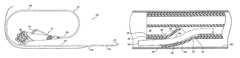
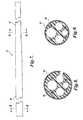
- FIG. 1is a plan view of an exemplary embodiment of a catheter assembly formed in accordance with aspects of the present invention
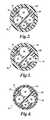
- FIG. 2is a cross-sectional view taken along line 2 - 2 in FIG. 1 ;
- FIG. 3is a cross-sectional view taken along line 3 - 3 in FIG. 1 ;
- FIG. 4is a cross-sectional view taken along line 4 - 4 in FIG. 1 ;
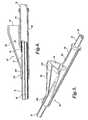
- FIG. 5is a perspective view of one exemplary embodiment of a guide wire port formed in accordance with aspects of the present invention.
- FIG. 6is a cross-sectional view of the guide wire port of FIG. 5 ;
- FIG. 7is a plan view of an exemplary embodiment of a catheter formed in accordance with aspects of the present invention.
- FIG. 8is a cross-sectional view taken along line 8 - 8 in FIG. 7 ;
- FIG. 9is a cross-sectional view taken along line 9 - 9 in FIG. 7 ;
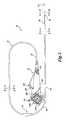
- FIG. 10is a plan view of another exemplary embodiment of a catheter assembly formed in accordance with aspects of the present invention.
- FIG. 11is an end view of a catheter of the catheter assembly shown in FIG. 10 , wherein a catheter of the catheter assembly is inserted into a working channel of an endoscope;
- FIG. 12is a partial perspective view of the catheter shown in FIGS. 10 and 11 ;
- FIG. 13is a partial side cross-sectional view of one exemplary embodiment of a guide wire port formed in accordance with aspects of the present invention.
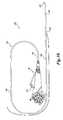
- FIG. 14is a plan view of another exemplary embodiment of a catheter assembly formed in accordance with aspects of the present invention.
- FIG. 15is a cross-sectional view taken along line 15 - 15 in FIG. 14 ;
- FIG. 16is a cross-sectional view taken along line 16 - 16 in FIG. 14 ;
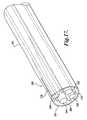
- FIG. 17is a partial perspective view of a taper or transition section formed in accordance with aspects of the present invention.
- FIGS. 18A-18Dare cross-sectional views of exemplary embodiments of the catheter.
- FIGS. 19A-19Dare cross-sectional views of additional exemplary embodiments of the catheter.
- Embodiments of the present inventionare directed to apparatuses of the type broadly applicable to numerous medical applications in which it is desirable to insert one or more steerable or non-steerable catheters or similar devices into a working channel of an associated device, such as an endoscope, catheter, etc., or passageway of a patient.
- Embodiments of the present inventionare generally directed to features and aspects of a catheter having a dedicated guide wire channel and one or more of the following: viewing capabilities, a working channel, and auxiliary channels, such as insufflation/irrigation channels.
- the guide wire channelmay be configured to provide the catheter or other device with rapid exchange capabilities.
- the cathetermay obtain viewing capabilities for viewing anatomical structures within the body by being constructed as a vision catheter or by having a fiberscope or other viewing device selectively routed through one of its channels.
- embodiments of the present inventioncan be used for a variety of different diagnostic and interventional procedures.
- the cathetermay be of the steerable type so that the distal end of the catheter may be steered from its proximal end as it is advanced within the body or of the non-steerable type.
- a suitable use for the catheters described hereinincludes, but is not limited to, diagnosis and/or treatment of the duodenum, and particularly the biliary tree.
- exemplary embodiments of the present inventionmay be described hereinafter as suitable for use with duodenoscopes, it will be appreciated that embodiments of the present invention and aspects thereof have wide application, and may be suitable for use with other endoscopes (e.g., ureteroscopes) or medical devices, such as catheters (e.g., guide catheters, electrode catheters, angioplasty catheters, etc.). Accordingly, the following descriptions and illustrations herein should be considered illustrative in nature, and thus, not limiting the scope of the present invention. Additionally, embodiments of the catheter may be utilized alone, as well as in conjunction with a conventional endoscope.
- endoscopese.g., ureteroscopes
- catheterse.g., guide catheters, electrode catheters, angioplasty catheters, etc.
- the catheter assembly 20includes a catheter handle 22 , a catheter 24 , and an optional guide wire port 26 positioned along a portion of the catheter 24 .
- the catheter 24includes a proximal end 30 that may be operatively connected to the catheter handle 22 and a distal end 32 that may be inserted into, for example, a working channel of an endoscope, such as a duodenoscope, or a passageway of a patient.
- the catheter 24 as shownincludes a shaft 36 comprising a proximal section 40 , a distal section 44 , and an optional taper 48 , which acts as a transition between the proximal section 40 and the distal section 44 of the catheter 24 .
- the proximal section 40has a larger cross-sectional area, e.g., diameter, than the distal section 44 , although in other embodiments, the proximal section 40 and the distal section 44 may have the same generally uniform cross-sectional area. As such, the taper 48 may be omitted in these latter embodiments.
- the catheter 24may further be of the steerable or deflectable type, and thus, the distal section 44 may either include an articulating section or may be constructed of a more flexible material than the proximal section 40 for aiding in the deflection of the distal end 32 .
- FIGS. 2-4are cross-sectional views of the proximal section 40 taken proximally and distally of the guide wire port 26 and of the distal section 44 , respectively.
- the catheter shaft 36includes a dedicated guide wire channel 60 and one or more channels 62 , 64 , and 66 for providing access to a treatment area located at the distal end of the catheter.
- the dedicated guide wire channel 60extends the entire length of the catheter through which a guide wire can be routed to and from the treatment area.
- the guide wire channel 60may not extend the entire length of the catheter shaft but instead extends only a portion thereof, for example, from one of many positions located distally of the proximal end to the catheter distal end.
- a portion of the catheter shaftis slitted, slotted or otherwise configured to provide access along the catheter shaft 36 for providing rapid exchange capabilities to the catheter.
- the one or more channels 62 , 64 , and 66may extend from a position proximal of the distal end of the catheter shaft 36 .
- the one or more channels 62 , 64 , and 66may extend to the distal end of the catheter shaft 36 from either the proximal end of the catheter or a position proximal of the catheter distal end.
- the one or more channelsmay include an optical channel 62 .
- the optical channel 62allows for the passage of a fiberscope, optical fiber cable, optical assembly, or other small diameter viewing catheter or device to the distal end of the catheter.
- a fiberscope, optical fiber cable or the likemay be permanently secured in place within the channel.
- the catheter 24may be constructed as a video catheter, and as such, viewing capabilities are provided by an image sensor, such as a CCD, CMOS, or photo diode, mounted at or adjacent the distal end of the catheter 24 .
- the cathetermay include other components, such as illumination sources, e.g., LEDs, etc., and associated power and signal transmission cabling, etc.
- the optical channelmay be used to provide a source of illumination to the distal tip by routing an illumination fiber therethrough, or such optical channel may be omitted.
- the one or more channelsmay also include a working channel 64 .
- the working channel 60allows for the passage of various treatment or diagnostic devices, such as stone retrieval baskets, lasers, biopsy forceps, etc, to and from the treatment area located distally of the catheter distal end.
- the one or more channelsmay further include an additional channel 66 for use as an irrigation/insufflation channel, a fluid delivery channel, or multi-purpose channel.
- the channel 66allows the passage of liquids, gases, and/or device to and from the treatment area.
- the catheter 24may be of a steerable-type, and thus, the catheter shaft 36 may optionally include one or more steering wire channels 70 that extend substantially the length of the catheter 24 for deflecting the distal end of the catheter shaft 36 in one or more directions.
- steering wires 72can be routed through a corresponding number of steering wire channels 70 , extend from the distal end of the catheter to the opposing, proximal end of the catheter, and terminate in a suitable manner with a steering mechanism associated with the catheter handle 22 , as will be described in detail below.
- the steering wires 72may be attached at anchor points to the distal section near or at the distal end of the catheter via conventional techniques, such as adhesive bonding, heat bonding, crimping, laser welding, resistance welding, soldering, etc., such that movement of the wires causes the distal end to deflect in a controllable manner.
- the steering wires 72are attached via welding or adhesive bonding to a fluoroscopy marker band (not shown) fixedly attached to the distal section.
- the bandmay be held in place via adhesive and/or an outer sleeve.
- the steering wires 72preferably have sufficient tensile strength and modulus of elasticity that they do not deform (elongate) during curved deflection.
- the steering wiresare made from 304 stainless steel with an 0.008 inch diameter and have a tensile strength of approximately 325 KPSI.
- the steering wires 72can optionally be housed in a PTFE thin-walled extrusion (not shown) to aid in lubricity and prevent the catheter 24 from binding up during deflections, if desired.
- a PTFE thin-walled extrusionnot shown
- the catheter 24includes two pairs of steering wires 72 that controllably steer the catheter 24 in two substantially perpendicular planes.
- the catheter 24includes one pair of steering wires 72 that allow the user to steer the distal end in one plane.
- the catheter 24only includes one steering wire 72 that allows the user to steer the distal end in one direction.
- the steering wiresmay be omitted, and thus, the catheter 24 can be of a non-steerable type.
- the cathetercan be advanced over a guide wire (not shown) pre-placed, for example, in the bile or pancreatic duct (referred in the art as “back loading” the catheter).
- the dedicated guide wire channel 60 , the one or more channels 62 , 64 , and 66 , and the optional steering channels 70may be separate tubular members, which are routed through a tubular catheter shaft.
- the catheter shaft 36may comprise a core body 80 that defines the dedicated guide wire channel 60 , the one or more channels 62 , 64 , and 66 , and the optional steering wire channels 70 .
- the core body 80 of the catheter shaft 36may be constructed from any suitable material, such as Pebax® (polyether block amides), nylon, polytetrafluoroethylene (PTFE), polyethylene, polyurethane, fluorinated ethylene propylene (FEP), thermoplastic elastomers and the like, or combinations or blends thereof.
- the core body 80 of the catheter shaft 36may be formed as a one-piece design using known techniques in the art, such as extrusion, or may be formed in multiple segments, for example, multiple extruded sections, using one or more materials, which are then subsequently joined by heat bonding, adhesive bonding, lamination or other known techniques.
- the embodiment of the catheter shaft 36 shown in FIGS. 2-4may optionally include an outer sleeve 82 .
- the outer sleeve 82may extend the length of the catheter or sections thereof.
- the outer sleeve 82may comprise one of any number of polymer jackets that are laminated, co-extruded, heat shrunk, adhesive bonded, or otherwise attached over the core body 80 .
- Suitable materials for the sleeve 82include, but are not limited to, polyethylene, nylon, Pebax® (polyether block amides), polyurethane, polytetrafluoroethylene (PTFE), and thermoplastic elastomers to name a few.
- the outer sleeve 82may be used to vary the stiffness of the catheter, if desired, or to provide improved torque transfer and/or other desirable catheter properties. Additionally, the sleeve 82 may be used as one convenient method for securing a more flexible distal section 44 to the proximal section 40 .
- the external surface of the sleeve 82may have a hydrophilic coating or a silicon coating to ease the passage of the device in-vivo.
- a hydrophilic coatingcan be, for example, but not limited to, N-Vinyl Pyrrolidone, Poly Vinyl Alcohol, and Poly Vinyl Pyrrolidone.
- the hydrophilic coatingcan be accomplished by coating the device with a primer, such as Bayhydrol 110 (an anionic dispersion of an aliphatic polyester urethane resin in water/n-methyl-2pyrrolidone) and then bonding the primary layer over the primer.
- the primary layercan be, for example, but not limited to, an acrylamide or a polyurethane-based acrylamide. Alliphatic polyether and polyester polyurethanes also can be used as lubricous coatings.
- the outer sleeve 82 disposed on the proximal section 40is thicker than the outer sleeve 82 disposed on the distal section for increasing the stiffness and torsional rigidity of the proximal section 40 of the catheter shaft 36 .
- the diameter of the core body 80 of the proximal section 40is greater than the diameter of the core body 80 of the distal section 44 while the outer sleeve 82 is somewhat uniform in thickness as it extends from the beginning of the proximal section 40 to the end of the distal section 44 .
- the larger core body of the proximal sectionincreases the stiffness and/or torsional rigidity of the shaft.
- the catheter 24may optionally include an inner reinforcement sheath 84 disposed between the core body 80 and the outer sleeve 82 along the distal section 44 (see FIG. 1 ) of the catheter shaft 36 as shown in cross-section in FIG. 4 .
- the sheath 84may be a woven or layered structure, such as a braided design of fine wire or polymeric elements (0.001 inches to 0.010 inches in diameter) woven or coiled together along the longitudinal axis of the catheter with conventional catheter braiding techniques. This allows the distal section of the catheter to be advanced to the desired anatomical site by increasing the column strength of the distal section while also increasing its torsional rigidity.
- coiled polymer or braid wiremay also be used for this component with coil wire dimensioning ranging in width from 0.002 to 0.120 inches and thicknesses from 0.002 to 0.10 inches.
- Braided ribbon wiremay also be used for the sheath.
- the outer sleeve 82is coextruded, coated, or otherwise attached, once the reinforcement layer 84 is applied to the distal section, to lock the reinforcement layer in place and secure it to the distal section core body 80 .
- the portion of the proximal section that extends from the proximal end to the beginning of the guide wire openingmay also include a reinforcement sheath.
- the catheter shaft 36may also include an opening 76 formed along a portion of the outer surface of the shaft 36 and positioned proximal the distal section 44 .
- the opening 76is formed so as to communicate with the guide wire channel 60 from a position external the shaft.
- the shaft opening(hidden by the guide wire port 26 ) may be positioned proximate or near the proximal end 30 of the catheter 24 or may be disposed further distally of the proximal end 30 along the catheter 24 toward the optional taper 48 .
- the shaft openingmay be located at any location distally of the proximal end 30 of the catheter 24 , in one embodiment the shaft opening is located approximately between 140 and 180 centimeters (cm) from the taper 48 and/or the beginning of the distal section 44 . In this manner, the catheter 24 may be utilized with a 260 cm or similar guide wire, as will be described in detail below.
- the shaft opening 76( FIGS. 5 and 6 ) in one embodiment communicates with the guide wire port 26 for facilitating the insertion of a guide wire into the guide wire channel during use.
- the catheter shaft 36may further include a slit, a slot, or other means for allowing a guide wire to radially exit the guide wire channel 60 along a portion of the shaft 36 , thereby providing rapid exchange capabilities to the catheter.
- the catheter shaft 36includes a slot 78 that connects the guide wire channel 60 to the exterior of the shaft for allowing a guide wire to radially exit the guide wire channel 60 .
- the slot 78extends from the shaft opening 76 to a position distally thereof, such as the beginning of the optional taper or catheter distal section. As best shown in the embodiment of FIG.
- the slot 78is formed in the core body 80 and the optional outer sleeve 82 of the catheter shaft 36 . In embodiments that do not include an outer sleeve, the slot 78 is formed in the core body. As such, the slot 78 and the guide wire channel 60 together define a slotted channel section.
- the slotted channel sectionmay define, for example, a general U or C-shaped channel, although other slotted configurations may be practiced with the present invention, and are contemplated to be within the scope of the present invention, as claimed.
- the slotted channel sectionserves to contain, but not constrain, a guide wire as it is routed between the opening 76 and the beginning of the distal section 44 .
- the guide wire channel 60is sufficiently large to allow unhindered radial guide wire movement therein.
- the slot 78is sized to allow passage of a conventional guide wire (e.g., 0.025 inch-0.035 inch diameter guide wires) radially therethrough.
- the slot 78is substantially equal to or slightly larger than the diameter of the guide wire channel 60 .
- the slot 78may be smaller than the diameter of the guide wire channel 60 , as shown, for example, in FIG. 3 .
- the slotmay be smaller than the diameter of the guide wire routed therethrough, as shown in the example of FIG. 15 .
- the slotted channel sectionis configured to allow separation at the opening to the guide wire channel to promote radial passage of the guide wire.
- FIGS. 3, 5, and 6employ a slotted configuration for allowing a guide wire to radially exit the guide wire channel 60 ′
- other configurationsare contemplated to be within the scope of the present invention, as claimed.
- the outer sleeve 82may be formed with a slit with abutting edges, a flap with overlapping edges or interlocking edges, as shown in FIGS. 18A-18C , respectively.
- FIG. 18A-18CAlternatively, as shown in FIG.
- a layer of material of the outer sleeve disposed in-between the guide wire channel 60 and the exterior of the shaftmay be relatively thin, weakened to promote tearing, perforated, or is composed of a generally soft material for providing a weak wall through which a guide wire can be pulled.
- FIGS. 19A-19Dillustrate other exemplary configurations for allowing a guide wire to radially exit the guide wire channel 60 .
- the outer sleevehas been omitted.
- the catheter shaft 36may be formed with a slit with abutting edges, a flap with overlapping edges or interlocking edges, respectively.
- a layer of material disposed in-between the guide wire channel 60 and the exterior of the shaftmay be relatively thin, weakened to promote tearing, perforated, or is a generally soft material for providing a weak wall through which a guide wire can be pulled.
- these aforementioned sections, along with the slotted channel section described above,may be referred herein as rapid exchange channel sections of the catheter shaft.
- the catheter assembly 20may further include a guide wire port 26 positioned, for example, along a portion of the proximal section 40 of the catheter shaft 36 .
- the guide wire port 26communicates with the shaft opening 76 (see FIGS. 5 and 6 ) for providing access to the guide wire channel.
- the guide wire port 26may be positioned proximate or near the proximal end 30 of the catheter 24 or may be disposed further distally of the proximal end 30 along the catheter 24 toward the optional taper 48 , depending on the location of the shaft opening.
- the guide wire port 26may be located at any location distally of the proximal end 30 of the catheter 24 , in one embodiment it is located approximately between 140 and 180 centimeters from the taper 48 .
- the guide wire port 26may include a main body 86 and a funnel-shaped extension 88 .
- the funnel-shaped extension 88is connected to and disposed adjacent the main body 86 .
- the main body 86includes a main channel 90 extending therethrough.
- the main channel 90is sized to accommodate the catheter shaft 36 in a slidably restricting manner.
- the funnel-shaped extension 88includes a funnel channel 92 having a proximal opening 94 and a distal opening 96 .
- the proximal opening 94 of the funnel channel 92may be dimensioned significantly larger than the guide wire to be used with the catheter so that the guide wire may be easily inserted into the funnel channel 92 .
- the distal opening 96 of the funnel channel 92is positioned and sized to communicate with the guide wire channel 60 of the catheter shaft 36 , as will be described in more detail below, so that the guide wire may be inserted into the funnel channel 92 through the proximal opening 94 and into the guide wire channel 60 through the distal opening 96 .
- the distal end of the main body 86 and the distal portion of the funnel-shaped extension 88converge together to define a merged section 100 .
- the main channel 90 and the funnel channel 92also merge together into a merged channel 102 in the merged section 100 .
- the funnel-shaped extension 88further includes a slot or slit 104 for providing access to the funnel channel 92 .
- the slot 104extends along the length of the funnel-shaped extension 88 and the distal merged section 100 .
- the slot 104is sized to allow passage of a conventional guide wire therethrough.
- the slot 104 of the guide wire port 26When assembled, the slot 104 of the guide wire port 26 is substantially aligned with the slot 78 , the slit, or other means for allowing a guide wire to radially exit the guide wire channel 60 , as shown in the embodiment of FIGS. 5 and 6 . Additionally, the shaft opening 76 is aligned with and is dimensioned to correspond to the distal opening 96 of the tunnel channel 92 for communication therebetween. As such, the rapid exchange channel section and the guide wire port 26 allows rapid exchange of either the guide wire or of the catheter 24 when an alternative catheter or guide wire is desired during certain medical procedures. Additionally, shorter length guide wires, such as 260 centimeter guide wires, may be used since the guide wire does not need to pass though the proximal end of the catheter shaft 36 .
- such a catheter shaft construction as shown and described hereinalso allows for longer length guide wires, such as the conventional 450 centimeter guide wires, to be routed from the proximal end 30 of the catheter shaft 36 to the distal end 32 of the catheter shaft 36 , and beyond.
- the catheter shaft 36may have one or more of the following dimensions.
- the proximal section 40may be approximately 200-240 centimeters in length and have an outside diameter of approximately 12 French.
- the outer diameter of the core body 80is approximately 0.125 inches.
- the core body 80may house a working channel 60 having a diameter of approximately 0.054 inches, an optical channel 62 having a diameter of approximately 0.044 inches, an irrigation channel 66 having a diameter of approximately 0.032 inches, a guide wire channel 64 having a diameter of approximately 0.040 inches (for use with a 0.035 inch diameter guide wire), and four steering wire channels 70 each having a diameter of approximately 0.012 inches.
- the core body 80may be sheathed with an outer sleeve 82 having a thickness of approximately 0.006-0.012 inches. Alternatively, the core body can remain unsheathed and have an outer diameter of approximately 11-12 French. It will be appreciated that the aforementioned dimensions may have tolerances of approximately 0.002 inches.
- the distal section 44may be approximately 10-40 centimeters in length and have an outside diameter of approximately 11 French.
- the outer diameter of the core body 80is approximately 0.125 inches.
- the dimensions of the aforementioned channelsare substantially identical.
- the core body 80may be sheathed with a reinforcement layer 84 and an outer sleeve 82 .
- the reinforcement layer 84has a thickness of approximately 0.0035 inches and the outer sleeve 82 has a thickness of approximately 0.006 inches.
- the distal section of the core bodycan omit the reinforcement layer and outer sleeve, and have an outer diameter of approximately 10-11 French. It will be appreciated that the aforementioned dimensions may have tolerances of approximately 0.002 inches.
- the outside diameter of the proximal section core body 80may be approximately 0.145 inches or around 11 French.
- the core body 80 of the proximal section 40 in this embodimentmay also be encased with an outer sleeve 82 of approximately 0.006 inch thickness, resulting in an outer diameter of the shaft of approximately 12 French.
- the outer diameter of the core body 80 of the distal section 44is approximately 0.125 inches, and may include a reinforcement layer (not shown) of approximately 0.0035 inch thickness and/or an outer sleeve 82 of approximately 0.006 inch thickness.
- the proximal section of the core bodycan remain unsheathed and have an outer diameter of approximately 12 French, and the distal section of the core body can remain unsheathed and unreinforced and have an outer diameter of approximately 11 French.
- the cathetermay be used with an 0.025 inch diameter guide wire.
- the diameters of the internal channelsmay be adjusted so that the overall outer diameter of the catheter is reduced.
- the outer diameter of the core body 80may be approximately 0.115 inches.
- the core body 80may house a working channel 60 having a diameter of approximately 0.054 inches, an optical channel 62 having a diameter of approximately 0.040 inches, an irrigation channel 66 having a diameter of approximately 0.030 inches, a guide wire channel 64 having a diameter of approximately 0.030 inches, and four steering wire channels 70 each having a diameter of approximately 0.012 inches.
- the core body 80may be sheathed with an outer sleeve 82 having a thickness of approximately 0.050 inches.
- the outside diameter of the catheteris approximately 0.125 inches, or slightly less than 10 French. It will be appreciated that the aforementioned dimensions may have tolerances of approximately 0.002 inches. It will further be appreciated that in this embodiment, the outer sleeve 82 may have a thickness of approximately 0.010-0.012 inches on the proximal section to increase stiffness, etc, resulting in a proximal section having an outer diameter of approximately 11 French.
- FIG. 1illustrates one exemplary embodiment of a catheter handle that may be practiced with embodiments of the catheter 24 , although many others may be alternatively used.
- the handle 22includes a handle housing 106 to which a steering mechanism 108 , one or more ports, and an optional endoscope attachment device (not shown) is operatively connected.
- the one or more portsmay include any combination of a working channel port 112 for providing access to the working channel from the proximal end of the catheter 24 , an optical channel port 114 for providing access to the optical channel from the proximal end of the catheter 24 , and a fluid channel port 116 for providing access to the irrigation/insufflation channel from the proximal end of the catheter 24 .
- the catheter handle 22may include an optional guide wire port 118 for providing access to the guide wire channel from the proximal end of the catheter 24 .
- ports 112 , 114 , and 116are shown on the handle 22 , it will be appreciated that ports for accessing the one or more channels of the catheter shaft may additionally or alternatively be disposed anywhere along the catheter shaft, preferably somewhere along the proximal section.
- the steering mechanism 108 of the catheter handle 22controls deflection of the distal end 32 of the catheter 24 .
- the steering mechanism 108may be any known or future developed mechanism that is capable of deflecting the distal end of the catheter by selectively pulling the steering wires.
- the steering mechanism 108includes two rotatable knobs for effecting 4-way steering of the catheter distal end in the up/down direction and in the right/left direction.
- This mechanism 108includes an outer knob 110 A to control up/down steering and an inner knob 110 B to control right/left steering.
- the inner knob 110 Bmay function to control right/left steering and an outer knob 110 A may function to control up/down steering.
- the knobsinterface with the distal end 32 of the catheter 30 via the steering wires 72 (See FIG. 4 ) that extend through the catheter 24 .
- various treatment or diagnostic devicessuch as stone retrieval baskets, lasers, biopsy forceps, etc. may be inserted into the working channel port 112 of the catheter handle 22 and routed to the treatment area located distally of the catheter distal end.
- Optical devicessuch as vision catheters or fiberscopes, may be inserted into the optical channel port 114 of the catheter handle 22 and routed to the treatment area located distally of the catheter distal end.
- Fluidssuch as liquids or gases, may be injected into the fluid port 116 and delivered to the distal end of the catheter.
- a guide wiremay be inserted into the optional guide wire port or working channel port if desired, and routed to the treatment area located distally of the catheter distal end.
- FIGS. 10-13there is shown another representative embodiment of a catheter assembly, generally designated 120 .
- the catheter assembly 120is substantially identical in construction, materials, and operation as the catheter assembly 20 , except for the differences that will now be described.
- the catheter assembly 120may include a catheter handle 22 , a catheter 124 , and a guide wire port 126 position along a portion of the catheter 124 .
- the catheter 124includes a proximal end 130 that may be operatively connected to the catheter handle 22 and a distal end 132 that may be inserted into, for example, a working channel of an endoscope or a passageway of a patient.
- the catheter 124includes a shaft 136 having a generally cylindrically-shaped body of substantially uniform diameter.
- the shaft 136comprises a proximal section 140 and a distal section 144 .
- the distal section 144 or portions thereofmay be constructed to be more flexible or bendable so that the distal end 132 of the catheter shaft 136 may be steered in one or more directions during use.
- FIG. 11there is shown an end view of the catheter shaft 136 positioned within a working channel WC of an endoscope.
- the catheter shaft 136may define an optical channel 162 and a working channel 164 that extend the length of the catheter from its proximal end 130 to its distal end 132 .
- the shaft 136also includes a dedicated guide wire channel 160 that extends the entire length of the catheter 124 through which a guide wire can be routed to and from the treatment area.
- the rapid exchange section of the catheter shaft 36is omitted.
- the shaft 136may further include an additional channel 166 that extends the entire length of the catheter shaft 136 for use as an irrigation/insufflations channel or fluid delivery channel.
- the catheter shaftmay be constructed of a core body 180 , an outer sleeve 182 , and an inner reinforcement sheath 184 .
- the inner reinforcement sheath 184is disposed in-between the core body 180 and the outer sleeve 182 , as best shown in FIG. 12 , and functions to provide increased column strength and torsional rigidity.
- the inner reinforcement sheath 184 and outer sleeve 182extend along the catheter shaft 136 from the proximal end 130 to the distal end 132 , or portions thereof.
- the catheter shaftmay include an opening 176 formed along a portion of the outer surface of the shaft and positioned, for example, near or at the beginning of the distal section, as best shown in FIG. 13 .
- the opening 176is formed so as to communicate with and provide access to the guide wire channel 164 from a position that is external to the shaft.
- the opening 176 in the embodiment shownis formed through the outer sleeve 182 , the reinforcement sheath 184 (not shown in FIG. 13 for ease of illustration), and a portion of the core body 180 .
- the opening 176communicates with the guide wire port 126 for facilitating the insertion of a guide wire into the guide wire channel during use.
- the catheter 124further includes a guide wire port 126 positioned near or at the beginning of the distal section 144 for providing access to a guide wire channel of the catheter shaft 136 .
- the guide wire portis located approximately between 5 and 30 centimeters from the distal end of the catheter shaft. In that regard, shorter guide wires, such as those approximately 260 cm to 450 cm, may be employed by the catheter 124 .
- FIG. 13the guide wire port 126 is shown in more detail. As best shown in FIG. 13 , the guide wire port 126 includes an extension section 188 and an optional deflector 198 . The extension section 180 is disposed adjacent the catheter shaft 136 .
- the guide wire port 126can be constructed as a section of the outer sleeve 182 .
- the extension 188includes a channel 192 having a proximal opening 194 and a distal opening 196 .
- the proximal opening 194 of the channel 192is preferably larger than the distal opening 196 to form a somewhat funnel-like channel. It will be appreciated that the proximal opening 194 of the guide wire port 126 is constructed as large as possible so that the guide wire GW may be easily inserted into the channel while also allowing the catheter shaft 136 to be inserted into a standard 4.2 mm inside diameter endoscope working channel WC as best shown in FIG. 11 .
- the distal opening 196 of the channel 192is positioned and sized to communicate with the shaft opening 176 , and in turn, the guide wire channel 164 of the catheter shaft 136 so that the guide wire GW may be inserted into the guide wire channel 164 through the distal opening 196 and shaft opening 176 .
- the guide wire port 126may be further formed with an optional deflector 198 .
- the deflector 198is positioned to inwardly extend into the shaft opening 176 and a substantial portion of the guide wire channel 160 .
- the deflector 198is operable to pivot about area 200 so as to either be capable of blocking access to the guide wire channel 164 of the catheter shaft 136 or the guide wire port channel 192 .
- the deflector 198is inwardly biased to the position shown in FIG. 13 . In this position, a guide wire may be front loaded into either the optional guide wire port 118 on the catheter handle 22 (see FIG.
- the guide wirewould temporarily displace the deflector so that the guide wire could pass through.
- the deflector 198is again biased to the position in FIG. 13 .
- the catheteris also back loadable.
- the guide wireenters the distal end opening 196 of the guide wire channel 192 and then is routed through the guide wire port channel 192 as a result of the deflector 198 .
- the deflector 198could be biased in a position that blocks the distal opening 196 of the guide wire port channel 192 so that the back loadable guide wire is routed through the guide wire channel 160 to the catheter's proximal end and out of the optional guide wire port of the catheter handle.
- the catheter 124may have one or more of the following dimensions.
- the proximal section 140may be approximately 200-240 centimeters in length and have an outside diameter of approximately 10 French.
- the distal section 144may be approximately 10-40 centimeters in length and have an outside diameter of approximately 10 French.
- the outer diameter of the core body 180is approximately 0.118 inches.
- the core body 180may house a working channel 160 having a diameter of approximately 0.050 inches, an optical channel 162 having a diameter of approximately 0.042 inches, an irrigation channel 166 having a diameter of approximately 0.030 inches, a guide wire channel 164 having a diameter of approximately 0.040 inches (for use with a 0.035 inch diameter guide wire), and four steering wire channels 170 each having a diameter of approximately 0.012 inches.
- the core body 180may be sheathed with a reinforcement layer 184 and an outer sleeve 182 .
- a reinforcement layer 184may be employed having a thickness of approximately 0.0035 inches and the outer sleeve 182 may be employed having a thickness of approximately 0.0035 inches. It will be appreciated that the aforementioned dimensions may have tolerances of approximately 0.002 inches.
- FIGS. 14-17there is shown another representative embodiment of a catheter assembly, generally designated 220 .
- the catheter assembly 220is substantially identical in construction, materials, and operation as the catheter assembly 20 , except for the differences that will now be described.
- the catheter assembly 220may include a catheter handle 22 , a catheter 224 , and a guide wire port 226 positioned along a portion of the proximal section of catheter 224 .
- the catheter 224includes a proximal end 230 that may be operatively connected to the catheter handle 22 and a distal end 232 that may be inserted into, for example, a working channel of an endoscope or a passageway of a patient.
- the catheter 224includes a shaft 236 comprising a proximal section 240 , a distal section 244 , and a taper 248 , which acts as a transition between the proximal section 240 and the distal section 244 of the catheter 224 .
- the distal section 244 or portions thereofmay be constructed to be more flexible or bendable so that the distal end 232 of the catheter shaft 236 may be steered in one or more directions during use.
- the catheter shaft 236may include an optical channel 262 and a working channel 264 that extend the length of the catheter or portions thereof.
- the shaft 236may also include an additional channel 266 for use as an irrigation/insufflations channel or fluid delivery channel.
- the shaft 236further includes a dedicated guide wire channel 260 that extends the entire length of the catheter through which a guide wire can be routed to and from the treatment area.
- the guide wire channel 260includes a slot 278 from the guide wire port 226 to the beginning of the taper of the catheter shaft 236 as shown in FIG. 16 .
- other means for accessing the guide wire channelmay be employed, including those shown in FIGS. 18 and 19 .
- the shaftmay be constructed of a core body 280 , an outer sleeve 382 , and an inner reinforcement sheath 284 disposed in-between the core body 280 and the outer sleeve 282 for providing improved column strength and torsional rigidity.
- the inner reinforcement sheath 284 and outer sleeve 282extend along the catheter shaft from the proximal end to the distal end, or portions thereof.
- the outer sleeve 282 in this embodimentforms the slotted channel section as it extends from the guide wire port 226 to the taper 248 .
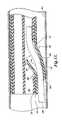
- the slot 278 of the guide wire channel 260terminates and the guide wire channel 260 merges gradually into the core body 280 of the catheter shaft, as best shown in FIG. 17 .
- the reinforcement sheath 284is omitted or an aperture is created so that the guide wire channel 260 can transition from being disposed outside of the core body 280 , as best shown in FIG. 15 , to being disposed inside the core body 280 , as shown best in FIG. 16 .
- the catheter 224may have one or more of the following dimensions.
- the proximal section 240may be approximately 200-240 centimeters in length and have an outside width of approximately 0.147-0.155 inches and a height of approximately 0.132-0.135.
- the distal section 244may be approximately 10-40 centimeters in length and have an outside diameter of approximately 10-11 French.
- the core body 280may house a working channel 260 having a diameter of approximately 0.054 inches, an optical channel 262 having a diameter of approximately 0.044 inches, an irrigation channel 166 having a diameter of approximately 0.030 inches, a guide wire channel 164 having a diameter of approximately 0.030-0.040 inches (depending on use of a 0.025 or 0.035 inch diameter guide wire), and four steering wire channels 170 each having a diameter of approximately 0.012 inches.
- the core body 180may be sheathed with a reinforcement layer 184 and an outer sleeve 182 .
- the reinforcement layer 284has a thickness of approximately 0.0035 inches and the outer sleeve 282 has a thickness of approximately 0.0035 inches. It will be appreciated that the aforementioned dimensions may have tolerances of approximately 0.002 inches.
Landscapes
- Health & Medical Sciences (AREA)
- Life Sciences & Earth Sciences (AREA)
- Engineering & Computer Science (AREA)
- Heart & Thoracic Surgery (AREA)
- Biophysics (AREA)
- Pulmonology (AREA)
- Anesthesiology (AREA)
- Biomedical Technology (AREA)
- Hematology (AREA)
- Animal Behavior & Ethology (AREA)
- General Health & Medical Sciences (AREA)
- Public Health (AREA)
- Veterinary Medicine (AREA)
- Mechanical Engineering (AREA)
- Media Introduction/Drainage Providing Device (AREA)
- Endoscopes (AREA)
Abstract
Description
This application is a continuation of U.S. application Ser. No. 12/353,894, filed Jan. 14, 2009, which claims the benefit of priority of U.S. Provisional Application No. 61/021,003, filed Jan. 14, 2008, all of which are hereby incorporated by reference in their entireties.
A challenge in the exploration and treatment of internal areas of the human anatomy has been adequately visualizing the area of concern. Visualization can be especially troublesome in minimally invasive procedures in which small diameter, elongate instruments, such as catheters and endoscopes, are navigated through natural passageways of a patient to an area of concern either in the passageway or in an organ reachable through the passageway.
Detailed information regarding the anatomy can be discerned from direct viewing of the anatomy provided through one or more of the elongate instruments used in the procedure. Various types of endoscopes configured for use in various passageways of the body such as the esophagus, rectum or bronchus can be equipped with direct viewing capability through the use of optical fibers extending through the length of the scope, or with digital sensors, such as CCD or CMOS. However, because endoscopes also provide a working channel through which other medical instruments must pass, optional lighting bundles and components to provide steering capability at its distal end, the scope is typically of a relatively large diameter, e.g., 5 mm or greater. This large diameter limits the use of the endoscope to relatively large body channels and prohibits their use in smaller ducts and organs that branch from a large body channel, such as the biliary tree.
Typically, when examining small passageway such as the bile duct or pancreatic duct, the endoscope is used to get close to a smaller passageway or region of concern and another instrument, such as a catheter, is then extended through the working channel of the endoscope and into the smaller passageway. The catheter can be routed over a guide wire pre-placed in the area of interest. Alternatively, a catheter of the steerable type may be steered into the smaller passageway with the aid of images provided from the endoscope, or if the steerable catheter has its own vision capabilities, steered into the smaller passageway with the aid of images provided by the catheter. One such steerable catheter with vision capabilities is described in co-pending U.S. application Ser. No. 11/089,520, filed Mar. 23, 2005, which is hereby incorporated by reference. Once the catheter is in the small passage areas, visualization may be provided via contrast media and/or the vision capabilities of the catheter.
Visualization may reveal selected areas within the area of interest, such as the common bile duct, that require treatment. To treat the selected areas, a different catheter is sometimes required, necessitating a catheter exchange. A catheter exchange typically involves removing the first catheter from the endoscope over a guide wire pre-placed in the area of interest, and advancing a second catheter over the guide wire to the desired treatment site. In order to maintain a handle on the proximal end of the guide wire, it is necessary that the portion of the guide wire that remains outside the patient be longer than the length of the catheter. Therefore, a catheter/guide wire system suitable for these procedures has required the use of long guide wires that can be cumbersome to manipulate and can clutter an operating room.
To address the issues associated with changing catheters over long guide wires, many non-steerable catheters include so-called “rapid exchange” lumens or channels. These rapid exchange catheters typically include an opening on the sheath of a catheter and a slot that extends along the length of the catheter through which a guide wire can be pulled. To exchange the catheter for another device while maintaining the position of the guide wire in the body, the catheter is stripped off the guide wire by pulling it through the slot. A new catheter or device can then be routed over the guide wire by inserting the proximal end of the guide wire into an opening of a guide wire lumen at the distal end of the new device and advanced such that the proximal end of the guide wire exits the opening. The opening may be positioned towards the proximal end of the catheter or may be located more towards the distal end.
While rapid exchange guide wire lumens have been developed for many procedures, they have not been adapted for use with steerable catheters, catheters with vision capabilities, catheters to be routed through the working channels of endoscopes, or catheters that are required to transmit torque from the proximal to the distal end of the catheter.
In addition to performing a catheter exchange procedure, it may also be desirable to perform a guide wire exchange procedure. This may be desirable when, for example, a first guide wire is too large to fit through a desired body duct, or otherwise lacks the desired characteristics. Under these circumstances, a physician may leave the catheter in place, withdraw the first guide wire from the catheter, and insert a second guide wire through the catheter to the desired site. During this procedure, the catheter guides the guide wire to the desired site. Thus, once the catheter is positioned at a target site, it is highly desirable to maintain the position of the catheter during a guide wire exchange procedure so that the second guide wire may be guided directly to the desired site in a minimum amount of time.
This summary is provided to introduce a selection of concepts in a simplified form that are further described below in the Detailed Description. This summary is not intended to identify key features of the claimed subject matter, nor is it intended to be used as an aid in determining the scope of the claimed subject matter.
In accordance with aspects of the present invention, a catheter is provided which comprises an elongated shaft having a proximal end and a distal end, a guide wire channel extending along at least a portion of the shaft in-between the proximal and distal ends, at least one channel disposed within the shaft and extending to the distal end, and a guide wire opening disposed in communication with the guide wire channel of the shaft such that a guide wire may be insertable into the guide wire opening and routed into the guide wire channel. The shaft may be configured for providing radial access from a position exteriorly of the shaft to a portion of the guide wire channel that extends between the guide wire opening and a position proximal the distal end of the shaft in order to allow a guide wire to radially exit the shaft.
In accordance with another aspect of the present invention, a catheter is provided which comprises an elongated shaft having a proximal section and a distal section, a channel for accessing the distal end of the shaft, a guide wire channel extending along at least a portion of the shaft to the distal end of the shaft, and a guide wire port disposed at or near the transition between the proximal section and the distal section of the shaft. The guide wire port defines a guide wire port opening and a guide wire port conduit that communicate with the guide wire channel of the shaft such that a guide wire may be insertable into the guide wire port opening and routed into the guide wire channel. The catheter further comprises a deflector associated with the guide wire port and positionable in the guide wire conduit or the guide wire channel.
In accordance with another aspect of the present invention, a catheter is provided which comprises an elongated shaft having a proximal end and a distal end, a guide wire channel extending along at least a portion of the shaft in-between the proximal and distal ends, at least one optical channel disposed within the shaft and extending to the distal end, a guide wire opening disposed in communication with the guide wire channel of the shaft such that a guide wire may be insertable into the guide wire opening and routed into the guide wire channel, and means disposed along a portion of the shaft for allowing a guide wire to radially exit the shaft.
In accordance with another aspect of the present invention, a catheter is provided which comprises an elongated shaft having a proximal end and a distal end, wherein the elongated shaft comprises an core body an outer sleeve, and an inner reinforcement sheath disposed between the core body and the outer sleeve. The catheter further includes a guide wire channel extending along at least a portion of the shaft in-between the proximal and distal end, a guide wire opening disposed in communication with the guide wire channel of the shaft such that a guide wire may be insertable into the guide wire opening and routed into the guide wire channel, and means disposed along a section of the shaft for allowing a guide wire to radially exit the shaft, wherein the means is disposed outwardly of the inner reinforcement sheath for at least a first portion of the section of the shaft and disposed inwardly of the inner reinforcement sheath for at least a second portion of the section of the shaft.
In accordance with another aspect of the present invention, a catheter is provided which comprises an elongated shaft having a proximal end and a distal end. The shaft has a proximal section having a first diameter and a distal section having a second, smaller diameter. The catheter further includes a guide wire channel extending along a portion of the shaft in-between the proximal and distal end, at least two channels selected from the group consisting of a working channel, an optical channel, and a fluid channel, disposed within the shaft and extending to the distal end, and a guide wire opening disposed in communication with the guide wire channel of the shaft such that a guide wire may be insertable into the guide wire opening and routed into the guide wire channel, wherein the shaft includes a rapid exchange channel section along a portion thereof.
The foregoing aspects and many of the attendant advantages of this invention will become more readily appreciated as the same become better understood by reference to the following detailed description, when taken in conjunction with the accompanying drawings, wherein:
Embodiments of the present invention will now be described with reference to the drawings where like numerals correspond to like elements. Embodiments of the present invention are directed to apparatuses of the type broadly applicable to numerous medical applications in which it is desirable to insert one or more steerable or non-steerable catheters or similar devices into a working channel of an associated device, such as an endoscope, catheter, etc., or passageway of a patient. Embodiments of the present invention are generally directed to features and aspects of a catheter having a dedicated guide wire channel and one or more of the following: viewing capabilities, a working channel, and auxiliary channels, such as insufflation/irrigation channels. In embodiments of the present invention, the guide wire channel may be configured to provide the catheter or other device with rapid exchange capabilities.
As will be described in detail below, the catheter may obtain viewing capabilities for viewing anatomical structures within the body by being constructed as a vision catheter or by having a fiberscope or other viewing device selectively routed through one of its channels. As such, embodiments of the present invention can be used for a variety of different diagnostic and interventional procedures. The catheter may be of the steerable type so that the distal end of the catheter may be steered from its proximal end as it is advanced within the body or of the non-steerable type. A suitable use for the catheters described herein includes, but is not limited to, diagnosis and/or treatment of the duodenum, and particularly the biliary tree.
Although exemplary embodiments of the present invention may be described hereinafter as suitable for use with duodenoscopes, it will be appreciated that embodiments of the present invention and aspects thereof have wide application, and may be suitable for use with other endoscopes (e.g., ureteroscopes) or medical devices, such as catheters (e.g., guide catheters, electrode catheters, angioplasty catheters, etc.). Accordingly, the following descriptions and illustrations herein should be considered illustrative in nature, and thus, not limiting the scope of the present invention. Additionally, embodiments of the catheter may be utilized alone, as well as in conjunction with a conventional endoscope.
Referring now toFIG. 1 , there is shown a representative embodiment of a catheter assembly, generally designated20, formed in accordance with aspects of the present invention. In the embodiment ofFIG. 1 , thecatheter assembly 20 includes acatheter handle 22, acatheter 24, and an optionalguide wire port 26 positioned along a portion of thecatheter 24. Thecatheter 24 includes aproximal end 30 that may be operatively connected to thecatheter handle 22 and adistal end 32 that may be inserted into, for example, a working channel of an endoscope, such as a duodenoscope, or a passageway of a patient. Thecatheter 24 as shown includes ashaft 36 comprising aproximal section 40, adistal section 44, and anoptional taper 48, which acts as a transition between theproximal section 40 and thedistal section 44 of thecatheter 24.
In the embodiment shown, theproximal section 40 has a larger cross-sectional area, e.g., diameter, than thedistal section 44, although in other embodiments, theproximal section 40 and thedistal section 44 may have the same generally uniform cross-sectional area. As such, thetaper 48 may be omitted in these latter embodiments. Thecatheter 24 may further be of the steerable or deflectable type, and thus, thedistal section 44 may either include an articulating section or may be constructed of a more flexible material than theproximal section 40 for aiding in the deflection of thedistal end 32.
Referring now toFIGS. 2-4 , one exemplary embodiment of thecatheter shaft 36 is shown in more detail.FIGS. 2-4 are cross-sectional views of theproximal section 40 taken proximally and distally of theguide wire port 26 and of thedistal section 44, respectively. As best shown inFIGS. 2-4 , thecatheter shaft 36 includes a dedicatedguide wire channel 60 and one ormore channels
In the embodiment shown inFIGS. 2-4 , the dedicatedguide wire channel 60 extends the entire length of the catheter through which a guide wire can be routed to and from the treatment area. In other embodiments, theguide wire channel 60 may not extend the entire length of the catheter shaft but instead extends only a portion thereof, for example, from one of many positions located distally of the proximal end to the catheter distal end. As will be described in more detail below, a portion of the catheter shaft is slitted, slotted or otherwise configured to provide access along thecatheter shaft 36 for providing rapid exchange capabilities to the catheter.
The one ormore channels catheter shaft 36. For example, the one ormore channels catheter shaft 36 from either the proximal end of the catheter or a position proximal of the catheter distal end.
As best shown inFIGS. 2-4 , the one or more channels may include anoptical channel 62. Theoptical channel 62 allows for the passage of a fiberscope, optical fiber cable, optical assembly, or other small diameter viewing catheter or device to the distal end of the catheter. In other embodiments, a fiberscope, optical fiber cable or the like may be permanently secured in place within the channel. Alternatively, thecatheter 24 may be constructed as a video catheter, and as such, viewing capabilities are provided by an image sensor, such as a CCD, CMOS, or photo diode, mounted at or adjacent the distal end of thecatheter 24. In this embodiment, the catheter may include other components, such as illumination sources, e.g., LEDs, etc., and associated power and signal transmission cabling, etc. It will be appreciated that in this embodiment, the optical channel may be used to provide a source of illumination to the distal tip by routing an illumination fiber therethrough, or such optical channel may be omitted.
The one or more channels may also include a workingchannel 64. The workingchannel 60 allows for the passage of various treatment or diagnostic devices, such as stone retrieval baskets, lasers, biopsy forceps, etc, to and from the treatment area located distally of the catheter distal end. The one or more channels may further include anadditional channel 66 for use as an irrigation/insufflation channel, a fluid delivery channel, or multi-purpose channel. Thechannel 66 allows the passage of liquids, gases, and/or device to and from the treatment area.
As was described briefly above, in several embodiments of the present invention, thecatheter 24 may be of a steerable-type, and thus, thecatheter shaft 36 may optionally include one or moresteering wire channels 70 that extend substantially the length of thecatheter 24 for deflecting the distal end of thecatheter shaft 36 in one or more directions. In the embodiment shown inFIGS. 2-4 , steeringwires 72 can be routed through a corresponding number ofsteering wire channels 70, extend from the distal end of the catheter to the opposing, proximal end of the catheter, and terminate in a suitable manner with a steering mechanism associated with thecatheter handle 22, as will be described in detail below. Thesteering wires 72 may be attached at anchor points to the distal section near or at the distal end of the catheter via conventional techniques, such as adhesive bonding, heat bonding, crimping, laser welding, resistance welding, soldering, etc., such that movement of the wires causes the distal end to deflect in a controllable manner. In one embodiment, thesteering wires 72 are attached via welding or adhesive bonding to a fluoroscopy marker band (not shown) fixedly attached to the distal section. In this embodiment, the band may be held in place via adhesive and/or an outer sleeve.
Thesteering wires 72 preferably have sufficient tensile strength and modulus of elasticity that they do not deform (elongate) during curved deflection. In one embodiment, the steering wires are made from 304 stainless steel with an 0.008 inch diameter and have a tensile strength of approximately 325 KPSI. Thesteering wires 72 can optionally be housed in a PTFE thin-walled extrusion (not shown) to aid in lubricity and prevent thecatheter 24 from binding up during deflections, if desired. For a more detailed description of types of steering wires and catheter shaft configurations that may be practiced with the present invention, please see co-pending U.S. application Ser. No. 11/089,520, which is hereby incorporated by reference.
In the illustrated embodiment shown inFIGS. 2-4 , thecatheter 24 includes two pairs ofsteering wires 72 that controllably steer thecatheter 24 in two substantially perpendicular planes. In alternative embodiments, thecatheter 24 includes one pair ofsteering wires 72 that allow the user to steer the distal end in one plane. In a further embodiment, thecatheter 24 only includes onesteering wire 72 that allows the user to steer the distal end in one direction. In another embodiment, the steering wires may be omitted, and thus, thecatheter 24 can be of a non-steerable type. In such an embodiment, the catheter can be advanced over a guide wire (not shown) pre-placed, for example, in the bile or pancreatic duct (referred in the art as “back loading” the catheter).
The dedicatedguide wire channel 60, the one ormore channels optional steering channels 70 may be separate tubular members, which are routed through a tubular catheter shaft. Alternatively, in the embodiment shown inFIGS. 2-4 , thecatheter shaft 36 may comprise acore body 80 that defines the dedicatedguide wire channel 60, the one ormore channels steering wire channels 70. In this embodiment, thecore body 80 of thecatheter shaft 36 may be constructed from any suitable material, such as Pebax® (polyether block amides), nylon, polytetrafluoroethylene (PTFE), polyethylene, polyurethane, fluorinated ethylene propylene (FEP), thermoplastic elastomers and the like, or combinations or blends thereof. Thecore body 80 of thecatheter shaft 36 may be formed as a one-piece design using known techniques in the art, such as extrusion, or may be formed in multiple segments, for example, multiple extruded sections, using one or more materials, which are then subsequently joined by heat bonding, adhesive bonding, lamination or other known techniques.
The embodiment of thecatheter shaft 36 shown inFIGS. 2-4 may optionally include anouter sleeve 82. Theouter sleeve 82 may extend the length of the catheter or sections thereof. Theouter sleeve 82 may comprise one of any number of polymer jackets that are laminated, co-extruded, heat shrunk, adhesive bonded, or otherwise attached over thecore body 80. Suitable materials for thesleeve 82 include, but are not limited to, polyethylene, nylon, Pebax® (polyether block amides), polyurethane, polytetrafluoroethylene (PTFE), and thermoplastic elastomers to name a few. Theouter sleeve 82 may be used to vary the stiffness of the catheter, if desired, or to provide improved torque transfer and/or other desirable catheter properties. Additionally, thesleeve 82 may be used as one convenient method for securing a more flexibledistal section 44 to theproximal section 40.
In several embodiments, the external surface of thesleeve 82 may have a hydrophilic coating or a silicon coating to ease the passage of the device in-vivo. Such a hydrophilic coating can be, for example, but not limited to, N-Vinyl Pyrrolidone, Poly Vinyl Alcohol, and Poly Vinyl Pyrrolidone. The hydrophilic coating can be accomplished by coating the device with a primer, such as Bayhydrol 110 (an anionic dispersion of an aliphatic polyester urethane resin in water/n-methyl-2pyrrolidone) and then bonding the primary layer over the primer. The primary layer can be, for example, but not limited to, an acrylamide or a polyurethane-based acrylamide. Alliphatic polyether and polyester polyurethanes also can be used as lubricous coatings.
In the embodiment shown inFIGS. 2-4 , theouter sleeve 82 disposed on theproximal section 40 is thicker than theouter sleeve 82 disposed on the distal section for increasing the stiffness and torsional rigidity of theproximal section 40 of thecatheter shaft 36. In another embodiment shown inFIGS. 7-9 , the diameter of thecore body 80 of theproximal section 40 is greater than the diameter of thecore body 80 of thedistal section 44 while theouter sleeve 82 is somewhat uniform in thickness as it extends from the beginning of theproximal section 40 to the end of thedistal section 44. In this embodiment, the larger core body of the proximal section increases the stiffness and/or torsional rigidity of the shaft.
In other embodiments, thecatheter 24 may optionally include aninner reinforcement sheath 84 disposed between thecore body 80 and theouter sleeve 82 along the distal section44 (seeFIG. 1 ) of thecatheter shaft 36 as shown in cross-section inFIG. 4 . Thesheath 84 may be a woven or layered structure, such as a braided design of fine wire or polymeric elements (0.001 inches to 0.010 inches in diameter) woven or coiled together along the longitudinal axis of the catheter with conventional catheter braiding techniques. This allows the distal section of the catheter to be advanced to the desired anatomical site by increasing the column strength of the distal section while also increasing its torsional rigidity. Conventional coiled polymer or braid wire may also be used for this component with coil wire dimensioning ranging in width from 0.002 to 0.120 inches and thicknesses from 0.002 to 0.10 inches. Braided ribbon wire may also be used for the sheath. In one embodiment, theouter sleeve 82 is coextruded, coated, or otherwise attached, once thereinforcement layer 84 is applied to the distal section, to lock the reinforcement layer in place and secure it to the distalsection core body 80. In one embodiment, the portion of the proximal section that extends from the proximal end to the beginning of the guide wire opening may also include a reinforcement sheath.
Turning now toFIGS. 5 and 6 , thecatheter shaft 36 may also include anopening 76 formed along a portion of the outer surface of theshaft 36 and positioned proximal thedistal section 44. Theopening 76 is formed so as to communicate with theguide wire channel 60 from a position external the shaft. Referring toFIG. 1 , the shaft opening (hidden by the guide wire port26) may be positioned proximate or near theproximal end 30 of thecatheter 24 or may be disposed further distally of theproximal end 30 along thecatheter 24 toward theoptional taper 48. Although it should be recognized that the shaft opening may be located at any location distally of theproximal end 30 of thecatheter 24, in one embodiment the shaft opening is located approximately between 140 and 180 centimeters (cm) from thetaper 48 and/or the beginning of thedistal section 44. In this manner, thecatheter 24 may be utilized with a 260 cm or similar guide wire, as will be described in detail below. As will be described in detail below, the shaft opening76 (FIGS. 5 and 6 ) in one embodiment communicates with theguide wire port 26 for facilitating the insertion of a guide wire into the guide wire channel during use.
Returning toFIGS. 5 and 6 , thecatheter shaft 36 may further include a slit, a slot, or other means for allowing a guide wire to radially exit theguide wire channel 60 along a portion of theshaft 36, thereby providing rapid exchange capabilities to the catheter. In the illustrated embodiment ofFIGS. 5 and 6 , thecatheter shaft 36 includes aslot 78 that connects theguide wire channel 60 to the exterior of the shaft for allowing a guide wire to radially exit theguide wire channel 60. Theslot 78 extends from theshaft opening 76 to a position distally thereof, such as the beginning of the optional taper or catheter distal section. As best shown in the embodiment ofFIG. 3 , theslot 78 is formed in thecore body 80 and the optionalouter sleeve 82 of thecatheter shaft 36. In embodiments that do not include an outer sleeve, theslot 78 is formed in the core body. As such, theslot 78 and theguide wire channel 60 together define a slotted channel section. The slotted channel section may define, for example, a general U or C-shaped channel, although other slotted configurations may be practiced with the present invention, and are contemplated to be within the scope of the present invention, as claimed.
In use, the slotted channel section serves to contain, but not constrain, a guide wire as it is routed between theopening 76 and the beginning of thedistal section 44. Theguide wire channel 60 is sufficiently large to allow unhindered radial guide wire movement therein. In the embodiment ofFIG. 3 , theslot 78 is sized to allow passage of a conventional guide wire (e.g., 0.025 inch-0.035 inch diameter guide wires) radially therethrough. In several embodiments, theslot 78 is substantially equal to or slightly larger than the diameter of theguide wire channel 60. In other embodiments, theslot 78 may be smaller than the diameter of theguide wire channel 60, as shown, for example, inFIG. 3 . In yet other embodiments, the slot may be smaller than the diameter of the guide wire routed therethrough, as shown in the example ofFIG. 15 . In these embodiments, the slotted channel section is configured to allow separation at the opening to the guide wire channel to promote radial passage of the guide wire.
While the embodiments shown inFIGS. 3, 5, and 6 employ a slotted configuration for allowing a guide wire to radially exit theguide wire channel 60′, other configurations are contemplated to be within the scope of the present invention, as claimed. For example, instead of a portion of theslot 78 being formed in theouter sleeve 82, theouter sleeve 82 may be formed with a slit with abutting edges, a flap with overlapping edges or interlocking edges, as shown inFIGS. 18A-18C , respectively. Alternatively, as shown inFIG. 18D , a layer of material of the outer sleeve disposed in-between theguide wire channel 60 and the exterior of the shaft may be relatively thin, weakened to promote tearing, perforated, or is composed of a generally soft material for providing a weak wall through which a guide wire can be pulled.
Returning toFIG. 1 , thecatheter assembly 20 may further include aguide wire port 26 positioned, for example, along a portion of theproximal section 40 of thecatheter shaft 36. In use, theguide wire port 26 communicates with the shaft opening76 (seeFIGS. 5 and 6 ) for providing access to the guide wire channel. As such, theguide wire port 26 may be positioned proximate or near theproximal end 30 of thecatheter 24 or may be disposed further distally of theproximal end 30 along thecatheter 24 toward theoptional taper 48, depending on the location of the shaft opening. Although it should be recognized that theguide wire port 26 may be located at any location distally of theproximal end 30 of thecatheter 24, in one embodiment it is located approximately between 140 and 180 centimeters from thetaper 48.
Referring now toFIGS. 5 and 6 , one exemplary embodiment of theguide wire port 26 is shown in more detail. As best shown in the embodiments ofFIGS. 5 and 6 , theguide wire port 26 may include amain body 86 and a funnel-shapedextension 88. The funnel-shapedextension 88 is connected to and disposed adjacent themain body 86. Themain body 86 includes amain channel 90 extending therethrough. Themain channel 90 is sized to accommodate thecatheter shaft 36 in a slidably restricting manner. Once positioned on thecatheter shaft 36 in a suitable position, theguide wire port 26 is fixedly secured to thecatheter shaft 36.
In the embodiment shown inFIGS. 5 and 6 , the funnel-shapedextension 88 includes afunnel channel 92 having aproximal opening 94 and adistal opening 96. In several embodiments, theproximal opening 94 of thefunnel channel 92 may be dimensioned significantly larger than the guide wire to be used with the catheter so that the guide wire may be easily inserted into thefunnel channel 92. Thedistal opening 96 of thefunnel channel 92 is positioned and sized to communicate with theguide wire channel 60 of thecatheter shaft 36, as will be described in more detail below, so that the guide wire may be inserted into thefunnel channel 92 through theproximal opening 94 and into theguide wire channel 60 through thedistal opening 96. The distal end of themain body 86 and the distal portion of the funnel-shapedextension 88 converge together to define amerged section 100. Themain channel 90 and thefunnel channel 92 also merge together into amerged channel 102 in themerged section 100. The funnel-shapedextension 88 further includes a slot or slit104 for providing access to thefunnel channel 92. Theslot 104 extends along the length of the funnel-shapedextension 88 and the distalmerged section 100. Theslot 104 is sized to allow passage of a conventional guide wire therethrough.
When assembled, theslot 104 of theguide wire port 26 is substantially aligned with theslot 78, the slit, or other means for allowing a guide wire to radially exit theguide wire channel 60, as shown in the embodiment ofFIGS. 5 and 6 . Additionally, theshaft opening 76 is aligned with and is dimensioned to correspond to thedistal opening 96 of thetunnel channel 92 for communication therebetween. As such, the rapid exchange channel section and theguide wire port 26 allows rapid exchange of either the guide wire or of thecatheter 24 when an alternative catheter or guide wire is desired during certain medical procedures. Additionally, shorter length guide wires, such as 260 centimeter guide wires, may be used since the guide wire does not need to pass though the proximal end of thecatheter shaft 36. Alternatively, it will be appreciated that such a catheter shaft construction as shown and described herein also allows for longer length guide wires, such as the conventional 450 centimeter guide wires, to be routed from theproximal end 30 of thecatheter shaft 36 to thedistal end 32 of thecatheter shaft 36, and beyond.
In exemplary embodiments of the present invention, thecatheter shaft 36 may have one or more of the following dimensions. For example, theproximal section 40 may be approximately 200-240 centimeters in length and have an outside diameter of approximately 12 French. In this embodiment, the outer diameter of thecore body 80 is approximately 0.125 inches. Thecore body 80 may house a workingchannel 60 having a diameter of approximately 0.054 inches, anoptical channel 62 having a diameter of approximately 0.044 inches, anirrigation channel 66 having a diameter of approximately 0.032 inches, aguide wire channel 64 having a diameter of approximately 0.040 inches (for use with a 0.035 inch diameter guide wire), and foursteering wire channels 70 each having a diameter of approximately 0.012 inches. Thecore body 80 may be sheathed with anouter sleeve 82 having a thickness of approximately 0.006-0.012 inches. Alternatively, the core body can remain unsheathed and have an outer diameter of approximately 11-12 French. It will be appreciated that the aforementioned dimensions may have tolerances of approximately 0.002 inches.
Thedistal section 44 may be approximately 10-40 centimeters in length and have an outside diameter of approximately 11 French. In this embodiment, the outer diameter of thecore body 80 is approximately 0.125 inches. The dimensions of the aforementioned channels are substantially identical. Thecore body 80 may be sheathed with areinforcement layer 84 and anouter sleeve 82. Thereinforcement layer 84 has a thickness of approximately 0.0035 inches and theouter sleeve 82 has a thickness of approximately 0.006 inches. Alternatively, the distal section of the core body can omit the reinforcement layer and outer sleeve, and have an outer diameter of approximately 10-11 French. It will be appreciated that the aforementioned dimensions may have tolerances of approximately 0.002 inches.
In other embodiments, such as those illustrated inFIGS. 7-9 , the outside diameter of the proximalsection core body 80 may be approximately 0.145 inches or around 11 French. Thecore body 80 of theproximal section 40 in this embodiment may also be encased with anouter sleeve 82 of approximately 0.006 inch thickness, resulting in an outer diameter of the shaft of approximately 12 French. In this embodiment, the outer diameter of thecore body 80 of thedistal section 44 is approximately 0.125 inches, and may include a reinforcement layer (not shown) of approximately 0.0035 inch thickness and/or anouter sleeve 82 of approximately 0.006 inch thickness. Alternatively, the proximal section of the core body can remain unsheathed and have an outer diameter of approximately 12 French, and the distal section of the core body can remain unsheathed and unreinforced and have an outer diameter of approximately 11 French.
In yet other embodiments, the catheter may be used with an 0.025 inch diameter guide wire. As such, the diameters of the internal channels may be adjusted so that the overall outer diameter of the catheter is reduced. For example, in this embodiment, the outer diameter of thecore body 80 may be approximately 0.115 inches. Thecore body 80 may house a workingchannel 60 having a diameter of approximately 0.054 inches, anoptical channel 62 having a diameter of approximately 0.040 inches, anirrigation channel 66 having a diameter of approximately 0.030 inches, aguide wire channel 64 having a diameter of approximately 0.030 inches, and foursteering wire channels 70 each having a diameter of approximately 0.012 inches. Thecore body 80 may be sheathed with anouter sleeve 82 having a thickness of approximately 0.050 inches. Accordingly, the outside diameter of the catheter is approximately 0.125 inches, or slightly less than 10 French. It will be appreciated that the aforementioned dimensions may have tolerances of approximately 0.002 inches. It will further be appreciated that in this embodiment, theouter sleeve 82 may have a thickness of approximately 0.010-0.012 inches on the proximal section to increase stiffness, etc, resulting in a proximal section having an outer diameter of approximately 11 French.
Returning to the embodiment ofFIG. 1 , thecatheter 24 may be functionally connected to thecatheter handle 22.FIG. 1 illustrates one exemplary embodiment of a catheter handle that may be practiced with embodiments of thecatheter 24, although many others may be alternatively used. As best shown inFIG. 1 , thehandle 22 includes ahandle housing 106 to which asteering mechanism 108, one or more ports, and an optional endoscope attachment device (not shown) is operatively connected. The one or more ports may include any combination of a workingchannel port 112 for providing access to the working channel from the proximal end of thecatheter 24, anoptical channel port 114 for providing access to the optical channel from the proximal end of thecatheter 24, and afluid channel port 116 for providing access to the irrigation/insufflation channel from the proximal end of thecatheter 24. The catheter handle22 may include an optionalguide wire port 118 for providing access to the guide wire channel from the proximal end of thecatheter 24.
While theports handle 22, it will be appreciated that ports for accessing the one or more channels of the catheter shaft may additionally or alternatively be disposed anywhere along the catheter shaft, preferably somewhere along the proximal section.
Thesteering mechanism 108 of the catheter handle22 controls deflection of thedistal end 32 of thecatheter 24. Thesteering mechanism 108 may be any known or future developed mechanism that is capable of deflecting the distal end of the catheter by selectively pulling the steering wires. In the embodiment shown inFIG. 1 , thesteering mechanism 108 includes two rotatable knobs for effecting 4-way steering of the catheter distal end in the up/down direction and in the right/left direction. Thismechanism 108 includes anouter knob 110A to control up/down steering and aninner knob 110B to control right/left steering. Alternatively, theinner knob 110B may function to control right/left steering and anouter knob 110A may function to control up/down steering. The knobs interface with thedistal end 32 of thecatheter 30 via the steering wires72 (SeeFIG. 4 ) that extend through thecatheter 24.
While a manually actuated steering mechanism for effecting 4-way steering of the distal is shown, it will be appreciated that a manually actuated steering mechanism that effects 2-way steering may be practiced with and is therefore considered to be within the scope of the present invention. Please see co-pending U.S. application Ser. No. 11/089,520, which is hereby incorporated by reference, for a more detailed description of steering mechanisms that may be practiced with the present invention. In embodiments of the catheter handle that connect to non-steerable catheters, it will be appreciated that the steering mechanism may be omitted from the handle.
In use, various treatment or diagnostic devices, such as stone retrieval baskets, lasers, biopsy forceps, etc. may be inserted into the workingchannel port 112 of thecatheter handle 22 and routed to the treatment area located distally of the catheter distal end. Optical devices, such as vision catheters or fiberscopes, may be inserted into theoptical channel port 114 of thecatheter handle 22 and routed to the treatment area located distally of the catheter distal end. Fluids, such as liquids or gases, may be injected into thefluid port 116 and delivered to the distal end of the catheter. Finally, a guide wire may be inserted into the optional guide wire port or working channel port if desired, and routed to the treatment area located distally of the catheter distal end.
For examples of imaging devices that may be practiced with embodiments of the present invention, please see the description of the fiber optic cable in co-pending U.S. application Ser. No. 10/914,411, filed Aug. 9, 2004, the fiberscope and methods of use in co-pending U.S. application Ser. No. 11/089,520, and the guide wire scope described in U.S. Published Patent Application Number 2004/0034311 A1, the disclosures of which are hereby incorporated by reference.
Turning now toFIGS. 10-13 , there is shown another representative embodiment of a catheter assembly, generally designated120. Thecatheter assembly 120 is substantially identical in construction, materials, and operation as thecatheter assembly 20, except for the differences that will now be described. As best shown inFIG. 10 , thecatheter assembly 120 may include acatheter handle 22, acatheter 124, and aguide wire port 126 position along a portion of thecatheter 124. Thecatheter 124 includes aproximal end 130 that may be operatively connected to thecatheter handle 22 and adistal end 132 that may be inserted into, for example, a working channel of an endoscope or a passageway of a patient.
Thecatheter 124 includes ashaft 136 having a generally cylindrically-shaped body of substantially uniform diameter. Theshaft 136 comprises aproximal section 140 and adistal section 144. In several embodiments, thedistal section 144 or portions thereof may be constructed to be more flexible or bendable so that thedistal end 132 of thecatheter shaft 136 may be steered in one or more directions during use.
Turning now toFIG. 11 , there is shown an end view of thecatheter shaft 136 positioned within a working channel WC of an endoscope. Substantially similar to thecatheter shaft 36 ofFIGS. 2-4 , thecatheter shaft 136 may define anoptical channel 162 and a workingchannel 164 that extend the length of the catheter from itsproximal end 130 to itsdistal end 132. Theshaft 136 also includes a dedicatedguide wire channel 160 that extends the entire length of thecatheter 124 through which a guide wire can be routed to and from the treatment area. However, in contrast to thecatheter shaft 36 shown inFIG. 3 and described above, the rapid exchange section of thecatheter shaft 36 is omitted. Theshaft 136 may further include anadditional channel 166 that extends the entire length of thecatheter shaft 136 for use as an irrigation/insufflations channel or fluid delivery channel.
In one embodiment, the catheter shaft may be constructed of acore body 180, anouter sleeve 182, and aninner reinforcement sheath 184. Theinner reinforcement sheath 184 is disposed in-between thecore body 180 and theouter sleeve 182, as best shown inFIG. 12 , and functions to provide increased column strength and torsional rigidity. Theinner reinforcement sheath 184 andouter sleeve 182 extend along thecatheter shaft 136 from theproximal end 130 to thedistal end 132, or portions thereof.
Finally, the catheter shaft may include anopening 176 formed along a portion of the outer surface of the shaft and positioned, for example, near or at the beginning of the distal section, as best shown inFIG. 13 . Theopening 176 is formed so as to communicate with and provide access to theguide wire channel 164 from a position that is external to the shaft. As such, theopening 176 in the embodiment shown is formed through theouter sleeve 182, the reinforcement sheath184 (not shown inFIG. 13 for ease of illustration), and a portion of thecore body 180. As will be described in detail below, theopening 176 communicates with theguide wire port 126 for facilitating the insertion of a guide wire into the guide wire channel during use.
Returning toFIG. 10 , thecatheter 124 further includes aguide wire port 126 positioned near or at the beginning of thedistal section 144 for providing access to a guide wire channel of thecatheter shaft 136. In one embodiment, the guide wire port is located approximately between 5 and 30 centimeters from the distal end of the catheter shaft. In that regard, shorter guide wires, such as those approximately 260 cm to 450 cm, may be employed by thecatheter 124. Referring now toFIG. 13 , theguide wire port 126 is shown in more detail. As best shown inFIG. 13 , theguide wire port 126 includes anextension section 188 and anoptional deflector 198. Theextension section 180 is disposed adjacent thecatheter shaft 136. In several embodiments of the present invention, theguide wire port 126 can be constructed as a section of theouter sleeve 182.
Theextension 188 includes achannel 192 having aproximal opening 194 and adistal opening 196. Theproximal opening 194 of thechannel 192 is preferably larger than thedistal opening 196 to form a somewhat funnel-like channel. It will be appreciated that theproximal opening 194 of theguide wire port 126 is constructed as large as possible so that the guide wire GW may be easily inserted into the channel while also allowing thecatheter shaft 136 to be inserted into a standard 4.2 mm inside diameter endoscope working channel WC as best shown inFIG. 11 . Thedistal opening 196 of thechannel 192 is positioned and sized to communicate with theshaft opening 176, and in turn, theguide wire channel 164 of thecatheter shaft 136 so that the guide wire GW may be inserted into theguide wire channel 164 through thedistal opening 196 andshaft opening 176.
Theguide wire port 126 may be further formed with anoptional deflector 198. In one embodiment, thedeflector 198 is positioned to inwardly extend into theshaft opening 176 and a substantial portion of theguide wire channel 160. Thedeflector 198 is operable to pivot aboutarea 200 so as to either be capable of blocking access to theguide wire channel 164 of thecatheter shaft 136 or the guidewire port channel 192. In several embodiments, thedeflector 198 is inwardly biased to the position shown inFIG. 13 . In this position, a guide wire may be front loaded into either the optionalguide wire port 118 on the catheter handle22 (seeFIG. 10 ) and routed through the catheter shaft to the distal end of the catheter or inserted into the guide wire portproximal opening 194 and routed to the distal end of the catheter. It will be appreciated that in this embodiment, if routed down the guide wire port on the handle, the guide wire would temporarily displace the deflector so that the guide wire could pass through.
Once the guide wire is removed, thedeflector 198 is again biased to the position inFIG. 13 . In this manner, the catheter is also back loadable. For example, when the catheter is routed over a guide wire previously placed within a body channel, the guide wire enters the distal end opening196 of theguide wire channel 192 and then is routed through the guidewire port channel 192 as a result of thedeflector 198. It will also be appreciated that thedeflector 198 could be biased in a position that blocks thedistal opening 196 of the guidewire port channel 192 so that the back loadable guide wire is routed through theguide wire channel 160 to the catheter's proximal end and out of the optional guide wire port of the catheter handle.
In exemplary embodiments of the present invention, thecatheter 124 may have one or more of the following dimensions. For example, theproximal section 140 may be approximately 200-240 centimeters in length and have an outside diameter of approximately 10 French. Thedistal section 144 may be approximately 10-40 centimeters in length and have an outside diameter of approximately 10 French. In this embodiment, the outer diameter of thecore body 180 is approximately 0.118 inches. Thecore body 180 may house a workingchannel 160 having a diameter of approximately 0.050 inches, anoptical channel 162 having a diameter of approximately 0.042 inches, anirrigation channel 166 having a diameter of approximately 0.030 inches, aguide wire channel 164 having a diameter of approximately 0.040 inches (for use with a 0.035 inch diameter guide wire), and foursteering wire channels 170 each having a diameter of approximately 0.012 inches. Thecore body 180 may be sheathed with areinforcement layer 184 and anouter sleeve 182. For example, areinforcement layer 184 may be employed having a thickness of approximately 0.0035 inches and theouter sleeve 182 may be employed having a thickness of approximately 0.0035 inches. It will be appreciated that the aforementioned dimensions may have tolerances of approximately 0.002 inches.
Turning now toFIGS. 14-17 , there is shown another representative embodiment of a catheter assembly, generally designated220. Thecatheter assembly 220 is substantially identical in construction, materials, and operation as thecatheter assembly 20, except for the differences that will now be described. Thecatheter assembly 220 may include acatheter handle 22, acatheter 224, and aguide wire port 226 positioned along a portion of the proximal section ofcatheter 224. Thecatheter 224 includes aproximal end 230 that may be operatively connected to thecatheter handle 22 and adistal end 232 that may be inserted into, for example, a working channel of an endoscope or a passageway of a patient. Thecatheter 224 includes ashaft 236 comprising aproximal section 240, adistal section 244, and ataper 248, which acts as a transition between theproximal section 240 and thedistal section 244 of thecatheter 224. In several embodiments, thedistal section 244 or portions thereof may be constructed to be more flexible or bendable so that thedistal end 232 of thecatheter shaft 236 may be steered in one or more directions during use.
Turning now toFIGS. 15 and 16 , there are shown cross-sectional views of theproximal section 240 taken distally of theguide wire port 126 and thedistal section 144, respectively. Substantially similar to thecatheter shaft 36 ofFIG. 3 , thecatheter shaft 236 may include anoptical channel 262 and a workingchannel 264 that extend the length of the catheter or portions thereof. Theshaft 236 may also include anadditional channel 266 for use as an irrigation/insufflations channel or fluid delivery channel. Theshaft 236 further includes a dedicatedguide wire channel 260 that extends the entire length of the catheter through which a guide wire can be routed to and from the treatment area. Theguide wire channel 260 includes aslot 278 from theguide wire port 226 to the beginning of the taper of thecatheter shaft 236 as shown inFIG. 16 . As described in more detail above, other means for accessing the guide wire channel may be employed, including those shown inFIGS. 18 and 19 .
As best shown inFIGS. 15 and 16 , the shaft may be constructed of acore body 280, an outer sleeve382, and aninner reinforcement sheath 284 disposed in-between thecore body 280 and theouter sleeve 282 for providing improved column strength and torsional rigidity. Theinner reinforcement sheath 284 andouter sleeve 282 extend along the catheter shaft from the proximal end to the distal end, or portions thereof. Theouter sleeve 282 in this embodiment forms the slotted channel section as it extends from theguide wire port 226 to thetaper 248. At thetaper 248, theslot 278 of theguide wire channel 260 terminates and theguide wire channel 260 merges gradually into thecore body 280 of the catheter shaft, as best shown inFIG. 17 . It will be appreciated that in this portion of the catheter shaft, thereinforcement sheath 284 is omitted or an aperture is created so that theguide wire channel 260 can transition from being disposed outside of thecore body 280, as best shown inFIG. 15 , to being disposed inside thecore body 280, as shown best inFIG. 16 .
In exemplary embodiments of the present invention, thecatheter 224 may have one or more of the following dimensions. For example, theproximal section 240 may be approximately 200-240 centimeters in length and have an outside width of approximately 0.147-0.155 inches and a height of approximately 0.132-0.135. Thedistal section 244 may be approximately 10-40 centimeters in length and have an outside diameter of approximately 10-11 French. Thecore body 280 may house a workingchannel 260 having a diameter of approximately 0.054 inches, anoptical channel 262 having a diameter of approximately 0.044 inches, anirrigation channel 166 having a diameter of approximately 0.030 inches, aguide wire channel 164 having a diameter of approximately 0.030-0.040 inches (depending on use of a 0.025 or 0.035 inch diameter guide wire), and foursteering wire channels 170 each having a diameter of approximately 0.012 inches. Thecore body 180 may be sheathed with areinforcement layer 184 and anouter sleeve 182. In these embodiments, thereinforcement layer 284 has a thickness of approximately 0.0035 inches and theouter sleeve 282 has a thickness of approximately 0.0035 inches. It will be appreciated that the aforementioned dimensions may have tolerances of approximately 0.002 inches.
The principles, representative embodiments, and modes of operation of the present invention have been described in the foregoing description. However, aspects of the present invention which are intended to be protected are not to be construed as limited to the particular embodiments disclosed. Further, the embodiments described herein are to be regarded as illustrative rather than restrictive. It will be appreciated that variations and changes may be made by others, and equivalents employed, without departing from the spirit of the present invention. Accordingly, it is expressly intended that all such variations, changes, and equivalents fall within the spirit and scope of the present invention, as claimed.
Claims (14)
1. A medical device, comprising:
a shaft, including:
a guidewire lumen extending longitudinally through the shaft, and
a sleeve around the guidewire lumen, the sleeve including:
an outer surface,
an inner surface,
a channel having a first aperture at the outer surface and a second aperture at the inner surface, the second aperture opening into the guidewire lumen such that the channel defines a passageway for a guidewire between the outer surface and the guidewire lumen, and
a deflectable member configured to move into the guidewire lumen to a first configuration, and toward the second aperture to a second configuration.
2. The medical device ofclaim 1 , wherein the deflectable member includes a proximal pivoting end and a distal free end.
3. The medical device ofclaim 1 , wherein the deflectable member is biased to move toward one of the first and second configurations.
4. The medical device ofclaim 1 , wherein, when in the first configuration, the deflectable member opens a path between the channel and a distal portion of the guidewire lumen.
5. The medical device ofclaim 1 , wherein, when in the first configuration, the deflectable member acts as a restriction between the distal portion of the guidewire lumen and a proximal portion of the guidewire lumen.
6. The medical device ofclaim 1 , wherein, when in the second configuration, the deflectable member opens a path between proximal and distal portions of the guidewire lumen.
7. The medical device ofclaim 1 , wherein, when in the second configuration, the deflectable member restricts communication between the channel and the guidewire lumen.
8. An apparatus, comprising:
a guidewire; and
a catheter for receiving the guidewire, the catheter including:
a longitudinally-extending guidewire lumen, and
an outer sleeve, including:
an outer surface,
an inner surface,
a channel having a first aperture at the outer surface and a second aperture at the inner surface, the second aperture opening into the guidewire lumen such that the channel defines a passageway for the guidewire between the outer surface and the guidewire lumen, and
a deflectable member configured to move toward the second aperture to a first configuration, and away from the second aperture to a second configuration.
9. The apparatus ofclaim 8 , wherein the deflectable member is biased to move toward one of the first and second configurations.
10. The apparatus ofclaim 8 , wherein, when in the first configuration, the deflectable member opens a path between the channel and a distal portion of the guidewire lumen.
11. The apparatus ofclaim 8 , wherein, when in the first configuration, the deflectable member acts as a restriction between the distal portion of the guidewire lumen and a proximal portion of the guidewire lumen.
12. The apparatus ofclaim 8 , wherein, when in the second configuration, the deflectable member opens a path between proximal and distal portions of the guidewire lumen.
13. The apparatus ofclaim 8 , wherein, when in the second configuration, the deflectable member opens a path between proximal and distal portions of the guidewire lumen.
14. The apparatus ofclaim 8 , wherein the deflectable member is configured to deflect a proximal end of the guidewire into the channel as the guidewire is moved proximally through the guidewire lumen.
Priority Applications (3)
| Application Number | Priority Date | Filing Date | Title |
|---|---|---|---|
| US14/507,400US9770573B2 (en) | 2008-01-14 | 2014-10-06 | Medical device |
| US15/691,509US10420915B2 (en) | 2008-01-14 | 2017-08-30 | Medical device |
| US16/540,642US11850373B2 (en) | 2008-01-14 | 2019-08-14 | Medical device |
Applications Claiming Priority (3)
| Application Number | Priority Date | Filing Date | Title |
|---|---|---|---|
| US2100308P | 2008-01-14 | 2008-01-14 | |
| US12/353,894US8876704B2 (en) | 2008-01-14 | 2009-01-14 | Medical device |
| US14/507,400US9770573B2 (en) | 2008-01-14 | 2014-10-06 | Medical device |
Related Parent Applications (1)
| Application Number | Title | Priority Date | Filing Date |
|---|---|---|---|
| US12/353,894ContinuationUS8876704B2 (en) | 2008-01-14 | 2009-01-14 | Medical device |
Related Child Applications (1)
| Application Number | Title | Priority Date | Filing Date |
|---|---|---|---|
| US15/691,509ContinuationUS10420915B2 (en) | 2008-01-14 | 2017-08-30 | Medical device |
Publications (2)
| Publication Number | Publication Date |
|---|---|
| US20150025507A1 US20150025507A1 (en) | 2015-01-22 |
| US9770573B2true US9770573B2 (en) | 2017-09-26 |
Family
ID=40459614
Family Applications (4)
| Application Number | Title | Priority Date | Filing Date |
|---|---|---|---|
| US12/353,894Active2032-09-25US8876704B2 (en) | 2008-01-14 | 2009-01-14 | Medical device |
| US14/507,400Active2029-10-24US9770573B2 (en) | 2008-01-14 | 2014-10-06 | Medical device |
| US15/691,509Active2029-04-11US10420915B2 (en) | 2008-01-14 | 2017-08-30 | Medical device |
| US16/540,642Active2032-03-07US11850373B2 (en) | 2008-01-14 | 2019-08-14 | Medical device |
Family Applications Before (1)
| Application Number | Title | Priority Date | Filing Date |
|---|---|---|---|
| US12/353,894Active2032-09-25US8876704B2 (en) | 2008-01-14 | 2009-01-14 | Medical device |
Family Applications After (2)
| Application Number | Title | Priority Date | Filing Date |
|---|---|---|---|
| US15/691,509Active2029-04-11US10420915B2 (en) | 2008-01-14 | 2017-08-30 | Medical device |
| US16/540,642Active2032-03-07US11850373B2 (en) | 2008-01-14 | 2019-08-14 | Medical device |
Country Status (7)
| Country | Link |
|---|---|
| US (4) | US8876704B2 (en) |
| EP (2) | EP2254638B1 (en) |
| JP (1) | JP5639896B2 (en) |
| CN (1) | CN101918068A (en) |
| AU (2) | AU2009205454B2 (en) |
| CA (1) | CA2711593C (en) |
| WO (1) | WO2009091836A1 (en) |
Cited By (16)
| Publication number | Priority date | Publication date | Assignee | Title |
|---|---|---|---|---|
| US10888354B2 (en)* | 2006-11-21 | 2021-01-12 | Bridgepoint Medical, Inc. | Endovascular devices and methods for exploiting intramural space |
| US11517719B2 (en) | 2019-09-24 | 2022-12-06 | Bard Access Systems, Inc. | Integrated acute central venous catheter and peripherally inserted venous catheter |
| US11819638B2 (en) | 2020-05-21 | 2023-11-21 | Bard Access Systems, Inc. | Rapidly insertable central catheters including catheter assemblies and methods thereof |
| US11826526B2 (en) | 2020-01-23 | 2023-11-28 | Bard Access Systems, Inc. | Splitable catheter docking station system and method |
| US11890429B2 (en) | 2019-09-10 | 2024-02-06 | Bard Access Systems, Inc. | Rapidly inserted central catheter and methods thereof |
| US11918767B2 (en) | 2020-04-23 | 2024-03-05 | Bard Access Systems, Inc. | Rapidly insertable central catheters including catheter assemblies and methods thereof |
| US12064576B2 (en) | 2020-03-13 | 2024-08-20 | Bard Access Systems, Inc. | Guidewire-management devices and methods thereof |
| US12097342B2 (en) | 2015-01-29 | 2024-09-24 | Becton, Dickinson And Company | Rapid insertion integrated catheter and method of using an integrated catheter |
| US12138405B2 (en) | 2020-12-17 | 2024-11-12 | Bard Access Systems, Inc. | Rapidly insertable central catheters, assemblies, and methods thereof |
| US12161820B2 (en) | 2020-06-29 | 2024-12-10 | Bard Access Systems, Inc. | Rapidly insertable central catheters including catheter assemblies and methods thereof |
| US12186503B2 (en) | 2019-10-25 | 2025-01-07 | Bard Access Systems, Inc. | Guidewire-management devices and methods thereof |
| US12186494B2 (en) | 2020-03-13 | 2025-01-07 | Bard Access Systems, Inc. | Guidewire-management devices and methods thereof |
| US12263316B2 (en) | 2020-12-21 | 2025-04-01 | Bard Access Systems, Inc. | Fluid path optimization in catheter insertion systems |
| US12274836B2 (en) | 2020-06-29 | 2025-04-15 | Bard Access Systems, Inc. | Rapidly insertable central catheters including assemblies and methods thereof |
| US12290644B2 (en) | 2020-10-28 | 2025-05-06 | Bard Access Systems, Inc. | Catheter placement system with stiffening system |
| US12357794B2 (en) | 2020-12-21 | 2025-07-15 | Bard Access Systems, Inc. | Optimized structural support in catheter insertion systems |
Families Citing this family (54)
| Publication number | Priority date | Publication date | Assignee | Title |
|---|---|---|---|---|
| US8876704B2 (en) | 2008-01-14 | 2014-11-04 | Boston Scientific Scimed, Inc. | Medical device |
| US8968210B2 (en) | 2008-10-01 | 2015-03-03 | Covidien LLP | Device for needle biopsy with integrated needle protection |
| US11298113B2 (en) | 2008-10-01 | 2022-04-12 | Covidien Lp | Device for needle biopsy with integrated needle protection |
| US9782565B2 (en) | 2008-10-01 | 2017-10-10 | Covidien Lp | Endoscopic ultrasound-guided biliary access system |
| US9332973B2 (en) | 2008-10-01 | 2016-05-10 | Covidien Lp | Needle biopsy device with exchangeable needle and integrated needle protection |
| US9186128B2 (en) | 2008-10-01 | 2015-11-17 | Covidien Lp | Needle biopsy device |
| US20110245603A1 (en)* | 2010-03-30 | 2011-10-06 | Brannon James K | Laser endoscopic surgical instrument |
| ES2566166T3 (en) | 2010-10-20 | 2016-04-11 | Stryker Corporation | Stent delivery catheter with rapid exchange capabilities |
| US10028641B1 (en)* | 2012-05-18 | 2018-07-24 | John H. Prince | Combined ear, nose and throat inspection and operation instruments |
| US11172809B2 (en)* | 2013-02-15 | 2021-11-16 | Intuitive Surgical Operations, Inc. | Vision probe with access port |
| US10398499B2 (en)* | 2013-05-24 | 2019-09-03 | Biosense Webster (Israel) Ltd. | Configurable control handle for catheters and other surgical tool |
| CA2920641C (en)* | 2013-08-26 | 2022-08-30 | Merit Medical Systems, Inc. | Sheathless guide, rapid exchange dilator and associated methods |
| US9561036B2 (en) | 2013-09-04 | 2017-02-07 | Rush University Medical Center | Catheter lumen partitioner |
| US11007026B2 (en) | 2013-10-25 | 2021-05-18 | Intuitive Surgical Operations, Inc. | Flexible instrument with embedded actuation conduits |
| EP3653156B1 (en) | 2013-10-25 | 2023-08-02 | Intuitive Surgical Operations, Inc. | Flexible instrument with grooved steerable tube |
| JP6249789B2 (en)* | 2014-01-17 | 2017-12-20 | 日本ライフライン株式会社 | Percutaneous intramyocardial drug infusion catheter and catheter system |
| US10390943B2 (en) | 2014-03-17 | 2019-08-27 | Evalve, Inc. | Double orifice device for transcatheter mitral valve replacement |
| US11534579B2 (en)* | 2015-01-02 | 2022-12-27 | 510 Kardiac Devices, Inc. | Steerable introducer sheath assembly |
| JP6727757B2 (en)* | 2015-03-30 | 2020-07-22 | 株式会社グッドマン | catheter |
| JP6329101B2 (en)* | 2015-04-15 | 2018-05-23 | オリンパス株式会社 | Endoscope treatment tool and method for manufacturing endoscope treatment tool |
| CN107249491A (en)* | 2015-06-01 | 2017-10-13 | 奥林巴斯株式会社 | Medical manipulator |
| AU2016323425B2 (en) | 2015-09-15 | 2020-10-22 | Averto Medical, Inc. | Devices and methods for anchoring a sheath in a tissue cavity |
| EP3487872A1 (en) | 2016-07-22 | 2019-05-29 | Evaxion Biotech ApS | Chimeric proteins for inducing immunity towards infection with s. aureus |
| US10729886B2 (en) | 2016-08-24 | 2020-08-04 | Intuitive Surgical Operations, Inc. | Axial support structure for a flexible elongate device |
| JP2020000263A (en)* | 2016-10-27 | 2020-01-09 | 株式会社カネカ | Catheter assembly body and stored article |
| US10363138B2 (en) | 2016-11-09 | 2019-07-30 | Evalve, Inc. | Devices for adjusting the curvature of cardiac valve structures |
| US10426616B2 (en)* | 2016-11-17 | 2019-10-01 | Evalve, Inc. | Cardiac implant delivery system |
| WO2018098465A1 (en) | 2016-11-28 | 2018-05-31 | Inventio, Inc. | Endoscope with separable, disposable shaft |
| US20180344987A1 (en)* | 2017-06-01 | 2018-12-06 | Angiodynamics, Inc. | Splittable Expandable Braided Sheath |
| JP6840649B2 (en)* | 2017-10-13 | 2021-03-10 | 日本ライフライン株式会社 | Radiofrequency treatment catheter |
| US10857333B2 (en)* | 2017-11-27 | 2020-12-08 | Acclarent, Inc. | Guidewire with integral expandable dilator |
| US11554255B2 (en)* | 2018-01-12 | 2023-01-17 | Boston Scientific Scimed, Inc. | Medical device for septal crossing with trapping features |
| EP3513706B1 (en)* | 2018-01-19 | 2024-10-16 | Ambu A/S | A method for fixation of a wire portion of an endoscope, and an endoscope |
| DE102018208555A1 (en) | 2018-05-30 | 2019-12-05 | Kardion Gmbh | Apparatus for anchoring a cardiac assist system in a blood vessel, method of operation, and method of making a device and cardiac assist system |
| DE102018208564A1 (en)* | 2018-05-30 | 2019-12-05 | Kardion Gmbh | Controllable introducer sheath |
| US10619987B1 (en)* | 2019-01-02 | 2020-04-14 | Dyno Nobel Inc. | Blasthole guards and related systems and methods |
| USD937414S1 (en)* | 2019-03-12 | 2021-11-30 | Neurescue Aps | Reboa catheter tip |
| USD896373S1 (en)* | 2019-06-27 | 2020-09-15 | Karl Storz Endovision, Inc. | Cystoscope distal tip |
| USD896374S1 (en)* | 2019-06-27 | 2020-09-15 | Karl Storz Endovision, Inc. | Cystoscope distal tip |
| US12426903B2 (en) | 2019-08-13 | 2025-09-30 | Reflow Medical, Inc. | Re-entry catheter |
| EP4013482A1 (en)* | 2019-08-13 | 2022-06-22 | Reflow Medical, Inc. | Re-entry catheter |
| US11612720B2 (en)* | 2019-09-13 | 2023-03-28 | Creganna Unlimited Company | Exit path connector for catheter assembly |
| USD1018844S1 (en) | 2020-01-09 | 2024-03-19 | Adaptivendo Llc | Endoscope handle |
| JP7634016B2 (en)* | 2020-01-28 | 2025-02-20 | ジャイラス エーシーエムアイ インク ディー/ビー/エー オリンパス サージカル テクノロジーズ アメリカ | Medical device with biliary diagnostic device |
| EP4167892A4 (en) | 2020-06-19 | 2024-10-30 | Remedy Robotics, Inc. | SYSTEMS AND METHODS FOR GUIDING INTRALUMINAL DEVICES WITHIN THE VASCULAR SYSTEM |
| USD1051380S1 (en) | 2020-11-17 | 2024-11-12 | Adaptivendo Llc | Endoscope handle |
| USD1031035S1 (en) | 2021-04-29 | 2024-06-11 | Adaptivendo Llc | Endoscope handle |
| USD1070082S1 (en) | 2021-04-29 | 2025-04-08 | Adaptivendo Llc | Endoscope handle |
| EP4364163A1 (en) | 2021-07-01 | 2024-05-08 | Remedy Robotics, Inc. | Vision-based position and orientation determination for endovascular tools |
| US12121307B2 (en) | 2021-07-01 | 2024-10-22 | Remedy Robotics, Inc. | Vision-based position and orientation determination for endovascular tools |
| US11707332B2 (en) | 2021-07-01 | 2023-07-25 | Remedy Robotics, Inc. | Image space control for endovascular tools |
| USD1066659S1 (en) | 2021-09-24 | 2025-03-11 | Adaptivendo Llc | Endoscope handle |
| CN119013070A (en)* | 2022-04-14 | 2024-11-22 | 波士顿科学国际有限公司 | Devices, systems, and methods for catheter ports |
| CN119031887A (en)* | 2022-04-18 | 2024-11-26 | 艾威图医疗有限公司 | Device and method for anchoring a sleeve in a tissue cavity |
Citations (40)
| Publication number | Priority date | Publication date | Assignee | Title |
|---|---|---|---|---|
| US3874388A (en) | 1973-02-12 | 1975-04-01 | Ochsner Med Found Alton | Shunt defect closure system |
| EP0149356A2 (en) | 1983-12-21 | 1985-07-24 | Mitsui Petrochemical Industries, Ltd. | Laminated structure having post-chlorinated adhesive olefin resin layer |
| US4690175A (en) | 1981-11-17 | 1987-09-01 | Kabushiki Kaisha Medos Kenkyusho | Flexible tube for endoscope |
| US4869238A (en) | 1988-04-22 | 1989-09-26 | Opielab, Inc. | Endoscope for use with a disposable sheath |
| US4921326A (en) | 1989-03-23 | 1990-05-01 | Victor F. Wild | Fiber optic probe |
| US5024234A (en) | 1989-10-17 | 1991-06-18 | Cardiovascular Imaging Systems, Inc. | Ultrasonic imaging catheter with guidewire channel |
| US5180368A (en) | 1989-09-08 | 1993-01-19 | Advanced Cardiovascular Systems, Inc. | Rapidly exchangeable and expandable cage catheter for repairing damaged blood vessels |
| WO1993018818A1 (en) | 1992-03-18 | 1993-09-30 | The Spectranetics Corporation | Fiber optic catheter with twistable tip |
| US5389087A (en)* | 1991-09-19 | 1995-02-14 | Baxter International Inc. | Fully exchangeable over-the-wire catheter with rip seam and gated side port |
| US5395335A (en) | 1991-05-24 | 1995-03-07 | Jang; G. David | Universal mode vascular catheter system |
| US5456680A (en) | 1993-09-14 | 1995-10-10 | Spectranetics Corp | Fiber optic catheter with shortened guide wire lumen |
| US5860923A (en) | 1995-01-30 | 1999-01-19 | Cardiovascular Concepts, Inc. | Lesion measurement catheter and method |
| EP0904795A1 (en) | 1997-09-05 | 1999-03-31 | Cordis Webster, Inc. | Thin-walled catheter with high torsional stiffness |
| WO2000069499A1 (en) | 1999-05-14 | 2000-11-23 | Boston Scientific Limited | Single operator exchange biliary catheter with common distal lumen |
| WO2001021246A1 (en) | 1999-09-20 | 2001-03-29 | Nuvasive, Inc. | Annulotomy closure device |
| WO2001049356A1 (en) | 2000-01-06 | 2001-07-12 | Bedell Raymond L | Steerable fiberoptic epidural balloon catheter and scope |
| WO2001089624A1 (en) | 2000-05-19 | 2001-11-29 | C.R. Bard, Inc. | Steerable biliary catheter |
| WO2002096483A2 (en) | 2001-05-31 | 2002-12-05 | Avantec Vascular Corporation | Exchangeable catheter |
| WO2003047447A1 (en) | 2001-12-04 | 2003-06-12 | Wilson-Cook Medical Inc. | Electrosphincterotome and manometry catheter |
| US20030109861A1 (en) | 2001-04-12 | 2003-06-12 | Jin Shimada | Steerable sheath catheters |
| US6606515B1 (en) | 1996-09-13 | 2003-08-12 | Scimed Life Systems, Inc. | Guide wire insertion and re-insertion tools and methods of use |
| WO2003101287A2 (en) | 2002-05-30 | 2003-12-11 | The Board Of Trustees Of The Leland Stanford Junior University | Apparatus and method for coronary sinus access |
| US20040030290A1 (en) | 2002-08-09 | 2004-02-12 | Scimed Life Systems, Inc. | Guidewire locking device and method |
| US20040034311A1 (en) | 2000-05-19 | 2004-02-19 | Albert Mihalcik | Guidewire with viewing capability |
| US20040102719A1 (en) | 2002-11-22 | 2004-05-27 | Velocimed, L.L.C. | Guide wire control catheters for crossing occlusions and related methods of use |
| US20040116848A1 (en) | 2002-12-16 | 2004-06-17 | Gardeski Kenneth C. | Multi-Lumen steerable catheter |
| US20040122360A1 (en) | 2002-12-23 | 2004-06-24 | Waldhauser Steven L. | Steerable catheter |
| EP1454587A2 (en) | 2003-03-06 | 2004-09-08 | Aesculap AG & Co. KG | Occlusion device for a puncture channel and applicator device |
| US20040260205A1 (en) | 2003-06-20 | 2004-12-23 | Boutillette Michael P. | Guidewire exit tool |
| US20050038467A1 (en) | 2000-08-21 | 2005-02-17 | Counter Clockwise, Inc. | Manipulatable delivery catheter for occlusive devices (II) |
| US6869416B2 (en) | 1996-09-13 | 2005-03-22 | Scimed Life Systems, Inc. | Multi-size convertible catheter |
| EP1532998A2 (en) | 1996-06-03 | 2005-05-25 | Terumo Kabushiki Kaisha | Tubular medical device |
| WO2005094665A2 (en) | 2004-03-23 | 2005-10-13 | Boston Scientific Limited | In-vivo visualization system |
| EP1595504A1 (en) | 2004-05-12 | 2005-11-16 | Medtronic Vascular, Inc. | Cardiovascular defect patch |
| WO2006020374A2 (en) | 2004-08-12 | 2006-02-23 | Boston Scientific Limited | Catheter incorporating a guidewire exit ramp |
| US20060252993A1 (en) | 2005-03-23 | 2006-11-09 | Freed David I | Medical devices and systems |
| US20070293727A1 (en) | 2004-04-21 | 2007-12-20 | Acclarent, Inc. | Endoscopic methods and devices for transnasal procedures |
| WO2008033589A1 (en) | 2006-09-11 | 2008-03-20 | Boston Scientific Limited | Steerable catheter with rapid exchange lumen |
| US20090182200A1 (en) | 2008-01-14 | 2009-07-16 | Boston Scientific Scimed, Inc. | Medical device |
| US7922654B2 (en) | 2004-08-09 | 2011-04-12 | Boston Scientific Scimed, Inc. | Fiber optic imaging catheter |
Family Cites Families (10)
| Publication number | Priority date | Publication date | Assignee | Title |
|---|---|---|---|---|
| US6733473B1 (en)* | 1991-04-05 | 2004-05-11 | Boston Scientific Corporation | Adjustably stiffenable convertible catheter assembly |
| WO1992017236A1 (en)* | 1991-04-05 | 1992-10-15 | Boston Scientific Corporation | Adjustably stiffenable convertible catheter assembly |
| US6821287B1 (en)* | 1991-05-24 | 2004-11-23 | Advanced Cardiovascular Systems, Inc. | Multi-mode vascular catheter system |
| US5364376A (en)* | 1992-08-04 | 1994-11-15 | Danforth Biomedical Incorporated | Convertible catheter |
| US6520951B1 (en)* | 1996-09-13 | 2003-02-18 | Scimed Life Systems, Inc. | Rapid exchange catheter with detachable hood |
| US6475187B1 (en)* | 1998-03-04 | 2002-11-05 | Scimed Life Systems, Inc. | Convertible catheter incorporating distal force transfer mechanism |
| US6689144B2 (en)* | 2002-02-08 | 2004-02-10 | Scimed Life Systems, Inc. | Rapid exchange catheter and methods for delivery of vaso-occlusive devices |
| US7534223B2 (en)* | 2002-10-08 | 2009-05-19 | Boston Scientific Scimed, Inc. | Catheter with formed guide wire ramp |
| US7037293B2 (en)* | 2002-11-15 | 2006-05-02 | Boston Scientific Scimed, Inc. | Rapid exchange catheter with depressable channel |
| EP2563143A4 (en) | 2010-04-29 | 2013-09-25 | Merck Sharp & Dohme | SUBSTITUTED 1,3-BENZOTHIAZOL-2 (3H) -ONE AND [1,3-] THIAZOLO- [5,4-B] PYRIDINE-2 (-1H) -ONE AS POSITIVE ALLOSTERE MODULATORS OF MGLUR2 |
- 2009
- 2009-01-14USUS12/353,894patent/US8876704B2/enactiveActive
- 2009-01-14JPJP2010542432Apatent/JP5639896B2/enactiveActive
- 2009-01-14EPEP09701660.4Apatent/EP2254638B1/enactiveActive
- 2009-01-14CNCN2009801020230Apatent/CN101918068A/enactivePending
- 2009-01-14EPEP19210011.3Apatent/EP3682932B1/enactiveActive
- 2009-01-14AUAU2009205454Apatent/AU2009205454B2/enactiveActive
- 2009-01-14CACA2711593Apatent/CA2711593C/enactiveActive
- 2009-01-14WOPCT/US2009/031014patent/WO2009091836A1/enactiveApplication Filing
- 2014
- 2014-10-06USUS14/507,400patent/US9770573B2/enactiveActive
- 2015
- 2015-10-07AUAU2015238818Apatent/AU2015238818B2/enactiveActive
- 2017
- 2017-08-30USUS15/691,509patent/US10420915B2/enactiveActive
- 2019
- 2019-08-14USUS16/540,642patent/US11850373B2/enactiveActive
Patent Citations (48)
| Publication number | Priority date | Publication date | Assignee | Title |
|---|---|---|---|---|
| US3874388A (en) | 1973-02-12 | 1975-04-01 | Ochsner Med Found Alton | Shunt defect closure system |
| US4690175A (en) | 1981-11-17 | 1987-09-01 | Kabushiki Kaisha Medos Kenkyusho | Flexible tube for endoscope |
| EP0149356A2 (en) | 1983-12-21 | 1985-07-24 | Mitsui Petrochemical Industries, Ltd. | Laminated structure having post-chlorinated adhesive olefin resin layer |
| US4869238A (en) | 1988-04-22 | 1989-09-26 | Opielab, Inc. | Endoscope for use with a disposable sheath |
| US4921326A (en) | 1989-03-23 | 1990-05-01 | Victor F. Wild | Fiber optic probe |
| US5180368A (en) | 1989-09-08 | 1993-01-19 | Advanced Cardiovascular Systems, Inc. | Rapidly exchangeable and expandable cage catheter for repairing damaged blood vessels |
| US5024234A (en) | 1989-10-17 | 1991-06-18 | Cardiovascular Imaging Systems, Inc. | Ultrasonic imaging catheter with guidewire channel |
| US5395335A (en) | 1991-05-24 | 1995-03-07 | Jang; G. David | Universal mode vascular catheter system |
| US5389087A (en)* | 1991-09-19 | 1995-02-14 | Baxter International Inc. | Fully exchangeable over-the-wire catheter with rip seam and gated side port |
| WO1993018818A1 (en) | 1992-03-18 | 1993-09-30 | The Spectranetics Corporation | Fiber optic catheter with twistable tip |
| US5456680A (en) | 1993-09-14 | 1995-10-10 | Spectranetics Corp | Fiber optic catheter with shortened guide wire lumen |
| US5860923A (en) | 1995-01-30 | 1999-01-19 | Cardiovascular Concepts, Inc. | Lesion measurement catheter and method |
| EP1532998A2 (en) | 1996-06-03 | 2005-05-25 | Terumo Kabushiki Kaisha | Tubular medical device |
| US6869416B2 (en) | 1996-09-13 | 2005-03-22 | Scimed Life Systems, Inc. | Multi-size convertible catheter |
| US6606515B1 (en) | 1996-09-13 | 2003-08-12 | Scimed Life Systems, Inc. | Guide wire insertion and re-insertion tools and methods of use |
| EP0904795A1 (en) | 1997-09-05 | 1999-03-31 | Cordis Webster, Inc. | Thin-walled catheter with high torsional stiffness |
| WO2000069499A1 (en) | 1999-05-14 | 2000-11-23 | Boston Scientific Limited | Single operator exchange biliary catheter with common distal lumen |
| JP2002543937A (en) | 1999-05-14 | 2002-12-24 | ボストン サイエンティフィック リミテッド | Single-operator exchangeable biliary catheter with common distal lumen |
| WO2001021246A1 (en) | 1999-09-20 | 2001-03-29 | Nuvasive, Inc. | Annulotomy closure device |
| WO2001049356A1 (en) | 2000-01-06 | 2001-07-12 | Bedell Raymond L | Steerable fiberoptic epidural balloon catheter and scope |
| US20040034311A1 (en) | 2000-05-19 | 2004-02-19 | Albert Mihalcik | Guidewire with viewing capability |
| WO2001089624A1 (en) | 2000-05-19 | 2001-11-29 | C.R. Bard, Inc. | Steerable biliary catheter |
| US20050038467A1 (en) | 2000-08-21 | 2005-02-17 | Counter Clockwise, Inc. | Manipulatable delivery catheter for occlusive devices (II) |
| US20030109861A1 (en) | 2001-04-12 | 2003-06-12 | Jin Shimada | Steerable sheath catheters |
| US6979312B2 (en) | 2001-04-12 | 2005-12-27 | Biotran Corporation, Inc. | Steerable sheath catheters |
| WO2002096483A2 (en) | 2001-05-31 | 2002-12-05 | Avantec Vascular Corporation | Exchangeable catheter |
| WO2003047447A1 (en) | 2001-12-04 | 2003-06-12 | Wilson-Cook Medical Inc. | Electrosphincterotome and manometry catheter |
| WO2003101287A2 (en) | 2002-05-30 | 2003-12-11 | The Board Of Trustees Of The Leland Stanford Junior University | Apparatus and method for coronary sinus access |
| US20040030290A1 (en) | 2002-08-09 | 2004-02-12 | Scimed Life Systems, Inc. | Guidewire locking device and method |
| US7172577B2 (en) | 2002-08-09 | 2007-02-06 | Boston Scientific Scimed, Inc. | Guidewire locking device and method |
| US20040102719A1 (en) | 2002-11-22 | 2004-05-27 | Velocimed, L.L.C. | Guide wire control catheters for crossing occlusions and related methods of use |
| US20040116848A1 (en) | 2002-12-16 | 2004-06-17 | Gardeski Kenneth C. | Multi-Lumen steerable catheter |
| US20040122360A1 (en) | 2002-12-23 | 2004-06-24 | Waldhauser Steven L. | Steerable catheter |
| EP1454587A2 (en) | 2003-03-06 | 2004-09-08 | Aesculap AG & Co. KG | Occlusion device for a puncture channel and applicator device |
| US7264001B2 (en) | 2003-06-20 | 2007-09-04 | Scimed Life Systems, Inc. | Guidewire exit tool |
| US20040260205A1 (en) | 2003-06-20 | 2004-12-23 | Boutillette Michael P. | Guidewire exit tool |
| US7922650B2 (en) | 2004-03-23 | 2011-04-12 | Boston Scientific Scimed, Inc. | Medical visualization system with endoscope and mounted catheter |
| WO2005094665A2 (en) | 2004-03-23 | 2005-10-13 | Boston Scientific Limited | In-vivo visualization system |
| JP2007530155A (en) | 2004-03-23 | 2007-11-01 | ボストン サイエンティフィック リミテッド | In vivo visualization system |
| US20070293727A1 (en) | 2004-04-21 | 2007-12-20 | Acclarent, Inc. | Endoscopic methods and devices for transnasal procedures |
| EP1595504A1 (en) | 2004-05-12 | 2005-11-16 | Medtronic Vascular, Inc. | Cardiovascular defect patch |
| US7922654B2 (en) | 2004-08-09 | 2011-04-12 | Boston Scientific Scimed, Inc. | Fiber optic imaging catheter |
| WO2006020374A2 (en) | 2004-08-12 | 2006-02-23 | Boston Scientific Limited | Catheter incorporating a guidewire exit ramp |
| US8221357B2 (en)* | 2004-08-12 | 2012-07-17 | Boston Scientific Scimed, Inc. | Catheter incorporating a guidewire exit ramp |
| US20060252993A1 (en) | 2005-03-23 | 2006-11-09 | Freed David I | Medical devices and systems |
| WO2008033589A1 (en) | 2006-09-11 | 2008-03-20 | Boston Scientific Limited | Steerable catheter with rapid exchange lumen |
| US20090182200A1 (en) | 2008-01-14 | 2009-07-16 | Boston Scientific Scimed, Inc. | Medical device |
| US8876704B2 (en) | 2008-01-14 | 2014-11-04 | Boston Scientific Scimed, Inc. | Medical device |
Non-Patent Citations (1)
| Title |
|---|
| International Search Report mailed Jun. 5, 2009, issued in corresponding International Application No. PCT/US2009/031014, filed Jan. 14, 2009. |
Cited By (16)
| Publication number | Priority date | Publication date | Assignee | Title |
|---|---|---|---|---|
| US10888354B2 (en)* | 2006-11-21 | 2021-01-12 | Bridgepoint Medical, Inc. | Endovascular devices and methods for exploiting intramural space |
| US12097342B2 (en) | 2015-01-29 | 2024-09-24 | Becton, Dickinson And Company | Rapid insertion integrated catheter and method of using an integrated catheter |
| US11890429B2 (en) | 2019-09-10 | 2024-02-06 | Bard Access Systems, Inc. | Rapidly inserted central catheter and methods thereof |
| US11517719B2 (en) | 2019-09-24 | 2022-12-06 | Bard Access Systems, Inc. | Integrated acute central venous catheter and peripherally inserted venous catheter |
| US12186503B2 (en) | 2019-10-25 | 2025-01-07 | Bard Access Systems, Inc. | Guidewire-management devices and methods thereof |
| US11826526B2 (en) | 2020-01-23 | 2023-11-28 | Bard Access Systems, Inc. | Splitable catheter docking station system and method |
| US12064576B2 (en) | 2020-03-13 | 2024-08-20 | Bard Access Systems, Inc. | Guidewire-management devices and methods thereof |
| US12186494B2 (en) | 2020-03-13 | 2025-01-07 | Bard Access Systems, Inc. | Guidewire-management devices and methods thereof |
| US11918767B2 (en) | 2020-04-23 | 2024-03-05 | Bard Access Systems, Inc. | Rapidly insertable central catheters including catheter assemblies and methods thereof |
| US11819638B2 (en) | 2020-05-21 | 2023-11-21 | Bard Access Systems, Inc. | Rapidly insertable central catheters including catheter assemblies and methods thereof |
| US12274836B2 (en) | 2020-06-29 | 2025-04-15 | Bard Access Systems, Inc. | Rapidly insertable central catheters including assemblies and methods thereof |
| US12161820B2 (en) | 2020-06-29 | 2024-12-10 | Bard Access Systems, Inc. | Rapidly insertable central catheters including catheter assemblies and methods thereof |
| US12290644B2 (en) | 2020-10-28 | 2025-05-06 | Bard Access Systems, Inc. | Catheter placement system with stiffening system |
| US12138405B2 (en) | 2020-12-17 | 2024-11-12 | Bard Access Systems, Inc. | Rapidly insertable central catheters, assemblies, and methods thereof |
| US12263316B2 (en) | 2020-12-21 | 2025-04-01 | Bard Access Systems, Inc. | Fluid path optimization in catheter insertion systems |
| US12357794B2 (en) | 2020-12-21 | 2025-07-15 | Bard Access Systems, Inc. | Optimized structural support in catheter insertion systems |
Also Published As
| Publication number | Publication date |
|---|---|
| US20090182200A1 (en) | 2009-07-16 |
| CA2711593C (en) | 2017-04-25 |
| US11850373B2 (en) | 2023-12-26 |
| JP5639896B2 (en) | 2014-12-10 |
| US10420915B2 (en) | 2019-09-24 |
| CN101918068A (en) | 2010-12-15 |
| US8876704B2 (en) | 2014-11-04 |
| US20190366040A1 (en) | 2019-12-05 |
| EP2254638B1 (en) | 2019-11-20 |
| CA2711593A1 (en) | 2009-07-23 |
| AU2015238818A1 (en) | 2015-10-29 |
| JP2011509718A (en) | 2011-03-31 |
| AU2015238818B2 (en) | 2017-03-30 |
| EP2254638A1 (en) | 2010-12-01 |
| WO2009091836A1 (en) | 2009-07-23 |
| AU2009205454A1 (en) | 2009-07-23 |
| EP3682932B1 (en) | 2021-06-30 |
| US20170361064A1 (en) | 2017-12-21 |
| EP3682932A1 (en) | 2020-07-22 |
| AU2009205454B2 (en) | 2015-07-09 |
| US20150025507A1 (en) | 2015-01-22 |
Similar Documents
| Publication | Publication Date | Title |
|---|---|---|
| US11850373B2 (en) | Medical device | |
| US12213650B2 (en) | In-vivo visualization system | |
| US11064869B2 (en) | In-vivo visualization system | |
| CN106455939B (en) | Mechanism for holding small drive wire on spool | |
| US10058236B2 (en) | Fiber optic imaging catheter | |
| CN101415362B (en) | Medical devices and systems | |
| JP2007530155A5 (en) |
Legal Events
| Date | Code | Title | Description |
|---|---|---|---|
| AS | Assignment | Owner name:BOSTON SCIENTIFIC SCIMED, INC., MINNESOTA Free format text:ASSIGNMENT OF ASSIGNORS INTEREST;ASSIGNORS:GOLDEN, JOHN B.;MCWEENEY, JOHN (SEAN) O.;CASTOLDI, ROBERT;SIGNING DATES FROM 20141018 TO 20141024;REEL/FRAME:034072/0125 | |
| STCF | Information on status: patent grant | Free format text:PATENTED CASE | |
| MAFP | Maintenance fee payment | Free format text:PAYMENT OF MAINTENANCE FEE, 4TH YEAR, LARGE ENTITY (ORIGINAL EVENT CODE: M1551); ENTITY STATUS OF PATENT OWNER: LARGE ENTITY Year of fee payment:4 | |
| MAFP | Maintenance fee payment | Free format text:PAYMENT OF MAINTENANCE FEE, 8TH YEAR, LARGE ENTITY (ORIGINAL EVENT CODE: M1552); ENTITY STATUS OF PATENT OWNER: LARGE ENTITY Year of fee payment:8 |