US9684019B2 - Wire management method with current and voltage sensing - Google Patents
Wire management method with current and voltage sensingDownload PDFInfo
- Publication number
- US9684019B2 US9684019B2US13/451,515US201213451515AUS9684019B2US 9684019 B2US9684019 B2US 9684019B2US 201213451515 AUS201213451515 AUS 201213451515AUS 9684019 B2US9684019 B2US 9684019B2
- Authority
- US
- United States
- Prior art keywords
- wire
- current
- wire manager
- wires
- sensors
- Prior art date
- Legal status (The legal status is an assumption and is not a legal conclusion. Google has not performed a legal analysis and makes no representation as to the accuracy of the status listed.)
- Expired - Fee Related, expires
Links
- 238000007726management methodMethods0.000titleabstractdescription6
- 238000000034methodMethods0.000claimsdescription10
- 238000005259measurementMethods0.000abstractdescription19
- 230000005355Hall effectEffects0.000abstractdescription4
- 238000012545processingMethods0.000description13
- 229910000859α-FeInorganic materials0.000description10
- 239000002184metalSubstances0.000description8
- 238000012544monitoring processMethods0.000description4
- 238000010586diagramMethods0.000description3
- 238000009434installationMethods0.000description3
- 230000007246mechanismEffects0.000description3
- 239000000853adhesiveSubstances0.000description2
- 230000001070adhesive effectEffects0.000description2
- 230000005540biological transmissionEffects0.000description2
- 230000008878couplingEffects0.000description2
- 238000010168coupling processMethods0.000description2
- 238000005859coupling reactionMethods0.000description2
- 239000000696magnetic materialSubstances0.000description2
- 230000013011matingEffects0.000description2
- 239000004065semiconductorSubstances0.000description2
- 230000009286beneficial effectEffects0.000description1
- 230000001419dependent effectEffects0.000description1
- 238000009429electrical wiringMethods0.000description1
- 238000003780insertionMethods0.000description1
- 230000037431insertionEffects0.000description1
- 230000010354integrationEffects0.000description1
- 230000003287optical effectEffects0.000description1
- 230000000717retained effectEffects0.000description1
- 238000005070samplingMethods0.000description1
Images

Classifications
- G—PHYSICS
- G01—MEASURING; TESTING
- G01R—MEASURING ELECTRIC VARIABLES; MEASURING MAGNETIC VARIABLES
- G01R21/00—Arrangements for measuring electric power or power factor
- G01R21/133—Arrangements for measuring electric power or power factor by using digital technique
Definitions
- the present inventionis related to wire managers for managing the position of one or multiple electrical wires, and more specifically to a wire manager including a current sensor that can be used to detect the current passing through a wire managed by the wire manager.
- a need to measure power consumption in AC line powered systemsis increasing due to a focus on energy efficiency for both commercial and residential locations.
- the current drawn by the loadmust generally be measured, and for precise results, the characteristics of the load may also need to be known.
- the inventionis embodied in a wire management method using a wire manager that includes a sensor for sensing a current passing through a wire and its method of operation.
- the wire managermay be a single wire manager that manages the position of one or more wires at a single position and measures a net current passing through the wires, or the wire manager may have multiple securing mechanisms for securing multiple wires with corresponding current sensors located at each wire.
- a voltage sensormay be incorporated within the sensor(s) for sensing an electric potential of the wire(s).
- the wire managermay have a housing adapted for installation within a power distribution panel or raceway, and the securing mechanisms may be clamshell housings containing portions of a current sensor formed from a ferrite cylinder, which when closed around the wire, form either a complete ferrite cylinder, or one with a gap along the circumference in which a semiconductor magnetic field sensor may be inserted.
- the voltage sensormay be a cylindrical plate, a wire, a film, or other suitable conductive element for capacitively coupling to the wire in order to sense the electric potential of the wire.
- the voltage sensormay be located alongside the current sensing element, or within the current sensing element.
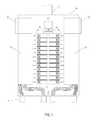
- FIG. 1is a pictorial diagram illustrating an electrical power distribution system including wire managers 10 according to an embodiment of the present invention.
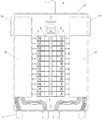
- FIG. 2is an illustration showing further details of wire manager 10 .
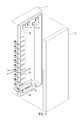
- FIG. 3is another illustration showing further details of wire manager 10 .
- FIGS. 4A-4Bare illustrations showing details of sensor 20 in accordance with an embodiment of the present invention.
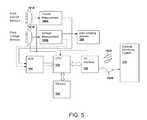
- FIG. 5is an electrical block diagram illustrating circuits within wire manager 10 according to an embodiment of the present invention.
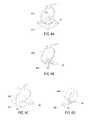
- FIGS. 6A-6Dare a pictorial diagrams depicting wire managers in accordance with alternative embodiments of the present invention.
- the present inventionencompasses wire managers having current sensing, and optionally voltage sensing, features for providing input to power measurement systems.
- the present inventioncan provide input to power monitoring equipment in computer server rooms, in which multiple branch circuit distribute power to various electronic chassis power supplies, and in which it is beneficial to provide power usage information for the various branch circuits to power monitoring and/or system control utilities within a computer operating environment.
- Other applicationsinclude power monitoring for commercial and/or residential energy management.
- a power distribution panel 8receives service entrance wiring 5 and distributes power to branch circuit wires 3 via circuit breakers 9 .
- Branch circuit wires 3are routed to supply power to loads via conduits or other raceways 7 .
- wire managers 10are installed within power distribution panel 8 .
- Wire managers 10control the position of branch circuit wires 3 and further include sensing elements that are used to determine the current flowing through branch circuit wires 3 and optionally the magnitude and/or phase of the voltage on branch circuit wires 3 to provide for computation of the actual (complex) power delivered to the branch circuit loads.
- Wire managers 10also include an interface/processing unit 12 that provides a wired or wireless interface to an external processing system and generally provides for computation of power usage-related information prior to transmission to the external processing system, although raw current (and optionally voltage) sensor output information could alternatively be transmitted, with computation of power usage-related information performed in the external processing system.
- Interface/processing unit 12may alternatively be placed in locations and be dimensioned other than as shown. For example, interface/processing unit 12 may physically separate from wire manager 10 and be coupled to wire manager 10 by a wired, wireless, optical or other suitable interface.
- Branch circuit wires 3are routed through a corresponding plurality of sensors 20 that provide at least an indication of a current flowing through the corresponding one of branch circuit wires 3 , and optionally the voltage or phase of the voltage at the corresponding one of branch circuit wires 3 .
- sensors 20will be described below in accordance with an exemplary embodiment of the invention, and further details of sensors 20 , along with other sensors that may alternatively be used to implement sensors 20 are described in above-incorporated U.S. patent application “NON-CONTACT CURRENT AND VOLTAGE SENSOR.”
- Sensors 20are fastened to a printed wiring board (PWB) 30 , that provides connections from each of current sensing elements 32 to interface/processing unit 12 , and also voltage sensing elements of sensors 20 if voltage sensing elements are provided.
- Interface/processing unit 12includes integrated circuits 35 that implement power usage computations and information transmission, as well as signal processing to remove noise and properly scale the output(s) of sensors 20 .
- current sensing elements 32extend through apertures in sensors 20 when sensors 20 are mounted to PWB 30 , and posts 38 may be provided to align and stabilize sensors 20 when sensors 20 are mounted to PWB 30 by mating posts 38 with recesses 36 in sensors 20 .
- Attachment of sensors 20may be made by any appropriate means, but some degree of flexibility should be provided so that excessive force is not applied to the mechanical connection between sensors 20 and PWB 30 when branch wires 3 are moved, so that the mechanical connection is not damaged.
- a soft-setting adhesive, flexible posts 36 either thermo-welded or chemically bonded, or snap-connectedmay be used.
- the outer body of current sensing elements 32may be made to provide mechanical attachment to sensors 20 .
- a cover 31is provided to isolate circuits within wire manager 10 from the electrical circuits in the power distribution center or raceway in which wire manager 10 is installed.
- Cover 31 and the body of wire managerform an enclosure when fitted together form a housing that isolates the circuits within wire manager 10
- branch wires 3extend through apertures 33 in the body of wire manager 10 and located at ends of sensors 20 and through which the ends of sensors 20 protrude as shown in FIG. 3 , partially closing off apertures 33 .
- Slots 37are provided through the body of wire manager 10 for insertion of branch wires 3 so that branch wires 3 can be extended through wire manager 10 and secured by sensors 20 .
- a current sensing portion of sensoris formed by three ferrite pieces 24 A, 24 B that form a ferrite cylinder around one of branch circuit wires 3 , when sensor body 22 is closed.
- Top ferrite piece 24 Aforms a half-cylinder, while ferrite pieces 24 B define a gap between ferrite pieces 24 B and in the circumference of the ferrite cylinder, in which current sensing element 32 of FIG. 3 , which is generally a semiconductor magnetic field sensor, such as a Hall effect sensor, is disposed.
- An aperture 34is formed through sensor body 22 for receiving current sensing element 32 as illustrated in FIG. 3 .
- a voltage sensor formed by metal plates 28 A, 28 Bprovides capacitive coupling to branch circuit wire 3 that provides an AC waveform that is at least indicative of the phase of the voltage on branch circuit wire 3 and may be calibrated to provide an indication of the magnitude of the voltage if needed.
- Metal plate 28 Aincludes a contact 27 and metal plate 28 B includes a mating recess 29 to improve electrical contact between metal plates 28 A and 28 B, so that connection of one of metal plates 28 A and 28 B to the measurement system is needed to provide voltage sensing.
- a terminal 38is provided on the bottom surface of sensor body 22 to provide an electrical connection from metal plate 28 B to a PWB.
- a latching mechanism 23is provided so that sensor body 22 is held in a closed position after clamping the sensor body 22 around branch circuit wire 3 .
- a pair of recesses 36may be provided for posts extending from a mounting surface, to stabilize and optionally snap-attach sensor body 22 to a PWB or other mounting surface.
- a multiplexer 101 Areceives signals from the individual current sensing elements within sensors 20 and selects a sensor for measurement, providing input to a current measurement circuit 108 A, which is an analog circuit that appropriately scales and filters the current channel output of sensors 20 .
- the output of current measurement circuit 108 Ais provided as an input to an analog-to-digital converter (ADC) 106 , which converts the current output waveform generated by current measurement circuit 108 A to sampled values provided to a central processing unit (CPU) 100 that performs power calculations in accordance with program instruction stored in a memory 104 coupled to CPU 104 .
- ADCanalog-to-digital converter
- a separate current measurement circuit 108 A and multiplexer 101 Amay not be necessary, and sensors 20 may be coupled directly to ADC 106 .
- the power usage by the branch circuit associated with a particular sensorcan be determined by assuming that the branch circuit voltage is constant (e.g., 115 Vrms) and that the phase relationship between the voltage and current is aligned (i.e., in-phase).
- the phase relationship between voltage and currentis dependent on the power factor of the load, and can vary widely and dynamically by load and over time. Therefore, it is generally desirable to at least know the phase relationship between the branch circuit voltage and current in order to accurately determine power usage by the branch circuit.
- another multiplexer 101 Bis provided to receive signals from the individual voltage sensing elements in sensors 20 if voltage sensing is implemented.
- Multiplexer 101 Breceives signals from the individual voltage sensing elements within sensors 20 and selects a sensor for measurement, providing input to a voltage measurement circuit 108 B, which is an analog circuit that appropriately scales and filters the voltage channel output of sensors 20 .
- a zero-crossing detector 109may be used to provide phase-only information to a central processing unit 100 that performs power calculations, alternatively or in combination with providing an output of voltage measurement circuit to an input of ADC 106 .
- multiplexor 101 Bmay not be necessary and one or more voltage sensor outputs of sensors 20 may be connected directly to ADC 106 .
- An input/output (I/O) interface 102provides either a wireless or wired connection to an external monitoring system, such as a wireless local area network (WLAN) connection 122 A or wired Ethernet connection 122 B.
- WLANwireless local area network
- P BRANCHV rms *I meas
- V rmsis a constant value, e.g. 115V and I meas is a measured rms current value.
- Power value P BRANCHmay be integrated over time to yield the energy use.
- the current waveformis not truly sinusoidal and the above approximation may not yield sufficiently accurate results.
- a more accurate methodis to multiply current and voltage samples measured at a sampling rate much higher than the line frequency.
- the sampled valuesthus approximate instantaneous values of the current and voltage waveforms and the energy may be computed as: ⁇ (V n *I n )
- a variety of arithmetic methodsmay be used to determine power, energy and phase relationships from the sampled current and voltage measurements.
- the wire manager of FIG. 6Aincludes a body portion 40 A that may be affixed to a chassis with a fastener, such as a sheet metal screw or an electrical wiring socket, or body portion 40 A may include an adhesive with a peel-off backing that may be removed from the underside of body portion 40 A and the wire manager pressed to a chassis or other location.
- a sensor 42is integrated in body portion 40 A, and may be a single Hall effect device for measuring a net current through one or more wires secured by a wire-tie 44 A that passes through body portion 40 A, but may also include a voltage sensing element as in sensor 20 as described above.
- Interface wires 46provide for connection of sensor 42 to a processing unit, which may receive input from multiple wire managers as shown in FIGS. 6A-6D in order to provide information about power usage by multiple power distribution branches in a manner similar to that employed in the power distribution system described above with reference to FIG. 1 .
- the wire managers of FIGS. 6B-6Dare similar to the wire manager of FIG. 6A , so only differences between them will be described in further detail below.
- the wire manager of FIG. 6Bincludes a body portion 40 B that is affixed to a chassis with a fastener, such as a sheet metal screw and also accepts a wire tie 44 B for securing wires.
- Sensor 42is positioned near an edge of body portion 40 B, in order to provide access to the mounting area.
- the wire manager of FIG. 6Chas integral twist-type securing extensions 44 C that wrap around one or more wires, and sensor 42 is integrated adjacent to the union of securing extensions 44 C with body portion 40 C.
- the wire manager of FIG. 6Dhas an integral wire retaining strap formed as part of body portion 40 D.
- sensor 42is position so that sensor 42 will be proximate wires that are retained by the wire manager is securing the wires.
- Ferrite or other magnetic materialcan be used to form a loop around the wire by integrating the magnetic material in the wire manager body in a manner similar to the integration of ferrite pieces 24 A, 24 B in sensor 20 described above.
- insert bushings as described abovecan be used around wires to provide for more uniform wire distance when voltage sensing is employed within sensor 42 .
- the Hall effect sensors used in the above-described embodimentsmay be replaced by other current-sensing elements, with suitable changes to the sensor mechanical features. Examples of alternative current-sensing elements include current transformers. Rogowski coils, anisotropic magnetoresistance (AMR) elements, fluxgates, giant magnetoresistive (GMR) elements, fiberoptic current sensors, or any other non-contact current sensor.
- AMRanisotropic magnetoresistance
- GMRgiant magnetoresistive
Landscapes
- Engineering & Computer Science (AREA)
- Power Engineering (AREA)
- Physics & Mathematics (AREA)
- General Physics & Mathematics (AREA)
- Distribution Board (AREA)
- Measuring Instrument Details And Bridges, And Automatic Balancing Devices (AREA)
- Remote Monitoring And Control Of Power-Distribution Networks (AREA)
- Measurement Of Current Or Voltage (AREA)
Abstract
Description
The present U.S. patent application is a Continuation of U.S. patent application Ser. No. 13/024,199 filed on Jan. 9, 2011 and claims priority thereto under 35 U.S.C. §120.
1. Field of the Invention
The present invention is related to wire managers for managing the position of one or multiple electrical wires, and more specifically to a wire manager including a current sensor that can be used to detect the current passing through a wire managed by the wire manager.
2. Description of Related Art
A need to measure power consumption in AC line powered systems is increasing due to a focus on energy efficiency for both commercial and residential locations. In order to measure power consumption of a circuit, the current drawn by the load must generally be measured, and for precise results, the characteristics of the load may also need to be known.
Adding current sensors to a power distribution system occupies space and adds complexity, and if a large number of circuits must be measured, increased installation difficulties and may cause disarray in the power distribution system.
Therefore, it would be desirable to provide a current sensing scheme that can provide isolated current draw information and optionally permit load characteristics to be taken into account, while providing organized and efficient installation with little additional space requirements for the power distribution system.
The invention is embodied in a wire management method using a wire manager that includes a sensor for sensing a current passing through a wire and its method of operation. The wire manager may be a single wire manager that manages the position of one or more wires at a single position and measures a net current passing through the wires, or the wire manager may have multiple securing mechanisms for securing multiple wires with corresponding current sensors located at each wire. A voltage sensor may be incorporated within the sensor(s) for sensing an electric potential of the wire(s).
The wire manager may have a housing adapted for installation within a power distribution panel or raceway, and the securing mechanisms may be clamshell housings containing portions of a current sensor formed from a ferrite cylinder, which when closed around the wire, form either a complete ferrite cylinder, or one with a gap along the circumference in which a semiconductor magnetic field sensor may be inserted. The voltage sensor may be a cylindrical plate, a wire, a film, or other suitable conductive element for capacitively coupling to the wire in order to sense the electric potential of the wire. The voltage sensor may be located alongside the current sensing element, or within the current sensing element.
The foregoing and other objectives, features, and advantages of the invention will be apparent from the following, more particular, description of the preferred embodiment of the invention, as illustrated in the accompanying drawings.
The novel features believed characteristic of the invention are set forth in the appended claims. The invention itself, however, as well as a preferred mode of use, further objectives, and advantages thereof, will best be understood by reference to the following detailed description of the invention when read in conjunction with the accompanying Figures, wherein like reference numerals indicate like components, and:
The present invention encompasses wire managers having current sensing, and optionally voltage sensing, features for providing input to power measurement systems. For example, the present invention can provide input to power monitoring equipment in computer server rooms, in which multiple branch circuit distribute power to various electronic chassis power supplies, and in which it is beneficial to provide power usage information for the various branch circuits to power monitoring and/or system control utilities within a computer operating environment. Other applications include power monitoring for commercial and/or residential energy management.
Referring now toFIG. 1 , a power distribution system in accordance with an embodiment of the present invention is shown. Apower distribution panel 8 receivesservice entrance wiring 5 and distributes power tobranch circuit wires 3 viacircuit breakers 9.Branch circuit wires 3 are routed to supply power to loads via conduits or other raceways7. Withinpower distribution panel 8,wire managers 10, in accordance with an embodiment of the invention, are installed.Wire managers 10 control the position ofbranch circuit wires 3 and further include sensing elements that are used to determine the current flowing throughbranch circuit wires 3 and optionally the magnitude and/or phase of the voltage onbranch circuit wires 3 to provide for computation of the actual (complex) power delivered to the branch circuit loads.Wire managers 10 also include an interface/processing unit 12 that provides a wired or wireless interface to an external processing system and generally provides for computation of power usage-related information prior to transmission to the external processing system, although raw current (and optionally voltage) sensor output information could alternatively be transmitted, with computation of power usage-related information performed in the external processing system. Interface/processing unit 12 may alternatively be placed in locations and be dimensioned other than as shown. For example, interface/processing unit 12 may physically separate fromwire manager 10 and be coupled towire manager 10 by a wired, wireless, optical or other suitable interface.
Referring now toFIG. 2 , details ofwire manager 10 ofFIG. 1 are shown.Branch circuit wires 3 are routed through a corresponding plurality ofsensors 20 that provide at least an indication of a current flowing through the corresponding one ofbranch circuit wires 3, and optionally the voltage or phase of the voltage at the corresponding one ofbranch circuit wires 3. Details ofsensors 20 will be described below in accordance with an exemplary embodiment of the invention, and further details ofsensors 20, along with other sensors that may alternatively be used to implementsensors 20 are described in above-incorporated U.S. patent application “NON-CONTACT CURRENT AND VOLTAGE SENSOR.”
Referring now toFIG. 3 , further details ofwire manager 10 ofFIG. 1 are shown.Sensors 20 are fastened to a printed wiring board (PWB)30, that provides connections from each of current sensing elements32 to interface/processing unit 12, and also voltage sensing elements ofsensors 20 if voltage sensing elements are provided. Interface/processing unit 12 includes integratedcircuits 35 that implement power usage computations and information transmission, as well as signal processing to remove noise and properly scale the output(s) ofsensors 20. As illustrated, current sensing elements32 extend through apertures insensors 20 whensensors 20 are mounted toPWB 30, andposts 38 may be provided to align and stabilizesensors 20 whensensors 20 are mounted toPWB 30 bymating posts 38 withrecesses 36 insensors 20. Attachment ofsensors 20 may be made by any appropriate means, but some degree of flexibility should be provided so that excessive force is not applied to the mechanical connection betweensensors 20 andPWB 30 whenbranch wires 3 are moved, so that the mechanical connection is not damaged. A soft-setting adhesive,flexible posts 36 either thermo-welded or chemically bonded, or snap-connected may be used. Alternatively, or in addition to the above, the outer body of current sensing elements32 may be made to provide mechanical attachment tosensors 20. Acover 31 is provided to isolate circuits withinwire manager 10 from the electrical circuits in the power distribution center or raceway in whichwire manager 10 is installed.Cover 31 and the body of wire manager form an enclosure when fitted together form a housing that isolates the circuits withinwire manager 10, andbranch wires 3 extend throughapertures 33 in the body ofwire manager 10 and located at ends ofsensors 20 and through which the ends ofsensors 20 protrude as shown inFIG. 3 , partially closing offapertures 33.Slots 37 are provided through the body ofwire manager 10 for insertion ofbranch wires 3 so thatbranch wires 3 can be extended throughwire manager 10 and secured bysensors 20.
Referring now toFIG. 4A , details ofsensor 20 ofFIG. 3 are shown. A current sensing portion of sensor is formed by three ferrite pieces24A,24B that form a ferrite cylinder around one ofbranch circuit wires 3, when sensor body22 is closed. Top ferrite piece24A forms a half-cylinder, while ferrite pieces24B define a gap between ferrite pieces24B and in the circumference of the ferrite cylinder, in which current sensing element32 ofFIG. 3 , which is generally a semiconductor magnetic field sensor, such as a Hall effect sensor, is disposed. Anaperture 34 is formed through sensor body22 for receiving current sensing element32 as illustrated inFIG. 3 . A voltage sensor formed by metal plates28A,28B provides capacitive coupling tobranch circuit wire 3 that provides an AC waveform that is at least indicative of the phase of the voltage onbranch circuit wire 3 and may be calibrated to provide an indication of the magnitude of the voltage if needed. Metal plate28A includes a contact27 and metal plate28B includes a mating recess29 to improve electrical contact between metal plates28A and28B, so that connection of one of metal plates28A and28B to the measurement system is needed to provide voltage sensing. Aterminal 38 is provided on the bottom surface of sensor body22 to provide an electrical connection from metal plate28B to a PWB. A latching mechanism23 is provided so that sensor body22 is held in a closed position after clamping the sensor body22 aroundbranch circuit wire 3. A pair ofrecesses 36 may be provided for posts extending from a mounting surface, to stabilize and optionally snap-attach sensor body22 to a PWB or other mounting surface.
Referring now toFIG. 5 , details of interface/processing unit 12 ofFIGS. 2 are shown. Amultiplexer 101A receives signals from the individual current sensing elements withinsensors 20 and selects a sensor for measurement, providing input to acurrent measurement circuit 108A, which is an analog circuit that appropriately scales and filters the current channel output ofsensors 20. The output ofcurrent measurement circuit 108A is provided as an input to an analog-to-digital converter (ADC)106, which converts the current output waveform generated bycurrent measurement circuit 108A to sampled values provided to a central processing unit (CPU)100 that performs power calculations in accordance with program instruction stored in amemory 104 coupled toCPU 104. Alternatively, a separatecurrent measurement circuit 108A andmultiplexer 101A may not be necessary, andsensors 20 may be coupled directly toADC 106. The power usage by the branch circuit associated with a particular sensor can be determined by assuming that the branch circuit voltage is constant (e.g., 115 Vrms) and that the phase relationship between the voltage and current is aligned (i.e., in-phase). However, while the assumption of constant voltage is generally sufficient, as properly designed distribution systems do not let the line voltage sag more than a small amount, e.g., <3%, the phase relationship between voltage and current is dependent on the power factor of the load, and can vary widely and dynamically by load and over time. Therefore, it is generally desirable to at least know the phase relationship between the branch circuit voltage and current in order to accurately determine power usage by the branch circuit.
When voltage measurement is implemented, anothermultiplexer 101B is provided to receive signals from the individual voltage sensing elements insensors 20 if voltage sensing is implemented.Multiplexer 101B receives signals from the individual voltage sensing elements withinsensors 20 and selects a sensor for measurement, providing input to avoltage measurement circuit 108B, which is an analog circuit that appropriately scales and filters the voltage channel output ofsensors 20. A zero-crossingdetector 109 may be used to provide phase-only information to acentral processing unit 100 that performs power calculations, alternatively or in combination with providing an output of voltage measurement circuit to an input ofADC 106. Alternatively,multiplexor 101B may not be necessary and one or more voltage sensor outputs ofsensors 20 may be connected directly toADC 106. In particular, it may not be necessary to make voltage measurements at each of sensors, for example, when sensing the phase of the voltage, a single measurement may suffice for providing a phase reference that is then used to determine the voltage-to-current phase difference for multiple branch circuits. Further, if multiple voltage measurements are taken, they voltage measurements may be used as an absolute voltage measurement, or the amplitude may be scaled to a known peak, r.m.s. or average value. An input/output (I/O)interface 102 provides either a wireless or wired connection to an external monitoring system, such as a wireless local area network (WLAN)connection 122A orwired Ethernet connection 122B. When power factor is not taken into account, the instantaneous power used by each branch circuit can be approximated as:
PBRANCH=Vrms*Imeas
where Vrmsis a constant value, e.g. 115V and Imeasis a measured rms current value. Power value PBRANCHmay be integrated over time to yield the energy use. When the phase of the voltage is known, then the power may be computed more accurately as:
PBRANCH=Vrms*Imeas*cos(Φ)
where (Φ) is a difference in phase angle between the voltage and current waveforms. The output of zero-crossingdetector 109 may be compared with the position of the zero crossings in the current waveform generated bycurrent measurement circuit 108A and the time ΔT between the zero crossings in the current and voltage used to generate phase difference Φ from the line frequency (assuming the line frequency is 60 Hz):
Φ=2Π*60*ΔT
In general, the current waveform is not truly sinusoidal and the above approximation may not yield sufficiently accurate results. A more accurate method is to multiply current and voltage samples measured at a sampling rate much higher than the line frequency. The sampled values thus approximate instantaneous values of the current and voltage waveforms and the energy may be computed as:
Σ(Vn*In)
A variety of arithmetic methods may be used to determine power, energy and phase relationships from the sampled current and voltage measurements.
PBRANCH=Vrms*Imeas
where Vrmsis a constant value, e.g. 115V and Imeasis a measured rms current value. Power value PBRANCHmay be integrated over time to yield the energy use. When the phase of the voltage is known, then the power may be computed more accurately as:
PBRANCH=Vrms*Imeas*cos(Φ)
where (Φ) is a difference in phase angle between the voltage and current waveforms. The output of zero-crossing
Φ=2Π*60*ΔT
In general, the current waveform is not truly sinusoidal and the above approximation may not yield sufficiently accurate results. A more accurate method is to multiply current and voltage samples measured at a sampling rate much higher than the line frequency. The sampled values thus approximate instantaneous values of the current and voltage waveforms and the energy may be computed as:
Σ(Vn*In)
A variety of arithmetic methods may be used to determine power, energy and phase relationships from the sampled current and voltage measurements.
Referring now toFIGS. 6A-6D , wire manager in accordance with other embodiments of the invention are shown. The wire manager ofFIG. 6A includes abody portion 40A that may be affixed to a chassis with a fastener, such as a sheet metal screw or an electrical wiring socket, orbody portion 40A may include an adhesive with a peel-off backing that may be removed from the underside ofbody portion 40A and the wire manager pressed to a chassis or other location. Asensor 42 is integrated inbody portion 40A, and may be a single Hall effect device for measuring a net current through one or more wires secured by a wire-tie 44A that passes throughbody portion 40A, but may also include a voltage sensing element as insensor 20 as described above.Interface wires 46 provide for connection ofsensor 42 to a processing unit, which may receive input from multiple wire managers as shown inFIGS. 6A-6D in order to provide information about power usage by multiple power distribution branches in a manner similar to that employed in the power distribution system described above with reference toFIG. 1 .
The wire managers ofFIGS. 6B-6D are similar to the wire manager ofFIG. 6A , so only differences between them will be described in further detail below. The wire manager ofFIG. 6B includes abody portion 40B that is affixed to a chassis with a fastener, such as a sheet metal screw and also accepts a wire tie44B for securing wires.Sensor 42 is positioned near an edge ofbody portion 40B, in order to provide access to the mounting area. The wire manager ofFIG. 6C has integral twist-type securing extensions 44C that wrap around one or more wires, andsensor 42 is integrated adjacent to the union of securingextensions 44C withbody portion 40C. The wire manager ofFIG. 6D has an integral wire retaining strap formed as part ofbody portion 40D. In each of the above-described wire managers,sensor 42 is position so thatsensor 42 will be proximate wires that are retained by the wire manager is securing the wires. Ferrite or other magnetic material can be used to form a loop around the wire by integrating the magnetic material in the wire manager body in a manner similar to the integration of ferrite pieces24A,24B insensor 20 described above. Also, insert bushings as described above can be used around wires to provide for more uniform wire distance when voltage sensing is employed withinsensor 42. The Hall effect sensors used in the above-described embodiments may be replaced by other current-sensing elements, with suitable changes to the sensor mechanical features. Examples of alternative current-sensing elements include current transformers. Rogowski coils, anisotropic magnetoresistance (AMR) elements, fluxgates, giant magnetoresistive (GMR) elements, fiberoptic current sensors, or any other non-contact current sensor.
While the invention has been particularly shown and described with reference to the preferred embodiments thereof, it will be understood by those skilled in the art that the foregoing and other changes in form, and details may be made therein without departing from the spirit and scope of the invention.
Claims (6)
1. A method of measuring energy usage in a building power distribution system, the method comprising:
installing a wire manager having a wire manager body within a raceway or panel of the building power distribution system;
controlling a position of multiple wires corresponding to multiple branch circuits of the power distribution system by directing the multiple wires through the wire manager body, wherein the wire manager body defines a plurality of apertures along one side of the wire manager body through which individual corresponding ones of the multiple wires are inserted by the directing;
isolating internal circuits of the wire manager from other circuits within the building power distribution system by installing a removable cover on the wire manager body;
securing the multiple wires within corresponding ones of multiple current sensors affixed to a printed wiring board by closing clamshell housings of the multiple current sensors around individual corresponding ones of the multiple wires, wherein the printed wiring board is mounted in the wire manager body so that ends of individual ones of the multiple current sensors are positioned within corresponding ones of the apertures;
measuring current in the multiple wires with current sensing elements integrated in the corresponding current sensors; and
communicating results of the measuring to an external system that are indicative of energy usage within the building power distribution system.
2. The method ofclaim 1 , wherein the measuring further comprises sensing electric potentials at each of the multiple wires using voltage sensing elements integrated in the sensors.
3. The method ofclaim 2 , further comprising transmitting a result of the measuring to an external system from an interface integrated with the wire manager body.
4. The method ofclaim 3 , wherein the interface is a circuit integrated on the printed wiring board.
5. The method ofclaim 1 , further comprising transmitting a result of the measuring to an external system from an interface integrated with the wire manager body.
6. The method ofclaim 5 , wherein the interface is a circuit integrated on the printed wiring board.
Priority Applications (1)
| Application Number | Priority Date | Filing Date | Title |
|---|---|---|---|
| US13/451,515US9684019B2 (en) | 2011-02-09 | 2012-04-19 | Wire management method with current and voltage sensing |
Applications Claiming Priority (2)
| Application Number | Priority Date | Filing Date | Title |
|---|---|---|---|
| US13/024,199US9588160B2 (en) | 2011-02-09 | 2011-02-09 | Wire manager with current and voltage sensing |
| US13/451,515US9684019B2 (en) | 2011-02-09 | 2012-04-19 | Wire management method with current and voltage sensing |
Related Parent Applications (1)
| Application Number | Title | Priority Date | Filing Date |
|---|---|---|---|
| US13/024,199ContinuationUS9588160B2 (en) | 2011-02-09 | 2011-02-09 | Wire manager with current and voltage sensing |
Publications (2)
| Publication Number | Publication Date |
|---|---|
| US20120200285A1 US20120200285A1 (en) | 2012-08-09 |
| US9684019B2true US9684019B2 (en) | 2017-06-20 |
Family
ID=46600224
Family Applications (2)
| Application Number | Title | Priority Date | Filing Date |
|---|---|---|---|
| US13/024,199Expired - Fee RelatedUS9588160B2 (en) | 2011-02-09 | 2011-02-09 | Wire manager with current and voltage sensing |
| US13/451,515Expired - Fee RelatedUS9684019B2 (en) | 2011-02-09 | 2012-04-19 | Wire management method with current and voltage sensing |
Family Applications Before (1)
| Application Number | Title | Priority Date | Filing Date |
|---|---|---|---|
| US13/024,199Expired - Fee RelatedUS9588160B2 (en) | 2011-02-09 | 2011-02-09 | Wire manager with current and voltage sensing |
Country Status (5)
| Country | Link |
|---|---|
| US (2) | US9588160B2 (en) |
| JP (1) | JP5893052B2 (en) |
| CN (1) | CN103348256B (en) |
| TW (1) | TWI538331B (en) |
| WO (1) | WO2012107845A1 (en) |
Families Citing this family (26)
| Publication number | Priority date | Publication date | Assignee | Title |
|---|---|---|---|---|
| GB0723621D0 (en)* | 2007-12-04 | 2008-01-09 | Ecoauditors Ltd | Measuring alternating current flowing through an electricity supply distribution unit |
| US8680845B2 (en) | 2011-02-09 | 2014-03-25 | International Business Machines Corporation | Non-contact current and voltage sensor |
| US9588160B2 (en) | 2011-02-09 | 2017-03-07 | International Business Machines Corporation | Wire manager with current and voltage sensing |
| US9146259B2 (en) | 2011-04-19 | 2015-09-29 | Schneider Electric It Corporation | Smart current transformers |
| US9000752B2 (en) | 2011-06-14 | 2015-04-07 | International Business Machines Corporation | Multi-conductor cable current and voltage sensors |
| US8508212B2 (en) | 2011-06-14 | 2013-08-13 | International Business Machines Corporation | Calibration of non-contact current sensors |
| US20130271895A1 (en)* | 2012-04-12 | 2013-10-17 | Hampden Kuhns | User installable branch circuit meter |
| EP2836848B1 (en)* | 2012-04-12 | 2020-04-01 | Schneider Electric IT Corporation | System and method for detecting branch circuit current |
| EP2841954B1 (en) | 2012-04-25 | 2022-03-02 | Schneider Electric IT Corporation | Current monitoring device |
| US10191095B2 (en)* | 2012-04-27 | 2019-01-29 | Socovar S.E.C. | Wireless sensor network for measurement of electrical energy consumption |
| GB2506135B (en)* | 2012-09-20 | 2018-04-11 | Tyrrell Products Ltd | Branch circuit monitoring |
| US20140167787A1 (en)* | 2012-12-14 | 2014-06-19 | Schneider Electric USA, Inc. | Branch Circuit Current Monitor |
| ES2743697T3 (en)* | 2012-12-27 | 2020-02-20 | Schneider Electric Usa Inc | Power meter with current and phase sensor |
| US9310397B2 (en) | 2013-01-29 | 2016-04-12 | International Business Machines Corporation | Multi-branch current/voltage sensor array |
| US9176203B2 (en)* | 2013-02-05 | 2015-11-03 | Texas Instruments Incorporated | Apparatus and method for in situ current measurement in a conductor |
| US9329659B2 (en)* | 2013-02-06 | 2016-05-03 | Veris Industries, Llc | Power monitoring system that determines frequency and phase relationships |
| US9973036B2 (en) | 2013-12-31 | 2018-05-15 | Schneider Electric It Corporation | Automatic sub-millisecond clock synchronization |
| US9620868B2 (en)* | 2014-10-27 | 2017-04-11 | Matthew Wootton | Compact electrical connection system |
| WO2017147838A1 (en)* | 2016-03-03 | 2017-09-08 | The University Of Hong Kong | Power measurement system |
| US10267833B2 (en) | 2016-11-02 | 2019-04-23 | Equinix, Inc. | Power monitoring probe for monitoring power distribution in an electrical system |
| US11215650B2 (en)* | 2017-02-28 | 2022-01-04 | Veris Industries, Llc | Phase aligned branch energy meter |
| US11175320B2 (en)* | 2018-08-14 | 2021-11-16 | Tiko Energy Solutions Ag | System and method for electrical power and/or energy metering on multiple channels |
| DE102021206825A1 (en)* | 2021-06-30 | 2023-01-05 | Siemens Mobility GmbH | Device for supplying energy to a sensor device in a rail vehicle |
| CN114878740B (en)* | 2022-05-10 | 2023-10-20 | 安徽广优特电缆科技有限公司 | Processing equipment for flame-retardant and fire-resistant cable |
| CN116626354B (en)* | 2023-03-27 | 2023-11-03 | 佳源科技股份有限公司 | Direct current intelligent electric energy meter |
| US20250020695A1 (en)* | 2023-07-13 | 2025-01-16 | Accuenergy (Canada) Inc. | Rogowski integrator kit and rogowski coil |
Citations (65)
| Publication number | Priority date | Publication date | Assignee | Title |
|---|---|---|---|---|
| US4005380A (en) | 1975-06-12 | 1977-01-25 | Robert Bosch G.M.B.H. | Clip-on inductive pulse pick-up |
| US4266189A (en) | 1976-07-28 | 1981-05-05 | Sun Electric Corporation | Current measuring apparatus and method |
| US4378525A (en) | 1980-09-18 | 1983-03-29 | Burdick Neal M | Method and apparatus for measuring a DC current in a wire without making a direct connection to the wire |
| US4558276A (en) | 1983-05-13 | 1985-12-10 | Leon J. Comeau | Device and method for sensing electric current in a conductor |
| JPH06174753A (en) | 1992-12-02 | 1994-06-24 | Sansha Electric Mfg Co Ltd | High current detector |
| US5436427A (en)* | 1994-04-11 | 1995-07-25 | Ultra Optec, Inc. | Welding control unit power supply |
| US5473244A (en) | 1992-09-17 | 1995-12-05 | Libove; Joel M. | Apparatus for measuring voltages and currents using non-contacting sensors |
| US5610512A (en) | 1991-09-12 | 1997-03-11 | Lem Heme Limited | Clamp-on electrical measuring device |
| JPH09281146A (en) | 1996-02-06 | 1997-10-31 | Furukawa Electric Co Ltd:The | Power cable line with current detector using giant magnetostrictive alloy and giant magnetostrictive alloy sensor |
| US5867020A (en) | 1996-10-31 | 1999-02-02 | Sematech, Inc. | Capacitively coupled RF voltage probe having optimized flux linkage |
| US5921805A (en)* | 1996-08-09 | 1999-07-13 | Sumitomo Wiring Systems, Ltd. | Connector cover |
| US6008634A (en) | 1996-09-30 | 1999-12-28 | Yazaki Corporation | Electrical junction box |
| US6414474B1 (en)* | 1999-05-11 | 2002-07-02 | Yazaki Corporation | Fixed type current detector |
| US6522509B1 (en) | 2000-07-21 | 2003-02-18 | Eaton Corporation | Arc fault detection in ac electric power systems |
| JP2003072484A (en) | 2001-09-05 | 2003-03-12 | Yazaki Corp | Mounting device for current sensor |
| US6654219B1 (en) | 2000-12-11 | 2003-11-25 | Pass & Seymour, Inc. | Arc fault detector with diagnostic indicator |
| US6661239B1 (en) | 2001-01-02 | 2003-12-09 | Irobot Corporation | Capacitive sensor systems and methods with increased resolution and automatic calibration |
| US6703842B2 (en) | 2001-01-25 | 2004-03-09 | Matsushita Electric Works, Ltd. | Method for discriminating abnormal current including arc current in AC load circuit and apparatus for executing the same |
| US6708126B2 (en) | 2002-05-17 | 2004-03-16 | General Electric Company | Method and system for measuring current |
| US20040227503A1 (en)* | 2002-03-26 | 2004-11-18 | Marc Bowman | Power monitoring system |
| US6825649B2 (en) | 2001-04-04 | 2004-11-30 | Hokuto Electronics Incorporated | Non-contact voltage measurement method and device, and detection probe |
| US20040257061A1 (en) | 2003-06-17 | 2004-12-23 | George De Buda Eric | Coreless current sensor |
| US20050127895A1 (en) | 2003-12-10 | 2005-06-16 | Functional Devices, Inc. | Current sensor wire clamp |
| US20050156587A1 (en) | 2004-01-16 | 2005-07-21 | Fieldmetrics Inc. | Current sensor |
| JP2006078316A (en) | 2004-09-09 | 2006-03-23 | Yazaki Corp | Current sensor |
| US20060087777A1 (en) | 2004-10-21 | 2006-04-27 | Veris Industries, Llc | A current sensor that includes a pair of segments |
| US7068045B2 (en) | 2003-07-25 | 2006-06-27 | Gaton Corporation | Apparatus and method for real time determination of arc fault energy, location and type |
| US7098644B1 (en) | 2004-03-22 | 2006-08-29 | Analog Devices, Inc. | Non-contact high-voltage electrometer architecture with low-voltage feedback |
| US7148675B2 (en) | 2004-04-23 | 2006-12-12 | Denso Corporation | Ring type current sensor |
| US20070058304A1 (en) | 2005-09-13 | 2007-03-15 | Michael Parker | Arc fault detection technique |
| US7227348B2 (en) | 2003-03-27 | 2007-06-05 | Thomas Sorensen | Apparatus for measuring an a.c. current in a cable |
| US7230413B2 (en) | 2004-10-19 | 2007-06-12 | Siemens Energy & Automation, Inc. | Flexible current sensor |
| US7265533B2 (en) | 2004-06-15 | 2007-09-04 | Power Measurement Ltd. | Non-intrusive power monitor |
| US7315161B2 (en) | 2004-06-07 | 2008-01-01 | General Electric Company | Micro-electromechanical system (MEMS) based current and magnetic field sensor having capacitive sense components |
| US20080077336A1 (en) | 2006-09-25 | 2008-03-27 | Roosevelt Fernandes | Power line universal monitor |
| US20080079437A1 (en) | 2006-09-28 | 2008-04-03 | General Electric Company | Current Sensing Module and Assembly Method Thereof |
| CN101329370A (en) | 2007-04-02 | 2008-12-24 | S.G.E.电子有限公司 | Electrical quantity measuring device for electric cable |
| US7474088B2 (en) | 2001-11-30 | 2009-01-06 | Veris Industries, Llc | Power monitoring system |
| US7493222B2 (en) | 2005-09-22 | 2009-02-17 | Veris Industries, Llc | High density metering system |
| WO2009042414A2 (en) | 2007-09-25 | 2009-04-02 | Square D Company | Virtual branch load management |
| US20090105973A1 (en) | 2007-10-17 | 2009-04-23 | Kyeong Dal Choi | Noncontact Measurement Method of Currents on Superconductive Wires Connected in Parallel |
| US7546214B2 (en) | 2006-09-28 | 2009-06-09 | General Electric Company | System for power sub-metering |
| US7622912B1 (en) | 2008-06-10 | 2009-11-24 | Sunpower Corporation | Method for enabling monitoring of power consumption |
| US20100001715A1 (en) | 2008-07-03 | 2010-01-07 | Doogue Michael C | Folding current sensor |
| US7714594B2 (en) | 2006-01-30 | 2010-05-11 | Daihen Corporation | Current detection printed board, voltage detection printed board, and current/voltage detector using same, and current detector and voltage detector |
| US7719258B2 (en) | 2008-10-13 | 2010-05-18 | National Taiwan University Of Science And Technology | Method and apparatus for current measurement using hall sensors without iron cores |
| US20100198535A1 (en) | 2009-02-03 | 2010-08-05 | Leviton Manufacturing Co., Inc. | Power distribution unit monitoring network and components |
| TWM386680U (en) | 2010-02-12 | 2010-08-11 | Josephtec Co Ltd | Multiple electrical power measurement and transmission device with full-time and multiple time-measuring features |
| US20100231198A1 (en) | 2009-03-12 | 2010-09-16 | Consolidated Edison Company Of New York, Inc. | Current measuring device |
| US20100264944A1 (en) | 2009-04-20 | 2010-10-21 | Veris Industries, Llc | Branch current monitoring system |
| US20100271037A1 (en) | 2007-09-28 | 2010-10-28 | Rockwell Automation Technologies, Inc. | Differential-mode current sensor |
| US20100283487A1 (en) | 2009-05-08 | 2010-11-11 | Mark Allan Juds | System and method for sensing voltage in medium-to-high voltage applications |
| CN201654106U (en) | 2010-02-26 | 2010-11-24 | 齐硕科技股份有限公司 | Multi-group power measurement transmission device with full-time and multi-time-sharing measurement |
| US7847543B2 (en) | 2005-11-28 | 2010-12-07 | Ladislav Grno | Precision flexible current sensor |
| US20110084688A1 (en) | 2008-07-21 | 2011-04-14 | Soerensen Freddy | 3-phase faraday optical current sensor assembly |
| US7990133B2 (en) | 2009-04-06 | 2011-08-02 | Carbon 612 Corporation | Non-intrusive electric alternating current sensor |
| JP2011149827A (en) | 2010-01-21 | 2011-08-04 | Panasonic Electric Works Co Ltd | Energization information measuring device |
| JP2011237209A (en) | 2010-05-07 | 2011-11-24 | Yazaki Corp | Sensor fixture and sensor fixing structure using the same |
| US20120078680A1 (en) | 2010-09-22 | 2012-03-29 | Brian Tharp | Electrical Engineering And Capacity Management System And Method |
| US20120203481A1 (en)* | 2011-02-09 | 2012-08-09 | International Business Machines Corporation | Wire manager with current and voltage sensing |
| US20120200293A1 (en) | 2011-02-09 | 2012-08-09 | International Business Machines Corporation | Non-contact current and voltage sensing method |
| US20120319676A1 (en) | 2011-06-14 | 2012-12-20 | International Business Machines Corporation | Multi-conductor cable current and voltage sensors |
| US20120319674A1 (en) | 2011-06-14 | 2012-12-20 | International Business Machines Corporation | Calibration of non-contact current sensors |
| US20130099775A1 (en) | 2011-10-20 | 2013-04-25 | Alps Green Devices Co., Ltd. | Current sensor |
| US20140167787A1 (en) | 2012-12-14 | 2014-06-19 | Schneider Electric USA, Inc. | Branch Circuit Current Monitor |
- 2011
- 2011-02-09USUS13/024,199patent/US9588160B2/ennot_activeExpired - Fee Related
- 2012
- 2012-01-10WOPCT/IB2012/050110patent/WO2012107845A1/enactiveApplication Filing
- 2012-01-10CNCN201280007317.7Apatent/CN103348256B/ennot_activeExpired - Fee Related
- 2012-01-10JPJP2013553050Apatent/JP5893052B2/ennot_activeExpired - Fee Related
- 2012-01-20TWTW101102744Apatent/TWI538331B/ennot_activeIP Right Cessation
- 2012-04-19USUS13/451,515patent/US9684019B2/ennot_activeExpired - Fee Related
Patent Citations (70)
| Publication number | Priority date | Publication date | Assignee | Title |
|---|---|---|---|---|
| US4005380A (en) | 1975-06-12 | 1977-01-25 | Robert Bosch G.M.B.H. | Clip-on inductive pulse pick-up |
| US4266189A (en) | 1976-07-28 | 1981-05-05 | Sun Electric Corporation | Current measuring apparatus and method |
| US4378525A (en) | 1980-09-18 | 1983-03-29 | Burdick Neal M | Method and apparatus for measuring a DC current in a wire without making a direct connection to the wire |
| US4558276A (en) | 1983-05-13 | 1985-12-10 | Leon J. Comeau | Device and method for sensing electric current in a conductor |
| US5610512A (en) | 1991-09-12 | 1997-03-11 | Lem Heme Limited | Clamp-on electrical measuring device |
| US5473244A (en) | 1992-09-17 | 1995-12-05 | Libove; Joel M. | Apparatus for measuring voltages and currents using non-contacting sensors |
| JPH06174753A (en) | 1992-12-02 | 1994-06-24 | Sansha Electric Mfg Co Ltd | High current detector |
| US5436427A (en)* | 1994-04-11 | 1995-07-25 | Ultra Optec, Inc. | Welding control unit power supply |
| JPH09281146A (en) | 1996-02-06 | 1997-10-31 | Furukawa Electric Co Ltd:The | Power cable line with current detector using giant magnetostrictive alloy and giant magnetostrictive alloy sensor |
| US5921805A (en)* | 1996-08-09 | 1999-07-13 | Sumitomo Wiring Systems, Ltd. | Connector cover |
| US6008634A (en) | 1996-09-30 | 1999-12-28 | Yazaki Corporation | Electrical junction box |
| US5867020A (en) | 1996-10-31 | 1999-02-02 | Sematech, Inc. | Capacitively coupled RF voltage probe having optimized flux linkage |
| US6414474B1 (en)* | 1999-05-11 | 2002-07-02 | Yazaki Corporation | Fixed type current detector |
| US6522509B1 (en) | 2000-07-21 | 2003-02-18 | Eaton Corporation | Arc fault detection in ac electric power systems |
| US6654219B1 (en) | 2000-12-11 | 2003-11-25 | Pass & Seymour, Inc. | Arc fault detector with diagnostic indicator |
| US6661239B1 (en) | 2001-01-02 | 2003-12-09 | Irobot Corporation | Capacitive sensor systems and methods with increased resolution and automatic calibration |
| US6940291B1 (en) | 2001-01-02 | 2005-09-06 | Irobot Corporation | Capacitive sensor systems and methods with increased resolution and automatic calibration |
| US6703842B2 (en) | 2001-01-25 | 2004-03-09 | Matsushita Electric Works, Ltd. | Method for discriminating abnormal current including arc current in AC load circuit and apparatus for executing the same |
| US6825649B2 (en) | 2001-04-04 | 2004-11-30 | Hokuto Electronics Incorporated | Non-contact voltage measurement method and device, and detection probe |
| JP2003072484A (en) | 2001-09-05 | 2003-03-12 | Yazaki Corp | Mounting device for current sensor |
| US7474088B2 (en) | 2001-11-30 | 2009-01-06 | Veris Industries, Llc | Power monitoring system |
| US7330022B2 (en) | 2001-11-30 | 2008-02-12 | Veris Industries, Llc | Power monitoring system |
| US20040227503A1 (en)* | 2002-03-26 | 2004-11-18 | Marc Bowman | Power monitoring system |
| US6708126B2 (en) | 2002-05-17 | 2004-03-16 | General Electric Company | Method and system for measuring current |
| US7227348B2 (en) | 2003-03-27 | 2007-06-05 | Thomas Sorensen | Apparatus for measuring an a.c. current in a cable |
| US20040257061A1 (en) | 2003-06-17 | 2004-12-23 | George De Buda Eric | Coreless current sensor |
| US7068045B2 (en) | 2003-07-25 | 2006-06-27 | Gaton Corporation | Apparatus and method for real time determination of arc fault energy, location and type |
| US20050127895A1 (en) | 2003-12-10 | 2005-06-16 | Functional Devices, Inc. | Current sensor wire clamp |
| US20050156587A1 (en) | 2004-01-16 | 2005-07-21 | Fieldmetrics Inc. | Current sensor |
| US7098644B1 (en) | 2004-03-22 | 2006-08-29 | Analog Devices, Inc. | Non-contact high-voltage electrometer architecture with low-voltage feedback |
| US7148675B2 (en) | 2004-04-23 | 2006-12-12 | Denso Corporation | Ring type current sensor |
| US7315161B2 (en) | 2004-06-07 | 2008-01-01 | General Electric Company | Micro-electromechanical system (MEMS) based current and magnetic field sensor having capacitive sense components |
| US7265533B2 (en) | 2004-06-15 | 2007-09-04 | Power Measurement Ltd. | Non-intrusive power monitor |
| JP2006078316A (en) | 2004-09-09 | 2006-03-23 | Yazaki Corp | Current sensor |
| US7230413B2 (en) | 2004-10-19 | 2007-06-12 | Siemens Energy & Automation, Inc. | Flexible current sensor |
| US20060087777A1 (en) | 2004-10-21 | 2006-04-27 | Veris Industries, Llc | A current sensor that includes a pair of segments |
| US20070058304A1 (en) | 2005-09-13 | 2007-03-15 | Michael Parker | Arc fault detection technique |
| US7493222B2 (en) | 2005-09-22 | 2009-02-17 | Veris Industries, Llc | High density metering system |
| US7847543B2 (en) | 2005-11-28 | 2010-12-07 | Ladislav Grno | Precision flexible current sensor |
| US7714594B2 (en) | 2006-01-30 | 2010-05-11 | Daihen Corporation | Current detection printed board, voltage detection printed board, and current/voltage detector using same, and current detector and voltage detector |
| US20080077336A1 (en) | 2006-09-25 | 2008-03-27 | Roosevelt Fernandes | Power line universal monitor |
| US20080079437A1 (en) | 2006-09-28 | 2008-04-03 | General Electric Company | Current Sensing Module and Assembly Method Thereof |
| US7719257B2 (en) | 2006-09-28 | 2010-05-18 | General Electric Company | Current sensing module and assembly method thereof |
| US7546214B2 (en) | 2006-09-28 | 2009-06-09 | General Electric Company | System for power sub-metering |
| CN101329370A (en) | 2007-04-02 | 2008-12-24 | S.G.E.电子有限公司 | Electrical quantity measuring device for electric cable |
| WO2009042414A2 (en) | 2007-09-25 | 2009-04-02 | Square D Company | Virtual branch load management |
| US20100271037A1 (en) | 2007-09-28 | 2010-10-28 | Rockwell Automation Technologies, Inc. | Differential-mode current sensor |
| US20090105973A1 (en) | 2007-10-17 | 2009-04-23 | Kyeong Dal Choi | Noncontact Measurement Method of Currents on Superconductive Wires Connected in Parallel |
| US7622912B1 (en) | 2008-06-10 | 2009-11-24 | Sunpower Corporation | Method for enabling monitoring of power consumption |
| US20100001715A1 (en) | 2008-07-03 | 2010-01-07 | Doogue Michael C | Folding current sensor |
| US7936164B2 (en) | 2008-07-03 | 2011-05-03 | Allegro Microsystems, Inc. | Folding current sensor |
| US20110084688A1 (en) | 2008-07-21 | 2011-04-14 | Soerensen Freddy | 3-phase faraday optical current sensor assembly |
| US7719258B2 (en) | 2008-10-13 | 2010-05-18 | National Taiwan University Of Science And Technology | Method and apparatus for current measurement using hall sensors without iron cores |
| US20100198535A1 (en) | 2009-02-03 | 2010-08-05 | Leviton Manufacturing Co., Inc. | Power distribution unit monitoring network and components |
| US20100231198A1 (en) | 2009-03-12 | 2010-09-16 | Consolidated Edison Company Of New York, Inc. | Current measuring device |
| US7990133B2 (en) | 2009-04-06 | 2011-08-02 | Carbon 612 Corporation | Non-intrusive electric alternating current sensor |
| US20100264944A1 (en) | 2009-04-20 | 2010-10-21 | Veris Industries, Llc | Branch current monitoring system |
| US20100283487A1 (en) | 2009-05-08 | 2010-11-11 | Mark Allan Juds | System and method for sensing voltage in medium-to-high voltage applications |
| JP2011149827A (en) | 2010-01-21 | 2011-08-04 | Panasonic Electric Works Co Ltd | Energization information measuring device |
| TWM386680U (en) | 2010-02-12 | 2010-08-11 | Josephtec Co Ltd | Multiple electrical power measurement and transmission device with full-time and multiple time-measuring features |
| CN201654106U (en) | 2010-02-26 | 2010-11-24 | 齐硕科技股份有限公司 | Multi-group power measurement transmission device with full-time and multi-time-sharing measurement |
| JP2011237209A (en) | 2010-05-07 | 2011-11-24 | Yazaki Corp | Sensor fixture and sensor fixing structure using the same |
| US20120078680A1 (en) | 2010-09-22 | 2012-03-29 | Brian Tharp | Electrical Engineering And Capacity Management System And Method |
| US20120203481A1 (en)* | 2011-02-09 | 2012-08-09 | International Business Machines Corporation | Wire manager with current and voltage sensing |
| US20120200293A1 (en) | 2011-02-09 | 2012-08-09 | International Business Machines Corporation | Non-contact current and voltage sensing method |
| US20120200291A1 (en) | 2011-02-09 | 2012-08-09 | International Business Machines Corporation | Non-contact current and voltage sensor |
| US20120319676A1 (en) | 2011-06-14 | 2012-12-20 | International Business Machines Corporation | Multi-conductor cable current and voltage sensors |
| US20120319674A1 (en) | 2011-06-14 | 2012-12-20 | International Business Machines Corporation | Calibration of non-contact current sensors |
| US20130099775A1 (en) | 2011-10-20 | 2013-04-25 | Alps Green Devices Co., Ltd. | Current sensor |
| US20140167787A1 (en) | 2012-12-14 | 2014-06-19 | Schneider Electric USA, Inc. | Branch Circuit Current Monitor |
Non-Patent Citations (17)
| Title |
|---|
| "AC Current sensor with Interface" downloaded from: http://www.electronicspoint.com/ac-current-sensor-interface-t221239.html on Jun. 10, 2011. |
| "Smart Current Signature Sensor" downloaded from http://technology.ksc.nasa.gov/successes/SS-Smart-Current-Signal-Snsr.htm on Jun. 10, 2011. |
| Dwyer, "A Self-Calibrating Miniature Hall Effect Solution to Gear Tooth Speed Sensing", downloaded from: http://saba.kntu.ac.ir/eecd/ecourses/instrumentation/projects/reports/speed/toothed%20rotor/toothrotor-files/main.htm on May 25, 2011. |
| Dwyer, "A Self-Calibrating Miniature Hall Effect Solution to Gear Tooth Speed Sensing", downloaded from: http://saba.kntu.ac.ir/eecd/ecourses/instrumentation/projects/reports/speed/toothed%20rotor/toothrotor—files/main.htm on May 25, 2011. |
| Final Office Action in U.S. Appl. No. 13/024,199 mailed on Jan. 15, 2015, 14 pages (pp. 1-14 in pdf). |
| McKenzie, et al. "Non-contact Voltage Measurement using Electronically Varying Capacitance", Electronics Letters, Feb. 4, 2010, vol. 46, No. 3, UK. |
| Notice of Allowance in U.S. Appl. No. 13/024,199 mailed on Oct. 20, 2016, 8 pages (pp. 1-8 in pdf). |
| Office Action in U.S. Appl. No. 13/024,199 mailed on Jan. 8, 2014, 15 pages (pp. 1-15 in pdf). |
| Office Action in U.S. Appl. No. 13/024,199 mailed on May 17, 2016, 15 pages (pp. 1-15 in pdf). |
| Office Action in U.S. Appl. No. 13/024,199 mailed on May 19, 2015, 6 pages (pp. 1-6 in pdf). |
| Office Action in U.S. Appl. No. 13/024,199 mailed on Sep. 21, 2016, 5 pages (pp. 1-5 in pdf). |
| Silicon Chip, "Compact 0-80A Automotive Ammeter", issue 165, pp. 1-12, downloaded from www.siliconchip.com.au/cms/A 03551/article.html Nov. 4, 2010, published Jun. 30, 2002. |
| Silicon Chip, "Current Clamp Meter Adapter for DMMs", issue 180, published Sep. 12, 2003. |
| U.S. Appl. No. 13/596,658, Aug. 28, 2012, El-Essawy, et al. |
| U.S. Appl. No. 13/682,112, Nov. 20, 2012, Carpenter, et al. |
| Valuetesters.com on-line catalog: "non-contact voltage probes", downloaded from http://valuetesters.com/Voltage-Probe-Non-contact.php on May 25, 2011. |
| Ziegler, et al., "Current Sensing Techniques: A Review", IEEE Sensors Journal, Apr. 2009, pp. 354-376 vol. 9, No. 4. Piscataway, NJ. |
Also Published As
| Publication number | Publication date |
|---|---|
| US9588160B2 (en) | 2017-03-07 |
| TW201236295A (en) | 2012-09-01 |
| US20120200285A1 (en) | 2012-08-09 |
| CN103348256B (en) | 2016-02-10 |
| JP5893052B2 (en) | 2016-03-30 |
| TWI538331B (en) | 2016-06-11 |
| CN103348256A (en) | 2013-10-09 |
| US20120203481A1 (en) | 2012-08-09 |
| WO2012107845A1 (en) | 2012-08-16 |
| JP2014510269A (en) | 2014-04-24 |
Similar Documents
| Publication | Publication Date | Title |
|---|---|---|
| US9684019B2 (en) | Wire management method with current and voltage sensing | |
| US9063184B2 (en) | Non-contact current-sensing and voltage-sensing clamp | |
| US9322855B2 (en) | Non-contact current and voltage sensor having detachable housing incorporating multiple ferrite cylinder portions | |
| US9007077B2 (en) | Flexible current and voltage sensor | |
| US9000752B2 (en) | Multi-conductor cable current and voltage sensors | |
| US9310397B2 (en) | Multi-branch current/voltage sensor array | |
| US9651584B2 (en) | Isolated and self-calibrating voltage measurement sensor | |
| US8493054B2 (en) | Calibration of non-contact voltage sensors | |
| EP2998748B1 (en) | Current measurement device and current calculation method | |
| US11137421B1 (en) | Non-contact voltage sensing system | |
| US9679235B2 (en) | Active RFID asset tracking tag with current-sensing cable clamp | |
| Martins et al. | Nonintrusive energy meter for nontechnical losses identification | |
| WO2015197911A1 (en) | An electrical energy meter and a method for installing it | |
| RU2717397C1 (en) | Device and method for measuring current strength of one separate wire of multi-wire system | |
| US20140210460A1 (en) | Contactless electric meter reading devices | |
| MX2010001276A (en) | Method and apparatus for measuring current output of low-voltage pad-mount distribution power transformers. | |
| JP4590983B2 (en) | Load capacity detector for wiring duct | |
| Sherman et al. | Proximity-based passive current sensors for real-time monitoring of power usage in low and mid-voltage applications | |
| Carpenter et al. | Non-contact current and voltage sensor having detachable housing incorporating multiple ferrite cylinder portions | |
| Carpenter et al. | Non-contact current and voltage sensing method using a clamshell housing and a ferrite cylinder | |
| Carpenter et al. | Non-contact current and voltage sensor |
Legal Events
| Date | Code | Title | Description |
|---|---|---|---|
| STCF | Information on status: patent grant | Free format text:PATENTED CASE | |
| FEPP | Fee payment procedure | Free format text:MAINTENANCE FEE REMINDER MAILED (ORIGINAL EVENT CODE: REM.); ENTITY STATUS OF PATENT OWNER: LARGE ENTITY | |
| LAPS | Lapse for failure to pay maintenance fees | Free format text:PATENT EXPIRED FOR FAILURE TO PAY MAINTENANCE FEES (ORIGINAL EVENT CODE: EXP.); ENTITY STATUS OF PATENT OWNER: LARGE ENTITY | |
| STCH | Information on status: patent discontinuation | Free format text:PATENT EXPIRED DUE TO NONPAYMENT OF MAINTENANCE FEES UNDER 37 CFR 1.362 | |
| FP | Lapsed due to failure to pay maintenance fee | Effective date:20210620 |