US9660520B2 - Method and apparatus to provide power conversion with high power factor - Google Patents
Method and apparatus to provide power conversion with high power factorDownload PDFInfo
- Publication number
- US9660520B2 US9660520B2US14/758,033US201414758033AUS9660520B2US 9660520 B2US9660520 B2US 9660520B2US 201414758033 AUS201414758033 AUS 201414758033AUS 9660520 B2US9660520 B2US 9660520B2
- Authority
- US
- United States
- Prior art keywords
- capacitors
- voltage
- power
- output
- converter circuit
- Prior art date
- Legal status (The legal status is an assumption and is not a legal conclusion. Google has not performed a legal analysis and makes no representation as to the accuracy of the status listed.)
- Active
Links
Images






Classifications
- H—ELECTRICITY
- H02—GENERATION; CONVERSION OR DISTRIBUTION OF ELECTRIC POWER
- H02M—APPARATUS FOR CONVERSION BETWEEN AC AND AC, BETWEEN AC AND DC, OR BETWEEN DC AND DC, AND FOR USE WITH MAINS OR SIMILAR POWER SUPPLY SYSTEMS; CONVERSION OF DC OR AC INPUT POWER INTO SURGE OUTPUT POWER; CONTROL OR REGULATION THEREOF
- H02M1/00—Details of apparatus for conversion
- H02M1/42—Circuits or arrangements for compensating for or adjusting power factor in converters or inverters
- H02M1/4208—Arrangements for improving power factor of AC input
- H02M1/4241—Arrangements for improving power factor of AC input using a resonant converter
- H—ELECTRICITY
- H02—GENERATION; CONVERSION OR DISTRIBUTION OF ELECTRIC POWER
- H02M—APPARATUS FOR CONVERSION BETWEEN AC AND AC, BETWEEN AC AND DC, OR BETWEEN DC AND DC, AND FOR USE WITH MAINS OR SIMILAR POWER SUPPLY SYSTEMS; CONVERSION OF DC OR AC INPUT POWER INTO SURGE OUTPUT POWER; CONTROL OR REGULATION THEREOF
- H02M1/00—Details of apparatus for conversion
- H02M1/42—Circuits or arrangements for compensating for or adjusting power factor in converters or inverters
- H02M1/4208—Arrangements for improving power factor of AC input
- H—ELECTRICITY
- H02—GENERATION; CONVERSION OR DISTRIBUTION OF ELECTRIC POWER
- H02M—APPARATUS FOR CONVERSION BETWEEN AC AND AC, BETWEEN AC AND DC, OR BETWEEN DC AND DC, AND FOR USE WITH MAINS OR SIMILAR POWER SUPPLY SYSTEMS; CONVERSION OF DC OR AC INPUT POWER INTO SURGE OUTPUT POWER; CONTROL OR REGULATION THEREOF
- H02M1/00—Details of apparatus for conversion
- H02M1/42—Circuits or arrangements for compensating for or adjusting power factor in converters or inverters
- H02M1/4208—Arrangements for improving power factor of AC input
- H02M1/4225—Arrangements for improving power factor of AC input using a non-isolated boost converter
- H—ELECTRICITY
- H02—GENERATION; CONVERSION OR DISTRIBUTION OF ELECTRIC POWER
- H02M—APPARATUS FOR CONVERSION BETWEEN AC AND AC, BETWEEN AC AND DC, OR BETWEEN DC AND DC, AND FOR USE WITH MAINS OR SIMILAR POWER SUPPLY SYSTEMS; CONVERSION OF DC OR AC INPUT POWER INTO SURGE OUTPUT POWER; CONTROL OR REGULATION THEREOF
- H02M3/00—Conversion of DC power input into DC power output
- H02M3/01—Resonant DC/DC converters
- H—ELECTRICITY
- H02—GENERATION; CONVERSION OR DISTRIBUTION OF ELECTRIC POWER
- H02M—APPARATUS FOR CONVERSION BETWEEN AC AND AC, BETWEEN AC AND DC, OR BETWEEN DC AND DC, AND FOR USE WITH MAINS OR SIMILAR POWER SUPPLY SYSTEMS; CONVERSION OF DC OR AC INPUT POWER INTO SURGE OUTPUT POWER; CONTROL OR REGULATION THEREOF
- H02M3/00—Conversion of DC power input into DC power output
- H02M3/02—Conversion of DC power input into DC power output without intermediate conversion into AC
- H02M3/04—Conversion of DC power input into DC power output without intermediate conversion into AC by static converters
- H02M3/10—Conversion of DC power input into DC power output without intermediate conversion into AC by static converters using discharge tubes with control electrode or semiconductor devices with control electrode
- H02M3/145—Conversion of DC power input into DC power output without intermediate conversion into AC by static converters using discharge tubes with control electrode or semiconductor devices with control electrode using devices of a triode or transistor type requiring continuous application of a control signal
- H02M3/155—Conversion of DC power input into DC power output without intermediate conversion into AC by static converters using discharge tubes with control electrode or semiconductor devices with control electrode using devices of a triode or transistor type requiring continuous application of a control signal using semiconductor devices only
- H02M3/156—Conversion of DC power input into DC power output without intermediate conversion into AC by static converters using discharge tubes with control electrode or semiconductor devices with control electrode using devices of a triode or transistor type requiring continuous application of a control signal using semiconductor devices only with automatic control of output voltage or current, e.g. switching regulators
- H02M3/158—Conversion of DC power input into DC power output without intermediate conversion into AC by static converters using discharge tubes with control electrode or semiconductor devices with control electrode using devices of a triode or transistor type requiring continuous application of a control signal using semiconductor devices only with automatic control of output voltage or current, e.g. switching regulators including plural semiconductor devices as final control devices for a single load
- H—ELECTRICITY
- H02—GENERATION; CONVERSION OR DISTRIBUTION OF ELECTRIC POWER
- H02M—APPARATUS FOR CONVERSION BETWEEN AC AND AC, BETWEEN AC AND DC, OR BETWEEN DC AND DC, AND FOR USE WITH MAINS OR SIMILAR POWER SUPPLY SYSTEMS; CONVERSION OF DC OR AC INPUT POWER INTO SURGE OUTPUT POWER; CONTROL OR REGULATION THEREOF
- H02M3/00—Conversion of DC power input into DC power output
- H02M3/22—Conversion of DC power input into DC power output with intermediate conversion into AC
- H02M3/24—Conversion of DC power input into DC power output with intermediate conversion into AC by static converters
- H02M3/28—Conversion of DC power input into DC power output with intermediate conversion into AC by static converters using discharge tubes with control electrode or semiconductor devices with control electrode to produce the intermediate AC
- H02M3/325—Conversion of DC power input into DC power output with intermediate conversion into AC by static converters using discharge tubes with control electrode or semiconductor devices with control electrode to produce the intermediate AC using devices of a triode or a transistor type requiring continuous application of a control signal
- H02M3/335—Conversion of DC power input into DC power output with intermediate conversion into AC by static converters using discharge tubes with control electrode or semiconductor devices with control electrode to produce the intermediate AC using devices of a triode or a transistor type requiring continuous application of a control signal using semiconductor devices only
- H02M3/33569—Conversion of DC power input into DC power output with intermediate conversion into AC by static converters using discharge tubes with control electrode or semiconductor devices with control electrode to produce the intermediate AC using devices of a triode or a transistor type requiring continuous application of a control signal using semiconductor devices only having several active switching elements
- H—ELECTRICITY
- H02—GENERATION; CONVERSION OR DISTRIBUTION OF ELECTRIC POWER
- H02M—APPARATUS FOR CONVERSION BETWEEN AC AND AC, BETWEEN AC AND DC, OR BETWEEN DC AND DC, AND FOR USE WITH MAINS OR SIMILAR POWER SUPPLY SYSTEMS; CONVERSION OF DC OR AC INPUT POWER INTO SURGE OUTPUT POWER; CONTROL OR REGULATION THEREOF
- H02M7/00—Conversion of AC power input into DC power output; Conversion of DC power input into AC power output
- H02M7/02—Conversion of AC power input into DC power output without possibility of reversal
- H02M7/04—Conversion of AC power input into DC power output without possibility of reversal by static converters
- H02M7/06—Conversion of AC power input into DC power output without possibility of reversal by static converters using discharge tubes without control electrode or semiconductor devices without control electrode
- H—ELECTRICITY
- H02—GENERATION; CONVERSION OR DISTRIBUTION OF ELECTRIC POWER
- H02M—APPARATUS FOR CONVERSION BETWEEN AC AND AC, BETWEEN AC AND DC, OR BETWEEN DC AND DC, AND FOR USE WITH MAINS OR SIMILAR POWER SUPPLY SYSTEMS; CONVERSION OF DC OR AC INPUT POWER INTO SURGE OUTPUT POWER; CONTROL OR REGULATION THEREOF
- H02M1/00—Details of apparatus for conversion
- H02M1/0067—Converter structures employing plural converter units, other than for parallel operation of the units on a single load
- H02M1/007—Plural converter units in cascade
- H—ELECTRICITY
- H02—GENERATION; CONVERSION OR DISTRIBUTION OF ELECTRIC POWER
- H02M—APPARATUS FOR CONVERSION BETWEEN AC AND AC, BETWEEN AC AND DC, OR BETWEEN DC AND DC, AND FOR USE WITH MAINS OR SIMILAR POWER SUPPLY SYSTEMS; CONVERSION OF DC OR AC INPUT POWER INTO SURGE OUTPUT POWER; CONTROL OR REGULATION THEREOF
- H02M1/00—Details of apparatus for conversion
- H02M1/0067—Converter structures employing plural converter units, other than for parallel operation of the units on a single load
- H02M1/0074—Plural converter units whose inputs are connected in series
- H02M2001/007—
- H02M2001/0074—
- Y—GENERAL TAGGING OF NEW TECHNOLOGICAL DEVELOPMENTS; GENERAL TAGGING OF CROSS-SECTIONAL TECHNOLOGIES SPANNING OVER SEVERAL SECTIONS OF THE IPC; TECHNICAL SUBJECTS COVERED BY FORMER USPC CROSS-REFERENCE ART COLLECTIONS [XRACs] AND DIGESTS
- Y02—TECHNOLOGIES OR APPLICATIONS FOR MITIGATION OR ADAPTATION AGAINST CLIMATE CHANGE
- Y02B—CLIMATE CHANGE MITIGATION TECHNOLOGIES RELATED TO BUILDINGS, e.g. HOUSING, HOUSE APPLIANCES OR RELATED END-USER APPLICATIONS
- Y02B70/00—Technologies for an efficient end-user side electric power management and consumption
- Y02B70/10—Technologies improving the efficiency by using switched-mode power supplies [SMPS], i.e. efficient power electronics conversion e.g. power factor correction or reduction of losses in power supplies or efficient standby modes
- Y02B70/126—
Definitions
- the subject matter described hereinrelates generally to electrical circuits and systems and more particularly to power conversion circuits and systems.
- the power factor (PF) at the input port of a circuitis a parameter that is related to a ratio between the amount of real power drawn by the circuit (e.g., the average power entering the input port of the circuit) and the amount of apparent power drawn by the circuit (e.g., the product of the root-mean-square, or RMS, voltage at the input port and the RMS current at the input port).
- ac-dc converterhigh power factor is generally desired to best convey real power from an alternating current (ac) input to a direct current (dc) output.
- a high PFis desired to maintain high power quality.
- a common technique to achieve high power factoris to cascade a “Power Factor Correction” (PFC) rectifier circuit with a de-dc converter.
- the PFC circuitshapes a sinusoidal input current and buffers twice-line-frequency ac power on a capacitor with a certain average do voltage.
- the subsequent dc-dc converterthen regulates the load voltage from this buffered voltage.
- a boost converteris often selected for use in a PFC circuit because of its high power factor capability (about 0.99).
- a boost converterwill typically require the use of high-voltage rated switch, diode, and capacitor components (e.g., 2-3 times peak voltage of about 200-400V).
- the subsequent dc-dc converterwould need a high step-down conversion ratio from the high stepped-up buffered voltage to the low do voltage. Therefore, high voltage stress will exist on the components of the dc-dc converter, deteriorating the efficiency.
- a boost converterIn contrast to a boost converter, one alternative for a PFC circuit is a buck converter, which draws a clipped current waveform (i.e., draws current when the input ac voltage magnitude exceeds the do buffer voltage). Often a clipped-sine current waveform is drawn, yielding a ⁇ 0.9-0.95 power factor for typical ac inputs.
- a benefit of a PFC having a buck topologyis the reduced voltage stress and conversion ratio for the corresponding dc-dc converter.
- the active components in the buck PFC circuitstill need to be operated directly from the ac line voltage, and thus the buck PFC needs to be designed with high voltage (e.g., 300-600V) active devices.
- New power conversion architectures and methodsare needed that are capable of achieving high power factor with one or more of high switching frequency, low component voltage stress, low buffer energy storage requirements, high power density, and/or high efficiency.
- a new power conversion architectureis provided that is capable of achieving high power factor.
- the power conversion architectureis suitable for use in, for example, grid interface power converters and other power converters where high power factor is an important operating characteristic.
- the power conversion architectureis capable of providing high power factor while also achieving one or more of high switching frequency, low component voltage stress, low peak buffer energy storage requirement, high power density, and/or high efficiency.
- the architecturecan significantly decrease the voltage stress of the active and passive devices within the converter, thus enabling high-frequency operation and small size.
- good power factorcan be achieved while dynamically buffering twice-line-frequency energy with relatively small capacitors.
- an ac-dc power converter architectureis provided that is suitable for use as a single-phase grid interface at high switching frequency (e.g., above 3 MHz).
- high switching frequencye.g., above 3 MHz.
- Additional features, concepts, and circuits described hereinmay also be used to provide bi-directional power converter circuits and dc-ac circuits.
- a prototype power converterwas developed for use in light emitting diode (LED) driver operations. Testing has shown that the prototype implementation achieves an efficiency of 93.3% and a power factor of 0.89, while maintaining high frequency operation and small size (with a displacement power density of 130 W/in 3 ).
- the circuits, systems, concepts, and features described hereincan be used to provide power converters with different regulating and combining converter topologies, and can likewise be adapted to the requirements of a variety of different applications, voltage ranges and power levels.
- a power converter circuitcomprises: a line frequency rectifier circuit configured to rectify an alternating current (ac) input voltage of the power converter circuit; a stack of capacitors to receive an output signal of the line frequency rectifier circuit, the stack of capacitors having at least two stacked capacitors; a set of regulating converters coupled to the stack of capacitors, each regulating converter in the set of regulating converters being configured to draw current from a corresponding one of the stacked capacitors and to generate a regulated voltage at an output thereof in response thereto; a power combining converter circuit configured to combine the output signals of the set of regulating converters and to convert the combined signal to a desired direct current (dc) output voltage; and a controller configured to controllably modulate the input current of one or more of the regulating converters in a manner that enhances power factor in the power converter circuit.
- acalternating current
- the controlleris configured to controllably modulate the input currents of the regulating converters in a manner that regulates the voltage or current at one or outputs of the regulating converters and/or at one or more system outputs.
- the controlleris configured to controllably modulate the input currents of the regulating converters in a manner that results in a power factor in the power converter circuit that is greater than or equal to 0.8.
- the controlleris configured to controllably modulate the input current of all of the regulating converters in the set in a manner that enhances power factor in the power converter circuit.
- the set of regulating convertersincludes at least one inverted resonant-transition buck converter.
- the set of regulating convertersincludes at least one inverted resonant-transition buck converter.
- the set of regulating convertersincludes at least one flyback converter.
- the power combining converter circuitincludes a switched capacitor circuit.
- the power combining converter circuitincludes an interleaved switched capacitor circuit.
- the power combining converter circuitincludes an indirect dc-dc converter topology.
- the power combining converter circuitincludes a buck-boost converter.
- the power combining converter circuitincludes a multi-winding flyback converter.
- the power combining converter circuitis configured to combine the outputs of the regulating converters to a single output.
- the stack of capacitorshas three or more stacked capacitors and the set of regulating converters has one converter for each of the three or more stacked capacitors.
- the controlleris configured to adapt a quantity of capacitors and regulating converters that are operative at a particular time based on a predetermined criterion.
- the controlleris configured to adapt a quantity of capacitors and regulating converters that are operative at a particular time based on a line voltage currently being used.
- the sum of the voltages across the capacitors of the stack of capacitorsis substantially equal to the output voltage of the line frequency rectifier.
- a machine implemented method of operating a power converter circuitcomprises: rectifying an alternating current (ac) line voltage; applying the rectified ac line voltage across a stack of capacitors, the stack of capacitors having at least two stacked capacitors; for each of the capacitors in the stack of capacitors, applying a corresponding voltage to an input of a corresponding regulating converter to convert the voltage to a regulated output signal for each of the regulating converters; modulating an input current of one or more of the regulating converters in a manner that increases power factor of the power converter circuit; and combining the regulated output signals of the regulating converters to generate a combined signal that is a desired direct current (dc) output voltage.
- acalternating current
- combining the regulated output signals of the regulating converters to generate a combined signalincludes providing electrical isolation between the regulated output signals and the combined signal.
- rectifying an ac line voltageincludes full-wave rectifying the ac line voltage.
- the methodfurther comprises adapting the number of capacitors in the stack of capacitors that are active based on a predetermined criterion.
- the methodfurther comprises adapting the number of capacitances in the stack of capacitors that are active based on a line voltage level currently being used.
- modulating an input current of one or more of the regulating convertersincludes modulating input currents of all regulating converters that are currently active.
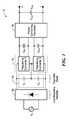
- FIG. 1is a schematic diagram illustrating an example grid interface power converter architecture in accordance with an embodiment
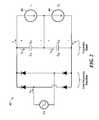
- FIG. 2is a schematic diagram illustrating a simplified circuit model of the front end of the grid interface power converter architecture of FIG. 1 in accordance with an embodiment
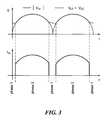
- FIG. 3are waveform diagrams illustrating the two-phase nature of capacitor stack voltage and rectifier input current in accordance with an embodiment
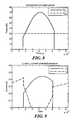
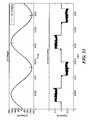
- FIG. 8is a diagram illustrating the input power and the output power associated with the power converter circuit operating in accordance with Example 1;
- FIG. 13is a diagram illustrating the input power and the output power associated with the power converter circuit operating in accordance with Example 2;
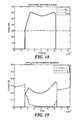
- FIG. 18is a diagram illustrating the input power and the output power associated with the power converter circuit operating in accordance with Example 3;
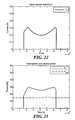
- FIG. 23is a diagram illustrating the input power and the output power associated with the power converter circuit operating in accordance with Example 4.
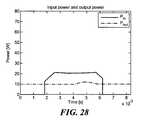
- FIG. 28is a diagram illustrating the input power and the output power associated with the power converter circuit operating in accordance with Example 5;
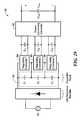
- FIG. 29is a schematic diagram illustrating an example grid interface power converter architecture that includes more than two capacitors in the capacitor stack in accordance with an embodiment
- FIG. 30is a schematic diagram illustrating an example grid interface power converter circuit that uses inverted resonant-transition buck converters as regulating converters and an interleaved switched capacitor circuit as a power combining converter in accordance with an embodiment
- FIG. 31is a schematic diagram illustrating a control arrangement that may be used with the grid interface power converter circuit of FIG. 30 and other converters;
- FIG. 32is a waveform diagram illustrating measured voltage waveforms for a prototype converter at startup and during operation over an ac line cycle
- FIG. 33are waveform diagrams illustrating measured ac input voltage and measured AC input current for the prototype converter
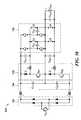
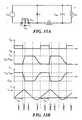
- FIG. 33Ais a schematic diagram illustrating an example inverted resonant buck converter that may be used with the grid interface power converter circuit of FIG. 30 and other converters;
- FIG. 33Bis a plot illustrating an example operation of the inverted resonant buck converter of FIG. 33A ;
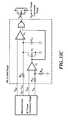
- FIG. 33Cis schematic diagram illustrating an example control circuit that may be used to control the inverted resonant buck converter of FIG. 33A and other converters;
- FIG. 34is a schematic diagram illustrating an example grid interface power converter circuit that uses inverted resonant-transition buck converters as regulating converters and a buck-boost converter as a power combining converter in accordance with an embodiment
- FIG. 35is a schematic diagram illustrating an example grid interface power converter circuit that uses inverted resonant-transition buck converters as regulating converters and a multi-winding flyback converter as a power combining converter in accordance with an embodiment
- FIG. 36is a flowchart illustrating a method of operating a power converter circuit in accordance with an embodiment.
- FIG. 1is a schematic diagram illustrating an example grid interface power converter architecture 10 in accordance with an embodiment.
- the grid interface power converter architecture 10is characterized by a line-frequency rectifier 12 , a stack of capacitors 14 , a set of regulating converters 16 , and a power-combining converter 18 (or a set of power combining converters).
- the line-frequency rectifier 12has an input that is coupled to a grid voltage (Vin) and an output that is coupled to the stack of capacitors 14 .
- the line-frequency rectifier 12rectifies the grid voltage to generate a DC voltage at the output.
- the line-frequency rectifier 12includes a full-bridge diode rectifier, although other rectifier configurations (such as synchronous full bridge rectifier, semi-bridge rectifier, voltage-doubler rectifier, switchable voltage-doubler/full-bridge rectifier, valley-fill rectifier) can alternatively be used.
- the total voltage across the capacitor stack 14is equal to the rectifier output voltage.
- the capacitor stack 14provides a portion of (or all of) any needed twice-line-frequency energy buffering, such that the power converter can provide high power factor.
- One or more of the capacitors in the capacitor stack 14may have a voltage that varies over a wide range as the line voltage varies over the line cycle.
- One or more of the capacitors in the capacitor stack 14may have larger value(s) than the other(s), and buffer a larger portion of the twice-line-frequency energy.
- the rectifier input current waveformmay approximate a clipped sine wave (or, may be a different current waveform providing a desired power factor and/or instantaneous power processing), and the total capacitor stack voltage may closely follow the amplitude of the line voltage over a portion of the line cycle.
- any one or more of the capacitors in the depicted “stack”can be implemented using multiple capacitors that are interconnected in a particular manner to achieve a single effective capacitance value.
- the phrases “stack of capacitors” and “capacitor stack”are intended to mean a stack of capacitors where each “capacitor” may be associated with a single capacitor (as in FIG. 1 ) or multiple interconnected capacitors, or multiple capacitors interconnected by switches.
- the set of regulating converters 16have their inputs coupled to the capacitors of the capacitor stack 14 and provide regulated output voltages based thereon.
- the currents drawn by the regulating convertersare modulated to draw energy from the capacitors, such that the currents drawn from the capacitor stack result in an input current waveform to the rectifier that provides high power factor while achieving the total needed energy transfer.
- the regulating converters 16may be implemented as resonant-transition discontinuous-mode inverted buck converters. This topology enables high-frequency (HF) or very-high-frequency (VHF) operation of the regulating converters with high efficiency, low device voltage stress, small component size, and good control capability. Other types of regulating converters may alternatively be used.
- the power-combining converter 18has a plurality of inputs coupled to the regulating converter outputs.
- the power-combining converter 18draws energy from the regulating converter outputs and delivers the combined power to the converter system output.
- the power-combining converter 18may provide one or more of: voltage balancing among the regulating converter outputs, isolation, voltage transformation, and additional regulation of the output.
- the power-combining converter 18may be a regulating or non-regulating converter structure, and may be optionally implemented as, for example, a switched capacitor circuit, a multi-input isolated converter, or as a set of single-input converters which each receive a corresponding regulating converter output and collectively supply a single power combining converter output. Other power combining converter configurations may alternatively be used.
- FIG. 2is a simplified circuit model 40 of the front end of the grid interface power converter architecture 10 of FIG. 1 .
- two current sources 42 , 44model the average current drawn by the regulating converters (e.g., average over a switching period).
- the circuitcycles in two phases across a half line cycle, as shown in the FIG. 3 .
- phase 1the input ac voltage is lower than the total voltage of the stacked capacitors and the full-bridge rectifier is off.
- capacitors C 1 and C 2are discharged by the regulating converters and the voltage across the capacitor stack decreases.
- the full-bridgeturns on and the circuit enters phase 2.
- the capacitor stack voltagetracks the rectified input AC voltage, and the input current follows the sum of the currents into C 1 and regulating converter 1, as well as C 2 and regulating converter 2.
- the total capacitor stack voltagedischarges slowly enough by the regulating convertors that it does not follow the decreasing envelope of the ac input voltage, the total capacitor stack voltage becomes higher than the rectified ac voltage.
- the full-bridgethen turns off and the circuit repeats the cycle starting phase 1 (see V C1 +V C2 in FIG. 3 ).
- Equations 9 and 10 aboveshow the currents i 1 and i 2 during phase 2 (i.e., the average current through the regulating converters 1 and 2). These equations for phase 2 show that a certain shape of input current is achieved through proper i 1 and i 2 current modulation across the line cycle. It should also be noted that the currents i 1 and i 2 are related to the instantaneous voltages across the capacitors C 1 and C 2 , respectively.
- the initial voltage of each capacitoris decided by predefined calculation or by internal feedback control circuitry.
- a sinusoidal input voltage of 170V pkis assumed.
- Currents i 1 (t) and i 2 (t)are calculated and modulated to achieve this using equations 9 and 10.
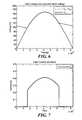
- the simulationshows that with the current modulation of each regulating converter, as shown in FIG.
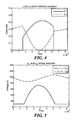
- FIG. 5illustrates the voltages across the capacitors C 1 and C 2
- the capacitor stackbuffers twice-line-frequency energy and both of the capacitors C 1 and C 2 maintain steady-state operation over the line cycle (i.e., the capacitor stack voltage is the same at the beginning and end of the line cycle).
- the full-bridge rectifierturns on and off over the line cycle.
- FIG. 6illustrates the capacitor stack voltage waveform and the input voltage (v in ) waveform.
- FIG. 7shows the actual clipped sinusoidal input current waveform at the rectifier input.
- the calculated i 2 currentwould ideally go negative, requiring bidirectional power flow from the regulating converter.
- i 2should be kept positive due to the regulating converter requirements.
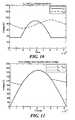
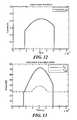
- the modulating current i 2is assigned to sit at the zero current level instead, and the resulting voltage and current waveforms are plotted as shown in FIGS. 10, 11, and 12 .
- the input current waveformdoes not resemble an ideal clipped sine wave, due to the positive-clipped i 2 current waveform (i.e., the input current waveform has a small deviation from an ideal clipped sinusoidal waveform when current i 2 sits at zero). This deviation, however, has only a small effect on the clipped sinusoidal waveform shape, and thus reasonably high power factor of about 0.91 is achieved in this example.
- the whole AC input energyis not buffered thoroughly in the capacitor stack, as shown in FIG. 13 .
- the residual ac ripple energy of Poutshould be buffered either at the output capacitors of the regulating converters or at the system output capacitor. Since the amount of this ac ripple energy is greatly reduced in comparison to the ac input energy, a small additional capacitance can be used for this further buffering.
- This exampleproposes another shape of the input current waveform to achieve high power factor and ac (twice line frequency) power buffering.
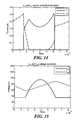
- a folded-clipped sinusoidal input current waveformis assumed (i.e., as shown in FIG. 17 , the input current waveform is folded backward above a specific current level).
- V c1,i35 volts
- FIGS. 14, 15, 16, and 17illustrate the resulting i 1 and i 2 current waveforms and the voltage waveforms across each capacitor stack.
- the folded-clipped sinusoidal input current waveformyields better ac power buffering capability as shown in FIG. 18 . Due to this folded clipped sinusoidal current waveform, the power factor is reduced to 0.9, which is nonetheless sufficient for many applications.
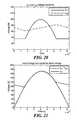
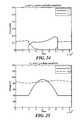
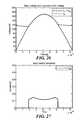
- FIGS. 24, 25, 26, 27 , and 28illustrate the resulting current, voltage, and power waveforms over the half line cycle. As before, simulation shows that a power factor of 0.9 can be achieved with sufficient input ac energy buffering operation.
- the power converter architectures of the present disclosurehave several possible advantages.
- One potential benefitis the decreased voltage stress to the components in the regulating converter and the power combining converter.
- each regulating converter of the proposed architectureoperates at a fraction of the grid voltage because of the stacked capacitor structure (with an increased number of “stack” capacitors, this voltage stress may be further reduced.)
- the power combining convertertied to the regulated outputs of the regulating converters, operates with low voltage stress range as well in some implementations.
- power converter architectures disclosed hereinare capable of providing better overall converter efficiency in many cases over prior structures.
- a traditional PFC circuitsuch as a boost or flyback PFC circuit
- the DC-DC converter stage after the PFCcan dissipate a lot of power due to the high conversion ratio from the buffer capacitor voltage after the PFC circuit (e.g., around 300-400V) to the system output voltage.
- each regulating convertercan operate under much higher efficiency because of the reduced conversion ratio from each capacitor stack voltage to the regulated output voltage (e.g., about one quarter the conversion ratio in some implementations).
- the power combining converter of the present architecturewhich may also operate from the low regulated voltage, may also provide high efficiency.
- the grid interface power converter approach described hereinis, in many cases, suitable for substantial miniaturization through a combination of architecture, circuit topology, and greatly increased switching frequencies.
- increases in switching frequencymay be necessary because the values of inductors and capacitors vary inversely with switching frequency.
- the sizes of passive componentsdo not necessarily decrease monotonically with frequency, owing to magnetic-core loss, voltage breakdown, and heat transfer limits. Consequently, achieving substantial miniaturization through high frequency operation further relies upon appropriate passives design and careful selection of circuit topology to minimize the demands placed upon the passive components, especially the magnetic components.
- the capacitor stack structurecan help the top regulating converter operate at high frequency, providing ac ground at the regulating converter switching frequency (i.e., the voltage across each capacitor stack changes so slowly across the line cycle that even the top regulating converter can be easily operated at high frequency).
- the behavior of grid interface architectures of the present disclosuresuggests the use of smaller energy-buffer capacitors and smaller inductor component levels. Considering that the total energy stored in a capacitor
- the stacked capacitors right after the full bridge rectifierbuffer the sc energy, and can be controlled to large voltage variations by active current modulation of the two regulating converter legs.
- This large voltage variationallows smaller capacitors to be used (e.g., about 30-200 ⁇ F for designs operating at tens of Watts from 120 Vac) to store the ac sloshing energy.
- a smaller inductorcan be used with the reduced impedance level at the regulating stage as compared to a conventional converter.
- Converters operating at high voltages and low currentsoperate at high impedance levels, and consequently utilize relatively large inductors and small capacitors (e.g., characteristic impedance
- the entire converter with two regulating converterscan be designed with smaller inductor values and size.
- more than two capacitorsmay be used in the capacitor stack, further reducing required individual inductance values and enabling higher frequencies to be employed.
- bi-directional grid interface power convertersare provided that can convert from ac to dc and also from dc to ac. Such bi-directional converters require proper device and topology selection and control.
- a line frequency bridgemay be provided that also serves as an inverter for dc to ac conversion (e.g., by replacing diodes with active devices).
- Control circuitryis also provided to control operation of the inverter. Power converter circuits that only serve as do-to-ac converters may also be produced.
- the grid interface power converter architecture 10 of FIG. 1comprises a line-frequency bridge rectifier 12 with a stack of two capacitors 14 across its output; a pair of regulating converters 16 ; and a power combining converter 18 having two inputs and an output that supplies the system output.
- a line-frequency bridge rectifier 12with a stack of two capacitors 14 across its output
- a pair of regulating converters 16regulating converters
- a power combining converter 18having two inputs and an output that supplies the system output.
- FIG. 29is a schematic diagram illustrating a grid interface power converter architecture 80 that includes a capacitor stack 82 having three capacitors.
- the power converter architecture 80also includes three regulating converters 84 , 86 , 88 which are each coupled at an output thereof to a power combining converter 90 .
- the number of capacitors and sub-regulating-converters that are activemay be allowed to vary dynamically or adapt over time based on a predetermined criterion (e.g., based on whether the line voltage is currently 120 or 240 V rms or based upon the ac rms voltage amplitude within a range This approach provides greater flexibility of operation and narrower component operating ranges than could otherwise be achieved.
- the variationmay be provided, for example, by providing circuit structures that allow one or more of the stack capacitors to be controllably shorted out. Other techniques may alternatively be used. It should be appreciated that this architecture may be further extended to use even more capacitors in the capacitor stack. Such an extension might be desirable in designs for “universal input” (e.g., operable from 85-265 V ac,rms ).
- FIG. 30is a schematic diagram illustrating a prototype grid interface power converter circuit 100 in accordance with an embodiment.
- the prototype grid interface power converter circuit 100was built and tested and found to operate at a high performance level.
- the grid interface power converter circuit 100includes: a line-frequency rectifier 102 , a capacitor stack 104 , a set of regulating converters 106 , and a power-combining converter 108 .
- the regulating converters 106were designed as inverted resonant-transition buck converters and the power combining converter 108 was designed as an interleaved switched capacitor circuit.
- the regulating converters 106were each designed with a single switch, diode, and small inductor and operate in the HF frequency range (i.e., 3-30 MHz).
- the buck convertersare “inverted” in the sense that they were designed with “common positives.”
- An advantage of thisis that the active switch control ports are each referenced to slowly-moving node voltages, simplifying the task of driving them at high frequencies.
- the regulating converters 106act like quasi-square-wave zero-voltage switching (ZVS) buck converters with a low ratio of switching to resonant frequency. Outside of this range, the converters do not operate with perfect zero-voltage switching, but rather provide near ZVS operation with low turn-on loss of the active switch.
- Each regulating convertertakes as an input one of the capacitor voltages from the capacitor stack and provides a regulated voltage across its output capacitor. This regulating converter design has several benefits. First, it operates with ZVS or near-ZVS soft switching across the 35-100 V wide input voltage range. The single common referenced switch (referenced to a slowly-moving potential) makes it suitable for operation at HF.
- the power combining converter 108 in the embodiment of FIG. 30is implemented as an “interleaved” switched capacitor circuit.
- the interleaved switched-capacitor circuitis an effective choice for high efficiency and power density, as the converter doesn't need to provide regulation.
- the switched capacitor circuitdraws energy from the two regulating converter outputs and supplies a single system output (which is also the output of one of the regulating converters 106 ). Because the switched capacitor circuit transfers charge without voltage regulation, and is designed with switches and capacitors, it can be operated with high efficiency at low frequency, with small converter size.
- the capacitors C f1 and C f2transfer charge from capacitor C R1 to capacitor C R2 and supply the combined power to the load.
- the switched capacitor power combining converter 108Because the load is connected across the output of one of the regulating converters, the switched capacitor power combining converter 108 only processes a portion of overall system energy. Moreover, if C f1 and C f2 are selected as much larger than C R1 and C R2 , partial “soft charging” of the energy transfer capacitors can be achieved.
- the prototype circuitused a gallium nitride (GaN) switch (EPC 2012) for Q R1 and Q R2 ; a Schottky diode (STPS30120DJF) for diode D; and an 800 nH inductance using 10 turns on a Micrometals P68-106 core for L.
- the prototype circuitused a GaN switch (EPC 2012) for the switches, and a 20 ⁇ F, 100V, X7R ceramic capacitor for C f1 and C f2 .
- the prototypeused an Atmel ATtiny 1634 microcontroller.
- the regulating converterswere able to operate in the range of 5-10 MHz under soft-switching or near-soft-switching conditions over their input voltage and power range.
- the power combining convertor 108operates at a fixed switching frequency of 30 kHz (although a variable frequency, e.g., proportional to operating power, could be employed).
- the microcontrollerwas used to control the average current of each regulating converter and to synchronize operation over the line cycle.
- the microcontrollerwas also used to, for example, detect the zero-voltage crossing of the ac line voltage and reset the time state.
- the microcontrollermay also monitor the capacitor stack voltage (e.g., the input voltage of each regulating converter) and send updated pro-defined switch-turn-on duration information to each regulating converter at periodic intervals (e.g., every 80 ⁇ S or so) in response thereto.
- the microcontrollermay generate a 30 kHz 50% duty ratio switching signal (with dead time) for the combining converter.
- the functions of the microcontrollermay vary from implementation to implementation based on the specific types of circuits that are used as the regulating converters and the power-combining converter.
- FIG. 32shows measured voltage waveforms of the prototype converter at startup and during operation over the ac line cycle, when powered from an Agilent 6812B ac power supply.
- the waveform labeled V C1represents the voltage across capacitor C 1
- the waveform labeled V C2represents the voltage across capacitor C 2 .
- V C2fluctuates about 50 V over the line cycle in this prototype converter as it buffers the line-frequency energy.
- FIG. 33shows the measured input AC voltage and current for the prototype converter.
- the prototype converterdisplayed 93.3% efficiency with 0.89 power factor for a 35 Vdc, 30 W load.
- the volume of the prototype converterwas measured and the “box power density” was calculated to be 25 W/in 3 . It is notable that this is much higher than the approximately 5 W/in 3 found for typical commercial LED drivers at this power rating, even though the component layout was not optimized for box volume power density.
- the displacement volumewas 0.23 in 3 yielding a “displacement power density” of 130 W/in 3 . This illustrates the high power density achieved, and that layout can readily provide a greatly improved “box power density.”
- FIG. 31is a diagram illustrating how a microcontroller may be coupled to various elements of a power converter circuit in accordance with an embodiment. Although illustrated in FIG. 31 as a microcontroller, it should be appreciated that many other types of processors and/or circuits may be used to provide control functions in a power converter in different embodiments.
- control functionsmay be performed by: a general purpose microprocessor, a digital signal processor (DSP), a reduced instruction set computer (RISC), a complex instruction set computer (CISC), an application specific integrated circuit (ASIC), a field programmable gate array (FPGA), a programmable logic array (PLA), a microcontroller, an embedded controller, a multi-core processor, a processor complex, and/or others, including combinations of the above.
- DSPdigital signal processor
- RISCreduced instruction set computer
- CISCcomplex instruction set computer
- ASICapplication specific integrated circuit
- FPGAfield programmable gate array
- PDAprogrammable logic array
- microcontrolleran embedded controller
- the controls for the inverted resonant-transition buck convertersmay use comparators to detect voltage ringdown for soft switching, and may employ analog time-based control to realize the PWM.
- techniques, systems, and circuits described hereinmay be implemented using any combination of hardware, software, and firmware.
- control circuitrycan save the predefined current waveform for various power levels, and modulate regulating converters to draw predefined current waveform.
- the separate feedback control circuits for each regulating convertercan be utilized to regulate each output of regulating converter, and the proposed system is controlled by selecting which regulating converter to turn on.
- the input current waveformis decided by the power level and the instantaneous operating voltage of each regulating converter.
- FIGS. 33B and 33CIllustrated in FIGS. 33B and 33C , for example, are an example operation of the inverted resonant buck converter shown in FIG. 33A and associated control circuitry for achieving said operation, respectively.
- the inverted resonant buck converter(e.g., of FIG. 33A ) cycles through four phases of a HF frequency cycle (denoted by phase 1, phase 2, phase 3, and phase 4), like the HF frequency cycle shown in FIG. 7 .
- a switche.g., S hf , shown in FIG. 33A
- inductor currente.g., i L
- inductore.g., L, shown in FIG. 33A
- phase 2the switch (e.g., S hf , shown in FIG. 33A ) is toggled off and, as a result, switch drain to source voltage (e.g., v ds , shown in FIG. 33A ) of the inverted resonant buck converter increases to a same voltage level as the input voltage (e.g., V int , shown in FIG. 33A ), which is substantially the same as or similar to an HF regulation stage input voltage.
- a diodee.g., D, shown in FIG. 33A
- phase 4the switch (e.g., S hf , shown in FIG. 33A ) is toggled off and, as a result, the diode (e.g., D, shown in FIG. 33A ) stops conducting current and the inductor (e.g., L, shown in FIG. 33A ) rings with a net capacitance observed at a switch drain node (not shown) of the inverted resonant buck converter, wherein the net capacitance is representative of switch output capacitance combined with diode output capacitance. Additionally, in phase 4 current flowing through the inductor (e.g., L, shown in FIG.
- FIG. 33Cillustrates example control circuitry for achieving the example operation discussed above in conjunction with FIG. 33B , particularly in achieving a particular peak current in inductor L of the inverted buck converter shown in FIG. 33A and other similar converters.
- the example control circuitrycomprises a microcontroller, a capacitor (C), a plurality of resistive loads (R), a logic gate, and two comparators, U 1 and U 2 . It is to be appreciated that, in alternate embodiments, the control circuitry may, for example, comprise greater than or fewer than two comparators.
- the control circuitryis configured to adjust output power (e.g., V out , shown in FIG. 33A ) of the inverted resonant buck converter by altering on-time (e.g., t on , shown in FIG. 33B ) of a switch (e.g., S hf , shown in FIG. 33A ) of the inverted resonant buck converter in any given phase (e.g., phase 4) of the HF frequency cycle.
- a peak amount of currente.g., i L
- inductore.g., L
- average amount of current flowing through the inverted resonant buck convertercan be set with a wide bandwidth range, especially when the control circuitry cycles at a frequency in the multi-megahertz range. Additionally, by specifying a peak amount of current flowing through the inductor (e.g., L, shown in FIG. 33A ) on a cycle by cycle basis, short circuit protection of the inverted resonant buck converter can be achieved.
- a peak amount of current flowing through the inductore.g., L, shown in FIG. 33A
- average input currentcan be set for any given load (R) with a constant output voltage (e.g., V out , shown in FIG. 33A ).
- V intpeak current of the inductor
- Lpeak current of the inductor
- V outconstant output voltage
- average input current and average output currentcan be determined. The aforementioned can be found particularly helpful in providing for power factor correction to the proposed circuit architecture discussed above.
- the average input currentcan be set proportional to the input voltage (e.g., V int , shown in FIG. 33A ) and, in doing so, generate a unity of power factor for power factor correction. If power factor correction is not required, however, arbitrary input current waveforms can be suitably used for the average input current.
- control circuitry of FIG. 33Ccan also be implemented in an open loop or forward feedback arrangement.
- input voltagee.g., V int , shown in FIG. 33A
- output voltagee.g., V out , shown in FIG. 33A
- the control circuitry of FIG. 33Ccan also be implemented in an open loop or forward feedback arrangement.
- FIGS. 34 and 35are schematic diagrams illustrating a number of grid interface power converter circuits in accordance with different embodiments.
- a different combination of structuresis used for the regulating converters and the power-combining converter.
- the regulating convertersare implemented as inverted resonant-transition buck converter and the power-combining converter is implemented as a buck-boost converter.
- the regulating convertersare again implemented as inverted resonant-transition buck converters, but the power-combining converter is implemented as flyback converter. It will be recognized that other topologies may likewise be used.
- Various regulating converterscan be employed, such as resonant transition buck converters, soft-switched synchronous buck converters, quasi-square-wave synchronous buck converters, tapped-inductor converters, indirect converters, etc.
- the power combining convertercould comprise a converter that takes energy from one (or more) regulating converter multi-input indirect converter outputs and provides it to a single regulating converter output. This could be done with a variety of isolated converter types, including flyback converters or resonant converters.
- the power combining convertermay be realized as an isolated multi-winding converter (e.g., multi-input converter) with input-side switches of different inputs operated synchronously. This may be done with a flyback topology (as in FIG. 35 ), as a different multi-input PWM converter, as a multi-input resonant converter (e.g., multi-input LLC converter), etc.
- FIG. 36is a flowchart illustrating a method 120 of operating a power converter circuit in accordance with an embodiment.
- an ac line voltageis rectified (block 122 ). In some embodiments, full wave rectification is performed, but other rectification techniques may alternatively be used.
- the rectified ac line voltageis then applied to a stack of two or more capacitors (block 124 ). For each capacitor in the stack, a voltage is applied to an input of a corresponding regulating converter, which converts the voltage to a regulated output signal (block 126 ). Input currents of one or more of the regulating converters are modulated in a manner that increases the power factor of the power converter circuit (block 128 ).
- input currents of all active regulating convertersare modulated.
- the input currentsare modulated in a manner that results in an input current of the power conversion circuit taking the form of a clipped sinusoid or a folded clipped sinusoid.
- the regulated output powers of the regulating convertersare combined to form a combined power and the combined power is converted to a desired dc output voltage (block 130 ).
- the number of capacitances in the stack that are activeis adapted over time based on a predetermined criterion (e.g., line voltage level being used, etc.).
Landscapes
- Engineering & Computer Science (AREA)
- Power Engineering (AREA)
- Rectifiers (AREA)
- Dc-Dc Converters (AREA)
Abstract
Description
phase 1—full-bridge is off and conducts zero input current
phase 2—full-bridge is on and conducts iin(t) input current
where iC1(t) and iC2(t) are the instantaneous currents through C1and C2, respectively; vC1(t) and vC2(t) are the instantaneous voltages across C1and C2, respectively; i1(t) and i2(t) are the currents associated with
and that the ac energy sloshes back and forth into and out of the buffer capacitor across the line cycle, a large capacitor is required to buffer this ac sloshing energy with low voltage variation across the capacitor
In the proposed grid interface architecture, the stacked capacitors right after the full bridge rectifier buffer the sc energy, and can be controlled to large voltage variations by active current modulation of the two regulating converter legs. This large voltage variation, as already shown in the simulation results, allows smaller capacitors to be used (e.g., about 30-200 μF for designs operating at tens of Watts from 120 Vac) to store the ac sloshing energy.
scales as V/I). Furthermore, inductor and capacitor values scale down with increasing resonant frequency
Thus, for a given topology, increasing frequency beyond a certain point may lead to capacitance values that are too small to be practically achievable (i.e., given parasitics), placing a practical bound on frequency and miniaturization. For miniaturization of converters at relatively high voltage and low power, it is preferable to select system architectures and circuit topologies that require relatively low characteristic impedance values (i.e., small inductances and large capacitances) to reduce constraints on scaling up in frequency. The proposed architecture roughly divides the input voltage range of each regulating converter by two (or more), and thus decreases the inductance level by four with a given capacitance. Consequently, the entire converter with two regulating converters can be designed with smaller inductor values and size. As will be described in greater detail, in some embodiments, more than two capacitors may be used in the capacitor stack, further reducing required individual inductance values and enabling higher frequencies to be employed.
Claims (23)
Priority Applications (1)
| Application Number | Priority Date | Filing Date | Title |
|---|---|---|---|
| US14/758,033US9660520B2 (en) | 2013-04-09 | 2014-04-08 | Method and apparatus to provide power conversion with high power factor |
Applications Claiming Priority (3)
| Application Number | Priority Date | Filing Date | Title |
|---|---|---|---|
| US201361809920P | 2013-04-09 | 2013-04-09 | |
| PCT/US2014/033267WO2014168911A1 (en) | 2013-04-09 | 2014-04-08 | Power conservation with high power factor |
| US14/758,033US9660520B2 (en) | 2013-04-09 | 2014-04-08 | Method and apparatus to provide power conversion with high power factor |
Publications (2)
| Publication Number | Publication Date |
|---|---|
| US20150357912A1 US20150357912A1 (en) | 2015-12-10 |
| US9660520B2true US9660520B2 (en) | 2017-05-23 |
Family
ID=51689945
Family Applications (1)
| Application Number | Title | Priority Date | Filing Date |
|---|---|---|---|
| US14/758,033ActiveUS9660520B2 (en) | 2013-04-09 | 2014-04-08 | Method and apparatus to provide power conversion with high power factor |
Country Status (2)
| Country | Link |
|---|---|
| US (1) | US9660520B2 (en) |
| WO (1) | WO2014168911A1 (en) |
Cited By (8)
| Publication number | Priority date | Publication date | Assignee | Title |
|---|---|---|---|---|
| US20180159443A1 (en)* | 2016-12-02 | 2018-06-07 | Lawrence Livermore National Security, Llc | Bi-directional, transformerless voltage system |
| US20190028049A1 (en)* | 2017-07-21 | 2019-01-24 | Kabushiki Kaisha Toshiba | Power generation system |
| US20190386579A1 (en)* | 2018-06-18 | 2019-12-19 | Infineon Technologies Austria Ag | Power Converter Circuit and Power Conversion Method |
| US10790784B2 (en) | 2014-12-19 | 2020-09-29 | Massachusetts Institute Of Technology | Generation and synchronization of pulse-width modulated (PWM) waveforms for radio-frequency (RF) applications |
| US20200373844A1 (en)* | 2019-05-23 | 2020-11-26 | Infineon Technologies Austria Ag | Hybrid resonant power supply |
| US11245330B2 (en) | 2008-05-08 | 2022-02-08 | Massachusetts Institute Of Technology | Power converter with capacitive energy transfer and fast dynamic response |
| TWI829170B (en)* | 2021-05-26 | 2024-01-11 | 美商茂力科技股份有限公司 | Multi-level buck converter and control circuit thereof |
| US12199513B2 (en) | 2020-11-03 | 2025-01-14 | Solaredge Technologies Ltd. | Method and apparatus for power conversion |
Families Citing this family (48)
| Publication number | Priority date | Publication date | Assignee | Title |
|---|---|---|---|---|
| CN101295872B (en) | 2007-04-28 | 2010-04-14 | 昂宝电子(上海)有限公司 | System and method for providing overcurrent and overpower protection for power converter |
| US9553501B2 (en) | 2010-12-08 | 2017-01-24 | On-Bright Electronics (Shanghai) Co., Ltd. | System and method providing over current protection based on duty cycle information for power converter |
| CN102545567B (en) | 2010-12-08 | 2014-07-30 | 昂宝电子(上海)有限公司 | Systems and methods for providing overcurrent protection for power converters |
| US10389235B2 (en) | 2011-05-05 | 2019-08-20 | Psemi Corporation | Power converter |
| US10381924B2 (en) | 2011-05-05 | 2019-08-13 | Psemi Corporation | Power converters with modular stages |
| US10680515B2 (en) | 2011-05-05 | 2020-06-09 | Psemi Corporation | Power converters with modular stages |
| EP4318909A3 (en) | 2011-05-05 | 2024-03-06 | PSEMI Corporation | Dc-dc converter with modular stages |
| WO2017161368A1 (en)* | 2016-03-18 | 2017-09-21 | Arctic Sand Technologies, Inc. | Power converters with modular stages |
| US9882471B2 (en) | 2011-05-05 | 2018-01-30 | Peregrine Semiconductor Corporation | DC-DC converter with modular stages |
| US8723491B2 (en) | 2011-12-19 | 2014-05-13 | Arctic Sand Technologies, Inc. | Control of power converters with capacitive energy transfer |
| US9853550B2 (en) | 2012-10-31 | 2017-12-26 | Massachusetts Institute Of Technology | Systems and methods for a variable frequency multiplier power converter |
| WO2014168911A1 (en) | 2013-04-09 | 2014-10-16 | Massachusetts Institute Of Technology | Power conservation with high power factor |
| CN103401424B (en) | 2013-07-19 | 2014-12-17 | 昂宝电子(上海)有限公司 | Systems and methods for adjusting output current of a power conversion system |
| US9825545B2 (en) | 2013-10-29 | 2017-11-21 | Massachusetts Institute Of Technology | Switched-capacitor split drive transformer power conversion circuit |
| CN108809100B (en) | 2014-04-18 | 2020-08-04 | 昂宝电子(上海)有限公司 | System and method for regulating output current of a power conversion system |
| US9584005B2 (en)* | 2014-04-18 | 2017-02-28 | On-Bright Electronics (Shanghai) Co., Ltd. | Systems and methods for regulating output currents of power conversion systems |
| US10075064B2 (en) | 2014-07-03 | 2018-09-11 | Massachusetts Institute Of Technology | High-frequency, high density power factor correction conversion for universal input grid interface |
| US9837921B2 (en) | 2014-09-08 | 2017-12-05 | Infineon Technologies Austria Ag | Multi-cell power conversion method and multi-cell power converter |
| US9762134B2 (en) | 2014-09-08 | 2017-09-12 | Infineon Technologies Austria Ag | Multi-cell power conversion method and multi-cell power converter |
| US9929662B2 (en) | 2014-09-08 | 2018-03-27 | Infineon Technologies Austria Ag | Alternating average power in a multi-cell power converter |
| US20160072395A1 (en)* | 2014-09-08 | 2016-03-10 | Infineon Technologies Austria Ag | Multi-cell power conversion method and multi-cell power converter |
| CN104660022B (en) | 2015-02-02 | 2017-06-13 | 昂宝电子(上海)有限公司 | The system and method that overcurrent protection is provided for supply convertor |
| US9979421B2 (en) | 2015-03-02 | 2018-05-22 | Eta Devices, Inc. | Digital pre-distortion (DPD) training and calibration system and related techniques |
| CN104853493B (en) | 2015-05-15 | 2017-12-08 | 昂宝电子(上海)有限公司 | Systems and methods for output current regulation in power conversion systems |
| US10270334B2 (en) | 2015-05-15 | 2019-04-23 | On-Bright Electronics (Shanghai) Co., Ltd. | Systems and methods for output current regulation in power conversion systems |
| GB2557443B (en)* | 2015-07-21 | 2019-07-10 | Dyson Technology Ltd | Battery charger |
| GB2540572B (en)* | 2015-07-21 | 2018-12-19 | Dyson Technology Ltd | Battery charger |
| US9426854B1 (en)* | 2015-11-30 | 2016-08-23 | General Electric Company | Electronic driver for controlling an illumination device |
| US11258371B2 (en)* | 2016-02-16 | 2022-02-22 | Psemi Corporation | Switched capacitors for AC-DC applications |
| US10545549B2 (en)* | 2016-08-12 | 2020-01-28 | Silanna Asia Pte Ltd | AC/DC power adapter with accessible internal memory |
| US9973078B2 (en)* | 2016-09-13 | 2018-05-15 | Kabushiki Kaisha Toshiba | Power conversion apparatus and method of using the apparatus |
| CN107124101B (en)* | 2017-05-22 | 2019-06-21 | 南京矽力杰半导体技术有限公司 | Isolated Switched Capacitor Converter |
| US10680512B2 (en) | 2017-07-19 | 2020-06-09 | Infineon Technologies Austria Ag | Switched-capacitor converters with capacitor pre-charging |
| US10224803B1 (en)* | 2017-12-20 | 2019-03-05 | Infineon Technologies Austria Ag | Switched capacitor converter with compensation inductor |
| CN109995240A (en)* | 2018-01-02 | 2019-07-09 | 通用电气公司 | Power adapter and power conversion method |
| US10763751B2 (en)* | 2018-06-12 | 2020-09-01 | Sanken Electric Co., Ltd. | Device and method for converting input voltage to output voltage |
| BE1026838B1 (en)* | 2018-12-05 | 2020-07-06 | Phoenix Contact Gmbh & Co | Switching power supply with coupled step-down stages |
| EP3675345A1 (en)* | 2018-12-31 | 2020-07-01 | Solaredge Technologies Ltd. | Balanced capacitor power converter |
| WO2020206270A1 (en)* | 2019-04-04 | 2020-10-08 | The Trustees Of Princeton University | System and method for modular high voltage conversion ratio power converter |
| JP7370783B2 (en)* | 2019-09-24 | 2023-10-30 | キヤノン株式会社 | Electronic equipment and control methods |
| US11973426B2 (en) | 2020-03-20 | 2024-04-30 | Signify Holding B.V. | Universal buck converter |
| US20210399640A1 (en)* | 2020-06-23 | 2021-12-23 | Ge Aviation Systems Llc | Dc-dc power converter |
| US11251705B2 (en)* | 2020-06-30 | 2022-02-15 | Astec International Limited | Controlling reverse current in switched mode power supplies to achieve zero voltage switching |
| CN116326207A (en)* | 2020-10-08 | 2023-06-23 | 昕诺飞控股有限公司 | Driver for load and corresponding light emitting diode LED based lighting device and method |
| US12278555B2 (en)* | 2021-10-26 | 2025-04-15 | Queen's University At Kingston | Variable gain modulation methods and controllers for AC-DC converter with power factor correction |
| CN114123756B (en)* | 2021-11-24 | 2024-05-10 | 成都芯源系统有限公司 | A totem pole PFC circuit and its control circuit and control method |
| US12176811B2 (en)* | 2022-05-04 | 2024-12-24 | Richtek Technology Corporation | Switched capacitor voltage converter circuit and switched capacitor converter control method |
| US12199506B2 (en)* | 2022-06-01 | 2025-01-14 | Richtek Technology Corporation | Switched capacitor voltage converter circuit and control method of switched capacitor converter |
Citations (207)
| Publication number | Priority date | Publication date | Assignee | Title |
|---|---|---|---|---|
| US3370215A (en) | 1966-02-09 | 1968-02-20 | Basic Inc | Step up cycloconverter with harmonic distortion reducing means |
| US3745437A (en) | 1972-05-18 | 1973-07-10 | Lorain Prod Corp | Regulator circuit having a multi-stepped regulating wave |
| US3818360A (en) | 1972-06-23 | 1974-06-18 | Telecommunications Sa | Regenerative repeater output stage for bipolar coded message signals |
| US4214174A (en) | 1977-03-25 | 1980-07-22 | Plessey Handel Und Investments Ag | Voltage multiplier employing clock gated transistor chain |
| US4513364A (en) | 1980-08-14 | 1985-04-23 | Nilssen Ole K | Thermally controllable variable frequency inverter |
| US4812961A (en) | 1987-05-15 | 1989-03-14 | Linear Technology, Inc. | Charge pump circuitry having low saturation voltage and current-limited switch |
| US4903181A (en) | 1989-05-16 | 1990-02-20 | American Telephone And Telegraph Company, At&T Bell Laboratories | Power converter having parallel power switching systems coupled by an impedance inversion network |
| US5057986A (en) | 1990-03-12 | 1991-10-15 | Unisys Corporation | Zero-voltage resonant transition switching power converter |
| US5119283A (en)* | 1991-06-10 | 1992-06-02 | General Electric Company | High power factor, voltage-doubler rectifier |
| US5132606A (en) | 1991-01-07 | 1992-07-21 | Edward Herbert | Method and apparatus for controlling the input impedance of a power converter |
| US5159539A (en) | 1989-08-17 | 1992-10-27 | Mitsubishi Denki Kabushiki Kaisha | High frequency DC/AC power converting apparatus |
| EP0513920A2 (en) | 1991-05-15 | 1992-11-19 | Matsushita Electric Works, Ltd. | Apparatus for operating discharge lamps |
| US5198970A (en) | 1988-04-27 | 1993-03-30 | Mitsubishi Denki Kabushiki Kaisha | A.C. power supply apparatus |
| US5268832A (en) | 1991-08-20 | 1993-12-07 | Kabushiki Kaisha Toshiba | DC/AC inverter controller for solar cell, including maximum power point tracking function |
| US5301097A (en) | 1992-06-10 | 1994-04-05 | Intel Corporation | Multi-staged charge-pump with staggered clock phases for providing high current capability |
| US5331303A (en) | 1992-04-21 | 1994-07-19 | Kabushiki Kaisha Toshiba | Power transformer for cycloconverters |
| US5402329A (en) | 1992-12-09 | 1995-03-28 | Ernest H. Wittenbreder, Jr. | Zero voltage switching pulse width modulated power converters |
| US5557193A (en) | 1992-10-12 | 1996-09-17 | Mitsubishi Denki Kabushiki Kaisha | Stabilized voltage generating circuit and internal voltage down converter and a method of generating an internal operating power supply voltage for a dynamically operating circuit |
| US5661348A (en) | 1995-07-18 | 1997-08-26 | Dell Usa L.P. | Method and apparatus for passive input current waveform correction for universal offline switchmode power supply |
| US5717581A (en) | 1994-06-30 | 1998-02-10 | Sgs-Thomson Microelectronics, Inc. | Charge pump circuit with feedback control |
| US5737201A (en) | 1991-07-25 | 1998-04-07 | Centre Nat Rech Scient | Electronic device for electrical energy conversion between a voltage source and a current source by means of controllable switching cells |
| US5761058A (en) | 1995-07-26 | 1998-06-02 | Matsushita Electric Works, Ltd. | Power converter apparatus for a discharge lamp |
| US5793626A (en) | 1996-05-29 | 1998-08-11 | Lucent Technologies Inc. | High efficiency bimodal power converter and method of operation thereof |
| US5801987A (en) | 1997-03-17 | 1998-09-01 | Motorola, Inc. | Automatic transition charge pump for nonvolatile memories |
| US5812017A (en) | 1994-12-05 | 1998-09-22 | Sgs-Thomson Microelectronics, S.R.L. | Charge pump voltage multiplier circuit |
| US5831846A (en) | 1997-08-22 | 1998-11-03 | Lucent Technologies Inc. | Dual mode boost converter and method of operation thereof |
| JPH10327573A (en) | 1997-05-23 | 1998-12-08 | Fuji Electric Co Ltd | Semiconductor stack of power converter |
| US5892395A (en) | 1997-05-02 | 1999-04-06 | Motorola, Inc. | Method and apparatus for efficient signal power amplification |
| US5907484A (en) | 1996-04-25 | 1999-05-25 | Programmable Microelectronics Corp. | Charge pump |
| JPH11235053A (en) | 1998-02-10 | 1999-08-27 | Takaoka Electric Mfg Co Ltd | Stack for power converter |
| US5956243A (en) | 1998-08-12 | 1999-09-21 | Lucent Technologies, Inc. | Three-level boost rectifier with voltage doubling switch |
| US5959565A (en) | 1996-11-29 | 1999-09-28 | Rohm Co., Ltd. | Switched capacitor |
| US5978283A (en) | 1998-07-02 | 1999-11-02 | Aplus Flash Technology, Inc. | Charge pump circuits |
| US5982645A (en) | 1992-08-25 | 1999-11-09 | Square D Company | Power conversion and distribution system |
| US6107864A (en) | 1998-08-24 | 2000-08-22 | Mitsubishi Denki Kabushiki Kaisha | Charge pump circuit |
| US6133788A (en) | 1998-04-02 | 2000-10-17 | Ericsson Inc. | Hybrid Chireix/Doherty amplifiers and methods |
| US6140807A (en) | 1998-10-01 | 2000-10-31 | Motorola, Inc. | Electronic device and associated method for charging an energy storage circuit with a DC-DC converter |
| US6154380A (en) | 1996-08-22 | 2000-11-28 | Telefonaktiebolaget Lm Ericsson | AC/DC boost converter |
| US6157253A (en) | 1999-09-03 | 2000-12-05 | Motorola, Inc. | High efficiency power amplifier circuit with wide dynamic backoff range |
| US6178102B1 (en)* | 1998-09-16 | 2001-01-23 | Crown Audio, Inc. | Regulated DC output power supply for amplifiers |
| US6198645B1 (en) | 1998-07-02 | 2001-03-06 | National Semiconductor Corporation | Buck and boost switched capacitor gain stage with optional shared rest state |
| US6255906B1 (en) | 1999-09-30 | 2001-07-03 | Conexant Systems, Inc. | Power amplifier operated as an envelope digital to analog converter with digital pre-distortion |
| US6275018B1 (en) | 2000-06-02 | 2001-08-14 | Iwatt | Switching power converter with gated oscillator controller |
| US6327462B1 (en) | 1998-12-29 | 2001-12-04 | Conexant Systems, Inc. | System and method for dynamically varying operational parameters of an amplifier |
| US6339538B1 (en) | 1998-06-22 | 2002-01-15 | Clayton Kling Philips Handleman | Inverter circuit and method of operation |
| JP2002062858A (en) | 1995-01-11 | 2002-02-28 | Seiko Epson Corp | Power supply circuit, liquid crystal display device and electronic equipment |
| US6377117B2 (en) | 1999-07-27 | 2002-04-23 | Conexant Systems, Inc. | Method and system for efficiently transmitting energy from an RF device |
| US6396341B1 (en) | 2000-12-29 | 2002-05-28 | Ericsson Inc. | Class E Doherty amplifier topology for high efficiency signal transmitters |
| US6476666B1 (en) | 2001-05-30 | 2002-11-05 | Alliance Semiconductor Corporation | Bootstrapped charge pump |
| US6486728B2 (en) | 2001-03-16 | 2002-11-26 | Matrix Semiconductor, Inc. | Multi-stage charge pump |
| US6501325B1 (en) | 2001-01-18 | 2002-12-31 | Cypress Semiconductor Corp. | Low voltage supply higher efficiency cross-coupled high voltage charge pumps |
| US6504422B1 (en) | 2000-11-21 | 2003-01-07 | Semtech Corporation | Charge pump with current limiting circuit |
| US6507503B2 (en) | 2001-05-17 | 2003-01-14 | Abb Ab | Apparatus and a method for voltage conversion |
| US6515612B1 (en) | 2001-10-23 | 2003-02-04 | Agere Systems, Inc. | Method and system to reduce signal-dependent charge drawn from reference voltage in switched capacitor circuits |
| US6563235B1 (en) | 2000-10-03 | 2003-05-13 | National Semiconductor Corporation | Switched capacitor array circuit for use in DC-DC converter and method |
| US20030169096A1 (en) | 2000-09-15 | 2003-09-11 | Infineon Technologies North America Corp. | Method to improve charge pump reliability, efficiency and size |
| US6650552B2 (en) | 2001-05-25 | 2003-11-18 | Tdk Corporation | Switching power supply unit with series connected converter circuits |
| US20030227280A1 (en) | 2002-01-31 | 2003-12-11 | Patrizio Vinciarelli | Factorized power architecture with point of load sine amplitude converters |
| US6700803B2 (en) | 2001-08-14 | 2004-03-02 | The Board Of Trustees Of The University Of Illinois | Systems and methods for pulse width modulation |
| US20040041620A1 (en) | 2002-09-03 | 2004-03-04 | D'angelo Kevin P. | LED driver with increased efficiency |
| US6738277B2 (en) | 2001-11-27 | 2004-05-18 | Power Integrations, Inc. | Method and apparatus for balancing active capacitor leakage current |
| US6738432B2 (en) | 2001-03-21 | 2004-05-18 | Ericsson Inc. | System and method for RF signal amplification |
| US6759766B2 (en) | 2001-12-18 | 2004-07-06 | Fuji Xerox Co., Ltd. | Power supply apparatus and image forming apparatus using the same |
| US20040170030A1 (en) | 2001-05-09 | 2004-09-02 | Thomas Duerbaum | Resonant converter |
| US20040222775A1 (en) | 2003-01-23 | 2004-11-11 | Yasunori Muramatsu | Charge pump type DC/DC converter |
| US20050007184A1 (en) | 2003-06-19 | 2005-01-13 | Seiko Epson Corporation | Booster circuit, semiconductor device, and display device |
| US20050088865A1 (en) | 2003-10-24 | 2005-04-28 | Alcatel | High power switching converter |
| DE10358299A1 (en) | 2003-12-12 | 2005-07-14 | Infineon Technologies Ag | Capacitor component for integrated circuits has trench in a substrate containing alternating conductive and dielectric layers |
| US6927441B2 (en) | 2001-03-20 | 2005-08-09 | Stmicroelectronics S.R.L. | Variable stage charge pump |
| US6934167B2 (en) | 2003-05-01 | 2005-08-23 | Delta Electronics, Inc. | Contactless electrical energy transmission system having a primary side current feedback control and soft-switched secondary side rectifier |
| US20050207133A1 (en) | 2004-03-11 | 2005-09-22 | Mark Pavier | Embedded power management control circuit |
| US20050213267A1 (en) | 2004-03-25 | 2005-09-29 | Integral Wave Technologies, Inc. | Switched-capacitor power supply system and method |
| US6980181B2 (en) | 2001-02-08 | 2005-12-27 | Seiko Instruments Inc. | LED drive circuit |
| US20050286278A1 (en) | 2004-04-22 | 2005-12-29 | Perreault David J | Method and apparatus for switched-mode power conversion at radio frequencies |
| US7072195B2 (en) | 2002-02-22 | 2006-07-04 | Xantrex Technology Inc. | Modular AC voltage supply and algorithm for controlling the same |
| US7091778B2 (en) | 2003-09-19 | 2006-08-15 | M/A-Com, Inc. | Adaptive wideband digital amplifier for linearly modulated signal amplification and transmission |
| US7103114B1 (en) | 1999-09-24 | 2006-09-05 | Centre National D'etude Spatiales (C.N.E.S.) | Modulated radio signal transmitter with self-adapted amplification polarization |
| WO2006093600A2 (en) | 2005-02-28 | 2006-09-08 | Integral Wave Technologies, Inc. | Trench capacitor power supply system and method |
| US7135847B2 (en) | 2003-03-18 | 2006-11-14 | Thales | Serial connected low-loss synchronously switchable voltage chopper |
| US7145382B2 (en) | 2004-01-02 | 2006-12-05 | National Chiao Tung University | Charge pump circuit suitable for low-voltage process |
| US7157956B2 (en) | 2004-12-03 | 2007-01-02 | Silicon Laboratories, Inc. | Switched capacitor input circuit and method therefor |
| US7161816B2 (en) | 2003-06-30 | 2007-01-09 | Iwatt Inc. | System and method for input current shaping in a power converter |
| EP1750366A2 (en) | 2005-07-29 | 2007-02-07 | Mks Instruments, Inc. | High reliability RF generator architecture |
| US20070066250A1 (en) | 2005-09-22 | 2007-03-22 | Kyoichi Takahashi | Electronic parts for high frequency power amplifier and wireless communication device |
| US20070066224A1 (en) | 2005-02-28 | 2007-03-22 | Sirit, Inc. | High efficiency RF amplifier and envelope modulator |
| US20070069818A1 (en) | 2004-10-28 | 2007-03-29 | Broadcom Corporation | Multilevel power amplifier architecture using multi-tap transformer |
| US20070091655A1 (en) | 2005-09-06 | 2007-04-26 | Manabu Oyama | Switching power supply apparatus provided with series-connected charge pump circuits |
| US7224062B2 (en) | 2005-01-21 | 2007-05-29 | Via Technologies, Inc. | Chip package with embedded panel-shaped component |
| US20070123184A1 (en) | 2005-11-30 | 2007-05-31 | Kabushiki Kaisha Toshiba | Signal processor for use with a power amplifier in a wireless circuit |
| US7236542B2 (en) | 2002-09-17 | 2007-06-26 | Nokia Corporation | Multi-mode envelope restoration architecture for RF transmitters |
| US20070146020A1 (en) | 2005-11-29 | 2007-06-28 | Advanced Analogic Technologies, Inc | High Frequency Power MESFET Gate Drive Circuits |
| US20070146090A1 (en) | 2005-12-22 | 2007-06-28 | M/A-Com Eurotec Bv | Apparatus, system, and method for digital base modulation of power amplifier in polar transmitter |
| US20070159257A1 (en) | 2003-03-04 | 2007-07-12 | Lee Dong-Geun | Method and apparatus for controlling a power amplifier in a mobile communication system |
| US20070171680A1 (en) | 2006-01-12 | 2007-07-26 | Perreault David J | Methods and apparatus for a resonant converter |
| US7250810B1 (en) | 2005-12-27 | 2007-07-31 | Aimtron Technology Corp. | Multi-mode charge pump drive circuit with improved input noise at a moment of mode change |
| US7269036B2 (en) | 2003-05-12 | 2007-09-11 | Siemens Vdo Automotive Corporation | Method and apparatus for adjusting wakeup time in electrical power converter systems and transformer isolation |
| US20070210774A1 (en) | 2006-03-08 | 2007-09-13 | Matsushita Electric Industrial Co., Ltd. | Switching power supply circuitry |
| US20070230221A1 (en) | 2006-02-21 | 2007-10-04 | Lim Michele H | Method and Apparatus for Three-Dimensional Integration of Embedded Power Module |
| US20070247222A1 (en) | 2006-04-24 | 2007-10-25 | Parkervision, Inc. | Systems and methods of RF power transmission, modulation and amplification, including embodiments for amplifier class transitioning |
| WO2007136919A2 (en) | 2006-03-21 | 2007-11-29 | Leadis Technology, Inc. | Distributed class g type amplifier switching method |
| US20070281635A1 (en) | 2006-06-02 | 2007-12-06 | Crestcom, Inc. | RF transmitter with variably biased RF power amplifier and method therefor |
| US20070291718A1 (en) | 2006-06-14 | 2007-12-20 | Research In Motion Limited | Control of switcher regulated power amplifier modules |
| US20070290747A1 (en) | 2006-05-31 | 2007-12-20 | Traylor Kevin B | System and method for polar modulation using power amplifier bias control |
| US20070296383A1 (en) | 2006-06-27 | 2007-12-27 | Ming Xu | Non-Isolated Bus Converters with Voltage Divider Topology |
| US20080003960A1 (en) | 2006-06-29 | 2008-01-03 | Alireza Zolfaghari | Polar transmitter amplifier with variable output power |
| US20080003962A1 (en) | 2006-06-30 | 2008-01-03 | Wai Lim Ngai | Method and apparatus for providing adaptive supply voltage control of a power amplifier |
| US20080001660A1 (en) | 2004-06-04 | 2008-01-03 | Silicon Power Devices Aps | Power Amplifier and Pulse-Width Modulated Amplifier |
| US20080007333A1 (en) | 2003-03-04 | 2008-01-10 | Lee Dong-Geun | Method and apparatus for controlling a power amplifier in a mobile communication system |
| US20080012637A1 (en) | 2006-05-30 | 2008-01-17 | Motorola, Inc. | Radio frequency power amplifier circuit and method |
| US20080013236A1 (en) | 2006-07-17 | 2008-01-17 | Da Feng Weng | Passive switching capacitor network auxiliary voltage source for off-line IC chip and additional circuits |
| US20080019459A1 (en) | 2006-07-21 | 2008-01-24 | Mediatek Inc. | Multilevel linc transmitter |
| US20080031023A1 (en) | 2006-08-02 | 2008-02-07 | Rohm Co., Ltd. | Semiconductor Integrated Circuit Including Charge Pump and Electronic Device Including the Semiconductor Integrated Circuit |
| US7330070B2 (en) | 2005-11-10 | 2008-02-12 | Nokia Corporation | Method and arrangement for optimizing efficiency of a power amplifier |
| US20080062724A1 (en) | 2006-09-12 | 2008-03-13 | Ya-Tsung Feng | Bidirectional active power conditioner |
| US7362251B2 (en) | 2006-05-18 | 2008-04-22 | Broadcom Corporation | Method and system for digital to analog conversion for power amplifier driver amplitude modulation |
| US7375992B2 (en) | 2005-01-24 | 2008-05-20 | The Hong Kong University Of Science And Technology | Switched-capacitor regulators |
| US7382113B2 (en) | 2006-03-17 | 2008-06-03 | Yuan Ze University | High-efficiency high-voltage difference ratio bi-directional converter |
| US7382634B2 (en) | 2002-10-25 | 2008-06-03 | Nokia Corporation | Voltage multiplier with charge recovery |
| US20080150621A1 (en) | 2006-12-22 | 2008-06-26 | Lesso John P | Charge pump circuit and methods of operation thereof |
| US20080157732A1 (en) | 2006-12-30 | 2008-07-03 | Advanced Analogic Technologies, Inc. | High-efficiency DC/DC voltage converter including capacitive switching pre-converter and up inductive switching post-regulator |
| US7408330B2 (en) | 2006-06-06 | 2008-08-05 | Skyworks Solutions, Inc. | Voltage up-conversion circuit using low voltage transistors |
| US20080239772A1 (en) | 2007-03-30 | 2008-10-02 | Intel Corporation | Switched capacitor converters |
| US7443705B2 (en) | 2004-11-02 | 2008-10-28 | Nec Electronics Corporation | Apparatus and method for power conversion having diode in charging and discharging circuit |
| US20090059630A1 (en) | 2006-12-30 | 2009-03-05 | Advanced Analogic Technologies, Inc. | High-efficiency DC/DC voltage converter including capacitive switching pre-converter and down inductive switching post-regulator |
| US20090072800A1 (en) | 2007-09-13 | 2009-03-19 | Ramadass Yogesh K | Circuit and Method for a Fully Integrated Switched-Capacitor Step-Down Power Converter |
| US7511978B2 (en) | 2006-05-24 | 2009-03-31 | On-Right Electronics (Shanghai) Co., Ltd. | System and method for providing switching to power regulators |
| US7521914B2 (en) | 2005-08-10 | 2009-04-21 | Xantrex Technology, Inc. | Photovoltaic DC-to-AC power converter and control method |
| US20090102439A1 (en) | 2007-08-08 | 2009-04-23 | Advanced Analogic Technologies, Inc. | Step-up DC/DC voltage converter with improved transient current capability |
| US7535133B2 (en) | 2005-05-03 | 2009-05-19 | Massachusetts Institute Of Technology | Methods and apparatus for resistance compression networks |
| US20090147554A1 (en) | 2007-12-05 | 2009-06-11 | Solaredge, Ltd. | Parallel connected inverters |
| US20090196082A1 (en) | 2007-12-12 | 2009-08-06 | Mazumder Sudip K | Multiphase Converter Apparatus and Method |
| US7589605B2 (en) | 2006-02-15 | 2009-09-15 | Massachusetts Institute Of Technology | Method and apparatus to provide compensation for parasitic inductance of multiple capacitors |
| WO2009112900A1 (en) | 2008-03-12 | 2009-09-17 | Sony Ericsson Mobile Communications Ab | Switched mode voltage converter with low-current mode and methods of performing voltage conversion with low-current mode |
| US7595682B2 (en) | 2005-02-24 | 2009-09-29 | Macronix International Co., Ltd. | Multi-stage charge pump without threshold drop with frequency modulation between embedded mode operations |
| US20090257211A1 (en) | 2008-03-04 | 2009-10-15 | Kabushiki Kaisha Toyota Jidoshokki | Power Converter Apparatus |
| US20090273955A1 (en) | 2008-05-01 | 2009-11-05 | Tseng Tang-Kuei | Optimum structure for charge pump circuit with bipolar output |
| US7616467B2 (en) | 2007-03-13 | 2009-11-10 | Sma Technologie Ag | Circuit apparatus for transformerless conversion of an electric direct voltage into an alternating voltage |
| US20090278520A1 (en) | 2008-05-08 | 2009-11-12 | Perreault David J | Power Converter with Capacitive Energy Transfer and Fast Dynamic Response |
| US20090303753A1 (en) | 2008-06-10 | 2009-12-10 | Dianbo Fu | Multi-Element Resonant Converters |
| US20090302686A1 (en) | 2007-11-30 | 2009-12-10 | Fishman Oleg S | Multiphase grid synchronized regulated current source inverter systems |
| US20090323380A1 (en) | 2006-08-10 | 2009-12-31 | Michael John Harrison | Cyclo-converter and methods of operation |
| JP2010045943A (en) | 2008-08-18 | 2010-02-25 | Rohm Co Ltd | Voltage booster circuit and power supply apparatus using it |
| US20100073084A1 (en) | 2008-09-19 | 2010-03-25 | Samsung Electro-Mechanics Company, Ltd. | Systems and methods for a level-shifting high-efficiency linc amplifier using dynamic power supply |
| US20100085786A1 (en) | 2008-10-06 | 2010-04-08 | Ming-Cheng Chiu | Convertible charge-pump circuit |
| US7705681B2 (en) | 2008-04-17 | 2010-04-27 | Infineon Technologies Ag | Apparatus for coupling at least one of a plurality of amplified input signals to an output terminal using a directional coupler |
| US20100110741A1 (en) | 2008-10-31 | 2010-05-06 | University Of Florida Research Foundation, Inc. | Miniature high voltage/current ac switch using low voltage single supply control |
| US20100117612A1 (en) | 2007-05-10 | 2010-05-13 | Nxp B.V. | Dc-to-dc converter comprising a reconfigurable capacitor unit |
| US7724551B2 (en) | 2004-12-06 | 2010-05-25 | Rohm Co., Ltd. | Step-up circuit and portable device using it |
| US20100142239A1 (en) | 2008-12-08 | 2010-06-10 | National Semiconductor | Fully integrated multi-phase grid-tie inverter |
| US20100140736A1 (en) | 2008-12-10 | 2010-06-10 | Stats Chippac, Ltd. | Semiconductor Device and Method of Embedding Integrated Passive Devices into the Package Electrically Interconnected Using Conductive Pillars |
| US20100201441A1 (en) | 2007-10-26 | 2010-08-12 | Telefonaktiebolaget Lm Ericsson (Publ) | Amplifying device |
| US20100202161A1 (en) | 2009-02-12 | 2010-08-12 | Sims Nicholas A | Power converter with automatic mode switching |
| US20100214746A1 (en) | 2008-10-02 | 2010-08-26 | Lotfi Ashraf W | Module Having a Stacked Magnetic Device and Semiconductor Device and Method of Forming the Same |
| US20100244189A1 (en) | 2007-05-10 | 2010-09-30 | Ipdia | Integration substrate with a ultra-high-density capacitor and a through-substrate via |
| US20100244585A1 (en) | 2009-03-26 | 2010-09-30 | General Electric Company | High-temperature capacitors and methods of making the same |
| US7807499B2 (en) | 2004-09-29 | 2010-10-05 | Murata Manufacturing Co., Ltd. | Stacked module and manufacturing method thereof |
| US20100308751A1 (en) | 2009-06-05 | 2010-12-09 | General Electric Company | Led power source and dc-dc converter |
| US20110001542A1 (en)* | 2008-02-28 | 2011-01-06 | Tero Tapio Ranta | Devices and methods for improving voltage handling and/or bi-directionality of stacks of elements when connected between terminals |
| US7907430B2 (en) | 2008-12-18 | 2011-03-15 | WaikotoLink Limited | High current voltage regulator |
| US7940038B2 (en) | 2006-04-21 | 2011-05-10 | Helmholtz-Zentrum Dresden-Rossendorf E.V. | Grid sensor for the two-dimensional measurement of different components in the cross section of a multiphase flow |
| US7956572B2 (en) | 2005-10-21 | 2011-06-07 | The Regents Of The University Of Colorado, A Body Corporate | Systems and methods for receiving and managing power in wireless devices |
| US20110148518A1 (en) | 2006-11-01 | 2011-06-23 | Telefonaktiebolaget Lm Ericsson (Publ) | Dynamic range improvements of load modulated amplifiers |
| US7977921B2 (en) | 2008-08-15 | 2011-07-12 | National Semiconductor Corporation | AC-to-DC voltage conversion and charging circuitry |
| US20110181128A1 (en) | 2010-01-22 | 2011-07-28 | Massachusetts Institute Of Technology | Grid-tied power conversion circuits and related techniques |
| US8000117B2 (en) | 2008-08-13 | 2011-08-16 | Intersil Americas Inc. | Buck boost function based on a capacitor bootstrap input buck converter |
| US7999601B2 (en) | 2005-04-01 | 2011-08-16 | Freescale Semiconductor, Inc. | Charge pump and control scheme |
| US8018216B2 (en) | 2007-07-13 | 2011-09-13 | Denso Corporation | Power supply voltage booster |
| US8026763B2 (en) | 2008-11-11 | 2011-09-27 | Massachusetts Institute Of Technology | Asymmetric multilevel outphasing architecture for RF amplifiers |
| US8040174B2 (en) | 2008-06-19 | 2011-10-18 | Sandisk Il Ltd. | Charge coupled pump-efficient charge pump regulator with MOS capacitor |
| US8048766B2 (en) | 2003-06-24 | 2011-11-01 | Commissariat A L'energie Atomique | Integrated circuit on high performance chip |
| US8085524B2 (en) | 2005-11-08 | 2011-12-27 | Ipdia | Integrated capacitor arrangement for ultrahigh capacitance values |
| US8111054B2 (en) | 2007-04-30 | 2012-02-07 | Novatek Microelectronics Corp. | Voltage conversion device capable of enhancing conversion efficiency |
| US20120043818A1 (en)* | 2010-08-18 | 2012-02-23 | Volterra Semiconductor Corporation | Switching Circuits For Extracting Power From An Electric Power Source And Associated Methods |
| US8130518B2 (en) | 2007-11-30 | 2012-03-06 | Rowan Technologies, Inc. | Multiphase grid synchronized regulated current source inverter systems |
| US8159091B2 (en) | 2009-04-01 | 2012-04-17 | Chimei Innolux Corporation | Switch circuit of DC/DC converter configured to conduct various modes for charging/discharging |
| US8169797B2 (en) | 2008-06-18 | 2012-05-01 | Abb Ag | AC/DC intermediate-circuit converter having a very wide AC input voltage range |
| US8193604B2 (en) | 2008-12-08 | 2012-06-05 | Stats Chippac, Ltd. | Semiconductor package with semiconductor core structure and method of forming the same |
| US20120146177A1 (en) | 2010-12-09 | 2012-06-14 | Stats Chippac, Ltd. | Semiconductor Device and Method of Forming Recesses in Substrate for Same Size or Different Sized Die with Vertical Integration |
| US20120153907A1 (en) | 2010-12-17 | 2012-06-21 | Qualcomm Incorporated | Dual-Stage Power Conversion |
| US8276002B2 (en) | 2009-11-23 | 2012-09-25 | International Business Machines Corporation | Power delivery in a heterogeneous 3-D stacked apparatus |
| WO2012151466A2 (en) | 2011-05-05 | 2012-11-08 | Arctic Sand Technologies, Inc. | Dc-dc converter with modular stages |
| US8339184B2 (en) | 2010-10-29 | 2012-12-25 | Canaan Microelectronics Corporation Limited | Gate voltage boosting element for charge pump |
| US8350549B2 (en) | 2010-10-29 | 2013-01-08 | Panasonic Corporation | Converter with switches having a diode region that is unipolar-conductive only in the reverse direction |
| US8384467B1 (en) | 2012-03-22 | 2013-02-26 | Cypress Semiconductor Corporation | Reconfigurable charge pump |
| US20130049714A1 (en) | 2011-08-28 | 2013-02-28 | Yueh Mei Chiu | PWM Control Circuit of A Converter And the Control Method Thereof |
| US20130094157A1 (en) | 2011-10-18 | 2013-04-18 | Arctic Sand Technologies, Inc. | Power converters with integrated capacitors |
| US8451053B2 (en) | 2010-02-03 | 2013-05-28 | Massachusetts Institute Of Technology | Radio-frequency (RF) amplifier circuits and related techniques |
| US8456874B2 (en) | 2009-07-15 | 2013-06-04 | Ramot At Tel Aviv University Ltd. | Partial arbitrary matrix topology (PMAT) and general transposed serial-parallel topology (GTSP) capacitive matrix converters |
| WO2013086445A1 (en) | 2011-12-09 | 2013-06-13 | The Regents Of The University Of California | Switched-capacitor isolated led driver |
| US20130154600A1 (en) | 2011-12-19 | 2013-06-20 | Arctic Sand Technologies, Inc. | Control of power converters with capacitive energy transfer |
| US8503203B1 (en) | 2012-10-16 | 2013-08-06 | Arctic Sand Technologies, Inc. | Pre-charge of switched capacitor circuits with cascoded drivers |
| US20130241625A1 (en) | 2010-02-03 | 2013-09-19 | David J. Perreault | Multiway Lossless Power Combining and Outphasing Incorporating Transmission Lines |
| US20130343106A1 (en) | 2012-06-25 | 2013-12-26 | Eta Devices, Inc. | RF Energy Recovery System |
| US20140118065A1 (en) | 2012-10-30 | 2014-05-01 | Eta Devices, Inc. | Linearization Circuits And Methods For Multilevel Power Amplifier Systems |
| US20140120854A1 (en) | 2012-10-30 | 2014-05-01 | Eta Devices, Inc. | Transmitter Architecture and Related Methods |
| US8718188B2 (en) | 2011-04-25 | 2014-05-06 | Skyworks Solutions, Inc. | Apparatus and methods for envelope tracking |
| US8729819B2 (en) | 2012-02-15 | 2014-05-20 | Silergy Semiconductor Technology (Hangzhou) Ltd. | Multi-output current-balancing circuit |
| US20140167513A1 (en) | 2012-02-03 | 2014-06-19 | Massachusetts Institute Of Technology | Systems Approach To Photovoltaic Energy Extraction |
| US8824978B2 (en) | 2012-10-30 | 2014-09-02 | Eta Devices, Inc. | RF amplifier architecture and related techniques |
| US20140306673A1 (en) | 2013-04-11 | 2014-10-16 | Lion Semiconductor Inc. | Apparatus, systems, and methods for providing a hybrid power regulator |
| WO2014168911A1 (en) | 2013-04-09 | 2014-10-16 | Massachusetts Institute Of Technology | Power conservation with high power factor |
| US20140313781A1 (en) | 2012-01-17 | 2014-10-23 | Massachusetts Institute Of Technology | Stacked Switched Capacitor Energy Buffer Circuit Architecture |
| US20150023063A1 (en) | 2012-03-08 | 2015-01-22 | Massachusetts Institute Of Technology | Resonant Power Converters Using Impedance Control Networks And Related Techniques |
| US20150022173A1 (en) | 2013-07-16 | 2015-01-22 | Lion Semiconductor Inc. | Reconfigurable power regulator |
| US20150084701A1 (en) | 2013-09-24 | 2015-03-26 | Eta Devices, Inc. | Integrated Power Supply And Modulator For Radio Frequency Power Amplifiers |
| US20150097538A1 (en) | 2013-10-07 | 2015-04-09 | Lion Semiconductor Inc. | Feedback control in hybrid voltage regulators |
| US20150295497A1 (en) | 2012-10-31 | 2015-10-15 | Massachusetts Institute Of Technology | Systems and Methods for a Variable Frequency Multiplier Power Converter |
- 2014
- 2014-04-08WOPCT/US2014/033267patent/WO2014168911A1/enactiveApplication Filing
- 2014-04-08USUS14/758,033patent/US9660520B2/enactiveActive
Patent Citations (253)
| Publication number | Priority date | Publication date | Assignee | Title |
|---|---|---|---|---|
| US3370215A (en) | 1966-02-09 | 1968-02-20 | Basic Inc | Step up cycloconverter with harmonic distortion reducing means |
| US3745437A (en) | 1972-05-18 | 1973-07-10 | Lorain Prod Corp | Regulator circuit having a multi-stepped regulating wave |
| US3818360A (en) | 1972-06-23 | 1974-06-18 | Telecommunications Sa | Regenerative repeater output stage for bipolar coded message signals |
| US4214174A (en) | 1977-03-25 | 1980-07-22 | Plessey Handel Und Investments Ag | Voltage multiplier employing clock gated transistor chain |
| US4513364A (en) | 1980-08-14 | 1985-04-23 | Nilssen Ole K | Thermally controllable variable frequency inverter |
| US4812961A (en) | 1987-05-15 | 1989-03-14 | Linear Technology, Inc. | Charge pump circuitry having low saturation voltage and current-limited switch |
| US5198970A (en) | 1988-04-27 | 1993-03-30 | Mitsubishi Denki Kabushiki Kaisha | A.C. power supply apparatus |
| US4903181A (en) | 1989-05-16 | 1990-02-20 | American Telephone And Telegraph Company, At&T Bell Laboratories | Power converter having parallel power switching systems coupled by an impedance inversion network |
| US5159539A (en) | 1989-08-17 | 1992-10-27 | Mitsubishi Denki Kabushiki Kaisha | High frequency DC/AC power converting apparatus |
| US5057986A (en) | 1990-03-12 | 1991-10-15 | Unisys Corporation | Zero-voltage resonant transition switching power converter |
| US5132606A (en) | 1991-01-07 | 1992-07-21 | Edward Herbert | Method and apparatus for controlling the input impedance of a power converter |
| EP0513920A2 (en) | 1991-05-15 | 1992-11-19 | Matsushita Electric Works, Ltd. | Apparatus for operating discharge lamps |
| US5119283A (en)* | 1991-06-10 | 1992-06-02 | General Electric Company | High power factor, voltage-doubler rectifier |
| US5737201A (en) | 1991-07-25 | 1998-04-07 | Centre Nat Rech Scient | Electronic device for electrical energy conversion between a voltage source and a current source by means of controllable switching cells |
| US5268832A (en) | 1991-08-20 | 1993-12-07 | Kabushiki Kaisha Toshiba | DC/AC inverter controller for solar cell, including maximum power point tracking function |
| US5331303A (en) | 1992-04-21 | 1994-07-19 | Kabushiki Kaisha Toshiba | Power transformer for cycloconverters |
| US5301097A (en) | 1992-06-10 | 1994-04-05 | Intel Corporation | Multi-staged charge-pump with staggered clock phases for providing high current capability |
| US5982645A (en) | 1992-08-25 | 1999-11-09 | Square D Company | Power conversion and distribution system |
| US5557193A (en) | 1992-10-12 | 1996-09-17 | Mitsubishi Denki Kabushiki Kaisha | Stabilized voltage generating circuit and internal voltage down converter and a method of generating an internal operating power supply voltage for a dynamically operating circuit |
| US5402329A (en) | 1992-12-09 | 1995-03-28 | Ernest H. Wittenbreder, Jr. | Zero voltage switching pulse width modulated power converters |
| US5717581A (en) | 1994-06-30 | 1998-02-10 | Sgs-Thomson Microelectronics, Inc. | Charge pump circuit with feedback control |
| US5812017A (en) | 1994-12-05 | 1998-09-22 | Sgs-Thomson Microelectronics, S.R.L. | Charge pump voltage multiplier circuit |
| JP2002062858A (en) | 1995-01-11 | 2002-02-28 | Seiko Epson Corp | Power supply circuit, liquid crystal display device and electronic equipment |
| US5661348A (en) | 1995-07-18 | 1997-08-26 | Dell Usa L.P. | Method and apparatus for passive input current waveform correction for universal offline switchmode power supply |
| US5761058A (en) | 1995-07-26 | 1998-06-02 | Matsushita Electric Works, Ltd. | Power converter apparatus for a discharge lamp |
| US5907484A (en) | 1996-04-25 | 1999-05-25 | Programmable Microelectronics Corp. | Charge pump |
| US5793626A (en) | 1996-05-29 | 1998-08-11 | Lucent Technologies Inc. | High efficiency bimodal power converter and method of operation thereof |
| US6154380A (en) | 1996-08-22 | 2000-11-28 | Telefonaktiebolaget Lm Ericsson | AC/DC boost converter |
| US5959565A (en) | 1996-11-29 | 1999-09-28 | Rohm Co., Ltd. | Switched capacitor |
| US5801987A (en) | 1997-03-17 | 1998-09-01 | Motorola, Inc. | Automatic transition charge pump for nonvolatile memories |
| US5892395A (en) | 1997-05-02 | 1999-04-06 | Motorola, Inc. | Method and apparatus for efficient signal power amplification |
| JPH10327573A (en) | 1997-05-23 | 1998-12-08 | Fuji Electric Co Ltd | Semiconductor stack of power converter |
| US5831846A (en) | 1997-08-22 | 1998-11-03 | Lucent Technologies Inc. | Dual mode boost converter and method of operation thereof |
| JPH11235053A (en) | 1998-02-10 | 1999-08-27 | Takaoka Electric Mfg Co Ltd | Stack for power converter |
| US6133788A (en) | 1998-04-02 | 2000-10-17 | Ericsson Inc. | Hybrid Chireix/Doherty amplifiers and methods |
| US6339538B1 (en) | 1998-06-22 | 2002-01-15 | Clayton Kling Philips Handleman | Inverter circuit and method of operation |
| US6198645B1 (en) | 1998-07-02 | 2001-03-06 | National Semiconductor Corporation | Buck and boost switched capacitor gain stage with optional shared rest state |
| US5978283A (en) | 1998-07-02 | 1999-11-02 | Aplus Flash Technology, Inc. | Charge pump circuits |
| US5956243A (en) | 1998-08-12 | 1999-09-21 | Lucent Technologies, Inc. | Three-level boost rectifier with voltage doubling switch |
| US6107864A (en) | 1998-08-24 | 2000-08-22 | Mitsubishi Denki Kabushiki Kaisha | Charge pump circuit |
| US6178102B1 (en)* | 1998-09-16 | 2001-01-23 | Crown Audio, Inc. | Regulated DC output power supply for amplifiers |
| US6140807A (en) | 1998-10-01 | 2000-10-31 | Motorola, Inc. | Electronic device and associated method for charging an energy storage circuit with a DC-DC converter |
| US6327462B1 (en) | 1998-12-29 | 2001-12-04 | Conexant Systems, Inc. | System and method for dynamically varying operational parameters of an amplifier |
| US6377117B2 (en) | 1999-07-27 | 2002-04-23 | Conexant Systems, Inc. | Method and system for efficiently transmitting energy from an RF device |
| US6157253A (en) | 1999-09-03 | 2000-12-05 | Motorola, Inc. | High efficiency power amplifier circuit with wide dynamic backoff range |
| US7103114B1 (en) | 1999-09-24 | 2006-09-05 | Centre National D'etude Spatiales (C.N.E.S.) | Modulated radio signal transmitter with self-adapted amplification polarization |
| US6255906B1 (en) | 1999-09-30 | 2001-07-03 | Conexant Systems, Inc. | Power amplifier operated as an envelope digital to analog converter with digital pre-distortion |
| US6275018B1 (en) | 2000-06-02 | 2001-08-14 | Iwatt | Switching power converter with gated oscillator controller |
| US20030169096A1 (en) | 2000-09-15 | 2003-09-11 | Infineon Technologies North America Corp. | Method to improve charge pump reliability, efficiency and size |
| US6563235B1 (en) | 2000-10-03 | 2003-05-13 | National Semiconductor Corporation | Switched capacitor array circuit for use in DC-DC converter and method |
| US6504422B1 (en) | 2000-11-21 | 2003-01-07 | Semtech Corporation | Charge pump with current limiting circuit |
| US6396341B1 (en) | 2000-12-29 | 2002-05-28 | Ericsson Inc. | Class E Doherty amplifier topology for high efficiency signal transmitters |
| US6501325B1 (en) | 2001-01-18 | 2002-12-31 | Cypress Semiconductor Corp. | Low voltage supply higher efficiency cross-coupled high voltage charge pumps |
| US6980181B2 (en) | 2001-02-08 | 2005-12-27 | Seiko Instruments Inc. | LED drive circuit |
| US6486728B2 (en) | 2001-03-16 | 2002-11-26 | Matrix Semiconductor, Inc. | Multi-stage charge pump |
| US6927441B2 (en) | 2001-03-20 | 2005-08-09 | Stmicroelectronics S.R.L. | Variable stage charge pump |
| US6738432B2 (en) | 2001-03-21 | 2004-05-18 | Ericsson Inc. | System and method for RF signal amplification |
| US20040170030A1 (en) | 2001-05-09 | 2004-09-02 | Thomas Duerbaum | Resonant converter |
| US6507503B2 (en) | 2001-05-17 | 2003-01-14 | Abb Ab | Apparatus and a method for voltage conversion |
| US6650552B2 (en) | 2001-05-25 | 2003-11-18 | Tdk Corporation | Switching power supply unit with series connected converter circuits |
| US6476666B1 (en) | 2001-05-30 | 2002-11-05 | Alliance Semiconductor Corporation | Bootstrapped charge pump |
| US6700803B2 (en) | 2001-08-14 | 2004-03-02 | The Board Of Trustees Of The University Of Illinois | Systems and methods for pulse width modulation |
| US6515612B1 (en) | 2001-10-23 | 2003-02-04 | Agere Systems, Inc. | Method and system to reduce signal-dependent charge drawn from reference voltage in switched capacitor circuits |
| US20070035977A1 (en)* | 2001-11-27 | 2007-02-15 | Odell Arthur B | Method and apparatus for balancing active capacitor leakage current |
| US6738277B2 (en) | 2001-11-27 | 2004-05-18 | Power Integrations, Inc. | Method and apparatus for balancing active capacitor leakage current |
| US6759766B2 (en) | 2001-12-18 | 2004-07-06 | Fuji Xerox Co., Ltd. | Power supply apparatus and image forming apparatus using the same |
| US20030227280A1 (en) | 2002-01-31 | 2003-12-11 | Patrizio Vinciarelli | Factorized power architecture with point of load sine amplitude converters |
| US7072195B2 (en) | 2002-02-22 | 2006-07-04 | Xantrex Technology Inc. | Modular AC voltage supply and algorithm for controlling the same |
| US20040041620A1 (en) | 2002-09-03 | 2004-03-04 | D'angelo Kevin P. | LED driver with increased efficiency |
| US7236542B2 (en) | 2002-09-17 | 2007-06-26 | Nokia Corporation | Multi-mode envelope restoration architecture for RF transmitters |
| US7382634B2 (en) | 2002-10-25 | 2008-06-03 | Nokia Corporation | Voltage multiplier with charge recovery |
| US20040222775A1 (en) | 2003-01-23 | 2004-11-11 | Yasunori Muramatsu | Charge pump type DC/DC converter |
| US20070159257A1 (en) | 2003-03-04 | 2007-07-12 | Lee Dong-Geun | Method and apparatus for controlling a power amplifier in a mobile communication system |
| US20080007333A1 (en) | 2003-03-04 | 2008-01-10 | Lee Dong-Geun | Method and apparatus for controlling a power amplifier in a mobile communication system |
| US7135847B2 (en) | 2003-03-18 | 2006-11-14 | Thales | Serial connected low-loss synchronously switchable voltage chopper |
| US6934167B2 (en) | 2003-05-01 | 2005-08-23 | Delta Electronics, Inc. | Contactless electrical energy transmission system having a primary side current feedback control and soft-switched secondary side rectifier |
| US7269036B2 (en) | 2003-05-12 | 2007-09-11 | Siemens Vdo Automotive Corporation | Method and apparatus for adjusting wakeup time in electrical power converter systems and transformer isolation |
| US20050007184A1 (en) | 2003-06-19 | 2005-01-13 | Seiko Epson Corporation | Booster circuit, semiconductor device, and display device |
| US8048766B2 (en) | 2003-06-24 | 2011-11-01 | Commissariat A L'energie Atomique | Integrated circuit on high performance chip |
| US7161816B2 (en) | 2003-06-30 | 2007-01-09 | Iwatt Inc. | System and method for input current shaping in a power converter |
| US7091778B2 (en) | 2003-09-19 | 2006-08-15 | M/A-Com, Inc. | Adaptive wideband digital amplifier for linearly modulated signal amplification and transmission |
| US20050088865A1 (en) | 2003-10-24 | 2005-04-28 | Alcatel | High power switching converter |
| DE10358299A1 (en) | 2003-12-12 | 2005-07-14 | Infineon Technologies Ag | Capacitor component for integrated circuits has trench in a substrate containing alternating conductive and dielectric layers |
| US7145382B2 (en) | 2004-01-02 | 2006-12-05 | National Chiao Tung University | Charge pump circuit suitable for low-voltage process |
| US20050207133A1 (en) | 2004-03-11 | 2005-09-22 | Mark Pavier | Embedded power management control circuit |
| US7239194B2 (en) | 2004-03-25 | 2007-07-03 | Integral Wave Technologies, Inc. | Trench capacitor power supply system and method |
| US7190210B2 (en) | 2004-03-25 | 2007-03-13 | Integral Wave Technologies, Inc. | Switched-capacitor power supply system and method |
| US20050213267A1 (en) | 2004-03-25 | 2005-09-29 | Integral Wave Technologies, Inc. | Switched-capacitor power supply system and method |
| US20050286278A1 (en) | 2004-04-22 | 2005-12-29 | Perreault David J | Method and apparatus for switched-mode power conversion at radio frequencies |
| US20080001660A1 (en) | 2004-06-04 | 2008-01-03 | Silicon Power Devices Aps | Power Amplifier and Pulse-Width Modulated Amplifier |
| US7807499B2 (en) | 2004-09-29 | 2010-10-05 | Murata Manufacturing Co., Ltd. | Stacked module and manufacturing method thereof |
| US20070069818A1 (en) | 2004-10-28 | 2007-03-29 | Broadcom Corporation | Multilevel power amplifier architecture using multi-tap transformer |
| US7443705B2 (en) | 2004-11-02 | 2008-10-28 | Nec Electronics Corporation | Apparatus and method for power conversion having diode in charging and discharging circuit |
| US7157956B2 (en) | 2004-12-03 | 2007-01-02 | Silicon Laboratories, Inc. | Switched capacitor input circuit and method therefor |
| US7724551B2 (en) | 2004-12-06 | 2010-05-25 | Rohm Co., Ltd. | Step-up circuit and portable device using it |
| US7224062B2 (en) | 2005-01-21 | 2007-05-29 | Via Technologies, Inc. | Chip package with embedded panel-shaped component |
| US7375992B2 (en) | 2005-01-24 | 2008-05-20 | The Hong Kong University Of Science And Technology | Switched-capacitor regulators |
| US7633778B2 (en) | 2005-01-24 | 2009-12-15 | The Hong Kong University of Science an Technology | Switched-capacitor regulators |
| US7595682B2 (en) | 2005-02-24 | 2009-09-29 | Macronix International Co., Ltd. | Multi-stage charge pump without threshold drop with frequency modulation between embedded mode operations |
| US20070066224A1 (en) | 2005-02-28 | 2007-03-22 | Sirit, Inc. | High efficiency RF amplifier and envelope modulator |
| WO2006093600A2 (en) | 2005-02-28 | 2006-09-08 | Integral Wave Technologies, Inc. | Trench capacitor power supply system and method |
| US7999601B2 (en) | 2005-04-01 | 2011-08-16 | Freescale Semiconductor, Inc. | Charge pump and control scheme |
| US7535133B2 (en) | 2005-05-03 | 2009-05-19 | Massachusetts Institute Of Technology | Methods and apparatus for resistance compression networks |
| EP1750366A3 (en) | 2005-07-29 | 2008-02-20 | Mks Instruments, Inc. | High reliability RF generator architecture |
| EP1750366A2 (en) | 2005-07-29 | 2007-02-07 | Mks Instruments, Inc. | High reliability RF generator architecture |
| US7521914B2 (en) | 2005-08-10 | 2009-04-21 | Xantrex Technology, Inc. | Photovoltaic DC-to-AC power converter and control method |
| US20070091655A1 (en) | 2005-09-06 | 2007-04-26 | Manabu Oyama | Switching power supply apparatus provided with series-connected charge pump circuits |
| US20070066250A1 (en) | 2005-09-22 | 2007-03-22 | Kyoichi Takahashi | Electronic parts for high frequency power amplifier and wireless communication device |
| US7956572B2 (en) | 2005-10-21 | 2011-06-07 | The Regents Of The University Of Colorado, A Body Corporate | Systems and methods for receiving and managing power in wireless devices |
| US8085524B2 (en) | 2005-11-08 | 2011-12-27 | Ipdia | Integrated capacitor arrangement for ultrahigh capacitance values |
| US7330070B2 (en) | 2005-11-10 | 2008-02-12 | Nokia Corporation | Method and arrangement for optimizing efficiency of a power amplifier |
| US20070146020A1 (en) | 2005-11-29 | 2007-06-28 | Advanced Analogic Technologies, Inc | High Frequency Power MESFET Gate Drive Circuits |
| US20070123184A1 (en) | 2005-11-30 | 2007-05-31 | Kabushiki Kaisha Toshiba | Signal processor for use with a power amplifier in a wireless circuit |
| US20070247253A1 (en) | 2005-12-22 | 2007-10-25 | Eoin Carey | Apparatus, system, and method for digital modulation of power amplifier in polar transmitter |
| US20070146090A1 (en) | 2005-12-22 | 2007-06-28 | M/A-Com Eurotec Bv | Apparatus, system, and method for digital base modulation of power amplifier in polar transmitter |
| US7250810B1 (en) | 2005-12-27 | 2007-07-31 | Aimtron Technology Corp. | Multi-mode charge pump drive circuit with improved input noise at a moment of mode change |
| US20070171680A1 (en) | 2006-01-12 | 2007-07-26 | Perreault David J | Methods and apparatus for a resonant converter |
| US7889519B2 (en) | 2006-01-12 | 2011-02-15 | Massachusetts Institute Of Technology | Methods and apparatus for a resonant converter |
| US7589605B2 (en) | 2006-02-15 | 2009-09-15 | Massachusetts Institute Of Technology | Method and apparatus to provide compensation for parasitic inductance of multiple capacitors |
| US20070230221A1 (en) | 2006-02-21 | 2007-10-04 | Lim Michele H | Method and Apparatus for Three-Dimensional Integration of Embedded Power Module |
| US20070210774A1 (en) | 2006-03-08 | 2007-09-13 | Matsushita Electric Industrial Co., Ltd. | Switching power supply circuitry |
| US7382113B2 (en) | 2006-03-17 | 2008-06-03 | Yuan Ze University | High-efficiency high-voltage difference ratio bi-directional converter |
| WO2007136919A2 (en) | 2006-03-21 | 2007-11-29 | Leadis Technology, Inc. | Distributed class g type amplifier switching method |
| WO2007136919A3 (en) | 2006-03-21 | 2008-05-08 | Leadis Technology Inc | Distributed class g type amplifier switching method |
| US7940038B2 (en) | 2006-04-21 | 2011-05-10 | Helmholtz-Zentrum Dresden-Rossendorf E.V. | Grid sensor for the two-dimensional measurement of different components in the cross section of a multiphase flow |
| US20070247222A1 (en) | 2006-04-24 | 2007-10-25 | Parkervision, Inc. | Systems and methods of RF power transmission, modulation and amplification, including embodiments for amplifier class transitioning |
| US7362251B2 (en) | 2006-05-18 | 2008-04-22 | Broadcom Corporation | Method and system for digital to analog conversion for power amplifier driver amplitude modulation |
| US7511978B2 (en) | 2006-05-24 | 2009-03-31 | On-Right Electronics (Shanghai) Co., Ltd. | System and method for providing switching to power regulators |
| US20080012637A1 (en) | 2006-05-30 | 2008-01-17 | Motorola, Inc. | Radio frequency power amplifier circuit and method |
| US20070290747A1 (en) | 2006-05-31 | 2007-12-20 | Traylor Kevin B | System and method for polar modulation using power amplifier bias control |
| US20070281635A1 (en) | 2006-06-02 | 2007-12-06 | Crestcom, Inc. | RF transmitter with variably biased RF power amplifier and method therefor |
| US7408330B2 (en) | 2006-06-06 | 2008-08-05 | Skyworks Solutions, Inc. | Voltage up-conversion circuit using low voltage transistors |
| US20070291718A1 (en) | 2006-06-14 | 2007-12-20 | Research In Motion Limited | Control of switcher regulated power amplifier modules |
| US20070296383A1 (en) | 2006-06-27 | 2007-12-27 | Ming Xu | Non-Isolated Bus Converters with Voltage Divider Topology |
| US20080003960A1 (en) | 2006-06-29 | 2008-01-03 | Alireza Zolfaghari | Polar transmitter amplifier with variable output power |
| US20080003962A1 (en) | 2006-06-30 | 2008-01-03 | Wai Lim Ngai | Method and apparatus for providing adaptive supply voltage control of a power amplifier |
| US20080013236A1 (en) | 2006-07-17 | 2008-01-17 | Da Feng Weng | Passive switching capacitor network auxiliary voltage source for off-line IC chip and additional circuits |
| US20080019459A1 (en) | 2006-07-21 | 2008-01-24 | Mediatek Inc. | Multilevel linc transmitter |
| US20080031023A1 (en) | 2006-08-02 | 2008-02-07 | Rohm Co., Ltd. | Semiconductor Integrated Circuit Including Charge Pump and Electronic Device Including the Semiconductor Integrated Circuit |
| US20090323380A1 (en) | 2006-08-10 | 2009-12-31 | Michael John Harrison | Cyclo-converter and methods of operation |
| US20080062724A1 (en) | 2006-09-12 | 2008-03-13 | Ya-Tsung Feng | Bidirectional active power conditioner |
| US20110148518A1 (en) | 2006-11-01 | 2011-06-23 | Telefonaktiebolaget Lm Ericsson (Publ) | Dynamic range improvements of load modulated amplifiers |
| US20080150621A1 (en) | 2006-12-22 | 2008-06-26 | Lesso John P | Charge pump circuit and methods of operation thereof |
| US7782027B2 (en) | 2006-12-30 | 2010-08-24 | Advanced Analogic Technologies, Inc. | High-efficiency DC/DC voltage converter including down inductive switching pre-regulator and capacitive switching post-converter |
| US7812579B2 (en) | 2006-12-30 | 2010-10-12 | Advanced Analogic Technologies, Inc. | High-efficiency DC/DC voltage converter including capacitive switching pre-converter and up inductive switching post-regulator |
| US20080157732A1 (en) | 2006-12-30 | 2008-07-03 | Advanced Analogic Technologies, Inc. | High-efficiency DC/DC voltage converter including capacitive switching pre-converter and up inductive switching post-regulator |
| US20080158915A1 (en) | 2006-12-30 | 2008-07-03 | Advanced Analogic Technologies, Inc. | High-efficiency DC/DC voltage converter including down inductive switching pre-regulator and capacitive switching post-converter |
| US20080157733A1 (en) | 2006-12-30 | 2008-07-03 | Advanced Analogic Technologies, Inc. | High-efficiency DC/DC voltage converter including up inductive switching pre-regulator and capacitive switching post-converter |
| US20090059630A1 (en) | 2006-12-30 | 2009-03-05 | Advanced Analogic Technologies, Inc. | High-efficiency DC/DC voltage converter including capacitive switching pre-converter and down inductive switching post-regulator |
| US7786712B2 (en) | 2006-12-30 | 2010-08-31 | Advanced Analogic Technologies, Inc. | High-efficiency DC/DC voltage converter including up inductive switching pre-regulator and capacitive switching post-converter |
| US7777459B2 (en) | 2006-12-30 | 2010-08-17 | Advanced Analogic Technologies, Inc. | High-efficiency DC/DC voltage converter including capacitive switching pre-converter and down inductive switching post-regulator |
| US7616467B2 (en) | 2007-03-13 | 2009-11-10 | Sma Technologie Ag | Circuit apparatus for transformerless conversion of an electric direct voltage into an alternating voltage |
| US20080239772A1 (en) | 2007-03-30 | 2008-10-02 | Intel Corporation | Switched capacitor converters |
| US7696735B2 (en) | 2007-03-30 | 2010-04-13 | Intel Corporation | Switched capacitor converters |
| US8111054B2 (en) | 2007-04-30 | 2012-02-07 | Novatek Microelectronics Corp. | Voltage conversion device capable of enhancing conversion efficiency |
| US8395914B2 (en) | 2007-05-10 | 2013-03-12 | Nxp B.V. | DC-to-DC converter comprising a reconfigurable capacitor unit |
| US20100117612A1 (en) | 2007-05-10 | 2010-05-13 | Nxp B.V. | Dc-to-dc converter comprising a reconfigurable capacitor unit |
| US20100244189A1 (en) | 2007-05-10 | 2010-09-30 | Ipdia | Integration substrate with a ultra-high-density capacitor and a through-substrate via |
| US8018216B2 (en) | 2007-07-13 | 2011-09-13 | Denso Corporation | Power supply voltage booster |
| US20090102439A1 (en) | 2007-08-08 | 2009-04-23 | Advanced Analogic Technologies, Inc. | Step-up DC/DC voltage converter with improved transient current capability |
| US7907429B2 (en) | 2007-09-13 | 2011-03-15 | Texas Instruments Incorporated | Circuit and method for a fully integrated switched-capacitor step-down power converter |
| US20090072800A1 (en) | 2007-09-13 | 2009-03-19 | Ramadass Yogesh K | Circuit and Method for a Fully Integrated Switched-Capacitor Step-Down Power Converter |
| US20100201441A1 (en) | 2007-10-26 | 2010-08-12 | Telefonaktiebolaget Lm Ericsson (Publ) | Amplifying device |
| US20090302686A1 (en) | 2007-11-30 | 2009-12-10 | Fishman Oleg S | Multiphase grid synchronized regulated current source inverter systems |
| US8130518B2 (en) | 2007-11-30 | 2012-03-06 | Rowan Technologies, Inc. | Multiphase grid synchronized regulated current source inverter systems |
| US20090147554A1 (en) | 2007-12-05 | 2009-06-11 | Solaredge, Ltd. | Parallel connected inverters |
| US7768800B2 (en) | 2007-12-12 | 2010-08-03 | The Board Of Trustees Of The University Of Illinois | Multiphase converter apparatus and method |
| US20090196082A1 (en) | 2007-12-12 | 2009-08-06 | Mazumder Sudip K | Multiphase Converter Apparatus and Method |
| US20110001542A1 (en)* | 2008-02-28 | 2011-01-06 | Tero Tapio Ranta | Devices and methods for improving voltage handling and/or bi-directionality of stacks of elements when connected between terminals |
| US20090257211A1 (en) | 2008-03-04 | 2009-10-15 | Kabushiki Kaisha Toyota Jidoshokki | Power Converter Apparatus |
| WO2009112900A1 (en) | 2008-03-12 | 2009-09-17 | Sony Ericsson Mobile Communications Ab | Switched mode voltage converter with low-current mode and methods of performing voltage conversion with low-current mode |
| US7928705B2 (en) | 2008-03-12 | 2011-04-19 | Sony Ericsson Mobile Communications Ab | Switched mode voltage converter with low-current mode and methods of performing voltage conversion with low-current mode |
| US7705681B2 (en) | 2008-04-17 | 2010-04-27 | Infineon Technologies Ag | Apparatus for coupling at least one of a plurality of amplified input signals to an output terminal using a directional coupler |
| US20090273955A1 (en) | 2008-05-01 | 2009-11-05 | Tseng Tang-Kuei | Optimum structure for charge pump circuit with bipolar output |
| US8212541B2 (en) | 2008-05-08 | 2012-07-03 | Massachusetts Institute Of Technology | Power converter with capacitive energy transfer and fast dynamic response |
| US9048727B2 (en) | 2008-05-08 | 2015-06-02 | Massachusetts Institute Of Technology | Power converter with capacitive energy transfer and fast dynamic response |
| US20140225581A1 (en) | 2008-05-08 | 2014-08-14 | Massachusetts Institute Of Technology | Power Converter With Capacitive Energy Transfer And Fast Dynamic Response |
| US20120313602A1 (en) | 2008-05-08 | 2012-12-13 | Massachusetts Institute Of Technology | Power Converter With Capacitive Energy Transfer And Fast Dynamic Response |
| US20120326684A1 (en) | 2008-05-08 | 2012-12-27 | Massachusetts Institute Of Technology | Power Converter With Capacitive Energy Transfer And Fast Dynamic Response |
| US8643347B2 (en) | 2008-05-08 | 2014-02-04 | Massachusetts Institute Of Technology | Power converter with capacitive energy transfer and fast dynamic response |
| US20090278520A1 (en) | 2008-05-08 | 2009-11-12 | Perreault David J | Power Converter with Capacitive Energy Transfer and Fast Dynamic Response |
| US20090303753A1 (en) | 2008-06-10 | 2009-12-10 | Dianbo Fu | Multi-Element Resonant Converters |
| US8169797B2 (en) | 2008-06-18 | 2012-05-01 | Abb Ag | AC/DC intermediate-circuit converter having a very wide AC input voltage range |
| US8040174B2 (en) | 2008-06-19 | 2011-10-18 | Sandisk Il Ltd. | Charge coupled pump-efficient charge pump regulator with MOS capacitor |
| US8000117B2 (en) | 2008-08-13 | 2011-08-16 | Intersil Americas Inc. | Buck boost function based on a capacitor bootstrap input buck converter |
| US7977921B2 (en) | 2008-08-15 | 2011-07-12 | National Semiconductor Corporation | AC-to-DC voltage conversion and charging circuitry |
| JP2010045943A (en) | 2008-08-18 | 2010-02-25 | Rohm Co Ltd | Voltage booster circuit and power supply apparatus using it |
| US20100073084A1 (en) | 2008-09-19 | 2010-03-25 | Samsung Electro-Mechanics Company, Ltd. | Systems and methods for a level-shifting high-efficiency linc amplifier using dynamic power supply |
| US20100214746A1 (en) | 2008-10-02 | 2010-08-26 | Lotfi Ashraf W | Module Having a Stacked Magnetic Device and Semiconductor Device and Method of Forming the Same |
| US20100085786A1 (en) | 2008-10-06 | 2010-04-08 | Ming-Cheng Chiu | Convertible charge-pump circuit |
| US20100110741A1 (en) | 2008-10-31 | 2010-05-06 | University Of Florida Research Foundation, Inc. | Miniature high voltage/current ac switch using low voltage single supply control |
| US20120176195A1 (en) | 2008-11-11 | 2012-07-12 | Massachusetts Institute Of Technology | Asymmetric Multilevel Outphasing Architecture For RF Amplifiers |
| US8659353B2 (en) | 2008-11-11 | 2014-02-25 | Massachusetts Institute Of Technology | Asymmetric multilevel outphasing architecture for RF amplifiers |
| US8026763B2 (en) | 2008-11-11 | 2011-09-27 | Massachusetts Institute Of Technology | Asymmetric multilevel outphasing architecture for RF amplifiers |
| US8164384B2 (en) | 2008-11-11 | 2012-04-24 | Massachusetts Institute Of Technology | Asymmetric multilevel outphasing architecture for RF amplifiers |
| US8957727B2 (en) | 2008-11-11 | 2015-02-17 | Massachusetts Institute Of Technology | Asymmetric multilevel outphasing architecture for RF amplifiers |
| US8193604B2 (en) | 2008-12-08 | 2012-06-05 | Stats Chippac, Ltd. | Semiconductor package with semiconductor core structure and method of forming the same |
| US20100142239A1 (en) | 2008-12-08 | 2010-06-10 | National Semiconductor | Fully integrated multi-phase grid-tie inverter |
| US20110163414A1 (en) | 2008-12-10 | 2011-07-07 | STATS ChiPAC, Ltd. | Semiconductor Device Having Embedded Integrated Passive Devices Electrically Interconnected Using Conductive Pillars |
| US20100140736A1 (en) | 2008-12-10 | 2010-06-10 | Stats Chippac, Ltd. | Semiconductor Device and Method of Embedding Integrated Passive Devices into the Package Electrically Interconnected Using Conductive Pillars |
| US7907430B2 (en) | 2008-12-18 | 2011-03-15 | WaikotoLink Limited | High current voltage regulator |
| US20100202161A1 (en) | 2009-02-12 | 2010-08-12 | Sims Nicholas A | Power converter with automatic mode switching |
| US20100244585A1 (en) | 2009-03-26 | 2010-09-30 | General Electric Company | High-temperature capacitors and methods of making the same |
| US8159091B2 (en) | 2009-04-01 | 2012-04-17 | Chimei Innolux Corporation | Switch circuit of DC/DC converter configured to conduct various modes for charging/discharging |
| US20100308751A1 (en) | 2009-06-05 | 2010-12-09 | General Electric Company | Led power source and dc-dc converter |
| US8456874B2 (en) | 2009-07-15 | 2013-06-04 | Ramot At Tel Aviv University Ltd. | Partial arbitrary matrix topology (PMAT) and general transposed serial-parallel topology (GTSP) capacitive matrix converters |
| US8276002B2 (en) | 2009-11-23 | 2012-09-25 | International Business Machines Corporation | Power delivery in a heterogeneous 3-D stacked apparatus |
| US8670254B2 (en) | 2010-01-22 | 2014-03-11 | Massachusetts Institute Of Technology | Grid-tied power conversion circuits and related techniques |
| US20110181128A1 (en) | 2010-01-22 | 2011-07-28 | Massachusetts Institute Of Technology | Grid-tied power conversion circuits and related techniques |
| US20130241625A1 (en) | 2010-02-03 | 2013-09-19 | David J. Perreault | Multiway Lossless Power Combining and Outphasing Incorporating Transmission Lines |
| US8451053B2 (en) | 2010-02-03 | 2013-05-28 | Massachusetts Institute Of Technology | Radio-frequency (RF) amplifier circuits and related techniques |
| US20120043818A1 (en)* | 2010-08-18 | 2012-02-23 | Volterra Semiconductor Corporation | Switching Circuits For Extracting Power From An Electric Power Source And Associated Methods |
| US8350549B2 (en) | 2010-10-29 | 2013-01-08 | Panasonic Corporation | Converter with switches having a diode region that is unipolar-conductive only in the reverse direction |
| US8339184B2 (en) | 2010-10-29 | 2012-12-25 | Canaan Microelectronics Corporation Limited | Gate voltage boosting element for charge pump |
| US20120146177A1 (en) | 2010-12-09 | 2012-06-14 | Stats Chippac, Ltd. | Semiconductor Device and Method of Forming Recesses in Substrate for Same Size or Different Sized Die with Vertical Integration |
| US20120153907A1 (en) | 2010-12-17 | 2012-06-21 | Qualcomm Incorporated | Dual-Stage Power Conversion |
| US8718188B2 (en) | 2011-04-25 | 2014-05-06 | Skyworks Solutions, Inc. | Apparatus and methods for envelope tracking |
| US8860396B2 (en) | 2011-05-05 | 2014-10-14 | Arctic Sand Technologies, Inc. | DC-DC converter with modular stages |
| WO2012151466A2 (en) | 2011-05-05 | 2012-11-08 | Arctic Sand Technologies, Inc. | Dc-dc converter with modular stages |
| US20130049714A1 (en) | 2011-08-28 | 2013-02-28 | Yueh Mei Chiu | PWM Control Circuit of A Converter And the Control Method Thereof |
| WO2013059446A1 (en) | 2011-10-18 | 2013-04-25 | Arctic Sand Technologies, Inc. | Power converters with integrated capacitors |
| US20130094157A1 (en) | 2011-10-18 | 2013-04-18 | Arctic Sand Technologies, Inc. | Power converters with integrated capacitors |
| WO2013086445A1 (en) | 2011-12-09 | 2013-06-13 | The Regents Of The University Of California | Switched-capacitor isolated led driver |
| WO2013096416A1 (en) | 2011-12-19 | 2013-06-27 | Arctic Sand Technologies, Inc. | Control of power converters with capacitive energy transfer |
| US20130154600A1 (en) | 2011-12-19 | 2013-06-20 | Arctic Sand Technologies, Inc. | Control of power converters with capacitive energy transfer |
| US20140355322A1 (en) | 2012-01-17 | 2014-12-04 | Massachusetts Institute Of Technology | Stacked Switched Capacitor Energy Buffer Circuit |
| US20140339918A1 (en) | 2012-01-17 | 2014-11-20 | Massachusetts Institute Of Technology | Enhanced Stacked Switched Capacitor Energy Buffer Circuit |
| US20140313781A1 (en) | 2012-01-17 | 2014-10-23 | Massachusetts Institute Of Technology | Stacked Switched Capacitor Energy Buffer Circuit Architecture |
| US20140167513A1 (en) | 2012-02-03 | 2014-06-19 | Massachusetts Institute Of Technology | Systems Approach To Photovoltaic Energy Extraction |
| US8729819B2 (en) | 2012-02-15 | 2014-05-20 | Silergy Semiconductor Technology (Hangzhou) Ltd. | Multi-output current-balancing circuit |
| US20150023063A1 (en) | 2012-03-08 | 2015-01-22 | Massachusetts Institute Of Technology | Resonant Power Converters Using Impedance Control Networks And Related Techniques |
| US8384467B1 (en) | 2012-03-22 | 2013-02-26 | Cypress Semiconductor Corporation | Reconfigurable charge pump |
| US20130343106A1 (en) | 2012-06-25 | 2013-12-26 | Eta Devices, Inc. | RF Energy Recovery System |
| US8830710B2 (en) | 2012-06-25 | 2014-09-09 | Eta Devices, Inc. | RF energy recovery system |
| US20130343107A1 (en) | 2012-06-25 | 2013-12-26 | Eta Devices, Inc. | Transmission-Line Resistance Compression Networks And Related Techniques |
| US8830709B2 (en) | 2012-06-25 | 2014-09-09 | Eta Devices, Inc. | Transmission-line resistance compression networks and related techniques |
| US20140226378A1 (en) | 2012-06-25 | 2014-08-14 | Eta Devices, Inc. | Transmission-Line Resistance Compression Networks And Related Techniques |
| US8503203B1 (en) | 2012-10-16 | 2013-08-06 | Arctic Sand Technologies, Inc. | Pre-charge of switched capacitor circuits with cascoded drivers |
| US9209758B2 (en) | 2012-10-30 | 2015-12-08 | Eta Devices, Inc. | RF amplifier having discrete supply voltages |
| US8824978B2 (en) | 2012-10-30 | 2014-09-02 | Eta Devices, Inc. | RF amplifier architecture and related techniques |
| US20140335805A1 (en) | 2012-10-30 | 2014-11-13 | Eta Devices, Inc. | RF Amplifier Architecture and Related Techniques |
| US20140118072A1 (en) | 2012-10-30 | 2014-05-01 | Eta Devices, Inc. | Method and apparatus for multilevel power amplification |
| US20140120854A1 (en) | 2012-10-30 | 2014-05-01 | Eta Devices, Inc. | Transmitter Architecture and Related Methods |
| US20140118065A1 (en) | 2012-10-30 | 2014-05-01 | Eta Devices, Inc. | Linearization Circuits And Methods For Multilevel Power Amplifier Systems |
| US8829993B2 (en) | 2012-10-30 | 2014-09-09 | Eta Devices, Inc. | Linearization circuits and methods for multilevel power amplifier systems |
| US20160254754A1 (en) | 2012-10-31 | 2016-09-01 | Massachusetts Institute Of Technology | Systems and Methods for a Variable Frequency Multiplier Power Converter |
| US20150295497A1 (en) | 2012-10-31 | 2015-10-15 | Massachusetts Institute Of Technology | Systems and Methods for a Variable Frequency Multiplier Power Converter |
| WO2014168911A1 (en) | 2013-04-09 | 2014-10-16 | Massachusetts Institute Of Technology | Power conservation with high power factor |
| US20140306648A1 (en) | 2013-04-11 | 2014-10-16 | Lion Semiconductor Inc. | Apparatus, systems, and methods for providing a hybrid voltage regulator |
| US20140306673A1 (en) | 2013-04-11 | 2014-10-16 | Lion Semiconductor Inc. | Apparatus, systems, and methods for providing a hybrid power regulator |
| US20150022173A1 (en) | 2013-07-16 | 2015-01-22 | Lion Semiconductor Inc. | Reconfigurable power regulator |
| US20150084701A1 (en) | 2013-09-24 | 2015-03-26 | Eta Devices, Inc. | Integrated Power Supply And Modulator For Radio Frequency Power Amplifiers |
| US20150097538A1 (en) | 2013-10-07 | 2015-04-09 | Lion Semiconductor Inc. | Feedback control in hybrid voltage regulators |
Non-Patent Citations (122)
| Title |
|---|
| Abutbul, et al.; "Step-Up Switching-Mode Converter with High Voltage Gain Using a Switched-Capacitor Circuit;" IEEE Transactions on Circuits and Systems-1: Fundamental Theory and Applications; vol. 50, No. 8; Aug. 2003; pp. 1098-1102. |
| Alspach; "Solar Power Inverter Manufacturers Get Day in Sun;" Boston Business Journal; Oct. 29, 2010; 1 page. |
| Amendment to Office Action mailed Apr. 7, 2011 for U.S. Appl. No. 12/680,048; 7 Pages. |
| Araghchini, et al.; "A Technology Overview of the PowerChip Development Program;" IEEE Transactions on Power Electronics; vol. 28; No. 9; Sep. 2013; pp. 4182-4201. |
| Axelrod, et al.; "Single-Switch Single-Stage Switched-Capacitor Buck Converter;" 4th Nordic Workshop on Power and Industrial Electronics; Jun. 2004; 5 pages. |
| Bush, et al.; "A Single-Phase Current Source Solar Inverter with Reduced-Size DC Link;" Energy Conversion Congress and Exposition; IEEE; Sep. 20, 2009; 6 Pages. |
| Chen, et al.; "Stacked Switched Capacitor Energy Buffer Architecture;" IEEE Transactions on Power Electronics; Vo. 28; No. 11; Nov. 2013; pp. 5183-5195. |
| D. Diaz, et al., "Comparison of Two Different Cell Topologies for a Multilevel Power Supply to Achieve High Efficiency Envelope Amplifier", IEEE , 2009, 6 Pages. |
| Denning; "Solar Market is Risking Sunstroke;" Wall Street Journal; Dec. 11-12, 2010, 1 page. |
| Frederick H. Raab, et al., "RF and Microwave Power Amplifier and Transmitter Technologies—Part 3", Sep. 2003, High Frequency Electronics, Summit Technical Media, LLC., 9 Pages. |
| Garcia, et al.; "Single Phase Power Factor Correction: A Survey;" IEEE Transactions on Power Electronics; vol. 18; No. 3; May 2003; pp. 749-755. |
| Giuliano, et al.; "Architectures and Topologies for Power Delivery;" Biannual Review of MIT Center for Integrated Circuits; Power Point Presentation; May 9, 2007; 17 slides. |
| Han, et al.; "A New Approach to Reducing Output Ripple in Switched-Capacitor-Based Step-Down DC-DC Converters;" IEEE Transactions on Power Electronics; vol. 21; No. 6; Nov. 2006; 8 pages. |
| Huber, et al.; "Design-Oriented Analysis and Performance Evaluation of Buck PFC Front End;" IEEE Transactions on Power Electronics; vol. 25; No. 1; Jan. 2010; pp. 85-94. |
| Hur, et al., "A Multi-Level and Multi-Band Class-D CMOS Power Amplifier for the LINC System in the Cognitive Radio Application;" IEEE; Feb. 2010, 3 Pages. |
| Hur, et al., "Highly Efficient and Linear Level Shifting Digital LINC Transmitter with a Phase Offset Cancellation;" IEEE; Jul. 2009; 4 Pages. |
| Hur, et al., "Highly Efficient Uneven Multi-Level LINC Transmitter;" Electronics Letter; vol. 45; No. 16; Jul. 30, 2009; 2 Pages. |
| Image File Wrapper downloaded on Aug. 27, 2015 for U.S. Appl. No. 13/423,909; Part 1 of 4; 353 Pages. |
| Image File Wrapper downloaded on Aug. 27, 2015 for U.S. Appl. No. 13/423,909; Part 2 of 4; 370 Pages. |
| Image File Wrapper downloaded on Aug. 27, 2015 for U.S. Appl. No. 13/423,909; Part 3 of 4; 368 Pages. |
| Image File Wrapper downloaded on Aug. 27, 2015 for U.S. Appl. No. 13/423,909; Part 4 of 4; 73 Pages. |
| Image File Wrapper downloaded on Aug. 27, 2015 for U.S. Appl. No. 13/798,738; Part 1 of 7; 200 Pages. |
| Image File Wrapper downloaded on Aug. 27, 2015 for U.S. Appl. No. 13/798,738; Part 2 of 7; 200 Pages. |
| Image File Wrapper downloaded on Aug. 27, 2015 for U.S. Appl. No. 13/798,738; Part 3 of 7; 200 Pages. |
| Image File Wrapper downloaded on Aug. 27, 2015 for U.S. Appl. No. 13/798,738; Part 4 of 7; 200 Pages. |
| Image File Wrapper downloaded on Aug. 27, 2015 for U.S. Appl. No. 13/798,738; Part 5 of 7; 200 Pages. |
| Image File Wrapper downloaded on Aug. 27, 2015 for U.S. Appl. No. 13/798,738; Part 7 of 7; 101 Pages. |
| Image File Wrapper downloaded on Aug. 27, 2015 for U.S. Appl. No. 13/798,738; Part 7 of 7; 200 Pages. |
| Image File Wrapper downloaded on Mar. 12, 2013 for U.S. Appl. No. 13/106,195; Part 1 of 2; 295 Pages. |
| Image File Wrapper downloaded on Mar. 12, 2013 for U.S. Appl. No. 13/106,195; Part 2 of 2; 234 Pages. |
| Image File Wrapper downloaded on Mar. 13, 2013 for U.S. Appl. No. 12/615,696; 427 Pages. |
| Invitation to Pay Additional Fees dated Jul. 5, 2011 for International Application No. PCT/US2011/022056; 3 Pages. |
| Jinsung Choi, et al., "A ΔΣ-Digitized Polar RF Transmitter", IEEE Transactions on Microwave Theory and Techniques, vol. 55, No. 12, Dec. 2007, 12 Pages. |
| Kai-Yuan Jheng, et. al., "Multilevel LINC System Design for Power Efficiency Enhancement", IEEE, 2007, 4 Pages. |
| Keogh; Power Factor Correction Using the Buck Topology—Efficient Benefits and Practical Design Considerations; Texas Instruments; Reproduced from Texas Instruments Power Supply Design Seminar; SEM1900; Topic 4; TI Literature No. SLUP264; 2010. |
| Kevin Tom, et al., "Load-Pull Analysis of Outphasing Class-E Power Amplifier", The 2nd International Conference on Wireless Broadband and Ultra Wideband Communications (AusWireless 2007), IEEE, 2007, 4 Pages. |
| Kjaer, et al.; "Design Optimization of a Single Phase Inverter for Photovoltaic Applications;" Power Electronics Specialist Conference; 2003; PESC 03; IEEE 34th Annual; vol. 3; Jun. 15-19, 2003; pp. 1183-1190. |
| Krein, et al.; "Cost-Effective Hundred-Year Life for Single Phase Inverters and Rectifiers in Solar and LED Lighting Applications Based on Minimum Capacitance Requirements and a Ripple Power Port;" Applied Power Electronics Conference and Exposition; APEC 2009; Twenty-Fourth Annual IEEE; Feb. 15-19, 2009; pp. 620-625. |
| Krein, et al.; "Cost-Effective Hundred-Year Life for Single-Phase Inverters and Rectifiers in Solar and LED Lighting Applications Based on Minimum Capacitance Requirements and a Ripple Power Port;" Applied Power Electronics Conference and Exposition; IEEE; Feb. 15, 2009; 6 Pages. |
| Kyritsis, et al.; "A Novel Parallel Active Filter for Current Pulsation Smoothing on Single Stage Grid-Connected AC-PV Modules;" Power Electronics and Applications; 2007 European Conference on; Sep. 2-5, 2007; pp. 1-10. |
| Kyritsis, et al.; "Enhanced Current Pulsation Smoothing Parallel Active Filter for Single Stage Grid-Connected AC-PV Modules;" International Power Electronics and Motion Control Conference 2008; EPE-PEMC; 2008; 13th; pp. 1287-1292. |
| Lam, et al.; "A Novel High-Power-Factor Single-Switch Electronic Ballast;" IEEE Transactions on Industry Applications; vol. 46; No. 6; Nov./Dec. 2010; pp. 2202-2211. |
| Lei, et al.; "Analysis of Switched-Capacitor DC-DC Converters in Soft-Charging Operation;" 14th IEEE Workshop on Control and Modeling for Power Electronics; Jun. 23, 2013; 7 pages. |
| Li; "A Review of the Single Phase Photovoltaic Module Integrated Converter Topologies With Three Different DC Link Configurations;" IEEE Transactions on Power Electronics; vol. 23; No. 3; May 2008; 14 Pages. |
| Lim, et al.; "Power Conversion Architecture for Grid Interface at High Switching Frequency;" Applied Power Electronics Conference and Exposition (APEC); 2014 Twenty-Ninth Annual IEEE: 2014; pp. 1838-1845. |
| Lim, et al.; "Two-Stage Power Conversion Architecture for an LED Driver Circuit;" Applied Power Electronics Conference and Exposition (APEC); 2013; Twenty-Eighth Annual IEEE; Mar. 17-21, 2013; pp. 854-861. |
| Linear Technology Data Sheet for Part LTC3402; "2A, 3MHz Micropower Synchronous Boost Converter;" 2000; 16 pages. |
| M. Rodriguez, et al., "Multilevel Converter for Envelope Tracking in RF Power Amplifiers", IEEE, 2009, 8 Pages. |
| Ma, et al.; "Design and Optimization on Dynamic Power Systems for Self-Powered Integrated Wireless Sensing Nodes;" Low Power Electronics and Design, 2005; ISLPED 05; Proceedings of the 2005 International Symposium; Aug. 8-10, 2005; pp. 303-306. |
| Makowski, et al; "Performance Limits of Switched-Capacitor DC-DC Converters;" IEEE PESC'95; 26th Annual Power Electronics Specialists Conference; vol. 2; Jul. 1995; 7 pages. |
| Maxim; Triple-Output TFT-LCD DC-DC Converters; MAX1748/MAX8726; 19-3430; Rev 0; Oct. 2004; pp. 1-16. |
| Meynard, et al.; "Multi-Level Conversion: High Voltage Choppers and Voltage-Source Inverters;" 23rd Annual IEEE Power Electronics Specialists Conference; Jan. 1992; 7 pages. |
| Middlebrook; "Transformerless DC-to-DC Converters with Large Conversion Ratios;" IEEE Transactions on Power Electronics; vol. 3; No. 4; Oct. 1988; 5 pages. |
| Ng; "Switched Capacitor DC-DC Converter: Superior Where the Buck Converter Has Dominated;" PhD Thesis, UC Berkeley; Aug. 17, 2011; 138 pages. |
| Non-Final Office Action dated Dec. 16, 2016; for U.S. Appl. No. 14/791,685; 34 pages. |
| Non-Final Office Action dated Jul. 1, 2016; for U.S. Appl. No. 14/708,903; 29 pages. |
| Notice of Allowance dated Feb. 23, 2017 for U.S. Appl. No. 14/708,903; 20 pages. |
| Ottman, et al.; "Optimized Piezoelectric Energy Harvesting Circuit Using Step-Down Converter in Discontinuous Conduction Mode;" Power Electronics Specialists Conference, 2002; pesc 02. 2002; IEEE 33rd Annual; vol. 4; Jun. 23-27, 2002; pp. 1988-1994. |
| Ozpineci, et al.; "Cycloconverters;" An on-line tutorial for the IEEE Power Electronics Society; http://pels.org/Comm/Education/Tutorials/tutorials.htm; 2001; 17 Pages. |
| Partial Search Report of the ISA dated Jul. 5, 2011 for International Application No. PCT/US2011/022056; 6 Pages. |
| PCT International Preliminary Report and Written Opinion dated May 26, 2011 for International Application No. PCT/US2009/063821; 9 Pages. |
| PCT International Preliminary Report on Patentability and Written Opinion of the ISA dated Oct. 22, 2015; For PCT Pat. App. No. PCT/US2014/033267; 9 pages. |
| PCT International Preliminary Report on Patentability dated Aug. 2, 2012 for International Application No. PCT/US2011/022056; 9 Pages. |
| PCT International Preliminary Report on Patentability for PCT/US2015/039197 dated Jan. 12, 2017; 7 pages. |
| PCT International Search Report and Written Opinion dated Aug. 28, 2014 for International Application No. PCT/US2014/033267; 10 Pages. |
| PCT International Search Report and Written Opinion dated May 13, 2013 for International Application No. PCT/US2013/030383; 13 Pages. |
| PCT International Search Report and Written Opinion dated Sep. 21, 2015 corresponding to International Application No. PCT/US2015/039197; 8 Pages. |
| PCT Invitation to Pay Additional Fees dated Feb. 9, 2010 for International Application No. PCT/US2009/063821; 44 Pages. |
| PCT Search Report and Written Opinion dated Apr. 13, 2010 for International Application No. PCT/US2009/063821; 16 Pages. |
| PCT Search Report and Written Opinion dated Sep. 23, 2011 for International Application No. PCT/US2011/022056; 15 Pages. |
| Perreault et al.; "Multi-Phase Grid Interface;" for U.S. Appl. No. 13/795,633, filed Mar. 12, 2013; 41 Pages. |
| Perreault, et al.; "Opportunities and Challenges in Very High Frequency Power Conversion;" Applied Power Electronics Conference and Exposition; 2009; APEC 2009; Twenty-Fourth Annual IEEE: Feb. 15-19, 2009; pp. 1-14. |
| Petri Eloranta, et al., "A Multimode Transmitter in 0.13 μm CMOS Using Direct-Digital RF Modulator", IEEE Journal of Solid-State Circuits, vol. 42, No. 12, Dec. 2007, 11 Pages. |
| Pierquet, et al.; "A Single-Phase Photovoltaic Inverter Topology With a Series-Connected Energy Buffer;" IEEE Transactions on Power Electronics; vol. 28; No. 10; Oct. 2013; pp. 4603-4611. |
| Pierquet, et al.; "A Single-Phase Photovoltaic Inverter Topology with a Series-Connected Power Buffer;" (ECCE), IEEE, Sep. 2010, pp. 1-9. |
| Pilawa-Podgurski, et al.; "Merged Two-Stage Power Converter Architecture with Soft Charging Switched-Capacitor Energy Transfer;" 2008 IEEE Power Electronics Specialists Conference; Jun. 15-19, 2008; 8 pages. |
| Pilawa-Podgurski, et al.; "Merged Two-Stage Power Converter With Soft Charging Switched-Capacitor Stage in 180 nm CMOS;" IEEE Journal of Solid-State Circuits; vol. 47; No. 7; Jul. 2012; pp. 1557-1567. |
| Response to Office Action dated Dec. 16, 2016 for U.S. Appl. No. 14/791,685, filed Mar. 9, 2017; 6 pages. |
| Response to Office Action dated Jul. 1, 2016 for U.S. Appl. No. 14/708,903, filed Jan. 3, 2017; 10 pages. |
| Schlecht, et al.; "Active Power Factor Correction for Switching Power Supplies;" IEEE Transactions on Power Electronics; vol. PE-2; No. 4; Oct. 1987; pp. 273-281. |
| Seeman, et al.; "Analysis and Optimization of Switched-Capacitor DC-DC Converters;" IEEE Transactions on Power Electronics; vol. 23; No. 2; Mar. 2008; pp. 841-851. |
| Shimizu, et al.; "Flyback-Type Single-Phase Utility Interactive Inverter With Power Pulsation Decoupling on the DC Input for an AC Photovoltaic Module System;" IEEE Transactions on Power Electronics; vol. 21; No. 5; Sep. 2006; pp. 1264-1272. |
| Singh, et al,; "A Review of Single-Phase Improved Power Quality AX-DC Converters;" IEEE Transactions on Industrial Electronics; vol. 50; No. 5; Oct. 2003; pp. 962-981. |
| Sun, et al.; "High Power Density, High Efficiency System Two-Stage Power Architecture for Laptop Computers;" 37th IEEE Power Electronics Specialists Conference apros; 06; Jun. 18, 2006; 7 pages. |
| Sungwon Chung, et al., "Asymmetric Multilevel Outphasing Architecture for Multi-Standard Transmitters", 2009 IEEE Radio Frequency Integrated Circuits Symposium, 4 Pages. |
| Surya Musunuri, et al., "Improvement of Light-Load Efficiency Using Width-Switching Scheme for CMOS Transistors", IEEE Power Electronics Letters, vol. 3, No. 3, Sep. 2005, 6 Pages. |
| Texas Instruments Data Sheet for Part TPS54310; "3-V to 6-V Input, 3-A Output Synchronous-Buck PWM Switcher with Integrated FETs (SWIFT);" dated Jan. 2005; 19 pages. |
| Trubitsyn, et al.; High-Efficiency Inverter for Photovoltaic Applications; (ECCE), IEEE, Sep. 2010, pp. 1-9. |
| Tse, et al.; "A Family of PFC Voltage Regulator Configurations with Reduced Redundant Power Processing;" IEEE Transactions on Power Electronics; vol. 16; No. 6; Nov. 2001; pp. 794-802. |
| U.S. Appl. No. 12/437,599. |
| U.S. Appl. No. 13/011,317. |
| U.S. Appl. No. 13/487,781. |
| U.S. Appl. No. 13/599,037. |
| U.S. Appl. No. 14/035,445, filed Sep. 24, 2013, Perreault. |
| U.S. Appl. No. 14/251,917. |
| U.S. Appl. No. 14/401,981, filed Nov. 18, 2014, Perreault. |
| U.S. Appl. No. 14/416,654, filed Jan. 23, 2015, Perreault, et al. |
| U.S. Appl. No. 14/435,914, filed Apr. 15, 2015, Perreault, et al. |
| U.S. Appl. No. 14/619,737, filed Feb. 11, 2015, Perreault, eta al. |
| U.S. Appl. No. 14/708,903, filed May 11, 2015, Giuliano et al. |
| U.S. Appl. No. 14/791,685, filed Jul. 6, 2015, Perreault et al. |
| U.S. Appl. No. 14/791,685, filed Jul. 6, 2015, Perreault, et al. |
| U.S. Appl. No. 14/791,685. |
| U.S. Appl. No. 14/823,220, filed Aug. 11, 2015, Barton, et al. |
| U.S. Appl. No. 14/837,616, filed Aug. 27, 2015, Briffa, et al. |
| U.S. Appl. No. 14/920,031, filed Oct. 22, 2015, Briffa, et al. |
| U.S. Appl. No. 14/934,760, filed Nov. 6, 2015, Briffa, et al. |
| U.S. Appl. No. 14/968,045, filed Dec. 14, 2015, Perreault et al. |
| U.S. Appl. No. 14/974,563, filed Dec. 18, 2015, Perreault et al. |
| U.S. Appl. No. 14/975,742, filed Dec. 19, 2015, Perreault et al. |
| U.S. Appl. No. 15/287,068, filed Oct. 6, 2016, Briffa, et al. |
| U.S. Appl. No. 15/290,402, filed Oct. 11, 2016, Perreault, et al. |
| U.S. Appl. No. 15/354,170, filed Nov. 17, 2016, Briffa, et al. |
| Umeno, et al.; "A New Approach to Low Ripple-Noise Switching Converters on the Basis of Switched-Capacitor Converters;" IEEE International Symposium on Circuits and Systems; Jun. 11-14, 1991; 4 pages. |
| Vorperian; "Quasi-Square-Wave Converters: Topologies and Analysis;" IEEE Transactions on Power Electronics; vol. 3; No. 2; Apr. l1988; pp. 183-191. |
| Wood, et al.; "Design, Fabrication and Initial Results of a 2g Autonomous Glider;" Industrial Electronics Society, IECON 2005; 31st Annual Conference of IEEE: Nov. 6-10, 2005; pp. 1870-1877. |
| Wu, et al.; Design Considerations of Soft-Switched Buck PFC Converter with Constant On-Time (COT) Control; IEEE Transactions on Power Electronics; vol. 26; No. 11; Nov. 2011; pp. 3144-3152. |
| Xu, et al.; Voltage Divider and its Application in the Two-stage Power Architecture; Applied Power Electronics Conference and Exposition 2006; APEC 06; Twenty-First Annual IEEE: Mar. 19-23, 2006; pp. 499-505. |
| Xuejun Zhang, et al., "Analysis of Power Recycling Techniques for RF and Microwave Outphasing Power Amplifiers", IEEE Transactions on Circuits and Systems-II: Analog and Digital Signal Porcessing, vol. 49, No. 5, May 2002, 9 Pages. |
| Yehui Han, et al., "Resistance Compression Networks for Radio-Frequency Power Conversion", IEEE Transactions on Power Electronics, vol. 22, No. 1, Jan. 2007, 13 Pages. |
| Yuan-Jyue Chen, et al., "Multilevel LINC System Design for Wireless Transmitters", IEEE, 2007, 4 Pages. |
| Zhang et al., "Single-Stage Input-Current-Shaping Technique with Voltage-Doubler-Rectifier Front End;" Proceedings of the IEEE Transactions on Power Electronics, vol. 16, No. 1; Jan. 2001; 9 Pages. |
Cited By (16)
| Publication number | Priority date | Publication date | Assignee | Title |
|---|---|---|---|---|
| US11245330B2 (en) | 2008-05-08 | 2022-02-08 | Massachusetts Institute Of Technology | Power converter with capacitive energy transfer and fast dynamic response |
| US12431801B2 (en) | 2008-05-08 | 2025-09-30 | Massachusetts Institute Of Technology | Power converter with capacitive energy transfer and fast dynamic response |
| US11736010B2 (en) | 2008-05-08 | 2023-08-22 | Massachusetts Institute Of Technology | Power converter with capacitive energy transfer and fast dynamic response |
| US11942898B2 (en) | 2014-12-19 | 2024-03-26 | Massachusetts Institute Of Technology | Generation and synchronization of pulse-width modulated (PWM) waveforms for radio-frequency (RF) applications |
| US10790784B2 (en) | 2014-12-19 | 2020-09-29 | Massachusetts Institute Of Technology | Generation and synchronization of pulse-width modulated (PWM) waveforms for radio-frequency (RF) applications |
| US11316477B2 (en) | 2014-12-19 | 2022-04-26 | Massachusetts Institute Of Technology | Generation and synchronization of pulse-width modulated (PWM) waveforms for radio-frequency (RF) applications |
| US10270368B2 (en)* | 2016-12-02 | 2019-04-23 | Lawrence Livermore National Security, Llc | Bi-directional, transformerless voltage system |
| US20180159443A1 (en)* | 2016-12-02 | 2018-06-07 | Lawrence Livermore National Security, Llc | Bi-directional, transformerless voltage system |
| US10615726B2 (en)* | 2017-07-21 | 2020-04-07 | Kabushiki Kaisha Toshiba | Power generation system |
| US20190028049A1 (en)* | 2017-07-21 | 2019-01-24 | Kabushiki Kaisha Toshiba | Power generation system |
| US11005386B2 (en)* | 2018-06-18 | 2021-05-11 | Infineon Technologies Austria Ag | Power converter circuit and power conversion method |
| US20190386579A1 (en)* | 2018-06-18 | 2019-12-19 | Infineon Technologies Austria Ag | Power Converter Circuit and Power Conversion Method |
| US20200373844A1 (en)* | 2019-05-23 | 2020-11-26 | Infineon Technologies Austria Ag | Hybrid resonant power supply |
| US12051972B2 (en)* | 2019-05-23 | 2024-07-30 | Infineon Technologies Austria Ag | Hybrid resonant power supply |
| US12199513B2 (en) | 2020-11-03 | 2025-01-14 | Solaredge Technologies Ltd. | Method and apparatus for power conversion |
| TWI829170B (en)* | 2021-05-26 | 2024-01-11 | 美商茂力科技股份有限公司 | Multi-level buck converter and control circuit thereof |
Also Published As
| Publication number | Publication date |
|---|---|
| US20150357912A1 (en) | 2015-12-10 |
| WO2014168911A1 (en) | 2014-10-16 |
Similar Documents
| Publication | Publication Date | Title |
|---|---|---|
| US9660520B2 (en) | Method and apparatus to provide power conversion with high power factor | |
| Hasanpour et al. | A novel full soft-switching high-gain DC/DC converter based on three-winding coupled-inductor | |
| US8102678B2 (en) | High power factor isolated buck-type power factor correction converter | |
| US11011936B2 (en) | Single-stage transmitter for wireless power transfer | |
| Lim et al. | New AC–DC power factor correction architecture suitable for high-frequency operation | |
| US20120044722A1 (en) | Isolated switching converter | |
| TWI542127B (en) | Active buck power factor correction device | |
| CN102959845B (en) | Method of Operating a DC-DC Converter | |
| Kasper et al. | PV panel-integrated high step-up high efficiency isolated GaN DC-DC boost converter | |
| TWI467908B (en) | Voltage generator and voltage generating method with wide dynamic range | |
| CN105932880A (en) | Magnetizing Current Based Control Of Resonant Converters | |
| CN103036418A (en) | Buck power factor correction system | |
| WO2019102474A1 (en) | Constant frequency dc/dc power converter | |
| US8665610B2 (en) | Modified zero voltage transition (ZVT) full bridge converter and photovoltaic (PV) array using the same | |
| Santiago-Gonzalez et al. | Single phase universal input PFC converter operating at HF | |
| Lim et al. | Power conversion architecture for grid interface at high switching frequency | |
| KR100966966B1 (en) | Dc/dc converter with multi-output | |
| TW201103243A (en) | Resonant power converter | |
| Tran et al. | Design of battery charger with USB type-C power delivery interface | |
| US8937463B2 (en) | Common-core power factor correction resonant converter | |
| US20140268910A1 (en) | Coupled inductor dc step down converter | |
| KR100868053B1 (en) | SMPS circuits for PDs | |
| JP6829220B2 (en) | Switching power supply and its control method | |
| JP6393962B2 (en) | Switching power supply | |
| KR102030918B1 (en) | High Efficiency EV Charger with Small Ripple Current |
Legal Events
| Date | Code | Title | Description |
|---|---|---|---|
| AS | Assignment | Owner name:MASSACHUSETTS INSTITUTE OF TECHNOLOGY, MASSACHUSET Free format text:ASSIGNMENT OF ASSIGNORS INTEREST;ASSIGNORS:PERREAULT, DAVID J.;OTTEN, DAVID MICHAEL;LIM, SEUNGBUM;REEL/FRAME:036024/0023 Effective date:20130425 | |
| AS | Assignment | Owner name:MASSACHUSETTS INSTITUTE OF TECHNOLOGY, MASSACHUSET Free format text:ASSIGNMENT OF ASSIGNORS INTEREST;ASSIGNORS:PERREAULT, DAVID J.;OTTEN, DAVID MICHAEL;LIM, SEUNGBUM;REEL/FRAME:036209/0212 Effective date:20130425 | |
| AS | Assignment | Owner name:U.S. DEPARTMENT OF ENERGY, DISTRICT OF COLUMBIA Free format text:CONFIRMATORY LICENSE;ASSIGNOR:MASSACHUSETTS INSTITUTE OF TECHNOLOGY;REEL/FRAME:039217/0072 Effective date:20150515 | |
| STCF | Information on status: patent grant | Free format text:PATENTED CASE | |
| CC | Certificate of correction | ||
| FEPP | Fee payment procedure | Free format text:ENTITY STATUS SET TO SMALL (ORIGINAL EVENT CODE: SMAL); ENTITY STATUS OF PATENT OWNER: SMALL ENTITY | |
| MAFP | Maintenance fee payment | Free format text:PAYMENT OF MAINTENANCE FEE, 4TH YR, SMALL ENTITY (ORIGINAL EVENT CODE: M2551); ENTITY STATUS OF PATENT OWNER: SMALL ENTITY Year of fee payment:4 | |
| MAFP | Maintenance fee payment | Free format text:PAYMENT OF MAINTENANCE FEE, 8TH YR, SMALL ENTITY (ORIGINAL EVENT CODE: M2552); ENTITY STATUS OF PATENT OWNER: SMALL ENTITY Year of fee payment:8 |