US9603453B2 - Reclining chair with tilting action to provide heart-rest position - Google Patents
Reclining chair with tilting action to provide heart-rest positionDownload PDFInfo
- Publication number
- US9603453B2 US9603453B2US13/338,398US201113338398AUS9603453B2US 9603453 B2US9603453 B2US 9603453B2US 201113338398 AUS201113338398 AUS 201113338398AUS 9603453 B2US9603453 B2US 9603453B2
- Authority
- US
- United States
- Prior art keywords
- seat
- footrest
- angle
- relative
- backrest
- Prior art date
- Legal status (The legal status is an assumption and is not a legal conclusion. Google has not performed a legal analysis and makes no representation as to the accuracy of the status listed.)
- Active, expires
Links
- 230000009471actionEffects0.000titledescription3
- 230000007246mechanismEffects0.000claimsabstractdescription85
- 230000007704transitionEffects0.000claimsdescription15
- 230000036541healthEffects0.000description5
- 239000008280bloodSubstances0.000description2
- 210000004369bloodAnatomy0.000description2
- 230000008859changeEffects0.000description2
- 230000004048modificationEffects0.000description2
- 238000012986modificationMethods0.000description2
- 238000011176poolingMethods0.000description2
- 238000010276constructionMethods0.000description1
- 238000000502dialysisMethods0.000description1
- 230000035939shockEffects0.000description1
- 238000011282treatmentMethods0.000description1
Images







Classifications
- A—HUMAN NECESSITIES
- A47—FURNITURE; DOMESTIC ARTICLES OR APPLIANCES; COFFEE MILLS; SPICE MILLS; SUCTION CLEANERS IN GENERAL
- A47C—CHAIRS; SOFAS; BEDS
- A47C1/00—Chairs adapted for special purposes
- A47C1/02—Reclining or easy chairs
- A47C1/031—Reclining or easy chairs having coupled concurrently adjustable supporting parts
- A47C1/034—Reclining or easy chairs having coupled concurrently adjustable supporting parts the parts including a leg-rest or foot-rest
- A47C1/035—Reclining or easy chairs having coupled concurrently adjustable supporting parts the parts including a leg-rest or foot-rest in combination with movably coupled seat and back-rest, i.e. the seat and back-rest being movably coupled in such a way that the extension mechanism of the foot-rest is actuated at least by the relative movements of seat and backrest
- A47C1/0355—Reclining or easy chairs having coupled concurrently adjustable supporting parts the parts including a leg-rest or foot-rest in combination with movably coupled seat and back-rest, i.e. the seat and back-rest being movably coupled in such a way that the extension mechanism of the foot-rest is actuated at least by the relative movements of seat and backrest actuated by linkages, e.g. lazy-tongs mechanisms
- A—HUMAN NECESSITIES
- A47—FURNITURE; DOMESTIC ARTICLES OR APPLIANCES; COFFEE MILLS; SPICE MILLS; SUCTION CLEANERS IN GENERAL
- A47C—CHAIRS; SOFAS; BEDS
- A47C1/00—Chairs adapted for special purposes
- A47C1/02—Reclining or easy chairs
- A47C1/031—Reclining or easy chairs having coupled concurrently adjustable supporting parts
- A47C1/032—Reclining or easy chairs having coupled concurrently adjustable supporting parts the parts being movably-coupled seat and back-rest
- A47C1/03205—Reclining or easy chairs having coupled concurrently adjustable supporting parts the parts being movably-coupled seat and back-rest having adjustable and lockable inclination
- A47C1/03211—Reclining or easy chairs having coupled concurrently adjustable supporting parts the parts being movably-coupled seat and back-rest having adjustable and lockable inclination by electric motors
Definitions
- the present inventionis directed to furniture, and more particularly to seating units for the health care industry.
- the advent of home health carehas created a need for furniture that provides functional features for the patient as well as more conventional function for others.
- chairsexist that are capable of reclining in a number of positions in the same manner as traditional, non-medical recliner chairs while being movable to a “heart-rest” position (also known as the Trendellenburg position).
- the heart-rest positionis one in which the occupant of the chair is postured such that his legs are elevated to a height equal to or above his heart, with the result that blood is encouraged to flow to the heart rather than pooling in the legs. This position is often used to treat shock (particularly during dialysis treatments).
- the Mizelle chairincludes a relatively simple six-bar linkage system and can stop in any intermediate position between an upright and a fully reclined position. An attendant can then lift the front of the seat frame of the chair to bring the chair into a “heart-rest” position in which the seat frame, back frame and leg rest assume “the position of a lounge chair that has been tilted approximately 45 degrees.”
- Another exemplary chair, available from Lumex, Inc.utilizes a reclining mechanism from a conventional residential reclining chair.
- the reclining mechanismis configured such that, once the chair is in a fully reclined position (i.e., one in which the backrest and seat have pivoted relative to one another so that the angle therebetween increases), a foot pedal can release the mechanism to continue its reclining motion, with the angle between the backrest and the seat continuing to increase.
- a foot pedalcan release the mechanism to continue its reclining motion, with the angle between the backrest and the seat continuing to increase.
- the heart-rest position of this chairprovides a support surface in which mimics that of a hospital bed.
- Another exemplary chairdiscussed in U.S. Patent Publication No. 20030015893 to Hoffman et al., also utilizes a mechanism from a conventional three-way reclining chair.
- the chaircan move from the fully reclined position to the heart-rest position by pivoting relative to the frame, such that the backrest and seat maintain a similar angle to one another; this pivoting movement is actuated by a foot pedal.
- a still further exemplary chair with heart-rest position capabilityis discussed in U.S. Pat. No. 7,114,770 to Hoffman et al.
- embodiments of the inventionare directed to a reclining health-care chair.
- the chaircomprises: a base configured to rest on an underlying surface; a frame including a pair of opposed arms; a seat; a backrest; a footrest; a tilting mechanism comprising a plurality of pivotally interconnected links, the tilting mechanism attached to the base and to the seat and configured to control movement of the seat relative to the base; a reclining mechanism comprising a plurality of pivotally interconnected links, the reclining mechanism attached to the backrest, footrest, seat, frame and tilting mechanism to control relative movement of the backrest, footrest, frame and seat relative to the base; and a power actuating unit attached to the seat and to the tilting mechanism.
- the chairis movable between (a) an upright position, in which the footrest is retracted beneath the seat, the seat defines an angle ⁇ relative to the underlying surface, and the backrest defines an angle ⁇ relative to the underlying surface, and (b) a fully reclined position, in which the footrest is extended in front of the seat, the seat defines an angle ⁇ relative to the underlying surface that is greater than the angle ⁇ , the backrest defines an angle ⁇ relative to the underlying surface that is less than the angle ⁇ , and the footrest is positioned such that an occupant's feet are higher than the occupant's heart.
- embodiments of the inventionare directed to a reclining health-care chair, comprising: a base configured to rest on an underlying surface; a frame including a pair of opposed arms; a seat; a backrest; a footrest; a tilting mechanism comprising a plurality of pivotally interconnected links, the tilting mechanism attached to the base and to the seat and configured to control movement of the seat relative to the base; a reclining mechanism comprising a plurality of pivotally interconnected links, the reclining mechanism attached to the backrest, footrest, seat, frame and tilting mechanism to control relative movement of the backrest, footrest, frame and seat relative to the base; and a power actuating unit attached to the seat and to the tilting mechanism.
- the chairis movable between (a) an upright position, in which the footrest is retracted beneath the seat, the seat defines an angle ⁇ relative to the underlying surface, and the backrest defines an angle ⁇ relative to the underlying surface, and (b) a fully reclined position, in which the footrest is extended in front of the seat, the seat defines an angle ⁇ relative to the underlying surface that is greater than the angle ⁇ , the backrest defines an angle ⁇ relative to the underlying surface that is less than the angle ⁇ .
- An uppermost portion of the seatis between about 1 and 6 inches higher than an uppermost portion of the backrest.
- embodiments of the inventionare directed to a reclining health-care chair, comprising: a base configured to rest on an underlying surface; a frame including a pair of opposed arms; a seat; a backrest; a footrest; a tilting mechanism comprising a plurality of pivotally interconnected links, the tilting mechanism attached to the base and to the seat and configured to control movement of the seat relative to the base; a reclining mechanism coupled to the tilting mechanism and comprising a plurality of pivotally interconnected links, the reclining mechanism attached to the backrest, footrest, seat, frame and tilting mechanism to control relative movement of the backrest, footrest, frame and seat relative to the base; and a power actuating unit attached to the seat and to the tilting mechanism.
- the chairis movable between (a) an upright position, in which the footrest is retracted beneath the seat, the seat defines an angle ⁇ relative to the underlying surface, and the backrest defines an angle ⁇ relative to the underlying surface, and (b) a fully reclined position, in which the footrest is extended in front of the seat, the seat defines an angle ⁇ relative to the underlying surface that is greater than the angle ⁇ , the backrest defines an angle ⁇ relative to the underlying surface that is less than the angle ⁇ , and the footrest is positioned such that an occupant's feet are higher than the occupant's heart.
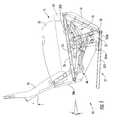
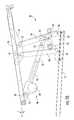
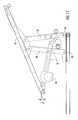
- FIG. 1is a cutaway side view of the reclining chair according to embodiments of the present invention, wherein the chair is shown in an upright position.
- FIG. 2is a cutaway side view of the chair of FIG. 1 in an intermediate position.
- FIG. 3is a cutaway side view of the chair of FIG. 1 in a fully reclined position.
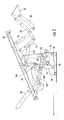
- FIG. 4is a cutaway side view of the reclining and tilt mechanisms of the chair of FIG. 1 , wherein the chair is shown in its upright position.
- FIG. 5is a cutaway side view of the reclining and tilt mechanisms of FIG. 4 , with the chair in the intermediate position of FIG. 2 .
- FIG. 6is a cutaway side view of the reclining and tilt mechanisms of FIG. 4 , with the chair in its fully reclined position.
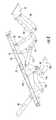
- FIG. 7is a cutaway side view of the reclining mechanism of the chair of FIG. 1 , wherein the chair is shown in its upright position.
- FIG. 8is a cutaway side view of the reclining mechanism of FIG. 7 , with the chair in the intermediate position of FIG. 2 .
- FIG. 9is a cutaway side view of the reclining mechanism of FIG. 7 , with the chair in its fully reclined position.
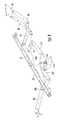
- FIG. 10is a cutaway side view of the tilt mechanism of the chair of FIG. 1 , wherein the chair is shown in its upright position.
- FIG. 11is a cutaway side view of the tilt mechanism of FIG. 10 , with the chair in the intermediate position of FIG. 2 .
- FIG. 12is a cutaway side view of the tilt mechanism of FIG. 11 , with the chair in its fully reclined position.
- FIG. 13is a top view of the chair of FIG. 1 in its upright position.
- spatially relative termssuch as “under”, “below”, “lower”, “over”, “upper” and the like, may be used herein for ease of description to describe one element or feature's relationship to another element(s) or feature(s) as illustrated in the figures. It will be understood that the spatially relative terms are intended to encompass different orientations of the device in use or operation in addition to the orientation depicted in the figures. For example, if the device in the figures is inverted, elements described as “under” or “beneath” other elements or features would then be oriented “over” the other elements or features. Thus, the exemplary term “under” can encompass both an orientation of over and under. The device may be otherwise oriented (rotated 90 degrees or at other orientations) and the spatially relative descriptors used herein interpreted accordingly.
- the chair 10includes a base 12 configured to rest on an underlying surface, a frame 14 that includes two arms 20 , a backrest 16 , a footrest 18 , and a seat 19 having an underlying seat frame 26 . These components are moved via a pair of tilt mechanisms 30 and a pair of reclining mechanisms 70 between an upright position ( FIG. 1 ), an intermediate TV position ( FIG. 2 ), and a fully reclined position ( FIG. 3 ). Components of the chair 10 are described below.
- the base 12includes two rails 202 that are spanned by cross-members 204 a , 204 b .
- a triangular mounting plate 32is mounted to the cross-members 204 a , 204 b inboard of the rails 202 .
- the arms 20 of the frame 14are hollow and are spanned by a cross-member 206 fixed to their rear portions.
- a shim 208is mounted to the inboard surface of each arm 20 .
- Each shim 208is mounted to an adapter link 24 that is fixed to the lateral edge of the seat frame 26 .
- the tilt mechanisms 30will be described first in the upright position, with the orientation of its components in the TV and fully reclined positions described subsequently.
- the tilt mechanisms 30are mirror images of each other about a vertical plane that bisects the chair 10 between the arms 20 ; as such, only one tilt mechanism will be described herein, with the understanding that the description is equally applicable to the tilt mechanism 30 mounted on the opposite side of the chair 10 .
- the tilt mechanism 30includes and is mounted to the base 12 via the mounting plate 32 .
- a front tilt link 34is attached to a mounting plate 32 at a pivot 36 and extends upwardly and somewhat rearwardly therefrom.
- a cross-member 35extends between the front tilt links 34 of the opposed tilt mechanisms 30 .
- the front tilt link 34is attached at a pivot 37 to the adapter link 24 that is fixed to the lateral edge of the seat frame 26 .
- the tilt mechanism 30also includes a rear tilt link 38 that is attached to the mounting plate 32 at a pivot 40 .
- the rear tilt link 38extends upwardly and slightly rearwardly from the pivot 40 to attach to the adapter link 24 at a pivot 41 that is located rearwardly of the pivot 37 .
- a cross-member 42extends between the rear tilt links 38 of the tilt mechanisms 30 on opposite sides of the chair 10 .
- a power actuating unit 46(in this embodiment a linear actuator) comprises a motor 48 , a sleeve 50 and a retractable rod 52 , with the free end of the rod 52 being mounted to the motor bracket 44 at a pivot 54 .
- the motor 48is attached at a pivot 58 to two seat flanges 56 that depend from the rear edge of the seat frame 26 .
- the rod 52In the upright position of FIGS. 1, 4, 7, 10 and 13 , the rod 52 is in an extended position relative to the sleeve 50 .
- the power actuating unit 46is electrically connected with an actuator (not shown), such as a toggle switch or the like, that energizes the power unit 46 upon actuation.
- the seat frame 26has a pitch angle ⁇ with the floor (or other surface underlying the base 12 ) of between about 6 and 12 degrees.
- the backrest 16(as defined by the backpost 98 , described below) forms an angles of between about 50 and 58 degrees with the floor (see FIG. 1 ).
- the reclining mechanisms 70are mirror images of each other about the aforementioned bisecting vertical plane, so only one will be described herein.
- the reclining mechanism 70will be described first in the upright position of FIG. 7 , with its orientation in the TV and fully reclined positions being subsequently described.
- the reclining mechanism 70includes a seat mounting link 72 that is fixed to the inner edge of the rail of the seat frame 26 .
- a rear footrest swing link 74is attached to the seat mounting link 72 at a pivot 76 and extends rearwardly and downwardly therefrom.
- a front footrest swing link 78is attached to the seat mounting link 72 at a pivot 80 and extends rearwardly and downwardly therefrom.
- An upper footrest extension link 82is attached at one end to the rear footrest swing link 74 at a pivot 84 and to the front footrest swing link 78 at a pivot 86 .
- the upper footrest extension link 82extends forwardly and upwardly from the pivot 86 .
- a lower footrest extension link 88is attached to the front footrest swing link 78 at a pivot 90 and extends forwardly and upwardly therefrom.
- a footrest mounting bracket 92is attached to the upper footrest extension link 82 at a pivot 94 and to the lower footrest extension link 88 at a pivot 96 .
- the front surface of the footrest mounting bracket 92faces forwardly and downwardly, with the footrest 18 positioned below and rearward of a frontmost edge of the seat 19 .
- the footrest 18is mounted on the footrest mounting bracket 92 .
- These linkscomprise a pantographic footrest extension linkage that extends the footrest 18 .
- a backpost 98is fixed to the backrest 16 and is attached to the rear end of the seat mounting link 72 at a pivot 100 .
- the lower end of the backpost 98extends downwardly and somewhat forwardly from the pivot 100 .
- a backrest drawing link 102is attached at its rear end to the lower end of the backpost 98 at a pivot 104 .
- a transition link 106is attached to the forward end of the backrest drawing link 102 at a pivot 108 and to a projection 72 a of the seat mounting link 72 at a pivot 110 .
- a footrest drive link 112is attached to the upper, rear end of the transition link 106 at a pivot 114 and to the rear footrest swing link 74 at a pivot 116 .
- a connecting link 118is attached to the lower, forward end of the transition link 106 at a pivot 120 and extends forwardly therefrom to a pivot 122 with the front tilt link 34 (this can be seen in FIG. 4 ).
- the tilting mechanism 30is coupled to the reclining mechanism 70 .
- the relative movement of the seat frame 26 and the front pivot link 34causes the reclining mechanism 70 to extend the footrest 18 .
- the rear end of the seat frame 26moves forwardly, it draws the lower end of the backpost 98 forwardly also, which in turn forces the backrest drawing link 102 forwardly.
- the front pivot link 34rotates clockwise about the pivot 36 , it draws the connecting link 118 forwardly, but to a lesser degree than the backrest drawing link 102 .
- both the backrest drawing link 102 and the connecting link 118are attached to the transition link 106 , the difference in their movements causes the transition link 106 to rotate clockwise about the pivot 110 .
- This movementdrives the footrest drive link 112 forward, which rotates the rear footrest swing link 74 counterclockwise about the pivot 76 .
- the rotation of the rear footrest swing link 74forces the upper footrest extension link 82 forwardly and upwardly; this action draws the front footrest swing link 78 counterclockwise about the pivot 80 .
- Rotation of the front footrest swing link 78drives the lower footrest extension link 88 forwardly and upwardly. Because the lower footrest extension link 88 moves more than does the upper footrest extension link 82 , the footrest mounting bracket 92 , and in turn the footrest 18 rotates counterclockwise to a generally horizontal disposition ( FIG. 8 ).
- the rotation of the transition link 106 about the pivot 110moves the pivot 108 between the transition link 106 and the backrest drawing link 102 upwardly relative to the seat frame 26 , but the pivot 108 does not experience substantial forward or rearward movement relative to the seat frame 26 . Consequently, the backrest 18 stays in generally the same orientation relative to the seat 19 during this portion of the reclining motion (the angular change is typically no more than about 4 degrees).
- the chair 10can be moved to a fully reclined position ( FIGS. 3, 6, 9 and 12 ) by continuing to activate the motor 48 so that the rod 52 continues to retract within the sleeve 50 .
- a fully reclined positionFIGS. 3, 6, 9 and 12
- the motor 48continues to activate the motor 48 so that the rod 52 continues to retract within the sleeve 50 .
- the rod 52draws the rear end of the seat frame 26 lower and farther forward, with such movement being controlled by the front and rear tilt links 34 , 38 as they rotate further clockwise about their respective pivots 36 , 40 .
- the front tilt link 34is substantially vertically disposed, and the seat frame 26 defines an angle ⁇ of between about 28 and 32 degrees with the floor (see FIG. 12 ).
- the transition link 106draws the backrest drawing link 102 forward, which induces the backpost 98 to rotate counterclockwise about the pivot 100 .
- the backpost 98defines an angle ⁇ with the floor of between about 10 and 18 degrees (see FIG. 9 ).
- the chair 10which can stop at any position between the upright position of FIGS. 1, 4, 7 and 10 and the fully reclined position of FIGS. 3, 6, 9 and 12 , is also capable of moving to the “heart-rest” in a similar manner as traditional, non-medical recliner chairs. As can be seen in FIGS. 3, 6, 9 and 12 , the chair 10 reaches a position in which the occupant of the chair is postured such that his legs are elevated to a height equal to or above his heart, with the result that blood is encouraged to flow to the heart rather than pooling in the legs.
- the uppermost portion of the seat 19is between about 1 and 6 inches higher than an uppermost portion of the backrest 16 .
- the chair 10can serve as a health care chair in addition to providing numerous reclined positions, and can do so while configured in a number of modern furniture styles.
- the chairmay take other forms.
- the chairmay have additional footrests rather than the single footrest shown herein, and the footrests may retract below the seat in a different manner.
- the footrestmay also extend more prominently in the intermediate position shown herein.
- the attachment of the power actuating unit to the tilting mechanismmay vary; as an example, the rod of the power actuating unit may attach to the front tilt link rather than the rear tilt link.
- the power actuating unitmay be oriented such that the motor is at the front, rather than the rear.
- the tilting mechanismmay take a different form.
- the adapter linkmay be omitted, such that the front and rear tilt links attached directly to the seat frame.
- the reclining mechanismmay take a different form.
- linkages for extending the footrestmay be employed, including those that may extend the footrest more quickly in the reclining motion relative to the reclining of the backrest.
- differently configured linkages for reclining the backrest relative to the seatmay also be used.
Landscapes
- Health & Medical Sciences (AREA)
- Dentistry (AREA)
- General Health & Medical Sciences (AREA)
- Chairs For Special Purposes, Such As Reclining Chairs (AREA)
Abstract
Description
This application claims priority from U.S. Provisional Patent Application Ser. No. 61/428,063, filed Dec. 29, 2010, the disclosure of which is hereby incorporated herein by reference in its entirety.
The present invention is directed to furniture, and more particularly to seating units for the health care industry.
The advent of home health care has created a need for furniture that provides functional features for the patient as well as more conventional function for others. For example, chairs exist that are capable of reclining in a number of positions in the same manner as traditional, non-medical recliner chairs while being movable to a “heart-rest” position (also known as the Trendellenburg position). The heart-rest position is one in which the occupant of the chair is postured such that his legs are elevated to a height equal to or above his heart, with the result that blood is encouraged to flow to the heart rather than pooling in the legs. This position is often used to treat shock (particularly during dialysis treatments).
One exemplary chair that combines reclining capability with the capacity to move to the heart-rest position is discussed and illustrated in U.S. Pat. No. 5,348,367 to Mizelle. The Mizelle chair includes a relatively simple six-bar linkage system and can stop in any intermediate position between an upright and a fully reclined position. An attendant can then lift the front of the seat frame of the chair to bring the chair into a “heart-rest” position in which the seat frame, back frame and leg rest assume “the position of a lounge chair that has been tilted approximately 45 degrees.” Another exemplary chair, available from Lumex, Inc., utilizes a reclining mechanism from a conventional residential reclining chair. In this chair, the reclining mechanism is configured such that, once the chair is in a fully reclined position (i.e., one in which the backrest and seat have pivoted relative to one another so that the angle therebetween increases), a foot pedal can release the mechanism to continue its reclining motion, with the angle between the backrest and the seat continuing to increase. As a result, the heart-rest position of this chair provides a support surface in which mimics that of a hospital bed. Another exemplary chair, discussed in U.S. Patent Publication No. 20030015893 to Hoffman et al., also utilizes a mechanism from a conventional three-way reclining chair. The chair can move from the fully reclined position to the heart-rest position by pivoting relative to the frame, such that the backrest and seat maintain a similar angle to one another; this pivoting movement is actuated by a foot pedal. A still further exemplary chair with heart-rest position capability is discussed in U.S. Pat. No. 7,114,770 to Hoffman et al.
In view of the foregoing, additional configurations for health care chairs may be desirable.
As a first aspect, embodiments of the invention are directed to a reclining health-care chair. The chair comprises: a base configured to rest on an underlying surface; a frame including a pair of opposed arms; a seat; a backrest; a footrest; a tilting mechanism comprising a plurality of pivotally interconnected links, the tilting mechanism attached to the base and to the seat and configured to control movement of the seat relative to the base; a reclining mechanism comprising a plurality of pivotally interconnected links, the reclining mechanism attached to the backrest, footrest, seat, frame and tilting mechanism to control relative movement of the backrest, footrest, frame and seat relative to the base; and a power actuating unit attached to the seat and to the tilting mechanism. The chair is movable between (a) an upright position, in which the footrest is retracted beneath the seat, the seat defines an angle α relative to the underlying surface, and the backrest defines an angle ε relative to the underlying surface, and (b) a fully reclined position, in which the footrest is extended in front of the seat, the seat defines an angle γ relative to the underlying surface that is greater than the angle α, the backrest defines an angle δ relative to the underlying surface that is less than the angle ε, and the footrest is positioned such that an occupant's feet are higher than the occupant's heart.
As a second aspect, embodiments of the invention are directed to a reclining health-care chair, comprising: a base configured to rest on an underlying surface; a frame including a pair of opposed arms; a seat; a backrest; a footrest; a tilting mechanism comprising a plurality of pivotally interconnected links, the tilting mechanism attached to the base and to the seat and configured to control movement of the seat relative to the base; a reclining mechanism comprising a plurality of pivotally interconnected links, the reclining mechanism attached to the backrest, footrest, seat, frame and tilting mechanism to control relative movement of the backrest, footrest, frame and seat relative to the base; and a power actuating unit attached to the seat and to the tilting mechanism. The chair is movable between (a) an upright position, in which the footrest is retracted beneath the seat, the seat defines an angle α relative to the underlying surface, and the backrest defines an angle ε relative to the underlying surface, and (b) a fully reclined position, in which the footrest is extended in front of the seat, the seat defines an angle γ relative to the underlying surface that is greater than the angle α, the backrest defines an angle δ relative to the underlying surface that is less than the angle ε. An uppermost portion of the seat is between about 1 and 6 inches higher than an uppermost portion of the backrest.
As a third aspect, embodiments of the invention are directed to a reclining health-care chair, comprising: a base configured to rest on an underlying surface; a frame including a pair of opposed arms; a seat; a backrest; a footrest; a tilting mechanism comprising a plurality of pivotally interconnected links, the tilting mechanism attached to the base and to the seat and configured to control movement of the seat relative to the base; a reclining mechanism coupled to the tilting mechanism and comprising a plurality of pivotally interconnected links, the reclining mechanism attached to the backrest, footrest, seat, frame and tilting mechanism to control relative movement of the backrest, footrest, frame and seat relative to the base; and a power actuating unit attached to the seat and to the tilting mechanism. The chair is movable between (a) an upright position, in which the footrest is retracted beneath the seat, the seat defines an angle α relative to the underlying surface, and the backrest defines an angle δ relative to the underlying surface, and (b) a fully reclined position, in which the footrest is extended in front of the seat, the seat defines an angle γ relative to the underlying surface that is greater than the angle α, the backrest defines an angle δ relative to the underlying surface that is less than the angle ε, and the footrest is positioned such that an occupant's feet are higher than the occupant's heart.
The present invention will be described more particularly hereinafter with reference to the accompanying drawings. The invention is not intended to be limited to the illustrated embodiments; rather, these embodiments are intended to fully and completely disclose the invention to those skilled in this art. In the drawings, like numbers refer to like elements throughout. Thicknesses and dimensions of some components may be exaggerated for clarity. Well-known functions or constructions may not be described in detail for brevity and/or clarity.
Unless otherwise defined, all terms (including technical and scientific terms) used herein have the same meaning as commonly understood by one of ordinary skill in the art to which this invention belongs. It will be further understood that terms, such as those defined in commonly used dictionaries, should be interpreted as having a meaning that is consistent with their meaning in the context of the relevant art and will not be interpreted in an idealized or overly formal sense unless expressly so defined herein.
In addition, spatially relative terms, such as “under”, “below”, “lower”, “over”, “upper” and the like, may be used herein for ease of description to describe one element or feature's relationship to another element(s) or feature(s) as illustrated in the figures. It will be understood that the spatially relative terms are intended to encompass different orientations of the device in use or operation in addition to the orientation depicted in the figures. For example, if the device in the figures is inverted, elements described as “under” or “beneath” other elements or features would then be oriented “over” the other elements or features. Thus, the exemplary term “under” can encompass both an orientation of over and under. The device may be otherwise oriented (rotated 90 degrees or at other orientations) and the spatially relative descriptors used herein interpreted accordingly.
The terminology used herein is for the purpose of describing particular embodiments only and is not intended to be limiting of the invention. As used herein, the singular forms “a”, “an” and “the” are intended to include the plural forms as well, unless the context clearly indicates otherwise. It will be further understood that the terms “comprises” and/or “comprising,” when used in this specification, specify the presence of stated features, integers, steps, operations, elements, and/or components, but do not preclude the presence or addition of one or more other features, integers, steps, operations, elements, components, and/or groups thereof. As used herein the expression “and/or” includes any and all combinations of one or more of the associated listed items.
Where used, the terms “attached”, “connected”, “interconnected”, “contacting”, “coupled”, “mounted” and the like can mean either direct or indirect attachment or contact between elements, unless stated otherwise.
In addition, some components of the seating units described herein (particularly mechanisms thereof) are illustrated herein as a series of pivotally interconnected links or members. Those skilled in this art will appreciate that the pivots between links or other components can take a variety of configurations, such as pivot pins, rivets, bolt and nut combinations, and the like, any of which may be suitable for use with the present invention. Also, the shapes and configurations of the links themselves may vary, as will be understood by those skilled in this art. Further, some links may be omitted entirely in some embodiments, and additional links may be included in some embodiments.
Referring now to the drawings, a chair, designated broadly at10, is illustrated inFIGS. 1-3 . Thechair 10 includes a base12 configured to rest on an underlying surface, aframe 14 that includes twoarms 20, abackrest 16, afootrest 18, and aseat 19 having anunderlying seat frame 26. These components are moved via a pair oftilt mechanisms 30 and a pair ofreclining mechanisms 70 between an upright position (FIG. 1 ), an intermediate TV position (FIG. 2 ), and a fully reclined position (FIG. 3 ). Components of thechair 10 are described below.
Referring toFIGS. 1 and 13 , thebase 12 includes tworails 202 that are spanned bycross-members plate 32 is mounted to the cross-members204a,204binboard of therails 202.
Still referring toFIGS. 1 and 13 , thearms 20 of theframe 14 are hollow and are spanned by a cross-member206 fixed to their rear portions. Ashim 208 is mounted to the inboard surface of eacharm 20. Eachshim 208 is mounted to anadapter link 24 that is fixed to the lateral edge of theseat frame 26.
Referring now toFIG. 10 , thetilt mechanisms 30 will be described first in the upright position, with the orientation of its components in the TV and fully reclined positions described subsequently. Thetilt mechanisms 30 are mirror images of each other about a vertical plane that bisects thechair 10 between thearms 20; as such, only one tilt mechanism will be described herein, with the understanding that the description is equally applicable to thetilt mechanism 30 mounted on the opposite side of thechair 10.
Referring still toFIG. 10 , thetilt mechanism 30 includes and is mounted to thebase 12 via the mountingplate 32. Afront tilt link 34 is attached to a mountingplate 32 at apivot 36 and extends upwardly and somewhat rearwardly therefrom. A cross-member35 extends between the front tilt links34 of theopposed tilt mechanisms 30. At its upper end, thefront tilt link 34 is attached at apivot 37 to theadapter link 24 that is fixed to the lateral edge of theseat frame 26. Thetilt mechanism 30 also includes arear tilt link 38 that is attached to the mountingplate 32 at apivot 40. Therear tilt link 38 extends upwardly and slightly rearwardly from thepivot 40 to attach to theadapter link 24 at apivot 41 that is located rearwardly of thepivot 37. A cross-member42 extends between the rear tilt links38 of thetilt mechanisms 30 on opposite sides of thechair 10.
Referring still toFIG. 10 and toFIG. 13 , twomotor brackets 44 are fixed to the forward surface of the cross-member42. A power actuating unit46 (in this embodiment a linear actuator) comprises amotor 48, asleeve 50 and aretractable rod 52, with the free end of therod 52 being mounted to themotor bracket 44 at apivot 54. Themotor 48 is attached at apivot 58 to twoseat flanges 56 that depend from the rear edge of theseat frame 26. In the upright position ofFIGS. 1, 4, 7, 10 and 13 , therod 52 is in an extended position relative to thesleeve 50. Thepower actuating unit 46 is electrically connected with an actuator (not shown), such as a toggle switch or the like, that energizes thepower unit 46 upon actuation.
In the upright position ofFIG. 10 , theseat frame 26 has a pitch angle α with the floor (or other surface underlying the base12) of between about 6 and 12 degrees. The backrest16 (as defined by the backpost98, described below) forms an angles of between about 50 and 58 degrees with the floor (seeFIG. 1 ).
Referring now toFIG. 7 , like thetilt mechanisms 30, thereclining mechanisms 70 are mirror images of each other about the aforementioned bisecting vertical plane, so only one will be described herein. Thereclining mechanism 70 will be described first in the upright position ofFIG. 7 , with its orientation in the TV and fully reclined positions being subsequently described.
Referring still toFIG. 7 , thereclining mechanism 70 includes aseat mounting link 72 that is fixed to the inner edge of the rail of theseat frame 26. A rearfootrest swing link 74 is attached to theseat mounting link 72 at apivot 76 and extends rearwardly and downwardly therefrom. Similarly, a frontfootrest swing link 78 is attached to theseat mounting link 72 at apivot 80 and extends rearwardly and downwardly therefrom. An upperfootrest extension link 82 is attached at one end to the rearfootrest swing link 74 at apivot 84 and to the frontfootrest swing link 78 at apivot 86. The upperfootrest extension link 82 extends forwardly and upwardly from thepivot 86. A lowerfootrest extension link 88 is attached to the frontfootrest swing link 78 at apivot 90 and extends forwardly and upwardly therefrom. Afootrest mounting bracket 92 is attached to the upper footrest extension link82 at apivot 94 and to the lower footrest extension link88 at apivot 96. In the upright position ofFIG. 7 , the front surface of thefootrest mounting bracket 92 faces forwardly and downwardly, with thefootrest 18 positioned below and rearward of a frontmost edge of theseat 19. As can be seen inFIG. 1 , thefootrest 18 is mounted on thefootrest mounting bracket 92. These links comprise a pantographic footrest extension linkage that extends thefootrest 18.
Referring again toFIG. 7 , a backpost98 is fixed to thebackrest 16 and is attached to the rear end of theseat mounting link 72 at apivot 100. The lower end of the backpost98 extends downwardly and somewhat forwardly from thepivot 100. Abackrest drawing link 102 is attached at its rear end to the lower end of the backpost98 at apivot 104. Atransition link 106 is attached to the forward end of thebackrest drawing link 102 at apivot 108 and to aprojection 72aof theseat mounting link 72 at apivot 110. Afootrest drive link 112 is attached to the upper, rear end of thetransition link 106 at apivot 114 and to the rearfootrest swing link 74 at apivot 116. A connectinglink 118 is attached to the lower, forward end of thetransition link 106 at apivot 120 and extends forwardly therefrom to apivot 122 with the front tilt link34 (this can be seen inFIG. 4 ). Thus, thetilting mechanism 30 is coupled to thereclining mechanism 70.
To move thechair 10 from the upright position ofFIGS. 1, 4, 7 and 10 to the intermediate position shown inFIGS. 2, 5, 8 and 11 , an occupant of thechair 10 actuates themotor 48 of thepower unit 46, thereby causing therod 52 to begin to retract into thesleeve 50. Retraction of therod 52 draws the rear end of theseat frame 26 forwardly and downwardly, which in turn forces therear tilt link 38 and thefront tilt link 34 to pivot (clockwise from the vantage point of the figures) about, respectively, thepivots seat frame 26 upwardly as it moves forward. As can be seen inFIG. 11 , in this intermediate position the seat frame26 (and, in turn, the seat19) defines an angle β with the floor of between about 20 and 25 degrees, which is an angular change of between about 10 and 15 degrees from its orientation in the upright position.
In addition, the relative movement of theseat frame 26 and thefront pivot link 34 causes thereclining mechanism 70 to extend thefootrest 18. Referring toFIGS. 7 and 8 , as the rear end of theseat frame 26 moves forwardly, it draws the lower end of the backpost98 forwardly also, which in turn forces thebackrest drawing link 102 forwardly. As thefront pivot link 34 rotates clockwise about thepivot 36, it draws the connectinglink 118 forwardly, but to a lesser degree than thebackrest drawing link 102. As both thebackrest drawing link 102 and the connectinglink 118 are attached to thetransition link 106, the difference in their movements causes thetransition link 106 to rotate clockwise about thepivot 110. This movement drives thefootrest drive link 112 forward, which rotates the rearfootrest swing link 74 counterclockwise about thepivot 76. The rotation of the rearfootrest swing link 74 forces the upperfootrest extension link 82 forwardly and upwardly; this action draws the frontfootrest swing link 78 counterclockwise about thepivot 80. Rotation of the frontfootrest swing link 78 drives the lowerfootrest extension link 88 forwardly and upwardly. Because the lowerfootrest extension link 88 moves more than does the upperfootrest extension link 82, thefootrest mounting bracket 92, and in turn thefootrest 18 rotates counterclockwise to a generally horizontal disposition (FIG. 8 ).
Notably, during this portion of the movement of thereclining mechanism 70, the rotation of thetransition link 106 about thepivot 110 moves thepivot 108 between thetransition link 106 and the backrest drawing link102 upwardly relative to theseat frame 26, but thepivot 108 does not experience substantial forward or rearward movement relative to theseat frame 26. Consequently, thebackrest 18 stays in generally the same orientation relative to theseat 19 during this portion of the reclining motion (the angular change is typically no more than about 4 degrees).
Thechair 10 can be moved to a fully reclined position (FIGS. 3, 6, 9 and 12 ) by continuing to activate themotor 48 so that therod 52 continues to retract within thesleeve 50. Continued retraction of therod 52 draws the rear end of theseat frame 26 lower and farther forward, with such movement being controlled by the front and rear tilt links34,38 as they rotate further clockwise about theirrespective pivots front tilt link 34 is substantially vertically disposed, and theseat frame 26 defines an angle γ of between about 28 and 32 degrees with the floor (seeFIG. 12 ).
In addition, further retraction of therod 52 and accompanying movement of theseat frame 26 causes further clockwise rotation of thetransition link 106 about thepivot 110. This movement forces thefootrest drive link 112 forward, which, via the footrest swing links74,78 and footrest extension links82,88, causes thefootrest 18 to extend fully in front of theseat 19 and rotate to a substantially horizontal position.
Further, rotation of thetransition link 106 draws thebackrest drawing link 102 forward, which induces the backpost98 to rotate counterclockwise about thepivot 100. In its fully reclined position, the backpost98 defines an angle δ with the floor of between about 10 and 18 degrees (seeFIG. 9 ).
The advent of home health care has created a need for furniture that provides functional features for the patient as well as more conventional function for others. Thechair 10, which can stop at any position between the upright position ofFIGS. 1, 4, 7 and 10 and the fully reclined position ofFIGS. 3, 6, 9 and 12 , is also capable of moving to the “heart-rest” in a similar manner as traditional, non-medical recliner chairs. As can be seen inFIGS. 3, 6, 9 and 12 , thechair 10 reaches a position in which the occupant of the chair is postured such that his legs are elevated to a height equal to or above his heart, with the result that blood is encouraged to flow to the heart rather than pooling in the legs. In some embodiments, the uppermost portion of theseat 19 is between about 1 and 6 inches higher than an uppermost portion of thebackrest 16. Thus, thechair 10 can serve as a health care chair in addition to providing numerous reclined positions, and can do so while configured in a number of modern furniture styles.
Those skilled in this art will appreciate that the chair may take other forms. For example, in some embodiments, the chair may have additional footrests rather than the single footrest shown herein, and the footrests may retract below the seat in a different manner. The footrest may also extend more prominently in the intermediate position shown herein.
In some embodiments, the attachment of the power actuating unit to the tilting mechanism may vary; as an example, the rod of the power actuating unit may attach to the front tilt link rather than the rear tilt link. Alternatively, the power actuating unit may be oriented such that the motor is at the front, rather than the rear.
Further, the tilting mechanism may take a different form. For example, there may be intermediate links between the front and rear tilt links and the seat. As another example, in some embodiments the adapter link may be omitted, such that the front and rear tilt links attached directly to the seat frame.
Moreover, the reclining mechanism may take a different form. Those skilled in this art will appreciate that other linkages for extending the footrest may be employed, including those that may extend the footrest more quickly in the reclining motion relative to the reclining of the backrest. Also, differently configured linkages for reclining the backrest relative to the seat may also be used.
The foregoing is illustrative of the present invention and is not to be construed as limiting thereof. Although exemplary embodiments of this invention have been described, those skilled in the art will readily appreciate that many modifications are possible in the exemplary embodiments without materially departing from the novel teachings and advantages of this invention. Accordingly, all such modifications are intended to be included within the scope of this invention as defined in the claims. The invention is defined by the following claims, with equivalents of the claims to be included therein.
Claims (17)
1. A reclining health-care chair, comprising:
a base configured to rest on an underlying surface;
a frame including a pair of opposed arms;
a seat fixed to a rigid seat frame assembly;
a backrest;
a footrest;
a tilting mechanism comprising front and rear tilt links directly pivotally attached to the base and to the seat frame assembly and forming a four-bar linkage, the tilting mechanism configured to control movement of the seat relative to the base;
a reclining mechanism comprising a plurality of pivotally interconnected links, the reclining mechanism attached to the backrest, footrest, seat, frame and tilting mechanism to control relative movement of the backrest, footrest, and frame relative to the base and the seat; and
a power actuating unit attached directly to the seat and directly to at least one of the front and rear tilt links of the tilting mechanism;
wherein the chair is movable between (a) an upright position, in which the footrest is retracted beneath the seat, the seat defines an angle α relative to the underlying surface, and the backrest defines an angleε relative to the underlying surface, and (b) a fully reclined position, in which the footrest is extended in front of the seat, the seat defines an angle γ relative to the underlying surface that is greater than the angle α, with a rear end of the seat lower than in the upright position, the backrest defines an angle δ relative to the underlying surface that is less than the angle ε, and the footrest is positioned such that an occupant's feet are higher than the occupant's heart;
wherein at least one of the pivotally interconnected links is directly pivotally attached to at least one of the front and rear tilt links such that in moving from the upright position to the fully reclined position, forward rotation of the front and rear tilt links gradually increases the angle of the seat between the angle α and the angle γ.
2. The chair defined inclaim 1 , wherein the power actuating unit is a linear actuator.
3. The chair defined inclaim 2 , wherein the power actuating unit includes a rod and a sleeve, and wherein the rod is in a retracted position relative to the sleeve when the chair is in its fully reclined position.
4. The chair defined inclaim 1 , wherein the power actuating unit is coupled to the rear tilt link.
5. The chair defined inclaim 1 , wherein the chair has only a single footrest.
6. The chair defined inclaim 5 , wherein the footrest is positioned below and behind a frontmost edge of the seat when the chair is in the upright position.
7. The chair defined inclaim 6 , wherein the footrest faces forwardly and downwardly when the chair is in the upright position.
8. The chair defined inclaim 1 , wherein, in moving from the upright position to the fully reclined position, the chair moves to an intermediate position in which the footrest extends in front of the seat as the backrest substantially maintains its orientation relative to the seat such that the difference between α and ε is generally the same as in the upright position and the seat defines an angle β relative to the underlying surface that is between about 20 and 25 degrees.
9. The chair defined inclaim 1 , wherein the reclining mechanism comprises a connecting link pivotally attached to the tilting mechanism, a transition link pivotally attached to the connecting link, a footrest drive link pivotally attached to the transition link, a backrest drawing link pivotally attached to the transition link and to the backrest, wherein the footrest drive link is pivotally attached to a pantographic footrest linkage that retracts and extends the footrest.
10. The chair defined inclaim 1 , wherein δ is between about 10 and 18 degrees, and γ is between about 28 and 32 degrees.
11. The chair defined inclaim 10 , wherein α is between about 6 and 12 degrees, and ε is between about 50 and 58 degrees.
12. A reclining health-care chair, comprising:
a base configured to rest on an underlying surface;
a frame including a pair of opposed arms;
a seat fixed to a rigid seat frame assembly;
a backrest;
a footrest;
a tilting mechanism comprising front and rear tilt links directly pivotally attached to the base and to the seat frame assembly and forming a four-bar linkage, the tilting mechanism configured to control movement of the seat relative to the base;
a reclining mechanism comprising a plurality of pivotally interconnected links, the reclining mechanism attached to the backrest, footrest, seat, frame and tilting mechanism to control relative movement of the backrest, footrest, and frame and seat relative to the seat and the base; and
a power actuating unit attached directly to the seat and directly to at least one of the front and rear tilt links of the tilting mechanism;
wherein the chair is movable between (a) an upright position, in which the footrest is retracted beneath the seat, the seat defines an angle α relative to the underlying surface, and the backrest defines an angle ε relative to the underlying surface, and (b) a fully reclined position, in which the footrest is extended in front of the seat, the seat defines an angle γ relative to the underlying surface that is greater than the angle α, with a rear end of the seat lower than in the upright position, the backrest defines an angle δ relative to the underlying surface that is less than the angle ε, and an uppermost portion of the seat is between about 1 and 6 inches higher than an uppermost portion of the backrest;
wherein at least one of the pivotally interconnected links is directly attatched to at least one of the front and rear tilt links such that in moving from the upright position to the fully reclined position, forward rotation of the front and rear tilt links gradually increases the angle of the seat between the angle α and the angle γ.
13. The chair defined inclaim 12 , wherein δ is between about 10 and 18 degrees, and γ is between about 28 and 32 degrees.
14. The chair defined inclaim 13 , wherein α is between about 6 and 12 degrees, and ε is between about 50 and 58 degrees.
15. The chair defined inclaim 12 , wherein the tilting mechanism is coupled to the reclining mechanism.
16. The chair defined inclaim 12 , wherein the reclining mechanism comprises a connecting link pivotally attached to the tilting mechanism, a transition link pivotally attached to the connecting link, a footrest drive link pivotally attached to the transition link, a backrest drawing link pivotally attached to the transition link and to the backrest, wherein the footrest drive link is pivotally attached to a pantographic footrest linkage that retracts and extends the footrest.
17. A reclining health-care chair, comprising:
a base configured to rest on an underlying surface;
a frame including a pair of opposed arms;
a seat fixed to a rigid seat frame assembly;
a backrest;
a footrest;
a tilting mechanism comprising front and rear tilt links directly pivotally attached to the base and to the seat frame assembly and forming a four-bar linkage, the tilting mechanism configured to control movement of the seat relative to the base;
a reclining mechanism coupled to the tilting mechanism and comprising a plurality of pivotally interconnected links, the reclining mechanism attached to the backrest, footrest, seat, frame and tilting mechanism to control relative movement of the backrest, footrest, and frame and seat relative to the seat and the base; and
a power actuating unit attached directly to the seat and directly to at least one of the front and rear tilt links of the tilting mechanism;
wherein the chair is movable between (a) an upright position, in which the footrest is retracted beneath the seat, the seat defines an angle α relative to the underlying surface, and the backrest defines an angle ε relative to the underlying surface, and (b) a fully reclined position, in which the footrest is extended in front of the seat, the seat defines an angle γ relative to the underlying surface that is greater than the angle α, with a rear end of the seat lower than in the upright position, the backrest defines an angle δ relative to the underlying surface that is less than the angle ε, and the footrest is positioned such that an occupant's feet are higher than the occupant's heart;
wherein at least one of the pivotally interconnected links is directly pivotally attached to at least one of the front and rear tilt links such that in moving from the upright position to the fully reclined position, forward rotation of the front and rear tilt links gradually increases the angle of the seat between the angle α and the angle γ.
Priority Applications (1)
| Application Number | Priority Date | Filing Date | Title |
|---|---|---|---|
| US13/338,398US9603453B2 (en) | 2010-12-29 | 2011-12-28 | Reclining chair with tilting action to provide heart-rest position |
Applications Claiming Priority (2)
| Application Number | Priority Date | Filing Date | Title |
|---|---|---|---|
| US201061428063P | 2010-12-29 | 2010-12-29 | |
| US13/338,398US9603453B2 (en) | 2010-12-29 | 2011-12-28 | Reclining chair with tilting action to provide heart-rest position |
Publications (2)
| Publication Number | Publication Date |
|---|---|
| US20120286557A1 US20120286557A1 (en) | 2012-11-15 |
| US9603453B2true US9603453B2 (en) | 2017-03-28 |
Family
ID=47141393
Family Applications (1)
| Application Number | Title | Priority Date | Filing Date |
|---|---|---|---|
| US13/338,398Active2033-05-08US9603453B2 (en) | 2010-12-29 | 2011-12-28 | Reclining chair with tilting action to provide heart-rest position |
Country Status (1)
| Country | Link |
|---|---|
| US (1) | US9603453B2 (en) |
Cited By (8)
| Publication number | Priority date | Publication date | Assignee | Title |
|---|---|---|---|---|
| US20160157613A1 (en)* | 2014-12-08 | 2016-06-09 | Ferdinand Lusch Gmbh & Co. Kg | Piece of Seating Furniture Having a Pivotable Functional Part |
| US10299597B1 (en)* | 2018-02-13 | 2019-05-28 | L&P Property Management Company | High-leg hidden ottoman recliner seating mechanism |
| US20200345143A1 (en)* | 2019-04-30 | 2020-11-05 | Herardony St-Fleur | Foldable multifunction chair |
| US11109681B2 (en)* | 2019-12-30 | 2021-09-07 | Changzhou Zehui Machinery Co., Ltd | Self-locking mechanism and lift chair therewith |
| US11166562B2 (en)* | 2020-01-18 | 2021-11-09 | Changzhou Zehui Machinery Co., Ltd | Footrest driving apparatus and lift chair therewith |
| US20230010099A1 (en)* | 2021-07-08 | 2023-01-12 | Ultra-Mek, Inc. | Reclining seating unit with wall-proximity capability and extendable headrest |
| IT202200011981A1 (en) | 2022-06-07 | 2023-12-07 | Form Design S R L | Semi-automated control system for an intelligent motorized recliner and related application methods |
| US12325336B2 (en) | 2020-11-18 | 2025-06-10 | Magna Seating Inc. | Seat assembly with zero-gravity position |
Families Citing this family (49)
| Publication number | Priority date | Publication date | Assignee | Title |
|---|---|---|---|---|
| WO2009158018A1 (en)* | 2008-06-27 | 2009-12-30 | Kreg Medical, Inc. | Bed with modified foot deck |
| US8833844B2 (en)* | 2010-04-13 | 2014-09-16 | La-Z-Boy Incorporated | Power actuated glider furniture member |
| US9603453B2 (en)* | 2010-12-29 | 2017-03-28 | Ultra-Mek, Inc. | Reclining chair with tilting action to provide heart-rest position |
| US8696054B2 (en)* | 2011-05-24 | 2014-04-15 | L & P Property Management Company | Enhanced compatibility for a linkage mechanism |
| DE102012105717A1 (en) | 2012-06-28 | 2014-01-02 | Dewertokin Gmbh | Electromotive furniture drive |
| WO2014152550A2 (en) | 2013-03-15 | 2014-09-25 | Stryker Corporation | Medical support apparatus |
| CN103239806B (en)* | 2013-05-15 | 2016-01-13 | 李世轩 | A kind of chair |
| US9433294B2 (en) | 2013-08-21 | 2016-09-06 | L & P Property Management Company | Reclining and ottoman-extending chair mechanism |
| US9398810B2 (en) | 2013-08-21 | 2016-07-26 | L & P Property Management Company | Reclining and ottoman-extending chair mechanism |
| US9326606B2 (en)* | 2013-09-19 | 2016-05-03 | La-Z-Boy Incorporated | Furniture member power mechanism with zero gravity and rear tilt positions |
| CN103584546B (en)* | 2013-09-23 | 2016-01-27 | 浙江永艺家具股份有限公司 | Seat and backrest installation structure thereof |
| US9839292B2 (en) | 2014-04-08 | 2017-12-12 | John Hart Miller | Rotating and non-rotating reclining chairs w/tilting mechanisms |
| US10179077B2 (en) | 2014-04-18 | 2019-01-15 | Kreg Medical, Inc. | Patient support with stand-up and sit features |
| US10021980B2 (en) | 2014-07-22 | 2018-07-17 | L&P Property Management Company | Zero-wall clearance linkage mechanism with power seat drive |
| US9433295B2 (en) | 2014-10-15 | 2016-09-06 | Michael A. Crum | Zerowall motorized multi-position recliner chair mechanism |
| CN104523059B (en)* | 2014-12-16 | 2017-02-01 | 东莞市捷科五金有限公司 | Multifunctional supporting device for seat |
| US9845852B2 (en)* | 2015-03-20 | 2017-12-19 | L&P Property Management Company | Motorized positioning apparatus for a seating unit |
| US10118508B2 (en)* | 2015-05-14 | 2018-11-06 | Vip Cinema, Llc | Motor driven sloped floor recline mechanism for a theater seat |
| AU2016262623A1 (en) | 2015-05-14 | 2017-11-09 | VIP Cinema LLC | Dual motion sloped floor recline mechanism for a theater |
| US9795528B1 (en)* | 2015-11-05 | 2017-10-24 | Images Of America, Inc. | Bariatric lift chair |
| US11178487B2 (en) | 2015-11-19 | 2021-11-16 | The Lovesac Company | Electronic furniture systems with integrated induction charger |
| US10123621B2 (en) | 2015-11-19 | 2018-11-13 | The Lovesac Company | Furniture system recliner assembly with sled rails |
| US10979241B2 (en)* | 2015-11-19 | 2021-04-13 | The Lovesac Company | Electronic furniture systems with integrated artificial intelligence |
| US10143307B2 (en) | 2015-11-19 | 2018-12-04 | The Lovesac Company | Furniture system with recliner assembly |
| US10212519B2 (en) | 2015-11-19 | 2019-02-19 | The Lovesac Company | Electronic furniture systems with integrated internal speakers |
| US11832039B2 (en) | 2021-04-12 | 2023-11-28 | The Lovesac Company | Tuning calibration technology for systems and methods for acoustically correcting sound loss through fabric |
| US11689856B2 (en) | 2015-11-19 | 2023-06-27 | The Lovesac Company | Electronic furniture systems with integrated induction charger |
| US10236643B2 (en) | 2015-11-19 | 2019-03-19 | The Lovesac Company | Electrical hub for furniture assemblies |
| US11178486B2 (en) | 2015-11-19 | 2021-11-16 | The Lovesac Company | Modular furniture speaker assembly with reconfigurable transverse members |
| US10021979B2 (en) | 2016-02-22 | 2018-07-17 | John Hart Miller | Rotating and non-rotating reclining chairs with tilting mechanisms |
| US11266245B2 (en) | 2016-07-29 | 2022-03-08 | Leggett & Platt, Inc. | Rocker/glider recliner linkage with projected back pivot point |
| US10420422B2 (en)* | 2016-07-29 | 2019-09-24 | L&P Property Management Company | Recliner chair having improved wall clearance and recline linkage with projected back pivot point |
| EP3537930A4 (en)* | 2016-12-12 | 2020-07-22 | Ultra-mek, Inc. | POWER SUPPORT TILTABLE LIFT WITH DIVIDED SEAT |
| MX2019008275A (en)* | 2017-01-26 | 2019-12-02 | Ultra Mek Inc | Reclining high-leg seating unit. |
| US10694897B2 (en)* | 2017-03-22 | 2020-06-30 | Andrew J Hart Enterprises Limited | Bath transfer chair |
| CN107157163B (en)* | 2017-06-19 | 2023-08-04 | 海宁美惠机械有限公司 | Double motor liftable elderly chair |
| US10729246B2 (en) | 2017-12-21 | 2020-08-04 | Stryker Corporation | Person support apparatus with shear-reducing pivot assembly |
| US10881209B2 (en) | 2018-01-12 | 2021-01-05 | L&P Property Management Company | Recliner seating mechanism with seat extension |
| US11284721B2 (en)* | 2019-03-29 | 2022-03-29 | L&P Property Management Company | Disengagement and reengagement mechanism on motorized seating unit for selective manual control |
| US11517109B2 (en) | 2019-03-29 | 2022-12-06 | L&P Property Management Company | Disengagement and reengagement mechanism on motorized seating unit for selective manual control |
| DE202019101920U1 (en)* | 2019-04-03 | 2020-07-06 | Innotec Motion GmbH | Seating furniture chassis |
| US10842274B1 (en) | 2019-05-20 | 2020-11-24 | L&P Property Management Company | Zero-wall clearance linkage mechanism with power seat drive |
| US10932570B2 (en) | 2019-05-20 | 2021-03-02 | L&P Property Management Company | Zero-wall clearance linkage mechanism with power seat drive |
| EP4175513A4 (en)* | 2020-07-30 | 2024-11-27 | L & P Property Management Company | RELEASE AND RETURN MECHANISM ON A MOTORIZED SEAT UNIT FOR SELECTIVE MANUAL CONTROL |
| US11832726B2 (en)* | 2021-05-26 | 2023-12-05 | Ultra-Mek, Inc. | Seating unit with extendable footrest |
| US11647840B2 (en) | 2021-06-16 | 2023-05-16 | The Lovesac Company | Furniture console and methods of using the same |
| CA3157037A1 (en)* | 2021-11-30 | 2023-05-30 | Dewertokin Technology Group Co., Ltd. | Seat frame |
| US12396557B2 (en) | 2022-04-11 | 2025-08-26 | The Lovesac Company | Modular furniture and reclining assemblies |
| CN119997847A (en)* | 2022-07-21 | 2025-05-13 | 厄特拉-梅克股份有限公司 | Reclining chair with tilting motion to provide heart rest position |
Citations (91)
| Publication number | Priority date | Publication date | Assignee | Title |
|---|---|---|---|---|
| GB625003A (en)* | 1944-10-11 | 1949-06-20 | Anton Lorenz | An improved reclining chair or like article of furniture |
| US2714922A (en)* | 1952-10-17 | 1955-08-09 | Joseph L Mckibban | Adjustable reclining chair |
| US2804910A (en)* | 1954-01-18 | 1957-09-03 | Simmons Co | Lounge chair |
| US3166352A (en)* | 1963-01-24 | 1965-01-19 | Dual Mfg & Eng | Reclining chair |
| US3433527A (en)* | 1967-04-17 | 1969-03-18 | Dual Mfg & Eng | Reclining mechanism for t-cushion chair |
| US3476495A (en)* | 1967-05-17 | 1969-11-04 | Lane Co Inc | Reclining chair |
| US3493264A (en)* | 1968-04-25 | 1970-02-03 | Dual Mfg & Eng | T-cushion rocker/reclining chair |
| US3572823A (en)* | 1969-01-03 | 1971-03-30 | Lear Siegler Inc | Reclining chair |
| US3845945A (en)* | 1972-11-06 | 1974-11-05 | W Lawley | Obstetrical examining chair and examination method |
| US3934929A (en)* | 1974-09-03 | 1976-01-27 | Sybron Corporation | Adjustable dental chair |
| US3934927A (en)* | 1974-10-29 | 1976-01-27 | Arizona Lounger Company | Powered tilting lounger |
| US4061397A (en)* | 1975-03-11 | 1977-12-06 | Michael Roland Lewis | Drive mechanism for reclining chairs |
| US4099776A (en)* | 1976-03-15 | 1978-07-11 | Leggett & Platt, Incorporated | Control assembly for a reclining chair |
| US4153292A (en)* | 1975-02-11 | 1979-05-08 | La-Z-Boy Chair Company | Recliner chair |
| US4212494A (en) | 1978-07-24 | 1980-07-15 | Kroehler Mfg. Co. | Rocker reclining chair with multi-position rocker lock |
| US4291913A (en)* | 1979-10-09 | 1981-09-29 | Mohasco, Corp. | Manually-operated reclining chairs |
| US4660883A (en)* | 1985-10-16 | 1987-04-28 | Hickory Springs Manufacturing Company, Inc. | Safety platform arrangement for recliner |
| US4674794A (en)* | 1986-04-30 | 1987-06-23 | Action Industries, Inc. | Resiliently releasing ottoman for motion chair |
| US4740031A (en)* | 1986-09-05 | 1988-04-26 | Parma Corporation | Mechanism for a reclining chair or sofa module |
| US4815788A (en)* | 1987-06-25 | 1989-03-28 | Super Sagless Corp. | Three-way incliner |
| US4852939A (en)* | 1987-10-23 | 1989-08-01 | Orthokinetics, Inc. | Device for converting a recliner chair to a recliner-lift chair |
| US4878710A (en)* | 1988-07-11 | 1989-11-07 | Super Sagless Corporation | Wall proximity chair |
| US4949408A (en) | 1989-09-29 | 1990-08-21 | Trkla Theodore A | All purpose wheelchair |
| US5015035A (en)* | 1988-12-14 | 1991-05-14 | Siemens Aktiengesellschaft | Dental patient chair |
| US5165753A (en)* | 1991-01-02 | 1992-11-24 | Henderson Eldred D | Elevator chair apparatus |
| US5309583A (en)* | 1993-06-10 | 1994-05-10 | Johnny White | Powered lift toilet seat |
| US5312153A (en)* | 1990-07-23 | 1994-05-17 | Ortho-Kinetics, Inc. | Recline lift wall hugger chair |
| US5348367A (en)* | 1991-07-01 | 1994-09-20 | Lumex, Inc. | Reclining chair mechanism |
| US5419611A (en)* | 1992-10-09 | 1995-05-30 | Super Sagless Corporation | Footrest assembly for reclining chair |
| US5628546A (en)* | 1994-04-27 | 1997-05-13 | Dentech Products, Inc. | Dental patient's chair |
| US5704686A (en) | 1995-10-17 | 1998-01-06 | The Lane Company, Inc. | Gliding reclining chair |
| US5775775A (en)* | 1995-09-14 | 1998-07-07 | Ultra-Mek, Inc. | Reclining seating unit and method for constructing same |
| US5865457A (en) | 1997-01-08 | 1999-02-02 | La-Z-Boy Incorporated | Wheeled health care chair |
| US5868461A (en) | 1997-05-06 | 1999-02-09 | Broda Enterprises Inc. | Reclining chair |
| US5931535A (en)* | 1998-01-30 | 1999-08-03 | Dacor Manufacturing Company, Inc. | Clinical care recliner |
| US5971482A (en)* | 1997-10-02 | 1999-10-26 | Invacare Corporation | Constant center of gravity tiltable chair of a wheelchair |
| US5992930A (en)* | 1997-05-13 | 1999-11-30 | La-Z-Boy Incorporated | Wall proximity reclining chair |
| US5992931A (en)* | 1991-10-11 | 1999-11-30 | La-Z-Boy Incorporated | Modular power reclining chair |
| US5992934A (en)* | 1995-11-29 | 1999-11-30 | Sirona Dental Systems Gmbh & Co. Kg | Device for adjusting the forcibly coupled seat and back of a dentist chair |
| US6003891A (en)* | 1996-11-12 | 1999-12-21 | Invacare Corporation | Tilt wheelchair with center of gravity compensation |
| US6120095A (en) | 1998-08-11 | 2000-09-19 | Rogers; W. Clark | Gliding seating unit with hinged gliding members |
| US6142558A (en)* | 1998-04-07 | 2000-11-07 | Action Industries, Inc. | Recliner with primary and secondary ottomans |
| US6154899A (en) | 1998-10-19 | 2000-12-05 | Hill-Rom, Inc. | Resident transfer chair |
| US6154896A (en)* | 2000-03-31 | 2000-12-05 | Houston; John | Heavy duty power-assisted toilet seat lift assembly |
| US6237172B1 (en)* | 1998-10-01 | 2001-05-29 | Morgan Medesign, Inc. | Patient support table |
| US20010035668A1 (en)* | 1999-05-06 | 2001-11-01 | Edward J. Gaffney | Power actuated reclining chair with wall-hugger function |
| US6325455B1 (en)* | 2000-05-11 | 2001-12-04 | Homedics, Inc. | Reclining chair |
| US6412870B1 (en)* | 1999-08-04 | 2002-07-02 | Britax Rumbold Limited | Seating unit for a passenger vehicle |
| US6439636B1 (en)* | 2001-02-07 | 2002-08-27 | Ming C. Kuo | Vehicle electric reclining seats |
| US20030025366A1 (en)* | 2001-08-02 | 2003-02-06 | Armando Barreiro | Distributed weight massage power reclining chair |
| US6527340B1 (en)* | 2000-03-27 | 2003-03-04 | Teftec Corporation | Apparatus and method for tilting the seat of a wheelchair with a low profile linkage |
| US6659556B2 (en)* | 2001-09-10 | 2003-12-09 | Pellerin Rene | Reclining motorized multi-position chair with rocking and pivoting action |
| US6672668B1 (en)* | 1998-11-18 | 2004-01-06 | Maquet Gmbh & Co. Kg. | Examination chair |
| US20040004383A1 (en)* | 2002-05-31 | 2004-01-08 | Ligonniere Laurent | Seat which can be converted into a couchette with a deformable armrest |
| US20040012231A1 (en)* | 2001-04-14 | 2004-01-22 | Detlef Hesse | Seat-recliner fitting that can be adjusted by a motor |
| US20040036336A1 (en)* | 2002-08-26 | 2004-02-26 | Alberto Veneruso | Mechanism to obtain the complete reclining of a seat, particularly for an aircraft seat |
| US20040080191A1 (en)* | 2002-10-25 | 2004-04-29 | Bartlett William E. | Electric opener for furniture recliner mechanism |
| US20050104420A1 (en)* | 2003-08-08 | 2005-05-19 | Murphy Marcus L. | Health care chair with reclining backrest and extendable ottoman |
| US20060061148A1 (en)* | 2004-09-13 | 2006-03-23 | Pollard Warren E | Lift chair and recliner |
| US7163263B1 (en)* | 2002-07-25 | 2007-01-16 | Herman Miller, Inc. | Office components, seating structures, methods of using seating structures, and systems of seating structures |
| US20070126267A1 (en)* | 2005-12-01 | 2007-06-07 | Hoffman D S | Reclining seating unit with backrest support frame and cloth backrest support deck |
| US20070241589A1 (en)* | 2006-04-14 | 2007-10-18 | La-Z-Boy, Incorporated | Rocking reclining chair |
| US7311359B2 (en)* | 2005-06-30 | 2007-12-25 | Nepsco, Inc. | Manual zero gravity reclining chair with adjustable back angle |
| US20080012396A1 (en)* | 2006-07-11 | 2008-01-17 | Hoffman D Stephen | Reclining Seating Unit With High Legs and T-Shaped Seat Cushion |
| US20080111402A1 (en)* | 2006-11-13 | 2008-05-15 | L & P Property Management Company | Pivot-over-arm reclining mechanism for a seating unit |
| US20080250562A1 (en)* | 2003-02-05 | 2008-10-16 | Tekulve Daniel R | Articulating bed frame |
| US20080252116A1 (en)* | 2006-10-02 | 2008-10-16 | Vbpm, Limited Liability Corporation (Llc) | Therapeutic Device For Inducing Blood Pressure Modulation |
| US20090096255A1 (en)* | 2003-10-30 | 2009-04-16 | Robco Designs, Ltd. | Powered furniture |
| US20090174251A1 (en)* | 2008-01-02 | 2009-07-09 | L & P Property Management Company | Zero-wall clearance linkage mechanism for a high-leg seating unit |
| US7600817B2 (en)* | 2004-08-16 | 2009-10-13 | Hill-Rom Services, Inc. | Chair |
| US7669921B2 (en)* | 2007-09-18 | 2010-03-02 | Ultra-Mek, Inc. | Reclining seating unit with headrest |
| US7673933B2 (en)* | 2007-02-15 | 2010-03-09 | Omega Motion L.L.C. | Recliner lift chair with dual motors |
| US20100072805A1 (en)* | 2008-09-24 | 2010-03-25 | I-Trust Better Life Corp | Lift chair and a chair frame with a position holding mechanism for use therewith |
| US7722114B2 (en)* | 2008-04-11 | 2010-05-25 | Jobri Llc | Zero gravity wall hugger recliner |
| US7731276B2 (en)* | 2006-08-08 | 2010-06-08 | Ultra-Mek, Inc. | Reclining seating unit with wall-proximity capability |
| US7823966B2 (en)* | 2006-06-28 | 2010-11-02 | Ferdinand Lusch Gmbh & Co. Kg | Recliner chair |
| US20100283297A1 (en)* | 2009-05-11 | 2010-11-11 | L & P Property Management Company | Recliner Ottoman Linkage with Unique Secondary Ottoman |
| US20110193373A1 (en)* | 2010-02-11 | 2011-08-11 | L & P Property Management Company | Zero-Wall Clearance Linkage Mechanism for a Lifting Recliner |
| US7997644B2 (en)* | 2008-11-24 | 2011-08-16 | Ultra-Mek, Inc. | Gliding-reclining seating unit with power actuator |
| US20110248530A1 (en)* | 2010-04-07 | 2011-10-13 | Ferdinand Lusch Gmbh & Co. Kg | Seating Furniture with a Seat Which can be Pivoted into a Standing Up Assistance Position |
| US20110304193A1 (en)* | 2010-06-11 | 2011-12-15 | Murphy Marcus L | Reclining seating unit with wall-proximity capability |
| US20120049606A1 (en)* | 2010-08-27 | 2012-03-01 | L & P Property Management Company | Zero-wall clearance linkage mechanism for providing additional layout |
| US20120104827A1 (en)* | 2010-11-03 | 2012-05-03 | Murphy Marcus L | Reclining Seating Unit with Extendable Footrest |
| US20120112519A1 (en)* | 2010-11-09 | 2012-05-10 | Murphy Marcus L | Gliding-Reclining Layflat Seating Unit with Power Actuator and Manual and Automatic Locking Linkages |
| US20120112518A1 (en)* | 2010-11-08 | 2012-05-10 | Murphy Marcus L | Gliding-Reclining Seating Unit |
| US20120146364A1 (en)* | 2010-11-08 | 2012-06-14 | Hoffman D Stephen | Rocking-reclining seating unit |
| US20120153704A1 (en)* | 2008-11-24 | 2012-06-21 | Hoffman D Stephen | Rocking-reclining seating unit with power actuator |
| US20120274103A1 (en)* | 2011-02-10 | 2012-11-01 | Purdue Research Foundation | Convertible chair |
| US20120286557A1 (en)* | 2010-12-29 | 2012-11-15 | Hoffman D Stephen | Reclining chair with tilting action to provide heart-rest position |
| US20120299363A1 (en)* | 2011-05-24 | 2012-11-29 | L & P Property Management Company | Enhanced compatibility for a linkage mechanism |
| US20130175847A1 (en)* | 2012-01-05 | 2013-07-11 | L & P Property Management Company | Linkage mechanism for a dual-motor lifting recliner |
- 2011
- 2011-12-28USUS13/338,398patent/US9603453B2/enactiveActive
Patent Citations (98)
| Publication number | Priority date | Publication date | Assignee | Title |
|---|---|---|---|---|
| GB625003A (en)* | 1944-10-11 | 1949-06-20 | Anton Lorenz | An improved reclining chair or like article of furniture |
| US2714922A (en)* | 1952-10-17 | 1955-08-09 | Joseph L Mckibban | Adjustable reclining chair |
| US2804910A (en)* | 1954-01-18 | 1957-09-03 | Simmons Co | Lounge chair |
| US3166352A (en)* | 1963-01-24 | 1965-01-19 | Dual Mfg & Eng | Reclining chair |
| US3433527A (en)* | 1967-04-17 | 1969-03-18 | Dual Mfg & Eng | Reclining mechanism for t-cushion chair |
| US3476495A (en)* | 1967-05-17 | 1969-11-04 | Lane Co Inc | Reclining chair |
| US3493264A (en)* | 1968-04-25 | 1970-02-03 | Dual Mfg & Eng | T-cushion rocker/reclining chair |
| US3572823A (en)* | 1969-01-03 | 1971-03-30 | Lear Siegler Inc | Reclining chair |
| US3845945A (en)* | 1972-11-06 | 1974-11-05 | W Lawley | Obstetrical examining chair and examination method |
| US3934929A (en)* | 1974-09-03 | 1976-01-27 | Sybron Corporation | Adjustable dental chair |
| US3934927A (en)* | 1974-10-29 | 1976-01-27 | Arizona Lounger Company | Powered tilting lounger |
| US4153292A (en)* | 1975-02-11 | 1979-05-08 | La-Z-Boy Chair Company | Recliner chair |
| US4061397A (en)* | 1975-03-11 | 1977-12-06 | Michael Roland Lewis | Drive mechanism for reclining chairs |
| US4099776A (en)* | 1976-03-15 | 1978-07-11 | Leggett & Platt, Incorporated | Control assembly for a reclining chair |
| US4212494A (en) | 1978-07-24 | 1980-07-15 | Kroehler Mfg. Co. | Rocker reclining chair with multi-position rocker lock |
| US4291913A (en)* | 1979-10-09 | 1981-09-29 | Mohasco, Corp. | Manually-operated reclining chairs |
| US4660883A (en)* | 1985-10-16 | 1987-04-28 | Hickory Springs Manufacturing Company, Inc. | Safety platform arrangement for recliner |
| US4674794A (en)* | 1986-04-30 | 1987-06-23 | Action Industries, Inc. | Resiliently releasing ottoman for motion chair |
| US4740031A (en)* | 1986-09-05 | 1988-04-26 | Parma Corporation | Mechanism for a reclining chair or sofa module |
| US4815788A (en)* | 1987-06-25 | 1989-03-28 | Super Sagless Corp. | Three-way incliner |
| US4852939A (en)* | 1987-10-23 | 1989-08-01 | Orthokinetics, Inc. | Device for converting a recliner chair to a recliner-lift chair |
| US4878710A (en)* | 1988-07-11 | 1989-11-07 | Super Sagless Corporation | Wall proximity chair |
| US5015035A (en)* | 1988-12-14 | 1991-05-14 | Siemens Aktiengesellschaft | Dental patient chair |
| US4949408A (en) | 1989-09-29 | 1990-08-21 | Trkla Theodore A | All purpose wheelchair |
| US5312153A (en)* | 1990-07-23 | 1994-05-17 | Ortho-Kinetics, Inc. | Recline lift wall hugger chair |
| US5165753A (en)* | 1991-01-02 | 1992-11-24 | Henderson Eldred D | Elevator chair apparatus |
| US5348367A (en)* | 1991-07-01 | 1994-09-20 | Lumex, Inc. | Reclining chair mechanism |
| US5992931A (en)* | 1991-10-11 | 1999-11-30 | La-Z-Boy Incorporated | Modular power reclining chair |
| US5419611A (en)* | 1992-10-09 | 1995-05-30 | Super Sagless Corporation | Footrest assembly for reclining chair |
| US5309583A (en)* | 1993-06-10 | 1994-05-10 | Johnny White | Powered lift toilet seat |
| US5628546A (en)* | 1994-04-27 | 1997-05-13 | Dentech Products, Inc. | Dental patient's chair |
| US5775775A (en)* | 1995-09-14 | 1998-07-07 | Ultra-Mek, Inc. | Reclining seating unit and method for constructing same |
| US5704686A (en) | 1995-10-17 | 1998-01-06 | The Lane Company, Inc. | Gliding reclining chair |
| US5992934A (en)* | 1995-11-29 | 1999-11-30 | Sirona Dental Systems Gmbh & Co. Kg | Device for adjusting the forcibly coupled seat and back of a dentist chair |
| US6003891A (en)* | 1996-11-12 | 1999-12-21 | Invacare Corporation | Tilt wheelchair with center of gravity compensation |
| US5865457A (en) | 1997-01-08 | 1999-02-02 | La-Z-Boy Incorporated | Wheeled health care chair |
| US5868461A (en) | 1997-05-06 | 1999-02-09 | Broda Enterprises Inc. | Reclining chair |
| US6145924A (en)* | 1997-05-13 | 2000-11-14 | La-Z-Boy Incorporated | All-linkage recliner with reinforced chair frame construction |
| US5992930A (en)* | 1997-05-13 | 1999-11-30 | La-Z-Boy Incorporated | Wall proximity reclining chair |
| US5971482A (en)* | 1997-10-02 | 1999-10-26 | Invacare Corporation | Constant center of gravity tiltable chair of a wheelchair |
| US5931535A (en)* | 1998-01-30 | 1999-08-03 | Dacor Manufacturing Company, Inc. | Clinical care recliner |
| US6142558A (en)* | 1998-04-07 | 2000-11-07 | Action Industries, Inc. | Recliner with primary and secondary ottomans |
| US6120095A (en) | 1998-08-11 | 2000-09-19 | Rogers; W. Clark | Gliding seating unit with hinged gliding members |
| US6237172B1 (en)* | 1998-10-01 | 2001-05-29 | Morgan Medesign, Inc. | Patient support table |
| US6154899A (en) | 1998-10-19 | 2000-12-05 | Hill-Rom, Inc. | Resident transfer chair |
| US6672668B1 (en)* | 1998-11-18 | 2004-01-06 | Maquet Gmbh & Co. Kg. | Examination chair |
| US20010035668A1 (en)* | 1999-05-06 | 2001-11-01 | Edward J. Gaffney | Power actuated reclining chair with wall-hugger function |
| US6412870B1 (en)* | 1999-08-04 | 2002-07-02 | Britax Rumbold Limited | Seating unit for a passenger vehicle |
| US6527340B1 (en)* | 2000-03-27 | 2003-03-04 | Teftec Corporation | Apparatus and method for tilting the seat of a wheelchair with a low profile linkage |
| US6154896A (en)* | 2000-03-31 | 2000-12-05 | Houston; John | Heavy duty power-assisted toilet seat lift assembly |
| US6325455B1 (en)* | 2000-05-11 | 2001-12-04 | Homedics, Inc. | Reclining chair |
| US6439636B1 (en)* | 2001-02-07 | 2002-08-27 | Ming C. Kuo | Vehicle electric reclining seats |
| US6840575B2 (en)* | 2001-04-14 | 2005-01-11 | Dewert Antriebs-Und Systemtechnik Gmbh & Co. Kg | Seat-recliner fitting that can be adjusted by a motor |
| US20040012231A1 (en)* | 2001-04-14 | 2004-01-22 | Detlef Hesse | Seat-recliner fitting that can be adjusted by a motor |
| US20030025366A1 (en)* | 2001-08-02 | 2003-02-06 | Armando Barreiro | Distributed weight massage power reclining chair |
| US6659556B2 (en)* | 2001-09-10 | 2003-12-09 | Pellerin Rene | Reclining motorized multi-position chair with rocking and pivoting action |
| US20040004383A1 (en)* | 2002-05-31 | 2004-01-08 | Ligonniere Laurent | Seat which can be converted into a couchette with a deformable armrest |
| US7163263B1 (en)* | 2002-07-25 | 2007-01-16 | Herman Miller, Inc. | Office components, seating structures, methods of using seating structures, and systems of seating structures |
| US20040036336A1 (en)* | 2002-08-26 | 2004-02-26 | Alberto Veneruso | Mechanism to obtain the complete reclining of a seat, particularly for an aircraft seat |
| US20040080191A1 (en)* | 2002-10-25 | 2004-04-29 | Bartlett William E. | Electric opener for furniture recliner mechanism |
| US20080250562A1 (en)* | 2003-02-05 | 2008-10-16 | Tekulve Daniel R | Articulating bed frame |
| US20050104420A1 (en)* | 2003-08-08 | 2005-05-19 | Murphy Marcus L. | Health care chair with reclining backrest and extendable ottoman |
| US7114770B2 (en) | 2003-08-08 | 2006-10-03 | Ultra-Mek, Inc. | Health care chair with reclining backrest and extendable ottoman |
| US20090096255A1 (en)* | 2003-10-30 | 2009-04-16 | Robco Designs, Ltd. | Powered furniture |
| US7600817B2 (en)* | 2004-08-16 | 2009-10-13 | Hill-Rom Services, Inc. | Chair |
| US20060061148A1 (en)* | 2004-09-13 | 2006-03-23 | Pollard Warren E | Lift chair and recliner |
| US7311359B2 (en)* | 2005-06-30 | 2007-12-25 | Nepsco, Inc. | Manual zero gravity reclining chair with adjustable back angle |
| US20070126267A1 (en)* | 2005-12-01 | 2007-06-07 | Hoffman D S | Reclining seating unit with backrest support frame and cloth backrest support deck |
| US20070241589A1 (en)* | 2006-04-14 | 2007-10-18 | La-Z-Boy, Incorporated | Rocking reclining chair |
| US20090243368A1 (en)* | 2006-04-14 | 2009-10-01 | La-Z-Boy, Incorporated | Rocking reclining chair |
| US7823966B2 (en)* | 2006-06-28 | 2010-11-02 | Ferdinand Lusch Gmbh & Co. Kg | Recliner chair |
| US20080012396A1 (en)* | 2006-07-11 | 2008-01-17 | Hoffman D Stephen | Reclining Seating Unit With High Legs and T-Shaped Seat Cushion |
| US20100264702A1 (en)* | 2006-07-11 | 2010-10-21 | Hoffman D Stephen | Reclining Seating Unit with High Legs and T-Shaped Seat Cushion |
| US7762625B2 (en)* | 2006-07-11 | 2010-07-27 | Ultra-Mek, Inc. | Reclining seating unit with high legs and T-shaped seat cushion |
| US7731276B2 (en)* | 2006-08-08 | 2010-06-08 | Ultra-Mek, Inc. | Reclining seating unit with wall-proximity capability |
| US20080252116A1 (en)* | 2006-10-02 | 2008-10-16 | Vbpm, Limited Liability Corporation (Llc) | Therapeutic Device For Inducing Blood Pressure Modulation |
| US20080111402A1 (en)* | 2006-11-13 | 2008-05-15 | L & P Property Management Company | Pivot-over-arm reclining mechanism for a seating unit |
| US7673933B2 (en)* | 2007-02-15 | 2010-03-09 | Omega Motion L.L.C. | Recliner lift chair with dual motors |
| US7669921B2 (en)* | 2007-09-18 | 2010-03-02 | Ultra-Mek, Inc. | Reclining seating unit with headrest |
| US20090174251A1 (en)* | 2008-01-02 | 2009-07-09 | L & P Property Management Company | Zero-wall clearance linkage mechanism for a high-leg seating unit |
| US7722114B2 (en)* | 2008-04-11 | 2010-05-25 | Jobri Llc | Zero gravity wall hugger recliner |
| US20100072805A1 (en)* | 2008-09-24 | 2010-03-25 | I-Trust Better Life Corp | Lift chair and a chair frame with a position holding mechanism for use therewith |
| US20120153704A1 (en)* | 2008-11-24 | 2012-06-21 | Hoffman D Stephen | Rocking-reclining seating unit with power actuator |
| US7997644B2 (en)* | 2008-11-24 | 2011-08-16 | Ultra-Mek, Inc. | Gliding-reclining seating unit with power actuator |
| US20100283297A1 (en)* | 2009-05-11 | 2010-11-11 | L & P Property Management Company | Recliner Ottoman Linkage with Unique Secondary Ottoman |
| US8360515B2 (en)* | 2009-05-11 | 2013-01-29 | L & P Property Management Company | Recliner ottoman linkage with unique secondary ottoman |
| US20110193373A1 (en)* | 2010-02-11 | 2011-08-11 | L & P Property Management Company | Zero-Wall Clearance Linkage Mechanism for a Lifting Recliner |
| US20110248530A1 (en)* | 2010-04-07 | 2011-10-13 | Ferdinand Lusch Gmbh & Co. Kg | Seating Furniture with a Seat Which can be Pivoted into a Standing Up Assistance Position |
| US20110304193A1 (en)* | 2010-06-11 | 2011-12-15 | Murphy Marcus L | Reclining seating unit with wall-proximity capability |
| US20120049606A1 (en)* | 2010-08-27 | 2012-03-01 | L & P Property Management Company | Zero-wall clearance linkage mechanism for providing additional layout |
| US20120104827A1 (en)* | 2010-11-03 | 2012-05-03 | Murphy Marcus L | Reclining Seating Unit with Extendable Footrest |
| US20120112518A1 (en)* | 2010-11-08 | 2012-05-10 | Murphy Marcus L | Gliding-Reclining Seating Unit |
| US20120146364A1 (en)* | 2010-11-08 | 2012-06-14 | Hoffman D Stephen | Rocking-reclining seating unit |
| US20120112519A1 (en)* | 2010-11-09 | 2012-05-10 | Murphy Marcus L | Gliding-Reclining Layflat Seating Unit with Power Actuator and Manual and Automatic Locking Linkages |
| US20120286557A1 (en)* | 2010-12-29 | 2012-11-15 | Hoffman D Stephen | Reclining chair with tilting action to provide heart-rest position |
| US20120274103A1 (en)* | 2011-02-10 | 2012-11-01 | Purdue Research Foundation | Convertible chair |
| US20120299363A1 (en)* | 2011-05-24 | 2012-11-29 | L & P Property Management Company | Enhanced compatibility for a linkage mechanism |
| US20130175847A1 (en)* | 2012-01-05 | 2013-07-11 | L & P Property Management Company | Linkage mechanism for a dual-motor lifting recliner |
Cited By (11)
| Publication number | Priority date | Publication date | Assignee | Title |
|---|---|---|---|---|
| US20160157613A1 (en)* | 2014-12-08 | 2016-06-09 | Ferdinand Lusch Gmbh & Co. Kg | Piece of Seating Furniture Having a Pivotable Functional Part |
| US9901179B2 (en)* | 2014-12-08 | 2018-02-27 | Ferdinand Lusch Gmbh & Co. Kg | Piece of seating furniture having a pivotable functional part |
| US10299597B1 (en)* | 2018-02-13 | 2019-05-28 | L&P Property Management Company | High-leg hidden ottoman recliner seating mechanism |
| US20200345143A1 (en)* | 2019-04-30 | 2020-11-05 | Herardony St-Fleur | Foldable multifunction chair |
| US11653764B2 (en)* | 2019-04-30 | 2023-05-23 | Herardony St-Fleur | Foldable multifunction chair |
| US11109681B2 (en)* | 2019-12-30 | 2021-09-07 | Changzhou Zehui Machinery Co., Ltd | Self-locking mechanism and lift chair therewith |
| US11166562B2 (en)* | 2020-01-18 | 2021-11-09 | Changzhou Zehui Machinery Co., Ltd | Footrest driving apparatus and lift chair therewith |
| US12325336B2 (en) | 2020-11-18 | 2025-06-10 | Magna Seating Inc. | Seat assembly with zero-gravity position |
| US20230010099A1 (en)* | 2021-07-08 | 2023-01-12 | Ultra-Mek, Inc. | Reclining seating unit with wall-proximity capability and extendable headrest |
| US11832727B2 (en)* | 2021-07-08 | 2023-12-05 | Ultra-Mek, Inc. | Reclining seating unit with wall-proximity capability and extendable headrest |
| IT202200011981A1 (en) | 2022-06-07 | 2023-12-07 | Form Design S R L | Semi-automated control system for an intelligent motorized recliner and related application methods |
Also Published As
| Publication number | Publication date |
|---|---|
| US20120286557A1 (en) | 2012-11-15 |
Similar Documents
| Publication | Publication Date | Title |
|---|---|---|
| US9603453B2 (en) | Reclining chair with tilting action to provide heart-rest position | |
| US11241094B2 (en) | Reclining high-leg seating unit | |
| US9603452B2 (en) | Gliding-reclining seating unit with power actuators | |
| US10842274B1 (en) | Zero-wall clearance linkage mechanism with power seat drive | |
| US8833845B2 (en) | Reclining seating unit with high legs and T-shaped seat cushion | |
| US8616627B2 (en) | Gliding-reclining seating unit | |
| US7766421B2 (en) | Recliner lift chair with power lift and reclining units | |
| EP3171734B1 (en) | Zero-wall clearance linkage mechanism with power seat drive | |
| US6793279B2 (en) | Reclining seating unit movable to heart-rest position | |
| US10485719B2 (en) | Power-assisted reclining lift chair with split seat | |
| US10932570B2 (en) | Zero-wall clearance linkage mechanism with power seat drive | |
| US7114770B2 (en) | Health care chair with reclining backrest and extendable ottoman | |
| US20240341479A1 (en) | Reclining seating unit for use in theater with riser arrangement | |
| US20240023713A1 (en) | Reclining chair with tilting action to provide heart-rest position | |
| US7503624B2 (en) | Press-back style reclining chair with actuating unit for moving backrest between positions |
Legal Events
| Date | Code | Title | Description |
|---|---|---|---|
| AS | Assignment | Owner name:ULTRA-MEK, INC., NORTH CAROLINA Free format text:ASSIGNMENT OF ASSIGNORS INTEREST;ASSIGNORS:HOFFMAN, D. STEPHEN;MURPHY, MARCUS L.;REEL/FRAME:027790/0406 Effective date:20120222 | |
| STCF | Information on status: patent grant | Free format text:PATENTED CASE | |
| CC | Certificate of correction | ||
| MAFP | Maintenance fee payment | Free format text:PAYMENT OF MAINTENANCE FEE, 4TH YR, SMALL ENTITY (ORIGINAL EVENT CODE: M2551); ENTITY STATUS OF PATENT OWNER: SMALL ENTITY Year of fee payment:4 | |
| MAFP | Maintenance fee payment | Free format text:PAYMENT OF MAINTENANCE FEE, 8TH YR, SMALL ENTITY (ORIGINAL EVENT CODE: M2552); ENTITY STATUS OF PATENT OWNER: SMALL ENTITY Year of fee payment:8 |