US9572591B2 - Endoscopic snare device - Google Patents
Endoscopic snare deviceDownload PDFInfo
- Publication number
- US9572591B2 US9572591B2US14/565,024US201414565024AUS9572591B2US 9572591 B2US9572591 B2US 9572591B2US 201414565024 AUS201414565024 AUS 201414565024AUS 9572591 B2US9572591 B2US 9572591B2
- Authority
- US
- United States
- Prior art keywords
- loop
- wire
- piece
- tissue
- proximal portion
- Prior art date
- Legal status (The legal status is an assumption and is not a legal conclusion. Google has not performed a legal analysis and makes no representation as to the accuracy of the status listed.)
- Active
Links
- 0CC*C1CCCC1Chemical compoundCC*C1CCCC10.000description1
Images








Classifications
- A—HUMAN NECESSITIES
- A61—MEDICAL OR VETERINARY SCIENCE; HYGIENE
- A61B—DIAGNOSIS; SURGERY; IDENTIFICATION
- A61B17/00—Surgical instruments, devices or methods
- A61B17/22—Implements for squeezing-off ulcers or the like on inner organs of the body; Implements for scraping-out cavities of body organs, e.g. bones; for invasive removal or destruction of calculus using mechanical vibrations; for removing obstructions in blood vessels, not otherwise provided for
- A61B17/221—Gripping devices in the form of loops or baskets for gripping calculi or similar types of obstructions
- A—HUMAN NECESSITIES
- A61—MEDICAL OR VETERINARY SCIENCE; HYGIENE
- A61B—DIAGNOSIS; SURGERY; IDENTIFICATION
- A61B1/00—Instruments for performing medical examinations of the interior of cavities or tubes of the body by visual or photographical inspection, e.g. endoscopes; Illuminating arrangements therefor
- A61B1/00131—Accessories for endoscopes
- A61B1/00133—Drive units for endoscopic tools inserted through or with the endoscope
- A—HUMAN NECESSITIES
- A61—MEDICAL OR VETERINARY SCIENCE; HYGIENE
- A61B—DIAGNOSIS; SURGERY; IDENTIFICATION
- A61B17/00—Surgical instruments, devices or methods
- A61B17/32—Surgical cutting instruments
- A61B17/3205—Excision instruments
- A61B17/32056—Surgical snare instruments
- A—HUMAN NECESSITIES
- A61—MEDICAL OR VETERINARY SCIENCE; HYGIENE
- A61B—DIAGNOSIS; SURGERY; IDENTIFICATION
- A61B17/00—Surgical instruments, devices or methods
- A61B17/00234—Surgical instruments, devices or methods for minimally invasive surgery
- A61B2017/00238—Type of minimally invasive operation
- A61B2017/00269—Type of minimally invasive operation endoscopic mucosal resection EMR
Definitions
- Endoscopesare well-known in the medical arts and are commonly used for numerous medical procedures.
- One such procedureis removing targeted tissue from the gastrointestinal mucosal wall of a human subject.
- tissuesuch as for example, polyps, lesions, tumors or adenomas, may be removed for various medical purposes, such as for example, treatment or diagnostic testing.
- cauterizing devicesmay be used to remove an unwanted polyp.
- a cauterizing deviceuses heat to separate the targeted tissue from the gastrointestinal wall of a patient. The removed tissue may be discarded or captured for testing.
- a snaremay be used to separate a polyp from the gastrointestinal wall of a patient.
- an operatormay deploy or open a snare loop, and position the snare around a polyp.
- the operatorcan cut into the tissue and separate the tissue from the gastrointestinal wall.
- the operatormay use a suction source to capture and retain the tissue after separation from the wall.
- the present applicationdescribes a tissue removal tool for use with an endoscope, such as for example, a snare suitable for use in removing a gastrointestinal polyp.
- the toolincludes a loop.
- the loopis movable between an open position and a closed position.
- the loopis advantageously shaped in the open position for tissue removal and includes-collapse resistant bends.
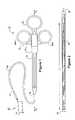
- FIG. 1is a perspective view of a retrieval device, showing a snare in an open position;
- FIG. 2is an enlarged sectional view of a portion of the retrieval device of FIG. 1 , showing the snare in a closed position within a conduit;
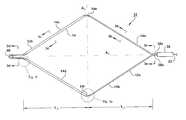
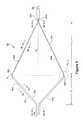
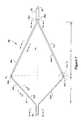
- FIG. 3is a top view of the snare of FIG. 1 , showing the snare in an open or deployed position;
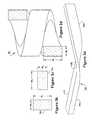
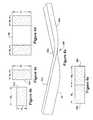
- FIG. 3 ais an enlarged perspective view of the designated circular area of FIG. 3 ;
- FIG. 3 bis sectional view of the snare of FIG. 3 , shown along the line 3 b - 3 b of FIG. 3 ;
- FIG. 3 cis sectional view of the snare of FIG. 3 , shown along the line 3 c - 3 c of FIG. 3 ;
- FIG. 3 dis sectional view of the snare of FIG. 3 , shown along the line 3 d - 3 d of FIG. 3 ;
- FIG. 3 eis sectional view of the snare of FIG. 3 , shown along the line 3 e - 3 e of FIG. 3 ;
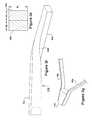
- FIG. 3 fis an enlarged perspective view of the designated circular area of FIG. 3 ;
- FIG. 3 gis an enlarged view of another snare having another distal end
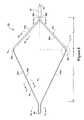
- FIG. 4is a top view of another snare, showing the snare in a deployed position
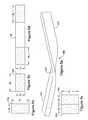
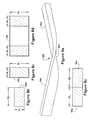
- FIG. 4 ais an enlarged perspective view of the designated circular area of FIG. 4 ;
- FIG. 4 bis sectional view of the snare of FIG. 4 , shown along the line 4 b - 4 b of FIG. 4 ;
- FIG. 4 cis sectional view of the snare of FIG. 4 , shown along the line 4 c - 4 c of FIG. 4 ;
- FIG. 4 dis sectional view of the snare of FIG. 4 , shown along the line 4 d - 4 d of FIG. 4 ;
- FIG. 4 eis sectional view of the snare of FIG. 4 , shown along the line 4 e - 4 e of FIG. 4 ;
- FIG. 5is a top view of another snare, showing the snare in a deployed position
- FIG. 5 ais an enlarged perspective view of the designated circular area of FIG. 5 ;
- FIG. 5 bis sectional view of the snare of FIG. 5 , shown along the line 5 b - 5 b of FIG. 5 ;
- FIG. 5 cis sectional view of the snare of FIG. 5 , shown along the line 5 c - 5 c of FIG. 5 ;
- FIG. 5 dis sectional view of the snare of FIG. 5 , shown along the line 5 d - 5 d of FIG. 5 ;
- FIG. 5 eis sectional view of the snare of FIG. 5 , shown along the line 5 e - 5 e of FIG. 5 ;
- FIG. 6is a top view of another snare, showing the snare in a deployed position
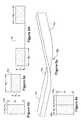
- FIG. 6 ais an enlarged perspective view of the designated circular area of FIG. 6 ;
- FIG. 6 bis sectional view of the snare of FIG. 6 , shown along the line 6 b - 6 b of FIG. 6 ;
- FIG. 6 cis sectional view of the snare of FIG. 6 , shown along the line 6 c - 6 c of FIG. 6 ;
- FIG. 6 dis sectional view of the snare of FIG. 6 , shown along the line 6 d - 6 d of FIG. 6 ;
- FIG. 6 eis sectional view of the snare of FIG. 6 , shown along the line 6 e - 6 e of FIG. 6 ;
- FIG. 7is a top view of another snare, showing the snare in a deployed position
- FIG. 7 ais an enlarged perspective view of the designated circular area of FIG. 7 ;
- FIG. 7 bis sectional view of the snare of FIG. 7 , shown along the line 7 b - 7 b of FIG. 7 ;
- FIG. 7 cis sectional view of the snare of FIG. 7 , shown along the line 7 c - 7 c of FIG. 7 ;
- FIG. 7 dis sectional view of the snare of FIG. 7 , shown along the line 7 d - 7 d of FIG. 7 ;
- FIG. 7 eis sectional view of the snare of FIG. 7 , shown along the line 7 e - 7 e of FIG. 7 ;
- FIG. 8is a top view of another snare, showing the snare in a deployed position
- FIG. 8 ais an enlarged perspective view of the designated circular area of FIG. 8 ;
- FIG. 8 bis sectional view of the snare of FIG. 8 , shown along the line 8 b - 8 b of FIG. 8 ;
- FIG. 8 cis sectional view of the snare of FIG. 8 , shown along the line 8 c - 8 c of FIG. 8 ;
- FIG. 8 dis sectional view of the snare of FIG. 8 , shown along the line 8 d - 8 d of FIG. 8 ;
- FIG. 8 eis sectional view of the snare of FIG. 8 , shown along the line 8 e - 8 e of FIG. 8 ;
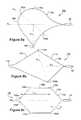
- FIG. 9 ais a top view of another snare having an irregular shape
- FIG. 9 bis a top view of another snare having an irregular shape
- FIG. 9 cis a top view of another snare having a hexagon shape
- FIG. 9 dis a top view of another snare having an oval-shape
- FIG. 9 eis a top view of another snare having an oval-shape
- FIG. 9 fis a top view of another snare having an irregular shape
- FIG. 10 ais perspective view of a portion of a snare having a diamond-shape, shown in a similar orientation as the snare in FIG. 3 a;
- FIG. 10 bis a sectional view of the snare of FIG. 10 a , shown in an orientation similar to the sectional view of FIG. 3 b;
- FIG. 10 cis a sectional view of the snare of FIG. 10 a , shown in an orientation similar to the sectional view of FIG. 3 c;
- FIG. 10 dis a sectional view of the snare of FIG. 10 a , shown in an orientation similar to the sectional view of FIG. 3 d;
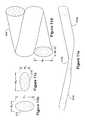
- FIG. 11 ais perspective view of a portion of a snare having an oval-shape, shown in a similar orientation as the snare in FIG. 3 a;
- FIG. 11 bis a sectional view of the snare of FIG. 11 a , shown in an orientation similar to the sectional view of FIG. 3 b;
- FIG. 11 cis a sectional view of the snare of FIG. 11 a , shown in an orientation similar to the sectional view of FIG. 3 c;
- FIG. 11 dis a sectional view of the snare of FIG. 11 a , shown in an orientation similar to the sectional view of FIG. 3 d;
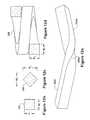
- FIG. 12 ais perspective view of a portion of a snare having a square-shape, shown in a similar orientation as the snare in FIG. 3 a;
- FIG. 12 bis a sectional view of the snare of FIG. 12 a , shown in an orientation similar to the sectional view of FIG. 3 b;
- FIG. 12 cis a sectional view of the snare of FIG. 12 a , shown in an orientation similar to the sectional view of FIG. 3 c;
- FIG. 12 dis a sectional view of the snare of FIG. 12 a , shown in an orientation similar to the sectional view of FIG. 3 d;
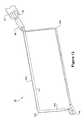
- FIG. 13is a perspective view of the snare of FIG. 3 , showing the snare in a deployed position;
- FIG. 14is a side view of a polyp on the mucosa layer of an intestinal wall
- FIG. 15is a side view of the snare device of FIG. 3 positioned around the polyp of FIG. 14 , showing the snare in a position while in motion toward deployment;
- FIG. 16is a top view of FIG. 15 ;
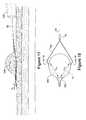
- FIG. 17is a side view of the snare device of FIG. 3 positioned around the polyp of FIG. 14 , showing the snare in a position while in motion toward retrieval;
- FIG. 18is a top view of FIG. 17 ;
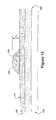
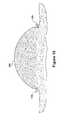
- FIG. 19is an enlarged sectional view of the snare of FIG. 3 , shown along the line 19 - 19 of FIG. 18 .
- FIG. 20is a top view another snare having an irregular shape.
- the terms “portrait” and “landscape”will be used to described an orientation of an object.
- the term “portrait” and the term “landscape”have their common ordinary meaning, and are used in the same manner in which one would use each term to describe the orientation of a common and well-known object or thing, such as for example, a piece of paper or a picture frame.
- cauterization devicesmay cause serious thermal injury to the gastrointestinal wall, fail to remove the entire targeted tissue, or do not completely cauterize blood vessels which lead to excessive bleeding.
- Mechanical snare devicesmay also be difficult to operate, and a physician may experience difficulty in securing the targeted tissue with the snare.
- snaring only the minimal tissue required from the three-layer wall, i.e., mucosa, submucosa, and muscularisis also important. More specifically, to prevent complications, the muscularis tissue should be avoided in a mechanical snaring procedure.
- An operator's attempt to minimize unwanted damaged to the removal siteis complicated by a conventional snare.
- An operator of a snaremay have difficulty in maintaining the snare in a flat position, that is to say, level or parallel with respect to the gastrointestinal wall, when closing the snare, and the desired tissue becomes more difficult to capture.
- a conventional snaretends to rise up and off the targeted tissue, or skim along the top of the tissue, when the snare is closing and moving in a proximal direction. As a result, either none or an inadequate amount of the targeted tissue is captured. Consequently, the snare has to be reopened and placed again on the distal side of the targeted tissue, and the process repeated until an adequate amount of tissue is captured.
- each opening and closing of the snaremay lead to deformities in the snare. Such deformities may cause difficulties in fully opening the snare or may cause the snare to unexpectedly collapse during tissue capture.
- Some physicianshave used other techniques to improve results of a snare capture, especially on a first attempt. For example, some technicians use an endoscopic needle tool to inject saline into the targeted tissue. The injected saline increases the size of the targeted tissue, and in some cases, makes the tissue an easier target for a conventional snare process. This injection step adds time and cost, both labor and material, to the overall procedure.
- the present applicationdescribes a tissue removal tool for use with an endoscope, such as for example, a snare suitable for use in removing a tissue sample, such as for example, a gastrointestinal polyp.
- the tooloffers improved performance features, such as for example, moving the polyp into a raised and pinched position such that the polyp may be transected with a snare which remains in essentially a flat position.
- the polypmay be advantageously manipulated in either the deployment direction, the retrieval direction, or both.
- the snareis formed by a wire, or similar structure, and arranged and shaped such to have a proximal portion and a distal portion in a deployed position.
- the proximal portion and a distal portionhave different shapes in relation to each other, and specifically, in relation to the cross-sectional shape of one portion in relation to the cross-sectional shape of the other portion.
- the contrasting shape of one portion of the loop in relation to the otherhas surprising and previously unknown benefits.
- the proximal portion and the distal portionmay be separated by a transition portion, in which the wire changes orientation, such as for example, is twisted, such that the cross-sectional shape of the wire is different in the proximal portion as compared to the distal portion.
- the piece of wiremay have a cross-sectional height in the proximal portion unequal to a cross-sectional height in the distal portion.
- the wiremay have a cross-sectional height in the proximal section equal to a cross-sectional width in the distal portion.
- the snaremay be shaped to perform the same or similar in other embodiments of the invention.
- the snare loopmay be formed by a proximal portion, a distal portion, and a transitional portion separating the proximal portion and the distal portion.
- the piece of wiremay be twisted by at least 45 degrees in the transitional portion on at least one side of the loop.
- the piece of wiremay have a cross-sectional height larger than a cross-sectional width in the proximal portion and a cross-sectional width larger than a cross-sectional height in the distal portion.
- the piece of wiremay have a cross-sectional height smaller than a cross-sectional width in the proximal portion and a cross-sectional width smaller than a cross-sectional height in the distal portion.
- the shape of the loopmay include portions which act as a memory point during opening and closing of the loop by motion of the handle relative the body.
- the shape of the loopmay be at least partially defined by a rotated and bent wire portion on either side of the loop, wherein the piece of wire has a cross-sectional height larger than a cross-sectional width at a location proximal to either rotated and bent wire portion and a cross-sectional height smaller than a cross-sectional width at a location distal to either rotated and bent wire portion.
- the loopis polygon-shaped in the open position and the piece of wire is twisted essentially 90 degrees in the rotated and bent portion.
- the shape of the loopis defined by a distal portion and a proximal portion.
- the proximal portionhas a distal facing vertical face and the distal position has a proximal facing edge.
- the wire forming the loopis twisted between the proximal portion and the distal portion, such that the distal facing vertical face of the proximal portion is higher than the proximal facing edge of the distal portion, and the top horizontal face of the distal portion is wider than a top horizontal face of the proximal portion.
- the distal facing vertical face of the proximal portionpushes against the polyp.
- the proximal facing vertical edge of the distal portioncuts into the polyp as distal facing vertical face of the proximal portion prohibits movement of the polyp in the proximal direction.
- the proximal portionraises and pinches the polyp to prepare the polyp for transecting.
- the proximal portionmay increase the percentage of the polyp which is above a targeted cutting line, relative the gastro-intestinal wall.
- a method of using an endoscopic tool to collect a tissue sampleincludes placing a loop of an endoscopic tool adjacent a targeted tissue sample.
- the loopis formed by a piece of wire and is movable between a closed position and a deployed position by use of a tool handle.
- the distal facing vertical inward face of the proximal portionis higher than proximal facing inward edge of the distal portion.
- the operatormoves the loop from a closed position to an open position.
- the distal facing vertical inward face of the proximal portionpushes against the targeted tissue sample.
- the loopis moved from the open or deployed position to a closed position, such that the proximal facing vertical inward edge of the distal portion cuts into the targeted tissue sample.
- the methodallows a snare to transect a polyp in the retrieval direction without the snare riding up the distal side of the polyp. A snare riding up the polyp may prohibit cutting the polyp along a straight line, or parallel line, relative the gastro-intestinal wall.
- FIG. 1a retrieval device, or tissue removal tool is illustrated in FIG. 1 .
- the toolis arranged for use with an endoscope to remove a tissue sample from the gastrointestinal wall of a human patient.
- the toolis also usable for other scientific purposes, and with a combination of other devices. This tool is illustrated and discussed for exemplary purposes only, and the invention may be practice with a tool having characteristics which vary from this tool.
- the exemplary tool 10includes a loop 12 formed by a piece of wire 14 .
- a wire of any suitable materialmay be used to form the loop, such as for example, a metal, such as stainless steel, or a plastic.
- the variations in the wire shape and orientation along the length of the wiremay be made by mechanically twisting a preformed wire into the desired shape and orientation, of the wire may be originally manufactured to have the desired shape and orientation, such as for example, a preformed plastic piece.
- a suitable materialwill be flexible and have memory to allow deployment and retrieval of the loop.
- the wireforms a plurality of segments separated by collapse-resistant bends to define a loop opening.
- the loopis movable between an open position, or deployed position, and a closed position, or retrieved position.
- the loop 12is illustrated in an open position in FIG. 1 .
- the loopis polygon-shaped, and specifically, the loop is generally diamond-shaped.
- FIG. 2the loop 12 is shown in a closed position within a distal portion of the tool 10 .
- the loop 12is within a conduit 18 .
- the exemplary loophas a length L 1 .
- the toolmay include a support assembly and a transmitting system for moving the loop between an open position and a closed position.
- the support assemblyincludes a base or body 16 and an elongated hollow tube, tubular member or conduit 18 .
- the transmitting assemblyincludes a handle 20 movable relative to the body 16 and a link 22 . One end of the link is fixed to the handle and a second end is remote from the body. As shown in FIGS. 1 and 2 , the link 22 extends substantially through a length of the conduit 18 .
- the conduit 18may be any suitable, small-diameter tube formed of a non-reactive low-friction flexible material, such as for example, polytetraflourethylene.
- the conduit 18defines a lumen with an opening at a distal second end 28 , as best seen in FIG. 2 which shows a cross-sectional view of a distal portion of the tool 10 .
- a proximal first end 30 of the conduitis fixed to the body 16 .
- the handleallows an operator to move the loop back and forth between a deployed position, as shown in FIG. 1 , and a closed position, as shown in FIG. 2 .
- the body 16includes a fixed ring 24 at a proximal end.
- the handle 20may be slid by an operator relative the body 16 by use of the handle 20 , and specifically, by use of one or both of two rings 26 a , 26 b .
- the handle 20is mounted over an elongated section of the body 16 and is movable relative to the body in the direction D 1 to deploy the loop 12 , or in an opposing direction D 2 to close the loop 12 .
- an operatormay place a finger in each of the rings 26 a , 26 b and a thumb of the same hand in the body ring 24 .
- an operatorcan move the handle 20 relative to the body 16 .
- This movement of the handlewill deploy the loop.
- the handle 20can be slid in the opposite direction D 2 by pulling one's fingers towards one's thumb to close the loop.
- a link 22is connected to the handle 20 for transferring axial motion from the handle 20 to other parts of the device.
- the linkmay be constructed of any suitable rigid material, and may be solid, hollow, or any suitable elongated object or combination of objects.
- the linkmay be one piece or formed from a series of pieces and connections, such as for example, hypodermic tubes, swage connections, and cables.
- the link 22has a first end fixed to the handle 20 and a second end remote from the body 16 . As shown in the drawings, the link extends substantially through the conduit 18 .
- FIG. 3a top view of the exemplary tool 10 of FIG. 1 is shown in an open or deployed position.
- the shape of the loop 14may be discussed in relation to a longitudinal axis A1 and a lateral axis A2 .
- the longitudinal axis A1is defined along the longitudinal axis of the link 22 and the axis defines a first side of the loop 14 a , 14 c and a second side 14 b , 14 d .
- the loop 12is essentially symmetric relative the longitudinal axis A1 . It should be apparent to those with skill in the art that the invention can be practiced with loops having a shape which are asymmetric relative the longitudinal axis A1 , such as for example, the exemplary loops shown in FIGS. 9 a and 9 c.
- the loop 12has a proximal portion 12 a and a distal portion 12 b when in the deployed position.
- the lateral axis A 2defines, or separates, the loop into a proximal portion having two wire portions 14 a , 14 b and a distal portion having two wire portions 14 c , 14 d .
- the shape of proximal portion 12 ais symmetric to the shape of the distal portion 12 b . It should be apparent to those with skill in the art that the invention can be practiced with loops having a shape which are asymmetric to the lateral axis A 2 , such as for example, the exemplary loops shown in FIGS. 5-8, 9 a - 9 c and 9 f.
- the bottom of the wiretwists at a middle portion 34 b inward along an axis of the wire, and the wire itself bends inward toward the longitudinal axis of the loop 12 .
- the wireis twisted at least 45° in a transitional portion on at least one side of the loop.
- the wireis twisted about 90°.
- an exiting portion 34 c of the wire 14 ahas width greater than a height, in other words, the rectangular shape of the wire is in a landscape orientation.
- the proximal portion and the distal portionare each formed from a wire 14 .
- the wireis orientated in the proximal portion in a different orientation than in the distal portion.
- the wire 14has a rectangular-shaped cross section.
- the cross-sectional shape of the wire 14relative to a horizontal plane during application, varies at different locations of the loop, as shown at different locations of the loop in FIGS. 3 a -3 f .
- the cross-sectional shape of the loop in the proximal portion relative to the cross-sectional shape of the loop in the distal portioncontributes to the advantageous features on the tool 10 .
- FIG. 3 bis sectional view of the wire in the proximal portion 12 a of the loop 12 , and shown along the line 3 b - 3 b of FIG. 3 .
- the wirehas a height H 1 which is greater than the width W 1 .
- FIG. 3 cis sectional view of the wire in the distal portion of the loop 12 .
- the wireis shown along the line 3 c - 3 c of FIG. 3 .
- the wirehas a height H 2 which is less than the width W 2 .
- the piece of wirehaving a cross-sectional height H 1 in the proximal portion equal to a cross-sectional width W 2 in the distal portion and unequal to a cross-sectional height in the distal portion H 2 .
- the orientation of the wire in the proximal portion relative the distal portioncould be reversed, in other words, the portrait orientation could be in the distal portion and the landscape orientation could be in the proximal portion in the practice of the invention, such as for example, as illustrated in the loops in FIGS. 4, 7 and 8 .
- the loop 12is formed by a wire 14 connected to the link 22 .
- the two ends on the wire 14are fixed to the link 22 by any suitable technique, such as for example, by welding.
- the two end portions 38 a , 38 bare contiguous and each in a portrait orientation.
- a covering 36is used to protect the connection between the wire and the link, and prohibit damage to the inside of the conduit 18 .
- FIGS. 3 d and 3 fThe most distal portions of the loop 12 is illustrated in FIGS. 3 d and 3 f .
- the wiretwists on each side of the loop near the distal tip 40 of tool.
- FIG. 3 fan enlarged version of one twisted portion is shown.
- the wire 14is discussed herein as traveling in the direction toward the distal tip 40 .
- an entering portion 42 a of the wirehas a width greater than a height, in other words, the rectangular shape of the wire is in a landscape orientation.
- the inward side of the wiretwists at a middle portion 42 b upward along an axis of the wire, and the wire itself bends outward away from the longitudinal axis of the loop 12 .
- an exiting portion 42 c of the wire 14 ahas height greater than a width, and the rectangular shape of the wire is in a portrait orientation.
- the wirecontinues toward the distal tip 40 to form a torsion tip having a 360° loop.
- the distal tip 40 of the toolmay have alternative shapes.
- the wiremay form a torsion tip with a 180° bend, as shown in the exemplary loop of FIG. 4 .
- the wire within the 180° bendmay be in a landscape orientation, as shown in the exemplary loop of FIG. 5 .
- Still another distal tipis shown in the enlarged view of FIG. 3 g .
- the loopis formed by a wire having two portions 44 a , 44 b .
- the two wire portionsare held together by a ball tip 44 c at a distal most point.
- the wire portionsfunction as a loop the same as discussed herein.
- FIG. 4is a top view of a loop, showing the loop in a deployed position.
- the loop 50is in a polygon-shape, and specifically, is in a diamond shape. That is to say, the loop has the same general orientation about a longitudinal axis and a lateral axis A 2 as the loop illustrated in FIG. 3 .
- the loop 50has a proximal portion 12 a and a distal portion 12 b which are essentially the same in size.
- the wire 54 orientation in FIG. 4is generally reversed as compared to the wire orientation in FIG. 3 .
- a transitional portion 54 e , 54 f on either side of the loop 54is disposed between the proximal portion 12 a and the distal portion 12 b .
- An enlarged perspective view of the transitional portion 54 fis illustrated in FIG. 4 a .
- the wiretwists and turns.
- the wire 54is discussed herein as traveling for the proximal portion 12 a to the distal portion 12 b .
- an entering portion 52 a of the wirehas a width greater than a height, in other words, the rectangular shape of the wire is in a landscape orientation.
- the bottom of the wiretwists at a middle portion 52 b outward along an axis of the wire, and the wire itself bends inward toward the longitudinal axis of the loop 50 .
- the wireis twisted about 90°.
- an exiting portion 52 c of the wire 54has height greater than a width, and the rectangular shape of the wire is in a portrait orientation.
- the proximal portion and the distal portionare each formed from a wire 54 .
- the wireis orientated in the proximal portion in a different orientation than in the distal portion.
- the wire 54has a rectangular-shaped cross section.
- the cross-sectional shape of the wire 54relative to a horizontal plane during application, varies at different locations of the loop, as shown at different locations of the loop in FIGS. 4 a -4 e .
- the cross-sectional shape of the loop in the proximal portion relative to the cross-sectional shape of the loop in the distal portioncontributes to the advantageous features on the tool 10 .
- FIG. 4 bis sectional view of the wire in the proximal portion 12 a of the loop 50 , and shown along the line 4 b - 4 b of FIG. 4 .
- the wirehas a width W 2 which is greater than the height H 2 .
- FIG. 4 cis sectional view of the wire in the distal portion of the loop 12 .
- the wireis shown along the line 4 c - 4 c of FIG. 4 .
- the wirehas a height H 1 which is greater than the width W 1 .
- the piece of wire having a cross-sectional width W 2 in the proximal portionequal to a cross-sectional height H 1 in the distal portion and unequal to a cross-sectional width in the distal portion W 1 .
- FIGS. 3 b -3 eOther sections of the loop compare similarly to FIGS. 3 b -3 e .
- the wire portions 58 a , 58 bin the most proximal part of the loop as shown.
- the wire portionsare connected to the link 22 .
- the two end portions 58 a , 58 bare contiguous and each in a landscape orientation.
- the most distal portion of the loop 12is illustrated in FIG. 4 d .
- the wirebends outward on each side of the loop near the distal tip 56 of tool.
- the wirecontinues toward the distal tip 56 to form a torsion tip having a 180° loop, and the wire in a portrait orientation.
- FIGS. 5-8 eshown four exemplary loops in which the proximal portion is not the same size as the distal portion.
- FIGS. 5 and 7show a proximal portion in which the proximal portion is larger than the distal portion
- FIGS. 6 and 8show a proximal portion which is smaller than the distal portion.
- all the loopsare symmetric about a longitudinal axis of the link.
- the wireis in a portrait orientation in the proximal portion, and in a landscape portion in the distal end.
- FIGS. 7 and 8the wire is in a landscape orientation in the proximal portion, and in a portrait orientation in the distal end.
- FIGS. 5, 6, 7 and 8are kite-shaped.
- the loop 60is shaped and arranged such that a proximal portion 12 a has a length L 4 which is greater than a length L 5 of the distal portion 12 b .
- the loop 80 shown in FIG. 7is shaped and arranged such that a proximal portion 12 a has a length L 8 which is greater than a length L 9 of the distal portion 12 b .
- FIGS. 6 and 8illustrate loops that have the same shape, but are arranged in a different orientation. In FIG.
- the loop 70is shaped and arranged such that a proximal portion 12 a has a length L 6 which is less than a length L 7 of the distal portion 12 b .
- the loop 90 shown in FIG. 8is shaped and arranged such that a proximal portion 12 a has a length L 10 which is less than a length L 11 of the distal portion 12 b.
- the loops illustrated in FIGS. 5, 6, 7 and 8also vary in the orientation of the wire.
- the loop 60 of FIG. 5 and the loop 70 of FIG. 6have a wire 64 , 74 , respectively, in which the wire in the proximal portion has a height greater than a width, that is to say, is rectangular shaped and in the portrait orientation.
- the wire 64 , 74 , respectively, in the distal portionhas a width greater than a height, that is to say, is rectangular shaped and in the landscape orientation.
- the wires of the loops 80 , 90 , respectively, in FIGS. 7 and 8are in the opposite direction.
- FIGS. 5, 6, 7 and 8show the wire 64 , 74 , 84 , 94 , respectively, at various points along the loop, 60 , 70 , 80 , 90 , respectively, and clearly illustrated wire shape, wire orientation, wire twists, and wire bends.
- the loop embodiments illustrated in FIGS. 5-8 eare for exemplary purposes only, and other loop shapes and arrangements may be used in the practice of this invention.
- a loopmay have an irregular shape in the practice of this invention.
- FIG. 9 ais a top view of another tool having an irregular shaped loop.
- the loop 100is asymmetric about a longitudinal axis A 11 and is asymmetric about a lateral axis A 12 .
- the proximal portion 12 a and the distal portion 12 bare defined by two transitional points 102 a , 102 b , in which the wire twists from a portrait orientation in the proximal portion 12 a to a landscape orientation in the distal portion 12 b .
- a longitudinal axis A 13 of the distal end 104is essentially perpendicular to the longitudinal axis A 11 of the link 22 .
- FIG. 9 bAnother exemplary loop having an irregular shape is shown in FIG. 9 b .
- the loop 110is symmetric about a longitudinal axis A 14 and is asymmetric about a lateral axis A 15 .
- the proximal portion 12 a and the distal portion 12 bare not divided by an axis which is perpendicular to the longitudinal axis of the link 22 .
- the proximal portion 12 a and the distal portion 12 bare defined by two transitional points 112 a , 112 b , in which the wire twists from a portrait orientation in the proximal portion 12 a to a landscape orientation in the distal portion 12 b .
- the distal end 114is formed by a less than 180° bend of the wire in a landscape orientation.
- FIG. 9 cAnother loop which is polygon-shaped is illustrated in FIG. 9 c .
- the loop 120is hexagon-shaped and is symmetric about a longitudinal axis A 16 , but is asymmetric about a lateral axis A 17 .
- the proximal portion 12 a and the distal portion 12 bare defined by two transitional points 122 a , 122 b , in which the wire 122 twists from a portrait orientation in the proximal portion 12 a to a landscape orientation in the distal portion 12 b .
- the wiremaintains a landscape orientation as it bends inwards at two other points 122 c , 122 d along the hexagon shape.
- the proximal portion and the distal portionare not the same length.
- the proximal portion 12 ahas length L 12 which is shorter than the length L 13 of the distal portion 12 b.
- the distal portion of the hexagon-shaped loop 120has similar properties to the loop illustrated in FIG. 3 .
- the wire 122twists from a landscape orientation to a portrait orientation.
- the distal end 124 of the loop 120is formed by a less than 180° bend of the wire 122 .
- an oval-shaped loop 130has a wire 132 which includes a pattern of wire segments.
- the patternis an alternating series of wire segments between a portrait orientation and a landscape orientation.
- the portrait orientation segments 132 b and the landscape orientation segments 132 amay be of different lengths, or may be of the same length, such as for example, 3 mm.
- a lateral axis A 18defines, or separates, the loop 130 into a proximal portion 12 a and a distal portion 12 b.
- FIG. 9 eshows an enlarged view of a wire having similar properties as the wire 132 of FIG. 9 d .
- the wire 142 illustrated in FIG. 9 ealso is used to form an oval-shaped loop which includes a pattern on wire segments.
- the patternis an alternating series of wire segments between a portrait orientation and a landscape orientation.
- the portrait orientation segments 142 b and the landscape orientation segments 142 amay be of different lengths, or may be of the same length, such as for example, 3 mm.
- the segments 142 a , 142 bare separated by a 360° loop 142 c .
- the wire 142is in the portrait orientation within each loop 142 c , but the loop may be made in the landscape orientation.
- the wires 132 , 142 on FIGS. 9 d and 9 emay be used to construct a loop with advantageous properties.
- a loop constructed of either wire 132 , 142has a proximal portion and a distal portion, and each portion has segments in the portrait orientation and segments in the landscape orientation.
- each particular orientationoffers advantageous properties.
- the number and length of each particular segment type in the proximal portion and in the distal portioncan be specified to produce desired performance characteristics of the tool.
- FIG. 9 fAnother loop having an irregular shape is shown in FIG. 9 f .
- This loop 150is generally arrowhead-shaped.
- the loop 150is divided into a proximal portion 12 a and a distal portion 12 b by two transitional portions 154 a , 154 b .
- the wire 152is in a portrait orientation in the proximal portion 12 a and in a landscape orientation in the distal portion 12 b .
- the wire 152maintains a landscape orientation.
- the distal end 156is formed by a less than 180° bend of the wire 152 .
- a loop which is arrowhead-shapedmay be polygon-shaped, or the loop may have curved portions.
- the loop 150 illustrated in FIG. 9 fis polygon-shaped, and is symmetric about the longitudinal axis A 19 and the lateral axis A 20 .
- the wire used to form a loop of this inventionmay be of different types of materials, and may be made by different manufacturing methods. Also, the wire may be of different cross-sectional shapes. Referring to FIGS. 3 and 3 b , the exemplary wire 14 has a rectangular cross-section. Three other exemplary types of cross-sections are shown in FIGS. 10 a -12 d . These three wire types, as well as wires having a cross-section not shown, may be used with any loop shape discussed herein.
- FIGS. 10 a -10 da wire 200 with a diamond-shaped cross-section is illustrated.
- the wire 200is shown in a portrait orientation and in a landscape orientation, respectively.
- a distal end having a 360° bend formed from the wire 200is shown in FIG. 10 d .
- a transitional portion of the wire 200is shown in FIG. 10 a .
- the wire 200has an entering portion 202 a in a portrait orientation, a center portion 202 b in which the wire bends inward and twists °90, and an exiting portion 202 c in a landscape orientation.
- FIGS. 11 a -11 da wire 210 with an oval-shaped cross-section is illustrated.
- the wire 210is shown in a portrait orientation and in a landscape orientation, respectively.
- a distal end having a 360° bend formed from the wire 210is shown in FIG. 10 d .
- a transitional portion of the wire 210is shown in FIG. 11 a .
- the wire 210has an entering portion 212 a in a portrait orientation, a center portion 212 b in which the wire bends inward and twists °90, and an exiting portion 212 c in a landscape orientation.
- the wire shown in FIGS. 12 a -12 dhas a square-shaped cross-section.
- the wire 220has a height H 1 which is equal to the width W 1 , as shown in FIG. 12 b .
- the height of the wireis always equal to the width, at any particular orientation, such as for example, at an orientation turned 0° relative an application surface, such as shown in FIG. 12 b , or at an orientation turned 45° relative an application surface, such as shown in FIG. 12 c .
- a transitional portion of the wire 220is shown in FIG. 12 a .
- the wire 220has an entering portion 212 a in an orientation turned 0° relative an application surface, a center portion 212 b in which the wire bends inward and twists °45, and an exiting portion 212 c in an orientation turned 45° relative an application surface.
- FIGS. 13-19illustrate an exemplary method for removal and recovery of a polyp. It should be understood by others with skill in the art than other removal methods can be undertaken in the practice of the invention.
- FIG. 14shows a side view of a polyp 300 on an intestinal wall. Specifically, the polyp is formed on the mucosa layer 302 , above the submucosa layer 304 and muscularis 306 . The polyp is shown at a relaxed height Hp above the top surface 310 of the mucosa layer 302 . As discussed herein, a polyp may be difficult to remove by cutting, especially along a target cut line on the first attempt.
- a polypmay grow back if not transected at its base.
- the polypmay be cut along a target cut line 308 , which may be at a level even with the top surface 310 of the mucosa layer 302 .
- an intubated endoscope 320is shown adjacent the mucosa layer 302 .
- the distal portion of the tool 10 of FIG. 13is shown extending from an instrument channel of the endoscope to a location surrounding the polyp 300 .
- the conduit 18is not shown for clarity.
- the loop 12is shown in a deployed position after movement in a deployment direction D 1 .
- the polyp 300is manipulated by the proximal portion 12 a of the loop 12 .
- the proximal portionis formed by a wire having a rectangular-shaped cross-section and in a portrait orientation.
- the wire 12contacts the polyp in a plowing effect to pinch and raise the polyp relative the top surface 310 of the mucosa layer 302 .
- the wireis shown contacting the polyp along two lengths L 20 , L 21 of the proximal portion.
- the plowing techniquehas the advantageous effect of pre-conditioning the polyp 300 for removal along the target cut line 308 .
- the polyp 300is raised to a pre-conditioned height H x in which a higher percentage of the mass of the polyp is above the target cut line 308 , and the center of gravity of the polyp 300 has been raised, each relative to the relaxed polyp condition shown in FIG. 14 .
- the plowingalso raised the amount of the polyp which is about the cutting face of the distal portion.
- the loopis manipulated in a retrieval direction D 2 .
- the cutting edge of the distal portion 12 b of the loop 12cuts into the polyp 300 at or near the target cut line 308 .
- the distal portionis formed by a wire having a rectangular-shaped cross-section and in a landscape orientation.
- the wire 12contacts the polyp in a cutting effect to cut into the polyp as shown in FIG. 17 .
- FIG. 19shows an enlarged sectional view of the polyp along the line 19 - 19 of FIG. 18 .
- the loop 400is symmetric about a longitudinal axis A 21 , but is asymmetric about a lateral axis A 22 .
- the wire 402 of the loop 400includes, at its proximal portion 12 a , a first pair inward bends 404 a , 404 b , followed distally by a second pair of inward bends 406 a , 406 b .
- the wire 402maintains a landscape orientation as it bends inwards at points 404 a , 404 b , 406 a and 406 b . These additional bends (i.e., memory points) may help the loop 400 resist collapse and retain its shape over time.
- the proximal portion 12 a and the distal portion 12 b of the loop 400are defined by two transitional points 408 a , 408 b , in which the wire 402 twists from a portrait orientation in the proximal portion 12 a to a landscape orientation in the distal portion 12 b.
- the distal portion of the loop 400has similar properties to the loop illustrated in FIG. 3 .
- the wire 402twists from a landscape orientation to a portrait orientation.
- the distal end 412 of the loop 400includes a torsion tip having a 360° loop.
- the loop 400includes two bends in the proximal portion 12 a
- other embodimentsmay include more bends in the proximal portion 12 a , distal portion 12 b , or both.
- the addition of collapse-resistant bendsmay be used in conjunction within any other of the previously described embodiments.
- a loop with at least two proximal bendsmay have an oval, arrowhead, diamond or kite shape (ignoring small variations from the proximal bends), may have wire with an oval or diamond cross-section, etc.
Landscapes
- Health & Medical Sciences (AREA)
- Life Sciences & Earth Sciences (AREA)
- Surgery (AREA)
- Molecular Biology (AREA)
- General Health & Medical Sciences (AREA)
- Veterinary Medicine (AREA)
- Engineering & Computer Science (AREA)
- Biomedical Technology (AREA)
- Heart & Thoracic Surgery (AREA)
- Medical Informatics (AREA)
- Public Health (AREA)
- Animal Behavior & Ethology (AREA)
- Nuclear Medicine, Radiotherapy & Molecular Imaging (AREA)
- Orthopedic Medicine & Surgery (AREA)
- Vascular Medicine (AREA)
- Physics & Mathematics (AREA)
- Biophysics (AREA)
- Optics & Photonics (AREA)
- Pathology (AREA)
- Radiology & Medical Imaging (AREA)
- Surgical Instruments (AREA)
Abstract
Description
This application is a continuation-in-part of U.S. application Ser. No. 14/016,906, titled “ENDOSCOPIC SNARE DEVICE,” and filed on Sep. 3, 2013. The entire disclosure of the above reference is fully incorporated herein by reference.
Endoscopes are well-known in the medical arts and are commonly used for numerous medical procedures. One such procedure is removing targeted tissue from the gastrointestinal mucosal wall of a human subject. Various types of tissue, such as for example, polyps, lesions, tumors or adenomas, may be removed for various medical purposes, such as for example, treatment or diagnostic testing.
One conventional polypectomy technique for removing targeted tissue is cauterization. For example, cauterizing devices may be used to remove an unwanted polyp. A cauterizing device uses heat to separate the targeted tissue from the gastrointestinal wall of a patient. The removed tissue may be discarded or captured for testing.
Mechanical devices, such as for example, snares, are also known in the art. For example, a snare may be used to separate a polyp from the gastrointestinal wall of a patient. Specifically, an operator may deploy or open a snare loop, and position the snare around a polyp. By retrieval or closing of the snare loop, the operator can cut into the tissue and separate the tissue from the gastrointestinal wall. Subsequently, the operator may use a suction source to capture and retain the tissue after separation from the wall.
The present application describes a tissue removal tool for use with an endoscope, such as for example, a snare suitable for use in removing a gastrointestinal polyp.
In an exemplary embodiment, the tool includes a loop. The loop is movable between an open position and a closed position. The loop is advantageously shaped in the open position for tissue removal and includes-collapse resistant bends.
Further features and advantages of the invention will become apparent from the following detailed description made with reference to the accompanying drawings.
Features and advantages of the general inventive concepts will become apparent from the following detailed description made with reference to the accompanying drawings.
This Detailed Description merely describes exemplary embodiments in accordance with the general inventive concepts and is not intended to limit the scope of the invention or the claims in any way. Indeed, the invention as described by the claims is broader than and unlimited by the exemplary embodiments set forth herein, and the terms used in the claims have their full ordinary meaning.
The general inventive concepts will now be described with occasional reference to the exemplary embodiments of the invention. This general inventive concept may, however, be embodied in different forms and should not be construed as limited to the embodiments set forth herein. Rather, these embodiments are provided so that this disclosure will be thorough and complete, and will fully convey the scope of the general inventive concepts to those skilled in the art.
Unless otherwise defined, all technical and scientific terms used herein have the same meaning as commonly understood by one of ordinary skill in the art encompassing the general inventive concepts. The terminology set forth in this detailed description is for describing particular embodiments only and is not intended to be limiting of the general inventive concepts. As used in this detailed description and the appended claims, the singular forms “a,” “an,” and “the” are intended to include the plural forms as well, unless the context clearly indicates otherwise.
Unless otherwise indicated, all numbers, such as for example, numbers expressing measurements or physical characteristics, used in the specification and claims are to be understood as being modified in all instances by the term “about.” Accordingly, unless otherwise indicated, the numerical properties set forth in the specification and claims are approximations that may vary depending on the suitable properties sought to be obtained in embodiments of the invention. Notwithstanding that the numerical ranges and parameters setting forth the broad scope of the general inventive concepts are approximations, the numerical values set forth in the specific examples are reported as precisely as possible. Any numerical values, however, inherently contain certain errors necessarily resulting from error found in their respective measurements.
When generally discussing the invention and embodiments of the invention, the terms “portrait” and “landscape” will be used to described an orientation of an object. The term “portrait” and the term “landscape” have their common ordinary meaning, and are used in the same manner in which one would use each term to describe the orientation of a common and well-known object or thing, such as for example, a piece of paper or a picture frame.
Several limitations exist with conventional polypectomy removal techniques. Despite careful use, cauterization devices may cause serious thermal injury to the gastrointestinal wall, fail to remove the entire targeted tissue, or do not completely cauterize blood vessels which lead to excessive bleeding. Mechanical snare devices may also be difficult to operate, and a physician may experience difficulty in securing the targeted tissue with the snare. Also, snaring only the minimal tissue required from the three-layer wall, i.e., mucosa, submucosa, and muscularis, is also important. More specifically, to prevent complications, the muscularis tissue should be avoided in a mechanical snaring procedure.
An operator's attempt to minimize unwanted damaged to the removal site is complicated by a conventional snare. An operator of a snare may have difficulty in maintaining the snare in a flat position, that is to say, level or parallel with respect to the gastrointestinal wall, when closing the snare, and the desired tissue becomes more difficult to capture. A conventional snare tends to rise up and off the targeted tissue, or skim along the top of the tissue, when the snare is closing and moving in a proximal direction. As a result, either none or an inadequate amount of the targeted tissue is captured. Consequently, the snare has to be reopened and placed again on the distal side of the targeted tissue, and the process repeated until an adequate amount of tissue is captured. Furthermore, each opening and closing of the snare may lead to deformities in the snare. Such deformities may cause difficulties in fully opening the snare or may cause the snare to unexpectedly collapse during tissue capture.
Some physicians have used other techniques to improve results of a snare capture, especially on a first attempt. For example, some technicians use an endoscopic needle tool to inject saline into the targeted tissue. The injected saline increases the size of the targeted tissue, and in some cases, makes the tissue an easier target for a conventional snare process. This injection step adds time and cost, both labor and material, to the overall procedure.
The present application describes a tissue removal tool for use with an endoscope, such as for example, a snare suitable for use in removing a tissue sample, such as for example, a gastrointestinal polyp. The tool offers improved performance features, such as for example, moving the polyp into a raised and pinched position such that the polyp may be transected with a snare which remains in essentially a flat position.
The polyp may be advantageously manipulated in either the deployment direction, the retrieval direction, or both. The snare is formed by a wire, or similar structure, and arranged and shaped such to have a proximal portion and a distal portion in a deployed position. The proximal portion and a distal portion have different shapes in relation to each other, and specifically, in relation to the cross-sectional shape of one portion in relation to the cross-sectional shape of the other portion. The contrasting shape of one portion of the loop in relation to the other has surprising and previously unknown benefits. The proximal portion and the distal portion may be separated by a transition portion, in which the wire changes orientation, such as for example, is twisted, such that the cross-sectional shape of the wire is different in the proximal portion as compared to the distal portion. In other words, the piece of wire may have a cross-sectional height in the proximal portion unequal to a cross-sectional height in the distal portion. The wire may have a cross-sectional height in the proximal section equal to a cross-sectional width in the distal portion. Thus, in one of the deployment direction or the retrieval direction, the polyp is raised or pinched, and in the other of the deployment direction or the retrieval direction, the polyp is cut along a straight line relative the gastro-intestinal wall.
The snare may be shaped to perform the same or similar in other embodiments of the invention. The snare loop may be formed by a proximal portion, a distal portion, and a transitional portion separating the proximal portion and the distal portion. The piece of wire may be twisted by at least 45 degrees in the transitional portion on at least one side of the loop. As such, the piece of wire may have a cross-sectional height larger than a cross-sectional width in the proximal portion and a cross-sectional width larger than a cross-sectional height in the distal portion. Alternatively, the piece of wire may have a cross-sectional height smaller than a cross-sectional width in the proximal portion and a cross-sectional width smaller than a cross-sectional height in the distal portion.
In another embodiment of the invention, the shape of the loop may include portions which act as a memory point during opening and closing of the loop by motion of the handle relative the body. For example, the shape of the loop may be at least partially defined by a rotated and bent wire portion on either side of the loop, wherein the piece of wire has a cross-sectional height larger than a cross-sectional width at a location proximal to either rotated and bent wire portion and a cross-sectional height smaller than a cross-sectional width at a location distal to either rotated and bent wire portion. In one embodiment, the loop is polygon-shaped in the open position and the piece of wire is twisted essentially 90 degrees in the rotated and bent portion.
As discussed herein, the invention offers performance features related to preparing the polyp for removal. In one embodiment, the shape of the loop is defined by a distal portion and a proximal portion. The proximal portion has a distal facing vertical face and the distal position has a proximal facing edge. The wire forming the loop is twisted between the proximal portion and the distal portion, such that the distal facing vertical face of the proximal portion is higher than the proximal facing edge of the distal portion, and the top horizontal face of the distal portion is wider than a top horizontal face of the proximal portion. In deployment, the distal facing vertical face of the proximal portion pushes against the polyp. In retrieval, the proximal facing vertical edge of the distal portion cuts into the polyp as distal facing vertical face of the proximal portion prohibits movement of the polyp in the proximal direction. In other words, the proximal portion raises and pinches the polyp to prepare the polyp for transecting. Specifically, the proximal portion may increase the percentage of the polyp which is above a targeted cutting line, relative the gastro-intestinal wall.
A method of using an endoscopic tool to collect a tissue sample is also disclosed. The method includes placing a loop of an endoscopic tool adjacent a targeted tissue sample. The loop is formed by a piece of wire and is movable between a closed position and a deployed position by use of a tool handle. The distal facing vertical inward face of the proximal portion is higher than proximal facing inward edge of the distal portion.
In the performance of the method, the operator moves the loop from a closed position to an open position. In the open or deployed position, the distal facing vertical inward face of the proximal portion pushes against the targeted tissue sample. After full or otherwise desired deployment, the loop is moved from the open or deployed position to a closed position, such that the proximal facing vertical inward edge of the distal portion cuts into the targeted tissue sample. The method allows a snare to transect a polyp in the retrieval direction without the snare riding up the distal side of the polyp. A snare riding up the polyp may prohibit cutting the polyp along a straight line, or parallel line, relative the gastro-intestinal wall.
Referring now to the drawings, a retrieval device, or tissue removal tool is illustrated inFIG. 1 . The tool is arranged for use with an endoscope to remove a tissue sample from the gastrointestinal wall of a human patient. The tool is also usable for other scientific purposes, and with a combination of other devices. This tool is illustrated and discussed for exemplary purposes only, and the invention may be practice with a tool having characteristics which vary from this tool.
Theexemplary tool 10 includes aloop 12 formed by a piece ofwire 14. A wire of any suitable material may be used to form the loop, such as for example, a metal, such as stainless steel, or a plastic. The variations in the wire shape and orientation along the length of the wire may be made by mechanically twisting a preformed wire into the desired shape and orientation, of the wire may be originally manufactured to have the desired shape and orientation, such as for example, a preformed plastic piece. A suitable material will be flexible and have memory to allow deployment and retrieval of the loop. The wire forms a plurality of segments separated by collapse-resistant bends to define a loop opening. The loop is movable between an open position, or deployed position, and a closed position, or retrieved position. Theloop 12 is illustrated in an open position inFIG. 1 . The loop is polygon-shaped, and specifically, the loop is generally diamond-shaped. InFIG. 2 , theloop 12 is shown in a closed position within a distal portion of thetool 10. As discussed herein, theloop 12 is within aconduit 18. In this closed or retrieved position, the exemplary loop has a length L1.
The tool may include a support assembly and a transmitting system for moving the loop between an open position and a closed position. In theexemplary tool 10 illustrated inFIG. 1 , the support assembly includes a base orbody 16 and an elongated hollow tube, tubular member orconduit 18. The transmitting assembly includes ahandle 20 movable relative to thebody 16 and alink 22. One end of the link is fixed to the handle and a second end is remote from the body. As shown inFIGS. 1 and 2 , thelink 22 extends substantially through a length of theconduit 18. Theconduit 18 may be any suitable, small-diameter tube formed of a non-reactive low-friction flexible material, such as for example, polytetraflourethylene. Theconduit 18 defines a lumen with an opening at a distalsecond end 28, as best seen inFIG. 2 which shows a cross-sectional view of a distal portion of thetool 10. A proximalfirst end 30 of the conduit is fixed to thebody 16.
The handle allows an operator to move the loop back and forth between a deployed position, as shown inFIG. 1 , and a closed position, as shown inFIG. 2 . Referring again toFIG. 1 , thebody 16 includes a fixedring 24 at a proximal end. Thehandle 20 may be slid by an operator relative thebody 16 by use of thehandle 20, and specifically, by use of one or both of tworings handle 20 is mounted over an elongated section of thebody 16 and is movable relative to the body in the direction D1to deploy theloop 12, or in an opposing direction D2to close theloop 12. For example, an operator may place a finger in each of therings body ring 24. By moving the two fingers in the direction D1, an operator can move thehandle 20 relative to thebody 16. This movement of the handle will deploy the loop. In contrast, thehandle 20 can be slid in the opposite direction D2by pulling one's fingers towards one's thumb to close the loop.
Alink 22 is connected to thehandle 20 for transferring axial motion from thehandle 20 to other parts of the device. The link may be constructed of any suitable rigid material, and may be solid, hollow, or any suitable elongated object or combination of objects. The link may be one piece or formed from a series of pieces and connections, such as for example, hypodermic tubes, swage connections, and cables. Thelink 22 has a first end fixed to thehandle 20 and a second end remote from thebody 16. As shown in the drawings, the link extends substantially through theconduit 18.
Referring now toFIG. 3 , a top view of theexemplary tool 10 ofFIG. 1 is shown in an open or deployed position. In the deployed position, the shape of theloop 14 may be discussed in relation to a longitudinal axisA1and a lateral axisA2. The longitudinal axisA1is defined along the longitudinal axis of thelink 22 and the axis defines a first side of theloop second side loop 12 is essentially symmetric relative the longitudinal axisA1. It should be apparent to those with skill in the art that the invention can be practiced with loops having a shape which are asymmetric relative the longitudinal axisA1, such as for example, the exemplary loops shown inFIGS. 9a and9c.
Theloop 12 has aproximal portion 12aand adistal portion 12bwhen in the deployed position. As shown inFIG. 3 , the lateral axis A2defines, or separates, the loop into a proximal portion having twowire portions wire portions proximal portion 12ais symmetric to the shape of thedistal portion 12b. It should be apparent to those with skill in the art that the invention can be practiced with loops having a shape which are asymmetric to the lateral axis A2, such as for example, the exemplary loops shown inFIGS. 5-8, 9 a-9cand9f.
The proximal portion and distal portion can also be defined relative a transitional portion. As shown inFIG. 3 , atransitional portion loop 12 is disposed between theproximal portion 12aand thedistal portion 12b. An enlarged perspective view of thetransitional portion 14fis illustrated inFIG. 3a . Within thetransitional area 14f, the wire twists and turns. For discussion purposes, thewire 14 is discussed herein as traveling for theproximal portion 12ato thedistal portion 12b. Within thetransitional portion 14f, an enteringportion 34aof the wire has a height greater than a width, in other words, the rectangular shape of the wire is in a portrait orientation. The bottom of the wire twists at amiddle portion 34binward along an axis of the wire, and the wire itself bends inward toward the longitudinal axis of theloop 12. In the inventive tool, the wire is twisted at least 45° in a transitional portion on at least one side of the loop. In exemplarytransitional portion 14fshown, the wire is twisted about 90°. As such, an exitingportion 34cof thewire 14ahas width greater than a height, in other words, the rectangular shape of the wire is in a landscape orientation.
As discussed herein, the proximal portion and the distal portion are each formed from awire 14. The wire is orientated in the proximal portion in a different orientation than in the distal portion. In theexemplary loop 12 shown inFIG. 3 , thewire 14 has a rectangular-shaped cross section. The cross-sectional shape of thewire 14, relative to a horizontal plane during application, varies at different locations of the loop, as shown at different locations of the loop inFIGS. 3a-3f . As discussed herein, the cross-sectional shape of the loop in the proximal portion relative to the cross-sectional shape of the loop in the distal portion contributes to the advantageous features on thetool 10.
Other sections of the loop will now be discussed. Theloop 12 is formed by awire 14 connected to thelink 22. The two ends on thewire 14 are fixed to thelink 22 by any suitable technique, such as for example, by welding. As shown inFIG. 3 and in the cross-sectional view inFIG. 3e , the twoend portions conduit 18.
The most distal portions of theloop 12 is illustrated inFIGS. 3dand 3f . In theexemplary loop 12, the wire twists on each side of the loop near thedistal tip 40 of tool. Referring now toFIG. 3f , an enlarged version of one twisted portion is shown. Within the illustrated area, the wire twists and turns similar to the wire within atransitional portion 14g. For discussion purposes, thewire 14 is discussed herein as traveling in the direction toward thedistal tip 40. Within the illustratedportion 14g, an enteringportion 42aof the wire has a width greater than a height, in other words, the rectangular shape of the wire is in a landscape orientation. The inward side of the wire twists at amiddle portion 42bupward along an axis of the wire, and the wire itself bends outward away from the longitudinal axis of theloop 12. As such, an exitingportion 42cof thewire 14ahas height greater than a width, and the rectangular shape of the wire is in a portrait orientation. The wire continues toward thedistal tip 40 to form a torsion tip having a 360° loop.
Thedistal tip 40 of the tool may have alternative shapes. The wire may form a torsion tip with a 180° bend, as shown in the exemplary loop ofFIG. 4 . In another distal tip, the wire within the 180° bend may be in a landscape orientation, as shown in the exemplary loop ofFIG. 5 . Still another distal tip is shown in the enlarged view ofFIG. 3g . In this exemplary distal tip, the loop is formed by a wire having twoportions ball tip 44cat a distal most point. As assembled, the wire portions function as a loop the same as discussed herein.
A tool of the invention may have a loop having a variety of shapes, and a wire in more than one orientation. Other embodiments of the invention will now be discussed.FIG. 4 is a top view of a loop, showing the loop in a deployed position. Theloop 50 is in a polygon-shape, and specifically, is in a diamond shape. That is to say, the loop has the same general orientation about a longitudinal axis and a lateral axis A2as the loop illustrated inFIG. 3 . Thus, theloop 50 has aproximal portion 12aand adistal portion 12bwhich are essentially the same in size.
As discussed herein, thewire 54 orientation inFIG. 4 is generally reversed as compared to the wire orientation inFIG. 3 . As shown inFIG. 4 , atransitional portion loop 54 is disposed between theproximal portion 12aand thedistal portion 12b. An enlarged perspective view of thetransitional portion 54fis illustrated inFIG. 4a . Within thetransitional area 54f, the wire twists and turns. For discussion purposes, thewire 54 is discussed herein as traveling for theproximal portion 12ato thedistal portion 12b. Within thetransitional portion 54f, an enteringportion 52aof the wire has a width greater than a height, in other words, the rectangular shape of the wire is in a landscape orientation. The bottom of the wire twists at amiddle portion 52boutward along an axis of the wire, and the wire itself bends inward toward the longitudinal axis of theloop 50. In exemplarytransitional portion 54fshown, the wire is twisted about 90°. As such, an exitingportion 52cof thewire 54 has height greater than a width, and the rectangular shape of the wire is in a portrait orientation.
As discussed herein, the proximal portion and the distal portion are each formed from awire 54. The wire is orientated in the proximal portion in a different orientation than in the distal portion. In theexemplary loop 50 shown inFIG. 4 , thewire 54 has a rectangular-shaped cross section. The cross-sectional shape of thewire 54, relative to a horizontal plane during application, varies at different locations of the loop, as shown at different locations of the loop inFIGS. 4a-4e . As discussed herein, the cross-sectional shape of the loop in the proximal portion relative to the cross-sectional shape of the loop in the distal portion contributes to the advantageous features on thetool 10.
Other sections of the loop compare similarly toFIGS. 3b-3e . In the cross-section show inFIG. 4e , thewire portions link 22. As shown inFIG. 4 and in the cross-sectional view inFIG. 4e , the twoend portions loop 12 is illustrated inFIG. 4d . In theexemplary loop 50, the wire bends outward on each side of the loop near thedistal tip 56 of tool. The wire continues toward thedistal tip 56 to form a torsion tip having a 180° loop, and the wire in a portrait orientation.
The invention may be practiced with a loop in which the proximal portion and the distal portion are not the same size.FIGS. 5-8 eshown four exemplary loops in which the proximal portion is not the same size as the distal portion. For example,FIGS. 5 and 7 show a proximal portion in which the proximal portion is larger than the distal portion, andFIGS. 6 and8 show a proximal portion which is smaller than the distal portion. In these embodiments, all the loops are symmetric about a longitudinal axis of the link. In two of the loops,FIGS. 5 and 6 , the wire is in a portrait orientation in the proximal portion, and in a landscape portion in the distal end. In the other two loops,FIGS. 7 and 8 , the wire is in a landscape orientation in the proximal portion, and in a portrait orientation in the distal end. Each of these exemplary loops will now be discussed in some detail. However, properties of each loop can be identified by one with skill in the art by other discussions herein and by the Figures.
The loops illustrated inFIGS. 5, 6, 7 and 8 are kite-shaped. InFIG. 5 , theloop 60 is shaped and arranged such that aproximal portion 12ahas a length L4which is greater than a length L5of thedistal portion 12b. Similarly, theloop 80 shown inFIG. 7 is shaped and arranged such that aproximal portion 12ahas a length L8which is greater than a length L9of thedistal portion 12b.FIGS. 6 and 8 illustrate loops that have the same shape, but are arranged in a different orientation. InFIG. 6 , theloop 70 is shaped and arranged such that aproximal portion 12ahas a length L6which is less than a length L7of thedistal portion 12b. Similarly, theloop 90 shown inFIG. 8 is shaped and arranged such that aproximal portion 12ahas a length L10which is less than a length L11of thedistal portion 12b.
The loops illustrated inFIGS. 5, 6, 7 and 8 also vary in the orientation of the wire. Theloop 60 ofFIG. 5 and theloop 70 ofFIG. 6 have awire wire loops FIGS. 7 and 8 are in the opposite direction. TheFIGS. 5a-5e, 6a-6e, 7a-7eand 8a-8e , with reference characters relating toFIGS. 5, 6, 7 and 8 , show thewire FIGS. 5-8 eare for exemplary purposes only, and other loop shapes and arrangements may be used in the practice of this invention.
A loop may have an irregular shape in the practice of this invention. For example,FIG. 9a is a top view of another tool having an irregular shaped loop. Theloop 100 is asymmetric about a longitudinal axis A11and is asymmetric about a lateral axis A12. Theproximal portion 12aand thedistal portion 12bare defined by twotransitional points proximal portion 12ato a landscape orientation in thedistal portion 12b. A longitudinal axis A13of thedistal end 104 is essentially perpendicular to the longitudinal axis A11of thelink 22.
Another exemplary loop having an irregular shape is shown inFIG. 9b . Theloop 110 is symmetric about a longitudinal axis A14and is asymmetric about a lateral axis A15. In this exemplary loop, theproximal portion 12aand thedistal portion 12bare not divided by an axis which is perpendicular to the longitudinal axis of thelink 22. Theproximal portion 12aand thedistal portion 12bare defined by twotransitional points proximal portion 12ato a landscape orientation in thedistal portion 12b. Thedistal end 114 is formed by a less than 180° bend of the wire in a landscape orientation.
Another loop which is polygon-shaped is illustrated inFIG. 9c . Theloop 120 is hexagon-shaped and is symmetric about a longitudinal axis A16, but is asymmetric about a lateral axis A17. Theproximal portion 12aand thedistal portion 12bare defined by twotransitional points wire 122 twists from a portrait orientation in theproximal portion 12ato a landscape orientation in thedistal portion 12b. However, the wire maintains a landscape orientation as it bends inwards at twoother points 122c,122dalong the hexagon shape. With theloop 120 in this arrangement, the proximal portion and the distal portion are not the same length. Specifically, theproximal portion 12ahas length L12which is shorter than the length L13of thedistal portion 12b.
The distal portion of the hexagon-shapedloop 120 has similar properties to the loop illustrated inFIG. 3 . At twotransitional points wire 122 twists from a landscape orientation to a portrait orientation. In this portrait orientation, thedistal end 124 of theloop 120 is formed by a less than 180° bend of thewire 122.
Referring now toFIGS. 9dand 9e , two oval-shaped loops are shown. InFIG. 9d , an oval-shapedloop 130 has awire 132 which includes a pattern of wire segments. The pattern is an alternating series of wire segments between a portrait orientation and a landscape orientation. Theportrait orientation segments 132band thelandscape orientation segments 132amay be of different lengths, or may be of the same length, such as for example, 3 mm. A lateral axis A18defines, or separates, theloop 130 into aproximal portion 12aand adistal portion 12b.
Thewires FIGS. 9dand 9e , respectively, may be used to construct a loop with advantageous properties. A loop constructed of eitherwire
Another loop having an irregular shape is shown inFIG. 9f . Thisloop 150 is generally arrowhead-shaped. Theloop 150 is divided into aproximal portion 12aand adistal portion 12bby twotransitional portions wire 152 is in a portrait orientation in theproximal portion 12aand in a landscape orientation in thedistal portion 12b. At thedistal end 156 of theloop 150, thewire 152 maintains a landscape orientation. Thedistal end 156 is formed by a less than 180° bend of thewire 152.
In the practice of this invention, a loop which is arrowhead-shaped may be polygon-shaped, or the loop may have curved portions. Theloop 150 illustrated inFIG. 9f is polygon-shaped, and is symmetric about the longitudinal axis A19and the lateral axis A20.
As discussed herein, the wire used to form a loop of this invention may be of different types of materials, and may be made by different manufacturing methods. Also, the wire may be of different cross-sectional shapes. Referring toFIGS. 3 and 3 b, theexemplary wire 14 has a rectangular cross-section. Three other exemplary types of cross-sections are shown inFIGS. 10a-12d . These three wire types, as well as wires having a cross-section not shown, may be used with any loop shape discussed herein.
Referring now toFIGS. 10a-10d , awire 200 with a diamond-shaped cross-section is illustrated. InFIGS. 10band 10c , thewire 200 is shown in a portrait orientation and in a landscape orientation, respectively. A distal end having a 360° bend formed from thewire 200 is shown inFIG. 10d . A transitional portion of thewire 200 is shown inFIG. 10a . In the transition portion, thewire 200 has an enteringportion 202ain a portrait orientation, acenter portion 202bin which the wire bends inward and twists °90, and an exitingportion 202cin a landscape orientation.
Referring now toFIGS. 11a-11d , awire 210 with an oval-shaped cross-section is illustrated. InFIGS. 11band 11c , thewire 210 is shown in a portrait orientation and in a landscape orientation, respectively. A distal end having a 360° bend formed from thewire 210 is shown inFIG. 10d . A transitional portion of thewire 210 is shown inFIG. 11a . In the transition portion, thewire 210 has an enteringportion 212ain a portrait orientation, acenter portion 212bin which the wire bends inward and twists °90, and an exitingportion 212cin a landscape orientation.
The wire shown inFIGS. 12a-12d has a square-shaped cross-section. In other words, thewire 220 has a height H1which is equal to the width W1, as shown inFIG. 12b . Because the wire has a square-shaped cross-section, the height of the wire is always equal to the width, at any particular orientation, such as for example, at an orientation turned 0° relative an application surface, such as shown inFIG. 12b , or at an orientation turned 45° relative an application surface, such as shown inFIG. 12c . A transitional portion of thewire 220 is shown inFIG. 12a . In the transition portion, thewire 220 has an enteringportion 212ain an orientation turned 0° relative an application surface, acenter portion 212bin which the wire bends inward and twists °45, and an exitingportion 212cin an orientation turned 45° relative an application surface.
A method of use of thedevice 10 for removing a polyp from a gastro-intestinal wall of a patient will now be discussed. TheFIGS. 13-19 illustrate an exemplary method for removal and recovery of a polyp. It should be understood by others with skill in the art than other removal methods can be undertaken in the practice of the invention.
Referring toFIG. 13 , a perspective view of thetool 10 ofFIG. 3 is shown with the loop in a deployed position. In this deployed position, or in another position, thetool 10 may be placed adjacent or around a targeted tissue.FIG. 14 shows a side view of apolyp 300 on an intestinal wall. Specifically, the polyp is formed on themucosa layer 302, above thesubmucosa layer 304 andmuscularis 306. The polyp is shown at a relaxed height Hp above thetop surface 310 of themucosa layer 302. As discussed herein, a polyp may be difficult to remove by cutting, especially along a target cut line on the first attempt. Further complicating such a procedure, a polyp may grow back if not transected at its base. In the exemplary method illustrated, the polyp may be cut along a target cutline 308, which may be at a level even with thetop surface 310 of themucosa layer 302.
Referring now toFIG. 15 , an intubatedendoscope 320 is shown adjacent themucosa layer 302. The distal portion of thetool 10 ofFIG. 13 is shown extending from an instrument channel of the endoscope to a location surrounding thepolyp 300. Theconduit 18 is not shown for clarity. Theloop 12 is shown in a deployed position after movement in a deployment direction D1. As a consequence of the deployment, thepolyp 300 is manipulated by theproximal portion 12aof theloop 12. As discussed with reference toFIG. 3 , the proximal portion is formed by a wire having a rectangular-shaped cross-section and in a portrait orientation. As such, thewire 12 contacts the polyp in a plowing effect to pinch and raise the polyp relative thetop surface 310 of themucosa layer 302. In a top view inFIG. 16 , the wire is shown contacting the polyp along two lengths L20, L21of the proximal portion.
Referring again toFIG. 15 , the plowing technique has the advantageous effect of pre-conditioning thepolyp 300 for removal along the target cutline 308. Thepolyp 300 is raised to a pre-conditioned height Hxin which a higher percentage of the mass of the polyp is above the target cutline 308, and the center of gravity of thepolyp 300 has been raised, each relative to the relaxed polyp condition shown inFIG. 14 . The plowing also raised the amount of the polyp which is about the cutting face of the distal portion.
While the polyp is in the pre-conditioned position, the loop is manipulated in a retrieval direction D2. As a consequence of the retrieval, the cutting edge of thedistal portion 12bof theloop 12 cuts into thepolyp 300 at or near the target cutline 308. As discussed with reference toFIG. 3 , the distal portion is formed by a wire having a rectangular-shaped cross-section and in a landscape orientation. As such, thewire 12 contacts the polyp in a cutting effect to cut into the polyp as shown inFIG. 17 . In a top view inFIG. 18 , the wire is shown at a position during the cutting procedure with the distal portion contacting the polyp along two lengths L22, L23.FIG. 19 shows an enlarged sectional view of the polyp along the line19-19 ofFIG. 18 . As discussed, it should be apparent to one skilled in the art that other methods of use of the inventive tool are possible other than the exemplary method shown and discussed.
One more loop, which is polygon-shaped, is illustrated inFIG. 20 . The loop400 is symmetric about a longitudinal axis A21, but is asymmetric about a lateral axis A22. Thewire 402 of the loop400 includes, at itsproximal portion 12a, a first pair inward bends404a,404b, followed distally by a second pair ofinward bends wire 402 maintains a landscape orientation as it bends inwards atpoints proximal portion 12aand thedistal portion 12bof the loop400 are defined by twotransitional points wire 402 twists from a portrait orientation in theproximal portion 12ato a landscape orientation in thedistal portion 12b.
The distal portion of the loop400 has similar properties to the loop illustrated inFIG. 3 . At twotransitional points wire 402 twists from a landscape orientation to a portrait orientation. In this portrait orientation, thedistal end 412 of the loop400 includes a torsion tip having a 360° loop. While the loop400 includes two bends in theproximal portion 12a, other embodiments may include more bends in theproximal portion 12a,distal portion 12b, or both. Further, the addition of collapse-resistant bends may be used in conjunction within any other of the previously described embodiments. For example, a loop with at least two proximal bends may have an oval, arrowhead, diamond or kite shape (ignoring small variations from the proximal bends), may have wire with an oval or diamond cross-section, etc.
While various inventive aspects, concepts and features of the general inventive concepts are described and illustrated herein in the context of various exemplary embodiments, these various aspects, concepts and features may be used in many alternative embodiments, either individually or in various combinations and sub-combinations thereof. Unless expressly excluded herein all such combinations and sub-combinations are intended to be within the scope of the general inventive concepts. Still further, while various alternative embodiments as to the various aspects, concepts and features of the inventions (such as alternative materials, structures, configurations, methods, circuits, devices and components, alternatives as to form, fit and function, and so on) may be described herein, such descriptions are not intended to be a complete or exhaustive list of available alternative embodiments, whether presently known or later developed. Those skilled in the art may readily adopt one or more of the inventive aspects, concepts or features into additional embodiments and uses within the scope of the general inventive concepts even if such embodiments are not expressly disclosed herein. Additionally, even though some features, concepts or aspects of the inventions may be described herein as being a preferred arrangement or method, such description is not intended to suggest that such feature is required or necessary unless expressly so stated. Still further, exemplary or representative values and ranges may be included to assist in understanding the present disclosure; however, such values and ranges are not to be construed in a limiting sense and are intended to be critical values or ranges only if so expressly stated. Moreover, while various aspects, features and concepts may be expressly identified herein as being inventive or forming part of an invention, such identification is not intended to be exclusive, but rather there may be inventive aspects, concepts and features that are fully described herein without being expressly identified as such or as part of a specific invention. Descriptions of exemplary methods or processes are not limited to inclusion of all steps as being required in all cases, nor is the order that the steps are presented to be construed as required or necessary unless expressly so stated.
Claims (18)
1. A tissue removal tool for use with an endoscope, the tool comprising:
a loop formed by a piece of wire and moveable between an open position and a closed position;
a handle;
a link having a first end attached to the handle and a second end attached to the loop, the loop being moveable between the open and closed positions by action of the handle;
wherein the shape of the loop is defined in the open position by a proximal portion and a distal portion, the proximal portion and the distal portion being separated by a transitional portion, wherein the loop is defined by a single twist that extends substantially along an elongate axis of the wire by at least 45 degrees on each side of the transitional portion so that the proximal portion pushed against a piece of tissue being removed to raise the piece of tissue and pinches the piece of tissue, and the distal portion transects the piece of tissue after the proximal portion pinches the piece of tissue; and
wherein the proximal portion comprises at least two collapse-resistant bends on at least one side of the loop.
2. The tissue removal tool ofclaim 1 wherein at least one of the single twists of the transitional portion extends substantially along the axis of the wire by at least 90 degrees.
3. The tissue removal tool ofclaim 1 wherein the loop comprises a torsion spring tip at a distal end thereof.
4. The tissue removal tool ofclaim 1 wherein the loop is essentially oval-shaped in the open position.
5. The tissue removal tool ofclaim 1 wherein the loop is essentially arrowhead-shaped in the open position.
6. The tissue removal tool ofclaim 1 wherein the loop is essentially polygon-shaped in the open position.
7. The tissue removal tool ofclaim 1 wherein the loop is essentially diamond-shaped in the open position.
8. The tissue removal tool ofclaim 1 wherein the loop is essentially kite-shaped in the open position.
9. The tissue removal tool ofclaim 1 wherein a length of the proximal portion is longer than a length of the distal portion.
10. The tissue removal tool ofclaim 1 wherein a length of the proximal portion is shorter than a length of the distal portion.
11. The tissue removal tool ofclaim 1 wherein the piece of wire is rectangular-shaped in cross-section.
12. The tissue removal tool ofclaim 1 wherein the piece of wire is oval-shaped in cross-section.
13. The tissue removal tool ofclaim 1 wherein the piece of wire is diamond-shaped in cross-section.
14. The tissue removal tool ofclaim 1 wherein the piece of wire is square-shaped in cross-section.
15. A snare for use with an endoscope, the snare comprising:
a support assembly having a base and an elongated hollow tube;
a transmitting assembly having a handle movable relative to the base and a link having a first end fixed to the handle and a second end remote from the base, the link extending substantially through a length of the tube; and
a loop formed by a piece of wire and attached to the link, and the loop being movable between an expanded position and a collapsed position by action of the handle relative to the base;
wherein the loop is formed by a proximal portion, a distal portion, and a transitional portion separating the proximal portion and the distal portion, wherein the loop is defined by a single twist that extends substantially along an axis of the wire by at least 45 degrees on each side of the transitional portion so that the proximal portion pushes against a piece of tissue being removed to raise the piece of tissue and pinches the piece of tissue, and the distal portion transects the piece of tissue after the proximal portion pinches the piece of tissue; and
wherein the proximal portion comprises at least two collapse-resistant bends on at least one side of the loop.
16. The snare ofclaim 15 wherein the piece of wire has a cross-sectional height larger than a cross-sectional width in the proximal portion and a cross-sectional width larger than a cross-sectional height in the distal portion.
17. The snare ofclaim 15 wherein the piece of wire has a cross-sectional height smaller than a cross-sectional width in the proximal portion and a cross-sectional width smaller than a cross-sectional height in the distal portion.
18. A tissue removal tool for use with an endoscope, the tool comprising:
a loop formed by a piece of wire and movable between an open position and a closed position;
a handle;
a link having a first end attached to the handle and a second end attached to the loop, the loop being moveable between the open and closed positions by action of the handle;
wherein the shape of the loop is defined in the open position by a proximal portion and a distal portion, the piece of wire having a cross-sectional height along a majority of the length of the proximal portion unequal to a cross-sectional height along a majority of the length of the distal portion;
wherein the proximal portion and the distal portion are separated by a transitional portion, wherein the loop is defined by a single twist that extends substantially along an elongate axis of the wire by at least 45 degrees on each side of the transitional portion so that the proximal portion pushes against a piece of tissue being removed to raise the piece of tissue and pinches the piece of tissue, and the distal portion transects the piece of tissue after the proximal portion pinches the piece of tissue; and
wherein the proximal portion comprises at least two collapse-resistant bends on at least one side of the loop.
Priority Applications (4)
| Application Number | Priority Date | Filing Date | Title |
|---|---|---|---|
| US14/565,024US9572591B2 (en) | 2013-09-03 | 2014-12-09 | Endoscopic snare device |
| US15/401,545US10675053B2 (en) | 2013-09-03 | 2017-01-09 | Endoscopic snare device |
| US16/856,550US11648027B2 (en) | 2013-09-03 | 2020-04-23 | Endoscopic snare device |
| US18/298,905US12207837B2 (en) | 2013-09-03 | 2023-04-11 | Endoscopic snare device |
Applications Claiming Priority (2)
| Application Number | Priority Date | Filing Date | Title |
|---|---|---|---|
| US14/016,906US9872700B2 (en) | 2013-09-03 | 2013-09-03 | Endoscopic snare device |
| US14/565,024US9572591B2 (en) | 2013-09-03 | 2014-12-09 | Endoscopic snare device |
Related Parent Applications (1)
| Application Number | Title | Priority Date | Filing Date |
|---|---|---|---|
| US14/016,906Continuation-In-PartUS9872700B2 (en) | 2013-09-03 | 2013-09-03 | Endoscopic snare device |
Related Child Applications (1)
| Application Number | Title | Priority Date | Filing Date |
|---|---|---|---|
| US15/401,545ContinuationUS10675053B2 (en) | 2013-09-03 | 2017-01-09 | Endoscopic snare device |
Publications (2)
| Publication Number | Publication Date |
|---|---|
| US20150157345A1 US20150157345A1 (en) | 2015-06-11 |
| US9572591B2true US9572591B2 (en) | 2017-02-21 |
Family
ID=53269967
Family Applications (4)
| Application Number | Title | Priority Date | Filing Date |
|---|---|---|---|
| US14/565,024ActiveUS9572591B2 (en) | 2013-09-03 | 2014-12-09 | Endoscopic snare device |
| US15/401,545Active2033-11-11US10675053B2 (en) | 2013-09-03 | 2017-01-09 | Endoscopic snare device |
| US16/856,550Active2033-11-13US11648027B2 (en) | 2013-09-03 | 2020-04-23 | Endoscopic snare device |
| US18/298,905Active2033-10-10US12207837B2 (en) | 2013-09-03 | 2023-04-11 | Endoscopic snare device |
Family Applications After (3)
| Application Number | Title | Priority Date | Filing Date |
|---|---|---|---|
| US15/401,545Active2033-11-11US10675053B2 (en) | 2013-09-03 | 2017-01-09 | Endoscopic snare device |
| US16/856,550Active2033-11-13US11648027B2 (en) | 2013-09-03 | 2020-04-23 | Endoscopic snare device |
| US18/298,905Active2033-10-10US12207837B2 (en) | 2013-09-03 | 2023-04-11 | Endoscopic snare device |
Country Status (1)
| Country | Link |
|---|---|
| US (4) | US9572591B2 (en) |
Cited By (4)
| Publication number | Priority date | Publication date | Assignee | Title |
|---|---|---|---|---|
| US20170215910A1 (en)* | 2013-09-03 | 2017-08-03 | United States Endoscopy Group, Inc. | Endoscopic snare device |
| US10667838B2 (en) | 2017-01-09 | 2020-06-02 | United States Endoscopy Group, Inc. | Endoscopic snare device |
| US10772648B2 (en) | 2001-05-18 | 2020-09-15 | United States Endoscopy Group, Inc. | Retrieval device |
| US11166735B2 (en) | 2007-06-08 | 2021-11-09 | United States Endoscopy Group, Inc. | Retrieval device |
Families Citing this family (4)
| Publication number | Priority date | Publication date | Assignee | Title |
|---|---|---|---|---|
| US20210298581A1 (en)* | 2013-03-15 | 2021-09-30 | Endovision Foundation | Adjustable-shape snare for endoscopic procedures |
| US10548625B2 (en) | 2015-07-24 | 2020-02-04 | Boston Scientific Scimed, Inc. | Devices for manipulating tissue and related methods |
| JP6855286B2 (en)* | 2017-03-07 | 2021-04-07 | テルモ株式会社 | Medical devices and systems |
| EP4231947A4 (en)* | 2020-10-23 | 2024-10-02 | Envision Endoscopy, Inc. | ENDOSCOPIC SUTURE STRAP |
Citations (114)
| Publication number | Priority date | Publication date | Assignee | Title |
|---|---|---|---|---|
| US1975790A (en)* | 1931-12-17 | 1934-10-09 | Williams Sealing Corp | Cap for receptacles |
| US2682284A (en)* | 1948-07-20 | 1954-06-29 | Elizabeth T Oder | Method of making combination loop and fastening devices |
| US3805791A (en) | 1971-07-01 | 1974-04-23 | K Seuberth | Apparatus for the diathermic removal of growths |
| US4200104A (en) | 1977-11-17 | 1980-04-29 | Valleylab, Inc. | Contact area measurement apparatus for use in electrosurgery |
| US4202338A (en) | 1977-11-18 | 1980-05-13 | Richard Wolf Gmbh | Device for removing excrescences and polyps |
| US4256113A (en) | 1977-12-08 | 1981-03-17 | Chamness Dale L | Surgical apparatus |
| US4311143A (en) | 1978-10-12 | 1982-01-19 | Olympus Optical Co., Ltd. | Apparatus for resecting tissue inside the body cavity utilizing high-frequency currents |
| US4493320A (en) | 1982-04-02 | 1985-01-15 | Treat Michael R | Bipolar electrocautery surgical snare |
| US4905691A (en)* | 1989-04-17 | 1990-03-06 | Everest Medical Corporation | Polypectome snare with bipolar electrodes |
| US5059199A (en) | 1989-04-12 | 1991-10-22 | Olympus Optical Co., Ltd. | Treating device for endoscopes |
| US5078716A (en) | 1990-05-11 | 1992-01-07 | Doll Larry F | Electrosurgical apparatus for resecting abnormal protruding growth |
| US5123906A (en) | 1991-06-20 | 1992-06-23 | Kelman Charles D | Surgical toroidal snare |
| US5171233A (en) | 1990-04-25 | 1992-12-15 | Microvena Corporation | Snare-type probe |
| US5192280A (en) | 1991-11-25 | 1993-03-09 | Everest Medical Corporation | Pivoting multiple loop bipolar cutting device |
| US5207686A (en) | 1992-04-15 | 1993-05-04 | Stuart Dolgin | Surgical snare |
| US5376094A (en) | 1993-08-19 | 1994-12-27 | Boston Scientific Corporation | Improved actuating handle with pulley system for providing mechanical advantage to a surgical working element |
| US5501692A (en) | 1994-01-28 | 1996-03-26 | Riza; Erol D. | Laparoscopic suture snare |
| US5536248A (en) | 1992-05-11 | 1996-07-16 | Arrow Precision Products, Inc. | Method and apparatus for electrosurgically obtaining access to the biliary tree and placing a stent therein |
| US5599299A (en) | 1992-05-11 | 1997-02-04 | Arrow Precision Products, Inc. | Multi-lumen endoscopic catheter |
| US5599300A (en) | 1992-05-11 | 1997-02-04 | Arrow Precision Products, Inc. | Method for electrosurgically obtaining access to the biliary tree with an adjustably positionable needle-knife |
| US5779686A (en) | 1993-04-19 | 1998-07-14 | Olympus Optical Co., Ltd. | Disposable medical instrument |
| US5788681A (en) | 1992-05-11 | 1998-08-04 | Medical Innovations Corporation | Multi-lumen endoscopic catheter |
| US5860987A (en) | 1994-10-04 | 1999-01-19 | United States Surgical Corporation | Surgical retractor |
| US5906621A (en)* | 1996-05-14 | 1999-05-25 | United States Endoscopy Group, Inc. | Endoscopic surgical device |
| US5971995A (en) | 1998-03-30 | 1999-10-26 | Ethicon, Inc. | Surgical pouch instrument |
| US5971994A (en) | 1997-07-16 | 1999-10-26 | Gebrueder Berchtold Gmbh | High frequency surgical instrument |
| US5989264A (en) | 1998-06-11 | 1999-11-23 | Ethicon Endo-Surgery, Inc. | Ultrasonic polyp snare |
| US6010512A (en) | 1995-04-13 | 2000-01-04 | Boston Scientific Corporation | Method and apparatus for severing and capturing polyps |
| US6015391A (en) | 1998-10-06 | 2000-01-18 | Medsol, Corp. | Biopsy needle structure |
| US6015415A (en) | 1999-03-09 | 2000-01-18 | General Science And Technology | Polypectomy snare instrument |
| US6050995A (en) | 1998-09-24 | 2000-04-18 | Scimed Lifesystems, Inc. | Polypectomy snare with multiple bipolar electrodes |
| US6174291B1 (en) | 1998-03-09 | 2001-01-16 | Spectrascience, Inc. | Optical biopsy system and methods for tissue diagnosis |
| US6183482B1 (en) | 1997-10-01 | 2001-02-06 | Scimed Life Systems, Inc. | Medical retrieval basket with legs shaped to enhance capture and reduce trauma |
| US6224611B1 (en) | 1998-09-14 | 2001-05-01 | Asahi Kogaku Kogyo Kabushiki Kaisha | Snare for endoscope |
| US6245078B1 (en) | 1999-04-26 | 2001-06-12 | Asahi Kogaku Kogyo Kabushiki Kaisha | Snare for endoscope |
| US6264664B1 (en) | 2000-03-10 | 2001-07-24 | General Science And Technology Corp. | Surgical basket devices |
| US6299612B1 (en)* | 1998-09-02 | 2001-10-09 | Asahi Kogaku Kogyo Kabushiki Kaisha | Wire loop type instrument for endoscope and method of producing the same |
| US6315782B1 (en) | 1997-11-13 | 2001-11-13 | Michael S. H. Chu | Device and method for severing lesions |
| US6319260B1 (en) | 2000-01-11 | 2001-11-20 | Hironori Yamamoto | Method of endoscopic mucosal resection using mucopolysaccharide and local injection preparation |
| US6383194B1 (en) | 2001-02-26 | 2002-05-07 | Viswanadham Pothula | Flexible ultrasonic surgical snare |
| US20020151889A1 (en) | 1994-10-07 | 2002-10-17 | Swanson David K. | Surgical method and apparatus for positioning a diagnostic or therapeutic element within the body |
| US20030139750A1 (en)* | 2001-04-12 | 2003-07-24 | Olympus Optical Co., Ltd. | Treatment device for endoscope |
| US6602262B2 (en) | 2000-06-02 | 2003-08-05 | Scimed Life Systems, Inc. | Medical device having linear to rotation control |
| US6616654B2 (en) | 2001-07-27 | 2003-09-09 | Starion Instruments Corporation | Polypectomy device and method |
| US6616659B1 (en) | 2001-07-27 | 2003-09-09 | Starion Instruments Corporation | Polypectomy device and method |
| US6669716B1 (en) | 1998-03-31 | 2003-12-30 | Salviac Limited | Delivery catheter |
| US6730097B2 (en) | 2001-12-07 | 2004-05-04 | William G. Dennis | Surgical snare with steering tether and method of using same |
| US6743228B2 (en) | 2001-09-12 | 2004-06-01 | Manoa Medical, Inc. | Devices and methods for tissue severing and removal |
| US6770066B1 (en) | 1992-05-11 | 2004-08-03 | Ballard Medical Products | Multi-lumen endoscopic catheter |
| US6773432B1 (en) | 1999-10-14 | 2004-08-10 | Applied Medical Resources Corporation | Electrosurgical snare |
| US20040172018A1 (en)* | 2003-02-28 | 2004-09-02 | Olympus Corporation | Endoscopic treatment instrument |
| US20050085808A1 (en)* | 2003-10-16 | 2005-04-21 | Nakao Naomi L. | Medical instrument with indented loop and associated method |
| US20050107668A1 (en) | 1999-10-14 | 2005-05-19 | Scimed Life Systems, Inc. | Endoscopic instrument system having reduced backlash control wire action |
| US20050267490A1 (en) | 2004-05-25 | 2005-12-01 | Secrest Dean J | Snare injection device |
| US20050267489A1 (en)* | 2004-05-25 | 2005-12-01 | Secrest Dean J | Retrieval device |
| US20060009759A1 (en) | 2004-06-02 | 2006-01-12 | Chrisitian Steven C | Loop ablation apparatus and method |
| US7037307B2 (en) | 2001-12-07 | 2006-05-02 | Dennis William G | Automatically deforming surgical snare |
| US7041116B2 (en) | 2001-07-02 | 2006-05-09 | Terumo Kabushiki Kaisha | Intravascular obstruction removing wire and medical instrument |
| US7104990B2 (en) | 2000-12-04 | 2006-09-12 | Boston Scientific Scimed, Inc. | Loop structure including inflatable therapeutic device |
| US7122003B2 (en) | 2003-04-16 | 2006-10-17 | Granit Medical Innovations, Llc | Endoscopic retractor instrument and associated method |
| WO2006112231A1 (en) | 2005-04-14 | 2006-10-26 | Olympus Corporation | Attachment for endoscope, treatment instrument for endoscope, and endoscope system |
| US20060264977A1 (en)* | 2001-12-07 | 2006-11-23 | Abbott Laboratories | Snared Suture Trimmer |
| US7147635B2 (en) | 2004-01-29 | 2006-12-12 | Ethicon, Inc. | Bipolar electrosurgical snare |
| US20070250070A1 (en)* | 2006-04-24 | 2007-10-25 | Nobis Rudolph H | Medical instrument having a medical snare |
| US20070288035A1 (en) | 2006-06-09 | 2007-12-13 | Olympus Medical Systems Corp. | Endoscopic treatment instrument and endoscope system |
| US20070293874A1 (en)* | 2005-02-18 | 2007-12-20 | Tsutomu Okada | Treatment apparatus for endoscope, and endoscope system |
| US20080045945A1 (en)* | 2006-08-21 | 2008-02-21 | Jacques Hamou | Device For Resection And/Or Ablation Of Organic Tissue By Means Of High-Frequency Current And Resectoscope |
| US7387632B2 (en) | 2003-12-10 | 2008-06-17 | Hoya Corporation | Endoscopic high-frequency snare |
| US7404817B2 (en)* | 2002-11-25 | 2008-07-29 | Olympus Corporation | High-frequency incision device |
| US20080183184A1 (en)* | 2007-01-29 | 2008-07-31 | U.S. Endoscopy Group, Inc. | Endoscopic device |
| US20090043317A1 (en) | 2007-08-08 | 2009-02-12 | Cavanaugh Brian J | Method and apparatus for delivery of a ligating suture |
| US20090093829A1 (en)* | 2007-10-09 | 2009-04-09 | Cook Incorporated | Chronic total occlusion (CTO) removal device |
| US20090112244A1 (en) | 2007-10-25 | 2009-04-30 | Franz Freudenthal | Snare mechanism for surgical retrieval |
| US7547310B2 (en) | 2005-03-29 | 2009-06-16 | Tyco Healthcare Group Lp | Specimen retrieval apparatus |
| US7632294B2 (en) | 2003-09-29 | 2009-12-15 | Promethean Surgical Devices, Llc | Devices and methods for spine repair |
| US7704249B2 (en) | 2004-05-07 | 2010-04-27 | Arthrocare Corporation | Apparatus and methods for electrosurgical ablation and resection of target tissue |
| US7785250B2 (en) | 2005-08-11 | 2010-08-31 | Granit Medical Innovation, Llc | Endoscopic instrument assembly with separable operative tip and associated medical method |
| US20100268206A1 (en) | 2009-04-17 | 2010-10-21 | Kim Manwaring | Method of treatment with multi-mode surgical tool |
| US20110066157A1 (en)* | 2008-12-24 | 2011-03-17 | Kazuya Sato | Treatment tool |
| US20110106107A1 (en) | 2009-10-30 | 2011-05-05 | Wilson-Cook Medical Inc. | Apparatus and methods for maintaining a force upon tissue using a loop member |
| US20110106077A1 (en)* | 2009-02-06 | 2011-05-05 | Olympus Medical Systems Corp. | Treatment instrument |
| US7951073B2 (en) | 2004-01-21 | 2011-05-31 | Boston Scientific Limited | Endoscopic device having spray mechanism and related methods of use |
| US7972265B1 (en) | 1998-06-22 | 2011-07-05 | Maquet Cardiovascular, Llc | Device and method for remote vessel ligation |
| US8066689B2 (en) | 2007-07-11 | 2011-11-29 | Apollo Endosurgery, Inc. | Methods and systems for submucosal implantation of a device for diagnosis and treatment with a therapeutic agent |
| US8075572B2 (en) | 2007-04-26 | 2011-12-13 | Ethicon Endo-Surgery, Inc. | Surgical suturing apparatus |
| US20120004666A1 (en) | 2010-07-02 | 2012-01-05 | The University Of Utah | Steerable surgical snare |
| US8100905B2 (en) | 2005-08-25 | 2012-01-24 | Boston Scientific Scimed, Inc. | Endoscopic resection method |
| US8114099B2 (en) | 2004-04-27 | 2012-02-14 | Tyco Healthcare Group Lp | Absorbable anchor for hernia mesh fixation |
| US8128592B2 (en) | 2007-07-11 | 2012-03-06 | Apollo Endosurgery, Inc. | Methods and systems for performing submucosal medical procedures |
| US8167893B2 (en) | 2006-09-22 | 2012-05-01 | Olympus Medical Systems Corp. | Endoscopic treatment instrument |
| US20120109057A1 (en)* | 2009-02-18 | 2012-05-03 | Hotspur Technologies, Inc. | Apparatus and methods for treating obstructions within body lumens |
| US8187266B2 (en) | 2006-09-29 | 2012-05-29 | Quantumcor, Inc. | Surgical probe and methods for targeted treatment of heart structures |
| US20120172864A1 (en) | 2009-07-28 | 2012-07-05 | Farin Guenther | Monopolar RF-Surgical Snares |
| US20120172662A1 (en)* | 2010-12-30 | 2012-07-05 | Boston Scientific Scimed, Inc. | Snare with Retractable Engaging Members |
| US20120184957A1 (en) | 2007-07-18 | 2012-07-19 | Rafic Saleh | Surgical retrieval device radially deployable from a collapsed position to a snare or cauterization loop |
| US8241210B2 (en) | 1998-06-22 | 2012-08-14 | Maquet Cardiovascular Llc | Vessel retractor |
| US8282658B2 (en) | 2006-10-05 | 2012-10-09 | Knapp Thomas P | Shape memory filament for suture management |
| US8298243B2 (en) | 2007-07-30 | 2012-10-30 | Tyco Healthcare Group Lp | Combination wire electrode and tube electrode polypectomy device |
| US20120283723A1 (en) | 2010-11-19 | 2012-11-08 | Gyrus Medical Limited | Electrosurgical instrument |
| US8317771B2 (en) | 2007-07-11 | 2012-11-27 | Apollo Endosurgery, Inc. | Methods and systems for performing submucosal medical procedures |
| US8328803B2 (en) | 2008-01-31 | 2012-12-11 | Covidien Lp | Polyp removal device and method of use |
| US20130018384A1 (en) | 2011-07-15 | 2013-01-17 | Gary Kappel | Medical Retrieval and Capture Device and Related Methods of Use |
| US20130018385A1 (en)* | 2011-07-11 | 2013-01-17 | Boston Scientific Scimed, Inc. | Polypectomy Snare Device |
| US8357148B2 (en) | 2004-09-30 | 2013-01-22 | Boston Scientific Scimed, Inc. | Multi-functional endoscopic system for use in electrosurgical applications |
| US8366612B2 (en) | 2009-09-25 | 2013-02-05 | Spectrum Health Innovations, LLC | Laryngoscope guide and related method of use |
| US8388630B2 (en) | 2003-09-18 | 2013-03-05 | Boston Scientific Scimed, Inc. | Medical retrieval devices and methods |
| US20130131688A1 (en)* | 2007-03-09 | 2013-05-23 | Jeremy Schwartz | Two-stage snare-basket medical device |
| US20140012255A1 (en)* | 2011-12-30 | 2014-01-09 | Paul Smith | Tissue resection device and related methods of use |
| US20140276810A1 (en)* | 2013-03-14 | 2014-09-18 | Boston Scientific Scimed, Inc. | Devices for tissue resection |
| US20150066045A1 (en)* | 2013-09-03 | 2015-03-05 | United States Endoscopy Group, Inc. | Endoscopic snare device |
| US20150066046A1 (en)* | 2013-08-28 | 2015-03-05 | Boston Scientific Scimed, Inc. | Tissue resection devices and related methods |
| US20150100062A1 (en)* | 2013-10-08 | 2015-04-09 | Boston Scientific Scimed, Inc. | Resection device having support elements and related methods of use |
| US20150105789A1 (en)* | 2013-10-10 | 2015-04-16 | Boston Scientific Scimed, Inc. | Tissue resection device and related methods of use |
| US20150157345A1 (en)* | 2013-09-03 | 2015-06-11 | United States Endoscopy Group, Inc. | Endoscopic snare device |
Family Cites Families (119)
| Publication number | Priority date | Publication date | Assignee | Title |
|---|---|---|---|---|
| US2197921A (en) | 1939-06-07 | 1940-04-23 | Coleman H Nelson | Landing net |
| US2626447A (en) | 1949-08-08 | 1953-01-27 | Thomas G Hunt | Rope connection |
| US4083706A (en) | 1974-10-25 | 1978-04-11 | Wiley Corless W | Sterile trap accessory for use with surgical aspirator |
| US4146019A (en) | 1976-09-30 | 1979-03-27 | University Of Southern California | Multichannel endoscope |
| JPS5778843A (en) | 1980-11-06 | 1982-05-17 | Olympus Optical Co | Basket type grip forceps |
| JPH0787843B2 (en) | 1987-02-13 | 1995-09-27 | オリンパス光学工業株式会社 | Basketball forceps for endoscope |
| US5009642A (en) | 1987-09-28 | 1991-04-23 | Bio-Plexus, Inc. | Self-blunting needle assembly for use with a catheter, and catheter assembly using the same |
| GB8822492D0 (en) | 1988-09-24 | 1988-10-26 | Considine J | Apparatus for removing tumours from hollow organs of body |
| US4966589A (en) | 1988-11-14 | 1990-10-30 | Hemedix International, Inc. | Intravenous catheter placement device |
| DE59006937D1 (en) | 1989-04-05 | 1994-10-06 | Gip Medizin Technik Gmbh | Lithotriptor. |
| JPH0354652A (en) | 1989-07-24 | 1991-03-08 | Fujitsu Ltd | Trouble locating method for input/output port |
| US5084054A (en) | 1990-03-05 | 1992-01-28 | C.R. Bard, Inc. | Surgical gripping instrument |
| US5195958A (en) | 1990-05-25 | 1993-03-23 | Phillips Edward H | Tool for laparoscopic surgery |
| US5057114A (en) | 1990-09-18 | 1991-10-15 | Cook Incorporated | Medical retrieval basket |
| US5449372A (en) | 1990-10-09 | 1995-09-12 | Scimed Lifesystems, Inc. | Temporary stent and methods for use and manufacture |
| US5527292A (en) | 1990-10-29 | 1996-06-18 | Scimed Life Systems, Inc. | Intravascular device for coronary heart treatment |
| US5354303A (en) | 1991-01-09 | 1994-10-11 | Endomedix Corporation | Devices for enclosing, manipulating, debulking and removing tissue through minimal incisions |
| US5122147A (en) | 1991-04-05 | 1992-06-16 | Sewell Jr Frank K | Polyp marking device and method |
| US5156590A (en) | 1991-06-24 | 1992-10-20 | Wolfgang Vilmar | Uretero-renoscope with catheter body having plural partitioned inner conduits |
| US5147371A (en) | 1991-06-28 | 1992-09-15 | Washington Charles N | Apparatus for removing gallstones and tissue during surgery |
| US5192286A (en) | 1991-07-26 | 1993-03-09 | Regents Of The University Of California | Method and device for retrieving materials from body lumens |
| JPH0591686A (en) | 1991-09-24 | 1993-04-09 | Toyo Electric Mfg Co Ltd | Insulating method of electric rotating machine and measuring device therefor |
| US5741271A (en) | 1991-11-05 | 1998-04-21 | Nakao; Naomi L. | Surgical retrieval assembly and associated method |
| US5997547A (en) | 1991-11-05 | 1999-12-07 | Nakao; Naomi L. | Surgical retrieval assembly and associated method |
| US5374273A (en) | 1992-10-05 | 1994-12-20 | Nakao; Naomi L. | Method for retrieval of retained common bile duct stones |
| US5190542A (en) | 1991-11-05 | 1993-03-02 | Nakao Naomi L | Surgical retrieval assembly and related method |
| US5201740A (en) | 1991-11-05 | 1993-04-13 | Nakao Naomi L | Surgical retrieval assembly and related method |
| US5759187A (en) | 1991-11-05 | 1998-06-02 | Wilk & Nakao Medical Technology, Incorporated | Surgical retrieval assembly and associated method |
| US5336227A (en) | 1991-11-05 | 1994-08-09 | Wilk & Nakao Medical Technology Incorporated | Surgical cauterization snare with polyp capturing web net |
| US5281238A (en) | 1991-11-22 | 1994-01-25 | Chin Albert K | Endoscopic ligation instrument |
| US5643283A (en) | 1992-01-03 | 1997-07-01 | Younker; Marlin E. | Surgical pouch |
| JP3250621B2 (en) | 1992-02-07 | 2002-01-28 | オリンパス光学工業株式会社 | Endoscope treatment tool |
| JPH06198351A (en) | 1992-12-28 | 1994-07-19 | Japan Steel Works Ltd:The | Method for coining |
| EP0684787B1 (en) | 1993-02-19 | 2004-05-12 | Boston Scientific Corporation | Surgical extractor |
| US6193672B1 (en) | 1993-05-11 | 2001-02-27 | Mectra Labs, Inc. | Lavage |
| US5279548A (en) | 1993-05-27 | 1994-01-18 | Essig Mitchell N | Peritoneal surgical method |
| US5480404A (en) | 1993-06-16 | 1996-01-02 | Ethicon, Inc. | Surgical tissue retrieval instrument |
| US5423830A (en) | 1993-07-07 | 1995-06-13 | Schneebaum; Cary W. | Polyp retrieval method and associated instrument assembly |
| US5417697A (en) | 1993-07-07 | 1995-05-23 | Wilk; Peter J. | Polyp retrieval assembly with cauterization loop and suction web |
| US5373854A (en) | 1993-07-15 | 1994-12-20 | Kolozsi; William Z. | Biopsy apparatus for use in endoscopy |
| US5542948A (en) | 1994-05-24 | 1996-08-06 | Arrow Precision Products, Inc. | Surgical combination inject and snare apparatus |
| US5666970A (en) | 1995-05-02 | 1997-09-16 | Heart Rhythm Technologies, Inc. | Locking mechanism for catheters |
| US5964740A (en) | 1996-07-09 | 1999-10-12 | Asahi Kogaku Kogyo Kabushiki Kaisha | Treatment accessory for an endoscope |
| DE59603763D1 (en) | 1995-08-16 | 2000-01-05 | Friadent Gmbh | Collecting device |
| DE69633411T2 (en) | 1995-10-13 | 2005-10-20 | Transvascular, Inc., Menlo Park | METHOD AND DEVICE FOR PREVENTING ARTERIAL ATTRACTIONS AND / OR FOR CARRYING OUT OTHER TRANSVASCULAR INTERVENTIONS |
| US5810776A (en) | 1996-02-13 | 1998-09-22 | Imagyn Medical, Inc. | Method and apparatus for performing laparoscopy |
| US5785689A (en) | 1996-07-18 | 1998-07-28 | Act Medical, Inc. | Endoscopic catheter sheath position control |
| JPH1071166A (en) | 1996-08-30 | 1998-03-17 | Nidek Co Ltd | Ultrasonic operation device |
| US6407333B1 (en) | 1997-11-04 | 2002-06-18 | Texas Instruments Incorporated | Wafer level packaging |
| US6142956A (en) | 1996-11-25 | 2000-11-07 | Symbiosis Corporation | Proximal actuation handle for a biopsy forceps instrument having irrigation and aspiration capabilities |
| US6827710B1 (en) | 1996-11-26 | 2004-12-07 | Edwards Lifesciences Corporation | Multiple lumen access device |
| JPH10174688A (en) | 1996-12-18 | 1998-06-30 | Asahi Optical Co Ltd | Manufacturing method of treatment tool for endoscope |
| US5906594A (en) | 1997-01-08 | 1999-05-25 | Symbiosis Corporation | Endoscopic infusion needle having dual distal stops |
| US5782840A (en) | 1997-02-14 | 1998-07-21 | Wilk & Nakao Medical Technology, Inc. | Snare cauterization surgical instrument assembly and method of manufacture |
| JPH10234743A (en) | 1997-02-27 | 1998-09-08 | Olympus Optical Co Ltd | High-frequency excision tool |
| JP3758815B2 (en) | 1997-06-18 | 2006-03-22 | ペンタックス株式会社 | End of the endoscope |
| US6626903B2 (en) | 1997-07-24 | 2003-09-30 | Rex Medical, L.P. | Surgical biopsy device |
| JP3730757B2 (en) | 1997-07-30 | 2006-01-05 | オリンパス株式会社 | Endoscopic treatment tool |
| US5947979A (en) | 1997-08-07 | 1999-09-07 | Asahi Kogaku Kogyo Kabushiki Kaisha | Wire loop type instrument for endoscope and method of producing the same |
| JP4157183B2 (en) | 1998-02-17 | 2008-09-24 | オリンパス株式会社 | Endoscopic treatment tool |
| US5961526A (en) | 1998-02-18 | 1999-10-05 | Boston Scientific Corporation | Coaxial needle and severing snare |
| AU746955B2 (en) | 1998-03-27 | 2002-05-09 | Cook Urological Inc. | Minimally-invasive medical retrieval device |
| US6296641B2 (en) | 1998-04-03 | 2001-10-02 | Bionx Implants Oy | Anatomical fixation implant |
| US6440138B1 (en) | 1998-04-06 | 2002-08-27 | Kyphon Inc. | Structures and methods for creating cavities in interior body regions |
| JP2002503140A (en) | 1998-04-23 | 2002-01-29 | サイムド ライフ システムズ,インコーポレイテッド | Non-traumatic medical recovery device |
| US6623474B1 (en) | 1998-06-04 | 2003-09-23 | Biosense Webster, Inc. | Injection catheter with needle stop |
| US6352503B1 (en) | 1998-07-17 | 2002-03-05 | Olympus Optical Co., Ltd. | Endoscopic surgery apparatus |
| JP3244660B2 (en) | 1998-08-17 | 2002-01-07 | 旭光学工業株式会社 | Endoscope treatment tool |
| US6007546A (en) | 1998-10-26 | 1999-12-28 | Boston Scientific Ltd. | Injection snare |
| US6371963B1 (en) | 1998-11-17 | 2002-04-16 | Scimed Life Systems, Inc. | Device for controlled endoscopic penetration of injection needle |
| US6162209A (en) | 1998-11-17 | 2000-12-19 | Scimed Life Systems, Inc. | Multi-function surgical instrument tool actuator assembly |
| JP2000175930A (en) | 1998-12-18 | 2000-06-27 | Fuji Photo Optical Co Ltd | Paracentesis treating implement |
| JP2000316868A (en) | 1999-05-10 | 2000-11-21 | Fuji Photo Optical Co Ltd | Treatment apparatus for endoscope |
| TW421586B (en) | 1999-05-19 | 2001-02-11 | Sumitomo Bakelite Co | Ring knife with collecting device |
| JP4360713B2 (en) | 1999-06-03 | 2009-11-11 | Hoya株式会社 | Endoscope snare |
| JP4331869B2 (en) | 1999-06-24 | 2009-09-16 | 株式会社根本杏林堂 | Autologous blood perfusion device for coronary artery bypass surgery under heart beat |
| US6235026B1 (en) | 1999-08-06 | 2001-05-22 | Scimed Life Systems, Inc. | Polypectomy snare instrument |
| US6454702B1 (en) | 1999-10-14 | 2002-09-24 | Scimed Life Systems, Inc. | Endoscope and endoscopic instrument system having reduced backlash when moving the endoscopic instrument within a working channel of the endoscope |
| US6383198B1 (en) | 1999-12-07 | 2002-05-07 | Scimed Life System, Inc. | Flexible vacuum grabber for holding lesions |
| JP3679674B2 (en) | 2000-02-03 | 2005-08-03 | オリンパス株式会社 | Endoscope |
| US6527753B2 (en) | 2000-02-29 | 2003-03-04 | Olympus Optical Co., Ltd. | Endoscopic treatment system |
| JP4441043B2 (en) | 2000-03-14 | 2010-03-31 | Hoya株式会社 | Endoscope snare |
| WO2001087399A2 (en) | 2000-05-18 | 2001-11-22 | Wilson-Cook Medical Inc. | Medical device with improved wire guide access |
| JP2001336048A (en) | 2000-05-25 | 2001-12-07 | Nobuhiko Katsura | Net body using spiral wire rod |
| US6635065B2 (en) | 2000-11-16 | 2003-10-21 | Vascular Control Systems, Inc. | Doppler directed suture ligation device and method |
| EP1294286B1 (en) | 2001-01-08 | 2005-12-07 | Boston Scientific Limited | Retrieval basket with releasable tip |
| US6814739B2 (en) | 2001-05-18 | 2004-11-09 | U.S. Endoscopy Group, Inc. | Retrieval device |
| US6409733B1 (en) | 2001-06-29 | 2002-06-25 | Ethicon Endo-Surgery, Inc. | Specimen retrieval bag |
| US7037291B2 (en) | 2001-12-04 | 2006-05-02 | Advanced Cardiovascular Systems, Inc. | Catheter shaft junction having a polymeric reinforcing member with a high glass transition temperature |
| WO2003105674A2 (en) | 2002-06-18 | 2003-12-24 | Tyco Healthcare Group, Lp | Tissue removal device |
| US6736812B2 (en) | 2002-06-19 | 2004-05-18 | Scimed Life Systems, Inc. | Dual short throw advancer/retractor |
| JP2004073582A (en) | 2002-08-20 | 2004-03-11 | Olympus Corp | Vital tissue abscise tool |
| WO2004049982A2 (en) | 2002-12-02 | 2004-06-17 | Gi Dynamics, Inc. | Bariatric sleeve |
| US6945956B2 (en) | 2002-12-23 | 2005-09-20 | Medtronic, Inc. | Steerable catheter |
| JP4094445B2 (en) | 2003-01-31 | 2008-06-04 | オリンパス株式会社 | Endoscopic mucosal resection tool |
| JP2006087473A (en) | 2004-09-21 | 2006-04-06 | Terumo Corp | Guiding catheter and set of intravascular foreign matter removal wire |
| US8070756B2 (en) | 2005-04-15 | 2011-12-06 | U.S. Endoscopy Group, Inc. | Polypectomy device and method of use |
| DE102005030159A1 (en) | 2005-06-29 | 2007-01-11 | M T W - Endoskopie Inhaber Wolfgang Haag E.K. | polypectomy |
| US7618437B2 (en) | 2005-07-15 | 2009-11-17 | Granit Medical Innovation, Llc | Endoscope retrieval instrument assembly |
| EP2079373B1 (en) | 2006-09-21 | 2018-12-19 | Mayo Foundation For Medical Education And Research | Devices for ligating anatomical structures |
| WO2008044615A1 (en) | 2006-10-02 | 2008-04-17 | Johnson & Johnson Kabushiki Kaisha | Endoscopic snare |
| EP3679874B1 (en) | 2007-06-08 | 2024-04-10 | United States Endoscopy Group, Inc. | Retrieval device |
| US8591521B2 (en) | 2007-06-08 | 2013-11-26 | United States Endoscopy Group, Inc. | Retrieval device |
| EP2485652B1 (en) | 2009-10-09 | 2019-08-21 | Applied Medical Resources Corporation | Single incision laparoscopic tissue retrieval system |
| WO2014144137A2 (en) | 2013-03-15 | 2014-09-18 | Boston Scientific Scimed, Inc. | Tissue resection snares |
| CN105377157B (en) | 2013-05-29 | 2017-12-08 | 托马斯·A·索斯 | Thrombus removal and intravascular distal embolic protection device |
| EP4427687A3 (en) | 2014-09-19 | 2024-11-20 | Boston Scientific Scimed Inc. | Method of attaching a mesh to a coated loop member of a surgical snare device |
| GB201418368D0 (en) | 2014-10-16 | 2014-12-03 | Creo Medical Ltd | Surgical snare |
| JP6569206B2 (en) | 2014-11-06 | 2019-09-04 | 日本ゼオン株式会社 | Medical basket-type treatment instrument |
| CN119949953A (en) | 2015-02-04 | 2025-05-09 | 92号医疗公司 | Intravascular access system, dilator and system including dilator |
| US10285725B2 (en) | 2015-02-24 | 2019-05-14 | Boston Scientific Scimed, Inc. | Snare design for improved traction |
| US20160279393A1 (en) | 2015-03-25 | 2016-09-29 | Covidien Lp | Guidewire retrieval catheter |
| US10631893B2 (en) | 2015-07-10 | 2020-04-28 | Warsaw Orthopedic, Inc. | Nerve and soft tissue removal device |
| US10610254B2 (en) | 2015-08-20 | 2020-04-07 | Boston Scientific Scimed, Inc. | Medical device and related methods |
| GB201520649D0 (en) | 2015-11-23 | 2016-01-06 | Univ Ulster | Sonodynamic therapy |
| WO2018023083A1 (en) | 2016-07-28 | 2018-02-01 | Boston Scientific Scimed, Inc. | Polypectomy snare devices |
| US10799261B2 (en) | 2016-08-18 | 2020-10-13 | Boston Scientific Scimed, Inc. | Retaining polypectomy device |
| US10646340B2 (en) | 2016-08-19 | 2020-05-12 | Edwards Lifesciences Corporation | Steerable delivery system for replacement mitral valve |
| US10786277B2 (en)* | 2017-01-09 | 2020-09-29 | United State Endoscopy Group, Inc. | Retrieval device |
- 2014
- 2014-12-09USUS14/565,024patent/US9572591B2/enactiveActive
- 2017
- 2017-01-09USUS15/401,545patent/US10675053B2/enactiveActive
- 2020
- 2020-04-23USUS16/856,550patent/US11648027B2/enactiveActive
- 2023
- 2023-04-11USUS18/298,905patent/US12207837B2/enactiveActive
Patent Citations (125)
| Publication number | Priority date | Publication date | Assignee | Title |
|---|---|---|---|---|
| US1975790A (en)* | 1931-12-17 | 1934-10-09 | Williams Sealing Corp | Cap for receptacles |
| US2682284A (en)* | 1948-07-20 | 1954-06-29 | Elizabeth T Oder | Method of making combination loop and fastening devices |
| US3805791A (en) | 1971-07-01 | 1974-04-23 | K Seuberth | Apparatus for the diathermic removal of growths |
| US4200104A (en) | 1977-11-17 | 1980-04-29 | Valleylab, Inc. | Contact area measurement apparatus for use in electrosurgery |
| US4202338A (en) | 1977-11-18 | 1980-05-13 | Richard Wolf Gmbh | Device for removing excrescences and polyps |
| US4256113A (en) | 1977-12-08 | 1981-03-17 | Chamness Dale L | Surgical apparatus |
| US4311143A (en) | 1978-10-12 | 1982-01-19 | Olympus Optical Co., Ltd. | Apparatus for resecting tissue inside the body cavity utilizing high-frequency currents |
| US4493320A (en) | 1982-04-02 | 1985-01-15 | Treat Michael R | Bipolar electrocautery surgical snare |
| US5059199A (en) | 1989-04-12 | 1991-10-22 | Olympus Optical Co., Ltd. | Treating device for endoscopes |
| US4905691A (en)* | 1989-04-17 | 1990-03-06 | Everest Medical Corporation | Polypectome snare with bipolar electrodes |
| US5171233A (en) | 1990-04-25 | 1992-12-15 | Microvena Corporation | Snare-type probe |
| US5078716A (en) | 1990-05-11 | 1992-01-07 | Doll Larry F | Electrosurgical apparatus for resecting abnormal protruding growth |
| US5123906A (en) | 1991-06-20 | 1992-06-23 | Kelman Charles D | Surgical toroidal snare |
| US5192280A (en) | 1991-11-25 | 1993-03-09 | Everest Medical Corporation | Pivoting multiple loop bipolar cutting device |
| US5207686A (en) | 1992-04-15 | 1993-05-04 | Stuart Dolgin | Surgical snare |
| US6770066B1 (en) | 1992-05-11 | 2004-08-03 | Ballard Medical Products | Multi-lumen endoscopic catheter |
| US5536248A (en) | 1992-05-11 | 1996-07-16 | Arrow Precision Products, Inc. | Method and apparatus for electrosurgically obtaining access to the biliary tree and placing a stent therein |
| US5599299A (en) | 1992-05-11 | 1997-02-04 | Arrow Precision Products, Inc. | Multi-lumen endoscopic catheter |
| US5599300A (en) | 1992-05-11 | 1997-02-04 | Arrow Precision Products, Inc. | Method for electrosurgically obtaining access to the biliary tree with an adjustably positionable needle-knife |
| US5788681A (en) | 1992-05-11 | 1998-08-04 | Medical Innovations Corporation | Multi-lumen endoscopic catheter |
| US5843028A (en) | 1992-05-11 | 1998-12-01 | Medical Innovations Corporation | Multi-lumen endoscopic catheter |
| US5779686A (en) | 1993-04-19 | 1998-07-14 | Olympus Optical Co., Ltd. | Disposable medical instrument |
| US5376094A (en) | 1993-08-19 | 1994-12-27 | Boston Scientific Corporation | Improved actuating handle with pulley system for providing mechanical advantage to a surgical working element |
| US5501692A (en) | 1994-01-28 | 1996-03-26 | Riza; Erol D. | Laparoscopic suture snare |
| US5860987A (en) | 1994-10-04 | 1999-01-19 | United States Surgical Corporation | Surgical retractor |
| US20020151889A1 (en) | 1994-10-07 | 2002-10-17 | Swanson David K. | Surgical method and apparatus for positioning a diagnostic or therapeutic element within the body |
| US6171315B1 (en) | 1995-04-13 | 2001-01-09 | Boston Scientific Corporation | Apparatus for severing and capturing polyps |
| US6010512A (en) | 1995-04-13 | 2000-01-04 | Boston Scientific Corporation | Method and apparatus for severing and capturing polyps |
| US5906621A (en)* | 1996-05-14 | 1999-05-25 | United States Endoscopy Group, Inc. | Endoscopic surgical device |
| US5971994A (en) | 1997-07-16 | 1999-10-26 | Gebrueder Berchtold Gmbh | High frequency surgical instrument |
| US6183482B1 (en) | 1997-10-01 | 2001-02-06 | Scimed Life Systems, Inc. | Medical retrieval basket with legs shaped to enhance capture and reduce trauma |
| US6315782B1 (en) | 1997-11-13 | 2001-11-13 | Michael S. H. Chu | Device and method for severing lesions |
| US6174291B1 (en) | 1998-03-09 | 2001-01-16 | Spectrascience, Inc. | Optical biopsy system and methods for tissue diagnosis |
| US5971995A (en) | 1998-03-30 | 1999-10-26 | Ethicon, Inc. | Surgical pouch instrument |
| US6669716B1 (en) | 1998-03-31 | 2003-12-30 | Salviac Limited | Delivery catheter |
| US5989264A (en) | 1998-06-11 | 1999-11-23 | Ethicon Endo-Surgery, Inc. | Ultrasonic polyp snare |
| US7972265B1 (en) | 1998-06-22 | 2011-07-05 | Maquet Cardiovascular, Llc | Device and method for remote vessel ligation |
| US8241210B2 (en) | 1998-06-22 | 2012-08-14 | Maquet Cardiovascular Llc | Vessel retractor |
| US6299612B1 (en)* | 1998-09-02 | 2001-10-09 | Asahi Kogaku Kogyo Kabushiki Kaisha | Wire loop type instrument for endoscope and method of producing the same |
| US6224611B1 (en) | 1998-09-14 | 2001-05-01 | Asahi Kogaku Kogyo Kabushiki Kaisha | Snare for endoscope |
| US6050995A (en) | 1998-09-24 | 2000-04-18 | Scimed Lifesystems, Inc. | Polypectomy snare with multiple bipolar electrodes |
| US6015391A (en) | 1998-10-06 | 2000-01-18 | Medsol, Corp. | Biopsy needle structure |
| US6015415A (en) | 1999-03-09 | 2000-01-18 | General Science And Technology | Polypectomy snare instrument |
| US6245078B1 (en) | 1999-04-26 | 2001-06-12 | Asahi Kogaku Kogyo Kabushiki Kaisha | Snare for endoscope |
| US20050107668A1 (en) | 1999-10-14 | 2005-05-19 | Scimed Life Systems, Inc. | Endoscopic instrument system having reduced backlash control wire action |
| US6773432B1 (en) | 1999-10-14 | 2004-08-10 | Applied Medical Resources Corporation | Electrosurgical snare |
| US6319260B1 (en) | 2000-01-11 | 2001-11-20 | Hironori Yamamoto | Method of endoscopic mucosal resection using mucopolysaccharide and local injection preparation |
| US6264664B1 (en) | 2000-03-10 | 2001-07-24 | General Science And Technology Corp. | Surgical basket devices |
| US6602262B2 (en) | 2000-06-02 | 2003-08-05 | Scimed Life Systems, Inc. | Medical device having linear to rotation control |
| US7758591B2 (en) | 2000-06-02 | 2010-07-20 | Boston Scientific Scimed, Inc. | Medical device having linear to rotation control |
| US7104990B2 (en) | 2000-12-04 | 2006-09-12 | Boston Scientific Scimed, Inc. | Loop structure including inflatable therapeutic device |
| US6383194B1 (en) | 2001-02-26 | 2002-05-07 | Viswanadham Pothula | Flexible ultrasonic surgical snare |
| US20030139750A1 (en)* | 2001-04-12 | 2003-07-24 | Olympus Optical Co., Ltd. | Treatment device for endoscope |
| US7575585B2 (en) | 2001-07-02 | 2009-08-18 | Terumo Kabushiki Kaisha | Intravascular obstruction removing wire and medical instrument |
| US7041116B2 (en) | 2001-07-02 | 2006-05-09 | Terumo Kabushiki Kaisha | Intravascular obstruction removing wire and medical instrument |
| US6616654B2 (en) | 2001-07-27 | 2003-09-09 | Starion Instruments Corporation | Polypectomy device and method |
| US7044947B2 (en) | 2001-07-27 | 2006-05-16 | Starion Instruments Corporation | Polypectomy device and method |
| US6616659B1 (en) | 2001-07-27 | 2003-09-09 | Starion Instruments Corporation | Polypectomy device and method |
| US6743228B2 (en) | 2001-09-12 | 2004-06-01 | Manoa Medical, Inc. | Devices and methods for tissue severing and removal |
| US20060264977A1 (en)* | 2001-12-07 | 2006-11-23 | Abbott Laboratories | Snared Suture Trimmer |
| US7037307B2 (en) | 2001-12-07 | 2006-05-02 | Dennis William G | Automatically deforming surgical snare |
| US6730097B2 (en) | 2001-12-07 | 2004-05-04 | William G. Dennis | Surgical snare with steering tether and method of using same |
| US7404817B2 (en)* | 2002-11-25 | 2008-07-29 | Olympus Corporation | High-frequency incision device |
| US20040172018A1 (en)* | 2003-02-28 | 2004-09-02 | Olympus Corporation | Endoscopic treatment instrument |
| US7122003B2 (en) | 2003-04-16 | 2006-10-17 | Granit Medical Innovations, Llc | Endoscopic retractor instrument and associated method |
| US8388630B2 (en) | 2003-09-18 | 2013-03-05 | Boston Scientific Scimed, Inc. | Medical retrieval devices and methods |
| US7632294B2 (en) | 2003-09-29 | 2009-12-15 | Promethean Surgical Devices, Llc | Devices and methods for spine repair |
| US7270663B2 (en) | 2003-10-16 | 2007-09-18 | Granit Medical Innovations, Llc | Medical snare loop with indentations for changing effective size of loop and associated method |
| US20050085808A1 (en)* | 2003-10-16 | 2005-04-21 | Nakao Naomi L. | Medical instrument with indented loop and associated method |
| US7387632B2 (en) | 2003-12-10 | 2008-06-17 | Hoya Corporation | Endoscopic high-frequency snare |
| US7951073B2 (en) | 2004-01-21 | 2011-05-31 | Boston Scientific Limited | Endoscopic device having spray mechanism and related methods of use |
| US7147635B2 (en) | 2004-01-29 | 2006-12-12 | Ethicon, Inc. | Bipolar electrosurgical snare |
| US8216272B2 (en) | 2004-04-27 | 2012-07-10 | Tyco Healthcare Group Lp | Absorbable anchor for hernia mesh fixation |
| US8114099B2 (en) | 2004-04-27 | 2012-02-14 | Tyco Healthcare Group Lp | Absorbable anchor for hernia mesh fixation |
| US7704249B2 (en) | 2004-05-07 | 2010-04-27 | Arthrocare Corporation | Apparatus and methods for electrosurgical ablation and resection of target tissue |
| US20050267489A1 (en)* | 2004-05-25 | 2005-12-01 | Secrest Dean J | Retrieval device |
| US20050267490A1 (en) | 2004-05-25 | 2005-12-01 | Secrest Dean J | Snare injection device |
| US20060009759A1 (en) | 2004-06-02 | 2006-01-12 | Chrisitian Steven C | Loop ablation apparatus and method |
| US8357148B2 (en) | 2004-09-30 | 2013-01-22 | Boston Scientific Scimed, Inc. | Multi-functional endoscopic system for use in electrosurgical applications |
| US20070293874A1 (en)* | 2005-02-18 | 2007-12-20 | Tsutomu Okada | Treatment apparatus for endoscope, and endoscope system |
| US7547310B2 (en) | 2005-03-29 | 2009-06-16 | Tyco Healthcare Group Lp | Specimen retrieval apparatus |
| WO2006112231A1 (en) | 2005-04-14 | 2006-10-26 | Olympus Corporation | Attachment for endoscope, treatment instrument for endoscope, and endoscope system |
| EP1870015A1 (en) | 2005-04-14 | 2007-12-26 | Olympus Corporation | Attachment for endoscope, treatment instrument for endoscope, and endoscope system |
| US7785250B2 (en) | 2005-08-11 | 2010-08-31 | Granit Medical Innovation, Llc | Endoscopic instrument assembly with separable operative tip and associated medical method |
| US8100905B2 (en) | 2005-08-25 | 2012-01-24 | Boston Scientific Scimed, Inc. | Endoscopic resection method |
| US20070250070A1 (en)* | 2006-04-24 | 2007-10-25 | Nobis Rudolph H | Medical instrument having a medical snare |
| US20070288035A1 (en) | 2006-06-09 | 2007-12-13 | Olympus Medical Systems Corp. | Endoscopic treatment instrument and endoscope system |
| US8267933B2 (en) | 2006-08-21 | 2012-09-18 | Jacques Hamou | Device for resection and/or ablation of organic tissue by means of high-frequency current and resectoscope |
| US20080045945A1 (en)* | 2006-08-21 | 2008-02-21 | Jacques Hamou | Device For Resection And/Or Ablation Of Organic Tissue By Means Of High-Frequency Current And Resectoscope |
| US8167893B2 (en) | 2006-09-22 | 2012-05-01 | Olympus Medical Systems Corp. | Endoscopic treatment instrument |
| US8187266B2 (en) | 2006-09-29 | 2012-05-29 | Quantumcor, Inc. | Surgical probe and methods for targeted treatment of heart structures |
| US8282658B2 (en) | 2006-10-05 | 2012-10-09 | Knapp Thomas P | Shape memory filament for suture management |
| US20080183184A1 (en)* | 2007-01-29 | 2008-07-31 | U.S. Endoscopy Group, Inc. | Endoscopic device |
| US20130131688A1 (en)* | 2007-03-09 | 2013-05-23 | Jeremy Schwartz | Two-stage snare-basket medical device |
| US8075572B2 (en) | 2007-04-26 | 2011-12-13 | Ethicon Endo-Surgery, Inc. | Surgical suturing apparatus |
| US8317771B2 (en) | 2007-07-11 | 2012-11-27 | Apollo Endosurgery, Inc. | Methods and systems for performing submucosal medical procedures |
| US8066689B2 (en) | 2007-07-11 | 2011-11-29 | Apollo Endosurgery, Inc. | Methods and systems for submucosal implantation of a device for diagnosis and treatment with a therapeutic agent |
| US8128592B2 (en) | 2007-07-11 | 2012-03-06 | Apollo Endosurgery, Inc. | Methods and systems for performing submucosal medical procedures |
| US20120184957A1 (en) | 2007-07-18 | 2012-07-19 | Rafic Saleh | Surgical retrieval device radially deployable from a collapsed position to a snare or cauterization loop |
| US8298243B2 (en) | 2007-07-30 | 2012-10-30 | Tyco Healthcare Group Lp | Combination wire electrode and tube electrode polypectomy device |
| US20090043317A1 (en) | 2007-08-08 | 2009-02-12 | Cavanaugh Brian J | Method and apparatus for delivery of a ligating suture |
| US20090093829A1 (en)* | 2007-10-09 | 2009-04-09 | Cook Incorporated | Chronic total occlusion (CTO) removal device |
| US20090112244A1 (en) | 2007-10-25 | 2009-04-30 | Franz Freudenthal | Snare mechanism for surgical retrieval |
| US8328803B2 (en) | 2008-01-31 | 2012-12-11 | Covidien Lp | Polyp removal device and method of use |
| US20110066157A1 (en)* | 2008-12-24 | 2011-03-17 | Kazuya Sato | Treatment tool |
| US20110106077A1 (en)* | 2009-02-06 | 2011-05-05 | Olympus Medical Systems Corp. | Treatment instrument |
| US20120109057A1 (en)* | 2009-02-18 | 2012-05-03 | Hotspur Technologies, Inc. | Apparatus and methods for treating obstructions within body lumens |
| US8372066B2 (en) | 2009-04-17 | 2013-02-12 | Domain Surgical, Inc. | Inductively heated multi-mode surgical tool |
| US20100268216A1 (en) | 2009-04-17 | 2010-10-21 | Kim Manwaring | Inductively heated multi-mode ultrasonic surgical tool |
| US20100268206A1 (en) | 2009-04-17 | 2010-10-21 | Kim Manwaring | Method of treatment with multi-mode surgical tool |
| US20120172864A1 (en) | 2009-07-28 | 2012-07-05 | Farin Guenther | Monopolar RF-Surgical Snares |
| US8366612B2 (en) | 2009-09-25 | 2013-02-05 | Spectrum Health Innovations, LLC | Laryngoscope guide and related method of use |
| US20110106107A1 (en) | 2009-10-30 | 2011-05-05 | Wilson-Cook Medical Inc. | Apparatus and methods for maintaining a force upon tissue using a loop member |
| US20120004666A1 (en) | 2010-07-02 | 2012-01-05 | The University Of Utah | Steerable surgical snare |
| US20120283723A1 (en) | 2010-11-19 | 2012-11-08 | Gyrus Medical Limited | Electrosurgical instrument |
| US20120172662A1 (en)* | 2010-12-30 | 2012-07-05 | Boston Scientific Scimed, Inc. | Snare with Retractable Engaging Members |
| US20130018385A1 (en)* | 2011-07-11 | 2013-01-17 | Boston Scientific Scimed, Inc. | Polypectomy Snare Device |
| US20130018384A1 (en) | 2011-07-15 | 2013-01-17 | Gary Kappel | Medical Retrieval and Capture Device and Related Methods of Use |
| US20140012255A1 (en)* | 2011-12-30 | 2014-01-09 | Paul Smith | Tissue resection device and related methods of use |
| US20140276810A1 (en)* | 2013-03-14 | 2014-09-18 | Boston Scientific Scimed, Inc. | Devices for tissue resection |
| US20150066046A1 (en)* | 2013-08-28 | 2015-03-05 | Boston Scientific Scimed, Inc. | Tissue resection devices and related methods |
| US20150066045A1 (en)* | 2013-09-03 | 2015-03-05 | United States Endoscopy Group, Inc. | Endoscopic snare device |
| US20150157345A1 (en)* | 2013-09-03 | 2015-06-11 | United States Endoscopy Group, Inc. | Endoscopic snare device |
| US20150100062A1 (en)* | 2013-10-08 | 2015-04-09 | Boston Scientific Scimed, Inc. | Resection device having support elements and related methods of use |
| US20150105789A1 (en)* | 2013-10-10 | 2015-04-16 | Boston Scientific Scimed, Inc. | Tissue resection device and related methods of use |
Non-Patent Citations (15)
| Title |
|---|
| Cook Medical brochure pages, Esophageal/Gastric Colonic: Snares, 3 pgs., date is at least as early as Jul. 1, 2013. |
| English translation of Office Action in Japanese Application No. 2014-004359 dated Jan. 20, 2015. |
| Extended European Search Report in European Application No. 08714094.3 dated Jan. 27, 2016. |
| Extended European Search Report in European Application No. 08756773.1 dated Feb. 23, 2015. |
| International Preliminary Report on Patentability from PCT/US2014/053828 dated Mar. 8, 2016. |
| International Search Report and Written Opinion from PCT/US2014/053828 dated Dec. 20, 2014. |
| MTW Endoskopie, brochure, one page, date is at least as early as Jul. 1, 2013. |
| Office Action from European Application No. 05757183.8 dated Nov. 16, 2015. |
| Office Action from U.S. Appl. No. 14/016,906 dated Apr. 8, 2015. |
| Office Action from U.S. Appl. No. 14/016,906 dated May 31, 2016. |
| Office Action from U.S. Appl. No. 14/016,906 dated Sep. 13, 2016. |
| Olympus, EndoTherapy, Polypectomy, brochure, 3 pgs., date is at least as early as Jul. 1, 2013. |
| Response to Office Action from European Application No. 05757183.8 dated Mar. 17, 2016. |
| Response to Office Action from U.S. Appl. No. 14/016,906 dated Feb. 12, 2016. |
| Search Report from European Application No. 12162767.3 dated Dec. 23, 2015. |
Cited By (10)
| Publication number | Priority date | Publication date | Assignee | Title |
|---|---|---|---|---|
| US10772648B2 (en) | 2001-05-18 | 2020-09-15 | United States Endoscopy Group, Inc. | Retrieval device |
| US11166735B2 (en) | 2007-06-08 | 2021-11-09 | United States Endoscopy Group, Inc. | Retrieval device |
| US20170215910A1 (en)* | 2013-09-03 | 2017-08-03 | United States Endoscopy Group, Inc. | Endoscopic snare device |
| US10675053B2 (en)* | 2013-09-03 | 2020-06-09 | United States Endoscopy Group, Inc. | Endoscopic snare device |
| US11648027B2 (en) | 2013-09-03 | 2023-05-16 | United States Endoscopy Group, Inc. | Endoscopic snare device |
| US12207837B2 (en) | 2013-09-03 | 2025-01-28 | United States Endoscopy Group, Inc. | Endoscopic snare device |
| US10667838B2 (en) | 2017-01-09 | 2020-06-02 | United States Endoscopy Group, Inc. | Endoscopic snare device |
| US10786277B2 (en) | 2017-01-09 | 2020-09-29 | United State Endoscopy Group, Inc. | Retrieval device |
| US11596434B2 (en) | 2017-01-09 | 2023-03-07 | United States Endoscopy Group, Inc. | Endoscopic snare device |
| US11871957B2 (en) | 2017-01-09 | 2024-01-16 | United States Endoscopy Group, Inc. | Retrieval device |
Also Published As
| Publication number | Publication date |
|---|---|
| US12207837B2 (en) | 2025-01-28 |
| US11648027B2 (en) | 2023-05-16 |
| US10675053B2 (en) | 2020-06-09 |
| US20200246040A1 (en) | 2020-08-06 |
| US20150157345A1 (en) | 2015-06-11 |
| US20230320748A1 (en) | 2023-10-12 |
| US20170215910A1 (en) | 2017-08-03 |
Similar Documents
| Publication | Publication Date | Title |
|---|---|---|
| US12207837B2 (en) | Endoscopic snare device | |
| US9872700B2 (en) | Endoscopic snare device | |
| US11596434B2 (en) | Endoscopic snare device | |
| JP4977017B2 (en) | Snare injection device | |
| JP4154660B2 (en) | Recovery device | |
| US8057484B2 (en) | Retrieval device | |
| EP2157915B1 (en) | Retrieval device | |
| US7241299B2 (en) | Surgical extractor for extracting foreign bodies through natural or surgical passages | |
| US9795401B2 (en) | Medical retrieval devices and related methods of use | |
| US20130018384A1 (en) | Medical Retrieval and Capture Device and Related Methods of Use | |
| US9782197B2 (en) | Tissue grasping device | |
| US10966748B2 (en) | Endoscopic snare | |
| US10092307B2 (en) | Tissue grasping tool | |
| CN105813584A (en) | Resection device having support elements and related methods of use and manufacture | |
| KR20200024431A (en) | Wire type thrombectomy apparatus |
Legal Events
| Date | Code | Title | Description |
|---|---|---|---|
| AS | Assignment | Owner name:UNITED STATES ENDOSCOPY GROUP, INC., OHIO Free format text:ASSIGNMENT OF ASSIGNORS INTEREST;ASSIGNORS:HAACK, SCOTT;RANALLO, CINDY;MOORE, CRAIG;AND OTHERS;SIGNING DATES FROM 20150708 TO 20150714;REEL/FRAME:036153/0848 | |
| STCF | Information on status: patent grant | Free format text:PATENTED CASE | |
| MAFP | Maintenance fee payment | Free format text:PAYMENT OF MAINTENANCE FEE, 4TH YEAR, LARGE ENTITY (ORIGINAL EVENT CODE: M1551); ENTITY STATUS OF PATENT OWNER: LARGE ENTITY Year of fee payment:4 | |
| MAFP | Maintenance fee payment | Free format text:PAYMENT OF MAINTENANCE FEE, 8TH YEAR, LARGE ENTITY (ORIGINAL EVENT CODE: M1552); ENTITY STATUS OF PATENT OWNER: LARGE ENTITY Year of fee payment:8 |