US9557750B2 - Cloud based building automation systems - Google Patents
Cloud based building automation systemsDownload PDFInfo
- Publication number
- US9557750B2 US9557750B2US13/828,133US201313828133AUS9557750B2US 9557750 B2US9557750 B2US 9557750B2US 201313828133 AUS201313828133 AUS 201313828133AUS 9557750 B2US9557750 B2US 9557750B2
- Authority
- US
- United States
- Prior art keywords
- component
- building
- control
- offsite
- central controller
- Prior art date
- Legal status (The legal status is an assumption and is not a legal conclusion. Google has not performed a legal analysis and makes no representation as to the accuracy of the status listed.)
- Active, expires
Links
- 230000007613environmental effectEffects0.000claimsabstractdescription50
- 238000000034methodMethods0.000claimsabstractdescription42
- 238000005259measurementMethods0.000claimsdescription36
- 238000012544monitoring processMethods0.000claimsdescription8
- 238000011022operating instructionMethods0.000claimsdescription6
- 230000006855networkingEffects0.000claims2
- 230000004931aggregating effectEffects0.000claims1
- 230000002776aggregationEffects0.000claims1
- 238000004220aggregationMethods0.000claims1
- 238000012986modificationMethods0.000description25
- 230000004048modificationEffects0.000description25
- 238000012545processingMethods0.000description6
- 238000013473artificial intelligenceMethods0.000description3
- 238000004891communicationMethods0.000description2
- 238000005457optimizationMethods0.000description2
- 238000004378air conditioningMethods0.000description1
- 230000005540biological transmissionEffects0.000description1
- 238000010586diagramMethods0.000description1
- 238000005516engineering processMethods0.000description1
- 238000011156evaluationMethods0.000description1
- 238000010438heat treatmentMethods0.000description1
- 230000007774longtermEffects0.000description1
- 230000001932seasonal effectEffects0.000description1
- 238000009423ventilationMethods0.000description1
Images

Classifications
- G—PHYSICS
- G05—CONTROLLING; REGULATING
- G05D—SYSTEMS FOR CONTROLLING OR REGULATING NON-ELECTRIC VARIABLES
- G05D23/00—Control of temperature
- G05D23/19—Control of temperature characterised by the use of electric means
- F24F11/0012—
- F24F11/006—
- F—MECHANICAL ENGINEERING; LIGHTING; HEATING; WEAPONS; BLASTING
- F24—HEATING; RANGES; VENTILATING
- F24F—AIR-CONDITIONING; AIR-HUMIDIFICATION; VENTILATION; USE OF AIR CURRENTS FOR SCREENING
- F24F11/00—Control or safety arrangements
- F24F11/30—Control or safety arrangements for purposes related to the operation of the system, e.g. for safety or monitoring
- F—MECHANICAL ENGINEERING; LIGHTING; HEATING; WEAPONS; BLASTING
- F24—HEATING; RANGES; VENTILATING
- F24F—AIR-CONDITIONING; AIR-HUMIDIFICATION; VENTILATION; USE OF AIR CURRENTS FOR SCREENING
- F24F11/00—Control or safety arrangements
- F24F11/30—Control or safety arrangements for purposes related to the operation of the system, e.g. for safety or monitoring
- F24F11/46—Improving electric energy efficiency or saving
- F—MECHANICAL ENGINEERING; LIGHTING; HEATING; WEAPONS; BLASTING
- F24—HEATING; RANGES; VENTILATING
- F24F—AIR-CONDITIONING; AIR-HUMIDIFICATION; VENTILATION; USE OF AIR CURRENTS FOR SCREENING
- F24F11/00—Control or safety arrangements
- F24F11/50—Control or safety arrangements characterised by user interfaces or communication
- F24F11/54—Control or safety arrangements characterised by user interfaces or communication using one central controller connected to several sub-controllers
- F—MECHANICAL ENGINEERING; LIGHTING; HEATING; WEAPONS; BLASTING
- F24—HEATING; RANGES; VENTILATING
- F24F—AIR-CONDITIONING; AIR-HUMIDIFICATION; VENTILATION; USE OF AIR CURRENTS FOR SCREENING
- F24F11/00—Control or safety arrangements
- F24F11/50—Control or safety arrangements characterised by user interfaces or communication
- F24F11/56—Remote control
- F24F11/58—Remote control using Internet communication
- F—MECHANICAL ENGINEERING; LIGHTING; HEATING; WEAPONS; BLASTING
- F24—HEATING; RANGES; VENTILATING
- F24F—AIR-CONDITIONING; AIR-HUMIDIFICATION; VENTILATION; USE OF AIR CURRENTS FOR SCREENING
- F24F11/00—Control or safety arrangements
- F24F11/62—Control or safety arrangements characterised by the type of control or by internal processing, e.g. using fuzzy logic, adaptive control or estimation of values
- G—PHYSICS
- G05—CONTROLLING; REGULATING
- G05B—CONTROL OR REGULATING SYSTEMS IN GENERAL; FUNCTIONAL ELEMENTS OF SUCH SYSTEMS; MONITORING OR TESTING ARRANGEMENTS FOR SUCH SYSTEMS OR ELEMENTS
- G05B19/00—Programme-control systems
- G05B19/02—Programme-control systems electric
- G05B19/04—Programme control other than numerical control, i.e. in sequence controllers or logic controllers
- G05B19/042—Programme control other than numerical control, i.e. in sequence controllers or logic controllers using digital processors
- G—PHYSICS
- G05—CONTROLLING; REGULATING
- G05D—SYSTEMS FOR CONTROLLING OR REGULATING NON-ELECTRIC VARIABLES
- G05D23/00—Control of temperature
- G05D23/19—Control of temperature characterised by the use of electric means
- G05D23/1902—Control of temperature characterised by the use of electric means characterised by the use of a variable reference value
- G05D23/1905—Control of temperature characterised by the use of electric means characterised by the use of a variable reference value associated with tele control
- F24F2011/0067—
- F24F2011/0071—
- F24F2011/0075—
- F—MECHANICAL ENGINEERING; LIGHTING; HEATING; WEAPONS; BLASTING
- F24—HEATING; RANGES; VENTILATING
- F24F—AIR-CONDITIONING; AIR-HUMIDIFICATION; VENTILATION; USE OF AIR CURRENTS FOR SCREENING
- F24F2110/00—Control inputs relating to air properties
- F24F2110/10—Temperature
- G—PHYSICS
- G05—CONTROLLING; REGULATING
- G05B—CONTROL OR REGULATING SYSTEMS IN GENERAL; FUNCTIONAL ELEMENTS OF SUCH SYSTEMS; MONITORING OR TESTING ARRANGEMENTS FOR SUCH SYSTEMS OR ELEMENTS
- G05B2219/00—Program-control systems
- G05B2219/20—Pc systems
- G05B2219/25—Pc structure of the system
- G05B2219/25168—Domotique, access through internet protocols
- G—PHYSICS
- G05—CONTROLLING; REGULATING
- G05B—CONTROL OR REGULATING SYSTEMS IN GENERAL; FUNCTIONAL ELEMENTS OF SUCH SYSTEMS; MONITORING OR TESTING ARRANGEMENTS FOR SUCH SYSTEMS OR ELEMENTS
- G05B2219/00—Program-control systems
- G05B2219/20—Pc systems
- G05B2219/26—Pc applications
- G05B2219/2642—Domotique, domestic, home control, automation, smart house
- Y—GENERAL TAGGING OF NEW TECHNOLOGICAL DEVELOPMENTS; GENERAL TAGGING OF CROSS-SECTIONAL TECHNOLOGIES SPANNING OVER SEVERAL SECTIONS OF THE IPC; TECHNICAL SUBJECTS COVERED BY FORMER USPC CROSS-REFERENCE ART COLLECTIONS [XRACs] AND DIGESTS
- Y02—TECHNOLOGIES OR APPLICATIONS FOR MITIGATION OR ADAPTATION AGAINST CLIMATE CHANGE
- Y02B—CLIMATE CHANGE MITIGATION TECHNOLOGIES RELATED TO BUILDINGS, e.g. HOUSING, HOUSE APPLIANCES OR RELATED END-USER APPLICATIONS
- Y02B70/00—Technologies for an efficient end-user side electric power management and consumption
- Y02B70/30—Systems integrating technologies related to power network operation and communication or information technologies for improving the carbon footprint of the management of residential or tertiary loads, i.e. smart grids as climate change mitigation technology in the buildings sector, including also the last stages of power distribution and the control, monitoring or operating management systems at local level
- Y02B70/3241—
- Y—GENERAL TAGGING OF NEW TECHNOLOGICAL DEVELOPMENTS; GENERAL TAGGING OF CROSS-SECTIONAL TECHNOLOGIES SPANNING OVER SEVERAL SECTIONS OF THE IPC; TECHNICAL SUBJECTS COVERED BY FORMER USPC CROSS-REFERENCE ART COLLECTIONS [XRACs] AND DIGESTS
- Y04—INFORMATION OR COMMUNICATION TECHNOLOGIES HAVING AN IMPACT ON OTHER TECHNOLOGY AREAS
- Y04S—SYSTEMS INTEGRATING TECHNOLOGIES RELATED TO POWER NETWORK OPERATION, COMMUNICATION OR INFORMATION TECHNOLOGIES FOR IMPROVING THE ELECTRICAL POWER GENERATION, TRANSMISSION, DISTRIBUTION, MANAGEMENT OR USAGE, i.e. SMART GRIDS
- Y04S10/00—Systems supporting electrical power generation, transmission or distribution
- Y04S10/30—State monitoring, e.g. fault, temperature monitoring, insulator monitoring, corona discharge
- Y—GENERAL TAGGING OF NEW TECHNOLOGICAL DEVELOPMENTS; GENERAL TAGGING OF CROSS-SECTIONAL TECHNOLOGIES SPANNING OVER SEVERAL SECTIONS OF THE IPC; TECHNICAL SUBJECTS COVERED BY FORMER USPC CROSS-REFERENCE ART COLLECTIONS [XRACs] AND DIGESTS
- Y04—INFORMATION OR COMMUNICATION TECHNOLOGIES HAVING AN IMPACT ON OTHER TECHNOLOGY AREAS
- Y04S—SYSTEMS INTEGRATING TECHNOLOGIES RELATED TO POWER NETWORK OPERATION, COMMUNICATION OR INFORMATION TECHNOLOGIES FOR IMPROVING THE ELECTRICAL POWER GENERATION, TRANSMISSION, DISTRIBUTION, MANAGEMENT OR USAGE, i.e. SMART GRIDS
- Y04S20/00—Management or operation of end-user stationary applications or the last stages of power distribution; Controlling, monitoring or operating thereof
- Y04S20/20—End-user application control systems
- Y04S20/227—
Definitions
- the present inventionis generally related to control systems for operation heating, ventilation and air conditioning (“HVAC”) systems based on monitored environmental conditions within the building. More specifically, the present invention is directed to a central control system for HVAC systems having stored control algorithms for operating the HVAC systems and linkable to a cloud for receiving updated control algorithms.
- HVACheating, ventilation and air conditioning
- Automated HVAC systemsmaintain environmental conditions within a building by monitoring environmental conditions within a building and adjusting operation of the HVAC systems accordingly.
- environmental conditions measured by sensors or thermostats positioned throughout the buildingare collected at a central controller, which calculates the appropriate operating instructions for the HVAC systems based on stored control algorithms.
- the control algorithmsare typically designed to operate the HVAC systems to minimally achieve the desired environmental conditions so as to minimize the amount energy consumed.
- control algorithms for HVAC systemsare unique requiring different operating parameters for the HVAC systems. Constant factors such as building dimensions and internal structures can vary the appropriate operating parameters for the HVAC system. Similarly, variable factors such as the daily weather, changing seasonal conditions and varying throughput of people through the building can change the appropriate operating parameters. As a result, control algorithms that can optimally operate the HVAC systems of a first building may less efficiently operate the HVAC systems of a second building. An optimized control algorithm optimized for a building can become inadequate as the building conditions change over time.
- control algorithmscan be modified to increase the efficiency of the control system
- the implementation process for updating the control algorithmsis typically tedious and time consuming.
- the modificationsIn order to correctly modify the control algorithm, the modifications must be implemented onsite and continually monitored until the system reaches a steady state to determine if the modifications are effective.
- the large number of factors affecting the operation of the HVAC systemstypically requires that the modifications be monitored for an extended period of time to ensure that the modifications address or mitigate as many factors as possible.
- the onsite modification and extended monitoringis inefficient and can take a substantial amount of time to perform correctly.
- changing conditions in or around the buildingcan render the modifications moot.
- the present inventionis directed to a control system for operating HVAC systems within a building to control the environmental conditions within a building and related method of operating.
- the control systemcomprises at least one onsite component installed at each building to be controlled and an offsite component networked to each onsite component.
- the onsite componentmonitors the conditions within the building and directly operates the HVAC systems, while the offsite component can be used by the system provider to communicate updates to the onsite component and remotely monitor the effectiveness of the control algorithms used to operate the HVAC systems. Accordingly, the system provider can remotely push control algorithm modifications to the onsite component and remotely monitor the effectiveness of the color algorithm modifications.
- the offsite componentcomprises at least one offsite server accessible by the system provider for remotely updating the control algorithms and monitoring the conditions within the building. Similarly, the location of the offsite component allows the service provider to provide subscription services such as regular updates or monitoring of the onsite component to monitor the efficacy of the control algorithms.
- Each onsite componentcomprises a central controller and a plurality of secondary units wirelessly linked to the central controller.
- the secondary unitscan include at least one sensor unit comprising a sensor or thermostat for collecting and transmitting information on the current conditions in the building.
- the secondary unitscan also comprise at least one secondary controller linked to an HVAC unit for receiving command instructions from the central controller and transmitting information on the current operating conditions of the HVAC unit.
- the offsite componentcomprises a server for receiving and storing control algorithms.
- the offsite servercan be positioned at the service provider allowing the service provider to easily upload new control algorithms and modify existing algorithms stored on the memory component.
- the building information and the operating conditionscan be gathered by the secondary units and transmitted to the central controller.
- the central controlleraggregates the data and retransmits the data to the offsite server.
- the transmitted datacan be processed at the offsite server to create a set of operating instructions for the HVAC systems at the building that are transmitted back to the central controller, which distributes the operating instructions to the appropriate secondary unit.
- Storing the control algorithms at the service providerallows for easy access for the service provider to the control algorithms to make modifications to the algorithms without having to make the changes onsite at the building.
- the offsite servercan be linked to a plurality of onsite components at a plurality of buildings.
- global modifications to the control algorithms stored at the central servercan be quickly made at the offsite server, rather than requiring trips to each building to apply the modifications at each onsite component.
- control algorithmsare stored on site at each onsite component rather than at the offsite server.
- the offsite servercan be accessed by the service provider to remotely transmit modifications to the onsite component of each controlled building.
- the onsite componentcan be configured to regularly upload the building information to the offsite server for monitoring by the service provider to ascertain the effectiveness of the control algorithms and whether any modifications to the algorithms are necessary.
- a method of maintaining environmental conditions within a buildingcomprises providing an offsite component networked to an onsite component, wherein the onsite component comprises a central controller wirelessly linking at least one sensor unit and at least one secondary controller linked to an HVAC system.
- the methodfurther comprises storing at least one control algorithm on the central controller.
- the methodalso comprises gathering at least one measurement of environmental conditions within the building and transmitting the measurement to the central controller.
- the methodfurther comprises processing the measurement through the central controller to generate at least one control instruction for operating the HVAC system.
- the methodalso comprises transmitting the instructions from the central controller to the secondary controller to operate the HVAC system according to the control instructions.
- the methodcomprises transmitting at least one programming modification from the offsite component to the central controller and modifying the control algorithm according to the programming modification.
- a method of maintaining environmental conditions within a buildingcomprises providing an offsite component networked to an onsite component, wherein the onsite component comprises a central controller wirelessly linking at least one sensor unit and at least one secondary controller linked to an HVAC system.
- the methodfurther comprises storing at least one control algorithm on the offsite component.
- the methodalso comprises gathering at least one measurement of environmental conditions within the building and transmitting the measurement to the central controller.
- the methodfurther comprises transmitting the measurement from the central controller to the offsite component and processing the measurement at the offsite component to generate at least one control instruction for operating the HVAC system.
- the methodalso comprises transmitting the instructions from the offsite component to the central controller, wherein the central controller distributes the control instruction to the secondary controller to operate the HVAC system according to the control instructions.
- the methodcomprises modifying the control algorithm at the offsite component to alter operation of the HVAC system at the onsite component.
- a method of providing an energy optimization plan for a building energy management systemis also disclosed.
- a subscription serviceis proposed to provide a hardware and software optimization system.
- the proposed methodwill continually learn to minimize total energy usage based on each building's unique and changing characteristics.
- the software platformBy placing the software platform on the cloud, onsite requirements are reduced.
- Existing locationscan be retrofitted with specially designed wireless controllers. New systems can be done at less cost by leveraging the wireless capabilities and placing controls outside of the structure on the cloud. The structure would only require a minimum level of internal control in case of a loss of communication.
- Multiple levels of servicecan be provided including: scheduler; alarm handler; dynamic graphics; notification of events; trending; user account information; report generator; energy optimization algorithm, diagnostic capabilities and service tools.
- the methodincludes allowing the user to choose from a menu of options that would be provided under a subscription plan.
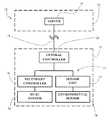
- FIG. 1is a schematic diagram of a control system according to an embodiment of the present invention.
- a control system 10 for controlling environmental conditions within at least one buildingcomprises an offsite component 12 and at least one onsite component 14 .
- the offsite component 12may include what is generically known as cloud computing.
- the offsite component 12operates as a remote terminal for directly accessing the onsite component 14 .
- the offsite component 12comprises at least one server 16 for storing and processing information.
- the offsite component 12is positioned at a site remote to each building to be controlled and is linked to the onsite component 14 at each building via a network connection 18 .
- the network connection 18can comprise, but is not limited to, hard line and wireless telecommunication means.
- the network connection 18can be used to remotely monitor the building conditions and communicate system updates to the onsite component 12 .
- a single offsite component 12can be networked to a plurality of onsite components 14 .
- a plurality of offsite components 12can each be linked to a single onsite component 14 , wherein the offsite components 12 are positioned at the same location for convenient access to each single onsite component 14 .
- the onsite component 14comprises a central controller 20 and a plurality of secondary units 22 .
- the plurality of secondary units 22can further comprise at least one sensor unit 24 and at least one secondary controller 26 .
- Each sensor unit 24is operably linked to environmental sensor 28 including, but not limited to, a thermometer, a humidity sensor, and a barometer.
- the environmental sensor 28collects measurements on the current environmental conditions within the building.
- each secondary controller 26is operable linked to an HVAC system 30 and is adapted to control the operation of the HVAC system 30 according to at least one control instruction.
- Each secondary unit 22is linked to the central controller 20 via a wireless connection 32 allowing for wireless transmission of information between the secondary units and central controller 20 .
- the wireless connection 32can comprise radio, BLUETOOTH, Wi-Fi or other conventional wireless technology.
- the central controller 20 and secondary units 22are modular and can be replaced or updated independently of the rest of the onsite component 14 .
- At least one control algorithm for generating control instructions based on the current environmental conditions within the buildingcan be stored on the central controller 20 .
- the environmental sensor 28can collect at least one environmental measurement indicative of the current environmental conditions within the building.
- the environmental measurementcan be transmitted to the central controller 20 via the sensor unit 24 .
- the central controller 20can process the environmental measurement with the control algorithm to produce at least one control instruction that is transmitted to the appropriate secondary controller 26 for operation of the HVAC system 30 .
- the environmental sensor 28can then collect additional environmental measurements to evaluate the effectiveness of the control algorithms.
- the controller 20can improve efficiencies over time as the controller 20 “learns” the characteristics of the structure.
- the environmental measurementscan be transmitted to the offsite component 12 via the network connection 18 and stored on the server 16 for long-term monitoring of the building.
- a system providercan access the environmental measurements to ascertain the effectiveness of the control algorithms and determine if the control algorithms need to be modified. Any modifications can be transmitted from the servers 16 to the central controller 20 via the network connection 18 to modify the control algorithms stored on the central controller 20 .
- the modification processcan be iterative where multiple cycles of evaluation and modification are performed to reach the desired efficiency.
- control algorithmcan be stored on the server 16 instead of the central controller 20 .
- the measurements collected by the environmental sensors 28are gathered by the central controller 20 and transmitted to the server 16 via the network connection 18 for processing.
- the server 16transmits the instructions back to the central controller 20 , which distributes the instructions to the appropriate secondary controller 26 .
- the system providercan modify the control algorithms directly at the server 16 to improve the effectiveness of the algorithms.
- back up control algorithmscan be implemented on the central controller 20 for maintaining operation of the onsite component 14 in the event that the network connection 18 to the server 16 is lost.
- the methodfurther comprises transmitting the measurement from the central controller 20 to the offsite component 12 and processing the measurement at the offsite component 12 to generate at least one control instruction for operating the HVAC system 30 .
- the methodalso comprises transmitting the instructions from the offsite component 12 to the central controller 20 , wherein the central controller 20 distributes the control instruction to the secondary controller 26 to operate the HVAC system 30 according to the control instructions.
- the methodcomprises modifying the control algorithm at the offsite component 12 to alter operation of the HVAC system 30 at the onsite component 14 . Services provided maybe tailored to individual users as required. For example, basic services could be provided in one package while advanced control services utilizing artificial intelligence in another package.
Landscapes
- Engineering & Computer Science (AREA)
- General Engineering & Computer Science (AREA)
- Chemical & Material Sciences (AREA)
- Combustion & Propulsion (AREA)
- Mechanical Engineering (AREA)
- Physics & Mathematics (AREA)
- Human Computer Interaction (AREA)
- General Physics & Mathematics (AREA)
- Automation & Control Theory (AREA)
- Fuzzy Systems (AREA)
- Mathematical Physics (AREA)
- Signal Processing (AREA)
- Air Conditioning Control Device (AREA)
- Selective Calling Equipment (AREA)
Abstract
Description
The present application claims priority to U.S. Provisional Application No. 61/647,350 entitled CLOUD BASED BUILDING AUTOMATION SYSTEMS and filed May 15, 2012, which is hereby incorporated herein in its entirety by reference.
The present invention is generally related to control systems for operation heating, ventilation and air conditioning (“HVAC”) systems based on monitored environmental conditions within the building. More specifically, the present invention is directed to a central control system for HVAC systems having stored control algorithms for operating the HVAC systems and linkable to a cloud for receiving updated control algorithms.
Automated HVAC systems maintain environmental conditions within a building by monitoring environmental conditions within a building and adjusting operation of the HVAC systems accordingly. Typically, environmental conditions measured by sensors or thermostats positioned throughout the building are collected at a central controller, which calculates the appropriate operating instructions for the HVAC systems based on stored control algorithms. As HVAC systems are often highly energy intensive to operate, the control algorithms are typically designed to operate the HVAC systems to minimally achieve the desired environmental conditions so as to minimize the amount energy consumed.
The inherent challenge of designing control algorithms for HVAC systems is that each building is unique requiring different operating parameters for the HVAC systems. Constant factors such as building dimensions and internal structures can vary the appropriate operating parameters for the HVAC system. Similarly, variable factors such as the daily weather, changing seasonal conditions and varying throughput of people through the building can change the appropriate operating parameters. As a result, control algorithms that can optimally operate the HVAC systems of a first building may less efficiently operate the HVAC systems of a second building. An optimized control algorithm optimized for a building can become inadequate as the building conditions change over time.
Although the control algorithms can be modified to increase the efficiency of the control system, the implementation process for updating the control algorithms is typically tedious and time consuming. In order to correctly modify the control algorithm, the modifications must be implemented onsite and continually monitored until the system reaches a steady state to determine if the modifications are effective. The large number of factors affecting the operation of the HVAC systems typically requires that the modifications be monitored for an extended period of time to ensure that the modifications address or mitigate as many factors as possible. The onsite modification and extended monitoring is inefficient and can take a substantial amount of time to perform correctly. Moreover, changing conditions in or around the building can render the modifications moot.
As energy costs rise, there is a need for ensuring that the central controller is operating the HVAC system at the maximum possible efficiency. As such, there is substantial need for means of reducing the tedious modification process to maintain the HVAC systems operating at maximizing efficiency
The present invention is directed to a control system for operating HVAC systems within a building to control the environmental conditions within a building and related method of operating. The control system comprises at least one onsite component installed at each building to be controlled and an offsite component networked to each onsite component. The onsite component monitors the conditions within the building and directly operates the HVAC systems, while the offsite component can be used by the system provider to communicate updates to the onsite component and remotely monitor the effectiveness of the control algorithms used to operate the HVAC systems. Accordingly, the system provider can remotely push control algorithm modifications to the onsite component and remotely monitor the effectiveness of the color algorithm modifications. The offsite component comprises at least one offsite server accessible by the system provider for remotely updating the control algorithms and monitoring the conditions within the building. Similarly, the location of the offsite component allows the service provider to provide subscription services such as regular updates or monitoring of the onsite component to monitor the efficacy of the control algorithms.
Each onsite component comprises a central controller and a plurality of secondary units wirelessly linked to the central controller. The secondary units can include at least one sensor unit comprising a sensor or thermostat for collecting and transmitting information on the current conditions in the building. The secondary units can also comprise at least one secondary controller linked to an HVAC unit for receiving command instructions from the central controller and transmitting information on the current operating conditions of the HVAC unit.
In one embodiment of the present invention, the offsite component comprises a server for receiving and storing control algorithms. The offsite server can be positioned at the service provider allowing the service provider to easily upload new control algorithms and modify existing algorithms stored on the memory component. In this configuration, the building information and the operating conditions can be gathered by the secondary units and transmitted to the central controller. The central controller aggregates the data and retransmits the data to the offsite server. The transmitted data can be processed at the offsite server to create a set of operating instructions for the HVAC systems at the building that are transmitted back to the central controller, which distributes the operating instructions to the appropriate secondary unit.
Storing the control algorithms at the service provider allows for easy access for the service provider to the control algorithms to make modifications to the algorithms without having to make the changes onsite at the building. The offsite server can be linked to a plurality of onsite components at a plurality of buildings. In certain aspects, global modifications to the control algorithms stored at the central server can be quickly made at the offsite server, rather than requiring trips to each building to apply the modifications at each onsite component.
In another embodiment, the control algorithms are stored on site at each onsite component rather than at the offsite server. In this configuration, the offsite server can be accessed by the service provider to remotely transmit modifications to the onsite component of each controlled building. Similarly, the onsite component can be configured to regularly upload the building information to the offsite server for monitoring by the service provider to ascertain the effectiveness of the control algorithms and whether any modifications to the algorithms are necessary.
A method of maintaining environmental conditions within a building, according to an embodiment of the present invention, comprises providing an offsite component networked to an onsite component, wherein the onsite component comprises a central controller wirelessly linking at least one sensor unit and at least one secondary controller linked to an HVAC system. The method further comprises storing at least one control algorithm on the central controller. The method also comprises gathering at least one measurement of environmental conditions within the building and transmitting the measurement to the central controller. The method further comprises processing the measurement through the central controller to generate at least one control instruction for operating the HVAC system. The method also comprises transmitting the instructions from the central controller to the secondary controller to operate the HVAC system according to the control instructions. Finally, the method comprises transmitting at least one programming modification from the offsite component to the central controller and modifying the control algorithm according to the programming modification.
A method of maintaining environmental conditions within a building, according to an embodiment of the present invention, comprises providing an offsite component networked to an onsite component, wherein the onsite component comprises a central controller wirelessly linking at least one sensor unit and at least one secondary controller linked to an HVAC system. The method further comprises storing at least one control algorithm on the offsite component. The method also comprises gathering at least one measurement of environmental conditions within the building and transmitting the measurement to the central controller. The method further comprises transmitting the measurement from the central controller to the offsite component and processing the measurement at the offsite component to generate at least one control instruction for operating the HVAC system. The method also comprises transmitting the instructions from the offsite component to the central controller, wherein the central controller distributes the control instruction to the secondary controller to operate the HVAC system according to the control instructions. Finally, the method comprises modifying the control algorithm at the offsite component to alter operation of the HVAC system at the onsite component.
A method of providing an energy optimization plan for a building energy management system is also disclosed. Instead of selling hardware and installing into a building, a subscription service is proposed to provide a hardware and software optimization system. By utilizing artificial intelligence and fuzzy logic, the proposed method will continually learn to minimize total energy usage based on each building's unique and changing characteristics. By placing the software platform on the cloud, onsite requirements are reduced. Existing locations can be retrofitted with specially designed wireless controllers. New systems can be done at less cost by leveraging the wireless capabilities and placing controls outside of the structure on the cloud. The structure would only require a minimum level of internal control in case of a loss of communication. Multiple levels of service can be provided including: scheduler; alarm handler; dynamic graphics; notification of events; trending; user account information; report generator; energy optimization algorithm, diagnostic capabilities and service tools. The method includes allowing the user to choose from a menu of options that would be provided under a subscription plan.
The above summary of the various representative embodiments of the invention is not intended to describe each illustrated embodiment or every implementation of the invention. Rather, the embodiments are chosen and described so that others skilled in the art can appreciate and understand the principles and practices of the invention. The FIGURE in the detailed description that follow more particularly exemplify these embodiments.
The invention can be completely understood in consideration of the following detailed description of various embodiments of the invention in connection with the accompanying drawings, in which:
While the invention is amenable to various modifications and alternative forms, specifics thereof have been shown by way of example in the drawings and will be described in detail. It should be understood, however, that the intention is not to limit the invention to the particular embodiments described. On the contrary, the intention is to cover all modifications, equivalents, and alternatives falling within the spirit and scope of the invention as defined by the appended claims.
As shown inFIG. 1 , a control system10 for controlling environmental conditions within at least one building, according to an embodiment of the present invention, comprises anoffsite component 12 and at least oneonsite component 14. Theoffsite component 12 may include what is generically known as cloud computing. Theoffsite component 12 operates as a remote terminal for directly accessing theonsite component 14. Theoffsite component 12 comprises at least oneserver 16 for storing and processing information. Theoffsite component 12 is positioned at a site remote to each building to be controlled and is linked to theonsite component 14 at each building via anetwork connection 18. Thenetwork connection 18 can comprise, but is not limited to, hard line and wireless telecommunication means. Thenetwork connection 18 can be used to remotely monitor the building conditions and communicate system updates to theonsite component 12. In certain aspects, a singleoffsite component 12 can be networked to a plurality ofonsite components 14. Alternatively, a plurality ofoffsite components 12 can each be linked to a singleonsite component 14, wherein theoffsite components 12 are positioned at the same location for convenient access to each singleonsite component 14.
Theonsite component 14 comprises acentral controller 20 and a plurality ofsecondary units 22. The plurality ofsecondary units 22 can further comprise at least onesensor unit 24 and at least onesecondary controller 26. Eachsensor unit 24 is operably linked toenvironmental sensor 28 including, but not limited to, a thermometer, a humidity sensor, and a barometer. Theenvironmental sensor 28 collects measurements on the current environmental conditions within the building. Similarly, eachsecondary controller 26 is operable linked to anHVAC system 30 and is adapted to control the operation of theHVAC system 30 according to at least one control instruction. Eachsecondary unit 22 is linked to thecentral controller 20 via a wireless connection32 allowing for wireless transmission of information between the secondary units andcentral controller 20. The wireless connection32 can comprise radio, BLUETOOTH, Wi-Fi or other conventional wireless technology. As thesecondary units 22 wirelessly communicate with thecentral controller 20, thecentral controller 20 andsecondary units 22 are modular and can be replaced or updated independently of the rest of theonsite component 14.
In one aspect, at least one control algorithm for generating control instructions based on the current environmental conditions within the building can be stored on thecentral controller 20. In this configuration, theenvironmental sensor 28 can collect at least one environmental measurement indicative of the current environmental conditions within the building. The environmental measurement can be transmitted to thecentral controller 20 via thesensor unit 24. Thecentral controller 20 can process the environmental measurement with the control algorithm to produce at least one control instruction that is transmitted to the appropriatesecondary controller 26 for operation of theHVAC system 30. Theenvironmental sensor 28 can then collect additional environmental measurements to evaluate the effectiveness of the control algorithms. Through fuzzy logic/artificial intelligence processes, thecontroller 20 can improve efficiencies over time as thecontroller 20 “learns” the characteristics of the structure.
In this configuration, the environmental measurements can be transmitted to theoffsite component 12 via thenetwork connection 18 and stored on theserver 16 for long-term monitoring of the building. A system provider can access the environmental measurements to ascertain the effectiveness of the control algorithms and determine if the control algorithms need to be modified. Any modifications can be transmitted from theservers 16 to thecentral controller 20 via thenetwork connection 18 to modify the control algorithms stored on thecentral controller 20. In one aspect, the modification process can be iterative where multiple cycles of evaluation and modification are performed to reach the desired efficiency.
In one aspect, the control algorithm can be stored on theserver 16 instead of thecentral controller 20. In this configuration, the measurements collected by theenvironmental sensors 28 are gathered by thecentral controller 20 and transmitted to theserver 16 via thenetwork connection 18 for processing. Once the control instructions are generated, theserver 16 transmits the instructions back to thecentral controller 20, which distributes the instructions to the appropriatesecondary controller 26. The system provider can modify the control algorithms directly at theserver 16 to improve the effectiveness of the algorithms. In this configuration, back up control algorithms can be implemented on thecentral controller 20 for maintaining operation of theonsite component 14 in the event that thenetwork connection 18 to theserver 16 is lost.
A method of maintaining environmental conditions within a building, according to an embodiment of the present invention, comprises providing a control system10 comprising anoffsite component 12 networked to anonsite component 14, wherein theonsite component 14 comprises acentral controller 20 wirelessly linking at least onesensor unit 24 and at least onesecondary controller 26 linked to anHVAC system 30. The method further comprises implementing at least one control algorithm on thecentral controller 20. The method also comprises gathering at least one measurement of environmental conditions within the building with thesensor unit 24 and transmitting the measurement to thecentral controller 20. The method further comprises processing the measurement through thecentral controller 20 to generate at least one control instruction for operating theHVAC system 30. The method also comprises transmitting the instructions from thecentral controller 20 to thesecondary controller 26 to operate theHVAC system 30 according to the control instructions. Finally, the method comprises transmitting at least one programming modification from theoffsite component 14 to thecentral controller 20 and modifying the control algorithm stored on thecentral controller 20 with the transmitted programming modification.
A method of providing building automation/energy management service by way of wireless communication to cloud servers is also provided herein. Such a method may be by annual fee or through a subscription service. Environmental conditions within a building, according to an embodiment of the present invention, comprises providing anoffsite component 12 networked to anonsite component 14, wherein theonsite component 14 comprises acentral controller 20 wirelessly linking at least onesensor unit 24 and at least onesecondary controller 26 linked to anHVAC system 30. The method further comprises storing at least one control algorithm on theoffsite component 12. The method also comprises gathering at least one measurement of environmental conditions within the building with thesensor unit 24 and transmitting the measurement to thecentral controller 20. The method further comprises transmitting the measurement from thecentral controller 20 to theoffsite component 12 and processing the measurement at theoffsite component 12 to generate at least one control instruction for operating theHVAC system 30. The method also comprises transmitting the instructions from theoffsite component 12 to thecentral controller 20, wherein thecentral controller 20 distributes the control instruction to thesecondary controller 26 to operate theHVAC system 30 according to the control instructions. Finally, the method comprises modifying the control algorithm at theoffsite component 12 to alter operation of theHVAC system 30 at theonsite component 14. Services provided maybe tailored to individual users as required. For example, basic services could be provided in one package while advanced control services utilizing artificial intelligence in another package.
While the invention is amenable to various modifications and alternative forms, specifics thereof have been shown by way of example in the drawings and described in detail. It is understood, however, that the intention is not to limit the invention to the particular embodiments described. On the contrary, the intention is to cover all modifications, equivalents, and alternatives falling within the spirit and scope of the invention as defined by the appended claims.
Claims (9)
1. A control system for controlling the environmental conditions within a building comprising:
at least one onsite component located at the building and further comprising:
a central controller that stores a control algorithm,
at least one sensor unit for collecting at least one environmental measurement corresponding to a measured temperature condition from within the building and transmitting the environmental measurement to the central controller, wherein the central controller automatically aggregates the environmental measurements and generates an environmental control instruction based on the environmental measurement,
at least one secondary control unit operably linked to an HVAC system,
an offsite component located remotely from the building and networked to the at least one onsite component, wherein the offsite component evaluates characteristics of the environmental control instruction to determine an effectiveness of the control algorithm, and wherein the offsite component remotely modifies at least one operating instruction of the control algorithm to generate a new temperature setpoint; and
wherein regular updates and monitoring of the at least one onsite component are offered through a subscription service to monitor the efficacy of the control algorithm and wherein the central controller transmits the at least one operating instruction to the secondary control unit governing operation of the HVAC system to achieve a desired environmental condition within the building.
2. The control system ofclaim 1 , wherein the control algorithm for calculating the operating instruction based on the environmental measurement is stored on the central controller.
3. A method of controlling the environmental conditions within a building, comprising:
providing an onsite component at the building and comprising a central controller that stores a control algorithm, a sensor unit and a secondary control unit operably linked to an HVAC system;
networking an offsite component to the onsite component, wherein the offsite component is remote from onsite component;
collecting an environmental measurement within the building with the sensor unit, wherein the environmental measurement corresponds to a measured temperature condition;
wirelessly transmitting the environmental measurement to the central controller;
aggregating the environmental measurements;
generating an environmental temperature control instruction based on the environmental measurement;
wirelessly transmitting a control instruction to the secondary control unit, wherein the control instruction corresponds to the environmental measurement;
operating the HVAC system according to the control instruction;
remotely modifying the control instruction via the offsite component to generate a new temperature setpoint based on an analysis of the building temperature data to maintain a desired efficiency level; and
providing regular updates and monitoring of the onsite component through a subscription service to monitor the efficacy of the control algorithm.
4. The method ofclaim 3 , further comprising:
storing a control algorithm on the central controller; and
calculating the control instruction based on an analysis of the aggregation of the environmental measurements from within the building.
5. The method ofclaim 4 , further comprising:
transmitting a modifying instruction from the offsite component to alter the control algorithm stored on the central controller to create a modified control algorithm.
6. The method ofclaim 3 , further comprising:
storing a control algorithm on the offsite component;
transmitting the environmental measurement from the offsite component;
calculating the control instruction based on the environmental measurement; and
transmitting the control instruction from the offsite component to the onsite component.
7. The method ofclaim 6 , further comprising:
modifying the instruction on the offsite component to alter the control algorithm stored on the offsite component to create a modified control algorithm.
8. The method ofclaim 3 , further comprising:
providing a second onsite component at a second building and comprising a central controller, a sensor unit and a secondary control unit operably linked to an HVAC system; and
networking the offsite component to the onsite component, wherein the offsite component is remote from the second onsite component.
9. The method ofclaim 8 , further comprising:
remotely modifying a control instruction transmitted by the second central controller via the offsite component.
Priority Applications (10)
| Application Number | Priority Date | Filing Date | Title |
|---|---|---|---|
| US13/828,133US9557750B2 (en) | 2012-05-15 | 2013-03-14 | Cloud based building automation systems |
| DK13790268.0TDK2856038T3 (en) | 2012-05-15 | 2013-05-06 | CLOUD-BASED BUILDING AUTOMATION SYSTEMS |
| PCT/US2013/039723WO2013173108A1 (en) | 2012-05-15 | 2013-05-06 | Cloud based building automation systems |
| JP2015512682AJP6290188B2 (en) | 2012-05-15 | 2013-05-06 | Cloud-based building automation system |
| EP13790268.0AEP2856038B1 (en) | 2012-05-15 | 2013-05-06 | Cloud based building automation systems |
| EP21170652.8AEP3926890A1 (en) | 2012-05-15 | 2013-05-06 | Cloud based building automation systems |
| CA2873625ACA2873625C (en) | 2012-05-15 | 2013-05-06 | Cloud based building automation systems |
| ES13790268TES2869944T3 (en) | 2012-05-15 | 2013-05-06 | Cloud-based building automation systems |
| MX2014013936AMX2014013936A (en) | 2012-05-15 | 2013-05-06 | Cloud based building automation systems. |
| CN201380037578.8ACN104583683B (en) | 2012-05-15 | 2013-05-06 | building automation system based on cloud |
Applications Claiming Priority (2)
| Application Number | Priority Date | Filing Date | Title |
|---|---|---|---|
| US201261647350P | 2012-05-15 | 2012-05-15 | |
| US13/828,133US9557750B2 (en) | 2012-05-15 | 2013-03-14 | Cloud based building automation systems |
Publications (2)
| Publication Number | Publication Date |
|---|---|
| US20130310986A1 US20130310986A1 (en) | 2013-11-21 |
| US9557750B2true US9557750B2 (en) | 2017-01-31 |
Family
ID=49581964
Family Applications (1)
| Application Number | Title | Priority Date | Filing Date |
|---|---|---|---|
| US13/828,133Active2034-05-15US9557750B2 (en) | 2012-05-15 | 2013-03-14 | Cloud based building automation systems |
Country Status (9)
| Country | Link |
|---|---|
| US (1) | US9557750B2 (en) |
| EP (2) | EP3926890A1 (en) |
| JP (1) | JP6290188B2 (en) |
| CN (1) | CN104583683B (en) |
| CA (1) | CA2873625C (en) |
| DK (1) | DK2856038T3 (en) |
| ES (1) | ES2869944T3 (en) |
| MX (1) | MX2014013936A (en) |
| WO (1) | WO2013173108A1 (en) |
Cited By (13)
| Publication number | Priority date | Publication date | Assignee | Title |
|---|---|---|---|---|
| US20170284690A1 (en)* | 2016-04-01 | 2017-10-05 | Softarex Technologies, Inc. | Mobile environment monitoring system |
| CN107606749A (en)* | 2017-08-30 | 2018-01-19 | 滁州市西控电子有限公司 | A kind of Intelligent variable parameter air energy-saving control system |
| US20180082155A1 (en)* | 2016-09-16 | 2018-03-22 | Kabushiki Kaisha Toshiba | Spatial information delivery system, spatial information delivery method, and non-transitory computer readable medium |
| US20180172308A1 (en)* | 2015-06-21 | 2018-06-21 | Rajesh Ramnik Solanki | System for monitoring and controlling devices and method thereof |
| US10731886B2 (en) | 2017-07-20 | 2020-08-04 | Carrier Corporation | HVAC system including energy analytics engine |
| US10845771B2 (en) | 2017-05-22 | 2020-11-24 | PassiveLogic, Inc. | Automated method of generalized building automation from atomic physical models and control loops thereof |
| US10921760B2 (en) | 2018-06-12 | 2021-02-16 | PassiveLogic, Inc. | Predictive control loops using time-based simulation and building-automation systems thereof |
| US10969133B2 (en) | 2017-05-31 | 2021-04-06 | PassiveLogic, Inc. | Methodology of occupant comfort management in buildings using occupant comfort models and user interfaces thereof |
| US11392096B2 (en) | 2017-06-12 | 2022-07-19 | PassiveLogic, Inc. | Heuristic method of automated and learning control, and building automation systems thereof |
| US11394574B2 (en) | 2017-06-13 | 2022-07-19 | PassiveLogic, Inc. | Automatic control method of generating sub-systems and sub-system arbitration from the deconstruction of a complex equipment graph |
| US20230214555A1 (en)* | 2021-12-30 | 2023-07-06 | PassiveLogic, Inc. | Simulation Training |
| US11775132B1 (en) | 2022-05-18 | 2023-10-03 | Environments by LE, Inc. | System and method for the management and use of building systems, facilities, and amenities using internet of things devices and a metaverse representation |
| US11861502B2 (en) | 2020-06-05 | 2024-01-02 | PassiveLogic, Inc. | Control sequence generation system and methods |
Families Citing this family (16)
| Publication number | Priority date | Publication date | Assignee | Title |
|---|---|---|---|---|
| DE102012105059A1 (en) | 2012-06-12 | 2013-12-12 | Epcos Ag | Method for producing a multilayer component and multilayer component |
| US9047189B1 (en) | 2013-05-28 | 2015-06-02 | Amazon Technologies, Inc. | Self-describing data blocks of a minimum atomic write size for a data store |
| US10915669B2 (en) | 2014-06-20 | 2021-02-09 | Ademco Inc. | HVAC zoning devices, systems, and methods |
| US10408482B2 (en) | 2015-02-11 | 2019-09-10 | Bitfinder, Inc. | Managing environmental conditions |
| JP6621935B2 (en)* | 2016-04-08 | 2019-12-18 | ハスクバーナ・アーベー | Intelligent watering system |
| US10908627B2 (en) | 2016-05-25 | 2021-02-02 | Alper Uzmezler | Edge analytics control devices and methods |
| DE102016212208A1 (en) | 2016-07-05 | 2018-01-11 | Rheinisch-Westfälische Technische Hochschule Aachen (RWTH) | System for the automated analysis and optimization of building automation systems |
| CN110023851B (en) | 2016-11-23 | 2023-04-21 | 开利公司 | Building management system with knowledge base |
| US10972306B2 (en) | 2016-11-23 | 2021-04-06 | Carrier Corporation | Building management system having event reporting |
| US20180156483A1 (en)* | 2016-12-01 | 2018-06-07 | Bitfinder, Inc. | Control of an environmental condition manipulating appliance |
| US10436470B2 (en) | 2017-07-18 | 2019-10-08 | Abb Schweiz Ag | Rule-based load shedding algorithm for building energy management |
| GB2570875B (en)* | 2018-02-02 | 2020-10-28 | British Telecomm | Monitoring of distributed systems |
| EP3747209A1 (en) | 2018-02-02 | 2020-12-09 | British Telecommunications public limited company | Monitoring of distributed systems |
| GB2576751B (en)* | 2018-08-30 | 2020-12-30 | British Telecomm | Monitoring of distributed systems |
| US11036198B2 (en) | 2018-08-30 | 2021-06-15 | British Telecommunications Public Limited Company | Monitoring of distributed systems with measuring effectiveness of a first policy to derive a satisfaction measure |
| WO2022010913A1 (en)* | 2020-07-06 | 2022-01-13 | Johnson Controls Tyco IP Holdings LLP | Cloud-based hvac&r control systems and methods |
Citations (31)
| Publication number | Priority date | Publication date | Assignee | Title |
|---|---|---|---|---|
| US4212078A (en)* | 1977-12-27 | 1980-07-08 | United Technologies Corporation | Computer controlled facility management system (FMS) |
| US6349883B1 (en)* | 1999-02-09 | 2002-02-26 | Energy Rest, Inc. | Energy-saving occupancy-controlled heating ventilating and air-conditioning systems for timing and cycling energy within different rooms of buildings having central power units |
| JP2003021380A (en) | 2001-07-09 | 2003-01-24 | Funai Electric Co Ltd | Air conditioning control system and air conditioner used in the same |
| JP2004245556A (en) | 2003-02-17 | 2004-09-02 | Toshiba Corp | Online air conditioning temperature setting system, center machine and online air conditioning temperature setting program |
| US20060161270A1 (en)* | 2004-10-14 | 2006-07-20 | Lagotek Corporation | Distributed wireless home and commercial electrical automation systems |
| US7135956B2 (en)* | 2000-07-13 | 2006-11-14 | Nxegen, Inc. | System and method for monitoring and controlling energy usage |
| EP2012288A2 (en) | 2007-07-06 | 2009-01-07 | Chunghwa Telecom Co., Ltd. | Network-based air-conditioning equipment remote monitoring and management system |
| JP2009009414A (en) | 2007-06-28 | 2009-01-15 | Sanyo Electric Co Ltd | Equipment control system, management controller, control method, and control program |
| US20090057429A1 (en) | 2007-08-30 | 2009-03-05 | Samsung Electronics Co., Ltd. | Hybrid Air-Conditioning System and Method for Controlling the Same |
| US20090057425A1 (en) | 2007-08-27 | 2009-03-05 | Honeywell International Inc. | Remote hvac control with building floor plan tool |
| US7565225B2 (en)* | 2007-07-09 | 2009-07-21 | Venstar, Inc. | Environment, lighting and security control system |
| US7621140B2 (en)* | 2005-09-01 | 2009-11-24 | Honeywell Intermational Inc. | Temperature control in a space served by multiple HVAC equipment |
| JP2010127542A (en) | 2008-11-27 | 2010-06-10 | Sanwa System Kk | Operation optimization remote tuning system |
| EP2264374A1 (en) | 2008-03-28 | 2010-12-22 | Mitsubishi Electric Corporation | Air-conditioning management apparatus, air-conditioning management system |
| US7894944B2 (en)* | 2007-07-06 | 2011-02-22 | Microsoft Corporation | Environmental monitoring in data facilities |
| US20110047052A1 (en)* | 2009-08-18 | 2011-02-24 | Kevin Terrill Cornish | Method and process for an energy management system for setting and adjusting a minimum energy reserve for a rechargeable energy storage device |
| WO2011028889A2 (en) | 2009-09-02 | 2011-03-10 | Optimum Energy, Llc | Environmental control for hvac system |
| US20110231320A1 (en)* | 2009-12-22 | 2011-09-22 | Irving Gary W | Energy management systems and methods |
| US20110304645A1 (en)* | 2011-06-30 | 2011-12-15 | Milan Milenkovic | Techniques for providing holistic views of personal energy consumption |
| US20120253527A1 (en)* | 2011-04-04 | 2012-10-04 | Ecobee, Inc. | Programming Simulator for an HVAC Controller |
| US8374725B1 (en)* | 2007-11-27 | 2013-02-12 | Joseph David Ols | Climate control |
| US20130073094A1 (en)* | 2010-03-30 | 2013-03-21 | Telepure Limited | Building occupancy dependent control system |
| US20130282181A1 (en)* | 2012-04-20 | 2013-10-24 | Battelle Memorial Institute | Controller for thermostatically controlled loads |
| US20130338839A1 (en)* | 2010-11-19 | 2013-12-19 | Matthew Lee Rogers | Flexible functionality partitioning within intelligent-thermostat-controlled hvac systems |
| US8645495B2 (en)* | 2009-11-12 | 2014-02-04 | Bank Of America Corporation | Facility maintenance and management system |
| US8651168B2 (en)* | 2007-05-07 | 2014-02-18 | Board Of Trustees Of The University Of Illinois | Cooling control system for continuous casting of metal |
| US20140052300A1 (en)* | 2010-12-31 | 2014-02-20 | Nest Labs, Inc. | Inhibiting deleterious control coupling in an enclosure having multiple hvac regions |
| US20140173289A1 (en)* | 2011-08-25 | 2014-06-19 | Siemens Industry, Inc. | Mobile identity provider with two factor authentication |
| US8788097B2 (en)* | 2009-06-22 | 2014-07-22 | Johnson Controls Technology Company | Systems and methods for using rule-based fault detection in a building management system |
| US20140207281A1 (en)* | 2013-01-18 | 2014-07-24 | Irobot Corporation | Environmental Management Systems Including Mobile Robots and Methods Using Same |
| US20140371921A1 (en)* | 2007-10-02 | 2014-12-18 | Google Inc. | Intelligent temperature management based on energy usage profiles and outside weather conditions |
Family Cites Families (5)
| Publication number | Priority date | Publication date | Assignee | Title |
|---|---|---|---|---|
| JPH06159764A (en)* | 1992-11-30 | 1994-06-07 | Daikin Ind Ltd | Operation control device for air conditioner |
| CN2703223Y (en)* | 2003-08-29 | 2005-06-01 | 苏州利源自动化科技有限公司 | Central air conditioner energy-saving controlling device |
| JP5233470B2 (en)* | 2008-07-23 | 2013-07-10 | ダイキン工業株式会社 | Group management device and group management system |
| CN201391966Y (en)* | 2009-04-24 | 2010-01-27 | 长沙麦融高科有限公司 | System for online monitoring state of air conditioner |
| CN201429177Y (en)* | 2009-05-14 | 2010-03-24 | 杭州光泽科技有限公司 | System for remote intelligent real-time monitoring and optimization evaluation of air conditioner energy conservation |
- 2013
- 2013-03-14USUS13/828,133patent/US9557750B2/enactiveActive
- 2013-05-06WOPCT/US2013/039723patent/WO2013173108A1/enactiveApplication Filing
- 2013-05-06CNCN201380037578.8Apatent/CN104583683B/enactiveActive
- 2013-05-06DKDK13790268.0Tpatent/DK2856038T3/enactive
- 2013-05-06CACA2873625Apatent/CA2873625C/enactiveActive
- 2013-05-06MXMX2014013936Apatent/MX2014013936A/enactiveIP Right Grant
- 2013-05-06EPEP21170652.8Apatent/EP3926890A1/enactivePending
- 2013-05-06ESES13790268Tpatent/ES2869944T3/enactiveActive
- 2013-05-06EPEP13790268.0Apatent/EP2856038B1/enactiveActive
- 2013-05-06JPJP2015512682Apatent/JP6290188B2/enactiveActive
Patent Citations (31)
| Publication number | Priority date | Publication date | Assignee | Title |
|---|---|---|---|---|
| US4212078A (en)* | 1977-12-27 | 1980-07-08 | United Technologies Corporation | Computer controlled facility management system (FMS) |
| US6349883B1 (en)* | 1999-02-09 | 2002-02-26 | Energy Rest, Inc. | Energy-saving occupancy-controlled heating ventilating and air-conditioning systems for timing and cycling energy within different rooms of buildings having central power units |
| US7135956B2 (en)* | 2000-07-13 | 2006-11-14 | Nxegen, Inc. | System and method for monitoring and controlling energy usage |
| JP2003021380A (en) | 2001-07-09 | 2003-01-24 | Funai Electric Co Ltd | Air conditioning control system and air conditioner used in the same |
| JP2004245556A (en) | 2003-02-17 | 2004-09-02 | Toshiba Corp | Online air conditioning temperature setting system, center machine and online air conditioning temperature setting program |
| US20060161270A1 (en)* | 2004-10-14 | 2006-07-20 | Lagotek Corporation | Distributed wireless home and commercial electrical automation systems |
| US7621140B2 (en)* | 2005-09-01 | 2009-11-24 | Honeywell Intermational Inc. | Temperature control in a space served by multiple HVAC equipment |
| US8651168B2 (en)* | 2007-05-07 | 2014-02-18 | Board Of Trustees Of The University Of Illinois | Cooling control system for continuous casting of metal |
| JP2009009414A (en) | 2007-06-28 | 2009-01-15 | Sanyo Electric Co Ltd | Equipment control system, management controller, control method, and control program |
| US7894944B2 (en)* | 2007-07-06 | 2011-02-22 | Microsoft Corporation | Environmental monitoring in data facilities |
| EP2012288A2 (en) | 2007-07-06 | 2009-01-07 | Chunghwa Telecom Co., Ltd. | Network-based air-conditioning equipment remote monitoring and management system |
| US7565225B2 (en)* | 2007-07-09 | 2009-07-21 | Venstar, Inc. | Environment, lighting and security control system |
| US20090057425A1 (en) | 2007-08-27 | 2009-03-05 | Honeywell International Inc. | Remote hvac control with building floor plan tool |
| US20090057429A1 (en) | 2007-08-30 | 2009-03-05 | Samsung Electronics Co., Ltd. | Hybrid Air-Conditioning System and Method for Controlling the Same |
| US20140371921A1 (en)* | 2007-10-02 | 2014-12-18 | Google Inc. | Intelligent temperature management based on energy usage profiles and outside weather conditions |
| US8374725B1 (en)* | 2007-11-27 | 2013-02-12 | Joseph David Ols | Climate control |
| EP2264374A1 (en) | 2008-03-28 | 2010-12-22 | Mitsubishi Electric Corporation | Air-conditioning management apparatus, air-conditioning management system |
| JP2010127542A (en) | 2008-11-27 | 2010-06-10 | Sanwa System Kk | Operation optimization remote tuning system |
| US8788097B2 (en)* | 2009-06-22 | 2014-07-22 | Johnson Controls Technology Company | Systems and methods for using rule-based fault detection in a building management system |
| US20110047052A1 (en)* | 2009-08-18 | 2011-02-24 | Kevin Terrill Cornish | Method and process for an energy management system for setting and adjusting a minimum energy reserve for a rechargeable energy storage device |
| WO2011028889A2 (en) | 2009-09-02 | 2011-03-10 | Optimum Energy, Llc | Environmental control for hvac system |
| US8645495B2 (en)* | 2009-11-12 | 2014-02-04 | Bank Of America Corporation | Facility maintenance and management system |
| US20110231320A1 (en)* | 2009-12-22 | 2011-09-22 | Irving Gary W | Energy management systems and methods |
| US20130073094A1 (en)* | 2010-03-30 | 2013-03-21 | Telepure Limited | Building occupancy dependent control system |
| US20130338839A1 (en)* | 2010-11-19 | 2013-12-19 | Matthew Lee Rogers | Flexible functionality partitioning within intelligent-thermostat-controlled hvac systems |
| US20140052300A1 (en)* | 2010-12-31 | 2014-02-20 | Nest Labs, Inc. | Inhibiting deleterious control coupling in an enclosure having multiple hvac regions |
| US20120253527A1 (en)* | 2011-04-04 | 2012-10-04 | Ecobee, Inc. | Programming Simulator for an HVAC Controller |
| US20110304645A1 (en)* | 2011-06-30 | 2011-12-15 | Milan Milenkovic | Techniques for providing holistic views of personal energy consumption |
| US20140173289A1 (en)* | 2011-08-25 | 2014-06-19 | Siemens Industry, Inc. | Mobile identity provider with two factor authentication |
| US20130282181A1 (en)* | 2012-04-20 | 2013-10-24 | Battelle Memorial Institute | Controller for thermostatically controlled loads |
| US20140207281A1 (en)* | 2013-01-18 | 2014-07-24 | Irobot Corporation | Environmental Management Systems Including Mobile Robots and Methods Using Same |
Non-Patent Citations (3)
| Title |
|---|
| Extended European Search Report for Application No. 13790268.0, mailed Jul. 13, 2016 (6 pgs). |
| International Preliminary Report on Patentability from PCT Application PCT/US2013/039723, dated Nov. 27, 2014, 7 pgs. |
| International Search Report and Written Opinion for PCT Application PCT/US2013/039723, dated Sep. 17, 2013, 10 pgs. |
Cited By (22)
| Publication number | Priority date | Publication date | Assignee | Title |
|---|---|---|---|---|
| US20180172308A1 (en)* | 2015-06-21 | 2018-06-21 | Rajesh Ramnik Solanki | System for monitoring and controlling devices and method thereof |
| US10578330B2 (en)* | 2015-06-21 | 2020-03-03 | Rajesh Ramnik Solanki | System for monitoring and controlling devices and method thereof |
| US20170284690A1 (en)* | 2016-04-01 | 2017-10-05 | Softarex Technologies, Inc. | Mobile environment monitoring system |
| US20180082155A1 (en)* | 2016-09-16 | 2018-03-22 | Kabushiki Kaisha Toshiba | Spatial information delivery system, spatial information delivery method, and non-transitory computer readable medium |
| US10467505B2 (en)* | 2016-09-16 | 2019-11-05 | Kabushiki Kaisha Toshiba | Spatial information delivery system, spatial information delivery method, and non-transitory computer readable medium |
| US10845771B2 (en) | 2017-05-22 | 2020-11-24 | PassiveLogic, Inc. | Automated method of generalized building automation from atomic physical models and control loops thereof |
| US10969133B2 (en) | 2017-05-31 | 2021-04-06 | PassiveLogic, Inc. | Methodology of occupant comfort management in buildings using occupant comfort models and user interfaces thereof |
| US11392096B2 (en) | 2017-06-12 | 2022-07-19 | PassiveLogic, Inc. | Heuristic method of automated and learning control, and building automation systems thereof |
| US20220350297A1 (en)* | 2017-06-12 | 2022-11-03 | PassiveLogic, Inc. | Heuristic method of automated and learning control, and building automation systems thereof |
| US12242234B2 (en)* | 2017-06-12 | 2025-03-04 | PassiveLogic, Inc. | Heuristic method of automated and learning control, and building automation systems thereof |
| US20230350355A1 (en)* | 2017-06-12 | 2023-11-02 | PassiveLogic, Inc. | Heuristic method of automated and learning control, and building automation systems thereof |
| US11733662B2 (en)* | 2017-06-12 | 2023-08-22 | PassiveLogic, Inc. | Heuristic method of automated and learning control, and building automation systems thereof |
| US11394574B2 (en) | 2017-06-13 | 2022-07-19 | PassiveLogic, Inc. | Automatic control method of generating sub-systems and sub-system arbitration from the deconstruction of a complex equipment graph |
| US12388673B2 (en) | 2017-06-13 | 2025-08-12 | PassiveLogic, Inc. | Automatic control method of generating sub-systems and sub-system arbitration from the deconstruction of a complex equipment graph |
| US10731886B2 (en) | 2017-07-20 | 2020-08-04 | Carrier Corporation | HVAC system including energy analytics engine |
| CN107606749A (en)* | 2017-08-30 | 2018-01-19 | 滁州市西控电子有限公司 | A kind of Intelligent variable parameter air energy-saving control system |
| US10921760B2 (en) | 2018-06-12 | 2021-02-16 | PassiveLogic, Inc. | Predictive control loops using time-based simulation and building-automation systems thereof |
| US11861502B2 (en) | 2020-06-05 | 2024-01-02 | PassiveLogic, Inc. | Control sequence generation system and methods |
| US11915142B2 (en) | 2020-06-05 | 2024-02-27 | PassiveLogic, Inc. | Creating equipment control sequences from constraint data |
| US12361291B2 (en) | 2020-06-05 | 2025-07-15 | PassiveLogic, Inc. | Control sequence generation system and methods |
| US20230214555A1 (en)* | 2021-12-30 | 2023-07-06 | PassiveLogic, Inc. | Simulation Training |
| US11775132B1 (en) | 2022-05-18 | 2023-10-03 | Environments by LE, Inc. | System and method for the management and use of building systems, facilities, and amenities using internet of things devices and a metaverse representation |
Also Published As
| Publication number | Publication date |
|---|---|
| JP6290188B2 (en) | 2018-03-07 |
| CN104583683B (en) | 2018-06-12 |
| EP2856038A4 (en) | 2016-08-10 |
| EP3926890A1 (en) | 2021-12-22 |
| MX2014013936A (en) | 2015-04-13 |
| CA2873625A1 (en) | 2013-11-21 |
| CA2873625C (en) | 2021-07-27 |
| EP2856038B1 (en) | 2021-04-28 |
| WO2013173108A1 (en) | 2013-11-21 |
| JP2015516562A (en) | 2015-06-11 |
| DK2856038T3 (en) | 2021-05-25 |
| ES2869944T3 (en) | 2021-10-26 |
| CN104583683A (en) | 2015-04-29 |
| EP2856038A1 (en) | 2015-04-08 |
| US20130310986A1 (en) | 2013-11-21 |
Similar Documents
| Publication | Publication Date | Title |
|---|---|---|
| US9557750B2 (en) | Cloud based building automation systems | |
| US11762362B2 (en) | Building management system with dynamic channel communication | |
| US11698205B2 (en) | Smart building level control for improving compliance of temperature, pressure, and humidity | |
| US11415334B2 (en) | Building control system with automatic comfort constraint generation | |
| EP3588232B1 (en) | Optimizing and controlling the energy comsumption of a building | |
| JP2021018055A (en) | Building management system with automatic comfort constraint adjustment | |
| US10731886B2 (en) | HVAC system including energy analytics engine | |
| US11774124B2 (en) | Systems and methods for managing building signature intelligent electronic devices | |
| CN119231653B (en) | Energy management method for photovoltaic energy storage system | |
| CN105674491A (en) | Cloud platform-based indoor environment management system | |
| JP5951270B2 (en) | Air conditioner power consumption management control system, server device, client device, and air conditioner power consumption management control method | |
| US12061453B2 (en) | Building management system performance index | |
| JP2018026033A (en) | Power demand control system, power demand control method, aggregator system, consumer power management system, and program | |
| US20230170697A1 (en) | Techniques for predictive control of energy use in a structure | |
| US20200309397A1 (en) | Humidity analytics | |
| US11968263B2 (en) | Behind-the-meter resource management system | |
| CN112262404A (en) | Global control system for consumption of energy resources based on IOT technology | |
| Prakash et al. | An Introduction to Smart Building Energy Management | |
| WO2020056447A1 (en) | Method, system and apparatus for controlling sensing devices of a hvac system | |
| Goodman et al. | Design Requirements and Hardware Specification for the Low-Cost, Interoperable, User-Centric, Supervisory Controller Kit for Small and Medium Size Commercial Buildings | |
| WO2023102455A1 (en) | Techniques for predictive control of energy use in a structure | |
| CN119184123A (en) | Remote temperature regulation control system for mobile phone end of roast duck oven | |
| HK1237396A1 (en) | Variable air volume modeling for an hvac system |
Legal Events
| Date | Code | Title | Description |
|---|---|---|---|
| AS | Assignment | Owner name:AFF-MCQUAY INC., MINNESOTA Free format text:ASSIGNMENT OF ASSIGNORS INTEREST;ASSIGNORS:GUST, MICHAEL J.;SUZUKIDA, JOHN H.;SIGNING DATES FROM 20131022 TO 20131029;REEL/FRAME:031559/0993 | |
| AS | Assignment | Owner name:DAIKIN APPLIED AMERICAS INC., MINNESOTA Free format text:CHANGE OF NAME;ASSIGNOR:AAF-MCQUAY INC.;REEL/FRAME:036343/0482 Effective date:20130930 | |
| STCF | Information on status: patent grant | Free format text:PATENTED CASE | |
| CC | Certificate of correction | ||
| MAFP | Maintenance fee payment | Free format text:PAYMENT OF MAINTENANCE FEE, 4TH YEAR, LARGE ENTITY (ORIGINAL EVENT CODE: M1551); ENTITY STATUS OF PATENT OWNER: LARGE ENTITY Year of fee payment:4 | |
| MAFP | Maintenance fee payment | Free format text:PAYMENT OF MAINTENANCE FEE, 8TH YEAR, LARGE ENTITY (ORIGINAL EVENT CODE: M1552); ENTITY STATUS OF PATENT OWNER: LARGE ENTITY Year of fee payment:8 |