US9554763B2 - Soft body automatic registration and surgical monitoring system - Google Patents
Soft body automatic registration and surgical monitoring systemDownload PDFInfo
- Publication number
- US9554763B2 US9554763B2US13/745,762US201313745762AUS9554763B2US 9554763 B2US9554763 B2US 9554763B2US 201313745762 AUS201313745762 AUS 201313745762AUS 9554763 B2US9554763 B2US 9554763B2
- Authority
- US
- United States
- Prior art keywords
- surgical
- monitoring system
- pattern
- tracking
- orientation
- Prior art date
- Legal status (The legal status is an assumption and is not a legal conclusion. Google has not performed a legal analysis and makes no representation as to the accuracy of the status listed.)
- Expired - Fee Related, expires
Links
- 238000012544monitoring processMethods0.000titleclaimsabstractdescription50
- 238000001356surgical procedureMethods0.000claimsabstractdescription41
- 239000003550markerSubstances0.000claimsdescription64
- 238000004891communicationMethods0.000claimsdescription13
- 238000000034methodMethods0.000abstractdescription82
- 230000033001locomotionEffects0.000abstractdescription9
- 238000013439planningMethods0.000abstractdescription4
- 230000008569processEffects0.000description31
- 239000000463materialSubstances0.000description20
- 238000012545processingMethods0.000description8
- 230000004044responseEffects0.000description8
- 230000003287optical effectEffects0.000description7
- 230000001413cellular effectEffects0.000description6
- 230000008859changeEffects0.000description6
- 238000010586diagramMethods0.000description6
- 230000006870functionEffects0.000description6
- 238000003384imaging methodMethods0.000description6
- 230000005540biological transmissionEffects0.000description5
- 238000004422calculation algorithmMethods0.000description5
- 238000004364calculation methodMethods0.000description5
- 239000011159matrix materialSubstances0.000description5
- 230000009466transformationEffects0.000description5
- 239000003795chemical substances by applicationSubstances0.000description4
- 238000004590computer programMethods0.000description4
- 238000005516engineering processMethods0.000description4
- 230000001953sensory effectEffects0.000description4
- 238000003325tomographyMethods0.000description4
- 230000001186cumulative effectEffects0.000description3
- 230000003993interactionEffects0.000description3
- 230000002093peripheral effectEffects0.000description3
- 210000001519tissueAnatomy0.000description3
- 238000013459approachMethods0.000description2
- 238000001574biopsyMethods0.000description2
- 238000002591computed tomographyMethods0.000description2
- 238000010276constructionMethods0.000description2
- 230000000694effectsEffects0.000description2
- 239000000976inkSubstances0.000description2
- 230000000670limiting effectEffects0.000description2
- 238000002595magnetic resonance imagingMethods0.000description2
- 230000001105regulatory effectEffects0.000description2
- 239000000126substanceSubstances0.000description2
- 230000000007visual effectEffects0.000description2
- IRLPACMLTUPBCL-KQYNXXCUSA-N5'-adenylyl sulfateChemical compoundC1=NC=2C(N)=NC=NC=2N1[C@@H]1O[C@H](COP(O)(=O)OS(O)(=O)=O)[C@@H](O)[C@H]1OIRLPACMLTUPBCL-KQYNXXCUSA-N0.000description1
- 238000012084abdominal surgeryMethods0.000description1
- 230000003213activating effectEffects0.000description1
- 230000004913activationEffects0.000description1
- 239000008186active pharmaceutical agentSubstances0.000description1
- 230000006978adaptationEffects0.000description1
- 238000004458analytical methodMethods0.000description1
- 230000002238attenuated effectEffects0.000description1
- 230000006399behaviorEffects0.000description1
- 210000000988bone and boneAnatomy0.000description1
- 238000013523data managementMethods0.000description1
- 230000003111delayed effectEffects0.000description1
- 238000013461designMethods0.000description1
- 238000005553drillingMethods0.000description1
- 239000000835fiberSubstances0.000description1
- 239000007943implantSubstances0.000description1
- 230000006872improvementEffects0.000description1
- 230000002452interceptive effectEffects0.000description1
- 230000007246mechanismEffects0.000description1
- 230000003340mental effectEffects0.000description1
- 238000010295mobile communicationMethods0.000description1
- 238000012986modificationMethods0.000description1
- 230000004048modificationEffects0.000description1
- 230000006855networkingEffects0.000description1
- 210000000056organAnatomy0.000description1
- 230000008520organizationEffects0.000description1
- 230000000737periodic effectEffects0.000description1
- 238000007639printingMethods0.000description1
- 230000002829reductive effectEffects0.000description1
- 230000029058respiratory gaseous exchangeEffects0.000description1
- 230000000284resting effectEffects0.000description1
- 238000004088simulationMethods0.000description1
- 210000003491skinAnatomy0.000description1
- 210000002784stomachAnatomy0.000description1
- 238000007920subcutaneous administrationMethods0.000description1
- 238000012384transportation and deliveryMethods0.000description1
Images






Classifications
- G—PHYSICS
- G16—INFORMATION AND COMMUNICATION TECHNOLOGY [ICT] SPECIALLY ADAPTED FOR SPECIFIC APPLICATION FIELDS
- G16H—HEALTHCARE INFORMATICS, i.e. INFORMATION AND COMMUNICATION TECHNOLOGY [ICT] SPECIALLY ADAPTED FOR THE HANDLING OR PROCESSING OF MEDICAL OR HEALTHCARE DATA
- G16H30/00—ICT specially adapted for the handling or processing of medical images
- G16H30/20—ICT specially adapted for the handling or processing of medical images for handling medical images, e.g. DICOM, HL7 or PACS
- A—HUMAN NECESSITIES
- A61—MEDICAL OR VETERINARY SCIENCE; HYGIENE
- A61B—DIAGNOSIS; SURGERY; IDENTIFICATION
- A61B6/00—Apparatus or devices for radiation diagnosis; Apparatus or devices for radiation diagnosis combined with radiation therapy equipment
- A61B6/48—Diagnostic techniques
- A61B6/481—Diagnostic techniques involving the use of contrast agents
- A—HUMAN NECESSITIES
- A61—MEDICAL OR VETERINARY SCIENCE; HYGIENE
- A61B—DIAGNOSIS; SURGERY; IDENTIFICATION
- A61B34/00—Computer-aided surgery; Manipulators or robots specially adapted for use in surgery
- A61B34/20—Surgical navigation systems; Devices for tracking or guiding surgical instruments, e.g. for frameless stereotaxis
- A—HUMAN NECESSITIES
- A61—MEDICAL OR VETERINARY SCIENCE; HYGIENE
- A61B—DIAGNOSIS; SURGERY; IDENTIFICATION
- A61B6/00—Apparatus or devices for radiation diagnosis; Apparatus or devices for radiation diagnosis combined with radiation therapy equipment
- A61B6/12—Arrangements for detecting or locating foreign bodies
- A61B6/14—
- A61B6/145—
- A—HUMAN NECESSITIES
- A61—MEDICAL OR VETERINARY SCIENCE; HYGIENE
- A61B—DIAGNOSIS; SURGERY; IDENTIFICATION
- A61B6/00—Apparatus or devices for radiation diagnosis; Apparatus or devices for radiation diagnosis combined with radiation therapy equipment
- A61B6/46—Arrangements for interfacing with the operator or the patient
- A61B6/467—Arrangements for interfacing with the operator or the patient characterised by special input means
- A—HUMAN NECESSITIES
- A61—MEDICAL OR VETERINARY SCIENCE; HYGIENE
- A61B—DIAGNOSIS; SURGERY; IDENTIFICATION
- A61B6/00—Apparatus or devices for radiation diagnosis; Apparatus or devices for radiation diagnosis combined with radiation therapy equipment
- A61B6/50—Apparatus or devices for radiation diagnosis; Apparatus or devices for radiation diagnosis combined with radiation therapy equipment specially adapted for specific body parts; specially adapted for specific clinical applications
- A61B6/51—Apparatus or devices for radiation diagnosis; Apparatus or devices for radiation diagnosis combined with radiation therapy equipment specially adapted for specific body parts; specially adapted for specific clinical applications for dentistry
- A—HUMAN NECESSITIES
- A61—MEDICAL OR VETERINARY SCIENCE; HYGIENE
- A61B—DIAGNOSIS; SURGERY; IDENTIFICATION
- A61B6/00—Apparatus or devices for radiation diagnosis; Apparatus or devices for radiation diagnosis combined with radiation therapy equipment
- A61B6/50—Apparatus or devices for radiation diagnosis; Apparatus or devices for radiation diagnosis combined with radiation therapy equipment specially adapted for specific body parts; specially adapted for specific clinical applications
- A61B6/51—Apparatus or devices for radiation diagnosis; Apparatus or devices for radiation diagnosis combined with radiation therapy equipment specially adapted for specific body parts; specially adapted for specific clinical applications for dentistry
- A61B6/512—Intraoral means
- A—HUMAN NECESSITIES
- A61—MEDICAL OR VETERINARY SCIENCE; HYGIENE
- A61B—DIAGNOSIS; SURGERY; IDENTIFICATION
- A61B90/00—Instruments, implements or accessories specially adapted for surgery or diagnosis and not covered by any of the groups A61B1/00 - A61B50/00, e.g. for luxation treatment or for protecting wound edges
- A61B90/39—Markers, e.g. radio-opaque or breast lesions markers
- A—HUMAN NECESSITIES
- A61—MEDICAL OR VETERINARY SCIENCE; HYGIENE
- A61C—DENTISTRY; APPARATUS OR METHODS FOR ORAL OR DENTAL HYGIENE
- A61C1/00—Dental machines for boring or cutting ; General features of dental machines or apparatus, e.g. hand-piece design
- A61C1/08—Machine parts specially adapted for dentistry
- A61C1/082—Positioning or guiding, e.g. of drills
- A—HUMAN NECESSITIES
- A61—MEDICAL OR VETERINARY SCIENCE; HYGIENE
- A61C—DENTISTRY; APPARATUS OR METHODS FOR ORAL OR DENTAL HYGIENE
- A61C3/00—Dental tools or instruments
- A61C3/02—Tooth drilling or cutting instruments; Instruments acting like a sandblast machine
- G—PHYSICS
- G16—INFORMATION AND COMMUNICATION TECHNOLOGY [ICT] SPECIALLY ADAPTED FOR SPECIFIC APPLICATION FIELDS
- G16H—HEALTHCARE INFORMATICS, i.e. INFORMATION AND COMMUNICATION TECHNOLOGY [ICT] SPECIALLY ADAPTED FOR THE HANDLING OR PROCESSING OF MEDICAL OR HEALTHCARE DATA
- G16H50/00—ICT specially adapted for medical diagnosis, medical simulation or medical data mining; ICT specially adapted for detecting, monitoring or modelling epidemics or pandemics
- G16H50/50—ICT specially adapted for medical diagnosis, medical simulation or medical data mining; ICT specially adapted for detecting, monitoring or modelling epidemics or pandemics for simulation or modelling of medical disorders
- H—ELECTRICITY
- H04—ELECTRIC COMMUNICATION TECHNIQUE
- H04L—TRANSMISSION OF DIGITAL INFORMATION, e.g. TELEGRAPHIC COMMUNICATION
- H04L67/00—Network arrangements or protocols for supporting network services or applications
- H04L67/01—Protocols
- H04L67/12—Protocols specially adapted for proprietary or special-purpose networking environments, e.g. medical networks, sensor networks, networks in vehicles or remote metering networks
- A—HUMAN NECESSITIES
- A61—MEDICAL OR VETERINARY SCIENCE; HYGIENE
- A61B—DIAGNOSIS; SURGERY; IDENTIFICATION
- A61B1/00—Instruments for performing medical examinations of the interior of cavities or tubes of the body by visual or photographical inspection, e.g. endoscopes; Illuminating arrangements therefor
- A—HUMAN NECESSITIES
- A61—MEDICAL OR VETERINARY SCIENCE; HYGIENE
- A61B—DIAGNOSIS; SURGERY; IDENTIFICATION
- A61B10/00—Instruments for taking body samples for diagnostic purposes; Other methods or instruments for diagnosis, e.g. for vaccination diagnosis, sex determination or ovulation-period determination; Throat striking implements
- A61B10/02—Instruments for taking cell samples or for biopsy
- A61B10/0233—Pointed or sharp biopsy instruments
- A—HUMAN NECESSITIES
- A61—MEDICAL OR VETERINARY SCIENCE; HYGIENE
- A61B—DIAGNOSIS; SURGERY; IDENTIFICATION
- A61B34/00—Computer-aided surgery; Manipulators or robots specially adapted for use in surgery
- A61B34/20—Surgical navigation systems; Devices for tracking or guiding surgical instruments, e.g. for frameless stereotaxis
- A61B2034/2046—Tracking techniques
- A61B2034/2065—Tracking using image or pattern recognition
- A—HUMAN NECESSITIES
- A61—MEDICAL OR VETERINARY SCIENCE; HYGIENE
- A61B—DIAGNOSIS; SURGERY; IDENTIFICATION
- A61B90/00—Instruments, implements or accessories specially adapted for surgery or diagnosis and not covered by any of the groups A61B1/00 - A61B50/00, e.g. for luxation treatment or for protecting wound edges
- A61B90/39—Markers, e.g. radio-opaque or breast lesions markers
- A61B2090/3966—Radiopaque markers visible in an X-ray image
- A—HUMAN NECESSITIES
- A61—MEDICAL OR VETERINARY SCIENCE; HYGIENE
- A61B—DIAGNOSIS; SURGERY; IDENTIFICATION
- A61B90/00—Instruments, implements or accessories specially adapted for surgery or diagnosis and not covered by any of the groups A61B1/00 - A61B50/00, e.g. for luxation treatment or for protecting wound edges
- A61B90/39—Markers, e.g. radio-opaque or breast lesions markers
- A61B2090/3983—Reference marker arrangements for use with image guided surgery
- A—HUMAN NECESSITIES
- A61—MEDICAL OR VETERINARY SCIENCE; HYGIENE
- A61B—DIAGNOSIS; SURGERY; IDENTIFICATION
- A61B6/00—Apparatus or devices for radiation diagnosis; Apparatus or devices for radiation diagnosis combined with radiation therapy equipment
- A61B6/02—Arrangements for diagnosis sequentially in different planes; Stereoscopic radiation diagnosis
- A61B6/03—Computed tomography [CT]
- A61B6/032—Transmission computed tomography [CT]
- G06F19/3437—
- G—PHYSICS
- G16—INFORMATION AND COMMUNICATION TECHNOLOGY [ICT] SPECIALLY ADAPTED FOR SPECIFIC APPLICATION FIELDS
- G16H—HEALTHCARE INFORMATICS, i.e. INFORMATION AND COMMUNICATION TECHNOLOGY [ICT] SPECIALLY ADAPTED FOR THE HANDLING OR PROCESSING OF MEDICAL OR HEALTHCARE DATA
- G16H20/00—ICT specially adapted for therapies or health-improving plans, e.g. for handling prescriptions, for steering therapy or for monitoring patient compliance
- G16H20/40—ICT specially adapted for therapies or health-improving plans, e.g. for handling prescriptions, for steering therapy or for monitoring patient compliance relating to mechanical, radiation or invasive therapies, e.g. surgery, laser therapy, dialysis or acupuncture
- H—ELECTRICITY
- H04—ELECTRIC COMMUNICATION TECHNIQUE
- H04L—TRANSMISSION OF DIGITAL INFORMATION, e.g. TELEGRAPHIC COMMUNICATION
- H04L67/00—Network arrangements or protocols for supporting network services or applications
- H04L67/01—Protocols
Definitions
- the inventionrelates to location monitoring hardware and software systems. More specifically, the field of the invention is that of surgical equipment and software for monitoring surgical conditions.
- a carrier assemblybears at least one fiducial marker onto an attachment element in a precisely repeatable position with respect to a patient's jaw bone, employing the carrier assembly for providing registration between the fiducial marker and the patient's jaw bone and implanting the tooth implant by employing a tracking system which uses the registration to guide a drilling assembly.
- the present inventionis a surgical hardware and software monitoring system and method which allows for surgical planning while the patient is available for surgery, for example while the patient is being prepared for surgery so that the system may model the surgical site.
- the modelmay be used to track contemplated surgical procedures and warn the physician regarding possible boundary violations that would indicate an inappropriate location in a surgical procedure.
- the hardwaremay track the movement of instruments during the procedure and in reference to the model to enhance observation of the procedure. In this way, physicians are provided an additional tool to improve surgical planning and performance.
- the systemuses a particularly configured fiducial reference, to orient the monitoring system with regard to the critical area.
- the fiducial referenceis attached to a location near the intended surgical area.
- a splintmay be used to securely locate the fiducial reference near the surgical area.
- the fiducial referencemay then be used as a point of reference, or a fiducial, for the further image processing of the surgical site.
- the fiducial referencemay be identified relative to other portions of the surgical area by having a recognizable fiducial marker apparent in the scan.
- the system of embodiments of the inventioninvolves automatically computing the three-dimensional location of the patient by means of a tracking device that may be a tracking marker.
- the tracking markermay be attached in fixed spatial relation either directly to the fiducial reference, or attached to the fiducial reference via a tracking pole that itself may have a distinct three-dimensional shape.
- a tracking poleis mechanically connected to the base of the fiducial reference that is in turn fixed in the patient's mouth.
- Each tracking pole devicehas a particular observation pattern, located either on itself or on a suitable tracking marker, and a particular geometrical connection to the base, which the computer software recognizes as corresponding to a particular geometry for subsequent location calculations.
- tracking pole devicesmay all share the same connection base and thus may be used with any keyucial reference.
- the particular tracking information calculationsare dictated by the particular pole tng pole used, and actual patient location is calculated accordingly.
- pole trackine devicesmay be interchanged and calculation of the location remains the same. This provides, in the case of dental surgery, automatic recognition of the patient head location in space.
- a sensor device, or a trackermay be in a known position relative to the fiducial key and its tracking pole, so that the current data image may be mapped to the scan image items.
- the fiducial reference and each tracking pole or associated tracking markermay have a pattern made of radio opaque material so that when imaging information is scanned by the software, the particular items are recognized.
- each instrument used in the procedurehas a unique pattern on its associated tracking marker so that the tracker information identifies the instrument.
- the softwarecreates a model of the surgical site, in one embodiment a coordinate system, according to the location and orientation of the patterns on the fiducial reference and/or tracking pole(s) or their attached tracking markers.
- analysis software interpreting image information from the trackermay recognize the pattern and may select the site of the base of the fiducial to be at the location where the fiducial reference is attached to a splint. If the fiducial key does not have an associated pattern, a fiducial site is designated. In the dental example this can be at a particular spatial relation to the tooth, and a splint location can be automatically designed for placement of the fiducial reference.
- a surgical monitoring systemcomprising a fiducial reference configured for removably attaching to a location proximate a surgical site, for having a three-dimensional location and orientation determinable based on scan data of the surgical site, and for having the three-dimensional location and orientation determinable based on image information about the surgical site; a tracker arranged for obtaining the image information; and a controller configured for spatially relating the image information to the scan data and for determining the three-dimensional location and orientation of the fiducial reference.
- the fiducial referencemay be rigidly and removably attachable to a part of the surgical site. In such an embodiment the fiducial reference may be repeatably attachable in the same three-dimensional orientation to the same location on the particular part of the surgical site.
- the fiducial referenceis at least one of marked and shaped for having at least one of its location and its orientation determined from the scan data and to allow it to be uniquely identified from the scan data.
- the surgical monitoring systemfurther comprises a first tracking marker in fixed three-dimensional spatial relationship with the fiducial reference, wherein the first tracking marker is configured for having at least one of its location and its orientation determined by the controller based on the image information and the scan data.
- the first tracking markermay be configured to be removably and rigidly connected to the fiducial reference by a first tracking pole.
- the first tracking polecan have a three-dimensional structure uniquely identifiable by the controller from the image information. The three-dimensional structure of the first tracking pole allows its three-dimensional orientation of the first tracking pole to be determined by the controller from the image information.
- the first tracking pole and fiducial referencemay be configured to allow the first tracking pole to connect to a single unique location on the fiducial reference in a first single unique three-dimensional orientation.
- the fiducial referencemay be configured for the attachment in a single second unique three-dimensional orientation of at least a second tracking pole attached to a second tracking marker.
- the first tracking markermay have a three-dimensional shape that is uniquely identifiable by the controller from the image information.
- the first tracking markercan have a three-dimensional shape that allows its three-dimensional orientation to be determined by the controller from the image information.
- the first tracking markermay have a marking that is uniquely identifiable by the controller and the marking may be configured for allowing at least one of its location and its orientation to be determined by the controller based on the image information and the scan data.
- the fiducial referencemay be a multi-element fiducial pattern comprising a plurality of pattern segments and every segment is individually configured for having a segmental three-dimensional location and orientation determinable based on scan data of the surgical site, and for having the segmental three-dimensional location and orientation determinable based on image information about the surgical site.
- the plurality of pattern segmentscan have unique differentiable shapes that allow the controller to identify them uniquely from at least one of the scan data and the image information.
- Tracking markerscan may attached to at least a selection of the pattern segments, the tracking markers having at least one of identifying marks and orientation marks that allow their three-dimensional orientations to be determined by the controller from the image information.
- the controllermay be configured for determining the locations and orientations of at least a selection of the pattern segments based on the image information and the scan data.
- the controllermay be configured for calculating of the locations of anatomical features in the proximity of the multi-element fiducial pattern.
- the surgical monitoring systemmay comprise further tracking markers attached to implements proximate the surgery site and the controller may be configured for determining locations and orientations of the implements based on the image information and information about the further tracking markers.
- a method for relating in real time the three-dimensional location and orientation of a surgical site on a patient to the location and orientation of the surgical site in a scan of the surgical sitecomprising removably attaching a fiducial reference to a fiducial location on the patient proximate the surgical site; performing the scan with the fiducial reference attached to the fiducial location to obtain scan data; determining the three-dimensional location and orientation of the fiducial reference from the scan data; obtaining real time image information of the surgical site; determining in real time the three-dimensional location and orientation of the fiducial reference from the image information; deriving a spatial transformation matrix for expressing in real time the three-dimensional location and orientation of the fiducial reference as determined from the image information in terms of the three-dimensional location and orientation of the fiducial reference as determined from the scan data.
- the obtaining of real time image information of the surgical sitemay comprise rigidly and removably attaching to the fiducial reference a first tracking marker in a fixed three-dimensional spatial relationship with the fiducial reference.
- the first tracking markermay be configured for having its location and its orientation determined based on the image information.
- the attaching of the first tracking marker to the fiducial referencemay comprise rigidly and removably attaching the first tracking marker to the fiducial reference by means of a tracking pole.
- the obtaining of the real time image information of the surgical sitemay comprise rigidly and removably attaching to the fiducial reference a tracking pole in a fixed three-dimensional spatial relationship with the fiducial reference, and the tracking pole may have a distinctly identifiable three-dimensional shape that allows its location and orientation to be uniquely determined from the image information.
- a method for tracking in real time changes in a surgical sitecomprising removably attaching a multi-element fiducial reference to a fiducial location on the patient proximate the surgical site, the multi-element fiducial reference comprising a plurality of pattern segments individually locatable based on scan data; performing a scan with the fiducial reference attached to the fiducial location to obtain the scan data; determining the three-dimensional locations and orientations of at least a selection of the pattern segments from the scan data; obtaining real time image information of the surgical site; determining in real time the three-dimensional locations and orientations of the at least a selection of the pattern segments from the image information; and deriving in real time the spatial distortion of the surgical site by comparing in real time the three-dimensional locations and orientations of the at least a selection of the pattern segments as determined from the image information with the three-dimensional locations and orientations of the at least a selection of the pattern segments as determined from the scan data.
- a method for real time monitoring the position of an object in relation to a surgical site of a patientcomprising removably attaching a fiducial reference to a fiducial location on the patient proximate the surgical site; performing a scan with the fiducial reference attached to the fiducial location to obtain scan data; determining the three-dimensional location and orientation of the fiducial reference from the scan data; obtaining real time image information of the surgical site; determining in real time the three-dimensional location and orientation of the fiducial reference from the image information; deriving a spatial transformation matrix for expressing in real time the three-dimensional location and orientation of the fiducial reference as determined from the image information in terms of the three-dimensional location and orientation of the fiducial reference as determined from the scan data; determining in real time the three-dimensional location and orientation of the object from the image information; and relating the three-dimensional location and orientation of the object to the three-dimensional location and orientation of the fiducial reference as determined from the image information
- FIG. 1is a schematic diagrammatic view of a network system in which embodiments of the present invention may be utilized.
- FIG. 2is a block diagram of a computing system (either a server or client, or both, as appropriate), with optional input devices (e.g., keyboard, mouse, touch screen, etc.) and output devices, hardware, network connections, one or more processors, and memory/storage for data and modules, etc. which may be utilized as controller and display in conjunction with embodiments of the present invention.
- input devicese.g., keyboard, mouse, touch screen, etc.
- output devicese.g., hardware, network connections, one or more processors, and memory/storage for data and modules, etc. which may be utilized as controller and display in conjunction with embodiments of the present invention.
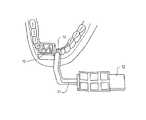
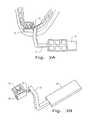
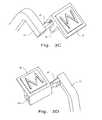
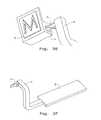
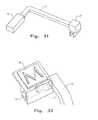
- FIGS. 3A-Jare drawings of hardware components of the surgical monitoring system according to embodiments of the invention.
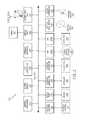
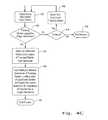
- FIGS. 4A-Cis a flow chart diagram illustrating one embodiment of the registering method of the present invention.
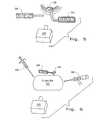
- FIG. 5is a drawing of a dental fiducial key with a tracking pole and a dental drill according to one embodiment of the present invention.
- FIG. 6is a drawing of an endoscopic surgical site showing the fiducial key, endoscope, and biopsy needle according to another embodiment of the invention.
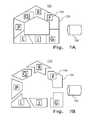
- FIGS. 7A and 7Bare drawings of a multi-element fiducial pattern comprising a plurality of pattern segments in respectively a default condition and a condition in which the body of a patient has moved to change the mutual spatial relation of the pattern segments.
- FIGS. 8A-Cis a flow chart diagram illustrating one embodiment of the registering method of the present invention as applied to the multi-element fiducial pattern of FIGS. 7A and 7B .
- a computergenerally includes a processor for executing instructions and memory for storing instructions and data, including interfaces to obtain and process imaging data.
- a general-purpose computerhas a series of machine encoded instructions stored in its memory, the computer operating on such encoded instructions may become a specific type of machine, namely a computer particularly configured to perform the operations embodied by the series of instructions.
- Some of the instructionsmay be adapted to produce signals that control operation of other machines and thus may operate through those control signals to transform materials far removed from the computer itself.
- Data structuresgreatly facilitate data management by data processing systems, and are not accessible except through sophisticated software systems.
- Data structuresare not the information content of a memory, rather they represent specific electronic structural elements that impart or manifest a physical organization on the information stored in memory. More than mere abstraction, the data structures are specific electrical or magnetic structural elements in memory, which simultaneously represent complex data accurately, often data modeling physical characteristics of related items, and provide increased efficiency in computer operation.
- the manipulations performedare often referred to in terms, such as comparing or adding, commonly associated with mental operations performed by a human operator. No such capability of a human operator is necessary, or desirable in most cases, in any of the operations described herein that form part of the present invention; the operations are machine operations.
- Useful machines for performing the operations of the present inventioninclude general-purpose digital computers or other similar devices. In all cases the distinction between the method operations in operating a computer and the method of computation itself should be recognized.
- the present inventionrelates to a method and apparatus for operating a computer in processing electrical or other (e.g., mechanical, chemical) physical signals to generate other desired physical manifestations or signals.
- the computeroperates on software modules, which are collections of signals stored on a media that represents a series of machine instructions that enable the computer processor to perform the machine instructions that implement the algorithmic steps.
- Such machine instructionsmay be the actual computer code the processor interprets to implement the instructions, or alternatively may be a higher level coding of the instructions that is interpreted to obtain the actual computer code.
- the software modulemay also include a hardware component, wherein some aspects of the algorithm are performed by the circuitry itself rather as a result of an instruction.
- the present inventionalso relates to an apparatus for performing these operations.
- This apparatusmay be specifically constructed for the required purposes or it may comprise a general-purpose computer as selectively activated or reconfigured by a computer program stored in the computer.
- the algorithms presented hereinare not inherently related to any particular computer or other apparatus unless explicitly indicated as requiring particular hardware.
- the computer programsmay communicate or relate to other programs or equipments through signals configured to particular protocols, which may or may not require specific hardware or programming to interact.
- various general-purpose machinesmay be used with programs written in accordance with the teachings herein, or it may prove more convenient to construct more specialized apparatus to perform the required method steps. The required structure for a variety of these machines will appear from the description below.
- the present inventionmay deal with “object-oriented” software, and particularly with an “object-oriented” operating system.
- the “object-oriented” softwareis organized into “objects”, each comprising a block of computer instructions describing various procedures (“methods”) to be performed in response to “messages” sent to the object or “events” which occur with the object.
- Such operationsinclude, for example, the manipulation of variables, the activation of an object by an external event, and the transmission of one or more messages to other objects.
- a physical objecthas a corresponding software object that may collect and transmit observed data from the physical device to the software system. Such observed data may be accessed from the physical object and/or the software object merely as an item of convenience; therefore where “actual data” is used in the following description, such “actual data” may be from the instrument itself or from the corresponding software object or module.
- Messagesare sent and received between objects having certain functions and knowledge to carry out processes. Messages are generated in response to user instructions, for example, by a user activating an icon with a “mouse” pointer generating an event. Also, messages may be generated by an object in response to the receipt of a message. When one of the objects receives a message, the object carries out an operation (a message procedure) corresponding to the message and, if necessary, returns a result of the operation. Each object has a region where internal states (instance variables) of the object itself are stored and where the other objects are not allowed to access.
- One feature of the object-oriented systemis inheritance. For example, an object for drawing a “circle” on a display may inherit functions and knowledge from another object for drawing a “shape” on a display.
- a programmer“programs” in an object-oriented programming language by writing individual blocks of code each of which creates an object by defining its methods.
- a collection of such objects adapted to communicate with one another by means of messagescomprises an object-oriented program.
- Object-oriented computer programmingfacilitates the modeling of interactive systems in that each component of the system may be modeled with an object, the behavior of each component being simulated by the methods of its corresponding object, and the interactions between components being simulated by messages transmitted between objects.
- An operatormay stimulate a collection of interrelated objects comprising an object-oriented program by sending a message to one of the objects.
- the receipt of the messagemay cause the object to respond by carrying out predetermined functions, which may include sending additional messages to one or more other objects.
- the other objectsmay in turn carry out additional functions in response to the messages they receive, including sending still more messages.
- sequences of message and responsemay continue indefinitely or may come to an end when all messages have been responded to and no new messages are being sent.
- a programmerneed only think in terms of how each component of a modeled system responds to a stimulus and not in terms of the sequence of operations to be performed in response to some stimulus. Such sequence of operations naturally flows out of the interactions between the objects in response to the stimulus and need not be preordained by the programmer.
- object-oriented programmingmakes simulation of systems of interrelated components more intuitive, the operation of an object-oriented program is often difficult to understand because the sequence of operations carried out by an object-oriented program is usually not immediately apparent from a software listing as in the case for sequentially organized programs. Nor is it easy to determine how an object-oriented program works through observation of the readily apparent manifestations of its operation. Most of the operations carried out by a computer in response to a program are “invisible” to an observer since only a relatively few steps in a program typically produce an observable computer output.
- the term “object”relates to a set of computer instructions and associated data, which may be activated directly or indirectly by the user.
- the terms “windowing environment”, “running in windows”, and “object oriented operating system”are used to denote a computer user interface in which information is manipulated and displayed on a video display such as within bounded regions on a raster scanned video display.
- the terms “network”, “local area network”, “LAN”, “wide area network”, or “WAN”mean two or more computers that are connected in such a manner that messages may be transmitted between the computers.
- ⁇typically one or more computers operate as a “server”, a computer with large storage devices such as hard disk drives and communication hardware to operate peripheral devices such as printers or modems.
- Other computerstermed “workstations”, provide a user interface so that users of computer networks may access the network resources, such as shared data files, common peripheral devices, and inter-workstation communication.
- Usersactivate computer programs or network resources to create “processes” which include both the general operation of the computer program along with specific operating characteristics determined by input variables and its environment.
- an agentsometimes called an intelligent agent
- an agentusing parameters typically provided by the user, searches locations either on the host machine or at some other point on a network, gathers the information relevant to the purpose of the agent, and presents it to the user on a periodic basis.
- the term “desktop”means a specific user interface which presents a menu or display of objects with associated settings for the user associated with the desktop.
- the desktopaccesses a network resource, which typically requires an application program to execute on the remote server, the desktop calls an Application Program Interface, or “API”, to allow the user to provide commands to the network resource and observe any output.
- APIApplication Program Interface
- the term “Browser”refers to a program which is not necessarily apparent to the user, but which is responsible for transmitting messages between the desktop and the network server and for displaying and interacting with the network user. Browsers are designed to utilize a communications protocol for transmission of text and graphic information over a worldwide network of computers, namely the “World Wide Web” or simply the “Web”.
- Browsers compatible with the present inventioninclude the Internet Explorer program sold by Microsoft Corporation (Internet Explorer is a trademark of Microsoft Corporation), the Opera Browser program created by Opera Software ASA, or the Firefox browser program distributed by the Mozilla Foundation (Firefox is a registered trademark of the Mozilla Foundation).
- Internet Exploreris a trademark of Microsoft Corporation
- Opera Browser programcreated by Opera Software ASA
- Firefox browser program distributed by the Mozilla FoundationFirefox is a registered trademark of the Mozilla Foundation.
- Browsersdisplay information, which is formatted in a Standard Generalized Markup Language (“SGML”) or a HyperText Markup Language (“HTML”), both being scripting languages, which embed non-visual codes in a text document through the use of special ASCII text codes.
- Files in these formatsmay be easily transmitted across computer networks, including global information networks like the Internet, and allow the Browsers to display text, images, and play audio and video recordings.
- the Webutilizes these data file formats to conjunction with its communication protocol to transmit such information between servers and workstations.
- Browsersmay also be programmed to display information provided in an eXtensible Markup Language (“XML”) file, with XML files being capable of use with several Document Type Definitions (“DTD”) and thus more general in nature than SGML or HTML.
- XML filemay be analogized to an object, as the data and the stylesheet formatting are separately contained (formatting may be thought of as methods of displaying information, thus an XML file has data and an associated method).
- PDApersonal digital assistant
- WWANwireless wide area network
- synchronizationmeans the exchanging of information between a first device, e.g. a handheld device, and a second device, e.g. a desktop computer, either via wires or wirelessly. Synchronization ensures that the data on both devices are identical (at least at the time of synchronization).
- communicationprimarily occurs through the transmission of radio signals over analog, digital cellular, or personal communications service (“PCS”) networks. Signals may also be transmitted through microwaves and other electromagnetic waves.
- PCSpersonal communications service
- CDMAcode-division multiple access
- TDMAtime division multiple access
- GSMGlobal System for Mobile Communications
- 3GThird Generation
- 4GFourth Generation
- PDCpersonal digital cellular
- CDPDpacket-data technology over analog systems
- AMPSAdvance Mobile Phone Service
- Mobile Softwarerefers to the software operating system, which allows for application programs to be implemented on a mobile device such as a mobile telephone or PDA.
- Examples of Mobile Softwareare Java and Java ME (Java and JavaME are trademarks of Sun Microsystems, Inc. of Santa Clara, Calif.), BREW (BREW is a registered trademark of Qualcomm Incorporated of San Diego, Calif.), Windows Mobile (Windows is a registered trademark of Microsoft Corporation of Redmond, Wash.), Palm OS (Palm is a registered trademark of Palm, Inc.
- Symbian OSis a registered trademark of Symbian Software Limited Corporation of London, United Kingdom
- ANDROID OSis a registered trademark of Google, Inc. of Mountain View, Calif.
- iPhone OSis a registered trademark of Apple, Inc. of Cupertino, Calif.
- Windows Phone 7“Mobile Apps” refers to software programs written for execution with Mobile Software.
- scanrefers to x-ray, magnetic resonance imaging (MRI), computerized tomography (CT), sonography, cone beam computerized tomography (CBCT), or any system that produces a quantitative spatial representation of a patient.
- MRImagnetic resonance imaging
- CTcomputerized tomography
- CBCTcone beam computerized tomography
- imaging referenceor simply “fiducial” refers to an object or reference on the image of a scan that is uniquely identifiable as a fixed recognizable point.
- fiducial locationrefers to a useful location to which a fiducial reference is attached.
- a “fiducial location”will typically be proximate a surgical site.
- the term “marker” or “tracking marker”refers to an object or reference that may be perceived by a sensor proximate to the location of the surgical or dental procedure, where the sensor may be an optical sensor, a radio frequency identifier (RFID), a sonic motion detector, an ultra-violet or infrared sensor.
- RFIDradio frequency identifier
- trackerrefers to a device or system of devices able to determine the location of the markers and their orientation and movement continually in ‘real time’ during a procedure. As an example of a possible implementation, if the markers are composed of printed targets then the tracker may include a stereo camera pair.
- image informationis used in the present specification to describe information obtained by the tracker, whether optical or otherwise, and usable for determining the location of the markers and their orientation and movement continually in ‘real time’ during a procedure.
- FIG. 1is a high-level block diagram of a computing environment 100 according to one embodiment.
- FIG. 1illustrates server 110 and three clients 112 connected by network 114 . Only three clients 112 are shown in FIG. 1 in order to simplify and clarify the description.
- Embodiments of the computing environment 100may have thousands or millions of clients 112 connected to network 114 , for example the Internet. Users (not shown) may operate software 116 on one of clients 112 to both send and receive messages network 114 via server 110 and its associated communications equipment and software (not shown).
- FIG. 2depicts a block diagram of computer system 210 suitable for implementing server 110 or client 112 .
- Computer system 210includes bus 212 which interconnects major subsystems of computer system 210 , such as central processor 214 , system memory 217 (typically RAM, but which may also include ROM, flash RAM, or the like), input/output controller 218 , external audio device, such as speaker system 220 via audio output interface 222 , external device, such as display screen 224 via display adapter 226 , serial ports 228 and 230 , keyboard 232 (interfaced with keyboard controller 233 ), storage interface 234 , disk drive 237 operative to receive floppy disk 238 , host bus adapter (HBA) interface card 235 A operative to connect with Fibre Channel network 290 , host bus adapter (HBA) interface card 235 B operative to connect to SCSI bus 239 , and optical disk drive 240 operative to receive optical disk 242 . Also included are mouse 246 (or other point-and-click device
- Bus 212allows data communication between central processor 214 and system memory 217 , which may include read-only memory (ROM) or flash memory (neither shown), and random access memory (RAM) (not shown), as previously noted.
- RAMis generally the main memory into which operating system and application programs are loaded.
- ROM or flash memorymay contain, among other software code, Basic Input-Output system (BIOS), which controls basic hardware operation such as interaction with peripheral components.
- BIOSBasic Input-Output system
- Applications resident with computer system 210are generally stored on and accessed via computer readable media, such as hard disk drives (e.g., fixed disk 244 ), optical drives (e.g., optical drive 240 ), floppy disk unit 237 , or other storage medium. Additionally, applications may be in the form of electronic signals modulated in accordance with the application and data communication technology when accessed via network modem 247 or interface 248 or other telecommunications equipment (not shown).
- Storage interface 234may connect to standard computer readable media for storage and/or retrieval of information, such as fixed disk drive 244 .
- Fixed disk drive 244may be part of computer system 210 or may be separate and accessed through other interface systems.
- Modem 247may provide direct connection to remote servers via telephone link or the Internet via an Internet service provider (ISP) (not shown).
- ISPInternet service provider
- Network interface 248may provide direct connection to remote servers via direct network link to the Internet via a POP (point of presence).
- Network interface 248may provide such connection using wireless techniques, including digital cellular telephone connection, Cellular Digital Packet Data (CDPD) connection, digital satellite data connection or the like.
- CDPDCellular Digital Packet Data
- FIGS. 3A-Imay be connected in a similar manner (e.g., document scanners, digital cameras and so on), including the hardware components of FIGS. 3A-I , which alternatively may be in communication with associated computational resources through local, wide-area, or wireless networks or communications systems.
- FIG. 2may generally discuss an embodiment where the hardware components are directly connected to computing resources, one of ordinary skill in this area recognizes that such hardware may be remotely connected with computing resources.
- All of the devices shown in FIG. 2need not be present to practice the present disclosure.
- Devices and subsystemsmay be interconnected in different ways from that shown in FIG. 2 . Operation of a computer system such as that shown in FIG. 2 is readily known in the art and is not discussed in detail in this application.
- Software source and/or object codes to implement the present disclosuremay be stored in computer-readable storage media such as one or more of system memory 217 , fixed disk 244 , optical disk 242 , or floppy disk 238 .
- the operating system provided on computer system 210may be a variety or version of either MS-DOS® (MS-DOS is a registered trademark of Microsoft Corporation of Redmond, Wash.), WINDOWS® (WINDOWS is a registered trademark of Microsoft Corporation of Redmond, Wash.), OS/2® (OS/2 is a registered trademark of International Business Machines Corporation of Armonk, N.Y.), UNIX® (UNIX is a registered trademark of X/Open Company Limited of Reading, United Kingdom), Linux® (Linux is a registered trademark of Linus Torvalds of Portland, Oreg.), or other known or developed operating system.
- a signalmay be directly transmitted from a first block to a second block, or a signal may be modified (e.g., amplified, attenuated, delayed, latched, buffered, inverted, filtered, or otherwise modified) between blocks.
- a signalmay be directly transmitted from a first block to a second block, or a signal may be modified (e.g., amplified, attenuated, delayed, latched, buffered, inverted, filtered, or otherwise modified) between blocks.
- modified signalse.g., amplified, attenuated, delayed, latched, buffered, inverted, filtered, or otherwise modified
- a signal input at a second blockmay be conceptualized as a second signal derived from a first signal output from a first block due to physical limitations of the circuitry involved (e.g., there will inevitably be some attenuation and delay). Therefore, as used herein, a second signal derived from a first signal includes the first signal or any modifications to the first signal, whether due to circuit limitations or due to passage through other circuit elements which do not change the informational and/or final functional aspect of the first signal.
- the present inventionrelates to a surgical hardware and software monitoring system and method which allows for surgical planning while the patient is available for surgery, for example while the patient is being prepared for surgery so that the system may model the surgical site.
- the systemuses a particularly configured piece of hardware, represented as fiducial key 10 in FIG. 3A , to orient tracking marker 12 of the monitoring system with regard to the critical area of the surgery.
- Fiducial key 10is attached to a location near the intended surgical area, in the exemplary embodiment of the dental surgical area of FIG. 3A , fiducial key 10 is attached to a dental splint 14 .
- Tracking marker 12may be connected to fiducial key 10 by tracking pole 11 .
- the fiducial referenceis directly visible to a suitable tracker (see for example FIG.
- a tracking markermay be attached directly to the fiducial reference.
- the dental tracking marker 14may be used to securely locate the fiducial 10 near the surgical area.
- the fiducial key 10may be used as a point of reference, or a fiducial, for the further image processing of data acquired from tracking marker 12 by the tracker.
- additional tracking markers 12may be attached to items independent of the fiducial key 10 and any of its associated tracking poles 11 or tracking markers 12 . This allows the independent items to be tracked by the tracker.
- At least one of the items or instruments near the surgical sitemay optionally have a tracker attached to function as tracker for the monitoring system of the invention and to thereby sense the orientation and the position of the tracking marker 12 and of any other additional tracking markers relative to the scan data of the surgical area.
- the tracker attached to an instrumentmay be a miniature digital camera and it may be attached, for example, to a dentist's drill. Any other markers to be tracked by the tracker attached to the item or instrument must be within the field of view of the tracker.
- fiducial key 10allows computer software stored in memory and executed in a suitable controller, for example processor 214 and memory 217 of computer 210 of FIG. 2 , to recognize its relative position within the surgical site from the scan data, so that further observations may be made with reference to both the location and orientation of fiducial key 10 .
- the fiducial referenceincludes a marking that is apparent as a recognizable identifying symbol when scanned.
- the fiducial referenceincludes a shape that is distinct in the sense that the body apparent on the scan has an asymmetrical form allowing the front, rear, upper, and lower, and left/right defined surfaces that may be unambiguously determined from the analysis of the scan, thereby to allow the determination not only of the location of the fiducial reference, but also of its orientation.
- the computer softwaremay create a coordinate system for organizing objects in the scan, such as teeth, jaw bone, skin and gum tissue, other surgical instruments, etc.
- the coordinate systemrelates the images on the scan to the space around the fiducial and locates the instruments bearing markers both by orientation and position.
- the model generated by the monitoring systemmay then be used to check boundary conditions, and in conjunction with the tracker display the arrangement in real time on a suitable display, for example display 224 of FIG. 2 .
- the computer systemhas a predetermined knowledge of the physical configuration of fiducial key 10 and examines slices/sections of the scan to locate fiducial key 10 .
- Locating of fiducial key 10may be on its distinct shape, or on the basis of distinctive identifying and orienting markings upon the fiducial key or on attachments to the fiducial key 10 as tracking marker 12 .
- Fiducial key 10may be rendered distinctly visible in the scans through higher imaging contrast by the employ of radio-opaque materials or high-density materials in the construction of the fiducial key 10 .
- the material of the distinctive identifying and orienting markingsmay be created using suitable high density or radio-opaque inks or materials.
- fiducial key 10Once fiducial key 10 is identified, the location and orientation of the fiducial key 10 is determined from the scan segments, and a point within fiducial key 10 is assigned as the center of the coordinate system. The point so chosen may be chosen arbitrarily, or the choice may be based on some useful criterion.
- a modelis then derived in the form of a transformation matrix to relate the fiducial system, being fiducial key 10 in one particular embodiment, to the coordinate system of the surgical site.
- the resulting virtual constructmay be used by surgical procedure planning software for virtual modeling of the contemplated procedure, and may alternatively be used by instrumentation software for the configuration of the instrument, for providing imaging assistance for surgical software, and/or for plotting trajectories for the conduct of the surgical procedure.
- the monitoring hardwareincludes a tracking attachment to the fiducial reference.
- the tracking attachment to fiducial key 10is tracking marker 12 , which is attached to fiducial key 10 via tracking pole 11 .
- Tracking marker 12may have a particular identifying pattern.
- the trackable attachment, for example tracking marker 12 , and even associated tracking pole 11may have known configurations so that observational data from tracking pole 11 and/or tracking marker 12 may be precisely mapped to the coordinate system, and thus progress of the surgical procedure may be monitored and recorded.
- fiducial key 10may have hole 15 in a predetermined location specially adapted for engagement with insert 17 of tracking pole 11 .
- tracking poles 11may be attached with a low force push into hole 15 of fiducial key 10 , and an audible haptic notification may thus be given upon successful completion of the attachment.
- reorient the tracking pole during a surgical proceduremay be in order to change the location of the procedure, for example where a dental surgery deals with teeth on the opposite side of the mouth, where a surgeon switches hands, and/or where a second surgeon performs a portion of the procedure.
- the movement of the tracking polemay trigger a re-registration of the tracking pole with relation to the coordinate system, so that the locations may be accordingly adjusted.
- Such a re-registrationmay be automatically initiated when, for example in the case of the dental surgery embodiment, tracking pole 11 with its attached tracking marker 12 are removed from hole 15 of fiducial key 10 and another tracking marker with its associated tracking pole is connected to an alternative hole on fiducial key 10 .
- boundary conditionsmay be implemented in the software so that the user is notified when observational data approaches and/or enters the boundary areas.
- a surgical instrument or implementherein termed a “hand piece” (see FIGS. 5 and 6 ), may also have a particular configuration that may be located and tracked in the coordinate system and may have suitable tracking markers as described herein.
- a boundary conditionmay be set up to indicate a potential collision with virtual material, so that when the hand piece is sensed to approach the boundary condition an indication may appear on a screen, or an alarm sound.
- target boundary conditionsmay be set up to indicate the desired surgical area, so that when the trajectory of the hand piece is trending outside the target area an indication may appear on screen or an alarm sound indicating that the hand piece is deviating from its desired path.
- Fiducial key 10 ′has connection elements with suitable connecting portions to allow a tracking pole 11 ′ to position a tracking marker 12 ′ relative to the surgical site.
- fiducial key 10 ′serves as an anchor for pole 11 ′ and tracking marker 12 ′ in much the same way as the earlier embodiment, although it has a distinct shape.
- the software of the monitoring systemis pre-programmed with the configuration of each particularly identified fiducial key, tracking pole, and tracking marker, so that the location calculations are only changed according to the changed configuration parameters.
- the materials of the hardware componentsmay vary according to regulatory requirements and practical considerations.
- the key or fiducial componentis made of generally radio opaque material such that it does not produce noise for the scan, yet creates recognizable contrast on the scanned image so that any identifying pattern associated with it may be recognized.
- the materialshould be lightweight and suitable for connection to an apparatus on the patient.
- the materials of the fiducial keymust be suitable for connection to a plastic splint and suitable for connection to a tracking pole.
- the materials of the fiducial keymay be suitable for attachment to the skin or other particular tissue of a patient.
- the tracking markersare clearly identified by employing, for example without limitation, high contrast pattern engraving.
- the materials of the tracking markersare chosen to be capable of resisting damage in autoclave processes and are compatible with rigid, repeatable, and quick connection to a connector structure.
- the tracking markers and associated tracking poleshave the ability to be accommodated at different locations for different surgery locations, and, like the fiducial keys, they should also be relatively lightweight as they will often be resting on or against the patient.
- the tracking polesmust similarly be compatible with autoclave processes and have connectors of a form shared among tracking poles.
- the tracker employed in tracking the fiducial keys, tracking poles and tracking markersshould be capable of tracking with suitable accuracy objects of a size of the order of 1.5 square centimeters.
- the trackermay be, by way of example without limitation, a stereo camera or stereo camera pair. While the tracker is generally connected by wire to a computing device to read the sensory input, it may optionally have wireless connectivity to transmit the sensory data to a computing device.
- tracking markers attached to such a trackable piece of instrumentationmay also be light-weight; capable of operating in a 3 object array with 90 degrees relationship; optionally having a high contrast pattern engraving and a rigid, quick mounting mechanism to a standard hand piece.
- FIGS. 4A-Cthere is presented an automatic registration method for tracking surgical activity, as illustrated in FIGS. 4A-C .
- FIG. 4A and FIG. 4Btogether present, without limitation, a flowchart of one method for determining the three-dimensional location and orientation of the fiducial reference from scan data.
- FIG. 4Cpresents a a flow chart of a method for confirming the presence of a suitable tracking marker in image information obtained by the tracker and determining the three-dimensional location and orientation of the fiducial reference based on the image information.
- the systemobtains a scan data set [ 404 ] from, for example, a CT scanner and checks for a default CT scan Hounsfield unit (HU) value [at 406 ] for the fiducial which may or may not have been provided with the scan based on a knowledge of the fiducial and the particular scanner model, and if such a threshold value is not present, then a generalized predetermined default value is employed [ 408 ].
- the datais processed by removing scan segments with Hounsfield data values outside expected values associated with the fiducial key values [at 410 ], following the collection of the remaining points [at 412 ].
- the CT value thresholdis reduced [at 416 ], the original value restored [at 418 ], and the segmenting processing scan segments continues [at 410 ]. Otherwise, with the existing data a center of mass is calculated [at 420 ], along with calculating the X, Y, and Z axes [at 422 ]. If the center of mass is not cross point of the XYZ axes [at 424 ], then the user is notified [at 426 ] and the process stopped [at 428 ]. If the center of mass is at the XYZ cross point then the data points are compared with designed fiducial data [ 430 ].
- an imageis obtained from the tracker, being a suitable camera or other sensor [ 442 ].
- the image informationis analyzed to determine whether a tracking marker is present in the image information [ 444 ]. If not, then the user is queried [ 446 ] as to whether the process should continue or not. If not, then the process is ended [ 448 ]. If the process is to continue, then the user can be notified that no tracking marker has been found in the image information [ 450 ], and the process returns to obtaining image information [ 442 ].
- the offset and relative orientation of the tracking marker to the fiducial referenceis obtained from a suitable database [ 452 ].
- databaseis used in this specification to describe any source, amount or arrangement of such information, whether organized into a formal multi-element or multi-dimensional database or not.
- a single data set comprising offset value and relative orientationmay suffice in a simple implementation of this embodiment of the invention and may be provided, for example, by the user or may be within a memory unit of the controller or in a separate database or memory.
- the offset and relative orientation of the tracking markeris used to define the origin of a coordinate system at the fiducial reference and to determine the three-dimensional orientation of the fiducial reference based on the image information [ 454 ] and the registration process ends [ 458 ].
- the processmay be looped back from step [ 454 ] to obtain new image information from the camera [ 442 ].
- a suitable query pointmay included to allow the user to terminate the process.
- Detailed methods for determining orientations and locations of predetermined shapes or marked tracking markers from image dataare known to practitioners of the art and will not be dwelt upon here.
- the coordinate system so derivedis then used for tracking the motion of any items bearing tracking markers in the proximity of the surgical site.
- Other registration systemsare also contemplated, for example using current other sensory data rather than the predetermined offset, or having a fiducial with a transmission capacity.
- FIG. 5One example of an embodiment of the invention is shown in FIG. 5 .
- an additional instrument or implement 506for example a hand piece which may be a dental drill, may be observed by a camera 508 serving as tracker of the monitoring system.
- FIG. 6Another example of an embodiment of the invention is shown in FIG. 6 .
- Surgery site 600for example a human stomach or chest, may have fiducial key 602 fixed to a predetermined position to support tracking marker 604 .
- Endoscope 606may have further tracking markers, and biopsy needle 608 may also be present bearing a tracking marker at surgery site 600 .
- Sensor 610may be for example a camera, infrared sensing device, or RADAR.
- the fiducial keymay comprise a multi-element fiducial pattern 710 .
- the multi-element fiducial pattern 710may be a dissociable pattern.
- the term “dissociable pattern”is used in this specification to describe a pattern comprising a plurality of pattern segments 720 that topologically fit together to form a contiguous whole pattern, and which may temporarily separated from one another, either in whole or in part.
- the term “breakable pattern”is used as an alternative term to describe such a dissociable pattern.
- the segments of the multi-element fiducial pattern 710do not form a contiguous pattern, but instead their positions and orientations with respect to one another are known when the multi-element fiducial pattern 710 is applied on the body of the patient near a critical area of a surgical site.
- Each pattern segment 720is individually locatable based on scan data of a surgical site to which multi-element fiducial pattern 710 may be attached.
- Pattern segments 720are uniquely identifiable by a suitable tracker 730 , being differentiated from one another in one or more of a variety of ways. Pattern segments 720 may be mutually differentiable shapes that also allow the identification of their orientations. Pattern segments 720 may be uniquely marked in one or more of a variety of ways, including but not limited to barcoding or orientation-defining symbols. The marking may be directly on the pattern segments 720 , or may be on tracking markers 740 attached to pattern segments 720 . The marking may be accomplished by a variety of methods, including but not limited to engraving and printing. In the embodiment shown in FIGS. 7A and 7B , by way of non-limiting example, the letters F, G, J, L, P, Q and R have been used.
- the materials of the multi-element fiducial pattern 710 and pattern segments 720may vary according to regulatory requirements and practical considerations.
- the key or fiducial componentis made of generally radio opaque material such that it does not produce noise for the scan, yet creates recognizable contrast on the scanned image so that any identifying pattern associated with it may be recognized.
- the multi-element fiducial pattern 710 and pattern segments 720may have a distinct coloration difference from human skin in order to be more clearly differentiable by tracker 730 .
- the materialshould be lightweight. The materials should also be capable of resisting damage in autoclave processes.
- a suitable tracker of any of the types already describedis used to locate and image multi-element fiducial pattern 710 within the surgical area.
- Multi-element fiducial pattern 710may be rendered distinctly visible in scans of the surgical area through higher imaging contrast by the employ of radio-opaque materials or high-density materials in the construction of theti-element fiducial pattern 710 .
- the distinctive identifying and orienting markings on the pattern segments 720 or on the tracking markers 740may be created using suitable high-density materials or radio-opaque inks, thereby allowing the orientations of pattern segments 720 to be determined based on scan data.
- pattern segments 720 of multi-element fiducial pattern 710change their relative locations and also, in general, their relative orientations. Information on these changes may be used to gain information on the subcutaneous motion of the body of the patient in the general vicinity of the surgical site by relating the changed positions and orientations of pattern segments 720 to their locations and orientations in a scan done before surgery.
- multi-element fiducial pattern 710allows computer software to recognize its relative position within the surgical site, so that further observations may be made with reference to both the location and orientation of multi-element fiducial pattern 710 .
- the computer softwaremay create a coordinate system for organizing objects in the scan, such as skin, organs, bones, and other tissue, other surgical instruments bearing suitable tracking markers, and segments 720 of multi-element fiducial pattern 710 etc.
- the computer systemhas a predetermined knowledge of the configuration of multi-element fiducial pattern 710 and examines slices of a scan of the surgical site to locate pattern segments 720 of multi-element fiducial pattern 710 based on one or more of the radio-opacity density of the material of the pattern segments 720 , their shapes and their unique tracking markers 740 .
- a point within or near multi-element fiducial pattern 710is assigned as the center of the coordinate system. The point so chosen may be chosen arbitrarily, or the choice may be based on some useful criterion.
- a transformation matrixis derived to relate multi-element fiducial pattern 710 to the coordinate system of the surgical site.
- the resulting virtual constructmay then be used by surgical procedure planning software for virtual modeling of the contemplated procedure, and may alternatively be used by instrumentation software for the configuration of the instrument, for providing imaging assistance for surgical software, and/or for plotting trajectories for the conduct of the surgical procedure.
- Multi-element fiducial pattern 710changes its shape as the body moves during surgery.
- the relative locations and relative orientations of pattern segments 720change in the process. (see FIG. 7A relative to FIG. 7B .)
- the integrity of individual pattern segments 720is maintained and they may be tracked by tracker 730 , including but not limited to a stereo video camera.
- the changed multi-element fiducial pattern 710 ′may be compared with initial multi-element fiducial pattern 710 ′ to create a transformation matrix.
- the relocating and reorienting of pattern segments 720may therefore be mapped on a continuous basis within the coordinate system of the surgical site. In FIGS. 7A and 7B a total of seven pattern segments 720 are shown.
- multi-element fiducial pattern 710may comprise larger or smaller numbers of pattern segments 720 .
- a selection of pattern segments 720may be employed and there is no limitation that all pattern segments 720 of multi-element fiducial pattern 710 have to be employed.
- the decision as to how many pattern segments 720 to employmay, by way of example, be based on the resolution required for the surgery to be done or on the processing speed of the controller, which may be, for example, computer 210 of FIG. 2 .
- FIG. 7Aemploys a dissociable multi-element fiducial pattern.
- the multi-element fiducial patternmay have a dissociated fiducial pattern, such as that of FIG. 7B , as default.
- the individual pattern segments 720then change position as the body of the patient changes shape near the surgical site during the surgery.
- tracking markers 740may be absent and the tracking system may rely on tracking the pattern segments 720 purely on the basis of their unique shapes, which lend themselves to determining orientation due to a lack of a center of symmetry.
- the pattern segments 720are not in general limited to being capable of being joined topologically at their perimeters to form a contiguous surface. Nor is there a particular limitation on the general shape of the multi-element fiducial pattern.
- FIG. 8A and FIG. 8Btogether present, without limitation, a flowchart of one method for determining the three-dimensional location and orientation of one segment of multi-element fiducial pattern 710 from scan data.
- FIG. 8Cpresents a a flow chart of a method for determining the spatial distortion of the surgical site based on the changed orientations and locations of pattern segments 720 of multi-element fiducial pattern 710 , using as input the result of applying the method shown in FIG. 8A and FIG. 8B to every one of the pan segments 720 that is to be employed in the determining the spatial distortion of the surgical site. In principle, not all pattern segments 720 need to be employed.
- the systemobtains a scan data set [ 404 ] from, for example, a CT scanner and checks for a default CT scan Hounsfield unit (HU) value [ 806 ] for the fiducial, which may or may not have been provided with the scan based on a knowledge of the fiducial and the particular scanner model. If such a default value is not present, then a generalized predetermined system default value is employed [ 808 ]. Next the data is processed by removing scan slices or segments with Hounsfield data values outside the expected values associated with the fiducial key [ 810 ], followed by the collecting of the remaining points [ 812 ].
- HUHounsfield unit
- the CT value thresholdis adjusted [ 816 ], the original data restored [ 818 ], and the processing of scan slices continues [ 810 ]. Otherwise, with the existing data a center of mass is calculated [ 820 ], as are the X, Y and Z axes [ 822 ]. If the center of mass is not at the X, Y, Z cross point [ 824 ], then the user is notified [ 826 ] and the process ended [ 828 ].
- the pattern of the fiducialis compared to the data [ 836 ], and if the cumulative error is larger than the maximum allowed error [ 838 ] the user is notified [ 840 ] and the process is ended [ 842 ]. If the cumulative error is not larger than the maximum allowed error [ 838 ], then the coordinate system is defined at the XYZ cross-point [ 844 ] and the CT profile is updated for HU units [ 846 ].
- This process of FIG. 8A and FIG. 8Bis repeated for every one of the pattern segments 720 that is to be employed in determining the spatial distortion of the surgical site. The information on the location and orientation of every one of pattern segments 720 is then used as input to the method described at the hand of FIG. 8C .
- image informationis obtained from the camera [ 848 ] and it is determined whether a particular segment 720 of the multi-element fiducial pattern 710 on the patient body is present in the image information [ 850 ]. If the particular segment 720 is not present in the image information, then the user is queried as to whether the process should continue [ 852 ]. If not, then the process is ended [ 854 ]. If the process is to continue, the user is notified that the particular segment 720 was not found in the image information [ 856 ] and the process returns to obtaining image information from the camera [ 848 ].
- every other pattern segment 720 employedis identified and the three-dimensional location and orientation of all segments 720 employed are determined based on the image information [ 858 ].
- the three-dimensional location and orientation of every pattern segment employed based on the image informationis compared with the three dimensional location and orientation of the same pattern segment as based on the scan data [ 860 ]. Based on this comparison the spatial distortion of the surgical site is determined [ 862 ]. In order to monitor such distortions in real time, the process may be looped back to obtain image information from the camera [ 848 ].
- a suitable query point [ 864 ]may be included to allow the user to terminate the process [ 866 ].
- Detailed methods for determining orientations and locations of predetermined shapes or marked tracking markers from image dataare known to practitioners of the art and will not be dwelt upon here.
- the software of the controllerfor example computer 210 of FIG. 2 , is capable of recognizing multi-element fiducial pattern 710 and calculating a model of the surgical site based on the identity of multi-element fiducial pattern 710 and its changes in shape based on the observation data received from multi-element fiducial pattern 710 .
- Thisallows the calculation in real time of the locations and orientations of anatomical features in the proximity of the multi-element fiducial pattern 710 .
Landscapes
- Health & Medical Sciences (AREA)
- Life Sciences & Earth Sciences (AREA)
- Engineering & Computer Science (AREA)
- Medical Informatics (AREA)
- General Health & Medical Sciences (AREA)
- Public Health (AREA)
- Animal Behavior & Ethology (AREA)
- Veterinary Medicine (AREA)
- Surgery (AREA)
- Biomedical Technology (AREA)
- Nuclear Medicine, Radiotherapy & Molecular Imaging (AREA)
- Heart & Thoracic Surgery (AREA)
- Molecular Biology (AREA)
- Pathology (AREA)
- Radiology & Medical Imaging (AREA)
- Optics & Photonics (AREA)
- Biophysics (AREA)
- Physics & Mathematics (AREA)
- Oral & Maxillofacial Surgery (AREA)
- High Energy & Nuclear Physics (AREA)
- Epidemiology (AREA)
- Dentistry (AREA)
- Primary Health Care (AREA)
- Robotics (AREA)
- Pulmonology (AREA)
- Theoretical Computer Science (AREA)
- Computing Systems (AREA)
- Computer Networks & Wireless Communication (AREA)
- Signal Processing (AREA)
- Data Mining & Analysis (AREA)
- Databases & Information Systems (AREA)
- Human Computer Interaction (AREA)
- Apparatus For Radiation Diagnosis (AREA)
Abstract
Description
The present application claims priority under 35 U.S.C. §119(e) of U.S. Provisional Patent Application Ser. No. 61/616,673, filed on Mar. 28, 2012 and titled “Soft Body Automatic Registration and Surgical Monitoring System”; and from PCT International Patent Application which designates the United States Serial No. PCT/IL2012/000363, filed on Oct. 21, 2012, U.S. Non-Provisional patent application Ser. No. 13/571,284, filed on Aug. 9, 2012, and which claims priority from U.S. Provisional Patent Application Ser. Nos. 61/553,058 and 61/616,718 filed on Oct. 28, 2011, and Mar. 28, 2012, respectively, said PCT, Non-Provisional and Provisional applications all entitled “SURGICAL LOCATION MONITORING SYSTEM AND METHOD”; the disclosures of all of which are expressly incorporated by reference herein.
Field of the Invention
The invention relates to location monitoring hardware and software systems. More specifically, the field of the invention is that of surgical equipment and software for monitoring surgical conditions.
Description of the Related Art
Visual and other sensory systems are known, with such systems being capable of both observing and monitoring surgical procedures. With such observation and monitoring systems, computer aided surgeries are now possible, and in fact are being routinely performed. In such procedures, the computer software interacts with both clinical images of the patient and observed surgical images from the current surgical procedure to provide guidance to the physician in conducting the surgery. For example, in one known system a carrier assembly bears at least one fiducial marker onto an attachment element in a precisely repeatable position with respect to a patient's jaw bone, employing the carrier assembly for providing registration between the fiducial marker and the patient's jaw bone and implanting the tooth implant by employing a tracking system which uses the registration to guide a drilling assembly. With this relatively new computer implemented technology, further improvements may further advance the effectiveness of surgical procedures.
The present invention is a surgical hardware and software monitoring system and method which allows for surgical planning while the patient is available for surgery, for example while the patient is being prepared for surgery so that the system may model the surgical site. In one embodiment, the model may be used to track contemplated surgical procedures and warn the physician regarding possible boundary violations that would indicate an inappropriate location in a surgical procedure. In another embodiment, the hardware may track the movement of instruments during the procedure and in reference to the model to enhance observation of the procedure. In this way, physicians are provided an additional tool to improve surgical planning and performance.
The system uses a particularly configured fiducial reference, to orient the monitoring system with regard to the critical area. The fiducial reference is attached to a location near the intended surgical area. For example, in the example of a dental surgery, a splint may be used to securely locate the fiducial reference near the surgical area. The fiducial reference may then be used as a point of reference, or a fiducial, for the further image processing of the surgical site. The fiducial reference may be identified relative to other portions of the surgical area by having a recognizable fiducial marker apparent in the scan.
The system of embodiments of the invention involves automatically computing the three-dimensional location of the patient by means of a tracking device that may be a tracking marker. The tracking marker may be attached in fixed spatial relation either directly to the fiducial reference, or attached to the fiducial reference via a tracking pole that itself may have a distinct three-dimensional shape. In the dental surgery example, a tracking pole is mechanically connected to the base of the fiducial reference that is in turn fixed in the patient's mouth. Each tracking pole device has a particular observation pattern, located either on itself or on a suitable tracking marker, and a particular geometrical connection to the base, which the computer software recognizes as corresponding to a particular geometry for subsequent location calculations. Although individual tracking pole devices have distinct configurations, they may all share the same connection base and thus may be used with any keyucial reference. The particular tracking information calculations are dictated by the particular pole tng pole used, and actual patient location is calculated accordingly. Thus, pole trackine devices may be interchanged and calculation of the location remains the same. This provides, in the case of dental surgery, automatic recognition of the patient head location in space. Alternatively, a sensor device, or a tracker, may be in a known position relative to the fiducial key and its tracking pole, so that the current data image may be mapped to the scan image items.
The fiducial reference and each tracking pole or associated tracking marker may have a pattern made of radio opaque material so that when imaging information is scanned by the software, the particular items are recognized. Typically, each instrument used in the procedure has a unique pattern on its associated tracking marker so that the tracker information identifies the instrument. The software creates a model of the surgical site, in one embodiment a coordinate system, according to the location and orientation of the patterns on the fiducial reference and/or tracking pole(s) or their attached tracking markers. By way of example, in the embodiment where the fiducial reference has an associated pre-assigned pattern, analysis software interpreting image information from the tracker may recognize the pattern and may select the site of the base of the fiducial to be at the location where the fiducial reference is attached to a splint. If the fiducial key does not have an associated pattern, a fiducial site is designated. In the dental example this can be at a particular spatial relation to the tooth, and a splint location can be automatically designed for placement of the fiducial reference.
In a first aspect of the invention there is provided a surgical monitoring system comprising a fiducial reference configured for removably attaching to a location proximate a surgical site, for having a three-dimensional location and orientation determinable based on scan data of the surgical site, and for having the three-dimensional location and orientation determinable based on image information about the surgical site; a tracker arranged for obtaining the image information; and a controller configured for spatially relating the image information to the scan data and for determining the three-dimensional location and orientation of the fiducial reference. In one embodiment of the invention the fiducial reference may be rigidly and removably attachable to a part of the surgical site. In such an embodiment the fiducial reference may be repeatably attachable in the same three-dimensional orientation to the same location on the particular part of the surgical site.
The fiducial reference is at least one of marked and shaped for having at least one of its location and its orientation determined from the scan data and to allow it to be uniquely identified from the scan data. The surgical monitoring system further comprises a first tracking marker in fixed three-dimensional spatial relationship with the fiducial reference, wherein the first tracking marker is configured for having at least one of its location and its orientation determined by the controller based on the image information and the scan data. The first tracking marker may be configured to be removably and rigidly connected to the fiducial reference by a first tracking pole. The first tracking pole can have a three-dimensional structure uniquely identifiable by the controller from the image information. The three-dimensional structure of the first tracking pole allows its three-dimensional orientation of the first tracking pole to be determined by the controller from the image information.
The first tracking pole and fiducial reference may be configured to allow the first tracking pole to connect to a single unique location on the fiducial reference in a first single unique three-dimensional orientation. The fiducial reference may be configured for the attachment in a single second unique three-dimensional orientation of at least a second tracking pole attached to a second tracking marker. The first tracking marker may have a three-dimensional shape that is uniquely identifiable by the controller from the image information. The first tracking marker can have a three-dimensional shape that allows its three-dimensional orientation to be determined by the controller from the image information. The first tracking marker may have a marking that is uniquely identifiable by the controller and the marking may be configured for allowing at least one of its location and its orientation to be determined by the controller based on the image information and the scan data.
The fiducial reference may be a multi-element fiducial pattern comprising a plurality of pattern segments and every segment is individually configured for having a segmental three-dimensional location and orientation determinable based on scan data of the surgical site, and for having the segmental three-dimensional location and orientation determinable based on image information about the surgical site. The plurality of pattern segments can have unique differentiable shapes that allow the controller to identify them uniquely from at least one of the scan data and the image information. Tracking markers can may attached to at least a selection of the pattern segments, the tracking markers having at least one of identifying marks and orientation marks that allow their three-dimensional orientations to be determined by the controller from the image information. The controller may be configured for determining the locations and orientations of at least a selection of the pattern segments based on the image information and the scan data. The controller may be configured for calculating of the locations of anatomical features in the proximity of the multi-element fiducial pattern.
The surgical monitoring system may comprise further tracking markers attached to implements proximate the surgery site and the controller may be configured for determining locations and orientations of the implements based on the image information and information about the further tracking markers.
In another aspect of the invention there is provided a method for relating in real time the three-dimensional location and orientation of a surgical site on a patient to the location and orientation of the surgical site in a scan of the surgical site, the method comprising removably attaching a fiducial reference to a fiducial location on the patient proximate the surgical site; performing the scan with the fiducial reference attached to the fiducial location to obtain scan data; determining the three-dimensional location and orientation of the fiducial reference from the scan data; obtaining real time image information of the surgical site; determining in real time the three-dimensional location and orientation of the fiducial reference from the image information; deriving a spatial transformation matrix for expressing in real time the three-dimensional location and orientation of the fiducial reference as determined from the image information in terms of the three-dimensional location and orientation of the fiducial reference as determined from the scan data.
The obtaining of real time image information of the surgical site may comprise rigidly and removably attaching to the fiducial reference a first tracking marker in a fixed three-dimensional spatial relationship with the fiducial reference. The first tracking marker may be configured for having its location and its orientation determined based on the image information. The attaching of the first tracking marker to the fiducial reference may comprise rigidly and removably attaching the first tracking marker to the fiducial reference by means of a tracking pole. The obtaining of the real time image information of the surgical site may comprise rigidly and removably attaching to the fiducial reference a tracking pole in a fixed three-dimensional spatial relationship with the fiducial reference, and the tracking pole may have a distinctly identifiable three-dimensional shape that allows its location and orientation to be uniquely determined from the image information. In the case where the fiducial reference is a multi-element fiducial pattern comprising a plurality of pattern segments individually locatable based on the scan data, the determining of the three-dimensional location and orientation of the fiducial reference from the scan data may comprise determining the three-dimensional location and orientation of at least a selection of the plurality of pattern segments from the scan data; and the determining in real time the three-dimensional location and orientation of the fiducial reference from the image information may comprise determining the three-dimensional location and orientation of the at least a selection of the plurality of pattern segments from the image information.
In another aspect of the invention there is provided a method for tracking in real time changes in a surgical site, the method comprising removably attaching a multi-element fiducial reference to a fiducial location on the patient proximate the surgical site, the multi-element fiducial reference comprising a plurality of pattern segments individually locatable based on scan data; performing a scan with the fiducial reference attached to the fiducial location to obtain the scan data; determining the three-dimensional locations and orientations of at least a selection of the pattern segments from the scan data; obtaining real time image information of the surgical site; determining in real time the three-dimensional locations and orientations of the at least a selection of the pattern segments from the image information; and deriving in real time the spatial distortion of the surgical site by comparing in real time the three-dimensional locations and orientations of the at least a selection of the pattern segments as determined from the image information with the three-dimensional locations and orientations of the at least a selection of the pattern segments as determined from the scan data.
In yet a further aspect of the invention there is provided a method for real time monitoring the position of an object in relation to a surgical site of a patient, the method comprising removably attaching a fiducial reference to a fiducial location on the patient proximate the surgical site; performing a scan with the fiducial reference attached to the fiducial location to obtain scan data; determining the three-dimensional location and orientation of the fiducial reference from the scan data; obtaining real time image information of the surgical site; determining in real time the three-dimensional location and orientation of the fiducial reference from the image information; deriving a spatial transformation matrix for expressing in real time the three-dimensional location and orientation of the fiducial reference as determined from the image information in terms of the three-dimensional location and orientation of the fiducial reference as determined from the scan data; determining in real time the three-dimensional location and orientation of the object from the image information; and relating the three-dimensional location and orientation of the object to the three-dimensional location and orientation of the fiducial reference as determined from the image information. The determining in real time of the three-dimensional location and orientation of the object from the image information may comprise rigidly attaching a tracking marker to the object.
The above mentioned and other features and objects of this invention, and the manner of attaining them, will become more apparent and the invention itself will be better understood by reference to the following description of an embodiment of the invention taken in conjunction with the accompanying drawings, wherein:
Corresponding reference characters indicate corresponding parts throughout the several views. Although the drawings represent embodiments of the present invention, the drawings are not necessarily to scale and certain features may be exaggerated in order to better illustrate and explain the present invention. The flow charts and screen shots are also representative in nature, and actual embodiments of the invention may include further features or steps not shown in the drawings. The exemplification set out herein illustrates an embodiment of the invention, in one form, and such exemplifications are not to be construed as limiting the scope of the invention in any manner.
The embodiments disclosed below are not intended to be exhaustive or limit the invention to the precise form disclosed in the following detailed description. Rather, the embodiments are chosen and described so that others skilled in the art may utilize their teachings.
The detailed descriptions that follow are presented in part in terms of algorithms and symbolic representations of operations on data bits within a computer memory representing alphanumeric characters or other information. The hardware components are shown with particular shapes and relative orientations and sizes using particular scanning techniques, although in the general case one of ordinary skill recognizes that a variety of particular shapes and orientations and scanning methodologies may be used within the teaching of the present invention. A computer generally includes a processor for executing instructions and memory for storing instructions and data, including interfaces to obtain and process imaging data. When a general-purpose computer has a series of machine encoded instructions stored in its memory, the computer operating on such encoded instructions may become a specific type of machine, namely a computer particularly configured to perform the operations embodied by the series of instructions. Some of the instructions may be adapted to produce signals that control operation of other machines and thus may operate through those control signals to transform materials far removed from the computer itself. These descriptions and representations are the means used by those skilled in the art of data processing arts to most effectively convey the substance of their work to others skilled in the art.
An algorithm is here, and generally, conceived to be a self-consistent sequence of steps leading to a desired result. These steps are those requiring physical manipulations of physical quantities, observing and measuring scanned data representative of matter around the surgical site. Usually, though not necessarily, these quantities take the form of electrical or magnetic pulses or signals capable of being stored, transferred, transformed, combined, compared, and otherwise manipulated. It proves convenient at times, principally for reasons of common usage, to refer to these signals as bits, values, symbols, characters, display data, terms, numbers, or the like as a reference to the physical items or manifestations in which such signals are embodied or expressed to capture the underlying data of an image. It should be borne in mind, however, that all of these and similar terms are to be associated with the appropriate physical quantities and are merely used here as convenient labels applied to these quantities.
Some algorithms may use data structures for both inputting information and producing the desired result. Data structures greatly facilitate data management by data processing systems, and are not accessible except through sophisticated software systems. Data structures are not the information content of a memory, rather they represent specific electronic structural elements that impart or manifest a physical organization on the information stored in memory. More than mere abstraction, the data structures are specific electrical or magnetic structural elements in memory, which simultaneously represent complex data accurately, often data modeling physical characteristics of related items, and provide increased efficiency in computer operation.
Further, the manipulations performed are often referred to in terms, such as comparing or adding, commonly associated with mental operations performed by a human operator. No such capability of a human operator is necessary, or desirable in most cases, in any of the operations described herein that form part of the present invention; the operations are machine operations. Useful machines for performing the operations of the present invention include general-purpose digital computers or other similar devices. In all cases the distinction between the method operations in operating a computer and the method of computation itself should be recognized. The present invention relates to a method and apparatus for operating a computer in processing electrical or other (e.g., mechanical, chemical) physical signals to generate other desired physical manifestations or signals. The computer operates on software modules, which are collections of signals stored on a media that represents a series of machine instructions that enable the computer processor to perform the machine instructions that implement the algorithmic steps. Such machine instructions may be the actual computer code the processor interprets to implement the instructions, or alternatively may be a higher level coding of the instructions that is interpreted to obtain the actual computer code. The software module may also include a hardware component, wherein some aspects of the algorithm are performed by the circuitry itself rather as a result of an instruction.
The present invention also relates to an apparatus for performing these operations. This apparatus may be specifically constructed for the required purposes or it may comprise a general-purpose computer as selectively activated or reconfigured by a computer program stored in the computer. The algorithms presented herein are not inherently related to any particular computer or other apparatus unless explicitly indicated as requiring particular hardware. In some cases, the computer programs may communicate or relate to other programs or equipments through signals configured to particular protocols, which may or may not require specific hardware or programming to interact. In particular, various general-purpose machines may be used with programs written in accordance with the teachings herein, or it may prove more convenient to construct more specialized apparatus to perform the required method steps. The required structure for a variety of these machines will appear from the description below.
The present invention may deal with “object-oriented” software, and particularly with an “object-oriented” operating system. The “object-oriented” software is organized into “objects”, each comprising a block of computer instructions describing various procedures (“methods”) to be performed in response to “messages” sent to the object or “events” which occur with the object. Such operations include, for example, the manipulation of variables, the activation of an object by an external event, and the transmission of one or more messages to other objects. Often, but not necessarily, a physical object has a corresponding software object that may collect and transmit observed data from the physical device to the software system. Such observed data may be accessed from the physical object and/or the software object merely as an item of convenience; therefore where “actual data” is used in the following description, such “actual data” may be from the instrument itself or from the corresponding software object or module.
Messages are sent and received between objects having certain functions and knowledge to carry out processes. Messages are generated in response to user instructions, for example, by a user activating an icon with a “mouse” pointer generating an event. Also, messages may be generated by an object in response to the receipt of a message. When one of the objects receives a message, the object carries out an operation (a message procedure) corresponding to the message and, if necessary, returns a result of the operation. Each object has a region where internal states (instance variables) of the object itself are stored and where the other objects are not allowed to access. One feature of the object-oriented system is inheritance. For example, an object for drawing a “circle” on a display may inherit functions and knowledge from another object for drawing a “shape” on a display.
A programmer “programs” in an object-oriented programming language by writing individual blocks of code each of which creates an object by defining its methods. A collection of such objects adapted to communicate with one another by means of messages comprises an object-oriented program. Object-oriented computer programming facilitates the modeling of interactive systems in that each component of the system may be modeled with an object, the behavior of each component being simulated by the methods of its corresponding object, and the interactions between components being simulated by messages transmitted between objects.
An operator may stimulate a collection of interrelated objects comprising an object-oriented program by sending a message to one of the objects. The receipt of the message may cause the object to respond by carrying out predetermined functions, which may include sending additional messages to one or more other objects. The other objects may in turn carry out additional functions in response to the messages they receive, including sending still more messages. In this manner, sequences of message and response may continue indefinitely or may come to an end when all messages have been responded to and no new messages are being sent. When modeling systems utilizing an object-oriented language, a programmer need only think in terms of how each component of a modeled system responds to a stimulus and not in terms of the sequence of operations to be performed in response to some stimulus. Such sequence of operations naturally flows out of the interactions between the objects in response to the stimulus and need not be preordained by the programmer.
Although object-oriented programming makes simulation of systems of interrelated components more intuitive, the operation of an object-oriented program is often difficult to understand because the sequence of operations carried out by an object-oriented program is usually not immediately apparent from a software listing as in the case for sequentially organized programs. Nor is it easy to determine how an object-oriented program works through observation of the readily apparent manifestations of its operation. Most of the operations carried out by a computer in response to a program are “invisible” to an observer since only a relatively few steps in a program typically produce an observable computer output.
In the following description, several terms that are used frequently have specialized meanings in the present context. The term “object” relates to a set of computer instructions and associated data, which may be activated directly or indirectly by the user. The terms “windowing environment”, “running in windows”, and “object oriented operating system” are used to denote a computer user interface in which information is manipulated and displayed on a video display such as within bounded regions on a raster scanned video display. The terms “network”, “local area network”, “LAN”, “wide area network”, or “WAN” mean two or more computers that are connected in such a manner that messages may be transmitted between the computers. In such computer networks, typically one or more computers operate as a “server”, a computer with large storage devices such as hard disk drives and communication hardware to operate peripheral devices such as printers or modems. Other computers, termed “workstations”, provide a user interface so that users of computer networks may access the network resources, such as shared data files, common peripheral devices, and inter-workstation communication. Users activate computer programs or network resources to create “processes” which include both the general operation of the computer program along with specific operating characteristics determined by input variables and its environment. Similar to a process is an agent (sometimes called an intelligent agent), which is a process that gathers information or performs some other service without user intervention and on some regular schedule. Typically, an agent, using parameters typically provided by the user, searches locations either on the host machine or at some other point on a network, gathers the information relevant to the purpose of the agent, and presents it to the user on a periodic basis.
The term “desktop” means a specific user interface which presents a menu or display of objects with associated settings for the user associated with the desktop. When the desktop accesses a network resource, which typically requires an application program to execute on the remote server, the desktop calls an Application Program Interface, or “API”, to allow the user to provide commands to the network resource and observe any output. The term “Browser” refers to a program which is not necessarily apparent to the user, but which is responsible for transmitting messages between the desktop and the network server and for displaying and interacting with the network user. Browsers are designed to utilize a communications protocol for transmission of text and graphic information over a worldwide network of computers, namely the “World Wide Web” or simply the “Web”. Examples of Browsers compatible with the present invention include the Internet Explorer program sold by Microsoft Corporation (Internet Explorer is a trademark of Microsoft Corporation), the Opera Browser program created by Opera Software ASA, or the Firefox browser program distributed by the Mozilla Foundation (Firefox is a registered trademark of the Mozilla Foundation). Although the following description details such operations in terms of a graphic user interface of a Browser, the present invention may be practiced with text based interfaces, or even with voice or visually activated interfaces, that have many of the functions of a graphic based Browser.
Browsers display information, which is formatted in a Standard Generalized Markup Language (“SGML”) or a HyperText Markup Language (“HTML”), both being scripting languages, which embed non-visual codes in a text document through the use of special ASCII text codes. Files in these formats may be easily transmitted across computer networks, including global information networks like the Internet, and allow the Browsers to display text, images, and play audio and video recordings. The Web utilizes these data file formats to conjunction with its communication protocol to transmit such information between servers and workstations. Browsers may also be programmed to display information provided in an eXtensible Markup Language (“XML”) file, with XML files being capable of use with several Document Type Definitions (“DTD”) and thus more general in nature than SGML or HTML. The XML file may be analogized to an object, as the data and the stylesheet formatting are separately contained (formatting may be thought of as methods of displaying information, thus an XML file has data and an associated method).
The terms “personal digital assistant” or “PDA”, as defined above, means any handheld, mobile device that combines computing, telephone, fax, e-mail and networking features. The terms “wireless wide area network” or “WWAN” mean a wireless network that serves as the medium for the transmission of data between a handheld device and a computer. The term “synchronization” means the exchanging of information between a first device, e.g. a handheld device, and a second device, e.g. a desktop computer, either via wires or wirelessly. Synchronization ensures that the data on both devices are identical (at least at the time of synchronization).
In wireless wide area networks, communication primarily occurs through the transmission of radio signals over analog, digital cellular, or personal communications service (“PCS”) networks. Signals may also be transmitted through microwaves and other electromagnetic waves. At the present time, most wireless data communication takes place across cellular systems using second generation technology such as code-division multiple access (“CDMA”), time division multiple access (“TDMA”), the Global System for Mobile Communications (“GSM”), Third Generation (wideband or “3G”), Fourth Generation (broadband or “4G”), personal digital cellular (“PDC”), or through packet-data technology over analog systems such as cellular digital packet data (CDPD”) used on the Advance Mobile Phone Service (“AMPS”).
The terms “wireless application protocol” or “WAP” mean a universal specification to facilitate the delivery and presentation of web-based data on handheld and mobile devices with small user interfaces. “Mobile Software” refers to the software operating system, which allows for application programs to be implemented on a mobile device such as a mobile telephone or PDA. Examples of Mobile Software are Java and Java ME (Java and JavaME are trademarks of Sun Microsystems, Inc. of Santa Clara, Calif.), BREW (BREW is a registered trademark of Qualcomm Incorporated of San Diego, Calif.), Windows Mobile (Windows is a registered trademark of Microsoft Corporation of Redmond, Wash.), Palm OS (Palm is a registered trademark of Palm, Inc. of Sunnyvale, Calif.), Symbian OS (Symbian is a registered trademark of Symbian Software Limited Corporation of London, United Kingdom), ANDROID OS (ANDROID is a registered trademark of Google, Inc. of Mountain View, Calif.), and iPhone OS (iPhone is a registered trademark of Apple, Inc. of Cupertino, Calif.), and Windows Phone 7. “Mobile Apps” refers to software programs written for execution with Mobile Software.
The terms “scan,” “fiducial reference”, “fiducial location”, “marker,” “tracker” and “image information” have particular meanings in the present disclosure. For purposes of the present disclosure, “scan” or derivatives thereof refer to x-ray, magnetic resonance imaging (MRI), computerized tomography (CT), sonography, cone beam computerized tomography (CBCT), or any system that produces a quantitative spatial representation of a patient. The term “fiducial reference” or simply “fiducial” refers to an object or reference on the image of a scan that is uniquely identifiable as a fixed recognizable point. In the present specification the term “fiducial location” refers to a useful location to which a fiducial reference is attached. A “fiducial location” will typically be proximate a surgical site. The term “marker” or “tracking marker” refers to an object or reference that may be perceived by a sensor proximate to the location of the surgical or dental procedure, where the sensor may be an optical sensor, a radio frequency identifier (RFID), a sonic motion detector, an ultra-violet or infrared sensor. The term “tracker” refers to a device or system of devices able to determine the location of the markers and their orientation and movement continually in ‘real time’ during a procedure. As an example of a possible implementation, if the markers are composed of printed targets then the tracker may include a stereo camera pair. The term “image information” is used in the present specification to describe information obtained by the tracker, whether optical or otherwise, and usable for determining the location of the markers and their orientation and movement continually in ‘real time’ during a procedure.
Bus212 allows data communication betweencentral processor 214 andsystem memory 217, which may include read-only memory (ROM) or flash memory (neither shown), and random access memory (RAM) (not shown), as previously noted. RAM is generally the main memory into which operating system and application programs are loaded. ROM or flash memory may contain, among other software code, Basic Input-Output system (BIOS), which controls basic hardware operation such as interaction with peripheral components. Applications resident withcomputer system 210 are generally stored on and accessed via computer readable media, such as hard disk drives (e.g., fixed disk244), optical drives (e.g., optical drive240),floppy disk unit 237, or other storage medium. Additionally, applications may be in the form of electronic signals modulated in accordance with the application and data communication technology when accessed vianetwork modem 247 orinterface 248 or other telecommunications equipment (not shown).
Many other devices or subsystems (not shown) may be connected in a similar manner (e.g., document scanners, digital cameras and so on), including the hardware components ofFIGS. 3A-I , which alternatively may be in communication with associated computational resources through local, wide-area, or wireless networks or communications systems. Thus, while the disclosure may generally discuss an embodiment where the hardware components are directly connected to computing resources, one of ordinary skill in this area recognizes that such hardware may be remotely connected with computing resources. Conversely, all of the devices shown inFIG. 2 need not be present to practice the present disclosure. Devices and subsystems may be interconnected in different ways from that shown inFIG. 2 . Operation of a computer system such as that shown inFIG. 2 is readily known in the art and is not discussed in detail in this application. Software source and/or object codes to implement the present disclosure may be stored in computer-readable storage media such as one or more ofsystem memory 217, fixed disk244,optical disk 242, orfloppy disk 238. The operating system provided oncomputer system 210 may be a variety or version of either MS-DOS® (MS-DOS is a registered trademark of Microsoft Corporation of Redmond, Wash.), WINDOWS® (WINDOWS is a registered trademark of Microsoft Corporation of Redmond, Wash.), OS/2® (OS/2 is a registered trademark of International Business Machines Corporation of Armonk, N.Y.), UNIX® (UNIX is a registered trademark of X/Open Company Limited of Reading, United Kingdom), Linux® (Linux is a registered trademark of Linus Torvalds of Portland, Oreg.), or other known or developed operating system.
Moreover, regarding the signals described herein, those skilled in the art recognize that a signal may be directly transmitted from a first block to a second block, or a signal may be modified (e.g., amplified, attenuated, delayed, latched, buffered, inverted, filtered, or otherwise modified) between blocks. Although the signals of the above-described embodiments are characterized as transmitted from one block to the next, other embodiments of the present disclosure may include modified signals in place of such directly transmitted signals as long as the informational and/or functional aspect of the signal is transmitted between blocks. To some extent, a signal input at a second block may be conceptualized as a second signal derived from a first signal output from a first block due to physical limitations of the circuitry involved (e.g., there will inevitably be some attenuation and delay). Therefore, as used herein, a second signal derived from a first signal includes the first signal or any modifications to the first signal, whether due to circuit limitations or due to passage through other circuit elements which do not change the informational and/or final functional aspect of the first signal.
The present invention relates to a surgical hardware and software monitoring system and method which allows for surgical planning while the patient is available for surgery, for example while the patient is being prepared for surgery so that the system may model the surgical site. The system uses a particularly configured piece of hardware, represented as fiducial key10 inFIG. 3A , to orient trackingmarker 12 of the monitoring system with regard to the critical area of the surgery. Fiducial key10 is attached to a location near the intended surgical area, in the exemplary embodiment of the dental surgical area ofFIG. 3A , fiducial key10 is attached to adental splint 14.Tracking marker 12 may be connected to fiducial key10 by trackingpole 11. In embodiments in which the fiducial reference is directly visible to a suitable tracker (see for exampleFIG. 5 andFIG. 6 ) that acquires image information about the surgical site, a tracking marker may be attached directly to the fiducial reference. For example a dental surgery, thedental tracking marker 14 may be used to securely locate the fiducial10 near the surgical area. The fiducial key10 may be used as a point of reference, or a fiducial, for the further image processing of data acquired from trackingmarker 12 by the tracker.
In other embodimentsadditional tracking markers 12 may be attached to items independent of the fiducial key10 and any of its associatedtracking poles 11 or trackingmarkers 12. This allows the independent items to be tracked by the tracker.
In a further embodiment at least one of the items or instruments near the surgical site may optionally have a tracker attached to function as tracker for the monitoring system of the invention and to thereby sense the orientation and the position of thetracking marker 12 and of any other additional tracking markers relative to the scan data of the surgical area. By way of example, the tracker attached to an instrument may be a miniature digital camera and it may be attached, for example, to a dentist's drill. Any other markers to be tracked by the tracker attached to the item or instrument must be within the field of view of the tracker.
Using the dental surgery example, the patient is scanned to obtain an initial scan of the surgical site. The particular configuration of fiducial key10 allows computer software stored in memory and executed in a suitable controller, forexample processor 214 andmemory 217 ofcomputer 210 ofFIG. 2 , to recognize its relative position within the surgical site from the scan data, so that further observations may be made with reference to both the location and orientation of fiducial key10. In some embodiments, the fiducial reference includes a marking that is apparent as a recognizable identifying symbol when scanned. In other embodiments, the fiducial reference includes a shape that is distinct in the sense that the body apparent on the scan has an asymmetrical form allowing the front, rear, upper, and lower, and left/right defined surfaces that may be unambiguously determined from the analysis of the scan, thereby to allow the determination not only of the location of the fiducial reference, but also of its orientation.
In addition, the computer software may create a coordinate system for organizing objects in the scan, such as teeth, jaw bone, skin and gum tissue, other surgical instruments, etc. The coordinate system relates the images on the scan to the space around the fiducial and locates the instruments bearing markers both by orientation and position. The model generated by the monitoring system may then be used to check boundary conditions, and in conjunction with the tracker display the arrangement in real time on a suitable display, forexample display 224 ofFIG. 2 .
In one embodiment, the computer system has a predetermined knowledge of the physical configuration of fiducial key10 and examines slices/sections of the scan to locatefiducial key 10. Locating of fiducial key10 may be on its distinct shape, or on the basis of distinctive identifying and orienting markings upon the fiducial key or on attachments to the fiducial key10 as trackingmarker 12. Fiducial key10 may be rendered distinctly visible in the scans through higher imaging contrast by the employ of radio-opaque materials or high-density materials in the construction of thefiducial key 10. In other embodiments the material of the distinctive identifying and orienting markings may be created using suitable high density or radio-opaque inks or materials.
Once fiducial key10 is identified, the location and orientation of the fiducial key10 is determined from the scan segments, and a point within fiducial key10 is assigned as the center of the coordinate system. The point so chosen may be chosen arbitrarily, or the choice may be based on some useful criterion. A model is then derived in the form of a transformation matrix to relate the fiducial system, being fiducial key10 in one particular embodiment, to the coordinate system of the surgical site. The resulting virtual construct may be used by surgical procedure planning software for virtual modeling of the contemplated procedure, and may alternatively be used by instrumentation software for the configuration of the instrument, for providing imaging assistance for surgical software, and/or for plotting trajectories for the conduct of the surgical procedure.
In some embodiments, the monitoring hardware includes a tracking attachment to the fiducial reference. In the embodiment pertaining to dental surgery the tracking attachment to fiducial key10 is trackingmarker 12, which is attached to fiducial key10 viatracking pole 11.Tracking marker 12 may have a particular identifying pattern. The trackable attachment, forexample tracking marker 12, and even associatedtracking pole 11 may have known configurations so that observational data from trackingpole 11 and/or trackingmarker 12 may be precisely mapped to the coordinate system, and thus progress of the surgical procedure may be monitored and recorded. For example, as particularly shown inFIG. 3J , fiducial key10 may havehole 15 in a predetermined location specially adapted for engagement withinsert 17 oftracking pole 11. In such an arrangement, for example, trackingpoles 11 may be attached with a low force push intohole 15 of fiducial key10, and an audible haptic notification may thus be given upon successful completion of the attachment.
It is further possible to reorient the tracking pole during a surgical procedure. Such reorientation may be in order to change the location of the procedure, for example where a dental surgery deals with teeth on the opposite side of the mouth, where a surgeon switches hands, and/or where a second surgeon performs a portion of the procedure. For example, the movement of the tracking pole may trigger a re-registration of the tracking pole with relation to the coordinate system, so that the locations may be accordingly adjusted. Such a re-registration may be automatically initiated when, for example in the case of the dental surgery embodiment,tracking pole 11 with its attachedtracking marker 12 are removed fromhole 15 of fiducial key10 and another tracking marker with its associated tracking pole is connected to an alternative hole onfiducial key 10. Additionally, boundary conditions may be implemented in the software so that the user is notified when observational data approaches and/or enters the boundary areas.
In a further embodiment of the system utilizing the invention, a surgical instrument or implement, herein termed a “hand piece” (seeFIGS. 5 and 6 ), may also have a particular configuration that may be located and tracked in the coordinate system and may have suitable tracking markers as described herein. A boundary condition may be set up to indicate a potential collision with virtual material, so that when the hand piece is sensed to approach the boundary condition an indication may appear on a screen, or an alarm sound. Further, target boundary conditions may be set up to indicate the desired surgical area, so that when the trajectory of the hand piece is trending outside the target area an indication may appear on screen or an alarm sound indicating that the hand piece is deviating from its desired path.
An alternative embodiment of some hardware components are shown inFIGS. 3G-I . Fiducial key10′ has connection elements with suitable connecting portions to allow atracking pole 11′ to position atracking marker 12′ relative to the surgical site. Conceptually, fiducial key10′ serves as an anchor forpole 11′ and trackingmarker 12′ in much the same way as the earlier embodiment, although it has a distinct shape. The software of the monitoring system is pre-programmed with the configuration of each particularly identified fiducial key, tracking pole, and tracking marker, so that the location calculations are only changed according to the changed configuration parameters.
The materials of the hardware components may vary according to regulatory requirements and practical considerations. Generally, the key or fiducial component is made of generally radio opaque material such that it does not produce noise for the scan, yet creates recognizable contrast on the scanned image so that any identifying pattern associated with it may be recognized. In addition, because it is generally located on the patient, the material should be lightweight and suitable for connection to an apparatus on the patient. For example, in the dental surgery example, the materials of the fiducial key must be suitable for connection to a plastic splint and suitable for connection to a tracking pole. In the surgical example the materials of the fiducial key may be suitable for attachment to the skin or other particular tissue of a patient.
The tracking markers are clearly identified by employing, for example without limitation, high contrast pattern engraving. The materials of the tracking markers are chosen to be capable of resisting damage in autoclave processes and are compatible with rigid, repeatable, and quick connection to a connector structure. The tracking markers and associated tracking poles have the ability to be accommodated at different locations for different surgery locations, and, like the fiducial keys, they should also be relatively lightweight as they will often be resting on or against the patient. The tracking poles must similarly be compatible with autoclave processes and have connectors of a form shared among tracking poles.
The tracker employed in tracking the fiducial keys, tracking poles and tracking markers should be capable of tracking with suitable accuracy objects of a size of the order of 1.5 square centimeters. The tracker may be, by way of example without limitation, a stereo camera or stereo camera pair. While the tracker is generally connected by wire to a computing device to read the sensory input, it may optionally have wireless connectivity to transmit the sensory data to a computing device.
In embodiments that additionally employ a trackable piece of instrumentation, such as a hand piece, tracking markers attached to such a trackable piece of instrumentation may also be light-weight; capable of operating in a 3 object array with 90 degrees relationship; optionally having a high contrast pattern engraving and a rigid, quick mounting mechanism to a standard hand piece.
In another aspect of the invention there is presented an automatic registration method for tracking surgical activity, as illustrated inFIGS. 4A-C .FIG. 4A andFIG. 4B together present, without limitation, a flowchart of one method for determining the three-dimensional location and orientation of the fiducial reference from scan data.FIG. 4C presents a a flow chart of a method for confirming the presence of a suitable tracking marker in image information obtained by the tracker and determining the three-dimensional location and orientation of the fiducial reference based on the image information.
Once the process starts [402], as described inFIGS. 4A and 4B , the system obtains a scan data set [404] from, for example, a CT scanner and checks for a default CT scan Hounsfield unit (HU) value [at406] for the fiducial which may or may not have been provided with the scan based on a knowledge of the fiducial and the particular scanner model, and if such a threshold value is not present, then a generalized predetermined default value is employed [408]. Next the data is processed by removing scan segments with Hounsfield data values outside expected values associated with the fiducial key values [at410], following the collection of the remaining points [at412]. If the data is empty [at414], the CT value threshold is reduced [at416], the original value restored [at418], and the segmenting processing scan segments continues [at410]. Otherwise, with the existing data a center of mass is calculated [at420], along with calculating the X, Y, and Z axes [at422]. If the center of mass is not cross point of the XYZ axes [at424], then the user is notified [at426] and the process stopped [at428]. If the center of mass is at the XYZ cross point then the data points are compared with designed fiducial data [430]. If the cumulative error is larger than the maximum allowed error [432] then the user is notified [at434] and the process ends [at436]. If not, then the coordinate system is defined at the XYZ cross point [at438], the scan profile is updated for the HU units [at440].
Turning now toFIG. 4C , an image is obtained from the tracker, being a suitable camera or other sensor [442]. The image information is analyzed to determine whether a tracking marker is present in the image information [444]. If not, then the user is queried [446] as to whether the process should continue or not. If not, then the process is ended [448]. If the process is to continue, then the user can be notified that no tracking marker has been found in the image information [450], and the process returns to obtaining image information [442]. If a tracking marker has been found based on the image information, or one has been attached by the user upon the above notification [450], the offset and relative orientation of the tracking marker to the fiducial reference is obtained from a suitable database [452]. The term “database” is used in this specification to describe any source, amount or arrangement of such information, whether organized into a formal multi-element or multi-dimensional database or not. A single data set comprising offset value and relative orientation may suffice in a simple implementation of this embodiment of the invention and may be provided, for example, by the user or may be within a memory unit of the controller or in a separate database or memory.
The offset and relative orientation of the tracking marker is used to define the origin of a coordinate system at the fiducial reference and to determine the three-dimensional orientation of the fiducial reference based on the image information [454] and the registration process ends [458]. In order to monitor the location and orientation of the fiducial reference in real time, the process may be looped back from step [454] to obtain new image information from the camera [442]. A suitable query point may included to allow the user to terminate the process. Detailed methods for determining orientations and locations of predetermined shapes or marked tracking markers from image data are known to practitioners of the art and will not be dwelt upon here. The coordinate system so derived is then used for tracking the motion of any items bearing tracking markers in the proximity of the surgical site. Other registration systems are also contemplated, for example using current other sensory data rather than the predetermined offset, or having a fiducial with a transmission capacity.
One example of an embodiment of the invention is shown inFIG. 5 . In addition to fiducial key502 mounted at a predetermined tooth and having a rigidly mountedtracking marker 504, an additional instrument or implement506, for example a hand piece which may be a dental drill, may be observed by acamera 508 serving as tracker of the monitoring system.
Another example of an embodiment of the invention is shown inFIG. 6 .Surgery site 600, for example a human stomach or chest, may have fiducial key602 fixed to a predetermined position to support trackingmarker 604.Endoscope 606 may have further tracking markers, andbiopsy needle 608 may also be present bearing a tracking marker atsurgery site 600.Sensor 610, may be for example a camera, infrared sensing device, or RADAR.
In another embodiment of the surgical monitoring system of the present invention, shown schematically inFIG. 7A , the fiducial key may comprise a multi-elementfiducial pattern 710. In one implementation the multi-elementfiducial pattern 710 may be a dissociable pattern. The term “dissociable pattern” is used in this specification to describe a pattern comprising a plurality ofpattern segments 720 that topologically fit together to form a contiguous whole pattern, and which may temporarily separated from one another, either in whole or in part. The term “breakable pattern” is used as an alternative term to describe such a dissociable pattern. In other implementations of the invention the segments of the multi-elementfiducial pattern 710 do not form a contiguous pattern, but instead their positions and orientations with respect to one another are known when the multi-elementfiducial pattern 710 is applied on the body of the patient near a critical area of a surgical site. Eachpattern segment 720 is individually locatable based on scan data of a surgical site to which multi-elementfiducial pattern 710 may be attached.
The materials of the multi-elementfiducial pattern 710 andpattern segments 720, and of any trackingmarkers 740 attached to them, may vary according to regulatory requirements and practical considerations. Generally, the key or fiducial component is made of generally radio opaque material such that it does not produce noise for the scan, yet creates recognizable contrast on the scanned image so that any identifying pattern associated with it may be recognized. The multi-elementfiducial pattern 710 andpattern segments 720 may have a distinct coloration difference from human skin in order to be more clearly differentiable bytracker 730. In addition, because it is generally located on the patient, the material should be lightweight. The materials should also be capable of resisting damage in autoclave processes.
A suitable tracker of any of the types already described is used to locate and image multi-elementfiducial pattern 710 within the surgical area. Multi-elementfiducial pattern 710 may be rendered distinctly visible in scans of the surgical area through higher imaging contrast by the employ of radio-opaque materials or high-density materials in the construction of theti-elementfiducial pattern 710. In other embodiments the distinctive identifying and orienting markings on thepattern segments 720 or on the trackingmarkers 740 may be created using suitable high-density materials or radio-opaque inks, thereby allowing the orientations ofpattern segments 720 to be determined based on scan data.
During surgery the surgical area may undergo changes in position and orientation. This may occur, for example, as a result of the breathing or movement of the patient. In this process, as shown inFIG. 7B ,pattern segments 720 of multi-elementfiducial pattern 710 change their relative locations and also, in general, their relative orientations. Information on these changes may be used to gain information on the subcutaneous motion of the body of the patient in the general vicinity of the surgical site by relating the changed positions and orientations ofpattern segments 720 to their locations and orientations in a scan done before surgery.
Using abdominal surgery as example, the patient is scanned, for example by an x-ray, magnetic resonance imaging (MRI), computerized tomography (CT), or cone beam computerized tomography (CBCT), to obtain an initial image of the surgical site. The particular configuration of multi-elementfiducial pattern 710 allows computer software to recognize its relative position within the surgical site, so that further observations may be made with reference to both the location and orientation of multi-elementfiducial pattern 710. In fact, the computer software may create a coordinate system for organizing objects in the scan, such as skin, organs, bones, and other tissue, other surgical instruments bearing suitable tracking markers, andsegments 720 of multi-elementfiducial pattern 710 etc.
In one embodiment, the computer system has a predetermined knowledge of the configuration of multi-elementfiducial pattern 710 and examines slices of a scan of the surgical site to locatepattern segments 720 of multi-elementfiducial pattern 710 based on one or more of the radio-opacity density of the material of thepattern segments 720, their shapes and theirunique tracking markers 740. Once the locations and orientations of thepattern segments 720 have been determined, a point within or near multi-elementfiducial pattern 710 is assigned as the center of the coordinate system. The point so chosen may be chosen arbitrarily, or the choice may be based on some useful criterion. A transformation matrix is derived to relate multi-elementfiducial pattern 710 to the coordinate system of the surgical site. The resulting virtual construct may then be used by surgical procedure planning software for virtual modeling of the contemplated procedure, and may alternatively be used by instrumentation software for the configuration of the instrument, for providing imaging assistance for surgical software, and/or for plotting trajectories for the conduct of the surgical procedure.
Multi-elementfiducial pattern 710 changes its shape as the body moves during surgery. The relative locations and relative orientations ofpattern segments 720 change in the process. (seeFIG. 7A relative toFIG. 7B .) In this process the integrity ofindividual pattern segments 720 is maintained and they may be tracked bytracker 730, including but not limited to a stereo video camera. The changed multi-elementfiducial pattern 710′ may be compared with initial multi-elementfiducial pattern 710′ to create a transformation matrix. The relocating and reorienting ofpattern segments 720 may therefore be mapped on a continuous basis within the coordinate system of the surgical site. InFIGS. 7A and 7B a total of sevenpattern segments 720 are shown. In other embodiments multi-elementfiducial pattern 710 may comprise larger or smaller numbers ofpattern segments 720. During operation of the surgical monitoring system of this embodiment of the present invention a selection ofpattern segments 720 may be employed and there is no limitation that allpattern segments 720 of multi-elementfiducial pattern 710 have to be employed. The decision as to howmany pattern segments 720 to employ may, by way of example, be based on the resolution required for the surgery to be done or on the processing speed of the controller, which may be, for example,computer 210 ofFIG. 2 .
For the sake of clarity,FIG. 7A employs a dissociable multi-element fiducial pattern. In other embodiments the multi-element fiducial pattern may have a dissociated fiducial pattern, such as that ofFIG. 7B , as default. Theindividual pattern segments 720 then change position as the body of the patient changes shape near the surgical site during the surgery. In yet otherembodiments tracking markers 740 may be absent and the tracking system may rely on tracking thepattern segments 720 purely on the basis of their unique shapes, which lend themselves to determining orientation due to a lack of a center of symmetry. As already pointed out, in other embodiments thepattern segments 720 are not in general limited to being capable of being joined topologically at their perimeters to form a contiguous surface. Nor is there a particular limitation on the general shape of the multi-element fiducial pattern.
In another aspect of the invention there is presented an automatic registration method for tracking surgical activity using a multi-elementfiducial pattern 710, as shown in the flow chart diagram ofFIG. 8A ,FIG. 8B andFIG. 8C .FIG. 8A andFIG. 8B together present, without limitation, a flowchart of one method for determining the three-dimensional location and orientation of one segment of multi-elementfiducial pattern 710 from scan data.FIG. 8C presents a a flow chart of a method for determining the spatial distortion of the surgical site based on the changed orientations and locations ofpattern segments 720 of multi-elementfiducial pattern 710, using as input the result of applying the method shown inFIG. 8A andFIG. 8B to every one of thepan segments 720 that is to be employed in the determining the spatial distortion of the surgical site. In principle, not allpattern segments 720 need to be employed.
Once the process starts [802], as described inFIGS. 8A and 8B , the system obtains a scan data set [404] from, for example, a CT scanner and checks for a default CT scan Hounsfield unit (HU) value [806] for the fiducial, which may or may not have been provided with the scan based on a knowledge of the fiducial and the particular scanner model. If such a default value is not present, then a generalized predetermined system default value is employed [808]. Next the data is processed by removing scan slices or segments with Hounsfield data values outside the expected values associated with the fiducial key [810], followed by the collecting of the remaining points [812]. If the data is empty [814], the CT value threshold is adjusted [816], the original data restored [818], and the processing of scan slices continues [810]. Otherwise, with the existing data a center of mass is calculated [820], as are the X, Y and Z axes [822]. If the center of mass is not at the X, Y, Z cross point [824], then the user is notified [826] and the process ended [828]. If the center of mass is at the X, Y, Z cross point [824], then the pattern of the fiducial is compared to the data [836], and if the cumulative error is larger than the maximum allowed error [838] the user is notified [840] and the process is ended [842]. If the cumulative error is not larger than the maximum allowed error [838], then the coordinate system is defined at the XYZ cross-point [844] and the CT profile is updated for HU units [846]. This process ofFIG. 8A andFIG. 8B is repeated for every one of thepattern segments 720 that is to be employed in determining the spatial distortion of the surgical site. The information on the location and orientation of every one ofpattern segments 720 is then used as input to the method described at the hand ofFIG. 8C .
Turning now toFIG. 8C , image information is obtained from the camera [848] and it is determined whether aparticular segment 720 of the multi-elementfiducial pattern 710 on the patient body is present in the image information [850]. If theparticular segment 720 is not present in the image information, then the user is queried as to whether the process should continue [852]. If not, then the process is ended [854]. If the process is to continue, the user is notified that theparticular segment 720 was not found in the image information [856] and the process returns to obtaining image information from the camera [848]. If theparticular segment 720 is present in the image information at step [850], then, everyother pattern segment 720 employed is identified and the three-dimensional location and orientation of allsegments 720 employed are determined based on the image information [858]. The three-dimensional location and orientation of every pattern segment employed based on the image information is compared with the three dimensional location and orientation of the same pattern segment as based on the scan data [860]. Based on this comparison the spatial distortion of the surgical site is determined [862]. In order to monitor such distortions in real time, the process may be looped back to obtain image information from the camera [848]. A suitable query point [864] may be included to allow the user to terminate the process [866]. Detailed methods for determining orientations and locations of predetermined shapes or marked tracking markers from image data are known to practitioners of the art and will not be dwelt upon here.
By the above method the software of the controller, forexample computer 210 ofFIG. 2 , is capable of recognizing multi-elementfiducial pattern 710 and calculating a model of the surgical site based on the identity of multi-elementfiducial pattern 710 and its changes in shape based on the observation data received from multi-elementfiducial pattern 710. This allows the calculation in real time of the locations and orientations of anatomical features in the proximity of the multi-elementfiducial pattern 710.
While this invention has been described as having an exemplary design, the present invention may be further modified within the spirit and scope of this disclosure. This application is therefore intended to cover any variations, uses, or adaptations of the invention using its general principles. Further, this application is intended to cover such departures from the present disclosure as come within known or customary practice in the art to which this invention pertains.
Claims (27)
1. A system for monitoring a surgical site, comprising: a single predetermined radio opaque marker having a radio opaque pattern with a configuration having determinable orientation, said marker structured and arranged to affix to a portion of a body proximate to a surgical site; a non-stereo tracker capable of observing the surgical site, and a computing device coupled to said tracker and adapted to receive observation data from said tracker, said computing device having a processor and memory storing software that when executed by said processor enables said processor to recognize the pattern and calculate a model of the surgical sited based on the identity of the pattern and changes in shape of the pattern based on the observation data received from said tracker.
2. The surgical monitoring system ofclaim 1 wherein the marker pattern is configured in at least one of marked and shaped for having at least one of its location and its orientation determined from the scan data.
3. The surgical monitoring system ofclaim 1 wherein the marker pattern is configured in at least one of marked and shaped to allow the marker pattern to be uniquely identified from the scan data.
4. The surgical monitoring system ofclaim 1 further comprising a tracking marker in fixed three-dimensional spatial relationship with the marker pattern, wherein the tracking marker is configured for having at least one of its location and its orientation determined by the controller based on the image information and the scan data.
5. The surgical monitoring system ofclaim 1 wherein the marker pattern includes a multi-element fiducial pattern comprising a plurality of pattern segments and every one of said plurality of segments is individually configured for having a segmental three-dimensional location and orientation determinable based on scan data of the surgical site, and for having the segmental three-dimensional location and orientation determinable based on image information about the surgical site.
6. The surgical monitoring system ofclaim 5 wherein the plurality of pattern segments have unique differentiable shapes that allow the controller to identify them uniquely from at least one of scan data and image information.
7. The surgical monitoring system ofclaim 5 further comprising tracking markers attached to at least a selection of the pattern segments, the tracking markers having at least one of identifying marks and orientation marks that allow their three-dimensional orientations to be determined by the controller from the image information.
8. The surgical monitoring system ofclaim 5 wherein the controller is configured for determining the locations and orientations of at least a selection of the pattern segments based on image information and scan data.
9. The surgical monitoring system ofclaim 5 wherein the software when executed by the processor further calculates the locations of anatomical features in the proximity of the multi-element fiducial pattern.
10. A surgical monitoring system comprising a non-stereo tracker for obtaining image information, a controller having a controller with a processor and being in communication with memory storing previously obtained scan data, a single fiducial reference having a configuration with a determinable orientation, said fiducial reference configured for attaching to a portion of the body proximate a surgical site, the fiducial reference being observable by the tracker, the controller having a processor with software that when executed by the processor determines three-dimensional location and orientation based on scan data and image data of the surgical site, and spatially relates the image information to the scan data to determine the three-dimensional location and the orientation of the fiducial reference.
11. The surgical monitoring system ofclaim 10 wherein the fiducial reference is configured in at least one of marked and shaped for having at least one of its location and its orientation determined from the scan data.
12. The surgical monitoring system ofclaim 10 wherein the fiducial reference is configured in at least one of marked and shaped to allow the fiducial reference to be uniquely identified from the scan data.
13. The surgical monitoring system ofclaim 10 further comprising a tracking marker in fixed three-dimensional spatial relationship with the fiducial reference, wherein the tracking marker is configured for having at least one of its location and its orientation determined by the controller based on the image information and the scan data.
14. The surgical monitoring system ofclaim 10 further comprising a first tracking pole, wherein the tracking marker is configured to be removably and rigidly connected to the fiducial reference by the first tracking pole.
15. The surgical monitoring system ofclaim 14 wherein that the first tracking pole has a three-dimensional structure uniquely identifiable by the controller from the image information.
16. The surgical monitoring system ofclaim 15 wherein the first tracking pole has a three-dimensional structure allowing for three-dimensional orientation to be determined by the controller from image information.
17. The surgical monitoring system ofclaim 15 wherein the first tracking pole and fiducial reference are configured to allow the first tracking pole to connect to a single unique location on the fiducial reference in a first single unique three-dimensional orientation.
18. The surgical monitoring system ofclaim 15 wherein the fiducial reference is configured for the attachment in a single second unique three-dimensional orientation of at least a second tracking pole attached to a second tracking marker.
19. The surgical monitoring system ofclaim 15 wherein the first tracking marker has a three-dimensional shape uniquely identifiable by the controller from image information.
20. The surgical monitoring system ofclaim 15 wherein the first tracking marker has a three-dimensional shape that allows three-dimensional orientation to be determined by the controller from image information.
21. The surgical monitoring system ofclaim 15 wherein the first tracking marker has a marking uniquely identifiable by the controller and the marking is configured for allowing at least one of its location and its orientation to be determined by the controller based on the image information and the scan data.
22. The surgical monitoring system ofclaim 10 wherein the fiducial reference includes a multi-element fiducial pattern comprising a plurality of pattern segments and every one of said plurality of segments is individually configured for having a segmental three-dimensional location and orientation determinable based on scan data of the surgical site, and for having the segmental three-dimensional location and orientation determinable based on image information about the surgical site.
23. The surgical monitoring system ofclaim 22 wherein the plurality of pattern segments have unique differentiable shapes that allow the controller to identify them uniquely from at least one of scan data and image information.
24. The surgical monitoring system ofclaim 22 further comprising tracking markers attached to at least a selection of the pattern segments, the tracking markers having at least one of identifying marks and orientation marks that allow their three-dimensional orientations to be determined by the controller from the image information.
25. The surgical monitoring system ofclaim 22 wherein the controller is configured for determining the locations and orientations of at least a selection of the pattern segments based on image information and scan data.
26. The surgical monitoring system ofclaim 22 wherein the software when executed by the processor further calculates the locations of anatomical features in the proximity of the multi-element fiducial pattern.
27. The surgical monitoring system ofclaim 10 further comprising tracking markers attached to implements proximate the surgery site, wherein the controller is configured for determining locations and orientations of implements based on image information and information about the further tracking markers.
Priority Applications (5)
| Application Number | Priority Date | Filing Date | Title |
|---|---|---|---|
| US13/745,762US9554763B2 (en) | 2011-10-28 | 2013-01-19 | Soft body automatic registration and surgical monitoring system |
| PCT/EP2013/056525WO2013144208A1 (en) | 2012-03-28 | 2013-03-27 | Soft body automatic registration and surgical location monitoring system and method with skin applied fiducial reference |
| EP13716228.5AEP2830527A1 (en) | 2012-03-28 | 2013-03-27 | Soft body automatic registration and surgical location monitoring system and method with skin applied fiducial reference |
| CA2867534ACA2867534A1 (en) | 2012-03-28 | 2013-03-27 | Soft body automatic registration and surgical location monitoring system and method with skin applied fiducial reference |
| US15/415,414US20170143431A1 (en) | 2011-10-28 | 2017-01-25 | Soft body automatic registration and surgical monitoring system |
Applications Claiming Priority (6)
| Application Number | Priority Date | Filing Date | Title |
|---|---|---|---|
| US201161553058P | 2011-10-28 | 2011-10-28 | |
| US201261616673P | 2012-03-28 | 2012-03-28 | |
| US201261616718P | 2012-03-28 | 2012-03-28 | |
| US13/571,284US8938282B2 (en) | 2011-10-28 | 2012-08-09 | Surgical location monitoring system and method with automatic registration |
| PCT/IL2012/000363WO2013061318A1 (en) | 2011-10-28 | 2012-10-21 | Surgical location monitoring system and method |
| US13/745,762US9554763B2 (en) | 2011-10-28 | 2013-01-19 | Soft body automatic registration and surgical monitoring system |
Related Parent Applications (2)
| Application Number | Title | Priority Date | Filing Date |
|---|---|---|---|
| US13/571,284Continuation-In-PartUS8938282B2 (en) | 2011-10-28 | 2012-08-09 | Surgical location monitoring system and method with automatic registration |
| PCT/IL2012/000363ContinuationWO2013061318A1 (en) | 2011-09-09 | 2012-10-21 | Surgical location monitoring system and method |
Related Child Applications (1)
| Application Number | Title | Priority Date | Filing Date |
|---|---|---|---|
| US15/415,414DivisionUS20170143431A1 (en) | 2011-10-28 | 2017-01-25 | Soft body automatic registration and surgical monitoring system |
Publications (2)
| Publication Number | Publication Date |
|---|---|
| US20130131504A1 US20130131504A1 (en) | 2013-05-23 |
| US9554763B2true US9554763B2 (en) | 2017-01-31 |
Family
ID=48427604
Family Applications (2)
| Application Number | Title | Priority Date | Filing Date |
|---|---|---|---|
| US13/745,762Expired - Fee RelatedUS9554763B2 (en) | 2011-10-28 | 2013-01-19 | Soft body automatic registration and surgical monitoring system |
| US15/415,414AbandonedUS20170143431A1 (en) | 2011-10-28 | 2017-01-25 | Soft body automatic registration and surgical monitoring system |
Family Applications After (1)
| Application Number | Title | Priority Date | Filing Date |
|---|---|---|---|
| US15/415,414AbandonedUS20170143431A1 (en) | 2011-10-28 | 2017-01-25 | Soft body automatic registration and surgical monitoring system |
Country Status (1)
| Country | Link |
|---|---|
| US (2) | US9554763B2 (en) |
Cited By (1)
| Publication number | Priority date | Publication date | Assignee | Title |
|---|---|---|---|---|
| US11701188B2 (en) | 2017-05-10 | 2023-07-18 | Mako Surgical Corp. | Robotic spine surgery system and methods |
Families Citing this family (14)
| Publication number | Priority date | Publication date | Assignee | Title |
|---|---|---|---|---|
| US8989843B2 (en)* | 2012-06-05 | 2015-03-24 | DePuy Synthes Products, LLC | Methods and apparatus for estimating the position and orientation of an implant using a mobile device |
| WO2015110859A1 (en)* | 2014-01-21 | 2015-07-30 | Trophy | Method for implant surgery using augmented visualization |
| US20150294504A1 (en)* | 2014-04-15 | 2015-10-15 | Navigate Surgical Technologies, Inc. | Marker-based pixel replacement |
| US20170202624A1 (en)* | 2014-06-08 | 2017-07-20 | M.S.T. Medical Surgery Technologies Ltd | Device and method for assisting laparoscopic surgery utilizing a touch screen |
| KR101638477B1 (en) | 2014-09-19 | 2016-07-11 | 주식회사 고영테크놀러지 | Optical tracking system and registration method for coordinate system in optical tracking system |
| KR101650821B1 (en) | 2014-12-19 | 2016-08-24 | 주식회사 고영테크놀러지 | Optical tracking system and tracking method in optical tracking system |
| DE102015208121A1 (en)* | 2015-04-30 | 2016-11-03 | Prüftechnik Dieter Busch AG | Method for obtaining information from a coding body, system with a coding body, computer program product and data storage means |
| CA3012805A1 (en)* | 2016-01-26 | 2017-08-03 | Christopher John Ciriello | Automated dental treatment system |
| AU2017340607B2 (en) | 2016-10-05 | 2022-10-27 | Nuvasive, Inc. | Surgical navigation system and related methods |
| WO2018143497A1 (en) | 2017-02-03 | 2018-08-09 | 김도현 | Implant surgery guiding method |
| EP3788982B1 (en)* | 2018-05-02 | 2023-02-15 | Otawa, Naruto | Scanning jig, and method and system for specifying spatial position of implant, etc. |
| US11612440B2 (en) | 2019-09-05 | 2023-03-28 | Nuvasive, Inc. | Surgical instrument tracking devices and related methods |
| CN112781521A (en)* | 2020-12-11 | 2021-05-11 | 北京信息科技大学 | Software operator shape recognition method based on visual markers |
| CN115568946B (en)* | 2022-10-20 | 2023-04-07 | 北京大学 | Lightweight navigation positioning system, method and medium for oral and throat surgery |
Citations (70)
| Publication number | Priority date | Publication date | Assignee | Title |
|---|---|---|---|---|
| US5230623A (en) | 1991-12-10 | 1993-07-27 | Radionics, Inc. | Operating pointer with interactive computergraphics |
| US5438991A (en) | 1993-10-18 | 1995-08-08 | William Beaumont Hospital | Method and apparatus for controlling a radiation treatment field |
| US5603318A (en) | 1992-04-21 | 1997-02-18 | University Of Utah Research Foundation | Apparatus and method for photogrammetric surgical localization |
| US5828770A (en) | 1996-02-20 | 1998-10-27 | Northern Digital Inc. | System for determining the spatial position and angular orientation of an object |
| WO1999027839A2 (en) | 1997-12-01 | 1999-06-10 | Cosman Eric R | Surgical positioning system |
| US5967777A (en) | 1997-11-24 | 1999-10-19 | Klein; Michael | Surgical template assembly and method for drilling and installing dental implants |
| JP2000046546A (en) | 1998-07-29 | 2000-02-18 | Mitsubishi Electric Corp | Sign recognition and positioning device |
| US6122541A (en) | 1995-05-04 | 2000-09-19 | Radionics, Inc. | Head band for frameless stereotactic registration |
| WO2002076302A2 (en) | 2001-03-26 | 2002-10-03 | Lb Medical Gmbh | Method and device system for removing material or for working material |
| US6468265B1 (en) | 1998-11-20 | 2002-10-22 | Intuitive Surgical, Inc. | Performing cardiac surgery without cardioplegia |
| US6529765B1 (en) | 1998-04-21 | 2003-03-04 | Neutar L.L.C. | Instrumented and actuated guidance fixture for sterotactic surgery |
| US20040002642A1 (en) | 2002-07-01 | 2004-01-01 | Doron Dekel | Video pose tracking system and method |
| US20040097952A1 (en) | 2002-02-13 | 2004-05-20 | Sarin Vineet Kumar | Non-image, computer assisted navigation system for joint replacement surgery with modular implant system |
| US20040138556A1 (en) | 1991-01-28 | 2004-07-15 | Cosman Eric R. | Optical object tracking system |
| US20050163342A1 (en) | 2001-05-31 | 2005-07-28 | Denx America, Inc. | Image guided implantology methods |
| US20050182318A1 (en) | 2004-02-06 | 2005-08-18 | Kunihide Kaji | Lesion identification system for surgical operation and related method |
| US20060142657A1 (en) | 2002-03-06 | 2006-06-29 | Mako Surgical Corporation | Haptic guidance system and method |
| US20060165310A1 (en) | 2004-10-27 | 2006-07-27 | Mack Newton E | Method and apparatus for a virtual scene previewing system |
| US20060212044A1 (en) | 2003-10-02 | 2006-09-21 | University Of Florida Research Foundation, Inc. | Frameless stereotactic guidance of medical procedures |
| US20060247517A1 (en) | 2005-04-29 | 2006-11-02 | Vanderbilt University | System and methods of using image-guidance for providing an access to a cochlear of a living subject |
| DE102005026654A1 (en) | 2005-06-09 | 2006-12-14 | Ife Industrielle Forschung Und Entwicklung Gmbh | Device for contactless measurement of body geometry, spatial position, orientation measures marker position relative to pattern(s) on body with optical navigation system, measures body position/orientation in space using marker position |
| US20060281991A1 (en) | 2003-05-09 | 2006-12-14 | Fitzpatrick J M | Fiducial marker holder system for surgery |
| US20070208252A1 (en) | 2004-04-21 | 2007-09-06 | Acclarent, Inc. | Systems and methods for performing image guided procedures within the ear, nose, throat and paranasal sinuses |
| US20070223910A1 (en) | 2006-03-22 | 2007-09-27 | Takata Corporation | Object detecting system |
| US20070253541A1 (en) | 2006-04-14 | 2007-11-01 | Predrag Sukovic | Surgical navigation system including patient tracker with removable registration appendage |
| WO2008009136A1 (en) | 2006-07-21 | 2008-01-24 | Orthosoft Inc. | Non-invasive tracking of bones for surgery |
| US20080135733A1 (en) | 2006-12-11 | 2008-06-12 | Thomas Feilkas | Multi-band tracking and calibration system |
| US20080161682A1 (en) | 2007-01-02 | 2008-07-03 | Medtronic Navigation, Inc. | System and method for tracking positions of uniform marker geometries |
| US20080183071A1 (en) | 2007-01-10 | 2008-07-31 | Mediguide Lit. | System and method for superimposing a representation of the tip of a catheter on an image acquired by a moving imager |
| US20080193896A1 (en) | 2007-02-14 | 2008-08-14 | Been-Der Yang | System for facilitating dental diagnosis and treatment planning on a cast model and method used thereof |
| US20080200927A1 (en) | 2007-02-19 | 2008-08-21 | Steve Hartmann | Automatic identification of tracked surgical devices using an electromagnetic localization system |
| US20080262345A1 (en) | 2003-07-21 | 2008-10-23 | The John Hopkins University | Image registration of multiple medical imaging modalities using a multiple degree-of-freedom-encoded fiducial device |
| US20080319491A1 (en) | 2007-06-19 | 2008-12-25 | Ryan Schoenefeld | Patient-matched surgical component and methods of use |
| US20090012509A1 (en) | 2007-04-24 | 2009-01-08 | Medtronic, Inc. | Navigated Soft Tissue Penetrating Laser System |
| US20090171196A1 (en) | 2007-12-31 | 2009-07-02 | Olson Eric S | Method and apparatus for encoding interventional devices |
| US20090253095A1 (en) | 2008-04-02 | 2009-10-08 | Neocis, Llc | Guided dental implantation system and associated device and method |
| US7653455B2 (en) | 2006-07-28 | 2010-01-26 | 3M Innovative Properties Company | Computer-aided implanting of orthodontic anchorage devices using surgical guides |
| US20100039506A1 (en) | 2008-08-15 | 2010-02-18 | Amir Sarvestani | System for and method of visualizing an interior of body |
| US20100049195A1 (en) | 2007-12-18 | 2010-02-25 | Otismed Corporation | Arthroplasty system and related methods |
| US7720521B2 (en) | 2004-04-21 | 2010-05-18 | Acclarent, Inc. | Methods and devices for performing procedures within the ear, nose, throat and paranasal sinuses |
| US20100168562A1 (en) | 2008-12-31 | 2010-07-01 | Intuitive Surgical, Inc. | Fiducial marker design and detection for locating surgical instrument in images |
| US20100168763A1 (en) | 2008-12-31 | 2010-07-01 | Intuitive Surgical, Inc. | Configuration marker design and detection for instrument tracking |
| US7758345B1 (en) | 2006-04-01 | 2010-07-20 | Medical Modeling Inc. | Systems and methods for design and manufacture of a modified bone model including an accurate soft tissue model |
| WO2010086374A1 (en) | 2009-01-29 | 2010-08-05 | Imactis | Method and device for navigation of a surgical tool |
| US20100210939A1 (en) | 1999-10-28 | 2010-08-19 | Medtronic Navigation, Inc. | Method and Apparatus for Surgical Navigation |
| US20100217139A1 (en) | 2005-11-30 | 2010-08-26 | Koninklijke Philips Electronics N.V. | Heart rate measurement |
| DE102009009158A1 (en) | 2009-02-16 | 2010-09-02 | Siemens Aktiengesellschaft | Medical instrument e.g. aortic valve, localization method, involves finding image of image sequence as reference image, and detecting position of instrument in reference image, where instrument position is assigned to position of landmarks |
| US20100298712A1 (en) | 2009-05-20 | 2010-11-25 | Laurent Pelissier | Ultrasound systems incorporating spatial position sensors and associated methods |
| US20110008751A1 (en) | 2007-01-10 | 2011-01-13 | Nobel Biocare Services Ag | Method and system for dental planning and production |
| US7894878B2 (en) | 2004-12-30 | 2011-02-22 | Board Of Regents, The University Of Texas System | Anatomically-referenced fiducial marker for registration of data |
| US7899512B2 (en) | 2004-03-22 | 2011-03-01 | Vanderbilt University | System and method for surgical instrument disablement via image-guided position feedback |
| US20110087332A1 (en) | 2001-05-25 | 2011-04-14 | Ray Bojarski | Patient-adapted and improved articular implants, designs and related guide tools |
| US20110217667A1 (en) | 2010-03-08 | 2011-09-08 | Groscurth Randall C | Custom linkable imaging and multifunctional tray |
| WO2011109041A1 (en) | 2010-03-04 | 2011-09-09 | Mako Surgical Corp. | System with brake to limit manual movement of member and control system for same |
| US20110257653A1 (en) | 2010-04-14 | 2011-10-20 | Smith & Nephew, Inc. | Systems and Methods for Patient-Based Computer Assisted Surgical Procedures |
| US20120065496A1 (en) | 2009-05-21 | 2012-03-15 | Renishaw (Ireland) Limited | Apparatus for imaging a body part |
| DE102010042540A1 (en) | 2010-10-15 | 2012-04-19 | Scopis Gmbh | Method and apparatus for calibrating an optical system, distance determining device and optical system |
| US8172573B2 (en) | 2005-04-18 | 2012-05-08 | Image Navigation Ltd | Methods and apparatus for dental implantation |
| US20120115107A1 (en) | 2010-11-04 | 2012-05-10 | Adams Bruce W | System and method for automated manufacturing of dental orthotics |
| WO2012068679A1 (en) | 2010-11-23 | 2012-05-31 | Claron Technology Inc. | Method and apparatus for automated registration and pose tracking |
| WO2012095642A1 (en) | 2011-01-11 | 2012-07-19 | Depuy (Ireland) | Surgical instrument with high contrast marking and method of marking a surgical instrument |
| US20120259204A1 (en) | 2011-04-08 | 2012-10-11 | Imactis | Device and method for determining the position of an instrument in relation to medical images |
| US20120265051A1 (en) | 2009-11-09 | 2012-10-18 | Worcester Polytechnic Institute | Apparatus and methods for mri-compatible haptic interface |
| WO2012149548A2 (en) | 2011-04-29 | 2012-11-01 | The Johns Hopkins University | System and method for tracking and navigation |
| US20120283637A1 (en) | 2009-11-03 | 2012-11-08 | Cohen Cynthia E | Injection site marker |
| US20130063558A1 (en) | 2011-09-14 | 2013-03-14 | Motion Analysis Corporation | Systems and Methods for Incorporating Two Dimensional Images Captured by a Moving Studio Camera with Actively Controlled Optics into a Virtual Three Dimensional Coordinate System |
| WO2013096766A2 (en) | 2011-12-21 | 2013-06-27 | Shachaf Catherine M | System for imaging lesions aligning tissue surfaces |
| WO2013144939A1 (en) | 2012-03-28 | 2013-10-03 | Navigate Surgical Technologies, Inc. | Method for creation of dynamic patient-specific surgical monitoring system |
| WO2013144208A1 (en) | 2012-03-28 | 2013-10-03 | Navigate Surgical Technologies, Inc. | Soft body automatic registration and surgical location monitoring system and method with skin applied fiducial reference |
| US20140030669A1 (en) | 2011-02-25 | 2014-01-30 | Joachim Hey | Surgical Instrument Having Integrated Navigation Control |
- 2013
- 2013-01-19USUS13/745,762patent/US9554763B2/ennot_activeExpired - Fee Related
- 2017
- 2017-01-25USUS15/415,414patent/US20170143431A1/ennot_activeAbandoned
Patent Citations (74)
| Publication number | Priority date | Publication date | Assignee | Title |
|---|---|---|---|---|
| US20040138556A1 (en) | 1991-01-28 | 2004-07-15 | Cosman Eric R. | Optical object tracking system |
| US5230623A (en) | 1991-12-10 | 1993-07-27 | Radionics, Inc. | Operating pointer with interactive computergraphics |
| US5603318A (en) | 1992-04-21 | 1997-02-18 | University Of Utah Research Foundation | Apparatus and method for photogrammetric surgical localization |
| US5438991A (en) | 1993-10-18 | 1995-08-08 | William Beaumont Hospital | Method and apparatus for controlling a radiation treatment field |
| US6122541A (en) | 1995-05-04 | 2000-09-19 | Radionics, Inc. | Head band for frameless stereotactic registration |
| US5828770A (en) | 1996-02-20 | 1998-10-27 | Northern Digital Inc. | System for determining the spatial position and angular orientation of an object |
| US5967777A (en) | 1997-11-24 | 1999-10-19 | Klein; Michael | Surgical template assembly and method for drilling and installing dental implants |
| WO1999027839A2 (en) | 1997-12-01 | 1999-06-10 | Cosman Eric R | Surgical positioning system |
| US6529765B1 (en) | 1998-04-21 | 2003-03-04 | Neutar L.L.C. | Instrumented and actuated guidance fixture for sterotactic surgery |
| JP2000046546A (en) | 1998-07-29 | 2000-02-18 | Mitsubishi Electric Corp | Sign recognition and positioning device |
| US6468265B1 (en) | 1998-11-20 | 2002-10-22 | Intuitive Surgical, Inc. | Performing cardiac surgery without cardioplegia |
| US20100210939A1 (en) | 1999-10-28 | 2010-08-19 | Medtronic Navigation, Inc. | Method and Apparatus for Surgical Navigation |
| WO2002076302A2 (en) | 2001-03-26 | 2002-10-03 | Lb Medical Gmbh | Method and device system for removing material or for working material |
| US20110087332A1 (en) | 2001-05-25 | 2011-04-14 | Ray Bojarski | Patient-adapted and improved articular implants, designs and related guide tools |
| US20050163342A1 (en) | 2001-05-31 | 2005-07-28 | Denx America, Inc. | Image guided implantology methods |
| JP2009172411A (en) | 2001-05-31 | 2009-08-06 | Image Navigation Ltd | Image guided transplantation |
| US20040097952A1 (en) | 2002-02-13 | 2004-05-20 | Sarin Vineet Kumar | Non-image, computer assisted navigation system for joint replacement surgery with modular implant system |
| US20060142657A1 (en) | 2002-03-06 | 2006-06-29 | Mako Surgical Corporation | Haptic guidance system and method |
| EP1527417A2 (en) | 2002-07-01 | 2005-05-04 | Claron Technology Inc. | A video pose tracking system and method |
| US20040002642A1 (en) | 2002-07-01 | 2004-01-01 | Doron Dekel | Video pose tracking system and method |
| US20060281991A1 (en) | 2003-05-09 | 2006-12-14 | Fitzpatrick J M | Fiducial marker holder system for surgery |
| US20080262345A1 (en) | 2003-07-21 | 2008-10-23 | The John Hopkins University | Image registration of multiple medical imaging modalities using a multiple degree-of-freedom-encoded fiducial device |
| US20060212044A1 (en) | 2003-10-02 | 2006-09-21 | University Of Florida Research Foundation, Inc. | Frameless stereotactic guidance of medical procedures |
| US20050182318A1 (en) | 2004-02-06 | 2005-08-18 | Kunihide Kaji | Lesion identification system for surgical operation and related method |
| US7899512B2 (en) | 2004-03-22 | 2011-03-01 | Vanderbilt University | System and method for surgical instrument disablement via image-guided position feedback |
| US7720521B2 (en) | 2004-04-21 | 2010-05-18 | Acclarent, Inc. | Methods and devices for performing procedures within the ear, nose, throat and paranasal sinuses |
| US20070208252A1 (en) | 2004-04-21 | 2007-09-06 | Acclarent, Inc. | Systems and methods for performing image guided procedures within the ear, nose, throat and paranasal sinuses |
| US20060165310A1 (en) | 2004-10-27 | 2006-07-27 | Mack Newton E | Method and apparatus for a virtual scene previewing system |
| US7894878B2 (en) | 2004-12-30 | 2011-02-22 | Board Of Regents, The University Of Texas System | Anatomically-referenced fiducial marker for registration of data |
| US8172573B2 (en) | 2005-04-18 | 2012-05-08 | Image Navigation Ltd | Methods and apparatus for dental implantation |
| US20060247517A1 (en) | 2005-04-29 | 2006-11-02 | Vanderbilt University | System and methods of using image-guidance for providing an access to a cochlear of a living subject |
| DE102005026654A1 (en) | 2005-06-09 | 2006-12-14 | Ife Industrielle Forschung Und Entwicklung Gmbh | Device for contactless measurement of body geometry, spatial position, orientation measures marker position relative to pattern(s) on body with optical navigation system, measures body position/orientation in space using marker position |
| US20100217139A1 (en) | 2005-11-30 | 2010-08-26 | Koninklijke Philips Electronics N.V. | Heart rate measurement |
| US20070223910A1 (en) | 2006-03-22 | 2007-09-27 | Takata Corporation | Object detecting system |
| JP2007253748A (en) | 2006-03-22 | 2007-10-04 | Takata Corp | Object detection system, drive gear and vehicle |
| US7758345B1 (en) | 2006-04-01 | 2010-07-20 | Medical Modeling Inc. | Systems and methods for design and manufacture of a modified bone model including an accurate soft tissue model |
| US20070253541A1 (en) | 2006-04-14 | 2007-11-01 | Predrag Sukovic | Surgical navigation system including patient tracker with removable registration appendage |
| WO2008009136A1 (en) | 2006-07-21 | 2008-01-24 | Orthosoft Inc. | Non-invasive tracking of bones for surgery |
| US7653455B2 (en) | 2006-07-28 | 2010-01-26 | 3M Innovative Properties Company | Computer-aided implanting of orthodontic anchorage devices using surgical guides |
| US20080135733A1 (en) | 2006-12-11 | 2008-06-12 | Thomas Feilkas | Multi-band tracking and calibration system |
| US20080161682A1 (en) | 2007-01-02 | 2008-07-03 | Medtronic Navigation, Inc. | System and method for tracking positions of uniform marker geometries |
| US20110008751A1 (en) | 2007-01-10 | 2011-01-13 | Nobel Biocare Services Ag | Method and system for dental planning and production |
| US20080183071A1 (en) | 2007-01-10 | 2008-07-31 | Mediguide Lit. | System and method for superimposing a representation of the tip of a catheter on an image acquired by a moving imager |
| US20080193896A1 (en) | 2007-02-14 | 2008-08-14 | Been-Der Yang | System for facilitating dental diagnosis and treatment planning on a cast model and method used thereof |
| US20080200927A1 (en) | 2007-02-19 | 2008-08-21 | Steve Hartmann | Automatic identification of tracked surgical devices using an electromagnetic localization system |
| US20090012509A1 (en) | 2007-04-24 | 2009-01-08 | Medtronic, Inc. | Navigated Soft Tissue Penetrating Laser System |
| US20080319491A1 (en) | 2007-06-19 | 2008-12-25 | Ryan Schoenefeld | Patient-matched surgical component and methods of use |
| US20100049195A1 (en) | 2007-12-18 | 2010-02-25 | Otismed Corporation | Arthroplasty system and related methods |
| US20090171196A1 (en) | 2007-12-31 | 2009-07-02 | Olson Eric S | Method and apparatus for encoding interventional devices |
| US20090253095A1 (en) | 2008-04-02 | 2009-10-08 | Neocis, Llc | Guided dental implantation system and associated device and method |
| US20100039506A1 (en) | 2008-08-15 | 2010-02-18 | Amir Sarvestani | System for and method of visualizing an interior of body |
| US20100168763A1 (en) | 2008-12-31 | 2010-07-01 | Intuitive Surgical, Inc. | Configuration marker design and detection for instrument tracking |
| US20100168562A1 (en) | 2008-12-31 | 2010-07-01 | Intuitive Surgical, Inc. | Fiducial marker design and detection for locating surgical instrument in images |
| WO2010086374A1 (en) | 2009-01-29 | 2010-08-05 | Imactis | Method and device for navigation of a surgical tool |
| DE102009009158A1 (en) | 2009-02-16 | 2010-09-02 | Siemens Aktiengesellschaft | Medical instrument e.g. aortic valve, localization method, involves finding image of image sequence as reference image, and detecting position of instrument in reference image, where instrument position is assigned to position of landmarks |
| US20100298712A1 (en) | 2009-05-20 | 2010-11-25 | Laurent Pelissier | Ultrasound systems incorporating spatial position sensors and associated methods |
| US20120065496A1 (en) | 2009-05-21 | 2012-03-15 | Renishaw (Ireland) Limited | Apparatus for imaging a body part |
| US20120283637A1 (en) | 2009-11-03 | 2012-11-08 | Cohen Cynthia E | Injection site marker |
| US20120265051A1 (en) | 2009-11-09 | 2012-10-18 | Worcester Polytechnic Institute | Apparatus and methods for mri-compatible haptic interface |
| WO2011109041A1 (en) | 2010-03-04 | 2011-09-09 | Mako Surgical Corp. | System with brake to limit manual movement of member and control system for same |
| US20110217667A1 (en) | 2010-03-08 | 2011-09-08 | Groscurth Randall C | Custom linkable imaging and multifunctional tray |
| US20110257653A1 (en) | 2010-04-14 | 2011-10-20 | Smith & Nephew, Inc. | Systems and Methods for Patient-Based Computer Assisted Surgical Procedures |
| DE102010042540A1 (en) | 2010-10-15 | 2012-04-19 | Scopis Gmbh | Method and apparatus for calibrating an optical system, distance determining device and optical system |
| US20130258353A1 (en) | 2010-10-15 | 2013-10-03 | Scopis Gmbh | Method and device for calibrating an optical system, distance determining device, and optical system |
| US20120115107A1 (en) | 2010-11-04 | 2012-05-10 | Adams Bruce W | System and method for automated manufacturing of dental orthotics |
| WO2012068679A1 (en) | 2010-11-23 | 2012-05-31 | Claron Technology Inc. | Method and apparatus for automated registration and pose tracking |
| WO2012095642A1 (en) | 2011-01-11 | 2012-07-19 | Depuy (Ireland) | Surgical instrument with high contrast marking and method of marking a surgical instrument |
| US20140030669A1 (en) | 2011-02-25 | 2014-01-30 | Joachim Hey | Surgical Instrument Having Integrated Navigation Control |
| US20120259204A1 (en) | 2011-04-08 | 2012-10-11 | Imactis | Device and method for determining the position of an instrument in relation to medical images |
| WO2012149548A2 (en) | 2011-04-29 | 2012-11-01 | The Johns Hopkins University | System and method for tracking and navigation |
| US20130063558A1 (en) | 2011-09-14 | 2013-03-14 | Motion Analysis Corporation | Systems and Methods for Incorporating Two Dimensional Images Captured by a Moving Studio Camera with Actively Controlled Optics into a Virtual Three Dimensional Coordinate System |
| WO2013096766A2 (en) | 2011-12-21 | 2013-06-27 | Shachaf Catherine M | System for imaging lesions aligning tissue surfaces |
| WO2013144939A1 (en) | 2012-03-28 | 2013-10-03 | Navigate Surgical Technologies, Inc. | Method for creation of dynamic patient-specific surgical monitoring system |
| WO2013144208A1 (en) | 2012-03-28 | 2013-10-03 | Navigate Surgical Technologies, Inc. | Soft body automatic registration and surgical location monitoring system and method with skin applied fiducial reference |
Non-Patent Citations (26)
| Title |
|---|
| European Patent Office, International Search Report, dated Jul. 17, 2014 (PCT/EP2014/058406). |
| European Patent Office, International Search Report, International Application No. PCT/EP2013/073401, Navigate Surgical Technologies, Inc., Mar. 19, 2014. |
| European Patent Office, International Written Opinion, dated Aug. 18, 2014 (PCT/EP2014/058406). |
| European Patent Office, International Written Opinion, dated Jul. 30, 2014 (PCT/EP2014/057656). |
| European Patent Office, International Written Opinion, dated Jul. 30, 2014 (PCT/EP2014/060018). |
| European Patent Office, International Written Opinion, dated Oct. 17, 2014 (PCT/EP2014/067280). |
| European Patent Office, International Written Opinion, dated Sep. 29, 2014 (PCT/IB2014/060403). |
| European Patent Office, Written Opinion of the International Searching Authority, International Application No. PCT/EP2013/073401, Navigate Surgical Technologies, Inc., Mar. 19, 2014. |
| International Search Report and Written Opinion for PCT/EP2014/067279, dated Nov. 10, 2014. |
| International Search Report and Written Opinion for PCT/EP2014/067280, dated Oct. 27, 2014. |
| International Searching Authority, International Search Report, dated Feb. 18, 2014 (PCT/EP2013/073416). |
| International Searching Authority, International Search Report, dated Sep. 16, 2013 (PCT/EP2013/056525). |
| International Searching Authority, International Search Report, dated Sep. 3, 2013 (PCT/IL2013/000032). |
| International Searching Authority, International Search Report, mailed Mar. 4, 2013 (PCT/IL2012/000363). |
| International Searching Authority, International Search Report, mailed Sep. 17, 2013 (PCT/IL2013/000031). |
| International Searching Authority, International Written Opinion, dated Sep. 3, 2013 (PCT/IL2013/000032). |
| International Searching Authority, International Written Opinion, mailed Feb. 18, 2014 (PCT/EP2013/073416). |
| International Searching Authority, International Written Opinion, mailed Mar. 4, 2013 (PCT/IL2012/000363). |
| Japanese Patent Office (JPO) Notice of Preliminary Rejection,Japan Patent Application No. 2014-537811, Based upon PCT/IL2012/000363, Jan. 25, 2016, which claims priority to U.S. Appl. No. 13/571,284, now U.S. Pat. No. 8,938,282. |
| Japanese Patent Office (JPO) Notice of Preliminary Rejection,Japanese Patent Application No. 2015-541159, Based upon PCT/EP2013/0073401, Mar. 1, 2016which claims priority to U.S. Appl. No. 14/562,691,284, now U.S. Pat. No. 8,908,918. |
| Office Action in related U.S. Appl. No. 13/735,487 dated Nov. 14, 2014. |
| Office Action in related U.S. Appl. No. 13/745,763 dated Dec. 29, 2014. |
| Prosecution of U.S. Appl. No. 13/571,284, from First Office Action of Aug. 15, 2013 to Amendment with Request for Continued Examination of Feb. 26, 2014. |
| United States Patent and Trademark Office, Non-final Office Action dated Aug. 15, 2013 (U.S. Appl. No. 13/571,284). |
| USPTO, Non-Final Office Action for U.S. Appl. No. 13/822,358, dated Feb. 13, 2015. |
| USPTO, Response to Non-Final Office Action for U.S. Appl. No. 13/745,763, dated Mar. 25, 2015. |
Cited By (2)
| Publication number | Priority date | Publication date | Assignee | Title |
|---|---|---|---|---|
| US11701188B2 (en) | 2017-05-10 | 2023-07-18 | Mako Surgical Corp. | Robotic spine surgery system and methods |
| US12035985B2 (en) | 2017-05-10 | 2024-07-16 | Mako Surgical Corp. | Robotic spine surgery system and methods |
Also Published As
| Publication number | Publication date |
|---|---|
| US20130131504A1 (en) | 2013-05-23 |
| US20170143431A1 (en) | 2017-05-25 |
Similar Documents
| Publication | Publication Date | Title |
|---|---|---|
| US9844413B2 (en) | System and method for tracking non-visible structure of a body with multi-element fiducial | |
| US9452024B2 (en) | Surgical location monitoring system and method | |
| US9554763B2 (en) | Soft body automatic registration and surgical monitoring system | |
| US8908918B2 (en) | System and method for determining the three-dimensional location and orientation of identification markers | |
| US9566123B2 (en) | Surgical location monitoring system and method | |
| CA2852793C (en) | Surgical location monitoring system and method | |
| US20130131505A1 (en) | Surgical location monitoring system and method using skin applied fiducial reference | |
| US20140309523A1 (en) | Three-dimensional extraction tracking for implant modeling | |
| US20130261433A1 (en) | Haptic simulation and surgical location monitoring system and method | |
| US9918657B2 (en) | Method for determining the location and orientation of a fiducial reference | |
| CA2867534A1 (en) | Soft body automatic registration and surgical location monitoring system and method with skin applied fiducial reference | |
| US20140343405A1 (en) | System and method for tracking non-visible structures of bodies relative to each other | |
| US20160220316A1 (en) | Surgical location monitoring system and method with surgical guidance graphic user interface | |
| US20140128727A1 (en) | Surgical location monitoring system and method using natural markers | |
| CA2907554A1 (en) | Method for determining the location and orientation of a fiducial reference | |
| US20160166174A1 (en) | System and method for real time tracking and modeling of surgical site | |
| US20140228675A1 (en) | Surgical location monitoring system and method | |
| WO2016139149A1 (en) | Surgical location monitoring system and method with surgical guidance graphic user interface | |
| US20140276955A1 (en) | Monolithic integrated three-dimensional location and orientation tracking marker |
Legal Events
| Date | Code | Title | Description |
|---|---|---|---|
| AS | Assignment | Owner name:NAVIDENT TECHNOLOGIES, INC., CANADA Free format text:ASSIGNMENT OF ASSIGNORS INTEREST;ASSIGNOR:DAON, EHUD (UDI);REEL/FRAME:029661/0397 Effective date:20130118 | |
| AS | Assignment | Owner name:NAVIGATE SURGICAL TECHNOLOGIES INC., CANADA Free format text:CHANGE OF NAME;ASSIGNOR:NAVIDENT TECHNOLOGIES, INC.;REEL/FRAME:030097/0537 Effective date:20130304 | |
| STCF | Information on status: patent grant | Free format text:PATENTED CASE | |
| FEPP | Fee payment procedure | Free format text:MAINTENANCE FEE REMINDER MAILED (ORIGINAL EVENT CODE: REM.); ENTITY STATUS OF PATENT OWNER: SMALL ENTITY | |
| LAPS | Lapse for failure to pay maintenance fees | Free format text:PATENT EXPIRED FOR FAILURE TO PAY MAINTENANCE FEES (ORIGINAL EVENT CODE: EXP.); ENTITY STATUS OF PATENT OWNER: SMALL ENTITY | |
| STCH | Information on status: patent discontinuation | Free format text:PATENT EXPIRED DUE TO NONPAYMENT OF MAINTENANCE FEES UNDER 37 CFR 1.362 | |
| FP | Lapsed due to failure to pay maintenance fee | Effective date:20210131 |