US9550043B2 - Systems and methods for anchoring medical devices - Google Patents
Systems and methods for anchoring medical devicesDownload PDFInfo
- Publication number
- US9550043B2 US9550043B2US13/713,239US201213713239AUS9550043B2US 9550043 B2US9550043 B2US 9550043B2US 201213713239 AUS201213713239 AUS 201213713239AUS 9550043 B2US9550043 B2US 9550043B2
- Authority
- US
- United States
- Prior art keywords
- flexible
- retainer body
- adhesive
- anchor device
- anchor
- Prior art date
- Legal status (The legal status is an assumption and is not a legal conclusion. Google has not performed a legal analysis and makes no representation as to the accuracy of the status listed.)
- Active, expires
Links
Images





Classifications
- A—HUMAN NECESSITIES
- A61—MEDICAL OR VETERINARY SCIENCE; HYGIENE
- A61M—DEVICES FOR INTRODUCING MEDIA INTO, OR ONTO, THE BODY; DEVICES FOR TRANSDUCING BODY MEDIA OR FOR TAKING MEDIA FROM THE BODY; DEVICES FOR PRODUCING OR ENDING SLEEP OR STUPOR
- A61M25/00—Catheters; Hollow probes
- A61M25/01—Introducing, guiding, advancing, emplacing or holding catheters
- A61M25/02—Holding devices, e.g. on the body
- A61M25/04—Holding devices, e.g. on the body in the body, e.g. expansible
- A—HUMAN NECESSITIES
- A61—MEDICAL OR VETERINARY SCIENCE; HYGIENE
- A61M—DEVICES FOR INTRODUCING MEDIA INTO, OR ONTO, THE BODY; DEVICES FOR TRANSDUCING BODY MEDIA OR FOR TAKING MEDIA FROM THE BODY; DEVICES FOR PRODUCING OR ENDING SLEEP OR STUPOR
- A61M25/00—Catheters; Hollow probes
- A61M25/01—Introducing, guiding, advancing, emplacing or holding catheters
- A61M25/02—Holding devices, e.g. on the body
- A—HUMAN NECESSITIES
- A61—MEDICAL OR VETERINARY SCIENCE; HYGIENE
- A61M—DEVICES FOR INTRODUCING MEDIA INTO, OR ONTO, THE BODY; DEVICES FOR TRANSDUCING BODY MEDIA OR FOR TAKING MEDIA FROM THE BODY; DEVICES FOR PRODUCING OR ENDING SLEEP OR STUPOR
- A61M25/00—Catheters; Hollow probes
- A61M25/01—Introducing, guiding, advancing, emplacing or holding catheters
- A61M25/02—Holding devices, e.g. on the body
- A61M2025/028—Holding devices, e.g. on the body having a mainly rigid support structure
- A—HUMAN NECESSITIES
- A61—MEDICAL OR VETERINARY SCIENCE; HYGIENE
- A61M—DEVICES FOR INTRODUCING MEDIA INTO, OR ONTO, THE BODY; DEVICES FOR TRANSDUCING BODY MEDIA OR FOR TAKING MEDIA FROM THE BODY; DEVICES FOR PRODUCING OR ENDING SLEEP OR STUPOR
- A61M25/00—Catheters; Hollow probes
- A61M25/01—Introducing, guiding, advancing, emplacing or holding catheters
- A61M25/02—Holding devices, e.g. on the body
- A61M2025/0286—Holding devices, e.g. on the body anchored in the skin by suture or other skin penetrating devices
Definitions
- This documentrelates to devices, systems, and methods for securing the position of a catheter or another medical instrument, for example, at a skin opening.
- Venous, arterial, and body fluid cathetersare commonly used by physicians.
- cathetersmay be used to gain access to the vascular system for dialysis, for introducing pharmaceutical agents, for nutrition or fluids, for hemodynamic monitoring, and for blood draws.
- catheterscan be used for drainage of fluid collections and to treat infection.
- catheterscan contain electrical leads for neuro-stimulation, cardiac pacing, and the like.
- the catheteris secured to the patient.
- the catheteris commonly secured to the patient using an adhesive tape on the skin or by suturing a catheter hub to the patient's skin.
- the cathetermay be secured to the patient using a subcutaneous anchor mechanism (such as an anchor sleeve equipped with anchors that are deployed using an external actuator handle or a separate delivery device).
- a subcutaneous anchor mechanismsuch as an anchor sleeve equipped with anchors that are deployed using an external actuator handle or a separate delivery device.
- a medical device anchor systeminclude an anchor device that provides an adhesive coupling with a medical instrument (such as a catheter or the like that is optionally equipped with suture wings) and furthermore secures the instrument in place relative to a skin penetration point.
- a medical instrumentsuch as a catheter or the like that is optionally equipped with suture wings
- the medical anchor devicecan be equipped with a flexible fabric portion that is configured to adhesively attach to a shaft of a hub of a catheter while the medical anchor device also provides subcutaneous anchor mechanisms deployable through the skin penetration point that is already occupied by the catheter, thereby reducing or eliminating the need for installing sutures through the suture wings and the patient's skin.
- the anchor devicecan be adjusted to a folded configuration that orients the tines of the subcutaneous anchors in a generally side-by-side configuration to facilitate insertion of the anchors through the skin penetration point.
- a folded configurationmay allow the anchor device to be installed after medical instrument is already in place without the need for a second penetration point for the anchor device.
- the anchor devicemay be configured to simplify the use of the anchor device, make the anchor device more adaptable to use with medical instruments of different sizes, and to facilitate the maintenance and cleaning of the skin tissue at and around the skin penetration point.
- an anchor device for securing the position of a medical instrumentmay include a retainer body.
- the retainer bodycan include a first body portion that is hingedly coupled to a second body portion about a longitudinal folding region.
- the anchor devicemay include one or more flexible adhesive strips mounted to the retainer body. The one or more flexible adhesive strips can be configured to adhesively attach with one or more corresponding exterior surfaces of a medical instrument.
- the anchor devicemay further include first and second anchors that extend distally from a distal end of the retainer body. Each anchor may include a flexible tine that is deployable in a subcutaneous region to secure the retainer body relative to a penetration point.
- the first anchormay be coupled to the first body portion, and the second anchor may be coupled to the second body portion.
- the first body portion of the retainer bodycan be hingedly movable relative to the second body portion about the longitudinal folding region so that the first and second anchors are adjustable from a first configuration in which the flexible tines extend outwardly away from one another to a second configuration in which the flexible tines extend generally in the same direction.
- an anchor devicemay include a retainer body and first and second flexible adhesive strips.
- the retainer bodymay include a first body portion that is pivotably coupled to a second body portion about a longitudinal fold axis.
- the first and second flexible adhesive stripsmay be configured to mate with an external structure of a medical instrument to adhesively couple the medical instrument to the retainer body.
- the first flexible adhesive stripmay be mounted to the first body portion of the retainer body, and the second flexible adhesive strip may be mounted to the second body portion of the retainer body.
- the anchor devicecan also include first and second anchors that extend distally from a distal end of the retainer body. Each anchor may include a flexible tine that is deployable in a subcutaneous region to secure the retainer body relative to a penetration point.
- the first anchormay be coupled to the first body portion, and the second anchor may be coupled to the second body portion.
- the first body portion of the retainer bodymay be pivotable relative to the second body portion about the longitudinal fold axis so that the first and second anchors are adjustable from a first configuration in which the flexible tines extend outwardly away from one another to a second configuration in which the flexible tines extend generally in the same direction.
- the systemmay include a medical instrument comprising a distal portion configured to extend through a skin penetration point and into a body, and an external portion configured to reside outside the body when the distal portion extends through the skin penetration point.
- the systemmay also include an anchor device.
- the anchor devicemay comprise a retainer body including a first body portion that is pivotably coupled to a second body portion.
- the anchor devicemay also comprise one or more flexible adhesive strips mounted to the retainer body. The one or more flexible adhesive strips may be configured to adhesively attach with one or more surfaces of the external portion of the medical instrument.
- the anchor devicemay further comprise first and second anchors that extend distally from a distal end of the retainer body.
- Each anchormay include a flexible tine that is deployable through the skin penetration point occupied by the medical instrument and into a subcutaneous region to secure the retainer body relative to the skin penetration point.
- the first anchormay be coupled to the first body portion, and the second anchor may be coupled to the second body portion.
- the first body portion of the retainer bodymay be pivotable relative to the second body portion so that the first and second anchors are adjustable from one another to a removal configuration in which the flexible tines extend generally in the same direction.
- Some embodiments described hereininclude a method of using a medical anchor system.
- the methodmay include advancing an anchor device toward a skin penetration point while the anchor device is in a folded condition so that a plurality of subcutaneous tines of the anchor device are generally adjacent to each other and oriented to extend in substantially the same direction.
- the methodmay also include inserting the subcutaneous tines through the skin penetration point and into a subcutaneous region adjacent to an underside of a skin layer while the anchor device is in the folded condition.
- Each of the subcutaneous tinesmay have a shape which terminates at a tip of a free end during insertion through the skin penetration point.
- the methodmay further include adjusting the anchor device to a non-folded condition after the subcutaneous tines are inserted into the subcutaneous layer so that the subcutaneous tines are in an anchored position in which the free ends of the subcutaneous tines extend generally away from one another.
- the methodmay include adhesively securing a medical instrument to the anchor device after the subcutaneous tines are adjusted to the anchored position in the subcutaneous region.
- the operation of adhesively securingmay include coupling one or more flexible adhesive members of the anchor device with one or more exterior surfaces of the medical instrument.
- an anchor systemcan retain a medical instrument in a desired position relative to a skin penetration point without necessarily requiring sutures or skin adhesives.
- second, particular embodiments of the anchor devicemay be readily adaptable to use with catheters or other medical instruments of different sizes, while also securing the catheter or medical instrument to a skin penetration point in a manner that facilitates improved inspection and cleaning of the skin tissue at and around the skin penetration point.
- some of these particular embodiments of the anchor devicecan provide a capless design in which an adhesive fabric of the anchor device adhesively couples the anchor device to an external portion of the catheter or medical instrument without the need for an attachable cap device, thereby simplifying the process for a practitioner to couple the anchor device to the catheter or medical instrument.
- some of these particular embodimentsinclude a tear strip in the adhesive fabric to permit a practitioner to decouple the catheter or medical device from the anchor device.
- the anchor devicemay be adjusted between a folded configuration and a non-folded configuration so that the subcutaneous anchors are arranged side-by-side and extend in generally the same direction during both installation through and removal from the skin penetration point.
- the anchor devicecan be installed in accordance with a technique that reduces or eliminates the need to shift the subcutaneous tines to or from a flexed or stressed configuration.
- the subcutaneous anchorsmay be readily installed and removed from the skin penetration point without the need for a separate external actuator or delivery device.
- the configuration of the anchor devicecan simplify the process of installing a medical instrument onto the anchor device and removing the medical instrument from the anchor device.
- the anchor devicecan be configured to be usable with a variety of styles and sizes of medical instruments.
- the anchor devicecan enable a hub of a catheter or other medical instrument to be positioned in close proximity to the skin penetration point.
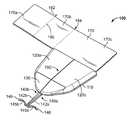
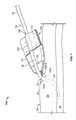
- FIG. 1is a perspective view of an anchor device with a portion of the device located in a subcutaneous region, in accordance with some embodiments.
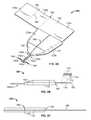
- FIGS. 2A-2Care perspective, side, and rear views, respectively, of the anchor device of FIG. 1 .
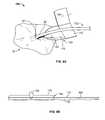
- FIGS. 3A-3Bare perspective and top views, respectively, of the anchor device of FIG. 1 in a folded condition, in accordance with some embodiments.
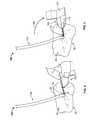
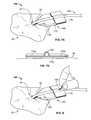
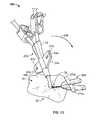
- FIGS. 4-7Aare perspective views of an anchor system, including the anchor device of FIG. 1 , for use in securing the position of a medical instrument.
- FIG. 7Bis a rear view of the anchor system, including the anchor device of FIG. 1 .
- FIG. 8is a perspective view of the anchor system, including the anchor device of FIG. 1 .
- FIG. 9is a perspective view of an anchor device with a portion of the device located in a subcutaneous region, in accordance with some embodiments.
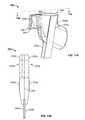
- FIGS. 10A-Care perspective, side, and rear views, respectively, of the anchor device of FIG. 9 .
- FIGS. 11A-Bare perspective and top views, respectively, of the anchor device of FIG. 9 in a folded condition, in accordance with some embodiments.
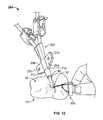
- FIGS. 12-16are perspective views of an anchor system, including the anchor device of FIG. 9 , for use in securing the position of a medical instrument.
- FIGS. 17A-17Bare perspective and side views, respectively, of an anchor device in accordance with some alternative embodiments.
- a medical device anchor system 104include an anchor device 100 that adhesively attaches to a medical instrument 102 and furthermore secures the medical instrument 102 in an operative position relative to a portion of skin 30 .
- the medical instrument 102can be adhesively coupled to the anchor device 100 after the medical instrument 102 using, for example, a flexible fabric portion 170 having an adhesive layer thereon.
- the anchor device 100can be coupled to the portion of skin 30 using one or more subcutaneous members 145 a - b . In this manner, the anchor device 100 can act as an intermediary member to cause the retention of the medical instrument 102 in a desired position with respect to the skin 30 .
- FIG. 1The example embodiment of FIG.
- the medial instrument 102e.g., a central venous catheter 102
- a percutaneous opening formed in the skine.g., penetration point 32
- a vein 40a percutaneous opening formed in the skin
- the anchor device 100can generally include a retainer body 110 , adhesive fabric 170 , and one or more anchors 140 a - b .
- the adhesive fabric 170extends proximally from a proximal end of the retainer body 110 .
- the one or more anchors 140 a - bextend distally from a distal end of the retainer body 110 .
- the anchor device 100can be configured to couple with the medical instrument 102 .
- the one or more anchors 140 a - bcan be configured for deployment through a skin penetration point 32 and into a subcutaneous layer 34 , so as to releasably retain the anchor device 100 with respect to the skin 30 .
- the anchor device 100can include the one or more anchors 140 a and 140 b that extend distally from the retainer body 110 so as to penetrate through the same skin penetration point while the retainer body 110 (and the adhesive fabric 170 mounted thereto) remain external to the skin penetration point 32 .
- the skin penetration point 32may be defined by a small incision, a puncture, or the like through the dermal layers 36 .
- the anchors 140 a - bcan include subcutaneous tines 145 a - b that, after insertion, reside in the subcutaneous region 34 (e.g., a region immediately under the skin 30 that may comprise a fatty tissue layer) so as to secure the position of the anchor device—and the medical instrument 102 retained therein—relative to the penetration point 32 .
- the anchor device 100can be secured to the patient without the retainer body 110 penetrating through the dermal layers 36 of the patient, and without necessarily requiring sutures or adhesive tapes bonded to the skin 30 .
- the anchor device 100can be installed into a skin penetration point 32 in accordance with a technique that reduces or eliminates the need to shift the subcutaneous tines 145 a - b of the anchors 140 a - b to or from a flexed or stressed configuration.
- the anchor tines 145 a - bneed not undergo substantial flexing during installation or removal.
- the subcutaneous anchorsmay be both installed and removed from the skin penetration point 32 advantageously without the need for an external actuator handle or delivery device to deploy the subcutaneous tines 145 a - b .
- the anchor tines 145 a - bmay be flexed to a different shape during installation or removal.
- the retainer body 110 and the adhesive fabric 170can receive the medical instrument 102 .
- the adhesive fabric 170receives the medical instrument 102 after a release liner 174 is removed from the adhesive fabric 170 to expose an adhesive layer 172 ( FIGS. 2A-C ).
- the release liner 174may be removed before installation of the subcutaneous tines 145 a - b through the skin opening 32 or after installation of the subcutaneous tines 145 a - b through the skin opening 32 .
- the medical instrument 102may be placed in contact with the exposed adhesive fabric 170 , and a user may fold the adhesive fabric 170 over the medical instrument 102 to secure the medical instrument 102 to the anchor device 100 .
- the anchor device 100can provide a capless design in which the anchor device 100 adhesively couples with an external portion of the medical instrument 102 without the need for attaching a cap or other similar component onto the retainer body 110 , thereby simplifying the process of inspecting and cleaning the anchor device 100 and the skin surface near the skin penetration point 32 after installation.
- the retainer body 110can be configured so as to mate with a cap component so as to supplement the holding force upon the medical instrument beyond the holding force provided from the adhesive fabric 170 .
- the medical instrument 102is embodied as a catheter.
- the medical instrument 102may alternatively be referred to as catheter 102 , without limiting the medical instrument 102 to such an embodiment.
- the example catheter 102generally includes a proximal portion 26 , a central portion 22 , and a distal portion 28 .
- the central portion 22can interconnect the proximal portion 26 with the distal portion 28 .
- the proximal portion 26 of the catheter 102may have multiple lumens (not shown) that are suited to deliver multiple types of solutions to the patient.
- the catheter 102includes a hub (e.g., hub 42 as described with respect to FIGS. 9-16 ) that can receive the multiple lumens on the proximal end of the hub, and merge the multiple lumens so as to connect with a single shaft of the distal portion 28 .
- some embodiments of the anchor device 100include the retainer body 110 and the anchors 140 a - b , which are connected to and extend distally from the distal end of the retainer body 110 .
- the anchors 140 a and 140 bcan be connected to the retainer body 110 using an over-molding process to secure the anchors 140 a - b relative to the retainer body 110 .
- the retainer body 110 and the anchors 140 a and 140 bcan be manufactured as a single, unitary piece.
- the anchor device 100can be configured to be folded longitudinally about a longitudinal fold axis 160 (e.g., a longitudinally extending region configured for enabling the retainer body 110 to repeatedly adjust from a first position to a second, folded position as shown, for example, in FIGS. 3A-3B ). Consequently, the retainer body 110 can be described as having a first retainer body portion 120 a and a second retainer body portion 120 b . In some embodiments, the first and second retainer body portions 120 a - b can be substantially mirror images of each other. In alternative embodiments, the first and second portions of the anchor device 100 can be asymmetrical.
- each anchor 140 a - bcomprises a flexible material.
- the anchors 140 a - bmay comprise a material that exhibits superelasticity.
- at least a portion of the anchors 140 a - b(including the tines 145 a - b ) may be formed from a length of nitinol wire or from a sheet of nitinol material.
- the anchors 140 a - bmay comprise a metal material such as stainless steel (e.g., 304 stainless, 316 stainless, custom 465 stainless, and the like), spring steel, titanium, MP35N, and other cobalt alloys, or the like.
- the anchors 140 a - bmay be formed from a resilient polymer material.
- the anchors 140 a - bcan be formed from a material or materials that allow the tines 145 a - b to be flexed and resiliently return to an unstressed position.
- each of the anchors 140 a - bmay be designed such that the tines 145 a - b have an unstressed position wherein the tines 145 a - b have a convex curvature.
- the convex curvature shape of the tines 145 a - bmay permit the tines 145 a - b to abut against the underside of the dermal layers 36 in a manner that reduces the likelihood of the tine tips 146 puncturing the underside of the dermal layers 36 .
- the tine tips 146are rounded bulbs or otherwise non-sharp so as to further protect the underside of the dermal layers 36 .
- the tines 145 a - bmay have a generally straight shape that extends substantially perpendicular to the longitudinal shaft portions of the anchors 140 a - b to the rounds tips 146 .
- the retainer body 110can comprise one or more biocompatible polymer materials (e.g., PVC, polypropylene, polystyrene, or the like). In some embodiments, the retainer body 110 can comprise a combination of such materials, for example, when the flexible web portion comprises an elastically flexible silicone material while the first and second retainer body portions 120 a - b comprise a less flexible polymer material such as polypropylene, PVC, polystyrene, or the like. In some embodiments, the retainer body 110 can be formed using a molding process in which the retainer body 110 is over-molded around a portion of the anchors 140 a - b , especially in those embodiments in which the anchors 140 a - b comprise a metallic material.
- biocompatible polymer materialse.g., PVC, polypropylene, polystyrene, or the like.
- the retainer body 110can comprise a combination of such materials, for example, when the flexible web portion comprises an elastically flexible silicone material while the first
- the left retainer body portion 120 acan be over-molded around a portion of anchor 140 a and, during the same or a different molding process, the right body portion 120 b can be over-molded around a portion of anchor 140 b . Consequently, as described further below, when the retainer body 110 is folded, the respective anchors 140 a - b (being connected to the retainer body portions 120 a - b respectively) likewise move in conjunction with their respective retainer body portion 120 a - b.
- the adhesive fabric 170 of the anchor deviceis optionally mounted to the retainer body 110 so that the adhesive fabric 170 extends proximally away from a proximal end of the retainer body 110 (e.g., extends away from the anchors 140 a - b ).
- the adhesive fabric 170may include a flexible substrate 175 on which an adhesive layer 172 has been formed (see FIG. 2B ).
- the flexible substrate 175may comprise a mesh material or flexible woven material.
- the anchor device 100may be manufactured with a releasable liner 174 covering the adhesive layer 172 to preserve the adhesive characteristics and to limit exposure of the adhesive layer 172 to environmental contaminants prior to user removal of the releasable liner 174 .
- a usermay readily remove the releasable liner 174 from the adhesive fabric 170 after installation of the subcutaneous anchor tines 145 a - b into the subcutaneous layer 34 .
- the usermay thereafter place the catheter 102 in contact with the adhesive layer 172 , and fold a portion of the adhesive fabric 170 over top of the catheter 102 and onto another portion of the adhesive fabric.
- the catheter 102may be sandwiched between two portions of the adhesive fabric 170 , securing the catheter 102 to the anchor device 100 .
- the adhesive layer 172is employed to secure the catheter 102 to the anchor device 100
- the catheter 102is anchored to the skin 30 using the subcutaneous tine 145 a - b (without the need to apply an adhesive directly to the skin 30 ).
- the adhesive fabric 170may include a tear strip 180 that extends in a generally longitudinal direction (e.g., generally parallel to the longitudinal fold axis 160 of the retainer body 110 ).
- the adhesive fabricmay be adapted such that pulling the tear strip 180 results in the adhesive fabric 170 separating along an installation of the tear strip 180 in the adhesive fabric 170 .
- the tear strip 180may be adapted to separate the adhesive fabric 170 into multiple portions as a result of a user pulling the tear strip 180 away from the adhesive fabric 170 , for example, in a direction that is generally traverse to a plane of the adhesive fabric 170 .
- the tear strip 180may embody a continuous polymer thread that is located within one or more layers of the flexible substrate 175 .
- the flexible substrate 175may be perforated along the location of the tear strip 180 to facilitate separation of the adhesive fabric 170 as a result of the user pulling the tear strip 180 away from the adhesive fabric 170 .
- the tear strip 180may be manufactured with sufficient tensile strength to remain intact as the user pulls the tear strip 180 away from the adhesive fabric 170 , and as the adhesive fabric 170 is ripped into two portions through force applied to the adhesive fabric 170 by the tear strip 180 .
- the tear strip 180may include a protruding portion 182 that is adapted to be grasped by the user with an instrument or between the user's fingers.
- the protruding portion 182may be a most-proximal portion of the anchor device 100 .
- the tear strip 180may be positioned in the adhesive fabric 170 such that the tear strip 180 is located generally longitudinally along the catheter 102 when the adhesive fabric 170 is folded over the catheter 102 .
- the practitioneris able to remove the catheter 102 from the anchor device 100 by pulling the tear strip 180 away from the adhesive fabric 170 , separating the adhesive fabric 170 along a length of the catheter 102 and permitting removal of the catheter 102 through the separation in the adhesive fabric 170 while the adhesive fabric remains adhesively bonded to itself.
- the usermay not grasp, for example, a corner of the adhesive fabric 170 and peel the corner of the adhesive fabric 170 off another portion of the adhesive fabric 170 .
- the catheter 102may be removed in a straightforward manner from contact with the anchor device 100 and subcutaneous region 34 before the tines 145 a - b are removed from the subcutaneous region 34 .
- the anchor device 100may be removed from the subcutaneous region 34 after catheter 102 has been removed from contact with the anchor device 100 and the subcutaneous region 34 .
- the adhesive fabric 170may remain folded over and adhesively bonded to itself (although separated into multiple portions) during removal of the anchor device 100 from the subcutaneous region 34 .
- the flexible substrate 175 of the adhesive fabric 170can be manufactured from a flexible material such as a textile mesh, a polymer mesh, a polymer sheet, a flat web of polymer foam material, or a metallic foil.
- the adhesive layer 172may comprise an adhesive, for example, a suitable medical adhesive. In some examples, a medical adhesive that is robust to cleaning agents and that provides a permanent hold may be employed as the adhesive layer 172 .
- the releasable liner 174may be formed of a polymer sheet or a wax paper, for example.
- the adhesive fabric 170can be configured to provide an effective coupling interface with the catheter 102 or other medical instrument, while providing features that simplify the overall use of the medical device anchor system 10 .
- the adhesive fabric 170may provide the user with a simplified coupling technique for mating the anchor device 100 to the catheter 102 , and may furthermore do so without the need for an attachable cap device.
- the adhesive fabric 170in general is mounted to the retainer body 110 , for example, so that the adhesive fabric may be folded along a fold axis 184 of the adhesive fabric 170 (e.g., a longitudinally extending region configured for the adhesive fabric 170 to fold upon itself).
- the fold axis 184 of the adhesive fabric 170may be offset from but parallel to the longitudinal fold axis 160 .
- the tear strip 180may be located such that the tear strip 180 is substantially with the longitudinal fold axis 160 when the adhesive fabric 170 has been folded along the fold axis 184 (refer to FIG. 1 ).
- the tear strip 180 and the fold axis 184 of the adhesive fabric 170can define borders between different regions of the adhesive fabric 170 . Consequently, the adhesive fabric 170 can be described as having a first adhesive fabric portion 170 a , a second adhesive fabric portion 170 b , and third adhesive fabric portion 170 c.
- the adhesive and flexible characteristics of the adhesive fabric 170enables a user to fold the first adhesive fabric portion 170 a and the second adhesive portion 170 b into adhesive contact with both the catheter 102 and the third adhesive fabric portion 170 c . In this manner, the first adhesive fabric portion 170 a and the second adhesive fabric portion 170 b each adhere to both the catheter 102 and the third adhesive fabric portion 170 c . Furthermore, the third adhesive fabric portion 170 c may adhere with the catheter 102 .
- the userwhen securing the medical device 102 to the retainer body 110 , the user can place the catheter 102 in contact with the adhesive fabric 170 , for example, along the longitudinal fold axis 160 , and can thereafter fold the adhesive fabric 170 along the fold axis 184 (which may include a visual indicia of the fold axis 184 , such as a solid or dotted line imprinted on the adhesive fabric 170 ).
- the usermay align the tear strip 180 with the catheter 102 and press the second adhesive fabric portion 170 b onto the catheter 102 and the third adhesive fabric portion 170 c , and can press the first adhesive fabric portion 170 a onto the catheter 102 and the third adhesive fabric portion 170 c .
- the contact of the catheter 102 with the first adhesive fabric portion 170 a , the second adhesive fabric portion 170 b , and the third adhesive fabric portion 170 cmay result in a snug coupling of the catheter 102 to the anchor device 100 .
- the adhesive fabric 170is molded into a proximal portion of the retainer body 110 at junction 186 , for example, with an insert molding operation.
- junction 186may be a slot that is formed during a molding process, and the adhesive fabric 170 is bonded into the slot with a permanent adhesive during a manufacturing assembly process.
- the adhesive fabric 170may be mechanically fastened into junction 186 .
- the adhesive fabric 170may include a tongue portion that is mechanically fastened or permanently adhered to an underside of the retainer body 110 so that the adhesive fabric 170 extends proximally away from the proximal end of the retainer body 110 .
- the adhesive coupling of the catheter 102 to the anchor device 100generally restrains movement of the medical instrument 102 away from the skin penetration point 32 . Further, the limited angular freedom of movement provided by the anchors 140 a - b permits the shaft of the catheter 102 to closely align with the skin penetration point 32 and reduce the stresses applied by the catheter 102 at the skin penetration point 32 .
- some embodiments of the anchor device 100also include a sloped nose region 130 along the retainer body 110 .
- the sloped nose region 130can be a generally planar surface near the distal end of the retainer body 110 that is oriented at a different angle than the generally planar surfaces of the first and second retainer body portions 120 a - b .
- the sloped nose region 130can decline from the generally planar surfaces of the first and second retainer body portions 120 a - b such that the nose region 130 slopes downward in a distal direction towards longitudinal shafts 142 a - b of the anchors 140 a - b (e.g., and thus downward to the skin penetration point 32 when the anchor tines 145 a - b are deployed).
- the sloped nose region 130can facilitate an orientation of the distal portion 28 of the medical instrument 102 that is directed toward the skin penetration point 32 . In this manner, the stresses that can potentially be exerted on the skin 30 proximal to the skin penetration point 32 by the distal portion 28 of the medical instrument 102 can be reduced.
- a flexible web portion 150 of the retainer body 110can be positioned, for example, generally centrally between the first and second retainer body portions 120 a - b .
- the flexible web portion 150can extend longitudinally from a distal face of the retainer body 110 to a proximal face of the retainer body 110 , and can be used to define the fold axis 160 about which the first and second retainer body portions 120 a - b are pivotable from the non-folded condition ( FIG. 2A ) to the folded condition ( FIG. 3A ).
- the flexible web portion 150can comprise an elastically flexible biocompatible polymer material (e.g., silicon, PVC, polypropylene, polystyrene, or the like).
- the flexible web portion 150can be made of the same material as the other portions of the retainer body 110 . In other embodiments, the flexible web portion 150 can be made of a different material than the other portions of the retainer body 110 . In such a case, the anchor device 100 can be made, for example, using a two-step insert molding operation. The flexible web portion 150 can be biased to resiliently maintain the non-folded shape of the anchor device 100 as depicted in FIGS. 2A-2C . When the anchor device 100 is folded along the fold axis 160 due to a user's grasp (refer, for example, to FIG.
- the flexible web portion 150can undergo elastic deformation such that flexible web portion 150 biases the anchor device 100 to return the non-folded condition ( FIGS. 2A and 5 ) upon release from the user.
- the fabric 170may also stretch along the longitudinal axis 160 and bias the anchor device 100 to return to the non-folded condition.
- the fabric 170may be two separate pieces of fabric that do not span the longitudinal fold axis 160 , such that the two separate pieces of fabric are not stretched at a location of the longitudinal fold axis 160 when the anchor device is in the folded condition.
- the anchor device 100may include features that allow the individual anchors 140 a - b to be moved relative to each other so as to facilitate both insertion and removal of the anchor device 100 through the skin penetration point 32 .
- the anchor device 100may have a foldable configuration in which a first portion of the retainer body 110 is pivotably coupled via a flexible hinge portion to a second portion of the retainer body 110 .
- the first retainer body portion 120 a and the second retainer body portion 120 bcan be flexibly pivoted with respect to each other along a fold axis 160 extending longitudinally through the retainer body 110 .
- the usercan apply a bending moment about the fold axis 160 to the first and second retainer body portions 120 a - b .
- Such a bending momentcan cause an elastic deformation of the flexible web portion 150 so as to fold the anchor device along the fold axis 160 (refer to FIG. 3A ).
- the adhesive fabric portion 170comprises the flexible substrate 175 and liner 174 , the adhesive fabric portion 170 is sufficiently compliant to temporarily fold with the retainer body 110 during this operation.
- the first retainer body portion 120 acan be fixedly coupled to the anchor 140 a
- the second retainer body portion 120 bcan be fixedly coupled to the anchor 140 b .
- FIG. 3Awhen the first and second retainer body portions 120 a - b are pivoted about the fold axis 160 , the two anchors 140 a - b likewise pivot relative to one another. This process of pivoting can cause the anchor device to transition from a non-folded condition (shown in FIGS. 2A-2C and in FIG. 1 ) in which the tines 145 a - b extend generally away from one another to a folded condition (shown in FIGS.
- the tines 145 a - bare generally adjacent to each other and oriented to extend in substantially the same direction.
- the anchor devicecan be biased to return the anchor device 100 from the folded condition to the non-folded condition.
- the tines 145 a - bcan be rotated about 75-degrees to about 105-degrees, and preferably about 90-degrees, during the transition between the non-folded condition and the folded condition.
- the anchor device 100can be arranged in the folded condition during both insertion and removal of the subcutaneous tines 145 a - b so as to reduce the likelihood of the tines 145 a - b causing damage to the skin 30 .
- the medical instrument 102can optionally include a catheter to be inserted through the penetration point 32 of the skin 30 as part of a medical procedure.
- a central venous catheter 102can be inserted into a percutaneous opening surgically formed in the skin (e.g., penetration point 32 ), to the underside of the skin 30 , and into a vein 40 to provide vascular access for delivering medications or minimally invasive devices into a patient.
- the usercan grasp the anchor device 100 in the folded condition and approach the penetration point 32 such that the free ends of the tines 145 a - b are contemporaneously inserted through the penetration point 32 while the tines 145 a - b are in a generally side-by-side condition (as depicted in FIG. 4 ).
- the subcutaneous tines 145 a - bare inserted through the skin penetration point 32 while the user conveniently grasps the retainer body 110 of the anchor device 100 and applies an insertion force until the convexly curved body portions of the subcutaneous tines 145 a - b are positioned below the surface of the skin 30 (while the remainder of the anchor device 100 resides external to the skin 30 ).
- the tines 145 a - bare maintained in a generally non-stressed configuration (e.g., a first shape or a steady-state shape) while passing through the penetration point 32 in a manner that reduces the likelihood of trauma to the surrounding skin tissue 30 .
- a generally non-stressed configuratione.g., a first shape or a steady-state shape
- the free ends of the tines 145 a - bare moved beneath the dermal skin layers 36 of the skin 30 .
- each tine 145 a - bmay retain their generally non-stressed configuration (e.g., the first shape or the steady-state shape).
- the anchor device 100can be installed in accordance with a technique that reduces or eliminates the need to shift the subcutaneous tines 145 a - b to or from a flexed or stressed configuration during the passage through the skin penetration point 32 .
- the adhesive fabric portion 170 of the anchor device 100is sufficiently compliant to temporarily fold and unfolded with the retainer body 110 during this process.
- the anchor device 100can secure the catheter 102 or other medical instrument relative to a skin penetration point 32 .
- the usermay remove the releasable liner 174 of the adhesive fabric 170 , exposing the adhesive layer 174 of the adhesive fabric 170 .
- the usermay remove the releasable liner 174 before installation of the subcutaneous tines 145 a - b into the subcutaneous region 34 .
- the previously inserted catheter 102can be placed in contact with the adhesive layer 174 of the adhesive fabric 170 .
- the directional arrow 198depicts an example motion of manually positioning the catheter 102 in contact with the adhesive fabric 170 to prepare for the coupling of the catheter 102 to the anchor device 100 .
- the catheter 102can be placed in contact with the anchor device 100 so that the shaft of the catheter 102 , for example, is generally aligned with the folding region 150 of the retainer body 110 .
- the catheter 102is placed in contact with the adhesive layer 172 of the third portion 170 c ( FIG. 2A ) of the adhesive fabric 170 , thereby temporarily retaining the catheter 102 is a position to receive the remaining portions 170 a - b of the adhesive fabric 170 over an upper side of the catheter 102 .
- the usermay fold the adhesive fabric 170 (with the adhesive layer 172 exposed) along the fold axis 184 ( FIG. 2A ) and onto the catheter 102 , aligning the tear strip 180 with the shaft of the catheter 102 .
- the anchor device of FIGS. 4-5is adhesively coupled to the catheter 102 .
- the adhesive fabric 170has been folded along the fold axis 184 over the catheter 102 .
- the catheter 102may be firmly secured between the upper and lower portions of adhesive fabric 170 .
- the first adhesive fabric portion 170 ais in adhesive contact with the third adhesive fabric portion 170 c while the second adhesive fabric portion 170 b is in adhesive contact with the third adhesive fabric portion 170 c .
- the first adhesive fabric portion 170 a , the second adhesive fabric portion 170 b , and the third adhesive fabric portion 170 cmay all contact the catheter 102 .
- the adhesive coupling of the catheter 102 to the anchor device 100secures the catheter 102 to the anchor device along at least two regions of the catheter 102 that are on opposing sides of the catheter 102 .
- the adhesive fabric 170folded over itself and adhesively secured to itself and the catheter 102 , the catheter 102 is fixed to the anchor device 100 .
- FIG. 8illustrates an example of removing of the catheter 102 (or other medical instrument) from the anchor device 100 .
- the usercan grasped the protruding portion 182 of the tear strip 180 , and pull the protruding portion 182 away from the adhesive fabric 170 , ripping the adhesive fabric 170 at the location of the tear strip 180 and permitting removal of the medical device 102 through the separation in the adhesive fabric 170 .
- FIG. 8shows the system 104 during removal of the tear strip 180 and ripping of the adhesive fabric 170 , but it should be understood that the tear strip 180 may be completely removed from the adhesive fabric 170 , resulting in a complete separation of the adhesive fabric 170 , for example, along the previous location of the tear strip 180 .
- the catheter 102may be removed from contact with the anchor device 100 .
- the catheter 102is removed from contact with both the subcutaneous layer 34 and the anchor device before the subcutaneous tines 145 a - b are removed from the subcutaneous layer 34 .
- some components of the system 104can be provided in a sterilized kit that pairs a particular type of catheter 102 or other medical instrument with a corresponding anchor device 100 .
- the particular type of catheter 102 or other medical instrument in the kitis compatible for adhesively mating with the anchor device 100 the kit.
- Each kitcan include one or more anchor devices 100 and the particular type of catheter 102 or other medical instrument enclosed within a flexible packaging material, which preferably includes indicators that identify the type of catheter 102 or other medical instrument that is provided along with instructions for deploying and removing the anchor device 100 .
- the kitmay include a one-to-one ratio for the quantity of anchor devices 100 to the quantity of catheters 102 .
- the kitmay include multiple anchor devices 100 (e.g., having differently sized or shaped tines 145 a - b ) for each catheter 102 contained therein.
- the anchor device 100can be provided in individual, sterilized packets so that a user can readily open such a packet and access the selected anchor device prior to insertion into the skin penetration point.
- Such individual packetscan include a single anchor device enclosed within a flexible packaging material, which preferably includes indicators that identify the types of catheters or other medical instruments that are compatible for adhesively mating with the anchor device 100 . As such, a user can readily select one of the packets for use after the type of catheter or medical instrument is selected for a particular patient.
- FIGS. 9-16show embodiments of a medical device anchor system 204 that is similar in some respects to the medical device anchor system 104 .
- the medical device anchor system 204includes an anchor device 200 that includes one or more adhesive fabric strips 270 a - b with multiple tear strips 280 a - b.
- some embodiments of the medical device anchor system 204include an anchor device 200 that adhesively retains a medical instrument 202 in an operative position relative to a portion of skin 30 .
- the medical instrument 202can be adhesively coupled to the anchor device 200 .
- the anchor device 200in turn, can be coupled to the portion of skin 30 . In this manner, the anchor device 200 can act as an intermediary member to cause the retention of the medical instrument 202 in a desired position with respect to the skin 30 .
- FIG. 10The example embodiment of FIG.
- a medical device 202e.g., a central venous catheter
- a percutaneous opening formed in the skine.g., penetration point 32
- a vein 40e.g., a percutaneous opening formed in the skin
- the anchor device 200can generally include a retainer body 210 , adhesive fabric 270 a - b , and one or more anchors 240 a - b .
- the anchors 240 a - bextend distally from a distal end of the retainer body 210 .
- the anchor device 200can be configured to couple with the medical instrument 202 .
- the one or more anchors 240 a - bcan be configured for deployment through a skin penetration point 32 and into a subcutaneous layer 34 , so as to releasably retain the anchor device 200 with respect to the skin 30 .
- the anchor device 200can include the one or more anchors 240 a and 240 b that extend distally from the retainer body 210 so as to penetrate through the same skin penetration point 32 while the retainer body 210 and the adhesive fabric 270 a - b remain external to the skin penetration point 32 .
- the anchors 240 a - bcan include subcutaneous tines 245 a - b that, after insertion, reside in the subcutaneous region 34 so as to secure the position of the anchor device—and the medical instrument 202 retained therein—relative to the penetration point 32 .
- the tines 245 a - bare deployed in the subcutaneous region 34 , the anchor device 200 can be secured to the patient without the retainer body 210 penetrating through the dermal layers 36 of the patient, and without necessarily requiring sutures or adhesive tapes bonded to the skin 30 .
- the anchor device 200can be installed into the skin penetration point 32 in accordance with a technique that reduces or eliminates the need to shift the subcutaneous anchors tines 245 a - b of the anchors 240 a - b to or from a flexed or stressed configuration. As such, the anchor tines 245 a - b need not undergo substantial flexing during installation or removal. In these circumstances, the subcutaneous anchors may be both installed and removed from the skin penetration point 32 advantageously without the need for an external actuator handle or delivery device to deploy the subcutaneous tines 245 a - b.
- the retainer body 210 and the adhesive fabric strips 270 a - bcan receive the medical instrument 202 .
- a usermay have removed releasable liners 274 a - b from the adhesive fabric strips 270 a - b to expose adhesive layers 272 a - b .
- the releasable liners 274 a - bmay have been removed before installation of the subcutaneous tines 245 a - b or after installation of the subcutaneous tines 245 a - b .
- the medical instrument 202may be placed in contact with the exposed adhesive fabric strips 270 a - b , and a user may fold the adhesive fabric strips 270 a - b over the medical instrument 202 .
- the medical instrument 202is embodied as a catheter.
- the medical instrument 202may alternatively be referred to as catheter 202 , without limiting the medical instrument 202 to such an embodiment.
- the anchor device 200can provide a capless design in which the anchor device 200 adhesively couples with an external portion of the catheter 202 without the need for attaching a cap onto the retainer body 210 , thereby simplifying the process inspecting and cleaning the anchor device 200 and the skin surface near the skin penetration point 32 after installation.
- the example catheter 202generally includes a proximal portion 46 , a hub 42 , and a distal portion 48 .
- the hub 42can interconnect the proximal portion 46 with the distal portion 48 .
- the proximal portion 46 of the catheter 202may have multiple lumens that are suited to deliver multiple types of solutions to the patient.
- the hub 42can receive the multiple lumens on the proximal end of the hub 42 , and merge the multiple lumens so as to connect with a single lumen distal portion 48 . For example, as shown in FIG.
- the proximal portion 46is depicted as having two lumens, and the distal portion 48 as having a single lumen that is adapted for percutaneous insertion through skin penetration point 32 .
- the hub 42can serve the purpose of merging multiple proximal supply lumens into a single distal delivery lumen suited for insertion into the patient.
- the hub 42can further be arranged to couple the catheter 202 onto the anchor device 200 .
- the hub 42can include wings 24 a - b .
- the wings 24 a - bcan have features that facilitate the coupling of the hub 42 to the anchor device 200 .
- the wings 24 a - bmay be shaped to adhesively couple with the one or more adhesive fabric strips 270 a - b .
- some embodiments of the hub 42can include apertures 47 a - b in the wings 24 a - b (see FIG. 13 ).
- the apertures 47 a - bcan be located and sized to couple with corresponding features of anchor devices that may not include the adhesive fabric strips 270 a - b.
- the hub 42can be manufactured from an elastomeric or otherwise flexible material, such as silicone or another biocompatible polymer material (e.g., PVC, polypropylene, polystyrene, or the like).
- the hub 42can be made from a combination of materials.
- at least wings 24 a - bmay comprise silicone or another flexible biocompatible material so that the wings 24 a - b and the apertures 47 a - b can flexibly adjust to couple with the adhesive fabric strips 270 a - b or the above-described retention posts, whereas the portions of the hub 42 other than the wings 24 a - b may comprise a more rigid polymer material.
- the anchor device 200can be configured to adhesively couple to the catheter 202 through use of the multiple adhesive fabric strips 270 a - b .
- a usermay wrap the adhesive fabric strips 270 a - b around the wings 24 a - b , respectively.
- the adhesive fabric strips 270 a - bmay include backing layers 275 a - b on which adhesive layers 272 a - b have been formed (see FIG. 10C ).
- the anchor device 200may be manufactured so that releasable liners 274 a - b cover the adhesive layers 272 a - b to limit exposure of the adhesive layers 272 a - b to environmental contaminants and gases prior to user removal of the releasable liners 274 a - b .
- a usermay remove the releasable liners 274 a - b from the adhesive fabric strips 270 a - b after installation of the subcutaneous anchor tines 245 a - b into the subcutaneous layer 34 .
- the usermay thereafter place the catheter 202 in contact with the retainer body 210 , and fold portions of the adhesive fabric strips 270 a - b over top of the wings 24 a - b .
- the wings 24 a - b of the catheter 202may be retained by at least portions of the adhesive fabric strips 270 a - b , securing the catheter 202 to the anchor device 200 .
- Each of the adhesive fabric strips 270 a - bmay include a tear strip (e.g., tear strip 280 a or 280 b in the depicted embodiment). As discussed with respect to the adhesive fabric 270 of FIGS. 1-8 , each of the adhesive fabric strips 270 a - b may be adapted such that pulling the respective tear strip 280 a or 280 b results in the adhesive fabric 270 a or 270 b separating along an installation of the tear strip 280 a or 280 b in the adhesive fabric 270 a or 270 b .
- tear stripe.g., tear strip 280 a or 280 b in the depicted embodiment.
- each of the adhesive fabric strips 270 a - bmay be adapted such that pulling the respective tear strip 280 a or 280 b results in the adhesive fabric 270 a or 270 b separating along an installation of the tear strip 280 a or 280 b in the adhesive fabric 270 a or 270 b .
- the tear strips 270 a - b , backing layers 275 a - b , and adhesive layers 272 a - bmay be constructed of the same materials and function similarly to the tear strip 170 , flexible substrate 175 , and adhesive layer 272 that are described with reference to FIGS. 1-8 .
- the tear strips 280 a - bmay include protruding portions 282 a - b that are adapted to be grasped by the user with an instrument or between the user's fingers.
- the tear strips 280 a - bmay be positioned in the adhesive fabric strips 270 a - b such that the tear strips 280 a - b generally run alongside surfaces 27 a - b when the adhesive fabric strips 270 a - b are folded over top surfaces 29 a - b of the wings 24 a - b .
- the useris able to remove the catheter 202 from the anchor device 200 by pulling the tear strips 280 a - b away from the adhesive fabric strips 270 a - b , separating the adhesive fabric strips 270 a - b along the locations of the side surfaces 27 a - b and permitting removal of the catheter 202 , for example, without requiring the user to grasp corners of the adhesive fabric strips 270 a - b and peel the adhesive fabric strips 270 a - b off the wings 24 a - b .
- portions of the adhesive fabric strips 270 a - bmay remain adhesively bonded to the wings 24 a - b after removal of the catheter 202 .
- the catheter 202may be removed in a straightforward manner from contact with the retainer body 210 and the subcutaneous region 34 before the tines 245 a - b are removed from the subcutaneous region 34 .
- the anchor device 200may be removed from the subcutaneous region 34 after catheter 202 has been removed from contact with the anchor device 200 and the subcutaneous region 34 (except that the separated regions of the adhesive fabric strips 270 a - b may remain in contact with the wings 24 a - b after pulling of the tear strips 280 a - b ).
- some embodiments of the anchor device 200include the retainer body 210 and the anchors 240 a - b , which are connected to and extend distally from the distal end of the retainer body 210 .
- the anchors 240 a and 240 bcan be connected to the retainer body 210 using an over-molding process to secure the anchors 240 a - b relative to the retainer body 210 .
- the retainer body 210 and the anchors 240 a and 240 bcan be manufactured as a single, unitary piece.
- the anchor device 200can be configured to be folded longitudinally about a longitudinal fold axis 260 (e.g., a longitudinally extending region configured for enabling the retainer body 210 to repeatedly adjust from a first position to a second, folded position as shown, for example, in FIGS. 11A-11B ). Consequently, the retainer body 210 can be described as having a first retainer body portion 220 a and a second retainer body portion 220 b . In some embodiments, the first and second retainer body portions 220 a - b can be substantially mirror images of each other. In alternative embodiments, the first and second portions of the anchor device 200 can be asymmetrical.
- the composition and construction of the anchors 240 a - bmay be the same as that of anchors 140 a - b , discussed with reference to FIGS. 1-8 .
- the anchors 240 a - bmay comprise a material that exhibits superelasticity.
- each of the anchors 240 a - bmay be designed such that the tines 245 a - b have an unstressed position wherein the tines 245 a - b have a convex curvature with tine tips 246 that are bulbs.
- the composition of the retainer body 210 and the connection of the retainer body 210 to the anchors 240 a - bmay be the same as that of the retainer body 110 and the anchors 140 a - b.
- the retainer body 210can include first and second retainer body portions 220 a - b arranged on opposing sides of the longitudinal fold axis 260 , left and right tabs 222 a - b , and (optionally) a sloped nose region 230 .
- the first and second retainer body portions 220 a - bcan be connected to each other at an elastically flexible web portion 150 , which may be employed to define the fold axis 260 .
- the adhesive fabric strips 270 a - bcan be configured to provide an effective coupling interface with the catheter 202 or other medical instrument, while providing features that simplify the overall use of the medical device anchor system 204 .
- the adhesive fabric strips 270 a - bmay provide the user with a simplified coupling technique for mating the anchor device 200 to the catheter 202 , and may furthermore do so without the need for an attachable cap device or skin sutures.
- the adhesive fabric strips 270 a - bin general are sized and attached the retainer body 210 , for example, so that the adhesive fabric strips 270 a - b may be folded along fold axes 284 a - b of the adhesive fabric strips 270 a - b .
- the fold axes 284 a - b of the adhesive fabric 270may be offset from but parallel to the longitudinal fold axis 260 .
- the tear strips 280may be located along the fold axes 284 a - b .
- the tear strips 280 a - b of the adhesive fabric strips 270 a - bcan define borders between different regions of the adhesive fabric strips 270 a - b .
- adhesive fabric 270 acan be described as having a first adhesive fabric portion 270 c and a second adhesive fabric portion 270 d
- the adhesive fabric 270 bcan be described as having a first adhesive fabric portion 270 e and a second adhesive fabric portion 270 f
- the fold axes 284 a - bmay be defined along the tear strips 280 a - b.
- the adhesive and flexible characteristics of the adhesive fabric strips 270 a - benable a user to fold the first adhesive fabric portions 270 c and 270 e onto the top surfaces 29 a - b of the wings 24 a - b .
- the first adhesive fabric portions 270 c and 270 eadhere to the top surfaces 29 a - b of the wings 24 a - b of the catheter 210 .
- second adhesive fabric portions 270 d and 270 fmay adhere to bottom surfaces 31 a - b of the wings 24 a - b .
- the userwhen securing the medical device 202 to the retainer body 210 , the user can place the medical device 202 in contact with at least one of the second adhesive fabric portions 270 d and 270 f , and can thereafter fold the adhesive fabric strips 270 a - b along the fold axes 284 a - b (which may include a visual indicia of the fold axes 284 a - b , such as solid or dotted lines imprinted on the adhesive fabric strips 270 a - b ).
- the usermay press the first adhesive fabric portions 270 c and 270 e onto the top surfaces 29 a - b of the wings 24 a - b .
- the contact of the wings 24 a - b with the adhesive fabric strips 270 a - bmay result in a snug coupling of the catheter 202 to the retainer body 210 .
- the adhesive fabric strips 270 a - bare bonded to outer surfaces of the retainer body 210 , for example with a medical adhesive.
- the adhesive fabric strips 270 a - bare molded into the retainer body 210 at junctions, for example, slots in the retainer body 210 with an insert molding operation.
- the adhesive fabric strips 270 a - bmay be mechanically latched into junction 270 . It should also be understood that there exist many manufacturing processes that can secure the adhesive fabric strips 270 a - b to the retainer body 210 .
- the flexibility of the wings 24 a - bcan allow some limited angular freedom of movement between the hub 42 and the anchor device 200 , while generally restraining movement of the catheter 202 away from the skin penetration point 32 . Further, the limited angular freedom of movement permits the hub 42 of the catheter 202 to be slightly titled relative to the anchor device 200 , thereby permitting the hub 202 and the distal portion 48 of the medical instrument to more closely align with the skin penetration point 32 and reduce the stresses applied by the catheter 202 at the skin penetration point 32 .
- the anchor device 200further includes first and second tabs 222 a - b .
- the first and second tabs 222 a - bare configured to simplify the act of manipulating and folding the anchor device 200 .
- the usercan adjust the first and second tabs 222 a - b in a pivoting motion toward one another, which readily enables the user to fold the anchor device 200 along the longitudinal fold axis 260 .
- the first and second tabs 222 a - bare also configured to provide a u-shaped cutout region 265 between the first and second tabs 222 a - b . This u-shaped cutout region 265 can more readily provide visualization and access to the skin region under the retainer body 210 for inspection and cleaning of the skin 30 around the skin penetration point 32 .
- the anchor device 200also includes a sloped nose region 230 .
- the sloped nose region 230can be a generally planar surface near the distal end of the retainer body 210 that is oriented at a different angle than the generally planar surfaces of the first and second retainer body portions 220 a - b .
- the sloped nose region 230can decline from the generally planar surfaces of the first and second retainer body portions 220 a - b such that the nose region 230 slopes downward in a distal direction towards longitudinal shafts 242 a - b of the anchors 240 a - b (e.g., and thus downward to the skin penetration point 32 when the anchor tines 245 a - b are deployed).
- the sloped nose region 230can facilitate an orientation of the distal portion 48 of the catheter 202 that is directed toward the skin penetration point 32 . In this manner, the stresses that can potentially be exerted on the skin 30 proximal to the skin penetration point 32 by the distal portion 48 of the catheter 202 can be reduced.
- the flexible web portion 250 of the anchor device 200can be positioned, for example, generally centrally between the first and second retainer body portions 220 a - b .
- the flexible web portion 250can extend longitudinally from a distal face of the retainer body 210 to a proximal face of the retainer body 210 , and can be used to define the fold axis 260 about which the first and second retainer body portions 220 a - b are pivotable from the non-folded condition ( FIG. 10A ) to the folded condition ( FIG. 11A ).
- the left and right retainer body portions 220 a - bcan be connected to opposing sides of the flexible web portion 250 .
- the flexible web portion 250can comprise an elastically flexible biocompatible polymer material, as discussed with reference to FIG. 2C .
- the flexible web portion 250can be biased to resiliently maintain the non-folded shape of the anchor device 200 as depicted in FIGS. 10A-10C .
- the flexible web portion 250can undergo elastic deformation such that flexible web portion 250 biases the anchor device 200 to return the non-folded condition ( FIGS. 2A and 5 ) upon release from the user.
- the adhesive fabric strips 270 a - bcomprise a single fabric that is joined across the fold axis 260 . The single fabric may stretch and bias the anchor device 200 to the non-folded condition.
- the anchor device 200may include features that allow the individual anchors 240 a - b to be moved relative to each other so as to facilitate both insertion and removal of the anchor device 200 through the skin penetration point 32 , for example, as discussed with reference to FIGS. 3A-3B in regard to anchor device 100 and individual anchors 140 a - b.
- the catheter 202can include a catheter to be inserted through the penetration point 32 of the skin 30 as part of a medical procedure.
- the usercan grasp the anchor device 200 in the folded condition and approach the penetration point 32 such that the free ends of the tines 245 a - b are contemporaneously inserted through the penetration point 32 while the tines 245 a - b are in a generally side-by-side condition (as depicted in FIG. 12 ).
- the subcutaneous tines 245 a - bare inserted through the skin penetration point 32 while the user conveniently grasps the tabs 222 a - b of the retainer body 210 of the anchor device 200 and applies an insertion force until the convexly curved body portions of the subcutaneous tines 245 a - b are positioned below the surface of the skin 30 (while the remainder of the anchor device 200 resides external to the skin 30 ).
- the tines 245 a - bare maintained in a generally non-stressed configuration (e.g., a first shape or a steady-state shape) while passing through the penetration point 32 in a manner that reduces the likelihood of trauma to the surrounding skin tissue 30 .
- a generally non-stressed configuratione.g., a first shape or a steady-state shape
- the free ends of the tines 245 a - bare moved beneath the dermal skin layers 36 of the skin 30 .
- each tine 245 a - bmay retain their generally non-stressed configuration (e.g., the first shape or the steady-state shape).
- the anchor device 200can be installed in accordance with a technique that reduces or eliminates the need to shift the subcutaneous anchors tines 245 a - b to or from a flexed or stressed configuration during the passage through the skin penetration point 32 .
- the subcutaneous anchors tines 245 a - bneed not undergo substantial flexing during installation or removal, and in some embodiments, the subcutaneous anchors tines 245 a - b can comprise a generally less costly material (such as stainless steel or biocompatible polymers) rather than more costly materials required for superelastic flexing.
- the anchor device 200can secure the catheter 202 relative to a skin penetration point 32 .
- the anchor device 200With the anchor device 200 positioned such that subcutaneous anchors tines 245 a - b are in their deployed configuration, as shown in FIG. 13 , the user may remove the releasable liners 274 a - b of the adhesive fabric strips 270 a - b , exposing the adhesive layers 274 a - b .
- the usermay remove the releasable liners 274 a - b before installation of the subcutaneous tines 245 a - b into the subcutaneous region 34 .
- the previously inserted catheter 202can be placed in contact with the anchor device 200 .
- the directional arrow 298depicts an example motion of manually positioning the catheter 202 in contact with the anchor device 200 to prepare for the coupling of the catheter 202 to the anchor device 200 .
- the hub 42 of the catheter 202can be placed in contact with the anchor device 200 so that the wings 24 a - b of the hub 42 are, for example, generally aligned with the corresponding adhesive fabric strips 270 a - b .
- the wings 24 a - bare placed in contact with the adhesive layer 272 of corresponding adhesive fabric strip 270 a - b , thereby temporarily retaining the catheter 202 is a position to receive the remaining portions of the adhesive fabric strips 270 a - b over an upper side of the wings 24 a - b .
- the usermay fold the adhesive fabric strips 270 a - b (with the adhesive layer 272 exposed) along the fold axes 284 a - b and onto the wings 24 a - b , preferably aligning the tear strips 280 a - b along the side surfaces 27 a - b.
- the medical device anchor system 204 of FIGS. 12-13is adhesively coupled to the medical instrument 202 .
- the adhesive fabric strips 270 a - bcan be folded along the fold axes 284 a - b and onto the top surfaces 29 a - b .
- the first adhesive fabric portion 270 cis in contact with the top surface 29 a and the first adhesive fabric portion 270 e is in contact with the top surface 29 b .
- the second adhesive fabric portion 270 dmay be in contact with the bottom surface 31 a and the second adhesive fabric portion 270 e may be in contact with the bottom surface 31 b .
- the catheter 202is fixed to the anchor device 200 .
- the anchor device 200adhesively retains the medical instrument 202 (e.g., catheter) in an operative position relative to a portion of skin 30 (e.g., the skin penetration point 32 ).
- the medical instrument 202is adhesively coupled to the anchor device 200 , as described above.
- the anchor device 200is coupled to the portion of skin 30 , as described above.
- the anchor device 200can be secured to the patient without necessarily requiring sutures or adhesive tapes bonded to the skin 30 .
- a distal portion 48 of the catheter 202penetrates a skin penetration point 32 and distally extends into the subcutaneous layer 34 .
- some embodiments of the system 204can enable the distal end of the hub 42 to be positioned closely to the skin penetration point 32 .
- Such a configurationprovides a compact anchor system 204 that is convenient to install and maintain. This configuration can minimize the lengths of the tubing proximal to the patient, and reduce the need for securement of such tubing or other portions of the medical instrument 202 to the patient using tapes, adhesive dressings, and the like.
- the hub 42 of the catheter 202may optionally inclined at an angle in relation to the skin surface 30 .
- Such an orientation between the hub 42 and the skin 30may, in some circumstances, reduce the stresses applied to the skin penetration point 32 of the patient by the distal portion 48 of the catheter 202 .
- the example orientation depicted in FIG. 15enables the distal portion 48 to be inclined at an angle in relation to the skin surface 30 which can thereby reduce the need for the distal portion 48 of the catheter 202 to have a significant bend at the skin penetration point.
- FIG. 16illustrates an example of removing of the catheter 202 from the anchor device 200 .
- the userhas grasped the protruding portions 282 a of the tear strips 280 a , and pulled the protruding portion 282 a away from the retainer body 210 , ripping the adhesive fabrics 270 a at the location of the tear strip 180 a and permitting removal of the medical device 202 due to separation in the adhesive fabrics 270 a .
- FIG. 16illustrates an example of removing of the catheter 202 from the anchor device 200 .
- the userhas grasped the protruding portions 282 a of the tear strips 280 a , and pulled the protruding portion 282 a away from the retainer body 210 , ripping the adhesive fabrics 270 a at the location of the tear strip 180 a and permitting removal of the medical device 202 due to separation in the adhesive fabrics 270 a .
- both tear strips 280 a - bmay be completely removed from the adhesive fabric strips 270 a - b , resulting in a complete separation of both adhesive fabric strips 270 a - b , for example, along the fold axes 284 a - b .
- the catheter 202may be removed from contact with the retainer body 210 .
- the catheter 202is removed from contact with both the retainer body 210 and the subcutaneous layer 34 before the subcutaneous tines 245 a - b are removed from the subcutaneous layer 34 .
- some components of the system 204can be provided in a sterilized kit that pairs a particular type of catheter 202 or other medical instrument with a corresponding anchor device 200 .
- the particular type of catheter 202 or other medical instrument in the kitis compatible for adhesively mating with the anchor device 200 in the kit.
- Each kitcan include one or more anchor devices 200 and the particular type of catheter 202 or other medical instrument enclosed within a flexible packaging material, which preferably includes indicators that identify the type of catheter 202 or other medical instrument that is provided along with instructions for deploying and removing the anchor device 200 .
- the kitmay include a one-to-one ratio for the quantity of anchor devices 200 to the quantity of catheters 202 .
- the kitmay include multiple anchor devices 200 (e.g., having differently sized or shaped tines 245 a - b ) for each catheter 202 contained therein.
- the anchor device 200can be provided in individual, sterilized packets so that a user can readily open such a packet and access the selected anchor device prior to insertion into the skin penetration point.
- Such individual packetscan include a single anchor device enclosed within a flexible packaging material, which preferably includes indicators that identify the types of catheters or other medical instruments that are compatible for adhesively mating with the anchor device 200 . As such, a user can readily select one of the packets for use after the type of catheter or medical instrument is selected for a particular patient.
- some embodiments of the medical device anchor systeminclude an anchor device 300 that adhesively retains a medical instrument (e.g., a catheter 102 as shown in FIG. 1 , or the like) in an operative position relative to a portion of skin. Similar to the embodiments previously described in connection with FIGS. 1-8 , the anchor device 300 can act as an intermediary member to cause the retention of the medical instrument in a desired position with respect to the skin 30 .
- the anchor device 300can generally include a retainer body 310 (including first and second portions 320 a - b ), a flexible adhesive web 370 , and one or more anchors 340 a - b .
- the anchor device 300is similar to the embodiments previously described in connection with FIGS. 1-8 , except that flexible adhesive web 370 is disposed along an underside of the retainer body 310 .
- the retainer body 310can include two separate portions 320 a - b that are affixed to a designated region of the flexible adhesive web 370 (refer to FIG. 17A ), and the longitudinal fold region 360 is defined by a small portion of the flexible adhesive web 370 positioned between opposing edges of the multitude body portions 320 a - b .
- the flexible adhesive web 370can serve both as the longitudinal hinge portion (e.g., that defines a longitudinal fold line for the retainer body 310 ) and as the securement structure for the medical instrument.
- the two individual body portions 320 a - b(each having a corresponding anchor 340 a - b extending distally therefrom) can be bonded to an exposed region of an adhesive layer of the underlying flexible adhesive web 370 .
- the proximal regions 370 a - c of the flexible adhesive web 370may be equipped with a release liner 374 so as to preserve the portion of the adhesive layer 372 until the proximal regions 370 a - c are used to adhere to the catheter or other medical instrument.
- the anchors 340 a - bextend distally from a distal end of the retainer body 310 for deployment through a skin penetration point and into a subcutaneous layer, so as to releasably retain the anchor device 300 with respect to the skin.
- the anchor device 300can include the one or more anchors 340 a and 340 b that extend distally from the retainer body 310 so as to penetrate through the same skin penetration point while the retainer body 310 and the flexible adhesive web 370 remain external to the skin penetration point. Also similar to the anchors 140 a - b previously described in connection with FIGS.
- the anchors 340 a - bcan include longitudinal shaft portions 342 a - b that extend distally to corresponding subcutaneous tines 345 a - b .
- the tines 345 a - breside in the subcutaneous region so as to secure the position of the anchor device 300 —and the medical instrument retained thereto—relative to the penetration point.
- the anchor device 300can be secured to the patient without the retainer body 310 penetrating through the dermal layers of the patient, and without necessarily requiring sutures or adhesive tapes bonded to the skin.
- the anchor device 300can be installed into the skin penetration point in accordance with a technique that reduces or eliminates the need to shift the subcutaneous anchors tines 345 a - b of the anchors 340 a - b to or from a flexed or stressed configuration.
- the anchor tines 345 a - bmay not necessarily undergo substantial flexing during installation or removal.
- the subcutaneous anchorsmay be both installed and removed from the skin penetration point advantageously without the need for an external actuator handle or delivery device to deploy the subcutaneous tines 345 a - b.
- the retainer body 310 and the flexible adhesive web 370can receive the catheter or other medical instrument.
- a usermay have removed releasable liner 374 from the flexible adhesive web 370 to expose the adhesive layer 372 .
- the cathetermay be placed in contact with the exposed flexible adhesive web 370 , and a user may fold the adhesive portions 370 a - b (e.g., along the fold axis 384 ) over the catheter and into engagement with the remaining portion 370 c.
- the flexible adhesive web 370may include a tear strip 380 that extends in a generally longitudinal direction (e.g., generally parallel to the longitudinal fold region 360 of the retainer body 310 ).
- the flexible adhesive web 370may be adapted such that pulling the tear strip 380 results in the flexible adhesive web 370 separating along an installation of the tear strip 380 in the flexible adhesive web 370 .
- the tear strip 380may be manufactured with sufficient tensile strength to remain intact as the user pulls the tear strip 380 away from the flexible adhesive web 370 , and as the flexible adhesive web 370 is ripped into two portions through force applied to the flexible adhesive web 370 by the tear strip 380 .
- the tear strip 380may include a protruding portion 382 that is adapted to be grasped by the user with an instrument or between the user's fingers.
- the cathetermay be removed in a straightforward manner from contact with the anchor device 300 and subcutaneous region before the tines 345 a - b are removed from the subcutaneous region.
- the flexible substrate 375 of the flexible adhesive web 370can be manufactured from a flexible material such as a textile mesh, a polymer mesh, a polymer sheet, a flat web of polymer foam material, or a metallic foil.
- the flexible substrate 375is selected with the material and thickness sufficient to bias the retainer body 310 to the deployed configuration (as shown in FIG. 17A ) after being temporarily adjusted to a folded condition (e.g., fold about the longitudinal fold region 360 ).
- the adhesive layer 372may comprise an adhesive, for example, a suitable medical adhesive. In some examples, a medical adhesive that is robust to cleaning agents and that provides a permanent hold may be employed as the adhesive layer 372 .
- the releasable liner 374may be formed of a polymer sheet or a wax paper, for example.
Landscapes
- Health & Medical Sciences (AREA)
- Life Sciences & Earth Sciences (AREA)
- Biophysics (AREA)
- Pulmonology (AREA)
- Engineering & Computer Science (AREA)
- Anesthesiology (AREA)
- Biomedical Technology (AREA)
- Heart & Thoracic Surgery (AREA)
- Hematology (AREA)
- Animal Behavior & Ethology (AREA)
- General Health & Medical Sciences (AREA)
- Public Health (AREA)
- Veterinary Medicine (AREA)
- Media Introduction/Drainage Providing Device (AREA)
Abstract
Description
This document relates to devices, systems, and methods for securing the position of a catheter or another medical instrument, for example, at a skin opening.
Venous, arterial, and body fluid catheters are commonly used by physicians. For example, such catheters may be used to gain access to the vascular system for dialysis, for introducing pharmaceutical agents, for nutrition or fluids, for hemodynamic monitoring, and for blood draws. Alternatively, catheters can be used for drainage of fluid collections and to treat infection. Alternatively, catheters can contain electrical leads for neuro-stimulation, cardiac pacing, and the like. Following introduction into the patient, the catheter is secured to the patient. In many instances, the catheter is commonly secured to the patient using an adhesive tape on the skin or by suturing a catheter hub to the patient's skin. In other circumstances, the catheter may be secured to the patient using a subcutaneous anchor mechanism (such as an anchor sleeve equipped with anchors that are deployed using an external actuator handle or a separate delivery device). In many cases, the medical practitioner will make efforts to clean the skin area around the catheter insertion site for purposes of a patient's comfort, safety, and improved visualization of the catheter insertion site after the catheter is installed.
Some embodiments of a medical device anchor system include an anchor device that provides an adhesive coupling with a medical instrument (such as a catheter or the like that is optionally equipped with suture wings) and furthermore secures the instrument in place relative to a skin penetration point. For example, the medical anchor device can be equipped with a flexible fabric portion that is configured to adhesively attach to a shaft of a hub of a catheter while the medical anchor device also provides subcutaneous anchor mechanisms deployable through the skin penetration point that is already occupied by the catheter, thereby reducing or eliminating the need for installing sutures through the suture wings and the patient's skin. Optionally, in some embodiments the anchor device can be adjusted to a folded configuration that orients the tines of the subcutaneous anchors in a generally side-by-side configuration to facilitate insertion of the anchors through the skin penetration point. Such a configuration may allow the anchor device to be installed after medical instrument is already in place without the need for a second penetration point for the anchor device. In particular embodiments, the anchor device may be configured to simplify the use of the anchor device, make the anchor device more adaptable to use with medical instruments of different sizes, and to facilitate the maintenance and cleaning of the skin tissue at and around the skin penetration point.
In particular embodiments, an anchor device for securing the position of a medical instrument may include a retainer body. The retainer body can include a first body portion that is hingedly coupled to a second body portion about a longitudinal folding region. Also, the anchor device may include one or more flexible adhesive strips mounted to the retainer body. The one or more flexible adhesive strips can be configured to adhesively attach with one or more corresponding exterior surfaces of a medical instrument. The anchor device may further include first and second anchors that extend distally from a distal end of the retainer body. Each anchor may include a flexible tine that is deployable in a subcutaneous region to secure the retainer body relative to a penetration point. The first anchor may be coupled to the first body portion, and the second anchor may be coupled to the second body portion. The first body portion of the retainer body can be hingedly movable relative to the second body portion about the longitudinal folding region so that the first and second anchors are adjustable from a first configuration in which the flexible tines extend outwardly away from one another to a second configuration in which the flexible tines extend generally in the same direction.
Some embodiments of an anchor device may include a retainer body and first and second flexible adhesive strips. The retainer body may include a first body portion that is pivotably coupled to a second body portion about a longitudinal fold axis. The first and second flexible adhesive strips may be configured to mate with an external structure of a medical instrument to adhesively couple the medical instrument to the retainer body. The first flexible adhesive strip may be mounted to the first body portion of the retainer body, and the second flexible adhesive strip may be mounted to the second body portion of the retainer body. The anchor device can also include first and second anchors that extend distally from a distal end of the retainer body. Each anchor may include a flexible tine that is deployable in a subcutaneous region to secure the retainer body relative to a penetration point. The first anchor may be coupled to the first body portion, and the second anchor may be coupled to the second body portion. The first body portion of the retainer body may be pivotable relative to the second body portion about the longitudinal fold axis so that the first and second anchors are adjustable from a first configuration in which the flexible tines extend outwardly away from one another to a second configuration in which the flexible tines extend generally in the same direction.
Other embodiments described herein include a system for securing the position of a medical instrument. The system may include a medical instrument comprising a distal portion configured to extend through a skin penetration point and into a body, and an external portion configured to reside outside the body when the distal portion extends through the skin penetration point. The system may also include an anchor device. The anchor device may comprise a retainer body including a first body portion that is pivotably coupled to a second body portion. The anchor device may also comprise one or more flexible adhesive strips mounted to the retainer body. The one or more flexible adhesive strips may be configured to adhesively attach with one or more surfaces of the external portion of the medical instrument. The anchor device may further comprise first and second anchors that extend distally from a distal end of the retainer body. Each anchor may include a flexible tine that is deployable through the skin penetration point occupied by the medical instrument and into a subcutaneous region to secure the retainer body relative to the skin penetration point. The first anchor may be coupled to the first body portion, and the second anchor may be coupled to the second body portion. The first body portion of the retainer body may be pivotable relative to the second body portion so that the first and second anchors are adjustable from one another to a removal configuration in which the flexible tines extend generally in the same direction.
Some embodiments described herein include a method of using a medical anchor system. The method may include advancing an anchor device toward a skin penetration point while the anchor device is in a folded condition so that a plurality of subcutaneous tines of the anchor device are generally adjacent to each other and oriented to extend in substantially the same direction. The method may also include inserting the subcutaneous tines through the skin penetration point and into a subcutaneous region adjacent to an underside of a skin layer while the anchor device is in the folded condition. Each of the subcutaneous tines may have a shape which terminates at a tip of a free end during insertion through the skin penetration point. The method may further include adjusting the anchor device to a non-folded condition after the subcutaneous tines are inserted into the subcutaneous layer so that the subcutaneous tines are in an anchored position in which the free ends of the subcutaneous tines extend generally away from one another. Also, the method may include adhesively securing a medical instrument to the anchor device after the subcutaneous tines are adjusted to the anchored position in the subcutaneous region. The operation of adhesively securing may include coupling one or more flexible adhesive members of the anchor device with one or more exterior surfaces of the medical instrument.
These and other embodiments may provide one or more of the following advantages. First, some embodiments of an anchor system can retain a medical instrument in a desired position relative to a skin penetration point without necessarily requiring sutures or skin adhesives. Second, particular embodiments of the anchor device may be readily adaptable to use with catheters or other medical instruments of different sizes, while also securing the catheter or medical instrument to a skin penetration point in a manner that facilitates improved inspection and cleaning of the skin tissue at and around the skin penetration point. For example, some of these particular embodiments of the anchor device can provide a capless design in which an adhesive fabric of the anchor device adhesively couples the anchor device to an external portion of the catheter or medical instrument without the need for an attachable cap device, thereby simplifying the process for a practitioner to couple the anchor device to the catheter or medical instrument. As another example, some of these particular embodiments include a tear strip in the adhesive fabric to permit a practitioner to decouple the catheter or medical device from the anchor device. Third, in some embodiments, the anchor device may be adjusted between a folded configuration and a non-folded configuration so that the subcutaneous anchors are arranged side-by-side and extend in generally the same direction during both installation through and removal from the skin penetration point. Fourth, in some embodiments, the anchor device can be installed in accordance with a technique that reduces or eliminates the need to shift the subcutaneous tines to or from a flexed or stressed configuration. Thus, in these embodiments, the subcutaneous anchors may be readily installed and removed from the skin penetration point without the need for a separate external actuator or delivery device. Fifth, in some embodiments, the configuration of the anchor device can simplify the process of installing a medical instrument onto the anchor device and removing the medical instrument from the anchor device. Sixth, in some embodiments, the anchor device can be configured to be usable with a variety of styles and sizes of medical instruments. Seventh, in some embodiments, the anchor device can enable a hub of a catheter or other medical instrument to be positioned in close proximity to the skin penetration point.
The details of one or more embodiments of the invention are set forth in the accompanying drawings and the description below. Other features, objects, and advantages of the invention will be apparent from the description and drawings, and from the claims.
Like reference symbols in the various drawings indicate like elements.
Referring toFIG. 1 , some embodiments of a medicaldevice anchor system 104 include ananchor device 100 that adhesively attaches to amedical instrument 102 and furthermore secures themedical instrument 102 in an operative position relative to a portion ofskin 30. Themedical instrument 102 can be adhesively coupled to theanchor device 100 after themedical instrument 102 using, for example, aflexible fabric portion 170 having an adhesive layer thereon. Theanchor device 100, in turn, can be coupled to the portion ofskin 30 using one or more subcutaneous members145a-b. In this manner, theanchor device 100 can act as an intermediary member to cause the retention of themedical instrument 102 in a desired position with respect to theskin 30. The example embodiment ofFIG. 1 can include the medial instrument102 (e.g., a central venous catheter102) inserted through a percutaneous opening formed in the skin (e.g., penetration point32), proceeding to the underside of theskin 30, and into avein 40 to provide vascular access for delivering medications, withdrawing fluids, or providing minimally invasive access into a patient.
In this example, theanchor device 100 can generally include aretainer body 110,adhesive fabric 170, and one or more anchors140a-b. Theadhesive fabric 170 extends proximally from a proximal end of theretainer body 110. The one or more anchors140a-bextend distally from a distal end of theretainer body 110. As described further below, theanchor device 100 can be configured to couple with themedical instrument 102. The one or more anchors140a-bcan be configured for deployment through askin penetration point 32 and into asubcutaneous layer 34, so as to releasably retain theanchor device 100 with respect to theskin 30. For example, theanchor device 100 can include the one ormore anchors retainer body 110 so as to penetrate through the same skin penetration point while the retainer body110 (and theadhesive fabric 170 mounted thereto) remain external to theskin penetration point 32. In some embodiments, theskin penetration point 32 may be defined by a small incision, a puncture, or the like through the dermal layers36.
The anchors140a-bcan include subcutaneous tines145a-bthat, after insertion, reside in the subcutaneous region34 (e.g., a region immediately under theskin 30 that may comprise a fatty tissue layer) so as to secure the position of the anchor device—and themedical instrument 102 retained therein—relative to thepenetration point 32. When the tines145a-bare deployed in thesubcutaneous region 34, theanchor device 100 can be secured to the patient without theretainer body 110 penetrating through thedermal layers 36 of the patient, and without necessarily requiring sutures or adhesive tapes bonded to theskin 30.
As described in more detail below in connection withFIGS. 4-8 , theanchor device 100 can be installed into askin penetration point 32 in accordance with a technique that reduces or eliminates the need to shift the subcutaneous tines145a-bof the anchors140a-bto or from a flexed or stressed configuration. As such, the anchor tines145a-bneed not undergo substantial flexing during installation or removal. In these circumstances, the subcutaneous anchors may be both installed and removed from theskin penetration point 32 advantageously without the need for an external actuator handle or delivery device to deploy the subcutaneous tines145a-b. It should be understood that, in alternative embodiments, the anchor tines145a-bmay be flexed to a different shape during installation or removal.
Still referring toFIG. 1 , after installation of the subcutaneous anchor tines145a-binto thesubcutaneous layer 34, theretainer body 110 and theadhesive fabric 170 can receive themedical instrument 102. In this embodiment, theadhesive fabric 170 receives themedical instrument 102 after arelease liner 174 is removed from theadhesive fabric 170 to expose an adhesive layer172 (FIGS. 2A-C ). Therelease liner 174 may be removed before installation of the subcutaneous tines145a-bthrough theskin opening 32 or after installation of the subcutaneous tines145a-bthrough theskin opening 32. Themedical instrument 102 may be placed in contact with the exposedadhesive fabric 170, and a user may fold theadhesive fabric 170 over themedical instrument 102 to secure themedical instrument 102 to theanchor device 100.
Accordingly, in some embodiments, theanchor device 100 can provide a capless design in which theanchor device 100 adhesively couples with an external portion of themedical instrument 102 without the need for attaching a cap or other similar component onto theretainer body 110, thereby simplifying the process of inspecting and cleaning theanchor device 100 and the skin surface near theskin penetration point 32 after installation. It should be understood that, in alternative embodiments, theretainer body 110 can be configured so as to mate with a cap component so as to supplement the holding force upon the medical instrument beyond the holding force provided from theadhesive fabric 170.
In the depicted example, themedical instrument 102 is embodied as a catheter. Hence, hereinafter themedical instrument 102 may alternatively be referred to ascatheter 102, without limiting themedical instrument 102 to such an embodiment. In this embodiment, theexample catheter 102 generally includes aproximal portion 26, acentral portion 22, and adistal portion 28. Thecentral portion 22 can interconnect theproximal portion 26 with thedistal portion 28. In some embodiments, theproximal portion 26 of thecatheter 102 may have multiple lumens (not shown) that are suited to deliver multiple types of solutions to the patient. In some embodiments, thecatheter 102 includes a hub (e.g.,hub 42 as described with respect toFIGS. 9-16 ) that can receive the multiple lumens on the proximal end of the hub, and merge the multiple lumens so as to connect with a single shaft of thedistal portion 28.
Referring now toFIGS. 2A-2B , some embodiments of theanchor device 100 include theretainer body 110 and the anchors140a-b, which are connected to and extend distally from the distal end of theretainer body 110. For example, theanchors retainer body 110 using an over-molding process to secure the anchors140a-brelative to theretainer body 110. It should also be understood that there exist many manufacturing processes that can secure theanchors retainer body 110. In some embodiments, theretainer body 110 and theanchors
In particular embodiments, theanchor device 100 can be configured to be folded longitudinally about a longitudinal fold axis160 (e.g., a longitudinally extending region configured for enabling theretainer body 110 to repeatedly adjust from a first position to a second, folded position as shown, for example, inFIGS. 3A-3B ). Consequently, theretainer body 110 can be described as having a firstretainer body portion 120aand a secondretainer body portion 120b. In some embodiments, the first and second retainer body portions120a-bcan be substantially mirror images of each other. In alternative embodiments, the first and second portions of theanchor device 100 can be asymmetrical.
Preferably, at least a portion of each anchor140a-bcomprises a flexible material. In some embodiments, the anchors140a-bmay comprise a material that exhibits superelasticity. In some embodiments, at least a portion of the anchors140a-b(including the tines145a-b) may be formed from a length of nitinol wire or from a sheet of nitinol material. Alternatively, the anchors140a-bmay comprise a metal material such as stainless steel (e.g., 304 stainless, 316 stainless, custom 465 stainless, and the like), spring steel, titanium, MP35N, and other cobalt alloys, or the like. In another alternative, the anchors140a-bmay be formed from a resilient polymer material. In some embodiments, the anchors140a-bcan be formed from a material or materials that allow the tines145a-bto be flexed and resiliently return to an unstressed position.
In the embodiment depicted inFIGS. 2A-C , each of the anchors140a-bmay be designed such that the tines145a-bhave an unstressed position wherein the tines145a-bhave a convex curvature. The convex curvature shape of the tines145a-bmay permit the tines145a-bto abut against the underside of thedermal layers 36 in a manner that reduces the likelihood of thetine tips 146 puncturing the underside of the dermal layers36. Preferably, thetine tips 146 are rounded bulbs or otherwise non-sharp so as to further protect the underside of the dermal layers36. In alternative embodiments, the tines145a-bmay have a generally straight shape that extends substantially perpendicular to the longitudinal shaft portions of the anchors140a-bto therounds tips 146.
Theretainer body 110 can comprise one or more biocompatible polymer materials (e.g., PVC, polypropylene, polystyrene, or the like). In some embodiments, theretainer body 110 can comprise a combination of such materials, for example, when the flexible web portion comprises an elastically flexible silicone material while the first and second retainer body portions120a-bcomprise a less flexible polymer material such as polypropylene, PVC, polystyrene, or the like. In some embodiments, theretainer body 110 can be formed using a molding process in which theretainer body 110 is over-molded around a portion of the anchors140a-b, especially in those embodiments in which the anchors140a-bcomprise a metallic material. For example, the leftretainer body portion 120acan be over-molded around a portion ofanchor 140aand, during the same or a different molding process, theright body portion 120bcan be over-molded around a portion ofanchor 140b. Consequently, as described further below, when theretainer body 110 is folded, the respective anchors140a-b(being connected to the retainer body portions120a-brespectively) likewise move in conjunction with their respective retainer body portion120a-b.
Still referring toFIGS. 2A-C , theadhesive fabric 170 of the anchor device is optionally mounted to theretainer body 110 so that theadhesive fabric 170 extends proximally away from a proximal end of the retainer body110 (e.g., extends away from the anchors140a-b). Theadhesive fabric 170 may include aflexible substrate 175 on which anadhesive layer 172 has been formed (seeFIG. 2B ). For example, theflexible substrate 175 may comprise a mesh material or flexible woven material. Theanchor device 100 may be manufactured with areleasable liner 174 covering theadhesive layer 172 to preserve the adhesive characteristics and to limit exposure of theadhesive layer 172 to environmental contaminants prior to user removal of thereleasable liner 174. In practice, a user may readily remove thereleasable liner 174 from theadhesive fabric 170 after installation of the subcutaneous anchor tines145a-binto thesubcutaneous layer 34. The user may thereafter place thecatheter 102 in contact with theadhesive layer 172, and fold a portion of theadhesive fabric 170 over top of thecatheter 102 and onto another portion of the adhesive fabric. In this way, thecatheter 102 may be sandwiched between two portions of theadhesive fabric 170, securing thecatheter 102 to theanchor device 100. Thus, although theadhesive layer 172 is employed to secure thecatheter 102 to theanchor device 100, thecatheter 102 is anchored to theskin 30 using the subcutaneous tine145a-b(without the need to apply an adhesive directly to the skin30).
In some embodiments, theadhesive fabric 170 may include atear strip 180 that extends in a generally longitudinal direction (e.g., generally parallel to thelongitudinal fold axis 160 of the retainer body110). The adhesive fabric may be adapted such that pulling thetear strip 180 results in theadhesive fabric 170 separating along an installation of thetear strip 180 in theadhesive fabric 170. Said another way, thetear strip 180 may be adapted to separate theadhesive fabric 170 into multiple portions as a result of a user pulling thetear strip 180 away from theadhesive fabric 170, for example, in a direction that is generally traverse to a plane of theadhesive fabric 170. Thetear strip 180 may embody a continuous polymer thread that is located within one or more layers of theflexible substrate 175. Optionally, theflexible substrate 175 may be perforated along the location of thetear strip 180 to facilitate separation of theadhesive fabric 170 as a result of the user pulling thetear strip 180 away from theadhesive fabric 170. Thetear strip 180 may be manufactured with sufficient tensile strength to remain intact as the user pulls thetear strip 180 away from theadhesive fabric 170, and as theadhesive fabric 170 is ripped into two portions through force applied to theadhesive fabric 170 by thetear strip 180.
In some embodiments, thetear strip 180 may include a protrudingportion 182 that is adapted to be grasped by the user with an instrument or between the user's fingers. The protrudingportion 182 may be a most-proximal portion of theanchor device 100. Thetear strip 180 may be positioned in theadhesive fabric 170 such that thetear strip 180 is located generally longitudinally along thecatheter 102 when theadhesive fabric 170 is folded over thecatheter 102. In this manner, after thecatheter 102 has been secured to theanchor device 100, the practitioner is able to remove thecatheter 102 from theanchor device 100 by pulling thetear strip 180 away from theadhesive fabric 170, separating theadhesive fabric 170 along a length of thecatheter 102 and permitting removal of thecatheter 102 through the separation in theadhesive fabric 170 while the adhesive fabric remains adhesively bonded to itself. The user may not grasp, for example, a corner of theadhesive fabric 170 and peel the corner of theadhesive fabric 170 off another portion of theadhesive fabric 170. Thus, after adhesive coupling of thecatheter 102 to theanchor device 100, thecatheter 102 may be removed in a straightforward manner from contact with theanchor device 100 andsubcutaneous region 34 before the tines145a-bare removed from thesubcutaneous region 34. Said another way, theanchor device 100 may be removed from thesubcutaneous region 34 aftercatheter 102 has been removed from contact with theanchor device 100 and thesubcutaneous region 34. Theadhesive fabric 170 may remain folded over and adhesively bonded to itself (although separated into multiple portions) during removal of theanchor device 100 from thesubcutaneous region 34.
Theflexible substrate 175 of theadhesive fabric 170 can be manufactured from a flexible material such as a textile mesh, a polymer mesh, a polymer sheet, a flat web of polymer foam material, or a metallic foil. Theadhesive layer 172 may comprise an adhesive, for example, a suitable medical adhesive. In some examples, a medical adhesive that is robust to cleaning agents and that provides a permanent hold may be employed as theadhesive layer 172. Thereleasable liner 174 may be formed of a polymer sheet or a wax paper, for example.
Still referring toFIGS. 2A-C , theadhesive fabric 170 can be configured to provide an effective coupling interface with thecatheter 102 or other medical instrument, while providing features that simplify the overall use of the medical device anchor system10. For example, in this embodiment, theadhesive fabric 170 may provide the user with a simplified coupling technique for mating theanchor device 100 to thecatheter 102, and may furthermore do so without the need for an attachable cap device. In the depicted example, theadhesive fabric 170 in general is mounted to theretainer body 110, for example, so that the adhesive fabric may be folded along afold axis 184 of the adhesive fabric170 (e.g., a longitudinally extending region configured for theadhesive fabric 170 to fold upon itself). Thefold axis 184 of theadhesive fabric 170 may be offset from but parallel to thelongitudinal fold axis 160. Thetear strip 180 may be located such that thetear strip 180 is substantially with thelongitudinal fold axis 160 when theadhesive fabric 170 has been folded along the fold axis184 (refer toFIG. 1 ). Thetear strip 180 and thefold axis 184 of theadhesive fabric 170 can define borders between different regions of theadhesive fabric 170. Consequently, theadhesive fabric 170 can be described as having a firstadhesive fabric portion 170a, a secondadhesive fabric portion 170b, and thirdadhesive fabric portion 170c.
The adhesive and flexible characteristics of theadhesive fabric 170 enables a user to fold the firstadhesive fabric portion 170aand the secondadhesive portion 170binto adhesive contact with both thecatheter 102 and the thirdadhesive fabric portion 170c. In this manner, the firstadhesive fabric portion 170aand the secondadhesive fabric portion 170beach adhere to both thecatheter 102 and the thirdadhesive fabric portion 170c. Furthermore, the thirdadhesive fabric portion 170cmay adhere with thecatheter 102. Thus, when securing themedical device 102 to theretainer body 110, the user can place thecatheter 102 in contact with theadhesive fabric 170, for example, along thelongitudinal fold axis 160, and can thereafter fold theadhesive fabric 170 along the fold axis184 (which may include a visual indicia of thefold axis 184, such as a solid or dotted line imprinted on the adhesive fabric170). During the folding, the user may align thetear strip 180 with thecatheter 102 and press the secondadhesive fabric portion 170bonto thecatheter 102 and the thirdadhesive fabric portion 170c, and can press the firstadhesive fabric portion 170aonto thecatheter 102 and the thirdadhesive fabric portion 170c. The contact of thecatheter 102 with the firstadhesive fabric portion 170a, the secondadhesive fabric portion 170b, and the thirdadhesive fabric portion 170cmay result in a snug coupling of thecatheter 102 to theanchor device 100.
In the embodiment shown inFIG. 2B , theadhesive fabric 170 is molded into a proximal portion of theretainer body 110 atjunction 186, for example, with an insert molding operation. In another example,junction 186 may be a slot that is formed during a molding process, and theadhesive fabric 170 is bonded into the slot with a permanent adhesive during a manufacturing assembly process. In yet another example, theadhesive fabric 170 may be mechanically fastened intojunction 186. In an alternative example, theadhesive fabric 170 may include a tongue portion that is mechanically fastened or permanently adhered to an underside of theretainer body 110 so that theadhesive fabric 170 extends proximally away from the proximal end of theretainer body 110.
As will be described further below, the adhesive coupling of thecatheter 102 to theanchor device 100 generally restrains movement of themedical instrument 102 away from theskin penetration point 32. Further, the limited angular freedom of movement provided by the anchors140a-bpermits the shaft of thecatheter 102 to closely align with theskin penetration point 32 and reduce the stresses applied by thecatheter 102 at theskin penetration point 32.
As shown inFIGS. 2A-B , some embodiments of theanchor device 100 also include asloped nose region 130 along theretainer body 110. The slopednose region 130 can be a generally planar surface near the distal end of theretainer body 110 that is oriented at a different angle than the generally planar surfaces of the first and second retainer body portions120a-b. The slopednose region 130 can decline from the generally planar surfaces of the first and second retainer body portions120a-bsuch that thenose region 130 slopes downward in a distal direction towards longitudinal shafts142a-bof the anchors140a-b(e.g., and thus downward to theskin penetration point 32 when the anchor tines145a-bare deployed). The slopednose region 130 can facilitate an orientation of thedistal portion 28 of themedical instrument 102 that is directed toward theskin penetration point 32. In this manner, the stresses that can potentially be exerted on theskin 30 proximal to theskin penetration point 32 by thedistal portion 28 of themedical instrument 102 can be reduced.
As shown inFIG. 2C , aflexible web portion 150 of theretainer body 110 can be positioned, for example, generally centrally between the first and second retainer body portions120a-b. As previously described, theflexible web portion 150 can extend longitudinally from a distal face of theretainer body 110 to a proximal face of theretainer body 110, and can be used to define thefold axis 160 about which the first and second retainer body portions120a-bare pivotable from the non-folded condition (FIG. 2A ) to the folded condition (FIG. 3A ). Theflexible web portion 150 can comprise an elastically flexible biocompatible polymer material (e.g., silicon, PVC, polypropylene, polystyrene, or the like). In some embodiments, theflexible web portion 150 can be made of the same material as the other portions of theretainer body 110. In other embodiments, theflexible web portion 150 can be made of a different material than the other portions of theretainer body 110. In such a case, theanchor device 100 can be made, for example, using a two-step insert molding operation. Theflexible web portion 150 can be biased to resiliently maintain the non-folded shape of theanchor device 100 as depicted inFIGS. 2A-2C . When theanchor device 100 is folded along thefold axis 160 due to a user's grasp (refer, for example, toFIG. 4 ), theflexible web portion 150 can undergo elastic deformation such thatflexible web portion 150 biases theanchor device 100 to return the non-folded condition (FIGS. 2A and 5 ) upon release from the user. In addition or alternatively, thefabric 170 may also stretch along thelongitudinal axis 160 and bias theanchor device 100 to return to the non-folded condition. In some embodiments, thefabric 170 may be two separate pieces of fabric that do not span thelongitudinal fold axis 160, such that the two separate pieces of fabric are not stretched at a location of thelongitudinal fold axis 160 when the anchor device is in the folded condition.
Referring now toFIGS. 3A-3B , in this example embodiment, theanchor device 100 may include features that allow the individual anchors140a-bto be moved relative to each other so as to facilitate both insertion and removal of theanchor device 100 through theskin penetration point 32. For example, theanchor device 100 may have a foldable configuration in which a first portion of theretainer body 110 is pivotably coupled via a flexible hinge portion to a second portion of theretainer body 110.
More specifically, in this embodiment, the firstretainer body portion 120aand the secondretainer body portion 120bcan be flexibly pivoted with respect to each other along afold axis 160 extending longitudinally through theretainer body 110. To initiate the folding process of theanchor device 100, the user can apply a bending moment about thefold axis 160 to the first and second retainer body portions120a-b. Such a bending moment can cause an elastic deformation of theflexible web portion 150 so as to fold the anchor device along the fold axis160 (refer toFIG. 3A ). Because theadhesive fabric portion 170 comprises theflexible substrate 175 andliner 174, theadhesive fabric portion 170 is sufficiently compliant to temporarily fold with theretainer body 110 during this operation. The firstretainer body portion 120acan be fixedly coupled to theanchor 140a, and the secondretainer body portion 120bcan be fixedly coupled to theanchor 140b. Thus, as shown inFIG. 3A , when the first and second retainer body portions120a-bare pivoted about thefold axis 160, the two anchors140a-blikewise pivot relative to one another. This process of pivoting can cause the anchor device to transition from a non-folded condition (shown inFIGS. 2A-2C and inFIG. 1 ) in which the tines145a-bextend generally away from one another to a folded condition (shown inFIGS. 3A-3B ), in which the tines145a-bare generally adjacent to each other and oriented to extend in substantially the same direction. Similarly, when the bending moment from the user is released, the anchor device can be biased to return theanchor device 100 from the folded condition to the non-folded condition. In the depicted embodiment, the tines145a-bcan be rotated about 75-degrees to about 105-degrees, and preferably about 90-degrees, during the transition between the non-folded condition and the folded condition. As described in more detail below, theanchor device 100 can be arranged in the folded condition during both insertion and removal of the subcutaneous tines145a-bso as to reduce the likelihood of the tines145a-bcausing damage to theskin 30.
Referring now toFIGS. 4-5 , as previously described, themedical instrument 102 can optionally include a catheter to be inserted through thepenetration point 32 of theskin 30 as part of a medical procedure. For example, in the embodiment depicted inFIG. 1 , a centralvenous catheter 102 can be inserted into a percutaneous opening surgically formed in the skin (e.g., penetration point32), to the underside of theskin 30, and into avein 40 to provide vascular access for delivering medications or minimally invasive devices into a patient.
After placement of thecatheter 102 through thepenetration point 32 of theskin 30, the user can grasp theanchor device 100 in the folded condition and approach thepenetration point 32 such that the free ends of the tines145a-bare contemporaneously inserted through thepenetration point 32 while the tines145a-bare in a generally side-by-side condition (as depicted inFIG. 4 ). In particular embodiments, the subcutaneous tines145a-bare inserted through theskin penetration point 32 while the user conveniently grasps theretainer body 110 of theanchor device 100 and applies an insertion force until the convexly curved body portions of the subcutaneous tines145a-bare positioned below the surface of the skin30 (while the remainder of theanchor device 100 resides external to the skin30).
As theanchor device 100 is inserted through thepenetration point 32, the tines145a-bare maintained in a generally non-stressed configuration (e.g., a first shape or a steady-state shape) while passing through thepenetration point 32 in a manner that reduces the likelihood of trauma to the surroundingskin tissue 30. As the tines145a-bare collectively advanced through thepenetration point 32, the free ends of the tines145a-bare moved beneath the dermal skin layers36 of theskin 30.
When the tines145a-breach thesubcutaneous region 34, theretainer body 110 can adjusted to the unfolded condition so that the tines145a-bare shifted relative to one another, resulting in the tines145a-bextending outwardly away from one another (as depicted inFIG. 5 ). During that process of unfolding theretainer body 110, each tine145a-bmay retain their generally non-stressed configuration (e.g., the first shape or the steady-state shape). Thus, theanchor device 100 can be installed in accordance with a technique that reduces or eliminates the need to shift the subcutaneous tines145a-bto or from a flexed or stressed configuration during the passage through theskin penetration point 32. Also, theadhesive fabric portion 170 of theanchor device 100 is sufficiently compliant to temporarily fold and unfolded with theretainer body 110 during this process.
As previously described, theanchor device 100 can secure thecatheter 102 or other medical instrument relative to askin penetration point 32. With theanchor device 100 positioned such that subcutaneous tines145a-bare in their deployed configuration, as shown inFIG. 5 , the user may remove thereleasable liner 174 of theadhesive fabric 170, exposing theadhesive layer 174 of theadhesive fabric 170. (Alternatively, the user may remove thereleasable liner 174 before installation of the subcutaneous tines145a-binto thesubcutaneous region 34.) After thereleasable liner 174 has been removed, the previously insertedcatheter 102 can be placed in contact with theadhesive layer 174 of theadhesive fabric 170. As shown inFIG. 5 , thedirectional arrow 198 depicts an example motion of manually positioning thecatheter 102 in contact with theadhesive fabric 170 to prepare for the coupling of thecatheter 102 to theanchor device 100.
Referring now toFIGS. 6A-B , thecatheter 102 can be placed in contact with theanchor device 100 so that the shaft of thecatheter 102, for example, is generally aligned with thefolding region 150 of theretainer body 110. In doing so, thecatheter 102 is placed in contact with theadhesive layer 172 of thethird portion 170c(FIG. 2A ) of theadhesive fabric 170, thereby temporarily retaining thecatheter 102 is a position to receive the remainingportions 170a-bof theadhesive fabric 170 over an upper side of thecatheter 102. In order to adhesively couple thecatheter 102 to theanchor device 102, the user may fold the adhesive fabric170 (with theadhesive layer 172 exposed) along the fold axis184 (FIG. 2A ) and onto thecatheter 102, aligning thetear strip 180 with the shaft of thecatheter 102.
Referring now toFIGS. 7A-B , the anchor device ofFIGS. 4-5 is adhesively coupled to thecatheter 102. For example, theadhesive fabric 170 has been folded along thefold axis 184 over thecatheter 102. Thecatheter 102 may be firmly secured between the upper and lower portions ofadhesive fabric 170. In the embodiment shown inFIGS. 7A-B , the firstadhesive fabric portion 170ais in adhesive contact with the thirdadhesive fabric portion 170cwhile the secondadhesive fabric portion 170bis in adhesive contact with the thirdadhesive fabric portion 170c. The firstadhesive fabric portion 170a, the secondadhesive fabric portion 170b, and the thirdadhesive fabric portion 170cmay all contact thecatheter 102. In this embodiment, the adhesive coupling of thecatheter 102 to theanchor device 100 secures thecatheter 102 to the anchor device along at least two regions of thecatheter 102 that are on opposing sides of thecatheter 102. With theadhesive fabric 170 folded over itself and adhesively secured to itself and thecatheter 102, thecatheter 102 is fixed to theanchor device 100.
In some embodiments, some components of thesystem 104 can be provided in a sterilized kit that pairs a particular type ofcatheter 102 or other medical instrument with acorresponding anchor device 100. The particular type ofcatheter 102 or other medical instrument in the kit is compatible for adhesively mating with theanchor device 100 the kit. Each kit can include one ormore anchor devices 100 and the particular type ofcatheter 102 or other medical instrument enclosed within a flexible packaging material, which preferably includes indicators that identify the type ofcatheter 102 or other medical instrument that is provided along with instructions for deploying and removing theanchor device 100. The kit may include a one-to-one ratio for the quantity ofanchor devices 100 to the quantity ofcatheters 102. In other embodiments, the kit may include multiple anchor devices100 (e.g., having differently sized or shaped tines145a-b) for eachcatheter 102 contained therein.
Alternatively, in some embodiments, theanchor device 100 can be provided in individual, sterilized packets so that a user can readily open such a packet and access the selected anchor device prior to insertion into the skin penetration point. Such individual packets can include a single anchor device enclosed within a flexible packaging material, which preferably includes indicators that identify the types of catheters or other medical instruments that are compatible for adhesively mating with theanchor device 100. As such, a user can readily select one of the packets for use after the type of catheter or medical instrument is selected for a particular patient.
Referring toFIG. 9 , some embodiments of the medicaldevice anchor system 204 include ananchor device 200 that adhesively retains amedical instrument 202 in an operative position relative to a portion ofskin 30. Themedical instrument 202 can be adhesively coupled to theanchor device 200. Theanchor device 200, in turn, can be coupled to the portion ofskin 30. In this manner, theanchor device 200 can act as an intermediary member to cause the retention of themedical instrument 202 in a desired position with respect to theskin 30. The example embodiment ofFIG. 9 , can include a medical device202 (e.g., a central venous catheter) inserted through a percutaneous opening formed in the skin (e.g., penetration point32), proceeding to the underside of theskin 30, and into avein 40 to provide vascular access for delivering medications, withdrawing fluids, or providing minimally invasive access into a patient.
In this example, theanchor device 200 can generally include aretainer body 210,adhesive fabric 270a-b, and one or more anchors240a-b. The anchors240a-bextend distally from a distal end of theretainer body 210. As described further below, theanchor device 200 can be configured to couple with themedical instrument 202. The one or more anchors240a-bcan be configured for deployment through askin penetration point 32 and into asubcutaneous layer 34, so as to releasably retain theanchor device 200 with respect to theskin 30. For example, theanchor device 200 can include the one ormore anchors retainer body 210 so as to penetrate through the sameskin penetration point 32 while theretainer body 210 and theadhesive fabric 270a-bremain external to theskin penetration point 32.
The anchors240a-bcan include subcutaneous tines245a-bthat, after insertion, reside in thesubcutaneous region 34 so as to secure the position of the anchor device—and themedical instrument 202 retained therein—relative to thepenetration point 32. When the tines245a-bare deployed in thesubcutaneous region 34, theanchor device 200 can be secured to the patient without theretainer body 210 penetrating through thedermal layers 36 of the patient, and without necessarily requiring sutures or adhesive tapes bonded to theskin 30.
As described in more detail below in connection withFIGS. 12-16 , theanchor device 200 can be installed into theskin penetration point 32 in accordance with a technique that reduces or eliminates the need to shift the subcutaneous anchors tines245a-bof the anchors240a-bto or from a flexed or stressed configuration. As such, the anchor tines245a-bneed not undergo substantial flexing during installation or removal. In these circumstances, the subcutaneous anchors may be both installed and removed from theskin penetration point 32 advantageously without the need for an external actuator handle or delivery device to deploy the subcutaneous tines245a-b.
Still referring toFIG. 9 , after installation of the subcutaneous anchor tines245a-binto thesubcutaneous layer 34, theretainer body 210 and theadhesive fabric strips 270a-bcan receive themedical instrument 202. For theadhesive fabric strips 270a-bto receive themedical instrument 202, a user may have removed releasable liners274a-bfrom theadhesive fabric strips 270a-bto expose adhesive layers272a-b. The releasable liners274a-bmay have been removed before installation of the subcutaneous tines245a-bor after installation of the subcutaneous tines245a-b. Themedical instrument 202 may be placed in contact with the exposedadhesive fabric strips 270a-b, and a user may fold theadhesive fabric strips 270a-bover themedical instrument 202.
In this example, themedical instrument 202 is embodied as a catheter. Hence, hereinafter themedical instrument 202 may alternatively be referred to ascatheter 202, without limiting themedical instrument 202 to such an embodiment. Furthermore, in some embodiments, theanchor device 200 can provide a capless design in which theanchor device 200 adhesively couples with an external portion of thecatheter 202 without the need for attaching a cap onto theretainer body 210, thereby simplifying the process inspecting and cleaning theanchor device 200 and the skin surface near theskin penetration point 32 after installation.
In this embodiment, theexample catheter 202 generally includes aproximal portion 46, ahub 42, and adistal portion 48. Thehub 42 can interconnect theproximal portion 46 with thedistal portion 48. In some embodiments, theproximal portion 46 of thecatheter 202 may have multiple lumens that are suited to deliver multiple types of solutions to the patient. In some such embodiments, thehub 42 can receive the multiple lumens on the proximal end of thehub 42, and merge the multiple lumens so as to connect with a single lumendistal portion 48. For example, as shown inFIG. 9 , theproximal portion 46 is depicted as having two lumens, and thedistal portion 48 as having a single lumen that is adapted for percutaneous insertion throughskin penetration point 32. Hence, thehub 42 can serve the purpose of merging multiple proximal supply lumens into a single distal delivery lumen suited for insertion into the patient.
Thehub 42 can further be arranged to couple thecatheter 202 onto theanchor device 200. In some embodiments, thehub 42 can include wings24a-b. The wings24a-bcan have features that facilitate the coupling of thehub 42 to theanchor device 200. For example, the wings24a-bmay be shaped to adhesively couple with the one or moreadhesive fabric strips 270a-b. As another example, some embodiments of thehub 42 can include apertures47a-bin the wings24a-b(seeFIG. 13 ). The apertures47a-bcan be located and sized to couple with corresponding features of anchor devices that may not include theadhesive fabric strips 270a-b.
Thehub 42 can be manufactured from an elastomeric or otherwise flexible material, such as silicone or another biocompatible polymer material (e.g., PVC, polypropylene, polystyrene, or the like). In some embodiments, thehub 42 can be made from a combination of materials. For example, at least wings24a-bmay comprise silicone or another flexible biocompatible material so that the wings24a-band the apertures47a-bcan flexibly adjust to couple with theadhesive fabric strips 270a-bor the above-described retention posts, whereas the portions of thehub 42 other than the wings24a-bmay comprise a more rigid polymer material.
Theanchor device 200 can be configured to adhesively couple to thecatheter 202 through use of the multipleadhesive fabric strips 270a-b. A user may wrap theadhesive fabric strips 270a-baround the wings24a-b, respectively. Theadhesive fabric strips 270a-bmay include backing layers275a-bon which adhesive layers272a-bhave been formed (seeFIG. 10C ). Theanchor device 200 may be manufactured so that releasable liners274a-bcover the adhesive layers272a-bto limit exposure of the adhesive layers272a-bto environmental contaminants and gases prior to user removal of the releasable liners274a-b. In practice, a user may remove the releasable liners274a-bfrom theadhesive fabric strips 270a-bafter installation of the subcutaneous anchor tines245a-binto thesubcutaneous layer 34. The user may thereafter place thecatheter 202 in contact with theretainer body 210, and fold portions of theadhesive fabric strips 270a-bover top of the wings24a-b. In this way, the wings24a-bof thecatheter 202 may be retained by at least portions of theadhesive fabric strips 270a-b, securing thecatheter 202 to theanchor device 200.
Each of theadhesive fabric strips 270a-bmay include a tear strip (e.g.,tear strip adhesive fabric 270 ofFIGS. 1-8 , each of theadhesive fabric strips 270a-bmay be adapted such that pulling therespective tear strip adhesive fabric tear strip adhesive fabric tear strip 170,flexible substrate 175, and adhesive layer272 that are described with reference toFIGS. 1-8 . The tear strips280a-bmay include protruding portions282a-bthat are adapted to be grasped by the user with an instrument or between the user's fingers.
The tear strips280a-bmay be positioned in theadhesive fabric strips 270a-bsuch that the tear strips280a-bgenerally run alongside surfaces27a-bwhen theadhesive fabric strips 270a-bare folded over top surfaces29a-bof the wings24a-b. In this manner, after thecatheter 202 has been secured to theanchor device 200, the user is able to remove thecatheter 202 from theanchor device 200 by pulling the tear strips280a-baway from theadhesive fabric strips 270a-b, separating theadhesive fabric strips 270a-balong the locations of the side surfaces27a-band permitting removal of thecatheter 202, for example, without requiring the user to grasp corners of theadhesive fabric strips 270a-band peel theadhesive fabric strips 270a-boff the wings24a-b. Indeed, portions of theadhesive fabric strips 270a-bmay remain adhesively bonded to the wings24a-bafter removal of thecatheter 202. Thus, after adhesive coupling of thecatheter 202 to theanchor device 200, thecatheter 202 may be removed in a straightforward manner from contact with theretainer body 210 and thesubcutaneous region 34 before the tines245a-bare removed from thesubcutaneous region 34. Said another way, theanchor device 200 may be removed from thesubcutaneous region 34 aftercatheter 202 has been removed from contact with theanchor device 200 and the subcutaneous region34 (except that the separated regions of theadhesive fabric strips 270a-bmay remain in contact with the wings24a-bafter pulling of the tear strips280a-b).
Referring now toFIGS. 10A-B , some embodiments of theanchor device 200 include theretainer body 210 and the anchors240a-b, which are connected to and extend distally from the distal end of theretainer body 210. For example, theanchors retainer body 210 using an over-molding process to secure the anchors240a-brelative to theretainer body 210. It should also be understood that there exist many manufacturing processes that can secure theanchors retainer body 210. In some embodiments, theretainer body 210 and theanchors
In particular embodiments, theanchor device 200 can be configured to be folded longitudinally about a longitudinal fold axis260 (e.g., a longitudinally extending region configured for enabling theretainer body 210 to repeatedly adjust from a first position to a second, folded position as shown, for example, inFIGS. 11A-11B ). Consequently, theretainer body 210 can be described as having a firstretainer body portion 220aand a secondretainer body portion 220b. In some embodiments, the first and second retainer body portions220a-bcan be substantially mirror images of each other. In alternative embodiments, the first and second portions of theanchor device 200 can be asymmetrical.
The composition and construction of the anchors240a-bmay be the same as that of anchors140a-b, discussed with reference toFIGS. 1-8 . For example, the anchors240a-bmay comprise a material that exhibits superelasticity. Moreover, each of the anchors240a-bmay be designed such that the tines245a-bhave an unstressed position wherein the tines245a-bhave a convex curvature withtine tips 246 that are bulbs. The composition of theretainer body 210 and the connection of theretainer body 210 to the anchors240a-bmay be the same as that of theretainer body 110 and the anchors140a-b.
Still referring toFIGS. 10A-C , theretainer body 210 can include first and second retainer body portions220a-barranged on opposing sides of thelongitudinal fold axis 260, left and right tabs222a-b, and (optionally) a slopednose region 230. The first and second retainer body portions220a-bcan be connected to each other at an elasticallyflexible web portion 150, which may be employed to define thefold axis 260.
Still referring toFIGS. 10A-C , theadhesive fabric strips 270a-bcan be configured to provide an effective coupling interface with thecatheter 202 or other medical instrument, while providing features that simplify the overall use of the medicaldevice anchor system 204. For example, in this embodiment, theadhesive fabric strips 270a-bmay provide the user with a simplified coupling technique for mating theanchor device 200 to thecatheter 202, and may furthermore do so without the need for an attachable cap device or skin sutures. In the depicted example, theadhesive fabric strips 270a-bin general are sized and attached theretainer body 210, for example, so that theadhesive fabric strips 270a-bmay be folded along fold axes284a-bof theadhesive fabric strips 270a-b. The fold axes284a-bof theadhesive fabric 270 may be offset from but parallel to thelongitudinal fold axis 260. The tear strips280 may be located along the fold axes284a-b. The tear strips280a-bof theadhesive fabric strips 270a-bcan define borders between different regions of theadhesive fabric strips 270a-b. Consequently,adhesive fabric 270acan be described as having a firstadhesive fabric portion 270cand a secondadhesive fabric portion 270d, and theadhesive fabric 270bcan be described as having a firstadhesive fabric portion 270eand a secondadhesive fabric portion 270f. The fold axes284a-bmay be defined along the tear strips280a-b.
The adhesive and flexible characteristics of theadhesive fabric strips 270a-benable a user to fold the firstadhesive fabric portions adhesive fabric portions catheter 210. Furthermore, secondadhesive fabric portions medical device 202 to theretainer body 210, the user can place themedical device 202 in contact with at least one of the secondadhesive fabric portions adhesive fabric strips 270a-balong the fold axes284a-b(which may include a visual indicia of the fold axes284a-b, such as solid or dotted lines imprinted on theadhesive fabric strips 270a-b). During the folding, the user may press the firstadhesive fabric portions adhesive fabric strips 270a-bmay result in a snug coupling of thecatheter 202 to theretainer body 210.
In the embodiment shown inFIG. 10B , theadhesive fabric strips 270a-bare bonded to outer surfaces of theretainer body 210, for example with a medical adhesive. In other embodiments (not shown), theadhesive fabric strips 270a-bare molded into theretainer body 210 at junctions, for example, slots in theretainer body 210 with an insert molding operation. Theadhesive fabric strips 270a-bmay be mechanically latched intojunction 270. It should also be understood that there exist many manufacturing processes that can secure theadhesive fabric strips 270a-bto theretainer body 210.
As will be described further below in reference toFIG. 14 , the flexibility of the wings24a-bcan allow some limited angular freedom of movement between thehub 42 and theanchor device 200, while generally restraining movement of thecatheter 202 away from theskin penetration point 32. Further, the limited angular freedom of movement permits thehub 42 of thecatheter 202 to be slightly titled relative to theanchor device 200, thereby permitting thehub 202 and thedistal portion 48 of the medical instrument to more closely align with theskin penetration point 32 and reduce the stresses applied by thecatheter 202 at theskin penetration point 32.
Still referring toFIGS. 10A-C , theanchor device 200 further includes first and second tabs222a-b. The first and second tabs222a-bare configured to simplify the act of manipulating and folding theanchor device 200. For example, as described further in reference toFIGS. 11A-B , the user can adjust the first and second tabs222a-bin a pivoting motion toward one another, which readily enables the user to fold theanchor device 200 along thelongitudinal fold axis 260. The first and second tabs222a-bare also configured to provide au-shaped cutout region 265 between the first and second tabs222a-b. Thisu-shaped cutout region 265 can more readily provide visualization and access to the skin region under theretainer body 210 for inspection and cleaning of theskin 30 around theskin penetration point 32.
Theanchor device 200 also includes a slopednose region 230. The slopednose region 230 can be a generally planar surface near the distal end of theretainer body 210 that is oriented at a different angle than the generally planar surfaces of the first and second retainer body portions220a-b. The slopednose region 230 can decline from the generally planar surfaces of the first and second retainer body portions220a-bsuch that thenose region 230 slopes downward in a distal direction towards longitudinal shafts242a-bof the anchors240a-b(e.g., and thus downward to theskin penetration point 32 when the anchor tines245a-bare deployed). As will be described further in reference toFIG. 14 , the slopednose region 230 can facilitate an orientation of thedistal portion 48 of thecatheter 202 that is directed toward theskin penetration point 32. In this manner, the stresses that can potentially be exerted on theskin 30 proximal to theskin penetration point 32 by thedistal portion 48 of thecatheter 202 can be reduced.
As shown inFIG. 10C , theflexible web portion 250 of theanchor device 200 can be positioned, for example, generally centrally between the first and second retainer body portions220a-b. As previously described, theflexible web portion 250 can extend longitudinally from a distal face of theretainer body 210 to a proximal face of theretainer body 210, and can be used to define thefold axis 260 about which the first and second retainer body portions220a-bare pivotable from the non-folded condition (FIG. 10A ) to the folded condition (FIG. 11A ). The left and right retainer body portions220a-bcan be connected to opposing sides of theflexible web portion 250. Theflexible web portion 250 can comprise an elastically flexible biocompatible polymer material, as discussed with reference toFIG. 2C . Theflexible web portion 250 can be biased to resiliently maintain the non-folded shape of theanchor device 200 as depicted inFIGS. 10A-10C . When theanchor device 200 is folded along thefold axis 260 due to a user's grasp (refer, for example toFIG. 4 ), theflexible web portion 250 can undergo elastic deformation such thatflexible web portion 250 biases theanchor device 200 to return the non-folded condition (FIGS. 2A and 5 ) upon release from the user. In some embodiments, theadhesive fabric strips 270a-bcomprise a single fabric that is joined across thefold axis 260. The single fabric may stretch and bias theanchor device 200 to the non-folded condition.
Referring now toFIGS. 11A-11B , in this example embodiment, theanchor device 200 may include features that allow the individual anchors240a-bto be moved relative to each other so as to facilitate both insertion and removal of theanchor device 200 through theskin penetration point 32, for example, as discussed with reference toFIGS. 3A-3B in regard toanchor device 100 and individual anchors140a-b.
Referring now toFIGS. 12-13 , in some embodiments, thecatheter 202 can include a catheter to be inserted through thepenetration point 32 of theskin 30 as part of a medical procedure. After placement of thecatheter 202 through thepenetration point 32 of theskin 30, the user can grasp theanchor device 200 in the folded condition and approach thepenetration point 32 such that the free ends of the tines245a-bare contemporaneously inserted through thepenetration point 32 while the tines245a-bare in a generally side-by-side condition (as depicted inFIG. 12 ). In particular embodiments, the subcutaneous tines245a-bare inserted through theskin penetration point 32 while the user conveniently grasps the tabs222a-bof theretainer body 210 of theanchor device 200 and applies an insertion force until the convexly curved body portions of the subcutaneous tines245a-bare positioned below the surface of the skin30 (while the remainder of theanchor device 200 resides external to the skin30).
As theanchor device 200 is inserted through thepenetration point 32, the tines245a-bare maintained in a generally non-stressed configuration (e.g., a first shape or a steady-state shape) while passing through thepenetration point 32 in a manner that reduces the likelihood of trauma to the surroundingskin tissue 30. As the tines245a-bare collectively advanced through thepenetration point 32, the free ends of the tines245a-bare moved beneath the dermal skin layers36 of theskin 30.
When the tines245a-breach thesubcutaneous region 34, theretainer body 210 can adjusted to the unfolded condition so that the tines245a-bare shifted relative to one another, resulting in the tines245a-bextending outwardly away from one another (as depicted inFIG. 13 ). During that process of unfolding theretainer body 210, each tine245a-bmay retain their generally non-stressed configuration (e.g., the first shape or the steady-state shape). Thus, theanchor device 200 can be installed in accordance with a technique that reduces or eliminates the need to shift the subcutaneous anchors tines245a-bto or from a flexed or stressed configuration during the passage through theskin penetration point 32. As such, the subcutaneous anchors tines245a-bneed not undergo substantial flexing during installation or removal, and in some embodiments, the subcutaneous anchors tines245a-bcan comprise a generally less costly material (such as stainless steel or biocompatible polymers) rather than more costly materials required for superelastic flexing.
As previously described, theanchor device 200 can secure thecatheter 202 relative to askin penetration point 32. With theanchor device 200 positioned such that subcutaneous anchors tines245a-bare in their deployed configuration, as shown inFIG. 13 , the user may remove the releasable liners274a-bof theadhesive fabric strips 270a-b, exposing the adhesive layers274a-b. (Alternatively, the user may remove the releasable liners274a-bbefore installation of the subcutaneous tines245a-binto thesubcutaneous region 34.) After the releasable liners274a-bhave been removed, the previously insertedcatheter 202 can be placed in contact with theanchor device 200. As shown inFIG. 13 , thedirectional arrow 298 depicts an example motion of manually positioning thecatheter 202 in contact with theanchor device 200 to prepare for the coupling of thecatheter 202 to theanchor device 200.
Referring now toFIG. 14 , thehub 42 of thecatheter 202 can be placed in contact with theanchor device 200 so that the wings24a-bof thehub 42 are, for example, generally aligned with the correspondingadhesive fabric strips 270a-b. In doing so, the wings24a-bare placed in contact with the adhesive layer272 of correspondingadhesive fabric strip 270a-b, thereby temporarily retaining thecatheter 202 is a position to receive the remaining portions of theadhesive fabric strips 270a-bover an upper side of the wings24a-b. In order to adhesively couple thecatheter 202 to theanchor device 202, the user may fold theadhesive fabric strips 270a-b(with the adhesive layer272 exposed) along the fold axes284a-band onto the wings24a-b, preferably aligning the tear strips280a-balong the side surfaces27a-b.
Referring now toFIG. 15 , the medicaldevice anchor system 204 ofFIGS. 12-13 is adhesively coupled to themedical instrument 202. For example, theadhesive fabric strips 270a-bcan be folded along the fold axes284a-band onto the top surfaces29a-b. In the embodiment shown inFIG. 15 , the firstadhesive fabric portion 270cis in contact with thetop surface 29aand the firstadhesive fabric portion 270eis in contact with thetop surface 29b. The secondadhesive fabric portion 270dmay be in contact with thebottom surface 31aand the secondadhesive fabric portion 270emay be in contact with thebottom surface 31b. With theadhesive fabric strips 270a-bfolded onto the wings24a-band adhesively bonded to the top surfaces29a-bof the wings24a-b, thecatheter 202 is fixed to theanchor device 200.
As shown inFIG. 15 , theanchor device 200 adhesively retains the medical instrument202 (e.g., catheter) in an operative position relative to a portion of skin30 (e.g., the skin penetration point32). Themedical instrument 202 is adhesively coupled to theanchor device 200, as described above. Theanchor device 200, in turn, is coupled to the portion ofskin 30, as described above. In such embodiments, theanchor device 200 can be secured to the patient without necessarily requiring sutures or adhesive tapes bonded to theskin 30. Adistal portion 48 of thecatheter 202 penetrates askin penetration point 32 and distally extends into thesubcutaneous layer 34. In this view, it can be seen that some embodiments of thesystem 204 can enable the distal end of thehub 42 to be positioned closely to theskin penetration point 32. Such a configuration provides acompact anchor system 204 that is convenient to install and maintain. This configuration can minimize the lengths of the tubing proximal to the patient, and reduce the need for securement of such tubing or other portions of themedical instrument 202 to the patient using tapes, adhesive dressings, and the like.
It can also be seen inFIG. 15 that thehub 42 of thecatheter 202 may optionally inclined at an angle in relation to theskin surface 30. Such an orientation between thehub 42 and theskin 30 may, in some circumstances, reduce the stresses applied to theskin penetration point 32 of the patient by thedistal portion 48 of thecatheter 202. In particular, the example orientation depicted inFIG. 15 enables thedistal portion 48 to be inclined at an angle in relation to theskin surface 30 which can thereby reduce the need for thedistal portion 48 of thecatheter 202 to have a significant bend at the skin penetration point.
In some embodiments, some components of thesystem 204 can be provided in a sterilized kit that pairs a particular type ofcatheter 202 or other medical instrument with acorresponding anchor device 200. The particular type ofcatheter 202 or other medical instrument in the kit is compatible for adhesively mating with theanchor device 200 in the kit. Each kit can include one ormore anchor devices 200 and the particular type ofcatheter 202 or other medical instrument enclosed within a flexible packaging material, which preferably includes indicators that identify the type ofcatheter 202 or other medical instrument that is provided along with instructions for deploying and removing theanchor device 200. The kit may include a one-to-one ratio for the quantity ofanchor devices 200 to the quantity ofcatheters 202. In other embodiments, the kit may include multiple anchor devices200 (e.g., having differently sized or shaped tines245a-b) for eachcatheter 202 contained therein.
Alternatively, in some embodiments, theanchor device 200 can be provided in individual, sterilized packets so that a user can readily open such a packet and access the selected anchor device prior to insertion into the skin penetration point. Such individual packets can include a single anchor device enclosed within a flexible packaging material, which preferably includes indicators that identify the types of catheters or other medical instruments that are compatible for adhesively mating with theanchor device 200. As such, a user can readily select one of the packets for use after the type of catheter or medical instrument is selected for a particular patient.
Referring to nowFIGS. 17A-B , some embodiments of the medical device anchor system include ananchor device 300 that adhesively retains a medical instrument (e.g., acatheter 102 as shown inFIG. 1 , or the like) in an operative position relative to a portion of skin. Similar to the embodiments previously described in connection withFIGS. 1-8 , theanchor device 300 can act as an intermediary member to cause the retention of the medical instrument in a desired position with respect to theskin 30. In this example, theanchor device 300 can generally include a retainer body310 (including first and second portions320a-b), a flexibleadhesive web 370, and one or more anchors340a-b. Theanchor device 300 is similar to the embodiments previously described in connection withFIGS. 1-8 , except that flexibleadhesive web 370 is disposed along an underside of theretainer body 310. For example, theretainer body 310 can include two separate portions320a-bthat are affixed to a designated region of the flexible adhesive web370 (refer toFIG. 17A ), and thelongitudinal fold region 360 is defined by a small portion of the flexibleadhesive web 370 positioned between opposing edges of the spate body portions320a-b. In this example, the flexibleadhesive web 370 can serve both as the longitudinal hinge portion (e.g., that defines a longitudinal fold line for the retainer body310) and as the securement structure for the medical instrument. Optionally, during manufacture of theanchor device 300, the two individual body portions320a-b(each having a corresponding anchor340a-bextending distally therefrom) can be bonded to an exposed region of an adhesive layer of the underlying flexibleadhesive web 370. Theproximal regions 370a-cof the flexibleadhesive web 370 may be equipped with arelease liner 374 so as to preserve the portion of theadhesive layer 372 until theproximal regions 370a-care used to adhere to the catheter or other medical instrument.
Similar to the anchors140a-bpreviously described in connection withFIGS. 1-8 , the anchors340a-bextend distally from a distal end of theretainer body 310 for deployment through a skin penetration point and into a subcutaneous layer, so as to releasably retain theanchor device 300 with respect to the skin. As such, theanchor device 300 can include the one ormore anchors retainer body 310 so as to penetrate through the same skin penetration point while theretainer body 310 and the flexibleadhesive web 370 remain external to the skin penetration point. Also similar to the anchors140a-bpreviously described in connection withFIGS. 1-8 , the anchors340a-bcan include longitudinal shaft portions342a-bthat extend distally to corresponding subcutaneous tines345a-b. After insertion of the tines345a-b, the tines345a-b, reside in the subcutaneous region so as to secure the position of theanchor device 300—and the medical instrument retained thereto—relative to the penetration point. When the tines345a-bare deployed in the subcutaneous region, theanchor device 300 can be secured to the patient without theretainer body 310 penetrating through the dermal layers of the patient, and without necessarily requiring sutures or adhesive tapes bonded to the skin. As previously described, theanchor device 300 can be installed into the skin penetration point in accordance with a technique that reduces or eliminates the need to shift the subcutaneous anchors tines345a-bof the anchors340a-bto or from a flexed or stressed configuration. As such, the anchor tines345a-bmay not necessarily undergo substantial flexing during installation or removal. In these circumstances, the subcutaneous anchors may be both installed and removed from the skin penetration point advantageously without the need for an external actuator handle or delivery device to deploy the subcutaneous tines345a-b.
Still referring toFIGS. 17A-B , after installation of the subcutaneous anchor tines345a-binto the subcutaneous layer, theretainer body 310 and the flexibleadhesive web 370 can receive the catheter or other medical instrument. For the flexibleadhesive web 370 to receive the catheter, a user may have removedreleasable liner 374 from the flexibleadhesive web 370 to expose theadhesive layer 372. The catheter may be placed in contact with the exposed flexibleadhesive web 370, and a user may fold theadhesive portions 370a-b(e.g., along the fold axis384) over the catheter and into engagement with the remainingportion 370c.
Similar to the embodiments previously described in connection withFIGS. 1-8 , the flexibleadhesive web 370 may include atear strip 380 that extends in a generally longitudinal direction (e.g., generally parallel to thelongitudinal fold region 360 of the retainer body310). The flexibleadhesive web 370 may be adapted such that pulling thetear strip 380 results in the flexibleadhesive web 370 separating along an installation of thetear strip 380 in the flexibleadhesive web 370. Thetear strip 380 may be manufactured with sufficient tensile strength to remain intact as the user pulls thetear strip 380 away from the flexibleadhesive web 370, and as the flexibleadhesive web 370 is ripped into two portions through force applied to the flexibleadhesive web 370 by thetear strip 380. In some embodiments, thetear strip 380 may include a protrudingportion 382 that is adapted to be grasped by the user with an instrument or between the user's fingers. Thus, after adhesive coupling of the catheter to theanchor device 300, the catheter may be removed in a straightforward manner from contact with theanchor device 300 and subcutaneous region before the tines345a-bare removed from the subcutaneous region.
Theflexible substrate 375 of the flexibleadhesive web 370 can be manufactured from a flexible material such as a textile mesh, a polymer mesh, a polymer sheet, a flat web of polymer foam material, or a metallic foil. Preferably, theflexible substrate 375 is selected with the material and thickness sufficient to bias theretainer body 310 to the deployed configuration (as shown inFIG. 17A ) after being temporarily adjusted to a folded condition (e.g., fold about the longitudinal fold region360). Theadhesive layer 372 may comprise an adhesive, for example, a suitable medical adhesive. In some examples, a medical adhesive that is robust to cleaning agents and that provides a permanent hold may be employed as theadhesive layer 372. Thereleasable liner 374 may be formed of a polymer sheet or a wax paper, for example.
A number of embodiments of the invention have been described. Nevertheless, it will be understood that various modifications may be made without departing from the scope of the invention. Accordingly, other embodiments are within the scope of the following claims.
Claims (19)
1. An anchor device for securing the position of a medical instrument, the anchor device comprising: a retainer body comprising a first body portion that is hingedly coupled to a second body portion about a longitudinal folding region; one or more flexible adhesive strips mounted to the retainer body and being configured to adhesively attach with one or more corresponding exterior surfaces of the medical instrument; and first and second anchors that extend distally from a distal end of the retainer body, each anchor comprising a flexible tine that is deployable in a subcutaneous region to secure the retainer body relative to a penetration point, the first anchor being coupled to the first body portion and the second anchor being coupled to the second body portion, wherein the first body portion of the retainer body is hingedly movable relative to the second body portion about the longitudinal folding region while the first and second body portions are hingedly coupled so that the first and second anchors are adjustable from a first configuration in which the flexible tines extend outwardly away from one another to a second configuration in which the flexible tines extend generally in the same direction; wherein the longitudinal folding region comprises a flexible web portion positioned generally centrally between the first and second body portions and extending longitudinally from the distal end of the retainer body to a proximal face of the retainer body, wherein the flexible web portion is configured to define a longitudinal fold axis along the longitudinal folding region, and the first body portion is hingedly movable relative to the second body portion about the longitudinal fold axis to adjust the first and second anchors between the first and second configurations; and wherein the one more flexible adhesive strips comprise a first adhesive strip configured to define an adhesive strip fold axis that is substantially parallel to and offset from the longitudinal fold axis of the flexible web portion, the first adhesive strip foldable upon itself about the adhesive strip fold axis.
2. The anchor device ofclaim 1 , wherein the one or more flexible adhesive strips each have a lateral width extending generally perpendicular to the longitudinal fold axis and a longitudinal length extending generally parallel to the longitudinal fold axis, wherein the lateral width of each respective flexible adhesive strip is substantially greater than the longitudinal length of the respective flexible adhesive strip.
3. A system for securing the position of a medical instrument, the system comprising: a medical instrument comprising a distal portion configured to extend through a skin penetration point and into a body, and an external portion configured to reside outside the body when the distal portion extends through the skin penetration point; and an anchor device comprising; a retainer body comprising a first body portion that is pivotably coupled to a second body portion; one or more flexible adhesive strips mounted to the retainer body and being configured to adhesively attach with one or more surfaces of the external portion of the medical instrument; and first and second anchors that extend distally from a distal end of the retainer body, each anchor comprising a flexible tine that is deployable through the skin penetration point occupied by the medical instrument and into a subcutaneous region to secure the retainer body relative to the skin penetration point, the first anchor being coupled to the first body portion and the second anchor being coupled to the second body portion, wherein the first body portion of the retainer body is pivotable relative to the second body portion while the first and second body portions are pivotably coupled so that the first and second anchors are adjustable from one another from a first configuration to a second configuration, in which the flexible tines extend generally in the same direction; wherein the retainer body comprises a flexible web portion positioned generally centrally between the first and second body portions and extending longitudinally from the distal end of the retainer body to a proximal face of the retainer body, wherein the flexible web portion is configured to define a longitudinal fold axis, and the first body portion is pivotable relative to the second body portion about the longitudinal fold axis to adjust the first and second anchors between the first and second configurations; and wherein the one or more flexible adhesive strips comprises a single flexible adhesive strip extending proximally from a proximal end of the retainer body and extending away from the first and second anchors; and wherein the one more flexible adhesive strips comprise a first adhesive strip configured to define an adhesive strip fold axis that is substantially parallel to and offset from the longitudinal fold axis of the flexible web portion, the first adhesive strip foldable upon itself about the adhesive strip fold axis.
4. The anchor device ofclaim 1 , wherein the one or more flexible adhesive strips each comprise a flexible substrate carrying an adhesive layer along a major surface thereof and a releasable liner over the adhesive layer.
5. The anchor device ofclaim 4 , wherein the flexible substrate comprises at least one of a fabric mesh material, a polymer mesh material, and a polymer sheet material.
6. The anchor device ofclaim 5 , wherein the releasable liner comprises at least one of a polymer sheet material and wax paper material.
7. The anchor device ofclaim 1 , wherein the retainer body further comprises a sloped nose region that has a generally planar upper surface that is oriented at a decline angle extending distally from the first and second body portions.
8. The system ofclaim 3 , wherein the medical instrument comprises a catheter, and wherein the one or more flexible adhesive strips comprises an adhesive layer configured to bond with the one or more surfaces of the external portion of the catheter.
9. The system ofclaim 3 , wherein the one or more flexible adhesive strips each comprise a flexible substrate carrying an adhesive layer along a major surface thereof and a releasable liner over the adhesive layer.
10. The system ofclaim 9 , wherein the flexible substrate comprises at least one of a fabric mesh material, a polymer mesh material, and a polymer sheet material.
11. The system ofclaim 10 , wherein the releasable liner comprises at least one of a polymer sheet material and wax paper material.
12. The system ofclaim 8 , wherein the retainer body further comprises a sloped nose region that has a generally planar upper surface that is oriented at a decline angle extending distally from the first and second body portions.
13. The system ofclaim 8 , wherein the one or more flexible adhesive strips each have a lateral width extending generally perpendicular to the longitudinal fold axis and a longitudinal length extending generally parallel to the longitudinal fold axis, wherein the lateral width of each width of each respective flexible adhesive strip is substantially greater than the longitudinal length of the respective flexible adhesive strip.
14. The system ofclaim 13 , wherein at least one of the one or more flexible strips comprises a tear strip that extends generally parallel to the longitudinal fold axis of the retainer body configured to separate the flexible strip into multiple portions.
15. The system ofclaim 14 , wherein the tear strip is substantially aligned with the catheter when the adhesive layer is bonded to the catheter.
16. A system for securing the position of a medical instrument, the system comprising: a medical instrument comprising a distal portion configured to extend through a skin penetration point and into a body, and an external portion configured to reside outside the body when the distal portion extends through the skin penetration point; and a retainer body comprising a first body portion that is hingedly coupled to a second body portion about a longitudinal folding region; one or more flexible adhesive strips mounted to the retainer body and being configured to adhesively attach with one or more corresponding exterior surfaces of the medical instrument; and first and second anchors that extend distally from a distal end of the retainer body, each anchor comprising a flexible tine that is deployable in a subcutaneous region to secure the retainer body relative to the skin penetration point, the first anchor being coupled to the first body portion and the second anchor being coupled to the second body portion, wherein the first body portion of the retainer body is hingedly movable relative to the second body portion about the longitudinal folding region while the first and second body portions are hingedly coupled so that the first and second anchors are adjustable from a first configuration in which the flexible tines extend outwardly away from one another to a second configuration in which the flexible tines extend generally in the same direction; and wherein the one or more flexible adhesive strips comprise a first adhesive strip configured to define an adhesive strip fold axis that is substantially parallel to and offset from the longitudinal folding region of the flexible web portion, the first adhesive strip foldable over the medical instrument about the adhesive strip fold axis.
17. The system ofclaim 16 , wherein the one or more flexible adhesive strips each have a lateral width extending generally perpendicular to the longitudinal folding region and a longitudinal length extending generally parallel to the longitudinal folding region, wherein the lateral width of each width of each respective flexible adhesive strip is substantially greater than the longitudinal length of the respective flexible adhesive strip.
18. The system ofclaim 17 , wherein the retainer body further comprises sloped nose region that has a generally planar upper surface that is oriented at a decline angle extending distally from generally planar surfaces of the first and second body portions.
19. The system ofclaim 18 , wherein the one or more flexible adhesive strips comprises a single flexible adhesive strip extending proximally from a proximal end of the retainer body and extending away from the first and second anchors.
Priority Applications (8)
| Application Number | Priority Date | Filing Date | Title |
|---|---|---|---|
| US13/713,239US9550043B2 (en) | 2012-12-13 | 2012-12-13 | Systems and methods for anchoring medical devices |
| PCT/US2013/074621WO2014093600A1 (en) | 2012-12-13 | 2013-12-12 | Systems and methods for anchoring medical devices |
| EP13863190.8AEP2931351B1 (en) | 2012-12-13 | 2013-12-12 | Device for anchoring medical devices |
| US15/384,910US9789288B2 (en) | 2012-12-13 | 2016-12-20 | Systems and methods for anchoring medical devices |
| US15/704,177US10279148B2 (en) | 2012-12-13 | 2017-09-14 | Systems and methods for anchoring medical devices |
| US16/404,344US10912927B2 (en) | 2012-12-13 | 2019-05-06 | Systems and methods for anchoring medical devices |
| US17/144,832US11793975B2 (en) | 2012-12-13 | 2021-01-08 | Systems and methods for anchoring medical devices |
| US18/371,140US20240024632A1 (en) | 2012-12-13 | 2023-09-21 | Systems and methods for anchoring medical devices |
Applications Claiming Priority (1)
| Application Number | Priority Date | Filing Date | Title |
|---|---|---|---|
| US13/713,239US9550043B2 (en) | 2012-12-13 | 2012-12-13 | Systems and methods for anchoring medical devices |
Related Child Applications (1)
| Application Number | Title | Priority Date | Filing Date |
|---|---|---|---|
| US15/384,910DivisionUS9789288B2 (en) | 2012-12-13 | 2016-12-20 | Systems and methods for anchoring medical devices |
Publications (2)
| Publication Number | Publication Date |
|---|---|
| US20140171899A1 US20140171899A1 (en) | 2014-06-19 |
| US9550043B2true US9550043B2 (en) | 2017-01-24 |
Family
ID=50931748
Family Applications (6)
| Application Number | Title | Priority Date | Filing Date |
|---|---|---|---|
| US13/713,239Active2035-03-24US9550043B2 (en) | 2012-12-13 | 2012-12-13 | Systems and methods for anchoring medical devices |
| US15/384,910ActiveUS9789288B2 (en) | 2012-12-13 | 2016-12-20 | Systems and methods for anchoring medical devices |
| US15/704,177ActiveUS10279148B2 (en) | 2012-12-13 | 2017-09-14 | Systems and methods for anchoring medical devices |
| US16/404,344Active2033-03-16US10912927B2 (en) | 2012-12-13 | 2019-05-06 | Systems and methods for anchoring medical devices |
| US17/144,832Active2034-01-17US11793975B2 (en) | 2012-12-13 | 2021-01-08 | Systems and methods for anchoring medical devices |
| US18/371,140PendingUS20240024632A1 (en) | 2012-12-13 | 2023-09-21 | Systems and methods for anchoring medical devices |
Family Applications After (5)
| Application Number | Title | Priority Date | Filing Date |
|---|---|---|---|
| US15/384,910ActiveUS9789288B2 (en) | 2012-12-13 | 2016-12-20 | Systems and methods for anchoring medical devices |
| US15/704,177ActiveUS10279148B2 (en) | 2012-12-13 | 2017-09-14 | Systems and methods for anchoring medical devices |
| US16/404,344Active2033-03-16US10912927B2 (en) | 2012-12-13 | 2019-05-06 | Systems and methods for anchoring medical devices |
| US17/144,832Active2034-01-17US11793975B2 (en) | 2012-12-13 | 2021-01-08 | Systems and methods for anchoring medical devices |
| US18/371,140PendingUS20240024632A1 (en) | 2012-12-13 | 2023-09-21 | Systems and methods for anchoring medical devices |
Country Status (3)
| Country | Link |
|---|---|
| US (6) | US9550043B2 (en) |
| EP (1) | EP2931351B1 (en) |
| WO (1) | WO2014093600A1 (en) |
Cited By (7)
| Publication number | Priority date | Publication date | Assignee | Title |
|---|---|---|---|---|
| US9789288B2 (en) | 2012-12-13 | 2017-10-17 | Interrad Medical, Inc. | Systems and methods for anchoring medical devices |
| US11191939B2 (en) | 2017-11-30 | 2021-12-07 | Velano Vascular, Inc. | Stabilizing connector devices for vascular access and methods of using the same |
| US11207501B2 (en) | 2017-05-30 | 2021-12-28 | Velano Vascular, Inc. | Stabilization devices for vascular access and methods of using the same |
| US11452848B2 (en) | 2019-04-17 | 2022-09-27 | Bard Access Systems, Inc. | Catheter securement device including extended anchor pad and release liner clasping features |
| US11648377B2 (en) | 2016-05-13 | 2023-05-16 | C. R. Bard, Inc. | Catheter securement device including a guiding nose |
| US11896783B2 (en) | 2016-12-27 | 2024-02-13 | Vasonics, Inc. | Catheter housing |
| US11918357B2 (en) | 2018-09-28 | 2024-03-05 | Velano Vascular, Inc. | Devices and methods for phlebotomy through a closed system intravenous catheter |
Families Citing this family (5)
| Publication number | Priority date | Publication date | Assignee | Title |
|---|---|---|---|---|
| US11013858B2 (en)* | 2016-01-12 | 2021-05-25 | David S. Goldsmith | Nonjacketing side-entry connectors and prosthetic disorder response systems |
| EP3347083A1 (en) | 2015-09-09 | 2018-07-18 | B. Braun Melsungen AG | Infusion systems, connectors for use with catheter devices, and related methods |
| US11282602B2 (en)* | 2016-10-26 | 2022-03-22 | Carefusion 2200, Inc. | Device and method for mobile monitoring of drainage catheter |
| DE102017118820A1 (en)* | 2017-08-17 | 2019-02-21 | Joline Gmbh & Co. Kg | Catheter for dialysis, especially for long-term use |
| US10828419B2 (en)* | 2018-09-04 | 2020-11-10 | Medtronic Minimed, Inc. | Infusion set with pivoting metal cannula and strain relief |
Citations (104)
| Publication number | Priority date | Publication date | Assignee | Title |
|---|---|---|---|---|
| US2525398A (en) | 1948-02-02 | 1950-10-10 | Arthur L Collins | Hypodermic syringe holder and guide |
| US3039468A (en) | 1959-01-07 | 1962-06-19 | Joseph L Price | Trocar and method of treating bloat |
| US3059645A (en) | 1960-11-28 | 1962-10-23 | Paul A Hasbrouck | Adjustable clamp |
| US3108595A (en) | 1960-08-08 | 1963-10-29 | Alfred P Overment | Retention catheter |
| US3176690A (en) | 1961-05-26 | 1965-04-06 | Doubler Peter B H | Catheter having integral, polymeric flanges |
| US3308819A (en) | 1963-12-09 | 1967-03-14 | Univ Iowa State Res Found Inc | Anesthetic device |
| US3630195A (en) | 1970-02-04 | 1971-12-28 | Deseret Pharma | Infusion tube holder and method |
| US3677250A (en) | 1971-02-11 | 1972-07-18 | Morton I Thomas | Tabbed anchoring tape means |
| US3717151A (en) | 1971-03-11 | 1973-02-20 | R Collett | Flesh penetrating apparatus |
| US3765032A (en) | 1972-09-27 | 1973-10-16 | J Palma | Implant |
| US3825010A (en) | 1973-04-23 | 1974-07-23 | Donald B Mc | Surgical apparatus for closing wounds |
| US3834380A (en) | 1972-11-15 | 1974-09-10 | W Boyd | Holder for intravenous injection cannula and tubing |
| US3856009A (en) | 1971-11-26 | 1974-12-24 | Johnson & Johnson | Catheter placement unit |
| US3896527A (en) | 1973-05-23 | 1975-07-29 | Cincinnati Biomedical Inc | Unitary clamp |
| US3938529A (en) | 1974-07-22 | 1976-02-17 | Gibbons Robert P | Indwelling ureteral catheter |
| US4043346A (en) | 1976-03-10 | 1977-08-23 | Baylor College Of Medicine | Catheter |
| US4114618A (en) | 1976-12-15 | 1978-09-19 | Vargas Jorge J | Catheter assembly |
| US4164943A (en) | 1977-09-30 | 1979-08-21 | Thoratec Laboratories Corporation | Catheter anchor |
| US4248224A (en) | 1978-08-01 | 1981-02-03 | Jones James W | Double venous cannula |
| US4309994A (en) | 1980-02-25 | 1982-01-12 | Grunwald Ronald P | Cardiovascular cannula |
| US4397647A (en) | 1979-01-19 | 1983-08-09 | Whitman Medical Corporation | Catheter stabilization fitting having a snap-over cover |
| US4474569A (en) | 1982-06-28 | 1984-10-02 | Denver Surgical Developments, Inc. | Antenatal shunt |
| US4569344A (en) | 1984-07-23 | 1986-02-11 | Ballard Medical Products | Aspirating/ventilating apparatus and method |
| US4592356A (en) | 1984-09-28 | 1986-06-03 | Pedro Gutierrez | Localizing device |
| US4645492A (en) | 1983-10-11 | 1987-02-24 | Medical Engineering Corporation | Catheter anchoring device |
| US4665906A (en) | 1983-10-14 | 1987-05-19 | Raychem Corporation | Medical devices incorporating sim alloy elements |
| US4799495A (en) | 1987-03-20 | 1989-01-24 | National Standard Company | Localization needle assembly |
| US4804359A (en) | 1987-10-23 | 1989-02-14 | Research Medical, Inc. | Cardiovascular cannula and obturator |
| US4813930A (en) | 1987-10-13 | 1989-03-21 | Dimed, Inc. | Angioplasty guiding catheters and methods for performing angioplasty |
| US4936823A (en) | 1988-05-04 | 1990-06-26 | Triangle Research And Development Corp. | Transendoscopic implant capsule |
| US4986810A (en) | 1989-09-01 | 1991-01-22 | Neal Semrad | Toggle catheter |
| US5041085A (en) | 1990-02-26 | 1991-08-20 | Cook Incorporated | Percutaneous lockable sleeve catheter |
| WO1991015254A1 (en) | 1990-04-04 | 1991-10-17 | Zimmon David S | Indwelling stent and method of use |
| US5067957A (en) | 1983-10-14 | 1991-11-26 | Raychem Corporation | Method of inserting medical devices incorporating SIM alloy elements |
| US5122122A (en) | 1989-11-22 | 1992-06-16 | Dexide, Incorporated | Locking trocar sleeve |
| US5190546A (en) | 1983-10-14 | 1993-03-02 | Raychem Corporation | Medical devices incorporating SIM alloy elements |
| US5256146A (en) | 1991-10-11 | 1993-10-26 | W. D. Ensminger | Vascular catheterization system with catheter anchoring feature |
| US5267960A (en) | 1990-03-19 | 1993-12-07 | Omnitron International Inc. | Tissue engaging catheter for a radioactive source wire |
| US5279564A (en) | 1992-09-11 | 1994-01-18 | Edward Weck Incorporated | Cannula retention device |
| US5312337A (en) | 1990-10-10 | 1994-05-17 | Strato Medical Corporation | Catheter attachment device |
| US5344439A (en) | 1992-10-30 | 1994-09-06 | Medtronic, Inc. | Catheter with retractable anchor mechanism |
| US5368017A (en) | 1991-04-01 | 1994-11-29 | Sorenson Laboratories, Inc. | Apparatus for ventilating and aspirating |
| US5378239A (en) | 1990-04-12 | 1995-01-03 | Schneider (Usa) Inc. | Radially expandable fixation member constructed of recovery metal |
| US5456671A (en) | 1989-07-24 | 1995-10-10 | Bierman; Steven F. | Catheter anchoring system |
| US5578013A (en) | 1989-07-24 | 1996-11-26 | Venetec International, Inc. | Catheter anchoring system |
| US5599311A (en) | 1994-07-25 | 1997-02-04 | Raulerson; J. Daniel | Subcutaneous catheter stabilizing devices |
| US5653718A (en) | 1994-05-16 | 1997-08-05 | Yoon; Inbae | Cannula anchoring system |
| US5681288A (en) | 1994-06-27 | 1997-10-28 | Schlitt; Michael James | Indwelling catheter |
| US5688247A (en) | 1992-06-30 | 1997-11-18 | Hans Haindl | Port catheter |
| US5702371A (en) | 1989-07-24 | 1997-12-30 | Venetec International, Inc. | Tube fitting anchoring system |
| US5707362A (en) | 1992-04-15 | 1998-01-13 | Yoon; Inbae | Penetrating instrument having an expandable anchoring portion for triggering protrusion of a safety member and/or retraction of a penetrating member |
| US5722959A (en) | 1995-10-24 | 1998-03-03 | Venetec International, Inc. | Catheter securement device |
| US5728133A (en) | 1996-07-09 | 1998-03-17 | Cardiologics, L.L.C. | Anchoring device and method for sealing percutaneous punctures in vessels |
| WO1998010823A1 (en) | 1996-09-10 | 1998-03-19 | Nikomed Aps | A bandage for fixating a cannula of a venous catheter to a skin surface part of a person |
| US5741234A (en) | 1996-07-16 | 1998-04-21 | Aboul-Hosn; Walid Nagib | Anatomical cavity access sealing condit |
| US5746720A (en) | 1995-10-18 | 1998-05-05 | Stouder, Jr.; Albert E. | Method and apparatus for insertion of a cannula and trocar |
| US5755697A (en) | 1995-11-22 | 1998-05-26 | Jones; Calvin E. | Self-tunneling, self-securing percutaneous catheterization device and method of use thereof |
| US5769821A (en) | 1992-03-02 | 1998-06-23 | Quinton Instrument Company | Catheter tip retainer |
| US5800402A (en) | 1993-03-19 | 1998-09-01 | Venetec International, Inc. | Catheter anchoring system and method of use |
| US5810781A (en) | 1995-10-24 | 1998-09-22 | Venetec International, Inc. | Catheter fitting securement device |
| US5814065A (en) | 1996-02-09 | 1998-09-29 | Cordis Corporation | Suture delivery tool |
| US5833664A (en) | 1996-10-08 | 1998-11-10 | Seare, Jr.; William J. | Noded cuffs for transcutaneous or intrabody prosthetic devices |
| US5833667A (en) | 1993-03-19 | 1998-11-10 | Venetec International, Inc. | Catheter anchoring system |
| US5857999A (en) | 1995-05-05 | 1999-01-12 | Imagyn Medical Technologies, Inc. | Small diameter introducer for laparoscopic instruments |
| US5921965A (en) | 1997-07-07 | 1999-07-13 | New York University | Tubing device for antibiotic administration through central venous catheters |
| US5944732A (en) | 1997-08-27 | 1999-08-31 | Medical Components, Inc. | Subcutaneous tunnelling device and methods of forming a subcutaneous tunnel |
| US5971960A (en) | 1996-03-12 | 1999-10-26 | Heartport, Inc. | Trocar with expandable members for retaining the trocar |
| US5989265A (en) | 1995-03-08 | 1999-11-23 | Bouquet De La Joliniere; Jean Henri | Device for pinpointing suspect lesions of the breast and apparatus for positioning it |
| US6213979B1 (en) | 1997-05-29 | 2001-04-10 | Venetec International, Inc. | Medical line anchoring system |
| US6231548B1 (en) | 1999-08-26 | 2001-05-15 | Alfred Ernest Bassett | Securing device for intravenous cannula or catheter |
| US6290676B1 (en) | 1989-07-24 | 2001-09-18 | Venetec International, Inc. | Catheter anchoring system |
| US20010056261A1 (en) | 2000-01-10 | 2001-12-27 | Lerman Benjamin S. | Anchoring device for medical apparatus |
| US20020068898A1 (en) | 2000-12-06 | 2002-06-06 | Rex Medical | Vascular introducer sheath with retainer |
| US20020068899A1 (en) | 2000-12-06 | 2002-06-06 | Rex Medical | Introducer sheath with retainer |
| US6413240B1 (en) | 2000-08-03 | 2002-07-02 | Venetec International, Inc. | Dialysis catheter anchoring system |
| US20020120250A1 (en) | 1998-08-11 | 2002-08-29 | Altman Peter A. | Catheter drug delivery system and method for use |
| US20020165489A1 (en) | 2000-12-06 | 2002-11-07 | Rex Medical | Introducer sheath with retainer |
| US6540693B2 (en) | 1998-03-03 | 2003-04-01 | Senorx, Inc. | Methods and apparatus for securing medical instruments to desired locations in a patients body |
| US6572588B1 (en) | 2000-03-10 | 2003-06-03 | Venetec International, Inc. | Medical anchoring system |
| US6582388B1 (en) | 1997-11-21 | 2003-06-24 | Advanced Interventional Technologies, Inc. | Cardiac bypass catheter system and method of use |
| US6582403B1 (en) | 2000-02-24 | 2003-06-24 | Venetec International, Inc. | Universal catheter anchoring system |
| US6679851B2 (en) | 1998-09-01 | 2004-01-20 | Senorx, Inc. | Tissue accessing and anchoring device and method |
| US6695861B1 (en) | 2002-09-20 | 2004-02-24 | Interrad Medical, Inc. | Sutureless retention device |
| US6770055B2 (en) | 2000-02-24 | 2004-08-03 | Venetec International, Inc. | Universal catheter anchoring system |
| US20050043685A1 (en) | 2002-03-30 | 2005-02-24 | Delia Schinkel-Fleitmann | Device for fixing a tube within a hole in a body tissue layer |
| WO2005039419A1 (en) | 2003-10-24 | 2005-05-06 | Ev3, Inc. | Patent foramen ovale closure system |
| US6896665B2 (en) | 2001-12-10 | 2005-05-24 | Applied Medical Research | Gastrostomy device package and method of assembly |
| US20050187578A1 (en) | 2002-09-20 | 2005-08-25 | Rosenberg Michael S. | Temporary retention device |
| US20050256458A1 (en) | 2004-04-19 | 2005-11-17 | Eben Howard And Pamela A. Howard | Self-anchoring catheter and method for using same |
| US7056286B2 (en) | 2003-11-12 | 2006-06-06 | Adrian Ravenscroft | Medical device anchor and delivery system |
| WO2006074700A1 (en) | 2005-01-14 | 2006-07-20 | Mokhtar Chawki | A dressing for securing and protecting a needle |
| US20070225651A1 (en) | 2006-03-09 | 2007-09-27 | Rosenberg Michael S | Anchor device and method |
| WO2008051810A2 (en) | 2006-10-20 | 2008-05-02 | C.R. Bard, Inc. | Securement device |
| US20080312599A1 (en) | 2007-06-15 | 2008-12-18 | Interrad Medical, Inc. | Anchor instrumentation and methods |
| US20090099527A1 (en) | 2007-10-10 | 2009-04-16 | Interrad Medical, Inc. | Anchor instrumentation and methods |
| US20090326473A1 (en)* | 2008-06-27 | 2009-12-31 | Interrad Medical, Inc. | System for anchoring medical devices |
| US20100016801A1 (en)* | 2008-07-16 | 2010-01-21 | Interrad Medical, Inc. | Anchor Systems and Methods |
| US20100081996A1 (en) | 2008-09-30 | 2010-04-01 | Tyco Healthcare Group Lp | Transparent Catheter Securement System |
| US20100204656A1 (en)* | 2009-02-06 | 2010-08-12 | Interrad Medical, Inc. | System for anchoring medical devices |
| US20100298778A1 (en)* | 2009-05-21 | 2010-11-25 | C.R. Bard, Inc. | Medical device securement system |
| WO2011060197A1 (en) | 2009-11-11 | 2011-05-19 | Venetec International, Inc. | Stabilizing device for an extension set |
| US20120041377A1 (en) | 2008-04-14 | 2012-02-16 | A&R Possibilities, L.L.C. | Catheter Anchoring System, Apparatus and Method |
| US20120078191A1 (en) | 2010-09-29 | 2012-03-29 | Interrad Medical, Inc. | Systems and methods for anchoring medical devices |
| WO2012162251A1 (en) | 2011-05-20 | 2012-11-29 | Becton, Dickinson And Company | Catheter securement via integrated securement strips |
Family Cites Families (4)
| Publication number | Priority date | Publication date | Assignee | Title |
|---|---|---|---|---|
| US8386029B2 (en)* | 2005-03-31 | 2013-02-26 | Encore Medical Asset Corporation | Apparatus for electrotherapy drug delivery with added impurities |
| US8657791B2 (en)* | 2005-08-22 | 2014-02-25 | Venetec International, Inc. | Catheter securement device |
| US8212101B2 (en)* | 2009-02-03 | 2012-07-03 | Centurion Medical Products Corporation | Window dressing having integral anchor |
| US9550043B2 (en) | 2012-12-13 | 2017-01-24 | Interrad Medical, Inc. | Systems and methods for anchoring medical devices |
- 2012
- 2012-12-13USUS13/713,239patent/US9550043B2/enactiveActive
- 2013
- 2013-12-12EPEP13863190.8Apatent/EP2931351B1/enactiveActive
- 2013-12-12WOPCT/US2013/074621patent/WO2014093600A1/enactiveApplication Filing
- 2016
- 2016-12-20USUS15/384,910patent/US9789288B2/enactiveActive
- 2017
- 2017-09-14USUS15/704,177patent/US10279148B2/enactiveActive
- 2019
- 2019-05-06USUS16/404,344patent/US10912927B2/enactiveActive
- 2021
- 2021-01-08USUS17/144,832patent/US11793975B2/enactiveActive
- 2023
- 2023-09-21USUS18/371,140patent/US20240024632A1/enactivePending
Patent Citations (115)
| Publication number | Priority date | Publication date | Assignee | Title |
|---|---|---|---|---|
| US2525398A (en) | 1948-02-02 | 1950-10-10 | Arthur L Collins | Hypodermic syringe holder and guide |
| US3039468A (en) | 1959-01-07 | 1962-06-19 | Joseph L Price | Trocar and method of treating bloat |
| US3108595A (en) | 1960-08-08 | 1963-10-29 | Alfred P Overment | Retention catheter |
| US3059645A (en) | 1960-11-28 | 1962-10-23 | Paul A Hasbrouck | Adjustable clamp |
| US3176690A (en) | 1961-05-26 | 1965-04-06 | Doubler Peter B H | Catheter having integral, polymeric flanges |
| US3308819A (en) | 1963-12-09 | 1967-03-14 | Univ Iowa State Res Found Inc | Anesthetic device |
| US3630195A (en) | 1970-02-04 | 1971-12-28 | Deseret Pharma | Infusion tube holder and method |
| US3677250A (en) | 1971-02-11 | 1972-07-18 | Morton I Thomas | Tabbed anchoring tape means |
| US3717151A (en) | 1971-03-11 | 1973-02-20 | R Collett | Flesh penetrating apparatus |
| US3856009A (en) | 1971-11-26 | 1974-12-24 | Johnson & Johnson | Catheter placement unit |
| US3765032A (en) | 1972-09-27 | 1973-10-16 | J Palma | Implant |
| US3834380A (en) | 1972-11-15 | 1974-09-10 | W Boyd | Holder for intravenous injection cannula and tubing |
| US3825010A (en) | 1973-04-23 | 1974-07-23 | Donald B Mc | Surgical apparatus for closing wounds |
| US3896527A (en) | 1973-05-23 | 1975-07-29 | Cincinnati Biomedical Inc | Unitary clamp |
| US3938529A (en) | 1974-07-22 | 1976-02-17 | Gibbons Robert P | Indwelling ureteral catheter |
| US4043346A (en) | 1976-03-10 | 1977-08-23 | Baylor College Of Medicine | Catheter |
| US4114618A (en) | 1976-12-15 | 1978-09-19 | Vargas Jorge J | Catheter assembly |
| US4164943A (en) | 1977-09-30 | 1979-08-21 | Thoratec Laboratories Corporation | Catheter anchor |
| US4248224A (en) | 1978-08-01 | 1981-02-03 | Jones James W | Double venous cannula |
| US4397647A (en) | 1979-01-19 | 1983-08-09 | Whitman Medical Corporation | Catheter stabilization fitting having a snap-over cover |
| US4309994A (en) | 1980-02-25 | 1982-01-12 | Grunwald Ronald P | Cardiovascular cannula |
| US4474569A (en) | 1982-06-28 | 1984-10-02 | Denver Surgical Developments, Inc. | Antenatal shunt |
| US4645492A (en) | 1983-10-11 | 1987-02-24 | Medical Engineering Corporation | Catheter anchoring device |
| US5190546A (en) | 1983-10-14 | 1993-03-02 | Raychem Corporation | Medical devices incorporating SIM alloy elements |
| US5067957A (en) | 1983-10-14 | 1991-11-26 | Raychem Corporation | Method of inserting medical devices incorporating SIM alloy elements |
| US4665906A (en) | 1983-10-14 | 1987-05-19 | Raychem Corporation | Medical devices incorporating sim alloy elements |
| US5597378A (en) | 1983-10-14 | 1997-01-28 | Raychem Corporation | Medical devices incorporating SIM alloy elements |
| US4569344A (en) | 1984-07-23 | 1986-02-11 | Ballard Medical Products | Aspirating/ventilating apparatus and method |
| US4592356A (en) | 1984-09-28 | 1986-06-03 | Pedro Gutierrez | Localizing device |
| US4799495A (en) | 1987-03-20 | 1989-01-24 | National Standard Company | Localization needle assembly |
| US4813930A (en) | 1987-10-13 | 1989-03-21 | Dimed, Inc. | Angioplasty guiding catheters and methods for performing angioplasty |
| US4804359A (en) | 1987-10-23 | 1989-02-14 | Research Medical, Inc. | Cardiovascular cannula and obturator |
| US4936823A (en) | 1988-05-04 | 1990-06-26 | Triangle Research And Development Corp. | Transendoscopic implant capsule |
| US5947931A (en) | 1989-07-24 | 1999-09-07 | Venetec International, Inc. | Tube fitting anchoring system |
| US5456671A (en) | 1989-07-24 | 1995-10-10 | Bierman; Steven F. | Catheter anchoring system |
| US6290676B1 (en) | 1989-07-24 | 2001-09-18 | Venetec International, Inc. | Catheter anchoring system |
| US5827230A (en) | 1989-07-24 | 1998-10-27 | Venetec International, Inc. | Catheter anchoring system |
| US5702371A (en) | 1989-07-24 | 1997-12-30 | Venetec International, Inc. | Tube fitting anchoring system |
| US5578013A (en) | 1989-07-24 | 1996-11-26 | Venetec International, Inc. | Catheter anchoring system |
| US4986810A (en) | 1989-09-01 | 1991-01-22 | Neal Semrad | Toggle catheter |
| US5122122A (en) | 1989-11-22 | 1992-06-16 | Dexide, Incorporated | Locking trocar sleeve |
| US5041085A (en) | 1990-02-26 | 1991-08-20 | Cook Incorporated | Percutaneous lockable sleeve catheter |
| US5267960A (en) | 1990-03-19 | 1993-12-07 | Omnitron International Inc. | Tissue engaging catheter for a radioactive source wire |
| WO1991015254A1 (en) | 1990-04-04 | 1991-10-17 | Zimmon David S | Indwelling stent and method of use |
| US5378239A (en) | 1990-04-12 | 1995-01-03 | Schneider (Usa) Inc. | Radially expandable fixation member constructed of recovery metal |
| US5496277A (en) | 1990-04-12 | 1996-03-05 | Schneider (Usa) Inc. | Radially expandable body implantable device |
| US5312337A (en) | 1990-10-10 | 1994-05-17 | Strato Medical Corporation | Catheter attachment device |
| US5368017A (en) | 1991-04-01 | 1994-11-29 | Sorenson Laboratories, Inc. | Apparatus for ventilating and aspirating |
| US5256146A (en) | 1991-10-11 | 1993-10-26 | W. D. Ensminger | Vascular catheterization system with catheter anchoring feature |
| US5769821A (en) | 1992-03-02 | 1998-06-23 | Quinton Instrument Company | Catheter tip retainer |
| US5707362A (en) | 1992-04-15 | 1998-01-13 | Yoon; Inbae | Penetrating instrument having an expandable anchoring portion for triggering protrusion of a safety member and/or retraction of a penetrating member |
| US5688247A (en) | 1992-06-30 | 1997-11-18 | Hans Haindl | Port catheter |
| US5279564A (en) | 1992-09-11 | 1994-01-18 | Edward Weck Incorporated | Cannula retention device |
| US5344439A (en) | 1992-10-30 | 1994-09-06 | Medtronic, Inc. | Catheter with retractable anchor mechanism |
| US5833667A (en) | 1993-03-19 | 1998-11-10 | Venetec International, Inc. | Catheter anchoring system |
| US5800402A (en) | 1993-03-19 | 1998-09-01 | Venetec International, Inc. | Catheter anchoring system and method of use |
| US5653718A (en) | 1994-05-16 | 1997-08-05 | Yoon; Inbae | Cannula anchoring system |
| US5681288A (en) | 1994-06-27 | 1997-10-28 | Schlitt; Michael James | Indwelling catheter |
| US5599311A (en) | 1994-07-25 | 1997-02-04 | Raulerson; J. Daniel | Subcutaneous catheter stabilizing devices |
| US5989265A (en) | 1995-03-08 | 1999-11-23 | Bouquet De La Joliniere; Jean Henri | Device for pinpointing suspect lesions of the breast and apparatus for positioning it |
| US5857999A (en) | 1995-05-05 | 1999-01-12 | Imagyn Medical Technologies, Inc. | Small diameter introducer for laparoscopic instruments |
| US5746720A (en) | 1995-10-18 | 1998-05-05 | Stouder, Jr.; Albert E. | Method and apparatus for insertion of a cannula and trocar |
| US5810781A (en) | 1995-10-24 | 1998-09-22 | Venetec International, Inc. | Catheter fitting securement device |
| US5722959A (en) | 1995-10-24 | 1998-03-03 | Venetec International, Inc. | Catheter securement device |
| US5755697A (en) | 1995-11-22 | 1998-05-26 | Jones; Calvin E. | Self-tunneling, self-securing percutaneous catheterization device and method of use thereof |
| US5814065A (en) | 1996-02-09 | 1998-09-29 | Cordis Corporation | Suture delivery tool |
| US5971960A (en) | 1996-03-12 | 1999-10-26 | Heartport, Inc. | Trocar with expandable members for retaining the trocar |
| US5728133A (en) | 1996-07-09 | 1998-03-17 | Cardiologics, L.L.C. | Anchoring device and method for sealing percutaneous punctures in vessels |
| US5928266A (en) | 1996-07-09 | 1999-07-27 | X-Site, L.L.C. | Anchoring device and method for sealing percutaneous punctures in vessels |
| US5741234A (en) | 1996-07-16 | 1998-04-21 | Aboul-Hosn; Walid Nagib | Anatomical cavity access sealing condit |
| WO1998010823A1 (en) | 1996-09-10 | 1998-03-19 | Nikomed Aps | A bandage for fixating a cannula of a venous catheter to a skin surface part of a person |
| US5833664A (en) | 1996-10-08 | 1998-11-10 | Seare, Jr.; William J. | Noded cuffs for transcutaneous or intrabody prosthetic devices |
| US6447485B2 (en) | 1997-05-29 | 2002-09-10 | Venetec International, Inc. | Medical line anchoring system |
| US6213979B1 (en) | 1997-05-29 | 2001-04-10 | Venetec International, Inc. | Medical line anchoring system |
| US20050273058A1 (en) | 1997-05-29 | 2005-12-08 | Bierman Steven F | Medical line anchoring system |
| US5921965A (en) | 1997-07-07 | 1999-07-13 | New York University | Tubing device for antibiotic administration through central venous catheters |
| US5944732A (en) | 1997-08-27 | 1999-08-31 | Medical Components, Inc. | Subcutaneous tunnelling device and methods of forming a subcutaneous tunnel |
| US6582388B1 (en) | 1997-11-21 | 2003-06-24 | Advanced Interventional Technologies, Inc. | Cardiac bypass catheter system and method of use |
| US6958044B2 (en) | 1998-03-03 | 2005-10-25 | Senorx, Inc. | Methods and apparatus for securing medical instruments to desired locations in a patient's body |
| US6540693B2 (en) | 1998-03-03 | 2003-04-01 | Senorx, Inc. | Methods and apparatus for securing medical instruments to desired locations in a patients body |
| US20020120250A1 (en) | 1998-08-11 | 2002-08-29 | Altman Peter A. | Catheter drug delivery system and method for use |
| US6679851B2 (en) | 1998-09-01 | 2004-01-20 | Senorx, Inc. | Tissue accessing and anchoring device and method |
| US6231548B1 (en) | 1999-08-26 | 2001-05-15 | Alfred Ernest Bassett | Securing device for intravenous cannula or catheter |
| US20010056261A1 (en) | 2000-01-10 | 2001-12-27 | Lerman Benjamin S. | Anchoring device for medical apparatus |
| US6770055B2 (en) | 2000-02-24 | 2004-08-03 | Venetec International, Inc. | Universal catheter anchoring system |
| US6582403B1 (en) | 2000-02-24 | 2003-06-24 | Venetec International, Inc. | Universal catheter anchoring system |
| US6572588B1 (en) | 2000-03-10 | 2003-06-03 | Venetec International, Inc. | Medical anchoring system |
| US6663600B2 (en) | 2000-08-03 | 2003-12-16 | Venetech International, Inc. | Dialysis catheter anchoring system |
| US6413240B1 (en) | 2000-08-03 | 2002-07-02 | Venetec International, Inc. | Dialysis catheter anchoring system |
| US20020068899A1 (en) | 2000-12-06 | 2002-06-06 | Rex Medical | Introducer sheath with retainer |
| US20020165489A1 (en) | 2000-12-06 | 2002-11-07 | Rex Medical | Introducer sheath with retainer |
| US20020068898A1 (en) | 2000-12-06 | 2002-06-06 | Rex Medical | Vascular introducer sheath with retainer |
| US6896665B2 (en) | 2001-12-10 | 2005-05-24 | Applied Medical Research | Gastrostomy device package and method of assembly |
| US20050043685A1 (en) | 2002-03-30 | 2005-02-24 | Delia Schinkel-Fleitmann | Device for fixing a tube within a hole in a body tissue layer |
| US20050187578A1 (en) | 2002-09-20 | 2005-08-25 | Rosenberg Michael S. | Temporary retention device |
| WO2004026152A1 (en) | 2002-09-20 | 2004-04-01 | Interrad Medical, Inc. | Sutureless retention device |
| US6695861B1 (en) | 2002-09-20 | 2004-02-24 | Interrad Medical, Inc. | Sutureless retention device |
| WO2005039419A1 (en) | 2003-10-24 | 2005-05-06 | Ev3, Inc. | Patent foramen ovale closure system |
| US7056286B2 (en) | 2003-11-12 | 2006-06-06 | Adrian Ravenscroft | Medical device anchor and delivery system |
| US20050256458A1 (en) | 2004-04-19 | 2005-11-17 | Eben Howard And Pamela A. Howard | Self-anchoring catheter and method for using same |
| WO2005102438A3 (en) | 2004-04-19 | 2006-11-23 | Pamela Howard | Self-anchoring catheter and method for using same |
| WO2006074700A1 (en) | 2005-01-14 | 2006-07-20 | Mokhtar Chawki | A dressing for securing and protecting a needle |
| US20070225651A1 (en) | 2006-03-09 | 2007-09-27 | Rosenberg Michael S | Anchor device and method |
| WO2008051810A2 (en) | 2006-10-20 | 2008-05-02 | C.R. Bard, Inc. | Securement device |
| US20080312599A1 (en) | 2007-06-15 | 2008-12-18 | Interrad Medical, Inc. | Anchor instrumentation and methods |
| US20090099527A1 (en) | 2007-10-10 | 2009-04-16 | Interrad Medical, Inc. | Anchor instrumentation and methods |
| US20120041377A1 (en) | 2008-04-14 | 2012-02-16 | A&R Possibilities, L.L.C. | Catheter Anchoring System, Apparatus and Method |
| US20090326473A1 (en)* | 2008-06-27 | 2009-12-31 | Interrad Medical, Inc. | System for anchoring medical devices |
| US20100016801A1 (en)* | 2008-07-16 | 2010-01-21 | Interrad Medical, Inc. | Anchor Systems and Methods |
| US20100081996A1 (en) | 2008-09-30 | 2010-04-01 | Tyco Healthcare Group Lp | Transparent Catheter Securement System |
| US20100204656A1 (en)* | 2009-02-06 | 2010-08-12 | Interrad Medical, Inc. | System for anchoring medical devices |
| US20100298778A1 (en)* | 2009-05-21 | 2010-11-25 | C.R. Bard, Inc. | Medical device securement system |
| WO2011060197A1 (en) | 2009-11-11 | 2011-05-19 | Venetec International, Inc. | Stabilizing device for an extension set |
| US20120078191A1 (en) | 2010-09-29 | 2012-03-29 | Interrad Medical, Inc. | Systems and methods for anchoring medical devices |
| WO2012162251A1 (en) | 2011-05-20 | 2012-11-29 | Becton, Dickinson And Company | Catheter securement via integrated securement strips |
Non-Patent Citations (6)
| Title |
|---|
| European Search Report, Application No. 13863190.8, dated Aug. 16, 2016, 4 pages. |
| International Search Report and Written Opinion for PCT/US2013/074621, mailed Mar. 6, 2014, 15 pages. |
| Johnson & Johnson web page printout, "The EndoANCHOR Comparative Summary" printed Sep. 13, 2005, 2 pages. |
| Johnson & Johnson web page printout, "The EndoANCHOR Features and Benefits" printed Sep. 13, 2005, 2 pages. |
| Johnson & Johnson web page printout, "The EndoANCHOR Firing Sequences" printed Sep. 13, 2005, 2 pages. |
| Web Page Printout of Statlock Device, author and date unknown, 2 pages. |
Cited By (11)
| Publication number | Priority date | Publication date | Assignee | Title |
|---|---|---|---|---|
| US9789288B2 (en) | 2012-12-13 | 2017-10-17 | Interrad Medical, Inc. | Systems and methods for anchoring medical devices |
| US11648377B2 (en) | 2016-05-13 | 2023-05-16 | C. R. Bard, Inc. | Catheter securement device including a guiding nose |
| US11896783B2 (en) | 2016-12-27 | 2024-02-13 | Vasonics, Inc. | Catheter housing |
| US12285573B2 (en) | 2016-12-27 | 2025-04-29 | Vasonics, Inc. | Catheter housing |
| US11207501B2 (en) | 2017-05-30 | 2021-12-28 | Velano Vascular, Inc. | Stabilization devices for vascular access and methods of using the same |
| US11975159B2 (en) | 2017-05-30 | 2024-05-07 | Velano Vascular, Inc. | Stabilization devices for vascular access and methods of using the same |
| US12263315B2 (en) | 2017-05-30 | 2025-04-01 | Velano Vascular, Inc. | Stabilization devices for vascular access and methods of using the same |
| US11191939B2 (en) | 2017-11-30 | 2021-12-07 | Velano Vascular, Inc. | Stabilizing connector devices for vascular access and methods of using the same |
| US12109383B2 (en) | 2017-11-30 | 2024-10-08 | Velano Vascular, Inc. | Stabilizing connector devices for vascular access and methods of using the same |
| US11918357B2 (en) | 2018-09-28 | 2024-03-05 | Velano Vascular, Inc. | Devices and methods for phlebotomy through a closed system intravenous catheter |
| US11452848B2 (en) | 2019-04-17 | 2022-09-27 | Bard Access Systems, Inc. | Catheter securement device including extended anchor pad and release liner clasping features |
Also Published As
| Publication number | Publication date |
|---|---|
| EP2931351A4 (en) | 2016-09-14 |
| US20190255293A1 (en) | 2019-08-22 |
| US20240024632A1 (en) | 2024-01-25 |
| EP2931351B1 (en) | 2022-08-31 |
| WO2014093600A1 (en) | 2014-06-19 |
| US10279148B2 (en) | 2019-05-07 |
| US9789288B2 (en) | 2017-10-17 |
| US10912927B2 (en) | 2021-02-09 |
| US20210128881A1 (en) | 2021-05-06 |
| EP2931351A1 (en) | 2015-10-21 |
| US11793975B2 (en) | 2023-10-24 |
| US20140171899A1 (en) | 2014-06-19 |
| US20170100567A1 (en) | 2017-04-13 |
| US20180001059A1 (en) | 2018-01-04 |
Similar Documents
| Publication | Publication Date | Title |
|---|---|---|
| US11793975B2 (en) | Systems and methods for anchoring medical devices | |
| US12053596B2 (en) | Systems and methods for anchoring medical devices | |
| US12350451B2 (en) | Systems and methods for anchoring medical devices | |
| EP2393543B1 (en) | System for anchoring medical devices | |
| US20130096506A1 (en) | Systems and methods for anchoring medical devices |
Legal Events
| Date | Code | Title | Description |
|---|---|---|---|
| AS | Assignment | Owner name:INTERRAD MEDICAL, INC., MINNESOTA Free format text:ASSIGNMENT OF ASSIGNORS INTEREST;ASSIGNORS:ROSENBERG, MICHAEL S.;CHRISTIANSON, MARK R.;SIGNING DATES FROM 20130103 TO 20130104;REEL/FRAME:029629/0602 | |
| STCF | Information on status: patent grant | Free format text:PATENTED CASE | |
| MAFP | Maintenance fee payment | Free format text:PAYMENT OF MAINTENANCE FEE, 4TH YR, SMALL ENTITY (ORIGINAL EVENT CODE: M2551); ENTITY STATUS OF PATENT OWNER: SMALL ENTITY Year of fee payment:4 | |
| MAFP | Maintenance fee payment | Free format text:PAYMENT OF MAINTENANCE FEE, 8TH YR, SMALL ENTITY (ORIGINAL EVENT CODE: M2552); ENTITY STATUS OF PATENT OWNER: SMALL ENTITY Year of fee payment:8 |