US9437584B2 - Electronic apparatus - Google Patents
Electronic apparatusDownload PDFInfo
- Publication number
- US9437584B2 US9437584B2US14/018,731US201314018731AUS9437584B2US 9437584 B2US9437584 B2US 9437584B2US 201314018731 AUS201314018731 AUS 201314018731AUS 9437584 B2US9437584 B2US 9437584B2
- Authority
- US
- United States
- Prior art keywords
- electronic apparatus
- semiconductor
- chip
- mems
- semiconductor chips
- Prior art date
- Legal status (The legal status is an assumption and is not a legal conclusion. Google has not performed a legal analysis and makes no representation as to the accuracy of the status listed.)
- Expired - Fee Related, expires
Links
Images


Classifications
- H—ELECTRICITY
- H01—ELECTRIC ELEMENTS
- H01L—SEMICONDUCTOR DEVICES NOT COVERED BY CLASS H10
- H01L25/00—Assemblies consisting of a plurality of semiconductor or other solid state devices
- H01L25/16—Assemblies consisting of a plurality of semiconductor or other solid state devices the devices being of types provided for in two or more different subclasses of H10B, H10D, H10F, H10H, H10K or H10N, e.g. forming hybrid circuits
- B—PERFORMING OPERATIONS; TRANSPORTING
- B81—MICROSTRUCTURAL TECHNOLOGY
- B81C—PROCESSES OR APPARATUS SPECIALLY ADAPTED FOR THE MANUFACTURE OR TREATMENT OF MICROSTRUCTURAL DEVICES OR SYSTEMS
- B81C1/00—Manufacture or treatment of devices or systems in or on a substrate
- B81C1/00015—Manufacture or treatment of devices or systems in or on a substrate for manufacturing microsystems
- B81C1/00222—Integrating an electronic processing unit with a micromechanical structure
- B81C1/00238—Joining a substrate with an electronic processing unit and a substrate with a micromechanical structure
- H—ELECTRICITY
- H01—ELECTRIC ELEMENTS
- H01L—SEMICONDUCTOR DEVICES NOT COVERED BY CLASS H10
- H01L23/00—Details of semiconductor or other solid state devices
- H01L23/34—Arrangements for cooling, heating, ventilating or temperature compensation ; Temperature sensing arrangements
- H—ELECTRICITY
- H01—ELECTRIC ELEMENTS
- H01L—SEMICONDUCTOR DEVICES NOT COVERED BY CLASS H10
- H01L23/00—Details of semiconductor or other solid state devices
- H01L23/34—Arrangements for cooling, heating, ventilating or temperature compensation ; Temperature sensing arrangements
- H01L23/40—Mountings or securing means for detachable cooling or heating arrangements ; fixed by friction, plugs or springs
- H01L23/4006—Mountings or securing means for detachable cooling or heating arrangements ; fixed by friction, plugs or springs with bolts or screws
- H01L23/4012—Mountings or securing means for detachable cooling or heating arrangements ; fixed by friction, plugs or springs with bolts or screws for stacked arrangements of a plurality of semiconductor devices
- H—ELECTRICITY
- H01—ELECTRIC ELEMENTS
- H01L—SEMICONDUCTOR DEVICES NOT COVERED BY CLASS H10
- H01L25/00—Assemblies consisting of a plurality of semiconductor or other solid state devices
- H01L25/03—Assemblies consisting of a plurality of semiconductor or other solid state devices all the devices being of a type provided for in a single subclass of subclasses H10B, H10D, H10F, H10H, H10K or H10N, e.g. assemblies of rectifier diodes
- H01L25/04—Assemblies consisting of a plurality of semiconductor or other solid state devices all the devices being of a type provided for in a single subclass of subclasses H10B, H10D, H10F, H10H, H10K or H10N, e.g. assemblies of rectifier diodes the devices not having separate containers
- H01L25/041—Assemblies consisting of a plurality of semiconductor or other solid state devices all the devices being of a type provided for in a single subclass of subclasses H10B, H10D, H10F, H10H, H10K or H10N, e.g. assemblies of rectifier diodes the devices not having separate containers the devices being of a type provided for in subclass H10F
- H01L25/043—Stacked arrangements of devices
- H—ELECTRICITY
- H01—ELECTRIC ELEMENTS
- H01L—SEMICONDUCTOR DEVICES NOT COVERED BY CLASS H10
- H01L25/00—Assemblies consisting of a plurality of semiconductor or other solid state devices
- H01L25/03—Assemblies consisting of a plurality of semiconductor or other solid state devices all the devices being of a type provided for in a single subclass of subclasses H10B, H10D, H10F, H10H, H10K or H10N, e.g. assemblies of rectifier diodes
- H01L25/04—Assemblies consisting of a plurality of semiconductor or other solid state devices all the devices being of a type provided for in a single subclass of subclasses H10B, H10D, H10F, H10H, H10K or H10N, e.g. assemblies of rectifier diodes the devices not having separate containers
- H01L25/065—Assemblies consisting of a plurality of semiconductor or other solid state devices all the devices being of a type provided for in a single subclass of subclasses H10B, H10D, H10F, H10H, H10K or H10N, e.g. assemblies of rectifier diodes the devices not having separate containers the devices being of a type provided for in group H10D89/00
- H01L25/0657—Stacked arrangements of devices
- H—ELECTRICITY
- H01—ELECTRIC ELEMENTS
- H01L—SEMICONDUCTOR DEVICES NOT COVERED BY CLASS H10
- H01L25/00—Assemblies consisting of a plurality of semiconductor or other solid state devices
- H01L25/03—Assemblies consisting of a plurality of semiconductor or other solid state devices all the devices being of a type provided for in a single subclass of subclasses H10B, H10D, H10F, H10H, H10K or H10N, e.g. assemblies of rectifier diodes
- H01L25/10—Assemblies consisting of a plurality of semiconductor or other solid state devices all the devices being of a type provided for in a single subclass of subclasses H10B, H10D, H10F, H10H, H10K or H10N, e.g. assemblies of rectifier diodes the devices having separate containers
- H01L25/11—Assemblies consisting of a plurality of semiconductor or other solid state devices all the devices being of a type provided for in a single subclass of subclasses H10B, H10D, H10F, H10H, H10K or H10N, e.g. assemblies of rectifier diodes the devices having separate containers the devices being of a type provided for in subclass H10D
- H01L25/117—Stacked arrangements of devices
- B—PERFORMING OPERATIONS; TRANSPORTING
- B81—MICROSTRUCTURAL TECHNOLOGY
- B81C—PROCESSES OR APPARATUS SPECIALLY ADAPTED FOR THE MANUFACTURE OR TREATMENT OF MICROSTRUCTURAL DEVICES OR SYSTEMS
- B81C2203/00—Forming microstructural systems
- B81C2203/07—Integrating an electronic processing unit with a micromechanical structure
- B81C2203/0785—Transfer and j oin technology, i.e. forming the electronic processing unit and the micromechanical structure on separate substrates and joining the substrates
- B81C2203/0792—Forming interconnections between the electronic processing unit and the micromechanical structure
- H—ELECTRICITY
- H01—ELECTRIC ELEMENTS
- H01L—SEMICONDUCTOR DEVICES NOT COVERED BY CLASS H10
- H01L2224/00—Indexing scheme for arrangements for connecting or disconnecting semiconductor or solid-state bodies and methods related thereto as covered by H01L24/00
- H01L2224/01—Means for bonding being attached to, or being formed on, the surface to be connected, e.g. chip-to-package, die-attach, "first-level" interconnects; Manufacturing methods related thereto
- H01L2224/42—Wire connectors; Manufacturing methods related thereto
- H01L2224/47—Structure, shape, material or disposition of the wire connectors after the connecting process
- H01L2224/48—Structure, shape, material or disposition of the wire connectors after the connecting process of an individual wire connector
- H01L2224/4805—Shape
- H01L2224/4809—Loop shape
- H01L2224/48091—Arched
- H—ELECTRICITY
- H01—ELECTRIC ELEMENTS
- H01L—SEMICONDUCTOR DEVICES NOT COVERED BY CLASS H10
- H01L2924/00—Indexing scheme for arrangements or methods for connecting or disconnecting semiconductor or solid-state bodies as covered by H01L24/00
- H—ELECTRICITY
- H01—ELECTRIC ELEMENTS
- H01L—SEMICONDUCTOR DEVICES NOT COVERED BY CLASS H10
- H01L2924/00—Indexing scheme for arrangements or methods for connecting or disconnecting semiconductor or solid-state bodies as covered by H01L24/00
- H01L2924/0001—Technical content checked by a classifier
- H01L2924/00014—Technical content checked by a classifier the subject-matter covered by the group, the symbol of which is combined with the symbol of this group, being disclosed without further technical details
- H—ELECTRICITY
- H01—ELECTRIC ELEMENTS
- H01L—SEMICONDUCTOR DEVICES NOT COVERED BY CLASS H10
- H01L2924/00—Indexing scheme for arrangements or methods for connecting or disconnecting semiconductor or solid-state bodies as covered by H01L24/00
- H01L2924/10—Details of semiconductor or other solid state devices to be connected
- H01L2924/146—Mixed devices
- H01L2924/1461—MEMS
Definitions
- the present inventionrelates to an electronic apparatus.
- MEMSMicro Electro Mechanical Systems
- MEMSMicro Electro Mechanical Systems
- Patent Document 1discloses an electronic apparatus in which an MEMS chip with an MEMS device formed thereon and a control chip with an integrated circuit formed thereon are electrically connected via wire bonding.
- the MEMS chip and the control chipare electrically connected via wire bonding, and downsizing of the apparatus has been difficult.
- the control chipshould be larger than the MEMS chip for forming an area for connection of bonding wires on the control chip and downsizing of the apparatus has been difficult.
- An advantage of some aspects of the inventionis to provide an electronic apparatus that may be downsized.
- An electronic apparatusincludes a multilayered structure in which a plurality of semiconductor chips provided with semiconductor devices are stacked, a penetrating electrode penetrating the semiconductor chips and electrically connecting the semiconductor devices of the plurality of semiconductor chips, an MEMS chip mounted on the multilayered structure and provided with an MEMS device, wherein a pad connecting to the penetrating electrode is provided on the MEMS chip.
- the semiconductor chipsare connected by the penetrating electrode and the MEMS chip is connected to the penetrating electrode by the pad, and thus, downsizing may be realized compared to the case where the semiconductor chips and the MEMS chip and the semiconductor chip are connected using wire bonding, for example.
- the penetrating electrodeis not necessarily formed in the MEMS chip, and thereby, the degree of freedom of choice of a substrate forming the MEMS chip is higher.
- the electronic apparatus according to the aspect of the inventionmay be configured such that a recess part is provided on a surface of the multilayered structure facing the MEMS chip.
- stress applied to the MEMS chipmay be relaxed.
- the electronic apparatusmay be configured such that the semiconductor device of the semiconductor chip facing the MEMS chip is provided on a surface at the MEMS chip side.
- an amount of radiation applied to the semiconductor devicemay be reduced by the MEMS chip.
- the electronic apparatusmay be configured such that the electronic apparatus further includes a thermal conduction part penetrating the semiconductor chip and having higher heat conductivity than that of the semiconductor chips, and the thermal conduction part is electrically separated from the semiconductor devices.
- the electronic apparatusmay be configured such that the penetrating electrode is formed in center parts of the semiconductor chips as seen from a stacking direction of the semiconductor chips.
- delay times of signals used in the semiconductor chipsmay be made shorter.
- the electronic apparatusmay be configured such that a capacitor for supplying a power supply voltage to the semiconductor device is provided on the MEMS chip.
- the electronic apparatusmay be configured to include a heat dissipation part formed on a surface of the MEMS chip opposite to the multilayered structure.
- the rise of the temperature of the apparatusmay be suppressed.
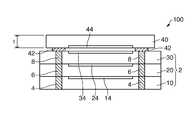
- FIG. 1is a sectional view schematically showing an electronic apparatus according to a first embodiment.
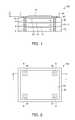
- FIG. 2is a plan view schematically showing the electronic apparatus according to the first embodiment.
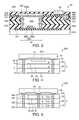
- FIG. 3is a sectional view schematically showing an MEMS chip of the electronic apparatus according to the first embodiment.
- FIG. 4is a sectional view schematically showing an electronic apparatus according to a first modified example of the first embodiment.
- FIG. 5is a sectional view schematically showing an electronic apparatus according to a second modified example of the first embodiment.
- FIG. 6is a plan view schematically showing the electronic apparatus according to the second modified example of the first embodiment.
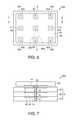
- FIG. 7is a sectional view schematically showing an electronic apparatus according to a third modified example of the first embodiment.
- FIG. 8is a plan view schematically showing the electronic apparatus according to the third modified example of the first embodiment.
- FIG. 9is a sectional view schematically showing an electronic apparatus according to a fourth modified example of the first embodiment.
- FIG. 10is a sectional view schematically showing an electronic apparatus according to a fifth modified example of the first embodiment.
- FIG. 11is a sectional view schematically showing an electronic apparatus according to a second embodiment.
- FIG. 12is a sectional view schematically showing an electronic apparatus according to a modified example of the second embodiment.
- FIG. 13is a circuit diagram showing an oscillator according to a third embodiment.
- FIG. 14is a circuit diagram showing an oscillator according to a modified example of the third embodiment.
- FIG. 1is a sectional view schematically showing an electronic apparatus 100 according to the embodiment.
- FIG. 2is a plan view schematically showing the electronic apparatus 100 according to the embodiment. Note that FIG. 1 is the sectional view taken along I-I line in FIG. 2 . Further, in FIGS. 1 and 2 , for convenience, semiconductor chips 10 , 20 , 30 and an MEMS chip 40 are simplified.
- the electronic apparatus 100includes a multilayered structure 2 in which the semiconductor chips 10 , 20 , 30 are stacked, penetrating electrodes 4 , 6 , 8 , and the MEMS chip 40 .
- the multilayered structure 2is formed by stacking of the semiconductor chips 10 , 20 , 30 .
- the multilayered structure 2is formed by the first semiconductor chip 10 , the second semiconductor chip 20 on the first semiconductor chip 10 , and the third semiconductor chip 30 on the second semiconductor chip 20 .
- the number of semiconductor chips forming the multilayered structure 2is not particularly limited, but maybe two or more.
- Insulating layersmay be formed between the adjacent semiconductor chips 10 , 20 , 30 . That is, the second semiconductor chip 20 may be stacked on the first semiconductor chip 10 via the insulating layer, and the third semiconductor chip 30 may be stacked on the second semiconductor chip 20 via the insulating layer.
- the semiconductor chips 10 , 20 , 30each includes a substrate, the semiconductor device formed on the substrate, and wires connected to the semiconductor device, for example.
- the first semiconductor chip 10has a device formation region 14 in which the semiconductor device is formed.
- the second semiconductor chip 20has a device formation region 24 in which the semiconductor device is formed.
- the third semiconductor chip 30has a device formation region 34 in which the semiconductor device is formed.
- the semiconductor chips 10 , 20 , 30may be logic chips having logic circuits formed in the device formation regions 14 , 24 , 34 , for example.
- the semiconductor chips 10 , 20 , 30may be memory chips having nonvolatile memories formed in the device formation regions 14 , 24 , 34 , for example.
- the device formation regions 14 , 24 , 34are formed on the upper surfaces (the surfaces at the MEMS chip 40 side) of the respective semiconductor chips 10 , 20 , 30 .
- the device formation regions 14 , 24 , 34may be formed on the lower surfaces (the opposite surfaces to the MEMS chip 40 ) of the respective semiconductor chips 10 , 20 , 30 .
- the first semiconductor chip 10 , the second semiconductor chip 20 , and the third semiconductor chip 30have the same shape and the same size as seen from the stacking direction of the semiconductor chips 10 , 20 , 30 , for example.
- the planar shape (the shape as seen from the stacking direction of the semiconductor chips 10 , 20 , 30 ) of the semiconductor chips 10 , 20 , 30is rectangular, for example.
- the penetrating electrode 4penetrates the first semiconductor chip 10 .
- the penetrating electrode 4extends from the upper surface to the lower surface of the first semiconductor chip 10 in the stacking direction of the semiconductor chips 10 , 20 , 30 .
- the penetrating electrode 4is electrically connected to the semiconductor device formed in the device formation region 14 . Further, the penetrating electrode 4 is connected to the penetrating electrode 6 .
- four penetrating electrodes 4are formed on the first semiconductor chip 10 , but the number is not particularly limited.
- the penetrating electrode 6penetrates the second semiconductor chip 20 .
- the penetrating electrode 6extends from the upper surface to the lower surface of the second semiconductor chip 20 in the stacking direction of the semiconductor chips 10 , 20 , 30 .
- the penetrating electrode 6is electrically connected to the semiconductor device formed in the device formation region 24 . Further, the penetrating electrode 6 is connected to the penetrating electrode 4 and the penetrating electrode 8 .
- Four penetrating electrodes 6are formed on the second semiconductor chip 20 , but the number is not particularly limited.
- the penetrating electrode 8penetrates the third semiconductor chip 30 .
- the penetrating electrode 8extends from the upper surface to the lower surface of the third semiconductor chip 30 in the stacking direction of the semiconductor chips 10 , 20 , 30 .
- the penetrating electrode 8is electrically connected to the semiconductor device formed in the device formation region 34 . Further, the penetrating electrode 8 is connected to the penetrating electrode 6 and pads 42 .
- Four penetrating electrodes 8are formed on the third semiconductor chip 30 , but the number is not particularly limited.
- the penetrating electrodes 4 , 6 , 8are Si through-silicon vias (TSV).
- TSVthrough-silicon vias
- the penetrating electrode 4 , the penetrating electrode 6 , and the penetrating electrode 8are connected and integrated and penetrate the multilayered structure 2 .
- the penetrating electrodes 4 , 6 , 8electrically connect the semiconductor devices of the semiconductor chips 10 , 20 , 30 . Further, the penetrating electrodes 4 , 6 , 8 electrically connect the respective semiconductor devices of the semiconductor chips 10 , 20 , 30 and an MEMS device formed on the MEMS chip 40 .
- the material of the penetrating electrodes 4 , 6 , 8is W, Cu, AL, Ag, Au, or the like, for example.
- the penetrating electrodes 4 , 6 , 8may have barrier layers of TiN, Ti, or the like.
- the penetrating electrode 4is formed by forming a through hole from the opposite surface (rear surface) side to the surface (front surface) on which the device formation region 14 of the first semiconductor chip 10 is formed, and burying the through hole with the above described metal material.
- the penetrating electrodes 6 , 8are formed in the same manner.
- the multilayered structure 2is formed by stacking the second semiconductor chip 20 on the first semiconductor chip 10 so that the penetrating electrodes 4 , 6 may be connected and the third semiconductor chip 30 on the second semiconductor chip 20 so that the penetrating electrodes 6 , 8 may be connected.
- the penetrating electrodes 4 , 6 , 8are connected using micro bump or the like, for example.
- the MEMS chip 40is mounted on the multilayered structure 2 .
- the MEMS chip 40is mounted on the third semiconductor chip 30 .
- the first semiconductor chip 10 , the second semiconductor chip 20 , the third semiconductor chip 30 , and the MEMS chip 40are stacked in this order.
- the MEMS chip 40has a device formation region 44 in which the MEMS device is formed.
- the device formation region 44is formed at the multilayered structure 2 side (on the lower surface in the illustrated example).
- the pads 42 connecting to the penetrating electrodes 8are provided on the MEMS chip 40 .
- the pads 42are in contact with the penetrating electrodes 8 in the illustrated example.
- the pads 42are terminals for attaching the MEMS chip 40 to the third semiconductor chip 30 (multilayered structure 2 ).
- the pads 42are bonded to the penetrating electrodes 8 .
- the pads 42may be bonded to the penetrating electrodes 8 via bonding members including solder, for example.
- the pads 42are electrically connected to the MEMS device. Accordingly, the MEMS device of the MEMS chip 40 and the semiconductor devices of the semiconductor chips 10 , 20 , 30 are electrically connected via the pads 42 and the penetrating electrodes 4 , 6 , 8 .
- the MEMS device of the MEMS chip 40 and the semiconductor devices of the semiconductor chips 10 , 20 , 30are electrically connected via the pads 42 and the penetrating electrodes 4 , 6 , 8 , and thus, no penetrating electrode (TSV) is formed on the MEMS chip 40 .
- TSVpenetrating electrode
- four pads 42are provided on the MEMS chip 40 , however, the number is not limited. The pads 42 are provided to overlap with the penetrating electrodes 8 as seen from the stacking direction of the semiconductor chips 10 , 20 , 30 .
- the device formation region 34 of the third semiconductor chip 30 facing the MEMS chip 40is provided on the surface at the MEMS chip 40 side (the upper surface in the illustrated example). Further, the MEMS chip 40 is provided above the device formation region 34 of the third semiconductor chip 30 . Accordingly, the MEMS chip 40 may block radiation including ⁇ -ray traveling toward the device formation region 34 of the third semiconductor chip 30 . Therefore, the amount of radiation applied to the device formation region 34 of the third semiconductor chip 30 may be reduced. Thereby, occurrence of soft errors of the semiconductor device formed in the device formation region 34 may be reduced.
- the thickness t of the MEMS chip 40is larger than the penetration depth of the ⁇ -ray. Specifically, the thickness t of the MEMS chip 40 is 30 ⁇ m or more, for example. Thereby, the occurrence of soft errors of the semiconductor device may be reduced more effectively.
- the radiation source of ⁇ -ray or the likeis a resin (mold resin) used for packaging or the like.
- FIG. 3is a sectional view schematically showing a part of the MEMS chip 40 .
- FIG. 3shows the view upside down compared to FIG. 1 .
- an MEMS device 420 of the MEMS chip 40is an MEMS vibrator will be explained.
- the MEMS chip 40includes a substrate 410 , the MEMS device 420 , interlayer insulating layers 430 , 432 , 434 , surrounding walls 450 , 452 , 454 , covering layers 456 , 458 , the pads 42 , interconnections 460 , 462 , 464 , a passivation layer 470 , and a protective film 480 .
- the substrate 410for example, a semiconductor substrate including a silicon substrate is used.
- various substratesincluding a ceramics substrate, a glass substrate, a sapphire substrate, a diamond substrate, and a synthetic resin substrate may be used.
- No penetrating electrodeis provided in the MEMS chip 40 , and thus, not limited to the silicon substrate, but the above described various substrates may be used as the substrate 410 . That is, the MEMS chip 40 has a high degree of freedom of choice of the substrate 410 .
- the foundation layer 411is a LOCOS (local oxidation of silicon) insulating layer, a semi-recess LOCOS insulating layer, or a trench insulating layer, for example.
- LOCOSlocal oxidation of silicon
- the MEMS device 420is formed on the foundation layer 411 (over the substrate 410 ) and housed in a cavity part 440 .
- the MEMS device 420is an MEMS vibrator in a cantilever shape, for example.
- the MEMS device 420has a first electrode 422 formed on the foundation layer 411 and a second electrode 424 formed apart from the first electrode 422 .
- the second electrode 424may have a beam part provided to face the first electrode 422 .
- the beam partmay vibrate in the thickness directions of the substrate 410 because of the electrostatic force generated between the electrodes 422 , 424 .
- the integrated circuits (semiconductor devices) formed in the device formation regions 14 , 24 , 34 of the semiconductor chips 10 , 20 , 30 and the MEMS device 420 formed on the MEMS chip 40form an oscillator circuit.
- the integrated circuits and the MEMS device 420are electrically connected via the penetrating electrodes 4 , 6 , 8 and the pads 42 .
- the MEMS device 420is not limited to the vibrator, but may be various MEMS devices including an acceleration sensor, a gyro sensor, and a micro actuator, for example.
- the surrounding walls 450 , 452 , 454 and the covering layers 456 , 458define (designate) the cavity part 440 in which the MEMS device 420 is housed.
- the interior of the cavity part 440is under a decompression condition, for example.
- the three interlayer insulating layers 430 , 432 , 434are provided in the order of the interlayer insulating layer 430 , the interlayer insulating layer 432 , and the interlayer insulating layer 434 from the substrate 410 side, however, the number is not particularly limited.
- the first covering layer 456is formed to cover the cavity part 440 from above.
- a through hole 456 ais provided in the first covering layer 456 .
- an etching solution or an etching gasmay be supplied through the through hole 456 a.
- the second covering layer 458is formed on the first covering layer 456 .
- the second covering layer 458covers the through hole 456 a formed in the first covering layer 456 . Thereby, a gas or the like may be prevented from entering the cavity part 440 from outside through the through hole 456 a.
- the interconnection 460is formed on the interlayer insulating layer 432 .
- the interconnection 460is electrically connected to the MEMS device 420 , for example.
- the interconnection 460is electrically connected to the pad 42 via the interconnection 462 penetrating the interlayer insulating layer 434 and the interconnection 464 on the passivation layer 470 . That is, the pad 42 and the MEMS device 420 are electrically connected.
- the pad 42is formed on the interconnection 464 .
- the pad 42is connected to the penetrating electrode 8 penetrating the third semiconductor chip 30 . That is, the MEMS chip 40 is mounted face-down on the third semiconductor chip 30 (multilayered structure 2 ).
- the protective film 480is provided on the passivation layer 470 , on the second covering layer 458 , and on the interconnection 464 .
- the protective film 480protects the MEMS device 420 , the interconnection 464 , etc.
- the pad 42is exposed from the protective film 480 .
- the electronic apparatus 100has the following advantages, for example.
- the electronic apparatus 100includes the multilayered structure 2 in which the plurality of semiconductor chips 10 , 20 , 30 provided with the semiconductor devices are stacked, the penetrating electrodes 4 , 6 , 8 penetrating the semiconductor chips 10 , 20 , 30 and electrically connecting the semiconductor chips 10 , 20 , 30 , and the MEMS chip 40 mounted on the multilayered structure 2 and provided with the MEMS device 420 , and the pads 42 connecting to the penetrating electrodes 8 are provided on the MEMS chip 40 .
- the semiconductor chips 10 , 20 , 30are connected by the penetrating electrodes 4 , 6 , 8 , and thereby, downsizing may be realized compared to the case where the semiconductor chips 10 , 20 , 30 are connected via wire bonding, for example.
- the pads 42 connected to the penetrating electrodes 8are provided on the MEMS chip 40 . That is, the MEMS chip 40 is connected to the third semiconductor chip 30 by the pads 42 . Accordingly, in the MEMS chip 40 , no penetrating electrode (TSV) is formed.
- the MEMS chip 40itself may be downsized and downsizing of the apparatus may be realized. Further, no penetrating electrode is formed in the MEMS chip 40 , and thereby, various other substrates than the silicon substrate may be used as the substrate 410 , and the degree of freedom of choice of the substrate 410 is higher.
- the electronic apparatus 100no integrated circuit is formed on the MEMS chip 40 , but the integrated circuits are formed on the semiconductor chips 10 , 20 , 30 , and thus, the older process technology generation than the process technology generation of the semiconductor chips 10 , 20 , 30 may be used on the MEMS chip 40 . Thereby, the lower cost may be realized.
- the semiconductor device of the third semiconductor chip 30 facing the MEMS chip 40is provided on the surface at the MEMS chip 40 side, and thus, the amount of radiation including CC-ray applied to the semiconductor device (device formation region 34 ) may be reduced by the MEMS chip 40 . Thereby, occurrence of soft errors of the semiconductor device due to radiation may be suppressed.
- FIG. 4is a sectional view schematically showing an electronic apparatus 200 according to the first modified example. Note that, in FIG. 4 , for convenience, the semiconductor chips 10 , 20 , 30 and the MEMS chip 40 are simplified.
- a recess part 210is formed on the surface of the multilayered structure 2 facing the MEMS chip 40 .
- the recess part 210is formed on the surface of the third semiconductor chip 30 facing the MEMS chip 40 (the upper surface in the illustrated example).
- the recess part 210is formed by etching of the rear surface side (the opposite surface to the surface with the device formation region 34 thereon) of the third semiconductor chip 30 , for example.
- the device formation regions 14 , 24 , 34are formed on the lower surfaces (the opposite surfaces to the MEMS chip 40 side) of the respective semiconductor chips 10 , 20 , 30 .
- the recess part 210is formed on the surface of the multilayered structure 2 facing the MEMS chip 40 , and thus, stress applied to the MEMS chip 40 may be relaxed.
- FIG. 5is a sectional view schematically showing an electronic apparatus 300 according to the second modified example.
- FIG. 6is a plan view schematically showing the electronic apparatus 300 according to the second modified example. Note that FIG. 5 is the sectional view taken along V-V line in FIG. 6 . Further, in FIGS. 5 and 6 , for convenience, the semiconductor chips 10 , 20 , 30 and the MEMS chip 40 are simplified.
- the electronic apparatus 300may further include thermal conduction parts 310 , 320 , 330 penetrating the semiconductor chips 10 , 20 , 30 and having higher thermal conductivity than that of the semiconductor chips 10 , 20 , 30 in addition to the component members of the electronic apparatus 100 .
- the thermal conduction part 310penetrates the first semiconductor chip 10 .
- the thermal conduction part 310connects to the thermal conduction part 320 .
- the thermal conduction part 310is electrically separated from the semiconductor device of the first semiconductor chip 10 . That is, the thermal conduction part 310 is not electrically connected to the semiconductor device or does not function as a penetrating electrode.
- the thermal conduction part 320penetrates the second semiconductor chip 20 .
- the thermal conduction part 320connects to the thermal conduction part 310 and the thermal conduction part 330 .
- the thermal conduction part 320is electrically separated from the semiconductor device of the second semiconductor chip 20 . That is, the thermal conduction part 320 is not electrically connected to the semiconductor device or does not function as a penetrating electrode.
- the thermal conduction part 330penetrates the third semiconductor chip 30 .
- the thermal conduction part 330connects to the thermal conduction part 320 and a pad 42 a . Note that, though not illustrated, the thermal conduction part 330 may not necessarily be connected to the pad 42 a .
- the pad 42 ais provided on the MEMS chip 40 , but not electrically connected to the MEMS device 420 .
- the thermal conduction part 330is electrically separated from the semiconductor device of the third semiconductor chip 30 . That is, the thermal conduction part 330 is not electrically connected to the semiconductor device or does not function as a penetrating electrode.
- the thermal conduction parts 310 , 320 , 330are formed in regions of the semiconductor chips 10 , 20 , 30 prone to heat generation or nearby.
- the thermal conduction parts 310 , 320 , 330are provided in the center parts of the semiconductor chips 10 , 20 , 30 and the four corners of the semiconductor chips 10 , 20 , 30 , for example.
- Five of the thermal conduction parts 310 , 320 , 330are respectively provided in the respective semiconductor chips 10 , 20 , 30 in the illustrated example, however, the number is not particularly limited.
- the thermal conduction part 310 , the thermal conduction part 320 , and the thermal conduction part 330are connected and integrated and penetrate the multilayered structure 2 .
- the material of the thermal conduction parts 310 , 320 , 330is the same as the material of the penetrating electrodes 4 , 6 , 8 , for example.
- the method of manufacturing the thermal conduction parts 310 , 320 , 330is the same as the method of manufacturing the penetrating electrodes 4 , 6 , 8 , for example.
- the electronic apparatus 300includes the thermal conduction parts 310 penetrating the semiconductor chips 10 , 20 , 30 and having the higher thermal conductivity than that of the semiconductor chips 10 , 20 , 30 , and thus, heat dissipation may be improved. Thereby, the rise of the temperature of the apparatus may be suppressed. Further, in the case where the thermal conduction parts 330 are connected to the MEMS chip 40 , the difference in temperature between the MEMS chip 40 and the semiconductor chips 10 , 20 , 30 may be made smaller, and therefore, temperature control of the MEMS chip 40 may be easily performed by providing temperature sensor functions or the like to the semiconductor chips 10 , 20 , 30 , for example.
- FIG. 7is a sectional view schematically showing an electronic apparatus 400 according to the third modified example.
- FIG. 8is a plan view schematically showing the electronic apparatus 400 according to the third modified example. Note that FIG. 7 is the sectional view taken along VII-VII line in FIG. 8 . Further, in FIGS. 7 and 8 , for convenience, the semiconductor chips 10 , 20 , 30 and the MEMS chip 40 are simplified.
- the penetrating electrodes 4 , 6 , 8are provided in the center parts of the semiconductor chips 10 , 20 , 30 as seen from the stacking direction of the semiconductor chips 10 , 20 , 30 .
- the semiconductor chips 10 , 20 , 30have rectangular shapes as seen from the stacking direction of the semiconductor chips 10 , 20 , 30 .
- the penetrating electrodes 4 , 6 , 8are provided at the centers (where diagonal lines intersect) of the semiconductor chips 10 , 20 , 30 as seen from the stacking direction of the semiconductor chips 10 , 20 , 30 .
- the penetrating electrodes 4 , 6 , 8are provided in the center parts of the semiconductor chips 10 , 20 , 30 as seen from the stacking direction of the semiconductor chips 10 , 20 , 30 , and thus, delay times of the signals used in the semiconductor chips 10 , 20 , 30 may be made shorter.
- the penetrating electrodes 4 , 6 , 8are provided in the corner parts of the semiconductor chips 10 , 20 , 30 as seen from the stacking direction of the semiconductor chips 10 , 20 , 30 , the distances to the opposite corner parts are longer and the delay times become longer.
- the clock signals from the MEMS chip 40 with an MEMS oscillatormay be supplied to the respective semiconductor chips 10 , 20 , 30 at times when necessary.
- FIG. 9is a sectional view schematically showing an electronic apparatus 500 according to the fourth modified example. Note that, in FIG. 9 , for convenience, the semiconductor chips 10 , 20 , 30 and the MEMS chip 40 are simplified.
- a power supply capacitor 510 for supplying a power supply voltage to the semiconductor devices of the semiconductor chips 10 , 20 , 30is provided on the MEMS chip 40 .
- the power supply capacitor 510includes a first electrode 510 a , and a second electrode 510 b provided to face the first electrode 510 a .
- the power supply capacitor 510may supply the power supply voltage to the semiconductor chips 10 , 20 , 30 via the penetrating electrodes 4 , 6 , 8 .
- a power supply of VDD and GNDis supplied to the semiconductor chips 10 , 20 , 30 by the adjacent penetrating electrodes 4 , 6 , 8 , and thereby, fluctuations of the power supply voltage may be reduced by the coupling capacity between VDD and GND.
- the power supply capacitor 510is provided to avoid the device formation region in which the MEMS device is provided.
- the power supply capacitor 510is provided on the MEMS chip 40 , and thus, stabilization of power supply may be realized.
- FIG. 10is a sectional view schematically showing an electronic apparatus 600 according to the fifth modified example.
- the semiconductor chips 10 , 20 , 30 and the MEMS chip 40are simplified.
- a heat dissipation part 610is provided on the surface of the MEMS chip 40 opposite to the multilayered structure 2 .
- the heat dissipation part 610is provided on the surface opposite to the surface having the device formation region 44 in which the MEMS device is formed.
- the heat dissipation part 610may suppress rise of the temperature of the electronic apparatus 600 .
- the heat dissipation part 610dissipates heat by air cooling or liquid cooling, for example.
- the heat dissipation part 610is a heat sink, a heat pipe, or the like, for example.
- the heat dissipation part 610is provided, and thus, the rise of the temperature of the electronic apparatus 600 maybe suppressed.
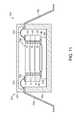
- FIG. 11is a sectional view schematically showing an electronic apparatus 700 according to the second embodiment.
- the electronic apparatus 700further includes a package 701 in addition to the component members of the electronic apparatus 100 .
- the package 701may house the semiconductor chips 10 , 20 , 30 and the MEMS chip 40 .
- the package 701may have a package base 701 , a lid 720 , and a lead frame 730 .
- a recess part 712is formed, and the multilayered structure 2 and the MEMS chip 40 are provided within the recess part 712 .
- the planar shape of the package base 710is not particularly limited as long as the multilayered structure 2 and the MEMS chip 40 may be provided within the recess part 712 .
- a material including an aluminum oxide sintered body formed by shaping, stacking, and sintering ceramic green sheets, quartz, glass, and siliconis used.
- the lid 720is provided to cover the recess part 712 of the package base 710 .
- the same material as that of the package base 710may be used.
- the lid 720is bonded to the package base 710 via a bonding member including a seam ring, low-melting-point glass, an adhesive agent (not shown), for example.
- the air-tightly sealed interior of the recess part 712 of the package base 710may be under a decompressed vacuum condition (high vacuum condition), or a condition filled with an inert gas of nitride, helium, argon, or the like.
- the lead frame 730may connect the semiconductor chips 10 , 20 , 30 and the MEMS chip 40 housed in the package 701 and external wiring (not shown).
- the lead frame 730is connected to rear surface electrodes 732 of the first semiconductor chip 10 via wires 734 made of aluminum or gold.
- the rear surface electrodes 732are electrically connected to the penetrating electrodes 4 , for example.
- the lead frame 730may support and secure the package 701 .
- FIG. 12is a sectional view schematically showing an electronic apparatus 800 according to a modified example of the second embodiment. Note that, in FIG. 12 , for convenience, the semiconductor chips 10 , 20 , 30 and the MEMS chip 40 are simplified.
- the electronic apparatus 800is a CSP including a WCSP (Wafer level Chip size package), for example.
- the semiconductor chips 10 , 20 , 30 and the MEMS chip 40are covered by a resin 810 .
- the semiconductor chips 10 , 20 , 30 and the MEMS chip 40 and external wiringmay be electrically connected via solder balls 820 .
- the solder balls 820are connected to rear surface electrodes 830 of the first semiconductor chip 10 .
- the rear surface electrodes 830are electrically connected to the penetrating electrodes 4 .
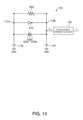
- FIG. 13is a circuit diagram showing the electronic apparatus (oscillator) 100 according to the third embodiment.
- the electronic apparatus 100includes the MEMS device (MEMS vibrator) 420 and an inverting amplifier circuit 110 , for example.
- the inverting amplifier circuits 110are provided on the semiconductor chips 10 , 20 , 30 shown in FIG. 1 , for example.
- the MEMS device 420has a first terminal 420 a electrically connected to the first electrode 422 (see FIG. 3 ), and a second terminal 420 b electrically connected to the second electrode 424 (see FIG. 3 ).
- the first terminal 420 a of the MEMS device 420is at least alternately connected to an output terminal 110 b of the inverting amplifier circuit 110 .
- the second terminal 420 b of the MEMS device 420is at least alternately connected to an input terminal 110 a of the inverting amplifier circuit 110 .
- the inverting amplifier circuit 110includes one inverter, however, may be formed by combining a plurality of inverters (inverting circuits) and amplifier circuits for satisfaction of a desired oscillation condition.
- the electronic apparatus 100may include a feedback resistor with respect to the inverting amplifier circuit 110 .
- the input terminal and the output terminal of the inverting amplifier circuit 110are connected via a resister 120 .
- the electronic apparatus 100includes a first capacitor 130 connected between the input terminal 110 a of the inverting amplifier circuit 110 and a reference potential (ground potential), and a second capacitor 132 connected between the output terminal 110 b of the inverting amplifier circuit 110 and a reference potential (ground potential).
- a first capacitor 130connected between the input terminal 110 a of the inverting amplifier circuit 110 and a reference potential (ground potential)
- a second capacitor 132connected between the output terminal 110 b of the inverting amplifier circuit 110 and a reference potential (ground potential).
- the electronic apparatus 100may further have a frequency divider circuit 140 .
- the frequency divider circuit 140divides the frequency of the output signal Vout of the oscillator circuit and outputs the oscillation signal f. Thereby, the electronic apparatus 100 may obtain an output signal at the lower frequency than the frequency of the output signal Vout, for example.
- the electronic apparatus 100is an oscillator including the MEMS device (MEMS vibrator) 420
- the electronic apparatus 100may be an acceleration sensor, a gyro sensor, a relay using an MEMS contact, or the like as long as it may be an apparatus including an MEMS device.
- the inventionincludes substantially the same configurations (the same configurations in function, method, and result or the same configurations in purpose and advantage) as the configurations explained in the embodiments. Further, the invention includes configurations in which non-essential parts of the configurations explained in th embodiments are replaced. Furthermore, the invention includes configurations that may exert the same effects or achieve the same purposes as those of the configurations explained in the embodiments. In addition, the invention includes configurations formed by adding known technologies to the configurations explained in the embodiments.
Landscapes
- Engineering & Computer Science (AREA)
- Microelectronics & Electronic Packaging (AREA)
- Power Engineering (AREA)
- Physics & Mathematics (AREA)
- Condensed Matter Physics & Semiconductors (AREA)
- General Physics & Mathematics (AREA)
- Computer Hardware Design (AREA)
- Manufacturing & Machinery (AREA)
- Micromachines (AREA)
Abstract
Description
Claims (8)
Applications Claiming Priority (2)
| Application Number | Priority Date | Filing Date | Title |
|---|---|---|---|
| JP2012-202374 | 2012-09-14 | ||
| JP2012202374AJP2014054718A (en) | 2012-09-14 | 2012-09-14 | Electronic device |
Publications (2)
| Publication Number | Publication Date |
|---|---|
| US20140077390A1 US20140077390A1 (en) | 2014-03-20 |
| US9437584B2true US9437584B2 (en) | 2016-09-06 |
Family
ID=50273639
Family Applications (1)
| Application Number | Title | Priority Date | Filing Date |
|---|---|---|---|
| US14/018,731Expired - Fee RelatedUS9437584B2 (en) | 2012-09-14 | 2013-09-05 | Electronic apparatus |
Country Status (3)
| Country | Link |
|---|---|
| US (1) | US9437584B2 (en) |
| JP (1) | JP2014054718A (en) |
| CN (1) | CN103663348A (en) |
Families Citing this family (4)
| Publication number | Priority date | Publication date | Assignee | Title |
|---|---|---|---|---|
| DE102014221546A1 (en)* | 2014-10-23 | 2016-04-28 | Robert Bosch Gmbh | Microelectronic component arrangement with a plurality of substrates and corresponding production method |
| KR101720300B1 (en)* | 2015-07-21 | 2017-03-28 | 주식회사 오킨스전자 | Film of test socket fabricated by MEMS technology having improved contact bump |
| KR102534734B1 (en)* | 2018-09-03 | 2023-05-19 | 삼성전자 주식회사 | Semiconductor package |
| JP7497604B2 (en)* | 2020-04-10 | 2024-06-11 | セイコーエプソン株式会社 | Vibration devices, electronic devices and mobile devices |
Citations (17)
| Publication number | Priority date | Publication date | Assignee | Title |
|---|---|---|---|---|
| JP2005153067A (en) | 2003-11-25 | 2005-06-16 | Kyocera Corp | Electronic component sealing substrate and electronic device manufacturing method using the same |
| JP2005335022A (en) | 2004-05-28 | 2005-12-08 | Sony Corp | Micro device and electronic equipment |
| JP2006245311A (en) | 2005-03-03 | 2006-09-14 | Oki Electric Ind Co Ltd | Semiconductor device and manufacturing method thereof |
| US20060286822A1 (en)* | 2005-06-17 | 2006-12-21 | Jochen Thomas | Multi-chip device and method for producing a multi-chip device |
| WO2007147137A2 (en) | 2006-06-15 | 2007-12-21 | Sitime Corporation | Stacked die package for mems resonator system |
| US20080048335A1 (en)* | 2006-08-23 | 2008-02-28 | Jae-Won Han | Semiconductor device |
| JP2008053734A (en) | 2006-08-25 | 2008-03-06 | Interuniv Micro Electronica Centrum Vzw | High aspect ratio via etching |
| US20080083975A1 (en) | 2006-10-09 | 2008-04-10 | Taiwan Semiconductor Manufacturing Co., Ltd. | Stacked structures and methods of fabricating stacked structures |
| JP2008229833A (en) | 2007-02-22 | 2008-10-02 | Denso Corp | Semiconductor device and manufacturing method thereof |
| JP2008288384A (en) | 2007-05-17 | 2008-11-27 | Sony Corp | Three-dimensional stacked device and its manufacturing method, and method of junction of three-dimensional stacked device |
| US20080290496A1 (en) | 2007-05-25 | 2008-11-27 | Nepes Corporation | Wafer level system in package and fabrication method thereof |
| JP2009124013A (en) | 2007-11-16 | 2009-06-04 | Hitachi Ltd | Semiconductor device and manufacturing method thereof |
| US20090194829A1 (en) | 2008-01-31 | 2009-08-06 | Shine Chung | MEMS Packaging Including Integrated Circuit Dies |
| WO2010047228A1 (en) | 2008-10-21 | 2010-04-29 | 日本電気株式会社 | Wiring board and method for manufacturing same |
| JP2010112763A (en) | 2008-11-04 | 2010-05-20 | Toshiba Corp | Semiconductor device and method for manufacturing it |
| US7807583B2 (en) | 2006-08-25 | 2010-10-05 | Imec | High aspect ratio via etch |
| US7919841B2 (en) | 2007-01-25 | 2011-04-05 | Samsung Electronics Co., Ltd. | Mounting structures for integrated circuit modules |
- 2012
- 2012-09-14JPJP2012202374Apatent/JP2014054718A/ennot_activeWithdrawn
- 2013
- 2013-09-04CNCN201310397636.XApatent/CN103663348A/enactivePending
- 2013-09-05USUS14/018,731patent/US9437584B2/ennot_activeExpired - Fee Related
Patent Citations (19)
| Publication number | Priority date | Publication date | Assignee | Title |
|---|---|---|---|---|
| JP2005153067A (en) | 2003-11-25 | 2005-06-16 | Kyocera Corp | Electronic component sealing substrate and electronic device manufacturing method using the same |
| JP2005335022A (en) | 2004-05-28 | 2005-12-08 | Sony Corp | Micro device and electronic equipment |
| JP2006245311A (en) | 2005-03-03 | 2006-09-14 | Oki Electric Ind Co Ltd | Semiconductor device and manufacturing method thereof |
| US20060286822A1 (en)* | 2005-06-17 | 2006-12-21 | Jochen Thomas | Multi-chip device and method for producing a multi-chip device |
| WO2007147137A2 (en) | 2006-06-15 | 2007-12-21 | Sitime Corporation | Stacked die package for mems resonator system |
| US20080048335A1 (en)* | 2006-08-23 | 2008-02-28 | Jae-Won Han | Semiconductor device |
| JP2008053708A (en) | 2006-08-23 | 2008-03-06 | Dongbu Hitek Co Ltd | Semiconductor element, and manufacturing method thereof |
| US7807583B2 (en) | 2006-08-25 | 2010-10-05 | Imec | High aspect ratio via etch |
| JP2008053734A (en) | 2006-08-25 | 2008-03-06 | Interuniv Micro Electronica Centrum Vzw | High aspect ratio via etching |
| US20080083975A1 (en) | 2006-10-09 | 2008-04-10 | Taiwan Semiconductor Manufacturing Co., Ltd. | Stacked structures and methods of fabricating stacked structures |
| US7919841B2 (en) | 2007-01-25 | 2011-04-05 | Samsung Electronics Co., Ltd. | Mounting structures for integrated circuit modules |
| JP2008229833A (en) | 2007-02-22 | 2008-10-02 | Denso Corp | Semiconductor device and manufacturing method thereof |
| US20100270630A1 (en) | 2007-02-22 | 2010-10-28 | Denso Corporation | Semiconductor device and method for manufacturing the same |
| JP2008288384A (en) | 2007-05-17 | 2008-11-27 | Sony Corp | Three-dimensional stacked device and its manufacturing method, and method of junction of three-dimensional stacked device |
| US20080290496A1 (en) | 2007-05-25 | 2008-11-27 | Nepes Corporation | Wafer level system in package and fabrication method thereof |
| JP2009124013A (en) | 2007-11-16 | 2009-06-04 | Hitachi Ltd | Semiconductor device and manufacturing method thereof |
| US20090194829A1 (en) | 2008-01-31 | 2009-08-06 | Shine Chung | MEMS Packaging Including Integrated Circuit Dies |
| WO2010047228A1 (en) | 2008-10-21 | 2010-04-29 | 日本電気株式会社 | Wiring board and method for manufacturing same |
| JP2010112763A (en) | 2008-11-04 | 2010-05-20 | Toshiba Corp | Semiconductor device and method for manufacturing it |
Also Published As
| Publication number | Publication date |
|---|---|
| JP2014054718A (en) | 2014-03-27 |
| US20140077390A1 (en) | 2014-03-20 |
| CN103663348A (en) | 2014-03-26 |
Similar Documents
| Publication | Publication Date | Title |
|---|---|---|
| KR102073443B1 (en) | Chip arrangements, chip packages, and a method for manufacturing a chip arrangement | |
| US10093533B2 (en) | CMOS-MEMS-CMOS platform | |
| JP5763682B2 (en) | Miniaturized electrical device including MEMS and ASIC and method for manufacturing the same | |
| US8802475B2 (en) | Method of fabricating a 3D integrated electronic device structure including increased thermal dissipation capabilities | |
| US10651150B2 (en) | Multichip module including surface mounting part embedded therein | |
| US11691870B2 (en) | Semiconductor device including a microelectromechanical structure and an associated integrated electronic circuit | |
| US9437584B2 (en) | Electronic apparatus | |
| KR101494417B1 (en) | Semiconductor package and method of manufacturing the same | |
| JP5984912B2 (en) | Manufacturing method of stacked semiconductor | |
| JP2018026649A (en) | Oscillation device and manufacturing method thereof | |
| JP2007227596A (en) | Semiconductor module and its manufacturing method | |
| US20230234835A1 (en) | Stress isolation for integrated circuit package integration | |
| JP4466497B2 (en) | Sensor module | |
| JP2008147368A (en) | Semiconductor device | |
| JP2019050478A (en) | MEMS oscillator | |
| WO2007061050A1 (en) | Sensor device and method for manufacturing same | |
| JP6919502B2 (en) | MEMS oscillator | |
| JP2010062448A (en) | Sensor module, and method for manufacturing the same | |
| JP2006185968A (en) | Electronic equipment | |
| TW202002207A (en) | Semiconductor device and manufacturing method thereof | |
| JP2007251391A (en) | Semiconductor device and its manufacturing process |
Legal Events
| Date | Code | Title | Description |
|---|---|---|---|
| AS | Assignment | Owner name:SEIKO EPSON CORPORATION, JAPAN Free format text:ASSIGNMENT OF ASSIGNORS INTEREST;ASSIGNORS:WATANABE, KENYA;OKUYAMA, NORIO;SIGNING DATES FROM 20130710 TO 20130719;REEL/FRAME:031143/0082 | |
| ZAAA | Notice of allowance and fees due | Free format text:ORIGINAL CODE: NOA | |
| ZAAB | Notice of allowance mailed | Free format text:ORIGINAL CODE: MN/=. | |
| ZAAA | Notice of allowance and fees due | Free format text:ORIGINAL CODE: NOA | |
| STCF | Information on status: patent grant | Free format text:PATENTED CASE | |
| MAFP | Maintenance fee payment | Free format text:PAYMENT OF MAINTENANCE FEE, 4TH YEAR, LARGE ENTITY (ORIGINAL EVENT CODE: M1551); ENTITY STATUS OF PATENT OWNER: LARGE ENTITY Year of fee payment:4 | |
| AS | Assignment | Owner name:COLUMBIA PEAK VENTURES, LLC, TEXAS Free format text:ASSIGNMENT OF ASSIGNORS INTEREST;ASSIGNOR:SEIKO EPSON CORP.;REEL/FRAME:058952/0475 Effective date:20211201 | |
| FEPP | Fee payment procedure | Free format text:MAINTENANCE FEE REMINDER MAILED (ORIGINAL EVENT CODE: REM.); ENTITY STATUS OF PATENT OWNER: LARGE ENTITY | |
| LAPS | Lapse for failure to pay maintenance fees | Free format text:PATENT EXPIRED FOR FAILURE TO PAY MAINTENANCE FEES (ORIGINAL EVENT CODE: EXP.); ENTITY STATUS OF PATENT OWNER: LARGE ENTITY | |
| STCH | Information on status: patent discontinuation | Free format text:PATENT EXPIRED DUE TO NONPAYMENT OF MAINTENANCE FEES UNDER 37 CFR 1.362 | |
| FP | Lapsed due to failure to pay maintenance fee | Effective date:20240906 |