US9420952B2 - Temperature probe suitable for axillary reading - Google Patents
Temperature probe suitable for axillary readingDownload PDFInfo
- Publication number
- US9420952B2 US9420952B2US12/844,775US84477510AUS9420952B2US 9420952 B2US9420952 B2US 9420952B2US 84477510 AUS84477510 AUS 84477510AUS 9420952 B2US9420952 B2US 9420952B2
- Authority
- US
- United States
- Prior art keywords
- temperature
- axilla
- person
- temperature sensing
- patient
- Prior art date
- Legal status (The legal status is an assumption and is not a legal conclusion. Google has not performed a legal analysis and makes no representation as to the accuracy of the status listed.)
- Active, expires
Links
Images
Classifications
- A—HUMAN NECESSITIES
- A61—MEDICAL OR VETERINARY SCIENCE; HYGIENE
- A61B—DIAGNOSIS; SURGERY; IDENTIFICATION
- A61B5/00—Measuring for diagnostic purposes; Identification of persons
- A61B5/0002—Remote monitoring of patients using telemetry, e.g. transmission of vital signals via a communication network
- A61B5/0004—Remote monitoring of patients using telemetry, e.g. transmission of vital signals via a communication network characterised by the type of physiological signal transmitted
- A61B5/0008—Temperature signals
- A—HUMAN NECESSITIES
- A61—MEDICAL OR VETERINARY SCIENCE; HYGIENE
- A61B—DIAGNOSIS; SURGERY; IDENTIFICATION
- A61B5/00—Measuring for diagnostic purposes; Identification of persons
- A61B5/01—Measuring temperature of body parts ; Diagnostic temperature sensing, e.g. for malignant or inflamed tissue
- A—HUMAN NECESSITIES
- A61—MEDICAL OR VETERINARY SCIENCE; HYGIENE
- A61B—DIAGNOSIS; SURGERY; IDENTIFICATION
- A61B5/00—Measuring for diagnostic purposes; Identification of persons
- A61B5/02—Detecting, measuring or recording for evaluating the cardiovascular system, e.g. pulse, heart rate, blood pressure or blood flow
- A61B5/0205—Simultaneously evaluating both cardiovascular conditions and different types of body conditions, e.g. heart and respiratory condition
- A61B5/02055—Simultaneously evaluating both cardiovascular condition and temperature
- A—HUMAN NECESSITIES
- A61—MEDICAL OR VETERINARY SCIENCE; HYGIENE
- A61B—DIAGNOSIS; SURGERY; IDENTIFICATION
- A61B2562/00—Details of sensors; Constructional details of sensor housings or probes; Accessories for sensors
- A61B2562/02—Details of sensors specially adapted for in-vivo measurements
- A61B2562/0271—Thermal or temperature sensors
- A—HUMAN NECESSITIES
- A61—MEDICAL OR VETERINARY SCIENCE; HYGIENE
- A61B—DIAGNOSIS; SURGERY; IDENTIFICATION
- A61B5/00—Measuring for diagnostic purposes; Identification of persons
- A61B5/68—Arrangements of detecting, measuring or recording means, e.g. sensors, in relation to patient
- A61B5/6801—Arrangements of detecting, measuring or recording means, e.g. sensors, in relation to patient specially adapted to be attached to or worn on the body surface
- A61B5/6813—Specially adapted to be attached to a specific body part
- A—HUMAN NECESSITIES
- A61—MEDICAL OR VETERINARY SCIENCE; HYGIENE
- A61B—DIAGNOSIS; SURGERY; IDENTIFICATION
- A61B5/00—Measuring for diagnostic purposes; Identification of persons
- A61B5/68—Arrangements of detecting, measuring or recording means, e.g. sensors, in relation to patient
- A61B5/6801—Arrangements of detecting, measuring or recording means, e.g. sensors, in relation to patient specially adapted to be attached to or worn on the body surface
- A61B5/683—Means for maintaining contact with the body
- A61B5/6832—Means for maintaining contact with the body using adhesives
- A61B5/6833—Adhesive patches
Definitions
- the present disclosuregenerally relates to systems and methods of physiological monitoring, and, in particular, relates to a temperature probe suitable for axillary reading.
- a temperature probe for axillary temperature reading of a personcan comprise a sensing portion configured for placement within the axilla of a person and having a first end and a second end.
- the sending portioncan comprise a temperature sensing element configured to provide a signal responsive to a change in body temperature of the person.
- the temperature probecan further comprise a wiring portion having one end connected to the first end of the sensing portion and comprising an electrical conductor, the electrical conductor having a first end configured for coupling to a monitoring device, and a second end connected to the temperature sensing element, the electrical connector configured to carry the signal from the temperature sensing element to the monitoring device.
- the temperature probecan further comprise a body connection portion having one end connected to the second end of the sensing portion and configured to be attached to another body portion of the person.
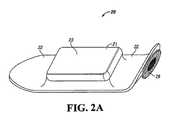
- FIG. 2Ais a perspective view of the vitals sign monitor patch shown in FIG. 1 according to certain aspects of the present disclosure.
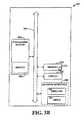
- FIG. 3Bis a functional schematic diagram of an embodiment of the surveillance server according to certain aspects of the present disclosure.
- heart rate monitorWidely sold for use in exercise and physical training, heart rate monitors may comprise a torso band in which are embedded two electrodes held against the skin and a small electronics package. Such heart rate monitors can communicate wirelessly to other equipment such as a small device that is worn like a wristwatch and that can transfer data wirelessly to a personal computer (PC).
- PCpersonal computer
- the monitor patch 20may engage in direct wireless communication with the server 60 .
- the server 60itself or a wireless modem connected to the server 60 may include a wireless communication system to receive data from the monitor patch 20 .
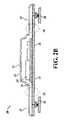
- the term ‘hermetic’implies that the rate of transmission of moisture through the seal is substantially the same as through the material of the layers that are sealed to each other, and further implies that the size of particulates that can pass through the seal are below the size that can have a significant effect on circuit assembly 24 .
- Flexible conductive circuit 26passes through portions of sealing areas 29 and the seal between layers 23 and 27 is maintained by sealing of layers 23 and 27 to flexible circuit assembly 28 .
- the layers 23 and 27are thin and flexible, as is the flexible conductive circuit 26 , allowing the side segment 22 of the monitor patch 20 between the electrodes 28 and the circuit assembly 24 to bend as shown in FIG. 2A .
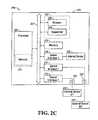
- the processor 202is also capable of communication with the receiver 206 and the transmitter 209 of the wireless transceiver 207 via the bus 204 .
- the processor 202using the transmitter and receiver 209 , 206 can transmit and receive data to and from the bridge 40 .
- the transmitter 209includes one or more of a RF signal generator (e.g., an oscillator), a modulator (a mixer), and a transmitting antenna; and the receiver 206 includes a demodulator (a mixer) and a receiving antenna which may or may not be the same as the transmitting antenna.
- the transmitter 209may include a digital-to-analog converter configured to receive data from the processor 202 and to generate a base signal; and/or the receiver 206 may include an analog-to-digital converter configured to digitize a demodulated base signal and output a stream of digitized data to the processor 202 .
- the processor 202may include a general-purpose processor or a specific-purpose processor for executing instructions and may further include a memory 219 , such as a volatile or non-volatile memory, for storing data and/or instructions for software programs.
- the instructionswhich may be stored in a memory 219 and/or 210 , may be executed by the processor 202 to control and manage the wireless transceiver 207 , the sensor interfaces 212 , 214 , 216 , as well as provide other communication and processing functions.
- the processor 202may be a general-purpose microprocessor, a microcontroller, a Digital Signal Processor (DSP), an Application Specific Integrated Circuit (ASIC), a Field Programmable Gate Array (FPGA), a Programmable Logic Device (PLD), a controller, a state machine, gated logic, discrete hardware components, or any other suitable device or a combination of devices that can perform calculations or other manipulations of information.
- DSPDigital Signal Processor
- ASICApplication Specific Integrated Circuit
- FPGAField Programmable Gate Array
- PLDProgrammable Logic Device
- controllera state machine, gated logic, discrete hardware components, or any other suitable device or a combination of devices that can perform calculations or other manipulations of information.
- Informationsuch as program instructions, data representative of sensor readings, preset alarm conditions, threshold limits, may be stored in a computer or processor readable medium such as a memory internal to the processor 202 (e.g., the memory 219 ) or a memory external to the processor 202 (e.g., the memory 210 ), such as a Random Access Memory (RAM), a flash memory, a Read Only Memory (ROM), a Programmable Read-Only Memory (PROM), an Erasable PROM (EPROM), registers, a hard disk, a removable disk, or any other suitable storage device.
- RAMRandom Access Memory
- ROMRead Only Memory
- PROMErasable PROM
- registersa hard disk, a removable disk, or any other suitable storage device.
- the internal sensor 236can be one or more sensors configured to measure certain properties of the processing and sensor interface module 201 , such as a board temperature sensor thermally coupled to a PCB. In other embodiments, the internal sensor 236 can be one or more sensors configured to measure certain properties of the patient 10 , such as a motion sensor (e.g., an accelerometer) for measuring the patient's motion or position with respect to gravity.
- a motion sensore.g., an accelerometer
- the external sensors 232 , 234can include sensors and sensing arrangements that are configured to produce a signal representative of one or more vital signs of the patient to which the monitor patch 20 is attached.
- the first external sensor 232can be a set of sensing electrodes that are affixed to an exterior surface of the monitor patch 20 and configured to be in contact with the patient for measuring the patient's respiratory rate
- the second external sensor 234can include a temperature sensing element (e.g., a thermocouple or a thermistor or resistive thermal device (RTD)) affixed, either directly or via an interposing layer, to skin of the patient 10 for measuring the patient's body temperature.
- one or more of the external sensors 232 , 234 or one or more additional external sensorscan measure other vital signs of the patient, such as blood pressure, pulse rate, or oxygen saturation.
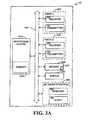
- FIG. 3Ais a functional block diagram illustrating exemplary electronic components of bridge 40 of FIG. 1 according to one aspect of the subject disclosure.
- Bridge 40includes a processor 310 , radio 320 having a receiver 322 and a transmitter 324 , radio 330 having a receiver 332 and a transmitter 334 , memory 340 , display 345 , and network interface 350 having a wireless interface 352 and a wired interface 354 .
- some or all of the aforementioned components of module 300may be integrated into single devices or mounted on PCBs.
- transmitters 324 and 334may include a digital-to-analog converter configured to convert data received from processor 310 and to generate a base signal, while receivers 322 and 332 may include analog-to-digital converters configured to convert a demodulated base signal and sent a digitized data stream to processor 310 .
- Processor 310may be a general-purpose microprocessor, a microcontroller, a Digital Signal Processor (DSP), an Application Specific Integrated Circuit (ASIC), a Field Programmable Gate Array (FPGA), a Programmable Logic Device (PLD), a controller, a state machine, gated logic, discrete hardware components, or any other suitable device or a combination of devices that can perform calculations or other manipulations of information.
- DSPDigital Signal Processor
- ASICApplication Specific Integrated Circuit
- FPGAField Programmable Gate Array
- PLDProgrammable Logic Device
- controllera state machine, gated logic, discrete hardware components, or any other suitable device or a combination of devices that can perform calculations or other manipulations of information.
- RAMRandom Access Memory
- ROMRead Only Memory
- PROMProgrammable Read Only Memory
- EPROMErasable Programmable Read Only Memory
- registersa hard disk, a removable disk, a Solid State Memory (SSD), or any other suitable storage device.
- Memory 312 or 340can also store a list or a database of established communication links and their corresponding characteristics (e.g., signal levels) between the bridge 40 and its related monitor patches 20 .
- the memory 340 external to the processor 310includes such a database 342 ; alternatively, the memory 312 internal to the processor 310 may include such a database.
- RAMRandom Access Memory
- ROMRead Only Memory
- PROMProgrammable Read Only Memory
- EPROMErasable Programmable Read Only Memory
- registersa hard disk, a removable disk, a Solid State Memory (SSD), or any other suitable storage device.
- Memory 362 or 370can also store a database of communication links and their corresponding characteristics (e.g., signal levels) between monitor patches 20 and bridges 40 .
- the memory 370 external to the processor 360includes such a database 372 ; alternatively, the memory 362 internal to the processor 360 may include such a database.
- the monitor patch 20are configured to operate with external sensors that are in turn configured to produce a signal representative of one or more vital signs of the patient to whom the monitor patch 20 is attached.
- the second external sensor 234can be a temperature probe that includes a temperature sensing element (e.g., a thermocouple or thermistor) affixed, either directly or via an interposing layer, to skin of the patient 10 for measuring the patient's body temperature.
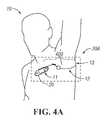
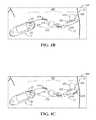
- FIG. 4Ais a diagram depicting a patient 10 wearing a temperature monitoring system 20 A comprising a monitor patch 20 and a temperature probe 400 that is configured to measure body temperature of the patient 10 .
- the temperature probe 400is configured for axillary temperature sensing of the patient 10 to whom the monitor patch 20 is attached.
- the monitor patch 20is attached to the chest 11 of the patient 10 , with a sensing portion of the temperature probe 400 retained in the axilla 12 of the patient 10 during body temperature monitoring.
- FIG. 4Bis a diagram providing an enlarged view of the monitoring system 20 A depicted in FIG. 4A according to certain aspects of the present disclosure.
- the monitor patch 20is attached to the chest 11 of the patient 10 via, e.g., an adhesive backing (not shown).
- the temperature probe 400has a proximal end 401 and a distal end 403 and includes a wiring portion 410 , a body connection portion 430 B, and a sensing portion 420 disposed between the wiring and body connection portions 410 , 430 B.
- the proximal end 401 of the temperature probe 400is connected to the monitor patch 20 at its connection port 22 .
- the proximal end 401 of the temperature probe 400is removably attached (e.g., plugged) to the monitor patch 20 .
- the proximal end 401is fixedly attached (e.g., epoxied or fused) to the monitor patch 20 .
- the sensing portion 420 of the temperature probe 400is configured for placement within the axilla 12 of the patient 10 and includes a temperature sensing element (e.g., 234 A-D of FIGS. 5A-D and 234 E-F of FIGS. 6A-B ).
- the wiring portion 410 of the temperature probe 400includes one or more electrical conductors ( 512 , 514 of FIGS. 5A-D and FIGS. 6A-B ) for carrying a signal responsive to a change in body temperature of the patient 10 between the temperature sensing element 234 and the monitor patch 20 .
- the monitoring system 20 Afurther includes an adhesive element 416 (e.g., a tape) coupled to the cable between the first and second coiled sections 414 , 418 and configured to attach the wiring portion 410 of the cable to the patient's body, e.g., at a point between the chest 11 and the armpit 12 of the patient.
- an adhesive element 416e.g., a tape
- the body connection portion 430 Bhas one end connected to the sensing portion 420 and is configured to be attached to another body portion of the patient 10 such that the sensing portion 420 of the temperature probe 400 can be retained within the axilla 12 of the patient 10 .
- such attachmentis achieved via an adhesive element 426 (e.g., a tape) coupled to the distal end of the body connection portion 430 B.
- the coupled adhesive element 426is then attached to a second body portion 13 (e.g., the back of the patient's arm) of the patient 10 .
- a second body portion 13e.g., the back of the patient's arm
- FIG. 4Cis a diagram providing an enlarged view of an alternative monitoring system 20 B according to certain aspects of the present disclosure.
- the monitoring system 20 Bis substantially the same as the monitoring system 20 A, except an additional (e.g., third) coiled section 419 is provided in body connection portion 430 C in place of the elastic tubing 430 B.
- the additional coiled section 419can provide all or some of the pulling force such as the one provided by the elastic tubing in the embodiment of FIG. 4B .
- the coiled section 419acts as a spring.
- the remainder of the body connection portion 430 Cmay include an elastic or inelastic flexible tubing.
- the body connection portion 430 of the temperature probe 400can include one or more coiled sections similar to the coiled section 414 of the wiring portion 410 . Any or all of the coiled sections 414 , 418 , 419 in the embodiments of FIGS. 4B and 4C may be replaced with elastic elements (e.g., elastic tubing).
- the adhesive element 416may be coupled to the body connection portion 430 at a point different than the distal end of the body connection portion 430 . In certain embodiments, entirely different means of attaching the body connection portion 430 to the patient's body may be used.
- the body connection portion 430may itself be in the form of an adhesive tape that can stick to the body of the patient 10 or may include an elastic loop (e.g., a rubber band) to be placed around the patient's arm.
- the temperature probe 400 in the illustrated embodiments of FIGS. 4A-Cis shown to be operatively coupled to a vital-sign monitor patch worn by the patient 10
- the temperature probe 400may be alternatively operatively coupled to other types of monitoring devices such as a stationary monitoring unit located near the patient's hospital bed.
- a stationary monitoring unitcan take readings of the patient's body temperature based on a signal from the temperature probe 400 and send the temperature readings to a surveillance server via a wired or wireless connection and make other decisions such as providing an indication of an alarm condition (e.g., a high body temperature condition or a loss of thermal contact between the temperature probe and the patient).
- an alarm conditione.g., a high body temperature condition or a loss of thermal contact between the temperature probe and the patient.
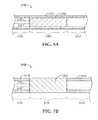
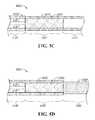
- FIGS. 5A-Dare diagrams depicting various exemplary embodiments of the temperature probe according to alternative aspects of the present disclosure. For the purposes of illustration only, without an intent to limit the scope of the present disclosure in any way, the embodiments will be described with references to elements of FIG. 4B . For clarity, each of the diagrams focuses on a region 500 A-D (corresponding to region 500 in FIG. 4B ) of the thermocouple 400 where sensing portion 420 A-D interfaces with wiring portion 410 A-D and body connection portions 430 A-D. The figures are not drawn to scale.
- the body connection portion 430 Dcomprises a flexible tape 432 D that is mechanically connected (e.g., glued or fused) to the sensing portion 420 D at the temperature sensing element 234 D and/or an end portion of the first flexible cable 401 D.
- the flexible tape 432 Dincludes an adhesive section that can be attached to a body portion (e.g., the back of the patient's arm) so as to retain the sensing portion 420 D of the temperature probe 400 within the axilla 12 of the patient 10 .
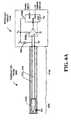
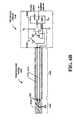
- a signal representative of the voltage difference produced at the junction 601 of the thermocouple 234 Eis received by the sensor interface 214 E via the first and second electrical conductors 512 , 514 in the wiring portion 410 E.
- the sensor interface 214 Eincludes an amplifier 620 E, an analog-to-digital converter (ADC) 630 E and a current source 605 .
- the current source 605supplies a constant DC current that flows through the junction and produces a signal representative of the voltage difference across the junction.
- the signalis received at the minus input of the amplifier 620 E.
- the received signalis amplified by the amplifier 620 E, and the amplified signal is received by the ADC 630 E at input port 632 E.
- the temperature sensing element 234 Fincludes a thermistor 603 , a type of resistor whose resistance varies with temperature.
- the thermistor 603can be made from a material that has a positive temperature coefficient (PTC) (called a “PTC thermistor”) or from a material that has a negative temperature coefficient (NTC) (called a “NTC thermistor”).
- PTCpositive temperature coefficient
- NTCnegative temperature coefficient
- the sensor interface circuit 214 Fincludes a Wheatstone bridge 610 F having three fixed resistors (R 1 , R 2 , and R 3 ), an amplifier 620 F, and an analog-to-digital converter (ADC) 630 F.
- the thermistor 603functions as a fourth and variable resistor in the Wheatstone bridge 610 F such that the bridge 610 F outputs a signal that is responsive to a change in the resistance of the thermistor 603 , which resistance is in turn responsive to a change in the body temperature of the patient 10 .
- the signal generated at the Wheatstone bridge 610is received by an amplifier 620 F.
- An amplified signal at the output of the amplifier 620 Fis received by an input port 632 F of the ADC 630 F.
- the ADC 630 Fdigitizes the received signal and provides a stream of digitized data at output port 634 F.
- the stream of digitized datais passed to a processor (e.g., 202 of FIG. 2 ) for further processing and/or transmission to a surveillance server (e.g., 60 of FIG. 1 ).
- a processore.g., 202 of FIG. 2
- a surveillance servere.g., 60 of FIG. 1
- the ADC 630 F at its control data input port 636 Freceives a set of control data that configures one or more functionalities of the ADC 630 F including, not limited to its sampling (digitization) rate and dynamic range.
- the monitor patch 20 worn by the patient 10receives a signal from a temperature sensing element (e.g., a thermocouple and a thermistor) of the temperature probe 400 , the signal responsive to a change in body temperature of the patient 10 .
- the signalis amplified and digitized into a stream of data by the sensor interface circuit 214 as explained above with respect to FIGS. 6A-B .
- the digitized signalis then received by the processor 202 .
- the processor 202generates a sequence of temperature readings based on the digitized signal.
- the processor 202is operatively connected to a wireless communication system (e.g., the wireless transceiver 207 ) which transmits data indicative of the patient's body temperature to the surveillance server 60 via the bridge 40 .
- a wireless communication systeme.g., the wireless transceiver 207
- the processor 202performs a number of temperature monitoring functions on the temperature readings to determine, inter alia, a high temperature condition and occurrence and loss of thermal contact between the patient 10 and the temperature probe 400 .
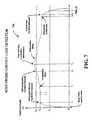
- FIG. 7is a graph 700 of a measured temperature reading (T) versus time (t) for illustrating an exemplary temperature monitoring scheme according to certain aspects of the present disclosure.
- the graph 700shows a low temperature limit (T L ) and a high temperature limit (T H ) that are used in the temperature monitoring scheme.
- T Llow temperature limit
- T Hhigh temperature limit
- the exemplary temperature monitoring schemewill be described with reference to elements of FIGS. 4A ,B.
- a processor(the processor 202 of FIG.
- the monitoring devicee.g., the monitor patch 20
- the recognitioncan be achieved from the temperature reading rising sharply past the low temperature limit (T L ) at a rate exceeding a first threshold rate of rise after having been below T L at least once.
- the temperature readingbegins to rise, indicating that the patient's body temperature is on the rise.
- the temperature readingexceeds the high temperature limit (T H ).
- the processor executing control software in the monitoring devicecan invoke a high temperature handler routine in the control software and take a number of predetermined actions. For example, the processor can cause the transmitter 209 ( FIG. 2 ) to start sending a signal indicative of the high temperature alarm condition to the surveillance server 60 either directly or via the bridge 40 .
- the surveillance server 60can send a notification to a hospital system (e.g., the workstation 100 of FIG. 1 ).
- the monitor patch 20can also set off an alarm, e.g., at the monitor patch 20 or at a stand alone monitoring unit or at a hospital system (e.g., the workstation 100 of FIG. 1 ), thereby notifying a nurse or other caregiver.
- the monitor patch 20can enter into an alert operation mode from the normal operation mode and take and transmit the temperature readings (e.g., to the surveillance server 60 ) at a faster rate. For instance, the monitor patch 20 can take and transmit the temperature reading every 10 minutes during the normal operation mode, but does so every 2 minutes in the alert operation mode.
- the temperature monitoring schemeutilizes two high temperature limits (T H1 and T H2 , where T H2 >T H1 ) and different sets of predetermined actions are performed depending on whether the temperature reading has exceeded only T H1 or both T H1 and T H2 .
- the body-probe contactis lost due to, e.g., the patient 10 opening the arm in a manner that causes the sensing portion 420 of the temperature probe 400 to be detached from the axilla 12 of the patient 10 , or the temperature probe 400 accidentally falls off the patient's body.
- the loss of body-probe contactcauses the temperature reading to fall towards a lower (e.g., open-air) value at a relatively sharp rate of decline.
- the processor executing control software in the monitor patch 20can detect the loss of body-probe contact by computing a rate of decline in the sequence of temperature readings and comparing the computed rate of decline to a threshold rate of decline.
- the processordetermines that the body-probe contact has been lost and generates an indication of the loss of contact.
- an indication of the loss of contactis wirelessly transmitted to the bridge 40 to be sent to the surveillance server 60 , and the surveillance server 60 then provides a notification of the loss of contact to a hospital system (e.g., the workstation 100 of FIG. 1 ).
- the monitor patch 20itself may sound an alarm indicating the loss of contact to the patient 10 or a nurse or caregiver who is near the patient 10 .
- the monitor patch 20after providing the indication, enters a sleep mode in which no additional temperature readings are taken. Alternatively, the monitor patch 20 can continue to take additional temperature readings to determine whether a new body-probe contact has been established.
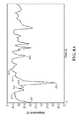
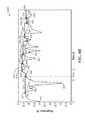
- FIG. 8Ais diagram depicting a realistic temperature reading (T) versus time (t) graph 800 A associated with a temperature monitoring system (e.g., 20) according to certain aspects of the present disclosure.
- the temperature readingshave peaks (e.g., 811 , 812 ) and valleys (e.g., 854 , 855 ).
- the up-and-down fluctuations in the temperature readingscan be caused by movements of a patient's arm (up and down/back and forth), for example. This is because arm movements can affect the quality of thermal contact between the sensing portion 420 of the temperature probe 400 and the axilla 12 of the patient 10 .
- the risemay be attributable to a transition from a relatively poor thermal contact to a good thermal contact, e.g., by armpit closing.
- the decreasemay be attributable to a transition from a relatively good thermal contact to a poor thermal contact caused, e.g., by armpit opening up or the temperature probe being detached from the patient 10 , thereby partially or fully exposing the sensing portion 420 to ambient air.
- a reading taken while the quality of thermal contact is pooris likely to be inaccurate, and thus it is desirable to identify occurrence of such a poor thermal contact so that inaccurate readings associated with the poor thermal contact may be rejected, and only valid temperature readings associated with a good thermal contact are reported, e.g., to the surveillance server 60 .
- a prolonged loss of thermal contactmay be detected and reported so that the patient 10 and/or a caregiver can be alerted.
- the term “poor thermal contact”refers to partial or complete loss of contact between a temperature probe and a person to whom the temperature probe is supposed to be attached.
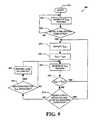
- the monitoring system 20achieves these objectives by adopting the following principles:
- T NEWa current (new) temperature reading
- T MAXthe current maximum temperature reading
- the process 900loops back to the operation 910 in which another T NEW reading is generated.
- the process 900proceeds to operation 930 in which the new temperature reading (T NEW ) is reported, and to operation 940 in which the T NEW reading is assigned to T MAX .
- a first temperature reading 851is taken at time 801 , e.g., after an initial attachment of the temperature probe 400 to the patient 10 , and an initial stabilization is determined to be completed at reading 811 .
- the process 900proceeds to decision states 970 in which a first query is made as to whether the new temperature reading corresponds to a peak (e.g., local maximum) or a plateau (e.g., relatively flat region after a local maximum), and, if so, a second query is made as to whether the peak/plateau satisfies the gradient condition, namely, whether the peak/plateau is at or above a corresponding one of the threshold decay curves 841 - 849 representing the threshold decay rate (e.g., ⁇ 2 C/h).
- a first queryis made as to whether the new temperature reading corresponds to a peak (e.g., local maximum) or a plateau (e.g., relatively flat region after a local maximum)
- a second queryis made as to whether the peak/plateau satisfies the gradient condition, namely, whether the peak/plateau is at or above a corresponding one of the threshold decay curves 841 - 849 representing the threshold decay rate (e.g., ⁇ 2
- the first and second queries of the decision state 970are designed to determine whether the current T NEW reading satisfies Condition 3.
- the first query relating to the occurrence of a peak/plateauinvolves obtaining a sequence of temperature readings and retroactively identifying one of the readings corresponding to a local maximum. If the first and second queries of the decision state 970 are both satisfied (YES), the process 900 loops back to the operations 930 and 940 in which the current T NEW reading is reported and assigned to T MAX .
- the process 900proceeds to another decision state 980 in which a query is made as to whether a maximum duration for the current T MAX reading has been exceeded.
- This querydetects a prolonged loss of thermal contact between the temperature probe 420 and the axilla 12 of the patient 10 .
- the maximum durationis preset at a value between about 10 and 30 minutes. If the query at the decision state 980 is NO (maximum duration not exceeded), the process 900 loops back to the operation 950 where another temperature reading is generated and then to decision state 960 and potentially to decision state 970 where Conditions 2 and 3, respectively, are checked.
- the algorithmmaintains the current T MAX reading, and the monitoring system 20 considers it as the currently effective temperature reading as indicated by the line 831 .
- the process 900proceeds to operation 990 in which the loss of thermal contact is reported (e.g., displayed on hospital system 100 ) and then back to operations 950 , where a next T NEW reading is taken.
- temperature readings(e.g., 852 , 853 ) generated after the reading 811 do not satisfy the combination of first and second queries of the decision state 970 , and the maximum duration for the current T MAX reading is exceeded at t 2 .
- the monitoring system 20 at or after t 2reports the prolonged loss of thermal contact to, e.g., a database in the surveillance server 60 or the patient 10 and/or nurse/caregiver at operation 990 . After the reporting at operation 990 , the process 900 loops back to the operations 950 , where a next T NEW reading is taken.
- the process 900After determining (e.g., identifying) the initially-stabilized T NEW reading 812 , the process 900 detects a series of new peak temperature readings 813 - 819 that satisfies Condition 2 ( 813 , 817 , 819 ) or Condition 3 ( 814 , 815 , 816 , 818 ). Other T NEW readings, such as readings 852 , 853 , 856 , however, are rejected because they do not satisfy either Condition 2 (T NEW not greater than the current T MAX 815 ) or Condition 3 (T NEW below the threshold decay curve 845 ). Valid temperature readings do not always have to be local maxima. For example, after identifying the reading 812 , the algorithm associated with the process 900 can report a series of readings between t 4 and t 5 indicated by the curved line 832 as they satisfy Condition 2.
- certain aspects of various temperature monitoring algorithms described hereinare performed by the processor 202 ( FIG. 2C ) executing one or more sequences of one or more instructions using threshold limits contained in an internal machine-readable medium such as the internal memory 219 or the memory 210 .
- the processor 202can determine the loss of body-probe thermal contact by executing instructions contained in the internal memory 202 that involve computation of a rate of decline in temperature readings and comparison of the rate of decline to a threshold rate of decline stored in the memory 210 or generation of a threshold decay curve 841 - 849 based on a threshold decay rate and comparison of the current T NEW reading to the threshold decay curve.
- the processor 202may be a microprocessor, a microcontroller, a digital signal processor (DSP), or an application specific integrated circuit (ASIC) capable of executing computer instructions. Such instructions and/or threshold limits may be read into the memory 219 , 210 from another machine-readable medium, such as a CD, flash memory, or a wireless transmission. Execution of the sequences of instructions contained in the memory 219 causes the processor 202 to perform the process steps described herein. One or more processors in a multi-processing arrangement may also be employed to execute the sequences of instructions contained in memory 219 . In alternative embodiments, hard-wired circuitry may be used in place of or in combination with software instructions to implement various embodiments. Thus, embodiments are not limited to any specific combination of hardware circuitry and software.
- machine-readable mediumrefers to any medium that participates in providing instructions to processor 202 for execution or storing results of or parameters (e.g., variables or constants) for computations such as for the determination of the occurrence and loss of thermal contact between the patient's body and the temperature probe.
- Such a mediummay take many forms, including, but not limited to, non-volatile media, volatile media, and transmission media.
- Non-volatile mediainclude, for example, optical or magnetic disks, such as data storage device.
- Volatile mediainclude dynamic memory, such as the memory 210 .
- Transmission mediainclude coaxial cables, copper wire, and fiber optics, including the wires that comprise bus 204 .
- Machine-readable mediainclude, for example, floppy disk, a flexible disk, hard disk, magnetic tape, any other magnetic medium, a CD-ROM, DVD, any other optical medium, punch cards, paper tape, any other physical medium with patterns of holes, a RAM, a PROM, an EPROM, a FLASH EPROM, any other memory chip or cartridge, a carrier wave, or any other medium from which a computer can read.
- such valuescan be either temporarily stored in the machine-readable medium such as the memory 210 until the values are transmitted via the wireless transmitter 209 .
- Instructions and/or various threshold limitse.g., the threshold rates of rise and decline, the maximum duration for T MAX ) used by the temperature monitoring scheme of the present disclosure may be downloaded into the memory 210 , 219 via wireless transmission from an external device (e.g., the surveillance server 60 via the bridge 40 ) via the receiver 206 .
Landscapes
- Health & Medical Sciences (AREA)
- Life Sciences & Earth Sciences (AREA)
- Engineering & Computer Science (AREA)
- Surgery (AREA)
- General Health & Medical Sciences (AREA)
- Biophysics (AREA)
- Biomedical Technology (AREA)
- Heart & Thoracic Surgery (AREA)
- Medical Informatics (AREA)
- Molecular Biology (AREA)
- Physics & Mathematics (AREA)
- Animal Behavior & Ethology (AREA)
- Pathology (AREA)
- Public Health (AREA)
- Veterinary Medicine (AREA)
- Cardiology (AREA)
- Physiology (AREA)
- Pulmonology (AREA)
- Computer Networks & Wireless Communication (AREA)
- Measuring And Recording Apparatus For Diagnosis (AREA)
- Measuring Temperature Or Quantity Of Heat (AREA)
Abstract
Description
The following applications disclose certain common subject matter with the present application: A Vital-Signs Monitor with Encapsulation Arrangement, U.S. patent application Ser. No. 12/844,766; A Vital-Signs Monitor with Spaced Electrodes, U.S. patent application Ser. No. 12/844,769; A Vital-Signs Patch Having a Strain Relief, U.S. patent application Ser. No. 12/844,774; System and Method for Monitoring Body Temperature of a Person, U.S. patent application Ser. No. 12/844,771; A System and Method for Storing and Forwarding Data from a Vital-Signs Monitor, U.S. patent application Ser. No. 12/844,780; System and Method for Saving Battery Power in a Vital Signs Monitor, U.S. patent application Ser. No. 12/844,789; A System and Method for Conserving Battery Power in a Patient Monitoring System, U.S. patent application Ser. No. 12/844,796; A System and Method for Saving Battery Power in a Patient Monitoring System, U.S. patent application Ser. No. 12/844,801; A System And Method for Tracking Vital-Signs Monitor Patches, U.S. patent application Ser. No. 12/844,788; A System And Method for Reducing False Alarms Associated with Vital-Signs Monitoring, U.S. patent application Ser. No. 12/844,794; A System And Method for Location Tracking of Patients in a Vital-Signs Monitoring System, U.S. patent application Ser. No. 12/844,781; A System And Method for Reducing False Alarms Based on Motion and Location Sensing, U.S. patent application Ser. No. 12/844,765; all of the listed applications filed on Jul. 27, 2010.
The present disclosure generally relates to systems and methods of physiological monitoring, and, in particular, relates to a temperature probe suitable for axillary reading.
Some of the most basic indicators of a person's health are those physiological measurements that reflect basic body functions and are commonly referred to as a person's “vital signs.” The four measurements commonly considered to be vital signs are body temperature, pulse rate, blood pressure, and respiratory rate. Some clinicians consider oxygen saturation (S02) to be a “fifth vital sign” particularly for pediatric or geriatric cases. Some or all of these measurements may be performed routinely upon a patient when they arrive at a healthcare facility, whether it is a routine visit to their doctor or arrival at an Emergency Room (ER).
Vital signs are frequently taken by a nurse using basic tools including a thermometer to measure body temperature, a sphygmomanometer to measure blood pressure, and a watch to count the number of breaths or the number of heart beats in a defined period of time which is then converted to a “per minute” rate. If a patient's pulse is weak, it may not be possible to detect a pulse by hand and the nurse may use a stethoscope to amplify the sound of the patient's heart beat so that she can count the beats. Oxygen saturation of the blood is most easily measured with a pulse oximeter.
When a patient is admitted to a hospital, it is common for vital signs to be measured and recorded at regular intervals during the patient's stay to monitor their condition. A typical interval is 4 hours, which leads to the undesirable requirement for a nurse to awaken a patient in the middle of the night to take vital sign measurements.
When a patient is admitted to an ER, it is common for a nurse to do a “triage” assessment of the patient's condition that will determine how quickly the patient receives treatment. During busy times in an ER, a patient who does not appear to have a life-threatening injury may wait for hours until more-serious cases have been treated. While the patient may be reassessed at intervals while awaiting treatment, the patient may not be under observation between these reassessments.
Measuring certain vital signs is normally intrusive at best and difficult to do on a continuous basis. Measurement of body temperature, for example, is commonly done by placing an oral thermometer under the tongue or placing an infrared thermometer in the ear canal such that the tympanic membrane, which shared blood circulation with the brain, is in the sensor's field of view. Another method of taking a body temperature is by placing a thermometer under the arm, referred to as an “axillary” measurement as axilla is the Latin word for armpit. Skin temperature can be measured using a stick-on strip that may contain panels that change color to indicate the temperature of the skin below the strip.
Measurement of respiration is easy for a nurse to do, but relatively complicated for equipment to achieve. A method of automatically measuring respiration is to encircle the upper torso with a flexible band that can detect the physical expansion of the rib cage when a patient inhales. An alternate technique is to measure a high-frequency electrical impedance between two electrodes placed on the torso and detect the change in impedance created when the lungs fill with air. The electrodes are typically placed on opposite sides of one or both lungs, resulting in placement on the front and back or on the left and right sides of the torso, commonly done with adhesive electrodes connected by wires or by using a torso band with multiple electrodes in the strap.
Measurement of pulse is also relatively easy for a nurse to do and intrusive for equipment to achieve. A common automatic method of measuring a pulse is to use an electrocardiograph (ECG or EKG) to detect the electrical activity of the heart. An EKG machine may use 12 electrodes placed at defined points on the body to detect various signals associated with the heart function. Another common piece of equipment is simply called a “heart rate monitor.” Widely sold for use in exercise and training, heart rate monitors commonly consist of a torso band, in which are embedded two electrodes held against the skin and a small electronics package. Such heart rate monitors can communicate wirelessly to other equipment such as a small device that is worn like a wristwatch and that can transfer data wirelessly to a PC.
Nurses are expected to provide complete care to an assigned number of patients. The workload of a typical nurse is increasing, driven by a combination of a continuing shortage of nurses, an increase in the number of formal procedures that must be followed, and an expectation of increased documentation. Replacing the manual measurement and logging of vital signs with a system that measures and records vital signs would enable a nurse to spend more time on other activities and avoid the potential for error that is inherent in any manual procedure.
For some or all of the reasons listed above, there is a need to be able to continuously monitor patients in different settings. In addition, it is desirable for this monitoring to be done with limited interference with a patient's mobility or interfering with their other activities.
Embodiments of the patient monitoring system disclosed herein measure certain vital signs of a patient, which include respiratory rate, pulse rate, blood pressure, body temperature, and, in some cases, oxygen saturation (SO2), on a regular basis and compare these measurements to defined limits.
In one aspect of the present disclosure, a temperature probe for axillary temperature reading of a person is provided. The temperature probe can comprise a sensing portion configured for placement within the axilla of a person and having a first end and a second end. The sending portion can comprise a temperature sensing element configured to provide a signal responsive to a change in body temperature of the person. The temperature probe can further comprise a wiring portion having one end connected to the first end of the sensing portion and comprising an electrical conductor, the electrical conductor having a first end configured for coupling to a monitoring device, and a second end connected to the temperature sensing element, the electrical connector configured to carry the signal from the temperature sensing element to the monitoring device. The temperature probe can further comprise a body connection portion having one end connected to the second end of the sensing portion and configured to be attached to another body portion of the person.
In one aspect of the present disclosure, a system for body temperature monitoring of a person through axillary measurement is provided. The system can comprise a temperature probe comprising a cable and a temperature sensing element, configured such that the temperature sensing element is to be retained in the axilla of the person at least during body temperature monitoring. The system can further comprise a monitoring device worn by the person and connected to the cable, the monitoring device receiving signals from the temperature sensing element. The monitoring device can include a wireless communication system to wirelessly transmit readings representative of sensed body temperatures of the person as determined by the monitoring device based on the signals received from the temperature sensing element.
In one aspect of the present disclosure, a method of monitoring the axillary temperature of a person is disclosed. The method can comprise providing a portion of a temperature probe within the axilla of the person, the temperature probe comprising a wiring portion and a body connection portion and a sensing portion between the wiring and body connection portions, the sensing portion comprising a temperature sensing element, the wiring portion coupled to a monitoring device and comprising a conductor having a first end and a second end, the first end coupled to the temperature sensing element, and the second end connected to the monitoring device. The method can further comprise attaching at least a portion of the body connection portion to a second body portion of the person, such that the sensing portion is retained within the axilla.
It is understood that other configurations of the subject technology will become readily apparent to those skilled in the art from the following detailed description, wherein various configurations of the subject technology are shown and described by way of illustration. As will be realized, the subject technology is capable of other and different configurations and its several details are capable of modification in various other respects, all without departing from the scope of the subject technology. Accordingly, the drawings and detailed description are to be regarded as illustrative in nature and not as restrictive.
The accompanying drawings, which are included to provide further understanding and are incorporated in and constitute a part of this specification, illustrate disclosed embodiments and together with the description serve to explain the principles of the disclosed embodiments. In the drawings:
Periodic monitoring of patients in a hospital is desirable at least to ensure that patients do not suffer an un-noticed sudden deterioration in their condition or a secondary injury during their stay in the hospital. It is impractical to provide continuous monitoring by a clinician and cumbersome to connect sensors to a patient, which are then connected to a fixed monitoring instrument by wires. Furthermore, systems that sound an alarm when the measured value exceeds a threshold value may sound alarms so often and in situations that are not truly serious that such alarms are ignored by clinicians.
Measuring vital signs is difficult to do on a continuous basis. Accurate measurement of cardiac pulse, for example, can be done using an electrocardiograph (ECG or EKG) to detect the electrical activity of the heart. An EKG machine may use up to 12 electrodes placed at various points on the body to detect various signals associated with the cardiac function. Another common piece of equipment is termed a “heart rate monitor.” Widely sold for use in exercise and physical training, heart rate monitors may comprise a torso band in which are embedded two electrodes held against the skin and a small electronics package. Such heart rate monitors can communicate wirelessly to other equipment such as a small device that is worn like a wristwatch and that can transfer data wirelessly to a personal computer (PC).
Monitoring of patients that is referred to as “continuous” is frequently periodic, in that measurements are taken at intervals. In many cases, the process to make a single measurement takes a certain amount of time, such that even back-to-back measurements produce values at an interval equal to the time that it takes to make the measurement. For the purpose of vital sign measurement, a sequence of repeated measurements can be considered to be “continuous” when the vital sign is not likely to change an amount that is of clinical significance within the interval between measurements. For example, a measurement of blood pressure every 10 minutes may be considered “continuous” if it is considered unlikely that a patient's blood pressure can change by a clinically significant amount within 10 minutes. The interval appropriate for measurements to be considered continuous may depend on a variety of factors including the type of injury or treatment and the patient's medical history. Compared to intervals of 4-8 hours for manual vital sign measurement in a hospital, measurement intervals of 30 minutes to several hours may still be considered “continuous.”
Certain exemplary embodiments of the present disclosure include a system that comprises a vital-signs monitor patch that is attached to the patient, and a bridge that communicates with monitor patches and links them to a central server that processes the data, where the server can send data and alarms to a hospital system according to algorithms and protocols defined by the hospital.
The construction of the vital-signs monitor patch is described according to certain aspects of the present disclosure. As the patch may be worn continuously for a period of time that may be several days, as is described in the following disclosure, it is desirable to encapsulate the components of the patch such that the patient can bathe or shower and engage in their normal activities without degradation of the patch function. An exemplary configuration of the construction of the patch to provide a hermetically sealed enclosure about the electronics is disclosed.
In the following detailed description, numerous specific details are set forth to provide a full understanding of the present disclosure. It will be apparent, however, to one ordinarily skilled in the art that embodiments of the present disclosure may be practiced without some of the specific details. In other instances, well-known structures and techniques have not been shown in detail so as not to obscure the disclosure.
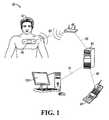
While the embodiments illustrated byFIG. 1 employ abridge 20 to provide communication link between themonitor patch 20 and theserver 60, in certain alternative embodiments, themonitor patch 20 may engage in direct wireless communication with theserver 60. In such alternative embodiments, theserver 60 itself or a wireless modem connected to theserver 60 may include a wireless communication system to receive data from themonitor patch 20.
In use, amonitor patch 20 is applied to apatient 10 by a clinician when it is desirable to continuously monitor basic vital signs ofpatient 10 whilepatient 10 is, in this embodiment, in a hospital.Monitor patch 20 is intended to remain attached topatient 10 for an extended period of time, for example, up to 5 days in certain embodiments, limited by the battery life ofmonitor patch 20. In some embodiments, monitorpatch 20 is disposable when removed frompatient 10.
Each of the sensor interfaces212,214,216 can include one or more electronic components that are configured to generate an excitation signal or provide DC power for the sensor that the interface is connected to and/or to condition and digitize a sensor signal from the sensor. For example, the sensor interface can include a signal generator for generating an excitation signal or a voltage regulator for providing power to the sensor. The sensor interface can further include an amplifier for amplifying a sensor signal from the sensor and an analog-to-digital converter for digitizing the amplified sensor signal. The sensor interface can further include a filter (e.g., a low-pass or bandpass filter) for filtering out spurious noises (e.g., a 60 Hz noise pickup).
Theprocessor 202 is configured to send and receive data (e.g., digitized signal or control data) to and from the sensor interfaces212,214,216 via abus 204, which can be one or more wire traces on the PCB. Although a bus communication topology is used in this embodiment, some or all communication between discrete components can also be implemented as direct links without departing from the scope of the present disclosure. For example, theprocessor 202 may send data representative of an excitation signal to the sensor excitation signal generator inside the sensor interface and receive data representative of the sensor signal from the sensor interface, over either a bus or direct data links betweenprocessor 202 and each ofsensor interface
Theprocessor 202 is also capable of communication with thereceiver 206 and thetransmitter 209 of thewireless transceiver 207 via thebus 204. For example, theprocessor 202 using the transmitter andreceiver bridge 40. In certain embodiments, thetransmitter 209 includes one or more of a RF signal generator (e.g., an oscillator), a modulator (a mixer), and a transmitting antenna; and thereceiver 206 includes a demodulator (a mixer) and a receiving antenna which may or may not be the same as the transmitting antenna. In some embodiments, thetransmitter 209 may include a digital-to-analog converter configured to receive data from theprocessor 202 and to generate a base signal; and/or thereceiver 206 may include an analog-to-digital converter configured to digitize a demodulated base signal and output a stream of digitized data to theprocessor 202.
Theprocessor 202 may include a general-purpose processor or a specific-purpose processor for executing instructions and may further include amemory 219, such as a volatile or non-volatile memory, for storing data and/or instructions for software programs. The instructions, which may be stored in amemory 219 and/or210, may be executed by theprocessor 202 to control and manage thewireless transceiver 207, the sensor interfaces212,214,216, as well as provide other communication and processing functions.
Theprocessor 202 may be a general-purpose microprocessor, a microcontroller, a Digital Signal Processor (DSP), an Application Specific Integrated Circuit (ASIC), a Field Programmable Gate Array (FPGA), a Programmable Logic Device (PLD), a controller, a state machine, gated logic, discrete hardware components, or any other suitable device or a combination of devices that can perform calculations or other manipulations of information.
Information, such as program instructions, data representative of sensor readings, preset alarm conditions, threshold limits, may be stored in a computer or processor readable medium such as a memory internal to the processor202 (e.g., the memory219) or a memory external to the processor202 (e.g., the memory210), such as a Random Access Memory (RAM), a flash memory, a Read Only Memory (ROM), a Programmable Read-Only Memory (PROM), an Erasable PROM (EPROM), registers, a hard disk, a removable disk, or any other suitable storage device.
In certain embodiments, theinternal sensor 236 can be one or more sensors configured to measure certain properties of the processing andsensor interface module 201, such as a board temperature sensor thermally coupled to a PCB. In other embodiments, theinternal sensor 236 can be one or more sensors configured to measure certain properties of thepatient 10, such as a motion sensor (e.g., an accelerometer) for measuring the patient's motion or position with respect to gravity.
Theexternal sensors monitor patch 20 is attached. For example, the firstexternal sensor 232 can be a set of sensing electrodes that are affixed to an exterior surface of themonitor patch 20 and configured to be in contact with the patient for measuring the patient's respiratory rate, and the secondexternal sensor 234 can include a temperature sensing element (e.g., a thermocouple or a thermistor or resistive thermal device (RTD)) affixed, either directly or via an interposing layer, to skin of thepatient 10 for measuring the patient's body temperature. In other embodiments, one or more of theexternal sensors
Information such as data representative of sensor readings may be stored inmemory 312 internal toprocessor 310 or inmemory 340 external toprocessor 310 which may be a Random Access Memory (RAM), flash memory, Read Only Memory (ROM), Programmable Read Only Memory (PROM), Erasable Programmable Read Only Memory (EPROM), registers, a hard disk, a removable disk, a Solid State Memory (SSD), or any other suitable storage device.
Information such as data representative of sensor readings may be stored inmemory 362 internal toprocessor 360 or inmemory 370 external toprocessor 360 which may be a Random Access Memory (RAM), flash memory, Read Only Memory (ROM), Programmable Read Only Memory (PROM), Erasable Programmable Read Only Memory (EPROM), registers, a hard disk, a removable disk, a Solid State Memory (SSD), or any other suitable storage device.
As indicated above with respect toFIG. 2C , certain embodiments of themonitor patch 20 are configured to operate with external sensors that are in turn configured to produce a signal representative of one or more vital signs of the patient to whom themonitor patch 20 is attached. For example, the secondexternal sensor 234 can be a temperature probe that includes a temperature sensing element (e.g., a thermocouple or thermistor) affixed, either directly or via an interposing layer, to skin of thepatient 10 for measuring the patient's body temperature.FIG. 4A is a diagram depicting a patient10 wearing atemperature monitoring system 20A comprising amonitor patch 20 and atemperature probe 400 that is configured to measure body temperature of thepatient 10. In the illustrated example, thetemperature probe 400 is configured for axillary temperature sensing of the patient10 to whom themonitor patch 20 is attached. Themonitor patch 20 is attached to thechest 11 of thepatient 10, with a sensing portion of thetemperature probe 400 retained in theaxilla 12 of the patient10 during body temperature monitoring.
Thesensing portion 420 of thetemperature probe 400 is configured for placement within theaxilla 12 of thepatient 10 and includes a temperature sensing element (e.g.,234A-D ofFIGS. 5A-D and234E-F ofFIGS. 6A-B ). Thewiring portion 410 of thetemperature probe 400 includes one or more electrical conductors (512,514 ofFIGS. 5A-D andFIGS. 6A-B ) for carrying a signal responsive to a change in body temperature of the patient10 between thetemperature sensing element 234 and themonitor patch 20. In the illustrated example ofFIG. 4B , thewiring portion 410 includes a flexible cable comprising a tubing and electrical conductors (e.g., a pair of twisted copper wires) placed within the tubing. Thewiring portion 410 includes a firstcoiled section 414 and a secondcoiled section 418. Thecoiled sections sensing portion 420 as high as possible in theaxilla 12, accommodating arm movements by reducing the “sawing” effect of a straight wire moving along its axis when the patient's arm is moving, creating a wider surface of contact with the skin, thus increasing patient's comfort, creating a contact surface with the skin that does not tend to cause irritation as much as a straight wire would.
In the illustrated example, themonitoring system 20A further includes an adhesive element416 (e.g., a tape) coupled to the cable between the first and secondcoiled sections wiring portion 410 of the cable to the patient's body, e.g., at a point between thechest 11 and thearmpit 12 of the patient.
Thebody connection portion 430B has one end connected to thesensing portion 420 and is configured to be attached to another body portion of the patient10 such that thesensing portion 420 of thetemperature probe 400 can be retained within theaxilla 12 of thepatient 10. In the illustrated example, such attachment is achieved via an adhesive element426 (e.g., a tape) coupled to the distal end of thebody connection portion 430B. The coupledadhesive element 426 is then attached to a second body portion13 (e.g., the back of the patient's arm) of thepatient 10. In the illustrated embodiment ofFIG. 4B , thebody connection portion 430B includes an elastic tubing comprising an elastic polymers (elastomers) such as natural rubber, synthetic polyisoprene, butyl rubber, and the like. In such embodiments, theadhesive element 426 is attached to the patient's body while the elastic tubing is in its stretched state such that the restorative (“pulling”) tensile force in the stretched tubing helps to hold thetemperature sensing portion 420 in place within theaxilla 12 of the patient. Theadhesive elements adhesive elements adhesive elements coiled sections sensing portion 420 upward.
A multitude of modifications and additions to the illustrated embodiments ofFIGS. 4B, 4C and 4D are possible without departing from the scope of the disclosure. For example, the body connection portion430 of thetemperature probe 400 can include one or more coiled sections similar to thecoiled section 414 of thewiring portion 410. Any or all of thecoiled sections FIGS. 4B and 4C may be replaced with elastic elements (e.g., elastic tubing). Theadhesive element 416 may be coupled to the body connection portion430 at a point different than the distal end of the body connection portion430. In certain embodiments, entirely different means of attaching the body connection portion430 to the patient's body may be used. For example, the body connection portion430 may itself be in the form of an adhesive tape that can stick to the body of the patient10 or may include an elastic loop (e.g., a rubber band) to be placed around the patient's arm.
While thetemperature probe 400 in the illustrated embodiments ofFIGS. 4A-C is shown to be operatively coupled to a vital-sign monitor patch worn by thepatient 10, thetemperature probe 400 may be alternatively operatively coupled to other types of monitoring devices such as a stationary monitoring unit located near the patient's hospital bed. Such a stationary monitoring unit can take readings of the patient's body temperature based on a signal from thetemperature probe 400 and send the temperature readings to a surveillance server via a wired or wireless connection and make other decisions such as providing an indication of an alarm condition (e.g., a high body temperature condition or a loss of thermal contact between the temperature probe and the patient).
In the first exemplary embodiment of thetemperature probe 400 depicted inFIG. 5A , the wiring portion410A, the sensing portion420A, and the body connection portion430A comprise a single hollow flexible cable401A. The wiring portion410A of the flexible cable401A includes a firstelectrical conductor 512 and a secondelectrical conductor 514. The sensing portion of the flexible cable401A houses atemperature sensing element 234A that is electrically connected to the first and secondelectrical conductors temperature sensing element 234A is configured to make thermal contact with the axilla of the patient10 through the surrounding flexible cable401A. In the illustrated example, the body connection portion430A of the flexible cable401A is empty inside.
In the second exemplary embodiment of thetemperature probe 400 depicted inFIG. 5B , the wiring portion410B comprises a first hollowflexible cable 411B having a firstelectrical conductor 512 and a secondelectrical conductor 514. The sensing portion420B includes atemperature sensing element 234B. In the illustrated example, thetemperature sensing element 234B is mechanically connected (e.g., glued or fused) to an end portion of the firstflexible cable 411B and is electrically connected to the first and secondelectrical conductors temperature sensing element 234B is configured to make a direct physical and thermal contact with theaxilla 12 of the patient10 (i.e., not through a flexible cable). Thebody connection portion 430B comprises a second hollowflexible cable 431B. In the illustrated example, the secondflexible cable 431B is empty inside.
In the third exemplary embodiment of thetemperature probe 400 depicted inFIG. 5C , wiring portion410C comprises a first flexible cable411C having a firstelectrical conductor 512 and a secondelectrical conductor 514. The sensing portion420C and body connection portion430C comprise a second hollow flexible cable501C. The second flexible cable501C is mechanically connected (e.g., glued or fused) to an end portion of the first flexible cable411C. The sensing portion420C of the second flexible cable501C houses a temperature sensing element234C that is electrically connected to the first and secondelectrical conductors
In the fourth exemplary embodiment of thetemperature probe 400 depicted inFIG. 5D , thewiring portion 410D and the sensing portion420D comprise a first flexible cable401D. Thewiring portion 410D of the first flexible cable401D includes a firstelectrical conductor 512 and a secondelectrical conductor 514. The sensing portion420D of the first flexible cable401D houses atemperature sensing element 234D. Thetemperature sensing element 234D is electrically connected to the first and secondelectrical conductors flexible tape 432D that is mechanically connected (e.g., glued or fused) to the sensing portion420D at thetemperature sensing element 234D and/or an end portion of the first flexible cable401D. In certain embodiments, theflexible tape 432D includes an adhesive section that can be attached to a body portion (e.g., the back of the patient's arm) so as to retain the sensing portion420D of thetemperature probe 400 within theaxilla 12 of thepatient 10.
The above embodiments ofFIGS. 5A-5D are exemplary only, as other embodiments can be employed without departing from the scope of the present disclosure. For example, a modular arrangement in which the cables are snap connectable with the temperature sensing element can be employed, as well as other physical configurations.
In the first exemplary probe-sensor interface configuration depicted inFIG. 6A , thetemperature sensing element 234E is a thermocouple that comprises ajunction 601 between two different metals. Thejunction 601 produces a voltage difference related to temperature at thejunction 601. The junction is of dissimilar metals including specific alloys such as platinum and platinum-rhodium alloy (Type S) or chromel and alumel (Type K). This embodiment of a thermocouple is exemplary only, as other embodiments may be employed. For example, additional circuits/elements relating to cold junction compensation may be used. In some embodiments, the temperature sensing element may comprise a resistance temperature detector (RTD) based on platinum.
A signal representative of the voltage difference produced at thejunction 601 of thethermocouple 234E is received by thesensor interface 214E via the first and secondelectrical conductors wiring portion 410E. Thesensor interface 214E includes anamplifier 620E, an analog-to-digital converter (ADC)630E and acurrent source 605. Thecurrent source 605 supplies a constant DC current that flows through the junction and produces a signal representative of the voltage difference across the junction. The signal is received at the minus input of theamplifier 620E. The received signal is amplified by theamplifier 620E, and the amplified signal is received by theADC 630E atinput port 632E. TheADC 630E digitizes the amplified signal and provides a stream of digitized data atoutput port 634E. The stream of digitized data is passed to a processor (e.g.,202 ofFIG. 2 ) for further processing and/or transmission to a surveillance server (e.g.,60 ofFIG. 1 ) via a bride (e.g.,40 ofFIG. 1 ). In certain embodiments, theADC 630E at its controldata input port 636E receives from the processor a set of control data that configures one or more functionalities of theADC 630E including, not limited to, its sampling (digitization) rate and dynamic range.
In the second exemplary probe-sensor interface depicted inFIG. 6B , the temperature sensing element234F includes athermistor 603, a type of resistor whose resistance varies with temperature. Thethermistor 603 can be made from a material that has a positive temperature coefficient (PTC) (called a “PTC thermistor”) or from a material that has a negative temperature coefficient (NTC) (called a “NTC thermistor”).
Two electrical contacts425 of thethermistor 603 are connected to thesensor interface circuit 214F via the first and secondelectrical conductors wiring portion 410F. Thesensor interface circuit 214F includes aWheatstone bridge 610F having three fixed resistors (R1, R2, and R3), anamplifier 620F, and an analog-to-digital converter (ADC)630F. By the connection provided by the first and secondelectrical conductors thermistor 603 functions as a fourth and variable resistor in theWheatstone bridge 610F such that thebridge 610F outputs a signal that is responsive to a change in the resistance of thethermistor 603, which resistance is in turn responsive to a change in the body temperature of thepatient 10. The signal generated at the Wheatstone bridge610 is received by anamplifier 620F. An amplified signal at the output of theamplifier 620F is received by aninput port 632F of theADC 630F. TheADC 630F digitizes the received signal and provides a stream of digitized data at output port634F. The stream of digitized data is passed to a processor (e.g.,202 ofFIG. 2 ) for further processing and/or transmission to a surveillance server (e.g.,60 ofFIG. 1 ). In certain embodiments, theADC 630F at its control data input port636F receives a set of control data that configures one or more functionalities of theADC 630F including, not limited to its sampling (digitization) rate and dynamic range.
With references toFIGS. 1, 2 and 4A -B, themonitor patch 20 worn by thepatient 10 receives a signal from a temperature sensing element (e.g., a thermocouple and a thermistor) of thetemperature probe 400, the signal responsive to a change in body temperature of thepatient 10. The signal is amplified and digitized into a stream of data by thesensor interface circuit 214 as explained above with respect toFIGS. 6A-B . The digitized signal is then received by theprocessor 202. Theprocessor 202 generates a sequence of temperature readings based on the digitized signal. Theprocessor 202 is operatively connected to a wireless communication system (e.g., the wireless transceiver207) which transmits data indicative of the patient's body temperature to thesurveillance server 60 via thebridge 40. In certain embodiments, theprocessor 202 performs a number of temperature monitoring functions on the temperature readings to determine, inter alia, a high temperature condition and occurrence and loss of thermal contact between the patient10 and thetemperature probe 400.
As seen inFIG. 7 , the temperature reading rises from an initial (e.g., open-air) value (T0) at t=t1to an equilibrium value (T1) at t=t1when the temperature sensing element has reached a thermal equilibrium with the patient's body.
At t=t2, the temperature reading begins to rise, indicating that the patient's body temperature is on the rise. At t=t3, the temperature reading exceeds the high temperature limit (TH). When this occurs, the processor executing control software in the monitoring device can invoke a high temperature handler routine in the control software and take a number of predetermined actions. For example, the processor can cause the transmitter209 (FIG. 2 ) to start sending a signal indicative of the high temperature alarm condition to thesurveillance server 60 either directly or via thebridge 40. In response, thesurveillance server 60 can send a notification to a hospital system (e.g., theworkstation 100 ofFIG. 1 ). Themonitor patch 20 can also set off an alarm, e.g., at themonitor patch 20 or at a stand alone monitoring unit or at a hospital system (e.g., theworkstation 100 ofFIG. 1 ), thereby notifying a nurse or other caregiver. Themonitor patch 20 can enter into an alert operation mode from the normal operation mode and take and transmit the temperature readings (e.g., to the surveillance server60) at a faster rate. For instance, themonitor patch 20 can take and transmit the temperature reading every 10 minutes during the normal operation mode, but does so every 2 minutes in the alert operation mode. In certain embodiments, the temperature monitoring scheme utilizes two high temperature limits (TH1and TH2, where TH2>TH1) and different sets of predetermined actions are performed depending on whether the temperature reading has exceeded only TH1or both TH1and TH2.
In the illustrated example ofFIG. 7 , it is assumed that at t=t4, a nurse who has been notified of the high temperature condition of thepatient 10 has decided to administer a fever-reducing medication to thepatient 10. Responding to the fever-reducing medication, the patient's body temperature reading begins to fall gradually and reach a relatively stable level below TH.
However, at t=t5, the body-probe contact is lost due to, e.g., the patient10 opening the arm in a manner that causes thesensing portion 420 of thetemperature probe 400 to be detached from theaxilla 12 of thepatient 10, or thetemperature probe 400 accidentally falls off the patient's body. The loss of body-probe contact causes the temperature reading to fall towards a lower (e.g., open-air) value at a relatively sharp rate of decline. In certain embodiments of thetemperature monitoring system 20A, the processor executing control software in themonitor patch 20 can detect the loss of body-probe contact by computing a rate of decline in the sequence of temperature readings and comparing the computed rate of decline to a threshold rate of decline. If the rate of decline exceeds the threshold rate of decline for a predetermined number of samples (e.g., 1-4), the processor determines that the body-probe contact has been lost and generates an indication of the loss of contact. In the illustrated example ofFIG. 7 , the loss of body-probe contact is detected at t=t6. As can be seen fromFIG. 7 , the detection scheme based on the rate of decline described herein can detect the loss of contact earlier than a scheme relying on the temperature readings falling below the low temperature limit (TL). The latter scheme would not detect the loss of contact until t=t7.
In certain embodiments, an indication of the loss of contact is wirelessly transmitted to thebridge 40 to be sent to thesurveillance server 60, and thesurveillance server 60 then provides a notification of the loss of contact to a hospital system (e.g., theworkstation 100 ofFIG. 1 ). In other embodiments, in addition or in lieu of the wireless transmission of the indication, themonitor patch 20 itself may sound an alarm indicating the loss of contact to the patient10 or a nurse or caregiver who is near thepatient 10.
In certain embodiments, themonitor patch 20, after providing the indication, enters a sleep mode in which no additional temperature readings are taken. Alternatively, themonitor patch 20 can continue to take additional temperature readings to determine whether a new body-probe contact has been established.
In certain aspects of the present disclosure, themonitoring system 20 achieves these objectives by adopting the following principles:
- 1) Only maximum readings (peaks or plateaus) are considered as potentially valid readings.
- 2) Temperature readings on a downward slope are considered to be associated with a poor thermal contact.
- 3) Given an almost impossible rate of decay of the core body temperature (e.g., −2 C/h), any peak or plateau below this threshold decay rate are rejected.
Applying these principles, a current (new) temperature reading (TNEW) is reported as a new valid temperature reading and replaces the current maximum temperature reading (TMAX) if TNEWfulfills at least one of the following acceptance conditions:
- Condition 1: Initial stabilization is just completed;
- Condition 2: (TNEW>TMAX); or
- Condition 3: (TNEW<TMAX) AND a peak/plateau (e.g., a local maximum) is detected AND a gradient condition, namely, the peak/plateau is at or above a threshold decay curve representing the threshold decay rate (e.g., e.g., −2 C/h), is satisfied.
Conversely, if the current temperature reading fails to satisfy all of these conditions, the reading is considered inaccurate and rejected, and themonitoring system 20 retains the current TMAXas the currently effective temperature reading value.
Thealgorithm 900 begins atstart state 901 and proceeds tooperation 910 in which a new temperature reading (TNEW) is generated. By way of example, the TNEWreading can be generated by a processor of themonitor patch 20 based on a signal generated by a temperature sensing element (e.g.,234A-D ofFIG. 5A-D ) of thetemperature probe 400. As described above, the sensing element can be a thermocouple (234E ofFIG. 6A ), thermistor (234F ofFIG. 6B ) or any another temperature transducer configured to generate a signal responsive to a change in body temperature of a person to whom thetemperature probe 400 is attached.
Thealgorithm 900 proceeds to decision state920 in which a query is made as to whether an initial stabilization (e.g., a thermal equilibrium) has been completed for the temperature readings, e.g., after an initial attachment of thetemperature probe 400 to the patient10 or after a prolonged loss of thermal contact. This query is designed to determine whether the current TNEWreading satisfiesCondition 1, e.g., whether the monitoring has gone through or completed its stabilization phase.
In certain embodiments, the decision state920 can involve, for example, determining whether the current and recent temperature readings have flattened out after a sharp increase by monitoring a slope (e.g., derivative) or an average of slopes of the temperature readings versus time. In other embodiments, the decision state920 can involve waiting for a certain period of time (e.g. 15 minutes) before reporting a value, even though some peaks or plateaus might be found. After that stabilization period, the maximum value found will be reported as the first value. The purpose of the stabilization period is to reduce chances of having low peaks of temperature being reported right after system activation because of the fact that the gradient criterion cannot be applied (gradient criterion requires an initial value). For example, if a peak is found after activation, without the gradient criterion to discard it, it would be reported as a valid reading. Waiting 15 minutes and taking the maximum value offers better chances of starting with a more accurate value. The above examples illustrate simple stabilization algorithms (e.g., waiting Z minutes and taking the maximum peak/plateau value). There can be different methods of obtaining a first reading such as using a predictive algorithm.
If answer to the query a the decision state920 is NO, (initial stabilization not completed), theprocess 900 loops back to theoperation 910 in which another TNEWreading is generated. On the other hand, if answer to the query at the decision state920 is YES (initial stabilization completed), theprocess 900 proceeds tooperation 930 in which the new temperature reading (TNEW) is reported, and tooperation 940 in which the TNEWreading is assigned to TMAX. In the illustrated example ofFIG. 8B , a first temperature reading851 is taken at time801, e.g., after an initial attachment of thetemperature probe 400 to thepatient 10, and an initial stabilization is determined to be completed at reading811.
Theprocess 900 then proceeds tooperation 950 in which another TNEWreading is generated and then todecision state 960 in which a query is made as to whether the TNEWreading obtained at theoperation 950 is larger than the current maximum temperature reading (TMAX), which at this point is equal to the value of the initially-stabilizedtemperature reading 811. This query is designed to determine whether the current TNEWreading satisfiesCondition 2, namely TNEW>TMAX. If answer to the query is YES (TNEW>TMAX) theprocess 900 loops back to theoperations
On the other hand, if the answer to the query at thedecision state 960 is NO (TNEW≦TMAX), theprocess 900 proceeds to decision states970 in which a first query is made as to whether the new temperature reading corresponds to a peak (e.g., local maximum) or a plateau (e.g., relatively flat region after a local maximum), and, if so, a second query is made as to whether the peak/plateau satisfies the gradient condition, namely, whether the peak/plateau is at or above a corresponding one of the threshold decay curves841-849 representing the threshold decay rate (e.g., −2 C/h). The first and second queries of thedecision state 970 are designed to determine whether the current TNEWreading satisfiesCondition 3. In certain embodiments, the first query relating to the occurrence of a peak/plateau involves obtaining a sequence of temperature readings and retroactively identifying one of the readings corresponding to a local maximum. If the first and second queries of thedecision state 970 are both satisfied (YES), theprocess 900 loops back to theoperations
On the other hand, if at least one of the first and second queries is not satisfied (NO), theprocess 900 proceeds to anotherdecision state 980 in which a query is made as to whether a maximum duration for the current TMAXreading has been exceeded. This query detects a prolonged loss of thermal contact between thetemperature probe 420 and theaxilla 12 of thepatient 10. In certain exemplary embodiments, the maximum duration is preset at a value between about 10 and 30 minutes. If the query at thedecision state 980 is NO (maximum duration not exceeded), theprocess 900 loops back to theoperation 950 where another temperature reading is generated and then todecision state 960 and potentially todecision state 970 whereConditions monitoring system 20 considers it as the currently effective temperature reading as indicated by theline 831.
On the other hand, if the answer to the query at thedecision state 980 is YES (maximum duration exceeded), theprocess 900 proceeds tooperation 990 in which the loss of thermal contact is reported (e.g., displayed on hospital system100) and then back tooperations 950, where a next TNEWreading is taken.
In the illustrated example ofFIG. 8B , temperature readings (e.g.,852,853) generated after the reading811 do not satisfy the combination of first and second queries of thedecision state 970, and the maximum duration for the current TMAXreading is exceeded at t2. Themonitoring system 20 at or after t2reports the prolonged loss of thermal contact to, e.g., a database in thesurveillance server 60 or thepatient 10 and/or nurse/caregiver atoperation 990. After the reporting atoperation 990, theprocess 900 loops back to theoperations 950, where a next TNEWreading is taken.
After determining (e.g., identifying) the initially-stabilized TNEWreading812, theprocess 900 detects a series of new peak temperature readings813-819 that satisfies Condition 2 (813,817,819) or Condition 3 (814,815,816,818). Other TNEWreadings, such asreadings process 900 can report a series of readings between t4and t5indicated by thecurved line 832 as they satisfyCondition 2.
With reference toFIG. 2C , certain aspects of various temperature monitoring algorithms described herein are performed by the processor202 (FIG. 2C ) executing one or more sequences of one or more instructions using threshold limits contained in an internal machine-readable medium such as theinternal memory 219 or thememory 210. For example, theprocessor 202 can determine the loss of body-probe thermal contact by executing instructions contained in theinternal memory 202 that involve computation of a rate of decline in temperature readings and comparison of the rate of decline to a threshold rate of decline stored in thememory 210 or generation of a threshold decay curve841-849 based on a threshold decay rate and comparison of the current TNEWreading to the threshold decay curve. Theprocessor 202 may be a microprocessor, a microcontroller, a digital signal processor (DSP), or an application specific integrated circuit (ASIC) capable of executing computer instructions. Such instructions and/or threshold limits may be read into thememory memory 219 causes theprocessor 202 to perform the process steps described herein. One or more processors in a multi-processing arrangement may also be employed to execute the sequences of instructions contained inmemory 219. In alternative embodiments, hard-wired circuitry may be used in place of or in combination with software instructions to implement various embodiments. Thus, embodiments are not limited to any specific combination of hardware circuitry and software.
The term “machine-readable medium” as used herein refers to any medium that participates in providing instructions toprocessor 202 for execution or storing results of or parameters (e.g., variables or constants) for computations such as for the determination of the occurrence and loss of thermal contact between the patient's body and the temperature probe. Such a medium may take many forms, including, but not limited to, non-volatile media, volatile media, and transmission media. Non-volatile media include, for example, optical or magnetic disks, such as data storage device. Volatile media include dynamic memory, such as thememory 210. Transmission media include coaxial cables, copper wire, and fiber optics, including the wires that comprisebus 204. Common forms of machine-readable media include, for example, floppy disk, a flexible disk, hard disk, magnetic tape, any other magnetic medium, a CD-ROM, DVD, any other optical medium, punch cards, paper tape, any other physical medium with patterns of holes, a RAM, a PROM, an EPROM, a FLASH EPROM, any other memory chip or cartridge, a carrier wave, or any other medium from which a computer can read.
In some embodiments, after theprocessor 202 programmatically generates data such as a sequence of temperature readings or indications of the high temperature condition or the loss of body-probe contact, such values can be either temporarily stored in the machine-readable medium such as thememory 210 until the values are transmitted via thewireless transmitter 209. Instructions and/or various threshold limits (e.g., the threshold rates of rise and decline, the maximum duration for TMAX) used by the temperature monitoring scheme of the present disclosure may be downloaded into thememory surveillance server 60 via the bridge40) via thereceiver 206.
The foregoing description is provided to enable any person skilled in the art to practice the various embodiments described herein. While the foregoing embodiments have been particularly described with reference to the various figures and embodiments, it should be understood that these are for illustration purposes only and should not be taken as limiting the scope of the claims.
The word “exemplary” is used herein to mean “serving as an example or illustration.” Any aspect or design described herein as “exemplary” is not necessarily to be construed as preferred or advantageous over other aspects or designs.
A reference to an element in the singular is not intended to mean “one and only one” unless specifically stated, but rather “one or more.” The term “some” refers to one or more. Underlined and/or italicized headings and subheadings are used for convenience only, do not limit the invention, and are not referred to in connection with the interpretation of the description of the invention. All structural and functional equivalents to the elements of the various embodiments of the invention described throughout this disclosure that are known or later come to be known to those of ordinary skill in the art are expressly incorporated herein by reference and intended to be encompassed by the invention. Moreover, nothing disclosed herein is intended to be dedicated to the public regardless of whether such disclosure is explicitly recited in the above description.
Claims (18)
1. A temperature probe for measuring a temperature of an axilla of a person, comprising:
a first adhesive element;
a temperature sensing portion configured for placement within the axilla;
a second adhesive element;
a coiled electrical conductor coupled between the first adhesive element and the temperature sensing portion and having a length sufficient to extend from the temperature sensing portion to a first location outside of the axilla on a first side of the axilla; and
a spring element coupled between the temperature sensing portion and the second adhesive element and having a length sufficient to extend from the temperature sensing portion to a second location outside of the axilla on an opposing second side of the axilla,
wherein the coiled electrical conductor and the spring element are configured to cooperate with the first and second adhesive elements to hold the temperature sensing portion within the axilla when the first and second adhesive elements are attached at the first and second locations outside of the axilla.
2. The temperature probe ofclaim 1 , further comprising:
a monitoring device; and
a flexible cable coupled between the first adhesive element the monitoring device.
3. The temperature probe ofclaim 1 , further comprising an electrical conductor configured for coupling between a monitoring device and the temperature sensing portion.
4. The temperature probe ofclaim 3 , wherein the monitoring device is a vital-sign monitoring patch.
5. The temperature probe ofclaim 1 , wherein the spring element comprises at least one coiled section acting as a spring.
6. The temperature probe ofclaim 1 , wherein the temperature sensing element comprises a thermocouple.
7. The temperature probe ofclaim 1 , wherein the temperature sensing element comprises a thermistor.
8. The temperature probe ofclaim 1 , wherein the temperature sensing element comprises a resistance temperature detector (RTD), the RTD comprising platinum.
9. A system for monitoring a temperature of a person having an axilla disposed between a chest and a back, the system comprising:
a first adhesive element;
a temperature sensing element;
a second adhesive element;
a coiled electrical conductor coupled between the first adhesive element and the temperature sensing element;
a spring element coupled between the temperature sensing element and the second adhesive element; and
a monitoring patch comprising an adhesive backing for attachment to the person, the monitoring patch configured to receive signals from the temperature sensing element via the coiled electrical conductor, the monitoring device including a wireless communication system to wirelessly transmit readings based on the received signals; and
wherein the coiled electrical conductor and the spring element each have a sufficient length such that the temperature sensing element is retained in the axilla by the first adhesive element, the second adhesive element, the coiled electrical conductor and the spring element when the first adhesive element is attached to a first point on the person that is external to the axilla on one of the chest and the back of the person and the second adhesive element is attached to a second point on the person that is external to the axilla on the other of the chest and the back of the person.
10. The system ofclaim 9 , wherein the monitoring device is a vital-sign monitor patch, the monitor patch configured to measure body temperature and at least one other vital sign of the person wearing the monitor patch.
11. The system ofclaim 10 , wherein the at least one other vital sign comprises at least one of pulse rate, blood pressure, and respiratory rate.
12. The system ofclaim 9 , further comprising an additional coiled electrical conductor coupled between the monitoring device and the first adhesive element.
13. The system ofclaim 12 wherein the system is configured to remain attached to the person for a period of time.
14. The system ofclaim 12 , wherein the spring element comprises a coiled section.
15. A method of monitoring a temperature of an axilla of a person, comprising:
placing a sensing portion of a temperature probe within the axilla of the person,
attaching a first adhesive element to the person at a first location on the person, wherein the first location is external to the axilla;
attaching a second adhesive element at a second location on the person, wherein the second location is external to the axilla and on an opposing side of the axilla; and
retaining the sensing portion within the axilla with a coiled electrical conductor coupled between the first adhesive element and the sensing portion and a spring element coupled between the second adhesive element and the sensing portion.
16. The method ofclaim 15 , further comprising wirelessly transmitting readings representative of sensed body temperatures of the person as determined by a monitoring device based on signals received from the temperature sensing element.
17. The method ofclaim 16 , wherein the monitoring device is a vital-sign monitoring patch, the monitor patch configured to measure body temperature and at least one other vital sign of the person wearing the monitor patch.
18. The method ofclaim 17 , wherein the at least one other vital sign comprises at least one of pulse rate, blood pressure, and respiratory rate.
Priority Applications (2)
| Application Number | Priority Date | Filing Date | Title |
|---|---|---|---|
| US12/844,775US9420952B2 (en) | 2010-07-27 | 2010-07-27 | Temperature probe suitable for axillary reading |
| PCT/US2011/045256WO2012015767A2 (en) | 2010-07-27 | 2011-07-25 | A temperature probe suitable for axillary reading |
Applications Claiming Priority (1)
| Application Number | Priority Date | Filing Date | Title |
|---|---|---|---|
| US12/844,775US9420952B2 (en) | 2010-07-27 | 2010-07-27 | Temperature probe suitable for axillary reading |
Publications (2)
| Publication Number | Publication Date |
|---|---|
| US20120029310A1 US20120029310A1 (en) | 2012-02-02 |
| US9420952B2true US9420952B2 (en) | 2016-08-23 |
Family
ID=45527414
Family Applications (1)
| Application Number | Title | Priority Date | Filing Date |
|---|---|---|---|
| US12/844,775Active2032-02-05US9420952B2 (en) | 2010-07-27 | 2010-07-27 | Temperature probe suitable for axillary reading |
Country Status (2)
| Country | Link |
|---|---|
| US (1) | US9420952B2 (en) |
| WO (1) | WO2012015767A2 (en) |
Cited By (4)
| Publication number | Priority date | Publication date | Assignee | Title |
|---|---|---|---|---|
| US20170224257A1 (en)* | 2014-08-11 | 2017-08-10 | The Board Of Trustees Of The University Of Lllinois | Epidermal Photonic Systems and Methods |
| US10111590B2 (en)* | 2015-08-26 | 2018-10-30 | Nxp B.V. | Health monitoring device |
| US10849501B2 (en) | 2017-08-09 | 2020-12-01 | Blue Spark Technologies, Inc. | Body temperature logging patch |
| US12239466B1 (en)* | 2015-03-10 | 2025-03-04 | Brain Tunnelgenix Technologies Corp. | Apparatus for measuring a parameter of a human body at an Abreu brain thermal tunnel (ABTT) |
Families Citing this family (25)
| Publication number | Priority date | Publication date | Assignee | Title |
|---|---|---|---|---|
| US20090076345A1 (en)* | 2007-09-14 | 2009-03-19 | Corventis, Inc. | Adherent Device with Multiple Physiological Sensors |
| US10453157B2 (en) | 2010-01-22 | 2019-10-22 | Deka Products Limited Partnership | System, method, and apparatus for electronic patient care |
| US20110313789A1 (en) | 2010-01-22 | 2011-12-22 | Deka Products Limited Partnership | Electronic patient monitoring system |
| US10242159B2 (en) | 2010-01-22 | 2019-03-26 | Deka Products Limited Partnership | System and apparatus for electronic patient care |
| US11210611B2 (en) | 2011-12-21 | 2021-12-28 | Deka Products Limited Partnership | System, method, and apparatus for electronic patient care |
| US11881307B2 (en) | 2012-05-24 | 2024-01-23 | Deka Products Limited Partnership | System, method, and apparatus for electronic patient care |
| US11244745B2 (en) | 2010-01-22 | 2022-02-08 | Deka Products Limited Partnership | Computer-implemented method, system, and apparatus for electronic patient care |
| US11164672B2 (en) | 2010-01-22 | 2021-11-02 | Deka Products Limited Partnership | System and apparatus for electronic patient care |
| US10911515B2 (en) | 2012-05-24 | 2021-02-02 | Deka Products Limited Partnership | System, method, and apparatus for electronic patient care |
| US9585620B2 (en) | 2010-07-27 | 2017-03-07 | Carefusion 303, Inc. | Vital-signs patch having a flexible attachment to electrodes |
| US9017255B2 (en) | 2010-07-27 | 2015-04-28 | Carefusion 303, Inc. | System and method for saving battery power in a patient monitoring system |
| US9055925B2 (en) | 2010-07-27 | 2015-06-16 | Carefusion 303, Inc. | System and method for reducing false alarms associated with vital-signs monitoring |
| US8814792B2 (en) | 2010-07-27 | 2014-08-26 | Carefusion 303, Inc. | System and method for storing and forwarding data from a vital-signs monitor |
| US12196364B2 (en) | 2011-12-21 | 2025-01-14 | DEKA Research Products Limited Partnership | System, method, and apparatus for clamping |
| US10563681B2 (en) | 2011-12-21 | 2020-02-18 | Deka Products Limited Partnership | System, method, and apparatus for clamping |
| US10499816B2 (en)* | 2012-12-06 | 2019-12-10 | Shuntcheck, Inc. | CSF shunt flow evaluation apparatus and method using a conformable expanded dynamic range thermosensor |
| US8922788B2 (en) | 2012-12-22 | 2014-12-30 | Covidien Lp | Methods and systems for determining a probe-off condition in a medical device |
| US9560995B2 (en) | 2013-02-25 | 2017-02-07 | Covidien Lp | Methods and systems for determining a probe-off condition in a medical device |
| DE102013007631A1 (en)* | 2013-05-02 | 2014-11-06 | Dräger Medical GmbH | Method and device for determining a core temperature of a body |
| US10143425B1 (en)* | 2013-09-09 | 2018-12-04 | Scanadu Incorporated | Methods of data acquisition quality and data fusion for personal portable wireless vital signs scanner |
| US9599521B2 (en)* | 2014-01-27 | 2017-03-21 | Medisim, Ltd. | Interface between vital-signs sensors and patient monitor |
| WO2016044881A1 (en)* | 2014-09-24 | 2016-03-31 | Fidelis Technologies Pty Ltd | A temperature measuring device and a system for communicating a body temperature |
| CN104523245A (en)* | 2015-01-07 | 2015-04-22 | 何筱峰 | Passive RFID wireless body temperature detection patch and system |
| WO2019084156A1 (en)* | 2017-10-24 | 2019-05-02 | Vitls Inc. | Self contained monitor and system for use |
| CN113686464A (en)* | 2021-08-23 | 2021-11-23 | 叶成刚 | Body temperature monitoring system with disposable armpit paster |
Citations (220)
| Publication number | Priority date | Publication date | Assignee | Title |
|---|---|---|---|---|
| US3677261A (en) | 1970-04-03 | 1972-07-18 | American Optical Corp | Impedance pneumograph |
| US3805769A (en) | 1971-08-27 | 1974-04-23 | R Sessions | Disposable electrode |
| US3830224A (en)* | 1972-12-19 | 1974-08-20 | Vanzetti Infrared Computer Sys | Means for detecting changes in the temperature of the skin |
| US3845757A (en) | 1972-07-12 | 1974-11-05 | Minnesota Mining & Mfg | Biomedical monitoring electrode |
| US4121574A (en) | 1977-04-11 | 1978-10-24 | Medicgraph Systems, Inc. | Method and apparatus for measuring and recording vital signs of a patient |
| US4396020A (en) | 1979-12-21 | 1983-08-02 | National Research Development Corporation | Measurement of basal body temperature |
| US4407295A (en)* | 1980-10-16 | 1983-10-04 | Dna Medical, Inc. | Miniature physiological monitor with interchangeable sensors |
| US4490005A (en) | 1982-06-21 | 1984-12-25 | Minnesota Mining And Manufacturing Company | Electrical connector |
| US4527087A (en) | 1981-09-03 | 1985-07-02 | Tokyo Shibaura Denki Kabushiki Kaisha | Fluorescent lamp |
| US4530366A (en) | 1981-12-01 | 1985-07-23 | Ares N.V. Amsterdam Nl, Swiss Branch | Electronic instrument for the control and treatment of infertility in women |
| US4539996A (en) | 1980-01-23 | 1985-09-10 | Minnesota Mining And Manufacturing Company | Conductive adhesive and biomedical electrode |
| US4541734A (en) | 1982-06-24 | 1985-09-17 | Terumo Kabushiki Kaisha | Electronic clinical thermometer, and method of measuring body temperature |
| US4554924A (en) | 1980-01-23 | 1985-11-26 | Minnesota Mining And Manufacturing Company | Conductive adhesive and biomedical electrode |
| JPS613019B2 (en) | 1979-12-05 | 1986-01-29 | Hitachi Ltd | |
| US4640289A (en) | 1983-11-14 | 1987-02-03 | Minnesota Mining And Manufacturing Company | Biomedical electrode |
| US4686998A (en)* | 1985-11-12 | 1987-08-18 | Mediscan Research Limited | Patient temperature and heartbeat rate monitoring system |
| US4708146A (en) | 1986-08-06 | 1987-11-24 | Spacelabs, Inc. | Apparatus and method for impedance pneumography |
| US4715382A (en) | 1986-08-01 | 1987-12-29 | Minnesota Mining And Manufacturing Company | Flat biomedical electrode with reuseable lead wire |
| US4765340A (en) | 1985-04-02 | 1988-08-23 | Minolta Camera Kabushiki Kaisha | Apnea detector |
| US4771713A (en) | 1985-05-20 | 1988-09-20 | Kinzenbaw Jon E | Row crop planter convertible between narrow and wide row spacing |
| US4838273A (en) | 1979-04-30 | 1989-06-13 | Baxter International Inc. | Medical electrode |
| US4846185A (en) | 1987-11-25 | 1989-07-11 | Minnesota Mining And Manufacturing Company | Bioelectrode having a galvanically active interfacing material |
| US4848353A (en) | 1986-09-05 | 1989-07-18 | Minnesota Mining And Manufacturing Company | Electrically-conductive, pressure-sensitive adhesive and biomedical electrodes |
| US4967765A (en) | 1988-07-28 | 1990-11-06 | Bsd Medical Corporation | Urethral inserted applicator for prostate hyperthermia |
| US5012810A (en) | 1988-09-22 | 1991-05-07 | Minnesota Mining And Manufacturing Company | Biomedical electrode construction |
| US5050612A (en)* | 1989-09-12 | 1991-09-24 | Matsumura Kenneth N | Device for computer-assisted monitoring of the body |
| US5094545A (en)* | 1990-09-28 | 1992-03-10 | Pyma Corporation | Urine temperature measuring device |
| US5133356A (en) | 1991-04-16 | 1992-07-28 | Minnesota Mining And Manufacturing Company | Biomedical electrode having centrally-positioned tab construction |
| US5153584A (en) | 1989-03-17 | 1992-10-06 | Cardiac Evaluation Center, Inc. | Miniature multilead biotelemetry and patient location system |
| WO1990012606A3 (en) | 1989-04-10 | 1992-10-15 | Baxter Int | iRE-SLIT INJECTION SITE AND TAPERED CANNULA |
| US5215087A (en) | 1988-09-22 | 1993-06-01 | Minnesota Mining And Manufacturing Company | Biomedical electrode construction |
| US5258577A (en) | 1991-11-22 | 1993-11-02 | Clements James R | Die mounting with uniaxial conductive adhesive |
| US5273036A (en) | 1991-04-03 | 1993-12-28 | Ppg Industries, Inc. | Apparatus and method for monitoring respiration |
| US5285577A (en) | 1992-05-22 | 1994-02-15 | Quick Point, Inc. | Letter opener with protected recess for business card and removable slide-in cover |
| US5344335A (en) | 1992-03-03 | 1994-09-06 | The Whitaker Corporation | Latching system for electrical connectors |
| US5353793A (en)* | 1991-11-25 | 1994-10-11 | Oishi-Kogyo Company | Sensor apparatus |
| US5401100A (en)* | 1992-12-18 | 1995-03-28 | Pymah Corporation | Axillary thermometer packaging |
| US5511553A (en)* | 1989-02-15 | 1996-04-30 | Segalowitz; Jacob | Device-system and method for monitoring multiple physiological parameters (MMPP) continuously and simultaneously |
| US5544661A (en) | 1994-01-13 | 1996-08-13 | Charles L. Davis | Real time ambulatory patient monitor |
| US5803915A (en)* | 1995-12-07 | 1998-09-08 | Ohmeda Inc. | System for detection of probe dislodgement |
| US5980467A (en) | 1998-05-07 | 1999-11-09 | Henry; James D. | Nutritional deficiency identification system |
| US6030342A (en) | 1996-06-12 | 2000-02-29 | Seiko Epson Corporation | Device for measuring calorie expenditure and device for measuring body temperature |
| US6042966A (en) | 1998-01-20 | 2000-03-28 | Valence Technology, Inc. | Battery terminal insulation |
| US6090050A (en) | 1998-07-16 | 2000-07-18 | Salix Medical, Inc. | Thermometric apparatus and method |
| US6222456B1 (en) | 1998-10-01 | 2001-04-24 | Pittway Corporation | Detector with variable sample rate |
| US6270252B1 (en) | 1999-05-18 | 2001-08-07 | Alaris Medical Systems, Inc. | Predictive temperature measurement system |
| US6273886B1 (en) | 1998-02-19 | 2001-08-14 | Curon Medical, Inc. | Integrated tissue heating and cooling apparatus |
| US6287252B1 (en) | 1999-06-30 | 2001-09-11 | Monitrak | Patient monitor |
| US6324426B1 (en) | 1988-04-28 | 2001-11-27 | Medtronic, Inc. | Power consumption reduction in medical devices employing multiple supply voltages and clock frequency control |
| US20010047127A1 (en)* | 1999-04-15 | 2001-11-29 | Nexan Telemed Limited | Physiological sensor array |
| US20020007676A1 (en) | 1997-02-05 | 2002-01-24 | Ward Michael A. | Package for electronic sports device and method of attaching same to objects |
| US20020013538A1 (en)* | 1997-09-30 | 2002-01-31 | David Teller | Method and apparatus for health signs monitoring |
| JP2002507131A (en) | 1997-03-17 | 2002-03-05 | ノンインベイシブ モニタリング システムズ インコーポレイテッド | Physiological sign feedback system |
| US6355031B1 (en) | 1998-02-19 | 2002-03-12 | Curon Medical, Inc. | Control systems for multiple electrode arrays to create lesions in tissue regions at or near a sphincter |
| US6358245B1 (en) | 1998-02-19 | 2002-03-19 | Curon Medical, Inc. | Graphical user interface for association with an electrode structure deployed in contact with a tissue region |
| US20020045836A1 (en) | 2000-10-16 | 2002-04-18 | Dima Alkawwas | Operation of wireless biopotential monitoring system |
| US6416471B1 (en) | 1999-04-15 | 2002-07-09 | Nexan Limited | Portable remote patient telemonitoring system |
| US20020099277A1 (en) | 2000-09-12 | 2002-07-25 | Nexan Limited | Disposable vital signs monitoring sensor band with removable alignment sheet |
| US20020107436A1 (en) | 2001-02-08 | 2002-08-08 | Barton Donna K. | Skin patch including a temperature sensor |
| US20020109621A1 (en) | 2000-04-18 | 2002-08-15 | Motorola, Inc. | Wireless system protocol for telemetry monitoring |
| US6454708B1 (en) | 1999-04-15 | 2002-09-24 | Nexan Limited | Portable remote patient telemonitoring system using a memory card or smart card |
| US6468261B1 (en) | 1999-07-14 | 2002-10-22 | Mallinckrodt Inc. | Medical fluid delivery system |
| US6472612B2 (en) | 2001-03-30 | 2002-10-29 | Intel Corporation | Printed circuit board with embedded thermocouple junctions |
| US6472614B1 (en) | 2000-01-07 | 2002-10-29 | Coflexip | Dynamic umbilicals with internal steel rods |
| US20020198519A1 (en) | 1999-05-04 | 2002-12-26 | Curon Medical, Inc. | Unified systems and methods for controlling use and operation of a family of different treatment devices |
| US20030004403A1 (en) | 2001-06-29 | 2003-01-02 | Darrel Drinan | Gateway platform for biological monitoring and delivery of therapeutic compounds |
| US6517497B2 (en) | 2000-12-13 | 2003-02-11 | Ge Medical Systems Information Technologies, Inc. | Method and apparatus for monitoring respiration using signals from a piezoelectric sensor mounted on a substrate |
| US20030040305A1 (en) | 2000-04-18 | 2003-02-27 | Motorola, Inc. | Programmable wireless electrode system for medical monitoring |
| US20030069510A1 (en) | 2001-10-04 | 2003-04-10 | Semler Herbert J. | Disposable vital signs monitor |
| US20030191445A1 (en) | 2002-04-08 | 2003-10-09 | Claes Wallen | Device and method for mixing medical fluids |
| US6636754B1 (en) | 2000-07-10 | 2003-10-21 | Cardiodynamics International Corporation | Apparatus and method for determining cardiac output in a living subject |
| US20030212340A1 (en) | 2002-05-08 | 2003-11-13 | Lussier Sherin B. | Digital thermometer for measuring body temperature |
| US20030212319A1 (en) | 2000-10-10 | 2003-11-13 | Magill Alan Remy | Health monitoring garment |
| US20030229809A1 (en) | 1999-04-15 | 2003-12-11 | Asaf Wexler | Transparent proxy server |
| US20040015058A1 (en) | 1993-09-04 | 2004-01-22 | Motorola, Inc. | Wireless medical diagnosis and monitoring equipment |
| US20040030259A1 (en) | 2002-08-12 | 2004-02-12 | Dae Michael W. | Temperature sensing system with retrograde sensor |
| US20040062133A1 (en) | 2002-08-30 | 2004-04-01 | Tomoharu Tsuji | Data transmission system and wearable communications device |
| US20040073132A1 (en) | 2002-05-07 | 2004-04-15 | Tracy Maahs | Systems and methods for detecting vulnerable plaque |
| US6740059B2 (en) | 2000-09-08 | 2004-05-25 | Insulet Corporation | Devices, systems and methods for patient infusion |
| US6740049B2 (en) | 2000-10-13 | 2004-05-25 | Ronald M. Wallach | Self-sampling brush and method for use |
| US20040116822A1 (en)* | 2002-12-12 | 2004-06-17 | Carol Lindsey | System and Method for Monitoring Body Temperature |
| US20040165646A1 (en) | 2003-02-20 | 2004-08-26 | Shidemantle Jack P. | Digitally modified resistive output for a temperature sensor |
| US20040220538A1 (en)* | 2003-04-22 | 2004-11-04 | Panopoulos Peter John | Hygienic diaper, sensor pad, and or sensing belt with alert, readout, transmission, paging, software & patient information database recording means for treating & caring for wetness, feces, & disease |
| US20040236188A1 (en) | 2003-05-19 | 2004-11-25 | Ge Medical Systems Information | Method and apparatus for monitoring using a mathematical model |
| US20050085706A1 (en) | 2002-09-27 | 2005-04-21 | Perrault James J. | Medical electrode |
| US20050101843A1 (en)* | 2003-11-06 | 2005-05-12 | Welch Allyn, Inc. | Wireless disposable physiological sensor |
| US20050131288A1 (en) | 2003-08-15 | 2005-06-16 | Turner Christopher T. | Flexible, patient-worn, integrated, self-contained sensor systems for the acquisition and monitoring of physiologic data |
| US20050159653A1 (en) | 2003-05-15 | 2005-07-21 | Ryuji Iijima | Living body information measuring system, method of identifying a living body information detecting device currently used, recording medium recording the method of identifying a living body information detecting device currently used, portable device, and data collector |
| JP2005521453A (en) | 2002-03-29 | 2005-07-21 | コーニンクレッカ フィリップス エレクトロニクス エヌ ヴィ | Detection and alarm system |
| US20050195079A1 (en) | 2004-03-08 | 2005-09-08 | David Cohen | Emergency situation detector |
| US6950688B2 (en) | 2000-11-16 | 2005-09-27 | Axelgaard Manufacturing Company. Ltd. | Dual element sensor medical electrode |
| US20050228297A1 (en) | 2004-04-07 | 2005-10-13 | Banet Matthew J | Wrist-worn System for Measuring Blood Pressure |
| US20050228299A1 (en) | 2004-04-07 | 2005-10-13 | Triage Wireless, Inc. | Patch sensor for measuring blood pressure without a cuff |
| US20050231350A1 (en) | 2004-04-15 | 2005-10-20 | General Electric Company | Method and system for generating automatic alarms based on trends detected in machine operation |
| US20050245839A1 (en) | 2002-08-22 | 2005-11-03 | John Stivoric | Non-invasive temperature monitoring device |
| US6963772B2 (en) | 2002-04-17 | 2005-11-08 | The Board Of Trustees Of The Leland Stanford Junior University | User-retainable temperature and impedance monitoring methods and devices |
| US20050251128A1 (en) | 2004-04-28 | 2005-11-10 | Gyrus Medical Limited | Electrosurgical method and apparatus |
| US20050249263A1 (en)* | 2001-06-27 | 2005-11-10 | Yerlikaya Y D | Temperature probe adapter |
| US20050280531A1 (en) | 2004-06-18 | 2005-12-22 | Fadem Kalford C | Device and method for transmitting physiologic data |
| US6980112B2 (en) | 2002-01-08 | 2005-12-27 | International Business Machines Corporation | Emergency call patient locating system for implanted automatic defibrillators |
| US20060009697A1 (en) | 2004-04-07 | 2006-01-12 | Triage Wireless, Inc. | Wireless, internet-based system for measuring vital signs from a plurality of patients in a hospital or medical clinic |
| US20060047987A1 (en) | 2004-08-31 | 2006-03-02 | Rajeev Prabhakaran | Dynamic clock frequency adjustment based on processor load |
| US20060045165A1 (en) | 2004-08-30 | 2006-03-02 | Chan Gary K | Thermal interface material characterization system and method |
| US20060094971A1 (en) | 2004-11-02 | 2006-05-04 | Medtronic, Inc. | Techniques for data retention upon detection of an event in an implantable medical device |
| US20060098576A1 (en) | 1996-12-06 | 2006-05-11 | Brownrigg Edwin B | Wireless network system and method for providing same |
| US7052472B1 (en) | 2002-12-18 | 2006-05-30 | Dsp Diabetes Sentry Products, Inc. | Systems and methods for detecting symptoms of hypoglycemia |
| US7061858B1 (en) | 2000-08-23 | 2006-06-13 | Cisco Technology, Inc. | High availability architecture for network devices |
| US20060155183A1 (en) | 2001-05-03 | 2006-07-13 | Kroecker Stephan V | Wireless medical monitoring apparatus and system |
| US20060202816A1 (en) | 2005-03-11 | 2006-09-14 | Cindy Crump | Mobile wireless customizable health and condition monitor |
| US20060224349A1 (en) | 2005-04-01 | 2006-10-05 | Butterfield Robert D | Temperature prediction system and method |
| US20060276714A1 (en) | 2005-06-06 | 2006-12-07 | Intel Corporation | Wireless medical sensor system |
| EP1748289A2 (en) | 2005-07-30 | 2007-01-31 | Rolls-Royce plc | Sensor measurement error |
| US20070032706A1 (en) | 2003-08-22 | 2007-02-08 | Apurv Kamath | Systems and methods for replacing signal artifacts in a glucose sensor data stream |
| US20070041424A1 (en)* | 2005-08-16 | 2007-02-22 | Mordechai Lev | Axillary thermometer |
| US7198600B2 (en) | 2000-06-13 | 2007-04-03 | Canon Kabushiki Kaisha | Body temperature managing method and device, storage medium, body temperature managing system, and program |
| US20070099678A1 (en) | 2005-10-28 | 2007-05-03 | Samsung Electronics Co., Ltd. | Power-saving method for wireless sensor network |
| US20070116089A1 (en) | 2005-11-22 | 2007-05-24 | Sherwood Services Ag | Electronic thermometer with progress indicator |
| US20070123756A1 (en) | 2005-10-14 | 2007-05-31 | Konica Minolta Sensing, Inc. | Vital information measuring device |
| US20070129622A1 (en) | 2005-12-02 | 2007-06-07 | Medtronic, Inc. | Wearable ambulatory data recorder |
| US20070135866A1 (en) | 2005-12-14 | 2007-06-14 | Welch Allyn Inc. | Medical device wireless adapter |
| US20070142715A1 (en) | 2005-12-20 | 2007-06-21 | Triage Wireless, Inc. | Chest strap for measuring vital signs |
| US20070185660A1 (en) | 2006-02-07 | 2007-08-09 | Anderson Noel W | Method of regulating wireless sensor network energy use |
| US20070191728A1 (en) | 2006-02-10 | 2007-08-16 | Adnan Shennib | Intrapartum monitor patch |
| US20070208233A1 (en)* | 2006-03-03 | 2007-09-06 | Physiowave Inc. | Integrated physiologic monitoring systems and methods |
| US20070219434A1 (en)* | 2002-04-22 | 2007-09-20 | Abreu Marcio M | Apparatus and method for measuring biologic parameters |
| US20070225614A1 (en) | 2004-05-26 | 2007-09-27 | Endothelix, Inc. | Method and apparatus for determining vascular health conditions |
| KR20070097725A (en) | 2006-03-29 | 2007-10-05 | 이태수 | Single Cycle Monitoring System for Biosignal Analysis |
| US20070293781A1 (en) | 2003-11-04 | 2007-12-20 | Nathaniel Sims | Respiration Motion Detection and Health State Assesment System |
| US7319895B2 (en)* | 2003-08-14 | 2008-01-15 | Tam-Telesante | Garment for the medical monitoring of a patient |
| US20080042866A1 (en) | 2006-08-15 | 2008-02-21 | Morse Jeffrey T | Illuminated trail marker apparatus |
| US7355512B1 (en) | 2002-01-24 | 2008-04-08 | Masimo Corporation | Parallel alarm processor |
| US20080091090A1 (en) | 2006-10-12 | 2008-04-17 | Kenneth Shane Guillory | Self-contained surface physiological monitor with adhesive attachment |
| US20080097178A1 (en) | 2003-01-07 | 2008-04-24 | Triage Data Networks | Wireless, internet-based, medical diagnostic system |
| US20080097422A1 (en) | 1998-02-19 | 2008-04-24 | Curon Medical Inc. | Graphical user interface for association with an electrode structure deployed in contact with a tissue region |
| US20080114220A1 (en) | 2006-11-10 | 2008-05-15 | Triage Wireless, Inc. | Two-part patch sensor for monitoring vital signs |
| US20080119707A1 (en) | 2006-10-23 | 2008-05-22 | Gary Ashley Stafford | Flexible patch for fluid delivery and monitoring body analytes |
| US20080143512A1 (en) | 2006-12-14 | 2008-06-19 | Yoshihiro Wakisaka | Wireless communication system and wireless terminal apparatus for sensor network |
| US20080183054A1 (en) | 2007-01-30 | 2008-07-31 | Peter Kroeger | Combination level alarms and alarm persistence for patient monitoring |
| US20080200770A1 (en) | 2007-02-16 | 2008-08-21 | Radi Medical Systems Ab | Measurement system to measure a physiological condition in a body |
| US20080200774A1 (en) | 2007-02-16 | 2008-08-21 | Hongyue Luo | Wearable Mini-size Intelligent Healthcare System |
| USRE40470E1 (en) | 1996-08-27 | 2008-08-26 | Draeger Medical Systems, Inc. | Body function measuring apparatus |
| US20080208026A1 (en) | 2006-10-31 | 2008-08-28 | Lifescan, Inc | Systems and methods for detecting hypoglycemic events having a reduced incidence of false alarms |
| US20080221399A1 (en) | 2007-03-05 | 2008-09-11 | Triage Wireless, Inc. | Monitor for measuring vital signs and rendering video images |
| US20080234600A1 (en) | 2004-03-04 | 2008-09-25 | Leon Thomas Lee Marsh | Hydration Monitor |
| US7434991B2 (en) | 2002-12-12 | 2008-10-14 | Covidien Ag | Thermal tympanic thermometer |
| US20080275327A1 (en) | 2005-03-09 | 2008-11-06 | Susanne Holm Faarbaek | Three-Dimensional Adhesive Device Having a Microelectronic System Embedded Therein |
| US20080294065A1 (en)* | 2007-05-22 | 2008-11-27 | Tyco Healthcare Group Lp | Multiple configuration electronic thermometer |
| US20080305154A1 (en) | 2007-06-08 | 2008-12-11 | Activatek, Inc. | Transdermal medicament patch and active electrode for same |
| US20090018409A1 (en)* | 2007-07-11 | 2009-01-15 | Triage Wireless, Inc. | Device for determining respiratory rate and other vital signs |
| US20090054737A1 (en) | 2007-08-24 | 2009-02-26 | Surendar Magar | Wireless physiological sensor patches and systems |
| US20090062670A1 (en) | 2007-08-30 | 2009-03-05 | Gary James Sterling | Heart monitoring body patch and system |
| US20090069642A1 (en) | 2007-09-11 | 2009-03-12 | Aid Networks, Llc | Wearable Wireless Electronic Patient Data Communications and Physiological Monitoring Device |
| US20090076336A1 (en)* | 2007-09-14 | 2009-03-19 | Corventis, Inc. | Medical Device Automatic Start-up Upon Contact to Patient Tissue |
| US20090076345A1 (en) | 2007-09-14 | 2009-03-19 | Corventis, Inc. | Adherent Device with Multiple Physiological Sensors |
| US20090076342A1 (en) | 2007-09-14 | 2009-03-19 | Corventis, Inc. | Adherent Multi-Sensor Device with Empathic Monitoring |
| US20090076341A1 (en) | 2007-09-14 | 2009-03-19 | Corventis, Inc. | Adherent Athletic Monitor |
| US20090076343A1 (en) | 2007-09-14 | 2009-03-19 | Corventis, Inc. | Energy Management for Adherent Patient Monitor |
| US20090076559A1 (en) | 2007-09-14 | 2009-03-19 | Corventis, Inc. | Adherent Device for Cardiac Rhythm Management |
| US20090076405A1 (en) | 2007-09-14 | 2009-03-19 | Corventis, Inc. | Adherent Device for Respiratory Monitoring |
| US20090076340A1 (en) | 2007-09-14 | 2009-03-19 | Corventis, Inc. | Adherent Cardiac Monitor with Advanced Sensing Capabilities |
| US20090076350A1 (en) | 2007-09-14 | 2009-03-19 | Corventis, Inc. | Data Collection in a Multi-Sensor Patient Monitor |
| US20090105549A1 (en) | 2007-10-19 | 2009-04-23 | Smiths Medical Pm, Inc. | Wireless telecommunications system adaptable for patient monitoring |
| US20090105605A1 (en)* | 2003-04-22 | 2009-04-23 | Marcio Marc Abreu | Apparatus and method for measuring biologic parameters |
| US20090131774A1 (en) | 2005-10-27 | 2009-05-21 | Smiths Medical Pm, Inc | Single use pulse oximeter |
| US7538682B2 (en) | 2005-06-15 | 2009-05-26 | Steven Michael Trost | Method and device for identification |
| US7542437B1 (en) | 2003-10-02 | 2009-06-02 | Bbn Technologies Corp. | Systems and methods for conserving energy in a communications network |
| US20090182204A1 (en) | 2001-10-04 | 2009-07-16 | Semler Herbert J | Body composition, circulation, and vital signs monitor and method |
| US20090203974A1 (en) | 2002-10-03 | 2009-08-13 | Scott Laboratories, Inc | Systems and methods for providing sensor fusion |
| US20090209896A1 (en) | 2008-02-19 | 2009-08-20 | Selevan James R | Method and apparatus for time-dependent and temperature-dependent clinical alert |
| US20090227877A1 (en) | 2006-05-12 | 2009-09-10 | Bao Tran | Health monitoring appliance |
| US20090259139A1 (en)* | 2006-12-29 | 2009-10-15 | Jacek Stepien | Thermomastographic apparatus for differentiation diagnostics for detecting breast pathology in women and use of the thermomastographic apparatus for differentiation diagnostics |
| US20090271681A1 (en) | 2006-09-26 | 2009-10-29 | Canon Kabushiki Kaisha | Method, device and software application for transmitting data packets in a communication system |
| US20090270744A1 (en) | 2003-04-17 | 2009-10-29 | Nike, Inc. | Adaptive watch |
| US20090306536A1 (en) | 2008-06-09 | 2009-12-10 | Sridhar Ranganathan | Method and Device For Monitoring Thermal Stress |
| JP2009544065A (en) | 2006-05-16 | 2009-12-10 | コーニンクレッカ フィリップス エレクトロニクス エヌ ヴィ | Communication system, communication device, sensor device and method for monitoring patient health |
| US7639652B1 (en) | 2005-09-28 | 2009-12-29 | Rockwell Collins, Inc. | Inter-channel bridge node communications protocol for TDMA networks |
| US7639352B2 (en) | 2004-06-29 | 2009-12-29 | Binder + Co. Ag | Detection device for identifying objects in a material stream |
| US7645263B2 (en) | 2001-10-26 | 2010-01-12 | Massachusetts Institute Of Technology | Impedance sensor |
| US20100010319A1 (en) | 2006-10-12 | 2010-01-14 | Koninklijke Philips Electronics N.V. | Clinician decision support system |
| US20100036212A1 (en) | 2008-08-05 | 2010-02-11 | Rieth Harry T | Apparatus, method and system for determining a physiological condition within a mammal |
| US7668588B2 (en)* | 2006-03-03 | 2010-02-23 | PhysioWave, Inc. | Dual-mode physiologic monitoring systems and methods |
| US20100056947A1 (en) | 2008-08-27 | 2010-03-04 | Lifeline Biotechnologies, Inc. | Placeholder for collecting and analyzing thermal data based on breast surface temperature to determine suspect conditions |
| US20100056945A1 (en) | 2008-08-27 | 2010-03-04 | Lifeline Biotechnologies, Inc. | Methods for collecting and analyzing thermal data based on breast surface temperature to determine suspect conditions |
| US20100056946A1 (en) | 2008-08-27 | 2010-03-04 | Lifeline Biotechnologies, Inc. | System for analyzing thermal data based on breast surface temperature to determine suspect conditions |
| US20100056886A1 (en) | 2004-07-09 | 2010-03-04 | Jean Denis Hurtubise | Vital sign monitor system and method |
| KR100949150B1 (en) | 2007-11-14 | 2010-03-25 | 엘아이지넥스원 주식회사 | Apparatus for monitoring health condition, and method therefor |
| US20100081949A1 (en) | 2008-09-26 | 2010-04-01 | Derby Jr William J | Ecg lead-off detection using phase shift of recovered transthoracic impedance respiration signal |
| US20100100004A1 (en) | 2008-10-16 | 2010-04-22 | Koninklijke Nederlandse Akademie Van Wetenschappen | Skin Temperature Measurement in Monitoring and Control of Sleep and Alertness |
| US20100113894A1 (en) | 2007-03-15 | 2010-05-06 | Koninklijke Philips Electronics N.V. | Methods and devices for measuring core body temperature |
| US20100121217A1 (en)* | 2006-12-06 | 2010-05-13 | Koninklijke Philips Electronics N. V. | Device for measuring core temperature |
| US20100160745A1 (en) | 2008-12-12 | 2010-06-24 | Intrapace, Inc. | Detection of Food or Drink Consumption In Order to Control Therapy or Provide Diagnostics |
| US20100222688A1 (en) | 2002-09-20 | 2010-09-02 | Fischell David R | Means and method for the detection of cardiac events |
| US20100234716A1 (en)* | 2009-03-12 | 2010-09-16 | Corventis, Inc. | Method and Apparatus for Monitoring Fluid Content within Body Tissues |
| US20100286607A1 (en) | 2009-05-05 | 2010-11-11 | Saltzstein William E | Patient status sensor |
| US20100292605A1 (en)* | 2009-05-14 | 2010-11-18 | Dragerwerk AG & Co. KGaA | Double temperature sensor |
| US20100298895A1 (en) | 2008-10-07 | 2010-11-25 | Roozbeh Ghaffari | Systems, methods, and devices using stretchable or flexible electronics for medical applications |
| US20100298656A1 (en) | 2009-05-20 | 2010-11-25 | Triage Wireless, Inc. | Alarm system that processes both motion and vital signs using specific heuristic rules and thresholds |
| US20100324548A1 (en) | 2007-02-25 | 2010-12-23 | Baylis Medical Company Inc. | Methods for control of energy delivery to multiple energy delivery devices |
| US20100323634A1 (en) | 2007-03-19 | 2010-12-23 | Tohru Kimura | Semiconductor device and signal processing method thereof |
| US20110004076A1 (en) | 2008-02-01 | 2011-01-06 | Smith & Nephew, Inc. | System and method for communicating with an implant |
| US20110060252A1 (en) | 2007-12-21 | 2011-03-10 | Jan Simonsen | Monitoring Apparatus and Method |
| US20110066062A1 (en) | 2009-09-14 | 2011-03-17 | Matt Banet | Body-worn monitor for measuring respiration rate |
| US20110077497A1 (en) | 2008-05-01 | 2011-03-31 | Oster Craig D | Biomedical sensor system |
| US7924150B2 (en) | 2004-11-08 | 2011-04-12 | Koninklijke Philips Electronics N.V. | Safe identification and association of wireless sensors |
| US7962188B2 (en) | 2005-10-14 | 2011-06-14 | Masimo Corporation | Robust alarm system |
| US7959574B2 (en) | 1999-11-16 | 2011-06-14 | Cardiac Pacemakers, Inc. | System and method for analyzing a patient status for respiratory insufficiency for use in automated patient care |
| US20110144470A1 (en) | 2009-12-14 | 2011-06-16 | Corventis, Inc. | Body adherent patch with electronics for physiologic monitoring |
| US20110160601A1 (en) | 2009-12-30 | 2011-06-30 | Yang Wang | Wire Free Self-Contained Single or Multi-Lead Ambulatory ECG Recording and Analyzing Device, System and Method Thereof |
| US20110176465A1 (en) | 2010-01-21 | 2011-07-21 | Robert Bosch Gmbh | Asynchronous low-power multi-channel media access control |
| US20110182213A1 (en) | 2008-08-18 | 2011-07-28 | Mika Forssell | Network Node, Network and a Method for Waking Up a Network Node |
| US8007436B2 (en)* | 2003-04-10 | 2011-08-30 | Intellectual Property Bank Corp. | Biological information monitoring system |
| US20110224557A1 (en) | 2010-03-10 | 2011-09-15 | Sotera Wireless, Inc. | Body-worn vital sign monitor |
| US20120029314A1 (en)* | 2010-07-27 | 2012-02-02 | Carefusion 303, Inc. | System and method for reducing false alarms associated with vital-signs monitoring |
| US20120029300A1 (en)* | 2010-07-27 | 2012-02-02 | Carefusion 303, Inc. | System and method for reducing false alarms and false negatives based on motion and position sensing |
| US20120029308A1 (en)* | 2010-07-27 | 2012-02-02 | Carefusion 303, Inc. | System and method for monitoring body temperature of a person |
| US20120165621A1 (en)* | 2010-12-23 | 2012-06-28 | Joseph Grayzel | System configuration for monitoring systems |
| US8228188B2 (en) | 2008-03-06 | 2012-07-24 | Toumaz Technology Limted | Monitoring and tracking of wireless sensor devices |
| US20120238901A1 (en)* | 2011-03-18 | 2012-09-20 | Augustine Biomedical & Design Llc | Non-invasive core temperature sensor |
| US20120310070A1 (en) | 2010-05-12 | 2012-12-06 | Irhythm Technologies, Inc. | Device features and design elements for long-term adhesion |
| US8496597B2 (en) | 2006-09-05 | 2013-07-30 | Fertility Focus Limited | Method of detecting and predicting ovulation and the period of fertility |
- 2010
- 2010-07-27USUS12/844,775patent/US9420952B2/enactiveActive
- 2011
- 2011-07-25WOPCT/US2011/045256patent/WO2012015767A2/enactiveApplication Filing
Patent Citations (236)
| Publication number | Priority date | Publication date | Assignee | Title |
|---|---|---|---|---|
| US3677261A (en) | 1970-04-03 | 1972-07-18 | American Optical Corp | Impedance pneumograph |
| US3805769A (en) | 1971-08-27 | 1974-04-23 | R Sessions | Disposable electrode |
| US3845757A (en) | 1972-07-12 | 1974-11-05 | Minnesota Mining & Mfg | Biomedical monitoring electrode |
| US3830224A (en)* | 1972-12-19 | 1974-08-20 | Vanzetti Infrared Computer Sys | Means for detecting changes in the temperature of the skin |
| US4121574A (en) | 1977-04-11 | 1978-10-24 | Medicgraph Systems, Inc. | Method and apparatus for measuring and recording vital signs of a patient |
| US4838273A (en) | 1979-04-30 | 1989-06-13 | Baxter International Inc. | Medical electrode |
| JPS613019B2 (en) | 1979-12-05 | 1986-01-29 | Hitachi Ltd | |
| US4396020A (en) | 1979-12-21 | 1983-08-02 | National Research Development Corporation | Measurement of basal body temperature |
| US4539996A (en) | 1980-01-23 | 1985-09-10 | Minnesota Mining And Manufacturing Company | Conductive adhesive and biomedical electrode |
| US4554924A (en) | 1980-01-23 | 1985-11-26 | Minnesota Mining And Manufacturing Company | Conductive adhesive and biomedical electrode |
| US4407295A (en)* | 1980-10-16 | 1983-10-04 | Dna Medical, Inc. | Miniature physiological monitor with interchangeable sensors |
| US4527087A (en) | 1981-09-03 | 1985-07-02 | Tokyo Shibaura Denki Kabushiki Kaisha | Fluorescent lamp |
| US4530366A (en) | 1981-12-01 | 1985-07-23 | Ares N.V. Amsterdam Nl, Swiss Branch | Electronic instrument for the control and treatment of infertility in women |
| US4490005A (en) | 1982-06-21 | 1984-12-25 | Minnesota Mining And Manufacturing Company | Electrical connector |
| US4541734A (en) | 1982-06-24 | 1985-09-17 | Terumo Kabushiki Kaisha | Electronic clinical thermometer, and method of measuring body temperature |
| US4640289A (en) | 1983-11-14 | 1987-02-03 | Minnesota Mining And Manufacturing Company | Biomedical electrode |
| US4765340A (en) | 1985-04-02 | 1988-08-23 | Minolta Camera Kabushiki Kaisha | Apnea detector |
| US4771713A (en) | 1985-05-20 | 1988-09-20 | Kinzenbaw Jon E | Row crop planter convertible between narrow and wide row spacing |
| US4686998A (en)* | 1985-11-12 | 1987-08-18 | Mediscan Research Limited | Patient temperature and heartbeat rate monitoring system |
| US4715382A (en) | 1986-08-01 | 1987-12-29 | Minnesota Mining And Manufacturing Company | Flat biomedical electrode with reuseable lead wire |
| US4708146A (en) | 1986-08-06 | 1987-11-24 | Spacelabs, Inc. | Apparatus and method for impedance pneumography |
| US4848353A (en) | 1986-09-05 | 1989-07-18 | Minnesota Mining And Manufacturing Company | Electrically-conductive, pressure-sensitive adhesive and biomedical electrodes |
| US4846185A (en) | 1987-11-25 | 1989-07-11 | Minnesota Mining And Manufacturing Company | Bioelectrode having a galvanically active interfacing material |
| US6324426B1 (en) | 1988-04-28 | 2001-11-27 | Medtronic, Inc. | Power consumption reduction in medical devices employing multiple supply voltages and clock frequency control |
| US4967765A (en) | 1988-07-28 | 1990-11-06 | Bsd Medical Corporation | Urethral inserted applicator for prostate hyperthermia |
| US5215087A (en) | 1988-09-22 | 1993-06-01 | Minnesota Mining And Manufacturing Company | Biomedical electrode construction |
| US5012810A (en) | 1988-09-22 | 1991-05-07 | Minnesota Mining And Manufacturing Company | Biomedical electrode construction |
| US5511553A (en)* | 1989-02-15 | 1996-04-30 | Segalowitz; Jacob | Device-system and method for monitoring multiple physiological parameters (MMPP) continuously and simultaneously |
| US5153584A (en) | 1989-03-17 | 1992-10-06 | Cardiac Evaluation Center, Inc. | Miniature multilead biotelemetry and patient location system |
| WO1990012606A3 (en) | 1989-04-10 | 1992-10-15 | Baxter Int | iRE-SLIT INJECTION SITE AND TAPERED CANNULA |
| US5050612A (en)* | 1989-09-12 | 1991-09-24 | Matsumura Kenneth N | Device for computer-assisted monitoring of the body |
| US5094545A (en)* | 1990-09-28 | 1992-03-10 | Pyma Corporation | Urine temperature measuring device |
| US5273036A (en) | 1991-04-03 | 1993-12-28 | Ppg Industries, Inc. | Apparatus and method for monitoring respiration |
| US5133356A (en) | 1991-04-16 | 1992-07-28 | Minnesota Mining And Manufacturing Company | Biomedical electrode having centrally-positioned tab construction |
| US5258577A (en) | 1991-11-22 | 1993-11-02 | Clements James R | Die mounting with uniaxial conductive adhesive |
| US5353793A (en)* | 1991-11-25 | 1994-10-11 | Oishi-Kogyo Company | Sensor apparatus |
| US5344335A (en) | 1992-03-03 | 1994-09-06 | The Whitaker Corporation | Latching system for electrical connectors |
| US5285577A (en) | 1992-05-22 | 1994-02-15 | Quick Point, Inc. | Letter opener with protected recess for business card and removable slide-in cover |
| US5401100A (en)* | 1992-12-18 | 1995-03-28 | Pymah Corporation | Axillary thermometer packaging |
| US20040015058A1 (en) | 1993-09-04 | 2004-01-22 | Motorola, Inc. | Wireless medical diagnosis and monitoring equipment |
| US5544661A (en) | 1994-01-13 | 1996-08-13 | Charles L. Davis | Real time ambulatory patient monitor |
| US5803915A (en)* | 1995-12-07 | 1998-09-08 | Ohmeda Inc. | System for detection of probe dislodgement |
| US6030342A (en) | 1996-06-12 | 2000-02-29 | Seiko Epson Corporation | Device for measuring calorie expenditure and device for measuring body temperature |
| USRE40470E1 (en) | 1996-08-27 | 2008-08-26 | Draeger Medical Systems, Inc. | Body function measuring apparatus |
| US20060098576A1 (en) | 1996-12-06 | 2006-05-11 | Brownrigg Edwin B | Wireless network system and method for providing same |
| US20020007676A1 (en) | 1997-02-05 | 2002-01-24 | Ward Michael A. | Package for electronic sports device and method of attaching same to objects |
| JP2002507131A (en) | 1997-03-17 | 2002-03-05 | ノンインベイシブ モニタリング システムズ インコーポレイテッド | Physiological sign feedback system |
| US20020013538A1 (en)* | 1997-09-30 | 2002-01-31 | David Teller | Method and apparatus for health signs monitoring |
| US6042966A (en) | 1998-01-20 | 2000-03-28 | Valence Technology, Inc. | Battery terminal insulation |
| US6273886B1 (en) | 1998-02-19 | 2001-08-14 | Curon Medical, Inc. | Integrated tissue heating and cooling apparatus |
| US6355031B1 (en) | 1998-02-19 | 2002-03-12 | Curon Medical, Inc. | Control systems for multiple electrode arrays to create lesions in tissue regions at or near a sphincter |
| US6358245B1 (en) | 1998-02-19 | 2002-03-19 | Curon Medical, Inc. | Graphical user interface for association with an electrode structure deployed in contact with a tissue region |
| US20080097422A1 (en) | 1998-02-19 | 2008-04-24 | Curon Medical Inc. | Graphical user interface for association with an electrode structure deployed in contact with a tissue region |
| US5980467A (en) | 1998-05-07 | 1999-11-09 | Henry; James D. | Nutritional deficiency identification system |
| US6090050A (en) | 1998-07-16 | 2000-07-18 | Salix Medical, Inc. | Thermometric apparatus and method |
| US6222456B1 (en) | 1998-10-01 | 2001-04-24 | Pittway Corporation | Detector with variable sample rate |
| US6416471B1 (en) | 1999-04-15 | 2002-07-09 | Nexan Limited | Portable remote patient telemonitoring system |
| US20030229809A1 (en) | 1999-04-15 | 2003-12-11 | Asaf Wexler | Transparent proxy server |
| US6454708B1 (en) | 1999-04-15 | 2002-09-24 | Nexan Limited | Portable remote patient telemonitoring system using a memory card or smart card |
| US6494829B1 (en)* | 1999-04-15 | 2002-12-17 | Nexan Limited | Physiological sensor array |
| US20010047127A1 (en)* | 1999-04-15 | 2001-11-29 | Nexan Telemed Limited | Physiological sensor array |
| US20020198519A1 (en) | 1999-05-04 | 2002-12-26 | Curon Medical, Inc. | Unified systems and methods for controlling use and operation of a family of different treatment devices |
| US6270252B1 (en) | 1999-05-18 | 2001-08-07 | Alaris Medical Systems, Inc. | Predictive temperature measurement system |
| US6287252B1 (en) | 1999-06-30 | 2001-09-11 | Monitrak | Patient monitor |
| US6468261B1 (en) | 1999-07-14 | 2002-10-22 | Mallinckrodt Inc. | Medical fluid delivery system |
| US7959574B2 (en) | 1999-11-16 | 2011-06-14 | Cardiac Pacemakers, Inc. | System and method for analyzing a patient status for respiratory insufficiency for use in automated patient care |
| US6472614B1 (en) | 2000-01-07 | 2002-10-29 | Coflexip | Dynamic umbilicals with internal steel rods |
| JP2004503266A (en) | 2000-04-18 | 2004-02-05 | モトローラ・インコーポレイテッド | Wireless system protocol for telemetry monitoring |
| US20020109621A1 (en) | 2000-04-18 | 2002-08-15 | Motorola, Inc. | Wireless system protocol for telemetry monitoring |
| US20030040305A1 (en) | 2000-04-18 | 2003-02-27 | Motorola, Inc. | Programmable wireless electrode system for medical monitoring |
| US7198600B2 (en) | 2000-06-13 | 2007-04-03 | Canon Kabushiki Kaisha | Body temperature managing method and device, storage medium, body temperature managing system, and program |
| US6636754B1 (en) | 2000-07-10 | 2003-10-21 | Cardiodynamics International Corporation | Apparatus and method for determining cardiac output in a living subject |
| US7061858B1 (en) | 2000-08-23 | 2006-06-13 | Cisco Technology, Inc. | High availability architecture for network devices |
| US6740059B2 (en) | 2000-09-08 | 2004-05-25 | Insulet Corporation | Devices, systems and methods for patient infusion |
| US20020099277A1 (en) | 2000-09-12 | 2002-07-25 | Nexan Limited | Disposable vital signs monitoring sensor band with removable alignment sheet |
| US20030212319A1 (en) | 2000-10-10 | 2003-11-13 | Magill Alan Remy | Health monitoring garment |
| US6740049B2 (en) | 2000-10-13 | 2004-05-25 | Ronald M. Wallach | Self-sampling brush and method for use |
| US20020045836A1 (en) | 2000-10-16 | 2002-04-18 | Dima Alkawwas | Operation of wireless biopotential monitoring system |
| US6950688B2 (en) | 2000-11-16 | 2005-09-27 | Axelgaard Manufacturing Company. Ltd. | Dual element sensor medical electrode |
| US6517497B2 (en) | 2000-12-13 | 2003-02-11 | Ge Medical Systems Information Technologies, Inc. | Method and apparatus for monitoring respiration using signals from a piezoelectric sensor mounted on a substrate |
| US20020107436A1 (en) | 2001-02-08 | 2002-08-08 | Barton Donna K. | Skin patch including a temperature sensor |
| US20040215098A1 (en) | 2001-02-08 | 2004-10-28 | Mini-Mitter Company, Inc. | Skin patch including a temperature sensor |
| US6472612B2 (en) | 2001-03-30 | 2002-10-29 | Intel Corporation | Printed circuit board with embedded thermocouple junctions |
| US20060155183A1 (en) | 2001-05-03 | 2006-07-13 | Kroecker Stephan V | Wireless medical monitoring apparatus and system |
| US20050249263A1 (en)* | 2001-06-27 | 2005-11-10 | Yerlikaya Y D | Temperature probe adapter |
| US20030004403A1 (en) | 2001-06-29 | 2003-01-02 | Darrel Drinan | Gateway platform for biological monitoring and delivery of therapeutic compounds |
| US20030069510A1 (en) | 2001-10-04 | 2003-04-10 | Semler Herbert J. | Disposable vital signs monitor |
| US20090182204A1 (en) | 2001-10-04 | 2009-07-16 | Semler Herbert J | Body composition, circulation, and vital signs monitor and method |
| US7645263B2 (en) | 2001-10-26 | 2010-01-12 | Massachusetts Institute Of Technology | Impedance sensor |
| US6980112B2 (en) | 2002-01-08 | 2005-12-27 | International Business Machines Corporation | Emergency call patient locating system for implanted automatic defibrillators |
| US7355512B1 (en) | 2002-01-24 | 2008-04-08 | Masimo Corporation | Parallel alarm processor |
| JP2005521453A (en) | 2002-03-29 | 2005-07-21 | コーニンクレッカ フィリップス エレクトロニクス エヌ ヴィ | Detection and alarm system |
| US20030191445A1 (en) | 2002-04-08 | 2003-10-09 | Claes Wallen | Device and method for mixing medical fluids |
| US6963772B2 (en) | 2002-04-17 | 2005-11-08 | The Board Of Trustees Of The Leland Stanford Junior University | User-retainable temperature and impedance monitoring methods and devices |
| US8721562B2 (en)* | 2002-04-22 | 2014-05-13 | Geelux Holdings, Ltd. | Apparatus and method for measuring biologic parameters |
| US20070219434A1 (en)* | 2002-04-22 | 2007-09-20 | Abreu Marcio M | Apparatus and method for measuring biologic parameters |
| US20040073132A1 (en) | 2002-05-07 | 2004-04-15 | Tracy Maahs | Systems and methods for detecting vulnerable plaque |
| US20030212340A1 (en) | 2002-05-08 | 2003-11-13 | Lussier Sherin B. | Digital thermometer for measuring body temperature |
| US20040030259A1 (en) | 2002-08-12 | 2004-02-12 | Dae Michael W. | Temperature sensing system with retrograde sensor |
| US20080214949A1 (en) | 2002-08-22 | 2008-09-04 | John Stivoric | Systems, methods, and devices to determine and predict physilogical states of individuals and to administer therapy, reports, notifications, and the like therefor |
| US20050245839A1 (en) | 2002-08-22 | 2005-11-03 | John Stivoric | Non-invasive temperature monitoring device |
| US20040062133A1 (en) | 2002-08-30 | 2004-04-01 | Tomoharu Tsuji | Data transmission system and wearable communications device |
| US20100222688A1 (en) | 2002-09-20 | 2010-09-02 | Fischell David R | Means and method for the detection of cardiac events |
| US20050085706A1 (en) | 2002-09-27 | 2005-04-21 | Perrault James J. | Medical electrode |
| US20090203974A1 (en) | 2002-10-03 | 2009-08-13 | Scott Laboratories, Inc | Systems and methods for providing sensor fusion |
| US20040116822A1 (en)* | 2002-12-12 | 2004-06-17 | Carol Lindsey | System and Method for Monitoring Body Temperature |
| US7434991B2 (en) | 2002-12-12 | 2008-10-14 | Covidien Ag | Thermal tympanic thermometer |
| US7052472B1 (en) | 2002-12-18 | 2006-05-30 | Dsp Diabetes Sentry Products, Inc. | Systems and methods for detecting symptoms of hypoglycemia |
| US20080097178A1 (en) | 2003-01-07 | 2008-04-24 | Triage Data Networks | Wireless, internet-based, medical diagnostic system |
| US20040165646A1 (en) | 2003-02-20 | 2004-08-26 | Shidemantle Jack P. | Digitally modified resistive output for a temperature sensor |
| US8007436B2 (en)* | 2003-04-10 | 2011-08-30 | Intellectual Property Bank Corp. | Biological information monitoring system |
| US20090270744A1 (en) | 2003-04-17 | 2009-10-29 | Nike, Inc. | Adaptive watch |
| US20040220538A1 (en)* | 2003-04-22 | 2004-11-04 | Panopoulos Peter John | Hygienic diaper, sensor pad, and or sensing belt with alert, readout, transmission, paging, software & patient information database recording means for treating & caring for wetness, feces, & disease |
| US20090105605A1 (en)* | 2003-04-22 | 2009-04-23 | Marcio Marc Abreu | Apparatus and method for measuring biologic parameters |
| US20050159653A1 (en) | 2003-05-15 | 2005-07-21 | Ryuji Iijima | Living body information measuring system, method of identifying a living body information detecting device currently used, recording medium recording the method of identifying a living body information detecting device currently used, portable device, and data collector |
| US20040236188A1 (en) | 2003-05-19 | 2004-11-25 | Ge Medical Systems Information | Method and apparatus for monitoring using a mathematical model |
| US7319895B2 (en)* | 2003-08-14 | 2008-01-15 | Tam-Telesante | Garment for the medical monitoring of a patient |
| US20050131288A1 (en) | 2003-08-15 | 2005-06-16 | Turner Christopher T. | Flexible, patient-worn, integrated, self-contained sensor systems for the acquisition and monitoring of physiologic data |
| US20070032706A1 (en) | 2003-08-22 | 2007-02-08 | Apurv Kamath | Systems and methods for replacing signal artifacts in a glucose sensor data stream |
| US7542437B1 (en) | 2003-10-02 | 2009-06-02 | Bbn Technologies Corp. | Systems and methods for conserving energy in a communications network |
| US20070293781A1 (en) | 2003-11-04 | 2007-12-20 | Nathaniel Sims | Respiration Motion Detection and Health State Assesment System |
| US20090131759A1 (en) | 2003-11-04 | 2009-05-21 | Nathaniel Sims | Life sign detection and health state assessment system |
| US20050101843A1 (en)* | 2003-11-06 | 2005-05-12 | Welch Allyn, Inc. | Wireless disposable physiological sensor |
| US20080234600A1 (en) | 2004-03-04 | 2008-09-25 | Leon Thomas Lee Marsh | Hydration Monitor |
| US20050195079A1 (en) | 2004-03-08 | 2005-09-08 | David Cohen | Emergency situation detector |
| US20050245831A1 (en) | 2004-04-07 | 2005-11-03 | Triage Wireless, Inc. | Patch sensor for measuring blood pressure without a cuff |
| US20050228297A1 (en) | 2004-04-07 | 2005-10-13 | Banet Matthew J | Wrist-worn System for Measuring Blood Pressure |
| US20050228299A1 (en) | 2004-04-07 | 2005-10-13 | Triage Wireless, Inc. | Patch sensor for measuring blood pressure without a cuff |
| US20060009697A1 (en) | 2004-04-07 | 2006-01-12 | Triage Wireless, Inc. | Wireless, internet-based system for measuring vital signs from a plurality of patients in a hospital or medical clinic |
| US20050231350A1 (en) | 2004-04-15 | 2005-10-20 | General Electric Company | Method and system for generating automatic alarms based on trends detected in machine operation |
| US20050251128A1 (en) | 2004-04-28 | 2005-11-10 | Gyrus Medical Limited | Electrosurgical method and apparatus |
| US20070225614A1 (en) | 2004-05-26 | 2007-09-27 | Endothelix, Inc. | Method and apparatus for determining vascular health conditions |
| US20050280531A1 (en) | 2004-06-18 | 2005-12-22 | Fadem Kalford C | Device and method for transmitting physiologic data |
| US7639352B2 (en) | 2004-06-29 | 2009-12-29 | Binder + Co. Ag | Detection device for identifying objects in a material stream |
| US20100056886A1 (en) | 2004-07-09 | 2010-03-04 | Jean Denis Hurtubise | Vital sign monitor system and method |
| US20060045165A1 (en) | 2004-08-30 | 2006-03-02 | Chan Gary K | Thermal interface material characterization system and method |
| US20060047987A1 (en) | 2004-08-31 | 2006-03-02 | Rajeev Prabhakaran | Dynamic clock frequency adjustment based on processor load |
| US20060094971A1 (en) | 2004-11-02 | 2006-05-04 | Medtronic, Inc. | Techniques for data retention upon detection of an event in an implantable medical device |
| US7924150B2 (en) | 2004-11-08 | 2011-04-12 | Koninklijke Philips Electronics N.V. | Safe identification and association of wireless sensors |
| US20080275327A1 (en) | 2005-03-09 | 2008-11-06 | Susanne Holm Faarbaek | Three-Dimensional Adhesive Device Having a Microelectronic System Embedded Therein |
| US20060202816A1 (en) | 2005-03-11 | 2006-09-14 | Cindy Crump | Mobile wireless customizable health and condition monitor |
| US20060224349A1 (en) | 2005-04-01 | 2006-10-05 | Butterfield Robert D | Temperature prediction system and method |
| US20060276714A1 (en) | 2005-06-06 | 2006-12-07 | Intel Corporation | Wireless medical sensor system |
| US7538682B2 (en) | 2005-06-15 | 2009-05-26 | Steven Michael Trost | Method and device for identification |
| EP1748289A2 (en) | 2005-07-30 | 2007-01-31 | Rolls-Royce plc | Sensor measurement error |
| US20070041424A1 (en)* | 2005-08-16 | 2007-02-22 | Mordechai Lev | Axillary thermometer |
| US7639652B1 (en) | 2005-09-28 | 2009-12-29 | Rockwell Collins, Inc. | Inter-channel bridge node communications protocol for TDMA networks |
| US20070123756A1 (en) | 2005-10-14 | 2007-05-31 | Konica Minolta Sensing, Inc. | Vital information measuring device |
| US7962188B2 (en) | 2005-10-14 | 2011-06-14 | Masimo Corporation | Robust alarm system |
| US20090131774A1 (en) | 2005-10-27 | 2009-05-21 | Smiths Medical Pm, Inc | Single use pulse oximeter |
| US7447526B2 (en) | 2005-10-28 | 2008-11-04 | Samsung Electronics Co., Ltd. | Power-saving method for wireless sensor network |
| US20070099678A1 (en) | 2005-10-28 | 2007-05-03 | Samsung Electronics Co., Ltd. | Power-saving method for wireless sensor network |
| US20070116089A1 (en) | 2005-11-22 | 2007-05-24 | Sherwood Services Ag | Electronic thermometer with progress indicator |
| US20070129622A1 (en) | 2005-12-02 | 2007-06-07 | Medtronic, Inc. | Wearable ambulatory data recorder |
| US20070135866A1 (en) | 2005-12-14 | 2007-06-14 | Welch Allyn Inc. | Medical device wireless adapter |
| US20070142715A1 (en) | 2005-12-20 | 2007-06-21 | Triage Wireless, Inc. | Chest strap for measuring vital signs |
| US20070185660A1 (en) | 2006-02-07 | 2007-08-09 | Anderson Noel W | Method of regulating wireless sensor network energy use |
| US20070191728A1 (en) | 2006-02-10 | 2007-08-16 | Adnan Shennib | Intrapartum monitor patch |
| US7668588B2 (en)* | 2006-03-03 | 2010-02-23 | PhysioWave, Inc. | Dual-mode physiologic monitoring systems and methods |
| US20070208233A1 (en)* | 2006-03-03 | 2007-09-06 | Physiowave Inc. | Integrated physiologic monitoring systems and methods |
| US8200320B2 (en)* | 2006-03-03 | 2012-06-12 | PhysioWave, Inc. | Integrated physiologic monitoring systems and methods |
| KR20070097725A (en) | 2006-03-29 | 2007-10-05 | 이태수 | Single Cycle Monitoring System for Biosignal Analysis |
| US20090227877A1 (en) | 2006-05-12 | 2009-09-10 | Bao Tran | Health monitoring appliance |
| JP2009544065A (en) | 2006-05-16 | 2009-12-10 | コーニンクレッカ フィリップス エレクトロニクス エヌ ヴィ | Communication system, communication device, sensor device and method for monitoring patient health |
| US20080042866A1 (en) | 2006-08-15 | 2008-02-21 | Morse Jeffrey T | Illuminated trail marker apparatus |
| US8496597B2 (en) | 2006-09-05 | 2013-07-30 | Fertility Focus Limited | Method of detecting and predicting ovulation and the period of fertility |
| US20090271681A1 (en) | 2006-09-26 | 2009-10-29 | Canon Kabushiki Kaisha | Method, device and software application for transmitting data packets in a communication system |
| US20100010319A1 (en) | 2006-10-12 | 2010-01-14 | Koninklijke Philips Electronics N.V. | Clinician decision support system |
| US20080091090A1 (en) | 2006-10-12 | 2008-04-17 | Kenneth Shane Guillory | Self-contained surface physiological monitor with adhesive attachment |
| US20080119707A1 (en) | 2006-10-23 | 2008-05-22 | Gary Ashley Stafford | Flexible patch for fluid delivery and monitoring body analytes |
| US20080208026A1 (en) | 2006-10-31 | 2008-08-28 | Lifescan, Inc | Systems and methods for detecting hypoglycemic events having a reduced incidence of false alarms |
| US20080114220A1 (en) | 2006-11-10 | 2008-05-15 | Triage Wireless, Inc. | Two-part patch sensor for monitoring vital signs |
| US20100121217A1 (en)* | 2006-12-06 | 2010-05-13 | Koninklijke Philips Electronics N. V. | Device for measuring core temperature |
| US20080143512A1 (en) | 2006-12-14 | 2008-06-19 | Yoshihiro Wakisaka | Wireless communication system and wireless terminal apparatus for sensor network |
| US20090259139A1 (en)* | 2006-12-29 | 2009-10-15 | Jacek Stepien | Thermomastographic apparatus for differentiation diagnostics for detecting breast pathology in women and use of the thermomastographic apparatus for differentiation diagnostics |
| US20080183054A1 (en) | 2007-01-30 | 2008-07-31 | Peter Kroeger | Combination level alarms and alarm persistence for patient monitoring |
| US20080200770A1 (en) | 2007-02-16 | 2008-08-21 | Radi Medical Systems Ab | Measurement system to measure a physiological condition in a body |
| US20080200774A1 (en) | 2007-02-16 | 2008-08-21 | Hongyue Luo | Wearable Mini-size Intelligent Healthcare System |
| US20100324548A1 (en) | 2007-02-25 | 2010-12-23 | Baylis Medical Company Inc. | Methods for control of energy delivery to multiple energy delivery devices |
| US20080221399A1 (en) | 2007-03-05 | 2008-09-11 | Triage Wireless, Inc. | Monitor for measuring vital signs and rendering video images |
| US20100113894A1 (en) | 2007-03-15 | 2010-05-06 | Koninklijke Philips Electronics N.V. | Methods and devices for measuring core body temperature |
| US20100323634A1 (en) | 2007-03-19 | 2010-12-23 | Tohru Kimura | Semiconductor device and signal processing method thereof |
| US20080294065A1 (en)* | 2007-05-22 | 2008-11-27 | Tyco Healthcare Group Lp | Multiple configuration electronic thermometer |
| US20080305154A1 (en) | 2007-06-08 | 2008-12-11 | Activatek, Inc. | Transdermal medicament patch and active electrode for same |
| US20090018409A1 (en)* | 2007-07-11 | 2009-01-15 | Triage Wireless, Inc. | Device for determining respiratory rate and other vital signs |
| US8506480B2 (en)* | 2007-07-11 | 2013-08-13 | Sotera Wireless, Inc. | Device for determining respiratory rate and other vital signs |
| US20090054737A1 (en) | 2007-08-24 | 2009-02-26 | Surendar Magar | Wireless physiological sensor patches and systems |
| US20090062670A1 (en) | 2007-08-30 | 2009-03-05 | Gary James Sterling | Heart monitoring body patch and system |
| US20090069642A1 (en) | 2007-09-11 | 2009-03-12 | Aid Networks, Llc | Wearable Wireless Electronic Patient Data Communications and Physiological Monitoring Device |
| US20090076350A1 (en) | 2007-09-14 | 2009-03-19 | Corventis, Inc. | Data Collection in a Multi-Sensor Patient Monitor |
| US20090076346A1 (en) | 2007-09-14 | 2009-03-19 | Corventis, Inc. | Tracking and Security for Adherent Patient Monitor |
| US20090076336A1 (en)* | 2007-09-14 | 2009-03-19 | Corventis, Inc. | Medical Device Automatic Start-up Upon Contact to Patient Tissue |
| US20090076345A1 (en) | 2007-09-14 | 2009-03-19 | Corventis, Inc. | Adherent Device with Multiple Physiological Sensors |
| US20090076342A1 (en) | 2007-09-14 | 2009-03-19 | Corventis, Inc. | Adherent Multi-Sensor Device with Empathic Monitoring |
| US20090076340A1 (en) | 2007-09-14 | 2009-03-19 | Corventis, Inc. | Adherent Cardiac Monitor with Advanced Sensing Capabilities |
| US20090076364A1 (en) | 2007-09-14 | 2009-03-19 | Corventis, Inc. | Adherent Device for Sleep Disordered Breathing |
| US20090076341A1 (en) | 2007-09-14 | 2009-03-19 | Corventis, Inc. | Adherent Athletic Monitor |
| US20120108920A1 (en) | 2007-09-14 | 2012-05-03 | Corventis, Inc. | Adherent device with multiple physiological sensors |
| US20090076405A1 (en) | 2007-09-14 | 2009-03-19 | Corventis, Inc. | Adherent Device for Respiratory Monitoring |
| US20090076559A1 (en) | 2007-09-14 | 2009-03-19 | Corventis, Inc. | Adherent Device for Cardiac Rhythm Management |
| US20090076343A1 (en) | 2007-09-14 | 2009-03-19 | Corventis, Inc. | Energy Management for Adherent Patient Monitor |
| US20090076363A1 (en) | 2007-09-14 | 2009-03-19 | Corventis, Inc. | Adherent Device with Multiple Physiological Sensors |
| US20090105549A1 (en) | 2007-10-19 | 2009-04-23 | Smiths Medical Pm, Inc. | Wireless telecommunications system adaptable for patient monitoring |
| KR100949150B1 (en) | 2007-11-14 | 2010-03-25 | 엘아이지넥스원 주식회사 | Apparatus for monitoring health condition, and method therefor |
| US20110060252A1 (en) | 2007-12-21 | 2011-03-10 | Jan Simonsen | Monitoring Apparatus and Method |
| US20110004076A1 (en) | 2008-02-01 | 2011-01-06 | Smith & Nephew, Inc. | System and method for communicating with an implant |
| US20090209896A1 (en) | 2008-02-19 | 2009-08-20 | Selevan James R | Method and apparatus for time-dependent and temperature-dependent clinical alert |
| US8228188B2 (en) | 2008-03-06 | 2012-07-24 | Toumaz Technology Limted | Monitoring and tracking of wireless sensor devices |
| US20110077497A1 (en) | 2008-05-01 | 2011-03-31 | Oster Craig D | Biomedical sensor system |
| US20090306536A1 (en) | 2008-06-09 | 2009-12-10 | Sridhar Ranganathan | Method and Device For Monitoring Thermal Stress |
| US20100036212A1 (en) | 2008-08-05 | 2010-02-11 | Rieth Harry T | Apparatus, method and system for determining a physiological condition within a mammal |
| US20110182213A1 (en) | 2008-08-18 | 2011-07-28 | Mika Forssell | Network Node, Network and a Method for Waking Up a Network Node |
| US20100056946A1 (en) | 2008-08-27 | 2010-03-04 | Lifeline Biotechnologies, Inc. | System for analyzing thermal data based on breast surface temperature to determine suspect conditions |
| US8226572B2 (en) | 2008-08-27 | 2012-07-24 | Lifeline Biotechnologies, Inc. | Methods for collecting and analyzing thermal data based on breast surface temperature to determine suspect conditions |
| US8231542B2 (en) | 2008-08-27 | 2012-07-31 | Lifeline Biotechnologies, Inc. | System for analyzing thermal data based on breast surface temperature to determine suspect conditions |
| US20100056947A1 (en) | 2008-08-27 | 2010-03-04 | Lifeline Biotechnologies, Inc. | Placeholder for collecting and analyzing thermal data based on breast surface temperature to determine suspect conditions |
| US20100056945A1 (en) | 2008-08-27 | 2010-03-04 | Lifeline Biotechnologies, Inc. | Methods for collecting and analyzing thermal data based on breast surface temperature to determine suspect conditions |
| US20100081949A1 (en) | 2008-09-26 | 2010-04-01 | Derby Jr William J | Ecg lead-off detection using phase shift of recovered transthoracic impedance respiration signal |
| US20100298895A1 (en) | 2008-10-07 | 2010-11-25 | Roozbeh Ghaffari | Systems, methods, and devices using stretchable or flexible electronics for medical applications |
| US20100100004A1 (en) | 2008-10-16 | 2010-04-22 | Koninklijke Nederlandse Akademie Van Wetenschappen | Skin Temperature Measurement in Monitoring and Control of Sleep and Alertness |
| US20100160745A1 (en) | 2008-12-12 | 2010-06-24 | Intrapace, Inc. | Detection of Food or Drink Consumption In Order to Control Therapy or Provide Diagnostics |
| US20100234716A1 (en)* | 2009-03-12 | 2010-09-16 | Corventis, Inc. | Method and Apparatus for Monitoring Fluid Content within Body Tissues |
| US20100286607A1 (en) | 2009-05-05 | 2010-11-11 | Saltzstein William E | Patient status sensor |
| US20100292605A1 (en)* | 2009-05-14 | 2010-11-18 | Dragerwerk AG & Co. KGaA | Double temperature sensor |
| US20100298656A1 (en) | 2009-05-20 | 2010-11-25 | Triage Wireless, Inc. | Alarm system that processes both motion and vital signs using specific heuristic rules and thresholds |
| US20110066062A1 (en) | 2009-09-14 | 2011-03-17 | Matt Banet | Body-worn monitor for measuring respiration rate |
| US20110144470A1 (en) | 2009-12-14 | 2011-06-16 | Corventis, Inc. | Body adherent patch with electronics for physiologic monitoring |
| US20110160601A1 (en) | 2009-12-30 | 2011-06-30 | Yang Wang | Wire Free Self-Contained Single or Multi-Lead Ambulatory ECG Recording and Analyzing Device, System and Method Thereof |
| US20110176465A1 (en) | 2010-01-21 | 2011-07-21 | Robert Bosch Gmbh | Asynchronous low-power multi-channel media access control |
| US20110224557A1 (en) | 2010-03-10 | 2011-09-15 | Sotera Wireless, Inc. | Body-worn vital sign monitor |
| US20120310070A1 (en) | 2010-05-12 | 2012-12-06 | Irhythm Technologies, Inc. | Device features and design elements for long-term adhesion |
| US20120029308A1 (en)* | 2010-07-27 | 2012-02-02 | Carefusion 303, Inc. | System and method for monitoring body temperature of a person |
| US20120029300A1 (en)* | 2010-07-27 | 2012-02-02 | Carefusion 303, Inc. | System and method for reducing false alarms and false negatives based on motion and position sensing |
| US20120029314A1 (en)* | 2010-07-27 | 2012-02-02 | Carefusion 303, Inc. | System and method for reducing false alarms associated with vital-signs monitoring |
| US20120165621A1 (en)* | 2010-12-23 | 2012-06-28 | Joseph Grayzel | System configuration for monitoring systems |
| US20120238901A1 (en)* | 2011-03-18 | 2012-09-20 | Augustine Biomedical & Design Llc | Non-invasive core temperature sensor |
Non-Patent Citations (67)
| Title |
|---|
| Akyldiz, I.F. et al.; "Wireless Multimedia Sensor Networks: A survey." IEEE Wireless Communications. Dec. 2007, p. 32-39. |
| Arisha, K. et al. "System-Level Power Optimization for wireless Multimedia Communication." Editors: Ramesh K. and Goodman, D.; Springer US; 2002, p. 21-40. |
| Brown, B.H. et al., "Bipolar and Tetrapolar transfer impedence measurements from volume conductor," Electronics Letters, vol. 35, No. 25, 2000, pp. 2060-2062. |
| Brown, B.H. et al., "Bipolar and Tetrapolar transfer impedence measurements from volume conductor," Electronics Letters, Wol. 35, No. 25, 2000, pp. 2060-2062. |
| Cardei, M. et al.; "Improving Wireless Sensor Network Lifetime through Power Aware Organization"; Wireless Networks 11, 222-240. 2005. |
| Cooley, W.L. et al. "A new design for an impedence pneumograph," Journal of Applied Physiology, vol. 25, No. 4, 1968, pp. 429-432. |
| Cooley, W.L. et al., "A new design for an impedence pneumograph," Journal of Applied Physiology, vol. 25, No. 4, 1968, pp. 429-432. |
| Davidson, K. G. et al., "Measurement of tidal volume by using transthoracic impedance variations in rats," J. Appl. Physiol. 86:759-766, 1999. |
| Ernst. J.M. et al, "Impedance Penumography: noise as signal in impedance cardiography," Psychophysiology, 36 (1999) 333-338. |
| Final Office Action, dated Oct. 28, 2012 for U.S. Appl. No. 12/844,771. |
| Freundlich J.J. et al., Electrical Impedence Pneumography for Simple Nonrestrictive Continuous Monitoring of Respiratory Rate, Rhythm and Tidal Volume for Surgical Patients, Chest, 65, p. 181-184, 1974. |
| Grenvik, A. et al., "Impedence Pneumography," Chest , vol. 62, No. 4, Oct. 1972, pp. 439-443. |
| Grenvik, A. et al., "Impedence Pneumography," Chest, vol. 62, No. 4, Oct. 1972, pp. 439-443. |
| Herman, T. et al.; "A Distributed TDMA Slot Assignment Algorithm for Wireless Sensor Networks"; S. Nikoletseas and J. Rolim (Eds.): Algosensors 2004, LNCS 3121, pp. 45-58, 2004, Springer-Verlag Berlin Heidelberg 2004. |
| Hohlt, B. et al. "Flexible Power Scheduling for Sensor Networks," IPSN'04, Apr. 26-27, 2004, Berkeley, California, USA. pp. 1-10. |
| Holt, T. et al., "Monitoring and recording of physiological data of the manned space flight program," Supplement to IEEE Transactions on Aerospace, Jun. 1965, p. 341-344. |
| International Preliminary Report on Patentability in International Application No. PCT/US2011/030088, dated Oct. 27, 2012, 13 pages. |
| International Preliminary Report on Patentability in International Application No. PCT/US2011/045240, dated Jan. 29, 2013, 6 pages. |
| International Preliminary Report on Patentability in International Application No. PCT/US2011/045245, dated Jan. 29, 2013, 5 pages. |
| International Preliminary Report on Patentability in International Application No. PCT/US2011/045249, dated Jan. 29, 2013, 4 pages. |
| International Preliminary Report on Patentability in International Application No. PCT/US2011/045256, dated Jan. 29, 2013, 4 pages. |
| International Preliminary Report on Patentability in International Application No. PCT/US2011/045258, dated Jan. 29, 2013, 5 pages. |
| International Preliminary Report on Patentability in International Application No. PCT/US2011/045337, dated Jan. 9, 2013, 4 pages. |
| International Preliminary Report on Patentability in International Application No. PCT/US2011/045361, dated Jan. 29, 2013, 6 pages. |
| International Preliminary Report on Patentability in International Application No. PCT/US2011/045408, dated Jan. 29, 2013, 4 pages. |
| International Preliminary Report on Patentability in International Application No. PCT/US2011/045414, dated Jan. 29, 2013, 6 pages. |
| International Preliminary Report on Patentability in International Application No. PCT/US2011/045415, dated Jan. 29, 2013, 4 pages. |
| International Preliminary Report on Patentability in International Application No. PCT/US2011/045419, dated Jan. 29, 2013, 5 pages. |
| International Preliminary Report on Patentability in International Application No. PCT/US2011/045425, dated Jan. 29, 2013, 5 pages. |
| International Search Report and Written Opinion for International Application No. PCT/US2011/045408, dated Feb. 24, 2012, 6 pages. |
| International Search Report and Written Opinion in International Application No. PCT/US2011/030088, dated Oct. 31, 2011, 7 pages. |
| International Search Report and Written Opinion in International Application No. PCT/US2011/045240, dated Mar. 15, 2012, 8 pages. |
| International Search Report and Written Opinion in International Application No. PCT/US2011/045245, dated Mar. 28, 2012, 7 pages. |
| International Search Report and Written Opinion in International Application No. PCT/US2011/045249, dated Mar. 12, 2012, 6 pages. |
| International Search Report and Written Opinion in International Application No. PCT/US2011/045256, dated Feb. 9, 2012, 12 pages. |
| International Search Report and Written Opinion in International Application No. PCT/US2011/045258, dated Apr. 6, 2012, 12 pages. |
| International Search Report and Written Opinion in International Application No. PCT/US2011/045337, dated Feb. 9, 2012, 7 pages. |
| International Search Report and Written Opinion in International Application No. PCT/US2011/045361, dated Apr. 6, 2012, 8 pages. |
| International Search Report and Written Opinion in International Application No. PCT/US2011/045414, dated Feb. 24, 2012, 9 pages. |
| International Search Report and Written Opinion in International Application No. PCT/US2011/045415, dated Feb. 24, 2012, 7 pages. |
| International Search Report and Written Opinion in International Application No. PCT/US2011/045419, dated Apr. 6, 2012, 7 pages. |
| International Search Report and Written Opinion in International Application No. PCT/US2011/045425, dated Apr. 6, 2012, 7 pages. |
| Kelkar, S. P. et al., "Development of Movement artifact free breathing monitor," J. Instrum. Soc. India 38(1) 34-43, 2008. |
| Kessler, "TCP/IP and tcpdump Pocket reference Guide", Champlain College, 2006. |
| Lee, W. L.; "Flexible-Schedule-Based TDMA Protocol for Fault-Tolerant and Energy-Efficient Wireless Sensor Networks," IEEE Transactions on Parallel and Distributed Systems, vol. 19, No. 6, Jun. 2008; p. 851-864. |
| Lee, W. L.; "Flexible-Schedule-Based TDMA Protocols for Supporting Fault-Tolerance, On-Demand TDMA Slot Transfer, and Peer-to-Peer Communication in Wireless Sensor Networks;" Thesis for the degree of Doctor in Philosophy, University of Western Australia, 2007, p. 1-213. |
| Loriga, G., et al., "Textile sensing interfaces for cardiopulmonary signs monitoring," Proceedings of the 2005 IEEE Engineering in Medicine and Biology 27th Annual Conference Shanghai, China, Sep. 1-4, 2005, p. 7349-7352. |
| Luo, S. et al., "The electrode system in Impedence-Based Ventilation Measurement," IEEE Transactions of biomedical Engineering, vol. 39, No. 11, Nov. 1992, p. 1130-1140. |
| Matthews, R., et al., "A Wearable Physiological Sensor Suite for Unobtrusive Monitoring of Physiological and Cognitive State," Proceedings of the 29th Annual International Conference of the IEEE EMBS Cite Internationale, Lyon, France, Aug. 23-26, 2007, pp. 1-6. |
| Miller, Matthew J., et al., "On-Demand TDMA Scheduling for Energy Conservation in Sensor Networks," Technical Report, Jun. 2004. |
| Murat, B., "Electrical Impedence Plethysmography," Wiley Encyclopedia of Biomedical Engineering , 2006, p. 1-10. |
| Murat, B., "Electrical Impedence Plethysmography," Wiley Encyclopedia of Biomedical Engineering, 2006, p. 1-10. |
| Non-Final Office Action, dated Jun. 30, 2014 for U.S. Appl. No. 12/844,796. |
| NPL-VitalSense-2006, p. 1-2. |
| Office Actions issued in U.S. Appl. No. 12/844,801, dated Aug. 14, 2014, and U.S. Appl. No. 12/844,794, dated Sep. 26, 2014. |
| Pacela, A.F. "Impedance Pneumograph, a survey of instrumentation techniques," Med. & Biol. Engineering, vol. 4, p. 1-5, 1966. |
| Pantazis, N.A. et al.; "Energy efficiency in wireless sensor networks using sleep mode TDMA scheduling," Ad Hoc Networks 7 (2009) 322-343. |
| Paradiso, R. et al., "A wearable health care system based on knitted integrated sensors," IEEE transactions on Information Technology in biomedicine, vol. 9, No. 3, Sep. 2005, p. 337-344. |
| Park, et al., "Development of Flexible Self Adhesive Patch for Professional Heat Stress Monitoring Service," Proceedings of the 2005 IEEE Engineering in Medicine and Biology 27th Annual Conference Shanghai, China, Sep. 1-4, 2005, pp. 3789-3792. |
| Poon, C. S. et al., "Evaluation of two noninvasive techniques for exercise ventilatory measurements," IEEE Engineering in Medicine and Biology conference, 1988, pp. 0823-0824. |
| Poon, C.S. et al., "Evaluation of two noninvasive techniques for exercise ventilatory measurements," IEEE Engineering in Medicine and Biology Conference, 1988, pp. 0823-0824. |
| Rashid, R. A. et al; "Development of Energy Aware TDMA-Based MAC Protocol for Wireless Sensor Network System," European Journal of Scientific, vol. 30 No. 4 (2009), pp. 571-578. |
| Sahakian, A.V. et al., "electrode Motion Artifacts in electrical Impedence Pneumography," IEEE Transactions in Biomedical Engineering, vol. BME-32, No. 6, Jun. 1985, pp. 448-451. |
| Shakian, A. V. et al., "Electrode Motion Artifacts in Electrical Impedence Pneumography," IEEE Transactions in Biomedical Engineering, vol. BME-32, No. 6, Jun. 1985, pp. 448-451. |
| Shaw, G.A. et al., "Warfighter Physiological and Environmental Monitoring: A Study for the U.S. Army Research Institute in Environmental Medicine and the Soldier Systems Center," 2004, Lincoln Laboratory, MIT, pp. 1-141. |
| Zheng, W. W. et al. "Adaptive-frame-based Dynamic Slot Assignment Protocol for Tactical Data Link System," 2009 International Conference of Networks Security, Wireless Communications and Trusted Computing, IEEE, p. 709-714. |
| Zhihui Chen; Kohkhar, A. "Self organization and energy efficient TDMA MAC protocol by wake up for wireless sensor networks," Sensor and Ad Hoc Communications and Networks, 2004. IEEE SECON 2004. 2004 First Annual IEEE Communications Society Conference on, pp. 335-341. Oct. 2004. |
Cited By (5)
| Publication number | Priority date | Publication date | Assignee | Title |
|---|---|---|---|---|
| US20170224257A1 (en)* | 2014-08-11 | 2017-08-10 | The Board Of Trustees Of The University Of Lllinois | Epidermal Photonic Systems and Methods |
| US10736551B2 (en)* | 2014-08-11 | 2020-08-11 | The Board Of Trustees Of The University Of Illinois | Epidermal photonic systems and methods |
| US12239466B1 (en)* | 2015-03-10 | 2025-03-04 | Brain Tunnelgenix Technologies Corp. | Apparatus for measuring a parameter of a human body at an Abreu brain thermal tunnel (ABTT) |
| US10111590B2 (en)* | 2015-08-26 | 2018-10-30 | Nxp B.V. | Health monitoring device |
| US10849501B2 (en) | 2017-08-09 | 2020-12-01 | Blue Spark Technologies, Inc. | Body temperature logging patch |
Also Published As
| Publication number | Publication date |
|---|---|
| WO2012015767A2 (en) | 2012-02-02 |
| WO2012015767A3 (en) | 2012-04-05 |
| US20120029310A1 (en) | 2012-02-02 |
Similar Documents
| Publication | Publication Date | Title |
|---|---|---|
| US9420952B2 (en) | Temperature probe suitable for axillary reading | |
| US9357929B2 (en) | System and method for monitoring body temperature of a person | |
| US20210361245A1 (en) | System and method for reducing false alarms associated with vital-signs monitoring | |
| US20220249023A1 (en) | System and method for storing and forwarding data from a vital-signs monitor | |
| US11083415B2 (en) | Vital-signs patch having a strain relief | |
| US20120029300A1 (en) | System and method for reducing false alarms and false negatives based on motion and position sensing | |
| US20120029307A1 (en) | Vital-signs monitor with spaced electrodes | |
| US20120029312A1 (en) | System and method for location tracking of patients in a vital-signs monitor system | |
| US20120029313A1 (en) | System and method for tracking vital-signs monitor patches | |
| US9017255B2 (en) | System and method for saving battery power in a patient monitoring system | |
| US9615792B2 (en) | System and method for conserving battery power in a patient monitoring system | |
| US20120029306A1 (en) | Vital-signs monitor with encapsulation arrangement | |
| US20090102611A1 (en) | Wireless disposable physiological sensor | |
| US20120030547A1 (en) | System and method for saving battery power in a vital-signs monitor | |
| EP1954186A1 (en) | Enhanced functionality and accuracy for a wrist-based multi-parameter monitor | |
| CN202891917U (en) | Electrocardio body temperature sensing strip | |
| US20240057941A1 (en) | Physiological sensor and sensing method with sensor lift detection |
Legal Events
| Date | Code | Title | Description |
|---|---|---|---|
| AS | Assignment | Owner name:CAREFUSION 303, INC., CALIFORNIA Free format text:ASSIGNMENT OF ASSIGNORS INTEREST;ASSIGNORS:PAQUET, PIERRE;DIALLO, BINTA;RAPTIS, MARK;SIGNING DATES FROM 20100526 TO 20100617;REEL/FRAME:025928/0988 | |
| STCF | Information on status: patent grant | Free format text:PATENTED CASE | |
| MAFP | Maintenance fee payment | Free format text:PAYMENT OF MAINTENANCE FEE, 4TH YEAR, LARGE ENTITY (ORIGINAL EVENT CODE: M1551); ENTITY STATUS OF PATENT OWNER: LARGE ENTITY Year of fee payment:4 | |
| MAFP | Maintenance fee payment | Free format text:PAYMENT OF MAINTENANCE FEE, 8TH YEAR, LARGE ENTITY (ORIGINAL EVENT CODE: M1552); ENTITY STATUS OF PATENT OWNER: LARGE ENTITY Year of fee payment:8 |