US9407579B1 - Software defined networking pipe for network traffic inspection - Google Patents
Software defined networking pipe for network traffic inspectionDownload PDFInfo
- Publication number
- US9407579B1 US9407579B1US14/990,007US201614990007AUS9407579B1US 9407579 B1US9407579 B1US 9407579B1US 201614990007 AUS201614990007 AUS 201614990007AUS 9407579 B1US9407579 B1US 9407579B1
- Authority
- US
- United States
- Prior art keywords
- port
- sdn
- sdn switch
- packets
- outgoing packets
- Prior art date
- Legal status (The legal status is an assumption and is not a legal conclusion. Google has not performed a legal analysis and makes no representation as to the accuracy of the status listed.)
- Active
Links
Images

Classifications
- H—ELECTRICITY
- H04—ELECTRIC COMMUNICATION TECHNIQUE
- H04L—TRANSMISSION OF DIGITAL INFORMATION, e.g. TELEGRAPHIC COMMUNICATION
- H04L63/00—Network architectures or network communication protocols for network security
- H04L63/02—Network architectures or network communication protocols for network security for separating internal from external traffic, e.g. firewalls
- H04L63/0227—Filtering policies
- H04L63/0245—Filtering by information in the payload
- H—ELECTRICITY
- H04—ELECTRIC COMMUNICATION TECHNIQUE
- H04L—TRANSMISSION OF DIGITAL INFORMATION, e.g. TELEGRAPHIC COMMUNICATION
- H04L49/00—Packet switching elements
- H04L49/35—Switches specially adapted for specific applications
- G—PHYSICS
- G06—COMPUTING OR CALCULATING; COUNTING
- G06F—ELECTRIC DIGITAL DATA PROCESSING
- G06F9/00—Arrangements for program control, e.g. control units
- G06F9/06—Arrangements for program control, e.g. control units using stored programs, i.e. using an internal store of processing equipment to receive or retain programs
- G06F9/44—Arrangements for executing specific programs
- G06F9/455—Emulation; Interpretation; Software simulation, e.g. virtualisation or emulation of application or operating system execution engines
- G06F9/45533—Hypervisors; Virtual machine monitors
- G06F9/45558—Hypervisor-specific management and integration aspects
- H—ELECTRICITY
- H04—ELECTRIC COMMUNICATION TECHNIQUE
- H04L—TRANSMISSION OF DIGITAL INFORMATION, e.g. TELEGRAPHIC COMMUNICATION
- H04L47/00—Traffic control in data switching networks
- H04L47/10—Flow control; Congestion control
- H04L47/24—Traffic characterised by specific attributes, e.g. priority or QoS
- H04L47/2441—Traffic characterised by specific attributes, e.g. priority or QoS relying on flow classification, e.g. using integrated services [IntServ]
- H—ELECTRICITY
- H04—ELECTRIC COMMUNICATION TECHNIQUE
- H04L—TRANSMISSION OF DIGITAL INFORMATION, e.g. TELEGRAPHIC COMMUNICATION
- H04L49/00—Packet switching elements
- H04L49/30—Peripheral units, e.g. input or output ports
- H—ELECTRICITY
- H04—ELECTRIC COMMUNICATION TECHNIQUE
- H04L—TRANSMISSION OF DIGITAL INFORMATION, e.g. TELEGRAPHIC COMMUNICATION
- H04L49/00—Packet switching elements
- H04L49/70—Virtual switches
- H—ELECTRICITY
- H04—ELECTRIC COMMUNICATION TECHNIQUE
- H04L—TRANSMISSION OF DIGITAL INFORMATION, e.g. TELEGRAPHIC COMMUNICATION
- H04L63/00—Network architectures or network communication protocols for network security
- H04L63/14—Network architectures or network communication protocols for network security for detecting or protecting against malicious traffic
- H04L63/1408—Network architectures or network communication protocols for network security for detecting or protecting against malicious traffic by monitoring network traffic
- H04L63/1425—Traffic logging, e.g. anomaly detection
- H—ELECTRICITY
- H04—ELECTRIC COMMUNICATION TECHNIQUE
- H04L—TRANSMISSION OF DIGITAL INFORMATION, e.g. TELEGRAPHIC COMMUNICATION
- H04L63/00—Network architectures or network communication protocols for network security
- H04L63/20—Network architectures or network communication protocols for network security for managing network security; network security policies in general
- G—PHYSICS
- G06—COMPUTING OR CALCULATING; COUNTING
- G06F—ELECTRIC DIGITAL DATA PROCESSING
- G06F9/00—Arrangements for program control, e.g. control units
- G06F9/06—Arrangements for program control, e.g. control units using stored programs, i.e. using an internal store of processing equipment to receive or retain programs
- G06F9/44—Arrangements for executing specific programs
- G06F9/455—Emulation; Interpretation; Software simulation, e.g. virtualisation or emulation of application or operating system execution engines
- G06F9/45533—Hypervisors; Virtual machine monitors
- G06F9/45558—Hypervisor-specific management and integration aspects
- G06F2009/45595—Network integration; Enabling network access in virtual machine instances
Definitions
- the present inventionrelates generally to computer security, and more particularly but not exclusively to software defined networking.
- SDNSoftware defined networking
- SDNis an emerging architecture for computer networking. Unlike traditional computer network architectures, SDN separates the control plane from the data plane. This provides many advantages, including relatively fast experimentation and optimization of switching and routing policies. SDN is applicable to both physical (i.e., real) and virtual computer networks.
- the OpenFlowTM protocolis an open protocol for remotely controlling forwarding tables of network switches that are enabled for SDN.
- the OpenFlowTM protocolallows direct access to and manipulation of the forwarding plane of network devices, such as switches and routers.
- a control plane of an OpenFlowTM protocol-compliant computer networkalso referred to as an “OpenFlowTM controller” may communicate with OpenFlowTM switches (i.e., network switches that are compliant with the OpenFlowTM protocol) to set flow policies that specify how the switches should manipulate packets of network traffic.
- Example packet manipulation actionsinclude forwarding a packet to a specific port, modifying one or more fields of the packet, asking the controller for action to perform on the packet, or dropping the packet.
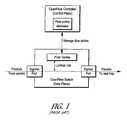
- FIG. 1shows a schematic diagram of an SDN computer network that is compliant with the OpenFlowTM protocol.
- the OpenFlowTM protocolseparates the control plane from the data plane.
- An OpenFlowTM controllerserves as a control plane for making forwarding decisions based on flow policies, which may be stored in a flow policy database.
- the controllerdetermines flow policies in conjunction with network forwarding setting and network topology.
- the flow policiesmay contain a condition and corresponding action to be performed when the condition is met.
- the actionmay specify how to manipulate a packet.
- An OpenFlowTM switchserves as the data plane that forwards packets, e.g., from an ingress port to an egress port, according to flow tables maintained by the data plane.
- the data planeis a replacement of traditional switches.
- the data planemay request the controller to receive a flow rule for the specific packet, and store the flow rule in the flow tables. Other packets that meet the same condition as the specific packet will be processed in accordance with the flow rule.
- the control planemay also actively insert flow rules into the flow tables.
- a software defined networking (SDN) computer networkincludes an SDN controller and an SDN switch.
- the SDN controllerinserts flow rules in a flow table of the SDN switch to create an SDN pipe between a sender component and a security component.
- a broadcast function of the SDN switch to the ports that form the SDN pipemay be disabled.
- the SDN pipeallows outgoing packets sent by the sender component to be received by the security component.
- the security componentinspects the outgoing packets for compliance with security policies and allows the outgoing packets to be forwarded to their destination when the outgoing packets pass inspection.
- the SDN controllermay also insert a flow rule in the flow table of the SDN switch to bypass inspection of specified packets.
- FIG. 1shows a schematic diagram of an SDN computer network that is compliant with the OpenFlowTM protocol.
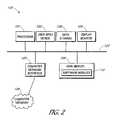
- FIG. 2shows a schematic diagram of a computer system that may be employed with embodiments of the present invention.
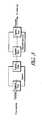
- FIGS. 3-5show schematic diagrams of computer networks that are capable of intercepting network traffic.
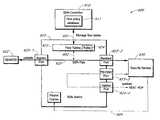
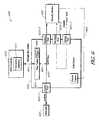
- FIG. 6shows a schematic diagram of an SDN computer network in accordance with an embodiment of the present invention.
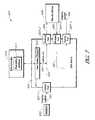
- FIG. 7schematically illustrates inspection of outgoing packets sent by a sender component in the SDN computer network of FIG. 6 in accordance with an embodiment of the present invention.
- FIG. 8schematically illustrates inspection of incoming packets to be received by a sender component in the SDN computer network of FIG. 6 in accordance with an embodiment of the present invention.
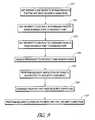
- FIG. 9shows a flow diagram of a computer-implemented method of inspecting network traffic in an SDN computer network in accordance with an embodiment of the present invention.
- FIG. 2shows a schematic diagram of a computer system 100 that may be employed with embodiments of the present invention.
- the computer system 100may be employed as a control plane and/or a data plane, for example.
- the computer system 100may be employed to host a virtualization environment that supports a plurality of virtual machines.
- the computer system 100may have fewer or more components to meet the needs of a particular application.
- the computer system 100may include one or more processors 101 .
- the computer system 100may have one or more buses 103 coupling its various components.
- the computer system 100may include one or more user input devices 102 (e.g., keyboard, mouse), one or more data storage devices 106 (e.g., hard drive, optical disk, Universal Serial Bus memory), a display monitor 104 (e.g., liquid crystal display, flat panel monitor), a computer network interface 105 (e.g., network adapter, modem), and a main memory 108 (e.g., random access memory).
- the computer network interface 105may be coupled to a computer network 109 .
- the computer system 100is a particular machine as programmed with software modules 110 .
- the software modules 110comprise computer-readable program code stored non-transitory in the main memory 108 for execution by the processor 101 .
- the computer system 100may be configured to perform its functions by executing the software modules 110 .
- the software modules 110may be loaded from the data storage device 106 to the main memory 108 .
- An article of manufacturemay be embodied as computer-readable storage medium including instructions that when executed by a computer causes the computer to be operable to perform the functions of the software modules 110 .
- Network security vendorsprovide network security services, such as firewall or deep packet inspection (DPI).
- DPIdeep packet inspection
- packets of network trafficare intercepted for inspection.
- One way of intercepting network trafficis to place the security service in the middle of the packet forwarding path. This is illustrated in FIG. 3 , where packets from a sender component (e.g., a sender computer) are received in an ingress port of a switch, forwarded to an egress port of the switch, and forwarded to the ingress port of a security component, such as a security service.
- the security servicemay inspect the packets, and forward the packets to an egress port of the switch toward the next hop, which may be another switch or a destination component (e.g., destination computer), for example.
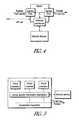
- Another way of intercepting network trafficis to mirror the packets to be inspected on a switch that provides vendor specific mirroring application programming interface (API) as shown in FIG. 4 .
- APIapplication programming interface
- a usermay make an API call such that particular packets that enter the ingress port of the switch are redirected or mirrored to the security service by way of a connection tunnel or a mirror port.
- the security servicemay forward the redirected or mirrored packets back to an egress port of the switch after inspection.
- network traffic from a virtual machinemay be intercepted as the network traffic passes through the hypervisor that runs the virtual machines. This is illustrated in FIG. 5 , where packets transmitted by virtual machines are intercepted at the virtualization hypervisor for redirection to a security service.
- the SDN computer network 600is compliant with the OpenFlowTM protocol.
- the SDN controller 610comprises an OpenFlowTM controller and the SDN switch 620 comprises an OpenFlowTM switch.
- the SDN controller 610 and the SDN switch 620comprise the control plane and data plane, respectively, of the SDN computer network 600 .
- the SDN computer network 600may have a plurality of SDN switches 620 but only one is shown for clarity of illustration.
- the SDN controller 610 and the SDN switch 620are logically separate components.
- the SDN computer network 600is a virtual computer network that allows for transmission of packets from one virtual machine to another.
- the SDN controller 610may comprise a virtual OpenFlowTM controller and the SDN switch 620 may comprise a virtual OpenFlowTM switch.
- the SDN computer network 600may be implemented in a computer system comprising one or more computers that host a virtualization environment.
- the SDN computer network 600may be implemented in the Amazon Web ServicesTM virtualization environment.
- the sender component 622may be a virtual machine in that embodiment.
- the SDN computer network 600may also be implemented using physical or a combination of physical and virtual components.
- the SDN controller 610may comprise one or more computers that serve as a control plane for the SDN switch 620 .
- the SDN switch 620may comprise an SDN-compliant physical network switch, such as an OpenFlowTM protocol-enabled physical network switch.
- the sender component 622may be a computer coupled to a port of the physical network switch.
- the SDN controller 610provides a logically centralized framework for controlling the behavior of the SDN computer network 600 . This is in marked contrast to traditional computer networks where the behavior of the computer network is controlled by low-level device configurations of switches and other network devices.
- the SDN controller 610may include a flow policy database 611 .
- the flow policy database 611may comprise flow policies that are enforced by the controller 610 on network traffic transmitted over the SDN computer network 600 .
- the flow policiesmay specify security policies that govern transmission of packets over the SDN computer network 600 .
- the flow policiesmay be enforced in terms of flow rules (labeled as 624 ) that are stored in the flow tables 621 of the SDN switch 620 .
- a flow policy in the flow policy database 611may indicate inspection of particular packets (e.g., those that meet one or more conditions) by a security service 630 .
- That flow policymay be implemented as a flow rule that forwards the particular packets received in an ingress port 623 - 1 to the redirect port 623 - 2 for inspection, for example.
- the SDN switch 620may comprise a plurality of ports 623 (i.e., 623 - 1 , 623 - 2 , 623 - 3 , 623 - 4 , etc.). The SDN switch 620 may forward packets from one port 623 to another port 623 in accordance with flow rules in the flow tables 621 .
- the port 6231 - 1is coupled to a sender component 622 .
- the port 623 - 1is referred to as an “ingress port” in that it is a port for receiving outgoing packets sent by the sender component 622 .
- the port 623 - 4is referred to as an “egress port” in that it is a port for transmitting outgoing packets sent by the sender component 622 . It is to be noted that any port 623 may be employed as an “ingress port,” “egress port,” “redirect port,” or “re-inject port.” The aforementioned labels are used herein merely to illustrate processing of packets relative to the sender component 622 .
- Packets going in the opposite directioni.e., incoming packets that are going to the sender component 622 , may be received in the egress port 623 - 4 , forwarded to the re-inject port 623 - 3 , received in the redirect port 623 - 2 , and forwarded to the ingress port 623 - 1 toward the sender component 622 .
- the SDN switch 620may comprise one or more flow tables 621 .
- the flow tables 621may comprise one or more flow rules (labeled as 624 ) that indicate how to manipulate or process packets that are passing through the SDN switch 620 .
- a flow rulemay indicate that a packet received in the ingress port 623 - 1 is to be forwarded to the redirect port 623 - 2 .
- Another flow rulemay indicate that a packet received in the redirect port 623 - 2 is to be forwarded to the ingress port 623 - 1 .
- the just mentioned pair of flow rulesare redirect flow rules that create an SDN pipe between the sender component 622 and the security service 630 , allowing the security service 630 to inspect packets sent by or going to the sender component 622 .
- Table 1shows an example flow table with flow rules that create an SDN pipe between the security service 630 and the sender component 622 .
- a flow tablemay include columns that indicate one or more conditions, a column that indicates an action to take when the conditions are met, and a column for statistics.
- a row on the flow tablemay comprise a flow rule.
- the “Action” columnindicates an action to take when conditions are met
- the “Count” columnindicates statistics, such as byte count.
- the rest of the columns of Table 1indicate conditions. For example, “IN_PORT”, “MAC src” (media access control (MAC) address of the source of the packet), “MAC dst” (MAC address of the destination of the packet), “IP src” (Internet Protocol (IP) address of the source of the packet), “IP dst” (IP address of the destination of the packet), etc. are conditions that identify a particular packet. When the conditions are met, i.e., the particular packet is identified, the action indicated in the corresponding “Action” column is performed on the packet.
- the asterisks in Table 1indicate an irrelevant condition.
- the first and second rowsare redirect flow rules for forming an SDN pipe between the sender component 622 and the security service 630 . More specifically, the first row of Table 1 is a flow rule instructing the SDN switch 620 to forward packets received in a port having the Ingress_port_ID (e.g., ingress port 623 - 1 ) to the redirect port (e.g., redirect port 623 - 2 ). Similarly, the second row of Table 1 is a flow rule instructing the SDN switch 620 to forward packets received in a port having a “Redirect_port_ID” to the ingress port.
- Ingress_port_IDe.g., ingress port 623 - 1
- redirect porte.g., redirect port 623 - 2
- the second row of Table 1is a flow rule instructing the SDN switch 620 to forward packets received in a port having a “Redirect_port_ID” to the ingress port.
- the SDN computer network 600may include a security component in the form of the security service 630 .
- the security service 630may comprise a virtual machine that provides computer network security services, such as packet inspection, for the sender component 622 and other virtual machines.
- the security service 630may comprise a virtual machine with a virtual network interface card that is coupled to the redirect port 623 - 2 and re-inject port 623 - 3 of the SDN switch 620 .
- the security service 630may inspect packets for compliance/non-compliance with security policies, such as for presence of malicious code, compliance with firewall rules and access control lists, network intrusion detection, and other computer network security services.
- the security service 630may employ conventional packet inspection algorithms.
- the security service 630may comprise the Trend Micro Deep SecurityTM service, for example.
- the security service 630may also comprise a physical machine, e.g., a server computer, an appliance, a gateway computer, etc.
- the security service 630may be connected to the SDN switch 620 by a physical link (i.e., using a wire), a virtual link (i.e., in a virtualized environment), or by a software tunnel.
- the security service 630may be connected to the SDN switch 620 by a software tunnel using generic routing encapsulation (GRE), stateless transport tunneling (STT), or some other software tunneling protocol supported by the SDN switch 620 .
- GREgeneric routing encapsulation
- STTstateless transport tunneling
- the security service 630serves as a remote (i.e., not in the same physical or virtual network) service that is only logically connected the SDN switch 620 by way of the software tunnel.
- the SDN controller 610may insert flow rules in the flow tables 621 (see arrow 601 ) to create an SDN pipe (labeled as 625 ) between the sender component 622 and the security service 630 .
- the SDN pipeallows outgoing packets sent by the sender component 622 or incoming packets going to the sender component 622 to be redirected to the security service 630 for inspection before the packets are sent out of the SDN switch 620 .
- the SDN pipeis created by creating a first flow rule that forwards packets received in the ingress port 623 - 1 to the redirect port 623 - 2 , and a second flow rule that forwards packets received in the redirect port 623 - 2 to the ingress port 623 - 1 .
- the L2 switching logic of the SDN computer network 600(which is controlled by the SDN controller 610 ) remembers that packets destined for the sender component 622 and entering the SDN switch 620 by way of the egress port 623 - 4 are to be forwarded to the re-inject port 623 - 3 . This allows the security service 630 to also receive incoming packets going to the sender component 622 for inspection.
- the creation of the SDN pipealso includes disabling the broadcast function of the SDN switch 620 to the ingress port 623 - 1 and the redirect port 623 - 2 . That is, packets that are broadcast to all ports of the SDN switch 620 will not be sent to the ports that form the SDN pipe. Instead, packets that are broadcasted by the SDN switch 620 are received by the security service 630 only through the re-inject port 623 - 3 , and forwarded by the security service 630 to the sender component 622 by way of the SDN pipe between the ingress port 623 - 1 and the redirect port 623 - 2 . The sender component 622 receives broadcast packets only from the security service 630 in that embodiment. In one embodiment, the SDN controller 610 disables the broadcast function to the ports forming the SDN pipe using the Open vSwitchTM database (OVSDB) management protocol, which is an OpenFlowTM configuration protocol.
- OVSDBOpen vSwitchTM database
- any packet received by the SDN switch 620 in the ingress port 623 - 1will be identified as to be forwarded to the redirect port 623 - 2
- any packet received by the SDN switch 620 in the redirect port 623 - 2will be identified as to be forwarded to the ingress port 623 - 1 (see arrow 602 ).
- Thisallows the security service 630 to receive from the redirect port 623 - 2 all outgoing packets sent by the sender component 622 to the ingress port 623 - 1 .
- the security service 630may inspect the outgoing packets for compliance with security policies.
- the security service 630may drop, or perform other security response, to packets that do not pass inspection (e.g., packets that do not meet firewall policies, packets containing prohibited payload, packets with malicious content, etc.).
- the security service 630may forward those packets that pass inspection toward their destination by re-injecting the packets back into the SDN switch 620 by way of the re-inject port 623 - 3 .
- the flow rules that govern packets received in the ingress port 623 - 1 and the redirect port 623 - 2no longer apply. Accordingly, the re-injected packets are forwarded to the egress port 623 - 4 (or some other port) toward the next hop in accordance with the L2 switching logic of the SDN computer network 600 .
- Incoming packets to the sender component 622 that enter the SDN switch 620 on the egress port 623 - 4are forwarded to the re-inject port 623 - 3 in accordance with the L2 switching logic of the SDN computer network 600 .
- the security service 630receives the incoming packets from the re-inject port 623 - 3 , inspects the incoming packets, and transmits those incoming packets that pass inspection to the redirect port 623 - 2 .
- the incoming packetsare forwarded from the redirect port 623 - 2 to the ingress port 623 - 1 in accordance with the flow rules that form the SDN pipe.
- the sender component 622is connected to the ingress port 623 - 1 , and receives the incoming packets therefrom.
- the SDN switch 620may be configured to copy packets that are redirected to the security service 630 for inspection. This way, the security service 630 simply has to inform the SDN switch 620 an action to take on packets based on the result of the inspection (see arrow 604 ). For example, the security service 630 may send an index identifying the packets and an action on how to manipulate the packets. The action may instruct the SDN switch 620 to drop the copied packets, forward the copied packets to their destinations, quarantine the copied packets, etc.
- bypass flow rulesare inserted in the flow tables 621 such that particular packets that do not need to be inspected are not redirected to the security service 630 . This embodiment is explained with reference to example flow tables of Tables 2 and 3.
- HTTPhypertext transfer protocol
- port 80 packetsthat are received in the ingress port with the Ingress_port_ID (i.e., ingress port 623 - 1 ) are forwarded directly to the egress port (i.e., egress port 623 - 4 ), instead of being redirected to the redirect port 623 - 2 for inspection by the security service 630 .
- HTTP packets received in the egress port with the Egress_port_IDi.e., egress port 623 - 4
- the bottom two rowsare redirect flow rules for forming the SDN pipe between the sender component 622 and the security service 630 . Because the bypass flow rules are inserted in the flow tables 621 with higher priority than the redirect flow rules, the bypass flow rules are followed by the SDN switch 620 before the redirect flow rules. Accordingly, HTTP packets are not redirected for inspection by the security service 630 . Other packets, i.e., non-HTTP packets, are redirected to the security service 630 per the redirect flow rules. Bypass flow rules and redirect flow rules may be set at different priority levels to meet particular packet inspection needs.
- bypass and redirect flow rulesalso allow for inspection of particular packets, while allowing all other packets to bypass inspection. This is illustrated in the example flow table of Table 3.
- the top two rowsare redirect flow rules for redirecting HTTP packets to the security service 630 for inspection, while the bottom two rows are bypass flow rules for all packets. Because the redirect flow rules are at higher priority than the bypass flow rules, HTTP packets are sent through the SDN pipe formed in the SDN switch 620 between the sender component 622 and the security service 630 . All other packets bypass the SDN pipe, and are accordingly not inspected by the security service 630 .
- FIG. 7schematically illustrates inspection of outgoing packets sent by the sender component 622 in the SDN computer network 600 in accordance with an embodiment of the present invention.
- the sender component 622e.g., a virtual machine, a laptop computer, desktop computer, etc.
- the SDN switch 620receives the outgoing packets in the ingress port 623 - 1 and follows a flow rule that pertains to the outgoing packets (see arrow 652 ).
- FIG. 7schematically illustrates inspection of outgoing packets sent by the sender component 622 in the SDN computer network 600 in accordance with an embodiment of the present invention.
- the sender component 622e.g., a virtual machine, a laptop computer, desktop computer, etc.
- the SDN switch 620receives the outgoing packets in the in
- a redirect flow ruledictates that packets received by the SDN switch 620 in the ingress port 623 - 1 are to be forwarded to the redirect port 623 - 2 . Accordingly, the SDN switch 620 forwards the outgoing packets to the redirect port 623 - 2 (see arrow 653 ), which is connected to the security service 630 (e.g., a virtual machine, server computer, appliance, etc.). The security service 630 receives the outgoing packets from the redirect port 623 - 2 (see arrow 654 ) and inspects the outgoing packets.
- the security service 630e.g., a virtual machine, server computer, appliance, etc.
- the security service 630re-injects the outgoing packets (e.g., outgoing packets that passed inspection) back into the SDN switch 620 by way of the re-inject port 623 - 3 (see arrow 655 ).
- the SDN switch 620receives the outgoing packets on the re-inject port 623 - 3 .
- the SDN switch 620forwards the outgoing packets from the re-inject port 623 - 3 to the egress port 623 - 4 in accordance with the L2 switching logic of the SDN computer network 600 (see arrow 657 ).
- the outgoing packetsexit the SDN switch 620 through the egress port 623 - 4 (see arrow 658 ) and move towards their destination.
- FIG. 8schematically illustrates inspection of incoming packets to be received by the sender component 622 in the SDN computer network 600 in accordance with an embodiment of the present invention.
- the incoming packetsare received by the SDN switch 620 on the egress port 623 - 4 (see arrow 671 ).
- the SDN switch 620identifies the incoming packets as to be forwarded to the re-inject port 623 - 3 in accordance with the L2 switching logic of the SDN computer network 600 . Accordingly, the SDN switch 620 forwards the incoming packets from the egress port 623 - 4 to the re-inject port 623 - 3 (see arrow 672 ).
- the security service 630receives the incoming packets from the re-inject port 623 - 3 (see arrow 673 ), inspects the incoming packets, and transmits the incoming packets (e.g., those that passed inspection) back to SDN switch 620 by way of the redirect port 623 - 2 (see arrow 674 ).
- the SDN switch 620receives the incoming packets on the redirect port 623 - 2 , and determines from a redirect flow rule in the flow tables 621 that packets received in the redirect port 623 - 2 are to be forwarded to the ingress port 623 - 1 (see arrow 675 ).
- the SDN switch 620forwards the incoming packets from the redirect port 623 - 2 to the ingress port 623 - 1 (see arrow 676 ).
- the sender component 622receives the incoming packets from the ingress port 623 - 1 (see arrow 677 ).
- FIG. 9shows a flow diagram of a computer-implemented method of inspecting network traffic in an SDN computer network in accordance with an embodiment of the present invention.
- the method of FIG. 9may be performed using previously described components for ease of illustration. Other components may also be employed without detracting from the merits of the present invention.
- the SDN controllerinserts one or more bypass flow rules in the flow table of an SDN switch that is controlled by the SDN controller (step 701 ).
- the bypass flow rulesmay instruct the SDN switch to forward particular packets directly from one port to another port of the SDN switch without being redirected to a security component, such as a security service, for inspection.
- the bypass flow rulesmay be inserted at higher or lower priority than redirect flow rules for creating an SDN pipe that redirects packets to be inspected to the security service.
- the security servicemay comprise a physical or virtual machine that provides a security service by inspecting network traffic.
- an SDN pipeis created in the SDN switch by inserting redirect flow rules in the flow table of the SDN switch.
- the SDN pipe formed by the redirect flow rulesallows for interception of packets sent by or transmitted to a virtual machine for inspection by the security service.
- the SDN controllerinserts a first flow rule that instructs the SDN switch to forward packets received in an ingress port to a redirect port (step 702 ).
- the ingress portmay be a port of the SDN switch that is connected to the virtual machine, and the redirect port may be a port of the SDN switch that is connected to the security service.
- the SDN controlleralso inserts a second flow rule that instructs the SDN switch to forward packets received in the redirect port to the egress port (step 703 ).
- the SDN controllermay also disable the broadcast function of the SDN switch to the ingress port and the redirect port (step 704 ) to prevent the same broadcast packets to be received multiple times by the virtual machine and the security service.
- the just described redirect rulesallow packets received by the SDN switch on the ingress port or packets destined for the virtual machine and received by the SDN switch on the egress port to be received by the security service, and packets received by the SDN switch on the redirect port to be forwarded to the virtual machine.
- Packets that have been redirected to the security serviceare inspected by the security service (step 705 ).
- the security serviceforwards packets that pass inspection, e.g., by re-injecting packets that pass inspection back into the SDN switch (step 706 ).
- the security servicemay perform a security response on packets that fail inspection (step 707 ). For example, the security component may drop packets that fail inspection.
Landscapes
- Engineering & Computer Science (AREA)
- Computer Networks & Wireless Communication (AREA)
- Signal Processing (AREA)
- Computer Security & Cryptography (AREA)
- General Engineering & Computer Science (AREA)
- Computer Hardware Design (AREA)
- Computing Systems (AREA)
- Software Systems (AREA)
- Theoretical Computer Science (AREA)
- Physics & Mathematics (AREA)
- General Physics & Mathematics (AREA)
- Data Exchanges In Wide-Area Networks (AREA)
Abstract
Description
This application is a continuation of U.S. patent application Ser. No. 14/094,442, filed on Dec. 2, 2013, which is incorporated herein by reference in its entirety.
1. Field of the Invention
The present invention relates generally to computer security, and more particularly but not exclusively to software defined networking.
2. Description of the Background Art
Software defined networking (SDN) is an emerging architecture for computer networking. Unlike traditional computer network architectures, SDN separates the control plane from the data plane. This provides many advantages, including relatively fast experimentation and optimization of switching and routing policies. SDN is applicable to both physical (i.e., real) and virtual computer networks.
The OpenFlow™ protocol is an open protocol for remotely controlling forwarding tables of network switches that are enabled for SDN. Generally speaking, the OpenFlow™ protocol allows direct access to and manipulation of the forwarding plane of network devices, such as switches and routers. A control plane of an OpenFlow™ protocol-compliant computer network (also referred to as an “OpenFlow™ controller”) may communicate with OpenFlow™ switches (i.e., network switches that are compliant with the OpenFlow™ protocol) to set flow policies that specify how the switches should manipulate packets of network traffic. Example packet manipulation actions include forwarding a packet to a specific port, modifying one or more fields of the packet, asking the controller for action to perform on the packet, or dropping the packet.
An OpenFlow™ switch serves as the data plane that forwards packets, e.g., from an ingress port to an egress port, according to flow tables maintained by the data plane. The data plane is a replacement of traditional switches. When the data plane does not know how to manipulate a specific packet, the data plane may request the controller to receive a flow rule for the specific packet, and store the flow rule in the flow tables. Other packets that meet the same condition as the specific packet will be processed in accordance with the flow rule. The control plane may also actively insert flow rules into the flow tables.
In one embodiment, a software defined networking (SDN) computer network includes an SDN controller and an SDN switch. The SDN controller inserts flow rules in a flow table of the SDN switch to create an SDN pipe between a sender component and a security component. A broadcast function of the SDN switch to the ports that form the SDN pipe may be disabled. The SDN pipe allows outgoing packets sent by the sender component to be received by the security component. The security component inspects the outgoing packets for compliance with security policies and allows the outgoing packets to be forwarded to their destination when the outgoing packets pass inspection. The SDN controller may also insert a flow rule in the flow table of the SDN switch to bypass inspection of specified packets.
These and other features of the present invention will be readily apparent to persons of ordinary skill in the art upon reading the entirety of this disclosure, which includes the accompanying drawings and claims.
The use of the same reference label in different drawings indicates the same or like components.
In the present disclosure, numerous specific details are provided, such as examples of apparatus, components, and methods, to provide a thorough understanding of embodiments of the invention. Persons of ordinary skill in the art will recognize, however, that the invention can be practiced without one or more of the specific details. In other instances, well-known details are not shown or described to avoid obscuring aspects of the invention.
Thecomputer system 100 is a particular machine as programmed withsoftware modules 110. Thesoftware modules 110 comprise computer-readable program code stored non-transitory in themain memory 108 for execution by theprocessor 101. Thecomputer system 100 may be configured to perform its functions by executing thesoftware modules 110. Thesoftware modules 110 may be loaded from thedata storage device 106 to themain memory 108. An article of manufacture may be embodied as computer-readable storage medium including instructions that when executed by a computer causes the computer to be operable to perform the functions of thesoftware modules 110.
Network security vendors provide network security services, such as firewall or deep packet inspection (DPI). Generally speaking, to provide network security services, packets of network traffic are intercepted for inspection. One way of intercepting network traffic is to place the security service in the middle of the packet forwarding path. This is illustrated inFIG. 3 , where packets from a sender component (e.g., a sender computer) are received in an ingress port of a switch, forwarded to an egress port of the switch, and forwarded to the ingress port of a security component, such as a security service. The security service may inspect the packets, and forward the packets to an egress port of the switch toward the next hop, which may be another switch or a destination component (e.g., destination computer), for example.
Another way of intercepting network traffic is to mirror the packets to be inspected on a switch that provides vendor specific mirroring application programming interface (API) as shown inFIG. 4 . A user may make an API call such that particular packets that enter the ingress port of the switch are redirected or mirrored to the security service by way of a connection tunnel or a mirror port. The security service may forward the redirected or mirrored packets back to an egress port of the switch after inspection.
In a virtualized computing environment, network traffic from a virtual machine may be intercepted as the network traffic passes through the hypervisor that runs the virtual machines. This is illustrated inFIG. 5 , where packets transmitted by virtual machines are intercepted at the virtualization hypervisor for redirection to a security service.
Referring now toFIG. 6 , there is shown a schematic diagram of anSDN computer network 600 in accordance with an embodiment of the present invention. In one embodiment, theSDN computer network 600 is compliant with the OpenFlow™ protocol. Accordingly, in one embodiment, theSDN controller 610 comprises an OpenFlow™ controller and theSDN switch 620 comprises an OpenFlow™ switch. TheSDN controller 610 and theSDN switch 620 comprise the control plane and data plane, respectively, of theSDN computer network 600. TheSDN computer network 600 may have a plurality of SDN switches620 but only one is shown for clarity of illustration. TheSDN controller 610 and theSDN switch 620 are logically separate components.
In one embodiment, theSDN computer network 600 is a virtual computer network that allows for transmission of packets from one virtual machine to another. Accordingly, theSDN controller 610 may comprise a virtual OpenFlow™ controller and theSDN switch 620 may comprise a virtual OpenFlow™ switch. TheSDN computer network 600 may be implemented in a computer system comprising one or more computers that host a virtualization environment. For example, theSDN computer network 600 may be implemented in the Amazon Web Services™ virtualization environment. Thesender component 622 may be a virtual machine in that embodiment.
TheSDN computer network 600 may also be implemented using physical or a combination of physical and virtual components. For example, theSDN controller 610 may comprise one or more computers that serve as a control plane for theSDN switch 620. In that embodiment, theSDN switch 620 may comprise an SDN-compliant physical network switch, such as an OpenFlow™ protocol-enabled physical network switch. Thesender component 622 may be a computer coupled to a port of the physical network switch.
TheSDN controller 610 provides a logically centralized framework for controlling the behavior of theSDN computer network 600. This is in marked contrast to traditional computer networks where the behavior of the computer network is controlled by low-level device configurations of switches and other network devices. TheSDN controller 610 may include aflow policy database 611. Theflow policy database 611 may comprise flow policies that are enforced by thecontroller 610 on network traffic transmitted over theSDN computer network 600. The flow policies may specify security policies that govern transmission of packets over theSDN computer network 600. The flow policies may be enforced in terms of flow rules (labeled as624) that are stored in the flow tables621 of theSDN switch 620. As a particular example, a flow policy in theflow policy database 611 may indicate inspection of particular packets (e.g., those that meet one or more conditions) by asecurity service 630. That flow policy may be implemented as a flow rule that forwards the particular packets received in an ingress port623-1 to the redirect port623-2 for inspection, for example.
TheSDN switch 620 may comprise a plurality of ports623 (i.e.,623-1,623-2,623-3,623-4, etc.). TheSDN switch 620 may forward packets from one port623 to another port623 in accordance with flow rules in the flow tables621. In the example ofFIG. 6 , the port6231-1 is coupled to asender component 622. The port623-1 is referred to as an “ingress port” in that it is a port for receiving outgoing packets sent by thesender component 622. Similarly, the port623-4 is referred to as an “egress port” in that it is a port for transmitting outgoing packets sent by thesender component 622. It is to be noted that any port623 may be employed as an “ingress port,” “egress port,” “redirect port,” or “re-inject port.” The aforementioned labels are used herein merely to illustrate processing of packets relative to thesender component 622. Packets going in the opposite direction, i.e., incoming packets that are going to thesender component 622, may be received in the egress port623-4, forwarded to the re-inject port623-3, received in the redirect port623-2, and forwarded to the ingress port623-1 toward thesender component 622.
TheSDN switch 620 may comprise one or more flow tables621. The flow tables621 may comprise one or more flow rules (labeled as624) that indicate how to manipulate or process packets that are passing through theSDN switch 620. As a particular example, a flow rule may indicate that a packet received in the ingress port623-1 is to be forwarded to the redirect port623-2. Another flow rule may indicate that a packet received in the redirect port623-2 is to be forwarded to the ingress port623-1. The just mentioned pair of flow rules are redirect flow rules that create an SDN pipe between thesender component 622 and thesecurity service 630, allowing thesecurity service 630 to inspect packets sent by or going to thesender component 622. Table 1 shows an example flow table with flow rules that create an SDN pipe between thesecurity service 630 and thesender component 622.
| TABLE 1 | |||||||
| MAC | MAC | IP | IP | ||||
| IN_PORT | src | dst | src | dst | . . . | Action | Count |
| Ingress_port_ID | * | * | * | * | * | Redirect port | 10 |
| Redirect_port_ID | * | * | * | * | * | Ingress port | 10 |
A flow table may include columns that indicate one or more conditions, a column that indicates an action to take when the conditions are met, and a column for statistics. A row on the flow table may comprise a flow rule. In the example of Table 1, the “Action” column indicates an action to take when conditions are met, and the “Count” column indicates statistics, such as byte count. The rest of the columns of Table 1 indicate conditions. For example, “IN_PORT”, “MAC src” (media access control (MAC) address of the source of the packet), “MAC dst” (MAC address of the destination of the packet), “IP src” (Internet Protocol (IP) address of the source of the packet), “IP dst” (IP address of the destination of the packet), etc. are conditions that identify a particular packet. When the conditions are met, i.e., the particular packet is identified, the action indicated in the corresponding “Action” column is performed on the packet. The asterisks in Table 1 indicate an irrelevant condition.
In the example of Table 1, the first and second rows are redirect flow rules for forming an SDN pipe between thesender component 622 and thesecurity service 630. More specifically, the first row of Table 1 is a flow rule instructing theSDN switch 620 to forward packets received in a port having the Ingress_port_ID (e.g., ingress port623-1) to the redirect port (e.g., redirect port623-2). Similarly, the second row of Table 1 is a flow rule instructing theSDN switch 620 to forward packets received in a port having a “Redirect_port_ID” to the ingress port.
TheSDN computer network 600 may include a security component in the form of thesecurity service 630. Thesecurity service 630 may comprise a virtual machine that provides computer network security services, such as packet inspection, for thesender component 622 and other virtual machines. For example, thesecurity service 630 may comprise a virtual machine with a virtual network interface card that is coupled to the redirect port623-2 and re-inject port623-3 of theSDN switch 620. Thesecurity service 630 may inspect packets for compliance/non-compliance with security policies, such as for presence of malicious code, compliance with firewall rules and access control lists, network intrusion detection, and other computer network security services. Thesecurity service 630 may employ conventional packet inspection algorithms. Thesecurity service 630 may comprise the Trend Micro Deep Security™ service, for example. Thesecurity service 630 may also comprise a physical machine, e.g., a server computer, an appliance, a gateway computer, etc.
Thesecurity service 630 may be connected to theSDN switch 620 by a physical link (i.e., using a wire), a virtual link (i.e., in a virtualized environment), or by a software tunnel. As a particular example, instead of using a physical link or a virtual link, thesecurity service 630 may be connected to theSDN switch 620 by a software tunnel using generic routing encapsulation (GRE), stateless transport tunneling (STT), or some other software tunneling protocol supported by theSDN switch 620. In that example, thesecurity service 630 serves as a remote (i.e., not in the same physical or virtual network) service that is only logically connected theSDN switch 620 by way of the software tunnel.
TheSDN controller 610 may insert flow rules in the flow tables621 (see arrow601) to create an SDN pipe (labeled as625) between thesender component 622 and thesecurity service 630. The SDN pipe allows outgoing packets sent by thesender component 622 or incoming packets going to thesender component 622 to be redirected to thesecurity service 630 for inspection before the packets are sent out of theSDN switch 620. In one embodiment, the SDN pipe is created by creating a first flow rule that forwards packets received in the ingress port623-1 to the redirect port623-2, and a second flow rule that forwards packets received in the redirect port623-2 to the ingress port623-1.
Once outgoing packets from thesender component 622 are inspected by thesecurity service 630 and re-injected by thesecurity service 630 back into theSDN switch 620 through the re-inject port623-3 and then forwarded out to the egress port623-4, the L2 switching logic of the SDN computer network600 (which is controlled by the SDN controller610) remembers that packets destined for thesender component 622 and entering theSDN switch 620 by way of the egress port623-4 are to be forwarded to the re-inject port623-3. This allows thesecurity service 630 to also receive incoming packets going to thesender component 622 for inspection.
In one embodiment, the creation of the SDN pipe also includes disabling the broadcast function of theSDN switch 620 to the ingress port623-1 and the redirect port623-2. That is, packets that are broadcast to all ports of theSDN switch 620 will not be sent to the ports that form the SDN pipe. Instead, packets that are broadcasted by theSDN switch 620 are received by thesecurity service 630 only through the re-inject port623-3, and forwarded by thesecurity service 630 to thesender component 622 by way of the SDN pipe between the ingress port623-1 and the redirect port623-2. Thesender component 622 receives broadcast packets only from thesecurity service 630 in that embodiment. In one embodiment, theSDN controller 610 disables the broadcast function to the ports forming the SDN pipe using the Open vSwitch™ database (OVSDB) management protocol, which is an OpenFlow™ configuration protocol.
After the redirect flow rules for creating the SDN pipe are inserted in the flow tables621, any packet received by theSDN switch 620 in the ingress port623-1 will be identified as to be forwarded to the redirect port623-2, and any packet received by theSDN switch 620 in the redirect port623-2 will be identified as to be forwarded to the ingress port623-1 (see arrow602). This allows thesecurity service 630 to receive from the redirect port623-2 all outgoing packets sent by thesender component 622 to the ingress port623-1. Thesecurity service 630 may inspect the outgoing packets for compliance with security policies. Thesecurity service 630 may drop, or perform other security response, to packets that do not pass inspection (e.g., packets that do not meet firewall policies, packets containing prohibited payload, packets with malicious content, etc.). Thesecurity service 630 may forward those packets that pass inspection toward their destination by re-injecting the packets back into theSDN switch 620 by way of the re-inject port623-3. Once back in theSDN switch 620 by way of the re-inject port623-3, the flow rules that govern packets received in the ingress port623-1 and the redirect port623-2 no longer apply. Accordingly, the re-injected packets are forwarded to the egress port623-4 (or some other port) toward the next hop in accordance with the L2 switching logic of theSDN computer network 600.
Incoming packets to thesender component 622 that enter theSDN switch 620 on the egress port623-4 are forwarded to the re-inject port623-3 in accordance with the L2 switching logic of theSDN computer network 600. Thesecurity service 630 receives the incoming packets from the re-inject port623-3, inspects the incoming packets, and transmits those incoming packets that pass inspection to the redirect port623-2. The incoming packets are forwarded from the redirect port623-2 to the ingress port623-1 in accordance with the flow rules that form the SDN pipe. Thesender component 622 is connected to the ingress port623-1, and receives the incoming packets therefrom.
Re-injecting packets that pass inspection consume bandwidth, as the packets will have to be transmitted by thesecurity service 630 to the re-inject port623-3. For optimization, theSDN switch 620 may be configured to copy packets that are redirected to thesecurity service 630 for inspection. This way, thesecurity service 630 simply has to inform theSDN switch 620 an action to take on packets based on the result of the inspection (see arrow604). For example, thesecurity service 630 may send an index identifying the packets and an action on how to manipulate the packets. The action may instruct theSDN switch 620 to drop the copied packets, forward the copied packets to their destinations, quarantine the copied packets, etc.
In one embodiment, bypass flow rules are inserted in the flow tables621 such that particular packets that do not need to be inspected are not redirected to thesecurity service 630. This embodiment is explained with reference to example flow tables of Tables 2 and 3.
| TABLE 2 | |||||||
| IP | TCP src | TCP dst | |||||
| IN_PORT | . . . | src | port | port | . . . | Action | Count |
| Ingress_port_ID | * | * | * | 80 | * | Egress port | 120 |
| Egress_port_ID | * | * | 80 | * | * | Ingress port | 120 |
| Ingress_port_ID | * | * | * | * | * | Redirect port | 10 |
| Redirect_ | * | * | * | * | * | Ingress port | 10 |
| port_ID | |||||||
In the example of Table 2, the first two rows are bypass rules for bypassing packets coming from or going to a transport control protocol (TCP) port 80. More specifically, hypertext transfer protocol (HTTP) packets, i.e., port 80 packets, that are received in the ingress port with the Ingress_port_ID (i.e., ingress port623-1) are forwarded directly to the egress port (i.e., egress port623-4), instead of being redirected to the redirect port623-2 for inspection by the
In the example of Table 2, the bottom two rows are redirect flow rules for forming the SDN pipe between thesender component 622 and thesecurity service 630. Because the bypass flow rules are inserted in the flow tables621 with higher priority than the redirect flow rules, the bypass flow rules are followed by theSDN switch 620 before the redirect flow rules. Accordingly, HTTP packets are not redirected for inspection by thesecurity service 630. Other packets, i.e., non-HTTP packets, are redirected to thesecurity service 630 per the redirect flow rules. Bypass flow rules and redirect flow rules may be set at different priority levels to meet particular packet inspection needs.
The bypass and redirect flow rules also allow for inspection of particular packets, while allowing all other packets to bypass inspection. This is illustrated in the example flow table of Table 3.
| TABLE 3 | |||||||
| IP | TCP src | TCP dst | |||||
| IN_PORT | . . . | src | port | port | . . . | Action | Count |
| Ingress_port_ID | * | * | * | 80 | * | Redirect port | 10 |
| Redirect_port_ID | * | * | 80 | * | * | Ingress port | 10 |
| Ingress_port_ID | * | * | * | * | * | Egress port | 130 |
| Egress_port_ID | * | * | * | * | * | Ingress port | 130 |
In the example of Table 3, the top two rows are redirect flow rules for redirecting HTTP packets to thesecurity service 630 for inspection, while the bottom two rows are bypass flow rules for all packets. Because the redirect flow rules are at higher priority than the bypass flow rules, HTTP packets are sent through the SDN pipe formed in theSDN switch 620 between thesender component 622 and thesecurity service 630. All other packets bypass the SDN pipe, and are accordingly not inspected by thesecurity service 630.
In the method ofFIG. 9 , the SDN controller inserts one or more bypass flow rules in the flow table of an SDN switch that is controlled by the SDN controller (step701). The bypass flow rules may instruct the SDN switch to forward particular packets directly from one port to another port of the SDN switch without being redirected to a security component, such as a security service, for inspection. The bypass flow rules may be inserted at higher or lower priority than redirect flow rules for creating an SDN pipe that redirects packets to be inspected to the security service. The security service may comprise a physical or virtual machine that provides a security service by inspecting network traffic.
In the following two steps (steps 702 and703), an SDN pipe is created in the SDN switch by inserting redirect flow rules in the flow table of the SDN switch. In one embodiment, the SDN pipe formed by the redirect flow rules allows for interception of packets sent by or transmitted to a virtual machine for inspection by the security service. The SDN controller inserts a first flow rule that instructs the SDN switch to forward packets received in an ingress port to a redirect port (step702). The ingress port may be a port of the SDN switch that is connected to the virtual machine, and the redirect port may be a port of the SDN switch that is connected to the security service. The SDN controller also inserts a second flow rule that instructs the SDN switch to forward packets received in the redirect port to the egress port (step703). The SDN controller may also disable the broadcast function of the SDN switch to the ingress port and the redirect port (step704) to prevent the same broadcast packets to be received multiple times by the virtual machine and the security service.
As can be appreciated, the just described redirect rules allow packets received by the SDN switch on the ingress port or packets destined for the virtual machine and received by the SDN switch on the egress port to be received by the security service, and packets received by the SDN switch on the redirect port to be forwarded to the virtual machine. Packets that have been redirected to the security service are inspected by the security service (step705). The security service forwards packets that pass inspection, e.g., by re-injecting packets that pass inspection back into the SDN switch (step706). The security service may perform a security response on packets that fail inspection (step707). For example, the security component may drop packets that fail inspection.
Methods and systems for inspecting network traffic in SDN computer networks have been disclosed. While specific embodiments of the present invention have been provided, it is to be understood that these embodiments are for illustration purposes and not limiting. Many additional embodiments will be apparent to persons of ordinary skill in the art reading this disclosure.
Claims (17)
1. A software defined networking (SDN) computer network comprising:
a security component;
an SDN switch comprising a plurality of ports that receive network traffic of an SDN computer network, the SDN switch having a first port coupled to a sender component and a second port coupled to the security component, the SDN switch comprising a flow table that comprises a first flow rule to forward a packet received in the first port to the security component that is coupled to the second port, wherein the SDN switch receives outgoing packets from the first port and forwards the outgoing packets to the second port in accordance with the first flow rule, the outgoing packets being sent by the sender component to a destination component; and
an SDN controller that controls forwarding behavior of the SDN switch and inserts the first flow rule into the flow table of the SDN switch,
wherein the security component receives the outgoing packets from the second port of the SDN switch, inspects the outgoing packets, and re-injects the outgoing packets back into the SDN switch to allow the outgoing packets to be forwarded out of another port of the SDN switch towards their destination when the outgoing packets pass inspection.
2. The SDN computer network ofclaim 1 , wherein the SDN computer network is in a virtualized computing environment hosted by one or more computers, and the sender component comprises a virtual machine.
3. The SDN computer network ofclaim 1 , wherein the SDN switch comprises a physical packet switch, the SDN controller comprises one or more computers that send flow rules to the SDN switch, and the sender component comprises a computer coupled to the first port of the SDN switch.
4. The SDN computer network ofclaim 1 , wherein the security component performs a security response on the outgoing packets when the outgoing packets do not pass inspection.
5. The SDN computer network ofclaim 4 , wherein the security component drops the outgoing packets when the outgoing packets do not pass inspection.
6. The SDN computer network ofclaim 1 , wherein the flow table of the SDN switch includes a bypass flow rule that forwards specified packets directly from the first port of the SDN switch to a third port of the SDN switch without being forwarded to the security component for inspection.
7. The SDN computer network ofclaim 6 , wherein the specified packets are packets having a particular transport control protocol (TCP) source or destination port.
8. The SDN computer network ofclaim 1 , wherein the security component inspects the outgoing packets for presence of malicious codes.
9. The SDN computer network ofclaim 1 , wherein the flow table further comprises a second flow rule to forward a packet received in the second port to the first port, and a broadcast function of the SDN switch to the first port of the SDN switch and the second port of the SDN switch is disabled.
10. A computer-implemented method of inspecting network traffic in a software defined networking (SDN) computer network, the method comprising:
inserting a first flow rule in a flow table of an SDN switch, the first flow rule instructing the SDN switch to forward packets received in a first port of the SDN switch to a second port of the SDN switch;
inserting a second flow rule in the flow table of the SDN switch, the second flow rule instructing the SDN switch to forward packets received in the second port of the SDN switch to the first port of the SDN switch;
disabling a broadcast function of the SDN switch to the first port of the SDN switch and to the second port of the SDN switch;
forwarding outgoing packets from the first port of the SDN switch to the second port of the SDN switch in accordance with the first flow rule;
receiving the outgoing packets in a security component that is coupled to the second port of the SDN switch;
inspecting the outgoing packets in the security component for compliance with security policies; and
re-injecting the outgoing packets back into the SDN switch to allow the outgoing packets to be forwarded out of another port of the SDN switch towards their destination when the outgoing packets pass inspection.
11. The computer-implemented method ofclaim 10 , wherein inspecting the outgoing packets in the security component for compliance with security policies comprises inspecting the outgoing packets for presence of malicious codes.
12. The computer-implemented method ofclaim 10 , further comprising:
after inspecting the outgoing packets in the security component, dropping the outgoing packets when the outgoing packets do not pass inspection for compliance with the security policies.
13. The computer-implemented method ofclaim 10 , further comprising:
inserting a third flow rule in the flow table of the SDN switch, the third flow rule instructing the SDN switch to forward specified packets directly from the first port of the SDN switch to a third port of the SDN switch to bypass inspection of the specified packets by the security component.
14. A computer-implemented method of inspecting network traffic in a software defined networking (SDN) computer network, the method comprising:
receiving outgoing packets in a first port of an SDN switch;
forwarding the outgoing packets from the first port of the SDN switch to a second port of the SDN switch in accordance with a first flow rule inserted by an SDN controller in a flow table of the SDN switch, the first port of the SDN switch being coupled to a virtual machine and the second port of the SDN switch being coupled to a security component;
receiving the outgoing packets in the security component by way of the second port of the SDN switch;
inspecting the outgoing packets in the security component; and
re-injecting the outgoing packets back into the SDN switch to allow the outgoing packets to be forwarded out of another port of the SDN switch towards their destination when the outgoing packets pass inspection.
15. The computer-implemented method ofclaim 14 , wherein the outgoing packets are transmitted by a virtual machine to a destination component.
16. The computer-implemented method ofclaim 14 , wherein the outgoing packets are inspected for presence of malicious codes.
17. The computer-implemented method ofclaim 14 , further comprising:
disabling a broadcast function to the first port of the SDN switch and to the second port of the SDN switch.
Priority Applications (1)
| Application Number | Priority Date | Filing Date | Title |
|---|---|---|---|
| US14/990,007US9407579B1 (en) | 2013-12-02 | 2016-01-07 | Software defined networking pipe for network traffic inspection |
Applications Claiming Priority (2)
| Application Number | Priority Date | Filing Date | Title |
|---|---|---|---|
| US14/094,442US9264400B1 (en) | 2013-12-02 | 2013-12-02 | Software defined networking pipe for network traffic inspection |
| US14/990,007US9407579B1 (en) | 2013-12-02 | 2016-01-07 | Software defined networking pipe for network traffic inspection |
Related Parent Applications (1)
| Application Number | Title | Priority Date | Filing Date |
|---|---|---|---|
| US14/094,442ContinuationUS9264400B1 (en) | 2013-12-02 | 2013-12-02 | Software defined networking pipe for network traffic inspection |
Publications (1)
| Publication Number | Publication Date |
|---|---|
| US9407579B1true US9407579B1 (en) | 2016-08-02 |
Family
ID=55275555
Family Applications (2)
| Application Number | Title | Priority Date | Filing Date |
|---|---|---|---|
| US14/094,442Active2034-04-02US9264400B1 (en) | 2013-12-02 | 2013-12-02 | Software defined networking pipe for network traffic inspection |
| US14/990,007ActiveUS9407579B1 (en) | 2013-12-02 | 2016-01-07 | Software defined networking pipe for network traffic inspection |
Family Applications Before (1)
| Application Number | Title | Priority Date | Filing Date |
|---|---|---|---|
| US14/094,442Active2034-04-02US9264400B1 (en) | 2013-12-02 | 2013-12-02 | Software defined networking pipe for network traffic inspection |
Country Status (1)
| Country | Link |
|---|---|
| US (2) | US9264400B1 (en) |
Families Citing this family (33)
| Publication number | Priority date | Publication date | Assignee | Title |
|---|---|---|---|---|
| US9577924B2 (en)* | 2013-11-14 | 2017-02-21 | Electronics And Telecommunications Research Institute | SDN-based network device with extended function and method of processing packet in the same device |
| US20150304164A1 (en)* | 2014-04-17 | 2015-10-22 | Accton Technology Corporation | Data center auto provisioning |
| EP3618358B1 (en) | 2014-04-22 | 2024-05-29 | Orckit IP, LLC | A method for deep packet inspection in software defined networks |
| US9479409B2 (en)* | 2014-08-18 | 2016-10-25 | Telefonaktiebolaget L M Ericsson (Publ) | Passive reachability measurement for inline service chaining |
| US9838286B2 (en) | 2014-11-20 | 2017-12-05 | Telefonaktiebolaget L M Ericsson (Publ) | Passive performance measurement for inline service chaining |
| US9705775B2 (en) | 2014-11-20 | 2017-07-11 | Telefonaktiebolaget Lm Ericsson (Publ) | Passive performance measurement for inline service chaining |
| US9584477B2 (en)* | 2015-02-26 | 2017-02-28 | International Business Machines Corporation | Packet processing in a multi-tenant software defined network (SDN) |
| US10009270B1 (en)* | 2015-03-01 | 2018-06-26 | Netronome Systems, Inc. | Modular and partitioned SDN switch |
| US9998374B1 (en)* | 2015-03-01 | 2018-06-12 | Netronome Systems, Inc. | Method of handling SDN protocol messages in a modular and partitioned SDN switch |
| US9699084B1 (en)* | 2015-03-01 | 2017-07-04 | Netronome Systems, Inc. | Forwarding messages within a switch fabric of an SDN switch |
| US9954783B1 (en) | 2015-03-31 | 2018-04-24 | Cisco Technology, Inc. | System and method for minimizing disruption from failed service nodes |
| US10075377B1 (en) | 2015-04-23 | 2018-09-11 | Cisco Technology, Inc. | Statistical collection in a network switch natively configured as a load balancer |
| US9935882B2 (en)* | 2015-05-13 | 2018-04-03 | Cisco Technology, Inc. | Configuration of network elements for automated policy-based routing |
| US10530684B2 (en)* | 2015-05-19 | 2020-01-07 | International Business Machines Corporation | Management of unreachable OpenFlow rules |
| CN106385365B (en)* | 2015-08-07 | 2019-09-06 | 新华三技术有限公司 | The method and apparatus for realizing cloud platform safety based on open flows Openflow table |
| US10262156B1 (en)* | 2016-04-29 | 2019-04-16 | Wells Fargo Bank, N.A. | Real-time feature level software security |
| US11449640B1 (en) | 2016-04-29 | 2022-09-20 | Wells Fargo Bank, N.A. | Real-time feature level software security |
| CN107666440B (en)* | 2016-07-29 | 2020-09-11 | 华为技术有限公司 | Switch and switching system |
| CN109644159B (en)* | 2016-08-26 | 2021-07-20 | 华为技术有限公司 | Data Packet Forwarding Unit in Data Transmission Network |
| US11277435B2 (en) | 2016-09-14 | 2022-03-15 | Oracle International Corporation | Reducing network attack surface area for a database using deep input validation |
| CN106341324B (en)* | 2016-09-30 | 2019-06-14 | 赛特斯信息科技股份有限公司 | The method that SDN and NFV converged network dynamic establishes SDN controller |
| US9667619B1 (en)* | 2016-10-14 | 2017-05-30 | Akamai Technologies, Inc. | Systems and methods for utilizing client side authentication to select services available at a given port number |
| US10623308B2 (en)* | 2017-02-17 | 2020-04-14 | Dell Products L.P. | Flow routing system |
| WO2018169293A1 (en)* | 2017-03-13 | 2018-09-20 | 성균관대학교 산학협력단 | Method and system for traffic steering and device for same |
| US11102186B2 (en)* | 2018-04-26 | 2021-08-24 | Vmware, Inc. | Packet capture in software-defined networking (SDN) environments |
| US11989575B2 (en)* | 2020-06-05 | 2024-05-21 | Nightwing Group, Llc. | Bi-directional interpositioning of virtual hardware |
| CN115114621B (en)* | 2021-03-23 | 2025-04-25 | 中移(苏州)软件技术有限公司 | A safety compliance detection method, system and storage medium |
| US11799785B2 (en) | 2021-04-09 | 2023-10-24 | Microsoft Technology Licensing, Llc | Hardware-based packet flow processing |
| US11652749B2 (en) | 2021-04-09 | 2023-05-16 | Microsoft Technology Licensing, Llc | High availability for hardware-based packet flow processing |
| CN117203615A (en) | 2021-04-09 | 2023-12-08 | 微软技术许可有限责任公司 | Extending host policies via distribution |
| CN113300952B (en)* | 2021-04-14 | 2022-08-12 | 启明星辰信息技术集团股份有限公司 | Distributed drainage system for cloud security resource pool and drainage method thereof |
| US12199859B2 (en)* | 2023-01-23 | 2025-01-14 | Cisco Technology, Inc. | Data network duplicate flow detection in hardware with line rate throughput |
| US12255811B2 (en)* | 2023-07-31 | 2025-03-18 | Nutanix, Inc. | Fallback-aware policy-based routing |
Citations (18)
| Publication number | Priority date | Publication date | Assignee | Title |
|---|---|---|---|---|
| US20030021230A1 (en)* | 2001-03-09 | 2003-01-30 | Petaswitch Solutions, Inc. | Switch fabric with bandwidth efficient flow control |
| US6697806B1 (en)* | 2000-04-24 | 2004-02-24 | Sprint Communications Company, L.P. | Access network authorization |
| US6751219B1 (en)* | 2000-04-20 | 2004-06-15 | Aztech Partners, Inc. | Multicast packet duplication at random node or at egress port with frame synchronization |
| US20060036780A1 (en)* | 2004-08-10 | 2006-02-16 | Microsoft Corporation | Extended USB protocol |
| US20090249472A1 (en)* | 2008-03-27 | 2009-10-01 | Moshe Litvin | Hierarchical firewalls |
| US20090300353A1 (en)* | 2008-04-30 | 2009-12-03 | Viasat, Inc. | Trusted network interface |
| US20100269171A1 (en)* | 2009-04-20 | 2010-10-21 | Check Point Software Technologies, Ltd. | Methods for effective network-security inspection in virtualized environments |
| US20100278180A1 (en)* | 2009-04-30 | 2010-11-04 | Huawei Technologies Co., Ltd. | Packet forwarding method, device and system |
| US20110286324A1 (en)* | 2010-05-19 | 2011-11-24 | Elisa Bellagamba | Link Failure Detection and Traffic Redirection in an Openflow Network |
| US20120210416A1 (en)* | 2011-02-16 | 2012-08-16 | Fortinet, Inc. A Delaware Corporation | Load balancing in a network with session information |
| US8339959B1 (en)* | 2008-05-20 | 2012-12-25 | Juniper Networks, Inc. | Streamlined packet forwarding using dynamic filters for routing and security in a shared forwarding plane |
| US20130291088A1 (en)* | 2012-04-11 | 2013-10-31 | Choung-Yaw Michael Shieh | Cooperative network security inspection |
| US20140133360A1 (en)* | 2012-11-15 | 2014-05-15 | Industrial Technology Research Institute | Method of converting routing mode of network, central controller and data center network system using the method |
| US20140211807A1 (en)* | 2011-11-11 | 2014-07-31 | Fujitsu Limited | Routing method and network transmission apparatus |
| US20150124629A1 (en)* | 2013-11-05 | 2015-05-07 | Cisco Technology, Inc. | Traceroute in a dense vxlan network |
| US20150163150A1 (en)* | 2013-12-06 | 2015-06-11 | Telefonaktiebolaget L M Ericsson (Publ) | Method and system of service placement for service chaining |
| US20150222491A1 (en)* | 2012-09-27 | 2015-08-06 | Hewlett-Packard Developement Company, L.P. | Transmit specific along blocked link |
| US20150236900A1 (en)* | 2012-08-31 | 2015-08-20 | Bce Inc. | Ip mpls pop virtualization and fault tolerant virtual router |
- 2013
- 2013-12-02USUS14/094,442patent/US9264400B1/enactiveActive
- 2016
- 2016-01-07USUS14/990,007patent/US9407579B1/enactiveActive
Patent Citations (18)
| Publication number | Priority date | Publication date | Assignee | Title |
|---|---|---|---|---|
| US6751219B1 (en)* | 2000-04-20 | 2004-06-15 | Aztech Partners, Inc. | Multicast packet duplication at random node or at egress port with frame synchronization |
| US6697806B1 (en)* | 2000-04-24 | 2004-02-24 | Sprint Communications Company, L.P. | Access network authorization |
| US20030021230A1 (en)* | 2001-03-09 | 2003-01-30 | Petaswitch Solutions, Inc. | Switch fabric with bandwidth efficient flow control |
| US20060036780A1 (en)* | 2004-08-10 | 2006-02-16 | Microsoft Corporation | Extended USB protocol |
| US20090249472A1 (en)* | 2008-03-27 | 2009-10-01 | Moshe Litvin | Hierarchical firewalls |
| US20090300353A1 (en)* | 2008-04-30 | 2009-12-03 | Viasat, Inc. | Trusted network interface |
| US8339959B1 (en)* | 2008-05-20 | 2012-12-25 | Juniper Networks, Inc. | Streamlined packet forwarding using dynamic filters for routing and security in a shared forwarding plane |
| US20100269171A1 (en)* | 2009-04-20 | 2010-10-21 | Check Point Software Technologies, Ltd. | Methods for effective network-security inspection in virtualized environments |
| US20100278180A1 (en)* | 2009-04-30 | 2010-11-04 | Huawei Technologies Co., Ltd. | Packet forwarding method, device and system |
| US20110286324A1 (en)* | 2010-05-19 | 2011-11-24 | Elisa Bellagamba | Link Failure Detection and Traffic Redirection in an Openflow Network |
| US20120210416A1 (en)* | 2011-02-16 | 2012-08-16 | Fortinet, Inc. A Delaware Corporation | Load balancing in a network with session information |
| US20140211807A1 (en)* | 2011-11-11 | 2014-07-31 | Fujitsu Limited | Routing method and network transmission apparatus |
| US20130291088A1 (en)* | 2012-04-11 | 2013-10-31 | Choung-Yaw Michael Shieh | Cooperative network security inspection |
| US20150236900A1 (en)* | 2012-08-31 | 2015-08-20 | Bce Inc. | Ip mpls pop virtualization and fault tolerant virtual router |
| US20150222491A1 (en)* | 2012-09-27 | 2015-08-06 | Hewlett-Packard Developement Company, L.P. | Transmit specific along blocked link |
| US20140133360A1 (en)* | 2012-11-15 | 2014-05-15 | Industrial Technology Research Institute | Method of converting routing mode of network, central controller and data center network system using the method |
| US20150124629A1 (en)* | 2013-11-05 | 2015-05-07 | Cisco Technology, Inc. | Traceroute in a dense vxlan network |
| US20150163150A1 (en)* | 2013-12-06 | 2015-06-11 | Telefonaktiebolaget L M Ericsson (Publ) | Method and system of service placement for service chaining |
Also Published As
| Publication number | Publication date |
|---|---|
| US9264400B1 (en) | 2016-02-16 |
Similar Documents
| Publication | Publication Date | Title |
|---|---|---|
| US9407579B1 (en) | Software defined networking pipe for network traffic inspection | |
| US11444868B2 (en) | Systems and methods for software defined networking service function chaining | |
| US10389642B2 (en) | Cloud-based network tool optimizers for server cloud networks | |
| US9729441B2 (en) | Service function bundling for service function chains | |
| US10397108B2 (en) | Service function chaining across multiple subnetworks | |
| US9614739B2 (en) | Defining service chains in terms of service functions | |
| US9736057B2 (en) | Forwarding packet fragments using L4-L7 headers without reassembly in a software-defined networking (SDN) system | |
| US10484418B2 (en) | Systems and methods for updating security policies for network traffic | |
| US20120216273A1 (en) | Securing a virtual environment | |
| US8442041B2 (en) | Virtual service domains | |
| US10212095B2 (en) | Maximum transmission unit installation for switches in a software-defined network | |
| CN106464422A (en) | Method to enable deep packet inspection (DPI) in openflow-based software defined network (SDN) | |
| US10587521B2 (en) | Hierarchical orchestration of a computer network | |
| US20200351306A1 (en) | Configuring security policies in response to detecting a pivot of an intrusion | |
| US20200351286A1 (en) | Configuring an island virtual switch for provisioning of network security services | |
| US9979698B2 (en) | Local internet with quality of service (QoS) egress queuing | |
| US10826916B2 (en) | Agent-less network traffic inspection using an overlay network | |
| WO2018149338A1 (en) | Sdn-based remote stream mirroring control method, implementation method, and related device | |
| US12368736B2 (en) | Resolving the disparate impact of security exploits to resources within a resource group | |
| US11122115B1 (en) | Workload distribution in a data network | |
| US10009263B1 (en) | Network switch device for routing network traffic through an inline tool | |
| KR101629089B1 (en) | Hybrid openFlow method for combining legacy switch protocol function and SDN function | |
| US12003608B2 (en) | System and method for repurposing layer 2 switch as a layer 1 switch | |
| WO2025080837A1 (en) | Techniques of handling overlay encapsulation |
Legal Events
| Date | Code | Title | Description |
|---|---|---|---|
| STCF | Information on status: patent grant | Free format text:PATENTED CASE | |
| MAFP | Maintenance fee payment | Free format text:PAYMENT OF MAINTENANCE FEE, 4TH YEAR, LARGE ENTITY (ORIGINAL EVENT CODE: M1551); ENTITY STATUS OF PATENT OWNER: LARGE ENTITY Year of fee payment:4 | |
| MAFP | Maintenance fee payment | Free format text:PAYMENT OF MAINTENANCE FEE, 8TH YEAR, LARGE ENTITY (ORIGINAL EVENT CODE: M1552); ENTITY STATUS OF PATENT OWNER: LARGE ENTITY Year of fee payment:8 |