US9375727B2 - Drum for magnetic separator and relevant production method - Google Patents
Drum for magnetic separator and relevant production methodDownload PDFInfo
- Publication number
- US9375727B2 US9375727B2US14/438,938US201314438938AUS9375727B2US 9375727 B2US9375727 B2US 9375727B2US 201314438938 AUS201314438938 AUS 201314438938AUS 9375727 B2US9375727 B2US 9375727B2
- Authority
- US
- United States
- Prior art keywords
- cylinder
- magnets
- drum
- magnetic
- shell
- Prior art date
- Legal status (The legal status is an assumption and is not a legal conclusion. Google has not performed a legal analysis and makes no representation as to the accuracy of the status listed.)
- Expired - Fee Related
Links
- 239000006148magnetic separatorSubstances0.000titleclaimsabstractdescription8
- 238000004519manufacturing processMethods0.000titleclaimsdescription9
- 230000005291magnetic effectEffects0.000claimsabstractdescription33
- 239000003302ferromagnetic materialSubstances0.000claimsabstractdescription6
- 239000003822epoxy resinSubstances0.000claimsdescription7
- 229920000647polyepoxidePolymers0.000claimsdescription7
- 238000003754machiningMethods0.000claimsdescription4
- 229910001172neodymium magnetInorganic materials0.000claimsdescription4
- 239000003973paintSubstances0.000claimsdescription4
- 238000000227grindingMethods0.000claimsdescription3
- 239000000696magnetic materialSubstances0.000claimsdescription3
- 238000003466weldingMethods0.000claimsdescription3
- 229910000619316 stainless steelInorganic materials0.000claimsdescription2
- 239000004593EpoxySubstances0.000claimsdescription2
- 229910045601alloyInorganic materials0.000claimsdescription2
- 239000000956alloySubstances0.000claimsdescription2
- 238000003801millingMethods0.000claimsdescription2
- 229920005989resinPolymers0.000claimsdescription2
- 239000011347resinSubstances0.000claimsdescription2
- 238000000034methodMethods0.000claims2
- 239000000463materialSubstances0.000abstractdescription5
- 229910052500inorganic mineralInorganic materials0.000description3
- 239000011707mineralSubstances0.000description3
- 229910000831SteelInorganic materials0.000description2
- 230000005294ferromagnetic effectEffects0.000description2
- 230000035699permeabilityEffects0.000description2
- 239000010959steelSubstances0.000description2
- GNFTZDOKVXKIBK-UHFFFAOYSA-N3-(2-methoxyethoxy)benzohydrazideChemical compoundCOCCOC1=CC=CC(C(=O)NN)=C1GNFTZDOKVXKIBK-UHFFFAOYSA-N0.000description1
- 229910001209Low-carbon steelInorganic materials0.000description1
- 239000004677NylonSubstances0.000description1
- 239000004809TeflonSubstances0.000description1
- 229920006362Teflon®Polymers0.000description1
- QJVKUMXDEUEQLH-UHFFFAOYSA-N[B].[Fe].[Nd]Chemical compound[B].[Fe].[Nd]QJVKUMXDEUEQLH-UHFFFAOYSA-N0.000description1
- 230000001419dependent effectEffects0.000description1
- 238000005516engineering processMethods0.000description1
- 229910052595hematiteInorganic materials0.000description1
- 239000011019hematiteSubstances0.000description1
- 239000006246high-intensity magnetic separatorSubstances0.000description1
- 230000006698inductionEffects0.000description1
- LIKBJVNGSGBSGK-UHFFFAOYSA-Niron(3+);oxygen(2-)Chemical compound[O-2].[O-2].[O-2].[Fe+3].[Fe+3]LIKBJVNGSGBSGK-UHFFFAOYSA-N0.000description1
- YDZQQRWRVYGNER-UHFFFAOYSA-Niron;titanium;trihydrateChemical compoundO.O.O.[Ti].[Fe]YDZQQRWRVYGNER-UHFFFAOYSA-N0.000description1
- 238000012986modificationMethods0.000description1
- 230000004048modificationEffects0.000description1
- 229920001778nylonPolymers0.000description1
- 239000002245particleSubstances0.000description1
- 230000000750progressive effectEffects0.000description1
- 238000005096rolling processMethods0.000description1
Images
Classifications
- B—PERFORMING OPERATIONS; TRANSPORTING
- B03—SEPARATION OF SOLID MATERIALS USING LIQUIDS OR USING PNEUMATIC TABLES OR JIGS; MAGNETIC OR ELECTROSTATIC SEPARATION OF SOLID MATERIALS FROM SOLID MATERIALS OR FLUIDS; SEPARATION BY HIGH-VOLTAGE ELECTRIC FIELDS
- B03C—MAGNETIC OR ELECTROSTATIC SEPARATION OF SOLID MATERIALS FROM SOLID MATERIALS OR FLUIDS; SEPARATION BY HIGH-VOLTAGE ELECTRIC FIELDS
- B03C1/00—Magnetic separation
- B03C1/02—Magnetic separation acting directly on the substance being separated
- B03C1/10—Magnetic separation acting directly on the substance being separated with cylindrical material carriers
- B03C1/14—Magnetic separation acting directly on the substance being separated with cylindrical material carriers with non-movable magnets
- F—MECHANICAL ENGINEERING; LIGHTING; HEATING; WEAPONS; BLASTING
- F16—ENGINEERING ELEMENTS AND UNITS; GENERAL MEASURES FOR PRODUCING AND MAINTAINING EFFECTIVE FUNCTIONING OF MACHINES OR INSTALLATIONS; THERMAL INSULATION IN GENERAL
- F16C—SHAFTS; FLEXIBLE SHAFTS; ELEMENTS OR CRANKSHAFT MECHANISMS; ROTARY BODIES OTHER THAN GEARING ELEMENTS; BEARINGS
- F16C33/00—Parts of bearings; Special methods for making bearings or parts thereof
- F16C33/30—Parts of ball or roller bearings
- F16C33/46—Cages for rollers or needles
- F16C33/4605—Details of interaction of cage and race, e.g. retention or centring
- F—MECHANICAL ENGINEERING; LIGHTING; HEATING; WEAPONS; BLASTING
- F16—ENGINEERING ELEMENTS AND UNITS; GENERAL MEASURES FOR PRODUCING AND MAINTAINING EFFECTIVE FUNCTIONING OF MACHINES OR INSTALLATIONS; THERMAL INSULATION IN GENERAL
- F16C—SHAFTS; FLEXIBLE SHAFTS; ELEMENTS OR CRANKSHAFT MECHANISMS; ROTARY BODIES OTHER THAN GEARING ELEMENTS; BEARINGS
- F16C43/00—Assembling bearings
- F16C43/04—Assembling rolling-contact bearings
- F16C43/06—Placing rolling bodies in cages or bearings
- F16C43/065—Placing rolling bodies in cages or bearings in cages
- B—PERFORMING OPERATIONS; TRANSPORTING
- B03—SEPARATION OF SOLID MATERIALS USING LIQUIDS OR USING PNEUMATIC TABLES OR JIGS; MAGNETIC OR ELECTROSTATIC SEPARATION OF SOLID MATERIALS FROM SOLID MATERIALS OR FLUIDS; SEPARATION BY HIGH-VOLTAGE ELECTRIC FIELDS
- B03C—MAGNETIC OR ELECTROSTATIC SEPARATION OF SOLID MATERIALS FROM SOLID MATERIALS OR FLUIDS; SEPARATION BY HIGH-VOLTAGE ELECTRIC FIELDS
- B03C2201/00—Details of magnetic or electrostatic separation
- B03C2201/20—Magnetic separation of bulk or dry particles in mixtures
- F—MECHANICAL ENGINEERING; LIGHTING; HEATING; WEAPONS; BLASTING
- F16—ENGINEERING ELEMENTS AND UNITS; GENERAL MEASURES FOR PRODUCING AND MAINTAINING EFFECTIVE FUNCTIONING OF MACHINES OR INSTALLATIONS; THERMAL INSULATION IN GENERAL
- F16C—SHAFTS; FLEXIBLE SHAFTS; ELEMENTS OR CRANKSHAFT MECHANISMS; ROTARY BODIES OTHER THAN GEARING ELEMENTS; BEARINGS
- F16C19/00—Bearings with rolling contact, for exclusively rotary movement
- F16C19/50—Other types of ball or roller bearings
- F16C19/507—Other types of ball or roller bearings with rolling elements journaled in one of the moving parts, e.g. stationary rollers to support a rotating part
- Y—GENERAL TAGGING OF NEW TECHNOLOGICAL DEVELOPMENTS; GENERAL TAGGING OF CROSS-SECTIONAL TECHNOLOGIES SPANNING OVER SEVERAL SECTIONS OF THE IPC; TECHNICAL SUBJECTS COVERED BY FORMER USPC CROSS-REFERENCE ART COLLECTIONS [XRACs] AND DIGESTS
- Y10—TECHNICAL SUBJECTS COVERED BY FORMER USPC
- Y10T—TECHNICAL SUBJECTS COVERED BY FORMER US CLASSIFICATION
- Y10T29/00—Metal working
- Y10T29/49—Method of mechanical manufacture
- Y10T29/49636—Process for making bearing or component thereof
- Y10T29/49643—Rotary bearing
- Y10T29/49679—Anti-friction bearing or component thereof
- Y10T29/49682—Assembling of race and rolling anti-friction members
- Y—GENERAL TAGGING OF NEW TECHNOLOGICAL DEVELOPMENTS; GENERAL TAGGING OF CROSS-SECTIONAL TECHNOLOGIES SPANNING OVER SEVERAL SECTIONS OF THE IPC; TECHNICAL SUBJECTS COVERED BY FORMER USPC CROSS-REFERENCE ART COLLECTIONS [XRACs] AND DIGESTS
- Y10—TECHNICAL SUBJECTS COVERED BY FORMER USPC
- Y10T—TECHNICAL SUBJECTS COVERED BY FORMER US CLASSIFICATION
- Y10T29/00—Metal working
- Y10T29/49—Method of mechanical manufacture
- Y10T29/49636—Process for making bearing or component thereof
- Y10T29/49643—Rotary bearing
- Y10T29/49679—Anti-friction bearing or component thereof
- Y10T29/49693—Roller making
Definitions
- the present inventionrelates to magnetic separators, and in particular to a drum for a medium intensity magnetic separator and to a method for producing such a drum.
- MIMSmedium intensity magnetic separator
- a MIMScan be used as a protection device for a wet high intensity magnetic separator (WHIMS), or as an autonomous magnetic separator for the concentration of metalliferous minerals with low magnetic susceptibility such as franklinite, ilmenite, some type of hematite, etc.
- WIMSwet high intensity magnetic separator
- the conventional structure of a MIMS drumprovides for a cylinder of ferromagnetic steel with high magnetic permeability on the outside of which longitudinal grooves are formed to house permanent magnets arranged in longitudinal rows of alternate N-S polarity, i.e. each row includes a single polarity that is different from those of the two adjacent rows (e.g. U.S. Pat. No. 5,636,748).
- These rows of magnetsextend over a limited arc of the drum, typically about 130°-160°, with a final zone (in the direction of rotation of drum) for releasing the ferromagnetic material in which the magnets are progressively tapered to be farther from the external surface of the cylinder.
- the cylinderis then enclosed by a shell of non-magnetic material that rotates around it drawing the material (mineral or else) containing the ferromagnetic particles to be separated.
- a first serious drawbackstems from the fact that since the different polarities are rather far from each other the length of the magnetic dipole (equal to the distance between two polarities with the same sign) results quite great, with values in the order of 200-400 mm like in the case of MIMS marketed by Mineral Technologies Pty. Ltd. (Carrara, Qld—Australia) and by Longi Magnet Co. Ltd. (Fushun—China).
- MIMSMagnetic Technologies Pty. Ltd.
- the values of the magnetic field on the active surface of the MIMShave a strongly sinusoidal pattern, with nominal values only at the polarities and close thereto (therefore over not more than 30% of the magnetic arc) whereas in the rest of the magnetic arc the values are significantly lower.
- a second drawback that further reduces the effectiveness of known drumsis the play between the cylinder and the shell which in the above-mentioned MIMS available on the market is of at least 5 mm, to which the shell thickness ranging between 1.5 and 5 mm must be added, whereby the minimum distance between the magnet active surface and the treated material is in the order of 7-8 mm.
- the object of the present inventionis to provide a MIMS drum which overcomes the above-mentioned drawbacks.
- This objectis achieved by means of a drum in which the magnetic dipole length is comprised in the range from 100 to 150 mm thanks to the use of smaller magnets arranged in a higher number of longitudinal rows.
- Other advantageous featuresare disclosed in the dependent claims.
- the main advantage of the drum according to the present inventionis therefore that of providing a substantially homogeneous magnetic field along the whole magnetic arc, thanks to the limited length of the dipole which results in a sinusoidal pattern of very limited amplitude, and therefore with nominal values of the magnetic field that are present over almost 100% of the magnetic arc.
- a second significant advantage of this drum stemming from the use of small magnetsis the possibility or reducing the play between the cylinder and the shell to not more than 2 mm, also thanks to the relevant production method described in the following, without risking a drum seizure in particular in its preferred embodiment that provides internal ball supports as described in detail further on.
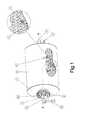
- FIG. 1is a perspective view of a drum with a see-through portion and an enlarged detail
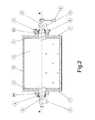
- FIG. 2is a longitudinal sectional view along a midplane including the rotation axis A-A;
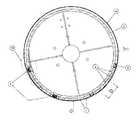
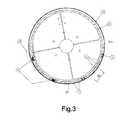
- FIG. 3is a cross-sectional view.
- a drum according to the present inventionconventionally includes a cylinder C of ferromagnetic material with high magnetic permeability, preferably mild steel, having for example a diameter of 950 mm and a thickness of 35 mm, closed at its ends by two steel flanges 2 .
- Two hubs 3provided with seats for bearings 4 and locking clamps 5 , are secured at the centre of flanges 2 , along the longitudinal axis A-A of cylinder C.
- an arm B for adjusting the position of the magnetic arc of the magnets-carrying cylinder Cis secured to one of hubs 3 .
- a plurality of longitudinal grooves 6are formed on the outside of cylinder C and house Nd—Fe—B permanent magnets 7 arranged in longitudinal rows with alternate N-S polarity ( FIG. 1 ).
- Cylinder Cis introduced in a shell M of non-magnetic material, for example AISI 316 stainless steel having a thickness Sm of 4 mm, closed at its ends by two flanges F (also of AISI 316) having flanged hubs MF provided with seats for bearings 4 .
- At least one of hubs MFis also provided with means, for example a toothed gear R, for receiving from a motor (not shown) the motion to drive into rotation shell M.
- a first novel aspect of the present drumresides in the fact that the use of smaller magnets allows to achieve a length D of the single dipole of the magnetic circuit ( FIG. 3 ) equal to 127 mm, and this in turn allows to obtain a higher number of alternate N-S longitudinal polarities which in the illustrated example are twenty along a magnetic arc of about 150°. More specifically, the attractive magnetic arc is made up of the first sixteen polarities and the material release zone 10 is made up of the last four polarities, the latter being housed in progressively deeper grooves.
- a second novel aspect of this drumin its preferred embodiment, is given by the presence of a plurality of rotatable ball supports 8 arranged in a chequered pattern among magnets 7 , in order to reduce to a minimum the play G between the active surface of the magnets and the internal surface of the non-magnetic shell M.
- the balls of supports 8project by 0.3-0.4 mm with respect to the active surface of magnets 7 and allow to reduce the play G between said active surface and the internal surface of the non-magnetic shell M to a value not greater than 2 mm.
- the external surface of shell Mis also preferably coated with a two-component epoxy paint that forms a high-friction layer, so as to improve the drawing of the ferromagnetic material attracted by magnets 7 and to reduce the wear of shell M.
- a paint suitable for this purposeis Epidek M377 produced by Leighs Paints (Bolton—GB).
- the method for producing the drum according to the present inventioncan be summarized in the following steps:
- the external surface of magnets 7has the same curvature as cylinder C so as to be able to minimize play G, and this working is made possible by the fact that magnets 7 are buried in the epoxy resin in step g), otherwise they would be too fragile and they would break.
- drum according to the inventionis just an example susceptible of various modifications.
- various parameterssuch as the number of grooves 6 , magnets 7 and supports 8 , as well as the thickness of cylinder C and shell M, may vary depending on the size of the drum as long as length D of the magnetic dipole is kept within the range from 100 to 150 mm.
Landscapes
- Engineering & Computer Science (AREA)
- General Engineering & Computer Science (AREA)
- Mechanical Engineering (AREA)
- Rolls And Other Rotary Bodies (AREA)
- Dynamo-Electric Clutches, Dynamo-Electric Brakes (AREA)
- Cell Separators (AREA)
- Magnetic Treatment Devices (AREA)
- Powder Metallurgy (AREA)
- Rolling Contact Bearings (AREA)
- Finish Polishing, Edge Sharpening, And Grinding By Specific Grinding Devices (AREA)
- Manufacturing Cores, Coils, And Magnets (AREA)
Abstract
Description
Claims (13)
Applications Claiming Priority (3)
| Application Number | Priority Date | Filing Date | Title |
|---|---|---|---|
| ITMI2012A001901 | 2012-11-08 | ||
| IT001901AITMI20121901A1 (en) | 2012-11-08 | 2012-11-08 | DRUM FOR MAGNETIC SEPARATOR AND RELATIVE PRODUCTION METHOD |
| PCT/IB2013/059749WO2014072880A1 (en) | 2012-11-08 | 2013-10-29 | Drum for magnetic separator and relevant production method |
Publications (2)
| Publication Number | Publication Date |
|---|---|
| US20150336108A1 US20150336108A1 (en) | 2015-11-26 |
| US9375727B2true US9375727B2 (en) | 2016-06-28 |
Family
ID=47561720
Family Applications (1)
| Application Number | Title | Priority Date | Filing Date |
|---|---|---|---|
| US14/438,938Expired - Fee RelatedUS9375727B2 (en) | 2012-11-08 | 2013-10-29 | Drum for magnetic separator and relevant production method |
Country Status (10)
| Country | Link |
|---|---|
| US (1) | US9375727B2 (en) |
| EP (1) | EP2916958B1 (en) |
| CN (1) | CN104768652B (en) |
| AU (1) | AU2013343103B2 (en) |
| BR (1) | BR112015008895A2 (en) |
| CA (1) | CA2884925C (en) |
| IN (1) | IN2015KN00708A (en) |
| IT (1) | ITMI20121901A1 (en) |
| RU (1) | RU2626082C2 (en) |
| WO (1) | WO2014072880A1 (en) |
Cited By (6)
| Publication number | Priority date | Publication date | Assignee | Title |
|---|---|---|---|---|
| US20160310962A1 (en)* | 2016-07-07 | 2016-10-27 | Bunting Magnetics Co. | Magnetic Roll |
| US20160318036A1 (en)* | 2014-01-25 | 2016-11-03 | Shandong Huate Magnet Technology Co., Ltd. | Magnetic separator for improving grade of refined ore and reducing slags |
| US20170128953A1 (en)* | 2014-07-04 | 2017-05-11 | Goudsmit Magnetic Systems B.V. | Diverter roller for a non ferrous waste separator, as well as non ferrous waste separator provided with the diverter roller |
| US10722903B2 (en)* | 2015-05-28 | 2020-07-28 | Bei Jing Ke Neng Mei Da Er Huan Bao Ke Ji Co., Ltd. | Tailings resource recovery process |
| US11318477B2 (en)* | 2017-03-29 | 2022-05-03 | Loesche Gmbh | Magnetic separator |
| US11944980B2 (en) | 2020-04-24 | 2024-04-02 | Bunting Group, Inc. | Magnetic separating conveyor output roll |
Families Citing this family (6)
| Publication number | Priority date | Publication date | Assignee | Title |
|---|---|---|---|---|
| ITMI20121901A1 (en)* | 2012-11-08 | 2014-05-09 | Sgm Gantry Spa | DRUM FOR MAGNETIC SEPARATOR AND RELATIVE PRODUCTION METHOD |
| CN105170324B (en)* | 2015-08-11 | 2017-08-29 | 李泽 | A kind of magnetic method for removing iron and device |
| WO2020046370A1 (en)* | 2018-08-31 | 2020-03-05 | Gt Of Ohio, Ltd | Method and apparatus for continuous magnetic filtration of ferrous mill scale from liquid solutions |
| CN110479483B (en)* | 2019-08-24 | 2023-03-28 | 肇庆合林立业科技有限公司 | Mixed spiral deironing device of lithium manganate raw materials |
| CN112112904A (en)* | 2020-10-15 | 2020-12-22 | 杨正香 | Turnover device for retainer |
| WO2024128207A1 (en)* | 2022-12-16 | 2024-06-20 | 東亞合成株式会社 | Method and apparatus for producing resin powder |
Citations (18)
| Publication number | Priority date | Publication date | Assignee | Title |
|---|---|---|---|---|
| US3146191A (en)* | 1961-05-12 | 1964-08-25 | Indiana General Corp | Variable magnetic strength permanent magnetic drum |
| US3312530A (en)* | 1964-01-08 | 1967-04-04 | Sackett & Sons Co A J | Ammoniator-granulator apparatus |
| DE1433172A1 (en) | 1964-08-31 | 1970-01-08 | Schwermaschb Ernst Thaelmann V | Permanent magnet drum for magnetic separation |
| US3489280A (en)* | 1966-02-03 | 1970-01-13 | Eriez Mfg Co | Magnetic separator having field shaping poles |
| US3595391A (en)* | 1969-02-24 | 1971-07-27 | Byron C Schmid | Magnetic separator |
| US4693812A (en)* | 1983-03-11 | 1987-09-15 | Raytheon Company | Magnetic drum separator |
| US4869811A (en)* | 1988-07-05 | 1989-09-26 | Huron Valley Steel Corporation | Rotor for magnetically sorting different metals |
| EP0687504A1 (en) | 1994-06-14 | 1995-12-20 | SGM Gantry S.p.A. | Process and device for separating stainless steel from mixed material containing it |
| US5496470A (en)* | 1994-05-27 | 1996-03-05 | Barnes International, Inc. | Magnetic separator |
| US5636748A (en)* | 1994-12-29 | 1997-06-10 | Arvidson; Bo R. | Magnetic drum separator |
| US5938579A (en)* | 1997-07-16 | 1999-08-17 | Cavazos; Arnold B. | Magnetic roller |
| US6062393A (en)* | 1997-09-16 | 2000-05-16 | Carpco, Inc. | Process and apparatus for separating particles of different magnetic susceptibilities |
| WO2001094868A1 (en) | 2000-06-06 | 2001-12-13 | Sgm Gantry S.P.A. | Continuous dryer with permanent magnets having adjustability of the transverse temperature profile |
| US6634504B2 (en)* | 2001-07-12 | 2003-10-21 | Micron Technology, Inc. | Method for magnetically separating integrated circuit devices |
| US7918345B2 (en)* | 2006-06-15 | 2011-04-05 | Sgm Gantry S.P.A. | Electromagnetic separator and separation method of ferromagnetic materials |
| US8196751B2 (en)* | 2010-01-05 | 2012-06-12 | Eriez Manufacturing Co. | Permanent magnet drum separator with movable magnetic elements |
| US20150290656A1 (en)* | 2012-11-08 | 2015-10-15 | Sgm Gantry S.P.A. | Electromagnetic drum for cleaning ferromagnetic scrap of medium and large size |
| US20150336108A1 (en)* | 2012-11-08 | 2015-11-26 | Sgm Gantry S.P.A. | Drum for magnetic separator and relevant production method |
Family Cites Families (6)
| Publication number | Priority date | Publication date | Assignee | Title |
|---|---|---|---|---|
| SU1136839A1 (en)* | 1983-11-09 | 1985-01-30 | Государственный проектно-конструкторский институт "Гипромашуглеобогащение" | Magnetic separator |
| SU1424869A1 (en)* | 1986-12-15 | 1988-09-23 | Научно-Исследовательский И Проектный Институт Обогащения И Механической Обработки Полезных Ископаемых "Уралмеханобр" | Drum magnetic separator |
| RU2060829C1 (en)* | 1992-07-21 | 1996-05-27 | Криворожский горнорудный институт | Magnetic separator to separate loose materials |
| US5626233A (en)* | 1995-03-07 | 1997-05-06 | Venturedyne, Ltd. | Eddy current separator |
| RU2229343C2 (en)* | 2002-08-07 | 2004-05-27 | Научно-Производственная Фирма "Продэкология" | Method of magnetic separation of loose products and separator for realization of this method |
| RU68363U1 (en)* | 2007-03-27 | 2007-11-27 | Научно-Производственная Фирма "Продэкология" | MAGNETIC TWO-CASED DRUM SEPARATOR FOR ENRICHMENT OF DRY BULK WEAK MAGNETIC ORES |
- 2012
- 2012-11-08ITIT001901Apatent/ITMI20121901A1/enunknown
- 2013
- 2013-10-26BRBR112015008895Apatent/BR112015008895A2/ennot_activeApplication Discontinuation
- 2013-10-29WOPCT/IB2013/059749patent/WO2014072880A1/ennot_activeCeased
- 2013-10-29AUAU2013343103Apatent/AU2013343103B2/ennot_activeCeased
- 2013-10-29CNCN201380057899.4Apatent/CN104768652B/ennot_activeExpired - Fee Related
- 2013-10-29RURU2015113816Apatent/RU2626082C2/ennot_activeIP Right Cessation
- 2013-10-29USUS14/438,938patent/US9375727B2/ennot_activeExpired - Fee Related
- 2013-10-29CACA2884925Apatent/CA2884925C/ennot_activeExpired - Fee Related
- 2013-10-29EPEP13820920.0Apatent/EP2916958B1/ennot_activeNot-in-force
- 2015
- 2015-03-16ININ708KON2015patent/IN2015KN00708A/enunknown
Patent Citations (18)
| Publication number | Priority date | Publication date | Assignee | Title |
|---|---|---|---|---|
| US3146191A (en)* | 1961-05-12 | 1964-08-25 | Indiana General Corp | Variable magnetic strength permanent magnetic drum |
| US3312530A (en)* | 1964-01-08 | 1967-04-04 | Sackett & Sons Co A J | Ammoniator-granulator apparatus |
| DE1433172A1 (en) | 1964-08-31 | 1970-01-08 | Schwermaschb Ernst Thaelmann V | Permanent magnet drum for magnetic separation |
| US3489280A (en)* | 1966-02-03 | 1970-01-13 | Eriez Mfg Co | Magnetic separator having field shaping poles |
| US3595391A (en)* | 1969-02-24 | 1971-07-27 | Byron C Schmid | Magnetic separator |
| US4693812A (en)* | 1983-03-11 | 1987-09-15 | Raytheon Company | Magnetic drum separator |
| US4869811A (en)* | 1988-07-05 | 1989-09-26 | Huron Valley Steel Corporation | Rotor for magnetically sorting different metals |
| US5496470A (en)* | 1994-05-27 | 1996-03-05 | Barnes International, Inc. | Magnetic separator |
| EP0687504A1 (en) | 1994-06-14 | 1995-12-20 | SGM Gantry S.p.A. | Process and device for separating stainless steel from mixed material containing it |
| US5636748A (en)* | 1994-12-29 | 1997-06-10 | Arvidson; Bo R. | Magnetic drum separator |
| US5938579A (en)* | 1997-07-16 | 1999-08-17 | Cavazos; Arnold B. | Magnetic roller |
| US6062393A (en)* | 1997-09-16 | 2000-05-16 | Carpco, Inc. | Process and apparatus for separating particles of different magnetic susceptibilities |
| WO2001094868A1 (en) | 2000-06-06 | 2001-12-13 | Sgm Gantry S.P.A. | Continuous dryer with permanent magnets having adjustability of the transverse temperature profile |
| US6634504B2 (en)* | 2001-07-12 | 2003-10-21 | Micron Technology, Inc. | Method for magnetically separating integrated circuit devices |
| US7918345B2 (en)* | 2006-06-15 | 2011-04-05 | Sgm Gantry S.P.A. | Electromagnetic separator and separation method of ferromagnetic materials |
| US8196751B2 (en)* | 2010-01-05 | 2012-06-12 | Eriez Manufacturing Co. | Permanent magnet drum separator with movable magnetic elements |
| US20150290656A1 (en)* | 2012-11-08 | 2015-10-15 | Sgm Gantry S.P.A. | Electromagnetic drum for cleaning ferromagnetic scrap of medium and large size |
| US20150336108A1 (en)* | 2012-11-08 | 2015-11-26 | Sgm Gantry S.P.A. | Drum for magnetic separator and relevant production method |
Non-Patent Citations (1)
| Title |
|---|
| International Search Report dated Apr. 2, 2014 for PCT/IB2013/059749. |
Cited By (8)
| Publication number | Priority date | Publication date | Assignee | Title |
|---|---|---|---|---|
| US20160318036A1 (en)* | 2014-01-25 | 2016-11-03 | Shandong Huate Magnet Technology Co., Ltd. | Magnetic separator for improving grade of refined ore and reducing slags |
| US9833791B2 (en)* | 2014-01-25 | 2017-12-05 | Shangdong Huate Magnet Technology Co., Ltd | Magnetic separator for improving grade of refined ore and reducing slags |
| US20170128953A1 (en)* | 2014-07-04 | 2017-05-11 | Goudsmit Magnetic Systems B.V. | Diverter roller for a non ferrous waste separator, as well as non ferrous waste separator provided with the diverter roller |
| US10722903B2 (en)* | 2015-05-28 | 2020-07-28 | Bei Jing Ke Neng Mei Da Er Huan Bao Ke Ji Co., Ltd. | Tailings resource recovery process |
| US20160310962A1 (en)* | 2016-07-07 | 2016-10-27 | Bunting Magnetics Co. | Magnetic Roll |
| US9962710B2 (en)* | 2016-07-07 | 2018-05-08 | Bunting Magnetics Co. | Magnetic roll |
| US11318477B2 (en)* | 2017-03-29 | 2022-05-03 | Loesche Gmbh | Magnetic separator |
| US11944980B2 (en) | 2020-04-24 | 2024-04-02 | Bunting Group, Inc. | Magnetic separating conveyor output roll |
Also Published As
| Publication number | Publication date |
|---|---|
| WO2014072880A1 (en) | 2014-05-15 |
| US20150336108A1 (en) | 2015-11-26 |
| CN104768652A (en) | 2015-07-08 |
| RU2015113816A (en) | 2016-11-10 |
| BR112015008895A2 (en) | 2017-07-04 |
| RU2626082C2 (en) | 2017-07-21 |
| ITMI20121901A1 (en) | 2014-05-09 |
| EP2916958B1 (en) | 2016-12-07 |
| CA2884925A1 (en) | 2014-05-15 |
| EP2916958A1 (en) | 2015-09-16 |
| AU2013343103A1 (en) | 2015-04-02 |
| CN104768652B (en) | 2017-08-04 |
| WO2014072880A4 (en) | 2014-07-31 |
| AU2013343103B2 (en) | 2016-01-28 |
| IN2015KN00708A (en) | 2015-07-17 |
| CA2884925C (en) | 2020-02-25 |
Similar Documents
| Publication | Publication Date | Title |
|---|---|---|
| US9375727B2 (en) | Drum for magnetic separator and relevant production method | |
| CN106794469B (en) | Rotary drum type magnetic separation device | |
| RU64947U1 (en) | TWO-STAGE MAGNETIC SEPARATOR FOR THE ENRICHMENT OF DRY LOAN MAGNETIC ORES | |
| US10389177B2 (en) | Magnetic field configuration for a wireless energy transfer system | |
| KR20160103992A (en) | Magnetic omni-wheel | |
| CN103988267A (en) | Rotary switchable multi-core element permanent magnet-based apparatus | |
| CN105873540B (en) | Actuators with grouped magnets for personal care appliances | |
| US2535719A (en) | Magnetic pulley | |
| KR102100226B1 (en) | Apparatus for polishing inner surface of structure and method thereof | |
| US20160324610A1 (en) | Actuator with enhanced magnetic spring function for personal care appliance | |
| JP3429725B2 (en) | Magnetic roller and magnetic separator using the same | |
| JP2017506488A5 (en) | ||
| CN105665126B (en) | Preparation equipment and beneficiation method | |
| CN103986248B (en) | Rare earth element annular magnet with the utensil for receiving impurity particle | |
| CN103247205B (en) | Drum type gravitational field interfering device | |
| EP2908955B1 (en) | Electromagnetic drum for cleaning ferromagnetic scrap of medium and large size | |
| JPH0852379A (en) | Drum type magnetic selector | |
| RU2301709C2 (en) | Magnetic system | |
| CN108722661A (en) | Magnetic separator for the high-precision purification of ferromagnetism powder | |
| CN104039457A (en) | Magnetic drums for magnetic separation of ferrous particles and comprising at least 18 direct magnetic plates | |
| JP3818883B2 (en) | Magnetic separator | |
| SU1715425A1 (en) | Magnetic drum separator | |
| JPS59109257A (en) | Screening device | |
| RU2209685C1 (en) | Rotary magnetic separator | |
| RU2642207C1 (en) | Gear transmission |
Legal Events
| Date | Code | Title | Description |
|---|---|---|---|
| AS | Assignment | Owner name:SGM GANTRY S.P.A., ITALY Free format text:ASSIGNMENT OF ASSIGNORS INTEREST;ASSIGNOR:MOLTENI, DANILO;REEL/FRAME:035510/0468 Effective date:20150407 | |
| STCF | Information on status: patent grant | Free format text:PATENTED CASE | |
| AS | Assignment | Owner name:SGM MAGNETICS S.P.A., ITALY Free format text:CHANGE OF NAME;ASSIGNOR:SGM GANTRY S.P.A.;REEL/FRAME:047363/0168 Effective date:20170616 | |
| MAFP | Maintenance fee payment | Free format text:PAYMENT OF MAINTENANCE FEE, 4TH YR, SMALL ENTITY (ORIGINAL EVENT CODE: M2551); ENTITY STATUS OF PATENT OWNER: SMALL ENTITY Year of fee payment:4 | |
| FEPP | Fee payment procedure | Free format text:MAINTENANCE FEE REMINDER MAILED (ORIGINAL EVENT CODE: REM.); ENTITY STATUS OF PATENT OWNER: SMALL ENTITY | |
| LAPS | Lapse for failure to pay maintenance fees | Free format text:PATENT EXPIRED FOR FAILURE TO PAY MAINTENANCE FEES (ORIGINAL EVENT CODE: EXP.); ENTITY STATUS OF PATENT OWNER: SMALL ENTITY | |
| STCH | Information on status: patent discontinuation | Free format text:PATENT EXPIRED DUE TO NONPAYMENT OF MAINTENANCE FEES UNDER 37 CFR 1.362 | |
| FP | Lapsed due to failure to pay maintenance fee | Effective date:20240628 |