US9313839B2 - Light-emitting diode lighting device having multiple driving stages and line/load regulation control - Google Patents
Light-emitting diode lighting device having multiple driving stages and line/load regulation controlDownload PDFInfo
- Publication number
- US9313839B2 US9313839B2US14/660,950US201514660950AUS9313839B2US 9313839 B2US9313839 B2US 9313839B2US 201514660950 AUS201514660950 AUS 201514660950AUS 9313839 B2US9313839 B2US 9313839B2
- Authority
- US
- United States
- Prior art keywords
- voltage
- current
- rectified
- lighting device
- reference voltage
- Prior art date
- Legal status (The legal status is an assumption and is not a legal conclusion. Google has not performed a legal analysis and makes no representation as to the accuracy of the status listed.)
- Active
Links
- 230000033228biological regulationEffects0.000titleclaimsabstractdescription36
- 238000010586diagramMethods0.000description12
- 230000007423decreaseEffects0.000description8
- 238000000034methodMethods0.000description4
- 230000004044responseEffects0.000description4
- 230000005669field effectEffects0.000description2
- 230000001105regulatory effectEffects0.000description2
- 230000004075alterationEffects0.000description1
- 230000008901benefitEffects0.000description1
- 239000003990capacitorSubstances0.000description1
- 230000008859changeEffects0.000description1
- 238000006243chemical reactionMethods0.000description1
- 238000007796conventional methodMethods0.000description1
- 238000012886linear functionMethods0.000description1
- 230000004048modificationEffects0.000description1
- 238000012986modificationMethods0.000description1
- 230000008569processEffects0.000description1
- 239000004065semiconductorSubstances0.000description1
Images

Classifications
- H05B33/0812—
- H—ELECTRICITY
- H05—ELECTRIC TECHNIQUES NOT OTHERWISE PROVIDED FOR
- H05B—ELECTRIC HEATING; ELECTRIC LIGHT SOURCES NOT OTHERWISE PROVIDED FOR; CIRCUIT ARRANGEMENTS FOR ELECTRIC LIGHT SOURCES, IN GENERAL
- H05B45/00—Circuit arrangements for operating light-emitting diodes [LED]
- H05B45/30—Driver circuits
- H05B45/395—Linear regulators
- H—ELECTRICITY
- H05—ELECTRIC TECHNIQUES NOT OTHERWISE PROVIDED FOR
- H05B—ELECTRIC HEATING; ELECTRIC LIGHT SOURCES NOT OTHERWISE PROVIDED FOR; CIRCUIT ARRANGEMENTS FOR ELECTRIC LIGHT SOURCES, IN GENERAL
- H05B45/00—Circuit arrangements for operating light-emitting diodes [LED]
- H05B45/40—Details of LED load circuits
- H05B45/44—Details of LED load circuits with an active control inside an LED matrix
- H05B45/48—Details of LED load circuits with an active control inside an LED matrix having LEDs organised in strings and incorporating parallel shunting devices
- Y—GENERAL TAGGING OF NEW TECHNOLOGICAL DEVELOPMENTS; GENERAL TAGGING OF CROSS-SECTIONAL TECHNOLOGIES SPANNING OVER SEVERAL SECTIONS OF THE IPC; TECHNICAL SUBJECTS COVERED BY FORMER USPC CROSS-REFERENCE ART COLLECTIONS [XRACs] AND DIGESTS
- Y02—TECHNOLOGIES OR APPLICATIONS FOR MITIGATION OR ADAPTATION AGAINST CLIMATE CHANGE
- Y02B—CLIMATE CHANGE MITIGATION TECHNOLOGIES RELATED TO BUILDINGS, e.g. HOUSING, HOUSE APPLIANCES OR RELATED END-USER APPLICATIONS
- Y02B20/00—Energy efficient lighting technologies, e.g. halogen lamps or gas discharge lamps
- Y02B20/30—Semiconductor lamps, e.g. solid state lamps [SSL] light emitting diodes [LED] or organic LED [OLED]
Definitions
- the present inventionis related to an LED lighting device having multiple driving stages, and more particularly, to an LED lighting device having multiple driving stages for improving operational voltage range and line/load regulation.
- An LED lighting device directly driven by a rectified alternative-current (AC) voltageusually adopts a plurality of LEDs coupled in series in order to provide required luminance.
- the LEDsmay be light up in stages in order to increase the effective operational voltage range.
- Line regulationis the ability of an LED lighting device to exhibit little change in brightness or power as the rectified AC voltage changes.
- Load regulationis the consistency in lamp-to-lamp brightness despite differences in the load voltage. Variations in line and load are similar in that a decrease in load voltage is effectively an increase in the rectified AC voltage (line voltage).
- the present inventionprovides an LED lighting device having multiple driving stages.
- the LED lighting deviceincludes a first luminescent device, a second luminescent device, a voltage detector, a first current controller, and a second current controller.
- the first luminescent deviceis driven by a rectified AC voltage for providing light according to first current.
- the second luminescent deviceis coupled in series to the first luminescent device and driven by the rectified AC voltage for providing light according to second current.
- the voltage detectoris configured to monitor a variation in a peak level of the rectified AC voltage and generate a compensation voltage associated with the peak level of the rectified AC voltage.
- the first current controlleris coupled in parallel with the first luminescent device and configured to regulate the first current so that the first current does not exceed a first current setting; and adjust the first current setting according to the compensation voltage.
- the second current controlleris coupled in series to the second luminescent device and configured to regulate the second current so that the second current does not exceed a second current setting; and adjust the second current setting according to the compensation voltage.
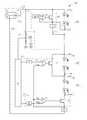
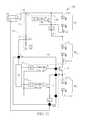
- FIG. 1is a diagram of an LED lighting device according to an embodiment of the present invention.
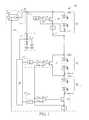
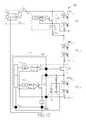
- FIG. 2is a diagram of an LED lighting device according to another embodiment of the present invention.
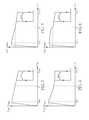
- FIGS. 3-6are diagrams illustrating the adjustment method performed by the LED lighting device according to embodiments of the present invention.
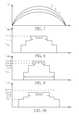
- FIGS. 7-10are diagrams illustrating the operation of the LED lighting device according to embodiments of the present invention.
- FIG. 11is a diagram illustrating an embodiment of fabricating an LED lighting device according to the present invention.
- FIG. 12is a diagram illustrating another embodiment of fabricating an LED lighting device according to the present invention.
- FIG. 1is a diagram of an LED lighting device 100 according to an embodiment of the present invention.
- FIG. 2is a diagram of an LED lighting device 200 according to another embodiment of the present invention.
- Each of the LED lighting device 100 and the LED lighting device 200includes a power supply circuit 110 and (N+2) driving stages ST 1 ⁇ ST N+2 (N is a positive integer).
- the power supply circuit 110is configured to receive an AC voltage VS having positive and negative periods and convert the output of the AC voltage VS in the negative period using a bridge rectifier 112 , thereby providing a rectified AC voltage V AC , whose value varies periodically with time, for driving the LED lighting devices 100 and 200 .
- the power supply circuit 110may receive any AC voltage VS, perform voltage conversion using an AC-AC converter, and rectify the converted AC voltage VS using the bridge rectifier 112 , thereby providing the rectified AC voltage V AC whose value varies periodically with time.
- the configuration of the power supply circuit 110does not limit the scope of the present invention.
- Each of the driving stages ST 1 ⁇ ST N+2includes a luminescent device which is regulated by a corresponding current controller.
- LED 1 ⁇ LED N+2represent the luminescent devices in the corresponding driving stages ST 1 ⁇ ST N+2 , respectively.
- CC 1 ⁇ CC Nrepresent the current controllers in the corresponding driving stages ST 1 ⁇ ST N , respectively.
- the driving stages ST 1 ⁇ ST Nare respectively controlled by the current controllers CC 1 ⁇ CC N each having a constant current setting.
- Each of the current controllers CC 1 ⁇ CC Nincludes a current detector 10 , a switch 20 , a comparator 30 and a reference voltage generator 40 .
- the current detectors 10 of the current controllers CC 1 ⁇ CC Nare configured to detect the sum of the current flowing through the switches 20 of the current controllers CC 1 ⁇ CC N and the luminescent devices LED 1 ⁇ LED N+2 , respectively, thereby providing corresponding feedback voltages V F1 ⁇ V FN .
- Each switch 20may include a field effect transistor (FET), a bipolar junction transistor (BJT) or other devices having similar function.
- FETfield effect transistor
- BJTbipolar junction transistor
- N-MOSFETN-channel metal-oxide-semiconductor field effect transistor
- the reference voltage generators 40 of the current controllers CC 1 ⁇ CC Nare configured to provide constant reference voltages V R1 ⁇ V RN respectively.
- the values of the reference voltages V R1 ⁇ V RNdetermine the maximum current levels of the driving stages ST 1 ⁇ ST N , respectively.
- Each comparator 30includes a positive input end coupled to the corresponding constant reference voltage, a negative input end coupled to the corresponding feedback voltage, and an output end coupled to the control end of the corresponding switch 20 .
- Each comparator 30is configured to output a control signal according to the relationship between the corresponding reference voltage and the corresponding feedback voltage, thereby adjusting the current flowing through the corresponding switch 20 .
- the operation of the driving stage ST 1is used hereafter for illustrative purpose.
- V F1 ⁇ V R1the comparator 30 in the current controller CC 1 is configured to raise the control signal for increasing the current flowing through the switch 20 until the feedback voltage V F1 reaches the reference voltage V R1 .
- V F1 >V R1the comparator 30 in the current controller CC 1 is configured to decrease the control signal for reducing the current flowing through the switch 20 until the feedback voltage V F1 reaches the reference voltage V R1 .
- the current controllers CC 1 ⁇ CC Nprovide constant current settings I SET1 ⁇ I SETN for the driving stages ST 1 ⁇ ST N , respectively, so that the current I LED1 ⁇ I LEDN flowing through the luminance devices LED 1 ⁇ LED N does not exceeds respective current settings during the entire cycle of the rectified voltage V AC .
- the driving stages ST N+1 and ST N+2are controlled by an adjustable current control unit 150 having adjustable current settings I SET(N+1) and I SET(N+2) .
- the adjustable current control unit 150includes a current detector 11 , a voltage detector 12 , a line/load regulation compensation control unit 50 , a current controller CC N+1 and a current controller CC N+2 .
- the current detector 11is configured to detect the overall current flowing through the switches 21 and 22 , thereby providing a corresponding feedback voltage V FB which varies with the rectified AC voltage V AC .
- the voltage detector 12is coupled to the power supply circuit 110 and configured to detect the peak level of the rectified AC voltage V AC , thereby providing a corresponding compensation voltage V LR .
- the voltage detector 12is coupled to the luminescent device LED N+2 and configured to detect the duty cycle of the luminescent device LED N+2 , thereby providing a corresponding compensation voltage V LR .
- the voltage detector 12may include one or multiple resistors, capacitors, other devices with similar functions, or any combination of above. However, the configuration of the voltage detector 12 does not limit the scope of the present invention.
- the current controller CC N+1includes a switch 21 , a comparator 31 and a reference voltage generator 41 .
- the current controller CC N+2includes a switch 22 , a comparator 32 and a reference voltage generator 42 .
- the reference voltage generator 41is configured to provide a reference voltage V REF1 which is a function of the compensation voltage V LR .
- the reference voltage generator 42is configured to provide a reference voltage V REF2 which is a function of the compensation voltage V LR .
- the comparator 31includes a positive input end coupled to the reference voltage V REF1 , a negative input end coupled to the feedback voltage V FB , and an output end coupled to the control end of the switch 21 .
- the comparator 32includes a positive input end coupled to the reference voltage V REF2 , a negative input end coupled to the feedback voltage V FB , and an output end coupled to the control end of the switch 22 .
- the comparator 31is configured to output a control signal to the switch 21 according to the relationship between the reference voltage V REF1 and the feedback voltage V FB , thereby adjusting the current flowing through the switch 21 .
- the comparator 32is configured to output a control signal to the switch 22 according to the relationship between the reference voltage V REF2 and the feedback voltage V FB , thereby adjusting the current flowing through the switch 22 .
- the line/load regulation compensation control unit 50is configured to operate the reference voltage generator 41 of the current controller CC N+1 and the reference voltage generator 42 of the current controller CC N+2 according to the compensation voltage V LR .
- the values of the reference voltages V REF1 ⁇ V REF2determine the maximum current levels of the driving stages ST N+1 ⁇ ST N+2 , respectively.
- the reference voltage V REF1 and V REF2 provided by the reference voltage generators 41 - 42are adjusted to smaller values in response to a higher compensation voltage V LR and to larger values in response to a smaller compensation voltage V LR .
- FIGS. 3-6are diagrams illustrating the adjustment method performed by the reference voltage generators 41 - 42 and the line/load regulation compensation control unit 50 according to embodiments of the present invention.
- the vertical axisrepresents the value of the reference voltage V REF1 or V REF2 .
- the horizontal axisrepresents the value of the compensation voltage V LR .
- V Trepresents the value of the compensation voltage V LR when the rectified AC voltage V AC at its nominal bound.
- the line/load regulation compensation control unit 50is configured to operate the reference voltage generators 41 - 42 in a way so that the variation of the reference voltage V REF1 or V REF2 is a linear function of the compensation voltage V LR .
- a hysteresis region HYSmay be adopted in order to avoid frequent reference voltage adjustment due to a small variation in the compensation voltage V LR .
- the line/load regulation compensation control unit 50is configured to operate the reference voltage generators 41 - 42 in a way so that the variation of the reference voltage V REF1 or V REF2 is a parabolic function of the compensation voltage V LR .
- a hysteresis region HYSmay be adopted in order to avoid frequent reference voltage adjustment due to a small variation in the compensation voltage V LR .
- the line/load regulation compensation control unit 50is configured to operate the reference voltage generators 41 - 42 in a way so that the reference voltage V REF1 or V REF2 vary with the compensation voltage V LR with different slopes.
- a hysteresis region HYSmay be adopted in order to avoid frequent reference voltage adjustment due to a small variation in the compensation voltage V LR .
- the line/load regulation compensation control unit 50is configured to operate the reference voltage generators 41 - 42 in a way so that the variation of the reference voltage V REF1 and V REF2 is an arbitrary function of the compensation voltage V LR as long as the reference voltage V REF1 or V REF2 decreases as the compensation voltage V LR increases.
- a hysteresis region HYSmay be adopted in order to avoid frequent reference voltage adjustment due to a small variation in the compensation voltage V LR .
- the line/load regulation compensation control unit 50may operate the reference voltage generators 41 - 42 in any way as long as the reference voltage V REF1 and V REF2 can be adjusted to smaller values in response to a higher compensation voltage V LR and to larger values in response to a smaller compensation voltage V LR .
- the voltage relationships depicted in FIGS. 3-6are only for illustrative purpose, but do not limit the scope of the present invention.
- FIGS. 7-10are diagrams illustrating the operation of the LED lighting devices 100 and 200 according to embodiments of the present invention.
- the embodiment when N1 is used for illustrative purpose.
- curve Arepresents the rectified AC voltage V AC at its nominal bound
- curve Brepresents the rectified AC voltage V AC at its lower bound (which may be due to an increase in load voltage or a decrease in the AC voltage VS)
- curve Crepresents the rectified AC voltage V AC at its upper bound (which may be due to a decrease in load voltage or an increase in the AC voltage VS).
- I LED _ Arepresents the overall current of the LED lighting device 100 or 200 when driven by the rectified AC voltage V AC at its nominal bound.
- the current controllers CC 1 -CC 3are configured to provide current settings I SET1 , I SET2A and I SET3A , respectively for the driving stages ST 1 -ST 3 .
- the line/load regulation LR_A of the LED lighting device 100 or 200 when driven by the rectified AC voltage V AC at its nominal boundis indicated by the integral of the current I LED _ A over time t.
- I LED _ Brepresents the overall current of the LED lighting device 100 or 200 when driven by the rectified AC voltage V AC at its lower bound.
- the current controllers CC 1 -C C3are configured to provide current settings I SET1 , I SET2B and I SET3B , respectively for the driving stages ST 1 -ST 3 .
- the voltage detector 12 of the LED lighting device 100can directly monitor the variation in the peak level the rectified AC voltage V AC
- the voltage detector 12 of the LED lighting device 200can directly monitor the variation in the conducting duty cycle of the luminance device LED N+2 due to variations in the rectified AC voltage V AC .
- the rectified AC voltage V AC at its lower boundresults in a smaller compensation voltage V LR , based on which the line/load regulation compensation control unit 50 instructs the reference voltage generators 41 - 42 to increase the reference voltage V REF1 and V REF2 .
- the adjustable current setting I SET2Bis set to a value larger than the current setting I SET2A
- the adjustable current setting I SET3Bis set to a value larger than the current setting I SET3A .
- the line/load regulation LR_B of the LED lighting device 100 or 200 when driven by the rectified AC voltage V AC at its lower boundis indicated by the integral of the current I LED _ B over time t. As can be seen in FIG.
- the present inventionwhen a decrease in the rectified AC voltage V AC shortens the conducting duty cycle of the LED lighting device 100 or 200 , the present invention can increase the current settings of the two driving stages with the highest and the second highest current levels. As a result, the difference between the line/load regulation LR_A and the line/load regulation LR_B may be reduced.
- I LED _ Crepresents the overall current of the LED lighting device 100 or 200 when driven by the rectified AC voltage V AC at its upper bound.
- the current controllers CC 1 -CC 3are configured to provide current settings I SET1 , I SET2C and I SET3C , respectively for the driving stages ST 1 -ST 3 .
- the voltage detector 12 of the LED lighting device 100can directly monitor the variation in the peak level of the rectified AC voltage V AC
- the voltage detector 12 of the LED lighting device 200can directly monitor the variation in the conducting duty cycle of the luminance device LED N+2 due to variations in the rectified AC voltage V AC .
- the rectified AC voltage V AC at its upper boundresults in a larger compensation voltage V LR , based on which the line/load regulation compensation control unit 50 instructs the reference voltage generators 41 - 42 to decrease the reference voltage V REF1 and V REF2 .
- the adjustable current setting I SET2Cis set to a value smaller than the current setting I SET2A
- the adjustable current setting I SET3Cis set to a value smaller than the current setting I SET3A .
- the line/load regulation LR_C of the LED lighting device 100 or 200 when driven by the rectified AC voltage V AC at its upper boundis indicated by the integral of the current I LED _ C over time t. As can be seen in FIG.
- the present inventionwhen an increase in the rectified AC voltage V AC increases the conducting duty cycle of the LED lighting device 100 or 200 , the present invention can decrease the current settings of the two driving stages with the highest and the second highest current levels. As a result, the difference between the line/load regulation LR_A and the line/load regulation LR_C may be reduced.
- the adjustable current control unit 150allows the average value of the current I LED _ A (or the average integral of the current I LED _ A over time t), the average value of the current I LED _ B (or the average integral of the current I LED _ B over time t) and the average value of the current I LED _ C (or the average integral of the current I LED _ C over time t) to be as close to each other as possible.
- the value of the line/load regulation LR_A when the rectified AC voltage V AC at its nominal bound, the value of the line/load regulation LR_B when the rectified AC voltage V AC at its lower bound, and the value of the line/load regulation LR_C when the rectified AC voltage V AC at its upper boundmay be as close to each other as possible, thereby improving the line/load regulation of the LED lighting device.
- the switch 22is required to have a higher durability (the ability to operating under thermal and/or electrical stress) than the switches 20 and 21 .
- the switch 22may be a high-voltage transistor, while the switches 20 and 21 may be low-voltage transistors.
- FIG. 11is a diagram illustrating an embodiment of fabricating the LED lighting device 100 according to the present invention.
- FIG. 12is a diagram illustrating an embodiment of fabricating the LED lighting device 200 according to the present invention.
- the current detector 11 , the switch 21 , the comparators 31 ⁇ 32 , the reference voltage generators 41 ⁇ 42 , and the line/load regulation compensation control unit 50may be integrated in the same chip 60 . Since the switch 21 may adopt a low-voltage transistor, the chip 60 may be fabricated in a low-voltage process.
- the driving stages ST 1 ⁇ ST Nare respectively controlled by the current controllers CC 1 ⁇ CC N each having a constant current setting.
- the current controllers CC 1 ⁇ CC Nmay be omitted.
- the present inventionmay directly monitor the variation in the peak level the rectified AC voltage V AC or monitor the variation in the conducting duty cycle of the luminance device due to the variation in the rectified AC voltage V AC , thereby adjusting the current settings of the two driving stages with the highest current level and the second highest current level accordingly. Even if the rectified AC voltage V AC somehow fluctuates between its upper bound and lower bound, the line/load regulation compensation control unit 50 and the reference voltage generators 41 - 42 may improve the line/load regulation of the LED lighting device.
- the present inventionmay improve the effective operational voltage range and line/load regulation of an LED lighting device.
Landscapes
- Circuit Arrangement For Electric Light Sources In General (AREA)
- Physics & Mathematics (AREA)
- General Physics & Mathematics (AREA)
- Engineering & Computer Science (AREA)
- General Engineering & Computer Science (AREA)
- Led Devices (AREA)
Abstract
Description
This application claims the benefit of U.S. provisional application No. 62/020,410 filed on 2014 Jul. 3.
1. Field of the Invention
The present invention is related to an LED lighting device having multiple driving stages, and more particularly, to an LED lighting device having multiple driving stages for improving operational voltage range and line/load regulation.
2. Description of the Prior Art
An LED lighting device directly driven by a rectified alternative-current (AC) voltage usually adopts a plurality of LEDs coupled in series in order to provide required luminance. In a conventional method for driving an LED lighting device, the LEDs may be light up in stages in order to increase the effective operational voltage range. Line regulation is the ability of an LED lighting device to exhibit little change in brightness or power as the rectified AC voltage changes. Load regulation is the consistency in lamp-to-lamp brightness despite differences in the load voltage. Variations in line and load are similar in that a decrease in load voltage is effectively an increase in the rectified AC voltage (line voltage). Since the current is regulated independently in each stage of a prior art LED lighting device according the voltage established across each stage, the overall line/load regulation of the LED lighting device may not be able meet desired values. Therefore, there is a need for an LED lighting device capable of improving the effective operational voltage range and improving line/load regulation.
The present invention provides an LED lighting device having multiple driving stages. The LED lighting device includes a first luminescent device, a second luminescent device, a voltage detector, a first current controller, and a second current controller. The first luminescent device is driven by a rectified AC voltage for providing light according to first current. The second luminescent device is coupled in series to the first luminescent device and driven by the rectified AC voltage for providing light according to second current. The voltage detector is configured to monitor a variation in a peak level of the rectified AC voltage and generate a compensation voltage associated with the peak level of the rectified AC voltage. The first current controller is coupled in parallel with the first luminescent device and configured to regulate the first current so that the first current does not exceed a first current setting; and adjust the first current setting according to the compensation voltage. The second current controller is coupled in series to the second luminescent device and configured to regulate the second current so that the second current does not exceed a second current setting; and adjust the second current setting according to the compensation voltage.
These and other objectives of the present invention will no doubt become obvious to those of ordinary skill in the art after reading the following detailed description of the preferred embodiment that is illustrated in the various figures and drawings.
Each of the driving stages ST1˜STN+2includes a luminescent device which is regulated by a corresponding current controller. LED1˜LEDN+2represent the luminescent devices in the corresponding driving stages ST1˜STN+2, respectively. CC1˜CCNrepresent the current controllers in the corresponding driving stages ST1˜STN, respectively.
The driving stages ST1˜STNare respectively controlled by the current controllers CC1˜CCNeach having a constant current setting. Each of the current controllers CC1˜CCNincludes acurrent detector 10, aswitch 20, acomparator 30 and areference voltage generator 40. Thecurrent detectors 10 of the current controllers CC1˜CCNare configured to detect the sum of the current flowing through theswitches 20 of the current controllers CC1˜CCNand the luminescent devices LED1˜LEDN+2, respectively, thereby providing corresponding feedback voltages VF1˜VFN. Eachswitch 20 may include a field effect transistor (FET), a bipolar junction transistor (BJT) or other devices having similar function. InFIGS. 1 ˜2, an N-channel metal-oxide-semiconductor field effect transistor (N-MOSFET) is used for illustration, but does not limit the scope of the present invention. Thereference voltage generators 40 of the current controllers CC1˜CCNare configured to provide constant reference voltages VR1˜VRNrespectively. The values of the reference voltages VR1˜VRNdetermine the maximum current levels of the driving stages ST1˜STN, respectively. Eachcomparator 30 includes a positive input end coupled to the corresponding constant reference voltage, a negative input end coupled to the corresponding feedback voltage, and an output end coupled to the control end of thecorresponding switch 20.
Eachcomparator 30 is configured to output a control signal according to the relationship between the corresponding reference voltage and the corresponding feedback voltage, thereby adjusting the current flowing through thecorresponding switch 20. The operation of the driving stage ST1is used hereafter for illustrative purpose. When VF1<VR1, thecomparator 30 in the current controller CC1is configured to raise the control signal for increasing the current flowing through theswitch 20 until the feedback voltage VF1reaches the reference voltage VR1. When VF1>VR1, thecomparator 30 in the current controller CC1is configured to decrease the control signal for reducing the current flowing through theswitch 20 until the feedback voltage VF1reaches the reference voltage VR1. In other words, the current controllers CC1˜CCNprovide constant current settings ISET1˜ISETNfor the driving stages ST1˜STN, respectively, so that the current ILED1˜ILEDNflowing through the luminance devices LED1˜LEDNdoes not exceeds respective current settings during the entire cycle of the rectified voltage VAC.
In theLED lighting devices current control unit 150 having adjustable current settings ISET(N+1)and ISET(N+2). The adjustablecurrent control unit 150 includes acurrent detector 11, avoltage detector 12, a line/load regulationcompensation control unit 50, a current controller CCN+1and a current controller CCN+2.
Thecurrent detector 11 is configured to detect the overall current flowing through theswitches
In theLED lighting device 100, thevoltage detector 12 is coupled to thepower supply circuit 110 and configured to detect the peak level of the rectified AC voltage VAC, thereby providing a corresponding compensation voltage VLR. In theLED lighting device 200, thevoltage detector 12 is coupled to the luminescent device LEDN+2and configured to detect the duty cycle of the luminescent device LEDN+2, thereby providing a corresponding compensation voltage VLR. In the present invention, thevoltage detector 12 may include one or multiple resistors, capacitors, other devices with similar functions, or any combination of above. However, the configuration of thevoltage detector 12 does not limit the scope of the present invention.
The current controller CCN+1includes aswitch 21, acomparator 31 and areference voltage generator 41. The current controller CCN+2includes aswitch 22, acomparator 32 and areference voltage generator 42. Thereference voltage generator 41 is configured to provide a reference voltage VREF1which is a function of the compensation voltage VLR. Thereference voltage generator 42 is configured to provide a reference voltage VREF2which is a function of the compensation voltage VLR. Thecomparator 31 includes a positive input end coupled to the reference voltage VREF1, a negative input end coupled to the feedback voltage VFB, and an output end coupled to the control end of theswitch 21. Thecomparator 32 includes a positive input end coupled to the reference voltage VREF2, a negative input end coupled to the feedback voltage VFB, and an output end coupled to the control end of theswitch 22. Thecomparator 31 is configured to output a control signal to theswitch 21 according to the relationship between the reference voltage VREF1and the feedback voltage VFB, thereby adjusting the current flowing through theswitch 21. Thecomparator 32 is configured to output a control signal to theswitch 22 according to the relationship between the reference voltage VREF2and the feedback voltage VFB, thereby adjusting the current flowing through theswitch 22.
The line/load regulationcompensation control unit 50 is configured to operate thereference voltage generator 41 of the current controller CCN+1and thereference voltage generator 42 of the current controller CCN+2according to the compensation voltage VLR. The values of the reference voltages VREF1˜VREF2determine the maximum current levels of the driving stages STN+1˜STN+2, respectively. In the present invention, the reference voltage VREF1and VREF2provided by the reference voltage generators41-42 are adjusted to smaller values in response to a higher compensation voltage VLRand to larger values in response to a smaller compensation voltage VLR.
In the embodiment depicted inFIG. 3 , the line/load regulationcompensation control unit 50 is configured to operate the reference voltage generators41-42 in a way so that the variation of the reference voltage VREF1or VREF2is a linear function of the compensation voltage VLR. A hysteresis region HYS may be adopted in order to avoid frequent reference voltage adjustment due to a small variation in the compensation voltage VLR.
In the embodiment depicted inFIG. 4 , the line/load regulationcompensation control unit 50 is configured to operate the reference voltage generators41-42 in a way so that the variation of the reference voltage VREF1or VREF2is a parabolic function of the compensation voltage VLR. A hysteresis region HYS may be adopted in order to avoid frequent reference voltage adjustment due to a small variation in the compensation voltage VLR.
In the embodiment depicted inFIG. 5 , the line/load regulationcompensation control unit 50 is configured to operate the reference voltage generators41-42 in a way so that the reference voltage VREF1or VREF2vary with the compensation voltage VLRwith different slopes. A hysteresis region HYS may be adopted in order to avoid frequent reference voltage adjustment due to a small variation in the compensation voltage VLR.
In the embodiment depicted inFIG. 6 , the line/load regulationcompensation control unit 50 is configured to operate the reference voltage generators41-42 in a way so that the variation of the reference voltage VREF1and VREF2is an arbitrary function of the compensation voltage VLRas long as the reference voltage VREF1or VREF2decreases as the compensation voltage VLRincreases. A hysteresis region HYS may be adopted in order to avoid frequent reference voltage adjustment due to a small variation in the compensation voltage VLR.
In the present invention, the line/load regulationcompensation control unit 50 may operate the reference voltage generators41-42 in any way as long as the reference voltage VREF1and VREF2can be adjusted to smaller values in response to a higher compensation voltage VLRand to larger values in response to a smaller compensation voltage VLR. The voltage relationships depicted inFIGS. 3-6 are only for illustrative purpose, but do not limit the scope of the present invention.
InFIG. 8 , ILED_Arepresents the overall current of theLED lighting device LED lighting device
InFIG. 9 , ILED_Brepresents the overall current of theLED lighting device voltage detector 12 of theLED lighting device 100 can directly monitor the variation in the peak level the rectified AC voltage VAC, while thevoltage detector 12 of theLED lighting device 200 can directly monitor the variation in the conducting duty cycle of the luminance device LEDN+2due to variations in the rectified AC voltage VAC. Therefore, the rectified AC voltage VACat its lower bound results in a smaller compensation voltage VLR, based on which the line/load regulationcompensation control unit 50 instructs the reference voltage generators41-42 to increase the reference voltage VREF1and VREF2. More specifically, the adjustable current setting ISET2Bis set to a value larger than the current setting ISET2A, and the adjustable current setting ISET3Bis set to a value larger than the current setting ISET3A. The line/load regulation LR_B of theLED lighting device FIG. 9 , when a decrease in the rectified AC voltage VACshortens the conducting duty cycle of theLED lighting device
InFIG. 10 , ILED_Crepresents the overall current of theLED lighting device voltage detector 12 of theLED lighting device 100 can directly monitor the variation in the peak level of the rectified AC voltage VAC, while thevoltage detector 12 of theLED lighting device 200 can directly monitor the variation in the conducting duty cycle of the luminance device LEDN+2due to variations in the rectified AC voltage VAC. Therefore, the rectified AC voltage VACat its upper bound results in a larger compensation voltage VLR, based on which the line/load regulationcompensation control unit 50 instructs the reference voltage generators41-42 to decrease the reference voltage VREF1and VREF2. More specifically, the adjustable current setting ISET2Cis set to a value smaller than the current setting ISET2A, and the adjustable current setting ISET3Cis set to a value smaller than the current setting ISET3A. The line/load regulation LR_C of theLED lighting device FIG. 10 , when an increase in the rectified AC voltage VACincreases the conducting duty cycle of theLED lighting device
As can be seen inFIGS. 8-10 , the adjustablecurrent control unit 150 allows the average value of the current ILED_A(or the average integral of the current ILED_Aover time t), the average value of the current ILED_B(or the average integral of the current ILED_Bover time t) and the average value of the current ILED_C(or the average integral of the current ILED_Cover time t) to be as close to each other as possible. The value of the line/load regulation LR_A when the rectified AC voltage VACat its nominal bound, the value of the line/load regulation LR_B when the rectified AC voltage VACat its lower bound, and the value of the line/load regulation LR_C when the rectified AC voltage VACat its upper bound may be as close to each other as possible, thereby improving the line/load regulation of the LED lighting device.
In the present invention, theswitch 22 is required to have a higher durability (the ability to operating under thermal and/or electrical stress) than theswitches switch 22 may be a high-voltage transistor, while theswitches
In the embodiments depicted inFIGS. 1 ˜2 and11˜12, the driving stages ST1˜STNare respectively controlled by the current controllers CC1˜CCNeach having a constant current setting. In other embodiments of the present invention, the current controllers CC1˜CCNmay be omitted.
The present invention may directly monitor the variation in the peak level the rectified AC voltage VACor monitor the variation in the conducting duty cycle of the luminance device due to the variation in the rectified AC voltage VAC, thereby adjusting the current settings of the two driving stages with the highest current level and the second highest current level accordingly. Even if the rectified AC voltage VACsomehow fluctuates between its upper bound and lower bound, the line/load regulationcompensation control unit 50 and the reference voltage generators41-42 may improve the line/load regulation of the LED lighting device.
With the above-mentioned multi-stage driving scheme with line/load regulation control, the present invention may improve the effective operational voltage range and line/load regulation of an LED lighting device.
Those skilled in the art will readily observe that numerous modifications and alterations of the device and method may be made while retaining the teachings of the invention. Accordingly, the above disclosure should be construed as limited only by the metes and bounds of the appended claims.
Claims (10)
1. A light-emitting diode (LED) lighting device having multiple driving stages, comprising:
a first luminescent device driven by a rectified alternative-current (AC) voltage for providing light according to first current;
a second luminescent device coupled in series to the first luminescent device and driven by the rectified AC voltage for providing light according to second current;
a voltage detector configured to monitor a variation in a peak level of the rectified AC voltage and generate a compensation voltage associated with the peak level of rectified AC voltage;
a first current controller coupled in parallel with the first luminescent device and configured to:
regulate the first current so that the first current does not exceed a first current setting; and
adjust the first current setting according to the compensation voltage; and
a second current controller coupled in series to the second luminescent device and configured to:
regulate the second current so that the second current does not exceed a second current setting; and
adjust the second current setting according to the compensation voltage.
2. The LED lighting device ofclaim 1 , wherein:
the first current controller includes:
a first switch configured to conduct third current according to a first control signal;
a current detector configured to monitor a sum of the first current and the third current and provide a corresponding feedback voltage;
a first reference voltage generator configured to provide a first reference voltage associated with the first current setting and adjust the first reference voltage according to the compensation voltage; and
a first comparator configured to generate the first control signal according to a relationship between the first reference voltage and the feedback voltage; and
the second current controller includes:
a second switch configured to conduct the second current according to a second control signal;
a second reference voltage generator configured to provide a second reference voltage associated with the second current setting and adjust the second reference voltage according to the compensation voltage; and
a second comparator configured to generate the second control signal according to a relationship between the second reference voltage and the feedback voltage.
3. The LED lighting device ofclaim 2 , wherein a durability of the second switch is higher than a durability of the first switch.
4. The LED lighting device ofclaim 2 , further comprising a line/load regulation compensation control unit configured to operate the first reference voltage generator and the second reference voltage generator according to the compensation voltage so that the first reference voltage or the second reference voltage is adjusted to a first value when the compensation voltage is equal to a second value or is adjusted to a third value when the compensation voltage is equal to a fourth value, wherein the first value is larger than the third value and the second value is smaller than the fourth value.
5. The LED lighting device ofclaim 4 , wherein the first switch, the first comparator, the first reference voltage generator, the second comparator, the second reference voltage generator and the line/load regulation compensation control unit are integrated into a same chip.
6. The LED lighting device ofclaim 1 , further comprising a power supply circuit configured to provide the rectified AC voltage, wherein the voltage detector is coupled to the power supply circuit for detecting the peak level of the rectified AC voltage during each driving cycle.
7. The LED lighting device ofclaim 1 , wherein the voltage detector is coupled to the second luminance device for detecting a variation in a conducting duty cycle of the second luminance device due to a variation in the rectified AC voltage.
8. The LED lighting device ofclaim 1 , further comprising:
a third luminescent device coupled in series to the first and second luminescent devices and driven by the rectified AC voltage for providing light according to fourth current.
9. The LED lighting device ofclaim 8 , wherein the third luminescent device is coupled between the rectified AC voltage and the first luminescent device.
10. The LED lighting device ofclaim 8 , further comprising:
a third current controller coupled in parallel with the third luminescent device and configured to regulate the fourth current so that the fourth current does not exceed a third current setting, wherein the third current setting is a constant value.
Priority Applications (5)
| Application Number | Priority Date | Filing Date | Title |
|---|---|---|---|
| US14/660,950US9313839B2 (en) | 2014-07-03 | 2015-03-18 | Light-emitting diode lighting device having multiple driving stages and line/load regulation control |
| KR1020150054631AKR101698948B1 (en) | 2014-07-03 | 2015-04-17 | Light-emitting diode lighting device having multiple driving stages and line/load regulation control |
| JP2015086355AJP5973618B2 (en) | 2014-07-03 | 2015-04-21 | Light emitting diode lighting device having multiple drive stages and line / load regulation control |
| TW104121465ATWI565358B (en) | 2014-07-03 | 2015-07-02 | Light-emitting diode lighting device having multiple driving stages and line/load regulation control |
| CN201510388371.6ACN105307324B (en) | 2014-07-03 | 2015-07-03 | Possesses the light emitting diode illuminating apparatus in multiple drive power stage |
Applications Claiming Priority (2)
| Application Number | Priority Date | Filing Date | Title |
|---|---|---|---|
| US201462020410P | 2014-07-03 | 2014-07-03 | |
| US14/660,950US9313839B2 (en) | 2014-07-03 | 2015-03-18 | Light-emitting diode lighting device having multiple driving stages and line/load regulation control |
Publications (2)
| Publication Number | Publication Date |
|---|---|
| US20160007416A1 US20160007416A1 (en) | 2016-01-07 |
| US9313839B2true US9313839B2 (en) | 2016-04-12 |
Family
ID=55018047
Family Applications (1)
| Application Number | Title | Priority Date | Filing Date |
|---|---|---|---|
| US14/660,950ActiveUS9313839B2 (en) | 2014-07-03 | 2015-03-18 | Light-emitting diode lighting device having multiple driving stages and line/load regulation control |
Country Status (5)
| Country | Link |
|---|---|
| US (1) | US9313839B2 (en) |
| JP (1) | JP5973618B2 (en) |
| KR (1) | KR101698948B1 (en) |
| CN (1) | CN105307324B (en) |
| TW (1) | TWI565358B (en) |
Cited By (3)
| Publication number | Priority date | Publication date | Assignee | Title |
|---|---|---|---|---|
| US20170086266A1 (en)* | 2015-09-17 | 2017-03-23 | Nxp B.V. | Circuits, Controllers and Methods for Controlling LED Strings or Circuits |
| US10201053B2 (en) | 2017-05-26 | 2019-02-05 | Exar Corporation | AC direct drive system for light emitting diodes with ultra-low flicker, low harmonic distortion, dimming compatibility and power line regulation |
| US10251225B2 (en) | 2015-12-28 | 2019-04-02 | Eaton Intelligent Power Limited | Multi-mode power supply for an LED illumination device |
Families Citing this family (7)
| Publication number | Priority date | Publication date | Assignee | Title |
|---|---|---|---|---|
| US9433052B1 (en)* | 2016-01-08 | 2016-08-30 | Alfasemi Inc. | LED control system suitable for different types of power sources |
| CN107277961B (en)* | 2016-04-06 | 2019-02-05 | 普诚科技股份有限公司 | current control circuit |
| US9794992B1 (en)* | 2016-07-27 | 2017-10-17 | Vastview Technology Inc. | Universal method for driving LEDs using high voltage |
| JP7037036B2 (en)* | 2017-09-22 | 2022-03-16 | 日亜化学工業株式会社 | Light emitting diode drive device and lighting for plant cultivation using it |
| US10201045B1 (en)* | 2017-10-24 | 2019-02-05 | Iml International | Light-emitting diode lighting device |
| CN109287042B (en)* | 2018-12-12 | 2021-05-28 | 昂宝电子(上海)有限公司 | Segmental constant current control system and method for LED lighting |
| TWI689224B (en) | 2019-02-13 | 2020-03-21 | 益力半導體股份有限公司 | Constant current source driving system |
Citations (7)
| Publication number | Priority date | Publication date | Assignee | Title |
|---|---|---|---|---|
| US20100308739A1 (en)* | 2009-06-04 | 2010-12-09 | Exclara Inc. | Apparatus, Method and System for Providing AC Line Power to Lighting Devices |
| US20130026935A1 (en)* | 2011-01-28 | 2013-01-31 | Seoul Semiconductor Co., Ltd. | Led luminescence apparatus |
| US20130169160A1 (en)* | 2011-12-30 | 2013-07-04 | Magnachip Semiconductor, Ltd. | Led driver circuit and light apparatus having the same in |
| JP2013179288A (en) | 2012-02-03 | 2013-09-09 | Nichia Chem Ind Ltd | Light-emitting diode drive device |
| JP2013179279A (en) | 2012-02-08 | 2013-09-09 | Ntt Data Intellilink Corp | Potential barrier element control circuit and potential barrier element circuit |
| JP2014039004A (en) | 2012-08-10 | 2014-02-27 | Macroblock Inc | Led driving device |
| JP2014093528A (en) | 2012-11-02 | 2014-05-19 | Lg Innotek Co Ltd | Light-emitting device controller |
Family Cites Families (4)
| Publication number | Priority date | Publication date | Assignee | Title |
|---|---|---|---|---|
| US8174212B2 (en)* | 2008-11-30 | 2012-05-08 | Microsemi Corp.—Analog Mixed Signal Group Ltd. | LED string driver with light intensity responsive to input voltage |
| TW201218851A (en)* | 2010-10-29 | 2012-05-01 | Numen Technology Inc | which can ignite different number of LED's, and can enhance the efficiency of stacked LED driving circuit |
| KR101408027B1 (en)* | 2012-04-25 | 2014-06-17 | 아이엠엘 인터내셔널 | Two-terminal current controller and related led lighting device |
| CN103702483B (en)* | 2013-12-20 | 2016-08-17 | 绍兴恒力特微电子有限公司 | High-efficient linear topological structure LED drive circuit |
- 2015
- 2015-03-18USUS14/660,950patent/US9313839B2/enactiveActive
- 2015-04-17KRKR1020150054631Apatent/KR101698948B1/enactiveActive
- 2015-04-21JPJP2015086355Apatent/JP5973618B2/ennot_activeExpired - Fee Related
- 2015-07-02TWTW104121465Apatent/TWI565358B/enactive
- 2015-07-03CNCN201510388371.6Apatent/CN105307324B/ennot_activeExpired - Fee Related
Patent Citations (7)
| Publication number | Priority date | Publication date | Assignee | Title |
|---|---|---|---|---|
| US20100308739A1 (en)* | 2009-06-04 | 2010-12-09 | Exclara Inc. | Apparatus, Method and System for Providing AC Line Power to Lighting Devices |
| US20130026935A1 (en)* | 2011-01-28 | 2013-01-31 | Seoul Semiconductor Co., Ltd. | Led luminescence apparatus |
| US20130169160A1 (en)* | 2011-12-30 | 2013-07-04 | Magnachip Semiconductor, Ltd. | Led driver circuit and light apparatus having the same in |
| JP2013179288A (en) | 2012-02-03 | 2013-09-09 | Nichia Chem Ind Ltd | Light-emitting diode drive device |
| JP2013179279A (en) | 2012-02-08 | 2013-09-09 | Ntt Data Intellilink Corp | Potential barrier element control circuit and potential barrier element circuit |
| JP2014039004A (en) | 2012-08-10 | 2014-02-27 | Macroblock Inc | Led driving device |
| JP2014093528A (en) | 2012-11-02 | 2014-05-19 | Lg Innotek Co Ltd | Light-emitting device controller |
Cited By (6)
| Publication number | Priority date | Publication date | Assignee | Title |
|---|---|---|---|---|
| US20170086266A1 (en)* | 2015-09-17 | 2017-03-23 | Nxp B.V. | Circuits, Controllers and Methods for Controlling LED Strings or Circuits |
| US9974132B2 (en)* | 2015-09-17 | 2018-05-15 | Nxp B.V. | Circuits, controllers and methods for controlling LED strings or circuits |
| US10251225B2 (en) | 2015-12-28 | 2019-04-02 | Eaton Intelligent Power Limited | Multi-mode power supply for an LED illumination device |
| US10887963B2 (en) | 2015-12-28 | 2021-01-05 | Signify Holding B.V. | Multi-mode power supply for an LED illumination device |
| US10201053B2 (en) | 2017-05-26 | 2019-02-05 | Exar Corporation | AC direct drive system for light emitting diodes with ultra-low flicker, low harmonic distortion, dimming compatibility and power line regulation |
| US10426008B2 (en) | 2017-05-26 | 2019-09-24 | Exar Corporation | AC direct drive system for light emitting diodes with ultra-low flicker, low harmonic distortion, dimming compatibility and power line regulation |
Also Published As
| Publication number | Publication date |
|---|---|
| JP2016015473A (en) | 2016-01-28 |
| JP5973618B2 (en) | 2016-08-23 |
| CN105307324A (en) | 2016-02-03 |
| KR20160008090A (en) | 2016-01-21 |
| TW201603641A (en) | 2016-01-16 |
| CN105307324B (en) | 2017-11-10 |
| US20160007416A1 (en) | 2016-01-07 |
| TWI565358B (en) | 2017-01-01 |
| KR101698948B1 (en) | 2017-01-23 |
Similar Documents
| Publication | Publication Date | Title |
|---|---|---|
| US9313839B2 (en) | Light-emitting diode lighting device having multiple driving stages and line/load regulation control | |
| TWI510131B (en) | Light emitting device driver circuit and control method thereof | |
| TWI487429B (en) | Ac led lighting apparatus and led driving control unit | |
| KR101440350B1 (en) | Control circuit for led lighting apparatus | |
| US9414452B1 (en) | Light-emitting diode lighting device with synchronized PWM dimming control | |
| US10849201B2 (en) | Driving circuit and driving method for driving light-emitting diode load | |
| US10492259B2 (en) | Dimmable LED driver and dimming method | |
| US20160049879A1 (en) | Power supply and power supplying method | |
| US9066395B2 (en) | Power supply device and control circuit thereof | |
| US8674615B2 (en) | Control apparatus for LED diodes | |
| TWI565356B (en) | Light-emitting diode lighting device with adjustable color rendering indexes | |
| TWI576008B (en) | Low-flicker light-emitting diode lighting device | |
| KR101517225B1 (en) | Device of operating lighting emitting diode module | |
| US8773046B2 (en) | Driving circuit having voltage dividing circuits and coupling circuit for controlling duty cycle of transistor and related circuit driving method thereof | |
| TWI547201B (en) | Light-emitting diode lighting device with multi-stage driving stage | |
| KR20140070126A (en) | Apparatus and method of operating the the illumination apparatus | |
| JP6457038B1 (en) | Low flicker LED lighting device | |
| TWI674035B (en) | Light-emitting diode lighting device | |
| US9351363B1 (en) | Dual mode operation light-emitting diode lighting device having multiple driving stages | |
| US11528788B1 (en) | Light-emitting diode lighting device which improves line regulation | |
| US9226354B2 (en) | Light-emitting diode lighting device having multiple driving stages | |
| KR20150113756A (en) | Device for driving light emitting diode |
Legal Events
| Date | Code | Title | Description |
|---|---|---|---|
| AS | Assignment | Owner name:IML INTERNATIONAL, CAYMAN ISLANDS Free format text:ASSIGNMENT OF ASSIGNORS INTEREST;ASSIGNORS:VIVIANI, ALBERTO GIOVANNI;GODER, DIMITRY;LU, CHUN;AND OTHERS;SIGNING DATES FROM 20150205 TO 20150314;REEL/FRAME:035186/0565 | |
| STCF | Information on status: patent grant | Free format text:PATENTED CASE | |
| CC | Certificate of correction | ||
| MAFP | Maintenance fee payment | Free format text:PAYMENT OF MAINTENANCE FEE, 4TH YR, SMALL ENTITY (ORIGINAL EVENT CODE: M2551); ENTITY STATUS OF PATENT OWNER: SMALL ENTITY Year of fee payment:4 | |
| AS | Assignment | Owner name:IML HONG KONG LIMITED, HONG KONG Free format text:ASSIGNMENT OF ASSIGNORS INTEREST;ASSIGNOR:IML INTERNATIONAL;REEL/FRAME:056321/0926 Effective date:20210511 | |
| MAFP | Maintenance fee payment | Free format text:PAYMENT OF MAINTENANCE FEE, 8TH YR, SMALL ENTITY (ORIGINAL EVENT CODE: M2552); ENTITY STATUS OF PATENT OWNER: SMALL ENTITY Year of fee payment:8 |