US9282907B2 - Identification of healthy versus unhealthy substrate for pacing from a multipolar lead - Google Patents
Identification of healthy versus unhealthy substrate for pacing from a multipolar leadDownload PDFInfo
- Publication number
- US9282907B2 US9282907B2US13/948,568US201313948568AUS9282907B2US 9282907 B2US9282907 B2US 9282907B2US 201313948568 AUS201313948568 AUS 201313948568AUS 9282907 B2US9282907 B2US 9282907B2
- Authority
- US
- United States
- Prior art keywords
- scar
- electrodes
- index
- torso
- features
- Prior art date
- Legal status (The legal status is an assumption and is not a legal conclusion. Google has not performed a legal analysis and makes no representation as to the accuracy of the status listed.)
- Active
Links
- 239000000758substrateSubstances0.000titledescription5
- 231100000241scarToxicity0.000claimsabstractdescription182
- 238000000034methodMethods0.000claimsabstractdescription52
- 238000002565electrocardiographyMethods0.000claimsdescription41
- 230000000747cardiac effectEffects0.000claimsdescription32
- 238000002560therapeutic procedureMethods0.000claimsdescription27
- 238000012545processingMethods0.000claimsdescription24
- 230000002107myocardial effectEffects0.000claimsdescription17
- 238000005094computer simulationMethods0.000claimsdescription12
- 238000005194fractionationMethods0.000claimsdescription11
- 230000004044responseEffects0.000claimsdescription10
- 210000003484anatomyAnatomy0.000claimsdescription3
- 239000000284extractSubstances0.000abstractdescription3
- 210000005240left ventricleAnatomy0.000description31
- 238000009125cardiac resynchronization therapyMethods0.000description25
- 210000005241right ventricleAnatomy0.000description24
- 238000001514detection methodMethods0.000description13
- 230000000694effectsEffects0.000description11
- 230000006854communicationEffects0.000description9
- 238000004891communicationMethods0.000description9
- 210000005242cardiac chamberAnatomy0.000description8
- 238000010586diagramMethods0.000description7
- 210000005245right atriumAnatomy0.000description7
- 230000033764rhythmic processEffects0.000description6
- 230000001746atrial effectEffects0.000description5
- 238000013194cardioversionMethods0.000description5
- 230000035939shockEffects0.000description5
- 238000012360testing methodMethods0.000description5
- 238000012384transportation and deliveryMethods0.000description5
- 230000008901benefitEffects0.000description4
- 239000004020conductorSubstances0.000description4
- 230000006870functionEffects0.000description4
- 238000003384imaging methodMethods0.000description4
- 239000007943implantSubstances0.000description4
- 210000005246left atriumAnatomy0.000description4
- 230000008569processEffects0.000description4
- 239000013598vectorSubstances0.000description4
- 230000008859changeEffects0.000description3
- 210000003748coronary sinusAnatomy0.000description3
- 230000028161membrane depolarizationEffects0.000description3
- 230000035945sensitivityEffects0.000description3
- 210000002620vena cava superiorAnatomy0.000description3
- 230000002861ventricularEffects0.000description3
- 239000000853adhesiveSubstances0.000description2
- 230000001070adhesive effectEffects0.000description2
- 230000009977dual effectEffects0.000description2
- 229940082150encoreDrugs0.000description2
- 238000002595magnetic resonance imagingMethods0.000description2
- 238000007726management methodMethods0.000description2
- 238000013507mappingMethods0.000description2
- 238000012544monitoring processMethods0.000description2
- 230000000638stimulationEffects0.000description2
- 206010019280Heart failuresDiseases0.000description1
- 208000001871TachycardiaDiseases0.000description1
- 230000003187abdominal effectEffects0.000description1
- 230000003288anthiarrhythmic effectEffects0.000description1
- 230000007175bidirectional communicationEffects0.000description1
- 230000005540biological transmissionEffects0.000description1
- 206010061592cardiac fibrillationDiseases0.000description1
- 239000002872contrast mediaSubstances0.000description1
- 230000001862defibrillatory effectEffects0.000description1
- 230000001419dependent effectEffects0.000description1
- 238000003745diagnosisMethods0.000description1
- 235000019800disodium phosphateNutrition0.000description1
- 238000005516engineering processMethods0.000description1
- 239000004744fabricSubstances0.000description1
- 230000002600fibrillogenic effectEffects0.000description1
- 230000000004hemodynamic effectEffects0.000description1
- 239000003550markerSubstances0.000description1
- 239000011159matrix materialSubstances0.000description1
- 230000007246mechanismEffects0.000description1
- 238000012986modificationMethods0.000description1
- 230000004048modificationEffects0.000description1
- 208000010125myocardial infarctionDiseases0.000description1
- 208000031225myocardial ischemiaDiseases0.000description1
- 230000003287optical effectEffects0.000description1
- 230000000737periodic effectEffects0.000description1
- 238000013439planningMethods0.000description1
- 230000001902propagating effectEffects0.000description1
- 230000002336repolarizationEffects0.000description1
- 238000012552reviewMethods0.000description1
- 230000001225therapeutic effectEffects0.000description1
- 210000003462veinAnatomy0.000description1
- 230000000007visual effectEffects0.000description1
Images


Classifications
- A61B5/04012—
- A—HUMAN NECESSITIES
- A61—MEDICAL OR VETERINARY SCIENCE; HYGIENE
- A61B—DIAGNOSIS; SURGERY; IDENTIFICATION
- A61B5/00—Measuring for diagnostic purposes; Identification of persons
- A61B5/24—Detecting, measuring or recording bioelectric or biomagnetic signals of the body or parts thereof
- A61B5/316—Modalities, i.e. specific diagnostic methods
- A61B5/0402—
- A61B5/0408—
- A61B5/044—
- A61B5/0452—
- A61B5/0468—
- A61B5/0472—
- A—HUMAN NECESSITIES
- A61—MEDICAL OR VETERINARY SCIENCE; HYGIENE
- A61B—DIAGNOSIS; SURGERY; IDENTIFICATION
- A61B5/00—Measuring for diagnostic purposes; Identification of persons
- A61B5/24—Detecting, measuring or recording bioelectric or biomagnetic signals of the body or parts thereof
- A61B5/25—Bioelectric electrodes therefor
- A—HUMAN NECESSITIES
- A61—MEDICAL OR VETERINARY SCIENCE; HYGIENE
- A61B—DIAGNOSIS; SURGERY; IDENTIFICATION
- A61B5/00—Measuring for diagnostic purposes; Identification of persons
- A61B5/24—Detecting, measuring or recording bioelectric or biomagnetic signals of the body or parts thereof
- A61B5/316—Modalities, i.e. specific diagnostic methods
- A61B5/318—Heart-related electrical modalities, e.g. electrocardiography [ECG]
- A—HUMAN NECESSITIES
- A61—MEDICAL OR VETERINARY SCIENCE; HYGIENE
- A61B—DIAGNOSIS; SURGERY; IDENTIFICATION
- A61B5/00—Measuring for diagnostic purposes; Identification of persons
- A61B5/24—Detecting, measuring or recording bioelectric or biomagnetic signals of the body or parts thereof
- A61B5/316—Modalities, i.e. specific diagnostic methods
- A61B5/318—Heart-related electrical modalities, e.g. electrocardiography [ECG]
- A61B5/339—Displays specially adapted therefor
- A—HUMAN NECESSITIES
- A61—MEDICAL OR VETERINARY SCIENCE; HYGIENE
- A61B—DIAGNOSIS; SURGERY; IDENTIFICATION
- A61B5/00—Measuring for diagnostic purposes; Identification of persons
- A61B5/24—Detecting, measuring or recording bioelectric or biomagnetic signals of the body or parts thereof
- A61B5/316—Modalities, i.e. specific diagnostic methods
- A61B5/318—Heart-related electrical modalities, e.g. electrocardiography [ECG]
- A61B5/346—Analysis of electrocardiograms
- A61B5/349—Detecting specific parameters of the electrocardiograph cycle
- A—HUMAN NECESSITIES
- A61—MEDICAL OR VETERINARY SCIENCE; HYGIENE
- A61B—DIAGNOSIS; SURGERY; IDENTIFICATION
- A61B5/00—Measuring for diagnostic purposes; Identification of persons
- A61B5/24—Detecting, measuring or recording bioelectric or biomagnetic signals of the body or parts thereof
- A61B5/316—Modalities, i.e. specific diagnostic methods
- A61B5/318—Heart-related electrical modalities, e.g. electrocardiography [ECG]
- A61B5/346—Analysis of electrocardiograms
- A61B5/349—Detecting specific parameters of the electrocardiograph cycle
- A61B5/364—Detecting abnormal ECG interval, e.g. extrasystoles, ectopic heartbeats
- A—HUMAN NECESSITIES
- A61—MEDICAL OR VETERINARY SCIENCE; HYGIENE
- A61B—DIAGNOSIS; SURGERY; IDENTIFICATION
- A61B5/00—Measuring for diagnostic purposes; Identification of persons
- A61B5/24—Detecting, measuring or recording bioelectric or biomagnetic signals of the body or parts thereof
- A61B5/316—Modalities, i.e. specific diagnostic methods
- A61B5/318—Heart-related electrical modalities, e.g. electrocardiography [ECG]
- A61B5/346—Analysis of electrocardiograms
- A61B5/349—Detecting specific parameters of the electrocardiograph cycle
- A61B5/366—Detecting abnormal QRS complex, e.g. widening
- A—HUMAN NECESSITIES
- A61—MEDICAL OR VETERINARY SCIENCE; HYGIENE
- A61B—DIAGNOSIS; SURGERY; IDENTIFICATION
- A61B5/00—Measuring for diagnostic purposes; Identification of persons
- A61B5/68—Arrangements of detecting, measuring or recording means, e.g. sensors, in relation to patient
- A61B5/6801—Arrangements of detecting, measuring or recording means, e.g. sensors, in relation to patient specially adapted to be attached to or worn on the body surface
- A61B5/6813—Specially adapted to be attached to a specific body part
- A61B5/6823—Trunk, e.g., chest, back, abdomen, hip
Definitions
- the disclosurerelates generally to identifying the presence of healthy versus unhealthy cardiac substrate and particularly a system and method for identifying substrate for receiving cardiac pacing.
- Myocardial ischemia or myocardial infarctioncan produce areas of scar tissue in the myocardial substrate that will be unresponsive to cardiac pacing. If a patient having myocardial scar tissue requires cardiac pacing, the location of the scar tissue is preferably avoided in positioning pacing electrodes. However, the location of the scar tissue may be unknown without performing imaging procedures, such as magnetic resonance imaging (MRI), which may be costly, require catheterization or contrast agents, and may not be readily available in some geographic areas.
- MRImagnetic resonance imaging
- Cardiac resynchronization therapyis one type of cardiac pacing therapy that is used as a treatment for heart failure patients in which one or more heart chambers are electrically stimulated (paced) to restore or improve heart chamber synchrony. Achieving a positive clinical benefit from CRT is dependent on several therapy control parameters including selection of pacing site(s) and the relative timing of pacing pulses delivered in the right and/or left ventricles. For example, selection of a CRT pacing site that avoids myocardial scar tissue is important in achieving clinical benefit. Systems and methods are needed for identifying myocardial scar tissue versus healthy myocardial substrate at a potential pacing site in a patient receiving CRT or other pacing therapy without requiring costly imaging technology.
- a methoddetermines the presence of scar tissue by a processing device receiving a torso-surface potential signal from multiple electrodes distributed on a torso of a patient.
- Features of the potential signal from each of the plurality of electrodesare extracted and stored in a non-transitory storage medium.
- a scar indicator indexis determined for each of the electrodes from the stored features.
- the electrodes having an affirmative scar indicator indexare identified, and an overall scar burden index is determined as a proportion of the electrodes with an affirmative scar indicator index.
- a medical device system for determining presence of scar tissueincludes a processor receiving means for receiving a torso-surface potential signal from each of multiple electrodes distributed on a torso of a patient and processor means for extracting features of the potential signal from each of the plurality of electrodes. The features are stored, and a processor determines a scar indicator index for each of the electrodes from the stored features, identifies electrodes having an affirmative scar indicator index, and determines an overall scar burden index as a proportion of the electrodes with an affirmative scar indicator index.
- a non-transitory, computer readable storage mediumstores instructions for causing a processor of a medical device system to perform a method for determining presence of myocardial scar tissue.
- the methodincludes receiving a torso-surface potential signal from electrodes distributed on a torso of a patient, extracting features of the potential signal from each of the electrodes, storing values of the features in a non-transitory storage medium, determining a scar indicator index for each of the electrodes from the stored features, identifying electrodes having an affirmative scar indicator index, and determining an overall scar burden index as a proportion of the electrodes with an affirmative scar indicator index.
- FIG. 1is a schematic diagram of one embodiment of an implantable medical device (IMD) system in which techniques disclosed herein may be implemented to provide therapy to a heart of a patient.
- IMDimplantable medical device
- FIG. 2is a functional block diagram illustrating one example configuration of an IMD.
- FIG. 3is a flow chart of a method for detecting myocardial scar tissue according to one embodiment.
- FIG. 4is a flow chart of a method for extracting unipolar EGM signal features for detecting scar tissue according to one embodiment.
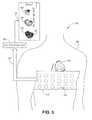
- FIG. 5is a schematic diagram of an external system for determining presence of scar tissue in a patient's heart.
- FIG. 6is a flow chart of a method for determining a scar burden index according to one embodiment.
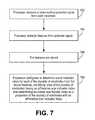
- FIG. 7is a flow chart of a method for determining a scar burden index according to one embodiment.
- FIG. 1is a schematic diagram of one embodiment of an implantable medical device (IMD) system 100 in which techniques disclosed herein may be implemented to provide therapy to heart 112 of patient 114 .
- System 100includes IMD 10 coupled to leads 118 , 120 , and 122 which carry multiple electrodes.
- IMD 10is configured for bidirectional communication with programmer 170 .
- IMD 10may be, for example, an implantable pacemaker or implantable cardioverter defibrillator (ICD) that provides electrical signals to heart 112 via electrodes coupled to one or more of leads 118 , 120 , and 122 for pacing, cardioverting and defibrillating the heart 112 .
- ICDimplantable cardioverter defibrillator
- IMD 10is capable of delivering pacing in one or more heart chambers, and in the embodiment shown, is configured for multi-chamber pacing and sensing in the right atrium (RA) 126 , the right ventricle (RV) 128 , and the left ventricle (LV) 132 using leads 118 , 120 and 122 .
- RAright atrium
- RVright ventricle
- LVleft ventricle
- IMD 10delivers RV pacing pulses and senses RV intracardiac electrogram (EGM) signals using RV tip electrode 140 and RV ring electrode 142 .
- RV lead 118is shown to carry a coil electrode 162 which may be used for delivering high voltage cardioversion or defibrillation shock pulses.
- IMD 10senses LV EGM signals and delivers LV pacing pulses using the electrodes 144 carried by a multipolar coronary sinus lead 120 , extending through the RA 126 and into a cardiac vein 130 via the coronary sinus.
- coronary sinus lead 120may include electrodes positioned along the left atrium (LA) 136 for sensing left atrial (LA) EGM signals and delivering LA pacing pulses.
- IMD 10senses RA EGM signals and delivers RA pacing pulses using RA lead 122 , carrying tip electrode 148 and ring electrode 150 .
- RA lead 122is shown to be carrying coil electrode 166 which may be positioned along the superior vena cava (SVC) for use in delivering cardioversion/defibrillation shocks.
- RV lead 118carries both the RV coil electrode 162 and the SVC coil electrode 166 .
- IMD 10may detect tachyarrhythmias of heart 112 , such as fibrillation of ventricles 128 and 132 , and deliver high voltage cardioversion or defibrillation therapy to heart 112 in the form of electrical shock pulses.
- Pacing and sensing of the cardiac chambersis typically achieved using the pace/sense electrodes 140 , 142 , 144 , 148 and 150 , however in some embodiments coil electrodes 162 and/or 166 may be used in sensing and/or pacing electrode vectors.
- IMD 10is shown in a right pectoral implant position in FIG. 1 , a more typical implant position, particularly when IMD 10 is embodied as an ICD, is a left pectoral implant position. In other embodiments, IMD 10 may be implanted in an abdominal location.
- IMD 10includes internal circuitry for performing the functions attributed to IMD 10 .
- Housing 160encloses the internal circuitry. It is recognized that the housing 160 or portions thereof may be configured as an active electrode 158 for use in cardioversion/defibrillation shock delivery or used as an indifferent electrode for unipolar pacing or sensing configurations with any electrodes carried by leads 118 , 120 and 122 .
- IMD 10includes a connector block 134 having connector bores for receiving proximal lead connectors of leads 118 , 120 and 122 . Electrical connection of electrodes carried by leads 118 , 120 and 122 and IMD internal circuitry is achieved via various connectors and electrical feedthroughs included in connector block 134 .
- IMD 10is configured for delivering CRT by delivering pacing pulses in one or both ventricles 128 and 132 for controlling and improving ventricular synchrony.
- LV pacingmay be delivered using a selected pacing vector that utilizes at least one electrode 144 on multipolar LV lead 120 .
- RV pacingis delivered using RV tip electrode 140 and ring electrode 142 .
- CRTmay be delivered by pacing in a single ventricular chamber (LV or RV) or both chambers (biventricular pacing) depending on patient need.
- the methods described hereinare implemented in a dual or multi-chamber pacemaker or ICD delivering pacing pulses to the right and/or left ventricles using programmable pacing pulse timing parameters and selected pacing sites and pacing vectors.
- FIG. 1While a multi-chamber ICD is shown in FIG. 1 , it is recognized that techniques disclosed herein may be implemented in a single chamber, dual chamber or multi-chamber pacemaker, with or without anti-arrhythmia therapies such as cardioversion and defibrillation shock capabilities. For example, techniques disclosed herein for identifying pacing site(s) for CRT may be used for guiding selection of a pacing site for any pacing therapy by identifying myocardial scar tissue at a potential pacing site.
- Programmer 170includes a display 172 , a processor 174 , a user interface 176 , and a communication module 178 including wireless telemetry circuitry for communication with IMD 10 .
- programmer 170may be a handheld device or a microprocessor-based home monitor or bedside programming device.
- a usersuch as a physician, technician, nurse or other clinician, may interact with programmer 170 to communicate with IMD 10 .
- the usermay interact with programmer 170 via user interface 176 to retrieve currently programmed operating parameters, physiological data collected by IMD 10 , or device-related diagnostic information from IMD 10 .
- a usermay also interact with programmer 170 to program IMD 10 , e.g., select values for operating parameters of the IMD.
- a user interacting with programmer 170can initiate a test to identify scar tissue at a potential pacing site according to the techniques disclosed herein.
- a multi-polar leadis used to record multiple unipolar EGM signals, determine a combination of EGM signal features from each of the EGM signals, and analyze the combination of EGM signal features to detect scar tissue at an electrode site.
- Programmer 170includes a communication module 178 to enable wireless communication with IMD 10 .
- Examples of communication techniques used by system 100include low frequency or radiofrequency (RF) telemetry, which may be an RF link established via Bluetooth, WiFi, or MICS for example.
- programmer 170may include a programming head that is placed proximate to the patient's body near the IMD 10 implant site, and in other examples programmer 170 and IMD 10 may be configured to communicate using a distance telemetry algorithm and circuitry that does not require the use of a programming head and does not require user intervention to maintain a communication link.
- RFradiofrequency
- programmer 170may be coupled to a communications network via communications module 178 for transferring data to a remote database or computer to allow remote monitoring and management of patient 114 using the techniques described herein.
- Remote patient management systemsmay be configured to utilize the presently disclosed techniques to enable a clinician to review test data, programmed therapy parameters and authorize programming of IMD 10 . Reference is made to commonly-assigned U.S. Pat. Nos.
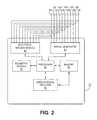
- FIG. 2is a functional block diagram illustrating one example configuration of IMD 10 .
- IMD 10includes a processor and control unit 80 , also referred to herein as “processor” 80 , memory 82 , signal generator 84 , electrical sensing module 86 , and telemetry module 88 .
- IMD 10further includes cardiac signal analyzer 90 .
- Memory 82may include computer-readable instructions that, when executed by processor 80 , cause IMD 10 and processor 80 to perform various functions attributed throughout this disclosure to IMD 10 , processor 80 , and cardiac signal analyzer 90 .
- the computer-readable instructionsmay be encoded within memory 82 .
- Memory 82may comprise non-transitory, computer-readable storage media including any volatile, non-volatile, magnetic, optical, or electrical media, such as a random access memory (RAM), read-only memory (ROM), non-volatile RAM (NVRAM), electrically-erasable programmable ROM (EEPROM), flash memory, or any other digital media with the sole exception being a transitory propagating signal.
- RAMrandom access memory
- ROMread-only memory
- NVRAMnon-volatile RAM
- EEPROMelectrically-erasable programmable ROM
- flash memoryor any other digital media with the sole exception being a transitory propagating signal.
- Processor and control unit 80may include any one or more of a microprocessor, a controller, a digital signal processor (DSP), an application specific integrated circuit (ASIC), a field-programmable gate array (FPGA), or equivalent discrete or integrated logic circuitry.
- processor 80may include multiple components, such as any combination of one or more microprocessors, one or more controllers, one or more DSPs, one or more ASICs, or one or more FPGAs, as well as other discrete or integrated logic circuitry.
- the functions attributed to processor 80 hereinmay be embodied as software, firmware, hardware or any combination thereof.
- cardiac signal analyzer 90may, at least in part, be stored or encoded as instructions in memory 82 that are executed by processor and control unit 80 .
- Processor and control unit 80includes a therapy control unit that controls signal generator 84 to deliver electrical stimulation therapy, e.g., cardiac pacing or CRT, to heart 112 according to a selected one or more therapy programs, which may be stored in memory 82 .
- Signal generator 84is electrically coupled to electrodes 140 , 142 , 144 A- 144 D (collectively 144 ), 148 , 150 , 158 , 162 , and 166 (all of which are shown in FIG. 1 ), e.g., via conductors of the respective leads 118 , 120 , 122 , or, in the case of housing electrode 158 , via an electrical conductor disposed within housing 160 of IMD 10 .
- Signal generator 84is configured to generate and deliver electrical stimulation therapy to heart 112 via selected combinations of electrodes 140 , 142 , 144 , 148 , 150 , 158 , 162 , and 166 .
- Signal generator 84delivers cardiac pacing pulses according to therapy control parameters during CRT.
- CRTis delivered to a pacing site identified as not being over scar tissue as will be described herein.
- Signal generator 84may include a switch module (not shown) and processor and control 80 may use the switch module to select, e.g., via a data/address bus, which of the available electrodes are used to deliver pacing pulses.
- Processor 80controls which of electrodes 140 , 142 , 144 A- 144 D, 148 , 150 , 158 , 162 , and 166 is coupled to signal generator 84 for delivering stimulus pulses, e.g., via the switch module.
- the switch modulemay include a switch array, switch matrix, multiplexer, or any other type of switching device suitable to selectively couple a signal to selected electrodes.
- Sensing module 86monitors cardiac electrical signals for sensing cardiac electrical events, e.g. P-waves and R-waves, from selected ones of electrodes 140 , 142 , 144 A- 144 D, 148 , 150 , 158 , 162 , or 166 in order to monitor electrical activity of heart 112 .
- Sensing module 86may also include a switch module to select which of the available electrodes are used to sense the cardiac electrical activity.
- processor 80selects the electrodes to function as sense electrodes, or the sensing vector, via the switch module within sensing module 86 .
- Sensing module 86includes multiple sensing channels, each of which may be selectively coupled to respective combinations of electrodes 140 , 142 , 144 A- 144 D, 148 , 150 , 158 , 162 , or 166 to detect electrical activity of a particular chamber of heart 112 .
- Each sensing channelmay comprise an amplifier that outputs an indication to processor 80 in response to sensing of a cardiac depolarization, in the respective chamber of heart 112 .
- processor 80may receive sense event signals corresponding to the occurrence of R-waves and P-waves in the various chambers of heart 112 , e.g. ventricular sense events and atrial sense events corresponding to intrinsic depolarization of the respective heart chamber.
- Sensing module 86may further include digital signal processing circuitry for providing processor 80 or cardiac signal analyzer 90 with digitized EGM signals.
- one or more sensing channelsmay be selectively coupled to electrodes 144 included on multipolar lead 120 for sensing unipolar EGM signals for detecting scar tissue.
- sensing module 86includes an LV sensing channel and electrodes 144 a , 144 b , 144 c and 144 d are selectively coupled one at a time in a unipolar sensing configuration in combination with a common anode, such as housing electrode 158 , coil electrode 162 , or coil electrode 166 , to acquire a unipolar EGM signal for each of the respective locations of electrodes 144 a - 144 d along LV tissue.
- a common anodesuch as housing electrode 158 , coil electrode 162 , or coil electrode 166
- a digitized EGM signal obtained using each of the electrodes 144 a - 144 dis analyzed by cardiac signal analyzer 90 to extract a combination of EGM signal features, e.g. at least two features, from each of the unipolar sensed signals.
- the extracted featuresare analyzed to detect scar tissue as will be described in greater detail below.
- processor 80may generate a notification for transmission via telemetry module 88 and/or establish or alter a pacing electrode selection for delivering CRT therapy.
- Processor 80 and cardiac signal analyzer 90may collectively represent processor means for determining the presence of scar tissue as described herein.
- Memory 82stores intervals, counters, or other data used by processor 80 to control the delivery of pacing pulses by signal generator 84 .
- Such datamay include intervals and counters used by processor 80 to control the delivery of pacing pulses to one or both of the left and right ventricles for CRT.
- the intervals and/or countersare, in some examples, used by processor 80 to control the timing of delivery of pacing pulses relative to an intrinsic or paced event in another chamber.
- FIGS. 17A-17BOther examples of functional block diagrams of IMD 10 may be seen with respect to U.S. patent application Ser. No. 13/916,353 (e.g., FIGS. 17A-17B) filed Jun. 12, 2013, and assigned to the assignee of the present invention, the disclosure of which is incorporated by reference in its entirety herein.
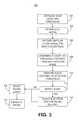
- FIG. 3is a flow chart 300 of one method for detecting myocardial scar tissue according to one embodiment.
- the method described in conjunction with FIG. 3is directed to the illustrative embodiment shown in FIG. 1 of an IMD 10 coupled to a quadripolar lead having four electrodes 144 A- 144 D positioned along the LV for delivering LV pacing pulses during CRT. It is recognized, however, that the techniques disclosed herein may be utilized in a variety of embodiments that include multiple electrodes positioned along a heart chamber carried by one or more medical electrical leads.
- a multipolar leadmay provide multiple sensing/pacing sites, however the spacing between electrodes along the multipolar lead may be greater than that required to record a bipolar signal with great enough sensitivity to reliably detect EGM signal changes caused by scar tissue.
- the process shown by flow chart 300provides a technique for detecting the presence of scar tissue at an electrode site independent of inter-electrode spacing when multiple electrodes are positioned at various sites along a heart chamber.
- the process shown by flow chart 300may be performed at the time an IMD and associated leads are being initially implanted, at a time of repositioning or replacing a cardiac lead, on a periodic basis after implanting the IMD and associated leads. In some embodiments, the process shown by flow chart 300 may be performed in response to a change in a monitored parameter, such as a change in a hemodynamic parameter or a change in a pacing capture threshold.
- a monitored parametersuch as a change in a hemodynamic parameter or a change in a pacing capture threshold.
- Thresholds for detecting scarmay be based on previous EGM baseline recordings obtained from the patient, EGM recordings obtained from the patient at the time the test for detecting scar is being performed, or based on empirical data from a population of patients. Thresholds are applied to at least two EGM signal features determined from each unipolar EGM signal. Separate thresholds may be applied to each of the two or more EGM signal features individually or to a single metric or index computed from the two or more EGM signal features and a single threshold applied to the metric.
- LV pacingis withheld.
- EGM signals for the purposes of detecting myocardial scar tissue in the LVare recorded during a baseline rhythm which typically does not involve pacing from the LV lead or electrodes.
- the heart rhythmmay be an intrinsic heart rhythm with no pacing delivered in any heart chamber, an atrial paced rhythm, an RV paced rhythm, or during pacing in an atrial chamber and the RV. It is contemplated that in some cases another LV lead or electrode may be present different than the pacing electrodes and associated sites being tested for scar tissue that could be used for pacing during recording of unipolar EGM signals at the LV pacing sites under test.
- unipolar LV EGM signalsare recorded by sensing module 86 for each LV electrode 144 a - d available when no LV pacing is being delivered.
- the LV EGM signalsare recorded using a common anode paired with each LV electrode for sensing n different unipolar EGM signals when n electrodes are positioned along the LV.
- the different unipolar EGM signalsmay be recorded one at a time in a sequential manner or simultaneously depending on the number of sensing channels available in the sensing module 86 IMD 10 .
- Each unipolar signalmay be recorded for at least one cardiac cycle and generally will be recorded for multiple cycles, e.g. 3 to 12 cycles, for obtaining representative EGM signal features from for a given sensing electrode site.
- At block 308at least two different EGM signal features are extracted from each recorded unipolar signal. At least two different signal features are extracted in case a single feature of the unipolar EGM does not provide a great enough sensitivity to reliably detect EGM signal changes due to scar tissue.
- the signal features extracted from each unipolar EGM signalmay include, but are not limited to, metrics of the QRS amplitude, negativity of the Q-wave, and fractionation of the EGM signal. It is recognized that numerous techniques can be conceived for determining a metric of QRS signal amplitude, a metric of Q-wave negativity, and a metric of QRS fractionation.
- a metric of QRS amplitudemay be determined as the peak-to-peak amplitude difference during a QRS sensing window.
- the QRS amplitudeis expected to be reduced when scar tissue is present at the sensing electrode as compared to healthy tissue at the sensing electrode.
- a broad negative Q-waveis also evidence of scar tissue.
- a metric of Q-wave negativitycan be extracted from the EGM signal by counting the number of digitized EGM sample points that are negative during a QRS sensing window, by determining a summation of EGM sample point values over a QRS sensing window, or by determining an integral or area defined by the EGM signal sample points over a sensing window.
- Scar tissuemay also cause fractionation of the EGM signal, i.e. multiple peaks rather than a single R-wave peak.
- a metric of fractionation of the EGM signalmay be extracted from the EGM signal by counting a number of slope sign changes, counting a number of peaks, or counting a number of inflection points during a QRS sensing window.
- At least two metrics of QRS amplitude, Q-wave negativity, and/or EGM fractionationare determined from each unipolar EGM signal at block 308 . These metrics are compared to the established detection thresholds at block 310 , individually and/or in a combined metric. Criteria may be defined for detecting scar tissue. For example, at least two out of three EGM signal features must meet a respective scar detection threshold to detect scar tissue at a sensing electrode site. If scar detection threshold(s)/criteria are satisfied at block 312 , the electrode used to record the associated EGM signal is rejected as a pacing site at block 314 .
- pacing site(s) for delivering pacing therapyare selected. Any electrodes available after rejecting those electrodes associated with scar detection may be selected for therapy delivery and additional pacing site selection criteria may be applied to select a pacing site according to the particular pacing application. Pacing site selection may be performed automatically at block 316 by rejecting any electrodes identified as being located along scar tissue and applying any other therapy pacing site selection criteria, e.g. low capture threshold, low impedance etc. Pacing site selection may alternatively be performed by a clinician after transmitting a notification to an external programmer or other device that scar has been detected and indicating the associated electrode(s).
- LV pacingis enabled such that a desired therapy can be delivered according to programmed therapy control parameters at the selected pacing site(s).
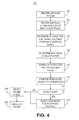
- FIG. 4is a flow chart 400 of a method for extracting unipolar EGM signal features for detecting scar tissue according to one embodiment.
- heart activityis sensed at an electrode positioned along the RV to produce a unipolar EGM waveform of RV heart activity.
- the RV unipolar EGM signalis recorded during an intrinsic rhythm or during atrial pacing, while no RV pacing is being delivered.
- heart activityis sensed at each electrode positioned along the LV to produce unipolar EGM waveforms corresponding to each LV electrode site.
- At least two featuresare extracted from each of the RV and LV unipolar EGM waveforms at block 406 .
- the extracted EGM featuresare representative of the heart activity at the associated electrode site and may include a metric of QRS waveform amplitude, a metric of Q-wave negativity, and a metric of QRS waveform fractionation.
- one feature extracted from the unipolar EGM waveformis a peak-to-peak amplitude difference as a metric of QRS amplitude.
- one extracted featureis a percentage of the EGM waveform sample points having a negative polarity out of all of the EGM waveform sample points during the QRS sensing window as a metric of Q-wave negativity.
- one extracted featureis a number of times the slope of the EGM waveform changes between a positive slope and a negative slope (in either direction) as a metric of fractionation of the QRS signal. Any combination of at least two features of the EGM waveform may be extracted.
- the featuresmay be extracted by first setting a QRS window.
- the QRS windowis centered at an R-wave sensed by a sense amplifier included in the IMD sensing module in one embodiment and extends a predetermined time interval earlier and later than the R-wave sense marker generated by the sense amplifier.
- the EGM featuresmay then be extracted from the waveform sample points during the window.
- a given featuremay be extracted on a beat-by-beat basis for a predetermined number of beats and then averaged to determine an average feature representative of heart activity at the electrode site or a median or mode of the extracted features may be determined.
- the EGM waveformmay be ensemble averaged over the QRS window for multiple beats then a feature can be extracted from the averaged QRS waveform.
- the featuresare determined for each unipolar EGM signal recorded, and at block 408 a maximum of an EGM feature determined from all recorded signals is identified.
- the maximum valuewhich may be an absolute value, of a given EGM feature is used to normalize the given EGM feature values extracted from each unipolar EGM waveform at block 410 .
- a percentage difference in a feature valueis determined relative to a maximum feature value. For example, if a unipolar EGM signal has a normal peak-to-peak amplitude difference and another unipolar EGM signal has a normalized peak-to-peak amplitude that is 50% of the normal peak-to-peak amplitude, the 50% lower peak-to-peak amplitude is a signal feature indicating scar tissue at the associated electrode site.
- One or more extracted featuresmay be normalized by a maximum and compared to a threshold percentage for identifying scar tissue at block 412 . It is recognized that in some cases, feature values may be normalized by a minimum feature value, a mean feature value or other reference value. In some examples, a value used to normalize extracted features values is extracted from the RV EGM.
- a normalized or non-normalized valuemay indicate scar when the value exceeds a threshold percentage or level or is less than a threshold percentage or level depending on the particular feature.
- a peak-to-peak amplitude differencemay be normalized by a maximum and required to be less than a threshold percentage, e.g. 50%, while the percentage of negative sample points may be required to be greater than a threshold percentage.
- a number of slope changesmay be left un-normalized and compared to a threshold number.
- a threshold applied to the feature values extracted from the LV unipolar EGM signalsis derived from the RV unipolar EGM signal.
- Pacing site(s)may be selected at block 418 from electrodes that were not determined to be located along scar tissue and the pacing therapy may be enabled at block 420 using the selected pacing site(s). In this example, the selected pacing site is along the LV for delivering CRT.
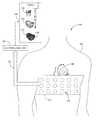
- FIG. 5is a schematic diagram of an external system 500 for determining presence of scar tissue in a patient's heart.
- an implanted leadmay not be available for detecting EGM evidence of scar tissue or an implanted electrode may not be located to produce an EGM signal sensitive enough to reliably detect scar tissue.
- a system and method for determining the presence of scar tissue without requiring costly or complex imaging systemsmay be needed to determine if scar is present and provide some assessment relating to the relative size of the scar in a metric referred to herein as the “scar burden.”
- the cliniciancan make informed treatment decisions. For example, if a patient is a candidate for CRT, knowledge of the presence of scar and an estimate of the scar burden is useful to a clinician in prescribing CRT and in planning lead and electrode placement for delivering CRT.
- System 500includes external surface electrodes 510 , shown carried by a wearable band or strap 512 for positioning the electrodes 510 in skin contact along the torso of a patient 506 .
- Electrodes 510may alternatively be adhesive skin electrodes. Electrodes 510 are positioned at multiple points along the patient's torso to record surface potential signals. The electrodes 510 may be equally distributed circumferentially around the patient's torso in one example.
- electrodes 510are used to acquire surface potential signals from heart 508 by strap 512 wrapped around the torso of patient 506 such that the electrodes 510 surround heart 508 Electrodes 510 may be positioned around the circumference of patient 506 , including the posterior, lateral, and anterior surfaces of the torso of patient 506 . In other examples, electrodes 512 may be positioned on any one or more of the posterior, lateral, and anterior surfaces of the torso. Electrodes 510 may be electrically connected to an ECG processing unit 520 via a wired connection 514 . Some configurations may use a wireless connection to transmit the signals sensed by electrodes 510 to ECG processing unit 520 , e.g., as channels of data.
- strap 512is shown carrying surface electrodes 510
- any of a variety of mechanismse.g., tape or adhesives, may be employed to aid in the spacing and placement of electrodes 510 in a distributed manner along a patient's torso to surround heart 508 .
- strap 512may include an elastic band, strip of tape, or cloth.
- electrodes 510may be placed individually on the torso of patient 506 .
- Electrodes 510record the electrical signals associated with the depolarization and repolarization of heart 508 .
- Each of electrodes 510may be used in a unipolar configuration to sense the surface potentials that reflect cardiac electrical activity.
- ECG processing unit 520may also be coupled to a return or indifferent electrode (not shown) which may be used in combination with each of electrodes 510 for unipolar sensing.
- ECG processing unit 520may record and analyze the surface potential signals, referred to generally herein as “ECG” signals, sensed by electrodes 510 .
- Processing unit 520may be configured to provide an output to a user indicating presence of scar tissue in heart 112 .
- the usermay make a diagnosis, prescribe CRT, position therapy devices, e.g., leads, or adjust or select treatment parameters based on the indicated scar tissue.
- the strap 512 carrying electrodes 510is one illustrative embodiment of an apparatus that is useful in recording surface ECG signals from which presence of scar tissue can be determined.
- Other surface cardiac signal recording apparatusmay be used for acquiring cardiac signal data from which presence scar tissue can be determined.
- Other signal recording apparatus and techniquesmay include 12 -lead ECG electrodes, a vest carrying an array of electrodes, and vectorcardiography.
- the electrodes 510are coupled to an ECG processing unit 520 via electrical conductors 514 .
- ECG signalsare received by ECG processing unit 520 which extracts ECG features from each received signal for producing an ECG feature map.
- ECG featuresmay be extracted from each ECG signal recorded from electrodes 510 in a manner similar to the techniques described above for extracting unipolar EGM features. For example, a QRS amplitude metric, a Q-wave negativity metric, an ECG fractionation metric or any combination thereof may be determined from the surface ECG signals as scar indicator indices.
- the ECG featuresare thereby used for determining scar indicator indices, individually or in a combined form, and are compared to a scar detection threshold by ECG processing unit 520 to determine if scar tissue is present at a myocardial tissue site.
- the ECG processing unit 520reports if scar tissue is detected and reports a scar burden, e.g. via display screen/monitor 522 coupled to ECG processing unit.
- the ECG processing unit 520may produce a graphical display 524 of a 2-dimensional or 3-dimensional model of the patient's torso superimposed with a color-coded mapping of the extracted ECG feature values projected onto the torso model based upon the electrode locations along the patient's torso.
- ECG processing unit 520 and display screen/monitor 522may be implemented in an external programmer, such as programmer 170 shown in FIG. 1 .
- a programmersuch as the CARELINK ENCORE® Programmer Model 29901, configured to receive signals from surface ECG electrodes is available from Medtronic, Inc., Minneapolis, Minn.
- the Medtronic CARELINK ENCORE® Programmer Model 29901 Reference Manual, 2013,is incorporated herein by reference in their entirety.
- the ECG processing unit 520may be configured to solve the inverse problem of electrocardiography to project ECG data onto a 2-dimensional or 3-dimensional heart model.
- a graphical display 526may be produced from the data projected on a computer heart model to create a visual mapping of the surface potential data mapped to the heart model.
- ECG feature valuesmay be represented as normalized values or percentages of a reference value of the respective feature.
- a mapped location of scar tissue based on the ECG feature valuesmay be presented in a graphical display 528 .
- the ECG processing unit 520may be configured to identify boundaries of detected scar tissue on a model heart in response to determining an overall cardiac scar burden index and torso surface locations of the electrodes identified having an affirmative scar indicator index.
- the display 528presents the boundaries 530 of scar tissue along the model heart and reports the overall cardiac scar burden index.
- a scar burden indexmay be computed as a percentage of the electrodes 510 having an affirmative scar indicator index.
- the resolution of the ECG data mapped to a graphical anatomical modelwill depend on the number and spacing of surface electrodes 510 used. In some examples, there may be 12 to 16 electrodes spatially distributed around the torso of patient 506 . Other configurations may have more or fewer electrodes. In one embodiment, a minimum number of electrodes includes twelve electrodes arranged in two rows extending along the posterior torso and twelve electrodes arranged in two rows extending along the anterior torso for a total of twenty-four electrodes, which may be equally distributed circumferentially around the torso.
- FIG. 6is a flow chart 600 of a method for determining a scar burden index according to one embodiment.
- surface potential signalsare recorded from skin electrodes distributed on a torso of a patient, for example as shown in FIG. 5 .
- An ECG processing unitreceives the potential signals from each surface electrode via the necessary electrical conductors or in some systems potential signals may be transmitted wirelessly from a body worn device to an ECG processing unit.
- a processor included in the ECG processing unitsolves the inverse problem of electrocardiography using a computer model of a heart anatomy and the received potential signals at block 604 .
- the potential signals resulting from the inverse problem solutionare used to characterize heart activity on the surface of the heart model.
- Featuresare extracted from the potential signals corresponding to each of the torso-surface electrodes at block 606 .
- at least two featuresare determined from each signal, which may include a metric of the QRS signal amplitude, a metric of Q-wave negativity and/or a metric of QRS signal fractionation, or any combination thereof, as described previously.
- the potential signals and/or the determined featurescan be stored in a non-transitory storage medium, e.g. digital memory associated with the ECG processing unit.
- a scar indicator indexis determined by the processor from the potential signal features, which may be normalized or non-normalized and combined in a single index or used individually as scar indicator indices.
- Feature valuesmay be normalized by determining a maximum, minimum, mean, median, mode or other reference value from all of the feature values determined from the distributed electrodes.
- the scar indicator indices determined for each electrode, from the potential signal produced at each surface electrode,are compared to a scar detection threshold at block 608 to identify which, if any, electrodes result in an affirmative scar indicator index. In this way, myocardial scar tissue is detected as being present at a cardiac location that corresponds to the torso-surface electrode that produced a potential signal resulting in a scar indicator index meeting a detection threshold requirement.
- a scar burden indexis computed at block 614 .
- the scar burden indexis computed as a proportion of the torso-surface electrodes having an affirmative scar indicator index.
- a scar burden indexmay be determined as an estimated myocardial surface area based on the number and location of electrodes having an affirmative scar indicator index.
- the scar burden indexis reported at block 616 .
- the scar burden indexmay be reported with a graphical display of data derived from the surface potential signals mapped to an anatomical heart model. Data obtained from the surface potential signals can be mapped to a heart using a computer model of a heart and the potential signals. For example, this process may involve solving inverse problem of electrocardiography based on a model heart and a model torso onto which the measured surface signals are mapped. The solution of inverse problem would provide reconstructed unipolar EGM signals at points or sites on the surface of the model heart. The reconstructed unipolar EGM features may be extracted and criteria for scar detection may be applied as described above. Feature values or an indication of the presence of scar tissue can be mapped and displayed to a clinician.
- the boundaries of detected scar tissuemay be estimated and presented on the display of a heart model based upon sites associated with affirmative scar indicator indices. If no scar is detected at block 610 , this result may be reported, and a display of a heart model mapped with signal feature values or scar indicator indices may optionally be generated at block 612 .
- the scar burden index and estimated scar boundariesmay be used by a clinician in making treatment decisions. For example, a patient being evaluated for CRT may be contraindicated for therapy if the scar burden exceeds a threshold value. Patients with a relatively high scar burden may not respond to CRT. Therefore, the scar burden index may be used as a predictor of patients that are expected to receive therapeutic benefit from CRT and those that are not.
- the reported scar burden at block 616may include a recommendation for CRT therapy based on the determined scar burden exceeding a threshold scar burden (CRT not recommended) or not exceeding a threshold scar burden (CRT recommended).
- FIG. 7is a flow chart of a system and/or method is disclosed for determining a scar burden index.
- a system and/or a methodis disclosed that comprises a processor receiving means for receiving a torso-surface potential signal from each of a plurality of electrodes distributed on a torso of a patient at block 702 .
- a processor meansextracts features of the potential signal from each of the plurality of electrodes.
- the featuresare stored.
- a processor meansis configured to determine a scar indicator index for each of the plurality of electrodes from the stored features, identifying ones of the plurality of electrodes having an affirmative scar indicator index, and determining an overall scar burden index as a proportion of the plurality of electrodes with an affirmative scar indicator index.
Landscapes
- Health & Medical Sciences (AREA)
- Life Sciences & Earth Sciences (AREA)
- Cardiology (AREA)
- Medical Informatics (AREA)
- Surgery (AREA)
- Engineering & Computer Science (AREA)
- Biomedical Technology (AREA)
- Heart & Thoracic Surgery (AREA)
- Physics & Mathematics (AREA)
- Molecular Biology (AREA)
- Pathology (AREA)
- Animal Behavior & Ethology (AREA)
- General Health & Medical Sciences (AREA)
- Public Health (AREA)
- Veterinary Medicine (AREA)
- Biophysics (AREA)
- Electrotherapy Devices (AREA)
- Measurement And Recording Of Electrical Phenomena And Electrical Characteristics Of The Living Body (AREA)
Abstract
Description
The disclosure relates generally to identifying the presence of healthy versus unhealthy cardiac substrate and particularly a system and method for identifying substrate for receiving cardiac pacing.
Myocardial ischemia or myocardial infarction can produce areas of scar tissue in the myocardial substrate that will be unresponsive to cardiac pacing. If a patient having myocardial scar tissue requires cardiac pacing, the location of the scar tissue is preferably avoided in positioning pacing electrodes. However, the location of the scar tissue may be unknown without performing imaging procedures, such as magnetic resonance imaging (MRI), which may be costly, require catheterization or contrast agents, and may not be readily available in some geographic areas.
Cardiac resynchronization therapy (CRT) is one type of cardiac pacing therapy that is used as a treatment for heart failure patients in which one or more heart chambers are electrically stimulated (paced) to restore or improve heart chamber synchrony. Achieving a positive clinical benefit from CRT is dependent on several therapy control parameters including selection of pacing site(s) and the relative timing of pacing pulses delivered in the right and/or left ventricles. For example, selection of a CRT pacing site that avoids myocardial scar tissue is important in achieving clinical benefit. Systems and methods are needed for identifying myocardial scar tissue versus healthy myocardial substrate at a potential pacing site in a patient receiving CRT or other pacing therapy without requiring costly imaging technology.
In general, the disclosure is directed towards techniques for determining presence of scar tissue. In one embodiment, a method determines the presence of scar tissue by a processing device receiving a torso-surface potential signal from multiple electrodes distributed on a torso of a patient. Features of the potential signal from each of the plurality of electrodes are extracted and stored in a non-transitory storage medium. A scar indicator index is determined for each of the electrodes from the stored features. The electrodes having an affirmative scar indicator index are identified, and an overall scar burden index is determined as a proportion of the electrodes with an affirmative scar indicator index.
In another embodiment, a medical device system for determining presence of scar tissue includes a processor receiving means for receiving a torso-surface potential signal from each of multiple electrodes distributed on a torso of a patient and processor means for extracting features of the potential signal from each of the plurality of electrodes. The features are stored, and a processor determines a scar indicator index for each of the electrodes from the stored features, identifies electrodes having an affirmative scar indicator index, and determines an overall scar burden index as a proportion of the electrodes with an affirmative scar indicator index.
In another embodiment, a non-transitory, computer readable storage medium stores instructions for causing a processor of a medical device system to perform a method for determining presence of myocardial scar tissue. The method includes receiving a torso-surface potential signal from electrodes distributed on a torso of a patient, extracting features of the potential signal from each of the electrodes, storing values of the features in a non-transitory storage medium, determining a scar indicator index for each of the electrodes from the stored features, identifying electrodes having an affirmative scar indicator index, and determining an overall scar burden index as a proportion of the electrodes with an affirmative scar indicator index.
Other embodiments and aspects of a system and method for determining presence of scar tissue are described herein. The details of one or more aspects of the disclosure are set forth in the accompanying drawings and the description below.
Other features, objects, and advantages will be apparent from the description and drawings, and from the claims.
IMD10 delivers RV pacing pulses and senses RV intracardiac electrogram (EGM) signals usingRV tip electrode 140 andRV ring electrode 142.RV lead 118 is shown to carry acoil electrode 162 which may be used for delivering high voltage cardioversion or defibrillation shock pulses. IMD10 senses LV EGM signals and delivers LV pacing pulses using theelectrodes 144 carried by a multipolarcoronary sinus lead 120, extending through theRA 126 and into acardiac vein 130 via the coronary sinus. In some embodiments,coronary sinus lead 120 may include electrodes positioned along the left atrium (LA)136 for sensing left atrial (LA) EGM signals and delivering LA pacing pulses.
IMD10 senses RA EGM signals and delivers RA pacing pulses usingRA lead 122, carryingtip electrode 148 andring electrode 150.RA lead 122 is shown to be carryingcoil electrode 166 which may be positioned along the superior vena cava (SVC) for use in delivering cardioversion/defibrillation shocks. In other embodiments,RV lead 118 carries both theRV coil electrode 162 and theSVC coil electrode 166. IMD10 may detect tachyarrhythmias ofheart 112, such as fibrillation ofventricles heart 112 in the form of electrical shock pulses. Pacing and sensing of the cardiac chambers is typically achieved using the pace/sense electrodes embodiments coil electrodes 162 and/or166 may be used in sensing and/or pacing electrode vectors.
While IMD10 is shown in a right pectoral implant position inFIG. 1 , a more typical implant position, particularly when IMD10 is embodied as an ICD, is a left pectoral implant position. In other embodiments, IMD10 may be implanted in an abdominal location.
IMD10 includes internal circuitry for performing the functions attributed toIMD 10.Housing 160 encloses the internal circuitry. It is recognized that thehousing 160 or portions thereof may be configured as anactive electrode 158 for use in cardioversion/defibrillation shock delivery or used as an indifferent electrode for unipolar pacing or sensing configurations with any electrodes carried byleads connector block 134 having connector bores for receiving proximal lead connectors ofleads leads connector block 134.
IMD10 is configured for delivering CRT by delivering pacing pulses in one or bothventricles electrode 144 onmultipolar LV lead 120. RV pacing is delivered usingRV tip electrode 140 andring electrode 142. CRT may be delivered by pacing in a single ventricular chamber (LV or RV) or both chambers (biventricular pacing) depending on patient need. The methods described herein are implemented in a dual or multi-chamber pacemaker or ICD delivering pacing pulses to the right and/or left ventricles using programmable pacing pulse timing parameters and selected pacing sites and pacing vectors.
While a multi-chamber ICD is shown inFIG. 1 , it is recognized that techniques disclosed herein may be implemented in a single chamber, dual chamber or multi-chamber pacemaker, with or without anti-arrhythmia therapies such as cardioversion and defibrillation shock capabilities. For example, techniques disclosed herein for identifying pacing site(s) for CRT may be used for guiding selection of a pacing site for any pacing therapy by identifying myocardial scar tissue at a potential pacing site.
It is contemplated thatprogrammer 170 may be coupled to a communications network viacommunications module 178 for transferring data to a remote database or computer to allow remote monitoring and management ofpatient 114 using the techniques described herein. Remote patient management systems may be configured to utilize the presently disclosed techniques to enable a clinician to review test data, programmed therapy parameters and authorize programming ofIMD 10. Reference is made to commonly-assigned U.S. Pat. Nos. 6,599,250 (Webb et al.), 6,442,433 (Linberg et al.), 6,418,346 (Nelson et al.), and 6,480,745 (Nelson et al.) for general descriptions and examples of network communication systems for use with implantable medical devices for remote patient monitoring and device programming, all of which patents are hereby incorporated herein by reference in their entirety.
Processor andcontrol unit 80 may include any one or more of a microprocessor, a controller, a digital signal processor (DSP), an application specific integrated circuit (ASIC), a field-programmable gate array (FPGA), or equivalent discrete or integrated logic circuitry. In some examples,processor 80 may include multiple components, such as any combination of one or more microprocessors, one or more controllers, one or more DSPs, one or more ASICs, or one or more FPGAs, as well as other discrete or integrated logic circuitry. The functions attributed toprocessor 80 herein may be embodied as software, firmware, hardware or any combination thereof. In one example,cardiac signal analyzer 90 may, at least in part, be stored or encoded as instructions inmemory 82 that are executed by processor andcontrol unit 80.
Processor andcontrol unit 80 includes a therapy control unit that controlssignal generator 84 to deliver electrical stimulation therapy, e.g., cardiac pacing or CRT, toheart 112 according to a selected one or more therapy programs, which may be stored inmemory 82.Signal generator 84 is electrically coupled toelectrodes FIG. 1 ), e.g., via conductors of the respective leads118,120,122, or, in the case ofhousing electrode 158, via an electrical conductor disposed withinhousing 160 ofIMD 10.Signal generator 84 is configured to generate and deliver electrical stimulation therapy toheart 112 via selected combinations ofelectrodes Signal generator 84 delivers cardiac pacing pulses according to therapy control parameters during CRT. CRT is delivered to a pacing site identified as not being over scar tissue as will be described herein.
In various embodiments, one or more sensing channels may be selectively coupled toelectrodes 144 included onmultipolar lead 120 for sensing unipolar EGM signals for detecting scar tissue. In one embodiment,sensing module 86 includes an LV sensing channel and electrodes144a,144b,144cand144dare selectively coupled one at a time in a unipolar sensing configuration in combination with a common anode, such ashousing electrode 158,coil electrode 162, orcoil electrode 166, to acquire a unipolar EGM signal for each of the respective locations ofelectrodes 144a-144dalong LV tissue.
A digitized EGM signal obtained using each of theelectrodes 144a-144dis analyzed bycardiac signal analyzer 90 to extract a combination of EGM signal features, e.g. at least two features, from each of the unipolar sensed signals. The extracted features are analyzed to detect scar tissue as will be described in greater detail below. In response to detecting scar tissue,processor 80 may generate a notification for transmission viatelemetry module 88 and/or establish or alter a pacing electrode selection for delivering CRT therapy.Processor 80 andcardiac signal analyzer 90 may collectively represent processor means for determining the presence of scar tissue as described herein.
Other examples of functional block diagrams ofIMD 10 may be seen with respect to U.S. patent application Ser. No. 13/916,353 (e.g., FIGS. 17A-17B) filed Jun. 12, 2013, and assigned to the assignee of the present invention, the disclosure of which is incorporated by reference in its entirety herein.
When multiple electrodes are available, conventional “short” bipolar pairs that enable recording of a true, near-field bipolar signal can be used to detect myocardial scar tissue by detecting changes in the bipolar EGM signal due to changes in the local, near-field EGM signal. However, as the distance between the sensing pair of electrodes increases, the volume of tissue contributing to the recorded EGM signal will increase. More far-field electrical activity will be contributing to the recorded signal reducing the sensitivity of the signal to detecting scar tissue at the sensing electrode site. A multipolar lead may provide multiple sensing/pacing sites, however the spacing between electrodes along the multipolar lead may be greater than that required to record a bipolar signal with great enough sensitivity to reliably detect EGM signal changes caused by scar tissue. The process shown byflow chart 300 provides a technique for detecting the presence of scar tissue at an electrode site independent of inter-electrode spacing when multiple electrodes are positioned at various sites along a heart chamber.
The process shown byflow chart 300 may be performed at the time an IMD and associated leads are being initially implanted, at a time of repositioning or replacing a cardiac lead, on a periodic basis after implanting the IMD and associated leads. In some embodiments, the process shown byflow chart 300 may be performed in response to a change in a monitored parameter, such as a change in a hemodynamic parameter or a change in a pacing capture threshold.
Atblock 302, scar tissue detection thresholds are established. Thresholds for detecting scar may be based on previous EGM baseline recordings obtained from the patient, EGM recordings obtained from the patient at the time the test for detecting scar is being performed, or based on empirical data from a population of patients. Thresholds are applied to at least two EGM signal features determined from each unipolar EGM signal. Separate thresholds may be applied to each of the two or more EGM signal features individually or to a single metric or index computed from the two or more EGM signal features and a single threshold applied to the metric.
Atblock 304, LV pacing is withheld. EGM signals for the purposes of detecting myocardial scar tissue in the LV are recorded during a baseline rhythm which typically does not involve pacing from the LV lead or electrodes. The heart rhythm may be an intrinsic heart rhythm with no pacing delivered in any heart chamber, an atrial paced rhythm, an RV paced rhythm, or during pacing in an atrial chamber and the RV. It is contemplated that in some cases another LV lead or electrode may be present different than the pacing electrodes and associated sites being tested for scar tissue that could be used for pacing during recording of unipolar EGM signals at the LV pacing sites under test.
Atblock 306, unipolar LV EGM signals are recorded by sensingmodule 86 for eachLV electrode 144a-davailable when no LV pacing is being delivered. The LV EGM signals are recorded using a common anode paired with each LV electrode for sensing n different unipolar EGM signals when n electrodes are positioned along the LV. The different unipolar EGM signals may be recorded one at a time in a sequential manner or simultaneously depending on the number of sensing channels available in thesensing module 86IMD 10. Each unipolar signal may be recorded for at least one cardiac cycle and generally will be recorded for multiple cycles, e.g. 3 to 12 cycles, for obtaining representative EGM signal features from for a given sensing electrode site.
Atblock 308, at least two different EGM signal features are extracted from each recorded unipolar signal. At least two different signal features are extracted in case a single feature of the unipolar EGM does not provide a great enough sensitivity to reliably detect EGM signal changes due to scar tissue. The signal features extracted from each unipolar EGM signal may include, but are not limited to, metrics of the QRS amplitude, negativity of the Q-wave, and fractionation of the EGM signal. It is recognized that numerous techniques can be conceived for determining a metric of QRS signal amplitude, a metric of Q-wave negativity, and a metric of QRS fractionation.
For the sake of illustration, a metric of QRS amplitude may be determined as the peak-to-peak amplitude difference during a QRS sensing window. The QRS amplitude is expected to be reduced when scar tissue is present at the sensing electrode as compared to healthy tissue at the sensing electrode.
A broad negative Q-wave is also evidence of scar tissue. A metric of Q-wave negativity can be extracted from the EGM signal by counting the number of digitized EGM sample points that are negative during a QRS sensing window, by determining a summation of EGM sample point values over a QRS sensing window, or by determining an integral or area defined by the EGM signal sample points over a sensing window.
Scar tissue may also cause fractionation of the EGM signal, i.e. multiple peaks rather than a single R-wave peak. A metric of fractionation of the EGM signal may be extracted from the EGM signal by counting a number of slope sign changes, counting a number of peaks, or counting a number of inflection points during a QRS sensing window.
In one embodiment, at least two metrics of QRS amplitude, Q-wave negativity, and/or EGM fractionation are determined from each unipolar EGM signal atblock 308. These metrics are compared to the established detection thresholds atblock 310, individually and/or in a combined metric. Criteria may be defined for detecting scar tissue. For example, at least two out of three EGM signal features must meet a respective scar detection threshold to detect scar tissue at a sensing electrode site. If scar detection threshold(s)/criteria are satisfied atblock 312, the electrode used to record the associated EGM signal is rejected as a pacing site atblock 314.
Atblock 316, pacing site(s) for delivering pacing therapy are selected. Any electrodes available after rejecting those electrodes associated with scar detection may be selected for therapy delivery and additional pacing site selection criteria may be applied to select a pacing site according to the particular pacing application. Pacing site selection may be performed automatically atblock 316 by rejecting any electrodes identified as being located along scar tissue and applying any other therapy pacing site selection criteria, e.g. low capture threshold, low impedance etc. Pacing site selection may alternatively be performed by a clinician after transmitting a notification to an external programmer or other device that scar has been detected and indicating the associated electrode(s). Atblock 318, LV pacing is enabled such that a desired therapy can be delivered according to programmed therapy control parameters at the selected pacing site(s).
Atblock 404, heart activity is sensed at each electrode positioned along the LV to produce unipolar EGM waveforms corresponding to each LV electrode site. At least two features are extracted from each of the RV and LV unipolar EGM waveforms atblock 406. The extracted EGM features are representative of the heart activity at the associated electrode site and may include a metric of QRS waveform amplitude, a metric of Q-wave negativity, and a metric of QRS waveform fractionation. In an illustrative embodiment, one feature extracted from the unipolar EGM waveform is a peak-to-peak amplitude difference as a metric of QRS amplitude. In another embodiment, one extracted feature is a percentage of the EGM waveform sample points having a negative polarity out of all of the EGM waveform sample points during the QRS sensing window as a metric of Q-wave negativity. In yet another embodiment, one extracted feature is a number of times the slope of the EGM waveform changes between a positive slope and a negative slope (in either direction) as a metric of fractionation of the QRS signal. Any combination of at least two features of the EGM waveform may be extracted.
The features may be extracted by first setting a QRS window. The QRS window is centered at an R-wave sensed by a sense amplifier included in the IMD sensing module in one embodiment and extends a predetermined time interval earlier and later than the R-wave sense marker generated by the sense amplifier. The EGM features may then be extracted from the waveform sample points during the window. A given feature may be extracted on a beat-by-beat basis for a predetermined number of beats and then averaged to determine an average feature representative of heart activity at the electrode site or a median or mode of the extracted features may be determined. Alternatively, the EGM waveform may be ensemble averaged over the QRS window for multiple beats then a feature can be extracted from the averaged QRS waveform.
The features are determined for each unipolar EGM signal recorded, and at block408 a maximum of an EGM feature determined from all recorded signals is identified. The maximum value, which may be an absolute value, of a given EGM feature is used to normalize the given EGM feature values extracted from each unipolar EGM waveform atblock 410. In this way, a percentage difference in a feature value is determined relative to a maximum feature value. For example, if a unipolar EGM signal has a normal peak-to-peak amplitude difference and another unipolar EGM signal has a normalized peak-to-peak amplitude that is 50% of the normal peak-to-peak amplitude, the 50% lower peak-to-peak amplitude is a signal feature indicating scar tissue at the associated electrode site. One or more extracted features may be normalized by a maximum and compared to a threshold percentage for identifying scar tissue atblock 412. It is recognized that in some cases, feature values may be normalized by a minimum feature value, a mean feature value or other reference value. In some examples, a value used to normalize extracted features values is extracted from the RV EGM.
A normalized or non-normalized value may indicate scar when the value exceeds a threshold percentage or level or is less than a threshold percentage or level depending on the particular feature. For example, a peak-to-peak amplitude difference may be normalized by a maximum and required to be less than a threshold percentage, e.g. 50%, while the percentage of negative sample points may be required to be greater than a threshold percentage. A number of slope changes may be left un-normalized and compared to a threshold number. In some embodiments, a threshold applied to the feature values extracted from the LV unipolar EGM signals is derived from the RV unipolar EGM signal.
If at least two extracted features of a unipolar EGM signal indicate scar tissue based on the detection threshold comparison, as determined atdecision block 414, scar is detected at the associated electrode site. The electrode is rejected for use in delivering a pacing therapy atblock 416 and/or a notification indicating detection of scar tissue and recommended rejection of the pacing site may be generated. Pacing site(s) may be selected atblock 418 from electrodes that were not determined to be located along scar tissue and the pacing therapy may be enabled atblock 420 using the selected pacing site(s). In this example, the selected pacing site is along the LV for delivering CRT.
In one embodiment,electrodes 510 are used to acquire surface potential signals fromheart 508 bystrap 512 wrapped around the torso ofpatient 506 such that theelectrodes 510surround heart 508Electrodes 510 may be positioned around the circumference ofpatient 506, including the posterior, lateral, and anterior surfaces of the torso ofpatient 506. In other examples,electrodes 512 may be positioned on any one or more of the posterior, lateral, and anterior surfaces of the torso.Electrodes 510 may be electrically connected to anECG processing unit 520 via awired connection 514. Some configurations may use a wireless connection to transmit the signals sensed byelectrodes 510 toECG processing unit 520, e.g., as channels of data.
Although in the example ofFIG. 5 ,strap 512 is shown carryingsurface electrodes 510, in other examples any of a variety of mechanisms, e.g., tape or adhesives, may be employed to aid in the spacing and placement ofelectrodes 510 in a distributed manner along a patient's torso to surroundheart 508. In some examples,strap 512 may include an elastic band, strip of tape, or cloth. In other examples,electrodes 510 may be placed individually on the torso ofpatient 506.
Thestrap 512 carryingelectrodes 510 is one illustrative embodiment of an apparatus that is useful in recording surface ECG signals from which presence of scar tissue can be determined. Other surface cardiac signal recording apparatus may be used for acquiring cardiac signal data from which presence scar tissue can be determined. Other signal recording apparatus and techniques may include12-lead ECG electrodes, a vest carrying an array of electrodes, and vectorcardiography.
Theelectrodes 510 are coupled to anECG processing unit 520 viaelectrical conductors 514. ECG signals are received byECG processing unit 520 which extracts ECG features from each received signal for producing an ECG feature map. ECG features may be extracted from each ECG signal recorded fromelectrodes 510 in a manner similar to the techniques described above for extracting unipolar EGM features. For example, a QRS amplitude metric, a Q-wave negativity metric, an ECG fractionation metric or any combination thereof may be determined from the surface ECG signals as scar indicator indices.
The ECG features are thereby used for determining scar indicator indices, individually or in a combined form, and are compared to a scar detection threshold byECG processing unit 520 to determine if scar tissue is present at a myocardial tissue site. TheECG processing unit 520 reports if scar tissue is detected and reports a scar burden, e.g. via display screen/monitor 522 coupled to ECG processing unit. TheECG processing unit 520 may produce agraphical display 524 of a 2-dimensional or 3-dimensional model of the patient's torso superimposed with a color-coded mapping of the extracted ECG feature values projected onto the torso model based upon the electrode locations along the patient's torso.
In some embodiments,ECG processing unit 520 and display screen/monitor 522 may be implemented in an external programmer, such asprogrammer 170 shown inFIG. 1 . A programmer, such as the CARELINK ENCORE® Programmer Model 29901, configured to receive signals from surface ECG electrodes is available from Medtronic, Inc., Minneapolis, Minn. The Medtronic CARELINK ENCORE® Programmer Model 29901 Reference Manual, 2013, is incorporated herein by reference in their entirety.
TheECG processing unit 520 may be configured to solve the inverse problem of electrocardiography to project ECG data onto a 2-dimensional or 3-dimensional heart model. Agraphical display 526 may be produced from the data projected on a computer heart model to create a visual mapping of the surface potential data mapped to the heart model. ECG feature values may be represented as normalized values or percentages of a reference value of the respective feature.
Additionally or alternatively, a mapped location of scar tissue based on the ECG feature values may be presented in agraphical display 528. TheECG processing unit 520 may be configured to identify boundaries of detected scar tissue on a model heart in response to determining an overall cardiac scar burden index and torso surface locations of the electrodes identified having an affirmative scar indicator index. Thedisplay 528 presents theboundaries 530 of scar tissue along the model heart and reports the overall cardiac scar burden index. As described below, a scar burden index may be computed as a percentage of theelectrodes 510 having an affirmative scar indicator index.
No imaging of the actual patient anatomy is required to produce thegraphical displays
The resolution of the ECG data mapped to a graphical anatomical model will depend on the number and spacing ofsurface electrodes 510 used. In some examples, there may be 12 to 16 electrodes spatially distributed around the torso ofpatient 506. Other configurations may have more or fewer electrodes. In one embodiment, a minimum number of electrodes includes twelve electrodes arranged in two rows extending along the posterior torso and twelve electrodes arranged in two rows extending along the anterior torso for a total of twenty-four electrodes, which may be equally distributed circumferentially around the torso.
A processor included in the ECG processing unit solves the inverse problem of electrocardiography using a computer model of a heart anatomy and the received potential signals atblock 604. The potential signals resulting from the inverse problem solution are used to characterize heart activity on the surface of the heart model. Features are extracted from the potential signals corresponding to each of the torso-surface electrodes atblock 606. In one embodiment, at least two features are determined from each signal, which may include a metric of the QRS signal amplitude, a metric of Q-wave negativity and/or a metric of QRS signal fractionation, or any combination thereof, as described previously. The potential signals and/or the determined features can be stored in a non-transitory storage medium, e.g. digital memory associated with the ECG processing unit.
A scar indicator index is determined by the processor from the potential signal features, which may be normalized or non-normalized and combined in a single index or used individually as scar indicator indices. Feature values may be normalized by determining a maximum, minimum, mean, median, mode or other reference value from all of the feature values determined from the distributed electrodes. The scar indicator indices determined for each electrode, from the potential signal produced at each surface electrode, are compared to a scar detection threshold atblock 608 to identify which, if any, electrodes result in an affirmative scar indicator index. In this way, myocardial scar tissue is detected as being present at a cardiac location that corresponds to the torso-surface electrode that produced a potential signal resulting in a scar indicator index meeting a detection threshold requirement.
If scar tissue is detected atblock 610 based upon one or more electrodes having an affirmative scar indicator index, a scar burden index is computed atblock 614. In one embodiment, the scar burden index is computed as a proportion of the torso-surface electrodes having an affirmative scar indicator index. Additionally or alternatively, a scar burden index may be determined as an estimated myocardial surface area based on the number and location of electrodes having an affirmative scar indicator index.
The scar burden index is reported atblock 616. The scar burden index may be reported with a graphical display of data derived from the surface potential signals mapped to an anatomical heart model. Data obtained from the surface potential signals can be mapped to a heart using a computer model of a heart and the potential signals. For example, this process may involve solving inverse problem of electrocardiography based on a model heart and a model torso onto which the measured surface signals are mapped. The solution of inverse problem would provide reconstructed unipolar EGM signals at points or sites on the surface of the model heart. The reconstructed unipolar EGM features may be extracted and criteria for scar detection may be applied as described above. Feature values or an indication of the presence of scar tissue can be mapped and displayed to a clinician. The boundaries of detected scar tissue may be estimated and presented on the display of a heart model based upon sites associated with affirmative scar indicator indices. If no scar is detected atblock 610, this result may be reported, and a display of a heart model mapped with signal feature values or scar indicator indices may optionally be generated atblock 612.
The scar burden index and estimated scar boundaries may be used by a clinician in making treatment decisions. For example, a patient being evaluated for CRT may be contraindicated for therapy if the scar burden exceeds a threshold value. Patients with a relatively high scar burden may not respond to CRT. Therefore, the scar burden index may be used as a predictor of patients that are expected to receive therapeutic benefit from CRT and those that are not. The reported scar burden atblock 616 may include a recommendation for CRT therapy based on the determined scar burden exceeding a threshold scar burden (CRT not recommended) or not exceeding a threshold scar burden (CRT recommended).
Thus, various embodiments of a system and method for determining the presence of myocardial scar have been described. However, one of ordinary skill in the art will appreciate that various modifications may be made to the described embodiments without departing from the scope of the claims. For example, although specific examples of scar indicator indices or ECG signal features have been described, it is recognized that other indicators may be conceived and substituted in the scar detection techniques presented herein. Both an implantable system and an external system useful for determining presence of myocardial scar have been described separately, however, the techniques disclosed herein may be combined in any manner to include scar detection using one or both internal and external electrodes at the same or different time points in managing a patient and determining a patient's scar burden. These and other examples are within the scope of the following claims.
Claims (22)
1. A system comprising:
a processor receiving means for receiving a torso-surface potential signal from each of a plurality of electrodes distributed on a torso of a patient;
a processor means for extracting features of the potential signal from each of the plurality of electrodes;
a storing means for storing the features;
a processor means for determining a scar indicator index for each of the plurality of electrodes from the stored features, identifying ones of the plurality of electrodes having an affirmative scar indicator index, and determining an overall scar burden index as a proportion of the plurality of electrodes with an affirmative scar indicator index.
2. The system ofclaim 1 , further comprising a processor generating means for generating a map containing anatomic locations of electrodes with an affirmative scar indicator index.
3. The system ofclaim 2 , further comprising a display means for displaying values of the features mapped to a computer model of a patient's anatomy.
4. The system ofclaim 1 , further comprising a processor means for determining an inverse problem of electrocardiography based on the torso-surface potential signals and an anatomical computer model of a human heart and torso.
5. The system ofclaim 1 , further comprising a processor means for computing potentials on a surface of a computer model of a heart anatomy based on the torso-surface potential signals.
6. The system ofclaim 1 , further comprising a processor means for identifying boundaries of scar tissue on a computer model heart in response to determining the overall cardiac scar burden index and torso surface locations of the ones of the plurality of electrodes identified with an affirmative scar indicator index.
7. The system ofclaim 6 , further comprising a display means for displaying the boundaries of scar tissue along the model heart and the overall cardiac scar burden index.
8. The system ofclaim 1 , wherein the features extracted from the potential signals for each of the plurality of electrodes comprise at least two of a QRS amplitude metric, a Q-wave negativity metric, and a QRS fractionation metric.
9. The system ofclaim 1 , further comprising a processor means for estimating a scar burden surface area in response to the determined overall cardiac scar burden index and the ones of the plurality of electrodes identified with an affirmative scar indicator index.
10. The system ofclaim 1 , further comprising reporting means for reporting the scar burden index and a therapy recommendation in response to the scar burden index.
11. A method comprising:
receiving by a processor a torso-surface potential signal from each of a plurality of electrodes distributed on a torso of a patient;
extracting by the processor features of the potential signal from each of the plurality of electrodes;
storing values of the features in a non-transitory storage medium;
determining by the processor a scar indicator index for each of the plurality of electrodes from the stored features;
identifying ones of the plurality of electrodes having an affirmative scar indicator index; and
determining an overall scar burden index as a proportion of the plurality of electrodes with an affirmative scar indicator index.
12. The method ofclaim 11 , further comprising generating a map containing anatomic locations of electrodes with an affirmative scar indicator index.
13. The method ofclaim 12 , further comprising displaying values of the features mapped to a computer model of a patient's anatomy.
14. The method ofclaim 11 , further comprising determining an inverse problem of electrocardiography based on the torso-surface potential signals and an anatomical computer model of a human heart and torso.
15. The method ofclaim 11 , further comprising computing potentials on a surface of a computer model of a heart anatomy based on the torso-surface potential signals.
16. The method ofclaim 11 , further comprising identifying boundaries of scar tissue on a computer model of a heart in response to determining the overall cardiac scar burden index and torso surface locations of the ones of the plurality of electrodes identified with an affirmative scar indicator index.
17. The method ofclaim 16 , further comprising displaying the boundaries of scar tissue along the computer model of the heart and the overall cardiac scar burden index.
18. The method ofclaim 11 , wherein extracting the features from the potential signals for each of the plurality of electrodes comprises determining at least two of a QRS amplitude metric, a Q-wave negativity metric, and a QRS fractionation metric.
19. The method ofclaim 11 , further comprising estimating a scar burden surface area in response to the determined overall cardiac scar burden index and the ones of the plurality of electrodes identified with an affirmative scar indicator index.
20. The method ofclaim 11 , further comprising reporting the scar burden index and a therapy recommendation in response to the scar burden index.
21. A non-transitory, computer readable storage medium comprising instructions for causing a processor of a medical device system to perform a method, the method comprising:
receiving a torso-surface potential signal from each of a plurality of electrodes distributed on a torso of a patient;
extracting features of the potential signal from each of the plurality of electrodes;
storing values of the features in a non-transitory storage medium;
determining a scar indicator index for each of the plurality of electrodes from the stored features;
identifying ones of the plurality of electrodes having an affirmative scar indicator index; and
determining an overall scar burden index as a proportion of the plurality of electrodes with an affirmative scar indicator index.
22. An apparatus for determining presence of myocardial scar tissue, comprising:
sensing means for receiving a torso-surface potential signal from each of a plurality of electrodes distributed on a torso of a patient;
processing means for extracting features of the potential signal from each of the plurality of electrodes;
storing means for storing values of the features in a non-transitory storage medium;
processing means for determining a scar indicator index for each of the plurality of electrodes from the stored features;
processing means for identifying ones of the plurality of electrodes having an affirmative scar indicator index; and
processing means for determining an overall scar burden index as a proportion of the plurality of electrodes with an affirmative scar indicator index.
Priority Applications (4)
| Application Number | Priority Date | Filing Date | Title |
|---|---|---|---|
| US13/948,568US9282907B2 (en) | 2013-07-23 | 2013-07-23 | Identification of healthy versus unhealthy substrate for pacing from a multipolar lead |
| CN201480041708.XACN105431082B (en) | 2013-07-23 | 2014-07-22 | Identify healthy versus unhealthy substrate for pacing from multipolar leads |
| PCT/US2014/047611WO2015013271A1 (en) | 2013-07-23 | 2014-07-22 | Identification of healthy versus unhealthy substrate for pacing from a multipolar lead |
| EP14748082.6AEP3024385B1 (en) | 2013-07-23 | 2014-07-22 | Identification of healthy versus unhealthy substrate for pacing from a multipolar lead |
Applications Claiming Priority (1)
| Application Number | Priority Date | Filing Date | Title |
|---|---|---|---|
| US13/948,568US9282907B2 (en) | 2013-07-23 | 2013-07-23 | Identification of healthy versus unhealthy substrate for pacing from a multipolar lead |
Publications (2)
| Publication Number | Publication Date |
|---|---|
| US20150032016A1 US20150032016A1 (en) | 2015-01-29 |
| US9282907B2true US9282907B2 (en) | 2016-03-15 |
Family
ID=51293201
Family Applications (1)
| Application Number | Title | Priority Date | Filing Date |
|---|---|---|---|
| US13/948,568ActiveUS9282907B2 (en) | 2013-07-23 | 2013-07-23 | Identification of healthy versus unhealthy substrate for pacing from a multipolar lead |
Country Status (4)
| Country | Link |
|---|---|
| US (1) | US9282907B2 (en) |
| EP (1) | EP3024385B1 (en) |
| CN (1) | CN105431082B (en) |
| WO (1) | WO2015013271A1 (en) |
Cited By (42)
| Publication number | Priority date | Publication date | Assignee | Title |
|---|---|---|---|---|
| US9474457B2 (en) | 2013-06-12 | 2016-10-25 | Medtronic, Inc. | Metrics of electrical dyssynchrony and electrical activation patterns from surface ECG electrodes |
| US9510763B2 (en) | 2011-05-03 | 2016-12-06 | Medtronic, Inc. | Assessing intra-cardiac activation patterns and electrical dyssynchrony |
| US9586052B2 (en) | 2014-08-15 | 2017-03-07 | Medtronic, Inc. | Systems and methods for evaluating cardiac therapy |
| US9586050B2 (en) | 2014-08-15 | 2017-03-07 | Medtronic, Inc. | Systems and methods for configuration of atrioventricular interval |
| US9591982B2 (en) | 2014-07-31 | 2017-03-14 | Medtronic, Inc. | Systems and methods for evaluating cardiac therapy |
| US9764143B2 (en) | 2014-08-15 | 2017-09-19 | Medtronic, Inc. | Systems and methods for configuration of interventricular interval |
| US9776009B2 (en) | 2014-03-20 | 2017-10-03 | Medtronic, Inc. | Non-invasive detection of phrenic nerve stimulation |
| US9877789B2 (en) | 2013-06-12 | 2018-01-30 | Medtronic, Inc. | Implantable electrode location selection |
| US9924884B2 (en) | 2013-04-30 | 2018-03-27 | Medtronic, Inc. | Systems, methods, and interfaces for identifying effective electrodes |
| US9986928B2 (en) | 2013-12-09 | 2018-06-05 | Medtronic, Inc. | Noninvasive cardiac therapy evaluation |
| US10064567B2 (en) | 2013-04-30 | 2018-09-04 | Medtronic, Inc. | Systems, methods, and interfaces for identifying optimal electrical vectors |
| US10251555B2 (en) | 2013-06-12 | 2019-04-09 | Medtronic, Inc. | Implantable electrode location selection |
| US10368766B2 (en) | 2013-12-09 | 2019-08-06 | Medtronic, Inc. | Bioelectric sensor device and methods |
| US10433746B2 (en) | 2017-12-22 | 2019-10-08 | Regents Of The University Of Minnesota | Systems and methods for anterior and posterior electrode signal analysis |
| US10492705B2 (en) | 2017-12-22 | 2019-12-03 | Regents Of The University Of Minnesota | Anterior and posterior electrode signals |
| US10532213B2 (en) | 2017-03-03 | 2020-01-14 | Medtronic, Inc. | Criteria for determination of local tissue latency near pacing electrode |
| US10617318B2 (en) | 2018-02-27 | 2020-04-14 | Medtronic, Inc. | Mapping electrical activity on a model heart |
| US10668290B2 (en) | 2018-03-01 | 2020-06-02 | Medtronic, Inc. | Delivery of pacing therapy by a cardiac pacing device |
| US10773085B2 (en) | 2017-03-15 | 2020-09-15 | Medtronic, Inc. | QRS offset and onset determination |
| US10780279B2 (en) | 2016-02-26 | 2020-09-22 | Medtronic, Inc. | Methods and systems of optimizing right ventricular only pacing for patients with respect to an atrial event and left ventricular event |
| US10780281B2 (en) | 2018-03-23 | 2020-09-22 | Medtronic, Inc. | Evaluation of ventricle from atrium pacing therapy |
| US10786167B2 (en) | 2017-12-22 | 2020-09-29 | Medtronic, Inc. | Ectopic beat-compensated electrical heterogeneity information |
| US10799703B2 (en) | 2017-12-22 | 2020-10-13 | Medtronic, Inc. | Evaluation of his bundle pacing therapy |
| US10918863B2 (en) | 2017-07-28 | 2021-02-16 | Medtronic, Inc. | Generating activation times |
| US10918870B2 (en) | 2018-03-07 | 2021-02-16 | Medtronic, Inc. | Atrial lead placement for treatment of atrial dyssynchrony |
| US10940321B2 (en) | 2018-06-01 | 2021-03-09 | Medtronic, Inc. | Systems, methods, and interfaces for use in cardiac evaluation |
| US11219769B2 (en) | 2016-02-26 | 2022-01-11 | Medtronic, Inc. | Noninvasive methods and systems of determining the extent of tissue capture from cardiac pacing |
| US11253178B2 (en) | 2015-01-29 | 2022-02-22 | Medtronic, Inc. | Noninvasive assessment of cardiac resynchronization therapy |
| US11285312B2 (en) | 2018-03-29 | 2022-03-29 | Medtronic, Inc. | Left ventricular assist device adjustment and evaluation |
| US11304641B2 (en) | 2018-06-01 | 2022-04-19 | Medtronic, Inc. | Systems, methods, and interfaces for use in cardiac evaluation |
| US11419539B2 (en) | 2017-12-22 | 2022-08-23 | Regents Of The University Of Minnesota | QRS onset and offset times and cycle selection using anterior and posterior electrode signals |
| US11471678B2 (en) | 2017-07-28 | 2022-10-18 | Medtronic, Inc. | Cardiac cycle selection |
| US11497431B2 (en) | 2019-10-09 | 2022-11-15 | Medtronic, Inc. | Systems and methods for configuring cardiac therapy |
| US11547858B2 (en) | 2019-03-29 | 2023-01-10 | Medtronic, Inc. | Systems, methods, and devices for adaptive cardiac therapy |
| US11642533B2 (en) | 2019-11-04 | 2023-05-09 | Medtronic, Inc. | Systems and methods for evaluating cardiac therapy |
| US11697025B2 (en) | 2019-03-29 | 2023-07-11 | Medtronic, Inc. | Cardiac conduction system capture |
| US11813464B2 (en) | 2020-07-31 | 2023-11-14 | Medtronic, Inc. | Cardiac conduction system evaluation |
| US12023503B2 (en) | 2020-07-30 | 2024-07-02 | Medtronic, Inc. | ECG belt systems to interoperate with IMDs |
| US12029570B1 (en)* | 2020-10-16 | 2024-07-09 | Neutrace Inc. | Method and system for measuring unipolar and bipolar cardiac electrogram fractionation |
| US12201843B2 (en) | 2019-10-09 | 2025-01-21 | Medtronic, Inc. | Synchronizing external electrical activity |
| US12280260B2 (en) | 2020-12-02 | 2025-04-22 | Medtronic, Inc. | Evaluation and adjustment of left bundle branch (LBB) pacing therapy |
| US12383183B2 (en) | 2020-01-30 | 2025-08-12 | Medtronic, Inc. | Disturbance detection and removal in cardiac signals |
Families Citing this family (12)
| Publication number | Priority date | Publication date | Assignee | Title |
|---|---|---|---|---|
| EP2533853A4 (en) | 2010-02-12 | 2013-11-06 | Brigham & Womens Hospital | SYSTEM AND METHOD FOR AUTOMATED ADJUSTMENT OF CONTROL PARAMETERS IN CARDIAC RESYNCHRONIZATION THERAPY |
| US9278219B2 (en) | 2013-03-15 | 2016-03-08 | Medtronic, Inc. | Closed loop optimization of control parameters during cardiac pacing |
| US9278220B2 (en) | 2013-07-23 | 2016-03-08 | Medtronic, Inc. | Identification of healthy versus unhealthy substrate for pacing from a multipolar lead |
| US9282907B2 (en) | 2013-07-23 | 2016-03-15 | Medtronic, Inc. | Identification of healthy versus unhealthy substrate for pacing from a multipolar lead |
| US9265954B2 (en) | 2013-07-26 | 2016-02-23 | Medtronic, Inc. | Method and system for improved estimation of time of left ventricular pacing with respect to intrinsic right ventricular activation in cardiac resynchronization therapy |
| US9265955B2 (en) | 2013-07-26 | 2016-02-23 | Medtronic, Inc. | Method and system for improved estimation of time of left ventricular pacing with respect to intrinsic right ventricular activation in cardiac resynchronization therapy |
| US10398331B2 (en)* | 2015-12-04 | 2019-09-03 | St. Jude Medical, Cardiology Division, Inc. | Methods and systems for statistically analyzing electrograms for local abnormal ventricular activities and mapping the same |
| JP6851283B2 (en)* | 2017-07-31 | 2021-03-31 | 日本電子株式会社 | Image processing equipment, analyzers, and image processing methods |
| US10675464B2 (en)* | 2017-09-21 | 2020-06-09 | Otsuka Techno Corporation | Electrical stimulation therapy instrument |
| US10898093B2 (en)* | 2018-01-29 | 2021-01-26 | Biosense Webster (Israel) Ltd. | Scar assessment |
| TWI678187B (en)* | 2018-10-02 | 2019-12-01 | 長庚大學 | Method for expressing characteristic points of heart beat and expressing physiological state of heart by using sequence diagram |
| FR3121027B1 (en)* | 2021-03-25 | 2025-04-25 | Univ Bordeaux | METHOD AND DEVICE FOR DETECTING REPRESENTATIVE CARDIAC ELECTRICAL ACTIVITY |
Citations (222)
| Publication number | Priority date | Publication date | Assignee | Title |
|---|---|---|---|---|
| US4233987A (en) | 1978-08-18 | 1980-11-18 | Alfred Feingold | Curvilinear electrocardiograph electrode strip |
| US4428378A (en) | 1981-11-19 | 1984-01-31 | Medtronic, Inc. | Rate adaptive pacer |
| US4497326A (en) | 1981-04-06 | 1985-02-05 | Curry Paul V L | Heart pacing lead |
| US4566456A (en) | 1984-10-18 | 1986-01-28 | Cordis Corporation | Apparatus and method for adjusting heart/pacer rate relative to right ventricular systolic pressure to obtain a required cardiac output |
| US4674511A (en) | 1979-04-30 | 1987-06-23 | American Hospital Supply Corporation | Medical electrode |
| US5052388A (en) | 1989-12-22 | 1991-10-01 | Medtronic, Inc. | Method and apparatus for implementing activity sensing in a pulse generator |
| US5054496A (en) | 1988-07-15 | 1991-10-08 | China-Japan Friendship Hospital | Method and apparatus for recording and analyzing body surface electrocardiographic peak maps |
| US5311873A (en) | 1992-08-28 | 1994-05-17 | Ecole Polytechnique | Comparative analysis of body surface potential distribution during cardiac pacing |
| US5443492A (en) | 1994-02-02 | 1995-08-22 | Medtronic, Inc. | Medical electrical lead and introducer system for implantable pulse generator |
| US5628778A (en) | 1994-11-21 | 1997-05-13 | Medtronic Inc. | Single pass medical electrical lead |
| US5671752A (en) | 1995-03-31 | 1997-09-30 | Universite De Montreal/The Royal Insitution For The Advancement Of Learning (Mcgill University) | Diaphragm electromyography analysis method and system |
| US5683432A (en) | 1996-01-11 | 1997-11-04 | Medtronic, Inc. | Adaptive, performance-optimizing communication system for communicating with an implanted medical device |
| WO1998026712A1 (en) | 1996-12-18 | 1998-06-25 | John Mccune Anderson | Apparatus for body surface mapping |
| US5810740A (en) | 1995-11-13 | 1998-09-22 | Heart Rhythm Technologies, Inc. | System and method for analyzing electrogram waveforms |
| US5891045A (en) | 1996-07-17 | 1999-04-06 | Cambridge Heart, Inc. | Method and system for obtaining a localized cardiac measure |
| US5922014A (en) | 1997-09-02 | 1999-07-13 | Medtronic, Inc. | Single pass lead and method of use |
| US6055448A (en) | 1994-11-07 | 2000-04-25 | Anderson; John Mccune | Sensor device |
| WO2000045700A1 (en) | 1999-02-03 | 2000-08-10 | The Trustees Of Columbia University In The City Of New York | Methods and systems for localizing reentrant circuits from electrogram features |
| EP1072284A2 (en) | 1999-07-15 | 2001-01-31 | Pacesetter, Inc. | Implantable cardiac stimulation device |
| US6187032B1 (en) | 1997-10-30 | 2001-02-13 | Kabushiki Kaisha Toshiba | Measurement of intracardiac electrophysiological phenomena |
| WO2001067950A1 (en) | 2000-03-15 | 2001-09-20 | The Regents Of The University Of California | Qrst subtraction using an adaptive template for analysis of tu wave obscured atrial activity |
| US6311089B1 (en) | 1996-05-14 | 2001-10-30 | Pacesetter, Inc. | Implantable stimulation device and method for determining ventricular and atrial sensitivity thresholds |
| US6381493B1 (en) | 1999-03-29 | 2002-04-30 | Medtronic, Inc. | Ischemia detection during non-standard cardiac excitation patterns |
| US6393316B1 (en) | 1999-05-12 | 2002-05-21 | Medtronic, Inc. | Method and apparatus for detection and treatment of cardiac arrhythmias |
| US6418346B1 (en) | 1999-12-14 | 2002-07-09 | Medtronic, Inc. | Apparatus and method for remote therapy and diagnosis in medical devices via interface systems |
| US6442433B1 (en) | 1999-10-26 | 2002-08-27 | Medtronic, Inc. | Apparatus and method for remote troubleshooting, maintenance and upgrade of implantable device systems |
| US6473638B2 (en) | 1999-12-24 | 2002-10-29 | Medtronic, Inc. | Medical device GUI for cardiac electrophysiology display and data communication |
| US20020161307A1 (en) | 2001-03-30 | 2002-10-31 | Yinghong Yu | Method and apparatus for predicting acute response to cardiac resynchronization therapy |
| US6480745B2 (en) | 1999-12-24 | 2002-11-12 | Medtronic, Inc. | Information network interrogation of an implanted device |
| US6507756B1 (en) | 2000-04-03 | 2003-01-14 | Medtronic, Inc. | Dual chamber pacing system having time-adaptive AV delay |
| US6584343B1 (en) | 2000-03-15 | 2003-06-24 | Resolution Medical, Inc. | Multi-electrode panel system for sensing electrical activity of the heart |
| US6599250B2 (en) | 2000-03-17 | 2003-07-29 | Medtronic, Inc. | Heart failure monitor quicklook summary for patient management systems |
| US6640136B1 (en) | 2001-09-12 | 2003-10-28 | Pacesetters, Inc. | Implantable cardiac stimulation device with automatic electrode selection for avoiding cross-chamber stimulation |
| US20040015081A1 (en) | 2002-07-19 | 2004-01-22 | Kramer Andrew P. | Method and apparatus for quantification of cardiac wall motion asynchrony |
| US20040059237A1 (en) | 2002-09-19 | 2004-03-25 | Narayan Sanjiv Mathur | Method and apparatus for classifying and localizing heart arrhythmias |
| US20040097806A1 (en) | 2002-11-19 | 2004-05-20 | Mark Hunter | Navigation system for cardiac therapies |
| US20040122479A1 (en) | 2002-12-20 | 2004-06-24 | Cardiac Pacemakers, Inc. | Method and apparatus for predicting acute response to cardiac resynchronization therapy at a given stimulation site |
| US6772004B2 (en) | 1997-07-31 | 2004-08-03 | Case Western Reserve University | System and method for non-invasive electrocardiographic imaging |
| US20040172078A1 (en) | 2003-02-28 | 2004-09-02 | Medtronic, Inc. | Method and apparatus for assessing left ventricular function and optimizing cardiac pacing intervals based on left ventricular wall motion |
| US20040172079A1 (en) | 2003-02-28 | 2004-09-02 | Medtronic, Inc. | Method and apparatus for optimizing cardiac resynchronization therapy based on left ventricular acceleration |
| US20040193223A1 (en) | 2003-01-28 | 2004-09-30 | Kramer Andrew P. | Method and apparatus for adjustment of sequential biventricular pacing parameters |
| US6804555B2 (en) | 2001-06-29 | 2004-10-12 | Medtronic, Inc. | Multi-site ventricular pacing system measuring QRS duration |
| US20040215252A1 (en) | 2003-04-25 | 2004-10-28 | Alexander Adrianus Martinus Verbeek | Cardiac pacing for optimal intra-left ventricular resynchronization |
| US20040220635A1 (en) | 2003-04-29 | 2004-11-04 | Medtronic, Inc. | Use of activation and recovery times and dispersions to monitor heart failure status and arrhythmia risk |
| US20040267321A1 (en) | 2003-06-26 | 2004-12-30 | Peter Boileau | Method and apparatus for monitoring drug effects on cardiac electrical signals using an implantable cardiac stimulation device |
| US20050008210A1 (en) | 2000-05-09 | 2005-01-13 | Paieon, Inc. | System and method for three-dimensional reconstruction of an artery |
| US20050027320A1 (en) | 2003-07-30 | 2005-02-03 | Medtronic, Inc. | Method of optimizing cardiac resynchronization therapy using sensor signals of septal wall motion |
| EP1504713A1 (en) | 2003-07-14 | 2005-02-09 | Surgical Navigation Technologies, Inc. | Navigation system for cardiac therapies |
| US6856830B2 (en) | 2001-07-19 | 2005-02-15 | Bin He | Method and apparatus of three dimension electrocardiographic imaging |
| US6882882B2 (en) | 2002-04-22 | 2005-04-19 | Medtronic, Inc. | Atrioventricular delay adjustment |
| US20050096522A1 (en) | 2003-11-05 | 2005-05-05 | Ge Medical Systems Global Technology Company, Llc | Cardiac imaging system and method for quantification of desynchrony of ventricles for biventricular pacing |
| WO2005056108A2 (en) | 2003-12-03 | 2005-06-23 | Medtronic, Inc. | Method and apparatus for determining an efficacious atrioventricular delay interval |
| US20050149138A1 (en) | 2003-12-24 | 2005-07-07 | Xiaoyi Min | System and method for determining optimal pacing sites based on myocardial activation times |
| US6968237B2 (en) | 2002-05-22 | 2005-11-22 | Pacesetter, Inc. | Implantable coronary sinus lead and lead system |
| US6975900B2 (en) | 1997-07-31 | 2005-12-13 | Case Western Reserve University | Systems and methods for determining a surface geometry |
| US6978184B1 (en) | 2002-07-29 | 2005-12-20 | Marcus Frank I | Optimization method for cardiac resynchronization therapy |
| US6980675B2 (en) | 2000-10-18 | 2005-12-27 | Paieon, Inc. | Method for processing images of coronary arteries |
| US7016719B2 (en) | 1997-07-31 | 2006-03-21 | Case Western Reserve University | System and methods for noninvasive electrocardiographic imaging (ECGI) using generalized minimum residual (GMRes) |
| US20060074285A1 (en) | 2004-09-24 | 2006-04-06 | Paieon Inc. | Apparatus and method for fusion and in-operating-room presentation of volumetric data and 3-D angiographic data |
| US7031777B2 (en) | 2002-09-27 | 2006-04-18 | Medtronic, Inc. | Cardiac vein lead with flexible anode and method for forming same |
| US20060224198A1 (en) | 2005-04-01 | 2006-10-05 | Yanting Dong | Electrogram morphology-based CRT optimization |
| WO2006105474A2 (en) | 2005-03-31 | 2006-10-05 | Proteus Biomedical, Inc. | Automated optimization of multi-electrode pacing for cardiac resynchronization |
| WO2006115777A1 (en) | 2005-04-28 | 2006-11-02 | Medtronic, Inc. | Method and apparatus for optimizing cardiac resynchronization therapy |
| US20060253162A1 (en) | 2005-05-09 | 2006-11-09 | Yi Zhang | Closed loop cardiac resynchronization therapy using cardiac activation sequence information |
| WO2006117773A1 (en) | 2005-05-03 | 2006-11-09 | Paieon Inc. | Method and apparatus for positioning a biventrivular pacemaker lead and electrode |
| WO2007013994A2 (en) | 2005-07-22 | 2007-02-01 | Case Western Reserve University | System and method for noninvasive electrocardiographic image (ecgd |
| US7184835B2 (en) | 2003-12-12 | 2007-02-27 | Cardiac Pacemakers, Inc. | Method and apparatus for adjustable AVD programming using a table |
| US7215998B2 (en) | 2003-01-06 | 2007-05-08 | Medtronic, Inc. | Synchronous pacemaker with AV interval optimization |
| US20070142871A1 (en) | 2005-12-20 | 2007-06-21 | Cardiac Pacemakers, Inc. | Implantable device for treating epilepsy and cardiac rhythm disorders |
| US7286866B2 (en) | 2001-11-05 | 2007-10-23 | Ge Medical Systems Global Technology Company, Llc | Method, system and computer product for cardiac interventional procedure planning |
| US20070250129A1 (en) | 2006-04-25 | 2007-10-25 | Van Oort Geeske | System and method for characterization of atrial wall using digital signal processing |
| US20070265508A1 (en) | 2004-08-15 | 2007-11-15 | Emma Mixed Signal C.V. | Method and system for managing physiological system |
| WO2007139456A1 (en) | 2006-05-31 | 2007-12-06 | St. Jude Medical Ab | A method in an imd system |
| US7308299B2 (en) | 2003-10-22 | 2007-12-11 | General Electric Company | Method, apparatus and product for acquiring cardiac images |
| US7313444B2 (en) | 1998-11-20 | 2007-12-25 | Pacesetter, Inc. | Self-anchoring coronary sinus lead |
| US20080021336A1 (en) | 2006-04-24 | 2008-01-24 | Dobak John D Iii | Devices and methods for accelerometer-based characterization of cardiac synchrony and dyssynchrony |
| US20080058656A1 (en) | 2004-10-08 | 2008-03-06 | Costello Benedict J | Electric tomography |
| US7346381B2 (en) | 2002-11-01 | 2008-03-18 | Ge Medical Systems Global Technology Company Llc | Method and apparatus for medical intervention procedure planning |
| US20080119903A1 (en) | 2006-11-17 | 2008-05-22 | Shantha Arcot-Krishnamurthy | Cardiac resynchronization therapy optimization using cardiac activation sequence information |
| US20080140143A1 (en) | 2006-12-08 | 2008-06-12 | Benjamin Ettori | Rate aberrant beat selection and template formation |
| US20080146954A1 (en) | 2004-01-16 | 2008-06-19 | Newcardio, Inc. | Device and procedure for visual three-dimensional presentation of ecg data |
| US7426412B1 (en) | 2004-10-13 | 2008-09-16 | Pacesetter, Inc. | Evoked potential and impedance based determination of diaphragmatic stimulation |
| US20080242976A1 (en) | 2007-03-30 | 2008-10-02 | Proteus Biomedical, Inc. | Electric field tomography |
| US20080269818A1 (en) | 2007-04-30 | 2008-10-30 | Sullivan Joseph L | Non-Invasive Cardiac Potentiation Therapy |
| US20080269823A1 (en) | 2007-04-30 | 2008-10-30 | Burnes John E | Apparatus and Methods for Automatic Determination of a Fusion Pacing Pre-Excitation Interval |
| US20080281195A1 (en) | 2007-05-09 | 2008-11-13 | General Electric Company | System and method for planning LV lead placement for cardiac resynchronization therapy |
| US7454248B2 (en) | 2004-01-30 | 2008-11-18 | Ge Medical Systems Global Technology, Llc | Method, apparatus and product for acquiring cardiac images |
| WO2008151077A2 (en) | 2007-06-01 | 2008-12-11 | Cdl Nuclear Technologies, Inc. | Method, apparatus and protocol for screening appropriate patient candidates and for cardiac resychronization therapy (crt), determining cardiac functional response to adjustments of ventricular pacing devices and follow-up of crt patient outcomes |
| US20080306568A1 (en) | 2001-03-30 | 2008-12-11 | Cardiac Pacemakers, Inc. | Identifying heart failure patients suitable for resynchronization therapy using QRS complex width from an intracardiac electrogram |
| US20080306567A1 (en) | 2007-06-07 | 2008-12-11 | Pacesetter, Inc. | System and method for improving crt response and identifying potential non-responders to crt therapy |
| US20090005832A1 (en) | 2004-12-20 | 2009-01-01 | Qingsheng Zhu | Circuit-Based Devices and Methods for Pulse Control of Endocardial Pacing in Cardiac Rhythm Management |
| US20090036947A1 (en) | 2006-11-17 | 2009-02-05 | Westlund Randy W | Transvenous Phrenic Nerve Stimulation System |
| US20090048528A1 (en) | 2007-08-16 | 2009-02-19 | Bruce Hopenfeld | System and methods for detecting ischemia with a limited extracardiac lead set |
| US20090054946A1 (en) | 2007-08-20 | 2009-02-26 | Medtronic, Inc. | Evaluating therapeutic stimulation electrode configurations based on physiological responses |
| US20090054941A1 (en) | 2007-08-20 | 2009-02-26 | Medtronic, Inc. | Stimulation field management |
| US7499743B2 (en) | 2002-03-15 | 2009-03-03 | General Electric Company | Method and system for registration of 3D images within an interventional system |
| US7509170B2 (en) | 2005-05-09 | 2009-03-24 | Cardiac Pacemakers, Inc. | Automatic capture verification using electrocardiograms sensed from multiple implanted electrodes |
| US20090084382A1 (en) | 2007-09-28 | 2009-04-02 | Fredrik Jalde | Catheter positioning method and computerized control unit for implementing the method |
| US20090093857A1 (en) | 2006-12-28 | 2009-04-09 | Markowitz H Toby | System and method to evaluate electrode position and spacing |
| US20090099468A1 (en) | 2004-12-21 | 2009-04-16 | Aravinda Thiagalingam | Automated Processing of Electrophysiological Data |
| US20090099619A1 (en) | 2007-10-15 | 2009-04-16 | Lessmeier Timothy J | Method for optimizing CRT therapy |
| US20090112109A1 (en) | 2007-08-31 | 2009-04-30 | Pawel Kuklik | Reconstruction of geometry of a body component and analysis of spatial distribution of electrophysiological values |
| US20090143838A1 (en) | 2003-12-24 | 2009-06-04 | Imad Libbus | Baroreflex modulation to gradually decrease blood pressure |
| US20090157134A1 (en) | 2007-12-13 | 2009-06-18 | Filippo Ziglio | Device For Characterizing the Cardiac Status Of A Patient Equipped With A Biventricular Pacing Active Implant |
| US20090157136A1 (en) | 2007-02-16 | 2009-06-18 | Pacesetter, Inc. | Motion-based optimization for placement of cardiac stimulation electrodes |
| WO2009079344A1 (en) | 2007-12-14 | 2009-06-25 | The Cleveland Clinic Foundation | System and method to characterize cardiac function |
| US7565190B2 (en) | 2003-05-09 | 2009-07-21 | Ge Medical Systems Global Technology Company, Llc | Cardiac CT system and method for planning atrial fibrillation intervention |
| US20090198298A1 (en) | 2007-10-03 | 2009-08-06 | Kaiser Daniel R | Methods and systems for use in selecting cardiac pacing sites |
| US7587074B2 (en) | 2003-07-21 | 2009-09-08 | Paieon Inc. | Method and system for identifying optimal image within a series of images that depict a moving organ |
| US20090232448A1 (en) | 2008-03-14 | 2009-09-17 | Eci Technology, Inc. | Fiber optic multiplexer |
| US20090254140A1 (en) | 2007-02-16 | 2009-10-08 | Pacesetter, Inc. | Cardiac resynchronization therapy optimization using parameter estimation from realtime electrode motion tracking |
| US20090270729A1 (en) | 2008-04-25 | 2009-10-29 | Metronic, Inc. | Implantable Device and Method for Monitoring Venous Diameter |
| US20090270937A1 (en) | 2001-10-26 | 2009-10-29 | Yonce David J | Morphology-based optimization of cardiac resynchronization therapy |
| US7616993B2 (en) | 2006-11-27 | 2009-11-10 | Biotronik Crm Patent Ag | Heart stimulator using a Bezier function to define AV-delay values |
| WO2009139911A2 (en) | 2008-05-16 | 2009-11-19 | Heartscape Technologies, Inc. | Electrode patch monitoring device |
| US20090299423A1 (en) | 2008-06-03 | 2009-12-03 | Pacesetter, Inc. | Systems and methods for determining inter-atrial conduction delays using multi-pole left ventricular pacing/sensing leads |
| US20090299201A1 (en) | 2008-06-02 | 2009-12-03 | Medtronic, Inc. | Electrode lead integrity reports |
| WO2009148429A1 (en) | 2008-06-02 | 2009-12-10 | Medtronic, Inc. | Electrogram storage for suspected non-physiological episodes |
| US20090306732A1 (en) | 2008-06-09 | 2009-12-10 | Pacesetter, Inc. | Cardiac resynchronization therapy optimization using electromechanical delay from realtime electrode motion tracking |
| US20090318995A1 (en) | 2008-06-20 | 2009-12-24 | Pacesetter, Inc. | Cardiac resynchronization therapy optimization using mechanical dyssynchrony and shortening parameters from realtime electrode motion tracking |
| US7664550B2 (en) | 2004-11-30 | 2010-02-16 | Medtronic, Inc. | Method and apparatus for detecting left ventricular lead displacement based upon EGM change |
| WO2010019494A1 (en) | 2008-08-11 | 2010-02-18 | Washington University In St. Louis | Systems and methods for on-site and real-time electrocardiographic imaging (ecgi) |
| US20100049063A1 (en) | 2005-02-07 | 2010-02-25 | Dobak Iii John D | Devices and methods for accelerometer-based characterization of cardiac function and identification of lv target pacing zones |
| US20100069987A1 (en) | 2008-09-15 | 2010-03-18 | Pacesetter, Inc. | Monitoring hf exacerbation and cardiac resynchronization therapy performance |
| US7684863B2 (en) | 2004-12-20 | 2010-03-23 | Medtronic, Inc. | LV threshold measurement and capture management |
| US20100113954A1 (en) | 2008-10-31 | 2010-05-06 | Xiaohong Zhou | Device and Method to Detect The Severity of Ischemia and Heart Attack Risk |
| US20100121403A1 (en) | 2008-11-07 | 2010-05-13 | Pacesetter, Inc. | Identification of electro-mechanical dysynchrony with a non-cardiac resynchronization therapeutic device |
| US7742629B2 (en) | 2003-09-25 | 2010-06-22 | Paieon Inc. | System and method for three-dimensional reconstruction of a tubular organ |
| WO2010071520A1 (en) | 2008-12-18 | 2010-06-24 | Maquet Critical Care Ab | A method of determining a position of an oesophageal catheter, a control unit and a computer program product |
| US7747047B2 (en) | 2003-05-07 | 2010-06-29 | Ge Medical Systems Global Technology Company, Llc | Cardiac CT system and method for planning left atrial appendage isolation |
| US7751882B1 (en) | 2005-12-21 | 2010-07-06 | Pacesetter, Inc. | Method and system for determining lead position for optimized cardiac resynchronization therapy hemodynamics |
| US20100174137A1 (en) | 2009-01-06 | 2010-07-08 | Youngtack Shim | Adaptive stimulation systems and methods |
| WO2010088040A1 (en) | 2009-01-30 | 2010-08-05 | Medtronic, Inc. | Pacing therapy adjustment based on ventriculo-atrial delay |
| WO2010088485A1 (en) | 2009-01-30 | 2010-08-05 | Medtronic, Inc. | Fusion pacing interval determination |
| US20100198292A1 (en) | 2009-01-30 | 2010-08-05 | Medtronic, Inc. | Evaluating electrode configurations for delivering cardiac pacing therapy |
| US7778686B2 (en) | 2002-06-04 | 2010-08-17 | General Electric Company | Method and apparatus for medical intervention procedure planning and location and navigation of an intervention tool |
| US7778685B2 (en) | 2000-10-18 | 2010-08-17 | Paieon Inc. | Method and system for positioning a device in a tubular organ |
| US7787951B1 (en) | 2003-12-24 | 2010-08-31 | Pacesetter, Inc. | System and method for determining optimal stimulation sites based on ECG information |
| US20100228138A1 (en) | 2009-03-05 | 2010-09-09 | Chen Guangren | System and method for scanning the heart |
| US7813785B2 (en) | 2003-07-01 | 2010-10-12 | General Electric Company | Cardiac imaging system and method for planning minimally invasive direct coronary artery bypass surgery |
| US7818040B2 (en) | 2003-09-05 | 2010-10-19 | Medtronic, Inc. | Deflectable medical therapy delivery device having common lumen profile |
| US20100268059A1 (en) | 2009-04-07 | 2010-10-21 | Pacesetter, Inc. | Therapy optimization via multi-dimensional mapping |
| US7848807B2 (en) | 2005-12-30 | 2010-12-07 | Medtronic, Inc. | Closed loop optimization of A-V and V-V timing |
| US7860580B2 (en) | 2006-04-24 | 2010-12-28 | Medtronic, Inc. | Active fixation medical electrical lead |
| US20110004264A1 (en) | 2009-07-02 | 2011-01-06 | Siejko Krzysztof Z | Systems and Methods for Ranking and Selection of Pacing Vectors |
| US20110004111A1 (en) | 2004-05-17 | 2011-01-06 | Pacesetter, Inc. | Ischemia detection using intra-cardiac signals |
| US20110022112A1 (en) | 2009-07-22 | 2011-01-27 | Pacesetter, Inc. | Systems and methods for determining ventricular pacing sites for use with multi-pole leads |
| US7894889B2 (en) | 2006-01-30 | 2011-02-22 | Cardiac Pacemakers, Inc. | ECG signal power vector detection of ischemia or infarction |
| US20110054560A1 (en) | 2009-09-03 | 2011-03-03 | Pacesetter, Inc. | Pacing, sensing and other parameter maps based on localization system data |
| US20110054286A1 (en) | 2009-08-27 | 2011-03-03 | William Crosby | Expandable Electrode Pad |
| US7912544B1 (en) | 2007-04-20 | 2011-03-22 | Pacesetter, Inc. | CRT responder model using EGM information |
| US7917214B1 (en) | 2007-09-06 | 2011-03-29 | Pacesetter, Inc. | Methods and systems for identifying a preferred pacing configuration for a multi-electrode implantable cardiac electrotherapy device |
| US20110112398A1 (en) | 2009-11-08 | 2011-05-12 | Paieon Inc. | Apparatus and method for locating a device tip within a volume |
| US20110118803A1 (en) | 2009-11-18 | 2011-05-19 | Pacesetter, Inc. | Cardiac Resynchronization Therapy Optimization Using Vector Measurements Obtained From Realtime Electrode Position Tracking |
| US7953482B2 (en) | 2005-03-31 | 2011-05-31 | Medtronic, Inc. | Delivery of CRT therapy during AT/AF termination |
| US7953475B2 (en) | 2006-06-13 | 2011-05-31 | Rhythmia Medical, Inc. | Preprocessing for cardiac mapping |
| US20110137369A1 (en) | 2009-12-07 | 2011-06-09 | Pacesetter, Inc. | Optimal pacing configuration via ventricular conduction delays |
| WO2011070166A1 (en) | 2009-12-12 | 2011-06-16 | Bjaellmark Anna | A system to quantify and visualize ventricular rotation pattern of the heart |
| US20110144510A1 (en) | 2009-12-16 | 2011-06-16 | Pacesetter, Inc. | Methods to identify damaged or scarred tissue based on position information and physiological information |
| WO2011090622A1 (en) | 2009-12-30 | 2011-07-28 | Medtronic, Inc. | Catheter system with electrodes and a method for its use in finding an optimal location for an implantable medical device |
| WO2011099992A1 (en) | 2010-02-12 | 2011-08-18 | Brigham And Women's Hospital, Inc. | System and method for automated adjustment of cardiac resynchronization therapy control parameters |
| US20110201915A1 (en) | 2008-10-23 | 2011-08-18 | Koninklijke Philips Electronics N.V. | Cardiac and or respiratory gated image acquisition system and method for virtual anatomy enriched real time 2d imaging in interventional radiofrequency ablation or pace maker replacement procecure |
| US8010194B2 (en) | 2009-04-01 | 2011-08-30 | David Muller | Determining site-to-site pacing delay for multi-site anti-tachycardia pacing |
| US20110213260A1 (en) | 2010-02-26 | 2011-09-01 | Pacesetter, Inc. | Crt lead placement based on optimal branch selection and optimal site selection |
| US8032229B2 (en) | 2007-04-30 | 2011-10-04 | Medtronic, Inc. | Therapy adjustment |
| US20120004567A1 (en) | 2010-07-01 | 2012-01-05 | Eberle Leanne M | Rhythm correlation diagnostic measurement |
| WO2012037471A2 (en) | 2010-09-17 | 2012-03-22 | Cardioinsight Technologies, Inc. | System and methods for computing activation maps |
| US8160700B1 (en) | 2007-05-16 | 2012-04-17 | Pacesetter, Inc. | Adaptive single site and multi-site ventricular pacing |
| US20120101543A1 (en) | 2010-10-21 | 2012-04-26 | Medtronic, Inc. | Capture threshold measurement for selection of pacing vector |
| US20120101546A1 (en) | 2010-10-21 | 2012-04-26 | Medtronic, Inc. | Method and apparatus to determine the relative energy expenditure for a plurality of pacing vectors |
| US8175703B2 (en) | 2006-01-25 | 2012-05-08 | Cardiac Pacemakers, Inc. | Cardiac resynchronization therapy parameter optimization |
| US8214041B2 (en) | 2005-04-19 | 2012-07-03 | Medtronic, Inc. | Optimization of AV intervals in single ventricle fusion pacing through electrogram morphology |
| WO2012106297A2 (en) | 2011-02-01 | 2012-08-09 | Brigham And Women's Hospital, Inc. | System and method for cardiac resychronization therapy control parameter generation using ventricular activation simulation and surface ecg registration |
| WO2012109618A2 (en) | 2011-02-11 | 2012-08-16 | The Johns Hopkins University | System and method for planning a patient-specific cardiac procedure |
| WO2012110940A1 (en) | 2011-02-17 | 2012-08-23 | Koninklijke Philips Electronics N.V. | System for providing an electrical activity map |
| US8285377B2 (en) | 2009-09-03 | 2012-10-09 | Pacesetter, Inc. | Pacing, sensing and other parameter maps based on localization system data |
| US8295943B2 (en) | 2007-08-20 | 2012-10-23 | Medtronic, Inc. | Implantable medical lead with biased electrode |
| WO2012151364A1 (en) | 2011-05-03 | 2012-11-08 | Medtronic, Inc. | Assessing intra-cardiac activation patterns and electrical dyssynchrony |
| US20120296388A1 (en) | 2011-05-19 | 2012-11-22 | Xusheng Zhang | Phrenic nerve stimulation detection using heart sounds |
| US20120302904A1 (en) | 2011-05-26 | 2012-11-29 | Jie Lian | Heart stimulator and method for a-v delay optimization |
| US20120330179A1 (en) | 2011-06-24 | 2012-12-27 | Verathon, Inc. | Electrode contact-quality evaluation |
| WO2013006724A2 (en) | 2011-07-05 | 2013-01-10 | Cardioinsight Technologies, Inc. | System and methods to facilitate providing therapy to a patient |
| US20130018250A1 (en) | 2011-07-14 | 2013-01-17 | Verathon Inc. | Releasable liner for sensor device |
| US20130018251A1 (en) | 2011-07-14 | 2013-01-17 | Verathon Inc. | Sensor device with flexible joints |
| WO2013010165A1 (en) | 2011-07-14 | 2013-01-17 | Brigham And Women's Hospital, Inc. | System and method for automated adjustment of cardiac resynchronization therapy control parameters |
| US20130030491A1 (en) | 2011-07-28 | 2013-01-31 | Stadler Robert W | Method for discriminating anodal and cathodal capture |
| US8380308B2 (en) | 2011-03-29 | 2013-02-19 | Pacesetter, Inc. | Systems and methods for optimizing ventricular pacing based on left atrial electromechanical activation detected by an AV groove electrode |
| US20130060298A1 (en) | 2011-09-02 | 2013-03-07 | Vincent E. Splett | Detection of extracardiac stimulation by a cardiac rhythm management device |
| US20130072790A1 (en) | 2011-09-19 | 2013-03-21 | University Of Pittsburgh-Of The Commonwealth System Of Higher Education | Selection and optimization for cardiac resynchronization therapy |
| US20130116739A1 (en) | 2011-11-07 | 2013-05-09 | Paieon Inc. | Method and system for detecting and analyzing heart mecahnics |
| US20130131751A1 (en) | 2011-11-21 | 2013-05-23 | Medtronic, Inc. | Apparatus and method for selecting a preferred pacing vector in a cardiac resynchronization device |
| US20130131749A1 (en) | 2011-11-21 | 2013-05-23 | Medtronic, Inc. | Method for efficient delivery of dual site pacing |
| US20130131529A1 (en) | 2011-10-12 | 2013-05-23 | Cardioinsight Technologies, Inc. | Sensing zone for spatially relevant electrical information |
| US20130165988A1 (en) | 2011-12-23 | 2013-06-27 | Medtronic, Inc. | Effectiveness of ventricular sense response in crt |
| EP2435132B1 (en) | 2009-05-27 | 2013-08-21 | Cardiac Pacemakers, Inc. | Phrenic nerve activation detection |
| US8527051B1 (en) | 2012-07-10 | 2013-09-03 | St. Jude Medical Ab | Detection and reduction of phrenic nerve stimulation |
| US20130261688A1 (en) | 2012-03-27 | 2013-10-03 | Cardiac Pacemakers, Inc. | Determination of phrenic nerve stimulation threshold |
| US20130261471A1 (en) | 2012-03-27 | 2013-10-03 | Cardiac Pacemakers, Inc. | Baseline determination for phrenic nerve stimulation detection |
| US20130289640A1 (en) | 2012-04-27 | 2013-10-31 | Medtronic, Inc. | Heart sound-based pacing vector selection system and method |
| US8583230B2 (en) | 2011-01-19 | 2013-11-12 | Pacesetter, Inc. | Systems and methods for selectively limiting multi-site ventricular pacing delays during optimization of cardiac resynchronization therapy parameters |
| US20130304407A1 (en) | 2012-05-09 | 2013-11-14 | Cardioinsight Technologies, Inc. | Channel integrity detection |
| US8617082B2 (en) | 2011-05-19 | 2013-12-31 | Medtronic, Inc. | Heart sounds-based pacing optimization |
| US20140005563A1 (en) | 2008-11-10 | 2014-01-02 | Cardioinsight Technologies, Inc. | Visualization of electrophsiology data |
| US20140018872A1 (en) | 2012-07-12 | 2014-01-16 | Cardiac Pacemakers, Inc. | Adaptive phrenic nerve stimulation detection |
| US8694099B2 (en) | 2012-02-17 | 2014-04-08 | Medronic, Inc. | Criteria for optimal electrical resynchronization derived from multipolar leads or multiple electrodes during biventricular pacing |
| US20140135867A1 (en) | 2012-11-15 | 2014-05-15 | Medtronic, Inc. | Capture threshold measurement for selection of pacing vector |
| US8738132B1 (en) | 2012-12-06 | 2014-05-27 | Medtronic, Inc. | Effective capture test |
| US8744576B2 (en) | 2011-07-29 | 2014-06-03 | Medtronic, Inc. | Sampling intrinsic AV conduction time |
| US20140163633A1 (en) | 2012-12-06 | 2014-06-12 | Medtronic, Inc. | Effective capture test |
| US20140236252A1 (en) | 2013-02-21 | 2014-08-21 | Medtronic, Inc. | Criteria for optimal electrical resynchronization during fusion pacing |
| US20140323893A1 (en) | 2013-04-30 | 2014-10-30 | Medtronic, Inc. | Systems, methods, and interfaces for identifying effective electrodes |
| US20140323882A1 (en) | 2013-04-30 | 2014-10-30 | Medtronic, Inc. | Systems, methods, and interfaces for identifying optimal electrical vectors |
| US20140371808A1 (en) | 2013-06-12 | 2014-12-18 | Medtronic, Inc. | Metrics of electrical dyssynchrony and electrical activation patterns from surface ecg electrodes |
| US20140371833A1 (en) | 2013-06-12 | 2014-12-18 | Subham Ghosh | Implantable electrode location selection |
| US20140371832A1 (en) | 2013-06-12 | 2014-12-18 | Subham Ghosh | Implantable electrode location selection |
| WO2015013493A1 (en) | 2013-07-26 | 2015-01-29 | Medtronic, Inc. | Method and system for improved estimation of time of left ventricular pacing with respect to intrinsic right ventricular activation in cardiac resynchronization therapy |
| WO2015013271A1 (en) | 2013-07-23 | 2015-01-29 | Medtronic, Inc. | Identification of healthy versus unhealthy substrate for pacing from a multipolar lead |
| WO2015013574A1 (en) | 2013-07-26 | 2015-01-29 | Medtronic, Inc. | Method and system for improved estimation of time of left ventricular pacing with respect to intrinsic right ventricular activation in cardiac resynchronization therapy |
| US20150142069A1 (en) | 2013-11-21 | 2015-05-21 | Medtronic, Inc. | Systems and methods for leadless cardiac resynchronization therapy |
| US20150157865A1 (en) | 2013-12-09 | 2015-06-11 | Medtronic, Inc. | Noninvasive cardiac therapy evaluation |
| US20150157225A1 (en) | 2013-12-09 | 2015-06-11 | Medtronic, Inc. | Bioelectric sensor device and methods |
| US20150265840A1 (en) | 2014-03-20 | 2015-09-24 | Medtronic, Inc. | Non-invasive detection of phrenic nerve stimulation |
Family Cites Families (3)
| Publication number | Priority date | Publication date | Assignee | Title |
|---|---|---|---|---|
| CN100577096C (en)* | 2004-10-25 | 2010-01-06 | 泰·川·阿尔弗雷德·克维克 | Systems, methods, and devices for detecting cardiac events |
| WO2007070544A2 (en)* | 2005-12-13 | 2007-06-21 | Cook Incorporated | Implantable medical device using palladium |
| CN102362808B (en)* | 2011-10-19 | 2013-03-13 | 汤日波 | Cardiac muscle biopsy system with electrophysiology standard measurement and three-dimensional positioning functions |
- 2013
- 2013-07-23USUS13/948,568patent/US9282907B2/enactiveActive
- 2014
- 2014-07-22EPEP14748082.6Apatent/EP3024385B1/enactiveActive
- 2014-07-22CNCN201480041708.XApatent/CN105431082B/enactiveActive
- 2014-07-22WOPCT/US2014/047611patent/WO2015013271A1/enactiveApplication Filing
Patent Citations (279)
| Publication number | Priority date | Publication date | Assignee | Title |
|---|---|---|---|---|
| US4233987A (en) | 1978-08-18 | 1980-11-18 | Alfred Feingold | Curvilinear electrocardiograph electrode strip |
| US4674511A (en) | 1979-04-30 | 1987-06-23 | American Hospital Supply Corporation | Medical electrode |
| US4497326A (en) | 1981-04-06 | 1985-02-05 | Curry Paul V L | Heart pacing lead |
| US4428378A (en) | 1981-11-19 | 1984-01-31 | Medtronic, Inc. | Rate adaptive pacer |
| US4566456A (en) | 1984-10-18 | 1986-01-28 | Cordis Corporation | Apparatus and method for adjusting heart/pacer rate relative to right ventricular systolic pressure to obtain a required cardiac output |
| US5054496A (en) | 1988-07-15 | 1991-10-08 | China-Japan Friendship Hospital | Method and apparatus for recording and analyzing body surface electrocardiographic peak maps |
| US5052388A (en) | 1989-12-22 | 1991-10-01 | Medtronic, Inc. | Method and apparatus for implementing activity sensing in a pulse generator |
| US5311873A (en) | 1992-08-28 | 1994-05-17 | Ecole Polytechnique | Comparative analysis of body surface potential distribution during cardiac pacing |
| US5443492A (en) | 1994-02-02 | 1995-08-22 | Medtronic, Inc. | Medical electrical lead and introducer system for implantable pulse generator |
| US6055448A (en) | 1994-11-07 | 2000-04-25 | Anderson; John Mccune | Sensor device |
| US5628778A (en) | 1994-11-21 | 1997-05-13 | Medtronic Inc. | Single pass medical electrical lead |
| US5671752A (en) | 1995-03-31 | 1997-09-30 | Universite De Montreal/The Royal Insitution For The Advancement Of Learning (Mcgill University) | Diaphragm electromyography analysis method and system |
| US5810740A (en) | 1995-11-13 | 1998-09-22 | Heart Rhythm Technologies, Inc. | System and method for analyzing electrogram waveforms |
| US5683432A (en) | 1996-01-11 | 1997-11-04 | Medtronic, Inc. | Adaptive, performance-optimizing communication system for communicating with an implanted medical device |
| US6311089B1 (en) | 1996-05-14 | 2001-10-30 | Pacesetter, Inc. | Implantable stimulation device and method for determining ventricular and atrial sensitivity thresholds |
| US5891045A (en) | 1996-07-17 | 1999-04-06 | Cambridge Heart, Inc. | Method and system for obtaining a localized cardiac measure |
| WO1998026712A1 (en) | 1996-12-18 | 1998-06-25 | John Mccune Anderson | Apparatus for body surface mapping |
| US6772004B2 (en) | 1997-07-31 | 2004-08-03 | Case Western Reserve University | System and method for non-invasive electrocardiographic imaging |
| US6975900B2 (en) | 1997-07-31 | 2005-12-13 | Case Western Reserve University | Systems and methods for determining a surface geometry |
| US7016719B2 (en) | 1997-07-31 | 2006-03-21 | Case Western Reserve University | System and methods for noninvasive electrocardiographic imaging (ECGI) using generalized minimum residual (GMRes) |
| US5922014A (en) | 1997-09-02 | 1999-07-13 | Medtronic, Inc. | Single pass lead and method of use |
| US6187032B1 (en) | 1997-10-30 | 2001-02-13 | Kabushiki Kaisha Toshiba | Measurement of intracardiac electrophysiological phenomena |
| US7313444B2 (en) | 1998-11-20 | 2007-12-25 | Pacesetter, Inc. | Self-anchoring coronary sinus lead |
| WO2000045700A1 (en) | 1999-02-03 | 2000-08-10 | The Trustees Of Columbia University In The City Of New York | Methods and systems for localizing reentrant circuits from electrogram features |
| US6236883B1 (en) | 1999-02-03 | 2001-05-22 | The Trustees Of Columbia University In The City Of New York | Methods and systems for localizing reentrant circuits from electrogram features |
| US6381493B1 (en) | 1999-03-29 | 2002-04-30 | Medtronic, Inc. | Ischemia detection during non-standard cardiac excitation patterns |
| US6393316B1 (en) | 1999-05-12 | 2002-05-21 | Medtronic, Inc. | Method and apparatus for detection and treatment of cardiac arrhythmias |
| EP1072284A2 (en) | 1999-07-15 | 2001-01-31 | Pacesetter, Inc. | Implantable cardiac stimulation device |
| US6442433B1 (en) | 1999-10-26 | 2002-08-27 | Medtronic, Inc. | Apparatus and method for remote troubleshooting, maintenance and upgrade of implantable device systems |
| US6418346B1 (en) | 1999-12-14 | 2002-07-09 | Medtronic, Inc. | Apparatus and method for remote therapy and diagnosis in medical devices via interface systems |
| US6480745B2 (en) | 1999-12-24 | 2002-11-12 | Medtronic, Inc. | Information network interrogation of an implanted device |
| US6473638B2 (en) | 1999-12-24 | 2002-10-29 | Medtronic, Inc. | Medical device GUI for cardiac electrophysiology display and data communication |
| US6584343B1 (en) | 2000-03-15 | 2003-06-24 | Resolution Medical, Inc. | Multi-electrode panel system for sensing electrical activity of the heart |
| WO2001067950A1 (en) | 2000-03-15 | 2001-09-20 | The Regents Of The University Of California | Qrst subtraction using an adaptive template for analysis of tu wave obscured atrial activity |
| US6599250B2 (en) | 2000-03-17 | 2003-07-29 | Medtronic, Inc. | Heart failure monitor quicklook summary for patient management systems |
| US6507756B1 (en) | 2000-04-03 | 2003-01-14 | Medtronic, Inc. | Dual chamber pacing system having time-adaptive AV delay |
| US7321677B2 (en) | 2000-05-09 | 2008-01-22 | Paieon Inc. | System and method for three-dimensional reconstruction of an artery |
| US20050008210A1 (en) | 2000-05-09 | 2005-01-13 | Paieon, Inc. | System and method for three-dimensional reconstruction of an artery |
| US6980675B2 (en) | 2000-10-18 | 2005-12-27 | Paieon, Inc. | Method for processing images of coronary arteries |
| US7778685B2 (en) | 2000-10-18 | 2010-08-17 | Paieon Inc. | Method and system for positioning a device in a tubular organ |
| US20020161307A1 (en) | 2001-03-30 | 2002-10-31 | Yinghong Yu | Method and apparatus for predicting acute response to cardiac resynchronization therapy |
| US20080306568A1 (en) | 2001-03-30 | 2008-12-11 | Cardiac Pacemakers, Inc. | Identifying heart failure patients suitable for resynchronization therapy using QRS complex width from an intracardiac electrogram |
| US6804555B2 (en) | 2001-06-29 | 2004-10-12 | Medtronic, Inc. | Multi-site ventricular pacing system measuring QRS duration |
| US6856830B2 (en) | 2001-07-19 | 2005-02-15 | Bin He | Method and apparatus of three dimension electrocardiographic imaging |
| US6640136B1 (en) | 2001-09-12 | 2003-10-28 | Pacesetters, Inc. | Implantable cardiac stimulation device with automatic electrode selection for avoiding cross-chamber stimulation |
| US20090270937A1 (en) | 2001-10-26 | 2009-10-29 | Yonce David J | Morphology-based optimization of cardiac resynchronization therapy |
| US7286866B2 (en) | 2001-11-05 | 2007-10-23 | Ge Medical Systems Global Technology Company, Llc | Method, system and computer product for cardiac interventional procedure planning |
| US7499743B2 (en) | 2002-03-15 | 2009-03-03 | General Electric Company | Method and system for registration of 3D images within an interventional system |
| US6882882B2 (en) | 2002-04-22 | 2005-04-19 | Medtronic, Inc. | Atrioventricular delay adjustment |
| US6968237B2 (en) | 2002-05-22 | 2005-11-22 | Pacesetter, Inc. | Implantable coronary sinus lead and lead system |
| US7996063B2 (en) | 2002-06-04 | 2011-08-09 | General Electric Company | Method and apparatus for medical intervention procedure planning and location and navigation of an intervention tool |
| US7778686B2 (en) | 2002-06-04 | 2010-08-17 | General Electric Company | Method and apparatus for medical intervention procedure planning and location and navigation of an intervention tool |
| US20040015081A1 (en) | 2002-07-19 | 2004-01-22 | Kramer Andrew P. | Method and apparatus for quantification of cardiac wall motion asynchrony |
| US6978184B1 (en) | 2002-07-29 | 2005-12-20 | Marcus Frank I | Optimization method for cardiac resynchronization therapy |
| US20040059237A1 (en) | 2002-09-19 | 2004-03-25 | Narayan Sanjiv Mathur | Method and apparatus for classifying and localizing heart arrhythmias |
| US7031777B2 (en) | 2002-09-27 | 2006-04-18 | Medtronic, Inc. | Cardiac vein lead with flexible anode and method for forming same |
| US7346381B2 (en) | 2002-11-01 | 2008-03-18 | Ge Medical Systems Global Technology Company Llc | Method and apparatus for medical intervention procedure planning |
| US7599730B2 (en) | 2002-11-19 | 2009-10-06 | Medtronic Navigation, Inc. | Navigation system for cardiac therapies |
| US20040097806A1 (en) | 2002-11-19 | 2004-05-20 | Mark Hunter | Navigation system for cardiac therapies |
| US20100022873A1 (en) | 2002-11-19 | 2010-01-28 | Surgical Navigation Technologies, Inc. | Navigation System for Cardiac Therapies |
| US8060185B2 (en) | 2002-11-19 | 2011-11-15 | Medtronic Navigation, Inc. | Navigation system for cardiac therapies |
| US8401616B2 (en) | 2002-11-19 | 2013-03-19 | Medtronic Navigation, Inc. | Navigation system for cardiac therapies |
| US7142922B2 (en) | 2002-12-20 | 2006-11-28 | Cardiac Pacemakers, Inc. | Method and apparatus for predicting acute response to cardiac resynchronization therapy at a given stimulation site |
| US20040122479A1 (en) | 2002-12-20 | 2004-06-24 | Cardiac Pacemakers, Inc. | Method and apparatus for predicting acute response to cardiac resynchronization therapy at a given stimulation site |
| US7215998B2 (en) | 2003-01-06 | 2007-05-08 | Medtronic, Inc. | Synchronous pacemaker with AV interval optimization |
| US20040193223A1 (en) | 2003-01-28 | 2004-09-30 | Kramer Andrew P. | Method and apparatus for adjustment of sequential biventricular pacing parameters |
| US20100114229A1 (en) | 2003-02-28 | 2010-05-06 | Medtronic, Inc. | Method and apparatus for assessing left ventricular function and optimizing cardiac pacing intervals based on left ventricular wall motion |
| US20040172079A1 (en) | 2003-02-28 | 2004-09-02 | Medtronic, Inc. | Method and apparatus for optimizing cardiac resynchronization therapy based on left ventricular acceleration |
| US20040172078A1 (en) | 2003-02-28 | 2004-09-02 | Medtronic, Inc. | Method and apparatus for assessing left ventricular function and optimizing cardiac pacing intervals based on left ventricular wall motion |
| US7610088B2 (en) | 2003-02-28 | 2009-10-27 | Medtronic, Inc. | Method and apparatus for assessing left ventricular function and optimizing cardiac pacing intervals based on left ventricular wall motion |
| US8150513B2 (en) | 2003-02-28 | 2012-04-03 | Medtronic, Inc. | Method and apparatus for assessing left ventricular function and optimizing cardiac pacing intervals based on left ventricular wall motion |
| US20040215252A1 (en) | 2003-04-25 | 2004-10-28 | Alexander Adrianus Martinus Verbeek | Cardiac pacing for optimal intra-left ventricular resynchronization |
| US20040220635A1 (en) | 2003-04-29 | 2004-11-04 | Medtronic, Inc. | Use of activation and recovery times and dispersions to monitor heart failure status and arrhythmia risk |
| US7747047B2 (en) | 2003-05-07 | 2010-06-29 | Ge Medical Systems Global Technology Company, Llc | Cardiac CT system and method for planning left atrial appendage isolation |
| US7565190B2 (en) | 2003-05-09 | 2009-07-21 | Ge Medical Systems Global Technology Company, Llc | Cardiac CT system and method for planning atrial fibrillation intervention |
| US20040267321A1 (en) | 2003-06-26 | 2004-12-30 | Peter Boileau | Method and apparatus for monitoring drug effects on cardiac electrical signals using an implantable cardiac stimulation device |
| US7813785B2 (en) | 2003-07-01 | 2010-10-12 | General Electric Company | Cardiac imaging system and method for planning minimally invasive direct coronary artery bypass surgery |
| EP1504713A1 (en) | 2003-07-14 | 2005-02-09 | Surgical Navigation Technologies, Inc. | Navigation system for cardiac therapies |
| US7587074B2 (en) | 2003-07-21 | 2009-09-08 | Paieon Inc. | Method and system for identifying optimal image within a series of images that depict a moving organ |
| US7092759B2 (en) | 2003-07-30 | 2006-08-15 | Medtronic, Inc. | Method of optimizing cardiac resynchronization therapy using sensor signals of septal wall motion |
| US20050027320A1 (en) | 2003-07-30 | 2005-02-03 | Medtronic, Inc. | Method of optimizing cardiac resynchronization therapy using sensor signals of septal wall motion |
| US7818040B2 (en) | 2003-09-05 | 2010-10-19 | Medtronic, Inc. | Deflectable medical therapy delivery device having common lumen profile |
| US7742629B2 (en) | 2003-09-25 | 2010-06-22 | Paieon Inc. | System and method for three-dimensional reconstruction of a tubular organ |
| US7308299B2 (en) | 2003-10-22 | 2007-12-11 | General Electric Company | Method, apparatus and product for acquiring cardiac images |
| US20050096522A1 (en) | 2003-11-05 | 2005-05-05 | Ge Medical Systems Global Technology Company, Llc | Cardiac imaging system and method for quantification of desynchrony of ventricles for biventricular pacing |
| US7613500B2 (en) | 2003-11-05 | 2009-11-03 | General Electric Company | Methods and apparatus for assisting cardiac resynchronization therapy |
| US7308297B2 (en) | 2003-11-05 | 2007-12-11 | Ge Medical Systems Global Technology Company, Llc | Cardiac imaging system and method for quantification of desynchrony of ventricles for biventricular pacing |
| WO2005056108A2 (en) | 2003-12-03 | 2005-06-23 | Medtronic, Inc. | Method and apparatus for determining an efficacious atrioventricular delay interval |
| US7184835B2 (en) | 2003-12-12 | 2007-02-27 | Cardiac Pacemakers, Inc. | Method and apparatus for adjustable AVD programming using a table |
| US20090143838A1 (en) | 2003-12-24 | 2009-06-04 | Imad Libbus | Baroreflex modulation to gradually decrease blood pressure |
| US20050149138A1 (en) | 2003-12-24 | 2005-07-07 | Xiaoyi Min | System and method for determining optimal pacing sites based on myocardial activation times |
| US7787951B1 (en) | 2003-12-24 | 2010-08-31 | Pacesetter, Inc. | System and method for determining optimal stimulation sites based on ECG information |
| US20080146954A1 (en) | 2004-01-16 | 2008-06-19 | Newcardio, Inc. | Device and procedure for visual three-dimensional presentation of ecg data |
| US7454248B2 (en) | 2004-01-30 | 2008-11-18 | Ge Medical Systems Global Technology, Llc | Method, apparatus and product for acquiring cardiac images |
| US20110004111A1 (en) | 2004-05-17 | 2011-01-06 | Pacesetter, Inc. | Ischemia detection using intra-cardiac signals |
| US20070265508A1 (en) | 2004-08-15 | 2007-11-15 | Emma Mixed Signal C.V. | Method and system for managing physiological system |
| US20060074285A1 (en) | 2004-09-24 | 2006-04-06 | Paieon Inc. | Apparatus and method for fusion and in-operating-room presentation of volumetric data and 3-D angiographic data |
| US20080058656A1 (en) | 2004-10-08 | 2008-03-06 | Costello Benedict J | Electric tomography |
| US7426412B1 (en) | 2004-10-13 | 2008-09-16 | Pacesetter, Inc. | Evoked potential and impedance based determination of diaphragmatic stimulation |
| US7664550B2 (en) | 2004-11-30 | 2010-02-16 | Medtronic, Inc. | Method and apparatus for detecting left ventricular lead displacement based upon EGM change |
| US7684863B2 (en) | 2004-12-20 | 2010-03-23 | Medtronic, Inc. | LV threshold measurement and capture management |
| US20090005832A1 (en) | 2004-12-20 | 2009-01-01 | Qingsheng Zhu | Circuit-Based Devices and Methods for Pulse Control of Endocardial Pacing in Cardiac Rhythm Management |
| US20090099468A1 (en) | 2004-12-21 | 2009-04-16 | Aravinda Thiagalingam | Automated Processing of Electrophysiological Data |
| US20100049063A1 (en) | 2005-02-07 | 2010-02-25 | Dobak Iii John D | Devices and methods for accelerometer-based characterization of cardiac function and identification of lv target pacing zones |
| US7953482B2 (en) | 2005-03-31 | 2011-05-31 | Medtronic, Inc. | Delivery of CRT therapy during AT/AF termination |
| US8036743B2 (en) | 2005-03-31 | 2011-10-11 | Proteus Biomedical, Inc. | Automated optimization of multi-electrode pacing for cardiac resynchronization |
| WO2006105474A2 (en) | 2005-03-31 | 2006-10-05 | Proteus Biomedical, Inc. | Automated optimization of multi-electrode pacing for cardiac resynchronization |
| US20060224198A1 (en) | 2005-04-01 | 2006-10-05 | Yanting Dong | Electrogram morphology-based CRT optimization |
| US8214041B2 (en) | 2005-04-19 | 2012-07-03 | Medtronic, Inc. | Optimization of AV intervals in single ventricle fusion pacing through electrogram morphology |
| US7769451B2 (en) | 2005-04-28 | 2010-08-03 | Medtronic, Inc. | Method and apparatus for optimizing cardiac resynchronization therapy |
| WO2006115777A1 (en) | 2005-04-28 | 2006-11-02 | Medtronic, Inc. | Method and apparatus for optimizing cardiac resynchronization therapy |
| WO2006117773A1 (en) | 2005-05-03 | 2006-11-09 | Paieon Inc. | Method and apparatus for positioning a biventrivular pacemaker lead and electrode |
| US20090216112A1 (en) | 2005-05-03 | 2009-08-27 | Tsuriel Assis | Method and apparatus for positioning a biventrivular pacemaker lead and electrode |
| US7509170B2 (en) | 2005-05-09 | 2009-03-24 | Cardiac Pacemakers, Inc. | Automatic capture verification using electrocardiograms sensed from multiple implanted electrodes |
| US20060253162A1 (en) | 2005-05-09 | 2006-11-09 | Yi Zhang | Closed loop cardiac resynchronization therapy using cardiac activation sequence information |
| WO2007013994A2 (en) | 2005-07-22 | 2007-02-01 | Case Western Reserve University | System and method for noninvasive electrocardiographic image (ecgd |
| US20090053102A2 (en) | 2005-07-22 | 2009-02-26 | Case Western Reserve University | System and method for noninvasive electrocardiographic imaging (ecgi) |
| US7983743B2 (en) | 2005-07-22 | 2011-07-19 | Case Western Reserve University | System and method for noninvasive electrocardiographic imaging (ECGI) |
| EP2436309A2 (en) | 2005-07-22 | 2012-04-04 | Case Western Reserve University | Noninvasive eletrocardiographic image (ECGD) |
| WO2007013994A3 (en) | 2005-07-22 | 2007-04-26 | Univ Case Western Reserve | System and method for noninvasive electrocardiographic image (ecgd |
| US20070142871A1 (en) | 2005-12-20 | 2007-06-21 | Cardiac Pacemakers, Inc. | Implantable device for treating epilepsy and cardiac rhythm disorders |
| US7751882B1 (en) | 2005-12-21 | 2010-07-06 | Pacesetter, Inc. | Method and system for determining lead position for optimized cardiac resynchronization therapy hemodynamics |
| US20110172728A1 (en) | 2005-12-30 | 2011-07-14 | Medtronic, Inc. | Closed loop optimization of a-v and v-v timing |
| US7848807B2 (en) | 2005-12-30 | 2010-12-07 | Medtronic, Inc. | Closed loop optimization of A-V and V-V timing |
| US8175703B2 (en) | 2006-01-25 | 2012-05-08 | Cardiac Pacemakers, Inc. | Cardiac resynchronization therapy parameter optimization |
| US7894889B2 (en) | 2006-01-30 | 2011-02-22 | Cardiac Pacemakers, Inc. | ECG signal power vector detection of ischemia or infarction |
| US7860580B2 (en) | 2006-04-24 | 2010-12-28 | Medtronic, Inc. | Active fixation medical electrical lead |
| US20080021336A1 (en) | 2006-04-24 | 2008-01-24 | Dobak John D Iii | Devices and methods for accelerometer-based characterization of cardiac synchrony and dyssynchrony |
| US20070250129A1 (en) | 2006-04-25 | 2007-10-25 | Van Oort Geeske | System and method for characterization of atrial wall using digital signal processing |
| WO2007139456A1 (en) | 2006-05-31 | 2007-12-06 | St. Jude Medical Ab | A method in an imd system |
| US7953475B2 (en) | 2006-06-13 | 2011-05-31 | Rhythmia Medical, Inc. | Preprocessing for cardiac mapping |
| US20080119903A1 (en) | 2006-11-17 | 2008-05-22 | Shantha Arcot-Krishnamurthy | Cardiac resynchronization therapy optimization using cardiac activation sequence information |
| US20090036947A1 (en) | 2006-11-17 | 2009-02-05 | Westlund Randy W | Transvenous Phrenic Nerve Stimulation System |
| EP1925337B1 (en) | 2006-11-27 | 2012-03-28 | Biotronik CRM Patent AG | Heart stimulator |
| US7616993B2 (en) | 2006-11-27 | 2009-11-10 | Biotronik Crm Patent Ag | Heart stimulator using a Bezier function to define AV-delay values |
| US20080140143A1 (en) | 2006-12-08 | 2008-06-12 | Benjamin Ettori | Rate aberrant beat selection and template formation |
| US20090093857A1 (en) | 2006-12-28 | 2009-04-09 | Markowitz H Toby | System and method to evaluate electrode position and spacing |
| US7941213B2 (en) | 2006-12-28 | 2011-05-10 | Medtronic, Inc. | System and method to evaluate electrode position and spacing |
| US8195292B2 (en) | 2007-02-16 | 2012-06-05 | Pacestter, Inc. | Cardiac resynchronization therapy optimization using parameter estimation from realtime electrode motion tracking |
| US20090254140A1 (en) | 2007-02-16 | 2009-10-08 | Pacesetter, Inc. | Cardiac resynchronization therapy optimization using parameter estimation from realtime electrode motion tracking |
| US20090157136A1 (en) | 2007-02-16 | 2009-06-18 | Pacesetter, Inc. | Motion-based optimization for placement of cardiac stimulation electrodes |
| US20080242976A1 (en) | 2007-03-30 | 2008-10-02 | Proteus Biomedical, Inc. | Electric field tomography |
| US8265738B1 (en) | 2007-04-20 | 2012-09-11 | Pacesetter, Inc. | CRT responder model using EGM information |
| US7912544B1 (en) | 2007-04-20 | 2011-03-22 | Pacesetter, Inc. | CRT responder model using EGM information |
| US8032229B2 (en) | 2007-04-30 | 2011-10-04 | Medtronic, Inc. | Therapy adjustment |
| US20080269818A1 (en) | 2007-04-30 | 2008-10-30 | Sullivan Joseph L | Non-Invasive Cardiac Potentiation Therapy |
| US20080269823A1 (en) | 2007-04-30 | 2008-10-30 | Burnes John E | Apparatus and Methods for Automatic Determination of a Fusion Pacing Pre-Excitation Interval |
| US20080281195A1 (en) | 2007-05-09 | 2008-11-13 | General Electric Company | System and method for planning LV lead placement for cardiac resynchronization therapy |
| US8160700B1 (en) | 2007-05-16 | 2012-04-17 | Pacesetter, Inc. | Adaptive single site and multi-site ventricular pacing |
| WO2008151077A2 (en) | 2007-06-01 | 2008-12-11 | Cdl Nuclear Technologies, Inc. | Method, apparatus and protocol for screening appropriate patient candidates and for cardiac resychronization therapy (crt), determining cardiac functional response to adjustments of ventricular pacing devices and follow-up of crt patient outcomes |
| US20080306567A1 (en) | 2007-06-07 | 2008-12-11 | Pacesetter, Inc. | System and method for improving crt response and identifying potential non-responders to crt therapy |
| EP2016976A1 (en) | 2007-06-07 | 2009-01-21 | Pacesetter, Inc. | System and method for improving CRT response and identifying potential non-responders to CRT therapy |
| US20090048528A1 (en) | 2007-08-16 | 2009-02-19 | Bruce Hopenfeld | System and methods for detecting ischemia with a limited extracardiac lead set |
| US20090054946A1 (en) | 2007-08-20 | 2009-02-26 | Medtronic, Inc. | Evaluating therapeutic stimulation electrode configurations based on physiological responses |
| US20090054941A1 (en) | 2007-08-20 | 2009-02-26 | Medtronic, Inc. | Stimulation field management |
| US8295943B2 (en) | 2007-08-20 | 2012-10-23 | Medtronic, Inc. | Implantable medical lead with biased electrode |
| US20130006332A1 (en) | 2007-08-20 | 2013-01-03 | Medtronics, Inc. | Evaluating therapeutic stimulation electrode configurations based on physiological responses |
| US20090112109A1 (en) | 2007-08-31 | 2009-04-30 | Pawel Kuklik | Reconstruction of geometry of a body component and analysis of spatial distribution of electrophysiological values |
| US7917214B1 (en) | 2007-09-06 | 2011-03-29 | Pacesetter, Inc. | Methods and systems for identifying a preferred pacing configuration for a multi-electrode implantable cardiac electrotherapy device |
| US20090084382A1 (en) | 2007-09-28 | 2009-04-02 | Fredrik Jalde | Catheter positioning method and computerized control unit for implementing the method |
| US8180428B2 (en) | 2007-10-03 | 2012-05-15 | Medtronic, Inc. | Methods and systems for use in selecting cardiac pacing sites |
| US20090198298A1 (en) | 2007-10-03 | 2009-08-06 | Kaiser Daniel R | Methods and systems for use in selecting cardiac pacing sites |
| US20090099619A1 (en) | 2007-10-15 | 2009-04-16 | Lessmeier Timothy J | Method for optimizing CRT therapy |
| US20090157134A1 (en) | 2007-12-13 | 2009-06-18 | Filippo Ziglio | Device For Characterizing the Cardiac Status Of A Patient Equipped With A Biventricular Pacing Active Implant |
| WO2009079344A1 (en) | 2007-12-14 | 2009-06-25 | The Cleveland Clinic Foundation | System and method to characterize cardiac function |
| US20090232448A1 (en) | 2008-03-14 | 2009-09-17 | Eci Technology, Inc. | Fiber optic multiplexer |
| US20090270729A1 (en) | 2008-04-25 | 2009-10-29 | Metronic, Inc. | Implantable Device and Method for Monitoring Venous Diameter |
| US20110190615A1 (en) | 2008-05-16 | 2011-08-04 | Paul David Phillips | Electrode patch monitoring device |
| WO2009139911A2 (en) | 2008-05-16 | 2009-11-19 | Heartscape Technologies, Inc. | Electrode patch monitoring device |
| WO2009148429A1 (en) | 2008-06-02 | 2009-12-10 | Medtronic, Inc. | Electrogram storage for suspected non-physiological episodes |
| US20090299201A1 (en) | 2008-06-02 | 2009-12-03 | Medtronic, Inc. | Electrode lead integrity reports |
| US20090299423A1 (en) | 2008-06-03 | 2009-12-03 | Pacesetter, Inc. | Systems and methods for determining inter-atrial conduction delays using multi-pole left ventricular pacing/sensing leads |
| US20090306732A1 (en) | 2008-06-09 | 2009-12-10 | Pacesetter, Inc. | Cardiac resynchronization therapy optimization using electromechanical delay from realtime electrode motion tracking |
| US8019409B2 (en) | 2008-06-09 | 2011-09-13 | Pacesetter, Inc. | Cardiac resynchronization therapy optimization using electromechanical delay from realtime electrode motion tracking |
| US20090318995A1 (en) | 2008-06-20 | 2009-12-24 | Pacesetter, Inc. | Cardiac resynchronization therapy optimization using mechanical dyssynchrony and shortening parameters from realtime electrode motion tracking |
| WO2010019494A1 (en) | 2008-08-11 | 2010-02-18 | Washington University In St. Louis | Systems and methods for on-site and real-time electrocardiographic imaging (ecgi) |
| US20100069987A1 (en) | 2008-09-15 | 2010-03-18 | Pacesetter, Inc. | Monitoring hf exacerbation and cardiac resynchronization therapy performance |
| US20110201915A1 (en) | 2008-10-23 | 2011-08-18 | Koninklijke Philips Electronics N.V. | Cardiac and or respiratory gated image acquisition system and method for virtual anatomy enriched real time 2d imaging in interventional radiofrequency ablation or pace maker replacement procecure |
| US20100113954A1 (en) | 2008-10-31 | 2010-05-06 | Xiaohong Zhou | Device and Method to Detect The Severity of Ischemia and Heart Attack Risk |
| US20100121403A1 (en) | 2008-11-07 | 2010-05-13 | Pacesetter, Inc. | Identification of electro-mechanical dysynchrony with a non-cardiac resynchronization therapeutic device |
| US20140005563A1 (en) | 2008-11-10 | 2014-01-02 | Cardioinsight Technologies, Inc. | Visualization of electrophsiology data |
| EP2391270A1 (en) | 2008-12-18 | 2011-12-07 | Maquet Critical Care AB | A method of determining a position of an oesophageal catheter, a control unit and a computer program product |
| WO2010071520A1 (en) | 2008-12-18 | 2010-06-24 | Maquet Critical Care Ab | A method of determining a position of an oesophageal catheter, a control unit and a computer program product |
| US20100174137A1 (en) | 2009-01-06 | 2010-07-08 | Youngtack Shim | Adaptive stimulation systems and methods |
| US20100198292A1 (en) | 2009-01-30 | 2010-08-05 | Medtronic, Inc. | Evaluating electrode configurations for delivering cardiac pacing therapy |
| WO2010088040A1 (en) | 2009-01-30 | 2010-08-05 | Medtronic, Inc. | Pacing therapy adjustment based on ventriculo-atrial delay |
| WO2010088485A1 (en) | 2009-01-30 | 2010-08-05 | Medtronic, Inc. | Fusion pacing interval determination |
| US20100228138A1 (en) | 2009-03-05 | 2010-09-09 | Chen Guangren | System and method for scanning the heart |
| US8010194B2 (en) | 2009-04-01 | 2011-08-30 | David Muller | Determining site-to-site pacing delay for multi-site anti-tachycardia pacing |
| US8478388B2 (en) | 2009-04-07 | 2013-07-02 | Pacesetter, Inc. | Cardiac coordinate system for motion analysis |
| US20110092809A1 (en) | 2009-04-07 | 2011-04-21 | Pacesetter, Inc. | Cardiac coordinate system for motion analysis |
| US20100268059A1 (en) | 2009-04-07 | 2010-10-21 | Pacesetter, Inc. | Therapy optimization via multi-dimensional mapping |
| US8326419B2 (en) | 2009-04-07 | 2012-12-04 | Pacesetter, Inc. | Therapy optimization via multi-dimensional mapping |
| EP2435132B1 (en) | 2009-05-27 | 2013-08-21 | Cardiac Pacemakers, Inc. | Phrenic nerve activation detection |
| US20110004264A1 (en) | 2009-07-02 | 2011-01-06 | Siejko Krzysztof Z | Systems and Methods for Ranking and Selection of Pacing Vectors |
| US20110022112A1 (en) | 2009-07-22 | 2011-01-27 | Pacesetter, Inc. | Systems and methods for determining ventricular pacing sites for use with multi-pole leads |
| US20110054286A1 (en) | 2009-08-27 | 2011-03-03 | William Crosby | Expandable Electrode Pad |
| US20110054560A1 (en) | 2009-09-03 | 2011-03-03 | Pacesetter, Inc. | Pacing, sensing and other parameter maps based on localization system data |
| US8285377B2 (en) | 2009-09-03 | 2012-10-09 | Pacesetter, Inc. | Pacing, sensing and other parameter maps based on localization system data |
| US20110112398A1 (en) | 2009-11-08 | 2011-05-12 | Paieon Inc. | Apparatus and method for locating a device tip within a volume |
| US20110118803A1 (en) | 2009-11-18 | 2011-05-19 | Pacesetter, Inc. | Cardiac Resynchronization Therapy Optimization Using Vector Measurements Obtained From Realtime Electrode Position Tracking |
| US20110137369A1 (en) | 2009-12-07 | 2011-06-09 | Pacesetter, Inc. | Optimal pacing configuration via ventricular conduction delays |
| WO2011070166A1 (en) | 2009-12-12 | 2011-06-16 | Bjaellmark Anna | A system to quantify and visualize ventricular rotation pattern of the heart |
| US20110144510A1 (en) | 2009-12-16 | 2011-06-16 | Pacesetter, Inc. | Methods to identify damaged or scarred tissue based on position information and physiological information |
| WO2011090622A1 (en) | 2009-12-30 | 2011-07-28 | Medtronic, Inc. | Catheter system with electrodes and a method for its use in finding an optimal location for an implantable medical device |
| WO2011099992A1 (en) | 2010-02-12 | 2011-08-18 | Brigham And Women's Hospital, Inc. | System and method for automated adjustment of cardiac resynchronization therapy control parameters |
| US20120310297A1 (en) | 2010-02-12 | 2012-12-06 | Sweeney Michael O | System and method for automated adjustment of cardiac resynchronization therapy control parameters |
| US20110213260A1 (en) | 2010-02-26 | 2011-09-01 | Pacesetter, Inc. | Crt lead placement based on optimal branch selection and optimal site selection |
| US20120004567A1 (en) | 2010-07-01 | 2012-01-05 | Eberle Leanne M | Rhythm correlation diagnostic measurement |
| WO2012037471A3 (en) | 2010-09-17 | 2012-06-21 | Cardioinsight Technologies, Inc. | System and methods for computing activation maps |
| WO2012037471A2 (en) | 2010-09-17 | 2012-03-22 | Cardioinsight Technologies, Inc. | System and methods for computing activation maps |
| US20120101543A1 (en) | 2010-10-21 | 2012-04-26 | Medtronic, Inc. | Capture threshold measurement for selection of pacing vector |
| US20120101546A1 (en) | 2010-10-21 | 2012-04-26 | Medtronic, Inc. | Method and apparatus to determine the relative energy expenditure for a plurality of pacing vectors |
| US8583230B2 (en) | 2011-01-19 | 2013-11-12 | Pacesetter, Inc. | Systems and methods for selectively limiting multi-site ventricular pacing delays during optimization of cardiac resynchronization therapy parameters |
| WO2012106297A2 (en) | 2011-02-01 | 2012-08-09 | Brigham And Women's Hospital, Inc. | System and method for cardiac resychronization therapy control parameter generation using ventricular activation simulation and surface ecg registration |
| WO2012106297A3 (en) | 2011-02-01 | 2012-11-01 | Brigham And Women's Hospital, Inc. | System and method for cardiac resychronization therapy control parameter generation using ventricular activation simulation and surface ecg registration |
| US8805504B2 (en) | 2011-02-01 | 2014-08-12 | Brigham And Women's Hospital | System and method for cardiac resynchronization therapy control parameter generation using ventricular activation simulation and surface ECG registration |
| WO2012109618A2 (en) | 2011-02-11 | 2012-08-16 | The Johns Hopkins University | System and method for planning a patient-specific cardiac procedure |
| WO2012109618A3 (en) | 2011-02-11 | 2012-11-01 | The Johns Hopkins University | System and method for planning a patient-specific cardiac procedure |
| WO2012110940A1 (en) | 2011-02-17 | 2012-08-23 | Koninklijke Philips Electronics N.V. | System for providing an electrical activity map |
| US8380308B2 (en) | 2011-03-29 | 2013-02-19 | Pacesetter, Inc. | Systems and methods for optimizing ventricular pacing based on left atrial electromechanical activation detected by an AV groove electrode |
| WO2012151364A1 (en) | 2011-05-03 | 2012-11-08 | Medtronic, Inc. | Assessing intra-cardiac activation patterns and electrical dyssynchrony |
| WO2012151389A1 (en) | 2011-05-03 | 2012-11-08 | Medtronic, Inc. | Assessing intra-cardiac activation patterns |
| US20120283587A1 (en) | 2011-05-03 | 2012-11-08 | Medtronic, Inc. | Assessing intra-cardiac activation patterns and electrical dyssynchrony |
| US20120284003A1 (en) | 2011-05-03 | 2012-11-08 | Medtronic, Inc. | Assessing intra-cardiac activation patterns |
| US8617082B2 (en) | 2011-05-19 | 2013-12-31 | Medtronic, Inc. | Heart sounds-based pacing optimization |
| US20120296388A1 (en) | 2011-05-19 | 2012-11-22 | Xusheng Zhang | Phrenic nerve stimulation detection using heart sounds |
| US20120296387A1 (en) | 2011-05-19 | 2012-11-22 | Xusheng Zhang | Phrenic nerve stimulation detection using heart sounds |
| US20120302904A1 (en) | 2011-05-26 | 2012-11-29 | Jie Lian | Heart stimulator and method for a-v delay optimization |
| US20120330179A1 (en) | 2011-06-24 | 2012-12-27 | Verathon, Inc. | Electrode contact-quality evaluation |
| US20140135866A1 (en) | 2011-07-05 | 2014-05-15 | Cardioinsight Technologies, Inc. | System and methods to facilitate providing therapy to a patient |
| WO2013006724A2 (en) | 2011-07-05 | 2013-01-10 | Cardioinsight Technologies, Inc. | System and methods to facilitate providing therapy to a patient |
| WO2013006724A3 (en) | 2011-07-05 | 2013-04-04 | Cardioinsight Technologies, Inc. | System and methods to facilitate providing therapy to a patient |
| WO2013010165A1 (en) | 2011-07-14 | 2013-01-17 | Brigham And Women's Hospital, Inc. | System and method for automated adjustment of cardiac resynchronization therapy control parameters |
| US20130018250A1 (en) | 2011-07-14 | 2013-01-17 | Verathon Inc. | Releasable liner for sensor device |
| US20140222099A1 (en) | 2011-07-14 | 2014-08-07 | The Brigham And Women's Hospital | System and method for automated adjustment of cardiac resynchronization therapy control parameters |
| US20130018251A1 (en) | 2011-07-14 | 2013-01-17 | Verathon Inc. | Sensor device with flexible joints |
| WO2013010184A1 (en) | 2011-07-14 | 2013-01-17 | Verathon Inc. | Sensor device with flexible joints |
| US20130030491A1 (en) | 2011-07-28 | 2013-01-31 | Stadler Robert W | Method for discriminating anodal and cathodal capture |
| US8744576B2 (en) | 2011-07-29 | 2014-06-03 | Medtronic, Inc. | Sampling intrinsic AV conduction time |
| US20130060298A1 (en) | 2011-09-02 | 2013-03-07 | Vincent E. Splett | Detection of extracardiac stimulation by a cardiac rhythm management device |
| US20130072790A1 (en) | 2011-09-19 | 2013-03-21 | University Of Pittsburgh-Of The Commonwealth System Of Higher Education | Selection and optimization for cardiac resynchronization therapy |
| US20130131529A1 (en) | 2011-10-12 | 2013-05-23 | Cardioinsight Technologies, Inc. | Sensing zone for spatially relevant electrical information |
| US20130116739A1 (en) | 2011-11-07 | 2013-05-09 | Paieon Inc. | Method and system for detecting and analyzing heart mecahnics |
| US20130131749A1 (en) | 2011-11-21 | 2013-05-23 | Medtronic, Inc. | Method for efficient delivery of dual site pacing |
| US20130131751A1 (en) | 2011-11-21 | 2013-05-23 | Medtronic, Inc. | Apparatus and method for selecting a preferred pacing vector in a cardiac resynchronization device |
| US20130165988A1 (en) | 2011-12-23 | 2013-06-27 | Medtronic, Inc. | Effectiveness of ventricular sense response in crt |
| US8694099B2 (en) | 2012-02-17 | 2014-04-08 | Medronic, Inc. | Criteria for optimal electrical resynchronization derived from multipolar leads or multiple electrodes during biventricular pacing |
| US20130261688A1 (en) | 2012-03-27 | 2013-10-03 | Cardiac Pacemakers, Inc. | Determination of phrenic nerve stimulation threshold |
| US20130261471A1 (en) | 2012-03-27 | 2013-10-03 | Cardiac Pacemakers, Inc. | Baseline determination for phrenic nerve stimulation detection |
| US20130289640A1 (en) | 2012-04-27 | 2013-10-31 | Medtronic, Inc. | Heart sound-based pacing vector selection system and method |
| US20130304407A1 (en) | 2012-05-09 | 2013-11-14 | Cardioinsight Technologies, Inc. | Channel integrity detection |
| US8527051B1 (en) | 2012-07-10 | 2013-09-03 | St. Jude Medical Ab | Detection and reduction of phrenic nerve stimulation |
| US20140018872A1 (en) | 2012-07-12 | 2014-01-16 | Cardiac Pacemakers, Inc. | Adaptive phrenic nerve stimulation detection |
| US20140135867A1 (en) | 2012-11-15 | 2014-05-15 | Medtronic, Inc. | Capture threshold measurement for selection of pacing vector |
| US8738132B1 (en) | 2012-12-06 | 2014-05-27 | Medtronic, Inc. | Effective capture test |
| US20140163633A1 (en) | 2012-12-06 | 2014-06-12 | Medtronic, Inc. | Effective capture test |
| US20140236252A1 (en) | 2013-02-21 | 2014-08-21 | Medtronic, Inc. | Criteria for optimal electrical resynchronization during fusion pacing |
| US20140323893A1 (en) | 2013-04-30 | 2014-10-30 | Medtronic, Inc. | Systems, methods, and interfaces for identifying effective electrodes |
| US20140323882A1 (en) | 2013-04-30 | 2014-10-30 | Medtronic, Inc. | Systems, methods, and interfaces for identifying optimal electrical vectors |
| US20140323892A1 (en) | 2013-04-30 | 2014-10-30 | Medtronic, Inc. | Systems, methods, and interfaces for identifying effective electrodes |
| WO2014179459A2 (en) | 2013-04-30 | 2014-11-06 | Medtronic, Inc. | Systems, methods, and interfaces for identifying effective electrodes |
| WO2014179454A1 (en) | 2013-04-30 | 2014-11-06 | Medtronic, Inc. | Systems, methods, and interfaces for identifying optimal electrical vectors |
| WO2014179459A3 (en) | 2013-04-30 | 2015-01-08 | Medtronic, Inc. | Systems, methods, and interfaces for identifying effective electrodes |
| US20140371833A1 (en) | 2013-06-12 | 2014-12-18 | Subham Ghosh | Implantable electrode location selection |
| US20140371832A1 (en) | 2013-06-12 | 2014-12-18 | Subham Ghosh | Implantable electrode location selection |
| US20140371808A1 (en) | 2013-06-12 | 2014-12-18 | Medtronic, Inc. | Metrics of electrical dyssynchrony and electrical activation patterns from surface ecg electrodes |
| US20140371807A1 (en) | 2013-06-12 | 2014-12-18 | Medtronic, Inc. | Metrics of electrical dyssynchrony and electrical activation patterns from surface ecg electrodes |
| WO2015013271A1 (en) | 2013-07-23 | 2015-01-29 | Medtronic, Inc. | Identification of healthy versus unhealthy substrate for pacing from a multipolar lead |
| WO2015013574A1 (en) | 2013-07-26 | 2015-01-29 | Medtronic, Inc. | Method and system for improved estimation of time of left ventricular pacing with respect to intrinsic right ventricular activation in cardiac resynchronization therapy |
| US20150032172A1 (en) | 2013-07-26 | 2015-01-29 | Medtronic, Inc. | Method and system for improved estimation of time of left ventricular pacing with respect to intrinsic right ventricular activation in cardiac resynchronization therapy |
| WO2015013493A1 (en) | 2013-07-26 | 2015-01-29 | Medtronic, Inc. | Method and system for improved estimation of time of left ventricular pacing with respect to intrinsic right ventricular activation in cardiac resynchronization therapy |
| US20150032173A1 (en) | 2013-07-26 | 2015-01-29 | Medtronic, Inc. | Method and system for improved estimation of time of left ventricular pacing with respect to intrinsic right ventricular activation in cardiac resynchronization therapy |
| US20150142069A1 (en) | 2013-11-21 | 2015-05-21 | Medtronic, Inc. | Systems and methods for leadless cardiac resynchronization therapy |
| US20150157865A1 (en) | 2013-12-09 | 2015-06-11 | Medtronic, Inc. | Noninvasive cardiac therapy evaluation |
| US20150157225A1 (en) | 2013-12-09 | 2015-06-11 | Medtronic, Inc. | Bioelectric sensor device and methods |
| US20150157232A1 (en) | 2013-12-09 | 2015-06-11 | Medtronic, Inc. | Noninvasive cardiac therapy evaluation |
| US20150157231A1 (en) | 2013-12-09 | 2015-06-11 | Medtronic, Inc. | Noninvasive cardiac therapy evaluation |
| US20150265840A1 (en) | 2014-03-20 | 2015-09-24 | Medtronic, Inc. | Non-invasive detection of phrenic nerve stimulation |
Non-Patent Citations (50)
| Title |
|---|
| "CardioGuide System Enables Real-Time Navigation of Left Ventricular Leads During Medtronic CRT Implants," Press Release, Apr. 9, 2013, Medtronic, Inc., 2 pgs. |
| "Heart Failure Management" datasheet [online]. Medtronic, Minneapolis, Minnesota, [Last updated on Jun. 3, 2013]. Retrieved from the Internet: www.medtronic.com; 9 pages. |
| (PCT/US2014/047583) PCT Notification of Transmittal of the International Search Report and the Written Opinion of the International Searching Authority. |
| (PCT/US2014/047611) PCT Notification of Transmittal of the International Search Report and the Written Opinion of the International Searching Authority, Published Dec. 18, 2014, Filed Jun. 13, 2014. |
| (PCT/US2014/047611) PCT Notification of Transmittal of the International Search Report and the Written Opinion of the International Searching Authority. |
| Biffi et al., "Occurrence of Phrenic Nerve Stimulation in Cardiac Resynchronization Therapy Patients: the Role of Left Ventricular Lead Type and Placement Site," Europace, 2013; 15:77-82. |
| Cuculich P.S., et al., "The Electrophysiological Cardiac Ventricular Substrate in Patients After Myocardial Infection" J Am Coll Cardiol 2011; 58: 1893-1902. |
| Czerwinska et al., "Method of Segmentation of Thorax Organs Images Applied to Modeling the Cardiac Electrical Field," Engineering in Medicine and Biology Society, Proceedings of the 22nd Annual International Conference of the IEEE, vol. 1, 23, Jul. 23, 2000.; pp. 402-405. |
| Dawoud, F. et al., "Inverse Electrocardiographic Imaging to Assess Electrical Dyssynchorny in Cardiac Resynchronization Therapy Patients" Computing in Cardiology, 2012; 39:993-996. |
| Ghosh et al. "Accuracy of Quadratic Versus Linear Interpolation in Noninvasive Electrocardiographic Imaging (ECGI)," Annuals of Biomedical Engineering, vol. 33, No. 9. Sep. 2005; pp. 1187-1201. |
| Ghosh et al. "Application of L1-Norm Regularization to Epicardial Potential Solution of the Inverse Electrocardiography Problem," Annuals of Biomedical Engineering, vol. 37, No. 5, May 2009; pp. 902-912. |
| Ghosh et al., "Cardiac Memory in Patents with Wolff-Parkinson-White Syndrome: Noninvasive Imaging of Activation and Repolarization Before and After Catheter Ablation" Circulation, 2008; 118:907-915. Published online Aug. 12, 2008. |
| Ghosh et al., "Electrophysiological Substrate and Intraventricular LV Dyssynchrony in Non-ischemic Heart Failure Patients Undergoing Cardiac Resynchronization Therapy," Heart rhythm: the official journal of the Heart Rhythm Society, 2011; 8(5):692-699. |
| Gold et al., "Comparison of Stimulation Sites within Left Ventricular Veins on the Acute Hemodynamic Effects of Cardiac Resynchronization Therapy" Heart Rhythm, Apr. 2005; 2(4):376-381. |
| Gulrajani, "The Forward and Inverse Problems of Electrocardiography," IEEE Engineering in Medicine and Biology, IEEE Service Center, vol. 17, No. 5, Sep. 1, 1988; pp. 84-101, 122. |
| Hansen, "Regularization Tools: A Matlab Package for Analysis and Solution of Discrete Ill-Posed Problems," Version 4.1 for Matlab 7.3; Mar. 2008; 128 pages. Retrieved from the Internet: Jun. 19, 2014 http://www.mathworks.com/matlabcentral/fileexchange/52-regtools. |
| Hayes et al., "Cardiac Resynchronization Therapy and the Relationship of Percent Biventricular Pacing to Symptoms and Survival," Heart Rhythm, Sep. 2011; 8(9):1469-1475. |
| International Search Report and Written Opinion for PCT/US2014/0247583, issued Nov. 4, 2014; 7 pages. |
| International Search Report and Written Opinion issued Aug. 6, 2014 for International Application No. PCT/US2014/036153; 14 pages. |
| International Search Report and Written Opinion issued May 3, 2012 for International Application No. PCT/US2012/036262; 9 pages. |
| International Search Report and Written Opinion issued May 3, 2012 for International Application No. PCT/US2012/036302; 9 pages. |
| International Search Report and Written Opinion issued Nov. 7, 2014 for International Application No. PCT/US2014/036163; 12 pages. |
| International Search Report and Written Opinion issued Oct. 24, 2014 for International Application No. PCT/US2014/041929; 14 pages. |
| International Search Report and Written Opinion issued Oct. 28, 2014 for International Application No. PCT/US2014/041928; 15 pages. |
| International Search Report and Written Opinion issued on Apr. 8, 2015 for International Application No. PCT/US2014/069070; 11 pages. |
| International Search Report and Written Opinion issued on Jun. 11, 2015 for International Application No. PCT/US2015/021442; 13 pages. |
| International Search Report and Written Opinion issued on Mar. 16, 2015 for International Application No. PCT/US2014/069182; 11 pages. |
| International Search Report and Written Opinion issued on Mar. 17, 2015, for International Application No. PCT/US2014/069192; 11 pages. |
| International Search Report and Written Opinion issued on Mar. 9, 2015 for International Application No. PCT/US2014/069214; 11 pages. |
| International Search Report and Written Opinion issued on Nov. 12, 2014 for International Application No. PCT/US2014/047971; 7 pages. |
| International Search Report and Written Opinion issued on Nov. 12, 2014 for International Application No. PCT/US2014/048120; 7 pages. |
| Jia et al., "Electrocardiographic Imaging of Cardiac Resynchronization Therapy in Heart Failure: Observation of Variable Electrophysiologic Responses," Heart Rhythm, vol. 3, No. 3; Mar. 1, 2006, pp. 296-310. |
| Kornreich, "Body Surface Potential Mapping of ST Segment Changes in Acute Myocardial Infarction," Circulation, 1993; 87: 773-782. |
| Medtronic Vitatron Carelink Encore® Programmer Model 29901 Reference Manual, 2013, Medtronic, Inc. Minneapolis, MN. |
| Modre et al., "Noninvasive Myocardial Activation Time Imaging: A Novel Inverse Algorithm Applied to Clinical ECG Mapping Data" IEEE Transactions on Biomedical Engineering, vol. 49; No. 10, Oct. 2002; pp. 1153-1161. |
| Potse et al., "Mathematical Modeling and Simulation of Ventricular Activation Sequences: Implications for Cardiac Resynchronization Therapy," J. of Cardiovasc. Trans. Res., 2012; 5:146-158. |
| Prinzen et al., "Cardiac Resynchronization Therapy State-of-the-Art of Current Applications, Guidelines, Ongoing Trials, and Areas of Controversy" Circulation, 2013; 128: 2407-2418. |
| Ryu et al., "Simultaneous Electrical and Mechanical Mapping Using 3D Cardiac Mapping System: Novel Approach for Optimal Cardiac Resynchronization Therapy," Journal of Cardiovascular Electrophysiology, Feb. 2010; 21(2):219-222. |
| Silva et al., "Cardiac Resynchronization Therapy in Pediatric Congenital Heart Disease: Insights from Noninvasive Electrocardiographic Imaging" Heart Rhythm, vol. 6, No. 8. Aug. 1, 2009; pp. 1178-1185. |
| Singh et al., "Left Ventricular Lead Position and Clinical Outcome in the Multicenter Automatic Defibrillator Implantation Trial-Cardiac Resynchronization Therapy (MADIT-CRT) Trial," Circulation, 2011; 123:1159-1166. |
| Sperzel et al., "Intraoperative Characterization of Interventricular Mechanical Dyssynchrony Using Electroanatomic Mapping System-A feasibility Study," Journal of Interventional Cardiac Electrophysiology, Nov. 2012; 35(2):189-96. |
| Steinhaus BM., "Estimating cardiac transmembrane activation and recovery times from unipolar and bipolar extracellular electrograms: a simulation study," Circulation Research, 1989, 64:449-462. |
| Strik et al., "Electrical and Mechanical Ventricular Activation During Left Bundle Branch Block and Resynchronization," J. of Cardiovasc. Trans. Res., 2012; 5:11-126. |
| Sweeney et al., "Analysis of Ventricular Activation Using Surface Electrocardiography to Predict Left Ventricular Reverse Volumetric Remodeling During Cardiac Resynchronization Therapy," Circulation, Feb. 9, 2010; 121(5):626-634. |
| Turner et al, "Electrical and Mechanical Components of Dyssynchrony in Heart Failure Patients with Normal QRS Duration and Left Bundle-Branch Block," Circulation 2004; 109: 2544-2549. |
| U.S. Appl. No. 14/220,733, filed Mar. 20, 2014, Ghosh et al. |
| van Deursen et al., "Vectorcardiography as a Tool for Easy Optimization of Cardiac Resynchronization Therapy in Canine Left Bundle Branch Block Hearts," Circulation Arrhythmia and Electrophysiology, Jun. 1, 2012; 5(3):544-552. |
| Vardas et al., The Task Force for Cardiac Pacing and Cardiac Resynchronization Therapy of the European Society of Cardiology. Developed in Collaboration with the European Heart Rhythm Association, European Heart Journal, 2007; 28:2256-2295. |
| Varma et al., "Placebo CRT," Journal of Cardiovascular Electrophysiology, vol. 19, Aug. 2008; p. 878. |
| Williams et al., "Short-Term Hemodynamic Effects of Cardiac Resynchronization Therapy in Patients With Heart Failure, a Narrow QRS Duration, and No Dyssynchrony," Circulation, Oct. 27, 2009; 120: 1687-1694. |
Cited By (54)
| Publication number | Priority date | Publication date | Assignee | Title |
|---|---|---|---|---|
| US9510763B2 (en) | 2011-05-03 | 2016-12-06 | Medtronic, Inc. | Assessing intra-cardiac activation patterns and electrical dyssynchrony |
| US9974457B2 (en) | 2011-05-03 | 2018-05-22 | Medtronic, Inc. | Assessing intra-cardiac activation patterns |
| US9962097B2 (en) | 2011-05-03 | 2018-05-08 | Medtronic, Inc. | Assessing intra-cardiac activation patterns and electrical dyssynchrony |
| US12133984B2 (en) | 2011-05-03 | 2024-11-05 | Medtronic, Inc. | Assessing intra-cardiac activation patterns |
| US11027135B2 (en)* | 2011-05-03 | 2021-06-08 | Medtronic, Inc. | Assessing intra-cardiac activation patterns |
| US9924884B2 (en) | 2013-04-30 | 2018-03-27 | Medtronic, Inc. | Systems, methods, and interfaces for identifying effective electrodes |
| US10064567B2 (en) | 2013-04-30 | 2018-09-04 | Medtronic, Inc. | Systems, methods, and interfaces for identifying optimal electrical vectors |
| US11648406B2 (en) | 2013-04-30 | 2023-05-16 | Medtronic, Inc. | Systems, methods, and interfaces for identifying effective electrodes |
| US9931048B2 (en) | 2013-04-30 | 2018-04-03 | Medtronic, Inc. | Systems, methods, and interfaces for identifying effective electrodes |
| US9474457B2 (en) | 2013-06-12 | 2016-10-25 | Medtronic, Inc. | Metrics of electrical dyssynchrony and electrical activation patterns from surface ECG electrodes |
| US9877789B2 (en) | 2013-06-12 | 2018-01-30 | Medtronic, Inc. | Implantable electrode location selection |
| US9486151B2 (en) | 2013-06-12 | 2016-11-08 | Medtronic, Inc. | Metrics of electrical dyssynchrony and electrical activation patterns from surface ECG electrodes |
| US10251555B2 (en) | 2013-06-12 | 2019-04-09 | Medtronic, Inc. | Implantable electrode location selection |
| US10368766B2 (en) | 2013-12-09 | 2019-08-06 | Medtronic, Inc. | Bioelectric sensor device and methods |
| US11456062B2 (en) | 2013-12-09 | 2022-09-27 | Medtronic, Inc. | Noninvasive cardiac therapy evaluation |
| US9986928B2 (en) | 2013-12-09 | 2018-06-05 | Medtronic, Inc. | Noninvasive cardiac therapy evaluation |
| US9993172B2 (en) | 2013-12-09 | 2018-06-12 | Medtronic, Inc. | Noninvasive cardiac therapy evaluation |
| US10206601B2 (en) | 2013-12-09 | 2019-02-19 | Medtronic, Inc. | Noninvasive cardiac therapy evaluation |
| US9776009B2 (en) | 2014-03-20 | 2017-10-03 | Medtronic, Inc. | Non-invasive detection of phrenic nerve stimulation |
| US9591982B2 (en) | 2014-07-31 | 2017-03-14 | Medtronic, Inc. | Systems and methods for evaluating cardiac therapy |
| US9764143B2 (en) | 2014-08-15 | 2017-09-19 | Medtronic, Inc. | Systems and methods for configuration of interventricular interval |
| US9586050B2 (en) | 2014-08-15 | 2017-03-07 | Medtronic, Inc. | Systems and methods for configuration of atrioventricular interval |
| US9586052B2 (en) | 2014-08-15 | 2017-03-07 | Medtronic, Inc. | Systems and methods for evaluating cardiac therapy |
| US11253178B2 (en) | 2015-01-29 | 2022-02-22 | Medtronic, Inc. | Noninvasive assessment of cardiac resynchronization therapy |
| US10780279B2 (en) | 2016-02-26 | 2020-09-22 | Medtronic, Inc. | Methods and systems of optimizing right ventricular only pacing for patients with respect to an atrial event and left ventricular event |
| US11219769B2 (en) | 2016-02-26 | 2022-01-11 | Medtronic, Inc. | Noninvasive methods and systems of determining the extent of tissue capture from cardiac pacing |
| US10532213B2 (en) | 2017-03-03 | 2020-01-14 | Medtronic, Inc. | Criteria for determination of local tissue latency near pacing electrode |
| US10773085B2 (en) | 2017-03-15 | 2020-09-15 | Medtronic, Inc. | QRS offset and onset determination |
| US11471678B2 (en) | 2017-07-28 | 2022-10-18 | Medtronic, Inc. | Cardiac cycle selection |
| US10918863B2 (en) | 2017-07-28 | 2021-02-16 | Medtronic, Inc. | Generating activation times |
| US11419539B2 (en) | 2017-12-22 | 2022-08-23 | Regents Of The University Of Minnesota | QRS onset and offset times and cycle selection using anterior and posterior electrode signals |
| US10433746B2 (en) | 2017-12-22 | 2019-10-08 | Regents Of The University Of Minnesota | Systems and methods for anterior and posterior electrode signal analysis |
| US10799703B2 (en) | 2017-12-22 | 2020-10-13 | Medtronic, Inc. | Evaluation of his bundle pacing therapy |
| US10786167B2 (en) | 2017-12-22 | 2020-09-29 | Medtronic, Inc. | Ectopic beat-compensated electrical heterogeneity information |
| US10492705B2 (en) | 2017-12-22 | 2019-12-03 | Regents Of The University Of Minnesota | Anterior and posterior electrode signals |
| US10617318B2 (en) | 2018-02-27 | 2020-04-14 | Medtronic, Inc. | Mapping electrical activity on a model heart |
| US10668290B2 (en) | 2018-03-01 | 2020-06-02 | Medtronic, Inc. | Delivery of pacing therapy by a cardiac pacing device |
| US10918870B2 (en) | 2018-03-07 | 2021-02-16 | Medtronic, Inc. | Atrial lead placement for treatment of atrial dyssynchrony |
| US10780281B2 (en) | 2018-03-23 | 2020-09-22 | Medtronic, Inc. | Evaluation of ventricle from atrium pacing therapy |
| US11285312B2 (en) | 2018-03-29 | 2022-03-29 | Medtronic, Inc. | Left ventricular assist device adjustment and evaluation |
| US11304641B2 (en) | 2018-06-01 | 2022-04-19 | Medtronic, Inc. | Systems, methods, and interfaces for use in cardiac evaluation |
| US12357215B2 (en) | 2018-06-01 | 2025-07-15 | Medtronic, Inc. | Systems, methods, and interfaces for use in cardiac evaluation |
| US10940321B2 (en) | 2018-06-01 | 2021-03-09 | Medtronic, Inc. | Systems, methods, and interfaces for use in cardiac evaluation |
| US11547858B2 (en) | 2019-03-29 | 2023-01-10 | Medtronic, Inc. | Systems, methods, and devices for adaptive cardiac therapy |
| US11697025B2 (en) | 2019-03-29 | 2023-07-11 | Medtronic, Inc. | Cardiac conduction system capture |
| US12201843B2 (en) | 2019-10-09 | 2025-01-21 | Medtronic, Inc. | Synchronizing external electrical activity |
| US11497431B2 (en) | 2019-10-09 | 2022-11-15 | Medtronic, Inc. | Systems and methods for configuring cardiac therapy |
| US11642533B2 (en) | 2019-11-04 | 2023-05-09 | Medtronic, Inc. | Systems and methods for evaluating cardiac therapy |
| US12383183B2 (en) | 2020-01-30 | 2025-08-12 | Medtronic, Inc. | Disturbance detection and removal in cardiac signals |
| US12023503B2 (en) | 2020-07-30 | 2024-07-02 | Medtronic, Inc. | ECG belt systems to interoperate with IMDs |
| US11813464B2 (en) | 2020-07-31 | 2023-11-14 | Medtronic, Inc. | Cardiac conduction system evaluation |
| US12029570B1 (en)* | 2020-10-16 | 2024-07-09 | Neutrace Inc. | Method and system for measuring unipolar and bipolar cardiac electrogram fractionation |
| US12433526B2 (en) | 2020-10-16 | 2025-10-07 | Anumana, Inc. | Method and system for measuring electrogram fractionation |
| US12280260B2 (en) | 2020-12-02 | 2025-04-22 | Medtronic, Inc. | Evaluation and adjustment of left bundle branch (LBB) pacing therapy |
Also Published As
| Publication number | Publication date |
|---|---|
| WO2015013271A9 (en) | 2016-04-28 |
| WO2015013271A1 (en) | 2015-01-29 |
| CN105431082A (en) | 2016-03-23 |
| EP3024385B1 (en) | 2019-09-18 |
| EP3024385A1 (en) | 2016-06-01 |
| US20150032016A1 (en) | 2015-01-29 |
| CN105431082B (en) | 2018-09-21 |
Similar Documents
| Publication | Publication Date | Title |
|---|---|---|
| US9282907B2 (en) | Identification of healthy versus unhealthy substrate for pacing from a multipolar lead | |
| US9278220B2 (en) | Identification of healthy versus unhealthy substrate for pacing from a multipolar lead | |
| US7787951B1 (en) | System and method for determining optimal stimulation sites based on ECG information | |
| US9278219B2 (en) | Closed loop optimization of control parameters during cardiac pacing | |
| EP3024386B1 (en) | Determining onsets and offsets of cardiac depolarization and repolarization waves | |
| US9700728B2 (en) | Combination of feedback on mechanical and electrical resynchronization to select therapy parameters | |
| US9750941B2 (en) | Criteria for determination of local tissue latency near pacing lead electrodes | |
| US8682436B2 (en) | Detection of target vein for CRT therapy | |
| CN110446461A (en) | QRS offset and starting determine | |
| US9180300B2 (en) | Left-ventricular pacing site selection guided by electrogram morphology analysis | |
| US12263347B2 (en) | Medical device system and method for determining His bundle pacing capture | |
| CN110996784B (en) | generating excitation time | |
| WO2021202711A1 (en) | Cardiac conduction system engagement | |
| US20140257070A1 (en) | Processing of lap signals | |
| US20250032031A1 (en) | Conducted premature atrial contraction (pac) burden estimation algorithm in icm |
Legal Events
| Date | Code | Title | Description |
|---|---|---|---|
| AS | Assignment | Owner name:MEDTRONIC, INC., MINNESOTA Free format text:ASSIGNMENT OF ASSIGNORS INTEREST;ASSIGNOR:GHOSH, SUBHAM;REEL/FRAME:030857/0597 Effective date:20130723 | |
| STCF | Information on status: patent grant | Free format text:PATENTED CASE | |
| MAFP | Maintenance fee payment | Free format text:PAYMENT OF MAINTENANCE FEE, 4TH YEAR, LARGE ENTITY (ORIGINAL EVENT CODE: M1551); ENTITY STATUS OF PATENT OWNER: LARGE ENTITY Year of fee payment:4 | |
| MAFP | Maintenance fee payment | Free format text:PAYMENT OF MAINTENANCE FEE, 8TH YEAR, LARGE ENTITY (ORIGINAL EVENT CODE: M1552); ENTITY STATUS OF PATENT OWNER: LARGE ENTITY Year of fee payment:8 |