US9278002B2 - Elbow antibiotic spacer implant - Google Patents
Elbow antibiotic spacer implantDownload PDFInfo
- Publication number
- US9278002B2 US9278002B2US14/297,973US201414297973AUS9278002B2US 9278002 B2US9278002 B2US 9278002B2US 201414297973 AUS201414297973 AUS 201414297973AUS 9278002 B2US9278002 B2US 9278002B2
- Authority
- US
- United States
- Prior art keywords
- component
- joint member
- ulnar
- articulable
- humeral
- Prior art date
- Legal status (The legal status is an assumption and is not a legal conclusion. Google has not performed a legal analysis and makes no representation as to the accuracy of the status listed.)
- Expired - Fee Related, expires
Links
- 230000003115biocidal effectEffects0.000titleclaimsabstractdescription38
- 125000006850spacer groupChemical group0.000titleclaimsabstractdescription29
- 239000007943implantSubstances0.000title1
- 239000004568cementSubstances0.000claimsabstractdescription32
- 238000003780insertionMethods0.000claimsabstractdescription14
- 230000037431insertionEffects0.000claimsabstractdescription14
- 210000005115ulnar canalAnatomy0.000claimsabstractdescription6
- 210000002221olecranon processAnatomy0.000claimsdescription24
- 238000000034methodMethods0.000claimsdescription17
- 210000002758humerusAnatomy0.000description9
- 239000002639bone cementSubstances0.000description7
- 208000015181infectious diseaseDiseases0.000description6
- 210000003484anatomyAnatomy0.000description4
- 239000003242anti bacterial agentSubstances0.000description4
- 230000008901benefitEffects0.000description4
- 210000000623ulnaAnatomy0.000description4
- 238000011882arthroplastyMethods0.000description3
- 238000005553drillingMethods0.000description2
- 210000002310elbow jointAnatomy0.000description2
- 238000010438heat treatmentMethods0.000description2
- 238000002513implantationMethods0.000description2
- 239000000463materialSubstances0.000description2
- 238000002844meltingMethods0.000description2
- 230000008018meltingEffects0.000description2
- 239000002184metalSubstances0.000description2
- 210000004872soft tissueAnatomy0.000description2
- 239000007787solidSubstances0.000description2
- 241001567848CapitellumSpecies0.000description1
- 229940088710antibiotic agentDrugs0.000description1
- 210000000988bone and boneAnatomy0.000description1
- 230000000694effectsEffects0.000description1
- 238000010828elutionMethods0.000description1
- 230000004927fusionEffects0.000description1
- 230000002265preventionEffects0.000description1
- 230000010076replicationEffects0.000description1
- 230000003068static effectEffects0.000description1
Images


Classifications
- A—HUMAN NECESSITIES
- A61—MEDICAL OR VETERINARY SCIENCE; HYGIENE
- A61F—FILTERS IMPLANTABLE INTO BLOOD VESSELS; PROSTHESES; DEVICES PROVIDING PATENCY TO, OR PREVENTING COLLAPSING OF, TUBULAR STRUCTURES OF THE BODY, e.g. STENTS; ORTHOPAEDIC, NURSING OR CONTRACEPTIVE DEVICES; FOMENTATION; TREATMENT OR PROTECTION OF EYES OR EARS; BANDAGES, DRESSINGS OR ABSORBENT PADS; FIRST-AID KITS
- A61F2/00—Filters implantable into blood vessels; Prostheses, i.e. artificial substitutes or replacements for parts of the body; Appliances for connecting them with the body; Devices providing patency to, or preventing collapsing of, tubular structures of the body, e.g. stents
- A61F2/02—Prostheses implantable into the body
- A61F2/30—Joints
- A61F2/38—Joints for elbows or knees
- A61F2/3804—Joints for elbows or knees for elbows
- A—HUMAN NECESSITIES
- A61—MEDICAL OR VETERINARY SCIENCE; HYGIENE
- A61F—FILTERS IMPLANTABLE INTO BLOOD VESSELS; PROSTHESES; DEVICES PROVIDING PATENCY TO, OR PREVENTING COLLAPSING OF, TUBULAR STRUCTURES OF THE BODY, e.g. STENTS; ORTHOPAEDIC, NURSING OR CONTRACEPTIVE DEVICES; FOMENTATION; TREATMENT OR PROTECTION OF EYES OR EARS; BANDAGES, DRESSINGS OR ABSORBENT PADS; FIRST-AID KITS
- A61F2/00—Filters implantable into blood vessels; Prostheses, i.e. artificial substitutes or replacements for parts of the body; Appliances for connecting them with the body; Devices providing patency to, or preventing collapsing of, tubular structures of the body, e.g. stents
- A61F2/02—Prostheses implantable into the body
- A61F2/30—Joints
- A61F2002/30001—Additional features of subject-matter classified in A61F2/28, A61F2/30 and subgroups thereof
- A61F2002/30316—The prosthesis having different structural features at different locations within the same prosthesis; Connections between prosthetic parts; Special structural features of bone or joint prostheses not otherwise provided for
- A61F2002/30329—Connections or couplings between prosthetic parts, e.g. between modular parts; Connecting elements
- A61F2002/30462—Connections or couplings between prosthetic parts, e.g. between modular parts; Connecting elements retained or tied with a rope, string, thread, wire or cable
- A—HUMAN NECESSITIES
- A61—MEDICAL OR VETERINARY SCIENCE; HYGIENE
- A61F—FILTERS IMPLANTABLE INTO BLOOD VESSELS; PROSTHESES; DEVICES PROVIDING PATENCY TO, OR PREVENTING COLLAPSING OF, TUBULAR STRUCTURES OF THE BODY, e.g. STENTS; ORTHOPAEDIC, NURSING OR CONTRACEPTIVE DEVICES; FOMENTATION; TREATMENT OR PROTECTION OF EYES OR EARS; BANDAGES, DRESSINGS OR ABSORBENT PADS; FIRST-AID KITS
- A61F2/00—Filters implantable into blood vessels; Prostheses, i.e. artificial substitutes or replacements for parts of the body; Appliances for connecting them with the body; Devices providing patency to, or preventing collapsing of, tubular structures of the body, e.g. stents
- A61F2/02—Prostheses implantable into the body
- A61F2/30—Joints
- A61F2002/30001—Additional features of subject-matter classified in A61F2/28, A61F2/30 and subgroups thereof
- A61F2002/30667—Features concerning an interaction with the environment or a particular use of the prosthesis
- A61F2002/30672—Features concerning an interaction with the environment or a particular use of the prosthesis temporary
- A—HUMAN NECESSITIES
- A61—MEDICAL OR VETERINARY SCIENCE; HYGIENE
- A61F—FILTERS IMPLANTABLE INTO BLOOD VESSELS; PROSTHESES; DEVICES PROVIDING PATENCY TO, OR PREVENTING COLLAPSING OF, TUBULAR STRUCTURES OF THE BODY, e.g. STENTS; ORTHOPAEDIC, NURSING OR CONTRACEPTIVE DEVICES; FOMENTATION; TREATMENT OR PROTECTION OF EYES OR EARS; BANDAGES, DRESSINGS OR ABSORBENT PADS; FIRST-AID KITS
- A61F2/00—Filters implantable into blood vessels; Prostheses, i.e. artificial substitutes or replacements for parts of the body; Appliances for connecting them with the body; Devices providing patency to, or preventing collapsing of, tubular structures of the body, e.g. stents
- A61F2/02—Prostheses implantable into the body
- A61F2/30—Joints
- A61F2002/30001—Additional features of subject-matter classified in A61F2/28, A61F2/30 and subgroups thereof
- A61F2002/30667—Features concerning an interaction with the environment or a particular use of the prosthesis
- A61F2002/30677—Means for introducing or releasing pharmaceutical products, e.g. antibiotics, into the body
- A—HUMAN NECESSITIES
- A61—MEDICAL OR VETERINARY SCIENCE; HYGIENE
- A61F—FILTERS IMPLANTABLE INTO BLOOD VESSELS; PROSTHESES; DEVICES PROVIDING PATENCY TO, OR PREVENTING COLLAPSING OF, TUBULAR STRUCTURES OF THE BODY, e.g. STENTS; ORTHOPAEDIC, NURSING OR CONTRACEPTIVE DEVICES; FOMENTATION; TREATMENT OR PROTECTION OF EYES OR EARS; BANDAGES, DRESSINGS OR ABSORBENT PADS; FIRST-AID KITS
- A61F2310/00—Prostheses classified in A61F2/28 or A61F2/30 - A61F2/44 being constructed from or coated with a particular material
- A61F2310/00005—The prosthesis being constructed from a particular material
- A61F2310/00353—Bone cement, e.g. polymethylmethacrylate or PMMA
Definitions
- the humeral componentmay include one or more of the following features:
- the linkage between the humeral and ulnar componentsmay include one or more of the following features:
- the two componentsAfter the two components are brought into tight apposition, they form a highly congruent simple hinge joint. Stabile articulation requires linkage between the two components.
- the tunnel position in the humeral and ulnar componentsis critical to successful linkage.
- the tunnelsform a circular pattern, which allows for a stabile smooth range of motion.
- the two componentsare linked with a tie system (e.g., a ropes, zip tie, cable, thread, string, wire, or the like) under appropriate tension to provide stability as well as to allow for motion.
- a tie systeme.g., a ropes, zip tie, cable, thread, string, wire, or the like
- the intramedullary rodsmay include one or more of the following features:
- the first joint membermay include a groove and the second joint member may include a ridge configured to be received by the groove.
- the first joint membermay include a first medial trochlea shaped portion fused to a second medial trochlea shaped portion, the first medial trochlea shaped portion and the second medial trochlea shaped portion defining the groove.
- the first medial trochlea shaped portionmay be a reflection of the second medial trochlea shaped portion.
- the groovemay be a substantially V-shaped groove.
- the groovemay include an inner surface having a first inner surface wall and a second inner surface wall opposing the first inner surface wall.
- the first inner surface wallmay have a convex shape and the second inner surface wall may have a convex shape.
- the ulnar componentmay include a coronoid process and an olecranon process for limiting a range of articulation of the articulable elbow spacer.
- the coronoid processmay protrudes further from the ulnar component in an anterior direction than the olecranon process.
- the tiemay have a circular shape and the one or more tunnels of the distal end of the joint member and the one or more tunnels of the proximal end of the second joint member may form a circular tunnel pattern configured to receive the tie.
- the humeral component and the ulnar componentmay form a ginglymus hinge.
- aspectsmay include one or more of the following features.
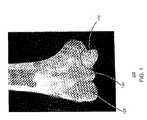
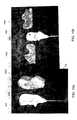
- FIG. 1is an anterior view of a plastic replica of an adult right distal humerus.
- the medial portion of the trochleais used as the basic design of the humeral component of FIG. 2 .
- FIG. 6 bis a lateral perspective of the ulnar component and shows the exit on the side of the component of the coronoid and olecranon tunnels of FIG. 6 a.
- FIG. 10 bis an anterior perspective of the ulnar component with the two part plastic mold opened on either side.
- the coronoidhas a point or process 360 .
- the olecranon process 340has a central olecranon tunnel 370 .
- the coronoid process 360also has a central coronoid tunnel 380 .
- the coronoid tunnel 380 and the olecranon tunnel 370are of substantially equal diameter and are oriented obliquely.
- the componentincludes a taper 390 which is configured to accept the central ulnar rod 200 .
- an anterior perspective 800 of the humeral component 100 and the ulnar component 300shows the components 100 , 300 made from antibiotic bone cement.
- the humeral rod 150is located centrally within the body 131 of the humeral component. In some examples, the humeral rod 150 has a diameter of 3/16th of an inch.
- the ulnar rod 200is located centrally within the ulnar component 300 . In some examples, the ulnar rod 200 has a diameter of 1 ⁇ 8th of an inch.
- a lateral perspective view 900 of the humeral component 100 and a humeral mold 950is shown.
- cementis poured into the mold 950 at the proximal open end 930 of the humeral mold 950 .
Landscapes
- Health & Medical Sciences (AREA)
- Orthopedic Medicine & Surgery (AREA)
- Physical Education & Sports Medicine (AREA)
- Cardiology (AREA)
- Oral & Maxillofacial Surgery (AREA)
- Transplantation (AREA)
- Engineering & Computer Science (AREA)
- Biomedical Technology (AREA)
- Heart & Thoracic Surgery (AREA)
- Vascular Medicine (AREA)
- Life Sciences & Earth Sciences (AREA)
- Animal Behavior & Ethology (AREA)
- General Health & Medical Sciences (AREA)
- Public Health (AREA)
- Veterinary Medicine (AREA)
- Prostheses (AREA)
Abstract
Description
The application claims the benefit of U.S. Provisional Application Ser. No. 61/832,228, filed Jun. 7, 2013, the content of which is incorporated herein by reference.
This invention relates to an antibiotic spacer element for treating deep infection about the elbow joint.
It is well accepted to use an antibiotic cement spacer in the treatment of deep infection following total elbow arthroplasty. Known descriptions of elbow devices for deep infection include static spacers meant to maintain the soft tissue envelope or space.
Conventional antibiotic cement elbow spacers generally include a piece of cement in each of the intramedullary canals including the humerus and ulna, as well as a block of cement between the two bones. This model allows for direct treatment or delivery of antibiotics to the humerus, ulna, and the soft tissue envelope previously affected by a deep infection. Motion is permitted but unstable and often requires full time splinting to allow for more stability and to control for pain during activities of daily living.
A device for use as a total elbow antibiotic spacer is provided. The device includes two separate components, which can be linked together to create the final two-piece articulating total elbow spacer. The device includes a component configured to fit into the distal end of the humerus as well as a component configured to fit into the proximal ulna. The components are fabricated using antibiotic cement.
In some examples, deep infection following total elbow arthroplasty requires the removal of both the humeral and ulnar components of the elbow to aid in clearance of the infection. Prior to re-implantation of a conventional metal total elbow arthroplasty, the elbow is treated with an antibiotic spacer. This device includes a standard sized humeral and ulnar component that can be cemented into any elbow and provide for an articulating surface for motion.
In some examples, such components can be made from plastic molds which are resistant to the heat of curing cement.
The humeral component may include one or more of the following features:
The design of the humeral component may be based off of the normal anatomy of an adult distal humerus and may include a solid piece of antibiotic bone cement. In general, the normal adult anatomy of the medial trochlea is utilized. The articulating portion of this device may be made from mirror images of the medial trochlea linked together. This allows for a deep groove, which acts as a simple hinge against the ulnar component. The final articular surface may have a substantially hourglass appearance and shape.
A single drill hole may be included above the articular surface in what would represent the coronoid and olecranon fossa of the distal humerus. The drill hole creates a short tunnel which passes from an anterior side to a posterior side of the device and may be located at the midline of the device to allow for a central linkage point between the humeral and ulnar components.
The ulnar component may include one or more of the following features:
The ulnar component may be composed of a solid piece of antibiotic bone cement. The component may be designed as a negative mold of the distal end of the humeral component. This creates a highly conformed hinge joint. The ulnar component may include a coronoid and olecranon process, which articulate with the distal aspect of the humeral component. They also aid in stability by prevention deep flexion and full extension of the elbow joint.
In some examples, there are two distinct tunnels in the ulnar component which aid in linkage to the humeral component. The first tunnel begins at the tip of the coronoid process and exits obliquely at the base of the ulnar component on the side. The second tunnel begins at the tip of the olecranon process and exits obliquely at the base of the ulnar component on the side. The start of each tunnel may be in the midline of the device, while the end to each tunnel exits on the same side of the ulnar component at its base. The feature allows for a central axis for linkage between the humeral and ulnar components.
The linkage between the humeral and ulnar components may include one or more of the following features:
After the two components are brought into tight apposition, they form a highly congruent simple hinge joint. Stabile articulation requires linkage between the two components. The tunnel position in the humeral and ulnar components is critical to successful linkage. The tunnels form a circular pattern, which allows for a stabile smooth range of motion. In some examples, the two components are linked with a tie system (e.g., a ropes, zip tie, cable, thread, string, wire, or the like) under appropriate tension to provide stability as well as to allow for motion.
The intramedullary rods may include one or more of the following features:
The rods are an essential part to the design of the humeral and ulnar components. The rods add rotational stability to the components once they are implanted in the humeral and ulnar shafts. In some examples, the rods are placed in the central axis of the humeral and ulnar shafts. The rods can also be used to help remove the components prior to re-implantation with a standard metal total elbow athroplasty.
The humeral and ulnar molds may include one or more of the following features:
The molds may be two-piece casts of the humeral and ulnar components. The molds may be heat stable to curing cement and allow for identical replication of each component.
Embodiments may include one or more of the following important features.
The design of the humeral component may be based on the native anatomy of the human adult medial trochlea of the distal humerus. The diameter and radius of curvature of the medial trochlea of the distal humerus may be mimicked. The anterior side of the humeral component may be a mirror image of the posterior side of the humeral component. The distal aspect may be based on mirror images of the medial side of the trochlea, which may then be fused to create a deep groove to form the basis of a simple gingylmus hinge design. The proximal shaft may taper to meet a humeral intramedullary rod.
The humeral component may be made from antibiotic bone cement. The design of the ulnar component may be a reverse or negative of the distal end of the humeral component. The proximal ulnar component may articulate with the humeral component to create a simple ginglymus hinge joint (i.e., a hinge joint that allows motion in only a single plane). The ulnar component may match the normal proximal ulnar anatomy with a coronoid anteriorly as well as an olecranon posteriorly. The distal shaft of the ulnar component may taper to meet an ulnar intramedullary rod, where the rod may be placed on the most posterior aspect of the ulnar component. The humeral component and the ulnar component may be linked via a tie system to allow for range of motion.
The humeral component may have a tunnel placed centrally just above the groove between the two reflected medial trochleas. The ulnar component may have tunnels, which are placed at the tip of the coronoid and olecranon respectively. The posterior hole at the base of the coronoid and olecranon may be positioned on the same side. The combined linkage between the humeral component and the ulnar component may match a circular pattern. The humeral component and the ulnar component may have a centrally placed rod.
The humeral component and the ulnar component may be made from molds that are reusable and match the final components.
In another general aspect, an articulable elbow spacer includes a humeral component, an ulnar component, and a tie. The humeral component includes a proximal end having a rod for insertion into a humeral canal and a distal end including a first joint member, the first joint member including antibiotic cement and one or more tunnels. The ulnar component includes a proximal end including a second joint member, the second joint member including antibiotic cement and including one or more tunnels, and configured to receive the first joint member and a distal end having a rod for insertion into an ulnar canal. The tie is configured to link the humeral component to the ulnar component and is configured for insertion into the one or more tunnels of the first joint member and the one or more tunnels of the second joint member.
Aspects may include one or more of the following features.
The first joint member may include a groove and the second joint member may include a ridge configured to be received by the groove. The first joint member may include a first medial trochlea shaped portion fused to a second medial trochlea shaped portion, the first medial trochlea shaped portion and the second medial trochlea shaped portion defining the groove. The first medial trochlea shaped portion may be a reflection of the second medial trochlea shaped portion. The groove may be a substantially V-shaped groove. The groove may include an inner surface having a first inner surface wall and a second inner surface wall opposing the first inner surface wall. The first inner surface wall may have a convex shape and the second inner surface wall may have a convex shape.
The ulnar component may include a coronoid process and an olecranon process for limiting a range of articulation of the articulable elbow spacer. The coronoid process may protrudes further from the ulnar component in an anterior direction than the olecranon process. The tie may have a circular shape and the one or more tunnels of the distal end of the joint member and the one or more tunnels of the proximal end of the second joint member may form a circular tunnel pattern configured to receive the tie. The humeral component and the ulnar component may form a ginglymus hinge. The first joint member may include a tapered portion tapering along a direction from the distal end of the humeral component to the proximal end of the humeral component. The second joint member may include a tapered portion tapering along a direction from the proximal end of the ulnar component to the distal end of the ulnar component.
A thinnest portion of the humeral component may have a thickness in a range of 1 mm to 3 mm. The thinnest portion of the humeral component may have a thickness of 2 mm. The rod for insertion into the humeral canal may have a diameter of 3/16 of an inch. The rod for insertion into the ulnar canal may have a diameter of ⅛ of an inch.
In another general aspect, a method for fabricating an articulable elbow spacer includes forming a humeral component, forming an ulnar component, and linking the humeral component and the ulnar component. Forming the humeral component includes providing a first joint member mold, pouring antibiotic cement into the first joint member mold, placing a first rod into the antibiotic cement in the first joint member mold, curing the antibiotic cement, and forming one or more tunnels in the antibiotic cement. Forming a ulnar component includes providing a second joint member mold, pouring antibiotic cement into the second joint member mold, placing a second rod into the antibiotic cement in the second joint member mold, curing the antibiotic cement, and forming one or more tunnels in the antibiotic cement. To link the humeral component to the ulnar component a tie is provided and is inserted into the one or more tunnels of the humeral component and inserting the tie into the one or more tunnels of the ulnar component.
Aspects may include one or more of the following features.
Forming the one or more tunnels in the antibiotic cement of the humeral component may include drilling the one or more tunnels into the antibiotic cement of the humeral component and forming the one or more tunnels in the antibiotic cement of the ulnar component may include drilling the one or more tunnels into the antibiotic cement of the ulnar component.
Forming the humeral component including curing the antibiotic cement may include heating the first joint member mold to a curing temperature of the antibiotic cement, wherein the curing temperature is less than a melting temperature of a material of the first joint member mold. Forming the ulnar component including curing the antibiotic cement may include heating the second joint member mold to a curing temperature of the antibiotic cement, wherein the curing temperature is less than a melting temperature of a material of the second joint member mold.
Embodiments may include one or more of the following advantages.
Among other advantages, the antibiotic cement elbow spacer provides antibiotic elution while allowing for a stable linked range of motion.
Other features and advantages of the invention are apparent from the following description, and from the claims.
Referring toFIG. 1 , an anterior prospective of an adult rightdistal humerus 105 is shown. The anterior portion of thecapitellum 120,lateral trochlea 130, andmedial trochlea 110 is shown. Themedial trochlea 110 is used as the basic design of a humeral component seen inFIGS. 2 aand2b.
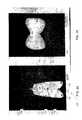
Referring toFIG. 2 a, an anterior view of thehumeral component 100 is shown. The distal aspect of thehumeral component 100 is composed of fused mirror images of themedial trochlea 110 seen inFIG. 1 . The fusion between themedial trochleas 110, forms adeep groove 121. The body of thehumeral component 131 connects the distalarticular surface 122 tohumeral rods 150. There is acentral tunnel 140 in thebody 131 used for humeral linkage.
Referring toFIG. 2 b, a view of the distalarticular surface 122 of thehumeral component 100 is shown. Thearticular surface 122 shows the relationship between the fused medialtrochlear pieces 110 and thecentral groove 121. In general the anterior to posterior dimension of themedial trochlea 110 is twice that of thecentral groove 121.
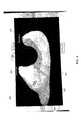
Referring toFIG. 3 , an anterior view of anulnar component 300 is shown. Thearticular surface 310 is a mirror image of the distalarticular surface 122 of thehumeral component 100 and is divided by aridge 320. Thearticular surface 310 compliments themedial trochlea 110 ofFIG. 2 a. That is to say that they have the same radius of curvature. Theridge 320 matches thegroove 120 ofFIG. 2 a. That is to say that the ridge fits into the groove. Theolecranon 330 is seen in the proximal portion of thecomponent 300. It comes to a point orprocess 340. Distal to the articular surface is the coronoid350. The coronoid has a point orprocess 360. Theolecranon process 340 has acentral olecranon tunnel 370. Thecoronoid process 360 also has a centralcoronoid tunnel 380. Thecoronoid tunnel 380 and theolecranon tunnel 370 are of substantially equal diameter and are oriented obliquely. Distal to the coronoid350, the component includes ataper 390 which is configured to accept thecentral ulnar rod 200.
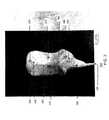
Referring toFIG. 4 , a lateral perspective of theulnar component 300 is shown. Thecoronoid process 360 is slightly higher or more anterior than theolecranon process 340. The shorter or moreposterior olecranon process 340 allows for better extension of the linked components. Thearticular surface 310 is shaded. Only one side of thearticular surface 310 is shown inFIG. 4 . It is noted that the articulatedsurface 310 is mirrored on the opposite side of theulnar component 300. Thearticular surface 310 slopes to a point orridge 320, which divides theulnar component 300 in half. In some examples, the exit to thecoronoid tunnel 380 exits at least 5 mm from thearticular surface 310. Distal to the coronoid, the component includes ataper 390 to allow for insertion into the native ulnar canal.
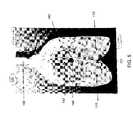
Referring toFIG. 5 , an anterior view of thehumeral component 100 is shown where thehumeral component 100 is made from antibiotic bone cement. The distal articular surface is made from fused mirror images of themedial trochlea 110. The articular surface of the fused mirror images of themedial trochlea 110 is divided by agroove 121, which accepts theridge 320 of the ulnar component ofFIG. 4 . Thehumeral component 100 has a centralhumeral tunnel 140 proximal to the articular surface of the fused mirror images of themedial trochlea 110 and thegroove 121. Thehumeral rod 150 ends just proximal to the centralhumeral tunnel 140, atpoint 142. The shadedarea 160 represents the thinnest portion of the component, which, in some examples, is only 2 mm thick near the centralhumeral tunnel 140. The shadedarea 160 is thin and recessed to accept the tip of thecoronoid process 360 ofFIG. 6 bduring elbow flexion.
Referring toFIG. 6 a, an anterior view of theulnar component 300 shows theulnar component 300 made from antibiotic bone cement. The shadedarea 310 is a mirror image divided by aridge 320 and represents the articular surface for the distal end of the humeral component. Distally, thecoronoid process 330, tapers390 into theulnar rod 200. At the tip of thecoronoid process 360 is the entrance to the centralcoronoid tunnel 380. Thecoronoid tunnel 380 is oriented obliquely to exit on the posterior side of thecoronoid process 360. Proximally thecentral olecranon tunnel 370, is located at the tip of theolecranon process 340.
Referring toFIG. 6 b, a lateral perspective of theulnar component 300 shows theulnar component 300 made from antibiotic bone cement. The shadedarea 310 represents the articular surface and corresponds to thearticular surface 310 ofFIG. 6 a. Theridge 320 represents a peak between the two identical sides of thearticular surface 310. Theridge 320 corresponds to theridge 320 ofFIG. 6 a. Distally thecoronoid process 360tapers 390 into theulnar rod 200. The tip of thecoronoid process 360 represents the starting point for the coronoid tunnel, which exits posterior and distal to thecoronoid process 360. The tip of theolecranon process 340 represents the starting point for the olecranon tunnel, which exits posterior to theolecranon process 340.
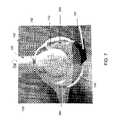
Referring toFIG. 7 , alateral perspective 700 of the linkedhumeral component 100 andulnar component 300 is shown. The components are linked with atie 730, which makes a circular pattern through the central axis of the components. It is noted that the term ‘tie’ relates to any type of element which can be used to fasten or tie something. Examples of ties include but are not limited to ropes, zip ties, cables, threads, strings, wires, and so on. Thetie 730 passes through theolecranon tunnel 770 followed by thehumeral tunnel 740, and finally thecoronoid tunnel 780 of the ulna before passing through aclip 791.
Referring toFIG. 8 , ananterior perspective 800 of thehumeral component 100 and theulnar component 300 shows thecomponents humeral rod 150 is located centrally within thebody 131 of the humeral component. In some examples, thehumeral rod 150 has a diameter of 3/16th of an inch. Theulnar rod 200 is located centrally within theulnar component 300. In some examples, theulnar rod 200 has a diameter of ⅛th of an inch.
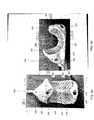
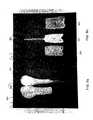
Referring toFIG. 9 a, alateral perspective view 900 of thehumeral component 100 and ahumeral mold 950 is shown. In some examples, cement is poured into themold 950 at the proximal open end930 of thehumeral mold 950.
Referring toFIG. 9 b, ananterior perspective view 901 of thehumeral component 100 is shown. Thehumeral component 100 is pictured with themold 950 separated into twoparts mold 950 include ananterior shell 952 which clips into aposterior shell 954 to form the completedmold 950 ofFIG. 9 a.
Referring toFIG. 10 a, ananterior view 1000 of theulnar component 300 and theulnar mold 1060 is shown. In some examples, cement is poured into themold 1060 at a distal open end1030 of theulnar mold 1060.
Referring toFIG. 10 b, aperspective view 1001 of theulnar component 300 is pictured along side theulnar mold 1060 which is separated into twoparts part ulnar mold ulnar mold 1060 to for the ulnar mold106 ofFIG. 10 a.
It is to be understood that the foregoing description is intended to illustrate and not to limit the scope of the invention, which is defined by the scope of the appended claims. Other embodiments are within the scope of the following claims.
Claims (15)
1. An articulable elbow spacer comprising:
a humeral component including
a proximal end having a rod for insertion into a humeral canal;
a distal end including a first joint member, the first joint member including antibiotic cement and one or more tunnels;
an ulnar component including
a proximal end including a second joint member, the second joint member including antibiotic cement and including one or more tunnels, and configured to receive the first joint member; and
a distal end having a rod for insertion into an ulnar canal;
a tie for linking the humeral component to the ulnar component, the tie configured for insertion into the one or more tunnels of the first joint member and the one or more tunnels of the second joint member.
2. The articulable elbow spacer ofclaim 1 wherein the first joint member includes a groove and the second joint member includes a ridge configured to be received by the groove.
3. The articulable elbow spacer ofclaim 2 wherein the first joint member includes a first medial trochlea shaped portion fused to a second medial trochlea shaped portion, the first medial trochlea shaped portion and the second medial trochlea shaped portion defining the groove, wherein the first medial trochlea shaped portion is a reflection of the second medial trochlea shaped portion.
4. The articulable elbow spacer ofclaim 2 wherein the groove is a substantially V-shaped groove.
5. The articulable elbow spacer ofclaim 2 wherein the groove includes an inner surface having a first inner surface wall and a second inner surface wall opposing the first inner surface wall, wherein the first inner surface wall has a convex shape and the second inner surface wall has a convex shape.
6. The articulable elbow spacer ofclaim 1 wherein the ulnar component includes a coronoid process and an olecranon process for limiting a range of articulation of the articulable elbow spacer.
7. The articulable elbow spacer ofclaim 6 wherein the coronoid process protrudes further from the ulnar component in an anterior direction than the olecranon process.
8. The articulable elbow spacer ofclaim 1 wherein the tie has a circular shape and the one or more tunnels of the distal end of the joint member and the one or more tunnels of the proximal end of the second joint member form a circular tunnel pattern configured to receive the tie.
9. The articulable elbow spacer ofclaim 1 wherein the humeral component and the ulnar component form a ginglymus hinge.
10. The articulable elbow spacer ofclaim 1 wherein the first joint member includes a tapered portion tapering along a direction from the distal end of the humeral component to the proximal end of the humeral component.
11. The articulable elbow spacer ofclaim 1 wherein the second joint member includes a tapered portion tapering along a direction from the proximal end of the ulnar component to the distal end of the ulnar component.
12. The articulable elbow spacer ofclaim 1 wherein a thinnest portion of the humeral component has a thickness in a range of 1 mm to 3 mm.
13. The articulable elbow spacer ofclaim 12 wherein the thinnest portion of the humeral component has a thickness of 2 mm.
14. The articulable elbow spacer ofclaim 1 wherein the rod for insertion into the humeral canal has a diameter of 3/16 of an inch.
15. The articulable elbow spacer ofclaim 1 wherein the rod for insertion into the ulnar canal has a diameter of ⅛ of an inch.
Priority Applications (1)
| Application Number | Priority Date | Filing Date | Title |
|---|---|---|---|
| US14/297,973US9278002B2 (en) | 2013-06-07 | 2014-06-06 | Elbow antibiotic spacer implant |
Applications Claiming Priority (2)
| Application Number | Priority Date | Filing Date | Title |
|---|---|---|---|
| US201361832228P | 2013-06-07 | 2013-06-07 | |
| US14/297,973US9278002B2 (en) | 2013-06-07 | 2014-06-06 | Elbow antibiotic spacer implant |
Publications (2)
| Publication Number | Publication Date |
|---|---|
| US20140364954A1 US20140364954A1 (en) | 2014-12-11 |
| US9278002B2true US9278002B2 (en) | 2016-03-08 |
Family
ID=52006094
Family Applications (1)
| Application Number | Title | Priority Date | Filing Date |
|---|---|---|---|
| US14/297,973Expired - Fee RelatedUS9278002B2 (en) | 2013-06-07 | 2014-06-06 | Elbow antibiotic spacer implant |
Country Status (1)
| Country | Link |
|---|---|
| US (1) | US9278002B2 (en) |
Cited By (3)
| Publication number | Priority date | Publication date | Assignee | Title |
|---|---|---|---|---|
| US10952961B2 (en) | 2015-07-23 | 2021-03-23 | Novaflux, Inc. | Implants and constructs including hollow fibers |
| US20210093455A1 (en)* | 2018-03-26 | 2021-04-01 | Waldemar Link Gmbh & Co. Kg | Active substance applicator for a joint implant, and joint implant having an active substance applicator |
| US12186000B2 (en) | 2020-09-04 | 2025-01-07 | DePuy Synthes Products, Inc. | Temporary antimicrobial cement spacer, assembly, kit, and method of manufacture |
Families Citing this family (2)
| Publication number | Priority date | Publication date | Assignee | Title |
|---|---|---|---|---|
| US9278002B2 (en)* | 2013-06-07 | 2016-03-08 | Gregory Merrell | Elbow antibiotic spacer implant |
| CN114403911B (en)* | 2021-12-27 | 2023-03-24 | 中国人民解放军总医院第四医学中心 | Ulna proximal end parameter measuring method and device based on CT three-dimensional reconstruction image |
Citations (121)
| Publication number | Priority date | Publication date | Assignee | Title |
|---|---|---|---|---|
| US3882858A (en)* | 1973-04-21 | 1975-05-13 | Merck Patent Gmbh | Surgical synthetic-resin material and method of treating osteomyelitis |
| US4274163A (en)* | 1979-07-16 | 1981-06-23 | The Regents Of The University Of California | Prosthetic fixation technique |
| US4399814A (en)* | 1981-04-27 | 1983-08-23 | Massachusetts Institute Of Technology | Method and apparatus for pressure-coated bones |
| US4488549A (en)* | 1981-08-25 | 1984-12-18 | University Of Exeter | Pressurization of cement in bones |
| US4711233A (en)* | 1985-06-26 | 1987-12-08 | Brown Byron L | Method and apparatus for cementing an acetabular cup to an acetabulum |
| US4888024A (en)* | 1985-11-08 | 1989-12-19 | Powlan Roy Y | Prosthetic device and method of fixation within the medullary cavity of bones |
| US4892550A (en)* | 1985-12-30 | 1990-01-09 | Huebsch Donald L | Endoprosthesis device and method |
| US5085861A (en)* | 1987-03-12 | 1992-02-04 | The Beth Israel Hospital Association | Bioerodable implant composition comprising crosslinked biodegradable polyesters |
| US5116377A (en)* | 1989-04-15 | 1992-05-26 | Bristol-Myers Squibb Company | Cementable hip prosthesis |
| US5133767A (en)* | 1989-10-12 | 1992-07-28 | Sulzer Brothers Limited | Prosthesis having a deformable implant surface |
| US5133772A (en)* | 1990-01-17 | 1992-07-28 | Osteonics Corporation | Femoral implant for hip arthroplasty |
| US5133771A (en)* | 1990-12-05 | 1992-07-28 | University Of British Columbia | Flexible mold for forming composite of a hip replacement component and a bone cement sleeve |
| US5156606A (en)* | 1988-10-11 | 1992-10-20 | Zimmer, Inc. | Method and apparatus for removing pre-placed prosthetic joints and preparing for their replacement |
| US5217493A (en)* | 1992-03-11 | 1993-06-08 | Board Of Regents, The University Of Texas System | Antibacterial coated medical implants |
| US5258420A (en)* | 1987-07-30 | 1993-11-02 | Pfizer Hospital Products Group, Inc. | Bone cement for sustained release of substances |
| US5290291A (en)* | 1992-03-16 | 1994-03-01 | Hall Surgical, Division Of Zimmer, Inc. | Method for implant removal |
| US5340362A (en)* | 1991-10-16 | 1994-08-23 | Carbone John J | Method and apparatus for cementing intramedullary bone prosthesis |
| US5376123A (en)* | 1989-12-07 | 1994-12-27 | Ao-Forschungsinstitut Davos | Adaptable stem for endoprosthesis |
| US5433718A (en)* | 1992-08-20 | 1995-07-18 | Brinker; Mark | Antibiotic eluding intramedullary nail apparatus |
| US5501687A (en)* | 1992-11-20 | 1996-03-26 | Sulzer Medizinaltechnik Ag | Body for distributing bone cement for the anchoring of implants |
| US5514137A (en)* | 1993-12-06 | 1996-05-07 | Coutts; Richard D. | Fixation of orthopedic devices |
| US5554111A (en)* | 1995-03-16 | 1996-09-10 | Mayo Foundation For Medical Education & Research | Bone cleaning and drying system |
| US5562736A (en)* | 1994-10-17 | 1996-10-08 | Raymedica, Inc. | Method for surgical implantation of a prosthetic spinal disc nucleus |
| US5571204A (en)* | 1994-07-14 | 1996-11-05 | Merck Patent Gesellschaft Mit Beschrankter Haftung | Femoral prosthesis |
| US5681289A (en)* | 1995-08-14 | 1997-10-28 | Medicinelodge Inc. | Chemical dispensing system |
| US5702446A (en)* | 1992-11-09 | 1997-12-30 | Board Of Regents, The University Of Texas System | Bone prosthesis |
| US5725596A (en)* | 1992-11-20 | 1998-03-10 | Burke; Dennis W. | Clamp for use with a bone prosthesis |
| US5728395A (en)* | 1990-05-10 | 1998-03-17 | Ohtsuka; Torao | Hydroxylapatite base porous beads filler for organism and method of producing the same |
| US5741265A (en)* | 1996-02-21 | 1998-04-21 | Chan; Kwan-Ho | Bone canal pressurizer |
| US5755811A (en)* | 1995-08-25 | 1998-05-26 | Zimmer, Inc. | Prosthetic implant with fins |
| US5827289A (en)* | 1994-01-26 | 1998-10-27 | Reiley; Mark A. | Inflatable device for use in surgical protocols relating to treatment of fractured or diseased bones |
| US5938698A (en)* | 1996-10-07 | 1999-08-17 | Sulzer Orthopaedie Ag | Kit system for cemented prostheses |
| US5954771A (en)* | 1993-02-16 | 1999-09-21 | Wright Medical Technology, Inc. | Dual fixation prosthesis |
| US5980573A (en)* | 1997-05-12 | 1999-11-09 | Shaffner; Richard L. | Method and apparatus for fighting infection and maintaining joint spacing in a prosthesis implant area |
| US6066154A (en)* | 1994-01-26 | 2000-05-23 | Kyphon Inc. | Inflatable device for use in surgical protocol relating to fixation of bone |
| US6113639A (en)* | 1999-03-23 | 2000-09-05 | Raymedica, Inc. | Trial implant and trial implant kit for evaluating an intradiscal space |
| US6155812A (en)* | 1998-07-15 | 2000-12-05 | Biomet, Inc | Cement mold for a temporary implant |
| US6217619B1 (en)* | 1997-12-05 | 2001-04-17 | GMT GESELLSCHAFT FüR MEDIZINISCHE TECHNIK MBH | Endoprosthesis for a least partial replacement of a tibia |
| US6248110B1 (en)* | 1994-01-26 | 2001-06-19 | Kyphon, Inc. | Systems and methods for treating fractured or diseased bone using expandable bodies |
| US6361731B1 (en)* | 1998-07-15 | 2002-03-26 | Biomet, Inc. | Method of forming a temporary implant |
| US6447514B1 (en)* | 2000-03-07 | 2002-09-10 | Zimmer | Polymer filled hip fracture fixation device |
| US6485754B1 (en)* | 1997-04-01 | 2002-11-26 | Merck Patent Gmbh | Bone cement paste containing an antibiotic |
| US6497901B1 (en)* | 2000-11-02 | 2002-12-24 | Royer Biomedical, Inc. | Resorbable matrices for delivery of bioactive compounds |
| US20030060891A1 (en)* | 2001-09-27 | 2003-03-27 | Shah Mrugesh K. | Hip replacement system having fat lubricant |
| US6544472B1 (en)* | 1995-10-12 | 2003-04-08 | Zimmer, Inc. | Method of making an orthopaedic implant having a porous surface |
| US20030097184A1 (en)* | 2001-11-21 | 2003-05-22 | Naoto Mitsugi | Stem of artificial hip joint |
| US20030163205A1 (en)* | 2002-02-27 | 2003-08-28 | Lawson Kevin Jon | Arthroplasty-prothesis cement restrictor |
| US20030187513A1 (en)* | 2002-03-26 | 2003-10-02 | Durniak Todd D. | System and method for delivering biological materials to a prosthesis implantation site |
| US6679890B2 (en)* | 2001-08-28 | 2004-01-20 | Joseph Y. Margulies | Method and apparatus for augmentation of the femoral neck |
| US20040013703A1 (en)* | 2002-07-22 | 2004-01-22 | James Ralph | Bioabsorbable plugs containing drugs |
| US20040036189A1 (en)* | 2002-03-13 | 2004-02-26 | Ensign Michael D. | Disposable knee mold |
| US20040054417A1 (en)* | 2000-04-07 | 2004-03-18 | Renzo Soffiati | Disposable articulated spacing device for surgical treatment of joints of the human body |
| US20040064192A1 (en)* | 2002-09-27 | 2004-04-01 | Bubb Stephen K. | Porous implant system and treatment method |
| US6740090B1 (en)* | 2000-02-16 | 2004-05-25 | Trans1 Inc. | Methods and apparatus for forming shaped axial bores through spinal vertebrae |
| US20040225360A1 (en)* | 2000-12-14 | 2004-11-11 | Malone David G. | Devices and methods for facilitating controlled bone growth or repair |
| US20050021084A1 (en)* | 2003-05-19 | 2005-01-27 | Lu William Weijia | Bone treatment device and method |
| US20050025807A1 (en)* | 2003-07-31 | 2005-02-03 | National Institute Of Advanced Industrial Science And Technology | Cured porous calcium phosphate material and uses thereof |
| US20050107885A1 (en)* | 2003-11-14 | 2005-05-19 | Cherry Creek Orthopedic Specialists | Total knee joint mold and methods |
| US6921403B2 (en)* | 2000-02-16 | 2005-07-26 | Trans1 Inc. | Method and apparatus for spinal distraction and fusion |
| US20050187555A1 (en)* | 2004-02-24 | 2005-08-25 | Biedermann Motech Gmbh | Bone anchoring element |
| US6969404B2 (en)* | 1999-10-08 | 2005-11-29 | Ferree Bret A | Annulus fibrosis augmentation methods and apparatus |
| US20060004431A1 (en)* | 2004-07-01 | 2006-01-05 | Fuller Thomas A | Prophylactic bactericidal implant |
| US20060014120A1 (en)* | 2004-07-16 | 2006-01-19 | Sapian Schubert L | Biofunctional dental implant |
| US6989033B1 (en)* | 1992-09-17 | 2006-01-24 | Karlheinz Schmidt | Implant for recreating verterbrae and tubular bones |
| US20060093646A1 (en)* | 2004-10-28 | 2006-05-04 | Cima Michael J | Orthopedic and dental implant devices providing controlled drug delivery |
| US7112205B2 (en)* | 2003-06-17 | 2006-09-26 | Boston Scientific Scimed, Inc. | Apparatus and methods for delivering compounds into vertebrae for vertebroplasty |
| US7141053B2 (en)* | 2001-11-28 | 2006-11-28 | Wright Medical Technology, Inc. | Methods of minimally invasive unicompartmental knee replacement |
| US20070005142A1 (en)* | 2005-06-30 | 2007-01-04 | Rhodes James M | Tibial insert and associated surgical method |
| US7211113B2 (en)* | 2004-05-18 | 2007-05-01 | Lev Zelener | Hip prosthesis |
| US20070162132A1 (en)* | 2005-12-23 | 2007-07-12 | Dominique Messerli | Flexible elongated chain implant and method of supporting body tissue with same |
| US7250055B1 (en)* | 2003-08-26 | 2007-07-31 | Biomet Manufacturing Corp. | Method and apparatus for cement delivering buttress pin |
| US7255713B2 (en)* | 2003-12-18 | 2007-08-14 | Malek Michel H | Systems and methods for agent delivery |
| US20070213835A1 (en)* | 2005-11-04 | 2007-09-13 | Markus Wimmer | Plastic implant impregnated with an antibiotic |
| US20070222114A1 (en)* | 2006-03-23 | 2007-09-27 | Ziran Bruce H | Method of forming a temporary implant and mold assembly for same |
| US20070254008A1 (en)* | 2001-07-13 | 2007-11-01 | Flow Focusing, Inc. | Antibiotic formulation and method of treatment |
| US20080058950A1 (en)* | 2006-03-03 | 2008-03-06 | Alain Leonard | Temporary implant incorporating two active ingredients |
| US20080286377A1 (en)* | 2001-11-20 | 2008-11-20 | Sloan-Kettering Institute For Cancer Research | Anti-resorptive bone cements and allogeneic, autografic, and xenografic bone grafts |
| US20090069899A1 (en)* | 2007-09-11 | 2009-03-12 | Howmedica Osteonics Corp. | Antibiotic bone cement spacer |
| US20090130167A1 (en)* | 2007-09-26 | 2009-05-21 | Microchips, Inc. | Drug Delivery Device and Method for Use with Prosthetic Device Implantation |
| US20090146342A1 (en)* | 2007-12-07 | 2009-06-11 | Sean Haney | Spacer mold and methods therefor |
| US20090157189A1 (en)* | 2007-12-13 | 2009-06-18 | Biomet Manufacturing Corp. | Modular Articulating Cement Spacer Mold |
| US20090175978A1 (en)* | 2007-12-13 | 2009-07-09 | Biomet Manufacturing Corp. | Modular Articulating Cement Spacer |
| US7601157B2 (en)* | 2001-11-01 | 2009-10-13 | Spine Wave, Inc. | Devices and methods for the restoration of a spinal disc |
| US20100042215A1 (en)* | 2008-08-13 | 2010-02-18 | Stalcup Gregory C | Orthopaedic implant |
| US20100042167A1 (en)* | 2008-08-13 | 2010-02-18 | Nebosky Paul S | Orthopaedic screws |
| US20100042214A1 (en)* | 2008-08-13 | 2010-02-18 | Nebosky Paul S | Drug delivery implants |
| US20100049322A1 (en)* | 2008-08-19 | 2010-02-25 | Warsaw Orthopedic, Inc. | Osteochondral repair implants and methods |
| US20100069469A1 (en)* | 2006-09-26 | 2010-03-18 | Ucl Business Plc | Formulations and composites with reactive fillers |
| US20100068243A1 (en)* | 2006-08-24 | 2010-03-18 | Graftys | Macroporous and highly resorbable apatitic calcium-phosphate cement |
| US20100102484A1 (en)* | 2008-10-29 | 2010-04-29 | Sean Haney | Spacer molds with releasable securement |
| US20100152319A1 (en)* | 2006-03-01 | 2010-06-17 | Shalaby Shalaby W | Antimicrobial, Radiopaque, Microfiber-Reinforced, Polymeric Methacrylate Bone Cement |
| US20100178250A1 (en)* | 2006-08-25 | 2010-07-15 | Philadelphia Health & Education Corporation | Method of Local Delivery of Bioactive and Diagnostic Agents Using Magnetizable Bone Cement |
| US20100217401A1 (en)* | 2009-02-25 | 2010-08-26 | De Beaubien Brian C | Antibiotic delivery system and method for treating an infected synovial joint during re-implantation of an orthopedic prosthesis |
| US20100292803A1 (en)* | 2009-05-17 | 2010-11-18 | The Board Of Trustees Of The Leland Stanford Junior University | Compositions and methods for forming and clinically utilizing articulating spacing devices |
| US7862619B2 (en)* | 2005-08-05 | 2011-01-04 | Vot, Llc | Knee joint prosthesis |
| US20110071072A1 (en)* | 2009-08-28 | 2011-03-24 | Georgetown University, A Congressionally Chartered Institution Of Higher Education | Antifungal Bone Cements |
| US7914585B2 (en)* | 2003-01-17 | 2011-03-29 | Waldemar Link Gmbh & Co. Kg | Hip prosthesis including a shaft to be inserted into the femur |
| US8038682B2 (en)* | 2004-08-17 | 2011-10-18 | Boston Scientific Scimed, Inc. | Apparatus and methods for delivering compounds into vertebrae for vertebroplasty |
| US20110287064A1 (en)* | 2010-05-19 | 2011-11-24 | Heraeus Medical Gmbh | Antibiotic coating |
| US20110311591A1 (en)* | 2008-08-29 | 2011-12-22 | Sheffield Hallam University | Antimicrobial Coating |
| US20120164311A1 (en)* | 2010-12-23 | 2012-06-28 | Heraeus Medical Gmbh | Coating method and coating device |
| US20120256344A1 (en)* | 2011-04-06 | 2012-10-11 | Stolarski Edward | Disposable orthopedic prosthesis mold |
| US20130041472A1 (en)* | 2011-07-19 | 2013-02-14 | Illuminoss Medical, Inc. | Systems and Methods for Joint Stabilization |
| US20130150979A1 (en)* | 2011-12-07 | 2013-06-13 | Biomet Manufacturing Corp. | Antimicrobial methacrylate cements |
| US20130173014A1 (en)* | 2010-01-15 | 2013-07-04 | Antonios G. Mikos | Combined Space Maintenance and Bone Regeneration System for the Reconstruction of Large Osseous Defects |
| US20130187310A1 (en)* | 2012-01-17 | 2013-07-25 | Heraeus Medical Gmbh | Method for producing a spacer and hollow mold for producing a spacer |
| US20130289721A1 (en)* | 2012-04-27 | 2013-10-31 | Michael Klebuc | Breast Implant Spacers for the Treatment of Periprosthetic Breast Implant Infections |
| US20130295213A1 (en)* | 2012-05-03 | 2013-11-07 | Zimmer, Inc. | Spacer molds for orthopedic implants |
| US8652216B2 (en)* | 2008-05-02 | 2014-02-18 | Cook Biotech Incorporated | Self deploying implant in needle |
| US8673018B2 (en)* | 2010-02-05 | 2014-03-18 | AMx Tek LLC | Methods of using water-soluble inorganic compounds for implants |
| US20140159282A1 (en)* | 2012-12-12 | 2014-06-12 | Biomet Manufacturing Llc | Method and device for producing temporary knee joint spacers with stems of various sizes |
| US20140274971A1 (en)* | 2013-03-14 | 2014-09-18 | Osteoceramics, Inc. | Systems and Methods of Using Chemically Bound Antibiotics Activated by Infections |
| US20140277532A1 (en)* | 2013-03-15 | 2014-09-18 | Steven M. Teeny | Orthopedic spacer |
| US20140328902A1 (en)* | 2013-05-01 | 2014-11-06 | Lanny Leo Johnson | Antimicrobials and methods of use thereof for wound healing |
| US20140343560A1 (en)* | 2013-05-17 | 2014-11-20 | Heraeus Medical Gmbh | Device and method for the in-situ production of articulated spacers |
| US20140348973A1 (en)* | 2011-12-06 | 2014-11-27 | Christopher J. Holt | Spacer mold for orthopedic implants |
| US20140364954A1 (en)* | 2013-06-07 | 2014-12-11 | Gregory Merrell | Elbow antibiotic spacer implant |
| US20150001765A1 (en)* | 2013-06-26 | 2015-01-01 | Heraeus Medical Gmbh | Method for producing spacers and device therefor |
| US20150012105A1 (en)* | 2013-07-08 | 2015-01-08 | Heraeus Medical Gmbh | Two-part articulating joint spacer and method for producing said joint spacer |
| US20150134068A1 (en)* | 2012-04-19 | 2015-05-14 | Teknimed | Spacer implant for the temporary replacement of a knee prosthesis |
| US20150250598A1 (en)* | 2014-03-04 | 2015-09-10 | Zimmer, Inc. | Orthopedic system and methods for treating an infection |
- 2014
- 2014-06-06USUS14/297,973patent/US9278002B2/ennot_activeExpired - Fee Related
Patent Citations (131)
| Publication number | Priority date | Publication date | Assignee | Title |
|---|---|---|---|---|
| US3882858A (en)* | 1973-04-21 | 1975-05-13 | Merck Patent Gmbh | Surgical synthetic-resin material and method of treating osteomyelitis |
| US4274163A (en)* | 1979-07-16 | 1981-06-23 | The Regents Of The University Of California | Prosthetic fixation technique |
| US4399814A (en)* | 1981-04-27 | 1983-08-23 | Massachusetts Institute Of Technology | Method and apparatus for pressure-coated bones |
| US4488549A (en)* | 1981-08-25 | 1984-12-18 | University Of Exeter | Pressurization of cement in bones |
| US4711233A (en)* | 1985-06-26 | 1987-12-08 | Brown Byron L | Method and apparatus for cementing an acetabular cup to an acetabulum |
| US4888024A (en)* | 1985-11-08 | 1989-12-19 | Powlan Roy Y | Prosthetic device and method of fixation within the medullary cavity of bones |
| US4892550A (en)* | 1985-12-30 | 1990-01-09 | Huebsch Donald L | Endoprosthesis device and method |
| US5085861A (en)* | 1987-03-12 | 1992-02-04 | The Beth Israel Hospital Association | Bioerodable implant composition comprising crosslinked biodegradable polyesters |
| US5258420A (en)* | 1987-07-30 | 1993-11-02 | Pfizer Hospital Products Group, Inc. | Bone cement for sustained release of substances |
| US5156606A (en)* | 1988-10-11 | 1992-10-20 | Zimmer, Inc. | Method and apparatus for removing pre-placed prosthetic joints and preparing for their replacement |
| US5116377A (en)* | 1989-04-15 | 1992-05-26 | Bristol-Myers Squibb Company | Cementable hip prosthesis |
| US5133767A (en)* | 1989-10-12 | 1992-07-28 | Sulzer Brothers Limited | Prosthesis having a deformable implant surface |
| US5376123A (en)* | 1989-12-07 | 1994-12-27 | Ao-Forschungsinstitut Davos | Adaptable stem for endoprosthesis |
| US5133772B1 (en)* | 1990-01-17 | 1997-08-05 | Osteonics Corp | Femoral implant for hip arthroplasty |
| US5133772A (en)* | 1990-01-17 | 1992-07-28 | Osteonics Corporation | Femoral implant for hip arthroplasty |
| US5728395A (en)* | 1990-05-10 | 1998-03-17 | Ohtsuka; Torao | Hydroxylapatite base porous beads filler for organism and method of producing the same |
| US5133771A (en)* | 1990-12-05 | 1992-07-28 | University Of British Columbia | Flexible mold for forming composite of a hip replacement component and a bone cement sleeve |
| US5340362A (en)* | 1991-10-16 | 1994-08-23 | Carbone John J | Method and apparatus for cementing intramedullary bone prosthesis |
| US5217493A (en)* | 1992-03-11 | 1993-06-08 | Board Of Regents, The University Of Texas System | Antibacterial coated medical implants |
| US5290291A (en)* | 1992-03-16 | 1994-03-01 | Hall Surgical, Division Of Zimmer, Inc. | Method for implant removal |
| US5433718A (en)* | 1992-08-20 | 1995-07-18 | Brinker; Mark | Antibiotic eluding intramedullary nail apparatus |
| US6989033B1 (en)* | 1992-09-17 | 2006-01-24 | Karlheinz Schmidt | Implant for recreating verterbrae and tubular bones |
| US5702446A (en)* | 1992-11-09 | 1997-12-30 | Board Of Regents, The University Of Texas System | Bone prosthesis |
| US5501687A (en)* | 1992-11-20 | 1996-03-26 | Sulzer Medizinaltechnik Ag | Body for distributing bone cement for the anchoring of implants |
| US5725596A (en)* | 1992-11-20 | 1998-03-10 | Burke; Dennis W. | Clamp for use with a bone prosthesis |
| US5954771A (en)* | 1993-02-16 | 1999-09-21 | Wright Medical Technology, Inc. | Dual fixation prosthesis |
| US5514137A (en)* | 1993-12-06 | 1996-05-07 | Coutts; Richard D. | Fixation of orthopedic devices |
| US6423083B2 (en)* | 1994-01-26 | 2002-07-23 | Kyphon Inc. | Inflatable device for use in surgical protocol relating to fixation of bone |
| US6248110B1 (en)* | 1994-01-26 | 2001-06-19 | Kyphon, Inc. | Systems and methods for treating fractured or diseased bone using expandable bodies |
| US5827289A (en)* | 1994-01-26 | 1998-10-27 | Reiley; Mark A. | Inflatable device for use in surgical protocols relating to treatment of fractured or diseased bones |
| US6066154A (en)* | 1994-01-26 | 2000-05-23 | Kyphon Inc. | Inflatable device for use in surgical protocol relating to fixation of bone |
| US5571204A (en)* | 1994-07-14 | 1996-11-05 | Merck Patent Gesellschaft Mit Beschrankter Haftung | Femoral prosthesis |
| US5562736A (en)* | 1994-10-17 | 1996-10-08 | Raymedica, Inc. | Method for surgical implantation of a prosthetic spinal disc nucleus |
| US5554111A (en)* | 1995-03-16 | 1996-09-10 | Mayo Foundation For Medical Education & Research | Bone cleaning and drying system |
| US5681289A (en)* | 1995-08-14 | 1997-10-28 | Medicinelodge Inc. | Chemical dispensing system |
| US5755811A (en)* | 1995-08-25 | 1998-05-26 | Zimmer, Inc. | Prosthetic implant with fins |
| US6544472B1 (en)* | 1995-10-12 | 2003-04-08 | Zimmer, Inc. | Method of making an orthopaedic implant having a porous surface |
| US5741265A (en)* | 1996-02-21 | 1998-04-21 | Chan; Kwan-Ho | Bone canal pressurizer |
| US5938698A (en)* | 1996-10-07 | 1999-08-17 | Sulzer Orthopaedie Ag | Kit system for cemented prostheses |
| US6485754B1 (en)* | 1997-04-01 | 2002-11-26 | Merck Patent Gmbh | Bone cement paste containing an antibiotic |
| US5980573A (en)* | 1997-05-12 | 1999-11-09 | Shaffner; Richard L. | Method and apparatus for fighting infection and maintaining joint spacing in a prosthesis implant area |
| US6217619B1 (en)* | 1997-12-05 | 2001-04-17 | GMT GESELLSCHAFT FüR MEDIZINISCHE TECHNIK MBH | Endoprosthesis for a least partial replacement of a tibia |
| US6155812A (en)* | 1998-07-15 | 2000-12-05 | Biomet, Inc | Cement mold for a temporary implant |
| US6361731B1 (en)* | 1998-07-15 | 2002-03-26 | Biomet, Inc. | Method of forming a temporary implant |
| US6113639A (en)* | 1999-03-23 | 2000-09-05 | Raymedica, Inc. | Trial implant and trial implant kit for evaluating an intradiscal space |
| US6969404B2 (en)* | 1999-10-08 | 2005-11-29 | Ferree Bret A | Annulus fibrosis augmentation methods and apparatus |
| US6740090B1 (en)* | 2000-02-16 | 2004-05-25 | Trans1 Inc. | Methods and apparatus for forming shaped axial bores through spinal vertebrae |
| US6921403B2 (en)* | 2000-02-16 | 2005-07-26 | Trans1 Inc. | Method and apparatus for spinal distraction and fusion |
| US6447514B1 (en)* | 2000-03-07 | 2002-09-10 | Zimmer | Polymer filled hip fracture fixation device |
| US20040054417A1 (en)* | 2000-04-07 | 2004-03-18 | Renzo Soffiati | Disposable articulated spacing device for surgical treatment of joints of the human body |
| US6497901B1 (en)* | 2000-11-02 | 2002-12-24 | Royer Biomedical, Inc. | Resorbable matrices for delivery of bioactive compounds |
| US20040225360A1 (en)* | 2000-12-14 | 2004-11-11 | Malone David G. | Devices and methods for facilitating controlled bone growth or repair |
| US20070254008A1 (en)* | 2001-07-13 | 2007-11-01 | Flow Focusing, Inc. | Antibiotic formulation and method of treatment |
| US6679890B2 (en)* | 2001-08-28 | 2004-01-20 | Joseph Y. Margulies | Method and apparatus for augmentation of the femoral neck |
| US20030060891A1 (en)* | 2001-09-27 | 2003-03-27 | Shah Mrugesh K. | Hip replacement system having fat lubricant |
| US7601157B2 (en)* | 2001-11-01 | 2009-10-13 | Spine Wave, Inc. | Devices and methods for the restoration of a spinal disc |
| US20080286377A1 (en)* | 2001-11-20 | 2008-11-20 | Sloan-Kettering Institute For Cancer Research | Anti-resorptive bone cements and allogeneic, autografic, and xenografic bone grafts |
| US20030097184A1 (en)* | 2001-11-21 | 2003-05-22 | Naoto Mitsugi | Stem of artificial hip joint |
| US7141053B2 (en)* | 2001-11-28 | 2006-11-28 | Wright Medical Technology, Inc. | Methods of minimally invasive unicompartmental knee replacement |
| US20030163205A1 (en)* | 2002-02-27 | 2003-08-28 | Lawson Kevin Jon | Arthroplasty-prothesis cement restrictor |
| US20040036189A1 (en)* | 2002-03-13 | 2004-02-26 | Ensign Michael D. | Disposable knee mold |
| US20030187513A1 (en)* | 2002-03-26 | 2003-10-02 | Durniak Todd D. | System and method for delivering biological materials to a prosthesis implantation site |
| US20040013703A1 (en)* | 2002-07-22 | 2004-01-22 | James Ralph | Bioabsorbable plugs containing drugs |
| US20040064192A1 (en)* | 2002-09-27 | 2004-04-01 | Bubb Stephen K. | Porous implant system and treatment method |
| US7914585B2 (en)* | 2003-01-17 | 2011-03-29 | Waldemar Link Gmbh & Co. Kg | Hip prosthesis including a shaft to be inserted into the femur |
| US20050021084A1 (en)* | 2003-05-19 | 2005-01-27 | Lu William Weijia | Bone treatment device and method |
| US7112205B2 (en)* | 2003-06-17 | 2006-09-26 | Boston Scientific Scimed, Inc. | Apparatus and methods for delivering compounds into vertebrae for vertebroplasty |
| US20050025807A1 (en)* | 2003-07-31 | 2005-02-03 | National Institute Of Advanced Industrial Science And Technology | Cured porous calcium phosphate material and uses thereof |
| US7250055B1 (en)* | 2003-08-26 | 2007-07-31 | Biomet Manufacturing Corp. | Method and apparatus for cement delivering buttress pin |
| US20050107885A1 (en)* | 2003-11-14 | 2005-05-19 | Cherry Creek Orthopedic Specialists | Total knee joint mold and methods |
| US7255713B2 (en)* | 2003-12-18 | 2007-08-14 | Malek Michel H | Systems and methods for agent delivery |
| US20050187555A1 (en)* | 2004-02-24 | 2005-08-25 | Biedermann Motech Gmbh | Bone anchoring element |
| US7211113B2 (en)* | 2004-05-18 | 2007-05-01 | Lev Zelener | Hip prosthesis |
| US20060004431A1 (en)* | 2004-07-01 | 2006-01-05 | Fuller Thomas A | Prophylactic bactericidal implant |
| US20060014120A1 (en)* | 2004-07-16 | 2006-01-19 | Sapian Schubert L | Biofunctional dental implant |
| US8038682B2 (en)* | 2004-08-17 | 2011-10-18 | Boston Scientific Scimed, Inc. | Apparatus and methods for delivering compounds into vertebrae for vertebroplasty |
| US20060093646A1 (en)* | 2004-10-28 | 2006-05-04 | Cima Michael J | Orthopedic and dental implant devices providing controlled drug delivery |
| US20070005142A1 (en)* | 2005-06-30 | 2007-01-04 | Rhodes James M | Tibial insert and associated surgical method |
| US7862619B2 (en)* | 2005-08-05 | 2011-01-04 | Vot, Llc | Knee joint prosthesis |
| US20070213835A1 (en)* | 2005-11-04 | 2007-09-13 | Markus Wimmer | Plastic implant impregnated with an antibiotic |
| US20120290096A1 (en)* | 2005-12-23 | 2012-11-15 | Synthes Usa, Llc | Flexible elongated chain implant and method of supporting body tissue with same |
| US20070162132A1 (en)* | 2005-12-23 | 2007-07-12 | Dominique Messerli | Flexible elongated chain implant and method of supporting body tissue with same |
| US20100152319A1 (en)* | 2006-03-01 | 2010-06-17 | Shalaby Shalaby W | Antimicrobial, Radiopaque, Microfiber-Reinforced, Polymeric Methacrylate Bone Cement |
| US20080058950A1 (en)* | 2006-03-03 | 2008-03-06 | Alain Leonard | Temporary implant incorporating two active ingredients |
| US20070222114A1 (en)* | 2006-03-23 | 2007-09-27 | Ziran Bruce H | Method of forming a temporary implant and mold assembly for same |
| US20100068243A1 (en)* | 2006-08-24 | 2010-03-18 | Graftys | Macroporous and highly resorbable apatitic calcium-phosphate cement |
| US20100178250A1 (en)* | 2006-08-25 | 2010-07-15 | Philadelphia Health & Education Corporation | Method of Local Delivery of Bioactive and Diagnostic Agents Using Magnetizable Bone Cement |
| US20100069469A1 (en)* | 2006-09-26 | 2010-03-18 | Ucl Business Plc | Formulations and composites with reactive fillers |
| US20090069899A1 (en)* | 2007-09-11 | 2009-03-12 | Howmedica Osteonics Corp. | Antibiotic bone cement spacer |
| US20090130167A1 (en)* | 2007-09-26 | 2009-05-21 | Microchips, Inc. | Drug Delivery Device and Method for Use with Prosthetic Device Implantation |
| US20090146342A1 (en)* | 2007-12-07 | 2009-06-11 | Sean Haney | Spacer mold and methods therefor |
| US8801983B2 (en)* | 2007-12-07 | 2014-08-12 | Zimmer Orthopaedic Surgical Products, Inc. | Spacer mold and methods therefor |
| US7789646B2 (en)* | 2007-12-07 | 2010-09-07 | Zimmer Orthopaedic Surgical Products, Inc. | Spacer mold and methods therefor |
| US8920152B2 (en)* | 2007-12-13 | 2014-12-30 | Biomet Manufacturing, Llc | Modular articulating cement spacer |
| US20090175978A1 (en)* | 2007-12-13 | 2009-07-09 | Biomet Manufacturing Corp. | Modular Articulating Cement Spacer |
| US20090157189A1 (en)* | 2007-12-13 | 2009-06-18 | Biomet Manufacturing Corp. | Modular Articulating Cement Spacer Mold |
| US8652216B2 (en)* | 2008-05-02 | 2014-02-18 | Cook Biotech Incorporated | Self deploying implant in needle |
| US20100042214A1 (en)* | 2008-08-13 | 2010-02-18 | Nebosky Paul S | Drug delivery implants |
| US20100042167A1 (en)* | 2008-08-13 | 2010-02-18 | Nebosky Paul S | Orthopaedic screws |
| US20100042215A1 (en)* | 2008-08-13 | 2010-02-18 | Stalcup Gregory C | Orthopaedic implant |
| US20100049322A1 (en)* | 2008-08-19 | 2010-02-25 | Warsaw Orthopedic, Inc. | Osteochondral repair implants and methods |
| US20110311591A1 (en)* | 2008-08-29 | 2011-12-22 | Sheffield Hallam University | Antimicrobial Coating |
| US20100102484A1 (en)* | 2008-10-29 | 2010-04-29 | Sean Haney | Spacer molds with releasable securement |
| US8900323B2 (en)* | 2009-02-25 | 2014-12-02 | Brian C. de Beaubien | Antibiotic delivery system for treating an infected synovial joint during re-implantation of an orthopedic prosthesis |
| US8900322B2 (en)* | 2009-02-25 | 2014-12-02 | Brian C. de Beaubien | Antibiotic delivery system and method for treating an infected synovial joint during re-implantation of an orthopedic prosthesis |
| US8454706B2 (en)* | 2009-02-25 | 2013-06-04 | Brian C. de Beaubien | Antibiotic delivery system and method for treating an infected synovial joint during re-implantation of an orthopedic prosthesis |
| US20100217401A1 (en)* | 2009-02-25 | 2010-08-26 | De Beaubien Brian C | Antibiotic delivery system and method for treating an infected synovial joint during re-implantation of an orthopedic prosthesis |
| US20100292803A1 (en)* | 2009-05-17 | 2010-11-18 | The Board Of Trustees Of The Leland Stanford Junior University | Compositions and methods for forming and clinically utilizing articulating spacing devices |
| US20110071072A1 (en)* | 2009-08-28 | 2011-03-24 | Georgetown University, A Congressionally Chartered Institution Of Higher Education | Antifungal Bone Cements |
| US20130173014A1 (en)* | 2010-01-15 | 2013-07-04 | Antonios G. Mikos | Combined Space Maintenance and Bone Regeneration System for the Reconstruction of Large Osseous Defects |
| US8673018B2 (en)* | 2010-02-05 | 2014-03-18 | AMx Tek LLC | Methods of using water-soluble inorganic compounds for implants |
| US20110287064A1 (en)* | 2010-05-19 | 2011-11-24 | Heraeus Medical Gmbh | Antibiotic coating |
| US20120164311A1 (en)* | 2010-12-23 | 2012-06-28 | Heraeus Medical Gmbh | Coating method and coating device |
| US20120256344A1 (en)* | 2011-04-06 | 2012-10-11 | Stolarski Edward | Disposable orthopedic prosthesis mold |
| US20130041472A1 (en)* | 2011-07-19 | 2013-02-14 | Illuminoss Medical, Inc. | Systems and Methods for Joint Stabilization |
| US20140348973A1 (en)* | 2011-12-06 | 2014-11-27 | Christopher J. Holt | Spacer mold for orthopedic implants |
| US20130150979A1 (en)* | 2011-12-07 | 2013-06-13 | Biomet Manufacturing Corp. | Antimicrobial methacrylate cements |
| US20130187310A1 (en)* | 2012-01-17 | 2013-07-25 | Heraeus Medical Gmbh | Method for producing a spacer and hollow mold for producing a spacer |
| US20150134068A1 (en)* | 2012-04-19 | 2015-05-14 | Teknimed | Spacer implant for the temporary replacement of a knee prosthesis |
| US20130289721A1 (en)* | 2012-04-27 | 2013-10-31 | Michael Klebuc | Breast Implant Spacers for the Treatment of Periprosthetic Breast Implant Infections |
| US20130295213A1 (en)* | 2012-05-03 | 2013-11-07 | Zimmer, Inc. | Spacer molds for orthopedic implants |
| US20140159282A1 (en)* | 2012-12-12 | 2014-06-12 | Biomet Manufacturing Llc | Method and device for producing temporary knee joint spacers with stems of various sizes |
| US20140274971A1 (en)* | 2013-03-14 | 2014-09-18 | Osteoceramics, Inc. | Systems and Methods of Using Chemically Bound Antibiotics Activated by Infections |
| US20140277532A1 (en)* | 2013-03-15 | 2014-09-18 | Steven M. Teeny | Orthopedic spacer |
| US8974538B2 (en)* | 2013-03-15 | 2015-03-10 | Steven M. Teeny | Orthopedic spacer |
| US20140328902A1 (en)* | 2013-05-01 | 2014-11-06 | Lanny Leo Johnson | Antimicrobials and methods of use thereof for wound healing |
| US20140343560A1 (en)* | 2013-05-17 | 2014-11-20 | Heraeus Medical Gmbh | Device and method for the in-situ production of articulated spacers |
| US20140364954A1 (en)* | 2013-06-07 | 2014-12-11 | Gregory Merrell | Elbow antibiotic spacer implant |
| US20150001765A1 (en)* | 2013-06-26 | 2015-01-01 | Heraeus Medical Gmbh | Method for producing spacers and device therefor |
| US20150012105A1 (en)* | 2013-07-08 | 2015-01-08 | Heraeus Medical Gmbh | Two-part articulating joint spacer and method for producing said joint spacer |
| US20150250598A1 (en)* | 2014-03-04 | 2015-09-10 | Zimmer, Inc. | Orthopedic system and methods for treating an infection |
Cited By (4)
| Publication number | Priority date | Publication date | Assignee | Title |
|---|---|---|---|---|
| US10952961B2 (en) | 2015-07-23 | 2021-03-23 | Novaflux, Inc. | Implants and constructs including hollow fibers |
| US20210093455A1 (en)* | 2018-03-26 | 2021-04-01 | Waldemar Link Gmbh & Co. Kg | Active substance applicator for a joint implant, and joint implant having an active substance applicator |
| US11911275B2 (en)* | 2018-03-26 | 2024-02-27 | Waldemar Link Gmbh & Co. Kg | Active substance applicator for a joint implant, and joint implant having an active substance applicator |
| US12186000B2 (en) | 2020-09-04 | 2025-01-07 | DePuy Synthes Products, Inc. | Temporary antimicrobial cement spacer, assembly, kit, and method of manufacture |
Also Published As
| Publication number | Publication date |
|---|---|
| US20140364954A1 (en) | 2014-12-11 |
Similar Documents
| Publication | Publication Date | Title |
|---|---|---|
| US9278002B2 (en) | Elbow antibiotic spacer implant | |
| US4352212A (en) | Joint prosthesis | |
| US10433970B2 (en) | Prosthetic ankle | |
| US5290314A (en) | Finger joint prosthesis made of metal | |
| US4259752A (en) | Endoprosthetic wrist joint | |
| US10463498B2 (en) | Constrained prosthesis for the knee joint | |
| BRPI0406686B1 (en) | JOINT IMPLANT SYSTEM | |
| JPS5841857B2 (en) | finger joint prosthesis | |
| FI83387B (en) | FEMORAL HOEFTPROTES. | |
| IE52501B1 (en) | A joint prosthesis | |
| GB2017502A (en) | Surgical implants | |
| Herren | The proximal interphalangeal joint: arthritis and deformity | |
| DE59905232D1 (en) | ARMIERUNGSENDOPROTHESE | |
| CN108524063A (en) | A kind of 3D printing personalization astragalus surface replacement prosthesis | |
| EP1125564A3 (en) | Plastic jacket for a cementless artificial joint stem and artificial joint having the jacket | |
| JPH04231044A (en) | Artificial joint part for finger joint | |
| US11058545B2 (en) | First metatarsophalangeal joint implant and method for placement | |
| US10182915B2 (en) | Cartilage prosthetic implant | |
| CN103070739B (en) | Artificial knee-joint thighbone | |
| JPH0751302A (en) | Finger joint prosthetic material having protective part | |
| CH697329B1 (en) | hip prosthesis with a stem whose axis has a trend similar to the cervical-trochanteric hip profile. | |
| CN110013363A (en) | A high-flexibility bionic half-finger joint replacement | |
| KR102049692B1 (en) | Jig for Artificial Joint | |
| Apaydın | Dorsal Deviations of the Septum | |
| JPS6043136B2 (en) | ankle device |
Legal Events
| Date | Code | Title | Description |
|---|---|---|---|
| ZAAA | Notice of allowance and fees due | Free format text:ORIGINAL CODE: NOA | |
| ZAAB | Notice of allowance mailed | Free format text:ORIGINAL CODE: MN/=. | |
| STCF | Information on status: patent grant | Free format text:PATENTED CASE | |
| MAFP | Maintenance fee payment | Free format text:PAYMENT OF MAINTENANCE FEE, 4TH YR, SMALL ENTITY (ORIGINAL EVENT CODE: M2551); ENTITY STATUS OF PATENT OWNER: SMALL ENTITY Year of fee payment:4 | |
| FEPP | Fee payment procedure | Free format text:MAINTENANCE FEE REMINDER MAILED (ORIGINAL EVENT CODE: REM.); ENTITY STATUS OF PATENT OWNER: SMALL ENTITY | |
| LAPS | Lapse for failure to pay maintenance fees | Free format text:PATENT EXPIRED FOR FAILURE TO PAY MAINTENANCE FEES (ORIGINAL EVENT CODE: EXP.); ENTITY STATUS OF PATENT OWNER: SMALL ENTITY | |
| STCH | Information on status: patent discontinuation | Free format text:PATENT EXPIRED DUE TO NONPAYMENT OF MAINTENANCE FEES UNDER 37 CFR 1.362 | |
| FP | Lapsed due to failure to pay maintenance fee | Effective date:20240308 |