US9201580B2 - Sound alignment user interface - Google Patents
Sound alignment user interfaceDownload PDFInfo
- Publication number
- US9201580B2 US9201580B2US13/675,807US201213675807AUS9201580B2US 9201580 B2US9201580 B2US 9201580B2US 201213675807 AUS201213675807 AUS 201213675807AUS 9201580 B2US9201580 B2US 9201580B2
- Authority
- US
- United States
- Prior art keywords
- sound data
- sound
- representation
- alignment
- aligned
- Prior art date
- Legal status (The legal status is an assumption and is not a legal conclusion. Google has not performed a legal analysis and makes no representation as to the accuracy of the status listed.)
- Active, expires
Links
Images


Classifications
- G—PHYSICS
- G06—COMPUTING OR CALCULATING; COUNTING
- G06F—ELECTRIC DIGITAL DATA PROCESSING
- G06F3/00—Input arrangements for transferring data to be processed into a form capable of being handled by the computer; Output arrangements for transferring data from processing unit to output unit, e.g. interface arrangements
- G06F3/01—Input arrangements or combined input and output arrangements for interaction between user and computer
- G06F3/048—Interaction techniques based on graphical user interfaces [GUI]
- G06F3/0484—Interaction techniques based on graphical user interfaces [GUI] for the control of specific functions or operations, e.g. selecting or manipulating an object, an image or a displayed text element, setting a parameter value or selecting a range
- G06F3/04847—Interaction techniques to control parameter settings, e.g. interaction with sliders or dials
- H—ELECTRICITY
- H04—ELECTRIC COMMUNICATION TECHNIQUE
- H04S—STEREOPHONIC SYSTEMS
- H04S2400/00—Details of stereophonic systems covered by H04S but not provided for in its groups
- H04S2400/15—Aspects of sound capture and related signal processing for recording or reproduction
- H—ELECTRICITY
- H04—ELECTRIC COMMUNICATION TECHNIQUE
- H04S—STEREOPHONIC SYSTEMS
- H04S7/00—Indicating arrangements; Control arrangements, e.g. balance control
- H04S7/30—Control circuits for electronic adaptation of the sound field
Definitions
- Sound alignmentmay be leveraged to support a wide range of functionality. For example, sound data may be captured for use as part of a movie, recording of a song, and so on. Parts of the sound data, however, may reflect capture in a noisy environment and therefore may be less than desirable when output, such as by being difficult to understand, interfere with desired sounds, and so on. Accordingly, parts of the sound data may be replaced by other sound data using sound alignment. Sound alignment may also be employed to support other functionality, such as to utilize a foreign overdub to replace the sound data with dialog in a different language.
- a user interfaceis output having a first representation of sound data generated from a first sound signal and a second representation of sound data generated from a second sound signal.
- One or more inputsare received, via interaction with the user interface, that indicate that a first point in time in the first representation corresponds to a second point in time in the second representation.
- Aligned sound datais generated from the sound data from the first and second sound signals based at least in part on correspondence of the first point in time in the sound data generated from the first sound signal to the second point in time in the sound data generated from the second sound signal.
- FIG. 1is an illustration of an environment in an example implementation that is operable to employ user interface alignment techniques as described herein.
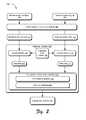
- FIG. 2depicts a system in an example implementation in which aligned sound data is generated from overdub sound data and reference sound data of FIG. 1 by leveraging an alignment user interface.
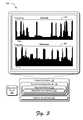
- FIG. 3depicts a system in an example implementation in which an example alignment user interface is shown that includes representations of the overdub and reference sound data.
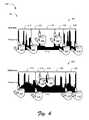
- FIG. 4depicts a system in an example implementation in which the example alignment user interface of FIG. 3 is shown as supporting interaction to manually specify alignment points.
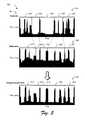
- FIG. 5depicts a system in an example implementation in which the example alignment user interface is shown as including a result of aligned sound data generated based at least in part on the specified alignment points in FIG. 4 .
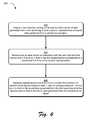
- FIG. 6is a flow diagram depicting a procedure in an example implementation in which a user interface is output that is configured to receive inputs that specify points in time in representations of sound data that are to be aligned.
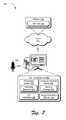
- FIG. 7illustrates an example system including various components of an example device that can be implemented as any type of computing device as described and/or utilize with reference to FIGS. 1-6 to implement embodiments of the techniques described herein.
- Sound alignment techniquesmay be employed to support a variety of different functionality. For example, sound data having a higher quality may be synchronized with sound data having a lower quality to replace the lower quality sound data, such as to remove noise from a video shoot, music recording, and so on. In another example, a foreign overdub may be used to replace original sound data for a movie with dialog in a different language.
- conventional auto-alignment systemscould result in an output having incorrect alignment, could consume significant amounts of computing resources, and so on.
- Sound alignment user interface techniquesare described herein.
- a user interfaceis configured to enable a user to specify particular intervals of sound data that are to be aligned to each other.
- the techniquesmay operate on these portions to align corresponding sound data, which may result in an efficient use of computing resources as well as an increased likelihood that the sound data is correctly aligned.
- these techniquesmay be used to align sound data even if the sound data does not have similar spectral characteristics. Further discussion of these and other examples may be found in relation to the following sections.
- Example proceduresare then described which may be performed in the example environment as well as other environments. Consequently, performance of the example procedures is not limited to the example environment and the example environment is not limited to performance of the example procedures.
- FIG. 1is an illustration of an environment 100 in an example implementation that is operable to employ techniques described herein.
- the illustrated environment 100includes a computing device 102 and sound capture devices 104 , 106 , which may be configured in a variety of ways.
- the computing device 102may be configured as a desktop computer, a laptop computer, a mobile device (e.g., assuming a handheld configuration such as a tablet or mobile phone), and so forth.
- the computing device 102may range from full resource devices with substantial memory and processor resources (e.g., personal computers, game consoles) to a low-resource device with limited memory and/or processing resources (e.g., mobile devices).
- a single computing device 102is shown, the computing device 102 may be representative of a plurality of different devices, such as multiple servers utilized by a business to perform operations “over the cloud” as further described in relation to FIG. 7 .
- the sound capture devices 104 , 106may also be configured in a variety of ways. Illustrated examples of one such configuration involves a standalone device but other configurations are also contemplated, such as part of a mobile phone, video camera, tablet computer, part of a desktop microphone, array microphone, and so on. Additionally, although the sound capture devices 104 , 106 are illustrated separately from the computing device 102 , the sound capture devices 104 , 106 may be configured as part of the computing device 102 , a single sound capture device may be utilized in each instance, and so on.
- the sound capture devices 104 , 106are each illustrated as including respective sound capture modules 108 , 110 that are representative of functionality to generate sound data, examples of which include reference sound data 112 and overdub sound data 114 .
- Reference sound data 112is utilized to describe sound data for which at least a part is to be replaced by the overdub sound data 114 . This may include replacement of noisy portions (e.g., due to capture of the reference sound data 112 “outside”), use of a foreign overdub, and even replacement using sound data that has different spectral characteristics.
- the overdub sound data 114may reference unaligned sound data that is to be processed for alignment with the reference sound data 112 .
- these rolesmay be satisfied alternately by different collections of sound data (e.g., in which different parts are taken from two or more files), and so on.
- this datamay then be obtained by the computing device 102 for processing by a sound processing module 116 .
- a sound processing module 116may be further divided, such as to be performed “over the cloud” via a network 118 connection, further discussion of which may be found in relation to FIG. 7 .
- the alignment module 120is representative of functionality to align the overdub sound data 114 to the reference sound data 112 to create aligned sound data 122 . As previously described, this may be used to replace a noisy portion of sound data, replace dialog with other dialog (e.g., for different languages), and so forth.
- the alignment module 120may support an alignment user interface 124 via which user inputs may be received to indicate corresponding points-in-time of the reference sound data 112 and the overdub sound data 114 . Further discussion of generation of the aligned sound data 122 and interaction with the alignment user interface 124 may be found in the following discussion and associated figure.
- FIG. 2depicts a system 200 in an example implementation in which aligned sound data 122 is generated from overdub sound data 114 and reference sound data 112 from FIG. 1 .
- a reference sound signal 202 and an overdub sound signal 204are processed by a time/frequency transform module 206 to create reference sound data 112 and overdub sound data 114 , which may be configured in a variety of ways.
- the sound datamay be used to form one or more spectrograms of a respective signal.
- a time-domain signalmay be received and processed to produce a time-frequency representation, e.g., a spectrogram, which may be output in an alignment user interface 124 for viewing by a user.
- the reference sound data 112 and overdub sound data 114may be used to provide a time-frequency representation of the reference sound signal 202 and overdub sound signal 204 , respectively, in this example.
- Spectrogramsmay be generated in a variety of ways, an example of which includes calculation as magnitudes of short time Fourier transforms (STFT) of the signals. Additionally, the spectrograms may assume a variety of configurations, such as narrowband spectrograms (e.g., 32 ms windows) although other instances are also contemplated.
- the STFT sub-bandsmay be combined in a way so as to approximate logarithmically-spaced or other nonlinearly-spaced sub-bands. In doing so, potentially adverse effects (e.g., very dissimilar features) from differences in pitch between the two sound signals may be mitigated and small differences in pitch may not result in significant differences in spectral features.
- STFTs and sub-band representationsmay be calculated for each of the reference sound signal 202 and overdub sound signal 204 before computing respective features, although other implementations are also contemplated.
- Overdub sound data 114 and reference sound data 112are illustrated as being received for processing by respective feature modules 208 , 210 of the alignment module 120 . Although illustrated separately, a single feature module may also be utilized for processing both the overdub sound data 114 and the reference sound data 112 .
- the feature modules 208 , 210are representative of functionality to identify features in the sound data that are usable to uniquely identify particular portions of the sound data, illustrated examples include features 212 of the reference sound data 112 and features 214 for the overdub sound data 114 .
- the features 212 , 214may take a variety of different forms.
- the features 212 , 214may result from a calculation of bases (e.g., spectral characteristics) and weights (e.g., temporal features) of the reference sound data 112 and the overdub sound data 114 , respectively.
- Basesmay include spectral characteristics such as spectral basis vectors, which may be considered spectral building blocks of the sound data.
- Weightsmay include temporal features, such as speech weights, noise weights, and so on. The weights may define a temporal evolution of a signal such that at each time instance of the signal, the signal may be defined by a linear combination of the blocks defined by the bases.
- the feature modules 208 , 210may employ a variety of different techniques to compute the features 212 , 214 .
- the features 212 , 214may be computed with an algorithm, such as Probabilistic Latent Component Analysis (PLCA), non-negative matrix factorization (NMF), non-negative hidden Markov (N-HMM), non-negative factorial hidden Markov (N-FHMM), and the like.
- PLCAProbabilistic Latent Component Analysis
- NMFnon-negative matrix factorization
- N-HMMnon-negative hidden Markov
- N-FHMMnon-negative factorial hidden Markov
- the features 212 identified in the reference sound data 112 and the features 214 identified from the overdub sound data 112 114may then be used by an adjustment and synthesis module 216 to generate aligned sound data 122 . This may include “speeding up” and “slowing down” portions of the overdub sound data 114 to match feature timing in the reference sound data 112 .
- the features 212 , 214may each include matrices of speech weights for the reference sound data 112 and overdub sound data 114 , respectively. Basis vectors and noise weights may be discarded.
- the features 212 , 214may be used to analyze how the overdub sound data 114 may be warped in time by the time warping module 218 to align the respective features, such as by a global offset or sampling factor, compressing, stretching, and so on.
- the time warping module 218may employ dynamic time warping that leverages a similarity matrix of the reference and overdub features, respectively.
- the similarity matrixmay be configured in a variety of ways, such as a two-dimensional rectangular matrix. One dimension may express length, in number of windows, for the reference sound data 112 and the other dimension may be the length for the overdub sound data 114 . Each element of the matrix may give a cosine distance between features.
- An optimal pathmay then be determined to minimize the error between the features of the reference sound data 112 and overdub sound data 114 , respectively, such that the path is most similar in the most number of planes.
- a pathmay indicate that to align a given frame of the reference sound data 112 and overdub sound data 114 , the reference sound data 112 and the overdub sound data 114 are each to be advanced by a single frame.
- a pathmay indicate that the reference sound data 112 is to be advanced two frames and the overdub sound data 114 is to remain on a current frame, i.e., is not to be advanced.
- the pathsmay indicate whether to stretch, compress, time-shift, or otherwise warp one of the signals to better match the other signal.
- An output of the time warping module 218may then be used by the synthesis module 220 to form the aligned sound data 122 from the reference sound data 112 and the overdub sound data 114 .
- automatic time alignmentmay be performed by the adjustment and synthesis module 216 to stretch and compress sound data to match the timing of other sound data, e.g., the overdub sound data 114 to the reference sound data 112 .
- Thismay be performed by dividing the sound data into a series of short frames and analyzing the spectral content of the frames. Based on this analysis, a determination may be made as to how the timing of the frames from the overdub sound data 114 is to be changed such that the spectral characteristics best match the frames in the reference sound data 112 . That timing information may then be used to modify the timing of the overdub sound data 114 to match the desired timing of the reference sound data 112 .
- sound alignment user interface techniquesmay be employed that leverage an alignment user interface 124 to aid alignment of sound data.
- the alignment user interface 124may be used to manually set one or more alignment points in representations of the reference sound data 112 and the overdub sound data 114 .
- a usermay indicate which points in the sound data are to correspond to each other.
- the alignment user interface 124may interact with the alignment user interface 124 to set alignment points to act as anchors in the troublesome regions. This may cause the adjustment and synthesis module 216 to align these points, and best align each of the other points (e.g., features 212 , 214 ) taking into account the manual alignment points.
- accuracy of the alignment module 120may be improved through use of the alignment user interface 124 .
- Efficiency of the alignment module 120may also be improved through use of the alignment user interface 124 .
- an alignment task for the two clips in the previous examplemay be divided into a plurality of interval alignment tasks. Results of the plurality of interval alignment tasks may then be combined to create aligned sound data 122 for the two clips. For example, adding “N” pairs of alignment points may increase computation speed by a factor between “N” and “N 2 ”.
- an alignment task that conventionally took over a minute to complete by a computing devicetook less than one second using less than ten alignment points.
- An example of the alignment user interface 124is discussed as follows and shown in a corresponding figure.
- FIG. 3depicts an example implementation 300 showing the computing device 102 of FIG. 1 as outputting an alignment user interface 124 for display.
- the computing device 102is illustrated as assuming a mobile form factor (e.g., a tablet computer) although other implementations are also contemplated as previously described.
- the reference sound data 112 and the overdub sound data 114are displayed in the alignment user interface 124 using respective time-frequency representations 302 , 304 , e.g., spectrograms, although other examples are also contemplated.
- the representations 302 , 304are displayed concurrently in the alignment user interface 124 by a display device of the computing device 102 , although other examples are also contemplated, such as through sequential output for display.
- the alignment user interface 124is configured such that alignment points 306 may be specified to indicate correspondence of points in time between the representations 302 , 304 , and accordingly correspondence of sound data represented at those points in time.
- the alignment module 120may then generate aligned sound data 122 as previously described based on the alignment points 306 .
- the alignment points 306may be specified in a variety of ways, an example of which is discussed as follows and shown in the corresponding figure.
- FIG. 4depicts an example implementation 400 in which the representations of the reference and overdub sound data 302 , 304 are utilized to indicate corresponding points in time.
- a series of inputsare depicted as being provided via a touch input, although other examples are also contemplated, such as use of a cursor control device, keyboard, voice command, and so on.
- Correspondence of the alignment points and intervalsis illustrated in the figure through use of a convention in which alignment point 402 of the representation 302 of the reference sound signal 112 corresponds to alignment point 402 ′ of the representation 304 of the overdub sound signal 114 and vice versa.
- a userwhen viewing the representations 302 , 304 of the reference and overdub sound signals 112 , 114 may notice particular points in time that likely correspond based on similar spectral characteristics as displayed in the alignment user interface 124 .
- a usermay note that spectral characteristics in the representations 302 , 304 likely correspond to each other at alignment points 402 , 402 ′. Accordingly, the user may indicate such through interaction with the alignment user interface by setting the alignment points 402 , 402 ′.
- the usermay repeat this by selecting additional alignment points 404 , 404 ′, 406 , 406 ′, 408 , 408 ′, 410 , 410 ′, which therefore also define a plurality of intervals 414 , 414 ′, 416 , 416 ′, 418 , 418 ′, 420 , 420 ′, 422 , 422 ′ as corresponding to each other.
- This selectionmay be performed in a variety of ways. For example, a user may select an alignment point 402 in the representation 302 of the reference sound data 112 and then indicate a corresponding point in time 402 ′ in the representation 304 of the overdub sound signal 114 . This selection may also be reversed, such as by selecting an alignment point 402 ′ in the representation 304 of the overdub sound data 114 and then an alignment point 402 in the representation 302 of the reference sound data 112 . Thus, in both of these examples, a user alternates selections between the representations 302 , 304 to indicate corresponding points in time.
- the alignment user interface 124may also be configured to support a series of selections made through interacting with one representation (e.g., alignment point 402 , 404 in representation 302 ) followed by a corresponding series of selections made through interacting with another representation, e.g., alignment points 402 ′, 404 ′ in representation 302 .
- alignment pointsmay be specified having unique display characteristics to indicate correspondence, may be performed through a drag-and-drop operations, and so on.
- other examplesare also contemplated, such as to specify the intervals 414 , 414 ′ themselves as corresponding to each other, for which a variety of different user interface techniques may be employed.
- a result of this manual alignment through interaction with the alignment user interface 124indicates correspondence between the sound data. This correspondence may be leveraged to generate the aligned sound data 122 .
- An example of the alignment user interface 124 showing a representation of the aligned sound data 122is discussed as follows and shown in the corresponding figure.
- FIG. 5depicts an example implementation 500 of the alignment user interface 124 as including a representation 502 of aligned sound data 122 .
- intervals 414 - 422 in the representation 302 of the reference sound data 112have lengths (i.e., describe amounts of time) that are different than the intervals 414 ′- 422 ′ in the representation 304 of the overdub sound data 114 .
- interval 414references an amount of time that is greater than interval 414 ′
- interval 418references an amount of time that is less than interval 418 ′, and so on. It should be readily apparent, however, that in some instances the lengths of the intervals may also match.
- the alignment module 120may use this information in a variety of ways to form aligned sound data 122 .
- the alignment pointsmay be utilized to strictly align those points in time specified by the alignment points 306 for the reference and overdub sound data 112 , 114 as corresponding to each other.
- the alignment module 120may then utilize techniques to align sound data within the intervals, such as to align features 212 , 214 as described previously. This may include stretching and/or compressing portions of the sound data included within the intervals to arrive at aligned sound data for that interval.
- the alignment module 120may divide the alignment task for the reference sound data 112 and the overdub sound data 114 according to the specified intervals. For example, the alignment task may be divided into “N+1” interval alignment tasks in which “N” is a number of user-defined alignment points 306 . Two or more of the interval alignment tasks may also be run in parallel to further speed-up performance. Once alignment is finished for the intervals, the results may be combined to arrive at the aligned sound data 122 for the reference sound data 112 and the overdub sound data 114 . In one or more implementations, a representation 502 of this result of the aligned sound data 114 may also be displayed in the alignment user interface 124 .
- the overdub sound data 114may be configured in a variety of ways.
- the techniquesmay allow for the audio in one signal to more closely follow the other signal (e.g., second signal, reference signal) such that utterances or other audio overlap more closely.
- sound data that corresponds to certain audio features from the two signalsmay be stretched, compressed, or shifted such that the lengths of those features are same and that they overlap in time, thus aligning the sound data to each other.
- the techniquesmay be used to automatically align the signals from the two saxophones to be more closely synchronized.
- the techniquesmay be used in situations in which both signals are noisy, in situations in which speakers from the two signals have significantly different spectral characteristics, and so on. For example, these techniques may be used to manually specify particular points in time to be aligned even if those points have quite different spectral characteristics, such as to align different instruments, a foreign overdub, and so forth.
- FIG. 6depicts a procedure 600 in an example implementation in which a user interface in output that is usable to manually align particular points in time to each other in sound data.
- a user interfaceis output having a first representation of sound data generated from a first sound signal and a second representation of sound data generated from a second sound signal (block 602 ).
- An alignment user interface 124may be output that includes representations 302 , 304 of reference sound data 112 and overdub sound data 114 , such as time-frequency representations.
- One or more inputsare received via interaction with the user interface that indicate that a first point in time in the first representation corresponds to a second point in time in the second representation (block 604 ).
- These inputsmay be provided in a variety of ways, such as a touch input, through use of a cursor control device (e.g., mouse), keyboard input, voice command, and so on.
- a cursor control devicee.g., mouse
- Aligned sound datais generated from the sound data from the first and second sound signals based at least in part on correspondence of the first point in time in the sound data generated from the first sound signal to the second point in time in the sound data generated from the second sound signal (block 606 ).
- the alignment module 120may generate aligned sound data 122 from the reference and overdub sound data 112 , 114 based on the alignment points 306 as well as respective features 212 , 214 identified in the sound data.
- FIG. 7illustrates an example system generally at 700 that includes an example computing device 702 that is representative of one or more computing systems and/or devices that may implement the various techniques described herein. This is illustrated through inclusion of the sound processing module 116 , which may be configured to process sound data, such as sound data captured by an sound capture device 104 .
- the computing device 702may be, for example, a server of a service provider, a device associated with a client (e.g., a client device), an on-chip system, and/or any other suitable computing device or computing system.
- the example computing device 702 as illustratedincludes a processing system 704 , one or more computer-readable media 706 , and one or more I/O interface 708 that are communicatively coupled, one to another.
- the computing device 702may further include a system bus or other data and command transfer system that couples the various components, one to another.
- a system buscan include any one or combination of different bus structures, such as a memory bus or memory controller, a peripheral bus, a universal serial bus, and/or a processor or local bus that utilizes any of a variety of bus architectures.
- a variety of other examplesare also contemplated, such as control and data lines.
- the processing system 704is representative of functionality to perform one or more operations using hardware. Accordingly, the processing system 704 is illustrated as including hardware element 710 that may be configured as processors, functional blocks, and so forth. This may include implementation in hardware as an application specific integrated circuit or other logic device formed using one or more semiconductors.
- the hardware elements 710are not limited by the materials from which they are formed or the processing mechanisms employed therein.
- processorsmay be comprised of semiconductor(s) and/or transistors (e.g., electronic integrated circuits (ICs)).
- processor-executable instructionsmay be electronically-executable instructions.
- the computer-readable storage media 706is illustrated as including memory/storage 712 .
- the memory/storage 712represents memory/storage capacity associated with one or more computer-readable media.
- the memory/storage component 712may include volatile media (such as random access memory (RAM)) and/or nonvolatile media (such as read only memory (ROM), Flash memory, optical disks, magnetic disks, and so forth).
- the memory/storage component 712may include fixed media (e.g., RAM, ROM, a fixed hard drive, and so on) as well as removable media (e.g., Flash memory, a removable hard drive, an optical disc, and so forth).
- the computer-readable media 706may be configured in a variety of other ways as further described below.
- Input/output interface(s) 708are representative of functionality to allow a user to enter commands and information to computing device 702 , and also allow information to be presented to the user and/or other components or devices using various input/output devices.
- input devicesinclude a keyboard, a cursor control device (e.g., a mouse), a microphone, a scanner, touch functionality (e.g., capacitive or other sensors that are configured to detect physical touch), a camera (e.g., which may employ visible or non-visible wavelengths such as infrared frequencies to recognize movement as gestures that do not involve touch), and so forth.
- Examples of output devicesinclude a display device (e.g., a monitor or projector), speakers, a printer, a network card, tactile-response device, and so forth.
- the computing device 702may be configured in a variety of ways as further described below to support user interaction.
- modulesinclude routines, programs, objects, elements, components, data structures, and so forth that perform particular tasks or implement particular abstract data types.
- modulegenerally represent software, firmware, hardware, or a combination thereof.
- the features of the techniques described hereinare platform-independent, meaning that the techniques may be implemented on a variety of commercial computing platforms having a variety of processors.
- Computer-readable mediamay include a variety of media that may be accessed by the computing device 702 .
- computer-readable mediamay include “computer-readable storage media” and “computer-readable signal media.”
- Computer-readable storage mediamay refer to media and/or devices that enable persistent and/or non-transitory storage of information in contrast to mere signal transmission, carrier waves, or signals per se. Thus, computer-readable storage media refers to non-signal bearing media.
- the computer-readable storage mediaincludes hardware such as volatile and non-volatile, removable and non-removable media and/or storage devices implemented in a method or technology suitable for storage of information such as computer readable instructions, data structures, program modules, logic elements/circuits, or other data.
- Examples of computer-readable storage mediamay include, but are not limited to, RAM, ROM, EEPROM, flash memory or other memory technology, CD-ROM, digital versatile disks (DVD) or other optical storage, hard disks, magnetic cassettes, magnetic tape, magnetic disk storage or other magnetic storage devices, or other storage device, tangible media, or article of manufacture suitable to store the desired information and which may be accessed by a computer.
- Computer-readable signal mediamay refer to a signal-bearing medium that is configured to transmit instructions to the hardware of the computing device 702 , such as via a network.
- Signal mediatypically may embody computer readable instructions, data structures, program modules, or other data in a modulated data signal, such as carrier waves, data signals, or other transport mechanism.
- Signal mediaalso include any information delivery media.
- modulated data signalmeans a signal that has one or more of its characteristics set or changed in such a manner as to encode information in the signal.
- communication mediainclude wired media such as a wired network or direct-wired connection, and wireless media such as acoustic, RF, infrared, and other wireless media.
- hardware elements 710 and computer-readable media 706are representative of modules, programmable device logic and/or fixed device logic implemented in a hardware form that may be employed in some embodiments to implement at least some aspects of the techniques described herein, such as to perform one or more instructions.
- Hardwaremay include components of an integrated circuit or on-chip system, an application-specific integrated circuit (ASIC), a field-programmable gate array (FPGA), a complex programmable logic device (CPLD), and other implementations in silicon or other hardware.
- ASICapplication-specific integrated circuit
- FPGAfield-programmable gate array
- CPLDcomplex programmable logic device
- hardwaremay operate as a processing device that performs program tasks defined by instructions and/or logic embodied by the hardware as well as a hardware utilized to store instructions for execution, e.g., the computer-readable storage media described previously.
- software, hardware, or executable modulesmay be implemented as one or more instructions and/or logic embodied on some form of computer-readable storage media and/or by one or more hardware elements 710 .
- the computing device 702may be configured to implement particular instructions and/or functions corresponding to the software and/or hardware modules. Accordingly, implementation of a module that is executable by the computing device 702 as software may be achieved at least partially in hardware, e.g., through use of computer-readable storage media and/or hardware elements 710 of the processing system 704 .
- the instructions and/or functionsmay be executable/operable by one or more articles of manufacture (for example, one or more computing devices 702 and/or processing systems 704 ) to implement techniques, modules, and examples described herein.
- the techniques described hereinmay be supported by various configurations of the computing device 702 and are not limited to the specific examples of the techniques described herein. This functionality may also be implemented all or in part through use of a distributed system, such as over a “cloud” 714 via a platform 716 as described below.
- the cloud 714includes and/or is representative of a platform 716 for resources 718 .
- the platform 716abstracts underlying functionality of hardware (e.g., servers) and software resources of the cloud 714 .
- the resources 718may include applications and/or data that can be utilized while computer processing is executed on servers that are remote from the computing device 702 .
- Resources 718can also include services provided over the Internet and/or through a subscriber network, such as a cellular or Wi-Fi network.
- the platform 716may abstract resources and functions to connect the computing device 702 with other computing devices.
- the platform 716may also serve to abstract scaling of resources to provide a corresponding level of scale to encountered demand for the resources 718 that are implemented via the platform 716 .
- implementation of functionality described hereinmay be distributed throughout the system 700 .
- the functionalitymay be implemented in part on the computing device 702 as well as via the platform 716 that abstracts the functionality of the cloud 714 .
Landscapes
- Engineering & Computer Science (AREA)
- General Engineering & Computer Science (AREA)
- Theoretical Computer Science (AREA)
- Human Computer Interaction (AREA)
- Physics & Mathematics (AREA)
- General Physics & Mathematics (AREA)
- User Interface Of Digital Computer (AREA)
Abstract
Description
Sound alignment may be leveraged to support a wide range of functionality. For example, sound data may be captured for use as part of a movie, recording of a song, and so on. Parts of the sound data, however, may reflect capture in a noisy environment and therefore may be less than desirable when output, such as by being difficult to understand, interfere with desired sounds, and so on. Accordingly, parts of the sound data may be replaced by other sound data using sound alignment. Sound alignment may also be employed to support other functionality, such as to utilize a foreign overdub to replace the sound data with dialog in a different language.
However, conventional techniques that are employed to automatically align the sound data may prove inadequate when confronted with relatively long clips, clips having differing lengths, and so on. Accordingly, these conventional techniques may cause a user to forgo use of these techniques as the results were often inconsistent, could result in undesirable alignments that lacked realism, and so forth. This may force users to undertake multiple re-recordings of the sound data that is to be used as a replacement until a desired match is obtained, manual fixing of the timing by a sound engineer, and so on.
Sound alignment user interface techniques are described. In one or more implementations, a user interface is output having a first representation of sound data generated from a first sound signal and a second representation of sound data generated from a second sound signal. One or more inputs are received, via interaction with the user interface, that indicate that a first point in time in the first representation corresponds to a second point in time in the second representation. Aligned sound data is generated from the sound data from the first and second sound signals based at least in part on correspondence of the first point in time in the sound data generated from the first sound signal to the second point in time in the sound data generated from the second sound signal.
This Summary introduces a selection of concepts in a simplified form that are further described below in the Detailed Description. As such, this Summary is not intended to identify essential features of the claimed subject matter, nor is it intended to be used as an aid in determining the scope of the claimed subject matter.
The detailed description is described with reference to the accompanying figures. In the figures, the left-most digit(s) of a reference number identifies the figure in which the reference number first appears. The use of the same reference numbers in different instances in the description and the figures may indicate similar or identical items. Entities represented in the figures may be indicative of one or more entities and thus reference may be made interchangeably to single or plural forms of the entities in the discussion.
Overview
Sound alignment techniques may be employed to support a variety of different functionality. For example, sound data having a higher quality may be synchronized with sound data having a lower quality to replace the lower quality sound data, such as to remove noise from a video shoot, music recording, and so on. In another example, a foreign overdub may be used to replace original sound data for a movie with dialog in a different language. However, conventional auto-alignment systems could result in an output having incorrect alignment, could consume significant amounts of computing resources, and so on.
Sound alignment user interface techniques are described herein. In one or more implementations, a user interface is configured to enable a user to specify particular intervals of sound data that are to be aligned to each other. In this way, the techniques may operate on these portions to align corresponding sound data, which may result in an efficient use of computing resources as well as an increased likelihood that the sound data is correctly aligned. For example, these techniques may be used to align sound data even if the sound data does not have similar spectral characteristics. Further discussion of these and other examples may be found in relation to the following sections.
In the following discussion, an example environment is first described that may employ the techniques described herein. Example procedures are then described which may be performed in the example environment as well as other environments. Consequently, performance of the example procedures is not limited to the example environment and the example environment is not limited to performance of the example procedures.
Example Environment
Thecomputing device 102, for instance, may be configured as a desktop computer, a laptop computer, a mobile device (e.g., assuming a handheld configuration such as a tablet or mobile phone), and so forth. Thus, thecomputing device 102 may range from full resource devices with substantial memory and processor resources (e.g., personal computers, game consoles) to a low-resource device with limited memory and/or processing resources (e.g., mobile devices). Additionally, although asingle computing device 102 is shown, thecomputing device 102 may be representative of a plurality of different devices, such as multiple servers utilized by a business to perform operations “over the cloud” as further described in relation toFIG. 7 .
Thesound capture devices sound capture devices computing device 102, thesound capture devices computing device 102, a single sound capture device may be utilized in each instance, and so on.
Thesound capture devices sound capture modules reference sound data 112 and overdubsound data 114.Reference sound data 112 is utilized to describe sound data for which at least a part is to be replaced by theoverdub sound data 114. This may include replacement of noisy portions (e.g., due to capture of thereference sound data 112 “outside”), use of a foreign overdub, and even replacement using sound data that has different spectral characteristics. Thus, theoverdub sound data 114 may reference unaligned sound data that is to be processed for alignment with thereference sound data 112. Additionally, although illustrated separately for clarity in the discussion it should be apparent that these roles may be satisfied alternately by different collections of sound data (e.g., in which different parts are taken from two or more files), and so on.
Regardless of where thereference sound data 112, and overdubsound data 114 originated, this data may then be obtained by thecomputing device 102 for processing by asound processing module 116. Although illustrated as part of thecomputing device 102, functionality represented by thesound processing module 116 may be further divided, such as to be performed “over the cloud” via anetwork 118 connection, further discussion of which may be found in relation toFIG. 7 .
An example of functionality of thesound processing module 116 is represented as analignment module 120. Thealignment module 120 is representative of functionality to align theoverdub sound data 114 to thereference sound data 112 to create alignedsound data 122. As previously described, this may be used to replace a noisy portion of sound data, replace dialog with other dialog (e.g., for different languages), and so forth. In order to aid in the alignment, thealignment module 120 may support analignment user interface 124 via which user inputs may be received to indicate corresponding points-in-time of thereference sound data 112 and theoverdub sound data 114. Further discussion of generation of the alignedsound data 122 and interaction with thealignment user interface 124 may be found in the following discussion and associated figure.
The sound data, for instance, may be used to form one or more spectrograms of a respective signal. For example, a time-domain signal may be received and processed to produce a time-frequency representation, e.g., a spectrogram, which may be output in analignment user interface 124 for viewing by a user. Thus, thereference sound data 112 and overdubsound data 114 may be used to provide a time-frequency representation of thereference sound signal 202 and overdubsound signal 204, respectively, in this example.
Spectrograms may be generated in a variety of ways, an example of which includes calculation as magnitudes of short time Fourier transforms (STFT) of the signals. Additionally, the spectrograms may assume a variety of configurations, such as narrowband spectrograms (e.g., 32 ms windows) although other instances are also contemplated. The STFT sub-bands may be combined in a way so as to approximate logarithmically-spaced or other nonlinearly-spaced sub-bands. In doing so, potentially adverse effects (e.g., very dissimilar features) from differences in pitch between the two sound signals may be mitigated and small differences in pitch may not result in significant differences in spectral features. In various implementations, STFTs and sub-band representations may be calculated for each of thereference sound signal 202 and overdubsound signal 204 before computing respective features, although other implementations are also contemplated.
Thefeatures features reference sound data 112 and theoverdub sound data 114, respectively. Bases, for instance, may include spectral characteristics such as spectral basis vectors, which may be considered spectral building blocks of the sound data. Weights may include temporal features, such as speech weights, noise weights, and so on. The weights may define a temporal evolution of a signal such that at each time instance of the signal, the signal may be defined by a linear combination of the blocks defined by the bases.
Thefeature modules features features
Thefeatures 212 identified in thereference sound data 112 and thefeatures 214 identified from theoverdub sound data 112114 may then be used by an adjustment and synthesis module216 to generate alignedsound data 122. This may include “speeding up” and “slowing down” portions of theoverdub sound data 114 to match feature timing in thereference sound data 112.
For example, thefeatures reference sound data 112 and overdubsound data 114, respectively. Basis vectors and noise weights may be discarded. Thefeatures overdub sound data 114 may be warped in time by thetime warping module 218 to align the respective features, such as by a global offset or sampling factor, compressing, stretching, and so on.
Thetime warping module 218, for instance, may employ dynamic time warping that leverages a similarity matrix of the reference and overdub features, respectively. The similarity matrix may be configured in a variety of ways, such as a two-dimensional rectangular matrix. One dimension may express length, in number of windows, for thereference sound data 112 and the other dimension may be the length for theoverdub sound data 114. Each element of the matrix may give a cosine distance between features.
An optimal path may then be determined to minimize the error between the features of thereference sound data 112 and overdubsound data 114, respectively, such that the path is most similar in the most number of planes. For instance, a path may indicate that to align a given frame of thereference sound data 112 and overdubsound data 114, thereference sound data 112 and theoverdub sound data 114 are each to be advanced by a single frame. For another frame, a path may indicate that thereference sound data 112 is to be advanced two frames and theoverdub sound data 114 is to remain on a current frame, i.e., is not to be advanced. The paths may indicate whether to stretch, compress, time-shift, or otherwise warp one of the signals to better match the other signal. An output of thetime warping module 218 may then be used by thesynthesis module 220 to form the alignedsound data 122 from thereference sound data 112 and theoverdub sound data 114.
Thus, automatic time alignment may be performed by the adjustment and synthesis module216 to stretch and compress sound data to match the timing of other sound data, e.g., theoverdub sound data 114 to thereference sound data 112. This may be performed by dividing the sound data into a series of short frames and analyzing the spectral content of the frames. Based on this analysis, a determination may be made as to how the timing of the frames from theoverdub sound data 114 is to be changed such that the spectral characteristics best match the frames in thereference sound data 112. That timing information may then be used to modify the timing of theoverdub sound data 114 to match the desired timing of thereference sound data 112.
In conventional techniques, a user simply selected the beginning and end points of each clip that was to be aligned. An alignment algorithm was then used to determine how to align everything in between. However, these conventional techniques could have several drawbacks. For example, the longer the clip, the more likely it was to result in an incorrect alignment. Second, computation time is proportionate to the length of clips, such as the length of the overdub clip times the length of the reference clip. Therefore, if the clip length doubles, the computation time quadruples. Consequently, inaccuracies could be encountered and the processing could be resource intensive, which could result in delays to even achieve an undesirable result.
Accordingly, sound alignment user interface techniques may be employed that leverage analignment user interface 124 to aid alignment of sound data. Thealignment user interface 124, for instance, may be used to manually set one or more alignment points in representations of thereference sound data 112 and theoverdub sound data 114. In this way, a user may indicate which points in the sound data are to correspond to each other. For example, if a user encountered a problem with the alignment, such as through automatic processing of two or more clips, the user may interact with thealignment user interface 124 to set alignment points to act as anchors in the troublesome regions. This may cause the adjustment and synthesis module216 to align these points, and best align each of the other points (e.g., features212,214) taking into account the manual alignment points. Thus, accuracy of thealignment module 120 may be improved through use of thealignment user interface 124.
Efficiency of thealignment module 120 may also be improved through use of thealignment user interface 124. Through specification of the alignment points, for instance, an alignment task for the two clips in the previous example may be divided into a plurality of interval alignment tasks. Results of the plurality of interval alignment tasks may then be combined to create alignedsound data 122 for the two clips. For example, adding “N” pairs of alignment points may increase computation speed by a factor between “N” and “N2”. In an example implementation, an alignment task that conventionally took over a minute to complete by a computing device took less than one second using less than ten alignment points. An example of thealignment user interface 124 is discussed as follows and shown in a corresponding figure.
Therepresentations alignment user interface 124 by a display device of thecomputing device 102, although other examples are also contemplated, such as through sequential output for display. Thealignment user interface 124 is configured such that alignment points306 may be specified to indicate correspondence of points in time between therepresentations alignment module 120 may then generate alignedsound data 122 as previously described based on the alignment points306. The alignment points306 may be specified in a variety of ways, an example of which is discussed as follows and shown in the corresponding figure.
A user, when viewing therepresentations alignment user interface 124. For example, a user may note that spectral characteristics in therepresentations alignment points additional alignment points intervals
This selection, including the order thereof, may be performed in a variety of ways. For example, a user may select analignment point 402 in therepresentation 302 of thereference sound data 112 and then indicate a corresponding point intime 402′ in therepresentation 304 of theoverdub sound signal 114. This selection may also be reversed, such as by selecting analignment point 402′ in therepresentation 304 of theoverdub sound data 114 and then analignment point 402 in therepresentation 302 of thereference sound data 112. Thus, in both of these examples, a user alternates selections between therepresentations
Other examples are also contemplated. For example, thealignment user interface 124 may also be configured to support a series of selections made through interacting with one representation (e.g.,alignment point representation 302. In another example, alignment points may be specified having unique display characteristics to indicate correspondence, may be performed through a drag-and-drop operations, and so on. Further, other examples are also contemplated, such as to specify theintervals
Regardless of a technique used to indicate the alignment points and/or intervals, a result of this manual alignment through interaction with thealignment user interface 124 indicates correspondence between the sound data. This correspondence may be leveraged to generate the alignedsound data 122. An example of thealignment user interface 124 showing a representation of the alignedsound data 122 is discussed as follows and shown in the corresponding figure.
Thealignment module 120 may use this information in a variety of ways to form alignedsound data 122. For example, the alignment points may be utilized to strictly align those points in time specified by the alignment points306 for the reference and overdubsound data alignment module 120 may then utilize techniques to align sound data within the intervals, such as to alignfeatures
Additionally, processing of the sound data by interval may be utilized to improve efficiency as previously described. Thealignment module 120, for instance, may divide the alignment task for thereference sound data 112 and theoverdub sound data 114 according to the specified intervals. For example, the alignment task may be divided into “N+1” interval alignment tasks in which “N” is a number of user-defined alignment points306. Two or more of the interval alignment tasks may also be run in parallel to further speed-up performance. Once alignment is finished for the intervals, the results may be combined to arrive at the alignedsound data 122 for thereference sound data 112 and theoverdub sound data 114. In one or more implementations, arepresentation 502 of this result of the alignedsound data 114 may also be displayed in thealignment user interface 124.
As previously described, theoverdub sound data 114 may be configured in a variety of ways. For instance, in a foreign dubbing embodiment, the techniques may allow for the audio in one signal to more closely follow the other signal (e.g., second signal, reference signal) such that utterances or other audio overlap more closely. For example, sound data that corresponds to certain audio features from the two signals may be stretched, compressed, or shifted such that the lengths of those features are same and that they overlap in time, thus aligning the sound data to each other. As another example, consider a scenario in which two saxophones in a musical performance are off in timing. The techniques may be used to automatically align the signals from the two saxophones to be more closely synchronized.
Additionally, the techniques may be used in situations in which both signals are noisy, in situations in which speakers from the two signals have significantly different spectral characteristics, and so on. For example, these techniques may be used to manually specify particular points in time to be aligned even if those points have quite different spectral characteristics, such as to align different instruments, a foreign overdub, and so forth.
Example Procedures
The following discussion describes user interface techniques that may be implemented utilizing the previously described systems and devices. Aspects of each of the procedures may be implemented in hardware, firmware, or software, or a combination thereof. The procedures are shown as a set of blocks that specify operations performed by one or more devices and are not necessarily limited to the orders shown for performing the operations by the respective blocks. In portions of the following discussion, reference will be made toFIGS. 1-5 .
One or more inputs are received via interaction with the user interface that indicate that a first point in time in the first representation corresponds to a second point in time in the second representation (block604). These inputs may be provided in a variety of ways, such as a touch input, through use of a cursor control device (e.g., mouse), keyboard input, voice command, and so on.
Aligned sound data is generated from the sound data from the first and second sound signals based at least in part on correspondence of the first point in time in the sound data generated from the first sound signal to the second point in time in the sound data generated from the second sound signal (block606). Thealignment module 120, for instance, may generate alignedsound data 122 from the reference and overdubsound data respective features
Example System and Device
Theexample computing device 702 as illustrated includes aprocessing system 704, one or more computer-readable media 706, and one or more I/O interface 708 that are communicatively coupled, one to another. Although not shown, thecomputing device 702 may further include a system bus or other data and command transfer system that couples the various components, one to another. A system bus can include any one or combination of different bus structures, such as a memory bus or memory controller, a peripheral bus, a universal serial bus, and/or a processor or local bus that utilizes any of a variety of bus architectures. A variety of other examples are also contemplated, such as control and data lines.
Theprocessing system 704 is representative of functionality to perform one or more operations using hardware. Accordingly, theprocessing system 704 is illustrated as includinghardware element 710 that may be configured as processors, functional blocks, and so forth. This may include implementation in hardware as an application specific integrated circuit or other logic device formed using one or more semiconductors. Thehardware elements 710 are not limited by the materials from which they are formed or the processing mechanisms employed therein. For example, processors may be comprised of semiconductor(s) and/or transistors (e.g., electronic integrated circuits (ICs)). In such a context, processor-executable instructions may be electronically-executable instructions.
The computer-readable storage media 706 is illustrated as including memory/storage 712. The memory/storage 712 represents memory/storage capacity associated with one or more computer-readable media. The memory/storage component 712 may include volatile media (such as random access memory (RAM)) and/or nonvolatile media (such as read only memory (ROM), Flash memory, optical disks, magnetic disks, and so forth). The memory/storage component 712 may include fixed media (e.g., RAM, ROM, a fixed hard drive, and so on) as well as removable media (e.g., Flash memory, a removable hard drive, an optical disc, and so forth). The computer-readable media 706 may be configured in a variety of other ways as further described below.
Input/output interface(s)708 are representative of functionality to allow a user to enter commands and information tocomputing device 702, and also allow information to be presented to the user and/or other components or devices using various input/output devices. Examples of input devices include a keyboard, a cursor control device (e.g., a mouse), a microphone, a scanner, touch functionality (e.g., capacitive or other sensors that are configured to detect physical touch), a camera (e.g., which may employ visible or non-visible wavelengths such as infrared frequencies to recognize movement as gestures that do not involve touch), and so forth. Examples of output devices include a display device (e.g., a monitor or projector), speakers, a printer, a network card, tactile-response device, and so forth. Thus, thecomputing device 702 may be configured in a variety of ways as further described below to support user interaction.
Various techniques may be described herein in the general context of software, hardware elements, or program modules. Generally, such modules include routines, programs, objects, elements, components, data structures, and so forth that perform particular tasks or implement particular abstract data types. The terms “module,” “functionality,” and “component” as used herein generally represent software, firmware, hardware, or a combination thereof. The features of the techniques described herein are platform-independent, meaning that the techniques may be implemented on a variety of commercial computing platforms having a variety of processors.
An implementation of the described modules and techniques may be stored on or transmitted across some form of computer-readable media. The computer-readable media may include a variety of media that may be accessed by thecomputing device 702. By way of example, and not limitation, computer-readable media may include “computer-readable storage media” and “computer-readable signal media.”
“Computer-readable storage media” may refer to media and/or devices that enable persistent and/or non-transitory storage of information in contrast to mere signal transmission, carrier waves, or signals per se. Thus, computer-readable storage media refers to non-signal bearing media. The computer-readable storage media includes hardware such as volatile and non-volatile, removable and non-removable media and/or storage devices implemented in a method or technology suitable for storage of information such as computer readable instructions, data structures, program modules, logic elements/circuits, or other data. Examples of computer-readable storage media may include, but are not limited to, RAM, ROM, EEPROM, flash memory or other memory technology, CD-ROM, digital versatile disks (DVD) or other optical storage, hard disks, magnetic cassettes, magnetic tape, magnetic disk storage or other magnetic storage devices, or other storage device, tangible media, or article of manufacture suitable to store the desired information and which may be accessed by a computer.
“Computer-readable signal media” may refer to a signal-bearing medium that is configured to transmit instructions to the hardware of thecomputing device 702, such as via a network. Signal media typically may embody computer readable instructions, data structures, program modules, or other data in a modulated data signal, such as carrier waves, data signals, or other transport mechanism. Signal media also include any information delivery media. The term “modulated data signal” means a signal that has one or more of its characteristics set or changed in such a manner as to encode information in the signal. By way of example, and not limitation, communication media include wired media such as a wired network or direct-wired connection, and wireless media such as acoustic, RF, infrared, and other wireless media.
As previously described,hardware elements 710 and computer-readable media 706 are representative of modules, programmable device logic and/or fixed device logic implemented in a hardware form that may be employed in some embodiments to implement at least some aspects of the techniques described herein, such as to perform one or more instructions. Hardware may include components of an integrated circuit or on-chip system, an application-specific integrated circuit (ASIC), a field-programmable gate array (FPGA), a complex programmable logic device (CPLD), and other implementations in silicon or other hardware. In this context, hardware may operate as a processing device that performs program tasks defined by instructions and/or logic embodied by the hardware as well as a hardware utilized to store instructions for execution, e.g., the computer-readable storage media described previously.
Combinations of the foregoing may also be employed to implement various techniques described herein. Accordingly, software, hardware, or executable modules may be implemented as one or more instructions and/or logic embodied on some form of computer-readable storage media and/or by one ormore hardware elements 710. Thecomputing device 702 may be configured to implement particular instructions and/or functions corresponding to the software and/or hardware modules. Accordingly, implementation of a module that is executable by thecomputing device 702 as software may be achieved at least partially in hardware, e.g., through use of computer-readable storage media and/orhardware elements 710 of theprocessing system 704. The instructions and/or functions may be executable/operable by one or more articles of manufacture (for example, one ormore computing devices 702 and/or processing systems704) to implement techniques, modules, and examples described herein.
The techniques described herein may be supported by various configurations of thecomputing device 702 and are not limited to the specific examples of the techniques described herein. This functionality may also be implemented all or in part through use of a distributed system, such as over a “cloud”714 via aplatform 716 as described below.
Thecloud 714 includes and/or is representative of aplatform 716 forresources 718. Theplatform 716 abstracts underlying functionality of hardware (e.g., servers) and software resources of thecloud 714. Theresources 718 may include applications and/or data that can be utilized while computer processing is executed on servers that are remote from thecomputing device 702.Resources 718 can also include services provided over the Internet and/or through a subscriber network, such as a cellular or Wi-Fi network.
Theplatform 716 may abstract resources and functions to connect thecomputing device 702 with other computing devices. Theplatform 716 may also serve to abstract scaling of resources to provide a corresponding level of scale to encountered demand for theresources 718 that are implemented via theplatform 716. Accordingly, in an interconnected device embodiment, implementation of functionality described herein may be distributed throughout thesystem 700. For example, the functionality may be implemented in part on thecomputing device 702 as well as via theplatform 716 that abstracts the functionality of thecloud 714.
Conclusion
Although the invention has been described in language specific to structural features and/or methodological acts, it is to be understood that the invention defined in the appended claims is not necessarily limited to the specific features or acts described. Rather, the specific features and acts are disclosed as example forms of implementing the claimed invention.
Claims (20)
1. A method implemented by one or more computing devices, the method comprising:
outputting a user interface having a first representation of sound data generated from a first sound signal and a second representation of sound data generated from a second sound signal;
identifying, automatically and without user input, a first portion of the first representation that contains one or more features that correspond to one or more features in a second portion of the second representation;
receiving one or more manual inputs via interaction with the user interface, the manual inputs being selection of a first point in time within the first representation and selection of a corresponding second point in time within the second representation; and
generating aligned sound data from the sound data from the first and second sound signals by at least:
aligning the first point in time in the sound data generated from the first sound signal to the second point in time in the sound data generated from the second sound signal, the aligning effective to anchor the first point and the second point to each other in the aligned sound data; and
adjusting, automatically and without user input, the second portion of the second representation containing the one or more features to have a slower speed or a faster speed, the adjustment effective to align in time the one or more features in the second portion with the one or more features in the first portion without changing the alignment of the first point with the second point.
2. The method as described inclaim 1 , wherein the one or more manual inputs define corresponding intervals in the sound data generated from the first and second sound signals, respectively.
3. The method as described inclaim 2 , wherein a plurality of said intervals are indicated, via manual interaction with the user interface, as corresponding between the sound data of the first and second sound signals, respectively, and the generating of the aligned sound data is performed individually for corresponding said intervals to generate the aligned sound data.
4. The method as described inclaim 1 , wherein the one or more features are spectral basis vectors, speech weights, or noise weights.
5. The method as described inclaim 1 , wherein the one or more features are computed using one or more of: probabilistic latent component analysis, non-negative matrix factorization, non-negative hidden Markov model, or non-negative factorial hidden Markov model.
6. The method as described inclaim 1 , wherein the first and second representations describe time and frequency of the sound data generated from the first and second sound signals, respectively.
7. The method as described inclaim 6 , wherein the sound data from the first and second sound signals are computed using short time Fourier transforms.
8. The method as described inclaim 1 , wherein the adjusting is accomplished by using one or more of: global offset, sampling factor, compression, or stretching.
9. The method as described inclaim 1 , wherein the first sound signal is an overdub sound signal and the second sound signal is a reference sound signal.
10. A system comprising:
at least one module implemented at least partially in hardware and configured to output a user interface that is usable to manually select points within a plurality of representations of sound data generated from a plurality of sound signals, each selected point in a representation corresponding to a selected point in each other representation and the selected points within each representation defining a plurality of corresponding intervals within the representations of sound data; and
one or more modules implemented at least partially in hardware and configured to generate aligned sound data from the sound data generated from the plurality of sound signals using the defined plurality of corresponding intervals by:
aligning each selected point within a representation to the corresponding selected point within each other representation, the aligning effective to anchor the corresponding points to each other in the aligned sound data;
automatically and without user intervention, dividing an alignment task for aligning the sound data generated from the plurality of sound signals into a plurality of interval alignment tasks, the interval alignment tasks being alignment of each defined interval within each representation with the corresponding defined interval within each other representation to produce aligned intervals without changing the alignment of the corresponding selected points;
combining the aligned intervals from the plurality of representations; and
using the combination of the aligned intervals as the aligned sound data.
11. The system as described inclaim 10 , wherein a first said interval defined for a first said representation has a length in time that is different than a second said interval defined for a second said representation.
12. The system as described inclaim 11 , wherein the one or more modules are configured to generate the aligned sound data by adjusting, automatically and without user intervention, the second interval to have a slower speed or a faster speed such that it is aligned in time with the corresponding first interval.
13. The system as described inclaim 10 , wherein at least two of the plurality of interval alignment tasks are configured to be executed in parallel by the one or more modules.
14. The system as described inclaim 12 , wherein the adjusting is accomplished by using one or more of: global offset, sampling factor, compression, or stretching.
15. The system as described inclaim 10 , wherein the plurality of representations of sound data are computed using short time Fourier transforms.
16. The system as described inclaim 10 , wherein the representations describe time and frequency of the sound data generated from respective ones of the plurality of sound signals.
17. One or more non-transitory computer-readable storage media having instructions stored thereon that, responsive to execution on a computing device, causes the computing device to perform operations comprising:
outputting a user interface having a first representation of sound data generated from a first sound signal and a second representation of sound data generated from a second sound signal;
identifying, automatically and without user input, a first portion of the first representation that contains one or more features that correspond to one or more features in a second portion of the second representation;
receiving one or more manual inputs via interaction with the user interface, the manual inputs being selection of a first point in time within the first representation and selection of a corresponding second point in time within the second representation; and
generating aligned sound data from the sound data generated from the first and second sound signals at least in part by:
aligning the first manually selected point in time in the sound data generated from the first sound signal to the second manually selected point in time in the sound data generated from the second sound signal, the aligning effective to anchor the first point and the second point to each other in the aligned sound data; and
adjusting, automatically and without user input, the second portion to have a slower speed or a faster speed, the adjustment effective to align in time the one or more features in the second portion with the one or more features in the first portion without changing the alignment of the first and second manually selected points.
18. The one or more non-transitory computer-readable storage media as described inclaim 17 , wherein the generating of the aligned sound data further comprises:
dividing the first and second representations of sound data into a plurality of intervals, each interval in the first representation corresponding to an interval in the second representation; and
dividing an alignment task for the sound data generated from the first and second sound signals into a plurality of interval alignment tasks that involve the corresponding intervals.
19. The one or more non-transitory computer-readable storage media as described inclaim 18 , wherein at least two of the plurality of interval alignment tasks are configured to be executed in parallel.
20. The one or more non-transitory computer-readable storage media as described inclaim 18 , wherein the generating is performed such that the aligned sound data is generated from the sound data of the first and second sound signals from a combination of results of the plurality of interval alignment tasks.
Priority Applications (1)
| Application Number | Priority Date | Filing Date | Title |
|---|---|---|---|
| US13/675,807US9201580B2 (en) | 2012-11-13 | 2012-11-13 | Sound alignment user interface |
Applications Claiming Priority (1)
| Application Number | Priority Date | Filing Date | Title |
|---|---|---|---|
| US13/675,807US9201580B2 (en) | 2012-11-13 | 2012-11-13 | Sound alignment user interface |
Publications (2)
| Publication Number | Publication Date |
|---|---|
| US20140136976A1 US20140136976A1 (en) | 2014-05-15 |
| US9201580B2true US9201580B2 (en) | 2015-12-01 |
Family
ID=50682969
Family Applications (1)
| Application Number | Title | Priority Date | Filing Date |
|---|---|---|---|
| US13/675,807Active2033-08-08US9201580B2 (en) | 2012-11-13 | 2012-11-13 | Sound alignment user interface |
Country Status (1)
| Country | Link |
|---|---|
| US (1) | US9201580B2 (en) |
Cited By (6)
| Publication number | Priority date | Publication date | Assignee | Title |
|---|---|---|---|---|
| US9355649B2 (en) | 2012-11-13 | 2016-05-31 | Adobe Systems Incorporated | Sound alignment using timing information |
| US9451304B2 (en) | 2012-11-29 | 2016-09-20 | Adobe Systems Incorporated | Sound feature priority alignment |
| US10249321B2 (en) | 2012-11-20 | 2019-04-02 | Adobe Inc. | Sound rate modification |
| US10249052B2 (en) | 2012-12-19 | 2019-04-02 | Adobe Systems Incorporated | Stereo correspondence model fitting |
| US10455219B2 (en) | 2012-11-30 | 2019-10-22 | Adobe Inc. | Stereo correspondence and depth sensors |
| US10638221B2 (en)* | 2012-11-13 | 2020-04-28 | Adobe Inc. | Time interval sound alignment |
Families Citing this family (10)
| Publication number | Priority date | Publication date | Assignee | Title |
|---|---|---|---|---|
| US8879731B2 (en) | 2011-12-02 | 2014-11-04 | Adobe Systems Incorporated | Binding of protected video content to video player with block cipher hash |
| US8903088B2 (en) | 2011-12-02 | 2014-12-02 | Adobe Systems Incorporated | Binding of protected video content to video player with encryption key |
| US9064318B2 (en) | 2012-10-25 | 2015-06-23 | Adobe Systems Incorporated | Image matting and alpha value techniques |
| US9076205B2 (en) | 2012-11-19 | 2015-07-07 | Adobe Systems Incorporated | Edge direction and curve based image de-blurring |
| US9135710B2 (en) | 2012-11-30 | 2015-09-15 | Adobe Systems Incorporated | Depth map stereo correspondence techniques |
| US9208547B2 (en) | 2012-12-19 | 2015-12-08 | Adobe Systems Incorporated | Stereo correspondence smoothness tool |
| US9214026B2 (en) | 2012-12-20 | 2015-12-15 | Adobe Systems Incorporated | Belief propagation and affinity measures |
| WO2015181163A1 (en)* | 2014-05-28 | 2015-12-03 | Thomson Licensing | Method and system for touch input |
| CN109697000B (en)* | 2017-10-24 | 2022-09-16 | 阿里巴巴集团控股有限公司 | Resource allocation method and related equipment, display method and related equipment |
| US10789920B1 (en)* | 2019-11-18 | 2020-09-29 | Thirty3, LLC | Cloud-based media synchronization system for generating a synchronization interface and performing media synchronization |
Citations (150)
| Publication number | Priority date | Publication date | Assignee | Title |
|---|---|---|---|---|
| US4591928A (en) | 1982-03-23 | 1986-05-27 | Wordfit Limited | Method and apparatus for use in processing signals |
| US5151998A (en)* | 1988-12-30 | 1992-09-29 | Macromedia, Inc. | sound editing system using control line for altering specified characteristic of adjacent segment of the stored waveform |
| US5652828A (en) | 1993-03-19 | 1997-07-29 | Nynex Science & Technology, Inc. | Automated voice synthesis employing enhanced prosodic treatment of text, spelling of text and rate of annunciation |
| US5671283A (en) | 1995-06-08 | 1997-09-23 | Wave Systems Corp. | Secure communication system with cross linked cryptographic codes |
| US5749073A (en) | 1996-03-15 | 1998-05-05 | Interval Research Corporation | System for automatically morphing audio information |
| US6122375A (en) | 1996-12-10 | 2000-09-19 | Hitachi, Ltd. | Hash value generating method and device, data encryption method and device, data decryption method and device |
| US6208348B1 (en) | 1998-05-27 | 2001-03-27 | In-Three, Inc. | System and method for dimensionalization processing of images in consideration of a pedetermined image projection format |
| US6266412B1 (en) | 1998-06-15 | 2001-07-24 | Lucent Technologies Inc. | Encrypting speech coder |
| US6316712B1 (en) | 1999-01-25 | 2001-11-13 | Creative Technology Ltd. | Method and apparatus for tempo and downbeat detection and alteration of rhythm in a musical segment |
| US6333983B1 (en) | 1997-12-16 | 2001-12-25 | International Business Machines Corporation | Method and apparatus for performing strong encryption or decryption data using special encryption functions |
| US20020154779A1 (en) | 2000-01-26 | 2002-10-24 | Tomoyuki Asano | Data recording/reproducing device and saved data processing method, and program proving medium |
| US6480957B1 (en) | 1997-11-10 | 2002-11-12 | Openwave Systems Inc. | Method and system for secure lightweight transactions in wireless data networks |
| US20040030656A1 (en) | 1999-03-05 | 2004-02-12 | Toru Kambayashi | Information recording device and information reproducing device |
| US6778667B1 (en) | 1997-01-07 | 2004-08-17 | Intel Corporation | Method and apparatus for integrated ciphering and hashing |
| US6792113B1 (en) | 1999-12-20 | 2004-09-14 | Microsoft Corporation | Adaptable security mechanism for preventing unauthorized access of digital data |
| US6804355B1 (en) | 2000-01-06 | 2004-10-12 | Intel Corporation | Block cipher for small selectable block sizes |
| US20040254660A1 (en) | 2003-05-28 | 2004-12-16 | Alan Seefeldt | Method and device to process digital media streams |
| US20050015343A1 (en) | 2002-09-11 | 2005-01-20 | Norihiro Nagai | License management device, license management method, and computer program |
| US20050201591A1 (en) | 2004-03-10 | 2005-09-15 | Kiselewich Stephen J. | Method and apparatus for recognizing the position of an occupant in a vehicle |
| US20050232463A1 (en) | 2004-03-02 | 2005-10-20 | David Hirvonen | Method and apparatus for detecting a presence prior to collision |
| US7003107B2 (en) | 2000-05-23 | 2006-02-21 | Mainstream Encryption | Hybrid stream cipher |
| US20060045211A1 (en) | 2004-08-30 | 2006-03-02 | Samsung Electronics Co., Ltd. | Method and apparatus for calculating log-likelihood ratio for decoding in a receiver for a mobile communication system |
| US20060078194A1 (en) | 2002-11-20 | 2006-04-13 | Maxim Fradkin | Image processing system for automatic adaptation of a 3-d mesh model onto a 3-d surface of an object |
| US20060122839A1 (en) | 2000-07-31 | 2006-06-08 | Avery Li-Chun Wang | System and methods for recognizing sound and music signals in high noise and distortion |
| US20060165240A1 (en)* | 2005-01-27 | 2006-07-27 | Bloom Phillip J | Methods and apparatus for use in sound modification |
| US20060173846A1 (en) | 2005-01-11 | 2006-08-03 | Ntt Docomo, Inc. | Access information relay device, a network device, an access information managing device, a resource managing device, and an access control system |
| US7130467B1 (en) | 2003-03-19 | 2006-10-31 | Microsoft Corporation | Real time data matching |
| US7142669B2 (en) | 2000-11-29 | 2006-11-28 | Freescale Semiconductor, Inc. | Circuit for generating hash values |
| US20070041663A1 (en) | 2005-08-03 | 2007-02-22 | Samsung Electronics Co., Ltd. | Apparatus and method for super-resolution enhancement processing |
| US20070061145A1 (en) | 2005-09-13 | 2007-03-15 | Voice Signal Technologies, Inc. | Methods and apparatus for formant-based voice systems |
| US20070070226A1 (en) | 2005-09-29 | 2007-03-29 | Wojciech Matusik | Matting using camera arrays |
| US7200226B2 (en) | 2003-09-04 | 2007-04-03 | Intel Corporation | Cipher block chaining decryption |
| US20070087756A1 (en) | 2005-10-04 | 2007-04-19 | Hoffberg Steven M | Multifactorial optimization system and method |
| US7213156B2 (en) | 2002-09-25 | 2007-05-01 | D&M Holdings Inc. | Contents data transmission/reception system, contents data transmitter, contents data receiver and contents data transmission/reception method |
| US7218733B2 (en) | 2001-07-09 | 2007-05-15 | C4 Technology Inc. | Encryption method, program for encryption, memory medium for storing the program, and encryption apparatus, as well as decryption method and decryption apparatus |
| US7221756B2 (en) | 2002-03-28 | 2007-05-22 | Lucent Technologies Inc. | Constructions of variable input length cryptographic primitives for high efficiency and high security |
| US7269854B2 (en) | 1998-08-23 | 2007-09-11 | Selvyn D. Simmons | Transaction system for transporting media files from content provider sources to home entertainment devices |
| US7269664B2 (en) | 2000-01-14 | 2007-09-11 | Sun Microsystems, Inc. | Network portal system and methods |
| US20070291958A1 (en) | 2006-06-15 | 2007-12-20 | Tristan Jehan | Creating Music by Listening |
| US7350070B2 (en) | 2004-04-12 | 2008-03-25 | Hewlett-Packard Development Company, L.P. | Method and system for cryptographically secure hashed end marker of streaming data |
| US20080120230A1 (en) | 2006-11-21 | 2008-05-22 | Xavier Lebegue | Method and device for providing the device with access rights to access rights controlled digital content |
| US7400744B2 (en) | 2002-09-05 | 2008-07-15 | Cognex Technology And Investment Corporation | Stereo door sensor |
| US7412060B2 (en) | 2003-03-28 | 2008-08-12 | D&M Holdings Inc. | Contents data transmission/reception system, contents data transmitter, contents data receiver and contents data transmission/reception method |
| US7418100B2 (en) | 2004-10-20 | 2008-08-26 | Cisco Technology, Inc. | Enciphering method |
| US20090055139A1 (en) | 2007-08-20 | 2009-02-26 | Yahoo! Inc. | Predictive discrete latent factor models for large scale dyadic data |
| US20090125726A1 (en) | 2007-11-14 | 2009-05-14 | Mcm Portfolio Llc | Method and Apparatus of Providing the Security and Error Correction Capability for Memory Storage Devices |
| US7536016B2 (en) | 2004-12-17 | 2009-05-19 | Microsoft Corporation | Encrypted content data structure package and generation thereof |
| US20090259684A1 (en) | 2008-04-09 | 2009-10-15 | Macrovision Corporation | Digital content library service |
| US20090276628A1 (en) | 1999-02-09 | 2009-11-05 | Lg Electronics Inc. | Digital content decrypting apparatus and operating method thereof |
| US20090279697A1 (en) | 2008-05-07 | 2009-11-12 | Red Hat, Inc. | Ciphertext key chaining |
| US20090290710A1 (en) | 2004-12-20 | 2009-11-26 | Koninklijke Philips Electronics, N.V. | Unlocking a protected portable storage medium |
| US20090306972A1 (en) | 2006-12-07 | 2009-12-10 | Martin Opitz | Dropout Concealment for a Multi-Channel Arrangement |
| US20090307489A1 (en) | 2006-01-30 | 2009-12-10 | Kyocera Corporation | Mobile Communication Equipment and Method of Controlling Same |
| US7636691B2 (en) | 1997-03-26 | 2009-12-22 | Sony Corporation | Method of controlling digital content distribution, a method of reproducing digital content, and an apparatus using the same |
| US20090315670A1 (en) | 2004-02-25 | 2009-12-24 | Accenture Global Services Gmbh | Rfid enabled media system and method |
| US20100023864A1 (en) | 2005-01-07 | 2010-01-28 | Gerhard Lengeling | User interface to automatically correct timing in playback for audio recordings |
| US7680269B2 (en) | 2003-07-16 | 2010-03-16 | Stmicroelectronics S.A. | Method for ciphering a compressed audio or video stream with error tolerance |
| US7693278B2 (en) | 2005-08-02 | 2010-04-06 | Mitsubishi Denki Kabushiki Kaisha | Data distribution apparatus and data communications system |
| US20100105454A1 (en) | 2006-04-13 | 2010-04-29 | Igt | Methods and systems for interfacing with a third-party application |
| US7715591B2 (en) | 2002-04-24 | 2010-05-11 | Hrl Laboratories, Llc | High-performance sensor fusion architecture |
| US20100153747A1 (en) | 2008-12-12 | 2010-06-17 | Micron Technology, Inc. | Parallel encryption/decryption |
| US20100172567A1 (en) | 2007-04-17 | 2010-07-08 | Prokoski Francine J | System and method for using three dimensional infrared imaging to provide detailed anatomical structure maps |
| US7757299B2 (en) | 2004-02-13 | 2010-07-13 | Microsoft Corporation | Conditional access to digital rights management conversion |
| WO2010086317A1 (en) | 2009-01-28 | 2010-08-05 | Telefonaktiebolaget L M Ericsson (Publ) | Lightweight streaming protection by sequence number scrambling |
| US20100208779A1 (en) | 2007-10-08 | 2010-08-19 | Hyung Ho Park | Transmitter for Reducing Channel Selectivity |
| US20100246816A1 (en) | 2009-03-26 | 2010-09-30 | The University Of Bristol | Data encryption |
| US20100257368A1 (en) | 2005-01-25 | 2010-10-07 | Pak Kay Yuen | Method of Secure Encryption |
| US7827408B1 (en) | 2007-07-10 | 2010-11-02 | The United States Of America As Represented By The Director Of The National Security Agency | Device for and method of authenticated cryptography |
| US20100279766A1 (en) | 2009-04-30 | 2010-11-04 | Brandon Pliska | Video Player Including Embedded Purchasing |
| US7836311B2 (en) | 2002-07-23 | 2010-11-16 | Sony Corporation | Information processing apparatus, information processing method, and computer program used therewith |
| US20100322042A1 (en)* | 2009-06-01 | 2010-12-23 | Music Mastermind, LLC | System and Method for Generating Musical Tracks Within a Continuously Looping Recording Session |
| US7861312B2 (en) | 2000-01-06 | 2010-12-28 | Super Talent Electronics, Inc. | MP3 player with digital rights management |
| US7884854B2 (en) | 2007-07-11 | 2011-02-08 | Hewlett-Packard Development Company, L.P. | Reducing motion blur from an image |
| US20110043864A1 (en) | 2009-08-21 | 2011-02-24 | Konica Minolta Systems Laboratory, Inc. | Deblurring and supervised adaptive thresholding for print-and-scan document image evaluation |
| US7924323B2 (en) | 2003-12-24 | 2011-04-12 | Walker Digital, Llc | Method and apparatus for automatically capturing and managing images |
| US20110112670A1 (en) | 2008-03-10 | 2011-05-12 | Sascha Disch | Device and Method for Manipulating an Audio Signal Having a Transient Event |
| US20110131219A1 (en) | 2007-12-07 | 2011-06-02 | Research In Motion Limited | System and method for managing multiple external identities of users with local or network based address book |
| US20110161669A1 (en) | 2004-07-27 | 2011-06-30 | Seiji Eto | System and Method for Enabling Device Dependent Rights Protection |
| US20110173208A1 (en) | 2010-01-13 | 2011-07-14 | Rovi Technologies Corporation | Rolling audio recognition |
| US20110230987A1 (en) | 2010-03-11 | 2011-09-22 | Telefonica, S.A. | Real-Time Music to Music-Video Synchronization Method and System |
| US20110261257A1 (en) | 2008-08-21 | 2011-10-27 | Dolby Laboratories Licensing Corporation | Feature Optimization and Reliability for Audio and Video Signature Generation and Detection |
| US8051287B2 (en) | 2008-10-15 | 2011-11-01 | Adobe Systems Incorporated | Imparting real-time priority-based network communications in an encrypted communication session |
| US8082592B2 (en) | 2008-01-12 | 2011-12-20 | Harris Technology, Llc | Read/write encrypted media and method of playing |
| US8095795B2 (en) | 1998-09-25 | 2012-01-10 | Digimarc Corporation | Methods and apparatus for robust embedded data |
| US8099519B2 (en) | 2007-10-04 | 2012-01-17 | Sony Corporation | Content providing device, data processing method, and computer program |
| US8103505B1 (en) | 2003-11-19 | 2012-01-24 | Apple Inc. | Method and apparatus for speech synthesis using paralinguistic variation |
| US20120042167A1 (en) | 2004-09-20 | 2012-02-16 | Aaron Marking | Simple nonautonomous peering network media |
| US20120046954A1 (en) | 2010-08-18 | 2012-02-23 | Apple Inc. | Efficient beat-matched crossfading |
| US8130952B2 (en) | 1998-03-16 | 2012-03-06 | Intertrust Technologies Corporation | Methods and apparatus for persistent control and protection of content |
| US20120056982A1 (en) | 2010-09-08 | 2012-03-08 | Microsoft Corporation | Depth camera based on structured light and stereo vision |
| US8184182B2 (en) | 2008-11-19 | 2012-05-22 | Samsung Electronics Co., Ltd. | Image processing apparatus and method |
| US8189769B2 (en) | 2007-07-31 | 2012-05-29 | Apple Inc. | Systems and methods for encrypting data |
| US8199216B2 (en) | 2005-11-01 | 2012-06-12 | Intellectual Ventures Ii Llc | Apparatus and method for improving image quality of image sensor |
| US20120151320A1 (en) | 2010-12-10 | 2012-06-14 | Mcclements Iv James Burns | Associating comments with playback of media content |
| US8205148B1 (en)* | 2008-01-11 | 2012-06-19 | Bruce Sharpe | Methods and apparatus for temporal alignment of media |
| US20120173880A1 (en) | 2010-12-29 | 2012-07-05 | Viswanathan Swaminathan | System And Method For Decrypting Content Samples Including Distinct Encryption Chains |
| US20120173865A1 (en) | 2010-12-29 | 2012-07-05 | Viswanathan Swaminathan | System And Method For Generating Multiple Protected Content Formats Without Redundant Encryption Of Content |
| US20120216300A1 (en) | 2009-10-26 | 2012-08-23 | France Telecom | Method and client agent for monitoring the use of protected content |
| US20120219229A1 (en) | 2011-02-24 | 2012-08-30 | Sony Corporation | Image enhancement apparatus and method |
| US8300812B2 (en) | 2005-11-08 | 2012-10-30 | Irdeto Access B.V. | Methods of scrambling and descrambling units of data |
| US8315396B2 (en) | 2008-07-17 | 2012-11-20 | Fraunhofer-Gesellschaft Zur Foerderung Der Angewandten Forschung E.V. | Apparatus and method for generating audio output signals using object based metadata |
| US20120321172A1 (en) | 2010-02-26 | 2012-12-20 | Jachalsky Joern | Confidence map, method for generating the same and method for refining a disparity map |
| US8345976B2 (en) | 2010-08-06 | 2013-01-01 | Sony Corporation | Systems and methods for segmenting digital images |
| US8390704B2 (en) | 2009-10-16 | 2013-03-05 | Eastman Kodak Company | Image deblurring using a spatial image prior |
| US20130064443A1 (en) | 2011-09-13 | 2013-03-14 | Markus Schlosser | Apparatus and method for determining a confidence value of a disparity estimate |
| US8417806B2 (en) | 2011-05-27 | 2013-04-09 | Dell Products, Lp | System and method for optimizing secured internet small computer system interface storage area networks |
| US8428390B2 (en) | 2010-06-14 | 2013-04-23 | Microsoft Corporation | Generating sharp images, panoramas, and videos from motion-blurred videos |
| US20130113881A1 (en) | 2011-11-03 | 2013-05-09 | Texas Instruments Incorporated | Reducing Disparity and Depth Ambiguity in Three-Dimensional (3D) Images |
| US8447098B1 (en) | 2010-08-20 | 2013-05-21 | Adobe Systems Incorporated | Model-based stereo matching |
| US20130127824A1 (en) | 2011-03-01 | 2013-05-23 | Scott D. Cohen | Object Selection in Stereo Image Pairs |
| US20130132733A1 (en) | 2009-05-26 | 2013-05-23 | Sunil C. Agrawal | System And Method For Digital Rights Management With System Individualization |
| US20130142330A1 (en) | 2011-12-02 | 2013-06-06 | Adobe Systems Incorporated | Binding of protected video content to video player with block cipher hash |
| US20130142331A1 (en) | 2011-12-02 | 2013-06-06 | Adobe Systems Incorporated | Binding of protected video content to video player with encryption key |
| US20130173273A1 (en) | 2010-08-25 | 2013-07-04 | Fraunhofer-Gesellschaft Zur Foerderung Der Angewandten Forschung E.V. | Apparatus for decoding a signal comprising transients using a combining unit and a mixer |
| US8520083B2 (en) | 2009-03-27 | 2013-08-27 | Canon Kabushiki Kaisha | Method of removing an artefact from an image |
| US20130243313A1 (en) | 2010-10-01 | 2013-09-19 | Telefonica, S.A. | Method and system for images foreground segmentation in real-time |
| US20130243314A1 (en) | 2010-10-01 | 2013-09-19 | Telefonica, S.A. | Method and system for real-time images foreground segmentation |
| US8543386B2 (en) | 2005-05-26 | 2013-09-24 | Lg Electronics Inc. | Method and apparatus for decoding an audio signal |
| US8548226B2 (en) | 2009-06-30 | 2013-10-01 | Hitachi, Ltd. | Stereo image processing device and method |
| US8571308B2 (en) | 2008-09-15 | 2013-10-29 | Telefonaktiebolaget L M Ericsson (Publ) | Image processing for aberration correction |
| US8571305B2 (en) | 2009-05-08 | 2013-10-29 | Chunghwa Picture Tubes, Ltd. | Image processing device for enhancing stereoscopic sensation of an image using a depth image and method thereof |
| US20130290818A1 (en) | 2012-04-27 | 2013-10-31 | Nokia Corporation | Method and apparatus for switching between presentations of two media items |
| US8583443B2 (en) | 2007-04-13 | 2013-11-12 | Funai Electric Co., Ltd. | Recording and reproducing apparatus |
| US8586847B2 (en) | 2011-12-02 | 2013-11-19 | The Echo Nest Corporation | Musical fingerprinting based on onset intervals |
| US8615108B1 (en) | 2013-01-30 | 2013-12-24 | Imimtek, Inc. | Systems and methods for initializing motion tracking of human hands |
| US20130343606A1 (en) | 2012-06-25 | 2013-12-26 | Imimtek, Inc. | Systems and methods for tracking human hands by performing parts based template matching using images from multiple viewpoints |
| US8619082B1 (en) | 2012-08-21 | 2013-12-31 | Pelican Imaging Corporation | Systems and methods for parallax detection and correction in images captured using array cameras that contain occlusions using subsets of images to perform depth estimation |
| US20140023291A1 (en) | 2012-07-17 | 2014-01-23 | Zhe Lin | Methods and apparatus for image deblurring and sharpening using local patch self-similarity |
| US8694319B2 (en) | 2005-11-03 | 2014-04-08 | International Business Machines Corporation | Dynamic prosody adjustment for voice-rendering synthesized data |
| US20140119643A1 (en) | 2012-10-25 | 2014-05-01 | Adobe Systems Incorporated | Image Matting and Alpha Value Techniques |
| US20140135962A1 (en) | 2012-11-13 | 2014-05-15 | Adobe Systems Incorporated | Sound Alignment using Timing Information |
| US20140133675A1 (en) | 2012-11-13 | 2014-05-15 | Adobe Systems Incorporated | Time Interval Sound Alignment |
| US8731913B2 (en) | 2006-08-03 | 2014-05-20 | Broadcom Corporation | Scaled window overlap add for mixed signals |
| US20140140626A1 (en) | 2012-11-19 | 2014-05-22 | Adobe Systems Incorporated | Edge Direction and Curve Based Image De-Blurring |
| US20140142947A1 (en) | 2012-11-20 | 2014-05-22 | Adobe Systems Incorporated | Sound Rate Modification |
| US8738633B1 (en) | 2012-01-31 | 2014-05-27 | Google Inc. | Transformation invariant media matching |
| US20140148933A1 (en) | 2012-11-29 | 2014-05-29 | Adobe Systems Incorporated | Sound Feature Priority Alignment |
| US20140153816A1 (en) | 2012-11-30 | 2014-06-05 | Adobe Systems Incorporated | Depth Map Stereo Correspondence Techniques |
| US20140152776A1 (en) | 2012-11-30 | 2014-06-05 | Adobe Systems Incorporated | Stereo Correspondence and Depth Sensors |
| US8751022B2 (en) | 2007-04-14 | 2014-06-10 | Apple Inc. | Multi-take compositing of digital media assets |
| US20140169660A1 (en) | 2012-12-19 | 2014-06-19 | Adobe Systems Incorporated | Stereo Correspondence Smoothness Tool |
| US20140168215A1 (en) | 2012-12-19 | 2014-06-19 | Adobe Systems Incorporated | Stereo Correspondence Model Fitting |
| US20140177903A1 (en) | 2012-12-20 | 2014-06-26 | Adobe Systems Incorporated | Belief Propagation and Affinity Measures |
| US20140201630A1 (en) | 2013-01-16 | 2014-07-17 | Adobe Systems Incorporated | Sound Decomposition Techniques and User Interfaces |
| US8805560B1 (en) | 2011-10-18 | 2014-08-12 | Google Inc. | Noise based interest point density pruning |
| US8855334B1 (en) | 2009-05-21 | 2014-10-07 | Funmobility, Inc. | Mixed content for a communications device |
| US20140310006A1 (en) | 2011-08-29 | 2014-10-16 | Telefonica, S.A. | Method to generate audio fingerprints |
| US8886543B1 (en) | 2011-11-15 | 2014-11-11 | Google Inc. | Frequency ratio fingerprint characterization for audio matching |
| US8914290B2 (en) | 2011-05-20 | 2014-12-16 | Vocollect, Inc. | Systems and methods for dynamically improving user intelligibility of synthesized speech in a work environment |
| US8953811B1 (en) | 2012-04-18 | 2015-02-10 | Google Inc. | Full digest of an audio file for identifying duplicates |
- 2012
- 2012-11-13USUS13/675,807patent/US9201580B2/enactiveActive
Patent Citations (161)
| Publication number | Priority date | Publication date | Assignee | Title |
|---|---|---|---|---|
| US4591928A (en) | 1982-03-23 | 1986-05-27 | Wordfit Limited | Method and apparatus for use in processing signals |
| US5151998A (en)* | 1988-12-30 | 1992-09-29 | Macromedia, Inc. | sound editing system using control line for altering specified characteristic of adjacent segment of the stored waveform |
| US5652828A (en) | 1993-03-19 | 1997-07-29 | Nynex Science & Technology, Inc. | Automated voice synthesis employing enhanced prosodic treatment of text, spelling of text and rate of annunciation |
| US5671283A (en) | 1995-06-08 | 1997-09-23 | Wave Systems Corp. | Secure communication system with cross linked cryptographic codes |
| US5749073A (en) | 1996-03-15 | 1998-05-05 | Interval Research Corporation | System for automatically morphing audio information |
| US6370247B1 (en) | 1996-12-10 | 2002-04-09 | Hitachi, Ltd. | Hash value generating method and device, data encryption method and device, data decryption method and device |
| US6122375A (en) | 1996-12-10 | 2000-09-19 | Hitachi, Ltd. | Hash value generating method and device, data encryption method and device, data decryption method and device |
| US6778667B1 (en) | 1997-01-07 | 2004-08-17 | Intel Corporation | Method and apparatus for integrated ciphering and hashing |
| US7636691B2 (en) | 1997-03-26 | 2009-12-22 | Sony Corporation | Method of controlling digital content distribution, a method of reproducing digital content, and an apparatus using the same |
| US6480957B1 (en) | 1997-11-10 | 2002-11-12 | Openwave Systems Inc. | Method and system for secure lightweight transactions in wireless data networks |
| US6333983B1 (en) | 1997-12-16 | 2001-12-25 | International Business Machines Corporation | Method and apparatus for performing strong encryption or decryption data using special encryption functions |
| US8130952B2 (en) | 1998-03-16 | 2012-03-06 | Intertrust Technologies Corporation | Methods and apparatus for persistent control and protection of content |
| US6208348B1 (en) | 1998-05-27 | 2001-03-27 | In-Three, Inc. | System and method for dimensionalization processing of images in consideration of a pedetermined image projection format |
| US6266412B1 (en) | 1998-06-15 | 2001-07-24 | Lucent Technologies Inc. | Encrypting speech coder |
| US7269854B2 (en) | 1998-08-23 | 2007-09-11 | Selvyn D. Simmons | Transaction system for transporting media files from content provider sources to home entertainment devices |
| US8095795B2 (en) | 1998-09-25 | 2012-01-10 | Digimarc Corporation | Methods and apparatus for robust embedded data |
| US6316712B1 (en) | 1999-01-25 | 2001-11-13 | Creative Technology Ltd. | Method and apparatus for tempo and downbeat detection and alteration of rhythm in a musical segment |
| US20090276628A1 (en) | 1999-02-09 | 2009-11-05 | Lg Electronics Inc. | Digital content decrypting apparatus and operating method thereof |
| US20040030656A1 (en) | 1999-03-05 | 2004-02-12 | Toru Kambayashi | Information recording device and information reproducing device |
| US6792113B1 (en) | 1999-12-20 | 2004-09-14 | Microsoft Corporation | Adaptable security mechanism for preventing unauthorized access of digital data |
| US7603563B2 (en) | 1999-12-20 | 2009-10-13 | Microsoft Corporation | Adaptable security mechanism for preventing unauthorized access of digital data |
| US6804355B1 (en) | 2000-01-06 | 2004-10-12 | Intel Corporation | Block cipher for small selectable block sizes |
| US7861312B2 (en) | 2000-01-06 | 2010-12-28 | Super Talent Electronics, Inc. | MP3 player with digital rights management |
| US7269664B2 (en) | 2000-01-14 | 2007-09-11 | Sun Microsystems, Inc. | Network portal system and methods |
| US20020154779A1 (en) | 2000-01-26 | 2002-10-24 | Tomoyuki Asano | Data recording/reproducing device and saved data processing method, and program proving medium |
| US7003107B2 (en) | 2000-05-23 | 2006-02-21 | Mainstream Encryption | Hybrid stream cipher |
| US7103181B2 (en) | 2000-05-23 | 2006-09-05 | Mainstream Encryption | State-varying hybrid stream cipher |
| US20060122839A1 (en) | 2000-07-31 | 2006-06-08 | Avery Li-Chun Wang | System and methods for recognizing sound and music signals in high noise and distortion |
| US7142669B2 (en) | 2000-11-29 | 2006-11-28 | Freescale Semiconductor, Inc. | Circuit for generating hash values |
| US7218733B2 (en) | 2001-07-09 | 2007-05-15 | C4 Technology Inc. | Encryption method, program for encryption, memory medium for storing the program, and encryption apparatus, as well as decryption method and decryption apparatus |
| US7221756B2 (en) | 2002-03-28 | 2007-05-22 | Lucent Technologies Inc. | Constructions of variable input length cryptographic primitives for high efficiency and high security |
| US7715591B2 (en) | 2002-04-24 | 2010-05-11 | Hrl Laboratories, Llc | High-performance sensor fusion architecture |
| US7836311B2 (en) | 2002-07-23 | 2010-11-16 | Sony Corporation | Information processing apparatus, information processing method, and computer program used therewith |
| US7400744B2 (en) | 2002-09-05 | 2008-07-15 | Cognex Technology And Investment Corporation | Stereo door sensor |
| US20050015343A1 (en) | 2002-09-11 | 2005-01-20 | Norihiro Nagai | License management device, license management method, and computer program |
| US7213156B2 (en) | 2002-09-25 | 2007-05-01 | D&M Holdings Inc. | Contents data transmission/reception system, contents data transmitter, contents data receiver and contents data transmission/reception method |
| US20060078194A1 (en) | 2002-11-20 | 2006-04-13 | Maxim Fradkin | Image processing system for automatic adaptation of a 3-d mesh model onto a 3-d surface of an object |
| US7130467B1 (en) | 2003-03-19 | 2006-10-31 | Microsoft Corporation | Real time data matching |
| US7412060B2 (en) | 2003-03-28 | 2008-08-12 | D&M Holdings Inc. | Contents data transmission/reception system, contents data transmitter, contents data receiver and contents data transmission/reception method |
| US20040254660A1 (en) | 2003-05-28 | 2004-12-16 | Alan Seefeldt | Method and device to process digital media streams |
| US7680269B2 (en) | 2003-07-16 | 2010-03-16 | Stmicroelectronics S.A. | Method for ciphering a compressed audio or video stream with error tolerance |
| US7200226B2 (en) | 2003-09-04 | 2007-04-03 | Intel Corporation | Cipher block chaining decryption |
| US8103505B1 (en) | 2003-11-19 | 2012-01-24 | Apple Inc. | Method and apparatus for speech synthesis using paralinguistic variation |
| US7924323B2 (en) | 2003-12-24 | 2011-04-12 | Walker Digital, Llc | Method and apparatus for automatically capturing and managing images |
| US7757299B2 (en) | 2004-02-13 | 2010-07-13 | Microsoft Corporation | Conditional access to digital rights management conversion |
| US20090315670A1 (en) | 2004-02-25 | 2009-12-24 | Accenture Global Services Gmbh | Rfid enabled media system and method |
| US20050232463A1 (en) | 2004-03-02 | 2005-10-20 | David Hirvonen | Method and apparatus for detecting a presence prior to collision |
| US20050201591A1 (en) | 2004-03-10 | 2005-09-15 | Kiselewich Stephen J. | Method and apparatus for recognizing the position of an occupant in a vehicle |
| US7350070B2 (en) | 2004-04-12 | 2008-03-25 | Hewlett-Packard Development Company, L.P. | Method and system for cryptographically secure hashed end marker of streaming data |
| US8291219B2 (en) | 2004-07-27 | 2012-10-16 | Seiji Eto | System and method for enabling device dependent rights protection |
| US20110161669A1 (en) | 2004-07-27 | 2011-06-30 | Seiji Eto | System and Method for Enabling Device Dependent Rights Protection |
| US20060045211A1 (en) | 2004-08-30 | 2006-03-02 | Samsung Electronics Co., Ltd. | Method and apparatus for calculating log-likelihood ratio for decoding in a receiver for a mobile communication system |
| US20120042167A1 (en) | 2004-09-20 | 2012-02-16 | Aaron Marking | Simple nonautonomous peering network media |
| US7418100B2 (en) | 2004-10-20 | 2008-08-26 | Cisco Technology, Inc. | Enciphering method |
| US7536016B2 (en) | 2004-12-17 | 2009-05-19 | Microsoft Corporation | Encrypted content data structure package and generation thereof |
| US20090290710A1 (en) | 2004-12-20 | 2009-11-26 | Koninklijke Philips Electronics, N.V. | Unlocking a protected portable storage medium |
| US20100023864A1 (en) | 2005-01-07 | 2010-01-28 | Gerhard Lengeling | User interface to automatically correct timing in playback for audio recordings |
| US20060173846A1 (en) | 2005-01-11 | 2006-08-03 | Ntt Docomo, Inc. | Access information relay device, a network device, an access information managing device, a resource managing device, and an access control system |
| US20100257368A1 (en) | 2005-01-25 | 2010-10-07 | Pak Kay Yuen | Method of Secure Encryption |
| US20060165240A1 (en)* | 2005-01-27 | 2006-07-27 | Bloom Phillip J | Methods and apparatus for use in sound modification |
| US8543386B2 (en) | 2005-05-26 | 2013-09-24 | Lg Electronics Inc. | Method and apparatus for decoding an audio signal |
| US7693278B2 (en) | 2005-08-02 | 2010-04-06 | Mitsubishi Denki Kabushiki Kaisha | Data distribution apparatus and data communications system |
| US20070041663A1 (en) | 2005-08-03 | 2007-02-22 | Samsung Electronics Co., Ltd. | Apparatus and method for super-resolution enhancement processing |
| US20070061145A1 (en) | 2005-09-13 | 2007-03-15 | Voice Signal Technologies, Inc. | Methods and apparatus for formant-based voice systems |
| US20070070226A1 (en) | 2005-09-29 | 2007-03-29 | Wojciech Matusik | Matting using camera arrays |
| US20070087756A1 (en) | 2005-10-04 | 2007-04-19 | Hoffberg Steven M | Multifactorial optimization system and method |
| US8199216B2 (en) | 2005-11-01 | 2012-06-12 | Intellectual Ventures Ii Llc | Apparatus and method for improving image quality of image sensor |
| US8694319B2 (en) | 2005-11-03 | 2014-04-08 | International Business Machines Corporation | Dynamic prosody adjustment for voice-rendering synthesized data |
| US8300812B2 (en) | 2005-11-08 | 2012-10-30 | Irdeto Access B.V. | Methods of scrambling and descrambling units of data |
| US20090307489A1 (en) | 2006-01-30 | 2009-12-10 | Kyocera Corporation | Mobile Communication Equipment and Method of Controlling Same |
| US20100105454A1 (en) | 2006-04-13 | 2010-04-29 | Igt | Methods and systems for interfacing with a third-party application |
| US20070291958A1 (en) | 2006-06-15 | 2007-12-20 | Tristan Jehan | Creating Music by Listening |
| US8731913B2 (en) | 2006-08-03 | 2014-05-20 | Broadcom Corporation | Scaled window overlap add for mixed signals |
| US20080120230A1 (en) | 2006-11-21 | 2008-05-22 | Xavier Lebegue | Method and device for providing the device with access rights to access rights controlled digital content |
| US20090306972A1 (en) | 2006-12-07 | 2009-12-10 | Martin Opitz | Dropout Concealment for a Multi-Channel Arrangement |
| US8583443B2 (en) | 2007-04-13 | 2013-11-12 | Funai Electric Co., Ltd. | Recording and reproducing apparatus |
| US8751022B2 (en) | 2007-04-14 | 2014-06-10 | Apple Inc. | Multi-take compositing of digital media assets |
| US20100172567A1 (en) | 2007-04-17 | 2010-07-08 | Prokoski Francine J | System and method for using three dimensional infrared imaging to provide detailed anatomical structure maps |
| US7827408B1 (en) | 2007-07-10 | 2010-11-02 | The United States Of America As Represented By The Director Of The National Security Agency | Device for and method of authenticated cryptography |
| US7884854B2 (en) | 2007-07-11 | 2011-02-08 | Hewlett-Packard Development Company, L.P. | Reducing motion blur from an image |
| US8189769B2 (en) | 2007-07-31 | 2012-05-29 | Apple Inc. | Systems and methods for encrypting data |
| US20090055139A1 (en) | 2007-08-20 | 2009-02-26 | Yahoo! Inc. | Predictive discrete latent factor models for large scale dyadic data |
| US8099519B2 (en) | 2007-10-04 | 2012-01-17 | Sony Corporation | Content providing device, data processing method, and computer program |
| US20100208779A1 (en) | 2007-10-08 | 2010-08-19 | Hyung Ho Park | Transmitter for Reducing Channel Selectivity |
| US20090125726A1 (en) | 2007-11-14 | 2009-05-14 | Mcm Portfolio Llc | Method and Apparatus of Providing the Security and Error Correction Capability for Memory Storage Devices |
| US20110131219A1 (en) | 2007-12-07 | 2011-06-02 | Research In Motion Limited | System and method for managing multiple external identities of users with local or network based address book |
| US8205148B1 (en)* | 2008-01-11 | 2012-06-19 | Bruce Sharpe | Methods and apparatus for temporal alignment of media |
| US8082592B2 (en) | 2008-01-12 | 2011-12-20 | Harris Technology, Llc | Read/write encrypted media and method of playing |
| US20110112670A1 (en) | 2008-03-10 | 2011-05-12 | Sascha Disch | Device and Method for Manipulating an Audio Signal Having a Transient Event |
| US20090259684A1 (en) | 2008-04-09 | 2009-10-15 | Macrovision Corporation | Digital content library service |
| US20090279697A1 (en) | 2008-05-07 | 2009-11-12 | Red Hat, Inc. | Ciphertext key chaining |
| US8315396B2 (en) | 2008-07-17 | 2012-11-20 | Fraunhofer-Gesellschaft Zur Foerderung Der Angewandten Forschung E.V. | Apparatus and method for generating audio output signals using object based metadata |
| US20110261257A1 (en) | 2008-08-21 | 2011-10-27 | Dolby Laboratories Licensing Corporation | Feature Optimization and Reliability for Audio and Video Signature Generation and Detection |
| US8571308B2 (en) | 2008-09-15 | 2013-10-29 | Telefonaktiebolaget L M Ericsson (Publ) | Image processing for aberration correction |
| US8051287B2 (en) | 2008-10-15 | 2011-11-01 | Adobe Systems Incorporated | Imparting real-time priority-based network communications in an encrypted communication session |
| US8245033B1 (en) | 2008-10-15 | 2012-08-14 | Adobe Systems Incorporated | Imparting real-time priority-based network communications in an encrypted communication session |
| US8184182B2 (en) | 2008-11-19 | 2012-05-22 | Samsung Electronics Co., Ltd. | Image processing apparatus and method |
| US20100153747A1 (en) | 2008-12-12 | 2010-06-17 | Micron Technology, Inc. | Parallel encryption/decryption |
| WO2010086317A1 (en) | 2009-01-28 | 2010-08-05 | Telefonaktiebolaget L M Ericsson (Publ) | Lightweight streaming protection by sequence number scrambling |
| US20100246816A1 (en) | 2009-03-26 | 2010-09-30 | The University Of Bristol | Data encryption |
| US8520083B2 (en) | 2009-03-27 | 2013-08-27 | Canon Kabushiki Kaisha | Method of removing an artefact from an image |
| US20100279766A1 (en) | 2009-04-30 | 2010-11-04 | Brandon Pliska | Video Player Including Embedded Purchasing |
| US8571305B2 (en) | 2009-05-08 | 2013-10-29 | Chunghwa Picture Tubes, Ltd. | Image processing device for enhancing stereoscopic sensation of an image using a depth image and method thereof |
| US8855334B1 (en) | 2009-05-21 | 2014-10-07 | Funmobility, Inc. | Mixed content for a communications device |
| US20130132733A1 (en) | 2009-05-26 | 2013-05-23 | Sunil C. Agrawal | System And Method For Digital Rights Management With System Individualization |
| US20100322042A1 (en)* | 2009-06-01 | 2010-12-23 | Music Mastermind, LLC | System and Method for Generating Musical Tracks Within a Continuously Looping Recording Session |
| US8548226B2 (en) | 2009-06-30 | 2013-10-01 | Hitachi, Ltd. | Stereo image processing device and method |
| US20110043864A1 (en) | 2009-08-21 | 2011-02-24 | Konica Minolta Systems Laboratory, Inc. | Deblurring and supervised adaptive thresholding for print-and-scan document image evaluation |
| US8390704B2 (en) | 2009-10-16 | 2013-03-05 | Eastman Kodak Company | Image deblurring using a spatial image prior |
| US20120216300A1 (en) | 2009-10-26 | 2012-08-23 | France Telecom | Method and client agent for monitoring the use of protected content |
| US20110173208A1 (en) | 2010-01-13 | 2011-07-14 | Rovi Technologies Corporation | Rolling audio recognition |
| US20120321172A1 (en) | 2010-02-26 | 2012-12-20 | Jachalsky Joern | Confidence map, method for generating the same and method for refining a disparity map |
| US20110230987A1 (en) | 2010-03-11 | 2011-09-22 | Telefonica, S.A. | Real-Time Music to Music-Video Synchronization Method and System |
| US8428390B2 (en) | 2010-06-14 | 2013-04-23 | Microsoft Corporation | Generating sharp images, panoramas, and videos from motion-blurred videos |
| US8345976B2 (en) | 2010-08-06 | 2013-01-01 | Sony Corporation | Systems and methods for segmenting digital images |
| US20120046954A1 (en) | 2010-08-18 | 2012-02-23 | Apple Inc. | Efficient beat-matched crossfading |
| US8447098B1 (en) | 2010-08-20 | 2013-05-21 | Adobe Systems Incorporated | Model-based stereo matching |
| US20130173273A1 (en) | 2010-08-25 | 2013-07-04 | Fraunhofer-Gesellschaft Zur Foerderung Der Angewandten Forschung E.V. | Apparatus for decoding a signal comprising transients using a combining unit and a mixer |
| US20120056982A1 (en) | 2010-09-08 | 2012-03-08 | Microsoft Corporation | Depth camera based on structured light and stereo vision |
| US20130243313A1 (en) | 2010-10-01 | 2013-09-19 | Telefonica, S.A. | Method and system for images foreground segmentation in real-time |
| US20130243314A1 (en) | 2010-10-01 | 2013-09-19 | Telefonica, S.A. | Method and system for real-time images foreground segmentation |
| US20120151320A1 (en) | 2010-12-10 | 2012-06-14 | Mcclements Iv James Burns | Associating comments with playback of media content |
| US20120173865A1 (en) | 2010-12-29 | 2012-07-05 | Viswanathan Swaminathan | System And Method For Generating Multiple Protected Content Formats Without Redundant Encryption Of Content |
| US20120173880A1 (en) | 2010-12-29 | 2012-07-05 | Viswanathan Swaminathan | System And Method For Decrypting Content Samples Including Distinct Encryption Chains |
| US20120219229A1 (en) | 2011-02-24 | 2012-08-30 | Sony Corporation | Image enhancement apparatus and method |
| US20130127824A1 (en) | 2011-03-01 | 2013-05-23 | Scott D. Cohen | Object Selection in Stereo Image Pairs |
| US8914290B2 (en) | 2011-05-20 | 2014-12-16 | Vocollect, Inc. | Systems and methods for dynamically improving user intelligibility of synthesized speech in a work environment |
| US8417806B2 (en) | 2011-05-27 | 2013-04-09 | Dell Products, Lp | System and method for optimizing secured internet small computer system interface storage area networks |
| US20130191491A1 (en) | 2011-05-27 | 2013-07-25 | Dell Products, Lp | System and Method for Optimizing Secured Internet Small Computer System Interface Storage Area Networks |
| US20140310006A1 (en) | 2011-08-29 | 2014-10-16 | Telefonica, S.A. | Method to generate audio fingerprints |
| US20130064443A1 (en) | 2011-09-13 | 2013-03-14 | Markus Schlosser | Apparatus and method for determining a confidence value of a disparity estimate |
| US8805560B1 (en) | 2011-10-18 | 2014-08-12 | Google Inc. | Noise based interest point density pruning |
| US20130113881A1 (en) | 2011-11-03 | 2013-05-09 | Texas Instruments Incorporated | Reducing Disparity and Depth Ambiguity in Three-Dimensional (3D) Images |
| US8886543B1 (en) | 2011-11-15 | 2014-11-11 | Google Inc. | Frequency ratio fingerprint characterization for audio matching |
| US8879731B2 (en) | 2011-12-02 | 2014-11-04 | Adobe Systems Incorporated | Binding of protected video content to video player with block cipher hash |
| US8903088B2 (en) | 2011-12-02 | 2014-12-02 | Adobe Systems Incorporated | Binding of protected video content to video player with encryption key |
| US8586847B2 (en) | 2011-12-02 | 2013-11-19 | The Echo Nest Corporation | Musical fingerprinting based on onset intervals |
| US20130142330A1 (en) | 2011-12-02 | 2013-06-06 | Adobe Systems Incorporated | Binding of protected video content to video player with block cipher hash |
| US20130142331A1 (en) | 2011-12-02 | 2013-06-06 | Adobe Systems Incorporated | Binding of protected video content to video player with encryption key |
| US8738633B1 (en) | 2012-01-31 | 2014-05-27 | Google Inc. | Transformation invariant media matching |
| US8953811B1 (en) | 2012-04-18 | 2015-02-10 | Google Inc. | Full digest of an audio file for identifying duplicates |
| US20130290818A1 (en) | 2012-04-27 | 2013-10-31 | Nokia Corporation | Method and apparatus for switching between presentations of two media items |
| US20130343606A1 (en) | 2012-06-25 | 2013-12-26 | Imimtek, Inc. | Systems and methods for tracking human hands by performing parts based template matching using images from multiple viewpoints |
| US20140023291A1 (en) | 2012-07-17 | 2014-01-23 | Zhe Lin | Methods and apparatus for image deblurring and sharpening using local patch self-similarity |
| US8619082B1 (en) | 2012-08-21 | 2013-12-31 | Pelican Imaging Corporation | Systems and methods for parallax detection and correction in images captured using array cameras that contain occlusions using subsets of images to perform depth estimation |
| US9064318B2 (en) | 2012-10-25 | 2015-06-23 | Adobe Systems Incorporated | Image matting and alpha value techniques |
| US20140119643A1 (en) | 2012-10-25 | 2014-05-01 | Adobe Systems Incorporated | Image Matting and Alpha Value Techniques |
| US20140133675A1 (en) | 2012-11-13 | 2014-05-15 | Adobe Systems Incorporated | Time Interval Sound Alignment |
| US20140135962A1 (en) | 2012-11-13 | 2014-05-15 | Adobe Systems Incorporated | Sound Alignment using Timing Information |
| US20140140626A1 (en) | 2012-11-19 | 2014-05-22 | Adobe Systems Incorporated | Edge Direction and Curve Based Image De-Blurring |
| US9076205B2 (en) | 2012-11-19 | 2015-07-07 | Adobe Systems Incorporated | Edge direction and curve based image de-blurring |
| US20140142947A1 (en) | 2012-11-20 | 2014-05-22 | Adobe Systems Incorporated | Sound Rate Modification |
| US20140148933A1 (en) | 2012-11-29 | 2014-05-29 | Adobe Systems Incorporated | Sound Feature Priority Alignment |
| US20140152776A1 (en) | 2012-11-30 | 2014-06-05 | Adobe Systems Incorporated | Stereo Correspondence and Depth Sensors |
| US20140153816A1 (en) | 2012-11-30 | 2014-06-05 | Adobe Systems Incorporated | Depth Map Stereo Correspondence Techniques |
| US9135710B2 (en) | 2012-11-30 | 2015-09-15 | Adobe Systems Incorporated | Depth map stereo correspondence techniques |
| US20140168215A1 (en) | 2012-12-19 | 2014-06-19 | Adobe Systems Incorporated | Stereo Correspondence Model Fitting |
| US20140169660A1 (en) | 2012-12-19 | 2014-06-19 | Adobe Systems Incorporated | Stereo Correspondence Smoothness Tool |
| US20140177903A1 (en) | 2012-12-20 | 2014-06-26 | Adobe Systems Incorporated | Belief Propagation and Affinity Measures |
| US20140201630A1 (en) | 2013-01-16 | 2014-07-17 | Adobe Systems Incorporated | Sound Decomposition Techniques and User Interfaces |
| US8615108B1 (en) | 2013-01-30 | 2013-12-24 | Imimtek, Inc. | Systems and methods for initializing motion tracking of human hands |
Non-Patent Citations (107)
| Title |
|---|
| "Adobe Audion", User Guide, 2003, 390 pages. |
| "Adobe Audition 3.0 User Guide", 2007, 194 pages. |
| "MPEG Surround Specification", International Organization for Standardization, Coding of Moving Pictures and Audio; ISO/IEF JTC 1/SC 29/WG 11; Bangkok, Thailand, Jan. 19, 2006, 186 pages. |
| "Notice of Allowance", Application No. 13/722,825, Aug. 28, 2015, 10 pages. |
| "Pre-Interview Communication", Application No. 13/720,316, Aug. 05, 2015, 3 pages. |
| "Supplemental Notice of Allowance", Application No. 13/690,755, Aug. 18, 2015, 4 pages. |
| "Time Domain Pitch Scaling using Synchronous Overlap and Add", retrieved from <http://homepages.inspire.net.nz/˜jamckinnon/report/sola.htm> on Nov. 12, 2012, 3 pages. |
| "Time Domain Pitch Scaling using Synchronous Overlap and Add", retrieved from on Nov. 12, 2012, 3 pages. |
| "Waveform Similarity Based Overlap-Add (WSOLA)", retrieved from <http://www.pjsip.org/pjmedia/docs/html/group-PJMED-WSOLA.htm> on Nov. 12, 2012, 4 pages. |
| "Waveform Similarity Based Overlap-Add (WSOLA)", retrieved from on Nov. 12, 2012, 4 pages. |
| Corrected Notice of Allowance, U.S. Appl. No. 13/660,159, Apr. 28, 2015, 2 pages. |
| Corrected Notice of Allowance, U.S. Appl. No. 13/660,159, May 29, 2015, 2 pages. |
| Corrected Notice of Allowance, U.S. Appl. No. 13/722,825, Sep. 21, 2015, 4 pages. |
| De Gotzen, Amalia et al., "Traditional (?) Implementations of a Phase-Vocoder: The Tricks of the Trade", Proceedings of the COST G-6 Conference on Digital Audio Effects (DAFX-00), Verona, Italy, Dec. 7-9, 2000, retrieved from <http://128.112.136.35/courses/archive/spring09/cos325/Bernardini.pdf> on Nov. 12, 2012,(Dec. 7, 2000), 7 pages. |
| De Gotzen, Amalia et al., "Traditional (?) Implementations of a Phase-Vocoder: The Tricks of the Trade", Proceedings of the COST G-6 Conference on Digital Audio Effects (DAFX-00), Verona, Italy, Dec. 7-9, 2000, retrieved from on Nov. 12, 2012,(Dec. 7, 2000), 7 pages. |
| Dolson, Mark "The Phase Vocoder: A Tutorial", retrieved from <http://www.panix.com/˜jens/pvoc-dolson.par> on Nov. 12, 2012, 11 pages. |
| Dolson, Mark "The Phase Vocoder: A Tutorial", retrieved from on Nov. 12, 2012, 11 pages. |
| Dueck,"Non-metric Affinity Propagation for Unsupervised Image Categorization", IEEE 11th International Conference on Computer Vision, 2007, Oct. 14, 2007, 8 pages. |
| Felzenszwalb, Pedro F., et al., "Efficient Belief Propagation for Early Vision", International Journal of Computer Vision, 70(1), (2006), pp. 41-54. |
| Final Office Action, U.S. Appl. No. 13/309,982, (Nov. 1, 2013), 34 pages. |
| Final Office Action, U.S. Appl. No. 13/310,032, (Oct. 31, 2013), 21 pages. |
| Final Office Action, U.S. Appl. No. 13/675,711, Jun. 23, 2015, 14 pages. |
| Final Office Action, U.S. Appl. No. 13/675,844, Aug. 14, 2015, 17 pages. |
| Final Office Action, U.S. Appl. No. 13/681,643, May 5, 2015, 14 pages. |
| Final Office Action, U.S. Appl. No. 13/688,421, Jul. 29, 2015, 22 pages. |
| Final Office Action, U.S. Appl. No. 13/690,755, Sep. 10, 2014, 7 pages. |
| First Action Interview Office Action, U.S. Appl. No. 13/720,316, Oct. 22, 2015, 4 pages. |
| Gastal, Eduardo S., et al., "Shared Sampling for Real-Time Alpha Matting", Eurographics 2010, vol. 29, No. 2, (2010), 10 pages. |
| Gutierrez-Osuna, Ricardo "L19: Prosodic Modification of Speech", Lecture based on [Taylor, 2009. ch. 14; Holmes, 2001, ch. 5; Moulines and Charpentier, 1990], retrieved from <http://research.cs.tamu.edu/prism/lectures/sp/l19.pdf> on Nov. 12, 2012, 35 pages. |
| Gutierrez-Osuna, Ricardo "L19: Prosodic Modification of Speech", Lecture based on [Taylor, 2009. ch. 14; Holmes, 2001, ch. 5; Moulines and Charpentier, 1990], retrieved from on Nov. 12, 2012, 35 pages. |
| He, et al., "Corner detector based on global and local curvature properties", Retrieved from <http://hub.hku.hk/bitstream/10722/57246/1/142282.pdf> on Dec. 21, 2012, (May 2008), 13 pages. |
| He, et al., "Corner detector based on global and local curvature properties", Retrieved from on Dec. 21, 2012, (May 2008), 13 pages. |
| He, Kaiming et al., "A Global Sampling Method for Alpha Matting", CVPR 2011, (2011), pp. 2049-2056. |
| Hirsch, et al., "Fast Removal of Non-uniform Camera Shake", Retrieved from <http://webdav.is.mpg.de/pixel/fast-removal-of-camera-shake/files/Hirsch-ICCV2011-Fast%20removal%20of%20non-uniform%20camera%20shake.pdf> on Dec. 21, 2012, 8 pages. |
| Ioffe, "Improved Consistent Sampling, Weighted Minhash and L1 Sketching", ICDM '10 Proceedings of the 2010 IEEE International Conference on Data Mining, Dec. 2010, 10 pages. |
| Jehan, "Creating Music by Listening", In PhD Thesis of Massachusetts Institute of Technology, Retrieved from ,Sep. 2005, 137 pages. |
| Jehan, "Creating Music by Listening", In PhD Thesis of Massachusetts Institute of Technology, Retrieved from <http://web.media.mit.edu/˜tristan/Papers/PhD-Tristan.pdf>,Sep. 2005, 137 pages. |
| Jia, Jiaya "Single Image Motion Deblurring Using Transparency", Retrieved from <http://www.cse.cuhk.edu.hk/~leojia/all-final-papers/motion-deblur-cvpr07.pdf> on Dec. 21, 2012, 8 pages. |
| Jia, Jiaya "Single Image Motion Deblurring Using Transparency", Retrieved from <http://www.cse.cuhk.edu.hk/˜leojia/all-final-papers/motion-deblur-cvpr07.pdf> on Dec. 21, 2012, 8 pages. |
| Klingbeil, Michael "SPEAR: Sinusoidal Partial Editing Analysis and Resynthesis", retrieved from <http://www.klingbeil.com/spear/> on Nov. 12, 2012, 3 pages. |
| Klingbeil, Michael "SPEAR: Sinusoidal Partial Editing Analysis and Resynthesis", retrieved from on Nov. 12, 2012, 3 pages. |
| Kubo, Shiro et al., "Characterization of the Tikhonov Regularization for Numerical Analysis of Inverse Boundary Value Problems by Using the Singular Value Decomposition", Inverse Problems in Engineering Mechanics, 1998, pp. 337-344. |
| Levin, Anat et al., "A Closed Form Solution to Natural Image Matting", CVPR, 2006, 8 pages. |
| Levin, et al., "Image and Depth from a Conventional Camera with a Coded Aperture", ACM Transactions on Graphics, SIGGRAPH 2007 Conference Proceedings, San Diego, CA, Retrieved from <http://groups.csail.mit.edu/graphics/CodedAperture/CodedAperture-LevinEtAl-SIGGRAPH07.pdf> on Dec. 21, 2012,(2007), 9 pages. |
| Levin, et al., "Image and Depth from a Conventional Camera with a Coded Aperture", ACM Transactions on Graphics, SIGGRAPH 2007 Conference Proceedings, San Diego, CA, Retrieved from on Dec. 21, 2012,(2007), 9 pages. |
| McAulay, R. J., et al., "Speech Processing Based on a Sinusoidal Model", The Lincoln Laboratory Journal, vol. 1, No. 2, 1998, retrieved from <http://www.ll.mit.edu/publications/journal/pdf/vol01-no2/1.2.3.speechprocessing.pdf> on Nov. 12, 2012,(1988), pp. 153-168. |
| McAulay, R. J., et al., "Speech Processing Based on a Sinusoidal Model", The Lincoln Laboratory Journal, vol. 1, No. 2, 1998, retrieved from on Nov. 12, 2012,(1988), pp. 153-168. |
| Moinet, Alexis et al., "PVSOLA: A Phase Vocoder with Synchronized Overlap-Add", Proc. of the 14th Int. Conference on Digital Audio Effects (DAFx-11), Paris, France, Sep. 19-23, 2011, retrieved from <http://tcts.fpms.ac.be/publications/papers/2011/dafx2011-pvsola-amtd.pdf> Nov. 12, 2012,(Sep. 19, 2011), 7 pages. |
| Moinet, Alexis et al., "PVSOLA: A Phase Vocoder with Synchronized Overlap-Add", Proc. of the 14th Int. Conference on Digital Audio Effects (DAFx-11), Paris, France, Sep. 19-23, 2011, retrieved from Nov. 12, 2012,(Sep. 19, 2011), 7 pages. |
| Non-Final Office Action, U.S. Appl. No. 13/309,982, (Jan. 17, 2013), 32 pages. |
| Non-Final Office Action, U.S. Appl. No. 13/309,982, Mar. 24, 2014, 35 pages. |
| Non-Final Office Action, U.S. Appl. No. 13/310,032, (Jan. 3, 2013), 18 pages. |
| Non-Final Office Action, U.S. Appl. No. 13/310,032, Mar. 7, 2014, 21 pages. |
| Non-Final Office Action, U.S. Appl. No. 13/660,159, Oct. 1, 2014, 7 pages. |
| Non-Final Office Action, U.S. Appl. No. 13/675,711, Mar. 11, 2015, 14 pages. |
| Non-Final Office Action, U.S. Appl. No. 13/675,844, Dec. 19, 2014, 10 pages. |
| Non-Final Office Action, U.S. Appl. No. 13/680,952, Aug. 4, 2014, 8 pages. |
| Non-Final Office Action, U.S. Appl. No. 13/681,643, Jan. 7, 2015, 10 pages. |
| Non-Final Office Action, U.S. Appl. No. 13/681,643, Oct. 16, 2015, 27 pages. |
| Non-Final Office Action, U.S. Appl. No. 13/688,421, Feb. 4, 2015, 18 pages. |
| Non-Final Office Action, U.S. Appl. No. 13/690,724, Jun. 18, 2015, 7 pages. |
| Non-Final Office Action, U.S. Appl. No. 13/690,755, Mar. 2, 2015, 8 pages. |
| Non-Final Office Action, U.S. Appl. No. 13/690,755, Mar. 28, 2014, 7 pages. |
| Non-Final Office Action, U.S. Appl. No. 13/720,258, Mar. 3, 2015, 14 pages. |
| Non-Final Office Action, U.S. Appl. No. 13/722,825, Mar. 25, 2015, 17 pages. |
| Notice of Allowance, U.S. Appl. No. 13/309,982, Jul. 30, 2014, 6 pages. |
| Notice of Allowance, U.S. Appl. No. 13/310,032, Aug. 26, 2014, 6 pages. |
| Notice of Allowance, U.S. Appl. No. 13/660,159, Mar. 10, 2015, 6 pages. |
| Notice of Allowance, U.S. Appl. No. 13/680,952, Mar. 17, 2015, 6 pages. |
| Notice of Allowance, U.S. Appl. No. 13/690,755, Jun. 5, 2015, 6 pages. |
| Notice of Allowance, U.S. Appl. No. 13/720,258, Jul. 24, 2015, 8 pages. |
| Notice of Allowance, U.S. Appl. No. 13/720,258, Sep. 18, 2015, 2 pages. |
| Park, Youngja et al., "Extracting Salient Keywords from Instructional Videos Using Joint Text, Audio and Visual Cues", Proceedings of the Human Language Technology Conference of the North American Chapter of the ACL, Association for Computational Linguistics, (Jun. 2006), pp. 109-112. |
| Patton, Joshua "ELEC 484 Project-Pitch Synchronous Overlap-Add", retrieved from <http://www.joshpatton.org/yeshua/Elec484/Elec484-files/ELEC%20484%20-%20PSOLA%20Final%20Project%20Report.pdf> on Nov. 12, 2012, 11 pages. |
| Radhakrishnan, Regunathan et al., "A Content-Adaptive Analysis and Representation Framework for Audio Event Discovery from "Unscripted" Multimedia", Hindawi Publishing Corporation, EURASIP Journal on Applied Signal Processing, vol. 2006, Article ID 89013, (2006), 24 pages. |
| Restriction Requirement, U.S. Appl. No. 13/660,159, Jun. 12, 2014, 6 pages. |
| Restriction Requirement, U.S. Appl. No. 13/690,724, Feb. 26, 2015, 6 Pages. |
| Restriction Requirement, U.S. Appl. No. 13/722,825, Oct. 9, 2014, 7 pages. |
| Rodet, Xavier "Musical Sound Signal Analysis/Synthesis: Sinusoidal+Residual and Elementary Waveform Models", TFTS'97 (IEEE Time-Frequency and Time-Scale Workshop 97), Coventry, Grande Bretagne, août, 1997, retrieved from <http://articles.ircam.fr/textes/Rodet97e/index.html> on Nov. 12, 2012,(1997), 16 pages. |
| Rodet, Xavier "Musical Sound Signal Analysis/Synthesis: Sinusoidal+Residual and Elementary Waveform Models", TFTS'97 (IEEE Time-Frequency and Time-Scale Workshop 97), Coventry, Grande Bretagne, août, 1997, retrieved from on Nov. 12, 2012,(1997), 16 pages. |
| Roelands, Marc et al., "Waveform Similarity Based Overlap-Add (WSOLA) for Time-Scale Modification of Speech: Structures and Evaluation", retrieved from <http://citeseerx.ist.psu.edu/viewdoc/summary?doi=10.1.1.58.1356> on Nov. 12, 2012, 4 pages. |
| Roelands, Marc et al., "Waveform Similarity Based Overlap-Add (WSOLA) for Time-Scale Modification of Speech: Structures and Evaluation", retrieved from on Nov. 12, 2012, 4 pages. |
| Serra, Xavier "A System for Sound Analysis/Transformation/Synthesis Based on a Deterministic Plus Stochastic Decomposition", retrieved from <https://ccrma.stanford.edu/files/papers/stanm58.pdf> on Nov. 12, 2012, (Oct. 1989), 166 pages. |
| Serra, Xavier "A System for Sound Analysis/Transformation/Synthesis Based on a Deterministic Plus Stochastic Decomposition", retrieved from on Nov. 12, 2012, (Oct. 1989), 166 pages. |
| Serra, Xavier "Approaches to Sinusoidal Plus Residual Modeling", retrieved from <http://www.dtic.upf.edu/˜xserra/cursos/CCRMA-workshop/lectures/7-SMS-related-research.pdf> on Nov. 12, 2012, 21 pages. |
| Serra, Xavier "Approaches to Sinusoidal Plus Residual Modeling", retrieved from on Nov. 12, 2012, 21 pages. |
| Serra, Xavier "Musical Sound Modeling with Sinusoids Plus Noise", published in C. Roads, S. Pope, A. Picialli, G. De Poli, editors. 1997. "Musical Signal Processing". Swets & Zeitlinger Publishers, retrieved from <http://web.media.mit.edu/~tristan/Classes/MAS.945/Papers/Technical/Serra-SMS-97.pdf> on Nov. 12, 2012,(1997), 25 pages. |
| Serra, Xavier "Musical Sound Modeling with Sinusoids Plus Noise", published in C. Roads, S. Pope, A. Picialli, G. De Poli, editors. 1997. "Musical Signal Processing". Swets & Zeitlinger Publishers, retrieved from <http://web.media.mit.edu/˜tristan/Classes/MAS.945/Papers/Technical/Serra-SMS-97.pdf> on Nov. 12, 2012,(1997), 25 pages. |
| Smaragdis, Paris "A Probabilistic Latent Variable Model for Acoustic Modeling", NIPS (2006), 6 pages. |
| Smaragdis, Paris "Supervised and Semi-Supervised Separation of Sounds from Single-Channel Mixtures", ICA'07 Proceedings of the 7th international conference on Independent component analysis and signal separation, (2007), 8 pages. |
| Smith III, Julius O., "MUS421/EE367B Applications Lecture 9C: Time Scale Modification (TSM) and Frequency Scaling/Shifting", retrieved from <https//ccrma.stanford.edu/˜jos/TSM/TSM.pdf> on Nov. 12, 2012, (Mar. 8, 2012), 15 pages. |
| Smith III, Julius O., "MUS421/EE367B Applications Lecture 9C: Time Scale Modification (TSM) and Frequency Scaling/Shifting", retrieved from on Nov. 12, 2012, (Mar. 8, 2012), 15 pages. |
| Smith, Alvy R., et al., "Blue Screen Matting", SIGGRAPH 96 Conference Proceedings, (Aug. 1996), 10 pages. |
| Su,"Over-Segmentation Based Background Modeling and Foreground Detection with Shadow Removal by Using Hierarchical MRFs", Proceedings of the 10th Asian conference on Computer vision-vol. Part III, Nov. 2010, 12 pages. |
| Supplemental Notice of Allowance, U.S. Appl. No. 13/310,032, Nov. 3, 2014, 4 pages. |
| Supplemental Notice of Allowance, U.S. Appl. No. 13/680,952, Jun. 11, 2015, 3 pages. |
| Upperman, Gina "Changing Pitch with PSOLA for Voice Conversion", retrieved from <http://cnx.org/content/m12474/latest/?collection=col10379/1.1> on Nov. 12, 2012, 1 page. |
| Upperman, Gina "Changing Pitch with PSOLA for Voice Conversion", retrieved from on Nov. 12, 2012, 1 page. |
| Verhelst, Werner "Overlap-Add Methods for Time-Scaling of Speech", retrieved from <http://citeseerx.ist.psu.edu/viewdoc/summary?doi=10.1.1.128.7991> on Nov. 12, 2012, 25 pages. |
| Verhelst, Werner "Overlap-Add Methods for Time-Scaling of Speech", retrieved from on Nov. 12, 2012, 25 pages. |
| Verhelst, Werner et al., "An Overlap-Add Technique Based on Waveform Similarity (WSOLA) for High Quality Time-Scale Modification of Speech", retrieved from <http://citeseerx.ist.psu.edu/viewdoc/download?doi=10.1.1.202.5460&rep=rep1&type=pdf> on Nov. 12, 2012, 4 pages. |
| Verhelst, Werner et al., "An Overlap-Add Technique Based on Waveform Similarity (WSOLA) for High Quality Time-Scale Modification of Speech", retrieved from on Nov. 12, 2012, 4 pages. |
| Xiao,"Joint Affinity Propagation for Multiple View Segmentation", IEEE 11th International Conference on Computer Vision, 2007, Oct. 14, 2007, 7 pages. |
| Yang, Qingxiong et al., "A Constant-Space Belief Propagation Algorithm for Stereo Matching", CVPR (2010), 8 pages. |
| Yang,"Stereo Matching with Color-Weighted Correlation, Hierarchical Belief Propagation, and Occlusion Handling", IEEE Transactions on Pattern Analysis and Machine Intelligence , vol. 31 Issue 3, Mar. 2009, 13 pages. |
| Yuan, et al., "Image Deblurring with Blurred/Noisy Image Pairs", Proceedings of ACM SIGGRAPH, vol. 26, Issue 3, (Jul. 2007), 10 pages. |
| Zhu, et al., "Fusion of Time-of-Flight Depth and Stereo for High Accuracy Depth Maps", IEEE Conference on Computer Vision and Pattern Recognition, Jun. 23, 2008, 8 pages. |
Cited By (7)
| Publication number | Priority date | Publication date | Assignee | Title |
|---|---|---|---|---|
| US9355649B2 (en) | 2012-11-13 | 2016-05-31 | Adobe Systems Incorporated | Sound alignment using timing information |
| US10638221B2 (en)* | 2012-11-13 | 2020-04-28 | Adobe Inc. | Time interval sound alignment |
| US10249321B2 (en) | 2012-11-20 | 2019-04-02 | Adobe Inc. | Sound rate modification |
| US9451304B2 (en) | 2012-11-29 | 2016-09-20 | Adobe Systems Incorporated | Sound feature priority alignment |
| US10455219B2 (en) | 2012-11-30 | 2019-10-22 | Adobe Inc. | Stereo correspondence and depth sensors |
| US10880541B2 (en) | 2012-11-30 | 2020-12-29 | Adobe Inc. | Stereo correspondence and depth sensors |
| US10249052B2 (en) | 2012-12-19 | 2019-04-02 | Adobe Systems Incorporated | Stereo correspondence model fitting |
Also Published As
| Publication number | Publication date |
|---|---|
| US20140136976A1 (en) | 2014-05-15 |
Similar Documents
| Publication | Publication Date | Title |
|---|---|---|
| US9201580B2 (en) | Sound alignment user interface | |
| US9355649B2 (en) | Sound alignment using timing information | |
| US10638221B2 (en) | Time interval sound alignment | |
| US9451304B2 (en) | Sound feature priority alignment | |
| US10249321B2 (en) | Sound rate modification | |
| US9553681B2 (en) | Source separation using nonnegative matrix factorization with an automatically determined number of bases | |
| US9215539B2 (en) | Sound data identification | |
| US11074925B2 (en) | Generating synthetic acoustic impulse responses from an acoustic impulse response | |
| US9607627B2 (en) | Sound enhancement through deverberation | |
| CN110010151A (en) | A kind of acoustic signal processing method and equipment, storage medium | |
| US20140201630A1 (en) | Sound Decomposition Techniques and User Interfaces | |
| RU2014110030A (en) | OPTIMAL MIXING MATRIX AND USING DECORRELATORS FOR SPACING PROCESSING | |
| US10262680B2 (en) | Variable sound decomposition masks | |
| US10832700B2 (en) | Sound file sound quality identification method and apparatus | |
| US20140358534A1 (en) | General Sound Decomposition Models | |
| US20160007130A1 (en) | Performance Metric Based Stopping Criteria for Iterative Algorithms | |
| US9601124B2 (en) | Acoustic matching and splicing of sound tracks | |
| US9502017B1 (en) | Automatic audio remixing with repetition avoidance | |
| CN112116903A (en) | Method and device for generating speech synthesis model, storage medium and electronic equipment | |
| US11430454B2 (en) | Methods and apparatus to identify sources of network streaming services using windowed sliding transforms | |
| US20130124200A1 (en) | Noise-Robust Template Matching | |
| US10176818B2 (en) | Sound processing using a product-of-filters model | |
| US9318106B2 (en) | Joint sound model generation techniques | |
| US9351093B2 (en) | Multichannel sound source identification and location | |
| WO2012105386A1 (en) | Sound segment detection device, sound segment detection method, and sound segment detection program |
Legal Events
| Date | Code | Title | Description |
|---|---|---|---|
| AS | Assignment | Owner name:ADOBE SYSTEMS INCORPORATED, CALIFORNIA Free format text:ASSIGNMENT OF ASSIGNORS INTEREST;ASSIGNORS:KING, BRIAN JOHN;MYSORE, GAUTHAM J.;SMARAGDIS, PARIS;SIGNING DATES FROM 20121108 TO 20121111;REEL/FRAME:029359/0643 | |
| STCF | Information on status: patent grant | Free format text:PATENTED CASE | |
| AS | Assignment | Owner name:ADOBE INC., CALIFORNIA Free format text:CHANGE OF NAME;ASSIGNOR:ADOBE SYSTEMS INCORPORATED;REEL/FRAME:048867/0882 Effective date:20181008 | |
| MAFP | Maintenance fee payment | Free format text:PAYMENT OF MAINTENANCE FEE, 4TH YEAR, LARGE ENTITY (ORIGINAL EVENT CODE: M1551); ENTITY STATUS OF PATENT OWNER: LARGE ENTITY Year of fee payment:4 | |
| MAFP | Maintenance fee payment | Free format text:PAYMENT OF MAINTENANCE FEE, 8TH YEAR, LARGE ENTITY (ORIGINAL EVENT CODE: M1552); ENTITY STATUS OF PATENT OWNER: LARGE ENTITY Year of fee payment:8 |