US9046085B2 - Miniature pumps - Google Patents
Miniature pumpsDownload PDFInfo
- Publication number
- US9046085B2 US9046085B2US13/601,809US201213601809AUS9046085B2US 9046085 B2US9046085 B2US 9046085B2US 201213601809 AUS201213601809 AUS 201213601809AUS 9046085 B2US9046085 B2US 9046085B2
- Authority
- US
- United States
- Prior art keywords
- pump
- fluid
- chamber
- layer
- absorbent material
- Prior art date
- Legal status (The legal status is an assumption and is not a legal conclusion. Google has not performed a legal analysis and makes no representation as to the accuracy of the status listed.)
- Active, expires
Links
- 239000012530fluidSubstances0.000claimsabstractdescription120
- 239000000463materialSubstances0.000claimsabstractdescription97
- 239000000017hydrogelSubstances0.000claimsabstractdescription95
- 230000004913activationEffects0.000claimsabstractdescription82
- 230000007613environmental effectEffects0.000claimsabstractdescription35
- 239000000499gelSubstances0.000claimsabstractdescription30
- 239000000126substanceSubstances0.000claimsabstractdescription21
- 230000009969flowable effectEffects0.000claimsabstractdescription20
- 239000007789gasSubstances0.000claimsabstractdescription20
- 230000008859changeEffects0.000claimsabstractdescription13
- 239000011324beadSubstances0.000claimsdescription70
- 229920000642polymerPolymers0.000claimsdescription57
- 239000002250absorbentSubstances0.000claimsdescription36
- 230000002745absorbentEffects0.000claimsdescription36
- 239000007788liquidSubstances0.000claimsdescription26
- QNILTEGFHQSKFF-UHFFFAOYSA-Nn-propan-2-ylprop-2-enamideChemical compoundCC(C)NC(=O)C=CQNILTEGFHQSKFF-UHFFFAOYSA-N0.000claimsdescription18
- 230000008961swellingEffects0.000claimsdescription17
- 239000000203mixtureSubstances0.000claimsdescription13
- 238000003860storageMethods0.000claimsdescription13
- 239000011148porous materialSubstances0.000claimsdescription11
- 241001465754MetazoaSpecies0.000claimsdescription7
- 238000004891communicationMethods0.000claimsdescription5
- 238000010521absorption reactionMethods0.000claimsdescription4
- 239000012190activatorSubstances0.000claimsdescription4
- 238000006243chemical reactionMethods0.000claimsdescription4
- 201000010099diseaseDiseases0.000claimsdescription3
- 208000037265diseases, disorders, signs and symptomsDiseases0.000claimsdescription3
- 230000005670electromagnetic radiationEffects0.000claimsdescription3
- 230000000717retained effectEffects0.000claimsdescription3
- 238000000926separation methodMethods0.000claimsdescription3
- 206010073306Exposure to radiationDiseases0.000claimsdescription2
- 239000003814drugSubstances0.000claimsdescription2
- 229940124597therapeutic agentDrugs0.000claimsdescription2
- 239000010410layerSubstances0.000description92
- 239000000243solutionSubstances0.000description60
- 238000000034methodMethods0.000description22
- 210000001519tissueAnatomy0.000description13
- KFZMGEQAYNKOFK-UHFFFAOYSA-NIsopropanolChemical compoundCC(C)OKFZMGEQAYNKOFK-UHFFFAOYSA-N0.000description9
- 230000008901benefitEffects0.000description9
- -1gassesSubstances0.000description9
- 239000011800void materialSubstances0.000description8
- XLYOFNOQVPJJNP-UHFFFAOYSA-NwaterSubstancesOXLYOFNOQVPJJNP-UHFFFAOYSA-N0.000description7
- 239000003431cross linking reagentSubstances0.000description6
- 230000001419dependent effectEffects0.000description6
- 230000007246mechanismEffects0.000description6
- 239000000565sealantSubstances0.000description6
- 206010052428WoundDiseases0.000description5
- 208000027418Wounds and injuryDiseases0.000description5
- 239000007864aqueous solutionSubstances0.000description5
- 238000002032lab-on-a-chipMethods0.000description5
- 239000000178monomerSubstances0.000description5
- 230000004044responseEffects0.000description5
- PEDCQBHIVMGVHV-UHFFFAOYSA-NGlycerineChemical compoundOCC(O)COPEDCQBHIVMGVHV-UHFFFAOYSA-N0.000description4
- FAPWRFPIFSIZLT-UHFFFAOYSA-MSodium chlorideChemical compound[Na+].[Cl-]FAPWRFPIFSIZLT-UHFFFAOYSA-M0.000description4
- ROOXNKNUYICQNP-UHFFFAOYSA-Nammonium persulfateChemical compound[NH4+].[NH4+].[O-]S(=O)(=O)OOS([O-])(=O)=OROOXNKNUYICQNP-UHFFFAOYSA-N0.000description4
- 238000013459approachMethods0.000description4
- 239000003795chemical substances by applicationSubstances0.000description4
- 150000001875compoundsChemical class0.000description4
- 230000008878couplingEffects0.000description4
- 238000010168coupling processMethods0.000description4
- 238000005859coupling reactionMethods0.000description4
- 239000012528membraneSubstances0.000description4
- 229920003229poly(methyl methacrylate)Polymers0.000description4
- 239000004926polymethyl methacrylateSubstances0.000description4
- KIDHWZJUCRJVML-UHFFFAOYSA-NputrescineChemical compoundNCCCCNKIDHWZJUCRJVML-UHFFFAOYSA-N0.000description4
- 238000007789sealingMethods0.000description4
- 239000007787solidSubstances0.000description4
- SMZOUWXMTYCWNB-UHFFFAOYSA-N2-(2-methoxy-5-methylphenyl)ethanamineChemical compoundCOC1=CC=C(C)C=C1CCNSMZOUWXMTYCWNB-UHFFFAOYSA-N0.000description3
- NIXOWILDQLNWCW-UHFFFAOYSA-N2-Propenoic acidNatural productsOC(=O)C=CNIXOWILDQLNWCW-UHFFFAOYSA-N0.000description3
- LYCAIKOWRPUZTN-UHFFFAOYSA-NEthylene glycolChemical compoundOCCOLYCAIKOWRPUZTN-UHFFFAOYSA-N0.000description3
- 239000004606Fillers/ExtendersSubstances0.000description3
- 230000009471actionEffects0.000description3
- 230000003213activating effectEffects0.000description3
- 238000002399angioplastyMethods0.000description3
- 229920001971elastomerPolymers0.000description3
- 238000010438heat treatmentMethods0.000description3
- 238000002156mixingMethods0.000description3
- 230000035479physiological effects, processes and functionsEffects0.000description3
- 229920003023plasticPolymers0.000description3
- 239000004033plasticSubstances0.000description3
- HRPVXLWXLXDGHG-UHFFFAOYSA-NAcrylamideChemical compoundNC(=O)C=CHRPVXLWXLXDGHG-UHFFFAOYSA-N0.000description2
- WOBHKFSMXKNTIM-UHFFFAOYSA-NHydroxyethyl methacrylateChemical compoundCC(=C)C(=O)OCCOWOBHKFSMXKNTIM-UHFFFAOYSA-N0.000description2
- 239000003929acidic solutionSubstances0.000description2
- 239000000853adhesiveSubstances0.000description2
- 230000001070adhesive effectEffects0.000description2
- 229910001870ammonium persulfateInorganic materials0.000description2
- 230000009286beneficial effectEffects0.000description2
- 239000001768carboxy methyl celluloseSubstances0.000description2
- 239000004568cementSubstances0.000description2
- 230000006835compressionEffects0.000description2
- 238000007906compressionMethods0.000description2
- 239000000470constituentSubstances0.000description2
- 230000008602contractionEffects0.000description2
- 230000001276controlling effectEffects0.000description2
- 229920001577copolymerPolymers0.000description2
- 239000012153distilled waterSubstances0.000description2
- 238000005516engineering processMethods0.000description2
- 239000000945fillerSubstances0.000description2
- 239000003292glueSubstances0.000description2
- 235000011187glycerolNutrition0.000description2
- NOESYZHRGYRDHS-UHFFFAOYSA-NinsulinChemical compoundN1C(=O)C(NC(=O)C(CCC(N)=O)NC(=O)C(CCC(O)=O)NC(=O)C(C(C)C)NC(=O)C(NC(=O)CN)C(C)CC)CSSCC(C(NC(CO)C(=O)NC(CC(C)C)C(=O)NC(CC=2C=CC(O)=CC=2)C(=O)NC(CCC(N)=O)C(=O)NC(CC(C)C)C(=O)NC(CCC(O)=O)C(=O)NC(CC(N)=O)C(=O)NC(CC=2C=CC(O)=CC=2)C(=O)NC(CSSCC(NC(=O)C(C(C)C)NC(=O)C(CC(C)C)NC(=O)C(CC=2C=CC(O)=CC=2)NC(=O)C(CC(C)C)NC(=O)C(C)NC(=O)C(CCC(O)=O)NC(=O)C(C(C)C)NC(=O)C(CC(C)C)NC(=O)C(CC=2NC=NC=2)NC(=O)C(CO)NC(=O)CNC2=O)C(=O)NCC(=O)NC(CCC(O)=O)C(=O)NC(CCCNC(N)=N)C(=O)NCC(=O)NC(CC=3C=CC=CC=3)C(=O)NC(CC=3C=CC=CC=3)C(=O)NC(CC=3C=CC(O)=CC=3)C(=O)NC(C(C)O)C(=O)N3C(CCC3)C(=O)NC(CCCCN)C(=O)NC(C)C(O)=O)C(=O)NC(CC(N)=O)C(O)=O)=O)NC(=O)C(C(C)CC)NC(=O)C(CO)NC(=O)C(C(C)O)NC(=O)C1CSSCC2NC(=O)C(CC(C)C)NC(=O)C(NC(=O)C(CCC(N)=O)NC(=O)C(CC(N)=O)NC(=O)C(NC(=O)C(N)CC=1C=CC=CC=1)C(C)C)CC1=CN=CN1NOESYZHRGYRDHS-UHFFFAOYSA-N0.000description2
- 229920000126latexPolymers0.000description2
- 238000004519manufacturing processMethods0.000description2
- 239000004005microsphereSubstances0.000description2
- ZIUHHBKFKCYYJD-UHFFFAOYSA-Nn,n'-methylenebisacrylamideChemical compoundC=CC(=O)NCNC(=O)C=CZIUHHBKFKCYYJD-UHFFFAOYSA-N0.000description2
- 229920003213poly(N-isopropyl acrylamide)Polymers0.000description2
- 238000006116polymerization reactionMethods0.000description2
- 229920001282polysaccharidePolymers0.000description2
- 239000005017polysaccharideSubstances0.000description2
- 150000004804polysaccharidesChemical class0.000description2
- 235000013809polyvinylpolypyrrolidoneNutrition0.000description2
- 229920000523polyvinylpolypyrrolidonePolymers0.000description2
- 230000005855radiationEffects0.000description2
- 230000001105regulatory effectEffects0.000description2
- 239000005060rubberSubstances0.000description2
- 229920002379silicone rubberPolymers0.000description2
- 239000004945silicone rubberSubstances0.000description2
- 239000011780sodium chlorideSubstances0.000description2
- 210000002435tendonAnatomy0.000description2
- 230000001225therapeutic effectEffects0.000description2
- 238000002560therapeutic procedureMethods0.000description2
- 230000001960triggered effectEffects0.000description2
- NYUTUWAFOUJLKI-UHFFFAOYSA-N3-prop-2-enoyloxypropane-1-sulfonic acidChemical compoundOS(=O)(=O)CCCOC(=O)C=CNYUTUWAFOUJLKI-UHFFFAOYSA-N0.000description1
- 239000004215Carbon black (E152)Substances0.000description1
- 229920002134Carboxymethyl cellulosePolymers0.000description1
- 229920001661ChitosanPolymers0.000description1
- 239000004971Cross linkerSubstances0.000description1
- WQZGKKKJIJFFOK-GASJEMHNSA-NGlucoseNatural productsOC[C@H]1OC(O)[C@H](O)[C@@H](O)[C@@H]1OWQZGKKKJIJFFOK-GASJEMHNSA-N0.000description1
- 102000004877InsulinHuman genes0.000description1
- 108090001061InsulinProteins0.000description1
- 208000005615Interstitial CystitisDiseases0.000description1
- RRHGJUQNOFWUDK-UHFFFAOYSA-NIsopreneChemical compoundCC(=C)C=CRRHGJUQNOFWUDK-UHFFFAOYSA-N0.000description1
- WHNWPMSKXPGLAX-UHFFFAOYSA-NN-Vinyl-2-pyrrolidoneChemical compoundC=CN1CCCC1=OWHNWPMSKXPGLAX-UHFFFAOYSA-N0.000description1
- 229920006169PerfluoroelastomerPolymers0.000description1
- 102000010780Platelet-Derived Growth FactorHuman genes0.000description1
- 108010038512Platelet-Derived Growth FactorProteins0.000description1
- 239000004698PolyethyleneSubstances0.000description1
- XUIMIQQOPSSXEZ-UHFFFAOYSA-NSiliconChemical compound[Si]XUIMIQQOPSSXEZ-UHFFFAOYSA-N0.000description1
- 208000031737Tissue AdhesionsDiseases0.000description1
- 230000003187abdominal effectEffects0.000description1
- DPXJVFZANSGRMM-UHFFFAOYSA-Nacetic acid;2,3,4,5,6-pentahydroxyhexanal;sodiumChemical compound[Na].CC(O)=O.OCC(O)C(O)C(O)C(O)C=ODPXJVFZANSGRMM-UHFFFAOYSA-N0.000description1
- 150000001252acrylic acid derivativesChemical class0.000description1
- 239000000783alginic acidSubstances0.000description1
- 235000010443alginic acidNutrition0.000description1
- 229920000615alginic acidPolymers0.000description1
- 229960001126alginic acidDrugs0.000description1
- 150000004781alginic acidsChemical class0.000description1
- 239000003242anti bacterial agentSubstances0.000description1
- 239000002246antineoplastic agentSubstances0.000description1
- 229920005601base polymerPolymers0.000description1
- 230000003115biocidal effectEffects0.000description1
- 239000000560biocompatible materialSubstances0.000description1
- 230000015572biosynthetic processEffects0.000description1
- 210000005068bladder tissueAnatomy0.000description1
- 239000008280bloodSubstances0.000description1
- 210000004369bloodAnatomy0.000description1
- 210000001124body fluidAnatomy0.000description1
- 239000010839body fluidSubstances0.000description1
- 238000009835boilingMethods0.000description1
- 230000009172burstingEffects0.000description1
- 125000000484butyl groupChemical group[H]C([*])([H])C([H])([H])C([H])([H])C([H])([H])[H]0.000description1
- 239000002775capsuleSubstances0.000description1
- 235000010948carboxy methyl celluloseNutrition0.000description1
- 239000008112carboxymethyl-celluloseSubstances0.000description1
- 230000015556catabolic processEffects0.000description1
- 230000010261cell growthEffects0.000description1
- 210000002421cell wallAnatomy0.000description1
- 239000000919ceramicSubstances0.000description1
- 239000003153chemical reaction reagentSubstances0.000description1
- 239000002131composite materialSubstances0.000description1
- 229960000913crospovidoneDrugs0.000description1
- 238000004132cross linkingMethods0.000description1
- 229940127089cytotoxic agentDrugs0.000description1
- 230000007423decreaseEffects0.000description1
- 230000003247decreasing effectEffects0.000description1
- 238000006731degradation reactionMethods0.000description1
- 239000008367deionised waterSubstances0.000description1
- 229910021641deionized waterInorganic materials0.000description1
- 238000013461designMethods0.000description1
- 238000011161developmentMethods0.000description1
- 230000018109developmental processEffects0.000description1
- 238000009792diffusion processMethods0.000description1
- 238000007599dischargingMethods0.000description1
- 239000000806elastomerSubstances0.000description1
- 230000005611electricityEffects0.000description1
- 239000000839emulsionSubstances0.000description1
- 238000011067equilibrationMethods0.000description1
- 125000001495ethyl groupChemical group[H]C([H])([H])C([H])([H])*0.000description1
- 238000001704evaporationMethods0.000description1
- 230000008020evaporationEffects0.000description1
- 238000002474experimental methodMethods0.000description1
- 210000000416exudates and transudateAnatomy0.000description1
- 239000000835fiberSubstances0.000description1
- 229920001973fluoroelastomerPolymers0.000description1
- 238000011010flushing procedureMethods0.000description1
- 239000006260foamSubstances0.000description1
- 229920001002functional polymerPolymers0.000description1
- 239000008103glucoseSubstances0.000description1
- 230000035876healingEffects0.000description1
- 230000036541healthEffects0.000description1
- 229930195733hydrocarbonNatural products0.000description1
- 150000002430hydrocarbonsChemical class0.000description1
- 239000000416hydrocolloidSubstances0.000description1
- 239000003999initiatorSubstances0.000description1
- 229940125396insulinDrugs0.000description1
- 239000002122magnetic nanoparticleSubstances0.000description1
- 239000011159matrix materialSubstances0.000description1
- 238000005259measurementMethods0.000description1
- 229910052751metalInorganic materials0.000description1
- 239000002184metalSubstances0.000description1
- 150000002739metalsChemical class0.000description1
- 125000002496methyl groupChemical group[H]C([H])([H])*0.000description1
- 238000005459micromachiningMethods0.000description1
- 238000012986modificationMethods0.000description1
- 230000004048modificationEffects0.000description1
- 210000003205muscleAnatomy0.000description1
- 239000002105nanoparticleSubstances0.000description1
- 229920003052natural elastomerPolymers0.000description1
- 229920001194natural rubberPolymers0.000description1
- 210000002445nippleAnatomy0.000description1
- 239000003921oilSubstances0.000description1
- 239000002245particleSubstances0.000description1
- 230000000737periodic effectEffects0.000description1
- 239000002831pharmacologic agentSubstances0.000description1
- 230000000704physical effectEffects0.000description1
- 238000012123point-of-care testingMethods0.000description1
- 229920000728polyesterPolymers0.000description1
- 229920000573polyethylenePolymers0.000description1
- 229920001343polytetrafluoroethylenePolymers0.000description1
- 239000004810polytetrafluoroethyleneSubstances0.000description1
- 229920002635polyurethanePolymers0.000description1
- 239000004814polyurethaneSubstances0.000description1
- 239000001253polyvinylpolypyrrolidoneSubstances0.000description1
- 229920000036polyvinylpyrrolidonePolymers0.000description1
- 235000013855polyvinylpyrrolidoneNutrition0.000description1
- 239000001267polyvinylpyrrolidoneSubstances0.000description1
- 238000002360preparation methodMethods0.000description1
- 230000008569processEffects0.000description1
- 230000001737promoting effectEffects0.000description1
- 238000005086pumpingMethods0.000description1
- 239000002994raw materialSubstances0.000description1
- 230000035484reaction timeEffects0.000description1
- 229920013730reactive polymerPolymers0.000description1
- 230000008439repair processEffects0.000description1
- 210000004994reproductive systemAnatomy0.000description1
- 238000011160researchMethods0.000description1
- 238000012827research and developmentMethods0.000description1
- 239000011347resinSubstances0.000description1
- 229920005989resinPolymers0.000description1
- 230000002441reversible effectEffects0.000description1
- 238000005070samplingMethods0.000description1
- 238000007650screen-printingMethods0.000description1
- 230000001953sensory effectEffects0.000description1
- 229910052710siliconInorganic materials0.000description1
- 239000010703siliconSubstances0.000description1
- 229920002545silicone oilPolymers0.000description1
- 239000002356single layerSubstances0.000description1
- 235000019812sodium carboxymethyl celluloseNutrition0.000description1
- 229920001027sodium carboxymethylcellulosePolymers0.000description1
- 229940079832sodium starch glycolateDrugs0.000description1
- 239000008109sodium starch glycolateSubstances0.000description1
- 229920003109sodium starch glycolatePolymers0.000description1
- 238000005728strengtheningMethods0.000description1
- 239000013589supplementSubstances0.000description1
- 239000000725suspensionSubstances0.000description1
- 230000002459sustained effectEffects0.000description1
- 230000002522swelling effectEffects0.000description1
- 230000002194synthesizing effectEffects0.000description1
- 229920003051synthetic elastomerPolymers0.000description1
- 239000005061synthetic rubberSubstances0.000description1
- 239000008399tap waterSubstances0.000description1
- 235000020679tap waterNutrition0.000description1
- 238000012360testing methodMethods0.000description1
- 238000011287therapeutic doseMethods0.000description1
- 230000007998vessel formationEffects0.000description1
- 239000011345viscous materialSubstances0.000description1
- 238000003466weldingMethods0.000description1
Images


Classifications
- F—MECHANICAL ENGINEERING; LIGHTING; HEATING; WEAPONS; BLASTING
- F04—POSITIVE - DISPLACEMENT MACHINES FOR LIQUIDS; PUMPS FOR LIQUIDS OR ELASTIC FLUIDS
- F04B—POSITIVE-DISPLACEMENT MACHINES FOR LIQUIDS; PUMPS
- F04B19/00—Machines or pumps having pertinent characteristics not provided for in, or of interest apart from, groups F04B1/00 - F04B17/00
- F04B19/006—Micropumps
- F—MECHANICAL ENGINEERING; LIGHTING; HEATING; WEAPONS; BLASTING
- F04—POSITIVE - DISPLACEMENT MACHINES FOR LIQUIDS; PUMPS FOR LIQUIDS OR ELASTIC FLUIDS
- F04B—POSITIVE-DISPLACEMENT MACHINES FOR LIQUIDS; PUMPS
- F04B19/00—Machines or pumps having pertinent characteristics not provided for in, or of interest apart from, groups F04B1/00 - F04B17/00
- F04B19/20—Other positive-displacement pumps
- F04B19/24—Pumping by heat expansion of pumped fluid
- F—MECHANICAL ENGINEERING; LIGHTING; HEATING; WEAPONS; BLASTING
- F04—POSITIVE - DISPLACEMENT MACHINES FOR LIQUIDS; PUMPS FOR LIQUIDS OR ELASTIC FLUIDS
- F04B—POSITIVE-DISPLACEMENT MACHINES FOR LIQUIDS; PUMPS
- F04B43/00—Machines, pumps, or pumping installations having flexible working members
- F04B43/02—Machines, pumps, or pumping installations having flexible working members having plate-like flexible members, e.g. diaphragms
- F04B43/04—Pumps having electric drive
- F04B43/043—Micropumps
- F—MECHANICAL ENGINEERING; LIGHTING; HEATING; WEAPONS; BLASTING
- F04—POSITIVE - DISPLACEMENT MACHINES FOR LIQUIDS; PUMPS FOR LIQUIDS OR ELASTIC FLUIDS
- F04B—POSITIVE-DISPLACEMENT MACHINES FOR LIQUIDS; PUMPS
- F04B43/00—Machines, pumps, or pumping installations having flexible working members
- F04B43/08—Machines, pumps, or pumping installations having flexible working members having tubular flexible members
- F04B43/10—Pumps having fluid drive
Definitions
- This disclosurerelates to miniature pumps.
- this disclosurerelates to miniature pumps capable of dispensing all or part of a stored liquid, gel, gas, or other medium from a retaining vessel, where the pumping mechanism is driven in part by a swelling action of one or more polymers, in particular, hydrogel polymers.
- Pumpsgenerally describe devices capable of flowing a liquid, gel, gas, or other flowable medium from one location to another. Pumps generally work by displacing a volume by mechanical action and are available in a variety of configurations for various purposes. For example, some large-scale industrial pumps are able to move large volumes of relatively viscous materials; other types of pumps are capable of transporting minute quantities of liquids with a high degree of accuracy and reliability.
- Pumpscan be driven by a variety of power sources, including alternating electrical current, engines, or batteries for portable applications.
- Other pumps, such as sump or well pumpscan be driven manually, as known in the arts.
- a pumpin one exemplary aspect, includes a first pump body having a chamber for storing a flowable substance and one or more exit ports in fluid communication with the chamber, through which the flowable substance can be dispensed when the pump is activated.
- the pumpfurther includes a flexible diaphragm sealingly engaged to the first pump body and positioned to retain the flowable substance within the chamber when the pump is in a pre-activation configuration.
- the pumpfurther includes a layer of absorbent material disposed upon a surface of the diaphragm opposite the chamber.
- the pumpfurther includes a second pump body sealingly engaged to the first pump body having first and second chambers connected by a porous wall that, when the pump is activated, allows a stored activation fluid to flow from the first chamber through the second chamber, and onto the layer of absorbent material to cause the layer of absorbent material to swell in size.
- the swelling of the absorbent materialcan cause the diaphragm to flex into the first pump body chamber and thereby urge the flowable substance toward the one or more exit ports.
- the flowable substanceis a liquid, gel, or gas.
- the pumpfurther includes a plug layer disposed within the second chamber of the second pump body, retained therein in part by a porous chamber floor.
- the plug layercan be configured to substantially prevent the activation fluid from flowing from the first chamber through the second chamber until the pump is activated.
- the plug layerincludes an environmentally-responsive polymer capable of changing from a first size to a second size in response to one or more environmental stimuli.
- the environmental stimulusis one or more of a change in: temperature, pH, pressure, salinity, or ionic strength of the environment within the second chamber, or exposure to radiation.
- a change in the temperaturecan be caused by vibration-induced friction between components of the environmentally-responsive polymer.
- the plug layerincludes a hydrogel.
- the hydrogelis a plurality of hydrogel beads.
- the hydrogel beadsare composed of N-isopropylacrylamide.
- the layer of absorbent materialincludes a superporous hydrogel or superporous hydrogel beads.
- a dispensing rate of the dispensable fluid or gelcan be selectably controlled by one or more of: the thickness and material composition of the diaphragm; the reaction rate of the plug layer to the environmental stimuli; or the absorption rate of the activation fluid into the absorbent material.
- a pump for dispensing a stored fluid, gas or gelincludes a pump body having a first fluid-retaining chamber for retaining the stored fluid, gas or gel, which is defined by one or more inner walls, a floor adjacent to said one or more inner walls, and a flexible diaphragm.
- the flexible diaphragmis capable of extending into the fluid retaining chamber under an urging force provided by expansion of an absorbent material layer disposed on a surface of the diaphragm opposite the fluid-retaining chamber. Expansion of the absorbent material layer can cause the fluid, gas or gel to be dispensed from the pump body through one or more exit channels that extend from the chamber to an exterior portion of the pump body.
- the pumpfurther includes a pump activator.
- the pump activatorincludes an activation solution contained in a storage chamber that is capable of causing the absorbent material layer to expand in volume when received and absorbed by the absorbent material layer, and a plug layer interposed between the storage chamber and said absorbent material layer capable of substantially preventing the activation solution from contacting the absorbent material layer under a first environmental condition, and allowing the activation solution to flow to the absorbent material layer under a second, different environmental condition.
- the environmental conditionis one or more of temperature, pH, pressure, ionic strength, salinity, or exposure to electromagnetic radiation.
- the plug layerincludes a plurality of hydrogel beads.
- the storage chamber and the absorbent material layerare interposed by a porous wall having pores that are smaller in diameter than the mean diameter of the hydrogel beads.
- the hydrogel beadsare composed of N-isopropylacrylamide.
- the absorbent material layeris composed of a superporous hydrogel or includes superporous hydrogel beads.
- the fluid, gas or gelincludes an effective dose of a therapeutic agent for treating an illness or disease, or cleansing a wound or surgical site.
- the fluid, gas or gelincludes or one or more polymeric solutions for the positioning or separation of animal tissue.
- a method for dispensing a fluid, gas or gel from a pumpincludes providing a pump, wherein the pump includes a first pump body having a chamber for storing a flowable substance and one or more exit ports in fluid communication with the chamber, through which the flowable substance can be dispensed when the pump is activated.
- the pumpfurther includes a flexible diaphragm sealingly engaged to the first pump body and positioned to retain the flowable substance within the chamber when the pump is in a pre-activation configuration.
- the pumpfurther includes a layer of absorbent material disposed upon a surface of the diaphragm opposite the chamber.
- the pumpfurther includes a second pump body sealingly engaged to the first pump body having first and second chambers connected by a porous wall that, when the pump is activated, allows a stored activation fluid to flow from the first chamber through the second chamber, and onto the layer of absorbent material to cause the layer of absorbent material to swell in size.
- the swelling of the absorbent materialcauses the diaphragm to flex into the first pump body chamber and thereby urge the flowable substance toward the one or more exit ports.
- the methodfurther includes exposing the plug layer to an environmental condition sufficient to cause the plug layer to shift from a first fluid-blocking configuration to a second fluid-flowing configuration that allows the activation fluid to flow from the storage chamber to the absorbent material layer, to cause the absorbent layer to swell and thereby urge the fluid, gas or gel out of said first fluid-retaining chamber.
- Certain advantages of the systems and methods described hereininclude, in one or more pump embodiments, the ability to dispense fluids, gasses, or gels from a storage container to a chosen location absent of a “traditional” external power source such as a battery or alternating current.
- Another advantageincludes, in a pump embodiment, the ability to selectively expel or dispense a liquid or gel from a retaining vessel to a chosen location through the application of heat to the general surroundings of the pump.
- Another advantageincludes, in a pump embodiment, an inexpensive, disposable pump having no moving mechanical parts, e.g., gears, or pistons, required to transport a retained volume of fluid from a storage vessel to a chosen location.
- Another advantageincludes the capability of wearing a lightweight, small, portable pump on a human or animal body, or implanted in a human or animal body for various applications, including the treatment of disease or ailment, among others.
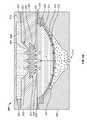
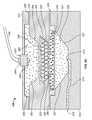
- FIG. 1Ais a half-section, exploded-view of a pump, according to one embodiment
- FIG. 1Bis a cross-sectional view of the assembled pump shown in FIG. 1A , according to one embodiment
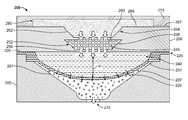
- FIG. 2Ais a cross-sectional view of a pump in a pre-activated configuration, according to one embodiment
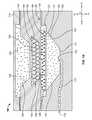
- FIG. 2Bis a cross-sectional view of a pump in an activated configuration, according to one embodiment
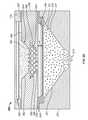
- FIG. 2Cis a cross-sectional view of a pump in a pre-activated configuration, according to one embodiment
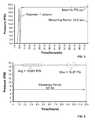
- FIG. 3is a chart showing measured pump output pressure versus time
- FIG. 4is a chart showing measured pump output pressure versus time
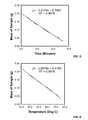
- FIG. 5is a chart showing sample mass versus time
- FIG. 6is a chart showing sample mass versus temperature
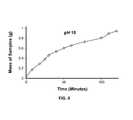
- FIG. 7is a chart showing sample mass versus time at pH 4.0
- FIG. 8is a chart showing sample mass versus time at pH 7.0.
- pumpsare described that are capable of controllably flowing a stored medium, e.g., a liquid, gel, or gas, from a retaining tub, bin, capsule, or other type of container upon application of an external stimulus to the pump.
- External stimulican include, without limitation, application of: heat or cold, magnetic fields, vibration, light energy, exposure to changes in pH or salinity, or other stimuli.
- such pumpscan be selectively activated without the need for an external power source such as a battery or electrical current from an outlet source.
- FIGS. 1A and 1Billustrate a pump 100 according to one embodiment.
- FIG. 1Ais a half-section, exploded-view of the pump 100 shown divided through the x-z plane.
- FIG. 1Billustrates the pump 100 in an operative, assembled configuration, according to one embodiment.
- like references in FIGS. 1A and 1Bindicate similar elements.
- the pump 100includes a lower pump body 105 .
- the lower pump body 105includes an inner wall 107 that defines a substantially conical-shaped cavity within the interior of the lower pump body 105 as shown.
- the lower pump body 105is composed of poly(methyl methacrylate) (PMMA), however, other suitable materials can be substituted according to preference.
- PMMApoly(methyl methacrylate)
- a disc-shaped floor 111abuts the inner wall 107 and defines a base of the substantially conical-shaped cavity.
- the floor 111includes an aperture 113 that defines one end of a hollow passage 115 ; the passage 115 is a conduit for transmitting a dispensable fluid 120 from the conical-shaped cavity to an exterior outlet port 116 .
- fluidsWhile reference is made to “fluid” in the description of this and other embodiments, it will be understood that fluids, gels, gasses, and other materials capable of being flowed are equally contemplated, even though they may be classified as other than fluids in the strictest scientific interpretations.
- the dispensable fluid 120can be any substance capable of being flowed from one location (e.g., the conical-shaped cavity) to another location (e.g., to the exterior outlet port 116 ), including, but not limited to fluids, gels, and gasses.
- the dispensable fluid 120can be a solution that includes one or more therapeutic dose(s) of: a pharmacological agent; an antibiotic; a solution containing one or more compounds for treating wounds, ailments, or other afflictions; a sealant; a solution for irrigating or flushing exudates or neurotic tissue, or other therapeutic solutions.
- the dispensable fluidcan be, e.g., a gel, including therapeutic gels; an oil; a hydrocarbon or a derivative thereof; a chemotherapeutic agent that includes a platelet-derived growth factor fluid to stimulate blood vessel formation and tissue cell growth; a saline solution; water; or other fluids, gels, or gasses.
- a gelincluding therapeutic gels; an oil; a hydrocarbon or a derivative thereof; a chemotherapeutic agent that includes a platelet-derived growth factor fluid to stimulate blood vessel formation and tissue cell growth; a saline solution; water; or other fluids, gels, or gasses.
- the surfaces of the conical-shaped cavitye.g., inner wall 107 , floor 111 , etc., can be coated with materials to prevent reaction of the dispensable fluid 120 with the lower pump body 105 material composition.
- the dispensable fluid 120can be a fluid for positioning or separation of internal tissues in an animal subject, such as a viscous polymer or polysaccharide solution.
- the dispensable fluid 120can be formulated to reduce the likelihood of pre- or post-surgical adhesions in reproductive system tissues, abdominal and bowel tissues, ophthalmic tissues, or skeletal joint and muscle tissues.
- the dispensable fluid 120can be a fluid formulated to reduce the likelihood of tendons binding to tendon sheathes, which can be found, for example, within the physiology of the human hand.
- the dispensable fluid 120can be a fluid formulated to position ophthalmic tissues and maintain those positions during tissue healing; one such fluid is described in U.S. Pat. No. 5,207,660, filed Apr. 26, 1991 to Harvey A. Lincoff, entitled “Method for Delivery of Compositions to Ocular Tissues,” which is incorporated by reference herein in its entirety for all purposes.
- the dispensable fluid 120can be a fluid formulated to coat tissue such as bladder tissue in an animal subject, to treat or reduce the likelihood of interstitial cystitis.
- tissuesuch as bladder tissue in an animal subject
- a plug, one-way valve, or other flow-restriction devicecan be used for preventing the dispensable fluid 120 from flowing out of the lower pump body 105 prior to activation of the pump, which is described in greater detail below.
- the aperture 113can lead to an exit port (e.g., the exit port 213 shown in FIG. 2 ) that allows the dispensable fluid 120 to exit the lower pump body 105 directly, e.g., through a vertical bore (not shown in FIG. 1A or 1 B).
- the lower pump body 105can be configured to include attachment mechanisms for receiving a tube or other or lumen-like structure capable of carrying the dispensable fluid 120 from the pump 100 .
- the vertical borecan include interior threads for receiving an end portion of a tube or other fluid-carrying structure having complimentary exterior threads; thus, the end portion of the tube can be screwed into the vertical bore to create a reversible union therebetween.
- the vertical borecan be configured as a plunger and configured to receive an extender tube.
- the extender tubecan carry the dispensable fluid 120 from the pump 100 to a chosen location.
- the extender tubecan include a distal tapered nozzle end portion configured to be inserted into tissue, a hydrocolloid dressing or wafer, an object intended to be lubricated by the dispensable fluid 120 , or a fluid port.
- the lower pump body 105includes bores 117 a , 117 b configured to receive a portion of a fastener that couples other parts of the pump together, as described in greater detail below (other bores may be included on the portion of the lower pump body 105 not illustrated in FIG. 1A or 1 B).
- exemplary fastenersinclude, but are not limited to: bolts, clamps, couplings, dowels, screws, such as machine screws, pop rivets, and other fasteners known in the art.
- the components of the pumpcan be assembled and secured into place using glues, cements, or other adhesives.
- the top of the inner wall 107i.e., the portion of the wall 107 where the circular diameter is greatest in the x-y plane is adjacent to a surrounding platform portion 109 that is configured to sealingly engage with a complimentary shoulder 127 of a flange member 125 (described in greater detail below).
- the sealing engagement between the platform portion 109 and the flange member 125caps the conical-shaped portion and can provide the capability for storing the dispensable fluid 120 within the lower pump body 105 .
- the pump 100further includes a flange member 125 .
- the flange member 125includes the aforementioned shoulder 127 , which generally protrudes downwardly (in the ⁇ z direction, as shown) from a top surface 126 to sealingly engage with the platform portion 109 of the lower pump body 105 .
- the flange member 125further includes apertures 129 a , 129 b configured and positioned so as to overlap with bores 117 a , 117 b of the lower pump body 105 when sealingly engaged thereto.
- the shoulder 127 of the flange member 125supports a disk-shaped, resiliently-flexible diaphragm 131 .
- the diaphragm 131is generally able to resiliently flex or stretch in +/ ⁇ z directions according to the frame of reference provided by FIGS. 1A and 1B .
- the diaphragm 131can expand, e.g., under applied force, into the conical-shaped cavity of the lower pump body 105 , thereby urging the dispensable fluid 120 into the aperture 113 of the hollow passage 115 .
- the diaphragm 131is a flexible elastomeric membrane composed of silicone rubber, although other suitable alternative materials can be substituted according to preference.
- suitable alternative membrane compositionsinclude, without limitation: silicone rubber polymer, latex rubber, fluoroelastomers such as VitonTM sold by DuPont Performance Elastomers LLC, perfluoroelastomers, PTFE, polyester, polyethylene, and polyurethane; other flexible membrane materials can be substituted according to preference or for a particular use.
- the thickness of the diaphragm 131can be chosen to provide a desired amount of elasticity, which, as explained in greater detail below, can influence the rate and amount of dispensable fluid 120 that is expelled from the pump 100 when the pump is activated.
- a diaphragm 131 having a higher degree of elasticitycan be expected to encroach further and faster into the conical-shaped cavity of the lower pump body 105 than a diaphragm 131 having a lesser degree of elasticity, assuming an equal amount of urging force in both cases.
- a polymer layer 140occupies a substantially disk-shaped void that is defined in part by the downward ( ⁇ z direction) protrusion of the shoulder 127 from the plane of the top surface 126 of the flange 125 .
- the empty volume of the substantially disk-shaped voidwhich can also define the volume of the polymer layer 140 if completely full, is defined in part by the height h of the inner shoulder rim 128 ; the height h (and thereby the amount of polymer 140 used in various embodiments) can be chosen according to preference and functional considerations as described herein.
- the polymer layer 140can include a polymer composition capable of absorbing fluid so as to increase the volume of the polymer layer 140 from a first volume to a second, larger volume.
- the polymercan be capable of absorbing fluid to increase the volume of the polymer layer 140 from a first volume to a second, larger volume, and subsequently releasing fluid to return to approximately the first volume.
- exemplary polymers for this purposeinclude, without limitation, the class of polymers generally known as superporous hydrogels (SPH's). SPH polymers or SPH polymer compositions can be applied as a paste, foam layer, or solid layer on the top surface of the diaphragm (e.g., the diaphragm surface proximal to the top surface 126 of the flange 125 ).
- a base hydrogel polymer capable of absorbing water or other solutionscan be synthesized by combining at least one ethylenically-unsaturated hydrophilic monomer, a multi-olefinic crosslinking agent and a strengthening agent, which can occupy the narrow spaces of the base polymer matrix.
- ethylenically-unsaturated hydrophillic monomers for this purposeinclude acrylamide (AM), sulfopropylacrylate (SPAK) and hydroxyl ethylmethacrylate (HEMA), although other ethylenically-unsaturated hydrophilic monomers can be substituted according to preference or for a particular use.
- methylene bisacrylamidecan be used as a multi-olefinic crosslinking agent, although other crosslinking agents can be used.
- the strengthenersare polysaccharides which can include polymers of alginic acid, chitosan, carboxymethylcellulose (and its derivatives), (meth)acrylate derivatives (e.g., methyl, ethyl, butyl), polyacetonitrile (PAN), and natural or synthetic rubber emulsions, although other strengtheners can be used.
- a superporous hydrogelhas an average pore size between about 100 ⁇ m and about 600 ⁇ m.
- the presence of large pores in the SPHcan contribute to rapid, large-volume absorption of fluids, which can be advantageous in the operational characteristics of some pump embodiments, e.g., rapid expulsion of the dispensable fluid 120 .
- SPH's and SPH compositionsare known to swell when exposed to certain fluids, in some cases increasing their volume by a factor of 50 to 200.
- Exemplary SPH's that can be used in embodiments described herein, including variations thereof,include the hydrogel compositions described in U.S. Pat. No. 6,271,278 to Kinam Park, filed May 13, 1997; U.S. Pat. No. 6,960,617 to Hossein Omidian et al., filed Apr. 22, 2003; and U.S. Pat. No. 7,988,992 also to Hossein Omidian et al., filed Jul. 6, 2007.
- U.S. Pat. Nos. 6,271,278, 6,960,617 and 7,988,992are incorporated by reference herein in their entirety for all purposes.
- Expancel beadscan be on the order of 5-10 ⁇ m in diameter at ambient temperature (e.g., room temperature).
- a polymer layer 140can be formed into a malleable paste by mixing Expancel microspheres with glycerin, and screen-printing the resulting paste on to the diaphragm layer.
- Glycerincan be a preferred mixing agent for supporting the SPH's due to its thermal conductivity characteristics and high boiling point, which can reduce the likelihood of evaporation of the paste.
- the pump 100further includes an upper pump body 150 .
- the upper pump body 150includes a lower basket 152 and an upper basket 154 , each having a truncated square pyramid shape, as shown, which are defined in part by lower basket interior wall 158 and lower basket floor 156 , and upper basket interior wall 162 and upper basket floor 160 , respectively. (The other walls defining the truncated square pyramid shape are not labeled in FIG. 1 for clarity.)
- the lower ( 156 ) and upper ( 160 ) floors of the lower ( 152 ) and upper ( 154 ) basketsare porous to allow an activation solution 166 to flow therethrough when the pump is activated, which is explained in greater detail below.
- a volume of activation solution 166occupies the void space defined by the upper basket 154
- a plug layer 145occupies the void space defined by the lower basket 152 .
- the plug layer 145can keep the activation solution 166 from flowing through the upper floor 160 until the pump is activated.
- the plug layer 145can be any material, or a plurality of materials, or a composition, including materials dispersed in suspension media such as gels and the like, that is (are) capable of contracting or expanding in size in response to an environmental stimulus.
- Examples of environmental stimulus for this and other embodimentsinclude, without limitation: changes in temperature, pH, pressure, e.g., atmospheric pressure, salinity, ionic strength, exposure to selected light frequencies, selected acoustic wave frequencies, magnetic fields, vibration, or other environmental factors.
- magnetic nanoparticlescan be incorporated into the plug layer 145 ; application of pulsed magnetic fields can cause rapid movement of the nanoparticles which can result in localized heating so as to increase the temperature of the plug layer 145 .
- the plug layer 145can prevent the solution 166 from entering the lower basket 152 by substantially plugging the pores of the upper basket floor 160 under a first environmental condition (such as a first temperature). Under a second environmental condition, (e.g., a second temperature), one or more constituents of the plug layer 145 , e.g., SPH's within the plug layer 145 , can contract to allow the solution 166 to drain from the upper basket 154 into the lower basket 152 .
- a first environmental conditionsuch as a first temperature
- a second environmental conditione.g., a second temperature
- the pump 100can be activated when an environmental stimulus causes the solution 166 to drain from the upper basket 154 , flow through the lower basket 152 , and contact the polymer layer 140 to cause expansion of the polymer layer 140 .
- expansion of the polymer layer 140 into the conical-shaped void in the lower pump body 105can cause the dispensable fluid 120 to be expelled from the pump 100 , e.g., through the hollow passage 115 .
- the activation solution 166can be chosen according to user preference or for a particular purpose; however, in a preferred embodiment, the activation solution 166 can be chosen to be maximally absorbed by the polymer layer 140 .
- the activation solution 166is an aqueous solution.
- Suitable aqueous solutionsinclude, but are not limited to: deionized water, saline solutions, e.g., 0.9% saline weight by volume, distilled water; or distilled water mixed with a chosen proportion of ethylene glycol.
- the activation solution 166is a solution composed of, or containing isopropyl alcohol or silicone oil.
- the activation solution 166can be chosen based on desired operational characteristics and other functional considerations of the pump 100 , as physical properties of the activation fluid can affect the operation of the pump 100 .
- the viscosity and density of the activation fluidcan affect pump activation response time and other variables, which can be advantageous when designing a pump for a particular purpose.
- the dispensing actione.g., the output flow rate of the pump can be controlled according to the rate at which the plug layer 145 contracts to allow the activation solution 166 to flow therethrough, the rate at which the polymer layer 140 absorbs the activation solution 166 , or a combination thereof; however, other factors may also be applicable.
- isopropyl alcoholwhen used as the activation solution, can be rapidly absorbed into a polymer layer 140 that includes a superporous hydrogel composite (SPHC).
- the SPHCcan include a filler agent that contains swellable particles that allow or enhance polymerization and crosslinking of the polymer simultaneously.
- Exemplary filler agentsinclude, but are not limited to: sodium carboxymethylcellulose (Ac-Di-Sol), cross-linked sodium starch glycolate (e.g., PrimojelTM provided by DFE Pharma) and cross-linked polyvinyl pyrrolidone (e.g., Polyvinylpolypyrrolidone (Crospovidone)).
- isopropyl alcoholas the activation solution 166 with a SPHC polymer layer 140 can lead to rapid dispensing of the fluid 120 (under 1 minute, in some embodiments).
- saline solutionsare absorbed more slowly in a SPHC polymer layer 140 , which can result in a relatively slower dispensing of the fluid 120 .
- tap waterobtained from a municipal supply from Eden Medical headquarters, Howard Lake, Minn., U.S.A. was found to cause the most rapid swelling of a SPHC polymer layer 140 , leading to the fasted dispensing rate of the fluid 120 and the highest pump output pressure (immediate, after activation, and sustained) of all aqueous solutions tested.
- the plug material 145can be chosen according to preference from materials known in the arts.
- the plug materialis an array of hydrogel beads in sufficient number, e.g., collective volume, to prevent the activation solution 166 from flowing through the upper basket floor 160 until the pump is purposefully activated, which is described in greater detail below.
- the pore size of the lower ( 156 ) and upper ( 160 ) floorscan be chosen in consideration of the average individual size of the hydrogel beads, so as to reduce the likelihood of the pores becoming plugged by the beads.
- the size of the hydrogel beadscan be selectively increased or decreased through the control of temperature or other environmental variables. For example, at least one type of thermoresponsive hydrogel bead decreases in size when heated.
- hydrogels, including hydrogel beadscan be used that undergo a change in size in response to one or more environmental stimuli.
- an environmental stimuluscan include causing the collection of hydrogel beads to vibrate with sufficient energy to cause localized frictional heating. This heating can cause the hydrogel bead plug layer to contract or swell in size, depending on the type of hydrogel bead used.
- environmental stimuluscan include exposing the plug layer to radiation, e.g., electromagnetic radiation.
- radiatione.g., electromagnetic radiation.
- light-sensitive hydrogel beadscan be caused to contract or swell in size upon exposure to certain wavelengths of light.
- the plug material 145can include such light-sensitive hydrogel beads, and the pump can be activated by exposing the beads to the proper wavelength of light.
- environmental stimuluscan be imparted to the plug layer via an input port disposed on the pump body where the plug layer is accessible by, e.g., catheter, syringe, or other device.
- a pumpcan be activated by introducing a solution having a certain pH that causes a plug layer 145 to swell or contract according to pH-sensitive hydrogel beads contained therein.
- thermoresponsive hydrogelis one composed of N-isopropylacrylamide (NIPAAm).
- NIPAAm hydrogel beadscan be synthesized with low or high initiator and accelerator concentration.
- One exemplary synthetic sequence for producing NIPAAm hydrogelsincludes combining 6 mL of N-isopropyl acrylamide (NIPAAm), 6 mL of acrylic acid, 6 mL of N—N′-methylene bisacrylamide (as the cross-linking agent) 1 mL of ammonium persulfate, and 100 ⁇ L of tetramethylenediamine.
- the swelling of NIPAAm hydrogel beadscan be relatively fast, compared to other hydrogel bead variants, where the kinetics of the swelling can be controlled in part by varying the density of the cross-linking agent in the material.
- a process for synthesizing thermosensitive poly(N-isopropylacrylamide) hydrogel beadscan be found in “Preparation of poly(N-isopropylacrylamide) hydrogel beads by circulation polymerization,” H. Tokuyama and N. Yazaki, Reactive and Functional Polymers,” 70(12), December 2010, pp 967-971.
- the pump 100further includes a gasket 167 which can be sealingly engaged to the upper pump body 150 , thereby forming a lid capable of retaining the activation solution 166 in the upper basket 154 together with the plug material 145 .
- the gasketincludes apertures 168 a , 168 b configured and positioned so as to overlap with bores 164 a , 164 b of the upper pump housing 150 when sealingly engaged thereto.
- the pump 100further includes a cover 175 .
- the cover 175can be configured to be positionable atop the gasket 167 to provide sealing engagement of the gasket 167 to the upper pump housing 150 through, e.g., applied pressure.
- the cover 175includes bores 177 a , 177 b configured and positioned so as to overlap with apertures 168 a , 168 b of the gasket 167 when sealingly engaged thereto.
- the bores and apertures of the various pump componentse.g., bores 117 a - b of the lower pump body 105 , apertures 129 a - b of the flange 125 , bores 164 a - b of the upper pump body 150 , apertures 168 a - b of the gasket 167 , and bores 177 a - b of the cover 175 are aligned so that a fastener 180 or fastening mechanism extending from the lower pump body 105 to the cover 175 can be received therethrough, to include the other aforementioned components.
- FIG. 1Aincludes a fastener 180 , in this example, a dowel, extending from the lower pump body 105 for illustrative purposes.
- a fastener 180in this example, a dowel, extending from the lower pump body 105 for illustrative purposes.
- Components of the pump 100can be fastened together using glues, cements, resins, or other compounds known in the art in lieu of, or in addition to the use of the aforementioned fastening mechanisms.
- Certain pump components that provide mechanical strength or support of the pump 100can be composed of bio-compatible polymers, metals, ceramics or other materials according to preference and the indented use of the pump 100 .
- a bio-compatible polymer that can be used in this and other embodimentsis sold under the MED610 brand, offered by Objet Inc., of Billerica, Mass., USA.
- considerationcan be given to the thermosensitive or pH-sensitive nature of hydrogel beads, if they are used as a plug material, and the choice of material for the aforementioned pump components can be selected so as to have a desired amount of thermal conductivity.
- the pump 200includes a lower pump body 205 having a conical-shaped cavity defined in part by inner wall 207 for holding a volume of dispensable liquid 220 .
- the liquidcan be forced out of the lower pump body 205 via an exit port 213 in a manner described in greater detail herein.
- the exit portcan be plugged with a suitable material, or, alternatively, the plug can include a one-way valve or suitable alternative device to prevent the dispensable liquid 220 from exiting the lower pump body 205 prior to activation of the pump 200 .
- the exit port 213can include one or more attachment mechanisms for securely receiving a lumen, tube, or other liquid 220 transporting material so that the dispensable liquid 220 can be delivered to a chosen location when the pump is activated.
- the exit port 213can be a threaded bore configured to receive a corresponding threaded lumen which can be reversibly attached for the purpose of transporting fluid 220 from the lower pump body 205 to a chosen location.
- the exit portcan be configured to interlock with a device, such as a medical device, which can be configured to receive the fluid 220 for a particular purpose.
- the fluidcan be an adhesive sealant compound
- the devicecan be a member of a continent ostomy wafer capable of sealing with, or reversibly sealing with a patient's skin.
- the pump 200includes a flange member 225 sealingly engaged with the lower pump body 205 and serves, in part, to retain the dispensable fluid 220 within the lower pump body 205 until the pump 200 is activated.
- the flange member 225includes a resiliently flexible diaphragm 231 that is capable of being flexed from a first conformation to a second conformation.
- the first conformationcan be the conformation shown in FIG. 2A , where the diaphragm is substantially flat, and not flexed in the +/ ⁇ z-direction, which can be a pre-pump activation configuration;
- the second conformationcan be the conformation of the diaphragm shown in FIG.
- the diaphragmis outwardly flexed from its circular midpoint from the first conformation and extends into the conical-shaped cavity of the lower pump body 205 (in the ⁇ z direction).
- the latter conformation, or any conformation where all or part of the diaphragm is stretched or displaced from its equilibrium position, e.g., the first conformation,can be the activated pump conformation.
- the diaphragm 231is recessed from the top wall 226 of the flange, thereby defining a disk-shaped cavity of height h for storing a layer of expandable material 240 as shown in the pre-pump activation conformation of FIG. 2A .
- the expandable material 240can expand, thereby urging all or part of the diaphragm 231 into the conical-shaped cavity of the lower pump body 205 ( FIG. 2B ).
- the expandable material layer 240can be a polymer capable of absorbing a fluid to increase its volume from a first volume to a second, larger volume.
- the polymercan be capable of absorbing fluid to increase the volume of the expandable material 240 from a first volume to a second, larger volume, and subsequently releasing fluid to return to approximately the first volume.
- exemplary polymers for this purposeinclude, without limitation, the class of polymers generally known as superporous hydrogels (SPH's) described above.
- an upper pump body 250is sealingly engaged with the flange member 225 as shown in FIGS. 2A and 2B .
- the upper pump body 250includes a lower reservoir 252 which, in this embodiment, has the general shape of an inverted truncated square pyramid as defined by an inner reservoir wall 252 .
- the lower reservoir 252includes a porous floor 256 capable of allowing passage of a volume of activation solution 266 therethrough when the pump is activated.
- the upper pump body 250also includes an upper reservoir 254 , also having a general shape of an inverted truncated square pyramid as defined by inner reservoir wall 262 , for storage of the solution 266 .
- the upper ( 254 ) and lower ( 252 ) reservoirsare divided by a porous floor 260 configured to allow fluid communication therebetween, as illustrated in FIGS. 2A and 2B .
- the lower reservoir 252contains a volume of hydrogel beads 245 .
- the hydrogel beads 245can be size-dependent according to factors (variables) of the surrounding environment, as previously described.
- the sizee.g., the mean diameter of the individual hydrogel beads can change according to surrounding temperature, the pH, or ionic strength of the activation solution 266 , or other factors.
- thermosensitive hydrogel beads 245are capable of shrinking or expanding in volume according to temperature. Suitable hydrogel beads 245 include those hydrogel beads described herein and equivalents known in the art.
- the individual size of the hydrogel beads 245can be chosen to maximize performance of the pump 200 (as described below) and also in consideration of the pore sizes of the porous floors 256 and 260 , so as not to plug the individual pores thereof.
- a pump cover 275sealingly engages a gasket 267 which serves, in part, to retain the activation solution 266 within the upper reservoir 254 and the void space defined in part by pump cover inner wall 295 .
- the dashed line 290 in FIG. 2Aserves to illustrate the base of the inverted truncated square pyramid shape of the upper reservoir 254 and is not a structural component of the pump 200 .
- the pump covercan include sealable ports for introducing (drawing out) activation solution 266 into (from) the upper reservoir 254 and the void space defined in part by pump cover inner wall 295 .
- Such structureprovides the capability to replenish the activation solution 266 if needed, such as after an activation of the pump 200 .
- pumps of the type described hereincan include access ports for delivering fluids, gasses, or other materials into the upper reservoir 254 for activating the pump, or replenishing the activation fluid 266 of the pump 200 .
- the pump 200 shown in FIG. 2Ccan contain the same structural elements as that described with respect to FIGS. 2A and 2B ; in addition, in this embodiment, the pump 200 includes a valve housing 297 configured to sealingly engage with the pump cover 275 .
- the valve housing 297houses a one-way valve within the housing (not shown in FIG. 2C for clarity) that allows fluids or gasses to flow into the upper reservoir 254 , but restricts flow in the opposite direction.
- the valve housing 297further includes a fitting 299 for coupling a terminal end of a lumen 296 to the housing 297 .
- Suitable couplingsinclude, but are not limited to: nipples, plugs, Luer connectors, and plungers.
- the fitting 299can allow a user to inject a solution into the upper reservoir 254 using, e.g., a syringe or similar device.
- the fitting 299can be a rubber seal or cap.
- an output port 298 of the valve housingallows liquids or gasses received via the lumen 296 to enter the upper reservoir 254 .
- FIG. 2Cis one of many examples that can allow a user to activate the pump 200 by administering a liquid or gas into the upper reservoir 254 .
- the injected liquid or gascan be one which causes the plug layer, in this case, the hydrogel beads 245 to contract in size, thereby allowing the activation liquid 266 to flow through the porous floors 256 , 260 , and reach the expandable material layer 240 .
- the pumpcan be activated without environmental stimulus by administering a liquid or gas into an empty upper reservoir 254 (e.g., absent hydrogel beads 245 ).
- the introduction of liquid or gascan directly contact the superporous polymer to immediately invoke expansion of the diaphragm 231 into the conical-shaped void and cause corresponding pump operation.
- the hydrogel beads 245can have a size dependence based on the pH of a surrounding liquid medium.
- the pH of the activation fluid 266can be changed to activate the pump.
- the hydrogel beads 245can retain a certain size that substantially precludes the activation fluid from flowing through the porous floors 256 , 260 ; however, at a second activation fluid 266 pH, the hydrogel beads 245 can contract in size, thereby allowing the activation fluid 266 to flow through the porous floors 256 , 260 and contact the expandable material layer 240 to activate the pump 200 .
- the rate that the activation fluid 266 is exposed to the expandable material layer 240can be controlled by regulating factors of the environment immediately surrounding the hydrogel beads 245 .
- the layer of hydrogel beads 245will contract to a minimum size when the pH of a fluid surrounding the individual beads is 4.0, and that the pump 200 is stored in a non-activated configuration wherein the activation fluid is an aqueous solution having a pH of 7.0.
- introducing a highly acidic solutioncan cause a rapid pH change in, and around the hydrogel beads 245 , causing a rapid contraction in size, and a rapid dumping of the activation fluid 266 onto the expandable material layer.
- the pump 200can be expected to rapidly expel the dispensable fluid 220 from the pump 200 .
- the rate of pH changecan be governed so that the contraction of the hydrogel beads 245 is gradual, instead of rapid, which can lead to a slower activation of the pump 200 and a slower expulsion of the dispensable fluid 220 .
- a less-acidic solutione.g., a solution of pH 5.0 can be introduced into the upper reservoir 254 to slow the activation of the pump.
- components of the pump embodiments described hereincan be fabricated from bio-compatible materials.
- the lower pump body 105 , upper pump body 150 , cover 175 , and any other componentcan be formed from a bio-compatible plastic so that the pump can be implanted into a human or animal subject.
- the pump 200can be formed from a bio-compatible plastic so as to be implantable as just described, wherein the valve housing 297 can be a portal that protrudes out of the skin or other tissue to allow administration of fluids or gasses into the upper reservoir 254 by a physician or other user.
- pumps of the types described hereincan be activated using various methods.
- the choice of method usedcan depend on material properties of the pump or pump components, in particular, the material properties of hydrogel beads, if incorporated, the intended use of the pump, and other considerations that will be apparent to those skilled in the relevant arts.
- activatingrefers to one or more steps that result in the dispensable liquid 220 stored in the lower pump body 205 being dispensed from the pump 200 via the exit port 213 (or, in the embodiment of FIGS. 1A and 1B , being dispensed through the aperture 113 of the floor 111 , and through the hollow passage 115 ).
- the disclosed pumpscan be activated without requiring an external power source, such as commercial, residential, or battery-supplied electricity.
- an external power sourcesuch as commercial, residential, or battery-supplied electricity.
- any of the disclosed embodimentscan be adapted to use electrical power if desired, in general, the environmental changes that can cause the plug layer or the hydrogel bead layer to contract to activate the pump can be engendered without an external power source.
- the operational characteristics of a pump of the type described hereincan be dependent on material factors of the pump constituents. Certain uses of a pump may call for rapid expulsion of the dispensable liquid 220 , while other uses may benefit from a slow, steady flow of the dispensable liquid 220 .
- the expulsion rate of the dispensable liquid 220can be dependent on, among other factors, the cross-sectional area the diaphragm, exit port outlet pressure (if regulated by a plug, valve, or other flow-restriction mechanism), and the cross-sectional area of the pump exit port.
- the maximum operating pressure of a pump of the type described hereincan be determined by the force per unit area across the pump diaphragm, which is largely dependent on the expansion rate and volume capacity of the polymer layer adjacent thereto.
- the amount of fluid absorbed by the polymercan be controlled by the valve action, e.g., the dynamics of the plug layer as it is exposed to environmental stimuli.
- the pump output flow rate of the dispensable fluidcan be affected by the flexibility and pliability of the diaphragm, and the material properties of the fluid, gas or gel, e.g., density, compressibility, volumetric flow rate, etc.
- the flexibility of the diaphragmcan generally be selected by considering the geometry of the diaphragm, e.g., its thickness, the mechanical properties of the diaphragm and the geometry of the fluid-retaining chamber.
- the elastic modulus and Poisson's ratioare mechanical diaphragm properties that can be considered when designing a pump of the type described herein for a particular use.
- a pump of the type described hereincan be thermally activated, e.g., activated by changing the temperature of the pump or one or more of its components.
- a pumpcan be activated by engendering a temperature change to the plug material, e.g., plug material 145 described with respect to FIGS. 1A and 1B , the collection of thermoresponsive hydrogel beads 245 described in FIGS. 2A and 2B , or variants and equivalents thereof.
- the pumpcan be activated by exposing the hydrogel beads to a solution having a pH that causes the size of the beads to shrink, e.g., by introducing the solution into the upper basket 254 of the upper pump housing 250 .
- the pump cover 175can include an input port capable of receiving fluids from a syringe, catheter tube, or other source.
- the solutioncan be introduced manually, or, in some embodiments, as part of a bio-feedback system that monitors an aspect of a patient's physiology and causes the solution to be injected into the pump when certain pre-established criteria are met.
- an aspect of a patient's physiologycan be a blood sugar concentration
- the solutioncan be insulin.
- the pump 200can include a plurality of substantially spherical, thermoresponsive hydrogel beads 245 which, at a first temperature, are of an average size to adequately prevent the activation solution 266 from flowing through the porous floor 260 of the upper reservoir 254 into the lower reservoir 252 .
- the hydrogel beads 245can have an average diameter that is at least twice the diameter of the pores of the porous floors 260 and 256 , assuming substantially equal pore size in both floors.
- thermoresponsive hydrogelsare capable of shrinking in average size when heated.
- activation of the pumpcan include engendering a temperature change to the collection of hydrogel beads 245 to cause them to shrink to a size that allows the activation solution 266 to flow from the upper reservoir 254 to the lower reservoir 252 , and through the floor ( 256 ) of the lower reservoir.
- FIG. 2Billustrates the pump 200 in an activated state, where a temperature change has caused the hydrogel beads 245 to shrink in size, which has caused the activation solution 266 to be released from the upper pump body 250 unto the expandable material 240 .
- the expandable material 240can be one which is capable of absorbing all or some of the activation solution 266 which can cause a substantially concurrent increase in volume, as previously described. Comparing the illustrated volume of the expandable material 240 in FIGS. 2A and 2B , it can be seen that the absorption of the solution 266 causes significant swelling of the expandable material 240 when the pump is activated.
- the swelling of the material 240creates outward expansion force in all directions; however, the upper pump body 250 can be composed of a rigid or semi-rigid material such as PMMA that resists the expansion force and urges the material and the diaphragm 231 into the conical-shaped cavity of the lower pump body 205 as illustrated in FIG. 2B .
- the expansion force of the expandable material 240urges the dispensable fluid 220 to the exit port 213 , where it can be channeled or flowed to a desired location as explained herein.
- a pump of the type described hereincan be activated in accordance with the above description by various methods.
- a pumpcan be activated through application of a heat source to the body of the pump.
- the solid components of a pumpe.g., the lower pump body 205 , upper pump body 250 , and pump cover 275 can be formed from a material having a desired amount of thermal conductivity.
- a pump of the type described hereincan be configured to protect the inner components and cavities (e.g., the conical-shaped cavity of the lower pump housing 205 , diaphragm 231 , lower ( 252 ) and upper ( 254 ) reservoirs, expandable material 240 , and hydrogel beads 245 ) from outside sources of moisture or other fluids.
- the pumpcan be substantially impervious to water and other fluids.
- the rate at which the dispensable fluid is dispensed from pumps of the type described hereincan be controlled according to one or more material considerations.
- the plug layer material ( 145 , FIGS. 1A and 1B ) or the hydrogel beads ( 245 , FIGS. 2A and 2B )can be chosen for their degree of thermoresponsiveness. Without wishing to be bound by theory, it is presumed that materials having a higher degree of thermoresponsiveness will generally respond more quickly to temperature changes of the ambient surroundings and vice-versa.
- the material and mechanical characteristics of the diaphragmcan affect the expansion rate of the expandable polymer layer (e.g., polymer layer 140 ).
- a thinner diaphragmcan be urged into the conical-shaped cavity of the lower pump body 105 by the expandable polymer (when activated) faster than a diaphragm having a relatively greater thickness.
- a diaphragm having a higher degree of elasticitycan provide the flexibility to exert higher output compression forces.
- the diaphragmcan be formulated from rubber or other compounds having a desired degree of elasticity for a particular purpose or application.
- any type of SPHcan be incorporated as, or in the plug layer 145 or the thermosensitive hydrogel beads 245 as described above with respect to FIGS. 1A-2B for actuating the pump.
- a SPH polymer with additional monomere.g., about 0.877% additional monomer can be used.
- a superporous hydrogel with an interpenetrating polymer networkcan be used, which incorporates a second polymer network inside of an SPH to strengthen the polymer structure.
- SPIH hydrogelscan have enhanced mechanical properties compared with SPHs, including higher compression strength and elasticity, making them a potential candidate for use as a pump actuator. The enhanced properties may be attributable to scaffold-like fiber network structures formed inside the cell walls of SPHs.
- the various components of a pump of the type described hereincan be composed of various materials known in the art, the choice of which may depend on one or more considerations, including: cost, including manufacturing and raw material cost, disposability of the pump, operability, ruggedness, resistance to degradation from heat, radiation, chemicals, or aesthetic value.
- a pump of the type described hereinis capable of producing a pulsed output, e.g., a controlled flow of the dispensable fluid for a certain period of time, followed by an “off” period, followed again by an “on” period of the controlled flow.
- Pulsed dispensable fluid outputcan be achieved, among other approaches, through application of periodic environmental stimulus to the plug layer, or by manually introducing pressure to one of the pump chambers, e.g., upper basket 154 or lower basket 152 using, e.g., a syringe to deliver gas or liquid as previously described.
- a pump of the type described hereincan contain an activation solution within a burstable pouch or similar type of container.
- the activation solutioncan be in fluid communication with the plug layer, e.g., plug layer 145 when the pouch is broken, and the pouch can be caused to burst by force or other methods when desired by the user.
- the pump 100can include a burstable pouch of activation solution 166 positioned in the upper basket 154 .
- the cover 175 and the gasket 167can be flexible, so that a user can push down on the top of the pump 100 to cause the burstable pouch to burst, thereby releasing the activation solution, which can cause the pump to activate and release the dispensable fluid 120 as previously described.
- Such an embodimentcan have particular advantages for remote use when access to environmental stimulus of the type described herein is unavailable, e.g., in military combat situations where soldiers may have limited resources.
- the use of lab-on-a-chip technologycan be incorporated into the pump design for sampling body fluids or other physiological measurements.
- the power source for the lab-on-a-chip assembly(not shown in FIGS. 1A-9 ) can be an air-bursting detonator.
- An air bursting detonatorcan supply energy by releasing stored gas when triggered by a short electrical pulse, as described, e.g., in “Disposable Smart Lab on a Chip for Point-of-Care Clinical Diagnostics,” C. H. Ahn et al., Proc. IEEE Vol. 92 (1), January 2004, 154; and U.S. Pat. No. 7,524,464 entitled “Smart disposable plastic lab-on-a-chip for point-of-care testing” to Ahn et al., which is incorporated herein in its entirety by reference for all purposes.
- surface energy gradient dispensing methodscan be used to improve flow properties of fluids. Such methods can be advantageous for reducing the energy required to transport fluids, enhance droplet formation, directing the movement of droplets, facilitate mixing of on-chip reagents or compositions, promoting sensory reactions, e.g., controlling the rate of diffusion in, e.g., glucose sensing, reducing variability in sampled fluid volumes and flows, etc.
- One exemplary surface energy gradient dispensing methodis described in U.S. Pat. No. 7,790,265 to Brian Babcok, entitled “Surface-energy gradient on a fluid-impervious surface and method of its creation using a mixed monolayer film,” which is incorporated in its entirety herein by reference for all purposes.
- a pump similar to that shown in FIGS. 1A and 1Bwas assembled and included: a lower pump body composed of PMMA, which included a conical-shaped chamber for storing a solution of a sealant fluid and an exit nozzle capable of discharging the sealant fluid when the pump was activated.
- a 100 kPa silicon pressure sensor(MPX 100, Motorola, Inc.) was used to measure pump exit pressure.
- a natural latex rubber diaphragmcomposed of a 270 ⁇ m thick elastic membrane sealed the sealant fluid within the conical-shaped chamber as previously described.
- a layer of NIPAAm expandable polymer having a weight of approximately 0.2 gramswas applied to the top side of the diaphragm.
- An upper pump bodywas sealingly engaged to the flange; the upper pump body stored an aqueous activation solution that was released to the NIPAAm layer when the one-way valve was opened.
- the pumpwas activated using a one-way valve (Model No. F-2804-403, Pneuaire, Inc.) that was mounted in an upper pump body to simulate activation by hydrogel beads ( 245 , FIGS. 2A-2B ).
- the upper pump bodywas sealingly engaged to the flange.
- the assembled pumpmeasured 16 mm ⁇ 16 mm ⁇ 14.8 mm, and had a fluid capacity of 3.0 mL.
- FIG. 3a graph showing measured pump pressure output vs. time is shown.
- the graphillustrates short-duration pump streaming characteristics, marked by a rapid pressure rise time of approximately one (1) second, and a holding pressure of approximately 18.776 psi for a period of at least 71 seconds.
- FIG. 4a graph showing measured pump pressure output vs. time is shown.
- the graphillustrates long-duration pump streaming characteristics, marked by a rapid pressure rise time of approximately one (1) second, and a holding pressure of approximately 18.867 psi for a period of greater than 60 hours.
- the chartsillustrate the time- and temperature-dependent swelling characteristics of the NIPAAm hydrogel which can be used as a pump activator (e.g., the plug layer 145 in FIGS. 1A-1B , or the hydrogel beads 245 in FIGS. 2A-2B ).
- the hydrogelwas a clear gel synthesized by combining 6 mL of N-isopropyl acrylamide (NIPAAm), 6 mL of acrylic acid, 6 mL of N—N′-methylene bisacrylamide (a cross-linking agent), 1 mL of ammonium persulfate, and 100 ⁇ L of tetramethylenediamine.
- the kinetics of swelling (i.e. de-swelling for pump operation) of these hydrogelsare relatively fast, capable of losing approximately 85% of water mass over a period of about 13 minutes and a concurrent temperature increase of approximately 21° C.
- the kinetics of the swelling or de-swellingcan be controlled in part by varying the cross-linker density of the NIPAAm hydrogel.
- a pump of the type described hereincan be activated by a variety of environmental stimuli to the plug layer (e.g., plug layer 140 or the hydrogel beads 240 described above).
- the pumpcan be activated by exposing the hydrogel beads to a solution having a pH that causes the beads to contract; the pump can be activated in a similar manner to those described above that are activated by thermo-sensitive hydrogel beads.
- FIGS. 7 , 8 and 9swelling data for NIPAA copolymer hydrogels are shown.
- the extent and kinetics of NIPAA swellingappear to be pH-dependent, where, without wishing to be bound by theory, the characteristics can be attributed to the presence of acrylic acid component in the hydrogel chain.
- the extent of swelling and the kinetics of swellingincreases with pH over comparable period of time.
- the extent of volume swelling at pH 4, pH 7 and pH 10 after 100 minutes of equilibration of the dried copolymeric NIPAA hydrogels in aqueous solutionare 27%, 565% and 2407% respectively.
- Additional activation solutioncan be re-loaded, in some embodiments, to the upper basket, e.g., the upper basket 154 in FIG. 1A , so that the pump can be activated again, or a plurality of times.
- Mechanical valvescan be used to drive activation fluid to the polymer layer as an alternative to the hydrogel valves described herein; thus, pumps according to such an embodiment can be activated manually or by controlling the mechanical valves to activate the pump.
- the dispensable fluide.g., dispensable fluid 120 in FIG. 1A is a liquid sealant that can be used to seal a negative wound pressure therapy wound dressing or ostomy wafer.
- a pump of the type described hereincan be assembled into an operative configuration using ultrasonic welding techniques known in the art.
- Miniature pumpssuch as those described herein can have additional uses beyond what has been described herein. It will be understood that the functionality of the disclosed pumps can be accomplished using the disclosed components; however, those components can be scaled, modified, or adapted to fit other uses.
- a miniature pumpcan be used in the practice of balloon angioplasty.
- a pump having features similar to those described hereincan be routed through a catheter to a treatment site, e.g., an arterial or venous blockage or damage site.
- the pumpcan be configured to pump air or another gas to an angioplasty balloon, which may be connected directly to an exit port of the pump or remotely positioned on a guide catheter or other instrument.
- the pumpcan be triggered by an environmental stimulus, such as a magnetic field, electrical current, or other stimulus, to cause the pump to activate and thereby inflate the balloon so that a medical procedure such as arterial repair can be performed.
- an environmental stimulussuch as a magnetic field, electrical current, or other stimulus
- Micromachining techniquescan be used in this and other embodiments to manufacture pump components on a scale suitable for angioplasty or other medical procedures, or according to a particular intended use.
- the upper pump body 150includes upper basket 154 and lower basket 158 ; the upper basket 158 includes an activation solution 166 which can be released upon the expandable polymer layer 140 when the plug layer 145 responds to an environmental stimuli.
- the plug layer 145can shrink in size in response to externally-applied heat.
- the expandable polymer layer 140can expand in size when it is exposed to the activation solution 166 .
- the expansion of the polymer layer 140can urge the diaphragm 131 into the confines of the lower pump body chamber 107 and thereby force the dispensable fluid 120 out of the pump 100 via the hollow passage 115 and outlet port 116 .
- Other structures or compositions, or combinations thereofare described herein and will be apparent to those skilled in the art.
Landscapes
- Engineering & Computer Science (AREA)
- Mechanical Engineering (AREA)
- General Engineering & Computer Science (AREA)
- Materials For Medical Uses (AREA)
- Reciprocating Pumps (AREA)
Abstract
Description
This application claims priority to and the benefit of U.S. Provisional Patent Application No. 61/610,933, filed on Mar. 14, 2012, the entirety of which is incorporated herein by reference for all purposes.
Research and development of the concepts disclosed herein were funded in part by grants from the National Institutes of Health, Grant No. 1R43RR025266-01A2. The United States Government may have certain rights in the claimed invention.
This disclosure relates to miniature pumps. In particular, this disclosure relates to miniature pumps capable of dispensing all or part of a stored liquid, gel, gas, or other medium from a retaining vessel, where the pumping mechanism is driven in part by a swelling action of one or more polymers, in particular, hydrogel polymers.
Pumps generally describe devices capable of flowing a liquid, gel, gas, or other flowable medium from one location to another. Pumps generally work by displacing a volume by mechanical action and are available in a variety of configurations for various purposes. For example, some large-scale industrial pumps are able to move large volumes of relatively viscous materials; other types of pumps are capable of transporting minute quantities of liquids with a high degree of accuracy and reliability.
Pumps can be driven by a variety of power sources, including alternating electrical current, engines, or batteries for portable applications. Other pumps, such as sump or well pumps can be driven manually, as known in the arts.
In one exemplary aspect, a pump is described. The pump includes a first pump body having a chamber for storing a flowable substance and one or more exit ports in fluid communication with the chamber, through which the flowable substance can be dispensed when the pump is activated. The pump further includes a flexible diaphragm sealingly engaged to the first pump body and positioned to retain the flowable substance within the chamber when the pump is in a pre-activation configuration. The pump further includes a layer of absorbent material disposed upon a surface of the diaphragm opposite the chamber. The pump further includes a second pump body sealingly engaged to the first pump body having first and second chambers connected by a porous wall that, when the pump is activated, allows a stored activation fluid to flow from the first chamber through the second chamber, and onto the layer of absorbent material to cause the layer of absorbent material to swell in size. The swelling of the absorbent material can cause the diaphragm to flex into the first pump body chamber and thereby urge the flowable substance toward the one or more exit ports.
In one embodiment, the flowable substance is a liquid, gel, or gas.
In one embodiment, the pump further includes a plug layer disposed within the second chamber of the second pump body, retained therein in part by a porous chamber floor. The plug layer can be configured to substantially prevent the activation fluid from flowing from the first chamber through the second chamber until the pump is activated. In one embodiment, the plug layer includes an environmentally-responsive polymer capable of changing from a first size to a second size in response to one or more environmental stimuli. In one embodiment, the environmental stimulus is one or more of a change in: temperature, pH, pressure, salinity, or ionic strength of the environment within the second chamber, or exposure to radiation. In one embodiment, a change in the temperature can be caused by vibration-induced friction between components of the environmentally-responsive polymer.
In one embodiment, the plug layer includes a hydrogel. In one embodiment, the hydrogel is a plurality of hydrogel beads. In one embodiment, the hydrogel beads are composed of N-isopropylacrylamide.
In one embodiment, the layer of absorbent material includes a superporous hydrogel or superporous hydrogel beads.
In one embodiment, a dispensing rate of the dispensable fluid or gel can be selectably controlled by one or more of: the thickness and material composition of the diaphragm; the reaction rate of the plug layer to the environmental stimuli; or the absorption rate of the activation fluid into the absorbent material.
In one exemplary aspect, a pump for dispensing a stored fluid, gas or gel is described. The pump includes a pump body having a first fluid-retaining chamber for retaining the stored fluid, gas or gel, which is defined by one or more inner walls, a floor adjacent to said one or more inner walls, and a flexible diaphragm. The flexible diaphragm is capable of extending into the fluid retaining chamber under an urging force provided by expansion of an absorbent material layer disposed on a surface of the diaphragm opposite the fluid-retaining chamber. Expansion of the absorbent material layer can cause the fluid, gas or gel to be dispensed from the pump body through one or more exit channels that extend from the chamber to an exterior portion of the pump body. The pump further includes a pump activator. The pump activator includes an activation solution contained in a storage chamber that is capable of causing the absorbent material layer to expand in volume when received and absorbed by the absorbent material layer, and a plug layer interposed between the storage chamber and said absorbent material layer capable of substantially preventing the activation solution from contacting the absorbent material layer under a first environmental condition, and allowing the activation solution to flow to the absorbent material layer under a second, different environmental condition.
In one embodiment, the environmental condition is one or more of temperature, pH, pressure, ionic strength, salinity, or exposure to electromagnetic radiation.
In one embodiment, the plug layer includes a plurality of hydrogel beads. In one embodiment, the storage chamber and the absorbent material layer are interposed by a porous wall having pores that are smaller in diameter than the mean diameter of the hydrogel beads.
In one embodiment, the hydrogel beads are composed of N-isopropylacrylamide.
In one embodiment, the absorbent material layer is composed of a superporous hydrogel or includes superporous hydrogel beads.
In one embodiment, the fluid, gas or gel includes an effective dose of a therapeutic agent for treating an illness or disease, or cleansing a wound or surgical site.
In one embodiment, the fluid, gas or gel includes or one or more polymeric solutions for the positioning or separation of animal tissue.
In one exemplary aspect, a method for dispensing a fluid, gas or gel from a pump is described. The method includes providing a pump, wherein the pump includes a first pump body having a chamber for storing a flowable substance and one or more exit ports in fluid communication with the chamber, through which the flowable substance can be dispensed when the pump is activated. The pump further includes a flexible diaphragm sealingly engaged to the first pump body and positioned to retain the flowable substance within the chamber when the pump is in a pre-activation configuration. The pump further includes a layer of absorbent material disposed upon a surface of the diaphragm opposite the chamber. The pump further includes a second pump body sealingly engaged to the first pump body having first and second chambers connected by a porous wall that, when the pump is activated, allows a stored activation fluid to flow from the first chamber through the second chamber, and onto the layer of absorbent material to cause the layer of absorbent material to swell in size. The swelling of the absorbent material causes the diaphragm to flex into the first pump body chamber and thereby urge the flowable substance toward the one or more exit ports. The method further includes exposing the plug layer to an environmental condition sufficient to cause the plug layer to shift from a first fluid-blocking configuration to a second fluid-flowing configuration that allows the activation fluid to flow from the storage chamber to the absorbent material layer, to cause the absorbent layer to swell and thereby urge the fluid, gas or gel out of said first fluid-retaining chamber.
Certain advantages of the systems and methods described herein include, in one or more pump embodiments, the ability to dispense fluids, gasses, or gels from a storage container to a chosen location absent of a “traditional” external power source such as a battery or alternating current. Another advantage includes, in a pump embodiment, the ability to selectively expel or dispense a liquid or gel from a retaining vessel to a chosen location through the application of heat to the general surroundings of the pump. Another advantage includes, in a pump embodiment, an inexpensive, disposable pump having no moving mechanical parts, e.g., gears, or pistons, required to transport a retained volume of fluid from a storage vessel to a chosen location. Another advantage includes the capability of wearing a lightweight, small, portable pump on a human or animal body, or implanted in a human or animal body for various applications, including the treatment of disease or ailment, among others.
Unless otherwise defined, all technical and scientific terms used herein have the same meaning as commonly understood by one of ordinary skill in the art. Although methods and materials similar or equivalent to those described herein can be used in the practice or testing of any described embodiment, suitable methods and materials are described below. In addition, the materials, methods, and examples are illustrative only and not intended to be limiting. In case of conflict with terms used in the art, the present specification, including definitions, will control.
The foregoing summary is illustrative only and is not intended to be in any way limiting. In addition to the illustrative aspects, embodiments, and features described above, further aspects, embodiments, and features will become apparent by reference to the drawings and the following detailed description and claims.
The present embodiments are illustrated by way of the figures of the accompanying drawings in which like references indicate similar elements, and in which:
In one exemplary aspect, pumps are described that are capable of controllably flowing a stored medium, e.g., a liquid, gel, or gas, from a retaining tub, bin, capsule, or other type of container upon application of an external stimulus to the pump. External stimuli can include, without limitation, application of: heat or cold, magnetic fields, vibration, light energy, exposure to changes in pH or salinity, or other stimuli. Thus, in the description that follows, such pumps can be selectively activated without the need for an external power source such as a battery or electrical current from an outlet source.
In this embodiment, thepump 100 includes alower pump body 105. Thelower pump body 105 includes aninner wall 107 that defines a substantially conical-shaped cavity within the interior of thelower pump body 105 as shown. In this embodiment, thelower pump body 105 is composed of poly(methyl methacrylate) (PMMA), however, other suitable materials can be substituted according to preference. In this embodiment, a disc-shapedfloor 111 abuts theinner wall 107 and defines a base of the substantially conical-shaped cavity. Thefloor 111 includes anaperture 113 that defines one end of ahollow passage 115; thepassage 115 is a conduit for transmitting adispensable fluid 120 from the conical-shaped cavity to anexterior outlet port 116. While reference is made to “fluid” in the description of this and other embodiments, it will be understood that fluids, gels, gasses, and other materials capable of being flowed are equally contemplated, even though they may be classified as other than fluids in the strictest scientific interpretations.
In this and other embodiments, thedispensable fluid 120 can be any substance capable of being flowed from one location (e.g., the conical-shaped cavity) to another location (e.g., to the exterior outlet port116), including, but not limited to fluids, gels, and gasses. For instance, thedispensable fluid 120 can be a solution that includes one or more therapeutic dose(s) of: a pharmacological agent; an antibiotic; a solution containing one or more compounds for treating wounds, ailments, or other afflictions; a sealant; a solution for irrigating or flushing exudates or neurotic tissue, or other therapeutic solutions. The dispensable fluid can be, e.g., a gel, including therapeutic gels; an oil; a hydrocarbon or a derivative thereof; a chemotherapeutic agent that includes a platelet-derived growth factor fluid to stimulate blood vessel formation and tissue cell growth; a saline solution; water; or other fluids, gels, or gasses. In some cases, the surfaces of the conical-shaped cavity, e.g.,inner wall 107,floor 111, etc., can be coated with materials to prevent reaction of thedispensable fluid 120 with thelower pump body 105 material composition.
In this and other embodiments, thedispensable fluid 120 can be a fluid for positioning or separation of internal tissues in an animal subject, such as a viscous polymer or polysaccharide solution. In one example of such an embodiment, thedispensable fluid 120 can be formulated to reduce the likelihood of pre- or post-surgical adhesions in reproductive system tissues, abdominal and bowel tissues, ophthalmic tissues, or skeletal joint and muscle tissues. In another example, thedispensable fluid 120 can be a fluid formulated to reduce the likelihood of tendons binding to tendon sheathes, which can be found, for example, within the physiology of the human hand. In another example, thedispensable fluid 120 can be a fluid formulated to position ophthalmic tissues and maintain those positions during tissue healing; one such fluid is described in U.S. Pat. No. 5,207,660, filed Apr. 26, 1991 to Harvey A. Lincoff, entitled “Method for Delivery of Compositions to Ocular Tissues,” which is incorporated by reference herein in its entirety for all purposes. In yet another example, thedispensable fluid 120 can be a fluid formulated to coat tissue such as bladder tissue in an animal subject, to treat or reduce the likelihood of interstitial cystitis. Those skilled in the art will appreciate that otherdispensable fluids 120 can be used according to an intended application of thepump 100.
In this and other embodiments, a plug, one-way valve, or other flow-restriction device (not shown inFIG. 1A or1B) can be used for preventing thedispensable fluid 120 from flowing out of thelower pump body 105 prior to activation of the pump, which is described in greater detail below. In some embodiments, theaperture 113 can lead to an exit port (e.g., theexit port 213 shown inFIG. 2 ) that allows thedispensable fluid 120 to exit thelower pump body 105 directly, e.g., through a vertical bore (not shown inFIG. 1A or1B). In such cases thelower pump body 105 can be configured to include attachment mechanisms for receiving a tube or other or lumen-like structure capable of carrying thedispensable fluid 120 from thepump 100. In other such cases, the vertical bore can include interior threads for receiving an end portion of a tube or other fluid-carrying structure having complimentary exterior threads; thus, the end portion of the tube can be screwed into the vertical bore to create a reversible union therebetween. In one embodiment, the vertical bore can be configured as a plunger and configured to receive an extender tube. The extender tube can carry thedispensable fluid 120 from thepump 100 to a chosen location. For example, the extender tube can include a distal tapered nozzle end portion configured to be inserted into tissue, a hydrocolloid dressing or wafer, an object intended to be lubricated by thedispensable fluid 120, or a fluid port.
In this embodiment, thelower pump body 105 includesbores lower pump body 105 not illustrated inFIG. 1A or1B). Exemplary fasteners include, but are not limited to: bolts, clamps, couplings, dowels, screws, such as machine screws, pop rivets, and other fasteners known in the art. In other embodiments, the components of the pump can be assembled and secured into place using glues, cements, or other adhesives.
In this embodiment, the top of theinner wall 107, i.e., the portion of thewall 107 where the circular diameter is greatest in the x-y plane is adjacent to a surroundingplatform portion 109 that is configured to sealingly engage with acomplimentary shoulder 127 of a flange member125 (described in greater detail below). The sealing engagement between theplatform portion 109 and theflange member 125 caps the conical-shaped portion and can provide the capability for storing thedispensable fluid 120 within thelower pump body 105.
In this embodiment, thepump 100 further includes aflange member 125. Theflange member 125 includes theaforementioned shoulder 127, which generally protrudes downwardly (in the −z direction, as shown) from atop surface 126 to sealingly engage with theplatform portion 109 of thelower pump body 105. Theflange member 125 further includesapertures bores lower pump body 105 when sealingly engaged thereto.
In this embodiment, theshoulder 127 of theflange member 125 supports a disk-shaped, resiliently-flexible diaphragm 131. Thediaphragm 131 is generally able to resiliently flex or stretch in +/− z directions according to the frame of reference provided byFIGS. 1A and 1B . During operation of the pump, which is described in greater detail below, thediaphragm 131 can expand, e.g., under applied force, into the conical-shaped cavity of thelower pump body 105, thereby urging thedispensable fluid 120 into theaperture 113 of thehollow passage 115.
In this embodiment, thediaphragm 131 is a flexible elastomeric membrane composed of silicone rubber, although other suitable alternative materials can be substituted according to preference. Suitable alternative membrane compositions include, without limitation: silicone rubber polymer, latex rubber, fluoroelastomers such as Viton™ sold by DuPont Performance Elastomers LLC, perfluoroelastomers, PTFE, polyester, polyethylene, and polyurethane; other flexible membrane materials can be substituted according to preference or for a particular use. The thickness of thediaphragm 131 can be chosen to provide a desired amount of elasticity, which, as explained in greater detail below, can influence the rate and amount ofdispensable fluid 120 that is expelled from thepump 100 when the pump is activated. Without wishing to be bound by theory, when thepump 100 is activated, adiaphragm 131 having a higher degree of elasticity can be expected to encroach further and faster into the conical-shaped cavity of thelower pump body 105 than adiaphragm 131 having a lesser degree of elasticity, assuming an equal amount of urging force in both cases.
In this embodiment, apolymer layer 140 occupies a substantially disk-shaped void that is defined in part by the downward (−z direction) protrusion of theshoulder 127 from the plane of thetop surface 126 of theflange 125. The empty volume of the substantially disk-shaped void, which can also define the volume of thepolymer layer 140 if completely full, is defined in part by the height h of theinner shoulder rim 128; the height h (and thereby the amount ofpolymer 140 used in various embodiments) can be chosen according to preference and functional considerations as described herein. In general, thepolymer layer 140 can include a polymer composition capable of absorbing fluid so as to increase the volume of thepolymer layer 140 from a first volume to a second, larger volume. In some embodiments, the polymer can be capable of absorbing fluid to increase the volume of thepolymer layer 140 from a first volume to a second, larger volume, and subsequently releasing fluid to return to approximately the first volume. Exemplary polymers for this purpose include, without limitation, the class of polymers generally known as superporous hydrogels (SPH's). SPH polymers or SPH polymer compositions can be applied as a paste, foam layer, or solid layer on the top surface of the diaphragm (e.g., the diaphragm surface proximal to thetop surface 126 of the flange125).
In this and other embodiments, a base hydrogel polymer capable of absorbing water or other solutions (includingsolution 166 described below) can be synthesized by combining at least one ethylenically-unsaturated hydrophilic monomer, a multi-olefinic crosslinking agent and a strengthening agent, which can occupy the narrow spaces of the base polymer matrix. Exemplary ethylenically-unsaturated hydrophillic monomers for this purpose include acrylamide (AM), sulfopropylacrylate (SPAK) and hydroxyl ethylmethacrylate (HEMA), although other ethylenically-unsaturated hydrophilic monomers can be substituted according to preference or for a particular use. In one example, methylene bisacrylamide (BIS) can be used as a multi-olefinic crosslinking agent, although other crosslinking agents can be used. In a preferred embodiment, the strengtheners are polysaccharides which can include polymers of alginic acid, chitosan, carboxymethylcellulose (and its derivatives), (meth)acrylate derivatives (e.g., methyl, ethyl, butyl), polyacetonitrile (PAN), and natural or synthetic rubber emulsions, although other strengtheners can be used. In one embodiment, a superporous hydrogel has an average pore size between about 100 μm and about 600 μm. In general, and without wishing to be bound by theory, it is believed that the presence of large pores in the SPH can contribute to rapid, large-volume absorption of fluids, which can be advantageous in the operational characteristics of some pump embodiments, e.g., rapid expulsion of thedispensable fluid 120.
Some SPH's and SPH compositions are known to swell when exposed to certain fluids, in some cases increasing their volume by a factor of 50 to 200. Exemplary SPH's that can be used in embodiments described herein, including variations thereof, include the hydrogel compositions described in U.S. Pat. No. 6,271,278 to Kinam Park, filed May 13, 1997; U.S. Pat. No. 6,960,617 to Hossein Omidian et al., filed Apr. 22, 2003; and U.S. Pat. No. 7,988,992 also to Hossein Omidian et al., filed Jul. 6, 2007. U.S. Pat. Nos. 6,271,278, 6,960,617 and 7,988,992 are incorporated by reference herein in their entirety for all purposes.
One exemplary, commercially-available microsphere SPH that can be used in thepolymer layer 140 is sold under the Expancel brand (Akzo Nobel, Sundsvall, Sweden). Expancel beads can be on the order of 5-10 μm in diameter at ambient temperature (e.g., room temperature). In one embodiment, apolymer layer 140 can be formed into a malleable paste by mixing Expancel microspheres with glycerin, and screen-printing the resulting paste on to the diaphragm layer. Glycerin can be a preferred mixing agent for supporting the SPH's due to its thermal conductivity characteristics and high boiling point, which can reduce the likelihood of evaporation of the paste.
In this embodiment, thepump 100 further includes anupper pump body 150. Theupper pump body 150 includes alower basket 152 and anupper basket 154, each having a truncated square pyramid shape, as shown, which are defined in part by lower basketinterior wall 158 andlower basket floor 156, and upper basketinterior wall 162 andupper basket floor 160, respectively. (The other walls defining the truncated square pyramid shape are not labeled inFIG. 1 for clarity.) In this embodiment, the lower (156) and upper (160) floors of the lower (152) and upper (154) baskets are porous to allow anactivation solution 166 to flow therethrough when the pump is activated, which is explained in greater detail below.
In this embodiment, a volume ofactivation solution 166 occupies the void space defined by theupper basket 154, and aplug layer 145 occupies the void space defined by thelower basket 152. Theplug layer 145 can keep theactivation solution 166 from flowing through theupper floor 160 until the pump is activated. Theplug layer 145 can be any material, or a plurality of materials, or a composition, including materials dispersed in suspension media such as gels and the like, that is (are) capable of contracting or expanding in size in response to an environmental stimulus. Examples of environmental stimulus for this and other embodiments include, without limitation: changes in temperature, pH, pressure, e.g., atmospheric pressure, salinity, ionic strength, exposure to selected light frequencies, selected acoustic wave frequencies, magnetic fields, vibration, or other environmental factors. In one embodiment, magnetic nanoparticles can be incorporated into theplug layer 145; application of pulsed magnetic fields can cause rapid movement of the nanoparticles which can result in localized heating so as to increase the temperature of theplug layer 145.
In one example, theplug layer 145 can prevent thesolution 166 from entering thelower basket 152 by substantially plugging the pores of theupper basket floor 160 under a first environmental condition (such as a first temperature). Under a second environmental condition, (e.g., a second temperature), one or more constituents of theplug layer 145, e.g., SPH's within theplug layer 145, can contract to allow thesolution 166 to drain from theupper basket 154 into thelower basket 152.
In one embodiment, thepump 100 can be activated when an environmental stimulus causes thesolution 166 to drain from theupper basket 154, flow through thelower basket 152, and contact thepolymer layer 140 to cause expansion of thepolymer layer 140. As described herein, expansion of thepolymer layer 140 into the conical-shaped void in thelower pump body 105 can cause thedispensable fluid 120 to be expelled from thepump 100, e.g., through thehollow passage 115. In general, theactivation solution 166 can be chosen according to user preference or for a particular purpose; however, in a preferred embodiment, theactivation solution 166 can be chosen to be maximally absorbed by thepolymer layer 140. In one non-limiting example, theactivation solution 166 is an aqueous solution. Suitable aqueous solutions include, but are not limited to: deionized water, saline solutions, e.g., 0.9% saline weight by volume, distilled water; or distilled water mixed with a chosen proportion of ethylene glycol. In another non-limiting example, theactivation solution 166 is a solution composed of, or containing isopropyl alcohol or silicone oil.
In general, theactivation solution 166 can be chosen based on desired operational characteristics and other functional considerations of thepump 100, as physical properties of the activation fluid can affect the operation of thepump 100. For example, the viscosity and density of the activation fluid can affect pump activation response time and other variables, which can be advantageous when designing a pump for a particular purpose. Generally, the dispensing action, e.g., the output flow rate of the pump can be controlled according to the rate at which theplug layer 145 contracts to allow theactivation solution 166 to flow therethrough, the rate at which thepolymer layer 140 absorbs theactivation solution 166, or a combination thereof; however, other factors may also be applicable.
For example, isopropyl alcohol, when used as the activation solution, can be rapidly absorbed into apolymer layer 140 that includes a superporous hydrogel composite (SPHC). In such an example, the SPHC can include a filler agent that contains swellable particles that allow or enhance polymerization and crosslinking of the polymer simultaneously. Exemplary filler agents include, but are not limited to: sodium carboxymethylcellulose (Ac-Di-Sol), cross-linked sodium starch glycolate (e.g., Primojel™ provided by DFE Pharma) and cross-linked polyvinyl pyrrolidone (e.g., Polyvinylpolypyrrolidone (Crospovidone)). The use of isopropyl alcohol as theactivation solution 166 with aSPHC polymer layer 140 can lead to rapid dispensing of the fluid120 (under 1 minute, in some embodiments). In a contrasting example, saline solutions are absorbed more slowly in aSPHC polymer layer 140, which can result in a relatively slower dispensing of thefluid 120. In yet another example, tap water (obtained from a municipal supply from Eden Medical headquarters, Howard Lake, Minn., U.S.A.) was found to cause the most rapid swelling of aSPHC polymer layer 140, leading to the fasted dispensing rate of the fluid120 and the highest pump output pressure (immediate, after activation, and sustained) of all aqueous solutions tested.
In general, theplug material 145 can be chosen according to preference from materials known in the arts. In one non-limiting example, the plug material is an array of hydrogel beads in sufficient number, e.g., collective volume, to prevent theactivation solution 166 from flowing through theupper basket floor 160 until the pump is purposefully activated, which is described in greater detail below. The pore size of the lower (156) and upper (160) floors can be chosen in consideration of the average individual size of the hydrogel beads, so as to reduce the likelihood of the pores becoming plugged by the beads. In a preferred embodiment, the size of the hydrogel beads can be selectively increased or decreased through the control of temperature or other environmental variables. For example, at least one type of thermoresponsive hydrogel bead decreases in size when heated. In other embodiments, hydrogels, including hydrogel beads can be used that undergo a change in size in response to one or more environmental stimuli.
In one embodiment, an environmental stimulus can include causing the collection of hydrogel beads to vibrate with sufficient energy to cause localized frictional heating. This heating can cause the hydrogel bead plug layer to contract or swell in size, depending on the type of hydrogel bead used.
In yet another embodiment, environmental stimulus can include exposing the plug layer to radiation, e.g., electromagnetic radiation. For example, light-sensitive hydrogel beads can be caused to contract or swell in size upon exposure to certain wavelengths of light. Thus, in one pump embodiment, theplug material 145 can include such light-sensitive hydrogel beads, and the pump can be activated by exposing the beads to the proper wavelength of light.
In some pump embodiments, environmental stimulus can be imparted to the plug layer via an input port disposed on the pump body where the plug layer is accessible by, e.g., catheter, syringe, or other device. For example, a pump can be activated by introducing a solution having a certain pH that causes aplug layer 145 to swell or contract according to pH-sensitive hydrogel beads contained therein.
One non-limiting example of a thermoresponsive hydrogel is one composed of N-isopropylacrylamide (NIPAAm). NIPAAm hydrogel beads can be synthesized with low or high initiator and accelerator concentration. One exemplary synthetic sequence for producing NIPAAm hydrogels includes combining 6 mL of N-isopropyl acrylamide (NIPAAm), 6 mL of acrylic acid, 6 mL of N—N′-methylene bisacrylamide (as the cross-linking agent) 1 mL of ammonium persulfate, and 100 μL of tetramethylenediamine. In general, the swelling of NIPAAm hydrogel beads can be relatively fast, compared to other hydrogel bead variants, where the kinetics of the swelling can be controlled in part by varying the density of the cross-linking agent in the material. A process for synthesizing thermosensitive poly(N-isopropylacrylamide) hydrogel beads can be found in “Preparation of poly(N-isopropylacrylamide) hydrogel beads by circulation polymerization,” H. Tokuyama and N. Yazaki, Reactive and Functional Polymers,” 70(12), December 2010, pp 967-971.
Still referring toFIGS. 1A and 1B , in this embodiment, thepump 100 further includes agasket 167 which can be sealingly engaged to theupper pump body 150, thereby forming a lid capable of retaining theactivation solution 166 in theupper basket 154 together with theplug material 145. The gasket includesapertures bores upper pump housing 150 when sealingly engaged thereto.
In this embodiment, thepump 100 further includes acover 175. Thecover 175 can be configured to be positionable atop thegasket 167 to provide sealing engagement of thegasket 167 to theupper pump housing 150 through, e.g., applied pressure. Thecover 175 includesbores apertures gasket 167 when sealingly engaged thereto.
In this embodiment, the bores and apertures of the various pump components, e.g., bores117a-bof thelower pump body 105, apertures129a-bof theflange 125, bores164a-bof theupper pump body 150, apertures168a-bof thegasket 167, and bores177a-bof thecover 175 are aligned so that afastener 180 or fastening mechanism extending from thelower pump body 105 to thecover 175 can be received therethrough, to include the other aforementioned components. Exemplary fasteners include, but are not limited to: bolts, clamps, couplings, dowels, hooks, latches, lugs, nails, pins, rivets, including pop rivets, and screws.FIG. 1A includes afastener 180, in this example, a dowel, extending from thelower pump body 105 for illustrative purposes. Components of thepump 100 can be fastened together using glues, cements, resins, or other compounds known in the art in lieu of, or in addition to the use of the aforementioned fastening mechanisms.
Certain pump components that provide mechanical strength or support of thepump 100, e.g., thelower pump body 105,flange 125,upper pump body 150, and cover175 can be composed of bio-compatible polymers, metals, ceramics or other materials according to preference and the indented use of thepump 100. One non-limiting example of a bio-compatible polymer that can be used in this and other embodiments is sold under the MED610 brand, offered by Objet Inc., of Billerica, Mass., USA. In some embodiments, consideration can be given to the thermosensitive or pH-sensitive nature of hydrogel beads, if they are used as a plug material, and the choice of material for the aforementioned pump components can be selected so as to have a desired amount of thermal conductivity.
Referring now toFIGS. 2A and 2B , apump 200 is shown according to one embodiment. In this embodiment, thepump 200 includes alower pump body 205 having a conical-shaped cavity defined in part byinner wall 207 for holding a volume ofdispensable liquid 220. The liquid can be forced out of thelower pump body 205 via anexit port 213 in a manner described in greater detail herein. The exit port can be plugged with a suitable material, or, alternatively, the plug can include a one-way valve or suitable alternative device to prevent thedispensable liquid 220 from exiting thelower pump body 205 prior to activation of thepump 200. In some embodiments, theexit port 213 can include one or more attachment mechanisms for securely receiving a lumen, tube, or other liquid220 transporting material so that thedispensable liquid 220 can be delivered to a chosen location when the pump is activated. In some embodiments, theexit port 213 can be a threaded bore configured to receive a corresponding threaded lumen which can be reversibly attached for the purpose of transporting fluid220 from thelower pump body 205 to a chosen location. In some embodiments, the exit port can be configured to interlock with a device, such as a medical device, which can be configured to receive the fluid220 for a particular purpose. In one example, the fluid can be an adhesive sealant compound, and the device can be a member of a continent ostomy wafer capable of sealing with, or reversibly sealing with a patient's skin.
In this embodiment, thepump 200 includes aflange member 225 sealingly engaged with thelower pump body 205 and serves, in part, to retain thedispensable fluid 220 within thelower pump body 205 until thepump 200 is activated. Theflange member 225 includes a resilientlyflexible diaphragm 231 that is capable of being flexed from a first conformation to a second conformation. For example, in this embodiment, the first conformation can be the conformation shown inFIG. 2A , where the diaphragm is substantially flat, and not flexed in the +/−z-direction, which can be a pre-pump activation configuration; the second conformation can be the conformation of the diaphragm shown inFIG. 2B , where the diaphragm is outwardly flexed from its circular midpoint from the first conformation and extends into the conical-shaped cavity of the lower pump body205 (in the −z direction). The latter conformation, or any conformation where all or part of the diaphragm is stretched or displaced from its equilibrium position, e.g., the first conformation, can be the activated pump conformation.
In this embodiment, thediaphragm 231 is recessed from thetop wall 226 of the flange, thereby defining a disk-shaped cavity of height h for storing a layer ofexpandable material 240 as shown in the pre-pump activation conformation ofFIG. 2A . When the pump is activated (described in further detail below) theexpandable material 240 can expand, thereby urging all or part of thediaphragm 231 into the conical-shaped cavity of the lower pump body205 (FIG. 2B ). In this and other embodiments, theexpandable material layer 240 can be a polymer capable of absorbing a fluid to increase its volume from a first volume to a second, larger volume. In some embodiments, the polymer can be capable of absorbing fluid to increase the volume of theexpandable material 240 from a first volume to a second, larger volume, and subsequently releasing fluid to return to approximately the first volume. Exemplary polymers for this purpose include, without limitation, the class of polymers generally known as superporous hydrogels (SPH's) described above.
In this embodiment, anupper pump body 250 is sealingly engaged with theflange member 225 as shown inFIGS. 2A and 2B . Theupper pump body 250 includes alower reservoir 252 which, in this embodiment, has the general shape of an inverted truncated square pyramid as defined by aninner reservoir wall 252. In this embodiment, thelower reservoir 252 includes aporous floor 256 capable of allowing passage of a volume ofactivation solution 266 therethrough when the pump is activated. In this embodiment, theupper pump body 250 also includes anupper reservoir 254, also having a general shape of an inverted truncated square pyramid as defined byinner reservoir wall 262, for storage of thesolution 266. The upper (254) and lower (252) reservoirs are divided by aporous floor 260 configured to allow fluid communication therebetween, as illustrated inFIGS. 2A and 2B .
In this embodiment, thelower reservoir 252 contains a volume ofhydrogel beads 245. In this and other embodiments, thehydrogel beads 245 can be size-dependent according to factors (variables) of the surrounding environment, as previously described. In several non-limiting examples, the size, e.g., the mean diameter of the individual hydrogel beads can change according to surrounding temperature, the pH, or ionic strength of theactivation solution 266, or other factors. As described herein,thermosensitive hydrogel beads 245 are capable of shrinking or expanding in volume according to temperature.Suitable hydrogel beads 245 include those hydrogel beads described herein and equivalents known in the art. The individual size of thehydrogel beads 245 can be chosen to maximize performance of the pump200 (as described below) and also in consideration of the pore sizes of theporous floors
In this embodiment, apump cover 275 sealingly engages agasket 267 which serves, in part, to retain theactivation solution 266 within theupper reservoir 254 and the void space defined in part by pump coverinner wall 295. The dashed line290 inFIG. 2A serves to illustrate the base of the inverted truncated square pyramid shape of theupper reservoir 254 and is not a structural component of thepump 200. While not shown inFIGS. 2A or2B, in this and other embodiments, including the embodiments shown inFIGS. 1A and 1B , the pump cover can include sealable ports for introducing (drawing out)activation solution 266 into (from) theupper reservoir 254 and the void space defined in part by pump coverinner wall 295. Such structure provides the capability to replenish theactivation solution 266 if needed, such as after an activation of thepump 200.
Referring now toFIG. 2C , in this and other embodiments, pumps of the type described herein can include access ports for delivering fluids, gasses, or other materials into theupper reservoir 254 for activating the pump, or replenishing theactivation fluid 266 of thepump 200. Thepump 200 shown inFIG. 2C can contain the same structural elements as that described with respect toFIGS. 2A and 2B ; in addition, in this embodiment, thepump 200 includes avalve housing 297 configured to sealingly engage with thepump cover 275. In this embodiment, thevalve housing 297 houses a one-way valve within the housing (not shown inFIG. 2C for clarity) that allows fluids or gasses to flow into theupper reservoir 254, but restricts flow in the opposite direction. It will be understood that a one-way valve is one of many valve alternatives that can be used to achieve the same or similar functionality in other pump embodiments. In this embodiment, thevalve housing 297 further includes a fitting299 for coupling a terminal end of alumen 296 to thehousing 297. Suitable couplings include, but are not limited to: nipples, plugs, Luer connectors, and plungers. In other embodiments, the fitting299 can allow a user to inject a solution into theupper reservoir 254 using, e.g., a syringe or similar device. In such cases, the fitting299 can be a rubber seal or cap. In this embodiment, anoutput port 298 of the valve housing allows liquids or gasses received via thelumen 296 to enter theupper reservoir 254.
The embodiment ofFIG. 2C is one of many examples that can allow a user to activate thepump 200 by administering a liquid or gas into theupper reservoir 254. In such cases, the injected liquid or gas can be one which causes the plug layer, in this case, thehydrogel beads 245 to contract in size, thereby allowing theactivation liquid 266 to flow through theporous floors expandable material layer 240. In another embodiment, the pump can be activated without environmental stimulus by administering a liquid or gas into an empty upper reservoir254 (e.g., absent hydrogel beads245). In this embodiment, the introduction of liquid or gas can directly contact the superporous polymer to immediately invoke expansion of thediaphragm 231 into the conical-shaped void and cause corresponding pump operation.
In one embodiment, thehydrogel beads 245 can have a size dependence based on the pH of a surrounding liquid medium. In such an embodiment, the pH of theactivation fluid 266 can be changed to activate the pump. For example, at afirst activation fluid 266 pH, thehydrogel beads 245 can retain a certain size that substantially precludes the activation fluid from flowing through theporous floors second activation fluid 266 pH, thehydrogel beads 245 can contract in size, thereby allowing theactivation fluid 266 to flow through theporous floors expandable material layer 240 to activate thepump 200.
In one embodiment, the rate that theactivation fluid 266 is exposed to theexpandable material layer 240 can be controlled by regulating factors of the environment immediately surrounding thehydrogel beads 245. In one example, consider that the layer ofhydrogel beads 245 will contract to a minimum size when the pH of a fluid surrounding the individual beads is 4.0, and that thepump 200 is stored in a non-activated configuration wherein the activation fluid is an aqueous solution having a pH of 7.0. In this example, introducing a highly acidic solution can cause a rapid pH change in, and around thehydrogel beads 245, causing a rapid contraction in size, and a rapid dumping of theactivation fluid 266 onto the expandable material layer. In this example, thepump 200 can be expected to rapidly expel thedispensable fluid 220 from thepump 200. However, the rate of pH change can be governed so that the contraction of thehydrogel beads 245 is gradual, instead of rapid, which can lead to a slower activation of thepump 200 and a slower expulsion of thedispensable fluid 220. In one example, a less-acidic solution e.g., a solution of pH 5.0 can be introduced into theupper reservoir 254 to slow the activation of the pump.
In general, components of the pump embodiments described herein can be fabricated from bio-compatible materials. For example, referring back toFIG. 1A , thelower pump body 105,upper pump body 150,cover 175, and any other component can be formed from a bio-compatible plastic so that the pump can be implanted into a human or animal subject. In another example, referring toFIG. 2C in particular, thepump 200 can be formed from a bio-compatible plastic so as to be implantable as just described, wherein thevalve housing 297 can be a portal that protrudes out of the skin or other tissue to allow administration of fluids or gasses into theupper reservoir 254 by a physician or other user.
In general, pumps of the types described herein can be activated using various methods. The choice of method used can depend on material properties of the pump or pump components, in particular, the material properties of hydrogel beads, if incorporated, the intended use of the pump, and other considerations that will be apparent to those skilled in the relevant arts. Reference is made in the following description to components of thepump 200 inFIGS. 2A and 2B , however, it will be understood that the terms and description are equally applicable to other pump embodiments, equivalents, and alternatives, including the embodiment ofFIGS. 1A and 1B . As described herein, “activating” thepump 200 refers to one or more steps that result in thedispensable liquid 220 stored in thelower pump body 205 being dispensed from thepump 200 via the exit port213 (or, in the embodiment ofFIGS. 1A and 1B , being dispensed through theaperture 113 of thefloor 111, and through the hollow passage115).
One particular advantage of the concepts provided herein is that the disclosed pumps can be activated without requiring an external power source, such as commercial, residential, or battery-supplied electricity. Although any of the disclosed embodiments can be adapted to use electrical power if desired, in general, the environmental changes that can cause the plug layer or the hydrogel bead layer to contract to activate the pump can be engendered without an external power source.
In general, the operational characteristics of a pump of the type described herein can be dependent on material factors of the pump constituents. Certain uses of a pump may call for rapid expulsion of thedispensable liquid 220, while other uses may benefit from a slow, steady flow of thedispensable liquid 220. The expulsion rate of thedispensable liquid 220 can be dependent on, among other factors, the cross-sectional area the diaphragm, exit port outlet pressure (if regulated by a plug, valve, or other flow-restriction mechanism), and the cross-sectional area of the pump exit port. In general, the maximum operating pressure of a pump of the type described herein can be determined by the force per unit area across the pump diaphragm, which is largely dependent on the expansion rate and volume capacity of the polymer layer adjacent thereto. The amount of fluid absorbed by the polymer can be controlled by the valve action, e.g., the dynamics of the plug layer as it is exposed to environmental stimuli. The pump output flow rate of the dispensable fluid can be affected by the flexibility and pliability of the diaphragm, and the material properties of the fluid, gas or gel, e.g., density, compressibility, volumetric flow rate, etc. The flexibility of the diaphragm can generally be selected by considering the geometry of the diaphragm, e.g., its thickness, the mechanical properties of the diaphragm and the geometry of the fluid-retaining chamber. The elastic modulus and Poisson's ratio are mechanical diaphragm properties that can be considered when designing a pump of the type described herein for a particular use.
In one embodiment, a pump of the type described herein can be thermally activated, e.g., activated by changing the temperature of the pump or one or more of its components. In particular, a pump can be activated by engendering a temperature change to the plug material, e.g., plugmaterial 145 described with respect toFIGS. 1A and 1B , the collection ofthermoresponsive hydrogel beads 245 described inFIGS. 2A and 2B , or variants and equivalents thereof. In another embodiment where the plug material of the pump includes pH-sensitive hydrogel beads, the pump can be activated by exposing the hydrogel beads to a solution having a pH that causes the size of the beads to shrink, e.g., by introducing the solution into theupper basket 254 of theupper pump housing 250. In such an embodiment, thepump cover 175 can include an input port capable of receiving fluids from a syringe, catheter tube, or other source. The solution can be introduced manually, or, in some embodiments, as part of a bio-feedback system that monitors an aspect of a patient's physiology and causes the solution to be injected into the pump when certain pre-established criteria are met. In one example, an aspect of a patient's physiology can be a blood sugar concentration, and the solution can be insulin.
In another example, referring toFIG. 2A , thepump 200 can include a plurality of substantially spherical,thermoresponsive hydrogel beads 245 which, at a first temperature, are of an average size to adequately prevent theactivation solution 266 from flowing through theporous floor 260 of theupper reservoir 254 into thelower reservoir 252. In one embodiment, thehydrogel beads 245 can have an average diameter that is at least twice the diameter of the pores of theporous floors
As described herein, and as known in the art, some thermoresponsive hydrogels are capable of shrinking in average size when heated. Thus, activation of the pump can include engendering a temperature change to the collection ofhydrogel beads 245 to cause them to shrink to a size that allows theactivation solution 266 to flow from theupper reservoir 254 to thelower reservoir 252, and through the floor (256) of the lower reservoir.
In general, a pump of the type described herein can be activated in accordance with the above description by various methods. In one non-limiting example, a pump can be activated through application of a heat source to the body of the pump. The solid components of a pump, e.g., thelower pump body 205,upper pump body 250, and pumpcover 275 can be formed from a material having a desired amount of thermal conductivity. In some cases, it can be beneficial to form the solid components from a material having a high thermal conductivity, e.g., in situations where the desired reaction time of pump activation is relatively fast. In other cases, however, it can be beneficial to form the solid components from a material having a lower degree of thermal conductivity, so that accidental or unintended activation of the pump is not caused by ambient temperature fluctuations.
In general, a pump of the type described herein can be configured to protect the inner components and cavities (e.g., the conical-shaped cavity of thelower pump housing 205,diaphragm 231, lower (252) and upper (254) reservoirs,expandable material 240, and hydrogel beads245) from outside sources of moisture or other fluids. In other words, the pump can be substantially impervious to water and other fluids.
In general, the rate at which the dispensable fluid is dispensed from pumps of the type described herein can be controlled according to one or more material considerations. In a first material consideration, the plug layer material (145,FIGS. 1A and 1B ) or the hydrogel beads (245,FIGS. 2A and 2B ) can be chosen for their degree of thermoresponsiveness. Without wishing to be bound by theory, it is presumed that materials having a higher degree of thermoresponsiveness will generally respond more quickly to temperature changes of the ambient surroundings and vice-versa. In another consideration, the material and mechanical characteristics of the diaphragm can affect the expansion rate of the expandable polymer layer (e.g., polymer layer140). In general, with all other factors equal, a thinner diaphragm can be urged into the conical-shaped cavity of thelower pump body 105 by the expandable polymer (when activated) faster than a diaphragm having a relatively greater thickness. In general, a diaphragm having a higher degree of elasticity can provide the flexibility to exert higher output compression forces. Additionally, the diaphragm can be formulated from rubber or other compounds having a desired degree of elasticity for a particular purpose or application.
In general, any type of SPH can be incorporated as, or in theplug layer 145 or thethermosensitive hydrogel beads 245 as described above with respect toFIGS. 1A-2B for actuating the pump. In one approach, a SPH polymer with additional monomer, e.g., about 0.877% additional monomer can be used. In another approach, a superporous hydrogel with an interpenetrating polymer network (SPIH) can be used, which incorporates a second polymer network inside of an SPH to strengthen the polymer structure. SPIH hydrogels can have enhanced mechanical properties compared with SPHs, including higher compression strength and elasticity, making them a potential candidate for use as a pump actuator. The enhanced properties may be attributable to scaffold-like fiber network structures formed inside the cell walls of SPHs.
In general, the various components of a pump of the type described herein can be composed of various materials known in the art, the choice of which may depend on one or more considerations, including: cost, including manufacturing and raw material cost, disposability of the pump, operability, ruggedness, resistance to degradation from heat, radiation, chemicals, or aesthetic value.
In general, some pump applications—e.g., wound therapy applications—can benefit from a pulsed delivery of the dispensable fluid. In some embodiments, a pump of the type described herein is capable of producing a pulsed output, e.g., a controlled flow of the dispensable fluid for a certain period of time, followed by an “off” period, followed again by an “on” period of the controlled flow. Pulsed dispensable fluid output can be achieved, among other approaches, through application of periodic environmental stimulus to the plug layer, or by manually introducing pressure to one of the pump chambers, e.g.,upper basket 154 orlower basket 152 using, e.g., a syringe to deliver gas or liquid as previously described.
In one embodiment, a pump of the type described herein can contain an activation solution within a burstable pouch or similar type of container. The activation solution can be in fluid communication with the plug layer, e.g.,plug layer 145 when the pouch is broken, and the pouch can be caused to burst by force or other methods when desired by the user. Referring back toFIG. 1A , in one example, thepump 100 can include a burstable pouch ofactivation solution 166 positioned in theupper basket 154. Thecover 175 and thegasket 167 can be flexible, so that a user can push down on the top of thepump 100 to cause the burstable pouch to burst, thereby releasing the activation solution, which can cause the pump to activate and release thedispensable fluid 120 as previously described. Such an embodiment can have particular advantages for remote use when access to environmental stimulus of the type described herein is unavailable, e.g., in military combat situations where soldiers may have limited resources.
In some pump embodiments, e.g., embodiments where the pump is configured for remote or body-worn use, the use of lab-on-a-chip technology can be incorporated into the pump design for sampling body fluids or other physiological measurements. In one such embodiment, the power source for the lab-on-a-chip assembly (not shown inFIGS. 1A-9 ) can be an air-bursting detonator. An air bursting detonator can supply energy by releasing stored gas when triggered by a short electrical pulse, as described, e.g., in “Disposable Smart Lab on a Chip for Point-of-Care Clinical Diagnostics,” C. H. Ahn et al., Proc. IEEE Vol. 92 (1), January 2004, 154; and U.S. Pat. No. 7,524,464 entitled “Smart disposable plastic lab-on-a-chip for point-of-care testing” to Ahn et al., which is incorporated herein in its entirety by reference for all purposes.
In some pump embodiments, particularly those embodiments incorporating lab-on-a-chip technology as previously described, surface energy gradient dispensing methods can be used to improve flow properties of fluids. Such methods can be advantageous for reducing the energy required to transport fluids, enhance droplet formation, directing the movement of droplets, facilitate mixing of on-chip reagents or compositions, promoting sensory reactions, e.g., controlling the rate of diffusion in, e.g., glucose sensing, reducing variability in sampled fluid volumes and flows, etc. One exemplary surface energy gradient dispensing method is described in U.S. Pat. No. 7,790,265 to Brian Babcok, entitled “Surface-energy gradient on a fluid-impervious surface and method of its creation using a mixed monolayer film,” which is incorporated in its entirety herein by reference for all purposes.
The following example is illustrative only; the materials and methods used in carrying out the experiments and the measured characteristics of the pump are in no way limiting with respect to the inventive concept or the claims.
A pump similar to that shown inFIGS. 1A and 1B was assembled and included: a lower pump body composed of PMMA, which included a conical-shaped chamber for storing a solution of a sealant fluid and an exit nozzle capable of discharging the sealant fluid when the pump was activated. A 100 kPa silicon pressure sensor (MPX 100, Motorola, Inc.) was used to measure pump exit pressure. A natural latex rubber diaphragm composed of a 270 μm thick elastic membrane sealed the sealant fluid within the conical-shaped chamber as previously described. A layer of NIPAAm expandable polymer having a weight of approximately 0.2 grams was applied to the top side of the diaphragm. An upper pump body was sealingly engaged to the flange; the upper pump body stored an aqueous activation solution that was released to the NIPAAm layer when the one-way valve was opened. The pump was activated using a one-way valve (Model No. F-2804-403, Pneuaire, Inc.) that was mounted in an upper pump body to simulate activation by hydrogel beads (245,FIGS. 2A-2B ). The upper pump body was sealingly engaged to the flange. The assembled pump measured 16 mm×16 mm×14.8 mm, and had a fluid capacity of 3.0 mL.
Referring now toFIG. 3 , a graph showing measured pump pressure output vs. time is shown. The graph illustrates short-duration pump streaming characteristics, marked by a rapid pressure rise time of approximately one (1) second, and a holding pressure of approximately 18.776 psi for a period of at least 71 seconds.
Referring now toFIG. 4 , a graph showing measured pump pressure output vs. time is shown. The graph illustrates long-duration pump streaming characteristics, marked by a rapid pressure rise time of approximately one (1) second, and a holding pressure of approximately 18.867 psi for a period of greater than 60 hours.
Referring now toFIGS. 5 and 6 , the swelling kinetics of the NIPAAm hydrogel is shown. The charts illustrate the time- and temperature-dependent swelling characteristics of the NIPAAm hydrogel which can be used as a pump activator (e.g., theplug layer 145 inFIGS. 1A-1B , or thehydrogel beads 245 inFIGS. 2A-2B ). The hydrogel was a clear gel synthesized by combining 6 mL of N-isopropyl acrylamide (NIPAAm), 6 mL of acrylic acid, 6 mL of N—N′-methylene bisacrylamide (a cross-linking agent), 1 mL of ammonium persulfate, and 100 μL of tetramethylenediamine. The kinetics of swelling (i.e. de-swelling for pump operation) of these hydrogels are relatively fast, capable of losing approximately 85% of water mass over a period of about 13 minutes and a concurrent temperature increase of approximately 21° C. The kinetics of the swelling or de-swelling can be controlled in part by varying the cross-linker density of the NIPAAm hydrogel.
As described above, a pump of the type described herein can be activated by a variety of environmental stimuli to the plug layer (e.g.,plug layer 140 or thehydrogel beads 240 described above). In one pump embodiment, the pump can be activated by exposing the hydrogel beads to a solution having a pH that causes the beads to contract; the pump can be activated in a similar manner to those described above that are activated by thermo-sensitive hydrogel beads.
Referring now toFIGS. 7 ,8 and9, swelling data for NIPAA copolymer hydrogels are shown. The extent and kinetics of NIPAA swelling appear to be pH-dependent, where, without wishing to be bound by theory, the characteristics can be attributed to the presence of acrylic acid component in the hydrogel chain. The extent of swelling and the kinetics of swelling increases with pH over comparable period of time. The extent of volume swelling atpH 4,pH 7 andpH 10 after 100 minutes of equilibration of the dried copolymeric NIPAA hydrogels in aqueous solution are 27%, 565% and 2407% respectively.
A number of illustrative embodiments have been described. Nevertheless, it will be understood that various modifications may be made without departing from the spirit and scope of the various embodiments presented herein. For example, it may be advantageous in some circumstances to modify or adapt certain components for a particular use. Similarly, it may be advantageous to supplement certain components with other components for various reasons which will be apparent to those skilled in the art. It may be advantageous to perform steps disclosed herein in a different order, or elect not to practice certain steps under certain circumstances or for particular reasons. For example, pumps of the type described herein can be re-used after activation. In one such approach, a pump can be dried to remove activation liquid absorbed in the polymer layer so that the polymer layer shrinks back to a pre-activation configuration. Additional activation solution can be re-loaded, in some embodiments, to the upper basket, e.g., theupper basket 154 inFIG. 1A , so that the pump can be activated again, or a plurality of times. Mechanical valves can be used to drive activation fluid to the polymer layer as an alternative to the hydrogel valves described herein; thus, pumps according to such an embodiment can be activated manually or by controlling the mechanical valves to activate the pump. In one embodiment of a miniature pump, the dispensable fluid, e.g.,dispensable fluid 120 inFIG. 1A is a liquid sealant that can be used to seal a negative wound pressure therapy wound dressing or ostomy wafer. In one embodiment, a pump of the type described herein can be assembled into an operative configuration using ultrasonic welding techniques known in the art.
Miniature pumps such as those described herein can have additional uses beyond what has been described herein. It will be understood that the functionality of the disclosed pumps can be accomplished using the disclosed components; however, those components can be scaled, modified, or adapted to fit other uses. For example, a miniature pump can be used in the practice of balloon angioplasty. In such a use, a pump having features similar to those described herein can be routed through a catheter to a treatment site, e.g., an arterial or venous blockage or damage site. In this embodiment, the pump can be configured to pump air or another gas to an angioplasty balloon, which may be connected directly to an exit port of the pump or remotely positioned on a guide catheter or other instrument. The pump can be triggered by an environmental stimulus, such as a magnetic field, electrical current, or other stimulus, to cause the pump to activate and thereby inflate the balloon so that a medical procedure such as arterial repair can be performed. Micromachining techniques can be used in this and other embodiments to manufacture pump components on a scale suitable for angioplasty or other medical procedures, or according to a particular intended use.
Various embodiments may include structures or compositions, or combinations thereof for activating a miniature pump. For example, referring toFIGS. 1A and 1B , theupper pump body 150 includesupper basket 154 andlower basket 158; theupper basket 158 includes anactivation solution 166 which can be released upon theexpandable polymer layer 140 when theplug layer 145 responds to an environmental stimuli. For example, theplug layer 145 can shrink in size in response to externally-applied heat. Theexpandable polymer layer 140 can expand in size when it is exposed to theactivation solution 166. As described herein, the expansion of thepolymer layer 140 can urge thediaphragm 131 into the confines of the lowerpump body chamber 107 and thereby force thedispensable fluid 120 out of thepump 100 via thehollow passage 115 andoutlet port 116. Other structures or compositions, or combinations thereof are described herein and will be apparent to those skilled in the art.
Accordingly, other embodiments are within the scope of the following claims.
Claims (20)
1. A pump, comprising:
a first pump body having a chamber for storing a flowable substance and one or more exit ports in fluid communication with said chamber, through which said flowable substance can be dispensed when said pump is activated;
a flexible diaphragm sealingly engaged to said first pump body and positioned to retain said flowable substance within said chamber when said pump is in a pre-activation configuration;
a layer of absorbent material disposed upon a surface of said diaphragm opposite said chamber; and
a second pump body sealingly engaged to said first pump body having first and second chambers connected by a porous wall that, when said pump is activated, allows a stored activation fluid to flow from said first chamber through said second chamber, and onto said layer of absorbent material to cause said layer of absorbent material to swell in size;
wherein said swelling of said absorbent material causes said diaphragm to flex into said first pump body chamber and thereby urge said flowable substance toward said one or more exit ports.
2. The pump according toclaim 1 , wherein said flowable substance is a liquid, gel, or gas.
3. The pump according toclaim 1 , further comprising:
a plug layer disposed within said second chamber of said second pump body and retained therein in part by a porous chamber floor, wherein said plug layer substantially prevents said activation fluid from flowing from said first chamber through said second chamber until said pump is activated.
4. The pump according toclaim 3 , wherein said plug layer comprises an environmentally-responsive polymer that undergoes a change in size according to one or more environmental stimuli.
5. The pump according toclaim 4 , wherein said one or more environmental stimuli is one or more of a change in: temperature, pH, pressure, salinity, ionic strength, or exposure to radiation.
6. The pump according toclaim 5 , wherein a change in said temperature is caused by vibration-induced friction between components of said environmentally-responsive polymer.
7. The pump according toclaim 3 , wherein said plug layer comprises a hydrogel.
8. The pump according toclaim 7 , wherein said hydrogel is a plurality of hydrogel beads.
9. The pump according toclaim 8 , wherein said hydrogel beads are formed of N-isopropylacrylamide.
10. The pump according toclaim 1 , wherein said layer of absorbent material comprises a superporous hydrogel or superporous hydrogel beads.
11. The pump according toclaim 1 , wherein a dispensing rate of said flowable substance is selectably controlled by one or more of: the thickness and material composition of said diaphragm; a reaction rate of said absorbent material to an environmental stimuli; or an absorption rate of said activation fluid into said absorbent material.
12. A pump for dispensing a stored fluid, gas or gel, comprising:
a pump body having a first retaining chamber for retaining said stored fluid, gas or gel defined by one or more inner walls, a floor adjacent to said one or more inner walls, and a flexible diaphragm, wherein said flexible diaphragm is capable of extending into said fluid retaining chamber under an urging force provided by expansion of an absorbent material layer disposed on a surface of said diaphragm opposite of said fluid-retaining chamber to cause said fluid, gas or gel to be dispensed from said pump body through one or more exit channels that extend from said chamber to an exterior portion of said pump body; and
a pump activator comprising an activation solution contained in a storage chamber capable of causing said absorbent material layer to expand in volume when received and absorbed by said absorbent material layer, and a plug layer interposed between said storage chamber and said absorbent material layer capable of substantially preventing said activation solution from contacting said absorbent material layer under a first environmental condition, and allowing said activation solution to flow to said absorbent material layer under a second, different environmental condition.
13. The pump according toclaim 12 , wherein said first or said second environmental condition is one or more of temperature, pH, pressure, ionic strength, salinity, or exposure to electromagnetic radiation.
14. The pump according toclaim 12 , wherein said plug layer comprises a plurality of hydrogel beads.
15. The pump according toclaim 14 , wherein said storage chamber and said absorbent material layer are separated by a porous wall having pores that are smaller in diameter than the mean diameter of said hydrogel beads.
16. The pump according toclaim 14 , wherein said hydrogel beads are formed of N-isopropylacrylamide.
17. The pump according toclaim 12 , wherein said absorbent material layer comprises a superporous hydrogel or superporous hydrogel beads.
18. The pump according toclaim 12 , wherein said fluid, gas or gel comprises an effective dose of a therapeutic agent for treating an illness or disease, or cleansing a wound or surgical site.
19. The pump according toclaim 12 , wherein said fluid, gas or gel comprises or one or more polymeric solutions for the positioning or separation of animal tissue.
20. A miniature pump, comprising:
a lower pump body configured to hold a flowable substance in a storage chamber having one or more exit ports through which said flowable substance can flow out of said pump when said pump is activated;
a flexible diaphragm adjacent said storage chamber configured to shift between a substantially non-flexed configuration and a flexed configuration that causes said flowable substance to be expelled from said storage chamber; and
an upper pump body adjacent said lower pump body comprising means for retaining a stored activation solution under a first environmental condition and releasing said stored activation onto an expandable layer adjacent said flexible diaphragm under a second, different environmental condition;
wherein said expandable layer is configured to cause said flexible diaphragm to shift to said flexed configuration upon receiving said activation solution.
Priority Applications (1)
| Application Number | Priority Date | Filing Date | Title |
|---|---|---|---|
| US13/601,809US9046085B2 (en) | 2012-03-14 | 2012-08-31 | Miniature pumps |
Applications Claiming Priority (2)
| Application Number | Priority Date | Filing Date | Title |
|---|---|---|---|
| US201261610933P | 2012-03-14 | 2012-03-14 | |
| US13/601,809US9046085B2 (en) | 2012-03-14 | 2012-08-31 | Miniature pumps |
Publications (2)
| Publication Number | Publication Date |
|---|---|
| US20130243621A1 US20130243621A1 (en) | 2013-09-19 |
| US9046085B2true US9046085B2 (en) | 2015-06-02 |
Family
ID=49157820
Family Applications (1)
| Application Number | Title | Priority Date | Filing Date |
|---|---|---|---|
| US13/601,809Active2033-05-15US9046085B2 (en) | 2012-03-14 | 2012-08-31 | Miniature pumps |
Country Status (1)
| Country | Link |
|---|---|
| US (1) | US9046085B2 (en) |
Cited By (42)
| Publication number | Priority date | Publication date | Assignee | Title |
|---|---|---|---|---|
| US20190142623A1 (en)* | 2014-04-17 | 2019-05-16 | Coloplast A/S | Thermoresponsive Skin Barrier Appliances |
| US10506961B1 (en) | 2015-04-15 | 2019-12-17 | Eden Medical, Inc. | Diagnostic transducer and method |
| US10849781B2 (en) | 2017-12-22 | 2020-12-01 | Coloplast A/S | Base plate for an ostomy appliance |
| US11534323B2 (en) | 2017-12-22 | 2022-12-27 | Coloplast A/S | Tools and methods for placing a medical appliance on a user |
| US11540937B2 (en) | 2017-12-22 | 2023-01-03 | Coloplast A/S | Base plate and sensor assembly of a medical system having a leakage sensor |
| US11547596B2 (en) | 2017-12-22 | 2023-01-10 | Coloplast A/S | Ostomy appliance with layered base plate |
| US11590015B2 (en) | 2017-12-22 | 2023-02-28 | Coloplast A/S | Sensor assembly part and a base plate for a medical appliance and a method for manufacturing a sensor assembly part and a base plate |
| US11589811B2 (en) | 2017-12-22 | 2023-02-28 | Coloplast A/S | Monitor device of a medical system and associated method for operating a monitor device |
| US11607334B2 (en) | 2017-12-22 | 2023-03-21 | Coloplast A/S | Base plate for a medical appliance, a monitor device and a system for a medical appliance |
| US11612508B2 (en) | 2017-12-22 | 2023-03-28 | Coloplast A/S | Sensor assembly part for a medical appliance and a method for manufacturing a sensor assembly part |
| US11612512B2 (en) | 2019-01-31 | 2023-03-28 | Coloplast A/S | Moisture detecting base plate for an ostomy appliance and a system for determining moisture propagation in a base plate and/or a sensor assembly part |
| US11627891B2 (en) | 2017-12-22 | 2023-04-18 | Coloplast A/S | Calibration methods for medical appliance tools |
| US11628084B2 (en) | 2017-12-22 | 2023-04-18 | Coloplast A/S | Sensor assembly part and a base plate for a medical appliance and a device for connecting to a base plate or a sensor assembly part |
| US11654043B2 (en) | 2017-12-22 | 2023-05-23 | Coloplast A/S | Sensor assembly part and a base plate for a medical appliance and a method for manufacturing a base plate or a sensor assembly part |
| US11701248B2 (en) | 2017-12-22 | 2023-07-18 | Coloplast A/S | Accessory devices of a medical system, and related methods for communicating leakage state |
| US11707376B2 (en) | 2017-12-22 | 2023-07-25 | Coloplast A/S | Base plate for a medical appliance and a sensor assembly part for a base plate and a method for manufacturing a base plate and sensor assembly part |
| US11707377B2 (en) | 2017-12-22 | 2023-07-25 | Coloplast A/S | Coupling part with a hinge for a medical base plate and sensor assembly part |
| US11717433B2 (en) | 2017-12-22 | 2023-08-08 | Coloplast A/S | Medical appliance with angular leakage detection |
| US11786392B2 (en) | 2017-12-22 | 2023-10-17 | Coloplast A/S | Data collection schemes for an ostomy appliance and related methods |
| US11819443B2 (en) | 2017-12-22 | 2023-11-21 | Coloplast A/S | Moisture detecting base plate for a medical appliance and a system for determining moisture propagation in a base plate and/or a sensor assembly part |
| US11865029B2 (en) | 2017-12-22 | 2024-01-09 | Coloplast A/S | Monitor device of a medical system having a connector for coupling to both a base plate and an accessory device |
| US11872154B2 (en) | 2017-12-22 | 2024-01-16 | Coloplast A/S | Medical appliance system, monitor device, and method of monitoring a medical appliance |
| US11918506B2 (en) | 2017-12-22 | 2024-03-05 | Coloplast A/S | Medical appliance with selective sensor points and related methods |
| US11931285B2 (en) | 2018-02-20 | 2024-03-19 | Coloplast A/S | Sensor assembly part and a base plate for a medical appliance and a device for connecting to a base plate and/or a sensor assembly part |
| US11986418B2 (en) | 2017-12-22 | 2024-05-21 | Coloplast A/S | Medical system and monitor device with angular leakage detection |
| US11998474B2 (en) | 2018-03-15 | 2024-06-04 | Coloplast A/S | Apparatus and methods for navigating ostomy appliance user to changing room |
| US11998473B2 (en) | 2017-12-22 | 2024-06-04 | Coloplast A/S | Tools and methods for cutting holes in a medical appliance |
| US12029582B2 (en) | 2018-02-20 | 2024-07-09 | Coloplast A/S | Accessory devices of a medical system, and related methods for changing a medical appliance based on future operating state |
| US12064369B2 (en) | 2017-12-22 | 2024-08-20 | Coloplast A/S | Processing schemes for an ostomy system, monitor device for an ostomy appliance and related methods |
| US12064258B2 (en) | 2018-12-20 | 2024-08-20 | Coloplast A/S | Ostomy condition classification with image data transformation, devices and related methods |
| US12147357B2 (en) | 2020-04-14 | 2024-11-19 | Coloplast A/S | Personal care system with monitor device and related methods |
| US12165312B2 (en) | 2018-12-20 | 2024-12-10 | Coloplast A/S | Ostomy condition classification with masking, devices and related methods |
| US12171572B2 (en) | 2017-12-22 | 2024-12-24 | Coloplast A/S | Accessory devices of a medical system, and related methods for communicating operating state |
| US12178740B2 (en) | 2017-12-22 | 2024-12-31 | Coloplast A/S | Leakage detection in an ostomy device |
| US12208029B2 (en) | 2018-02-20 | 2025-01-28 | Coloplast A/S | Base plate having a mechanical and electrical connector |
| US12226229B2 (en) | 2018-03-15 | 2025-02-18 | Coloplast A/S | Methods of configuring ostomy notifications and related accessory devices |
| US12232998B2 (en) | 2019-01-31 | 2025-02-25 | Coloplast A/S | Application of a stomal sensor patch |
| US12232997B2 (en) | 2018-08-15 | 2025-02-25 | Coloplast A/S | Accessory device of a medical system and related methods for issue identification |
| US12257172B2 (en) | 2019-02-28 | 2025-03-25 | Coloplast A/S | Sensor patch for attachment to a base plate |
| US12272449B2 (en) | 2017-12-22 | 2025-04-08 | Coloplast A/S | Data transmission schemes for a medical system, monitor device for a medical appliance and related methods |
| US12310877B2 (en) | 2019-01-31 | 2025-05-27 | Coloplast A/S | Sensor patch for an ostomy appliance |
| US12376984B2 (en) | 2019-01-31 | 2025-08-05 | Coloplast A/S | Stomal sensor patch |
Families Citing this family (1)
| Publication number | Priority date | Publication date | Assignee | Title |
|---|---|---|---|---|
| EP3717041A4 (en)* | 2017-11-29 | 2021-06-09 | Serenno Medical | A dual active valve fluid pressure operated positive displacement pump |
Citations (9)
| Publication number | Priority date | Publication date | Assignee | Title |
|---|---|---|---|---|
| US5792471A (en)* | 1989-01-12 | 1998-08-11 | Pfizer Inc. | Dispensing devices powered by hydrogel |
| US6491061B1 (en) | 2000-02-25 | 2002-12-10 | University Of New Mexico | Stimuli responsive hybrid materials containing molecular actuators and their applications |
| US20030156991A1 (en) | 2001-10-23 | 2003-08-21 | William Marsh Rice University | Optomechanically-responsive materials for use as light-activated actuators and valves |
| US20040248326A1 (en)* | 2001-11-01 | 2004-12-09 | Babak Ziaie | Hydrogel compositions, devices, and microscale components |
| US20060045766A1 (en)* | 2004-09-02 | 2006-03-02 | Herbert Harttig | Micropump for delivering liquids at low delivery rates in a push/pull operating mode |
| US20070281024A1 (en)* | 2005-02-03 | 2007-12-06 | Alza Corporation | Two-Piece, Internal-Channel Osmotic Delivery System Flow Modulator |
| US20080140057A1 (en) | 2006-03-09 | 2008-06-12 | Searete Llc, A Limited Liability Corporation Of State Of The Delaware | Injectable controlled release fluid delivery system |
| US20090281528A1 (en)* | 2008-05-12 | 2009-11-12 | Medtronic, Inc. | Osmotic pump apparatus and associated methods |
| US20100183456A1 (en) | 2006-08-09 | 2010-07-22 | Koninklijke Philips Electronics N.V. | Micro-fluidic system |
- 2012
- 2012-08-31USUS13/601,809patent/US9046085B2/enactiveActive
Patent Citations (9)
| Publication number | Priority date | Publication date | Assignee | Title |
|---|---|---|---|---|
| US5792471A (en)* | 1989-01-12 | 1998-08-11 | Pfizer Inc. | Dispensing devices powered by hydrogel |
| US6491061B1 (en) | 2000-02-25 | 2002-12-10 | University Of New Mexico | Stimuli responsive hybrid materials containing molecular actuators and their applications |
| US20030156991A1 (en) | 2001-10-23 | 2003-08-21 | William Marsh Rice University | Optomechanically-responsive materials for use as light-activated actuators and valves |
| US20040248326A1 (en)* | 2001-11-01 | 2004-12-09 | Babak Ziaie | Hydrogel compositions, devices, and microscale components |
| US20060045766A1 (en)* | 2004-09-02 | 2006-03-02 | Herbert Harttig | Micropump for delivering liquids at low delivery rates in a push/pull operating mode |
| US20070281024A1 (en)* | 2005-02-03 | 2007-12-06 | Alza Corporation | Two-Piece, Internal-Channel Osmotic Delivery System Flow Modulator |
| US20080140057A1 (en) | 2006-03-09 | 2008-06-12 | Searete Llc, A Limited Liability Corporation Of State Of The Delaware | Injectable controlled release fluid delivery system |
| US20100183456A1 (en) | 2006-08-09 | 2010-07-22 | Koninklijke Philips Electronics N.V. | Micro-fluidic system |
| US20090281528A1 (en)* | 2008-05-12 | 2009-11-12 | Medtronic, Inc. | Osmotic pump apparatus and associated methods |
Cited By (64)
| Publication number | Priority date | Publication date | Assignee | Title |
|---|---|---|---|---|
| US20190142623A1 (en)* | 2014-04-17 | 2019-05-16 | Coloplast A/S | Thermoresponsive Skin Barrier Appliances |
| US10531977B2 (en)* | 2014-04-17 | 2020-01-14 | Coloplast A/S | Thermoresponsive skin barrier appliances |
| US10506961B1 (en) | 2015-04-15 | 2019-12-17 | Eden Medical, Inc. | Diagnostic transducer and method |
| US11998473B2 (en) | 2017-12-22 | 2024-06-04 | Coloplast A/S | Tools and methods for cutting holes in a medical appliance |
| US12127966B2 (en) | 2017-12-22 | 2024-10-29 | Coloplast A/S | Base plate and sensor assembly of an ostomy system having a leakage sensor |
| US11540937B2 (en) | 2017-12-22 | 2023-01-03 | Coloplast A/S | Base plate and sensor assembly of a medical system having a leakage sensor |
| US11547595B2 (en) | 2017-12-22 | 2023-01-10 | Coloplast A/S | Base plate and a sensor assembly part for a medical appliance |
| US11547596B2 (en) | 2017-12-22 | 2023-01-10 | Coloplast A/S | Ostomy appliance with layered base plate |
| US11590015B2 (en) | 2017-12-22 | 2023-02-28 | Coloplast A/S | Sensor assembly part and a base plate for a medical appliance and a method for manufacturing a sensor assembly part and a base plate |
| US11589811B2 (en) | 2017-12-22 | 2023-02-28 | Coloplast A/S | Monitor device of a medical system and associated method for operating a monitor device |
| US11607334B2 (en) | 2017-12-22 | 2023-03-21 | Coloplast A/S | Base plate for a medical appliance, a monitor device and a system for a medical appliance |
| US11612508B2 (en) | 2017-12-22 | 2023-03-28 | Coloplast A/S | Sensor assembly part for a medical appliance and a method for manufacturing a sensor assembly part |
| US11612509B2 (en) | 2017-12-22 | 2023-03-28 | Coloplast A/S | Base plate and a sensor assembly part for an ostomy appliance |
| US11622719B2 (en) | 2017-12-22 | 2023-04-11 | Coloplast A/S | Sensor assembly part, base plate and monitor device of a medical system and associated method |
| US11627891B2 (en) | 2017-12-22 | 2023-04-18 | Coloplast A/S | Calibration methods for medical appliance tools |
| US11628084B2 (en) | 2017-12-22 | 2023-04-18 | Coloplast A/S | Sensor assembly part and a base plate for a medical appliance and a device for connecting to a base plate or a sensor assembly part |
| US11654043B2 (en) | 2017-12-22 | 2023-05-23 | Coloplast A/S | Sensor assembly part and a base plate for a medical appliance and a method for manufacturing a base plate or a sensor assembly part |
| US11701248B2 (en) | 2017-12-22 | 2023-07-18 | Coloplast A/S | Accessory devices of a medical system, and related methods for communicating leakage state |
| US11707376B2 (en) | 2017-12-22 | 2023-07-25 | Coloplast A/S | Base plate for a medical appliance and a sensor assembly part for a base plate and a method for manufacturing a base plate and sensor assembly part |
| US11707377B2 (en) | 2017-12-22 | 2023-07-25 | Coloplast A/S | Coupling part with a hinge for a medical base plate and sensor assembly part |
| US11717433B2 (en) | 2017-12-22 | 2023-08-08 | Coloplast A/S | Medical appliance with angular leakage detection |
| US11730622B2 (en) | 2017-12-22 | 2023-08-22 | Coloplast A/S | Medical appliance with layered base plate and/or sensor assembly part and related methods |
| US11786392B2 (en) | 2017-12-22 | 2023-10-17 | Coloplast A/S | Data collection schemes for an ostomy appliance and related methods |
| US11819443B2 (en) | 2017-12-22 | 2023-11-21 | Coloplast A/S | Moisture detecting base plate for a medical appliance and a system for determining moisture propagation in a base plate and/or a sensor assembly part |
| US11844718B2 (en) | 2017-12-22 | 2023-12-19 | Coloplast A/S | Medical device having a monitor mechanically and electrically attachable to a medical appliance |
| US11865029B2 (en) | 2017-12-22 | 2024-01-09 | Coloplast A/S | Monitor device of a medical system having a connector for coupling to both a base plate and an accessory device |
| US11872154B2 (en) | 2017-12-22 | 2024-01-16 | Coloplast A/S | Medical appliance system, monitor device, and method of monitoring a medical appliance |
| US11918506B2 (en) | 2017-12-22 | 2024-03-05 | Coloplast A/S | Medical appliance with selective sensor points and related methods |
| US11974938B2 (en) | 2017-12-22 | 2024-05-07 | Coloplast A/S | Ostomy system having an ostomy appliance, a monitor device, and a docking station for the monitor device |
| US11986418B2 (en) | 2017-12-22 | 2024-05-21 | Coloplast A/S | Medical system and monitor device with angular leakage detection |
| US12433782B2 (en) | 2017-12-22 | 2025-10-07 | Coloplast A/S | Ostomy appliance with selective sensor points and related methods |
| US12433781B2 (en) | 2017-12-22 | 2025-10-07 | Coloplast A/S | Tools and methods for placing an ostomy appliance on a user |
| US12064369B2 (en) | 2017-12-22 | 2024-08-20 | Coloplast A/S | Processing schemes for an ostomy system, monitor device for an ostomy appliance and related methods |
| US11534323B2 (en) | 2017-12-22 | 2022-12-27 | Coloplast A/S | Tools and methods for placing a medical appliance on a user |
| US12004990B2 (en) | 2017-12-22 | 2024-06-11 | Coloplast A/S | Ostomy base plate having a monitor interface provided with a lock to hold a data monitor in mechanical and electrical connection with electrodes of the base plate |
| US10849781B2 (en) | 2017-12-22 | 2020-12-01 | Coloplast A/S | Base plate for an ostomy appliance |
| US12364621B2 (en) | 2017-12-22 | 2025-07-22 | Coloplast A/S | Ostomy system operable to inform an ostomate of an ostomy device condition useful in preventing leakage relative to the ostomy device |
| US12097141B2 (en) | 2017-12-22 | 2024-09-24 | Coloplast A/S | Medical system having a monitor attachable to an ostomy appliance and to a docking station |
| US12290466B2 (en) | 2017-12-22 | 2025-05-06 | Coloplast A/S | Accessory devices of an ostomy system, and related methods for communicating leakage state |
| US12138074B2 (en) | 2017-12-22 | 2024-11-12 | Coloplast A/S | Monitor device of an ostomy system and associated method for operating a monitor device |
| US12272449B2 (en) | 2017-12-22 | 2025-04-08 | Coloplast A/S | Data transmission schemes for a medical system, monitor device for a medical appliance and related methods |
| US12232999B2 (en) | 2017-12-22 | 2025-02-25 | Coloplast A/S | Base plate and a sensor assembly part for an ostomy appliance |
| US12208030B2 (en) | 2017-12-22 | 2025-01-28 | Coloplast A/S | Ostomy appliance system, monitor device, and method of monitoring an ostomy appliance |
| US12161581B2 (en) | 2017-12-22 | 2024-12-10 | Coloplast A/S | Method of monitoring performance of an ostomy device with a monitor device attachable to both an ostomy appliance and an accessory device |
| US12178739B2 (en) | 2017-12-22 | 2024-12-31 | Coloplast A/S | Ostomy appliance having an electrical connector |
| US12171572B2 (en) | 2017-12-22 | 2024-12-24 | Coloplast A/S | Accessory devices of a medical system, and related methods for communicating operating state |
| US12178737B2 (en) | 2017-12-22 | 2024-12-31 | Coloplast A/S | Adhesive ostomy base plate having a sensor assembly adapted to monitor a condition of the adhesive |
| US12178736B2 (en) | 2017-12-22 | 2024-12-31 | Coloplast A/S | Ostomy system base plate including electrical terminals and a coupling part attachable to a monitor device |
| US12178740B2 (en) | 2017-12-22 | 2024-12-31 | Coloplast A/S | Leakage detection in an ostomy device |
| US12029582B2 (en) | 2018-02-20 | 2024-07-09 | Coloplast A/S | Accessory devices of a medical system, and related methods for changing a medical appliance based on future operating state |
| US11931285B2 (en) | 2018-02-20 | 2024-03-19 | Coloplast A/S | Sensor assembly part and a base plate for a medical appliance and a device for connecting to a base plate and/or a sensor assembly part |
| US12208029B2 (en) | 2018-02-20 | 2025-01-28 | Coloplast A/S | Base plate having a mechanical and electrical connector |
| US12226229B2 (en) | 2018-03-15 | 2025-02-18 | Coloplast A/S | Methods of configuring ostomy notifications and related accessory devices |
| US11998474B2 (en) | 2018-03-15 | 2024-06-04 | Coloplast A/S | Apparatus and methods for navigating ostomy appliance user to changing room |
| US12232997B2 (en) | 2018-08-15 | 2025-02-25 | Coloplast A/S | Accessory device of a medical system and related methods for issue identification |
| US12165312B2 (en) | 2018-12-20 | 2024-12-10 | Coloplast A/S | Ostomy condition classification with masking, devices and related methods |
| US12064258B2 (en) | 2018-12-20 | 2024-08-20 | Coloplast A/S | Ostomy condition classification with image data transformation, devices and related methods |
| US12232998B2 (en) | 2019-01-31 | 2025-02-25 | Coloplast A/S | Application of a stomal sensor patch |
| US11612512B2 (en) | 2019-01-31 | 2023-03-28 | Coloplast A/S | Moisture detecting base plate for an ostomy appliance and a system for determining moisture propagation in a base plate and/or a sensor assembly part |
| US11737907B2 (en) | 2019-01-31 | 2023-08-29 | Coloplast A/S | Moisture detecting base plate for an ostomy appliance and a system for determining moisture propagation in a base plate and/or a sensor assembly part |
| US12310877B2 (en) | 2019-01-31 | 2025-05-27 | Coloplast A/S | Sensor patch for an ostomy appliance |
| US12376984B2 (en) | 2019-01-31 | 2025-08-05 | Coloplast A/S | Stomal sensor patch |
| US12257172B2 (en) | 2019-02-28 | 2025-03-25 | Coloplast A/S | Sensor patch for attachment to a base plate |
| US12147357B2 (en) | 2020-04-14 | 2024-11-19 | Coloplast A/S | Personal care system with monitor device and related methods |
Also Published As
| Publication number | Publication date |
|---|---|
| US20130243621A1 (en) | 2013-09-19 |
Similar Documents
| Publication | Publication Date | Title |
|---|---|---|
| US9046085B2 (en) | Miniature pumps | |
| US20250177183A1 (en) | Thermoresponsive skin barrier appliances | |
| EP3727230B1 (en) | Thermoresponsive skin barrier appliances | |
| US7988685B2 (en) | Hydrogel compositions, devices, and microscale components | |
| CN108065998B (en) | Bone cement applicator with closed system driven by bone cement dough | |
| US11951032B2 (en) | Systems and methods for delivering biomaterials | |
| US6527744B1 (en) | Fluid delivery device with light activated energy source | |
| CA2511565A1 (en) | Automatic conveyor driven by hydrogels, provided with an adjustable output characteristic for conveying a medium, especially insulin | |
| CN102215897B (en) | Delivery tube, system and method for storing liquid from a tissue site | |
| CA3014063A1 (en) | Drug delivery device and method of manufacture | |
| Deo et al. | Peer reviewed: Responsive drug delivery systems | |
| EP0312576A1 (en) | AUTOMATICALLY DESTROYING DISPOSABLE INJECTION SYRINGE. | |
| TWI762521B (en) | Micro delivery device | |
| CN108578059A (en) | A kind of contact lens of controlled drug sustained release | |
| JP6830662B2 (en) | Drug delivery device | |
| JP2009517090A (en) | Mechanically actuated liquid pump | |
| US7482381B2 (en) | Artificial muscle hydrogel blends reversibly electroactuated near neutral pH, implantable actuating devices, and methods using the same | |
| JP4942462B2 (en) | Valve body and medical device | |
| JP2009544393A (en) | Drug delivery system with heat-switchable membrane | |
| US10548854B2 (en) | Manufacture of nonelectronic, active-infusion patch and device for transdermal delivery across skin | |
| CN119097790A (en) | Device for delivering fluid based on microfluidic pump | |
| Vosseler et al. | A flat and cost effective actuator based on superabsorbent polymer driving a skin attachable drug delivery system | |
| WO2025204280A1 (en) | Administration device and method for manufacturing administration device | |
| Deo et al. | Applying micromachining, biosensors, telemetry, and other techniques at the interface of analytical chemistry and bioengineering to revolutionize drug delivery. |
Legal Events
| Date | Code | Title | Description |
|---|---|---|---|
| AS | Assignment | Owner name:EDEN MEDICAL, INC., MINNESOTA Free format text:ASSIGNMENT OF ASSIGNORS INTEREST;ASSIGNORS:SCHOESS, JEFFREY N.;SIVPRAKASAM, KANNAN;SIGNING DATES FROM 20120803 TO 20120823;REEL/FRAME:029085/0596 | |
| STCF | Information on status: patent grant | Free format text:PATENTED CASE | |
| FEPP | Fee payment procedure | Free format text:SURCHARGE FOR LATE PAYMENT, SMALL ENTITY (ORIGINAL EVENT CODE: M2554); ENTITY STATUS OF PATENT OWNER: SMALL ENTITY | |
| MAFP | Maintenance fee payment | Free format text:PAYMENT OF MAINTENANCE FEE, 4TH YR, SMALL ENTITY (ORIGINAL EVENT CODE: M2551); ENTITY STATUS OF PATENT OWNER: SMALL ENTITY Year of fee payment:4 | |
| MAFP | Maintenance fee payment | Free format text:PAYMENT OF MAINTENANCE FEE, 8TH YR, SMALL ENTITY (ORIGINAL EVENT CODE: M2552); ENTITY STATUS OF PATENT OWNER: SMALL ENTITY Year of fee payment:8 |