US8985523B2 - Railway system using acoustic monitoring - Google Patents
Railway system using acoustic monitoringDownload PDFInfo
- Publication number
- US8985523B2 US8985523B2US13/393,950US201013393950AUS8985523B2US 8985523 B2US8985523 B2US 8985523B2US 201013393950 AUS201013393950 AUS 201013393950AUS 8985523 B2US8985523 B2US 8985523B2
- Authority
- US
- United States
- Prior art keywords
- train
- track
- signals
- railway
- received
- Prior art date
- Legal status (The legal status is an assumption and is not a legal conclusion. Google has not performed a legal analysis and makes no representation as to the accuracy of the status listed.)
- Active
Links
- 238000012544monitoring processMethods0.000titleclaimsabstractdescription14
- 238000000034methodMethods0.000claimsabstractdescription25
- 238000001514detection methodMethods0.000claimsdescription13
- 239000013307optical fiberSubstances0.000claimsdescription11
- 238000004458analytical methodMethods0.000claimsdescription9
- 238000012545processingMethods0.000claimsdescription7
- 239000000835fiberSubstances0.000description33
- 230000004888barrier functionEffects0.000description7
- 230000001419dependent effectEffects0.000description7
- 238000013459approachMethods0.000description6
- 238000005516engineering processMethods0.000description4
- 230000004913activationEffects0.000description3
- 238000004891communicationMethods0.000description3
- 238000012423maintenanceMethods0.000description3
- 229910000831SteelInorganic materials0.000description2
- 238000005259measurementMethods0.000description2
- 230000004044responseEffects0.000description2
- 239000010959steelSubstances0.000description2
- 230000002159abnormal effectEffects0.000description1
- 230000009471actionEffects0.000description1
- 230000003213activating effectEffects0.000description1
- 230000002547anomalous effectEffects0.000description1
- 230000008901benefitEffects0.000description1
- 238000004364calculation methodMethods0.000description1
- 230000008859changeEffects0.000description1
- 238000010276constructionMethods0.000description1
- 238000005336crackingMethods0.000description1
- 238000011161developmentMethods0.000description1
- 230000003467diminishing effectEffects0.000description1
- 238000007689inspectionMethods0.000description1
- 230000004807localizationEffects0.000description1
- 230000007246mechanismEffects0.000description1
- 238000012986modificationMethods0.000description1
- 230000004048modificationEffects0.000description1
- 230000000717retained effectEffects0.000description1
- 230000035939shockEffects0.000description1
- 230000011664signalingEffects0.000description1
- 230000003595spectral effectEffects0.000description1
- 239000000725suspensionSubstances0.000description1
Images


Classifications
- B—PERFORMING OPERATIONS; TRANSPORTING
- B61—RAILWAYS
- B61L—GUIDING RAILWAY TRAFFIC; ENSURING THE SAFETY OF RAILWAY TRAFFIC
- B61L1/00—Devices along the route controlled by interaction with the vehicle or train
- B61L1/02—Electric devices associated with track, e.g. rail contacts
- B61L1/06—Electric devices associated with track, e.g. rail contacts actuated by deformation of rail; actuated by vibration in rail
- B—PERFORMING OPERATIONS; TRANSPORTING
- B61—RAILWAYS
- B61L—GUIDING RAILWAY TRAFFIC; ENSURING THE SAFETY OF RAILWAY TRAFFIC
- B61L29/00—Safety means for rail/road crossing traffic
- B61L29/24—Means for warning road traffic that a gate is closed or closing, or that rail traffic is approaching, e.g. for visible or audible warning
- B61L29/28—Means for warning road traffic that a gate is closed or closing, or that rail traffic is approaching, e.g. for visible or audible warning electrically operated
- B61L29/32—Timing, e.g. advance warning of approaching train
- B—PERFORMING OPERATIONS; TRANSPORTING
- B61—RAILWAYS
- B61L—GUIDING RAILWAY TRAFFIC; ENSURING THE SAFETY OF RAILWAY TRAFFIC
- B61L23/00—Control, warning or like safety means along the route or between vehicles or trains
- B61L23/04—Control, warning or like safety means along the route or between vehicles or trains for monitoring the mechanical state of the route
- B61L23/041—Obstacle detection
- B—PERFORMING OPERATIONS; TRANSPORTING
- B61—RAILWAYS
- B61L—GUIDING RAILWAY TRAFFIC; ENSURING THE SAFETY OF RAILWAY TRAFFIC
- B61L25/00—Recording or indicating positions or identities of vehicles or trains or setting of track apparatus
- B61L25/02—Indicating or recording positions or identities of vehicles or trains
- B61L25/021—Measuring and recording of train speed
- B—PERFORMING OPERATIONS; TRANSPORTING
- B61—RAILWAYS
- B61L—GUIDING RAILWAY TRAFFIC; ENSURING THE SAFETY OF RAILWAY TRAFFIC
- B61L25/00—Recording or indicating positions or identities of vehicles or trains or setting of track apparatus
- B61L25/02—Indicating or recording positions or identities of vehicles or trains
- B61L25/025—Absolute localisation, e.g. providing geodetic coordinates
- B—PERFORMING OPERATIONS; TRANSPORTING
- B61—RAILWAYS
- B61L—GUIDING RAILWAY TRAFFIC; ENSURING THE SAFETY OF RAILWAY TRAFFIC
- B61L27/00—Central railway traffic control systems; Trackside control; Communication systems specially adapted therefor
- B61L27/50—Trackside diagnosis or maintenance, e.g. software upgrades
- B61L27/53—Trackside diagnosis or maintenance, e.g. software upgrades for trackside elements or systems, e.g. trackside supervision of trackside control system conditions
- B—PERFORMING OPERATIONS; TRANSPORTING
- B61—RAILWAYS
- B61L—GUIDING RAILWAY TRAFFIC; ENSURING THE SAFETY OF RAILWAY TRAFFIC
- B61L27/00—Central railway traffic control systems; Trackside control; Communication systems specially adapted therefor
- B61L27/50—Trackside diagnosis or maintenance, e.g. software upgrades
- B61L27/57—Trackside diagnosis or maintenance, e.g. software upgrades for vehicles or trains, e.g. trackside supervision of train conditions
- B—PERFORMING OPERATIONS; TRANSPORTING
- B61—RAILWAYS
- B61L—GUIDING RAILWAY TRAFFIC; ENSURING THE SAFETY OF RAILWAY TRAFFIC
- B61L29/00—Safety means for rail/road crossing traffic
- B61L29/08—Operation of gates; Combined operation of gates and signals
- B61L29/18—Operation by approaching rail vehicle or train
- G—PHYSICS
- G08—SIGNALLING
- G08B—SIGNALLING OR CALLING SYSTEMS; ORDER TELEGRAPHS; ALARM SYSTEMS
- G08B13/00—Burglar, theft or intruder alarms
- G08B13/16—Actuation by interference with mechanical vibrations in air or other fluid
- G08B13/1654—Actuation by interference with mechanical vibrations in air or other fluid using passive vibration detection systems
- G08B13/1672—Actuation by interference with mechanical vibrations in air or other fluid using passive vibration detection systems using sonic detecting means, e.g. a microphone operating in the audio frequency range
- B—PERFORMING OPERATIONS; TRANSPORTING
- B61—RAILWAYS
- B61L—GUIDING RAILWAY TRAFFIC; ENSURING THE SAFETY OF RAILWAY TRAFFIC
- B61L23/00—Control, warning or like safety means along the route or between vehicles or trains
- B61L23/06—Control, warning or like safety means along the route or between vehicles or trains for warning men working on the route
Definitions
- the present inventionrelates to a method of monitoring and/or controlling components of a railway system, a method for predicting the time at which a train will arrive at a level crossing and apparatus for monitoring and/or controlling components of a railway system.
- This aimis achieved by ‘listening’ to the trackside environment and allow information to be derived for a number of uses. This ‘listening’ may make use of fibre optic hydrophony.
- a method of monitoring and/or controlling components of a railway systemwhich includes a track and at least one train that is operable to run on said track, comprising the steps of:
- a method for predicting the time at which a train will arrive at a level crossingcomprising the steps of:
- apparatus for monitoring and/or controlling components of a railway systemwhich includes a track and at least one train that is operable to run on said track, comprising: an acoustic transducer proximate the railway for picking up acoustic signals; a receiver for receiving acoustic signals from the transducer; and processing means for analysing the received signals.
- acoustic waves emitted from a sourceact to cause incident objects to vibrate.
- Vibrations on the outer surface of a fibre optic cablecause changes in the refractive properties experienced by light passing through the cable, which may for example be analysed using computer algorithms in order to determine where on the cable such vibration is being experienced, and additionally the frequency and amplitude of such disturbance. This is analogous to turning the cable into one or a series of microphones.
- existing rail tracksare often already provided with at least one fibre optic cable positioned adjacent to the track, so that communications signals may be transmitted therethrough.
- a bundle of fibresare provided, of which some will be “dark”, i.e. unused in normal operation.
- dark fibresmay be used as the acoustic transducers in accordance with the present invention. It is not essential to use dark fibres however, for example “light” communications carrying fibres may be used, in which case it is necessary to distinguish between the communications and acoustic signals, which can be achieved using electronic filters for example.
- new optical fibremay be laid at or adjacent to the track for the purpose of hydrophony.
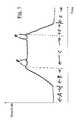
- FIG. 1schematically shows a theoretical train signature in the amplitude vs time domain
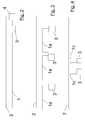
- FIG. 2schematically shows a first possible optical fibre arrangement
- FIG. 3schematically shows a second possible optical fibre arrangement
- FIG. 4schematically shows a third possible optical fibre arrangement
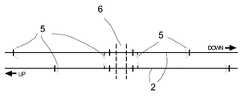
- FIG. 5schematically shows a conventional level crossing predictor
- FIG. 6schematically shows a level crossing predictor in accordance with a first embodiment of the present invention.
- the signature of a trainwill be characterised by a series of frequencies at various amplitudes caused by the passage of the wheel along the rail, in particular there will be specific peaks as an axle passes a given point. It is therefore possible to determine not only that a train has passed a particular location on the railway, but also to determine further information such as train length, the number of axles of the train, the condition of equipment on that train, and the condition of fixed equipment such as the track itself or trackside equipment.
- FIG. 1schematically shows a theoretical signature in the amplitude vs time domain for a train operating normally.
- the trainis assumed to be simple, for example a “two-car sprinter” lightweight vehicle with substantially evenly-distributed weight along the length of the train.
- the signature shownreflects the acoustic signal measured by a trackside transducer over time at a set region, located away from, and out of the influence of, “noisy” equipment, and shows the approach, passage and departure of a train.
- the acoustic signalcorresponds to ambient or background noise only.
- region Ba train approaches the transducer, and as it approaches the noise level increases.
- Region Coccurs as the train passes the transducer.
- this regiongenerally takes the form of a plateau, i.e. there is a similar noise level experienced throughout passage of the train.
- points D of raised signalwhich occur when individual wheels of the train pass by the transducer.
- Region Eoccurs after the passage of the train, and shows a gradually diminishing noise level as the train moves away.
- region Fshows a return to ambient or background noise only.
- the signaturewill have a characteristic spectral response in the frequency domain, which advantageously is also monitored.
- FIG. 1It can be seen from FIG. 1 that various types of information may be collated from the transducer's output. These include:
- the train signatureis unique for each train. Therefore comparison of detected signatures can be used to identify and differentiate trains. Furthermore trains may be tracked by means of the signature, as described below. It must be remembered though that the signature will be “squeezed” or “stretched” along the time axis depending on the speed of the train as it passes a transducer, and so compensation is necessary when identifying or tracking trains.
- the transducermay be used as an axle-counter.
- the profile of points Dcontains information as to the condition of the wheels and the condition of track where the wheels pass. If all such points D share a common unusual feature, then this implies that the track has a certain characteristic (e.g. a fault). If on the other hand a feature is only shown in one point D, then it may be implied that a particular wheel has a characteristic (e.g. a region of flattening). Furthermore the wheel affected may be determined.
- a signature including a high response at certain frequenciesmay imply “squealing” due to a fault.
- An unusual profile in region Emay imply that an object is dragging along behind the train for example.
- a “long” fibrei.e. one which is longer than the desired resolution of the system, alongside the track.
- the location of the source of acoustic signalsmay be determined by using signal processing, as is known in the art.
- This type of arrangementis schematically shown in FIG. 2 , where a single length of optical fibre 1 is provided alongside a track 2 .
- Signal detectionis performed by a receiver 3 located at an end of the fibre 1 .
- Receiver 3is in connection with a signal processor 4 . This outputs data to the main train control system (not shown).
- receiver 3 and signal processor 4may be integrally formed.
- each fibrehaving a length approximately equal to the desired resolution of the system.
- This arrangementis schematically shown in FIG. 3 , where a number of fibres 1 a are provided alongside track 2 , each fibre being connected to a receiver 3 .
- This arrangementmay reduce processing load. It is possible to apply signal processing to the signal received from each fibre 1 a , in order to further improve localisation of the acoustic signal source.
- FIG. 4Providing a “point” measurement with a short section of fibre to provide accurate determination of the acoustic signal source location without requiring the signal processing of i) above.
- This arrangementis shown in FIG. 4 , with a number of short fibre sections 1 b positioned proximate a track 2 , each section 1 b being connected to a receiver 3 .
- This arrangementmay be of particular use for monitoring fixed/trackside equipment such as points, crossings etc.
- fibre optic cablesare used to determine the position of trains approaching a road/rail crossing (level crossing).
- FIG. 5schematically shows a conventional bi-directional level crossing predictor.
- tracks 2are provided with a number of treadles 5 , which are activated by the physical passage of a train (not shown) as it approaches or departs from a level crossing 6 .
- Activation of a treadle 5 by a train approaching the level crossing 6causes barriers at the crossing to lower, i.e. to block the crossing to road users.
- Activation of a treadle 5 by a train as it leaves the level crossingcauses the barriers to raise again, so that road users may cross.
- the barriersare controlled based on the position of a train, i.e. whether a train has reached the location of a treadle 5 .
- a disadvantage with such a systemis that the time between the train activating a treadle 5 on the approach to the level crossing 6 and the train reaching the level crossing 6 is dependent on the speed of the train. This means that road users are not given consistent warning of approaching trains.
- a way to avoid this problemwould be to control barrier activation dependent upon a determined time for a train to reach the level crossing.
- This embodimentprovides such a method by the use of fibre optic hydrophony.
- Analysis of sound vibrations detected by fibre optic hydrophony technologyis used to determine when a train enters a section of interest, and to track its passage along the section of line. Since the location of the train is tracked, the speed v of the train may be determined by comparing the train's location at various times.
- Trackside machinerysuch as lights and/or barriers is then operated at a fixed time before the train's arrival.
- a trainhas a clear signature, i.e. vibration amplitude and/or frequency against time characteristic which is dependent on e.g. train type, trackside infrastructure and train speed.
- peaksare determined when axles pass a point on the railway, or a trackside anomaly such as an insulated rail joint, track joint, set of points, or indeed specifically placed target or targets (anomalies placed on the rail) that result in a characteristic vibration as a train wheel passes over it.
- the signature of a trainis very different to that of a car or other road vehicle. Having determined that a train is passing a particular position of the track, it is then possible to track the train as it moves towards a road crossing. By determining the time taken to travel a known distance between points on the fibre, it is possible to predict the time at which the train will arrive at the level crossing and thus provide a constant time warning to road users.
- FIG. 6schematically shows a level crossing detector in accordance with this embodiment, where reference numerals for similar components have been retained from FIG. 5 .
- an optical fibre 1is laid proximate each rail 2 .
- Acoustic signalsare received from two specified spaced apart locations 7 and 8 on the approach to the crossing 6 .
- Processing means(not shown) is used to analyse the signals received from locations 7 and 8 , in particular the train signatures received therefrom. these are compared, e.g. by pattern matching, to ensure that the received signatures correspond to the same train.
- the speed of the trainmay then be determined, and thus the time of arrival at crossing 6 .
- the barriers of crossing 6may then be operated at a set time before that estimated arrival time.
- Integritymay be further increased by determining that the signature at various points is the same as the vehicle moves along, thus ensuring that the same train is being tracked, and that there is no anomalous reading being made. This may be achieved using a pattern matching algorithm to compare received signatures. As noted previously, it is preferable to compensate the signatures for the speed of the train.
- Further safetycan be provided by using similar technology on the road crossing itself to track the position of road vehicles as the cross the track. Again, signatures of road vehicles are dependent on e.g. their engine, and the wheel/road interface, particularly as structures such as the rail are struck. It is therefore possible to determine that vehicles that have entered the crossing have also safely passed over it. If this is not the case, then an appropriate action can be taken by the crossing control equipment, for example warning the driver to stop. Additional optical fibre transducer may be located proximate the road to assist in this monitoring, alternatively trackside fibre may be sufficient.
- the level crossing equipmentis caused to operate as a fallback fault condition.
- each trainhas a clear signature, i.e. vibration amplitude and/or frequency against time characteristic which is dependent on e.g. train type, trackside infrastructure and train speed.
- peaksare determined when axles pass a point on the railway, or trackside anomaly such as an insulated rail joint, track joint, set of points, or indeed specifically placed target or targets (anomalies placed on the rail) that results in a characteristic vibration as a train wheel passes over it.
- the signature of the trainwill, as described above, be dependent on the number of axles on the train, the shape, deformation and condition of the wheels, the traction systems and so on. This can allow the tracking of multiple trains in the same section of track, and distinction between them.
- train locationis determined by the use of a fibre optic hydrophony system, in particular accurate determination of train position within a section of track as the the train moves along the railway.
- a fibre optic hydrophony systemin particular accurate determination of train position within a section of track as the the train moves along the railway.
- the hydrophony train detection systemmay be overlaid on to a conventional train detection system, such as one using track circuits or axle counter sections to provide additional resolution of position, such an arrangement being ideal for use in areas where increased resolution of train position detection can offer increased system performance, and at a potentially lower cost than a purely train-carried system.
- softwareis used to track trains safely as they move around a railway network.
- the trackingmay be performed using a pattern matching algorithm to compare received signatures. This allows the determination of train presence in ‘virtual blocks’ (i.e. any logical area of track), thus increasing safety of a system at potentially lower cost than conventional systems. Since the location of the acoustic signal source may be specified to the software, i.e. the software may be asked to “listen” to signals received from a particular location, the size of the virtual block can also be specified.
- the hydrophony train detection systemmay be overlaid with conventional detection systems, e.g. GPS, beacon, odometry, axle counters, track circuits, treadles or the like, to provide diversity, and fall-back in the event of failure of one detection system.
- conventional detection systemse.g. GPS, beacon, odometry, axle counters, track circuits, treadles or the like.
- train locationis again determined by the use of a fibre optic hydrophony system.
- a fibre optic hydrophony systemthis is not provided as a ‘vital’ system, but as a means of providing accurate information for applications such as “Real Time Information Systems”, passenger information etc to railway stakeholders. This is particularly relevant where continuous train detection is not used and therefore positional accuracy is not certain.
- the fibrecould for example comprise a new fibre optic cable, or a spare, dark fibre, in any existing system. Triggers could be based on either presence of noise having the signature of a train at a fixed point on the line, or by tracking movement through the section of track.
- Passenger informationcan therefore be determined from knowledge of the timetable combined with knowledge about the train type and its location, giving accurate predictive information to passengers as to the time at which the vehicle is likely to arrive at a particular station, or to advise passengers at a station to stand back as a non-stopping train passes the location.
- a fibre optic cable laid close to the tracksidemay be used to determine the status of moving railway assets such as rail vehicles.
- a trainhas a clear signature, i.e. vibration amplitude and/or frequency against time characteristic which is dependent on e.g. train type, trackside infrastructure and train speed.
- peaksare determined when axles pass a point on the railway, or trackside anomaly such as an insulated rail joint, track joint, set of points, or indeed specifically placed target or targets (anomalies placed on the rail) that results in a characteristic vibration as a train wheel passes over it.
- a fibre optic cable laid close to the tracksidemay be used to determine the status of fixed railway assets such as point machines, level crossing barriers and so on.
- the vibration caused by the moving parts of the equipmentwill cause the outer layer of the fibre optic cable to vibrate, and this is picked up by the sensing equipment. Measurements of the signature of healthy equipment are made and recorded, in particular characteristics such as time of operation, and peaks of amplitude or vibration as areas of high friction are encountered.
- the systemcan determine at which point maintenance is required.
- this techniquemay be used to monitor vandalism, trespassing or theft at railside locations. If the noise expected to be created by an item disappears from a received signal, then this implies that the item has been physically removed, e.g. by theft. Abnormal signals received from an item may indicate vandalism of that item.
- the acoustic monitoringmay be able to detect items not associated with the railway, e.g. monitoring intruders directly, for example footsteps, talking, or vehicles.
- acoustic transducercomprises a fibre optic cable
- other forms of acoustic transducermay be used, for example microphones.
- the acoustic signalsare monitored continuously, however this may not be necessary for all applications.
- the received signalmay be played to a human operator, who may be able to identify the noise picked up.
- the methodology described abovemay be used in combination, e.g. the same received signals may be used both for train location and for monitoring of fixed assets.
Landscapes
- Engineering & Computer Science (AREA)
- Mechanical Engineering (AREA)
- Health & Medical Sciences (AREA)
- Biomedical Technology (AREA)
- General Health & Medical Sciences (AREA)
- Multimedia (AREA)
- Physics & Mathematics (AREA)
- General Physics & Mathematics (AREA)
- Automation & Control Theory (AREA)
- Train Traffic Observation, Control, And Security (AREA)
- Measurement Of Mechanical Vibrations Or Ultrasonic Waves (AREA)
- Electric Propulsion And Braking For Vehicles (AREA)
Abstract
Description
- Wheels with ‘flat spots’. Such a system is also known as “Wheel Impact Load Detection”. As a wheel flat passes over the rail, and particularly over an anomaly such as a rail joint, or specially placed artificial anomaly, the signature of a wheel with a wheel flat passing that point is significantly different to that of a perfectly circular wheel. In particular the frequency domain analysis will show a large number of frequency components being detected due to the significant shock load placed on the wheel and track. It is also possible to check for such problems using an acoustic transducer provided on the train itself
- Hot wheel bearings (and later consequences such as locked wheels). Increased friction will cause a changed signature as the wheel moves along the rail, as stress waves pass over the wheel rail interface. In addition expansion of components within the wheel/bogie assembly will cause the time and/or frequency domain analysis to change.
- High pressure air leaks (e.g. brake pipe or suspension components). The high frequency ‘whistling’ caused by such faults are easily picked up as the train travels past the sensing devices, resulting in a clearly identifiable profile in the frequency/time signature.
- Pantograph (the apparatus used to pick up energy from overhead cables) high voltage arcs cause a ‘white noise’ which manifests itself as high amplitude components at a wide range of frequencies within the range of detection of the hydrophony system.
- Dragging equipment which has fallen from a train, as it is dragged along the ballast will cause the train's signature to be radically changed, thus allowing feedback to be provided to the driver either through the railway signalling system, or through a message passed to the control centre.
- Decoupled/uncoupled trains. Analysis of the received signature may be used to determine if a train has split, for example by counting the number of axle peaks.
- Track deformation, for example torsion of the rail or gauge corner cracking. As the train moves along the rail, the signature detected will be different to the ‘normal’ signature, for all axles, thus allowing detection with some surety that that rail is not as expected and that further inspection is required.
- Switch and crossings suffering increased friction or slower operational times.
- Point machines where condition is not optimal.
Claims (15)
Applications Claiming Priority (3)
| Application Number | Priority Date | Filing Date | Title |
|---|---|---|---|
| GBGB0915322.2AGB0915322D0 (en) | 2009-09-03 | 2009-09-03 | Railway systems using fibre optic hydrophony systems |
| GB0915322.2 | 2009-09-03 | ||
| PCT/GB2010/051467WO2011027166A1 (en) | 2009-09-03 | 2010-09-03 | Railway systems using acoustic monitoring |
Publications (2)
| Publication Number | Publication Date |
|---|---|
| US20120217351A1 US20120217351A1 (en) | 2012-08-30 |
| US8985523B2true US8985523B2 (en) | 2015-03-24 |
Family
ID=41203079
Family Applications (1)
| Application Number | Title | Priority Date | Filing Date |
|---|---|---|---|
| US13/393,950ActiveUS8985523B2 (en) | 2009-09-03 | 2010-09-03 | Railway system using acoustic monitoring |
Country Status (9)
| Country | Link |
|---|---|
| US (1) | US8985523B2 (en) |
| EP (5) | EP2473392B1 (en) |
| CA (1) | CA2771468C (en) |
| DK (3) | DK3281840T3 (en) |
| ES (4) | ES2662744T3 (en) |
| FI (1) | FI3792142T3 (en) |
| GB (1) | GB0915322D0 (en) |
| PT (3) | PT2473392T (en) |
| WO (1) | WO2011027166A1 (en) |
Cited By (9)
| Publication number | Priority date | Publication date | Assignee | Title |
|---|---|---|---|---|
| US20150284015A1 (en)* | 2010-09-17 | 2015-10-08 | Wavetrain Systems As | System and method for early train detection |
| US20160152253A1 (en)* | 2013-07-31 | 2016-06-02 | Rail Safe R.S. (2015) Ltd. | System and method for utilizing an infra-red sensor by a moving train |
| US9566988B2 (en) | 2012-12-06 | 2017-02-14 | Siemens Aktiengesellschaft | Locating of vehicles |
| US20170305445A1 (en)* | 2014-09-22 | 2017-10-26 | Bombardier Transportation Gmbh | Method for State Determination in a Rail Vehicle |
| EP3445635B1 (en) | 2016-06-20 | 2020-05-13 | Siemens Mobility GmbH | Method for operating a positioning device, and positioning device |
| US20210041232A1 (en)* | 2018-08-30 | 2021-02-11 | Voestalpine Signaling Usa Inc. | Railcar acoustic monitoring system and method of use |
| US11408988B2 (en) | 2018-09-24 | 2022-08-09 | Howden Alphair Ventilating Systems Inc. | System and method for acoustic vehicle location tracking |
| US11975750B2 (en) | 2019-10-14 | 2024-05-07 | Athena Industrial Technologies Inc. | Broken rail detector |
| US12122435B2 (en) | 2021-02-02 | 2024-10-22 | Charter Communications Operating, Llc | System and method for real-time detection of trains |
Families Citing this family (56)
| Publication number | Priority date | Publication date | Assignee | Title |
|---|---|---|---|---|
| US10569792B2 (en) | 2006-03-20 | 2020-02-25 | General Electric Company | Vehicle control system and method |
| US9733625B2 (en) | 2006-03-20 | 2017-08-15 | General Electric Company | Trip optimization system and method for a train |
| US10308265B2 (en) | 2006-03-20 | 2019-06-04 | Ge Global Sourcing Llc | Vehicle control system and method |
| US9950722B2 (en) | 2003-01-06 | 2018-04-24 | General Electric Company | System and method for vehicle control |
| US9828010B2 (en) | 2006-03-20 | 2017-11-28 | General Electric Company | System, method and computer software code for determining a mission plan for a powered system using signal aspect information |
| US9481384B2 (en) | 2012-11-21 | 2016-11-01 | General Electric Company | Route examining system and method |
| GB0915322D0 (en)* | 2009-09-03 | 2009-10-07 | Westinghouse Brake & Signal | Railway systems using fibre optic hydrophony systems |
| US8500071B2 (en)* | 2009-10-27 | 2013-08-06 | Invensys Rail Corporation | Method and apparatus for bi-directional downstream adjacent crossing signaling |
| WO2012039776A1 (en)* | 2010-09-24 | 2012-03-29 | QinetiQ North America, Inc. | Airport incursion notification system |
| EP2502800B1 (en)* | 2011-03-25 | 2013-05-08 | Thales Deutschland GmbH | Detector for cold movement detection of a railway vehicle, and method for its operation |
| GB201201768D0 (en)* | 2012-02-01 | 2012-03-14 | Qinetiq Ltd | Control of transport networks |
| GB201201703D0 (en) | 2012-02-01 | 2012-03-14 | Qinetiq Ltd | Detecting train separation |
| US8725405B2 (en)* | 2012-04-13 | 2014-05-13 | General Electric Company | Methods and system for crossing prediction |
| DE102012213499A1 (en) | 2012-07-31 | 2014-02-06 | Siemens Aktiengesellschaft | vehicle tracking |
| DE102012213487A1 (en) | 2012-07-31 | 2014-02-06 | Siemens Aktiengesellschaft | Rail Vehicle Tracking |
| DE102012213495A1 (en) | 2012-07-31 | 2014-02-06 | Siemens Aktiengesellschaft | Rail Vehicle Tracking |
| DE102012217620A1 (en) | 2012-09-27 | 2014-03-27 | Siemens Aktiengesellschaft | Method for operating a mobile device in a railway system, railway system and mobile device |
| DE102012217627A1 (en) | 2012-09-27 | 2014-03-27 | Siemens Aktiengesellschaft | Method for operating a rail vehicle in a railway system and railway system |
| US9682716B2 (en) | 2012-11-21 | 2017-06-20 | General Electric Company | Route examining system and method |
| US9669851B2 (en) | 2012-11-21 | 2017-06-06 | General Electric Company | Route examination system and method |
| EP2862778B1 (en)* | 2013-10-15 | 2017-01-04 | Bayern Engineering GmbH & Co. KG | Method for generating measurement results from sensor signals |
| TR201405723A2 (en)* | 2014-05-22 | 2015-09-21 | Sabri Haluk Goekmen | System which senses rail fractures and cracks through the method of reflection |
| CN104020221B (en)* | 2014-05-30 | 2017-06-16 | 杨媛 | A kind of real-time broken rail detection localization method based on supersonic guide-wave |
| GB201414616D0 (en) | 2014-08-18 | 2014-10-01 | Optasense Holdings Ltd | Detection of anomalies in rail wheelsets |
| CA2870425C (en)* | 2014-11-12 | 2015-12-29 | Frank C. Van Der Merwe | Automated in motion railway seismic wheel failure detection system |
| CN104554348A (en)* | 2014-12-08 | 2015-04-29 | 河南思维信息技术有限公司 | Locomotive operation real-time analysis method and locomotive operation real-time analysis device |
| CN104960551A (en)* | 2015-06-25 | 2015-10-07 | 北京交通大学 | Unattended system for sensing railway field operation and protection based on photonic crystal fiber |
| US10513280B2 (en) | 2015-10-20 | 2019-12-24 | International Electronic Machines Corp. | Operations monitoring for effect mitigation |
| GB201521116D0 (en)* | 2015-11-30 | 2016-01-13 | Optasense Holdings Ltd | Tracking using distributed fibre optic sensing |
| DE102016108273A1 (en)* | 2016-05-04 | 2017-11-09 | senvisys UG (haftungsbeschränkt) | Method for evaluating signals of at least one vibration sensor |
| GB201611326D0 (en)* | 2016-06-29 | 2016-08-10 | Optasense Holdings Ltd | Distributed fibre optic sensing for rail monitoring |
| PL3275763T3 (en)* | 2016-07-27 | 2022-03-28 | Frauscher Sensortechnik GmbH | Sensor arrangement for railway monitoring and corresponding method |
| DE102016214024A1 (en)* | 2016-07-29 | 2018-02-01 | Siemens Aktiengesellschaft | Method and system for influencing track-bound vehicles |
| US10124819B2 (en)* | 2016-08-08 | 2018-11-13 | General Electric Company | Wheel deformity warning system |
| EP3541683A4 (en)* | 2016-11-21 | 2020-07-08 | Rail Control Systems Australia Pty Ltd | SPEED DETECTION METHOD AND DEVICE |
| US10773742B2 (en)* | 2017-09-13 | 2020-09-15 | Siemens Industry, Inc. | Advanced preemption using the wayside inspector and wireless magnetometer sensors |
| DE102017217450A1 (en)* | 2017-09-29 | 2019-04-04 | Siemens Mobility GmbH | Method for determining the state of at least one catenary running along a route |
| KR20190064035A (en)* | 2017-11-30 | 2019-06-10 | (주)넷케이티아이 | System for monitoring railroading status based on distributed acoustic sensor and a method thereof |
| JP7127997B2 (en)* | 2018-03-15 | 2022-08-30 | 株式会社京三製作所 | Railroad crossing warning time calculator |
| GB2572187B (en) | 2018-03-22 | 2021-09-01 | Siemens Mobility Ltd | Sensor unit for detecting the approach of a train |
| RU2681451C1 (en)* | 2018-03-30 | 2019-03-06 | Дмитрий Викторович Ефанов | Safety in the railway crossing ensuring method |
| US11055984B2 (en)* | 2018-04-10 | 2021-07-06 | Network Integrity Systems, Inc. | Monitoring a sensor output to determine intrusion events |
| CN108622135A (en)* | 2018-05-08 | 2018-10-09 | 成都九壹通智能科技股份有限公司 | Track switch automatic control system and method |
| CN108791359A (en)* | 2018-05-08 | 2018-11-13 | 成都九壹通智能科技股份有限公司 | The automatic control system of track switch conversion |
| CN108639101A (en)* | 2018-05-08 | 2018-10-12 | 成都九壹通智能科技股份有限公司 | The early warning system that track switch automatically controls |
| CN108791360A (en)* | 2018-05-09 | 2018-11-13 | 成都九壹通智能科技股份有限公司 | Track switch remote control system |
| CH715491B1 (en)* | 2018-10-23 | 2024-12-30 | Fabrimex X Tec Ag | Monitoring system and method for monitoring road users in a detection area. |
| WO2020116031A1 (en)* | 2018-12-03 | 2020-06-11 | 日本電気株式会社 | Railroad monitoring system, railroad monitoring device, railroad monitoring method, and non-transitory computer-readable medium |
| US11124211B2 (en)* | 2018-12-07 | 2021-09-21 | Alstom Transport Technologies | Methods and devices for locating a railway vehicle |
| DE102018222723A1 (en) | 2018-12-21 | 2020-06-25 | Siemens Mobility GmbH | Method and device for object detection |
| CN110329116B (en)* | 2019-08-01 | 2022-07-22 | 南京拓控信息科技股份有限公司 | Automatic neutral section passing detection device and detection method for electric locomotive |
| US12116030B2 (en)* | 2020-02-14 | 2024-10-15 | International Electronic Machines Corp. | Methods and systems for monitoring a transportation path with acoustic or vibration sensing |
| WO2021183080A1 (en)* | 2020-03-09 | 2021-09-16 | Gokmen Sabri Haluk | Method for detection of track leveling errors by vibration measurement from rails |
| EP4211014A1 (en)* | 2020-09-14 | 2023-07-19 | Konux GmbH | Monitoring passing trains, system and method |
| WO2023129052A2 (en)* | 2021-12-29 | 2023-07-06 | Gokmen Sabri Haluk | Acoustic method for detecting flood, landslide and under-rail washout problems resulting from natural disasters in railways |
| DE102023133548A1 (en)* | 2023-11-30 | 2025-06-05 | Scheidt & Bachmann Gmbh | Data processing device for a rail system |
Citations (17)
| Publication number | Priority date | Publication date | Assignee | Title |
|---|---|---|---|---|
| GB137433A (en) | 1919-03-22 | 1920-01-15 | John Gardner | Improvements in electric signalling controlled by mechanical vibrations |
| US4843885A (en)* | 1987-10-02 | 1989-07-04 | Servo Corporation Of America | Acoustic detection of bearing defects |
| US5029477A (en)* | 1990-01-31 | 1991-07-09 | Servo Corporation Of America | Integrity test for acoustic bearing defect detector |
| WO1991010584A1 (en) | 1990-01-12 | 1991-07-25 | Mueller Bruno | Arrangement for identifying an object by means of structure-borne noise, and use of said arrangement |
| DE4214580A1 (en) | 1992-04-30 | 1993-11-04 | Deutsche Aerospace | Detecting approaching train during track work - uses electro-acoustic transducers, whose output signals are amplified and fed to optical or audible alarm system |
| US5713540A (en)* | 1996-06-26 | 1998-02-03 | At&T Corp. | Method and apparatus for detecting railway activity |
| US6216985B1 (en)* | 1997-08-29 | 2001-04-17 | Robert Douglas Stephens | Railway hazard acoustic sensing, locating, and alarm system |
| US6830224B2 (en)* | 2001-02-26 | 2004-12-14 | Railroad Transportation Communication Technologies (Rtct) Llc | Rail communications system |
| US20040261533A1 (en)* | 2003-06-27 | 2004-12-30 | General Electric Company | Rail and train monitoring system and method |
| DE102007006833A1 (en) | 2007-02-07 | 2008-08-14 | Deutsches Zentrum für Luft- und Raumfahrt e.V. | Action e.g. switching operation, triggering device for railway system, has sensors detecting acoustic signals, where device detects rail-mounted vehicle located on track system based on signals and triggers action based on vehicle detection |
| US20090001226A1 (en)* | 2007-06-27 | 2009-01-01 | Rftrax, Inc. | Acoustic monitoring of railcar running gear and railcars |
| US20090266943A1 (en)* | 2008-04-28 | 2009-10-29 | Ajith Kuttannair Kumar | System and Method For Pacing A Powered System Traveling Along A Route |
| US20110093144A1 (en)* | 2009-03-17 | 2011-04-21 | Todd Goodermuth | System and method for communicating data in a train having one or more locomotive consists |
| US20120074266A1 (en)* | 2010-09-28 | 2012-03-29 | Wolfgang Daum | Rail vehicle control communication system and method for communicating with a rail vehicle |
| US8160832B2 (en)* | 2007-06-06 | 2012-04-17 | Progress Rail Services Corp | Apparatus and method for identifying a defect and/or operating characteristic of a system |
| US20120097803A1 (en)* | 2010-10-26 | 2012-04-26 | Wolfgang Daum | Methods and systems for rail communication |
| US20120217351A1 (en)* | 2009-09-03 | 2012-08-30 | Simon Chadwick | Railway system using acoustic monitoring |
Family Cites Families (10)
| Publication number | Priority date | Publication date | Assignee | Title |
|---|---|---|---|---|
| US580304A (en)* | 1897-04-06 | Sylvania | ||
| DE4214271A1 (en)* | 1992-04-30 | 1993-11-04 | Deutsche Aerospace | Detecting approaching train during track work - uses acoustic sensors, whose output signals are fed to alarm system after amplification |
| IT1262407B (en)* | 1993-09-06 | 1996-06-19 | Finmeccanica Spa | INSTRUMENTATION USING INTEGRATED OPTIC COMPONENTS FOR DIAGNOSTICS OF PARTS WITH FIBER OPTIC SENSORS INCLUDED OR FIXED ON THE SURFACE. |
| WO1997025235A1 (en)* | 1996-01-12 | 1997-07-17 | Pace Joseph A | Railroad traffic warning system apparatus and method therefor |
| DE19913057A1 (en)* | 1999-03-17 | 2000-09-21 | Siemens Ag | Wheel counting and detecting method e.g. for rail-borne vehicles such as trains |
| EP1128171A1 (en)* | 2000-02-22 | 2001-08-29 | Sensor Line Gesellschaft für optoelektronische Sensoren mbH | Fibre optic load sensor for detecting railway vehicles |
| US7254467B2 (en)* | 2003-02-13 | 2007-08-07 | General Electric Company | Digital train system for automatically detecting trains approaching a crossing |
| ITBN20060004A1 (en)† | 2006-09-20 | 2006-12-20 | Antonello Cutolo | FIBER OPTIC TRANSMISSION SYSTEM FOR THE PARAMETER MONITORING AND THE IMPROVEMENT OF THE SAFETY OF A RAILWAY LINE |
| DE102007041174A1 (en)* | 2007-08-27 | 2009-02-26 | Siemens Ag | Device for identification of technically unprotected level crossing, has traffic signs for carrying out signaling for road traffic user and sensor, which responds to approaching train |
| WO2009043109A1 (en)* | 2007-10-05 | 2009-04-09 | United Group Rail Services Limited | Railroad vigilance system control unit |
- 2009
- 2009-09-03GBGBGB0915322.2Apatent/GB0915322D0/ennot_activeCeased
- 2010
- 2010-09-03PTPT107521387Tpatent/PT2473392T/enunknown
- 2010-09-03FIFIEP20192265.5Tpatent/FI3792142T3/enactive
- 2010-09-03ESES10752138.7Tpatent/ES2662744T3/enactiveActive
- 2010-09-03EPEP10752138.7Apatent/EP2473392B1/ennot_activeRevoked
- 2010-09-03PTPT171863608Tpatent/PT3281840T/enunknown
- 2010-09-03EPEP20192265.5Apatent/EP3792142B1/enactiveActive
- 2010-09-03ESES17186360Tpatent/ES2891350T3/enactiveActive
- 2010-09-03DKDK17186360.8Tpatent/DK3281840T3/enactive
- 2010-09-03DKDK20192265.5Tpatent/DK3792142T3/enactive
- 2010-09-03EPEP16153126.4Apatent/EP3050774B2/enactiveActive
- 2010-09-03DKDK10752138.7Tpatent/DK2473392T3/enactive
- 2010-09-03EPEP17186360.8Apatent/EP3281840B1/enactiveActive
- 2010-09-03ESES16153126Tpatent/ES2662877T5/enactiveActive
- 2010-09-03USUS13/393,950patent/US8985523B2/enactiveActive
- 2010-09-03WOPCT/GB2010/051467patent/WO2011027166A1/enactiveApplication Filing
- 2010-09-03PTPT201922655Tpatent/PT3792142T/enunknown
- 2010-09-03CACA2771468Apatent/CA2771468C/enactiveActive
- 2010-09-03ESES20192265Tpatent/ES2984152T3/enactiveActive
- 2010-09-03EPEP20192266.3Apatent/EP3766757A3/enactivePending
Patent Citations (19)
| Publication number | Priority date | Publication date | Assignee | Title |
|---|---|---|---|---|
| GB137433A (en) | 1919-03-22 | 1920-01-15 | John Gardner | Improvements in electric signalling controlled by mechanical vibrations |
| US4843885A (en)* | 1987-10-02 | 1989-07-04 | Servo Corporation Of America | Acoustic detection of bearing defects |
| WO1991010584A1 (en) | 1990-01-12 | 1991-07-25 | Mueller Bruno | Arrangement for identifying an object by means of structure-borne noise, and use of said arrangement |
| US5029477A (en)* | 1990-01-31 | 1991-07-09 | Servo Corporation Of America | Integrity test for acoustic bearing defect detector |
| DE4214580A1 (en) | 1992-04-30 | 1993-11-04 | Deutsche Aerospace | Detecting approaching train during track work - uses electro-acoustic transducers, whose output signals are amplified and fed to optical or audible alarm system |
| US5713540A (en)* | 1996-06-26 | 1998-02-03 | At&T Corp. | Method and apparatus for detecting railway activity |
| US6216985B1 (en)* | 1997-08-29 | 2001-04-17 | Robert Douglas Stephens | Railway hazard acoustic sensing, locating, and alarm system |
| US6830224B2 (en)* | 2001-02-26 | 2004-12-14 | Railroad Transportation Communication Technologies (Rtct) Llc | Rail communications system |
| US20040261533A1 (en)* | 2003-06-27 | 2004-12-30 | General Electric Company | Rail and train monitoring system and method |
| US6951132B2 (en)* | 2003-06-27 | 2005-10-04 | General Electric Company | Rail and train monitoring system and method |
| DE102007006833A1 (en) | 2007-02-07 | 2008-08-14 | Deutsches Zentrum für Luft- und Raumfahrt e.V. | Action e.g. switching operation, triggering device for railway system, has sensors detecting acoustic signals, where device detects rail-mounted vehicle located on track system based on signals and triggers action based on vehicle detection |
| US8160832B2 (en)* | 2007-06-06 | 2012-04-17 | Progress Rail Services Corp | Apparatus and method for identifying a defect and/or operating characteristic of a system |
| US20090001226A1 (en)* | 2007-06-27 | 2009-01-01 | Rftrax, Inc. | Acoustic monitoring of railcar running gear and railcars |
| US20090266943A1 (en)* | 2008-04-28 | 2009-10-29 | Ajith Kuttannair Kumar | System and Method For Pacing A Powered System Traveling Along A Route |
| US20110186692A1 (en)* | 2008-04-28 | 2011-08-04 | Ajith Kuttannair Kumar | System and method for pacing a powered system traveling along a route |
| US20110093144A1 (en)* | 2009-03-17 | 2011-04-21 | Todd Goodermuth | System and method for communicating data in a train having one or more locomotive consists |
| US20120217351A1 (en)* | 2009-09-03 | 2012-08-30 | Simon Chadwick | Railway system using acoustic monitoring |
| US20120074266A1 (en)* | 2010-09-28 | 2012-03-29 | Wolfgang Daum | Rail vehicle control communication system and method for communicating with a rail vehicle |
| US20120097803A1 (en)* | 2010-10-26 | 2012-04-26 | Wolfgang Daum | Methods and systems for rail communication |
Non-Patent Citations (1)
| Title |
|---|
| International Search Report dated Jan. 21, 2011 for International Application PCT/GB2010/051467, 7 sheets. |
Cited By (18)
| Publication number | Priority date | Publication date | Assignee | Title |
|---|---|---|---|---|
| US9327744B2 (en)* | 2010-09-17 | 2016-05-03 | Wavetrain Systems As | System and method for early train detection |
| US20150284015A1 (en)* | 2010-09-17 | 2015-10-08 | Wavetrain Systems As | System and method for early train detection |
| USRE48307E1 (en)* | 2010-09-17 | 2020-11-17 | Wavetrain Systems As | System and method for early train detection |
| US9566988B2 (en) | 2012-12-06 | 2017-02-14 | Siemens Aktiengesellschaft | Locating of vehicles |
| US10654499B2 (en)* | 2013-07-31 | 2020-05-19 | Rail Vision Ltd. | System and method for utilizing an infra-red sensor by a moving train |
| US20160152253A1 (en)* | 2013-07-31 | 2016-06-02 | Rail Safe R.S. (2015) Ltd. | System and method for utilizing an infra-red sensor by a moving train |
| US20170305445A1 (en)* | 2014-09-22 | 2017-10-26 | Bombardier Transportation Gmbh | Method for State Determination in a Rail Vehicle |
| US10343700B2 (en)* | 2014-09-22 | 2019-07-09 | Bombardier Transportation Gmbh | Method for state determination in a rail vehicle |
| EP3445635B1 (en) | 2016-06-20 | 2020-05-13 | Siemens Mobility GmbH | Method for operating a positioning device, and positioning device |
| US11124212B2 (en)* | 2016-06-20 | 2021-09-21 | Siemens Mobility GmbH | Method for operating a positioning device, and positioning device |
| US20210041232A1 (en)* | 2018-08-30 | 2021-02-11 | Voestalpine Signaling Usa Inc. | Railcar acoustic monitoring system and method of use |
| US11787454B2 (en)* | 2018-08-30 | 2023-10-17 | Voestalpine Signaling Usa Inc. | Railcar acoustic monitoring system and method of use |
| US20240109571A1 (en)* | 2018-08-30 | 2024-04-04 | Voestalpine Signaling Usa Inc. | Railcar acoustic monitoring system and method of use |
| US12168468B2 (en)* | 2018-08-30 | 2024-12-17 | Voestalpine Signaling Usa Inc. | Railcar acoustic monitoring system and method of use |
| US11408988B2 (en) | 2018-09-24 | 2022-08-09 | Howden Alphair Ventilating Systems Inc. | System and method for acoustic vehicle location tracking |
| US11975750B2 (en) | 2019-10-14 | 2024-05-07 | Athena Industrial Technologies Inc. | Broken rail detector |
| US12351220B2 (en) | 2019-10-14 | 2025-07-08 | Athena Industrial Technologies Inc. | Broken rail detector |
| US12122435B2 (en) | 2021-02-02 | 2024-10-22 | Charter Communications Operating, Llc | System and method for real-time detection of trains |
Also Published As
| Publication number | Publication date |
|---|---|
| PT3281840T (en) | 2021-07-28 |
| EP2473392A1 (en) | 2012-07-11 |
| EP3766757A2 (en) | 2021-01-20 |
| EP3792142A2 (en) | 2021-03-17 |
| PT2473392T (en) | 2018-01-18 |
| EP3050774B1 (en) | 2017-12-13 |
| FI3792142T3 (en) | 2024-07-17 |
| DK2473392T3 (en) | 2018-02-12 |
| EP3281840A2 (en) | 2018-02-14 |
| EP3050774B2 (en) | 2020-11-11 |
| EP3766757A3 (en) | 2021-04-28 |
| US20120217351A1 (en) | 2012-08-30 |
| EP3281840B1 (en) | 2021-07-07 |
| GB0915322D0 (en) | 2009-10-07 |
| WO2011027166A1 (en) | 2011-03-10 |
| EP3792142B1 (en) | 2024-05-15 |
| EP3050774A1 (en) | 2016-08-03 |
| DK3281840T3 (en) | 2021-08-02 |
| CA2771468C (en) | 2016-10-18 |
| ES2891350T3 (en) | 2022-01-27 |
| CA2771468A1 (en) | 2011-03-10 |
| EP2473392B1 (en) | 2017-12-13 |
| PT3792142T (en) | 2024-06-24 |
| EP3281840A3 (en) | 2018-05-30 |
| ES2662877T3 (en) | 2018-04-10 |
| DK3792142T3 (en) | 2024-06-24 |
| ES2662744T3 (en) | 2018-04-09 |
| ES2662877T5 (en) | 2021-09-07 |
| EP3792142A3 (en) | 2021-04-14 |
| ES2984152T3 (en) | 2024-10-29 |
Similar Documents
| Publication | Publication Date | Title |
|---|---|---|
| US8985523B2 (en) | Railway system using acoustic monitoring | |
| EP2809565B2 (en) | Detecting train separation | |
| RU2729135C1 (en) | Evaluation unit for arrangement of sensors for railway monitoring, arrangement of sensors and corresponding method | |
| CN107406090B (en) | Abnormal vehicle dynamic detection | |
| CA2106635C (en) | Railway coded track circuit apparatus and method utilizing fiber optic sensing | |
| US7213789B1 (en) | System for detection of defects in railroad car wheels | |
| US6416020B1 (en) | Method and apparatus for detecting defective track wheels | |
| US12116030B2 (en) | Methods and systems for monitoring a transportation path with acoustic or vibration sensing | |
| RU2008110175A (en) | SYSTEM AND METHOD FOR DETECTING CHANGE IN THE RAILWAY OR OBSTACLE ON IT | |
| RU2618660C1 (en) | Railway traffic interval regulation system based on radio channels | |
| US20200103223A1 (en) | Rail Break and Train Location Detection Method using Fiber Optics | |
| EP3978331B1 (en) | Method for monitoring a railway track and monitoring unit for monitoring a railway track | |
| Ozerov et al. | Diagnostic Systems and Complexes for Railways | |
| JP2023100442A (en) | Operation restart determination device and operation restarting support system |
Legal Events
| Date | Code | Title | Description |
|---|---|---|---|
| AS | Assignment | Owner name:WESTINGHOUSE BRAKE AND SIGNAL HOLDINGS LIMITED, UN Free format text:ASSIGNMENT OF ASSIGNORS INTEREST;ASSIGNORS:CHADWICK, SIMON;GLOVER, MARK;PRIEST, IAN;AND OTHERS;SIGNING DATES FROM 20120713 TO 20120723;REEL/FRAME:029235/0923 | |
| AS | Assignment | Owner name:SIEMENS RAIL AUTOMATION HOLDINGS LIMITED, UNITED K Free format text:CHANGE OF NAME;ASSIGNOR:WESTINGHOUSE BRAKE AND SIGNAL HOLDINGS LIMITED;REEL/FRAME:031537/0819 Effective date:20130625 | |
| FEPP | Fee payment procedure | Free format text:PAYOR NUMBER ASSIGNED (ORIGINAL EVENT CODE: ASPN); ENTITY STATUS OF PATENT OWNER: LARGE ENTITY | |
| STCF | Information on status: patent grant | Free format text:PATENTED CASE | |
| MAFP | Maintenance fee payment | Free format text:PAYMENT OF MAINTENANCE FEE, 4TH YEAR, LARGE ENTITY (ORIGINAL EVENT CODE: M1551) Year of fee payment:4 | |
| AS | Assignment | Owner name:SIEMENS MOBILITY LIMITED, UNITED KINGDOM Free format text:CHANGE OF NAME;ASSIGNOR:SIEMENS RAIL AUTOMATION HOLDINGS LIMITED;REEL/FRAME:051058/0854 Effective date:20180601 | |
| MAFP | Maintenance fee payment | Free format text:PAYMENT OF MAINTENANCE FEE, 8TH YEAR, LARGE ENTITY (ORIGINAL EVENT CODE: M1552); ENTITY STATUS OF PATENT OWNER: LARGE ENTITY Year of fee payment:8 |