US8974453B2 - Irrigated ablation catheter having a flexible manifold - Google Patents
Irrigated ablation catheter having a flexible manifoldDownload PDFInfo
- Publication number
- US8974453B2 US8974453B2US12/326,579US32657908AUS8974453B2US 8974453 B2US8974453 B2US 8974453B2US 32657908 AUS32657908 AUS 32657908AUS 8974453 B2US8974453 B2US 8974453B2
- Authority
- US
- United States
- Prior art keywords
- manifold
- electrode
- catheter
- portions
- disposed
- Prior art date
- Legal status (The legal status is an assumption and is not a legal conclusion. Google has not performed a legal analysis and makes no representation as to the accuracy of the status listed.)
- Active, expires
Links
- 238000002679ablationMethods0.000titleclaimsabstractdescription40
- 230000002262irrigationEffects0.000claimsabstractdescription88
- 238000003973irrigationMethods0.000claimsabstractdescription88
- 239000012530fluidSubstances0.000claimsabstractdescription69
- 239000000463materialSubstances0.000claimsabstractdescription53
- 238000004891communicationMethods0.000claimsabstractdescription13
- 239000013013elastic materialSubstances0.000claimsdescription17
- 230000000295complement effectEffects0.000claimsdescription2
- 238000000034methodMethods0.000description33
- 210000001519tissueAnatomy0.000description19
- 230000008569processEffects0.000description13
- 210000005003heart tissueAnatomy0.000description5
- 239000004033plasticSubstances0.000description5
- 229920003023plasticPolymers0.000description5
- 239000004677NylonSubstances0.000description4
- 229920002614Polyether block amidePolymers0.000description4
- 239000000853adhesiveSubstances0.000description4
- 230000001070adhesive effectEffects0.000description4
- 239000007767bonding agentSubstances0.000description4
- -1for exampleSubstances0.000description4
- 238000004519manufacturing processMethods0.000description4
- 229920001778nylonPolymers0.000description4
- 229920002635polyurethanePolymers0.000description4
- 239000004814polyurethaneSubstances0.000description4
- 239000004696Poly ether ether ketoneSubstances0.000description3
- FAPWRFPIFSIZLT-UHFFFAOYSA-MSodium chlorideChemical compound[Na+].[Cl-]FAPWRFPIFSIZLT-UHFFFAOYSA-M0.000description3
- 229920002530polyetherether ketonePolymers0.000description3
- 229920001296polysiloxanePolymers0.000description3
- 230000001225therapeutic effectEffects0.000description3
- 230000008901benefitEffects0.000description2
- 230000000903blocking effectEffects0.000description2
- 230000023555blood coagulationEffects0.000description2
- 230000000747cardiac effectEffects0.000description2
- 238000010276constructionMethods0.000description2
- 230000008878couplingEffects0.000description2
- 238000010168coupling processMethods0.000description2
- 238000005859coupling reactionMethods0.000description2
- 238000000465mouldingMethods0.000description2
- 229920000642polymerPolymers0.000description2
- 208000007536ThrombosisDiseases0.000description1
- 230000005856abnormalityEffects0.000description1
- 230000004075alterationEffects0.000description1
- 230000006793arrhythmiaEffects0.000description1
- 206010003119arrhythmiaDiseases0.000description1
- 230000000712assemblyEffects0.000description1
- 238000000429assemblyMethods0.000description1
- 230000015572biosynthetic processEffects0.000description1
- 238000013153catheter ablationMethods0.000description1
- 239000000470constituentSubstances0.000description1
- 238000001816coolingMethods0.000description1
- 239000012809cooling fluidSubstances0.000description1
- 230000007812deficiencyEffects0.000description1
- 230000001419dependent effectEffects0.000description1
- 229910003460diamondInorganic materials0.000description1
- 239000010432diamondSubstances0.000description1
- 230000000694effectsEffects0.000description1
- 230000007831electrophysiologyEffects0.000description1
- 238000002001electrophysiologyMethods0.000description1
- 230000003902lesionEffects0.000description1
- 230000007246mechanismEffects0.000description1
- 239000002184metalSubstances0.000description1
- 238000012544monitoring processMethods0.000description1
- 230000033764rhythmic processEffects0.000description1
- 239000011780sodium chlorideSubstances0.000description1
- 230000000451tissue damageEffects0.000description1
- 231100000827tissue damageToxicity0.000description1
Images

Classifications
- A—HUMAN NECESSITIES
- A61—MEDICAL OR VETERINARY SCIENCE; HYGIENE
- A61B—DIAGNOSIS; SURGERY; IDENTIFICATION
- A61B18/00—Surgical instruments, devices or methods for transferring non-mechanical forms of energy to or from the body
- A61B18/04—Surgical instruments, devices or methods for transferring non-mechanical forms of energy to or from the body by heating
- A61B18/12—Surgical instruments, devices or methods for transferring non-mechanical forms of energy to or from the body by heating by passing a current through the tissue to be heated, e.g. high-frequency current
- A61B18/14—Probes or electrodes therefor
- A61B18/1492—Probes or electrodes therefor having a flexible, catheter-like structure, e.g. for heart ablation
- A—HUMAN NECESSITIES
- A61—MEDICAL OR VETERINARY SCIENCE; HYGIENE
- A61B—DIAGNOSIS; SURGERY; IDENTIFICATION
- A61B18/00—Surgical instruments, devices or methods for transferring non-mechanical forms of energy to or from the body
- A61B2018/00005—Cooling or heating of the probe or tissue immediately surrounding the probe
- A61B2018/00011—Cooling or heating of the probe or tissue immediately surrounding the probe with fluids
- A61B2018/00029—Cooling or heating of the probe or tissue immediately surrounding the probe with fluids open
- A—HUMAN NECESSITIES
- A61—MEDICAL OR VETERINARY SCIENCE; HYGIENE
- A61B—DIAGNOSIS; SURGERY; IDENTIFICATION
- A61B18/00—Surgical instruments, devices or methods for transferring non-mechanical forms of energy to or from the body
- A61B2018/00571—Surgical instruments, devices or methods for transferring non-mechanical forms of energy to or from the body for achieving a particular surgical effect
- A61B2018/00577—Ablation
- A—HUMAN NECESSITIES
- A61—MEDICAL OR VETERINARY SCIENCE; HYGIENE
- A61B—DIAGNOSIS; SURGERY; IDENTIFICATION
- A61B2218/00—Details of surgical instruments, devices or methods for transferring non-mechanical forms of energy to or from the body
- A61B2218/001—Details of surgical instruments, devices or methods for transferring non-mechanical forms of energy to or from the body having means for irrigation and/or aspiration of substances to and/or from the surgical site
- A61B2218/002—Irrigation
Definitions
- the present inventionrelates to electrophysiological (EP) catheters. More particularly, the present invention relates to an irrigated EP catheter for use in ablation procedures, that includes a flexible manifold disposed between the shaft and electrode assembly of the catheter.
- EPelectrophysiological
- Electrophysiological (EP) cathetersfind particular application in cardiac electrophysiology studies and procedures, such as various cardiac diagnostic and/or ablation procedures.
- ablation procedureselectrodes mounted or otherwise disposed at the distal end of the catheter may be used to deliver energy to the heart to ablate a site of cardiac tissue that causes, for example, an arrhythmia or abnormality in the heart rhythm.
- ablation proceduresmay generate significant heat, which if not controlled can result in excessive tissue damage, such as, for example, steam pop, tissue charring, and the like
- tissue damagesuch as, for example, steam pop, tissue charring, and the like
- biocompatible fluidssuch as, for example, saline solution.
- the use of irrigated catheterscan also prevent the formation of soft thrombus and/or blood coagulation during ablation procedures.
- irrigated cathetersused in ablation procedures—open, closed, and external irrigated catheters.
- Closed irrigated cathetersusually circulate a cooling fluid within the inner cavity or lumen disposed proximate the ablation electrode.
- Open irrigated catheterstypically deliver the cooling or irrigating fluid through irrigation ports or outlets to a surface of the ablation electrode.
- Open irrigated cathetersuse an inner cavity or lumen of the electrode to distribute saline solution, or other irrigating fluids known in the art, to one or more irrigation ports or outlets disposed within the electrode and between the inner cavity and outer surface of the electrode.
- the irrigating fluidflows through the irrigation ports onto the surface of the electrode.
- one drawback of this particular type of irrigated catheteris that the flow of the irrigating fluid through the electrode lowers the temperature of the electrode during operation, often making accurate monitoring and control of the ablative process more difficult.
- External irrigated cathetersprovide one solution to this drawback. More particularly, rather than distributing irrigating fluid directly from the electrode of the catheter, as is done in open irrigated catheters, external irrigated catheters use a fluid manifold disposed between the catheter shaft and the electrode to distribute irrigation fluid from the catheter. More particularly, the manifold distributes irrigation fluid to the external surface of the electrode to cool the electrode and to also minimize the blood coagulation. Accordingly, it is known that external irrigated ablation catheters typically include, in part, a shaft having a proximal end and a distal end, and an electrode assembly disposed at the distal end of the shaft that is comprised of a proximal manifold portion and a distal electrode portion.
- the manifoldis disposed between and coupled to each of the distal end of the shaft and the proximal end of the electrode.
- the manifoldtypically includes an inner cavity configured for fluid communication with an irrigation lumen in the shaft of the catheter.
- the manifoldfurther includes a plurality of irrigation ports configured for fluid communication with the inner cavity to distribute irrigating fluid passing from the irrigation lumen, to the inner cavity, and then on to the surface of the ablation electrode and/or surrounding tissue.
- irrigating fluidis equally distributed from all of the irrigation ports disposed in the manifold regardless of the relative location of the irrigation port in relation to the site where the ablation function or operation is performed. Accordingly, fluid is distributed or expelled from the manifold to areas where irrigation is not needed, and thus, irrigating fluid is unnecessarily wasted.
- the present inventionis directed to an irrigated ablation catheter, the constituent components, and a method of manufacturing the same.
- the catheter according to the present teachingsincludes a shaft having a proximal end and a distal end, and an irrigation lumen disposed therein.
- the catheterfurther includes an electrode assembly having a distal portion defined by an ablation electrode and a proximal portion defined by a manifold.
- the manifoldis disposed between and coupled to each of the shaft and the electrode components of the catheter.
- the manifoldis constructed of a flexible material that allows for the electrode assembly of the catheter, and therefore, the manifold and the electrode, to deflect.
- the manifoldincludes a body defined by an outer surface, an inner cavity disposed within the body configured for fluid communication with the irrigation lumen, and an irrigation port disposed within the body and configured for fluid communication with the inner cavity.
- the irrigation portis a through-going port extending from the inner cavity to the outer surface of the body and is configured to allow for an irrigating fluid to be distributed from the manifold.
- the manifold, and the body thereofin particular, includes a first portion, a second portion, and a third portion.
- the first portionis disposed at a first end of the body and is configured to be coupled to the shaft of the catheter.
- the second portionis disposed at a second end of the body opposite the first end, and is configured to be coupled to the electrode of the catheter.
- the third portionis disposed between the first and second portions. At least one of the first, second, and third portions are constructed of a flexible material.
- the manifoldfurther includes an inner cavity and an irrigation port that are disposed within the body, with the inner cavity extending through at least the first and third portions of the body.
- the method of manufacturing an irrigated ablation catheter comprising a shaft and an ablating electrode in accordance with the present teachingsincludes providing a manifold having an inner cavity and an irrigating port disposed therein, wherein at least a portion of the manifold is constructed of a flexible material. The method further includes coupling the manifold to the distal end of the shaft. The method still further includes coupling the manifold to the electrode.
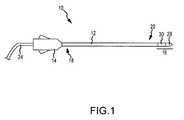
- FIG. 1is a diagrammatic view of an irrigated ablation catheter in accordance with the present teachings
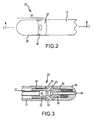
- FIG. 2is a plan view of the distal portion of the irrigated ablation catheter illustrated in FIG. 1 ;
- FIG. 3is a cross-sectional view of the distal portion of the irrigated ablation catheter illustrated in FIGS. 1 and 2 taken substantially along the lines 3 - 3 in FIG. 2 ;
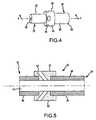
- FIG. 4is an enlarged view of the manifold of the irrigated ablation catheter illustrated in FIGS. 1-3 ;
- FIG. 5is a cross-sectional view of the manifold illustrated in FIGS. 1-4 taken substantially along the lines 5 - 5 in FIG. 4 ;
- FIGS. 6 a - 6 dare enlarged views of alternate exemplary embodiments of the manifold illustrated in FIGS. 1-5 having differently shaped irrigation ports therein;
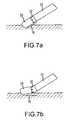
- FIG. 7 ais a diagrammatic view of the catheter illustrated in FIGS. 1 and 2 contacting tissue, wherein the electrode assembly of the catheter is in a non-deflected position;
- FIG. 7 bis a diagrammatic view of the catheter illustrated in FIG. 1 contacting tissue, wherein the electrode assembly of the catheter is in a deflected position;
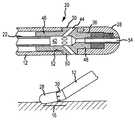
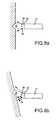
- FIG. 8 ais a diagrammatic view of the distal portion of the catheter illustrated in FIG. 1 contacting tissue, wherein the electrode assembly of the catheter is in a non-deflected position and the diameters of the irrigation ports are substantially equal to each other;
- FIG. 8 bis a diagrammatic view of the distal portion of the catheter illustrated in FIG. 1 contacting tissue, wherein the electrode assembly of the catheter is in a deflected position and the diameters of the irrigation ports are either expanded or contracted, depending on their location;
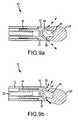
- FIG. 9 ais a cross-sectional view of the distal portion of another exemplary embodiment of the irrigated ablation catheter illustrated in FIGS. 1-8 b , wherein the electrode assembly of the catheter is in a non-deflected position;
- FIG. 9 bis a cross-sectional view of the distal portion of the irrigated ablation catheter illustrated in FIGS. 1-8 b , wherein the electrode assembly of the catheter is in a deflected position;
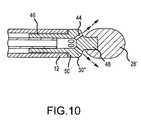
- FIG. 10is a cross-sectional view of the distal portion of another embodiment of the irrigated ablation catheter illustrated in FIGS. 9 a and 9 b , wherein the electrode assembly is in a non-deflected position;
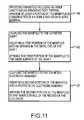
- FIG. 11is a flow chart illustrating a method of manufacturing an irrigated ablation catheter in accordance with the present teachings.
- FIGS. 1 and 2illustrate one exemplary embodiment of an irrigated electrophysiological (EP) catheter 10 .
- the catheter 10includes an elongated shaft 12 , a handle 14 , and an electrode assembly 16 .
- the catheter 10may be used in a number of diagnostic and therapeutic applications, such as the recording of electrograms in the heart, the performance of a cardiac ablation procedure, and other similar applications/procedures. Accordingly, one of ordinary skill in the art will recognize and appreciate that the inventive catheter can be used in any number of diagnostic and therapeutic applications.
- the shaft 12extends along an axis and includes a proximal end 18 and a distal end 20 .
- the shaft 12may be formed of one or more materials known in the art. These materials include, without limitation, PEBAX, Nylon, and polyurethane.
- the shaft 12may be constructed, at least in part, of a metal wire braid, as is known in the art.
- the shaft 12further includes at least one, and typically multiple, lumens therein (best shown in FIG. 3 ).
- the lumensextend longitudinally along an axial portion of the shaft 12 from the proximal end 18 to the distal end 20 , and are configured to have one or more catheter components disposed therein, such as, for example, pull wires, planarity wires, and/or lead wires for electrodes associated with the catheter 10 .
- At least one lumen, lumen 22is an irrigation lumen (or irrigation tube disposed within the shaft 12 ) in which irrigating fluid flows.
- the irrigation lumen 22is coupled to, and/or in fluid communication with, an irrigating fluid source that provides biocompatible irrigating fluid, such as, for example, saline or other irrigating fluids known in the art, to the catheter 10 .
- the catheter 10may further include a connecting tube 24 to couple the fluid source (not shown) with the lumen 22 .
- the handle 14is coupled to the shaft 12 at the proximal end 18 thereof.
- the handle 14is operative to, among other things, to effect movement of the shaft 12 , or steer the catheter 10 , when the catheter 10 is disposed within a patient.
- the handle 14includes an actuator 26 that can be selectively manipulated to navigate the catheter 10 and to position the distal end 20 thereof in a desired location.
- the electrode assembly 16is coupled to the shaft 12 at the distal end 20 thereof. More particularly, as will be described in greater detail below, the electrode assembly 16 comprises a distal portion defined by an electrode 28 , and a proximal portion defined by a manifold 30 .
- the shaft 12is coupled to a first or proximal end 32 of the manifold 30
- the electrode 28is coupled to a second or distal end 34 of the manifold 30 .
- the electrode 28which may be constructed of one or more materials known in the art, is an ablation electrode operative to deliver energy to the heart to ablate a site of cardiac tissue.
- the electrode 28further includes a recessed cavity or pocket 36 that, as will be described in greater detail below, is configured to receive a portion of the manifold 30 , such that the manifold 30 and the electrode 28 may be coupled together.
- the manifold 30is disposed between, and coupled to, each of the distal end 20 of the shaft 12 and the electrode 28 .
- the manifold 30will be described in greater detail with reference to FIGS. 4 and 5 .
- the manifold 30comprises a body 38 defined by an outer surface 40 .
- the body 38has a first or proximal end 32 configured to be coupled with the distal end 20 of the shaft 12 , and a second or distal end 34 configured to be coupled with the electrode 28 .
- the manifoldis formed of a rigid plastic, such as, for example, PEEK
- at least a portion of the manifold 30is constructed of a at least one flexible material.
- the flexible materialis both flexible and elastic, such as, for exemplary purposes only, an elastic polymer having a durometer that allows the manifold 30 to elastically deform or bend/deflect.
- the durometer of the materialis approximately 20-30 D.
- the materialmust be electrically nonconductive and have poor thermal conduction properties. Suitable materials include, without limitation, silicone, polyurethane, Nylon, PEBAX, and other like materials having similar properties.
- the manifold 30further includes an inner cavity 42 disposed in body 38 that, when the manifold 30 is assembled with the shaft 12 , is configured for fluid communication with the irrigation lumen 22 .
- the manifold 30still further includes at least one, and typically a plurality, of irrigation ports 44 disposed in body 38 .
- the inner cavity 42comprises a through-going bore extending from the first end 32 of the body 38 to the second end 34 of the body 38 .
- the inner cavity 42is not a through-going bore, but rather extends from the first end of the body 38 to a point short of the second end 34 of the body 38 . Accordingly, the present invention is not meant to be limited to an embodiment wherein the inner cavity 42 comprises a through-going bore.
- the irrigation ports 44are configured for fluid communication with the inner cavity 42 and extend from the inner cavity 42 to the outer surface 40 of the body 38 .
- the irrigation ports 44allow for irrigating fluid to be distributed from the manifold 30 . More particularly, irrigating fluid flowing in the irrigation lumen 22 flows through the inner cavity 42 , and then through the irrigation ports 44 where the fluid is then distributed to the outer surface of electrode 28 and the tissue proximate the irrigation ports 44 .
- the irrigation ports 44have an oval shape.
- the present inventionis not limited to irrigation ports having such a shape. Rather, the irrigation ports 44 may have any number of shapes. For example, in the exemplary embodiments illustrated in FIGS.
- the irrigation ports 44may have a rectangular shape ( FIG. 6 a ), a diamond shape ( FIG. 6 b ), an oval shape ( FIG. 6 c ), and a round or circular shape with a v-shaped cut therein ( FIG. 6 d ). Accordingly, the present invention is not limited to one particular shape for irrigation ports 44 .
- the manifold 30includes a first portion 46 disposed at the first end 32 , a second portion 48 disposed at the second end 34 , and a third portion 50 disposed between the first portion 46 and the second portion 48 .
- the inner cavity 42extends through each of the first, the second, and the third portions 46 , 48 , 50 .
- the inner cavity 42may only extend through the first and third portions 46 , 50 .
- the first portion 46is configured to be coupled with the shaft 12 . More particularly, the distal end 20 of the shaft 12 is open-ended, thereby defining an opening 52 therein.
- the inner diameter of the shaft 12and therefore, the diameter of the opening 52 , is approximately 1-2 mm, and the outer diameter of the first portion 46 is slightly smaller.
- the first portion 46is configured to be insertable within the opening 52 .
- the first portion 46may coupled with and secured to the inner surface of the shaft 12 in a number of ways known in the art. For instance, in one exemplary embodiment, a reflow process may be employed.
- the outer surface of the first portion 46may be affixed to the inner surface of the shaft 12 using an adhesive, a bonding agent, or any other like material known in the art. Accordingly, those of ordinary skill in the art will appreciate that the shaft 12 and the first portion 46 of the manifold 30 may be coupled together using any number of processes or techniques.
- the first portion 46may be constructed of any number of materials.
- the first portion 46may be constructed of a rigid material, such as a rigid plastic.
- the first portion 46may be constructed of a flexible material such as one or more of the flexible and elastic materials described above.
- the first portion 46may be unitarily-formed with the second and/or third portions 48 , 50 of the manifold 30 , or may be a separate and distinct component that is ultimately assembled with the second and/or third portions 48 , 50 to form the manifold 30 .
- the inner cavity 42 of the manifold 30When inserted within the opening 52 at the distal end 20 of the shaft 12 , the inner cavity 42 of the manifold 30 which extends through the first portion 46 , is substantially aligned with the irrigation lumen 22 .
- the inner diameter of the inner cavity 42 and the outer diameter of the irrigation lumen 22are such that the tube may be inserted within the inner cavity 42 .
- the inner cavity 42has an inner diameter of approximately 0.8-1.1 mm
- the irrigation lumen 22has an outer diameter that is slightly smaller.
- the second portion 48 of the manifold 30is configured to be coupled with the electrode 28 . More particularly, the second portion 48 has an outer diameter that is sized so as to be insertable within the cavity or pocket 36 of the electrode 28 . In an exemplary embodiment provided for illustrative purposes only, the second portion 48 has an outer diameter of approximately 1-2 mm, and the cavity or pocket 36 has an inner diameter that is slightly larger. Accordingly, the second portion 48 can be inserted within the cavity or pocket 36 . Once inserted, the second portion 48 may be coupled with the inner surface of the cavity 36 in a number of ways known in the art. For instance, in one exemplary embodiment, a reflow process may be employed.
- the outer surface of the second portion 48may be affixed to the inner surface of the cavity 36 using an adhesive, a bonding agent, or any other like material known in the art. Accordingly, those of ordinary skill in the art will appreciate that the electrode 28 and the second portion 48 of the manifold 30 may be coupled together using any number of processes or techniques.
- the second portion 48may be constructed of any number of materials.
- the second portion 48may be constructed of a rigid material, such as a rigid plastic.
- the second portion 48may be constructed of a flexible material such as one or more of the flexible and elastic materials described above.
- the second portion 48may be unitarily-formed with the first and/or third portions 46 , 50 of the manifold 30 , or may be a separate and distinct component that is ultimately assembled with one or both of the first and third portions 46 , 50 to form the manifold 30 .
- the inner cavity 42 of the manifold 30extends from the first end 32 of the manifold body 38 through the second end 34 , and therefore, through the first, second, and third portions 46 , 48 , 50 .
- the inner cavity 42is aligned with a fluid passageway 54 disposed within the electrode 28 .
- the fluid passageway 54is a through-going passageway in the electrode 28 extending from the cavity or pocket 36 thereof to the outer surface of the electrode 28 , and is configured for fluid communication with the inner cavity 42 of the manifold 30 .
- the fluid passageway 54is similar to the irrigation ports 44 in that it is operative to distribute irrigating fluid flowing through the inner cavity 42 from the electrode 28 and on to the outer surface of electrode 28 and tissue proximate the fluid passageway 54 . It should be noted, however, that the present invention is not meant to be limited to an embodiment wherein the electrode 28 includes the fluid passageway 54 . Rather, in another exemplary embodiment, the electrode 28 does not include a fluid passageway 54 , and the only “irrigation ports” are those in the manifold 30 .
- the third portion 50 of the manifold 30is disposed between the first and second portions 46 , 48 .
- the third portion 50is constructed of one or more flexible materials, and preferably a flexible and elastic material, to allow for the electrode assembly 16 , and therefore, the manifold 30 and the electrode 28 , to be deflected in one or more directions. More particularly, the third portion 50 is constructed of one or more elastic polymers, such as, for example, silicone, polyurethane, Nylon, PEBAX, and other like materials having similar properties.
- the third portion 50has an outer diameter that is both greater than the outer diameters of the first and second portions 46 , 48 , and substantially the same as the outer diameters of one or both of the shaft 12 and the electrode 28 . Accordingly, when assembled with the shaft 12 and the electrode 28 , the outer surface of the third portion 50 is substantially flush with the outer surfaces of the shaft 12 and the electrode 28 .
- the irrigation ports 44are disposed within the third portion 50 .
- the third portion 50may be unitarily-formed with the first and/or second portions 46 , 48 of the manifold 30 , or may be a separate and distinct component that is ultimately assembled with one or both of the first and second portions 46 , 48 to form manifold 30 .
- the manifold 30and the body 38 thereof, in particular, may be constructed of one or more materials.
- the first, second, and third portions 46 , 48 , 50 of the manifold 30are constructed of a single flexible and/or elastic material.
- the first, second, and third portions 46 , 48 , 50are constructed of the same material but with the first and second portions 46 , 48 being formed of a particular class of the material that has a higher durometer than the particular class of the material of which the third portion 50 is constructed (i.e., the third portion has greater flexibility).
- the first and second portions 46 , 48are constructed of an altogether different material than that of the third portion 50 .
- the first and second portions 46 , 48may constructed of a more rigid material than the flexible and/or elastic material of which the third portion 50 is constructed.
- the manifold 30may be constructed in a number of ways.
- a molding processsuch as a multiple shot molding process, may be used to form the manifold 30 as a single piece wherein the first, second, and third portions 46 , 48 , 50 of the manifold 30 are unitarily formed.
- one or more of the first, second, and third portions 46 , 48 , 50may be separate and distinct components that are assembled with and affixed to the other components. Accordingly, the present invention is not limited to a manifold having one particular construction, but rather manifolds constructed using any number of processes/techniques known in the art remain within the spirit and scope of the present invention.
- the flexible nature of the manifold 30allows for the electrode assembly 16 , and therefore, the manifold 30 and the electrode 28 , to be deflected in one or more directions. More particularly, when the electrode 28 contacts tissue and a sufficient amount of force is applied to the electrode 28 against the tissue by the operator of the catheter 10 , the manifold 30 is elastically deformed or bent/deflected in a desired direction, thereby deflecting the electrode assembly 16 . In an exemplary embodiment, the deflection force applied to the electrode 28 is on the order of 20-50 grams.
- the elastic nature of the manifold materialallows for the electrode assembly 16 to bend/deflect back to its original, non-deflected position. It should be noted that the deflection force required is dependent on the particular material used to construct the manifold 30 . The higher the durometer or the more stiff the material, the more force will be required, and vice versa. Therefore, the 20-50 gram range for the deflection force is provided for exemplary purposes only.
- the flexible manifold 30allows for increased and improved contact between the electrode 28 and the tissue that is to be ablated.
- FIG. 7 adepicts the electrode 28 of the catheter 10 in contact with tissue with the electrode assembly 16 in a non-deflected position.
- FIG. 7 billustrates the electrode 28 of the catheter 10 in contact with tissue wherein the electrode assembly 16 is in a deflected position. It is clear from these illustrations that the flexible manifold 30 allows for improved and increased contact between the electrode 28 and the tissue.
- At least a portion of the manifold 30is constructed of a flexible and elastic material.
- the elastic nature of the materialallows for the irrigating ports 44 to expand and contract (i.e., the diameter of the port gets larger or smaller) as the manifold 30 is elastically deformed or bent/deflected.
- FIGS. 8 a and 8 billustrate each of these aspects.
- the elastic nature of the materialallows the electrode assembly 16 , and therefore, the manifold 30 , to deflect or bend back to its original, non-deflected position, and thus, the irrigation ports 44 likewise return to their original size.
- the catheter 10is in a generally perpendicular relationship with the tissue being ablated and the electrode assembly 16 is in a non-deflected position.
- the irrigation ports 44are generally equal in size to each other and as a result, fluid is substantially equally distributed through each of the irrigation ports 44 .
- the electrode assembly 16is deflected or bent.
- the irrigation ports 44 disposed in the extended area of the manifold 30 , or the area of the manifold 30 that is experiencing the most stretch or expansion during the deflectioni.e., on the outside of the “bend” in the manifold 30
- the size of those irrigation ports 44get larger (i.e., the respective diameters of the ports get larger).
- the irrigation ports 44 disposed in the area of the manifold 30 that is compressed during the deflectioncontract, thereby reducing the size of those irrigation ports 44 (i.e., the respective diameters of the ports get smaller).
- the irrigation ports 44 disposed in other areas of the manifold 30 between the most extended area and the most compressed areaare incrementally expanded or contracted, respectively, to have a size between the most expanded and most contracted of the irrigation ports 44 .
- the larger the size or diameter of the irrigation port 44the greater the volume of irrigating fluid that is distributed therefrom.
- FIGS. 9 a and 9 billustrate another exemplary embodiment of the catheter 10 (catheter 10 ′) and the electrode assembly 16 (electrode assembly 16 ′), in particular. Except as provided below, the detailed description set forth above relating to the catheter 10 and the electrode assembly 16 applies here with equal force, and therefore, will not be entirely repeated.
- the manifold 30 (manifold 30 ′) of electrode assembly 16 ′is disposed between and coupled to each of the shaft 12 and the electrode 28 (electrode 28 ′).
- the electrode 28 ′has a rounded-off proximal end.
- the first portion 46 of the manifold 30 ′is configured to be coupled with the shaft 12
- the second portion 48is configured to be coupled with the recess or pocket 36 in the electrode 28 ′
- the third portion 50is disposed between the first and second portions 46 , 48 .
- the irrigation ports 44are disposed within the third portion 50 .
- the third portion 50includes a concave surface 56 disposed in the distal end thereof (i.e., in the end of the third portion 50 facing the electrode 28 ′).
- the irrigation ports 44are disposed within the concave surface such that the exterior openings of the irrigation ports 44 substantially face the electrode 28 ′.
- the concave surface 56has a concave shape that it is complementary to the rounded-off shape of the proximal end of the electrode 28 ′.
- the manifold 30 ′is constructed of one or more flexible and/or elastic materials. Suitable materials include, without limitation, silicone, polyurethane, Nylon, and PEBAX.
- itis the second portion 48 that is constructed of a flexible material.
- the first and third portions 46 , 50may also, or alternatively, be constructed of a flexible material.
- the first and the third portionsmay also be constructed of a more rigid plastic material, for example.
- the second portion 48is constructed of flexible material to allow for the electrode assembly 16 ′, and therefore, the manifold 18 ′ and the electrode 28 ′, to be deflected.
- the manifold 30 ′when the electrode 28 ′ contacts tissue and a deflection force is applied to the electrode 28 ′ against the tissue by the operator of the catheter 10 ′, the manifold 30 ′, and in this embodiment, the second portion 48 thereof, in particular, is elastically deformed or bent/deflected. As a result, the electrode assembly 16 ′ and the electrode 28 ′ coupled to the second portion 46 is caused to be deflected.
- the rounded-off proximal end of electrode 28 ′makes contact with the complementary-shaped concave surface 56 of the third portion 50 of the manifold 30 ′. Since the irrigation ports 44 are located in the concave surface 56 , as the electrode assembly 16 ′ is further deflected, the electrode 28 ′ begins to close off the irrigation ports 44 disposed in the deflection path (i.e., on the “inside” of the bend or deflection), thereby blocking the flow of irrigating fluid from those ports. Once the electrode assembly 16 ′ is fully deflected, the electrode 28 ′ substantially limits the distribution of irrigating fluid from the irrigation ports 44 disposed in the deflection path.
- the electrode 28 ′also opens or increases the flow path from the irrigation ports 44 disposed opposite the deflection path (i.e., on the “outside” of the bend or deflection) proximate the ablation site. Consequently, the distribution of irrigating fluid from these irrigation ports is increased. Accordingly, the irrigating fluid is redistributed such that more irrigating fluid is distributed through the irrigation ports 44 proximate the ablation site—where more fluid is needed—and less irrigating fluid is distributed from the irrigation ports 44 that are disposed away from the electrodes that are ablating tissue—where little or no irrigating fluid is needed. Therefore, in this embodiment, the electrode assembly 16 ′, and the electrode 28 ′, in particular, acts to “open” and “close” the irrigation ports 44 , or increase and decrease the flow paths from the irrigation ports as the electrode assembly 16 ′ is deflected.
- FIGS. 9 a and 9 b having a concave surface as the distal end of the manifold 30 ′is provided for exemplary purposes only and is not meant to be limiting in nature. Rather, those of ordinary skill in the art will appreciate that the manifold 30 may take on a number of constructions or arrangements that remain within the spirit and scope of the present invention.
- FIG. 10illustrates another exemplary embodiment wherein the distal end of the third portion 50 of the manifold 30 ( 30 ′′) has a tapered or conical shape.
- the irrigation ports 44are disposed in the surface of the third portion proximate the electrode 28 ′.
- the electrode assembly 16 ′When the electrode assembly 16 ′ is in a substantially non-deflected position, all of the irrigation ports 44 are open, and thus, the distribution of irrigating fluid from each of the irrigation ports 44 is substantially equal.
- the irrigation port(s) 44 in the path of the deflectioni.e., on the “inside of the bend/deflection
- the irrigating ports 44 that are not in the deflection pathremain open, and therefore, the irrigating fluid is redistributed such that more irrigating fluid is distributed through the irrigation ports 44 proximate the ablation site, and less irrigating fluid is distributed from the irrigation ports 44 that are disposed away from the ablation site.
- a method of manufacturing an irrigating ablation cathetercomprising a shaft 12 and an electrode 28 will be described.
- a manifold 30having at least a portion constructed of a flexible material is provided.
- the manifold 30further includes an inner cavity 42 and plurality of irrigation ports 44 disposed therein.
- the providing step 58includes providing a manifold 30 that is constructed of a flexible and elastic material.
- a first end 32 of the manifold 30is coupled with the distal end 20 of the shaft 12 .
- the second step 60comprises inserting a first portion 46 of the manifold 30 into an opening 52 in the distal end 20 of the shaft 12 , and affixing the first portion 46 to the shaft 12 .
- Numerous techniques or processesmay be used to affix the components together.
- a reflow processmay be employed.
- the outer surface of the first portion 46may be affixed to the inner surface of the shaft 12 using an adhesive, a bonding agent, or any other like material known in the art. Accordingly, those of ordinary skill in the art will appreciate that the shaft 12 and the first portion 46 of the manifold 30 may be coupled together using any number of processes or techniques.
- a third step 62the second end 34 of the manifold 30 is coupled with the proximal end of the electrode 28 .
- the third step 62comprises inserting a second portion 48 of the manifold 30 into a recess or pocket 36 in the proximal end of the electrode 28 , and affixing the second portion 48 to the electrode 28 , and the inner surface of the recess/pocket 36 , in particular. Numerous techniques or processes may be used to affix the components together. In one exemplary embodiment, a reflow process may be employed.
- the outer surface of the second portion 48may be affixed to the inner surface of the electrode 28 , and more particularly, the inner surface of the recess or pocket 36 , using an adhesive, a bonding agent, or any other like material known in the art. Accordingly, those of ordinary skill in the art will appreciate that the electrode 28 and the second portion 48 of the manifold 30 may be coupled together using any number of techniques.
- the manifoldmay be constructed of any number of flexible and elastic materials.
- the shaft, manifold, and electrode assembly of the cathetermay be assembled in any number of ways.
- the manifold componentmay be assembled or formed in various ways.
- all directional referencese.g., up, down, left, right are only used for identification purposes to aid the reader's understanding of the present invention, and do not create limitations, particularly as to the position, orientation, or use of the invention.
- joinder referencesare to be construed broadly and may include intermediate members between a connection of elements and relative movement between elements. As such, joinder references do not necessarily infer that two elements are directly connected/coupled and in fixed relation to each other. It is intended that all matter contained in the above description or shown in the accompanying drawings shall be interpreted as illustrative only and not limiting. Changes in detail or structure may be made without departing from the invention as defined in the appended claims.
Landscapes
- Health & Medical Sciences (AREA)
- Life Sciences & Earth Sciences (AREA)
- Surgery (AREA)
- Engineering & Computer Science (AREA)
- Plasma & Fusion (AREA)
- Medical Informatics (AREA)
- Otolaryngology (AREA)
- Physics & Mathematics (AREA)
- Cardiology (AREA)
- Biomedical Technology (AREA)
- Heart & Thoracic Surgery (AREA)
- Nuclear Medicine, Radiotherapy & Molecular Imaging (AREA)
- Molecular Biology (AREA)
- Animal Behavior & Ethology (AREA)
- General Health & Medical Sciences (AREA)
- Public Health (AREA)
- Veterinary Medicine (AREA)
- Surgical Instruments (AREA)
Abstract
Description
a. Field of the Invention
The present invention relates to electrophysiological (EP) catheters. More particularly, the present invention relates to an irrigated EP catheter for use in ablation procedures, that includes a flexible manifold disposed between the shaft and electrode assembly of the catheter.
b. Background Art
It is known to use catheters to perform a variety of functions relating to diagnostic and therapeutic medical procedures. Electrophysiological (EP) catheters find particular application in cardiac electrophysiology studies and procedures, such as various cardiac diagnostic and/or ablation procedures. In ablation procedures, electrodes mounted or otherwise disposed at the distal end of the catheter may be used to deliver energy to the heart to ablate a site of cardiac tissue that causes, for example, an arrhythmia or abnormality in the heart rhythm.
Because ablation procedures may generate significant heat, which if not controlled can result in excessive tissue damage, such as, for example, steam pop, tissue charring, and the like, it is desirable to include a mechanism to irrigate the target area and the ablating electrode(s) with biocompatible fluids, such as, for example, saline solution. The use of irrigated catheters can also prevent the formation of soft thrombus and/or blood coagulation during ablation procedures.
Typically, there are three classes of irrigated catheters used in ablation procedures—open, closed, and external irrigated catheters. Closed irrigated catheters usually circulate a cooling fluid within the inner cavity or lumen disposed proximate the ablation electrode.
Open irrigated catheters typically deliver the cooling or irrigating fluid through irrigation ports or outlets to a surface of the ablation electrode. Open irrigated catheters use an inner cavity or lumen of the electrode to distribute saline solution, or other irrigating fluids known in the art, to one or more irrigation ports or outlets disposed within the electrode and between the inner cavity and outer surface of the electrode. Thus, the irrigating fluid flows through the irrigation ports onto the surface of the electrode. However, one drawback of this particular type of irrigated catheter is that the flow of the irrigating fluid through the electrode lowers the temperature of the electrode during operation, often making accurate monitoring and control of the ablative process more difficult.
External irrigated catheters provide one solution to this drawback. More particularly, rather than distributing irrigating fluid directly from the electrode of the catheter, as is done in open irrigated catheters, external irrigated catheters use a fluid manifold disposed between the catheter shaft and the electrode to distribute irrigation fluid from the catheter. More particularly, the manifold distributes irrigation fluid to the external surface of the electrode to cool the electrode and to also minimize the blood coagulation. Accordingly, it is known that external irrigated ablation catheters typically include, in part, a shaft having a proximal end and a distal end, and an electrode assembly disposed at the distal end of the shaft that is comprised of a proximal manifold portion and a distal electrode portion. Therefore, the manifold is disposed between and coupled to each of the distal end of the shaft and the proximal end of the electrode. In known systems, the manifold typically includes an inner cavity configured for fluid communication with an irrigation lumen in the shaft of the catheter. The manifold further includes a plurality of irrigation ports configured for fluid communication with the inner cavity to distribute irrigating fluid passing from the irrigation lumen, to the inner cavity, and then on to the surface of the ablation electrode and/or surrounding tissue.
These known arrangements, however, are not without their drawbacks. For instance, in ablation procedures, it is often desirable to create a deep lesion on the cardiac tissue. In order to do so, it is important to have adequate contact between the electrode of the catheter and the cardiac tissue being ablated. However, the manifold of typical external irrigated ablation catheters is usually formed of rigid plastic materials, such as, for example, polyetheretherketone (PEEK), having little to no flexibility. As such, optimal contact between the electrode and the cardiac tissue may not be achieved because the electrode assembly cannot be sufficiently deflected due to the rigidity of the manifold.
Another drawback lies in the distribution of the irrigating fluid from the manifold. In known arrangements, irrigating fluid is equally distributed from all of the irrigation ports disposed in the manifold regardless of the relative location of the irrigation port in relation to the site where the ablation function or operation is performed. Accordingly, fluid is distributed or expelled from the manifold to areas where irrigation is not needed, and thus, irrigating fluid is unnecessarily wasted.
Accordingly, there is a need for a catheter that will minimize and/or eliminate one or more of the above-identified deficiencies.
The present invention is directed to an irrigated ablation catheter, the constituent components, and a method of manufacturing the same. The catheter according to the present teachings includes a shaft having a proximal end and a distal end, and an irrigation lumen disposed therein. The catheter further includes an electrode assembly having a distal portion defined by an ablation electrode and a proximal portion defined by a manifold. The manifold is disposed between and coupled to each of the shaft and the electrode components of the catheter. The manifold is constructed of a flexible material that allows for the electrode assembly of the catheter, and therefore, the manifold and the electrode, to deflect.
In accordance with one aspect of the invention, the manifold includes a body defined by an outer surface, an inner cavity disposed within the body configured for fluid communication with the irrigation lumen, and an irrigation port disposed within the body and configured for fluid communication with the inner cavity. The irrigation port is a through-going port extending from the inner cavity to the outer surface of the body and is configured to allow for an irrigating fluid to be distributed from the manifold.
In an exemplary embodiment, the manifold, and the body thereof, in particular, includes a first portion, a second portion, and a third portion. The first portion is disposed at a first end of the body and is configured to be coupled to the shaft of the catheter. The second portion is disposed at a second end of the body opposite the first end, and is configured to be coupled to the electrode of the catheter. The third portion is disposed between the first and second portions. At least one of the first, second, and third portions are constructed of a flexible material. As described above, the manifold further includes an inner cavity and an irrigation port that are disposed within the body, with the inner cavity extending through at least the first and third portions of the body.
The method of manufacturing an irrigated ablation catheter comprising a shaft and an ablating electrode in accordance with the present teachings includes providing a manifold having an inner cavity and an irrigating port disposed therein, wherein at least a portion of the manifold is constructed of a flexible material. The method further includes coupling the manifold to the distal end of the shaft. The method still further includes coupling the manifold to the electrode.
The foregoing and other aspects, features, details, utilities, and advantages of the present invention will be apparent from reading the following description and claims, and from reviewing the accompanying drawings.
Referring now to the drawings wherein like reference numerals are used to identify identical components in the various views,FIGS. 1 and 2 illustrate one exemplary embodiment of an irrigated electrophysiological (EP)catheter 10. In its most general form, thecatheter 10 includes anelongated shaft 12, ahandle 14, and anelectrode assembly 16. Thecatheter 10 may be used in a number of diagnostic and therapeutic applications, such as the recording of electrograms in the heart, the performance of a cardiac ablation procedure, and other similar applications/procedures. Accordingly, one of ordinary skill in the art will recognize and appreciate that the inventive catheter can be used in any number of diagnostic and therapeutic applications.
With reference toFIGS. 2 and 3 , theshaft 12 extends along an axis and includes aproximal end 18 and adistal end 20. Theshaft 12 may be formed of one or more materials known in the art. These materials include, without limitation, PEBAX, Nylon, and polyurethane. In an exemplary embodiment, theshaft 12 may be constructed, at least in part, of a metal wire braid, as is known in the art. Theshaft 12 further includes at least one, and typically multiple, lumens therein (best shown inFIG. 3 ). The lumens extend longitudinally along an axial portion of theshaft 12 from theproximal end 18 to thedistal end 20, and are configured to have one or more catheter components disposed therein, such as, for example, pull wires, planarity wires, and/or lead wires for electrodes associated with thecatheter 10. At least one lumen,lumen 22, is an irrigation lumen (or irrigation tube disposed within the shaft12) in which irrigating fluid flows. Theirrigation lumen 22 is coupled to, and/or in fluid communication with, an irrigating fluid source that provides biocompatible irrigating fluid, such as, for example, saline or other irrigating fluids known in the art, to thecatheter 10. Accordingly, as illustrated inFIG. 1 , thecatheter 10 may further include a connectingtube 24 to couple the fluid source (not shown) with thelumen 22.
With continued reference toFIG. 1 , thehandle 14 is coupled to theshaft 12 at theproximal end 18 thereof. Thehandle 14 is operative to, among other things, to effect movement of theshaft 12, or steer thecatheter 10, when thecatheter 10 is disposed within a patient. Thehandle 14 includes an actuator26 that can be selectively manipulated to navigate thecatheter 10 and to position thedistal end 20 thereof in a desired location.
As illustrated inFIGS. 2 and 3 , theelectrode assembly 16 is coupled to theshaft 12 at thedistal end 20 thereof. More particularly, as will be described in greater detail below, theelectrode assembly 16 comprises a distal portion defined by anelectrode 28, and a proximal portion defined by amanifold 30. In an exemplary embodiment, theshaft 12 is coupled to a first orproximal end 32 of the manifold30, and theelectrode 28 is coupled to a second ordistal end 34 of the manifold30. Theelectrode 28, which may be constructed of one or more materials known in the art, is an ablation electrode operative to deliver energy to the heart to ablate a site of cardiac tissue. In one exemplary embodiment, theelectrode 28 further includes a recessed cavity orpocket 36 that, as will be described in greater detail below, is configured to receive a portion of the manifold30, such that the manifold30 and theelectrode 28 may be coupled together.
As briefly described above, and as illustrated inFIGS. 2 and 3 , for example, the manifold30 is disposed between, and coupled to, each of thedistal end 20 of theshaft 12 and theelectrode 28. The manifold30 will be described in greater detail with reference toFIGS. 4 and 5 .
In its most general form, the manifold30 comprises abody 38 defined by an outer surface40. As briefly described above, thebody 38 has a first orproximal end 32 configured to be coupled with thedistal end 20 of theshaft 12, and a second ordistal end 34 configured to be coupled with theelectrode 28. Unlike known ablation catheter assemblies wherein the manifold is formed of a rigid plastic, such as, for example, PEEK, at least a portion of the manifold30 is constructed of a at least one flexible material. Constructing themanifold 30 of a flexible material allows for theelectrode assembly 16, and therefore, the manifold30 and theelectrode 28, to be deflected when theelectrode 28 contacts tissue and a sufficient amount of deflection force is applied to theelectrode 28 against the tissue by the operator of thecatheter 10. In an exemplary embodiment, the flexible material is both flexible and elastic, such as, for exemplary purposes only, an elastic polymer having a durometer that allows the manifold30 to elastically deform or bend/deflect. In an exemplary embodiment, the durometer of the material is approximately 20-30 D. Additionally, the material must be electrically nonconductive and have poor thermal conduction properties. Suitable materials include, without limitation, silicone, polyurethane, Nylon, PEBAX, and other like materials having similar properties.
With continued reference toFIGS. 4 and 5 , the manifold30 further includes aninner cavity 42 disposed inbody 38 that, when the manifold30 is assembled with theshaft 12, is configured for fluid communication with theirrigation lumen 22. The manifold30 still further includes at least one, and typically a plurality, ofirrigation ports 44 disposed inbody 38. In the embodiment illustrated inFIG. 5 , theinner cavity 42 comprises a through-going bore extending from thefirst end 32 of thebody 38 to thesecond end 34 of thebody 38. However, in another exemplary embodiment, theinner cavity 42 is not a through-going bore, but rather extends from the first end of thebody 38 to a point short of thesecond end 34 of thebody 38. Accordingly, the present invention is not meant to be limited to an embodiment wherein theinner cavity 42 comprises a through-going bore.
With continued reference toFIG. 5 , theirrigation ports 44 are configured for fluid communication with theinner cavity 42 and extend from theinner cavity 42 to the outer surface40 of thebody 38. Theirrigation ports 44 allow for irrigating fluid to be distributed from the manifold30. More particularly, irrigating fluid flowing in theirrigation lumen 22 flows through theinner cavity 42, and then through theirrigation ports 44 where the fluid is then distributed to the outer surface ofelectrode 28 and the tissue proximate theirrigation ports 44. In the embodiment illustrated inFIG. 4 , theirrigation ports 44 have an oval shape. However, the present invention is not limited to irrigation ports having such a shape. Rather, theirrigation ports 44 may have any number of shapes. For example, in the exemplary embodiments illustrated inFIGS. 6 a-6d, theirrigation ports 44 may have a rectangular shape (FIG. 6 a), a diamond shape (FIG. 6 b), an oval shape (FIG. 6 c), and a round or circular shape with a v-shaped cut therein (FIG. 6 d). Accordingly, the present invention is not limited to one particular shape forirrigation ports 44.
In the embodiment illustrated inFIGS. 4 and 5 , the manifold30, and more specifically thebody 38 thereof, includes afirst portion 46 disposed at thefirst end 32, asecond portion 48 disposed at thesecond end 34, and athird portion 50 disposed between thefirst portion 46 and thesecond portion 48. In the embodiment illustrated inFIG. 5 , theinner cavity 42 extends through each of the first, the second, and thethird portions inner cavity 42 may only extend through the first andthird portions
Thefirst portion 46 is configured to be coupled with theshaft 12. More particularly, thedistal end 20 of theshaft 12 is open-ended, thereby defining anopening 52 therein. In one exemplary embodiment provided for illustrative purposes only, the inner diameter of theshaft 12, and therefore, the diameter of theopening 52, is approximately 1-2 mm, and the outer diameter of thefirst portion 46 is slightly smaller. Thus, thefirst portion 46 is configured to be insertable within theopening 52. Once inserted, thefirst portion 46 may coupled with and secured to the inner surface of theshaft 12 in a number of ways known in the art. For instance, in one exemplary embodiment, a reflow process may be employed. In another exemplary embodiment, the outer surface of thefirst portion 46 may be affixed to the inner surface of theshaft 12 using an adhesive, a bonding agent, or any other like material known in the art. Accordingly, those of ordinary skill in the art will appreciate that theshaft 12 and thefirst portion 46 of the manifold30 may be coupled together using any number of processes or techniques.
Thefirst portion 46 may be constructed of any number of materials. For example, in an exemplary embodiment thefirst portion 46 may be constructed of a rigid material, such as a rigid plastic. Alternatively, however, in another exemplary embodiment, thefirst portion 46 may be constructed of a flexible material such as one or more of the flexible and elastic materials described above. Additionally, as will be described in greater detail below, thefirst portion 46 may be unitarily-formed with the second and/orthird portions third portions manifold 30.
When inserted within theopening 52 at thedistal end 20 of theshaft 12, theinner cavity 42 of the manifold30 which extends through thefirst portion 46, is substantially aligned with theirrigation lumen 22. In an exemplary embodiment, the inner diameter of theinner cavity 42 and the outer diameter of theirrigation lumen 22 are such that the tube may be inserted within theinner cavity 42. For instance, in an exemplary embodiment provided for illustrative purposes only, theinner cavity 42 has an inner diameter of approximately 0.8-1.1 mm, and theirrigation lumen 22 has an outer diameter that is slightly smaller. Once inserted, theirrigation lumen 22 may be affixed or otherwise bonded to the inner surface of theinner cavity 42 using techniques known in the art.
With continued reference toFIGS. 4 and 5 , thesecond portion 48 of the manifold30 is configured to be coupled with theelectrode 28. More particularly, thesecond portion 48 has an outer diameter that is sized so as to be insertable within the cavity orpocket 36 of theelectrode 28. In an exemplary embodiment provided for illustrative purposes only, thesecond portion 48 has an outer diameter of approximately 1-2 mm, and the cavity orpocket 36 has an inner diameter that is slightly larger. Accordingly, thesecond portion 48 can be inserted within the cavity orpocket 36. Once inserted, thesecond portion 48 may be coupled with the inner surface of thecavity 36 in a number of ways known in the art. For instance, in one exemplary embodiment, a reflow process may be employed. In another exemplary embodiment, the outer surface of thesecond portion 48 may be affixed to the inner surface of thecavity 36 using an adhesive, a bonding agent, or any other like material known in the art. Accordingly, those of ordinary skill in the art will appreciate that theelectrode 28 and thesecond portion 48 of the manifold30 may be coupled together using any number of processes or techniques.
As with thefirst portion 46, thesecond portion 48 may be constructed of any number of materials. For example, in an exemplary embodiment, thesecond portion 48 may be constructed of a rigid material, such as a rigid plastic. Alternatively, however, in another exemplary embodiment, thesecond portion 48 may be constructed of a flexible material such as one or more of the flexible and elastic materials described above. Further, as with thefirst portion 46, and as will be described in greater detail below, thesecond portion 48 may be unitarily-formed with the first and/orthird portions third portions manifold 30.
Additionally, in the exemplary embodiment illustrated inFIG. 3 , theinner cavity 42 of the manifold30 extends from thefirst end 32 of themanifold body 38 through thesecond end 34, and therefore, through the first, second, andthird portions inner cavity 42 is aligned with afluid passageway 54 disposed within theelectrode 28. In this embodiment, thefluid passageway 54 is a through-going passageway in theelectrode 28 extending from the cavity orpocket 36 thereof to the outer surface of theelectrode 28, and is configured for fluid communication with theinner cavity 42 of the manifold30. Thefluid passageway 54 is similar to theirrigation ports 44 in that it is operative to distribute irrigating fluid flowing through theinner cavity 42 from theelectrode 28 and on to the outer surface ofelectrode 28 and tissue proximate thefluid passageway 54. It should be noted, however, that the present invention is not meant to be limited to an embodiment wherein theelectrode 28 includes thefluid passageway 54. Rather, in another exemplary embodiment, theelectrode 28 does not include afluid passageway 54, and the only “irrigation ports” are those in themanifold 30.
With reference toFIGS. 4 and 5 , thethird portion 50 of the manifold30 is disposed between the first andsecond portions third portion 50 is constructed of one or more flexible materials, and preferably a flexible and elastic material, to allow for theelectrode assembly 16, and therefore, the manifold30 and theelectrode 28, to be deflected in one or more directions. More particularly, thethird portion 50 is constructed of one or more elastic polymers, such as, for example, silicone, polyurethane, Nylon, PEBAX, and other like materials having similar properties. In an exemplary embodiment, thethird portion 50 has an outer diameter that is both greater than the outer diameters of the first andsecond portions shaft 12 and theelectrode 28. Accordingly, when assembled with theshaft 12 and theelectrode 28, the outer surface of thethird portion 50 is substantially flush with the outer surfaces of theshaft 12 and theelectrode 28.
As illustrated inFIGS. 2-6 d, in an exemplary embodiment, theirrigation ports 44 are disposed within thethird portion 50. Further, as with the first andsecond portions third portion 50 may be unitarily-formed with the first and/orsecond portions second portions manifold 30.
As briefly described above, the manifold30, and thebody 38 thereof, in particular, may be constructed of one or more materials. In one exemplary embodiment, the first, second, andthird portions third portions second portions third portion 50 is constructed (i.e., the third portion has greater flexibility). In yet another exemplary embodiment, the first andsecond portions third portion 50. In such an embodiment, the first andsecond portions third portion 50 is constructed.
Whether the first andsecond portions third portion 50, the same type of material but with a higher durometer, or a different material altogether, the manifold30 may be constructed in a number of ways. In an exemplary embodiment, a molding process, such as a multiple shot molding process, may be used to form the manifold30 as a single piece wherein the first, second, andthird portions third portions
As briefly described above, and as illustrated inFIGS. 7 aand7b, when theshaft 12, theelectrode 28, and the manifold30 are assembled, the flexible nature of the manifold30 allows for theelectrode assembly 16, and therefore, the manifold30 and theelectrode 28, to be deflected in one or more directions. More particularly, when theelectrode 28 contacts tissue and a sufficient amount of force is applied to theelectrode 28 against the tissue by the operator of thecatheter 10, the manifold30 is elastically deformed or bent/deflected in a desired direction, thereby deflecting theelectrode assembly 16. In an exemplary embodiment, the deflection force applied to theelectrode 28 is on the order of 20-50 grams. Once the deflection force is removed, or at least sufficiently reduced, the elastic nature of the manifold material allows for theelectrode assembly 16 to bend/deflect back to its original, non-deflected position. It should be noted that the deflection force required is dependent on the particular material used to construct the manifold30. The higher the durometer or the more stiff the material, the more force will be required, and vice versa. Therefore, the 20-50 gram range for the deflection force is provided for exemplary purposes only.
Accordingly, theflexible manifold 30 allows for increased and improved contact between theelectrode 28 and the tissue that is to be ablated. To illustrate this benefit,FIG. 7 adepicts theelectrode 28 of thecatheter 10 in contact with tissue with theelectrode assembly 16 in a non-deflected position. Conversely,FIG. 7 billustrates theelectrode 28 of thecatheter 10 in contact with tissue wherein theelectrode assembly 16 is in a deflected position. It is clear from these illustrations that theflexible manifold 30 allows for improved and increased contact between theelectrode 28 and the tissue.
With reference toFIGS. 8 aand8b, another aspect of the present invention will be described. As set forth above, in an exemplary embodiment, at least a portion of the manifold30 is constructed of a flexible and elastic material. In an embodiment wherein theirrigation ports 44 are disposed within this portion of the manifold30, the elastic nature of the material allows for the irrigatingports 44 to expand and contract (i.e., the diameter of the port gets larger or smaller) as the manifold30 is elastically deformed or bent/deflected. As a consequence, rather than distributing the irrigating fluid substantially equally through each of theirrigation ports 44, the fluid may be redistributed such that more fluid is distributed through the expanded ports located proximate the ablation site—where it is needed—and less fluid is distributed through the contracted ports located away from the ablation site—where fluid may not be needed.FIGS. 8 aand8billustrate each of these aspects. As described above, once the deflection force applied to theelectrode 28 is removed, or at least sufficiently reduced, the elastic nature of the material allows theelectrode assembly 16, and therefore, the manifold30, to deflect or bend back to its original, non-deflected position, and thus, theirrigation ports 44 likewise return to their original size.
InFIG. 8 a, thecatheter 10 is in a generally perpendicular relationship with the tissue being ablated and theelectrode assembly 16 is in a non-deflected position. In such a relationship, theirrigation ports 44 are generally equal in size to each other and as a result, fluid is substantially equally distributed through each of theirrigation ports 44.
Conversely, inFIG. 8 b, theelectrode assembly 16 is deflected or bent. As a result, theirrigation ports 44 disposed in the extended area of the manifold30, or the area of the manifold30 that is experiencing the most stretch or expansion during the deflection (i.e., on the outside of the “bend” in the manifold30), expand due to the elasticity of the material. Accordingly, the size of thoseirrigation ports 44 get larger (i.e., the respective diameters of the ports get larger). On the other hand, theirrigation ports 44 disposed in the area of the manifold30 that is compressed during the deflection (i.e., on the inside of the “bend” in the manifold30) contract, thereby reducing the size of those irrigation ports44 (i.e., the respective diameters of the ports get smaller). Theirrigation ports 44 disposed in other areas of the manifold30 between the most extended area and the most compressed area are incrementally expanded or contracted, respectively, to have a size between the most expanded and most contracted of theirrigation ports 44. The larger the size or diameter of theirrigation port 44, the greater the volume of irrigating fluid that is distributed therefrom.
As illustrated inFIG. 9 a, the manifold30 (manifold 30′) ofelectrode assembly 16′ is disposed between and coupled to each of theshaft 12 and the electrode28 (electrode 28′). In an exemplary embodiment, and for reasons that will be discussed in greater detail below, theelectrode 28′ has a rounded-off proximal end.
With continued reference toFIG. 9 a, in an exemplary embodiment, thefirst portion 46 of the manifold30′ is configured to be coupled with theshaft 12, thesecond portion 48 is configured to be coupled with the recess orpocket 36 in theelectrode 28′, and thethird portion 50 is disposed between the first andsecond portions irrigation ports 44 are disposed within thethird portion 50. In this embodiment, thethird portion 50 includes aconcave surface 56 disposed in the distal end thereof (i.e., in the end of thethird portion 50 facing theelectrode 28′). Additionally, theirrigation ports 44 are disposed within the concave surface such that the exterior openings of theirrigation ports 44 substantially face theelectrode 28′. Further, for reasons that will be discussed in greater detail below, theconcave surface 56 has a concave shape that it is complementary to the rounded-off shape of the proximal end of theelectrode 28′.
With reference toFIG. 9 b, and as with the embodiment of the manifold30 described above, at least a portion of the manifold30′ is constructed of one or more flexible and/or elastic materials. Suitable materials include, without limitation, silicone, polyurethane, Nylon, and PEBAX. In an exemplary embodiment, it is thesecond portion 48 that is constructed of a flexible material. However, it should be noted that in addition tosecond portion 48, the first andthird portions
As illustrated inFIG. 9 b, thesecond portion 48 is constructed of flexible material to allow for theelectrode assembly 16′, and therefore, the manifold18′ and theelectrode 28′, to be deflected. As described in greater detail above, when theelectrode 28′ contacts tissue and a deflection force is applied to theelectrode 28′ against the tissue by the operator of thecatheter 10′, the manifold30′, and in this embodiment, thesecond portion 48 thereof, in particular, is elastically deformed or bent/deflected. As a result, theelectrode assembly 16′ and theelectrode 28′ coupled to thesecond portion 46 is caused to be deflected. As theelectrode assembly 16′ is deflected, the rounded-off proximal end ofelectrode 28′ makes contact with the complementary-shapedconcave surface 56 of thethird portion 50 of the manifold30′. Since theirrigation ports 44 are located in theconcave surface 56, as theelectrode assembly 16′ is further deflected, theelectrode 28′ begins to close off theirrigation ports 44 disposed in the deflection path (i.e., on the “inside” of the bend or deflection), thereby blocking the flow of irrigating fluid from those ports. Once theelectrode assembly 16′ is fully deflected, theelectrode 28′ substantially limits the distribution of irrigating fluid from theirrigation ports 44 disposed in the deflection path.
Conversely, as theelectrode assembly 16′ deflects, theelectrode 28′ also opens or increases the flow path from theirrigation ports 44 disposed opposite the deflection path (i.e., on the “outside” of the bend or deflection) proximate the ablation site. Consequently, the distribution of irrigating fluid from these irrigation ports is increased. Accordingly, the irrigating fluid is redistributed such that more irrigating fluid is distributed through theirrigation ports 44 proximate the ablation site—where more fluid is needed—and less irrigating fluid is distributed from theirrigation ports 44 that are disposed away from the electrodes that are ablating tissue—where little or no irrigating fluid is needed. Therefore, in this embodiment, theelectrode assembly 16′, and theelectrode 28′, in particular, acts to “open” and “close” theirrigation ports 44, or increase and decrease the flow paths from the irrigation ports as theelectrode assembly 16′ is deflected.
It should be noted that the embodiment illustrated inFIGS. 9 aand9bhaving a concave surface as the distal end of the manifold30′ is provided for exemplary purposes only and is not meant to be limiting in nature. Rather, those of ordinary skill in the art will appreciate that the manifold30 may take on a number of constructions or arrangements that remain within the spirit and scope of the present invention. For example,FIG. 10 illustrates another exemplary embodiment wherein the distal end of thethird portion 50 of the manifold30 (30″) has a tapered or conical shape.
In this embodiment, theirrigation ports 44 are disposed in the surface of the third portion proximate theelectrode 28′. When theelectrode assembly 16′ is in a substantially non-deflected position, all of theirrigation ports 44 are open, and thus, the distribution of irrigating fluid from each of theirrigation ports 44 is substantially equal. As theelectrode assembly 16′ is deflected, the irrigation port(s)44 in the path of the deflection (i.e., on the “inside of the bend/deflection) is/are closed off, thereby blocking or impeding the flow of irrigating fluid from those irrigation ports. The irrigatingports 44 that are not in the deflection path remain open, and therefore, the irrigating fluid is redistributed such that more irrigating fluid is distributed through theirrigation ports 44 proximate the ablation site, and less irrigating fluid is distributed from theirrigation ports 44 that are disposed away from the ablation site.
With reference toFIG. 11 , a method of manufacturing an irrigating ablation catheter comprising ashaft 12 and anelectrode 28 will be described. In afirst step 58, a manifold30 having at least a portion constructed of a flexible material is provided. The manifold30 further includes aninner cavity 42 and plurality ofirrigation ports 44 disposed therein. In another exemplary embodiment, the providingstep 58 includes providing a manifold30 that is constructed of a flexible and elastic material.
In asecond step 60, afirst end 32 of the manifold30 is coupled with thedistal end 20 of theshaft 12. In an exemplary embodiment, thesecond step 60 comprises inserting afirst portion 46 of the manifold30 into anopening 52 in thedistal end 20 of theshaft 12, and affixing thefirst portion 46 to theshaft 12. Numerous techniques or processes may be used to affix the components together. In one exemplary embodiment, a reflow process may be employed. In another exemplary embodiment, the outer surface of thefirst portion 46 may be affixed to the inner surface of theshaft 12 using an adhesive, a bonding agent, or any other like material known in the art. Accordingly, those of ordinary skill in the art will appreciate that theshaft 12 and thefirst portion 46 of the manifold30 may be coupled together using any number of processes or techniques.
In athird step 62, thesecond end 34 of the manifold30 is coupled with the proximal end of theelectrode 28. In an exemplary embodiment, thethird step 62 comprises inserting asecond portion 48 of the manifold30 into a recess orpocket 36 in the proximal end of theelectrode 28, and affixing thesecond portion 48 to theelectrode 28, and the inner surface of the recess/pocket 36, in particular. Numerous techniques or processes may be used to affix the components together. In one exemplary embodiment, a reflow process may be employed. In another exemplary embodiment, the outer surface of thesecond portion 48 may be affixed to the inner surface of theelectrode 28, and more particularly, the inner surface of the recess orpocket 36, using an adhesive, a bonding agent, or any other like material known in the art. Accordingly, those of ordinary skill in the art will appreciate that theelectrode 28 and thesecond portion 48 of the manifold30 may be coupled together using any number of techniques.
Although only certain embodiments of this invention have been described above with a certain degree of particularity, those skilled in the art could make numerous alterations to the disclosed embodiments without departing from the scope of this invention. For example, the manifold may be constructed of any number of flexible and elastic materials. Further, the shaft, manifold, and electrode assembly of the catheter may be assembled in any number of ways. Still further, the manifold component may be assembled or formed in various ways. Additionally, all directional references (e.g., up, down, left, right) are only used for identification purposes to aid the reader's understanding of the present invention, and do not create limitations, particularly as to the position, orientation, or use of the invention. Joinder references (e.g., attached, coupled, connected, and the like) are to be construed broadly and may include intermediate members between a connection of elements and relative movement between elements. As such, joinder references do not necessarily infer that two elements are directly connected/coupled and in fixed relation to each other. It is intended that all matter contained in the above description or shown in the accompanying drawings shall be interpreted as illustrative only and not limiting. Changes in detail or structure may be made without departing from the invention as defined in the appended claims.
Claims (14)
1. An irrigated ablation catheter, comprising
a shaft comprising a proximal end, a distal end, and at least one irrigation lumen therein;
an ablation electrode; and
a manifold disposed between and coupled to each of said distal end of said shaft and said electrode said manifold including
a body defined by an outer surface, said body comprising a plurality of portions wherein one of said plurality of portions is constructed of a flexible and elastic material and has a flexibility greater than that of said shaft to allow said one of said plurality of portions to be elastically deformed to thereby allow said manifold and said electrode to be defected relative to said shaft, and further wherein said one of said plurality of portions has a greater degree of flexibility than another of said plurality of portions;
an inner cavity disposed within said body, and configured for fluid communication with said irrigation lumen; and
an irrigation port disposed within said body, extending from said inner cavity to said outer surface of said body and configured to allow for an irrigating fluid to be distributed from said manifold.
2. The catheter ofclaim 1 , wherein said irrigation port is disposed within said one of said plurality of portions of said manifold body constructed of a flexible and elastic material, and is expandable when said manifold and said electrode deflect in a first direction and contractible when said manifold and said electrode deflect in a second direction opposite said first direction.
3. The catheter ofclaim 1 , wherein said plurality of portions of said manifold body comprises
a first portion coupled with said distal end of said shaft;
a second portion coupled with said electrode assembly; and
a third portion disposed between said first and second portions;
wherein one of said first, second, and third portions comprises said one of said plurality of portions of said manifold body constructed of a flexible and elastic material; and
further wherein said inner cavity extends through at least said first and third portions.
4. The catheter ofclaim 3 wherein said first portion of said manifold is disposed within said distal end of said shaft, said second portion of said manifold is disposed within a recess in said electrode, and said third portion is disposed between said shaft and electrode.
5. The catheter ofclaim 3 , wherein said one of said plurality of portions of said manifold body constructed of a flexible and elastic material is said third portion, and said irrigation port is disposed in said third portion.
6. The catheter ofclaim 3 , wherein said one of said plurality of portions of said manifold body constructed of a flexible and elastic material is said second portion.
7. The catheter ofclaim 6 , wherein said third portion includes a distal end and a concave surface formed in said distal end, and further wherein said irrigation port is disposed within said concave surface.
8. The catheter ofclaim 7 , wherein said electrode includes a proximal end and said proximal end is rounded-off to have a complementary shape to said concave surface of said third portion, said proximal end of said electrode assembly configured to increase the flow path from said irrigation port when said manifold and said electrode deflect in a first direction, and to decrease the flow path from said irrigation port when said manifold and said electrode deflect in a second direction opposite said first direction.
9. The catheter ofclaim 6 , wherein said third portion includes a distal end and said distal end of said third portion has a conical shape.
10. The catheter ofclaim 1 , wherein said flexible and elastic material has a durometer of 20-30D.
11. The catheter ofclaim 1 , wherein said electrode comprises a fluid passageway disposed therein and extending therethrough, said fluid passageway configured for fluid communication with said inner cavity of said manifold and to allow for an irrigating fluid to be distributed from said electrode.
12. The catheter ofclaim 1 , wherein said one of said plurality of portions of said body is constructed of a first class of said flexible and elastic material, and another of said plurality of portions of said body is constructed of a second class of said flexible and elastic material, and further wherein said first class of said material has a lower durometer than said second class of said material.
13. The catheter ofclaim 1 , wherein said one of said plurality of portions of said body is constructed of a first material, and another of said plurality of portions of said body is constructed of a second material different than said first material.
14. An irrigated ablation catheter, comprising
a shaft comprising a proximal end, a distal end, and at least one irrigation lumen therein;
an ablation electrode; and
a manifold disposed between and coupled to each of said distal end of said shaft and said electrode, wherein said manifold has a flexibility and elasticity greater than that of said shaft to allow said manifold and said electrode to be deflected relative to said shaft, said manifold comprising:
a body defined by an outer surface;
an inner cavity disposed within said body and configured for fluid communication with said irrigation lumen; and
an irrigation port disposed within said body extending from said inner cavity to said outer surface of said body and configured to allow for an irrigating fluid to be distributed from said manifold.
Priority Applications (3)
| Application Number | Priority Date | Filing Date | Title |
|---|---|---|---|
| US12/326,579US8974453B2 (en) | 2008-12-02 | 2008-12-02 | Irrigated ablation catheter having a flexible manifold |
| US14/610,843US10182864B2 (en) | 2008-12-02 | 2015-01-30 | Irrigated ablation catheter having a flexible manifold |
| US16/216,671US10709500B2 (en) | 2008-12-02 | 2018-12-11 | Irrigated ablation catheter having a flexible manifold |
Applications Claiming Priority (1)
| Application Number | Priority Date | Filing Date | Title |
|---|---|---|---|
| US12/326,579US8974453B2 (en) | 2008-12-02 | 2008-12-02 | Irrigated ablation catheter having a flexible manifold |
Related Child Applications (1)
| Application Number | Title | Priority Date | Filing Date |
|---|---|---|---|
| US14/610,843ContinuationUS10182864B2 (en) | 2008-12-02 | 2015-01-30 | Irrigated ablation catheter having a flexible manifold |
Publications (2)
| Publication Number | Publication Date |
|---|---|
| US20100137859A1 US20100137859A1 (en) | 2010-06-03 |
| US8974453B2true US8974453B2 (en) | 2015-03-10 |
Family
ID=42223491
Family Applications (3)
| Application Number | Title | Priority Date | Filing Date |
|---|---|---|---|
| US12/326,579Active2033-06-07US8974453B2 (en) | 2008-12-02 | 2008-12-02 | Irrigated ablation catheter having a flexible manifold |
| US14/610,843Active2029-06-14US10182864B2 (en) | 2008-12-02 | 2015-01-30 | Irrigated ablation catheter having a flexible manifold |
| US16/216,671ActiveUS10709500B2 (en) | 2008-12-02 | 2018-12-11 | Irrigated ablation catheter having a flexible manifold |
Family Applications After (2)
| Application Number | Title | Priority Date | Filing Date |
|---|---|---|---|
| US14/610,843Active2029-06-14US10182864B2 (en) | 2008-12-02 | 2015-01-30 | Irrigated ablation catheter having a flexible manifold |
| US16/216,671ActiveUS10709500B2 (en) | 2008-12-02 | 2018-12-11 | Irrigated ablation catheter having a flexible manifold |
Country Status (1)
| Country | Link |
|---|---|
| US (3) | US8974453B2 (en) |
Cited By (13)
| Publication number | Priority date | Publication date | Assignee | Title |
|---|---|---|---|---|
| US20150010342A1 (en)* | 2012-03-27 | 2015-01-08 | Michael Groth | Pin Joint For An Eccentric Screw Pump |
| US10105179B2 (en) | 2016-05-02 | 2018-10-23 | Affera, Inc. | Catheter sensing and irrigating |
| US11033323B2 (en) | 2017-09-29 | 2021-06-15 | Cilag Gmbh International | Systems and methods for managing fluid and suction in electrosurgical systems |
| US11484358B2 (en) | 2017-09-29 | 2022-11-01 | Cilag Gmbh International | Flexible electrosurgical instrument |
| US11490951B2 (en) | 2017-09-29 | 2022-11-08 | Cilag Gmbh International | Saline contact with electrodes |
| US11497546B2 (en) | 2017-03-31 | 2022-11-15 | Cilag Gmbh International | Area ratios of patterned coatings on RF electrodes to reduce sticking |
| US20230320780A1 (en)* | 2021-03-24 | 2023-10-12 | Japan Lifeline Co., Ltd. | Electrode catheter |
| US11839422B2 (en) | 2016-09-23 | 2023-12-12 | Cilag Gmbh International | Electrosurgical instrument with fluid diverter |
| USD1014762S1 (en) | 2021-06-16 | 2024-02-13 | Affera, Inc. | Catheter tip with electrode panel(s) |
| US11957342B2 (en) | 2021-11-01 | 2024-04-16 | Cilag Gmbh International | Devices, systems, and methods for detecting tissue and foreign objects during a surgical operation |
| US12023087B2 (en) | 2017-03-15 | 2024-07-02 | Cilag Gmbh International | Electrosurgical instrument with textured jaws |
| USD1074999S1 (en) | 2019-12-16 | 2025-05-13 | Affera, Inc. | Catheter tip with electrode panel(s) |
| US12396786B2 (en) | 2019-03-22 | 2025-08-26 | Stryker Corporation | Systems for ablating tissue |
Families Citing this family (15)
| Publication number | Priority date | Publication date | Assignee | Title |
|---|---|---|---|---|
| US10828462B2 (en)* | 2009-06-01 | 2020-11-10 | Sanovas Intellectual Property, Llc | Systems and methods for impairing smooth muscle tissue function |
| US10792096B2 (en)* | 2010-11-08 | 2020-10-06 | Baylis Medical Company Inc. | Medical device having a support structure |
| US8979840B2 (en) | 2010-12-17 | 2015-03-17 | St. Jude Medical, Atrial Fibrillation Division, Inc. | Irrigant distribution system for flexible electrodes |
| US8814857B2 (en) | 2010-12-17 | 2014-08-26 | St. Jude Medical, Atrial Filbrillation Division, Inc. | Irrigated ablation electrode assemblies |
| US9855094B2 (en) | 2010-12-28 | 2018-01-02 | St. Jude Medical, Atrial Fibrillation Division, Inc. | Multi-rate fluid flow and variable power delivery for ablation electrode assemblies used in catheter ablation procedures |
| US9788891B2 (en) | 2010-12-28 | 2017-10-17 | St. Jude Medical, Atrial Fibrillation Division, Inc. | Ablation electrode assemblies and methods for using same |
| US9011428B2 (en)* | 2011-03-02 | 2015-04-21 | Arthrocare Corporation | Electrosurgical device with internal digestor electrode |
| JP5731668B2 (en)* | 2011-06-16 | 2015-06-10 | セント・ジュード・メディカル・エイトリアル・フィブリレーション・ディヴィジョン・インコーポレーテッド | Irrigation solution dispersion system for flexible electrodes |
| US20130274737A1 (en)* | 2012-04-16 | 2013-10-17 | Boston Scientific Scimed, Inc. | Renal nerve modulation catheter design |
| JP5348675B1 (en)* | 2012-05-30 | 2013-11-20 | 日本ライフライン株式会社 | Electrode catheter |
| US9066725B2 (en) | 2012-12-06 | 2015-06-30 | St. Jude Medical, Atrial Fibrillation Division, Inc. | Irrigant distribution system for electrodes |
| EP2968846B1 (en)* | 2013-03-12 | 2022-05-04 | Baylis Medical Company Inc. | Medical device having a support structure |
| US11937873B2 (en) | 2013-03-12 | 2024-03-26 | Boston Scientific Medical Device Limited | Electrosurgical device having a lumen |
| US9364285B2 (en)* | 2014-04-01 | 2016-06-14 | Biosense Webster (Israel) Ltd. | Sealed two-way magnetic manifold |
| CN107205774B (en)* | 2015-01-28 | 2020-05-29 | 圣犹达医疗用品心脏病学部门有限公司 | Thermal mapping catheter |
Citations (35)
| Publication number | Priority date | Publication date | Assignee | Title |
|---|---|---|---|---|
| US5056517A (en) | 1989-07-24 | 1991-10-15 | Consiglio Nazionale Delle Ricerche | Biomagnetically localizable multipurpose catheter and method for magnetocardiographic guided intracardiac mapping, biopsy and ablation of cardiac arrhythmias |
| US5230349A (en) | 1988-11-25 | 1993-07-27 | Sensor Electronics, Inc. | Electrical heating catheter |
| US5348554A (en) | 1992-12-01 | 1994-09-20 | Cardiac Pathways Corporation | Catheter for RF ablation with cooled electrode |
| US5403311A (en) | 1993-03-29 | 1995-04-04 | Boston Scientific Corporation | Electro-coagulation and ablation and other electrotherapeutic treatments of body tissue |
| US5431168A (en) | 1993-08-23 | 1995-07-11 | Cordis-Webster, Inc. | Steerable open-lumen catheter |
| US5462521A (en) | 1993-12-21 | 1995-10-31 | Angeion Corporation | Fluid cooled and perfused tip for a catheter |
| US5545161A (en) | 1992-12-01 | 1996-08-13 | Cardiac Pathways Corporation | Catheter for RF ablation having cooled electrode with electrically insulated sleeve |
| US5676693A (en) | 1992-11-13 | 1997-10-14 | Scimed Life Systems, Inc. | Electrophysiology device |
| US5769618A (en)* | 1995-09-25 | 1998-06-23 | Heishin Sobi Kabushiki Kaisha | Uniaxial eccentric screw pump having a flexible plastic shaft |
| US5792140A (en) | 1997-05-15 | 1998-08-11 | Irvine Biomedical, Inc. | Catheter having cooled multiple-needle electrode |
| US5814029A (en) | 1994-11-03 | 1998-09-29 | Daig Corporation | Guiding introducer system for use in ablation and mapping procedures in the left ventricle |
| US5843152A (en) | 1997-06-02 | 1998-12-01 | Irvine Biomedical, Inc. | Catheter system having a ball electrode |
| US5913856A (en) | 1997-05-19 | 1999-06-22 | Irvine Biomedical, Inc. | Catheter system having a porous shaft and fluid irrigation capabilities |
| US5919188A (en) | 1997-02-04 | 1999-07-06 | Medtronic, Inc. | Linear ablation catheter |
| US5971968A (en) | 1999-04-08 | 1999-10-26 | Irvine Biomedical, Inc. | Catheter probe having contrast media delivery means |
| US6120476A (en) | 1997-12-01 | 2000-09-19 | Cordis Webster, Inc. | Irrigated tip catheter |
| US6162219A (en) | 1997-10-21 | 2000-12-19 | Akzo Nobel N.V. | Electrode |
| US6168594B1 (en) | 1992-11-13 | 2001-01-02 | Scimed Life Systems, Inc. | Electrophysiology RF energy treatment device |
| US6171275B1 (en) | 1998-12-03 | 2001-01-09 | Cordis Webster, Inc. | Irrigated split tip electrode catheter |
| US6217576B1 (en) | 1997-05-19 | 2001-04-17 | Irvine Biomedical Inc. | Catheter probe for treating focal atrial fibrillation in pulmonary veins |
| US6238393B1 (en) | 1998-07-07 | 2001-05-29 | Medtronic, Inc. | Method and apparatus for creating a bi-polar virtual electrode used for the ablation of tissue |
| US20020007181A1 (en)* | 1997-09-11 | 2002-01-17 | Zikorus Arthur W. | Expandable vein ligator catheter having multiple electrode leads, and method |
| US6363937B1 (en) | 1995-06-07 | 2002-04-02 | Arthrocare Corporation | System and methods for electrosurgical treatment of the digestive system |
| US20020087156A1 (en) | 1997-07-08 | 2002-07-04 | Maguire Mark A. | Medical device with sensor cooperating with expandable member |
| US6611699B2 (en) | 2001-06-28 | 2003-08-26 | Scimed Life Systems, Inc. | Catheter with an irrigated composite tip electrode |
| US20030212394A1 (en) | 2001-05-10 | 2003-11-13 | Rob Pearson | Tissue ablation apparatus and method |
| WO2005048858A1 (en) | 2003-10-29 | 2005-06-02 | Universitair Medisch Centrum Utrecht | Catheter and method, in particular for ablation and like technique |
| US20050177151A1 (en) | 2001-06-20 | 2005-08-11 | Coen Thomas P. | Irrigation sheath |
| WO2005112814A2 (en) | 2004-05-17 | 2005-12-01 | C.R. Bard, Inc. | Irrigated catheter |
| US20060184165A1 (en) | 2005-02-14 | 2006-08-17 | Webster Wilton W Jr | Irrigated tip catheter and method for manufacturing therefor |
| US7166105B2 (en) | 1995-02-22 | 2007-01-23 | Medtronic, Inc. | Pen-type electrosurgical instrument |
| US20070156131A1 (en) | 2005-12-30 | 2007-07-05 | Keshava Datta | Ablation catheter with improved tip cooling |
| US20070270791A1 (en) | 2006-05-16 | 2007-11-22 | Huisun Wang | Ablation electrode assembly and methods for improved control of temperature and minimization of coagulation and tissue damage |
| US20080071267A1 (en) | 2005-05-16 | 2008-03-20 | Huisun Wang | Irrigated ablation electrode assembly and method for control of temperature |
| WO2008045925A2 (en) | 2006-10-10 | 2008-04-17 | St. Jude Medical, Atrial Fibrillation Division, Inc. | Ablation electrode assembly with insulated distal outlet |
Family Cites Families (5)
| Publication number | Priority date | Publication date | Assignee | Title |
|---|---|---|---|---|
| US6662034B2 (en)* | 2000-11-15 | 2003-12-09 | Stereotaxis, Inc. | Magnetically guidable electrophysiology catheter |
| US8256428B2 (en)* | 2003-03-12 | 2012-09-04 | Biosense Webster, Inc. | Method for treating tissue |
| US7163537B2 (en)* | 2003-06-02 | 2007-01-16 | Biosense Webster, Inc. | Enhanced ablation and mapping catheter and method for treating atrial fibrillation |
| US8221409B2 (en)* | 2007-12-21 | 2012-07-17 | St. Jude Medical, Atrial Fibrillation Division, Inc. | Thermally insulated irrigation catheter assembly |
| US8273082B2 (en)* | 2007-12-21 | 2012-09-25 | St. Jude Medical, Atrial Fibrillation Division, Inc. | Irrigated ablation catheter assembly having a flow member to create parallel external flow |
- 2008
- 2008-12-02USUS12/326,579patent/US8974453B2/enactiveActive
- 2015
- 2015-01-30USUS14/610,843patent/US10182864B2/enactiveActive
- 2018
- 2018-12-11USUS16/216,671patent/US10709500B2/enactiveActive
Patent Citations (42)
| Publication number | Priority date | Publication date | Assignee | Title |
|---|---|---|---|---|
| US5230349A (en) | 1988-11-25 | 1993-07-27 | Sensor Electronics, Inc. | Electrical heating catheter |
| US5056517A (en) | 1989-07-24 | 1991-10-15 | Consiglio Nazionale Delle Ricerche | Biomagnetically localizable multipurpose catheter and method for magnetocardiographic guided intracardiac mapping, biopsy and ablation of cardiac arrhythmias |
| US6168594B1 (en) | 1992-11-13 | 2001-01-02 | Scimed Life Systems, Inc. | Electrophysiology RF energy treatment device |
| US5676693A (en) | 1992-11-13 | 1997-10-14 | Scimed Life Systems, Inc. | Electrophysiology device |
| US5545161A (en) | 1992-12-01 | 1996-08-13 | Cardiac Pathways Corporation | Catheter for RF ablation having cooled electrode with electrically insulated sleeve |
| US5348554A (en) | 1992-12-01 | 1994-09-20 | Cardiac Pathways Corporation | Catheter for RF ablation with cooled electrode |
| US5423811A (en) | 1992-12-01 | 1995-06-13 | Cardiac Pathways Corporation | Method for RF ablation using cooled electrode |
| US5403311A (en) | 1993-03-29 | 1995-04-04 | Boston Scientific Corporation | Electro-coagulation and ablation and other electrotherapeutic treatments of body tissue |
| US5431168A (en) | 1993-08-23 | 1995-07-11 | Cordis-Webster, Inc. | Steerable open-lumen catheter |
| US5643197A (en) | 1993-12-21 | 1997-07-01 | Angeion Corporation | Fluid cooled and perfused tip for a catheter |
| US5462521A (en) | 1993-12-21 | 1995-10-31 | Angeion Corporation | Fluid cooled and perfused tip for a catheter |
| US6017338A (en) | 1993-12-21 | 2000-01-25 | Angeion Corporation | Fluid cooled and perfused tip for a catheter |
| US5814029A (en) | 1994-11-03 | 1998-09-29 | Daig Corporation | Guiding introducer system for use in ablation and mapping procedures in the left ventricle |
| US7166105B2 (en) | 1995-02-22 | 2007-01-23 | Medtronic, Inc. | Pen-type electrosurgical instrument |
| US6363937B1 (en) | 1995-06-07 | 2002-04-02 | Arthrocare Corporation | System and methods for electrosurgical treatment of the digestive system |
| US5769618A (en)* | 1995-09-25 | 1998-06-23 | Heishin Sobi Kabushiki Kaisha | Uniaxial eccentric screw pump having a flexible plastic shaft |
| US5919188A (en) | 1997-02-04 | 1999-07-06 | Medtronic, Inc. | Linear ablation catheter |
| US5792140A (en) | 1997-05-15 | 1998-08-11 | Irvine Biomedical, Inc. | Catheter having cooled multiple-needle electrode |
| US5913856A (en) | 1997-05-19 | 1999-06-22 | Irvine Biomedical, Inc. | Catheter system having a porous shaft and fluid irrigation capabilities |
| US6217576B1 (en) | 1997-05-19 | 2001-04-17 | Irvine Biomedical Inc. | Catheter probe for treating focal atrial fibrillation in pulmonary veins |
| US5843152A (en) | 1997-06-02 | 1998-12-01 | Irvine Biomedical, Inc. | Catheter system having a ball electrode |
| US20020087156A1 (en) | 1997-07-08 | 2002-07-04 | Maguire Mark A. | Medical device with sensor cooperating with expandable member |
| US20020007181A1 (en)* | 1997-09-11 | 2002-01-17 | Zikorus Arthur W. | Expandable vein ligator catheter having multiple electrode leads, and method |
| US6162219A (en) | 1997-10-21 | 2000-12-19 | Akzo Nobel N.V. | Electrode |
| US6602242B1 (en) | 1997-12-01 | 2003-08-05 | Biosense Webster, Inc. | Irrigated tip catheter |
| US6120476A (en) | 1997-12-01 | 2000-09-19 | Cordis Webster, Inc. | Irrigated tip catheter |
| US6238393B1 (en) | 1998-07-07 | 2001-05-29 | Medtronic, Inc. | Method and apparatus for creating a bi-polar virtual electrode used for the ablation of tissue |
| US6171275B1 (en) | 1998-12-03 | 2001-01-09 | Cordis Webster, Inc. | Irrigated split tip electrode catheter |
| US5971968A (en) | 1999-04-08 | 1999-10-26 | Irvine Biomedical, Inc. | Catheter probe having contrast media delivery means |
| US20030212394A1 (en) | 2001-05-10 | 2003-11-13 | Rob Pearson | Tissue ablation apparatus and method |
| US20050177151A1 (en) | 2001-06-20 | 2005-08-11 | Coen Thomas P. | Irrigation sheath |
| US6611699B2 (en) | 2001-06-28 | 2003-08-26 | Scimed Life Systems, Inc. | Catheter with an irrigated composite tip electrode |
| US20040054272A1 (en) | 2001-06-28 | 2004-03-18 | Scimed Life Systems, Inc. | Catheter with an irrigated composite tip electrode |
| WO2005048858A1 (en) | 2003-10-29 | 2005-06-02 | Universitair Medisch Centrum Utrecht | Catheter and method, in particular for ablation and like technique |
| US20080045943A1 (en)* | 2003-10-29 | 2008-02-21 | Frederik Henricus Wittkampf | Catheter and Method, in Particular for Ablation and Like Technique |
| WO2005112814A2 (en) | 2004-05-17 | 2005-12-01 | C.R. Bard, Inc. | Irrigated catheter |
| US20060184165A1 (en) | 2005-02-14 | 2006-08-17 | Webster Wilton W Jr | Irrigated tip catheter and method for manufacturing therefor |
| US20080071267A1 (en) | 2005-05-16 | 2008-03-20 | Huisun Wang | Irrigated ablation electrode assembly and method for control of temperature |
| US20070156131A1 (en) | 2005-12-30 | 2007-07-05 | Keshava Datta | Ablation catheter with improved tip cooling |
| US20070270791A1 (en) | 2006-05-16 | 2007-11-22 | Huisun Wang | Ablation electrode assembly and methods for improved control of temperature and minimization of coagulation and tissue damage |
| WO2007136979A2 (en) | 2006-05-16 | 2007-11-29 | St. Jude Medical, Atrial Fibrillation Division, Inc. | Ablation electrode assembly and methods for improved control of temperature |
| WO2008045925A2 (en) | 2006-10-10 | 2008-04-17 | St. Jude Medical, Atrial Fibrillation Division, Inc. | Ablation electrode assembly with insulated distal outlet |
Non-Patent Citations (2)
| Title |
|---|
| Wittkampf, et al., Radiofrequency Ablation with a Cooled Porous Electrode Catheter, JACC vol. 11, No. 2, Feb. 1988: 17A Abstracts. |
| Wittkampf, et al., Saline-Irrigated Radiofrequency Ablation Electrode with External Cooling, Journal of Cardiovascular Electrophysiology, vol. 16, No. 3, Mar. 2005. |
Cited By (36)
| Publication number | Priority date | Publication date | Assignee | Title |
|---|---|---|---|---|
| US20150010342A1 (en)* | 2012-03-27 | 2015-01-08 | Michael Groth | Pin Joint For An Eccentric Screw Pump |
| US12114922B2 (en) | 2016-05-02 | 2024-10-15 | Affera, Inc. | Catheter tip with deformable portion |
| US11826095B2 (en) | 2016-05-02 | 2023-11-28 | Affera, Inc. | Catheter with deformable electrode |
| US10507057B2 (en) | 2016-05-02 | 2019-12-17 | Affera, Inc. | Catheter sensing and irrigating |
| US10842558B2 (en) | 2016-05-02 | 2020-11-24 | Affera, Inc. | Catheter sensing and irrigating |
| US10856937B2 (en) | 2016-05-02 | 2020-12-08 | Affera, Inc. | Catheter sensing and irrigating |
| US10869719B2 (en) | 2016-05-02 | 2020-12-22 | Affera, Inc. | Pulsed radiofrequency ablation |
| US10932850B2 (en) | 2016-05-02 | 2021-03-02 | Affera, Inc. | Lesion formation |
| US10939956B2 (en) | 2016-05-02 | 2021-03-09 | Affera, Inc. | Pulsed radiofrequency ablation |
| US12390271B2 (en) | 2016-05-02 | 2025-08-19 | Affera, Inc. | Catheter with mapping and ablating tip assembly |
| US11246656B2 (en) | 2016-05-02 | 2022-02-15 | Affera, Inc. | Therapeutic catheter with imaging |
| US11471216B2 (en) | 2016-05-02 | 2022-10-18 | Affera, Inc. | Catheter insertion |
| US12364535B2 (en) | 2016-05-02 | 2025-07-22 | Affera, Inc. | Pulsed radiofrequency ablation |
| US12239366B2 (en) | 2016-05-02 | 2025-03-04 | Affera, Inc. | Catheter insertion |
| US12178499B2 (en) | 2016-05-02 | 2024-12-31 | Affera, Inc. | Catheter |
| US11759255B2 (en) | 2016-05-02 | 2023-09-19 | Affera, Inc. | Lesion formation |
| US10105179B2 (en) | 2016-05-02 | 2018-10-23 | Affera, Inc. | Catheter sensing and irrigating |
| US10219860B2 (en) | 2016-05-02 | 2019-03-05 | Affera, Inc. | Catheter sensing and irrigating |
| US11793567B2 (en) | 2016-05-02 | 2023-10-24 | Affera, Inc. | Catheter insertion |
| US12114921B2 (en) | 2016-05-02 | 2024-10-15 | Affera, Inc. | Therapeutic catheter with imaging |
| US12064168B2 (en) | 2016-05-02 | 2024-08-20 | Affera, Inc. | Catheter sensing and irrigating |
| US12035965B2 (en) | 2016-05-02 | 2024-07-16 | Affera, Inc. | Catheter sensing and irrigating |
| US11986237B2 (en) | 2016-05-02 | 2024-05-21 | Affera, Inc. | Catheter with ablation electrode |
| US12295644B2 (en) | 2016-09-23 | 2025-05-13 | Cilag Gmbh International | Electrosurgical instrument with fluid diverter |
| US11839422B2 (en) | 2016-09-23 | 2023-12-12 | Cilag Gmbh International | Electrosurgical instrument with fluid diverter |
| US12023087B2 (en) | 2017-03-15 | 2024-07-02 | Cilag Gmbh International | Electrosurgical instrument with textured jaws |
| US11497546B2 (en) | 2017-03-31 | 2022-11-15 | Cilag Gmbh International | Area ratios of patterned coatings on RF electrodes to reduce sticking |
| US11033323B2 (en) | 2017-09-29 | 2021-06-15 | Cilag Gmbh International | Systems and methods for managing fluid and suction in electrosurgical systems |
| US11484358B2 (en) | 2017-09-29 | 2022-11-01 | Cilag Gmbh International | Flexible electrosurgical instrument |
| US12390264B2 (en) | 2017-09-29 | 2025-08-19 | Cilag Gmbh International | Systems and methods for managing fluid and suction in electrosurgical systems |
| US11490951B2 (en) | 2017-09-29 | 2022-11-08 | Cilag Gmbh International | Saline contact with electrodes |
| US12396786B2 (en) | 2019-03-22 | 2025-08-26 | Stryker Corporation | Systems for ablating tissue |
| USD1074999S1 (en) | 2019-12-16 | 2025-05-13 | Affera, Inc. | Catheter tip with electrode panel(s) |
| US20230320780A1 (en)* | 2021-03-24 | 2023-10-12 | Japan Lifeline Co., Ltd. | Electrode catheter |
| USD1014762S1 (en) | 2021-06-16 | 2024-02-13 | Affera, Inc. | Catheter tip with electrode panel(s) |
| US11957342B2 (en) | 2021-11-01 | 2024-04-16 | Cilag Gmbh International | Devices, systems, and methods for detecting tissue and foreign objects during a surgical operation |
Also Published As
| Publication number | Publication date |
|---|---|
| US10709500B2 (en) | 2020-07-14 |
| US20100137859A1 (en) | 2010-06-03 |
| US20190175269A1 (en) | 2019-06-13 |
| US10182864B2 (en) | 2019-01-22 |
| US20150202000A1 (en) | 2015-07-23 |
Similar Documents
| Publication | Publication Date | Title |
|---|---|---|
| US10709500B2 (en) | Irrigated ablation catheter having a flexible manifold | |
| US11559658B2 (en) | Flexible tip catheter with extended fluid lumen | |
| US12396788B2 (en) | Flex tip fluid lumen assembly with termination tube | |
| US20200297417A1 (en) | Catheter having a distal section with spring sections for biased deflection | |
| US10925666B2 (en) | Irrigated multi-lumened electrophysiology catheter with fluid evacuation | |
| US8128620B2 (en) | Irrigated ablation electrode having proximal direction flow | |
| US7101362B2 (en) | Steerable and shapable catheter employing fluid force | |
| US7235070B2 (en) | Ablation fluid manifold for ablation catheter | |
| US8216225B2 (en) | Irrigated ablation electrode assembly having a polygonal electrode | |
| US20070156132A1 (en) | Injection molded irrigated tip electrode and catheter having the same | |
| US11064929B2 (en) | Flexible electrode tip with halo irrigation | |
| US20180000542A1 (en) | Flexible electrode | |
| EP2968841B1 (en) | Flex tip fluid lumen assembly with termination tube |
Legal Events
| Date | Code | Title | Description |
|---|---|---|---|
| AS | Assignment | Owner name:ST. JUDE MEDICAL, ATRIAL FIBRILLATION DIVISION, IN Free format text:ASSIGNMENT OF ASSIGNORS INTEREST;ASSIGNOR:WANG, HUISUN;REEL/FRAME:022991/0946 Effective date:20090326 | |
| STCF | Information on status: patent grant | Free format text:PATENTED CASE | |
| MAFP | Maintenance fee payment | Free format text:PAYMENT OF MAINTENANCE FEE, 4TH YEAR, LARGE ENTITY (ORIGINAL EVENT CODE: M1551); ENTITY STATUS OF PATENT OWNER: LARGE ENTITY Year of fee payment:4 | |
| MAFP | Maintenance fee payment | Free format text:PAYMENT OF MAINTENANCE FEE, 8TH YEAR, LARGE ENTITY (ORIGINAL EVENT CODE: M1552); ENTITY STATUS OF PATENT OWNER: LARGE ENTITY Year of fee payment:8 |