US8933687B2 - Portable self powered line mountable device for measuring and transmitting solar radiation - Google Patents
Portable self powered line mountable device for measuring and transmitting solar radiationDownload PDFInfo
- Publication number
- US8933687B2 US8933687B2US14/085,944US201314085944AUS8933687B2US 8933687 B2US8933687 B2US 8933687B2US 201314085944 AUS201314085944 AUS 201314085944AUS 8933687 B2US8933687 B2US 8933687B2
- Authority
- US
- United States
- Prior art keywords
- power line
- solar
- line conductor
- electrically conductive
- housing
- Prior art date
- Legal status (The legal status is an assumption and is not a legal conclusion. Google has not performed a legal analysis and makes no representation as to the accuracy of the status listed.)
- Active
Links
Images








Classifications
- A—HUMAN NECESSITIES
- A46—BRUSHWARE
- A46B—BRUSHES
- A46B9/00—Arrangements of the bristles in the brush body
- A46B9/02—Position or arrangement of bristles in relation to surface of the brush body, e.g. inclined, in rows, in groups
- A46B9/028—Bristle profile, the end of the bristle defining a surface other than a single plane or deviating from a simple geometric form, e.g. cylinder, sphere or cone
- G—PHYSICS
- G01—MEASURING; TESTING
- G01B—MEASURING LENGTH, THICKNESS OR SIMILAR LINEAR DIMENSIONS; MEASURING ANGLES; MEASURING AREAS; MEASURING IRREGULARITIES OF SURFACES OR CONTOURS
- G01B11/00—Measuring arrangements characterised by the use of optical techniques
- G01B11/02—Measuring arrangements characterised by the use of optical techniques for measuring length, width or thickness
- G01B11/06—Measuring arrangements characterised by the use of optical techniques for measuring length, width or thickness for measuring thickness ; e.g. of sheet material
- G01B11/0616—Measuring arrangements characterised by the use of optical techniques for measuring length, width or thickness for measuring thickness ; e.g. of sheet material of coating
- G—PHYSICS
- G01—MEASURING; TESTING
- G01D—MEASURING NOT SPECIALLY ADAPTED FOR A SPECIFIC VARIABLE; ARRANGEMENTS FOR MEASURING TWO OR MORE VARIABLES NOT COVERED IN A SINGLE OTHER SUBCLASS; TARIFF METERING APPARATUS; MEASURING OR TESTING NOT OTHERWISE PROVIDED FOR
- G01D11/00—Component parts of measuring arrangements not specially adapted for a specific variable
- G01D11/30—Supports specially adapted for an instrument; Supports specially adapted for a set of instruments
- G—PHYSICS
- G01—MEASURING; TESTING
- G01K—MEASURING TEMPERATURE; MEASURING QUANTITY OF HEAT; THERMALLY-SENSITIVE ELEMENTS NOT OTHERWISE PROVIDED FOR
- G01K13/00—Thermometers specially adapted for specific purposes
- G—PHYSICS
- G01—MEASURING; TESTING
- G01N—INVESTIGATING OR ANALYSING MATERIALS BY DETERMINING THEIR CHEMICAL OR PHYSICAL PROPERTIES
- G01N27/00—Investigating or analysing materials by the use of electric, electrochemical, or magnetic means
- G01N27/02—Investigating or analysing materials by the use of electric, electrochemical, or magnetic means by investigating impedance
- G01N27/22—Investigating or analysing materials by the use of electric, electrochemical, or magnetic means by investigating impedance by investigating capacitance
- G01N27/223—Investigating or analysing materials by the use of electric, electrochemical, or magnetic means by investigating impedance by investigating capacitance for determining moisture content, e.g. humidity
- G—PHYSICS
- G01—MEASURING; TESTING
- G01R—MEASURING ELECTRIC VARIABLES; MEASURING MAGNETIC VARIABLES
- G01R1/00—Details of instruments or arrangements of the types included in groups G01R5/00 - G01R13/00 and G01R31/00
- G01R1/20—Modifications of basic electric elements for use in electric measuring instruments; Structural combinations of such elements with such instruments
- G—PHYSICS
- G01—MEASURING; TESTING
- G01R—MEASURING ELECTRIC VARIABLES; MEASURING MAGNETIC VARIABLES
- G01R1/00—Details of instruments or arrangements of the types included in groups G01R5/00 - G01R13/00 and G01R31/00
- G01R1/20—Modifications of basic electric elements for use in electric measuring instruments; Structural combinations of such elements with such instruments
- G01R1/22—Tong testers acting as secondary windings of current transformers
- G—PHYSICS
- G01—MEASURING; TESTING
- G01R—MEASURING ELECTRIC VARIABLES; MEASURING MAGNETIC VARIABLES
- G01R19/00—Arrangements for measuring currents or voltages or for indicating presence or sign thereof
- G01R19/0084—Arrangements for measuring currents or voltages or for indicating presence or sign thereof measuring voltage only
- G—PHYSICS
- G01—MEASURING; TESTING
- G01R—MEASURING ELECTRIC VARIABLES; MEASURING MAGNETIC VARIABLES
- G01R19/00—Arrangements for measuring currents or voltages or for indicating presence or sign thereof
- G01R19/0092—Arrangements for measuring currents or voltages or for indicating presence or sign thereof measuring current only
- G—PHYSICS
- G01—MEASURING; TESTING
- G01R—MEASURING ELECTRIC VARIABLES; MEASURING MAGNETIC VARIABLES
- G01R31/00—Arrangements for testing electric properties; Arrangements for locating electric faults; Arrangements for electrical testing characterised by what is being tested not provided for elsewhere
- G01R31/08—Locating faults in cables, transmission lines, or networks
- G—PHYSICS
- G01—MEASURING; TESTING
- G01R—MEASURING ELECTRIC VARIABLES; MEASURING MAGNETIC VARIABLES
- G01R31/00—Arrangements for testing electric properties; Arrangements for locating electric faults; Arrangements for electrical testing characterised by what is being tested not provided for elsewhere
- G01R31/08—Locating faults in cables, transmission lines, or networks
- G01R31/081—Locating faults in cables, transmission lines, or networks according to type of conductors
- G01R31/086—Locating faults in cables, transmission lines, or networks according to type of conductors in power transmission or distribution networks, i.e. with interconnected conductors
- G—PHYSICS
- G01—MEASURING; TESTING
- G01R—MEASURING ELECTRIC VARIABLES; MEASURING MAGNETIC VARIABLES
- G01R31/00—Arrangements for testing electric properties; Arrangements for locating electric faults; Arrangements for electrical testing characterised by what is being tested not provided for elsewhere
- G01R31/40—Testing power supplies
- G—PHYSICS
- G01—MEASURING; TESTING
- G01W—METEOROLOGY
- G01W1/00—Meteorology
- G01W1/14—Rainfall or precipitation gauges
- H—ELECTRICITY
- H01—ELECTRIC ELEMENTS
- H01F—MAGNETS; INDUCTANCES; TRANSFORMERS; SELECTION OF MATERIALS FOR THEIR MAGNETIC PROPERTIES
- H01F27/00—Details of transformers or inductances, in general
- H01F27/02—Casings
- H—ELECTRICITY
- H01—ELECTRIC ELEMENTS
- H01F—MAGNETS; INDUCTANCES; TRANSFORMERS; SELECTION OF MATERIALS FOR THEIR MAGNETIC PROPERTIES
- H01F27/00—Details of transformers or inductances, in general
- H01F27/08—Cooling; Ventilating
- H01F27/22—Cooling by heat conduction through solid or powdered fillings
- H—ELECTRICITY
- H01—ELECTRIC ELEMENTS
- H01F—MAGNETS; INDUCTANCES; TRANSFORMERS; SELECTION OF MATERIALS FOR THEIR MAGNETIC PROPERTIES
- H01F38/00—Adaptations of transformers or inductances for specific applications or functions
- H01F38/20—Instruments transformers
- H01F38/22—Instruments transformers for single phase AC
- H01F38/28—Current transformers
- H01F38/30—Constructions
- H—ELECTRICITY
- H01—ELECTRIC ELEMENTS
- H01R—ELECTRICALLY-CONDUCTIVE CONNECTIONS; STRUCTURAL ASSOCIATIONS OF A PLURALITY OF MUTUALLY-INSULATED ELECTRICAL CONNECTING ELEMENTS; COUPLING DEVICES; CURRENT COLLECTORS
- H01R4/00—Electrically-conductive connections between two or more conductive members in direct contact, i.e. touching one another; Means for effecting or maintaining such contact; Electrically-conductive connections having two or more spaced connecting locations for conductors and using contact members penetrating insulation
- H01R4/28—Clamped connections, spring connections
- H—ELECTRICITY
- H02—GENERATION; CONVERSION OR DISTRIBUTION OF ELECTRIC POWER
- H02G—INSTALLATION OF ELECTRIC CABLES OR LINES, OR OF COMBINED OPTICAL AND ELECTRIC CABLES OR LINES
- H02G1/00—Methods or apparatus specially adapted for installing, maintaining, repairing or dismantling electric cables or lines
- H02G1/02—Methods or apparatus specially adapted for installing, maintaining, repairing or dismantling electric cables or lines for overhead lines or cables
- H—ELECTRICITY
- H04—ELECTRIC COMMUNICATION TECHNIQUE
- H04N—PICTORIAL COMMUNICATION, e.g. TELEVISION
- H04N23/00—Cameras or camera modules comprising electronic image sensors; Control thereof
- H04N23/50—Constructional details
- H04N23/51—Housings
- H04N5/2252—
- H—ELECTRICITY
- H04—ELECTRIC COMMUNICATION TECHNIQUE
- H04N—PICTORIAL COMMUNICATION, e.g. TELEVISION
- H04N7/00—Television systems
- H04N7/18—Closed-circuit television [CCTV] systems, i.e. systems in which the video signal is not broadcast
- H04N7/181—Closed-circuit television [CCTV] systems, i.e. systems in which the video signal is not broadcast for receiving images from a plurality of remote sources
- A—HUMAN NECESSITIES
- A46—BRUSHWARE
- A46B—BRUSHES
- A46B2200/00—Brushes characterized by their functions, uses or applications
- A46B2200/30—Brushes for cleaning or polishing
- A46B2200/3073—Brush for cleaning specific unusual places not otherwise covered, e.g. gutters, golf clubs, tops of tin cans, corners
- G—PHYSICS
- G01—MEASURING; TESTING
- G01R—MEASURING ELECTRIC VARIABLES; MEASURING MAGNETIC VARIABLES
- G01R15/00—Details of measuring arrangements of the types provided for in groups G01R17/00 - G01R29/00, G01R33/00 - G01R33/26 or G01R35/00
- G01R15/14—Adaptations providing voltage or current isolation, e.g. for high-voltage or high-current networks
- G01R15/18—Adaptations providing voltage or current isolation, e.g. for high-voltage or high-current networks using inductive devices, e.g. transformers
- G01R15/186—Adaptations providing voltage or current isolation, e.g. for high-voltage or high-current networks using inductive devices, e.g. transformers using current transformers with a core consisting of two or more parts, e.g. clamp-on type
- Y—GENERAL TAGGING OF NEW TECHNOLOGICAL DEVELOPMENTS; GENERAL TAGGING OF CROSS-SECTIONAL TECHNOLOGIES SPANNING OVER SEVERAL SECTIONS OF THE IPC; TECHNICAL SUBJECTS COVERED BY FORMER USPC CROSS-REFERENCE ART COLLECTIONS [XRACs] AND DIGESTS
- Y02—TECHNOLOGIES OR APPLICATIONS FOR MITIGATION OR ADAPTATION AGAINST CLIMATE CHANGE
- Y02E—REDUCTION OF GREENHOUSE GAS [GHG] EMISSIONS, RELATED TO ENERGY GENERATION, TRANSMISSION OR DISTRIBUTION
- Y02E10/00—Energy generation through renewable energy sources
- Y02E10/50—Photovoltaic [PV] energy
- Y—GENERAL TAGGING OF NEW TECHNOLOGICAL DEVELOPMENTS; GENERAL TAGGING OF CROSS-SECTIONAL TECHNOLOGIES SPANNING OVER SEVERAL SECTIONS OF THE IPC; TECHNICAL SUBJECTS COVERED BY FORMER USPC CROSS-REFERENCE ART COLLECTIONS [XRACs] AND DIGESTS
- Y10—TECHNICAL SUBJECTS COVERED BY FORMER USPC
- Y10T—TECHNICAL SUBJECTS COVERED BY FORMER US CLASSIFICATION
- Y10T29/00—Metal working
- Y10T29/49—Method of mechanical manufacture
- Y10T29/49002—Electrical device making
- Y10T29/49117—Conductor or circuit manufacturing
Definitions
- the present disclosurerelates to a multiple parameter sensor-transmitter/receiver unit which may be installed on or removed from an energized electric power line, such as an overhead power line.
- an energized electric power linesuch as an overhead power line.
- One example device for measuring environmental parametersis a land based weather station.
- land based weather stationsEven if located in close proximity at the terminal ends of the electric power line, is the measured weather data at these two locations can never be representative of the differing weather conditions the line actually experiences throughout its entire length. This is especially true for long lines traversing over various types of terrain where it may be shielded by trees and other natural obstacles such as hills and rocky formations, and the weather itself such as the amount of sunshine, fog, rain, snow and icing conditions the line is exposed to can dramatically vary from one point to another along these lines.
- a device for attaching to an electric power line conductorincludes a housing with an opening for accepting the power line conductor.
- the housingis configured to be grounded to the power line conductor.
- At least one magnetic coreis configured to surround the power line conductor and power a power supply electronics module.
- a solar sensing elementis configured to be mounted horizontally on the housing.
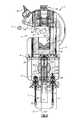
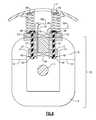
- FIG. 3illustrates a cross-sectional view taken along line A-A of FIG. 2 .
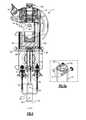
- FIG. 4illustrates a cross-sectional view taken along line A-A of FIG. 2 with an example hotstick.
- FIG. 5 aillustrates an enlarged view of a keyhole slot.
- FIG. 6illustrates another cross-sectional view taken along line A-A of FIG. 2 engaging a conductor.
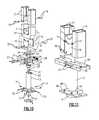
- FIG. 10illustrates an expanded view of the lower magnetic core, example lead screw assembly, and an example hotstick guide tube.
- FIG. 11illustrates the collapsed view of the lower magnetic core, the lead screw assembly, and the hotstick guide tube.
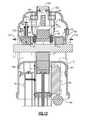
- FIG. 12illustrates a cross-sectional view taken along line B-B of FIG. 2 .
- FIG. 13illustrates a cross-sectional view taken along line C-C of FIG. 1 .
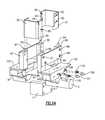
- FIG. 14illustrates an exploded view of example support blocks mounting the upper magnetic core subassembly and example upper and lower jaws.
- FIG. 15illustrates an exploded view of an upper magnetic core mount and the upper and lower jaws.
- FIG. 16illustrates a top view of a solar radiation sensor.
- FIG. 17illustrates an enlarged cross-sectional view of the solar radiation sensor taken along line M-M of FIG. 16 .
- FIG. 18illustrates an exploded view of the solar radiation sensor of FIG. 16 .
- FIG. 19illustrates a cross-sectional view of the solar radiation sensor mount taken along line M-M of FIG. 16 .
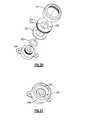
- FIG. 20illustrates an exploded view of the solar radiation mount.
- FIG. 21illustrates a collapsed view of the solar radiation mount.
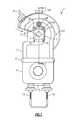
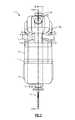
- FIGS. 1 and 2illustrate an example sensor transmitter receiver unit (“STR unit”) 1 installed on a power line conductor C for measuring and monitoring various parameters of the power line conductor C and its environment.
- the STR unit 1is formed from a one piece upper housing 2 and a one piece lower housing 3 .
- the lower housing 3is accepted into a bead 4 formed on a distal end of the upper housing 2 .
- the bead 4which is an integral part of the upper housing 2 is formed by machining a portion of the upper housing 2 to form a groove on the inside of the bead 4 .
- the lower housing 3is secured to the bead 4 and the upper housing 2 by a collar 5 .
- the collar 5attaches to a hotstick guide tube 13 ( FIG. 3 ) that is secured to the upper housing 2 and extends through the lower housing 3 .
- the upper housing 2 and the lower housing 3are made of aluminum or other suitable electrically conductive material.
- the material chosenshould accommodate subassembly installation without the use of external surface fasteners which could generate corona discharges due to high voltage being applied to the upper housing 2 and the lower housing 3 .
- the upper housing 2has the advantage of reducing the number of mating surfaces and eliminating mismatches between multiple cast parts which can generate corona discharges and audible noise due to slightly offset sharp edges of the mating surfaces of the adjacent castings.
- a lower jaw 7is moved to its fully lowered position spaced from upper jaws 6 . This allows the conductor C to pass from position “A” of FIG. 3 through a throat T on the left side of the upper housing 2 and onto the upper jaws 6 in position “B” as shown in FIG. 5 .
- a specially designed hotstick 10is inserted into the bottom of the STR unit 1 and inside the hotstick guide tube 13 .
- the hotstick 10is made of an electrically insulated material such as fiberglass.
- the hotstick 10includes a hotstick driver assembly 9 ( FIG. 4 ) attached to the hotstick 10 with a pin 36 .
- the hotstick 10provides the required electrical insulation between the hands of the linemen and the energized conductor C.
- a flexible stirrup assembly 11( FIG. 4 ) contains a flexible braided conductor 12 which bends out of the way to allow the hotstick driver assembly 9 to enter a hole in the collar 5 .
- the collar 5secures the lower housing 3 to the bead 4 on the upper housing 2 .
- the collar 5is fastened to the hotstick guide tube 13 using the set screw 5 a which is screwed into the collar 5 and into a hole in the hotstick guide tube 13 .
- the STR unit 1can be lifted by the lineman with the hotstick 10 onto the conductor C while maintaining the STR unit 1 securely attached to the hotstick 10 .
- the upper housing 2includes two jaw inserts 8 , shown in FIGS. 5 and 14 , located adjacent the throat T and the upper jaws 6 .
- the two jaw inserts 8include inclined surfaces 8 a and the upper jaws 6 include inclined surfaces 6 a .
- the angle of incline of the inclined surfaces 8 amatches the angle of the incline of an inclined surface 2 a on the upper housing 2 .
- the angle of the inclined surfaces 6 ais steeper than the angle of the inclined surfaces 8 a and the inclined surface 2 a to aid in installing the STR unit 1 on the conductor C.
- the STR unit 1will bounce slightly upward and land in a circular notch 6 b of the upper jaws 6 (See FIG. 4 ). This allows a conductor temperature sensor to be mounted vertically and in the middle inside the upper jaws 6 and initially extends slightly below the circular notch 6 b for the upper portion of the conductor C.
- the two different inclined surfaces 6 a and 8 a of the jaw inserts 8 and upper jaws 6prevent the conductor temperature sensor S, shown in FIGS. 3 and 4 , from becoming damaged since the conductor C firmly lands vertically in the circular notch 6 b of the upper jaws 6 and pushes the conductor temperature sensor S up to the inside surface of the circular notch 6 b.
- the lower jaw 7is located in a pocket P between two legs of a lower magnetic core 14 .
- the lower jaw 7is held in place with two spring pins 132 and 133 ( FIG. 15 ) located in the lower jaw 7 that snap into two holes 15 in a lower jaw holder 16 ( FIGS. 10 and 11 ) which is attached to a bottom block 19 using two screws 20 ( FIG. 3 ).
- the bottom block 19is located adjacent the base of the upper housing 2 .
- Two identical electrically conductive lower core covers 17partially surround the two legs of the lower magnetic core 14 .
- the lower core covers 17are attached to the bottom block 19 on each side of the lower jaw holder 16 using screws 18 of FIG. 3 on the front right side and one set of the screws 18 on the back left side (not shown).
- the front and back lower jaw holders 16are both held in place by the four screws 20 , two in the front and two in the back.
- the two legs of the lower magnetic core 14are totally encased by the two lower core covers 17 and the front and back lower jaw holders 16 . Therefore, the lower magnetic core 14 is not exposed to any moisture, such as from rain, snow, and ice that could enter through the throat T of the upper housing 2 ( FIG. 3 ).
- the bottom block 19contains a conical hole 21 in the center which provides a very low friction bearing surface for the semi-circular top of a lead screw 22 ( FIG. 3 ).
- the lead screw 22is held in the conical hole 21 with a retainer plate 23 which has a hole in the middle the size of the lead screw 22 diameter and is fastened to the bottom block 19 .
- the lead screw 22is threaded into the center of a threaded bushing 25 .
- the threaded bushing 25has a reduced diameter cylindrical lower portion which fits inside the hotstick guide tube 13 and a larger diameter cylindrical top portion of the threaded bushing 25 is supported on the upper end of the hotstick guide tube 13 .
- Both the threaded bushing 25 and the hotstick guide tube 13are attached to a hotstick guide support 26 using two large through bolts 27 and nuts which are placed through the holes in a bottom support 28 .
- the bottom support 28includes an upside down “U” shaped cross member and is fastened at each end to the upper housing with two large threaded screws 29 on each side.
- the threaded bushing 25has two small vertical holes 25 a drilled through the threaded bushing 25 on each side of the threaded hole in the middle for the lead screw 22 .
- the vertical holes 25 aare countersunk on the top and provide drainage paths for fluid, such as rain water, that can accumulate underneath the bottom block 19 and on top of the bottom support 28 ( FIG. 5 a ). The water then drains through the two vertical holes 25 a in the threaded bushing 25 and drops on the inside of the hotstick guide tube 13 and out the bottom of the STR unit 1 . Therefore, water will not leak into the lower housing 3 .
- the lead screw 22has a small diameter hotstick guide 30 which is threaded on the inside and is screwed on the bottom of the lead screw 22 .
- a pin 31keeps the hotstick guide 30 from turning on the lead screw 22 .
- the hotstick guide 30prevents the inside of a hotstick lead screw driver 33 from coming into contact with the threads on the lead screw 22 and damaging the internal bore of the lead screw driver 33 . It also guides the lead screw driver 33 onto the lead screw 22 . When the pin 31 engages the lead screw driver 33 the STR unit 1 is ready for installation on the conductor C.
- the hotstick driver assembly 9includes the lead screw driver 33 , a hotstick driver coupling 32 , a rivet 34 , a hotstick sleeve 35 , the pin 36 , and the hotstick 10 .
- the hotstick 10 of FIG. 4rests on the rounded portion of the hotstick driver coupling 32 and the rounded inside bottom of the hotstick guide tube 13 . This prevents the lead screw driver 33 from applying pressure to the threaded bushing 25 upon installation of the STR unit 1 on the conductor C.
- the lead screw driver 33 and the hotstick driver coupling 32are each fastened to the hotstick sleeve 35 by the rivet 34 and the hotstick sleeve 35 is attached to the hotstick 10 with the pin 36 .
- the hotstick driver assembly 9When the hotstick driver assembly 9 is engaged with the lead screw 22 as shown in FIG. 4 , the STR unit 1 is raised to position “A” relative to the height of the conductor C. The STR unit 1 is then moved toward the conductor C so that the conductor C passes through the throat T of the upper housing 2 and into position “B” as shown in FIG. 5 . Once the STR unit 1 is fully supported by the conductor C in position “B”, the hotstick driver assembly 9 is turned clockwise by the installer with the hotstick 10 and allowed to drop down from its position in FIG. 4 to a lower position as in FIG. 5 . A horizontal keyhole slot 38 of the lead screw driver 33 is now engaged with the pin 31 of the lead screw 22 . With the pin 31 in the horizontal keyhole slot 38 , the hotstick driver assembly 9 and the hotstick 10 are secured to the STR unit 1 .
- an opening and closing mechanism 39 of FIG. 6extends the lower jaw 7 upward to secure the STR unit 1 on the conductor C. Additionally, the opening and closing mechanism 39 can also retract the lower jaw 7 to remove the STR unit 1 from the conductor C.
- the opening and closing mechanism 39includes the lower magnetic core 14 , the lower core covers 17 , the lower jaw holders 16 , the lower jaw 7 , spring pins 132 and 133 , the bottom block 19 , the retainer plate 23 , two fasteners 24 , the lead screw 22 , the hotstick guide 30 , and the pin 31 .
- FIG. 6illustrates the keyhole slot 38 on the lead screw driver 33 engaged with the pin 31 on the lead screw 22 .
- the opening and closing mechanism 39moves the lower magnetic core 14 toward an upper magnetic core 40 .
- the upper magnetic core 40has two large compression springs 41 to bias the upper magnetic core 40 downward.
- the compression springs 44provide pressure to hold both the upper magnetic core 40 and the lower magnetic core 14 together to reduce the magnetic reluctance caused by air gaps 54 ( FIG. 8 ) between the upper magnetic core 40 and the lower magnetic core 14 .
- the hotstick driver assembly 9can continue to be turned clockwise even after the lower magnetic core 14 begins to mate with the upper magnetic core 40 because the compression springs 41 compress at the top of the upper magnetic core 40 .
- the clockwise motion of the hotstick driver assembly 9can be achieved either manually or with a battery powered drill or another rotating device, until the lower jaw 7 is tightened onto the conductor C.
- the hotstick 10is turned slightly to the left, or counterclockwise, and the pin 31 will become disengaged from the horizontal portion of the keyhole slot 38 .
- the hotstick 10is then free to be removed when the pin 31 aligns with the vertical slot 37 .
- the horizontal upper core blocks 43 and the horizontal lower core blocks 44are clamped around the upper magnetic core 40 on each side using two through bolts 45 and two nuts 46 in the front and two through bolts 45 and two nuts 46 located in the back of the upper horizontal core blocks 43 and horizontal lower core blocks 44 .
- the upper magnetic core 40is prevented from falling out of a left core shoe 50 and a right core shoe 51 , by a step 52 located at the bottom of the right core shoe 51 and a step 53 located at the bottom of the left core shoe 50 .
- the lead screw 22can be turned further clockwise to move the two upper core blocks 43 away from the steps 52 and 53 and further compress the compression springs 41 .
- the lead screw 22can continue to be turned clockwise and compress the compression springs 41 until the lower jaw 7 and the upper jaws 6 are tight on the conductor C.
- the compression springs 41are compressed to their maximum distance, and thus the maximum compressive force is also applied to the lower magnetic core 14 and the upper magnetic core 40 .
- varying amounts torquecan be applied to the hotstick driver assembly 9 to tighten the opening and closing mechanism 39 on the conductor C.
- the physical size and shape of the upper jaws 6 and the lower jaw 7are designed such that approximately the same compressive force is applied to the upper magnetic core 40 and the lower magnetic core 14 .
- the opening and closing mechanism 39allows the STR unit 1 to be installed on a wide range of conductor diameters without changing the upper jaws 6 and the lower jaws 7 while maintaining sufficient contact between the upper magnetic core 40 and the lower magnetic core 14 to complete the magnetic circuit of the power supply transformer 55 of the STR unit 1 which derives its power from the current flowing through the conductor C to power a power supply module 60 of FIG. 9 .
- the STR unit 1derives power from the conductor C, batteries or solar cells are not required to power the STR unit 1 .
- the STR unit 1is powered at all times when current is flowing in the conductor C, even at current levels as low as 6.8 amperes and still process data and transmit data at 1 watt power levels because of the low threshold of the power supply module 60 .
- the power supply module 60contains an energy storage device 256 ( FIG. 13 ) which can power the transmitter/receiver 64 when the conductor C current ceases to flow.
- a transmitting and receiving antenna 81 for the on-board transmitter/receiver 64is mounted on the upper housing 2 ( FIG. 12 ).
- Locating the coil winding 56 , 58 , and 59 on the upper magnetic core 40allows the heat from the coil winding 56 , 58 , and 59 to escape through a vent 65 ( FIG. 1 ) in the upper housing 2 .
- a vent 65FIG. 1
- the conductor sensor S located within the STR unit 1measures the temperature of the conductor C, it is important that the heat from the coil windings 56 , 58 , and 59 does not affect the temperature of the conductor C or the conductor temperature sensor S, which is in electrical communication with the sensor electronics module 63 . As shown in FIG.
- a thermally insulating barrier 66located below the coil windings 56 , 58 , and 59 , allows for a more accurate temperature reading of the conductor temperature by blocking heat from the coil windings 56 , 58 , and 59 .
- FIGS. 10-12 and 13illustrate the lower magnetic core 14 with the lower core covers 17 , the lead screw 22 , the hotstick guide tube 13 , and other related parts in both exploded and collapsed views.
- the hotstick guide tube 13is anchored at the top with the through bolts 27 that extend through the bottom support 28 and the hotstick guide support 26 .
- a round cylindrical milled slot 67is located along opposing sides of the top of the hotstick guide tube 13 to accept the through bolts 27 that support the hotstick guide tube 13 .
- a central hole 70extends through a base plate support 68 and a base plate 69 for accepting a bottom portion of the hotstick guide tube 13 .
- the base plate support 68 and the base plate 69are connected to each other with four identical threaded screws 71 .
- the hotstick guide tube 13is attached to the base plate support 68 and the base plate 69 with set screws 72 and 73 .
- Left and right side panels 76 of FIG. 12are attached to the base plate support 68 and the bottom support 28 for the lower core 14 with the use of two identical screws 74 extending through the bottom support 28 and the side panel 76 and at the bottom with two identical screws 75 extending through the side panel 76 and the base plate support 68 .
- the threaded bushing 25rests on top of the hotstick guide tube 13 and is prevented from turning relative to the hotstick guide tube 13 using a set screw 77 .
- the left and right side panels 76not only provide added strength, but also provide the physical space to mount the power supply module 60 , the transmitter/receiver 64 , the sensor electronics 63 , and support left and right lower core guides 78 and 79 .
- the left lower core guide 78 and a right lower core guide 79are “U” shaped and guide the opening and closing mechanism 39 such that the lower magnetic core 14 is aligned with the upper magnetic core 40 .
- Each of the left and right lower core guides 78 and 79are attached to the left and right side panels 76 with four threaded screws 80 .
- the lower housing 3is placed over the hotstick guide tube 13 at the bottom and fitted up to the base plate 69 and held in place with the collar 5 . This means that once the collar 5 is removed, the lower housing 3 can be removed thus allowing access to the power supply module 60 , sensor electronics module 63 , and the transmitter/receiver 64 of FIG. 9 mounted inside and on the left and right side panels 76 for easy maintenance and repair.
- FIGS. 7 and 12 - 15illustrate an upper magnetic core subassembly 40 a mounted to the upper housing 2 .
- the left and right core shoes 50 and 51support the upper magnetic core 40 such that the upper magnetic core 40 can move freely up and down inside the left and right shoes 50 and 51 .
- the left and right core shoes 50 and 51are attached to the upper housing 2 using four support blocks 86 and 87 of FIG. 14 , right and left upper core guides 90 and 93 , and four vertical through bolts 94 , 95 , 96 , and 97 .
- the upper magnetic core subassembly 40 acan be inserted through the throat T and fastened to the inside of the upper housing 2 .
- a top portion of the upper housing 2is “C” shaped which provides a surface on the inside for mounting a current sensing device 156 for measuring the power line frequency current (60 Hz or 50 Hz) and a loop coil 157 for measuring lightning stroke current ( FIGS. 13 and 16 ).
- the right core shoe 51has two identical threaded holes 82 and 83 on the front and back for a total of four
- left core shoe 50has two identical threaded holes 84 and 85 on the front and back for a total of four as shown in FIGS. 7 and 14 .
- two identical support blocks 86 on the right sideare placed on the front and back of the right core shoe 51 and two identical support blocks 87 are placed on the front and back of the left core shoe 50 .
- threaded screws 88 and 89are first inserted into the upper and lower holes in the right side upper core guide 90 and then through the two holes in the right support block 86 and screwed into the accommodating threaded holes 82 and 83 of the right core shoe 51 .
- the two left side support blocks 87are held in alignment with the left core shoe 50 by first inserting two threaded screws 91 and 92 through the other end of the right side upper core guide 90 and then through the holes in the left side support block 87 and screwed into the threaded holes 84 and 85 of the left core shoe 50 .
- the same processis repeated on the back side by connecting support blocks 86 and 87 to the left upper core guide 93 with the backside of the right core shoe 51 and the back side of the left core shoe 50 .
- the purpose of the upper core guides 90 and 93is to insure the two long vertical through bolts 94 and 95 placed through the vertical holes in the two right side support blocks 86 and two long vertical through bolts 96 and 97 placed through the vertical holes in the two left side support blocks 87 line up with the four threaded holes in four threaded inserts 98 , 99 , 100 , and 101 , which are embedded in the casting of the upper housing 2 .
- the two right side support blocks 86are prevented from falling down by inserting the back of a right side upper jaw holder 102 and the back of the left side upper jaw holder 103 over the vertical through bolts 94 and 95 and threading nuts 104 and 105 onto the two vertical through bolts 94 and 95 and tightening them down, respectively.
- the two left side support blocks 87are held in place by inserting the vertical through bolts 96 and 97 through the front hole in the right side upper jaw holder 102 and the front hole in the left side upper jaw holder 103 and threading two nuts 106 and 107 on the vertical through bolts 96 and 97 and tightening them down, respectively.
- FIGS. 2 and 15illustrate casting fillers 113 and 114 located on the back left and back right sides of the STR unit 1 and secured with round head screws 115 which are first inserted through holes in the casting fillers 113 and 114 and then through the two back holes on the right and left side of the thermal barrier 66 and into the standoffs 108 and 109 , respectively.
- the left and right lower core guides 78 and 79 including the opening and closing mechanism subassembly 39 and the left and right side panels 76are inserted through the bottom of the upper housing 2 (See FIG. 12 ).
- Four screws 29are inserted through the two holes on the left and the two holes on the right of the bottom support 28 and screwed into the threaded holes of the upper housing 2 .
- the right lower core guide 79shown in FIG. 12 , slides around the outside surface of the right core shoe 51 and underneath a tab 116 at the top as a weldment on the right upper side of the right core shoe 51 .
- the tab 116insures that the right lower core guide 79 fits precisely around the outside of the right core shoe 51 to provide a near perfect alignment of the lower magnetic core 14 with the upper magnetic core 40 .
- the precise alignment between the upper magnetic core 40 and the lower magnetic core 14reduces magnetic reluctance by decreasing the air gaps 54 . This results in a decrease in the threshold current for the operation of the power supply module 60 .
- the right side upper jaw holder 102 and the left side upper jaw holder 103support the two upper jaws 6 and the jaw inserts 8 .
- the long vertical through bolts 96 and 97which are screwed into the threaded inserts 100 and 101 at the top and on the inside of the upper housing 2 fit through top holes 117 and 118 on the back and front of the right side upper jaw holder 102 on the right side.
- flush mount screws 119 and 120are inserted on the back and through corresponding holes in the right side upper jaw holder 102 and are screwed into the upper housing.
- the flush mount screws 119 and 120are installed before the upper jaws 6 and inserts 8 are mounted to the right side upper jaw holder 102 .
- the same arrangement for mounting the left side upper jaw holder 103is followed using screws 121 and 122 .
- the jaw inserts 8 on the right and left sides of the STR unit 1 and in front of the upper jaws 6are held in place by inserting threaded bolts 130 and 131 into each insert 8 and through the right and left keepers 123 and 124 and screwing into the upper jaw holders 102 and 103 .
- the spring pins 132 and 133are included in the lower jaw 7 which when depressed snap into the two holes 15 in the lower jaw holder 16 .
- the transmitting and receiving antenna 81 for the on-board transmitter and receiver 64 shown in FIG. 9is mounted on the housing 2 .
- the antenna 81is displayed in FIGS. 1 and 2 and is installed on the top left side in FIG. 1 .
- a solar sensor assembly 134is located at the top of this housing and on its vertical centerline ( FIG. 13 ).
- the small hole 140 located directly to the right of the conductor 1allows access and adjustment of the electric power line sag sensor ( FIG. 1 ).
- the solar sensor assembly 134similar to a pyranometer, is located on the top of the housing 2 and on the vertical centerline of the conductor C as shown in FIGS. 3 and 4 .
- the top surface of the solar sensor assembly 134is level with the top of the transmitting and receiving antenna 81 , so that the transmitting and receiving antenna 81 does not cast a shadow over the surface of the solar sensor assembly 134 .
- the solar sensor assembly 134includes a solar radiation sensing element 282 having twisted and electrostatically shielded lead wires 284 and 285 , as shown in FIG. 17 .
- the solar sensor assembly 134 including the lead wires 284 and 285can be easily removed from the top of the STR unit 1 by simply unscrewing an electrically conductive bezel 281 shown in FIG. 17 .
- the solar radiation sensing element 282 of FIGS. 17 and 18is a commercially available 5 mm ⁇ 5 mm silicon photovoltaic gridded solar cell having a 6.1 milli-ampere maximum output current when 100 watts per square foot of solar radiation is normal to the horizontal surface of this cell.
- the solar radiation sensing element 282is placed in the center of a cell holder 283 and includes a non-reflective white high temperature plastic thin wafer with lead wires 284 and 285 .
- the lead wires 284 and 285output a dc voltage of 0.4 volts at 100 watts per square foot of solar radiation and after having been processed through the signal conditioning circuit of the sensor electronics module 63 produce a dc output voltage of 4.0 volts.
- the maximum operating temperature of the cell holder 283is 204° C.
- the lead wires 284 and 285extend through two semi-circular cutouts of the cell holder 283 and pass into a slot 286 of a lead spacer 287 which is formed from the same material as the cell holder 283 .
- the lead spacer 287supports the back of the solar radiation sensing element 282 , while providing a space in the form of a slot for the lead wires 284 and 285 to occupy.
- the lead wires 284 and 285are twisted to prevent electromagnetic interference created by the current in conductor C from affecting the output signal.
- the lead wires 284 and 285extend through a small offset hole 288 in a lead grommet 289 which is also formed of the same material as the cell holder 283 and then passes through a central hole 290 in a filler 291 .
- the filler 291allows access for an electrically conductive ground strap 292 to be bonded to the inside wall at point 294 just above the inside threads of the bezel 281 shown in FIG. 17 . This allows the solar sensor assembly 134 of FIGS. 17 and 18 to be unscrewed from an electrically conductive mount ring 295 shown in FIGS. 19 , 20 and 21 .
- a glass circular beveled edge lens 296 shown in FIGS. 17 and 18includes a transparent electrically conductive substrate 297 on the bottom made of indium—tin oxide which provides a combination of low resistivity (less than 40 ohms/square) and high transmittivity of 94% within the sunlight's wavelength range of 0.230 milli-microns to 3.000 milli-microns (230 nm to 3000 nm).
- the transparent electrically conductive coating 297creates a Faraday cage over the solar radiation sensing element 282 and thus isolates the solar radiation sensing element 282 from the high electric field surrounding the high voltage conductor C.
- the bezel 281which is screwed onto the mount ring 295
- a solar mount 298which is attached to housing 2 , are all at the same voltage potential as the conductor C. (See FIG. 13 ).
- the electrostatic shielding function of the conductive coating 297prevents the solar radiation sensing element 282 from being exposed to the high electric field and thus the solar radiation sensing element 282 does not create a corona discharge which would destroy the solar radiation sensing element 282 .
- the ground strap 292is bonded to the conductive coating 297 at point 293 and to the bezel 281 at the point 294 using an electrically conductive epoxy as shown in FIG. 17 .
- the space created by the ground strap 292 and between the conductive coating 297 on the bottom of the glass circular beveled edge lens 296 and the solar radiation sensing element 282is filled with a clear, colorless, easily pourable, silicone rubber dielectric compound 299 which has a useful operating temperature range from ⁇ 60° C. to 204° C.
- the solar sensor assembly 134is installed on the STR unit 1 by inserting the solar mount 298 from the inside of housing 2 without the mount ring 295 and bezel 281 into a top hole 300 of FIGS. 13 and 19 .
- the solar mount 298is secured with two screws 301 and 302 .
- an “O” ring 303is slid over the top of the threaded portion on top of the solar mount 298 as shown in FIGS. 19 and 20 .
- the mount ring 295contains two small vertical holes 305 and 306 , as shown in FIG. 20 , to accept a spanner wrench of which when inserted into the two holes 305 and 306 can easily tighten or remove 295 from the solar mount 298 .
- a Faraday cagecompletely surrounds the solar radiation sensing element 282 .
- the Faraday cageincludes the electrically conductive coating 297 spaced apart and on top of the solar radiation sensing element 282 , the electrically conductive bezel 281 surrounding the sides of the solar radiation sensing element 282 , the electrically conductive mount ring 295 , the electrically conductive mount 298 , the flat washer 304 , and the housing 2 complete the bottom of the cage around the solar radiation sensing element 282 .
- the electrostatically shielded and twisted lead wires 284 and 285are fed to the sensor electronics module 63 of FIGS. 9 and 13 , which in turn is powered by the power supply electronics module 60 of FIG. 9 .
- the measurement error of the solar radiation sensoris approximately 3 percent after the sun's solar altitude reaches 13 . 75 degrees from the horizon at sunrise and sunset as shown in FIG. 17 .
- the total solar radiation on a horizontal surface valuesare sent to the transmitter-receiver unit 64 of the STR unit 1 shown in FIG. 9 where the data is then sent to remote location receivers on a real time basis.
- the received datais processed by offsite software which displays the data and calculates the real power output (kilowatts) of any solar panels (farms) that may be interconnected to the electric power line circuit upon which the STR unit 1 is located. This information may be used to control the output of solar panels and regulate the voltage on the circuit, since a kW injection of real power from the solar panels will cause the voltage to rise on the circuit.
- the STR unit 1measures solar radiation while attached to a power line conductor C.
- the sensor electronics module 63signal conditions measured values of solar radiation and sends the signal conditioned measured values to a remote location with the transmitter-receiver unit 64 via the antenna 81 located within the STR unit 1 to a remote location on a real time basis.
- the signal conditioned measured valuescan be used to determine a current carrying capacity of the conductor C.
Landscapes
- Physics & Mathematics (AREA)
- General Physics & Mathematics (AREA)
- Engineering & Computer Science (AREA)
- Power Engineering (AREA)
- Life Sciences & Earth Sciences (AREA)
- Multimedia (AREA)
- Signal Processing (AREA)
- Environmental & Geological Engineering (AREA)
- Chemical & Material Sciences (AREA)
- Geometry (AREA)
- Analytical Chemistry (AREA)
- Health & Medical Sciences (AREA)
- Ecology (AREA)
- Biodiversity & Conservation Biology (AREA)
- Atmospheric Sciences (AREA)
- Chemical Kinetics & Catalysis (AREA)
- Electrochemistry (AREA)
- Environmental Sciences (AREA)
- Hydrology & Water Resources (AREA)
- Biochemistry (AREA)
- General Health & Medical Sciences (AREA)
- Immunology (AREA)
- Pathology (AREA)
- Measuring Instrument Details And Bridges, And Automatic Balancing Devices (AREA)
- Measurement Of Current Or Voltage (AREA)
- Driving Mechanisms And Operating Circuits Of Arc-Extinguishing High-Tension Switches (AREA)
- Locating Faults (AREA)
- Cleaning In General (AREA)
- Charge And Discharge Circuits For Batteries Or The Like (AREA)
- Transformers For Measuring Instruments (AREA)
- Measurement Of Length, Angles, Or The Like Using Electric Or Magnetic Means (AREA)
- Electric Cable Installation (AREA)
- Resistance Heating (AREA)
- Tumbler Switches (AREA)
- Cable Transmission Systems, Equalization Of Radio And Reduction Of Echo (AREA)
- Rotary Switch, Piano Key Switch, And Lever Switch (AREA)
Abstract
Description
This application claims reference to U.S. Provisional Application No. 61/740,517 dated Dec. 21, 2012.
The present disclosure relates to a multiple parameter sensor-transmitter/receiver unit which may be installed on or removed from an energized electric power line, such as an overhead power line. With the advent of Smart-Grid applications for electric power systems, there is an ever increasing need for a device that measures electric, mechanical, and environmental parameters of the power line.
In order to address the increasing need for monitoring power lines, devices have been developed that attach directly to the power line. These devices generally require a power source, such as batteries or solar panels. When utilizing batteries, regular maintenance must be performed to replace the batteries, which can become costly. When solar panels are used, the device may only be powered during sunny weather conditions and during daylight hours. Therefore, there is a need for a device which is low maintenance and can be constantly powered independent of weather conditions.
One example device for measuring environmental parameters is a land based weather station. One of the significant problems of land based weather stations, even if located in close proximity at the terminal ends of the electric power line, is the measured weather data at these two locations can never be representative of the differing weather conditions the line actually experiences throughout its entire length. This is especially true for long lines traversing over various types of terrain where it may be shielded by trees and other natural obstacles such as hills and rocky formations, and the weather itself such as the amount of sunshine, fog, rain, snow and icing conditions the line is exposed to can dramatically vary from one point to another along these lines.
A device for attaching to an electric power line conductor includes a housing with an opening for accepting the power line conductor. The housing is configured to be grounded to the power line conductor. At least one magnetic core is configured to surround the power line conductor and power a power supply electronics module. A solar sensing element is configured to be mounted horizontally on the housing.
A method of measuring solar radiation with a device configured to be attached to a power line conductor including signal conditioning measured values of solar radiation.
The signal conditioned measured values are sent to a remote location with a transmitter-receiver unit located within a housing. A sensor electronics module and the transmitter-receiver unit are powered from current flowing in the power line conductor. The measured values are processed to determine a current carrying capacity of the power line conductor.
These and other features of the disclosed examples can be understood from the following description and the accompanying drawings, which can be briefly described as follows.
An exampleFIGS. 1 and 2 illustrate an example sensor transmitter receiver unit (“STR unit”)1 installed on a power line conductor C for measuring and monitoring various parameters of the power line conductor C and its environment. TheSTR unit 1 is formed from a one pieceupper housing 2 and a one piecelower housing 3. Thelower housing 3 is accepted into abead 4 formed on a distal end of theupper housing 2. In this example, thebead 4 which is an integral part of theupper housing 2 is formed by machining a portion of theupper housing 2 to form a groove on the inside of thebead 4. Thelower housing 3 is secured to thebead 4 and theupper housing 2 by acollar 5. Thecollar 5 attaches to a hotstick guide tube13 (FIG. 3 ) that is secured to theupper housing 2 and extends through thelower housing 3.
In one example, theupper housing 2 and thelower housing 3 are made of aluminum or other suitable electrically conductive material. The material chosen should accommodate subassembly installation without the use of external surface fasteners which could generate corona discharges due to high voltage being applied to theupper housing 2 and thelower housing 3. Theupper housing 2 has the advantage of reducing the number of mating surfaces and eliminating mismatches between multiple cast parts which can generate corona discharges and audible noise due to slightly offset sharp edges of the mating surfaces of the adjacent castings.
Referring toFIGS. 3 and 4 , before theSTR unit 1 is clamped onto the conductor C, alower jaw 7 is moved to its fully lowered position spaced fromupper jaws 6. This allows the conductor C to pass from position “A” ofFIG. 3 through a throat T on the left side of theupper housing 2 and onto theupper jaws 6 in position “B” as shown inFIG. 5 .
With thelower jaw 7 of theSTR unit 1 in its fully lowered position, a specially designedhotstick 10 is inserted into the bottom of theSTR unit 1 and inside thehotstick guide tube 13. In this example, thehotstick 10 is made of an electrically insulated material such as fiberglass. Thehotstick 10 includes a hotstick driver assembly9 (FIG. 4 ) attached to thehotstick 10 with apin 36. Thehotstick 10 provides the required electrical insulation between the hands of the linemen and the energized conductor C. A flexible stirrup assembly11 (FIG. 4 ) contains a flexiblebraided conductor 12 which bends out of the way to allow thehotstick driver assembly 9 to enter a hole in thecollar 5. As mentioned earlier, thecollar 5 secures thelower housing 3 to thebead 4 on theupper housing 2. Thecollar 5 is fastened to thehotstick guide tube 13 using theset screw 5awhich is screwed into thecollar 5 and into a hole in thehotstick guide tube 13.
With thehotstick 10 and thehotstick driver assembly 9 fully engaged inside thehotstick guide tube 13, theSTR unit 1 can be lifted by the lineman with thehotstick 10 onto the conductor C while maintaining theSTR unit 1 securely attached to thehotstick 10.
Theupper housing 2 includes twojaw inserts 8, shown inFIGS. 5 and 14 , located adjacent the throat T and theupper jaws 6. The twojaw inserts 8 includeinclined surfaces 8aand theupper jaws 6 includeinclined surfaces 6a. The angle of incline of theinclined surfaces 8amatches the angle of the incline of aninclined surface 2aon theupper housing 2.
The angle of theinclined surfaces 6ais steeper than the angle of theinclined surfaces 8aand theinclined surface 2ato aid in installing theSTR unit 1 on the conductor C. As the conductor C slides across theinclined surfaces inclined surface 6a, theSTR unit 1 will bounce slightly upward and land in acircular notch 6bof the upper jaws6 (SeeFIG. 4 ). This allows a conductor temperature sensor to be mounted vertically and in the middle inside theupper jaws 6 and initially extends slightly below thecircular notch 6bfor the upper portion of the conductor C. The two differentinclined surfaces upper jaws 6 prevent the conductor temperature sensor S, shown inFIGS. 3 and 4 , from becoming damaged since the conductor C firmly lands vertically in thecircular notch 6bof theupper jaws 6 and pushes the conductor temperature sensor S up to the inside surface of thecircular notch 6b.
InFIG. 3 , thelower jaw 7 is located in a pocket P between two legs of a lowermagnetic core 14. Thelower jaw 7 is held in place with twospring pins 132 and133 (FIG. 15 ) located in thelower jaw 7 that snap into twoholes 15 in a lower jaw holder16 (FIGS. 10 and 11 ) which is attached to abottom block 19 using two screws20 (FIG. 3 ). Thebottom block 19 is located adjacent the base of theupper housing 2.
Two identical electrically conductive lower core covers17 partially surround the two legs of the lowermagnetic core 14. The lower core covers17 are attached to thebottom block 19 on each side of thelower jaw holder 16 usingscrews 18 ofFIG. 3 on the front right side and one set of thescrews 18 on the back left side (not shown). The front and backlower jaw holders 16 are both held in place by the fourscrews 20, two in the front and two in the back. The two legs of the lowermagnetic core 14 are totally encased by the two lower core covers17 and the front and backlower jaw holders 16. Therefore, the lowermagnetic core 14 is not exposed to any moisture, such as from rain, snow, and ice that could enter through the throat T of the upper housing2 (FIG. 3 ).
Thebottom block 19 contains a conical hole21 in the center which provides a very low friction bearing surface for the semi-circular top of a lead screw22 (FIG. 3 ). Thelead screw 22 is held in the conical hole21 with aretainer plate 23 which has a hole in the middle the size of thelead screw 22 diameter and is fastened to thebottom block 19. Thelead screw 22 is threaded into the center of a threadedbushing 25. The threadedbushing 25 has a reduced diameter cylindrical lower portion which fits inside thehotstick guide tube 13 and a larger diameter cylindrical top portion of the threadedbushing 25 is supported on the upper end of thehotstick guide tube 13. Both the threadedbushing 25 and thehotstick guide tube 13 are attached to ahotstick guide support 26 using two large throughbolts 27 and nuts which are placed through the holes in abottom support 28.
Referring toFIG. 2 , theupper jaws 6 include two spaced apart jaws and thelower jaw 7 includes a single jaw aligned between the two spaced apartupper jaws 6. Whenlower jaw 7 is clamped onto the conductor C, the conductor C is bent slightly upward as thelower jaw 7 extends upward between theupper jaws 6 creating a bending moment in the conductor C. The bending moment in the conductor C prevents theSTR unit 1 from sliding down the conductor C, especially when theSTR unit 1 is mounted at the point of attachment adjacent a utility pole or tower where the slope of the conductor C is at its maximum value. Preventing theupper jaws 6 and thelower jaw 7 from sliding down the conductor C at the point of attachment is necessary when the STR unit is being used to measure sag of the power line conductor.
Referring toFIGS. 5 and 5 a, thebottom support 28 includes an upside down “U” shaped cross member and is fastened at each end to the upper housing with two large threadedscrews 29 on each side. The threadedbushing 25 has two smallvertical holes 25adrilled through the threadedbushing 25 on each side of the threaded hole in the middle for thelead screw 22. Thevertical holes 25aare countersunk on the top and provide drainage paths for fluid, such as rain water, that can accumulate underneath thebottom block 19 and on top of the bottom support28 (FIG. 5 a). The water then drains through the twovertical holes 25ain the threadedbushing 25 and drops on the inside of thehotstick guide tube 13 and out the bottom of theSTR unit 1. Therefore, water will not leak into thelower housing 3.
Referring toFIG. 6 , thelead screw 22 has a small diameter hotstick guide30 which is threaded on the inside and is screwed on the bottom of thelead screw 22. Apin 31 keeps thehotstick guide 30 from turning on thelead screw 22. Thehotstick guide 30 prevents the inside of a hotsticklead screw driver 33 from coming into contact with the threads on thelead screw 22 and damaging the internal bore of thelead screw driver 33. It also guides thelead screw driver 33 onto thelead screw 22. When thepin 31 engages thelead screw driver 33 theSTR unit 1 is ready for installation on the conductor C.
Thehotstick driver assembly 9 includes thelead screw driver 33, ahotstick driver coupling 32, arivet 34, ahotstick sleeve 35, thepin 36, and thehotstick 10. Thehotstick 10 ofFIG. 4 rests on the rounded portion of thehotstick driver coupling 32 and the rounded inside bottom of thehotstick guide tube 13. This prevents thelead screw driver 33 from applying pressure to the threadedbushing 25 upon installation of theSTR unit 1 on the conductor C. Thelead screw driver 33 and thehotstick driver coupling 32 are each fastened to thehotstick sleeve 35 by therivet 34 and thehotstick sleeve 35 is attached to thehotstick 10 with thepin 36. A long narrow vertical slot in thelead screw driver 33 allows thepin 31 of thelead screw 22 to be engaged with thelead screw driver 33 and is free to slide up or down in thevertical slot 37 as the lead screw is turned to tighten thelower jaw 7 on the conductor C or to loosen thelower jaw 7 from the conductor C to remove theSTR unit 1.
When thehotstick driver assembly 9 is engaged with thelead screw 22 as shown inFIG. 4 , theSTR unit 1 is raised to position “A” relative to the height of the conductor C. TheSTR unit 1 is then moved toward the conductor C so that the conductor C passes through the throat T of theupper housing 2 and into position “B” as shown inFIG. 5 . Once theSTR unit 1 is fully supported by the conductor C in position “B”, thehotstick driver assembly 9 is turned clockwise by the installer with thehotstick 10 and allowed to drop down from its position inFIG. 4 to a lower position as inFIG. 5 . Ahorizontal keyhole slot 38 of thelead screw driver 33 is now engaged with thepin 31 of thelead screw 22. With thepin 31 in thehorizontal keyhole slot 38, thehotstick driver assembly 9 and thehotstick 10 are secured to theSTR unit 1.
In this example, an opening andclosing mechanism 39 ofFIG. 6 extends thelower jaw 7 upward to secure theSTR unit 1 on the conductor C. Additionally, the opening andclosing mechanism 39 can also retract thelower jaw 7 to remove theSTR unit 1 from the conductor C. The opening andclosing mechanism 39 includes the lowermagnetic core 14, the lower core covers17, thelower jaw holders 16, thelower jaw 7, spring pins132 and133, thebottom block 19, theretainer plate 23, twofasteners 24, thelead screw 22, thehotstick guide 30, and thepin 31.
Thehotstick driver assembly 9 can continue to be turned clockwise even after the lowermagnetic core 14 begins to mate with the uppermagnetic core 40 because the compression springs41 compress at the top of the uppermagnetic core 40. The clockwise motion of thehotstick driver assembly 9 can be achieved either manually or with a battery powered drill or another rotating device, until thelower jaw 7 is tightened onto the conductor C. After theSTR unit 1 is mounted on the conductor C, thehotstick 10 is turned slightly to the left, or counterclockwise, and thepin 31 will become disengaged from the horizontal portion of thekeyhole slot 38. Thehotstick 10 is then free to be removed when thepin 31 aligns with thevertical slot 37.
When the two large compression springs41 push the upper core blocks43 down, the uppermagnetic core 40 is prevented from falling out of aleft core shoe 50 and aright core shoe 51, by astep 52 located at the bottom of theright core shoe 51 and astep 53 located at the bottom of theleft core shoe 50.
When the lowermagnetic core 14 mates with the uppermagnetic core 40, thelead screw 22 can be turned further clockwise to move the two upper core blocks43 away from thesteps lead screw 22 can continue to be turned clockwise and compress the compression springs41 until thelower jaw 7 and theupper jaws 6 are tight on the conductor C.
Electrical insulating spools47 are inserted over each of the throughbolts 45 and electrical insulatingwashers 48 are inserted under the head of each throughbolt 45 and under eachnut 46. The insulating spools47 and the insulatingwashers 48 on each of the throughbolts 45 prevent shorted electrically conductive paths around the uppermagnetic core 40 which is comprised of the four throughbolts 45, fournuts 46, the two electrically conductive upper core blocks43 and the two lower core blocks44.
When theupper jaws 6 and thelower jaw 7 are firmly tightened on the conductor C, the compression springs41 are compressed to their maximum distance, and thus the maximum compressive force is also applied to the lowermagnetic core 14 and the uppermagnetic core 40. This decreases the size of theair gaps 54 between the lowermagnetic core 14 and the uppermagnetic core 40 and the magnetic reluctance between the lowermagnetic core 14 and the uppermagnetic core 40. Depending on the size of the conductor C, varying amounts torque can be applied to thehotstick driver assembly 9 to tighten the opening andclosing mechanism 39 on the conductor C.
The physical size and shape of theupper jaws 6 and thelower jaw 7 are designed such that approximately the same compressive force is applied to the uppermagnetic core 40 and the lowermagnetic core 14. In one example, there are five different sets of upper andlower jaws closing mechanism 39 allows theSTR unit 1 to be installed on a wide range of conductor diameters without changing theupper jaws 6 and thelower jaws 7 while maintaining sufficient contact between the uppermagnetic core 40 and the lowermagnetic core 14 to complete the magnetic circuit of thepower supply transformer 55 of theSTR unit 1 which derives its power from the current flowing through the conductor C to power apower supply module 60 ofFIG. 9 . Because theSTR unit 1 derives power from the conductor C, batteries or solar cells are not required to power theSTR unit 1. TheSTR unit 1 is powered at all times when current is flowing in the conductor C, even at current levels as low as 6.8 amperes and still process data and transmit data at 1 watt power levels because of the low threshold of thepower supply module 60.
Maintaining a minimum magnetic reluctance insures that a power supply transformer55 (FIGS. 8 and 9 ) will provide the needed secondary voltage V2and secondary current I2to operate thepower supply transformer 55,sensor electronics module 63, and transmitter/receiver 64. Thepower supply transformer 55 includes the uppermagnetic core 40, the lowermagnetic core 14, and a coil winding56. The upper magnetic core and the lower magnetic core form a window W for accepting the conductor C.
The number of secondary turns N2of wire on the coil winding56 are optimized to produce the required secondary voltage V2and secondary current I2with a minimum of current I1in the conductor C. The coil winding56 is held in place by twocoil bobbins 57 which are supported laterally by the two upper core blocks43 and the two lower core blocks44. Secondary leads58aand59aofcoil windings power supply module 60 which maintains the same level of secondary voltage across leads61 and62 for thesensor electronics module 63 and the transmitter/receiver 64 even though the primary current may range from 34 amperes up to 1000 amperes. Lower primary currents of 6.8 amperes are achievable with the low threshold currentpower supply module 60. Thepower supply module 60 contains an energy storage device256 (FIG. 13 ) which can power the transmitter/receiver 64 when the conductor C current ceases to flow. A transmitting and receivingantenna 81 for the on-board transmitter/receiver 64 is mounted on the upper housing2 (FIG. 12 ).
Locating the coil winding56,58, and59 on the uppermagnetic core 40 allows the heat from the coil winding56,58, and59 to escape through a vent65 (FIG. 1 ) in theupper housing 2. When the conductor sensor S located within theSTR unit 1 measures the temperature of the conductor C, it is important that the heat from thecoil windings sensor electronics module 63. As shown inFIG. 6 , a thermally insulatingbarrier 66 located below thecoil windings coil windings
Acentral hole 70 extends through abase plate support 68 and abase plate 69 for accepting a bottom portion of thehotstick guide tube 13. Thebase plate support 68 and thebase plate 69 are connected to each other with four identical threaded screws71. Thehotstick guide tube 13 is attached to thebase plate support 68 and thebase plate 69 withset screws right side panels 76 ofFIG. 12 are attached to thebase plate support 68 and thebottom support 28 for thelower core 14 with the use of twoidentical screws 74 extending through thebottom support 28 and theside panel 76 and at the bottom with twoidentical screws 75 extending through theside panel 76 and thebase plate support 68.
The threadedbushing 25 rests on top of thehotstick guide tube 13 and is prevented from turning relative to thehotstick guide tube 13 using aset screw 77. The left andright side panels 76 not only provide added strength, but also provide the physical space to mount thepower supply module 60, the transmitter/receiver 64, thesensor electronics 63, and support left and right lower core guides78 and79.
The leftlower core guide 78 and a rightlower core guide 79 are “U” shaped and guide the opening andclosing mechanism 39 such that the lowermagnetic core 14 is aligned with the uppermagnetic core 40. Each of the left and right lower core guides78 and79 are attached to the left andright side panels 76 with four threadedscrews 80. Thelower housing 3 is placed over thehotstick guide tube 13 at the bottom and fitted up to thebase plate 69 and held in place with thecollar 5. This means that once thecollar 5 is removed, thelower housing 3 can be removed thus allowing access to thepower supply module 60,sensor electronics module 63, and the transmitter/receiver 64 ofFIG. 9 mounted inside and on the left andright side panels 76 for easy maintenance and repair.
FIGS.7 and12-15 illustrate an uppermagnetic core subassembly 40amounted to theupper housing 2. The left and right core shoes50 and51 support the uppermagnetic core 40 such that the uppermagnetic core 40 can move freely up and down inside the left andright shoes upper housing 2 using four support blocks86 and87 ofFIG. 14 , right and left upper core guides90 and93, and four vertical throughbolts
The uppermagnetic core subassembly 40acan be inserted through the throat T and fastened to the inside of theupper housing 2. A top portion of theupper housing 2 is “C” shaped which provides a surface on the inside for mounting acurrent sensing device 156 for measuring the power line frequency current (60 Hz or 50 Hz) and aloop coil 157 for measuring lightning stroke current (FIGS. 13 and 16 ).
Theright core shoe 51 has two identical threadedholes core shoe 50 has two identical threadedholes FIGS. 7 and 14 . As shown inFIG. 14 , two identical support blocks86 on the right side are placed on the front and back of theright core shoe 51 and two identical support blocks87 are placed on the front and back of theleft core shoe 50.
To align the two right side support blocks86 with the two sets of threadedholes right core shoe 51, threaded screws88 and89 are first inserted into the upper and lower holes in the right sideupper core guide 90 and then through the two holes in theright support block 86 and screwed into the accommodating threadedholes right core shoe 51. The two left side support blocks87 are held in alignment with theleft core shoe 50 by first inserting two threadedscrews upper core guide 90 and then through the holes in the leftside support block 87 and screwed into the threadedholes left core shoe 50. The same process is repeated on the back side by connecting support blocks86 and87 to the left upper core guide93 with the backside of theright core shoe 51 and the back side of theleft core shoe 50.
The purpose of the upper core guides90 and93 is to insure the two long vertical throughbolts bolts inserts upper housing 2. The two right side support blocks86 are prevented from falling down by inserting the back of a right sideupper jaw holder 102 and the back of the left sideupper jaw holder 103 over the vertical throughbolts nuts bolts bolts upper jaw holder 102 and the front hole in the left sideupper jaw holder 103 and threading twonuts bolts
Four threaded throughstandoffs bolts thermal barrier 66 is placed over the four bottom holes of thestandoffs standoffs FIG. 15 .
After the uppermagnetic core subassembly 40ais mounted, the left and right lower core guides78 and79 including the opening andclosing mechanism subassembly 39 and the left andright side panels 76 are inserted through the bottom of the upper housing2 (SeeFIG. 12 ). Fourscrews 29 are inserted through the two holes on the left and the two holes on the right of thebottom support 28 and screwed into the threaded holes of theupper housing 2. It should be noted that during the insertion process, the rightlower core guide 79, shown inFIG. 12 , slides around the outside surface of theright core shoe 51 and underneath atab 116 at the top as a weldment on the right upper side of theright core shoe 51.
As shown inFIG. 12 , thetab 116 insures that the rightlower core guide 79 fits precisely around the outside of theright core shoe 51 to provide a near perfect alignment of the lowermagnetic core 14 with the uppermagnetic core 40. The precise alignment between the uppermagnetic core 40 and the lowermagnetic core 14 reduces magnetic reluctance by decreasing theair gaps 54. This results in a decrease in the threshold current for the operation of thepower supply module 60.
Referring toFIGS. 14 and 15 , the right sideupper jaw holder 102 and the left sideupper jaw holder 103 support the twoupper jaws 6 and the jaw inserts8. The long vertical throughbolts inserts upper housing 2 fit throughtop holes upper jaw holder 102 on the right side. Also, flush mount screws119 and120 are inserted on the back and through corresponding holes in the right sideupper jaw holder 102 and are screwed into the upper housing. The flush mount screws119 and120 are installed before theupper jaws 6 and inserts8 are mounted to the right sideupper jaw holder 102. The same arrangement for mounting the left sideupper jaw holder 103 is followed usingscrews
Right and leftupper jaw keepers upper jaws 6 from dropping down on the inside, because spring pins126 and127 are located on the outside and when depressed snap into theholes upper jaw holder 102. The same procedure is followed with the leftupper jaw keeper 124.
The jaw inserts8 on the right and left sides of theSTR unit 1 and in front of theupper jaws 6 are held in place by inserting threadedbolts insert 8 and through the right and leftkeepers upper jaw holders lower jaw 7 which when depressed snap into the twoholes 15 in thelower jaw holder 16.
The transmitting and receivingantenna 81 for the on-board transmitter andreceiver 64 shown inFIG. 9 is mounted on thehousing 2. Theantenna 81 is displayed inFIGS. 1 and 2 and is installed on the top left side inFIG. 1 . Asolar sensor assembly 134 is located at the top of this housing and on its vertical centerline (FIG. 13 ). Thesmall hole 140 located directly to the right of theconductor 1 allows access and adjustment of the electric power line sag sensor (FIG. 1 ).
Thesolar sensor assembly 134, similar to a pyranometer, is located on the top of thehousing 2 and on the vertical centerline of the conductor C as shown inFIGS. 3 and 4 . InFIGS. 3 and 4 , the top surface of thesolar sensor assembly 134 is level with the top of the transmitting and receivingantenna 81, so that the transmitting and receivingantenna 81 does not cast a shadow over the surface of thesolar sensor assembly 134.
Thesolar sensor assembly 134 includes a solarradiation sensing element 282 having twisted and electrostatically shieldedlead wires FIG. 17 . Thesolar sensor assembly 134 including thelead wires STR unit 1 by simply unscrewing an electricallyconductive bezel 281 shown inFIG. 17 .
The solarradiation sensing element 282 ofFIGS. 17 and 18 is a commercially available 5 mm×5 mm silicon photovoltaic gridded solar cell having a 6.1 milli-ampere maximum output current when 100 watts per square foot of solar radiation is normal to the horizontal surface of this cell. The solarradiation sensing element 282 is placed in the center of acell holder 283 and includes a non-reflective white high temperature plastic thin wafer withlead wires lead wires sensor electronics module 63 produce a dc output voltage of 4.0 volts.
The maximum operating temperature of thecell holder 283 is 204° C. Thelead wires cell holder 283 and pass into aslot 286 of alead spacer 287 which is formed from the same material as thecell holder 283. Thelead spacer 287 supports the back of the solarradiation sensing element 282, while providing a space in the form of a slot for thelead wires lead wires lead wires hole 288 in alead grommet 289 which is also formed of the same material as thecell holder 283 and then passes through acentral hole 290 in afiller 291.
Thefiller 291 allows access for an electricallyconductive ground strap 292 to be bonded to the inside wall at point294 just above the inside threads of thebezel 281 shown inFIG. 17 . This allows thesolar sensor assembly 134 ofFIGS. 17 and 18 to be unscrewed from an electricallyconductive mount ring 295 shown inFIGS. 19 ,20 and21.
A glass circular bevelededge lens 296 shown inFIGS. 17 and 18 includes a transparent electricallyconductive substrate 297 on the bottom made of indium—tin oxide which provides a combination of low resistivity (less than 40 ohms/square) and high transmittivity of 94% within the sunlight's wavelength range of 0.230 milli-microns to 3.000 milli-microns (230 nm to 3000 nm). The transparent electricallyconductive coating 297 creates a Faraday cage over the solarradiation sensing element 282 and thus isolates the solarradiation sensing element 282 from the high electric field surrounding the high voltage conductor C.
Since theSTR unit 1 and thehousings bezel 281, which is screwed onto themount ring 295, and asolar mount 298, which is attached tohousing 2, are all at the same voltage potential as the conductor C. (SeeFIG. 13 ). The electrostatic shielding function of theconductive coating 297 prevents the solarradiation sensing element 282 from being exposed to the high electric field and thus the solarradiation sensing element 282 does not create a corona discharge which would destroy the solarradiation sensing element 282.
To connect theconductive coating 297 to thebezel 281, theground strap 292 is bonded to theconductive coating 297 at point293 and to thebezel 281 at the point294 using an electrically conductive epoxy as shown inFIG. 17 . The space created by theground strap 292 and between theconductive coating 297 on the bottom of the glass circularbeveled edge lens 296 and the solarradiation sensing element 282 is filled with a clear, colorless, easily pourable, siliconerubber dielectric compound 299 which has a useful operating temperature range from −60° C. to 204° C.
Thesolar sensor assembly 134 is installed on theSTR unit 1 by inserting thesolar mount 298 from the inside ofhousing 2 without themount ring 295 andbezel 281 into atop hole 300 ofFIGS. 13 and 19 . Thesolar mount 298 is secured with twoscrews solar mount 298 in place, an “O”ring 303 is slid over the top of the threaded portion on top of thesolar mount 298 as shown inFIGS. 19 and 20 .
An electrically conductiveflat washer 304 is then placed over the “O”ring 303, and the “O”ring 303 centers theflat washer 304 such that when themount ring 295 is screwed down themount ring 295 mates with the full top surface of theflat washer 304 and electrically grounds themount ring 295 to thesolar mount 298. This insures that when thebezel 281 containing the solarradiation sensing element 282 is screwed on, there is an electrical continuity path from theconductive coating 297, theground strap 292, thebezel 281, themount ring 295, theflat washer 304, and thesolar mount 298 to thehousing 2. Themount ring 295 contains two smallvertical holes FIG. 20 , to accept a spanner wrench of which when inserted into the twoholes solar mount 298.
As shown inFIGS. 18 and 19 , a Faraday cage completely surrounds the solarradiation sensing element 282. The Faraday cage includes the electricallyconductive coating 297 spaced apart and on top of the solarradiation sensing element 282, the electricallyconductive bezel 281 surrounding the sides of the solarradiation sensing element 282, the electricallyconductive mount ring 295, the electricallyconductive mount 298, theflat washer 304, and thehousing 2 complete the bottom of the cage around the solarradiation sensing element 282. With a completely enclosed Faraday cage which is subjected to high power line voltages on its surface there is no electric field inside the cage and thus the sensing element cannot produce a corona discharge.
Once thesolar sensor assembly 134 is mounted as shown inFIGS. 17 and 19 , the electrostatically shielded and twistedlead wires sensor electronics module 63 ofFIGS. 9 and 13 , which in turn is powered by the powersupply electronics module 60 ofFIG. 9 . The measurement error of the solar radiation sensor is approximately3 percent after the sun's solar altitude reaches13.75 degrees from the horizon at sunrise and sunset as shown inFIG. 17 .
The total solar radiation on a horizontal surface values are sent to the transmitter-receiver unit 64 of theSTR unit 1 shown inFIG. 9 where the data is then sent to remote location receivers on a real time basis. The received data is processed by offsite software which displays the data and calculates the real power output (kilowatts) of any solar panels (farms) that may be interconnected to the electric power line circuit upon which theSTR unit 1 is located. This information may be used to control the output of solar panels and regulate the voltage on the circuit, since a kW injection of real power from the solar panels will cause the voltage to rise on the circuit.
TheSTR unit 1 measures solar radiation while attached to a power line conductor C. Thesensor electronics module 63 signal conditions measured values of solar radiation and sends the signal conditioned measured values to a remote location with the transmitter-receiver unit 64 via theantenna 81 located within theSTR unit 1 to a remote location on a real time basis. The signal conditioned measured values can be used to determine a current carrying capacity of the conductor C.
The preceding description is exemplary rather than limiting in nature. Variations and modifications to the disclosed examples may become apparent to those skilled in the art that do not necessarily depart from the essence of this disclosure. The scope of legal protection given to this disclosure can only be determined by studying the following claims.
Claims (20)
1. A device for attaching to an electric power line conductor comprising:
a housing including an opening for accepting the power line conductor, the housing is configured to be grounded to the power line conductor;
at least one magnetic core configured to surround the power line conductor and power a power supply electronics module; and
a solar sensing element mounted horizontally on the housing, wherein the solar sensing element is mounted under and adjacent a transparent lens that is undercoated with a transparent electrically conductive substrate, the transparent lens being mounted to an electrically conductive mounting structure which forms a Faraday cage completely surrounding the solar sensing element.
2. The device ofclaim 1 wherein the solar sensing element includes a silicon photovoltaic solar cell mounted adjacent and under the transparent lens and a transparent dielectric located between the silicon photovoltaic solar cell and the transparent lens which isolates the top of the silicon photovoltaic solar cell from the transparent electrically conductive substrate.
3. The device ofclaim 1 wherein the transparent lens is undercoated with an indium-tin oxide substrate.
4. The device ofclaim 1 wherein the transparent lens is electrically grounded to an electrically conductive mounting structure which completely surrounds the solar sensing element.
5. The device ofclaim 4 where the electrically conductive mounting structure includes an electrically conductive bezel for mounting the transparent lens therein, the electrically conductive bezel is grounded to the transparent electrically conductive substrate and the housing.
6. The device ofclaim 1 including a photovoltaic solar cell configured to produce a voltage output proportional to an incident solar radiation when the sun's solar altitude measured from the horizon is greater than 13.75 degrees at sunrise and when the solar altitude is greater than 13.75 degrees at sunset.
7. The device ofclaim 1 , wherein the transparent lens, the transparent electrically conductive substrate, a transparent dielectric, a photovoltaic solar cell, and output leads are contained within an electrically conductive bezel which is attachable to an electrically conductive mounting structure and grounded to the housing.
8. The device ofclaim 7 wherein the photovoltaic solar cell is mounted within an opening in a wafer that accepts the output leads.
9. The device ofclaim 8 wherein the wafer is a non-reflective white thin high operating temperature tolerant plastic.
10. The device ofclaim 7 wherein the bezel includes inside threads configured to screw onto outside threads of an electrically conductive mount ring, the mount ring contains a pair of diametrically opposed holes for screwing internal threads on the mount ring onto outer threads on an electrically conductive solar mount which is grounded to said housing.
11. The device ofclaim 10 including an “O” ring placed over the external threads of the said solar mount which centers an electrically conductive flat washer upon the electrically conductive solar mount and an upper surface of the flat washer engages the bottom of the mount ring and a lower surface of the flat washer engages the top of the solar mount for providing a direct electrically conductivity path from the bezel to the mount ring to said solar mount and to the housing.
12. A method of measuring solar radiation with a device configured to be attached to a power line conductor comprising:
measuring solar radiation levels with a solar sensing element mounted under and adjacent a transparent lens that is undercoated with a transparent electrically conductive substrate, the transparent lens being mounted to an electrically conductive mounting structure which forms a Faraday cage completely surrounding the solar sensing element;
grounding the Faraday cage to the power line conductor;
signal conditioning measured values of solar radiation;
sending the signal conditioned measured values to a remote location with a transmitter-receiver unit located within a housing;
powering a sensor electronics module and the transmitter-receiver unit from current flowing in the power line conductor; and
processing the measured values to determine a current carrying capacity of the power line conductor.
13. The method ofclaim 12 wherein the signal conditioned measured values are transmitted by the transmitter-receiver unit to a remote location receiver.
14. The method ofclaim 13 wherein the measured values are transmitted by the said transmitter-receiver unit to the remote location receiver on a real time basis.
15. The method ofclaim 13 wherein the measured values represent a real power output of solar panels inter-connected with the power line conductor for controlling the output of the solar panels and regulating a voltage of the power line conductor.
16. The device ofclaim 1 , including at least one moveable jaw located within the housing for engaging the power line conductor and the at least one magnetic core is attached to the at least one moveable jaw.
17. The method ofclaim 12 , wherein the housing includes an opening for accepting a power line conductor and moveable jaws located within the housing for engaging the power line conductor, the moveable jaws translate in a first direction to cause a magnetic core to surround the power line conductor.
18. The method ofclaim 12 , including attaching the device to the power line conductor, wherein the device includes a housing having an upper jaw and a lower jaw for engaging the power line conductor and a magnetic core attached to at least one of the upper jaw and the lower jaw.
19. The method ofclaim 12 , including powering the device with an energy storage element when current ceases to flow in the power line conductor.
20. The method ofclaim 12 , including grounding the housing to the power line conductor.
Priority Applications (1)
| Application Number | Priority Date | Filing Date | Title |
|---|---|---|---|
| US14/085,944US8933687B2 (en) | 2012-12-21 | 2013-11-21 | Portable self powered line mountable device for measuring and transmitting solar radiation |
Applications Claiming Priority (2)
| Application Number | Priority Date | Filing Date | Title |
|---|---|---|---|
| US201261740517P | 2012-12-21 | 2012-12-21 | |
| US14/085,944US8933687B2 (en) | 2012-12-21 | 2013-11-21 | Portable self powered line mountable device for measuring and transmitting solar radiation |
Publications (2)
| Publication Number | Publication Date |
|---|---|
| US20140176155A1 US20140176155A1 (en) | 2014-06-26 |
| US8933687B2true US8933687B2 (en) | 2015-01-13 |
Family
ID=50972903
Family Applications (18)
| Application Number | Title | Priority Date | Filing Date |
|---|---|---|---|
| US14/046,242ActiveUS9198500B2 (en) | 2012-12-21 | 2013-10-04 | Portable self powered line mountable electric power line and environment parameter monitoring transmitting and receiving system |
| US14/059,483ActiveUS8952679B2 (en) | 2012-12-21 | 2013-10-22 | Portable self powered line mountable electric power line current monitoring transmitting and receiving system |
| US14/084,978Active2034-04-01US9140764B2 (en) | 2012-12-21 | 2013-11-20 | Portable self powered line mounted device and method for measuring the voltage of electric power line conductors |
| US14/084,997AbandonedUS20140174171A1 (en) | 2012-12-21 | 2013-11-20 | Portable self powered line mountable device for measuring and transmitting rainfall measurements |
| US14/085,944ActiveUS8933687B2 (en) | 2012-12-21 | 2013-11-21 | Portable self powered line mountable device for measuring and transmitting solar radiation |
| US14/092,022Expired - Fee RelatedUS9380857B2 (en) | 2012-12-21 | 2013-11-27 | Portable self powered line mountable device for measuring and transmitting ambient temperature |
| US14/096,460ActiveUS9055808B2 (en) | 2012-12-21 | 2013-12-04 | Portable self powered line mountable device for measuring and transmitting the undisturbed conductor temperature of electric power line conductors |
| US14/096,471Expired - Fee RelatedUS9241559B2 (en) | 2012-12-21 | 2013-12-04 | Portable self powered line mountable device for measuring and transmitting relative humidity |
| US14/101,463ActiveUS8913126B2 (en) | 2012-12-21 | 2013-12-10 | Portable self powered line mounted high speed camera system for overhead electric power lines |
| US14/105,520ActiveUS8943926B2 (en) | 2012-12-21 | 2013-12-13 | Hotstick assembly for installing and removing devices from high voltage energized overhead power lines |
| US14/105,508ActiveUS8806694B2 (en) | 2012-12-21 | 2013-12-13 | Conductor cleaning brush assembly for overhead electric power lines |
| US14/108,613ActiveUS9078512B2 (en) | 2012-12-21 | 2013-12-17 | Portable self powered line mounted conductor ice thickness measuring system for overhead electric power lines |
| US14/108,625ActiveUS9066578B2 (en) | 2012-12-21 | 2013-12-17 | Fixed tap low threshold current power supply |
| US14/133,819Expired - Fee RelatedUS8912920B2 (en) | 2012-12-21 | 2013-12-19 | Switchable low threshold current power supply |
| US14/133,811Expired - Fee RelatedUS9060594B2 (en) | 2012-12-21 | 2013-12-19 | Automatic switchable low threshold current power supply |
| US14/479,410Expired - Fee RelatedUS9167885B2 (en) | 2012-12-21 | 2014-09-08 | Automatic switchable low threshold current power supply |
| US14/566,770ActiveUS9143745B2 (en) | 2012-12-21 | 2014-12-11 | Portable self powered line mounted high speed camera system for overhead electric power lines |
| US14/566,803Active2033-12-01US9271563B2 (en) | 2012-12-21 | 2014-12-11 | Portable self powered line mountable electric power line current monitoring transmitting and receiving system |
Family Applications Before (4)
| Application Number | Title | Priority Date | Filing Date |
|---|---|---|---|
| US14/046,242ActiveUS9198500B2 (en) | 2012-12-21 | 2013-10-04 | Portable self powered line mountable electric power line and environment parameter monitoring transmitting and receiving system |
| US14/059,483ActiveUS8952679B2 (en) | 2012-12-21 | 2013-10-22 | Portable self powered line mountable electric power line current monitoring transmitting and receiving system |
| US14/084,978Active2034-04-01US9140764B2 (en) | 2012-12-21 | 2013-11-20 | Portable self powered line mounted device and method for measuring the voltage of electric power line conductors |
| US14/084,997AbandonedUS20140174171A1 (en) | 2012-12-21 | 2013-11-20 | Portable self powered line mountable device for measuring and transmitting rainfall measurements |
Family Applications After (13)
| Application Number | Title | Priority Date | Filing Date |
|---|---|---|---|
| US14/092,022Expired - Fee RelatedUS9380857B2 (en) | 2012-12-21 | 2013-11-27 | Portable self powered line mountable device for measuring and transmitting ambient temperature |
| US14/096,460ActiveUS9055808B2 (en) | 2012-12-21 | 2013-12-04 | Portable self powered line mountable device for measuring and transmitting the undisturbed conductor temperature of electric power line conductors |
| US14/096,471Expired - Fee RelatedUS9241559B2 (en) | 2012-12-21 | 2013-12-04 | Portable self powered line mountable device for measuring and transmitting relative humidity |
| US14/101,463ActiveUS8913126B2 (en) | 2012-12-21 | 2013-12-10 | Portable self powered line mounted high speed camera system for overhead electric power lines |
| US14/105,520ActiveUS8943926B2 (en) | 2012-12-21 | 2013-12-13 | Hotstick assembly for installing and removing devices from high voltage energized overhead power lines |
| US14/105,508ActiveUS8806694B2 (en) | 2012-12-21 | 2013-12-13 | Conductor cleaning brush assembly for overhead electric power lines |
| US14/108,613ActiveUS9078512B2 (en) | 2012-12-21 | 2013-12-17 | Portable self powered line mounted conductor ice thickness measuring system for overhead electric power lines |
| US14/108,625ActiveUS9066578B2 (en) | 2012-12-21 | 2013-12-17 | Fixed tap low threshold current power supply |
| US14/133,819Expired - Fee RelatedUS8912920B2 (en) | 2012-12-21 | 2013-12-19 | Switchable low threshold current power supply |
| US14/133,811Expired - Fee RelatedUS9060594B2 (en) | 2012-12-21 | 2013-12-19 | Automatic switchable low threshold current power supply |
| US14/479,410Expired - Fee RelatedUS9167885B2 (en) | 2012-12-21 | 2014-09-08 | Automatic switchable low threshold current power supply |
| US14/566,770ActiveUS9143745B2 (en) | 2012-12-21 | 2014-12-11 | Portable self powered line mounted high speed camera system for overhead electric power lines |
| US14/566,803Active2033-12-01US9271563B2 (en) | 2012-12-21 | 2014-12-11 | Portable self powered line mountable electric power line current monitoring transmitting and receiving system |
Country Status (2)
| Country | Link |
|---|---|
| US (18) | US9198500B2 (en) |
| CA (13) | CA2834541A1 (en) |
Families Citing this family (260)
| Publication number | Priority date | Publication date | Assignee | Title |
|---|---|---|---|---|
| US9229036B2 (en) | 2012-01-03 | 2016-01-05 | Sentient Energy, Inc. | Energy harvest split core design elements for ease of installation, high performance, and long term reliability |
| US9182429B2 (en) | 2012-01-04 | 2015-11-10 | Sentient Energy, Inc. | Distribution line clamp force using DC bias on coil |
| DE102012004716B4 (en)* | 2012-03-07 | 2021-02-11 | Dehn Se + Co Kg | Circuit arrangement for status control and logging of surge protection devices or surge protection systems |
| US9620942B2 (en)* | 2012-10-05 | 2017-04-11 | Madi, Llc | Utility knife for cleaning a conductor |
| US10009065B2 (en) | 2012-12-05 | 2018-06-26 | At&T Intellectual Property I, L.P. | Backhaul link for distributed antenna system |
| US9113347B2 (en) | 2012-12-05 | 2015-08-18 | At&T Intellectual Property I, Lp | Backhaul link for distributed antenna system |
| WO2014099876A1 (en)* | 2012-12-18 | 2014-06-26 | Smart Wire Grid, Inc. | Installation fixture for installing devices on power lines |
| US9999038B2 (en) | 2013-05-31 | 2018-06-12 | At&T Intellectual Property I, L.P. | Remote distributed antenna system |
| US9525524B2 (en) | 2013-05-31 | 2016-12-20 | At&T Intellectual Property I, L.P. | Remote distributed antenna system |
| EP2853904A1 (en)* | 2013-09-30 | 2015-04-01 | LEM Intellectual Property SA | Clip-on current transducer or current transformer |
| US8897697B1 (en) | 2013-11-06 | 2014-11-25 | At&T Intellectual Property I, Lp | Millimeter-wave surface-wave communications |
| US9209902B2 (en) | 2013-12-10 | 2015-12-08 | At&T Intellectual Property I, L.P. | Quasi-optical coupler |
| CA2937814A1 (en)* | 2014-01-24 | 2015-07-30 | GF Technologies, LLC | Sensitive and selective ground fault detection |
| US9217762B2 (en)* | 2014-02-07 | 2015-12-22 | Smart Wires Inc. | Detection of geomagnetically-induced currents with power line-mounted devices |
| USD724452S1 (en)* | 2014-04-28 | 2015-03-17 | Stephen Mate | Laser thickness gauge |
| US9692101B2 (en) | 2014-08-26 | 2017-06-27 | At&T Intellectual Property I, L.P. | Guided wave couplers for coupling electromagnetic waves between a waveguide surface and a surface of a wire |
| US9768833B2 (en) | 2014-09-15 | 2017-09-19 | At&T Intellectual Property I, L.P. | Method and apparatus for sensing a condition in a transmission medium of electromagnetic waves |
| US10063280B2 (en) | 2014-09-17 | 2018-08-28 | At&T Intellectual Property I, L.P. | Monitoring and mitigating conditions in a communication network |
| US9615269B2 (en) | 2014-10-02 | 2017-04-04 | At&T Intellectual Property I, L.P. | Method and apparatus that provides fault tolerance in a communication network |
| US9685992B2 (en) | 2014-10-03 | 2017-06-20 | At&T Intellectual Property I, L.P. | Circuit panel network and methods thereof |
| US9503189B2 (en) | 2014-10-10 | 2016-11-22 | At&T Intellectual Property I, L.P. | Method and apparatus for arranging communication sessions in a communication system |
| US9762289B2 (en) | 2014-10-14 | 2017-09-12 | At&T Intellectual Property I, L.P. | Method and apparatus for transmitting or receiving signals in a transportation system |
| US9973299B2 (en) | 2014-10-14 | 2018-05-15 | At&T Intellectual Property I, L.P. | Method and apparatus for adjusting a mode of communication in a communication network |
| US9627768B2 (en) | 2014-10-21 | 2017-04-18 | At&T Intellectual Property I, L.P. | Guided-wave transmission device with non-fundamental mode propagation and methods for use therewith |
| US9769020B2 (en) | 2014-10-21 | 2017-09-19 | At&T Intellectual Property I, L.P. | Method and apparatus for responding to events affecting communications in a communication network |
| US9520945B2 (en) | 2014-10-21 | 2016-12-13 | At&T Intellectual Property I, L.P. | Apparatus for providing communication services and methods thereof |
| US9653770B2 (en) | 2014-10-21 | 2017-05-16 | At&T Intellectual Property I, L.P. | Guided wave coupler, coupling module and methods for use therewith |
| US9577306B2 (en) | 2014-10-21 | 2017-02-21 | At&T Intellectual Property I, L.P. | Guided-wave transmission device and methods for use therewith |
| US9312919B1 (en) | 2014-10-21 | 2016-04-12 | At&T Intellectual Property I, Lp | Transmission device with impairment compensation and methods for use therewith |
| US9780834B2 (en) | 2014-10-21 | 2017-10-03 | At&T Intellectual Property I, L.P. | Method and apparatus for transmitting electromagnetic waves |
| US9541581B2 (en)* | 2014-10-27 | 2017-01-10 | Fluke Corporation | Flexible current sensor |
| US9997819B2 (en) | 2015-06-09 | 2018-06-12 | At&T Intellectual Property I, L.P. | Transmission medium and method for facilitating propagation of electromagnetic waves via a core |
| US9680670B2 (en) | 2014-11-20 | 2017-06-13 | At&T Intellectual Property I, L.P. | Transmission device with channel equalization and control and methods for use therewith |
| US9654173B2 (en) | 2014-11-20 | 2017-05-16 | At&T Intellectual Property I, L.P. | Apparatus for powering a communication device and methods thereof |
| US9954287B2 (en) | 2014-11-20 | 2018-04-24 | At&T Intellectual Property I, L.P. | Apparatus for converting wireless signals and electromagnetic waves and methods thereof |
| US9742462B2 (en) | 2014-12-04 | 2017-08-22 | At&T Intellectual Property I, L.P. | Transmission medium and communication interfaces and methods for use therewith |
| US9800327B2 (en) | 2014-11-20 | 2017-10-24 | At&T Intellectual Property I, L.P. | Apparatus for controlling operations of a communication device and methods thereof |
| US9544006B2 (en) | 2014-11-20 | 2017-01-10 | At&T Intellectual Property I, L.P. | Transmission device with mode division multiplexing and methods for use therewith |
| US10009067B2 (en) | 2014-12-04 | 2018-06-26 | At&T Intellectual Property I, L.P. | Method and apparatus for configuring a communication interface |
| US10340573B2 (en) | 2016-10-26 | 2019-07-02 | At&T Intellectual Property I, L.P. | Launcher with cylindrical coupling device and methods for use therewith |
| US9461706B1 (en) | 2015-07-31 | 2016-10-04 | At&T Intellectual Property I, Lp | Method and apparatus for exchanging communication signals |
| US10243784B2 (en) | 2014-11-20 | 2019-03-26 | At&T Intellectual Property I, L.P. | System for generating topology information and methods thereof |
| US9954354B2 (en) | 2015-01-06 | 2018-04-24 | Sentient Energy, Inc. | Methods and apparatus for mitigation of damage of power line assets from traveling electrical arcs |
| US9735588B2 (en) | 2015-01-13 | 2017-08-15 | Fluke Corporation | Power source system with multiple electrical outputs |
| US9698609B2 (en)* | 2015-01-13 | 2017-07-04 | Fluke Corporation | Testing device power induced by current transformer |
| US10144036B2 (en) | 2015-01-30 | 2018-12-04 | At&T Intellectual Property I, L.P. | Method and apparatus for mitigating interference affecting a propagation of electromagnetic waves guided by a transmission medium |
| US9876570B2 (en) | 2015-02-20 | 2018-01-23 | At&T Intellectual Property I, Lp | Guided-wave transmission device with non-fundamental mode propagation and methods for use therewith |
| US9749013B2 (en) | 2015-03-17 | 2017-08-29 | At&T Intellectual Property I, L.P. | Method and apparatus for reducing attenuation of electromagnetic waves guided by a transmission medium |
| US9915687B2 (en)* | 2015-03-27 | 2018-03-13 | Liebert Corporation | Real current meter |
| US9705561B2 (en) | 2015-04-24 | 2017-07-11 | At&T Intellectual Property I, L.P. | Directional coupling device and methods for use therewith |
| US10224981B2 (en) | 2015-04-24 | 2019-03-05 | At&T Intellectual Property I, Lp | Passive electrical coupling device and methods for use therewith |
| US9793954B2 (en) | 2015-04-28 | 2017-10-17 | At&T Intellectual Property I, L.P. | Magnetic coupling device and methods for use therewith |
| US9948354B2 (en) | 2015-04-28 | 2018-04-17 | At&T Intellectual Property I, L.P. | Magnetic coupling device with reflective plate and methods for use therewith |
| US9490869B1 (en) | 2015-05-14 | 2016-11-08 | At&T Intellectual Property I, L.P. | Transmission medium having multiple cores and methods for use therewith |
| US9871282B2 (en) | 2015-05-14 | 2018-01-16 | At&T Intellectual Property I, L.P. | At least one transmission medium having a dielectric surface that is covered at least in part by a second dielectric |
| US9748626B2 (en) | 2015-05-14 | 2017-08-29 | At&T Intellectual Property I, L.P. | Plurality of cables having different cross-sectional shapes which are bundled together to form a transmission medium |
| US10650940B2 (en) | 2015-05-15 | 2020-05-12 | At&T Intellectual Property I, L.P. | Transmission medium having a conductive material and methods for use therewith |
| EP3298417B1 (en)* | 2015-05-18 | 2024-10-23 | 3M Innovative Properties Company | Voltage sensor using a capacitive voltage divider |
| US9917341B2 (en) | 2015-05-27 | 2018-03-13 | At&T Intellectual Property I, L.P. | Apparatus and method for launching electromagnetic waves and for modifying radial dimensions of the propagating electromagnetic waves |
| US9912381B2 (en) | 2015-06-03 | 2018-03-06 | At&T Intellectual Property I, Lp | Network termination and methods for use therewith |
| US10812174B2 (en) | 2015-06-03 | 2020-10-20 | At&T Intellectual Property I, L.P. | Client node device and methods for use therewith |
| US9866309B2 (en) | 2015-06-03 | 2018-01-09 | At&T Intellectual Property I, Lp | Host node device and methods for use therewith |
| US10103801B2 (en) | 2015-06-03 | 2018-10-16 | At&T Intellectual Property I, L.P. | Host node device and methods for use therewith |
| US9913139B2 (en) | 2015-06-09 | 2018-03-06 | At&T Intellectual Property I, L.P. | Signal fingerprinting for authentication of communicating devices |
| US10142086B2 (en) | 2015-06-11 | 2018-11-27 | At&T Intellectual Property I, L.P. | Repeater and methods for use therewith |
| US9608692B2 (en) | 2015-06-11 | 2017-03-28 | At&T Intellectual Property I, L.P. | Repeater and methods for use therewith |
| US9820146B2 (en) | 2015-06-12 | 2017-11-14 | At&T Intellectual Property I, L.P. | Method and apparatus for authentication and identity management of communicating devices |
| US9667317B2 (en) | 2015-06-15 | 2017-05-30 | At&T Intellectual Property I, L.P. | Method and apparatus for providing security using network traffic adjustments |
| GB2539413B (en)* | 2015-06-15 | 2020-07-01 | Saunders Electronics Ltd | Apparatus for monitoring electrical current |
| WO2016207784A1 (en)* | 2015-06-23 | 2016-12-29 | Electrical Grid Monitoring Ltd. | A method and system for cleaning electric grid |
| US9640850B2 (en) | 2015-06-25 | 2017-05-02 | At&T Intellectual Property I, L.P. | Methods and apparatus for inducing a non-fundamental wave mode on a transmission medium |
| US9509415B1 (en) | 2015-06-25 | 2016-11-29 | At&T Intellectual Property I, L.P. | Methods and apparatus for inducing a fundamental wave mode on a transmission medium |
| US9865911B2 (en) | 2015-06-25 | 2018-01-09 | At&T Intellectual Property I, L.P. | Waveguide system for slot radiating first electromagnetic waves that are combined into a non-fundamental wave mode second electromagnetic wave on a transmission medium |
| US9882257B2 (en) | 2015-07-14 | 2018-01-30 | At&T Intellectual Property I, L.P. | Method and apparatus for launching a wave mode that mitigates interference |
| US10320586B2 (en) | 2015-07-14 | 2019-06-11 | At&T Intellectual Property I, L.P. | Apparatus and methods for generating non-interfering electromagnetic waves on an insulated transmission medium |
| US9836957B2 (en) | 2015-07-14 | 2017-12-05 | At&T Intellectual Property I, L.P. | Method and apparatus for communicating with premises equipment |
| US9722318B2 (en) | 2015-07-14 | 2017-08-01 | At&T Intellectual Property I, L.P. | Method and apparatus for coupling an antenna to a device |
| US9853342B2 (en) | 2015-07-14 | 2017-12-26 | At&T Intellectual Property I, L.P. | Dielectric transmission medium connector and methods for use therewith |
| US10033108B2 (en) | 2015-07-14 | 2018-07-24 | At&T Intellectual Property I, L.P. | Apparatus and methods for generating an electromagnetic wave having a wave mode that mitigates interference |
| US10341142B2 (en) | 2015-07-14 | 2019-07-02 | At&T Intellectual Property I, L.P. | Apparatus and methods for generating non-interfering electromagnetic waves on an uninsulated conductor |
| US10170840B2 (en) | 2015-07-14 | 2019-01-01 | At&T Intellectual Property I, L.P. | Apparatus and methods for sending or receiving electromagnetic signals |
| US9628116B2 (en) | 2015-07-14 | 2017-04-18 | At&T Intellectual Property I, L.P. | Apparatus and methods for transmitting wireless signals |
| US10148016B2 (en) | 2015-07-14 | 2018-12-04 | At&T Intellectual Property I, L.P. | Apparatus and methods for communicating utilizing an antenna array |
| US10033107B2 (en) | 2015-07-14 | 2018-07-24 | At&T Intellectual Property I, L.P. | Method and apparatus for coupling an antenna to a device |
| US9847566B2 (en) | 2015-07-14 | 2017-12-19 | At&T Intellectual Property I, L.P. | Method and apparatus for adjusting a field of a signal to mitigate interference |
| US10044409B2 (en) | 2015-07-14 | 2018-08-07 | At&T Intellectual Property I, L.P. | Transmission medium and methods for use therewith |
| US10205655B2 (en) | 2015-07-14 | 2019-02-12 | At&T Intellectual Property I, L.P. | Apparatus and methods for communicating utilizing an antenna array and multiple communication paths |
| US9608740B2 (en) | 2015-07-15 | 2017-03-28 | At&T Intellectual Property I, L.P. | Method and apparatus for launching a wave mode that mitigates interference |
| US10090606B2 (en) | 2015-07-15 | 2018-10-02 | At&T Intellectual Property I, L.P. | Antenna system with dielectric array and methods for use therewith |
| US9793951B2 (en) | 2015-07-15 | 2017-10-17 | At&T Intellectual Property I, L.P. | Method and apparatus for launching a wave mode that mitigates interference |
| US10784670B2 (en) | 2015-07-23 | 2020-09-22 | At&T Intellectual Property I, L.P. | Antenna support for aligning an antenna |
| CN105092928B (en)* | 2015-07-23 | 2018-04-20 | 深圳市华谊智测科技股份有限公司 | Digital split-core type meter and its method for automatic measurement |
| US9871283B2 (en) | 2015-07-23 | 2018-01-16 | At&T Intellectual Property I, Lp | Transmission medium having a dielectric core comprised of plural members connected by a ball and socket configuration |
| US9749053B2 (en) | 2015-07-23 | 2017-08-29 | At&T Intellectual Property I, L.P. | Node device, repeater and methods for use therewith |
| US9912027B2 (en) | 2015-07-23 | 2018-03-06 | At&T Intellectual Property I, L.P. | Method and apparatus for exchanging communication signals |
| US9948333B2 (en) | 2015-07-23 | 2018-04-17 | At&T Intellectual Property I, L.P. | Method and apparatus for wireless communications to mitigate interference |
| US9735833B2 (en) | 2015-07-31 | 2017-08-15 | At&T Intellectual Property I, L.P. | Method and apparatus for communications management in a neighborhood network |
| US10020587B2 (en) | 2015-07-31 | 2018-07-10 | At&T Intellectual Property I, L.P. | Radial antenna and methods for use therewith |
| US9967173B2 (en) | 2015-07-31 | 2018-05-08 | At&T Intellectual Property I, L.P. | Method and apparatus for authentication and identity management of communicating devices |
| US11408622B2 (en)* | 2015-08-27 | 2022-08-09 | Delta T, Llc | Control with enhanced sensing capabilities |
| US9904535B2 (en) | 2015-09-14 | 2018-02-27 | At&T Intellectual Property I, L.P. | Method and apparatus for distributing software |
| US10009901B2 (en) | 2015-09-16 | 2018-06-26 | At&T Intellectual Property I, L.P. | Method, apparatus, and computer-readable storage medium for managing utilization of wireless resources between base stations |
| US10136434B2 (en) | 2015-09-16 | 2018-11-20 | At&T Intellectual Property I, L.P. | Method and apparatus for use with a radio distributed antenna system having an ultra-wideband control channel |
| US10079661B2 (en) | 2015-09-16 | 2018-09-18 | At&T Intellectual Property I, L.P. | Method and apparatus for use with a radio distributed antenna system having a clock reference |
| US10009063B2 (en) | 2015-09-16 | 2018-06-26 | At&T Intellectual Property I, L.P. | Method and apparatus for use with a radio distributed antenna system having an out-of-band reference signal |
| US9769128B2 (en) | 2015-09-28 | 2017-09-19 | At&T Intellectual Property I, L.P. | Method and apparatus for encryption of communications over a network |
| US9729197B2 (en) | 2015-10-01 | 2017-08-08 | At&T Intellectual Property I, L.P. | Method and apparatus for communicating network management traffic over a network |
| US9876264B2 (en) | 2015-10-02 | 2018-01-23 | At&T Intellectual Property I, Lp | Communication system, guided wave switch and methods for use therewith |
| US9882277B2 (en) | 2015-10-02 | 2018-01-30 | At&T Intellectual Property I, Lp | Communication device and antenna assembly with actuated gimbal mount |
| US10355367B2 (en) | 2015-10-16 | 2019-07-16 | At&T Intellectual Property I, L.P. | Antenna structure for exchanging wireless signals |
| US10665942B2 (en) | 2015-10-16 | 2020-05-26 | At&T Intellectual Property I, L.P. | Method and apparatus for adjusting wireless communications |
| CN105300537B (en)* | 2015-11-18 | 2017-12-22 | 国网山东省电力公司莱芜供电公司 | Portable wire electrical equipment temperature measuring equipment |
| US9984818B2 (en) | 2015-12-04 | 2018-05-29 | Sentient Energy, Inc. | Current harvesting transformer with protection from high currents |
| US10903653B2 (en)* | 2015-12-08 | 2021-01-26 | Smart Wires Inc. | Voltage agnostic power reactor |
| WO2017127456A1 (en)* | 2016-01-18 | 2017-07-27 | Dci Marketing, Inc. Dba Dci - Artform | Sensors, devices, adapters and mating structures for merchandisers and related methods |
| CN105759182B (en)* | 2016-02-18 | 2018-08-28 | 河北工业大学 | Power transmission line insulation performance automatic detection device |
| CN105609299A (en)* | 2016-03-11 | 2016-05-25 | 吴世植 | Waterproof detachable current transformer |
| TWI612314B (en)* | 2016-03-29 | 2018-01-21 | 國立臺灣大學 | Sensor device and power transmission monitoring system with using thereof |
| AU2017245897B2 (en)* | 2016-04-08 | 2019-07-25 | Zenner-Networks Ltd. | Safety system |
| WO2017180668A1 (en)* | 2016-04-11 | 2017-10-19 | Lindsey Manufacturing Co. | Dropped conductor sensor |
| WO2017190065A1 (en)* | 2016-04-29 | 2017-11-02 | Win Sheng Cheng | Current sensor and battery current monitoring system |
| GB201608653D0 (en)* | 2016-05-17 | 2016-06-29 | Micromass Ltd | Ion mobility seperator |
| US11475385B2 (en)* | 2016-06-12 | 2022-10-18 | Green Grid, Inc. | Method and system for utility power line monitoring |
| JP2018004269A (en)* | 2016-06-27 | 2018-01-11 | アイシン精機株式会社 | Current sensor |
| CN105914656A (en)* | 2016-07-08 | 2016-08-31 | 安徽送变电工程公司 | Ground wire overhead vehicle special for large span |
| AU2017294793B2 (en)* | 2016-07-15 | 2020-09-10 | South East Water Corporation | Systems and methods for sewer monitoring |
| CN106289001A (en)* | 2016-07-20 | 2017-01-04 | 国网浙江省电力公司绍兴供电公司 | A kind of aided ruler device for powerline ice-covering observation |
| CN106017271A (en)* | 2016-07-20 | 2016-10-12 | 国网浙江省电力公司绍兴供电公司 | Auxiliary scale for observing icing of power transmission line |
| KR101946972B1 (en)* | 2016-08-05 | 2019-02-12 | 주식회사 아모센스 | Core for current transformer |
| US9912419B1 (en) | 2016-08-24 | 2018-03-06 | At&T Intellectual Property I, L.P. | Method and apparatus for managing a fault in a distributed antenna system |
| US9860075B1 (en) | 2016-08-26 | 2018-01-02 | At&T Intellectual Property I, L.P. | Method and communication node for broadband distribution |
| US10291311B2 (en) | 2016-09-09 | 2019-05-14 | At&T Intellectual Property I, L.P. | Method and apparatus for mitigating a fault in a distributed antenna system |
| CN106569088A (en)* | 2016-09-13 | 2017-04-19 | 北京映翰通网络技术股份有限公司 | Power distribution network line fault indication and positioning device |
| US11032819B2 (en) | 2016-09-15 | 2021-06-08 | At&T Intellectual Property I, L.P. | Method and apparatus for use with a radio distributed antenna system having a control channel reference signal |
| US10340600B2 (en) | 2016-10-18 | 2019-07-02 | At&T Intellectual Property I, L.P. | Apparatus and methods for launching guided waves via plural waveguide systems |
| US10135146B2 (en) | 2016-10-18 | 2018-11-20 | At&T Intellectual Property I, L.P. | Apparatus and methods for launching guided waves via circuits |
| US10135147B2 (en) | 2016-10-18 | 2018-11-20 | At&T Intellectual Property I, L.P. | Apparatus and methods for launching guided waves via an antenna |
| US10374316B2 (en) | 2016-10-21 | 2019-08-06 | At&T Intellectual Property I, L.P. | System and dielectric antenna with non-uniform dielectric |
| US9876605B1 (en) | 2016-10-21 | 2018-01-23 | At&T Intellectual Property I, L.P. | Launcher and coupling system to support desired guided wave mode |
| US9991580B2 (en) | 2016-10-21 | 2018-06-05 | At&T Intellectual Property I, L.P. | Launcher and coupling system for guided wave mode cancellation |
| US10811767B2 (en) | 2016-10-21 | 2020-10-20 | At&T Intellectual Property I, L.P. | System and dielectric antenna with convex dielectric radome |
| US10312567B2 (en) | 2016-10-26 | 2019-06-04 | At&T Intellectual Property I, L.P. | Launcher with planar strip antenna and methods for use therewith |
| CN106482849A (en)* | 2016-10-27 | 2017-03-08 | 北京许继电气有限公司 | A kind of method and system obtaining high pressure overhead power line temperature rise |
| US10224634B2 (en) | 2016-11-03 | 2019-03-05 | At&T Intellectual Property I, L.P. | Methods and apparatus for adjusting an operational characteristic of an antenna |
| US10225025B2 (en) | 2016-11-03 | 2019-03-05 | At&T Intellectual Property I, L.P. | Method and apparatus for detecting a fault in a communication system |
| US10291334B2 (en) | 2016-11-03 | 2019-05-14 | At&T Intellectual Property I, L.P. | System for detecting a fault in a communication system |
| US10498044B2 (en) | 2016-11-03 | 2019-12-03 | At&T Intellectual Property I, L.P. | Apparatus for configuring a surface of an antenna |
| US10634733B2 (en) | 2016-11-18 | 2020-04-28 | Sentient Energy, Inc. | Overhead power line sensor |
| US10535928B2 (en) | 2016-11-23 | 2020-01-14 | At&T Intellectual Property I, L.P. | Antenna system and methods for use therewith |
| US10178445B2 (en) | 2016-11-23 | 2019-01-08 | At&T Intellectual Property I, L.P. | Methods, devices, and systems for load balancing between a plurality of waveguides |
| US10340601B2 (en) | 2016-11-23 | 2019-07-02 | At&T Intellectual Property I, L.P. | Multi-antenna system and methods for use therewith |
| US10090594B2 (en) | 2016-11-23 | 2018-10-02 | At&T Intellectual Property I, L.P. | Antenna system having structural configurations for assembly |
| US10340603B2 (en) | 2016-11-23 | 2019-07-02 | At&T Intellectual Property I, L.P. | Antenna system having shielded structural configurations for assembly |
| US10361489B2 (en) | 2016-12-01 | 2019-07-23 | At&T Intellectual Property I, L.P. | Dielectric dish antenna system and methods for use therewith |
| US10305190B2 (en) | 2016-12-01 | 2019-05-28 | At&T Intellectual Property I, L.P. | Reflecting dielectric antenna system and methods for use therewith |
| US10135145B2 (en) | 2016-12-06 | 2018-11-20 | At&T Intellectual Property I, L.P. | Apparatus and methods for generating an electromagnetic wave along a transmission medium |
| US10819035B2 (en) | 2016-12-06 | 2020-10-27 | At&T Intellectual Property I, L.P. | Launcher with helical antenna and methods for use therewith |
| US10326494B2 (en) | 2016-12-06 | 2019-06-18 | At&T Intellectual Property I, L.P. | Apparatus for measurement de-embedding and methods for use therewith |
| US10755542B2 (en) | 2016-12-06 | 2020-08-25 | At&T Intellectual Property I, L.P. | Method and apparatus for surveillance via guided wave communication |
| US10727599B2 (en) | 2016-12-06 | 2020-07-28 | At&T Intellectual Property I, L.P. | Launcher with slot antenna and methods for use therewith |
| US10439675B2 (en) | 2016-12-06 | 2019-10-08 | At&T Intellectual Property I, L.P. | Method and apparatus for repeating guided wave communication signals |
| US10694379B2 (en) | 2016-12-06 | 2020-06-23 | At&T Intellectual Property I, L.P. | Waveguide system with device-based authentication and methods for use therewith |
| US9927517B1 (en) | 2016-12-06 | 2018-03-27 | At&T Intellectual Property I, L.P. | Apparatus and methods for sensing rainfall |
| US10637149B2 (en) | 2016-12-06 | 2020-04-28 | At&T Intellectual Property I, L.P. | Injection molded dielectric antenna and methods for use therewith |
| US10020844B2 (en) | 2016-12-06 | 2018-07-10 | T&T Intellectual Property I, L.P. | Method and apparatus for broadcast communication via guided waves |
| US10382976B2 (en) | 2016-12-06 | 2019-08-13 | At&T Intellectual Property I, L.P. | Method and apparatus for managing wireless communications based on communication paths and network device positions |
| US10027397B2 (en) | 2016-12-07 | 2018-07-17 | At&T Intellectual Property I, L.P. | Distributed antenna system and methods for use therewith |
| US10243270B2 (en) | 2016-12-07 | 2019-03-26 | At&T Intellectual Property I, L.P. | Beam adaptive multi-feed dielectric antenna system and methods for use therewith |
| US9893795B1 (en) | 2016-12-07 | 2018-02-13 | At&T Intellectual Property I, Lp | Method and repeater for broadband distribution |
| US10446936B2 (en) | 2016-12-07 | 2019-10-15 | At&T Intellectual Property I, L.P. | Multi-feed dielectric antenna system and methods for use therewith |
| US10359749B2 (en) | 2016-12-07 | 2019-07-23 | At&T Intellectual Property I, L.P. | Method and apparatus for utilities management via guided wave communication |
| US10547348B2 (en) | 2016-12-07 | 2020-01-28 | At&T Intellectual Property I, L.P. | Method and apparatus for switching transmission mediums in a communication system |
| US10168695B2 (en) | 2016-12-07 | 2019-01-01 | At&T Intellectual Property I, L.P. | Method and apparatus for controlling an unmanned aircraft |
| US10139820B2 (en) | 2016-12-07 | 2018-11-27 | At&T Intellectual Property I, L.P. | Method and apparatus for deploying equipment of a communication system |
| US10389029B2 (en) | 2016-12-07 | 2019-08-20 | At&T Intellectual Property I, L.P. | Multi-feed dielectric antenna system with core selection and methods for use therewith |
| US9998870B1 (en) | 2016-12-08 | 2018-06-12 | At&T Intellectual Property I, L.P. | Method and apparatus for proximity sensing |
| US10938108B2 (en) | 2016-12-08 | 2021-03-02 | At&T Intellectual Property I, L.P. | Frequency selective multi-feed dielectric antenna system and methods for use therewith |
| US10411356B2 (en) | 2016-12-08 | 2019-09-10 | At&T Intellectual Property I, L.P. | Apparatus and methods for selectively targeting communication devices with an antenna array |
| US10530505B2 (en) | 2016-12-08 | 2020-01-07 | At&T Intellectual Property I, L.P. | Apparatus and methods for launching electromagnetic waves along a transmission medium |
| US10389037B2 (en) | 2016-12-08 | 2019-08-20 | At&T Intellectual Property I, L.P. | Apparatus and methods for selecting sections of an antenna array and use therewith |
| US10777873B2 (en) | 2016-12-08 | 2020-09-15 | At&T Intellectual Property I, L.P. | Method and apparatus for mounting network devices |
| US10601494B2 (en) | 2016-12-08 | 2020-03-24 | At&T Intellectual Property I, L.P. | Dual-band communication device and method for use therewith |
| US10916969B2 (en) | 2016-12-08 | 2021-02-09 | At&T Intellectual Property I, L.P. | Method and apparatus for providing power using an inductive coupling |
| US10103422B2 (en) | 2016-12-08 | 2018-10-16 | At&T Intellectual Property I, L.P. | Method and apparatus for mounting network devices |
| US10069535B2 (en) | 2016-12-08 | 2018-09-04 | At&T Intellectual Property I, L.P. | Apparatus and methods for launching electromagnetic waves having a certain electric field structure |
| US9911020B1 (en) | 2016-12-08 | 2018-03-06 | At&T Intellectual Property I, L.P. | Method and apparatus for tracking via a radio frequency identification device |
| US10326689B2 (en) | 2016-12-08 | 2019-06-18 | At&T Intellectual Property I, L.P. | Method and system for providing alternative communication paths |
| US10264586B2 (en) | 2016-12-09 | 2019-04-16 | At&T Mobility Ii Llc | Cloud-based packet controller and methods for use therewith |
| US9838896B1 (en) | 2016-12-09 | 2017-12-05 | At&T Intellectual Property I, L.P. | Method and apparatus for assessing network coverage |
| US10340983B2 (en) | 2016-12-09 | 2019-07-02 | At&T Intellectual Property I, L.P. | Method and apparatus for surveying remote sites via guided wave communications |
| CN106706968B (en)* | 2016-12-30 | 2023-11-03 | 上海海能先源科技有限公司 | Auxiliary installation equipment of transmission line fault detector |
| CN106643624A (en)* | 2017-01-10 | 2017-05-10 | 国网江苏省电力公司电力科学研究院 | Device and method of measuring minimum distance between lead and support during insulator wind deflection |
| US9973940B1 (en) | 2017-02-27 | 2018-05-15 | At&T Intellectual Property I, L.P. | Apparatus and methods for dynamic impedance matching of a guided wave launcher |
| US10298293B2 (en) | 2017-03-13 | 2019-05-21 | At&T Intellectual Property I, L.P. | Apparatus of communication utilizing wireless network devices |
| US10424908B2 (en) | 2017-03-21 | 2019-09-24 | Texas Instruments Incorporated | Electronic fuse |
| US10514304B2 (en)* | 2017-03-23 | 2019-12-24 | Eaton Intelligent Power Limited | Temperature monitoring devices for electrical apparatus, switchgears with same and related methods |
| CN106707002B (en)* | 2017-04-01 | 2018-01-30 | 国网山东省电力公司高青县供电公司 | A kind of portable power detection device |
| JP1595290S (en)* | 2017-04-07 | 2021-01-18 | ||
| CN106972405B (en)* | 2017-04-14 | 2019-02-15 | 贵州电网有限责任公司 | Monofilament winder for repairing transmission line lead and use method thereof |
| CN107064746A (en)* | 2017-04-22 | 2017-08-18 | 徐勇 | A kind of three phase mains electric power monitoring method |
| US10923835B2 (en)* | 2017-06-22 | 2021-02-16 | One Energy Enterprises Llc | Grounding devices, systems, and associated kits and methods |
| KR102349318B1 (en)* | 2017-06-30 | 2022-01-11 | 한국전력공사 | Apparatus for detecting friction loss of line |
| US11031755B2 (en) | 2017-09-28 | 2021-06-08 | Honeywell International Inc. | Automated shotgun stick for clamping grounding devices on overhead lines |
| US10978262B2 (en) | 2017-10-20 | 2021-04-13 | Otis Elevator Company | Reach tool for use in low voltage applications |
| USD862183S1 (en) | 2017-10-20 | 2019-10-08 | Otis Elevator Company | Reaching tool |
| DE102018201488A1 (en)* | 2018-01-31 | 2019-08-01 | Siemens Aktiengesellschaft | Electrical device with pressing plates for clamping a magnetizable core |
| CN108169627B (en)* | 2018-02-09 | 2019-01-04 | 深圳市汉锐信息技术股份有限公司 | A kind of power network monitoring device |
| CN108414843B (en)* | 2018-03-08 | 2020-02-07 | 南方电网科学研究院有限责任公司 | Method for discriminating direct lightning strike from inductive lightning strike based on optical integrated electric field sensor |
| CA3038314A1 (en)* | 2018-03-28 | 2019-09-28 | Quanta Associates, L.P. | Method and apparatus for determining line sag in a conductor span |
| US11442083B2 (en)* | 2018-04-04 | 2022-09-13 | Schneider Electric USA, Inc. | Systems and methods for intelligent event waveform analysis |
| CN108663588B (en)* | 2018-04-10 | 2020-06-30 | 歌尔科技有限公司 | Electromagnetic test probe, electromagnetic test device and electromagnetic test method |
| CN108988265A (en)* | 2018-07-24 | 2018-12-11 | 安徽宏源线路器材有限公司 | A kind of power transmission tower aerial cable separated time adjusting fit structure device |
| CN108917807A (en)* | 2018-08-15 | 2018-11-30 | 苏州艾捷尔斯生物科技有限公司 | A kind of simple farmland monitoring device on the spot |
| CN108957576B (en)* | 2018-09-01 | 2024-06-21 | 云南沪滇应急装备制造有限公司 | Infrared sensor |
| US11476674B2 (en) | 2018-09-18 | 2022-10-18 | Sentient Technology Holdings, LLC | Systems and methods to maximize power from multiple power line energy harvesting devices |
| US11041915B2 (en) | 2018-09-18 | 2021-06-22 | Sentient Technology Holdings, LLC | Disturbance detecting current sensor |
| US10714239B2 (en)* | 2018-09-24 | 2020-07-14 | Ronald Murl Sundelin | Corrosion resistant fastener |
| CN109239438B (en)* | 2018-10-12 | 2023-09-12 | 四川大学 | Heating control detection equipment and detection control method for multi-strand insulating self-heating wire |
| US12050241B2 (en) | 2018-10-15 | 2024-07-30 | Sentient Technology Holdings, Llc. | Power line sensors with automatic phase identification |
| US10641820B1 (en)* | 2018-10-19 | 2020-05-05 | Teradyne, Inc. | Automated test equipment with relay hot-switch detection |
| US11125832B2 (en) | 2018-12-13 | 2021-09-21 | Sentient Technology Holdings, LLC | Multi-phase simulation environment |
| CN109586230B (en)* | 2018-12-18 | 2024-08-02 | 平高集团有限公司 | A split conductor support fixing hardware |
| CN109655642B (en)* | 2019-01-23 | 2023-12-01 | 柏宜照明(上海)股份有限公司 | Open type residual current transformer |
| US11609590B2 (en) | 2019-02-04 | 2023-03-21 | Sentient Technology Holdings, LLC | Power supply for electric utility underground equipment |
| US20200256886A1 (en)* | 2019-02-11 | 2020-08-13 | Marmon Utility Llc | Powerline contact monitoring and alert system |
| CN110188914A (en)* | 2019-03-25 | 2019-08-30 | 华北电力大学 | An Intelligent Prediction Method for Icing Thickness of Transmission Lines in Power Grid |
| JP7519585B2 (en)* | 2019-04-24 | 2024-07-22 | パナソニックIpマネジメント株式会社 | Current Sensors |
| JP6987103B2 (en)* | 2019-09-27 | 2021-12-22 | 住友電装株式会社 | Clamps and wire harnesses |
| CN110854743B (en)* | 2019-12-11 | 2021-04-13 | 云南电网有限责任公司昆明供电局 | A windproof and anti-slip structure for a 500KV transmission line high-altitude patrol robot |
| EP4073741A4 (en)* | 2019-12-13 | 2023-11-29 | Lindsey Firesense, LLC | SYSTEM AND METHOD FOR DEBRIS DETECTION AND INTEGRITY VALIDATION FOR LAW-BASED INFRASTRUCTURE |
| EP3840135B1 (en)* | 2019-12-20 | 2023-09-13 | 3M Innovative Properties Company | Retrofittable voltage sensing device for power networks |
| CN110987055A (en)* | 2019-12-20 | 2020-04-10 | 盐城市方圆测绘有限公司 | On-spot survey and drawing system is used in engineering survey and drawing |
| CN111123410A (en)* | 2019-12-26 | 2020-05-08 | 国网北京市电力公司 | Precipitation monitoring system and method, storage medium and processor |
| CN111336887B (en)* | 2020-04-09 | 2021-06-08 | 中国人民解放军陆军军事交通学院汽车士官学校 | Automobile brake disc heat balance groove size measurement checking fixture and method |
| CN111490490A (en)* | 2020-04-17 | 2020-08-04 | 何珊 | Circuit icing detection device |
| US12392682B2 (en) | 2020-05-04 | 2025-08-19 | Lindsey Manufacturing Co. | Methods and systems for predicting conductor health |
| CN111786468B (en)* | 2020-06-03 | 2022-04-01 | 山东信通电子股份有限公司 | Charging method and device for intelligent monitoring robot of power transmission line |
| CN111988503B (en)* | 2020-08-06 | 2021-11-23 | 杭州海康微影传感科技有限公司 | Deicing method and device applied to photoelectric turntable and electronic equipment |
| GB2598564B (en)* | 2020-08-28 | 2022-11-23 | Netico GmbH | Real time live line measurement of metrological properties of current transformers |
| CN112217136B (en)* | 2020-09-23 | 2022-05-24 | 国网山东省电力公司潍坊供电公司 | Disconnecting device for wire of distribution line and method of using the same |
| CN112202110B (en)* | 2020-09-29 | 2021-12-21 | 李德元 | Self-walking preformed armor rod winding device for electric power overhaul, installation equipment and operation method |
| CN112327011B (en)* | 2020-10-16 | 2023-01-31 | 贵州电网有限责任公司 | Insulator zero-value detection pole auxiliary stand |
| CN112273364B (en)* | 2020-10-20 | 2022-08-12 | 国网辽宁省电力有限公司朝阳供电公司 | A wind energy driven electric bird repelling device |
| CA3131764A1 (en)* | 2020-11-18 | 2022-05-18 | Green Grid Inc. | Method and system for utility infrastructure condition monitoring, detection and response |
| CN112467441B (en)* | 2020-11-20 | 2023-01-24 | 广东电网有限责任公司佛山供电局 | Electric power overhauls wiring equipment |
| CN112643700A (en)* | 2020-12-11 | 2021-04-13 | 贵州电网有限责任公司 | Pushing device for safety operating rod of electric shock prevention signboard and using method |
| CN112786303B (en)* | 2021-01-08 | 2022-07-08 | 台州百瑞电子科技有限公司 | Manufacturing and forming method of transformer iron core |
| US12374872B2 (en)* | 2021-01-27 | 2025-07-29 | Quanta Associates, L.P. | Electrically insulated boom mountable temporary conductor guard structure |
| CN113011015B (en)* | 2021-03-04 | 2022-07-22 | 国网浙江省电力有限公司嘉兴供电公司 | Safety control method for dynamic capacity increase of power transmission and transformation line |
| CN113030838B (en)* | 2021-03-25 | 2024-02-02 | 河南省计量科学研究院 | Electric energy meter calibrating device for on-line on-load calibration |
| CN113053646B (en)* | 2021-04-06 | 2025-08-15 | 江阴市星火电子科技有限公司 | Compact outdoor open-close type current transformer |
| CN113628843B (en)* | 2021-08-12 | 2023-04-14 | 德清盖格电子有限公司 | Precise current transformer |
| KR102673016B1 (en)* | 2022-04-20 | 2024-06-07 | 김민수 | Electric wire leakage current monitoring unit |
| CN114689005B (en)* | 2022-05-06 | 2022-10-04 | 中国南方电网有限责任公司超高压输电公司贵阳局 | Icing monitoring method under uneven icing working condition |
| US20240345137A1 (en)* | 2023-04-14 | 2024-10-17 | Fluke Corporation | Non-contact dc current measurement device with open loop degaussing |
| CN117081269A (en)* | 2023-07-18 | 2023-11-17 | 青岛鼎信通讯股份有限公司 | Modular fault indicator |
| CN117346715B (en)* | 2023-12-04 | 2024-03-08 | 成都深瑞同华科技有限公司 | Power distribution network overhead line sag determination method, system and storage medium |
| CN117990949B (en)* | 2024-04-07 | 2024-06-07 | 国网山东省电力公司青岛供电公司 | Abnormality monitoring device and method for high-voltage cable |
| CN118226182B (en)* | 2024-05-23 | 2024-07-19 | 深圳市迈杰罗遥控技术有限公司 | Fault matching detection device for power distribution network |
| CN119582075A (en)* | 2024-11-26 | 2025-03-07 | 广东电网有限责任公司 | Fixed components |
Citations (71)
| Publication number | Priority date | Publication date | Assignee | Title |
|---|---|---|---|---|
| US2303824A (en) | 1940-08-20 | 1942-12-01 | Ralph B Comins | Hose resizing tool |
| US2306117A (en) | 1941-04-24 | 1942-12-22 | Royal Electric Mfg Company | Electric switch |
| US3267507A (en) | 1962-03-30 | 1966-08-23 | Cox Paul Elbert | Conductor wire cleaning device |
| US3622867A (en) | 1970-04-16 | 1971-11-23 | Westinghouse Electric Corp | Load tap changer system including protective apparatus for monitoring the operation thereof |
| US3861197A (en)* | 1973-06-29 | 1975-01-21 | Technicon Instr | Method and apparatus for determining the viscosity of a liquid sample |
| US4032842A (en) | 1976-01-28 | 1977-06-28 | Champion Spark Plug Company | Spark plug tester ignition system |
| US4052000A (en) | 1976-04-19 | 1977-10-04 | Allen K. Cooper | Solar energy augmented water heating system |
| US4061963A (en) | 1976-04-27 | 1977-12-06 | Westinghouse Electric Corporation | Load tap changer system |
| US4234863A (en) | 1978-11-08 | 1980-11-18 | Dixson, Inc. | Inductive pickup clip |
| US4242930A (en) | 1979-04-27 | 1981-01-06 | A. B. Chance Company | Torque controlled clamp stick adapter |
| US4268818A (en) | 1978-03-20 | 1981-05-19 | Murray W. Davis | Real-time parameter sensor-transmitter |
| US4326316A (en) | 1980-10-06 | 1982-04-27 | Dolenti Alfred N | Hot stick rotary brush for cleaning aerial conductors |
| US4420752A (en) | 1978-03-20 | 1983-12-13 | Murray W. Davis | Real-time parameter sensor-transmitter |
| US4546340A (en) | 1984-07-30 | 1985-10-08 | The Singer Company | Electrical coil assembly |
| US4728887A (en) | 1984-06-22 | 1988-03-01 | Davis Murray W | System for rating electric power transmission lines and equipment |
| US4746241A (en) | 1983-04-13 | 1988-05-24 | Niagara Mohawk Power Corporation | Hinge clamp for securing a sensor module on a power transmission line |
| US4801937A (en) | 1986-06-16 | 1989-01-31 | Fernandes Roosevelt A | Line mounted apparatus for remote measurement of power system or environmental parameters beyond line-of-site distanc |
| US4806855A (en) | 1984-06-22 | 1989-02-21 | Davis Murray W | System for rating electric power transmission lines and equipment |
| US4827272A (en) | 1984-06-04 | 1989-05-02 | Davis Murray W | Overhead power line clamp and antenna |
| US5029101A (en) | 1987-09-18 | 1991-07-02 | Fernandes Roosevelt A | High voltage conductor mounted line powered monitoring system |
| US5140257A (en) | 1984-06-22 | 1992-08-18 | Davis Murray W | System for rating electric power transmission lines and equipment |
| US5232518A (en)* | 1990-11-30 | 1993-08-03 | United Solar Systems Corporation | Photovoltaic roof system |
| US5341088A (en) | 1984-06-22 | 1994-08-23 | Davis Murray W | System for rating electric power transmission lines and equipment |
| US5351359A (en) | 1993-09-30 | 1994-10-04 | Golden Michael H | Anchor chain cleaning device |
| US5426360A (en) | 1994-02-17 | 1995-06-20 | Niagara Mohawk Power Corporation | Secondary electrical power line parameter monitoring apparatus and system |
| US5883511A (en) | 1997-03-27 | 1999-03-16 | General Motors Corporation | Sensor wire lead strain relief |
| US6151065A (en) | 1995-06-20 | 2000-11-21 | Steed; Van P. | Concealed integrated vehicular camera safety system |
| US6157160A (en) | 1998-03-30 | 2000-12-05 | Aisin Seiki Kabushiki Kaisha | Energization control of a switched reluctance motor |
| US6299824B1 (en) | 1996-10-08 | 2001-10-09 | Mtu Motoren- Und Turbinen-Union Muenchen Gmbh | Process and arrangement for manufacturing brush-type seals |
| US20040012678A1 (en) | 2002-07-16 | 2004-01-22 | Tung-Liang Li | Electric power line network video camera device for processing images and signals |
| US6713670B2 (en)* | 2001-08-17 | 2004-03-30 | Composite Optics, Incorporated | Electrostatically clean solar array |
| US6741069B1 (en) | 1999-11-03 | 2004-05-25 | Vestas Wind Systems A/S | Detector for high intensity electrical currents |
| US6924732B2 (en) | 2002-09-25 | 2005-08-02 | Alps Electric Co., Ltd. | Camera for monitoring utilizing power line communication |
| US6983508B2 (en) | 2002-08-19 | 2006-01-10 | Saurer James M | Bolt cleaning system |
| US20060060007A1 (en) | 2002-10-30 | 2006-03-23 | Mekhanoshin Boris I | Device for telemonitoring the state of aerial power lines(variants) |
| US7030593B2 (en) | 2002-08-30 | 2006-04-18 | Active Power, Inc. | Multiple path variable speed constant frequency device having automatic power path selection capability |
| US20060125469A1 (en) | 2002-10-07 | 2006-06-15 | Roger Hansen | Monitoring system and device for an electric power line network |
| US7127972B2 (en) | 2003-03-05 | 2006-10-31 | Klein David T | Method and apparatus for attaching a rod member to a remote surface |
| US7310109B2 (en) | 2000-04-07 | 2007-12-18 | Pilz Gmbh & Co. | Protective device for safeguarding a hazardous area and method of checking the functional reliability of such a device |
| US20080077336A1 (en) | 2006-09-25 | 2008-03-27 | Roosevelt Fernandes | Power line universal monitor |
| US20080136403A1 (en) | 2005-06-29 | 2008-06-12 | Abb Research Ltd | Apparatus for the detection of a current and method for operating such an apparatus |
| US7412338B2 (en) | 2004-03-18 | 2008-08-12 | Power Measurement Ltd. | Radio frequency device within an energy sensor system |
| US7432787B2 (en) | 2005-12-15 | 2008-10-07 | Cooper Technologies Company | Motorized loadbreak switch control system and method |
| US20080297162A1 (en) | 2004-11-01 | 2008-12-04 | Undergrounds Systems Inc. | Electrical Instrument Platform for Mounting on and Removal from an Energized High Voltage Power Conductor |
| US7545140B2 (en) | 2006-09-01 | 2009-06-09 | Qinetiq Limited | Metal object detecting apparatus |
| US7557563B2 (en) | 2005-01-19 | 2009-07-07 | Power Measurement Ltd. | Current sensor assembly |
| US7570045B2 (en) | 2006-10-12 | 2009-08-04 | James G. Biddle Company | Attachment device and method for fastening electrical cable monitoring instruments to electrical cables |
| US20090207421A1 (en) | 2007-10-25 | 2009-08-20 | Alphonse Kelly | Laser 3-Point Distance and Angle Calculator |
| US7579824B2 (en) | 2006-09-29 | 2009-08-25 | Gm Global Technology Operations, Inc. | High-precision Rogowski current transformer |
| US20090212241A1 (en) | 2007-11-29 | 2009-08-27 | Plex Llc | Laser heated discharge plasma euv source |
| US20090243876A1 (en) | 2005-09-16 | 2009-10-01 | Jean-Louis Lilien | Device, system and method for real-time monitoring of overhead power lines |
| US20100085036A1 (en)* | 2007-11-02 | 2010-04-08 | Cooper Technologies Company | Overhead Communicating Device |
| US7706596B2 (en) | 2004-06-18 | 2010-04-27 | Csi Technology, Inc. | Method and apparatus for automating an inspection procedure |
| US20100192975A1 (en) | 2004-07-14 | 2010-08-05 | Medical Components, Inc. | Scrubber for Medical Device Cleaner |
| US20110204879A1 (en) | 2008-11-18 | 2011-08-25 | Alberto Bauer | Construction system for an electrical current and/or voltage sensor |
| US8022291B2 (en)* | 2008-10-15 | 2011-09-20 | Guardian Industries Corp. | Method of making front electrode of photovoltaic device having etched surface and corresponding photovoltaic device |
| US20110308566A1 (en)* | 2009-02-28 | 2011-12-22 | Alien Inspired Technologies Ait Sp. Z O. O. | Photovoltaic module and the way of connecting photovoltaic modules in a photovoltaic system |
| US8144445B2 (en) | 2007-06-12 | 2012-03-27 | General Electric Company | Micro-electromechanical system based switching |
| US20120086804A1 (en) | 2010-04-19 | 2012-04-12 | Sony Corporation | Imaging apparatus and method of controlling the same |
| US8203328B2 (en) | 2009-03-12 | 2012-06-19 | Consolidated Edison Company Of New York, Inc. | Current measuring device |
| US20120152346A1 (en)* | 2010-12-20 | 2012-06-21 | Qualcomm Mems Technologies, Inc. | Light absorption-enhancing substrate stacks |
| US8320146B2 (en)* | 2007-05-08 | 2012-11-27 | American Power Conversion Corporation | Alternative-source energy management |
| US8322332B2 (en)* | 2010-11-08 | 2012-12-04 | Rogers William E | Self-erecting gimbal mounted solar radiation collectors |
| US20130022078A1 (en) | 2011-07-21 | 2013-01-24 | Electric Power Research Institute, Inc. | Overhead Conductor Sensor |
| US8400504B2 (en) | 2010-04-05 | 2013-03-19 | King Fahd University Of Petroleum And Minerals | Contamination monitoring of high voltage insulators |
| JP2013061752A (en) | 2011-09-13 | 2013-04-04 | Fuji Xerox Co Ltd | Electronic conference system, server device, and program |
| US20130179079A1 (en)* | 2008-11-06 | 2013-07-11 | Southwire Company | Real-Time Power Line Rating |
| US8536857B2 (en) | 2008-07-18 | 2013-09-17 | Tollgrade Communications, Inc. | Power line takeoff clamp assembly |
| US8628211B2 (en)* | 2010-10-28 | 2014-01-14 | Jensen Group, LLC | Compact solar light assembly |
| US8686302B2 (en) | 2011-03-25 | 2014-04-01 | Abb Technology Ag | Selector switch assembly for load tap changer |
| US20140110376A1 (en) | 2011-03-22 | 2014-04-24 | Dehn + Söhne Gmbh + Co. Kg | Single- or multi-pole switching device, in particular for dc applications |
Family Cites Families (54)
| Publication number | Priority date | Publication date | Assignee | Title |
|---|---|---|---|---|
| US2004998A (en) | 1933-11-29 | 1935-06-18 | Gen Electric | Transformer tap changing mechanisms |
| US3253215A (en)* | 1959-09-30 | 1966-05-24 | Automatic Switch Co | Overload current detecting device having laminated split core means coupled to a holding circuit with indicator |
| US3678372A (en) | 1970-04-07 | 1972-07-18 | Westinghouse Electric Corp | Portable circuit breaker tester for calibrating a circuit breaker over a wide range of current |
| US3820106A (en) | 1970-05-20 | 1974-06-25 | Mitsubishi Electric Corp | Signal transmission line for automatic gauge inspection system |
| US3764891A (en)* | 1972-07-06 | 1973-10-09 | Westinghouse Electric Corp | Tap changing apparatus with prevention of floating tapped winding |
| US4053830A (en) | 1976-11-10 | 1977-10-11 | Avtron Manufacturing, Inc. | Armature winding termination continuity tester and method |
| US4384289A (en)* | 1981-01-23 | 1983-05-17 | General Electric Company | Transponder unit for measuring temperature and current on live transmission lines |
| AU550497B2 (en) | 1981-10-27 | 1986-03-20 | General Electric Company, Plc, The | Fault location in power transmission lines |
| US4855671A (en)* | 1983-04-13 | 1989-08-08 | Fernandes Roosevelt A | Electrical power line and substation monitoring apparatus |
| JPH0727788Y2 (en)* | 1986-05-23 | 1995-06-21 | 住友電気工業株式会社 | Monitoring equipment for overhead power transmission and distribution equipment |
| US4894785A (en) | 1987-09-18 | 1990-01-16 | Fernandes Roosevelt A | High voltage conductor mounted line powered monitoring system |
| US5006846A (en)* | 1987-11-12 | 1991-04-09 | Granville J Michael | Power transmission line monitoring system |
| US4904996A (en)* | 1988-01-19 | 1990-02-27 | Fernandes Roosevelt A | Line-mounted, movable, power line monitoring system |
| US5181026A (en)* | 1990-01-12 | 1993-01-19 | Granville Group, Inc., The | Power transmission line monitoring system |
| DE4011019C1 (en)* | 1990-04-05 | 1991-12-05 | Maschinenfabrik Reinhausen Gmbh, 8400 Regensburg, De | |
| DE69432588T2 (en) | 1993-05-07 | 2004-04-01 | Hegyi, Dennis J., Ann Arbor | MULTIFUNCTIONAL LIGHT SENSOR FOR A VEHICLE |
| JP3072880B2 (en)* | 1994-06-02 | 2000-08-07 | 株式会社アドバンテスト | Voltage generator for IC test |
| US5559430A (en)* | 1994-07-27 | 1996-09-24 | Seppa; Tapani O. | Net radiation sensor |
| US5565783A (en)* | 1994-09-29 | 1996-10-15 | Pacific Gas And Electric Company | Fault sensor device with radio transceiver |
| US5772326A (en) | 1996-08-30 | 1998-06-30 | Hubbell Incorporated | Temperature and passive infrared sensor module |
| DE19514342C1 (en)* | 1995-04-18 | 1996-02-22 | Siemens Ag | Radio-interrogated current transducer for HV or MV appts. |
| IES960198A2 (en)* | 1996-03-01 | 1996-10-16 | Suparules Ltd | Apparatus for measuring an A.C. current in a cable |
| JP3125916B2 (en)* | 1996-05-07 | 2001-01-22 | アンデン株式会社 | Load drive circuit with surge protection function |
| US5796259A (en) | 1996-09-16 | 1998-08-18 | Abb Power T&D Company, Inc. | Methods and apparatus for detection of fault direction |
| US6144017A (en) | 1997-03-19 | 2000-11-07 | Libbey-Owens-Ford Co. | Condensation control system for heated insulating glass units |
| GB9827186D0 (en)* | 1998-12-11 | 1999-02-03 | British Aerospace Defence Syst | A sensor |
| CA2421158A1 (en)* | 2000-09-06 | 2003-02-28 | Sanyo Electric Co., Ltd. | Temperature recorder and temperature recording and controlling system for power supply equipment |
| NO313219B1 (en)* | 2000-12-07 | 2002-08-26 | Protura As | Apparatus and method for removing foreign matter such as ice / snow from an overhead line |
| US6611189B2 (en)* | 2001-05-22 | 2003-08-26 | Illinois Tool Works Inc. | Welding power supply transformer |
| US6498290B1 (en)* | 2001-05-29 | 2002-12-24 | The Sun Trust, L.L.C. | Conversion of solar energy |
| WO2002101952A1 (en)* | 2001-06-12 | 2002-12-19 | Main.Net Communications Ltd. | Coupling circuits for power line communications |
| EP1412637A1 (en) | 2001-07-31 | 2004-04-28 | Snap-on Technologies, Inc. | Coil on plug capacitive signal amplification and method of determining burn-time |
| JP2003061752A (en) | 2001-08-23 | 2003-03-04 | Katsuhiko Yamagishi | Rotary brush for shower hose |
| US7102478B2 (en)* | 2002-06-21 | 2006-09-05 | Current Technologies, Llc | Power line coupling device and method of using the same |
| US7046124B2 (en)* | 2003-01-21 | 2006-05-16 | Current Technologies, Llc | Power line coupling device and method of using the same |
| US7282944B2 (en)* | 2003-07-25 | 2007-10-16 | Power Measurement, Ltd. | Body capacitance electric field powered device for high voltage lines |
| US7902854B2 (en) | 2003-07-25 | 2011-03-08 | Power Measurement, Ltd. | Body capacitance electric field powered device for high voltage lines |
| US7234669B2 (en)* | 2004-04-01 | 2007-06-26 | Senior Industries, Inc. | Clamp |
| JP2005304148A (en)* | 2004-04-09 | 2005-10-27 | Hitachi Industrial Equipment Systems Co Ltd | Insulation monitoring system |
| WO2007061137A1 (en)* | 2005-11-25 | 2007-05-31 | Matsushita Electric Works, Ltd. | Infrared detection unit using a semiconductor optical lens |
| US7932480B2 (en)* | 2006-04-05 | 2011-04-26 | Mks Instruments, Inc. | Multiple heater control system with expandable modular functionality |
| DE102006024357A1 (en)* | 2006-05-18 | 2008-04-10 | Ldic Gmbh | Method and device for determining the electrical load capacity of overhead lines by means of temperature measurement |
| US7969155B2 (en) | 2007-07-03 | 2011-06-28 | Thomas & Betts International, Inc. | Directional fault current indicator |
| US7884598B2 (en)* | 2007-08-30 | 2011-02-08 | Fluke Corporation | Clamp jaw assembly |
| US8594956B2 (en) | 2007-11-02 | 2013-11-26 | Cooper Technologies Company | Power line energy harvesting power supply |
| US8693079B2 (en) | 2008-01-31 | 2014-04-08 | Ajjer, Llc | Sealants and conductive busbars for chromogenic devices |
| US20090250449A1 (en)* | 2008-04-02 | 2009-10-08 | The Trustees Of Dartmouth College | System And Method For Deicing Of Power Line Cables |
| US8197130B2 (en) | 2008-07-08 | 2012-06-12 | Siemens Industry, Inc | Method to accurately read temperature for a room sensor apparatus |
| US8436602B2 (en) | 2008-08-15 | 2013-05-07 | Technology Reasearch Corporation | Voltage compensation circuit |
| US9697724B2 (en) | 2010-09-22 | 2017-07-04 | Hubbell Incorporated | Transmission line measuring device and method for connectivity and monitoring |
| BR112013008760B1 (en) | 2010-10-14 | 2021-02-23 | Abb Schweiz Ag | method for determining a fault direction parameter on an ac transmission line, fault direction parameter indicating device, directional overcurrent relay |
| CN202041573U (en)* | 2011-03-18 | 2011-11-16 | 武汉大学 | A pulse current sensor |
| CN102221381B (en) | 2011-06-10 | 2012-10-03 | 国网信息通信有限公司 | Method and system for monitoring power transmission line of power grid |
| BR112014019973A2 (en) | 2012-02-14 | 2017-06-13 | Tollgrade Communications Inc | transmission line management system |
- 2013
- 2013-10-04USUS14/046,242patent/US9198500B2/enactiveActive
- 2013-10-22USUS14/059,483patent/US8952679B2/enactiveActive
- 2013-11-20USUS14/084,978patent/US9140764B2/enactiveActive
- 2013-11-20USUS14/084,997patent/US20140174171A1/ennot_activeAbandoned
- 2013-11-21USUS14/085,944patent/US8933687B2/enactiveActive
- 2013-11-27USUS14/092,022patent/US9380857B2/ennot_activeExpired - Fee Related
- 2013-11-28CACA2834541Apatent/CA2834541A1/ennot_activeAbandoned
- 2013-11-28CACA2834611Apatent/CA2834611A1/ennot_activeAbandoned
- 2013-11-28CACA2834544Apatent/CA2834544C/enactiveActive
- 2013-12-04CACA2835724Apatent/CA2835724A1/ennot_activeAbandoned
- 2013-12-04USUS14/096,460patent/US9055808B2/enactiveActive
- 2013-12-04USUS14/096,471patent/US9241559B2/ennot_activeExpired - Fee Related
- 2013-12-10USUS14/101,463patent/US8913126B2/enactiveActive
- 2013-12-11CACA2836224Apatent/CA2836224A1/ennot_activeAbandoned
- 2013-12-11CACA2836259Apatent/CA2836259C/enactiveActive
- 2013-12-11CACA2836209Apatent/CA2836209A1/ennot_activeAbandoned
- 2013-12-13USUS14/105,520patent/US8943926B2/enactiveActive
- 2013-12-13USUS14/105,508patent/US8806694B2/enactiveActive
- 2013-12-17CACA2836754Apatent/CA2836754A1/ennot_activeAbandoned
- 2013-12-17USUS14/108,613patent/US9078512B2/enactiveActive
- 2013-12-17CACA2836753Apatent/CA2836753A1/ennot_activeAbandoned
- 2013-12-17USUS14/108,625patent/US9066578B2/enactiveActive
- 2013-12-19USUS14/133,819patent/US8912920B2/ennot_activeExpired - Fee Related
- 2013-12-19CACA2836971Apatent/CA2836971A1/ennot_activeAbandoned
- 2013-12-19CACA2836991Apatent/CA2836991A1/ennot_activeAbandoned
- 2013-12-19CACA2836970Apatent/CA2836970A1/ennot_activeAbandoned
- 2013-12-19USUS14/133,811patent/US9060594B2/ennot_activeExpired - Fee Related
- 2013-12-19CACA2838093Apatent/CA2838093A1/ennot_activeAbandoned
- 2014
- 2014-09-08USUS14/479,410patent/US9167885B2/ennot_activeExpired - Fee Related
- 2014-12-11USUS14/566,770patent/US9143745B2/enactiveActive
- 2014-12-11USUS14/566,803patent/US9271563B2/enactiveActive
Patent Citations (74)
| Publication number | Priority date | Publication date | Assignee | Title |
|---|---|---|---|---|
| US2303824A (en) | 1940-08-20 | 1942-12-01 | Ralph B Comins | Hose resizing tool |
| US2306117A (en) | 1941-04-24 | 1942-12-22 | Royal Electric Mfg Company | Electric switch |
| US3267507A (en) | 1962-03-30 | 1966-08-23 | Cox Paul Elbert | Conductor wire cleaning device |
| US3622867A (en) | 1970-04-16 | 1971-11-23 | Westinghouse Electric Corp | Load tap changer system including protective apparatus for monitoring the operation thereof |
| US3861197A (en)* | 1973-06-29 | 1975-01-21 | Technicon Instr | Method and apparatus for determining the viscosity of a liquid sample |
| US4032842A (en) | 1976-01-28 | 1977-06-28 | Champion Spark Plug Company | Spark plug tester ignition system |
| US4052000A (en) | 1976-04-19 | 1977-10-04 | Allen K. Cooper | Solar energy augmented water heating system |
| US4061963A (en) | 1976-04-27 | 1977-12-06 | Westinghouse Electric Corporation | Load tap changer system |
| US4268818A (en) | 1978-03-20 | 1981-05-19 | Murray W. Davis | Real-time parameter sensor-transmitter |
| US4420752A (en) | 1978-03-20 | 1983-12-13 | Murray W. Davis | Real-time parameter sensor-transmitter |
| US4234863A (en) | 1978-11-08 | 1980-11-18 | Dixson, Inc. | Inductive pickup clip |
| US4242930A (en) | 1979-04-27 | 1981-01-06 | A. B. Chance Company | Torque controlled clamp stick adapter |
| US4326316A (en) | 1980-10-06 | 1982-04-27 | Dolenti Alfred N | Hot stick rotary brush for cleaning aerial conductors |
| US4746241A (en) | 1983-04-13 | 1988-05-24 | Niagara Mohawk Power Corporation | Hinge clamp for securing a sensor module on a power transmission line |
| US4827272A (en) | 1984-06-04 | 1989-05-02 | Davis Murray W | Overhead power line clamp and antenna |
| US4806855A (en) | 1984-06-22 | 1989-02-21 | Davis Murray W | System for rating electric power transmission lines and equipment |
| US5140257A (en) | 1984-06-22 | 1992-08-18 | Davis Murray W | System for rating electric power transmission lines and equipment |
| US5341088A (en) | 1984-06-22 | 1994-08-23 | Davis Murray W | System for rating electric power transmission lines and equipment |
| US4728887A (en) | 1984-06-22 | 1988-03-01 | Davis Murray W | System for rating electric power transmission lines and equipment |
| US4546340A (en) | 1984-07-30 | 1985-10-08 | The Singer Company | Electrical coil assembly |
| US4801937A (en) | 1986-06-16 | 1989-01-31 | Fernandes Roosevelt A | Line mounted apparatus for remote measurement of power system or environmental parameters beyond line-of-site distanc |
| US5029101A (en) | 1987-09-18 | 1991-07-02 | Fernandes Roosevelt A | High voltage conductor mounted line powered monitoring system |
| US5232518A (en)* | 1990-11-30 | 1993-08-03 | United Solar Systems Corporation | Photovoltaic roof system |
| US5351359A (en) | 1993-09-30 | 1994-10-04 | Golden Michael H | Anchor chain cleaning device |
| US5426360A (en) | 1994-02-17 | 1995-06-20 | Niagara Mohawk Power Corporation | Secondary electrical power line parameter monitoring apparatus and system |
| US6151065A (en) | 1995-06-20 | 2000-11-21 | Steed; Van P. | Concealed integrated vehicular camera safety system |
| US6299824B1 (en) | 1996-10-08 | 2001-10-09 | Mtu Motoren- Und Turbinen-Union Muenchen Gmbh | Process and arrangement for manufacturing brush-type seals |
| US5883511A (en) | 1997-03-27 | 1999-03-16 | General Motors Corporation | Sensor wire lead strain relief |
| US6157160A (en) | 1998-03-30 | 2000-12-05 | Aisin Seiki Kabushiki Kaisha | Energization control of a switched reluctance motor |
| US6741069B1 (en) | 1999-11-03 | 2004-05-25 | Vestas Wind Systems A/S | Detector for high intensity electrical currents |
| US7310109B2 (en) | 2000-04-07 | 2007-12-18 | Pilz Gmbh & Co. | Protective device for safeguarding a hazardous area and method of checking the functional reliability of such a device |
| US6713670B2 (en)* | 2001-08-17 | 2004-03-30 | Composite Optics, Incorporated | Electrostatically clean solar array |
| US20040012678A1 (en) | 2002-07-16 | 2004-01-22 | Tung-Liang Li | Electric power line network video camera device for processing images and signals |
| US6983508B2 (en) | 2002-08-19 | 2006-01-10 | Saurer James M | Bolt cleaning system |
| US7030593B2 (en) | 2002-08-30 | 2006-04-18 | Active Power, Inc. | Multiple path variable speed constant frequency device having automatic power path selection capability |
| US6924732B2 (en) | 2002-09-25 | 2005-08-02 | Alps Electric Co., Ltd. | Camera for monitoring utilizing power line communication |
| US20060125469A1 (en) | 2002-10-07 | 2006-06-15 | Roger Hansen | Monitoring system and device for an electric power line network |
| US20060060007A1 (en) | 2002-10-30 | 2006-03-23 | Mekhanoshin Boris I | Device for telemonitoring the state of aerial power lines(variants) |
| US7127972B2 (en) | 2003-03-05 | 2006-10-31 | Klein David T | Method and apparatus for attaching a rod member to a remote surface |
| US7412338B2 (en) | 2004-03-18 | 2008-08-12 | Power Measurement Ltd. | Radio frequency device within an energy sensor system |
| US8300922B1 (en) | 2004-06-18 | 2012-10-30 | Csi Technology, Inc. | Hand-held programmable inspection system with a display |
| US7706596B2 (en) | 2004-06-18 | 2010-04-27 | Csi Technology, Inc. | Method and apparatus for automating an inspection procedure |
| US20100192975A1 (en) | 2004-07-14 | 2010-08-05 | Medical Components, Inc. | Scrubber for Medical Device Cleaner |
| US20080297162A1 (en) | 2004-11-01 | 2008-12-04 | Undergrounds Systems Inc. | Electrical Instrument Platform for Mounting on and Removal from an Energized High Voltage Power Conductor |
| USRE44256E1 (en) | 2004-11-01 | 2013-06-04 | Underground Systems, Inc. | Electrical instrument platform for mounting on and removal from an energized high voltage power conductor |
| US7557563B2 (en) | 2005-01-19 | 2009-07-07 | Power Measurement Ltd. | Current sensor assembly |
| US20080136403A1 (en) | 2005-06-29 | 2008-06-12 | Abb Research Ltd | Apparatus for the detection of a current and method for operating such an apparatus |
| US20090243876A1 (en) | 2005-09-16 | 2009-10-01 | Jean-Louis Lilien | Device, system and method for real-time monitoring of overhead power lines |
| US8184015B2 (en) | 2005-09-16 | 2012-05-22 | Université de Liège | Device, system and method for real-time monitoring of overhead power lines |
| US7432787B2 (en) | 2005-12-15 | 2008-10-07 | Cooper Technologies Company | Motorized loadbreak switch control system and method |
| US7545140B2 (en) | 2006-09-01 | 2009-06-09 | Qinetiq Limited | Metal object detecting apparatus |
| US20080077336A1 (en) | 2006-09-25 | 2008-03-27 | Roosevelt Fernandes | Power line universal monitor |
| US7579824B2 (en) | 2006-09-29 | 2009-08-25 | Gm Global Technology Operations, Inc. | High-precision Rogowski current transformer |
| US7570045B2 (en) | 2006-10-12 | 2009-08-04 | James G. Biddle Company | Attachment device and method for fastening electrical cable monitoring instruments to electrical cables |
| US8320146B2 (en)* | 2007-05-08 | 2012-11-27 | American Power Conversion Corporation | Alternative-source energy management |
| US8144445B2 (en) | 2007-06-12 | 2012-03-27 | General Electric Company | Micro-electromechanical system based switching |
| US20090207421A1 (en) | 2007-10-25 | 2009-08-20 | Alphonse Kelly | Laser 3-Point Distance and Angle Calculator |
| US20100085036A1 (en)* | 2007-11-02 | 2010-04-08 | Cooper Technologies Company | Overhead Communicating Device |
| US20090212241A1 (en) | 2007-11-29 | 2009-08-27 | Plex Llc | Laser heated discharge plasma euv source |
| US8536857B2 (en) | 2008-07-18 | 2013-09-17 | Tollgrade Communications, Inc. | Power line takeoff clamp assembly |
| US8022291B2 (en)* | 2008-10-15 | 2011-09-20 | Guardian Industries Corp. | Method of making front electrode of photovoltaic device having etched surface and corresponding photovoltaic device |
| US20130179079A1 (en)* | 2008-11-06 | 2013-07-11 | Southwire Company | Real-Time Power Line Rating |
| US20110204879A1 (en) | 2008-11-18 | 2011-08-25 | Alberto Bauer | Construction system for an electrical current and/or voltage sensor |
| US20110308566A1 (en)* | 2009-02-28 | 2011-12-22 | Alien Inspired Technologies Ait Sp. Z O. O. | Photovoltaic module and the way of connecting photovoltaic modules in a photovoltaic system |
| US8203328B2 (en) | 2009-03-12 | 2012-06-19 | Consolidated Edison Company Of New York, Inc. | Current measuring device |
| US8400504B2 (en) | 2010-04-05 | 2013-03-19 | King Fahd University Of Petroleum And Minerals | Contamination monitoring of high voltage insulators |
| US20120086804A1 (en) | 2010-04-19 | 2012-04-12 | Sony Corporation | Imaging apparatus and method of controlling the same |
| US8628211B2 (en)* | 2010-10-28 | 2014-01-14 | Jensen Group, LLC | Compact solar light assembly |
| US8322332B2 (en)* | 2010-11-08 | 2012-12-04 | Rogers William E | Self-erecting gimbal mounted solar radiation collectors |
| US20120152346A1 (en)* | 2010-12-20 | 2012-06-21 | Qualcomm Mems Technologies, Inc. | Light absorption-enhancing substrate stacks |
| US20140110376A1 (en) | 2011-03-22 | 2014-04-24 | Dehn + Söhne Gmbh + Co. Kg | Single- or multi-pole switching device, in particular for dc applications |
| US8686302B2 (en) | 2011-03-25 | 2014-04-01 | Abb Technology Ag | Selector switch assembly for load tap changer |
| US20130022078A1 (en) | 2011-07-21 | 2013-01-24 | Electric Power Research Institute, Inc. | Overhead Conductor Sensor |
| JP2013061752A (en) | 2011-09-13 | 2013-04-04 | Fuji Xerox Co Ltd | Electronic conference system, server device, and program |
Also Published As
Similar Documents
| Publication | Publication Date | Title |
|---|---|---|
| US8933687B2 (en) | Portable self powered line mountable device for measuring and transmitting solar radiation | |
| BRPI0922403B1 (en) | apparatus and method of manufacturing an apparatus based on electrical component | |
| KR101602369B1 (en) | System for monitoring voltage of power distribution line | |
| CN110454335A (en) | A kind of wind electricity blade lightning-protection system | |
| US20250020704A1 (en) | Medium voltage sensor using a multi-component resistive voltage divider | |
| CA2831225A1 (en) | Portable self powered line mountable electric power line and environment parameter monitoring transmitting and receiving system | |
| CA2834064C (en) | Portable self powered line mountable electric power line current monitoring transmitting and receiving system | |
| US4952898A (en) | Transformer secondary buss adapter apparatus | |
| CN222775071U (en) | A corrosion-resistant insulator | |
| RO113502B1 (en) | Method and device for increasing maintainability of underground cables |
Legal Events
| Date | Code | Title | Description |
|---|---|---|---|
| STCF | Information on status: patent grant | Free format text:PATENTED CASE | |
| MAFP | Maintenance fee payment | Free format text:PAYMENT OF MAINTENANCE FEE, 4TH YR, SMALL ENTITY (ORIGINAL EVENT CODE: M2551) Year of fee payment:4 | |
| MAFP | Maintenance fee payment | Free format text:PAYMENT OF MAINTENANCE FEE, 8TH YR, SMALL ENTITY (ORIGINAL EVENT CODE: M2552); ENTITY STATUS OF PATENT OWNER: SMALL ENTITY Year of fee payment:8 |