US8835265B1 - High-k dielectric device and process - Google Patents
High-k dielectric device and processDownload PDFInfo
- Publication number
- US8835265B1 US8835265B1US13/525,864US201213525864AUS8835265B1US 8835265 B1US8835265 B1US 8835265B1US 201213525864 AUS201213525864 AUS 201213525864AUS 8835265 B1US8835265 B1US 8835265B1
- Authority
- US
- United States
- Prior art keywords
- layer
- semiconductor substrate
- forming
- insulating layer
- spacer layer
- Prior art date
- Legal status (The legal status is an assumption and is not a legal conclusion. Google has not performed a legal analysis and makes no representation as to the accuracy of the status listed.)
- Active
Links
- 238000000034methodMethods0.000titleclaimsabstractdescription40
- 230000008569processEffects0.000titleabstractdescription27
- 125000006850spacer groupChemical group0.000claimsabstractdescription48
- 239000000758substrateSubstances0.000claimsabstractdescription37
- 239000004065semiconductorSubstances0.000claimsabstractdescription26
- 238000005530etchingMethods0.000claimsabstractdescription20
- VYPSYNLAJGMNEJ-UHFFFAOYSA-NSilicium dioxideChemical compoundO=[Si]=OVYPSYNLAJGMNEJ-UHFFFAOYSA-N0.000claimsdescription9
- 238000000623plasma-assisted chemical vapour depositionMethods0.000claimsdescription6
- 229910052581Si3N4Inorganic materials0.000claimsdescription4
- 235000012239silicon dioxideNutrition0.000claimsdescription4
- 239000000377silicon dioxideSubstances0.000claimsdescription4
- HQVNEWCFYHHQES-UHFFFAOYSA-Nsilicon nitrideChemical compoundN12[Si]34N5[Si]62N3[Si]51N64HQVNEWCFYHHQES-UHFFFAOYSA-N0.000claimsdescription4
- OKTJSMMVPCPJKN-UHFFFAOYSA-NCarbonChemical compound[C]OKTJSMMVPCPJKN-UHFFFAOYSA-N0.000claimsdescription3
- YCKRFDGAMUMZLT-UHFFFAOYSA-NFluorine atomChemical compound[F]YCKRFDGAMUMZLT-UHFFFAOYSA-N0.000claimsdescription3
- 229910052799carbonInorganic materials0.000claimsdescription3
- 230000002950deficientEffects0.000claimsdescription3
- 229910052731fluorineInorganic materials0.000claimsdescription3
- 239000011737fluorineSubstances0.000claimsdescription3
- NBVXSUQYWXRMNV-UHFFFAOYSA-NfluoromethaneChemical compoundFCNBVXSUQYWXRMNV-UHFFFAOYSA-N0.000claimsdescription3
- 150000002500ionsChemical class0.000claims3
- 229910052751metalInorganic materials0.000abstractdescription28
- 239000002184metalSubstances0.000abstractdescription28
- 239000010410layerSubstances0.000description70
- 239000000463materialSubstances0.000description9
- 238000004519manufacturing processMethods0.000description6
- 239000002019doping agentSubstances0.000description5
- 238000005516engineering processMethods0.000description5
- 230000004888barrier functionEffects0.000description3
- 230000015572biosynthetic processEffects0.000description3
- 239000012212insulatorSubstances0.000description3
- 229910021420polycrystalline siliconInorganic materials0.000description3
- 229920005591polysiliconPolymers0.000description3
- XUIMIQQOPSSXEZ-UHFFFAOYSA-NSiliconChemical compound[Si]XUIMIQQOPSSXEZ-UHFFFAOYSA-N0.000description2
- 230000000694effectsEffects0.000description2
- 238000005468ion implantationMethods0.000description2
- 238000001465metallisationMethods0.000description2
- 210000002381plasmaAnatomy0.000description2
- 238000005498polishingMethods0.000description2
- 230000009467reductionEffects0.000description2
- 229910052710siliconInorganic materials0.000description2
- 239000010703siliconSubstances0.000description2
- 239000002356single layerSubstances0.000description2
- 239000000126substanceSubstances0.000description2
- XPDWGBQVDMORPB-UHFFFAOYSA-NFluoroformChemical compoundFC(F)FXPDWGBQVDMORPB-UHFFFAOYSA-N0.000description1
- 229910004205SiNXInorganic materials0.000description1
- 238000009825accumulationMethods0.000description1
- 229910052782aluminiumInorganic materials0.000description1
- XAGFODPZIPBFFR-UHFFFAOYSA-NaluminiumChemical compound[Al]XAGFODPZIPBFFR-UHFFFAOYSA-N0.000description1
- 238000000137annealingMethods0.000description1
- 238000003491arrayMethods0.000description1
- 230000008859changeEffects0.000description1
- 230000003247decreasing effectEffects0.000description1
- 239000003989dielectric materialSubstances0.000description1
- 229910000449hafnium oxideInorganic materials0.000description1
- WIHZLLGSGQNAGK-UHFFFAOYSA-Nhafnium(4+);oxygen(2-)Chemical compound[O-2].[O-2].[Hf+4]WIHZLLGSGQNAGK-UHFFFAOYSA-N0.000description1
- 150000002739metalsChemical class0.000description1
- 238000004377microelectronicMethods0.000description1
- 238000001228spectrumMethods0.000description1
- 230000007704transitionEffects0.000description1
Images


Classifications
- H—ELECTRICITY
- H10—SEMICONDUCTOR DEVICES; ELECTRIC SOLID-STATE DEVICES NOT OTHERWISE PROVIDED FOR
- H10D—INORGANIC ELECTRIC SEMICONDUCTOR DEVICES
- H10D30/00—Field-effect transistors [FET]
- H10D30/60—Insulated-gate field-effect transistors [IGFET]
- H10D30/601—Insulated-gate field-effect transistors [IGFET] having lightly-doped drain or source extensions, e.g. LDD IGFETs or DDD IGFETs
- H01L21/8232—
- H—ELECTRICITY
- H01—ELECTRIC ELEMENTS
- H01L—SEMICONDUCTOR DEVICES NOT COVERED BY CLASS H10
- H01L21/00—Processes or apparatus adapted for the manufacture or treatment of semiconductor or solid state devices or of parts thereof
- H01L21/02—Manufacture or treatment of semiconductor devices or of parts thereof
- H01L21/02104—Forming layers
- H01L21/02107—Forming insulating materials on a substrate
- H01L21/02109—Forming insulating materials on a substrate characterised by the type of layer, e.g. type of material, porous/non-porous, pre-cursors, mixtures or laminates
- H01L21/02112—Forming insulating materials on a substrate characterised by the type of layer, e.g. type of material, porous/non-porous, pre-cursors, mixtures or laminates characterised by the material of the layer
- H01L21/02115—Forming insulating materials on a substrate characterised by the type of layer, e.g. type of material, porous/non-porous, pre-cursors, mixtures or laminates characterised by the material of the layer the material being carbon, e.g. alpha-C, diamond or hydrogen doped carbon
- H—ELECTRICITY
- H01—ELECTRIC ELEMENTS
- H01L—SEMICONDUCTOR DEVICES NOT COVERED BY CLASS H10
- H01L21/00—Processes or apparatus adapted for the manufacture or treatment of semiconductor or solid state devices or of parts thereof
- H01L21/02—Manufacture or treatment of semiconductor devices or of parts thereof
- H01L21/02104—Forming layers
- H01L21/02107—Forming insulating materials on a substrate
- H01L21/02109—Forming insulating materials on a substrate characterised by the type of layer, e.g. type of material, porous/non-porous, pre-cursors, mixtures or laminates
- H01L21/02112—Forming insulating materials on a substrate characterised by the type of layer, e.g. type of material, porous/non-porous, pre-cursors, mixtures or laminates characterised by the material of the layer
- H01L21/02123—Forming insulating materials on a substrate characterised by the type of layer, e.g. type of material, porous/non-porous, pre-cursors, mixtures or laminates characterised by the material of the layer the material containing silicon
- H01L21/02126—Forming insulating materials on a substrate characterised by the type of layer, e.g. type of material, porous/non-porous, pre-cursors, mixtures or laminates characterised by the material of the layer the material containing silicon the material containing Si, O, and at least one of H, N, C, F, or other non-metal elements, e.g. SiOC, SiOC:H or SiONC
- H—ELECTRICITY
- H01—ELECTRIC ELEMENTS
- H01L—SEMICONDUCTOR DEVICES NOT COVERED BY CLASS H10
- H01L21/00—Processes or apparatus adapted for the manufacture or treatment of semiconductor or solid state devices or of parts thereof
- H01L21/02—Manufacture or treatment of semiconductor devices or of parts thereof
- H01L21/02104—Forming layers
- H01L21/02107—Forming insulating materials on a substrate
- H01L21/02109—Forming insulating materials on a substrate characterised by the type of layer, e.g. type of material, porous/non-porous, pre-cursors, mixtures or laminates
- H01L21/02112—Forming insulating materials on a substrate characterised by the type of layer, e.g. type of material, porous/non-porous, pre-cursors, mixtures or laminates characterised by the material of the layer
- H01L21/02123—Forming insulating materials on a substrate characterised by the type of layer, e.g. type of material, porous/non-porous, pre-cursors, mixtures or laminates characterised by the material of the layer the material containing silicon
- H01L21/0217—Forming insulating materials on a substrate characterised by the type of layer, e.g. type of material, porous/non-porous, pre-cursors, mixtures or laminates characterised by the material of the layer the material containing silicon the material being a silicon nitride not containing oxygen, e.g. SixNy or SixByNz
- H—ELECTRICITY
- H01—ELECTRIC ELEMENTS
- H01L—SEMICONDUCTOR DEVICES NOT COVERED BY CLASS H10
- H01L21/00—Processes or apparatus adapted for the manufacture or treatment of semiconductor or solid state devices or of parts thereof
- H01L21/02—Manufacture or treatment of semiconductor devices or of parts thereof
- H01L21/04—Manufacture or treatment of semiconductor devices or of parts thereof the devices having potential barriers, e.g. a PN junction, depletion layer or carrier concentration layer
- H01L21/18—Manufacture or treatment of semiconductor devices or of parts thereof the devices having potential barriers, e.g. a PN junction, depletion layer or carrier concentration layer the devices having semiconductor bodies comprising elements of Group IV of the Periodic Table or AIIIBV compounds with or without impurities, e.g. doping materials
- H01L21/30—Treatment of semiconductor bodies using processes or apparatus not provided for in groups H01L21/20 - H01L21/26
- H01L21/31—Treatment of semiconductor bodies using processes or apparatus not provided for in groups H01L21/20 - H01L21/26 to form insulating layers thereon, e.g. for masking or by using photolithographic techniques; After treatment of these layers; Selection of materials for these layers
- H01L21/3105—After-treatment
- H01L21/311—Etching the insulating layers by chemical or physical means
- H01L21/31105—Etching inorganic layers
- H01L21/31111—Etching inorganic layers by chemical means
- H01L21/8238—
- H01L29/66477—
- H01L29/7833—
- H—ELECTRICITY
- H10—SEMICONDUCTOR DEVICES; ELECTRIC SOLID-STATE DEVICES NOT OTHERWISE PROVIDED FOR
- H10D—INORGANIC ELECTRIC SEMICONDUCTOR DEVICES
- H10D30/00—Field-effect transistors [FET]
- H10D30/01—Manufacture or treatment
- H10D30/021—Manufacture or treatment of FETs having insulated gates [IGFET]
- H—ELECTRICITY
- H10—SEMICONDUCTOR DEVICES; ELECTRIC SOLID-STATE DEVICES NOT OTHERWISE PROVIDED FOR
- H10D—INORGANIC ELECTRIC SEMICONDUCTOR DEVICES
- H10D30/00—Field-effect transistors [FET]
- H10D30/01—Manufacture or treatment
- H10D30/021—Manufacture or treatment of FETs having insulated gates [IGFET]
- H10D30/0223—Manufacture or treatment of FETs having insulated gates [IGFET] having source and drain regions or source and drain extensions self-aligned to sides of the gate
- H10D30/0225—Manufacture or treatment of FETs having insulated gates [IGFET] having source and drain regions or source and drain extensions self-aligned to sides of the gate using an initial gate mask complementary to the prospective gate location, e.g. using dummy source and drain electrodes
- H—ELECTRICITY
- H10—SEMICONDUCTOR DEVICES; ELECTRIC SOLID-STATE DEVICES NOT OTHERWISE PROVIDED FOR
- H10D—INORGANIC ELECTRIC SEMICONDUCTOR DEVICES
- H10D64/00—Electrodes of devices having potential barriers
- H10D64/01—Manufacture or treatment
- H—ELECTRICITY
- H10—SEMICONDUCTOR DEVICES; ELECTRIC SOLID-STATE DEVICES NOT OTHERWISE PROVIDED FOR
- H10D—INORGANIC ELECTRIC SEMICONDUCTOR DEVICES
- H10D64/00—Electrodes of devices having potential barriers
- H10D64/01—Manufacture or treatment
- H10D64/018—Spacers formed inside holes at the prospective gate locations, e.g. holes left by removing dummy gates
- H—ELECTRICITY
- H10—SEMICONDUCTOR DEVICES; ELECTRIC SOLID-STATE DEVICES NOT OTHERWISE PROVIDED FOR
- H10D—INORGANIC ELECTRIC SEMICONDUCTOR DEVICES
- H10D64/00—Electrodes of devices having potential barriers
- H10D64/60—Electrodes characterised by their materials
- H10D64/66—Electrodes having a conductor capacitively coupled to a semiconductor by an insulator, e.g. MIS electrodes
- H10D64/68—Electrodes having a conductor capacitively coupled to a semiconductor by an insulator, e.g. MIS electrodes characterised by the insulator, e.g. by the gate insulator
- H10D64/691—Electrodes having a conductor capacitively coupled to a semiconductor by an insulator, e.g. MIS electrodes characterised by the insulator, e.g. by the gate insulator comprising metallic compounds, e.g. metal oxides or metal silicates
- H—ELECTRICITY
- H10—SEMICONDUCTOR DEVICES; ELECTRIC SOLID-STATE DEVICES NOT OTHERWISE PROVIDED FOR
- H10D—INORGANIC ELECTRIC SEMICONDUCTOR DEVICES
- H10D84/00—Integrated devices formed in or on semiconductor substrates that comprise only semiconducting layers, e.g. on Si wafers or on GaAs-on-Si wafers
- H10D84/01—Manufacture or treatment
- H10D84/0123—Integrating together multiple components covered by H10D12/00 or H10D30/00, e.g. integrating multiple IGBTs
- H—ELECTRICITY
- H10—SEMICONDUCTOR DEVICES; ELECTRIC SOLID-STATE DEVICES NOT OTHERWISE PROVIDED FOR
- H10D—INORGANIC ELECTRIC SEMICONDUCTOR DEVICES
- H10D84/00—Integrated devices formed in or on semiconductor substrates that comprise only semiconducting layers, e.g. on Si wafers or on GaAs-on-Si wafers
- H10D84/01—Manufacture or treatment
- H10D84/0123—Integrating together multiple components covered by H10D12/00 or H10D30/00, e.g. integrating multiple IGBTs
- H10D84/0126—Integrating together multiple components covered by H10D12/00 or H10D30/00, e.g. integrating multiple IGBTs the components including insulated gates, e.g. IGFETs
- H10D84/0165—Integrating together multiple components covered by H10D12/00 or H10D30/00, e.g. integrating multiple IGBTs the components including insulated gates, e.g. IGFETs the components including complementary IGFETs, e.g. CMOS devices
- H—ELECTRICITY
- H10—SEMICONDUCTOR DEVICES; ELECTRIC SOLID-STATE DEVICES NOT OTHERWISE PROVIDED FOR
- H10D—INORGANIC ELECTRIC SEMICONDUCTOR DEVICES
- H10D84/00—Integrated devices formed in or on semiconductor substrates that comprise only semiconducting layers, e.g. on Si wafers or on GaAs-on-Si wafers
- H10D84/01—Manufacture or treatment
- H10D84/0123—Integrating together multiple components covered by H10D12/00 or H10D30/00, e.g. integrating multiple IGBTs
- H10D84/0126—Integrating together multiple components covered by H10D12/00 or H10D30/00, e.g. integrating multiple IGBTs the components including insulated gates, e.g. IGFETs
- H10D84/0165—Integrating together multiple components covered by H10D12/00 or H10D30/00, e.g. integrating multiple IGBTs the components including insulated gates, e.g. IGFETs the components including complementary IGFETs, e.g. CMOS devices
- H10D84/0181—Manufacturing their gate insulating layers
- H—ELECTRICITY
- H10—SEMICONDUCTOR DEVICES; ELECTRIC SOLID-STATE DEVICES NOT OTHERWISE PROVIDED FOR
- H10D—INORGANIC ELECTRIC SEMICONDUCTOR DEVICES
- H10D84/00—Integrated devices formed in or on semiconductor substrates that comprise only semiconducting layers, e.g. on Si wafers or on GaAs-on-Si wafers
- H10D84/01—Manufacture or treatment
- H10D84/02—Manufacture or treatment characterised by using material-based technologies
- H10D84/03—Manufacture or treatment characterised by using material-based technologies using Group IV technology, e.g. silicon technology or silicon-carbide [SiC] technology
- H10D84/038—Manufacture or treatment characterised by using material-based technologies using Group IV technology, e.g. silicon technology or silicon-carbide [SiC] technology using silicon technology, e.g. SiGe
- H—ELECTRICITY
- H10—SEMICONDUCTOR DEVICES; ELECTRIC SOLID-STATE DEVICES NOT OTHERWISE PROVIDED FOR
- H10D—INORGANIC ELECTRIC SEMICONDUCTOR DEVICES
- H10D84/00—Integrated devices formed in or on semiconductor substrates that comprise only semiconducting layers, e.g. on Si wafers or on GaAs-on-Si wafers
- H10D84/80—Integrated devices formed in or on semiconductor substrates that comprise only semiconducting layers, e.g. on Si wafers or on GaAs-on-Si wafers characterised by the integration of at least one component covered by groups H10D12/00 or H10D30/00, e.g. integration of IGFETs
- H10D84/82—Integrated devices formed in or on semiconductor substrates that comprise only semiconducting layers, e.g. on Si wafers or on GaAs-on-Si wafers characterised by the integration of at least one component covered by groups H10D12/00 or H10D30/00, e.g. integration of IGFETs of only field-effect components
- H10D84/83—Integrated devices formed in or on semiconductor substrates that comprise only semiconducting layers, e.g. on Si wafers or on GaAs-on-Si wafers characterised by the integration of at least one component covered by groups H10D12/00 or H10D30/00, e.g. integration of IGFETs of only field-effect components of only insulated-gate FETs [IGFET]
- H10D84/85—Complementary IGFETs, e.g. CMOS
- H—ELECTRICITY
- H10—SEMICONDUCTOR DEVICES; ELECTRIC SOLID-STATE DEVICES NOT OTHERWISE PROVIDED FOR
- H10D—INORGANIC ELECTRIC SEMICONDUCTOR DEVICES
- H10D64/00—Electrodes of devices having potential barriers
- H10D64/01—Manufacture or treatment
- H10D64/017—Manufacture or treatment using dummy gates in processes wherein at least parts of the final gates are self-aligned to the dummy gates, i.e. replacement gate processes
- H—ELECTRICITY
- H10—SEMICONDUCTOR DEVICES; ELECTRIC SOLID-STATE DEVICES NOT OTHERWISE PROVIDED FOR
- H10D—INORGANIC ELECTRIC SEMICONDUCTOR DEVICES
- H10D64/00—Electrodes of devices having potential barriers
- H10D64/60—Electrodes characterised by their materials
- H10D64/66—Electrodes having a conductor capacitively coupled to a semiconductor by an insulator, e.g. MIS electrodes
- H10D64/665—Electrodes having a conductor capacitively coupled to a semiconductor by an insulator, e.g. MIS electrodes the conductor comprising a layer of elemental metal contacting the insulator, e.g. tungsten or molybdenum
- H10D64/666—Electrodes having a conductor capacitively coupled to a semiconductor by an insulator, e.g. MIS electrodes the conductor comprising a layer of elemental metal contacting the insulator, e.g. tungsten or molybdenum the conductor further comprising additional layers
Definitions
- Thisrelates to a MOS gate structure and a method for forming the gate. It is especially useful in high-k dielectric last technology and will be described in that context. However, it may also be used in other technologies.
- the present inventionis an improved high-k dielectric device and process.
- an insulating layeris formed on the substrate; and holes are patterned in the insulating layer where the gates of NMOS and PMOS transistors are to be formed.
- a hard mask spacer layeris formed on the upper surface of the insulating layer, on the substantially vertical sidewalls of the holes, and on the exposed portions of the upper surface of the substrate at the bottom of the holes.
- the spacer layeris anisotropically etched to remove the portion of the spacer layer exposed at the bottom of each hole as well as the portion of the spacer layer on the upper surface of the insulating layer.
- the etching processdoes not remove all of the portion of the spacer layer formed on the substantially vertical sidewalls of the holes. Rather, the duration of the etching process is controlled so as to leave a vertical portion of the spacer layer having a desired thickness at the bottom of the hole and a taper that begins part way up the sidewall.
- a high-k dielectric layeris then formed on the remaining vertical portion of the spacer layer and on the exposed upper surfaces of the substrate and the insulating layer.
- a metal layeris then formed on the high-k dielectric layer; and bulk gate metal is then formed on the metal layer.
- Chemical mechanical polishingis then performed to remove the bulk gate metal down to the insulating layer, thereby isolating individual NMOS and PMOS gate structures. Contacts are then formed to the individual gate structures as well as to other structures in the device. Finally, the wafer is singulated.
- the use of a spacer layer and an anisotropic etching processmake it possible to form a device having more uniform dimensions in the gate region. This enables reductions in the overlap capacitance (Cov) and the drain induced barrier lowering (DIBL) effect. It also makes it possible to improve the filling of the high-k dielectric and gate metals in the gate holes.
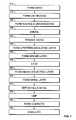
- FIG. 1is a flowchart of an illustrative embodiment of a process of the present invention.
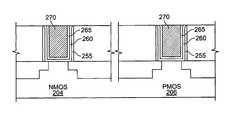
- FIGS. 2A-2Fare cross-sections of illustrative NMOS and PMOS transistors at various stages of the process of FIG. 1 .
- FIG. 1is a flowchart depicting some of the major steps in making NMOS and
- FIGS. 2A-2Fdepict illustrative cross-sections of one such NMOS transistor and one such PMOS transistor at certain steps in the process of FIG. 1 .
- polysilicon gatesare formed on a substrate wherever a gate will ultimately be used.
- LDD regionsare then formed on either side of each gate using the gate as a mask to define where the regions are formed.
- source and drain regionsare formed in the substrate at step 120 again using the gate and side spacers to define where the source and drain regions are formed.
- the LDD regions, the source regions and the drain regionsare formed by ion implantation of dopants and the damage caused by the ion implantation is thermally annealed at step 125 .
- both PMOS and NMOS structuresare typically formed in the same integrated circuit.
- steps 110 to 125are set forth in S. A. Campbell, The Science and Engineering of Microelectronic Fabrication (2 nd ed.)(Oxford 2001); J. D. Plummer et al., Silicon VLSI Technology Fundamentals, Practice and Modeling (Prentice Hall 2000), which are incorporated by reference in their entireties.
- FIG. 2Adepicts an illustrative cross-section of the NMOS and PMOS transistors after step 135 . More particularly, FIG. 2A depicts a substrate 200 having an upper surface 202 , a first region 204 that is doped with dopants of P-type conductivity and a second region 206 that is doped with dopants of N-type conductivity. It will be appreciated that in a state-of-the-art substrate, there are many billions of such regions 204 , 206 .
- LDD regions 210In the first region 204 are formed LDD regions 210 , a source region 212 and a drain region 214 of N-type conductivity; and in the second region 206 are formed LDD regions 220 , a source region 222 and a drain region 224 of P-type conductivity.
- An insulating layer 230is formed on the substrate; and holes 235 are patterned in the insulating layer where the gates of the NMOS and PMOS transistors are to be formed. As shown in FIG. 2A , holes 235 extend from an upper surface 232 of insulating layer 230 down to the upper surface 202 of substrate 200 . Holes 235 have substantially vertical sidewalls 237 .
- a spacer layer 250is formed on the upper surface of the insulating layer, on the substantially vertical sidewalls of the holes in the insulating layer and on the exposed portions of the upper surface of the substrate at the bottom of the holes.
- the spacer layeris depicted in FIG. 2B .
- spacer layer 250is a hard mask layer made of materials such as silicon nitride, SiNx, carbon-doped silicon dioxide, amorphous/plasma enhanced chemical vapor deposition (PECVD) carbon.
- the thickness of the spacer layeris in the range of 1 to 10 nanometers (nm) with current technologies and can be expected to decrease in the future.
- the hard maskis etched using a plasma etchant.
- the etching processis anisotropic with a vertical etch rate that is faster than a lateral etch rate As a result, the etching process removes the material of the spacer layer that lies on a horizontal surface faster than it removes the material that lies on a vertical surface. Specifically, the etching process removes the portion of the spacer layer exposed at the bottom of each hole. Since the etching process operates uniformly on the horizontal surfaces of the device, the process also removes all of the portion of the spacer layer on upper surface 232 of insulating layer 230 . However, the etching process does not remove all of the portion of the spacer layer formed on the substantially vertical sidewalls of the holes.
- FIG. 2Cdepicts an illustrative cross-section after completion of etching step 155 .
- Suitable anisotropic etchantsare known for a wide variety of materials that may be used for the spacer layer.
- suitable etchantsare fluorine deficient fluorocarbon plasmas such as CF4/H2, CHF3, C2HF5 or C4F8.
- a high-k dielectric layer 260is formed on the remaining vertical portion 255 of spacer layer 250 and on the exposed upper surfaces 202 , 232 of substrate 200 and insulating layer 230 as depicted in FIG. 2D .
- a variety of high-k dielectric materialsare available for use. One such material is Hafnium oxide. Typically, the high-k dielectric layer is less than about 10 nm thick.
- a metal layer 265is then formed on the high-k dielectric layer 260 at step 165 .
- This layeris typically aluminum and is less than approximately 100 nm thick.
- Bulk gate metal 270is then formed on the metal layer at step 170 .
- the resulting structureis shown in FIG. 2E .
- step 175Chemical mechanical polishing is then performed at step 175 to remove the bulk gate metal down to the insulating layer. As shown in FIG. 2F , this isolates the individual NMOS and PMOS gate structures.
- contactsare formed to the individual NMOS and PMOS transistors as well as to other structures in the device.
- the waferis singulated so as to separate the integrated circuits into separate dies.
- the distance L between the sidewallscan be controlled by controlling the thickness of spacer layer 250 and the duration of etching step 155
- the length of the high-k dielectric layer 260 and the length of metal layer 265 in the same directioncan also be controlled very precisely by controlling the duration of the etching step 155 .
- Thismakes it possible to control the amount by which the gate overlaps the source and drain regions of the NMOS and PMOS transistors and thereby reduce the device overlap capacitance (Coy). Reductions in overlap capacitance on the order of 50 percent (%) are possible which, in turn, make possible significant improvements in device speed.
- DIBLdrain induced barrier lowering
- the taper 257 at the upper end of the sidewall spacers 255provide a structure that facilitates the formation of the high-k dielectric layer 260 and the metal layer 265 .
- the taperprovides a relatively smooth transition from the vertical surface of the sidewalls of the holes to the horizontal upper surface of the insulating layer.
- the taperalso ensures that the distance between the sidewalls of the hole at the top of each hole is greater than the distance L between the sidewalls at the bottom of the hole. This funnel shape reduces the likelihood of unwanted accumulation of fill material at the top of the hole and, in general, facilitates filling the holes with gate metallization.
- FIGS. 1 and 2 A- 2 FNumerous variations may be practiced in the embodiment depicted in FIGS. 1 and 2 A- 2 F.
- the hard mask materials used for the spacer layerare only illustrative. Numerous other materials are available for use as the spacer layer and others are being developed. Appropriate anisotropic etches will be apparent for the hard mask materials identified and others are likely to be devised.
- FIGS. 1 and 2 A- 2 Fhas been described for the case where the same metal layer is used for the gates of both the NMOS and PMOS transistors, the invention may also be practiced where different metal layers are used for the gates of the NMOS and PMOS transistors.
- a first metal layeris formed on the high-k dielectric layer as in step 165 .
- This layeris then patterned to form the metal gates for one type of transistors, illustratively, the PMOS transistors.
- the upper surface on one portion of the deviceis the high-k dielectric layer and on a second portion of the device it is the metal layer that is used to form the gates for the PMOS devices.
- a second metal layeris formed on the entire surface of the device; and a bulk gate metal is then formed on the second metal layer.
- the second metal layerserves as the gates for the NMOS devices.
- the spacer layer, the high-k dielectric layer, the metal layer, and the bulk metal fillhave not been supplied because many such processes are well known in the industry. For example, details of many of these processes are set forth in the above-referenced textbooks of Campbell and Plummer. While the embodiments have been described in terms of single layers, it will be understood that the single layers may be formed of multiple sub-layers that provide a multiplicity of functions.
Landscapes
- Engineering & Computer Science (AREA)
- Microelectronics & Electronic Packaging (AREA)
- Condensed Matter Physics & Semiconductors (AREA)
- General Physics & Mathematics (AREA)
- Manufacturing & Machinery (AREA)
- Computer Hardware Design (AREA)
- Physics & Mathematics (AREA)
- Power Engineering (AREA)
- Chemical & Material Sciences (AREA)
- Chemical Kinetics & Catalysis (AREA)
- General Chemical & Material Sciences (AREA)
- Inorganic Chemistry (AREA)
- Insulated Gate Type Field-Effect Transistor (AREA)
- Metal-Oxide And Bipolar Metal-Oxide Semiconductor Integrated Circuits (AREA)
Abstract
Description
This relates to a MOS gate structure and a method for forming the gate. It is especially useful in high-k dielectric last technology and will be described in that context. However, it may also be used in other technologies.
In recent years, the continued progress in reducing the physical size of semiconductors has required a major change in the composition of the gate structure in a PMOS or NMOS transistor. In particular, the thickness of the silicon dioxide insulator became so small that quantum effects resulted in substantial leakage currents through the insulator. As a result, it became necessary to replace the silicon dioxide insulator and, with it, the polysilicon gate. The replacement structure was a metal gate with a high-k dielectric that greatly reduced the leakage current For further details, see M. T. Bohr, et al., “The High-k Solution”,IEEE Spectrum(October 2007); E. P. Gusev et al, “Advanced High-k Dielectric Stacks with PolySi and Metal Gates: Recent Progress and Current Challenges,”IBM J. Res. &Dev., Vol. 50, No. 4/5 (July/September 2006), both of which are incorporated herein in their entireties.
The use of a metal gate and high-k dielectric introduced other issues into the semiconductor device manufacturing process. Of particular importance, high temperature annealing operations performed after implanting operations such as those for forming LDD regions, sources and drains were not compatible with the metal gate and high-k dielectric structures. As a result, fabrication processes were developed and implemented in which the high-k dielectric and metal layer were the last elements to be formed in the process. Such fabrication processes are sometimes referred to as high-k dielectric last processes.
While the high-k dielectric last process has facilitated the implementation of the Semiconductor Roadmap at technology nodes of 65 nm and beyond, the constantly decreasing size of the MOS gate continues to produce challenges. For example, other types of current leakage such as that caused by drain induced barrier lowering (DIBL) remain a problem. And capacitance between the gate and the source/drain (gate-source/drain overlap capacitance (Cov)) interferes with efforts to increase the switching speed of the transistors in devices such as Field Programmable Gate Arrays (FPGA). There are also problems in the fabrication of the structures of the semiconductor devices. For example, as the length of the transistor gates gets smaller and smaller, the size of the holes made in the insulating layer to form the gates should also get smaller except that it becomes increasingly more difficult to fill those holes with gate metallization.
The present invention is an improved high-k dielectric device and process.
In an illustrative embodiment, an insulating layer is formed on the substrate; and holes are patterned in the insulating layer where the gates of NMOS and PMOS transistors are to be formed. A hard mask spacer layer is formed on the upper surface of the insulating layer, on the substantially vertical sidewalls of the holes, and on the exposed portions of the upper surface of the substrate at the bottom of the holes. Next, the spacer layer is anisotropically etched to remove the portion of the spacer layer exposed at the bottom of each hole as well as the portion of the spacer layer on the upper surface of the insulating layer. However, the etching process does not remove all of the portion of the spacer layer formed on the substantially vertical sidewalls of the holes. Rather, the duration of the etching process is controlled so as to leave a vertical portion of the spacer layer having a desired thickness at the bottom of the hole and a taper that begins part way up the sidewall.
A high-k dielectric layer is then formed on the remaining vertical portion of the spacer layer and on the exposed upper surfaces of the substrate and the insulating layer. A metal layer is then formed on the high-k dielectric layer; and bulk gate metal is then formed on the metal layer. Chemical mechanical polishing is then performed to remove the bulk gate metal down to the insulating layer, thereby isolating individual NMOS and PMOS gate structures. Contacts are then formed to the individual gate structures as well as to other structures in the device. Finally, the wafer is singulated.
As will be described in more detail below, the use of a spacer layer and an anisotropic etching process make it possible to form a device having more uniform dimensions in the gate region. This enables reductions in the overlap capacitance (Cov) and the drain induced barrier lowering (DIBL) effect. It also makes it possible to improve the filling of the high-k dielectric and gate metals in the gate holes.
Numerous variations may be practiced in the invention.
These and other objects and advantages of the present invention will be apparent to those of ordinary skill in the art in view of the following detailed description in which:
It will be appreciated that the drawings are not to scale.
PMOS transistors in an illustrative embodiment of the invention. It will be understood that these steps are performed on a semiconductor substrate that typically is a wafer of silicon up to 12 inches (300 cm.) in diameter in today's state-of-the-art processes. Individual PMOS and NMOS transistors are quite small which allows for the formation of several hundred integrated circuits on a single wafer, each integrated circuit having up to a billion or so MOS transistors.FIGS. 2A-2F depict illustrative cross-sections of one such NMOS transistor and one such PMOS transistor at certain steps in the process ofFIG. 1 .
Atstep 110 ofFIG. 1 , polysilicon gates are formed on a substrate wherever a gate will ultimately be used. Atstep 115, LDD regions are then formed on either side of each gate using the gate as a mask to define where the regions are formed. Next, source and drain regions are formed in the substrate atstep 120 again using the gate and side spacers to define where the source and drain regions are formed. Typically, the LDD regions, the source regions and the drain regions are formed by ion implantation of dopants and the damage caused by the ion implantation is thermally annealed atstep 125. As will be appreciated by those skilled in the art, both PMOS and NMOS structures are typically formed in the same integrated circuit. This is accomplished by first implanting first portions of the substrate with dopants of one conductivity type and subsequently implanting other portions of the substrate with dopants of the other conductivity type. Furtherdetails concerning steps 110 to125 are set forth in S. A. Campbell,The Science and Engineering of Microelectronic Fabrication(2nded.)(Oxford 2001); J. D. Plummer et al.,Silicon VLSI Technology Fundamentals, Practice and Modeling(Prentice Hall 2000), which are incorporated by reference in their entireties.
In the process depicted inFIG. 1 , the polysilicon gates are then removed atstep 130 An insulating layer is formed on the substrate and patterned atstep 135 to define the regions where the metal gates are to be formed.FIG. 2A depicts an illustrative cross-section of the NMOS and PMOS transistors afterstep 135. More particularly,FIG. 2A depicts asubstrate 200 having anupper surface 202, afirst region 204 that is doped with dopants of P-type conductivity and asecond region 206 that is doped with dopants of N-type conductivity. It will be appreciated that in a state-of-the-art substrate, there are many billions ofsuch regions first region 204 are formedLDD regions 210, asource region 212 and adrain region 214 of N-type conductivity; and in thesecond region 206 are formedLDD regions 220, asource region 222 and adrain region 224 of P-type conductivity. Aninsulating layer 230 is formed on the substrate; andholes 235 are patterned in the insulating layer where the gates of the NMOS and PMOS transistors are to be formed. As shown inFIG. 2A , holes235 extend from anupper surface 232 of insulatinglayer 230 down to theupper surface 202 ofsubstrate 200.Holes 235 have substantially vertical sidewalls237.
Atstep 150, aspacer layer 250 is formed on the upper surface of the insulating layer, on the substantially vertical sidewalls of the holes in the insulating layer and on the exposed portions of the upper surface of the substrate at the bottom of the holes. The spacer layer is depicted inFIG. 2B . Illustratively,spacer layer 250 is a hard mask layer made of materials such as silicon nitride, SiNx, carbon-doped silicon dioxide, amorphous/plasma enhanced chemical vapor deposition (PECVD) carbon. Illustratively, the thickness of the spacer layer is in the range of 1 to 10 nanometers (nm) with current technologies and can be expected to decrease in the future.
Atstep 155, the hard mask is etched using a plasma etchant. The etching process is anisotropic with a vertical etch rate that is faster than a lateral etch rate As a result, the etching process removes the material of the spacer layer that lies on a horizontal surface faster than it removes the material that lies on a vertical surface. Specifically, the etching process removes the portion of the spacer layer exposed at the bottom of each hole. Since the etching process operates uniformly on the horizontal surfaces of the device, the process also removes all of the portion of the spacer layer onupper surface 232 of insulatinglayer 230. However, the etching process does not remove all of the portion of the spacer layer formed on the substantially vertical sidewalls of the holes. Rather, it removes only a portion of the thickness of the vertical portion of the spacer layer, leavingsidewalls 255 separated by a distance L. The amount of the vertical portion ofspacer layer 250 that is removed depends on the lateral etch rate of the etchant and the duration of the etching process. At the inside upper edge of the vertical portion of the spacer, the anisotropic etching process produces ataper 257 that begins part way up the sidewall and reduces in thickness moving farther up the sidewall. Thus, the width of the hole grows gradually wider with increasing distance from the bottom of the hole.FIG. 2C depicts an illustrative cross-section after completion ofetching step 155.
Suitable anisotropic etchants are known for a wide variety of materials that may be used for the spacer layer. For example, for silicon nitride hard masks, suitable etchants are fluorine deficient fluorocarbon plasmas such as CF4/H2, CHF3, C2HF5 or C4F8.
Atstep 160, a high-k dielectric layer 260 is formed on the remainingvertical portion 255 ofspacer layer 250 and on the exposedupper surfaces substrate 200 and insulatinglayer 230 as depicted inFIG. 2D . A variety of high-k dielectric materials are available for use. One such material is Hafnium oxide. Typically, the high-k dielectric layer is less than about 10 nm thick.
Ametal layer 265 is then formed on the high-k dielectric layer 260 atstep 165. This layer is typically aluminum and is less than approximately 100 nm thick.Bulk gate metal 270 is then formed on the metal layer atstep 170. The resulting structure is shown inFIG. 2E .
Chemical mechanical polishing is then performed atstep 175 to remove the bulk gate metal down to the insulating layer. As shown inFIG. 2F , this isolates the individual NMOS and PMOS gate structures. Atstep 180, contacts are formed to the individual NMOS and PMOS transistors as well as to other structures in the device. Finally, atstep 185, the wafer is singulated so as to separate the integrated circuits into separate dies.
Since the distance L between the sidewalls can be controlled by controlling the thickness ofspacer layer 250 and the duration ofetching step 155, the length of the high-k dielectric layer 260 and the length ofmetal layer 265 in the same direction can also be controlled very precisely by controlling the duration of theetching step 155. This makes it possible to control the amount by which the gate overlaps the source and drain regions of the NMOS and PMOS transistors and thereby reduce the device overlap capacitance (Coy). Reductions in overlap capacitance on the order of 50 percent (%) are possible which, in turn, make possible significant improvements in device speed.
Since the length of the gate can be precisely controlled, it is also possible to reduce the drain induced barrier lowering (DIBL) by up to approximately 70 mV which lowers leakage currents by a factor of up to 3. This also makes it possible to use deeper LDD regions which results in lower substrate resistance Rs.
Thetaper 257 at the upper end of thesidewall spacers 255 provide a structure that facilitates the formation of the high-k dielectric layer 260 and themetal layer 265. The taper provides a relatively smooth transition from the vertical surface of the sidewalls of the holes to the horizontal upper surface of the insulating layer. The taper also ensures that the distance between the sidewalls of the hole at the top of each hole is greater than the distance L between the sidewalls at the bottom of the hole. This funnel shape reduces the likelihood of unwanted accumulation of fill material at the top of the hole and, in general, facilitates filling the holes with gate metallization.
Numerous variations may be practiced in the embodiment depicted in FIGS.1 and2A-2F. The hard mask materials used for the spacer layer are only illustrative. Numerous other materials are available for use as the spacer layer and others are being developed. Appropriate anisotropic etches will be apparent for the hard mask materials identified and others are likely to be devised.
While the embodiment of FIGS.1 and2A-2F has been described for the case where the same metal layer is used for the gates of both the NMOS and PMOS transistors, the invention may also be practiced where different metal layers are used for the gates of the NMOS and PMOS transistors. In this circumstance, a first metal layer is formed on the high-k dielectric layer as instep 165. This layer is then patterned to form the metal gates for one type of transistors, illustratively, the PMOS transistors. As a result, the upper surface on one portion of the device is the high-k dielectric layer and on a second portion of the device it is the metal layer that is used to form the gates for the PMOS devices. Next, a second metal layer is formed on the entire surface of the device; and a bulk gate metal is then formed on the second metal layer. The second metal layer serves as the gates for the NMOS devices.
Specific details for the formation of the spacer layer, the high-k dielectric layer, the metal layer, and the bulk metal fill have not been supplied because many such processes are well known in the industry. For example, details of many of these processes are set forth in the above-referenced textbooks of Campbell and Plummer. While the embodiments have been described in terms of single layers, it will be understood that the single layers may be formed of multiple sub-layers that provide a multiplicity of functions.
In the interest of simplicity and to avoid obscuring the invention, only the major steps of the semiconductor fabrication process have been described. It will also be understood that many additional steps and details have been omitted as unnecessary for an understanding of the invention.
Claims (12)
1. A method for fabricating a MOS transistor in a semiconductor substrate having a first conductivity type comprising:
forming source and drain regions by implanting in the semiconductor substrate ions having a second conductivity type;
forming an insulating layer on an upper surface of the semiconductor substrate;
removing a portion of the insulating layer to form a hole that exposes the upper surface of the semiconductor substrate between the source and drain regions;
forming a spacer layer on an upper surface of the insulating layer, on sidewalls of the hole in the insulating layer and on the exposed upper surface of the semiconductor substrate;
forming spacers by anistropically etching the spacer layer so as to remove the spacer layer on the upper surface of the semiconductor substrate, thereby exposing the upper surface of the semiconductor substrate, and to remove a portion of the spacer layer on the sidewalls of the insulating layer;
forming a high-k dielectric layer between the spacers on the exposed upper surface of the semiconductor substrate; and
forming a gate on the portion of the high-k dielectric layer formed between the spacers on the exposed upper surface of the semiconductor substrate; wherein a top surface of the gate is substantially co-planar with a top surface of the insulating layer.
2. The method ofclaim 1 further comprising forming electrical connections to the gate, the source region and the drain region.
3. The method ofclaim 1 further comprising forming LDD Regions.
4. The method ofclaim 1 wherein the spacer layer is a hard mask layer and the etching is performed using a plasma etch.
5. The method ofclaim 1 wherein the spacer layer is a layer of silicon nitride, a layer of carbon-doped silicon dioxide, or a layer of amorphous/plasma enhanced chemical vapor deposition(PECVD)carbon.
6. The method ofclaim 1 when the etching step is performed using a fluorine-deficient fluorocarbon plasma etchant.
7. A method for fabricating an integrated circuit structure in a semiconductor substrate comprising:
forming first source and drain regions by implanting ions having a first conductivity type in a first portion of the semiconductor substrate having a second conductivity type;
forming second source and drain regions by implanting ions having a second conductivity type in a second portion of the semiconductor substrate having a first conductivity type;
forming an insulating layer on an upper surface of the semiconductor substrate;
removing portions of the insulating layer to form holes that expose the upper surface of the semiconductor substrate between the first source and drain regions and between the second source and drain regions;
forming a spacer layer on an upper surface of the insulating layer, on sidewalls of the holes in the insulating layer and on the exposed upper surface of the semiconductor substrate;
anisotropically etching the spacer layer so as to remove both the spacer layer on the upper surface of the semiconductor substrate in the holes, thereby exposing the upper surface of the semiconductor substrate, and portions of the spacer layer on the sidewalls of the holes in the insulating layer;
forming a high-k dielectric layer on the exposed upper surface of the semiconductor substrate in the holes; and
forming gates on the portions of the high-k dielectric layer formed on the exposed upper surface of the semiconductor substrate in the holes.
8. The method ofclaim 7 further comprising forming electrical connections to the gate, the source region and the drain region.
9. The method ofclaim 7 further comprising forming LDD Regions.
10. The method ofclaim 7 wherein the spacer layer is a hard mask layer and the etching step is performed using a plasma etch.
11. The method ofclaim 7 wherein the spacer layer is a layer of silicon nitride, a layer of carbon-doped silicon dioxide, or a layer of amorphous/plasma enhanced chemical vapor deposition(PECVD)carbon.
12. The method ofclaim 7 when the etching step is performed using a fluorine-deficient fluorocarbon etchant.
Priority Applications (2)
| Application Number | Priority Date | Filing Date | Title |
|---|---|---|---|
| US13/525,864US8835265B1 (en) | 2012-06-18 | 2012-06-18 | High-k dielectric device and process |
| US14/473,953US9166045B1 (en) | 2012-06-18 | 2014-08-29 | High-k dielectric device and process |
Applications Claiming Priority (1)
| Application Number | Priority Date | Filing Date | Title |
|---|---|---|---|
| US13/525,864US8835265B1 (en) | 2012-06-18 | 2012-06-18 | High-k dielectric device and process |
Related Child Applications (1)
| Application Number | Title | Priority Date | Filing Date |
|---|---|---|---|
| US14/473,953DivisionUS9166045B1 (en) | 2012-06-18 | 2014-08-29 | High-k dielectric device and process |
Publications (1)
| Publication Number | Publication Date |
|---|---|
| US8835265B1true US8835265B1 (en) | 2014-09-16 |
Family
ID=51493336
Family Applications (2)
| Application Number | Title | Priority Date | Filing Date |
|---|---|---|---|
| US13/525,864ActiveUS8835265B1 (en) | 2012-06-18 | 2012-06-18 | High-k dielectric device and process |
| US14/473,953ActiveUS9166045B1 (en) | 2012-06-18 | 2014-08-29 | High-k dielectric device and process |
Family Applications After (1)
| Application Number | Title | Priority Date | Filing Date |
|---|---|---|---|
| US14/473,953ActiveUS9166045B1 (en) | 2012-06-18 | 2014-08-29 | High-k dielectric device and process |
Country Status (1)
| Country | Link |
|---|---|
| US (2) | US8835265B1 (en) |
Cited By (3)
| Publication number | Priority date | Publication date | Assignee | Title |
|---|---|---|---|---|
| US20220231147A1 (en)* | 2021-01-18 | 2022-07-21 | Commissariat à l'énergie atomique et aux énergies alternatives | Semiconductor device and associated manufacturing method |
| CN115213764A (en)* | 2022-07-04 | 2022-10-21 | 江苏东海半导体股份有限公司 | Preparation method of metal oxide semiconductor field effect transistor |
| CN116779611A (en)* | 2023-08-17 | 2023-09-19 | 合肥晶合集成电路股份有限公司 | Semiconductor structure and preparation method thereof |
Families Citing this family (2)
| Publication number | Priority date | Publication date | Assignee | Title |
|---|---|---|---|---|
| US9691900B2 (en)* | 2014-11-24 | 2017-06-27 | International Business Machines Corporation | Dual epitaxy CMOS processing using selective nitride formation for reduced gate pitch |
| EP3707759B1 (en)* | 2017-11-07 | 2024-07-10 | Everspin Technologies, Inc. | Angled surface removal process and structure relating thereto |
Citations (27)
| Publication number | Priority date | Publication date | Assignee | Title |
|---|---|---|---|---|
| US5434093A (en)* | 1994-08-10 | 1995-07-18 | Intel Corporation | Inverted spacer transistor |
| US5905285A (en)* | 1996-09-12 | 1999-05-18 | Advanced Micro Devices, Inc. | Ultra short trench transistors and process for making same |
| US5953602A (en)* | 1995-05-26 | 1999-09-14 | Lg Semicon Co., Ltd. | EEPROM cell and related method of making thereof |
| US6033963A (en)* | 1999-08-30 | 2000-03-07 | Taiwan Semiconductor Manufacturing Company | Method of forming a metal gate for CMOS devices using a replacement gate process |
| US6108242A (en)* | 1999-08-10 | 2000-08-22 | Taiwan Semiconductor Mfg. Co. Ltd. | Flash memory with split gate structure and method of fabricating the same |
| US6124177A (en)* | 1999-08-13 | 2000-09-26 | Taiwan Semiconductor Manufacturing Company | Method for making deep sub-micron mosfet structures having improved electrical characteristics |
| US6169315B1 (en)* | 1995-12-28 | 2001-01-02 | Hyundai Electronics Industries Co., Ltd. | Metal oxide semiconductor field effect transistor (MOSFET) and method for making thereof |
| US6297132B1 (en)* | 2000-02-07 | 2001-10-02 | Chartered Semiconductor Manufacturing Ltd. | Process to control the lateral doping profile of an implanted channel region |
| US6326272B1 (en)* | 1999-11-18 | 2001-12-04 | Chartered Semiconductor Manufacturing Ltd. | Method for forming self-aligned elevated transistor |
| US20020102790A1 (en)* | 2000-09-18 | 2002-08-01 | Samsung Electronics Co., Ltd. | Semiconductor memory device and method for manufacturing the same |
| US20020155664A1 (en)* | 1998-12-09 | 2002-10-24 | Matsushita Electronics Corporation | Semiconductor storage device and method of manufacturing the same |
| US6639288B1 (en)* | 1999-01-19 | 2003-10-28 | Mitsubishi Denki Kabushiki Kaisha | Semiconductor device with a particular conductor arrangement |
| US20040033657A1 (en)* | 2002-08-15 | 2004-02-19 | Nanya Technology Corporation | Method for fabricating memory unit with T-shaped gate |
| US20040113212A1 (en)* | 2002-10-11 | 2004-06-17 | Shin-Ae Lee | MOS transistors having inverted T-shaped gate electrodes and fabrication methods thereof |
| US20040203198A1 (en)* | 2003-04-01 | 2004-10-14 | Wonju Cho | MOSFET device with nanoscale channel and method of manufacturing the same |
| US6812111B2 (en)* | 2002-01-29 | 2004-11-02 | Samsung Electronics Co., Ltd. | Methods for fabricating MOS transistors with notched gate electrodes |
| US6864135B2 (en)* | 2002-10-31 | 2005-03-08 | Freescale Semiconductor, Inc. | Semiconductor fabrication process using transistor spacers of differing widths |
| US6867082B2 (en)* | 2002-03-28 | 2005-03-15 | Samsung Electronics Co., Ltd | Nonvolatile memory cells having split gate structure and methods of fabricating the same |
| US20060043462A1 (en)* | 2004-08-27 | 2006-03-02 | Micron Technology, Inc. | Stepped gate configuration for non-volatile memory |
| US7041538B2 (en)* | 2002-04-05 | 2006-05-09 | International Business Machines Corporation | Method of manufacturing a disposable reversed spacer process for high performance recessed channel CMOS |
| US7160780B2 (en)* | 2004-02-23 | 2007-01-09 | Samsung Electronics Co., Ltd. | Method of manufacturing a fin field effect transistor |
| US20070224767A1 (en)* | 2006-03-21 | 2007-09-27 | Promos Technologies Inc. | Semiconductor Device with Recessed Trench and Method of Fabricating the Same |
| US20100001317A1 (en)* | 2008-07-03 | 2010-01-07 | Yi-Wei Chen | Cmos transistor and the method for manufacturing the same |
| US20110237062A1 (en)* | 2010-03-24 | 2011-09-29 | Samsung Electronics Co., Ltd. | Semiconductor Device And Method Of Fabricating The Same |
| US20120104470A1 (en)* | 2010-10-28 | 2012-05-03 | International Business Machines Corporation | Replacement gate mosfet with raised source and drain |
| US20120139062A1 (en)* | 2010-12-02 | 2012-06-07 | International Business Machines Corporation | Self-aligned contact combined with a replacement metal gate/high-k gate dielectric |
| US20120313165A1 (en)* | 2011-06-09 | 2012-12-13 | Semiconductor Manufacturing International (Beijing) Corporation | Semiconductor device and manufacturing method thereof |
Family Cites Families (42)
| Publication number | Priority date | Publication date | Assignee | Title |
|---|---|---|---|---|
| JP2508818B2 (en)* | 1988-10-03 | 1996-06-19 | 三菱電機株式会社 | Method for manufacturing semiconductor device |
| US5231038A (en)* | 1989-04-04 | 1993-07-27 | Mitsubishi Denki Kabushiki Kaisha | Method of producing field effect transistor |
| US5023190A (en)* | 1990-08-03 | 1991-06-11 | Micron Technology, Inc. | CMOS processes |
| US5874341A (en)* | 1996-10-30 | 1999-02-23 | Advanced Micro Devices, Inc. | Method of forming trench transistor with source contact in trench |
| US5571738A (en)* | 1992-09-21 | 1996-11-05 | Advanced Micro Devices, Inc. | Method of making poly LDD self-aligned channel transistors |
| US5538913A (en)* | 1995-11-13 | 1996-07-23 | United Microelectronics Corporation | Process for fabricating MOS transistors having full-overlap lightly-doped drain structure |
| US5714413A (en)* | 1995-12-11 | 1998-02-03 | Intel Corporation | Method of making a transistor having a deposited dual-layer spacer structure |
| US5698461A (en)* | 1996-03-12 | 1997-12-16 | United Microelectronics Corp. | Method for fabricating lightly doped drain metal oxide semiconductor field effect transistor |
| US5801075A (en)* | 1996-10-30 | 1998-09-01 | Advanced Micro Devices, Inc. | Method of forming trench transistor with metal spacers |
| US6100146A (en)* | 1996-10-30 | 2000-08-08 | Advanced Micro Devices, Inc. | Method of forming trench transistor with insulative spacers |
| US5899719A (en)* | 1997-02-14 | 1999-05-04 | United Semiconductor Corporation | Sub-micron MOSFET |
| US6025635A (en)* | 1997-07-09 | 2000-02-15 | Advanced Micro Devices, Inc. | Short channel transistor having resistive gate extensions |
| US5891787A (en)* | 1997-09-04 | 1999-04-06 | Advanced Micro Devices, Inc. | Semiconductor fabrication employing implantation of excess atoms at the edges of a trench isolation structure |
| US5877056A (en)* | 1998-01-08 | 1999-03-02 | Texas Instruments-Acer Incorporated | Ultra-short channel recessed gate MOSFET with a buried contact |
| JP3461277B2 (en)* | 1998-01-23 | 2003-10-27 | 株式会社東芝 | Semiconductor device and manufacturing method thereof |
| US5937297A (en)* | 1998-06-01 | 1999-08-10 | Chartered Semiconductor Manufacturing, Ltd. | Method for making sub-quarter-micron MOSFET |
| US6093945A (en)* | 1998-07-09 | 2000-07-25 | Windbond Electronics Corp. | Split gate flash memory with minimum over-erase problem |
| US6155537A (en)* | 1998-07-09 | 2000-12-05 | Windbond Electronics Corp. | Deep submicron MOS transistors with a self-aligned gate electrode |
| JP3408437B2 (en)* | 1998-10-30 | 2003-05-19 | シャープ株式会社 | Method for manufacturing semiconductor device |
| US6153904A (en)* | 1998-12-04 | 2000-11-28 | Winbond Electronics Corporation | Fabrication method for increasing the coupling efficiency of ETOX flash memory devices |
| US6319776B1 (en)* | 1999-05-12 | 2001-11-20 | United Microelectronics Corp. | Forming high voltage complementary semiconductor device (HV-CMOS) with gradient doping electrodes |
| TW445649B (en)* | 1999-06-09 | 2001-07-11 | Sanyo Electric Co | Semiconductor memory and method for operating a semiconductor memory |
| US6501131B1 (en)* | 1999-07-22 | 2002-12-31 | International Business Machines Corporation | Transistors having independently adjustable parameters |
| US6249022B1 (en)* | 1999-10-22 | 2001-06-19 | United Microelectronics Corp. | Trench flash memory with nitride spacers for electron trapping |
| US6358800B1 (en)* | 2000-09-18 | 2002-03-19 | Vanguard International Semiconductor Corporation | Method of forming a MOSFET with a recessed-gate having a channel length beyond photolithography limit |
| US6559051B1 (en)* | 2000-10-05 | 2003-05-06 | Advanced Micro Devices, Inc. | Electroless deposition of dielectric precursor materials for use in in-laid gate MOS transistors |
| US6506639B1 (en)* | 2000-10-18 | 2003-01-14 | Advanced Micro Devices, Inc. | Method of forming low resistance reduced channel length transistors |
| JP2002343963A (en)* | 2001-05-17 | 2002-11-29 | Sony Corp | Trench gate type field effect transistor and manufacturing method thereof |
| US6740557B1 (en)* | 2001-07-02 | 2004-05-25 | Taiwan Semiconductor Manufacturing Company | Spacer like floating gate formation |
| US6566215B1 (en)* | 2002-06-06 | 2003-05-20 | Chartered Semiconductor Manufacturing Ltd. | Method of fabricating short channel MOS transistors with source/drain extensions |
| KR100488099B1 (en)* | 2002-11-18 | 2005-05-06 | 한국전자통신연구원 | A mos transistor having short channel and a manufacturing method thereof |
| KR20040055360A (en)* | 2002-12-20 | 2004-06-26 | 아남반도체 주식회사 | Manufacturing method of flash memory semiconductor device |
| KR100521381B1 (en)* | 2003-06-25 | 2005-10-12 | 삼성전자주식회사 | Method Of Fabricating Metal-Oxide-Semiconductor Field Effect Transistor |
| US7087508B2 (en)* | 2003-10-30 | 2006-08-08 | Taiwan Semiconductor Manufacturing Company, Ltd. | Method of improving short channel effect and gate oxide reliability by nitrogen plasma treatment before spacer deposition |
| KR100539247B1 (en)* | 2004-02-04 | 2005-12-27 | 삼성전자주식회사 | Split gate type non-volatile semiconductor memory device and method of fabricating the same |
| US6992353B1 (en)* | 2004-11-01 | 2006-01-31 | Silicon-Based Technology Corp. | Self-aligned source structure of planar DMOS power transistor and its manufacturing methods |
| US7208785B2 (en)* | 2004-12-20 | 2007-04-24 | Silicon-Based Technology Corp. | Self-aligned Schottky-barrier clamped planar DMOS transistor structure and its manufacturing methods |
| US7307315B2 (en)* | 2004-12-20 | 2007-12-11 | Silicon-Based Technology Corp. | Scalable planar DMOS transistor structure and its fabricating methods |
| US20070075362A1 (en)* | 2005-09-30 | 2007-04-05 | Ching-Yuan Wu | Self-aligned schottky-barrier clamped trench DMOS transistor structure and its manufacturing methods |
| US7358133B2 (en)* | 2005-12-28 | 2008-04-15 | Nanya Technology Corporation | Semiconductor device and method for making the same |
| JP2008251825A (en)* | 2007-03-30 | 2008-10-16 | Nec Electronics Corp | Manufacturing method of semiconductor memory device |
| US8900954B2 (en)* | 2011-11-04 | 2014-12-02 | International Business Machines Corporation | Blanket short channel roll-up implant with non-angled long channel compensating implant through patterned opening |
- 2012
- 2012-06-18USUS13/525,864patent/US8835265B1/enactiveActive
- 2014
- 2014-08-29USUS14/473,953patent/US9166045B1/enactiveActive
Patent Citations (27)
| Publication number | Priority date | Publication date | Assignee | Title |
|---|---|---|---|---|
| US5434093A (en)* | 1994-08-10 | 1995-07-18 | Intel Corporation | Inverted spacer transistor |
| US5953602A (en)* | 1995-05-26 | 1999-09-14 | Lg Semicon Co., Ltd. | EEPROM cell and related method of making thereof |
| US6169315B1 (en)* | 1995-12-28 | 2001-01-02 | Hyundai Electronics Industries Co., Ltd. | Metal oxide semiconductor field effect transistor (MOSFET) and method for making thereof |
| US5905285A (en)* | 1996-09-12 | 1999-05-18 | Advanced Micro Devices, Inc. | Ultra short trench transistors and process for making same |
| US20020155664A1 (en)* | 1998-12-09 | 2002-10-24 | Matsushita Electronics Corporation | Semiconductor storage device and method of manufacturing the same |
| US6639288B1 (en)* | 1999-01-19 | 2003-10-28 | Mitsubishi Denki Kabushiki Kaisha | Semiconductor device with a particular conductor arrangement |
| US6108242A (en)* | 1999-08-10 | 2000-08-22 | Taiwan Semiconductor Mfg. Co. Ltd. | Flash memory with split gate structure and method of fabricating the same |
| US6124177A (en)* | 1999-08-13 | 2000-09-26 | Taiwan Semiconductor Manufacturing Company | Method for making deep sub-micron mosfet structures having improved electrical characteristics |
| US6033963A (en)* | 1999-08-30 | 2000-03-07 | Taiwan Semiconductor Manufacturing Company | Method of forming a metal gate for CMOS devices using a replacement gate process |
| US6326272B1 (en)* | 1999-11-18 | 2001-12-04 | Chartered Semiconductor Manufacturing Ltd. | Method for forming self-aligned elevated transistor |
| US6297132B1 (en)* | 2000-02-07 | 2001-10-02 | Chartered Semiconductor Manufacturing Ltd. | Process to control the lateral doping profile of an implanted channel region |
| US20020102790A1 (en)* | 2000-09-18 | 2002-08-01 | Samsung Electronics Co., Ltd. | Semiconductor memory device and method for manufacturing the same |
| US6812111B2 (en)* | 2002-01-29 | 2004-11-02 | Samsung Electronics Co., Ltd. | Methods for fabricating MOS transistors with notched gate electrodes |
| US6867082B2 (en)* | 2002-03-28 | 2005-03-15 | Samsung Electronics Co., Ltd | Nonvolatile memory cells having split gate structure and methods of fabricating the same |
| US7041538B2 (en)* | 2002-04-05 | 2006-05-09 | International Business Machines Corporation | Method of manufacturing a disposable reversed spacer process for high performance recessed channel CMOS |
| US20040033657A1 (en)* | 2002-08-15 | 2004-02-19 | Nanya Technology Corporation | Method for fabricating memory unit with T-shaped gate |
| US20040113212A1 (en)* | 2002-10-11 | 2004-06-17 | Shin-Ae Lee | MOS transistors having inverted T-shaped gate electrodes and fabrication methods thereof |
| US6864135B2 (en)* | 2002-10-31 | 2005-03-08 | Freescale Semiconductor, Inc. | Semiconductor fabrication process using transistor spacers of differing widths |
| US20040203198A1 (en)* | 2003-04-01 | 2004-10-14 | Wonju Cho | MOSFET device with nanoscale channel and method of manufacturing the same |
| US7160780B2 (en)* | 2004-02-23 | 2007-01-09 | Samsung Electronics Co., Ltd. | Method of manufacturing a fin field effect transistor |
| US20060043462A1 (en)* | 2004-08-27 | 2006-03-02 | Micron Technology, Inc. | Stepped gate configuration for non-volatile memory |
| US20070224767A1 (en)* | 2006-03-21 | 2007-09-27 | Promos Technologies Inc. | Semiconductor Device with Recessed Trench and Method of Fabricating the Same |
| US20100001317A1 (en)* | 2008-07-03 | 2010-01-07 | Yi-Wei Chen | Cmos transistor and the method for manufacturing the same |
| US20110237062A1 (en)* | 2010-03-24 | 2011-09-29 | Samsung Electronics Co., Ltd. | Semiconductor Device And Method Of Fabricating The Same |
| US20120104470A1 (en)* | 2010-10-28 | 2012-05-03 | International Business Machines Corporation | Replacement gate mosfet with raised source and drain |
| US20120139062A1 (en)* | 2010-12-02 | 2012-06-07 | International Business Machines Corporation | Self-aligned contact combined with a replacement metal gate/high-k gate dielectric |
| US20120313165A1 (en)* | 2011-06-09 | 2012-12-13 | Semiconductor Manufacturing International (Beijing) Corporation | Semiconductor device and manufacturing method thereof |
Non-Patent Citations (4)
| Title |
|---|
| E.P.Gusev et al., "Advanced High-k Dielectric Stacks with Poly Si and Metal Gates: Recent Progress and Current Challenges," IBM J. Res. & Dev., vol. 50, No. 4/5 (July Sept. 20. |
| J.D.Plummer et al., Silicon VLSI Technology Fundamentals, Practice and Modeling, pp. 71-82 (Prentice Hall 2000). |
| M.T.Bohr et al.,"The High-k Solution," IEEE Spectrum (Oct. 2007) (eight pages). |
| S.A.Campbell, The Science and Engineering of Microelectronic Fabrication, pp. 455-458 (2nd Ed., Oxford University Press 2001). |
Cited By (5)
| Publication number | Priority date | Publication date | Assignee | Title |
|---|---|---|---|---|
| US20220231147A1 (en)* | 2021-01-18 | 2022-07-21 | Commissariat à l'énergie atomique et aux énergies alternatives | Semiconductor device and associated manufacturing method |
| CN115213764A (en)* | 2022-07-04 | 2022-10-21 | 江苏东海半导体股份有限公司 | Preparation method of metal oxide semiconductor field effect transistor |
| CN115213764B (en)* | 2022-07-04 | 2024-05-14 | 江苏东海半导体股份有限公司 | A method for preparing a metal oxide semiconductor field effect transistor |
| CN116779611A (en)* | 2023-08-17 | 2023-09-19 | 合肥晶合集成电路股份有限公司 | Semiconductor structure and preparation method thereof |
| CN116779611B (en)* | 2023-08-17 | 2023-11-28 | 合肥晶合集成电路股份有限公司 | Semiconductor structure and preparation method thereof |
Also Published As
| Publication number | Publication date |
|---|---|
| US9166045B1 (en) | 2015-10-20 |
Similar Documents
| Publication | Publication Date | Title |
|---|---|---|
| US12211750B2 (en) | Mechanisms for forming FinFET device | |
| US8815739B2 (en) | FinFET device with a graphene gate electrode and methods of forming same | |
| TWI443757B (en) | Method of manufacturing strain source/dip structure | |
| CN102104003B (en) | Method for manufacturing semiconductor device | |
| US6849516B2 (en) | Methods of forming drain/source extension structures of a field effect transistor using a doped high-k dielectric layer | |
| US9893182B2 (en) | FinFET and method for forming the same | |
| CN105826257A (en) | FinFET (Fin Field Effect Transistor) and formation method thereof | |
| CN110265302A (en) | Autoregistration SiGe fin FETs | |
| US10847431B2 (en) | Ion implantation methods and structures thereof | |
| CN101714508A (en) | Method for manufacturing semiconductor device | |
| TWI757509B (en) | Forming epitaxial structures in fin field effect transistors | |
| US9166045B1 (en) | High-k dielectric device and process | |
| CN103681346B (en) | Transistors, semiconductor devices, and methods of manufacture thereof | |
| CN105280642B (en) | Semiconductor devices and forming method thereof | |
| TW201807746A (en) | Method for oxidizing a depressed gate structure during a recess etching process | |
| US9748111B2 (en) | Method of fabricating semiconductor structure using planarization process and cleaning process | |
| TWI576898B (en) | Method for forming a nanowire device having a gate surrounding channel structure and the nanowire device | |
| CN102044438B (en) | MOS (Metal Oxide Semiconductor) transistor and manufacturing method thereof | |
| US11495500B2 (en) | Horizontal GAA nano-wire and nano-slab transistors | |
| US10008495B2 (en) | Method for forming FinFET device | |
| US20050098818A1 (en) | Drain/source extension structure of a field effect transistor including doped high-k sidewall spacers | |
| CN113517229B (en) | A method of manufacturing semiconductor components | |
| US10679905B2 (en) | Semiconductor structures and fabrication methods thereof | |
| TWI828979B (en) | Semiconductor device and method for forming the same | |
| CN104425262B (en) | PMOS transistor structure and its manufacture method |
Legal Events
| Date | Code | Title | Description |
|---|---|---|---|
| AS | Assignment | Owner name:ALTERA CORPORATION, CALIFORNIA Free format text:ASSIGNMENT OF ASSIGNORS INTEREST;ASSIGNORS:HSU, CHE TA;RICHTER, FANGYUN;CHENG, NING;AND OTHERS;REEL/FRAME:028834/0795 Effective date:20120724 | |
| STCF | Information on status: patent grant | Free format text:PATENTED CASE | |
| MAFP | Maintenance fee payment | Free format text:PAYMENT OF MAINTENANCE FEE, 4TH YEAR, LARGE ENTITY (ORIGINAL EVENT CODE: M1551) Year of fee payment:4 | |
| MAFP | Maintenance fee payment | Free format text:PAYMENT OF MAINTENANCE FEE, 8TH YEAR, LARGE ENTITY (ORIGINAL EVENT CODE: M1552); ENTITY STATUS OF PATENT OWNER: LARGE ENTITY Year of fee payment:8 |