US8783347B2 - Radio frequency enhanced steam assisted gravity drainage method for recovery of hydrocarbons - Google Patents
Radio frequency enhanced steam assisted gravity drainage method for recovery of hydrocarbonsDownload PDFInfo
- Publication number
- US8783347B2 US8783347B2US14/084,150US201314084150AUS8783347B2US 8783347 B2US8783347 B2US 8783347B2US 201314084150 AUS201314084150 AUS 201314084150AUS 8783347 B2US8783347 B2US 8783347B2
- Authority
- US
- United States
- Prior art keywords
- steam
- hydrocarbon formation
- energy
- waste heat
- electric
- Prior art date
- Legal status (The legal status is an assumption and is not a legal conclusion. Google has not performed a legal analysis and makes no representation as to the accuracy of the status listed.)
- Active
Links
- 229930195733hydrocarbonNatural products0.000titleclaimsabstractdescription84
- 150000002430hydrocarbonsChemical class0.000titleclaimsabstractdescription83
- 238000000034methodMethods0.000titleclaimsabstractdescription41
- 238000010796Steam-assisted gravity drainageMethods0.000titledescription15
- 238000011084recoveryMethods0.000titledescription4
- 230000015572biosynthetic processEffects0.000claimsabstractdescription93
- 239000004215Carbon black (E152)Substances0.000claimsabstractdescription70
- 238000010438heat treatmentMethods0.000claimsabstractdescription61
- XLYOFNOQVPJJNP-UHFFFAOYSA-NwaterSubstancesOXLYOFNOQVPJJNP-UHFFFAOYSA-N0.000claimsabstractdescription44
- 230000005540biological transmissionEffects0.000claimsdescription8
- 238000004519manufacturing processMethods0.000claimsdescription5
- 239000002918waste heatSubstances0.000claims16
- 230000005291magnetic effectEffects0.000abstractdescription25
- 230000005611electricityEffects0.000abstractdescription5
- 230000005855radiationEffects0.000abstractdescription5
- 230000008569processEffects0.000abstractdescription4
- 238000005755formation reactionMethods0.000description80
- 230000005684electric fieldEffects0.000description21
- 239000003921oilSubstances0.000description12
- 238000000605extractionMethods0.000description10
- 238000010793Steam injection (oil industry)Methods0.000description9
- 230000035515penetrationEffects0.000description9
- 239000007788liquidSubstances0.000description7
- 239000000295fuel oilSubstances0.000description6
- 239000010426asphaltSubstances0.000description5
- 238000010586diagramMethods0.000description5
- 230000000694effectsEffects0.000description5
- 239000000463materialSubstances0.000description4
- 230000008901benefitEffects0.000description2
- 230000008859changeEffects0.000description2
- 239000010779crude oilSubstances0.000description2
- 238000005485electric heatingMethods0.000description2
- 238000011065in-situ storageMethods0.000description2
- 230000007246mechanismEffects0.000description2
- 239000004058oil shaleSubstances0.000description2
- 150000003839saltsChemical class0.000description2
- 230000000638stimulationEffects0.000description2
- 239000011269tarSubstances0.000description2
- OGPQOSAKRHKIHW-UHFFFAOYSA-NCassinNatural productsCC(CCCCCCCCCC1CCC(O)C(C)N1)C(=O)COGPQOSAKRHKIHW-UHFFFAOYSA-N0.000description1
- 238000004458analytical methodMethods0.000description1
- 230000033228biological regulationEffects0.000description1
- 238000009835boilingMethods0.000description1
- 239000006227byproductSubstances0.000description1
- 238000012512characterization methodMethods0.000description1
- 239000004927claySubstances0.000description1
- 238000004891communicationMethods0.000description1
- 239000004020conductorSubstances0.000description1
- 230000007423decreaseEffects0.000description1
- 238000011161developmentMethods0.000description1
- 238000005553drillingMethods0.000description1
- 230000002500effect on skinEffects0.000description1
- 238000005516engineering processMethods0.000description1
- 230000004907fluxEffects0.000description1
- 239000000446fuelSubstances0.000description1
- 230000006870functionEffects0.000description1
- 125000001183hydrocarbyl groupChemical group0.000description1
- 238000013507mappingMethods0.000description1
- 239000000203mixtureSubstances0.000description1
- 239000003027oil sandSubstances0.000description1
- 230000035699permeabilityEffects0.000description1
- 238000012545processingMethods0.000description1
- 230000001737promoting effectEffects0.000description1
- 238000011160researchMethods0.000description1
- 239000004576sandSubstances0.000description1
- 238000000926separation methodMethods0.000description1
- 230000001502supplementing effectEffects0.000description1
- 239000013077target materialSubstances0.000description1
- 238000012360testing methodMethods0.000description1
Images


Classifications
- E—FIXED CONSTRUCTIONS
- E21—EARTH OR ROCK DRILLING; MINING
- E21B—EARTH OR ROCK DRILLING; OBTAINING OIL, GAS, WATER, SOLUBLE OR MELTABLE MATERIALS OR A SLURRY OF MINERALS FROM WELLS
- E21B43/00—Methods or apparatus for obtaining oil, gas, water, soluble or meltable materials or a slurry of minerals from wells
- E21B43/16—Enhanced recovery methods for obtaining hydrocarbons
- E21B43/24—Enhanced recovery methods for obtaining hydrocarbons using heat, e.g. steam injection
- E21B43/2406—Steam assisted gravity drainage [SAGD]
- E21B43/2408—SAGD in combination with other methods
- E—FIXED CONSTRUCTIONS
- E21—EARTH OR ROCK DRILLING; MINING
- E21B—EARTH OR ROCK DRILLING; OBTAINING OIL, GAS, WATER, SOLUBLE OR MELTABLE MATERIALS OR A SLURRY OF MINERALS FROM WELLS
- E21B43/00—Methods or apparatus for obtaining oil, gas, water, soluble or meltable materials or a slurry of minerals from wells
- E21B43/16—Enhanced recovery methods for obtaining hydrocarbons
- E21B43/24—Enhanced recovery methods for obtaining hydrocarbons using heat, e.g. steam injection
- E21B43/2401—Enhanced recovery methods for obtaining hydrocarbons using heat, e.g. steam injection by means of electricity
- H—ELECTRICITY
- H01—ELECTRIC ELEMENTS
- H01Q—ANTENNAS, i.e. RADIO AERIALS
- H01Q1/00—Details of, or arrangements associated with, antennas
- H01Q1/04—Adaptation for subterranean or subaqueous use
- H—ELECTRICITY
- H01—ELECTRIC ELEMENTS
- H01Q—ANTENNAS, i.e. RADIO AERIALS
- H01Q9/00—Electrically-short antennas having dimensions not more than twice the operating wavelength and consisting of conductive active radiating elements
- H01Q9/04—Resonant antennas
- H01Q9/16—Resonant antennas with feed intermediate between the extremities of the antenna, e.g. centre-fed dipole
- H01Q9/20—Two collinear substantially straight active elements; Substantially straight single active elements
- H01Q9/24—Shunt feed arrangements to single active elements, e.g. for delta matching
- H—ELECTRICITY
- H05—ELECTRIC TECHNIQUES NOT OTHERWISE PROVIDED FOR
- H05B—ELECTRIC HEATING; ELECTRIC LIGHT SOURCES NOT OTHERWISE PROVIDED FOR; CIRCUIT ARRANGEMENTS FOR ELECTRIC LIGHT SOURCES, IN GENERAL
- H05B6/00—Heating by electric, magnetic or electromagnetic fields
- H05B6/46—Dielectric heating
- H—ELECTRICITY
- H05—ELECTRIC TECHNIQUES NOT OTHERWISE PROVIDED FOR
- H05B—ELECTRIC HEATING; ELECTRIC LIGHT SOURCES NOT OTHERWISE PROVIDED FOR; CIRCUIT ARRANGEMENTS FOR ELECTRIC LIGHT SOURCES, IN GENERAL
- H05B2214/00—Aspects relating to resistive heating, induction heating and heating using microwaves, covered by groups H05B3/00, H05B6/00
- H05B2214/03—Heating of hydrocarbons
Definitions
- the present inventionrelates to heating a geological formation for the extraction of hydrocarbons, which is a technique of well stimulation.
- the present inventionrelates to an advantageous method that can be used to heat a geological formation to extract heavy hydrocarbons.
- An embodiment of the present inventionis a method for heating a hydrocarbon formation.
- a radio frequency applicatoris positioned to produce electromagnetic energy within a hydrocarbon formation in a location where water is present near the applicator.
- a signal, sufficient to heat the hydrocarbon formation through electric current,is applied to the applicator.
- the same or an alternate frequency signalis then applied to the applicator that is sufficient to heat the hydrocarbon formation through electric fields, magnetic fields, or both.
- Another aspect of the present inventionis a method for efficiently creating electricity and steam to heat a hydrocarbon formation.
- An electric generator, steam generator, and a regenerator containing waterare provided.
- the electric generatoris run.
- the excess heat created from running the electric generatoris recycled by feeding it into the regenerator causing the water to be preheated or even steamed.
- the preheated water or steamis then fed into the steam generator, which improves the overall efficiency of the process.
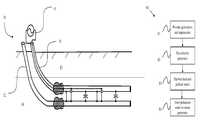
- FIG. 1is a diagrammatic cutaway view of a steam assisted gravity drainage (SAGD) system adapted to also operate as a radio frequency applicator.
- SAGDsteam assisted gravity drainage
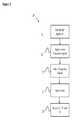
- FIG. 2is a flow diagram illustrating a method of applying heat to a hydrocarbon formation.
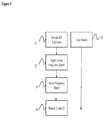
- FIG. 3is a flow diagram illustrating an alternative method of applying heat to a hydrocarbon formation.
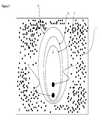
- FIG. 4depicts a steam chamber in conjunction with the present invention.
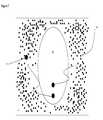
- FIG. 5depicts an expanding steam chamber in conjunction with the present invention.
- FIG. 6depicts an alternate location of a steam chamber in conjunction with the present invention.
- FIG. 7depicts an alternate location of an antenna in relation to an SAGD system in conjunction with the present invention.
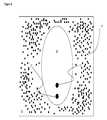
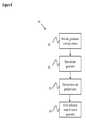
- FIG. 8is a flow diagram illustrating a method of conserving energy in relation to heating a hydrocarbon formation.
- Electromagnetic heatinguses one or more of three energy forms: electric currents, electric fields, and magnetic fields at radio frequencies.
- the heating mechanismmay be resistive by Joule effect or dielectric by molecular moment. Resistive heating by Joule effect is often described as electric heating, where electric current flows through a resistive material.
- Magnetic fieldsalso heat electrically conductive materials through the formation of eddy currents, which in turn heat resistively. Thus magnetic fields can provide resistive heating without conductive electrode contact.
- Electromagnetic heatingcan use electrically conductive antennas to function as heating applicators.
- the antennais a passive device that converts applied electrical current into electric fields, magnetic fields, and electrical currents in the target material, without having to heat the structure to a specific threshold level.
- Preferred antenna shapescan be Euclidian geometries, such as lines and circles. Additional background information on dipole antennas can be found at S. K. Schelkunoff and H. T. Friis, Antennas: Theory and Practice , pp 229-244, 351-353 (Wiley New York 1952).
- the radiation pattern of an antennacan be calculated by taking the Fourier transform of the antenna's electric current flow. Modern techniques for antenna field characterization may employ digital computers and provide for precise RF heat mapping.
- Antennasincluding antennas for electromagnetic heat application, can provide multiple field zones which are determined by the radius from the antenna r and the electrical wavelength ⁇ (lambda). Although there are several names for the zones they can be referred to as a near field zone, a middle field zone, and a far field zone.
- the near field zonecan be within a radius r ⁇ /2 ⁇ (r less than lambda over 2 pi) from the antenna, and it contains both magnetic and electric fields.
- the near field zone energiesare useful for heating hydrocarbon deposits, and the antenna does not need to be in electrically conductive contact with the formation to form the near field heating energies.
- the middle field zoneis of theoretical importance only.
- the far field zoneoccurs beyond r> ⁇ / ⁇ (r greater than lambda over pi), is useful for heating hydrocarbon formations, and is especially useful for heating formations when the antenna is contained in a reservoir cavity.
- radiation of radio wavesoccurs and the reservoir cavity walls may be at any distance from the antenna if sufficient energy is applied relative the heating area.
- Susceptorsare materials that heat in the presence of RF energies.
- Salt wateris a particularly good susceptor for electromagnetic heating; it can respond to all three RF energies: electric currents, electric fields, and magnetic fields.
- Oil sands and heavy oil formationscommonly contain connate liquid water and salt in sufficient quantities to serve as an electromagnetic heating susceptor. For instance, in the Athabasca region of Canada and at 1 KHz frequency, rich oil sand (15% bitumen) may have about 0.5-5% water by weight, an electrical conductivity of about 0.01 s/m, and a relative dielectric permittivity of about 120.
- liquid watermay be a used as an electromagnetic heating susceptor during bitumen extraction, permitting well stimulation by the application of RF energy.
- electromagnetic heatinghas superior penetration and heating rate compared to conductive heating in hydrocarbon formations.
- Electromagnetic heatingmay also have properties of thermal regulation because steam is not an electromagnetic heating susceptor. In other words, once the water is heated sufficiently to vaporize, it is no longer electrically conductive and is not further heated to any substantial degree by continued application of electrical energy.
- the applicatormay be formed from one or more pipes of a steam assisted gravity drainage (SAGD) system.
- SAGDsteam assisted gravity drainage
- An SAGD systemis an existing type of system for extracting heavy hydrocarbons.
- the applicatormay be located adjacent to an SAGD system.
- the applicatormay be located near an extraction pipe that is not part of a traditional SAGD system.
- using electromagnetic heating in a stand alone configuration or in conjunction with steam injectionaccelerates heat penetration within the reservoir thereby promoting faster heavy oil recovery. Supplementing the heat provided by steam with electromagnetic energy also dramatically reduces the water consumption of the extraction process. Electromagnetic heating that reduces or even eliminates water consumption is very advantageous because in some hydrocarbon formations water can be scarce. Additionally, processing water prior to steam injection and downstream in the oil separation and upgrading processes can be very expensive. Therefore, incorporating electromagnetic heating in accordance with this invention provides significant advantages over existing methods.
- FIG. 1depicts a radio frequency applicator 10 formed from the existing pipes of an SAGD system. It includes at least two well pipes 11 and 12 that extend downward through an overburden region 13 into a hydrocarbon formation 14 .
- the portions of the steam injection pipe 11 and the extraction pipe 12 within the hydrocarbon formation 14are positioned so that steam or liquid released from the steam injection pipe 11 heats the hydrocarbon formation 14 , which causes the heavy oil or bitumen to become mobile and flow within the hydrocarbon formation 14 to the extraction pipe 12 .
- the pipesare electrically connected, and powered through a radio frequency transmitter and coupler 15 .
- the applicator 10is disclosed in greater detail in copending application U.S. patent application Ser. No. 12/886,338, filed Sep. 20, 2010, now U.S. Patent Application Publication No.
- the applicator 10is an example of an applicator that can be utilized to heat the formation in accordance with the methods described below. However, variations and alternatives to such an applicator can be employed. And the methods below are not limited to any particular applicator configuration.
- FIG. 2is a flow diagram illustrating a method of applying heat to a hydrocarbon formation 20 .
- a radio frequency applicatoris provided and is positioned to provide electromagnetic energy within the hydrocarbon formation in an area where water is present.
- a signal sufficient to heat the formation through conducted electric currentsis applied to the applicator until the water near the applicator is nearly or completely desiccated (i.e. removed).
- the same signal or an alternate signal than applied in the step 22is applied to the applicator, which is sufficient to pass through the desiccated zone and heat the hydrocarbon formation through an electric field, a magnetic field, or both.
- a radio frequency applicatoris provided and is positioned to provide electromagnetic energy within the hydrocarbon formation in an area where water is present within the hydrocarbon formation.
- the applicatorcan be located within the hydrocarbon formation or adjacent to the hydrocarbon formation, so long as the radiation produced from the applicator penetrates the hydrocarbon formation.
- the applicatorcan be any structure that radiates when a radio frequency signal is applied. For example, it can resemble the applicator described above with respect to FIG. 1 .
- a signalis applied to the applicator, which is sufficient to heat the formation through electric current until the water near the applicator is nearly or completely desiccated.
- the applicatorcan provide resistive heating within the hydrocarbon formation by Joule effect.
- the Joule effect resistive heatingoccurs through current flow due to direct contact with the conductive applicator.
- the particular frequency appliedcan vary depending on the conductivity of the media within a particular hydrocarbon formation, however, signals with frequencies between about 0 to 500 Hz and including DC are contemplated to heat a typical formation through electric currents.
- heating through electric currentswill eventually become inefficient or not viable.
- the same or alternate frequency signalis applied to the applicator, which is sufficient to heat the hydrocarbon formation through electric fields, magnetic fields, or both. If the frequency applied in the step 22 is sufficient to heat the hydrocarbon formation through electric fields, magnetic fields, or both then the same frequency signal may be used at the step 23 . However, once the water near the applicator is nearly or completely desiccated, applying a different frequency signal can provide more efficient penetration of heat the formation.
- the frequencies necessary to produce heating through electric fieldsmay vary depending on a number of factors, such as the dielectric permittivity of the hydrocarbon formation, however, frequencies between 30 MHz and 24 GHz are contemplated to heat a typical hydrocarbon formation through electric fields.
- the frequencies necessary to produce heating through magnetic fieldscan vary depending on a number of factors, such as the conductivity of the hydrocarbon formation, however, frequencies between 500 Hz and 1 MHz are contemplated to heat a typical hydrocarbon formation through magnetic fields. Relatively lower frequencies (lower than about 1 kHz) may provide greater heat penetration while the relatively higher frequencies (higher than about 1 kHz) may allow higher power application as the load resistance will increase.
- the optimal frequencymay relate to the electrical conductivity of the formation, thus the frequency ranges provided are listed as examples and may be different for different formations.
- the formation penetrationis related to the radio frequency skin depth at radio frequencies. For example, signals greater than about 500 Hz are contemplated to heat a hydrocarbon formation through electric fields, magnetic fields, or both. Thus, by changing the frequency, the formation can be further heated without conductive electrical contact with the hydrocarbon formation.
- the hydrocarbon formationcan be simultaneously heated by a combination of types of radio frequency energy.
- the hydrocarbon formationcan be simultaneously heated using a combination of electric currents and electric fields, electric fields and magnetic fields, electric currents and magnetic fields, or electric currents, electric fields, and magnetic fields.
- a change in frequencycan also provide additional benefits as the heating pattern can be varied to more efficiently heat a particular formation.
- the more electrically conductive overburden and underburden regionscan convey the electric current, increasing the horizontal heat spread.
- the signal applied in step 22can provide enhanced heating along the boundary conditions between the deposit formation and the overburden and underburden, and this can increase convection in the reservoir to provide preheating for the later or concomitant application of steam heating.
- the electromagnetic heatingachieves deeper penetration within the reservoir.
- the frequencyis adjusted to optimize RF penetration depth and the power is selected to establish the desired size of the desiccated zone and thus establish the region of heating within the reservoir.
- steamcan be injected into the formation.
- steamcan be injected into the formation through the steam injection pipe 11 .
- steamcan also be injected prior to step 22 or in conjunction with any other step.
- steps 22 , 23 , and optionally step 24are repeated, and these steps can be repeated any number of times.
- step 22applying a signal to heat the formation through electric currents
- step 23applying a signal to heat the formation through electric fields or magnetic fields
- Itcan be advantageous to alternate between electric current heating and electrical field or magnetic field heating to heat a particular hydrocarbon formation uniformly, which can result in more efficient extraction of the heavy oil or bitumen.
- FIG. 2shows steam injected at the step 24 or sequentially with the other heating steps described above. Also, as noted above, steam can also be injected prior to step 22 or in conjunction with any other step.
- FIG. 3depicts a method for heating a hydrocarbon formation where steam is simultaneously injected into the formation in conjunction with the RF heating steps 32 , 33 , and 34 .
- FIG. 4depicts heating the hydrocarbon formation through electric fields or magnetic fields as indicated in the step 23 of FIG. 2 .
- Electric fields and magnetic fieldsheat the hydrocarbon formation through dielectric heating by exciting liquid water molecules 41 within the hydrocarbon formation 14 . Because steam molecules are unaffected by electric and magnetic fields, energy is not expended within the steam chamber region 42 surrounding the pipes in the SAGD system. Rather, the electric fields heat the hydrocarbon region beyond the steam chamber region 42 .
- the heating pattern that resultscan vary depending on a particular hydrocarbon formation and the frequency value chosen in the step 23 above.
- far field radiation of radio wavesdoes not significantly occur for applicators immersed in hydrocarbon formations. Rather the fields are generally of the near field type so the flux lines begin and terminate on the applicator structure.
- near field energyrolls off at a 1/r 3 rate (where r is the distance from the applicator).
- the antenna near fieldbehaves differently from free space. Analysis and testing has shown that dissipation causes the roll off to be much higher, about 1/r 5 to 1/r 8 . This advantageously limits the depth of heating penetration in the present invention to be substantially located within the hydrocarbon formation.
- the depth of heating penetrationmay be calculated and adjusted for by frequency, in accordance with the well-known RF skin effect.
- FIG. 5shows how the steam chamber 42 expands over time, which allows electric fields and magnetic fields to penetrate further into the hydrocarbon formation.
- the boundary of the steam chamber 42may be at 51 .
- the steam chamber 42may expand to 52 .
- the steam chamber 42can expand to 53 .
- the effectis the formation of an advancing steam front with electromagnetic heating ahead of the steam front but little heating within the desiccated zone.
- the radio frequency heating step 23may also provide the means to extend the heating zone over time as a steam saturation zone may form around and move along the antenna.
- a steam saturation zonemay form around and move along the antenna.
- the electric and magnetic fieldscan propagate through it to reach the liquid water beyond creating a radially moving traveling wave steam front in the formation.
- the electrical currentcan penetrate along the antenna in the steam saturation zone to cause a traveling wave steam front longitudinally along the antenna.
- the steam chamber 42need not surround both the steam injection pipe 11 and the extraction pipe 12 .
- FIG. 6shows an alternative arrangement where the steam chamber 42 does not surround the extraction pipe 12 .
- the applicatorneed not be located within steam chamber 42 and does not need to be formed from the pipes of an SAGD system as depicted with respect to FIG. 1 .
- FIG. 7shows an arrangement where an applicator 71 is located within a hydrocarbon formation 14 adjacent to the well pipes 11 and 12 of an SAGD system.
- FIG. 8depicts yet another embodiment of the present invention.
- a flow diagramis illustrated showing a method for efficiently creating electricity and steam for heating a hydrocarbon formation, indicated generally as 80 .
- an electric generator, a steam generator, and a regenerator containing waterare provided.
- the electric generatorcan be any commercially available generator to create electricity, such as a gas turbine.
- the steam generatorcan be any commercially available generator to create steam.
- the regeneratorcontains water and can include a mechanism to fill or refill it with water.
- the electric generatoris run. As the electric generator runs, it produces heat as a byproduct of being run that is generally lost energy.
- the superfluous heat generated from running the electric generatoris collected and used to preheat the water within the regenerator.
- the preheated wateris fed from the regenerator to the steam generator. Because the water has been preheated, the steam generator requires less energy to produce steam than if the water was not preheated. Thus, the heat expended from the electric generator in step 82 has been reused to preheat the water for efficient steam generation. Referring back to FIG.
- a result of this methodis that less total energy is used to create the electricity necessary to power the radio frequency applicator 10 and to create the steam necessary to inject into the hydrocarbon formation 14 through steam injection pipe 11 than if the heat expended from the electric generator was not harvested. Thus, less total energy is used to heat the hydrocarbon formation 14 .
- Energy in the form of expended heatcan also be harvested from other elements in a system, such as that described above in relation to FIG. 1 .
- the transmitter used to apply a signal to the radio frequency applicatorcan expend heat, and that heat can also be harvested and used to preheat the water in the regenerator.
- the coupler and transmission linecan also expend heat, and this heat can also be harvested and used to preheat the water in the regenerator.
Landscapes
- Life Sciences & Earth Sciences (AREA)
- Engineering & Computer Science (AREA)
- Geology (AREA)
- Mining & Mineral Resources (AREA)
- Physics & Mathematics (AREA)
- Environmental & Geological Engineering (AREA)
- Fluid Mechanics (AREA)
- General Life Sciences & Earth Sciences (AREA)
- Geochemistry & Mineralogy (AREA)
- Electromagnetism (AREA)
- Production Of Liquid Hydrocarbon Mixture For Refining Petroleum (AREA)
- Constitution Of High-Frequency Heating (AREA)
Abstract
Description
This specification is related to U.S. patent application Ser. No. 12/886,338, filed Sep. 20, 2010, now U.S. Patent Application Publication No. 2012/0067580, published Mar. 22, 2012, which is incorporated by reference here.
The present invention relates to heating a geological formation for the extraction of hydrocarbons, which is a technique of well stimulation. In particular, the present invention relates to an advantageous method that can be used to heat a geological formation to extract heavy hydrocarbons.
As the world's standard crude oil reserves are depleted, and the continued demand for oil causes oil prices to rise, oil producers are attempting to process hydrocarbons from bituminous ore, oil sands, tar sands, and heavy oil deposits. These materials are often found in naturally occurring mixtures of sand or clay. Because of the extremely high viscosity of bituminous deposits, oil sands, oil shale, tar sands, and heavy oil, the drilling and refinement methods used in extracting standard crude oil are typically not available. Therefore, recovery of oil from these deposits requires heating to extract hydrocarbons from other geologic materials and to maintain hydrocarbons at temperatures at which they will flow.
Current technology heats the hydrocarbon formations through the use of steam and sometimes through the use of electric or radio frequency (RF) heating. Steam has been used to provide heat in-situ, such as through a steam assisted gravity drainage (SAGD) system. Electric heating methods generally use electrodes in the formation and the electrodes may require continuous contact with liquid water.
A list of possibly relevant patents and literature follows:
| US 2007/0261844 | Cogliandro et al. |
| US 2008/0073079 | Tranquilla et al. |
| 2,685,930 | Albaugh |
| 3,954,140 | Hendrick |
| 4,140,180 | Bridges et al. |
| 4,144,935 | Bridges et al. |
| 4,328,324 | Kock et al. |
| 4,373,581 | Toellner |
| 4,410,216 | Allen |
| 4,457,365 | Kasevich et al. |
| 4,485,869 | Sresty et al. |
| 4,508,168 | Heeren |
| 4,524,827 | Bridges et al. |
| 4,620,593 | Haagensen |
| 4,622,496 | Dattilo et al. |
| 4,678,034 | Eastlund et al. |
| 4,790,375 | Bridges et al. |
| 5,046,559 | Glandt |
| 5,082,054 | Kiamanesh |
| 5,236,039 | Edelstein et al. |
| 5,251,700 | Nelson et al. |
| 5,293,936 | Bridges |
| 5,370,477 | Bunin et al. |
| 5,621,844 | Bridges |
| 5,910,287 | Cassin et al. |
| 6,046,464 | Schetzina |
| 6,055,213 | Rubbo et al. |
| 6,063,338 | Pham et al. |
| 6,112,273 | Kau et al. |
| 6,229,603 | Coassin, et al. |
| 6,232,114 | Coassin, et al. |
| 6,301,088 | Nakada |
| 6,360,819 | Vinegar |
| 6,432,365 | Levin et al. |
| 6,603,309 | Forgang, et al. |
| 6,613,678 | Sakaguchi et al. |
| 6,614,059 | Tsujimura et al. |
| 6,712,136 | de Rouffignac et al. |
| 6,808,935 | Levin et al. |
| 6,923,273 | Terry et al. |
| 6,932,155 | Vinegar et al. |
| 6,967,589 | Peters |
| 7,046,584 | Sorrells et al. |
| 7,109,457 | Kinzer |
| 7,147,057 | Steele et al. |
| 7,172,038 | Terry et al |
| 7,322,416 | Burris, II et al. |
| 7,337,980 | Schaedel et al. |
| US2007/0187089 | Bridges |
| Development of the IIT Research | Carlson et al. |
| Institute RF Heating Process for | |
| In Situ Oil Shale/Tar Sand Fuel | |
| Extraction - An Overview | |
An embodiment of the present invention is a method for heating a hydrocarbon formation. A radio frequency applicator is positioned to produce electromagnetic energy within a hydrocarbon formation in a location where water is present near the applicator. A signal, sufficient to heat the hydrocarbon formation through electric current, is applied to the applicator. The same or an alternate frequency signal is then applied to the applicator that is sufficient to heat the hydrocarbon formation through electric fields, magnetic fields, or both.
Another aspect of the present invention is a method for efficiently creating electricity and steam to heat a hydrocarbon formation. An electric generator, steam generator, and a regenerator containing water are provided. The electric generator is run. The excess heat created from running the electric generator is recycled by feeding it into the regenerator causing the water to be preheated or even steamed. The preheated water or steam is then fed into the steam generator, which improves the overall efficiency of the process.
Other aspects of the invention will be apparent from this disclosure.
The subject matter of this disclosure will now be described more fully, and one or more embodiments of the invention are shown. This invention may, however, be embodied in many different forms and should not be construed as limited to the embodiments set forth herein. Rather, these embodiments are examples of the invention, which has the full scope indicated by the language of the claims.
The viscosity of oil decreases dramatically as its temperature is increased. Butler [1972] showed that the oil recovery rate is proportional to the square root of the viscosity of the oil in the reservoir. Thus the oil production rate is strongly influenced by the temperature of the hydrocarbon, with higher temperatures yielding significantly higher production rates. The application of electromagnetic heating to the hydrocarbons increases the hydrocarbon temperature and thus increases the hydrocarbon production rate.
Electromagnetic heating uses one or more of three energy forms: electric currents, electric fields, and magnetic fields at radio frequencies. Depending on operating parameters, the heating mechanism may be resistive by Joule effect or dielectric by molecular moment. Resistive heating by Joule effect is often described as electric heating, where electric current flows through a resistive material. The electrical work provides the heat which may be reconciled according to the well known relationships of P=I2R and Q=I2Rt. Dielectric heating occurs where polar molecules, such as water, change orientation when immersed in an electric field and dielectric heating occurs according to P=ω∈r″∈0E2and Q=ω∈r″∈0E2t. Magnetic fields also heat electrically conductive materials through the formation of eddy currents, which in turn heat resistively. Thus magnetic fields can provide resistive heating without conductive electrode contact.
Electromagnetic heating can use electrically conductive antennas to function as heating applicators. The antenna is a passive device that converts applied electrical current into electric fields, magnetic fields, and electrical currents in the target material, without having to heat the structure to a specific threshold level. Preferred antenna shapes can be Euclidian geometries, such as lines and circles. Additional background information on dipole antennas can be found at S. K. Schelkunoff and H. T. Friis,Antennas: Theory and Practice, pp 229-244, 351-353 (Wiley New York 1952). The radiation pattern of an antenna can be calculated by taking the Fourier transform of the antenna's electric current flow. Modern techniques for antenna field characterization may employ digital computers and provide for precise RF heat mapping.
Antennas, including antennas for electromagnetic heat application, can provide multiple field zones which are determined by the radius from the antenna r and the electrical wavelength λ (lambda). Although there are several names for the zones they can be referred to as a near field zone, a middle field zone, and a far field zone. The near field zone can be within a radius r<λ/2π(r less than lambda over 2 pi) from the antenna, and it contains both magnetic and electric fields. The near field zone energies are useful for heating hydrocarbon deposits, and the antenna does not need to be in electrically conductive contact with the formation to form the near field heating energies. The middle field zone is of theoretical importance only. The far field zone occurs beyond r>λ/π (r greater than lambda over pi), is useful for heating hydrocarbon formations, and is especially useful for heating formations when the antenna is contained in a reservoir cavity. In the far field zone, radiation of radio waves occurs and the reservoir cavity walls may be at any distance from the antenna if sufficient energy is applied relative the heating area. Thus, reliable heating of underground formations is possible with radio frequency electromagnetic energy with antennas insulated from and spaced from the formation. The electrical wavelength may be calculated as λ=c/f which is the speed of light divided by the frequency. In media this value is multiplied by √μ/∈ which is the square root of the media magnetic permeability divided by media electric permittivity.
Susceptors are materials that heat in the presence of RF energies. Salt water is a particularly good susceptor for electromagnetic heating; it can respond to all three RF energies: electric currents, electric fields, and magnetic fields. Oil sands and heavy oil formations commonly contain connate liquid water and salt in sufficient quantities to serve as an electromagnetic heating susceptor. For instance, in the Athabasca region of Canada and at 1 KHz frequency, rich oil sand (15% bitumen) may have about 0.5-5% water by weight, an electrical conductivity of about 0.01 s/m, and a relative dielectric permittivity of about 120. As bitumen becomes mobile at or below the boiling point of water at reservoir conditions, liquid water may be a used as an electromagnetic heating susceptor during bitumen extraction, permitting well stimulation by the application of RF energy. In general, electromagnetic heating has superior penetration and heating rate compared to conductive heating in hydrocarbon formations. Electromagnetic heating may also have properties of thermal regulation because steam is not an electromagnetic heating susceptor. In other words, once the water is heated sufficiently to vaporize, it is no longer electrically conductive and is not further heated to any substantial degree by continued application of electrical energy.
In certain embodiments, the applicator may be formed from one or more pipes of a steam assisted gravity drainage (SAGD) system. An SAGD system is an existing type of system for extracting heavy hydrocarbons. In other embodiments, the applicator may be located adjacent to an SAGD system. In yet other embodiments, the applicator may be located near an extraction pipe that is not part of a traditional SAGD system. In these embodiments, using electromagnetic heating in a stand alone configuration or in conjunction with steam injection accelerates heat penetration within the reservoir thereby promoting faster heavy oil recovery. Supplementing the heat provided by steam with electromagnetic energy also dramatically reduces the water consumption of the extraction process. Electromagnetic heating that reduces or even eliminates water consumption is very advantageous because in some hydrocarbon formations water can be scarce. Additionally, processing water prior to steam injection and downstream in the oil separation and upgrading processes can be very expensive. Therefore, incorporating electromagnetic heating in accordance with this invention provides significant advantages over existing methods.
At thestep 21, a radio frequency applicator is provided and is positioned to provide electromagnetic energy within the hydrocarbon formation in an area where water is present within the hydrocarbon formation. The applicator can be located within the hydrocarbon formation or adjacent to the hydrocarbon formation, so long as the radiation produced from the applicator penetrates the hydrocarbon formation. The applicator can be any structure that radiates when a radio frequency signal is applied. For example, it can resemble the applicator described above with respect toFIG. 1 .
At thestep 22, a signal is applied to the applicator, which is sufficient to heat the formation through electric current until the water near the applicator is nearly or completely desiccated. At relatively low frequencies (less than 500 Hz) or at DC, the applicator can provide resistive heating within the hydrocarbon formation by Joule effect. The Joule effect resistive heating occurs through current flow due to direct contact with the conductive applicator. The particular frequency applied can vary depending on the conductivity of the media within a particular hydrocarbon formation, however, signals with frequencies between about 0 to 500 Hz and including DC are contemplated to heat a typical formation through electric currents. As the water near the applicator is desiccated, heating through electric currents will eventually become inefficient or not viable. Thus, at this point when the water is nearly or completely desiccated, it is necessary to either move onto the next step, or replace water within the formation, for example, through steam injection.
At the step23, the same or alternate frequency signal is applied to the applicator, which is sufficient to heat the hydrocarbon formation through electric fields, magnetic fields, or both. If the frequency applied in thestep 22 is sufficient to heat the hydrocarbon formation through electric fields, magnetic fields, or both then the same frequency signal may be used at the step23. However, once the water near the applicator is nearly or completely desiccated, applying a different frequency signal can provide more efficient penetration of heat the formation. The frequencies necessary to produce heating through electric fields may vary depending on a number of factors, such as the dielectric permittivity of the hydrocarbon formation, however, frequencies between 30 MHz and 24 GHz are contemplated to heat a typical hydrocarbon formation through electric fields.
The frequencies necessary to produce heating through magnetic fields can vary depending on a number of factors, such as the conductivity of the hydrocarbon formation, however, frequencies between 500 Hz and 1 MHz are contemplated to heat a typical hydrocarbon formation through magnetic fields. Relatively lower frequencies (lower than about 1 kHz) may provide greater heat penetration while the relatively higher frequencies (higher than about 1 kHz) may allow higher power application as the load resistance will increase. The optimal frequency may relate to the electrical conductivity of the formation, thus the frequency ranges provided are listed as examples and may be different for different formations. The formation penetration is related to the radio frequency skin depth at radio frequencies. For example, signals greater than about 500 Hz are contemplated to heat a hydrocarbon formation through electric fields, magnetic fields, or both. Thus, by changing the frequency, the formation can be further heated without conductive electrical contact with the hydrocarbon formation.
At some frequencies, the hydrocarbon formation can be simultaneously heated by a combination of types of radio frequency energy. For example, the hydrocarbon formation can be simultaneously heated using a combination of electric currents and electric fields, electric fields and magnetic fields, electric currents and magnetic fields, or electric currents, electric fields, and magnetic fields.
A change in frequency can also provide additional benefits as the heating pattern can be varied to more efficiently heat a particular formation. For example, at DC or up to 60 Hz, the more electrically conductive overburden and underburden regions can convey the electric current, increasing the horizontal heat spread. Thus, the signal applied instep 22 can provide enhanced heating along the boundary conditions between the deposit formation and the overburden and underburden, and this can increase convection in the reservoir to provide preheating for the later or concomitant application of steam heating. As the desiccated zone expands, the electromagnetic heating achieves deeper penetration within the reservoir. The frequency is adjusted to optimize RF penetration depth and the power is selected to establish the desired size of the desiccated zone and thus establish the region of heating within the reservoir.
At the step24, steam can be injected into the formation. For example, steam can be injected into the formation through thesteam injection pipe 11. Alternatively, steam can also be injected prior to step22 or in conjunction with any other step.
At thestep 25, steps22,23, and optionally step24 are repeated, and these steps can be repeated any number of times. In other words, alternating betweenstep 22, applying a signal to heat the formation through electric currents, and step23, applying a signal to heat the formation through electric fields or magnetic fields, occurs. It can be advantageous to alternate between electric current heating and electrical field or magnetic field heating to heat a particular hydrocarbon formation uniformly, which can result in more efficient extraction of the heavy oil or bitumen.
Moreover, steam injection can help to heat a hydrocarbon formation more efficiently.FIG. 2 shows steam injected at the step24 or sequentially with the other heating steps described above. Also, as noted above, steam can also be injected prior to step22 or in conjunction with any other step. Alternatively,FIG. 3 depicts a method for heating a hydrocarbon formation where steam is simultaneously injected into the formation in conjunction with the RF heating steps32,33, and34.
The heating pattern that results can vary depending on a particular hydrocarbon formation and the frequency value chosen in the step23 above. However, generally, far field radiation of radio waves (as is typical in wireless communications involving antennas) does not significantly occur for applicators immersed in hydrocarbon formations. Rather the fields are generally of the near field type so the flux lines begin and terminate on the applicator structure. In free space, near field energy rolls off at a 1/r3rate (where r is the distance from the applicator). In a hydrocarbon formation, however, the antenna near field behaves differently from free space. Analysis and testing has shown that dissipation causes the roll off to be much higher, about 1/r5to 1/r8. This advantageously limits the depth of heating penetration in the present invention to be substantially located within the hydrocarbon formation. The depth of heating penetration may be calculated and adjusted for by frequency, in accordance with the well-known RF skin effect.
The radio frequency heating step23 may also provide the means to extend the heating zone over time as a steam saturation zone may form around and move along the antenna. As steam is not a radio frequency heating susceptor the electric and magnetic fields can propagate through it to reach the liquid water beyond creating a radially moving traveling wave steam front in the formation. Additionally, the electrical current can penetrate along the antenna in the steam saturation zone to cause a traveling wave steam front longitudinally along the antenna.
Thesteam chamber 42 need not surround both thesteam injection pipe 11 and theextraction pipe 12.FIG. 6 shows an alternative arrangement where thesteam chamber 42 does not surround theextraction pipe 12. Moreover, the applicator need not be located withinsteam chamber 42 and does not need to be formed from the pipes of an SAGD system as depicted with respect toFIG. 1 .FIG. 7 shows an arrangement where anapplicator 71 is located within ahydrocarbon formation 14 adjacent to thewell pipes
At thestep 82, the electric generator is run. As the electric generator runs, it produces heat as a byproduct of being run that is generally lost energy. Atstep 83, the superfluous heat generated from running the electric generator is collected and used to preheat the water within the regenerator. Atstep 84, the preheated water is fed from the regenerator to the steam generator. Because the water has been preheated, the steam generator requires less energy to produce steam than if the water was not preheated. Thus, the heat expended from the electric generator instep 82 has been reused to preheat the water for efficient steam generation. Referring back toFIG. 1 , a result of this method is that less total energy is used to create the electricity necessary to power theradio frequency applicator 10 and to create the steam necessary to inject into thehydrocarbon formation 14 throughsteam injection pipe 11 than if the heat expended from the electric generator was not harvested. Thus, less total energy is used to heat thehydrocarbon formation 14.
Energy in the form of expended heat can also be harvested from other elements in a system, such as that described above in relation toFIG. 1 . For example, the transmitter used to apply a signal to the radio frequency applicator can expend heat, and that heat can also be harvested and used to preheat the water in the regenerator. The coupler and transmission line can also expend heat, and this heat can also be harvested and used to preheat the water in the regenerator.
Although preferred embodiments have been described using specific terms, devices, and methods, such description is for illustrative purposes only. The words used are words of description rather than of limitation. It is to be understood that changes and variations can be made by those of ordinary skill in the art without departing from the spirit or the scope of the present invention, which is set forth in the following claims. In addition, it should be understood that aspects of the various embodiments can be interchanged either in whole or in part. Therefore, the spirit and scope of the appended claims should not be limited to the description of the preferred versions contained herein.
Claims (16)
1. A method for heating a hydrocarbon formation comprising:
operating an electric generator to produce electric energy and waste heat;
operating a steam generator to produce steam;
supplying the electric energy and steam to heat the hydrocarbon formation;
operating a regenerator using the waste heat to preheat water; and
supplying the preheated water to the steam generator.
2. The method according toclaim 1 wherein supplying the electric energy to the hydrocarbon formation comprises:
converting the electric energy to radio frequency (RF) energy; and
supplying the RF energy to at least one RF antenna within the hydrocarbon formation.
3. The method according toclaim 2 wherein converting the electric energy to RF energy comprises using an RF transmitter coupled to the electric generator.
4. The method according toclaim 3 wherein using the RF transmitter produces additional waste heat; and wherein operating the regenerator further comprises using the regenerator to preheat the water using the additional waste heat.
5. The method according toclaim 2 wherein supplying the RF energy to the at least one RF antenna comprises using a transmission line coupled to the at least one RF antenna.
6. The method according toclaim 5 wherein using the transmission line generates additional waste heat; and wherein operating the regenerator further comprises using the regenerator to preheat the water using the additional waste heat.
7. The method according toclaim 1 wherein the hydrocarbon formation has an upper laterally extending wellbore therein and a lower laterally extending wellbore therein; and wherein the electric energy and steam are supplied via the upper laterally extending wellbore, and hydrocarbons are produced via the lower laterally extending wellbore.
8. A method for producing hydrocarbons from a hydrocarbon formation having an upper laterally extending wellbore and a lower laterally extending wellbore, the method comprising:
operating an electric generator to produce electric energy and waste heat;
operating a steam generator to produce steam and using the waste heat;
supplying the electric energy and steam via the upper laterally extending wellbore; and
producing hydrocarbons via the lower laterally extending wellbore.
9. The method according toclaim 8 wherein supplying the electric energy to the hydrocarbon formation comprises:
converting the electric energy to radio frequency (RF) energy; and
supplying the RF energy to at least one RF antenna within the upper laterally extending wellbore.
10. The method according toclaim 9 wherein converting the electric energy to RF energy comprises using an RF transmitter coupled to the electric generator.
11. The method according toclaim 10 wherein using the RF transmitter produces additional waste heat; and wherein operating the steam generator further comprises using the additional waste heat.
12. The method according toclaim 9 wherein supplying the RF energy to the at least one RF antenna comprises using a transmission line coupled to the at least one RF antenna.
13. The method according toclaim 12 wherein using the transmission line generates additional waste heat; and wherein operating the steam generator further comprises using the additional waste heat.
14. A method for producing hydrocarbons from a hydrocarbon formation having an upper laterally extending wellbore therein and a lower laterally extending wellbore therein, the method comprising:
supplying radio frequency (RF) energy via a transmission line to at least one RF antenna within the upper laterally extending wellbore with the RF transmission line producing waste heat;
operating a steam generator to produce steam and using the waste heat;
supplying the steam via the upper laterally extending wellbore; and
producing hydrocarbons via the lower laterally extending wellbore.
15. The method according toclaim 14 further comprising converting electric energy to RF energy using an RF transmitter coupled to the RF transmission line.
16. The method according toclaim 15 wherein using the RF transmitter produces additional waste heat; and wherein operating the steam generator further comprises using the additional waste heat.
Priority Applications (1)
| Application Number | Priority Date | Filing Date | Title |
|---|---|---|---|
| US14/084,150US8783347B2 (en) | 2010-09-20 | 2013-11-19 | Radio frequency enhanced steam assisted gravity drainage method for recovery of hydrocarbons |
Applications Claiming Priority (2)
| Application Number | Priority Date | Filing Date | Title |
|---|---|---|---|
| US12/886,304US8646527B2 (en) | 2010-09-20 | 2010-09-20 | Radio frequency enhanced steam assisted gravity drainage method for recovery of hydrocarbons |
| US14/084,150US8783347B2 (en) | 2010-09-20 | 2013-11-19 | Radio frequency enhanced steam assisted gravity drainage method for recovery of hydrocarbons |
Related Parent Applications (1)
| Application Number | Title | Priority Date | Filing Date |
|---|---|---|---|
| US12/886,304DivisionUS8646527B2 (en) | 2010-09-20 | 2010-09-20 | Radio frequency enhanced steam assisted gravity drainage method for recovery of hydrocarbons |
Publications (2)
| Publication Number | Publication Date |
|---|---|
| US20140069638A1 US20140069638A1 (en) | 2014-03-13 |
| US8783347B2true US8783347B2 (en) | 2014-07-22 |
Family
ID=44654518
Family Applications (2)
| Application Number | Title | Priority Date | Filing Date |
|---|---|---|---|
| US12/886,304Active2032-01-13US8646527B2 (en) | 2010-09-20 | 2010-09-20 | Radio frequency enhanced steam assisted gravity drainage method for recovery of hydrocarbons |
| US14/084,150ActiveUS8783347B2 (en) | 2010-09-20 | 2013-11-19 | Radio frequency enhanced steam assisted gravity drainage method for recovery of hydrocarbons |
Family Applications Before (1)
| Application Number | Title | Priority Date | Filing Date |
|---|---|---|---|
| US12/886,304Active2032-01-13US8646527B2 (en) | 2010-09-20 | 2010-09-20 | Radio frequency enhanced steam assisted gravity drainage method for recovery of hydrocarbons |
Country Status (5)
| Country | Link |
|---|---|
| US (2) | US8646527B2 (en) |
| AU (1) | AU2011305792A1 (en) |
| BR (1) | BR112013006782A2 (en) |
| CA (1) | CA2811552C (en) |
| WO (1) | WO2012039987A2 (en) |
Cited By (2)
| Publication number | Priority date | Publication date | Assignee | Title |
|---|---|---|---|---|
| US20140311739A1 (en)* | 2013-04-18 | 2014-10-23 | Conocophillips Company | Acceleration of heavy oil recovery through downhole radio frequency radiation heating |
| US20170081950A1 (en)* | 2015-09-23 | 2017-03-23 | Conocophillips Company | Thermal conditioning of fishbones |
Families Citing this family (19)
| Publication number | Priority date | Publication date | Assignee | Title |
|---|---|---|---|---|
| US8789599B2 (en) | 2010-09-20 | 2014-07-29 | Harris Corporation | Radio frequency heat applicator for increased heavy oil recovery |
| CA2828750C (en)* | 2011-04-25 | 2017-01-03 | Harris Corporation | In situ radio frequency catalytic upgrading |
| US9103205B2 (en)* | 2012-07-13 | 2015-08-11 | Harris Corporation | Method of recovering hydrocarbon resources while injecting a solvent and supplying radio frequency power and related apparatus |
| US9200506B2 (en) | 2012-07-13 | 2015-12-01 | Harris Corporation | Apparatus for transporting and upgrading a hydrocarbon resource through a pipeline and related methods |
| US9057237B2 (en) | 2012-07-13 | 2015-06-16 | Harris Corporation | Method for recovering a hydrocarbon resource from a subterranean formation including additional upgrading at the wellhead and related apparatus |
| US10161233B2 (en) | 2012-07-13 | 2018-12-25 | Harris Corporation | Method of upgrading and recovering a hydrocarbon resource for pipeline transport and related system |
| US9044731B2 (en) | 2012-07-13 | 2015-06-02 | Harris Corporation | Radio frequency hydrocarbon resource upgrading apparatus including parallel paths and related methods |
| US8978756B2 (en)* | 2012-10-19 | 2015-03-17 | Harris Corporation | Hydrocarbon processing apparatus including resonant frequency tracking and related methods |
| US9115576B2 (en) | 2012-11-14 | 2015-08-25 | Harris Corporation | Method for producing hydrocarbon resources with RF and conductive heating and related apparatuses |
| WO2014086594A1 (en)* | 2012-12-06 | 2014-06-12 | Siemens Aktiengesellschaft | Arrangement and method for introducing heat into a geological formation by means of electromagnetic induction |
| US9057259B2 (en) | 2013-02-01 | 2015-06-16 | Harris Corporation | Hydrocarbon resource recovery apparatus including a transmission line with fluid tuning chamber and related methods |
| US9157305B2 (en) | 2013-02-01 | 2015-10-13 | Harris Corporation | Apparatus for heating a hydrocarbon resource in a subterranean formation including a fluid balun and related methods |
| US9267366B2 (en)* | 2013-03-07 | 2016-02-23 | Harris Corporation | Apparatus for heating hydrocarbon resources with magnetic radiator and related methods |
| US9267358B2 (en)* | 2013-07-12 | 2016-02-23 | Harris Corporation | Hydrocarbon recovery system using RF energy to heat steam within an injector and associated methods |
| US10012060B2 (en) | 2014-08-11 | 2018-07-03 | Eni S.P.A. | Radio frequency (RF) system for the recovery of hydrocarbons |
| CN106797066B (en) | 2014-08-11 | 2020-03-27 | 艾尼股份公司 | Apparatus for generating interference in differential mode of propagation of RF signals and array thereof |
| US10760392B2 (en) | 2016-04-13 | 2020-09-01 | Acceleware Ltd. | Apparatus and methods for electromagnetic heating of hydrocarbon formations |
| CN107420079B (en)* | 2017-09-25 | 2023-06-16 | 西南石油大学 | Double-horizontal well SAGD thick oil exploitation mechanism and method |
| US11946351B2 (en) | 2020-04-24 | 2024-04-02 | Acceleware Ltd. | Systems and methods for controlling electromagnetic heating of a hydrocarbon medium |
Citations (138)
| Publication number | Priority date | Publication date | Assignee | Title |
|---|---|---|---|---|
| US2371459A (en) | 1941-08-30 | 1945-03-13 | Mittelmann Eugen | Method of and means for heat-treating metal in strip form |
| US2685930A (en) | 1948-08-12 | 1954-08-10 | Union Oil Co | Oil well production process |
| FR1586066A (en) | 1967-10-25 | 1970-02-06 | ||
| US3497005A (en) | 1967-03-02 | 1970-02-24 | Resources Research & Dev Corp | Sonic energy process |
| US3848671A (en) | 1973-10-24 | 1974-11-19 | Atlantic Richfield Co | Method of producing bitumen from a subterranean tar sand formation |
| US3954140A (en) | 1975-08-13 | 1976-05-04 | Hendrick Robert P | Recovery of hydrocarbons by in situ thermal extraction |
| US3988036A (en) | 1975-03-10 | 1976-10-26 | Fisher Sidney T | Electric induction heating of underground ore deposits |
| US3991091A (en) | 1973-07-23 | 1976-11-09 | Sun Ventures, Inc. | Organo tin compound |
| US4035282A (en) | 1975-08-20 | 1977-07-12 | Shell Canada Limited | Process for recovery of bitumen from a bituminous froth |
| US4042487A (en) | 1975-05-08 | 1977-08-16 | Kureha Kagako Kogyo Kabushiki Kaisha | Method for the treatment of heavy petroleum oil |
| US4087781A (en) | 1974-07-01 | 1978-05-02 | Raytheon Company | Electromagnetic lithosphere telemetry system |
| US4136014A (en) | 1975-08-28 | 1979-01-23 | Canadian Patents & Development Limited | Method and apparatus for separation of bitumen from tar sands |
| US4140179A (en) | 1977-01-03 | 1979-02-20 | Raytheon Company | In situ radio frequency selective heating process |
| US4140180A (en) | 1977-08-29 | 1979-02-20 | Iit Research Institute | Method for in situ heat processing of hydrocarbonaceous formations |
| US4144935A (en) | 1977-08-29 | 1979-03-20 | Iit Research Institute | Apparatus and method for in situ heat processing of hydrocarbonaceous formations |
| US4146125A (en) | 1977-11-01 | 1979-03-27 | Petro-Canada Exploration Inc. | Bitumen-sodium hydroxide-water emulsion release agent for bituminous sands conveyor belt |
| US4196329A (en) | 1976-05-03 | 1980-04-01 | Raytheon Company | Situ processing of organic ore bodies |
| US4295880A (en) | 1980-04-29 | 1981-10-20 | Horner Jr John W | Apparatus and method for recovering organic and non-ferrous metal products from shale and ore bearing rock |
| US4300219A (en) | 1979-04-26 | 1981-11-10 | Raytheon Company | Bowed elastomeric window |
| US4301865A (en) | 1977-01-03 | 1981-11-24 | Raytheon Company | In situ radio frequency selective heating process and system |
| US4320801A (en) | 1977-09-30 | 1982-03-23 | Raytheon Company | In situ processing of organic ore bodies |
| US4328324A (en) | 1978-06-14 | 1982-05-04 | Nederlandse Organisatie Voor Tiegeoast- Natyyrwetebscgaooekuhj Ibderziej Ten Behoeve Van Nijverheid Handel En Verkeer | Process for the treatment of aromatic polyamide fibers, which are suitable for use in construction materials and rubbers, as well as so treated fibers and shaped articles reinforced with these fibers |
| US4373581A (en) | 1981-01-19 | 1983-02-15 | Halliburton Company | Apparatus and method for radio frequency heating of hydrocarbonaceous earth formations including an impedance matching technique |
| US4396062A (en) | 1980-10-06 | 1983-08-02 | University Of Utah Research Foundation | Apparatus and method for time-domain tracking of high-speed chemical reactions |
| US4404123A (en) | 1982-12-15 | 1983-09-13 | Mobil Oil Corporation | Catalysts for para-ethyltoluene dehydrogenation |
| US4410216A (en) | 1979-12-31 | 1983-10-18 | Heavy Oil Process, Inc. | Method for recovering high viscosity oils |
| US4425227A (en) | 1981-10-05 | 1984-01-10 | Gnc Energy Corporation | Ambient froth flotation process for the recovery of bitumen from tar sand |
| US4449585A (en) | 1982-01-29 | 1984-05-22 | Iit Research Institute | Apparatus and method for in situ controlled heat processing of hydrocarbonaceous formations |
| US4456065A (en) | 1981-08-20 | 1984-06-26 | Elektra Energie A.G. | Heavy oil recovering |
| US4457365A (en) | 1978-12-07 | 1984-07-03 | Raytheon Company | In situ radio frequency selective heating system |
| US4470459A (en) | 1983-05-09 | 1984-09-11 | Halliburton Company | Apparatus and method for controlled temperature heating of volumes of hydrocarbonaceous materials in earth formations |
| US4485869A (en) | 1982-10-22 | 1984-12-04 | Iit Research Institute | Recovery of liquid hydrocarbons from oil shale by electromagnetic heating in situ |
| US4487257A (en) | 1976-06-17 | 1984-12-11 | Raytheon Company | Apparatus and method for production of organic products from kerogen |
| US4508168A (en) | 1980-06-30 | 1985-04-02 | Raytheon Company | RF Applicator for in situ heating |
| EP0135966A2 (en) | 1983-09-13 | 1985-04-03 | Jan Bernard Buijs | Method of utilization and disposal of sludge from tar sands hot water extraction process and other highly contaminated and/or toxic and/or bitumen and/or oil containing sludges |
| US4514305A (en) | 1982-12-01 | 1985-04-30 | Petro-Canada Exploration, Inc. | Azeotropic dehydration process for treating bituminous froth |
| US4524826A (en) | 1982-06-14 | 1985-06-25 | Texaco Inc. | Method of heating an oil shale formation |
| US4524827A (en) | 1983-04-29 | 1985-06-25 | Iit Research Institute | Single well stimulation for the recovery of liquid hydrocarbons from subsurface formations |
| US4531468A (en) | 1982-01-05 | 1985-07-30 | Raytheon Company | Temperature/pressure compensation structure |
| CA1199573A (en) | 1983-06-20 | 1986-01-21 | Synfuel (A Partnership) | In situ oil shale process |
| US4583586A (en) | 1984-12-06 | 1986-04-22 | Ebara Corporation | Apparatus for cleaning heat exchanger tubes |
| US4620593A (en) | 1984-10-01 | 1986-11-04 | Haagensen Duane B | Oil recovery system and method |
| US4622496A (en) | 1985-12-13 | 1986-11-11 | Energy Technologies Corp. | Energy efficient reactance ballast with electronic start circuit for the operation of fluorescent lamps of various wattages at standard levels of light output as well as at increased levels of light output |
| US4645585A (en) | 1983-07-15 | 1987-02-24 | The Broken Hill Proprietary Company Limited | Production of fuels, particularly jet and diesel fuels, and constituents thereof |
| US4678034A (en) | 1985-08-05 | 1987-07-07 | Formation Damage Removal Corporation | Well heater |
| US4703433A (en) | 1984-01-09 | 1987-10-27 | Hewlett-Packard Company | Vector network analyzer with integral processor |
| US4790375A (en) | 1987-11-23 | 1988-12-13 | Ors Development Corporation | Mineral well heating systems |
| US4817711A (en) | 1987-05-27 | 1989-04-04 | Jeambey Calhoun G | System for recovery of petroleum from petroleum impregnated media |
| US4882984A (en) | 1988-10-07 | 1989-11-28 | Raytheon Company | Constant temperature fryer assembly |
| US4884634A (en) | 1985-12-03 | 1989-12-05 | Industrikontakt Ing. O. Ellingsen & Co. | Process for increasing the degree of oil extraction |
| US4892782A (en) | 1987-04-13 | 1990-01-09 | E. I. Dupont De Nemours And Company | Fibrous microwave susceptor packaging material |
| US5046559A (en) | 1990-08-23 | 1991-09-10 | Shell Oil Company | Method and apparatus for producing hydrocarbon bearing deposits in formations having shale layers |
| US5055180A (en) | 1984-04-20 | 1991-10-08 | Electromagnetic Energy Corporation | Method and apparatus for recovering fractions from hydrocarbon materials, facilitating the removal and cleansing of hydrocarbon fluids, insulating storage vessels, and cleansing storage vessels and pipelines |
| US5065819A (en) | 1990-03-09 | 1991-11-19 | Kai Technologies | Electromagnetic apparatus and method for in situ heating and recovery of organic and inorganic materials |
| US5082054A (en) | 1990-02-12 | 1992-01-21 | Kiamanesh Anoosh I | In-situ tuned microwave oil extraction process |
| US5136249A (en) | 1988-06-20 | 1992-08-04 | Commonwealth Scientific & Industrial Research Organization | Probes for measurement of moisture content, solids contents, and electrical conductivity |
| US5199488A (en) | 1990-03-09 | 1993-04-06 | Kai Technologies, Inc. | Electromagnetic method and apparatus for the treatment of radioactive material-containing volumes |
| US5233306A (en) | 1991-02-13 | 1993-08-03 | The Board Of Regents Of The University Of Wisconsin System | Method and apparatus for measuring the permittivity of materials |
| US5236039A (en) | 1992-06-17 | 1993-08-17 | General Electric Company | Balanced-line RF electrode system for use in RF ground heating to recover oil from oil shale |
| US5251700A (en) | 1990-02-05 | 1993-10-12 | Hrubetz Environmental Services, Inc. | Well casing providing directional flow of injection fluids |
| US5282508A (en) | 1991-07-02 | 1994-02-01 | Petroleo Brasilero S.A. - Petrobras | Process to increase petroleum recovery from petroleum reservoirs |
| US5293936A (en) | 1992-02-18 | 1994-03-15 | Iit Research Institute | Optimum antenna-like exciters for heating earth media to recover thermally responsive constituents |
| EP0418117B1 (en) | 1989-09-05 | 1994-04-06 | AEROSPATIALE Société Nationale Industrielle | Apparatus for characterising dielectric properties of samples of materials, having an even or uneven surface, and application to the non-destructive control of the dielectric homogeneity of said samples |
| US5304767A (en) | 1992-11-13 | 1994-04-19 | Gas Research Institute | Low emission induction heating coil |
| US5315561A (en) | 1993-06-21 | 1994-05-24 | Raytheon Company | Radar system and components therefore for transmitting an electromagnetic signal underwater |
| US5370477A (en) | 1990-12-10 | 1994-12-06 | Enviropro, Inc. | In-situ decontamination with electromagnetic energy in a well array |
| US5378879A (en) | 1993-04-20 | 1995-01-03 | Raychem Corporation | Induction heating of loaded materials |
| US5506592A (en) | 1992-05-29 | 1996-04-09 | Texas Instruments Incorporated | Multi-octave, low profile, full instantaneous azimuthal field of view direction finding antenna |
| US5582854A (en) | 1993-07-05 | 1996-12-10 | Ajinomoto Co., Inc. | Cooking with the use of microwave |
| US5621844A (en) | 1995-03-01 | 1997-04-15 | Uentech Corporation | Electrical heating of mineral well deposits using downhole impedance transformation networks |
| US5631562A (en) | 1994-03-31 | 1997-05-20 | Western Atlas International, Inc. | Time domain electromagnetic well logging sensor including arcuate microwave strip lines |
| US5746909A (en) | 1996-11-06 | 1998-05-05 | Witco Corp | Process for extracting tar from tarsand |
| EP0563999B1 (en) | 1992-04-03 | 1999-03-03 | Fort James Corporation | Antenna for microwave enhanced cooking |
| US5910287A (en) | 1997-06-03 | 1999-06-08 | Aurora Biosciences Corporation | Low background multi-well plates with greater than 864 wells for fluorescence measurements of biological and biochemical samples |
| US5923299A (en) | 1996-12-19 | 1999-07-13 | Raytheon Company | High-power shaped-beam, ultra-wideband biconical antenna |
| US6046464A (en) | 1995-03-29 | 2000-04-04 | North Carolina State University | Integrated heterostructures of group III-V nitride semiconductor materials including epitaxial ohmic contact comprising multiple quantum well |
| US6045648A (en) | 1993-08-06 | 2000-04-04 | Minnesta Mining And Manufacturing Company | Thermoset adhesive having susceptor particles therein |
| US6055213A (en) | 1990-07-09 | 2000-04-25 | Baker Hughes Incorporated | Subsurface well apparatus |
| US6063338A (en) | 1997-06-02 | 2000-05-16 | Aurora Biosciences Corporation | Low background multi-well plates and platforms for spectroscopic measurements |
| US6097262A (en) | 1998-04-27 | 2000-08-01 | Nortel Networks Corporation | Transmission line impedance matching apparatus |
| US6106895A (en) | 1997-03-11 | 2000-08-22 | Fuji Photo Film Co., Ltd. | Magnetic recording medium and process for producing the same |
| US6112273A (en) | 1994-12-22 | 2000-08-29 | Texas Instruments Incorporated | Method and apparatus for handling system management interrupts (SMI) as well as, ordinary interrupts of peripherals such as PCMCIA cards |
| US6184427B1 (en) | 1999-03-19 | 2001-02-06 | Invitri, Inc. | Process and reactor for microwave cracking of plastic materials |
| US6229603B1 (en) | 1997-06-02 | 2001-05-08 | Aurora Biosciences Corporation | Low background multi-well plates with greater than 864 wells for spectroscopic measurements |
| US6301088B1 (en) | 1998-04-09 | 2001-10-09 | Nec Corporation | Magnetoresistance effect device and method of forming the same as well as magnetoresistance effect sensor and magnetic recording system |
| US6303021B2 (en) | 1999-04-23 | 2001-10-16 | Denim Engineering, Inc. | Apparatus and process for improved aromatic extraction from gasoline |
| US6348679B1 (en) | 1998-03-17 | 2002-02-19 | Ameritherm, Inc. | RF active compositions for use in adhesion, bonding and coating |
| US20020032534A1 (en) | 2000-07-03 | 2002-03-14 | Marc Regier | Method, device and computer-readable memory containing a computer program for determining at least one property of a test emulsion and/or test suspension |
| US6360819B1 (en) | 1998-02-24 | 2002-03-26 | Shell Oil Company | Electrical heater |
| US6432365B1 (en) | 2000-04-14 | 2002-08-13 | Discovery Partners International, Inc. | System and method for dispensing solution to a multi-well container |
| US6499536B1 (en) | 1997-12-22 | 2002-12-31 | Eureka Oil Asa | Method to increase the oil production from an oil reservoir |
| US6603309B2 (en) | 2001-05-21 | 2003-08-05 | Baker Hughes Incorporated | Active signal conditioning circuitry for well logging and monitoring while drilling nuclear magnetic resonance spectrometers |
| US6613678B1 (en) | 1998-05-15 | 2003-09-02 | Canon Kabushiki Kaisha | Process for manufacturing a semiconductor substrate as well as a semiconductor thin film, and multilayer structure |
| US6614059B1 (en) | 1999-01-07 | 2003-09-02 | Matsushita Electric Industrial Co., Ltd. | Semiconductor light-emitting device with quantum well |
| US6649888B2 (en) | 1999-09-23 | 2003-11-18 | Codaco, Inc. | Radio frequency (RF) heating system |
| US20040020642A1 (en)* | 2001-10-24 | 2004-02-05 | Vinegar Harold J. | In situ recovery from a hydrocarbon containing formation using conductor-in-conduit heat sources with an electrically conductive material in the overburden |
| US20040031731A1 (en) | 2002-07-12 | 2004-02-19 | Travis Honeycutt | Process for the microwave treatment of oil sands and shale oils |
| US20040040715A1 (en)* | 2001-10-24 | 2004-03-04 | Wellington Scott Lee | In situ production of a blending agent from a hydrocarbon containing formation |
| EP1106672B1 (en) | 1999-12-07 | 2004-03-24 | Donizetti Srl | Process and equipment for the transformation of refuse using induced currents |
| US6712136B2 (en) | 2000-04-24 | 2004-03-30 | Shell Oil Company | In situ thermal processing of a hydrocarbon containing formation using a selected production well spacing |
| US6923273B2 (en) | 1997-10-27 | 2005-08-02 | Halliburton Energy Services, Inc. | Well system |
| US20050199386A1 (en) | 2004-03-15 | 2005-09-15 | Kinzer Dwight E. | In situ processing of hydrocarbon-bearing formations with variable frequency automated capacitive radio frequency dielectric heating |
| US6967589B1 (en) | 2000-08-11 | 2005-11-22 | Oleumtech Corporation | Gas/oil well monitoring system |
| US20050274513A1 (en) | 2004-06-15 | 2005-12-15 | Schultz Roger L | System and method for determining downhole conditions |
| US6992630B2 (en) | 2003-10-28 | 2006-01-31 | Harris Corporation | Annular ring antenna |
| US20060038083A1 (en) | 2004-07-20 | 2006-02-23 | Criswell David R | Power generating and distribution system and method |
| US7046584B2 (en) | 2003-07-09 | 2006-05-16 | Precision Drilling Technology Services Group Inc. | Compensated ensemble crystal oscillator for use in a well borehole system |
| US7079081B2 (en) | 2003-07-14 | 2006-07-18 | Harris Corporation | Slotted cylinder antenna |
| US7147057B2 (en) | 2003-10-06 | 2006-12-12 | Halliburton Energy Services, Inc. | Loop systems and methods of using the same for conveying and distributing thermal energy into a wellbore |
| US7205947B2 (en) | 2004-08-19 | 2007-04-17 | Harris Corporation | Litzendraht loop antenna and associated methods |
| US20070131591A1 (en) | 2005-12-14 | 2007-06-14 | Mobilestream Oil, Inc. | Microwave-based recovery of hydrocarbons and fossil fuels |
| US20070137852A1 (en) | 2005-12-20 | 2007-06-21 | Considine Brian C | Apparatus for extraction of hydrocarbon fuels or contaminants using electrical energy and critical fluids |
| US20070137858A1 (en) | 2005-12-20 | 2007-06-21 | Considine Brian C | Method for extraction of hydrocarbon fuels or contaminants using electrical energy and critical fluids |
| US20070187089A1 (en) | 2006-01-19 | 2007-08-16 | Pyrophase, Inc. | Radio frequency technology heater for unconventional resources |
| US20070261844A1 (en) | 2006-05-10 | 2007-11-15 | Raytheon Company | Method and apparatus for capture and sequester of carbon dioxide and extraction of energy from large land masses during and after extraction of hydrocarbon fuels or contaminants using energy and critical fluids |
| US7322416B2 (en) | 2004-05-03 | 2008-01-29 | Halliburton Energy Services, Inc. | Methods of servicing a well bore using self-activating downhole tool |
| US7337980B2 (en) | 2002-11-19 | 2008-03-04 | Tetra Laval Holdings & Finance S.A. | Method of transferring from a plant for the production of packaging material to a filling machine, a method of providing a packaging material with information, as well as packaging material and the use thereof |
| US20080073079A1 (en) | 2006-09-26 | 2008-03-27 | Hw Advanced Technologies, Inc. | Stimulation and recovery of heavy hydrocarbon fluids |
| US20080143330A1 (en) | 2006-12-18 | 2008-06-19 | Schlumberger Technology Corporation | Devices, systems and methods for assessing porous media properties |
| US7438807B2 (en) | 2002-09-19 | 2008-10-21 | Suncor Energy, Inc. | Bituminous froth inclined plate separator and hydrocarbon cyclone treatment process |
| US7441597B2 (en) | 2005-06-20 | 2008-10-28 | Ksn Energies, Llc | Method and apparatus for in-situ radiofrequency assisted gravity drainage of oil (RAGD) |
| US20090009410A1 (en) | 2005-12-16 | 2009-01-08 | Dolgin Benjamin P | Positioning, detection and communication system and method |
| US7484561B2 (en) | 2006-02-21 | 2009-02-03 | Pyrophase, Inc. | Electro thermal in situ energy storage for intermittent energy sources to recover fuel from hydro carbonaceous earth formations |
| US20090050318A1 (en) | 2005-06-20 | 2009-02-26 | Kasevich Raymond S | Method and apparatus for in-situ radiofrequency assisted gravity drainage of oil (ragd) |
| FR2925519A1 (en) | 2007-12-20 | 2009-06-26 | Total France Sa | Fuel oil degrading method for petroleum field, involves mixing fuel oil and vector, and applying magnetic field such that mixture is heated and separated into two sections, where one section is lighter than another |
| US20090242196A1 (en) | 2007-09-28 | 2009-10-01 | Hsueh-Yuan Pao | System and method for extraction of hydrocarbons by in-situ radio frequency heating of carbon bearing geological formations |
| DE102008022176A1 (en) | 2007-08-27 | 2009-11-12 | Siemens Aktiengesellschaft | Device for "in situ" production of bitumen or heavy oil |
| US7623804B2 (en) | 2006-03-20 | 2009-11-24 | Kabushiki Kaisha Toshiba | Fixing device of image forming apparatus |
| US20100108318A1 (en)* | 2007-02-16 | 2010-05-06 | Dirk Diehl | Method and device for the in-situ extraction of a hydrocarbon-containing substance, while reducing the viscosity thereof, from an underground deposit |
| US7814975B2 (en)* | 2007-09-18 | 2010-10-19 | Vast Power Portfolio, Llc | Heavy oil recovery with fluid water and carbon dioxide |
| US20100276141A1 (en)* | 2006-10-20 | 2010-11-04 | Shell Oil Company | Creating fluid injectivity in tar sands formations |
| US20110227349A1 (en)* | 2008-09-15 | 2011-09-22 | Norbert Huber | Method for extracting bitumen and/or ultra-heavy oil from an underground deposit, associated installation and operating method for said installation |
| US20110253362A1 (en)* | 2008-09-26 | 2011-10-20 | Conocophillips Company | Process for enhanced production of heavy oil using microwaves |
| US20120067580A1 (en) | 2010-09-20 | 2012-03-22 | Harris Corporation | Radio frequency heat applicator for increased heavy oil recovery |
| US20120118565A1 (en) | 2010-11-17 | 2012-05-17 | Laricina Energy Ltd. | Effective Solvent Extraction System Incorporating Electromagnetic Heating |
| US20120318498A1 (en) | 2011-06-17 | 2012-12-20 | Harris Corporation | Electromagnetic Heat Treatment Providing Enhanced Oil Recovery |
| US20130068458A1 (en)* | 2011-03-04 | 2013-03-21 | Conocophillips Company | Heat recovery method for wellpad sagd steam generation |
| US20130098603A1 (en)* | 2011-10-21 | 2013-04-25 | Nexen Inc. | Steam Assisted Gravity Drainage Processes With The Addition of Oxygen Addition |
Family Cites Families (3)
| Publication number | Priority date | Publication date | Assignee | Title |
|---|---|---|---|---|
| US20080028989A1 (en) | 2006-07-20 | 2008-02-07 | Scott Kevin Palm | Process for removing organic contaminants from non-metallic inorganic materials using dielectric heating |
| DE102007040606B3 (en) | 2007-08-27 | 2009-02-26 | Siemens Ag | Method and device for the in situ production of bitumen or heavy oil |
| WO2009114934A1 (en) | 2008-03-17 | 2009-09-24 | Shell Canada Energy, A General Partnership Formed Under The Laws Of The Province Of Alberta | Recovery of bitumen from oil sands using sonication |
- 2010
- 2010-09-20USUS12/886,304patent/US8646527B2/enactiveActive
- 2011
- 2011-09-13CACA2811552Apatent/CA2811552C/enactiveActive
- 2011-09-13BRBR112013006782Apatent/BR112013006782A2/ennot_activeIP Right Cessation
- 2011-09-13WOPCT/US2011/051301patent/WO2012039987A2/enactiveApplication Filing
- 2011-09-13AUAU2011305792Apatent/AU2011305792A1/ennot_activeAbandoned
- 2013
- 2013-11-19USUS14/084,150patent/US8783347B2/enactiveActive
Patent Citations (151)
| Publication number | Priority date | Publication date | Assignee | Title |
|---|---|---|---|---|
| US2371459A (en) | 1941-08-30 | 1945-03-13 | Mittelmann Eugen | Method of and means for heat-treating metal in strip form |
| US2685930A (en) | 1948-08-12 | 1954-08-10 | Union Oil Co | Oil well production process |
| US3497005A (en) | 1967-03-02 | 1970-02-24 | Resources Research & Dev Corp | Sonic energy process |
| FR1586066A (en) | 1967-10-25 | 1970-02-06 | ||
| US3991091A (en) | 1973-07-23 | 1976-11-09 | Sun Ventures, Inc. | Organo tin compound |
| US3848671A (en) | 1973-10-24 | 1974-11-19 | Atlantic Richfield Co | Method of producing bitumen from a subterranean tar sand formation |
| US4087781A (en) | 1974-07-01 | 1978-05-02 | Raytheon Company | Electromagnetic lithosphere telemetry system |
| US3988036A (en) | 1975-03-10 | 1976-10-26 | Fisher Sidney T | Electric induction heating of underground ore deposits |
| US4042487A (en) | 1975-05-08 | 1977-08-16 | Kureha Kagako Kogyo Kabushiki Kaisha | Method for the treatment of heavy petroleum oil |
| US3954140A (en) | 1975-08-13 | 1976-05-04 | Hendrick Robert P | Recovery of hydrocarbons by in situ thermal extraction |
| US4035282A (en) | 1975-08-20 | 1977-07-12 | Shell Canada Limited | Process for recovery of bitumen from a bituminous froth |
| US4136014A (en) | 1975-08-28 | 1979-01-23 | Canadian Patents & Development Limited | Method and apparatus for separation of bitumen from tar sands |
| US4196329A (en) | 1976-05-03 | 1980-04-01 | Raytheon Company | Situ processing of organic ore bodies |
| US4487257A (en) | 1976-06-17 | 1984-12-11 | Raytheon Company | Apparatus and method for production of organic products from kerogen |
| US4140179A (en) | 1977-01-03 | 1979-02-20 | Raytheon Company | In situ radio frequency selective heating process |
| US4301865A (en) | 1977-01-03 | 1981-11-24 | Raytheon Company | In situ radio frequency selective heating process and system |
| US4140180A (en) | 1977-08-29 | 1979-02-20 | Iit Research Institute | Method for in situ heat processing of hydrocarbonaceous formations |
| US4144935A (en) | 1977-08-29 | 1979-03-20 | Iit Research Institute | Apparatus and method for in situ heat processing of hydrocarbonaceous formations |
| US4320801A (en) | 1977-09-30 | 1982-03-23 | Raytheon Company | In situ processing of organic ore bodies |
| US4146125A (en) | 1977-11-01 | 1979-03-27 | Petro-Canada Exploration Inc. | Bitumen-sodium hydroxide-water emulsion release agent for bituminous sands conveyor belt |
| US4328324A (en) | 1978-06-14 | 1982-05-04 | Nederlandse Organisatie Voor Tiegeoast- Natyyrwetebscgaooekuhj Ibderziej Ten Behoeve Van Nijverheid Handel En Verkeer | Process for the treatment of aromatic polyamide fibers, which are suitable for use in construction materials and rubbers, as well as so treated fibers and shaped articles reinforced with these fibers |
| US4457365A (en) | 1978-12-07 | 1984-07-03 | Raytheon Company | In situ radio frequency selective heating system |
| US4300219A (en) | 1979-04-26 | 1981-11-10 | Raytheon Company | Bowed elastomeric window |
| US4410216A (en) | 1979-12-31 | 1983-10-18 | Heavy Oil Process, Inc. | Method for recovering high viscosity oils |
| US4295880A (en) | 1980-04-29 | 1981-10-20 | Horner Jr John W | Apparatus and method for recovering organic and non-ferrous metal products from shale and ore bearing rock |
| US4508168A (en) | 1980-06-30 | 1985-04-02 | Raytheon Company | RF Applicator for in situ heating |
| US4396062A (en) | 1980-10-06 | 1983-08-02 | University Of Utah Research Foundation | Apparatus and method for time-domain tracking of high-speed chemical reactions |
| US4373581A (en) | 1981-01-19 | 1983-02-15 | Halliburton Company | Apparatus and method for radio frequency heating of hydrocarbonaceous earth formations including an impedance matching technique |
| US4456065A (en) | 1981-08-20 | 1984-06-26 | Elektra Energie A.G. | Heavy oil recovering |
| US4425227A (en) | 1981-10-05 | 1984-01-10 | Gnc Energy Corporation | Ambient froth flotation process for the recovery of bitumen from tar sand |
| US4531468A (en) | 1982-01-05 | 1985-07-30 | Raytheon Company | Temperature/pressure compensation structure |
| US4449585A (en) | 1982-01-29 | 1984-05-22 | Iit Research Institute | Apparatus and method for in situ controlled heat processing of hydrocarbonaceous formations |
| US4524826A (en) | 1982-06-14 | 1985-06-25 | Texaco Inc. | Method of heating an oil shale formation |
| US4485869A (en) | 1982-10-22 | 1984-12-04 | Iit Research Institute | Recovery of liquid hydrocarbons from oil shale by electromagnetic heating in situ |
| US4514305A (en) | 1982-12-01 | 1985-04-30 | Petro-Canada Exploration, Inc. | Azeotropic dehydration process for treating bituminous froth |
| US4404123A (en) | 1982-12-15 | 1983-09-13 | Mobil Oil Corporation | Catalysts for para-ethyltoluene dehydrogenation |
| US4524827A (en) | 1983-04-29 | 1985-06-25 | Iit Research Institute | Single well stimulation for the recovery of liquid hydrocarbons from subsurface formations |
| US4470459A (en) | 1983-05-09 | 1984-09-11 | Halliburton Company | Apparatus and method for controlled temperature heating of volumes of hydrocarbonaceous materials in earth formations |
| CA1199573A (en) | 1983-06-20 | 1986-01-21 | Synfuel (A Partnership) | In situ oil shale process |
| US4645585A (en) | 1983-07-15 | 1987-02-24 | The Broken Hill Proprietary Company Limited | Production of fuels, particularly jet and diesel fuels, and constituents thereof |
| EP0135966A2 (en) | 1983-09-13 | 1985-04-03 | Jan Bernard Buijs | Method of utilization and disposal of sludge from tar sands hot water extraction process and other highly contaminated and/or toxic and/or bitumen and/or oil containing sludges |
| US4703433A (en) | 1984-01-09 | 1987-10-27 | Hewlett-Packard Company | Vector network analyzer with integral processor |
| US5055180A (en) | 1984-04-20 | 1991-10-08 | Electromagnetic Energy Corporation | Method and apparatus for recovering fractions from hydrocarbon materials, facilitating the removal and cleansing of hydrocarbon fluids, insulating storage vessels, and cleansing storage vessels and pipelines |
| US4620593A (en) | 1984-10-01 | 1986-11-04 | Haagensen Duane B | Oil recovery system and method |
| US4583586A (en) | 1984-12-06 | 1986-04-22 | Ebara Corporation | Apparatus for cleaning heat exchanger tubes |
| US4678034A (en) | 1985-08-05 | 1987-07-07 | Formation Damage Removal Corporation | Well heater |
| US4884634A (en) | 1985-12-03 | 1989-12-05 | Industrikontakt Ing. O. Ellingsen & Co. | Process for increasing the degree of oil extraction |
| US4622496A (en) | 1985-12-13 | 1986-11-11 | Energy Technologies Corp. | Energy efficient reactance ballast with electronic start circuit for the operation of fluorescent lamps of various wattages at standard levels of light output as well as at increased levels of light output |
| US4892782A (en) | 1987-04-13 | 1990-01-09 | E. I. Dupont De Nemours And Company | Fibrous microwave susceptor packaging material |
| US4817711A (en) | 1987-05-27 | 1989-04-04 | Jeambey Calhoun G | System for recovery of petroleum from petroleum impregnated media |
| US4790375A (en) | 1987-11-23 | 1988-12-13 | Ors Development Corporation | Mineral well heating systems |
| US5136249A (en) | 1988-06-20 | 1992-08-04 | Commonwealth Scientific & Industrial Research Organization | Probes for measurement of moisture content, solids contents, and electrical conductivity |
| US4882984A (en) | 1988-10-07 | 1989-11-28 | Raytheon Company | Constant temperature fryer assembly |
| EP0418117B1 (en) | 1989-09-05 | 1994-04-06 | AEROSPATIALE Société Nationale Industrielle | Apparatus for characterising dielectric properties of samples of materials, having an even or uneven surface, and application to the non-destructive control of the dielectric homogeneity of said samples |
| US5251700A (en) | 1990-02-05 | 1993-10-12 | Hrubetz Environmental Services, Inc. | Well casing providing directional flow of injection fluids |
| US5082054A (en) | 1990-02-12 | 1992-01-21 | Kiamanesh Anoosh I | In-situ tuned microwave oil extraction process |
| US5065819A (en) | 1990-03-09 | 1991-11-19 | Kai Technologies | Electromagnetic apparatus and method for in situ heating and recovery of organic and inorganic materials |
| US5199488A (en) | 1990-03-09 | 1993-04-06 | Kai Technologies, Inc. | Electromagnetic method and apparatus for the treatment of radioactive material-containing volumes |
| US6055213A (en) | 1990-07-09 | 2000-04-25 | Baker Hughes Incorporated | Subsurface well apparatus |
| US5046559A (en) | 1990-08-23 | 1991-09-10 | Shell Oil Company | Method and apparatus for producing hydrocarbon bearing deposits in formations having shale layers |
| US5370477A (en) | 1990-12-10 | 1994-12-06 | Enviropro, Inc. | In-situ decontamination with electromagnetic energy in a well array |
| US5233306A (en) | 1991-02-13 | 1993-08-03 | The Board Of Regents Of The University Of Wisconsin System | Method and apparatus for measuring the permittivity of materials |
| US5282508A (en) | 1991-07-02 | 1994-02-01 | Petroleo Brasilero S.A. - Petrobras | Process to increase petroleum recovery from petroleum reservoirs |
| US5293936A (en) | 1992-02-18 | 1994-03-15 | Iit Research Institute | Optimum antenna-like exciters for heating earth media to recover thermally responsive constituents |
| EP0563999B1 (en) | 1992-04-03 | 1999-03-03 | Fort James Corporation | Antenna for microwave enhanced cooking |
| US5506592A (en) | 1992-05-29 | 1996-04-09 | Texas Instruments Incorporated | Multi-octave, low profile, full instantaneous azimuthal field of view direction finding antenna |
| US5236039A (en) | 1992-06-17 | 1993-08-17 | General Electric Company | Balanced-line RF electrode system for use in RF ground heating to recover oil from oil shale |
| US5304767A (en) | 1992-11-13 | 1994-04-19 | Gas Research Institute | Low emission induction heating coil |
| US5378879A (en) | 1993-04-20 | 1995-01-03 | Raychem Corporation | Induction heating of loaded materials |
| US5315561A (en) | 1993-06-21 | 1994-05-24 | Raytheon Company | Radar system and components therefore for transmitting an electromagnetic signal underwater |
| US5582854A (en) | 1993-07-05 | 1996-12-10 | Ajinomoto Co., Inc. | Cooking with the use of microwave |
| US6045648A (en) | 1993-08-06 | 2000-04-04 | Minnesta Mining And Manufacturing Company | Thermoset adhesive having susceptor particles therein |
| US5631562A (en) | 1994-03-31 | 1997-05-20 | Western Atlas International, Inc. | Time domain electromagnetic well logging sensor including arcuate microwave strip lines |
| US6112273A (en) | 1994-12-22 | 2000-08-29 | Texas Instruments Incorporated | Method and apparatus for handling system management interrupts (SMI) as well as, ordinary interrupts of peripherals such as PCMCIA cards |
| US5621844A (en) | 1995-03-01 | 1997-04-15 | Uentech Corporation | Electrical heating of mineral well deposits using downhole impedance transformation networks |
| US6046464A (en) | 1995-03-29 | 2000-04-04 | North Carolina State University | Integrated heterostructures of group III-V nitride semiconductor materials including epitaxial ohmic contact comprising multiple quantum well |
| US5746909A (en) | 1996-11-06 | 1998-05-05 | Witco Corp | Process for extracting tar from tarsand |
| US5923299A (en) | 1996-12-19 | 1999-07-13 | Raytheon Company | High-power shaped-beam, ultra-wideband biconical antenna |
| US6106895A (en) | 1997-03-11 | 2000-08-22 | Fuji Photo Film Co., Ltd. | Magnetic recording medium and process for producing the same |
| US6063338A (en) | 1997-06-02 | 2000-05-16 | Aurora Biosciences Corporation | Low background multi-well plates and platforms for spectroscopic measurements |
| US6232114B1 (en) | 1997-06-02 | 2001-05-15 | Aurora Biosciences Corporation | Low background multi-well plates for fluorescence measurements of biological and biochemical samples |
| US6229603B1 (en) | 1997-06-02 | 2001-05-08 | Aurora Biosciences Corporation | Low background multi-well plates with greater than 864 wells for spectroscopic measurements |
| US5910287A (en) | 1997-06-03 | 1999-06-08 | Aurora Biosciences Corporation | Low background multi-well plates with greater than 864 wells for fluorescence measurements of biological and biochemical samples |
| US7172038B2 (en) | 1997-10-27 | 2007-02-06 | Halliburton Energy Services, Inc. | Well system |
| US6923273B2 (en) | 1997-10-27 | 2005-08-02 | Halliburton Energy Services, Inc. | Well system |
| US6499536B1 (en) | 1997-12-22 | 2002-12-31 | Eureka Oil Asa | Method to increase the oil production from an oil reservoir |
| US6360819B1 (en) | 1998-02-24 | 2002-03-26 | Shell Oil Company | Electrical heater |
| US6348679B1 (en) | 1998-03-17 | 2002-02-19 | Ameritherm, Inc. | RF active compositions for use in adhesion, bonding and coating |
| US6301088B1 (en) | 1998-04-09 | 2001-10-09 | Nec Corporation | Magnetoresistance effect device and method of forming the same as well as magnetoresistance effect sensor and magnetic recording system |
| US6097262A (en) | 1998-04-27 | 2000-08-01 | Nortel Networks Corporation | Transmission line impedance matching apparatus |
| US6613678B1 (en) | 1998-05-15 | 2003-09-02 | Canon Kabushiki Kaisha | Process for manufacturing a semiconductor substrate as well as a semiconductor thin film, and multilayer structure |
| US6614059B1 (en) | 1999-01-07 | 2003-09-02 | Matsushita Electric Industrial Co., Ltd. | Semiconductor light-emitting device with quantum well |
| US6184427B1 (en) | 1999-03-19 | 2001-02-06 | Invitri, Inc. | Process and reactor for microwave cracking of plastic materials |
| US6303021B2 (en) | 1999-04-23 | 2001-10-16 | Denim Engineering, Inc. | Apparatus and process for improved aromatic extraction from gasoline |
| US6649888B2 (en) | 1999-09-23 | 2003-11-18 | Codaco, Inc. | Radio frequency (RF) heating system |
| EP1106672B1 (en) | 1999-12-07 | 2004-03-24 | Donizetti Srl | Process and equipment for the transformation of refuse using induced currents |
| US6432365B1 (en) | 2000-04-14 | 2002-08-13 | Discovery Partners International, Inc. | System and method for dispensing solution to a multi-well container |
| US6808935B2 (en) | 2000-04-14 | 2004-10-26 | Discovery Partners International, Inc. | System and method for dispensing solution to a multi-well container |
| US6712136B2 (en) | 2000-04-24 | 2004-03-30 | Shell Oil Company | In situ thermal processing of a hydrocarbon containing formation using a selected production well spacing |
| US20020032534A1 (en) | 2000-07-03 | 2002-03-14 | Marc Regier | Method, device and computer-readable memory containing a computer program for determining at least one property of a test emulsion and/or test suspension |
| US6967589B1 (en) | 2000-08-11 | 2005-11-22 | Oleumtech Corporation | Gas/oil well monitoring system |
| US6603309B2 (en) | 2001-05-21 | 2003-08-05 | Baker Hughes Incorporated | Active signal conditioning circuitry for well logging and monitoring while drilling nuclear magnetic resonance spectrometers |
| US20040020642A1 (en)* | 2001-10-24 | 2004-02-05 | Vinegar Harold J. | In situ recovery from a hydrocarbon containing formation using conductor-in-conduit heat sources with an electrically conductive material in the overburden |
| US6932155B2 (en) | 2001-10-24 | 2005-08-23 | Shell Oil Company | In situ thermal processing of a hydrocarbon containing formation via backproducing through a heater well |
| US20040040715A1 (en)* | 2001-10-24 | 2004-03-04 | Wellington Scott Lee | In situ production of a blending agent from a hydrocarbon containing formation |
| US20040031731A1 (en) | 2002-07-12 | 2004-02-19 | Travis Honeycutt | Process for the microwave treatment of oil sands and shale oils |
| US7438807B2 (en) | 2002-09-19 | 2008-10-21 | Suncor Energy, Inc. | Bituminous froth inclined plate separator and hydrocarbon cyclone treatment process |
| US7337980B2 (en) | 2002-11-19 | 2008-03-04 | Tetra Laval Holdings & Finance S.A. | Method of transferring from a plant for the production of packaging material to a filling machine, a method of providing a packaging material with information, as well as packaging material and the use thereof |
| US7046584B2 (en) | 2003-07-09 | 2006-05-16 | Precision Drilling Technology Services Group Inc. | Compensated ensemble crystal oscillator for use in a well borehole system |
| US7079081B2 (en) | 2003-07-14 | 2006-07-18 | Harris Corporation | Slotted cylinder antenna |
| US7147057B2 (en) | 2003-10-06 | 2006-12-12 | Halliburton Energy Services, Inc. | Loop systems and methods of using the same for conveying and distributing thermal energy into a wellbore |
| US6992630B2 (en) | 2003-10-28 | 2006-01-31 | Harris Corporation | Annular ring antenna |
| US7312428B2 (en) | 2004-03-15 | 2007-12-25 | Dwight Eric Kinzer | Processing hydrocarbons and Debye frequencies |
| US7109457B2 (en) | 2004-03-15 | 2006-09-19 | Dwight Eric Kinzer | In situ processing of hydrocarbon-bearing formations with automatic impedance matching radio frequency dielectric heating |
| US7115847B2 (en) | 2004-03-15 | 2006-10-03 | Dwight Eric Kinzer | In situ processing of hydrocarbon-bearing formations with variable frequency dielectric heating |
| US20070108202A1 (en) | 2004-03-15 | 2007-05-17 | Kinzer Dwight E | Processing hydrocarbons with Debye frequencies |
| US20050199386A1 (en) | 2004-03-15 | 2005-09-15 | Kinzer Dwight E. | In situ processing of hydrocarbon-bearing formations with variable frequency automated capacitive radio frequency dielectric heating |
| US7091460B2 (en) | 2004-03-15 | 2006-08-15 | Dwight Eric Kinzer | In situ processing of hydrocarbon-bearing formations with variable frequency automated capacitive radio frequency dielectric heating |
| US20070215613A1 (en) | 2004-03-15 | 2007-09-20 | Kinzer Dwight E | Extracting And Processing Hydrocarbon-Bearing Formations |
| US7322416B2 (en) | 2004-05-03 | 2008-01-29 | Halliburton Energy Services, Inc. | Methods of servicing a well bore using self-activating downhole tool |
| US20050274513A1 (en) | 2004-06-15 | 2005-12-15 | Schultz Roger L | System and method for determining downhole conditions |
| US20060038083A1 (en) | 2004-07-20 | 2006-02-23 | Criswell David R | Power generating and distribution system and method |
| US7205947B2 (en) | 2004-08-19 | 2007-04-17 | Harris Corporation | Litzendraht loop antenna and associated methods |
| US20090050318A1 (en) | 2005-06-20 | 2009-02-26 | Kasevich Raymond S | Method and apparatus for in-situ radiofrequency assisted gravity drainage of oil (ragd) |
| US7441597B2 (en) | 2005-06-20 | 2008-10-28 | Ksn Energies, Llc | Method and apparatus for in-situ radiofrequency assisted gravity drainage of oil (RAGD) |
| US20070131591A1 (en) | 2005-12-14 | 2007-06-14 | Mobilestream Oil, Inc. | Microwave-based recovery of hydrocarbons and fossil fuels |
| US20090009410A1 (en) | 2005-12-16 | 2009-01-08 | Dolgin Benjamin P | Positioning, detection and communication system and method |
| US20070137858A1 (en) | 2005-12-20 | 2007-06-21 | Considine Brian C | Method for extraction of hydrocarbon fuels or contaminants using electrical energy and critical fluids |
| US20070137852A1 (en) | 2005-12-20 | 2007-06-21 | Considine Brian C | Apparatus for extraction of hydrocarbon fuels or contaminants using electrical energy and critical fluids |
| US7461693B2 (en) | 2005-12-20 | 2008-12-09 | Schlumberger Technology Corporation | Method for extraction of hydrocarbon fuels or contaminants using electrical energy and critical fluids |
| US20070187089A1 (en) | 2006-01-19 | 2007-08-16 | Pyrophase, Inc. | Radio frequency technology heater for unconventional resources |
| US7484561B2 (en) | 2006-02-21 | 2009-02-03 | Pyrophase, Inc. | Electro thermal in situ energy storage for intermittent energy sources to recover fuel from hydro carbonaceous earth formations |
| US7623804B2 (en) | 2006-03-20 | 2009-11-24 | Kabushiki Kaisha Toshiba | Fixing device of image forming apparatus |
| US20070261844A1 (en) | 2006-05-10 | 2007-11-15 | Raytheon Company | Method and apparatus for capture and sequester of carbon dioxide and extraction of energy from large land masses during and after extraction of hydrocarbon fuels or contaminants using energy and critical fluids |
| US7562708B2 (en) | 2006-05-10 | 2009-07-21 | Raytheon Company | Method and apparatus for capture and sequester of carbon dioxide and extraction of energy from large land masses during and after extraction of hydrocarbon fuels or contaminants using energy and critical fluids |
| US20080073079A1 (en) | 2006-09-26 | 2008-03-27 | Hw Advanced Technologies, Inc. | Stimulation and recovery of heavy hydrocarbon fluids |
| US20100276141A1 (en)* | 2006-10-20 | 2010-11-04 | Shell Oil Company | Creating fluid injectivity in tar sands formations |
| US20080143330A1 (en) | 2006-12-18 | 2008-06-19 | Schlumberger Technology Corporation | Devices, systems and methods for assessing porous media properties |
| CA2678473C (en) | 2007-02-16 | 2012-08-07 | Siemens Aktiengesellschaft | Method and device for the in-situ extraction of a hydrocarbon-containing substance, while reducing the viscosity thereof, from an underground deposit |
| US20100108318A1 (en)* | 2007-02-16 | 2010-05-06 | Dirk Diehl | Method and device for the in-situ extraction of a hydrocarbon-containing substance, while reducing the viscosity thereof, from an underground deposit |
| DE102008022176A1 (en) | 2007-08-27 | 2009-11-12 | Siemens Aktiengesellschaft | Device for "in situ" production of bitumen or heavy oil |
| US7814975B2 (en)* | 2007-09-18 | 2010-10-19 | Vast Power Portfolio, Llc | Heavy oil recovery with fluid water and carbon dioxide |
| US20090242196A1 (en) | 2007-09-28 | 2009-10-01 | Hsueh-Yuan Pao | System and method for extraction of hydrocarbons by in-situ radio frequency heating of carbon bearing geological formations |
| FR2925519A1 (en) | 2007-12-20 | 2009-06-26 | Total France Sa | Fuel oil degrading method for petroleum field, involves mixing fuel oil and vector, and applying magnetic field such that mixture is heated and separated into two sections, where one section is lighter than another |
| US20110227349A1 (en)* | 2008-09-15 | 2011-09-22 | Norbert Huber | Method for extracting bitumen and/or ultra-heavy oil from an underground deposit, associated installation and operating method for said installation |
| US20110253362A1 (en)* | 2008-09-26 | 2011-10-20 | Conocophillips Company | Process for enhanced production of heavy oil using microwaves |
| US20120067580A1 (en) | 2010-09-20 | 2012-03-22 | Harris Corporation | Radio frequency heat applicator for increased heavy oil recovery |
| US20120118565A1 (en) | 2010-11-17 | 2012-05-17 | Laricina Energy Ltd. | Effective Solvent Extraction System Incorporating Electromagnetic Heating |
| US20130068458A1 (en)* | 2011-03-04 | 2013-03-21 | Conocophillips Company | Heat recovery method for wellpad sagd steam generation |
| US20120318498A1 (en) | 2011-06-17 | 2012-12-20 | Harris Corporation | Electromagnetic Heat Treatment Providing Enhanced Oil Recovery |
| US20130098603A1 (en)* | 2011-10-21 | 2013-04-25 | Nexen Inc. | Steam Assisted Gravity Drainage Processes With The Addition of Oxygen Addition |
Non-Patent Citations (71)
| Title |
|---|
| "Control of Hazardous Air Pollutants From Mobile Sources", U.S. Environmental Protection Agency, Mar. 29, 2006. p. 15853 (http://www.epa.gov/EPA-AIR/2006/March/Day-29/a2315b.htm.), pp. 1-13. |
| "Froth Flotation." Wikipedia, the free encyclopedia. Retrieved from the internet from: http://en.wikipedia.org/wiki/ Froth-flotation, Apr. 7, 2009, pp. 1-6. |
| "Froth Flotation." Wikipedia, the free encyclopedia. Retrieved from the internet from: http://en.wikipedia.org/wiki/ Froth—flotation, Apr. 7, 2009, pp. 1-6. |
| "Oil sands." Wikipedia, the free encyclopedia. Retrieved from the Internet from: http://en.wikipedia.org/w/index.php? title=Oil-sands&printable=yes, Feb. 16, 2009, pp. 1-14. |
| "Oil sands." Wikipedia, the free encyclopedia. Retrieved from the Internet from: http://en.wikipedia.org/w/index.php? title=Oil—sands&printable=yes, Feb. 16, 2009, pp. 1-14. |
| "Relative static permittivity." Wikipedia, the free encyclopedia. Retrieved from the Internet from http://en.wikipedia.org/ w/index/php?title=Relative-static-permittivity&printable=yes, Feb. 12, 2009, pp. 1-3. |
| "Relative static permittivity." Wikipedia, the free encyclopedia. Retrieved from the Internet from http://en.wikipedia.org/ w/index/php?title=Relative—static—permittivity&printable=yes, Feb. 12, 2009, pp. 1-3. |
| "Tailings." Wikipedia, the free encyclopedia. Retrieved from the Internet from http://en.wikipedia.org/w/index.php? title=Tailings&printable=yes, Feb. 12, 2009, pp. 1-6. |
| "Technologies for Enhanced Energy Recovery" Executive Summary, Radio Frequency Dielectric Heating Technologies for Conventional and Non-Conventional Hydrocarbon-Bearing Formulations, Quasar Energy, LLC, Sep. 3, 2009, pp. 1-6. |
| A. Godio: "Open ended-coaxial Cable Measurements of Saturated Sandy Soils", American Journal of Environmental Sciences, vol. 3, No. 3, 2007, XP002583544, pp. 175-182. |
| Abernethy, "Production Increase of Heavy Oils by Electromagnetic Heating," The Journal of Canadian Petroleum Technology, Jul.-Sep. 1976, pp. 91-97. |
| Bridges, J.E., Sresty, G.C., Spencer, H.L. and Wattenbarger, R.A., "Electromagnetic Stimulation of Heavy Oil Wells", 14, Third International Conference on Heavy Oil Crude and Tar Sands, UNITAR/UNDP, Long Beach D California, USA Jul. 22-31, 1985, pp. 1221-1232. |
| Burnhan, "Slow Radio-Frequency Processing of Large Oil Shale Volumes To Produce Petroleum-like Shale Oil," U.S. Department of Energy, Lawrence Livermore National Laboratory, Aug. 20, 2003, UCRL-ID-155045, pp. 1-17. |
| Butler, R. and Mokrys, 1., "A New Process (VAPEX) for Recovering Heavy Oils Using Hot Water and Hydrocarbon Vapour", Journal of Canadian Petroleum Technology, 30(1 ), 1991, pp. 97-106. |
| Butler, R. and Mokrys, 1., "Closed Loop Extraction Method for the Recovery of Heavy Oils and Bitumens Underlain by Aquifers: the VAPEX Process", Journal of Canadian Petroleum Technology, 37(4), 1998, pp. 41-50. |
| Butler, R. and Mokrys, 1., "Recovery of Heavy Oils Using Vapourized Hydrocarbon Solvents: Further Development of the VAPEX Process", Journal of Canadian Petroleum Technology, 32(6), 1993, pp. 56-62. |
| Butler, R.M. "Theoretical Studies on the Gravity Drainage of Heavy Oil During In-Situ Steam Heating", Can J. Chern Eng, vol. 59,1981, pp. 1-6. |
| Carlson et al., "Development of the IIT Research Institute RF Heating Process for In Situ Oil Shale/Tar Sand Fuel Extraction-An Overview", Apr. 1981, pp. 1-9. |
| Carlson et al., "Development of the IIT Research Institute RF Heating Process for In Situ Oil Shale/Tar Sand Fuel Extraction—An Overview", Apr. 1981, pp. 1-9. |
| Carrizales, M. and Lake, L.W., "Two-Dimensional COMSOL Simulation of Heavy-Oil Recovery by Electromagnetic Heating", Proceedings of the COMSOL Conference Boston, 2009, pp. 1-7. |
| Carrizales, M.A., Lake, L.W. and Johns, R.T., "Production Improvement of Heavy Oil Recovery by Using Electromagnetic Heating", SPE115723, presented at the 2008 SPE Annual Technical Conference and Exhibition held in Denver, Colorado, USA, Sep. 21-24, 2008, p. 1. |
| Chakma, A. and Jha, K.N., "Heavy-Oil Recovery from Thin Pay Zones by Electromagnetic Heating", SPE24817, presented at the 67th Annual Technical Conference and Exhibition of the Society of Petroleum Engineers held in Washington, DC, Oct. 4-7, 1992, pp. 1-10. |
| Chhetri, A.B. and Islam, M.R., "A Critical Review of Electromagnetic Heating for Enhanced Oil Recovery", Petroleum Science and Technology, 26(14), 2008, pp. 1619-1631. |
| Chute, F.S., Vermeulen, F.E., Cervenan, M.R. and McVea, F.J., "Electrical Properties of Athabasca Oil Sands", Canadian Journal of Earth Science, 16, 1979, pp. 2009-2021. |
| Das, S.K. and Butler, R.M., "Diffusion Coefficients of Propane and Butane in Peace River Bitumen" Canadian Journal of Chemical Engineering, 74,988-989, Dec. 1996 pp. 1-8. |
| Das, S.K. and Butler, R.M., "Extraction of Heavy Oil and Bitumen Using Solvents at Reservoir Pressure" CIM 95-118, presented at the CIM 1995 Annual Technical Conference in Calgary, Jun. 1995, pp. 1-16. |
| Das, S.K. and Butler, R.M., "Mechanism of the Vapour Extraction Process for Heavy Oil and Bitumen", Journal of Petroleum Science and Engineering, 21, 1998, pp. 43-59. |
| Davidson, R.J., "Electromagnetic Stimulation of Lloydminster Heavy Oil Reservoirs", Journal of Canadian Petroleum Technology, 34(4), 1995, pp. 15-24. |
| Deutsch, C.V., McLennan, J.A., "The Steam Assisted Gravity Drainage (SAGD) Process," Guide to SAGD (Steam '' Assisted Gravity Drainage) Reservoir Characterization Using Geostatistics, Centre for Computational Statistics (CCG), Guidebook Series, 2005, vol. 3; p. 2, section 1.2, published by Centre for Computational Statistics, Edmonton, AB, Canada, pp. 1-14. |
| Deutsch, C.V., McLennan, J.A., "The Steam Assisted Gravity Drainage (SAGD) Process," Guide to SAGD (Steam ″ Assisted Gravity Drainage) Reservoir Characterization Using Geostatistics, Centre for Computational Statistics (CCG), Guidebook Series, 2005, vol. 3; p. 2, section 1.2, published by Centre for Computational Statistics, Edmonton, AB, Canada, pp. 1-14. |
| Dunn, S.G., Nenniger, E. and Rajan, R., "A Study of Bitumen Recovery by Gravity Drainage Using Low Temperature Soluble Gas Injection", Canadian Journal of Chemical Engineering, 67, Dec. 1989, pp. 978-991. |
| Flint, "Bitumen Recovery Technology A Review of Long Term R&D Opportunities." Jan. 31, 2005. LENEF Consulting (1994) Limited, Part 1, 100 pgs; Part 2, 110 pgs. |
| Frauenfeld, T., Lillico, D., Jossy, C., Vilcsak, G., Rabeeh, S. and Singh, S., "Evaluation of Partially Miscible Processes for Alberta Heavy Oil Reservoirs", Journal of Canadian Petroleum Technology, 37(4), 1998, pp. 17-24. |
| Gupta, S.C., Gittins, S.D., "Effect of Solvent Sequencing and Other Enhancement on Solvent Aided Process", Journal of Canadian Petroleum Technology, vol. 46, No. 9, Sep. 2007, pp. 57-61. |
| Hu, Y., Jha, K.N. and Chakma, A., "Heavy-Oil Recovery from Thin Pay Zones by Electromagnetic Heating", Energy Sources, 21(1-2), 1999, pp. 63-73. |
| Kasevich, R.S., Price, S.L., Faust, D.L. and Fontaine, M.F., "Pilot Testing of a Radio Frequency Heating System for Enhanced Oil Recovery from Diatomaceous Earth", SPE28619, presented at the SPE 69th Annual Technical Conference and Exhibition held in New Orleans LA, USA, Sep. 25-28, 1994, pp. 1-15. |
| Kinzer, "Past, Present, and Pending Intellectual Property for Electromagnetic Heating of Oil Shale," Quasar Energy LLC, 28th Oil Shale Symposium Colorado School of Mines, Oct. 13-15, 2008, pp. 1-18. |
| Kinzer, "Past, Present, and Pending Intellectual Property for Electromagnetic Heating of Oil Shale," Quasar Energy LLC, 28th Oil Shale Symposium Colorado School of Mines, Oct. 13-15, 2008, pp. 1-33. |
| Kinzer, A Review of Notable Intellectual Property for In Situ Electromagnetic Heating of Oil Shale, Quasar Energy LLC, p. 1. |
| Koolman, M., Huber, N., Diehl, D. and Wacker, B., "Electromagnetic Heating Method to Improve Steam Assisted /N.B./ 23 Gravity Drainage", SPE117481, presented at the 2008 SPE International Thermal Operations and Heavy Oil Symposium held in Calgary, Alberta, Canada, Oct. 20-23, 2008, pp. 1-13. |
| Kovaleva, L.A., Nasyrov, N.M. and Khaidar, A.M., Mathematical Modelling of High-Frequency Electromagnetic Heating of the Bottom-Hole Area of Horizontal Oil Wells, Journal of Engineering Physics and Thermo Physics, 77(6), 2004, pp. 1184-1191. |
| Marcuvitz, Nathan, Waveguide Handbook; 1986; Institution of Engineering and Technology, vol. 21 of IEE Electromagnetic Wave series, ISBN 0863410588, Chapter 1, pp. 1-54, published by Peter Peregrinus Ltd. on behalf of The Institution of Electrical Engineers,© 1986, pp. 1-57. |
| Marcuvitz, Nathan, Waveguide Handbook; 1986; Institution of Engineering and Technology, vol. 21 of IEE Electromagnetic Wave series, ISBN 0863410588, Chapter 2.3, pp. 66-72, published by Peter Peregrinus Ltd. on behalf of The Institution of Electrical Engineers,© 1986. pp. 1-10. |
| McGee, B.C.W. and Donaldson, RD., "Heat Transfer Fundamentals for Electro-thermal Heating of Oil Reservoirs", CIPC 2009-024, presented at the Canadian International Petroleum Conference, held in Calgary, Alberta, Canada, Jun. 16-18, 2009, pp. 1-16. |
| Mokrys, 1., and Butler, R., "In Situ Upgrading of Heavy Oils and Bitumen by Propane Deasphalting: The VAPEX 11 Process", SPE 25452, presented at the SPE Production Operations Symposium held in Oklahoma City OK USA, D Mar. 21-23, 1993, pp. 1-16. |
| Nenniger, J.E. and Dunn, S.G., "How Fast is Solvent Based Gravity Drainage?", CIPC 2008-139, presented at the Canadian International Petroleum Conference, held in Calgary, Alberta Canada, Jun. 17-19, 2008, pp. 1-14. |
| Nenniger, J.E. and Gunnewick, L., "Dew Point vs. Bubble Point: A Misunderstood Constraint on Gravity Drainage Processes", CIPC 2009-065, presented at the Canadian International Petroleum Conference, held in Calgary, Alberta D Canada, Jun. 16-18, 2009, pp. 1-16. |
| Ovalles, C., Fonseca, A., Lara, A., Alvarado, V., Urrecheaga, K., Ranson, A. and Mendoza, H., "Opportunities of Downhole Dielectric Heating in Venezuela: Three Case Studies Involving Medium, Heavy and Extra-Heavy Crude Oil Reservoirs" SPE78980, presented at the 2002 SPE International Thermal Operations and Heavy Oil Symposium and International Horizontal Well Technology Conference held in Calgary, Alberta, Canada, Nov. 4-7, 2002, pp. 1-10. |
| Patent Cooperation Treaty, Notification of Transmittal of the International Search Report and the Written Opinion of the International Searching Authority, or the Declaration, in PCT/US2010/025808, dated Apr. 5, 2011, pp. 1-12. |
| PCT International Search Report and Written Opinion in PCT/US2010/025763, Jun. 4, 2010, pp. 1-15. |
| PCT International Search Report and Written Opinion in PCT/US2010/025765, Jun. 30, 2010, pp. 1-11. |
| PCT International Search Report and Written Opinion in PCT/US2010/025769, Jun. 10, 2010, pp. 1-15. |
| PCT International Search Report and Written Opinion in PCT/US2010/025772, Aug. 9, 2010, pp. 1-16. |
| PCT International Search Report and Written Opinion in PCT/US2010/025804, Jun. 30, 2010, pp. 1-15. |
| PCT International Search Report and Written Opinion in PCT/US2010/025807, Jun. 17, 2010, pp. 1-15. |
| PCT Notification of Transmittal of the International Search Report and the Written Opinion of the International Searching Authority, or the Declaration, in PCT/US2010/025761, dated Feb. 9, 2011, pp. 1-13. |
| PCT Notification of Transmittal of the International Search Report and the Written Opinion of the International Searching Authority, or the Declaration, in PCT/US2010/057090, dated Mar. 3, 2011, pp. 1-10. |
| Power et al., "Froth Treatment: Past, Present & Future." Oil Sands Symposium, University of Alberta, May 3-5, 2004, pp. 1-29. |
| Rice, S.A., Kok, A.L. and Neate, C.J., "A Test of the Electric Heating Process as a Means of Stimulating the 27 Productivity of an Oil Well in the Schoonebeek Field", CIM 92-04 presented at the CIM 1992 Annual Technical Conference in Calgary, Jun. 7-10, 1992, pp. 1-16. |
| Sahni et al., "Electromagnetic Heating Methods for Heavy Oil Reservoirs," U.S. Department of Energy, Lawrence Livermore National Laboratory, May 1, 2000, UCL-JC-138802, pp. 1-10. |
| Sahni et al., "Electromagnetic Heating Methods for Heavy Oil Reservoirs." 2000 Society of Petroleum Engineers SPE/AAPG Western Regional Meeting, Jun. 19-23, 2000, pp. 1-12. |
| Sahni, A. and Kumar, M. "Electromagnetic Heating Methods for Heavy Oil Reservoirs", SPE62550, presented at the 2000 SPE/AAPG Western Regional Meeting held in Long Beach, California, Jun. 19-23, 2000, pp. 1-10. |
| Sayakhov, F.L., Kovaleva, L.A. and Nasyrov, N.M., "Special Features of Heat and Mass Exchange in the Face Zone of /N.B./ 29 Boreholes upon Injection of a Solvent with a Simultaneous Electromagnetic Effect", Journal of Engineering Physics and Thermophysics, 71(1), 1998, pp. 161-165. |
| Schelkunoff, S.K. and Friis, H.T., "Antennas: Theory and Practice", John Wiley & Sons, Inc., London, Chapman Hall, Limited, 1952, pp. 229-244, 351-353. |
| Spencer, H.L., Bennett, K.A. and Bridges, J.E. "Application of the IITRI/Uentech Electromagnetic Stimulation Process iN.B.i 30 to Canadian Heavy Oil Reservoirs" Paper 42, Fourth International Conference on Heavy Oil Crude and Tar Sands, UNITARIUNDP, Edmonton, Alberta, Canada, Aug. 7-12, 1988, pp. 1-8. |
| Sresty, G.C., Dev, H., Snow, R.H. and Bridges, J.E., "Recovery of Bitumen from Tar Sand Deposits with the Radio Frequency Process", SPE Reservoir Engineering, Jan. 1986, pp. 85-94. |
| Sweeney, et al., "Study of Dielectric Properties of Dry and Saturated Green River Oil Shale," Lawrence Livermore National Laboratory, Mar. 26, 2007, revised manuscript Jun. 29, 2007, published on Web Aug. 25, 2007, pp. 1-9. |
| United States Patent and Trademark Office, Non-final Office action issued in U.S. Appl. No. 12/396,247, dated Mar. 28, 2011, pp. 1-10. |
| United States Patent and Trademark Office, Non-final Office action issued in U.S. Appl. No. 12/396,284, dated Apr. 26, 2011, pp. 1-62. |
| Vermulen, F. and McGee, B.C.W., "In Situ Electromagnetic Heating for Hydrocarbon Recovery and Environmental Remediation", Journal of Canadian Petroleum Technology, Distinguished Author Series, 39(8), 2000, pp. 25-29. |
| Von Hippel, Arthur R., Dielectrics and Waves, Copyright 1954, Library of Congress Catalog Card No. 54-11020, Contents, pp. xi-xii; Chapter II, Section 17, "Polyatomic Molecules", Appendix C-E, New York, John Wiley and Sons, pp. 150-155, pp. 273-277. |
Cited By (4)
| Publication number | Priority date | Publication date | Assignee | Title |
|---|---|---|---|---|
| US20140311739A1 (en)* | 2013-04-18 | 2014-10-23 | Conocophillips Company | Acceleration of heavy oil recovery through downhole radio frequency radiation heating |
| US9719337B2 (en)* | 2013-04-18 | 2017-08-01 | Conocophillips Company | Acceleration of heavy oil recovery through downhole radio frequency radiation heating |
| US20170081950A1 (en)* | 2015-09-23 | 2017-03-23 | Conocophillips Company | Thermal conditioning of fishbones |
| US10370949B2 (en)* | 2015-09-23 | 2019-08-06 | Conocophillips Company | Thermal conditioning of fishbone well configurations |
Also Published As
| Publication number | Publication date |
|---|---|
| US20120067572A1 (en) | 2012-03-22 |
| CA2811552C (en) | 2014-12-16 |
| WO2012039987A2 (en) | 2012-03-29 |
| US20140069638A1 (en) | 2014-03-13 |
| AU2011305792A1 (en) | 2013-04-11 |
| US8646527B2 (en) | 2014-02-11 |
| BR112013006782A2 (en) | 2016-07-05 |
| CA2811552A1 (en) | 2012-03-29 |
| WO2012039987A3 (en) | 2012-07-05 |
Similar Documents
| Publication | Publication Date | Title |
|---|---|---|
| US8783347B2 (en) | Radio frequency enhanced steam assisted gravity drainage method for recovery of hydrocarbons | |
| USRE47024E1 (en) | Apparatus for heating hydrocarbons with RF antenna assembly having segmented dipole elements and related methods | |
| US8701760B2 (en) | Electromagnetic heat treatment providing enhanced oil recovery | |
| US9963959B2 (en) | Hydrocarbon resource heating apparatus including upper and lower wellbore RF radiators and related methods | |
| US9115576B2 (en) | Method for producing hydrocarbon resources with RF and conductive heating and related apparatuses | |
| CA2943134C (en) | Thermal conditioning of fishbones | |
| CA2855323C (en) | Hydrocarbon resource heating system including rf antennas driven at different phases and related methods | |
| US8763692B2 (en) | Parallel fed well antenna array for increased heavy oil recovery | |
| CA2960018C (en) | Effective solvent extraction system incorporating electromagnetic heating | |
| WO2014011994A2 (en) | Method of recovering hydrocarbon resources while injecting a solvent and supplying radio frequency power and related apparatus | |
| US8978756B2 (en) | Hydrocarbon processing apparatus including resonant frequency tracking and related methods | |
| CA2828736C (en) | Method for hydrocarbon recovery using a water changing or driving agent with rf heating | |
| CA2851782C (en) | Method for hydrocarbon recovery using heated liquid water injection with rf heating | |
| US9382788B2 (en) | System including compound current choke for hydrocarbon resource heating and associated methods |
Legal Events
| Date | Code | Title | Description |
|---|---|---|---|
| AS | Assignment | Owner name:HARRIS CORPORATION, FLORIDA Free format text:ASSIGNMENT OF ASSIGNORS INTEREST;ASSIGNORS:TRAUTMAN, MARK;PARSCHE, FRANCIS EUGENE;SIGNING DATES FROM 20100913 TO 20100916;REEL/FRAME:032617/0981 | |
| STCF | Information on status: patent grant | Free format text:PATENTED CASE | |
| MAFP | Maintenance fee payment | Free format text:PAYMENT OF MAINTENANCE FEE, 4TH YEAR, LARGE ENTITY (ORIGINAL EVENT CODE: M1551) Year of fee payment:4 | |
| MAFP | Maintenance fee payment | Free format text:PAYMENT OF MAINTENANCE FEE, 8TH YEAR, LARGE ENTITY (ORIGINAL EVENT CODE: M1552); ENTITY STATUS OF PATENT OWNER: LARGE ENTITY Year of fee payment:8 |