US8692493B2 - Methods, apparatuses, and systems for speed control of a movable partition - Google Patents
Methods, apparatuses, and systems for speed control of a movable partitionDownload PDFInfo
- Publication number
- US8692493B2 US8692493B2US13/178,621US201113178621AUS8692493B2US 8692493 B2US8692493 B2US 8692493B2US 201113178621 AUS201113178621 AUS 201113178621AUS 8692493 B2US8692493 B2US 8692493B2
- Authority
- US
- United States
- Prior art keywords
- motor
- movable partition
- signals
- pwm signals
- pulse widths
- Prior art date
- Legal status (The legal status is an assumption and is not a legal conclusion. Google has not performed a legal analysis and makes no representation as to the accuracy of the status listed.)
- Active, expires
Links
- 238000005192partitionMethods0.000titleclaimsabstractdescription136
- 238000000034methodMethods0.000titledescription20
- 230000000694effectsEffects0.000claimsabstractdescription13
- 230000008878couplingEffects0.000claimsabstractdescription12
- 238000010168coupling processMethods0.000claimsabstractdescription12
- 238000005859coupling reactionMethods0.000claimsabstractdescription12
- 230000003247decreasing effectEffects0.000claimsdescription4
- 230000004888barrier functionEffects0.000description21
- 238000010586diagramMethods0.000description12
- 230000001276controlling effectEffects0.000description10
- 230000008569processEffects0.000description9
- 238000012360testing methodMethods0.000description6
- 230000006870functionEffects0.000description5
- 238000000638solvent extractionMethods0.000description5
- 238000013459approachMethods0.000description3
- 230000008859changeEffects0.000description3
- 230000004044responseEffects0.000description3
- 230000002596correlated effectEffects0.000description2
- 230000007246mechanismEffects0.000description2
- 238000012986modificationMethods0.000description2
- 230000004048modificationEffects0.000description2
- 230000003287optical effectEffects0.000description2
- 239000002245particleSubstances0.000description2
- 230000009467reductionEffects0.000description2
- 239000000779smokeSubstances0.000description2
- 238000012546transferMethods0.000description2
- 230000005355Hall effectEffects0.000description1
- 230000008901benefitEffects0.000description1
- 238000004891communicationMethods0.000description1
- 238000004590computer programMethods0.000description1
- 239000004020conductorSubstances0.000description1
- 230000000875corresponding effectEffects0.000description1
- 238000005516engineering processMethods0.000description1
- 230000005669field effectEffects0.000description1
- 230000001939inductive effectEffects0.000description1
- 239000012212insulatorSubstances0.000description1
- 238000012544monitoring processMethods0.000description1
- 238000009877renderingMethods0.000description1
Images




Classifications
- E—FIXED CONSTRUCTIONS
- E05—LOCKS; KEYS; WINDOW OR DOOR FITTINGS; SAFES
- E05F—DEVICES FOR MOVING WINGS INTO OPEN OR CLOSED POSITION; CHECKS FOR WINGS; WING FITTINGS NOT OTHERWISE PROVIDED FOR, CONCERNED WITH THE FUNCTIONING OF THE WING
- E05F15/00—Power-operated mechanisms for wings
- E05F15/60—Power-operated mechanisms for wings using electrical actuators
- E05F15/603—Power-operated mechanisms for wings using electrical actuators using rotary electromotors
- E05F15/632—Power-operated mechanisms for wings using electrical actuators using rotary electromotors for horizontally-sliding wings
- E—FIXED CONSTRUCTIONS
- E04—BUILDING
- E04B—GENERAL BUILDING CONSTRUCTIONS; WALLS, e.g. PARTITIONS; ROOFS; FLOORS; CEILINGS; INSULATION OR OTHER PROTECTION OF BUILDINGS
- E04B2/00—Walls, e.g. partitions, for buildings; Wall construction with regard to insulation; Connections specially adapted to walls
- E04B2/74—Removable non-load-bearing partitions; Partitions with a free upper edge
- E—FIXED CONSTRUCTIONS
- E05—LOCKS; KEYS; WINDOW OR DOOR FITTINGS; SAFES
- E05D—HINGES OR SUSPENSION DEVICES FOR DOORS, WINDOWS OR WINGS
- E05D15/00—Suspension arrangements for wings
- E05D15/06—Suspension arrangements for wings for wings sliding horizontally more or less in their own plane
- E05D15/0621—Details, e.g. suspension or supporting guides
- E05D15/0626—Details, e.g. suspension or supporting guides for wings suspended at the top
- E05D15/0652—Tracks
- E—FIXED CONSTRUCTIONS
- E05—LOCKS; KEYS; WINDOW OR DOOR FITTINGS; SAFES
- E05F—DEVICES FOR MOVING WINGS INTO OPEN OR CLOSED POSITION; CHECKS FOR WINGS; WING FITTINGS NOT OTHERWISE PROVIDED FOR, CONCERNED WITH THE FUNCTIONING OF THE WING
- E05F15/00—Power-operated mechanisms for wings
- E05F15/70—Power-operated mechanisms for wings with automatic actuation
- H—ELECTRICITY
- H02—GENERATION; CONVERSION OR DISTRIBUTION OF ELECTRIC POWER
- H02P—CONTROL OR REGULATION OF ELECTRIC MOTORS, ELECTRIC GENERATORS OR DYNAMO-ELECTRIC CONVERTERS; CONTROLLING TRANSFORMERS, REACTORS OR CHOKE COILS
- H02P29/00—Arrangements for regulating or controlling electric motors, appropriate for both AC and DC motors
- H02P29/10—Arrangements for regulating or controlling electric motors, appropriate for both AC and DC motors for preventing overspeed or under speed
- H—ELECTRICITY
- H02—GENERATION; CONVERSION OR DISTRIBUTION OF ELECTRIC POWER
- H02P—CONTROL OR REGULATION OF ELECTRIC MOTORS, ELECTRIC GENERATORS OR DYNAMO-ELECTRIC CONVERTERS; CONTROLLING TRANSFORMERS, REACTORS OR CHOKE COILS
- H02P6/00—Arrangements for controlling synchronous motors or other dynamo-electric motors using electronic commutation dependent on the rotor position; Electronic commutators therefor
- H02P6/14—Electronic commutators
- H—ELECTRICITY
- H02—GENERATION; CONVERSION OR DISTRIBUTION OF ELECTRIC POWER
- H02P—CONTROL OR REGULATION OF ELECTRIC MOTORS, ELECTRIC GENERATORS OR DYNAMO-ELECTRIC CONVERTERS; CONTROLLING TRANSFORMERS, REACTORS OR CHOKE COILS
- H02P7/00—Arrangements for regulating or controlling the speed or torque of electric DC motors
- H02P7/06—Arrangements for regulating or controlling the speed or torque of electric DC motors for regulating or controlling an individual DC dynamo-electric motor by varying field or armature current
- H02P7/18—Arrangements for regulating or controlling the speed or torque of electric DC motors for regulating or controlling an individual DC dynamo-electric motor by varying field or armature current by master control with auxiliary power
- H02P7/24—Arrangements for regulating or controlling the speed or torque of electric DC motors for regulating or controlling an individual DC dynamo-electric motor by varying field or armature current by master control with auxiliary power using discharge tubes or semiconductor devices
- H02P7/28—Arrangements for regulating or controlling the speed or torque of electric DC motors for regulating or controlling an individual DC dynamo-electric motor by varying field or armature current by master control with auxiliary power using discharge tubes or semiconductor devices using semiconductor devices
- H02P7/285—Arrangements for regulating or controlling the speed or torque of electric DC motors for regulating or controlling an individual DC dynamo-electric motor by varying field or armature current by master control with auxiliary power using discharge tubes or semiconductor devices using semiconductor devices controlling armature supply only
- H02P7/29—Arrangements for regulating or controlling the speed or torque of electric DC motors for regulating or controlling an individual DC dynamo-electric motor by varying field or armature current by master control with auxiliary power using discharge tubes or semiconductor devices using semiconductor devices controlling armature supply only using pulse modulation
- H02P7/291—Arrangements for regulating or controlling the speed or torque of electric DC motors for regulating or controlling an individual DC dynamo-electric motor by varying field or armature current by master control with auxiliary power using discharge tubes or semiconductor devices using semiconductor devices controlling armature supply only using pulse modulation with on-off control between two set points, e.g. controlling by hysteresis
- H—ELECTRICITY
- H02—GENERATION; CONVERSION OR DISTRIBUTION OF ELECTRIC POWER
- H02P—CONTROL OR REGULATION OF ELECTRIC MOTORS, ELECTRIC GENERATORS OR DYNAMO-ELECTRIC CONVERTERS; CONTROLLING TRANSFORMERS, REACTORS OR CHOKE COILS
- H02P7/00—Arrangements for regulating or controlling the speed or torque of electric DC motors
- H02P7/06—Arrangements for regulating or controlling the speed or torque of electric DC motors for regulating or controlling an individual DC dynamo-electric motor by varying field or armature current
- H02P7/18—Arrangements for regulating or controlling the speed or torque of electric DC motors for regulating or controlling an individual DC dynamo-electric motor by varying field or armature current by master control with auxiliary power
- H02P7/24—Arrangements for regulating or controlling the speed or torque of electric DC motors for regulating or controlling an individual DC dynamo-electric motor by varying field or armature current by master control with auxiliary power using discharge tubes or semiconductor devices
- H02P7/28—Arrangements for regulating or controlling the speed or torque of electric DC motors for regulating or controlling an individual DC dynamo-electric motor by varying field or armature current by master control with auxiliary power using discharge tubes or semiconductor devices using semiconductor devices
- H02P7/285—Arrangements for regulating or controlling the speed or torque of electric DC motors for regulating or controlling an individual DC dynamo-electric motor by varying field or armature current by master control with auxiliary power using discharge tubes or semiconductor devices using semiconductor devices controlling armature supply only
- H02P7/29—Arrangements for regulating or controlling the speed or torque of electric DC motors for regulating or controlling an individual DC dynamo-electric motor by varying field or armature current by master control with auxiliary power using discharge tubes or semiconductor devices using semiconductor devices controlling armature supply only using pulse modulation
- H02P7/2913—Arrangements for regulating or controlling the speed or torque of electric DC motors for regulating or controlling an individual DC dynamo-electric motor by varying field or armature current by master control with auxiliary power using discharge tubes or semiconductor devices using semiconductor devices controlling armature supply only using pulse modulation whereby the speed is regulated by measuring the motor speed and comparing it with a given physical value
- E—FIXED CONSTRUCTIONS
- E05—LOCKS; KEYS; WINDOW OR DOOR FITTINGS; SAFES
- E05Y—INDEXING SCHEME ASSOCIATED WITH SUBCLASSES E05D AND E05F, RELATING TO CONSTRUCTION ELEMENTS, ELECTRIC CONTROL, POWER SUPPLY, POWER SIGNAL OR TRANSMISSION, USER INTERFACES, MOUNTING OR COUPLING, DETAILS, ACCESSORIES, AUXILIARY OPERATIONS NOT OTHERWISE PROVIDED FOR, APPLICATION THEREOF
- E05Y2900/00—Application of doors, windows, wings or fittings thereof
- E05Y2900/10—Application of doors, windows, wings or fittings thereof for buildings or parts thereof
- E05Y2900/13—Type of wing
- E05Y2900/142—Partition walls
Definitions
- Embodiments of the present inventionare directed to the field of movable partitions used for partitioning space, as sound barriers, as fire barriers, security barriers, and for various other applications.
- Movable partitionsare utilized in numerous situations and environments for a variety of purposes. Such partitions may include, for example, a movable partition comprising foldable or collapsible doors configured to enclose or subdivide a room or other area. Often such partitions may be utilized simply for purposes of versatility in being able to subdivide a single large room into multiple smaller rooms. The subdivision of a larger area may be desired, for example, to accommodate multiple groups or meetings simultaneously. In other applications, such partitions may be utilized for noise control depending, for example, on the activities taking place in a given room or portion thereof.
- Movable partitionsmay also be used to provide a security barrier, a fire barrier, or both a security barrier and a fire barrier.
- the partition barriermay be configured to automatically close upon the occurrence of a predetermined event such as the actuation of an associated alarm.
- one or more accordion or similar folding-type partitionsmay be used as a security barrier, a fire barrier, or both a security barrier and a fire barrier wherein each partition is formed with a plurality of panels connected to one another with hinges. The hinged connection of the panels allows the partition to fold and collapse into a compact unit for purposes of storage when not deployed.
- the partitionmay be stored in a pocket formed in the wall of a building when in a retracted or folded state.
- the partitionWhen the partition is deployed to subdivide a single large room into multiple smaller rooms, secure an area during a fire, or for any other specified reason, the partition may be extended along an overhead track, which is often located above the movable partition in a header assembly, until the partition extends a desired distance across the room.
- a leading end of the movable partitionWhen deployed, a leading end of the movable partition, often defined by a component known as a lead post, complementarily engages another structure, such as a wall, a post, or a lead post of another door.
- Automatic extension and retraction of the movable partitionmay be accomplished through the use of a motor located in a pocket formed in the wall of a building in which the movable partition is stored when in a retracted or folded state.
- the motorwhich remains fixed in place within the pocket, may be used to drive extension and retraction of the movable partition.
- a motor for automatically extending and retracting a movable partitionmay also be mounted within the movable partition itself, such that the motor travels with the movable partition as the movable partition is extended and retracted using the motor.
- Embodiments of the present disclosureinclude apparatuses, and methods for moving and controlling a movable partition to reduce stresses on the movable partition, the motor, or a combination thereof.
- a motor control system for motivating a movable partitionincludes a motor for mechanical coupling to the movable partition and a switching circuit operably coupled to the motor for selectively coupling the motor to a positive power source and a negative power source responsive to one or more PWM signals.
- An encoderis configured for generating one or more rotation signals indicative of operational direction and operational speed of the motor.
- a motor controlleris operably coupled to the switching circuit and is configured for improving airflow around panels of the movable partition when a lead post of the movable partition is between a predefined position and a fully retracted position indicative of a billowing effect for the panels by adjusting pulse widths of the one or more PWM signals to control a rotational speed of the motor.
- a movable partition systemincludes a movable partition including coupled panels engaged with and movable along a track extending longitudinally between a first end and a second end and a lead post coupled to the movable partition and the track.
- a motor control systemincludes a motor for mechanical coupling to the movable partition and a switching circuit operably coupled to the motor for selectively coupling the motor to a positive power source and a negative power source responsive to one or more PWM signals.
- An encoderis configured for generating one or more rotation signals indicative of operational direction and operational speed of the motor.
- a motor controlleris operably coupled to the switching circuit and is configured for improving airflow around the panels of the movable partition when the lead post of the movable partition is between a predefined position and a fully retracted position indicative of a billowing effect for the panels by adjusting pulse widths of the one or more PWM signals to control a rotational speed of the motor.
- a method of moving a movable partition along a trackincludes actuating a motor operably coupled to the movable partition to drive rotation of the motor at a rotational speed and cause the movable partition to move along the track at a linear speed proportional to the rotational speed.
- the methodalso includes enabling improved airflow around panels of the movable partition when the movable partition reaches a predefined position relative to a fully retracted configuration by reducing the rotational speed of the motor when a lead post of the movable partition is between the predefined position and a fully retracted position.
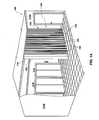
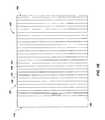
- FIGS. 1A through 1Cshow a perspective view, a side view and a top view, respectively, of a system with a movable partition in accordance with an embodiment of the present disclosure
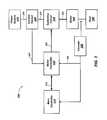
- FIG. 2is a simplified block diagram of a door control system for controlling movement and speed of the movable partition in accordance with an embodiment of the present disclosure
- FIG. 3is a simplified block diagram of an H-bridge configuration of switches as a possible switching circuit for controlling a motor
- FIG. 4illustrates an operational profile of sampled current values to the motor through an operational cycle of the movable partition
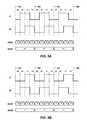
- FIGS. 5A and 5Bare timing diagrams illustrating quadrature signals, internal count and external count in accordance with an embodiment of the present disclosure.
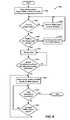
- FIG. 6is a simplified flow diagram illustrating acts performed in controlling speed of the movable partition in accordance with an embodiment of the present disclosure.
- DSPDigital Signal Processor
- ASICApplication Specific Integrated Circuit
- FPGAField Programmable Gate Array
- a general-purpose processormay be a microprocessor, but in the alternative, the processor may be any conventional processor, controller, microcontroller, or state machine.
- a processormay also be implemented as a combination of computing devices, e.g., a combination of a DSP and a microprocessor, a plurality of microprocessors, one or more microprocessors in conjunction with a DSP core, or any other such configuration.
- the embodimentsmay be described in terms of a process that may be depicted as a flowchart, a flow diagram, a structure diagram, or a block diagram. Although a process may describe operational acts as a sequential process, many of these acts can be performed in another sequence, in parallel, or substantially concurrently. In addition, the order of the acts may be re-arranged. A process may correspond to a method, a function, a procedure, a subroutine, a subprogram, etc. Furthermore, the methods disclosed herein may be implemented in hardware, software, or both. If implemented in software, the functions may be stored or transmitted as one or more instructions or code on computer readable media. Computer readable media includes both computer storage media and communication media including any medium that facilitates transfer of a computer program from one place to another.
- Elements described hereinmay include multiple instances of the same element. These elements may be generically indicated by a numerical designator (e.g., 110 ) and specifically indicated by the numerical indicator followed by an alphabetic designator (e.g., 110 A) or a numeric indicator preceded by a “dash” (e.g., 110 - 1 ). For ease of following the description, for the most part element number indicators begin with the number of the drawing on which the elements are introduced or most fully discussed. Thus, for example, element identifiers on a FIG. 1 will be mostly in the numerical format 1xx and elements on a FIG. 4 will be mostly in the numerical format 4xx.
- any reference to an element herein using a designation such as “first,” “second,” and so forthdoes not limit the quantity or order of those elements, unless such limitation is explicitly stated. Rather, these designations may be used herein as a convenient method of distinguishing between two or more elements or instances of an element. Thus, a reference to first and second elements does not mean that only two elements may be employed there or that the first element must precede the second element in some manner.
- a set of elementsmay comprise one or more elements.
- assertand “negate” may be respectively used when referring to the rendering of a signal, status bit, or similar apparatus into its logically true or logically false state. If the logically true state is a logic level one, the logically false state will be a logic level zero. Conversely, if the logically true state is a logic level zero, the logically false state will be a logic level one.
- busis used to refer to a plurality of signals or conductors, which may be used to transfer one or more various types of information, such as data, addresses, control, or status. Additionally, a bus or a collection of signals may be referred to in the singular as a signal. Some drawings may illustrate signals as a single signal for clarity of presentation and description. It will be understood by a person of ordinary skill in the art that the signal may represent a bus of signals, wherein the bus may have a variety of bit widths and the present invention may be implemented on any number of data signals including a single data signal.
- rotating the motoreffecting, causing, or inducing “rotation” of the motor, or a “rotational mode” of the motor, refer to the relative rotational movement between the components of a motor such as a rotor and stator.
- Embodiments of the present disclosureinclude apparatuses, and methods for moving and controlling a movable partition to reduce stresses on the movable partition, the motor, or a combination thereof.
- FIGS. 1A through 1Cillustrate an embodiment of a movable partition system 100 of the present disclosure.
- the movable partition system 100is an automatic movable partition system, in that the system 100 includes a movable partition 120 that may be automatically extended, automatically retracted, or both automatically extended and automatically retracted.
- the movable partition 120may be used for partitioning space, as a sound barrier, as a fire barrier, as a security barrier, for combinations of such purposes, or for other purposes.
- the movable partition 120may comprise, for example, an accordion-type door, as shown in FIGS. 1A through 1C .
- the movable partition 120may be formed with a plurality of panels 104 that are connected to one another with hinges or other hinge-like members 106 .
- the hinged connection of the panels 104allows the panels 104 to fold, and the movable partition 120 to collapse, as the movable partition 120 is retracted, which allows the movable partition 120 to be compactly stored in a pocket 108 (may also be referred to herein as a storage compartment) formed in a wall 110 A of a building when in a retracted or folded state.
- the movable partition 120may comprise a sliding door, or another type of movable partition 120 .
- the panels 104may be configured in a manner that they interlock, while still allowing the pivoting between the panels 104 where they are interlocked.
- the pivot-like couplingmay be referred to herein as using hinges 106 or couplings 106 .
- the movable partition 120When it is desired to deploy the movable partition 120 to an extended position, the movable partition 120 is driven along a track 114 or track assembly across the space to provide an appropriate barrier.
- a leading edge of the movable partition 120shown in the presently described embodiment as a male lead drive box 180 , matingly (i.e., complementarily) engages with a jamb or door post 118 that may be formed in a wall 110 B of a building.
- the lead drive box 180may simply meet flush with the wall 110 B.
- the lead drive box 180 and movable partition 120may extend longitudinally substantially from the track 114 on one surface (e.g., a ceiling) to an opposing surface 134 (e.g., a floor).
- an accordion-type door 120may include a first sheet 120 A of panels 104 and a second sheet 120 B of panels 104 that is laterally spaced from the first sheet 120 A.
- a configurationmay be utilized as a fire door wherein one sheet 120 A acts as a primary fire and smoke barrier, a space between the two sheets 120 A and 120 B acts as an insulator or a buffer zone, and the second sheet 120 B acts as a secondary fire and smoke barrier.
- Such a configurationmay also be useful in providing an acoustical barrier when the movable partition 120 is used to subdivide a larger space into multiple, smaller rooms.
- the lead drive box 180which may include, for example, a drive mechanism 322 with one or more rotatable drive members 190 (e.g., sprockets, gears, and pulleys) for coupling to a fixed drive member 355 (e.g., chains, belts, and cables), which may be configured to open and close the movable partition 120 upon actuation thereof.
- the movable partition system 100may further include various sensors and switches to assist in the control of the movable partition 120 through appropriate connection with a motor (not shown).
- the example shown hereinincludes a motor and control circuitry positioned in or near the lead drive box 180 .
- Other embodiments according to the present inventionmay include the motor and control circuitry positioned in various combinations of in or near the lead drive box 180 or a lead post 180 , in or near wall 110 A, and in or near wall 110 B.
- motorsmay be mounted in a header on a strike side.
- a chain or beltis fixed and the motor 240 ( FIG. 2 ) (and possibly other electrical components) moves with the movable partition 120 .
- the motor 240(and possibly other electrical components) is fixed and the chain or belt moves with the movable partition 120 .
- lead post 180In general, the description herein discusses a lead post 180 unless the context of the discussion is directed to a lead drive box 180 .
- lead post 180encompasses both a lead post 180 and a lead drive box 180 in either configuration of a fixed position motor 240 or a motor 240 that moves with the lead post 180 .
- FIGS. 1A-1Cis directed to a single accordion-type door 120
- other movable partitionsmay be utilized.
- a two-door, or bi-part door, systemmay be utilized wherein two similarly configured doors extend across a space and join together to form an appropriate barrier.
- the present disclosuremay be applicable to movable partitions or barriers other than the accordion-type doors that are shown and described herein in example embodiments.
- FIG. 2is a simplified block diagram of a door control system 200 for controlling movement and speed of the movable partition 120 in accordance with an embodiment of the present disclosure.
- the door control system 200may be configured to monitor an operational cycle of the movable partition 120 from a fully extended configuration to a fully retracted configuration and from the retracted configuration to the extended configuration.
- the door control system 200may include a main controller 210 for controlling and monitoring overall operation of the movable partition 120 and the lead post 180 .
- a motor controller 220monitors and controls operation of a motor 240 as it drives the movable partition 120 .
- the main controller 210 and the motor controller 220may communicate over bus 215 to share operation and control information related to the motor 240 and the movable partition 120 .
- movable partition systems 100have been configured to open or close the movable partition 120 at about 6 inches per second to about 24 inches per second.
- significant stressmay be placed on the motor 240 due to high current, or significant stress may be placed on the mechanical systems due to an encountered obstruction or upon reaching a fully extended position or a fully retracted position.
- Embodiments of the present disclosuremay be configured to limit the speed increase of the motor 240 , and thereby the speed increase of the lead post 180 , when the movable partition 120 is in an almost fully extended position or an almost fully retracted position to reduce these stresses.
- startup current for a conventional DC motormay be very high.
- a one-half horsepower motor 240that normally has operational current of about 17 amps may have startup currents in excess of 120 amps.
- Embodiments of the present disclosuremay be configured to reduce the speed of the motor 240 , and thereby the speed of the lead post 180 , when the motor 240 is first starting up to reduce these high startup currents.
- the panels 104begin getting closer and closer together, which may cause an increased air pressure between the panels 104 because the air between the panels 104 cannot escape as fast as the panels 104 are closing together. Conversely, when starting from a fully retracted position, as the panels 104 begin to move apart, a reduced air pressure may develop between the panels 104 because air cannot enter between the panels 104 as fast as the panels 104 are moving apart.
- the term “billowing effect”is used to describe both the increased air pressure and the reduced air pressure that may be encountered as the movable partition 120 moves to or from the fully retracted position.
- Embodiments of the present disclosuremay be configured to reduce the billowing effect that might be present by reducing the speed of the motor 240 , and thereby the speed of the lead post 180 , to create improved airflow around the panels 104 .
- Reduced air pressurecan apply additional force to the panels 104 and, as a result the lead post 180 and the motor 240 .
- increased air pressurecan apply additional force to the panels 104 and, as a result, the lead post 180 and the motor 240 .
- the panels 104may billow out relative to each other, which may cause them to encounter obstructions that they might not normally encounter if they did't billowed out.
- the billowed panels 104may run into sides of the wall 110 A when moving into the pocket 108 .
- the main controller 210 and the motor controller 220may be any suitable controller or processor and may be configured to monitor the state of a movable device (e.g., a movable door or a movable partition), monitor other aspects related to the control of the movable device, and thereby operate the movable device under a defined set of parameters or rules.
- the main controller 210may be further configured to transmit one or more control signals via bus 215 to the motor controller 220 related to an operation of the movable device, such as, for example only, an “open” operation signal, a “close” operation signal, or a “brake” operation signal.
- a current sensor 260may be coupled to a power source 270 via a power signal 275 and may be configured to provide power to the motor 240 and possibly various other components of the door control system 200 .
- the current sensor 260may comprise any sensor suitable for generating an analog or digital current signal 265 , wherein the current signal 265 is proportional to the amount of current flowing from the power source 270 to the motor 240 .
- the current sensor 260 configured to generate an analog signalmay be coupled to an analog-to-digital converter to sample the input and convert it to a digital value suitable for use by the motor controller 220 .
- the analog-to-digital convertormay comprise a stand-alone analog-to-digital converter coupled between the current sensor 260 and the motor controller 220 or an analog-to-digital converter included in the motor controller 220 .
- a current sensor 260 configured to generate a digital signalmay directly interface to the motor controller 220 to present a digital value suitable for use by the motor controller 220 .
- the current sensor 260may comprise a conventional Hall Effect current sensor 260 , as will be understood by a person having ordinary skill in the art.
- the motor 240may be mechanically coupled with a door 290 (e.g., a movable partition 120 or lead drive box 180 ) to open or close the door 290 as the motor 240 rotates.
- a door 290e.g., a movable partition 120 or lead drive box 180
- An encoder 250 including one or more sensors (not shown)may generate rotation signals 255 for the motor controller 220 .
- the rotation signals 255can be used to indicate relative position between components of the motor 240 , such as between a rotor and a stator of the motor 240 .
- the motor controller 220can use the rotation signals 255 to determine position, speed, and rotation direction of the motor 240 . From these positions, speed, and direction parameters of the motor 240 , position, speed, and direction parameters for the door 290 may be estimated.
- the encoder 250may be a magnetic encoder.
- the encoder 250may include an optical encoder using an LED to emit light onto a codewheel surface, projecting an image back on a photodetector, causing the output to change as the rotatable drive member 190 ( FIG. 1C ) rotates.
- the encoder 250may be configured to sense rotation of a shaft of the motor 240 , a gearbox attached to the motor 240 , or a chain or belt attached to the gearbox or motor 240 . Additional details of the encoder 250 , and use thereof, are discussed below with reference to FIGS. 5A and 5B .
- a switching circuit 230may be coupled between the power source 270 and the motor 240 to control rotation, speed, and direction of the motor 240 responsive to motor control signals 235 from the motor controller 220 .
- the motor controller 220in response to receiving an “open” control signal from the main controller 210 , the motor controller 220 may be configured to transmit the motor control signals 235 to the switching circuit 230 to cause the motor 240 to rotate in a first rotational direction.
- the motor controller 220may transmit the motor control signals 235 to the switching circuit 230 to cause the motor 240 to rotate in a second rotational direction.
- the motor controller 220may transmit the motor control signals 235 to cause rotation of the motor 240 to cease in either direction.
- FIG. 3is a simplified block diagram of an H-bridge configuration of switches as a possible switching circuit 230 and the motor controller 220 for controlling the motor 240 .
- the switching circuit 230includes a first switching device 310 A, a second switching device 310 B, a third switching device 310 C, and a fourth switching device 310 D.
- the switching devicesmay each comprise relays.
- the switching devicesmay each comprise field effect transistors (FETs).
- FETsfield effect transistors
- the first switching device 310 A and the second switching device 310 Bmay comprise p-channel devices and the third switching device 310 C and the fourth switching device 310 D may comprise n-channel devices.
- the first switching device 310 Ais operably coupled between a positive power source 370 and a first motor terminal 330 and is controlled by motor control signal 235 A.
- the second switching device 310 Bis operably coupled between the positive power source 370 and a second motor terminal 340 and is controlled by motor control signal 235 B.
- the third switching device 310 Cis operably coupled between a negative power source 380 and the first motor terminal 330 and is controlled by motor control signal 235 C.
- the fourth switching device 310 Dis operably coupled between the negative power source 380 and the second motor terminal 340 and is controlled by motor control signal 235 D.
- the positive power source 370 and the negative power source 380may create a voltage differential suitable for driving a DC motor.
- a DC motormay include a stator-rotor combination or a commutator-armature combination configured to effect rotational motion of an output component such as a shaft.
- the present inventionmay be practiced with a motor rated at 12 volts DC or higher, such as a 24 volt DC motor, although motors of other voltages may be utilized.
- the switching circuit 230may be thought of as operating in a dynamic braking mode when motor control signal 235 A and motor control signal 235 B are each asserted and motor control signal 235 C and motor control signal 235 D are each negated.
- the switching circuit 230may also operate in a dynamic braking mode when motor control signal 235 A and motor control signal 235 B are each negated and motor control signal 235 C and motor control signal 235 D are each asserted.
- the switching circuit 230may be thought of as operating in a rotational mode when motor control signal 235 A and motor control signal 235 D are each asserted and motor control signal 235 B and motor control signal 235 C are each negated.
- the switching circuit 230may also operate in a rotational mode when motor control signal 235 B and motor control signal 235 C are each asserted and motor control signal 235 A and motor control signal 235 D are each negated.
- the switching circuit 230may cause the motor 240 to rotate in a first rotation direction or in a second rotation direction, depending on the state of the motor control signals ( 235 A, 235 B, 235 C and 235 D).
- the motor 240is enabled to rotate because the first motor terminal 330 is operably coupled to the positive power source 370 and the second motor terminal 340 is operably coupled to the negative power source 380 , or vice versa. More specifically, the motor 240 may rotate in the first rotation direction if motor control signal 235 B and motor control signal 235 C are each asserted while motor control signal 235 A and motor control signal 235 D are each negated.
- the first rotation directionis enabled because the asserted motor control signal 235 B causes the second switching device 310 B to conduct, and the asserted motor control signal 235 C causes the third switching device 310 C to conduct.
- the negated motor control signal 235 A and the negated motor control signal 235 Dprevent respective first and fourth switching devices 310 A and 310 D from conducting.
- the second motor terminal 340connects to the positive power source 370 and the first motor terminal 330 connects to the negative power source 380 , causing the motor 240 to rotate in the first rotation direction.
- the motor 240may rotate in the second rotation direction if the motor control signal 235 B and motor control signal 235 C are each negated while the motor control signal 235 A and motor control signal 235 D are each asserted.
- the second rotation directionis enabled because the asserted motor control signal 235 A causes first switching device 310 A to conduct, and the asserted motor control signal 235 D causes fourth switching device 310 D to conduct.
- the negated motor control signal 235 B and negated motor control signal 235 Cprevent respective second and third switching devices 310 B and 310 C from conducting.
- the first motor terminal 330connects to the positive power source 370 and the second motor terminal 340 connects to the negative power source 380 , causing the motor 240 to rotate in the second rotation direction.
- control signalsmay be configured as Pulse Width Modulation (PWM) signals and use pulse width modulation by the motor controller 220 to create the motor control signals ( 235 A, 235 B, 235 C and 235 D) in an appropriate manner to stop the motor 240 as well as control the direction of rotation of the motor 240 .
- PWMPulse Width Modulation
- rotational speed of the motormay be adjusted, which in turn will adjust linear speed of the opening or closing door 290 ( FIG. 2 ).
- the motor 240may be configured to start and stop slowly and, therefore, reduce wear and tear on the motor 240 .
- This speed adjustmentmay also be used to reduce wear and tear on mechanical components of the movable partition system 100 ( FIGS. 1A-1C ) such as rotatable drive members (e.g., sprockets, gears, and pulleys) and to fixed drive members (e.g., chains, belts, and cables).
- rotatable drive memberse.g., sprockets, gears, and pulleys
- fixed drive memberse.g., chains, belts, and cables.
- FIG. 4illustrates an operational profile 410 of sampled current values to the motor 240 ( FIG. 2 ) through an operational cycle of the movable partition 120 ( FIGS. 1A-1C ).
- the Y-axisindicates current to the motor 240 and the X-axis indicates position of the door 290 .
- the main controller 210may be configured to transmit and receive one or more status signals via bus 215 to the motor controller 220 related to an operational state or status of the motor 240 , the door 290 , or a combination thereof.
- status signals related to an operational state of the door 290may comprise an alarm signal, a fault signal, a service signal, or a moving signal.
- the status signals related to an operational state of the motor 240may comprise a start-up signal, a steady-state signal, an almost retracted signal, or an off signal.
- motor control signals 235may be communicated to the switching circuit 230 providing a current from the power source 270 to the motor 240 .
- the provided currentmay be sensed with the current sensor 260 and the current signal 265 , which may be proportional to the amount of current sensed, is communicated to the motor controller 220 .
- the motor controller 220may be configured to sample the signal at discrete positions (e.g., positions of the motor 240 or positions of the door 290 ) or discrete times to obtain a plurality of current values to generate the operational profile 410 .
- the motor controller 220may be configured to analyze the operational profile 410 obtained, as well as to compare the values to any previously acquired values.
- the motor 240may require varying amounts of current during an operational cycle of the door 290 .
- the current provided to the loadmay vary over the course of a single operational cycle.
- the motor 240may require a higher current during a start-up mode 420 than what is required during a steady-state mode 430 .
- the motor 240 , the door 290 , or bothmay encounter several irregularities or other anomalies during an operational cycle causing the current requirements to fluctuate even during the “steady state” mode.
- certain fluctuations in the current requirementsmay signify a problem of some sort. For example, when the drive mechanism 322 ( FIG. 1C ) is stopped or substantially restrained from motion during an operational cycle, the motor 240 may require a substantially higher current as compared to a normal operation of the door 290 . However, certain fluctuations may also be considered part of a normal operational cycle.
- FIGS. 5A and 5Bare timing diagrams illustrating quadrature signals 255 ( FIG. 2 ) as a type of rotation signals 255 , internal count 530 ( 530 A for increments and 530 B for decrements) and external count 540 ( 540 A for increments and 540 B for decrements) in accordance with an embodiment of the present disclosure.
- the encoder 250may be coupled to the motor 240 and may be configured to output the quadrature signals 255 (i.e., a first phase signal A and a second phase signal B) correlated to the relative position between the rotor and stator within the motor 240 .
- the motor controller 220may be configured to determine a rotational direction (may also be referred to herein as an operational direction) of the motor 240 and track a rotational speed (may also be referred to herein as an operational speed) of the motor 240 and a corresponding linear speed of the door 290 by either incrementing the internal count 530 at each combinational logic state (i.e., “00,” “10,” “11,” and “01”) in a forward rotational cycle, as shown in FIG. 5A or decrementing the internal count 530 at each combinational logic state (i.e., “00,” “01,” “11,” and “10”) in a reverse rotational cycle, as shown in FIG. 5B .
- the motor controller 220may also be configured to increment an external count 540 A or decrement an external count 540 B after completion of a complete cycle (as indicated by lines 560 in FIG. 5A and lines 580 in FIG. 5B ).
- the complete cycle of the first phase signal A and the second phase signal Bi.e., after first phase signal A and second phase signal B have transitioned through each combinational logic state, “00,” “10,” “11,” and “01” for a forward rotation or “00,” “01,” “11,” and “10” for a reverse rotation).
- the motor controller 220may determine a rotational direction of an associated motor 240 and monitor a rotational position of the motor 240 by maintaining the internal count 530 , the external count 540 , or a combination thereof.
- width of the door 290 and position of the lead post 180may be determined by the number of quadrature pulses.
- 1 ⁇ 2 inch in chain pitchmeans there are 5 inches of travel of the lead post 180 for each revolution of the motor 240 .
- tracking the number of pulsescan keep track of the lateral position of the lead post 180 throughout its full travel length.
- Determination of the position of the lead post 180may be desirable so that the movable partition system 100 may be able to properly control the speed of the motor 240 , and thereby the movable partition 120 during periods of interest of the operational cycle.
- a rotational speed of the motor 240may be determined and, as a result, a proportional linear speed of the lead post 180 ( FIGS. 1A-1C ).
- FIG. 6is a simplified flow diagram 600 illustrating acts performed in controlling speed of the movable partition 120 in accordance with an embodiment of the present disclosure. While discussing FIG. 6 , reference will also be made to FIGS. 1A-1C and FIG. 2 .
- the movable partition system 100enters a startup phase wherein the motor 240 would begin to turn. Prior to turning, the motor controller 220 may set up the PWM signals 235 with a minimum pulse width acceptable for beginning rotation of the motor 240 and lateral movement of the door 290 .
- Decision block 604indicates a test to determine if current to the motor 240 is within a predefined limit. This test can function to verify that current to the motor 240 during the startup phase stays within safe limits and that mechanical stresses on the movable partition system 100 stay within safe limits. If the current is not within the predefined limit, operation block 606 indicates that the pulse widths of the PWM signals 235 may be reduced by a delta amount to reduce current. If the pulse widths are already at the minimum amount, the process may stop the motor 240 . Thus, a loop through decision block 604 and operation block 606 creates a feedback loop to maintain current to the motor 240 and forces on the door 290 within desired limits.
- decision block 608indicates a test to determine if pulse widths of the PWM signals 235 are at their desired steady-state values. If not, operation block 610 indicates that the pulse widths of the PWM signals 235 may be increased by a delta amount to increase current and, as a result, speed of the motor 240 and door 290 . Thus, a loop through decision block 604 , decision block 608 , and operation block 610 creates a ramp up of current and speed until the desired steady-state values are reached.
- the delta amount of increase in operation block 610may be configured to create a linear increase. In other embodiments, the delta amounts may change for different iterations through the loop to create other, more complex increases, such as, for example, a parabolic increase to gradually approach steady state.
- the acts and decisions that may be performed in blocks 602 , 604 , 606 , 608 , and 610comprise acts and decision that may be performed during a startup-phase.
- operation block 612indicates that the door 290 has reached and is operating in a steady state. While not shown, it should be apparent that a feedback loop may also be used in the steady state to ensure that current to the motor 240 stays within acceptable limits.
- Decision block 614indicates a test to determine if the lead post 180 has reached a position that may be indicative of the beginning of the billowing effect, if the lead post 180 has reached a position that may be indicative of potentially harmful stress on the mechanical components, or a combination thereof. If not, the process loops back to operation block 612 to continue steady-state operation.
- operation block 616indicates that the pulse widths of the PWM signals 235 may be increased or decreased by a delta amount to increase or decrease rotational speed of the motor 240 and lateral speed of the door 290 .
- Decision block 618tests to see if the door 290 has been fully retracted or fully extended. If so, the process ends. If not, decision block 620 tests to see if the pulse widths of the PWM signals 235 have reached their desired width. If so, the process may loop back to decision block 618 to see if the door 290 is fully retracted or fully extended.
- the processmay loop back to operation block 616 to adjust the pulse widths by a new delta amount.
- a loop through operation block 616 , decision block 618 , and decision block 620creates a ramp down of current and speed until the desired pulse widths are reached.
- the delta amount of decrease in operation block 616may be configured to create a linear decrease.
- the delta amountsmay change for different iterations through the loop to create other, more complex increases, such as, for example, a parabolic decrease to gradually approach the reduced speed that is desired.
- the acts and decisions that may be performed in blocks 614 , 616 , 618 , and 620comprise acts and decision that may be performed during an ending phase, a billowing reduction phase, or a combination thereof.
- Various predefined positions for the startup phase, the ending phase, and the billowing reduction phasemay be preset based on the type of movable partition system 100 .
- the predefined positionmay be configured by a user based on observations of how the movable partition system 100 is performing.
Landscapes
- Engineering & Computer Science (AREA)
- Power Engineering (AREA)
- Architecture (AREA)
- Physics & Mathematics (AREA)
- Electromagnetism (AREA)
- Civil Engineering (AREA)
- Structural Engineering (AREA)
- Mechanical Engineering (AREA)
- Power-Operated Mechanisms For Wings (AREA)
- Control Of Stepping Motors (AREA)
Abstract
Description
Embodiments of the present invention are directed to the field of movable partitions used for partitioning space, as sound barriers, as fire barriers, security barriers, and for various other applications.
Movable partitions are utilized in numerous situations and environments for a variety of purposes. Such partitions may include, for example, a movable partition comprising foldable or collapsible doors configured to enclose or subdivide a room or other area. Often such partitions may be utilized simply for purposes of versatility in being able to subdivide a single large room into multiple smaller rooms. The subdivision of a larger area may be desired, for example, to accommodate multiple groups or meetings simultaneously. In other applications, such partitions may be utilized for noise control depending, for example, on the activities taking place in a given room or portion thereof.
Movable partitions may also be used to provide a security barrier, a fire barrier, or both a security barrier and a fire barrier. In such a case, the partition barrier may be configured to automatically close upon the occurrence of a predetermined event such as the actuation of an associated alarm. For example, one or more accordion or similar folding-type partitions may be used as a security barrier, a fire barrier, or both a security barrier and a fire barrier wherein each partition is formed with a plurality of panels connected to one another with hinges. The hinged connection of the panels allows the partition to fold and collapse into a compact unit for purposes of storage when not deployed. The partition may be stored in a pocket formed in the wall of a building when in a retracted or folded state. When the partition is deployed to subdivide a single large room into multiple smaller rooms, secure an area during a fire, or for any other specified reason, the partition may be extended along an overhead track, which is often located above the movable partition in a header assembly, until the partition extends a desired distance across the room.
When deployed, a leading end of the movable partition, often defined by a component known as a lead post, complementarily engages another structure, such as a wall, a post, or a lead post of another door.
Automatic extension and retraction of the movable partition may be accomplished through the use of a motor located in a pocket formed in the wall of a building in which the movable partition is stored when in a retracted or folded state. The motor, which remains fixed in place within the pocket, may be used to drive extension and retraction of the movable partition. A motor for automatically extending and retracting a movable partition may also be mounted within the movable partition itself, such that the motor travels with the movable partition as the movable partition is extended and retracted using the motor.
As the movable partition extends and retracts between a closed and open position various stresses may be placed on the movable partition and the motor. The inventors have appreciated that there is a need for apparatuses, and methods for moving and controlling a movable partition to reduce stresses on the movable partition, the motor, or a combination thereof.
Embodiments of the present disclosure include apparatuses, and methods for moving and controlling a movable partition to reduce stresses on the movable partition, the motor, or a combination thereof.
In some embodiments, a motor control system for motivating a movable partition includes a motor for mechanical coupling to the movable partition and a switching circuit operably coupled to the motor for selectively coupling the motor to a positive power source and a negative power source responsive to one or more PWM signals. An encoder is configured for generating one or more rotation signals indicative of operational direction and operational speed of the motor. A motor controller is operably coupled to the switching circuit and is configured for improving airflow around panels of the movable partition when a lead post of the movable partition is between a predefined position and a fully retracted position indicative of a billowing effect for the panels by adjusting pulse widths of the one or more PWM signals to control a rotational speed of the motor.
In other embodiments, a movable partition system includes a movable partition including coupled panels engaged with and movable along a track extending longitudinally between a first end and a second end and a lead post coupled to the movable partition and the track. A motor control system includes a motor for mechanical coupling to the movable partition and a switching circuit operably coupled to the motor for selectively coupling the motor to a positive power source and a negative power source responsive to one or more PWM signals. An encoder is configured for generating one or more rotation signals indicative of operational direction and operational speed of the motor. A motor controller is operably coupled to the switching circuit and is configured for improving airflow around the panels of the movable partition when the lead post of the movable partition is between a predefined position and a fully retracted position indicative of a billowing effect for the panels by adjusting pulse widths of the one or more PWM signals to control a rotational speed of the motor.
In other embodiments, a method of moving a movable partition along a track includes actuating a motor operably coupled to the movable partition to drive rotation of the motor at a rotational speed and cause the movable partition to move along the track at a linear speed proportional to the rotational speed. The method also includes enabling improved airflow around panels of the movable partition when the movable partition reaches a predefined position relative to a fully retracted configuration by reducing the rotational speed of the motor when a lead post of the movable partition is between the predefined position and a fully retracted position.
While the specification concludes with claims particularly pointing out and distinctly claiming that which is regarded as the present disclosure, the advantages of this disclosure may be more readily ascertained from the description of embodiments of the disclosure when read in conjunction with the accompanying drawings, in which:
In the following description, reference is made to the accompanying drawings in which is shown, by way of illustration, specific embodiments of the present disclosure. The embodiments are intended to describe aspects of the disclosure in sufficient detail to enable those skilled in the art to practice the invention. Other embodiments may be utilized and changes may be made without departing from the scope of the disclosure. The following detailed description is not to be taken in a limiting sense, and the scope of the present invention is defined only by the appended claims.
Furthermore, specific implementations shown and described are only examples and should not be construed as the only way to implement or partition the present disclosure into functional elements unless specified otherwise herein. It will be readily apparent to one of ordinary skill in the art that the various embodiments of the present disclosure may be practiced by numerous other partitioning solutions.
In the following description, elements, circuits, and functions may be shown in block diagram form in order not to obscure the present disclosure in unnecessary detail. Additionally, block definitions and partitioning of logic between various blocks is exemplary of a specific implementation. It will be readily apparent to one of ordinary skill in the art that the present disclosure may be practiced by numerous other partitioning solutions. Those of ordinary skill in the art would understand that information and signals may be represented using any of a variety of different technologies and techniques. For example, data, instructions, commands, information, signals, bits, symbols, and chips that may be referenced throughout the above description may be represented by voltages, currents, electromagnetic waves, magnetic fields or particles, optical fields or particles, or any combination thereof. Some drawings may illustrate signals as a single signal for clarity of presentation and description. It will be understood by a person of ordinary skill in the art that the signal may represent a bus of signals, wherein the bus may have a variety of bit widths and the present disclosure may be implemented on any number of data signals including a single data signal.
The various illustrative logical blocks, modules, and circuits described in connection with the embodiments disclosed herein may be implemented or performed with a general purpose processor, a special purpose processor, a Digital Signal Processor (DSP), an Application Specific Integrated Circuit (ASIC), a Field Programmable Gate Array (FPGA) or other programmable logic device, discrete gate or transistor logic, discrete hardware components, or any combination thereof designed to perform the functions described herein. A general-purpose processor may be a microprocessor, but in the alternative, the processor may be any conventional processor, controller, microcontroller, or state machine. A processor may also be implemented as a combination of computing devices, e.g., a combination of a DSP and a microprocessor, a plurality of microprocessors, one or more microprocessors in conjunction with a DSP core, or any other such configuration.
Also, it is noted that the embodiments may be described in terms of a process that may be depicted as a flowchart, a flow diagram, a structure diagram, or a block diagram. Although a process may describe operational acts as a sequential process, many of these acts can be performed in another sequence, in parallel, or substantially concurrently. In addition, the order of the acts may be re-arranged. A process may correspond to a method, a function, a procedure, a subroutine, a subprogram, etc. Furthermore, the methods disclosed herein may be implemented in hardware, software, or both. If implemented in software, the functions may be stored or transmitted as one or more instructions or code on computer readable media. Computer readable media includes both computer storage media and communication media including any medium that facilitates transfer of a computer program from one place to another.
Elements described herein may include multiple instances of the same element. These elements may be generically indicated by a numerical designator (e.g.,110) and specifically indicated by the numerical indicator followed by an alphabetic designator (e.g.,110A) or a numeric indicator preceded by a “dash” (e.g.,110-1). For ease of following the description, for the most part element number indicators begin with the number of the drawing on which the elements are introduced or most fully discussed. Thus, for example, element identifiers on aFIG. 1 will be mostly in the numerical format 1xx and elements on aFIG. 4 will be mostly in the numerical format 4xx.
It should be understood that any reference to an element herein using a designation such as “first,” “second,” and so forth does not limit the quantity or order of those elements, unless such limitation is explicitly stated. Rather, these designations may be used herein as a convenient method of distinguishing between two or more elements or instances of an element. Thus, a reference to first and second elements does not mean that only two elements may be employed there or that the first element must precede the second element in some manner. In addition, unless stated otherwise, a set of elements may comprise one or more elements.
The terms “assert” and “negate” may be respectively used when referring to the rendering of a signal, status bit, or similar apparatus into its logically true or logically false state. If the logically true state is a logic level one, the logically false state will be a logic level zero. Conversely, if the logically true state is a logic level zero, the logically false state will be a logic level one.
The term “bus” is used to refer to a plurality of signals or conductors, which may be used to transfer one or more various types of information, such as data, addresses, control, or status. Additionally, a bus or a collection of signals may be referred to in the singular as a signal. Some drawings may illustrate signals as a single signal for clarity of presentation and description. It will be understood by a person of ordinary skill in the art that the signal may represent a bus of signals, wherein the bus may have a variety of bit widths and the present invention may be implemented on any number of data signals including a single data signal.
As used herein, the terms “rotating the motor,” effecting, causing, or inducing “rotation” of the motor, or a “rotational mode” of the motor, refer to the relative rotational movement between the components of a motor such as a rotor and stator.
Embodiments of the present disclosure include apparatuses, and methods for moving and controlling a movable partition to reduce stresses on the movable partition, the motor, or a combination thereof.
Themovable partition 120 may comprise, for example, an accordion-type door, as shown inFIGS. 1A through 1C . Themovable partition 120 may be formed with a plurality ofpanels 104 that are connected to one another with hinges or other hinge-like members 106. The hinged connection of thepanels 104 allows thepanels 104 to fold, and themovable partition 120 to collapse, as themovable partition 120 is retracted, which allows themovable partition 120 to be compactly stored in a pocket108 (may also be referred to herein as a storage compartment) formed in awall 110A of a building when in a retracted or folded state. In other embodiments, themovable partition 120 may comprise a sliding door, or another type ofmovable partition 120. As a non-limiting example, thepanels 104 may be configured in a manner that they interlock, while still allowing the pivoting between thepanels 104 where they are interlocked. For simplicity in explanation, and not for limitation, the pivot-like coupling may be referred to herein as usinghinges 106 orcouplings 106.
When it is desired to deploy themovable partition 120 to an extended position, themovable partition 120 is driven along atrack 114 or track assembly across the space to provide an appropriate barrier. When in a deployed or an extended state, a leading edge of themovable partition 120, shown in the presently described embodiment as a malelead drive box 180, matingly (i.e., complementarily) engages with a jamb ordoor post 118 that may be formed in awall 110B of a building. In other embodiments, thelead drive box 180 may simply meet flush with thewall 110B. In some embodiments, thelead drive box 180 andmovable partition 120 may extend longitudinally substantially from thetrack 114 on one surface (e.g., a ceiling) to an opposing surface134 (e.g., a floor).
As can be seen inFIG. 1C , an accordion-type door 120 may include afirst sheet 120A ofpanels 104 and asecond sheet 120B ofpanels 104 that is laterally spaced from thefirst sheet 120A. Such a configuration may be utilized as a fire door wherein onesheet 120A acts as a primary fire and smoke barrier, a space between the twosheets second sheet 120B acts as a secondary fire and smoke barrier. Such a configuration may also be useful in providing an acoustical barrier when themovable partition 120 is used to subdivide a larger space into multiple, smaller rooms.
Thelead drive box 180, which may include, for example, adrive mechanism 322 with one or more rotatable drive members190 (e.g., sprockets, gears, and pulleys) for coupling to a fixed drive member355 (e.g., chains, belts, and cables), which may be configured to open and close themovable partition 120 upon actuation thereof. Themovable partition system 100 may further include various sensors and switches to assist in the control of themovable partition 120 through appropriate connection with a motor (not shown).
The example shown herein includes a motor and control circuitry positioned in or near thelead drive box 180. Other embodiments according to the present invention may include the motor and control circuitry positioned in various combinations of in or near thelead drive box 180 or alead post 180, in or nearwall 110A, and in or nearwall 110B. In still other embodiments, motors may be mounted in a header on a strike side. Thus, in some embodiments, a chain or belt is fixed and the motor240 (FIG. 2 ) (and possibly other electrical components) moves with themovable partition 120. In other embodiments, the motor240 (and possibly other electrical components) is fixed and the chain or belt moves with themovable partition 120. In general, the description herein discusses alead post 180 unless the context of the discussion is directed to alead drive box 180. However, as used herein the termlead post 180 encompasses both alead post 180 and alead drive box 180 in either configuration of afixed position motor 240 or amotor 240 that moves with thelead post 180.
It is also noted that, while the exemplary embodiment shown and described with respect toFIGS. 1A-1C is directed to a single accordion-type door 120, other movable partitions may be utilized. For example, a two-door, or bi-part door, system may be utilized wherein two similarly configured doors extend across a space and join together to form an appropriate barrier. Also, the present disclosure may be applicable to movable partitions or barriers other than the accordion-type doors that are shown and described herein in example embodiments.
Amotor controller 220 monitors and controls operation of amotor 240 as it drives themovable partition 120. Themain controller 210 and themotor controller 220 may communicate overbus 215 to share operation and control information related to themotor 240 and themovable partition 120.
Conventionally,movable partition systems 100 have been configured to open or close themovable partition 120 at about 6 inches per second to about 24 inches per second. However, at high speeds, significant stress may be placed on themotor 240 due to high current, or significant stress may be placed on the mechanical systems due to an encountered obstruction or upon reaching a fully extended position or a fully retracted position. Embodiments of the present disclosure may be configured to limit the speed increase of themotor 240, and thereby the speed increase of thelead post 180, when themovable partition 120 is in an almost fully extended position or an almost fully retracted position to reduce these stresses.
In addition, startup current for a conventional DC motor may be very high. For example, a one-half horsepower motor 240 that normally has operational current of about 17 amps may have startup currents in excess of 120 amps. Embodiments of the present disclosure may be configured to reduce the speed of themotor 240, and thereby the speed of thelead post 180, when themotor 240 is first starting up to reduce these high startup currents.
As themovable partition 120 approaches a fully retracted position, thepanels 104 begin getting closer and closer together, which may cause an increased air pressure between thepanels 104 because the air between thepanels 104 cannot escape as fast as thepanels 104 are closing together. Conversely, when starting from a fully retracted position, as thepanels 104 begin to move apart, a reduced air pressure may develop between thepanels 104 because air cannot enter between thepanels 104 as fast as thepanels 104 are moving apart.
As used herein, the term “billowing effect” is used to describe both the increased air pressure and the reduced air pressure that may be encountered as themovable partition 120 moves to or from the fully retracted position.
Embodiments of the present disclosure may be configured to reduce the billowing effect that might be present by reducing the speed of themotor 240, and thereby the speed of thelead post 180, to create improved airflow around thepanels 104.
Reduced air pressure, can apply additional force to thepanels 104 and, as a result thelead post 180 and themotor 240. Similarly, increased air pressure can apply additional force to thepanels 104 and, as a result, thelead post 180 and themotor 240. In addition, thepanels 104 may billow out relative to each other, which may cause them to encounter obstructions that they might not normally encounter if they weren't billowed out. As a non-limiting example, and as shown inFIG. 1C , the billowedpanels 104 may run into sides of thewall 110A when moving into thepocket 108.
Themain controller 210 and themotor controller 220 may be any suitable controller or processor and may be configured to monitor the state of a movable device (e.g., a movable door or a movable partition), monitor other aspects related to the control of the movable device, and thereby operate the movable device under a defined set of parameters or rules. Themain controller 210 may be further configured to transmit one or more control signals viabus 215 to themotor controller 220 related to an operation of the movable device, such as, for example only, an “open” operation signal, a “close” operation signal, or a “brake” operation signal.
Acurrent sensor 260 may be coupled to apower source 270 via apower signal 275 and may be configured to provide power to themotor 240 and possibly various other components of thedoor control system 200. Thecurrent sensor 260 may comprise any sensor suitable for generating an analog or digitalcurrent signal 265, wherein thecurrent signal 265 is proportional to the amount of current flowing from thepower source 270 to themotor 240. Thecurrent sensor 260 configured to generate an analog signal may be coupled to an analog-to-digital converter to sample the input and convert it to a digital value suitable for use by themotor controller 220. The analog-to-digital convertor may comprise a stand-alone analog-to-digital converter coupled between thecurrent sensor 260 and themotor controller 220 or an analog-to-digital converter included in themotor controller 220. Acurrent sensor 260 configured to generate a digital signal may directly interface to themotor controller 220 to present a digital value suitable for use by themotor controller 220. By way of example only, and not by way of limitation, thecurrent sensor 260 may comprise a conventional Hall Effectcurrent sensor 260, as will be understood by a person having ordinary skill in the art.
Themotor 240 may be mechanically coupled with a door290 (e.g., amovable partition 120 or lead drive box180) to open or close thedoor 290 as themotor 240 rotates.
Anencoder 250 including one or more sensors (not shown) may generaterotation signals 255 for themotor controller 220. The rotation signals255 can be used to indicate relative position between components of themotor 240, such as between a rotor and a stator of themotor 240. Themotor controller 220 can use the rotation signals255 to determine position, speed, and rotation direction of themotor 240. From these positions, speed, and direction parameters of themotor 240, position, speed, and direction parameters for thedoor 290 may be estimated. In one embodiment, theencoder 250 may be a magnetic encoder. In another embodiment, theencoder 250 may include an optical encoder using an LED to emit light onto a codewheel surface, projecting an image back on a photodetector, causing the output to change as the rotatable drive member190 (FIG. 1C ) rotates. However, it will be appreciated by those of ordinary skill in the art that other components may be used for theencoder 250. In addition, while the description generally discusses rotation of themotor 240, theencoder 250 may be configured to sense rotation of a shaft of themotor 240, a gearbox attached to themotor 240, or a chain or belt attached to the gearbox ormotor 240. Additional details of theencoder 250, and use thereof, are discussed below with reference toFIGS. 5A and 5B .
A switchingcircuit 230 may be coupled between thepower source 270 and themotor 240 to control rotation, speed, and direction of themotor 240 responsive to motor control signals235 from themotor controller 220. As a non-limiting example, in response to receiving an “open” control signal from themain controller 210, themotor controller 220 may be configured to transmit the motor control signals235 to theswitching circuit 230 to cause themotor 240 to rotate in a first rotational direction. Similarly, in response to receiving a “close” control signal from themain controller 210, themotor controller 220 may transmit the motor control signals235 to theswitching circuit 230 to cause themotor 240 to rotate in a second rotational direction. Furthermore, in response to receiving a “brake” control signal from themain controller 210, themotor controller 220 may transmit the motor control signals235 to cause rotation of themotor 240 to cease in either direction.
As illustrated inFIG. 3 , thefirst switching device 310A is operably coupled between apositive power source 370 and afirst motor terminal 330 and is controlled bymotor control signal 235A. Thesecond switching device 310B is operably coupled between thepositive power source 370 and asecond motor terminal 340 and is controlled bymotor control signal 235B. Thethird switching device 310C is operably coupled between anegative power source 380 and thefirst motor terminal 330 and is controlled bymotor control signal 235C. Thefourth switching device 310D is operably coupled between thenegative power source 380 and thesecond motor terminal 340 and is controlled bymotor control signal 235D.
As a non-limiting example, thepositive power source 370 and thenegative power source 380 may create a voltage differential suitable for driving a DC motor. A DC motor, as will be appreciated by those of ordinary skill in the art, may include a stator-rotor combination or a commutator-armature combination configured to effect rotational motion of an output component such as a shaft. In one particular embodiment, the present invention may be practiced with a motor rated at 12 volts DC or higher, such as a 24 volt DC motor, although motors of other voltages may be utilized.
In operation, theswitching circuit 230 may be thought of as operating in a dynamic braking mode whenmotor control signal 235A andmotor control signal 235B are each asserted andmotor control signal 235C andmotor control signal 235D are each negated. Theswitching circuit 230 may also operate in a dynamic braking mode whenmotor control signal 235A andmotor control signal 235B are each negated andmotor control signal 235C andmotor control signal 235D are each asserted.
Theswitching circuit 230 may be thought of as operating in a rotational mode whenmotor control signal 235A andmotor control signal 235D are each asserted andmotor control signal 235B andmotor control signal 235C are each negated. Theswitching circuit 230 may also operate in a rotational mode whenmotor control signal 235B andmotor control signal 235C are each asserted andmotor control signal 235A andmotor control signal 235D are each negated.
In the rotational mode, theswitching circuit 230 may cause themotor 240 to rotate in a first rotation direction or in a second rotation direction, depending on the state of the motor control signals (235A,235B,235C and235D). In the rotational mode, themotor 240 is enabled to rotate because thefirst motor terminal 330 is operably coupled to thepositive power source 370 and thesecond motor terminal 340 is operably coupled to thenegative power source 380, or vice versa. More specifically, themotor 240 may rotate in the first rotation direction ifmotor control signal 235B andmotor control signal 235C are each asserted whilemotor control signal 235A andmotor control signal 235D are each negated. The first rotation direction is enabled because the assertedmotor control signal 235B causes thesecond switching device 310B to conduct, and the assertedmotor control signal 235C causes thethird switching device 310C to conduct. Similarly, the negatedmotor control signal 235A and the negatedmotor control signal 235D prevent respective first andfourth switching devices second motor terminal 340 connects to thepositive power source 370 and thefirst motor terminal 330 connects to thenegative power source 380, causing themotor 240 to rotate in the first rotation direction.
On the other hand, themotor 240 may rotate in the second rotation direction if themotor control signal 235B andmotor control signal 235C are each negated while themotor control signal 235A andmotor control signal 235D are each asserted. The second rotation direction is enabled because the assertedmotor control signal 235A causesfirst switching device 310A to conduct, and the assertedmotor control signal 235D causesfourth switching device 310D to conduct. Similarly, the negatedmotor control signal 235B and negatedmotor control signal 235C prevent respective second andthird switching devices first motor terminal 330 connects to thepositive power source 370 and thesecond motor terminal 340 connects to thenegative power source 380, causing themotor 240 to rotate in the second rotation direction.
As will be appreciated by one having ordinary skill in the art, the control signals (235A,235B,235C and235D) may be configured as Pulse Width Modulation (PWM) signals and use pulse width modulation by themotor controller 220 to create the motor control signals (235A,235B,235C and235D) in an appropriate manner to stop themotor 240 as well as control the direction of rotation of themotor 240. Moreover, by adjusting the pulse widths of the PWM signals, rotational speed of the motor may be adjusted, which in turn will adjust linear speed of the opening or closing door290 (FIG. 2 ).
As a result, themotor 240 may be configured to start and stop slowly and, therefore, reduce wear and tear on themotor 240. This speed adjustment may also be used to reduce wear and tear on mechanical components of the movable partition system100 (FIGS. 1A-1C ) such as rotatable drive members (e.g., sprockets, gears, and pulleys) and to fixed drive members (e.g., chains, belts, and cables).
In operation, motor control signals235 may be communicated to theswitching circuit 230 providing a current from thepower source 270 to themotor 240. The provided current may be sensed with thecurrent sensor 260 and thecurrent signal 265, which may be proportional to the amount of current sensed, is communicated to themotor controller 220. Themotor controller 220 may be configured to sample the signal at discrete positions (e.g., positions of themotor 240 or positions of the door290) or discrete times to obtain a plurality of current values to generate theoperational profile 410. Themotor controller 220 may be configured to analyze theoperational profile 410 obtained, as well as to compare the values to any previously acquired values.
In some applications, themotor 240 may require varying amounts of current during an operational cycle of thedoor 290. In other words, the current provided to the load may vary over the course of a single operational cycle. For example, as illustrated inFIG. 4 , themotor 240 may require a higher current during a start-upmode 420 than what is required during a steady-state mode 430. Furthermore, themotor 240, thedoor 290, or both may encounter several irregularities or other anomalies during an operational cycle causing the current requirements to fluctuate even during the “steady state” mode. In some applications, certain fluctuations in the current requirements may signify a problem of some sort. For example, when the drive mechanism322 (FIG. 1C ) is stopped or substantially restrained from motion during an operational cycle, themotor 240 may require a substantially higher current as compared to a normal operation of thedoor 290. However, certain fluctuations may also be considered part of a normal operational cycle.
Themotor controller 220 may also be configured to increment anexternal count 540A or decrement anexternal count 540B after completion of a complete cycle (as indicated bylines 560 inFIG. 5A andlines 580 inFIG. 5B ). The complete cycle of the first phase signal A and the second phase signal B (i.e., after first phase signal A and second phase signal B have transitioned through each combinational logic state, “00,” “10,” “11,” and “01” for a forward rotation or “00,” “01,” “11,” and “10” for a reverse rotation).
Stated another way, upon receipt of quadrature signals A and B from theencoder 250, themotor controller 220 may determine a rotational direction of an associatedmotor 240 and monitor a rotational position of themotor 240 by maintaining the internal count530, theexternal count 540, or a combination thereof. Thus, width of thedoor 290 and position of thelead post 180 may be determined by the number of quadrature pulses. For example, in an embodiment with a 10-tooth sprocket, ½ inch in chain pitch means there are 5 inches of travel of thelead post 180 for each revolution of themotor 240. In other words, tracking the number of pulses can keep track of the lateral position of thelead post 180 throughout its full travel length.
Determination of the position of thelead post 180 may be desirable so that themovable partition system 100 may be able to properly control the speed of themotor 240, and thereby themovable partition 120 during periods of interest of the operational cycle.
Moreover, if the quadrature signals255 are correlated to a known time base, such as, for example, a clock, a rotational speed of themotor 240 may be determined and, as a result, a proportional linear speed of the lead post180 (FIGS. 1A-1C ).
If the current is within the predefined limit,decision block 608 indicates a test to determine if pulse widths of the PWM signals235 are at their desired steady-state values. If not,operation block 610 indicates that the pulse widths of the PWM signals235 may be increased by a delta amount to increase current and, as a result, speed of themotor 240 anddoor 290. Thus, a loop throughdecision block 604,decision block 608, andoperation block 610 creates a ramp up of current and speed until the desired steady-state values are reached. In some embodiments, the delta amount of increase inoperation block 610 may be configured to create a linear increase. In other embodiments, the delta amounts may change for different iterations through the loop to create other, more complex increases, such as, for example, a parabolic increase to gradually approach steady state.
The acts and decisions that may be performed inblocks
If the PWM signals235 are at the desired pulse width indecision block 608, thenoperation block 612 indicates that thedoor 290 has reached and is operating in a steady state. While not shown, it should be apparent that a feedback loop may also be used in the steady state to ensure that current to themotor 240 stays within acceptable limits.
If the predefined position of thelead post 180 has been reached,operation block 616 indicates that the pulse widths of the PWM signals235 may be increased or decreased by a delta amount to increase or decrease rotational speed of themotor 240 and lateral speed of thedoor 290.
Decision block618 tests to see if thedoor 290 has been fully retracted or fully extended. If so, the process ends. If not, decision block620 tests to see if the pulse widths of the PWM signals235 have reached their desired width. If so, the process may loop back to decision block618 to see if thedoor 290 is fully retracted or fully extended.
If the pulse widths of the PWM signals235 have not reached their desired limit indecision block 620, the process may loop back to operation block616 to adjust the pulse widths by a new delta amount. Thus, a loop throughoperation block 616,decision block 618, anddecision block 620, creates a ramp down of current and speed until the desired pulse widths are reached. In some embodiments, the delta amount of decrease inoperation block 616 may be configured to create a linear decrease. In other embodiments, the delta amounts may change for different iterations through the loop to create other, more complex increases, such as, for example, a parabolic decrease to gradually approach the reduced speed that is desired.
The acts and decisions that may be performed inblocks
Various predefined positions for the startup phase, the ending phase, and the billowing reduction phase may be preset based on the type ofmovable partition system 100. Alternatively, the predefined position may be configured by a user based on observations of how themovable partition system 100 is performing.
As stated earlier, acts and decisions can be performed in parallel, substantially concurrently, or in sequences different than those shown inFIG. 6 . As a non-limiting example, when thedoor 290 is extending, reducing current for the billowing effect may occur with or after reducing current for the startup phase.
While the invention is susceptible to various modifications and implementation in alternative forms, specific embodiments have been shown by way of examples in the drawings and have been described in detail herein. However, it should be understood that the invention is not intended to be limited to the particular forms disclosed. Rather, the invention includes all modifications, equivalents, and alternatives falling within the scope of the following appended claims and their legal equivalents.
Claims (26)
1. A motor control system for motivating a movable partition, comprising:
a motor for mechanical coupling to the movable partition;
a switching circuit operably coupled to the motor for selectively coupling the motor to a positive power source and a negative power source responsive to one or more PWM signals;
an encoder configured for generating one or more rotation signals indicative of operational direction and operational speed of the motor; and
a motor controller operably coupled to the switching circuit and the encoder and configured for improving airflow around foldable panels of the movable partition and reducing a billowing effect caused by air between the foldable panels by adjusting pulse widths of the one or more PWM signals from a previous pulse width to control a rotational speed of the motor responsive to a determination that the movable partition is in a position that is between a predefined position and a fully retracted position.
2. The motor control system ofclaim 1 , wherein the motor controller is configured to adjust pulse widths of the one or more PWM signals to improve the airflow around the foldable panels when the movable partition is being retracted.
3. The motor control system ofclaim 1 , wherein the lead post comprises a lead drive box including the motor disposed therein.
4. The motor control system ofclaim 1 , further comprising:
a current sensor operably coupled between the motor and at least one of the positive power source and the negative power source and configured to generate a current signal indicative of current through the motor; and
wherein the motor controller is further configured for reducing current spikes to the motor during a startup phase of the motor, an ending phase of the motor, or a combination thereof by adjusting the pulse widths of the one or more PWM signals responsive to the current signal.
5. The motor control system ofclaim 1 , further comprising:
a current sensor operably coupled between the motor and at least one of the positive power source and the negative power source and configured to generate a current signal indicative of current through the motor; and
wherein the motor controller is further configured for reducing stresses on mechanical components operably coupled between the motor and the movable partitions during a startup phase of the motor, an ending phase of the motor, or a combination thereof by adjusting pulse widths of the one or more PWM signals responsive to the current signal.
6. The motor control system ofclaim 1 , wherein the motor controller is further configured for generating the one or more PWM signals to adjust a rotational direction of the motor.
7. The motor control system ofclaim 6 , wherein:
the switching circuit comprises an H-bridge configuration of switches; and
the motor controller is further configured for generating the one or more PWM signals as four signals configured for operating the H-bridge configuration of switches to cause rotation of the motor by pulse-width modulating at least one of the four signals.
8. The motor control system ofclaim 1 , wherein the motor controller is further configured for:
determining if the movable partition is between the predefined position and the fully retracted position by analyzing the one or more rotation signals; and
determining the rotational speed of the motor and a proportional linear position of the movable partition by analyzing the one or more rotation signals relative to a known time base.
9. The motor control system ofclaim 1 , wherein the one or more rotation signals comprise quadrature signals.
10. The motor control system ofclaim 1 , wherein the motor controller is further configured for:
determining the movable partition is between the predefined position and the fully retracted position by analyzing the one or more rotation signals; and
determining the rotational speed of the motor and a proportional linear position of the movable partition by analyzing the one or more rotation signals relative to a known time base.
11. The motor control system ofclaim 1 , wherein the predefined position is a position indicative of the billowing effect occurring for the foldable panels of the movable partition system.
12. The motor control system ofclaim 1 , wherein the motor controller is further configured for maintaining the pulse widths of the one or more PWM signals in a steady state responsive to a determination that the moveable partition is in a position that is prior to the predefined position.
13. The motor control system ofclaim 1 , wherein adjusting pulse widths of the one or more PWM signals from a previous pulse width includes decreasing the pulse widths by a delta amount.
14. The motor control system ofclaim 1 , wherein adjusting pulse widths of the one or more PWM signals from a previous pulse width includes increasing the pulse widths by a delta amount.
15. A movable partition system, comprising:
a movable partition comprising coupled foldable panels engaged with and movable along a track extending longitudinally between a first end and a second end;
a lead post coupled to the movable partition and the track; and
a motor control system, comprising:
a motor for mechanical coupling to the movable partition;
a switching circuit operably coupled to the motor for selectively coupling the motor to a positive power source and a negative power source responsive to one or more PWM signals;
an encoder configured for generating one or more rotation signals indicative of operational direction and operational speed of the motor; and
a motor controller operably coupled to the switching circuit and the encoder and configured for improving airflow around foldable panels of the movable partition and reducing a billowing effect caused by air between the foldable panels by adjusting pulse widths of the one or more PWM signals to control a rotational speed of the motor responsive to a determination that the lead post of the movable partition is between a predefined position and a fully retracted position.
16. The movable partition system ofclaim 15 , wherein the motor controller is configured to adjust pulse widths of the one or more PWM signals to improve the airflow around the foldable panels when the movable partition is being retracted.
17. The movable partition system ofclaim 16 , wherein the motor controller is configured to maintain the pulse widths of the one or more PWM signals in a steady state prior to the lead post reaching the predetermined location during retraction.
18. The movable partition system ofclaim 15 , wherein the lead post comprises a lead drive box including the motor disposed therein.
19. The movable partition system ofclaim 15 , wherein the motor is positioned proximate the first end or the second end.
20. The movable partition system ofclaim 15 , further comprising:
a current sensor operably coupled between the motor and at least one of the positive power source and the negative power source and configured to generate a current signal indicative of current through the motor; and
wherein the motor controller is further configured for reducing current spikes to the motor during a startup phase of the motor, an ending phase of the motor, or a combination thereof by adjusting the pulse widths of the one or more PWM signals responsive to the current signal.
21. The movable partition system ofclaim 15 , further comprising:
a current sensor operably coupled between the motor and at least one of the positive power source and the negative power source and configured to generate a current signal indicative of current through the motor; and
wherein the motor controller is further configured for reducing stresses on mechanical components operably coupled between the motor and the movable partition during a startup phase of the motor, an ending phase of the motor, or a combination thereof by adjusting pulse widths of the one or more PWM signals responsive to the current signal.
22. The movable partition system ofclaim 15 , wherein the motor controller is further configured for generating the one or more PWM signals to adjust a rotational direction of the motor.
23. The movable partition system ofclaim 22 , wherein:
the switching circuit comprises an H-bridge configuration of switches; and
the motor controller is further configured for generating the one or more PWM signals as four signals configured for operating the H-bridge configuration of switches to cause rotation of the motor by pulse-width modulating at least one of the four signals.
24. The movable partition system ofclaim 15 , wherein the predefined position is a position indicative of the billowing effect occurring for the foldable panels of the movable partition system.
25. The movable partition system ofclaim 15 , wherein the motor controller is configured for adjusting the pulse widths of the one or more PWM signals by decreasing the pulse widths in a linear manner as the lead post moves between the predefined position and the fully retracted position during retraction.
26. The movable partition system ofclaim 15 , wherein the motor controller is configured for adjusting the pulse widths of the one or more PWM signals by decreasing the pulse widths in a parabolic manner as the lead post moves between the predefined position and the fully retracted position during retraction.
Priority Applications (9)
| Application Number | Priority Date | Filing Date | Title |
|---|---|---|---|
| US13/178,621US8692493B2 (en) | 2011-07-08 | 2011-07-08 | Methods, apparatuses, and systems for speed control of a movable partition |
| NZ619433ANZ619433B2 (en) | 2011-07-08 | 2012-05-17 | Methods, apparatuses, and systems for speed control of a movable partition |
| PCT/US2012/038378WO2013009391A1 (en) | 2011-07-08 | 2012-05-17 | Methods, apparatuses, and systems for speed control of a movable partition |
| CA2840429ACA2840429C (en) | 2011-07-08 | 2012-05-17 | Methods, apparatuses, and systems for speed control of a movable partition |
| AU2012283090AAU2012283090B2 (en) | 2011-07-08 | 2012-05-17 | Methods, apparatuses, and systems for speed control of a movable partition |
| SG10201605565RASG10201605565RA (en) | 2011-07-08 | 2012-05-17 | Methods, apparatuses, and systems for speed control of a movable partition |
| US14/248,098US9151103B2 (en) | 2011-07-08 | 2014-04-08 | Methods for speed control of a movable partition |
| US14/874,046US9670711B2 (en) | 2011-07-08 | 2015-10-02 | Methods for speed control of a movable partition |
| AU2017201705AAU2017201705B2 (en) | 2011-07-08 | 2017-03-13 | Methods, apparatuses, and systems for speed control of a movable partition |
Applications Claiming Priority (1)
| Application Number | Priority Date | Filing Date | Title |
|---|---|---|---|
| US13/178,621US8692493B2 (en) | 2011-07-08 | 2011-07-08 | Methods, apparatuses, and systems for speed control of a movable partition |
Related Child Applications (1)
| Application Number | Title | Priority Date | Filing Date |
|---|---|---|---|
| US14/248,098DivisionUS9151103B2 (en) | 2011-07-08 | 2014-04-08 | Methods for speed control of a movable partition |
Publications (2)
| Publication Number | Publication Date |
|---|---|
| US20130008618A1 US20130008618A1 (en) | 2013-01-10 |
| US8692493B2true US8692493B2 (en) | 2014-04-08 |
Family
ID=47437933
Family Applications (3)
| Application Number | Title | Priority Date | Filing Date |
|---|---|---|---|
| US13/178,621Active2032-01-23US8692493B2 (en) | 2011-07-08 | 2011-07-08 | Methods, apparatuses, and systems for speed control of a movable partition |
| US14/248,098Active2031-07-09US9151103B2 (en) | 2011-07-08 | 2014-04-08 | Methods for speed control of a movable partition |
| US14/874,046ActiveUS9670711B2 (en) | 2011-07-08 | 2015-10-02 | Methods for speed control of a movable partition |
Family Applications After (2)
| Application Number | Title | Priority Date | Filing Date |
|---|---|---|---|
| US14/248,098Active2031-07-09US9151103B2 (en) | 2011-07-08 | 2014-04-08 | Methods for speed control of a movable partition |
| US14/874,046ActiveUS9670711B2 (en) | 2011-07-08 | 2015-10-02 | Methods for speed control of a movable partition |
Country Status (5)
| Country | Link |
|---|---|
| US (3) | US8692493B2 (en) |
| AU (2) | AU2012283090B2 (en) |
| CA (1) | CA2840429C (en) |
| SG (1) | SG10201605565RA (en) |
| WO (1) | WO2013009391A1 (en) |
Cited By (4)
| Publication number | Priority date | Publication date | Assignee | Title |
|---|---|---|---|---|
| US20130221882A1 (en)* | 2012-02-29 | 2013-08-29 | Samsung Electro-Mechanics Co., Ltd. | Motor driving circuit, motor driving apparatus having the same, and motor driving method |
| US20130221883A1 (en)* | 2012-02-29 | 2013-08-29 | Samsung Electro-Mechanics Co., Ltd. | Motor driving circuit, motor driving apparatus having the same, and motor driving method |
| US10199981B2 (en)* | 2016-12-19 | 2019-02-05 | Won-Door Corporation | System, method, and apparatus for high speed operation |
| US11764713B2 (en) | 2016-12-15 | 2023-09-19 | Won-Door Corporation | Control system and movable folding partition |
Families Citing this family (7)
| Publication number | Priority date | Publication date | Assignee | Title |
|---|---|---|---|---|
| US20130112357A1 (en)* | 2011-11-04 | 2013-05-09 | Rytec Corporation | Overhead Roll-Up Door Having At Least Two Motors |
| US10454871B2 (en)* | 2014-11-26 | 2019-10-22 | Google Llc | Systems and methods for generating a message topic training dataset from user interactions in message clients |
| JP2016183523A (en)* | 2015-03-26 | 2016-10-20 | オムロンオートモーティブエレクトロニクス株式会社 | Opening/closing body control device and opening/closing body control method |
| US10577853B2 (en)* | 2016-05-08 | 2020-03-03 | Modernfold, Inc. | Systems and methods for controlling the operation of a movable panel wall system |
| KR102536791B1 (en)* | 2016-07-29 | 2023-05-26 | 엘지디스플레이 주식회사 | Rollable flexible display device |
| US10415288B2 (en)* | 2017-03-07 | 2019-09-17 | Hufcor, Inc. | Operable wall assembly with drive system |
| US11053725B2 (en)* | 2017-04-11 | 2021-07-06 | Overhead Door Corporation | Sliding barrier tracking system |
Citations (33)
| Publication number | Priority date | Publication date | Assignee | Title |
|---|---|---|---|---|
| US3289741A (en) | 1966-12-06 | Self-propelled partition assembly | ||
| US4432031A (en) | 1982-05-03 | 1984-02-14 | General Electric Company | Method for overcurrent protection |
| US4834161A (en) | 1986-02-11 | 1989-05-30 | Won-Door Corporation | Folding firedoor lead post assembly |
| US4924929A (en) | 1986-02-11 | 1990-05-15 | Won-Door Corporation | Folding firedoor lead post assembly |
| US4937624A (en)* | 1988-05-02 | 1990-06-26 | Canon Kabushiki Kaisha | Device for storing developing units |
| US5150030A (en)* | 1989-12-08 | 1992-09-22 | Canon Kabushiki Kaisha | Motor driving device |
| JPH0771167A (en) | 1993-09-03 | 1995-03-14 | S Ii Kogyo Kk | Panel system |
| JPH09296648A (en) | 1996-04-30 | 1997-11-18 | Nichibei Co Ltd | Sliding wall turning device |
| US5703463A (en) | 1997-02-18 | 1997-12-30 | National Semiconductor Corporation | Methods and apparatus for protecting battery cells from overcharge |
| US5726373A (en) | 1994-12-28 | 1998-03-10 | Samsung Electronics Co., Ltd. | Video-song accompaniment apparatus using a compact disc as a recording medium |
| US5937883A (en)* | 1997-02-18 | 1999-08-17 | Camara; Kevin | Portable environmental barrier apparatus |
| US6055145A (en) | 1990-12-28 | 2000-04-25 | Eaton Corporation | Overcurrent protection device with visual indicators for trip and programming functions |
| US6094255A (en)* | 1997-02-04 | 2000-07-25 | Nikon Corporation | Projection exposure apparatus and method that floats a plate |
| US6662848B2 (en) | 2002-02-20 | 2003-12-16 | Won-Door Corporation | Automatic door and method of operating same |
| US6760437B1 (en) | 1998-05-06 | 2004-07-06 | Hewlett-Packard Development Company, L.P. | Analog modem overcurrent protection |
| US6812668B2 (en)* | 2002-03-25 | 2004-11-02 | Brother Kogyo Kabushiki Kaisha | Apparatus, method and program for controlling an electric motor |
| US20050131606A1 (en) | 2003-12-16 | 2005-06-16 | Honda Motor Co., Ltd. | Vehicle occupant protection apparatus |
| US6947271B1 (en) | 2002-11-22 | 2005-09-20 | Yazaki North America | Resettable overcurrent protective power port with built-in trip adjustment |
| KR20050104537A (en) | 2004-04-29 | 2005-11-03 | 이기환 | Radio control partition |
| US20060002043A1 (en) | 2004-04-30 | 2006-01-05 | Disalvo Nicholas L | Overcurrent protection for circuit interrupting devices |
| US20060087939A1 (en) | 2004-10-26 | 2006-04-27 | Funai Electric Co., Ltd. | Optical disc device |
| US20060144529A1 (en) | 2005-01-04 | 2006-07-06 | Emerge Technologies, Inc. | Automated door openers |
| US20070074089A1 (en) | 2005-09-13 | 2007-03-29 | Funai Electric Co., Ltd | Optical disk recorder |
| US7211975B2 (en) | 2002-05-10 | 2007-05-01 | Wayne-Dalton Corp. | Motorized barrier operator system adaptable to different safety configurations and methods for programming the same |
| US20070124014A1 (en) | 2005-11-17 | 2007-05-31 | Samsung Electronics Co., Ltd. | Apparatus and method for processing analog encoder signals |
| US20070176578A1 (en) | 2006-01-30 | 2007-08-02 | Nintendo Co., Ltd. | Electrical apparatus, electrical apparatus system, and power supply apparatus |
| US7292418B2 (en) | 2004-04-27 | 2007-11-06 | Microsoft Corporation | Leakage current interrupter with sustained overvoltage and/or overcurrent protection |
| US7342370B2 (en) | 2005-03-08 | 2008-03-11 | Dura Global Technologies, Inc. | Electronic control system with torque and/or speed boost for motor vehicle seats |
| US20080165461A1 (en) | 2007-01-05 | 2008-07-10 | Namwook Paik | System and method for circuit overcurrent protection |
| US20080184623A1 (en) | 2007-02-01 | 2008-08-07 | Heigl Keith D | Vehicle access control system |
| US7503594B2 (en) | 2003-09-09 | 2009-03-17 | Westinghouse Savannah River Company | Expanding hollow metal rings |
| US7503205B2 (en) | 2005-04-26 | 2009-03-17 | Veeder-Root Company | Redundant vacuum source for secondary containment monitoring and leak detection system and method |
| US20110000625A1 (en) | 2009-07-02 | 2011-01-06 | Won-Door Corporation | Movable partitions, leading end assemblies for movable partitions and related methods |
Family Cites Families (5)
| Publication number | Priority date | Publication date | Assignee | Title |
|---|---|---|---|---|
| WO1991004866A1 (en)* | 1989-10-03 | 1991-04-18 | Seiko Epson Corporation | Carriage controller of a printer |
| US5170108A (en)* | 1991-01-31 | 1992-12-08 | Daylighting, Inc. | Motion control method and apparatus for motorized window blinds and and the like |
| DE4345232C2 (en)* | 1993-11-30 | 1996-01-11 | Dorma Gmbh & Co Kg | Control and regulation for a door driven by an electromechanical motor |
| JP3114800B2 (en)* | 1997-06-30 | 2000-12-04 | 日本電気株式会社 | Motor drive circuit |
| DE19819279C1 (en)* | 1998-04-30 | 1999-03-25 | Dorma Gmbh & Co Kg | Automatically operated room divider system |
- 2011
- 2011-07-08USUS13/178,621patent/US8692493B2/enactiveActive
- 2012
- 2012-05-17SGSG10201605565RApatent/SG10201605565RA/enunknown
- 2012-05-17CACA2840429Apatent/CA2840429C/enactiveActive
- 2012-05-17AUAU2012283090Apatent/AU2012283090B2/enactiveActive
- 2012-05-17WOPCT/US2012/038378patent/WO2013009391A1/enactiveApplication Filing
- 2014
- 2014-04-08USUS14/248,098patent/US9151103B2/enactiveActive
- 2015
- 2015-10-02USUS14/874,046patent/US9670711B2/enactiveActive
- 2017
- 2017-03-13AUAU2017201705Apatent/AU2017201705B2/enactiveActive
Patent Citations (33)
| Publication number | Priority date | Publication date | Assignee | Title |
|---|---|---|---|---|
| US3289741A (en) | 1966-12-06 | Self-propelled partition assembly | ||
| US4432031A (en) | 1982-05-03 | 1984-02-14 | General Electric Company | Method for overcurrent protection |
| US4834161A (en) | 1986-02-11 | 1989-05-30 | Won-Door Corporation | Folding firedoor lead post assembly |
| US4924929A (en) | 1986-02-11 | 1990-05-15 | Won-Door Corporation | Folding firedoor lead post assembly |
| US4937624A (en)* | 1988-05-02 | 1990-06-26 | Canon Kabushiki Kaisha | Device for storing developing units |
| US5150030A (en)* | 1989-12-08 | 1992-09-22 | Canon Kabushiki Kaisha | Motor driving device |
| US6055145A (en) | 1990-12-28 | 2000-04-25 | Eaton Corporation | Overcurrent protection device with visual indicators for trip and programming functions |
| JPH0771167A (en) | 1993-09-03 | 1995-03-14 | S Ii Kogyo Kk | Panel system |
| US5726373A (en) | 1994-12-28 | 1998-03-10 | Samsung Electronics Co., Ltd. | Video-song accompaniment apparatus using a compact disc as a recording medium |
| JPH09296648A (en) | 1996-04-30 | 1997-11-18 | Nichibei Co Ltd | Sliding wall turning device |
| US6094255A (en)* | 1997-02-04 | 2000-07-25 | Nikon Corporation | Projection exposure apparatus and method that floats a plate |
| US5937883A (en)* | 1997-02-18 | 1999-08-17 | Camara; Kevin | Portable environmental barrier apparatus |
| US5703463A (en) | 1997-02-18 | 1997-12-30 | National Semiconductor Corporation | Methods and apparatus for protecting battery cells from overcharge |
| US6760437B1 (en) | 1998-05-06 | 2004-07-06 | Hewlett-Packard Development Company, L.P. | Analog modem overcurrent protection |
| US6662848B2 (en) | 2002-02-20 | 2003-12-16 | Won-Door Corporation | Automatic door and method of operating same |
| US6812668B2 (en)* | 2002-03-25 | 2004-11-02 | Brother Kogyo Kabushiki Kaisha | Apparatus, method and program for controlling an electric motor |
| US7211975B2 (en) | 2002-05-10 | 2007-05-01 | Wayne-Dalton Corp. | Motorized barrier operator system adaptable to different safety configurations and methods for programming the same |
| US6947271B1 (en) | 2002-11-22 | 2005-09-20 | Yazaki North America | Resettable overcurrent protective power port with built-in trip adjustment |
| US7503594B2 (en) | 2003-09-09 | 2009-03-17 | Westinghouse Savannah River Company | Expanding hollow metal rings |
| US20050131606A1 (en) | 2003-12-16 | 2005-06-16 | Honda Motor Co., Ltd. | Vehicle occupant protection apparatus |
| US7292418B2 (en) | 2004-04-27 | 2007-11-06 | Microsoft Corporation | Leakage current interrupter with sustained overvoltage and/or overcurrent protection |
| KR20050104537A (en) | 2004-04-29 | 2005-11-03 | 이기환 | Radio control partition |
| US20060002043A1 (en) | 2004-04-30 | 2006-01-05 | Disalvo Nicholas L | Overcurrent protection for circuit interrupting devices |
| US20060087939A1 (en) | 2004-10-26 | 2006-04-27 | Funai Electric Co., Ltd. | Optical disc device |
| US20060144529A1 (en) | 2005-01-04 | 2006-07-06 | Emerge Technologies, Inc. | Automated door openers |
| US7342370B2 (en) | 2005-03-08 | 2008-03-11 | Dura Global Technologies, Inc. | Electronic control system with torque and/or speed boost for motor vehicle seats |
| US7503205B2 (en) | 2005-04-26 | 2009-03-17 | Veeder-Root Company | Redundant vacuum source for secondary containment monitoring and leak detection system and method |
| US20070074089A1 (en) | 2005-09-13 | 2007-03-29 | Funai Electric Co., Ltd | Optical disk recorder |
| US20070124014A1 (en) | 2005-11-17 | 2007-05-31 | Samsung Electronics Co., Ltd. | Apparatus and method for processing analog encoder signals |
| US20070176578A1 (en) | 2006-01-30 | 2007-08-02 | Nintendo Co., Ltd. | Electrical apparatus, electrical apparatus system, and power supply apparatus |
| US20080165461A1 (en) | 2007-01-05 | 2008-07-10 | Namwook Paik | System and method for circuit overcurrent protection |
| US20080184623A1 (en) | 2007-02-01 | 2008-08-07 | Heigl Keith D | Vehicle access control system |
| US20110000625A1 (en) | 2009-07-02 | 2011-01-06 | Won-Door Corporation | Movable partitions, leading end assemblies for movable partitions and related methods |
Non-Patent Citations (1)
| Title |
|---|
| PCT International Search Report and Written Opinion of the International Searching Authority for PCT/US2012/038378, dated Sep. 7, 2012, 6 pages. |
Cited By (6)
| Publication number | Priority date | Publication date | Assignee | Title |
|---|---|---|---|---|
| US20130221882A1 (en)* | 2012-02-29 | 2013-08-29 | Samsung Electro-Mechanics Co., Ltd. | Motor driving circuit, motor driving apparatus having the same, and motor driving method |
| US20130221883A1 (en)* | 2012-02-29 | 2013-08-29 | Samsung Electro-Mechanics Co., Ltd. | Motor driving circuit, motor driving apparatus having the same, and motor driving method |
| US11764713B2 (en) | 2016-12-15 | 2023-09-19 | Won-Door Corporation | Control system and movable folding partition |
| US10199981B2 (en)* | 2016-12-19 | 2019-02-05 | Won-Door Corporation | System, method, and apparatus for high speed operation |
| US11063549B2 (en) | 2016-12-19 | 2021-07-13 | Won-Door Corporation | System, method, and apparatus for high speed operation |
| US11626828B2 (en) | 2016-12-19 | 2023-04-11 | Won-Door Corporation | Control systems for folding partitions and related methods |
Also Published As
| Publication number | Publication date |
|---|---|
| CA2840429C (en) | 2016-11-08 |
| AU2012283090A1 (en) | 2014-01-23 |
| US9151103B2 (en) | 2015-10-06 |
| WO2013009391A1 (en) | 2013-01-17 |
| AU2012283090B2 (en) | 2017-01-12 |
| CA2840429A1 (en) | 2013-01-17 |
| AU2017201705A1 (en) | 2017-03-30 |
| US20130008618A1 (en) | 2013-01-10 |
| NZ619433A (en) | 2015-08-28 |
| SG10201605565RA (en) | 2016-09-29 |
| US9670711B2 (en) | 2017-06-06 |
| AU2017201705B2 (en) | 2018-04-26 |
| US20140216670A1 (en) | 2014-08-07 |
| US20160024832A1 (en) | 2016-01-28 |
Similar Documents
| Publication | Publication Date | Title |
|---|---|---|
| US9670711B2 (en) | Methods for speed control of a movable partition | |
| US8278862B2 (en) | Motor control systems, foldable partitions employing motor control systems, methods of monitoring the operation of electric motors and foldable partitions | |
| US11365576B2 (en) | Adjustment drive of a motor vehicle and drive unit for an adjustment drive | |
| AU2012275753B2 (en) | Methods, apparatuses, and systems for driving a movable partition with a lead drive box | |
| US8365796B2 (en) | Methods, apparatuses, and systems for movable partitions | |
| US8115427B2 (en) | Methods, systems, and devices for a motor control system | |
| US11626828B2 (en) | Control systems for folding partitions and related methods | |
| US8307877B1 (en) | Two-sided fire door with single motor drive | |
| US20040055829A1 (en) | Tubular linear synchronous motor door and encoder-less control | |
| EP3971380A1 (en) | Door pinch detection device, railway door device and program | |
| US20200248493A1 (en) | Opening and closing body control device | |
| CN104692219B (en) | The control device of elevator door and the control method of elevator door | |
| CN110077943A (en) | The determination method, apparatus and computer equipment of elevator switch door state | |
| EP3971379A1 (en) | Door pinch detection device, railway door device and program | |
| JP6265866B2 (en) | Elevator door control device and elevator door control method | |
| US20110214349A1 (en) | Electrical door driving device | |
| KR20120039230A (en) | Accident prvention method of automatic door system | |
| JP2005104678A (en) | Elevator door control device | |
| KR101967520B1 (en) | Device for automatic opening and shutting the door | |
| CN209429831U (en) | Detection of obstacles activation system and shield door | |
| CN109184414A (en) | Detection of obstacles activation system and shield door | |
| JP5924721B2 (en) | Door drive device, door drive method, and elevator system | |
| JP2006104781A (en) | Automatic door device | |
| ITBS20010089A1 (en) | SAFETY DEVICE FOR MOTORIZED LOCKING SYSTEMS |
Legal Events
| Date | Code | Title | Description |
|---|---|---|---|
| AS | Assignment | Owner name:WON-DOOR CORPORATION, UTAH Free format text:ASSIGNMENT OF ASSIGNORS INTEREST;ASSIGNORS:HALL, DUANE O.;GOODMAN, E. CARL;COLEMAN, W. MICHAEL;AND OTHERS;REEL/FRAME:026561/0101 Effective date:20110707 | |
| STCF | Information on status: patent grant | Free format text:PATENTED CASE | |
| FPAY | Fee payment | Year of fee payment:4 | |
| FEPP | Fee payment procedure | Free format text:ENTITY STATUS SET TO UNDISCOUNTED (ORIGINAL EVENT CODE: BIG.); ENTITY STATUS OF PATENT OWNER: LARGE ENTITY | |
| MAFP | Maintenance fee payment | Free format text:PAYMENT OF MAINTENANCE FEE, 8TH YEAR, LARGE ENTITY (ORIGINAL EVENT CODE: M1552); ENTITY STATUS OF PATENT OWNER: LARGE ENTITY Year of fee payment:8 |