US8690758B2 - Fluorescent endoscope apparatus - Google Patents
Fluorescent endoscope apparatusDownload PDFInfo
- Publication number
- US8690758B2 US8690758B2US13/073,154US201113073154AUS8690758B2US 8690758 B2US8690758 B2US 8690758B2US 201113073154 AUS201113073154 AUS 201113073154AUS 8690758 B2US8690758 B2US 8690758B2
- Authority
- US
- United States
- Prior art keywords
- wavelength
- fluorescence
- light
- endoscope apparatus
- regions
- Prior art date
- Legal status (The legal status is an assumption and is not a legal conclusion. Google has not performed a legal analysis and makes no representation as to the accuracy of the status listed.)
- Active, expires
Links
Images




Classifications
- A—HUMAN NECESSITIES
- A61—MEDICAL OR VETERINARY SCIENCE; HYGIENE
- A61B—DIAGNOSIS; SURGERY; IDENTIFICATION
- A61B1/00—Instruments for performing medical examinations of the interior of cavities or tubes of the body by visual or photographical inspection, e.g. endoscopes; Illuminating arrangements therefor
- A61B1/04—Instruments for performing medical examinations of the interior of cavities or tubes of the body by visual or photographical inspection, e.g. endoscopes; Illuminating arrangements therefor combined with photographic or television appliances
- A61B1/05—Instruments for performing medical examinations of the interior of cavities or tubes of the body by visual or photographical inspection, e.g. endoscopes; Illuminating arrangements therefor combined with photographic or television appliances characterised by the image sensor, e.g. camera, being in the distal end portion
- A—HUMAN NECESSITIES
- A61—MEDICAL OR VETERINARY SCIENCE; HYGIENE
- A61B—DIAGNOSIS; SURGERY; IDENTIFICATION
- A61B1/00—Instruments for performing medical examinations of the interior of cavities or tubes of the body by visual or photographical inspection, e.g. endoscopes; Illuminating arrangements therefor
- A61B1/00163—Optical arrangements
- A61B1/00186—Optical arrangements with imaging filters
- A—HUMAN NECESSITIES
- A61—MEDICAL OR VETERINARY SCIENCE; HYGIENE
- A61B—DIAGNOSIS; SURGERY; IDENTIFICATION
- A61B1/00—Instruments for performing medical examinations of the interior of cavities or tubes of the body by visual or photographical inspection, e.g. endoscopes; Illuminating arrangements therefor
- A61B1/04—Instruments for performing medical examinations of the interior of cavities or tubes of the body by visual or photographical inspection, e.g. endoscopes; Illuminating arrangements therefor combined with photographic or television appliances
- A61B1/043—Instruments for performing medical examinations of the interior of cavities or tubes of the body by visual or photographical inspection, e.g. endoscopes; Illuminating arrangements therefor combined with photographic or television appliances for fluorescence imaging
- A—HUMAN NECESSITIES
- A61—MEDICAL OR VETERINARY SCIENCE; HYGIENE
- A61B—DIAGNOSIS; SURGERY; IDENTIFICATION
- A61B1/00—Instruments for performing medical examinations of the interior of cavities or tubes of the body by visual or photographical inspection, e.g. endoscopes; Illuminating arrangements therefor
- A61B1/06—Instruments for performing medical examinations of the interior of cavities or tubes of the body by visual or photographical inspection, e.g. endoscopes; Illuminating arrangements therefor with illuminating arrangements
- A61B1/0638—Instruments for performing medical examinations of the interior of cavities or tubes of the body by visual or photographical inspection, e.g. endoscopes; Illuminating arrangements therefor with illuminating arrangements providing two or more wavelengths
- A—HUMAN NECESSITIES
- A61—MEDICAL OR VETERINARY SCIENCE; HYGIENE
- A61B—DIAGNOSIS; SURGERY; IDENTIFICATION
- A61B1/00—Instruments for performing medical examinations of the interior of cavities or tubes of the body by visual or photographical inspection, e.g. endoscopes; Illuminating arrangements therefor
- A61B1/06—Instruments for performing medical examinations of the interior of cavities or tubes of the body by visual or photographical inspection, e.g. endoscopes; Illuminating arrangements therefor with illuminating arrangements
- A61B1/0655—Control therefor
- G—PHYSICS
- G02—OPTICS
- G02B—OPTICAL ELEMENTS, SYSTEMS OR APPARATUS
- G02B23/00—Telescopes, e.g. binoculars; Periscopes; Instruments for viewing the inside of hollow bodies; Viewfinders; Optical aiming or sighting devices
- G02B23/24—Instruments or systems for viewing the inside of hollow bodies, e.g. fibrescopes
- G02B23/2407—Optical details
- G02B23/2461—Illumination
- G—PHYSICS
- G02—OPTICS
- G02B—OPTICAL ELEMENTS, SYSTEMS OR APPARATUS
- G02B23/00—Telescopes, e.g. binoculars; Periscopes; Instruments for viewing the inside of hollow bodies; Viewfinders; Optical aiming or sighting devices
- G02B23/24—Instruments or systems for viewing the inside of hollow bodies, e.g. fibrescopes
- G02B23/2476—Non-optical details, e.g. housings, mountings, supports
- G02B23/2484—Arrangements in relation to a camera or imaging device
Definitions
- This inventionrelates to a fluorescent endoscope apparatus of detecting a fluorescence spectrum resulting from a biological tissue in order to observe the biological tissue.
- a component which causes variations in the fluorescent spectra of a labeled fluorescent agent and auto-fluorescence, for example, to have a bad influence upon a decision on lesion tissue (for example, residue emitting fluorescence or the like)exists in a living body.
- the fluorescent spectra obtained from a living bodymake a difference among individuals.
- the fluorescent endoscope apparatuswhich is described in Japanese Patent No. 4109133 is formed in such a way that: after the information about the distributions of a plurality of feature quantities is acquired on the basis of the fluorescence information about a clean biological tissue to which residues or the like do not adhere, in advance, a plurality of feature quantities are acquired on the basis of the fluorescence information which is obtained from an area to be measured; and a decision whether the area to be measured is a clean tissue to which residues or the like do not adhere or not is made on the basis of the acquired feature quantities and the information about the distributions of the feature quantities that was acquired in advance on the basis of the fluorescence information about the clean biological tissue to which residues or the like do not adhere.
- the fluorescent endoscope apparatuswhich is described in Japanese Patent No. 4109133 makes it possible to improve the reliability of the result of a decision on tissue characterization.
- a fluorescent endoscope apparatusis characterized in that the fluorescent endoscope apparatus comprises: an excitation light irradiation means which irradiates excitation light for exciting a plural kind of fluorescent agents that exist in an observation area of a living body, to the observation area; a wavelength selection and transmission means which selects and transmits light of a predetermined wavelength that enters from the observation area of the living body; a photo detector means by which the light that has been selected and transmitted by the wavelength selection and transmission means is photoelectrically converted; a wavelength selection control means which controls the wavelength selection and transmission means so that the wavelength selection and transmission means selects and transmits light in fluorescence detection wavelength regions that correspond to the plural kind of fluorescence emitting from the plural kind of the fluorescent agents respectively, and light in spectrum acquisition wavelength regions that adjoin each other in turn with a predetermined wavelength width in a predetermined wavelength range that includes a fluorescence detection wavelength region corresponding to at least one kind of fluorescence in the plural kind of fluorescence; a fluorescent image compounding means which compounds images of the
- the fluorescent endoscope apparatuscomprises a wavelength selection control adjusting means which adjusts control of the wavelength selection and transmission means selecting fluorescence detection wavelength region and transmitting the light in the selected wavelength region by the wavelength selection control means, in such a way that a fluorescence detection wavelength region corresponding to at least one kind of fluorescence which is selected and transmitted by the wavelength selection and transmission means is shifted to a peak wavelength region in the intensity distribution of the light in the predetermined wavelength range that includes the fluorescence detection wavelength region, the intensity distribution of the light being acquired by the intensity distribution obtaining means.
- the wavelength selection control meanscontrols the wavelength selection and transmission means in such a way that, after the wavelength selection and transmission means selects and transmits light in all of the fluorescence detection wavelength regions, the wavelength selection and transmission means selects and transmits light in all of the spectrum acquisition wavelength regions.
- the wavelength selection control meanscontrols the wavelength selection and transmission means in such a way that: after the wavelength selection and transmission means selects and transmits light in all of the fluorescence detection wavelength regions, the wavelength selection and transmission means selects and transmits light in one of the spectrum acquisition wavelength regions; and a sequence of these processes is repeated until light in all of the spectrum acquisition wavelength regions is selected and transmitted.
- the wavelength selection control meanshas a first control mode in which the wavelength selection control means controls the wavelength selection and transmission means in such a way that the wavelength selection and transmission means selects and transmits light in all of the fluorescence detection wavelength regions, and a second control mode in which the wavelength selection control means controls the wavelength selection and transmission means in such a way that the wavelength selection and transmission means selects and transmits light in all of the spectrum acquisition wavelength regions; and the wavelength selection control means can be driven through a selection of one of the first and second control modes by a manual operation.
- the wavelength selection control meanshas the first control mode in which the wavelength selection control means controls the wavelength selection and transmission means in such a way that the wavelength selection and transmission means selects and transmits light in all of the fluorescence detection wavelength regions, and a third control mode in which the wavelength selection control means controls the wavelength selection and transmission means in such a way that, after the wavelength selection and transmission means selects and transmits light in all of the fluorescence detection wavelength regions, the wavelength selection and transmission means selects and transmits light in one of the spectrum acquisition wavelength regions, and a sequence of these processes is repeated until light in all of the spectrum acquisition wavelength regions is selected and transmitted; and the wavelength selection control means can be driven through a selection of one of the first and third control modes by a manual operation.
- the fluorescent endoscope apparatusfurther comprises a pixel area specifying means which specifies a desired pixel area on which the intensity distribution of light in the predetermined wavelength range is acquired by the intensity distribution obtaining means, and the light intensity distribution obtaining means acquires the intensity distribution of light in the predetermined wavelength range relative to a pixel area which is specified by the pixel area specifying means.
- the wavelength selection control adjusting meansautomatically makes an adjustment to control of the wavelength selection and transmission means selecting fluorescence detection wavelength region and transmitting light in the selected wavelength region by the wavelength selection control means.
- the wavelength selection control adjusting meansmanually makes an adjustment to control of the wavelength selection and transmission means selecting fluorescence detection wavelength region and transmitting light in the selected wavelength region by the wavelength selection control means.
- the fluorescent endoscope apparatusfurther comprises a moving amount detecting means which detects a moving amount in the observation area by using a change of a fluorescence image which is compounded by the fluorescence image compounding means;
- the wavelength selection control meanshas a first control mode in which the wavelength selection control means controls the wavelength selection and transmission means in such a way that the wavelength selection and transmission means selects and transmits light in all of the fluorescence detection wavelength regions, and the second control mode in which the wavelength selection control means controls the wavelength selection and transmission means in such a way that the wavelength selection and transmission means selects and transmits light in all of the spectrum acquisition wavelength regions; and, when a moving amount which is detected by the moving amount detecting means is equal to or smaller than a predetermined value, the wavelength selection control means is driven with the second control mode, and when a moving amount which is detected by the moving amount detecting means is larger than the predetermined value, the wavelength selection control means is driven with the first control mode.
- the fluorescent endoscope apparatusfurther comprises a moving amount detecting means which detects a moving amount in the observation area by using a change of a fluorescence image which is compounded by the fluorescence image compounding means;
- the wavelength selection control meanshas a first control mode in which the wavelength selection control means controls the wavelength selection and transmission means in such a way that the wavelength selection and transmission means selects and transmits light in all of the fluorescence detection wavelength regions, and a third control mode in which the wavelength selection control means controls the wavelength selection and transmission means in such a way that, after the wavelength selection and transmission means selects and transmits light in all of the fluorescence detection wavelength regions, the wavelength selection and transmission means selects and transmits light in one of the spectrum acquisition wavelength regions, and a sequence of these processes is repeated until light in all of the spectrum acquisition wavelength regions is selected and transmitted; and, when a moving amount which is detected by the moving amount detecting means is equal to or smaller than a predetermined value, the wavelength selection
- the intensity distribution obtaining meansoperates when a moving amount which is detected by the moving amount detecting means is equal to or smaller than the predetermined value.
- the fluorescent endoscope apparatusfurther comprises a moving amount detecting means which detects a moving amount in the observation area by using a change of a fluorescence image which is compounded by the fluorescence image compounding means, and the intensity distribution obtaining means operates when a moving amount which is detected by the moving amount detecting means is equal to or smaller than the predetermined value.
- the intensity distribution obtaining meansfurther includes a targeted wavelength region setting means which can set the predetermined wavelength range that becomes a target range for acquiring intensity distribution.
- the fluorescent endoscope apparatusfurther comprises a spectrum division means which divides a specific spectrum by using the intensity distribution of light in the predetermined wavelength range which is acquired by the intensity distribution obtaining means.
- the image display meansdisplays the intensity distribution of light in the predetermined wavelength range which is acquired by the intensity distribution obtaining means, together with an image which is compounded by the fluorescent image compounding means.
- the present inventionis capable of offering a fluorescent endoscope apparatus which makes it possible to acquire a fluorescence spectrum for detecting variations in fluorescence spectrum due to residue, difference among individuals, or the like, in order to select and adjust a suitable wavelength region for detecting fluorescence emitting from lesion or residue in observation of a biological tissue, regardless of the presence or absence of a factor in variations in fluorescence spectrum due to residue, difference among individuals, or the like.
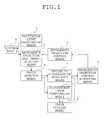
- FIG. 1is a block diagram schematically showing one example of the constitution of a primary part in the whole of a fluorescent endoscope apparatus of the present invention.
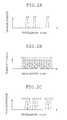
- FIG. 2is a view showing one example of wavelength regions which the wavelength selection and transmission means selects and transmits light in the wavelength regions in the fluorescent endoscope apparatus shown in FIG. 1
- FIG. 2Ashows respective fluorescence detection wavelength regions
- FIG. 2Bshows respective spectrum acquisition wavelength regions
- FIG. 2Cshows a state in which the respective fluorescence detection wavelength regions are shifted.
- FIG. 3is an explanatory view showing one example of timing to acquire a spectral image in the fluorescent endoscope apparatus shown in FIG. 1
- FIG. 3Ais a view chronologically showing light in respective wavelength regions which the wavelength selection and transmission means selects and transmits the light in the wavelength regions
- FIG. 3Bis a view chronologically showing light in respective wavelength regions which is photoelectrically converted at approximately the same time as FIG. 3A through the photo detector means, to be recorded on respective frame memories.
- FIG. 4is an explanatory view showing another example of timing to acquire a spectral image in the fluorescent endoscope apparatus shown in FIG. 1
- FIG. 4Ais a view chronologically showing light in respective wavelength regions which the wavelength selection and transmission means selects and transmits the light in the wavelength regions
- FIG. 4Bis a view chronologically showing light in respective wavelength regions which is photoelectrically converted at approximately the same time as FIG. 4A through the photo detector means, to be recorded on respective frame memories.
- FIG. 5is a block diagram schematically showing a common constitution to fluorescent endoscope apparatuses of the respective embodiments of the present invention.
- FIG. 6is an explanatory view showing one example of the constitution of an image pick up optical system for the fluorescent endoscope apparatus shown in FIG. 5 .
- FIG. 7is a graph showing the transmittable wavelength characteristic of an excitation light cut filter which is used in an image pick up optical system for the fluorescent endoscope apparatus shown in FIG. 5 .
- FIG. 8is a graph showing the spectral transmittance characteristic of plural kinds of fluorescence which exists in a living body that is an object for observation in the fluorescent endoscope apparatus shown in FIG. 5 .
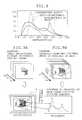
- FIG. 9is an explanatory view showing the relation between an image and a spectrum which are acquired with the fluorescent endoscope apparatus shown in FIG. 5
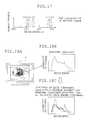
- FIG. 9Ais a view showing the images of light in three kinds of fluorescence detection wavelength regions, which are written on respective frame memories for synthesis of fluorescence image, and showing an image into which these images are compounded by the fluorescent image compounding means and which is displayed by the image display means
- FIG. 9Bis a graph showing the images of light in spectrum acquisition wavelength regions extending throughout a predetermined wavelength range, which are recorded on a frame memory for acquisition of intensity distribution, and showing a fluorescence spectrum at a predetermined image position, which is acquired through the intensity distribution obtaining means by using these images.
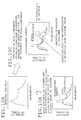
- FIG. 10is an explanatory view conceptually showing a method for dividing a fluorescence spectrum by which is acquired by the intensity distribution obtaining means and in which a plural kind of fluorescence components intermingle with one another, into its respective fluorescence components
- FIG. 10Ais a graph showing the spectra of auto-fluorescence originating from a living body and of fluorescence emitting from a fluorescent agent for labeling the living body, which is already known to be contained in the living body in advance, respectively
- FIG. 10Bis a graph showing one example of a fluorescence spectrum which is acquired by the intensity distribution obtaining means
- FIG. 10Cis a graph showing the fluorescence spectrum which is shown in FIG. 10B and is divided into its fluorescence components by the spectrum division means.
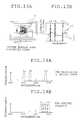
- FIG. 11is a view showing one example of wavelength region which the wavelength selection and transmission means selects to transmit light in the wavelength region in fluorescent endoscope apparatus according to the embodiment 1
- FIG. 11Ais a view showing respective fluorescence detection wavelength regions
- FIG. 11Bis a view showing respective spectrum acquisition wavelength regions
- FIG. 11Cis a view showing a state in which one fluorescence detection wavelength region is shifted.
- FIG. 12is an explanatory view showing one variation of timing to acquire a spectral image in the fluorescent endoscope apparatus of the embodiment 1
- FIG. 12Ais a view chronologically showing light in respective wavelength regions which the wavelength selection and transmission means selects and transmits the light in the wavelength regions
- FIG. 12Bis a view chronologically showing light in respective wavelength regions which is photoelectrically converted at approximately the same time as FIG. 12A through the photo detector means, to be recorded on respective frame memories.
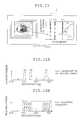
- FIG. 13is an explanatory view showing a fluorescence image which is displayed by the display means and showing a fluorescence spectrum which is acquired by the intensity distribution obtaining means, in the fluorescent endoscope apparatus of the embodiment 1,
- FIG. 13Ais a view showing an image into which the images of light in three kinds of fluorescence detection wavelength regions that are written on respective frame memories for synthesis of fluorescence image are combined by the fluorescent image compounding means and which is displayed by the image display means, and
- FIG. 13Ais a view showing an image into which the images of light in three kinds of fluorescence detection wavelength regions that are written on respective frame memories for synthesis of fluorescence image are combined by the fluorescent image compounding means and which is displayed by the image display means, and
- 13 Bis a graph showing a state in which a peak wavelength region of the fluorescence spectrum of a residue that is acquired by the intensity distribution obtaining means relative to a pixel area specified through the pixel area specifying means is shifted from the peak wavelength region of a known fluorescence spectrum in the fluorescence image shown in FIG. 13A .
- FIG. 14is a view showing one example of wavelength region which the wavelength selection and transmission means selects and transmits light in the wavelength region in the fluorescent endoscope apparatus according to the embodiment 2
- FIG. 14Ais a view showing respective fluorescence detection wavelength regions
- FIG. 14Bis a view showing predetermined spectrum acquisition wavelength regions.
- FIG. 15is an explanatory view showing a fluorescence image which is displayed by the display means and showing a fluorescence spectrum which is acquired by the intensity distribution obtaining means, in the fluorescent endoscope apparatus of the embodiment 2, the left side of FIG. 15 is a view showing an image into which the images of light in three kinds of fluorescence detection wavelength regions that are written on respective frame memories for synthesis of fluorescence image are compounded by the fluorescent image compounding means and which is displayed by the image display means, and the right side of FIG.
- 15is a view showing a state in which a peak wavelength region of the fluorescence spectrum of a residue that is acquired by the intensity distribution obtaining means relative to a pixel area specified through the pixel area specifying means is shifted from the peak wavelength region of a known fluorescence spectrum in the image that is displayed by the image display means.
- FIG. 16is a view showing one example of wavelength region which the wavelength selection and transmission means selects and transmits light in the wavelength region in the fluorescent endoscope apparatus according to the embodiment 3
- FIG. 16Ais a view showing respective fluorescence detection wavelength regions
- FIG. 16Bis a view showing respective spectrum acquisition wavelength regions.
- FIG. 17is a view showing one example of fluorescence detection wavelength region which the wavelength selection and transmission means 2 selects and transmits light in the wavelength region in the fluorescent endoscope apparatus according to the embodiment 4, and a showing a state in which two kinds of fluorescence detection wavelength regions are shifted.
- FIG. 18is an explanatory view showing a fluorescence image which is displayed by the image display means, showing a fluorescence spectrum which is acquired by the intensity distribution obtaining means, and showing the fluorescence spectrum which is divided by the spectrum division means, in the fluorescent endoscope apparatus of the embodiment 4,
- FIG. 18Ais a view showing an image into which the images of light in three kinds of fluorescence detection wavelength regions that are written on respective frame memories for synthesis of fluorescence image are compounded by the fluorescent image compounding means and which is displayed by the image display means
- FIG. 18Bis a graph showing a fluorescence spectrum that is acquired by the intensity distribution obtaining means relative to a pixel area specified through the pixel area specifying means in the image shown in FIG. 18A
- FIG. 18Cis a graph showing the fluorescence spectrum shown in FIG. 18B which is divided into its fluorescence components by the spectrum division means.
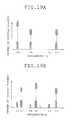
- FIG. 19is a view showing an example of a method for determining a pixel area which becomes an object for adjustment to the shift to a fluorescence detection wavelength region which the wavelength selection and transmission means selects and transmits light in the wavelength region by control from the wavelength selection control means through the wavelength selection control adjusting means, in the fluorescent endoscope apparatus of the embodiment 6,
- FIG. 19Ais a view showing one example of wavelength region in which the brightness value becomes peak in the fluorescence spectrum of each of the fluorescence components into which the fluorescence spectrum that is acquired by the intensity distribution obtaining means is divided by the spectrum division means and showing one example of the number of pixels for each of the peak brightness values, and FIG.
- 19Bis a view showing another example of wavelength region in which the brightness value becomes peak in the fluorescence spectrum of each of the fluorescence components into which the fluorescence spectrum that is acquired by the intensity distribution obtaining means is divided by the spectrum division means and showing another example of the number of pixels for each of the peak brightness values.
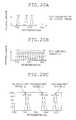
- FIG. 20is a view showing one example of wavelength region which the wavelength selection and transmission means selects and transmits light in the wavelength region in the fluorescent endoscope apparatus according to the embodiment 7,
- FIG. 20Ais a view showing respective fluorescence detection wavelength regions
- FIG. 20Bis a view showing respective spectrum acquisition wavelength regions
- FIG. 20Cis a graph showing a state the respective fluorescent spectra into which the fluorescence spectrum shown in FIG. 20B is divided as its fluorescence components by the spectrum division means are shifted from known fluorescence spectra, respectively.
- FIG. 1is a block diagram schematically showing one example of the constitution of a primary part in the whole of a fluorescent endoscope apparatus of the present invention.
- FIG. 2is a view showing one example of wavelength regions which the wavelength selection and transmission means selects and transmits light in the wavelength regions in the fluorescent endoscope apparatus shown in FIG. 1
- FIG. 2Ais a view showing respective fluorescence detection wavelength regions
- FIG. 2Bis a view showing respective spectrum acquisition wavelength regions
- FIG. 2Cis a view showing a state in which the respective fluorescence detection wavelength regions are shifted.
- FIG. 3is an explanatory view showing one example of timing to acquire a spectral image in the fluorescent endoscope apparatus shown in FIG. 1
- FIG. 3is an explanatory view showing one example of timing to acquire a spectral image in the fluorescent endoscope apparatus shown in FIG. 1
- FIG. 3is an explanatory view showing one example of timing to acquire a spectral image in the fluorescent endoscope apparatus shown in FIG. 1
- FIG. 3Ais a view chronologically showing light in respective wavelength regions which the wavelength selection and transmission means selects and transmits the light in the wavelength regions
- FIG. 3Bis a view chronologically showing light in respective wavelength regions which is photoelectrically converted at approximately the same time as FIG. 3A through the photo detector means, to be recorded on respective frame memories.
- FIG. 4is an explanatory view showing another example of timing to acquire a spectral image in the fluorescent endoscope apparatus shown in FIG. 1
- FIG. 4Ais a view chronologically showing light in respective wavelength regions which the wavelength selection and transmission means selects and transmits the light in the wavelength regions
- FIG. 4Bis a view chronologically showing light in respective wavelength regions which is photoelectrically converted at approximately the same time as FIG. 4A through the photo detector means, to be recorded on respective frame memories.
- the fluorescent endoscope apparatuswhich is shown in FIG. 1 comprises an excitation light irradiation means 1 , a wavelength selection and transmission means 2 , a photo detector means 3 , a wavelength selection control means 4 , a fluorescent image compounding means 5 , an image display means 6 , an intensity distribution obtaining means 7 , and a wavelength selection control adjusting means 8 .
- the excitation light irradiation means 1includes a light source for excitation which is provided for a light source unit that is omitted in the drawings, an illumination optical system which is provided for the top end portion of the endoscope that is omitted in the drawings, and a light guide which connects the light source for excitation and the illumination optical system and is omitted in the drawings, for example.
- the excitation light irradiation means 1irradiates to an observation area in a living body 9 excitation light which excites plural kinds of fluorescent agents that exist in the observation area.
- the wavelength selection and transmission means 2is composed of a spectral optical device like etalon which is provided on the optical path of the image pick up optical system that is provided for the top end portion of the endoscope that is omitted in the drawings.
- the wavelength selection and transmission means 2selects light in a predetermined wavelength region among light entering from the living body 9 , to transmit the light in the predetermined wavelength region.
- the image pick up optical systemis not only provided with the wavelength selection and transmission means 2 , but also provided with an objective optical system, an image forming optical system, an excitation light cut filter, and a photo detector means 3 that is described below, for example.
- the photo detector means 3is composed of an image sensor like CCD which is provided on the optical path of the image pick up optical system that is provided in the top end portion of the endoscope that is omitted in the drawings.
- the photo detector means 3photoelectrically converts light which is selected to be transmitted by the wavelength selection and transmission means 2 .
- An image into which the light is photoelectrically convertedis written on a frame memory that is provided in a control unit that is omitted in the drawings.
- the wavelength selection control means 4is provided in the control unit that is omitted in the drawings.
- the wavelength selection control means 4controls the wavelength selection and transmission means 2 in such a way that the wavelength selection and transmission means 2 selects: light in fluorescence detection wavelength regions ⁇ a, ⁇ b, and ⁇ c which correspond to plural kinds of fluorescence that emit from plural kinds of fluorescent agents, respectively, as shown in FIG. 2A for example; and light in spectrum acquisition wavelength regions ⁇ 1 , ⁇ 2 , . . . , ⁇ n which adjoin each other in turn with a predetermined wavelength width in a predetermined wavelength range that includes a fluorescence detection wavelength region corresponding to at least one kind of fluorescence among the plural kinds of the fluorescence (where, in FIG. 2B , the predetermined wavelength range includes the fluorescence detection wavelength regions ⁇ a, ⁇ b, and ⁇ c which correspond to all the kinds of the fluorescence), as shown in FIG. 2 B for example, to transmit the selected light.
- the wavelength selection control means 4controls the wavelength selection and transmission means 2 in such a way that: timing with which the wavelength selection and transmission means 2 selects fluorescence detection wavelength region and spectrum acquisition wavelength region to transmit light in the wavelength regions is such that the wavelength selection and transmission means 2 selects light in one spectrum acquisition wavelength region to transmit the light in the spectrum acquisition wavelength region after selecting light in all of the fluorescence detection wavelength regions ⁇ a, ⁇ b, and ⁇ c to transmit the light in all of the fluorescence detection wavelength regions, as shown in FIG. 3A for example; and a sequence of these processes is repeated until light in all of the spectrum acquisition wavelength regions is selected to be transmitted.
- light in all of the spectrum acquisition wavelength regionsmeans “a plural kind of light which adjoin each other in turn with a predetermined wavelength width in a predetermined wavelength range that includes a fluorescence detection wavelength region corresponding to at least one kind of fluorescence among the plural kind of the fluorescence”, as described above.
- the wavelength selection control means 4may control the wavelength selection and transmission means 2 in such a way that the wavelength selection and transmission means 2 selects and transmits light in all of the spectrum acquisition wavelength regions ⁇ 1 , ⁇ 2 , . . . , ⁇ n after light in all of the fluorescence detection wavelength regions ⁇ a, ⁇ b, and ⁇ c has been selected and transmitted.
- light in all of the spectrum acquisition wavelength regionsmeans “a plural kind of light which adjoin each other in turn with a predetermined wavelength width in a predetermined wavelength range that includes a fluorescence detection wavelength region corresponding to at least one kind of fluorescence among the plural kind of the fluorescence”, as described above.
- the images of light in the fluorescence detection wavelength regions ⁇ a, ⁇ b, and ⁇ care written on frame memories a, b, and c for synthesis of fluorescence image that are provided in the control unit that is omitted in the drawings, respectively, in the images into which the light that is selected to be transmitted by the wavelength selection and transmission means 2 is photoelectrically converted by the photo detector means 3 .
- the images of light in the spectrum acquisition wavelength regions ⁇ 1 , ⁇ 2 , . . . , ⁇ nare written on a frame memory d for acquisition of intensity distribution (refer to FIGS. 3B and 4B ).
- the fluorescent image compounding means 5is provided in the control unit that is omitted in the drawings, and combines the images into which light in fluorescence detection wavelength regions that is selected and transmitted by the wavelength selection and transmission means 2 is photoelectrically converted by the photo detector means 3 .
- the fluorescent image compounding means 5compounds the images of light in the fluorescence detection wavelength ranges ⁇ a, ⁇ b, and ⁇ c that are written on frame memories a, b, and c for synthesis of fluorescence image.
- the image display means 6displays the image that is synthesized by the fluorescent image compounding means 5 .
- the image display means 6may be formed in such a way that the image display means 6 displays not only this image but also the intensity distribution of light in a predetermined wavelength range that is acquired by the below described intensity distribution obtaining means 7 .
- the intensity distribution obtaining means 7is provided in the control unit that is omitted in the drawings, and acquires the intensity distribution of light in a predetermined wavelength range by the use of the images into which the light in respective spectrum acquisition wavelength regions in a predetermined wavelength range that is selected to be transmitted by the wavelength selection and transmission means 2 is photoelectrically converted by the photo detector means 3 .
- the intensity distribution obtaining means 7acquires the intensity distribution of light in a predetermined wavelength range, by the use of the images of light in the spectrum acquisition wavelength regions ⁇ 1 , ⁇ 2 , . . . , ⁇ n that are written on the frame memory d for acquisition of intensity distribution.
- the wavelength selection control adjusting means 8is provided in the control unit that is omitted in the drawings.
- the wavelength selection control adjusting means 8adjusts the selection and transmission control to the wavelength selection and transmission means 2 by means of the wavelength selection control means 4 , in such a way that a fluorescence detection wavelength region corresponding to at least one kind of fluorescence that is selected and transmitted by the wavelength selection and transmission means 2 (the three kinds of the fluorescence detection wavelength regions ⁇ a, ⁇ b, and ⁇ c, in FIG. 2C ) is shifted to a peak wavelength region in the intensity distribution of light in the predetermined wavelength range that includes the fluorescence detection wavelength region (the wavelength regions ⁇ a′, ⁇ b′, and ⁇ c′, in FIG. 2C ), the intensity distribution being acquired by the intensity distribution obtaining means 7 .
- the excitation light irradiation means 1irradiates excitation light to an observation area of the living body 9 .
- Fluorescence emitting from the plural kinds of the fluorescent agents that exist in the observation area of the living body 9 and light reflected by the observation areapass through the objective optical system and the image forming optical system that constitute the image pick up optical system in the top end portion of the endoscope that is not shown in the drawings, and light in an excitation wavelength region is blocked by the excitation light cut filter, and the other light enters the wavelength selection and transmission means 2 .
- the wavelength selection and transmission means 2selects: light in fluorescence detection wavelength regions ⁇ a, ⁇ b, and ⁇ c which correspond to plural kinds of fluorescence that emit from plural kinds of fluorescent agents, respectively, as shown in FIG. 2A for example; and light in spectrum acquisition wavelength regions ⁇ 1 , ⁇ 2 , . . . , ⁇ n which adjoin each other in turn with a predetermined wavelength width in a predetermined wavelength range that includes the fluorescence detection wavelength regions ⁇ a, ⁇ b, and ⁇ c corresponding to the plural kinds of the fluorescence, as shown in FIG. 2B for example, among the light entering the wavelength selection and transmission means 2 , to transmit the selected light, through control by the wavelength selection control means 4 , with such timing as is shown in FIG.
- the photo detector means 3photoelectrically converts the light which is selected to be transmitted by the wavelength selection and transmission means 2 , and the photoelectrically converted images are written on the frame memories a, b, c, and d which are provided in the control unit that is omitted in the drawings, with such timing as is shown in FIG. 3B or 4 B for example.
- the fluorescent image compounding means 5combines the images of the light in the fluorescence detection wavelength regions ⁇ a, ⁇ b, and ⁇ c which are written on the frame memories a, b, and c for synthesis of fluorescence image.
- the intensity distribution obtaining means 7acquires the intensity distribution of light in a predetermined wavelength range, by the use of the images of the light in the spectrum acquisition wavelength regions ⁇ 1 , ⁇ 2 , . . . , ⁇ n that are written on the frame memory d for acquisition of intensity distribution.
- the image display means 6displays the image which is synthesized by the fluorescent image compounding means 5 . Accordingly, in the examples which are shown in FIGS. 3 and 4 , the fluorescence image into which the images of the light in the fluorescence detection wavelength regions ⁇ a, ⁇ b, and ⁇ c are combined is displayed as a moving image through the image display means 6 , and the intensity distribution of the light in the predetermined wavelength range is acquired through the intensity distribution obtaining means 7 at the background.
- the wavelength selection control adjusting means 8adjusts control of the wavelength selection and transmission means 2 selecting fluorescence detection wavelength region and transmitting light in the selected fluorescence detection wavelength region through the wavelength selection control means 4 , in such a way that a fluorescence detection wavelength region corresponding to at least one kind of fluorescence that is selected to be transmitted by the wavelength selection and transmission means 2 (the three kinds of the fluorescence detection wavelength regions ⁇ a, ⁇ b, and ⁇ c, in FIG. 2C ) is shifted to a peak wavelength region in the intensity distribution of light in the predetermined wavelength range that includes the fluorescence detection wavelength region (the wavelength regions ⁇ a′, ⁇ b′, and ⁇ c′, in FIG. 2C ), the intensity distribution being acquired by the intensity distribution obtaining means 7 , as shown in FIG. 2C .
- the fluorescent endoscope apparatuswhich is shown in FIG. 1 , it is possible to display an image in a wavelength range in which light emits with the highest intensity, as a fluorescence image which is displayed as a moving image, so that it is possible to change a wavelength region into a suitable wavelength region for detecting fluorescence in real time to observe the fluorescence image in the living body 9 even though residues or the like cause variation in fluorescence spectrum in the living body 9 .
- a fluorescent endoscope apparatus of the present inventionit is possible to acquire fluorescence spectrum for detecting variation in fluorescence spectrum due to residue, difference among individuals, or the like.
- the fluorescent endoscope apparatus of the present inventionit is possible to select and adjust to a suitable wavelength region for detecting fluorescence which emits from a lesion and a residue in observation of a biological tissue, regardless of the presence or absence of factors in variation in fluorescence spectrum, such as residue and difference among individuals.
- the fluorescent endoscope apparatuswhich is shown in FIG. 1 may be formed in such a way that: the wavelength selection control means 4 has the first control mode in which the wavelength selection control means 4 controls the wavelength selection and transmission means 2 in such a way that the wavelength selection and transmission means 2 selects light in all of the fluorescence detection wavelength regions (for example, a set of the fluorescence detection wavelength regions ⁇ , ⁇ b, and ⁇ c in FIG.
- the wavelength selection control means 4controls the wavelength selection and transmission means 2 in such a way that the wavelength selection and transmission means 2 selects light in all of the spectrum acquisition wavelength regions (for example, a set of the spectrum acquisition wavelength regions ⁇ 1 , ⁇ 2 , . . . , ⁇ n in FIG. 4A ) to transmit the light in all of the spectrum acquisition wavelength regions; and the wavelength selection control means 4 can be driven through a selection of one of the first and second control modes by a manual operation.
- the fluorescent endoscope apparatuswhich is shown in FIG. 1 may be formed in such a way that: the wavelength selection control means 4 has the first control mode in which the wavelength selection control means 4 controls the wavelength selection and transmission means 2 in such a way that the wavelength selection and transmission means 2 selects light in all of the fluorescence detection wavelength regions (for example, a set of the fluorescence detection wavelength regions ⁇ a, ⁇ b, and ⁇ c in FIG.
- the wavelength selection control means 4controls the wavelength selection and transmission means 2 in such a way that, after the wavelength selection and transmission means 2 selects light in all of the fluorescence detection wavelength regions (for example, a set of the fluorescence detection wavelength regions ⁇ a, ⁇ b, and ⁇ c in FIG. 3A ) to transmit the light in all of the fluorescence detection wavelength regions, the wavelength selection and transmission means 2 selects light in one spectrum acquisition wavelength region (for example, one of a set of the spectrum acquisition wavelength regions ⁇ 1 , ⁇ 2 , . . . , ⁇ n in FIG.
- the wavelength selection control means 4can be driven through a selection of one of the first and third control modes by a manual operation.
- the fluorescent endoscope apparatusis formed in such a way that a selection of these control modes can be made by manual operation, an observer can select a control mode so as to acquire a fluorescence spectrum when the moving amount of the top end portion of the endoscope in a living body is small, for example, so that it is possible to minimize position differences between respective spectral images for acquiring the fluorescence spectrum and to acquire the fluorescence spectrum with high precision.
- the fluorescent endoscope apparatusis formed in such a way that, at all times, light in a part of the spectrum acquisition wavelength regions is selected to transmitted on the way to selecting light in all of the fluorescence detection wavelength regions to transmit the light in all of the fluorescence detection wavelength regions by the wavelength selection and transmission means 2 , drop frame occurs in a fluorescence image which is displayed by the image display means 6 in selecting spectrum acquisition wavelength region to transmit light in the selected spectrum acquisition wavelength region through the wavelength selection and transmission means 2 , when the moving amount of the top end portion of the endoscope in a living body is large. As a result, the image observation becomes troublesome.
- the fluorescent endoscope apparatusis formed in such a way that a selection of control mode can be made by manual operation, as described above, the observer is also released from the troublesome observation of such a fluorescence image in which drop frame occurs.
- the fluorescent endoscope apparatusfurther comprises a pixel area specifying means which specifies a desired pixel area on which the intensity distribution of light in a predetermined wavelength range is acquired by the intensity distribution obtaining means 7 (where, the pixel area specifying means is omitted in the drawings), and the light intensity distribution obtaining means 7 acquires the intensity distribution of light in the predetermined wavelength range relative to a pixel area which is specified by the pixel area specifying means.
- the fluorescent endoscope apparatuswhich is shown in FIG. 1 is formed in such a way that the wavelength selection control adjusting means 8 automatically makes an adjustment to control of the wavelength selection and transmission means 2 by the wavelength selection control means 4 .
- the wavelength selection control adjusting means 8automatically makes an adjustment to control of the wavelength selection and transmission means 2 by the wavelength selection control means 4 .
- the fluorescent endoscope apparatuswhich is shown in FIG. 1 may be formed in such a way that the wavelength selection control adjusting means 8 manually makes an adjustment to control of the wavelength selection and transmission means 2 by the wavelength selection control means 4 .
- the wavelength selection control adjusting means 8manually makes an adjustment to control of the wavelength selection and transmission means 2 by the wavelength selection control means 4 .
- the fluorescent endoscope apparatusfurther comprises a moving amount detecting means which detects a moving amount in an observation area by the use of a change of a fluorescence image which is synthesized by the fluorescence image synthesizing means 5 (where, moving amount detecting means is omitted in the drawings);
- the wavelength selection control means 4has the first control mode in which the wavelength selection control means 4 controls the wavelength selection and transmission means 2 in such a way that the wavelength selection and transmission means 2 selects light in all of the fluorescence detection wavelength regions (for example, a set of the fluorescence detection wavelength regions ⁇ , ⁇ b, and ⁇ c in FIG.
- the wavelength selection control means 4controls the wavelength selection and transmission means 2 in such a way that the wavelength selection and transmission means 2 selects light in all of the spectrum acquisition wavelength regions (for example, a set of the spectrum acquisition wavelength regions ⁇ 1 , ⁇ 2 , . . . , ⁇ n in FIG.
- the wavelength selection and transmission means 2is driven with the second control mode, and when a moving amount which is detected by the moving amount detecting means is larger than the predetermined value, the wavelength selection and transmission means 2 is driven with the first control mode.
- the fluorescent endoscope apparatusfurther comprises a moving amount detecting means which detects a moving amount in an observation area by the use of a change of a fluorescence image which is synthesized by the fluorescence image synthesizing means 5 (where, moving amount detecting means is omitted in the drawings);
- the wavelength selection control means 4has the first control mode in which the wavelength selection control means 4 controls the wavelength selection and transmission means 2 in such a way that the wavelength selection and transmission means 2 selects light in all of the fluorescence detection wavelength regions (for example, a set of the fluorescence detection wavelength regions ⁇ a, ⁇ b, and ⁇ c in FIG.
- the wavelength selection control means 4controls the wavelength selection and transmission means 2 in such a way that, after the wavelength selection and transmission means 2 selects light in all of the fluorescence detection wavelength regions (for example, a set of the fluorescence detection wavelength regions ⁇ a, ⁇ b, and ⁇ c in FIG. 3A ) to transmit the light in all of the fluorescence detection wavelength regions, the wavelength selection and transmission means 2 selects light in one spectrum acquisition wavelength region (for example, one of a set of the spectrum acquisition wavelength regions ⁇ 1 , ⁇ 2 , . . . , ⁇ n in FIG.
- the wavelength selection and transmission means 2is driven with the third control mode, and when a moving amount which is detected by the moving amount detecting means is larger than the predetermined value, the wavelength selection and transmission means 2 is driven with the first control mode.
- a fluorescent endoscope apparatus of the present inventionwhen a fluorescent endoscope apparatus of the present invention is formed in such a way that a moving amount in an observation area is detected by the use of a change of a fluorescence image through the moving amount detecting means (which is omitted in the drawings) and light in spectrum acquisition wavelength region is selected to transmitted when the moving amount is equal to or smaller than a predetermined value, such a formation of the fluorescent endoscope apparatus saves an observer from making a selection of control mode, and, as described above, the observer is also released from the troublesomeness of drop frame in fluorescence image.
- the intensity distribution obtaining means 7operates when a moving amount which is detected by the moving amount detecting means (which is omitted in the drawings) is equal to or smaller than the predetermined value. As a result, the precision in an acquired fluorescence spectrum becomes high.
- the fluorescent endoscope apparatusfurther comprises a moving amount detecting means which detects a moving amount in an observation area by the use of a change of a fluorescence image which is synthesized by the fluorescence image synthesizing means 5 (where, the moving amount detecting means is omitted in the drawings), and the intensity distribution obtaining means 7 operates when a moving amount which is detected by the moving amount detecting means is equal to or smaller than a predetermined value. As a result, the precision in an acquired fluorescence spectrum becomes high.
- the intensity distribution obtaining means 7further includes a targeted wavelength region setting means which can set a predetermined wavelength range that becomes a target range for acquisition of intensity distribution, (where, the targeted wavelength range setting means is omitted in the drawings).
- the fluorescent endoscope apparatusfurther comprises a spectrum division means which divides a specific spectrum by the use of the intensity distribution of light in a predetermined wavelength range which is acquired by the intensity distribution obtaining means 7 (where, the spectrum division means is omitted in the drawings).
- a spectrum division meanswhich divides a specific spectrum by the use of the intensity distribution of light in a predetermined wavelength range which is acquired by the intensity distribution obtaining means 7 (where, the spectrum division means is omitted in the drawings).
- the image display means 6displays the intensity distribution of light in a predetermined wavelength range which is acquired by the intensity distribution obtaining means 7 , together with an image which is synthesized by the fluorescent image compounding means 5 .
- the image display means 6displays the intensity distribution of light in a predetermined wavelength range which is acquired by the intensity distribution obtaining means 7 , together with an image which is synthesized by the fluorescent image compounding means 5 .
- FIG. 5is a block diagram schematically showing a common constitution to fluorescent endoscope apparatuses of the respective embodiments of the present invention.
- FIG. 6is an explanatory view showing one example of the constitution of an image pick up optical system for the fluorescent endoscope apparatus shown in FIG. 5 .
- FIG. 7is a graph showing the transmittable wavelength characteristic of an excitation light cut filter which is used in an image pick up optical system for the fluorescent endoscope apparatus shown in FIG. 5 .
- FIG. 8is a graph showing the spectral transmittance characteristic of plural kinds of fluorescence which exists in a living body that is an object for observation in the fluorescent endoscope apparatus shown in FIG. 5 .
- the fluorescent endoscope apparatuswhich is shown in FIG. 5 includes a light source unit 11 , an endoscope top end insertion unit 12 , a control unit 13 , and a display unit 14 .
- the light source unit 11includes an light source 11 a for excitation light, an light source 11 b for illumination light, and a light source controlling circuit 11 c.
- the excitation light source unit 11 aincludes a light source (which is omitted in the drawings) and an excitation filter (which is omitted in the drawings), and is formed in such a way that the light source 11 a for excitation light emits light in a predetermined wavelength range for excitation.
- the light source 11 b for illumination lightis composed of a light source which emits light in the usual visible wavelength range (and is omitted in the drawings).
- the light source controlling circuit 11 cis formed in such a way that the light source controlling circuit 11 c can perform control of selectively switching excitation light from the light source 11 a for excitation light and illumination light from the light source 11 b for illumination light as light emitting from the light source unit 11 , for example, by rotating a turret which is provided with an excitation filter and a transparent glass plate on circumference, or by sliding a slider which is provided with an excitation filter and a transparent glass plate.
- the endoscope top end insertion unit 12includes an illumination optical system 12 a and an image pick up optical system 12 b .
- the illumination optical system 12 airradiates to the living body 9 light from the light source unit 11 through the light guide 12 c.
- the light source 11 a for excitation light in the light source unit 11 , the light guide 12 c , and the illumination optical system 12 aare combined with one another and have a function as a excitation light irradiation means 1 which irradiates to an observation area of the living body 9 excitation light that excites plural kinds of fluorescent agents existing in the observation area.
- the image pick up optical system 12 bincludes an objective optical system 12 b 1 , an image forming optical system 12 b 2 , an excitation light cut filter 12 b 3 , a spectral optical element 12 b 4 , and an image sensor 12 b 5 , as shown in FIG. 6 .
- the spectral optical element 12 b 4is composed of an etalon or the like, functions as a wavelength selection and transmission means 2 , and selects and transmits light in a predetermined wavelength range among light entering from the observation area of the living body 9 , through the wavelength selection control means 4 that is described below.
- the image sensor 12 b 5is composed of a black and white CCD that consists of a single chip image sensor for example, functions as a photo detector means 3 , and photoelectrically converts light which is selected to be transmitted by the spectral optical element 12 b 4 (the wavelength selection and transmission means 2 ).
- An image into which the transmitted light is photoelectrically convertedis written on a frame memory 13 c that is provided in a control unit 13 , the control unit 13 being shown in FIG. 5 and described below.
- the control unit 13includes a variable spectral element controlling circuit 13 a , an image pick up element control circuit 13 b , the frame memory 13 c , an image processing circuit 13 d , and a wavelength selection control adjustment circuit 13 e.
- variable spectral element controlling circuit 13 afunctions as a wavelength selection control means 4 .
- the frame memory 13 cincludes an R frame memory 13 c 1 for synthesis of fluorescence image, a G frame memory 13 c 2 for synthesis of fluorescence image, a B frame memory 13 c 3 for synthesis of fluorescence image, and a frame memory 13 c 4 for acquisition of intensity distribution.
- a image into which light in spectrum acquisition wavelength region that is selected to be transmitted by the wavelength selection and transmission means 2 is photoelectrically converted by the photo detector means 3is written on the frame memory 13 c 4 for acquisition of intensity distribution.
- the image pick up element control circuit 13 bperforms control of operating the image sensor 12 b 5 (the photo detector means 3 ).
- the image processing circuit 13 dincludes a fluorescence image composing circuit 13 d 1 and an intensity distribution obtaining circuit 13 d 2 .
- the fluorescence image composing circuit 13 d 1functions as a fluorescent image compounding means 5 and combines respective image signals which are written on the R frame memory 13 c 1 , the G frame memory 13 c 2 , and the B frame memory 13 c 3 for synthesis of fluorescence image.
- the image signalsare converted into output signals having various color phases, in order to make it easy to distinguish normal tissue region and lesion tissue region.
- the display unit 14functions as an image display means 6 and displays an image which is synthesized by the fluorescence image composing circuit 13 d 1 (the fluorescent image compounding means 5 ). Besides, the display unit 14 may further display also the intensity distribution of light in a predetermined wavelength range which is acquired by the intensity distribution obtaining circuit 13 d 2 that is described below.
- the intensity distribution obtaining circuit 13 d 2functions as an intensity distribution obtaining means 7 and acquires the intensity distribution of light in a predetermined wavelength range by the use of the images into which light in respective spectrum acquisition wavelength regions in the predetermined wavelength range that is selected to be transmitted by the spectral optical element 12 b 4 (the wavelength selection and transmission means 2 ) is photoelectrically converted by the image sensor 12 b 5 (the photo detector means 3 ).
- the wavelength selection control adjustment circuit 13 efunctions as a wavelength selection control adjusting means 8 and adjusts control of the spectral optical element 12 b 4 (the wavelength selection and transmission means 2 ) selecting fluorescence detection wavelength region and transmitting light in the selected fluorescence detection wavelength region by the variable spectral element controlling circuit 13 a (the wavelength selection control means 4 ), in such a way that a fluorescence detection wavelength region corresponding to at least one kind of fluorescence that is selected to be transmitted by the spectral optical element 12 b 4 (the wavelength selection and transmission means 2 ) (the three kinds of the fluorescence detection wavelength regions ⁇ , ⁇ b, and ⁇ c, in FIG.
- the biological tissue 9which is an object for observation in the respective following embodiments is labeled with a fluorescent agent as a fluorescent probe which emits fluorescence in a wavelength range of 500 to 600 nm by radiating to the fluorescent agent excitation light the wavelength of which is less than 475 nm. Also, the biological tissue 9 emits auto-fluorescence which is in a wavelength range of 475 to 750 nm and the peak wavelength region of which is a predetermined wavelength region in a wavelength range of 500 to 550 nm, by radiating this excitation light to the biological tissue 9 .
- a fluorescent agentas a fluorescent probe which emits fluorescence in a wavelength range of 500 to 600 nm by radiating to the fluorescent agent excitation light the wavelength of which is less than 475 nm.
- the biological tissue 9emits auto-fluorescence which is in a wavelength range of 475 to 750 nm and the peak wavelength region of which is a predetermined wavelength region in a wavelength range of 500 to 550 nm, by radiating
- feces which are a residue in the biological tissue 9also emits auto-fluorescence which is in a wavelength range of 475 to 750 nm and the peak wavelength region of which is a predetermined wavelength region in a wavelength range of 650 to 700 nm.
- the shapes of the fluorescence spectra of these fluorescencesvary with difference among individual subjects or subject's condition (the amount of residue, the presence or absence of hemorrhage, or the like).
- the image sensor 12 b 5may be composed of a color CCD which is provided with a mosaic filter (which is omitted in the drawings) and a single chip image sensor (which is omitted in the drawings).
- the mosaic filtershould be formed in such a way that a large number of filters that transmit light in a wavelength range of R (575 to 695 nm) (and is omitted in the drawings), a large number of filters that transmit light in a wavelength range of G (460 to 600 nm) (and is omitted in the drawings), and a large number of filters that transmit light in a wavelength range of B (380 to 490 nm) (and is omitted in the drawings) are arranged in a mosaic manner.
- R575 to 695 nm
- G460 to 600 nm
- B380 to 490 nm
- the single chip image sensorshould be formed in such a way that: the pixels of the single chip image sensor correspond to the filters that transmit light in a wavelength range of R (575 to 695 nm), the filters that transmit light in a wavelength range of G (460 to 600 nm), and the filters that transmit light in a wavelength range of B (380 to 490 nm), respectively, these filters constituting the mosaic filter; and plural kinds of light into which the light of the image is divided by the mosaic filter are acquired by the different pixels, separately.
- the fluorescent endoscope apparatusshould be formed in such a way that the R frame memory 13 c 1 , the G frame memory 13 c 2 , and the B frame memory 13 c 3 for synthesis of fluorescence image correspond to the filters that transmit light in a wavelength range of R (575 to 695 nm), the filters that transmit light in a wavelength range of G (460 to 600 nm), and the filters that transmit light in a wavelength range of B (380 to 490 nm), respectively, these filters constituting the mosaic filter, and the image signals which are separated from one another through the mosaic filter and are acquired by the corresponding pixels respectively are written on these frame memories separately.
- FIG. 9is an explanatory view showing the relation between an image and a spectrum which are acquired with the fluorescent endoscope apparatus shown in FIG. 5
- FIG. 9Ais a view showing the images of light in three kinds of fluorescence detection wavelength regions, which are written on respective frame memories 13 c 1 , 13 c 2 , and 13 c 3 for synthesis of fluorescence image, and showing an image into which these images are combined by the fluorescent image compounding means 5 and which is displayed by the image display means 6
- FIG. 9Ais a view showing the images of light in three kinds of fluorescence detection wavelength regions, which are written on respective frame memories 13 c 1 , 13 c 2 , and 13 c 3 for synthesis of fluorescence image, and showing an image into which these images are combined by the fluorescent image compounding means 5 and which is displayed by the image display means 6
- FIG. 9Ais a view showing the images of light in three kinds of fluorescence detection wavelength regions, which are written on respective frame memories 13 c 1 , 13 c 2 , and
- FIG. 9Bis a graph showing the images of light in spectrum acquisition wavelength regions extending throughout a predetermined wavelength range, which are recorded on a frame memory 13 c 4 for acquisition of intensity distribution, and showing a fluorescence spectrum at a predetermined image position, which is acquired by the intensity distribution obtaining means 7 by the use of these images.
- the fluorescent endoscope apparatuswhich is shown in FIG. 5 is provided with the above described pixel area specifying means (which is omitted in the drawings), and, in FIG. 9 , for the sake of convenience, FIG.
- FIG. 9Ais made to show a state where a region in which a fluorescent agent with which the biological tissue is labeled emits light strongly (pixel area) and a region in which a feces that is a residue in the biological tissue emits fluorescence strongly (pixel area) are specified in the fluorescence image of the living body 9 that is displayed by the image display means 6
- FIG. 9Bis made to show the fluorescence spectrum of the fluorescent agent with which the biological tissue is labeled and the fluorescence spectrum of the feces which is a residue in the biological tissue, in the pixel areas which are specified in FIG. 9A respectively.
- the fluorescent endoscope apparatuses of the respective embodimentsare provided with the spectrum division means (which is not shown in the drawings and) as described in the fluorescent endoscope apparatus which is shown in FIG. 1 .
- the spectrum division meansis a control circuit which is provided in the control unit 13 . And, the spectrum division means is formed in such a way that the spectrum division means can divide a multiplexed fluorescence image into separate fluorescences by calculating the densities of respective fluorescent dyes from the multiplexed fluorescence image, for example with methods such as spectral estimation and Unmixing.
- the use of the spectrum division meansimproves a precision in detecting a suitable wavelength region for a desired fluorescent substance.
- FIG. 10is an explanatory view conceptually showing a method for dividing a fluorescence spectrum by which is acquired by the intensity distribution obtaining means 7 and in which plural kinds of fluorescence components intermingle with one another, into its respective fluorescence components
- FIG. 10Ais a graph showing the spectra of auto-fluorescence originating from a living body and of fluorescence emitting from a fluorescent agent for labeling the living body, which is already known to be contained in the living body in advance, respectively
- FIG. 10Bis a graph showing one example of a fluorescence spectrum which is acquired by the intensity distribution obtaining means 7
- FIG. 10Cis a graph showing the fluorescence spectrum which is shown in FIG. 10B and is divided into its fluorescence components by the spectrum division means.
- two kinds of fluorescent dyesauto-fluorescence originating from the living body and fluorescent agent
- the fluorescence spectrum of each of the fluorescent dyes which exist in a tissue of the living body 9 that is an object for measurementis measured at a predetermined standard density, in advance.
- FIG. 10Ashows one example of each of fluorescence spectra of the two kinds of the fluorescent dyes at the standard density.
- FIG. 10Bshows one example of the fluorescence spectrum of the tissue of the living body 9 which is acquired by the intensity distribution obtaining means 7 .
- the densities of the two kinds of the fluorescent dyes for obtaining the measurement data of the fluorescence spectrum of the tissue of the living body 9 which is shown in FIG. 10Bare calculated by the use of the measurement data of the fluorescence spectra of the respective two kinds of the fluorescent dyes at the standard density, the fluorescence spectra being shown in FIG. 10A , and the fluorescence spectrum shown in FIG. 10B is divided into the fluorescence spectra of the respective fluorescent dyes by the use of the calculation results.
- FIG. 10Cschematically shows an example of the division of the measurement data of the fluorescence spectrum of the tissue of the living body 9 shown in FIG. 10B into the fluorescence spectra of the respective two kinds of the fluorescent dyes at a predetermined density.
- I 2( ⁇ n )a 2( ⁇ n )* D 2 (2b) where D 2 denotes the density of the fluorescent dye 2 , and a 2 ( ⁇ n) denotes the coefficient for the fluorescent dye 2 at the standard density at the wavelength ⁇ n.
- Im ( ⁇ n )am ( ⁇ n )* Dm (2c) where Dm denotes the density of the fluorescent dye m, and am ( ⁇ n) denotes the coefficient for the fluorescent dye m at the standard density at the wavelength ⁇ n.
- the signal intensities of the measured object at n kinds of wavelengths ⁇ 1 to ⁇ ncan be expressed, for example, by the following matrix equation (3) with these equations (2a) to (2c):
- the densities D 1 , D 2 , . . . , and Dm of the respective fluorescent dyesare found by solving the following matrix equation (4):
- the equationsare as many as varieties of the densities of the fluorescent dyes, so that the matrix equation can be uniquely solved. Also, when the number of varieties of the spectral images is larger than that of varieties of the fluorescent dyes (or, n>m), although the number of the equations is larger than that of varieties of the densities of the fluorescent dyes, the matrix equation can be solved with the least squares method, in this case.
- the number of varieties of the spectral imagesis smaller than that of varieties of the fluorescent dyes (or, n ⁇ m)
- the number of the equationsis smaller than that of varieties of the densities of the fluorescent dyes, so that the matrix equation cannot be solved.
- the method of Unmixingrequires the premise that the number of varieties of the spectral images is equal to or larger than that of varieties of the fluorescent dyes (or, n ⁇ m),
- the fluorescence spectra of known fluorescence componentsare separated from one another by the spectrum division means. Also, in this case, when the fluorescence spectra of the known fluorescence components are separated from the fluorescence spectrum which is acquired by the intensity distribution obtaining means 7 and in which plural kinds of fluorescence components intermingle with one another, it is also possible to estimate the fluorescence spectrum of an unknown fluorescence component (which is the fluorescence component from residue in this case).
- the fluorescence spectrum characteristic (or characteristic points) of known fluorescence componentsmay be registered in a memory in the endoscope top end insertion unit 12 or the control unit 13 (where, the memory is omitted in the drawings), in advance.
- Wavelength regions which form an extreme value in the spectra of the respective fluorescence components that are separated from one another by the spectrum division meansare extracted as a peak wavelength region in the intensity distribution of light in the predetermined wavelength range including the fluorescence detection wavelength region which is acquired by the intensity distribution obtaining circuit 13 d 2 (the intensity distribution obtaining means 7 ), by the wavelength selection control adjustment circuit 13 e (the wavelength selection control adjusting means 8 ).
- the wavelength selection control adjustment circuit 13 eadjusts control of the spectral optical element 12 b 4 (the wavelength selection and transmission means 2 ) selecting fluorescence detection wavelength region and transmitting light in the selected fluorescence detection wavelength region through the variable spectral element controlling circuit 13 a (the wavelength selection control means 4 ), in such a way that when a fluorescence detection wavelength region corresponding to at least one kind of fluorescence that is selected to be transmitted by the spectral optical element 12 b 4 (the wavelength selection and transmission means 2 ) (the three kinds of the fluorescence detection wavelength regions ⁇ , ⁇ b, and ⁇ c, in FIG. 2C ) does not corresponds with the extracted peak wavelength region, the fluorescence detection wavelength region is shifted to the peak wavelength region (the wavelength regions ⁇ a′, ⁇ b′, and ⁇ c′, in FIG. 2C ).
- FIG. 11is a view showing one example of wavelength region which the wavelength selection and transmission means 2 selects to transmit light in the wavelength region in fluorescent endoscope apparatus according to the embodiment 1
- FIG. 11Ais a view showing respective fluorescence detection wavelength regions
- FIG. 11Bis a view showing respective spectrum acquisition wavelength regions
- FIG. 11Cis a view showing a state in which one fluorescence detection wavelength region is shifted.
- FIG. 12is an explanatory view showing one variation of timing to acquire a spectral image in the fluorescent endoscope apparatus of the embodiment 1
- FIG. 12Ais a view chronologically showing light in respective wavelength regions which the wavelength selection and transmission means 2 selects to transmit the light in the wavelength regions
- FIG. 12Bis a view chronologically showing light in respective wavelength regions which is photoelectrically converted at approximately the same time as FIG. 12A through the photo detector means, to be recorded on respective frame memories 13 c 1 , 13 c 2 , 13 c 3 , and 13 c 4 .
- FIG. 13is an explanatory view showing a fluorescence image which is displayed by the image display means 6 and showing a fluorescence spectrum which is acquired by the intensity distribution obtaining means 7 in the fluorescent endoscope apparatus of the embodiment 1, FIG.
- FIG. 13Ais a view showing an image into which the images of light in three kinds of fluorescence detection wavelength regions that are written on respective frame memories 13 c 1 , 13 c 2 , and 13 c 3 for synthesis of fluorescence image are combined by the fluorescent image compounding means 5 and which is displayed by the image display means 6
- FIG. 13Bis a graph showing a state in which a peak wavelength region of the fluorescence spectrum of a residue that is acquired by the intensity distribution obtaining means 7 relative to a pixel area specified through the pixel area specifying means is shifted from the peak wavelength region of a known fluorescence spectrum in the fluorescence image shown in FIG. 13A .
- the fluorescent endoscope apparatus of the embodiment 1has the same fundamental constitution as explained above using FIGS. 5 to 10 .
- the wavelength selection control means 4controls the wavelength selection and transmission means 2 in such a way that the wavelength selection and transmission means 2 selects: light in fluorescence detection wavelength regions ⁇ a, ⁇ b, and ⁇ c which correspond to three kinds of fluorescence (auto-fluorescence, fluorescence emitting from fluorescent agent, and fluorescence emitting from feces that is a residue) that emit from three kinds of fluorescent agents that are shown in FIG. 8 , respectively, as shown in FIG. 11 ; and light in spectrum acquisition wavelength regions ⁇ 1 , ⁇ 2 , . . . , ⁇ n which adjoin each other in turn with a predetermined wavelength width in a wavelength range of 490 to 730 nm that includes the fluorescence detection wavelength regions ⁇ , ⁇ b, and ⁇ c, to transmit the selected light.
- the wavelength selection control means 4controls the wavelength selection and transmission means 2 in such a way that: timing with which the wavelength selection and transmission means 2 selects fluorescence detection wavelength region and spectrum acquisition wavelength region to transmit light in the wavelength regions is such that the wavelength selection and transmission means 2 selects light in one spectrum acquisition wavelength region to transmit the light in the one spectrum acquisition wavelength region after selecting light in all of the fluorescence detection wavelength regions ⁇ a, ⁇ b, and ⁇ c to transmit the light in all of the fluorescence detection wavelength regions, as shown in FIG. 3A ; and a sequence of these processes is repeated until light in all of the spectrum acquisition wavelength regions is selected to be transmitted. That is to say, after fluorescence images are acquired as a moving image with the three RGB frames 13 c 1 , 13 c 2 , and 13 c 3 , one spectral image is acquired with the frame 13 c 4 for acquiring fluorescence spectrum.
- the fluorescent endoscope apparatus of the embodiment 1acquires the fluorescence spectrum at the background while acquiring the moving image of the fluorescence image to display the moving image, by such control by the wavelength selection control means 4 .
- the wavelength selection control means 4may control the wavelength selection and transmission means 2 in such a way that timing with which the wavelength selection and transmission means 2 selects fluorescence detection wavelength region and spectrum acquisition wavelength region to transmit light in the wavelength regions is such that the wavelength selection and transmission means 2 selects light in all of the spectrum acquisition wavelength regions ⁇ 1 , ⁇ 2 , . . . , ⁇ n to transmit the light in all of the spectrum acquisition wavelength regions after selecting light in all of the fluorescence detection wavelength regions ⁇ a, ⁇ b, and ⁇ c to transmit the light in all of the fluorescence detection wavelength regions, as shown in FIG. 4A .
- fluorescence spectramay be automatically or manually acquired all together, through the above described moving amount detecting means (which is omitted in the drawings).
- fluorescence images for moving imageare written on the frame memories 13 c 1 , 13 c 2 , and 13 c 3 for synthesis of fluorescence image.
- the image display means 6displays the written fluorescence images frame by frame or as a still image, while the spectral images are being acquired.
- the spectral imagemay be acquired with desired timing on which an observer focuses. That is to say, for example, the fluorescent endoscope apparatus of the embodiment 1 may be formed in such a way that: the wavelength selection control means 4 has the first control mode in which the wavelength selection control means 4 controls the wavelength selection and transmission means 2 in such a way that the wavelength selection and transmission means 2 selects light in all of the fluorescence detection wavelength regions (for example, a set of the fluorescence detection wavelength regions ⁇ a, ⁇ b, and ⁇ c in FIG.
- the wavelength selection control means 4controls the wavelength selection and transmission means 2 in such a way that, after the wavelength selection and transmission means 2 selects light in all of the fluorescence detection wavelength regions (for example, a set of the fluorescence detection wavelength regions ⁇ a, ⁇ b, and ⁇ c in FIG. 3A ) to transmit the light in all of the fluorescence detection wavelength regions, the wavelength selection and transmission means 2 selects light in one spectrum acquisition wavelength region (for example, one of a set of the spectrum acquisition wavelength regions ⁇ 1 , ⁇ 2 , . . . , ⁇ n in FIG.
- the wavelength selection control meanscan be driven through a selection of one of the first and third control modes by a manual operation.
- the fluorescent endoscope apparatus of the embodiment 1may be formed in such a way that one of the above described mode in which only a moving image of fluorescence image is displayed and the mode in which a spectral image is acquired at the back while a moving image of fluorescence image is being displayed is automatically changed into the other to drive the wavelength selection control means 4 .
- the fluorescent endoscope apparatus of the embodiment 1is formed in such a way that the observer can manually input and specify an area on which the observer desires to display the spectrum in a screen on which a fluorescence image is displayed by the displaying unit 6 , through the pixel area specifying means.
- an area in the screen on which the observer desires to display the spectrumfor example, a pointer on the screen, a border indicating the area, or the like is operated using keyboard or mouse which is not shown in the drawings.
- FIG. 13Ashows a state in which a pixel area relative to a region of a residue that emits fluorescence strongly is specified.
- the fluorescent endoscope apparatus of the embodiment 1is formed in such a way that the intensity distribution obtaining means 7 acquires the intensity distribution of light in a predetermined wavelength range relative to a pixel area that is specified by the pixel area specifying means, as shown in FIG. 13B .
- the fluorescent endoscope apparatus of the embodiment 1is formed in such a way that, when a peak wavelength region of the fluorescence spectrum of a residue that is acquired by the intensity distribution acquiring member 7 relative to a pixel area specified through the pixel area specifying means is shifted from the peak wavelength region of the known fluorescence spectrum of the residue in the fluorescent image shown in FIG.
- the wavelength selection control adjusting means 8automatically adjusts control of the wavelength selection and transmission means 2 selecting fluorescence detection wavelength region and transmitting light in the selected fluorescence detection wavelength region by the wavelength selection control means 4 , in such a way that a fluorescence detection wavelength region ⁇ c corresponding to the fluorescence of the residue that is selected to be transmitted by the wavelength selection and transmission means 2 is shifted to a peak wavelength region ⁇ c′ in the fluorescence spectrum of the residue that is acquired by the intensity distribution obtaining means 7 .
- the spectrum division meanswhich is omitted in the drawings estimates the fluorescence spectrum of residue by the use of the known standard values of the spectrum of auto-fluorescence originating from the living body and the fluorescence spectrum of fluorescent agent and the use of a method of spectral estimation or UNMIXING, to separate the fluorescence spectrum of the residue from the fluorescence spectrum that is acquired by the intensity distribution obtaining means 7 .
- the shift quantities of the fluorescence detection wavelength regions ⁇ , ⁇ b, and ⁇ c which correspond to the fluorescence components respectivelyare detected from peak values in the spectra of the respective fluorescence components which are separated from one another.
- FIG. 14is a view showing one example of wavelength region which the wavelength selection and transmission means 2 selects to transmit light in the wavelength region in the fluorescent endoscope apparatus according to the embodiment 2
- FIG. 14Ais a view showing respective fluorescence detection wavelength regions
- FIG. 14Bis a view showing predetermined spectrum acquisition wavelength regions.
- FIG. 15is an explanatory view showing a fluorescence image which is displayed by the image display means 6 and showing a fluorescence spectrum which is acquired by the intensity distribution obtaining means 7 , in the fluorescent endoscope apparatus of the embodiment 2, the left side of FIG.
- FIG. 15shows an image into which the images of light in three kinds of fluorescence detection wavelength regions that are written on respective frame memories 13 c 1 , 13 c 2 , and 13 c 3 for synthesis of fluorescence image are combined by the fluorescent image compounding means 5 and which is displayed by the image display means 6 , and the right side of FIG. 15 shows a state in which a peak wavelength region of the fluorescence spectrum of a residue that is acquired by the intensity distribution obtaining means 7 relative to a pixel area specified through the pixel area specifying means is shifted from the peak wavelength region of a known fluorescence spectrum in the image that is displayed by the image display means 6 .
- the wavelength selection control means 4controls the wavelength selection and transmission means 2 in such a way that the wavelength selection and transmission means 2 selects: light in fluorescence detection wavelength regions ⁇ , ⁇ b, and ⁇ c which correspond to three kinds of fluorescence (auto-fluorescence, fluorescence emitting from fluorescent agent, and fluorescence emitting from feces that is a residue) that emit from three kinds of fluorescent agents that are shown in FIG. 8 , respectively, as shown in FIG.
- the image display means 6is formed in such a way that the image display means 6 displays the intensity distribution of light in a wavelength range of 630 to 705 nm which is acquired by the intensity distribution obtaining means 7 , together with an image which is synthesized by the fluorescent image compounding means 5 .
- the fluorescent endoscope apparatus of the embodiment 2is formed in such a way that the wavelength selection control adjusting means 8 automatically adjusts control of the wavelength selection and transmission means 2 selecting fluorescence detection wavelength region and transmitting light in the selected fluorescence detection wavelength region by the wavelength selection control means 4 , like the fluorescent endoscope apparatus of the embodiment 1.
- the wavelength selection control adjusting means 8automatically adjusts control of the wavelength selection and transmission means 2 selecting fluorescence detection wavelength region and transmitting light in the selected fluorescence detection wavelength region by the wavelength selection control means 4 , like the fluorescent endoscope apparatus of the embodiment 1.
- the wavelength selection control adjusting means 8adjusts control of the wavelength selection and transmission means 2 selecting fluorescence detection wavelength region and transmitting light in the selected fluorescence detection wavelength region by the wavelength selection control means 4 , in such a way that the fluorescence spectrum of the residue that is acquired by the intensity distribution fluorescence detection wavelength region corresponding to the fluorescence of the residue that is selected to be transmitted by the wavelength selection and transmission means 2 is shifted to the peak wavelength region ⁇ c′ in the obtaining means 7 .
- the spectrum acquisition wavelength regionsare limited to a wavelength range of 630 to 705 nm which includes the fluorescence detection wavelength region ⁇ c, so that it is possible to reduce time to acquire spectrum, and it is possible to reduce drop frame of fluorescence image.
- the other constitutions and operation effects of the fluorescent endoscope apparatus of the embodiment 2are approximately the same as those of the fluorescent endoscope apparatus of the embodiment 1.
- FIG. 16is a view showing one example of wavelength region which the wavelength selection and transmission means 2 selects to transmit light in the wavelength region in the fluorescent endoscope apparatus according to the embodiment 3
- FIG. 16Ais a view showing respective fluorescence detection wavelength regions
- FIG. 16Bis a view showing respective spectrum acquisition wavelength regions.
- the wavelength selection control means 4controls the wavelength selection and transmission means 2 in such a way that the wavelength selection and transmission means 2 selects: light in fluorescence detection wavelength regions ⁇ , ⁇ b, and ⁇ c which correspond to three kinds of fluorescence (auto-fluorescence, fluorescence emitting from fluorescent agent, and fluorescence emitting from feces that is a residue) that emit from three kinds of fluorescent agents that are shown in FIG. 8 , respectively, as shown in FIG. 16 ; and light in spectrum acquisition wavelength regions ⁇ 1 , ⁇ 2 , . . .
- ⁇ nwhich adjoin each other in turn with a wavelength region in a wavelength band of 490 to 565 nm that includes the fluorescence detection wavelength regions ⁇ a and ⁇ b, or light in spectrum acquisition wavelength regions . . . , ⁇ n which adjoin each other in turn with a wavelength width in a wavelength range of 645 to 715 nm that includes the fluorescence detection wavelength region ⁇ c, to transmit the selected light.
- the fluorescent endoscope apparatus of the embodiment 3is formed in such a way that the wavelength selection control adjusting means 8 manually adjusts control of the wavelength selection and transmission means 2 selecting fluorescence detection wavelength region and transmitting light in the selected fluorescence detection wavelength region by the wavelength selection control means 4 .
- the wavelength selection control adjusting means 8manually adjusts control of the wavelength selection and transmission means 2 selecting fluorescence detection wavelength region and transmitting light in the selected fluorescence detection wavelength region by the wavelength selection control means 4 .
- the wavelength selection control adjusting means 8adjusts control of the wavelength selection and transmission means 2 selecting fluorescence detection wavelength region and transmitting light in the selected fluorescence detection wavelength region by the wavelength selection control means 4 , in such a way that the fluorescence detection wavelength region corresponding to the fluorescence of the residue that is selected to be transmitted by the wavelength selection and transmission means 2 is shifted to a predetermined wavelength region that includes the peak wavelength region ⁇ c′ in the fluorescence spectrum of the residue that is acquired by the intensity distribution obtaining means 7 .
- the other constitutions and operation effects of the fluorescent endoscope apparatus of the embodiment 3are approximately the same as those of the fluorescent endoscope apparatus of the embodiment 2.
- FIG. 17is a view showing one example of wavelength region which the wavelength selection and transmission means 2 selects to transmit light in the wavelength region in the fluorescent endoscope apparatus according to the embodiment 4, and a view showing a state in which two kinds of fluorescence detection wavelength regions are shifted.
- FIG. 18is an explanatory view showing a fluorescence image which is displayed by the image display means 6 , showing a fluorescence spectrum which is acquired by the intensity distribution obtaining means 7 , and showing the fluorescence spectrum which is divided by the spectrum division means, in the fluorescent endoscope apparatus of the embodiment 4, FIG.
- FIG. 18Ais a view showing an image into which the images of light in three kinds of fluorescence detection wavelength regions that are written on respective frame memories 13 c 1 , 13 c 2 , and 13 c 3 for synthesis of fluorescence image are combined by the fluorescent image compounding means 5 and which is displayed by the image display means 6
- FIG. 18Bis a graph showing a fluorescence spectrum that is acquired by the intensity distribution obtaining means 7 relative to a pixel area specified through the pixel area specifying means in the image shown in FIG. 18A
- FIG. 18Cis a graph showing the fluorescence spectrum shown in FIG. 18B which is divided into its fluorescence components by the spectrum division means.
- wavelength regions which the wavelength selection and transmission means 2 selects to transmit light in the wavelength regions through the wavelength selection control means 4are the same as those in the fluorescent endoscope apparatus of the embodiment 1 which are shown in FIGS. 11A and 11B .
- the fluorescent endoscope apparatus of the embodiment 4is formed in such a way that, when not only a peak wavelength in the fluorescence spectrum of residue, but also a peak wavelength in the fluorescence spectrum of another fluorescence component due to the influence of factors except residue, such as bloodstream, (the spectrum of auto-fluorescence originating from a living body in the example of FIG.
- the wavelength selection control adjusting means 8automatically adjusts control of the wavelength selection and transmission means 2 selecting fluorescence detection wavelength region and transmitting light in the selected fluorescence detection wavelength region by the wavelength selection control means 4 , in such a way that a fluorescence detection wavelength region ⁇ c corresponding to the fluorescence of the residue that is selected to be transmitted by the wavelength selection and transmission means 2 and a fluorescence detection wavelength region ⁇ a corresponding to auto-fluorescence originating from the living body are shifted to a peak wavelength region ⁇ c′ in the fluorescence spectrum of the residue and a peak wavelength region ⁇ a′ in the auto-fluorescence spectrum originating from the living body that are acquired by the intensity distribution obtaining means 7 , respectively.
- the fluorescent agent and residuealso emit fluorescence with a relatively strong intensity in the vicinity of the peak wavelength region of auto-fluorescence originating from the living body.
- the spectrum division means(which is not shown in the drawings) divides into the fluorescence spectra of respective fluorescence components a fluorescence spectrum which is acquired by the intensity distribution obtaining means 7 .
- the spectrum division meansseparates the fluorescence spectra of a plurality of fluorescence components (fluorescence component originating from the living body, fluorescence component originating from fluorescent agent) from a fluorescence spectrum which is acquired by the intensity distribution obtaining means 7 relative to a pixel area that is specified by the pixel area specifying means in the fluorescence image shown in FIG. 18A (refer to FIG. 18B ), for example. That is to say, a predetermined calculation is performed with methods such as spectral estimation and Unmixing that are described above, so that the fluorescence spectra of the respective fluorescence components are separated from one another.
- the wavelength selection control adjusting means 8automatically adjusts control of the wavelength selection and transmission means 2 selecting fluorescence detection wavelength region and transmitting light in the selected fluorescence detection wavelength region by the wavelength selection control means 4 , in such a way that the fluorescence detection wavelength region ⁇ c corresponding to the fluorescence of the residue and a fluorescence detection wavelength region ⁇ a corresponding to auto-fluorescence originating from the living body that are selected to be transmitted by the wavelength selection and transmission means 2 are shifted to the predetermined peak wavelength region ⁇ c′ and the predetermined peak wavelength region ⁇ a′, respectively, as described above.
- the fluorescent endoscope apparatus of the embodiment 4is formed in such a way that the acquisition and division of fluorescence spectrum and detection of peak wavelength region through the intensity distribution acquisition means 7 , the spectrum division means, and so on, and the adjustment of control of the wavelength selection and transmission means 2 selecting fluorescence detection wavelength region and transmitting light in the selected fluorescence detection wavelength region by the wavelength selection control means 4 through the wavelength selection control means 8 (or, the shift of fluorescence detection wavelength region to a detected peak wavelength region) are automatically performed.
- the other constitutions and operation effects of the fluorescent endoscope apparatus of the embodiment 4are approximately the same as those of the fluorescent endoscope apparatus of the embodiment 1.
- the fluorescent endoscope apparatus of the embodiment 4may be formed in such a way that the image display means 6 is formed in such a way that the image display means 6 displays the intensity distributions of light of the respective fluorescence components into which a fluorescence spectrum that is acquired by the intensity distribution obtaining means 7 is divided by the spectrum division means, together with an image which is synthesized by the fluorescent image compounding means 5 , as in the fluorescent endoscope apparatuses of the embodiments 2 and 3.
- the wavelength selection control adjusting means 8may be formed in such a way that control of the wavelength selection and transmission means 2 selecting fluorescence detection wavelength region and transmitting light in the selected fluorescence detection wavelength region by the wavelength selection control means 4 is manually adjusted (or, the adjustment is manually performed when the observer manually inputs a shift point for a peak wavelength region on the screen with keyboard or mouse which is not shown in the drawings), as in the fluorescent endoscope apparatus of the embodiment 3.
- the fluorescent endoscope apparatus of the embodiment 5may be formed in such a way that the image display means 6 is formed in such a way that the image display means 6 displays the intensity distribution of light of fluorescence components which is acquired by the intensity distribution obtaining means 7 and in which the fluorescence spectra of a plurality of the fluorescence components intermingle with one another, together with an image which is synthesized by the fluorescent image compounding means 5 .
- wavelength regions in the fluorescent endoscope apparatus of the embodiment 5 which the wavelength selection and transmission means 2 selects to transmit light in the wavelength regions through the wavelength selection control means 4are the same as those in the fluorescent endoscope apparatus of the embodiment 1 which are shown in FIGS. 11A and 11B .
- the wavelength selection control adjusting means 8is formed in such a way that the control of the wavelength selection and transmission means 2 selecting fluorescence detection wavelength region and transmitting light in the selected fluorescence detection wavelength region by the wavelength selection control means 4 is manually adjusted (or, the adjustment is manually performed when the observer manually inputs a shift point for a peak wavelength region on the screen with keyboard or mouse which is not shown in the drawings), as in the fluorescent endoscope apparatus of the embodiment 3.
- the other constitutions and operation effects of the fluorescent endoscope apparatus of the embodiment 5are approximately the same as those of the fluorescent endoscope apparatus of the embodiment 3.
- the fluorescent endoscope apparatus of the embodiment 6is formed in such a way that all of the acquisition of fluorescence spectrum through the intensity distribution obtaining means 7 , the division of the acquired fluorescence spectrum into the fluorescence spectra of its fluorescence components through the fluorescence spectrum division means, the extraction of peak wavelength regions in the fluorescence spectra of the respective fluorescence components through the wavelength selection control adjusting means 8 , the calculations of the quantities of the shifts of the fluorescence detection wavelength regions to the peak wavelength regions, and the shifts of the fluorescence detection wavelength regions by the calculated shift quantities are automatically performed relative to each of pixels in an image that is displayed by the image display means 6 .
- the wavelength selection control adjusting means 8determines a pixel area at which the adjustment to the shift to a fluorescence detection wavelength region that the wavelength selection and transmission means 2 selects to transmit light in the selected fluorescence detection wavelength region through control by the wavelength selection control means 4 is targeted, for example, in the following manner.
- FIG. 19is a view showing an example of a method for determining a pixel area which becomes an object for the adjustment to the shift to a fluorescence detection wavelength region which the wavelength selection and transmission means 2 selects to transmit light in the wavelength region by control from the wavelength selection control means 4 through the wavelength selection control adjusting means 8 , in the fluorescent endoscope apparatus of the embodiment 6,
- FIG. 19Ais a view showing one example of wavelength region in which the brightness value becomes peak in the fluorescence spectrum of each of the fluorescence components into which the fluorescence spectrum that is acquired by the intensity distribution obtaining means 7 is divided by the spectrum division means and showing one example of the number of pixels for each of the peak brightness values, and FIG.
- 19Bis a view showing another example of wavelength region in which the brightness value becomes peak in the fluorescence spectrum of each of the fluorescence components into which the fluorescence spectrum that is acquired by the intensity distribution obtaining means 7 is divided by the spectrum division means and showing another example of the number of pixels for each of the peak brightness values.
- wavelength selection and transmission means 2selects an intensity distribution acquisition wavelength region with a predetermined wavelength width, to transmit light in the wavelength region, wavelength regions in which brightness value is not acquired could intermittently exist in a fluorescence spectrum which is acquired by the intensity distribution obtaining means 7 .
- the brightness value in such a wavelength regioncan be supplemented by performing the spline interpolation or the like between wavelength regions in which the brightness values are acquired.
- both the brightness value of fluorescence spectrum which is acquired by the intensity distribution obtaining means 7 and in which its respective fluorescence components intermingle with one another and the brightness values of the fluorescent spectra of the fluorescence components which are separated from one another by the spectrum division meanscan be used as the brightness value Y.
- the wavelength selection control adjusting means 8calculates the number of pixels z relative to each of wavelength regions in which the fluorescence spectrum of each of the fluorescence components has a maximal value as an extreme value.
- the wavelength selection control adjusting means 8calculates whether there exists a wavelength shift from the peak wavelength region in the known fluorescence spectra of the respective fluorescence components that become standards for the fluorescence spectra of the respective fluorescence components or not, and, in the case where there exists a wavelength shift in a fluorescence spectrum, the wavelength selection control means 8 calculates the shift quantity of the wavelength shift.
- the wavelength selection control adjusting means 8determines a pixel area at which the adjustment to the shift of fluorescence detection wavelength region is targeted, by the use of threshold in the following manner as a first example.
- the wavelength selection control adjusting means 8adjusts control of the wavelength selection and transmission means 2 selecting fluorescence detection wavelength region and transmitting light in the selected fluorescence detection wavelength region by the wavelength selection control means 4 , in such a way that: only when the number of pixels g ( ⁇ c′) for a wavelength region ⁇ c′ in which the brightness value shown in FIG.
- the wavelength selection control adjusting means 8chooses the pixel area for the wavelength region ⁇ c′ as a pixel area at which the shift arrangement is targeted; and the fluorescence detection wavelength region is shifted from a predetermined wavelength region including the known wavelength region ⁇ c as a standard to a predetermined wavelength region including the wavelength region ⁇ c′: 0.1 ⁇ g ( ⁇ )/ So (7)
- the wavelength selection control adjusting means 8may determine a pixel area at which the adjustment to the shift of fluorescence detection wavelength region is targeted, in the following manner as a second example.
- the wavelength selection control adjusting means 8adjusts control of the wavelength selection and transmission means 2 selecting fluorescence detection wavelength region and transmitting light in the selected fluorescence detection wavelength region by the wavelength selection control means 4 , in such a way that: the wavelength selection control adjusting means 8 chooses only a peak wavelength region in which one of the numbers of pixels g ( ⁇ c′), g ( ⁇ c′), and g ( ⁇ c′) for respective wavelength regions ⁇ a′ ⁇ b′ and ⁇ c′ which are shown in FIG.
- 19Bsatisfies the following condition (8a), (8b), or (8c) and the numbers of pixels of which exceeds the numbers of pixels g ( ⁇ a), g (kb), and g ( ⁇ c) for respective peak wavelength regions ⁇ , ⁇ b, and ⁇ c in the known fluorescence spectra of the respective fluorescence components that become standards for the fluorescence spectra of the respective fluorescence components, as a pixel area at which the shift arrangement is targeted; and the fluorescence detection wavelength region is shifted from a predetermined wavelength region including the known wavelength region ⁇ a ( ⁇ b, or ⁇ c) as a standard to a predetermined wavelength region including the wavelength region ⁇ a′ ( ⁇ b′, or ⁇ c′): g ( ⁇ a ) ⁇ g ( ⁇ a ′) (8a) g ( ⁇ b ) ⁇ g ( ⁇ b ′) (8b) g ( ⁇ c ) ⁇ g ( ⁇ c ′) (8c)
- the other constitutions and operation effects of the fluorescent endoscope apparatus of the embodiment 6are approximately the same as those of the fluorescent endoscope apparatus of the embodiment 4.
- the fluorescent endoscope apparatusmay be formed in such a way that the observer determines a pixel area at which the shift adjustment to fluorescence light detection wavelength region is targeted, by touching a remarkable area in a fluorescence image or by manually inputting the remarkably area using keyboard or mouse which is not shown in the drawings.
- the fluorescence spectra of the three kinds of fluorescence components and fluorescence detection wavelength regionswere explained.
- the number of fluorescence components and fluorescence detection wavelength regions in fluorescent endoscope apparatuses of the present inventionare not limited to those in the fluorescent endoscope apparatuses of the embodiments 1 to 6, and fluorescent endoscope apparatuses of the present invention can deal with a constitution in which more fluorescence components and more fluorescence detection wavelength regions are used than those of the embodiments 1 to 6.
- the peak wavelength region of each of the three kinds of fluorescent agents which are used for the embodiments 1 to 6is divided into R, G, and B wavelength regions.
- fluorescent endoscope apparatuses of the present inventionare also applicable to observation by the use of plural kinds of fluorescent agents the peak wavelengths of which are present in one of the R, G, and B regions or in the near infrared region.
- the estimated value of a pixel in a wavelength range within a 20 nanometer radius of a wavelength that becomes an extreme valuemay be used as the number of pixels z in the above described equation (6).
- FIG. 20is a view showing one example of wavelength region which the wavelength selection and transmission means 2 selects to transmit light in the wavelength region in the fluorescent endoscope apparatus according to the embodiment 7,
- FIG. 20Ais a view showing respective fluorescence detection wavelength regions
- FIG. 20Bis a view showing respective spectrum acquisition wavelength regions
- FIG. 20Cis a graph showing a state the respective fluorescent spectra into which the fluorescence spectrum shown in FIG. 20B is divided as its fluorescence components by the spectrum division means are shifted from known fluorescence spectra, respectively.
- the biological tissue 9which is an object for observation in the fluorescent endoscope apparatus of the embodiment 7 is labeled with three kinds of fluorescent agents which emit fluorescence in a wavelength range of 700 to 720 nm, in a wavelength range of 755 to 800 nm, and in a wavelength range of 830 to 850 nm respectively, as a fluorescent probe, as shown in FIG. 20C , because excitation light in a wavelength range of less than 670 nm is radiated to the biological tissue 9 .
- the photo detector means 3is composed of a monochrome CCD which is provided with a single chip image sensor (which is omitted in the drawings).
- the wavelength selection control means 4controls the wavelength selection and transmission means 2 in such a way that the wavelength selection and transmission means 2 selects: light in fluorescence detection wavelength regions ⁇ a, ⁇ b, and ⁇ c which correspond to three kinds of fluorescence (fluorescence emitting from the three kinds of fluorescent agent) that emit from three kinds of fluorescent agents which are shown in FIG. 20C , respectively, as shown in FIGS. 20A and 20B ; and light in spectrum acquisition wavelength regions ⁇ 1 , ⁇ 2 , . . . , ⁇ n which adjoin each other in turn with a wavelength width in a wavelength range of 690 to 915 nm that includes the fluorescence detection wavelength regions ⁇ a, ⁇ b, and ⁇ c, to transmit the selected light.
- the fluorescent endoscope apparatus of the embodiment 7is formed in such a way that the wavelength selection control adjusting means 8 automatically adjusts control of the wavelength selection and transmission means 2 selecting fluorescence detection wavelength region and transmitting light in the selected fluorescence detection wavelength region by the wavelength selection control means 4 , in such a way that the fluorescence detection wavelength regions ⁇ a, ⁇ b, and ⁇ c which correspond to fluorescences of the respective fluorescent agents into which the fluorescence spectrum that is acquired by the intensity distribution obtaining means 7 is divided by the spectrum division means to be selected to be transmitted by the wavelength selection and transmission means 2 are shifted to a predetermined wavelength regions ⁇ a′, ⁇ b′, and ⁇ c′, respectively.
- the other constitutions and operation effects of the embodiment 7are approximately the same as those of the fluorescent endoscope apparatus of one of the embodiments 1 to 6.
- fluorescent endoscope apparatuses of the present inventionare useful for fields in which fluorescence emitting from a living body is detected in order to observe the living body.
Landscapes
- Health & Medical Sciences (AREA)
- Life Sciences & Earth Sciences (AREA)
- Physics & Mathematics (AREA)
- Surgery (AREA)
- Optics & Photonics (AREA)
- Engineering & Computer Science (AREA)
- Biomedical Technology (AREA)
- General Health & Medical Sciences (AREA)
- Pathology (AREA)
- Nuclear Medicine, Radiotherapy & Molecular Imaging (AREA)
- Biophysics (AREA)
- Heart & Thoracic Surgery (AREA)
- Medical Informatics (AREA)
- Molecular Biology (AREA)
- Animal Behavior & Ethology (AREA)
- Radiology & Medical Imaging (AREA)
- Public Health (AREA)
- Veterinary Medicine (AREA)
- Astronomy & Astrophysics (AREA)
- General Physics & Mathematics (AREA)
- Multimedia (AREA)
- Endoscopes (AREA)
- Instruments For Viewing The Inside Of Hollow Bodies (AREA)
Abstract
Description
Iall(λn)=I1(λn)+I2(λn)+ . . . +Im(λn) (1)
where I1 denotes the signal intensity at the wavelength λn which is obtained from a
I1(λn)=a1(λn)*D1 (2a)
where D1 denotes the density of the
I2(λn)=a2(λn)*D2 (2b)
where D2 denotes the density of the
Im(λn)=am(λn)*Dm (2c)
where Dm denotes the density of the fluorescent dye m, and am (λn) denotes the coefficient for the fluorescent dye m at the standard density at the wavelength λn.
denotes the spectrum of the object to be measured.
denotes the fluorescent spectra of the respective fluorescent dyes at the standard density.
Y=f(λ) (5)
z=g(λ) (6)
0.1<g(λ)/So (7)
g(λa)<g(λa′) (8a)
g(λb)<g(λb′) (8b)
g(λc)<g(λc′) (8c)
Claims (16)
Applications Claiming Priority (2)
| Application Number | Priority Date | Filing Date | Title |
|---|---|---|---|
| JP2010-075676 | 2010-03-29 | ||
| JP2010075676AJP5432793B2 (en) | 2010-03-29 | 2010-03-29 | Fluorescence endoscope device |
Publications (2)
| Publication Number | Publication Date |
|---|---|
| US20110282143A1 US20110282143A1 (en) | 2011-11-17 |
| US8690758B2true US8690758B2 (en) | 2014-04-08 |
Family
ID=44912337
Family Applications (1)
| Application Number | Title | Priority Date | Filing Date |
|---|---|---|---|
| US13/073,154Active2032-01-02US8690758B2 (en) | 2010-03-29 | 2011-03-28 | Fluorescent endoscope apparatus |
Country Status (2)
| Country | Link |
|---|---|
| US (1) | US8690758B2 (en) |
| JP (1) | JP5432793B2 (en) |
Cited By (8)
| Publication number | Priority date | Publication date | Assignee | Title |
|---|---|---|---|---|
| US10076238B2 (en) | 2011-09-22 | 2018-09-18 | The George Washington University | Systems and methods for visualizing ablated tissue |
| US10143517B2 (en) | 2014-11-03 | 2018-12-04 | LuxCath, LLC | Systems and methods for assessment of contact quality |
| US10722301B2 (en) | 2014-11-03 | 2020-07-28 | The George Washington University | Systems and methods for lesion assessment |
| US10736512B2 (en) | 2011-09-22 | 2020-08-11 | The George Washington University | Systems and methods for visualizing ablated tissue |
| US10779904B2 (en) | 2015-07-19 | 2020-09-22 | 460Medical, Inc. | Systems and methods for lesion formation and assessment |
| US11457817B2 (en) | 2013-11-20 | 2022-10-04 | The George Washington University | Systems and methods for hyperspectral analysis of cardiac tissue |
| US12076081B2 (en) | 2020-01-08 | 2024-09-03 | 460Medical, Inc. | Systems and methods for optical interrogation of ablation lesions |
| US12343114B2 (en) | 2013-11-14 | 2025-07-01 | The George Washington University | Systems and methods for determining lesion depth using fluorescence imaging |
Families Citing this family (11)
| Publication number | Priority date | Publication date | Assignee | Title |
|---|---|---|---|---|
| JP5721959B2 (en)* | 2010-03-16 | 2015-05-20 | オリンパス株式会社 | Fluorescence endoscope device |
| CN106456267B (en) | 2014-03-28 | 2020-04-03 | 直观外科手术操作公司 | Quantitative 3D visualization of instruments in the field of view |
| KR102373714B1 (en) | 2014-03-28 | 2022-03-15 | 인튜어티브 서지컬 오퍼레이션즈 인코포레이티드 | Quantitative three-dimensional imaging of surgical scenes from multiport perspectives |
| WO2015149043A1 (en)* | 2014-03-28 | 2015-10-01 | Dorin Panescu | Quantitative three-dimensional imaging and printing of surgical implants |
| WO2015149040A1 (en) | 2014-03-28 | 2015-10-01 | Dorin Panescu | Quantitative three-dimensional imaging of surgical scenes |
| WO2015149044A1 (en) | 2014-03-28 | 2015-10-01 | Dorin Panescu | Surgical system with haptic feedback based upon quantitative three-dimensional imaging |
| WO2016204027A1 (en)* | 2015-06-18 | 2016-12-22 | コニカミノルタ株式会社 | Objective biological substance analysis device, analysis system, analysis method, and analysis program |
| CN109640781A (en)* | 2016-09-06 | 2019-04-16 | 奥林巴斯株式会社 | Endoscopic system |
| JP6919890B2 (en)* | 2017-07-21 | 2021-08-18 | 株式会社日立ハイテクサイエンス | Display device for optical analyzer |
| JP7197134B2 (en) | 2019-03-12 | 2022-12-27 | 株式会社日立ハイテクサイエンス | Fluorometer and observation method |
| JP2021162393A (en)* | 2020-03-31 | 2021-10-11 | ソニーグループ株式会社 | Information processing apparatus, information processing method, program and optical measurement system |
Citations (19)
| Publication number | Priority date | Publication date | Assignee | Title |
|---|---|---|---|---|
| US20010055424A1 (en)* | 1997-02-21 | 2001-12-27 | Nelson George Publicover | Method and system for computerized high rate image processing |
| US20030001104A1 (en)* | 2001-06-29 | 2003-01-02 | Fuji Photo Film Co., Ltd | Method and apparatus for obtaining fluorescence images, and computer executable program therefor |
| JP2004000478A (en) | 2002-03-28 | 2004-01-08 | Fuji Photo Film Co Ltd | Method and system for fluorescence determination |
| US20070013771A1 (en)* | 2005-07-13 | 2007-01-18 | Olympus Medical Systems Corp. | Image processing device |
| US20070016077A1 (en)* | 2004-12-08 | 2007-01-18 | Masaya Nakaoka | Fluorescent endoscope device |
| US20070213593A1 (en)* | 2006-02-28 | 2007-09-13 | Olympus Corporation | Endoscope system |
| US20070213588A1 (en)* | 2006-02-28 | 2007-09-13 | Olympus Corporation | Endoscope system and observation method using the same |
| US20070273888A1 (en)* | 2006-05-29 | 2007-11-29 | Olympus Corporation | Variable spectroscopy device, spectroscopy apparatus, and endoscope system |
| US20090021739A1 (en)* | 2007-07-18 | 2009-01-22 | Fujifilm Corporation | Imaging apparatus |
| US20100016669A1 (en)* | 2006-12-28 | 2010-01-21 | Olympus Corporation | Fluorescence endoscope system |
| US20100044550A1 (en)* | 2006-11-16 | 2010-02-25 | Olympus Corporation | Spectroscopic device |
| US20100067002A1 (en)* | 2008-09-17 | 2010-03-18 | Fujifilm Corporation | Image obtaining method and image obtaining apparatus |
| US20100084563A1 (en)* | 2007-03-20 | 2010-04-08 | Olympus Corporation | Fluorescence imaging apparatus |
| US20100094136A1 (en)* | 2006-12-28 | 2010-04-15 | Olympus Corporation | Endoscope system |
| US20100234739A1 (en)* | 2007-12-03 | 2010-09-16 | Olympus Corporation | Spectroscopic observation device, endoscope system, and capsule endoscope system |
| US20110009702A1 (en)* | 2009-03-24 | 2011-01-13 | Olympus Corporation | Fluorescence observation apparatus |
| US20110068278A1 (en)* | 2006-11-24 | 2011-03-24 | Olympus Corporation | Fluorescence observation apparatus |
| US20110160077A1 (en)* | 2009-12-16 | 2011-06-30 | Pacific Biosciences Of California, Inc. | Sequencing methods using enzyme conformation |
| US20110243414A1 (en)* | 2010-03-31 | 2011-10-06 | Fujifilm Corporation | Optical tomographic information generating device, light intensity distribution computing method, and computer-readable medium |
- 2010
- 2010-03-29JPJP2010075676Apatent/JP5432793B2/enactiveActive
- 2011
- 2011-03-28USUS13/073,154patent/US8690758B2/enactiveActive
Patent Citations (23)
| Publication number | Priority date | Publication date | Assignee | Title |
|---|---|---|---|---|
| US20010055424A1 (en)* | 1997-02-21 | 2001-12-27 | Nelson George Publicover | Method and system for computerized high rate image processing |
| US20030001104A1 (en)* | 2001-06-29 | 2003-01-02 | Fuji Photo Film Co., Ltd | Method and apparatus for obtaining fluorescence images, and computer executable program therefor |
| JP2004000478A (en) | 2002-03-28 | 2004-01-08 | Fuji Photo Film Co Ltd | Method and system for fluorescence determination |
| US20070016077A1 (en)* | 2004-12-08 | 2007-01-18 | Masaya Nakaoka | Fluorescent endoscope device |
| US20070013771A1 (en)* | 2005-07-13 | 2007-01-18 | Olympus Medical Systems Corp. | Image processing device |
| US20070213593A1 (en)* | 2006-02-28 | 2007-09-13 | Olympus Corporation | Endoscope system |
| US20070213588A1 (en)* | 2006-02-28 | 2007-09-13 | Olympus Corporation | Endoscope system and observation method using the same |
| US20070273888A1 (en)* | 2006-05-29 | 2007-11-29 | Olympus Corporation | Variable spectroscopy device, spectroscopy apparatus, and endoscope system |
| US20110080582A1 (en)* | 2006-05-29 | 2011-04-07 | Olympus Corporation | Variable spectroscopy device, spectroscopy apparatus, and endoscope system |
| US20100044550A1 (en)* | 2006-11-16 | 2010-02-25 | Olympus Corporation | Spectroscopic device |
| US7956311B2 (en)* | 2006-11-16 | 2011-06-07 | Olympus Corporation | Spectroscopic device |
| US20110068278A1 (en)* | 2006-11-24 | 2011-03-24 | Olympus Corporation | Fluorescence observation apparatus |
| US20100094136A1 (en)* | 2006-12-28 | 2010-04-15 | Olympus Corporation | Endoscope system |
| US20100016669A1 (en)* | 2006-12-28 | 2010-01-21 | Olympus Corporation | Fluorescence endoscope system |
| US8313426B2 (en)* | 2006-12-28 | 2012-11-20 | Olympus Corporation | Endoscope system |
| US20100084563A1 (en)* | 2007-03-20 | 2010-04-08 | Olympus Corporation | Fluorescence imaging apparatus |
| US8188446B2 (en)* | 2007-03-20 | 2012-05-29 | Olympus Corporation | Fluorescence imaging apparatus |
| US20090021739A1 (en)* | 2007-07-18 | 2009-01-22 | Fujifilm Corporation | Imaging apparatus |
| US20100234739A1 (en)* | 2007-12-03 | 2010-09-16 | Olympus Corporation | Spectroscopic observation device, endoscope system, and capsule endoscope system |
| US20100067002A1 (en)* | 2008-09-17 | 2010-03-18 | Fujifilm Corporation | Image obtaining method and image obtaining apparatus |
| US20110009702A1 (en)* | 2009-03-24 | 2011-01-13 | Olympus Corporation | Fluorescence observation apparatus |
| US20110160077A1 (en)* | 2009-12-16 | 2011-06-30 | Pacific Biosciences Of California, Inc. | Sequencing methods using enzyme conformation |
| US20110243414A1 (en)* | 2010-03-31 | 2011-10-06 | Fujifilm Corporation | Optical tomographic information generating device, light intensity distribution computing method, and computer-readable medium |
Cited By (15)
| Publication number | Priority date | Publication date | Assignee | Title |
|---|---|---|---|---|
| US12075980B2 (en) | 2011-09-22 | 2024-09-03 | The George Washington University | Systems and methods for visualizing ablated tissue |
| US10716462B2 (en) | 2011-09-22 | 2020-07-21 | The George Washington University | Systems and methods for visualizing ablated tissue |
| US10076238B2 (en) | 2011-09-22 | 2018-09-18 | The George Washington University | Systems and methods for visualizing ablated tissue |
| US10736512B2 (en) | 2011-09-22 | 2020-08-11 | The George Washington University | Systems and methods for visualizing ablated tissue |
| US11559192B2 (en) | 2011-09-22 | 2023-01-24 | The George Washington University | Systems and methods for visualizing ablated tissue |
| US12343114B2 (en) | 2013-11-14 | 2025-07-01 | The George Washington University | Systems and methods for determining lesion depth using fluorescence imaging |
| US11457817B2 (en) | 2013-11-20 | 2022-10-04 | The George Washington University | Systems and methods for hyperspectral analysis of cardiac tissue |
| US11559352B2 (en) | 2014-11-03 | 2023-01-24 | The George Washington University | Systems and methods for lesion assessment |
| US10722301B2 (en) | 2014-11-03 | 2020-07-28 | The George Washington University | Systems and methods for lesion assessment |
| US11596472B2 (en) | 2014-11-03 | 2023-03-07 | 460Medical, Inc. | Systems and methods for assessment of contact quality |
| US10682179B2 (en) | 2014-11-03 | 2020-06-16 | 460Medical, Inc. | Systems and methods for determining tissue type |
| US10143517B2 (en) | 2014-11-03 | 2018-12-04 | LuxCath, LLC | Systems and methods for assessment of contact quality |
| US10779904B2 (en) | 2015-07-19 | 2020-09-22 | 460Medical, Inc. | Systems and methods for lesion formation and assessment |
| US12295795B2 (en) | 2015-07-19 | 2025-05-13 | 460Medical, Inc. | Systems and methods for lesion formation and assessment |
| US12076081B2 (en) | 2020-01-08 | 2024-09-03 | 460Medical, Inc. | Systems and methods for optical interrogation of ablation lesions |
Also Published As
| Publication number | Publication date |
|---|---|
| US20110282143A1 (en) | 2011-11-17 |
| JP5432793B2 (en) | 2014-03-05 |
| JP2011206193A (en) | 2011-10-20 |
Similar Documents
| Publication | Publication Date | Title |
|---|---|---|
| US8690758B2 (en) | Fluorescent endoscope apparatus | |
| EP1705477B1 (en) | Fluorescence detecting system | |
| EP2301416B1 (en) | Method of controlling endoscope and endoscope | |
| US9521947B2 (en) | Fluorescence endoscope apparatus | |
| US8834359B2 (en) | Method of controlling endoscope and endoscope | |
| US9906739B2 (en) | Image pickup device and image pickup method | |
| KR101022585B1 (en) | Biological observation device | |
| KR101514204B1 (en) | Apparatus and method for detecting NIR fluorescence at Sentinel Lymph Node | |
| JP6204314B2 (en) | Electronic endoscope system | |
| EP2550910B1 (en) | Endoscope system | |
| US9392942B2 (en) | Fluoroscopy apparatus and fluoroscopy system | |
| EP2384686B1 (en) | Fluorescence image device and operation method | |
| US9907493B2 (en) | Endoscope system processor device, endoscope system, operation method for endoscope system processor device, and operation method for endoscope system | |
| JP6412709B2 (en) | Observation image acquisition system | |
| JP2019041947A (en) | Endoscope system | |
| CN101584572A (en) | Fluorescence image acquisition method and apparatus, fluorescence endoscope, and excitation light device | |
| WO2009120228A1 (en) | Image processing systems and methods for surgical applications | |
| EP3520671A1 (en) | Processor device, endoscope system, and method for operation of processor device | |
| KR20190135705A (en) | System and method for providing visible ray image and near-infrared ray image, using a single color camera and capable of those images simultaneously | |
| US9050012B2 (en) | Fluorescence-endoscope apparatus | |
| JP2007125403A (en) | Fluorescent image apparatus | |
| JP2001128926A (en) | Method and device for fluorescent character display |
Legal Events
| Date | Code | Title | Description |
|---|---|---|---|
| AS | Assignment | Owner name:OLYMPUS CORPORATION, JAPAN Free format text:ASSIGNMENT OF ASSIGNORS INTEREST;ASSIGNOR:MATSUMOTO, SHINYA;REEL/FRAME:026666/0947 Effective date:20110610 | |
| STCF | Information on status: patent grant | Free format text:PATENTED CASE | |
| FEPP | Fee payment procedure | Free format text:PAYOR NUMBER ASSIGNED (ORIGINAL EVENT CODE: ASPN); ENTITY STATUS OF PATENT OWNER: LARGE ENTITY | |
| AS | Assignment | Owner name:OLYMPUS CORPORATION, JAPAN Free format text:CHANGE OF ADDRESS;ASSIGNOR:OLYMPUS CORPORATION;REEL/FRAME:039344/0502 Effective date:20160401 | |
| MAFP | Maintenance fee payment | Free format text:PAYMENT OF MAINTENANCE FEE, 4TH YEAR, LARGE ENTITY (ORIGINAL EVENT CODE: M1551) Year of fee payment:4 | |
| MAFP | Maintenance fee payment | Free format text:PAYMENT OF MAINTENANCE FEE, 8TH YEAR, LARGE ENTITY (ORIGINAL EVENT CODE: M1552); ENTITY STATUS OF PATENT OWNER: LARGE ENTITY Year of fee payment:8 | |
| MAFP | Maintenance fee payment | Free format text:PAYMENT OF MAINTENANCE FEE, 12TH YEAR, LARGE ENTITY (ORIGINAL EVENT CODE: M1553); ENTITY STATUS OF PATENT OWNER: LARGE ENTITY Year of fee payment:12 |