US8681219B2 - System and method for driving assistance at road intersections - Google Patents
System and method for driving assistance at road intersectionsDownload PDFInfo
- Publication number
- US8681219B2 US8681219B2US12/767,600US76760010AUS8681219B2US 8681219 B2US8681219 B2US 8681219B2US 76760010 AUS76760010 AUS 76760010AUS 8681219 B2US8681219 B2US 8681219B2
- Authority
- US
- United States
- Prior art keywords
- road
- lane
- vehicle
- intersection
- view
- Prior art date
- Legal status (The legal status is an assumption and is not a legal conclusion. Google has not performed a legal analysis and makes no representation as to the accuracy of the status listed.)
- Expired - Fee Related, expires
Links
- 238000000034methodMethods0.000titleclaimsabstractdescription15
- 230000033001locomotionEffects0.000claimsabstractdescription17
- 238000012545processingMethods0.000claimsdescription25
- 238000004364calculation methodMethods0.000claimsdescription8
- 238000001514detection methodMethods0.000claimsdescription3
- 238000010586diagramMethods0.000description11
- 230000003213activating effectEffects0.000description3
- 230000001154acute effectEffects0.000description2
- 231100001261hazardousToxicity0.000description2
- 230000003287optical effectEffects0.000description2
- 230000008569processEffects0.000description2
- 230000000007visual effectEffects0.000description2
- 230000001133accelerationEffects0.000description1
- 230000004913activationEffects0.000description1
- 230000008859changeEffects0.000description1
- 238000004891communicationMethods0.000description1
- 238000010276constructionMethods0.000description1
- 230000008878couplingEffects0.000description1
- 238000010168coupling processMethods0.000description1
- 238000005859coupling reactionMethods0.000description1
- 230000007812deficiencyEffects0.000description1
- 230000001419dependent effectEffects0.000description1
- 238000011161developmentMethods0.000description1
- 238000012986modificationMethods0.000description1
- 230000004048modificationEffects0.000description1
- 238000012544monitoring processMethods0.000description1
- 230000007935neutral effectEffects0.000description1
- 230000000750progressive effectEffects0.000description1
Images


Classifications
- B—PERFORMING OPERATIONS; TRANSPORTING
- B60—VEHICLES IN GENERAL
- B60R—VEHICLES, VEHICLE FITTINGS, OR VEHICLE PARTS, NOT OTHERWISE PROVIDED FOR
- B60R1/00—Optical viewing arrangements; Real-time viewing arrangements for drivers or passengers using optical image capturing systems, e.g. cameras or video systems specially adapted for use in or on vehicles
- B60R1/02—Rear-view mirror arrangements
- B60R1/025—Rear-view mirror arrangements comprising special mechanical means for correcting the field of view in relation to particular driving conditions, e.g. change of lane; scanning mirrors
Definitions
- the present inventiongenerally regards vehicle driving assistance systems, and more specifically a system and method for automatic adjustment of vehicle rear-view means intended to serve as a driving assistance at road intersections.
- Road intersectionsrepresent critical points of a road system due to the interferences that occur between various traffic streams. Thus, there arises various problems on the roads regarding traffic safety and circulation regularity.
- a vehicleperforms various manoeuvres, among which changing speed and/or direction, which cannot be performed freely, due to the presence of other vehicles.
- the driver of the vehicle joining the traffic streammust make sure he has enough space between the vehicles transiting in the traffic stream.
- the drivers of the vehicles transiting in the main traffic stream of a road or lanemust be in turn able to control the manoeuvre of the other vehicles joining the traffic stream (passive entry).
- the vehicles nearing a road intersection or about to perform a manoeuvre to join the traffic streamshould be able to mutually see each other hence adjust their driving conduct according to the regulation modes of the road intersection itself.
- the entry of the vehicle into the main traffic stream, towards a destination direction,occurs along a variable direction of manoeuvre and ends along a direction of joining the traffic stream incident with the destination direction according to an acute angle.
- the rear-view meansare not always oriented in such a manner to show an image including the lane or destination road, making the driving condition still hazardous.
- the current systems for picking up scenes of the environment surrounding the vehicledo little to overcome such drawbacks in that they are complex systems arranged to acoustically warn the driver or which require the driver to look away, when naturally looking at the rear-view mirror, to project the image of interest elsewhere, typically on the windscreen, on the dashboard or on the instrument panel.
- the present inventionhas the object of providing a satisfactory solution to the problems described above providing a system for automatic adjustment of the rear-view means of a vehicle at road intersections, and a respective vehicle driving assistance system, capable of allowing an optimal view of the environment surrounding the vehicle when joining the destination road and in particular when joining a traffic stream present in the destination road.
- FIG. 1is a schematic representation of a vehicle provided with a system subject of the invention
- FIG. 2is a schematic representation of a road intersection
- FIG. 3is a block diagram of the system subject of the invention.
- FIG. 4is a state diagram representing a high level management of the operating modes of the system subject of the invention.
- FIG. 5is a state diagram representing the configuration mode of the system subject of the invention.
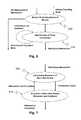
- FIG. 6is a state diagram representing the Normal Mode of the system subject of the invention.
- FIG. 7is a state diagram representing the driving assistance mode of the system subject of the invention.
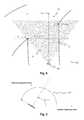
- FIG. 8is a geometric representation of the calculation of the orientation of the rear-view means implemented by the system subject of the invention.
- FIG. 9is a geometric representation of the movement of a rear-view device in the system subject of the invention.
- a vehicle V provided with a system for the automatic adjustment of rear-view means at a road intersectionis schematically shown in FIG. 1 .
- An on board processing unit 10supervises the control of shooting means 20 , for example one or more video cameras, preferably installed at the front part of the vehicle or facing the travel direction of the vehicle and arranged for shooting scenes representing an environment surrounding the vehicle.
- shooting means 20for example one or more video cameras, preferably installed at the front part of the vehicle or facing the travel direction of the vehicle and arranged for shooting scenes representing an environment surrounding the vehicle.
- the field of view Fis used to indicate the field of view of the shooting means, herein solely indicatively represented symmetric with respect to the longitudinal axis of the vehicle.
- the width of the horizontal field of viewis preferably comprised between 40° and 100°.
- the depth of the field of view on the road surfaceis preferably in the order of 50 m and not lower than 30 m.
- the field of view Fmay be fixed or variable, for example automatically variable during an operation for detecting and tracking a manoeuvre to join the traffic stream, as better described hereinafter.
- the vehicle rear-view means 30is used to generally indicate the vehicle rear-view means, whose orientation is controlled automatically for the purposes of assisting the driver in the manoeuvre of entering an intersection by the system subject of the invention.
- rear-view meansis used to indicate any device adapted to represent to the driver a scene of the rear or mainly rear environment, with respect to the vehicle.
- theyare represented by a plurality of rear-view mirrors, respectively a first external rear-view mirror on a first side of the vehicle near the driver, a second external rear-view mirror on the opposite side of the vehicle remote from the driver and possibly a central internal rear-view mirror for vehicles that allow rear view through a rear window.
- the rear-view meansmight be obtained through video cameras or like shooting means, located in place of, or alongside, rear-view mirrors or installed on other parts of the body of the vehicle, facing the lateral and/or rear side with respect to the same.
- a rear-view mirror deviceit is possible to identify at least one axis or normal direction (N in FIG. 2 ), with respect to which the images of a rear or at least partially lateral scene are reflected to the driver.
- the adjustable orientation of the mirrori.e. of its axis, in the space allows modifying the picked up scene and its representation to the driver.
- the shooting meanshave an optical axis, defined with respect to which is a field of view for capturing the images.
- the display means for representing images of a scene subject of the shooting to the drivermay also be remotely located with respect to the shooting means, usually, according to the predefined fixed orientation to meet needs regarding ergonomic optimisation. In this case, it is the adjustable orientation of the optical axis of the shooting means in the space that allows modifying the area for picking up the images.
- the on board processing unit 10is further coupled with means 40 e.g. motor means, for moving orientable parts of the single rear-view devices 30 R, 30 L (thus, right and left mirrors or shooting devices), for transmitting to the abovementioned devices electrical signals for actuating the local movement means 40 R, 40 L.
- means 40e.g. motor means, for moving orientable parts of the single rear-view devices 30 R, 30 L (thus, right and left mirrors or shooting devices), for transmitting to the abovementioned devices electrical signals for actuating the local movement means 40 R, 40 L.
- Such couplingmay occur, for example and advantageously, through cables arranged for the setting (configuration) of the orientation of the rear-view means by the drivers of the vehicle. Communication may occur by means of automotive lines such as CAN, LIN, dedicated digital lines or through analogue lines.
- FIG. 2shows an example of a road intersection between a road R and a lane L for joining the traffic stream.
- the main direction of traffic stream along the road R(or rather its lane in the direction corresponding to the direction of joining the traffic stream), identified herein as the destination direction of the manoeuvre to join the traffic stream, is indicated by the arrow D.
- the direction to join the traffic streami.e. the direction of temporary motion followed by the vehicle V in the manoeuvre to join the traffic stream from the lane L into the road R, is indicated by the arrow I.
- the direction Ito join the traffic stream and the destination direction Dare incident according to an acute angle ⁇ , in case of interchanges or interurban junctions, in which the intersections are built to be engaged by vehicles without stopping.
- lane or incident roador “incident direction” shall indicate a lane, road or direction that is incident with respect to a lane, road or direction taken as reference in the context.
- a reference system “centred” on the vehicle moving through the lane L to join the traffic stream, or on its travel directionshall be defined as the direction incident the destination direction D.
- the incident directionshall be the direction Ito join the traffic stream, i.e. the travel direction of the vehicle along the lane L joining the road R.
- FIG. 2Also schematically represented (not in scale) in FIG. 2 is a rear-view device 30 L in a travel direction of orientation, referring to the normal axis N in case of a flat reflecting surface. Indicated with the dashed line is a desired modified direction of orientation, that the mirror should acquire in proximity to an intersection to allow the driver a better view of the incident lane (in this case, according to the definition above, the main travel road R).
- FIG. 3A detailed diagram of the system subject of the invention is illustrated in FIG. 3 . Identical elements or components, or functionally equivalent to the ones illustrated in FIGS. 1 and 2 were indicated with the same alphanumeric reference numbers. Highlighted are directional control buttons PBR, PBL for the automatic setting of the orientation of the rear-view means, respectively right and left, adapted to impart a movement command to the mirrors (or to the shooting means) to represent to the driver the incident lane or road. Also represented is the active part of control of the vehicle dynamics, specifically the processing modules for controlling the engine 50 , braking 60 and steering 70 to which the processing unit 10 of the system subject of the invention can send information with a view to an active control of the vehicle.
- PBRdirectional control buttons
- PBLfor the automatic setting of the orientation of the rear-view means, respectively right and left, adapted to impart a movement command to the mirrors (or to the shooting means) to represent to the driver the incident lane or road.
- active part of control of the vehicle dynamicsspecifically the processing modules for controlling
- the processing unit 10is also connected to an on board network, for example a CAN network for communicating the information regarding the status of the vehicle.
- an on board networkfor example a CAN network for communicating the information regarding the status of the vehicle.
- control panel PANfor example representable digitally in the on board panel or in another location arranged for communicating information to the driver when setting the system or resetting/modifying the same, adapted to represent the different configurations that the system may acquire, which shall be fully described hereinafter.
- FIG. 4shows a status diagram representing the high level management of the operation modes of the system subject of the invention by the processing unit 10 .
- the systemprovides for three operation modes, respectively a configuration mode, an automatic orientation mode for normal travel (briefly, Normal Mode) and an automatic orientation mode for travel in proximity to intersections (briefly, intersection assistance mode).
- the systemUpon starting the vehicle the system is arranged in the Normal Mode wherein the rear-view means are oriented according to the settings desired by the driver to allow him to view the scene at the rear of the vehicle.
- the processing unit 10executes a programme stored for identifying road intersections, using images acquired by the shooting means.
- the finite state machineswitches to the Intersection Assistance Mode state, whereby the rear-view device on the side of joining the traffic stream in the destination road, controlled by the processing unit, is oriented in such a manner to guarantee the visibility of a rear and lateral scene with respect to the vehicle, comprising the destination direction.
- the automatic modification of the orientation of a rear-view deviceis advantageously active only upon reaching a threshold distance from the intersection, for example in the order of 10-15 m therefrom, when the speed of the vehicle is presumably low.
- the orientation of the rear-view devicesmay be set according to the personal driving style and the view requirements, through the control buttons PBL, PBR, in a Configuration Mode of the state machine where the unit 10 shall be capable of storing the established settings, to be referred to each time the assisted manoeuvre to join the traffic stream is completed.
- FIG. 5is a status diagram representing the Configuration Mode of the system.
- the systementers the configuration mode when requested by the driver, for example by pressing a button or selecting a setting function provided for by a cockpit operating menu represented in the instrument panel (state 100 ).
- the systemthus awaits in state 102 for the operation mode to be configured to be selected, respectively by selecting the Normal Mode or the Intersection Assistance Mode.
- the desired orientation of the rear-view devicesis set in the normal drive conditions, i.e. for representing to the driver the rear and partly side scene (from the driver's side and the opposite side) with respect to the vehicle.
- the memorisation of the set orientation parametersoccurs by setting the operation mode to be configured or the operating mode again, whereby the system passes to state 106 (Memorisation of Normal Mode parameters), or by selecting—within the configuration mode—the Intersection Assistance Mode, whereby the system passes to state 108 for memorising the parameters (Memorisation of Normal Mode parameters) and then to state 110 for configuring the Intersection Assistance Mode (Intersection Mode Configuration).
- Intersection Assistance Mode Configurationstate 110 called Intersection Mode Configuration
- buttons PBL, PBRthe desired orientation of the rear-view devices is set in the conditions of approaching and/or entering an intersection, i.e. for representing to the driver the rear and lateral scene (on the driver's side and on the opposite side) with respect to the vehicle along the destination direction.
- These settingsshall be maintained only in a first phase of approaching the intersection, i.e. when identifying the intersections (for example possibly coinciding with an orientation of the rear-view device according to the maximum admissible angle with respect to the travel direction of the vehicle), leaving the control on the orientation of the device to a module for calculating and activating the movement that operates an actual tracking of the adjustment in the phase of entering the intersection.
- the memorisation of the set orientation parametersoccurs by selecting the operation mode to be configured or the operating mode again, whereby the system passes to state 112 (Memorisation of Intersection Mode Parameters), or by selecting—within the configuration mode—the Normal Mode, whereby the system passes to state 118 for memorising the parameters (Memorisation of Intersection Mode Parameters) and then to state 104 for configuring the Normal Mode (Normal Mode Configuration).
- FIG. 6is a state diagram representing the Normal Mode of the system subject of the invention.
- the rear-view devicesIn the Normal operating mode, the rear-view devices assume the position determined by the configuration set for the Normal Mode. Such state, identified with 200 in the figure, may be attained upon the identification of the end of an intersection, thus at the exit from an Intersection Assistance Mode state (shown in FIG. 7 and described hereinafter), or upon exiting from the configuration mode, i.e. upon selecting the operating mode (states 106 or 112 in FIG. 5 ).
- the systemactuates shooting means 20 for shooting scenes of the environment surrounding the vehicle, in particular in the travel direction of the vehicle.
- the processing unit 10receives the shot images and performs a procedure for identifying the same, to identify a road intersection.
- the processing unitperiodically processes the identification of images, on frames separated by a predetermined time interval, ensuring a frame rate ranging from 30 to 60 Hz.
- the identification of a road intersectionis performed in state 210 (Road Intersection Identification) and it is based on the identification of a collection of predetermined shapes representative of a road intersection. Specifically, in an image is searched at least one from among the shapes of the set comprising:
- the processing unitin state 210 , is thus adapted to identify geometric shapes such as triangles, circles and rectangles; writings; lines or horizontal, longitudinal and transverse lines (white bands on dark backgrounds).
- the processing unitoperates executing one or more modules or distinct application programmes, each intended to identify a respective category of shape or indicia of a road intersection, preferably combined together to guarantee high reliability on the correct detection of a road intersection.
- LDWLane Departure Warning
- a first condition required to identify the presence of an intersectionis the detection of a second road, i.e. a destination road.
- the identification of the lane or destination road(R, in FIG. 2 ) is based on the principle that the lane traveled by the vehicle or lane for joining the traffic stream (I, in FIG. 2 ) is interrupted at one side, where intersection with the destination road occurs.
- the processing unitis thus adapted to detect a discontinuity of the signs for delimiting the travel lane on one side thereof and verify the presence of an intersecting (or rather incident) delimiting line that defines the direction of the destination road.
- the identification of an interruption of the lines delimiting the lanecontributes to determine an image region (or scene) where the searching for other shapes (vertical sign of road signs, writings, light signs) is to be carried out.
- a second condition necessary to detect a road intersection, alongside identifying the travel road (joining the traffic stream) and the destination road,is the identification of at least one from among the following conditions:
- the module 210may for example be implemented with suitably configured neutral networks, alongside combining with traditional identification algorithms based on a Hough transform and others present in the literature.
- FIG. 7is a state diagram representing the Intersection Assistance Mode.
- the finite state machineUpon identifying the intersection and the related side for joining the traffic stream in state 210 , the finite state machine enters into state 300 of Calculation of the rear-view device movement.
- the processing unit in state 300calculates the correct orientation of the rear-view device towards the incident road through trigonometric calculations, then, in state 310 (feedback activation), the calculated orientation is performed by operating the movement of the device, and possibly providing visual and/or sound feedback to the driver of the vehicle by means of warning lights, signals on the instrument panel, or the sound of a buzzer.
- the orientationdepends on the angle of incidence between the direction to join the traffic stream and the destination direction.
- the intersectionis characterised in that it has a discontinuity on one side of the traveled road (the lane to join the traffic stream L).
- the intersectionis characterised in that it has a discontinuity on one side of the traveled road (the lane to join the traffic stream L).
- the extreme points P 1 , P 2 that define the discontinuityfor example, where the change of the line section delimiting the road lane occurs
- it is possible to calculate the distances present between the shooting means in state 300ideally point wise, i.e.—approximately—from the vehicle (x 1 , x 2 ; y 1 , y 2 in FIG. 8 ). Calculating a mean value between the abovementioned distances, given the current speed of the vehicle in module and direction, the Time To Connection is obtained.
- ⁇ Junctionarctan ⁇ ( y 2 - y 1 x 2 - x 1 )
- the ⁇ Junction anglebeing defined by convention as the angle between the destination direction D (equivalent to the direction indicated by the line delimiting the lane or destination road R) and the direction orthogonal to the direction of joining the traffic stream I (or travel direction) of the vehicle.
- Such parameteris fundamental to define the rotation to be imposed to the rear-view device with respect to the transverse axis of the vehicle.
- the finite state machineswitches to state 310 of Activating mirror movement feedback which comprises the physical adjustment (movement) of the rear-view device according to the angular indications obtained from the processing at state 300 , alongside generating visual and sound feedbacks.
- an active driving assistance systemmay be configured if it is decided to use the information of presence of the intersection to operate on the vehicle speed in an automatic manner, using the distance information obtained from the image processing operation and the dynamic data available on board, providing controls to the processing modules for controlling the engine 50 , braking 60 and steering 70 .
- the active systemtakes the control of the engine as well as of the braking and steering systems according to the time information regarding the Time To Connection TTC, to the distance of the intersection and to the speed of the vehicle.
- the systemmay be voluntarily activated by activating direction indicator devices.
- the systemcould be further enhanced through additional information coming from sensors such as radars or lidars, or from digital maps, to integrate any deficiency in shooting at night or under harsh whether conditions (heavy rain, fog, . . . ).
Landscapes
- Engineering & Computer Science (AREA)
- Multimedia (AREA)
- Mechanical Engineering (AREA)
- Traffic Control Systems (AREA)
Abstract
Description
- The vertical sign indicating an obligation to stop (STOP sign);
- The vertical sign indicating the obligation to give priority (PRIORITY sign);
- The horizontal sign indicating an obligation to stop (transverse line and/or STOP writing/pictogram);
- The horizontal sign indicating an obligation to give priority (continuous transverse line or made up of a series of triangles);
- Vertical light sign indicating a controlled intersection (traffic light);
- The horizontal sign delimiting the travel lane or lane for joining the traffic stream;
- The horizontal sign delimiting the lane or destination road.
- Presence of stop signs;
- Presence of priority signs;
- Presence of light signs (traffic light).
θDevice=θJunction+90°
as indicated in
Claims (15)
θDevice=θJunction+90°
θDevice=θJunction+90°
Applications Claiming Priority (3)
| Application Number | Priority Date | Filing Date | Title |
|---|---|---|---|
| EP09425157AEP2246762B1 (en) | 2009-04-27 | 2009-04-27 | System and method for driving assistance at road intersections |
| EP09425157.6 | 2009-04-27 | ||
| EP09425157 | 2009-04-27 |
Publications (2)
| Publication Number | Publication Date |
|---|---|
| US20100271720A1 US20100271720A1 (en) | 2010-10-28 |
| US8681219B2true US8681219B2 (en) | 2014-03-25 |
Family
ID=41153259
Family Applications (1)
| Application Number | Title | Priority Date | Filing Date |
|---|---|---|---|
| US12/767,600Expired - Fee RelatedUS8681219B2 (en) | 2009-04-27 | 2010-04-26 | System and method for driving assistance at road intersections |
Country Status (2)
| Country | Link |
|---|---|
| US (1) | US8681219B2 (en) |
| EP (1) | EP2246762B1 (en) |
Families Citing this family (5)
| Publication number | Priority date | Publication date | Assignee | Title |
|---|---|---|---|---|
| US8692692B2 (en)* | 2010-11-18 | 2014-04-08 | International Business Machines Corporation | Identifying a potential vehicle incident within a communication black spot |
| KR101738026B1 (en) | 2011-10-11 | 2017-05-22 | 현대자동차주식회사 | System and Method for Controling Side Mirrors to Reduce Blind Spot of a Driving Car |
| KR102516365B1 (en)* | 2018-05-25 | 2023-03-31 | 삼성전자주식회사 | Method and apparatus for controlling radar of vehicle |
| JP7091290B2 (en)* | 2019-08-09 | 2022-06-27 | 本田技研工業株式会社 | Vehicle control devices, vehicle control methods, and programs |
| CN113276771B (en)* | 2021-06-24 | 2023-08-08 | 广州通达汽车电气股份有限公司 | Rearview field adjusting method and device based on driving environment |
Citations (24)
| Publication number | Priority date | Publication date | Assignee | Title |
|---|---|---|---|---|
| US6014814A (en)* | 1996-11-14 | 2000-01-18 | Eurocopter | Method and tool for determining on a vehicle, especially an aircraft, the harmonization error of an equipment item |
| US6115652A (en)* | 1997-05-15 | 2000-09-05 | Honda Giken Kogyo Kabushiki | Road system for automatically traveling vehicle |
| US6414712B1 (en)* | 1995-12-13 | 2002-07-02 | Daimlerchrylsler, Ag | Vehicle navigational system and signal processing method for said navigational system |
| US6422706B1 (en)* | 1999-05-21 | 2002-07-23 | Karur S. Rangan | Apparatus and method for positioning a mirror in a motor vehicle to ensure correct coverage of a critical field of view |
| US6501371B2 (en)* | 2001-05-22 | 2002-12-31 | Trw Inc. | Apparatus and method for positioning a reflective surface on a vehicle |
| US6527399B1 (en)* | 2002-01-03 | 2003-03-04 | Jose Chakkoru Palathingal | All-planar blind-spot proof automobile side-view mirror |
| US20030117731A1 (en)* | 2001-04-24 | 2003-06-26 | Platzer George E | Compound automotive rearview mirror |
| WO2004065176A1 (en) | 2003-01-17 | 2004-08-05 | Siemens Aktiengesellschaft | Holding element for the mirror of an interior rearview mirror, camera comprising one such holding element, and motor vehicle comprising one such camera |
| US6775606B1 (en)* | 2000-12-07 | 2004-08-10 | Siemens Aktiengesellschaft | Device and method for sensing an object and use of the device and method for adjusting an element |
| US20050015203A1 (en)* | 2003-07-18 | 2005-01-20 | Nissan Motor Co., Ltd. | Lane-changing support system |
| US20050159862A1 (en)* | 2004-01-16 | 2005-07-21 | Nissan Motor Co., Ltd. | Vehicle situation monitoring apparatus and vehicle situation monitoring method |
| US20050240342A1 (en)* | 2004-04-22 | 2005-10-27 | Nobuaki Ishihara | Vehicle periphery display control system |
| EP1605404A2 (en) | 2004-06-02 | 2005-12-14 | Toyota Jidosha Kabushiki Kaisha | Lane boundary detector |
| US20060155444A1 (en)* | 2005-01-13 | 2006-07-13 | Lee Yong H | Automatic control of automotive rearview mirror |
| US20070010938A1 (en)* | 2005-07-08 | 2007-01-11 | Aisin Aw Co., Ltd. | Navigation systems, methods, and programs |
| US20070263301A1 (en)* | 2004-06-17 | 2007-11-15 | Zohar Agrest | System and Method for Automatic Adjustment of Mirrors for a Vehicle |
| JP2008068827A (en)* | 2006-09-15 | 2008-03-27 | Calsonic Kansei Corp | Rear lateral side confirmation device |
| JP2008222153A (en) | 2007-03-15 | 2008-09-25 | Aisin Aw Co Ltd | Merging support device |
| US20080291276A1 (en)* | 2003-10-24 | 2008-11-27 | Martin Randler | Method for Driver Assistance and Driver Assistance Device on the Basis of Lane Information |
| US20090216431A1 (en)* | 2008-02-26 | 2009-08-27 | Tien Vu | Method and apparatus for adjusting distance for generating maneuver instruction for navigation system |
| US20090299622A1 (en)* | 2008-05-30 | 2009-12-03 | Navteq North America, Llc | Data mining to identify locations of potentially hazardous conditions for vehicle operation and use thereof |
| US20090310237A1 (en)* | 2008-06-16 | 2009-12-17 | Gm Global Technology Operations, Inc. | Lane change aid side-mirror system |
| US20100157061A1 (en)* | 2008-12-24 | 2010-06-24 | Igor Katsman | Device and method for handheld device based vehicle monitoring and driver assistance |
| US20100315214A1 (en)* | 2008-02-26 | 2010-12-16 | Fujitsu Limited | Image processor, storage medium storing an image processing program and vehicle-mounted terminal |
- 2009
- 2009-04-27EPEP09425157Apatent/EP2246762B1/enactiveActive
- 2010
- 2010-04-26USUS12/767,600patent/US8681219B2/ennot_activeExpired - Fee Related
Patent Citations (24)
| Publication number | Priority date | Publication date | Assignee | Title |
|---|---|---|---|---|
| US6414712B1 (en)* | 1995-12-13 | 2002-07-02 | Daimlerchrylsler, Ag | Vehicle navigational system and signal processing method for said navigational system |
| US6014814A (en)* | 1996-11-14 | 2000-01-18 | Eurocopter | Method and tool for determining on a vehicle, especially an aircraft, the harmonization error of an equipment item |
| US6115652A (en)* | 1997-05-15 | 2000-09-05 | Honda Giken Kogyo Kabushiki | Road system for automatically traveling vehicle |
| US6422706B1 (en)* | 1999-05-21 | 2002-07-23 | Karur S. Rangan | Apparatus and method for positioning a mirror in a motor vehicle to ensure correct coverage of a critical field of view |
| US6775606B1 (en)* | 2000-12-07 | 2004-08-10 | Siemens Aktiengesellschaft | Device and method for sensing an object and use of the device and method for adjusting an element |
| US20030117731A1 (en)* | 2001-04-24 | 2003-06-26 | Platzer George E | Compound automotive rearview mirror |
| US6501371B2 (en)* | 2001-05-22 | 2002-12-31 | Trw Inc. | Apparatus and method for positioning a reflective surface on a vehicle |
| US6527399B1 (en)* | 2002-01-03 | 2003-03-04 | Jose Chakkoru Palathingal | All-planar blind-spot proof automobile side-view mirror |
| WO2004065176A1 (en) | 2003-01-17 | 2004-08-05 | Siemens Aktiengesellschaft | Holding element for the mirror of an interior rearview mirror, camera comprising one such holding element, and motor vehicle comprising one such camera |
| US20050015203A1 (en)* | 2003-07-18 | 2005-01-20 | Nissan Motor Co., Ltd. | Lane-changing support system |
| US20080291276A1 (en)* | 2003-10-24 | 2008-11-27 | Martin Randler | Method for Driver Assistance and Driver Assistance Device on the Basis of Lane Information |
| US20050159862A1 (en)* | 2004-01-16 | 2005-07-21 | Nissan Motor Co., Ltd. | Vehicle situation monitoring apparatus and vehicle situation monitoring method |
| US20050240342A1 (en)* | 2004-04-22 | 2005-10-27 | Nobuaki Ishihara | Vehicle periphery display control system |
| EP1605404A2 (en) | 2004-06-02 | 2005-12-14 | Toyota Jidosha Kabushiki Kaisha | Lane boundary detector |
| US20070263301A1 (en)* | 2004-06-17 | 2007-11-15 | Zohar Agrest | System and Method for Automatic Adjustment of Mirrors for a Vehicle |
| US20060155444A1 (en)* | 2005-01-13 | 2006-07-13 | Lee Yong H | Automatic control of automotive rearview mirror |
| US20070010938A1 (en)* | 2005-07-08 | 2007-01-11 | Aisin Aw Co., Ltd. | Navigation systems, methods, and programs |
| JP2008068827A (en)* | 2006-09-15 | 2008-03-27 | Calsonic Kansei Corp | Rear lateral side confirmation device |
| JP2008222153A (en) | 2007-03-15 | 2008-09-25 | Aisin Aw Co Ltd | Merging support device |
| US20090216431A1 (en)* | 2008-02-26 | 2009-08-27 | Tien Vu | Method and apparatus for adjusting distance for generating maneuver instruction for navigation system |
| US20100315214A1 (en)* | 2008-02-26 | 2010-12-16 | Fujitsu Limited | Image processor, storage medium storing an image processing program and vehicle-mounted terminal |
| US20090299622A1 (en)* | 2008-05-30 | 2009-12-03 | Navteq North America, Llc | Data mining to identify locations of potentially hazardous conditions for vehicle operation and use thereof |
| US20090310237A1 (en)* | 2008-06-16 | 2009-12-17 | Gm Global Technology Operations, Inc. | Lane change aid side-mirror system |
| US20100157061A1 (en)* | 2008-12-24 | 2010-06-24 | Igor Katsman | Device and method for handheld device based vehicle monitoring and driver assistance |
Also Published As
| Publication number | Publication date |
|---|---|
| EP2246762A1 (en) | 2010-11-03 |
| US20100271720A1 (en) | 2010-10-28 |
| EP2246762B1 (en) | 2012-06-06 |
Similar Documents
| Publication | Publication Date | Title |
|---|---|---|
| JP6539304B2 (en) | Vehicle travel control device | |
| US10163016B2 (en) | Parking space detection method and device | |
| US9507345B2 (en) | Vehicle control system and method | |
| US11900812B2 (en) | Vehicle control device | |
| US9126533B2 (en) | Driving support method and driving support device | |
| US8094192B2 (en) | Driving support method and driving support apparatus | |
| JP4749958B2 (en) | Driving assistance device | |
| JP2023010800A (en) | Display device | |
| KR102004062B1 (en) | Method for operating a driver assistance system of a motor vehicle, driver assistance system and motor vehicle | |
| CN110857093A (en) | Vehicle travel control system | |
| CN110033629A (en) | Signal light identifier and automated driving system | |
| US12054144B2 (en) | Road information generation apparatus | |
| CN109987101A (en) | The control device of vehicle | |
| US8681219B2 (en) | System and method for driving assistance at road intersections | |
| JP2021146905A (en) | Control device, control method and program | |
| US20130342926A1 (en) | Method And System For Dynamically Adjusting A Vehicle Mirror | |
| US12216470B2 (en) | Vehicle control system and vehicle driving method using the vehicle control system | |
| US11897482B2 (en) | Autonomous vehicle control for changing grip completion status in real-time to prevent unnecessary warning issuance | |
| JP7674947B2 (en) | Driving Support Devices | |
| JP7698495B2 (en) | Parking Assistance Device | |
| US20250236308A1 (en) | Information providing device and information providing method | |
| US12430925B2 (en) | Vehicle control system and vehicle driving method using the vehicle control system | |
| JP7734613B2 (en) | Map Generator | |
| US20250074194A1 (en) | Display device | |
| KR20210097237A (en) | Travel information system for self driving cars |
Legal Events
| Date | Code | Title | Description |
|---|---|---|---|
| AS | Assignment | Owner name:MAGNETI MARELLI S.P.A., ITALY Free format text:ASSIGNMENT OF ASSIGNORS INTEREST;ASSIGNOR:MARENCO, DANIELE;REEL/FRAME:024332/0701 Effective date:20100330 | |
| AS | Assignment | Owner name:MAGNETI MARELLI S.P.A., ITALY Free format text:ASSIGNMENT OF ASSIGNORS INTEREST;ASSIGNOR:BOLLEA, DENIS;REEL/FRAME:031976/0996 Effective date:20131030 | |
| STCF | Information on status: patent grant | Free format text:PATENTED CASE | |
| MAFP | Maintenance fee payment | Free format text:PAYMENT OF MAINTENANCE FEE, 4TH YEAR, LARGE ENTITY (ORIGINAL EVENT CODE: M1551) Year of fee payment:4 | |
| FEPP | Fee payment procedure | Free format text:MAINTENANCE FEE REMINDER MAILED (ORIGINAL EVENT CODE: REM.); ENTITY STATUS OF PATENT OWNER: LARGE ENTITY | |
| LAPS | Lapse for failure to pay maintenance fees | Free format text:PATENT EXPIRED FOR FAILURE TO PAY MAINTENANCE FEES (ORIGINAL EVENT CODE: EXP.); ENTITY STATUS OF PATENT OWNER: LARGE ENTITY | |
| STCH | Information on status: patent discontinuation | Free format text:PATENT EXPIRED DUE TO NONPAYMENT OF MAINTENANCE FEES UNDER 37 CFR 1.362 | |
| FP | Lapsed due to failure to pay maintenance fee | Effective date:20220325 |