US8653355B2 - Chord-playing robot system and method for controlling the same - Google Patents
Chord-playing robot system and method for controlling the sameDownload PDFInfo
- Publication number
- US8653355B2 US8653355B2US13/186,699US201113186699AUS8653355B2US 8653355 B2US8653355 B2US 8653355B2US 201113186699 AUS201113186699 AUS 201113186699AUS 8653355 B2US8653355 B2US 8653355B2
- Authority
- US
- United States
- Prior art keywords
- tubular
- finger
- robot system
- devices
- solenoids
- Prior art date
- Legal status (The legal status is an assumption and is not a legal conclusion. Google has not performed a legal analysis and makes no representation as to the accuracy of the status listed.)
- Expired - Fee Related, expires
Links
Images


Classifications
- G—PHYSICS
- G10—MUSICAL INSTRUMENTS; ACOUSTICS
- G10F—AUTOMATIC MUSICAL INSTRUMENTS
- G10F3/00—Independent players for keyboard instruments
- B—PERFORMING OPERATIONS; TRANSPORTING
- B25—HAND TOOLS; PORTABLE POWER-DRIVEN TOOLS; MANIPULATORS
- B25J—MANIPULATORS; CHAMBERS PROVIDED WITH MANIPULATION DEVICES
- B25J11/00—Manipulators not otherwise provided for
- B25J11/003—Manipulators for entertainment
- B25J11/004—Playing a music instrument
- B—PERFORMING OPERATIONS; TRANSPORTING
- B25—HAND TOOLS; PORTABLE POWER-DRIVEN TOOLS; MANIPULATORS
- B25J—MANIPULATORS; CHAMBERS PROVIDED WITH MANIPULATION DEVICES
- B25J19/00—Accessories fitted to manipulators, e.g. for monitoring, for viewing; Safety devices combined with or specially adapted for use in connection with manipulators
- B25J19/06—Safety devices
- B—PERFORMING OPERATIONS; TRANSPORTING
- B25—HAND TOOLS; PORTABLE POWER-DRIVEN TOOLS; MANIPULATORS
- B25J—MANIPULATORS; CHAMBERS PROVIDED WITH MANIPULATION DEVICES
- B25J5/00—Manipulators mounted on wheels or on carriages
- B25J5/02—Manipulators mounted on wheels or on carriages travelling along a guideway
- G—PHYSICS
- G10—MUSICAL INSTRUMENTS; ACOUSTICS
- G10H—ELECTROPHONIC MUSICAL INSTRUMENTS; INSTRUMENTS IN WHICH THE TONES ARE GENERATED BY ELECTROMECHANICAL MEANS OR ELECTRONIC GENERATORS, OR IN WHICH THE TONES ARE SYNTHESISED FROM A DATA STORE
- G10H1/00—Details of electrophonic musical instruments
- G10H1/0033—Recording/reproducing or transmission of music for electrophonic musical instruments
- G10H1/0041—Recording/reproducing or transmission of music for electrophonic musical instruments in coded form
- G10H1/0058—Transmission between separate instruments or between individual components of a musical system
- G10H1/0066—Transmission between separate instruments or between individual components of a musical system using a MIDI interface
Definitions
- the present inventionrelates to a chord-playing robot system and a method for controlling the robot system.
- the robot systemcan simulate the way of a human playing the piano; for example, the robot system may press black keys and/or white keys as commanded, and simultaneously play the main melody and chords.
- the robot systemcan simulate the way of a human playing the piano, and the moving parts of the robot system can shift among different intervals without colliding with each other.
- the present inventionprovides a robot system capable of playing the piano in a way similar to the way a human plays the piano with both hands.
- the robot systemcomprises a computer, two linear motors, two moving devices, and two finger-like devices.
- the computercomprises an anti-collision program.
- the two linear motors and two finger-like devicesare respectively electrically coupled to the computer.
- the two moving devicesare respectively connected with the two linear motors so that the linear motors control the position of the respective moving devices connected therewith.
- Each of the two finger-like devicescomprises a plurality of tubular solenoids which is arranged in alternating sequence in two rows.
- Each tubular solenoidis configured to reciprocate between a first position for pressing a key on a piano under the presence of the induced electromagnetic force and a second position for leaving the key on the piano under the absence of the induced electromagnetic force.
- the two moving devicesare respectively driven by the two linear motors under the control of the computer, and the collision between the two moving devices are prevented by executing the anti-collision program.
- the two finger-like devicesare also controlled by the computer.
- the computermay determine whether or not to activate or switch on a particular tubular solenoid based on the musical pieces to be played, and when the tubular solenoid is switched on, the electromagnetic bar associated with the tubular solenoid would be pushed toward the keyboard (i.e., in the first position) thereby pressing the key underneath the electromagnetic bar.
- the computermay determine whether or not to activate or switch on a particular tubular solenoid based on the musical pieces to be played, and when the tubular solenoid is switched on, the electromagnetic bar associated with the tubular solenoid would be pushed toward the keyboard (i.e., in the first position) thereby pressing the key underneath the electromagnetic bar.
- one finger-like deviceit is possible for one finger-like device to simultaneously press multiple keys that constitute a chord.
- one of the finger-like devicesplays a main melody of a musical piece, whereas the other finger-like device plays a second melody (such as a melody subordinate to the main melody or a counter melody) or chords of the musical piece.
- each of the finger-like devicespreferably has sixteen tubular solenoids.
- the sixteen tubular solenoidsare disposed in alternating sequence in two parallel rows such that each row has eight tubular solenoids.
- the eight tubular solenoids in one rowrespectively correspond to eight consecutive white keys on the piano, whereas the other tubular solenoids in the other row are responsible for pressing black keys on the piano.
- the rightmost tubular solenoidfor example, corresponding to the C5 note
- the leftmost tubular solenoidfor example, corresponding to the C4 note
- the present inventionfurther provides a method for controlling the chord-playing robot system described herein. The method comprises:
- Step S1providing a plurality of conversion tables based on a pitch position corresponding to one of the plurality of tubular solenoids
- Step S2converting each musical note of a music score into a corresponding value of Musical Instrument Digital Interface (MIDI) respectively;
- MIDIMusical Instrument Digital Interface
- Step S3dividing each MIDI value by 12 to obtain a remainder thereof.
- Step S4looking up the remainder within the plurality of conversion tables to determine which of the plurality of tubular solenoids would be switched on.
- the methodmay further comprise the following step:
- Step S5determining whether one tubular solenoid within one finger-like device is spaced nine white keys apart from the tubular solenoid located at the same relative position within the other finger-like device.
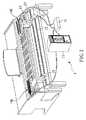
- FIG. 1is a schematic perspective view illustrating a robot system according to the present invention.
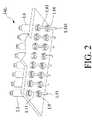
- FIG. 2is a schematic perspective view illustrating of a finger-like device according to the present invention.
- FIG. 3A and FIG. 3Brespectively illustrate the dispositions of tubular solenoids within the left and right finger-like devices.
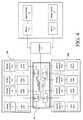
- FIG. 4is a schematic functional block diagram illustrating the robot system according to the present invention.
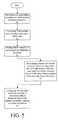
- FIG. 5is a flowchart presenting a method for controlling a chord-playing robot system according to the present invention.
- a chord-playing robot system 1 of the present inventionis capable of playing the piano with both hands.
- the robot system 1comprises a computer 11 , two linear motors 12 , two moving devices 13 , and two finger-like devices 14 R, 14 L.
- the computer 11comprises an anti-collision program.
- the two linear motors 12 and the two finger-like devices 14 R, 14 Lare respectively electrically coupled to the computer 11 .
- the present inventionexecutes the anti-collision program of the computer 11 to prevent the two moving devices 13 from colliding with each other.
- the two moving devices 13respectively are connected with the two linear motors 12 so that the linear motors 12 control the position of the respective moving devices 13 connected therewith.
- the two linear motors 12are controlled by the computer 11 to drive the two moving devices 13 .
- the chord-playing robot system 1further comprises a control circuit 15 .
- the two finger-like devices 14 R, 14 Lare electrically coupled to the computer 11 via the control circuit 15 substantially, which will be described in detail in the following paragraphs.
- Each finger-like device 14 L or 14 Rcomprises a plurality of tubular solenoids.
- the tubular solenoidsare denoted by L plus number or R plus number. Take finger-like device 14 L for example. Please refer to FIG. 2 and FIG. 3A .
- Sixteen tubular solenoids L 1 -L 16are disposed in alternating sequence in two rows; that is, the tubular solenoids L 1 -L 8 are arranged in one row, and the tubular solenoids L 9 -L 16 are arranged in another row.
- the tubular solenoids L 1 -L 8 and the tubular solenoids L 9 -L 16are actually disposed in alternating sequence in two rows.
- the tubular solenoids L 1 -L 8are misaligned with the tubular solenoids L 9 -L 16 .
- the tubular solenoids L 1 -L 8serve to press white keys of the piano
- the tubular solenoids L 9 -L 16serve to press black keys of the piano.
- right tubular solenoids R 1 -R 16are disposed in the same way as left tubular solenoids L 1 -L 16 , so as to play keys that should be played by a right hand.
- the right finger-like device 14 Rcan play a second melody (such as a melody subordinate to the main melody or a counter melody) or chords of the musical piece.
- each of the tubular solenoids L 1 -L 16is configured with one electromagnetic bar L 11 -L 161 respectively so as to reciprocate between a first position for pressing a key on a piano under the presence of the induced electromagnetic force and a second position for leaving the key on the piano under the absence of the induced electromagnetic force.
- each of the tubular solenoids R 1 -R 16 of the right finger-like device 14 Rthough not shown in the figures, also is configured with one electromagnetic bar so as to reciprocate between a first position for pressing a key on a piano under the presence of the induced electromagnetic force and a second position for leaving the key on the piano under the absence of the induced electromagnetic force.
- the computer 11controls the two finger-like devices 14 L, 14 R and determines whether to activate any of the plurality of the tubular solenoids L 1 -L 16 or R 1 -R 16 so as to play a chord.
- the electromagnetic bars L 11 -L 161 shown in FIG. 2are in the first position (ie. the tubular solenoids L 1 -L 16 are activated), which are in the state of pressing keys. Because the technique is well known to those of reasonable skill in the art for the tubular solenoids L 1 -L 16 , R 1 -R 16 and the electromagnetic bars L 11 -L 161 , R 11 -R 161 , the detailed description for doing so is omitted.
- each of the finger-like devices 14 R or 14 Lpreferably has sixteen tubular solenoids R 1 -R 16 or L 1 -L 16 .
- the sixteen tubular solenoids R 1 -R 16 or L 1 -L 16are disposed in alternating sequence in two rows such that each of the two rows has eight tubular solenoids R 1 -R 8 , R 9 -R 16 or L 1 -L 8 , L 9 -L 16 .
- the distance between the leftmost tubular solenoid L 1 or L 9 of each finger-like device (e.g., 14 L) and the rightmost tubular solenoid L 8 or L 16is an octave. This solves the problem of the finger-like device being unable to play a chord when the distance between two musical notes of the chord is more than five keys. Moreover, this reduces the moving frequency of the moving devices 13 and makes the piano playing smoother.
- FIG. 4illustrates the control circuit 15 of the present invention.
- the two finger-like devices 14 L and 14 Rare substantially electrically coupled to the computer 11 via the control circuit 15 .
- the computer 11when the computer 11 stored with a piano score, the computer 11 transmits the instructions of what should be played in the piano score to a controller 152 via a RS-232 interface.
- the controller 152may be, for example, the BS2 microprocessor.
- the controller 152determines which IC (IC 152 a - 152 b ′) controls the key that is going to be played and then drives a corresponding relay.
- the ICmay be, for example, a SN74HC595 chip.
- the computer 11controls two linear motors 12 via a driver 121 and obtains the present position and target position of the tubular solenoids L 1 -L 16 and R 1 -R 16 .
- the tubular solenoids L 1 -L 16 and R 1 -R 16are controlled for activation respectively via relays LR 1 -LR 16 and RR 1 -RR 16 , and then the key(s) is/are pressed by the corresponding electromagnetic bar(s).
- the present inventionfurther provides a method for playing a chord by using the above chord-playing robot system.
- the method of the present inventioncan be performed by executing a playing program by a computer substantially. Please refer to FIG. 5 .
- the method of the present inventioncomprises steps S1-S5, which are respectively illustrated in the following paragraphs.
- Step S1Provide a plurality of conversion tables according to a pitch position of one of the plurality of tubular solenoids.
- two linear motors 12are respectively electronically coupled to the computer 11 , whereby the position of each of the tubular solenoids L 1 -L 16 and R 1 -R 16 can be obtained.
- the following descriptionrespectively lists seven conversion tables (Tables 1-7) using an example of the tubular solenoid of No. L 9 located at pitch positions C, D, E, F, G, A, and B, respectively.
- Step S2Convert each musical note of a music score into a corresponding value of Musical Instrument Digital Interface (MIDI) respectively.
- MIDIMusical Instrument Digital Interface
- MIDIMusical Instrument Digital Interface
- the MIDIdefines all kinds of musical notes or playing codes for music devices such as electronic instruments (e.g., an electronic piano). Because the technique of MIDI is well known to those of reasonable skill in the art, the detailed description for doing so is omitted.
- the tubular solenoid L 9 at the position of key C5is defined in Step 1. If it needs to simultaneously press the keys of E5, G#5, and B5, the MIDI values of E5, G#5, and B5 are respectively 64, 68, and 71, which can be converted by the computer.
- Step S3Divide the MIDI values by 12 and respectively obtain a remainder.
- Step S4Look up the remainder within the plurality of conversion tables to determine which of the plurality of tubular solenoids would be activated or switched on.
- step S2 of converting each musical note of a music score into a corresponding MIDI valuecan also be performed first.
- the present inventiondesigns a mechanism for preventing collisions. Therefore, preferably, the present invention may also perform the following step before step S4 by using the computer to execute an anti-collision program:
- Step S5Determine whether one tubular solenoid within one finger-like device is spaced nine white keys apart from the tubular solenoid located at the same relative position within the other finger-like device.
- the computer 11is utilized to execute the anti-collision program to perform the determination in step S5.
- the shortest distance between tubular solenoids L 9 and R 9is nine keys in a situation in which the left and right linear motors 12 do not collide with each other.
- the linear motors 12are going to move, the following determination is performed (take the left linear motor for example):
- last_posi_L/* the present position of the left linear motor*/ last_posi_R; /* the present position of the right linear motor*/ goal_posi_L; /* the target position of the left linear motor*/ goal_posi_R; /* the target position of the right linear motor*/ if(
- the system of the present inventionwill be simplified and has complete functions. It simply uses two linear motors 12 and tubular solenoids L 1 -L 16 , R 1 -R 16 to meet the requirement of playing the piano. Moreover, the principle of the operation of tubular solenoids is very easy. The precision of displacement of the linear motors is very high, and the actual operation is quite easy and reliable. Furthermore, the mechanism for preventing collisions can indeed work, and there were no collisions during experimental testing. Finally, according to the results of the experiments, chords in the same octave can be played simultaneously and correctly by dealing with chord playing by way of instruction codes.
- the present inventionhas complete functions.
- the cost of the present inventionis relatively low.
- the present inventionis easy to maintain and operate.
- the system and the method of the present inventioneffectively solve current problems of playing piano.
Landscapes
- Engineering & Computer Science (AREA)
- Robotics (AREA)
- Mechanical Engineering (AREA)
- Multimedia (AREA)
- Physics & Mathematics (AREA)
- Acoustics & Sound (AREA)
- Electrophonic Musical Instruments (AREA)
- Manipulator (AREA)
Abstract
Description
1. Field of the Invention
The present invention relates to a chord-playing robot system and a method for controlling the robot system.
2. Description of the Related Art
It has been a long time since robots were first developed; however, the functions of current piano playing robot systems are still in comprehensive. Those robots can only press the white keys on the piano or press a single key at a time due to the constraints imposed by the degree of freedom of mechanisms. Therefore, it is necessary to develop a robot system that can press both the black and white keys, as well as playing chords.
Most of the piano-playing robot systems that have been presented so far have only one set of playing devices. Musical pieces, however, are usually composed of a main melody and chords, which are played with both hands on piano. Consequently, there is a need to develop a piano-playing robot system that has two moving parts to mimics the way of a human when playing the piano, namely playing a main melody and chords simultaneously. Moreover, the two moving parts may shift among various intervals without colliding each other.
Thus, in order to provide a robot system capable of playing the main melody and chords on piano at the same time, it is necessary to invent a chord-playing robot system and a method for controlling the same so that the robot system may play complex musical pieces and the two moving parts of the robot system would not collide with each other when the moving parts respectively shift from one interval to another interval.
It is a main object of the present invention to provide a chord-playing robot system and a method for controlling the robot system. The robot system can simulate the way of a human playing the piano; for example, the robot system may press black keys and/or white keys as commanded, and simultaneously play the main melody and chords.
It is another object of the present invention to provide a chord-playing robot system and a method for controlling the robot system. The robot system can simulate the way of a human playing the piano, and the moving parts of the robot system can shift among different intervals without colliding with each other.
In one aspect, the present invention provides a robot system capable of playing the piano in a way similar to the way a human plays the piano with both hands. The robot system comprises a computer, two linear motors, two moving devices, and two finger-like devices. The computer comprises an anti-collision program. The two linear motors and two finger-like devices are respectively electrically coupled to the computer. The two moving devices are respectively connected with the two linear motors so that the linear motors control the position of the respective moving devices connected therewith. Each of the two finger-like devices comprises a plurality of tubular solenoids which is arranged in alternating sequence in two rows. Each tubular solenoid is configured to reciprocate between a first position for pressing a key on a piano under the presence of the induced electromagnetic force and a second position for leaving the key on the piano under the absence of the induced electromagnetic force. According to one embodiments of the present invention, the two moving devices are respectively driven by the two linear motors under the control of the computer, and the collision between the two moving devices are prevented by executing the anti-collision program. Moreover, the two finger-like devices are also controlled by the computer. In practice, the computer may determine whether or not to activate or switch on a particular tubular solenoid based on the musical pieces to be played, and when the tubular solenoid is switched on, the electromagnetic bar associated with the tubular solenoid would be pushed toward the keyboard (i.e., in the first position) thereby pressing the key underneath the electromagnetic bar. In this way, it is possible for one finger-like device to simultaneously press multiple keys that constitute a chord. In one optional embodiment, one of the finger-like devices plays a main melody of a musical piece, whereas the other finger-like device plays a second melody (such as a melody subordinate to the main melody or a counter melody) or chords of the musical piece. In order to provide a robot system capable of pressing black and white keys simultaneously and/or playing chords composed of multiple notes, each of the finger-like devices preferably has sixteen tubular solenoids. The sixteen tubular solenoids are disposed in alternating sequence in two parallel rows such that each row has eight tubular solenoids. The eight tubular solenoids in one row respectively correspond to eight consecutive white keys on the piano, whereas the other tubular solenoids in the other row are responsible for pressing black keys on the piano. Accordingly, within one finger-like device, the rightmost tubular solenoid (for example, corresponding to the C5 note) and the leftmost tubular solenoid (for example, corresponding to the C4 note) are an octave interval apart. In this way, a single finger-like device may play a chord having two notes five white keys apart (such as, C4 and G4 notes). Moreover, this novel arrangement reduces the frequency required for moving the finger-like horizontally during the performance thereby improving the smoothness of the performance. In another aspect, the present invention further provides a method for controlling the chord-playing robot system described herein. The method comprises:
Step S1: providing a plurality of conversion tables based on a pitch position corresponding to one of the plurality of tubular solenoids;
Step S2: converting each musical note of a music score into a corresponding value of Musical Instrument Digital Interface (MIDI) respectively;
Step S3: dividing each MIDI value by 12 to obtain a remainder thereof; and
Step S4: looking up the remainder within the plurality of conversion tables to determine which of the plurality of tubular solenoids would be switched on.
Preferably, the method may further comprise the following step:
Step S5: determining whether one tubular solenoid within one finger-like device is spaced nine white keys apart from the tubular solenoid located at the same relative position within the other finger-like device.
The advantages and innovative features of the invention will become more apparent from the following detailed description when taken in conjunction with the accompanying drawings.
Please refer toFIG. 1 first. A chord-playingrobot system 1 of the present invention is capable of playing the piano with both hands. As shown in the figure, therobot system 1 comprises acomputer 11, twolinear motors 12, twomoving devices 13, and two finger-like devices computer 11 comprises an anti-collision program. The twolinear motors 12 and the two finger-like devices computer 11. The present invention executes the anti-collision program of thecomputer 11 to prevent the two movingdevices 13 from colliding with each other. The twomoving devices 13 respectively are connected with the twolinear motors 12 so that thelinear motors 12 control the position of the respectivemoving devices 13 connected therewith. The twolinear motors 12 are controlled by thecomputer 11 to drive the twomoving devices 13.
Preferably, the chord-playing robot system 1 further comprises acontrol circuit 15. The two finger-like devices computer 11 via thecontrol circuit 15 substantially, which will be described in detail in the following paragraphs.
Each finger-like device like device like device 14L for example. Please refer toFIG. 2 andFIG. 3A . Sixteen tubular solenoids L1-L16 are disposed in alternating sequence in two rows; that is, the tubular solenoids L1-L8 are arranged in one row, and the tubular solenoids L9-L16 are arranged in another row. Moreover, the tubular solenoids L1-L8 and the tubular solenoids L9-L16 are actually disposed in alternating sequence in two rows. The tubular solenoids L1-L8 are misaligned with the tubular solenoids L9-L16. Thus, the tubular solenoids L1-L8 serve to press white keys of the piano, and the tubular solenoids L9-L16 serve to press black keys of the piano. As shown inFIG. 3B , right tubular solenoids R1-R16 are disposed in the same way as left tubular solenoids L1-L16, so as to play keys that should be played by a right hand. For example, when the left finger-like device 14L plays a main melody of a musical piece, the right finger-like device 14R can play a second melody (such as a melody subordinate to the main melody or a counter melody) or chords of the musical piece.
Please refer toFIG. 2 . Take left finger-like device 14L for example. Each of the tubular solenoids L1-L16 is configured with one electromagnetic bar L11-L161 respectively so as to reciprocate between a first position for pressing a key on a piano under the presence of the induced electromagnetic force and a second position for leaving the key on the piano under the absence of the induced electromagnetic force. It can be understood that each of the tubular solenoids R1-R16 of the right finger-like device 14R, though not shown in the figures, also is configured with one electromagnetic bar so as to reciprocate between a first position for pressing a key on a piano under the presence of the induced electromagnetic force and a second position for leaving the key on the piano under the absence of the induced electromagnetic force. Please also refer toFIG. 1 . Thecomputer 11 controls the two finger-like devices FIG. 2 are in the first position (ie. the tubular solenoids L1-L16 are activated), which are in the state of pressing keys. Because the technique is well known to those of reasonable skill in the art for the tubular solenoids L1-L16, R1-R16 and the electromagnetic bars L11-L161, R11-R161, the detailed description for doing so is omitted.
In order to be able to simultaneously press black keys and white keys and to play a chord, each of the finger-like devices devices 13 and makes the piano playing smoother.
Next, please refer toFIG. 4 , which illustrates thecontrol circuit 15 of the present invention. The two finger-like devices computer 11 via thecontrol circuit 15. For example, when thecomputer 11 stored with a piano score, thecomputer 11 transmits the instructions of what should be played in the piano score to acontroller 152 via a RS-232 interface. (Thecontroller 152 may be, for example, the BS2 microprocessor.) Next, thecontroller 152 determines which IC (IC 152a-152b′) controls the key that is going to be played and then drives a corresponding relay. The IC may be, for example, a SN74HC595 chip. Thecomputer 11 controls twolinear motors 12 via adriver 121 and obtains the present position and target position of the tubular solenoids L1-L16 and R1-R16. The tubular solenoids L1-L16 and R1-R16 are controlled for activation respectively via relays LR1-LR16 and RR1-RR16, and then the key(s) is/are pressed by the corresponding electromagnetic bar(s).
The present invention further provides a method for playing a chord by using the above chord-playing robot system. The method of the present invention can be performed by executing a playing program by a computer substantially. Please refer toFIG. 5 . The method of the present invention comprises steps S1-S5, which are respectively illustrated in the following paragraphs.
Step S1: Provide a plurality of conversion tables according to a pitch position of one of the plurality of tubular solenoids.
For example, twolinear motors 12 are respectively electronically coupled to thecomputer 11, whereby the position of each of the tubular solenoids L1-L16 and R1-R16 can be obtained. The following description respectively lists seven conversion tables (Tables 1-7) using an example of the tubular solenoid of No. L9 located at pitch positions C, D, E, F, G, A, and B, respectively.
Step S2: Convert each musical note of a music score into a corresponding value of Musical Instrument Digital Interface (MIDI) respectively.
Musical Instrument Digital Interface (MIDI) is an industry-standard electrical communication protocol. The MIDI defines all kinds of musical notes or playing codes for music devices such as electronic instruments (e.g., an electronic piano). Because the technique of MIDI is well known to those of reasonable skill in the art, the detailed description for doing so is omitted.
For example, the tubular solenoid L9 at the position of key C5 is defined inStep 1. If it needs to simultaneously press the keys of E5,G# 5, and B5, the MIDI values of E5,G# 5, and B5 are respectively 64, 68, and 71, which can be converted by the computer.
Step S3: Divide the MIDI values by 12 and respectively obtain a remainder.
The MIDI values of E5,G# 5, and B5 of the above example are respectively divided by 12, so the respective remainders, 4, 8, and 11, can be obtained.
Step S4: Look up the remainder within the plurality of conversion tables to determine which of the plurality of tubular solenoids would be activated or switched on.
In the above example, it can be obtained through Conversion Table 1 that the corresponding instruction codes of the tubular solenoid are 0×04, 0×10, and 0×40. The instructions are combined through “OR” of logic to obtain the following codes:
Left_f=0×10
Left_r=0×04|0×40=0×44
Left_f=0×10
Left_r=0×04|0×40=0×44
According to the results of the above codes, it can be obtained from referring to Table 1 that the tubular solenoids of No. L5, L11, and L15 will be instructed to perform the movement of press. At this step, a control instruction is formed according to the other two ICs, and the BS2 microprocessor is used to execute the instruction of the movement of press.
It should be noted that the steps of the method of the present invention do not have to be in the order mentioned above. For example, step S2 of converting each musical note of a music score into a corresponding MIDI value can also be performed first.
The following seven conversion tables (tables 1-7) are listed according to an example of the tubular solenoid No. L9 located at pitch positions C, D, E, F, G, A, and B, respectively.
| TABLE 1 |
| The conversion table when tubular solenoid |
| L9 is located at pitch “C” |
| Tubular solenoid |
| L1 | L2 | L3 | L4 | L5 | L6 | L7 | L8 | |
| Pitch | C# | D# | F# | A# | ||||
| Remainder | ||||||||
| 1 | 3 | 6 | 8 | 10 | ||||
| Instruction | 0X01 | 0X02 | X08 | 0X10 | 0X20 | |||
| Tubular solenoid |
| L9 | L10 | L11 | L12 | L13 | L14 | L15 | L16 | |
| Pitch | C | D | E | F | G | A | B | |
| Remainder | 0 | 2 | 4 | 5 | 7 | 9 | 11 | |
| Instruction | 0X01 | 0X02 | 0X04 | 0X08 | 0X10 | 0X20 | 0X40 | |
| TABLE 2 |
| The conversion table when tubular solenoid |
| L9 is located at pitch “D” |
| Tubular solenoid |
| L1 | L2 | L3 | L4 | L5 | L6 | L7 | L8 | |
| Pitch | D# | F# | G# | C# | ||||
| Remainder | ||||||||
| 3 | 6 | 8 | 10 | 1 | ||||
| Instruction | 0X01 | 0X04 | X08 | 0X10 | 0X40 | |||
| Tubular solenoid |
| L9 | L10 | L11 | L12 | L13 | L14 | L15 | L16 | |
| Pitch | D | E | F | G | A | C | ||
| Remainder | ||||||||
| 2 | 4 | 5 | 7 | 9 | 11 | 0 | ||
| Instruction | 0X01 | 0X02 | 0X04 | 0X08 | 0X10 | 0X20 | 0X40 | |
| TABLE 3 |
| The conversion table when tubular solenoid |
| L9 is located at pitch “E” |
| Tubular solenoid |
| L1 | L2 | L3 | L4 | L5 | L6 | L7 | L8 | |
| Pitch | F# | G# | A# | C# | D# | |||
| Remainder | 6 | 8 | 10 | 1 | 3 | |||
| Instruction | 0X02 | 0X04 | X08 | 0X20 | 0X40 | |||
| Tubular solenoid |
| L9 | L10 | L11 | L12 | L13 | L14 | L15 | L16 | |
| Pitch | E | F | G | A | B | C | D | |
| Remainder | 4 | 5 | 7 | 9 | 11 | 0 | 2 | |
| Instruction | 0X01 | 0X02 | 0X04 | 0X08 | 0X10 | 0X20 | 0X40 | |
| TABLE 4 |
| The conversion table when tubular solenoid |
| L9 is located at pitch “F” |
| Tubular solenoid |
| L1 | L2 | L3 | L4 | L5 | L6 | L7 | L8 | |
| Pitch | F# | G# | A# | C# | D# | |||
| Remainder | 6 | 8 | 10 | 1 | 3 | |||
| Instruction | 0X01 | 0X02 | 0X04 | 0X10 | 0X20 | |||
| Tubular solenoid |
| L9 | L10 | L11 | L12 | L13 | L14 | L15 | L16 | |
| Pitch | F | G | A | B | C | E | ||
| Remainder | ||||||||
| 5 | 7 | 9 | 11 | 0 | 2 | 4 | ||
| Instruction | 0X01 | 0X02 | 0X04 | 0X08 | 0X10 | 0X20 | 0X40 | |
| TABLE 5 |
| The conversion table when tubular solenoid |
| L9 is located at pitch “G” |
| Tubular solenoid |
| L1 | L2 | L3 | L4 | L5 | L6 | L7 | L8 | |
| Pitch | G# | A# | C# | D# | F# | |||
| Remainder | 6 | 8 | 1 | 3 | 6 | |||
| Instruction | 0X01 | 0X02 | 0X08 | 0X10 | 0X40 | |||
| Tubular solenoid |
| L9 | L10 | L11 | L12 | L13 | L14 | L15 | L16 | |
| Pitch | G | A | B | C | D | E | F | |
| Remainder | 7 | 9 | 11 | 0 | 2 | 4 | 5 | |
| Instruction | 0X01 | 0X02 | 0X04 | 0X08 | 0X10 | 0X20 | 0X40 | |
| TABLE 6 |
| The conversion table when tubular solenoid |
| L9 is located at pitch “A” |
| Tubular solenoid |
| L1 | L2 | L3 | L4 | L5 | L6 | L7 | L8 | |
| Pitch | A# | C# | D# | F# | G# | |||
| Remainder | 8 | 1 | 3 | 6 | 8 | |||
| Instruction | 0X01 | 0X04 | 0X08 | 0X20 | 0X40 | |||
| Tubular solenoid |
| L9 | L10 | L11 | L12 | L13 | L14 | L15 | L16 | |
| Pitch | A | B | C | D | E | F | G | |
| Remainder | 9 | 11 | 0 | 2 | 4 | 5 | 7 | |
| Instruction | 0X01 | 0X02 | 0X04 | 0X08 | 0X10 | 0X20 | 0X40 | |
| TABLE 7 |
| The conversion table when tubular solenoid |
| L9 is located at pitch “B” |
| Tubular solenoid |
| L1 | L2 | L3 | L4 | L5 | L6 | L7 | L8 | |
| Pitch | C# | D# | F# | A# | ||||
| Remainder | ||||||||
| 1 | 3 | 6 | 8 | 10 | ||||
| Instruction | 0X02 | 0X04 | 0X10 | 0X20 | 0X40 | |||
| Tubular solenoid |
| L9 | L10 | L11 | L12 | L13 | L14 | L15 | L16 | |
| Pitch | B | C | D | E | F | A | ||
| Remainder | ||||||||
| 11 | 0 | 2 | 4 | 5 | 7 | 9 | ||
| Instruction | 0X01 | 0X02 | 0X04 | 0X08 | 0X10 | 0X20 | 0X40 | |
In addition, in order to prevent collisions, the present invention designs a mechanism for preventing collisions. Therefore, preferably, the present invention may also perform the following step before step S4 by using the computer to execute an anti-collision program:
Step S5: Determine whether one tubular solenoid within one finger-like device is spaced nine white keys apart from the tubular solenoid located at the same relative position within the other finger-like device.
For example, in the above chord-playingrobot system 1, thecomputer 11 is utilized to execute the anti-collision program to perform the determination in step S5. In detail, the shortest distance between tubular solenoids L9 and R9 is nine keys in a situation in which the left and rightlinear motors 12 do not collide with each other. Thus when thelinear motors 12 are going to move, the following determination is performed (take the left linear motor for example):
| Definition: last_posi_L; /* the present position of the left linear motor*/ |
| last_posi_R; /* the present position of the right linear motor*/ | ||
| goal_posi_L; /* the target position of the left linear motor*/ | ||
| goal_posi_R; /* the target position of the right linear motor*/ | ||
| if( | goal_posi_L-last_posi_R | ≧9) | ||
| { | ||
| move to goal_posi_L; | ||
| last_posi_L ← goal_posi_L; | ||
| } | ||
| else | ||
| { | ||
| goal_posi_L ← last_posi_R-9; | ||
| move to goal_posi_L; | ||
| last_posi_L ← goal_posi_L; | ||
| } | ||
Thus, the collision between the left side and the right side can be prevented. Therefore, the system of the present invention will be simplified and has complete functions. It simply uses twolinear motors 12 and tubular solenoids L1-L16, R1-R16 to meet the requirement of playing the piano. Moreover, the principle of the operation of tubular solenoids is very easy. The precision of displacement of the linear motors is very high, and the actual operation is quite easy and reliable. Furthermore, the mechanism for preventing collisions can indeed work, and there were no collisions during experimental testing. Finally, according to the results of the experiments, chords in the same octave can be played simultaneously and correctly by dealing with chord playing by way of instruction codes.
The present invention has complete functions. In addition, compared with a playing system with multidimensional robot fingers and arms, the cost of the present invention is relatively low. Moreover, the present invention is easy to maintain and operate. Thus, the system and the method of the present invention effectively solve current problems of playing piano.
It is noted that the above-mentioned embodiments are only for illustration. It is intended that the present invention cover modifications and variations of this invention provided they fall within the scope of the following claims and their equivalents. Therefore, it will be apparent to those skilled in the art that various modifications and variations can be made to the structure of the present invention without departing from the scope or spirit of the invention.
Claims (7)
1. A chord-playing robot system, comprising:
a computer, comprising an anti-collision program stored therein;
two linear motors electrically coupled to and controlled by the computer;
two moving devices respectively connected with the two linear motors, wherein the two linear motors are operable to control the position of the two moving devices, and the anti-collision program, upon execution, is operable to prevent the two moving devices from colliding with each other; and
two finger-like devices electrically coupled to and controlled by the computer, wherein each of the two finger-like devices is connected with one of the two moving devices and comprises:
a plurality of tubular solenoids disposed in alternating sequence in two rows, wherein each of the tubular solenoids, upon activating, is operable to create an induced electromagnetic force, wherein the computer determines whether to activate each of the tubular solenoids or not; and
a plurality of electromagnetic bars, each configured to reciprocate between a first position for pressing a key on a piano in the presence of the induced electromagnetic force and a second position for releasing the key on the piano in the absence of the induced electromagnetic force, and whereby the robot system plays a chord on the piano.
2. The robot system as claimed inclaim 1 , wherein each of the finger-like devices comprises sixteen tubular solenoids that are disposed in alternating sequence in two rows such that each of the two rows has eight tubular solenoids.
3. The robot system as claimed inclaim 1 further comprising a plurality of relays configured to respectively control the on/off of each of the plurality of tubular solenoids.
4. The robot system as claimed inclaim 1 further comprising a control circuit, wherein the two finger-like devices are electrically coupled to the computer via the control circuit.
5. The robot system as claimed inclaim 1 , wherein one of the finger-like devices plays a main melody of a musical piece, the other finger-like device plays a second melody or chords of the musical piece.
6. The robot system as claimed inclaim 1 , wherein the computer further comprises a playing program to perform the following steps:
providing a plurality of conversion tables based on a pitch position corresponding to one of the plurality of tubular solenoids s;
converting each musical note of a music score into a corresponding value of Musical Instrument Digital Interface respectively;
dividing each of the MIDI values by 12 to obtain a remainder thereof; and
looking up the remainder within the plurality of conversion tables to determine which of the plurality of tubular solenoids would be activated.
7. The robot system as claimed inclaim 6 , wherein the anti-collision program further performs the following steps:
determining whether one tubular solenoid within one finger-like device is spaced nine white keys apart from the tubular solenoid located at the same relative position within the other finger-like device.
Applications Claiming Priority (3)
| Application Number | Priority Date | Filing Date | Title |
|---|---|---|---|
| TW99145917A | 2010-12-24 | ||
| TW099145917ATWI405650B (en) | 2010-12-24 | 2010-12-24 | Robot system and method for playing a chord by using the same |
| TW099145917 | 2010-12-24 |
Publications (2)
| Publication Number | Publication Date |
|---|---|
| US20120165981A1 US20120165981A1 (en) | 2012-06-28 |
| US8653355B2true US8653355B2 (en) | 2014-02-18 |
Family
ID=44512515
Family Applications (1)
| Application Number | Title | Priority Date | Filing Date |
|---|---|---|---|
| US13/186,699Expired - Fee RelatedUS8653355B2 (en) | 2010-12-24 | 2011-07-20 | Chord-playing robot system and method for controlling the same |
Country Status (4)
| Country | Link |
|---|---|
| US (1) | US8653355B2 (en) |
| EP (1) | EP2469506B1 (en) |
| JP (1) | JP5525487B2 (en) |
| TW (1) | TWI405650B (en) |
Families Citing this family (15)
| Publication number | Priority date | Publication date | Assignee | Title |
|---|---|---|---|---|
| CN104149101A (en)* | 2014-04-03 | 2014-11-19 | 长春工业大学 | Multi-joint arm of humanoid robot capable of playing piano |
| TWI607431B (en)* | 2014-10-27 | 2017-12-01 | 明新科技大學 | Music performance control device |
| CN105773634B (en)* | 2016-04-15 | 2018-11-27 | 中国地质大学(武汉) | A kind of dulcimer robot wrist taps control method and knocking device |
| CN105818150A (en)* | 2016-05-05 | 2016-08-03 | 安徽击尔智能科技有限公司 | Bamboo flute robot |
| CN105729489B (en)* | 2016-05-09 | 2017-06-30 | 中国地质大学(武汉) | A kind of dulcimer plays robot |
| CN106903704A (en)* | 2017-05-03 | 2017-06-30 | 合肥磐石自动化科技有限公司 | A kind of Novel piano plays robot system |
| CN107263504B (en)* | 2017-07-26 | 2019-07-12 | 东北大学 | A mechanical device for playing the piano |
| CN108416892B (en)* | 2018-03-09 | 2020-09-29 | 浙江工业大学 | A lottery machine keyboard automatic keystroke system |
| CN108705540B (en)* | 2018-04-27 | 2020-10-30 | 中国地质大学(武汉) | Knocking and collision prevention method and equipment for double-arm dulcimer robot and storage equipment |
| CN108994825A (en)* | 2018-09-19 | 2018-12-14 | 河北卓秋实业有限公司 | Cantilevered Dual-spindle linked bionic mechanical hand spreading machine |
| CN110216677B (en)* | 2019-06-21 | 2022-04-01 | 浙江大学 | Method for generating and optimizing mechanical dexterous hand playing piano action sequence |
| CN110625625A (en)* | 2019-09-18 | 2019-12-31 | 天津工业大学 | A music robot based on EEG control |
| WO2021258117A1 (en)* | 2020-06-18 | 2021-12-23 | Loc Vo Gia | A robotic arm, a robotic hand, a robotic system for playing the piano |
| USD1000511S1 (en)* | 2022-08-24 | 2023-10-03 | Jinjiang Sunlin Electronic Co., Ltd | Piano |
| CN117207204B (en)* | 2023-11-09 | 2024-01-30 | 之江实验室 | A control method and control device for a piano-playing robot |
Citations (7)
| Publication number | Priority date | Publication date | Assignee | Title |
|---|---|---|---|---|
| US4921293A (en)* | 1982-04-02 | 1990-05-01 | The United States Of America As Represented By The Administrator Of The National Aeronautics And Space Administration | Multi-fingered robotic hand |
| US5270480A (en)* | 1992-06-25 | 1993-12-14 | Victor Company Of Japan, Ltd. | Toy acting in response to a MIDI signal |
| US5570920A (en)* | 1994-02-16 | 1996-11-05 | Northeastern University | Robot arm end effector |
| US6015174A (en)* | 1998-06-04 | 2000-01-18 | Eastman Kodak Company | Universal end effector for robotic applications |
| US20090114054A1 (en)* | 2005-12-28 | 2009-05-07 | Harmonic Drive Systems Inc. | Finger unit for robot hand and method of assembling the same |
| US20100131100A1 (en)* | 2007-02-16 | 2010-05-27 | Kiichiro Takano | Robot Hand for Industrial Robot |
| US20110118871A1 (en)* | 2009-10-08 | 2011-05-19 | Honda Motor Co., Ltd. | Theremin-player robot |
Family Cites Families (8)
| Publication number | Priority date | Publication date | Assignee | Title |
|---|---|---|---|---|
| JPS58108582A (en)* | 1981-10-08 | 1983-06-28 | 可児 弘文 | Semi-automatic performer for keyed instrument |
| US4843936A (en)* | 1986-11-26 | 1989-07-04 | Yamaha Corporation | Automatic music player system |
| JPH02249207A (en)* | 1989-03-22 | 1990-10-05 | Yamaha Corp | Linked electromagnetic plunger device |
| US5166467A (en)* | 1991-05-17 | 1992-11-24 | Brown Tommy M | Foot pedal operation of an electronic synthesizer |
| JPH0726891U (en)* | 1993-10-08 | 1995-05-19 | ヤマハ株式会社 | Automatic instrument for keyboard instruments |
| JP2720305B2 (en)* | 1994-06-16 | 1998-03-04 | 博 太田 | Robot fingering performance device with few keys electronic piano |
| CN100506494C (en)* | 2004-04-12 | 2009-07-01 | 上海科技馆 | robot playing piano |
| US20080167739A1 (en)* | 2007-01-05 | 2008-07-10 | National Taiwan University Of Science And Technology | Autonomous robot for music playing and related method |
- 2010
- 2010-12-24TWTW099145917Apatent/TWI405650B/ennot_activeIP Right Cessation
- 2011
- 2011-06-06JPJP2011125897Apatent/JP5525487B2/enactiveActive
- 2011-07-20USUS13/186,699patent/US8653355B2/ennot_activeExpired - Fee Related
- 2011-07-21EPEP11005982.1Apatent/EP2469506B1/ennot_activeNot-in-force
Patent Citations (7)
| Publication number | Priority date | Publication date | Assignee | Title |
|---|---|---|---|---|
| US4921293A (en)* | 1982-04-02 | 1990-05-01 | The United States Of America As Represented By The Administrator Of The National Aeronautics And Space Administration | Multi-fingered robotic hand |
| US5270480A (en)* | 1992-06-25 | 1993-12-14 | Victor Company Of Japan, Ltd. | Toy acting in response to a MIDI signal |
| US5570920A (en)* | 1994-02-16 | 1996-11-05 | Northeastern University | Robot arm end effector |
| US6015174A (en)* | 1998-06-04 | 2000-01-18 | Eastman Kodak Company | Universal end effector for robotic applications |
| US20090114054A1 (en)* | 2005-12-28 | 2009-05-07 | Harmonic Drive Systems Inc. | Finger unit for robot hand and method of assembling the same |
| US20100131100A1 (en)* | 2007-02-16 | 2010-05-27 | Kiichiro Takano | Robot Hand for Industrial Robot |
| US20110118871A1 (en)* | 2009-10-08 | 2011-05-19 | Honda Motor Co., Ltd. | Theremin-player robot |
Also Published As
| Publication number | Publication date |
|---|---|
| TWI405650B (en) | 2013-08-21 |
| JP2012137727A (en) | 2012-07-19 |
| JP5525487B2 (en) | 2014-06-18 |
| EP2469506A1 (en) | 2012-06-27 |
| TW201226133A (en) | 2012-07-01 |
| EP2469506B1 (en) | 2013-04-17 |
| US20120165981A1 (en) | 2012-06-28 |
Similar Documents
| Publication | Publication Date | Title |
|---|---|---|
| US8653355B2 (en) | Chord-playing robot system and method for controlling the same | |
| US6463859B1 (en) | Game machine system | |
| EP1112565A1 (en) | System for remotely playing a percussion musical instrument | |
| EP2061027A3 (en) | Finger musical instrument | |
| CN102615648B (en) | Robot system and method for playing chords using the robot system | |
| US10319354B2 (en) | Modulating keyboard with relative transposition mechanism for electronic keyboard musical instruments | |
| CN102163424A (en) | Guitar playing auxiliary device | |
| US7846022B2 (en) | Game input device, game method and game system using the same | |
| RU2009131465A (en) | ELECTRONIC GAMING MACHINE | |
| JP2019047991A5 (en) | ||
| TW201616490A (en) | Music performance control device | |
| JP3951166B2 (en) | Solenoid valve control device | |
| GB2035664A (en) | Music teaching apparatus | |
| JP3239615B2 (en) | Fingering display | |
| WO2005093710A1 (en) | Keyboards | |
| US3422210A (en) | Chord selecting device in electronic organs | |
| JP3879551B2 (en) | Performance equipment | |
| SU1730663A1 (en) | Keyboard of electric musical instrument | |
| WO2025100385A1 (en) | Musical note input device, performance state display device, musical score, performance instruction device, musical note input method, performance state display method, performance instruction method, program, and recording medium | |
| CN2379834Y (en) | Symmetric type computer keyboard | |
| JP3065331U (en) | Accordion | |
| JP5533077B2 (en) | Electronic keyboard instrument | |
| JPH0645998Y2 (en) | Electronic musical instrument | |
| US729978A (en) | Keyboard musical instrument. | |
| CN119676892A (en) | Display control device, display device, method, storage medium and program product |
Legal Events
| Date | Code | Title | Description |
|---|---|---|---|
| AS | Assignment | Owner name:NATIONAL TAIWAN UNIVERSITY OF SCIENCE AND TECHNOLO Free format text:ASSIGNMENT OF ASSIGNORS INTEREST;ASSIGNORS:FAHN, CHIN-SHYURNG;LIN, YUNG-WEI;REEL/FRAME:026621/0541 Effective date:20110720 | |
| STCF | Information on status: patent grant | Free format text:PATENTED CASE | |
| FPAY | Fee payment | Year of fee payment:4 | |
| FEPP | Fee payment procedure | Free format text:MAINTENANCE FEE REMINDER MAILED (ORIGINAL EVENT CODE: REM.); ENTITY STATUS OF PATENT OWNER: SMALL ENTITY | |
| LAPS | Lapse for failure to pay maintenance fees | Free format text:PATENT EXPIRED FOR FAILURE TO PAY MAINTENANCE FEES (ORIGINAL EVENT CODE: EXP.); ENTITY STATUS OF PATENT OWNER: SMALL ENTITY | |
| STCH | Information on status: patent discontinuation | Free format text:PATENT EXPIRED DUE TO NONPAYMENT OF MAINTENANCE FEES UNDER 37 CFR 1.362 | |
| FP | Lapsed due to failure to pay maintenance fee | Effective date:20220218 |