US8617059B2 - Endoscopic apparatus and endoscope adapter - Google Patents
Endoscopic apparatus and endoscope adapterDownload PDFInfo
- Publication number
- US8617059B2 US8617059B2US11/601,920US60192006AUS8617059B2US 8617059 B2US8617059 B2US 8617059B2US 60192006 AUS60192006 AUS 60192006AUS 8617059 B2US8617059 B2US 8617059B2
- Authority
- US
- United States
- Prior art keywords
- section
- electrode
- adapter
- insertion section
- endoscopic
- Prior art date
- Legal status (The legal status is an assumption and is not a legal conclusion. Google has not performed a legal analysis and makes no representation as to the accuracy of the status listed.)
- Active, expires
Links
Images









Classifications
- A—HUMAN NECESSITIES
- A61—MEDICAL OR VETERINARY SCIENCE; HYGIENE
- A61B—DIAGNOSIS; SURGERY; IDENTIFICATION
- A61B1/00—Instruments for performing medical examinations of the interior of cavities or tubes of the body by visual or photographical inspection, e.g. endoscopes; Illuminating arrangements therefor
- A61B1/00064—Constructional details of the endoscope body
- A61B1/00071—Insertion part of the endoscope body
- A61B1/0008—Insertion part of the endoscope body characterised by distal tip features
- A61B1/00089—Hoods
- A—HUMAN NECESSITIES
- A61—MEDICAL OR VETERINARY SCIENCE; HYGIENE
- A61B—DIAGNOSIS; SURGERY; IDENTIFICATION
- A61B1/00—Instruments for performing medical examinations of the interior of cavities or tubes of the body by visual or photographical inspection, e.g. endoscopes; Illuminating arrangements therefor
- A61B1/00064—Constructional details of the endoscope body
- A61B1/00071—Insertion part of the endoscope body
- A61B1/0008—Insertion part of the endoscope body characterised by distal tip features
- A61B1/00101—Insertion part of the endoscope body characterised by distal tip features the distal tip features being detachable
- A—HUMAN NECESSITIES
- A61—MEDICAL OR VETERINARY SCIENCE; HYGIENE
- A61B—DIAGNOSIS; SURGERY; IDENTIFICATION
- A61B1/00—Instruments for performing medical examinations of the interior of cavities or tubes of the body by visual or photographical inspection, e.g. endoscopes; Illuminating arrangements therefor
- A61B1/06—Instruments for performing medical examinations of the interior of cavities or tubes of the body by visual or photographical inspection, e.g. endoscopes; Illuminating arrangements therefor with illuminating arrangements
- A61B1/0615—Instruments for performing medical examinations of the interior of cavities or tubes of the body by visual or photographical inspection, e.g. endoscopes; Illuminating arrangements therefor with illuminating arrangements for radial illumination
- A—HUMAN NECESSITIES
- A61—MEDICAL OR VETERINARY SCIENCE; HYGIENE
- A61B—DIAGNOSIS; SURGERY; IDENTIFICATION
- A61B1/00—Instruments for performing medical examinations of the interior of cavities or tubes of the body by visual or photographical inspection, e.g. endoscopes; Illuminating arrangements therefor
- A61B1/06—Instruments for performing medical examinations of the interior of cavities or tubes of the body by visual or photographical inspection, e.g. endoscopes; Illuminating arrangements therefor with illuminating arrangements
- A61B1/0661—Endoscope light sources
- A61B1/0676—Endoscope light sources at distal tip of an endoscope
Definitions
- the present inventionrelates to an endoscopic apparatus for observing an object subject to inspection and an endoscope adapter.
- a variously operable endoscopic apparatus for use in various fields, e.g., medical field or industrial fieldis provided with an elongated endoscopic insertion section subject to be inserted into an object subject to inspection; and an endoscope main body section.
- An endoscope adapter provided with a lighting section, etc.is detachably attached at the tip of the endoscopic insertion section in some of commonly known endoscopic apparatus (see, for example, Japanese Unexamined Patent Application, First Publication No. 2004-341546).
- a cylindrical insertion electrode sectionconnected to a power supply section.
- an adapter electrode section connected to the lighting sectionis provided to the endoscope adapter.
- the adapter electrode sectionis provided with a round electrode terminal disposed in an attaching hole having a compression spring.
- the electrode terminalis disposed movably along the longitudinal direction of the attaching hole so as to extend from and retract into the opening section of attaching hole. Attaching the endoscope adapter onto the tip of the endoscopic insertion section electrically connects the adapter electrode section to an insertion electrode section, thus supplying electric power from the power supply section to the lighting section.
- an attaching surfaceonto which the adapter is attached.
- the attaching surfacehas a cylindrical electrode thereon which is connected to the power supply system.
- the adapterhas an electrode connected to the lighting section, etc. Attaching consequently the adapter onto the tip of the endoscopic insertion section electrically connects the electrode disposed to the adapter and the electrode disposed to the insertion section, thereby supplying electric power to the lighting section.
- the present inventionprovides the following components.
- a first aspect of the present inventionis an endoscope adapter for use with an endoscope.
- the endoscopeincludes an endoscopic insertion section subject to be inserted into an object subject to inspection and the endoscope adapter so that the endoscopic insertion section has an insertion section electrode;
- the endoscope adaptercomprises a lighting section for emitting light to the object and an adapter electrode section connected to the lighting section.
- the adapter electrode sectioncomprises: an elongated hollow casing having an opening section at one end in the longitudinal direction of the casing; and a columnar electrode terminal configured to be movable in the longitudinal direction in the hollow casing and capable of projecting from the longitudinal direction end of the hollow casing.
- the inner diameter of the opening sectionis equalized to the outer diameter of the electrode terminal.
- Attaching the endoscope adapter to the endoscopic insertion section in the endoscope adapter according to the present inventionthrusts the electrode terminal innermore toward the endoscope adapter.
- the electrode terminal having a columnar shapemaintains the constant distance between the inner wall of the opening section and the exterior wall of the electrode terminal irrespective of position of the electrode terminal in the longitudinal direction as long as the electrode terminal is disposed within the opening section. Equalizing the inner diameter of the opening section to the outer diameter of the electrode blocks the interspace between the inner wall of the opening section and the exterior wall of the electrode terminal irrespective of the position of the electrode terminal in the longitudinal direction.
- one of the adapter electrode section and the insertion electrode sectionis provided with the hollow casing and the electrode terminal, and the electrode terminal is configured to be movable in the longitudinal direction in the hollow casing and capable of projecting from the longitudinal direction end of the hollow casing.
- detaching the endoscope adapter from the endoscopic insertion sectionprojects the electrode terminal from one longitudinal end of the hollow casing, and coupling the endoscope adapter to the endoscopic insertion section thrusts the electrode terminal toward the adapter electrode section or the insertion electrode section, thereby moving the electrode terminal innermore toward the hollow casing.
- the hollow casing of the endoscopic apparatusis electrically conductive.
- an attaching section subject to attaching to the hollow casingis provided to one of the endoscope adapter and the endoscopic insertion section, and the adapter further has an insulative unit for insulating the hollow casing from the attaching section.
- the insulative unitisolates the hollow casing from the attaching section in the endoscopic apparatus according to the present invention.
- a fifth aspect of the present inventionis an endoscopic apparatus for use in observing an object subject to inspection.
- the apparatusincludes: an endoscopic insertion section subjected to be inserted into the object subject to inspection, the endoscopic insertion section having insertion section electrodes; and an endoscope adapter having an adapter electrode section electrically connected to a lighting section for emitting light to the object, the endoscope adapter being subjected to being detachably attached to the endoscopic insertion section.
- the endoscopic insertion sectionis provided with an insertion electrode section electrically connected to the adapter electrode section when the endoscope adapter is attached to the endoscopic insertion section.
- the insertion electrode sectionincludes: an elongated hollow casing having an opening section at one end in the longitudinal direction of the casing; and a columnar electrode terminal configured to be movable in the longitudinal direction in the hollow casing and capable of projecting from the longitudinal direction end of the hollow casing, and the inner diameter of the opening section is equalized to the outer diameter of the electrode terminal.
- Attaching the endoscope adapter of the endoscopic apparatus to the endoscopic insertion sectionelectrically connects the adapter electrode section to the insertion electrode section.
- the electrode terminalis thrusted by the adapter electrode section innermore toward the endoscopic insertion section.
- the electrode terminal having a columnar shapemaintains the constant distance between the inner wall of the opening section and the exterior wall of the electrode terminal irrespective of position of the electrode terminal in the longitudinal direction as long as the electrode terminal is disposed within the opening section.
- Equalizing the inner diameter of the opening section to the outer diameter of the electrodeblocks the interspace between the inner wall of the opening section and the exterior wall of the electrode terminal irrespective of the position of the electrode terminal in the longitudinal direction.
- an endoscopic apparatusincluding: an endoscopic insertion section subjected to be inserted into an object subject to inspection; an attaching surface disposed to the endoscopic insertion section, the surface being subjected to be detachably attached to the adapter having the adapter electrode section; and the insertion section electrode disposed to the endoscopic insertion section, the electrode being subjected to being electrically connected to the adapter electrode section when the adapter is attached to the attaching surface.
- the insertion section electrodeis disposed innermore toward the endoscopic insertion section relative to the attaching surface.
- attaching the adapter to the attaching surface of the endoscopic insertion sectionelectrically connects the insertion section electrode to the adapter electrode.
- the insertion section electrode detached therefromis concealed from the surface of the attaching surface since the insertion section electrode is disposed innermore relative to the attaching surface.
- a recess accommodating the insertion section electrodeis formed in the attaching surface.
- the insertion section electrodeis reliably prevented from projecting from the surface of the attaching surface in the endoscopic apparatus according to the present invention since the insertion section electrode is disposed in the recess.
- An eighth aspect of the present inventionis an endoscopic apparatus including: an endoscopic insertion section subjected to be inserted into an object subject to inspection; an attaching surface disposed to the endoscopic insertion section, the surface being subjected to being detachably attached to the adapter having the adapter electrode section; and the insertion section electrode disposed to the endoscopic insertion section, the electrode being subjected to being electrically connected to the adapter electrode section when the adapter is attached to the attaching surface; and projecting sections disposed in the vicinity of the insertion section electrode on the attaching surface and projecting from the attaching surface.
- the insertion section electrodeis disposed innermore toward the attaching surface relative to the tip of the projecting sections.
- attaching the adapter to the attaching surface of the endoscopic insertion sectionelectrically connects the insertion section electrode to the adapter electrode.
- at least a portion of the insertion section electrodeis concealed by the projecting sections when the adapter is detached since the insertion section electrode is disposed closer to the attaching surface than the tip of the projecting sections.
- the projecting sectionsare provided with a hollow section extending in the projecting direction, the insertion section electrode being disposed in the hollow section.
- the insertion section electrodeis reliably prevented from projecting from the surface of the attaching surface in the endoscopic apparatus according to the present invention since the insertion section electrode is disposed in the recess.
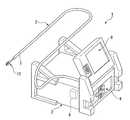
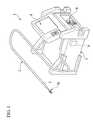
- FIG. 1illustrates first and fifth embodiments of the endoscopic apparatus according to the present invention in a schematic view.
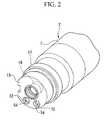
- FIG. 2illustrates the tip of the insertion section of the endoscopic apparatus of FIG. 1 in an enlarged perspective view.
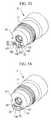
- FIG. 3is an enlarged view of the optical adapter shown in FIG. 1 viewed from the base end including an attaching hood approximately half of which is illustrated in a cutout view.
- FIG. 4illustrates the adapter electrode section of FIG. 3 in an enlarged perspective view.
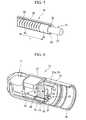
- FIG. 5is a half-cutaway view of a hollow casing shown in FIG. 4 .
- FIG. 6is a half-cutaway view of a hollow casing shown in FIG. 3 .
- FIG. 7illustrates the substantial peripheral part of the adapter electrode section shown in FIG. 6 in a cross sectional view.
- FIG. 8illustrates a modified example of the adapter electrode section shown in FIG. 5 in a perspective view additionally having a resilient member.
- FIG. 9illustrates another modified example of the adapter electrode section shown in FIG. 5 in a perspective view using air as a resilient member.
- FIG. 10illustrates another modified example of the adapter electrode section shown in FIG. 5 in a perspective view additionally having a sealing member.
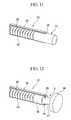
- FIG. 11illustrates another modified example of the adapter electrode section shown in FIG. 5 in a perspective view additionally having a columnar electrode terminal.
- FIG. 12illustrates another modified example of the adapter electrode section shown in FIG. 5 in a perspective view additionally showing a large diameter portion at the tip of the terminal.
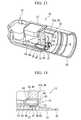
- FIG. 13illustrates modified examples of the hollow casing, the insulative casing, and inner peripheral wall section shown in FIG. 6 where an outward flange section is disposed to the hollow casing.
- FIG. 14illustrates the substantial peripheral part of the adapter electrode section shown in FIG. 13 in a cross sectional view.
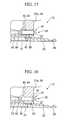
- FIG. 15illustrates modified examples of the hollow casing, the insulative casing, inner peripheral wall section that are shown in FIG. 14 , and the substantial peripheral part of the adapter electrode section.
- FIG. 16illustrates other modified examples of the hollow casing, the insulative casing, inner peripheral wall section that are shown in FIG. 14 , and the substantial peripheral part of the adapter electrode section.
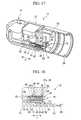
- FIG. 17illustrates modified examples of the hollow casing, the insulative casing, and inner peripheral wall section, where a counterpart terminal is disposed to the hollow casing.
- FIG. 18illustrates the substantial peripheral part of the adapter electrode section shown in FIG. 17 in a cross sectional view.
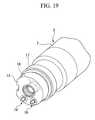
- FIG. 19shows a substantial part of the endoscopic apparatus including the tip of the insertion section according to the second embodiment of the present invention.
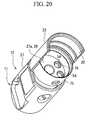
- FIG. 20shows a substantial part of the endoscopic apparatus of the second embodiment in a perspective view including a half cutaway view of the attaching hood of the optical adapter viewed from the base end.
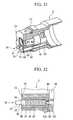
- FIG. 21is a perspective half-cutaway view of the insertion section shown in FIG. 19 .
- FIG. 22illustrates the substantial peripheral part of the insertion electrode section shown in FIG. 21 in a cross sectional view.
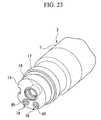
- FIG. 23shows a substantial part of the endoscopic apparatus including the tip of the insertion section according to the third embodiment of the present invention.
- FIG. 24shows a substantial part of the endoscopic apparatus of the third embodiment in a perspective view including a half cutaway view of the attaching hood of the optical adapter viewed from the base end.
- FIG. 25illustrates the adapter electrode section of FIG. 24 in an enlarged perspective view.
- FIG. 26is a half-cutaway view of a hollow casing shown in FIG. 24 .
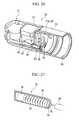
- FIG. 27illustrates a modified example of the adapter electrode section shown in FIG. 25 .
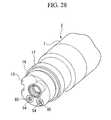
- FIG. 28shows a substantial part of the endoscopic apparatus including the tip of the insertion section according to the fourth embodiment of the present invention.
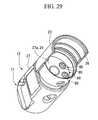
- FIG. 29shows a substantial part of the endoscopic apparatus of the fourth embodiment in a perspective view including a half cutaway view of the attaching hood of the optical adapter viewed from the base end.
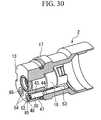
- FIG. 30is a perspective half-cutaway view of the insertion section shown in FIG. 28 .
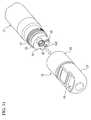
- FIG. 31illustrates the insertion section of the endoscopic apparatus shown in FIG. 1 including the attaching surface to which the optical adapter is detachably attached.
- FIG. 32is an enlarged view of the optical adapter shown in FIG. 1 viewed from the base end including an attaching hood approximately half of which is illustrated in a cutout view.
- FIG. 33illustrates the substantial peripheral part of the adapter electrode section shown in FIG. 32 in a cross sectional view.
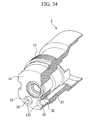
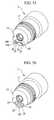
- FIG. 34is an enlarged half cutaway view of the tip of the insertion section viewed from the tip.
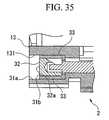
- FIG. 35illustrates the substantial peripheral part of the insertion electrode section shown in FIG. 34 in a cross sectional view.
- FIG. 36illustrates a modified example of the insertion section electrode shown in FIG. 34 in a perspective view including a half cutaway view of a cylindrical main body.
- FIG. 37illustrates another modified example of the insertion section electrode shown in FIG. 34 in a perspective view including a half cutaway view of the cylindrical main body.
- FIG. 38illustrates modified examples of a recess and the insertion section electrode that are shown in FIG. 31 .
- FIG. 39illustrates modified examples of the recess and the insertion section electrode that are shown in FIG. 31 and a notch section formed on the recess shown in FIG. 38 .
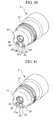
- FIG. 40illustrates modified examples of two recesses and the insertion section electrode that are shown in FIG. 31 and a notch section formed on each recess shown in FIG. 31 .
- FIG. 41illustrates modified examples of FIG. 31 having a recess having a plurality of insertion section electrodes.
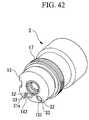
- FIG. 42illustrates modified examples of the recess and the insertion section electrodes that are shown in FIG. 31 and a notch section formed on the recess shown in FIG. 41 .
- FIG. 43shows a substantial part of the endoscopic apparatus including a half cutaway view of the tip of the insertion section according to the sixth embodiment of the present invention.
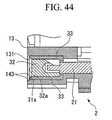
- FIG. 44illustrates the substantial peripheral part of the insertion electrode section shown in FIG. 43 in a cross sectional view.
- FIG. 45shows a substantial part of the endoscopic apparatus including a half cutaway view of the tip of the insertion section according to the seventh embodiment of the present invention.
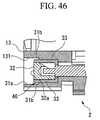
- FIG. 46illustrates the substantial peripheral part of the insertion electrode section shown in FIG. 45 in a cross sectional view.
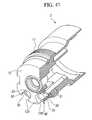
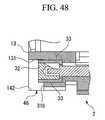
- FIG. 47illustrates a modified example of a groove shown in FIG. 45 in a perspective view including a half cutaway view of the tip of the insertion section.
- FIG. 48illustrates the substantial peripheral part of the insertion electrode section shown in FIG. 47 in a cross sectional view.
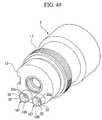
- FIG. 49illustrates substantial parts of the eighth embodiment of the endoscopic apparatus according to the present invention in a perspective view.
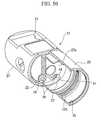
- FIG. 50illustrates the optical adapter viewed from the base end according to an embodiment including a half cutaway view of the base end section.
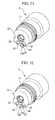
- FIG. 51illustrates modified examples of a projecting section and the insertion section electrode that are shown in FIG. 49 .
- FIG. 52illustrates modified examples of the recess and the insertion section electrodes that are shown in FIG. 49 and a notch section formed on the recess shown in FIG. 51 .
- FIG. 53is a perspective view illustrating modified examples of two projecting sections and the insertion section electrode that are shown in FIG. 49 and a notch section formed on each projecting section.
- FIG. 54illustrates modified examples of FIG. 49 having a projecting section having a hollow section accommodating a plurality of the insertion section electrodes.
- FIG. 55illustrates modified examples of the projecting section and the insertion section electrodes that are shown in FIG. 49 and a notch section formed on the projecting section shown in FIG. 54 .
- FIG. 56illustrates modified examples of a projecting section and the insertion section electrodes that are shown in FIG. 49 where a columnar projecting section is provided between the electrodes.
- FIG. 1illustrates the endoscope device according to the first embodiment of the present invention.
- An endoscope apparatus 1is provided with an insertion section 2 (endoscopic insertion section) having a bending section 7 capable of bending; and a main body section 3 variously operable when used with the insertion section 2 inserted thereinto.
- the approximately box-shaped main body section 3has a side wall section onto which an operation panel 6 used for carrying out various operations is disposed.
- a monitor 8 for exhibiting an observed imageis disposed on a ceiling of the main body section 3 .
- a power supply section 9 for supplying electric poweris disposed to the main body section 3 .
- the base end section of the insertion section 2is configured to be detachably attached to the main body section 3 through a connecting section which is not shown in the drawings.
- an observing unit using a CCD 16is disposed onto the tip thereof as shown in FIG. 2 .
- a fitting-protrusion section 17is disposed over the circumference of the insertion section 2 while protruding outwardly in a radial direction.
- An insertion section-mounting surface 13is disposed on the tip of the insertion section 2 so that an optical adapter 12 (shown in FIG. 1 ) having an object lens which is not shown in the drawing is detachably attached onto the surface 13 .
- Fixed onto the insertion section-mounting surface 13is an insertion section electrode section 32 which is electrically connected to the power supply section 9 shown in FIG. 1 .
- the insertion section electrode section 32will be explained afterwards.
- the optical adapter (endoscope adapter) 12is provided with an adapter main body 27 having an approximate columnar shape; and an attachment hood section 23 having an approximate cylindrical shape and being coaxially joined to the base end of the adapter main body 27 .
- a lighting section 11having, for example LEDs.
- an adapter-mounting surface 29is formed on the bottom surface section 27 a of the adapter main body 27 by way of which the optical adapter 12 is attached to the insertion section 2 .
- a movable adapter electrode section 18electrically connected to the lighting section 11 .
- the adapter electrode section 18will also be explained afterwards.
- a mounting groove 26formed on the inner periphery of the attachment hood section 23 is a mounting groove 26 extending over the circumference of the hood 23 .
- the adapter electrode section 18is provided with a hollow casing 30 having a bottom section and a cylindrical section and an approximate columnar electrode terminal 31 .
- the hollow casing 30possesses electrical conductivity and is made from nonferrous metals and ferrous metals, e.g., iron.
- an inward flange section 34 formed on one end of the hollow casing 30 in a longitudinal direction Lis inwardly directed in a radial direction of the casing 30 . Crimping the end of the hollow casing 30 provides the inward flange section 34 .
- the inward flange section 34also defines a circular opening section 35 on the end of the hollow casing 30 .
- the electrode terminal 31is further provided with a columnar terminal tip section 37 and a terminal base end section 38 .
- the terminal tip section 37is coaxially jointed to the terminal base end section 38 in one unit.
- the terminal tip section 37projects from the hollow casing 30 through the opening section 35 formed at the end of the casing 30 .
- the inner diameter of the opening section 35is set to be the same as the outer diameter of the terminal tip section 37 , so disposing the terminal tip section 37 into the opening section 35 blocks the opening section 35 .
- the same dimensions with respect to the inner diameter of the opening section and the outer diameter of the tip of the terminalindicate that there is a clearance that allows the tip of the terminal to slidably move through the opening section.
- the terminal base end section 38 greater than the terminal tip section 37 in diameteris configured to slidably move in the tubular hole 39 (hollow casing) of the hollow casing 30 in the longitudinal direction L.
- the movement of the terminal base end section 38 in the tubular hole 39allows the terminal tip section 37 to project from and retract into the opening section 35 formed at the end of the hollow casing 30 .
- the terminal base end section 38makes contact with the inward flange section 34 before the terminal base end section 38 moves out of the opening section 35 . That is, the inward flange section 34 works as a retainer against the electrode terminal 31 .
- a coil spring (urging member) 42Provided between the terminal base end section 38 and the bottom section inside the hollow casing 30 is a coil spring (urging member) 42 .
- the force exerted by the coil spring 42presses the terminal base end section 38 at the end of the hollow casing 30 , thereby maintaining the terminal tip section 37 to project outward from the end of the hollow casing 30 .
- the coil spring 42is made from electrically conductive metal.
- the insulative casing 47has a bottom section, a cylinder section, and a cylindrical hole into which the adapter electrode section 18 is inserted and fixed there.
- the bottom surface of the hollow casing 30makes contact with the bottom surface section 47 a of the insulative casing 47 .
- Formed at the end of the insulative casing 47is a flange section 48 extending outward in the radial direction of the insulative casing 47 .
- a through hole 49is formed in the center of the bottom surface section 47 a of the insulative casing 47 .
- the endoscope adapteris inserted into the insulative casing 47 inserted in the adapter electrode section 18 is attached in the electrode-mounting hole 43 formed in the optical adapter 12 . That is, the inner peripheral wall section 44 defining the electrode-mounting hole 43 works as an attaching portion accommodating the hollow casing 30 and the insulative casing 47 thereon.
- the terminal tip section 37projects from the adapter-mounting surface 29 while the adapter electrode section 18 is mounted in the electrode-mounting hole 43 .
- a portion of the bottom surface section 27 a disposed at one longitudinal end of the inner peripheral wall section 44has a step section 52 with which the outward-extending flange section 48 makes contact.
- the force needed to push the adapter electrode section 18 into the optical adapter 12is supported by the bottom surface section 47 a of the insulative casing 47 , thereby restraining the movement of the hollow casing 30 inward, i.e., toward the inside of the optical adapter 12 in this configuration. Furthermore, the force pushing the insulative casing 47 into the optical adapter 12 is supported by the step section 52 , thereby restraining the movement of the insulative casing 47 into the optical adapter 12 . That is, the bottom surface section 47 a of the insulative casing 47 serves for restraining the movement of the hollow casing; and the step section 52 and the outward-extending flange section 48 serve for restraining the movement of the insulative member.
- the insulative casing 47furthermore serves for providing insulation to the hollow casing 30 and the inner peripheral wall section 44 .
- An end of a cable 53 inserted through the through hole 49 into the insulative casing 47is electrically soldered to the outer surface of the bottom of the hollow casing 30 .
- the other end of the cable 53is electrically connected to the lighting section 11 .
- Reference numeral 50indicates the soldered portion.
- the insertion section-mounting surface 13 of the insertion section 2furthermore has recesses 54 accommodating insertion section electrode sections 32 each having a bottom and a cylinder section.
- the innermost section of each insertion section electrode section 32is bent inner more in the radial direction than the recess 54 .
- each insertion section electrode section 32subsides inward of the insertion section 2 relative to the insertion section-mounting surface 13 .
- Each insertion section electrode section 32is concealed from the insertion section-mounting surface 13 by a sidewall section of the recess 54 .
- highly conductive plating or paintingis applied to the surface of the insertion section electrode section 32 made of metal.
- the optical adapter 12is first attached onto the insertion section-mounting surface 13 of the insertion section 2 .
- the terminal tip section 37is subsequently disposed in the recess 54 and makes contact with the outer surface of the bottom of the insertion section electrode section 32 .
- the lighting section 11 of the insertion section 2 introduced into an object subject to inspectionemits light.
- the light reflected by the object subject to inspectionpasses through object lenses in the optical adapter 12 and an image thereof is formed on a CCD 16 .
- a signal output from the CCD 16is supplied to a monitor 8 through a predetermined circuit. This provides an observed image exhibited on the monitor 8 used for a predetermined inspection of the object.
- the adapter electrode section 18is electrically connected to the insertion section electrode section 32 upon coupling the optical adapter 12 to the insertion section-mounting surface 13 .
- the optical adapter 12is brought to the tip of the insertion section 2 and pushed thereinto while the insertion section-mounting surface 13 faces the adapter-mounting surface 29 .
- the terminal tip section 37is subsequently disposed in the recess 54 and makes contact with the insertion section electrode section 32 . Pushing furthermore the optical adapter 12 thereinto causes the insertion section electrode section 32 to press the terminal tip section 37 innermore toward the optical adapter 12 .
- the terminal tip section 37moves in the subsiding direction into the hollow casing 30 through the opening section 35 .
- the terminal base end section 38resisting the force exerted by the coil spring 42 moves in the hollow casing 30 into the optical adapter 12 .
- the constant interspaceis maintained between the exterior wall of the terminal tip section 37 and the inner wall of the opening section 35 when the cylindrical terminal tip section 37 moves into the hollow casing 30 through the opening section 35 .
- Configuring the outer diameter of the terminal tip section 37 to be the same as the inner diameter of the opening section 35blocks the interspace between the exterior wall of the terminal tip section 37 and the inner wall of the opening section 35 irrespective of the position of the terminal tip section 37 .
- the fitting-protrusion section 17 of the insertion section 2fits with a mounting groove 26 while the terminal tip section 37 is depressed; thus, the optical adapter 12 is attached onto the tip of the insertion section 2 .
- the projection of the terminal tip section 37 in length from the adapter-mounting surface 29 through the opening section 35reduces according to the depression caused by the insertion section electrode section 32 .
- the terminal tip section 37is further pressed toward the insertion section electrode section 32 by the force exerted by the coil spring 42 .
- the contact between the terminal tip section 37 and the insertion section electrode section 32is therefore maintained. This configuration allows the adapter electrode section 18 to be electrically connected to the insertion section electrode section 32 .
- the hollow casing 30 and the insulative casing 47 subject to the pressing forceare apt to move into the optical adapter 12 when the optical adapter 12 is attached onto the tip of the insertion section 2 , the movements of these casings 30 and 47 are restrained by making contacts with the bottom surface section 47 a of the insulative casing 47 and the step section 52 .
- the present embodimentdoes not allow the interspace between the exterior wall of the terminal tip section 37 and the inner wall of the opening section 35 while the optical adapter 12 is attached to the insertion section 2 .
- the circular shapes of the opening section 35 and the terminal tip section 37not only allow smooth movement of the terminal tip section 37 through the opening section 35 but provide a uniform block between the inner wall of the opening section 35 and the exterior wall of the terminal tip section 37 .
- the terminal tip section 37 mounted in the hollow casing 30 through the opening section 35is pushed by the force exerted by the coil spring 42 ; thus coupling the optical adapter 12 into the insertion section 2 results in secure connection between the adapter electrode section 18 and the insertion section electrode section 32 .
- the electric power supplied by the power supply section 9can be further supplied to the lighting section 11 through the coil spring 42 and the hollow casing 30 that are electrically conductive.
- the efficiencythus increases in supplying electricity.
- the electrical resistance of the coil spring 42is significant because of its insignificant cross sectional area and significant longitudinal length, insignificant electrical resistance in the hollow casing 30 having a significant cross sectional area and insignificant longitudinal length connected to the cable 53 help to efficiently supply the electric power in the present embodiment.
- the isolation between the hollow casing 30 and the inner peripheral wall section 44 obtained by the insulative casing 47can lower the electrical loss of the adapter electrode section 18 .
- the insertion section electrode section 32subsides from the insertion section-mounting surface 13 , i.e., is concealed from the insertion section-mounting surface 13 , thereby resisting damage of the insertion section electrode section 32 and preventing dust from entering or sticking there with the optical adapter 12 detached. The cleanness of the insertion section electrode section 32 can be thus maintained effectively.
- the inward flange section 34 formed to the hollow casing 30prevents the removal of the electrode terminal 31 from the hollow casing 30 while allowing smooth movement of the electrode terminal 31 .
- the bottom surface section 47 a and the step section 52 that are formed to the insulative casing 47restrain the hollow casing 30 and the insulative casing 47 from moving inward into the optical adapter 12 , thereby facilitating fixing the hollow casing 30 and the insulative casing 47 to the inner peripheral wall section 44 and maintaining suitable contact between the adapter electrode section 18 and the insertion section electrode section 32 in the long term.
- coupling the optical adapter 12 to the insertion section 2connects the the radially-inner surface of the insertion section electrode section 32 to an end surface of the terminal tip section 37 , thereby providing an interfacial contact between the insertion section electrode section 32 and the adapter electrode section 18 .
- the electrical conductivity between the insertion section electrode section 32 and the adapter electrode section 18can be obtained in the case of lower component quality or lower assembly accuracy.
- the highly conductive plating or painting provided onto the insertion section electrode section 32 and the electrode terminal 31lowers the electrical loss between the insertion section electrode section 32 and the adapter electrode section 18 .
- the hollow casing 30 , electrode terminal 31 , coil spring 42 , and insulative casing 47 provided in the present embodimentare susceptible to modifications in arbitrary shape and material.
- an elastic member (urging member) 57may be provided as shown in FIG. 8 in place of the coil spring 42 .
- the elastic member 57 made of conductive resinallows supplying the electrical power efficiently in an improved manner.
- the configuration free of the coil spring 42 as shown in FIG. 9may also be desirable.
- This caserequires the hollow casing 30 to be of an airtight construction.
- the reciprocation of the electrode terminal 31expands and contracts the air in the tubular hole 39 , thereby rendering the air an urging member.
- a rubber sealing material 58may be provided to the tip of the hollow casing 30 as shown in FIG. 10 . This prevents water from entering into the adapter electrode section 18 , thereby preventing corrosion and failure due to the submergence.
- the electrode terminal 31may be a column having an identical diameter over the longitudinal length as shown in FIG. 11 . This facilitates the production of the electrode terminal 31 . This case requires to fix the tip of the coil spring 42 to the rear end of the electrode terminal 31 and to fix the rear end of the coil spring 42 to the inner bottom surface of the hollow casing 30 . This configuration eliminates the need of the inward flange section 34 , thereby simplifying the configuration.
- a large-diameter tip section 59 having a larger diameter than that of the terminal tip section 37may be formed at the tip of the terminal tip section 37 as shown in FIG. 12 .
- Thisprovides contact between the large-diameter tip section 59 and the insertion section electrode section 32 , thereby increasing the area contacting the insertion section electrode section 32 . Therefore, superior conductivity can be obtained between the adapter electrode section 18 and the insertion section electrode section 32 in the case of lower component quality or lower assembly accuracy.
- an outward flange section 62may be provided to the tip of the hollow casing 30
- a step section 63 contacting the outward flange section 62may be provided to the tip of the insulative casing 47 .
- the outward flange section 62 and the step section 63serve for restraining the movement of the hollow casing.
- an engagement step section 64is disposed in the vicinity of the base end section of the insulative casing 47 ; and a counter-engagement step section 66 engaging the engagement step section 64 is formed to the inner peripheral wall section 44 near a coupling part.
- the engagement step section 64 and the counter-engagement step section 66serve for restraining the movement of the insulative component.
- the insulative casing 47may be cylindrical and the hollow casing 30 may have a bottom section and a cylinder section as shown in FIG. 15 in place of providing a step section or an outer flange section to the inner peripheral wall section 44 , insulative casing 47 , and hollow casing 30 .
- This caserequires the insulative casing 47 to be fixed to the hollow casing 30 using adhesives, etc.
- the adapter electrode section 18may be directly mounted into the inner peripheral wall section 44 , i.e., without the insulative casing 47 .
- the hollow casing 30may be made of an insulative material, and the hollow casing 30 may be anodized so as to provide insulation on the surface thereof.
- the inner peripheral wall section 44may be made of an insulative material and the surface of the inner peripheral wall section 44 may be treated to impart insulation there.
- An inward flange section 34 defining the circular other counterpart opening section 68may be provided to the other end in the longitudinal direction L of the hollow casing 30 .
- another columnar end terminal 69provided to the other end of the hollow casing 30 is another columnar end terminal 69 .
- the other end terminal 69 having a configuration similar to that of the electrode terminal 31is provided with a columnar connection terminal section 70 and a terminal base plate section 71 .
- connection terminal section 70projects from the other end of the hollow casing 30 through the other counterpart opening section 68 .
- the inner diameter of the other counterpart opening section 68is set to be the same as the outer diameter of the connection terminal section 70 , so disposing the connection terminal section 70 into the other counterpart opening section 68 blocks the other counterpart opening section 68 . This prevents dusts from entering there through the other counterpart opening section 68 .
- the terminal base plate section 71is movable in the longitudinal direction L of the tubular hole 39 in the hollow casing 30 .
- the movement of the terminal base plate section 71 in the tubular hole 39 similarly to the electrode terminal 31enables the reciprocation of the connection terminal section 70 from the other end of the hollow casing 30 through the other counterpart opening section 68 .
- the force exerted by the coil spring 42presses the terminal base plate section 71 at the other end of the hollow casing 30 , thereby urging the connection terminal section 70 outward from the other end of the hollow casing 30 .
- the insulative casing 47 mounted into the electrode-mounting hole 43is configured to be detachable from the mounted condition.
- the insulative casing 47 including the adapter electrode section 18is configured to be replaceably mounted in the electrode-mounting hole 43 .
- connection terminal section 70Inserting and pushing the adapter electrode section 18 into the insulative casing 47 at a predetermined position allow the connection terminal section 70 to project through the through hole 49 in this configuration. In addition, equalizing the outer diameter of the connection terminal section 70 to the inner diameter of the through hole 49 blocks the through hole 49 .
- the electrical connection between the other end terminal 69 and the connecting section 73is maintained because the connection terminal section 70 is pushed by the force exerted by the coil spring 42 toward the connecting section 73 .
- the adapter electrode section 18In the case of failure of the adapter electrode section 18 , the adapter electrode section 18 is removed together with the insulative casing 47 , and another set of adapter electrode section 18 and insulative casing 47 is mounted to the inner peripheral wall section 44 as described above.
- the adapter electrode section 18may be replaceably mounted in the insulative casing 47 .
- the adapter electrode section 18regardless of its direction is facile in the above configuration. Also, the reciprocation of the other end terminal 69 absorbs dimensional error in each component. Also, the replaceable adapter electrode section 18 facilitates repairing the optical adapter 12 . The absence of necessity for fixing the other end terminal 69 to the connecting section 73 also facilitates replacing the adapter electrode section 18 .
- FIGS. 19 to 22illustrate the second embodiment of the present invention.
- the adapter electrode section 18 and the insertion section electrode section 32 illustrated in the first embodimentare interchangeably disposed in the endoscope apparatus 1 of the present embodiment.
- an insertion section electrode section 74 according to the present embodimenthas the same configuration as that of the adapter electrode section 18 according to the above first embodiment; and the adapter electrode section 75 according to the present embodiment has the same configuration as that of the insertion section electrode section 32 according to the above first embodiment. Accordingly, the adapter electrode section 75 is of a fixed type, and the insertion section electrode section 74 is of a movable type as explained above.
- the adapter electrode section 75is electrically connected to the insertion section electrode section 74 upon coupling the optical adapter 12 to the insertion section 2 .
- the opening section 35is closed in this state.
- FIGS. 23 to 26illustrate the third embodiment of the present invention.
- an insertion section electrode section 78is of a fixed type, and an adapter electrode section 79 is of a movable type according to the present embodiment.
- the insertion section electrode section 78is provided with a projecting terminal (electrode terminal) 80 which is fixed on and projects from the insertion section-mounting surface 13 .
- the adapter electrode section 79is provided with a columnar inner-casing connection terminal 83 as illustrated in FIGS. 25 and 26 in place of the electrode terminal 31 .
- highly conductive plating or paintingis applied to the surface of the inner-casing connection terminal 83 made of metal.
- the inner-casing connection terminal 83 movable in the longitudinal direction Lis also urged by the coil spring 42 toward the opening section 35 .
- the inner diameter of the opening section 35 and the outer diameter of the projecting terminals 80are configured to be the same.
- Coupling the optical adapter 12 to the insertion section 2 in this configurationinserts the projecting terminals 80 into the hollow casing 30 through the recess 54 and the opening section 35 .
- the contact between the projecting terminals 80 and the inner-casing connection terminal 83provides electrical connection between the adapter electrode section 79 and the insertion section electrode section 78 .
- the effect similar to that of the above first embodimentcan be obtained by the endoscope apparatus 1 according to the present embodiment; and the rigidity of the fixed projecting terminals 80 can be significant.
- the configuration of the present inventionis not limited to the use of the inner-casing connection terminal 83 , that is, the configuration free of the inner-casing connection terminal 83 is also practicable.
- the projecting terminals 80make contact with the tip of the coil spring 42 through the opening section 35 .
- This configurationallows the adapter electrode section 79 to be electrically connected to the insertion section electrode section 78 .
- FIGS. 28 to 30illustrate the fourth embodiment of the present invention.
- the adapter electrode section 79 and the insertion section electrode section 78 illustrated in the third embodimentare interchangeably disposed in the endoscope apparatus 1 of the present embodiment.
- an insertion section electrode section 85 according to the present embodimenthas the same configuration as that of the adapter electrode section 79 according to the above third embodiment; and the adapter electrode section 86 according to the present embodiment has the same configuration as that of the insertion section electrode section 78 according to the above third embodiment. Accordingly, the adapter electrode section 86 is of a fixed type, and the insertion section electrode section 85 is of a movable type.
- the adapter electrode section 86is electrically connected to the insertion section electrode section 85 upon coupling the optical adapter 12 to the insertion section 2 .
- the opening section 35is closed in this state.
- the opening section 35 and other counterpart opening section 68that are circular through the above first to fourth embodiments; and the electrode terminal 31 , the other end terminal 69 , and projecting terminals 80 that are columnar through the above embodiments.
- the transverse cross section of the electrode terminal 31 , etc.may be oval, and the electrode terminal 31 may be a rectangular parallelepiped.
- adapter electrode sections 18 , 75 , 79 , and 86are not limited to be connected to the lighting section 11 . These may rather be connected to other sensors and electronic components, e.g., adapter recognition sensors and temperature humidity sensors.
- the present inventionis not limited to the optical adapter 12 of a lateral view type having the lighting section 11 on a side wall section.
- the lighting section 11may rather be of a direct view type provided onto the tip of the optical adapter 12 .
- the first to fourth embodiments above having disclosed the electrodes disposed to one of the adapter and the insertion sectionmay include the configuration of one electrode to the adapter and the other one to the insertion section.
- the adapter and the insertion sectionmay each have two electrodes in another configuration. This configuration advantageously maintains an adapter and an insertion section to be small in outside shape.
- FIG. 1illustrates the endoscope device according to the fifth embodiment of the present invention.
- the endoscope apparatus 1is provided with an insertion section 2 (endoscopic insertion section) having a bending section 7 capable of bending; and a main body section 3 (endoscope main body section) variously operable when used with the insertion section 2 inserted thereinto.
- the approximately box-shaped main body section 3has a side wall section onto which an operation panel 6 is disposed used for carrying out various operations.
- a monitor 8 for exhibiting an observed imageis disposed on a ceiling of the main body section 3 .
- a power supply section 9 for supplying electric poweris disposed to the main body section 3 .
- the base end section of the insertion section 2is configured to be detachably attached to the main body section 3 through a connecting section which is not shown in the drawings.
- an observing unit using a CCD 16is disposed onto the tip thereof as shown in FIG. 31 .
- a fitting-protrusion section 17is disposed extending over the circumference of the insertion section 2 .
- An insertion section-mounting surface 13is disposed on the tip of the insertion section 2 so that an optical adapter (adapter) 12 having an object lens which is not shown in the drawing is detachably attached onto the surface 13 .
- the optical adapter 12is provided with an approximately columnar adapter main body 27 and an approximately cylindrical attachment hood section 23 as shown in FIG. 32 .
- the adapter main body 27is coaxially and rotatably coupled to the attachment hood section 23 .
- a lighting section 11having, for example, LEDs.
- an adapter electrode section 18Provided on a bottom surface section 27 a of the adapter main body 27 is an adapter electrode section 18 connected to the lighting section 11 through a cable 21 shown in FIG. 33 .
- Highly conductive plating or paintingis applied to the surface of the adapter electrode section 18 made of nonferrous metals or ferrous metals, e.g., iron.
- the adapter electrode section 18is also provided with protrusion electrode sections 28 projecting from the bottom surface section 27 a outward in the longitudinal direction of the optical adapter 12 .
- an insulative member 22Provided around the adapter electrode section 18 is provided around the adapter electrode section 18 .
- a first female thread section 25 and a second female screw section 126are cut fully on the inner periphery of the attachment hood section 23 so that a predetermined interval is disposed between the screw sections.
- the first female thread section 25works as a retainer restraining the optical adapter 12 from removing from the insertion section 2 .
- each recesses 131each accommodating thereinside an insertion section electrode section 32 having a bottom section and a cylinder section.
- an end surface section 32 a of the insertion section electrode section 32is disposed to be flush with the bottom surface section 31 b .
- the insertion section electrode section 32is therefore disposed recessed relative to the mounting surface 13 toward the insertion section 2 .
- the insertion section electrode section 32is further connected to the power supply section 9 as shown in FIG. 1 through the cable 21 . Attaching then the optical adapter 12 to the mounting surface 13 provides contact between the protrusion electrode section 28 and the end surface section 32 a of the insertion section electrode section 32 , thereby providing electrical connection between the adapter electrode section 18 and the insertion section electrode section 32 and thus supplying electrical power from the power supply section 9 to the lighting section 11 .
- an insulative member 33Provided around the insertion section electrode section 32 .
- a selected one of desirable optical adapter 12is attached first to the mounting surface 13 of the insertion section 2 as explained previously. This electrically connects the adapter electrode section 18 to the insertion section electrode section 32 , thereby supplying electric power to the lighting section 11 from the power supply section 9 .
- the lighting section 11 of the insertion section 2 introduced into a object subject to inspectionemits light. The light reflected by the object subject to inspection passes through object lenses in the optical adapter 12 and an image thereof is formed on a CCD 16 .
- a signal output from the CCD 16is supplied to a monitor 8 through a predetermined circuit. This provides an observed image exhibited on the monitor 8 used for a predetermined inspection of the object.
- the optical adapter 12 attached to the mounting surface 13is detached and replaced by another optical adapter 12 required for inspecting another object. Another selected one of the optical adapter 12 is then attached to the mounting surface 13 . This is how the optical adapters 12 are exchanged.
- the insertion section electrode section 32 accommodated in the recess 131is surrounded by the side wall section 31 a forming the recess 131 while the optical adapter 12 is in the detached state in the present embodiment. This conceals the insertion section electrode section 32 behind the mounting surface 13 .
- the endoscope apparatus 1advantageously prevents the appearance of the insertion section electrode section 32 from the mounting surface 13 with the optical adapter 12 detached. Accordingly, the insertion section electrode section 32 can be protected from short circuit, failure, and dust entry, thereby maintaining the insertion section electrode section 32 clean with the optical adapter 12 detached from the insertion section 2 .
- the insertion section electrode section 32 having the bottom section, the cylinder section, and the end surface section 32 a directed outwardis effectively protected from dust entry.
- coupling the optical adapter 12 to the mounting surface 13connects the end surface section 32 a of the insertion section electrode section 32 to the tip of the protrusion electrode section 28 , thereby providing an interfacial contact between the insertion section electrode section 32 and the adapter electrode section 18 .
- the electrical conductivity between the insertion section electrode section 32 and the adapter electrode section 18can be obtained in the case of lower component quality or lower assembly accuracy.
- the highly conductive plating or painting provided onto the insertion section electrode section 32 and the adapter electrode section 18lowers the electrical loss between the insertion section electrode section 32 and the adapter electrode section 18 .
- the present embodimentis not limited to the configuration disclosing the protrusion electrode section 28 fixed to the adapter electrode section 18 and the end surface section 32 a fixed to the insertion section electrode section 32 , i.e., at least one of them may be movable.
- the insertion section electrode section 32 as shown in FIG. 36may comprise a main body cylinder section 137 having a bottom section and a cylinder section; a spring 138 disposed in the main body cylinder section 137 ; and a columnar electrode terminal section 139 disposed to the tip of the spring 138 so as to be movable in the longitudinal direction of the main body cylinder section 137 .
- the tip of the main body cylinder section 137is then disposed at the bottom surface section 31 b forming the recess 131 .
- Coupling the optical adapter 12 to the mounting surface 13 in this configurationinserts the protrusion electrode section 28 into the main body cylinder section 137 through the opening 41 disposed at the tip of the main body cylinder section 137 .
- the electrode terminal section 139moves accordingly while resisting the thrust force exerted by the spring 138 . This facilitates the connection between the protrusion electrode section 28 and the end surface section 32 a , and the resilience of the spring 138 absorbs manufacturing error in the adapter electrode section 18 and the insertion section electrode section 32 , etc.
- Equalizing the outer diameter of the protrusion electrode section 28 to the inner diameter of the opening 41provides the constant blockage of the interspace between the protrusion electrode section 28 and the opening 41 irrespective of the position of the protrusion electrode section 28 inserted into the insertion section electrode section 32 , thereby more effectively preventing dust entry.
- FIG. 1Another configuration having only a spring 138 in the main body cylinder section 137 , i.e., without the electrode terminal section 139 may be practicable. Coupling the optical adapter 12 to the mounting surface 13 in this configuration inserts the protrusion electrode section 28 into the main body cylinder section 137 through the opening 41 disposed at the tip of the main body cylinder section 137 . The spring 138 contacting the tip of the protrusion electrode section 28 is then thrusted. This simple configuration facilitates the electrical connection between the protrusion electrode section 28 and the spring 138 .
- the number of the recesses 131 and insertion section electrode sections 32 disposed in the present embodimentmay be modified arbitrarily irrespective of the previously described disposition in which one recess 131 has one insertion section electrode section 32 .
- insertion section electrode sections 32may practicably be disposed.
- FIG. 38illustrates an example in which a recess 131 disposed on the mounting surface 13 has an insertion section electrode section 32 , and an insertion section electrode 32 ′ is disposed on a portion of the mounting surface 13 except the recess 131 .
- FIG. 41practicably shows an example in which two insertion section electrodes 32 a are disposed in a recess 131 .
- the simple and low cost configuration that can be shortly obtainedfacilitates cleaning inside the recess 131 .
- the number of insertion section electrode sections 32 disposed in the recess 131 in this casemay not be limited to two, i.e., it can be arbitrarily modified. That is, a plurality of insertion section electrode sections 32 may be disposed in one common recess 131 formed on the mounting surface 13 ; and some of the insertion section electrode sections 32 may be separately disposed at a plurality of recesses 131 . Alternatively, some of the insertion section electrode sections 32 may be disposed in the recess 131 .
- FIG. 40practicably shows an example in which two recesses 131 each has a notch section 142 .
- FIG. 41practicably shows an example in which two insertion section electrodes 32 a are disposed in a recess 131 .
- the simple and low cost configuration that can be shortly obtainedfacilitates cleaning inside the recess 131 .
- the number of insertion section electrodes 32 disposed in the recess 131 in this casemay not be limited to two, i.e., it can be arbitrarily modified. That is, a plurality of insertion section electrodes 32 may be disposed in one common recess 131 formed on the mounting surface 13 ; and some of the insertion section electrodes 32 may be separately disposed at a plurality of recesses 131 . Alternatively, some of the insertion section electrodes 32 may be disposed in the recess 131 .
- FIG. 42practicably shows an example in which the recess 131 accommodates a plurality of insertion section electrode sections 32 and has a notch section 142 .
- FIGS. 33 to 44illustrate the sixth embodiment of the present invention.
- a side wall section 31 a of the recess 131is configured to incline so as to gradually expand in a radial direction outward relative to the recess 131 .
- the side wall section 31 ais a tapered section (recess section's tapered section) 143 .
- the inclination of the tapered section 143prevents dusts from entering the recess 131 and sticking thereto.
- the configuration described aboveprevents dusts from clogging in the vicinity of the insertion section electrode section 32 , thereby improving the workability in cleaning inside the recess 131 .
- FIGS. 45 and 46illustrate the seventh embodiment of the present invention.
- An end surface section 32 a of the insertion section electrode section 32projects more frontward relative to a bottom surface section 31 b of the recess 131 in the present embodiment. That is, a groove (groove in a recess) 46 extends around and in the vicinity of the circumference of the insertion section electrode section 32 .
- the present inventionis not limited to the configuration in which the groove 46 extending over the circumference of the insertion section electrode section 32 is disposed, that is, the groove 46 may be arbitrarily modified with respect to its size and position.
- FIGS. 47 and 48show an example in which a groove 46 is disposed along the length of the notch section.
- FIGS. 49 and 50illustrate the eighth embodiment of the present invention.
- the projecting sections 147are cylindrical in shape.
- a hollow section 148projecting in the same direction as that of the projecting sections 147 .
- an insertion section electrode section 32Provided in the hollow section 148 is an insertion section electrode section 32 .
- the end surface section 32 a of the insertion section electrode section 32is configured to be flush with the mounting surface 13 , thus the insertion section electrode section 32 is located more frontward, i.e., closer to the mounting surface 13 relative to the tip of the projecting sections 147 .
- an adapter-recessing section 51accommodating a protrusion electrode section 28 .
- Coupling the optical adapter 12 to the mounting surface 13 in this configurationdisposes the projecting sections 147 into the adapter-recessing section 51 , thereby contacting the protrusion electrode section 28 to the end surface section 32 a of the insertion section electrode section 32 through the hollow section 148 .
- This configurationallows the adapter electrode section 18 to be electrically connected to the insertion section electrode section 32 . Since the insertion section electrode section 32 accommodated in the hollow section 148 is surrounded by the projecting sections 147 , and the insertion section electrode section 32 is disposed closer to the mounting surface 13 relative to the tip of the projecting sections 147 , this conceals the insertion section electrode 32 behind the mounting surface 13 .
- the endoscope apparatus 1advantageously prevents the appearance of the insertion section electrode section 32 from the mounting surface 13 with the optical adapter 12 detached.
- the present embodimentcan exhibit substantially the same effect as that of the previously described fifth embodiment.
- the number of adapter-recessing sections 51 in the present embodimentmay be modified arbitrarily irrespective of one piece of the adapter-recessing section 51 previously described.
- the number of projecting sections 147 and insertion section electrode sections 32 disposed in the present embodimentmay be modified arbitrarily irrespective of the previously described disposition in which one projecting section 147 has one insertion section electrode section 32 .
- insertion section electrode sections 32may practicably be disposed.
- FIG. 51furthermore illustrates an example in which a projecting section 147 disposed on the mounting surface 13 has an insertion section electrode section 32 in its hollow section 148 , and an insertion section electrode 32 ′ is disposed on a portion of the mounting surface 13 except the hollow section 148 .
- FIG. 52shows an example in which a projecting section 147 has a notch (notched recess) 152 formed by cutting a portion of the projecting sections 147 . If dust has entered the hollow section 148 , it would be discharged from the notch section 152 without difficulty. This prevents dust from clogging in the hollow section 148 , thereby improving the workability in cleaning inside the recess 148 .
- FIG. 53practicably shows an example in which two projecting sections 147 each has a notch section 152 .
- FIG. 54practicably shows an example in which two insertion section electrode sections 32 are disposed in a projecting section 147 .
- the simple and low cost configuration that can be shortly obtainedfacilitates cleaning inside the hollow section 148 .
- the number of insertion section electrode sections 32 disposed in the hollow section 148 in this casemay not be limited to two, i.e., it can be arbitrarily modified. That is, a plurality of insertion section electrode sections 32 may be disposed in one common hollow section 148 formed on the mounting surface 13 ; and some of the insertion section electrode sections 32 may be separately disposed at a plurality of hollow sections 148 . Alternatively, some of the insertion section electrode sections 32 may be disposed in the hollow section 148 .
- FIG. 55practicably shows an example in which a hollow section 148 accommodates a plurality of insertion section electrode sections 32 and has a notch section 152 in the projecting sections 147 .
- a configuration free of a hollow section 148may be desirable.
- projecting sections (projecting sections) 153 projecting in manner of a rectangular parallelepiped shapemay be provided between (in the vicinity of) the insertion section electrode sections 32 as shown in FIG. 56 . Detaching the optical adapter 12 conceals a part of the insertion section electrode 32 behind the mounting surface 13 because the rectangular parallelepiped protrusion section 153 is disposed in the vicinity of the insertion section electrode sections 32 . Accordingly, the simple configuration according to the present embodiment provides an effect similar to that of the previously described fifth embodiment.
- a tapered section(tapered section used for projecting sections) similar to the above configuration and grooves (projecting sections used with a groove), etc., may be provided in the vicinity of the insertion section electrode section 32 in the present embodiment in which the insertion section electrode sections 32 are disposed on the mounting surface 13 .
- the adapter electrode section 18 according to the above fifth to eighth embodimentsis not limited to be connected to the lighting section 11 . This may rather be connected to other sensors and electronic components, e.g., adapter recognition sensors and temperature/humidity sensors.
- the present inventionis not limited to the optical adapter 12 of a lateral view type having the lighting section 11 on a side wall section.
- the lighting section 11may rather be of a direct view type provided onto the tip of the optical adapter 12 .
- the insulative member 33 disposed on surfaces of the adapter electrode section 18 and the insertion section electrode section 32may be anodized instead.
- the component of the insertion section 2 itselfmay be of an insulative material, and it may be subjected to an insulation process. This eliminates the necessity of the insulative member 33 covering the adapter electrode section 18 and the insertion section electrode section 32 .
- the present inventionprevents the generation of an interspace between the inner wall of the opening section and the exterior wall of the electrode terminal with the endoscope adapter attached to the endoscopic insertion section, thereby providing a blockage to the opening section in the attached state of the endoscope adapter without expanding the endoscope adapter and the endoscopic insertion section in size, thus maintaining cleanliness of the electrode terminal in the long term.
- Short circuit, failure, and dust entry in the insertion section electrodecan be prevented according to the present invention because the insertion section electrode is prevented from projecting from the attaching surface; therefore, the cleanliness of the insertion section electrode can be maintained in the detached state of the adapter from the endoscopic insertion section.
- the present inventionis effective for use not only in electrical connection to the lighting section but also electrical contacts of sensors and motors, etc.
- the present inventionis also effective for use in electrical contacts of apparatuses subject to electrical connection with respect to optional retrofit requirement.
Landscapes
- Health & Medical Sciences (AREA)
- Life Sciences & Earth Sciences (AREA)
- Surgery (AREA)
- Biomedical Technology (AREA)
- Medical Informatics (AREA)
- Optics & Photonics (AREA)
- Pathology (AREA)
- Radiology & Medical Imaging (AREA)
- Biophysics (AREA)
- Engineering & Computer Science (AREA)
- Physics & Mathematics (AREA)
- Heart & Thoracic Surgery (AREA)
- Nuclear Medicine, Radiotherapy & Molecular Imaging (AREA)
- Molecular Biology (AREA)
- Animal Behavior & Ethology (AREA)
- General Health & Medical Sciences (AREA)
- Public Health (AREA)
- Veterinary Medicine (AREA)
- Endoscopes (AREA)
- Instruments For Viewing The Inside Of Hollow Bodies (AREA)
Abstract
Description
Claims (7)
Applications Claiming Priority (4)
| Application Number | Priority Date | Filing Date | Title |
|---|---|---|---|
| JP2005155845AJP5305555B2 (en) | 2005-05-27 | 2005-05-27 | Endoscope device |
| JPP2005-155845 | 2005-05-27 | ||
| JP2005160297AJP5041676B2 (en) | 2005-05-31 | 2005-05-31 | Endoscope device and adapter for the endoscope |
| JPP2005-160297 | 2005-05-31 |
Publications (2)
| Publication Number | Publication Date |
|---|---|
| US20070203397A1 US20070203397A1 (en) | 2007-08-30 |
| US8617059B2true US8617059B2 (en) | 2013-12-31 |
Family
ID=38444947
Family Applications (1)
| Application Number | Title | Priority Date | Filing Date |
|---|---|---|---|
| US11/601,920Active2030-03-11US8617059B2 (en) | 2005-05-27 | 2006-11-20 | Endoscopic apparatus and endoscope adapter |
Country Status (1)
| Country | Link |
|---|---|
| US (1) | US8617059B2 (en) |
Families Citing this family (3)
| Publication number | Priority date | Publication date | Assignee | Title |
|---|---|---|---|---|
| US8206289B2 (en)* | 2008-03-12 | 2012-06-26 | Olympus Corporation | Electric connection portion and adaptor endoscope |
| JP5384970B2 (en)* | 2009-02-25 | 2014-01-08 | オリンパス株式会社 | Adapter type endoscope |
| JP7055892B2 (en)* | 2018-09-13 | 2022-04-18 | オリンパス株式会社 | Endoscopic treatment tool |
Citations (27)
| Publication number | Priority date | Publication date | Assignee | Title |
|---|---|---|---|---|
| US4534339A (en)* | 1983-10-17 | 1985-08-13 | Warner-Lambert Technologies, Inc. | Endoscope |
| US4926757A (en)* | 1989-01-30 | 1990-05-22 | Amsted Industries Incorporated | Electrically grounded railway truck |
| JPH02160211A (en) | 1988-09-22 | 1990-06-20 | Olympus Optical Co Ltd | Endoscope device and tip optical adapter |
| US4974075A (en)* | 1987-08-11 | 1990-11-27 | Olympus Optical Co., Ltd. | Image pickup apparatus having connector capable of separately shielding grouped electrical connections |
| US4998182A (en)* | 1990-02-08 | 1991-03-05 | Welch Allyn, Inc. | Connector for optical sensor |
| US5287191A (en)* | 1991-05-20 | 1994-02-15 | Matsushita Electric Industrial Co., Ltd. | Cable connector for separable type camera head |
| US5518501A (en)* | 1993-07-08 | 1996-05-21 | Vision-Sciences, Inc. | Endoscopic contamination protection system to facilitate cleaning of endoscopes |
| US5609561A (en)* | 1992-06-09 | 1997-03-11 | Olympus Optical Co., Ltd | Electronic type endoscope in which image pickup unit is dismounted to execute disinfection/sterilization processing |
| US5634466A (en)* | 1993-11-19 | 1997-06-03 | Advanced Technology Laboratories, Inc. | Ultrasonic transesophageal probe with detachable transducer tip |
| US5662588A (en)* | 1994-05-31 | 1997-09-02 | Olympus Optical Co., Ltd. | Endoscope apparatus |
| US5682199A (en)* | 1996-03-28 | 1997-10-28 | Jedmed Instrument Company | Video endoscope with interchangeable endoscope heads |
| JPH10328131A (en) | 1997-06-04 | 1998-12-15 | Olympus Optical Co Ltd | Endoscope unit |
| US6036636A (en) | 1996-11-18 | 2000-03-14 | Olympus Optical Co., Ltd. | Endoscope with tip portion disposed on distal side of insertion portion |
| US6095970A (en)* | 1997-02-19 | 2000-08-01 | Asahi Kogaku Kogyo Kabushiki Kaisha | Endoscope |
| US20010056280A1 (en)* | 1992-01-07 | 2001-12-27 | Underwood Ronald A. | Systems and methods for electrosurgical spine surgery |
| US20040143162A1 (en)* | 2001-04-27 | 2004-07-22 | Beat Krattiger | Optical instrument, in particular an endoscope, having an interchangeable head |
| US20040171914A1 (en)* | 2001-06-18 | 2004-09-02 | Dov Avni | In vivo sensing device with a circuit board having rigid sections and flexible sections |
| JP2004341547A (en) | 2004-07-07 | 2004-12-02 | Olympus Corp | Endoscope device |
| JP2004341546A (en) | 2004-07-07 | 2004-12-02 | Olympus Corp | Endoscope device |
| JP2005110879A (en) | 2003-10-06 | 2005-04-28 | Olympus Corp | Endoscope |
| JP2005118137A (en) | 2003-10-14 | 2005-05-12 | Olympus Corp | Endoscope |
| US20050177027A1 (en) | 2004-02-09 | 2005-08-11 | Olympus Corporation | Endoscope apparatus |
| JP2005218781A (en) | 2004-02-09 | 2005-08-18 | Olympus Corp | Endoscope device |
| US20050182291A1 (en)* | 2003-12-19 | 2005-08-18 | Olympus Corporation | Endoscope apparatus |
| US20060058584A1 (en)* | 2004-03-25 | 2006-03-16 | Yasuo Hirata | Endoscope |
| US20060069309A1 (en)* | 2004-05-21 | 2006-03-30 | Mitsunobu Ono | Optical adaptor for endoscope and endoscope apparatus |
| US20070191684A1 (en)* | 2004-10-24 | 2007-08-16 | Yasuo Hirata | Endoscope device |
- 2006
- 2006-11-20USUS11/601,920patent/US8617059B2/enactiveActive
Patent Citations (28)
| Publication number | Priority date | Publication date | Assignee | Title |
|---|---|---|---|---|
| US4534339A (en)* | 1983-10-17 | 1985-08-13 | Warner-Lambert Technologies, Inc. | Endoscope |
| US4974075A (en)* | 1987-08-11 | 1990-11-27 | Olympus Optical Co., Ltd. | Image pickup apparatus having connector capable of separately shielding grouped electrical connections |
| JPH02160211A (en) | 1988-09-22 | 1990-06-20 | Olympus Optical Co Ltd | Endoscope device and tip optical adapter |
| US4926757A (en)* | 1989-01-30 | 1990-05-22 | Amsted Industries Incorporated | Electrically grounded railway truck |
| US4998182A (en)* | 1990-02-08 | 1991-03-05 | Welch Allyn, Inc. | Connector for optical sensor |
| US5287191A (en)* | 1991-05-20 | 1994-02-15 | Matsushita Electric Industrial Co., Ltd. | Cable connector for separable type camera head |
| US20010056280A1 (en)* | 1992-01-07 | 2001-12-27 | Underwood Ronald A. | Systems and methods for electrosurgical spine surgery |
| US5609561A (en)* | 1992-06-09 | 1997-03-11 | Olympus Optical Co., Ltd | Electronic type endoscope in which image pickup unit is dismounted to execute disinfection/sterilization processing |
| US5518501A (en)* | 1993-07-08 | 1996-05-21 | Vision-Sciences, Inc. | Endoscopic contamination protection system to facilitate cleaning of endoscopes |
| US5634466A (en)* | 1993-11-19 | 1997-06-03 | Advanced Technology Laboratories, Inc. | Ultrasonic transesophageal probe with detachable transducer tip |
| US5662588A (en)* | 1994-05-31 | 1997-09-02 | Olympus Optical Co., Ltd. | Endoscope apparatus |
| US5682199A (en)* | 1996-03-28 | 1997-10-28 | Jedmed Instrument Company | Video endoscope with interchangeable endoscope heads |
| US6036636A (en) | 1996-11-18 | 2000-03-14 | Olympus Optical Co., Ltd. | Endoscope with tip portion disposed on distal side of insertion portion |
| US6095970A (en)* | 1997-02-19 | 2000-08-01 | Asahi Kogaku Kogyo Kabushiki Kaisha | Endoscope |
| JPH10328131A (en) | 1997-06-04 | 1998-12-15 | Olympus Optical Co Ltd | Endoscope unit |
| US20040143162A1 (en)* | 2001-04-27 | 2004-07-22 | Beat Krattiger | Optical instrument, in particular an endoscope, having an interchangeable head |
| US20040171914A1 (en)* | 2001-06-18 | 2004-09-02 | Dov Avni | In vivo sensing device with a circuit board having rigid sections and flexible sections |
| JP2005110879A (en) | 2003-10-06 | 2005-04-28 | Olympus Corp | Endoscope |
| JP2005118137A (en) | 2003-10-14 | 2005-05-12 | Olympus Corp | Endoscope |
| US20050182291A1 (en)* | 2003-12-19 | 2005-08-18 | Olympus Corporation | Endoscope apparatus |
| US7691056B2 (en)* | 2003-12-19 | 2010-04-06 | Olympus Corporation | Endoscope apparatus |
| US20050177027A1 (en) | 2004-02-09 | 2005-08-11 | Olympus Corporation | Endoscope apparatus |
| JP2005218781A (en) | 2004-02-09 | 2005-08-18 | Olympus Corp | Endoscope device |
| US20060058584A1 (en)* | 2004-03-25 | 2006-03-16 | Yasuo Hirata | Endoscope |
| US20060069309A1 (en)* | 2004-05-21 | 2006-03-30 | Mitsunobu Ono | Optical adaptor for endoscope and endoscope apparatus |
| JP2004341546A (en) | 2004-07-07 | 2004-12-02 | Olympus Corp | Endoscope device |
| JP2004341547A (en) | 2004-07-07 | 2004-12-02 | Olympus Corp | Endoscope device |
| US20070191684A1 (en)* | 2004-10-24 | 2007-08-16 | Yasuo Hirata | Endoscope device |
Non-Patent Citations (2)
| Title |
|---|
| Japanese Office Action of corresponding Application No. JP 2005-155845 dated Mar. 15, 2011. |
| Japanese Office Action of corresponding Application No. JP 2005-160297 dated Mar. 15, 2011. |
Also Published As
| Publication number | Publication date |
|---|---|
| US20070203397A1 (en) | 2007-08-30 |
Similar Documents
| Publication | Publication Date | Title |
|---|---|---|
| JP6130244B2 (en) | Terminal and charging connector | |
| US6796850B2 (en) | Press fitting type spring connector | |
| US6796838B2 (en) | Shield connector directly-mountable on equipment | |
| JP2009266555A (en) | Electric contactor and electronic apparatus | |
| JP2009211976A (en) | Connector | |
| US8617059B2 (en) | Endoscopic apparatus and endoscope adapter | |
| CN102377079A (en) | Electric connector assembly and manufacturing method thereof | |
| JP5808307B2 (en) | Dust-proof, touch-proof, and waterproof electrical connector | |
| CN109904653A (en) | Electrical connection components | |
| CN105706310A (en) | Water stoppage structure of connector | |
| CN104205515A (en) | Ring support member and electric connector | |
| JP2007267003A (en) | Portable radio terminal equipment | |
| JP7500471B2 (en) | Lighting equipment | |
| CN100552284C (en) | Pluggable fluorescent lamps and their sockets | |
| JP5305555B2 (en) | Endoscope device | |
| KR20080088941A (en) | Wedge Bulb Socket | |
| JP6131148B2 (en) | Endoscope connector | |
| JP2015210993A (en) | Waterproof structure for connector | |
| JP3287046B2 (en) | Magnet plug and manufacturing method thereof | |
| KR20150084197A (en) | Straight type lamp | |
| CN217488612U (en) | Visual device and visual operating device for diagnosis or treatment | |
| JP4373738B2 (en) | Endoscope connector | |
| DE50300380D1 (en) | Symmetrical connector | |
| JP2006333997A (en) | Endoscope apparatus and its adapter for endoscope | |
| JP2024054917A (en) | Mating Connector |
Legal Events
| Date | Code | Title | Description |
|---|---|---|---|
| AS | Assignment | Owner name:OLYMPUS CORPORATION, JAPAN Free format text:ASSIGNMENT OF ASSIGNORS INTEREST;ASSIGNOR:KANZAKI, KAZUHIRO;REEL/FRAME:019137/0806 Effective date:20061121 | |
| STCF | Information on status: patent grant | Free format text:PATENTED CASE | |
| FEPP | Fee payment procedure | Free format text:PAYOR NUMBER ASSIGNED (ORIGINAL EVENT CODE: ASPN); ENTITY STATUS OF PATENT OWNER: LARGE ENTITY | |
| AS | Assignment | Owner name:OLYMPUS CORPORATION, JAPAN Free format text:CHANGE OF ADDRESS;ASSIGNOR:OLYMPUS CORPORATION;REEL/FRAME:039344/0502 Effective date:20160401 | |
| FPAY | Fee payment | Year of fee payment:4 | |
| MAFP | Maintenance fee payment | Free format text:PAYMENT OF MAINTENANCE FEE, 8TH YEAR, LARGE ENTITY (ORIGINAL EVENT CODE: M1552); ENTITY STATUS OF PATENT OWNER: LARGE ENTITY Year of fee payment:8 | |
| AS | Assignment | Owner name:EVIDENT CORPORATION, JAPAN Free format text:ASSIGNMENT OF ASSIGNORS INTEREST;ASSIGNOR:OLYMPUS CORPORATION;REEL/FRAME:062492/0267 Effective date:20221024 | |
| MAFP | Maintenance fee payment | Free format text:PAYMENT OF MAINTENANCE FEE, 12TH YEAR, LARGE ENTITY (ORIGINAL EVENT CODE: M1553); ENTITY STATUS OF PATENT OWNER: LARGE ENTITY Year of fee payment:12 |