US8562620B2 - Bone treatment systems - Google Patents
Bone treatment systemsDownload PDFInfo
- Publication number
- US8562620B2 US8562620B2US12/427,531US42753109AUS8562620B2US 8562620 B2US8562620 B2US 8562620B2US 42753109 AUS42753109 AUS 42753109AUS 8562620 B2US8562620 B2US 8562620B2
- Authority
- US
- United States
- Prior art keywords
- bone cement
- component
- different
- liquid polymer
- liquid
- Prior art date
- Legal status (The legal status is an assumption and is not a legal conclusion. Google has not performed a legal analysis and makes no representation as to the accuracy of the status listed.)
- Active, expires
Links
- 210000000988bone and boneAnatomy0.000titleclaimsabstractdescription60
- 239000002639bone cementSubstances0.000claimsabstractdescription165
- 239000007788liquidSubstances0.000claimsabstractdescription122
- 239000000203mixtureSubstances0.000claimsabstractdescription95
- 229920000642polymerPolymers0.000claimsabstractdescription69
- 239000000178monomerSubstances0.000claimsabstractdescription64
- 239000002245particleSubstances0.000claimsabstractdescription21
- 239000012620biological materialSubstances0.000claimsdescription55
- 238000002156mixingMethods0.000claimsdescription53
- 238000002347injectionMethods0.000claimsdescription51
- 239000007924injectionSubstances0.000claimsdescription51
- 239000000843powderSubstances0.000claimsdescription43
- 238000009472formulationMethods0.000claimsdescription39
- 239000000463materialSubstances0.000claimsdescription26
- 230000007246mechanismEffects0.000claimsdescription13
- 229920006395saturated elastomerPolymers0.000claimsdescription7
- 239000003999initiatorSubstances0.000claimsdescription5
- 239000012190activatorSubstances0.000claimsdescription4
- 230000008878couplingEffects0.000claimsdescription4
- 238000010168coupling processMethods0.000claimsdescription4
- 238000005859coupling reactionMethods0.000claimsdescription4
- 238000006116polymerization reactionMethods0.000claimsdescription4
- 230000000007visual effectEffects0.000claimsdescription3
- 238000002604ultrasonographyMethods0.000claimsdescription2
- 238000000034methodMethods0.000abstractdescription57
- 206010010214Compression fractureDiseases0.000abstractdescription10
- 206010015866ExtravasationDiseases0.000abstractdescription7
- 230000036251extravasationEffects0.000abstractdescription7
- 239000004342Benzoyl peroxideSubstances0.000description86
- OMPJBNCRMGITSC-UHFFFAOYSA-NBenzoylperoxideChemical compoundC=1C=CC=CC=1C(=O)OOC(=O)C1=CC=CC=C1OMPJBNCRMGITSC-UHFFFAOYSA-N0.000description86
- 235000019400benzoyl peroxideNutrition0.000description86
- 239000004568cementSubstances0.000description63
- 229920003229poly(methyl methacrylate)Polymers0.000description50
- 239000004926polymethyl methacrylateSubstances0.000description50
- 239000011324beadSubstances0.000description43
- 230000008859changeEffects0.000description18
- 206010017076FractureDiseases0.000description14
- DFPOZTRSOAQFIK-UHFFFAOYSA-NS,S-dimethyl-beta-propiothetinChemical compoundC[S+](C)CCC([O-])=ODFPOZTRSOAQFIK-UHFFFAOYSA-N0.000description11
- 208000010392Bone FracturesDiseases0.000description10
- QIGBRXMKCJKVMJ-UHFFFAOYSA-NHydroquinoneChemical compoundOC1=CC=C(O)C=C1QIGBRXMKCJKVMJ-UHFFFAOYSA-N0.000description10
- 230000001054cortical effectEffects0.000description9
- 230000008901benefitEffects0.000description7
- 208000002193PainDiseases0.000description6
- 239000002872contrast mediaSubstances0.000description6
- 239000002243precursorSubstances0.000description6
- 238000009738saturatingMethods0.000description6
- VVQNEPGJFQJSBK-UHFFFAOYSA-NMethyl methacrylateChemical compoundCOC(=O)C(C)=CVVQNEPGJFQJSBK-UHFFFAOYSA-N0.000description5
- 208000001132OsteoporosisDiseases0.000description5
- 238000009792diffusion processMethods0.000description5
- 230000036407painEffects0.000description5
- 238000009736wettingMethods0.000description5
- 238000013459approachMethods0.000description4
- 238000006243chemical reactionMethods0.000description4
- 239000011248coating agentSubstances0.000description4
- 238000000576coating methodMethods0.000description4
- 230000006378damageEffects0.000description4
- 238000012986modificationMethods0.000description4
- 230000004048modificationEffects0.000description4
- 229920003023plasticPolymers0.000description4
- 238000002360preparation methodMethods0.000description4
- 206010041541Spinal compression fractureDiseases0.000description3
- MCMNRKCIXSYSNV-UHFFFAOYSA-NZrO2Inorganic materialsO=[Zr]=OMCMNRKCIXSYSNV-UHFFFAOYSA-N0.000description3
- 239000003522acrylic cementSubstances0.000description3
- TZCXTZWJZNENPQ-UHFFFAOYSA-Lbarium sulfateChemical compound[Ba+2].[O-]S([O-])(=O)=OTZCXTZWJZNENPQ-UHFFFAOYSA-L0.000description3
- 230000002146bilateral effectEffects0.000description3
- 238000007906compressionMethods0.000description3
- 230000006835compressionEffects0.000description3
- 230000001419dependent effectEffects0.000description3
- 230000000694effectsEffects0.000description3
- 238000001802infusionMethods0.000description3
- 229910052500inorganic mineralInorganic materials0.000description3
- 239000011707mineralSubstances0.000description3
- GYVGXEWAOAAJEU-UHFFFAOYSA-Nn,n,4-trimethylanilineChemical compoundCN(C)C1=CC=C(C)C=C1GYVGXEWAOAAJEU-UHFFFAOYSA-N0.000description3
- 230000001009osteoporotic effectEffects0.000description3
- RVTZCBVAJQQJTK-UHFFFAOYSA-Noxygen(2-);zirconium(4+)Chemical compound[O-2].[O-2].[Zr+4]RVTZCBVAJQQJTK-UHFFFAOYSA-N0.000description3
- 239000004033plasticSubstances0.000description3
- 206010041569spinal fractureDiseases0.000description3
- 230000035882stressEffects0.000description3
- 208000001164Osteoporotic FracturesDiseases0.000description2
- 208000010378Pulmonary EmbolismDiseases0.000description2
- 230000015556catabolic processEffects0.000description2
- 230000003247decreasing effectEffects0.000description2
- 230000009969flowable effectEffects0.000description2
- 239000012530fluidSubstances0.000description2
- 238000002594fluoroscopyMethods0.000description2
- 230000000977initiatory effectEffects0.000description2
- 239000003094microcapsuleSubstances0.000description2
- 230000011164ossificationEffects0.000description2
- 230000001575pathological effectEffects0.000description2
- 239000011148porous materialSubstances0.000description2
- 230000008569processEffects0.000description2
- 238000012800visualizationMethods0.000description2
- 208000006386Bone ResorptionDiseases0.000description1
- 206010065687Bone lossDiseases0.000description1
- 208000009079Bronchial SpasmDiseases0.000description1
- 208000014181Bronchial diseaseDiseases0.000description1
- 206010006482BronchospasmDiseases0.000description1
- 208000000094Chronic PainDiseases0.000description1
- 102000008186CollagenHuman genes0.000description1
- 108010035532CollagenProteins0.000description1
- 206010072132Fracture painDiseases0.000description1
- 206010020100Hip fractureDiseases0.000description1
- NNJVILVZKWQKPM-UHFFFAOYSA-NLidocaineChemical compoundCCN(CC)CC(=O)NC1=C(C)C=CC=C1CNNJVILVZKWQKPM-UHFFFAOYSA-N0.000description1
- 206010027476MetastasesDiseases0.000description1
- 206010031264OsteonecrosisDiseases0.000description1
- 208000031481Pathologic ConstrictionDiseases0.000description1
- 208000006735PeriostitisDiseases0.000description1
- 241000219061RheumSpecies0.000description1
- 206010039897SedationDiseases0.000description1
- 208000027418Wounds and injuryDiseases0.000description1
- 230000001133accelerationEffects0.000description1
- 230000001154acute effectEffects0.000description1
- 230000032683agingEffects0.000description1
- 238000004458analytical methodMethods0.000description1
- 238000004873anchoringMethods0.000description1
- 230000003416augmentationEffects0.000description1
- 239000012867bioactive agentSubstances0.000description1
- 210000004204blood vesselAnatomy0.000description1
- 230000037182bone densityEffects0.000description1
- 210000001185bone marrowAnatomy0.000description1
- 230000024279bone resorptionEffects0.000description1
- 159000000007calcium saltsChemical class0.000description1
- 210000004027cellAnatomy0.000description1
- 229920001436collagenPolymers0.000description1
- 239000002131composite materialSubstances0.000description1
- 238000002591computed tomographyMethods0.000description1
- 239000000470constituentSubstances0.000description1
- 230000000991decompressive effectEffects0.000description1
- 230000006866deteriorationEffects0.000description1
- 239000013013elastic materialSubstances0.000description1
- 229920001971elastomerPolymers0.000description1
- 239000000806elastomerSubstances0.000description1
- 238000000605extractionMethods0.000description1
- 239000000945fillerSubstances0.000description1
- 239000012634fragmentSubstances0.000description1
- 238000002695general anesthesiaMethods0.000description1
- 239000008187granular materialSubstances0.000description1
- 238000010438heat treatmentMethods0.000description1
- 201000011066hemangiomaDiseases0.000description1
- 229920001903high density polyethylenePolymers0.000description1
- 239000004700high-density polyethyleneSubstances0.000description1
- 238000003384imaging methodMethods0.000description1
- 238000011065in-situ storageMethods0.000description1
- 230000008595infiltrationEffects0.000description1
- 238000001764infiltrationMethods0.000description1
- 208000014674injuryDiseases0.000description1
- 229960004194lidocaineDrugs0.000description1
- 239000003589local anesthetic agentSubstances0.000description1
- 230000004807localizationEffects0.000description1
- 208000028755loss of heightDiseases0.000description1
- 238000004519manufacturing processMethods0.000description1
- 229910052751metalInorganic materials0.000description1
- 239000002184metalSubstances0.000description1
- 230000009401metastasisEffects0.000description1
- 239000004005microsphereSubstances0.000description1
- 210000005036nerveAnatomy0.000description1
- 235000015097nutrientsNutrition0.000description1
- 230000000399orthopedic effectEffects0.000description1
- 210000000963osteoblastAnatomy0.000description1
- 210000002997osteoclastAnatomy0.000description1
- 230000002188osteogenic effectEffects0.000description1
- 210000003460periosteumAnatomy0.000description1
- 230000002085persistent effectEffects0.000description1
- 239000002831pharmacologic agentSubstances0.000description1
- 208000001685postmenopausal osteoporosisDiseases0.000description1
- 238000010526radical polymerization reactionMethods0.000description1
- 238000002601radiographyMethods0.000description1
- 230000009467reductionEffects0.000description1
- 238000012552reviewMethods0.000description1
- 239000004576sandSubstances0.000description1
- 230000036280sedationEffects0.000description1
- 239000000243solutionSubstances0.000description1
- 239000003381stabilizerSubstances0.000description1
- 230000003068static effectEffects0.000description1
- 230000036262stenosisEffects0.000description1
- 208000037804stenosisDiseases0.000description1
- 239000000126substanceSubstances0.000description1
- 238000001356surgical procedureMethods0.000description1
- 208000024891symptomDiseases0.000description1
- 238000012360testing methodMethods0.000description1
- 230000003685thermal hair damageEffects0.000description1
- 230000000472traumatic effectEffects0.000description1
- 210000005239tubuleAnatomy0.000description1
- 230000002792vascularEffects0.000description1
- 239000002699waste materialSubstances0.000description1
Images

Classifications
- A—HUMAN NECESSITIES
- A61—MEDICAL OR VETERINARY SCIENCE; HYGIENE
- A61B—DIAGNOSIS; SURGERY; IDENTIFICATION
- A61B17/00—Surgical instruments, devices or methods
- A61B17/56—Surgical instruments or methods for treatment of bones or joints; Devices specially adapted therefor
- A61B17/58—Surgical instruments or methods for treatment of bones or joints; Devices specially adapted therefor for osteosynthesis, e.g. bone plates, screws or setting implements
- A61B17/88—Osteosynthesis instruments; Methods or means for implanting or extracting internal or external fixation devices
- A61B17/8802—Equipment for handling bone cement or other fluid fillers
- A61B17/8805—Equipment for handling bone cement or other fluid fillers for introducing fluid filler into bone or extracting it
- A—HUMAN NECESSITIES
- A61—MEDICAL OR VETERINARY SCIENCE; HYGIENE
- A61B—DIAGNOSIS; SURGERY; IDENTIFICATION
- A61B17/00—Surgical instruments, devices or methods
- A61B17/56—Surgical instruments or methods for treatment of bones or joints; Devices specially adapted therefor
- A61B17/58—Surgical instruments or methods for treatment of bones or joints; Devices specially adapted therefor for osteosynthesis, e.g. bone plates, screws or setting implements
- A61B17/88—Osteosynthesis instruments; Methods or means for implanting or extracting internal or external fixation devices
- A61B17/8802—Equipment for handling bone cement or other fluid fillers
- A61B17/8805—Equipment for handling bone cement or other fluid fillers for introducing fluid filler into bone or extracting it
- A61B17/8822—Equipment for handling bone cement or other fluid fillers for introducing fluid filler into bone or extracting it characterised by means facilitating expulsion of fluid from the introducer, e.g. a screw pump plunger, hydraulic force transmissions, application of vibrations or a vacuum
- A—HUMAN NECESSITIES
- A61—MEDICAL OR VETERINARY SCIENCE; HYGIENE
- A61B—DIAGNOSIS; SURGERY; IDENTIFICATION
- A61B17/00—Surgical instruments, devices or methods
- A61B17/56—Surgical instruments or methods for treatment of bones or joints; Devices specially adapted therefor
- A61B17/58—Surgical instruments or methods for treatment of bones or joints; Devices specially adapted therefor for osteosynthesis, e.g. bone plates, screws or setting implements
- A61B17/88—Osteosynthesis instruments; Methods or means for implanting or extracting internal or external fixation devices
- A61B17/8802—Equipment for handling bone cement or other fluid fillers
- A61B17/8805—Equipment for handling bone cement or other fluid fillers for introducing fluid filler into bone or extracting it
- A61B17/8827—Equipment for handling bone cement or other fluid fillers for introducing fluid filler into bone or extracting it with filtering, degassing, venting or pressure relief means
- A—HUMAN NECESSITIES
- A61—MEDICAL OR VETERINARY SCIENCE; HYGIENE
- A61B—DIAGNOSIS; SURGERY; IDENTIFICATION
- A61B17/00—Surgical instruments, devices or methods
- A61B17/56—Surgical instruments or methods for treatment of bones or joints; Devices specially adapted therefor
- A61B17/58—Surgical instruments or methods for treatment of bones or joints; Devices specially adapted therefor for osteosynthesis, e.g. bone plates, screws or setting implements
- A61B17/68—Internal fixation devices, including fasteners and spinal fixators, even if a part thereof projects from the skin
- A61B17/70—Spinal positioners or stabilisers, e.g. stabilisers comprising fluid filler in an implant
- A61B17/7094—Solid vertebral fillers; devices for inserting such fillers
- A61B17/7095—Solid vertebral fillers; devices for inserting such fillers the filler comprising unlinked macroscopic particles
Definitions
- Embodiments of the present disclosurerelate to bone cements and cement injection systems.
- One embodimentfurther provides systems and methods for on-demand control of bone cement viscosity for treating vertebral compression fractures and for preventing cement extravasation, wherein a settable bone cement comprises first and second cement precursors that are characterized by a post-mixing working interval in which viscosity changes at a low rate, for example, an extended interval in which the change of viscosity averages less than 50%/minute.
- Osteoporotic fracturesare prevalent in the elderly, with an annual estimate of 1.5 million fractures in the United States alone. These include 750,000 vertebral compression fractures (VCFs) and 250,000 hip fractures. The annual cost of osteoporotic fractures in the United States has been estimated at $13.8 billion. The prevalence of VCFs in women age 50 and older has been estimated at 26%. The prevalence increases with age, reaching 40% among 80-year-old women. Medical advances aimed at slowing or arresting bone loss from aging have not provided solutions to this problem. Further, the population affected will grow steadily as life expectancy increases. Osteoporosis affects the entire skeleton but most commonly causes fractures in the spine and hip.
- Osteoporosisis a pathologic state that literally means “porous bones”. Skeletal bones are made up of a thick cortical shell and a strong inner meshwork, or cancellous bone, of collagen, calcium salts and other minerals. Cancellous bone is similar to a honeycomb, with blood vessels and bone marrow in the spaces. Osteoporosis describes a condition of decreased bone mass that leads to fragile bones which are at an increased risk for fractures.
- the sponge-like cancellous bonehas pores or voids that increase in dimension making the bone very fragile.
- bone breakdownoccurs continually as the result of osteoclast activity, but the breakdown is balanced by new bone formation by osteoblasts.
- bone resorptioncan surpass bone formation thus resulting in deterioration of bone density. Osteoporosis occurs largely without symptoms until a fracture occurs.
- Vertebroplasty and balloon kyphoplastyare recently developed techniques for treating vertebral compression fractures.
- Percutaneous vertebroplastywas first reported by a French group in 1987 for the treatment of painful hemangiomas. In the 1990's, percutaneous vertebroplasty was extended to indications including osteoporotic vertebral compression fractures, traumatic compression fractures, and painful vertebral metastasis.
- Vertebroplastyis the percutaneous injection of PMMA (polymethylmethacrylate) into a fractured vertebral body via a trocar and cannula. The targeted vertebrae are identified under fluoroscopy. A needle is introduced into the vertebral body under fluoroscopic control, to allow direct visualization.
- a bilateral transpedicular (through the pedicle of the vertebrae) approachis typical but the procedure can be done unilaterally. The bilateral transpedicular approach allows for more uniform PMMA infill of the vertebra.
- PMMApolymethyl methacrylate
- the PMMA cementcontains radiopaque materials so that when injected under live fluoroscopy, cement localization and leakage can be observed.
- the visualization of PMMA injection and extravasationare critical to the technique—and the physician terminates PMMA injection when leakage is evident.
- the cementis injected using syringes to allow the physician manual control of injection pressure.
- Balloon kyphoplastyis a modification of percutaneous vertebroplasty which involves a preliminary step of using an inflatable balloon tamp in the vertebral body. Inflation of the balloon creates a cavity in the bone prior to cement injection. In balloon kyphoplasty, the bone cement can be injected at a lower pressure into the collapsed vertebra since a cavity exists, when compared to conventional vertebroplasty.
- the principal indications for any form of vertebroplastyare osteoporotic vertebral collapse with debilitating pain. Radiography and computed tomography must be performed in the days preceding treatment to determine the extent of vertebral collapse, the presence of epidural or foraminal stenosis caused by bone fragment retropulsion, the presence of cortical destruction or fracture and the visibility and degree of involvement of the pedicles.
- Leakage of PMMA during vertebroplastycan result in very serious complications including compression of adjacent structures that necessitate emergency decompressive surgery. See “Anatomical and Pathological Considerations in Percutaneous Vertebroplasty and Kyphoplasty: A Reappraisal of the Vertebral Venous System,” Groen, R. et al., Spine, Vol. 29, No. 13, pp. 1465-1471, 2004. Leakage or extravasation of PMMA is a critical issue and can be divided into paravertebral leakage, venous infiltration, epidural leakage and intradiscal leakage. The exothermic reaction of PMMA carries potential catastrophic consequences if thermal damage were to extend to the dural sac, cord, and nerve roots.
- vertebral compression fractureis not optimized or controlled in high pressure balloons as forces of balloon expansion occur in multiple directions.
- the physicianIn a balloon kyphoplasty procedure, the physician often uses very high pressures (e.g., up to 200 or 300 psi) to inflate the balloon which crushes and compacts cancellous bone. Expansion of the balloon under high pressures close to cortical bone can fracture the cortical bone, typically the endplates, which can cause regional damage to the cortical bone with the risk of cortical bone necrosis. Such cortical bone damage is highly undesirable as the endplate and adjacent structures provide nutrients for the disc.
- very high pressurese.g., up to 200 or 300 psi
- Certain embodimentsprovide bone cement injectors and that allow for vertebroplasty procedures that inject cement having a substantially controlled high viscosity over an extended cement injection interval.
- a bone cement syringe of some embodimentsthat carries a plurality of curable bone cement portions that each have a different time-viscosity curve for injection within different serial injection intervals over the duration of a procedure, and the cement also can include differing amounts of other non-curable materials intermixed with the bone cement.
- Some embodiments of a method of controlling the viscosity of a bone cement over a treatment intervalcomprise wetting or saturating a column of biomaterial to initiate a curing process and to create a column of curable bone cement and injecting the column of a bone cement into a bone.
- the different portions of the column of bone cementcan have different pre-selected time-viscosity characteristics.
- the column of biomaterialcan comprise a column of a non-liquid component of the bone cement and the step of wetting can be performed with a liquid component of the bone cement.
- the column of the non-liquid componentcan also comprise different portions with each portion configured to provide the column of bone cement with the different portions having different pre-selected time-viscosity characteristics.
- the step of injecting of certain methodscan further comprise injecting the bone cement into the bone while the bone cement is within a pre-selected viscosity range such that each of the different portions is injected while within the range.
- the different portionscan comprise first, second and third portions, wherein when the first portion is within the higher end of the pre-selected viscosity range the second portion is within the lower end of the range and when the second portion is within the higher end of the range the first portion is above the range and the third portion is within the lower end of the range.
- Certain embodiments of a method of treating bone with a biomaterialcan comprise placing a column of biomaterial in an interior space of an injector body, wherein the column includes a plurality of predetermined column portions comprising different biomaterials, at least one portion comprising a non-liquid polymer component of a curable bone cement, saturating the column with a liquid monomer component of the curable bone cement thereby initiating a curing reaction of the polymer and monomer components, and injecting the column of biomaterial into bone.
- the pre-determined column portionsinclude a plurality of different formulations of non-liquid polymer component that following saturation with the monomer component provide each portion with a different predetermined time-viscosity characteristic.
- Certain methodsalso can comprise, wherein the saturating step includes applying negative pressure to a first end of the interior space to thereby draw the liquid monomer through the column of biomaterial from a second end of the interior space.
- a biomaterial injection systemcomprise an elongate structure with an interior space containing a column of biomaterial, wherein the column includes a plurality of predetermined column portions comprising different biomaterials, at least one portion comprising a non-liquid polymer component of a curable bone cement and a mechanism for coupling a negative pressure source to a first end of the interior space to draw a liquid monomer component into the interior space to saturate the polymer component.
- the biomaterial injection system of certain embodimentsfurther comprises a funnel member configured for coupling to the elongate structure for receiving the liquid monomer component and/or a force-application system configured for coupling to the elongate structure for pushing the column of biomaterial from the structure.
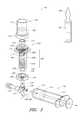
- FIG. 1is a perspective view of one embodiment of a bone cement preparation and/or injection system.
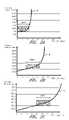
- FIG. 2Ais a chart indicating a time-viscosity curve for a first curable PMMA bone cement.
- FIG. 2Bis a chart indicating a time-viscosity curve for a second curable PMMA bone cement.
- FIG. 2Cis a chart indicating a time-viscosity curve for a third curable PMMA bone cement.
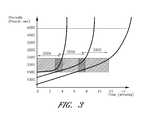
- FIG. 3is a chart illustrating an overlay of the time-viscosity curves of the PMMA bone cements of FIGS. 2A-2C .
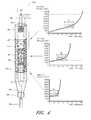
- FIG. 4is a cut-away schematic view of another embodiment of a bone cement injection system.
- a vertebroplasty procedure using the inventioncould introduce the injector of FIG. 1 through a pedicle of a vertebra, or in a parapedicular approach, for accessing the osteoporotic cancellous bone.
- the initial aspects of the procedurecan be similar to a conventional percutaneous vertebroplasty wherein the patient is placed in a prone position on an operating table. The patient is typically under conscious sedation, although general anesthesia is an alternative.
- the physicianinjects a local anesthetic (e.g., 1% Lidocaine) into the region overlying the targeted pedicle or pedicles as well as the periosteum of the pedicle(s). Thereafter, the physician can use a scalpel to make a 1 to 5 mm skin incision over each targeted pedicle. Thereafter, the bone cement injector can be advanced through the pedicle into the anterior region of the vertebral body, which typically is the region of greatest compression and fracture. The physician can confirm the introducer path posterior to the pedicle, through the pedicle and within the vertebral body by anteroposterior and lateral X-Ray projection fluoroscopic views or by other methods. The introduction of infill material as described below can be imaged several times, or continuously, during the treatment depending on the imaging method.
- a local anesthetice.g., 1% Lidocaine
- Bone cement, bone fill or fill material, infill material or compositionincludes its ordinary meaning and is defined as any material for infilling a bone that includes an in-situ hardenable or settable cement, or a composition that can be infused with such a hardenable cement.
- the fill materialalso can include other “fillers” such as filaments, microspheres, powders, granular elements, flakes, chips, tubules and the like, autograft or allograft materials, as well as other chemicals, pharmacological agents or other bioactive agents.
- Flowable materialincludes its ordinary meaning and is defined as a material continuum that is unable to withstand a static shear stress and responds with an irrecoverable flow (a fluid)—unlike an elastic material or elastomer that responds to shear stress with a recoverable deformation.
- Flowable materialincludes fill material or composites that include a fluid (first) component and an elastic or inelastic material (second) component that responds to stress with a flow, no matter the proportions of the first and second component, and wherein the above shear test does not apply to the second component alone.
- substantiallyor “substantial” mean largely but not entirely. For example, substantially may mean about 50% to about 99.999%, about 80% to about 99.999% or about 90% to about 99.999%.
- Vertebroplastyincludes its ordinary meaning and means any procedure wherein fill material is delivered into the interior of a vertebra.
- Ostoplastyincludes its ordinary meaning and means any procedure wherein fill material is delivered into the interior of a bone.
- a system 10is illustrated that is adapted for bone cement preparation and thereafter for cement injection in an osteoplasty or vertebroplasty procedure.
- a syringe or injector body 100carries a plurality of different biomaterial formulations 102 A, 102 B and 102 C, each in different axial portions of a biomaterial column in interior chamber 104 of the injector body 100 .
- body 100carries three different specialized formulations of the non-liquid polymer powder component 105 of a two-part curable bone cement, such as a PMMA bone cement.
- the non-liquid component 105is configured to be wetted or saturated with a liquid monomer component 106 (typically carried in vial 108 pre-mixing) wherein the polymer and monomer components in a post-saturation interval will result in a curable bone cement described further below.
- the body 100can carry more or fewer than three different specialized formulations of the non-liquid polymer powder component 105 (e.g., two formulations, four formulations, etc.).
- wetting and saturatingare used interchangeably herein to describe the process of thoroughly or completely exposing the non-liquid polymer powder component to the liquid monomer component, in other words to unite the two components to thereafter cause a polymerization reaction between at least two portions of the biomaterials.
- each of the different polymer formulations 102 A, 102 B and 102 Cwill result post-mixing in the different time-viscosity curves A, B, C of FIGS. 2A , 2 B and 2 C, respectively.
- Each of the PMMA cements 101 , 102 and 103have a different time-viscosity curve indicated at A, B and C.
- Such different time-viscosity curves as showncan be provided by bone cement formulations that for example, vary the levels of initiator and activator, as well as varying the mean dimensions of the polymer particles.
- Tecres S. P. A., Via A. Doria, 6 Sommacampagna, Verona, Italyis a bone cement manufacturing company that has the expertise to formulate PMMA bone cements with the various time-viscosity profiles described above.
- one embodiment of system 10includes an elongated cement or biomaterial-carrying body 100 , which can be of a transparent plastic and can carry a pre-packed volume of non-liquid polymer powder components, indicated collectively at 105 .
- the body 100extends along an axis 115 from a proximal end 120 with opening 122 into the interior space 104 to a distal end 130 with an open termination 132 of the interior space 104 .
- the proximal end 120 of the cement-carrying body 100can have a fitting such as, for example, a threaded fitting 134 for connecting a pressurization mechanism to the structure.
- the distal end 130 of the structure 100can also have a fitting 136 (e.g., a Luer fitting) for connecting a filter and vacuum source to the body as will be described further below.
- the biomaterial-carrying body 100has an elongate configuration with a cross-section of the interior space 104 having a diameter between about 2 mm and 20 mm.
- the length of body 100can range from about 5 cm to 20 cm, to provide an interior volume of from about 2 cc to 20 cc.
- the body 100is transparent to thus allow viewing of monomer saturation described below.
- one or more biomaterial-carrying bodies 100can be used, as a treatment of a vertebral compression fracture can use from about 2 cc to 8 cc of bone cement.
- the biomaterial-carrying body 100can have other length and diameter dimensions to provide other desired interior volumes for the body 100 .
- the systemcan include a negative pressure source or assembly 140 that can be detachably coupled to body 100 for suctioning the liquid monomer component 106 into and through the non-liquid polymer powder component 105 disposed in space 104 in the body 100 .
- the saturation of the polymer powder 105 with the monomer 106thus causes the biomaterial column to begin polymerization and set in post-mixing (or post-saturation) time intervals that are described further below.
- the negative pressure source 140can comprise a syringe 142 with a lockable plunger assembly 144 slidable within the syringe 142 that can be withdrawn to apply suction from syringe chamber 145 through channel 146 in body 148 that communicates with open termination 132 in body 100 when connected together by cooperating fittings, such as Luer threads 136 of body 100 and the fitting 152 of the negative pressure source or assembly 140 .
- a structure 154 carrying a filter 155can be fixedly or detachably connected to body 148 intermediate the biomaterial-carrying body 100 and the negative pressure source 140 .
- the filter 155can in one embodiment include a plastic (e.g., high density polyethylene) mesh filter having a mean pore dimension of about 0.1 to 0.5 microns and be configured to allow air extraction from the volume of compacted polymer powder in body 100 by initial application of a vacuum from syringe 142 , but the liquid monomer component 106 when suctioned through the polymer powder 105 in sleeve 112 creates a higher viscosity mixture akin to a wet sand which will not pass through the filter 155 .
- plastice.g., high density polyethylene
- the filter 155can function to limit any liquid monomer losses from the saturated mixture, and can result in a desired (e.g., an exact) volume of liquid monomer 106 being drawn by vacuum into the sleeve for saturating the polymer powder volume 105 .
- a pressure relief valve 160can be provided that limits the amount of negative pressure in the syringe 142 .
- the body 148also carries a valve indicated at 165 for selectively closing channel 146 .
- the valve 165can be selectively closed, and then the lockable plunger assembly 144 can be withdrawn in chamber 145 and selectively locked, thus providing a selected negative pressure or vacuum in the chamber 145 .
- the liquid monomer 106can be poured into a funnel 170 (described next), with the body 100 held in a vertical position, and then the valve 165 can be moved to an open position to suction the monomer 106 into and through polymer powder 105 in the body 100 .
- an alternative negative pressure source 140can comprise a canister pre-packaged with a suitable level of vacuum therein.
- the vacuum canisterthen can be coupled to a valve and further coupled to the body 148 of FIG. 1 to provide a negative pressure source for saturating the biomaterial column with the liquid monomer.
- the system of FIG. 1can in one embodiment further include a funnel mechanism for assisting the step of pouring the requisite volume of liquid monomer 106 into the open end 122 of the proximal end 120 of body 100 .
- the funnel mechanismcomprises a funnel member 170 that is attachable to body 100 wherein the volume of the funnel is sized to contain the selected volume of monomer 106 required to saturate the volume of polymer powder 105 in the biomaterial-carrying body 100 .
- the funnel member 170can be fabricated of a clear plastic and have a fluid-tight fitting, such as an o-ring 172 , to couple to body 100 with threaded portion 174 .
- the systems for preparing bone cementfurther comprise a cement ejection mechanism coupleable to the body 100 for ejecting the bone cement from the body 100 into bone, wherein a piston or driving shaft is inserted into space 104 to drive the bone cement through a needle (not shown) coupled to the distal end 130 of body 100 .
- the cement ejection mechanismcan in one embodiment include a manually advanced plunger assembly, or any type of hydraulic system, CO2 gas cartridge system, pneumatic system, cable drive system, screw drive system, a spring system or other pump system any of which can be computer controlled with a microprocessor that executes one or more control algorithms for delivering the curable bone cement at desired flow parameters (e.g., flow rate, temperature, pressure) into a treatment site (e.g., into naturally-occurring cavities in uncompressed cancellous bone of a bone, such as a vertebral body).
- desired flow parameterse.g., flow rate, temperature, pressure
- a method for controlling the viscosity of a bone cement over a treatment intervalthat comprises injecting a column of a bone cement into bone wherein different portions of a column of bone cement have different time-viscosity characteristics.
- the methodcan include a plurality of different bone cement portions in a column, for example with the different time-viscosity characteristics, the number of different portions being at least 2, 3, 4, 5 or more.
- the methodcan utilize different bone cement portions disposed in axial portions of a column or in concentric portions of a column.
- the methodfurther comprises controlling the rate of injecting the column of bone cement with a non-manual drive system and controller.
- the rate of injection(e.g., velocity, acceleration, flow rate or pressure) can be controlled by a manual drive system and a sensor system that provides feedback of the rate of injection by at least one of visual, aural or tactile signals.
- the rate of injectioncan be selected to reduce the potential of emboli from entering the vascular system. This can be done with a rate of injection that is less than 2-5 cc per minute. In some embodiments, the rate of injection can be constant, and between 0.1 cc and 5 cc per minute or between 0.5 cc and 2 cc per minute.
- the first portion of bone cement have time viscosity curve A(from polymer component 102 A of FIG. 1 ) can be injected first from body 100 into bone over a first time interval of about 4 minutes indicated at 200 A in FIG. 2A .
- the cement viscosity in the first time interval 200 Ais between about 1500 Pa ⁇ s and 2500 Pa ⁇ s.
- the injection ratecan be controlled so that this initial column of cement is ejected from body 100 during the first time interval and before about the time that the second different portion of cement is injected into bone (from polymer component 102 B of FIG. 1 ).
- FIG. 1the cement viscosity in the first time interval 200 A is between about 1500 Pa ⁇ s and 2500 Pa ⁇ s.
- the injection ratecan be controlled so that this initial column of cement is ejected from body 100 during the first time interval and before about the time that the second different portion of cement is injected into bone (from polymer component 102 B of FIG. 1 ).
- the time-viscosity curve Bprovides a cement having a viscosity again between about 1500 Pa ⁇ s and 2500 Pa ⁇ s.
- the third different column of cementcan be injected into bone (from polymer component 102 C of FIG. 1 ).
- FIG. 2Cshows that during time interval 200 C, the time-viscosity curve C again provides a cement viscosity between about 1500 Pa ⁇ s and 2500 Pa ⁇ s, for about four minutes or more.
- the different columns of cementcan be injected so that the injected bone cement has a different viscosity range than 1500-2500 Pa ⁇ s.
- the system of FIG. 1can provide a curable bone cement having a viscosity within a selected range over an extended working time of many minutes, for example at least 8 minutes, 10 minutes, 12 minutes or more by providing a saturation mixing system that pre-packs a column of different cement precursors and biomaterials in a source of bone cement.
- a saturation mixing systemthat pre-packs a column of different cement precursors and biomaterials in a source of bone cement.
- at least one portion of the column of biomaterialcan comprise an osteogenic composition, bone chips, or a biodegradable or bioabsorbable material.
- the bone cement according to some methodscan be injected within a set range of viscosity over an extended cement injection interval.
- Further embodimentscan comprise injecting bone cement into bone while the bone cement is within a pre-selected range of viscosity such that each different portion of bone cement is injected while within the range.
- the pre-selected rangecan be about 500 to 4000 Pa ⁇ s.
- the pre-selected viscosity rangeis about 1500 to 2500 Pa ⁇ s.
- the different portionscan comprise first, second and third portions. After the liquid and non-liquid components have been mixed, when the first portion is within the higher end of the pre-selected viscosity range the second portion is within the lower end of the range and when the second portion is within the higher end of the range the first portion is above the range and the third portion is within the lower end of the range.
- a method of treating bonecomprises providing an injector containing an axial column of a curable biomaterial, and injecting the column of biomaterial into the interior of a mammalian subject wherein the column has axial non-uniformity in biomaterial curing parameters.
- a methodcomprises providing an axial column of a curable biomaterial, and injecting the column of biomaterial into a bone wherein the column has a plurality of axial portions characterized by different setting times.
- the methodfurther comprises injecting at least 3 cc of biomaterial, at least 4 cc of biomaterial, at least 6 cc of biomaterial and at least 8 cc of biomaterial.
- a biomaterial injection system for injecting a curable biomaterialcomprises a structure for holding an axially-extending column of a curable biomaterial, a drive system or force-application member for moving the biomaterial from the structure, wherein the column of biomaterial has axial non-uniformity in biomaterial curing parameters.
- the biomaterialcan have non-uniform curing parameters that consist of setting time, time-viscosity curves, change of viscosity over an interval, rate of change of viscosity over an interval, time-temperature curves, and/or the length of an interval between first and second selected viscosities.
- the biomaterial injection systemcarries a column of curable biomaterial which comprises first and second column portions with first and second curing parameters, respectively.
- Each column portioncan be at least 1 cc, 2 cc, 3 cc, 4 cc, 5 cc, 6 cc, 8 cc and 10 cc.
- Each column portioncan have a different percentage of activator and/or different percentage of initiator.
- the biomaterial injection system of some embodimentsincludes a mechanism for introducing a liquid monomer component into the column of biomaterial.
- a pressurized source of liquid monomer componentcan be operated at between 0.1 psi and 500 psi.
- the biomaterial injection systemcan include a vent in the structure to thereby allow the liquid monomer component to diffuse through the column of biomaterial without backpressure.
- the biomaterial injection systemcan have a controller and drive system configured for controllably moving the force-application member to provide a delivery rate of between 0.5 cc and 3 cc per minute.
- the systemcan include a sensor system that provides feedback of the rate of injection by at least one of visual, aural or tactile signals and can include a temperature sensor, flow sensor, electrical parameter sensor, ultrasound sensor, a load cell and a thermochromic material indicator.
- a method of treating bonecomprises providing an injector containing an axial column of a non-liquid component of a curable biomaterial, introducing a liquid component of the curable biomaterial into the column of non-liquid component under a selected pressure to allow diffusion of the liquid component within the non-liquid component to thereby initiate a curing reaction without mixing, and injecting the column of biomaterial into the interior of a bone.
- a method of treating bonecomprises providing an injector containing an axial column of a non-liquid component of a curable biomaterial, introducing a liquid component of the curable biomaterial into the column of non-liquid component under predetermined parameters allowing for diffusion of the liquid component within the non-liquid component with less than 240 seconds, 120 seconds, 60 seconds, 30 seconds, 20 seconds and 10 seconds.
- the parameterscan include the rate of introducing the liquid component, the pressure of introducing the liquid component, a negative pressure applied to the non-liquid component, and selecting a maximum dimension of any path of diffusion within the non-liquid component.
- the systemmay include a mechanism for applying vibratory forces to the injector including ultrasonic vibratory forces. This can further assist in the diffusion of the liquid component into the non-liquid component.
- a combinationcomprises two settable bone cement formulation that have different time-viscosity curves, wherein said time-viscosity curves are characterized by overlapping time interval of at least 1 minute in the viscosity range of 500 Pa ⁇ s to 4000 Pa ⁇ s; and a bone cement injector having a chamber for holding the two bone cements formulations.
- the overlapping time intervalis at least 2 minutes, 3 minutes, 4 minutes, 5 minutes and 10 minutes.
- FIG. 1Further embodiments relate to bone cement compositions and formulations for use in the bone cement delivery systems described above.
- the bone cement formulationsprovide for an extended working time, since the viscosity can be altered and increased on demand when injected.
- Bone cementssuch as polymethyl methacrylate (PMMA) have been used in orthopedic procedures for several decades, with initial use in the field of anchoring endoprostheses in a bone.
- skeletal jointssuch as in the hip are replaced with a prosthetic joint.
- the prosthetic jointis cemented into the bone using an acrylic bone cement such as PMMA.
- bone cementsalso have been widely used in vertebroplasty procedures wherein the cement is injected into a fractured vertebra to stabilize the fracture and eliminate micromotion that causes pain.
- Polymethyl methacrylate bone cementprior to injection, comprises a powder component and a liquid monomer component.
- the powder componentcomprises granules of methyl methacrylate or polymethyl methacrylate, an X-ray contrast agent and a radical initiator.
- barium sulfate or zirconium dioxideis used as an X-ray contrast agent.
- Benzoyl peroxide (BPO)is typically used as the radical initiator.
- the liquid monomer componenttypically consists of liquid methyl methacrylate (MMI), an activator, such as N,N-dimethyl-p-toluidine (DMPT) and a stabilizer, such as hydroquinone (HQ).
- DMPTN,N-dimethyl-p-toluidine
- HQhydroquinone
- Typical bone cements formulationsused for vertebroplasty have a fairly rapid cement curing time after mixing of the powder and liquid components. This allows the physician to not have to waste time waiting for the cement to increase in viscosity prior to injection. Further, the higher viscosity cement is less prone to unwanted extravasation which can cause serious complications.
- the disadvantage of such current formulationsis that the “working time” of the cement is relatively short—for example about 5 to 8 minutes—in which the cement is within a selected viscosity range that allows for reasonably low injection pressures while still being fairly viscous to help limit cement extravasation. In some typical bone cements, the viscosity may range between approximately 50 to 500 Pa ⁇ s prior to injection and is measured according to ASTM standard F451, “Standard Specification for Acrylic Bone Cement,” which is hereby incorporated by reference in its entirety.
- the bone cement formulationis adapted for use with the cement injectors and energy delivery systems described above. These formulations are distinct from conventional formulations and have greatly extended working times for use in vertebroplasty procedures with the “on-demand” viscosity control methods and apparatus disclosed herein and in co-pending applications listed and incorporated by reference above.
- the bone cementprovides a formulation adapted for injection into a patient's body, wherein the setting time is about 25 minutes or more, more preferably about 30 minutes or more, more preferably about 35 minutes or more, and even more preferably about 40 minutes or more. Setting time is measured in accordance with ASTM standard F451.
- the bone cementprior to mixing and setting, comprises a powder component and a liquid component.
- the powder componentcomprises a PMMA that is about 64% to 75% by weight based on overall weight of the powder component.
- an X-ray contrast mediumis about 27% to 32% by weight based on overall weight of the powder component.
- the X-ray contrast mediumin one embodiment, comprises barium sulfate (BaSO4) or zirconium dioxide (ZrO2).
- the formulationfurther includes BPO that is about 0.4% to 0.8% by weight based on overall weight of the powder component. In another embodiment, the BPO is by weight based on overall weight of the powder component, less than 0.6%, 0.4% and 0.2%.
- the liquid componentcan include MMA that is greater than about 99% by weight based on overall weight of the liquid component.
- the liquid componentcan include DMPT that is less than about 1% by weight based on overall weight of the liquid component.
- the liquid componentcan include hydroquinone that ranges between about 30 and 120 ppm of the liquid component.
- the liquid weight/powder weight ratiocan be equal to or greater than about 0.4.
- the PMMAcan comprise particles having a mean diameter ranging from about 25 microns to 200 microns or ranging from about 50 microns to 100 microns.
- the concentrations of benzoyl peroxide and DMPTmay be varied in order to adjust setting times.
- Studies examining the influence of bone cement concentration on setting timeshave demonstrated that, in bone cements comprising BPO and DMPT, increases in BPO and DMPT concentration increase the set time of the bone cement.
- the datafurther illustrate that, of the two bone cement constituents, BPO has a greater effect on the rate of set time than does DMPT.
- the concentration of BPO, DMPT, and combinations thereofmay be increased within the ranges discussed above so as to increase the setting time of the composition.
- the setting time of the bone cementmay be increased or decreased. Heating the bone cement composition can also modify the setting time of the bone cement. Furthermore, in certain embodiments, the concentration of BPO and/or DMPT in the bone cement may be varied and the composition may be heated so as to adjust the setting time to a selected value. As discussed above, in certain embodiments, the setting time can be selected to be at least 2 minutes, 4 minutes, 6 minutes, 8 minutes, 10 minutes, 12 minutes or 14 minutes.
- a bone cementhas a first component comprising greater than about 99 wt. % methyl methacrylate (MMA), and less than about 1 wt. % N,N-dimethyl-p-toluidine (DMPT), about 30 to 120 ppm hydroquinone on the basis of the total amount of the first component, and a second component comprising a powder component comprising less than 75 wt. % PMMA, less than 32 wt. % of an X-ray contrast medium; and less than 0.4 wt. % benzoyl peroxide (BPO) on the basis of the total weight of the second component.
- the second componenthas less than 0.2 wt.
- the liquid weight/powder weight ratiocan be equal to or greater than about 0.4.
- the PMMA to monomer ratiois 2:1. In another embodiment, the PMMA to monomer ratio is 2.5:1.
- a settable bone cementcomprises mixable first and second components, wherein the first component comprises greater than about 99 wt. % methyl methacrylate (MMA), and less than about 1 wt. % N,N-dimethyl-p-toluidine (DMPT), about 30 to 120 ppm hydroquinone on the basis of the total amount of the first component, and wherein the second component comprises a PMMA component comprised of less than 75 wt. % PMMA, less than 32 wt. % of an X-ray contrast medium; and a selected wt. % of benzoyl peroxide (BPO) on the basis of the total weight of the second component.
- MMAmethyl methacrylate
- DMPTN,N-dimethyl-p-toluidine
- the PMMA componentincludes first and second volumes of beads having first and second amounts of BPO, respectively.
- the PMMA componentincludes a first volume of beads having greater than 0.4 wt. % BPO on the basis of the total weight of the PMMA component and the beads of the first volume have a mean bead size of less than 100 microns.
- the PMMA componentincludes a second volume of beads having less than 0.4 wt. % BPO on the basis of the total weight of the PMMA component and the beads of the second volume have a mean bead size of greater than 100 microns.
- the cementhas a plurality of different PMMA beads sizes each carrying a different BPO amount, wherein the mean BPO amount among the plurality of beads is from 0.3 to 0.6% BPO on the basis of the total weight.
- the PMMA componentincludes a first volume of beads greater than 0.4 wt. % BPO on the basis of the total weight of the PMMA and the first volume has a mean bead size of greater than 100 microns. Further, the PMMA component includes a second volume of beads having less than 0.4 wt. % BPO on the basis of the total weight of the PMMA component and the second volume has a mean bead size of less than 100 microns.
- the bone cementcomprises a first monomer-carrying component and a second polymer-carrying component, wherein the mixture is characterized by having a viscosity of less than 500 Pa ⁇ s at 18 minutes post-mixing.
- the bone cementfurther can be characterized as having a time-viscosity curve slope of less than 200 Pa ⁇ s/minute for at least 5 minutes after achieving a viscosity of 500 Pa ⁇ s.
- the bone cementfurther can be characterized by a post-mixing time-viscosity curve slope of less than 100 Pa ⁇ s/minute for at least 15 minutes, 16 minutes, 17 minutes, 18 minutes, 19 minutes and 20 minutes.
- the bone cementcomprises a first monomer-carrying component and a second polymer-carrying component, wherein post-mixing the mixture is characterized by a time-viscosity curve slope of less than 100 Pa ⁇ s/minute until to the mixture achieving a viscosity of 500 Pa ⁇ s.
- the bone cement post-mixingcan be characterized by a time-viscosity curve slope of less than 100 Pa ⁇ s/minute immediately before the mixture achieves a viscosity of 800 Pa ⁇ s.
- the bone cementfurther can be characterized by a time-viscosity curve slope of less than 100 Pa ⁇ s/minute immediately before the mixture achieves a viscosity of 1000 Pa ⁇ s.
- the bone cementfurther can be characterized by a time-viscosity curve slope of less than 100 Pa ⁇ s/minute immediately before the mixture achieves a viscosity of 1500 Pa ⁇ s.
- the bone cementfurther can be characterized by a time-viscosity curve slope of less than 200 Pa ⁇ s/minute immediately before the mixture achieves a viscosity of 500 Pa ⁇ s.
- the bone cementfurther can be characterized by a time-viscosity curve slope of less than 200 Pa ⁇ s/minute immediately before the mixture achieves a viscosity of 1000 Pa ⁇ s.
- the bone cementfurther can be characterized by a time-viscosity curve slope of less than 200 Pa ⁇ s/minute immediately before the mixture achieves a viscosity of 1500 Pa ⁇ s.
- the bone cementfurther can be characterized by a time-viscosity curve slope of less than 200 Pa ⁇ s/minute immediately before the mixture achieves a viscosity of 2000 Pa ⁇ s.
- the bone cementcomprises a first monomer-carrying component and a second polymer-carrying component, wherein post-mixing the mixture is characterized by a time-viscosity curve having a rate of change of less than 20% or less that 40% over an interval of at least 5 minutes, 10 minutes, 15 minutes and 20 minutes.
- the bone cementcomprises a first monomer-carrying component and a second polymer-carrying component, wherein post-mixing the mixture of the first and second components is characterized as having a viscosity of less than 100 Pa ⁇ s at 10 minutes post-mixing, or less than 200 Pa ⁇ s at 15 minutes post-mixing, or less than 500 Pa ⁇ s at 18 minutes post-mixing.
- the bone cement formulation described abovecomprises first and second cement precursors, wherein the mixture is characterized by a post-mixing interval in which viscosity is between 500 Pa ⁇ s and 5000 Pa ⁇ s, and in which the change of viscosity of less than 30%/minute.
- the settable bone cementcomprises first and second cement precursors, wherein the mixture is characterized by a post-mixing interval in which viscosity is between 500 Pa ⁇ s and 2000 Pa ⁇ s, and in which the change of viscosity of less than 20%/minute.
- the settable bone cementcomprises a first monomer-carrying component and a second polymer-carrying component, wherein post-mixing the mixture is characterized by a change of viscosity of less than 20%/minute for at least three minutes after reaching 500 Pa ⁇ s, 1000 Pa ⁇ s, 1500 Pa ⁇ s and 2000 Pa ⁇ s.
- the cementcomprises a first monomer-carrying component and a second polymer-carrying component, wherein post-mixing the mixture is characterized by a change of viscosity of less than 30%/minute for at least three minutes after reaching 500 Pa ⁇ s, 1000 Pa ⁇ s, 1500 Pa ⁇ s and 2000 Pa ⁇ s.
- the cementcomprises a first monomer-carrying component and a second polymer-carrying component, wherein post-mixing the mixture is characterized by a change of viscosity of less than 40%/minute for at least three minutes after reaching 500 Pa ⁇ s, 1000 Pa ⁇ s, 1500 Pa ⁇ s and 2000 Pa ⁇ s.
- the cementcomprises a first monomer-carrying component and a second polymer-carrying component, wherein post-mixing the mixture is characterized by a change of viscosity of less than 30%/minute for at least five minutes after reaching 1000 Pa ⁇ s, 1500 Pa ⁇ s, 2000 Pa ⁇ s, 2500 Pa ⁇ s, 3000 Pa ⁇ s, 3500 Pa ⁇ s and 4000 Pa ⁇ s.
- the cementcomprises a first monomer-carrying component and a second polymer-carrying component, wherein post-mixing the mixture is characterized by a change of viscosity of less than 40%/minute for at least five minutes after reaching 1000 Pa ⁇ s, 1500 Pa ⁇ s, 2000 Pa ⁇ s, 2500 Pa ⁇ s, 3000 Pa ⁇ s, 3500 Pa ⁇ s and 4000 Pa ⁇ s.
- the cementcomprises a first monomer-carrying component and a second polymer-carrying component, wherein post-mixing the mixture is characterized by a change of viscosity of less than 50%/minute for at least five minutes after reaching 1000 Pa ⁇ s, 1500 Pa ⁇ s, 2000 Pa ⁇ s, 2500 Pa ⁇ s, 3000 Pa ⁇ s, 3500 Pa ⁇ s and 4000 Pa ⁇ s.
- a cementcomprises a first monomer-carrying component and a second polymer-carrying component, wherein the mixture is characterized by a rate of change of viscosity of less than 50%/minute after achieving a viscosity of 5000 Pa ⁇ s.
- a cementcomprises a first monomer-carrying component and a second polymer-carrying component, wherein the mixture is characterized by a rate of change of viscosity of less than 50%/minute after achieving a viscosity of 4000 Pa ⁇ s.
- a cementcomprises a first monomer-carrying component and a second polymer-carrying component, wherein the mixture is characterized by a rate of change of viscosity of less than 50%/minute after achieving a viscosity of 3000 Pa ⁇ s.
- a cementcomprises a first monomer-carrying component and a second polymer-carrying component, wherein post-mixing the mixture is characterized by a rate of change of viscosity of less than 50%/minute for an interval preceding the point in time the mixture achieves 5000 Pa ⁇ s, the interval being at least 2 minutes, 3 minutes, 4 minutes, 5 minutes, 6 minutes and 8 minutes.
- a cementcomprises a first monomer-carrying component and a second polymer-carrying component, wherein post-mixing the mixture is characterized by a rate of change of viscosity of less than 40%/minute for an interval preceding the point in time the mixture achieves 5000 Pa ⁇ s, the interval being at least 2 minutes, 3 minutes, 4 minutes, 5 minutes, 6 minutes and 8 minutes.
- a cementcomprises a first monomer-carrying component and a second polymer-carrying component, wherein post-mixing the mixture is characterized by a rate of change of viscosity of less than 30%/minute for an interval preceding the point in time the mixture achieves 5000 Pa ⁇ s, the interval being at least 2 minutes, 3 minutes, 4 minutes, 5 minutes, 6 minutes and 8 minutes.
- a cementcomprises a first monomer-carrying component and a second polymer-carrying component, wherein the mixture is characterized by a post-mixing interval of at least 4 minutes, 6 minutes, 8 minutes or 10 minutes in the interval preceding the point in time the mixture achieves 3000 Pa ⁇ s.
- a cementcomprises a first monomer-carrying component and a second polymer-carrying component, wherein the mixture is characterized by a post-mixing interval of at least 4 minutes, 6 minutes, 8 minutes or 10 minutes in the interval preceding the point in time the mixture achieves 4000 Pa ⁇ s.
- a cementcomprises a first monomer-carrying component and a second polymer-carrying component, wherein the mixture is characterized by a post-mixing interval of at least 4 minutes, 6 minutes, 8 minutes or 10 minutes in the interval preceding the point in time the mixture achieves 5000 Pa ⁇ s.
- a settable or curable bone cementthat comprises two mixable components as described above: a liquid monomer component and a non-liquid component.
- the non-liquid componentincludes polymer beads or particles, wherein this non-liquid component is configured for controlled differential BPO exposure to the liquid monomer over a setting interval of the bone cement. The controlled exposure of BPO will thus control the time-viscosity curve of cement injected into a bone.
- the desired differential BPO exposure over the working time of the cementis provided by differing beads or particles and having differing BPO configurations therein.
- the first beads of a first portion of the total volumecan have a small diameter with a higher density of BPO when compared to second beads of a second portion of the total non-liquid component of the cement.
- the first portion of beadscan have an average cross section of less than 100 microns, 80 microns, 60 microns or 40 microns.
- the first portioncan have greater than 0.5 wt. % of BPO.
- the second volume of beads or particlescan have an average cross section of greater than 40 microns, 60 microns, 80 microns and 100 microns, with a less than 0.5 wt. % of BPO.
- the volume of the first and second portions or volumescan have less than a 5.0 wt. % of BPO.
- the BPO configuration in the non-liquid componentcan comprise particles of BPO and particles of a polymeric material alone or particles with an integrated BPO.
- the polymer particlescan have different regions of different BPO densities.
- the BPO configuration in the non-liquid componentcan comprise particles having a surface coating of BPO.
- the BPO configurationcan also comprise particles having BPO layers.
- a method of utilizing a bone cementcomprises mixing the liquid and non-liquid components, and injecting the bone cement into bone wherein the controlled BPO exposure provides a lengthened setting interval in which the mixture is configured for a flowability property that prevents unwanted extravasation.
- the methodcan provide a mixture that is configured to have a viscosity within 30 seconds post-mixing of at least 500 Pa ⁇ s, 1000 Pa ⁇ s, 1500 Pa ⁇ s and 2000 Pa ⁇ s.
- the methodcan provide a mixture that is configured for having a viscosity within 60 seconds post-mixing of at least 500 Pa ⁇ s, 1000 Pa ⁇ s, 1500 Pa ⁇ s, 2000 Pa ⁇ s and 2500 Pa ⁇ s.
- the methodcan provide a mixture that is configured for having a viscosity within 90 seconds post-mixing of at least 500 Pa ⁇ s, 1000 Pa ⁇ s, 1500 Pa ⁇ s, 2000 Pa ⁇ s and 3000 Pa ⁇ s.
- the bone cement precursorsprovide a mixture configured to have a viscosity after of less than 4000 Pa ⁇ s after 20 minutes post-mixing, after 18 minutes post-mixing, after 16 minutes post-mixing, after 14 minutes post-mixing and after 12 minutes post-mixing.
- the mixtureis configured to have a viscosity after of less than 3000 Pa ⁇ s after 20 minutes post-mixing, after 18 minutes post-mixing, after 16 minutes post-mixing, after 14 minutes post-mixing and after 12 minutes post-mixing.
- the mixtureis configured to have a viscosity of less than 2000 Pa ⁇ s after 20 minutes post-mixing, after 18 minutes post-mixing, after 16 minutes post-mixing, after 14 minutes post-mixing and after 12 minutes post-mixing.
- the bone cementcomprises a monomer component and polymer component, wherein the polymer component includes a first volume of beads having a first average wt. % of BPO on the basis of the total weight of the first volume and a second volume of beads having a second average wt. % of BPO on the basis of the total weight of the second volume.
- the beads of the first volume of beadscan have an average cross section of less than 100 microns, 80 microns, 60 microns or 40 microns.
- the beads of the second volume of beadscan have an average cross section of greater than 40 microns, 60 microns, 80 microns and 100 microns.
- the first volumehas less than 0.5 wt.
- Embodiments of bone cementmay have combined first and second volumes having less than a 5.0 wt. % of BPO or less than a 2.5 wt. % of BPO. In some bone cement embodiments, the combined first and second volumes have greater than a 0.5 wt. % of BPO or greater than a 1.0 wt. % of BPO. In other embodiments, at least a portion of the first volume is without BPO or at least a portion of the second volume is without BPO.
- the bone cementcomprises a monomer component and polymer component, wherein the polymer component comprises a volume of beads carrying from 0.2% and 0.6% of BPO on the basis of the total weight of the volume, wherein at least 80% of the BPO is carried on a sub-volume of beads, the beads having a mean cross section of greater than 100 microns, and wherein less than 20% of the BPO is carried on a sub-volume of beads, the beads having a mean cross section of less than 100 microns.
- the bone cementcomprises a monomer component and polymer component, wherein the polymer component comprises a volume of beads carrying from 0.2% and 0.6% of BPO on the basis of the total weight of the volume, wherein 100% of the BPO is carried on a portion of the bead volume where the beads have a mean cross section of greater than 100 microns, and wherein no BPO is carried on a portion of the bead volume where the beads have a mean cross section of less than 100 microns.
- the bone cementcomprises a monomer component and polymer component, wherein the polymer component comprises a volume of beads of at least one polymeric material, wherein the polymer component carries from 0.2% and 3.0% BPO on the basis of the total weight of the volume, wherein a first portion of the bead volume carries BPO in a surface coating and wherein a second portion of the bead volume carries BPO intermixed in the at least one polymeric material.
- the bone cementcomprises a monomer component and polymer component, wherein the polymer component comprises a volume of beads of at least one polymeric material and from 0.2% and 3.0% BPO on the basis of the total weight of the volume, and wherein the BPO is provided in at least two of the following forms: as a surface coating on beads, as BPO particles, as BPO in microcapsules, as BPO particles within beads of a polymeric material, and as BPO in microcapsules within beads of a polymeric material.
- a bone cementcomprising a mixture of a liquid monomer component and polymer component of particles which includes distributing BPO within the mixture to provide a selected BPO availability to be wetted by the monomer component over first and second intervals, wherein the BPO availability per second over the first interval is substantially greater than the BPO availability per second over the second interval.
- the liquid monomer component and polymer componentare mixed and then injected into bone.
- the selected BPO availabilityis provided by at least two different particles having differing BPO configurations therein.
- the selected BPO availabilityis provided by a differential BPO exposure in a surface area of the particles.
- the selected BPO exposureis provided in part by particles having a mixed polymeric material and BPO.
- the selected BPO exposureis provided in part by particles having a surface coating of BPO. In another embodiment, the selected BPO exposure is provided in part by microencapsulated BPO. In yet another embodiment, the selected BPO exposure is provided by particles having layers of polymeric materials and BPO.
- FIG. 4illustrates another embodiment of a biomaterial injection system 210 that comprises a syringe-like body 212 having an axis 215 with an interior chamber 218 carrying a volume (e.g., column) 220 of biomaterial therein.
- the column of biomaterialcan consist of volume or column portions of the PMMA bone cements 201 , 202 and 203 that are configured to be injected, e.g., serially, into a bone such as a vertebral body.
- a drive system 225 for driving the cementcomprises a driving shaft 226 with a plunger head or element 228 with an o-ring or other seal-type element that allows for pushing the column 220 of biomaterial distally in chamber 218 .
- the bone cement volumecan be pushed through chamber 218 and flow channel 230 into any injector needle or cannula 235 that has a cooperating flow channel therein.
- the cannula 235can be made of any suitable metal or plastic sleeve and can be detachably coupleable to body 212 and can extend to one or more flow outlets.
- the driving shaft 226can be a manually advanced plunger assembly, or any type of hydraulic system, CO2 gas cartridge system, pneumatic system, cable drive system, screw drive system, a spring system or other pump system (indicated at 225 ), any of which can be computer controlled with a microprocessor that executes one or more control algorithms.
- FIG. 4further illustrates a monomer infusion system of the invention which comprises a liquid monomer source 240 that is detachably coupleable to at least one infusion channel 242 in body 212 that communicates with chamber 218 .
- the infusion channelcomprises a plurality of ports 244 over the length and about the circumference of the chamber to allow rapid, uniform monomer wetting of the column of biomaterial.
- the arrows in the channel(s) 242 and port(s) 244indicate a flow of monomer into the biomaterial.
- the pressure of the monomer inflowcan be greater that 1 psi, 5 psi, 10 psi, 50 psi or 100 psi.
- the chamber 218 or cement column 220has a small cross sectional diameter that allows for rapid monomer diffusion, for example less than 20 mm, 15 mm or 10 mm.
- at least one ventcan be used to vent air from the column that is displaced by the liquid monomer.
- a vent channel 250is shown in the shaft 226 but it should be appreciated that there can be one or more vents with optional check valves in the shaft 226 , the body 212 or a removable cap 252 at the distal end of the body 212 .
Landscapes
- Health & Medical Sciences (AREA)
- Life Sciences & Earth Sciences (AREA)
- Orthopedic Medicine & Surgery (AREA)
- Surgery (AREA)
- Biomedical Technology (AREA)
- Engineering & Computer Science (AREA)
- Nuclear Medicine, Radiotherapy & Molecular Imaging (AREA)
- Heart & Thoracic Surgery (AREA)
- Medical Informatics (AREA)
- Molecular Biology (AREA)
- Animal Behavior & Ethology (AREA)
- General Health & Medical Sciences (AREA)
- Public Health (AREA)
- Veterinary Medicine (AREA)
- Materials For Medical Uses (AREA)
Abstract
Description
Claims (24)
Priority Applications (4)
| Application Number | Priority Date | Filing Date | Title |
|---|---|---|---|
| US12/427,531US8562620B2 (en) | 2008-04-21 | 2009-04-21 | Bone treatment systems |
| US13/474,611US9180416B2 (en) | 2008-04-21 | 2012-05-17 | System for use in bone cement preparation and delivery |
| US13/955,769US9592317B2 (en) | 2005-08-22 | 2013-07-31 | Medical system and method of use |
| US14/932,714US10039584B2 (en) | 2008-04-21 | 2015-11-04 | System for use in bone cement preparation and delivery |
Applications Claiming Priority (3)
| Application Number | Priority Date | Filing Date | Title |
|---|---|---|---|
| US12491608P | 2008-04-21 | 2008-04-21 | |
| US10497908P | 2008-10-13 | 2008-10-13 | |
| US12/427,531US8562620B2 (en) | 2008-04-21 | 2009-04-21 | Bone treatment systems |
Publications (2)
| Publication Number | Publication Date |
|---|---|
| US20090292290A1 US20090292290A1 (en) | 2009-11-26 |
| US8562620B2true US8562620B2 (en) | 2013-10-22 |
Family
ID=41342637
Family Applications (1)
| Application Number | Title | Priority Date | Filing Date |
|---|---|---|---|
| US12/427,531Active2031-01-22US8562620B2 (en) | 2005-08-22 | 2009-04-21 | Bone treatment systems |
Country Status (1)
| Country | Link |
|---|---|
| US (1) | US8562620B2 (en) |
Cited By (17)
| Publication number | Priority date | Publication date | Assignee | Title |
|---|---|---|---|---|
| US20130308416A1 (en)* | 2008-04-21 | 2013-11-21 | Dfine, Inc. | System for use in bone cement preparation and delivery |
| US9445918B1 (en) | 2012-10-22 | 2016-09-20 | Nuvasive, Inc. | Expandable spinal fusion implants and related instruments and methods |
| US9572613B2 (en) | 2005-08-22 | 2017-02-21 | Dfine, Inc. | Bone treatment systems and methods |
| US9592317B2 (en) | 2005-08-22 | 2017-03-14 | Dfine, Inc. | Medical system and method of use |
| US9901657B2 (en) | 2008-10-13 | 2018-02-27 | Dfine, Inc. | System for use in bone cement preparation and delivery |
| US10231846B2 (en) | 2016-08-19 | 2019-03-19 | Stryker European Holdings I, Llc | Bone graft delivery loading assembly |
| US10905440B2 (en) | 2008-09-26 | 2021-02-02 | Relievant Medsystems, Inc. | Nerve modulation systems |
| US11007010B2 (en) | 2019-09-12 | 2021-05-18 | Relevant Medsysterns, Inc. | Curved bone access systems |
| US11065046B2 (en) | 2013-08-08 | 2021-07-20 | Relievant Medsystems, Inc. | Modulating nerves within bone |
| US11160563B2 (en) | 2012-11-05 | 2021-11-02 | Relievant Medsystems, Inc. | Systems for navigation and treatment within a vertebral body |
| US11471210B2 (en) | 2011-12-30 | 2022-10-18 | Relievant Medsystems, Inc. | Methods of denervating vertebral body using external energy source |
| US11596468B2 (en) | 2002-09-30 | 2023-03-07 | Relievant Medsystems, Inc. | Intraosseous nerve treatment |
| US11690667B2 (en) | 2012-09-12 | 2023-07-04 | Relievant Medsystems, Inc. | Radiofrequency ablation of tissue within a vertebral body |
| US12039731B2 (en) | 2020-12-22 | 2024-07-16 | Relievant Medsystems, Inc. | Prediction of candidates for spinal neuromodulation |
| US12082876B1 (en) | 2020-09-28 | 2024-09-10 | Relievant Medsystems, Inc. | Introducer drill |
| US12303166B2 (en) | 2008-09-26 | 2025-05-20 | Relievant Medsystems, Inc. | Methods for accessing nerves within bone |
| US12433668B1 (en) | 2021-11-08 | 2025-10-07 | Relievant Medsystems, Inc. | Impedance stoppage mitigation during radiofrequency tissue ablation procedures |
Families Citing this family (7)
| Publication number | Priority date | Publication date | Assignee | Title |
|---|---|---|---|---|
| US8256949B2 (en)* | 2007-12-27 | 2012-09-04 | Cook Medical Technologies Llc | Apparatus and method for mixing and dispensing a bone cement mixture |
| EP2307075B1 (en)* | 2008-07-15 | 2015-11-11 | Thomas Steffen | Bone cement injection device |
| US8480681B2 (en)* | 2009-05-21 | 2013-07-09 | Christopher Jordan | Pressured syringe for the injection of a viscous liquid through a cannulated surgical screw bone filler adapter |
| US8408250B2 (en) | 2010-06-18 | 2013-04-02 | Warsaw Orthopedic, Inc. | Bone replacement material mixing and delivery devices and methods of use |
| TWI646987B (en)* | 2016-12-08 | 2019-01-11 | 國立陽明大學 | Negative pressure guided bone cement injection system |
| US11801343B2 (en)* | 2018-07-12 | 2023-10-31 | Alcon Inc. | Methods and systems for delivering material to a body part |
| JP7669386B2 (en) | 2020-04-23 | 2025-04-28 | ハヌマン ペリカン,インコーポレイテッド | Plasma/cell concentrator device and method |
Citations (44)
| Publication number | Priority date | Publication date | Assignee | Title |
|---|---|---|---|---|
| US3349840A (en) | 1965-04-05 | 1967-10-31 | Whirlpool Co | Fluid flow control apparatus |
| US3376999A (en) | 1967-05-31 | 1968-04-09 | Gen Dynamics Corp | Packaging, mixing and dispensing apparatus |
| US3739947A (en) | 1969-08-01 | 1973-06-19 | E Baumann | Storing and mixing receptacle |
| US4377168A (en) | 1981-02-27 | 1983-03-22 | Wallach Surgical Instruments, Inc. | Cryosurgical instrument |
| US5051482A (en) | 1986-11-19 | 1991-09-24 | Laboratorium Fur Experimentelle Chirurgie | Method and apparatus for preparing a self-curing two-component powder liquid bone cement |
| US5130950A (en) | 1990-05-16 | 1992-07-14 | Schlumberger Technology Corporation | Ultrasonic measurement apparatus |
| US5145250A (en) | 1989-06-15 | 1992-09-08 | Merck Patent Gesellschaft Mit Beschraenkter Haftung | Process for the preparation of bone cement |
| US5531683A (en)* | 1992-08-13 | 1996-07-02 | Science Incorporated | Mixing and delivery syringe assembly |
| US5542928A (en) | 1991-05-17 | 1996-08-06 | Innerdyne, Inc. | Method and device for thermal ablation having improved heat transfer |
| US5688252A (en) | 1994-09-30 | 1997-11-18 | Takeda Chemical Industries, Ltd. | Syringe |
| US5713857A (en) | 1996-06-28 | 1998-02-03 | Becton Dickinson France, S.A. | Sequential stopper |
| US5788711A (en) | 1996-05-10 | 1998-08-04 | Implex Gmgh Spezialhorgerate | Implantable positioning and fixing system for actuator and sensor implants |
| US5865798A (en) | 1996-06-28 | 1999-02-02 | Becton Dickinson France, S.A. | Stopper assembly having bypass features for use in a multi-chamber syringe barrel |
| US6075067A (en) | 1994-08-15 | 2000-06-13 | Corpipharm Gmbh & Co | Cement for medical use, method for producing the cement, and use of the cement |
| US6122549A (en) | 1996-08-13 | 2000-09-19 | Oratec Interventions, Inc. | Apparatus for treating intervertebral discs with resistive energy |
| US6264659B1 (en) | 1999-02-22 | 2001-07-24 | Anthony C. Ross | Method of treating an intervertebral disk |
| US6312149B1 (en) | 1999-02-26 | 2001-11-06 | Scandimed International Ab | Mixing device |
| US20020068974A1 (en) | 2000-07-21 | 2002-06-06 | Kuslich Stephen D. | Expandable porous mesh bag device and methods of use for reduction, filling, fixation and supporting of bone |
| US20020156483A1 (en) | 2001-02-15 | 2002-10-24 | Voellmicke John C. | Vertebroplasty injection device and bone cement therefor |
| WO2002087416A2 (en) | 2001-04-26 | 2002-11-07 | Porter Christopher H | Method and apparatus for delivering materials to the body |
| US6575930B1 (en)* | 1999-03-12 | 2003-06-10 | Medrad, Inc. | Agitation devices and dispensing systems incorporating such agitation devices |
| US6709149B1 (en)* | 1998-12-14 | 2004-03-23 | Ao Research Institute Davos | Method of bone cement preparation |
| US6736537B2 (en) | 2001-07-16 | 2004-05-18 | Stryker Instruments | Bone cement mixing and delivery device for injection and method thereof |
| US20040180986A1 (en)* | 1999-03-31 | 2004-09-16 | The Brigham And Women's Hospital, Inc. | Nanocomposite surgical materials and method of producing them |
| US6832988B2 (en) | 2002-07-05 | 2004-12-21 | Yacmur, Ltd. | Ultrasonic cannula system |
| US6964667B2 (en) | 2000-06-23 | 2005-11-15 | Sdgi Holdings, Inc. | Formed in place fixation system with thermal acceleration |
| US6979352B2 (en) | 2002-11-21 | 2005-12-27 | Depuy Acromed | Methods of performing embolism-free vertebroplasty and devices therefor |
| US20060000284A1 (en)* | 2004-06-30 | 2006-01-05 | Sherman Jason T | System and method for determining the operating state of orthopaedic admixtures |
| US20060052794A1 (en)* | 2004-08-17 | 2006-03-09 | Scimed Life Systems, Inc. | Apparatus and methods for delivering compounds into vertebrae for vertebroplasty |
| US20060079834A1 (en) | 2004-10-13 | 2006-04-13 | Hyprotek, Inc. | Syringe devices and methods for mixing and administering medication |
| US7048720B1 (en) | 2004-05-03 | 2006-05-23 | Infusive Technologies, Llc | Multi-chamber, sequential dose dispensing syringe |
| US7048743B2 (en)* | 1999-09-30 | 2006-05-23 | Arthrocare Corporation | Methods for delivering tissue implant material with a high pressure applicator |
| US7160020B2 (en)* | 2000-10-25 | 2007-01-09 | Kyphon Inc. | Methods for mixing and transferring flowable materials |
| US7259210B2 (en)* | 2001-01-26 | 2007-08-21 | The Uab Research Foundation | Bone cement and a system for mixing and delivery thereof |
| US20080188858A1 (en)* | 2007-02-05 | 2008-08-07 | Robert Luzzi | Bone treatment systems and methods |
| US20090062808A1 (en)* | 2007-09-05 | 2009-03-05 | Wolf Ii Erich W | Apparatus and method for the dispensing of bone cement |
| US20090093550A1 (en)* | 2007-09-19 | 2009-04-09 | Rolfes Emily R | Biocompatible foams, systems, and methods |
| US20090171362A1 (en)* | 2007-12-27 | 2009-07-02 | Cook Incorporated | Device and method for mixing and dispensing a bone cement mixture |
| US7559932B2 (en)* | 2004-12-06 | 2009-07-14 | Dfine, Inc. | Bone treatment systems and methods |
| US20090281549A1 (en)* | 2008-05-12 | 2009-11-12 | Cook Incorporated | Bone cement mixing and delivery device and method of use |
| US7678116B2 (en) | 2004-12-06 | 2010-03-16 | Dfine, Inc. | Bone treatment systems and methods |
| US20100091606A1 (en) | 2008-10-13 | 2010-04-15 | Dfine, Inc. | System for use in bone cement preparation and delivery |
| US20100110436A1 (en)* | 2005-05-28 | 2010-05-06 | Matthew Chandler | Apparatus for monitoring the cure of a bone cement material |
| US20100168271A1 (en)* | 2006-09-14 | 2010-07-01 | Depuy Spine, Inc | Bone cement and methods of use thereof |
Family Cites Families (2)
| Publication number | Priority date | Publication date | Assignee | Title |
|---|---|---|---|---|
| RU2134295C1 (en)* | 1994-01-21 | 1999-08-10 | Паудерджект Вэксинс, Инк. | Tool for feeding genetic material, cartridge for use in gas- acting tool for genetic material feeding (variants) and method of genetic material feeding |
| US6145250A (en)* | 1999-04-30 | 2000-11-14 | Mai; Chuan-Liang | Flowerpot |
- 2009
- 2009-04-21USUS12/427,531patent/US8562620B2/enactiveActive
Patent Citations (46)
| Publication number | Priority date | Publication date | Assignee | Title |
|---|---|---|---|---|
| US3349840A (en) | 1965-04-05 | 1967-10-31 | Whirlpool Co | Fluid flow control apparatus |
| US3376999A (en) | 1967-05-31 | 1968-04-09 | Gen Dynamics Corp | Packaging, mixing and dispensing apparatus |
| US3739947A (en) | 1969-08-01 | 1973-06-19 | E Baumann | Storing and mixing receptacle |
| US4377168A (en) | 1981-02-27 | 1983-03-22 | Wallach Surgical Instruments, Inc. | Cryosurgical instrument |
| US5051482A (en) | 1986-11-19 | 1991-09-24 | Laboratorium Fur Experimentelle Chirurgie | Method and apparatus for preparing a self-curing two-component powder liquid bone cement |
| US5145250A (en) | 1989-06-15 | 1992-09-08 | Merck Patent Gesellschaft Mit Beschraenkter Haftung | Process for the preparation of bone cement |
| US5130950A (en) | 1990-05-16 | 1992-07-14 | Schlumberger Technology Corporation | Ultrasonic measurement apparatus |
| US5542928A (en) | 1991-05-17 | 1996-08-06 | Innerdyne, Inc. | Method and device for thermal ablation having improved heat transfer |
| US5531683A (en)* | 1992-08-13 | 1996-07-02 | Science Incorporated | Mixing and delivery syringe assembly |
| US6075067A (en) | 1994-08-15 | 2000-06-13 | Corpipharm Gmbh & Co | Cement for medical use, method for producing the cement, and use of the cement |
| US5688252A (en) | 1994-09-30 | 1997-11-18 | Takeda Chemical Industries, Ltd. | Syringe |
| US5788711A (en) | 1996-05-10 | 1998-08-04 | Implex Gmgh Spezialhorgerate | Implantable positioning and fixing system for actuator and sensor implants |
| US5713857A (en) | 1996-06-28 | 1998-02-03 | Becton Dickinson France, S.A. | Sequential stopper |
| US5865798A (en) | 1996-06-28 | 1999-02-02 | Becton Dickinson France, S.A. | Stopper assembly having bypass features for use in a multi-chamber syringe barrel |
| US5899881A (en)* | 1996-06-28 | 1999-05-04 | Grimard; Jean Pierre | Stopper assembly having bypass features for use in a multi-chamber syringe barrel |
| US6122549A (en) | 1996-08-13 | 2000-09-19 | Oratec Interventions, Inc. | Apparatus for treating intervertebral discs with resistive energy |
| US6709149B1 (en)* | 1998-12-14 | 2004-03-23 | Ao Research Institute Davos | Method of bone cement preparation |
| US6264659B1 (en) | 1999-02-22 | 2001-07-24 | Anthony C. Ross | Method of treating an intervertebral disk |
| US6312149B1 (en) | 1999-02-26 | 2001-11-06 | Scandimed International Ab | Mixing device |
| US6575930B1 (en)* | 1999-03-12 | 2003-06-10 | Medrad, Inc. | Agitation devices and dispensing systems incorporating such agitation devices |
| US20040180986A1 (en)* | 1999-03-31 | 2004-09-16 | The Brigham And Women's Hospital, Inc. | Nanocomposite surgical materials and method of producing them |
| US7048743B2 (en)* | 1999-09-30 | 2006-05-23 | Arthrocare Corporation | Methods for delivering tissue implant material with a high pressure applicator |
| US6964667B2 (en) | 2000-06-23 | 2005-11-15 | Sdgi Holdings, Inc. | Formed in place fixation system with thermal acceleration |
| US20020068974A1 (en) | 2000-07-21 | 2002-06-06 | Kuslich Stephen D. | Expandable porous mesh bag device and methods of use for reduction, filling, fixation and supporting of bone |
| US7160020B2 (en)* | 2000-10-25 | 2007-01-09 | Kyphon Inc. | Methods for mixing and transferring flowable materials |
| US7259210B2 (en)* | 2001-01-26 | 2007-08-21 | The Uab Research Foundation | Bone cement and a system for mixing and delivery thereof |
| US7008433B2 (en) | 2001-02-15 | 2006-03-07 | Depuy Acromed, Inc. | Vertebroplasty injection device |
| US20020156483A1 (en) | 2001-02-15 | 2002-10-24 | Voellmicke John C. | Vertebroplasty injection device and bone cement therefor |
| WO2002087416A2 (en) | 2001-04-26 | 2002-11-07 | Porter Christopher H | Method and apparatus for delivering materials to the body |
| US6736537B2 (en) | 2001-07-16 | 2004-05-18 | Stryker Instruments | Bone cement mixing and delivery device for injection and method thereof |
| US6832988B2 (en) | 2002-07-05 | 2004-12-21 | Yacmur, Ltd. | Ultrasonic cannula system |
| US6979352B2 (en) | 2002-11-21 | 2005-12-27 | Depuy Acromed | Methods of performing embolism-free vertebroplasty and devices therefor |
| US7048720B1 (en) | 2004-05-03 | 2006-05-23 | Infusive Technologies, Llc | Multi-chamber, sequential dose dispensing syringe |
| US20060000284A1 (en)* | 2004-06-30 | 2006-01-05 | Sherman Jason T | System and method for determining the operating state of orthopaedic admixtures |
| US20060052794A1 (en)* | 2004-08-17 | 2006-03-09 | Scimed Life Systems, Inc. | Apparatus and methods for delivering compounds into vertebrae for vertebroplasty |
| US20060079834A1 (en) | 2004-10-13 | 2006-04-13 | Hyprotek, Inc. | Syringe devices and methods for mixing and administering medication |
| US7559932B2 (en)* | 2004-12-06 | 2009-07-14 | Dfine, Inc. | Bone treatment systems and methods |
| US7678116B2 (en) | 2004-12-06 | 2010-03-16 | Dfine, Inc. | Bone treatment systems and methods |
| US20100110436A1 (en)* | 2005-05-28 | 2010-05-06 | Matthew Chandler | Apparatus for monitoring the cure of a bone cement material |
| US20100168271A1 (en)* | 2006-09-14 | 2010-07-01 | Depuy Spine, Inc | Bone cement and methods of use thereof |
| US20080188858A1 (en)* | 2007-02-05 | 2008-08-07 | Robert Luzzi | Bone treatment systems and methods |
| US20090062808A1 (en)* | 2007-09-05 | 2009-03-05 | Wolf Ii Erich W | Apparatus and method for the dispensing of bone cement |
| US20090093550A1 (en)* | 2007-09-19 | 2009-04-09 | Rolfes Emily R | Biocompatible foams, systems, and methods |
| US20090171362A1 (en)* | 2007-12-27 | 2009-07-02 | Cook Incorporated | Device and method for mixing and dispensing a bone cement mixture |
| US20090281549A1 (en)* | 2008-05-12 | 2009-11-12 | Cook Incorporated | Bone cement mixing and delivery device and method of use |
| US20100091606A1 (en) | 2008-10-13 | 2010-04-15 | Dfine, Inc. | System for use in bone cement preparation and delivery |
Non-Patent Citations (2)
| Title |
|---|
| Belkoff et al., The Effect of the Monomer-to-Polymer Ratio on the Material Properties of Acrylic Bone Cement, 2002, Wiley Periodicals, Inc. J Biomed Mater Res (Appl Biomater) 63: 396-399, Abstract, accessed Aug. 7, 2012 PubMed.* |
| U.S. Appl. No. 12/759,573, filed Apr. 13, 2010, Shadduck et al. |
Cited By (40)
| Publication number | Priority date | Publication date | Assignee | Title |
|---|---|---|---|---|
| US11596468B2 (en) | 2002-09-30 | 2023-03-07 | Relievant Medsystems, Inc. | Intraosseous nerve treatment |
| US10278754B2 (en) | 2005-08-22 | 2019-05-07 | Dfine, Inc. | Bone treatment systems and methods |
| US9592317B2 (en) | 2005-08-22 | 2017-03-14 | Dfine, Inc. | Medical system and method of use |
| US9572613B2 (en) | 2005-08-22 | 2017-02-21 | Dfine, Inc. | Bone treatment systems and methods |
| US20130308416A1 (en)* | 2008-04-21 | 2013-11-21 | Dfine, Inc. | System for use in bone cement preparation and delivery |
| US10039584B2 (en) | 2008-04-21 | 2018-08-07 | Dfine, Inc. | System for use in bone cement preparation and delivery |
| US9180416B2 (en)* | 2008-04-21 | 2015-11-10 | Dfine, Inc. | System for use in bone cement preparation and delivery |
| US12329412B2 (en) | 2008-09-26 | 2025-06-17 | Relievant Medsystems, Inc. | Systems for accessing nerves within bone |
| US10905440B2 (en) | 2008-09-26 | 2021-02-02 | Relievant Medsystems, Inc. | Nerve modulation systems |
| US12161350B2 (en) | 2008-09-26 | 2024-12-10 | Relievant Medsystems, Inc. | Systems for treating nerves within bone using steam |
| US12303166B2 (en) | 2008-09-26 | 2025-05-20 | Relievant Medsystems, Inc. | Methods for accessing nerves within bone |
| US11471171B2 (en) | 2008-09-26 | 2022-10-18 | Relievant Medsystems, Inc. | Bipolar radiofrequency ablation systems for treatment within bone |
| US9901657B2 (en) | 2008-10-13 | 2018-02-27 | Dfine, Inc. | System for use in bone cement preparation and delivery |
| US11471210B2 (en) | 2011-12-30 | 2022-10-18 | Relievant Medsystems, Inc. | Methods of denervating vertebral body using external energy source |
| US12059193B2 (en) | 2011-12-30 | 2024-08-13 | Relievant Medsystems, Inc. | Methods of denervating vertebral body using external energy source |
| US11737814B2 (en) | 2012-09-12 | 2023-08-29 | Relievant Medsystems, Inc. | Cryotherapy treatment for back pain |
| US11690667B2 (en) | 2012-09-12 | 2023-07-04 | Relievant Medsystems, Inc. | Radiofrequency ablation of tissue within a vertebral body |
| US11701168B2 (en) | 2012-09-12 | 2023-07-18 | Relievant Medsystems, Inc. | Radiofrequency ablation of tissue within a vertebral body |
| US12048635B2 (en) | 2012-10-22 | 2024-07-30 | Nuvasive, Inc. | Expandable spinal fusion implant, related instruments and methods |
| US11399954B2 (en) | 2012-10-22 | 2022-08-02 | Nuvasive, Inc. | Expandable spinal fusion implant, related instruments and methods |
| US10350084B1 (en) | 2012-10-22 | 2019-07-16 | Nuvasive, Inc. | Expandable spinal fusion implant, related instruments and methods |
| US9445918B1 (en) | 2012-10-22 | 2016-09-20 | Nuvasive, Inc. | Expandable spinal fusion implants and related instruments and methods |
| US11291502B2 (en) | 2012-11-05 | 2022-04-05 | Relievant Medsystems, Inc. | Methods of navigation and treatment within a vertebral body |
| US11234764B1 (en) | 2012-11-05 | 2022-02-01 | Relievant Medsystems, Inc. | Systems for navigation and treatment within a vertebral body |
| US11160563B2 (en) | 2012-11-05 | 2021-11-02 | Relievant Medsystems, Inc. | Systems for navigation and treatment within a vertebral body |
| US11974759B2 (en) | 2012-11-05 | 2024-05-07 | Relievant Medsystems, Inc. | Methods of navigation and treatment within a vertebral body |
| US12193719B2 (en) | 2013-08-08 | 2025-01-14 | Relievant Medsystems, Inc. | Modulating nerves within bone |
| US11065046B2 (en) | 2013-08-08 | 2021-07-20 | Relievant Medsystems, Inc. | Modulating nerves within bone |
| US10857001B2 (en) | 2016-08-19 | 2020-12-08 | Stryker European Holdings I, Llc | Bone graft delivery loading assembly |
| US11666456B2 (en) | 2016-08-19 | 2023-06-06 | Stryker European Operations Holdings Llc | Bone graft delivery loading assembly |
| US12186206B2 (en) | 2016-08-19 | 2025-01-07 | Stryker European Operations Holdings Llc | Bone graft delivery loading assembly |
| US10231846B2 (en) | 2016-08-19 | 2019-03-19 | Stryker European Holdings I, Llc | Bone graft delivery loading assembly |
| US11426199B2 (en) | 2019-09-12 | 2022-08-30 | Relievant Medsystems, Inc. | Methods of treating a vertebral body |
| US11207100B2 (en) | 2019-09-12 | 2021-12-28 | Relievant Medsystems, Inc. | Methods of detecting and treating back pain |
| US11202655B2 (en) | 2019-09-12 | 2021-12-21 | Relievant Medsystems, Inc. | Accessing and treating tissue within a vertebral body |
| US11123103B2 (en) | 2019-09-12 | 2021-09-21 | Relievant Medsystems, Inc. | Introducer systems for bone access |
| US11007010B2 (en) | 2019-09-12 | 2021-05-18 | Relevant Medsysterns, Inc. | Curved bone access systems |
| US12082876B1 (en) | 2020-09-28 | 2024-09-10 | Relievant Medsystems, Inc. | Introducer drill |
| US12039731B2 (en) | 2020-12-22 | 2024-07-16 | Relievant Medsystems, Inc. | Prediction of candidates for spinal neuromodulation |
| US12433668B1 (en) | 2021-11-08 | 2025-10-07 | Relievant Medsystems, Inc. | Impedance stoppage mitigation during radiofrequency tissue ablation procedures |
Also Published As
| Publication number | Publication date |
|---|---|
| US20090292290A1 (en) | 2009-11-26 |
Similar Documents
| Publication | Publication Date | Title |
|---|---|---|
| US8562620B2 (en) | Bone treatment systems | |
| US9901657B2 (en) | System for use in bone cement preparation and delivery | |
| US10039584B2 (en) | System for use in bone cement preparation and delivery | |
| US9592317B2 (en) | Medical system and method of use | |
| US9821085B2 (en) | Bone treatment systems and methods | |
| US11672579B2 (en) | Bone treatment systems and methods | |
| US9572613B2 (en) | Bone treatment systems and methods | |
| US10695117B2 (en) | Bone treatment systems and methods | |
| US9681900B2 (en) | Method and composition for use in reinforcing bone | |
| US10080817B2 (en) | Bone treatment systems and methods | |
| AU2015305830B2 (en) | Bone treatment systems and methods | |
| HK1205005B (en) | Bone cement composition |
Legal Events
| Date | Code | Title | Description |
|---|---|---|---|
| AS | Assignment | Owner name:DFINE, INC., CALIFORNIA Free format text:ASSIGNMENT OF ASSIGNORS INTEREST;ASSIGNORS:TRUCKAI, CSABA;KOHM, ANDREW;SHADDUCK, JOHN H.;REEL/FRAME:023059/0723 Effective date:20090804 | |
| STCF | Information on status: patent grant | Free format text:PATENTED CASE | |
| CC | Certificate of correction | ||
| FEPP | Fee payment procedure | Free format text:PAT HOLDER NO LONGER CLAIMS SMALL ENTITY STATUS, ENTITY STATUS SET TO UNDISCOUNTED (ORIGINAL EVENT CODE: STOL); ENTITY STATUS OF PATENT OWNER: LARGE ENTITY | |
| AS | Assignment | Owner name:WELLS FARGO BANK, NATIONAL ASSOCIATION, AS ADMINISTRATIVE AGENT, NORTH CAROLINA Free format text:SECURITY INTEREST;ASSIGNOR:DFINE, INC.;REEL/FRAME:039481/0260 Effective date:20160706 Owner name:WELLS FARGO BANK, NATIONAL ASSOCIATION, AS ADMINIS Free format text:SECURITY INTEREST;ASSIGNOR:DFINE, INC.;REEL/FRAME:039481/0260 Effective date:20160706 | |
| FPAY | Fee payment | Year of fee payment:4 | |
| MAFP | Maintenance fee payment | Free format text:PAYMENT OF MAINTENANCE FEE, 8TH YEAR, LARGE ENTITY (ORIGINAL EVENT CODE: M1552); ENTITY STATUS OF PATENT OWNER: LARGE ENTITY Year of fee payment:8 | |
| MAFP | Maintenance fee payment | Free format text:PAYMENT OF MAINTENANCE FEE, 12TH YEAR, LARGE ENTITY (ORIGINAL EVENT CODE: M1553); ENTITY STATUS OF PATENT OWNER: LARGE ENTITY Year of fee payment:12 |