US8560658B2 - Managing distributed address pools within network devices - Google Patents
Managing distributed address pools within network devicesDownload PDFInfo
- Publication number
- US8560658B2 US8560658B2US12/729,979US72997910AUS8560658B2US 8560658 B2US8560658 B2US 8560658B2US 72997910 AUS72997910 AUS 72997910AUS 8560658 B2US8560658 B2US 8560658B2
- Authority
- US
- United States
- Prior art keywords
- network device
- addresses
- block
- network
- assigned
- Prior art date
- Legal status (The legal status is an assumption and is not a legal conclusion. Google has not performed a legal analysis and makes no representation as to the accuracy of the status listed.)
- Active, expires
Links
Images
Classifications
- H—ELECTRICITY
- H04—ELECTRIC COMMUNICATION TECHNIQUE
- H04L—TRANSMISSION OF DIGITAL INFORMATION, e.g. TELEGRAPHIC COMMUNICATION
- H04L45/00—Routing or path finding of packets in data switching networks
- H04L45/58—Association of routers
- H04L45/586—Association of routers of virtual routers
- H—ELECTRICITY
- H04—ELECTRIC COMMUNICATION TECHNIQUE
- H04L—TRANSMISSION OF DIGITAL INFORMATION, e.g. TELEGRAPHIC COMMUNICATION
- H04L61/00—Network arrangements, protocols or services for addressing or naming
- H04L61/50—Address allocation
- H04L61/5007—Internet protocol [IP] addresses
- H04L61/5014—Internet protocol [IP] addresses using dynamic host configuration protocol [DHCP] or bootstrap protocol [BOOTP]
- H—ELECTRICITY
- H04—ELECTRIC COMMUNICATION TECHNIQUE
- H04L—TRANSMISSION OF DIGITAL INFORMATION, e.g. TELEGRAPHIC COMMUNICATION
- H04L61/00—Network arrangements, protocols or services for addressing or naming
- H04L61/50—Address allocation
- H04L61/5061—Pools of addresses
Definitions
- the inventionrelates to computer networks and, more particularly, to reserving addresses within computer networks.
- a computer networkis a collection of interconnected computing devices that exchange data and share resources.
- the computing devicescommunicate data by dividing the data into small blocks called packets.
- the packetsare individually routed across the network from a source device to a destination device.
- the destination deviceextracts the data from the packets and assembles the data into its original form. Dividing the data into packets enables the source device to resend only those individual packets that may be lost during transmission.
- each network devicemay be assigned an address that uniquely identifies each of the requesting network devices.
- Each packetmay then include a source address uniquely identifying the network device that originated the packet and a destination address uniquely identifying the network device to which the packet is destined.
- Intermediate devicesreferred to as routers, may route the packets to the destination device based on the destination address included within the packet.
- each network deviceupon attempting to access the network, may request configuration information that includes an Internet Protocol (IP) address in accordance with a Dynamic Host Configuration Protocol (DHCP).
- IPInternet Protocol
- DHCPDynamic Host Configuration Protocol
- a subscriber devicee.g., a cable modem, a digital television setup box, a Digital Subscriber Line (DSL) modem
- DSLDigital Subscriber Line
- a layer three IP network addressby issuing a DHCP request to a DHCP server.
- access routers located near the requesting subscribe deviceimplement what is referred to as a “local” DCHP server to service these DHCP requests.
- a DHCP server implemented by an access routeris considered local in that it is positioned within the same sub-network as that of the requesting subscriber device. Because these DHCP servers are local, the servers implemented by the access routers may more quickly respond to the DHCP server requests issued by the client network devices.
- each of these local DHCP serverstypically needs to be configured to allocate IP addresses from a different portion of an IP address space assigned to the enterprise. Misconfiguring any of the DHCP servers such that two or more of the servers have portions that overlap may cause significant network conflicts as two different subscriber devices may be assigned the same IP address, thereby preventing routers from being able to individually route traffic to one or the other of these devices.
- any given local DHCP servertypically only utilizes a small amount of its assigned portion of the IP address space at any one time. This wastes address resources in that the unused addresses in the assigned portion could be used by another local DHCP server.
- a central DHCP serveris often employed to centrally allocate addresses from the IP address space. Rather than divide the IP address space into portions, the central DHCP server receives the DHCP requests from the routers, reserves an address from the centrally maintained IP address space, and forwards the reserved address to the requesting subscriber devices effectively assigning the reserved address to these subscriber devices remotely. While more easy to administer than local DHCP servers implemented by routers, the central DHCP server is often implemented as a stand-alone device, which increases costs considering that another device in addition to the routers need be purchased to implement the central DHCP server. Moreover, the central DHCP server typically cannot respond to DHCP requests as quickly as the local DHCP servers due to its central, rather than local, location.
- This distributed address poolmay represent a virtual address pool in that the address pool is shared by two or more different network devices that implement an address allocation mechanism, such as a dynamic host configuration protocol (DHCP) implemented by a DHCP server. These network devices are typically located local to the subscriber devices so as to more quickly respond to DHCP requests.
- DHCPdynamic host configuration protocol
- the techniquesfacilitate implementations of local DHCP servers that reside in the same sub-network (or so-called “subnet”) as the subscriber devices.
- the techniquesfacilitate implementations of this virtual distributed address pool that provide an automated mechanism for sharing individual assigned addresses among the local DHCP servers such that each address may only be assigned once, thereby avoiding address conflicts without increasing administrative burdens.
- the techniquesmay be used to automatically, without repeated administrative input, maintain the local DHCP servers in an updated state with respect to unassigned portions or blocks of the enterprise-wide IP address space so as to avoid address conflicts within the network yet allow individual network addresses to be assigned by any of the local DHCP servers. Consequently, the techniques may enable a local DHCP implementation capable of quickly responding to DHCP requests without the burdensome administrative oversight normally associated with maintaining local DHCP servers.
- a method for sharing a network address poolcomprises storing, with a first network device, data that 1) defines the network address pool shared by both the first network device and a second network device and 2) individual addresses of the network address pool reserved for use by the first and second network devices in allocating the respective individual addresses to one or more subscriber devices coupled to the first and second network devices and evaluating, with the first network device, the data that defines the network address pool to determine a block of addresses identified by the data that defines the network address pool that is not currently reserved for use by the second network device in allocating addresses from the identified particular block of addresses to the one or more subscriber devices coupled to the second network device.
- the methodalso comprises transmitting, with the first network device, a request to the second network device requesting that the determined block of addresses within the network address pool be reserved for use by the first network device in allocating addresses from the requested block to the one or more subscriber devices coupled to the first network device and receiving, with the first network device, a response from the second network device indicating whether one or more addresses of the requested block of addresses is available for use by the first network device in allocating addresses from the requested block to the one or more subscriber devices.
- the methodfurther includes updating, with the first network device, the data that defines the network address pool to reflect that the block of addresses has been reserved for use by the first network device based on the indication in the response received from the second network device, and when the data has been updated to reflect that the block of addresses has been reserved for use by the first network device, allocating one or more addresses from the reserved block of addresses with the first network device in response to a request by one of the one or more subscriber devices for one or more addresses.
- a network devicecomprises a control unit that stores data that 1) defines a network address pool shared by both a first network device and a second network device and 2) individual addresses of the network address pool reserved for use by the first and second network devices in allocating the respective individual addresses to one or more subscriber devices coupled to the first and second network devices.
- the network devicecomprises the first network device.
- the control unitincludes a shared pool manager module that evaluates the data that defines the network address pool to determine a block of addresses identified by the data that defines the network address pool that is not currently reserved for use by the second network device in allocating addresses from the identified particular block of addresses to the one or more subscriber devices coupled to the second network device.
- the network device referred to as the first network devicealso includes at least one interface that transmits a request to the second network device requesting that the determined block of addresses within the network address pool be reserved for use by the first network device in allocating addresses from the requested block to the one or more subscriber devices coupled to the first network device, and receives a response from the second network device indicating whether one or more addresses of the requested block of addresses is available for use by the first network device in allocating addresses from the requested block to the one or more subscriber devices.
- the shared pool manager moduleupdates the data that defines the network address pool to reflect that the block of addresses has been reserved for use by the first network device based on the indication in the response received from the second network device.
- the control unitwhen the data has been updated to reflect that the block of addresses has been reserved for use by the first network device, allocates one or more addresses from the reserved block of addresses in response to a request by one of the one or more subscriber devices for one or more addresses.
- a network systemcomprises a first set of subscriber devices, a first network device coupled to the first set of subscriber devices, a second set of subscriber devices different from the first set of subscriber devices, and a second network device different from the first network device that couples to the second set of subscriber devices.
- the first network deviceincludes a control unit that stores data that 1) defines a network address pool shared by both a first network device and a second network device and 2) individual addresses of the network address pool reserved for use by the first and second network devices in allocating the respective individual addresses to one or more subscriber devices coupled to the first and second network devices.
- the control unitincludes a shared pool manager module that evaluates the data that defines the network address pool to determine a block of addresses identified by the data that defines the network address pool that is not currently reserved for use by the second network device in allocating addresses from the identified particular block of addresses to the one or more subscriber devices coupled to the second network device.
- the first network devicealso includes at least one interface that transmits a request to the second network device requesting that the determined block of addresses within the network address pool be reserved for use by the first network device in allocating addresses from the requested block to the one or more subscriber devices coupled to the first network device, and receives a response from the second network device indicating whether one or more addresses of the requested block of addresses is available for use by the first network device in allocating addresses from the requested block to the one or more subscriber devices.
- the shared pool manager moduleupdates the data that defines the network address pool to reflect that the block of addresses has been reserved for use by the first network device based on the indication in the response received from the second network device.
- the control unitwhen the data has been updated to reflect that the block of addresses has been reserved for use by the first network device, allocates one or more addresses from the reserved block of addresses in response to a request by one of the one or more subscriber devices for one or more addresses.
- a computer-readable mediumcomprises instructions for causing a programmable processor to store, with a first network device, data that 1) defines a network address pool shared by both the first network device and a second network device and 2) individual addresses of the network address pool reserved for use by the first and second network devices in allocating the respective individual addresses to one or more subscriber devices coupled to the first and second network devices and evaluate, with the first network device, the data that defines the network address pool to determine a block of addresses identified by the data that defines the network address pool that is not currently reserved for use by the second network device in allocating addresses from the identified particular block of addresses to the one or more subscriber devices coupled to the second network device.
- the instructionsfurther cause the processor to transmit, with the first network device, a request to the second network device requesting that the determined block of addresses within the network address pool be reserved for use by the first network device in allocating addresses from the requested block to the one or more subscriber devices coupled to the first network device and receive, with the first network device, a response from the second network device indicating whether one or more addresses of the requested block of addresses is available for use by the first network device in allocating addresses from the requested block to the one or more subscriber devices.
- the instructionsalso cause the processor to update, with the first network device, the data that defines the network address pool to reflect that the block of addresses has been reserved for use by the first network device based on the indication in the response received from the second network device, and when the data has been updated to reflect that the block of addresses has been reserved for use by the first network device, allocate one or more addresses from the reserved block of addresses with the first network device in response to a request by one of the one or more subscriber devices for one or more addresses.
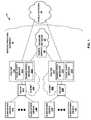
- FIG. 1is a block diagram illustrating an example network system in which routers implement the techniques of this disclosure to manage distributed address pools.
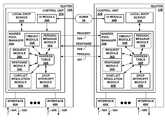
- FIG. 2is a block diagram illustrating routers of FIG. 1 in more detail.
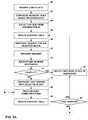
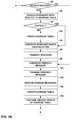
- FIGS. 3A , 3 Bare flowcharts illustrating example operation of a network device in implementing the techniques described in this disclosure.
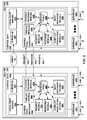
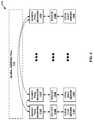
- FIG. 4is a block diagram illustrating a conceptual view of a number of shared pool managers sharing a global address pool in accordance with the techniques described in this disclosure.
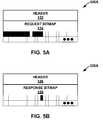
- FIGS. 5A , 5 Bare block diagrams illustrating a request message and a response message in reply to the request message, respectively, that are generated in accordance with the techniques described in this disclosure.
- FIG. 1is a block diagram illustrating an example network system 10 in which routers 12 A, 12 B implement the techniques of this disclosure to manage distributed address pools.
- Routers 12 A, 12 B(“routers 12 ”) each represents an example of a network device capable of performing the techniques of this disclosure. While described with respect to these example network devices, any network device positioned locally to subscriber devices, such as subscriber devices 14 A- 14 Z (“subscriber devices 14 ”), may implement the techniques of this disclosure to manage distributed address pools for the purposes of allocating addresses from a local network device to subscriber devices 14 .
- Examples of other devices that may implement the distributed address pool management techniques described hereininclude an access gateway, a home office router, a switch, a hub, a digital subscriber line access multiplexer (DSLAM) device, a cable modem termination system (CMTS), a wireless access point (WAP), a networked desktop computer, and a networked laptop computer. Consequently, the techniques should not be limited in this respect to the examples described in this disclosure.
- DSLAMdigital subscriber line access multiplexer
- CMTScable modem termination system
- WAPwireless access point
- networked desktop computera networked desktop computer
- networked laptop computerConsequently, the techniques should not be limited in this respect to the examples described in this disclosure.
- public network 16implements a layer three (L3) protocol referred to as an Internet protocol (IP) by which to route data units referred to as packets.
- L3layer three
- IPInternet protocol
- layersrefers to layers of the Open Systems Interconnection (OSI) model.
- OSIOpen Systems Interconnection
- public network 16is typically referred to as a packet-switched network or a L3 network. While described with respect to packets, the techniques may be implemented with respect to any type of discrete data unit.
- Service provider network 16represents a computer network owned by a service provider that provides access to public network 18 in the form of one or more services, such as a voice over Internet protocol (VoIP) service, a video service sometimes referred to as an Internet Protocol Television (IPTV) service, and a data service often referred to as Internet service. Subscribers contract with the service provider to subscribe to one or more of these services. After subscribing to the service, the subscriber employs one or more of subscriber devices 14 to receive or otherwise access the contracted services.
- VoIPvoice over Internet protocol
- IPTVInternet Protocol Television
- Subscriber devices 14generally represent one or more of a desktop computer, a laptop computer, a PDA, a cellular phone (including so-called “smart” phones), a netbook, a tablet computer, a set-top box (STB), a cable modem, a digital subscriber line (DSL) modem, a wireless access point (WAP), a server, a hub, a switch, a television, or any other device capable of accessing one or more of the above described services provided by service provider network 18 .
- STBset-top box
- WAPwireless access point
- servera server
- huba switch
- televisionor any other device capable of accessing one or more of the above described services provided by service provider network 18 .
- service provider network 18includes sub-networks (“subnets”) 20 A, 20 B (“subnets 20 ”) and a backend network 22 .
- Subnets 20represent a collection of network devices that all share a common subnet address. Devices within the same subnet commonly share addresses from among a designated pool of addresses and have the same IP prefix.
- An IP prefixis typically denoted using a form of notation referred to as classless inter-domain routing (CIDR) notation that identifies the base address of the network followed by a slash (/) and then a size of the routing prefix. For example, one IP subnet may be identified as 192.168.0.0/16.
- CIDRclassless inter-domain routing
- Subnets 20include routers 12 and DSLAMs 24 A, 24 B (“DSLAMs 24 ”), respectively, where DSLAM 24 A couples to router 12 A and DSLAM 24 B couples to router 12 B.
- Routers 12represent one example of a network device that may employ the techniques described in this disclosure.
- routers 12include a routing engine and one or more packet forwarding engines.
- the routing engineoperates as a control plane and implements one or more routing protocols by which to discover the topology of the network in the form of routes from one or more sources addresses to one or more destination addresses.
- the routing enginemaintains these routes in a database referred to as a routing information base (RIB).
- RIBrouting information base
- the routing engineselects one or more routes and installs so-called “next hops” in a database referred to as a forwarding information base (FIB) of the packet forwarding engine.
- the packet forwarding enginereceives the network traffic, accesses the FIB to select a next hop for each packet of the network traffic, and forwards the packets to their respective network hops.
- routers 12generally route traffic to its intended destination.
- routers 12may route packets that conform to the L3 Internet Protocol (IP) and may be referred to as L3 network devices.
- IPInternet Protocol
- DSLAMs 24 A, 24 B(“DSLAMs 24 ”) couple to subscriber devices 14 A- 14 M and 14 N- 14 Z, respectively.
- DSLAMs 24represent access devices that receive network traffic in the form of packets from one or more of their respective subscriber devices 14 and multiplex this network traffic onto one or more connections coupling DLSMS 24 to router 12 A in the example of FIG. 1 .
- DSLAMs 24are employed in copper-based networks previously used to couple subscriber devices 14 to a plain old telephone service (POTS) network that provides at least some portion of last-mile access between subscriber devices 14 and DSLAMs 24 via a copper wire lines.
- routers 12each represent a broadband remote access server (BRAS). While described in this context, the techniques may also be employed in cable or optical networks providing last-mile access using cable or optical fiber lines.
- BRASbroadband remote access server
- RADIUS server 26also provides accounting in the event one or more of the services to which the subscriber has contracted is payable on a use-basis, such as pay-per-view (PPV) services. While shown in backend network 22 , RADIUS server 26 may be located in a more central location, such as a central office.
- PSVpay-per-view
- the subscriberdirects one or more of subscriber devices 14 to accesses the services to which the subscriber has contracted with the service provider to provide.
- the subscriberinstalls a subscriber device referred to as a digital subscriber line (DSL) modem, which subscriber device 14 A, for purposes of illustration, is assumed to represent.
- DSLdigital subscriber line
- This device 14 Agenerally arrives pre-configured from the service provider with the necessary authentication information.
- subscriber device 14 AUpon coupling subscriber device 14 A to DSLAM 22 A and powering-on or otherwise activating this device, subscriber device 14 A first requests configuration information typically in accordance with a configuration protocol, such as a dynamic host configuration protocol (DHCP).
- DHCPdynamic host configuration protocol
- DHCP requestsRequests that comply with DHCP are generally referred to herein as “DHCP requests.” More specifically, this DHCP request is denoted as a DHCP discover message in that this first request is broadcast within the local subnet in an attempt to locate DHCP servers residing in the subnet, or a DHCP relay agent that relays the DHCP discover message to a DHCP server located in a different subnet. More information concerning DHCP in general as well as particulars concerning DHCP messages, such as DHCP discover messages, as well as, other messages can be found in Request for Comments (RFC) 2131, titled “Dynamic Host Configuration Protocol,” dated March 1997, herein incorporated by reference in its entirety.
- RRCRequest for Comments
- a DHCP discover messagegenerally includes a request that one or more IP addresses be allocated for use by subscriber device 14 A.
- Subscriber device 14 Awhich is representative of a DSL modem in this example, requests these addresses so that it can allocate one of these IP addresses to itself and then assign any remaining addresses to other subscriber devices 14 that couple to subscriber device 14 A.
- Subscriber device 14 Abroadcasts the DHCP discover message, as noted above, throughout the local subnet, i.e., subnet 20 A in this example.
- DSLAM 22 Areceives the message and forwards the message to either a local DHCP server or a DHCP relay agent.
- administratorsfavor local DHCP servers over a DHCP relay agent that forwards DHCP discover messages to a remote DHCP server located in a different subnet because the local DHCP servers are typically able to respond more quickly than remote DHCP servers due to their proximity to subscriber devices 14 .
- this proximitycomes at a cost in terms of administrative burden.
- a large service provider networkthat includes tens if not hundreds of individual subnets. Deploying local DHCP servers in each subnet requires that tens if not hundreds of DHCP servers need to be properly configured so that each DHCP server allocates IP addresses from a different subset of the IP address space reserved for use by the service provider network.
- the local DHCP serversmay allocate the same IP address for use by two different subscriber devices, which can cause considerable confusion when devices, such as routers 12 , attempt to resolve the IP address to a single subscriber device. Consequently, local DHCP servers are generally prone to misconfiguration that can lead to significant routing errors with respect to routers and loss of service with respect to subscriber devices.
- local DHCP serversmay waste a portion of the subset of the IP address space assigned to each of the local DHCP servers for allocation to the subscriber devices.
- a typical contract for data services provided by a service providerstipulates that a subscriber can access the data service with a set number of subscriber devices, each of which requires a different IP address. Consequently, when provisioning subscribers, the administrator configures the DHCP server to allocate the set number of IP addresses defined in the data service contract for each subscriber that resides within a given subnet, whether or not the subscriber actually employs the set number of subscriber devices to access the data service.
- the subset of the IP address space assigned to the local DHCP serversrepresents a maximum number of IP addresses that arises due to the presumption that each subscriber employs the set number of subscriber devices to access the data service.
- the local DHCP serveronly allocates a portion of this maximum number of IP addresses.
- the remaining IP addressare reserved for use only by the local DHCP servers, but never actually allocated by the DHCP servers, thereby wasting potentially valuable, especially in the limited address space of IP version 4 (IPv4), IP addresses that could be used by other DHCP servers.
- IPv4IP version 4
- DHCP serverimplements one or more centrally located DHCP server that are remote from subnets 20 .
- the administratordeploys a DHCP relay agent that directs DHCP discover messages to one or more centrally located DHCP servers.
- the DHCP serversare centrally located, the administrator may more efficiently administer the DHCP servers.
- fewer DCHP serversneed be deployed because a centrally located DHCP server may service a number of subnets contrary to local DHCP servers that generally only service a single subnet or, at most, a few proximately located subnets.
- these DHCP serversare not as prone to configuration errors involving overlapping assignment of sets of IP addresses.
- the centrally located DHCP serversgenerally do not waste as many IP addresses as those wasted by local DHCP servers due to the fact that the centrally located DHCP servers may receive requests from a large number of subnets and may be more easily administered.
- the service providermay specify the set number of devices, but acknowledge that most subscribers will not employ concurrently the set number of devices.
- it is important to allocate the maximumbecause under allocation of IP address subset would require burdensome reconfiguration.
- administrationis less of an issue so under allocation of IP address subsets may be more easily tolerated.
- the service providermay determine an average use per subscriber of IP addresses and allocate this average number of IP addresses per subscriber given that the allocated IP address subset is larger in a centrally located DHCP error and therefore provides more room for error as opposed to the relatively small IP address subsets of local DHCP servers.
- the centrally located DHCP serversmay not respond as quickly to DHCP messages compared to local DHCP servers, the centrally located DHCP servers are more easily administered and do not generally waste as many IP addresses, again, in comparison to local DHCP servers.
- routers 12include shared pool managers 28 A, 28 B (“shared pool managers 28 ”) that enable routers 12 to implement local DHCP servers 30 A, 30 B (“local DHCP servers 30 ”) in a manner that reduces, if not potentially eliminates, both the administrative burdens and IP address waste commonly associated with local DHCP servers 30 .
- each of shared pool managers 28represent a hardware module, which in some instances executes software, to manage a virtual global address pool in accordance with the techniques described in this disclosure.
- Each of local DHCP servers 30may represent a hardware module, which in some instances executes software, to implement DHCP in accordance with the above incorporated reference, as one example.
- poolis used in this disclosure to refer to the subset of the IP address space assigned for use by a given local DHCP server, where the term “assign” refers to reservation of a block or subset of addresses by a given local DHCP server in contrast to the term “allocate,” which refers to allocation of one or more addresses from the assigned subset of addresses to subscriber devices by the local DHPC server.
- the term “global address pool”refers generally to a subset of the IP address space reserved for use by two or more local DHCP servers.
- This global address poolis “virtual” in the sense that shared pool managers 28 facilitate access by local DHCP servers 30 to the global address pool but that this global address pool is not ever assigned in its entirety to any single one of local DHCP servers 30 . In other words, all of the local DHCP servers 30 can access the global address pool to reserve different portions of this address pool for use by DHCP servers 30 but none of the local DHCP servers 30 are actually assigned the entire global address pool.
- the global address poolfrom the perspective of DHCP servers 30 , appears as if it has been assigned to the DHCP server in its entirety when in fact it is shared by local DHCP servers 30 .
- shared pool managers 28are configured to share a given global address pool, which again can be either a subset of the IP address space assigned to service provider network 18 or the entire IP address space assigned to service provider network 18 .
- shared pool managers 28each stores data that defines the global address space shared by both of local DHCP servers 30 of routers 12 . This address space is shared in that both maintain the same address space, meaning that this space overlaps and initially spans the entire address pool.
- Each of shared pool managers 28then attempt to reserve a block of the global address space for each of respective local DHCP servers 30 .
- shared pool manager 28 Amay generate a request that requests a block of addresses within the global address space be reserved for use by local DHCP server 30 A in allocating addresses from the reserved block to one or more of subscriber devices 14 A- 14 M coupled to router 12 A.
- Shared pool manager 28 Bmay likewise generate a similar request to that of the request generated by shared pool manager 28 A requesting a block of addresses within the global address space be reserved for use by local DHCP server 30 B in allocating addresses from the reserved block to one or more of subscriber devices 14 N- 14 Z coupled to router 12 B.
- Each of these requestsgenerally includes a bitmap having one bit for each of the addresses in the global address space. A bit set to one in the bitmap indicates a request for the corresponding address.
- the block of addresses defined by each requestneed not be a contiguous block of addresses but may be any combination of addresses within the global address space.
- Shared pool managers 28then broadcast their requests to every other one of shared pool managers 28 that share the same global address space, whereupon shared pool managers 28 extract the bitmap and determine whether the request presents any address conflicts.
- An address conflictoccurs when the bitmap indicates an attempt to reserve an address previously reserved or attempted to be reserved contemporaneously to the received request by shared pool managers 28 that received the request. That is, both of shared pool managers 28 may in some instances attempt to reserve the same address contemporaneously, which results in an address conflict.
- Shared pool managers 28in response to an address conflict, reject the respectively received requests and select a different block of addresses using a random offset or some other method to avoid repeated address conflicts. If shared pool managers 28 do not detect an address conflict, shared pool managers 28 transmit a response indicating that the request has been granted.
- shared pool managers 28receive a response from each of the another shared pool managers 28 that share the same global address space indicating whether the requested block of addresses is available for use by the requesting one of shared pool managers 28 (and thus by local DHCP server 30 A) in allocating addresses from the reserved block to subscriber devices 14 . Based on the indication in the response received from the other shared pool managers 28 , each of shared pool managers 28 update the data that defines the global address space to reflect that the block of addresses has been reserved for use by the first network device. As noted above, in the instance of an address conflict, this request process is repeated until a block of addresses is reserved for use by local DHCP server 30 A.
- shared pool managers 28After configuring shared pool manager 28 , the administrator often does not need to further interact with shared pool managers 28 , as shared pool managers 28 automatically (that is, without administrator input) negotiate and reserve blocks of the global address space and configure local DHCP servers 30 with the reserved blocks. Shared pool managers 28 therefore reduce administrative burden normally associated with administrating local DHCP servers 30 while also reducing resource waste as smaller blocks of a size less than the maximum may be reserved. If additional addresses are required, as illustrated in the example below, shared pool managers 28 may repeat the above processes to reserve another block of the global address space and configure local DHCP servers 30 to use the previously reserved block in conjunction with the additional block. Again, shared pool managers 28 generally reserve this additional block without any administrative oversight or input, thereby lessening if not eliminating administrative burdens normally associated with local DHCP servers 30 .
- each of local DHCP servers 30begin receiving DHCP discover messages from one or more of subscriber devices 14 .
- Local DHCP servers 30respond to these discover messages with DHCP offer messages.
- the DHCP offer messagesdefine a lease for one or more of the IP addresses of the block of the global address pool reserved for each of local DHCP servers 30 .
- Those of subscriber devices 14 that initially sent the DHCP discover messagesrespond to the DHCP offer messages with a DHCP request message requesting the lease offered in one of the DHCP offer messages.
- Local DHCP servers 30respond to this offer messages with a DHCP acknowledgement (ACK) message that indicates acknowledgement of the lease for the IP address by the respective ones of subscriber devices 14 requesting an IP address.
- ACKDHCP acknowledgement
- each of shared pool managers 28stores data indicating those of the IP addresses within the block of the global address pool reserved for use by local DHCP servers 30 that have been allocated to subscriber devices 14 .
- Shared pool managers 28may intercept (in a manner transparent to local DHCP servers 30 ) DHCP discover messages and determine whether any of the block of IP addresses reserved from the global address pool are available for use by the requesting one of subscriber devices 14 . If, based on the data stored by shared pool manager 28 indicating those of the IP addresses available for allocation by local DHCP servers 30 , shared pool manager 28 determines that none of the IP addresses are available in the reserved block, shared pool managers 28 negotiate in the manner described above an additional block of IP addresses from the global address pool that can be reserved for use by local DHPC servers 30 . Shared pool managers 28 , after negotiating this additional block, configures local DHCP servers 30 , respectively, with the additional block of addresses reserved from the global address pool.
- Shared pool manager 28typically drops or does not responds to the received DHCP discover message that prompted the reconfiguration of local DHCP servers 30 , whereupon the one of subscriber devices 14 that issued this DHCP discover message typically times out after a set period of time and resends the DHCP discover message.
- Shared pool managers 30verify that local DHCP server 30 has IP addresses available for allocation and forwards the DHCP discover message to the respective one of local DHCP servers 30 .
- Local DHCP servers 30responds to this DHCP discover message in the manner indicated above so as to eventually allocate an IP address from the newly reserved block of IP addresses reserved from the global address pool.
- shared pool manager 28represents a module positioned between subscriber devices 14 and local DHCP server 30 that transparently intercepts DHCP messages to provide a form of automated administrative oversight.
- shared pool managers 28detects that the respective one of local DHCP servers 30 no longer has any addresses available for allocation, shared pool managers 28 automatically reconfigures local DHCP servers 30 to expand the number of IP addresses that can be allocated.
- shared pool managers 28may detect unused IP addresses and dynamically reconfigure local DHCP servers 30 to reduce the number of IP addresses that can be allocated by respective ones of local DHCP servers 30 .
- shared pool managers 28may enable local DHCP servers 30 such that these local DHCP servers 30 require little if any additional administrative oversight in comparison to a central DHCP server while also reducing address waste normally associated with local DHCP servers.
- subnets 20 shown in FIG. 1are separate from one another despite these two subnets 20 potentially sharing addresses from the same global address pool. That is, the term “subnet” usually refers to a computer network where each of the devices of the network is assigned an address that shares the same IP prefix.
- shared pool manager 28 Areserves a non-contiguous block of IP addresses having one or more addresses identified by an IP prefix of one or more addresses reserved by shared pool manager 28 B for use by local DHCP server 30 B, thereby effectively creating one large subnet in which both routers 12 reside contrary to the example of FIG. 1 .
- shared pool managers 28each reserve contiguous blocks of addresses that each includes all of the addresses for a given IP prefix.
- subnets 20represent typical subnets rather than forming one large subnet. For this reason, subnets 20 are shown as dashed lines in FIG. 1 to denote that these subnets 20 may effectively merge or remain distinct depending on the configuration of shared pool managers 28 .
- FIG. 2is a block diagram illustrating routers 12 of FIG. 1 in more detail.
- the techniques described in this disclosuremay be implemented by any type of network device capable of implementing a local DHCP server. In general, the techniques should not be limited strictly to the examples described in this disclosure.
- router 12 Aincludes a control unit 32 A.
- Control unit 32 Amay comprise one or more processors (not shown in FIG. 2 ) that execute software instructions, such as those used to define a software or computer program, stored to a computer-readable storage medium (again, not shown in FIG. 2 ), such as a storage device (e.g., a disk drive, or an optical drive), or memory (such as Flash memory, random access memory or RAM) or any other type of volatile or non-volatile memory, that stores instructions to cause a programmable processor to perform the techniques described herein.
- a storage mediume.g., a disk drive, or an optical drive
- memorysuch as Flash memory, random access memory or RAM
- control unit 32 Amay comprise dedicated hardware, such as one or more integrated circuits, one or more Application Specific Integrated Circuits (ASICs), one or more Application Specific Special Processors (ASSPs), one or more Field Programmable Gate Arrays (FPGAs), or any combination of one or more of the foregoing examples of dedicated hardware, for performing the techniques described herein.
- ASICsApplication Specific Integrated Circuits
- ASSPsApplication Specific Special Processors
- FPGAsField Programmable Gate Arrays
- Control unit 32 Amay be divided into two logical or physical “planes” to include a first control or routing plane and a second data or forwarding plane. That is, control unit 32 A may implement two separate functionalities, e.g., the routing and forwarding functionalities, either logically, e.g., as separate software instances executing on the same set of hardware components, or physically, e.g., as separate physical dedicated hardware components that either statically implement the functionality in hardware or dynamically execute software or a computer program to implement the functionality. For purposes of illustration, these planes are not shown in the example of FIG. 2 , however, generally the control or routing plane of control unit 32 A implements local DHCP server 30 A and shared pool manager 28 A.
- Control unit 32 Aincludes shared pool manager 28 A, local DHCP server 30 A and user interface (UI) module 34 A.
- Shared pool manager 28 Aincludes a request module 36 A, a response module 38 A, a conflict resolution module 40 A, a periodic message module 42 A, a timeout module 44 A.
- Request module 36 Arepresents a hardware module, which in some instances executes software, to generate block requests requesting a block of either contiguous or non-contiguous IP addresses from the global address pool.
- Response module 38 Arepresents a hardware module, which in some instances executes software, to generate responses to received block requests.
- Conflict resolution module 40 Arepresents a hardware module, which in some instances executes software, to resolve address conflicts that result when a received response indicates that one or more addresses of the requested block are unavailable.
- Periodic message module 42 Arepresents a hardware module, which in some instances executes software, to generate periodic messages indicating the addresses reserved for use by local DHCP server 30 A.
- Timeout module 44 Arepresents a hardware module, which in some instances executes software, to determine when one or more leases of IP addresses have timeout and therefore become available for consideration as an unreserved IP addresses, i.e., an address not reserved for use by any of local DHCP servers 30 that share the global address pool.
- Local DHCP server 30 Arepresents a hardware module, which in some instances executes software, to implement DHCP.
- UI module 34 Arepresents a hardware module, which in some instances executes software, to provide a user interface with which a user may interface to interact with local DHCP server 30 A and shared pool manager 28 A of control unit 12 A.
- UI module 34 Amay provide a graphical user interface (GUI) or a command line interface (CLI) with which a user may interface to input commands, scripts, and configuration data.
- GUIgraphical user interface
- CLIcommand line interface
- router 12 Aincludes interfaces 48 A- 48 N (“interfaces 48 ”) that receive and send packet flows or network traffic via inbound network links 50 A- 50 N (“inbound network links 50 ”) and outbound network links 52 A- 52 N (“outbound network links 52 ”), respectively.
- IFCs 48are typically coupled to network links 50 , 52 via a number of interface ports (not shown), and forward and receive packets and control information from control unit 37 via a respective one of paths 54 A- 54 N (“paths 54 ”).
- Each physical interface of IFCs 48is typically assigned a unique identifier by control unit 37 , and multiple logical interfaces having unique identifiers may be assigned to each physical interface, where each logical interface represents as a distinct input or output interface for different network traffic. These logical interfaces may represent VLANs and each VLAN may be assigned a unique VLAN tag. Often, each particular context in which a DHCP client devices resides is assigned a VLAN tag to differentiate between client devices of different context. Each of IFCs 48 may also each couple to a different separate sub-network via links 50 , 52 . These sub-networks, although not shown in FIGS. 1 and 2 , may comprise a Large Area Network (LAN) or other broadcast network.
- LANLarge Area Network
- Router 12 Amay include a chassis (not shown in FIG. 2 ) having a number of slots for receiving a set of cards, including IFCs that include one or more of interfaces 48 . Each card may be inserted into a corresponding slot of a chassis for communicably coupling the card to a control unit 32 A via a bus, backplane, or other electrical communication mechanism.
- Router 12 Bis substantially similar to router 12 A in that router 12 B includes a control unit 32 B and interfaces 48 A′- 48 N′ (“interfaces 48 ′”) that are substantially similar to control unit 32 A and interfaces 48 of router 12 A.
- shared pool manager 28 B of control unit 32 Bincludes modules 36 B- 44 B that are substantially similar to respective modules 36 A- 44 A of shared pool manager 28 A included within control unit 32 A of router 12 A.
- UI module 34 B and local DHCP server 30 Bmay also be substantially to UI module 34 A and local DHCP server 30 A.
- a usersuch as administrator 54 (“admin 54 ”), interfaces with a user interface presented by UI modules 34 A, 34 B (“UI modules 34 ”) to enter configuration data for configuring shared pool managers 28 .
- This configuration datadefines at least the size of the global address pool.
- Shared pool managers 28then store data defining address tables 56 A, 56 B (“address tables 56 ”), respectively, that contains an entry for each address of the global address pool defined by the configuration data.
- address tables 56An example representative of a newly initialized address tables 56 is shown below with respect to the following Table 1.
- each row after the header rowdenotes an entry in address tables 56 that defines a “Pool Member” or a different address of the global address pool, an “L” bit indicating whether the corresponding address is “owned” or reserved by respective the one of shared pool managers 28 that maintains the respective one of address tables 56 , a “C” bit indicating whether the respective “owned” or reserved addresses are actually consumed, a “T” or timestamp indicating a time at which the corresponding address lease was last refreshed, and an “O” or owner indicating who sent the last request for the corresponding address.
- each of request modules 36 of shared pool managers 28access the respective one of address tables 56 and select a contiguous or non-contiguous block of addresses that are not currently reserved by shared pool managers 28 . That is, each of request modules 36 evaluates the respective data that defines the network address pool to determine a block of addresses identified by the data that defines the network address pool that is not currently reserved for use by the other local DHCP server in allocating addresses from the identified particular block of addresses to the one or more subscriber devices coupled to the second network device. In one example, request modules 36 may select addresses reserved by another shared pool manager 28 but that have since timeout as determined from the corresponding timestamp.
- request module 36 Aattempts to select a contiguous block of addresses first, and only selects non-contiguous blocks of addresses if a contiguous block of addresses of a configured size is not available as determined through analysis of address table 56 A.
- request module 36 Agenerates a bitmap having a bit for each address of the global address pool.
- Request module 36 Aindicates those addresses of the global address pool that it has determined to request by setting each of the corresponding bits in the bitmask to one and setting the remaining bits of the bitmask to zero.
- Request module 36 Aalso updates address table 56 A, and specifically, the “L” bits for those addresses request module 36 A has requested for use by local DHCP server 30 A.
- Request module 36generates a request message 58 A to include this request and forwards this request via an appropriate one of interfaces 48 to each of the other shared pool managers 28 , i.e., shared pool manager 28 B in the example of FIG. 2 .
- Response module 38 B of shared pool manager 28 Breceives this request message 58 A and extracts the bitmap defined by this message 58 A. Response module 38 B then compares this received bitmap (which is sometimes referred to as a “request” bitmap) to address table 56 A. For example, response module 38 B may perform a logical “AND” operation (usually denoted in programming languages using a double ampersand “&&”) between the request bitmap and the “L” column of address table 56 A. The bitmap resulting from this logical AND operation may be referred to as a “response” bitmap. Response module 38 B generates a response message 58 B to include this response bitmap and forwards response message 58 B via one of interfaces 48 ′ to shared pool manager 28 A.
- Response module 38 A of shared pool manager 28 Areceives response message 58 B and extracts the response bitmap.
- Response module 38 Aanalyzes the response bitmap to determine whether there are any address conflicts.
- Response bitmapgenerally indicates an address conflict with a bit of the bitmap set to one. That is, the logical “AND” operation performed by request module 36 B reveals address conflicts in that a logical AND of a one in a location of the request bitmap as a corresponding one in the same location of the “L” bitmap indicates that the requested address is currently reserved for use by local DHCP server 30 B. Consequently, any bits of the response bitmap set to one indicates an address conflict, while if all of the bits of the request bitmap are set to zero, the bitmap indicates acknowledgement of the request.
- request module 36 BAfter performing the local “AND” operation, request module 36 B analyzes the response bitmap to determine whether any address conflicts occurred. If no address conflicts are detected, i.e., every bit of the request bitmap is set to zero in this example, request module 36 B updates address table 56 B to indicate the requested addresses are owned by shared pool manager 28 A and sets the corresponding timestamp to the current time. If an address conflict is detected, request module 36 B does not update address table 56 A. To illustrate with respect to the above example of Table 1, consider that shared pool manager 28 A requests the first two addresses shown in Table 1 and request module 36 B performed the logical “AND” operation and determined that no address conflicts occurred. Request module 36 B updates the first two entries after the header entry of Table 1 to denote the current time for the timestamp column and the owner as “A,” which is assumed for purposes of illustration to denote shared pool manager 28 A. The following Table 2 shows the result of this update.
- Shared pool manager 28 Amay receive and process multiple responses as request 58 A is broadcast to all of shared pool managers 28 that have been configured to share the same global address pool. If any one of these responses (which are similar to response 58 B) denotes an address conflict, conflict resolution module 40 A of shared pool manager 28 A is invoked to resolve the conflict.
- Conflict resolution module 40 Aanalyzes the response bitmap indicating the conflict, refers to address table 56 A, updates address table 56 A to indicate this conflicted address is reserved by a different one of shared pool managers 28 , and generates a request bitmap so as to potentially avoid the detected address conflict.
- the address conflictsresult when two or more shared pool managers concurrently, or even in some instances simultaneously, request at least one of the same addresses.
- Conflict resolution module 40 Amay implement an algorithm that selects a random time to delay the generation of the request bitmap so as to provide time for the other conflicting one of shared pool managers 28 to generate a request to reserve the conflicted address. This algorithm generally also randomly selects another address that is usually not adjacent to the requested address. This randomness helps prevent further conflicts from occurring.
- request module 36 Aupdates address table 56 A to reflect that shared pool manager 28 A has reserved the first two addresses (continuing the example from above) at the current time, T Y .
- the following Table 3illustrates address table 56 A after this update.
- request module 36 Aupdates the “L” column of the first and second entries to store a bit value of one, the timestamp column of the first and second entries to denote the current time, T Y , and the “O” column to denote that shared pool manager 28 A or “A” owns or has reserved these addresses. In one example, request module 36 A leaves the “C” bits for these entries unedited as these addresses have not been allocated by local DHCP server 30 A.
- shared pool manager 28 Balso performs a substantially similar process to that of shared pool manager 28 B to reserve a block of addresses. For purposes of illustration it is assumed that shared pool manager 28 B reserves the last two addresses in the global address pool reflected in Tables 1-3 above. The following Table 4 shows the state of address table 56 B after reserving these two addresses.
- request module 36 Bhas updated the last two entries to denote that shared pool manager 28 B, which is denoted by “B” in the “O” column, reserved addresses 192.168.2.254 and 192.168.2.255 at a time of T Z . After reserving these addresses, shared pool managers 28 configure respective local DHCP servers 30 with the reserved addresses.
- periodic message modules 42each generates a periodic message 58 C indicating those addresses of the global address pool owned by respective shared pool managers 28 .
- Each of periodic message modules 42periodically accesses address table 56 , extracts the “L” column bitmap, generates periodic message 58 C to include this “L” bitmap and broadcasts periodic message 58 C to each of shared pool managers 28 configured to share the same global address pool.
- Periodic message modules 42receive these periodic messages 58 C from one another and update address table 56 A based on “L” bitmap stored to each of these periodic messages 58 C. This update is generally performed so as to synchronize address state among various shared pool managers 28 , as address table 56 A may, as noted above, be updated by the requesting one of shared pool managers 28 A before an address conflict is detected.
- a first one of shared pool managers 28may not detect a conflict and update its respective address table 56 while a second one of shared pool managers 28 may detect a conflict thereby preventing the requesting one of shared pool managers 28 from reserving the addresses indicated by the request bitmap. Yet, this first shared pool manager 28 is not aware of this conflict. Consequently, periodic message modules 42 communicate with one another via periodic messages 58 C to synchronize address tables 56 between one another to improve sharing of the global address pool.
- local DHCP servers 30may, after being configured with the served address block, begin receiving DHCP discover messages.
- shared pool managers 28intercept DHCP discover message received via interfaces 48 , 48 ′ to determine whether their respective local DHCP servers 30 include sufficient addresses to service the DHCP discover messages. That is, shared pool managers 28 each generally include a DHCP intercept module 45 A, 45 B (“DHCP intercept modules 45 ”) that intercepts DHCP messages, such as DHCP discovery, offer, request, and ACK messages.
- DHCP intercept modules 45accesses the “L” column bitmask and the “C” column bitmask in their respective address tables 56 and determines whether, for each of the bits of the “L” bitmask set to one, whether the corresponding bit of the “C” bitmask is set to zero. If there are sufficient bits in the “L” bitmask that are set to one with the corresponding bits in the “C” bitmask set to zero to accommodate the request for one or more addresses set out in the DHCP discover message, DHCP intercept modules 45 forwards the DHCP discover messages to their corresponding local DHCP server 30 .
- DHCP intercept module 45invokes request module 36 A to request that another block of addresses of the global address pool be reserved for use by their respective one of local DHCP servers 30 , which proceeds in the manner described above.
- DHCP intercept modules 45also intercept DHCP ACK messages, parse the address allocation from the ACK message, and update their respective one of address tables 56 to denote consumption by requesting subscriber devices 14 of the addresses reserved for use by their respective one of local DHCP servers 30 .
- DHCP intercept module 45 Amay intercept a DHCP ACK message for the address listed in the first entry of the above Table 3.
- DHCP intercept module 45 Aparses this DHCP ACK message to retrieve the address, i.e., 192.168.2.1 in this example, and accesses address table 56 A to update the “C” bit for the first entry to denote that this address has been consumed.
- Table 5illustrates the result of this update on Table 3 and also notes the reservation of the last two addresses in the global address pool by shared pool manager 28 B (which was described with respect to Table 4 above).
- timeout modules 44routinely access their respective address tables 56 to determine if one or more address leases have timed out. That is, the configuration data input by admin 54 may define a lease timeout value that defines a duration that a given shared pool manager 28 may reserve a given address. Timeout modules 44 access their respective one of addresses tables 56 to retrieve the timestamp values for all entries having an “L” bit set to one. Timeout modules 44 then compare the retrieved timestamps to the current time to determine an elapsed time for each owned address. Timeout modules 44 next compare the elapsed times to the timeout value.
- timeout modules 44clear that address from address tables 56 by setting the respective “L” and “C” bits back to zero and the timestamp and owner fields to null.
- shared pool managers 28configures their respective local DHCP servers 30 with the reserved block of addresses
- shared pool managers 28set the lease duration to a value that is a multiple of the lease timeout value.
- local DHCP servers 30automatically revoke the subscribers lease for the address at a point in time before timeout modules 44 perform their timeout operations described above to clear entries in their respective one of address tables 56 .
- local DHCP servers 30do not allow leases to run longer than shared pool managers 28 is allowed to reserve a given address from the global address pool.
- DHCP intercept modules 45refresh the timestamp in response to DHCP ACK messages so that when timeout modules 44 determine elapsed times, these elapsed times better reflect lease duration configured by local DHCP servers 30 . That is, local DHCP servers 30 can be configured to provide lease durations up to the lease timeout value configured for timeout modules 44 .
- DHCP intercept module 45 Aupdates the timestamps for entries of the address table 56 A in response to DHCP ACK messages for those corresponding addresses. Timeout module 44 A then determines elapsed times for these entries that reflect an elapsed time that a given subscriber device has reserved the use of that address, rather than an elapsed time shared pool manager 28 A has reserved the address.
- timeout module 44 AIn comparing the timeout value to this elapsed time, timeout module 44 A in effect determines when local DHCP server 30 A will revoke the lease, thereby synchronizing timeout module 44 A with local DHCP server 30 A.
- DHCP intercept module 45 Amay continually update these timestamps in response to DHCP renew messages that request renewal of a given lease. In either instance, when timeout module 44 A detects a timeout in these instances and clears a given entry, timeout module 44 A often also reconfigures local DHCP server 30 A so that it can no longer use these addresses.
- routers 12may enable a dynamic global address pool such that one or more network devices that each implement a local DHCP server may dynamically join and leave the global address pool.
- Admin 54interfaces with a user interface presented by UI module 34 B executing within control unit 32 B of router 12 B to input configuration data.
- This configuration dataincludes, as noted above, various data to enable shared pool manager 28 B to dynamically join the shared global address pool.
- This configuration datamay specify the global address pool as an IP subnet address so that shared pool manager 28 B can configure address table 56 B to reflect this shared global address pool.
- shared pool manager 28 Bbegins issuing requests to reserve a block of addresses for use by local DHCP server 30 B in the manner described above with respect to shared pool manager 28 A of router 12 A.
- FIGS. 3A , 3 Bare flowcharts illustrating example operation of a network device, such as router 12 A shown in the example of FIG. 2 , in implementing the techniques described in this disclosure. While described with respect to a particular network device, i.e., router 12 A in this example, the techniques may be implemented by any network device as noted above. The techniques should not be limited in this respect.
- a usersuch as admin 54 initially interacts with a user interface presented by UI module 34 A to input configuration data, as described above ( 60 ).
- the configuration datatypically defines parameters for configuring a global address pool within address table 56 A, as well as, other parameters, such as a frequency with which periodic message module 42 A generates and sends a periodic message 58 C and a timeout value that controls how long a given one of shared pool managers 28 A can reserve a given block of addresses.
- the configuration datarepresents any data that facilitates configuring shared pool manager 28 A to implement the techniques described in this disclosure.
- UI module 34 Aforwards this configuration data to shared pool manager 28 A of control unit 32 A, which configures address table 56 A in the manner described above and possibly periodic message module 42 A and timeout module 44 A ( 62 ).
- shared pool manager 28 Ainvokes request module 36 A to select a block of addresses from address table 56 A ( 64 ).
- Request module 36 Aupdates address table 56 A to denote that these addresses are reserved by shared pool manager 28 A, as described above ( 66 ).
- the configuration datamay define a maximum block size and request module 36 A generally selects a block of addresses that meets this maximum block size.
- request module 36 Agenerates a request 58 A for the selected block of address in the manner described above ( 68 ).
- this request 58 Aincludes a bitmap having a bit for each of the addresses defined by address table 56 A with those of the bits set to one that correspond to the selected block of addresses.
- this block of addressesmay be a contiguous or non-contiguous block of addresses.
- Request module 36 Atransmits request 58 A to those other devices that share the same global address pool, i.e., router 12 B in this example, via one of interfaces 48 ( 70 ).
- each of those devices that also implement the techniques described in this disclosure and shares the same global address poolevaluates request 58 A and responds with a response 58 B.
- Shared pool manager 28 Areceives this response 58 B via one of interfaces 48 ( 72 ).
- Shared pool manager 28 Ainvokes response module 38 A to evaluate received response 58 B, which determines whether an address conflict has occurred in the manner described above ( 74 ). If there is an address conflict, response module 38 A forwards response 58 B to conflict resolution module 40 A.
- conflict resolution module 40 Aselects a different block of addresses from the global address pool defined by address table 56 A so as to avoid the address conflict ( 76 ).
- Conflict resolution module 40 Aupdates address table 56 A to remove notations that the previously requested block of addresses was reserved and denote that the different block of addresses will be reserved for use by shared pool manager 28 A.
- Conflict resolution module 40 Aforwards this different block of addresses to request module 36 A, which generates and transmits a new request 58 A requesting this different block of addresses ( 66 - 70 ).
- shared pool manager 28 Areceives one or more responses via interfaces 48 and invokes response module 38 A to determine whether an address conflict occurred ( 72 , 74 ).
- shared pool manager 28 Aconfigures DHCP server 30 A to allocate the selected block of addresses in response to DHCP communications, at which point, DHCP server 30 A begins receiving DHCP communications ( 78 ).
- DHCP intercept module 45 Atransparently monitors or intercepts these communications and updates address table 56 A, as described above ( 80 , 82 ).
- DHCP intercept module 45 Awhen updating address table 56 A, determines whether DHCP server 30 A has allocated its last remaining address from the selected block of addresses ( 84 ). While described with respect to the “last address,” the techniques should not be limited to this specific example. In other instances, DHCP intercept module 45 A may determine whether the number of allocated addresses exceeds some limit or threshold. For example, DHCP intercept module 45 A may determine whether the percentage of allocated addresses exceeds 90%.
- DHCP intercept module 45 Ainvokes request module 36 A.
- Request module 36 Aselect a different block of available addresses (i.e., addresses not denoted as reserved by another one of the shared pool managers that share the same global address pool) from address table 56 A, updates address table 56 A, generates a request message 58 A and transmits request message 58 A ( 76 , 64 - 70 ).
- shared pool manager 28 Aagain invokes response module 38 A to evaluate the request and determine if a conflict occurred ( 72 , 74 ). Assuming no conflict, shared pool manager 28 A configures DHCP server 30 A to expand the block of addresses reserved for use by DHCP server 30 A to include the different reserved block of addresses ( 78 ).
- shared pool manager 28 Alistens for requests similar to request 58 A from shared pool manager 28 B ( 86 ). In response to receiving a request via one of interfaces 48 (“YES” 86 ), shared pool manager 28 A invokes request module 36 A, which evaluates the request with respect to address table 56 A to determine whether any address conflicts occur between the requested addresses and those currently reserved for use by DHCP server 30 A ( 88 , 90 ).
- request module 36 Aupdates address table 58 A to denote that the requested addresses are reserved for use by the requesting shared pool manager, i.e., shared pool manager 28 B in this instance ( 92 ).
- Request module 36 Aforwards the result of the evaluation to response module 38 A, which generates and transmits a response similar to response 58 B to shared pool manager 28 B via one of interface 48 ( 94 , 96 ).
- request module 36 Awithout updating address table 56 A, merely forwards the result of the evaluation to response module 38 A, which generates and transmits the response based on the evaluation in the manner described above ( 94 , 96 ).
- shared pool manager 28 AAfter sending the response ( 96 ) or if no request was received (“NO” 86 ), shared pool manager 28 A periodically invokes periodic message module 42 A, which generates and transmits a periodic message 58 C via one or more of interfaces 48 in the manner described above ( 98 , 100 ). Shared pool manager 28 A also invokes periodic message module 42 A in response to receiving a periodic message 58 C, which proceeds to update address table 56 A in response to receiving periodic messages 58 C ( 102 , 104 ). Moreover, shared pool manager 28 A also routinely or periodically invokes timeout module 44 A to update address table 56 A and remove any address reservations that have timed out, again as described in more detail above ( 106 ). Shared pool manager 28 A continues in this manner to intercept DHCP communications, manage reserved addresses and perform the other operations denoted as steps 80 - 84 , 76 , and 66 - 106 until such time as no more addresses in the global address pool are available.
- FIG. 4is a block diagram illustrating a conceptual view 110 of a number of shared pool managers 112 A- 112 N sharing a global address pool 114 in accordance with the techniques described in this disclosure.
- Shared pool managers 112 A- 112 N(“shared pool managers 112 ”) are communicatively coupled to one another and share global address pool 114 through above noted exchange of various types of messages.
- Share pool managers 112execute within respective access routers 114 , which may represent either physical actual routers or so-called “virtual” routers, that service subscriber devices.
- Virtual routersrepresent a partition of a physical router's resources. This virtualization in effect enables a single router to emulate multiple routers. In some instances, these virtual routers are referred to as separate “routing instances.” In any event, each of these virtual routers may execute its own shared pool manager. Often, a single router may implement two virtual routers in a high-availability (HA) context, where one of the virtual routers is designated as a primary virtual router and the other virtual router is designated as a backup or secondary virtual router. If the first virtual router fails for some reason in the HA context, the second backup virtual router may take control of the router and continue routing packets, often without any other router noticing the failure of the first virtual router.
- HAhigh-availability
- multiple physical routersmay cooperate with one another to provide a single router.
- One of these routersis the primary, while another one is the secondary or backup router.
- the primary one of the cooperating physical routersfails, the secondary one of the cooperating physical routers assumes the operations of the failed one of the cooperating routers.
- This multiple redundant physical router instanceis also referred to generally as a high-availability router.
- the primary routermirrors routing and forwarding information to the secondary router.
- the techniques described in this disclosuremay be implemented in this HA context either with regard to two different physical routers or virtual routers.
- the address tablemay be mirrored from the shared pool manager of the primary virtual router to the shared pool manager of the backup virtual router.
- the backup shared pool managerdoes not either send or receive messages, but remains silent until activated. Once activated, the backup shared pool manager takes over for the primary shared pool manager.
- Routers 114each include or otherwise communicatively couple to a DHCP server 116 .
- the DHCP communicationsflow to and from shared pool managers 112 via routers 114 , whereupon shared pool managers 112 provide automated administrative oversight of local DHCP servers 116 in the manner described above.
- FIGS. 5A , 5 Bare block diagrams illustrating a request message 120 A and a response message 120 B in reply to request message 120 A, respectively, that are generated in accordance with the techniques described in this disclosure.
- FIG. 5Ais a block diagram illustrating an example request message 120 A generated in accordance with the techniques of this disclosure.
- request message 120 Aincludes a header 122 that identifies a group of one or more shared pool managers that share the same global address pool, such as shared pool managers 112 shown in the example of FIG. 4 .
- Header 122may define any information necessary to transmit message 120 A to shared pool managers 112 , as well as, information required to interpret or parse message 120 A.
- Request message 120 Aalso includes a request bitmap 124 that defines a number of bits, with set bits being indicated in the example of FIG. 5A as black-filled blocks.
- request bitmap 124defines a request for a block of non-contiguous addresses.
- FIG. 5Bis a block diagram illustrating an example response message 120 B generated in accordance with the techniques of this disclosure.
- response message 120 Bincludes a header 126 that identifies a group of one or more shared pool managers that share the same global address pool, such as shared pool managers 112 shown in the example of FIG. 4 .
- Header 126may define any information necessary to transmit message 120 B to shared pool managers 112 , as well as, information required to interpret or parse message 120 B.
- Response message 120 Balso includes a response bitmap 128 that defines a number of bits, with set bits being indicated in the example of FIG. 5B as black-filled blocks.
- response bitmap 128indicates that one address requested by request bitmap 124 is in conflict, as denoted by the black filled box.
- bitmaps 124 and 128may be compressed using a number of compression techniques, such as a Lempel-Ziv compression technique, a Lempel-Ziv-Welch compression technique, a PKZIP compression technique, a GZIP compression technique or any other suitable compression techniques.
- a common size for a global address poolis 64K
- each of bitmaps 124 , 128are about 8 KB of data, which effectively represents the approximate size of each of messages 120 A, 120 B. Compression using one of these techniques may reduce the size of the bitmaps and therefore the messages to about 2 KB or 3 KB.
- the above techniquesmay improve DHCP server administration commonly associated with local DHCP servers. Overcoming this administrative burden facilitates the deployment of local DHCP servers, which thereby improves DHCP server response times for the reasons noted above. Quick DHCP response times are typically an important requirement for certain services, such as Voice over IP (VoIP).
- VoIPemploys a process known as a “call setup” that requires a line care or interface of a forwarding engine to set up a VoIP interface for each VoIP call.
- DHCP communications that precede call setupwhen redirected to a remote DHCP server, require the line card to perform additional processing that negatively impacts call setup, decreasing a call setup rate.
- the additional processingcan be avoided, thereby potentially improving the call setup rate.
Landscapes
- Engineering & Computer Science (AREA)
- Computer Networks & Wireless Communication (AREA)
- Signal Processing (AREA)
- Small-Scale Networks (AREA)
- Data Exchanges In Wide-Area Networks (AREA)
Abstract
Description
The invention relates to computer networks and, more particularly, to reserving addresses within computer networks.
A computer network is a collection of interconnected computing devices that exchange data and share resources. In a packet-based network, such as the Internet, the computing devices communicate data by dividing the data into small blocks called packets. The packets are individually routed across the network from a source device to a destination device. The destination device extracts the data from the packets and assembles the data into its original form. Dividing the data into packets enables the source device to resend only those individual packets that may be lost during transmission.
To route the packets through the computer network, each network device may be assigned an address that uniquely identifies each of the requesting network devices. Each packet may then include a source address uniquely identifying the network device that originated the packet and a destination address uniquely identifying the network device to which the packet is destined. Intermediate devices, referred to as routers, may route the packets to the destination device based on the destination address included within the packet.
Typically, each network device, upon attempting to access the network, may request configuration information that includes an Internet Protocol (IP) address in accordance with a Dynamic Host Configuration Protocol (DHCP). For example, a subscriber device (e.g., a cable modem, a digital television setup box, a Digital Subscriber Line (DSL) modem) may request a layer three IP network address by issuing a DHCP request to a DHCP server. Often, access routers located near the requesting subscribe device implement what is referred to as a “local” DCHP server to service these DHCP requests. A DHCP server implemented by an access router is considered local in that it is positioned within the same sub-network as that of the requesting subscriber device. Because these DHCP servers are local, the servers implemented by the access routers may more quickly respond to the DHCP server requests issued by the client network devices.
While local DHCP servers usually improve response times with respect to DHCP requests, these local DHCP servers may be more difficult to administer and waste address resources. For example, each of these local DHCP servers typically needs to be configured to allocate IP addresses from a different portion of an IP address space assigned to the enterprise. Misconfiguring any of the DHCP servers such that two or more of the servers have portions that overlap may cause significant network conflicts as two different subscriber devices may be assigned the same IP address, thereby preventing routers from being able to individually route traffic to one or the other of these devices. In addition, any given local DHCP server typically only utilizes a small amount of its assigned portion of the IP address space at any one time. This wastes address resources in that the unused addresses in the assigned portion could be used by another local DHCP server.
To avoid the administrative difficulty and address waste associated with local DHCP servers, a central DHCP server is often employed to centrally allocate addresses from the IP address space. Rather than divide the IP address space into portions, the central DHCP server receives the DHCP requests from the routers, reserves an address from the centrally maintained IP address space, and forwards the reserved address to the requesting subscriber devices effectively assigning the reserved address to these subscriber devices remotely. While more easy to administer than local DHCP servers implemented by routers, the central DHCP server is often implemented as a stand-alone device, which increases costs considering that another device in addition to the routers need be purchased to implement the central DHCP server. Moreover, the central DHCP server typically cannot respond to DHCP requests as quickly as the local DHCP servers due to its central, rather than local, location.
In general, techniques are described for implementing a distributed address pool within a computer network. This distributed address pool may represent a virtual address pool in that the address pool is shared by two or more different network devices that implement an address allocation mechanism, such as a dynamic host configuration protocol (DHCP) implemented by a DHCP server. These network devices are typically located local to the subscriber devices so as to more quickly respond to DHCP requests. In this sense, the techniques facilitate implementations of local DHCP servers that reside in the same sub-network (or so-called “subnet”) as the subscriber devices. Moreover, the techniques facilitate implementations of this virtual distributed address pool that provide an automated mechanism for sharing individual assigned addresses among the local DHCP servers such that each address may only be assigned once, thereby avoiding address conflicts without increasing administrative burdens. For example, the techniques may be used to automatically, without repeated administrative input, maintain the local DHCP servers in an updated state with respect to unassigned portions or blocks of the enterprise-wide IP address space so as to avoid address conflicts within the network yet allow individual network addresses to be assigned by any of the local DHCP servers. Consequently, the techniques may enable a local DHCP implementation capable of quickly responding to DHCP requests without the burdensome administrative oversight normally associated with maintaining local DHCP servers.
In one embodiment, a method for sharing a network address pool comprises storing, with a first network device, data that 1) defines the network address pool shared by both the first network device and a second network device and 2) individual addresses of the network address pool reserved for use by the first and second network devices in allocating the respective individual addresses to one or more subscriber devices coupled to the first and second network devices and evaluating, with the first network device, the data that defines the network address pool to determine a block of addresses identified by the data that defines the network address pool that is not currently reserved for use by the second network device in allocating addresses from the identified particular block of addresses to the one or more subscriber devices coupled to the second network device. The method also comprises transmitting, with the first network device, a request to the second network device requesting that the determined block of addresses within the network address pool be reserved for use by the first network device in allocating addresses from the requested block to the one or more subscriber devices coupled to the first network device and receiving, with the first network device, a response from the second network device indicating whether one or more addresses of the requested block of addresses is available for use by the first network device in allocating addresses from the requested block to the one or more subscriber devices. The method further includes updating, with the first network device, the data that defines the network address pool to reflect that the block of addresses has been reserved for use by the first network device based on the indication in the response received from the second network device, and when the data has been updated to reflect that the block of addresses has been reserved for use by the first network device, allocating one or more addresses from the reserved block of addresses with the first network device in response to a request by one of the one or more subscriber devices for one or more addresses.
In another embodiment, a network device comprises a control unit that stores data that 1) defines a network address pool shared by both a first network device and a second network device and 2) individual addresses of the network address pool reserved for use by the first and second network devices in allocating the respective individual addresses to one or more subscriber devices coupled to the first and second network devices. The network device comprises the first network device. The control unit includes a shared pool manager module that evaluates the data that defines the network address pool to determine a block of addresses identified by the data that defines the network address pool that is not currently reserved for use by the second network device in allocating addresses from the identified particular block of addresses to the one or more subscriber devices coupled to the second network device. The network device referred to as the first network device also includes at least one interface that transmits a request to the second network device requesting that the determined block of addresses within the network address pool be reserved for use by the first network device in allocating addresses from the requested block to the one or more subscriber devices coupled to the first network device, and receives a response from the second network device indicating whether one or more addresses of the requested block of addresses is available for use by the first network device in allocating addresses from the requested block to the one or more subscriber devices. The shared pool manager module updates the data that defines the network address pool to reflect that the block of addresses has been reserved for use by the first network device based on the indication in the response received from the second network device. The control unit, when the data has been updated to reflect that the block of addresses has been reserved for use by the first network device, allocates one or more addresses from the reserved block of addresses in response to a request by one of the one or more subscriber devices for one or more addresses.
In another embodiment, a network system comprises a first set of subscriber devices, a first network device coupled to the first set of subscriber devices, a second set of subscriber devices different from the first set of subscriber devices, and a second network device different from the first network device that couples to the second set of subscriber devices. The first network device includes a control unit that stores data that 1) defines a network address pool shared by both a first network device and a second network device and 2) individual addresses of the network address pool reserved for use by the first and second network devices in allocating the respective individual addresses to one or more subscriber devices coupled to the first and second network devices. The control unit includes a shared pool manager module that evaluates the data that defines the network address pool to determine a block of addresses identified by the data that defines the network address pool that is not currently reserved for use by the second network device in allocating addresses from the identified particular block of addresses to the one or more subscriber devices coupled to the second network device. The first network device also includes at least one interface that transmits a request to the second network device requesting that the determined block of addresses within the network address pool be reserved for use by the first network device in allocating addresses from the requested block to the one or more subscriber devices coupled to the first network device, and receives a response from the second network device indicating whether one or more addresses of the requested block of addresses is available for use by the first network device in allocating addresses from the requested block to the one or more subscriber devices. The shared pool manager module updates the data that defines the network address pool to reflect that the block of addresses has been reserved for use by the first network device based on the indication in the response received from the second network device. The control unit, when the data has been updated to reflect that the block of addresses has been reserved for use by the first network device, allocates one or more addresses from the reserved block of addresses in response to a request by one of the one or more subscriber devices for one or more addresses.
In another embodiment, a computer-readable medium comprises instructions for causing a programmable processor to store, with a first network device, data that 1) defines a network address pool shared by both the first network device and a second network device and 2) individual addresses of the network address pool reserved for use by the first and second network devices in allocating the respective individual addresses to one or more subscriber devices coupled to the first and second network devices and evaluate, with the first network device, the data that defines the network address pool to determine a block of addresses identified by the data that defines the network address pool that is not currently reserved for use by the second network device in allocating addresses from the identified particular block of addresses to the one or more subscriber devices coupled to the second network device. The instructions further cause the processor to transmit, with the first network device, a request to the second network device requesting that the determined block of addresses within the network address pool be reserved for use by the first network device in allocating addresses from the requested block to the one or more subscriber devices coupled to the first network device and receive, with the first network device, a response from the second network device indicating whether one or more addresses of the requested block of addresses is available for use by the first network device in allocating addresses from the requested block to the one or more subscriber devices. The instructions also cause the processor to update, with the first network device, the data that defines the network address pool to reflect that the block of addresses has been reserved for use by the first network device based on the indication in the response received from the second network device, and when the data has been updated to reflect that the block of addresses has been reserved for use by the first network device, allocate one or more addresses from the reserved block of addresses with the first network device in response to a request by one of the one or more subscriber devices for one or more addresses.
The details of one or more embodiments of the techniques are set forth in the accompanying drawings and the description below. Other features, objects, and advantages of the techniques will be apparent from the description and drawings, and from the claims.
As shown inFIG. 1 ,network system 10 includes apublic network 16 andservice provider network 18.Public network 16 represents a computer network available to the public, such as the public network commonly referred to as the Internet. Although not shown in the example ofFIG. 1 for illustrative purposes,public network 16 generally includes a collection of interconnected network devices, such as network servers, routers, hubs, switches, workstations, DSLAMs, CMTSes, desktop computers, laptop computers, cellular phones (including so-called “smart” phones), personal digital assistants (PDAs), tablet computers, computer referred to as “netbooks,” and any other network device capable of receiving and forwarding network traffic. Usually,public network 16 implements a layer three (L3) protocol referred to as an Internet protocol (IP) by which to route data units referred to as packets. The term “layers” as used in this disclosure refers to layers of the Open Systems Interconnection (OSI) model. In even event,public network 16 is typically referred to as a packet-switched network or a L3 network. While described with respect to packets, the techniques may be implemented with respect to any type of discrete data unit.
In the example ofFIG. 1 ,service provider network 18 includes sub-networks (“subnets”)20A,20B (“subnets20”) and abackend network 22. Subnets20 represent a collection of network devices that all share a common subnet address. Devices within the same subnet commonly share addresses from among a designated pool of addresses and have the same IP prefix. An IP prefix is typically denoted using a form of notation referred to as classless inter-domain routing (CIDR) notation that identifies the base address of the network followed by a slash (/) and then a size of the routing prefix. For example, one IP subnet may be identified as 192.168.0.0/16.
Subnets20 include routers12 andDSLAMs DSLAM 24A couples torouter 12A andDSLAM 24B couples torouter 12B. Routers12 represent one example of a network device that may employ the techniques described in this disclosure. In one example, routers12 include a routing engine and one or more packet forwarding engines. The routing engine operates as a control plane and implements one or more routing protocols by which to discover the topology of the network in the form of routes from one or more sources addresses to one or more destination addresses. The routing engine maintains these routes in a database referred to as a routing information base (RIB). The routing engine then selects one or more routes and installs so-called “next hops” in a database referred to as a forwarding information base (FIB) of the packet forwarding engine. The packet forwarding engine receives the network traffic, accesses the FIB to select a next hop for each packet of the network traffic, and forwards the packets to their respective network hops. In this way, routers12 generally route traffic to its intended destination. For example, routers12 may route packets that conform to the L3 Internet Protocol (IP) and may be referred to as L3 network devices.
Typically, after subscribing to one or more services, as noted above, the subscriber directs one or more of subscriber devices14 to accesses the services to which the subscriber has contracted with the service provider to provide. Commonly, in a copper-based network, the subscriber installs a subscriber device referred to as a digital subscriber line (DSL) modem, whichsubscriber device 14A, for purposes of illustration, is assumed to represent. Thisdevice 14A generally arrives pre-configured from the service provider with the necessary authentication information. Uponcoupling subscriber device 14A to DSLAM22A and powering-on or otherwise activating this device,subscriber device 14A first requests configuration information typically in accordance with a configuration protocol, such as a dynamic host configuration protocol (DHCP).
Requests that comply with DHCP are generally referred to herein as “DHCP requests.” More specifically, this DHCP request is denoted as a DHCP discover message in that this first request is broadcast within the local subnet in an attempt to locate DHCP servers residing in the subnet, or a DHCP relay agent that relays the DHCP discover message to a DHCP server located in a different subnet. More information concerning DHCP in general as well as particulars concerning DHCP messages, such as DHCP discover messages, as well as, other messages can be found in Request for Comments (RFC) 2131, titled “Dynamic Host Configuration Protocol,” dated March 1997, herein incorporated by reference in its entirety.
A DHCP discover message generally includes a request that one or more IP addresses be allocated for use bysubscriber device 14A.Subscriber device 14A, which is representative of a DSL modem in this example, requests these addresses so that it can allocate one of these IP addresses to itself and then assign any remaining addresses to other subscriber devices14 that couple tosubscriber device 14A.Subscriber device 14A broadcasts the DHCP discover message, as noted above, throughout the local subnet, i.e.,subnet 20A in this example. DSLAM22A receives the message and forwards the message to either a local DHCP server or a DHCP relay agent.
In some instances, administrators favor local DHCP servers over a DHCP relay agent that forwards DHCP discover messages to a remote DHCP server located in a different subnet because the local DHCP servers are typically able to respond more quickly than remote DHCP servers due to their proximity to subscriber devices14. However, this proximity comes at a cost in terms of administrative burden. Consider a large service provider network that includes tens if not hundreds of individual subnets. Deploying local DHCP servers in each subnet requires that tens if not hundreds of DHCP servers need to be properly configured so that each DHCP server allocates IP addresses from a different subset of the IP address space reserved for use by the service provider network. If two or more subsets overlap, the local DHCP servers may allocate the same IP address for use by two different subscriber devices, which can cause considerable confusion when devices, such as routers12, attempt to resolve the IP address to a single subscriber device. Consequently, local DHCP servers are generally prone to misconfiguration that can lead to significant routing errors with respect to routers and loss of service with respect to subscriber devices.
Moreover, local DHCP servers may waste a portion of the subset of the IP address space assigned to each of the local DHCP servers for allocation to the subscriber devices. To illustrate, a typical contract for data services provided by a service provider stipulates that a subscriber can access the data service with a set number of subscriber devices, each of which requires a different IP address. Consequently, when provisioning subscribers, the administrator configures the DHCP server to allocate the set number of IP addresses defined in the data service contract for each subscriber that resides within a given subnet, whether or not the subscriber actually employs the set number of subscriber devices to access the data service. Thus, the subset of the IP address space assigned to the local DHCP servers represents a maximum number of IP addresses that arises due to the presumption that each subscriber employs the set number of subscriber devices to access the data service. When the subscribers use less than the set number of subscriber devices, the local DHCP server only allocates a portion of this maximum number of IP addresses. As a result, the remaining IP address are reserved for use only by the local DHCP servers, but never actually allocated by the DHCP servers, thereby wasting potentially valuable, especially in the limited address space of IP version 4 (IPv4), IP addresses that could be used by other DHCP servers.
To avoid both the administrative burden and the waste of potentially valuable IP addresses, administrators, in some instances, implement one or more centrally located DHCP server that are remote from subnets20. In each subnet, such as subnets20, the administrator deploys a DHCP relay agent that directs DHCP discover messages to one or more centrally located DHCP servers. Because the DHCP servers are centrally located, the administrator may more efficiently administer the DHCP servers. Moreover, fewer DCHP servers need be deployed because a centrally located DHCP server may service a number of subnets contrary to local DHCP servers that generally only service a single subnet or, at most, a few proximately located subnets. As there are generally less central DHCP servers to administer and each DHCP server manages a larger set of IP addresses, these DHCP servers are not as prone to configuration errors involving overlapping assignment of sets of IP addresses.
Additionally, the centrally located DHCP servers generally do not waste as many IP addresses as those wasted by local DHCP servers due to the fact that the centrally located DHCP servers may receive requests from a large number of subnets and may be more easily administered. To illustrate consider that the service provider may specify the set number of devices, but acknowledge that most subscribers will not employ concurrently the set number of devices. In the small IP address subsets employed with respect to local DHCP servers, it is important to allocate the maximum because under allocation of IP address subset would require burdensome reconfiguration. In a centrally located DHCP server, administration is less of an issue so under allocation of IP address subsets may be more easily tolerated. Moreover, the service provider may determine an average use per subscriber of IP addresses and allocate this average number of IP addresses per subscriber given that the allocated IP address subset is larger in a centrally located DHCP error and therefore provides more room for error as opposed to the relatively small IP address subsets of local DHCP servers. Thus, while the centrally located DHCP servers may not respond as quickly to DHCP messages compared to local DHCP servers, the centrally located DHCP servers are more easily administered and do not generally waste as many IP addresses, again, in comparison to local DHCP servers.
In accordance with the techniques described in this disclosure, routers12 include sharedpool managers local DHCP servers
Reference to a hardware module in this disclosure with respect to individual modules should not be construed to suggest that each of these modules are necessarily implemented by separate, distinct or individual hardware modules. Rather, each of these modules may be executed by the same hardware module, such as a control unit described below with respect to the example ofFIG. 2 . Consequently, the techniques should not be limited in this respect such that each module is necessarily implemented by a separate, distinct or individual hardware module.
The term “pool” is used in this disclosure to refer to the subset of the IP address space assigned for use by a given local DHCP server, where the term “assign” refers to reservation of a block or subset of addresses by a given local DHCP server in contrast to the term “allocate,” which refers to allocation of one or more addresses from the assigned subset of addresses to subscriber devices by the local DHPC server. The term “global address pool” refers generally to a subset of the IP address space reserved for use by two or more local DHCP servers. This global address pool is “virtual” in the sense that shared pool managers28 facilitate access by local DHCP servers30 to the global address pool but that this global address pool is not ever assigned in its entirety to any single one of local DHCP servers30. In other words, all of the local DHCP servers30 can access the global address pool to reserve different portions of this address pool for use by DHCP servers30 but none of the local DHCP servers30 are actually assigned the entire global address pool. The global address pool, from the perspective of DHCP servers30, appears as if it has been assigned to the DHCP server in its entirety when in fact it is shared by local DHCP servers30.
Initially, shared pool managers28 are configured to share a given global address pool, which again can be either a subset of the IP address space assigned toservice provider network 18 or the entire IP address space assigned toservice provider network 18. In any event, shared pool managers28 each stores data that defines the global address space shared by both of local DHCP servers30 of routers12. This address space is shared in that both maintain the same address space, meaning that this space overlaps and initially spans the entire address pool. Each of shared pool managers28 then attempt to reserve a block of the global address space for each of respective local DHCP servers30. For example, sharedpool manager 28A may generate a request that requests a block of addresses within the global address space be reserved for use bylocal DHCP server 30A in allocating addresses from the reserved block to one or more ofsubscriber devices 14A-14M coupled torouter 12A. Sharedpool manager 28B may likewise generate a similar request to that of the request generated by sharedpool manager 28A requesting a block of addresses within the global address space be reserved for use bylocal DHCP server 30B in allocating addresses from the reserved block to one or more ofsubscriber devices 14N-14Z coupled torouter 12B. Each of these requests generally includes a bitmap having one bit for each of the addresses in the global address space. A bit set to one in the bitmap indicates a request for the corresponding address. In one example, the block of addresses defined by each request need not be a contiguous block of addresses but may be any combination of addresses within the global address space.
Shared pool managers28 then broadcast their requests to every other one of shared pool managers28 that share the same global address space, whereupon shared pool managers28 extract the bitmap and determine whether the request presents any address conflicts. An address conflict occurs when the bitmap indicates an attempt to reserve an address previously reserved or attempted to be reserved contemporaneously to the received request by shared pool managers28 that received the request. That is, both of shared pool managers28 may in some instances attempt to reserve the same address contemporaneously, which results in an address conflict. Shared pool managers28, in response to an address conflict, reject the respectively received requests and select a different block of addresses using a random offset or some other method to avoid repeated address conflicts. If shared pool managers28 do not detect an address conflict, shared pool managers28 transmit a response indicating that the request has been granted.
In this respect, shared pool managers28 receive a response from each of the another shared pool managers28 that share the same global address space indicating whether the requested block of addresses is available for use by the requesting one of shared pool managers28 (and thus bylocal DHCP server 30A) in allocating addresses from the reserved block to subscriber devices14. Based on the indication in the response received from the other shared pool managers28, each of shared pool managers28 update the data that defines the global address space to reflect that the block of addresses has been reserved for use by the first network device. As noted above, in the instance of an address conflict, this request process is repeated until a block of addresses is reserved for use bylocal DHCP server 30A.
After configuring shared pool manager28, the administrator often does not need to further interact with shared pool managers28, as shared pool managers28 automatically (that is, without administrator input) negotiate and reserve blocks of the global address space and configure local DHCP servers30 with the reserved blocks. Shared pool managers28 therefore reduce administrative burden normally associated with administrating local DHCP servers30 while also reducing resource waste as smaller blocks of a size less than the maximum may be reserved. If additional addresses are required, as illustrated in the example below, shared pool managers28 may repeat the above processes to reserve another block of the global address space and configure local DHCP servers30 to use the previously reserved block in conjunction with the additional block. Again, shared pool managers28 generally reserve this additional block without any administrative oversight or input, thereby lessening if not eliminating administrative burdens normally associated with local DHCP servers30.
For example, assuming shared pool managers28 have reserved a block of the global address pool for use by each of local DHCP servers30, each of local DHCP servers30 begin receiving DHCP discover messages from one or more of subscriber devices14. Local DHCP servers30 respond to these discover messages with DHCP offer messages. The DHCP offer messages define a lease for one or more of the IP addresses of the block of the global address pool reserved for each of local DHCP servers30. Those of subscriber devices14 that initially sent the DHCP discover messages respond to the DHCP offer messages with a DHCP request message requesting the lease offered in one of the DHCP offer messages. Local DHCP servers30 respond to this offer messages with a DHCP acknowledgement (ACK) message that indicates acknowledgement of the lease for the IP address by the respective ones of subscriber devices14 requesting an IP address. Generally, each of shared pool managers28 stores data indicating those of the IP addresses within the block of the global address pool reserved for use by local DHCP servers30 that have been allocated to subscriber devices14.
Shared pool managers28 may intercept (in a manner transparent to local DHCP servers30) DHCP discover messages and determine whether any of the block of IP addresses reserved from the global address pool are available for use by the requesting one of subscriber devices14. If, based on the data stored by shared pool manager28 indicating those of the IP addresses available for allocation by local DHCP servers30, shared pool manager28 determines that none of the IP addresses are available in the reserved block, shared pool managers28 negotiate in the manner described above an additional block of IP addresses from the global address pool that can be reserved for use by local DHPC servers30. Shared pool managers28, after negotiating this additional block, configures local DHCP servers30, respectively, with the additional block of addresses reserved from the global address pool. Shared pool manager28 typically drops or does not responds to the received DHCP discover message that prompted the reconfiguration of local DHCP servers30, whereupon the one of subscriber devices14 that issued this DHCP discover message typically times out after a set period of time and resends the DHCP discover message. Shared pool managers30 verify that local DHCP server30 has IP addresses available for allocation and forwards the DHCP discover message to the respective one of local DHCP servers30. Local DHCP servers30 responds to this DHCP discover message in the manner indicated above so as to eventually allocate an IP address from the newly reserved block of IP addresses reserved from the global address pool.
In this way, shared pool manager28 represents a module positioned between subscriber devices14 and local DHCP server30 that transparently intercepts DHCP messages to provide a form of automated administrative oversight. When shared pool managers28 detects that the respective one of local DHCP servers30 no longer has any addresses available for allocation, shared pool managers28 automatically reconfigures local DHCP servers30 to expand the number of IP addresses that can be allocated. Likewise, shared pool managers28 may detect unused IP addresses and dynamically reconfigure local DHCP servers30 to reduce the number of IP addresses that can be allocated by respective ones of local DHCP servers30. Consequently, by providing this automated administrative oversight, shared pool managers28 may enable local DHCP servers30 such that these local DHCP servers30 require little if any additional administrative oversight in comparison to a central DHCP server while also reducing address waste normally associated with local DHCP servers.
It is noted that subnets20 shown inFIG. 1 are separate from one another despite these two subnets20 potentially sharing addresses from the same global address pool. That is, the term “subnet” usually refers to a computer network where each of the devices of the network is assigned an address that shares the same IP prefix. As a result of the techniques described in this disclosure, it is possible sharedpool manager 28A reserves a non-contiguous block of IP addresses having one or more addresses identified by an IP prefix of one or more addresses reserved by sharedpool manager 28B for use bylocal DHCP server 30B, thereby effectively creating one large subnet in which both routers12 reside contrary to the example ofFIG. 1 . It is also possible that shared pool managers28 each reserve contiguous blocks of addresses that each includes all of the addresses for a given IP prefix. In this alternative contiguous block instance, subnets20 represent typical subnets rather than forming one large subnet. For this reason, subnets20 are shown as dashed lines inFIG. 1 to denote that these subnets20 may effectively merge or remain distinct depending on the configuration of shared pool managers28.
As shown in the example ofFIG. 2 ,router 12A includes acontrol unit 32A.Control unit 32A may comprise one or more processors (not shown inFIG. 2 ) that execute software instructions, such as those used to define a software or computer program, stored to a computer-readable storage medium (again, not shown inFIG. 2 ), such as a storage device (e.g., a disk drive, or an optical drive), or memory (such as Flash memory, random access memory or RAM) or any other type of volatile or non-volatile memory, that stores instructions to cause a programmable processor to perform the techniques described herein. Alternatively,control unit 32A may comprise dedicated hardware, such as one or more integrated circuits, one or more Application Specific Integrated Circuits (ASICs), one or more Application Specific Special Processors (ASSPs), one or more Field Programmable Gate Arrays (FPGAs), or any combination of one or more of the foregoing examples of dedicated hardware, for performing the techniques described herein.
As further shown inFIG. 2 ,router 12A includesinterfaces 48A-48N (“interfaces48”) that receive and send packet flows or network traffic viainbound network links 50A-50N (“inbound network links50”) andoutbound network links 52A-52N (“outbound network links52”), respectively. IFCs48 are typically coupled to network links50,52 via a number of interface ports (not shown), and forward and receive packets and control information from control unit37 via a respective one of paths54A-54N (“paths 54”). Each physical interface of IFCs48 is typically assigned a unique identifier by control unit37, and multiple logical interfaces having unique identifiers may be assigned to each physical interface, where each logical interface represents as a distinct input or output interface for different network traffic. These logical interfaces may represent VLANs and each VLAN may be assigned a unique VLAN tag. Often, each particular context in which a DHCP client devices resides is assigned a VLAN tag to differentiate between client devices of different context. Each of IFCs48 may also each couple to a different separate sub-network via links50,52. These sub-networks, although not shown inFIGS. 1 and 2 , may comprise a Large Area Network (LAN) or other broadcast network.
Initially, a user, such as administrator54 (“admin 54”), interfaces with a user interface presented byUI modules
| TABLE 1 | ||||||
| Pool Members | L | C | T | O | ||
| 192.168.2.1 | 0 | 0 | Null | Null | ||
| 192.168.2.2 | 0 | 0 | Null | Null | ||
| 192.168.2.255 | 0 | 0 | Null | Null | ||
In the above Table 1, each row after the header row (i.e., the first row in the example of Table 1) denotes an entry in address tables56 that defines a “Pool Member” or a different address of the global address pool, an “L” bit indicating whether the corresponding address is “owned” or reserved by respective the one of shared pool managers28 that maintains the respective one of address tables56, a “C” bit indicating whether the respective “owned” or reserved addresses are actually consumed, a “T” or timestamp indicating a time at which the corresponding address lease was last refreshed, and an “O” or owner indicating who sent the last request for the corresponding address.
After being configured in this matter and initializing address tables56, each of request modules36 of shared pool managers28 access the respective one of address tables56 and select a contiguous or non-contiguous block of addresses that are not currently reserved by shared pool managers28. That is, each of request modules36 evaluates the respective data that defines the network address pool to determine a block of addresses identified by the data that defines the network address pool that is not currently reserved for use by the other local DHCP server in allocating addresses from the identified particular block of addresses to the one or more subscriber devices coupled to the second network device. In one example, request modules36 may select addresses reserved by another shared pool manager28 but that have since timeout as determined from the corresponding timestamp. To illustrate,request module 36A, generally, attempts to select a contiguous block of addresses first, and only selects non-contiguous blocks of addresses if a contiguous block of addresses of a configured size is not available as determined through analysis of address table56A. In any event,request module 36A generates a bitmap having a bit for each address of the global address pool.Request module 36A indicates those addresses of the global address pool that it has determined to request by setting each of the corresponding bits in the bitmask to one and setting the remaining bits of the bitmask to zero.Request module 36A also updates address table56A, and specifically, the “L” bits for those addresses requestmodule 36A has requested for use bylocal DHCP server 30A. Request module36 generates arequest message 58A to include this request and forwards this request via an appropriate one of interfaces48 to each of the other shared pool managers28, i.e., sharedpool manager 28B in the example ofFIG. 2 .
After performing the local “AND” operation,request module 36B analyzes the response bitmap to determine whether any address conflicts occurred. If no address conflicts are detected, i.e., every bit of the request bitmap is set to zero in this example,request module 36B updates address table56B to indicate the requested addresses are owned by sharedpool manager 28A and sets the corresponding timestamp to the current time. If an address conflict is detected,request module 36B does not update address table56A. To illustrate with respect to the above example of Table 1, consider that sharedpool manager 28A requests the first two addresses shown in Table 1 andrequest module 36B performed the logical “AND” operation and determined that no address conflicts occurred.Request module 36B updates the first two entries after the header entry of Table 1 to denote the current time for the timestamp column and the owner as “A,” which is assumed for purposes of illustration to denote sharedpool manager 28A. The following Table 2 shows the result of this update.
| TABLE 2 | ||||||
| Pool Members | L | C | T | O | ||
| 192.168.2.1 | 0 | 0 | TX | A | ||
| 192.168.2.2 | 0 | 0 | TX | A | ||
| 192.168.2.255 | 0 | 0 | Null | Null | ||
Referring to Table 2 above, the timestamp column has been updated in Table 2 for the first two entries to denote the current time, TX, and that shared
Sharedpool manager 28A may receive and process multiple responses asrequest 58A is broadcast to all of shared pool managers28 that have been configured to share the same global address pool. If any one of these responses (which are similar toresponse 58B) denotes an address conflict,conflict resolution module 40A of sharedpool manager 28A is invoked to resolve the conflict.Conflict resolution module 40A analyzes the response bitmap indicating the conflict, refers to address table56A, updates address table56A to indicate this conflicted address is reserved by a different one of shared pool managers28, and generates a request bitmap so as to potentially avoid the detected address conflict. Commonly, the address conflicts result when two or more shared pool managers concurrently, or even in some instances simultaneously, request at least one of the same addresses.Conflict resolution module 40A may implement an algorithm that selects a random time to delay the generation of the request bitmap so as to provide time for the other conflicting one of shared pool managers28 to generate a request to reserve the conflicted address. This algorithm generally also randomly selects another address that is usually not adjacent to the requested address. This randomness helps prevent further conflicts from occurring.
Assuming for illustrative purposes that no address conflicts are detected,request module 36A updates address table56A to reflect that sharedpool manager 28A has reserved the first two addresses (continuing the example from above) at the current time, TY. The following Table 3 illustrates address table56A after this update.
| TABLE 3 | ||||||
| Pool Members | L | C | T | O | ||
| 192.168.2.1 | 1 | 0 | TY | A | ||
| 192.168.2.2 | 1 | 0 | TY | A | ||
| 192.168.2.255 | 0 | 0 | Null | Null | ||
As shown in the above Table 3,
Although not shown in the example ofFIG. 2 , sharedpool manager 28B also performs a substantially similar process to that of sharedpool manager 28B to reserve a block of addresses. For purposes of illustration it is assumed that sharedpool manager 28B reserves the last two addresses in the global address pool reflected in Tables 1-3 above. The following Table 4 shows the state of address table56B after reserving these two addresses.
| TABLE 4 | ||||||
| Pool Members | L | C | T | O | ||
| 192.168.2.1 | 0 | 0 | TX | A | ||
| 192.168.2.2 | 0 | 0 | TX | A | ||
| 192.168.2.254 | 1 | 0 | TZ | B | ||
| 192.168.2.255 | 1 | 0 | TZ | B | ||
In the example of Table 4,
Meanwhile, periodic message modules42 each generates aperiodic message 58C indicating those addresses of the global address pool owned by respective shared pool managers28. Each of periodic message modules42 periodically accesses address table56, extracts the “L” column bitmap, generatesperiodic message 58C to include this “L” bitmap and broadcastsperiodic message 58C to each of shared pool managers28 configured to share the same global address pool. Periodic message modules42 receive theseperiodic messages 58C from one another and update address table56A based on “L” bitmap stored to each of theseperiodic messages 58C. This update is generally performed so as to synchronize address state among various shared pool managers28, as address table56A may, as noted above, be updated by the requesting one of sharedpool managers 28A before an address conflict is detected. Moreover, a first one of shared pool managers28 may not detect a conflict and update its respective address table56 while a second one of shared pool managers28 may detect a conflict thereby preventing the requesting one of shared pool managers28 from reserving the addresses indicated by the request bitmap. Yet, this first shared pool manager28 is not aware of this conflict. Consequently, periodic message modules42 communicate with one another viaperiodic messages 58C to synchronize address tables56 between one another to improve sharing of the global address pool.
Returning to the example discussed above, local DHCP servers30 may, after being configured with the served address block, begin receiving DHCP discover messages. In some instances, shared pool managers28 intercept DHCP discover message received via interfaces48,48′ to determine whether their respective local DHCP servers30 include sufficient addresses to service the DHCP discover messages. That is, shared pool managers28 each generally include aDHCP intercept module request module 36A to request that another block of addresses of the global address pool be reserved for use by their respective one of local DHCP servers30, which proceeds in the manner described above.
DHCP intercept modules45 also intercept DHCP ACK messages, parse the address allocation from the ACK message, and update their respective one of address tables56 to denote consumption by requesting subscriber devices14 of the addresses reserved for use by their respective one of local DHCP servers30. For example,DHCP intercept module 45A may intercept a DHCP ACK message for the address listed in the first entry of the above Table 3.DHCP intercept module 45A parses this DHCP ACK message to retrieve the address, i.e., 192.168.2.1 in this example, and accesses address table56A to update the “C” bit for the first entry to denote that this address has been consumed. The following Table 5 illustrates the result of this update on Table 3 and also notes the reservation of the last two addresses in the global address pool by sharedpool manager 28B (which was described with respect to Table 4 above).
| TABLE 5 | ||||||
| Pool Members | L | C | T | O | ||
| 192.168.2.1 | 1 | 1 | TY | A | ||
| 192.168.2.2 | 1 | 0 | TY | A | ||
| 192.168.2.254 | TA | B | ||||
| 192.168.2.255 | 0 | 0 | TA | B | ||
While all of this negotiation is ongoing to reserve blocks and maintain an accurate address state of the global address pool, timeout modules44 routinely access their respective address tables56 to determine if one or more address leases have timed out. That is, the configuration data input byadmin 54 may define a lease timeout value that defines a duration that a given shared pool manager28 may reserve a given address. Timeout modules44 access their respective one of addresses tables56 to retrieve the timestamp values for all entries having an “L” bit set to one. Timeout modules44 then compare the retrieved timestamps to the current time to determine an elapsed time for each owned address. Timeout modules44 next compare the elapsed times to the timeout value. If one or more of the elapsed times exceed the timeout value, timeout modules44 clear that address from address tables56 by setting the respective “L” and “C” bits back to zero and the timestamp and owner fields to null. Generally, when shared pool managers28 configures their respective local DHCP servers30 with the reserved block of addresses, shared pool managers28 set the lease duration to a value that is a multiple of the lease timeout value. In this way, local DHCP servers30 automatically revoke the subscribers lease for the address at a point in time before timeout modules44 perform their timeout operations described above to clear entries in their respective one of address tables56. In this way, local DHCP servers30 do not allow leases to run longer than shared pool managers28 is allowed to reserve a given address from the global address pool.
In some instances, DHCP intercept modules45 refresh the timestamp in response to DHCP ACK messages so that when timeout modules44 determine elapsed times, these elapsed times better reflect lease duration configured by local DHCP servers30. That is, local DHCP servers30 can be configured to provide lease durations up to the lease timeout value configured for timeout modules44.DHCP intercept module 45A, for example, updates the timestamps for entries of the address table56A in response to DHCP ACK messages for those corresponding addresses.Timeout module 44A then determines elapsed times for these entries that reflect an elapsed time that a given subscriber device has reserved the use of that address, rather than an elapsed time sharedpool manager 28A has reserved the address. In comparing the timeout value to this elapsed time,timeout module 44A in effect determines whenlocal DHCP server 30A will revoke the lease, thereby synchronizingtimeout module 44A withlocal DHCP server 30A.DHCP intercept module 45A may continually update these timestamps in response to DHCP renew messages that request renewal of a given lease. In either instance, whentimeout module 44A detects a timeout in these instances and clears a given entry,timeout module 44A often also reconfigureslocal DHCP server 30A so that it can no longer use these addresses.
The techniques described above with respect to routers12 may enable a dynamic global address pool such that one or more network devices that each implement a local DHCP server may dynamically join and leave the global address pool. To illustrate, consider thatrouter 12A may already have joined the global address pool in the manner described above butrouter 12B may not yet have joined the global address pool.Admin 54 interfaces with a user interface presented byUI module 34B executing withincontrol unit 32B ofrouter 12B to input configuration data. This configuration data includes, as noted above, various data to enable sharedpool manager 28B to dynamically join the shared global address pool. This configuration data, for example, may specify the global address pool as an IP subnet address so that sharedpool manager 28B can configure address table56B to reflect this shared global address pool. Once configured in this manner, sharedpool manager 28B begins issuing requests to reserve a block of addresses for use bylocal DHCP server 30B in the manner described above with respect to sharedpool manager 28A ofrouter 12A.
In this manner, once configured,admin 54 is not required to perform any other administrative actions to otherwise configurelocal DHCP server 30B. Instead, sharedpool manager 28B automatically (that is, without direct administrative action in this example) reserves a block of addresses from the global address pool and configuredlocal DHCP server 30B with the block of addresses. The techniques therefore facilitate dynamic addition of new routers with only minor initial administrative oversight to configure the new routers to provide a local DHCP server. In this way, the techniques may accommodate the dynamic addition of local DHCP servers to service growth in the aggregation network of additional subscriber devices.
Referring first toFIG. 3A , a user, such asadmin 54 initially interacts with a user interface presented byUI module 34A to input configuration data, as described above (60). The configuration data typically defines parameters for configuring a global address pool within address table56A, as well as, other parameters, such as a frequency with whichperiodic message module 42A generates and sends aperiodic message 58C and a timeout value that controls how long a given one of sharedpool managers 28A can reserve a given block of addresses. In general, the configuration data represents any data that facilitates configuring sharedpool manager 28A to implement the techniques described in this disclosure.UI module 34A forwards this configuration data to sharedpool manager 28A ofcontrol unit 32A, which configures address table56A in the manner described above and possiblyperiodic message module 42A andtimeout module 44A (62).
After configuring address table56A, sharedpool manager 28A invokesrequest module 36A to select a block of addresses from address table56A (64).Request module 36A updates address table56A to denote that these addresses are reserved by sharedpool manager 28A, as described above (66). The configuration data may define a maximum block size andrequest module 36A generally selects a block of addresses that meets this maximum block size. In any event,request module 36A generates arequest 58A for the selected block of address in the manner described above (68). Usually, thisrequest 58A includes a bitmap having a bit for each of the addresses defined by address table56A with those of the bits set to one that correspond to the selected block of addresses. Again, this block of addresses may be a contiguous or non-contiguous block of addresses.Request module 36A transmitsrequest 58A to those other devices that share the same global address pool, i.e.,router 12B in this example, via one of interfaces48 (70).
In response to thisrequest 58A, each of those devices that also implement the techniques described in this disclosure and shares the same global address pool, which again isrouter 12B in this example, evaluatesrequest 58A and responds with aresponse 58B. Sharedpool manager 28A receives thisresponse 58B via one of interfaces48 (72). Sharedpool manager 28A invokesresponse module 38A to evaluate receivedresponse 58B, which determines whether an address conflict has occurred in the manner described above (74). If there is an address conflict,response module 38A forwardsresponse 58B toconflict resolution module 40A. As described above,conflict resolution module 40A then selects a different block of addresses from the global address pool defined by address table56A so as to avoid the address conflict (76).Conflict resolution module 40A updates address table56A to remove notations that the previously requested block of addresses was reserved and denote that the different block of addresses will be reserved for use by sharedpool manager 28A.Conflict resolution module 40A forwards this different block of addresses to requestmodule 36A, which generates and transmits anew request 58A requesting this different block of addresses (66-70). Once again, sharedpool manager 28A receives one or more responses via interfaces48 and invokesresponse module 38A to determine whether an address conflict occurred (72,74).
Assuming that no conflicts occurred (“NO”74), sharedpool manager 28A configuresDHCP server 30A to allocate the selected block of addresses in response to DHCP communications, at which point,DHCP server 30A begins receiving DHCP communications (78).DHCP intercept module 45A transparently monitors or intercepts these communications and updates address table56A, as described above (80,82).DHCP intercept module 45A, when updating address table56A, determines whetherDHCP server 30A has allocated its last remaining address from the selected block of addresses (84). While described with respect to the “last address,” the techniques should not be limited to this specific example. In other instances,DHCP intercept module 45A may determine whether the number of allocated addresses exceeds some limit or threshold. For example,DHCP intercept module 45A may determine whether the percentage of allocated addresses exceeds 90%.
Continuing the above example, if the last address was allocated (or some threshold such as 90% was exceeded),DHCP intercept module 45A invokesrequest module 36A.Request module 36A select a different block of available addresses (i.e., addresses not denoted as reserved by another one of the shared pool managers that share the same global address pool) from address table56A, updates address table56A, generates arequest message 58A and transmitsrequest message 58A (76,64-70). In response to receivingresponses 58B to this request, sharedpool manager 28A again invokesresponse module 38A to evaluate the request and determine if a conflict occurred (72,74). Assuming no conflict, sharedpool manager 28A configuresDHCP server 30A to expand the block of addresses reserved for use byDHCP server 30A to include the different reserved block of addresses (78).
Assuming further that subsequent DHCP communications do not indicate that the “last address” was allocated (“NO”84), sharedpool manager 28A generally, referring to the example ofFIG. 3B , listens for requests similar to request58A from sharedpool manager 28B (86). In response to receiving a request via one of interfaces48 (“YES”86), sharedpool manager 28A invokesrequest module 36A, which evaluates the request with respect to address table56A to determine whether any address conflicts occur between the requested addresses and those currently reserved for use byDHCP server 30A (88,90). If no conflict results from this evaluation (“NO”90),request module 36A updates address table58A to denote that the requested addresses are reserved for use by the requesting shared pool manager, i.e., sharedpool manager 28B in this instance (92).Request module 36A forwards the result of the evaluation toresponse module 38A, which generates and transmits a response similar toresponse 58B to sharedpool manager 28B via one of interface48 (94,96). If a conflict does result (“YES”90),request module 36A, without updating address table56A, merely forwards the result of the evaluation toresponse module 38A, which generates and transmits the response based on the evaluation in the manner described above (94,96).
After sending the response (96) or if no request was received (“NO”86), sharedpool manager 28A periodically invokesperiodic message module 42A, which generates and transmits aperiodic message 58C via one or more of interfaces48 in the manner described above (98,100). Sharedpool manager 28A also invokesperiodic message module 42A in response to receiving aperiodic message 58C, which proceeds to update address table56A in response to receivingperiodic messages 58C (102,104). Moreover, sharedpool manager 28A also routinely or periodically invokestimeout module 44A to update address table56A and remove any address reservations that have timed out, again as described in more detail above (106). Sharedpool manager 28A continues in this manner to intercept DHCP communications, manage reserved addresses and perform the other operations denoted as steps80-84,76, and66-106 until such time as no more addresses in the global address pool are available.
Virtual routers represent a partition of a physical router's resources. This virtualization in effect enables a single router to emulate multiple routers. In some instances, these virtual routers are referred to as separate “routing instances.” In any event, each of these virtual routers may execute its own shared pool manager. Often, a single router may implement two virtual routers in a high-availability (HA) context, where one of the virtual routers is designated as a primary virtual router and the other virtual router is designated as a backup or secondary virtual router. If the first virtual router fails for some reason in the HA context, the second backup virtual router may take control of the router and continue routing packets, often without any other router noticing the failure of the first virtual router.
Alternatively, in some instances, multiple physical routers may cooperate with one another to provide a single router. One of these routers is the primary, while another one is the secondary or backup router. In this instance, if the primary one of the cooperating physical routers fails, the secondary one of the cooperating physical routers assumes the operations of the failed one of the cooperating routers. This multiple redundant physical router instance is also referred to generally as a high-availability router.
In any event, to manage this handoff of routing responsibility from the primary to the secondary virtual router or router, the primary router mirrors routing and forwarding information to the secondary router. The techniques described in this disclosure may be implemented in this HA context either with regard to two different physical routers or virtual routers. In either case, the address table may be mirrored from the shared pool manager of the primary virtual router to the shared pool manager of the backup virtual router. In this instance, the backup shared pool manager does not either send or receive messages, but remains silent until activated. Once activated, the backup shared pool manager takes over for the primary shared pool manager.
In one example, bitmaps124 and128 may be compressed using a number of compression techniques, such as a Lempel-Ziv compression technique, a Lempel-Ziv-Welch compression technique, a PKZIP compression technique, a GZIP compression technique or any other suitable compression techniques. Considering that a common size for a global address pool is 64K, each ofbitmaps messages 120A,120B. Compression using one of these techniques may reduce the size of the bitmaps and therefore the messages to about 2 KB or 3 KB.
In one example, the above techniques may improve DHCP server administration commonly associated with local DHCP servers. Overcoming this administrative burden facilitates the deployment of local DHCP servers, which thereby improves DHCP server response times for the reasons noted above. Quick DHCP response times are typically an important requirement for certain services, such as Voice over IP (VoIP). To illustrate, VoIP employs a process known as a “call setup” that requires a line care or interface of a forwarding engine to set up a VoIP interface for each VoIP call. Often, DHCP communications that precede call setup, when redirected to a remote DHCP server, require the line card to perform additional processing that negatively impacts call setup, decreasing a call setup rate. Using the local DHCP server enabled by the techniques of this disclosure, the additional processing can be avoided, thereby potentially improving the call setup rate.
Various embodiments of the invention have been described. These and other embodiments are within the scope of the following claims.
Claims (30)
1. A method for sharing a network address pool comprising:
storing, with a first network device, data that defines 1) the network address pool provided for use in allocation by both the first network device servicing a first sub-network and a second network device servicing a second sub-network different from the first sub-network and 2) individual addresses of the network address pool assigned for use by the first or second network device in allocating the respective individual addresses to one or more subscriber devices coupled to the first or second network device;
evaluating, with the first network device, the data that defines the network address pool to determine a block of addresses identified by the data that defines the network address pool that is not currently assigned for use by the second network device in allocating addresses from the identified particular block of addresses to the one or more subscriber devices coupled to the second network device;
transmitting, with the first network device, a request to the second network device requesting that the determined block of addresses within the network address pool be assigned for use by the first network device in allocating addresses from the requested block to the one or more subscriber devices coupled to the first network device;
receiving, with the first network device, a response from the second network device indicating whether one or more addresses of the requested block of addresses is available to be assigned for use by the first network device in allocating addresses from the requested block to the one or more subscriber devices coupled to the first network device;
updating, with the first network device, the data that defines the network address pool to reflect that the block of addresses has been assigned for use by the first network device based on the indication in the response received from the second network device; and
when the data has been updated to reflect that the block of addresses has been assigned for use by the first network device, allocating, with the first network device, one or more addresses from the assigned block of addresses with the first network device in response to a request by one of the one or more subscriber devices coupled to the first network device for one or more addresses.
2. The method ofclaim 1 ,
wherein the first network device includes a router that implements a local dynamic host configuration protocol (DHCP) server,
wherein receiving the response includes receiving a response from the second network device indicating that the requested block of addresses is available to be assigned for use by the first network device in allocating addresses from the reserved block to the one or more subscriber devices coupled to the first network device,
wherein updating the data that defines the network address pool includes updating the data that defines the network address pool to reflect that the block of addresses has been assigned for use by the first network device based on the indication that the requested block of addresses is available to be assigned for use by the first network device, and
wherein the method further comprises automatically configuring the local DHCP server with the requested block of addresses so that the local DHCP server allocates one or more of the addresses from the reserved block to the one or more subscriber devices coupled to the first network device.
3. The method ofclaim 2 , wherein allocating one or more addresses comprises:
receiving a DHCP discover message from one of the subscriber devices coupled to the first network device that requests the one or more addresses;
generating, with the local DHCP server, a DHCP offer message that offers one or more of the addresses from the assigned block to the requesting one of the subscriber devices from which the DHCP discover message was received;
forwarding the DHCP offer message to the requesting one of the subscriber devices;
after forwarding the DHCP offer message, receiving a DHCP request message from the requesting one of the subscriber devices requesting the one or more addresses offered by the DHCP offer message; and
generating and forwarding, with the local DHCP server, a DHCP acknowledgement message acknowledging that the one or more addresses requested by the requesting one of the subscriber devices has been allocated to the subscriber device to use in accessing a computer network.
4. The method ofclaim 3 , further comprising:
monitoring, with the first network device, each of the DHCP discover, offer, request and acknowledgment messages within the first sub-network; and
updating, with the first network device, the data that defines the network address pool to indicate that the address of the assigned block has been consumed by the requesting one of the subscriber devices.
5. The method ofclaim 4 ,
wherein the request comprises a first request that requests a first block of addresses,
wherein the response comprises a first response, and
wherein the method further comprises:
evaluating, with the first network device, the data that defines the network address pool to determine an extent to which the addresses of the assigned block have been consumed by the one or more subscriber devices coupled to the first network device;
transmitting, with the first network device, a second request to the second network device requesting that a second block of addresses within the network address pool be assigned for use by the local DHCP server based on the evaluation;
receiving, with the first network device, a second response from the second network device indicating whether the requested second block of addresses is available to be assigned for use by the local DHCP server in allocating addresses from the requested second block to the one or more subscriber devices coupled to the first network device;
updating, with the first network device, the data that defines the network address pool to reflect that the second block of addresses has been assigned for use by the first network device based on the indication in the response received from the second network device; and
automatically configuring, with the first network device, the local DHCP server with the requested second block of addresses so that the local DHCP server allocates one or more of the addresses from the assigned second block to the one or more subscriber devices coupled to the first network device.
6. The method ofclaim 1 , wherein the request to the second network device comprises a request that a block of non-contiguous addresses within the network address pool be assigned for use by the first network device in allocating addresses from the requested block to the one or more subscriber devices coupled to the first network device.
7. The method ofclaim 1 ,
wherein the request includes a request bitmap having a bit that corresponds to each address in the network address pool, wherein each bit of the request bitmap indicates whether the first network device has requested that the corresponding address be assigned for use by the first network device, and
wherein the response includes a response bitmap as the indication of whether the requested second block of addresses is available to be assigned for use by the second network device, wherein the response bitmap comprises a bit for each address in the network address pool.
8. The method ofclaim 1 ,
wherein the data that defines the network address pool identifies those of the addresses currently assigned for use by the second network device, and
wherein the method further comprises generating the request to request that the block of addresses within the network address pool be assigned for use by the first network device based on the evaluation.
9. The method ofclaim 8 ,
wherein receiving a response comprises receiving a response from the second network device indicating that at least one of the requested block of addresses is not available to be assigned for use by the first network device in allocating addresses from the requested block to the one or more subscriber devices coupled to the first network device, and
wherein the method further comprises:
updating, with the first network device, the data that defines the network address pool to identify the at least one addresses of the requested block of addresses is assigned for use by the second network device;
selecting, with the first network device, a different block of addresses from the global address pool to avoid those addresses of the global address pool indicated by the updated data as being assigned for use by the second network device;
transmitting, with the first network device, another request requesting that the different block of addresses within the network address pool be assigned for use by the first network device;
receiving, with the first network device, another response from the second network device indicating whether the requested different block of addresses is available to be assigned for use by the first network device in allocating addresses from the requested block to the one or more subscriber devices coupled to the first network device; and
updating, with the first network device, the updated data that defines the network address pool to reflect that the different block of addresses has been assigned for use by the first network device based on the indication in the response received from the second network device.
10. The method ofclaim 1 , further comprising:
periodically generating and transmitting, with the first network device, a first periodic message to the second network device indicating a first set of addresses of the network address pool assigned for use by the first network device;
periodically receiving, with the first network device, a second periodic message from the second network device indicating a second set of addresses of the network address pool assigned for use by the second network device; and
updating, with the first network device, the data that defines the network address pool to indicate that the second set of addresses are assigned for use by the second network device.
11. The method ofclaim 1 ,
wherein the data that defines the network address pool identifies a timestamp for each address that indicates a time at which the corresponding address was assigned, and
wherein the method further comprises:
evaluating, with the first network device, each of the timestamps to determine whether the assignment of the corresponding address by the corresponding one of the first and second network devices has timed out; and
updating, with the first network device, the data that defines the network address pool to remove any indication that the corresponding one of the first and second network devices has been assigned the associated one of the addresses in the network address pool based on the evaluation of each of the timestamps.
12. The method ofclaim 11 ,
wherein the request comprises a first request for a first block of addresses, and
wherein the method further comprises:
receiving, with the first network device, a second request from the second network device requesting that a second block of addresses within the network address pool be assigned for use by the second network device in allocating addresses from the requested second block to one or more additional subscriber devices coupled to the second network device;
determining, with the first network device, whether the requested second block of addresses is available to be assigned for use by the second network device in allocating addresses from the requested second block to the one or more additional subscriber devices coupled to the second network device;
updating, with the first network device, the data that defines the network address pool to reflect that the second block of addresses has been assigned for use by the second network device based on the determination of whether the requested second block of addresses is available; and
transmitting, with the first network device, a response to the second network device indicating whether the requested second block of addresses is available to be assigned for use by the second network device in allocating addresses from the requested second block to the one or more additional subscriber devices coupled to the second network device.
13. The method ofclaim 12 ,
wherein the second request includes a request bitmap having a bit that corresponds to each address in the network address pool, wherein each bit of the request bitmap indicates whether the second network device has requested that the corresponding address be assigned for use by the second network device,
wherein the data that defines the network address pool includes an assigned bitmap having a bit that corresponds to each address in the network address pool, wherein each bit of the reserved bitmap indicates whether the first network device has been assigned the corresponding address,
wherein determining whether the requested second block of addresses is available comprises performing a bit-wise AND operation between the request bitmap and the assigned bitmap to generate a response bitmap, and
wherein the second response includes the response bitmap as the indication of whether the requested second block of addresses is available to be assigned for use by the second network device.
14. The method ofclaim 1 , further comprising:
receiving, with the first network device, configuration data that defines the network address pool;
configuring, with the first network device, the network address pool by storing the data that defines the network address pool defined by the configuration data; and
after configuring the network address pool, dynamically joining, with the first network device, the network address pool by transmitting the request to the second network device requesting that the block of addresses within the configured network address pool be assigned for use by the first network device.
15. A network device comprising:
a control unit that stores data that defines 1) a network address pool provided for use in allocation by both a first network device servicing a first sub-network and a second network device servicing a second sub-network different from the first sub-network and 2) individual addresses of the network address pool assigned for use by the first or second network device in allocating the respective individual addresses to one or more subscriber devices coupled to the first or second network device, wherein the network device comprises the first network device, and
wherein the control unit includes a shared pool manager module that evaluates the data that defines the network address pool to determine a block of addresses identified by the data that defines the network address pool that is not currently assigned for use by the second network device in allocating addresses from the identified particular block of addresses to the one or more subscriber devices coupled to the second network device; and
at least one interface that transmits a request to the second network device requesting that the determined block of addresses within the network address pool be assigned for use by the first network device in allocating addresses from the requested block to the one or more subscriber devices coupled to the first network device, and receives a response from the second network device indicating whether one or more addresses of the requested block of addresses is available to be assigned for use by the first network device in allocating addresses from the requested block to the one or more subscriber devices coupled to the first network device,
wherein the shared pool manager module updates the data that defines the network address pool to reflect that the block of addresses has been assigned for use by the first network device based on the indication in the response received from the second network device, and
wherein the control unit, when the data has been updated to reflect that the block of addresses has been assigned for use by the first network device, allocates one or more addresses from the assigned block of addresses in response to a request by one of the one or more subscriber devices coupled to the first network for one or more addresses.
16. The network device ofclaim 15 ,
wherein the first network device includes a router that implements a local dynamic host configuration protocol (DHCP) server,
wherein the at least one interface receives a response from the second network device indicating that the requested block of addresses is available to be assigned for use by the first network device in allocating addresses from the reserved block to the one or more subscriber devices coupled to the first network device,
wherein the shared pool manager module updates the data that defines the network address pool to reflect that the block of addresses has been assigned for use by the first network device based on the indication that the requested block of addresses is available to be assigned for use by the first network device and automatically configuring the local DHCP server with the requested block of addresses so that the local DHCP server allocates one or more of the addresses from the assigned block to the one or more subscriber devices coupled to the first network device.
17. The network device ofclaim 16 , wherein the local DHCP server receives a DHCP discover message from one of the subscriber devices coupled to the first network device that requests the one or more addresses and generates a DHCP offer message that offers one or more of the addresses from the assigned block to the requesting one of the subscriber devices from which the DHCP discover message was received,
wherein the at least one interface forwards the DHCP offer message to the requesting one of the subscriber devices and, after forwarding the DHCP offer message, receives a DHCP request message from the requesting one of the subscriber devices requesting the one or more addresses offered by the DHCP offer message,
wherein the local DHCP server generates and forwards a DHCP acknowledgement message acknowledging that the one or more addresses requested by the requesting one of the subscriber devices has been allocated to the subscriber device to use in accessing a computer network.
18. The network device ofclaim 17 , wherein the shared pool manager module includes a DHCP intercept module that monitors each of the DHCP discover, offer, request and acknowledgment messages within the first sub-network and updates the data that defines the network address pool to indicate that the address of the assigned block has been consumed by the requesting one of the subscriber devices.
19. The network device ofclaim 18 ,
wherein the request comprises a first request that requests a first block of addresses,
wherein the response comprises a first response, and
wherein the shared pool manager module evaluates the data that defines the network address pool to determine an extent to which the addresses of the assigned block have been consumed by the one or more subscriber devices coupled to the first network device,
wherein the at least one interface transmits a second request to the second network device requesting that a second block of addresses within the network address pool be assigned for use by the local DHCP server based on the evaluation and receives a second response from the second network device indicating whether the requested second block of addresses is available to be assigned for use by the local DHCP server in allocating addresses from the requested second block to the one or more subscriber devices coupled to the first network device, and
wherein the shared pool manager module updates the data that defines the network address pool to reflect that the second block of addresses has been assigned for use by the first network device based on the indication in the response received from the second network device and automatically configures the local DHCP server with the requested second block of addresses so that the local DHCP server allocates one or more of the addresses from the assigned second block to the one or more subscriber devices coupled to the first network device.
20. The network device ofclaim 15 , wherein the request to the second network device comprises a request that a block of non-contiguous addresses within the network address pool be assigned for use by the first network device in allocating addresses from the requested block to the one or more subscriber devices coupled to the first network device.
21. The network device ofclaim 15 ,
wherein the request includes a request bitmap having a bit that corresponds to each address in the network address pool, wherein each bit of the request bitmap indicates whether the first network device has requested that the corresponding address be assigned for use by the first network device, and
wherein the response includes a response bitmap as the indication of whether the requested second block of addresses is available to be assigned for use by the second network device, wherein the response bitmap comprises a bit for each address in the network address pool.
22. The network device ofclaim 15 ,
wherein the data that defines the network address pool identifies those of the addresses currently assigned for use by the second network device, and
wherein the shared pool manager includes a request module that generates the request to request that the block of addresses within the network address pool be assigned for use by the first network device based on the evaluation.
23. The network device ofclaim 22 ,
wherein the shared pool manager includes a response module that receives a response from the second network device indicating that at least one of the requested block of addresses is not available to be assigned for use by the first network device in allocating addresses from the requested block to the one or more subscriber devices coupled to the first network device,
wherein the shared pool manager also includes a conflict resolution module that updates the data that defines the network address pool to identify the at least one addresses of the requested block of addresses is assigned for use by the second network device and selects a different block of addresses from the global address pool to avoid those addresses of the global address pool indicated by the updated data as being assigned for use by the second network device, and
wherein the shared pool manager transmits another request requesting that the different block of addresses within the network address pool be assigned for use by the first network device, receives another response from the second network device indicating whether the requested different block of addresses is available to be assigned for use by the first network device in allocating addresses from the requested block to the one or more subscriber devices coupled to the first network device, and updates the updated data that defines the network address pool to reflect that the different block of addresses has been assigned for use by the first network device based on the indication in the response received from the second network device.
24. The network device ofclaim 15 , wherein the shared pool manager includes a periodic message module that periodically generates and transmits via the at least one interface a first periodic message to the second network device indicating a first set of addresses of the network address pool assigned for use by the first network device, periodically receives via the at least one interface a second periodic message from the second network device indicating a second set of addresses of the network address pool assigned for use by the second network device, and updates the data that defines the network address pool to indicate that the second set of addresses are assigned for use by the second network device.
25. The network device ofclaim 15 ,
wherein the data that defines the network address pool identifies a timestamp for each address that indicates a time at which the corresponding address was assigned, and
wherein the shared pool manager module includes a timeout module that evaluates each of the timestamps to determine whether the assignment of the corresponding address by the corresponding one of the first and second network devices has timed out; and updates the data that defines the network address pool to remove any indication that the corresponding one of the first and second network devices has been assigned the associated one of the addresses in the network address pool based on the evaluation of each of the timestamps.
26. The network device ofclaim 25 ,
wherein the request comprises a first request for a first block of addresses, and
wherein the shared pool manager module receives via the at least one interface a second request from the second network device requesting that a second block of addresses within the network address pool be assigned for use by the second network device in allocating addresses from the requested second block to one or more additional subscriber devices coupled to the second network device, determines whether the requested second block of addresses is available to be assigned for use by the second network device in allocating addresses from the requested second block to the one or more additional subscriber devices coupled to the second network device, and updates the data that defines the network address pool to reflect that the second block of addresses has been assigned for use by the second network device based on the determination of whether the requested second block of addresses is available, and
wherein the at least one interface transmits a response to the second network device indicating whether the requested second block of addresses is available to be assigned for use by the second network device in allocating addresses from the requested second block to the one or more additional subscriber devices coupled to the second network device.
27. The network device ofclaim 26 ,
wherein the second request includes a request bitmap having a bit that corresponds to each address in the network address pool, wherein each bit of the request bitmap indicates whether the second network device has requested that the corresponding address be assigned for use by the second network device,
wherein the data that defines the network address pool includes an assigned bitmap having a bit that corresponds to each address in the network address pool, wherein each bit of the reserved bitmap indicates whether the first network device has been assigned the corresponding address,
wherein the shared pool manager module includes a request module that performs a bit-wise AND operation between the request bitmap and the assigned bitmap to generate a response bitmap, and
wherein the second response includes the response bitmap as the indication of whether the requested second block of addresses is available to be assigned for use by the second network device.
28. The network device ofclaim 15 ,
wherein the control unit includes a user interface module that receives configuration data that defines the network address pool,
wherein the control unit stores the data to the shared pool manager to defines the network address pool defined by the configuration data,
wherein the shared pool manager, after configuring the network address pool, dynamically joins the network address pool by transmitting the request to the second network device requesting that the block of addresses within the configured network address pool be assigned for use by the first network device.
29. A network system comprising:
a first set of subscriber devices;
a first network device servicing a first sub-network, coupled to the first set of subscriber devices;
a second set of subscriber devices different from the first set of subscriber devices; and
a second network device different from the first network device, servicing a second sub-network different from the first sub-network, that couples to the second set of subscriber devices,
wherein the first network device includes:
a control unit that stores data that defines 1) a network address pool provided for use in allocation by both the first network device and the second network device and 2) individual addresses of the network address pool assigned for use by the first or second network device in allocating the respective individual addresses to one or more subscriber devices coupled to the first or second network device, and
wherein the control unit includes a shared pool manager module that evaluates the data that defines the network address pool to determine a block of addresses identified by the data that defines the network address pool that is not currently assigned for use by the second network device in allocating addresses from the identified particular block of addresses to the one or more subscriber devices coupled to the second network device; and
at least one interface that transmits a request to the second network device requesting that the determined block of addresses within the network address pool be assigned for use by the first network device in allocating addresses from the requested block to the one or more subscriber devices coupled to the first network device, and receives a response from the second network device indicating whether one or more addresses of the requested block of addresses is available to be assigned for use by the first network device in allocating addresses from the requested block to the one or more subscriber devices coupled to the first network device,
wherein the shared pool manager module updates the data that defines the network address pool to reflect that the block of addresses has been assigned for use by the first network device based on the indication in the response received from the second network device, and
wherein the control unit, when the data has been updated to reflect that the block of addresses has been assigned for use by the first network device, allocates one or more addresses from the assigned block of addresses in response to a request by one of the one or more subscriber devices coupled to the first network device for one or more addresses.
30. A non-transitory computer-readable medium comprising instructions for causing a programmable processor to:
store, with a first network device, data that defines 1) a network address pool provided for use in allocation by both the first network device servicing a first sub-network and a second network device servicing a second sub-network different from the first sub-network and 2) individual addresses of the network address pool assigned for use by the first or second network device in allocating the respective individual addresses to one or more subscriber devices coupled to the first or second network device;
evaluate, with the first network device, the data that defines the network address pool to determine a block of addresses identified by the data that defines the network address pool that is not currently assigned for use by the second network device in allocating addresses from the identified particular block of addresses to the one or more subscriber devices coupled to the second network device;
transmit, with the first network device, a request to the second network device requesting that the determined block of addresses within the network address pool be assigned for use by the first network device in allocating addresses from the requested block to the one or more subscriber devices coupled to the first network device;
receive, with the first network device, a response from the second network device indicating whether one or more addresses of the requested block of addresses is available to be assigned for use by the first network device in allocating addresses from the requested block to the one or more subscriber devices coupled to the first network device;
update, with the first network device, the data that defines the network address pool to reflect that the block of addresses has been assigned for use by the first network device based on the indication in the response received from the second network device; and
when the data has been updated to reflect that the block of addresses has been assigned for use by the first network device, allocate one or more addresses from the assigned block of addresses with the first network device in response to a request by one of the one or more subscriber devices coupled to the first network device for one or more addresses.
Priority Applications (3)
| Application Number | Priority Date | Filing Date | Title |
|---|---|---|---|
| US12/729,979US8560658B2 (en) | 2010-03-23 | 2010-03-23 | Managing distributed address pools within network devices |
| EP10186815.6AEP2369815B1 (en) | 2010-03-23 | 2010-10-07 | Managing distributed address pools within network devices |
| CN201010530108.3ACN102202104B (en) | 2010-03-23 | 2010-10-22 | Managing distributed address pools within network devices |
Applications Claiming Priority (1)
| Application Number | Priority Date | Filing Date | Title |
|---|---|---|---|
| US12/729,979US8560658B2 (en) | 2010-03-23 | 2010-03-23 | Managing distributed address pools within network devices |
Publications (2)
| Publication Number | Publication Date |
|---|---|
| US20110238793A1 US20110238793A1 (en) | 2011-09-29 |
| US8560658B2true US8560658B2 (en) | 2013-10-15 |
Family
ID=44148987
Family Applications (1)
| Application Number | Title | Priority Date | Filing Date |
|---|---|---|---|
| US12/729,979Active2031-11-10US8560658B2 (en) | 2010-03-23 | 2010-03-23 | Managing distributed address pools within network devices |
Country Status (3)
| Country | Link |
|---|---|
| US (1) | US8560658B2 (en) |
| EP (1) | EP2369815B1 (en) |
| CN (1) | CN102202104B (en) |
Cited By (7)
| Publication number | Priority date | Publication date | Assignee | Title |
|---|---|---|---|---|
| US20120198096A1 (en)* | 2009-09-23 | 2012-08-02 | Zte Corporation | Method, Apparatus, System for Address Management |
| US20130275622A1 (en)* | 2010-12-22 | 2013-10-17 | Nec Corporation | Communication device, method for setting communication device, and program |
| US20140025821A1 (en)* | 2012-07-18 | 2014-01-23 | Vmware, Inc. | Method and apparatus for managing mac address generation for virtualized environments |
| US20150040238A1 (en)* | 2012-03-05 | 2015-02-05 | Alcatel Lucent | Method and device for improving subscribers privacy in ip communications networks |
| US9094342B2 (en)* | 2012-01-13 | 2015-07-28 | Verizon Patent And Licensing Inc. | Method and system for sharing router resources via a mobile virtual router |
| US9749288B2 (en) | 2015-02-20 | 2017-08-29 | Red Hat Israel, Ltd. | Management of network address pools |
| US11283762B2 (en)* | 2020-07-02 | 2022-03-22 | Charter Communications Operating, Llc | Method and system for internet protocol address allocation |
Families Citing this family (172)
| Publication number | Priority date | Publication date | Assignee | Title |
|---|---|---|---|---|
| US20080262974A1 (en)* | 2007-04-17 | 2008-10-23 | Embarq Holdings Company, Llc | System and method for enabling commercial subscribers of a communications carrier to access a network of wireless access points of other subscribers |
| US8028090B2 (en) | 2008-11-17 | 2011-09-27 | Amazon Technologies, Inc. | Request routing utilizing client location information |
| US7991910B2 (en) | 2008-11-17 | 2011-08-02 | Amazon Technologies, Inc. | Updating routing information based on client location |
| US8345694B2 (en)* | 2007-12-31 | 2013-01-01 | Airvana, Corp. | Network address translation for tunnel mobility |
| US8156243B2 (en) | 2008-03-31 | 2012-04-10 | Amazon Technologies, Inc. | Request routing |
| US8533293B1 (en) | 2008-03-31 | 2013-09-10 | Amazon Technologies, Inc. | Client side cache management |
| US8601090B1 (en) | 2008-03-31 | 2013-12-03 | Amazon Technologies, Inc. | Network resource identification |
| US7970820B1 (en) | 2008-03-31 | 2011-06-28 | Amazon Technologies, Inc. | Locality based content distribution |
| US8606996B2 (en) | 2008-03-31 | 2013-12-10 | Amazon Technologies, Inc. | Cache optimization |
| US8447831B1 (en) | 2008-03-31 | 2013-05-21 | Amazon Technologies, Inc. | Incentive driven content delivery |
| US8321568B2 (en) | 2008-03-31 | 2012-11-27 | Amazon Technologies, Inc. | Content management |
| US7962597B2 (en) | 2008-03-31 | 2011-06-14 | Amazon Technologies, Inc. | Request routing based on class |
| US9407681B1 (en) | 2010-09-28 | 2016-08-02 | Amazon Technologies, Inc. | Latency measurement in resource requests |
| US7925782B2 (en) | 2008-06-30 | 2011-04-12 | Amazon Technologies, Inc. | Request routing using network computing components |
| US9912740B2 (en) | 2008-06-30 | 2018-03-06 | Amazon Technologies, Inc. | Latency measurement in resource requests |
| CN102177685B (en)* | 2008-07-31 | 2015-03-25 | 泰克莱克股份有限公司 | Methods, systems, and computer readable media for throttling traffic to an internet protocol (IP) network server using alias hostname identifiers assigned to the IP network server with a domain name system (DNS) |
| US8065417B1 (en) | 2008-11-17 | 2011-11-22 | Amazon Technologies, Inc. | Service provider registration by a content broker |
| US8521880B1 (en) | 2008-11-17 | 2013-08-27 | Amazon Technologies, Inc. | Managing content delivery network service providers |
| US8122098B1 (en) | 2008-11-17 | 2012-02-21 | Amazon Technologies, Inc. | Managing content delivery network service providers by a content broker |
| US8732309B1 (en) | 2008-11-17 | 2014-05-20 | Amazon Technologies, Inc. | Request routing utilizing cost information |
| US8073940B1 (en) | 2008-11-17 | 2011-12-06 | Amazon Technologies, Inc. | Managing content delivery network service providers |
| US8060616B1 (en) | 2008-11-17 | 2011-11-15 | Amazon Technologies, Inc. | Managing CDN registration by a storage provider |
| US8756341B1 (en) | 2009-03-27 | 2014-06-17 | Amazon Technologies, Inc. | Request routing utilizing popularity information |
| US8412823B1 (en) | 2009-03-27 | 2013-04-02 | Amazon Technologies, Inc. | Managing tracking information entries in resource cache components |
| US8688837B1 (en) | 2009-03-27 | 2014-04-01 | Amazon Technologies, Inc. | Dynamically translating resource identifiers for request routing using popularity information |
| US8521851B1 (en) | 2009-03-27 | 2013-08-27 | Amazon Technologies, Inc. | DNS query processing using resource identifiers specifying an application broker |
| US8782236B1 (en) | 2009-06-16 | 2014-07-15 | Amazon Technologies, Inc. | Managing resources using resource expiration data |
| US8397073B1 (en) | 2009-09-04 | 2013-03-12 | Amazon Technologies, Inc. | Managing secure content in a content delivery network |
| US8433771B1 (en) | 2009-10-02 | 2013-04-30 | Amazon Technologies, Inc. | Distribution network with forward resource propagation |
| US9495338B1 (en) | 2010-01-28 | 2016-11-15 | Amazon Technologies, Inc. | Content distribution network |
| CN102986170B (en)* | 2010-06-15 | 2016-03-16 | 泰克莱克股份有限公司 | For providing in DIAMETER network dynamically based on method, system and equipment that the routed keyword of starting point is registered |
| US8756272B1 (en) | 2010-08-26 | 2014-06-17 | Amazon Technologies, Inc. | Processing encoded content |
| US8938526B1 (en) | 2010-09-28 | 2015-01-20 | Amazon Technologies, Inc. | Request routing management based on network components |
| US8930513B1 (en) | 2010-09-28 | 2015-01-06 | Amazon Technologies, Inc. | Latency measurement in resource requests |
| US9003035B1 (en) | 2010-09-28 | 2015-04-07 | Amazon Technologies, Inc. | Point of presence management in request routing |
| US10097398B1 (en) | 2010-09-28 | 2018-10-09 | Amazon Technologies, Inc. | Point of presence management in request routing |
| US10958501B1 (en) | 2010-09-28 | 2021-03-23 | Amazon Technologies, Inc. | Request routing information based on client IP groupings |
| US8924528B1 (en) | 2010-09-28 | 2014-12-30 | Amazon Technologies, Inc. | Latency measurement in resource requests |
| US8577992B1 (en) | 2010-09-28 | 2013-11-05 | Amazon Technologies, Inc. | Request routing management based on network components |
| US8468247B1 (en) | 2010-09-28 | 2013-06-18 | Amazon Technologies, Inc. | Point of presence management in request routing |
| US9712484B1 (en) | 2010-09-28 | 2017-07-18 | Amazon Technologies, Inc. | Managing request routing information utilizing client identifiers |
| US8819283B2 (en) | 2010-09-28 | 2014-08-26 | Amazon Technologies, Inc. | Request routing in a networked environment |
| US8452874B2 (en) | 2010-11-22 | 2013-05-28 | Amazon Technologies, Inc. | Request routing processing |
| US20120131197A1 (en)* | 2010-11-23 | 2012-05-24 | Sensormatic Electronics, LLC | Method and apparatus for automatically resolving conflicting devices on a network |
| US8626950B1 (en)* | 2010-12-03 | 2014-01-07 | Amazon Technologies, Inc. | Request routing processing |
| US9391949B1 (en)* | 2010-12-03 | 2016-07-12 | Amazon Technologies, Inc. | Request routing processing |
| CN102025798B (en)* | 2010-12-15 | 2013-12-04 | 华为技术有限公司 | Address allocation processing method, device and system |
| US8429257B2 (en)* | 2011-03-03 | 2013-04-23 | Verizon Patent And Licensing Inc. | Optimizing use of internet protocol addresses |
| CN103493522B (en) | 2011-03-03 | 2016-12-07 | 泰科来股份有限公司 | For enriching the method for Diameter signaling message, system and computer-readable medium |
| JP5729063B2 (en)* | 2011-03-22 | 2015-06-03 | 富士通株式会社 | COMMUNICATION SETTING METHOD, COMMUNICATION SETTING SERVER, RELAY DEVICE, AND COMMUNICATION SETTING PROGRAM |
| US10467042B1 (en) | 2011-04-27 | 2019-11-05 | Amazon Technologies, Inc. | Optimized deployment based upon customer locality |
| JP5331163B2 (en)* | 2011-05-31 | 2013-10-30 | 株式会社バッファロー | IP address assignment system, DHCP server, and IP address assignment method |
| US8805977B2 (en)* | 2011-06-09 | 2014-08-12 | Freescale Semiconductor, Inc. | Method and system for address conflict resolution |
| AU2012296329B2 (en) | 2011-08-17 | 2015-08-27 | Nicira, Inc. | Logical L3 routing |
| US9608930B1 (en) | 2011-08-30 | 2017-03-28 | Amazon Technologies, Inc. | Allocating identifiers with minimal fragmentation |
| US9407506B2 (en)* | 2011-09-12 | 2016-08-02 | Microsoft Technology Licensing, Llc | Multi-entity management |
| CN104041094B (en) | 2011-10-10 | 2018-09-21 | 三星电子株式会社 | Method for distributing unique logical address and master base station |
| US9137198B2 (en)* | 2011-10-21 | 2015-09-15 | Hewlett-Packard Development Company, L.P. | Centralized configuration with dynamic distributed address management |
| CN102404419A (en)* | 2011-11-23 | 2012-04-04 | 华为技术有限公司 | IP address allocation method and router |
| KR20130072967A (en)* | 2011-12-22 | 2013-07-02 | 삼성전자주식회사 | Ip router and method allocating ip address |
| US8904009B1 (en) | 2012-02-10 | 2014-12-02 | Amazon Technologies, Inc. | Dynamic content delivery |
| US10021179B1 (en) | 2012-02-21 | 2018-07-10 | Amazon Technologies, Inc. | Local resource delivery network |
| US9083743B1 (en) | 2012-03-21 | 2015-07-14 | Amazon Technologies, Inc. | Managing request routing information utilizing performance information |
| US10623408B1 (en) | 2012-04-02 | 2020-04-14 | Amazon Technologies, Inc. | Context sensitive object management |
| US9515920B2 (en)* | 2012-04-20 | 2016-12-06 | Futurewei Technologies, Inc. | Name-based neighbor discovery and multi-hop service discovery in information-centric networks |
| US9154551B1 (en) | 2012-06-11 | 2015-10-06 | Amazon Technologies, Inc. | Processing DNS queries to identify pre-processing information |
| US9525659B1 (en) | 2012-09-04 | 2016-12-20 | Amazon Technologies, Inc. | Request routing utilizing point of presence load information |
| US9135048B2 (en) | 2012-09-20 | 2015-09-15 | Amazon Technologies, Inc. | Automated profiling of resource usage |
| US9323577B2 (en) | 2012-09-20 | 2016-04-26 | Amazon Technologies, Inc. | Automated profiling of resource usage |
| US9300541B2 (en)* | 2012-09-28 | 2016-03-29 | Time Warner Cable Enterprises Llc | System and method for automatically learning and maintaining IP address allocation topology |
| US10205698B1 (en) | 2012-12-19 | 2019-02-12 | Amazon Technologies, Inc. | Source-dependent address resolution |
| CN103117947B (en)* | 2013-01-28 | 2016-06-29 | 中兴通讯股份有限公司 | A kind of load sharing method and device |
| US9286047B1 (en)* | 2013-02-13 | 2016-03-15 | Cisco Technology, Inc. | Deployment and upgrade of network devices in a network environment |
| US9300627B2 (en)* | 2013-03-14 | 2016-03-29 | Time Warner Cable Enterprises Llc | System and method for automatic routing of dynamic host configuration protocol (DHCP) traffic |
| US9763102B2 (en)* | 2013-04-22 | 2017-09-12 | Nokia Solutions And Networks Oy | Resources in a communication system |
| US9294391B1 (en) | 2013-06-04 | 2016-03-22 | Amazon Technologies, Inc. | Managing network computing components utilizing request routing |
| US9350607B2 (en)* | 2013-09-25 | 2016-05-24 | International Business Machines Corporation | Scalable network configuration with consistent updates in software defined networks |
| US9680711B2 (en)* | 2013-11-27 | 2017-06-13 | Solarwinds Worldwide, Llc | Method and apparatus for visualizing dynamic-host-configuration-protocol scopes |
| CN104734864B (en)* | 2013-12-18 | 2018-02-23 | 华为技术有限公司 | The method and apparatus that wideband network gateway pond is generated in network |
| US9450910B2 (en)* | 2014-02-06 | 2016-09-20 | Lenovo Enterprise Solutions (Singapore) Pte. Ltd. | Network address allocation |
| US20150317169A1 (en)* | 2014-05-04 | 2015-11-05 | Midfin Systems Inc. | Constructing and operating high-performance unified compute infrastructure across geo-distributed datacenters |
| US9473319B2 (en) | 2014-05-14 | 2016-10-18 | International Business Machines Corporation | Dynamic discovery and assignment of available virtual local area networks |
| US9531642B1 (en) | 2014-09-30 | 2016-12-27 | Amazon Technologies, Inc. | Distributing routing updates according to a synchronous mode |
| US9699068B1 (en)* | 2014-09-30 | 2017-07-04 | Amazon Technologies, Inc. | Distributing routing updates according to a decay mode |
| US10291578B2 (en)* | 2014-10-27 | 2019-05-14 | Hewlett Packard Enierprise Development LP | Method to distribute a centralized service |
| US10033627B1 (en) | 2014-12-18 | 2018-07-24 | Amazon Technologies, Inc. | Routing mode and point-of-presence selection service |
| US10097448B1 (en) | 2014-12-18 | 2018-10-09 | Amazon Technologies, Inc. | Routing mode and point-of-presence selection service |
| US10091096B1 (en) | 2014-12-18 | 2018-10-02 | Amazon Technologies, Inc. | Routing mode and point-of-presence selection service |
| EP3062489B1 (en)* | 2015-02-25 | 2019-07-03 | Deutsche Telekom AG | Dhcp using a distributed data structure |
| US9900169B2 (en)* | 2015-03-18 | 2018-02-20 | Cisco Technology, Inc. | Reliable multicast in low-power and lossy networks |
| US10225326B1 (en) | 2015-03-23 | 2019-03-05 | Amazon Technologies, Inc. | Point of presence based data uploading |
| US9887931B1 (en) | 2015-03-30 | 2018-02-06 | Amazon Technologies, Inc. | Traffic surge management for points of presence |
| US9887932B1 (en) | 2015-03-30 | 2018-02-06 | Amazon Technologies, Inc. | Traffic surge management for points of presence |
| US9819567B1 (en) | 2015-03-30 | 2017-11-14 | Amazon Technologies, Inc. | Traffic surge management for points of presence |
| CN104869665B (en)* | 2015-04-10 | 2018-11-20 | 广东欧珀移动通信有限公司 | Control method, wireless router and the mobile device of network connection |
| US9832141B1 (en) | 2015-05-13 | 2017-11-28 | Amazon Technologies, Inc. | Routing based request correlation |
| US10374904B2 (en) | 2015-05-15 | 2019-08-06 | Cisco Technology, Inc. | Diagnostic network visualization |
| US10536357B2 (en) | 2015-06-05 | 2020-01-14 | Cisco Technology, Inc. | Late data detection in data center |
| US10142353B2 (en) | 2015-06-05 | 2018-11-27 | Cisco Technology, Inc. | System for monitoring and managing datacenters |
| US9967158B2 (en) | 2015-06-05 | 2018-05-08 | Cisco Technology, Inc. | Interactive hierarchical network chord diagram for application dependency mapping |
| US10616179B1 (en) | 2015-06-25 | 2020-04-07 | Amazon Technologies, Inc. | Selective routing of domain name system (DNS) requests |
| US10097566B1 (en) | 2015-07-31 | 2018-10-09 | Amazon Technologies, Inc. | Identifying targets of network attacks |
| US9742795B1 (en) | 2015-09-24 | 2017-08-22 | Amazon Technologies, Inc. | Mitigating network attacks |
| US9794281B1 (en) | 2015-09-24 | 2017-10-17 | Amazon Technologies, Inc. | Identifying sources of network attacks |
| US9774619B1 (en) | 2015-09-24 | 2017-09-26 | Amazon Technologies, Inc. | Mitigating network attacks |
| US10270878B1 (en) | 2015-11-10 | 2019-04-23 | Amazon Technologies, Inc. | Routing for origin-facing points of presence |
| US10257307B1 (en) | 2015-12-11 | 2019-04-09 | Amazon Technologies, Inc. | Reserved cache space in content delivery networks |
| US10049051B1 (en) | 2015-12-11 | 2018-08-14 | Amazon Technologies, Inc. | Reserved cache space in content delivery networks |
| US10348639B2 (en) | 2015-12-18 | 2019-07-09 | Amazon Technologies, Inc. | Use of virtual endpoints to improve data transmission rates |
| US10284465B2 (en)* | 2015-12-28 | 2019-05-07 | Mellanox Technologies Tlv Ltd. | Efficient algorithmic forwarding in fat-tree networks |
| WO2017137067A1 (en)* | 2016-02-08 | 2017-08-17 | Hewlett Packard Enterprise Development Lp | Federated virtual datacenter apparatus |
| US10075551B1 (en) | 2016-06-06 | 2018-09-11 | Amazon Technologies, Inc. | Request management for hierarchical cache |
| US11822970B2 (en)* | 2016-06-24 | 2023-11-21 | Nicira, Inc. | Identifier (ID) allocation in a virtualized computing environment |
| US10110694B1 (en) | 2016-06-29 | 2018-10-23 | Amazon Technologies, Inc. | Adaptive transfer rate for retrieving content from a server |
| US10708183B2 (en) | 2016-07-21 | 2020-07-07 | Cisco Technology, Inc. | System and method of providing segment routing as a service |
| US9992086B1 (en) | 2016-08-23 | 2018-06-05 | Amazon Technologies, Inc. | External health checking of virtual private cloud network environments |
| US10033691B1 (en) | 2016-08-24 | 2018-07-24 | Amazon Technologies, Inc. | Adaptive resolution of domain name requests in virtual private cloud network environments |
| US10505961B2 (en) | 2016-10-05 | 2019-12-10 | Amazon Technologies, Inc. | Digitally signed network address |
| KR101920190B1 (en)* | 2016-11-22 | 2019-02-08 | 한국인터넷진흥원 | A method and apparatus for generating a random ip |
| US10972388B2 (en) | 2016-11-22 | 2021-04-06 | Cisco Technology, Inc. | Federated microburst detection |
| US11316744B2 (en) | 2016-12-21 | 2022-04-26 | Juniper Networks, Inc. | Organizing execution of distributed operating systems for network devices |
| US11316775B2 (en) | 2016-12-21 | 2022-04-26 | Juniper Networks, Inc. | Maintaining coherency in distributed operating systems for network devices |
| US10887173B2 (en) | 2016-12-21 | 2021-01-05 | Juniper Networks, Inc. | Communicating state information in distributed operating systems |
| CN106899704A (en)* | 2016-12-21 | 2017-06-27 | 新华三技术有限公司 | A kind of method and apparatus of station address distribution |
| US10831549B1 (en) | 2016-12-27 | 2020-11-10 | Amazon Technologies, Inc. | Multi-region request-driven code execution system |
| US10372499B1 (en) | 2016-12-27 | 2019-08-06 | Amazon Technologies, Inc. | Efficient region selection system for executing request-driven code |
| US10938884B1 (en) | 2017-01-30 | 2021-03-02 | Amazon Technologies, Inc. | Origin server cloaking using virtual private cloud network environments |
| US10708152B2 (en) | 2017-03-23 | 2020-07-07 | Cisco Technology, Inc. | Predicting application and network performance |
| US10523512B2 (en) | 2017-03-24 | 2019-12-31 | Cisco Technology, Inc. | Network agent for generating platform specific network policies |
| US10594560B2 (en) | 2017-03-27 | 2020-03-17 | Cisco Technology, Inc. | Intent driven network policy platform |
| US10764141B2 (en) | 2017-03-27 | 2020-09-01 | Cisco Technology, Inc. | Network agent for reporting to a network policy system |
| US10873794B2 (en) | 2017-03-28 | 2020-12-22 | Cisco Technology, Inc. | Flowlet resolution for application performance monitoring and management |
| US10503613B1 (en) | 2017-04-21 | 2019-12-10 | Amazon Technologies, Inc. | Efficient serving of resources during server unavailability |
| CN109314723B (en)* | 2017-04-27 | 2020-10-27 | 华为技术有限公司 | A method, device and terminal for realizing data service |
| US11075987B1 (en) | 2017-06-12 | 2021-07-27 | Amazon Technologies, Inc. | Load estimating content delivery network |
| US10447648B2 (en) | 2017-06-19 | 2019-10-15 | Amazon Technologies, Inc. | Assignment of a POP to a DNS resolver based on volume of communications over a link between client devices and the POP |
| US10680887B2 (en) | 2017-07-21 | 2020-06-09 | Cisco Technology, Inc. | Remote device status audit and recovery |
| US10742593B1 (en) | 2017-09-25 | 2020-08-11 | Amazon Technologies, Inc. | Hybrid content request routing system |
| US10554501B2 (en) | 2017-10-23 | 2020-02-04 | Cisco Technology, Inc. | Network migration assistant |
| US10523541B2 (en) | 2017-10-25 | 2019-12-31 | Cisco Technology, Inc. | Federated network and application data analytics platform |
| US10594542B2 (en) | 2017-10-27 | 2020-03-17 | Cisco Technology, Inc. | System and method for network root cause analysis |
| US11233821B2 (en) | 2018-01-04 | 2022-01-25 | Cisco Technology, Inc. | Network intrusion counter-intelligence |
| US10826803B2 (en) | 2018-01-25 | 2020-11-03 | Cisco Technology, Inc. | Mechanism for facilitating efficient policy updates |
| US10574575B2 (en) | 2018-01-25 | 2020-02-25 | Cisco Technology, Inc. | Network flow stitching using middle box flow stitching |
| US10798015B2 (en) | 2018-01-25 | 2020-10-06 | Cisco Technology, Inc. | Discovery of middleboxes using traffic flow stitching |
| US10999149B2 (en) | 2018-01-25 | 2021-05-04 | Cisco Technology, Inc. | Automatic configuration discovery based on traffic flow data |
| US11128700B2 (en) | 2018-01-26 | 2021-09-21 | Cisco Technology, Inc. | Load balancing configuration based on traffic flow telemetry |
| US10592578B1 (en) | 2018-03-07 | 2020-03-17 | Amazon Technologies, Inc. | Predictive content push-enabled content delivery network |
| EP3562091B1 (en)* | 2018-04-27 | 2023-04-19 | Hewlett Packard Enterprise Development LP | Highly available dhcp service by running dhcp servers on a blockchain network |
| CN108616610A (en)* | 2018-05-21 | 2018-10-02 | 深圳前海有电物联科技有限公司 | Address distribution method, host, slave and bus system |
| CN110677309B (en)* | 2018-07-03 | 2021-12-14 | 百度在线网络技术(北京)有限公司 | Crowd clustering method and system, terminal and computer readable storage medium |
| KR102605458B1 (en)* | 2018-10-05 | 2023-11-22 | 텔레폰악티에볼라겟엘엠에릭슨(펍) | Analysis function discovery method and device |
| US10862852B1 (en) | 2018-11-16 | 2020-12-08 | Amazon Technologies, Inc. | Resolution of domain name requests in heterogeneous network environments |
| US11888814B2 (en)* | 2018-12-05 | 2024-01-30 | Juniper Networks, Inc. | Managing address spaces across network elements |
| US11025747B1 (en) | 2018-12-12 | 2021-06-01 | Amazon Technologies, Inc. | Content request pattern-based routing system |
| US11108671B2 (en) | 2019-01-21 | 2021-08-31 | Rankin Labs, Llc | Systems and methods for processing network traffic using dynamic memory |
| US11095742B2 (en) | 2019-03-27 | 2021-08-17 | Juniper Networks, Inc. | Query proxy for delivery of dynamic system state |
| US11487674B2 (en) | 2019-04-17 | 2022-11-01 | Rankin Labs, Llc | Virtual memory pool within a network which is accessible from multiple platforms |
| US11218440B2 (en)* | 2019-04-30 | 2022-01-04 | Hewlett Packard Enterprise Development Lp | Contiguous subnet IP address allocation |
| WO2020243244A1 (en) | 2019-05-28 | 2020-12-03 | John Rankin | Supporting a virtual memory area at a remote computing machine |
| US11729184B2 (en) | 2019-05-28 | 2023-08-15 | Rankin Labs, Llc | Detecting covertly stored payloads of data within a network |
| WO2020243249A1 (en) | 2019-05-28 | 2020-12-03 | John Rankin | Covertly storing a payload of data within a network |
| US11190394B2 (en)* | 2019-10-10 | 2021-11-30 | Cisco Technology, Inc. | Soft-failure protection for multicast communications |
| WO2021127320A1 (en) | 2019-12-18 | 2021-06-24 | John Rankin | Distribution of data over a network with interconnected rings |
| US12137035B2 (en)* | 2020-04-21 | 2024-11-05 | Qualcomm Incorporated | Network data analytics function selection |
| EP4272396A1 (en)* | 2020-12-30 | 2023-11-08 | Level 3 Communications, LLC | Customer activation on edge computing environment |
| US11463312B2 (en)* | 2021-01-21 | 2022-10-04 | Cisco Technology, Inc. | Secure onboarding of network devices |
| US11637808B2 (en)* | 2021-04-22 | 2023-04-25 | Centurylink Intellectual Property Llc | Generation and use of micro-pools to assign an IP address to a requesting computing device |
| US11757833B2 (en) | 2021-09-29 | 2023-09-12 | Juniper Networks, Inc. | Network device interface for supporting centralized address pool management |
| CN115396987B (en)* | 2022-07-13 | 2024-10-22 | 微网优联科技(成都)有限公司 | Method and device for simultaneously accessing multiple networks, storage medium and electronic equipment |
| US12341747B1 (en)* | 2023-09-27 | 2025-06-24 | Amazon Technologies, Inc. | Self-service management of network address allocations in a cloud provider network |
| CN120342994A (en)* | 2024-01-16 | 2025-07-18 | 中兴通讯股份有限公司 | Address set determination, address update method, communication node and storage medium |
Citations (32)
| Publication number | Priority date | Publication date | Assignee | Title |
|---|---|---|---|---|
| US6243749B1 (en)* | 1998-10-08 | 2001-06-05 | Cisco Technology, Inc. | Dynamic network address updating |
| US20030076805A1 (en)* | 2001-10-23 | 2003-04-24 | Prathima Agrawal | System and method for dynamically allocating IP addresses for shared wireless and wireline networks based on priorities and guard bands |
| US6578074B1 (en) | 1999-06-25 | 2003-06-10 | Mediaone Group, Inc. | Provisioning server enhancement |
| WO2003081875A1 (en) | 2002-03-27 | 2003-10-02 | Siemens Aktiengesellschaft | Aaa server system for efficient access control and address assignment |
| JP2004356920A (en)* | 2003-05-29 | 2004-12-16 | Hitachi Ltd | DHCP server system |
| US20050044273A1 (en) | 2003-07-03 | 2005-02-24 | Alcatel | Dynamic change of MAC address |
| US20050097223A1 (en)* | 2003-10-31 | 2005-05-05 | Naiming Shen | Use of IP address blocks with default interfaces in a router |
| WO2005050897A2 (en) | 2003-11-18 | 2005-06-02 | Air Broadband Communications, Inc. | Dhcp pool sharing mechanism in mobile environment |
| US6957276B1 (en) | 2000-10-23 | 2005-10-18 | Microsoft Corporation | System and method of assigning and reclaiming static addresses through the dynamic host configuration protocol |
| US20050253722A1 (en) | 2004-05-13 | 2005-11-17 | Cisco Technology, Inc. | Locating, provisioning and identifying devices in a network |
| US20050253718A1 (en) | 2004-05-13 | 2005-11-17 | Cisco Technology, Inc., A Corporation Of California | Locating and provisioning devices in a network |
| US6982953B1 (en) | 2000-07-11 | 2006-01-03 | Scorpion Controls, Inc. | Automatic determination of correct IP address for network-connected devices |
| US20060155563A1 (en) | 2005-01-12 | 2006-07-13 | Banerjee Dwip N | Method, system and article for advance lease negotiation in DHCP |
| US20070002833A1 (en) | 2005-06-30 | 2007-01-04 | Symbol Technologies, Inc. | Method, system and apparatus for assigning and managing IP addresses for wireless clients in wireless local area networks (WLANs) |
| US7178059B2 (en) | 2003-05-07 | 2007-02-13 | Egenera, Inc. | Disaster recovery for processing resources using configurable deployment platform |
| US7197549B1 (en)* | 2001-06-04 | 2007-03-27 | Cisco Technology, Inc. | On-demand address pools |
| US20070180499A1 (en) | 2006-01-31 | 2007-08-02 | Van Bemmel Jeroen | Authenticating clients to wireless access networks |
| US20070203999A1 (en) | 2006-02-24 | 2007-08-30 | Townsley William M | Techniques for replacing point to point protocol with dynamic host configuration protocol |
| US20070214352A1 (en) | 2006-03-10 | 2007-09-13 | Sean Convery | Role aware network security enforcement |
| US7292538B1 (en) | 2002-12-06 | 2007-11-06 | Cisco Technology, Inc. | System and method for distributing information in a network environment |
| US7321893B1 (en) | 2004-07-29 | 2008-01-22 | Emc Corporation | System and method for the configuration of resources in resource groups |
| US20080046597A1 (en) | 2004-08-19 | 2008-02-21 | Rainer Stademann | Method for Switching Ip Packets Between Client Networks and Ip Provider Networks by Means of an Access Network |
| US20080065747A1 (en) | 2006-09-11 | 2008-03-13 | Fujitsu Limited | Relay agent device and proxy address leasing device |
| US7386629B2 (en) | 2003-06-30 | 2008-06-10 | Intel Corporation | System and method for synchronous configuration of DHCP server and router interfaces |
| US7533165B2 (en) | 2002-12-13 | 2009-05-12 | Canon Kabushiki Kaisha | Communication apparatus |
| US20090154406A1 (en)* | 2007-12-18 | 2009-06-18 | Electronics And Telecommunications Research Institute | Dynamic address allocation method for mobile ad hoc network |
| US20090257425A1 (en) | 2008-04-14 | 2009-10-15 | Cisco Technology, Inc. | Synchronizing DHCP And Mobile IP Messaging |
| US7624181B2 (en) | 2006-02-24 | 2009-11-24 | Cisco Technology, Inc. | Techniques for authenticating a subscriber for an access network using DHCP |
| US20100042707A1 (en) | 2007-07-25 | 2010-02-18 | Huawei Technologies Co., Ltd. | Method and device for requesting and allocating connection point address |
| US20100042714A1 (en) | 2008-08-14 | 2010-02-18 | Samsung Electronics Co., Ltd | Method and system for handling a dynamic host configuration protocol internet protocol version 4 address release |
| US7792942B1 (en) | 2007-01-31 | 2010-09-07 | Alcatel Lucent | DHCP server synchronization with DHCP proxy |
| US8036237B2 (en) | 2003-05-16 | 2011-10-11 | Tut Systems, Inc. | System and method for transparent virtual routing |
- 2010
- 2010-03-23USUS12/729,979patent/US8560658B2/enactiveActive
- 2010-10-07EPEP10186815.6Apatent/EP2369815B1/ennot_activeNot-in-force
- 2010-10-22CNCN201010530108.3Apatent/CN102202104B/ennot_activeExpired - Fee Related
Patent Citations (37)
| Publication number | Priority date | Publication date | Assignee | Title |
|---|---|---|---|---|
| US6243749B1 (en)* | 1998-10-08 | 2001-06-05 | Cisco Technology, Inc. | Dynamic network address updating |
| US6578074B1 (en) | 1999-06-25 | 2003-06-10 | Mediaone Group, Inc. | Provisioning server enhancement |
| US20060031488A1 (en) | 2000-07-11 | 2006-02-09 | Scorpion Controls, Inc. | Automatic determination of correct IP address for network-connected devices |
| US6982953B1 (en) | 2000-07-11 | 2006-01-03 | Scorpion Controls, Inc. | Automatic determination of correct IP address for network-connected devices |
| US6957276B1 (en) | 2000-10-23 | 2005-10-18 | Microsoft Corporation | System and method of assigning and reclaiming static addresses through the dynamic host configuration protocol |
| US20060047791A1 (en) | 2000-10-23 | 2006-03-02 | Microsoft Corporation | System and method of assigning and reclaiming static addresses through the dynamic host configuration protocol |
| US7197549B1 (en)* | 2001-06-04 | 2007-03-27 | Cisco Technology, Inc. | On-demand address pools |
| US20030076805A1 (en)* | 2001-10-23 | 2003-04-24 | Prathima Agrawal | System and method for dynamically allocating IP addresses for shared wireless and wireline networks based on priorities and guard bands |
| WO2003081875A1 (en) | 2002-03-27 | 2003-10-02 | Siemens Aktiengesellschaft | Aaa server system for efficient access control and address assignment |
| US7292538B1 (en) | 2002-12-06 | 2007-11-06 | Cisco Technology, Inc. | System and method for distributing information in a network environment |
| US7533165B2 (en) | 2002-12-13 | 2009-05-12 | Canon Kabushiki Kaisha | Communication apparatus |
| US7178059B2 (en) | 2003-05-07 | 2007-02-13 | Egenera, Inc. | Disaster recovery for processing resources using configurable deployment platform |
| US8036237B2 (en) | 2003-05-16 | 2011-10-11 | Tut Systems, Inc. | System and method for transparent virtual routing |
| JP2004356920A (en)* | 2003-05-29 | 2004-12-16 | Hitachi Ltd | DHCP server system |
| US7386629B2 (en) | 2003-06-30 | 2008-06-10 | Intel Corporation | System and method for synchronous configuration of DHCP server and router interfaces |
| US20050044273A1 (en) | 2003-07-03 | 2005-02-24 | Alcatel | Dynamic change of MAC address |
| US20050097223A1 (en)* | 2003-10-31 | 2005-05-05 | Naiming Shen | Use of IP address blocks with default interfaces in a router |
| US20050122946A1 (en)* | 2003-11-18 | 2005-06-09 | Won Chan Y. | DHCP pool sharing mechanism in mobile environment |
| WO2005050897A2 (en) | 2003-11-18 | 2005-06-02 | Air Broadband Communications, Inc. | Dhcp pool sharing mechanism in mobile environment |
| US20050253722A1 (en) | 2004-05-13 | 2005-11-17 | Cisco Technology, Inc. | Locating, provisioning and identifying devices in a network |
| US7648070B2 (en) | 2004-05-13 | 2010-01-19 | Cisco Technology, Inc. | Locating, provisioning and identifying devices in a network |
| US20050253718A1 (en) | 2004-05-13 | 2005-11-17 | Cisco Technology, Inc., A Corporation Of California | Locating and provisioning devices in a network |
| US7321893B1 (en) | 2004-07-29 | 2008-01-22 | Emc Corporation | System and method for the configuration of resources in resource groups |
| US20080046597A1 (en) | 2004-08-19 | 2008-02-21 | Rainer Stademann | Method for Switching Ip Packets Between Client Networks and Ip Provider Networks by Means of an Access Network |
| US20060155563A1 (en) | 2005-01-12 | 2006-07-13 | Banerjee Dwip N | Method, system and article for advance lease negotiation in DHCP |
| US20070002833A1 (en) | 2005-06-30 | 2007-01-04 | Symbol Technologies, Inc. | Method, system and apparatus for assigning and managing IP addresses for wireless clients in wireless local area networks (WLANs) |
| US20070180499A1 (en) | 2006-01-31 | 2007-08-02 | Van Bemmel Jeroen | Authenticating clients to wireless access networks |
| US20070203999A1 (en) | 2006-02-24 | 2007-08-30 | Townsley William M | Techniques for replacing point to point protocol with dynamic host configuration protocol |
| US7624181B2 (en) | 2006-02-24 | 2009-11-24 | Cisco Technology, Inc. | Techniques for authenticating a subscriber for an access network using DHCP |
| US20070214352A1 (en) | 2006-03-10 | 2007-09-13 | Sean Convery | Role aware network security enforcement |
| US20080065747A1 (en) | 2006-09-11 | 2008-03-13 | Fujitsu Limited | Relay agent device and proxy address leasing device |
| US7792942B1 (en) | 2007-01-31 | 2010-09-07 | Alcatel Lucent | DHCP server synchronization with DHCP proxy |
| US20100042707A1 (en) | 2007-07-25 | 2010-02-18 | Huawei Technologies Co., Ltd. | Method and device for requesting and allocating connection point address |
| US7991863B2 (en) | 2007-07-25 | 2011-08-02 | Huawei Technologies Co., Ltd | Method and device for requesting and allocating connection point address |
| US20090154406A1 (en)* | 2007-12-18 | 2009-06-18 | Electronics And Telecommunications Research Institute | Dynamic address allocation method for mobile ad hoc network |
| US20090257425A1 (en) | 2008-04-14 | 2009-10-15 | Cisco Technology, Inc. | Synchronizing DHCP And Mobile IP Messaging |
| US20100042714A1 (en) | 2008-08-14 | 2010-02-18 | Samsung Electronics Co., Ltd | Method and system for handling a dynamic host configuration protocol internet protocol version 4 address release |
Non-Patent Citations (8)
| Title |
|---|
| Alexander, S. et al., "DHCP Options and BOOIP Vendor Extensions", Network Working Group, RFC 2132, Mar. 1997, 35 pp. |
| Droms, R. and R. Cole,"An Inter-server Protocol for DHCP; draft-ietf-dhc-interserver-01.txt" Network Working Group, Internet Draft, Mar. 1997, p. 1-31. |
| Droms, R., "Dynamic Host Configuration Protocol", Network Working Group, RFC 2131, Mar. 1997, 46 pp. |
| Extended European Search Report for European application No. 10186815.6 dated Jul. 5, 2011, p. 6. |
| Juniper Networks, Inc., "JUNOS Software Subscriber Access Configuration Guide-DHCP Auto Logout Overview", Release 9.4, Jan. 15, 2009, retrieved from the internet: URL: http://www.juniper.net/techpubs/en-US/junos9.4/information-products/topic-collections/subscriber-access/swconfig-subscriber-access.pdf, 38 pp. |
| McAuley et al. "Experience with Autoconfiguring a Network with IP Addresses", Proceedings: Communications for Network-Centric Operations: Creating the Information Force, Oct. 28-30, 2001, Mclean, VA, Telcordia Technologies, Inc., 2001, p. 272-276. |
| Patrick, M., "DHCP Relay Agent Information Option", Network Working Group, RFC 3046, Jan. 2001, 15 pp. |
| Translation of Office Action mailed Mar. 21, 2013 in corresponding CN Application No. 201010530108.3, 32 pgs. |
Cited By (12)
| Publication number | Priority date | Publication date | Assignee | Title |
|---|---|---|---|---|
| US20120198096A1 (en)* | 2009-09-23 | 2012-08-02 | Zte Corporation | Method, Apparatus, System for Address Management |
| US8825904B2 (en)* | 2009-09-23 | 2014-09-02 | Zte Corporation | Method, apparatus, system for address management |
| US20130275622A1 (en)* | 2010-12-22 | 2013-10-17 | Nec Corporation | Communication device, method for setting communication device, and program |
| US9231905B2 (en)* | 2010-12-22 | 2016-01-05 | Nec Corporation | Communication device, method for setting communication device, and program |
| US9094342B2 (en)* | 2012-01-13 | 2015-07-28 | Verizon Patent And Licensing Inc. | Method and system for sharing router resources via a mobile virtual router |
| US20150040238A1 (en)* | 2012-03-05 | 2015-02-05 | Alcatel Lucent | Method and device for improving subscribers privacy in ip communications networks |
| US20140025821A1 (en)* | 2012-07-18 | 2014-01-23 | Vmware, Inc. | Method and apparatus for managing mac address generation for virtualized environments |
| US9385989B2 (en)* | 2012-07-18 | 2016-07-05 | Vmware, Inc. | Method and apparatus for managing MAC address generation for virtualized environments |
| US10686756B2 (en) | 2012-07-18 | 2020-06-16 | Vmware, Inc. | Method and apparatus for managing MAC address generation for virtualized environments |
| US9749288B2 (en) | 2015-02-20 | 2017-08-29 | Red Hat Israel, Ltd. | Management of network address pools |
| US11283762B2 (en)* | 2020-07-02 | 2022-03-22 | Charter Communications Operating, Llc | Method and system for internet protocol address allocation |
| US11838264B2 (en) | 2020-07-02 | 2023-12-05 | Charter Communications Operating, Llc | Method and system for internet protocol address allocation |
Also Published As
| Publication number | Publication date |
|---|---|
| CN102202104B (en) | 2014-12-17 |
| CN102202104A (en) | 2011-09-28 |
| EP2369815A1 (en) | 2011-09-28 |
| EP2369815B1 (en) | 2017-08-16 |
| US20110238793A1 (en) | 2011-09-29 |
Similar Documents
| Publication | Publication Date | Title |
|---|---|---|
| US8560658B2 (en) | Managing distributed address pools within network devices | |
| US9847967B2 (en) | DHCP proxy in a subscriber environment | |
| US8681695B1 (en) | Single address prefix allocation within computer networks | |
| US8125993B2 (en) | Network element having a DHCP lease timer | |
| US8631100B2 (en) | Automatic assignment of hardware addresses within computer networks | |
| US9787632B2 (en) | Centralized configuration with dynamic distributed address management | |
| EP3264731B1 (en) | Method, relay agent, and system for acquiring internet protocol address in network | |
| CN109586972B (en) | Access method and system of user terminal equipment and broadband network gateway | |
| US8539055B2 (en) | Device abstraction in autonomous wireless local area networks | |
| CN102084638B (en) | Deterministic session load-balancing and redundancy of access servers in a computer network | |
| CN101478576B (en) | Method, apparatus and system for selecting service network | |
| US9749287B2 (en) | Interface directionality assignment | |
| US20140281029A1 (en) | System and method for automatic routing of dynamic host configuration protocol (dhcp) traffic | |
| WO2019214560A1 (en) | Dhcp packet processing method and device | |
| CN112654049B (en) | Method, system, node and medium for configuring a wireless communication coverage extension system | |
| CN106878480B (en) | DHCP service process sharing method and device | |
| US20130311624A1 (en) | Method, apparatus and system for configuring ip address | |
| WO2013071765A1 (en) | Method, device and system for distributing ip address for user terminal | |
| JP6505319B2 (en) | Communication method and device based on optical network system | |
| CN109495593B (en) | Address allocation method and system | |
| US10686752B2 (en) | Methods for configuring and managing an IP network, corresponding devices and computer programs | |
| WO2014169838A1 (en) | Management method and apparatus for dynamic host configuration protocol server and relay | |
| WO2014179925A1 (en) | Method and apparatus for processing control rules | |
| US7912072B1 (en) | Communication with a remote device | |
| EP3264678A1 (en) | Method and device for processing, at a network equipment, a processing request from a terminal |
Legal Events
| Date | Code | Title | Description |
|---|---|---|---|
| AS | Assignment | Owner name:JUNIPER NETWORKS, INC., CALIFORNIA Free format text:ASSIGNMENT OF ASSIGNORS INTEREST;ASSIGNORS:BEDARE, MILIND;KAILASA, SOUMYA;REEL/FRAME:024443/0860 Effective date:20100331 | |
| STCF | Information on status: patent grant | Free format text:PATENTED CASE | |
| FPAY | Fee payment | Year of fee payment:4 | |
| MAFP | Maintenance fee payment | Free format text:PAYMENT OF MAINTENANCE FEE, 8TH YEAR, LARGE ENTITY (ORIGINAL EVENT CODE: M1552); ENTITY STATUS OF PATENT OWNER: LARGE ENTITY Year of fee payment:8 | |
| FEPP | Fee payment procedure | Free format text:MAINTENANCE FEE REMINDER MAILED (ORIGINAL EVENT CODE: REM.); ENTITY STATUS OF PATENT OWNER: LARGE ENTITY |