US8504842B1 - Alternative unlocking patterns - Google Patents
Alternative unlocking patternsDownload PDFInfo
- Publication number
- US8504842B1 US8504842B1US13/428,619US201213428619AUS8504842B1US 8504842 B1US8504842 B1US 8504842B1US 201213428619 AUS201213428619 AUS 201213428619AUS 8504842 B1US8504842 B1US 8504842B1
- Authority
- US
- United States
- Prior art keywords
- user
- unlocking
- computing system
- input
- user interface
- Prior art date
- Legal status (The legal status is an assumption and is not a legal conclusion. Google has not performed a legal analysis and makes no representation as to the accuracy of the status listed.)
- Expired - Fee Related
Links
Images

Classifications
- G—PHYSICS
- G06—COMPUTING OR CALCULATING; COUNTING
- G06F—ELECTRIC DIGITAL DATA PROCESSING
- G06F21/00—Security arrangements for protecting computers, components thereof, programs or data against unauthorised activity
- G06F21/30—Authentication, i.e. establishing the identity or authorisation of security principals
- G06F21/31—User authentication
- G06F21/36—User authentication by graphic or iconic representation
- G—PHYSICS
- G06—COMPUTING OR CALCULATING; COUNTING
- G06F—ELECTRIC DIGITAL DATA PROCESSING
- G06F3/00—Input arrangements for transferring data to be processed into a form capable of being handled by the computer; Output arrangements for transferring data from processing unit to output unit, e.g. interface arrangements
- G06F3/01—Input arrangements or combined input and output arrangements for interaction between user and computer
- G06F3/048—Interaction techniques based on graphical user interfaces [GUI]
- G06F3/0487—Interaction techniques based on graphical user interfaces [GUI] using specific features provided by the input device, e.g. functions controlled by the rotation of a mouse with dual sensing arrangements, or of the nature of the input device, e.g. tap gestures based on pressure sensed by a digitiser
- G06F3/0488—Interaction techniques based on graphical user interfaces [GUI] using specific features provided by the input device, e.g. functions controlled by the rotation of a mouse with dual sensing arrangements, or of the nature of the input device, e.g. tap gestures based on pressure sensed by a digitiser using a touch-screen or digitiser, e.g. input of commands through traced gestures
Definitions
- This documentgenerally relates to physical security for computing devices.
- a computing devicecan enter a locked state when it is not used for a while or when a user provides input that causes the computing device to enter the locked state. For example, a computing device may lock if a user presses a “lock” button, or if a determined amount of time passes since the user has provided any user input. While in the locked state, features of a computing device may be restricted. Certain limited features may be available, such as a display of the current time, and an ability to dial an emergency telephone number, while most features may be unavailable, such as access to contact data on the device and ability to interact with applications the user has loaded on the device. As such, a user may not be able to access the restricted features unless the user enters an unlocking pattern that causes the device to enter an unlocked state.
- a device that lockscan prevent unauthorized users from accessing the restricted features. Further a device that locks can prevent a user from unintentionally providing user input and launching computing device actions (e.g., calling a person or visiting a website).
- a computing systemmay recognize multiple unlocking patterns.
- the unlocking patternswhen entered by a user, may perform different actions. For example, a first unlocking pattern may cause the computing system to unlock the computing system and display a home screen, while a second unlocking pattern may cause the computing system to unlock the computing system and automatically display a user interface for a particular application program (and perhaps launch the application if is not already active).
- Implementation 1is a computer-implemented method.
- the methodcomprises receiving, by a computing system that is locked, input from a user that provides an unlocking pattern, wherein during entry of the unlocking pattern a display of the computing system does not provide a visual indication of an action that will be performed upon the user completing the unlocking pattern.
- the methodcomprises comparing, by the computing system, the provided unlocking pattern to a plurality of stored unlocking patterns to determine whether the provided unlocking pattern matches any of the stored unlocking patterns, the stored unlocking patterns being associated with respective actions that are performed upon completion of the respective unlocking patterns, the unlocking patterns being associated with a same level of unlocked security access to the computing system.
- the methodcomprises responding, by the computing system to a determination that the provided unlocking pattern matches one of the stored unlocking patterns, by unlocking the computing system and performing the action that is associated with the matching unlocking pattern.
- Implementation 2is the method of implementation 1, wherein the user is unable to access features of the computing system while the computing system is locked, and is able to access the features while the computing system is unlocked.
- Implementation 3is the method of implementations 1 or 2.
- the methodfurther comprises receiving, by the computing system with an unlocking pattern configuration user interface, input from the user that specifies: (a) multiple of the stored unlocking patterns, and (b) the respective actions that are associated with the multiple unlocking patterns.
- Implementation 4is the method of any one of implementations 1 through 3, wherein receiving the input from the user that provides the unlocking pattern comprises receiving input from the user that specifies a numeric or alphanumeric code.
- Implementation 5is the method of any one of implementations 1 through 3, wherein receiving the input from the user that provides the unlocking pattern comprises receiving input from the user that contacts a touchscreen of the computing system and traces a path across the touchscreen.
- Implementation 6is the method of implementation 5, wherein at least two of the stored unlocking patterns identify paths that end with selection from the user of a same user interface element.
- Implementation 7is the method of implementation 5. The method further comprises, after the input from the user has completed tracing the path and while the input from the user remains in contact with the touchscreen, adding to a display on the touchscreen selectable user interface elements that were not displayed on the touchscreen during tracing of the path.
- Implementation 8is the method of implementation 7.
- the methodfurther comprises identifying, by the computing system, that the input from the user releases contact with the touchscreen at one of the selectable user interface elements.
- the actionis associated with the one selectable user interface element and is one of multiple actions that are respectively associated with the selectable user interface elements.
- Implementation 9is the method of implementation 8. The method further comprises, before the input from the user releases contact with the touchscreen at the one selectable user interface element, beginning to load multiple application programs, wherein the multiple application programs are application programs that are launched for display upon selection from the user of respective ones of the selectable user interface elements.
- Implementation 10is the method of any one of implementations 1-9.
- the methodfurther comprises performing a second action as a consequence of receiving input from the user while the computing system is unlocked and after the action has been performed, wherein the second action is associated with a second unlocking pattern from the plurality of stored unlocking patterns so as to be performed upon completion of the second unlocking pattern.
- Implementation 11is the method of any one of implementations 1-10. Receiving the input from the user that provides the unlocking pattern is associated with selection from the user of at least four graphical interface elements.
- Implementation 12is a computer-implemented method.
- the methodcomprises receiving, by a computing system that is locked, input from the user that provides a first unlocking pattern and input from the user that provides a second unlocking pattern, wherein during entry of the unlocking patterns a display of the computing system does not provide a visual indication of an action that will be performed upon receiving input from the user that provides a valid unlocking pattern, wherein the computing system is responsive to both the first unlocking pattern and the second unlocking pattern so as to perform a first action or a second action based on the received unlocking pattern.
- the methodcomprises responding, by the computing system, to the input from the user that provides the first unlocking pattern by unlocking the computing system and performing a first action in order to provide unlocked security access to the computing system.
- the methodcomprises responding, by the computing system, to the input from the user that provides the second unlocking pattern by unlocking the computing system and performing a second action in order to provide the unlocked security access to the computing system.
- Implementation 13is the method of implementation 12. The method further comprises locking the computing system at some time after the first action has been performed, wherein the input from the user that provides the second unlocking pattern is received after the device has been locked at the some time.
- Implementation 14is the method of any one of implementations 12 through 13.
- the first actionincludes displaying a home screen user interface of the computing system.
- the second actionincludes displaying a user interface that is not the home screen user interface and that is a most-recent user interface that the computing system displayed before receiving the input from the user that provides the second unlocking pattern and while the computing system was unlocked.
- Implementation 15is the method of any one of implementations 12-14.
- the first actionis performed without the user providing input subsequent to providing the first unlocking pattern.
- the second actionis performed without the user providing input subsequent to providing the second unlocking pattern.
- Implementation 16is the method of any one of implementations 12-15. The method further comprises, while the computing system is unlocked after having performed the first action, performing the second action as a consequence of receiving input from the user that selects a user interface element that is associated with the second action.
- Implementation 17is a computerized system.
- the computerized systemcomprises a touchscreen for displaying user interfaces.
- the computerized systemcomprises a computer-accessible repository that stores information that identifies multiple unlocking patterns and associated actions.
- the computerized systemcomprises a computer, communicatively-connected to the touchscreen and the repository.
- the computeris configured to receive, while the computer is locked, input from a user that provides an unlocking pattern, wherein during entry of the unlocking pattern the touchscreen does not provide a visual indication of an action that will be performed upon completion of a valid unlocking pattern.
- the computeris configured to determine whether the provided unlocking pattern matches any of the multiple unlocking patterns.
- the computeris configured to, if the provided unlocking pattern matches a first of the multiple unlocking patterns, unlock the computer and perform a first action to display on the touchscreen a first user interface.
- the computeris configured to, if the provided unlocking pattern matches a second of the multiple unlocking patterns, unlock the computer and perform a second action to display on the touchscreen a second user interface, the second user interface being a user interface of an application program that the user is able to launch by selecting a user interface element that is displayed on the first user interface or another user interface that is navigable from the first user interface.
- Implementation 18is the system of implementation 17.
- the computeris configured to display multiple selectable user interface elements on the touchscreen upon determining that the provided unlocking pattern matches the second unlocking pattern, the multiple selectable user interface elements being associated with different user interfaces.
- Implementation 19is the system of implementation 18. The computer remains locked until the user selects one of the multiple selectable user interface elements.
- Implementation 20is the system of implementations 18 or 19.
- the userprovides the unlocking pattern by contacting the touchscreen in a path that selects at least three graphical interface elements.
- the computeris configured to identify that the user has selected one of the multiple selectable user interface elements by identifying that the user moved the contact with the touchscreen from the path to the selected user interface element without releasing the contact with the touchscreen.
- a usermay provide an unlocking pattern that is specific to an application program in order to view the application program immediately upon unlocking the computing device.
- the usermay have quick access to the application program and may not need to unlock the device and thereafter select an icon for the application program from a home screen of the computing device or another screen of the computing device.
- the computing devicemay display multiple icons that the user can select without the user removing a finger from a touchscreen of the computing system. As such, in one gesture a user may enter the unlocking pattern and launch an application program.
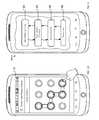
- FIG. 1is a diagram of an example touchscreen computing device that is displaying two different password shapes.
- FIGS. 2A and 2Bare diagrams of example user input to form password shapes.
- FIGS. 3A-3Care diagrams of example user interfaces for mapping actions to password shapes.
- FIG. 4is a block diagram of an example computing device configured to recognize password shapes.
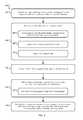
- FIG. 5is a flowchart of an example process for receiving user input and unlocking a computing environment.
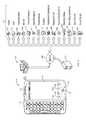
- FIG. 6is a conceptual diagram of a system that may be used to implement the systems and methods described in this document.
- FIG. 7is a block diagram of computing devices that may be used to implement the systems and methods described in this document, as either a client or as a server or plurality of servers.
- a user of a computing system that is lockedmay unlock the system by providing any of multiple unlocking patterns, such as by tracing a pattern with their fingertip on a touchscreen display of a computing device.
- the unlocking patternsmay be associated with different actions upon the system unlocking. For example, a first pattern may cause the system to display a “home screen.” The home screen can display multiple icons that are available for the user to select in order to launch corresponding application programs.
- a second patternmay cause the system to automatically launch a particular one of the application programs and display the user interface for the launched application program, without requiring further input from the user. As such, when the computing system is locked, the user may be able to more quickly access the particular application program by entering the second pattern instead of entering the first pattern and thereafter selecting an icon to launch the particular application program.
- a computing system(also herein also referred to as a computing device) can enter a locked state.
- a locked computing systemmay prevent the user from accessing specific features of the computing system unless the user provides an unlocking pattern.
- the computing systemmay be an application telephone that includes a touchscreen.
- the systemis locked, the user may not be allowed to call other telephones by entering numbers to dial the other telephones. Rather the user may only be able to use a telephone “emergency mode” in which the computing system may only call 911 and/or a predefined list of contacts.
- the computing systemis locked, the user may not be able to access an email application program, compose text messages, play gaming application programs, or access a mapping application program, for example.
- the usermay have to provide a security pattern, or unlocking pattern.
- the unlocking patternis a numeric or alphanumeric code that the user enters using a physical or virtual keyboard.
- the unlocking patternis a predefined path that the user may enter by tracing a finger across a touchscreen display in conformity with the predefined path.
- the predefined pathcan be a gesture that traces the path across an empty canvas (e.g., a blank display or a blank portion of the display).
- the predefined pathis traced among a grid of user interface elements in order to select a combination of the user interface elements in a particular order.
- the usermay drag his finger across the display and contact the displayed user interface elements (e.g., icons displayed in a grid) in a particular sequence in order for the entered unlocking pattern to be in conformity with a predefined path that specifies contact with the interface elements in the sequential order.
- the displayed user interface elementse.g., icons displayed in a grid
- the systemmay compare an entered unlocking pattern to a repository of unlocking patterns stored on the system to determine if the entered unlocking pattern matches any of the patterns in the repository.
- the entered patternmay match a pattern in the repository if the entered pattern specifies a sequence of alphanumeric characters that are the same as the pattern in the repository.
- the entered patternmay match a pattern in the repository if the entered pattern specifies a sequence of user interface elements that the user contacted in an order, and the pattern in the repository also specifies the sequence of user interface elements in the order.
- the computing systemmay clear on the display an indication of the entered unlocking pattern. For example, the computing system may remove alphanumeric characters that the user had specified or asterisks that masked the alphanumeric characters that the user had specified. In examples in which the user drags his finger across a touchscreen display to trace a path, the computing system may remove an indication of the traced path from the display (e.g., one or more lines that represent movement of the user's finger across the touchscreen).
- the computing systemmay unlock the computing system.
- the usermay access computing system functions that were unavailable to the user when the computing system was locked. For example, once the computing system is unlocked the user may dial a telephone number by specifying a phone number, may view a list of contacts, may add contacts to the contacts list, may use a web browser application program, and may download and install new application programs for use by the computing system.
- the usermay create an additional and new unlocking pattern, and may assign an action to the additional unlocking pattern.
- the usermay create the additional unlocking pattern without re-entering a previously-created unlocking pattern. In other words, the user has already validated that he is authorized to access the full functionality of the computing system and does not need to re-enter an established unlocking pattern.
- the computing systemmay further identify at least one action that is stored in association with the matching pattern.
- an identified actionindicates that the computing system is to display a “home screen” user interface of the computing device after unlocking the computing device.
- the home screenmay display after the user has completed entering the unlocking pattern and without the user providing subsequent user input.
- a computing system's home screenmay include multiple graphical interface elements that a user can select (e.g., by touching a region of a touchscreen that displays a user interface element) in order to launch an associated application program.
- a computing system's home screenmay be associated with a physical button of the computing system such that the computing system, when unlocked, displays the home screen user interface in response to user selection of the physical button.
- a home screenmay be considered a “desktop” display of the computing system.
- the identified actionis associated with a particular application program.
- the computing systemmay replace a user interface that is for user entry of the unlocking pattern with a user interface that is specified, at least in part, by the application program.
- Example application programsinclude a contacts list application program, a text messaging application program, an electronic mail application, a picture-taking application program, a web browser application program, and a voice commend entry user application program.
- the usermay launch any of the above-described application programs by selecting a graphical interface element (e.g., an icon) that is displayed on the home screen for the application program, or by navigating to another screen (e.g., a screen that that lists all application programs that are installed on the computing system) and selecting the graphical interface element.
- a graphical interface elemente.g., an icon
- another screene.g., a screen that that lists all application programs that are installed on the computing system
- the usermay navigate to the other screen by selecting an “all application programs” user interface element.
- entry of multiple different unlocking patternsmay produce different actions, but may result in a same level of security access to the computing system.
- a usermay have access to a same set of features regardless of which unlocking pattern the user enters. Having entered a first valid unlocking pattern, a user may not be prevented from accessing features (e.g., application programs or data that is displayed while an application program is executing) that are available to the user should the user enter a second valid unlocking pattern.
- An initial display that replaces the unlocking user interfacemay be different and may depend on the entered unlocking pattern.
- the computing systemmight not, during entry of a valid unlocking pattern, provide an indication of an action that will be performed upon completion of the valid unlocking pattern. For example, while the device is locked and while the user is entering the valid unlocking pattern (but before the user has completed entry of the valid unlocking pattern), the computing system might not display one or more graphical interface elements that illustrate actions that the computing system may perform upon entry of the valid unlocking pattern.
- the action that is performed upon entry of an unlocking patternmay not be apparent to a user until after the unlocking pattern is performed and the computing system unlocks the computing device.
- the computing systemmight not display during entry of the unlocking pattern a visual indication of one or more user interface displays to be shown after the device has unlocked. Rather, the system may display a user interface for entering security patterns, but may not indicate (e.g., visually or audibly) how to perform a valid unlocking pattern from among a collection of possible unlocking patterns.
- the computing systemmay enable the user to enter numerous (e.g., more than fifty) different combinations of unlocking patterns. Some of the unlocking patterns (e.g., three) may be recognized for unlocking the computing system and the others may not be recognized for unlocking the computing system. In some examples, the computing system may erase data that is stored on the computing system or prevent the user from entering another unlocking pattern for a specified amount of time (e.g., one minute) after detecting a predetermined number of incorrect unlocking patterns.
- a specified amount of timee.g., one minute
- the computing systemmay re-enter the locked state after the user has unlocked the computing system.
- this transition to the locked stateoccurs should the user not provide input for a predetermined amount of time.
- this transition to the locked stateoccurs should the user provide input that specifies that the computing system should lock.
- the computing systemmay include a physical or virtual button that, when selected, locks the computing system.
- the computing systemdisplays user selectable options for launching application programs.
- a usermay physically contact a touchscreen of the computing system with his finger and trace his finger over a surface of the touchscreen.
- the usermay trace his finger to contact graphical interface elements (e.g., by moving his finger over a display of the graphical interface elements) in a grid of graphical interface elements. If a path of the contacted graphical interface elements matches a path for a valid unlocking pattern, the computing system may access a list of one or more actions (e.g., application programs to launch) that are stored in association with the valid unlocking pattern.
- actionse.g., application programs to launch
- the computing systemmay display selectable user interface elements for the accessed actions. These selectable user interface elements may not have been displayed (or may have been displayed but may not have been selectable) before the computing system determined that the user entered the valid unlocking pattern.
- the usermay select one of the user interface elements in order to cause the computing system to unlock and perform the action associated with the selected interface element.
- the usermay select an element by dragging his finger across the touchscreen display and either contacting a region of the touchscreen that is displaying the interface element or releasing his finger from the display over the interface element.
- the usermay enter a security pattern by tracing his finger across a display, and may leave his finger in contact with the display after he has completed the unlocking pattern, in order to cause a display of icons for application programs, and in order to launch one of the application programs.
- the usermay both unlock the computing system and select to launch one of multiple displayed application programs without releasing his finger from the display.
- the computing systemperforms a default action if the user enters the unlocking pattern but does not select one of the subsequently displayed graphical interface elements.
- the selectable graphical interface elementsmay include indicia that indicate actions that are performed by a system upon user selection of the respective graphical interface element.
- one interface elementmay include a depiction of a camera (for a picture taking application program) while another interface element may include a depiction of a telephone (for a telephone dialing application program).
- the user interface elements that are selected by a user as part of an unlocking patternmay not include indicia of actions.
- multiple of the user interface elementsmay appear the same.
- a grid of selectable user interface elements for specifying a pathmay include user interface elements that appear the same.
- a single graphical interface element in the gridmay be associated with multiple unlocking patterns. For example, different unlocking patterns may trace different paths but end on the same graphical interface element.
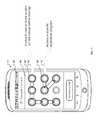
- FIG. 1is a diagram of an example touchscreen computing device 101 that is displaying two different password shapes.
- a touchscreen 100is shown here on a cellular telephone, but a similar touchscreen may be used on other types of computing devices, such as a tablet computer, a touch-enabled computer monitor, a dedicated electronic device (e.g. a radio, e-reader, or power meter), or a toy with a touchscreen.
- the touchscreencan display an updating user interface (UI) and can receive touch input from a user.
- the touch inputcan consist of one or more user fingers tapping, sliding, holding, or otherwise interacting with the touchscreen.
- Some touchscreensare configured to receive input from a stylus or other device, either in addition to or as an alternative to user touch input.
- the computing device containing the touchscreencan receive other forms of input and output using components that include hardware buttons, a scroll-ball, a power button, a speaker, and additional touchscreens.
- the touchscreen 100can display a welcome screen to a user.
- the welcome screencan indicate to the user that computing device is in a locked state, perhaps because it has been unused for a period of time or the user has pressed the power button to lock it.
- the computing deviceWhile displaying the welcome screen, the computing device may be limited to little or no input other than input to unlock the computing device. For example, this may allow the user to carry the computing device in a pocket without accidently dialing a phone number or launching an application.
- One scheme for unlocking the computing deviceincludes displaying a canvas 102 with interactive elements, and receiving user input that draws a password shape through those interactive elements. For example, when the user touches the first interactive element, the element may respond by lighting up and vibrating the phone. The user may then draw a password shape through other interactive elements by sliding the finger over other interactive elements to form the password shape. A path line or other UI element may track the user's movements, displaying the password shape as it is entered (and snapping each entered point to one of the displayed user interface elements). Lifting the finger from the touchscreen 100 can indicate that the password shape is complete.
- a canvas 102 of interactive elementsis shown here, other displays for receiving password information are possible.
- a keypad of numeric or alphanumeric buttonsmay be shown.
- the user inputcan tap a sequence of keys to type out a numeric or alphanumeric code.
- This codemay be displayed in the canvas 102 , either in cleartext (e.g. if the user presses “1”, a 1 appears) or obfuscated (e.g. an additional * is shown for each successive key press).
- password shapesare usually described with respect to these figures below, it will be understood that other schemes, such as with numeric or alphanumeric codes, are also possible.
- a password shape 104 and a password shape 108may be drawn in the same canvas 102 . Although they are shown through different interactive elements for clarity's sake, the password shapes may both pass through some or all of the same interactive elements of the canvas 102 . In examples in which the password shapes include all of the same interactive elements, the password shapes may specify contact with the same interactive elements in different orders.
- the different password shapescan cause the computing device to unlock into different states.
- the different statescan include running or hiding a selected application (where different applications may constitute different end states), adjusting different control settings (e.g. with audio silenced or enabled), or using different homescreens.
- a homescreenmay be considered a default or entry UI from which different features of a computing environment are accessible.
- the homescreenmay have UI navigation controls to applications, settings and data.
- a usermight have different homescreens for different usage scenarios. For example, a “work homescreen” might have shortcut links to a work email application, a remote datastore provided by an employer, and a folder with client contact information. Another “personal homescreen” may have a link to personal email, a folder with friend and family contact information, and a link to a media library.
- thematic materialmay be different for different homescreens, such as color schemes, sounds associated with user actions, and the like.
- the computing devicecan perform transfer actions 106 from the locked state to a so-called “base” state, bringing the user to a homescreen (or alternatively the last screen displayed before the computing device was locked). If the user enters the password shape 108 , the computing device can perform transfer actions 110 to a different state, for example, by launching a specific application program.
- the computing devicecan be configured to reach some states by entering the base state and then executing one or more actions before displaying the unlocked computing environment to the user.
- the transfer actions 110can include performing the transfer actions 106 and then launching the specific application. In effect, this may be similar to the behavior if the user entered the password shape 104 , entered the unlocked computing environment, and then launched the specific application from a shortcut on the displayed homescreen.
- the transfer actions 110can include instructions to 1) turn on the cellphone's global positioning system (GPS) transceiver; 2) determine the cellphone's location; and 3) load the navigation application with instructions to display turn-by-turn navigation from the cellphone's location to a user-entered street address.
- GPSglobal positioning system
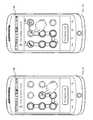
- FIGS. 2A and 2Bare diagrams of example user input to form password shapes.
- the useris presented with optional states to enter into once a password shape is completed.
- the userenters the partial password shape 202 .
- the partial password shapeincludes all but the last interactive element of a password shape 204 ,
- the cellphonecan unlock into the base state, as previously described with reference to FIG. 1 .
- the usermay provide additional input to select a different state into which to unlock the cellphone.
- one or more interactive elements 206 and 208can update to display indicia for an action, application, or other unlock state.
- the interactive element 206shows a phone icon that indicates a dialer application
- the interactive element 208shows a camera icon that indicates a camera or camcorder application.
- the icons, and associated statesmay be predetermined by the user or may be selected by the computing device.
- the computing devicemay record the number of times each application program is launched in the unlocked environment or may record the two most recently used applications. These two recorded applications may be selected for the two interactive elements 206 and 208 , providing the user with quick access to two applications that the user is likely interested in.
- the computing devicecan unlock into the associated state.
- the usermust keep the finger in contact with the touchscreen 200 after completing the password shape 204 through touching one of the interactive elements, and must release the finger from the screen in order to select the interactive element.
- the userhas a time window in which they may remove the finger from the touchscreen 200 and then select an altered interactive element. As shown here, interactive elements that are included in the password shape 204 may be altered.
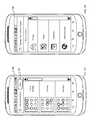
- FIGS. 3A-3Care diagrams of example UIs 300 , 325 , and 350 for mapping actions to password shapes.
- the userhas already unlocked the computing device and has access to normal user environment operations (e.g. applications, settings, and data).
- the user interface 300may be reached, for example, by navigating through system settings menus to a ‘security’ or ‘unlock’ section.
- the UI 300displays a list of recorded password shapes and their associated states. These password shapes and states may have been previously entered by the user and used to unlock the computing device to eventually reach this UI 300 .
- the usermay edit or delete one of the pairs of password shape/states though the UI 300 . For example, the user may press-and-hold on one of the display rows, and an edit UI may launch.
- a “new” button 302allows the user to select a new action and input an associated new password shape.
- the userselects an action first, and then inputs an associated new password shape.
- the systemcould be configured to receive the new password shape first, or to receive both through the same UI, thus receiving both in the same screen in the order of the user's choice.
- the usercan load the UI 325 for creating a new password shape.
- the usercan be presented with a list of actions, settings, applications, or other state-controlling elements.
- the computing devicekeeps an internal list of such elements and uses them for this and other uses. For example, when a user performs a press-and-hold input on a homescreen, the computing device may offer the list as possible shortcut icons to be created and placed on the homescreen.
- the usermay also supplement a selection with additional data. For example, the user may select the “Web Browser” entry with a press-and-hold input. This may call up an address dialog, where the user can supply a web URI. In doing so, the user not only indicates that the phone should unlock into a state with the web browser open, but that the web browser should also begin fetching the supplied URI.
- a user supplied script filecan be selected as an action or as supplemental data (e.g. the URI) for a selection.
- the UI 350can be displayed for receiving the new password shape.
- the usercan enter a new password shape through interactive elements in the same process as entering a password shape to unlock the computing device, as previously described in FIG. 1 .
- the usercan be prompted to enter the same pattern again, to ensure that they did not miss-key the input or forget it after entering.
- the computing devicemay check the new password shape against the collection of password shapes already on file. If the new password shape is a match for any previously recorded password shapes, the new password shape may be rejected. However, in other configurations, identical password shapes are permitted and handled as previously described in FIG. 2 . If the newly entered password shape is accepted, it may be used from the unlock screen to unlock the computing environment and transition to the state selected in UI 325 , as previously described in FIGS. 1 and 2 .
- FIG. 4is a block diagram of an example computing device 400 configured to recognize password shapes.
- the computing device 400may be used, for example, to provide the UIs 100 , 200 , 300 , 325 , and 350 .
- FIGS. 3A-3Cwill be used as a basis of an example to describe the computing device 400 , but one or more other computing devices can be used to provide the UIs 100 , 200 , 300 , 325 , and 350 , and other UIs may be used by the computing device 400 .
- a new pattern generator 402may receive user input specifying a new password shape and may generate data that identifies the new password shape.
- each password shapemay be stored as a word of up to nine characters with values 0-9.
- Each interactive elementis assigned a value from 1 to 9 and is stored in the word in order selected, with 0 padding the end of the word if needed.
- the topmost left interactive elementmay be assigned the 1 value, with each interactive element to the right and then down receiving the next highest value, to the bottommost right interactive element being assigned the value 9.
- the password shape in the UI 350would generate the word “145890000.”
- other data formatsmay be used.
- a pattern/action repository 404can store an association of one or more unlock states (e.g., actions to implement the states) to data of the respective password shapes (e.g., data of the new password shape received from the new pattern generator 402 ).
- the stored association of the one or more statesmay be based off user input into the UI 325 .
- the pattern/action repositorymay convert that input into computer readable data that identifies the user input action.
- this computer readable datamay be in the same format as the user script provided by the user, and may include a copy of the user script.
- the computer readable datamay specify an order in a series of actions, as well as the actions.
- a pattern identifier 406can identify password shapes input using a touchscreen 408 , possibly in the same format as the data of the new password shapes.
- the pattern identifier 406can compare the data of the received password shapes with all saved password shapes. If a match is found, the pattern identifier 406 can begin a process to unlock the computing device 400 , followed by actions specified for the entered pattern in the repository 404 . In this way, the computing device 400 can unlock into the state specified by the user.
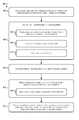
- FIG. 5is a flowchart of an example process 500 for receiving user input and unlocking a computing environment.
- the process 500can be performed by, for example, the computing device 400 .
- FIG. 4will be used as a basis of an example to describe the process 500 , but one or more other computing devices may be used to perform the process 500 .
- unlocking pattern configuration interfaceUser input specifying multiple stored unlocking patterns and respective actions is received in an unlocking pattern configuration interface (box 502 ).
- the new pattern generator 402 and the pattern/action repository 404may use the UIs 300 , 325 , and 350 to receive input from a user specifying a group of password shapes and associated computing environment states. Additionally, this information may be collected by the computing device 400 from a data repository. For example, the computing device 400 may periodically back up user data including password shapes and unlock states. If the user wishes to move his data to a new computing device, or if the computing device 400 is erased, this backup data may be copied over and utilized.
- User input that enters an unlocking patternis received (box 504 ).
- the touchscreen 408may receive user input in the form of a finger swiped through one or more interactive elements. This input may be converted by the pattern identifier 406 into, for example, an alphanumeric code uniquely identifying the password shape entered by the user.
- the displaydoes not provide visual indication of action that is performed upon entering the unlocking pattern (box 506 ).
- different password shapesmay be tied to different unlock states, but the touchscreen 408 may not provide any indications that a password shape is correct or incorrect until the user finalizes the inputting of the password shape. This may prevent a malicious user from discovering that there are multiple valid password shapes, providing for heightened security while using the computing system.
- the computing systemmay alter one or more interactive elements displayed on the touchscreen 408 with indications of states that are available after unlocking. The user may select one of these interactive elements to unlock the computing system into a particular state.
- user inputis numeric or alphanumeric code (box 508 ).
- the touchscreen 408can display an alphanumeric or numeric keypad.
- the touchscreen 408can receive the numeric or alphanumeric code directly and pass it to the pattern identifier 406 .
- the user inputis a traced path (box 510 ).
- the traced pathcan include a user swiping a finger through one or more interactive elements, or swiping a shape on a blank canvas.
- the pattern drawn by the usercan be converted into machine readable data describing the password shape.
- the entered unlocking patternis compared to a plurality of unlocking patterns (box 512 ).
- the pattern identifier 406can look up the code of the entered password shape in the pattern/action repository 404 . If the pattern identifier 406 finds one or more matches, the associated unlock states are identified for use.
- a display of selectable user interface elementsis added after user input has completed the unlocking pattern (box 514 ).
- the pattern identifier 406can pass graphical icons of the identified unlock states to the touchscreen 408 .
- the touchscreencan reconfigure the unlock screen to display those icons as user-selectable interactive elements.
- a usercan select the interactive elements without releasing contact from the touchscreen (box 516 ).
- the usermay drag the finger from the end of the password-pattern to one of the user-selectable interactive elements, indicating that the user wishes to unlock the computing device 400 into the state visually identified by the one user-selectable interactive element. If the user wishes to enter the ‘base’ state, such as the default homescreen, the user may instead lift the finger from the touchscreen 408 without selecting any of the newly displayed icons.
- the computer systemIn respond to a determination that entered unlocking pattern matches a stored pattern, the computer system unlocks and performs an action that is associated with the matching unlocking pattern (box 518 ). If the user selects one of the user-selectable interactive elements or lifts the finger without selecting one, the computing device 400 can unlock into the indicated states. This unlocking process can include processing one or more scripts, launching an application, adjusting a setting, etc.
- mobile computing device 610can wirelessly communicate with base station 640 , which can provide the mobile computing device wireless access to numerous hosted services 660 through a network 650 .
- the mobile computing device 610is depicted as a handheld mobile telephone (e.g., a smartphone, or application telephone) that includes a touchscreen display device 612 for presenting content to a user of the mobile computing device 610 and receiving touch-based user inputs.
- a handheld mobile telephonee.g., a smartphone, or application telephone
- Other visual, auditory, and tactile output componentsmay also be provided (e.g., LED lights, a speaker for providing tonal, voice-generated, or recorded output, or vibrating mechanisms for tactile output), as may various different input components (e.g., keyboard 614 , physical buttons, trackballs, accelerometers, gyroscopes, and magnetometers).
- Example visual output mechanism in the form of display device 612may take the form of a 3.7 or 4.3 inch LED or AMOLED display with resistive or capacitive touch capabilities, for displaying video, graphics, images, and text, and coordinating user touch input locations with the location of displayed information so that user contact at a location of a displayed item may be associated with the item by the device 610 .
- the mobile computing device 610may take alternative forms also, including as a laptop computer, a tablet or slate computer, a personal digital assistant, an embedded system (e.g., a car navigation system), a desktop personal computer, or a computerized workstation.
- An example mechanism for receiving user-inputincludes keyboard 614 , which may be a full qwerty keyboard or a traditional keypad that includes keys for the digits ‘0-9’, ‘*’, and ‘#.’
- the keyboard 614receives input when a user physically contacts or depresses a keyboard key.
- User manipulation of a trackball 616 or interaction with a track padenables the user to supply directional and rate of rotation information to the mobile computing device 610 (e.g., to manipulate a position of a cursor on the display device 612 ).
- the mobile computing device 610may be able to determine a position of physical contact with the touchscreen display device 612 (e.g., a position of contact by a finger or a stylus).
- various “virtual” input mechanismsmay be produced, where a user interacts with a graphical user interface element depicted on the touchscreen 612 by contacting the graphical user interface element.
- An example of a “virtual” input mechanismis a “software keyboard,” where a keyboard is displayed on the touchscreen and a user selects keys by pressing a region of the touchscreen 612 that corresponds to each key.
- the mobile computing device 610may include mechanical or touch sensitive buttons 618 a - d . Additionally, the mobile computing device may include buttons for adjusting volume output by the one or more speakers 620 , and a button for turning the mobile computing device on or off.
- a microphone 622allows the mobile computing device 610 to convert audible sounds into an electrical signal that may be digitally encoded and stored in computer-readable memory, or transmitted to another computing device.
- the mobile computing device 610may also include a digital compass, an accelerometer, proximity sensors, and ambient light sensors.
- An operating systemmay provide an interface between the mobile computing device's hardware (e.g., the input/output mechanisms and a processor executing instructions retrieved from computer-readable medium) and software.
- Some examples of operating systemsinclude the ANDROID mobile device platform; APPLE IPHONE/MAC OS X operating systems; MICROSOFT WINDOWS 6/WINDOWS MOBILE operating systems; SYMBIAN operating system; RIM BLACKBERRY operating system; PALM WEB operating system; a variety of UNIX-flavored operating systems; or a proprietary operating system for computerized devices.
- the operating systemmay provide a platform for the execution of application programs that facilitate interaction between the computing device and a user.
- the mobile computing device 610may present a graphical user interface with the touchscreen 612 .
- a graphical user interfaceis a collection of one or more graphical interface elements and may be static (e.g., the display appears to remain the same over a period of time), or may be dynamic (e.g., the graphical user interface includes graphical interface elements that animate without user input).
- a graphical interface elementmay be text, lines, shapes, images, or combinations thereof.
- a graphical interface elementmay be an icon that is displayed on the desktop and the icon's associated text.
- a graphical interface elementis selectable with user-input.
- a usermay select a graphical interface element by pressing a region of the touchscreen that corresponds to a display of the graphical interface element.
- the usermay manipulate a trackball to highlight a single graphical interface element as having focus.
- User-selection of a graphical interface elementmay invoke a pre-defined action by the mobile computing device.
- selectable graphical interface elementsfurther or alternatively correspond to a button on the keyboard 604 . User-selection of the button may invoke the pre-defined action.
- the operating systemprovides a “desktop” user interface that is displayed upon turning on the mobile computing device 610 , activating the mobile computing device 610 from a sleep state, upon “unlocking” the mobile computing device 610 , or upon receiving user-selection of the “home” button 618 c .
- the desktop graphical interfacemay display several icons that, when selected with user-input, invoke corresponding application programs.
- An invoked application programmay present a graphical interface that replaces the desktop graphical interface until the application program terminates or is hidden from view.
- User-inputmay manipulate a sequence of mobile computing device 610 operations.
- a single-action user inpute.g., a single tap of the touchscreen, swipe across the touchscreen, contact with a button, or combination of these at a same time
- an operation that changes a display of the user interfaceWithout the user-input, the user interface may not have changed at a particular time.
- a multi-touch user input with the touchscreen 612may invoke a mapping application to “zoom-in” on a location, even though the mapping application may have by default zoomed-in after several seconds.
- the desktop graphical interfacecan also display “widgets.”
- a widgetis one or more graphical interface elements that are associated with an application program that has been executed, and that display on the desktop content controlled by the executing application program.
- a widget's application programmay start with the mobile telephone. Further, a widget may not take focus of the full display. Instead, a widget may only “own” a small portion of the desktop, displaying content and receiving touchscreen user-input within the portion of the desktop.
- the mobile computing device 610may include one or more location-identification mechanisms.
- a location-identification mechanismmay include a collection of hardware and software that provides the operating system and application programs an estimate of the mobile telephone's geographical position.
- a location-identification mechanismmay employ satellite-based positioning techniques, base station transmitting antenna identification, multiple base station triangulation, internet access point IP location determinations, inferential identification of a user's position based on search engine queries, and user-supplied identification of location (e.g., by “checking in” to a location).
- the mobile computing device 610may include other application modules and hardware.
- a call handling unitmay receive an indication of an incoming telephone call and provide a user the capability to answer the incoming telephone call.
- a media playermay allow a user to listen to music or play movies that are stored in local memory of the mobile computing device 610 .
- the mobile telephone 610may include a digital camera sensor, and corresponding image and video capture and editing software.
- An internet browsermay enable the user to view content from a web page by typing in an addresses corresponding to the web page or selecting a link to the web page.
- the mobile computing device 610may include an antenna to wirelessly communicate information with the base station 640 .
- the base station 640may be one of many base stations in a collection of base stations (e.g., a mobile telephone cellular network) that enables the mobile computing device 610 to maintain communication with a network 650 as the mobile computing device is geographically moved.
- the computing device 610may alternatively or additionally communicate with the network 650 through a Wi-Fi router or a wired connection (e.g., Ethernet, USB, or FIREWIRE).
- the computing device 610may also wirelessly communicate with other computing devices using BLUETOOTH protocols, or may employ an ad-hoc wireless network.
- a service provider that operates the network of base stationsmay connect the mobile computing device 610 to the network 650 to enable communication between the mobile computing device 610 and other computerized devices that provide services 660 .
- the services 660may be provided over different networks (e.g., the service provider's internal network, the Public Switched Telephone Network, and the Internet), network 650 is illustrated as a single network.
- the service providermay operate a server system 652 that routes information packets and voice data between the mobile computing device 610 and computing devices associated with the services 660 .
- the network 650may connect the mobile computing device 610 to the Public Switched Telephone Network (PSTN) 662 in order to establish voice or fax communication between the mobile computing device 610 and another computing device.
- PSTNPublic Switched Telephone Network
- the service provider server system 652may receive an indication from the PSTN 662 of an incoming call for the mobile computing device 610 .
- the mobile computing device 610may send a communication to the service provider server system 652 initiating a telephone call with a telephone number that is associated with a device accessible through the PSTN 662 .
- the network 650may connect the mobile computing device 610 with a Voice over Internet Protocol (VoIP) service 664 that routes voice communications over an IP network, as opposed to the PSTN.
- VoIPVoice over Internet Protocol
- a user of the mobile computing device 610may invoke a VoIP application and initiate a call using the program.
- the service provider server system 652may forward voice data from the call to a VoIP service, which may route the call over the internet to a corresponding computing device, potentially using the PSTN for a final leg of the connection.
- An application store 666may provide a user of the mobile computing device 610 the ability to browse a list of remotely stored application programs that the user may download over the network 650 and install on the mobile computing device 610 .
- the application store 666may serve as a repository of applications developed by third-party application developers.
- An application program that is installed on the mobile computing device 610may be able to communicate over the network 650 with server systems that are designated for the application program. For example, a VoIP application program may be downloaded from the Application Store 666 , enabling the user to communicate with the VoIP service 664 .
- the mobile computing device 610may access content on the internet 668 through network 650 .
- a user of the mobile computing device 610may invoke a web browser application that requests data from remote computing devices that are accessible at designated universal resource locations.
- some of the services 660are accessible over the internet.
- the mobile computing devicemay communicate with a personal computer 670 .
- the personal computer 670may be the home computer for a user of the mobile computing device 610 .
- the usermay be able to stream media from his personal computer 670 .
- the usermay also view the file structure of his personal computer 670 , and transmit selected documents between the computerized devices.
- a voice recognition service 672may receive voice communication data recorded with the mobile computing device's microphone 622 , and translate the voice communication into corresponding textual data.
- the translated textis provided to a search engine as a web query, and responsive search engine search results are transmitted to the mobile computing device 610 .
- the mobile computing device 610may communicate with a social network 674 .
- the social networkmay include numerous members, some of which have agreed to be related as acquaintances.
- Application programs on the mobile computing device 610may access the social network 674 to retrieve information based on the acquaintances of the user of the mobile computing device. For example, an “address book” application program may retrieve telephone numbers for the user's acquaintances.
- contentmay be delivered to the mobile computing device 610 based on social network distances from the user to other members. For example, advertisement and news article content may be selected for the user based on a level of interaction with such content by members that are “close” to the user (e.g., members that are “friends” or “friends of friends”).
- the mobile computing device 610may access a personal set of contacts 676 through network 650 .
- Each contactmay identify an individual and include information about that individual (e.g., a phone number, an email address, and a birthday). Because the set of contacts is hosted remotely to the mobile computing device 610 , the user may access and maintain the contacts 676 across several devices as a common set of contacts.
- the mobile computing device 610may access cloud-based application programs 678 .
- Cloud-computingprovides application programs (e.g., a word processor or an email program) that are hosted remotely from the mobile computing device 610 , and may be accessed by the device 610 using a web browser or a dedicated program.
- Example cloud-based application programsinclude GOOGLE DOCS word processor and spreadsheet service, GOOGLE GMAIL webmail service, and PICASA picture manager.
- Mapping service 680can provide the mobile computing device 610 with street maps, route planning information, and satellite images.
- An example mapping serviceis GOOGLE MAPS.
- the mapping service 680may also receive queries and return location-specific results. For example, the mobile computing device 610 may send an estimated location of the mobile computing device and a user-entered query for “pizza places” to the mapping service 680 .
- the mapping service 680may return a street map with “markers” superimposed on the map that identify geographical locations of nearby “pizza places.”
- Turn-by-turn service 682may provide the mobile computing device 610 with turn-by-turn directions to a user-supplied destination. For example, the turn-by-turn service 682 may stream to device 610 a street-level view of an estimated location of the device, along with data for providing audio commands and superimposing arrows that direct a user of the device 610 to the destination.
- streaming media 684may be requested by the mobile computing device 610 .
- computing device 610may request a stream for a pre-recorded video file, a live television program, or a live radio program.
- Example services that provide streaming mediainclude YOUTUBE and PANDORA.
- a micro-blogging service 686may receive from the mobile computing device 610 a user-input post that does not identify recipients of the post.
- the micro-blogging service 686may disseminate the post to other members of the micro-blogging service 686 that agreed to subscribe to the user.
- a search engine 688may receive user-entered textual or verbal queries from the mobile computing device 610 , determine a set of internet-accessible documents that are responsive to the query, and provide to the device 610 information to display a list of search results for the responsive documents.
- the voice recognition service 672may translate the received audio into a textual query that is sent to the search engine.
- a server systemmay be a combination of hardware and software that provides a service or a set of services.
- a set of physically separate and networked computerized devicesmay operate together as a logical server system unit to handle the operations necessary to offer a service to hundreds of individual computing devices.
- operations that are performed “in response” to another operationare not performed if the prior operation is unsuccessful (e.g., if the determination was not performed).
- a determination or an identificatione.g., if the determination was not performed.
- Features in this document that are described with conditional languagemay describe implementations that are optional.
- “transmitting” from a first device to a second deviceincludes the first device placing data into a network for receipt by the second device, but may not include the second device receiving the data.
- “receiving” from a first devicemay include receiving the data from a network, but may not include the first device transmitting the data.
- FIG. 7is a block diagram of computing devices 700 , 750 that may be used to implement the systems and methods described in this document, as either a client or as a server or plurality of servers.
- Computing device 700is intended to represent various forms of digital computers, such as laptops, desktops, workstations, personal digital assistants, servers, blade servers, mainframes, and other appropriate computers.
- Computing device 750is intended to represent various forms of mobile devices, such as personal digital assistants, cellular telephones, smartphones, and other similar computing devices.
- the components shown here, their connections and relationships, and their functions,are meant to be examples only, and are not meant to limit implementations described and/or claimed in this document.
- Computing device 700includes a processor 702 , memory 704 , a storage device 706 , a high-speed interface 708 connecting to memory 704 and high-speed expansion ports 710 , and a low speed interface 712 connecting to low speed bus 714 and storage device 706 .
- Each of the components 702 , 704 , 706 , 708 , 710 , and 712are interconnected using various busses, and may be mounted on a common motherboard or in other manners as appropriate.
- the processor 702can process instructions for execution within the computing device 700 , including instructions stored in the memory 704 or on the storage device 706 to display graphical information for a GUI on an external input/output device, such as display 716 coupled to high-speed interface 708 .
- multiple processors and/or multiple busesmay be used, as appropriate, along with multiple memories and types of memory.
- multiple computing devices 700may be connected, with each device providing portions of the necessary operations (e.g., as a server bank, a group of blade servers, or a multi-processor system).
- the memory 704stores information within the computing device 700 .
- the memory 704is a volatile memory unit or units.
- the memory 704is a non-volatile memory unit or units.
- the memory 704may also be another form of computer-readable medium, such as a magnetic or optical disk.
- the storage device 706is capable of providing mass storage for the computing device 700 .
- the storage device 706may be or contain a computer-readable medium, such as a floppy disk device, a hard disk device, an optical disk device, or a tape device, a flash memory or other similar solid state memory device, or an array of devices, including devices in a storage area network or other configurations.
- a computer program productcan be tangibly embodied in an information carrier.
- the computer program productmay also contain instructions that, when executed, perform one or more methods, such as those described above.
- the information carrieris a computer- or machine-readable medium, such as the memory 704 , the storage device 706 , or memory on processor 702 .
- the high-speed controller 708manages bandwidth-intensive operations for the computing device 700 , while the low speed controller 712 manages lower bandwidth-intensive operations.
- the high-speed controller 708is coupled to memory 704 , display 716 (e.g., through a graphics processor or accelerator), and to high-speed expansion ports 710 , which may accept various expansion cards (not shown).
- low-speed controller 712is coupled to storage device 706 and low-speed expansion port 714 .
- the low-speed expansion portwhich may include various communication ports (e.g., USB, Bluetooth, Ethernet, wireless Ethernet) may be coupled to one or more input/output devices, such as a keyboard, a pointing device, a scanner, or a networking device such as a switch or router, e.g., through a network adapter.
- input/output devicessuch as a keyboard, a pointing device, a scanner, or a networking device such as a switch or router, e.g., through a network adapter.
- the computing device 700may be implemented in a number of different forms, as shown in the figure. For example, it may be implemented as a standard server 720 , or multiple times in a group of such servers. It may also be implemented as part of a rack server system 724 . In addition, it may be implemented in a personal computer such as a laptop computer 722 . Alternatively, components from computing device 700 may be combined with other components in a mobile device (not shown), such as device 750 . Each of such devices may contain one or more of computing device 700 , 750 , and an entire system may be made up of multiple computing devices 700 , 750 communicating with each other.
- Computing device 750includes a processor 752 , memory 764 , an input/output device such as a display 754 , a communication interface 766 , and a transceiver 768 , among other components.
- the device 750may also be provided with a storage device, such as a microdrive or other device, to provide additional storage.
- a storage devicesuch as a microdrive or other device, to provide additional storage.
- Each of the components 750 , 752 , 764 , 754 , 766 , and 768are interconnected using various buses, and several of the components may be mounted on a common motherboard or in other manners as appropriate.
- the processor 752can execute instructions within the computing device 750 , including instructions stored in the memory 764 .
- the processormay be implemented as a chipset of chips that include separate and multiple analog and digital processors. Additionally, the processor may be implemented using any of a number of architectures.
- the processor 410may be a CISC (Complex Instruction Set Computers) processor, a RISC (Reduced Instruction Set Computer) processor, or a MISC (Minimal Instruction Set Computer) processor.
- the processormay provide, for example, for coordination of the other components of the device 750 , such as control of user interfaces, applications run by device 750 , and wireless communication by device 750 .
- Processor 752may communicate with a user through control interface 758 and display interface 756 coupled to a display 754 .
- the display 754may be, for example, a TFT (Thin-Film-Transistor Liquid Crystal Display) display or an OLED (Organic Light Emitting Diode) display, or other appropriate display technology.
- the display interface 756may comprise appropriate circuitry for driving the display 754 to present graphical and other information to a user.
- the control interface 758may receive commands from a user and convert them for submission to the processor 752 .
- an external interface 762may be provided in communication with processor 752 , so as to enable near area communication of device 750 with other devices. External interface 762 may provide, for example, for wired communication in some implementations, or for wireless communication in other implementations, and multiple interfaces may also be used.
- the memory 764stores information within the computing device 750 .
- the memory 764can be implemented as one or more of a computer-readable medium or media, a volatile memory unit or units, or a non-volatile memory unit or units.
- Expansion memory 774may also be provided and connected to device 750 through expansion interface 772 , which may include, for example, a SIMM (Single In Line Memory Module) card interface.
- SIMMSingle In Line Memory Module
- expansion memory 774may provide extra storage space for device 750 , or may also store applications or other information for device 750 .
- expansion memory 774may include instructions to carry out or supplement the processes described above, and may include secure information also.
- expansion memory 774may be provided as a security module for device 750 , and may be programmed with instructions that permit secure use of device 750 .
- secure applicationsmay be provided via the SIMM cards, along with additional information, such as placing identifying information on the SIMM card in a non-hackable manner.
- the memorymay include, for example, flash memory and/or NVRAM memory, as discussed below.
- a computer program productis tangibly embodied in an information carrier.
- the computer program productcontains instructions that, when executed, perform one or more methods, such as those described above.
- the information carrieris a computer- or machine-readable medium, such as the memory 764 , expansion memory 774 , or memory on processor 752 that may be received, for example, over transceiver 768 or external interface 762 .
- Device 750may communicate wirelessly through communication interface 766 , which may include digital signal processing circuitry where necessary. Communication interface 766 may provide for communications under various modes or protocols, such as GSM voice calls, SMS, EMS, or MMS messaging, CDMA, TDMA, PDC, WCDMA, CDMA2000, or GPRS, among others. Such communication may occur, for example, through radio-frequency transceiver 768 . In addition, short-range communication may occur, such as using a Bluetooth, WiFi, or other such transceiver (not shown). In addition, GPS (Global Positioning System) receiver module 770 may provide additional navigation- and location-related wireless data to device 750 , which may be used as appropriate by applications running on device 750 .
- GPSGlobal Positioning System
- Device 750may also communicate audibly using audio codec 760 , which may receive spoken information from a user and convert it to usable digital information. Audio codec 760 may likewise generate audible sound for a user, such as through a speaker, e.g., in a handset of device 750 . Such sound may include sound from voice telephone calls, may include recorded sound (e.g., voice messages, music files, etc.) and may also include sound generated by applications operating on device 750 .
- Audio codec 760may receive spoken information from a user and convert it to usable digital information. Audio codec 760 may likewise generate audible sound for a user, such as through a speaker, e.g., in a handset of device 750 . Such sound may include sound from voice telephone calls, may include recorded sound (e.g., voice messages, music files, etc.) and may also include sound generated by applications operating on device 750 .
- the computing device 750may be implemented in a number of different forms, some of which are shown in the figure. For example, it may be implemented as a cellular telephone 780 . It may also be implemented as part of a smartphone 782 , personal digital assistant, or other similar mobile device.
- USB flash drivescan store operating systems and other applications.
- the USB flash drivescan include input/output components, such as a wireless transmitter or USB connector that may be inserted into a USB port of another computing device.
- implementations of the systems and techniques described herecan be realized in digital electronic circuitry, integrated circuitry, specially designed ASICs (application specific integrated circuits), computer hardware, firmware, software, and/or combinations thereof.
- ASICsapplication specific integrated circuits
- These various implementationscan include implementation in one or more computer programs that are executable and/or interpretable on a programmable system including at least one programmable processor, which may be special or general purpose, coupled to receive data and instructions from, and to transmit data and instructions to, a storage system, at least one input device, and at least one output device.
- the systems and techniques described herecan be implemented on a computer having a display device (e.g., a CRT (cathode ray tube) or LCD (liquid crystal display) monitor) for displaying information to the user and a keyboard and a pointing device (e.g., a mouse or a trackball) by which the user can provide input to the computer.
- a display devicee.g., a CRT (cathode ray tube) or LCD (liquid crystal display) monitor
- a keyboard and a pointing devicee.g., a mouse or a trackball
- Other kinds of devicescan be used to provide for interaction with a user as well; for example, feedback provided to the user can be any form of sensory feedback (e.g., visual feedback, auditory feedback, or tactile feedback); and input from the user can be received in any form, including acoustic, speech, or tactile input.
- the systems and techniques described herecan be implemented in a computing system that includes a back end component (e.g., as a data server), or that includes a middleware component (e.g., an application server), or that includes a front end component (e.g., a client computer having a graphical user interface or a Web browser through which a user can interact with an implementation of the systems and techniques described here), or any combination of such back end, middleware, or front end components.
- the components of the systemcan be interconnected by any form or medium of digital data communication (e.g., a communication network). Examples of communication networks include a local area network (“LAN”), a wide area network (“WAN”), peer-to-peer networks (having ad-hoc or static members), grid computing infrastructures, and the Internet.
- LANlocal area network
- WANwide area network
- peer-to-peer networkshaving ad-hoc or static members
- grid computing infrastructuresand the Internet.
- the computing systemcan include clients and servers.
- a client and serverare generally remote from each other and typically interact through a communication network.
- the relationship of client and serverarises by virtue of computer programs running on the respective computers and having a client-server relationship to each other.
Landscapes
- Engineering & Computer Science (AREA)
- Theoretical Computer Science (AREA)
- General Engineering & Computer Science (AREA)
- Physics & Mathematics (AREA)
- General Physics & Mathematics (AREA)
- Computer Security & Cryptography (AREA)
- Human Computer Interaction (AREA)
- Computer Hardware Design (AREA)
- Software Systems (AREA)
- User Interface Of Digital Computer (AREA)
- Health & Medical Sciences (AREA)
- Bioethics (AREA)
- General Health & Medical Sciences (AREA)
- Storage Device Security (AREA)
Abstract
Description
This document generally relates to physical security for computing devices.
A computing device can enter a locked state when it is not used for a while or when a user provides input that causes the computing device to enter the locked state. For example, a computing device may lock if a user presses a “lock” button, or if a determined amount of time passes since the user has provided any user input. While in the locked state, features of a computing device may be restricted. Certain limited features may be available, such as a display of the current time, and an ability to dial an emergency telephone number, while most features may be unavailable, such as access to contact data on the device and ability to interact with applications the user has loaded on the device. As such, a user may not be able to access the restricted features unless the user enters an unlocking pattern that causes the device to enter an unlocked state. A device that locks can prevent unauthorized users from accessing the restricted features. Further a device that locks can prevent a user from unintentionally providing user input and launching computing device actions (e.g., calling a person or visiting a website).
This document describes a computing system that provides for alternative unlocking patterns. In general, a computing system may recognize multiple unlocking patterns. The unlocking patterns, when entered by a user, may perform different actions. For example, a first unlocking pattern may cause the computing system to unlock the computing system and display a home screen, while a second unlocking pattern may cause the computing system to unlock the computing system and automatically display a user interface for a particular application program (and perhaps launch the application if is not already active).
As additional description to the implementations described below, the present disclosure describes the following implementations:
Implementation 1 is a computer-implemented method. The method comprises receiving, by a computing system that is locked, input from a user that provides an unlocking pattern, wherein during entry of the unlocking pattern a display of the computing system does not provide a visual indication of an action that will be performed upon the user completing the unlocking pattern. The method comprises comparing, by the computing system, the provided unlocking pattern to a plurality of stored unlocking patterns to determine whether the provided unlocking pattern matches any of the stored unlocking patterns, the stored unlocking patterns being associated with respective actions that are performed upon completion of the respective unlocking patterns, the unlocking patterns being associated with a same level of unlocked security access to the computing system. The method comprises responding, by the computing system to a determination that the provided unlocking pattern matches one of the stored unlocking patterns, by unlocking the computing system and performing the action that is associated with the matching unlocking pattern.
Implementation 2 is the method of implementation 1, wherein the user is unable to access features of the computing system while the computing system is locked, and is able to access the features while the computing system is unlocked.
Implementation 3 is the method of implementations 1 or 2. The method further comprises receiving, by the computing system with an unlocking pattern configuration user interface, input from the user that specifies: (a) multiple of the stored unlocking patterns, and (b) the respective actions that are associated with the multiple unlocking patterns.
Implementation 4 is the method of any one of implementations 1 through 3, wherein receiving the input from the user that provides the unlocking pattern comprises receiving input from the user that specifies a numeric or alphanumeric code.
Implementation 5 is the method of any one of implementations 1 through 3, wherein receiving the input from the user that provides the unlocking pattern comprises receiving input from the user that contacts a touchscreen of the computing system and traces a path across the touchscreen.
Implementation 6 is the method of implementation 5, wherein at least two of the stored unlocking patterns identify paths that end with selection from the user of a same user interface element.
Implementation 7 is the method of implementation 5. The method further comprises, after the input from the user has completed tracing the path and while the input from the user remains in contact with the touchscreen, adding to a display on the touchscreen selectable user interface elements that were not displayed on the touchscreen during tracing of the path.
Implementation 8 is the method of implementation 7. The method further comprises identifying, by the computing system, that the input from the user releases contact with the touchscreen at one of the selectable user interface elements. The action is associated with the one selectable user interface element and is one of multiple actions that are respectively associated with the selectable user interface elements.
Implementation 9 is the method of implementation 8. The method further comprises, before the input from the user releases contact with the touchscreen at the one selectable user interface element, beginning to load multiple application programs, wherein the multiple application programs are application programs that are launched for display upon selection from the user of respective ones of the selectable user interface elements.
Implementation 10 is the method of any one of implementations 1-9. The method further comprises performing a second action as a consequence of receiving input from the user while the computing system is unlocked and after the action has been performed, wherein the second action is associated with a second unlocking pattern from the plurality of stored unlocking patterns so as to be performed upon completion of the second unlocking pattern.
Implementation 11 is the method of any one of implementations 1-10. Receiving the input from the user that provides the unlocking pattern is associated with selection from the user of at least four graphical interface elements.
Implementation 12 is a computer-implemented method. The method comprises receiving, by a computing system that is locked, input from the user that provides a first unlocking pattern and input from the user that provides a second unlocking pattern, wherein during entry of the unlocking patterns a display of the computing system does not provide a visual indication of an action that will be performed upon receiving input from the user that provides a valid unlocking pattern, wherein the computing system is responsive to both the first unlocking pattern and the second unlocking pattern so as to perform a first action or a second action based on the received unlocking pattern. The method comprises responding, by the computing system, to the input from the user that provides the first unlocking pattern by unlocking the computing system and performing a first action in order to provide unlocked security access to the computing system. The method comprises responding, by the computing system, to the input from the user that provides the second unlocking pattern by unlocking the computing system and performing a second action in order to provide the unlocked security access to the computing system.
Implementation 13 is the method of implementation 12. The method further comprises locking the computing system at some time after the first action has been performed, wherein the input from the user that provides the second unlocking pattern is received after the device has been locked at the some time.
Implementation 14 is the method of any one of implementations 12 through 13. The first action includes displaying a home screen user interface of the computing system. The second action includes displaying a user interface that is not the home screen user interface and that is a most-recent user interface that the computing system displayed before receiving the input from the user that provides the second unlocking pattern and while the computing system was unlocked.
Implementation 15 is the method of any one of implementations 12-14. The first action is performed without the user providing input subsequent to providing the first unlocking pattern. The second action is performed without the user providing input subsequent to providing the second unlocking pattern.
Implementation 16 is the method of any one of implementations 12-15. The method further comprises, while the computing system is unlocked after having performed the first action, performing the second action as a consequence of receiving input from the user that selects a user interface element that is associated with the second action.
Implementation 17 is a computerized system. The computerized system comprises a touchscreen for displaying user interfaces. The computerized system comprises a computer-accessible repository that stores information that identifies multiple unlocking patterns and associated actions. The computerized system comprises a computer, communicatively-connected to the touchscreen and the repository. The computer is configured to receive, while the computer is locked, input from a user that provides an unlocking pattern, wherein during entry of the unlocking pattern the touchscreen does not provide a visual indication of an action that will be performed upon completion of a valid unlocking pattern. The computer is configured to determine whether the provided unlocking pattern matches any of the multiple unlocking patterns. The computer is configured to, if the provided unlocking pattern matches a first of the multiple unlocking patterns, unlock the computer and perform a first action to display on the touchscreen a first user interface. The computer is configured to, if the provided unlocking pattern matches a second of the multiple unlocking patterns, unlock the computer and perform a second action to display on the touchscreen a second user interface, the second user interface being a user interface of an application program that the user is able to launch by selecting a user interface element that is displayed on the first user interface or another user interface that is navigable from the first user interface.
Implementation 18 is the system of implementation 17. The computer is configured to display multiple selectable user interface elements on the touchscreen upon determining that the provided unlocking pattern matches the second unlocking pattern, the multiple selectable user interface elements being associated with different user interfaces.
Implementation 19 is the system of implementation 18. The computer remains locked until the user selects one of the multiple selectable user interface elements.
Implementation 20 is the system of implementations 18 or 19. The user provides the unlocking pattern by contacting the touchscreen in a path that selects at least three graphical interface elements. The computer is configured to identify that the user has selected one of the multiple selectable user interface elements by identifying that the user moved the contact with the touchscreen from the path to the selected user interface element without releasing the contact with the touchscreen.
Particular implementations can, in certain instances, realize one or more of the following advantages. A user may provide an unlocking pattern that is specific to an application program in order to view the application program immediately upon unlocking the computing device. As such, the user may have quick access to the application program and may not need to unlock the device and thereafter select an icon for the application program from a home screen of the computing device or another screen of the computing device. In some examples, upon completion of the security pattern, the computing device may display multiple icons that the user can select without the user removing a finger from a touchscreen of the computing system. As such, in one gesture a user may enter the unlocking pattern and launch an application program.
The details of one or more implementations are set forth in the accompanying drawings and the description below. Other features, objects, and advantages will be apparent from the description and drawings, and from the claims.
Like reference symbols in the various drawings indicate like elements.
This document generally describes a computing system (e.g., a mobile telephone or tablet computer) that provides for alternative unlocking patterns. In general, a user of a computing system that is locked may unlock the system by providing any of multiple unlocking patterns, such as by tracing a pattern with their fingertip on a touchscreen display of a computing device. The unlocking patterns may be associated with different actions upon the system unlocking. For example, a first pattern may cause the system to display a “home screen.” The home screen can display multiple icons that are available for the user to select in order to launch corresponding application programs. A second pattern may cause the system to automatically launch a particular one of the application programs and display the user interface for the launched application program, without requiring further input from the user. As such, when the computing system is locked, the user may be able to more quickly access the particular application program by entering the second pattern instead of entering the first pattern and thereafter selecting an icon to launch the particular application program.
More specifically, a computing system (also herein also referred to as a computing device) can enter a locked state. Such a locked computing system may prevent the user from accessing specific features of the computing system unless the user provides an unlocking pattern. For example, the computing system may be an application telephone that includes a touchscreen. When the system is locked, the user may not be allowed to call other telephones by entering numbers to dial the other telephones. Rather the user may only be able to use a telephone “emergency mode” in which the computing system may only call 911 and/or a predefined list of contacts. Moreover, when the computing system is locked, the user may not be able to access an email application program, compose text messages, play gaming application programs, or access a mapping application program, for example.
In order to access full system functionality, the user may have to provide a security pattern, or unlocking pattern. In some examples, the unlocking pattern is a numeric or alphanumeric code that the user enters using a physical or virtual keyboard. In some examples, the unlocking pattern is a predefined path that the user may enter by tracing a finger across a touchscreen display in conformity with the predefined path. For example, the predefined path can be a gesture that traces the path across an empty canvas (e.g., a blank display or a blank portion of the display). In other examples, the predefined path is traced among a grid of user interface elements in order to select a combination of the user interface elements in a particular order. For example, the user may drag his finger across the display and contact the displayed user interface elements (e.g., icons displayed in a grid) in a particular sequence in order for the entered unlocking pattern to be in conformity with a predefined path that specifies contact with the interface elements in the sequential order.
The system may compare an entered unlocking pattern to a repository of unlocking patterns stored on the system to determine if the entered unlocking pattern matches any of the patterns in the repository. The entered pattern may match a pattern in the repository if the entered pattern specifies a sequence of alphanumeric characters that are the same as the pattern in the repository. Alternatively, the entered pattern may match a pattern in the repository if the entered pattern specifies a sequence of user interface elements that the user contacted in an order, and the pattern in the repository also specifies the sequence of user interface elements in the order.
If the entered unlocking pattern does not match any of the patterns in the repository, the computing system may clear on the display an indication of the entered unlocking pattern. For example, the computing system may remove alphanumeric characters that the user had specified or asterisks that masked the alphanumeric characters that the user had specified. In examples in which the user drags his finger across a touchscreen display to trace a path, the computing system may remove an indication of the traced path from the display (e.g., one or more lines that represent movement of the user's finger across the touchscreen).
If the entered unlocking pattern does match one of the patterns in the repository, the computing system may unlock the computing system. Once the computing system is unlocked, the user may access computing system functions that were unavailable to the user when the computing system was locked. For example, once the computing system is unlocked the user may dial a telephone number by specifying a phone number, may view a list of contacts, may add contacts to the contacts list, may use a web browser application program, and may download and install new application programs for use by the computing system. As another example, once the computing system is unlocked, the user may create an additional and new unlocking pattern, and may assign an action to the additional unlocking pattern. In some examples, the user may create the additional unlocking pattern without re-entering a previously-created unlocking pattern. In other words, the user has already validated that he is authorized to access the full functionality of the computing system and does not need to re-enter an established unlocking pattern.
If the entered unlocking pattern matches one of the patterns in the repository, the computing system may further identify at least one action that is stored in association with the matching pattern. In some examples, an identified action indicates that the computing system is to display a “home screen” user interface of the computing device after unlocking the computing device. In such examples, the home screen may display after the user has completed entering the unlocking pattern and without the user providing subsequent user input.
A computing system's home screen may include multiple graphical interface elements that a user can select (e.g., by touching a region of a touchscreen that displays a user interface element) in order to launch an associated application program. In some examples, a computing system's home screen may be associated with a physical button of the computing system such that the computing system, when unlocked, displays the home screen user interface in response to user selection of the physical button. A home screen may be considered a “desktop” display of the computing system.
In some examples, the identified action is associated with a particular application program. For example, upon the user entering the unlocking pattern, the computing system may replace a user interface that is for user entry of the unlocking pattern with a user interface that is specified, at least in part, by the application program. Example application programs include a contacts list application program, a text messaging application program, an electronic mail application, a picture-taking application program, a web browser application program, and a voice commend entry user application program.
Should the user have entered an unlocking pattern that is associated with a display of the “home screen,” the user may launch any of the above-described application programs by selecting a graphical interface element (e.g., an icon) that is displayed on the home screen for the application program, or by navigating to another screen (e.g., a screen that that lists all application programs that are installed on the computing system) and selecting the graphical interface element. The user may navigate to the other screen by selecting an “all application programs” user interface element.
In other words, entry of multiple different unlocking patterns may produce different actions, but may result in a same level of security access to the computing system. Thus, a user may have access to a same set of features regardless of which unlocking pattern the user enters. Having entered a first valid unlocking pattern, a user may not be prevented from accessing features (e.g., application programs or data that is displayed while an application program is executing) that are available to the user should the user enter a second valid unlocking pattern. An initial display that replaces the unlocking user interface, however, may be different and may depend on the entered unlocking pattern.
The computing system might not, during entry of a valid unlocking pattern, provide an indication of an action that will be performed upon completion of the valid unlocking pattern. For example, while the device is locked and while the user is entering the valid unlocking pattern (but before the user has completed entry of the valid unlocking pattern), the computing system might not display one or more graphical interface elements that illustrate actions that the computing system may perform upon entry of the valid unlocking pattern.
In some examples, the action that is performed upon entry of an unlocking pattern may not be apparent to a user until after the unlocking pattern is performed and the computing system unlocks the computing device. In these examples, the computing system might not display during entry of the unlocking pattern a visual indication of one or more user interface displays to be shown after the device has unlocked. Rather, the system may display a user interface for entering security patterns, but may not indicate (e.g., visually or audibly) how to perform a valid unlocking pattern from among a collection of possible unlocking patterns.
In other words, the computing system may enable the user to enter numerous (e.g., more than fifty) different combinations of unlocking patterns. Some of the unlocking patterns (e.g., three) may be recognized for unlocking the computing system and the others may not be recognized for unlocking the computing system. In some examples, the computing system may erase data that is stored on the computing system or prevent the user from entering another unlocking pattern for a specified amount of time (e.g., one minute) after detecting a predetermined number of incorrect unlocking patterns.
The computing system may re-enter the locked state after the user has unlocked the computing system. In some examples, this transition to the locked state occurs should the user not provide input for a predetermined amount of time. In some examples, this transition to the locked state occurs should the user provide input that specifies that the computing system should lock. For example, the computing system may include a physical or virtual button that, when selected, locks the computing system.
In some examples, after the user has entered a valid unlocking pattern, the computing system displays user selectable options for launching application programs. As an illustration, a user may physically contact a touchscreen of the computing system with his finger and trace his finger over a surface of the touchscreen. The user may trace his finger to contact graphical interface elements (e.g., by moving his finger over a display of the graphical interface elements) in a grid of graphical interface elements. If a path of the contacted graphical interface elements matches a path for a valid unlocking pattern, the computing system may access a list of one or more actions (e.g., application programs to launch) that are stored in association with the valid unlocking pattern.
The computing system may display selectable user interface elements for the accessed actions. These selectable user interface elements may not have been displayed (or may have been displayed but may not have been selectable) before the computing system determined that the user entered the valid unlocking pattern. In some examples, the user may select one of the user interface elements in order to cause the computing system to unlock and perform the action associated with the selected interface element. The user may select an element by dragging his finger across the touchscreen display and either contacting a region of the touchscreen that is displaying the interface element or releasing his finger from the display over the interface element.
In other words, the user may enter a security pattern by tracing his finger across a display, and may leave his finger in contact with the display after he has completed the unlocking pattern, in order to cause a display of icons for application programs, and in order to launch one of the application programs. As such, the user may both unlock the computing system and select to launch one of multiple displayed application programs without releasing his finger from the display. In some examples, the computing system performs a default action if the user enters the unlocking pattern but does not select one of the subsequently displayed graphical interface elements.
The selectable graphical interface elements may include indicia that indicate actions that are performed by a system upon user selection of the respective graphical interface element. For example, one interface element may include a depiction of a camera (for a picture taking application program) while another interface element may include a depiction of a telephone (for a telephone dialing application program).
In contrast, the user interface elements that are selected by a user as part of an unlocking pattern may not include indicia of actions. In some example, multiple of the user interface elements may appear the same. For example, a grid of selectable user interface elements for specifying a path may include user interface elements that appear the same. Additionally, a single graphical interface element in the grid may be associated with multiple unlocking patterns. For example, different unlocking patterns may trace different paths but end on the same graphical interface element.
The touchscreen100 can display a welcome screen to a user. The welcome screen can indicate to the user that computing device is in a locked state, perhaps because it has been unused for a period of time or the user has pressed the power button to lock it. While displaying the welcome screen, the computing device may be limited to little or no input other than input to unlock the computing device. For example, this may allow the user to carry the computing device in a pocket without accidently dialing a phone number or launching an application.
One scheme for unlocking the computing device includes displaying acanvas 102 with interactive elements, and receiving user input that draws a password shape through those interactive elements. For example, when the user touches the first interactive element, the element may respond by lighting up and vibrating the phone. The user may then draw a password shape through other interactive elements by sliding the finger over other interactive elements to form the password shape. A path line or other UI element may track the user's movements, displaying the password shape as it is entered (and snapping each entered point to one of the displayed user interface elements). Lifting the finger from the touchscreen100 can indicate that the password shape is complete.
Although acanvas 102 of interactive elements is shown here, other displays for receiving password information are possible. For example, a keypad of numeric or alphanumeric buttons may be shown. In such a situation, instead of drawing a pattern, the user input can tap a sequence of keys to type out a numeric or alphanumeric code. This code may be displayed in thecanvas 102, either in cleartext (e.g. if the user presses “1”, a 1 appears) or obfuscated (e.g. an additional * is shown for each successive key press). Although password shapes are usually described with respect to these figures below, it will be understood that other schemes, such as with numeric or alphanumeric codes, are also possible.
It is possible for the user to enter different password shapes in thecanvas 102. For example, apassword shape 104 and apassword shape 108 may be drawn in thesame canvas 102. Although they are shown through different interactive elements for clarity's sake, the password shapes may both pass through some or all of the same interactive elements of thecanvas 102. In examples in which the password shapes include all of the same interactive elements, the password shapes may specify contact with the same interactive elements in different orders.
The different password shapes can cause the computing device to unlock into different states. The different states can include running or hiding a selected application (where different applications may constitute different end states), adjusting different control settings (e.g. with audio silenced or enabled), or using different homescreens. A homescreen may be considered a default or entry UI from which different features of a computing environment are accessible. The homescreen may have UI navigation controls to applications, settings and data. A user might have different homescreens for different usage scenarios. For example, a “work homescreen” might have shortcut links to a work email application, a remote datastore provided by an employer, and a folder with client contact information. Another “personal homescreen” may have a link to personal email, a folder with friend and family contact information, and a link to a media library. In addition, thematic material may be different for different homescreens, such as color schemes, sounds associated with user actions, and the like.
In the example shown, if thepassword shape 104 is entered, the computing device can perform transferactions 106 from the locked state to a so-called “base” state, bringing the user to a homescreen (or alternatively the last screen displayed before the computing device was locked). If the user enters thepassword shape 108, the computing device can perform transfer actions110 to a different state, for example, by launching a specific application program.
The computing device can be configured to reach some states by entering the base state and then executing one or more actions before displaying the unlocked computing environment to the user. In this example, the transfer actions110 can include performing thetransfer actions 106 and then launching the specific application. In effect, this may be similar to the behavior if the user entered thepassword shape 104, entered the unlocked computing environment, and then launched the specific application from a shortcut on the displayed homescreen.
Other instructions may be included in the transfer actions110 as well. Consider an example of a delivery driver who often uses a cellphone for navigation instructions to addresses that the driver doesn't recognize. The driver may configure his cellphone so that thepassword shape 104 unlocks the phone to the homescreen, and thepassword shape 108 unlocks the cellphone and launches a navigation application. As such, the transfer actions110 can include instructions to 1) turn on the cellphone's global positioning system (GPS) transceiver; 2) determine the cellphone's location; and 3) load the navigation application with instructions to display turn-by-turn navigation from the cellphone's location to a user-entered street address. By using the second password shape, the user can greatly reduce the number of input events needed for this user's common use scenario.
If the user lifts the finger after completing thepassword shape 204, the cellphone can unlock into the base state, as previously described with reference toFIG. 1 . However, in this example, the user may provide additional input to select a different state into which to unlock the cellphone. If the user continues to hold the finger ontouchscreen 200 after completing thepassword shape 204, one or moreinteractive elements interactive element 206 shows a phone icon that indicates a dialer application, and theinteractive element 208 shows a camera icon that indicates a camera or camcorder application.
The icons, and associated states, may be predetermined by the user or may be selected by the computing device. For example, the computing device may record the number of times each application program is launched in the unlocked environment or may record the two most recently used applications. These two recorded applications may be selected for the twointeractive elements
If the user continues to supply user touch input moving from thepassword shape 204 to one of the two altered interactive icons, the computing device can unlock into the associated state. In some configurations, the user must keep the finger in contact with thetouchscreen 200 after completing thepassword shape 204 through touching one of the interactive elements, and must release the finger from the screen in order to select the interactive element. In other implementations, the user has a time window in which they may remove the finger from thetouchscreen 200 and then select an altered interactive element. As shown here, interactive elements that are included in thepassword shape 204 may be altered.
TheUI 300 displays a list of recorded password shapes and their associated states. These password shapes and states may have been previously entered by the user and used to unlock the computing device to eventually reach thisUI 300. The user may edit or delete one of the pairs of password shape/states though theUI 300. For example, the user may press-and-hold on one of the display rows, and an edit UI may launch.
A “new” button302 allows the user to select a new action and input an associated new password shape. In the example that follows, the user selects an action first, and then inputs an associated new password shape. However, the system could be configured to receive the new password shape first, or to receive both through the same UI, thus receiving both in the same screen in the order of the user's choice.
By pressing the “new” button302, the user can load the UI325 for creating a new password shape. In the UI325, the user can be presented with a list of actions, settings, applications, or other state-controlling elements. In some implementations, the computing device keeps an internal list of such elements and uses them for this and other uses. For example, when a user performs a press-and-hold input on a homescreen, the computing device may offer the list as possible shortcut icons to be created and placed on the homescreen.
In addition to selecting one of the elements of the list, the user may also supplement a selection with additional data. For example, the user may select the “Web Browser” entry with a press-and-hold input. This may call up an address dialog, where the user can supply a web URI. In doing so, the user not only indicates that the phone should unlock into a state with the web browser open, but that the web browser should also begin fetching the supplied URI. In some configurations, a user supplied script file can be selected as an action or as supplemental data (e.g. the URI) for a selection.
After the user selects a state-controlling element from the UI325, theUI 350 can be displayed for receiving the new password shape. The user can enter a new password shape through interactive elements in the same process as entering a password shape to unlock the computing device, as previously described inFIG. 1 . Once entered, the user can be prompted to enter the same pattern again, to ensure that they did not miss-key the input or forget it after entering.
The computing device may check the new password shape against the collection of password shapes already on file. If the new password shape is a match for any previously recorded password shapes, the new password shape may be rejected. However, in other configurations, identical password shapes are permitted and handled as previously described inFIG. 2 . If the newly entered password shape is accepted, it may be used from the unlock screen to unlock the computing environment and transition to the state selected in UI325, as previously described inFIGS. 1 and 2 .
Anew pattern generator 402 may receive user input specifying a new password shape and may generate data that identifies the new password shape. For example, each password shape may be stored as a word of up to nine characters with values 0-9. Each interactive element is assigned a value from 1 to 9 and is stored in the word in order selected, with 0 padding the end of the word if needed. In theUI 350, the topmost left interactive element may be assigned the 1 value, with each interactive element to the right and then down receiving the next highest value, to the bottommost right interactive element being assigned the value 9. In this example, the password shape in theUI 350 would generate the word “145890000.” In other configurations, other data formats may be used.
A pattern/action repository 404 can store an association of one or more unlock states (e.g., actions to implement the states) to data of the respective password shapes (e.g., data of the new password shape received from the new pattern generator402). The stored association of the one or more states may be based off user input into the UI325. When the user selects an entry, supplies supplemental data, or supplies a user script, the pattern/action repository may convert that input into computer readable data that identifies the user input action. In some configurations, this computer readable data may be in the same format as the user script provided by the user, and may include a copy of the user script. The computer readable data may specify an order in a series of actions, as well as the actions.
Apattern identifier 406 can identify password shapes input using atouchscreen 408, possibly in the same format as the data of the new password shapes. Thepattern identifier 406 can compare the data of the received password shapes with all saved password shapes. If a match is found, thepattern identifier 406 can begin a process to unlock the computing device400, followed by actions specified for the entered pattern in therepository 404. In this way, the computing device400 can unlock into the state specified by the user.
User input specifying multiple stored unlocking patterns and respective actions is received in an unlocking pattern configuration interface (box502). For example, thenew pattern generator 402 and the pattern/action repository 404 may use theUIs
User input that enters an unlocking pattern is received (box504). For example, thetouchscreen 408 may receive user input in the form of a finger swiped through one or more interactive elements. This input may be converted by thepattern identifier 406 into, for example, an alphanumeric code uniquely identifying the password shape entered by the user.
In some implementations, the display does not provide visual indication of action that is performed upon entering the unlocking pattern (box506). For example, different password shapes may be tied to different unlock states, but thetouchscreen 408 may not provide any indications that a password shape is correct or incorrect until the user finalizes the inputting of the password shape. This may prevent a malicious user from discovering that there are multiple valid password shapes, providing for heightened security while using the computing system. After a password shape has been received, the computing system may alter one or more interactive elements displayed on thetouchscreen 408 with indications of states that are available after unlocking. The user may select one of these interactive elements to unlock the computing system into a particular state.
In some implementations, user input is numeric or alphanumeric code (box508). For example, instead of receiving a password shape at thetouchscreen 408 and converting it to a numeric or alphanumeric code at thepattern identifier 406, thetouchscreen 408 can display an alphanumeric or numeric keypad. Here, thetouchscreen 408 can receive the numeric or alphanumeric code directly and pass it to thepattern identifier 406.
In some implementations, the user input is a traced path (box510). The traced path can include a user swiping a finger through one or more interactive elements, or swiping a shape on a blank canvas. The pattern drawn by the user can be converted into machine readable data describing the password shape.
The entered unlocking pattern is compared to a plurality of unlocking patterns (box512). For example, thepattern identifier 406 can look up the code of the entered password shape in the pattern/action repository 404. If thepattern identifier 406 finds one or more matches, the associated unlock states are identified for use.
A display of selectable user interface elements is added after user input has completed the unlocking pattern (box514). For example, thepattern identifier 406 can pass graphical icons of the identified unlock states to thetouchscreen 408. The touchscreen can reconfigure the unlock screen to display those icons as user-selectable interactive elements.
A user can select the interactive elements without releasing contact from the touchscreen (box516). After thetouchscreen 408 has been updated, the user may drag the finger from the end of the password-pattern to one of the user-selectable interactive elements, indicating that the user wishes to unlock the computing device400 into the state visually identified by the one user-selectable interactive element. If the user wishes to enter the ‘base’ state, such as the default homescreen, the user may instead lift the finger from thetouchscreen 408 without selecting any of the newly displayed icons.
In respond to a determination that entered unlocking pattern matches a stored pattern, the computer system unlocks and performs an action that is associated with the matching unlocking pattern (box518). If the user selects one of the user-selectable interactive elements or lifts the finger without selecting one, the computing device400 can unlock into the indicated states. This unlocking process can include processing one or more scripts, launching an application, adjusting a setting, etc.
Referring now toFIG. 6 , a conceptual diagram of a system that may be used to implement the systems and methods described in this document is illustrated. In the system,mobile computing device 610 can wirelessly communicate withbase station 640, which can provide the mobile computing device wireless access to numerous hostedservices 660 through anetwork 650.
In this illustration, themobile computing device 610 is depicted as a handheld mobile telephone (e.g., a smartphone, or application telephone) that includes atouchscreen display device 612 for presenting content to a user of themobile computing device 610 and receiving touch-based user inputs. Other visual, auditory, and tactile output components may also be provided (e.g., LED lights, a speaker for providing tonal, voice-generated, or recorded output, or vibrating mechanisms for tactile output), as may various different input components (e.g.,keyboard 614, physical buttons, trackballs, accelerometers, gyroscopes, and magnetometers).
Example visual output mechanism in the form ofdisplay device 612 may take the form of a 3.7 or 4.3 inch LED or AMOLED display with resistive or capacitive touch capabilities, for displaying video, graphics, images, and text, and coordinating user touch input locations with the location of displayed information so that user contact at a location of a displayed item may be associated with the item by thedevice 610. Themobile computing device 610 may take alternative forms also, including as a laptop computer, a tablet or slate computer, a personal digital assistant, an embedded system (e.g., a car navigation system), a desktop personal computer, or a computerized workstation.
An example mechanism for receiving user-input includeskeyboard 614, which may be a full qwerty keyboard or a traditional keypad that includes keys for the digits ‘0-9’, ‘*’, and ‘#.’ Thekeyboard 614 receives input when a user physically contacts or depresses a keyboard key. User manipulation of atrackball 616 or interaction with a track pad enables the user to supply directional and rate of rotation information to the mobile computing device610 (e.g., to manipulate a position of a cursor on the display device612).
Themobile computing device 610 may be able to determine a position of physical contact with the touchscreen display device612 (e.g., a position of contact by a finger or a stylus). Using thetouchscreen 612, various “virtual” input mechanisms may be produced, where a user interacts with a graphical user interface element depicted on thetouchscreen 612 by contacting the graphical user interface element. An example of a “virtual” input mechanism is a “software keyboard,” where a keyboard is displayed on the touchscreen and a user selects keys by pressing a region of thetouchscreen 612 that corresponds to each key.
Themobile computing device 610 may include mechanical or touch sensitive buttons618a-d. Additionally, the mobile computing device may include buttons for adjusting volume output by the one ormore speakers 620, and a button for turning the mobile computing device on or off. Amicrophone 622 allows themobile computing device 610 to convert audible sounds into an electrical signal that may be digitally encoded and stored in computer-readable memory, or transmitted to another computing device. Themobile computing device 610 may also include a digital compass, an accelerometer, proximity sensors, and ambient light sensors.
An operating system may provide an interface between the mobile computing device's hardware (e.g., the input/output mechanisms and a processor executing instructions retrieved from computer-readable medium) and software. Some examples of operating systems include the ANDROID mobile device platform; APPLE IPHONE/MAC OS X operating systems; MICROSOFT WINDOWS 6/WINDOWS MOBILE operating systems; SYMBIAN operating system; RIM BLACKBERRY operating system; PALM WEB operating system; a variety of UNIX-flavored operating systems; or a proprietary operating system for computerized devices. The operating system may provide a platform for the execution of application programs that facilitate interaction between the computing device and a user.
Themobile computing device 610 may present a graphical user interface with thetouchscreen 612. A graphical user interface is a collection of one or more graphical interface elements and may be static (e.g., the display appears to remain the same over a period of time), or may be dynamic (e.g., the graphical user interface includes graphical interface elements that animate without user input).
A graphical interface element may be text, lines, shapes, images, or combinations thereof. For example, a graphical interface element may be an icon that is displayed on the desktop and the icon's associated text. In some examples, a graphical interface element is selectable with user-input. For example, a user may select a graphical interface element by pressing a region of the touchscreen that corresponds to a display of the graphical interface element. In some examples, the user may manipulate a trackball to highlight a single graphical interface element as having focus. User-selection of a graphical interface element may invoke a pre-defined action by the mobile computing device. In some examples, selectable graphical interface elements further or alternatively correspond to a button on the keyboard604. User-selection of the button may invoke the pre-defined action.
In some examples, the operating system provides a “desktop” user interface that is displayed upon turning on themobile computing device 610, activating themobile computing device 610 from a sleep state, upon “unlocking” themobile computing device 610, or upon receiving user-selection of the “home”button 618c. The desktop graphical interface may display several icons that, when selected with user-input, invoke corresponding application programs. An invoked application program may present a graphical interface that replaces the desktop graphical interface until the application program terminates or is hidden from view.
User-input may manipulate a sequence ofmobile computing device 610 operations. For example, a single-action user input (e.g., a single tap of the touchscreen, swipe across the touchscreen, contact with a button, or combination of these at a same time) may invoke an operation that changes a display of the user interface. Without the user-input, the user interface may not have changed at a particular time. For example, a multi-touch user input with thetouchscreen 612 may invoke a mapping application to “zoom-in” on a location, even though the mapping application may have by default zoomed-in after several seconds.
The desktop graphical interface can also display “widgets.” A widget is one or more graphical interface elements that are associated with an application program that has been executed, and that display on the desktop content controlled by the executing application program. A widget's application program may start with the mobile telephone. Further, a widget may not take focus of the full display. Instead, a widget may only “own” a small portion of the desktop, displaying content and receiving touchscreen user-input within the portion of the desktop.
Themobile computing device 610 may include one or more location-identification mechanisms. A location-identification mechanism may include a collection of hardware and software that provides the operating system and application programs an estimate of the mobile telephone's geographical position. A location-identification mechanism may employ satellite-based positioning techniques, base station transmitting antenna identification, multiple base station triangulation, internet access point IP location determinations, inferential identification of a user's position based on search engine queries, and user-supplied identification of location (e.g., by “checking in” to a location).
Themobile computing device 610 may include other application modules and hardware. A call handling unit may receive an indication of an incoming telephone call and provide a user the capability to answer the incoming telephone call. A media player may allow a user to listen to music or play movies that are stored in local memory of themobile computing device 610. Themobile telephone 610 may include a digital camera sensor, and corresponding image and video capture and editing software. An internet browser may enable the user to view content from a web page by typing in an addresses corresponding to the web page or selecting a link to the web page.
Themobile computing device 610 may include an antenna to wirelessly communicate information with thebase station 640. Thebase station 640 may be one of many base stations in a collection of base stations (e.g., a mobile telephone cellular network) that enables themobile computing device 610 to maintain communication with anetwork 650 as the mobile computing device is geographically moved. Thecomputing device 610 may alternatively or additionally communicate with thenetwork 650 through a Wi-Fi router or a wired connection (e.g., Ethernet, USB, or FIREWIRE). Thecomputing device 610 may also wirelessly communicate with other computing devices using BLUETOOTH protocols, or may employ an ad-hoc wireless network.
A service provider that operates the network of base stations may connect themobile computing device 610 to thenetwork 650 to enable communication between themobile computing device 610 and other computerized devices that provideservices 660. Although theservices 660 may be provided over different networks (e.g., the service provider's internal network, the Public Switched Telephone Network, and the Internet),network 650 is illustrated as a single network. The service provider may operate aserver system 652 that routes information packets and voice data between themobile computing device 610 and computing devices associated with theservices 660.
Thenetwork 650 may connect themobile computing device 610 to the Public Switched Telephone Network (PSTN)662 in order to establish voice or fax communication between themobile computing device 610 and another computing device. For example, the serviceprovider server system 652 may receive an indication from thePSTN 662 of an incoming call for themobile computing device 610. Conversely, themobile computing device 610 may send a communication to the serviceprovider server system 652 initiating a telephone call with a telephone number that is associated with a device accessible through thePSTN 662.
Thenetwork 650 may connect themobile computing device 610 with a Voice over Internet Protocol (VoIP)service 664 that routes voice communications over an IP network, as opposed to the PSTN. For example, a user of themobile computing device 610 may invoke a VoIP application and initiate a call using the program. The serviceprovider server system 652 may forward voice data from the call to a VoIP service, which may route the call over the internet to a corresponding computing device, potentially using the PSTN for a final leg of the connection.
Anapplication store 666 may provide a user of themobile computing device 610 the ability to browse a list of remotely stored application programs that the user may download over thenetwork 650 and install on themobile computing device 610. Theapplication store 666 may serve as a repository of applications developed by third-party application developers. An application program that is installed on themobile computing device 610 may be able to communicate over thenetwork 650 with server systems that are designated for the application program. For example, a VoIP application program may be downloaded from theApplication Store 666, enabling the user to communicate with theVoIP service 664.
Themobile computing device 610 may access content on theinternet 668 throughnetwork 650. For example, a user of themobile computing device 610 may invoke a web browser application that requests data from remote computing devices that are accessible at designated universal resource locations. In various examples, some of theservices 660 are accessible over the internet.
The mobile computing device may communicate with apersonal computer 670. For example, thepersonal computer 670 may be the home computer for a user of themobile computing device 610. Thus, the user may be able to stream media from hispersonal computer 670. The user may also view the file structure of hispersonal computer 670, and transmit selected documents between the computerized devices.
Avoice recognition service 672 may receive voice communication data recorded with the mobile computing device'smicrophone 622, and translate the voice communication into corresponding textual data. In some examples, the translated text is provided to a search engine as a web query, and responsive search engine search results are transmitted to themobile computing device 610.
Themobile computing device 610 may communicate with asocial network 674. The social network may include numerous members, some of which have agreed to be related as acquaintances. Application programs on themobile computing device 610 may access thesocial network 674 to retrieve information based on the acquaintances of the user of the mobile computing device. For example, an “address book” application program may retrieve telephone numbers for the user's acquaintances. In various examples, content may be delivered to themobile computing device 610 based on social network distances from the user to other members. For example, advertisement and news article content may be selected for the user based on a level of interaction with such content by members that are “close” to the user (e.g., members that are “friends” or “friends of friends”).
Themobile computing device 610 may access a personal set ofcontacts 676 throughnetwork 650. Each contact may identify an individual and include information about that individual (e.g., a phone number, an email address, and a birthday). Because the set of contacts is hosted remotely to themobile computing device 610, the user may access and maintain thecontacts 676 across several devices as a common set of contacts.
Themobile computing device 610 may access cloud-basedapplication programs 678. Cloud-computing provides application programs (e.g., a word processor or an email program) that are hosted remotely from themobile computing device 610, and may be accessed by thedevice 610 using a web browser or a dedicated program. Example cloud-based application programs include GOOGLE DOCS word processor and spreadsheet service, GOOGLE GMAIL webmail service, and PICASA picture manager.
Turn-by-turn service 682 may provide themobile computing device 610 with turn-by-turn directions to a user-supplied destination. For example, the turn-by-turn service 682 may stream to device610 a street-level view of an estimated location of the device, along with data for providing audio commands and superimposing arrows that direct a user of thedevice 610 to the destination.
Various forms of streamingmedia 684 may be requested by themobile computing device 610. For example,computing device 610 may request a stream for a pre-recorded video file, a live television program, or a live radio program. Example services that provide streaming media include YOUTUBE and PANDORA.
Amicro-blogging service 686 may receive from the mobile computing device610 a user-input post that does not identify recipients of the post. Themicro-blogging service 686 may disseminate the post to other members of themicro-blogging service 686 that agreed to subscribe to the user.
Asearch engine 688 may receive user-entered textual or verbal queries from themobile computing device 610, determine a set of internet-accessible documents that are responsive to the query, and provide to thedevice 610 information to display a list of search results for the responsive documents. In examples where a verbal query is received, thevoice recognition service 672 may translate the received audio into a textual query that is sent to the search engine.
These and other services may be implemented in aserver system 690. A server system may be a combination of hardware and software that provides a service or a set of services. For example, a set of physically separate and networked computerized devices may operate together as a logical server system unit to handle the operations necessary to offer a service to hundreds of individual computing devices.
In various implementations, operations that are performed “in response” to another operation (e.g., a determination or an identification) are not performed if the prior operation is unsuccessful (e.g., if the determination was not performed). Features in this document that are described with conditional language may describe implementations that are optional. In some examples, “transmitting” from a first device to a second device includes the first device placing data into a network for receipt by the second device, but may not include the second device receiving the data. Conversely, “receiving” from a first device may include receiving the data from a network, but may not include the first device transmitting the data.
Computing device700 includes a processor702,memory 704, astorage device 706, a high-speed interface 708 connecting tomemory 704 and high-speed expansion ports710, and alow speed interface 712 connecting tolow speed bus 714 andstorage device 706. Each of thecomponents memory 704 or on thestorage device 706 to display graphical information for a GUI on an external input/output device, such asdisplay 716 coupled to high-speed interface 708. In other implementations, multiple processors and/or multiple buses may be used, as appropriate, along with multiple memories and types of memory. Also, multiple computing devices700 may be connected, with each device providing portions of the necessary operations (e.g., as a server bank, a group of blade servers, or a multi-processor system).
Thememory 704 stores information within the computing device700. In one implementation, thememory 704 is a volatile memory unit or units. In another implementation, thememory 704 is a non-volatile memory unit or units. Thememory 704 may also be another form of computer-readable medium, such as a magnetic or optical disk.
Thestorage device 706 is capable of providing mass storage for the computing device700. In one implementation, thestorage device 706 may be or contain a computer-readable medium, such as a floppy disk device, a hard disk device, an optical disk device, or a tape device, a flash memory or other similar solid state memory device, or an array of devices, including devices in a storage area network or other configurations. A computer program product can be tangibly embodied in an information carrier. The computer program product may also contain instructions that, when executed, perform one or more methods, such as those described above. The information carrier is a computer- or machine-readable medium, such as thememory 704, thestorage device 706, or memory on processor702.
The high-speed controller 708 manages bandwidth-intensive operations for the computing device700, while thelow speed controller 712 manages lower bandwidth-intensive operations. Such allocation of functions is by way of example only. In one implementation, the high-speed controller 708 is coupled tomemory 704, display716 (e.g., through a graphics processor or accelerator), and to high-speed expansion ports710, which may accept various expansion cards (not shown). In the implementation, low-speed controller 712 is coupled tostorage device 706 and low-speed expansion port 714. The low-speed expansion port, which may include various communication ports (e.g., USB, Bluetooth, Ethernet, wireless Ethernet) may be coupled to one or more input/output devices, such as a keyboard, a pointing device, a scanner, or a networking device such as a switch or router, e.g., through a network adapter.
The computing device700 may be implemented in a number of different forms, as shown in the figure. For example, it may be implemented as a standard server720, or multiple times in a group of such servers. It may also be implemented as part of arack server system 724. In addition, it may be implemented in a personal computer such as alaptop computer 722. Alternatively, components from computing device700 may be combined with other components in a mobile device (not shown), such as device750. Each of such devices may contain one or more of computing device700,750, and an entire system may be made up of multiple computing devices700,750 communicating with each other.
Computing device750 includes aprocessor 752,memory 764, an input/output device such as adisplay 754, acommunication interface 766, and atransceiver 768, among other components. The device750 may also be provided with a storage device, such as a microdrive or other device, to provide additional storage. Each of thecomponents
Theprocessor 752 can execute instructions within the computing device750, including instructions stored in thememory 764. The processor may be implemented as a chipset of chips that include separate and multiple analog and digital processors. Additionally, the processor may be implemented using any of a number of architectures. For example, the processor410 may be a CISC (Complex Instruction Set Computers) processor, a RISC (Reduced Instruction Set Computer) processor, or a MISC (Minimal Instruction Set Computer) processor. The processor may provide, for example, for coordination of the other components of the device750, such as control of user interfaces, applications run by device750, and wireless communication by device750.
Thememory 764 stores information within the computing device750. Thememory 764 can be implemented as one or more of a computer-readable medium or media, a volatile memory unit or units, or a non-volatile memory unit or units.Expansion memory 774 may also be provided and connected to device750 throughexpansion interface 772, which may include, for example, a SIMM (Single In Line Memory Module) card interface.Such expansion memory 774 may provide extra storage space for device750, or may also store applications or other information for device750. Specifically,expansion memory 774 may include instructions to carry out or supplement the processes described above, and may include secure information also. Thus, for example,expansion memory 774 may be provided as a security module for device750, and may be programmed with instructions that permit secure use of device750. In addition, secure applications may be provided via the SIMM cards, along with additional information, such as placing identifying information on the SIMM card in a non-hackable manner.
The memory may include, for example, flash memory and/or NVRAM memory, as discussed below. In one implementation, a computer program product is tangibly embodied in an information carrier. The computer program product contains instructions that, when executed, perform one or more methods, such as those described above. The information carrier is a computer- or machine-readable medium, such as thememory 764,expansion memory 774, or memory onprocessor 752 that may be received, for example, overtransceiver 768 orexternal interface 762.
Device750 may communicate wirelessly throughcommunication interface 766, which may include digital signal processing circuitry where necessary.Communication interface 766 may provide for communications under various modes or protocols, such as GSM voice calls, SMS, EMS, or MMS messaging, CDMA, TDMA, PDC, WCDMA, CDMA2000, or GPRS, among others. Such communication may occur, for example, through radio-frequency transceiver 768. In addition, short-range communication may occur, such as using a Bluetooth, WiFi, or other such transceiver (not shown). In addition, GPS (Global Positioning System)receiver module 770 may provide additional navigation- and location-related wireless data to device750, which may be used as appropriate by applications running on device750.
Device750 may also communicate audibly usingaudio codec 760, which may receive spoken information from a user and convert it to usable digital information.Audio codec 760 may likewise generate audible sound for a user, such as through a speaker, e.g., in a handset of device750. Such sound may include sound from voice telephone calls, may include recorded sound (e.g., voice messages, music files, etc.) and may also include sound generated by applications operating on device750.
The computing device750 may be implemented in a number of different forms, some of which are shown in the figure. For example, it may be implemented as acellular telephone 780. It may also be implemented as part of asmartphone 782, personal digital assistant, or other similar mobile device.
Additionally computing device700 or750 can include Universal Serial Bus (USB) flash drives. The USB flash drives may store operating systems and other applications. The USB flash drives can include input/output components, such as a wireless transmitter or USB connector that may be inserted into a USB port of another computing device.
Various implementations of the systems and techniques described here can be realized in digital electronic circuitry, integrated circuitry, specially designed ASICs (application specific integrated circuits), computer hardware, firmware, software, and/or combinations thereof. These various implementations can include implementation in one or more computer programs that are executable and/or interpretable on a programmable system including at least one programmable processor, which may be special or general purpose, coupled to receive data and instructions from, and to transmit data and instructions to, a storage system, at least one input device, and at least one output device.
These computer programs (also known as programs, software, software applications or code) include machine instructions for a programmable processor, and can be implemented in a high-level procedural and/or object-oriented programming language, and/or in assembly/machine language. As used herein, the terms “machine-readable medium” and “computer-readable medium” refer to any computer program product, apparatus and/or device (e.g., magnetic discs, optical disks, memory, Programmable Logic Devices (PLDs)) used to provide machine instructions and/or data to a programmable processor, including a machine-readable medium that receives machine instructions as a machine-readable signal. The term “machine-readable signal” refers to any signal used to provide machine instructions and/or data to a programmable processor.
To provide for interaction with a user, the systems and techniques described here can be implemented on a computer having a display device (e.g., a CRT (cathode ray tube) or LCD (liquid crystal display) monitor) for displaying information to the user and a keyboard and a pointing device (e.g., a mouse or a trackball) by which the user can provide input to the computer. Other kinds of devices can be used to provide for interaction with a user as well; for example, feedback provided to the user can be any form of sensory feedback (e.g., visual feedback, auditory feedback, or tactile feedback); and input from the user can be received in any form, including acoustic, speech, or tactile input.
The systems and techniques described here can be implemented in a computing system that includes a back end component (e.g., as a data server), or that includes a middleware component (e.g., an application server), or that includes a front end component (e.g., a client computer having a graphical user interface or a Web browser through which a user can interact with an implementation of the systems and techniques described here), or any combination of such back end, middleware, or front end components. The components of the system can be interconnected by any form or medium of digital data communication (e.g., a communication network). Examples of communication networks include a local area network (“LAN”), a wide area network (“WAN”), peer-to-peer networks (having ad-hoc or static members), grid computing infrastructures, and the Internet.
The computing system can include clients and servers. A client and server are generally remote from each other and typically interact through a communication network. The relationship of client and server arises by virtue of computer programs running on the respective computers and having a client-server relationship to each other.
Although a few implementations have been described in detail above, other modifications are possible. Moreover, other mechanisms for performing the systems and methods described in this document may be used. In addition, the logic flows depicted in the figures do not require the particular order shown, or sequential order, to achieve desirable results. Other steps may be provided, or steps may be eliminated, from the described flows, and other components may be added to, or removed from, the described systems. Accordingly, other implementations are within the scope of the following claims.
Claims (29)
1. A computer-implemented method, comprising:
receiving, by a computing system that is locked, input from a user that provides an unlocking pattern, wherein during entry of the unlocking pattern a display of the computing system does not provide a visual indication of an action that will be performed upon the user completing the unlocking pattern;
comparing, by the computing system, the provided unlocking pattern to a plurality of stored unlocking patterns to determine whether the provided unlocking pattern matches any of the stored unlocking patterns, the stored unlocking patterns being associated with respective actions that are performed upon completion of the respective unlocking patterns, the unlocking patterns being associated with a same level of unlocked security access to the computing system,
wherein a first unlocking pattern of the plurality of stored unlocking patterns is associated with a first action that includes displaying a home screen user interface of the computing system,
wherein a second unlocking pattern of the plurality of stored unlocking patterns is associated with a second action that includes displaying a user interface that is not the home screen user interface and that is a most-recent user interface that the computing system would display (i) before receiving input from the user that provides the second unlocking pattern and (ii) while the computing system is unlocked; and
responding, by the computing system, to a determination that the provided unlocking pattern matches one of the stored unlocking patterns, by unlocking the computing system and performing the action that is associated with the matching unlocking pattern.
2. The computer-implemented method ofclaim 1 , wherein the user is unable to access features of the computing system while the computing system is locked, and is able to access the features while the computing system is unlocked.
3. The computer-implemented method ofclaim 1 , further comprising receiving, by the computing system with an unlocking pattern configuration user interface, input from the user that specifies: (a) multiple of the stored unlocking patterns, and (b) the respective actions that are associated with the multiple unlocking patterns.
4. The computer-implemented method ofclaim 1 , wherein receiving the input from the user that provides the unlocking pattern comprises receiving input from the user that specifies a numeric or alphanumeric code.
5. The computer-implemented method ofclaim 1 , wherein receiving the input from the user that provides the unlocking pattern comprises receiving input from the user that contacts a touchscreen of the computing system and traces a path across the touchscreen.
6. The computer-implemented method ofclaim 5 , wherein at least two of the stored unlocking patterns identify paths that end with selection from the user of a same user interface element.
7. The computer-implemented method ofclaim 5 , further comprising, after the input from the user has completed tracing the path and while the input from the user remains in contact with the touchscreen, adding to a display on the touchscreen selectable user interface elements that were not displayed on the touchscreen during tracing of the path.
8. The computer-implemented method ofclaim 7 , further comprising identifying, by the computing system, that the input from the user releases contact with the touchscreen at one of the selectable user interface elements; wherein the action is associated with the one selectable user interface element and is one of multiple actions that are respectively associated with the selectable user interface elements.
9. The computer-implemented method ofclaim 8 , further comprising, before the input from the user releases contact with the touchscreen at the one selectable user interface element, beginning to load multiple application programs, wherein the multiple application programs are application programs that are launched for display upon selection from the user of respective ones of the selectable user interface elements.
10. The computer-implemented method ofclaim 1 , further comprising performing the second action as a consequence of receiving input from the user while the computing system is unlocked and after the action has been performed.
11. The computer-implemented method ofclaim 1 , wherein receiving the input from the user that provides the unlocking pattern is associated with selection from the user of at least four graphical interface elements.
12. A computer-implemented method, comprising:
receiving, by a computing system that is locked, input from the user that provides a first unlocking pattern and input from the user that provides a second unlocking pattern, wherein during entry of the unlocking patterns a display of the computing system does not provide a visual indication of an action that will be performed upon receiving input from the user that provides a valid unlocking pattern, wherein the computing system is responsive to both the first unlocking pattern and the second unlocking pattern so as to perform a first action or a second action based on the received unlocking pattern, wherein:
the first action includes displaying a home screen user interface of the computing system, and
the second action includes displaying a user interface that is not the home screen user interface and that is a most-recent user interface that the computing system displayed (i) before receiving the input from the user that provides the second unlocking pattern and (ii) while the computing system was unlocked;
responding, by the computing system, to the input from the user that provides the first unlocking pattern by unlocking the computing system and performing the first action in order to provide unlocked security access to the computing system; and
responding, by the computing system, to the input from the user that provides the second unlocking pattern by unlocking the computing system and performing the second action in order to provide the unlocked security access to the computing system.
13. The computer-implemented method ofclaim 12 , further comprising locking the computing system at some time after the first action has been performed, wherein the input from the user that provides the second unlocking pattern is received after the device has been locked at the some time.
14. The computer-implemented method ofclaim 12 , wherein:
the first action is performed without the user providing input subsequent to providing the first unlocking pattern; and
the second action is performed without the user providing input subsequent to providing the second unlocking pattern.
15. The computer-implemented method ofclaim 12 , further comprising, while the computing system is unlocked after having performed the first action, performing the second action as a consequence of receiving input from the user that selects a user interface element that is associated with the second action.
16. A computerized system, comprising:
a touchscreen for displaying user interfaces;
a computer-accessible repository that stores information that identifies multiple unlocking patterns and associated actions; and
a computer, communicatively-connected to the touchscreen and the repository, that is configured to:
receive, while the computer is locked, input from a user that provides an unlocking pattern, wherein during entry of the unlocking pattern the touchscreen does not provide a visual indication of an action that will be performed upon completion of a valid unlocking pattern;
determine whether the provided unlocking pattern matches any of the multiple unlocking patterns;
if the provided unlocking pattern matches a first of the multiple unlocking patterns, unlock the computer and perform a first action to display on the touchscreen a home screen user interface; and
if the provided unlocking pattern matches a second of the multiple unlocking patterns, unlock the computer and perform a second action to display on the touchscreen a second user interface, the second user interface being a user interface of an application program that the user is able to launch by selecting a user interface element that is displayed on the home screen user interface or another user interface that is navigable from the home screen user interface, the second user interface not being the home screen user interface and being a most-recent user interface that the touchscreen displayed (i) before receiving the input from the user that provides the unlocking pattern and (ii) while the computer was unlocked.
17. The computerized system ofclaim 16 , wherein the computer is configured to display multiple selectable user interface elements on the touchscreen upon determining that the provided unlocking pattern matches the second unlocking pattern, the multiple selectable user interface elements being associated with different user interfaces.
18. The computerized system ofclaim 17 , wherein the computer remains locked until the user selects one of the multiple selectable user interface elements.
19. The computerized system ofclaim 17 , wherein:
the user provides the unlocking pattern by contacting the touchscreen in a path that selects at least three graphical interface elements; and
the computer is configured to identify that the user has selected one of the multiple selectable user interface elements by identifying that the user moved the contact with the touchscreen from the path to the selected user interface element without releasing the contact with the touchscreen.
20. One or more computer-readable devices including instructions that, when executed by at least one programmable computer processor, cause performance of a method that comprises:
receiving, by a computing system that is locked, input from a user that provides an unlocking pattern, wherein during entry of the unlocking pattern a display of the computing system does not provide a visual indication of an action that will be performed upon the user completing the unlocking pattern;
comparing, by the computing system, the provided unlocking pattern to a plurality of stored unlocking patterns to determine whether the provided unlocking pattern matches any of the stored unlocking patterns, the stored unlocking patterns being associated with respective actions that are performed upon completion of the respective unlocking patterns, the unlocking patterns being associated with a same level of unlocked security access to the computing system,
wherein a first unlocking pattern of the plurality of stored unlocking patterns is associated with a first action that includes displaying a home screen user interface of the computing system,
wherein a second unlocking pattern of the plurality of stored unlocking patterns is associated with a second action that includes displaying a user interface that is not the home screen user interface and that is a most-recent user interface that the computing system would display (i) before receiving input from the user that provides the second unlocking pattern and (ii) while the computing system is unlocked; and
responding, by the computing system to a determination that the provided unlocking pattern matches one of the stored unlocking patterns, by unlocking the computing system and performing the action that is associated with the matching unlocking pattern.
21. The one or more computer-readable devices ofclaim 20 , wherein the user is unable to access features of the computing system while the computing system is locked, and is able to access the features while the computing system is unlocked.
22. One or more computer-readable devices including instructions that, when executed by at least one programmable computer processor, causes performance of a method that comprises:
receiving, by a computing system that is locked, input from the user that provides a first unlocking pattern and input from the user that provides a second unlocking pattern, wherein during entry of the unlocking patterns a display of the computing system does not provide a visual indication of an action that will be performed upon receiving input from the user that provides a valid unlocking pattern, wherein the computing system is responsive to both the first unlocking pattern and the second unlocking pattern so as to perform a first action or a second action based on the received unlocking pattern, wherein:
the first action includes displaying a home screen user interface of the computing system, and
the second action includes displaying a user interface that is not the home screen user interface and that is a most-recent user interface that the computing system displayed (i) before receiving the input from the user that provides the second unlocking pattern and (ii) while the computing system was unlocked;
responding, by the computing system, to the input from the user that provides the first unlocking pattern by unlocking the computing system and performing the first action in order to provide unlocked security access to the computing system; and
responding, by the computing system, to the input from the user that provides the second unlocking pattern by unlocking the computing system and performing the second action in order to provide the unlocked security access to the computing system.
23. The one or more computer-readable devices ofclaim 22 , wherein the method further comprises locking the computing system at some time after the first action has been performed, wherein the input from the user that provides the second unlocking pattern is received after the device has been locked at the some time.
24. The one or more computer-readable devices ofclaim 22 , wherein:
the first action is performed without the user providing input subsequent to providing the first unlocking pattern; and
the second action is performed without the user providing input subsequent to providing the second unlocking pattern.
25. The one or more computer-readable devices ofclaim 22 , wherein the method further comprises, while the computing system is unlocked after having performed the first action, performing the second action as a consequence of receiving input from the user that selects a user interface element that is associated with the second action.
26. A computer-implemented method, comprising:
receiving, by a computing system that is locked, input from a user that provides an unlocking pattern, wherein during entry of the unlocking pattern a display of the computing system does not provide a visual indication of an action that will be performed upon the user completing the unlocking pattern, wherein receiving the input from the user that provides the unlocking pattern comprises receiving input from the user that contacts a touchscreen of the computing system and traces a path across the touchscreen;
after the input from the user has completed tracing the path and while the input from the user remains in contact with the touchscreen, adding to a display on the touchscreen selectable user interface elements that were not displayed on the touchscreen during tracing of the path;
identifying, by the computing system, that the input from the user releases contact with the touchscreen at one of the selectable user interface elements, wherein the action is associated with the one selectable user interface element and is one of multiple actions that are respectively associated with the selectable user interface elements;
comparing, by the computing system, the provided unlocking pattern to a plurality of stored unlocking patterns to determine whether the provided unlocking pattern matches any of the stored unlocking patterns, the stored unlocking patterns being associated with respective actions that are performed upon completion of the respective unlocking patterns, the unlocking patterns being associated with a same level of unlocked security access to the computing system; and
responding, by the computing system to a determination that the provided unlocking pattern matches one of the stored unlocking patterns, by unlocking the computing system and performing the action that is associated with the matching unlocking pattern.
27. The computer-implemented method ofclaim 26 , further comprising, before the input from the user releases contact with the touchscreen at the one selectable user interface element, beginning to load multiple application programs, wherein the multiple application programs are application programs that are launched for display upon selection from the user of respective ones of the selectable user interface elements.
28. One or more computer-readable devices including instructions, that when executed by at least one programmable computer processor, perform a method that comprises:
receiving, by a computing system that is locked, input from a user that provides an unlocking pattern, wherein during entry of the unlocking pattern a display of the computing system does not provide a visual indication of an action that will be performed upon the user completing the unlocking pattern, wherein receiving the input from the user that provides the unlocking pattern comprises receiving input from the user that contacts a touchscreen of the computing system and traces a path across the touchscreen;
after the input from the user has completed tracing the path and while the input from the user remains in contact with the touchscreen, adding to a display on the touchscreen selectable user interface elements that were not displayed on the touchscreen during tracing of the path;
identifying, by the computing system, that the input from the user releases contact with the touchscreen at one of the selectable user interface elements, wherein the action is associated with the one selectable user interface element and is one of multiple actions that are respectively associated with the selectable user interface elements;
comparing, by the computing system, the provided unlocking pattern to a plurality of stored unlocking patterns to determine whether the provided unlocking pattern matches any of the stored unlocking patterns, the stored unlocking patterns being associated with respective actions that are performed upon completion of the respective unlocking patterns, the unlocking patterns being associated with a same level of unlocked security access to the computing system; and
responding, by the computing system to a determination that the provided unlocking pattern matches one of the stored unlocking patterns, by unlocking the computing system and performing the action that is associated with the matching unlocking pattern.
29. The one or more computer-readable devices ofclaim 28 , wherein the method further comprises, before the input from the user releases contact with the touchscreen at the one selectable user interface element, beginning to load multiple application programs, wherein the multiple application programs are application programs that are launched for display upon selection from the user of respective ones of the selectable user interface elements.
Priority Applications (7)
| Application Number | Priority Date | Filing Date | Title |
|---|---|---|---|
| US13/428,619US8504842B1 (en) | 2012-03-23 | 2012-03-23 | Alternative unlocking patterns |
| DE201310004214DE102013004214A1 (en) | 2012-03-23 | 2013-03-11 | Alternative unlock pattern |
| AU2013201840AAU2013201840B2 (en) | 2012-03-23 | 2013-03-22 | Alternative unlocking patterns |
| GB201305331AGB2503071B (en) | 2012-03-23 | 2013-03-22 | Alternative unlocking patterns |
| GB1503421.8AGB2522133B (en) | 2012-03-23 | 2013-03-22 | Alternative unlocking patterns |
| KR1020130031477AKR101412764B1 (en) | 2012-03-23 | 2013-03-25 | Alternative unlocking patterns |
| US13/957,495US9158907B2 (en) | 2012-03-23 | 2013-08-02 | Alternative unlocking patterns |
Applications Claiming Priority (1)
| Application Number | Priority Date | Filing Date | Title |
|---|---|---|---|
| US13/428,619US8504842B1 (en) | 2012-03-23 | 2012-03-23 | Alternative unlocking patterns |
Related Child Applications (1)
| Application Number | Title | Priority Date | Filing Date |
|---|---|---|---|
| US13/957,495ContinuationUS9158907B2 (en) | 2012-03-23 | 2013-08-02 | Alternative unlocking patterns |
Publications (1)
| Publication Number | Publication Date |
|---|---|
| US8504842B1true US8504842B1 (en) | 2013-08-06 |
Family
ID=48326537
Family Applications (2)
| Application Number | Title | Priority Date | Filing Date |
|---|---|---|---|
| US13/428,619Expired - Fee RelatedUS8504842B1 (en) | 2012-03-23 | 2012-03-23 | Alternative unlocking patterns |
| US13/957,495Expired - Fee RelatedUS9158907B2 (en) | 2012-03-23 | 2013-08-02 | Alternative unlocking patterns |
Family Applications After (1)
| Application Number | Title | Priority Date | Filing Date |
|---|---|---|---|
| US13/957,495Expired - Fee RelatedUS9158907B2 (en) | 2012-03-23 | 2013-08-02 | Alternative unlocking patterns |
Country Status (5)
| Country | Link |
|---|---|
| US (2) | US8504842B1 (en) |
| KR (1) | KR101412764B1 (en) |
| AU (1) | AU2013201840B2 (en) |
| DE (1) | DE102013004214A1 (en) |
| GB (2) | GB2503071B (en) |
Cited By (102)
| Publication number | Priority date | Publication date | Assignee | Title |
|---|---|---|---|---|
| US20130088442A1 (en)* | 2011-10-06 | 2013-04-11 | Taehoon Lee | Mobile terminal and method for providing user interface thereof |
| US20130185788A1 (en)* | 2012-01-18 | 2013-07-18 | Jean-Charles PICARD | Traversal of a soft bar to unlock an application |
| US20130269024A1 (en)* | 2012-04-05 | 2013-10-10 | Hon Hai Precision Industry Co., Ltd. | Electronic device and method for controlling access to the electronic device |
| US20130285925A1 (en)* | 2012-04-26 | 2013-10-31 | Motorola Mobility, Inc | Unlocking an Electronic Device |
| US20130312083A1 (en)* | 2012-05-16 | 2013-11-21 | Ebay Inc. | Lockable widgets on a mobile device |
| US20130340072A1 (en)* | 2012-06-15 | 2013-12-19 | Yankey Information Co., Ltd. | Pattern password trajectory configuration system and method using the same |
| US20140006965A1 (en)* | 2012-07-02 | 2014-01-02 | Beijing Xiaomi Technology Co., Ltd. | Method of entering a user interface in a device and the device thereof |
| US20140013143A1 (en)* | 2012-07-06 | 2014-01-09 | Samsung Electronics Co. Ltd. | Apparatus and method for performing user authentication in terminal |
| US20140026210A1 (en)* | 2012-07-23 | 2014-01-23 | Electronics And Telecommunications Research Institute | Method for authenticating mobile devices |
| US20140033298A1 (en)* | 2012-07-25 | 2014-01-30 | Samsung Electronics Co., Ltd. | User terminal apparatus and control method thereof |
| US20140043243A1 (en)* | 2012-08-08 | 2014-02-13 | Metropcs Wireless, Inc. | System and method for enhancing device passcode security |
| US20140059673A1 (en)* | 2005-06-16 | 2014-02-27 | Sensible Vision, Inc. | System and Method for Disabling Secure Access to an Electronic Device Using Detection of a Unique Motion |
| US20140075512A1 (en)* | 2012-09-07 | 2014-03-13 | Ebay Inc. | Dynamic Secure Login Authentication |
| US20140101777A1 (en)* | 2012-10-08 | 2014-04-10 | Samsung Electronics Co. Ltd. | Apparatus and method for protecting data in terminal |
| US20140099924A1 (en)* | 2012-10-04 | 2014-04-10 | Samsung Electronics Co., Ltd. | Method and device for screen unlocking of electronic device |
| US20140109217A1 (en)* | 2012-10-12 | 2014-04-17 | Samsung Electronics Co., Ltd. | Apparatus and method for unlocking screen and executing operation in a portable terminal |
| US20140123275A1 (en)* | 2012-01-09 | 2014-05-01 | Sensible Vision, Inc. | System and method for disabling secure access to an electronic device using detection of a predetermined device orientation |
| US20140137049A1 (en)* | 2012-11-14 | 2014-05-15 | Samsung Electronics Co., Ltd. | Method and apparatus for unlocking mobile terminal |
| US20140164941A1 (en)* | 2012-12-06 | 2014-06-12 | Samsung Electronics Co., Ltd | Display device and method of controlling the same |
| US20140165186A1 (en)* | 2012-12-12 | 2014-06-12 | Gowda Timma Ramu | Geometrical pattern based application passcode |
| US20140208269A1 (en)* | 2013-01-22 | 2014-07-24 | Lg Electronics Inc. | Mobile terminal and control method thereof |
| US20140269660A1 (en)* | 2013-03-15 | 2014-09-18 | Vivint, Inc. | Using a control panel as a wireless access point |
| US20140335826A1 (en)* | 2013-05-07 | 2014-11-13 | Samsung Electronics Co., Ltd. | Method and apparatus for unlocking a terminal device |
| US20140364107A1 (en)* | 2013-05-27 | 2014-12-11 | Tencent Technology (Shenzhen) Company Limited | Quick communication method and device, and storage medium |
| US20140366127A1 (en)* | 2013-06-06 | 2014-12-11 | International Business Machines Corporation | Touchscreen security user input interface |
| US20140365903A1 (en)* | 2013-06-07 | 2014-12-11 | Lg Cns Co., Ltd. | Method and apparatus for unlocking terminal |
| US20150062041A1 (en)* | 2013-08-29 | 2015-03-05 | Samsung Electronics Co., Ltd. | Apparatus and method for executing functions related to handwritten user input on lock screen |
| US20150089449A1 (en)* | 2013-09-24 | 2015-03-26 | Fih (Hong Kong) Limited | Electronic device and method for unlocking the electronic device |
| USD725674S1 (en)* | 2012-02-24 | 2015-03-31 | Samsung Electronics Co., Ltd. | Display screen or portion thereof with transitional graphical user interface |
| WO2015069599A1 (en)* | 2013-11-05 | 2015-05-14 | Google Inc. | Directional touch unlocking for electronic devices |
| US20150186348A1 (en)* | 2013-12-31 | 2015-07-02 | Barnesandnoble.Com Llc | Multi-Purpose Tool For Interacting With Paginated Digital Content |
| EP2913741A1 (en) | 2014-02-28 | 2015-09-02 | Orange | Method for access control using haptic feedback |
| US20150268853A1 (en)* | 2012-12-13 | 2015-09-24 | Tencent Technology (Shenzhen) Company Limited | Method And Apparatus For Unlocking A Touch Screen |
| USD740308S1 (en)* | 2013-05-23 | 2015-10-06 | Samsung Electronics Co., Ltd. | Display screen or portion thereof with animated graphical user interface |
| US20150288803A1 (en)* | 2012-12-14 | 2015-10-08 | Nec Casio Mobile Communications, Ltd. | Information terminal device,information terminal control method, and program |
| US9191386B1 (en)* | 2012-12-17 | 2015-11-17 | Emc Corporation | Authentication using one-time passcode and predefined swipe pattern |
| US20160018984A1 (en)* | 2014-07-16 | 2016-01-21 | Samsung Electronics Co., Ltd. | Method of activating user interface and electronic device supporting the same |
| US9250706B1 (en)* | 2012-12-26 | 2016-02-02 | Padraig Galvin | Signature system |
| US20160065713A1 (en)* | 2014-08-29 | 2016-03-03 | Wistron Corporation | Dynamic unlocking method and electronic apparatus using the same |
| US20160110013A1 (en)* | 2014-10-20 | 2016-04-21 | Samsung Electronics Co., Ltd. | Method for controlling security and electronic device thereof |
| US9355239B2 (en) | 2009-06-17 | 2016-05-31 | Microsoft Technology Licensing, Llc | Image-based unlock functionality on a computing device |
| USD758419S1 (en)* | 2013-05-23 | 2016-06-07 | Samsung Electronics Co., Ltd. | Display screen or portion thereof with graphical user interface |
| US20160188852A1 (en)* | 2014-12-27 | 2016-06-30 | Hon Hai Precision Industry Co., Ltd. | Electronic device and unlocking method thereof |
| US20160252969A1 (en)* | 2015-02-28 | 2016-09-01 | Samsung Electronics Co., Ltd. | Electronic device and control method thereof |
| EP3065098A1 (en)* | 2015-03-05 | 2016-09-07 | LG Electronics Inc. | Mobile terminal and method for controlling the same |
| US9471761B2 (en) | 2014-05-06 | 2016-10-18 | International Business Machines Corporation | Unlocking electronic devices using touchscreen input gestures |
| US9548865B2 (en) | 2014-12-01 | 2017-01-17 | International Business Machines Corporation | Token authentication for touch sensitive display devices |
| CN106372493A (en)* | 2016-08-30 | 2017-02-01 | 广州视源电子科技股份有限公司 | Unlocking method and device |
| USRE46301E1 (en)* | 2005-03-08 | 2017-02-07 | Microsoft Technology Licensing, Llc | Image or pictographic based computer login systems and methods |
| US9626500B2 (en)* | 2015-06-09 | 2017-04-18 | International Business Machines Corporation | Managing access to an electronic system |
| US20170109543A1 (en)* | 2014-03-31 | 2017-04-20 | Huawei Technologies Co., Ltd. | Privacy protection method and terminal device |
| US20170153773A1 (en)* | 2015-11-28 | 2017-06-01 | Xiaomi Inc. | Display screen unlocking method and apparatus |
| US20170177858A1 (en)* | 2014-09-03 | 2017-06-22 | Alibaba Group Holding Limited | Method and apparatus for unlocking user interface |
| US9692879B1 (en)* | 2014-05-20 | 2017-06-27 | Invincea, Inc. | Methods and devices for secure authentication to a compute device |
| US9697805B2 (en) | 2014-08-26 | 2017-07-04 | Samsung Electronics Co., Ltd. | Method and apparatus for electronic device unlocking |
| EP3187995A4 (en)* | 2014-09-19 | 2017-08-23 | Huawei Technologies Co., Ltd. | Method and apparatus for running application program |
| CN107111438A (en)* | 2014-12-22 | 2017-08-29 | 京瓷办公信息系统株式会社 | Display device, image processing system and display methods |
| US20170262624A1 (en)* | 2015-09-25 | 2017-09-14 | Intel Corporation | Access control system |
| US20170300700A1 (en)* | 2014-09-11 | 2017-10-19 | Samsung Electronics Co., Ltd. | Method for controlling lock status of application and electronic device supporting same |
| USD803232S1 (en)* | 2015-04-24 | 2017-11-21 | General Electric Company | Display screen or portion thereof with graphical user interface |
| US20170359570A1 (en)* | 2015-07-15 | 2017-12-14 | Fyusion, Inc. | Multi-View Interactive Digital Media Representation Lock Screen |
| US20180091973A1 (en)* | 2016-09-28 | 2018-03-29 | International Business Machines Corporation | Mobile device authentication |
| US20180108245A1 (en)* | 2015-01-28 | 2018-04-19 | Arati P Singh | Portable device for indicating emergecny events |
| WO2018080347A1 (en)* | 2016-10-28 | 2018-05-03 | Ооо "Пирф" | Method and system for retrieving a user interface on the screen of an electronic device |
| US20180239882A1 (en)* | 2017-02-21 | 2018-08-23 | International Business Machines Corporation | Obfuscating mobile device passwords through pattern generation |
| US10069859B2 (en)* | 2015-12-16 | 2018-09-04 | Verizon Digital Media Services Inc. | Distributed rate limiting |
| CN105005529B (en)* | 2014-04-16 | 2018-10-23 | 腾讯科技(深圳)有限公司 | A kind of method and device that application program is tested |
| US10114529B2 (en)* | 2012-06-11 | 2018-10-30 | Huizhou Tcl Mobile Communication Co., Ltd | Screen-unlocking method, system and touch screen terminal |
| US10120989B2 (en)* | 2013-06-04 | 2018-11-06 | NOWWW.US Pty. Ltd. | Login process for mobile phones, tablets and other types of touch screen devices or computers |
| US20190065728A1 (en)* | 2014-06-25 | 2019-02-28 | Chian Chiu Li | Systems and Methods for Accessing Contents |
| US10234988B2 (en) | 2013-09-30 | 2019-03-19 | Blackberry Limited | User-trackable moving image for control of electronic device with touch-sensitive display |
| US20190095735A1 (en)* | 2017-09-28 | 2019-03-28 | Fortinet, Inc. | User authentication via a combination of a fingerprint and a tactile pattern |
| US20190187799A1 (en)* | 2017-12-18 | 2019-06-20 | Facebook, Inc. | Selecting an application for a client device to execute after the client device exits a locked state |
| US20190243536A1 (en)* | 2018-02-05 | 2019-08-08 | Alkymia | Method for interacting with one or more software applications using a touch sensitive display |
| US10430995B2 (en) | 2014-10-31 | 2019-10-01 | Fyusion, Inc. | System and method for infinite synthetic image generation from multi-directional structured image array |
| US10496852B1 (en)* | 2016-07-12 | 2019-12-03 | Symantec Corporation | Systems and methods of dynamic obfuscation pattern generation for preventing smudge attacks on touch screen devices |
| US10540773B2 (en) | 2014-10-31 | 2020-01-21 | Fyusion, Inc. | System and method for infinite smoothing of image sequences |
| US20200042173A1 (en)* | 2012-01-27 | 2020-02-06 | Sony Corporation | Sensor managed apparatus, method and computer program product |
| US10852902B2 (en) | 2015-07-15 | 2020-12-01 | Fyusion, Inc. | Automatic tagging of objects on a multi-view interactive digital media representation of a dynamic entity |
| US10951412B2 (en) | 2019-01-16 | 2021-03-16 | Rsa Security Llc | Cryptographic device with administrative access interface utilizing event-based one-time passcodes |
| US11010044B2 (en)* | 2019-05-28 | 2021-05-18 | Shopify Inc. | Swipe-based PIN entry |
| USD928808S1 (en)* | 2020-06-05 | 2021-08-24 | Shelterzoom Corp. | Display screen or portion thereof with a group of graphical user interfaces |
| US11120203B2 (en) | 2013-12-31 | 2021-09-14 | Barnes & Noble College Booksellers, Llc | Editing annotations of paginated digital content |
| US11165571B2 (en) | 2019-01-25 | 2021-11-02 | EMC IP Holding Company LLC | Transmitting authentication data over an audio channel |
| US11171949B2 (en) | 2019-01-09 | 2021-11-09 | EMC IP Holding Company LLC | Generating authentication information utilizing linear feedback shift registers |
| US11195314B2 (en) | 2015-07-15 | 2021-12-07 | Fyusion, Inc. | Artificially rendering images using viewpoint interpolation and extrapolation |
| US11202017B2 (en) | 2016-10-06 | 2021-12-14 | Fyusion, Inc. | Live style transfer on a mobile device |
| US20220164421A1 (en)* | 2020-11-20 | 2022-05-26 | Qualcomm Incorporated | Selection of authentication function according to environment of user device |
| US11435869B2 (en) | 2015-07-15 | 2022-09-06 | Fyusion, Inc. | Virtual reality environment based manipulation of multi-layered multi-view interactive digital media representations |
| US11488380B2 (en) | 2018-04-26 | 2022-11-01 | Fyusion, Inc. | Method and apparatus for 3-D auto tagging |
| US11632533B2 (en) | 2015-07-15 | 2023-04-18 | Fyusion, Inc. | System and method for generating combined embedded multi-view interactive digital media representations |
| US11636637B2 (en) | 2015-07-15 | 2023-04-25 | Fyusion, Inc. | Artificially rendering images using viewpoint interpolation and extrapolation |
| US11651066B2 (en) | 2021-01-07 | 2023-05-16 | EMC IP Holding Company LLC | Secure token-based communications between a host device and a storage system |
| US11663302B1 (en)* | 2021-12-22 | 2023-05-30 | Devdan Gershon | System and method for quickly accessing a locked electronic device |
| US11694794B2 (en) | 2012-04-23 | 2023-07-04 | Tandem Diabetes Care, Inc. | System and method for reduction of inadvertent activation of medical device during manipulation |
| US11776229B2 (en) | 2017-06-26 | 2023-10-03 | Fyusion, Inc. | Modification of multi-view interactive digital media representation |
| US11783864B2 (en) | 2015-09-22 | 2023-10-10 | Fyusion, Inc. | Integration of audio into a multi-view interactive digital media representation |
| US11876948B2 (en) | 2017-05-22 | 2024-01-16 | Fyusion, Inc. | Snapshots at predefined intervals or angles |
| US11956412B2 (en) | 2015-07-15 | 2024-04-09 | Fyusion, Inc. | Drone based capture of multi-view interactive digital media |
| US11960533B2 (en) | 2017-01-18 | 2024-04-16 | Fyusion, Inc. | Visual search using multi-view interactive digital media representations |
| US12261990B2 (en) | 2015-07-15 | 2025-03-25 | Fyusion, Inc. | System and method for generating combined embedded multi-view interactive digital media representations |
| US12381995B2 (en) | 2017-02-07 | 2025-08-05 | Fyusion, Inc. | Scene-aware selection of filters and effects for visual digital media content |
Families Citing this family (50)
| Publication number | Priority date | Publication date | Assignee | Title |
|---|---|---|---|---|
| KR101882339B1 (en) | 2011-08-30 | 2018-07-27 | 삼성전자주식회사 | Device and method for managing application in wireless terminal |
| TW201349017A (en)* | 2012-05-23 | 2013-12-01 | Wistron Corp | Method of rhythm touch unlock and related electronic device |
| KR102013940B1 (en)* | 2012-12-24 | 2019-10-21 | 삼성전자주식회사 | Method for managing security for applications and an electronic device thereof |
| CN103927106A (en)* | 2013-01-14 | 2014-07-16 | 富泰华工业(深圳)有限公司 | Application program starting system and method |
| KR102038467B1 (en) | 2013-03-05 | 2019-10-30 | 삼성전자주식회사 | Method and apparatus for configuring password and for releasing lock |
| KR102208112B1 (en)* | 2013-11-28 | 2021-01-27 | 엘지전자 주식회사 | A display device and the method of controlling thereof |
| KR20150069835A (en)* | 2013-12-16 | 2015-06-24 | 삼성전자주식회사 | Method and apparatus for controlling an object in electronic device |
| IN2013CH05878A (en)* | 2013-12-17 | 2015-06-19 | Infosys Ltd | |
| US9235715B1 (en)* | 2013-12-19 | 2016-01-12 | Emc Corporation | Techniques for increasing mobile device security |
| KR20150116037A (en)* | 2014-04-03 | 2015-10-15 | 엘지전자 주식회사 | Mobile terminal and control method for the mobile terminal |
| US20150339027A1 (en)* | 2014-05-22 | 2015-11-26 | Woundmatrix, Inc. | Systems, methods, and computer-readable media for touch-screen tracing input |
| JP6547251B2 (en)* | 2014-08-28 | 2019-07-24 | 株式会社ニコン | Imaging device |
| US20170322722A1 (en)* | 2014-12-02 | 2017-11-09 | Nes Stewart Irvine | Touch Display Control Method |
| KR20160128606A (en)* | 2015-04-29 | 2016-11-08 | 삼성전자주식회사 | Device For Providing Shortcut User Interface and Method Thereof |
| CN106203011B (en)* | 2015-05-06 | 2020-08-25 | 腾讯科技(深圳)有限公司 | Method and device for entering operating system desktop |
| US9830439B2 (en)* | 2015-10-01 | 2017-11-28 | Qualcomm, Incorporated | Techniques for entering codes on computing devices |
| CN105391857A (en)* | 2015-10-30 | 2016-03-09 | 宁波萨瑞通讯有限公司 | System and method for quickly calling contact |
| KR101885755B1 (en)* | 2015-11-10 | 2018-08-06 | 주식회사 카우치그램 | Secure Call Button |
| CN105426741A (en)* | 2015-12-21 | 2016-03-23 | 小米科技有限责任公司 | Screen unlocking method, device and terminal |
| KR101885732B1 (en)* | 2016-12-12 | 2018-09-11 | 김희도 | Mobile device, system and method for providing id automatically |
| US10369988B2 (en) | 2017-01-13 | 2019-08-06 | Ford Global Technologies, Llc | Autonomous parking of vehicles inperpendicular parking spots |
| US10683034B2 (en) | 2017-06-06 | 2020-06-16 | Ford Global Technologies, Llc | Vehicle remote parking systems and methods |
| US10775781B2 (en) | 2017-06-16 | 2020-09-15 | Ford Global Technologies, Llc | Interface verification for vehicle remote park-assist |
| US10234868B2 (en) | 2017-06-16 | 2019-03-19 | Ford Global Technologies, Llc | Mobile device initiation of vehicle remote-parking |
| US10281921B2 (en) | 2017-10-02 | 2019-05-07 | Ford Global Technologies, Llc | Autonomous parking of vehicles in perpendicular parking spots |
| US10336320B2 (en) | 2017-11-22 | 2019-07-02 | Ford Global Technologies, Llc | Monitoring of communication for vehicle remote park-assist |
| US10578676B2 (en) | 2017-11-28 | 2020-03-03 | Ford Global Technologies, Llc | Vehicle monitoring of mobile device state-of-charge |
| US11148661B2 (en) | 2018-01-02 | 2021-10-19 | Ford Global Technologies, Llc | Mobile device tethering for a remote parking assist system of a vehicle |
| US10688918B2 (en) | 2018-01-02 | 2020-06-23 | Ford Global Technologies, Llc | Mobile device tethering for a remote parking assist system of a vehicle |
| US10974717B2 (en) | 2018-01-02 | 2021-04-13 | Ford Global Technologies, I.LC | Mobile device tethering for a remote parking assist system of a vehicle |
| US10583830B2 (en) | 2018-01-02 | 2020-03-10 | Ford Global Technologies, Llc | Mobile device tethering for a remote parking assist system of a vehicle |
| US10814864B2 (en) | 2018-01-02 | 2020-10-27 | Ford Global Technologies, Llc | Mobile device tethering for a remote parking assist system of a vehicle |
| US10737690B2 (en) | 2018-01-02 | 2020-08-11 | Ford Global Technologies, Llc | Mobile device tethering for a remote parking assist system of a vehicle |
| US10747218B2 (en) | 2018-01-12 | 2020-08-18 | Ford Global Technologies, Llc | Mobile device tethering for remote parking assist |
| US10917748B2 (en) | 2018-01-25 | 2021-02-09 | Ford Global Technologies, Llc | Mobile device tethering for vehicle systems based on variable time-of-flight and dead reckoning |
| US11188070B2 (en) | 2018-02-19 | 2021-11-30 | Ford Global Technologies, Llc | Mitigating key fob unavailability for remote parking assist systems |
| US10507868B2 (en) | 2018-02-22 | 2019-12-17 | Ford Global Technologies, Llc | Tire pressure monitoring for vehicle park-assist |
| US10732622B2 (en) | 2018-04-05 | 2020-08-04 | Ford Global Technologies, Llc | Advanced user interaction features for remote park assist |
| US10384605B1 (en) | 2018-09-04 | 2019-08-20 | Ford Global Technologies, Llc | Methods and apparatus to facilitate pedestrian detection during remote-controlled maneuvers |
| US10821972B2 (en) | 2018-09-13 | 2020-11-03 | Ford Global Technologies, Llc | Vehicle remote parking assist systems and methods |
| US10529233B1 (en) | 2018-09-24 | 2020-01-07 | Ford Global Technologies Llc | Vehicle and method for detecting a parking space via a drone |
| US10967851B2 (en) | 2018-09-24 | 2021-04-06 | Ford Global Technologies, Llc | Vehicle system and method for setting variable virtual boundary |
| US10908603B2 (en) | 2018-10-08 | 2021-02-02 | Ford Global Technologies, Llc | Methods and apparatus to facilitate remote-controlled maneuvers |
| US11097723B2 (en) | 2018-10-17 | 2021-08-24 | Ford Global Technologies, Llc | User interfaces for vehicle remote park assist |
| US11137754B2 (en) | 2018-10-24 | 2021-10-05 | Ford Global Technologies, Llc | Intermittent delay mitigation for remote vehicle operation |
| US11789442B2 (en) | 2019-02-07 | 2023-10-17 | Ford Global Technologies, Llc | Anomalous input detection |
| US11195344B2 (en) | 2019-03-15 | 2021-12-07 | Ford Global Technologies, Llc | High phone BLE or CPU burden detection and notification |
| US11169517B2 (en) | 2019-04-01 | 2021-11-09 | Ford Global Technologies, Llc | Initiation of vehicle remote park-assist with key fob |
| US11275368B2 (en) | 2019-04-01 | 2022-03-15 | Ford Global Technologies, Llc | Key fobs for vehicle remote park-assist |
| USD1033444S1 (en) | 2021-11-24 | 2024-07-02 | Waymo Llc | Display screen or portion thereof with animated graphical user interface |
Citations (83)
| Publication number | Priority date | Publication date | Assignee | Title |
|---|---|---|---|---|
| US4972496A (en) | 1986-07-25 | 1990-11-20 | Grid Systems Corporation | Handwritten keyboardless entry computer system |
| US4988981A (en) | 1987-03-17 | 1991-01-29 | Vpl Research, Inc. | Computer data entry and manipulation apparatus and method |
| US5252951A (en) | 1989-04-28 | 1993-10-12 | International Business Machines Corporation | Graphical user interface with gesture recognition in a multiapplication environment |
| US5500937A (en) | 1993-09-08 | 1996-03-19 | Apple Computer, Inc. | Method and apparatus for editing an inked object while simultaneously displaying its recognized object |
| US5864635A (en) | 1996-06-14 | 1999-01-26 | International Business Machines Corporation | Distinguishing gestures from handwriting in a pen based computer by stroke analysis |
| US5923793A (en) | 1994-12-28 | 1999-07-13 | Nec Corporation | Handwritten character recognition apparatus with an improved feature of correction to stroke segmentation and method for correction to stroke segmentation for recognition of handwritten character |
| US6057845A (en) | 1997-11-14 | 2000-05-02 | Sensiva, Inc. | System, method, and apparatus for generation and recognizing universal commands |
| US20020032043A1 (en) | 2000-09-01 | 2002-03-14 | Masaru Ishikawa | Communication terminal device and lens adapter |
| US6407679B1 (en) | 1998-07-31 | 2002-06-18 | The Research Foundation Of The State University Of New York | System and method for entering text in a virtual environment |
| US6493464B1 (en) | 1994-07-01 | 2002-12-10 | Palm, Inc. | Multiple pen stroke character set and handwriting recognition system with immediate response |
| US6573883B1 (en) | 1998-06-24 | 2003-06-03 | Hewlett Packard Development Company, L.P. | Method and apparatus for controlling a computing device with gestures |
| US20040034801A1 (en) | 2001-02-15 | 2004-02-19 | Denny Jaeger | Method for creating and using computer passwords |
| US20040155909A1 (en) | 2003-02-07 | 2004-08-12 | Sun Microsystems, Inc. | Scroll tray mechanism for cellular telephone |
| US6791537B1 (en) | 2001-07-06 | 2004-09-14 | Mobigence, Inc. | Display of ink for hand entered characters |
| US20040204123A1 (en) | 2002-12-30 | 2004-10-14 | Cowsky Albert F. | Method and apparatus for protecting against an inadvertent keystroke |
| US20040212617A1 (en) | 2003-01-08 | 2004-10-28 | George Fitzmaurice | User interface having a placement and layout suitable for pen-based computers |
| US20050111736A1 (en) | 2002-02-08 | 2005-05-26 | Microsoft Corporation | Ink gestures |
| US20050212760A1 (en) | 2004-03-23 | 2005-09-29 | Marvit David L | Gesture based user interface supporting preexisting symbols |
| US20050212911A1 (en)* | 2004-03-23 | 2005-09-29 | Marvit David L | Gesture identification of controlled devices |
| US20050253817A1 (en) | 2002-06-19 | 2005-11-17 | Markku Rytivaara | Method of deactivating lock and portable electronic device |
| US20050274796A1 (en)* | 2004-06-14 | 2005-12-15 | Yukio Miyashita | Portable apparatus and its method of unlocking with new simplified pin code |
| US6983061B2 (en) | 2000-04-27 | 2006-01-03 | Fujitsu Limited | Personal authentication system and method using biometrics information, and registering apparatus, authenticating apparatus and pattern information input medium for the system |
| US7002560B2 (en) | 2002-10-04 | 2006-02-21 | Human Interface Technologies Inc. | Method of combining data entry of handwritten symbols with displayed character data |
| US20060075250A1 (en)* | 2004-09-24 | 2006-04-06 | Chung-Wen Liao | Touch panel lock and unlock function and hand-held device |
| US20060129832A1 (en)* | 2004-12-15 | 2006-06-15 | International Business Machines Corporation | Apparatus and method for protecting user password within computer system |
| US20060174339A1 (en) | 2005-01-29 | 2006-08-03 | Hai Tao | An arrangement and method of graphical password authentication |
| US20060206717A1 (en)* | 2005-03-08 | 2006-09-14 | Microsoft Corporation | Image or pictographic based computer login systems and methods |
| US20060233464A1 (en) | 2002-06-28 | 2006-10-19 | Microsoft Corporation | Method and system for displaying and linking ink objects with recognized text and objects |
| US20060242607A1 (en)* | 2003-06-13 | 2006-10-26 | University Of Lancaster | User interface |
| US20060267967A1 (en) | 2005-05-24 | 2006-11-30 | Microsoft Corporation | Phrasing extensions and multiple modes in one spring-loaded control |
| US20060288313A1 (en) | 2004-08-06 | 2006-12-21 | Hillis W D | Bounding box gesture recognition on a touch detecting interactive display |
| US7219368B2 (en) | 1999-02-11 | 2007-05-15 | Rsa Security Inc. | Robust visual passwords |
| US20070150842A1 (en) | 2005-12-23 | 2007-06-28 | Imran Chaudhri | Unlocking a device by performing gestures on an unlock image |
| US20070150826A1 (en)* | 2005-12-23 | 2007-06-28 | Anzures Freddy A | Indication of progress towards satisfaction of a user input condition |
| US20070177803A1 (en) | 2006-01-30 | 2007-08-02 | Apple Computer, Inc | Multi-touch gesture dictionary |
| US20070268268A1 (en)* | 2004-08-03 | 2007-11-22 | Anthony Allison | Touchpad Device |
| US20070273674A1 (en) | 2005-03-18 | 2007-11-29 | Searete Llc, A Limited Liability Corporation | Machine-differentiatable identifiers having a commonly accepted meaning |
| US20070283292A1 (en) | 2006-05-30 | 2007-12-06 | Zing Systems, Inc. | Contextual-based and overlaid user interface elements |
| US20070288868A1 (en) | 2006-06-09 | 2007-12-13 | Samsung Electronics Co., Ltd. | Portable device and method of providing menu icons |
| US7315944B2 (en) | 2001-11-13 | 2008-01-01 | Ericsson Inc. | Secure handling of stored-value data objects |
| US7322524B2 (en) | 2000-10-20 | 2008-01-29 | Silverbrook Research Pty Ltd | Graphic design software using an interface surface |
| US20080094370A1 (en)* | 2006-09-06 | 2008-04-24 | Bas Ording | Portable Electronic Device Performing Similar Operations for Different Gestures |
| US7372993B2 (en) | 2004-07-21 | 2008-05-13 | Hewlett-Packard Development Company, L.P. | Gesture recognition |
| US20080137971A1 (en) | 2004-04-01 | 2008-06-12 | Exbiblio B.V. | Method and System For Character Recognition |
| US20080191905A1 (en) | 2007-02-14 | 2008-08-14 | Research In Motion Limited | Method and apparatus for preventing action responsive to accidental keystroke |
| US20080220752A1 (en) | 2007-01-07 | 2008-09-11 | Scott Forstall | Portable Multifunction Device, Method, and Graphical User Interface for Managing Communications Received While in a Locked State |
| US20080287169A1 (en) | 2007-05-17 | 2008-11-20 | Samsung Electronics Co., Ltd. | Bidirectional slide-type mobile communication terminal and method of providing graphic user interface thereof |
| US20080310602A1 (en) | 2007-06-12 | 2008-12-18 | Microsoft Corporation | Messaging with a locked communication device |
| US20090003658A1 (en) | 2007-06-26 | 2009-01-01 | Microsoft Corporation | Digital ink-based search |
| US7484106B2 (en)* | 2003-10-24 | 2009-01-27 | Microsoft Corporation | Pre-login data access |
| US20090040215A1 (en) | 2007-08-10 | 2009-02-12 | Nitin Afzulpurkar | Interpreting Sign Language Gestures |
| US20090061837A1 (en) | 2007-09-04 | 2009-03-05 | Chaudhri Imran A | Audio file interface |
| US20090064055A1 (en) | 2007-09-04 | 2009-03-05 | Apple Inc. | Application Menu User Interface |
| US20090094562A1 (en) | 2007-10-04 | 2009-04-09 | Lg Electronics Inc. | Menu display method for a mobile communication terminal |
| US20090164467A1 (en) | 2007-12-20 | 2009-06-25 | Nokia Corporation | Ice recognition function to override mobile device lock code |
| US20090174677A1 (en) | 2008-01-06 | 2009-07-09 | Gehani Samir B | Variable Rate Media Playback Methods for Electronic Devices with Touch Interfaces |
| US20090207184A1 (en) | 2008-02-14 | 2009-08-20 | Nokia Corporation | Information Presentation Based on Display Screen Orientation |
| US20090265627A1 (en) | 2008-04-17 | 2009-10-22 | Kim Joo Min | Method and device for controlling user interface based on user's gesture |
| US20090265666A1 (en) | 2008-04-16 | 2009-10-22 | Htc Corporation | Method for prompting outstanding event in screen lock state, electronic device thereof, and storage medium thereof |
| US20090288032A1 (en) | 2008-04-27 | 2009-11-19 | Htc Corporation | Electronic device and user interface display method thereof |
| US20090289916A1 (en)* | 2008-05-23 | 2009-11-26 | Hon Hai Precision Industry Co., Ltd. | Electronic device and method for switching between locked state and unlocked state |
| US20100001967A1 (en) | 2008-07-07 | 2010-01-07 | Yoo Young Jin | Mobile terminal and operation control method thereof |
| US20100099394A1 (en) | 2008-10-17 | 2010-04-22 | Sony Ericsson Mobile Communications Ab | Method of unlocking a mobile electronic device |
| US20100127998A1 (en) | 2008-11-26 | 2010-05-27 | Samsung Electronics Co. Ltd. | Method and device for releasing lock function of mobile terminal |
| US20100146384A1 (en)* | 2008-12-04 | 2010-06-10 | Microsoft Corporation | Providing selected data through a locked display |
| US20100146437A1 (en)* | 2008-12-04 | 2010-06-10 | Microsoft Corporation | Glanceable animated notifications on a locked device |
| US20100162182A1 (en) | 2008-12-23 | 2010-06-24 | Samsung Electronics Co., Ltd. | Method and apparatus for unlocking electronic appliance |
| US20100159995A1 (en) | 2008-12-19 | 2010-06-24 | Verizon Data Services Llc | Interactive locked state mobile communication device |
| US20100162169A1 (en) | 2008-12-23 | 2010-06-24 | Nokia Corporation | Method, Apparatus and Computer Program Product for Providing a Dynamic Slider Interface |
| US20100227640A1 (en) | 2009-03-03 | 2010-09-09 | Jong Hwan Kim | Mobile terminal and operation control method thereof |
| US20100248689A1 (en) | 2009-03-30 | 2010-09-30 | Teng Stephanie E | Unlock Screen |
| US20100257490A1 (en) | 2009-04-03 | 2010-10-07 | Palm, Inc. | Preventing Unintentional Activation And/Or Input In An Electronic Device |
| US20100262905A1 (en) | 2009-04-10 | 2010-10-14 | Yang Li | Glyph entry on computing device |
| US20100269040A1 (en) | 2009-04-16 | 2010-10-21 | Lg Electronics Inc. | Mobile terminal and control method thereof |
| US20100306705A1 (en) | 2009-05-27 | 2010-12-02 | Sony Ericsson Mobile Communications Ab | Lockscreen display |
| US20110087970A1 (en) | 2009-10-14 | 2011-04-14 | At&T Mobility Ii Llc | Systems, apparatus, methods and computer-readable storage media for facilitating integrated messaging, contacts and social media for a selected entity |
| US7940250B2 (en) | 2006-09-06 | 2011-05-10 | Apple Inc. | Web-clip widgets on a portable multifunction device |
| US20110163972A1 (en) | 2010-01-06 | 2011-07-07 | Freddy Allen Anzures | Device, Method, and Graphical User Interface for Interacting with a Digital Photo Frame |
| US8036433B1 (en) | 2004-04-01 | 2011-10-11 | Ricoh Co., Ltd. | Grid-based data input and authentication |
| US20110271181A1 (en) | 2010-04-28 | 2011-11-03 | Acer Incorporated | Screen unlocking method and electronic apparatus thereof |
| US20110279384A1 (en)* | 2010-05-14 | 2011-11-17 | Google Inc. | Automatic Derivation of Analogous Touch Gestures From A User-Defined Gesture |
| US20120036556A1 (en)* | 2010-08-06 | 2012-02-09 | Google Inc. | Input to Locked Computing Device |
| US20120054057A1 (en)* | 2006-04-10 | 2012-03-01 | International Business Machines Corporation | User-touchscreen interaction analysis authentication system |
Family Cites Families (11)
| Publication number | Priority date | Publication date | Assignee | Title |
|---|---|---|---|---|
| US9563350B2 (en)* | 2009-08-11 | 2017-02-07 | Lg Electronics Inc. | Mobile terminal and method for controlling the same |
| US20110283241A1 (en)* | 2010-05-14 | 2011-11-17 | Google Inc. | Touch Gesture Actions From A Device's Lock Screen |
| US8528072B2 (en) | 2010-07-23 | 2013-09-03 | Apple Inc. | Method, apparatus and system for access mode control of a device |
| TWI441072B (en)* | 2010-09-21 | 2014-06-11 | Altek Corp | Touch screen unlock method and electric device with camera function thereof |
| US9027117B2 (en)* | 2010-10-04 | 2015-05-05 | Microsoft Technology Licensing, Llc | Multiple-access-level lock screen |
| US8994499B2 (en) | 2011-03-16 | 2015-03-31 | Apple Inc. | Locking and unlocking a mobile device using facial recognition |
| WO2013032187A1 (en)* | 2011-09-01 | 2013-03-07 | Samsung Electronics Co., Ltd. | Mobile terminal for performing screen unlock based on motion and method thereof |
| US20130129162A1 (en)* | 2011-11-22 | 2013-05-23 | Shian-Luen Cheng | Method of Executing Software Functions Using Biometric Detection and Related Electronic Device |
| US20130222329A1 (en)* | 2012-02-29 | 2013-08-29 | Lars-Johan Olof LARSBY | Graphical user interface interaction on a touch-sensitive device |
| GB2508016A (en)* | 2012-11-19 | 2014-05-21 | Samsung Electronics Co Ltd | Switching a device to a restricted mode |
| WO2014089763A1 (en)* | 2012-12-12 | 2014-06-19 | Intel Corporation | Single- gesture device unlock and application launch |
- 2012
- 2012-03-23USUS13/428,619patent/US8504842B1/ennot_activeExpired - Fee Related
- 2013
- 2013-03-11DEDE201310004214patent/DE102013004214A1/ennot_activeWithdrawn
- 2013-03-22AUAU2013201840Apatent/AU2013201840B2/ennot_activeCeased
- 2013-03-22GBGB201305331Apatent/GB2503071B/ennot_activeExpired - Fee Related
- 2013-03-22GBGB1503421.8Apatent/GB2522133B/ennot_activeExpired - Fee Related
- 2013-03-25KRKR1020130031477Apatent/KR101412764B1/ennot_activeExpired - Fee Related
- 2013-08-02USUS13/957,495patent/US9158907B2/ennot_activeExpired - Fee Related
Patent Citations (88)
| Publication number | Priority date | Publication date | Assignee | Title |
|---|---|---|---|---|
| US4972496A (en) | 1986-07-25 | 1990-11-20 | Grid Systems Corporation | Handwritten keyboardless entry computer system |
| US4988981B1 (en) | 1987-03-17 | 1999-05-18 | Vpl Newco Inc | Computer data entry and manipulation apparatus and method |
| US4988981A (en) | 1987-03-17 | 1991-01-29 | Vpl Research, Inc. | Computer data entry and manipulation apparatus and method |
| US5252951A (en) | 1989-04-28 | 1993-10-12 | International Business Machines Corporation | Graphical user interface with gesture recognition in a multiapplication environment |
| US5500937A (en) | 1993-09-08 | 1996-03-19 | Apple Computer, Inc. | Method and apparatus for editing an inked object while simultaneously displaying its recognized object |
| US6493464B1 (en) | 1994-07-01 | 2002-12-10 | Palm, Inc. | Multiple pen stroke character set and handwriting recognition system with immediate response |
| US5923793A (en) | 1994-12-28 | 1999-07-13 | Nec Corporation | Handwritten character recognition apparatus with an improved feature of correction to stroke segmentation and method for correction to stroke segmentation for recognition of handwritten character |
| US5864635A (en) | 1996-06-14 | 1999-01-26 | International Business Machines Corporation | Distinguishing gestures from handwriting in a pen based computer by stroke analysis |
| US6057845A (en) | 1997-11-14 | 2000-05-02 | Sensiva, Inc. | System, method, and apparatus for generation and recognizing universal commands |
| US6573883B1 (en) | 1998-06-24 | 2003-06-03 | Hewlett Packard Development Company, L.P. | Method and apparatus for controlling a computing device with gestures |
| US6407679B1 (en) | 1998-07-31 | 2002-06-18 | The Research Foundation Of The State University Of New York | System and method for entering text in a virtual environment |
| US7219368B2 (en) | 1999-02-11 | 2007-05-15 | Rsa Security Inc. | Robust visual passwords |
| US6983061B2 (en) | 2000-04-27 | 2006-01-03 | Fujitsu Limited | Personal authentication system and method using biometrics information, and registering apparatus, authenticating apparatus and pattern information input medium for the system |
| US20020032043A1 (en) | 2000-09-01 | 2002-03-14 | Masaru Ishikawa | Communication terminal device and lens adapter |
| US7322524B2 (en) | 2000-10-20 | 2008-01-29 | Silverbrook Research Pty Ltd | Graphic design software using an interface surface |
| US20040034801A1 (en) | 2001-02-15 | 2004-02-19 | Denny Jaeger | Method for creating and using computer passwords |
| US6791537B1 (en) | 2001-07-06 | 2004-09-14 | Mobigence, Inc. | Display of ink for hand entered characters |
| US7315944B2 (en) | 2001-11-13 | 2008-01-01 | Ericsson Inc. | Secure handling of stored-value data objects |
| US20050111736A1 (en) | 2002-02-08 | 2005-05-26 | Microsoft Corporation | Ink gestures |
| US20050253817A1 (en) | 2002-06-19 | 2005-11-17 | Markku Rytivaara | Method of deactivating lock and portable electronic device |
| US20060233464A1 (en) | 2002-06-28 | 2006-10-19 | Microsoft Corporation | Method and system for displaying and linking ink objects with recognized text and objects |
| US7002560B2 (en) | 2002-10-04 | 2006-02-21 | Human Interface Technologies Inc. | Method of combining data entry of handwritten symbols with displayed character data |
| US20040204123A1 (en) | 2002-12-30 | 2004-10-14 | Cowsky Albert F. | Method and apparatus for protecting against an inadvertent keystroke |
| US20040212617A1 (en) | 2003-01-08 | 2004-10-28 | George Fitzmaurice | User interface having a placement and layout suitable for pen-based computers |
| US20040155909A1 (en) | 2003-02-07 | 2004-08-12 | Sun Microsystems, Inc. | Scroll tray mechanism for cellular telephone |
| US20060242607A1 (en)* | 2003-06-13 | 2006-10-26 | University Of Lancaster | User interface |
| US7484106B2 (en)* | 2003-10-24 | 2009-01-27 | Microsoft Corporation | Pre-login data access |
| US20050212911A1 (en)* | 2004-03-23 | 2005-09-29 | Marvit David L | Gesture identification of controlled devices |
| US20050212760A1 (en) | 2004-03-23 | 2005-09-29 | Marvit David L | Gesture based user interface supporting preexisting symbols |
| US8036433B1 (en) | 2004-04-01 | 2011-10-11 | Ricoh Co., Ltd. | Grid-based data input and authentication |
| US20080137971A1 (en) | 2004-04-01 | 2008-06-12 | Exbiblio B.V. | Method and System For Character Recognition |
| US20050274796A1 (en)* | 2004-06-14 | 2005-12-15 | Yukio Miyashita | Portable apparatus and its method of unlocking with new simplified pin code |
| US7372993B2 (en) | 2004-07-21 | 2008-05-13 | Hewlett-Packard Development Company, L.P. | Gesture recognition |
| US20070268268A1 (en)* | 2004-08-03 | 2007-11-22 | Anthony Allison | Touchpad Device |
| US20060288313A1 (en) | 2004-08-06 | 2006-12-21 | Hillis W D | Bounding box gesture recognition on a touch detecting interactive display |
| US20060075250A1 (en)* | 2004-09-24 | 2006-04-06 | Chung-Wen Liao | Touch panel lock and unlock function and hand-held device |
| US20060129832A1 (en)* | 2004-12-15 | 2006-06-15 | International Business Machines Corporation | Apparatus and method for protecting user password within computer system |
| US20060174339A1 (en) | 2005-01-29 | 2006-08-03 | Hai Tao | An arrangement and method of graphical password authentication |
| US7953983B2 (en)* | 2005-03-08 | 2011-05-31 | Microsoft Corporation | Image or pictographic based computer login systems and methods |
| US20060206717A1 (en)* | 2005-03-08 | 2006-09-14 | Microsoft Corporation | Image or pictographic based computer login systems and methods |
| US20070273674A1 (en) | 2005-03-18 | 2007-11-29 | Searete Llc, A Limited Liability Corporation | Machine-differentiatable identifiers having a commonly accepted meaning |
| US20060267967A1 (en) | 2005-05-24 | 2006-11-30 | Microsoft Corporation | Phrasing extensions and multiple modes in one spring-loaded control |
| US8046721B2 (en) | 2005-12-23 | 2011-10-25 | Apple Inc. | Unlocking a device by performing gestures on an unlock image |
| US20070150842A1 (en) | 2005-12-23 | 2007-06-28 | Imran Chaudhri | Unlocking a device by performing gestures on an unlock image |
| US7657849B2 (en) | 2005-12-23 | 2010-02-02 | Apple Inc. | Unlocking a device by performing gestures on an unlock image |
| US20070150826A1 (en)* | 2005-12-23 | 2007-06-28 | Anzures Freddy A | Indication of progress towards satisfaction of a user input condition |
| US20070177803A1 (en) | 2006-01-30 | 2007-08-02 | Apple Computer, Inc | Multi-touch gesture dictionary |
| US20120054057A1 (en)* | 2006-04-10 | 2012-03-01 | International Business Machines Corporation | User-touchscreen interaction analysis authentication system |
| US20070283292A1 (en) | 2006-05-30 | 2007-12-06 | Zing Systems, Inc. | Contextual-based and overlaid user interface elements |
| US20070288868A1 (en) | 2006-06-09 | 2007-12-13 | Samsung Electronics Co., Ltd. | Portable device and method of providing menu icons |
| US7940250B2 (en) | 2006-09-06 | 2011-05-10 | Apple Inc. | Web-clip widgets on a portable multifunction device |
| US20080094370A1 (en)* | 2006-09-06 | 2008-04-24 | Bas Ording | Portable Electronic Device Performing Similar Operations for Different Gestures |
| US20080220752A1 (en) | 2007-01-07 | 2008-09-11 | Scott Forstall | Portable Multifunction Device, Method, and Graphical User Interface for Managing Communications Received While in a Locked State |
| US20080191905A1 (en) | 2007-02-14 | 2008-08-14 | Research In Motion Limited | Method and apparatus for preventing action responsive to accidental keystroke |
| US20080287169A1 (en) | 2007-05-17 | 2008-11-20 | Samsung Electronics Co., Ltd. | Bidirectional slide-type mobile communication terminal and method of providing graphic user interface thereof |
| US20080310602A1 (en) | 2007-06-12 | 2008-12-18 | Microsoft Corporation | Messaging with a locked communication device |
| US20090003658A1 (en) | 2007-06-26 | 2009-01-01 | Microsoft Corporation | Digital ink-based search |
| US20090040215A1 (en) | 2007-08-10 | 2009-02-12 | Nitin Afzulpurkar | Interpreting Sign Language Gestures |
| US20090064055A1 (en) | 2007-09-04 | 2009-03-05 | Apple Inc. | Application Menu User Interface |
| US20090061837A1 (en) | 2007-09-04 | 2009-03-05 | Chaudhri Imran A | Audio file interface |
| US20090094562A1 (en) | 2007-10-04 | 2009-04-09 | Lg Electronics Inc. | Menu display method for a mobile communication terminal |
| US20090164467A1 (en) | 2007-12-20 | 2009-06-25 | Nokia Corporation | Ice recognition function to override mobile device lock code |
| US20090174677A1 (en) | 2008-01-06 | 2009-07-09 | Gehani Samir B | Variable Rate Media Playback Methods for Electronic Devices with Touch Interfaces |
| US20090207184A1 (en) | 2008-02-14 | 2009-08-20 | Nokia Corporation | Information Presentation Based on Display Screen Orientation |
| US20090265666A1 (en) | 2008-04-16 | 2009-10-22 | Htc Corporation | Method for prompting outstanding event in screen lock state, electronic device thereof, and storage medium thereof |
| US20090265627A1 (en) | 2008-04-17 | 2009-10-22 | Kim Joo Min | Method and device for controlling user interface based on user's gesture |
| US20090288032A1 (en) | 2008-04-27 | 2009-11-19 | Htc Corporation | Electronic device and user interface display method thereof |
| US20090289916A1 (en)* | 2008-05-23 | 2009-11-26 | Hon Hai Precision Industry Co., Ltd. | Electronic device and method for switching between locked state and unlocked state |
| US20100001967A1 (en) | 2008-07-07 | 2010-01-07 | Yoo Young Jin | Mobile terminal and operation control method thereof |
| US20100099394A1 (en) | 2008-10-17 | 2010-04-22 | Sony Ericsson Mobile Communications Ab | Method of unlocking a mobile electronic device |
| US20100127998A1 (en) | 2008-11-26 | 2010-05-27 | Samsung Electronics Co. Ltd. | Method and device for releasing lock function of mobile terminal |
| US20100146437A1 (en)* | 2008-12-04 | 2010-06-10 | Microsoft Corporation | Glanceable animated notifications on a locked device |
| US20100146384A1 (en)* | 2008-12-04 | 2010-06-10 | Microsoft Corporation | Providing selected data through a locked display |
| US20100159995A1 (en) | 2008-12-19 | 2010-06-24 | Verizon Data Services Llc | Interactive locked state mobile communication device |
| US20100162182A1 (en) | 2008-12-23 | 2010-06-24 | Samsung Electronics Co., Ltd. | Method and apparatus for unlocking electronic appliance |
| US20100162169A1 (en) | 2008-12-23 | 2010-06-24 | Nokia Corporation | Method, Apparatus and Computer Program Product for Providing a Dynamic Slider Interface |
| US20100227640A1 (en) | 2009-03-03 | 2010-09-09 | Jong Hwan Kim | Mobile terminal and operation control method thereof |
| US20100248689A1 (en) | 2009-03-30 | 2010-09-30 | Teng Stephanie E | Unlock Screen |
| US20100257490A1 (en) | 2009-04-03 | 2010-10-07 | Palm, Inc. | Preventing Unintentional Activation And/Or Input In An Electronic Device |
| US20100262905A1 (en) | 2009-04-10 | 2010-10-14 | Yang Li | Glyph entry on computing device |
| US20100269040A1 (en) | 2009-04-16 | 2010-10-21 | Lg Electronics Inc. | Mobile terminal and control method thereof |
| US20100306705A1 (en) | 2009-05-27 | 2010-12-02 | Sony Ericsson Mobile Communications Ab | Lockscreen display |
| US20110087970A1 (en) | 2009-10-14 | 2011-04-14 | At&T Mobility Ii Llc | Systems, apparatus, methods and computer-readable storage media for facilitating integrated messaging, contacts and social media for a selected entity |
| US20110163972A1 (en) | 2010-01-06 | 2011-07-07 | Freddy Allen Anzures | Device, Method, and Graphical User Interface for Interacting with a Digital Photo Frame |
| US20110271181A1 (en) | 2010-04-28 | 2011-11-03 | Acer Incorporated | Screen unlocking method and electronic apparatus thereof |
| US20110279384A1 (en)* | 2010-05-14 | 2011-11-17 | Google Inc. | Automatic Derivation of Analogous Touch Gestures From A User-Defined Gesture |
| US20120036556A1 (en)* | 2010-08-06 | 2012-02-09 | Google Inc. | Input to Locked Computing Device |
| US8402533B2 (en) | 2010-08-06 | 2013-03-19 | Google Inc. | Input to locked computing device |
Non-Patent Citations (34)
| Title |
|---|
| "Handbook for the Palm Zire 71 Handheld" [online] Retrieved from the Internet: URL:http://www.palm.com/us/support/handbooks/zire71/zire71-hb-ENG.pdf [retrieved on Mar. 20, 2007], Jan. 1, 2003, 261 pages. |
| "Otaku, Cedric's weblog: Android's locking pattern", Sep. 17, 2008, 5 pages, printed: Jun. 18, 2012.* |
| "Symbol commander," Retrieved from the Internet: http://web.archive.org/web/20041106050200/www.sensiva.com/symbolcommander/index.html, 2004, 2 pages. |
| ‘Motorola’ [online]. "Welcome to my moto care," 2012, [retrieved on Mar. 5, 2013]. Retreived from the Internet: URL< https://motorola-global-portal.custhelp.com/app/answers/detail/a—id/48498/˜/droid-x---screen-lock-%28security-locks%3A-pattern,-pin-code,-passcode%29>. 3 pages. |
| "Handbook for the Palm Zire 71 Handheld" [online] Retrieved from the Internet: URL:http://www.palm.com/us/support/handbooks/zire71/zire71—hb—ENG.pdf [retrieved on Mar. 20, 2007], Jan. 1, 2003, 261 pages. |
| Abdalla et al., "Provably Secure Password-based Authentication in TLS", posted at the eScholarship Repository, University of California, 2005, 13 pages. |
| Appert and Zhai, "Using strokes as command shortcuts: cognitive benefits and toolkit support." ACM 2009, Boston, Massachusetts, 2009, 10 pages. |
| Duncan et al., "Visual Security for Wireless Handheld Devices", available at http://bama.ua.edu/~joshua/archive/may04/Duncan%20et%20al.pdf, 9 pages, 2004. |
| Duncan et al., "Visual Security for Wireless Handheld Devices", available at http://bama.ua.edu/˜joshua/archive/may04/Duncan%20et%20al.pdf, 9 pages, 2004. |
| Fast Company. "Samsung Shows One Future for Touchscreen Cellphones: Alphabet Gestures." [retrieved on Apr. 10, 2009] Retrieved from the Internet: <URL: http://www.fastcompnay.com/blog/kit-eaton/technomiz/samsung-shows-one-furture-touchsreen-cellphones-alphabet-gestures>, 2009, 2 pages. |
| Geibler, Jorg. "Gedrics: The Next Generation of Icons." German National Research Center for Computer Science (CMD), 1995, 7 pages. |
| Gross, Mark D. and Ellen Yi-Luen Do. "Drawing on the Back of an Envelope: A framework for interacting with application programs by freehand drawing." Design Maching Group, Arch. Dept, University of Washington; 2000, 15 pages. |
| Grundel et al., "A Direct Manipulation User Interface for the Control of Communication Processes-Making Call Handling Manageable," Proceedings of the HCI International '99 (the 8th International Conference on Human-Computer Interaction) on Human-Computer Interaction: Communication, Cooperation, and Application Design, vol. 2, 1999, pp. 8-13. |
| Grundel et al., "A Direct Manipulation User Interface for the Control of Communication Processes—Making Call Handling Manageable," Proceedings of the HCI International '99 (the 8th International Conference on Human-Computer Interaction) on Human-Computer Interaction: Communication, Cooperation, and Application Design, vol. 2, 1999, pp. 8-13. |
| International Preliminary Report on Patentability in International Application No. PCT/US2010/030417, dated Oct. 11, 2011, 6 pages. |
| International Preliminary Report on Patentability in International Application No. PCT/US2011/045928, dated Feb. 12, 2013, 7 pages. |
| International Search Report and Written Opinion in International Application No. PCT/US2010/030417, dated Jul. 23, 2010, 11 pages. |
| International Search Report and Written Opinion in International Application No. PCT/US2011/045928, dated Dec. 9, 2011, 14 pages. |
| Jansen, "Authenticating Mobile Device Users Through Image Selection," available at http://csrc.nist.gov/groups/SNS/mobile-security/documents/mobile-devices/PPVisualAuthentication-rev-DS04.pdf, 10 pages, 2004. |
| Jansen, "Authenticating Mobile Device Users Through Image Selection," available at http://csrc.nist.gov/groups/SNS/mobile—security/documents/mobile—devices/PPVisualAuthentication-rev-DS04.pdf, 10 pages, 2004. |
| Jermyn et al., "The Design and Analysis of Graphical Passwords", for Proceedings of the 8th USENIX Security Symposium, Aug. 23-26, 1999, 15 pages. |
| Lenahan, ‘TheDailyBuggle.com’ [online]. "How to customize and enhance the android lock screen," 2011, [retrieved on Mar. 5, 2013]. Retreived from the Internet: URL<http://www.thedailybuggle.com/customize-enhance-android-lock-screen/>. 4 pages. |
| Lenahan, 'TheDailyBuggle.com' [online]. "How to customize and enhance the android lock screen," 2011, [retrieved on Mar. 5, 2013]. Retreived from the Internet: URL. 4 pages. |
| Monson-Haefel, Richard. "Multitouch++: One Finger Gestures." Feb. 2, 2009 [retrieved Apr. 10, 2009] Retrieved from the Internet: URL:http://theclevermonkey.blogspot.com/2009/02/one-finger-gestures.html. 4 pages. |
| 'Motorola' [online]. "Welcome to my moto care," 2012, [retrieved on Mar. 5, 2013]. Retreived from the Internet: URL< https://motorola-global-portal.custhelp.com/app/answers/detail/a-id/48498/~/droid-x---screen-lock-%28security-locks%3A-pattern,-pin-code,-passcode%29>. 3 pages. |
| Rogers, ‘Tech-Recipes.com’ [online]. "Android 2.2 (froyo): Use pattern, PIN or password for screen unlock security," website dated 2003-2013, [retrieved on Mar. 5, 2013]. Retreived from the Internet: URL<http://www.tech-recipes.com/rx/5901/android-2-2-froyo-use-pattern-pin-or-password-for-screen-unlock-security/>. 5 pages. |
| Rogers, 'Tech-Recipes.com' [online]. "Android 2.2 (froyo): Use pattern, PIN or password for screen unlock security," website dated 2003-2013, [retrieved on Mar. 5, 2013]. Retreived from the Internet: URL<http://www.tech-recipes.com/rx/5901/android-2-2-froyo-use-pattern-pin-or-password-for-screen-unlock-security/>. 5 pages. |
| Steven Sinofsky, "Signing in with a picture password", 23 pages, Dec. 16, 2011, printed: Jun. 19, 2012.* |
| Suo et al., "Graphical Passwords: A Survey", 21st Annual Computer Security Applications Conference, Dec. 5-9, 2005, 10 pages. |
| Tao, "Pass-Go, a New Graphical Password Scheme", theses as submitted to the Faculty of Graduate and Postdoctoral Studies for Electrical and Computer Engineering, University of Ottawa, Jun. 2006, 110 pages. |
| U.S. Appl. No. 12/058,166, filed Mar. 28, 2008, Andersson et al. |
| U.S. Appl. No. 12/058,166, filed Mar. 28, 2008, Johnsson et al. |
| U.S. Appl. No. 12/872,482, filed Aug. 31, 2010, Yaksick et al. |
| Wobbrock, Jacob O. Meredith Ringle Morris, and Andrew D. Wilson. "User-Defined Gestures for Surface Computing." ACM 2009; Boston Massachusetts, 2009, 10 pages. |
Cited By (189)
| Publication number | Priority date | Publication date | Assignee | Title |
|---|---|---|---|---|
| USRE47518E1 (en) | 2005-03-08 | 2019-07-16 | Microsoft Technology Licensing, Llc | Image or pictographic based computer login systems and methods |
| USRE46301E1 (en)* | 2005-03-08 | 2017-02-07 | Microsoft Technology Licensing, Llc | Image or pictographic based computer login systems and methods |
| US9594894B2 (en)* | 2005-06-16 | 2017-03-14 | Sensible Vision, Inc. | System and method for enabling a camera used with an electronic device using detection of a unique motion |
| US20140059673A1 (en)* | 2005-06-16 | 2014-02-27 | Sensible Vision, Inc. | System and Method for Disabling Secure Access to an Electronic Device Using Detection of a Unique Motion |
| US9946891B2 (en) | 2009-06-17 | 2018-04-17 | Microsoft Technology Licensing, Llc | Image-based unlock functionality on a computing device |
| US9355239B2 (en) | 2009-06-17 | 2016-05-31 | Microsoft Technology Licensing, Llc | Image-based unlock functionality on a computing device |
| US9310996B2 (en)* | 2011-10-06 | 2016-04-12 | Lg Electronics Inc. | Mobile terminal and method for providing user interface thereof |
| US20130088442A1 (en)* | 2011-10-06 | 2013-04-11 | Taehoon Lee | Mobile terminal and method for providing user interface thereof |
| US20140123275A1 (en)* | 2012-01-09 | 2014-05-01 | Sensible Vision, Inc. | System and method for disabling secure access to an electronic device using detection of a predetermined device orientation |
| US9519769B2 (en)* | 2012-01-09 | 2016-12-13 | Sensible Vision, Inc. | System and method for disabling secure access to an electronic device using detection of a predetermined device orientation |
| US20130185788A1 (en)* | 2012-01-18 | 2013-07-18 | Jean-Charles PICARD | Traversal of a soft bar to unlock an application |
| US9134900B2 (en)* | 2012-01-18 | 2015-09-15 | Qualcomm Incorporated | Traversal of a soft bar to unlock an application |
| US11409435B2 (en) | 2012-01-27 | 2022-08-09 | Sony Group Corporation | Sensor managed apparatus, method and computer program product |
| US20200042173A1 (en)* | 2012-01-27 | 2020-02-06 | Sony Corporation | Sensor managed apparatus, method and computer program product |
| US11137906B2 (en)* | 2012-01-27 | 2021-10-05 | Sony Corporation | Sensor managed apparatus, method and computer program product |
| USD725674S1 (en)* | 2012-02-24 | 2015-03-31 | Samsung Electronics Co., Ltd. | Display screen or portion thereof with transitional graphical user interface |
| US20130269024A1 (en)* | 2012-04-05 | 2013-10-10 | Hon Hai Precision Industry Co., Ltd. | Electronic device and method for controlling access to the electronic device |
| US11694794B2 (en) | 2012-04-23 | 2023-07-04 | Tandem Diabetes Care, Inc. | System and method for reduction of inadvertent activation of medical device during manipulation |
| US8847903B2 (en)* | 2012-04-26 | 2014-09-30 | Motorola Mobility Llc | Unlocking an electronic device |
| US20130285925A1 (en)* | 2012-04-26 | 2013-10-31 | Motorola Mobility, Inc | Unlocking an Electronic Device |
| US10664584B2 (en) | 2012-05-16 | 2020-05-26 | Ebay Inc. | Lockable widgets on a mobile device |
| US10198569B2 (en)* | 2012-05-16 | 2019-02-05 | Ebay Inc. | Lockable widgets on a mobile device |
| US9953154B2 (en) | 2012-05-16 | 2018-04-24 | Ebay Inc. | Lockable widgets on a mobile device |
| US9536068B2 (en) | 2012-05-16 | 2017-01-03 | Ebay Inc. | Lockable widgets on a mobile device |
| US8966612B2 (en)* | 2012-05-16 | 2015-02-24 | Ebay Inc. | Lockable widgets on a mobile device |
| US20130312083A1 (en)* | 2012-05-16 | 2013-11-21 | Ebay Inc. | Lockable widgets on a mobile device |
| US10114529B2 (en)* | 2012-06-11 | 2018-10-30 | Huizhou Tcl Mobile Communication Co., Ltd | Screen-unlocking method, system and touch screen terminal |
| US9032508B2 (en)* | 2012-06-15 | 2015-05-12 | Yankey Information Co., Ltd. | Pattern password trajectory configuration system and method using the same |
| US20130340072A1 (en)* | 2012-06-15 | 2013-12-19 | Yankey Information Co., Ltd. | Pattern password trajectory configuration system and method using the same |
| US20140006965A1 (en)* | 2012-07-02 | 2014-01-02 | Beijing Xiaomi Technology Co., Ltd. | Method of entering a user interface in a device and the device thereof |
| US20140013143A1 (en)* | 2012-07-06 | 2014-01-09 | Samsung Electronics Co. Ltd. | Apparatus and method for performing user authentication in terminal |
| US20140026210A1 (en)* | 2012-07-23 | 2014-01-23 | Electronics And Telecommunications Research Institute | Method for authenticating mobile devices |
| US10942993B2 (en)* | 2012-07-25 | 2021-03-09 | Samsung Electronics Co., Ltd. | User terminal apparatus having a plurality of user modes and control method thereof |
| US20140033298A1 (en)* | 2012-07-25 | 2014-01-30 | Samsung Electronics Co., Ltd. | User terminal apparatus and control method thereof |
| US8850603B2 (en)* | 2012-08-08 | 2014-09-30 | MetroPCS Wireless Inc. | System and method for enhancing device passcode security |
| US20140043243A1 (en)* | 2012-08-08 | 2014-02-13 | Metropcs Wireless, Inc. | System and method for enhancing device passcode security |
| US9712521B2 (en)* | 2012-09-07 | 2017-07-18 | Paypal, Inc. | Dynamic secure login authentication |
| US9104855B2 (en)* | 2012-09-07 | 2015-08-11 | Paypal, Inc. | Dynamic secure login authentication |
| US20140075512A1 (en)* | 2012-09-07 | 2014-03-13 | Ebay Inc. | Dynamic Secure Login Authentication |
| US20140099924A1 (en)* | 2012-10-04 | 2014-04-10 | Samsung Electronics Co., Ltd. | Method and device for screen unlocking of electronic device |
| US9241268B2 (en)* | 2012-10-04 | 2016-01-19 | Samsung Electronics Co., Ltd. | Method and device for screen unlocking of electronic device |
| US20140101777A1 (en)* | 2012-10-08 | 2014-04-10 | Samsung Electronics Co. Ltd. | Apparatus and method for protecting data in terminal |
| US20140109217A1 (en)* | 2012-10-12 | 2014-04-17 | Samsung Electronics Co., Ltd. | Apparatus and method for unlocking screen and executing operation in a portable terminal |
| US9588641B2 (en)* | 2012-11-14 | 2017-03-07 | Samsung Electronics Co., Ltd. | Method and apparatus for unlocking mobile terminal |
| US20140137049A1 (en)* | 2012-11-14 | 2014-05-15 | Samsung Electronics Co., Ltd. | Method and apparatus for unlocking mobile terminal |
| US20140164941A1 (en)* | 2012-12-06 | 2014-06-12 | Samsung Electronics Co., Ltd | Display device and method of controlling the same |
| US20140165186A1 (en)* | 2012-12-12 | 2014-06-12 | Gowda Timma Ramu | Geometrical pattern based application passcode |
| US8925071B2 (en)* | 2012-12-12 | 2014-12-30 | Business Objects Software Limited | Geometrical pattern based application passcode |
| US20150268853A1 (en)* | 2012-12-13 | 2015-09-24 | Tencent Technology (Shenzhen) Company Limited | Method And Apparatus For Unlocking A Touch Screen |
| US9641667B2 (en)* | 2012-12-14 | 2017-05-02 | Nec Corporation | Method of releasing a locked state of a terminal device using tapping |
| US20150288803A1 (en)* | 2012-12-14 | 2015-10-08 | Nec Casio Mobile Communications, Ltd. | Information terminal device,information terminal control method, and program |
| US9191386B1 (en)* | 2012-12-17 | 2015-11-17 | Emc Corporation | Authentication using one-time passcode and predefined swipe pattern |
| US9250706B1 (en)* | 2012-12-26 | 2016-02-02 | Padraig Galvin | Signature system |
| US9892309B1 (en) | 2012-12-26 | 2018-02-13 | Padraig Galvin | Signature system |
| US9367207B2 (en)* | 2013-01-22 | 2016-06-14 | Lg Electronics Inc. | Mobile terminal and control method thereof |
| US20140208269A1 (en)* | 2013-01-22 | 2014-07-24 | Lg Electronics Inc. | Mobile terminal and control method thereof |
| US10944589B2 (en) | 2013-03-15 | 2021-03-09 | Vivint, Inc. | Using a control panel as a wireless access point |
| US10050802B2 (en) | 2013-03-15 | 2018-08-14 | Vivint, Inc. | Using a control panel as a wireless access point |
| US9584336B2 (en)* | 2013-03-15 | 2017-02-28 | Vivint, Inc. | Using a control panel as a wireless access point |
| US20140269660A1 (en)* | 2013-03-15 | 2014-09-18 | Vivint, Inc. | Using a control panel as a wireless access point |
| US20140335826A1 (en)* | 2013-05-07 | 2014-11-13 | Samsung Electronics Co., Ltd. | Method and apparatus for unlocking a terminal device |
| USD758419S1 (en)* | 2013-05-23 | 2016-06-07 | Samsung Electronics Co., Ltd. | Display screen or portion thereof with graphical user interface |
| USD740308S1 (en)* | 2013-05-23 | 2015-10-06 | Samsung Electronics Co., Ltd. | Display screen or portion thereof with animated graphical user interface |
| US10116780B2 (en)* | 2013-05-27 | 2018-10-30 | Tencent Technology (Shenzhen) Company Limited | Quick communication method and device, and storage medium |
| US20140364107A1 (en)* | 2013-05-27 | 2014-12-11 | Tencent Technology (Shenzhen) Company Limited | Quick communication method and device, and storage medium |
| US20190018938A1 (en)* | 2013-06-04 | 2019-01-17 | Nowww.Us Pty Ltd. | Login process for mobile phones, tablets and other types of touch screen devices or computers |
| US10885164B2 (en)* | 2013-06-04 | 2021-01-05 | Nowww.Us Pty Ltd. | Login process for mobile phones, tablets and other types of touch screen devices or computers |
| US10120989B2 (en)* | 2013-06-04 | 2018-11-06 | NOWWW.US Pty. Ltd. | Login process for mobile phones, tablets and other types of touch screen devices or computers |
| US20140366127A1 (en)* | 2013-06-06 | 2014-12-11 | International Business Machines Corporation | Touchscreen security user input interface |
| US10891047B2 (en)* | 2013-06-07 | 2021-01-12 | Lg Cns Co., Ltd. | Method and apparatus for unlocking terminal |
| US20140365903A1 (en)* | 2013-06-07 | 2014-12-11 | Lg Cns Co., Ltd. | Method and apparatus for unlocking terminal |
| US20150062041A1 (en)* | 2013-08-29 | 2015-03-05 | Samsung Electronics Co., Ltd. | Apparatus and method for executing functions related to handwritten user input on lock screen |
| US9430084B2 (en)* | 2013-08-29 | 2016-08-30 | Samsung Electronics Co., Ltd. | Apparatus and method for executing functions related to handwritten user input on lock screen |
| US20150089449A1 (en)* | 2013-09-24 | 2015-03-26 | Fih (Hong Kong) Limited | Electronic device and method for unlocking the electronic device |
| US10234988B2 (en) | 2013-09-30 | 2019-03-19 | Blackberry Limited | User-trackable moving image for control of electronic device with touch-sensitive display |
| WO2015069599A1 (en)* | 2013-11-05 | 2015-05-14 | Google Inc. | Directional touch unlocking for electronic devices |
| US9058480B2 (en) | 2013-11-05 | 2015-06-16 | Google Inc. | Directional touch unlocking for electronic devices |
| CN110781479B (en)* | 2013-11-05 | 2021-02-26 | 谷歌有限责任公司 | Directional touch unlocking for electronic devices |
| US9626499B2 (en) | 2013-11-05 | 2017-04-18 | Google Inc. | Directional touch unlocking for electronic devices |
| CN110781479A (en)* | 2013-11-05 | 2020-02-11 | 谷歌有限责任公司 | Directional touch unlocking for electronic devices |
| US10915698B2 (en)* | 2013-12-31 | 2021-02-09 | Barnes & Noble College Booksellers, Llc | Multi-purpose tool for interacting with paginated digital content |
| US11120203B2 (en) | 2013-12-31 | 2021-09-14 | Barnes & Noble College Booksellers, Llc | Editing annotations of paginated digital content |
| US20150186348A1 (en)* | 2013-12-31 | 2015-07-02 | Barnesandnoble.Com Llc | Multi-Purpose Tool For Interacting With Paginated Digital Content |
| EP2913741A1 (en) | 2014-02-28 | 2015-09-02 | Orange | Method for access control using haptic feedback |
| US10234943B2 (en) | 2014-02-28 | 2019-03-19 | Orange | Access control method by haptic feedback |
| US20170109543A1 (en)* | 2014-03-31 | 2017-04-20 | Huawei Technologies Co., Ltd. | Privacy protection method and terminal device |
| US10885218B2 (en)* | 2014-03-31 | 2021-01-05 | Huawei Technologies Co., Ltd. | Privacy protection method and terminal device |
| CN105005529B (en)* | 2014-04-16 | 2018-10-23 | 腾讯科技(深圳)有限公司 | A kind of method and device that application program is tested |
| US9760707B2 (en) | 2014-05-06 | 2017-09-12 | International Business Machines Corporation | Unlocking electronic devices using touchscreen input gestures |
| US9754095B2 (en) | 2014-05-06 | 2017-09-05 | International Business Machines Corporation | Unlocking electronic devices using touchscreen input gestures |
| US9679121B2 (en) | 2014-05-06 | 2017-06-13 | International Business Machines Corporation | Unlocking electronic devices using touchscreen input gestures |
| US9471761B2 (en) | 2014-05-06 | 2016-10-18 | International Business Machines Corporation | Unlocking electronic devices using touchscreen input gestures |
| US10715654B1 (en) | 2014-05-20 | 2020-07-14 | Invincea, Inc. | Methods and devices for secure authentication to a compute device |
| US10306052B1 (en) | 2014-05-20 | 2019-05-28 | Invincea, Inc. | Methods and devices for secure authentication to a compute device |
| US12238239B1 (en) | 2014-05-20 | 2025-02-25 | Invincea, Inc. | Methods and devices for secure authentication to a compute device |
| US11128750B1 (en) | 2014-05-20 | 2021-09-21 | Invincea, Inc. | Methods and devices for secure authentication to a compute device |
| US9692879B1 (en)* | 2014-05-20 | 2017-06-27 | Invincea, Inc. | Methods and devices for secure authentication to a compute device |
| US20190065728A1 (en)* | 2014-06-25 | 2019-02-28 | Chian Chiu Li | Systems and Methods for Accessing Contents |
| US20160018984A1 (en)* | 2014-07-16 | 2016-01-21 | Samsung Electronics Co., Ltd. | Method of activating user interface and electronic device supporting the same |
| US9697805B2 (en) | 2014-08-26 | 2017-07-04 | Samsung Electronics Co., Ltd. | Method and apparatus for electronic device unlocking |
| US9571621B2 (en)* | 2014-08-29 | 2017-02-14 | Wistron Corporation | Dynamic unlocking method and electronic apparatus using the same |
| US20160065713A1 (en)* | 2014-08-29 | 2016-03-03 | Wistron Corporation | Dynamic unlocking method and electronic apparatus using the same |
| US10909234B2 (en)* | 2014-09-03 | 2021-02-02 | Advanced New Technologies Co. Ltd. | Method and apparatus for unlocking user interface |
| US20170177858A1 (en)* | 2014-09-03 | 2017-06-22 | Alibaba Group Holding Limited | Method and apparatus for unlocking user interface |
| US20170300700A1 (en)* | 2014-09-11 | 2017-10-19 | Samsung Electronics Co., Ltd. | Method for controlling lock status of application and electronic device supporting same |
| EP3187995A4 (en)* | 2014-09-19 | 2017-08-23 | Huawei Technologies Co., Ltd. | Method and apparatus for running application program |
| US10386914B2 (en) | 2014-09-19 | 2019-08-20 | Huawei Technologies Co., Ltd. | Method and apparatus for running application program |
| US11181968B2 (en) | 2014-09-19 | 2021-11-23 | Huawei Technologies Co., Ltd. | Method and apparatus for running application program |
| US10133393B2 (en)* | 2014-10-20 | 2018-11-20 | Samsung Electronics Co., Ltd. | Method for controlling security and electronic device thereof |
| US20160110013A1 (en)* | 2014-10-20 | 2016-04-21 | Samsung Electronics Co., Ltd. | Method for controlling security and electronic device thereof |
| CN105528540A (en)* | 2014-10-20 | 2016-04-27 | 三星电子株式会社 | Electronic device and operating method thereof |
| CN105528540B (en)* | 2014-10-20 | 2019-08-30 | 三星电子株式会社 | Electronic device and method of operating the same |
| US10430995B2 (en) | 2014-10-31 | 2019-10-01 | Fyusion, Inc. | System and method for infinite synthetic image generation from multi-directional structured image array |
| US10846913B2 (en) | 2014-10-31 | 2020-11-24 | Fyusion, Inc. | System and method for infinite synthetic image generation from multi-directional structured image array |
| US10540773B2 (en) | 2014-10-31 | 2020-01-21 | Fyusion, Inc. | System and method for infinite smoothing of image sequences |
| US9548865B2 (en) | 2014-12-01 | 2017-01-17 | International Business Machines Corporation | Token authentication for touch sensitive display devices |
| US9596087B2 (en) | 2014-12-01 | 2017-03-14 | International Business Machines Corporation | Token authentication for touch sensitive display devices |
| US20170339291A1 (en)* | 2014-12-22 | 2017-11-23 | Kyocera Document Solutions Inc. | Display device, image forming apparatus, and display method |
| CN107111438A (en)* | 2014-12-22 | 2017-08-29 | 京瓷办公信息系统株式会社 | Display device, image processing system and display methods |
| CN107111438B (en)* | 2014-12-22 | 2020-06-16 | 京瓷办公信息系统株式会社 | Display device, image forming device, and display method |
| US10075600B2 (en)* | 2014-12-22 | 2018-09-11 | Kyocera Document Solutions Inc. | Display device, image forming apparatus, and display method including display of soft key array |
| US20160188852A1 (en)* | 2014-12-27 | 2016-06-30 | Hon Hai Precision Industry Co., Ltd. | Electronic device and unlocking method thereof |
| US20180108245A1 (en)* | 2015-01-28 | 2018-04-19 | Arati P Singh | Portable device for indicating emergecny events |
| US10726706B2 (en)* | 2015-01-28 | 2020-07-28 | Arati P. Singh | Portable device for indicating emergency events even when the touch screen associated with the portable device is locked |
| US20190012901A1 (en)* | 2015-01-28 | 2019-01-10 | Arati P. Singh | Smart watch for indicating emergency events |
| US10467886B2 (en)* | 2015-01-28 | 2019-11-05 | Arati P Singh | Portable device for indicating emergency events |
| US11567602B2 (en) | 2015-01-28 | 2023-01-31 | Dauntless Labs, Llc | Device with integrated health, safety, and security functions |
| US10573164B2 (en)* | 2015-01-28 | 2020-02-25 | Arati P Singh | Smart watch for indicating emergency events |
| US11281370B2 (en) | 2015-02-28 | 2022-03-22 | Samsung Electronics Co., Ltd | Electronic device and touch gesture control method thereof |
| AU2016224175B2 (en)* | 2015-02-28 | 2018-07-12 | Samsung Electronics Co., Ltd. | Electronic device and control method thereof |
| CN105930072A (en)* | 2015-02-28 | 2016-09-07 | 三星电子株式会社 | Electronic Device And Control Method Thereof |
| US20160252969A1 (en)* | 2015-02-28 | 2016-09-01 | Samsung Electronics Co., Ltd. | Electronic device and control method thereof |
| US10365820B2 (en)* | 2015-02-28 | 2019-07-30 | Samsung Electronics Co., Ltd | Electronic device and touch gesture control method thereof |
| EP3065098A1 (en)* | 2015-03-05 | 2016-09-07 | LG Electronics Inc. | Mobile terminal and method for controlling the same |
| USD803232S1 (en)* | 2015-04-24 | 2017-11-21 | General Electric Company | Display screen or portion thereof with graphical user interface |
| US9626500B2 (en)* | 2015-06-09 | 2017-04-18 | International Business Machines Corporation | Managing access to an electronic system |
| US10007775B2 (en) | 2015-06-09 | 2018-06-26 | International Business Machines Corporation | Managing access to an electronic system |
| US11195314B2 (en) | 2015-07-15 | 2021-12-07 | Fyusion, Inc. | Artificially rendering images using viewpoint interpolation and extrapolation |
| US12020355B2 (en) | 2015-07-15 | 2024-06-25 | Fyusion, Inc. | Artificially rendering images using viewpoint interpolation and extrapolation |
| US10852902B2 (en) | 2015-07-15 | 2020-12-01 | Fyusion, Inc. | Automatic tagging of objects on a multi-view interactive digital media representation of a dynamic entity |
| US12380634B2 (en) | 2015-07-15 | 2025-08-05 | Fyusion, Inc. | Virtual reality environment based manipulation of multi-layered multi-view interactive digital media representations |
| US11435869B2 (en) | 2015-07-15 | 2022-09-06 | Fyusion, Inc. | Virtual reality environment based manipulation of multi-layered multi-view interactive digital media representations |
| US12261990B2 (en) | 2015-07-15 | 2025-03-25 | Fyusion, Inc. | System and method for generating combined embedded multi-view interactive digital media representations |
| US20170359570A1 (en)* | 2015-07-15 | 2017-12-14 | Fyusion, Inc. | Multi-View Interactive Digital Media Representation Lock Screen |
| US11632533B2 (en) | 2015-07-15 | 2023-04-18 | Fyusion, Inc. | System and method for generating combined embedded multi-view interactive digital media representations |
| US11636637B2 (en) | 2015-07-15 | 2023-04-25 | Fyusion, Inc. | Artificially rendering images using viewpoint interpolation and extrapolation |
| US10750161B2 (en)* | 2015-07-15 | 2020-08-18 | Fyusion, Inc. | Multi-view interactive digital media representation lock screen |
| US11956412B2 (en) | 2015-07-15 | 2024-04-09 | Fyusion, Inc. | Drone based capture of multi-view interactive digital media |
| US11776199B2 (en) | 2015-07-15 | 2023-10-03 | Fyusion, Inc. | Virtual reality environment based manipulation of multi-layered multi-view interactive digital media representations |
| US11783864B2 (en) | 2015-09-22 | 2023-10-10 | Fyusion, Inc. | Integration of audio into a multi-view interactive digital media representation |
| US12190916B2 (en) | 2015-09-22 | 2025-01-07 | Fyusion, Inc. | Integration of audio into a multi-view interactive digital media representation |
| US20170262624A1 (en)* | 2015-09-25 | 2017-09-14 | Intel Corporation | Access control system |
| US20170153773A1 (en)* | 2015-11-28 | 2017-06-01 | Xiaomi Inc. | Display screen unlocking method and apparatus |
| US10558328B2 (en)* | 2015-11-28 | 2020-02-11 | Xiaomi Inc. | Display screen unlocking method and apparatus |
| US10069859B2 (en)* | 2015-12-16 | 2018-09-04 | Verizon Digital Media Services Inc. | Distributed rate limiting |
| US10496852B1 (en)* | 2016-07-12 | 2019-12-03 | Symantec Corporation | Systems and methods of dynamic obfuscation pattern generation for preventing smudge attacks on touch screen devices |
| CN106372493A (en)* | 2016-08-30 | 2017-02-01 | 广州视源电子科技股份有限公司 | Unlocking method and device |
| US20180091973A1 (en)* | 2016-09-28 | 2018-03-29 | International Business Machines Corporation | Mobile device authentication |
| US10237736B2 (en)* | 2016-09-28 | 2019-03-19 | International Business Machines Corporation | Unlocking of a mobile device by a code received via a stencil on a touchscreen |
| US10136316B2 (en)* | 2016-09-28 | 2018-11-20 | International Business Machines Corporation | Unlocking of a mobile device by a code received via a stencil on a touchscreen |
| US11202017B2 (en) | 2016-10-06 | 2021-12-14 | Fyusion, Inc. | Live style transfer on a mobile device |
| WO2018080347A1 (en)* | 2016-10-28 | 2018-05-03 | Ооо "Пирф" | Method and system for retrieving a user interface on the screen of an electronic device |
| US11537759B2 (en) | 2016-10-28 | 2022-12-27 | Limited Liability Company “Peerf” | Method and system for retrieving a user interface on the screen of an electronic device |
| RU2658803C2 (en)* | 2016-10-28 | 2018-06-22 | Общество с ограниченной ответственностью "ПИРФ" (ООО "ПИРФ") | Method and system of calling user interface on the screen of an electronic device |
| US11960533B2 (en) | 2017-01-18 | 2024-04-16 | Fyusion, Inc. | Visual search using multi-view interactive digital media representations |
| US12381995B2 (en) | 2017-02-07 | 2025-08-05 | Fyusion, Inc. | Scene-aware selection of filters and effects for visual digital media content |
| US11119648B2 (en) | 2017-02-21 | 2021-09-14 | International Business Machines Corporation | Obfuscating mobile device passwords through pattern generation |
| US10558355B2 (en)* | 2017-02-21 | 2020-02-11 | International Business Machines Corporation | Obfuscating mobile device passwords through pattern generation |
| US20180239882A1 (en)* | 2017-02-21 | 2018-08-23 | International Business Machines Corporation | Obfuscating mobile device passwords through pattern generation |
| US11876948B2 (en) | 2017-05-22 | 2024-01-16 | Fyusion, Inc. | Snapshots at predefined intervals or angles |
| US12432327B2 (en) | 2017-05-22 | 2025-09-30 | Fyusion, Inc. | Snapshots at predefined intervals or angles |
| US11776229B2 (en) | 2017-06-26 | 2023-10-03 | Fyusion, Inc. | Modification of multi-view interactive digital media representation |
| US10706304B2 (en)* | 2017-09-28 | 2020-07-07 | Fortinet, Inc. | User authentication via a combination of a fingerprint and a tactile pattern |
| US20190095735A1 (en)* | 2017-09-28 | 2019-03-28 | Fortinet, Inc. | User authentication via a combination of a fingerprint and a tactile pattern |
| US20190187799A1 (en)* | 2017-12-18 | 2019-06-20 | Facebook, Inc. | Selecting an application for a client device to execute after the client device exits a locked state |
| US20190243536A1 (en)* | 2018-02-05 | 2019-08-08 | Alkymia | Method for interacting with one or more software applications using a touch sensitive display |
| US11967162B2 (en) | 2018-04-26 | 2024-04-23 | Fyusion, Inc. | Method and apparatus for 3-D auto tagging |
| US11488380B2 (en) | 2018-04-26 | 2022-11-01 | Fyusion, Inc. | Method and apparatus for 3-D auto tagging |
| US11171949B2 (en) | 2019-01-09 | 2021-11-09 | EMC IP Holding Company LLC | Generating authentication information utilizing linear feedback shift registers |
| US10951412B2 (en) | 2019-01-16 | 2021-03-16 | Rsa Security Llc | Cryptographic device with administrative access interface utilizing event-based one-time passcodes |
| US11165571B2 (en) | 2019-01-25 | 2021-11-02 | EMC IP Holding Company LLC | Transmitting authentication data over an audio channel |
| US11010044B2 (en)* | 2019-05-28 | 2021-05-18 | Shopify Inc. | Swipe-based PIN entry |
| USD973094S1 (en)* | 2020-06-05 | 2022-12-20 | Shelterzoom Corp. | Display screen or portion thereof with animated graphical user interface |
| USD928808S1 (en)* | 2020-06-05 | 2021-08-24 | Shelterzoom Corp. | Display screen or portion thereof with a group of graphical user interfaces |
| USD986911S1 (en)* | 2020-06-05 | 2023-05-23 | Shelterzoom Corp. | Display screen or portion thereof with graphical user interface |
| US11907342B2 (en)* | 2020-11-20 | 2024-02-20 | Qualcomm Incorporated | Selection of authentication function according to environment of user device |
| US20220164421A1 (en)* | 2020-11-20 | 2022-05-26 | Qualcomm Incorporated | Selection of authentication function according to environment of user device |
| US11651066B2 (en) | 2021-01-07 | 2023-05-16 | EMC IP Holding Company LLC | Secure token-based communications between a host device and a storage system |
| US11663302B1 (en)* | 2021-12-22 | 2023-05-30 | Devdan Gershon | System and method for quickly accessing a locked electronic device |
Also Published As
| Publication number | Publication date |
|---|---|
| GB201503421D0 (en) | 2015-04-15 |
| GB2522133B (en) | 2015-12-23 |
| US9158907B2 (en) | 2015-10-13 |
| KR101412764B1 (en) | 2014-07-01 |
| US20130318598A1 (en) | 2013-11-28 |
| GB2522133A (en) | 2015-07-15 |
| GB201305331D0 (en) | 2013-05-08 |
| AU2013201840A1 (en) | 2013-10-10 |
| DE102013004214A1 (en) | 2013-09-26 |
| GB2503071B (en) | 2015-05-06 |
| AU2013201840B2 (en) | 2013-10-24 |
| GB2503071A (en) | 2013-12-18 |
| KR20130108205A (en) | 2013-10-02 |
Similar Documents
| Publication | Publication Date | Title |
|---|---|---|
| US9158907B2 (en) | Alternative unlocking patterns | |
| US9027117B2 (en) | Multiple-access-level lock screen | |
| WO2019205065A1 (en) | Method for quickly opening application or application function, and terminal | |
| US20140006944A1 (en) | Visual UI Guide Triggered by User Actions | |
| EP3320477B1 (en) | Protecting data from unauthorized access | |
| KR20130130697A (en) | Input to locked computing device | |
| US20150254225A1 (en) | Adaptive key-based navigation on a form | |
| WO2015106134A1 (en) | Audio triggers based on context | |
| JP2016506564A (en) | Swipe stroke input and continuous handwriting | |
| US10152308B2 (en) | User interface display testing system | |
| WO2016154893A1 (en) | Method and device for processing new message associated with application | |
| US20150012329A1 (en) | Process flow infrastructure and configuration interface | |
| CN110799943A (en) | Accessing application functionality from within a graphical keyboard | |
| CN106778296B (en) | Access method, device and terminal for access object | |
| EP3114550A1 (en) | Context aware commands | |
| CN108496140B (en) | Processing method and electronic equipment | |
| US10530762B2 (en) | Electing whether to unify passcodes | |
| JP6490719B2 (en) | Data filtering in enterprise systems |
Legal Events
| Date | Code | Title | Description |
|---|---|---|---|
| AS | Assignment | Owner name:GOOGLE INC., CALIFORNIA Free format text:ASSIGNMENT OF ASSIGNORS INTEREST;ASSIGNOR:MEACHAM, JOHN W.;REEL/FRAME:029407/0523 Effective date:20120322 | |
| STCF | Information on status: patent grant | Free format text:PATENTED CASE | |
| FPAY | Fee payment | Year of fee payment:4 | |
| AS | Assignment | Owner name:GOOGLE LLC, CALIFORNIA Free format text:CHANGE OF NAME;ASSIGNOR:GOOGLE INC.;REEL/FRAME:044101/0299 Effective date:20170929 | |
| FEPP | Fee payment procedure | Free format text:MAINTENANCE FEE REMINDER MAILED (ORIGINAL EVENT CODE: REM.); ENTITY STATUS OF PATENT OWNER: LARGE ENTITY | |
| LAPS | Lapse for failure to pay maintenance fees | Free format text:PATENT EXPIRED FOR FAILURE TO PAY MAINTENANCE FEES (ORIGINAL EVENT CODE: EXP.); ENTITY STATUS OF PATENT OWNER: LARGE ENTITY | |
| STCH | Information on status: patent discontinuation | Free format text:PATENT EXPIRED DUE TO NONPAYMENT OF MAINTENANCE FEES UNDER 37 CFR 1.362 | |
| FP | Lapsed due to failure to pay maintenance fee | Effective date:20210806 |