US8448693B2 - Sealed thermal interface component - Google Patents
Sealed thermal interface componentDownload PDFInfo
- Publication number
- US8448693B2 US8448693B2US11/821,648US82164807AUS8448693B2US 8448693 B2US8448693 B2US 8448693B2US 82164807 AUS82164807 AUS 82164807AUS 8448693 B2US8448693 B2US 8448693B2
- Authority
- US
- United States
- Prior art keywords
- thermal
- sealed
- interface component
- thermal pad
- thermal interface
- Prior art date
- Legal status (The legal status is an assumption and is not a legal conclusion. Google has not performed a legal analysis and makes no representation as to the accuracy of the status listed.)
- Active, expires
Links
- 239000012530fluidSubstances0.000claimsabstractdescription15
- 239000004020conductorSubstances0.000claimsabstractdescription11
- XUIMIQQOPSSXEZ-UHFFFAOYSA-NSiliconChemical compound[Si]XUIMIQQOPSSXEZ-UHFFFAOYSA-N0.000claimsabstractdescription7
- 229910052710siliconInorganic materials0.000claimsabstractdescription7
- 239000010703siliconSubstances0.000claimsabstractdescription7
- 239000006260foamSubstances0.000claimsdescription93
- 230000006835compressionEffects0.000claimsdescription23
- 238000007906compressionMethods0.000claimsdescription23
- 238000005538encapsulationMethods0.000claimsdescription21
- 229920001296polysiloxanePolymers0.000claimsdescription12
- 238000007789sealingMethods0.000claimsdescription9
- JOYRKODLDBILNP-UHFFFAOYSA-NEthyl urethaneChemical compoundCCOC(N)=OJOYRKODLDBILNP-UHFFFAOYSA-N0.000claimsdescription3
- 239000000853adhesiveSubstances0.000claimsdescription2
- 230000001070adhesive effectEffects0.000claimsdescription2
- 239000000463materialSubstances0.000abstractdescription38
- 229920002545silicone oilPolymers0.000abstractdescription5
- 230000002708enhancing effectEffects0.000abstractdescription3
- 229920002635polyurethanePolymers0.000abstractdescription3
- 239000004814polyurethaneSubstances0.000abstractdescription3
- 239000010408filmSubstances0.000description122
- 238000000034methodMethods0.000description12
- 238000004519manufacturing processMethods0.000description11
- 238000001816coolingMethods0.000description6
- 238000005520cutting processMethods0.000description5
- 238000006073displacement reactionMethods0.000description3
- 238000009432framingMethods0.000description3
- 238000010438heat treatmentMethods0.000description3
- 239000011159matrix materialSubstances0.000description3
- 230000004888barrier functionEffects0.000description2
- 239000000356contaminantSubstances0.000description2
- 230000002349favourable effectEffects0.000description2
- 239000007789gasSubstances0.000description2
- 238000003780insertionMethods0.000description2
- 230000037431insertionEffects0.000description2
- 239000003921oilSubstances0.000description2
- 239000002210silicon-based materialSubstances0.000description2
- 238000010521absorption reactionMethods0.000description1
- 229910052782aluminiumInorganic materials0.000description1
- XAGFODPZIPBFFR-UHFFFAOYSA-NaluminiumChemical compound[Al]XAGFODPZIPBFFR-UHFFFAOYSA-N0.000description1
- 230000015556catabolic processEffects0.000description1
- 238000004891communicationMethods0.000description1
- 230000000295complement effectEffects0.000description1
- 150000001875compoundsChemical class0.000description1
- UODXSCCNACAPCE-UHFFFAOYSA-Ndraft:flumetramideChemical groupC1=CC(C(F)(F)F)=CC=C1C1OCC(=O)NC1UODXSCCNACAPCE-UHFFFAOYSA-N0.000description1
- 239000006261foam materialSubstances0.000description1
- 239000004519greaseSubstances0.000description1
- 229910052751metalInorganic materials0.000description1
- 239000002184metalSubstances0.000description1
- 239000002905metal composite materialSubstances0.000description1
- 238000010943off-gassingMethods0.000description1
- 229920000642polymerPolymers0.000description1
- 230000002787reinforcementEffects0.000description1
- 229920002379silicone rubberPolymers0.000description1
- 239000010409thin filmSubstances0.000description1
- XLYOFNOQVPJJNP-UHFFFAOYSA-NwaterSubstancesOXLYOFNOQVPJJNP-UHFFFAOYSA-N0.000description1
Images
Classifications
- F—MECHANICAL ENGINEERING; LIGHTING; HEATING; WEAPONS; BLASTING
- F28—HEAT EXCHANGE IN GENERAL
- F28F—DETAILS OF HEAT-EXCHANGE AND HEAT-TRANSFER APPARATUS, OF GENERAL APPLICATION
- F28F13/00—Arrangements for modifying heat-transfer, e.g. increasing, decreasing
- H—ELECTRICITY
- H01—ELECTRIC ELEMENTS
- H01L—SEMICONDUCTOR DEVICES NOT COVERED BY CLASS H10
- H01L23/00—Details of semiconductor or other solid state devices
- H01L23/34—Arrangements for cooling, heating, ventilating or temperature compensation ; Temperature sensing arrangements
- H01L23/42—Fillings or auxiliary members in containers or encapsulations selected or arranged to facilitate heating or cooling
- H01L23/433—Auxiliary members in containers characterised by their shape, e.g. pistons
- F—MECHANICAL ENGINEERING; LIGHTING; HEATING; WEAPONS; BLASTING
- F28—HEAT EXCHANGE IN GENERAL
- F28F—DETAILS OF HEAT-EXCHANGE AND HEAT-TRANSFER APPARATUS, OF GENERAL APPLICATION
- F28F13/00—Arrangements for modifying heat-transfer, e.g. increasing, decreasing
- F28F2013/005—Thermal joints
- H—ELECTRICITY
- H01—ELECTRIC ELEMENTS
- H01L—SEMICONDUCTOR DEVICES NOT COVERED BY CLASS H10
- H01L2924/00—Indexing scheme for arrangements or methods for connecting or disconnecting semiconductor or solid-state bodies as covered by H01L24/00
- H01L2924/0001—Technical content checked by a classifier
- H01L2924/0002—Not covered by any one of groups H01L24/00, H01L24/00 and H01L2224/00
Definitions
- This inventionrelates to thermal management materials that conduct heat from a heat source to a heat-sinking component and, more particularly, components that interface between a heat source and a heat switch.
- IC devicesDuring operation, IC devices produce heat. Efficient cooling systems are sometimes necessary to prevent the failure of IC devices due to this heat.
- Certain types of cooling systemswork by transferring heat from the surface of a heat source to a heat-sinking component that dissipates the heat.
- Heat sinking componentstypically are metal, for example aluminum, and have expanded surface areas to transfer heat to the environment or may have other mechanical cooling means.
- surface irregularitiesWhen the surface of a heat source, such as an integrated circuit or a module or package containing such components, is directly engaged with the surface of a heat-sinking component, surface irregularities may prevent optimum contact and result in air spaces located in the interface between the surfaces. These air spaces can reduce the rate of heat transfer from the heat source to the heat-sinking component to unacceptable ranges.
- an interface of thermally conductive material or a component formed from such thermally conductive materialcan be placed between the heat source and heat sink.
- the material or compoundshould reduce or eliminate gaps or air spaces that resist heat transfer by maximizing contact with the surfaces of the heat source and heat-sinking components.
- thermally conductive paste or greaseextending between the contact surfaces of the components.
- Such pastes or greasesfunction by increasing surface area contact between the heat-dissipating and heat-sinking components.
- thermally conductive pastes and greasesare difficult to apply and messy, and often bond to the surfaces to which they have been applied or may melt and flow under elevated temperatures.
- thermal padsare now made from an elastomeric or foam matrix material loaded with a material that has favorable thermally conductive characteristics.
- Thermal padsincluding those loaded with such materials, are further described in U.S. Pat. Nos. 6,054,198; 5,679,457; 5,545,473; 5,510,174; 5,309,320; 5,298,791; 5,213,868; 5,194,480; 5,137,959; 5,151,777; 5,060,114; 4,979,074; 4,869,954; 4,782,893; 4,685,987; 4,606,962; and 4,602,678. These patents are incorporated herein by reference.
- thermal pads loaded with a thermally conductive materialcan significantly reduce air spaces and facilitate heat transfer between the surfaces of a heat source and heat-sinking components.
- Silicone-based materialshave come into favor in thermal management materials due to their excellent heat transfer capabilities and their high conformability under compression. Such compression can cause many of these silicone-based materials to effectively flow rather than to simply be compressed, essentially maintaining the original volume of the pad.
- these silicone-loaded padshave a tendency to exude fluids, for example, silicone and other fluids and may out-gas. These fluids and gases, in turn, may contaminate the IC devices or other components or portions of the equipment. In some applications, this is not a concern, but in many applications, such exudation and/or outgassing is not acceptable.
- thermal pad materials based on or loaded with a non-silicone materialare not as effective as other materials in transferring heat and in conformability.
- thermal interface componentthat has the performance characteristics of silicone-based or silicone-loaded thermal pad material but that does not exude silicone or oils under operating conditions.
- the present inventionmeets the aforementioned needs of the industry, in particular by providing a sealed thermal interface component that minimizes or eliminates the exudation of fluids, such as silicone oils, while preserving the excellent thermal conductivity of silicon-based thermal pad materials and enhancing the conformability of the component.
- a foam framesurrounds a plurality of thermal pad portions formed of conformable thermal management material that may exude fluid under elevated temperatures or over time.
- the sealed thermal interface componentdoes not utilize a foam frame. Film encapsulates the foam-framed thermal pad portions, forming a sealed and partially evacuated thermal interface component. Alternatively, film may encapsulate one or more thermal pad portions that are not framed within foam.
- the thermal padsare formed of an elastomeric matrix material containing silicone
- the foam frameis made of polyurethane
- the filmis made of urethane.
- the foam frameis an optional feature of the thermal interface component. Utilization of the foam frame may depend, for example, upon the application of the thermal interface component and the preferences of manufacturers and end users of the thermal interface component.
- airis evacuated from the interior of the encapsulation, thus eliminating of minimizing air gaps or pockets from within the sealed thermal interface component.
- the encapsulating filmis heat sealed around the foam-framed thermal pad portions. The minimal amount of air present in the evacuated component is conducive to excellent thermal transfer characteristics.
- Compression of thermal interface management materials between heat source and heat-sinking componentsgenerally causes some flowing of the conformable material. This increase in pressure causes the thermal pads to expand along axes perpendicular to the axis of compression. Such compression and the resultant flowage can rupture a simple encapsulation of the material due to the buildup of internal pressure caused by the flowage.
- the foam frameprevents rupture of the encapsulating film by compressing and allowing lateral expansion by the thermal pads within the component.
- selecting a thickness and geometry for the thermal pad that permits compression while limiting lateral expansion within a resilient filmcan prevent rupture of the encapsulating film.
- the presence of a bolt hole designed to facilitate attachment of the sealed thermal interface componentcan also provide additional room for lateral expansion of the thermal pad.
- the present inventionthereby provides a thermal interface material flow management system.
- Another feature and advantage of the preferred embodiments of the inventionis the use of a heat-sealed encapsulating film.
- the encapsulating filmprevents the exudation of silicone oils, maintains a vacuum within the sealed thermal interface component, enhancing thermal conductivity, and accommodates volumetric displacement of the foam-framed or non-framed thermal pad without rupture or leakage during compression.
- a further feature and advantage of preferred embodiments of this inventionis presented relating to the optional use of foam as a framing component within the sealed thermal interface component.
- Components formed from a simple encapsulation of conformable heat transfer materialsmay not adequately contain fluids that may exude from the material, particularly when the component is severely compressed.
- the foam frameis available for absorbing the silicone oil exuded from the thermal management material in the component.
- the film-encapsulated thermal padmay adequately contain fluids that may exude from the material, even when compressed, and the thermal interface component need not include the foam frame.
- the present inventionthereby provides a thermal interface material fluid exudation management system through absorption and containment.
- Another feature and advantage of the preferred embodiments of this inventionis the creation of a vacuum within the encapsulating film while simultaneously heat sealing the encapsulating film. This removes and maintains the absence of air spaces from the sealed thermal interface. Air may inhibit heat transfer and the vacuum-induced lack of air within the thermal interface component increases the thermal transfer performance.
- Another feature and advantage of the preferred embodiments of the inventionis the presence of a control means for silicone oil in the thermal interface.
- Said meanscomprises a containment for the oil as well as an liquid-absorbing capability within the thermal interface.
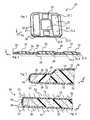
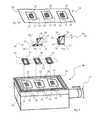
- FIG. 1is a perspective view of a thermal interface component according to the invention.
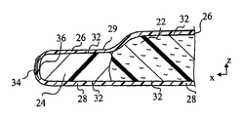
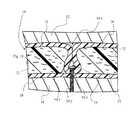
- FIG. 2is a cross-sectional view of the sealed thermal interface component of FIG. 1 taken at line 2 - 2 .
- FIG. 3is a cross-sectional view of the sealed thermal interface component of FIGS. 1 and 2 .
- FIG. 4is an enhanced cross-sectional view of the sealed thermal interface component shown in FIG. 1 compressed between a heat source and a heat-sinking component.
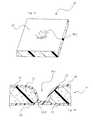
- FIG. 5a perspective view of a thermal interface component according to the invention.
- FIG. 6is a cross-sectional view of the sealed thermal interface component of FIG. 5 taken at line 6 - 6 .
- FIG. 7is a cross-sectional view of the sealed thermal interface component shown in FIG. 6 compressed between a heat source and a heat-sinking component.
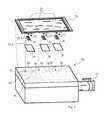
- FIG. 8is a perspective view of the apparatus and process used to encapsulate the thermal interface pad between two layers of film and remove air spaces from the encapsulation.
- FIG. 9is a perspective view of the apparatus and process used to heat-seal the framed thermal interface pads between two layers of film.
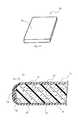
- FIG. 10is a perspective view of framed thermal interface pads components sealed between two layers of film.
- FIG. 11is a cross-sectional view of the overlapping juncture of the heat-sealed upper and lower layers of film around the outer edge of the foam frame after having been trimmed.
- FIG. 12is a cross-sectional view of the thermal interface component of FIG. 11 after the loose edges are heat sealed to the side of the component overlapping juncture of the heat-sealed upper and lower layers of film after they have been folded so as to conform to the edge of the foam frame.
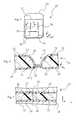
- FIG. 13is a perspective view of a thermal interface component according to an embodiment of the present invention.
- FIG. 14is cross-sectional view of the sealed thermal interface component shown in FIG. 13 .
- FIG. 15is a perspective view of a thermal interface component according to an embodiment of the present invention adapted to receive a fastening member through the shown bolt hole.
- FIG. 16is a cross-sectional view of the sealed thermal interface component shown in FIG. 15 having upper and lower films heat sealed in the bolt hole.
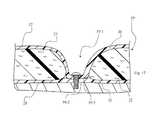
- FIG. 17is a cross-sectional view of the sealed thermal interface component shown in FIG. 16 with a fastening member inserted therethrough.
- FIG. 18is a cross-sectional view of the sealed thermal interface component shown in FIG. 17 compressed between a heat source and a heat-sinking component and the fastening member secured to the heat-sinking component.
- the present inventionincludes a heat-sealed thermal interface component for facilitating heat transfer between a heat source and a heat-sinking component.
- a heat-sealed thermal interface componentfor facilitating heat transfer between a heat source and a heat-sinking component.
- FIGS. 1 , 2 , 5 , 6 , and 13 - 16different embodiments of the sealed thermal interface component 18 , 19 , 20 , 21 are illustrated.
- the componentsgenerally have a top side 21 . 1 with a top surface 21 . 2 , a bottom side 21 . 3 with a bottom surface 21 . 4 , and a side 21 . 5 with a side surface 21 . 6 .
- the componentis a sheet configuration with a maximum thickness of about 0.03 inches to about 0.50 inches (in the z direction of the x-y-z coordinate system) and surface area (in the x and y plane) of about 2 square inches to about 36 square inches. More preferably, the component has a thickness of 0.06 to 0.16 inches.
- the componentmay have a thickness that varies slightly due to different thicknesses of the base components and compression that occurs during manufacture, specifically the partial evacuation.
- partial evacuationand “vacuum” indicate that the component was sealed with the interior of the encapsulation at a negative pressure that is below the atmospheric pressure at the time and point of encapsulation.
- evacuation form fitindicates a partial evacuation substantially conforming to the space occupied by object, such as, for example, the partial evacuation between an encapsulating film and a thermal pad.
- Such form fitmay include some spatial compression of the object or portions of the object being compressed.
- sealed thermal interface components 20 , 21are principally made up of foam frame 24 , thermal pads 22 , upper film 26 , and lower film 28 .
- sealed thermal interface components 20 , 21comprise thermal pads 22 situated inside frames 24 , preferably foam frames.
- Foam frames 24 and thermal pads 22are sealed between an upper film 26 and a lower film 28 .
- the films 26 , 28are preferably transparent and encapsulated 29 or form an uninterrupted barrier around foam frame 24 and thermal pads 22 .
- FIGS. 14 and 16 - 18cross-sectional views of sealed thermal interface components 18 , 19 are also illustrated.
- Sealed thermal interface components 18 , 19are principally made up of thermal pads 22 , upper film 26 , and lower film 28 .
- sealed thermal interface components 18 , 19 illustrated in FIGS. 13-18do not have foam frame 24 .
- FIGS. 13-18illustrate thermal interface components that have only one thermal pad 22 , one skilled in the art would recognize that thermal interface components 18 , 19 without foam frame 24 could have multiple thermal pads 22 without departing from the spirit or scope of the present invention.
- sealed thermal interface components 18 , 19each comprise a single thermal pad 22 .
- Thermal pad 22is sealed between an upper film 26 and a lower film 28 .
- the films 26 , 28are preferably transparent and encapsulated 29 or form an uninterrupted barrier around foam frame 24 and thermal pads 22 .
- Thermal pad 22is made from a compressible and conformable thermal management material suitable for transferring heat from an integrated circuit (IC) device to a cooling block.
- the thermal management materialis an elastomeric matrix loaded with silicone, metal composites, or other thermally conductive material.
- the thermal conductivity of thermal pad 22is typically in a range of about 0.04 watts per meter per degree Kelvin (“w/m-K”) to 20.0 w/m-K, or more preferably a range of about 0.4 w/m-K to about 5.0 w/m-K, or about 0.74 w/m-K to about 2.3 w/m-K.
- thermal pad 22is preferably in a range of about 50 degrees Celsius by square millimeters per watt (“C-mm 2 /w”) to about 200 C-mm 2 /w, or more preferably about 80 C-mm 2 /w to about 190 C-mm 2 /w.
- the dielectric breakdown strength of thermal pad 22is preferably in a range of about 100 volts per millimeter (V/m) to about 1000 V/m, or more preferably a range of about 523 V/m to about 882 V/m.
- the Shore A hardnessis preferably in a range of about 10 to about 200, or more preferably about 70 to about 100.
- a preferred material for the thermal padsis Thermagon T-flex 6100, manufactured by Laird (Cleveland, Ohio). Other materials with similar characteristics may also be used. Also Gap Pad® and Gap Filler® materials available from The Bergquist Company of Chanhassen, Minn. are believed to be suitable. These materials are typically silicon based
- sealed thermal interface components 18 , 19 , 20 , 21may be compressed between heat source 52 and heat-sinking component 54 . Compression of thermal pad 22 between heat source 52 and heat-sinking component 54 alters the shape and may change the volume of the components 18 , 19 , 20 , 21 and of the thermal pads 22 , causing flowage of thermal pad 22 material.
- the thickness of foam frame 24is preferably less than the thickness of thermal pads 22 . This optimizes the ability of foam frame 24 to accommodate expansion of thermal pads 22 without rupturing films 26 , 28 during compression. In certain applications, however, foam frame 24 may not be necessary to accommodate expansion of thermal pads 22 without rupturing films 26 , 28 during compression.
- the thickness of thermal pads 22is preferably in a range of about 0.03 inches (in.) to about 0.50 in., or more preferably about 0.06 in. to about 0.16 in. In more preferred embodiments, the thickness of thermal pads 22 is about 0.10 in. thick and the thickness of foam frame 24 is about 0.045 in. thick.
- Thermal pads 22may be of any suitable shape and the corresponding cooperating frame 24 any suitable complementary shape.
- thermal pads 22are substantially square in shape, as shown in FIGS. 1 and 13 .
- thermal pads 22may be shaped to substantially match the shape of a particular heat source 52 .
- thermal pads 22contain an aperture or are slotted to provide volume-absorbing gaps 57 laterally (in the x-y plane) between for expansion due to compression of thermal pads 22 , as shown in FIGS. 5 and 6 .
- thermal pad 22contains bolt hole 59 . 1 or other aperture through which fastening member 59 . 2 may be inserted. Fastening member 59 .
- FIGS. 15-18depict bolt holes 59 . 5 in embodiments of the present invention not having 19 not having foam frame 24 . Though not shown, embodiments of the present invention having foam frame 24 could easily be adapted to comprise bolt hole 59 . 2 .
- Thermal pads 22may be spaced in any suitable configuration. In one embodiment, thermal pads 22 are spaced substantially evenly in foam frame 24 , as shown in FIG. 1 . In another embodiment, thermal pads 22 may be spaced and configured to align with specific heat sources 52 , as shown in FIG. 5 . In another embodiment, thermal pads 22 are not placed in foam frame 24 , as shown in FIGS. 13 and 15 .
- thermal pad 22expands outward along axes perpendicular to the axis of compression, that is the x and y directions, as shown in FIGS. 4 and 7 .
- foam frame 24may contract near edge 36 of the component to accommodate glacial expansion of thermal pads 22 .
- lateral expansion of thermal pads 22is accommodated by placing thermal pads 22 in foam frame 24 shaped like a window grille, as shown in FIGS. 1 and 2 .
- lateral expansion of thermal pads 22is accommodated by removing material from thermal pads 22 to create volume-absorbing gaps 57 prior to encapsulation. As shown in FIG.
- thermal pads 22expand into volume-absorbing gaps 57 during compression and may cause expansion of the region 57 . 1 between the upper and lower films.
- the end 58 . 1 of the overlapping layers of filmmay be sealed but the adjacent portion 58 . 2 not sealed to allow the thermal pad to expand therein.
- thermal pads 22that occurs under compression can also be contained without the use of foam frame 24 .
- forming thermal pads 22 of a particular geometry and selecting thermal management material of a particular thicknesscan substantially limit displacement of the thermally conductive material from which thermal pads 22 are made.
- Selecting a resiliently expandable film for encapsulation of thermal pads 22can further assist in limiting displacement of the thermally conductive material so that thermal interface component 18 , 19 does not rupture under compression.
- a variety of dimensions and thicknesses of thermal pads 22may permit embodiments of the present invention without foam frame 24 to be compressed without rupturing.
- thermal pad 22generally has a thickness in the range of about 0.010 inches to about 0.100 inches.
- Thermal pad 22may also have a thickness in the range of about 0.30 inches to about 0.070 inches. In an example embodiment, thermal pad 22 has a thickness of about 0.040 inches.
- thermal pads 22may exude fluid that was loaded into or that is part of thermal pads 22 to facilitate heat transfer.
- Thermal pads 22comprising a filled silicone elastomer, for example, may exude silicone fluids.
- Surrounding thermal pads 22 and foam frame 24 with upper film 26 and lower film 28 sealed at overlapping juncture 34may absorb and contain silicone fluids and other potential contaminants within sealed thermal interface components 20 , 21 .
- the present inventionalso includes non-framed embodiments of thermal interface components 18 , 19 having a single thermal pad 22 or multiple thermal pads 22 surrounded by upper film 26 and lower film 28 sealed at overlapping juncture. Such embodiments similarly contain silicone fluids and other potential contaminants within thermal interface components 18 , 19 .
- upper film 26 and lower film 28completely surrounds and seals therein thermal pads 22 and, in certain embodiments, foam frame 24 as well.
- interfaces 32 between films 26 , 28 and foam frame 24 and interfaces 32 between films 26 , 28 and thermal pad 22are substantially free of air spaces.
- Films 26 , 28are substantially coextensive with the surface of thermal pads 22 and foam frame 24 .
- upper film 26 and lower film 28may or may not dip into the cavity defined by bolt hole 59 . 1 .
- upper film 26 and lower film 28overlap in at least a portion of bolt hole 59 . 1 , as depicted in FIG. 16 .
- overlapping junction 34follows the circumference of foam frame 24 substantially coextensive with outer edge 36 of foam frame 24 .
- overlapping juncture 34follows the circumference of thermal pad 22 substantially coextensive with outer edge 37 of thermal pad 22 , as depicted in FIG. 14 .
- Overlapping junction 34may be folded upon itself to lie coextensive with upper film 26 or lower film 28 , as shown in FIG. 12 thereby providing further reinforcement to the juncture 34 .
- upper film 26 and lower film 28may also be integrally joined or otherwise hermetically sealed at overlapping bolt hole juncture 59 . 3 .
- overlapping bolt hole juncture 59 . 3is substantially coextensive with the inner surface of thermal pad 22 defined by circumference bolt hole 59 . 2 .
- a gapexists between holt hole juncture 59 . 3 and an interior edge of thermal pad 22 defined by circumference of bolt hole 59 . 2 .
- the heat-sealed or otherwise hermetically sealed portion of overlapping bolt hole juncture 59 . 3comprises an area capable of receiving the shaft of a fastening member without compromising the integrity of the film seal around thermal pad 22 .
- a portion of overlapping bolt hole juncture 59 . 3coextensively surrounds the perimeter of the shaft of fastening member 59 . 2 , such as is depicted in FIG. 17 .
- overlapping bolt hole juncture 59 . 3may be pre-cut or scored. To accommodate fastening member 59 .
- bolt hole 59 . 1may comprise any number of shapes and sizes.
- bolt hole 59 . 1is cylindrical and has a radius in the range of about 0.05 inches to about 0.50 inches.
- Bolt hole 59 . 1may also have a radius in the range of about 0.10 inches to about 0.20 inches.
- bolt holeis large enough to accommodate a No. 6 screw (which has a diameter of approximately 0.1380 inches) without compromising the integrity of the film encapsulation.
- Films 26 , 28are suitably polyurethane. Films 26 , 28 may be deformed, and are suitably elastic. When sealed thermal interface component 20 is compressed, such as, for example, between an integrated circuit (IC) device and a cooling block, films 26 , 28 accommodate volumetric expansion of thermal pads 22 without rupturing. As shown in FIGS. 3 , 4 , 6 , and 7 , the thickness of upper film 26 is substantially the same as the thickness of lower film 28 .
- the thickness of films 26 , 28is preferably in a range of about 0.5 thousandths of an inch (mil) to about 3.0 mils, or more preferably about 1.0 mils to about 2.0 mils. In a most preferred embodiment, the thickness of films 26 , 28 is about 1.4 mils.
- a preferred filmis Duraflex X1843, manufactured by Deerfield Urethane (South Deerfield, Mass.). Use of such films and such relatively thin films provide minimal additional heat transfer resistance to the component.
- sealed thermal interface component 20facilitates heat transfer.
- sealed thermal interface component 19 , 20is compressed between heat source 52 and heat-sinking component 54 to achieve coextensive thermal communication between sealed thermal interface component 20 and adjacent surfaces of heat source 52 and heat-sinking component 54 .
- Heat source 52generates heat, which is transferred through sealed thermal interface component 20 to heat-sinking component 54 .
- heat source 52may be an integrated IC device and heat-sinking component 54 may be a cooling block.
- a pressure sensitive pad 54 . 2may be applied to the component to facilitate attachment to the heat generating component or heat sink.
- thermal pads 22are cut from a sheet of thermal management material.
- thermal pads 22are cut using a water-jet apparatus. Use of a water jet apparatus minimizes deformation of thermal management material during the cutting process.
- thermal pads 22are cut using a die-cutting apparatus. Typically, there are layers of backing on the thermal management material that is preferably removed before encapsulating.
- foam frame 24may be cut from a sheet of foam material. This process includes cutting the outer shape and dimensions of foam frame 24 as well as apertures in foam frame 24 that will accept thermal pads 22 .
- foam frame 24is cut using a water-jet apparatus.
- foam frame 24is cut using a die-cutting apparatus.
- a preferred foamis Poron 4701-30, manufactured by Rogers Corporation (Woodstock, Conn.).
- the foam frameshave a inner geometry, such as the windows 25 . 5 , and an outer geometry 25 . 6 .
- the thermal padsare sized for insertion in the inner geometry.
- thermal pads 22are placed in apertures in foam frame 24 .
- thermal pads 22are placed by hand in apertures cut in foam frame 24 . Inserting thermal pads 22 by hand into apertures in foam frame 24 minimizes deformation of thermal management material 36 .
- thermal pads 22are placed into apertures in foam frame 24 by a machine.
- upper film 26 and lower film 28are cut from roll of film.
- lower film portions 28are cut so as to be narrower and shorter than upper film 26 , as shown in FIGS. 8-10 .
- lower film 28is placed onto vacuum table 40 connected to vacuum hose 42 , as shown in FIG. 8 .
- Thermal pads 22including thermal pads 22 contained in foam frame 24 , are placed onto lower film 28 , as shown in FIG. 8 .
- foam frame 24 already containing thermal pads 22is placed onto lower portions film 28 .
- thermal pads 22are placed onto foam frame 24 and onto lower film 28 after foam frame 24 is placed onto lower film 28 .
- foam frameis placed around thermal pads 22 and onto lower film 28 after thermal pads 22 are placed onto lower film 28 .
- a plurality of foam frames 24 containing thermal pads 22are placed over lower film 28 .
- single foam frame 24 containing thermal pads 22is placed over foam frame 24 containing thermal pads 22 .
- a single thermal pad 22is placed onto lower film 28 .
- a plurality of thermal pads 22are placed onto lower film 28 .
- upper film 26is adhered to rigid frame 58 .
- Rigid frame 58is lowered and upper film 26 is thereby placed over foam frame 24 containing thermal pads 22 and over lower film 28 .
- upper film 26is placed over a plurality of foam frames 24 containing thermal pads 22 .
- upper film 26is placed over a plurality of thermal pads 22 .
- the internal pressure of vacuum table 40becomes lower than the ambient pressure when the vacuum is engaged.
- This pressure differentialcreates a negative force through an array of inner holes 38 and outer holes 60 in the top surface of vacuum table 40 .
- the outer edge of lower film 28is located between inner holes 38 and outer holes 60 at the position 58 defined by the dashed lines.
- the negative force through the array of inner holes 38holds lower film 26 in place on vacuum table 40 .
- aircontinues to pass through outer holes 60 , but no longer passes through inner holes 28 .
- upper film 26When upper film 26 is placed over thermal pads 22 , including thermal pads 22 contained in foam frame 24 , the outer edge of upper film 26 lies outside the array of outer holes 60 . As this point, all holes 38 , 60 are substantially covered and air no longer passes through holes 38 , 60 . The negative force through the array of outer holes 60 holds upper film 60 in place over foam frame 24 containing thermal pads 22 and over lower film 28 . Since upper film 26 is wider and longer than lower film 28 , vacuum table 40 holds upper film 26 in place over lower film 28 coextensively along overlapping juncture 34 . In preferred embodiments, upper film 26 is placed over a plurality of foam frames 24 containing thermal pads 22 . In another embodiment, upper film 26 is placed over a single foam frame 24 containing thermal pads 22 . In another embodiment, upper film 26 is places over a single thermal pad 22 . In yet another embodiment, upper film 26 is placed over a plurality of thermal pads 22 .
- air spacesare removed from overlapping juncture 34 between upper film 26 and lower film 28 so that films 26 , 28 are substantially coextensive with thermal pads 22 and foam frame 24 . Air spaces are also substantially removed from between upper film 26 and lower film 28 at overlapping juncture 34 . When necessary due to the geometry of thermal pads 22 , air is also removed from gaps 57 . In preferred embodiments, air spaces are removed by exerting downward pressure on the upper film 26 and foam frame 24 containing thermal pads 22 .
- overlapping juncture 34is sealed.
- overlapping bolt hole juncture 59 . 3may also be sealed at this stage.
- overlapping juncture 34 and overlapping bolt hole juncture 59 . 3are heat sealed.
- heated sealing walls 46are adapted to form cavities 62 that fit over and around foam frames 24 containing thermal pads 22 .
- Heated sealing walls 46can also be adapted to form cavities 62 that fit over thermal pads 22 not having foam frame 24 and to fit into overlapping bolt hole juncture 59 . 3 .
- the height of cavities 62is slightly larger than the height of thermal pads 22 .
- cavities 62is substantially the same and slightly larger than the outer shape of foam frames 24 such that sealing walls 46 conform to foam frames 24 containing thermal pads 22 .
- the shape of cavities 62may also be substantially the same and slightly larger than the outer shape of thermal pads 22 such that sealing walls 46 conform to thermal pads 22 or a plurality of thermal pads 22 .
- heated sealing walls 46are affixed onto a movable heating press. The movable heating press is lowered such that each cavity 62 surrounds foam frame 24 containing thermal pads 22 or thermal pads 22 without foam frame 24 . Films 26 , 28 are pinched between contact surfaces of heated sealing walls 46 and vacuum table 40 . Movable heating press is raised after overlapping juncture 34 has been sufficiently sealed.
- overlapping juncture 34is sealed by alternative means, such as, for example, by application of an adhesive.
- a package 64 of several foam frames 24 containing thermal pads 22are independently sealed between upper film 26 and lower film 28 .
- a single foam frame 24 containing thermal pads 22is sealed between upper film 26 and lower film 28 .
- a package 64 of several thermal pads 22are independently sealed between upper film 26 and lower film 28 .
- a single thermal pad 22is sealed between upper film 26 and lower film 28 .
- excess upper film 26 and excess lower film 28are removed. As shown in FIG. 11 , a discrete portion of heat-sealed films 26 , 28 remains around outer edge 36 of foam frame 24 . In preferred embodiments of this method, excess upper film 26 and excess lower film 28 are removed by a die-cutting apparatus. As shown in FIG. 12 , the portion of heat-sealed films 26 , 28 forming overlapping junction 34 that remains after excess upper film 26 and excess lower film 28 are removed is folded over sealed thermal interface 20 and sealed with heat and pressure. Overlapping junctions 34 may be folded or left unfolded both in embodiments of the present invention having foam frame 24 as well as embodiments of the present invention without foam frame 24 .
- Some embodiments of the inventionmay include a simple encapsulation of the thermal pads without the foam framing or utilizing another framing material such as rigid of soft polymers.
Landscapes
- Engineering & Computer Science (AREA)
- Physics & Mathematics (AREA)
- Condensed Matter Physics & Semiconductors (AREA)
- General Physics & Mathematics (AREA)
- Computer Hardware Design (AREA)
- Microelectronics & Electronic Packaging (AREA)
- Power Engineering (AREA)
- Thermal Sciences (AREA)
- Mechanical Engineering (AREA)
- General Engineering & Computer Science (AREA)
- Buffer Packaging (AREA)
Abstract
Description
This application is a continuation-in-part of application Ser. No. 11/704,005 filed Feb. 8, 2007, now U.S. Pat. No. 7,954,236, which is hereby fully incorporated herein by reference.
This invention relates to thermal management materials that conduct heat from a heat source to a heat-sinking component and, more particularly, components that interface between a heat source and a heat switch.
During operation, IC devices produce heat. Efficient cooling systems are sometimes necessary to prevent the failure of IC devices due to this heat. Certain types of cooling systems work by transferring heat from the surface of a heat source to a heat-sinking component that dissipates the heat. Heat sinking components typically are metal, for example aluminum, and have expanded surface areas to transfer heat to the environment or may have other mechanical cooling means. When the surface of a heat source, such as an integrated circuit or a module or package containing such components, is directly engaged with the surface of a heat-sinking component, surface irregularities may prevent optimum contact and result in air spaces located in the interface between the surfaces. These air spaces can reduce the rate of heat transfer from the heat source to the heat-sinking component to unacceptable ranges.
A key aspect of efficiently and effectively transferring heat from a heat source to a heat-sinking component, therefore, is maximizing heat transfer between the surfaces. To this end, an interface of thermally conductive material or a component formed from such thermally conductive material can be placed between the heat source and heat sink. Preferably, the material or compound should reduce or eliminate gaps or air spaces that resist heat transfer by maximizing contact with the surfaces of the heat source and heat-sinking components.
One such material that may be used to facilitate heat transfer between a heat source and heat-sinking components is a viscous, thermally conductive paste or grease extending between the contact surfaces of the components. Such pastes or greases function by increasing surface area contact between the heat-dissipating and heat-sinking components. Furthermore, thermally conductive pastes and greases are difficult to apply and messy, and often bond to the surfaces to which they have been applied or may melt and flow under elevated temperatures.
Products have been developed to avoid some of the problems associated with thermally conductive pastes and greases and still facilitate heat transfer through an interface. For example, thermal pads are now made from an elastomeric or foam matrix material loaded with a material that has favorable thermally conductive characteristics. Thermal pads, including those loaded with such materials, are further described in U.S. Pat. Nos. 6,054,198; 5,679,457; 5,545,473; 5,510,174; 5,309,320; 5,298,791; 5,213,868; 5,194,480; 5,137,959; 5,151,777; 5,060,114; 4,979,074; 4,869,954; 4,782,893; 4,685,987; 4,606,962; and 4,602,678. These patents are incorporated herein by reference.
By combining the elastomeric-conforming properties of one material with the favorable thermally conductive properties of another, thermal pads loaded with a thermally conductive material can significantly reduce air spaces and facilitate heat transfer between the surfaces of a heat source and heat-sinking components. Silicone-based materials have come into favor in thermal management materials due to their excellent heat transfer capabilities and their high conformability under compression. Such compression can cause many of these silicone-based materials to effectively flow rather than to simply be compressed, essentially maintaining the original volume of the pad. Especially when used under conditions of continuous elevated temperatures, these silicone-loaded pads have a tendency to exude fluids, for example, silicone and other fluids and may out-gas. These fluids and gases, in turn, may contaminate the IC devices or other components or portions of the equipment. In some applications, this is not a concern, but in many applications, such exudation and/or outgassing is not acceptable.
It is considered by many in the field that thermal pad materials based on or loaded with a non-silicone material are not as effective as other materials in transferring heat and in conformability.
Thus, there is a need for an effective thermal interface component that has the performance characteristics of silicone-based or silicone-loaded thermal pad material but that does not exude silicone or oils under operating conditions.
The present invention meets the aforementioned needs of the industry, in particular by providing a sealed thermal interface component that minimizes or eliminates the exudation of fluids, such as silicone oils, while preserving the excellent thermal conductivity of silicon-based thermal pad materials and enhancing the conformability of the component. In preferred embodiments, a foam frame surrounds a plurality of thermal pad portions formed of conformable thermal management material that may exude fluid under elevated temperatures or over time. In other embodiments, the sealed thermal interface component does not utilize a foam frame. Film encapsulates the foam-framed thermal pad portions, forming a sealed and partially evacuated thermal interface component. Alternatively, film may encapsulate one or more thermal pad portions that are not framed within foam. In a preferred embodiment of the invention, the thermal pads are formed of an elastomeric matrix material containing silicone, the foam frame is made of polyurethane, and the film is made of urethane. One skilled in the art will recognize that the foam frame is an optional feature of the thermal interface component. Utilization of the foam frame may depend, for example, upon the application of the thermal interface component and the preferences of manufacturers and end users of the thermal interface component.
In preferred embodiments, in the encapsulation process, air is evacuated from the interior of the encapsulation, thus eliminating of minimizing air gaps or pockets from within the sealed thermal interface component. The encapsulating film is heat sealed around the foam-framed thermal pad portions. The minimal amount of air present in the evacuated component is conducive to excellent thermal transfer characteristics.
Compression of thermal interface management materials between heat source and heat-sinking components generally causes some flowing of the conformable material. This increase in pressure causes the thermal pads to expand along axes perpendicular to the axis of compression. Such compression and the resultant flowage can rupture a simple encapsulation of the material due to the buildup of internal pressure caused by the flowage. The foam frame prevents rupture of the encapsulating film by compressing and allowing lateral expansion by the thermal pads within the component. In embodiments not having the foam frame, selecting a thickness and geometry for the thermal pad that permits compression while limiting lateral expansion within a resilient film can prevent rupture of the encapsulating film. The presence of a bolt hole designed to facilitate attachment of the sealed thermal interface component can also provide additional room for lateral expansion of the thermal pad. The present invention thereby provides a thermal interface material flow management system.
Another feature and advantage of the preferred embodiments of the invention is the use of a heat-sealed encapsulating film. When heat-sealed, the encapsulating film prevents the exudation of silicone oils, maintains a vacuum within the sealed thermal interface component, enhancing thermal conductivity, and accommodates volumetric displacement of the foam-framed or non-framed thermal pad without rupture or leakage during compression.
A further feature and advantage of preferred embodiments of this invention is presented relating to the optional use of foam as a framing component within the sealed thermal interface component. Components formed from a simple encapsulation of conformable heat transfer materials may not adequately contain fluids that may exude from the material, particularly when the component is severely compressed. The foam frame is available for absorbing the silicone oil exuded from the thermal management material in the component. In other applications, the film-encapsulated thermal pad may adequately contain fluids that may exude from the material, even when compressed, and the thermal interface component need not include the foam frame. The present invention thereby provides a thermal interface material fluid exudation management system through absorption and containment.
Another feature and advantage of the preferred embodiments of this invention is the creation of a vacuum within the encapsulating film while simultaneously heat sealing the encapsulating film. This removes and maintains the absence of air spaces from the sealed thermal interface. Air may inhibit heat transfer and the vacuum-induced lack of air within the thermal interface component increases the thermal transfer performance.
Another feature and advantage of the preferred embodiments of the invention is the presence of a control means for silicone oil in the thermal interface. Said means comprises a containment for the oil as well as an liquid-absorbing capability within the thermal interface.
The present invention includes a heat-sealed thermal interface component for facilitating heat transfer between a heat source and a heat-sinking component. Referring toFIGS. 1 ,2,5,6, and13-16, different embodiments of the sealedthermal interface component
Referring toFIGS. 2-4 ,6-7, and11-12, detailed cross-sectional views of sealedthermal interface components thermal interface components foam frame 24,thermal pads 22,upper film 26, andlower film 28. In an example embodiment, sealedthermal interface components thermal pads 22 situated inside frames24, preferably foam frames. Foam frames24 andthermal pads 22 are sealed between anupper film 26 and alower film 28. Thefilms foam frame 24 andthermal pads 22.
Referring to FIGS.14 and16-18, cross-sectional views of sealedthermal interface components thermal interface components thermal pads 22,upper film 26, andlower film 28. Unlike sealedthermal interface components FIGS. 2-4 ,6-7, and11-12, sealedthermal interface components FIGS. 13-18 do not havefoam frame 24. AlthoughFIGS. 13-18 illustrate thermal interface components that have only onethermal pad 22, one skilled in the art would recognize thatthermal interface components foam frame 24 could have multiplethermal pads 22 without departing from the spirit or scope of the present invention. In an example embodiment, sealedthermal interface components thermal pad 22.Thermal pad 22 is sealed between anupper film 26 and alower film 28. Thefilms foam frame 24 andthermal pads 22.
As shown inFIGS. 4 ,7, and18, sealedthermal interface components heat source 52 and heat-sinkingcomponent 54. Compression ofthermal pad 22 betweenheat source 52 and heat-sinkingcomponent 54 alters the shape and may change the volume of thecomponents thermal pads 22, causing flowage ofthermal pad 22 material.
The thickness offoam frame 24 is preferably less than the thickness ofthermal pads 22. This optimizes the ability offoam frame 24 to accommodate expansion ofthermal pads 22 without rupturingfilms foam frame 24 may not be necessary to accommodate expansion ofthermal pads 22 without rupturingfilms thermal pads 22 is preferably in a range of about 0.03 inches (in.) to about 0.50 in., or more preferably about 0.06 in. to about 0.16 in. In more preferred embodiments, the thickness ofthermal pads 22 is about 0.10 in. thick and the thickness offoam frame 24 is about 0.045 in. thick.
During compression, normally in the z direction,thermal pad 22 expands outward along axes perpendicular to the axis of compression, that is the x and y directions, as shown inFIGS. 4 and 7 . As shown inFIG. 4 ,foam frame 24 may contract nearedge 36 of the component to accommodate glacial expansion ofthermal pads 22. In one embodiment, lateral expansion ofthermal pads 22 is accommodated by placingthermal pads 22 infoam frame 24 shaped like a window grille, as shown inFIGS. 1 and 2 . In another embodiment, lateral expansion ofthermal pads 22 is accommodated by removing material fromthermal pads 22 to create volume-absorbinggaps 57 prior to encapsulation. As shown inFIG. 7 ,thermal pads 22 expand into volume-absorbinggaps 57 during compression and may cause expansion of the region57.1 between the upper and lower films. There may also be the closed but unsealed two layers of film at the edges of the component that allows the thermal pad to push beyond the previous perimeter or edge of the component. For example inFIG. 11 , the end58.1 of the overlapping layers of film may be sealed but the adjacent portion58.2 not sealed to allow the thermal pad to expand therein.
The glacial expansion ofthermal pads 22 that occurs under compression can also be contained without the use offoam frame 24. Specifically, formingthermal pads 22 of a particular geometry and selecting thermal management material of a particular thickness can substantially limit displacement of the thermally conductive material from whichthermal pads 22 are made. Selecting a resiliently expandable film for encapsulation ofthermal pads 22 can further assist in limiting displacement of the thermally conductive material so thatthermal interface component thermal pads 22 may permit embodiments of the present invention withoutfoam frame 24 to be compressed without rupturing. In embodiments of the present invention withoutfoam frame 24,thermal pad 22 generally has a thickness in the range of about 0.010 inches to about 0.100 inches.Thermal pad 22 may also have a thickness in the range of about 0.30 inches to about 0.070 inches. In an example embodiment,thermal pad 22 has a thickness of about 0.040 inches.FIGS. 13 and 15 depict thermal interface components having a generally square shape.Thermal interface components thermal pads 22 without rupturing the encapsulation. Althoughfoam frame 24 may still be used in these embodiments, their use may not be necessary.
During compression of sealedthermal interface 20,thermal pads 22 may exude fluid that was loaded into or that is part ofthermal pads 22 to facilitate heat transfer.Thermal pads 22 comprising a filled silicone elastomer, for example, may exude silicone fluids. Surroundingthermal pads 22 andfoam frame 24 withupper film 26 andlower film 28 sealed at overlappingjuncture 34 may absorb and contain silicone fluids and other potential contaminants within sealedthermal interface components FIGS. 13-14 , the present invention also includes non-framed embodiments ofthermal interface components thermal pad 22 or multiplethermal pads 22 surrounded byupper film 26 andlower film 28 sealed at overlapping juncture. Such embodiments similarly contain silicone fluids and other potential contaminants withinthermal interface components
The encapsulation formed byupper film 26 andlower film 28 completely surrounds and seals thereinthermal pads 22 and, in certain embodiments,foam frame 24 as well. In preferred embodiments, interfaces32 betweenfilms foam frame 24 andinterfaces 32 betweenfilms thermal pad 22 are substantially free of air spaces.Films thermal pads 22 andfoam frame 24. In embodiments of the present invention having bolt hole59.1,upper film 26 andlower film 28 may or may not dip into the cavity defined by bolt hole59.1. In an example embodiment,upper film 26 andlower film 28 overlap in at least a portion of bolt hole59.1, as depicted inFIG. 16 .
Referring toFIG. 16 ,upper film 26 andlower film 28 may also be integrally joined or otherwise hermetically sealed at overlapping bolt hole juncture59.3. In one embodiment, overlapping bolt hole juncture59.3 is substantially coextensive with the inner surface ofthermal pad 22 defined by circumference bolt hole59.2. In another embodiment, a gap exists between holt hole juncture59.3 and an interior edge ofthermal pad 22 defined by circumference of bolt hole59.2.
Generally, the heat-sealed or otherwise hermetically sealed portion of overlapping bolt hole juncture59.3 comprises an area capable of receiving the shaft of a fastening member without compromising the integrity of the film seal aroundthermal pad 22. In an example embodiment, a portion of overlapping bolt hole juncture59.3 coextensively surrounds the perimeter of the shaft of fastening member59.2, such as is depicted inFIG. 17 . To facilitate insertion of fastening member59.2 through bolt hole59.1 without destroying the vacuum within the encapsulation, overlapping bolt hole juncture59.3 may be pre-cut or scored. To accommodate fastening member59.2, bolt hole59.1 may comprise any number of shapes and sizes. Generally, bolt hole59.1 is cylindrical and has a radius in the range of about 0.05 inches to about 0.50 inches. Bolt hole59.1 may also have a radius in the range of about 0.10 inches to about 0.20 inches. In an example embodiment, bolt hole is large enough to accommodate a No. 6 screw (which has a diameter of approximately 0.1380 inches) without compromising the integrity of the film encapsulation.
In operation, sealedthermal interface component 20 facilitates heat transfer. As shown inFIGS. 4 ,7, and18, sealedthermal interface component heat source 52 and heat-sinkingcomponent 54 to achieve coextensive thermal communication between sealedthermal interface component 20 and adjacent surfaces ofheat source 52 and heat-sinkingcomponent 54. Heatsource 52 generates heat, which is transferred through sealedthermal interface component 20 to heat-sinkingcomponent 54. In preferred embodiments,heat source 52 may be an integrated IC device and heat-sinkingcomponent 54 may be a cooling block. Referring toFIG. 2 , a pressure sensitive pad54.2 may be applied to the component to facilitate attachment to the heat generating component or heat sink.
In manufacturing sealedthermal interface component 20,thermal pads 22 are cut from a sheet of thermal management material. In one embodiment of this method,thermal pads 22 are cut using a water-jet apparatus. Use of a water jet apparatus minimizes deformation of thermal management material during the cutting process. In another embodiment of this method,thermal pads 22 are cut using a die-cutting apparatus. Typically, there are layers of backing on the thermal management material that is preferably removed before encapsulating.
In manufacturing sealedthermal interface component 20,foam frame 24 may be cut from a sheet of foam material. This process includes cutting the outer shape and dimensions offoam frame 24 as well as apertures infoam frame 24 that will acceptthermal pads 22. In preferred embodiments of this method,foam frame 24 is cut using a water-jet apparatus. In another embodiment of this method,foam frame 24 is cut using a die-cutting apparatus. A preferred foam is Poron 4701-30, manufactured by Rogers Corporation (Woodstock, Conn.). The foam frames have a inner geometry, such as the windows25.5, and an outer geometry25.6. The thermal pads are sized for insertion in the inner geometry.
In manufacturing sealedthermal interface components thermal pads 22,thermal pads 22 are placed in apertures infoam frame 24. In preferred embodiments of this method,thermal pads 22 are placed by hand in apertures cut infoam frame 24. Insertingthermal pads 22 by hand into apertures infoam frame 24 minimizes deformation ofthermal management material 36. In another embodiment of this method,thermal pads 22 are placed into apertures infoam frame 24 by a machine.
In manufacturing sealedthermal interface component 20,upper film 26 andlower film 28 are cut from roll of film. In preferred embodiments,lower film portions 28 are cut so as to be narrower and shorter thanupper film 26, as shown inFIGS. 8-10 .
In manufacturing sealedthermal interface component 20,lower film 28 is placed onto vacuum table40 connected to vacuumhose 42, as shown inFIG. 8 .Thermal pads 22, includingthermal pads 22 contained infoam frame 24, are placed ontolower film 28, as shown inFIG. 8 . In preferred embodiments,foam frame 24 already containingthermal pads 22 is placed ontolower portions film 28. In another embodiment,thermal pads 22 are placed ontofoam frame 24 and ontolower film 28 afterfoam frame 24 is placed ontolower film 28. In another embodiment, foam frame is placed aroundthermal pads 22 and ontolower film 28 afterthermal pads 22 are placed ontolower film 28. In preferred embodiments, a plurality of foam frames24 containingthermal pads 22 are placed overlower film 28. In another embodiment,single foam frame 24 containingthermal pads 22 is placed overfoam frame 24 containingthermal pads 22. In another embodiment, a singlethermal pad 22 is placed ontolower film 28. In yet another embodiment, a plurality ofthermal pads 22 are placed ontolower film 28.
In manufacturing sealedthermal interface component 20,upper film 26 is adhered torigid frame 58.Rigid frame 58 is lowered andupper film 26 is thereby placed overfoam frame 24 containingthermal pads 22 and overlower film 28. In preferred embodiments,upper film 26 is placed over a plurality of foam frames24 containingthermal pads 22. In other embodiments,upper film 26 is placed over a plurality ofthermal pads 22.
In manufacturing sealedthermal interface component 20, the internal pressure of vacuum table40 becomes lower than the ambient pressure when the vacuum is engaged. This pressure differential creates a negative force through an array ofinner holes 38 andouter holes 60 in the top surface of vacuum table40. As shown inFIG. 8 , whenlower film 28 is placed on vacuum table40, the outer edge oflower film 28 is located betweeninner holes 38 andouter holes 60 at theposition 58 defined by the dashed lines. The negative force through the array ofinner holes 38 holdslower film 26 in place on vacuum table40. At this point, air continues to pass throughouter holes 60, but no longer passes throughinner holes 28. Whenupper film 26 is placed overthermal pads 22, includingthermal pads 22 contained infoam frame 24, the outer edge ofupper film 26 lies outside the array ofouter holes 60. As this point, allholes holes outer holes 60 holdsupper film 60 in place overfoam frame 24 containingthermal pads 22 and overlower film 28. Sinceupper film 26 is wider and longer thanlower film 28, vacuum table40 holdsupper film 26 in place overlower film 28 coextensively along overlappingjuncture 34. In preferred embodiments,upper film 26 is placed over a plurality of foam frames24 containingthermal pads 22. In another embodiment,upper film 26 is placed over asingle foam frame 24 containingthermal pads 22. In another embodiment,upper film 26 is places over a singlethermal pad 22. In yet another embodiment,upper film 26 is placed over a plurality ofthermal pads 22.
In manufacturing sealedthermal interface component 20, air spaces are removed from overlappingjuncture 34 betweenupper film 26 andlower film 28 so thatfilms thermal pads 22 andfoam frame 24. Air spaces are also substantially removed from betweenupper film 26 andlower film 28 at overlappingjuncture 34. When necessary due to the geometry ofthermal pads 22, air is also removed fromgaps 57. In preferred embodiments, air spaces are removed by exerting downward pressure on theupper film 26 andfoam frame 24 containingthermal pads 22.
In manufacturing sealedthermal interface component 20, overlappingjuncture 34 is sealed. In embodiments of the present invention having bolt hole59.1, overlapping bolt hole juncture59.3 may also be sealed at this stage. In preferred embodiments of this method, overlappingjuncture 34 and overlapping bolt hole juncture59.3 are heat sealed. As shown inFIG. 9 , heated sealingwalls 46 are adapted to formcavities 62 that fit over and around foam frames24 containingthermal pads 22. Heated sealingwalls 46 can also be adapted to formcavities 62 that fit overthermal pads 22 not havingfoam frame 24 and to fit into overlapping bolt hole juncture59.3. The height ofcavities 62 is slightly larger than the height ofthermal pads 22. The shape ofcavities 62 is substantially the same and slightly larger than the outer shape of foam frames24 such that sealingwalls 46 conform to foam frames24 containingthermal pads 22. The shape ofcavities 62 may also be substantially the same and slightly larger than the outer shape ofthermal pads 22 such that sealingwalls 46 conform tothermal pads 22 or a plurality ofthermal pads 22. In preferred embodiments, heated sealingwalls 46 are affixed onto a movable heating press. The movable heating press is lowered such that eachcavity 62 surroundsfoam frame 24 containingthermal pads 22 orthermal pads 22 withoutfoam frame 24.Films heated sealing walls 46 and vacuum table40. Movable heating press is raised after overlappingjuncture 34 has been sufficiently sealed. In other embodiments, overlappingjuncture 34 is sealed by alternative means, such as, for example, by application of an adhesive. In preferred embodiments, apackage 64 of several foam frames24 containingthermal pads 22 are independently sealed betweenupper film 26 andlower film 28. In another, embodiment, asingle foam frame 24 containingthermal pads 22 is sealed betweenupper film 26 andlower film 28. In another embodiment, apackage 64 of severalthermal pads 22 are independently sealed betweenupper film 26 andlower film 28. In yet another embodiment, a singlethermal pad 22 is sealed betweenupper film 26 andlower film 28.
In manufacturing sealedthermal interface component 20, excessupper film 26 and excesslower film 28 are removed. As shown inFIG. 11 , a discrete portion of heat-sealedfilms outer edge 36 offoam frame 24. In preferred embodiments of this method, excessupper film 26 and excesslower film 28 are removed by a die-cutting apparatus. As shown inFIG. 12 , the portion of heat-sealedfilms junction 34 that remains after excessupper film 26 and excesslower film 28 are removed is folded over sealedthermal interface 20 and sealed with heat and pressure. Overlappingjunctions 34 may be folded or left unfolded both in embodiments of the present invention havingfoam frame 24 as well as embodiments of the present invention withoutfoam frame 24.
The embodiments above are intended to be illustrative and not limiting. Additional embodiments are within the claims. Although the present invention has been described with reference to particular embodiments, workers skilled in the art will recognize that changes may be made in form and detail without departing from the spirit and scope of the invention.
Some embodiments of the invention may include a simple encapsulation of the thermal pads without the foam framing or utilizing another framing material such as rigid of soft polymers.
Claims (21)
1. A sealed thermal interface component comprising:
a thermal pad having a silicon-based thermally conductive material, the thermal pad having a top surface, an opposing bottom surface and defining an outer perimeter;
a foam frame having an aperture therethrough with a shape corresponding to the outer perimeter of the thermal pad, the thermal pad positioned in the aperture such that the foam frame extends along the outer perimeter of the thermal pad while leaving the top surface and the bottom surface substantially exposed; and
an encapsulating film sealing the thermal pad and foam frame therein and providing an encapsulation sustaining an evacuation form fit of the encapsulation and the thermal pad and foam frame therein.
2. The sealed thermal interface component ofclaim 1 , wherein the thermal pad is characterized by a thermal conductivity not less than about 0.5 Watts per meter per degree Kelvin (“W/m-K”) and not greater than about 5.0 W/m-K.
3. The sealed thermal interface component ofclaim 1 , wherein the thermally conductive material exudes silicone fluid.
4. The sealed thermal interface component ofclaim 1 , wherein the thermal pad comprises an aperture defining a gap.
5. The sealed thermal interface component ofclaim 4 , wherein the gap is substantially without air spaces.
6. The sealed thermal interface component ofclaim 4 , wherein the encapsulating film comprises a top layer and a bottom layer substantially coextensive within the gap.
7. The sealed thermal interface component ofclaim 4 , wherein the top layer and the bottom layer are heat sealed within the gap.
8. The sealed thermal interface component ofclaim 7 , wherein a heat-sealed portion of the top layer and the bottom layer is adapted to receive a fastening member without allowing air into the partial evacuation of the encapsulation.
9. The sealed thermal interface component ofclaim 8 , wherein the heat-sealed portion of the top layer and the bottom layer is cut or scored to receive the fastening member.
10. The sealed thermal interface component ofclaim 1 , further comprising:
a second thermal pad sealed adjacent to the thermal pad within the encapsulation formed by the encapsulating film, the second thermal pad made from the silicon-based thermally conductive material.
11. The sealed thermal interface component ofclaim 10 , wherein a gap exists between the thermal pads.
12. The sealed thermal interface component ofclaim 11 , wherein the gap between the thermal pads does not have foam therebetween.
13. The sealed thermal interface component ofclaim 1 , wherein the encapsulation comprises an anti-static urethane film.
14. The sealed thermal interface component ofclaim 1 , further comprising:
an adhesive adapted to adhere the sealed thermal interface component to a heat sink.
15. The sealed thermal interface component ofclaim 1 , wherein the thermal pad is characterized by a thickness of about 0.040 inches.
16. The sealed thermal interface component ofclaim 1 , wherein a thickness of the foam frame between a top surface and bottom surface of the foam frame is less than a thickness of the thermal pad between the top surface and the bottom surface of the thermal pad.
17. The sealed thermal interface component ofclaim 1 , further comprising a second thermal pad disposed in a second aperture in the foam frame.
18. The sealed thermal interface component ofclaim 1 , wherein the encapsulating film comprises a top layer and a separate bottom layer, the top layer having an inner surface engaging the top surface of the thermal pad and a top surface of the foam frame and the bottom layer having an inner surface engaging the bottom surface of the thermal pad and a bottom surface of the foam frame and wherein the top layer and bottom layer overlap and extend beyond an outer perimeter of the foam frame to create an overlapping juncture in which the inner surfaces of the top layer and bottom layer directly interface and are joined with each other.
19. The sealed thermal interface component ofclaim 18 , wherein the overlapping juncture is folded against the outer perimeter of the foam frame.
20. A sealed thermal interface component comprising:
a thermal pad having a silicon-based thermally conductive material, the thermal pad having a top surface, an opposing bottom surface and defining an outer perimeter;
an encapsulating film sealing the thermal pad therein and providing an encapsulation sustaining an evacuation form fit of the encapsulation and the thermal pad therein; and
means for accommodating the expansion of the thermal pad when the thermal pad is under compression;
wherein the means for accommodating the expansion of the thermal pad when the thermal pad is under compression comprises a foam frame having an aperture into which the thermal pad is inserted that is sealed by the encapsulating film along with the thermal pad.
21. The sealed thermal interface component ofclaim 20 , wherein the means for accommodating the expansion of the thermal pad when the thermal pad is under compression comprises an overlapping juncture between a top layer and a bottom layer that comprise the encapsulating film, the overlapping juncture extending beyond the outer perimeter of the thermal pad.
Priority Applications (1)
| Application Number | Priority Date | Filing Date | Title |
|---|---|---|---|
| US11/821,648US8448693B2 (en) | 2007-02-08 | 2007-06-25 | Sealed thermal interface component |
Applications Claiming Priority (2)
| Application Number | Priority Date | Filing Date | Title |
|---|---|---|---|
| US11/704,005US7954236B2 (en) | 2007-02-08 | 2007-02-08 | Method of assembling a sealed thermal interface |
| US11/821,648US8448693B2 (en) | 2007-02-08 | 2007-06-25 | Sealed thermal interface component |
Related Parent Applications (1)
| Application Number | Title | Priority Date | Filing Date |
|---|---|---|---|
| US11/704,005Continuation-In-PartUS7954236B2 (en) | 2007-02-08 | 2007-02-08 | Method of assembling a sealed thermal interface |
Publications (2)
| Publication Number | Publication Date |
|---|---|
| US20080190585A1 US20080190585A1 (en) | 2008-08-14 |
| US8448693B2true US8448693B2 (en) | 2013-05-28 |
Family
ID=39684837
Family Applications (1)
| Application Number | Title | Priority Date | Filing Date |
|---|---|---|---|
| US11/821,648Active2031-06-24US8448693B2 (en) | 2007-02-08 | 2007-06-25 | Sealed thermal interface component |
Country Status (1)
| Country | Link |
|---|---|
| US (1) | US8448693B2 (en) |
Cited By (5)
| Publication number | Priority date | Publication date | Assignee | Title |
|---|---|---|---|---|
| US20110048672A1 (en)* | 2009-08-28 | 2011-03-03 | International Business Machines Corporation | Thermal ground plane for cooling a computer |
| US20150136359A1 (en)* | 2013-11-19 | 2015-05-21 | Newtech Enterprise Limited | Flexible heat transfer assembly |
| US20150168087A1 (en)* | 2013-12-12 | 2015-06-18 | General Electric Company | Reusable phase-change thermal interface structures |
| US20160278237A1 (en)* | 2013-10-29 | 2016-09-22 | Polymatech Japan Co., Ltd. | Liquid-Encapsulation Heat Dissipation Member |
| US11076510B2 (en)* | 2018-08-13 | 2021-07-27 | Facebook Technologies, Llc | Heat management device and method of manufacture |
Families Citing this family (7)
| Publication number | Priority date | Publication date | Assignee | Title |
|---|---|---|---|---|
| WO2010036784A1 (en)* | 2008-09-26 | 2010-04-01 | Parker Hannifin Corporation | Thermally conductive gel packs |
| US9658000B2 (en)* | 2012-02-15 | 2017-05-23 | Abaco Systems, Inc. | Flexible metallic heat connector |
| KR102065748B1 (en)* | 2013-01-07 | 2020-01-14 | 에스케이이노베이션 주식회사 | Thermal pad for secondary battery and Battery module having the same |
| US20150129174A1 (en)* | 2013-11-11 | 2015-05-14 | Robert J. Monson | Component reachable expandable heat plate |
| KR20150118831A (en)* | 2014-04-15 | 2015-10-23 | 삼성에스디아이 주식회사 | Rechargeable battery and pack of the same |
| KR102286337B1 (en)* | 2014-10-17 | 2021-08-04 | 쓰리엠 이노베이티브 프로퍼티즈 컴파니 | Emi shielding structure and thermal pad, and electronic circuit board assembly including the same |
| US20180207026A1 (en)* | 2015-07-23 | 2018-07-26 | Innovation Lab | Conformal thermal device |
Citations (50)
| Publication number | Priority date | Publication date | Assignee | Title |
|---|---|---|---|---|
| US3928907A (en) | 1971-11-18 | 1975-12-30 | John Chisholm | Method of making thermal attachment to porous metal surfaces |
| US4132856A (en) | 1977-11-28 | 1979-01-02 | Burroughs Corporation | Process of forming a plastic encapsulated molded film carrier CML package and the package formed thereby |
| US4233645A (en)* | 1978-10-02 | 1980-11-11 | International Business Machines Corporation | Semiconductor package with improved conduction cooling structure |
| US4299715A (en) | 1978-04-14 | 1981-11-10 | Whitfield Fred J | Methods and materials for conducting heat from electronic components and the like |
| US4466483A (en) | 1978-04-14 | 1984-08-21 | Whitfield Fred J | Methods and means for conducting heat from electronic components and the like |
| US4473113A (en) | 1978-04-14 | 1984-09-25 | Whitfield Fred J | Methods and materials for conducting heat from electronic components and the like |
| US4563375A (en)* | 1982-12-16 | 1986-01-07 | Hasler Ag | Flat bag filled with thermally conducting liquid or paste |
| US4602678A (en) | 1983-09-02 | 1986-07-29 | The Bergquist Company | Interfacing of heat sinks with electrical devices, and the like |
| US4606962A (en) | 1983-06-13 | 1986-08-19 | Minnesota Mining And Manufacturing Company | Electrically and thermally conductive adhesive transfer tape |
| US4654754A (en) | 1982-11-02 | 1987-03-31 | Fairchild Weston Systems, Inc. | Thermal link |
| US4685987A (en) | 1983-09-02 | 1987-08-11 | The Bergquist Company | Method of preparing interfacings of heat sinks with electrical devices |
| US4764845A (en) | 1986-03-26 | 1988-08-16 | Artus Raymonde G C | Cooled component assembly |
| US4782893A (en) | 1986-09-15 | 1988-11-08 | Trique Concepts, Inc. | Electrically insulating thermally conductive pad for mounting electronic components |
| US4842911A (en) | 1983-09-02 | 1989-06-27 | The Bergquist Company | Interfacing for heat sinks |
| US4869954A (en) | 1987-09-10 | 1989-09-26 | Chomerics, Inc. | Thermally conductive materials |
| US4965699A (en) | 1989-04-18 | 1990-10-23 | Magnavox Government And Industrial Electronics Company | Circuit card assembly cold plate |
| US4974119A (en) | 1988-09-14 | 1990-11-27 | The Charles Stark Draper Laboratories, Inc. | Conforming heat sink assembly |
| US4979074A (en) | 1989-06-12 | 1990-12-18 | Flavors Technology | Printed circuit board heat sink |
| US5060114A (en) | 1990-06-06 | 1991-10-22 | Zenith Electronics Corporation | Conformable pad with thermally conductive additive for heat dissipation |
| US5137959A (en) | 1991-05-24 | 1992-08-11 | W. R. Grace & Co.-Conn. | Thermally conductive elastomer containing alumina platelets |
| US5151777A (en) | 1989-03-03 | 1992-09-29 | Delco Electronics Corporation | Interface device for thermally coupling an integrated circuit to a heat sink |
| US5167851A (en) | 1991-04-22 | 1992-12-01 | Thermoset Plastics, Inc. | Hydrophilic thermally conductive grease |
| US5194480A (en) | 1991-05-24 | 1993-03-16 | W. R. Grace & Co.-Conn. | Thermally conductive elastomer |
| US5205348A (en) | 1991-05-31 | 1993-04-27 | Minnesota Mining And Manufacturing Company | Semi-rigid heat transfer devices |
| US5213868A (en) | 1991-08-13 | 1993-05-25 | Chomerics, Inc. | Thermally conductive interface materials and methods of using the same |
| US5245508A (en)* | 1990-08-21 | 1993-09-14 | International Business Machines Corporation | Close card cooling method |
| US5250209A (en) | 1991-04-22 | 1993-10-05 | Thermoset Plastics, Inc. | Thermal coupling with water-washable thermally conductive grease |
| US5309320A (en) | 1991-02-06 | 1994-05-03 | Hughes Aircraft Company | Circuit card assembly conduction converter |
| US5321582A (en) | 1993-04-26 | 1994-06-14 | Cummins Engine Company, Inc. | Electronic component heat sink attachment using a low force spring |
| US5359768A (en) | 1992-07-30 | 1994-11-01 | Intel Corporation | Method for mounting very small integrated circuit package on PCB |
| US5471027A (en) | 1994-07-22 | 1995-11-28 | International Business Machines Corporation | Method for forming chip carrier with a single protective encapsulant |
| US5510174A (en) | 1993-07-14 | 1996-04-23 | Chomerics, Inc. | Thermally conductive materials containing titanium diboride filler |
| US5533256A (en) | 1994-07-22 | 1996-07-09 | International Business Machines Corporation | Method for directly joining a chip to a heat sink |
| US5545473A (en) | 1994-02-14 | 1996-08-13 | W. L. Gore & Associates, Inc. | Thermally conductive interface |
| US5679457A (en) | 1995-05-19 | 1997-10-21 | The Bergquist Company | Thermally conductive interface for electronic devices |
| US5685363A (en)* | 1994-12-08 | 1997-11-11 | Nissin Electric Co., Ltd. | Substrate holding device and manufacturing method therefor |
| US5766740A (en) | 1995-05-26 | 1998-06-16 | Sheldahl, Inc. | Adherent film with low thermal impedance and high electrical impedance used in an electronic assembly with a heat sink |
| US5790376A (en) | 1996-11-06 | 1998-08-04 | Compaq Computer Corporation | Heat dissipating pad structure for an electronic component |
| US6054198A (en) | 1996-04-29 | 2000-04-25 | Parker-Hannifin Corporation | Conformal thermal interface material for electronic components |
| US6096414A (en) | 1997-11-25 | 2000-08-01 | Parker-Hannifin Corporation | High dielectric strength thermal interface material |
| US6293332B2 (en)* | 1999-03-31 | 2001-09-25 | Jia Hao Li | Structure of a super-thin heat plate |
| US6397450B1 (en) | 1998-06-17 | 2002-06-04 | Intersil Americas Inc. | Method of cooling an electronic power module using a high performance heat exchanger incorporating metal foam therein |
| US20030128519A1 (en)* | 2002-01-08 | 2003-07-10 | International Business Machine Corporartion | Flexible, thermally conductive, electrically insulating gap filler, method to prepare same, and method using same |
| US20030155102A1 (en)* | 2002-02-15 | 2003-08-21 | Garner Scott D. | Vapor chamber having integral captive fasteners |
| US6946190B2 (en) | 2002-02-06 | 2005-09-20 | Parker-Hannifin Corporation | Thermal management materials |
| US7004244B2 (en) | 2001-06-07 | 2006-02-28 | Henkel Corporation | Thermal interface wafer and method of making and using the same |
| US7063127B2 (en) | 2003-09-18 | 2006-06-20 | International Business Machines Corporation | Method and apparatus for chip-cooling |
| US7137444B2 (en) | 2003-09-08 | 2006-11-21 | Pacific Rubber & Packing, Inc. | Heat-transfer interface device between a source of heat and a heat-receiving object |
| US7568255B1 (en) | 2003-02-10 | 2009-08-04 | Bissell Homecare, Inc. | Thermal storage bare surface cleaner |
| US7682690B2 (en) | 2002-02-06 | 2010-03-23 | Parker-Hannifin Corporation | Thermal management materials having a phase change dispersion |
Family Cites Families (1)
| Publication number | Priority date | Publication date | Assignee | Title |
|---|---|---|---|---|
| DE3511588A1 (en)* | 1985-03-27 | 1986-10-02 | Schering AG, Berlin und Bergkamen, 1000 Berlin | AQUEOUS CRYSTAL SUSPENSION OF STEROID GLYCOESTERS |
- 2007
- 2007-06-25USUS11/821,648patent/US8448693B2/enactiveActive
Patent Citations (52)
| Publication number | Priority date | Publication date | Assignee | Title |
|---|---|---|---|---|
| US3928907A (en) | 1971-11-18 | 1975-12-30 | John Chisholm | Method of making thermal attachment to porous metal surfaces |
| US4132856A (en) | 1977-11-28 | 1979-01-02 | Burroughs Corporation | Process of forming a plastic encapsulated molded film carrier CML package and the package formed thereby |
| US4299715A (en) | 1978-04-14 | 1981-11-10 | Whitfield Fred J | Methods and materials for conducting heat from electronic components and the like |
| US4466483A (en) | 1978-04-14 | 1984-08-21 | Whitfield Fred J | Methods and means for conducting heat from electronic components and the like |
| US4473113A (en) | 1978-04-14 | 1984-09-25 | Whitfield Fred J | Methods and materials for conducting heat from electronic components and the like |
| US4233645A (en)* | 1978-10-02 | 1980-11-11 | International Business Machines Corporation | Semiconductor package with improved conduction cooling structure |
| US4654754A (en) | 1982-11-02 | 1987-03-31 | Fairchild Weston Systems, Inc. | Thermal link |
| US4563375A (en)* | 1982-12-16 | 1986-01-07 | Hasler Ag | Flat bag filled with thermally conducting liquid or paste |
| US4606962A (en) | 1983-06-13 | 1986-08-19 | Minnesota Mining And Manufacturing Company | Electrically and thermally conductive adhesive transfer tape |
| US4685987A (en) | 1983-09-02 | 1987-08-11 | The Bergquist Company | Method of preparing interfacings of heat sinks with electrical devices |
| US4842911A (en) | 1983-09-02 | 1989-06-27 | The Bergquist Company | Interfacing for heat sinks |
| US4602678A (en) | 1983-09-02 | 1986-07-29 | The Bergquist Company | Interfacing of heat sinks with electrical devices, and the like |
| US4764845A (en) | 1986-03-26 | 1988-08-16 | Artus Raymonde G C | Cooled component assembly |
| US4782893A (en) | 1986-09-15 | 1988-11-08 | Trique Concepts, Inc. | Electrically insulating thermally conductive pad for mounting electronic components |
| US4869954A (en) | 1987-09-10 | 1989-09-26 | Chomerics, Inc. | Thermally conductive materials |
| US4974119A (en) | 1988-09-14 | 1990-11-27 | The Charles Stark Draper Laboratories, Inc. | Conforming heat sink assembly |
| US5151777A (en) | 1989-03-03 | 1992-09-29 | Delco Electronics Corporation | Interface device for thermally coupling an integrated circuit to a heat sink |
| US4965699A (en) | 1989-04-18 | 1990-10-23 | Magnavox Government And Industrial Electronics Company | Circuit card assembly cold plate |
| US4979074A (en) | 1989-06-12 | 1990-12-18 | Flavors Technology | Printed circuit board heat sink |
| US5060114A (en) | 1990-06-06 | 1991-10-22 | Zenith Electronics Corporation | Conformable pad with thermally conductive additive for heat dissipation |
| US5245508A (en)* | 1990-08-21 | 1993-09-14 | International Business Machines Corporation | Close card cooling method |
| US5309320A (en) | 1991-02-06 | 1994-05-03 | Hughes Aircraft Company | Circuit card assembly conduction converter |
| US5250209A (en) | 1991-04-22 | 1993-10-05 | Thermoset Plastics, Inc. | Thermal coupling with water-washable thermally conductive grease |
| US5167851A (en) | 1991-04-22 | 1992-12-01 | Thermoset Plastics, Inc. | Hydrophilic thermally conductive grease |
| US5194480A (en) | 1991-05-24 | 1993-03-16 | W. R. Grace & Co.-Conn. | Thermally conductive elastomer |
| US5137959A (en) | 1991-05-24 | 1992-08-11 | W. R. Grace & Co.-Conn. | Thermally conductive elastomer containing alumina platelets |
| US5205348A (en) | 1991-05-31 | 1993-04-27 | Minnesota Mining And Manufacturing Company | Semi-rigid heat transfer devices |
| US5213868A (en) | 1991-08-13 | 1993-05-25 | Chomerics, Inc. | Thermally conductive interface materials and methods of using the same |
| US5298791A (en) | 1991-08-13 | 1994-03-29 | Chomerics, Inc. | Thermally conductive electrical assembly |
| US5359768A (en) | 1992-07-30 | 1994-11-01 | Intel Corporation | Method for mounting very small integrated circuit package on PCB |
| US5321582A (en) | 1993-04-26 | 1994-06-14 | Cummins Engine Company, Inc. | Electronic component heat sink attachment using a low force spring |
| US5510174A (en) | 1993-07-14 | 1996-04-23 | Chomerics, Inc. | Thermally conductive materials containing titanium diboride filler |
| US5545473A (en) | 1994-02-14 | 1996-08-13 | W. L. Gore & Associates, Inc. | Thermally conductive interface |
| US5471027A (en) | 1994-07-22 | 1995-11-28 | International Business Machines Corporation | Method for forming chip carrier with a single protective encapsulant |
| US5533256A (en) | 1994-07-22 | 1996-07-09 | International Business Machines Corporation | Method for directly joining a chip to a heat sink |
| US5685363A (en)* | 1994-12-08 | 1997-11-11 | Nissin Electric Co., Ltd. | Substrate holding device and manufacturing method therefor |
| US5679457A (en) | 1995-05-19 | 1997-10-21 | The Bergquist Company | Thermally conductive interface for electronic devices |
| US5766740A (en) | 1995-05-26 | 1998-06-16 | Sheldahl, Inc. | Adherent film with low thermal impedance and high electrical impedance used in an electronic assembly with a heat sink |
| US5798171A (en) | 1995-05-26 | 1998-08-25 | Sheldahl, Inc. | Adherent film with low thermal impedance and high electrical impedance used in an electronic assembly with a heat sink |
| US6054198A (en) | 1996-04-29 | 2000-04-25 | Parker-Hannifin Corporation | Conformal thermal interface material for electronic components |
| US5790376A (en) | 1996-11-06 | 1998-08-04 | Compaq Computer Corporation | Heat dissipating pad structure for an electronic component |
| US6096414A (en) | 1997-11-25 | 2000-08-01 | Parker-Hannifin Corporation | High dielectric strength thermal interface material |
| US6397450B1 (en) | 1998-06-17 | 2002-06-04 | Intersil Americas Inc. | Method of cooling an electronic power module using a high performance heat exchanger incorporating metal foam therein |
| US6293332B2 (en)* | 1999-03-31 | 2001-09-25 | Jia Hao Li | Structure of a super-thin heat plate |
| US7004244B2 (en) | 2001-06-07 | 2006-02-28 | Henkel Corporation | Thermal interface wafer and method of making and using the same |
| US20030128519A1 (en)* | 2002-01-08 | 2003-07-10 | International Business Machine Corporartion | Flexible, thermally conductive, electrically insulating gap filler, method to prepare same, and method using same |
| US6946190B2 (en) | 2002-02-06 | 2005-09-20 | Parker-Hannifin Corporation | Thermal management materials |
| US7682690B2 (en) | 2002-02-06 | 2010-03-23 | Parker-Hannifin Corporation | Thermal management materials having a phase change dispersion |
| US20030155102A1 (en)* | 2002-02-15 | 2003-08-21 | Garner Scott D. | Vapor chamber having integral captive fasteners |
| US7568255B1 (en) | 2003-02-10 | 2009-08-04 | Bissell Homecare, Inc. | Thermal storage bare surface cleaner |
| US7137444B2 (en) | 2003-09-08 | 2006-11-21 | Pacific Rubber & Packing, Inc. | Heat-transfer interface device between a source of heat and a heat-receiving object |
| US7063127B2 (en) | 2003-09-18 | 2006-06-20 | International Business Machines Corporation | Method and apparatus for chip-cooling |
Non-Patent Citations (32)
| Title |
|---|
| 3M Thermal Management Solutions for Electronics Brochure; (6 pages). |
| 3M Thermally conductive Interface Pad 5591s; Technical Data; Aug. 2006; (4 pages). |
| 3M Thermally Conductive Interface Pad 5592/5592s; Aug. 2006; (4 pages). |
| 3M Thermally Conductive Interface Pad 5595/5595s; Aug. 2006; (4 pages). |
| Application and File History of U.S. Appl. No. 11/704,005, Inventors Timothy J. Lundell et al., filed Feb. 8, 2007. |
| Core Creative Technologies Worldwide; CP6000 Thermal Interface Material Product Technical Details;http://www.gore.com/en-xx/products/electronic/speciality/m20-therm-int-mtrl-prod-tech-dils.html; (3 pages). |
| Core Creative Technologies Worldwide; CP6000 Thermal Interface Material Product Technical Details;http://www.gore.com/en—xx/products/electronic/speciality/m20—therm—int—mtrl—prod—tech—dils.html; (3 pages). |
| Dow Corning; Product Information; Information about Dow Corning® Brand Thermal Interface Pads and Films; (8 pages). |
| Dow Corning; Thermal Interface-Pads and Films; Gap Filler thermal Interface Materials Overview; http://www.dowcorning.com/content/etronicspadsfilm/etronics-tcpad-gapov.asp; (2 pages). |
| Dow Corning; Thermal Interface—Pads and Films; Gap Filler thermal Interface Materials Overview; http://www.dowcorning.com/content/etronicspadsfilm/etronics—tcpad—gapov.asp; (2 pages). |
| Dow Corning; Thermal Interface-Pads and Films; http:www.dowcorning.com/content/etronics/etronicspadsfilm/default.asp; (2 pages). |
| Dow Corning; Thermal Interface—Pads and Films; http:www.dowcorning.com/content/etronics/etronicspadsfilm/default.asp; (2 pages). |
| Dow Corning; Thermal Interface-Pads and Films; Thin Thermal Interface Materials Overview; (Fomerly Known as Heat Path(TM)); http://www.dowcorning.com/content/etronics/etronicspadsfilm/etronics-tcpad-thinov.asp; (2 pages). |
| Dow Corning; Thermal Interface—Pads and Films; Thin Thermal Interface Materials Overview; (Fomerly Known as Heat Path™); http://www.dowcorning.com/content/etronics/etronicspadsfilm/etronics—tcpad—thinov.asp; (2 pages). |
| Fujipoly-Sarcon Thermal Interface Materials; Fujipoly-A ISO9000 Registered Company; (3 pages); (Jan. 18, 2007);http://www.fujipoly.com/products/genProductLine.asp?ProductLine=Sarcon-Thermal-Interface-Materials. |
| Fujipoly—Sarcon Thermal Interface Materials; Fujipoly—A ISO9000 Registered Company; (3 pages); (Jan. 18, 2007);http://www.fujipoly.com/products/genProductLine.asp?ProductLine=Sarcon-Thermal-Interface-Materials. |
| Gore Creative Technologies Worldwide; CP8000 Thermal Interface Material Product Technical Details-POLARCHIP CP8000 Thermal Interface Material Properties; http://www.gore.com/en-xx/products/electronic/speciality/cp8000-therm-int-mtrl-tech+dtls.html; (3 pages). |
| Gore Creative Technologies Worldwide; CP8000 Thermal Interface Material Product Technical Details—POLARCHIP CP8000 Thermal Interface Material Properties; http://www.gore.com/en—xx/products/electronic/speciality/cp8000—therm—int—mtrl—tech+dtls.html; (3 pages). |
| Gore Creative Technologies Worldwide; Thermal Interface Materials; CP6000 and CP8000; http://www.gore.com/en-xx/products/electronic/speciality/thermal-interface-materials.html; (2 pages). |
| Gore Creative Technologies Worldwide; Thermal Interface Materials; CP6000 and CP8000; http://www.gore.com/en—xx/products/electronic/speciality/thermal—interface—materials.html; (2 pages). |
| Laird Technologies; Corporate Overview Brochure; http://ww.lairdtech.com/pages/catalogs/thermal.asp; (17 pages). |
| Laird Technologies; T-flex(TM) 600 Series Thermal Gap Filler; Engineered emi, antenna and Thermal applications; www.lairdtech.com; (3 pages). |
| Laird Technologies; T-flex™ 600 Series Thermal Gap Filler; Engineered emi, antenna and Thermal applications; www.lairdtech.com; (3 pages). |
| The Bergquist Company; Compressive Modulus of Elasticity for Gap Pad® Materials; (5 pages); Benno Shuhbauer and Kevin Hanson; (May 3, 1999). |
| The Bergquist Company; Thermal Materials: Gap-Pad Products; (2 pages); http://www.bergquistcompany.com/tm-gap-pad-list.cfm. |
| The Bergquist Company; Thermal Materials: Gap-Pad Products; (2 pages); http://www.bergquistcompany.com/tm—gap—pad—list.cfm. |
| The Bergquist Company; Thermal Materials: Sil-Pad Products; (3 pages); http://www.bergquistcompany.com/tm-sil-pad -list.cfm. |
| The Bergquist Company; Thermal Materials: Sil-Pad Products; (3 pages); http://www.bergquistcompany.com/tm—sil—pad —list.cfm. |
| The Bergquist Company; Thermal Materials: Thermal Properties and Testing; (Jan. 18, 2007); 3 pages; http://www.bergquistcompany.com/tm-thermal-prop.cfm. |
| Thermagon, Inc.; (A Division of Laird Technologies); T-flex 600 Series; (4 pages). |
| W. L. Gore & Associates-Electronics Products Division; GORE(TM) POLARCHIP(TM) CP8000 Thermal Interface Material Brochure; © 2003 W.L. Gore & Associates; (1 page). |
| W. L. Gore & Associates—Electronics Products Division; GORE™ POLARCHIP™ CP8000 Thermal Interface Material Brochure; © 2003 W.L. Gore & Associates; (1 page). |
Cited By (9)
| Publication number | Priority date | Publication date | Assignee | Title |
|---|---|---|---|---|
| US20110048672A1 (en)* | 2009-08-28 | 2011-03-03 | International Business Machines Corporation | Thermal ground plane for cooling a computer |
| US8776868B2 (en)* | 2009-08-28 | 2014-07-15 | International Business Machines Corporation | Thermal ground plane for cooling a computer |
| US9377251B2 (en) | 2009-08-28 | 2016-06-28 | Globalfoundries Inc. | Thermal ground plane for cooling a computer |
| US20160278237A1 (en)* | 2013-10-29 | 2016-09-22 | Polymatech Japan Co., Ltd. | Liquid-Encapsulation Heat Dissipation Member |
| US10356944B2 (en)* | 2013-10-29 | 2019-07-16 | Sekisui Polymatech Co., Ltd. | Liquid-encapsulation heat dissipation member |
| US20150136359A1 (en)* | 2013-11-19 | 2015-05-21 | Newtech Enterprise Limited | Flexible heat transfer assembly |
| US20150168087A1 (en)* | 2013-12-12 | 2015-06-18 | General Electric Company | Reusable phase-change thermal interface structures |
| US9826662B2 (en)* | 2013-12-12 | 2017-11-21 | General Electric Company | Reusable phase-change thermal interface structures |
| US11076510B2 (en)* | 2018-08-13 | 2021-07-27 | Facebook Technologies, Llc | Heat management device and method of manufacture |
Also Published As
| Publication number | Publication date |
|---|---|
| US20080190585A1 (en) | 2008-08-14 |
Similar Documents
| Publication | Publication Date | Title |
|---|---|---|
| US8448693B2 (en) | Sealed thermal interface component | |
| US7954236B2 (en) | Method of assembling a sealed thermal interface | |
| EP3227915B1 (en) | System for effectively transferring heat from electronic devices and method for forming the same | |
| US6665186B1 (en) | Liquid metal thermal interface for an electronic module | |
| US4997032A (en) | Thermal transfer bag | |
| US20180374715A1 (en) | Adhesive-bonded thermal interface structures for integrated circuit cooling | |
| US11013147B2 (en) | Thermal interface material structures | |
| US6062299A (en) | Heat sink | |
| US5689878A (en) | Method for protecting electronic circuit components | |
| US9392731B2 (en) | Cooling apparatus with dynamic load adjustment | |
| KR20180006850A (en) | Systems and methods of applying thermal interface materials | |
| US20030159806A1 (en) | Flat-plate heat-pipe with lanced-offset fin wick | |
| US7760504B2 (en) | Apparatus, system, and method for thermal conduction interfacing | |
| TWI637680B (en) | Heat dissipation structure, method for making the same, and electronic device | |
| EP0309279B1 (en) | Thermal transfer bag | |
| EP2466636A2 (en) | Adaptive thermal gap pad | |
| US7096926B2 (en) | Thermal pouch interface | |
| US6849941B1 (en) | Heat sink and heat spreader assembly | |
| US20120292005A1 (en) | Thermal interface materials and methods for processing the same | |
| JP7301948B1 (en) | Heat dissipation structure, method for manufacturing heat dissipation structure, and electronic device | |
| CN216749869U (en) | Chip heat radiation structure and electronic product with same | |
| CN113990816A (en) | Chip heat radiation structure and electronic product with same | |
| JP7472224B1 (en) | Heat dissipation structures, electronic devices, and heat transfer structures | |
| KR102618866B1 (en) | Thermal conductive gap filler unit | |
| JP2009246043A (en) | Heat exchanger and moisture preventing method therefor |
Legal Events
| Date | Code | Title | Description |
|---|---|---|---|
| AS | Assignment | Owner name:LUNDELL MANUFACTURING CORPORATION, MINNESOTA Free format text:ASSIGNMENT OF ASSIGNORS INTEREST;ASSIGNORS:LUNDELL, TIMOTHY J;LUNDELL, THOMAS L;REEL/FRAME:019600/0829 Effective date:20070622 | |
| STCF | Information on status: patent grant | Free format text:PATENTED CASE | |
| FPAY | Fee payment | Year of fee payment:4 | |
| MAFP | Maintenance fee payment | Free format text:PAYMENT OF MAINTENANCE FEE, 8TH YR, SMALL ENTITY (ORIGINAL EVENT CODE: M2552); ENTITY STATUS OF PATENT OWNER: SMALL ENTITY Year of fee payment:8 | |
| FEPP | Fee payment procedure | Free format text:11.5 YR SURCHARGE- LATE PMT W/IN 6 MO, SMALL ENTITY (ORIGINAL EVENT CODE: M2556); ENTITY STATUS OF PATENT OWNER: SMALL ENTITY | |
| MAFP | Maintenance fee payment | Free format text:PAYMENT OF MAINTENANCE FEE, 12TH YR, SMALL ENTITY (ORIGINAL EVENT CODE: M2553); ENTITY STATUS OF PATENT OWNER: SMALL ENTITY Year of fee payment:12 |