US8448301B2 - Tool set for marine applications - Google Patents
Tool set for marine applicationsDownload PDFInfo
- Publication number
- US8448301B2 US8448301B2US12/945,831US94583110AUS8448301B2US 8448301 B2US8448301 B2US 8448301B2US 94583110 AUS94583110 AUS 94583110AUS 8448301 B2US8448301 B2US 8448301B2
- Authority
- US
- United States
- Prior art keywords
- flexible strap
- hook
- spiked
- strap
- bucket
- Prior art date
- Legal status (The legal status is an assumption and is not a legal conclusion. Google has not performed a legal analysis and makes no representation as to the accuracy of the status listed.)
- Expired - Fee Related
Links
Images







Classifications
- A—HUMAN NECESSITIES
- A45—HAND OR TRAVELLING ARTICLES
- A45C—PURSES; LUGGAGE; HAND CARRIED BAGS
- A45C13/00—Details; Accessories
- A45C13/26—Special adaptations of handles
- A45C13/28—Combinations of handles with other devices
- A—HUMAN NECESSITIES
- A45—HAND OR TRAVELLING ARTICLES
- A45F—TRAVELLING OR CAMP EQUIPMENT: SACKS OR PACKS CARRIED ON THE BODY
- A45F5/00—Holders or carriers for hand articles; Holders or carriers for use while travelling or camping
- A45F5/10—Handles for carrying purposes
- A45F5/102—Handles for carrying purposes with means, e.g. a hook, receiving a carrying element of the hand article to be carried
Definitions
- This inventionrelates in general to marine equipment and tools, and more particularly it relates to an improved bucket handle and an improved stopcock wrench.
- This inventionprovides a toolset for marine applications that includes improved handle for buckets that provides an improved flexible gripping strap, and further provides a method of securely attaching the flexible gripping strap to specially formed spiked hooks that attach to a bucket.
- the spiked hookis inserted into a central channel of the flexible gripping strap.
- the hookhas a distal end with angled spikes that allow the hook to be inserted into the central channel, but are angled such that they cannot be withdrawn.
- the hookfurther has a proximal end with an open hook that can be easily attached or detached from a bucket.
- the tool setfurther has specially formed wrenches that allow a user to adjust stopcocks that are located in hard to reach locations. The wrenches have open ends and slotted sides to allow them to adjust the stopcocks in multiple ways.
- FIG. 1is a side view of a preferred embodiment of a spiked hook used to attach a flexible gripping strap to a bucket.
- FIG. 2is a top view of the preferred embodiment of the spiked hook of FIG. 1 .
- FIG. 3Ais a side view of the preferred embodiment of the spiked hook of FIG. 1 inserted into a flexible gripping strap.
- FIG. 3Bis a side view of an alternative preferred embodiment of the spiked hook of FIG. 1 inserted into a flexible gripping strap with an option shrink wrap cover over the end of the flexible gripping strap.
- FIG. 4is a side view of the preferred embodiment of the spiked hook of FIG. 1 inserted into the flexible gripping strap with an optional retaining ring securing the flexible gripping strap to the spiked hook.
- FIG. 5is a side cross-sectional view of a preferred embodiment of the spiked hook and flexible gripping strap attached to a bucket.
- FIG. 6is a perspective view of a preferred embodiment of a stopcock wrench.
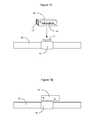
- FIG. 7Ais a side view of the stopcock wrench of FIG. 6 with its side slot aligned with a stopcock lever.
- FIG. 7Bis a side view of the stopcock wrench of FIG. 6 with the side slot inserted over the stopcock lever.
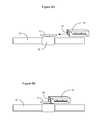
- FIG. 8Ais a side view of the stopcock wrench of FIG. 6 with its open end aligned with a stopcock lever.
- FIG. 8Bis a side view of the stopcock wrench of FIG. 6 with the open end inserted over the stopcock lever.
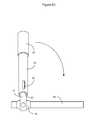
- FIG. 9Ais a perspective view of an alternative preferred embodiment of the stopcock wrench that illustrates side slots and the open end.
- FIG. 9Bis a side view of the preferred embodiment of FIG. 9A showing the stopcock wrench with the stopcock lever inserted through the side slots of the stopcock wrench.
- FIG. 9Cillustrates a side view of the alternative preferred embodiment of FIG. 9A showing the stopcock wrench with the stopcock lever inserted into the open end of the stopcock wrench.
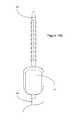
- FIG. 10Ais a side view of a preferred embodiment of an alternative use for the spiked hook of FIG. 1 that is used in this embodiment to clean lobster.
- FIG. 10Bis a top view of the preferred embodiment of the spiked hook of FIG. 10A .
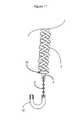
- FIG. 11is a side view of an alternative preferred embodiment of the spiked hook in which the spiked hook is connected via a chain to the bucket attachment.
- FIG. 1is a side view of a preferred embodiment of a spiked hook 1 used to attach a flexible strap 8 (shown below in regard to FIG. 3 ) to a bucket 10 (shown below in regard to FIG. 5 ).
- spiked hook 1consists of a hook portion 2 that has a proximal end 7 and a distal end 5 .
- the proximal end 7is sized to fit into an aperture on the side of a bucket 10 .
- the distal end 5is preferably pointed to facilitate entry of the spiked hook 1 into the flexible gripping strap 8 .
- Spiked hook 1includes an offset segment 6 to allow the spiked hook 1 to be more easily inserted into an aperture on a bucket 10 without interference from the flexible gripping strap 8 .
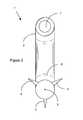
- spikes 4that protrude from the shaft 3 of spiked hook 1 .
- spikes 4are angled away from distal end 5 to facilitate entry of spiked hook 1 into the internal channel of flexible strap 8 .
- the number of spikes 4can vary, as well as their angle, size, and placement on shaft 3 .
- the only requirement for spikes 4is that they securely grasp flexible gripping strap 8 .
- spiked hook numberone can be fabricated from any suitable material, such as plastic, metal, wood etc.
- spiked hook 1is used in harsh environments, such as on a boat, it would be preferable to fabricate spiked hook 1 from the material that is resistant too environmental factors found injury environments such as heat, salt water, and substantial levels of sunlight.
- spiked hook 1might preferably be fabricated for such an environment from materials such as plastic, polyethylene, polypropylene, or virgin nylon.
- FIG. 2is a top view of the preferred embodiment of the spiked hook 1 of FIG. 1 . This figure provides a better view of spikes 4 distributed about the circumference of shaft 3 .
- FIG. 3Ais a side view of the preferred embodiment of the spiked hook 1 of FIG. 1 when it is inserted into a flexible gripping strap 8 .
- flexible gripping strap 8is constructed such that it has a central channel into which spiked hook 1 is inserted. Once inserted, the spikes 4 will prevent spiked hook 1 from being withdrawn from the flexible gripping strap 8 .
- the optional heat-sealed end 29 of the flexible gripping strap 8is also shown in this figure.
- the purpose of heat-sealing the ends of the flexible gripping strap 8is to prevent the flexible gripping strap 8 from fraying. By preventing fraying, the hollow braid structure of the flexible gripping strap 8 is prevented from unraveling.
- alternatives to heat-sealingsuch as adhesives, RF bonding, chemical bonding, etc., could be used.
- Another important feature of the inventionis the hollow braid structure of the flexible gripping strap 8 .
- This structureprovides advantages in that it provides a channel for insertion of the spiked hook 1 , and further, it provides a softer and more comfortable grip for the individual carrying the attached bucket.
- FIG. 3Bis a side view of an alternative preferred embodiment of the spiked hook 1 of FIG. 1 when it is inserted into a flexible gripping strap 8 .
- flexible gripping strap 8includes an optional shrink wrap cover on the end of the flexible gripping strap that is intended to prevent fraying of the flexible gripping strap 8 , and put improve its aesthetics.
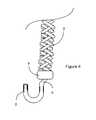
- FIG. 4is a side view of the preferred embodiment of the spiked hook 1 of FIG. 1 inserted into the flexible gripping strap 8 with an optional retaining ring 9 which further secures the flexible gripping strap 8 to the spiked hook 1 .
- Retaining ring 9can be tape, it can be a rigid plan, etc. The only requirement is that retaining ring 9 protects the end of flexible gripping strap 8 such that it does not get damaged during ordinary use. It also serves to further prevent flexible gripping strap 8 from disengaging from spiked hook 1 .
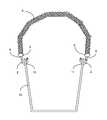
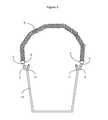
- FIG. 5is a side cross-sectional view of a preferred embodiment of the spiked hook 1 and flexible gripping strap 8 attached to a bucket 10 .
- hook portions 2are inserted through apertures 11 in the side of bucket 10 .
- This figurealso illustrates how offset segment 6 positions flexible gripping strap 8 away from the edge of bucket 10 .
- FIG. 6is a perspective view of a preferred embodiment of a stopcock wrench 12 .
- stopcock wrench 12is a rigid structure having an open end 13 , and at least one slot 14 .
- the open end 13 and the slot 14are sized such that they can fit over a stopcock lever 17 (shown below in regard to FIG. 7A ).
- Stopcock wrench 12can be fabricated from any suitable material.
- stopcock lever's 17oftentimes require a substantial amount of force to turn.
- stopcock wrench 12should preferably be fabricated from material having substantial strength, such as metal.
- FIG. 7Ais a side view of the stopcock wrench 12 of FIG. 6 with its slot 14 aligned with a stopcock lever 17 . While the size of the stopcock wrench 12 , and its associated slot 14 will vary based on its intended use, the slot 14 should be sized such that it can easily fit over stopcock lever 17 .
- FIG. 7Bis a side view of the stopcock wrench 12 of FIG. 6 with the slot 14 inserted over the stopcock lever 17 . Once joined in this manner, the stopcock wrench 12 can provide additional leverage to turn stopcock lever 17 .
- a significant advantage of stopcock wrench 12is that it has a minimal size that allows it to be used in very close quarters were conventional wrenches may not fit.
- FIG. 8Ais a side view of the stopcock wrench 12 of FIG. 6 with its open end 13 aligned with a stopcock lever 17 .
- the open end 13 of stopcock 12should be sized such that it can easily fit over the end of stopcock lever 17 .
- FIG. 8Bis a side view of the stopcock wrench 12 of FIG. 6 with the open end 13 installed on the end of stopcock lever 17 .
- stopcock wrench 12provides additional leverage while requiring a minimum amount of space to allow its use in tight quarters.
- FIG. 9Ais a perspective view of an alternative preferred embodiment of the stopcock wrench 18 that illustrates slots 20 , 21 and the open end 22 .
- This embodimentalso provides a resilient grip 23 allow the user to more comfortably grasp the device.
- This embodiment of the stopcock wrench 18can also be fabricated from a suitable material, such as metal, PVC pipe, etc. It is intended that this embodiment be used for having stopcocks having larger levers, and thus requiring greater leverage.
- FIG. 9Bis a side view of the preferred embodiment of FIG. 9A showing the stopcock wrench 18 with the stopcock lever 17 inserted through the slots 21 , 22 of the stopcock wrench 18 .
- the arrow above grip 23indicates direction of motion of stopcock wrench 18 when moving stopcock lever 17 .
- FIG. 9Cillustrates a side view of the preferred embodiment of FIG. 9A showing an alternative method of using stopcock wrench 18 .
- the open end 22 of stopcock wrench 18is installed on stopcock lever 17 .
- the arrow above grip 23indicates direction of motion of stopcock wrench 18 when moving stopcock lever 17 .
- FIGS. 9A-Cprovides a stopcock wrench 18 that provides improved leverage while requiring a minimum amount of space to operate.
- FIGS. 6-9are not limited to adjustment of stopcocks.
- any item that needs to be tightened or loosenedsuch as a wingnut, can be tightened or loosened using the stopcock wrench 12 providing that the item is suitable sized to fit the particular stopcock wrench 12 .
- FIG. 10Ais a side view of a preferred embodiment of an alternative use for the spiked hook 1 of FIG. 1 that is used in this embodiment to form a lobster cleaning tool 24 , which allows fishermen hooks, etc. to rapidly and conveniently clean lobster.
- spiked hook 25is attached to a handle 26 of lobster cleaning tool 24 .
- the handle 26includes a thumb rest 27 , and figure apertures 28 .
- the spiked hook 25extends from handle 26 , and is used to enter and remove the digestive tract of the lobster for the purpose of cleaning it prior to cooking.
- FIG. 10Bis a top view of the preferred embodiment of the lobster cleaning tools 24 of FIG. 10A . This figure illustrates the thumb rest 27 .
- FIG. 11is a side view of an alternative preferred embodiment of the spiked hook 1 in which the spiked hook 1 is connected via a chain leader 31 to the bucket attachment 32 .
- This embodimentallows the flexible gripping strap 8 to be shortened to form a conventional handle while the chain leader 31 provides a strong carrying strap.
- stopcock wrenchhaving slots on both sides and open ends
- variations in the structurecould be made.
- a solid stopcock wrenchcan be fabricated with no open end, and a single slot that extends partly, or completely through, the body the stopcock wrench.
Landscapes
- Hooks, Suction Cups, And Attachment By Adhesive Means (AREA)
Abstract
Description
This application is related to, and claims the benefit of, the provisional patent application entitled “Tool Set For Marine Applications”, filed Nov. 12, 2009, bearing U.S. Ser. No. 61/260,832 and naming Brad E. Shaffer, the named inventor herein, as sole inventor, the contents of which is specifically incorporated by reference herein in its entirety.
1. Technical Field
This invention relates in general to marine equipment and tools, and more particularly it relates to an improved bucket handle and an improved stopcock wrench.
2. Background of the Invention
Boat maintenance can be a difficult task due to the fact that when boats are designed there is an emphasis placed on maximizing space. To do this, it is often difficult to reach components of the boat that need to be serviced due to their inconvenient location. It would be desirable to have a method of accessing components on the boat in a more convenient fashion.
In addition to accessing equipment, there also tools on a boat that can be difficult to carry in an article environment when the boat is rocking. It would be desirable to have a method of comfortably holding items such as buckets, while at the same time maintaining a firm on the bucket.
While the prior art has provided basic tools, it has failed to provide a non-slip grip for buckets, and this further failed to provide a convenient method of accessing equipment controls, such as stopcocks.
This invention provides a toolset for marine applications that includes improved handle for buckets that provides an improved flexible gripping strap, and further provides a method of securely attaching the flexible gripping strap to specially formed spiked hooks that attach to a bucket. The spiked hook is inserted into a central channel of the flexible gripping strap. The hook has a distal end with angled spikes that allow the hook to be inserted into the central channel, but are angled such that they cannot be withdrawn. The hook further has a proximal end with an open hook that can be easily attached or detached from a bucket. The tool set further has specially formed wrenches that allow a user to adjust stopcocks that are located in hard to reach locations. The wrenches have open ends and slotted sides to allow them to adjust the stopcocks in multiple ways.
Also shown in this figure arespikes 4 that protrude from theshaft 3 ofspiked hook 1. Preferably,spikes 4 are angled away fromdistal end 5 to facilitate entry of spikedhook 1 into the internal channel offlexible strap 8. Those skilled in the art will recognize that the number ofspikes 4 can vary, as well as their angle, size, and placement onshaft 3. The only requirement forspikes 4 is that they securely graspflexible gripping strap 8. Further, those skilled in the art recognize that spiked hook number one can be fabricated from any suitable material, such as plastic, metal, wood etc. Of course, ifspiked hook 1 is used in harsh environments, such as on a boat, it would be preferable to fabricate spikedhook 1 from the material that is resistant too environmental factors found injury environments such as heat, salt water, and substantial levels of sunlight. For example, spikedhook 1 might preferably be fabricated for such an environment from materials such as plastic, polyethylene, polypropylene, or virgin nylon.
Another important feature of the invention is the hollow braid structure of the flexiblegripping strap 8. This structure provides advantages in that it provides a channel for insertion of thespiked hook 1, and further, it provides a softer and more comfortable grip for the individual carrying the attached bucket.
As was the case with the previous embodiments, embodiments ofFIGS. 9A-C provides astopcock wrench 18 that provides improved leverage while requiring a minimum amount of space to operate.
Those skilled in the art will recognize that the embodiments illustrated inFIGS. 6-9 are not limited to adjustment of stopcocks. For example, any item that needs to be tightened or loosened, such as a wingnut, can be tightened or loosened using thestopcock wrench 12 providing that the item is suitable sized to fit theparticular stopcock wrench 12.
While the preferred embodiments show the stopcock wrench having slots on both sides and open ends, variations in the structure could be made. For example, a solid stopcock wrench can be fabricated with no open end, and a single slot that extends partly, or completely through, the body the stopcock wrench.
While specific embodiments have been discussed to illustrate the invention, it will be understood by those skilled in the art that variations in the embodiments can be made without departing from the spirit of the invention. Therefore, the invention shall be limited to the scope of the claims.
Claims (18)
1. A flexible strap for carrying a bucket, comprising:
a flexible gripping strap having first and second ends;
first and second spiked hooks, each spiked hook having a distal end with means to attach to a bucket, and a proximal end with means to attach to the first or second end of the flexible strap;
the first spiked hook secured to the first end of the flexible strap and the second spiked hook attached to the second end of the flexible strap; and
each spiked hook having a plurality of spikes for securing the spiked hook to the flexible strap;
whereby the spiked hooks, when secured to the flexible strap, prevents the flexible gripping strap from disengaging from the spikes.
2. A flexible strap, as inclaim 1 , further comprising:
each end of the flexible strap having a central channel in the flexible strap sized to snugly and slidably accept the proximal end of a spiked hook.
3. A flexible strap, as inclaim 2 , wherein:
the plurality of spikes extending outward from the spiked hook, and the plurality of spikes further angled toward the distal end of the spiked hook such that the spiked hook can slide into the flexible strap, and is prevented from sliding out by the spikes.
4. A flexible strap, as inclaim 3 , wherein:
the distal end of the spiked hook has a hook shaped end that movably securable to an aperture in a bucket.
5. A flexible strap, as inclaim 3 , further comprising:
means to seal the first and second ends of the flexible strap such that fraying and/or unraveling is prevented.
6. A flexible strap, as inclaim 5 , wherein:
the first and second ends of the flexible strap is sealed by heat sealing, RF bonding, adhesives, shrink wrap, or chemical bonding.
7. A flexible strap, as inclaim 6 , further comprising:
first and second retaining rings to secure the first and second ends, respectively, of the flexible strap to the spiked hooks.
8. A flexible strap, as inclaim 7 , wherein:
the distal end of the spiked hook has a hook shaped end that movably securable to an aperture in a bucket.
9. A flexible strap, as inclaim 5 , wherein:
the distal end of the spiked hook has a hook shaped end that movably securable to an aperture in a bucket.
10. A flexible strap, as inclaim 3 , wherein:
first and second retaining rings to secure the first and second ends, respectively, of the flexible strap to the spiked hooks.
11. A flexible strap, as inclaim 10 , wherein:
the distal end of the spiked hook has a hook shaped end that movably securable to an aperture in a bucket.
12. A flexible strap, as inclaim 2 , wherein:
the flexible strap is a hollow braid structure that encloses the central channel.
13. A flexible strap, as inclaim 12 , further comprising:
means to seal the first and second ends of the flexible strap such that fraying and/or unraveling is prevented.
14. A flexible strap, as inclaim 13 , wherein:
the first and second ends of the flexible strap is sealed by heat sealing, RF bonding, adhesives, shrink wrap, or chemical bonding.
15. A flexible strap, as inclaim 14 , further comprising:
first and second retaining rings to secure the first and second ends, respectively, of the flexible strap to the spiked hooks.
16. A flexible strap, as inclaim 13 , wherein:
the distal end of the spiked hook has a hook shaped end that movably securable to an aperture in a bucket.
17. A flexible strap, as inclaim 12 , wherein:
first and second retaining rings to secure the first and second ends, respectively, of the flexible strap to the spiked hooks.
18. A flexible strap, as inclaim 17 , wherein:
the distal end of the spiked hook has a hook shaped end that movably securable to an aperture in a bucket.
Priority Applications (1)
| Application Number | Priority Date | Filing Date | Title |
|---|---|---|---|
| US12/945,831US8448301B2 (en) | 2009-11-12 | 2010-11-12 | Tool set for marine applications |
Applications Claiming Priority (2)
| Application Number | Priority Date | Filing Date | Title |
|---|---|---|---|
| US26083209P | 2009-11-12 | 2009-11-12 | |
| US12/945,831US8448301B2 (en) | 2009-11-12 | 2010-11-12 | Tool set for marine applications |
Publications (2)
| Publication Number | Publication Date |
|---|---|
| US20130087592A1 US20130087592A1 (en) | 2013-04-11 |
| US8448301B2true US8448301B2 (en) | 2013-05-28 |
Family
ID=48041434
Family Applications (1)
| Application Number | Title | Priority Date | Filing Date |
|---|---|---|---|
| US12/945,831Expired - Fee RelatedUS8448301B2 (en) | 2009-11-12 | 2010-11-12 | Tool set for marine applications |
Country Status (1)
| Country | Link |
|---|---|
| US (1) | US8448301B2 (en) |
Cited By (1)
| Publication number | Priority date | Publication date | Assignee | Title |
|---|---|---|---|---|
| USD762032S1 (en)* | 2014-12-10 | 2016-07-19 | Bucket Innovations, LLC | Bucket handle |
Families Citing this family (1)
| Publication number | Priority date | Publication date | Assignee | Title |
|---|---|---|---|---|
| USD822446S1 (en)* | 2016-05-06 | 2018-07-10 | Scott Jacob Mobley | Lobster cleaning tool with a cover |
Citations (15)
| Publication number | Priority date | Publication date | Assignee | Title |
|---|---|---|---|---|
| US196939A (en)* | 1877-11-06 | Improvement in attaching devices for leather straps | ||
| US1742867A (en)* | 1926-10-04 | 1930-01-07 | Levi Max | Handle for baggage or luggage |
| US2712196A (en)* | 1954-07-15 | 1955-07-05 | Wesley M Allen | Fly line terminal anchor |
| US3221746A (en)* | 1963-01-25 | 1965-12-07 | Noble John William | Surgical connecting device |
| US3711130A (en)* | 1970-11-09 | 1973-01-16 | Air Prod & Chem | Ferruleless barbed tubing connector |
| US3722130A (en)* | 1970-03-12 | 1973-03-27 | E Handl | Element for rapid joint for tubular fishing lines |
| US3788156A (en)* | 1972-06-26 | 1974-01-29 | Spector G | Easily installed belt |
| US3898760A (en)* | 1971-03-25 | 1975-08-12 | Gerald B Klein | Hook connector |
| US3988852A (en)* | 1973-02-23 | 1976-11-02 | Klein Gerald B | Hook connector |
| US4959891A (en)* | 1990-03-28 | 1990-10-02 | Chou An Chuan | Attachment device for strap end |
| GB2332932A (en)* | 1998-01-06 | 1999-07-07 | Smiths Industries Plc | Connector for insertion into reinforced tube |
| FR2813770A1 (en)* | 2000-09-08 | 2002-03-15 | Quentin Frederic Lefebvre | Carrying strap, e.g. for laptop computer, is made of rubber and has snap hooks at either end, inflation valve allowing whole strap to be inflated |
| US20040146341A1 (en)* | 2003-01-28 | 2004-07-29 | Scimed Life Systems, Inc. | Tube connection joint and method of forming same |
| US6880289B1 (en)* | 2004-05-08 | 2005-04-19 | Way Yin | Line connector |
| US8141208B2 (en)* | 2003-09-08 | 2012-03-27 | Halkey-Roberts Corporation | Assemblable jerk handle for inflators |
- 2010
- 2010-11-12USUS12/945,831patent/US8448301B2/ennot_activeExpired - Fee Related
Patent Citations (15)
| Publication number | Priority date | Publication date | Assignee | Title |
|---|---|---|---|---|
| US196939A (en)* | 1877-11-06 | Improvement in attaching devices for leather straps | ||
| US1742867A (en)* | 1926-10-04 | 1930-01-07 | Levi Max | Handle for baggage or luggage |
| US2712196A (en)* | 1954-07-15 | 1955-07-05 | Wesley M Allen | Fly line terminal anchor |
| US3221746A (en)* | 1963-01-25 | 1965-12-07 | Noble John William | Surgical connecting device |
| US3722130A (en)* | 1970-03-12 | 1973-03-27 | E Handl | Element for rapid joint for tubular fishing lines |
| US3711130A (en)* | 1970-11-09 | 1973-01-16 | Air Prod & Chem | Ferruleless barbed tubing connector |
| US3898760A (en)* | 1971-03-25 | 1975-08-12 | Gerald B Klein | Hook connector |
| US3788156A (en)* | 1972-06-26 | 1974-01-29 | Spector G | Easily installed belt |
| US3988852A (en)* | 1973-02-23 | 1976-11-02 | Klein Gerald B | Hook connector |
| US4959891A (en)* | 1990-03-28 | 1990-10-02 | Chou An Chuan | Attachment device for strap end |
| GB2332932A (en)* | 1998-01-06 | 1999-07-07 | Smiths Industries Plc | Connector for insertion into reinforced tube |
| FR2813770A1 (en)* | 2000-09-08 | 2002-03-15 | Quentin Frederic Lefebvre | Carrying strap, e.g. for laptop computer, is made of rubber and has snap hooks at either end, inflation valve allowing whole strap to be inflated |
| US20040146341A1 (en)* | 2003-01-28 | 2004-07-29 | Scimed Life Systems, Inc. | Tube connection joint and method of forming same |
| US8141208B2 (en)* | 2003-09-08 | 2012-03-27 | Halkey-Roberts Corporation | Assemblable jerk handle for inflators |
| US6880289B1 (en)* | 2004-05-08 | 2005-04-19 | Way Yin | Line connector |
Cited By (1)
| Publication number | Priority date | Publication date | Assignee | Title |
|---|---|---|---|---|
| USD762032S1 (en)* | 2014-12-10 | 2016-07-19 | Bucket Innovations, LLC | Bucket handle |
Also Published As
| Publication number | Publication date |
|---|---|
| US20130087592A1 (en) | 2013-04-11 |
Similar Documents
| Publication | Publication Date | Title |
|---|---|---|
| US12006091B2 (en) | Portable container and container assembly | |
| USRE45863E1 (en) | Bag | |
| US8333358B2 (en) | Fishing rod holder device and associated methods | |
| JP2011036637A (en) | Combination eating utensil | |
| US8448301B2 (en) | Tool set for marine applications | |
| US20190183094A1 (en) | Leash Carrier Utility Band | |
| JPH09103323A (en) | Handle for bag carrying | |
| EP1765664A1 (en) | Boat docking aid | |
| US20230095978A1 (en) | Portable Container, Container Assembly, and Accessories | |
| US9943953B2 (en) | Universal second handle | |
| US20100116960A1 (en) | Accessory holding device mountable to handles of wheelbarrow | |
| US20150157071A1 (en) | Glove | |
| US20230189969A1 (en) | Mess kit and utensils | |
| JP5922921B2 (en) | Fishing bait bag | |
| US20070235422A1 (en) | Cable management system for plasma cutter | |
| US20180111036A1 (en) | Collapsible carrying case cover for a snowboard or similar device | |
| US9901087B2 (en) | Hand reel for a fishing line | |
| US20040069199A1 (en) | Boat hook attachment | |
| US8550526B2 (en) | Rope handling apparatus and method | |
| WO2011036656A1 (en) | Tow strap bag | |
| US20050212315A1 (en) | Anchor shovel | |
| JP2007330158A (en) | Fishing tackle case | |
| US12239119B1 (en) | Multifunction fish holder | |
| US20130081579A1 (en) | Waste bag retention device and system | |
| JP3448677B2 (en) | Gardening shears with an opening band |
Legal Events
| Date | Code | Title | Description |
|---|---|---|---|
| STCF | Information on status: patent grant | Free format text:PATENTED CASE | |
| AS | Assignment | Owner name:TOP SHELF HOLDINGS, LLC, FLORIDA Free format text:ASSIGNMENT OF ASSIGNORS INTEREST;ASSIGNOR:SHAFFER, BRAD E.;REEL/FRAME:034693/0695 Effective date:20150113 | |
| FPAY | Fee payment | Year of fee payment:4 | |
| FEPP | Fee payment procedure | Free format text:MAINTENANCE FEE REMINDER MAILED (ORIGINAL EVENT CODE: REM.); ENTITY STATUS OF PATENT OWNER: SMALL ENTITY | |
| LAPS | Lapse for failure to pay maintenance fees | Free format text:PATENT EXPIRED FOR FAILURE TO PAY MAINTENANCE FEES (ORIGINAL EVENT CODE: EXP.); ENTITY STATUS OF PATENT OWNER: SMALL ENTITY | |
| STCH | Information on status: patent discontinuation | Free format text:PATENT EXPIRED DUE TO NONPAYMENT OF MAINTENANCE FEES UNDER 37 CFR 1.362 | |
| FP | Lapsed due to failure to pay maintenance fee | Effective date:20210528 |