US8448106B1 - Large scale finite state machines - Google Patents
Large scale finite state machinesDownload PDFInfo
- Publication number
- US8448106B1 US8448106B1US12/840,211US84021110AUS8448106B1US 8448106 B1US8448106 B1US 8448106B1US 84021110 AUS84021110 AUS 84021110AUS 8448106 B1US8448106 B1US 8448106B1
- Authority
- US
- United States
- Prior art keywords
- expressions
- expression
- fsm
- finite state
- sub
- Prior art date
- Legal status (The legal status is an assumption and is not a legal conclusion. Google has not performed a legal analysis and makes no representation as to the accuracy of the status listed.)
- Expired - Lifetime
Links
Images









Classifications
- G—PHYSICS
- G06—COMPUTING OR CALCULATING; COUNTING
- G06F—ELECTRIC DIGITAL DATA PROCESSING
- G06F30/00—Computer-aided design [CAD]
- G06F30/20—Design optimisation, verification or simulation
- G—PHYSICS
- G06—COMPUTING OR CALCULATING; COUNTING
- G06F—ELECTRIC DIGITAL DATA PROCESSING
- G06F30/00—Computer-aided design [CAD]
- G06F30/30—Circuit design
- G06F30/32—Circuit design at the digital level
- G06F30/33—Design verification, e.g. functional simulation or model checking
- G06F30/3323—Design verification, e.g. functional simulation or model checking using formal methods, e.g. equivalence checking or property checking
Definitions
- Embodiments of the present inventionrelate to the field of software tools to facilitate designing computer architecture. Specifically, embodiments of the present invention relate to computer-implemented techniques to create and modify large-scale finite state machines that may be used in modeling and simulating computer architectures.
- the BusCompilerTM tool(which is commercially available from CoWareTM Corporation of San Jose, Calif.) is a tool that facilitates the design and development of computer bus architectures.
- the BusCompilerTM toolinputs a file containing a formal protocol (e.g., input specification) that describes a bus architecture being designed and outputs a model of the bus architecture, which may be used to simulate the bus architecture.
- the input specificationmay comprise a number of expressions that are solved in order to simulate the bus architecture.
- the expressionsmay comprise mathematical operators and may include Boolean variables and operators.
- a design engineermay create an input specification that comprises a number of expressions that describe characteristics of a computer architecture/logic for which a model or simulation is desired.
- the design engineerdoes not specify FSMs in the input specification.
- the BusCompilerTM toolBased on the input specification, the BusCompilerTM tool creates and outputs a computer executable file that may be used to simulate the computer architecture being designed.
- the computer executable filecomprises finite state machines (FSMs), which are automatically generated by the BusCompilerTM tool and which can be very large scale. Further, the complexity of the FSMs can grow exponentially as the complexity of the computer architecture/logic that is the subject of the model increases. Finite state machines are also used to design other computer architectures and logic.
- embodiments of the present inventionprovide methods and systems that allow complex computer architectures and logic to be modeled and simulated.
- Embodiments of the present inventionprovide methods and systems to manage (e.g., reduce) the size of FSMs.
- Embodiments of the present inventionmethods and systems that efficiently create computer executable code used in simulations of computer architectures.
- Embodiments of the present inventionprovide methods and systems that provide computer executable code that allow simulations of computer architectures to execute efficiently.
- An embodiment of the present inventionis a computer-implemented method of splitting FSMs into smaller FSMs. Such splitting allows complex computer architecture to be modeled and simulated because it decreases the overall size of all of the FSMs used in the modeling and simulation of the entire complex computer architecture.
- a dataflow graphis accessed that represents an expression.
- a cost analysis of computing sub-expressions of the expression corresponding to subsets of the dataflow graphis performed. Based on the cost analysis, the dataflow graph is split into separate dataflow graphs.
- a finite state machineis determined for each of the dataflow graphs.
- the finite state machines created by the preceding embodimentare combined during simulation by using an output of a first of the finite state machines as an input for a second of the finite state machines.
- Another embodiment of the present inventionis a computer-implemented method of partitioning expressions into groups that are implemented with respective FSMs without exploding the number of states in the FSMs.
- an input specificationis accessed.
- the input specificationmay comprise a formal protocol describing a computer architecture.
- Outputs for the input specificationare determined.
- Expressionsare determined to compute each of the outputs.
- the expressionsare analyzed to determine which expressions to implement with a single finite state machine without exploding the number of states in the single finite state machine.
- the expressionsare partitioned into groups of expressions, wherein a single FSM is used to compute all of the outputs for all expressions in a given group.
- a set of finite state machinesis determined for the expressions based on the analysis of which expressions to implement with a single finite state machine. Therefore, a model for the computer architecture is generated.
- Another embodiment of the present inventionis a computer-implemented method of relaxing a constraint when determining FSMs.
- a first expressioncomprising variables is accessed.
- a second expression that describes a constraint with respect to a first of the variablesis also accessed.
- At least one of the variables from the second expressionis eliminated to create a third expression with the constraint relaxed.
- the third expressionis applied to the first expression to determine a finite state machine for the first expression.
- Embodiments of the present inventionprovide these advantages and others not specifically mentioned above but described in the sections to follow.
- FIG. 1is a block diagram of components of a bus compiler tool, according to an embodiment of the present invention.
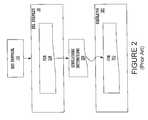
- FIG. 2is block diagram illustrating a conventional finite state machine generation.
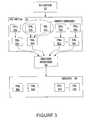
- FIG. 3is block diagram illustrating relationships between FSMs and an input specification, in accordance with an embodiment of the present invention.
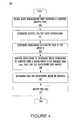
- FIG. 4is flowchart illustrating steps of a process of splitting a FSM based on output partitioning, in accordance with an embodiment of the present invention.
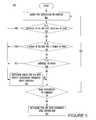
- FIG. 5is flowchart illustrating steps of a process of rules of splitting a FSM based on output partitioning, in accordance with an embodiment of the present invention.
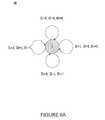
- FIG. 6A and FIG. 6Bare diagrams illustrating FSMs for computing two different outputs.
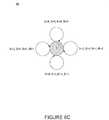
- FIG. 6Cis a diagram illustrating a single FSM for computing both outputs of the FSMs of FIG. 6A and FIG. 6B , in accordance with an embodiment of the present invention.
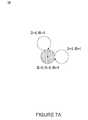
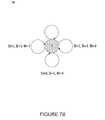
- FIG. 7A and FIG. 7Bare diagrams illustrating FSMs for computing two different outputs.
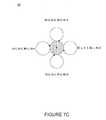
- FIG. 7Cis a diagram illustrating a single FSM for computing both outputs of the FSMs of FIG. 7A and FIG. 7B , in accordance with an embodiment of the present invention.
- FIG. 8A and FIG. 8Bare diagrams illustrating FSMs for computing two different outputs.
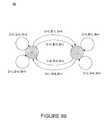
- FIG. 8Cis a diagram illustrating a single FSM for computing both outputs of the FSMs of FIG. 8A and FIG. 8B , in accordance with an embodiment of the present invention.
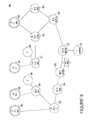
- FIG. 9is a diagram illustrating splitting of a dataflow graph, which results in splitting a FSM, in accordance with an embodiment of the present invention.
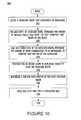
- FIG. 10is flowchart illustrating steps of a process of splitting a dataflow graph such that a FSM derived therefrom is split, in accordance with an embodiment of the present invention.
- FIG. 11A and FIG. 11Bare diagrams illustrating subsets of the dataflow graph depicted in FIG. 9 , which was split in accordance with an embodiment of the present invention.
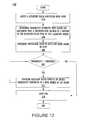
- FIG. 12is a flowchart illustrating steps of a process of splitting a dataflow graph applying heuristics, in accordance with an embodiment of the present invention.
- FIG. 13is flowchart illustrating steps of a process of calculating a state machine using constraint relaxation, in accordance with an embodiment of the present invention.
- FIG. 14is flowchart illustrating steps of a process of applying rules to simplify an expression, in accordance with an embodiment of the present invention.
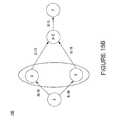
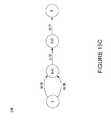
- FIG. 15A , FIG. 15B , and FIG. 15Care diagrams of a finite state machine illustrating collapsing states, in accordance with an embodiment of the present invention.
- FIG. 16is an exemplary computer system that may serve as a platform upon which embodiments of the present invention may be executed.
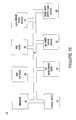
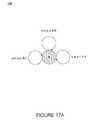
- FIG. 17Ais a diagram illustrating simplifying a state machine, in accordance with an embodiment of the present invention.
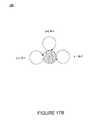
- FIG. 17Bis a diagram illustrating a state machine that was simplified in accordance with an embodiment of the present invention.
- embodiments of the present inventionaccess a specification (otherwise known as a formal protocol) that describes a computer architecture for which a model or simulation is desired and create computer executable code that facilitate that simulation. From the input specification, a number of FSMs are created by embodiments of the present invention. The FSMs calculate outputs of the expressions from the input specification when the FSMs are integrated into a simulation program.
- FIG. 1is a block diagram of components of a bus compiler tool 120 , according to an embodiment of the present invention.
- the bus compiler tool 120may be implemented on a general-purpose computer system, such as the computer system 100 depicted in FIG. 16 .
- An input to the bus compiler tool 120is a description 115 of a bus protocol.
- the bus compiler tool 120outputs transactional level bus simulation instructions 130 and a metadata bus description 140 .
- the transactional level bus simulation instructions 130may be used for architecture exploration, testing, and verification.
- the metadata bus description 140may be used to facilitate the aforementioned architecture exploration, testing, and verification. However, the metadata bus description 140 is not a required output of the bus compiler 120 .
- the bus compiler tool 120may be described as comprising a number of logical components, which will be described in more detail below.
- the parser 135reads the input formal bus protocol description 115 and converts it to a format that is suitable for other components of the bus compiler tool 120 .
- the FSM generator 136receives an output from the parser 135 and produces FSMs based thereon.
- the metadata description generator 142generates the metadata bus description 140 from an output of the parser 135 .
- the metadata description generator 142is not a required component of the bus compiler tool 120 .
- the input formal bus protocol description 115may be written by a user and may contain temporal expressions, which can describe temporal relationships between events. Temporal expressions are widely known to those of ordinary skill in the art.
- the input formal bus protocol description 115may be a general description of the formal bus protocol.
- the formal bus protocol description 115may describe the nodes that are part of a family of busses, along with protocol and timing information.
- the formal bus protocol description 115does not necessarily specify the exact number of master/slaves, the precise topology, the exact memory map, complete arbitration algorithms, etc.
- the transactional level bus simulation instructions 130 generated by the bus compiler 120comprises instructions that are general in nature, such that the bus design may be refined by the user during exploration, verification, and testing.
- the formal bus protocol description 115may be a text file or a graphical description.
- the parser 135may be designed to be able to parse formal bus protocol descriptions 115 in a textual format, a graphical format, or another format.
- the bus compiler tool 120outputs two files 130 , 140 , in this embodiment.
- One fileis a transactional level bus simulation instructions 130 of the bus.
- the transaction levelmay be described as an abstraction away from the physical hardware (e.g., MUXes, registers, electrical connections) up to a level at which transactions over the bus are considered.
- the transactional level bus simulation instructions 130may be used by another tool (not depicted in FIG. 1 ) to explore the architecture.
- the Platform Creator ToolTMcommercially available from CoWareTM of San Jose, Calif. may be used to simulate a bus by inputting the transactional level bus simulation instructions 130 .
- the transactional level bus simulation instructions 130may be substantially compliant with the SystemC programming language, although other programming languages are also suitable for the transactional level bus simulation instructions 130 .
- the formal bus protocol description 115 that is an input to the bus compiler tool 120may be a text file, although the formal bus protocol description 115 does not have to be a text file.
- the present inventionis not limited to any specific language in which to describe the text file formal bus protocol description.
- the present inventionis not limited to the formal bus protocol description 115 being a text file.
- FIG. 2is block diagram illustrating relationships between FSMs and an input specification, in accordance with a conventional technique.
- the conventional bus compiler 20creates a single FSM 210 from the input specification 115 and outputs it as part of the simulation instructions 230 .
- the simulation instructions 230are input to the simulator 250 .
- Executing the simulation with a single very large FSM 210can be a very efficient way to run the simulation.
- the extremely large scale of the FSM needed for complex computer architecturescan present problems.
- the creation of the single FSMinvolves implicit multiplication of individual FSMs, each of which represents an input expression. For example, the bus protocol 115 is divided into many expressions.
- Implicitly multiplying the various FSMs together to create a single FSMresults in state explosion and hence an extremely large FSM.
- the extremely large scale of the FSMpresents computational challenges within the bus compiler tool 20 .
- the single FSMis so large that the resources of the computer system that serves as the platform for the bus compiler 20 are inadequate to compute the FSM.
- FIG. 3is block diagram illustrating relationships between FSMs and expressions derived from an input specification, in accordance with an embodiment of the present invention.
- the bus compiler 120 of the present embodimentaccesses a bus protocol 115 (e.g., input specification).
- the bus compiler 120analyzes the input specification to determine what outputs are needed for the given input specification.
- the bus compiler 120creates an expression 310 a - 310 n for each of the needed outputs.
- the bus compiler 120could at this point create a FSM for each expression. In other words, the bus compiler 120 could create a FSM for each output.
- the bus compiler 120then groups certain outputs together.
- a FSM 320 a , 320 b , 320 d - 320 nis then created for the expressions, with some FSMs representing multiple expressions.
- expressions 310 b and 310 care both represented by FSM 310 b .
- Thisallows fewer FSMs 310 to be created than if a separate FSM were used for each expression.
- this embodimentavoids that state explosion that occurs if a single FSM were used for all of the expressions (e.g., expression 320 a - 320 n ).
- the bus compiler 120outputs the FSMs 320 , which may be stored on a computer readable medium as part of the simulation instructions 130 .
- the bus compiler 120outputs SystemC code that may be stored on a computer readable medium. Other computer code and data structures may also make up the simulation instructions 130 .
- the bus compiler 120may also output metadata (not depicted in FIG. 3 ).
- the simulation instructions 130comprising the FSMs 320 are input to the simulator 350 , which may multiply the FSMs 120 when the simulation is executed.
- this embodimentcomputes and compiles the FSMs in the bus compiler 120 much faster than the conventional technique depicted in FIG. 2 .
- the output of the bus compiler 120which may be C++ files, is reduced in size.
- grouping some of the expressions togetherhelps to avoid state explosion, which may allow the simulation to execute more efficiently.
- FIG. 4is flowchart illustrating a computer-implemented process of splitting a FSM based on output partitioning, in accordance with an embodiment of the present invention.
- Steps of process 400may be stored as instructions on a computer readable medium and executed on a processor.
- Process 400produces computer data structures that may be stored on a computer readable medium.
- the data structuresmay be input to a software tool, such as Platform Creator ToolTM, such that a simulation of a computer architecture is achieved.
- a software toolsuch as Platform Creator ToolTM
- an input specification that describes a computer architectureis accessed.
- step 420outputs for the input specification are determined.
- the input specificationdoes not necessarily have the outputs explicitly defined.
- a design engineer who wrote the input specificationdoes not necessarily explicitly define the outputs.
- step 430expressions are determined to compute each of the outputs.
- a dataflow graphcan be created for each expression.
- the dataflow graphcontains information about inputs, outputs, intermediate variables, and state variables. The information in the dataflow graph can be used to determine what a FSM would look like if it were to be created.
- Delay expressions of other outputsare not state variables, in one implementation. Rather, they are modeled as inputs to the FSM. It may also be observed that some outputs are purely combinatorial and hence yield FSMs with no state variables and only a single state.
- the expressionsare analyzed to determine which expressions can be computed by a single FSM.
- the expressionsare partitioned into groups of expressions, wherein a single FSM is used to compute all of the outputs for all expressions in a given group.
- a set of adjustable rulesmay be applied in the analysis.
- IS1may be defined as the set of inputs used by the expression that defines O1, SVS1 as the set of state variables used by the expression that defines O1, and ISVS1 as the set of inputs used by the SVS1. Similar definitions of IS2, SVS2, ISVS2 can be used for O2.
- step 440applies a heuristic to determine which outputs can be computed by a single FSM. Using the notation described in step 440 , the outputs O1 and O2 can be computed by a single FSM if any of the following rules hold:
- IS1is substantially identical to IS2 and SVS1 is substantially identical to SVS2.
- IS1is a subset of IS2 and SVS1 is a subset of SVS2.
- ISVS1is substantially identical to ISVS2.
- Rule 1implies this implies that the separate FSMs to computer O1 and O2 would be substantially identical. For example, if the state variables and the inputs of the two output expressions are substantially identical are identical, then the states and transitions of the respective FSMs will be substantially the same. However, temporary variables used by the respective FSMs may be different. However, as this embodiment is concerned with outputs, the differences in temporary variables can be ignored. Rule 2 implies that the FSM that computes O1 would be a subset of the FSM that computes O2. Hence, the smaller FSM need not be computed. Rule 3 implies that the FSM that computes O1 and the FSM that computes O2 are likely to be very similar FSMs. The similarity can be taken advantage of by using just one FSM to compute both outputs, wherein computational resources and reduced.
- rulesare exemplary in that other rules could be used instead of or in addition to these rules. It is not required that any of the above rules need be applied.
- rulesmay be configurable, so that the user can choose rules in accordance with user desires. For example, it may be possible that different heuristics work better for certain types of busses. Therefore, the user can adjust the rules in accordance with one embodiment.
- finite state machinesare determined for the expressions. For some of the expressions, a single FSM is determined. If a single FSM is used for multiple expressions (e.g., multiple outputs) then each output is annotated on the FSM. Other expressions lead to a separate FSM for each expression. State variables and inputs for the FSMs are inferred by examining the expressions that define that output.
- the FSMsare output and may be stored on a computer readable medium.
- the FSMsmay be input to a simulation tool to simulate the computer architecture that was the subject of the input specification. During execution of the simulation, the FSMs may be multiplied together such that the input specification is modeled and simulated.
- a cost functioncan be applied to determine which partitioning to use. For example, a cost function that balances memory versus simulation performance can be applied. Because the cost function can be calculated relatively quickly, all possible partitioning can be enumerated with the partitioning with the lowest cost being used.
- nFor FSMs with only a single state and no state variables (as is the case for purely combinatorial outputs), n will be 0. However, such a FSM may be assigned an infinite memory cost. The simulation performance is largely determined by the number of inputs a FSM has. The more inputs an FSM has, the slower it will simulate, in general.
- Process 400may be described as computing one FSM per output and combining FSMs that are very similar to make a trade-off between FSM size and simulation speed. It will be understood that the combining may take place before the FSM is actually computed.
- output partitioningis provided for illustrative purposes.
- the input specificationhas four Boolean inputs: I1, I2, I3 and I4.
- outputs O1 through O6are defined as:
- FIG. 5is flowchart illustrating a computer-implemented process 500 of rules of splitting a FSM based on output partitioning, in accordance with an embodiment of the present invention.
- Process 500may be used to implement steps 440 and 450 of process 400 of FIG. 4 .
- steps 440 and 450 of process 400 of FIG. 4are not limited to process 500 .
- Process 500will be explained using the preceding exemplary input specification.
- step 505two input expressions are accessed for comparison per steps 510 - 530 .
- step 510inputs and state variables of the two expressions are compared to determine if a single FSM should be used to compute both outputs of the two respective expressions.
- the test of step 510can be expressed as: “IS1 is identical to IS2 and SVS1 is identical to SVS2.”
- process 500computes the single FSM in step 540 .
- the FSMs for those separate expressionswould be as illustrated as the FSM 600 in FIG. 6A and the FSM 650 of 6 B.
- FIG. 6Cillustrates the FSM used to compute both outputs O1 and O2, in accordance with this embodiment of the present invention.
- the two FSMs of FIGS. 6A and 6Bwould require computing two states and eight transitions.
- the single FSM 680 of FIG. 6Ccomputes only one state and four transitions.
- the number of states and transitions used by the combined FSM of FIG. 6Cis equal to either of the separate FSMs of FIGS. 6A and 6B .
- step 510fails to conclude that the two expression being compared should be computed with a single FSM
- process 500proceeds to step 520 to determine if the two expressions should be computed with a single FSM based on the test of step 520 .
- step 520the condition tested for is whether the Boolean inputs for a first of the outputs are a subset of the Boolean inputs of a second output and whether the state variables used by the expression that defines the first output is a subset of the state variables used by the expression that defines the second output.
- step 520implies that a FSM computing the first output would be a subset of the FSM computing the second output.
- process 500computes the single FSM in step 540 .
- the two expressions currently being comparedare those for computing outputs O5 and O6.
- the FSMs for those separate expressionswould the FSM 700 in FIG. 7A and the FSM 720 in FIG. 7B .
- step 520represents the FSM 750 for computing the outputs O5 and O6 with a single FSM 750 , in accordance with this embodiment of the present invention.
- step 520fails to conclude that a single FSM is to be computed for the current expressions being evaluated, process 500 proceeds to step 530 to test the next rule.
- step 530a determination is made as to whether the set of inputs used by the state variables of a first output are identical to the set of inputs used by the state variables of a second output. The test of step 530 determines whether the FSM computing the first output and the FSM computing the second output are likely to be very similar FSMs.
- process 500computes the single FSM in step 540 .
- the two expressions currently being comparedare those for computing outputs O3 and O4, then the FSMs for those separate expressions would the FSM 800 in FIG. 8A and the FSM 820 in FIG. 8B .
- applying the rule of step 530leads to the conclusion that a single FSM can be used to compute both O3 and O4.
- the FSM 850 in FIG. 8Crepresents the FSM 850 for computing the outputs O3 and O4 with a single FSM 850 , in accordance with this embodiment of the present invention.
- the FSM 850 in FIG. 8Crepresents the FSM 850 for computing the outputs O3 and O4 with a single FSM 850 , in accordance with this embodiment of the present invention.
- FIGS. 8A and 8Binstead of computing four states and 12 transitions, as depicted in FIGS. 8A and 8B , only two states and eight transitions are computed in the combined FSM 850 of FIG. 8C .
- This rulemakes no hard guarantees with regards to the number of states and transitions of the combined FSM, except that the combined FSM will never be larger than the sum of the individual FSM and is very likely to be only “slightly” bigger than the largest of the individual FSMs.
- step 530determines that a single FSM is not to be computed for the two expressions currently being compared, process 500 proceeds to step 550 to determine if there are more expressions to compare.
- the process 500repeats steps 505 - 530 until all expressions are compared.
- step 560the process 500 determines FSMs for all expressions for which FSMs have not yet been determined. For example, a separate FSM is determined for all expressions for which step 540 did not produce a FSM. Alternatively, a single FSM could be determined for all remaining expressions, if desired. However, it will be understood that the present embodiment is not limited by to any particular number of FSMs used to calculate the remaining expressions.
- the process 500then ends.
- Another embodiment of the present inventionprovides for a technique to split a FSM into multiple FSMs.
- the multiple FSMsmay be input into a simulation tool.
- the output of one split of the FSMis used as an input of another split of the FSM.
- This embodimentallows for modeling of more complex computer architectures than might be possible without splitting, as the splitting can conserve computer system resources used to compute the FSMs, such as computer memory.
- FIG. 9is a diagram illustrating splitting of a dataflow graph 900 , which results in splitting a FSM, in accordance with an embodiment of the present invention. For example, a separate FSM is created for each portion of the dataflow graph 900 that exists after the dataflow graph 900 is split.
- FIGS. 11A and 11Bare diagrams illustrating two portions ( 1100 and 1150 , respectively) of the dataflow graph 900 after splitting, in accordance with an embodiment of the present invention.
- the outputis “canSend,” which indicates that data can be sent on the bus that is the subject of the formal protocol if the expression evaluates as true.
- the above expressionmay be one of many expression that are derived from a formal protocol specification of a computer architecture. Each variable and operator in the expression is represented by a node in the dataflow graph 900 .
- FIG. 10is flowchart illustrating a process 1000 of splitting a dataflow graph such that a FSM derived therefrom is split into multiple FSMs, in accordance with an embodiment of the present invention.
- Steps of process 1000may be stored as instructions on a computer readable medium and executed on a processor.
- Process 1000 of FIG. 10will be discussed in conjunction with the dataflow graphs depicted in FIGS. 9 , 11 A, and 11 B.
- Step 1010is accessing a dataflow graph that represents an expression.
- the dataflow graphmay have been created by accessing an input specification of a computer architecture, deriving a number of expressions that are suitable to implement the input specification, and creating a dataflow graph for each of the expressions.
- step 1020for each input, the number of possible values this input can have is determined and annotated that on that input node. For example, if I 1 is a Boolean variable, then “2/-” is annotated on the node 901 representing I 1 . The input I 2 can have 10 possible values and hence node 902 is annotated “10/-.” Nodes 903 and 904 are for inputs I3 and I4, respectively. There are two constant inputs in the dataflow graph, as reflected in nodes 905 and 906 .
- the dataflow graph 900is traversed to determine where to spilt the dataflow graph 900 .
- the threshold valuemay be a pre-determined value. Alternatively, The threshold value may based on user input. Furthermore, the threshold value may be adjusted by the computer program that executes process 1000 .
- step 1050the FSMs for the dataflow diagrams in FIGS. 11A and 11B are generated and output.
- the split FSMsmay be stored on a computer readable medium.
- step 1060the split FSMs are input to a simulation tool.
- the output 1110 of the first FSM 1100 of FIG. 11A (“TMP”)serves as an input 1160 to the second FSM 1150 of FIG. 11B .
- TMPthe output 1110 of the first FSM 1100 of FIG. 11A
- the effect on the second FSM 1150is that where “TMP” represented 80 input combinations in the non-split FSM 900 , it only represents two input combinations in the split FSM 1150 of FIG. 11B .
- Process 1000then ends.
- nodes in the dataflow diagrams in FIGS. 9 , 11 A, and 11 Bare also annotated with a probability. This is the probability that the portion of the expression represented by a subset of the dataflow graph will be true.
- the probabilitymay that this sub-expression will be true may be estimated as 5%, which is based on an estimate that the Boolean input “I 1 ” has a 50% probability of being true and the input “I 2 ” will equal the constant value of “5” with a 10% probability.
- the estimate of the probabilitymay be arrived at by more complex techniques. For example, it is not required to estimate the Boolean input I 1 will be true 50% of the time. Moreover, while the previous discussion assumes that inputs are independent and its values are evenly distributed, this is not required.
- an embodiment of the present inventionapplies a probabilistic heuristic when cutting a dataflow graph 900 of FIG. 9 to spilt a FSM.
- the estimated probability that the node TMP 1160 is trueis 96.25%. Recalling that the node TMP 1160 is an input to the second FSM 1150 of FIG. 11B , this means that it is estimated that 96.25% of the time the input from the first FSM 1100 of FIG. 11A to the second FSM 1150 of FIG. 11B will be true. This is referred to as interFSM communication.
- the probability of interFSM communicationis factored into the decision of where to cut the original FSM 900 of FIG. 9 . This embodiment reduces the probability that interFSM communication occurs.
- Process 1200describes steps in a process of splitting a dataflow graph applying heuristics, in accordance with an embodiment of the present invention. This embodiment may reduce the probability that interFSM communication occurs.
- Process 1200may be implemented after steps of 1000 are performed.
- step 1210a dataflow graph that is annotated with costs is accessed. For example, a dataflow graph that is processed in accordance with steps 1010 - 1030 of process 1000 is accessed.
- step 1220probability estimates are determined that define the likelihood that a sub-expression defined by a portion of the dataflow graph will be true.
- the nodes of the dataflow graphare annotated with the probability estimate.
- a node that represents a provisional splitting pointis determined.
- the provisional splitting pointis based on the cost, but the probability estimate is not yet used.
- the splitmay be performed on either side of the node, in accordance with a preferred criterion.
- step 1240the probability value annotated to the node of the provisional spilt is accessed to determine whether the probability is greater than a threshold value. If the probability is not greater than the threshold, this indicates that the probability of interFSM communication during simulation is acceptable. Thus, the process 1200 continues to step 1260 wherein the dataflow graph is split. If the probability is greater than the threshold, this indicates that the probability of interFSM communication during simulation is higher than desired.
- step 1250is taken in which the dataflow graph is traversed upwards from the provisional splitting point to access the probability annotated to another and step 1240 is repeated until a node is found with a probability that is less than a given threshold value. Then the process 1200 continues to step 1260 wherein the dataflow graph is split. The process 1200 then ends.
- FSMsmay be derived from expressions that reflect conditions of an input specification.
- the expressionsmay comprise mathematical operators and integers, including Boolean variables and operators.
- the expressionsare not so limited.
- the expressionsmay contain real numbers.
- a second expressione.g., an enable expression
- the enable expressioncan be very complex. If a very complex enable expression is strictly adhered to, the computation of the FSM for the first expression can actually be hindered by using the enable expression.
- An embodiment of the present inventionrelaxes the constraints on expressions such that an expression can be simplified.
- the simplificationmay result in one or more variables being removed from the expression.
- One application of relaxing constraints on expressionsis to create FSMs more efficiently. For example, a constraint is relaxed on an enable expression to simplify the enable expression. Then, the simplified enable expression is used in the determination of a FSM that computes the output of an expression to which the enable expression relates. It will be understood that the embodiment for relaxing constraints on expressions is not limited to applications that derive FSM from expressions. Those of ordinary skill in the art will understand that other useful applications exist for removing variables from expressions.
- the present embodimentdetermines an expression E2 that uses the variables V1 . . . V(n ⁇ 1) such that a correctness criterion holds.
- the correctness criterionis defined as follows: for all cases in which E1 evaluates as true, the simplified expression E2 evaluates as true. However, the simplified expression E2 may evaluate as true for a case in which E1 does not.
- E1is “V1 & V2” (where & stands for the Boolean AND operator).
- E2is “V1”.
- TABLE Iwe can derive that the correctness criterion is satisfied. For example, all the rows (only row four in this case) where there's a “1” for E1 also has a “1” for E2, which means the correctness criterion is satisfied.
- This criterionstrives to reduce the number of cases in which E2 evaluates to “true” where E1 is not true.
- E2also has a ‘1’ in row three of Table I, whereas E1 does not. This is acceptable, but less than ideal.
- this solutionreduces the number of cases in which E2 evaluates to “true” where E1 is not true.
- the reductionprovides the fewest number of cases in which E2 evaluates to “true” where E1 is not true. However, providing the fewest number of cases in which E2 evaluates to “true” where E1 is not true is not a requirement.
- FIG. 13is flowchart illustrating a process 1300 of calculating a state machine using constraint relaxation, in accordance with an embodiment of the present invention.
- a second Boolean expressionis accessed that describes a constraint with respect to one of the variables of the first Boolean expression.
- the second expressionmay be referred to as an enable expression and may be created by a user.
- the second expressionmay be a user-provided constraint upon “x.”
- the enable expressionhas an integer input “z.” Note, however, that z is not necessary to compute the output.
- a determination is made as to which variable to eliminate from the second expression(e.g., from the enable expression).
- the enable expression that the user providesmay be more complex than desired.
- the enable expression provided by a usermay be so complex that it is very difficult for the user to recognize that the enable expression contains a variable that is not in the original expression.
- Step 1330the second Boolean expression is simplified.
- Step 1330may comprise normalizing the expression and relaxing the expression.
- Process 1400 of FIG. 14illustrates an embodiment for normalizing an expression and relaxing a constraint in the expression.
- a FSMis determined for the first expression based on the simplified enable expression.
- the resultmay be that at least one of the plurality of input combinations for the FSM is eliminated based on the constraint.
- the FSMis output and may be stored on a computer readable medium.
- the FSMmay be used in the simulation of a computer architecture, a part of which was specified by the first expression that was accessed in step 1310 .
- FIG. 14is flowchart illustrating a process 1400 of applying rules to simplify an expression, in accordance with an embodiment of the present invention.
- the overall process 1400is divided into two stages, normalization and relaxation.
- steps 1410 - 1440a set of rules are applied to put the input expression (E1) into a “normal form”.
- the normal formis equivalent to E1 in the sense that its truth table is identical to E1's truth table.
- the relaxation stageis applied after the expression is in its normal form.
- A, B, C and Dare Boolean variables
- X, Y and Zare integer variables.
- variable Iis used to denote the Boolean variable that is to be removed from the expression
- variable Jis used to denote the integer variable that should be removed from the expression.
- the variablescould be inputs or expressions themselves.
- step 1410the “Laws of De Morgan” are applied to input expression E1.
- step 1420extensions of De Morgan's laws are applied for the other operators.
- De Morgan's lawsonly cover the standard Boolean operators !, & and
- step 1440manipulations are performed on arithmetic and relational operators.
- arithmetic and relational operatorsare only applied on inputs or on the ! operator or on the delay operator or on arithmetic sub-expressions or on relational sub-expressions.
- Step 1440may be illustrated by the following exemplary rules. It will be understood that this list is non-exhaustive.
- relaxation rulesare applied to the normal form of expression E1.
- Exemplary relaxation rulesare as follows. It is not required that all rules on this list be applied. Moreover, the present embodiment is not limited to the following exemplary relaxation rules.
- Another embodiment of the present inventioncollapses two states in a FSM to a common state. This embodiment is practiced after the FSM is created and is applicable to very large scale FSMs. This embodiments first collapses states near the end of the FSM, then works backwards in the FSM. This allows states earlier in the FSM to be collapsed that would not otherwise be collapsible.
- states D and Eare identified as collapsible because their inputs are identical (“10”), their outputs of are identical (“01”), and they transition to the same state (F).
- states D and Eare collapsed to a common state (D+E).
- states B and Care identified as collapsible because their inputs are identical (“11”), their outputs of are identical (“10”), and they transition to the same state (D+E). Note that while states B and C can also be collapsed, this is predicated upon determining that states D and E are equivalent before B and C are processed.
- FIG. 15Cillustrates the FSM 1500 after collapsing states B and C to state B+C.
- state Athe outputs of state A are “00”, and inputs to state A are either “00” or “01”.
- inputs to state Aare either “00” or “01”.
- state B and Cbeing initially generated because the bus state is different for the two states.
- the fact that the variables x and y are differentturns out to be immaterial.
- the value of yis not specified. However, this is not relevant because all outgoing transitions from states B and C are the same.
- FIG. 16illustrates circuitry of an exemplary computer system 100 , which may form a platform for embodiments of large-scale FSMs.
- computer system 100may form a platform for the bus compiler 120 of FIG. 1 .
- Computer system 100includes an address/data bus 99 for communicating information, a central processor 101 coupled with the bus for processing information and instructions, a volatile memory 102 (e.g., random access memory RAM) coupled with the bus 99 for storing information and instructions for the central processor 101 and a non-volatile memory 103 (e.g., read only memory ROM) coupled with the bus 99 for storing static information and instructions for the processor 101 .
- Computer system 100also includes an optional data storage device 104 (e.g., a magnetic or optical disk and disk drive) coupled with the bus 99 for storing information and instructions.
- a data storage device 104e.g., a magnetic or optical disk and disk drive
- system 100also includes an alphanumeric input device 106 including alphanumeric and function keys coupled to bus 99 for communicating information and command selections to central processor unit 101 .
- System 100also includes a cursor control device 107 coupled to bus 99 for communicating user input information and command selections to central processor unit 101 .
- System 100 of the present embodimentalso includes a display device 105 coupled to bus 99 for displaying information.
- a signal input/output communication device 108 coupled to bus 99provides communication with external devices.
Landscapes
- Engineering & Computer Science (AREA)
- Physics & Mathematics (AREA)
- Theoretical Computer Science (AREA)
- Computer Hardware Design (AREA)
- Evolutionary Computation (AREA)
- Geometry (AREA)
- General Engineering & Computer Science (AREA)
- General Physics & Mathematics (AREA)
- Debugging And Monitoring (AREA)
- Management, Administration, Business Operations System, And Electronic Commerce (AREA)
Abstract
Description
canSend=!(I1&I2==5)|I4==3|!I3|(I3&I4==3)
| TABLE I | |||||
| V1 | E1 | E2 | |||
| 0 | 0 | 0 | 0 | ||
| 0 | 1 | 0 | 0 | ||
| 1 | 0 | 0 | 1 | ||
| 1 | 1 | 1 | 1 | ||
!(A&B)==>!A|!B
!(A|B)==>!A&!B
!!A==>A
!(A==B)==>A!=B
!(A!=B)==>A==B
!(A>=B)==>A<B
!(A<=B)==>A>B
!(A>B)==>A<=B
!(A<B)==>A>=B
ifAthenBelseC==>(A&B)|(!A&C)
(A|B)==(C|D)==>((A|B)&(C|D))|(!A&!B&!C&!D)
(A&B)==(C&D)==>(A&B&C&D)|((!A|!B)&(!C&!D))
(A|B)==false==>!A&!B
(A|B)==true==>A|B
(A&B)==false==>!A|!B
(A&B)==true==>A&B
((A|B)+D)==C==>((A|B)&(1+D==C))|((!A&!B)&(D==C))
X==(ifIthenYelse 3)+(ifAthen 4 elseZ)
(A&X==Y+4|!A&X==Y+Z)|(A&X==3+4|!A&X==3+Z)
Collapsing Finite State Machines
Claims (20)
Priority Applications (1)
| Application Number | Priority Date | Filing Date | Title |
|---|---|---|---|
| US12/840,211US8448106B1 (en) | 2004-07-30 | 2010-07-20 | Large scale finite state machines |
Applications Claiming Priority (3)
| Application Number | Priority Date | Filing Date | Title |
|---|---|---|---|
| US59265004P | 2004-07-30 | 2004-07-30 | |
| US10/937,645US7783997B1 (en) | 2004-07-30 | 2004-09-08 | Large scale finite state machines |
| US12/840,211US8448106B1 (en) | 2004-07-30 | 2010-07-20 | Large scale finite state machines |
Related Parent Applications (1)
| Application Number | Title | Priority Date | Filing Date |
|---|---|---|---|
| US10/937,645ContinuationUS7783997B1 (en) | 2004-07-30 | 2004-09-08 | Large scale finite state machines |
Publications (1)
| Publication Number | Publication Date |
|---|---|
| US8448106B1true US8448106B1 (en) | 2013-05-21 |
Family
ID=42583467
Family Applications (4)
| Application Number | Title | Priority Date | Filing Date |
|---|---|---|---|
| US10/937,645Expired - LifetimeUS7783997B1 (en) | 2004-07-30 | 2004-09-08 | Large scale finite state machines |
| US10/937,068Expired - LifetimeUS8265920B1 (en) | 2004-07-30 | 2004-09-08 | Determining large-scale finite state machines using constraint relaxation |
| US12/840,211Expired - LifetimeUS8448106B1 (en) | 2004-07-30 | 2010-07-20 | Large scale finite state machines |
| US13/610,662Expired - LifetimeUS8903699B2 (en) | 2004-07-30 | 2012-09-11 | Determining large-scale finite state machines using constraint relaxation |
Family Applications Before (2)
| Application Number | Title | Priority Date | Filing Date |
|---|---|---|---|
| US10/937,645Expired - LifetimeUS7783997B1 (en) | 2004-07-30 | 2004-09-08 | Large scale finite state machines |
| US10/937,068Expired - LifetimeUS8265920B1 (en) | 2004-07-30 | 2004-09-08 | Determining large-scale finite state machines using constraint relaxation |
Family Applications After (1)
| Application Number | Title | Priority Date | Filing Date |
|---|---|---|---|
| US13/610,662Expired - LifetimeUS8903699B2 (en) | 2004-07-30 | 2012-09-11 | Determining large-scale finite state machines using constraint relaxation |
Country Status (1)
| Country | Link |
|---|---|
| US (4) | US7783997B1 (en) |
Cited By (1)
| Publication number | Priority date | Publication date | Assignee | Title |
|---|---|---|---|---|
| US9507891B1 (en) | 2015-05-29 | 2016-11-29 | International Business Machines Corporation | Automating a microarchitecture design exploration environment |
Families Citing this family (5)
| Publication number | Priority date | Publication date | Assignee | Title |
|---|---|---|---|---|
| US7783997B1 (en) | 2004-07-30 | 2010-08-24 | Synopsys, Inc. | Large scale finite state machines |
| US9305116B2 (en)* | 2010-04-20 | 2016-04-05 | International Business Machines Corporation | Dual DFA decomposition for large scale regular expression matching |
| US9152458B1 (en)* | 2012-08-30 | 2015-10-06 | Google Inc. | Mirrored stateful workers |
| EP3671492A1 (en)* | 2018-12-21 | 2020-06-24 | Dassault Systèmes | Adaptive compression of simulation data for visualization |
| EP3671494A1 (en) | 2018-12-21 | 2020-06-24 | Dassault Systèmes | Multi-instanced simulations for large environments |
Citations (32)
| Publication number | Priority date | Publication date | Assignee | Title |
|---|---|---|---|---|
| US5301100A (en) | 1991-04-29 | 1994-04-05 | Wagner Ferdinand H | Method of and apparatus for constructing a control system and control system created thereby |
| US5452215A (en) | 1994-08-24 | 1995-09-19 | Ibm Business Machines Corporation | System and method for designing a finite state machine to reduce power dissipation |
| US5495409A (en) | 1993-01-29 | 1996-02-27 | Matsushita Electric Industrial Co., Ltd. | Constructing method of finite-state machine performing transitions according to a partial type of success function and a failure function |
| US5513122A (en) | 1994-06-06 | 1996-04-30 | At&T Corp. | Method and apparatus for determining the reachable states in a hybrid model state machine |
| US5594656A (en) | 1993-11-02 | 1997-01-14 | Bull S.A. | Method of verification of a finite state sequential machine and resulting information support and verification tool |
| US5703885A (en) | 1995-03-06 | 1997-12-30 | Motorola, Inc. | Method and apparatus for constructing verification test sequences by merging and touring hierarchical unique input/output sequence (UIO) based test subsequence graphs |
| US5706205A (en)* | 1994-09-30 | 1998-01-06 | Kabushiki Kaisha Toshiba | Apparatus and method for high-level synthesis of a logic circuit |
| US5706473A (en) | 1995-03-31 | 1998-01-06 | Synopsys, Inc. | Computer model of a finite state machine having inputs, outputs, delayed inputs and delayed outputs |
| US5774370A (en) | 1995-09-18 | 1998-06-30 | Vlsi Technology, Inc. | Method of extracting implicit sequential behavior from hardware description languages |
| US5822514A (en) | 1994-11-17 | 1998-10-13 | Nv Gti Holding | Method and device for processing signals in a protection system |
| US5870590A (en) | 1993-07-29 | 1999-02-09 | Kita; Ronald Allen | Method and apparatus for generating an extended finite state machine architecture for a software specification |
| US5910958A (en) | 1991-08-14 | 1999-06-08 | Vlsi Technology, Inc. | Automatic generation of test vectors for sequential circuits |
| US6038378A (en) | 1993-07-29 | 2000-03-14 | Digital Esquipment Corporation | Method and apparatus for testing implementations of software specifications |
| US6074428A (en) | 1994-10-19 | 2000-06-13 | Hewlett-Packard Company | Minimizing logic by resolving "don't care" output values in a finite state machine |
| US6094151A (en) | 1998-01-05 | 2000-07-25 | Ricoh Company, Ltd. | Apparatus and method for finite state machine coding of information selecting most probable state subintervals |
| US6141633A (en) | 1997-02-28 | 2000-10-31 | Fujitsu Limited | Logical device verification method and apparatus |
| US6182268B1 (en) | 1998-01-05 | 2001-01-30 | Synplicity, Inc. | Methods and apparatuses for automatic extraction of finite state machines |
| US6192505B1 (en) | 1998-07-29 | 2001-02-20 | International Business Machines Corporation | Method and system for reducing state space variables prior to symbolic model checking |
| US6253112B1 (en) | 1998-09-17 | 2001-06-26 | Lucent Technologies Inc. | Method of and apparatus for constructing a complex control system and the complex control system created thereby |
| US6292023B1 (en) | 1999-09-29 | 2001-09-18 | Agere Systems Guardian Corp. | Spike-triggered asynchronous finite state machine |
| US20020023256A1 (en) | 1998-01-09 | 2002-02-21 | James Andrew Garrard Seawright | Method and apparatus for optimized partitioning of finite state machines synthesized from hierarchical high-level descriptions |
| US6487704B1 (en) | 1997-08-07 | 2002-11-26 | Verisity Design, Inc. | System and method for identifying finite state machines and verifying circuit designs |
| US20030065505A1 (en) | 2001-08-17 | 2003-04-03 | At&T Corp. | Systems and methods for abstracting portions of information that is represented with finite-state devices |
| US6628660B1 (en) | 1999-06-11 | 2003-09-30 | Lattice Semiconductor Corporation | Finite state machine with associated memory |
| US6668199B1 (en) | 1999-06-16 | 2003-12-23 | Stmicroelectronics S.R.L. | Fabrication method for a control unit for electronic microcontrollers or micoprocessors |
| US6694290B1 (en) | 1999-05-25 | 2004-02-17 | Empirix Inc. | Analyzing an extended finite state machine system model |
| US6711728B1 (en) | 1999-02-23 | 2004-03-23 | Nec Electronics Corporation | Function synthesizing method and apparatus, and recording medium on which program of said method is recorded |
| US20040059443A1 (en) | 2002-08-28 | 2004-03-25 | Harshvardhan Sharangpani | Method and apparatus for efficient implementation and evaluation of state machines and programmable finite state automata |
| US6920583B1 (en) | 2001-06-15 | 2005-07-19 | Verisity Ltd. | System and method for compiling temporal expressions |
| US20050160404A1 (en)* | 2004-01-15 | 2005-07-21 | Microsoft Corporation | Non-deterministic testing |
| US6968291B1 (en) | 2003-11-04 | 2005-11-22 | Sun Microsystems, Inc. | Using and generating finite state machines to monitor system status |
| US7783997B1 (en) | 2004-07-30 | 2010-08-24 | Synopsys, Inc. | Large scale finite state machines |
- 2004
- 2004-09-08USUS10/937,645patent/US7783997B1/ennot_activeExpired - Lifetime
- 2004-09-08USUS10/937,068patent/US8265920B1/ennot_activeExpired - Lifetime
- 2010
- 2010-07-20USUS12/840,211patent/US8448106B1/ennot_activeExpired - Lifetime
- 2012
- 2012-09-11USUS13/610,662patent/US8903699B2/ennot_activeExpired - Lifetime
Patent Citations (34)
| Publication number | Priority date | Publication date | Assignee | Title |
|---|---|---|---|---|
| US5301100A (en) | 1991-04-29 | 1994-04-05 | Wagner Ferdinand H | Method of and apparatus for constructing a control system and control system created thereby |
| US5910958A (en) | 1991-08-14 | 1999-06-08 | Vlsi Technology, Inc. | Automatic generation of test vectors for sequential circuits |
| US5495409A (en) | 1993-01-29 | 1996-02-27 | Matsushita Electric Industrial Co., Ltd. | Constructing method of finite-state machine performing transitions according to a partial type of success function and a failure function |
| US5870590A (en) | 1993-07-29 | 1999-02-09 | Kita; Ronald Allen | Method and apparatus for generating an extended finite state machine architecture for a software specification |
| US6038378A (en) | 1993-07-29 | 2000-03-14 | Digital Esquipment Corporation | Method and apparatus for testing implementations of software specifications |
| US5594656A (en) | 1993-11-02 | 1997-01-14 | Bull S.A. | Method of verification of a finite state sequential machine and resulting information support and verification tool |
| US5513122A (en) | 1994-06-06 | 1996-04-30 | At&T Corp. | Method and apparatus for determining the reachable states in a hybrid model state machine |
| US5452215A (en) | 1994-08-24 | 1995-09-19 | Ibm Business Machines Corporation | System and method for designing a finite state machine to reduce power dissipation |
| US5706205A (en)* | 1994-09-30 | 1998-01-06 | Kabushiki Kaisha Toshiba | Apparatus and method for high-level synthesis of a logic circuit |
| US6074428A (en) | 1994-10-19 | 2000-06-13 | Hewlett-Packard Company | Minimizing logic by resolving "don't care" output values in a finite state machine |
| US5822514A (en) | 1994-11-17 | 1998-10-13 | Nv Gti Holding | Method and device for processing signals in a protection system |
| US5703885A (en) | 1995-03-06 | 1997-12-30 | Motorola, Inc. | Method and apparatus for constructing verification test sequences by merging and touring hierarchical unique input/output sequence (UIO) based test subsequence graphs |
| US5706473A (en) | 1995-03-31 | 1998-01-06 | Synopsys, Inc. | Computer model of a finite state machine having inputs, outputs, delayed inputs and delayed outputs |
| US5774370A (en) | 1995-09-18 | 1998-06-30 | Vlsi Technology, Inc. | Method of extracting implicit sequential behavior from hardware description languages |
| US6141633A (en) | 1997-02-28 | 2000-10-31 | Fujitsu Limited | Logical device verification method and apparatus |
| US6487704B1 (en) | 1997-08-07 | 2002-11-26 | Verisity Design, Inc. | System and method for identifying finite state machines and verifying circuit designs |
| US6182268B1 (en) | 1998-01-05 | 2001-01-30 | Synplicity, Inc. | Methods and apparatuses for automatic extraction of finite state machines |
| US6094151A (en) | 1998-01-05 | 2000-07-25 | Ricoh Company, Ltd. | Apparatus and method for finite state machine coding of information selecting most probable state subintervals |
| US20020023256A1 (en) | 1998-01-09 | 2002-02-21 | James Andrew Garrard Seawright | Method and apparatus for optimized partitioning of finite state machines synthesized from hierarchical high-level descriptions |
| US6421815B1 (en) | 1998-01-09 | 2002-07-16 | Synopsys, Inc. | Method and apparatus for optimized partitioning of finite state machines synthesized from hierarchical high-level descriptions |
| US6192505B1 (en) | 1998-07-29 | 2001-02-20 | International Business Machines Corporation | Method and system for reducing state space variables prior to symbolic model checking |
| US6253112B1 (en) | 1998-09-17 | 2001-06-26 | Lucent Technologies Inc. | Method of and apparatus for constructing a complex control system and the complex control system created thereby |
| US6711728B1 (en) | 1999-02-23 | 2004-03-23 | Nec Electronics Corporation | Function synthesizing method and apparatus, and recording medium on which program of said method is recorded |
| US6694290B1 (en) | 1999-05-25 | 2004-02-17 | Empirix Inc. | Analyzing an extended finite state machine system model |
| US6628660B1 (en) | 1999-06-11 | 2003-09-30 | Lattice Semiconductor Corporation | Finite state machine with associated memory |
| US6668199B1 (en) | 1999-06-16 | 2003-12-23 | Stmicroelectronics S.R.L. | Fabrication method for a control unit for electronic microcontrollers or micoprocessors |
| US6292023B1 (en) | 1999-09-29 | 2001-09-18 | Agere Systems Guardian Corp. | Spike-triggered asynchronous finite state machine |
| US6920583B1 (en) | 2001-06-15 | 2005-07-19 | Verisity Ltd. | System and method for compiling temporal expressions |
| US20030065505A1 (en) | 2001-08-17 | 2003-04-03 | At&T Corp. | Systems and methods for abstracting portions of information that is represented with finite-state devices |
| US20040059443A1 (en) | 2002-08-28 | 2004-03-25 | Harshvardhan Sharangpani | Method and apparatus for efficient implementation and evaluation of state machines and programmable finite state automata |
| US6968291B1 (en) | 2003-11-04 | 2005-11-22 | Sun Microsystems, Inc. | Using and generating finite state machines to monitor system status |
| US20050160404A1 (en)* | 2004-01-15 | 2005-07-21 | Microsoft Corporation | Non-deterministic testing |
| US7783997B1 (en) | 2004-07-30 | 2010-08-24 | Synopsys, Inc. | Large scale finite state machines |
| US8265920B1 (en) | 2004-07-30 | 2012-09-11 | Synopsys, Inc. | Determining large-scale finite state machines using constraint relaxation |
Non-Patent Citations (4)
| Title |
|---|
| "Finite State Machine," Free On-Line Dictionary of Computing, http://foldoc/foldoc.cgi?query=finite+state+machine, Sep. 22, 2001. |
| "State Explosion", Embedded Software Design Automation Glossary, http://web.archive.org/web/20021025140630//http:www.reactive-systems.com/esda-glossary.msp,2002. |
| Knudsen; et al. "Simulated Evolution in a Linguistic Model", 2000 Overseas Publishers Association, NY. |
| Wolf, "An Algorithm for Nearly-Minimal Collapsing of Finite-State Machine Networks", IEEE, 1990. |
Cited By (1)
| Publication number | Priority date | Publication date | Assignee | Title |
|---|---|---|---|---|
| US9507891B1 (en) | 2015-05-29 | 2016-11-29 | International Business Machines Corporation | Automating a microarchitecture design exploration environment |
Also Published As
| Publication number | Publication date |
|---|---|
| US8265920B1 (en) | 2012-09-11 |
| US20130173245A1 (en) | 2013-07-04 |
| US8903699B2 (en) | 2014-12-02 |
| US7783997B1 (en) | 2010-08-24 |
Similar Documents
| Publication | Publication Date | Title |
|---|---|---|
| Burch et al. | Symbolic model checking for sequential circuit verification | |
| Chauhan et al. | Automated abstraction refinement for model checking large state spaces using SAT based conflict analysis | |
| Clarke et al. | Counterexample-guided abstraction refinement for symbolic model checking | |
| US5691925A (en) | Deriving tractable sub-system for model of larger system | |
| Tabakov et al. | Experimental evaluation of classical automata constructions | |
| JP4000567B2 (en) | Efficient bounded model checking method | |
| Bloem et al. | Efficient decision procedures for model checking of linear time logic properties | |
| US8903699B2 (en) | Determining large-scale finite state machines using constraint relaxation | |
| US5726902A (en) | Method and apparatus for characterizing timing behavior of datapaths for integrated circuit design and fabrication | |
| CN118171609B (en) | Key path delay optimization method based on logic netlist | |
| Ravi et al. | Hints to accelerate symbolic traversal | |
| Gu et al. | Asynchronous circuit synthesis with boolean satisfiability | |
| Benini et al. | Symbolic synthesis of clock-gating logic for power optimization of control-oriented synchronous networks | |
| US20040064794A1 (en) | Symbolic model checking with dynamic model pruning | |
| US9817930B1 (en) | Method, system, and computer program product for verifying an electronic circuit design with a graph-based proof flow | |
| Mishchenko et al. | GLA: Gate-level abstraction revisited | |
| US20110016441A1 (en) | Method and system for dynamic automated hint generation for enhanced reachability analysis | |
| US7308657B2 (en) | Method for generating hints for program analysis | |
| Jain et al. | Word-level predicate-abstraction and refinement techniques for verifying RTL Verilog | |
| US6792581B2 (en) | Method and apparatus for cut-point frontier selection and for counter-example generation in formal equivalence verification | |
| Berstis | The V compiler: automatic hardware design | |
| JPH0765022A (en) | Method and equipment for question and answer | |
| US10380295B1 (en) | Methods, systems, and articles of manufacture for X-behavior verification of an electronic design | |
| CN113297854A (en) | Method, device and equipment for mapping text to knowledge graph entity and storage medium | |
| US8090564B1 (en) | Automatic generation of transaction level bus simulation instructions from bus protocol |
Legal Events
| Date | Code | Title | Description |
|---|---|---|---|
| AS | Assignment | Owner name:COWARE, LLC, CALIFORNIA Free format text:CHANGE OF NAME;ASSIGNOR:COWARE, INC.;REEL/FRAME:025703/0401 Effective date:20100323 | |
| STCF | Information on status: patent grant | Free format text:PATENTED CASE | |
| CC | Certificate of correction | ||
| FPAY | Fee payment | Year of fee payment:4 | |
| MAFP | Maintenance fee payment | Free format text:PAYMENT OF MAINTENANCE FEE, 8TH YEAR, LARGE ENTITY (ORIGINAL EVENT CODE: M1552); ENTITY STATUS OF PATENT OWNER: LARGE ENTITY Year of fee payment:8 | |
| FEPP | Fee payment procedure | Free format text:MAINTENANCE FEE REMINDER MAILED (ORIGINAL EVENT CODE: REM.); ENTITY STATUS OF PATENT OWNER: LARGE ENTITY | |
| FEPP | Fee payment procedure | Free format text:11.5 YR SURCHARGE- LATE PMT W/IN 6 MO, LARGE ENTITY (ORIGINAL EVENT CODE: M1556); ENTITY STATUS OF PATENT OWNER: LARGE ENTITY | |
| MAFP | Maintenance fee payment | Free format text:PAYMENT OF MAINTENANCE FEE, 12TH YEAR, LARGE ENTITY (ORIGINAL EVENT CODE: M1553); ENTITY STATUS OF PATENT OWNER: LARGE ENTITY Year of fee payment:12 |