US8388886B2 - Blow-molded plastic bottle and method of manufacture - Google Patents
Blow-molded plastic bottle and method of manufactureDownload PDFInfo
- Publication number
- US8388886B2 US8388886B2US12/813,216US81321610AUS8388886B2US 8388886 B2US8388886 B2US 8388886B2US 81321610 AUS81321610 AUS 81321610AUS 8388886 B2US8388886 B2US 8388886B2
- Authority
- US
- United States
- Prior art keywords
- panels
- preform
- web
- folded
- side edges
- Prior art date
- Legal status (The legal status is an assumption and is not a legal conclusion. Google has not performed a legal analysis and makes no representation as to the accuracy of the status listed.)
- Expired - Fee Related, expires
Links
Images



Classifications
- B—PERFORMING OPERATIONS; TRANSPORTING
- B65—CONVEYING; PACKING; STORING; HANDLING THIN OR FILAMENTARY MATERIAL
- B65D—CONTAINERS FOR STORAGE OR TRANSPORT OF ARTICLES OR MATERIALS, e.g. BAGS, BARRELS, BOTTLES, BOXES, CANS, CARTONS, CRATES, DRUMS, JARS, TANKS, HOPPERS, FORWARDING CONTAINERS; ACCESSORIES, CLOSURES, OR FITTINGS THEREFOR; PACKAGING ELEMENTS; PACKAGES
- B65D1/00—Rigid or semi-rigid containers having bodies formed in one piece, e.g. by casting metallic material, by moulding plastics, by blowing vitreous material, by throwing ceramic material, by moulding pulped fibrous material or by deep-drawing operations performed on sheet material
- B65D1/02—Bottles or similar containers with necks or like restricted apertures, designed for pouring contents
- B65D1/0223—Bottles or similar containers with necks or like restricted apertures, designed for pouring contents characterised by shape
- B65D1/023—Neck construction
- B65D1/0246—Closure retaining means, e.g. beads, screw-threads
- B—PERFORMING OPERATIONS; TRANSPORTING
- B65—CONVEYING; PACKING; STORING; HANDLING THIN OR FILAMENTARY MATERIAL
- B65D—CONTAINERS FOR STORAGE OR TRANSPORT OF ARTICLES OR MATERIALS, e.g. BAGS, BARRELS, BOTTLES, BOXES, CANS, CARTONS, CRATES, DRUMS, JARS, TANKS, HOPPERS, FORWARDING CONTAINERS; ACCESSORIES, CLOSURES, OR FITTINGS THEREFOR; PACKAGING ELEMENTS; PACKAGES
- B65D1/00—Rigid or semi-rigid containers having bodies formed in one piece, e.g. by casting metallic material, by moulding plastics, by blowing vitreous material, by throwing ceramic material, by moulding pulped fibrous material or by deep-drawing operations performed on sheet material
- B65D1/02—Bottles or similar containers with necks or like restricted apertures, designed for pouring contents
- B65D1/0223—Bottles or similar containers with necks or like restricted apertures, designed for pouring contents characterised by shape
- B—PERFORMING OPERATIONS; TRANSPORTING
- B29—WORKING OF PLASTICS; WORKING OF SUBSTANCES IN A PLASTIC STATE IN GENERAL
- B29C—SHAPING OR JOINING OF PLASTICS; SHAPING OF MATERIAL IN A PLASTIC STATE, NOT OTHERWISE PROVIDED FOR; AFTER-TREATMENT OF THE SHAPED PRODUCTS, e.g. REPAIRING
- B29C49/00—Blow-moulding, i.e. blowing a preform or parison to a desired shape within a mould; Apparatus therefor
- B29C49/02—Combined blow-moulding and manufacture of the preform or the parison
- B29C49/06905—Using combined techniques for making the preform
- B29C49/0691—Using combined techniques for making the preform using sheet like material, e.g. sheet blow-moulding from joined sheets
- B—PERFORMING OPERATIONS; TRANSPORTING
- B29—WORKING OF PLASTICS; WORKING OF SUBSTANCES IN A PLASTIC STATE IN GENERAL
- B29C—SHAPING OR JOINING OF PLASTICS; SHAPING OF MATERIAL IN A PLASTIC STATE, NOT OTHERWISE PROVIDED FOR; AFTER-TREATMENT OF THE SHAPED PRODUCTS, e.g. REPAIRING
- B29C49/00—Blow-moulding, i.e. blowing a preform or parison to a desired shape within a mould; Apparatus therefor
- B29C49/02—Combined blow-moulding and manufacture of the preform or the parison
- B29C49/06905—Using combined techniques for making the preform
- B29C49/0691—Using combined techniques for making the preform using sheet like material, e.g. sheet blow-moulding from joined sheets
- B29C49/06912—Using combined techniques for making the preform using sheet like material, e.g. sheet blow-moulding from joined sheets using folded sheets as a preform, e.g. folded into parallel sheets or rolled into cylindrical shape
- B—PERFORMING OPERATIONS; TRANSPORTING
- B29—WORKING OF PLASTICS; WORKING OF SUBSTANCES IN A PLASTIC STATE IN GENERAL
- B29C—SHAPING OR JOINING OF PLASTICS; SHAPING OF MATERIAL IN A PLASTIC STATE, NOT OTHERWISE PROVIDED FOR; AFTER-TREATMENT OF THE SHAPED PRODUCTS, e.g. REPAIRING
- B29C49/00—Blow-moulding, i.e. blowing a preform or parison to a desired shape within a mould; Apparatus therefor
- B29C49/20—Blow-moulding, i.e. blowing a preform or parison to a desired shape within a mould; Apparatus therefor of articles having inserts or reinforcements ; Handling of inserts or reinforcements
- B—PERFORMING OPERATIONS; TRANSPORTING
- B65—CONVEYING; PACKING; STORING; HANDLING THIN OR FILAMENTARY MATERIAL
- B65D—CONTAINERS FOR STORAGE OR TRANSPORT OF ARTICLES OR MATERIALS, e.g. BAGS, BARRELS, BOTTLES, BOXES, CANS, CARTONS, CRATES, DRUMS, JARS, TANKS, HOPPERS, FORWARDING CONTAINERS; ACCESSORIES, CLOSURES, OR FITTINGS THEREFOR; PACKAGING ELEMENTS; PACKAGES
- B65D1/00—Rigid or semi-rigid containers having bodies formed in one piece, e.g. by casting metallic material, by moulding plastics, by blowing vitreous material, by throwing ceramic material, by moulding pulped fibrous material or by deep-drawing operations performed on sheet material
- B65D1/40—Details of walls
- B65D1/42—Reinforcing or strengthening parts or members
- B65D1/44—Corrugations
- B—PERFORMING OPERATIONS; TRANSPORTING
- B65—CONVEYING; PACKING; STORING; HANDLING THIN OR FILAMENTARY MATERIAL
- B65D—CONTAINERS FOR STORAGE OR TRANSPORT OF ARTICLES OR MATERIALS, e.g. BAGS, BARRELS, BOTTLES, BOXES, CANS, CARTONS, CRATES, DRUMS, JARS, TANKS, HOPPERS, FORWARDING CONTAINERS; ACCESSORIES, CLOSURES, OR FITTINGS THEREFOR; PACKAGING ELEMENTS; PACKAGES
- B65D41/00—Caps, e.g. crown caps or crown seals, i.e. members having parts arranged for engagement with the external periphery of a neck or wall defining a pouring opening or discharge aperture; Protective cap-like covers for closure members, e.g. decorative covers of metal foil or paper
- B65D41/02—Caps or cap-like covers without lines of weakness, tearing strips, tags, or like opening or removal devices
- B65D41/04—Threaded or like caps or cap-like covers secured by rotation
- B—PERFORMING OPERATIONS; TRANSPORTING
- B29—WORKING OF PLASTICS; WORKING OF SUBSTANCES IN A PLASTIC STATE IN GENERAL
- B29C—SHAPING OR JOINING OF PLASTICS; SHAPING OF MATERIAL IN A PLASTIC STATE, NOT OTHERWISE PROVIDED FOR; AFTER-TREATMENT OF THE SHAPED PRODUCTS, e.g. REPAIRING
- B29C49/00—Blow-moulding, i.e. blowing a preform or parison to a desired shape within a mould; Apparatus therefor
- B29C49/20—Blow-moulding, i.e. blowing a preform or parison to a desired shape within a mould; Apparatus therefor of articles having inserts or reinforcements ; Handling of inserts or reinforcements
- B29C2049/2008—Blow-moulding, i.e. blowing a preform or parison to a desired shape within a mould; Apparatus therefor of articles having inserts or reinforcements ; Handling of inserts or reinforcements inside the article
- B—PERFORMING OPERATIONS; TRANSPORTING
- B29—WORKING OF PLASTICS; WORKING OF SUBSTANCES IN A PLASTIC STATE IN GENERAL
- B29C—SHAPING OR JOINING OF PLASTICS; SHAPING OF MATERIAL IN A PLASTIC STATE, NOT OTHERWISE PROVIDED FOR; AFTER-TREATMENT OF THE SHAPED PRODUCTS, e.g. REPAIRING
- B29C49/00—Blow-moulding, i.e. blowing a preform or parison to a desired shape within a mould; Apparatus therefor
- B29C49/20—Blow-moulding, i.e. blowing a preform or parison to a desired shape within a mould; Apparatus therefor of articles having inserts or reinforcements ; Handling of inserts or reinforcements
- B29C2049/2021—Inserts characterised by the material or type
- B29C2049/2026—Neck portions
- B—PERFORMING OPERATIONS; TRANSPORTING
- B29—WORKING OF PLASTICS; WORKING OF SUBSTANCES IN A PLASTIC STATE IN GENERAL
- B29C—SHAPING OR JOINING OF PLASTICS; SHAPING OF MATERIAL IN A PLASTIC STATE, NOT OTHERWISE PROVIDED FOR; AFTER-TREATMENT OF THE SHAPED PRODUCTS, e.g. REPAIRING
- B29C49/00—Blow-moulding, i.e. blowing a preform or parison to a desired shape within a mould; Apparatus therefor
- B29C49/24—Lining or labelling
- B29C2049/2404—Lining or labelling inside the article
- B—PERFORMING OPERATIONS; TRANSPORTING
- B29—WORKING OF PLASTICS; WORKING OF SUBSTANCES IN A PLASTIC STATE IN GENERAL
- B29C—SHAPING OR JOINING OF PLASTICS; SHAPING OF MATERIAL IN A PLASTIC STATE, NOT OTHERWISE PROVIDED FOR; AFTER-TREATMENT OF THE SHAPED PRODUCTS, e.g. REPAIRING
- B29C49/00—Blow-moulding, i.e. blowing a preform or parison to a desired shape within a mould; Apparatus therefor
- B29C49/42—Component parts, details or accessories; Auxiliary operations
- B29C49/48—Moulds
- B29C2049/4879—Moulds characterised by mould configurations
- B29C2049/4882—Mould cavity geometry
- B29C2049/48825—Asymmetric moulds, i.e. the parison is not in the center of the mould
- B—PERFORMING OPERATIONS; TRANSPORTING
- B29—WORKING OF PLASTICS; WORKING OF SUBSTANCES IN A PLASTIC STATE IN GENERAL
- B29C—SHAPING OR JOINING OF PLASTICS; SHAPING OF MATERIAL IN A PLASTIC STATE, NOT OTHERWISE PROVIDED FOR; AFTER-TREATMENT OF THE SHAPED PRODUCTS, e.g. REPAIRING
- B29C2793/00—Shaping techniques involving a cutting or machining operation
- B29C2793/0081—Shaping techniques involving a cutting or machining operation before shaping
- B—PERFORMING OPERATIONS; TRANSPORTING
- B29—WORKING OF PLASTICS; WORKING OF SUBSTANCES IN A PLASTIC STATE IN GENERAL
- B29C—SHAPING OR JOINING OF PLASTICS; SHAPING OF MATERIAL IN A PLASTIC STATE, NOT OTHERWISE PROVIDED FOR; AFTER-TREATMENT OF THE SHAPED PRODUCTS, e.g. REPAIRING
- B29C2949/00—Indexing scheme relating to blow-moulding
- B29C2949/07—Preforms or parisons characterised by their configuration
- B29C2949/079—Auxiliary parts or inserts
- B29C2949/08—Preforms made of several individual parts, e.g. by welding or gluing parts together
- B—PERFORMING OPERATIONS; TRANSPORTING
- B29—WORKING OF PLASTICS; WORKING OF SUBSTANCES IN A PLASTIC STATE IN GENERAL
- B29C—SHAPING OR JOINING OF PLASTICS; SHAPING OF MATERIAL IN A PLASTIC STATE, NOT OTHERWISE PROVIDED FOR; AFTER-TREATMENT OF THE SHAPED PRODUCTS, e.g. REPAIRING
- B29C49/00—Blow-moulding, i.e. blowing a preform or parison to a desired shape within a mould; Apparatus therefor
- B29C49/02—Combined blow-moulding and manufacture of the preform or the parison
- B29C49/06905—Using combined techniques for making the preform
- B29C49/0691—Using combined techniques for making the preform using sheet like material, e.g. sheet blow-moulding from joined sheets
- B29C49/06916—Means for avoiding parts of the sheets to stick together, e.g. to provide blow opening
- B—PERFORMING OPERATIONS; TRANSPORTING
- B29—WORKING OF PLASTICS; WORKING OF SUBSTANCES IN A PLASTIC STATE IN GENERAL
- B29C—SHAPING OR JOINING OF PLASTICS; SHAPING OF MATERIAL IN A PLASTIC STATE, NOT OTHERWISE PROVIDED FOR; AFTER-TREATMENT OF THE SHAPED PRODUCTS, e.g. REPAIRING
- B29C65/00—Joining or sealing of preformed parts, e.g. welding of plastics materials; Apparatus therefor
- B29C65/02—Joining or sealing of preformed parts, e.g. welding of plastics materials; Apparatus therefor by heating, with or without pressure
- B—PERFORMING OPERATIONS; TRANSPORTING
- B29—WORKING OF PLASTICS; WORKING OF SUBSTANCES IN A PLASTIC STATE IN GENERAL
- B29C—SHAPING OR JOINING OF PLASTICS; SHAPING OF MATERIAL IN A PLASTIC STATE, NOT OTHERWISE PROVIDED FOR; AFTER-TREATMENT OF THE SHAPED PRODUCTS, e.g. REPAIRING
- B29C65/00—Joining or sealing of preformed parts, e.g. welding of plastics materials; Apparatus therefor
- B29C65/74—Joining or sealing of preformed parts, e.g. welding of plastics materials; Apparatus therefor by welding and severing, or by joining and severing, the severing being performed in the area to be joined, next to the area to be joined, in the joint area or next to the joint area
- B—PERFORMING OPERATIONS; TRANSPORTING
- B29—WORKING OF PLASTICS; WORKING OF SUBSTANCES IN A PLASTIC STATE IN GENERAL
- B29C—SHAPING OR JOINING OF PLASTICS; SHAPING OF MATERIAL IN A PLASTIC STATE, NOT OTHERWISE PROVIDED FOR; AFTER-TREATMENT OF THE SHAPED PRODUCTS, e.g. REPAIRING
- B29C65/00—Joining or sealing of preformed parts, e.g. welding of plastics materials; Apparatus therefor
- B29C65/78—Means for handling the parts to be joined, e.g. for making containers or hollow articles, e.g. means for handling sheets, plates, web-like materials, tubular articles, hollow articles or elements to be joined therewith; Means for discharging the joined articles from the joining apparatus
- B29C65/7802—Positioning the parts to be joined, e.g. aligning, indexing or centring
- B29C65/7838—Positioning the parts to be joined, e.g. aligning, indexing or centring from the inside, e.g. of tubular or hollow articles
- B—PERFORMING OPERATIONS; TRANSPORTING
- B29—WORKING OF PLASTICS; WORKING OF SUBSTANCES IN A PLASTIC STATE IN GENERAL
- B29C—SHAPING OR JOINING OF PLASTICS; SHAPING OF MATERIAL IN A PLASTIC STATE, NOT OTHERWISE PROVIDED FOR; AFTER-TREATMENT OF THE SHAPED PRODUCTS, e.g. REPAIRING
- B29C66/00—General aspects of processes or apparatus for joining preformed parts
- B29C66/01—General aspects dealing with the joint area or with the area to be joined
- B29C66/05—Particular design of joint configurations
- B29C66/10—Particular design of joint configurations particular design of the joint cross-sections
- B29C66/11—Joint cross-sections comprising a single joint-segment, i.e. one of the parts to be joined comprising a single joint-segment in the joint cross-section
- B29C66/112—Single lapped joints
- B29C66/1122—Single lap to lap joints, i.e. overlap joints
- B—PERFORMING OPERATIONS; TRANSPORTING
- B29—WORKING OF PLASTICS; WORKING OF SUBSTANCES IN A PLASTIC STATE IN GENERAL
- B29C—SHAPING OR JOINING OF PLASTICS; SHAPING OF MATERIAL IN A PLASTIC STATE, NOT OTHERWISE PROVIDED FOR; AFTER-TREATMENT OF THE SHAPED PRODUCTS, e.g. REPAIRING
- B29C66/00—General aspects of processes or apparatus for joining preformed parts
- B29C66/01—General aspects dealing with the joint area or with the area to be joined
- B29C66/05—Particular design of joint configurations
- B29C66/10—Particular design of joint configurations particular design of the joint cross-sections
- B29C66/11—Joint cross-sections comprising a single joint-segment, i.e. one of the parts to be joined comprising a single joint-segment in the joint cross-section
- B29C66/116—Single bevelled joints, i.e. one of the parts to be joined being bevelled in the joint area
- B29C66/1162—Single bevel to bevel joints, e.g. mitre joints
- B—PERFORMING OPERATIONS; TRANSPORTING
- B29—WORKING OF PLASTICS; WORKING OF SUBSTANCES IN A PLASTIC STATE IN GENERAL
- B29C—SHAPING OR JOINING OF PLASTICS; SHAPING OF MATERIAL IN A PLASTIC STATE, NOT OTHERWISE PROVIDED FOR; AFTER-TREATMENT OF THE SHAPED PRODUCTS, e.g. REPAIRING
- B29C66/00—General aspects of processes or apparatus for joining preformed parts
- B29C66/01—General aspects dealing with the joint area or with the area to be joined
- B29C66/05—Particular design of joint configurations
- B29C66/20—Particular design of joint configurations particular design of the joint lines, e.g. of the weld lines
- B29C66/24—Particular design of joint configurations particular design of the joint lines, e.g. of the weld lines said joint lines being closed or non-straight
- B29C66/244—Particular design of joint configurations particular design of the joint lines, e.g. of the weld lines said joint lines being closed or non-straight said joint lines being non-straight, e.g. forming non-closed contours
- B—PERFORMING OPERATIONS; TRANSPORTING
- B29—WORKING OF PLASTICS; WORKING OF SUBSTANCES IN A PLASTIC STATE IN GENERAL
- B29C—SHAPING OR JOINING OF PLASTICS; SHAPING OF MATERIAL IN A PLASTIC STATE, NOT OTHERWISE PROVIDED FOR; AFTER-TREATMENT OF THE SHAPED PRODUCTS, e.g. REPAIRING
- B29C66/00—General aspects of processes or apparatus for joining preformed parts
- B29C66/40—General aspects of joining substantially flat articles, e.g. plates, sheets or web-like materials; Making flat seams in tubular or hollow articles; Joining single elements to substantially flat surfaces
- B29C66/41—Joining substantially flat articles ; Making flat seams in tubular or hollow articles
- B29C66/43—Joining a relatively small portion of the surface of said articles
- B29C66/431—Joining the articles to themselves
- B29C66/4312—Joining the articles to themselves for making flat seams in tubular or hollow articles, e.g. transversal seams
- B—PERFORMING OPERATIONS; TRANSPORTING
- B29—WORKING OF PLASTICS; WORKING OF SUBSTANCES IN A PLASTIC STATE IN GENERAL
- B29C—SHAPING OR JOINING OF PLASTICS; SHAPING OF MATERIAL IN A PLASTIC STATE, NOT OTHERWISE PROVIDED FOR; AFTER-TREATMENT OF THE SHAPED PRODUCTS, e.g. REPAIRING
- B29C66/00—General aspects of processes or apparatus for joining preformed parts
- B29C66/40—General aspects of joining substantially flat articles, e.g. plates, sheets or web-like materials; Making flat seams in tubular or hollow articles; Joining single elements to substantially flat surfaces
- B29C66/41—Joining substantially flat articles ; Making flat seams in tubular or hollow articles
- B29C66/43—Joining a relatively small portion of the surface of said articles
- B29C66/432—Joining a relatively small portion of the surface of said articles for making tubular articles or closed loops, e.g. by joining several sheets ; for making hollow articles or hollow preforms
- B29C66/4322—Joining a relatively small portion of the surface of said articles for making tubular articles or closed loops, e.g. by joining several sheets ; for making hollow articles or hollow preforms by joining a single sheet to itself
- B—PERFORMING OPERATIONS; TRANSPORTING
- B29—WORKING OF PLASTICS; WORKING OF SUBSTANCES IN A PLASTIC STATE IN GENERAL
- B29C—SHAPING OR JOINING OF PLASTICS; SHAPING OF MATERIAL IN A PLASTIC STATE, NOT OTHERWISE PROVIDED FOR; AFTER-TREATMENT OF THE SHAPED PRODUCTS, e.g. REPAIRING
- B29C66/00—General aspects of processes or apparatus for joining preformed parts
- B29C66/50—General aspects of joining tubular articles; General aspects of joining long products, i.e. bars or profiled elements; General aspects of joining single elements to tubular articles, hollow articles or bars; General aspects of joining several hollow-preforms to form hollow or tubular articles
- B29C66/51—Joining tubular articles, profiled elements or bars; Joining single elements to tubular articles, hollow articles or bars; Joining several hollow-preforms to form hollow or tubular articles
- B29C66/53—Joining single elements to tubular articles, hollow articles or bars
- B29C66/532—Joining single elements to the wall of tubular articles, hollow articles or bars
- B29C66/5326—Joining single elements to the wall of tubular articles, hollow articles or bars said single elements being substantially flat
- B29C66/53261—Enclosing tubular articles between substantially flat elements
- B29C66/53262—Enclosing spouts between the walls of bags, e.g. of medical bags
- B—PERFORMING OPERATIONS; TRANSPORTING
- B29—WORKING OF PLASTICS; WORKING OF SUBSTANCES IN A PLASTIC STATE IN GENERAL
- B29C—SHAPING OR JOINING OF PLASTICS; SHAPING OF MATERIAL IN A PLASTIC STATE, NOT OTHERWISE PROVIDED FOR; AFTER-TREATMENT OF THE SHAPED PRODUCTS, e.g. REPAIRING
- B29C66/00—General aspects of processes or apparatus for joining preformed parts
- B29C66/80—General aspects of machine operations or constructions and parts thereof
- B29C66/83—General aspects of machine operations or constructions and parts thereof characterised by the movement of the joining or pressing tools
- B29C66/832—Reciprocating joining or pressing tools
- B29C66/8322—Joining or pressing tools reciprocating along one axis
- B—PERFORMING OPERATIONS; TRANSPORTING
- B29—WORKING OF PLASTICS; WORKING OF SUBSTANCES IN A PLASTIC STATE IN GENERAL
- B29C—SHAPING OR JOINING OF PLASTICS; SHAPING OF MATERIAL IN A PLASTIC STATE, NOT OTHERWISE PROVIDED FOR; AFTER-TREATMENT OF THE SHAPED PRODUCTS, e.g. REPAIRING
- B29C66/00—General aspects of processes or apparatus for joining preformed parts
- B29C66/80—General aspects of machine operations or constructions and parts thereof
- B29C66/83—General aspects of machine operations or constructions and parts thereof characterised by the movement of the joining or pressing tools
- B29C66/832—Reciprocating joining or pressing tools
- B29C66/8322—Joining or pressing tools reciprocating along one axis
- B29C66/83221—Joining or pressing tools reciprocating along one axis cooperating reciprocating tools, each tool reciprocating along one axis
- B—PERFORMING OPERATIONS; TRANSPORTING
- B29—WORKING OF PLASTICS; WORKING OF SUBSTANCES IN A PLASTIC STATE IN GENERAL
- B29L—INDEXING SCHEME ASSOCIATED WITH SUBCLASS B29C, RELATING TO PARTICULAR ARTICLES
- B29L2031/00—Other particular articles
- B29L2031/712—Containers; Packaging elements or accessories, Packages
- B29L2031/7158—Bottles
Definitions
- This technologyincludes a plastic bottle that is formed by blow-molding a preform of plastic film into the shape of a bottle.
- Plastic bottlescan be formed from plastic film.
- One or more elongated webs of the plastic filmare unrolled from spools, and are severed into panels that are folded and seamed together to form structures known as a preforms.
- Each preformcorresponds to an individual bottle.
- a fitmentmay be installed in the neck of a preform to provide a spout, but the preform has a generally flat shape defined by the flat panels of plastic film.
- the preformis then placed inside a blow-molding cavity that has the shape of the bottle, and is expanded under fluid pressure inside the cavity. This deflects the flat sections of plastic film into the shape of the bottle.
- a plastic bottleincludes an expanded blow-molding preform of plastic film.
- the expanded preformhas a base configured to support the bottle in a free-standing upright position, a neck containing a fitment, and seams including only a single full height seam extending from the base to the neck.
- an elongated web of plastic filmis folded and sealed into a four panel configuration that enables the finished bottle to have only the single full height seam.
- the four panel configurationincludes a front panel with right and left side edges, a back panel with right and left side edges, and a pair of gusset panels extending transversely inward from the front and back panels.
- a pair of folded cornersjoin the gusset panels to the front and back panels along the right side edges.
- Another folded cornerjoins the gusset panels together.
- the left side edges of the front and back panelsare joined together by a longitudinally extending seam. With folded corners instead of seams at each other longitudinal juncture of panels, the seam at the left side edges is the only longitudinal seam extending the full length of the four panel configuration.
- a fitmentis installed between forward ends of the panels. Rear ends of the panels are sealed together across the folded web. The web is then severed to obtain a blow-molding preform in the four panel configuration with a closed rear end, the fitment at a forward end, the gusset panels extending transversely inward along a right side of the preform, and the single full length seam at left side of the preform.
- the preformis expanded under fluid pressure in a blow-molding cavity.
- the fluid pressureturns the gusset panels outward, and deflects the rear end into a base configured to support the expanded preform in a free-standing upright position.
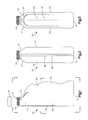
- FIG. 1is a front view of a blow-molded plastic bottle.
- FIG. 2is a left side view taken on line 2 - 2 of FIG. 1 .
- FIG. 3is a right side view taken on line 3 - 3 of FIG. 1 .
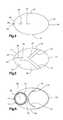
- FIG. 4is a sectional view taken on line 4 - 4 of FIG. 1 .
- FIG. 5is a bottom view taken on line 5 - 5 of FIG. 1 .
- FIG. 6is a top view taken on line 6 - 6 of FIG. 1 .
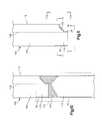
- FIG. 7is schematic view showing a web of plastic film with an apparatus for manufacturing blow-molding preforms.
- FIG. 8is a sectional view taken on line 8 - 8 of FIG. 7 .
- FIG. 9is a sectional view taken on line 9 - 9 of FIG. 7 .
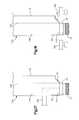
- FIG. 10is a view similar to FIG. 7 showing another part of the apparatus.
- FIG. 11is a front view showing the web of plastic film in a condition taken during the manufacturing process.
- FIG. 12is a sectional view taken on line 12 - 12 of FIG. 11 .
- FIG. 13is a side view taken on line 13 - 13 of FIG. 11 .
- FIG. 14is an end view taken on line 14 - 14 of FIG. 11 .
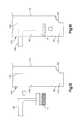
- FIGS. 15-17are views similar to FIG. 11 showing steps taken to insert a fitment into the web of plastic film.
- FIG. 18is a view similar to FIG. 15 showing another part of the apparatus.
- FIG. 19is a view similar to FIG. 10 showing the web of plastic film in a subsequent condition taken during the manufacturing process.
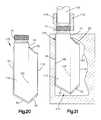
- FIG. 20is a front view of a blow-molding preform with a fitment.
- FIG. 21is a partially sectional view showing the preform of FIG. 20 inside a blow-molding cavity.
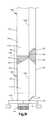
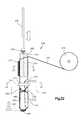
- FIG. 22is a schematic view of another apparatus for manufacturing blow-molding preforms.
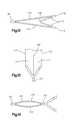
- FIG. 23is a sectional view taken on line 23 - 23 of FIG. 22 .
- FIG. 24is a sectional view taken online 24 - 24 of FIG. 22 .
- a plastic bottle 10is shown in FIG. 1 .
- the bottle 10is especially suitable for contents 11 such as a liquid, granular or powder laundry product.
- the parts of the bottle 10include a blow-molded plastic body 12 , a fitment 14 , and a closure cap 16 .
- the body 12is vertically elongated, and has a generally flat base 18 configured to support the bottle 10 in a free-standing upright position, as shown in FIG. 1 .
- a handgrip portion 20 of the body 12is located at the right hand side 22 , as viewed from the front in FIG. 1 .
- the fitment 14is installed in a neck 24 at the upper end of the body 12 , and is offset toward the left hand side 26 .
- the body 12has front and back faces 40 and 42 extending fully throughout the height of the body 12 from the base 18 to the neck 24 .
- a horizontal cross-section of the body 12has an oval periphery.
- the front and back faces 40 and 42extend across the width of the body 12 between right and left vertices 43 and 45 of the oval periphery.
- the base 18 of the body 12likewise has an oval periphery, and has a central axis 47 .
- the fitment 14 and the neck 24are centered on an axis 49 ( FIG. 6 ) that is parallel but spaced to the left from the axis 47 of the base 18 such that the fitment 14 is offset to left hand side 26 of the bottle 10 , as noted above.
- a user gripping the bottle 10 from the right hand side 22can pour a stream that projects downward and outward from the fitment 14 without crossing any substantial width portion of the bottle 10 .
- a seam 50also is located at the left hand side 26 of the body 12 .
- This seam 50is located at the left vertex 45 of the oval periphery, and extends the full height of the body 12 from the base 18 to the neck 24 .
- Top seams 52extend downward from the neck 24
- bottom seams 56extend across the base 18 .
- the seam 50 at the left hand side 26is the only full height seam on the body 12 of the bottle 10 .
- This location of the single full height seam 50maximizes the unobstructed areas of the front and back faces 40 and 42 for printed text and images to appear across the width of the bottle 10 .
- This location of the single full height seam 50also provides the handgrip 20 with a smooth, seamless surface.
- the body 12 of the bottle 10is formed of plastic film.
- an elongated web 100 of plastic filmis withdrawn from a spool 102 and conveyed lengthwise through a folding station 104 .
- lengths of the web 100are incrementally pulled downward through the folding station 104 .
- the folding station 104is configured to fold the web 100 across longitudinally extending fold lines 105 to place the web 100 in a four panel configuration.
- the web 100When the four panel configuration, as shown separately in FIG. 9 , it has a front panel 110 , a back panel 112 , and two gusset panels 114 , all of which are elongated lengthwise of the web 110 .
- the front and back panels 110 and 112both have right and left side edges 116 and 118 .
- the gusset panels 114extend transversely inward from the front and back panels 110 and 112 .
- a pair of folded corners 126join the gusset panels 114 to the front and back panels 110 and 112 at the right side edges 116 .
- Another folded corner 128joins the gusset panels 114 together.
- the front and back panels 110 and 112are unattached at the left side edges 118 .
- a seaming press 140engages the web 100 in the four panel configuration.
- the seaming press 140severs a section 142 from the web 100 to separate a leading section 144 from a trailing section 146 .
- the seaming press 140seals the front and back panels 100 and 112 together along their left side edges 118 to form a short section of the side seam 50 .
- this section of the partially formed seam 50has a length extending longitudinally along the web 100 , and has a width projecting transversely outward from unattached portions of the front and back panels 110 and 112 .
- An inner surface 148( FIG. 7 ) of the web 110 is treated beforehand to ensure that only inner surfaces of the four-panel configuration are bonded together by the seaming press 140 .
- the seamscould be formed ultrasonically, in which case the surface treatment would not be necessary.
- the seaming press 140also forms top seams 52 on the trailing section 146 of the web 100 . As shown in FIGS. 11 , 13 and 14 , the top seams 52 extend across the ends of the gusset panels 14 . This provides an open neck 24 at the forward end of the trailing section 146 .
- the fitment 14is inserted in the trailing section 146 of the web 100 as shown in FIGS. 15-17 . Specifically, the fitment 14 is inserted between the front and back panels 110 and 112 from the side, and is moved downward into the neck 24 .
- the relatively short length of the partially formed side seam 50provides clearance for a fitment insertion tool 150 to move downward within the trailing section 146 of the web 110 to reach the neck 24 .
- Heat-sealing clamps 160( FIG. 18 ) are moved into engagement with the neck 24 to seal the fitment 14 in its installed position in the neck 24 .
- the clamps 160also fold the seams 50 and 52 inward against the neck 24 so that the seams 50 and 52 no longer project transversely outward at the neck 24 .
- the clamps 160pull the web 100 downward so that the prior trailing section 146 becomes the next leading section 144 , as shown in FIG. 19 .
- the next cycle of the seaming press 140seals the front and back panels 110 and 112 together to form the remainder of the side seam 50 at the leading section 144 .
- the seaming press 140also the panels 100 , 112 and 114 of the leading section 146 together at their rear ends by forming bottom seams 56 across the web 110 . This repeats each time the web 100 is pulled downward so that each successive cycle of the seaming press 140 yields a blow-molding preform 170 with a fitment 14 and only a single full length seam 50 , as shown separately in FIG. 20 .
- the bottle 10 of FIG. 1is formed by expanding the preform 170 in a mold cavity 175 ( FIG. 21 ) having the shape of the body 12 .
- Grippers 176press the fitment 14 into pressure-tight engagement with a filler 178 that communicates with a source pressurized fluid.
- the pressurized fluidis then directed into the preform 170 to deflect the panels 110 , 112 and 114 into the shape of the cavity 175 .
- the fluid pressureturns the gusset panels 114 outward, and presses them against an opposed inner surface 180 of the mold cavity 175 .
- the inner surface 180has an undulating vertical profile for the handgrip 20 at the right hand side 22 of the body 12 .
- the inner surface 180also has a non-circular, concave horizontal profile for the right vertex 43 ( FIG. 4 ) of the oval periphery.
- An opposite inner surface 182 of the mold cavity 175has a non-circular, concave horizontal profile for the left vertex 45 , but has a more linear vertical profile.
- the panels 110 , 112 and 114are registered with the mold cavity 175 such that the side seam 50 is centered on the concave inner surface 182 . This ensures that the side seam 50 is centered at the left-hand side 26 of the body 12 , as described above.
- Deflection of the panels 110 , 112 and 114 outward within the mold cavity 175draws the lower end portions of the panels 110 , 112 and 114 upward to form the base 18 of the body 12 .
- the fluid pressurealso presses the projecting sections of the side and top seams 50 and 52 outward against the opposed mold cavity surfaces. This folds those seams 50 and 52 inward to lie flat against an adjoining outer surface of the body 12 .
- FIG. 22shows parts of another apparatus for manufacturing a preform to be blow-molded into a bottle with only a single full height seam.
- This apparatus 200includes a tube 202 with a bar sealer 204 .
- the tube 202is a cylinder with a circular cross-section centered on a vertical axis 205 .
- the bar sealer 204extends vertically alongside the tube 202 .
- a fitment insertion tool 208is arranged above the tube 202 for vertical movement through the tube 202 .
- a pair of rollers 210are arranged beside each other beneath the tube 202 .
- the rollers 210are alike and are rotatable about parallel horizontal axes 211 .
- a first gusset finger 216is located above the rollers 210
- a second gusset finger 216is located below the rollers 210 .
- a neck sealer clamp 220has a range of movement vertically and horizontally beneath the rollers 210 , as indicated by the arrows shown in FIG. 22 .
- a web 224 of plastic filmextends from a spool 226 to the tube 202 .
- the web 224is guided over the outside of the tube 202 so that a section 228 of the web 224 is wrapped around, and extends downward over, the tube 202 .
- That section of the web 224is thus shaped as a cylinder with a circular cross-section centered on the vertical axis 205 , as shown in FIG. 23 .
- Also shown in FIG. 23are unattached edge portions 230 of the web 224 at the cylindrical section 228 .
- the unattached edge portions 230overlap circumferentially, and extend axially alongside the bar sealer 204 .
- the web 224extends downward from the tube 202 past the first gusset finger 216 , and through a nip between the rollers 210 . Also shown schematically in FIG. 22 is a seaming press 240 beneath the rollers 210 . The web 224 extends further downward past the seaming press 240 and the second gusset finger 216 . The lower end of the web 224 contains a fitment 244 when the web 224 has the condition shown in FIG. 22 .
- the bar sealer 204moves radially inward against the overlapping edge portions 230 of the web 224 to form a longitudinally extending seam at which the overlapping edge portions 230 are joined together.
- the seaming press 240then acts upon the web 224 to sever a section 246 from the web 224 , and also to form seams extending across the web 224 .
- this stepyields a completed blow-molding preform 248 at the leading section of the web 224 .
- This stepalso forms top seams and a neck 250 at the trailing section of the web 224 .
- the fitment insertion tool 208is advanced downward through the tube 202 and into the newly formed neck 250 to install the next fitment 244 .
- the rollers 210are moved apart from each other, and the first gusset finger 216 is retracted, to provide clearance for the fitment insertion tool 208 to be inserted and retracted.
- the fitment 244is off-center. Accordingly, the fitment insertion tool 208 is advanced and retracted though the cylindrical tube 202 along a linear path that is radially offset from the central axis 205 .
- the neck sealer clamp 220grasps the neck 250 containing the fitment 244 , and pulls the web 224 downward so that the web 224 again takes the condition shown in FIG. 22 .
- the second gusset finger 216can be retracted as needed for the passage of the fitment 244 . This step draws the cylindrical section 228 of the web 224 downward from the tube 202 .
- the gusset fingers 216impart the longitudinally extending fold lines about which the moving web 224 is folded into the four panel configuration shown in FIG. 24 .
- the four panel configuration of the web 224has a fully formed side seam 252 .
Landscapes
- Engineering & Computer Science (AREA)
- Mechanical Engineering (AREA)
- Manufacturing & Machinery (AREA)
- Ceramic Engineering (AREA)
- Blow-Moulding Or Thermoforming Of Plastics Or The Like (AREA)
- Containers Having Bodies Formed In One Piece (AREA)
Abstract
Description
Claims (11)
Priority Applications (5)
| Application Number | Priority Date | Filing Date | Title |
|---|---|---|---|
| US12/813,216US8388886B2 (en) | 2010-06-10 | 2010-06-10 | Blow-molded plastic bottle and method of manufacture |
| JP2013514272AJP5671613B2 (en) | 2010-06-10 | 2011-06-07 | Blow molded plastic bottle and manufacturing method |
| PCT/US2011/039361WO2011156306A1 (en) | 2010-06-10 | 2011-06-07 | Blow-molded plastic bottle and method of manufacture |
| EP11792978.6AEP2580043A4 (en) | 2010-06-10 | 2011-06-07 | Blow-molded plastic bottle and method of manufacture |
| US13/767,134US20130153576A1 (en) | 2010-06-10 | 2013-02-14 | Blow-Molded Plastic Bottle and Method of Manufacture |
Applications Claiming Priority (1)
| Application Number | Priority Date | Filing Date | Title |
|---|---|---|---|
| US12/813,216US8388886B2 (en) | 2010-06-10 | 2010-06-10 | Blow-molded plastic bottle and method of manufacture |
Related Child Applications (1)
| Application Number | Title | Priority Date | Filing Date |
|---|---|---|---|
| US13/767,134DivisionUS20130153576A1 (en) | 2010-06-10 | 2013-02-14 | Blow-Molded Plastic Bottle and Method of Manufacture |
Publications (2)
| Publication Number | Publication Date |
|---|---|
| US20110303673A1 US20110303673A1 (en) | 2011-12-15 |
| US8388886B2true US8388886B2 (en) | 2013-03-05 |
Family
ID=45095404
Family Applications (2)
| Application Number | Title | Priority Date | Filing Date |
|---|---|---|---|
| US12/813,216Expired - Fee RelatedUS8388886B2 (en) | 2010-06-10 | 2010-06-10 | Blow-molded plastic bottle and method of manufacture |
| US13/767,134AbandonedUS20130153576A1 (en) | 2010-06-10 | 2013-02-14 | Blow-Molded Plastic Bottle and Method of Manufacture |
Family Applications After (1)
| Application Number | Title | Priority Date | Filing Date |
|---|---|---|---|
| US13/767,134AbandonedUS20130153576A1 (en) | 2010-06-10 | 2013-02-14 | Blow-Molded Plastic Bottle and Method of Manufacture |
Country Status (4)
| Country | Link |
|---|---|
| US (2) | US8388886B2 (en) |
| EP (1) | EP2580043A4 (en) |
| JP (1) | JP5671613B2 (en) |
| WO (1) | WO2011156306A1 (en) |
Cited By (3)
| Publication number | Priority date | Publication date | Assignee | Title |
|---|---|---|---|---|
| US20130153576A1 (en)* | 2010-06-10 | 2013-06-20 | Smart Bottle, Inc. | Blow-Molded Plastic Bottle and Method of Manufacture |
| US20130256310A1 (en)* | 2012-04-03 | 2013-10-03 | World Create, Inc. | Silicone Resin Container |
| US20150266228A1 (en)* | 2014-03-21 | 2015-09-24 | Serac Group | Machine for blowing molding articles such as containers |
Families Citing this family (7)
| Publication number | Priority date | Publication date | Assignee | Title |
|---|---|---|---|---|
| US10532847B2 (en) | 2013-10-04 | 2020-01-14 | The Procter & Gamble Company | Package having a plug seal closure |
| BR112016016879B1 (en)* | 2014-01-23 | 2021-06-15 | Serac Group | CONTAINER FORMED OF A UNITARY PRINTED THERMOPLASTIC SUBSTRATE WITH DISTORTION |
| FR3069182A1 (en)* | 2017-07-21 | 2019-01-25 | Ublo | MACHINE FOR MANUFACTURING PLASTIC ARTICLES BY BLOWING. |
| US11331844B2 (en) | 2018-05-25 | 2022-05-17 | The Procter & Gamble Company | Container having coordinated mold part line and longitudinal seam |
| JP7551503B2 (en)* | 2018-12-20 | 2024-09-17 | 日精エー・エス・ビー機械株式会社 | Plastic container |
| US11358747B2 (en) | 2019-04-29 | 2022-06-14 | The Procter & Gamble Company | Low opacity thermoformed container having longitudinal seam |
| FR3131908B1 (en)* | 2022-01-17 | 2024-02-16 | Ublo | Flexible plastic container, method of manufacturing such a container and corresponding mold |
Citations (22)
| Publication number | Priority date | Publication date | Assignee | Title |
|---|---|---|---|---|
| US3367380A (en) | 1964-03-05 | 1968-02-06 | Dev Consultants Inc | Collapsible container |
| US3380646A (en) | 1962-11-14 | 1968-04-30 | Leon Doyen | Container of plastic material and method of producing same |
| US3438567A (en) | 1966-03-18 | 1969-04-15 | Dow Chemical Co | Flexible film bag with bottom gusset |
| US3935993A (en) | 1973-01-26 | 1976-02-03 | Leon Doyen | Free-standing container |
| US4597103A (en) | 1985-05-24 | 1986-06-24 | Sonoco Products Company | Bag construction with improved gussets |
| US5020692A (en) | 1986-05-15 | 1991-06-04 | Plastipak Packaging, Inc. | Container including unitary blow molded bottle having drain-back dispensing spout and plastic insert |
| US5316184A (en) | 1991-08-08 | 1994-05-31 | During Ag | Foldable plastic bottle, blow mold form to make the bottle, and method of making the bottle |
| US5511686A (en) | 1992-03-12 | 1996-04-30 | Jean Gallay S.A. | Container made of a synthetic material and method for making same |
| WO1996021599A1 (en) | 1994-11-10 | 1996-07-18 | Jebco Packaging Systems, Inc. | Fitment for flexible containers |
| EP0854092A2 (en) | 1992-10-08 | 1998-07-22 | Unifill International A/G | Container of thermofarmable and heat sealable material |
| US6193416B1 (en) | 1996-09-27 | 2001-02-27 | Kao Corporation | Gusseted bag |
| US6679034B2 (en) | 2002-03-18 | 2004-01-20 | Recot, Inc. | Vertical stand-up pouch quick change module |
| US6722106B2 (en) | 2002-03-18 | 2004-04-20 | Recot, Inc. | Vertical stand-up pouch |
| US6832852B2 (en) | 2002-04-27 | 2004-12-21 | Kenneth R. Wilkes | Gusseted flexible bottle with fitment and method of fabrication |
| US20060107619A1 (en) | 2004-11-12 | 2006-05-25 | Reaves Jerry M | Method and apparatus for providing end seals on vertical stand-up packages |
| US20060266728A1 (en) | 2005-05-31 | 2006-11-30 | Wilkes Kenneth R | Container of selectively expanded plastic film with fitment |
| US7147597B2 (en) | 2002-04-27 | 2006-12-12 | Wilkes Kenneth R | Method of fabrication of gusseted flexible bottle with fitment |
| US20070040306A1 (en) | 2003-04-02 | 2007-02-22 | Sabrina Morel | Method for carrying out ventilation in a multi-walled container |
| US7407326B2 (en) | 2003-12-08 | 2008-08-05 | Wilkes Kenneth R | Triangularly shaped flexible bottle with fitment, and method of fabrication |
| US7546721B2 (en) | 2007-10-23 | 2009-06-16 | Heinz North America (A Division Of H.J. Heniz Company) | Method of making a tetrahedron package |
| US20100072679A1 (en) | 2008-09-24 | 2010-03-25 | Krw Machinery, Llc | Container Made From Expanded Plastic Film |
| US20100133294A1 (en) | 2008-10-23 | 2010-06-03 | John Geoffrey Chan | Multi-chamber material dispensing system and method for making same |
Family Cites Families (29)
| Publication number | Priority date | Publication date | Assignee | Title |
|---|---|---|---|---|
| US3288334A (en)* | 1965-05-28 | 1966-11-29 | Calmar Inc | Disppenser with collapsible container and pump |
| US3392861A (en)* | 1966-04-22 | 1968-07-16 | Monsanto Co | Container with closure |
| US3430841A (en)* | 1967-01-26 | 1969-03-04 | Amos R Kanaga | Tri-cornered bag |
| US3592885A (en)* | 1968-12-13 | 1971-07-13 | Phillips Petroleum Co | Corrugated parison real line |
| US3612326A (en)* | 1969-03-20 | 1971-10-12 | Tenneco Chem | Extension seal for a plastic container |
| US3804285A (en)* | 1972-05-23 | 1974-04-16 | Lilly Co Eli | Bottle with pourout neck |
| SE403342B (en)* | 1972-12-08 | 1978-08-14 | Rit Rech Ind Therapeut | FOPABLE HALF FRAME PLASTIC BOTTLE |
| CA1077212A (en)* | 1974-07-31 | 1980-05-13 | Malcolm B. Lucas | Precisely partitioned bulbous-shape container and method of making it |
| US4084717A (en)* | 1977-06-29 | 1978-04-18 | Vca Corporation | Container and closure |
| JPS60125625A (en)* | 1983-12-12 | 1985-07-04 | Kyoraku Co Ltd | Hollow molding method |
| US4756857A (en)* | 1985-07-18 | 1988-07-12 | Continental Plastic Containers, Inc. | Process of applying a top element to a container utilizing a hot melt material |
| US4616759A (en)* | 1985-11-08 | 1986-10-14 | Darrell Mahler | Liquid-dispensing container assembly |
| US5249695A (en)* | 1991-03-05 | 1993-10-05 | Portola Packaging, Inc. | Spout fitment closure plug |
| US5462202A (en)* | 1994-08-25 | 1995-10-31 | Owens-Illinois Closure Inc. | Liquid containing and dispensing package |
| US5692628A (en)* | 1996-01-11 | 1997-12-02 | Rexam Closure, Inc. | Press-on screw-off self-tapping closure/container package |
| US5738231A (en)* | 1996-04-19 | 1998-04-14 | Rexam Closures, Inc. | Tamper indicating threaded closure-container package |
| US20040232102A1 (en)* | 1996-11-18 | 2004-11-25 | Gardner William A. | Systems, devices and methods for opening a bottle sealed with a stopper and for sealing a bottle |
| US5735417A (en)* | 1996-12-05 | 1998-04-07 | Plastipak Packaging, Inc. | Container closure locking assembly |
| US6213756B1 (en)* | 1999-04-08 | 2001-04-10 | Owens-Brockway Plastic Products Inc. | Extrusion blow molding apparatus for manufacture of thermoplastic containers |
| US6648188B2 (en)* | 1999-12-21 | 2003-11-18 | Owens-Brockway Plastic Products Inc. | Liquid dispensing package and method of manufacture |
| TW430545B (en)* | 2000-08-09 | 2001-04-21 | Hsu Hui Chen | Splitable plant tissue culture vessel |
| US6695757B2 (en) | 2001-01-12 | 2004-02-24 | Scholle Corporation | Method of manufacturing a standup bag |
| US7413097B1 (en)* | 2003-08-01 | 2008-08-19 | Portola Packaging, Inc. | Tamper-evident closure and method of making same |
| US8613548B2 (en)* | 2004-08-03 | 2013-12-24 | Pouch Pac Innovations, Llc | Flexible pouch with curvilinear shape and method of forming |
| US7900789B2 (en)* | 2007-05-30 | 2011-03-08 | Graham Packaging Company, Lp | Non-removable finish and closure system |
| US7959034B2 (en)* | 2007-08-17 | 2011-06-14 | The Dial Corporation | Liquid product pouring and measuring package with drain-back spout fitment and tight-sealing measuring cup assembly |
| US8685309B2 (en)* | 2010-04-26 | 2014-04-01 | The Procter & Gamble Company | Method for making a personal care product |
| US8388886B2 (en)* | 2010-06-10 | 2013-03-05 | Smart Bottle, Inc. | Blow-molded plastic bottle and method of manufacture |
| JP5827919B2 (en)* | 2012-04-03 | 2015-12-02 | 株式会社ワールド・クリエイト | Silicone resin container |
- 2010
- 2010-06-10USUS12/813,216patent/US8388886B2/ennot_activeExpired - Fee Related
- 2011
- 2011-06-07JPJP2013514272Apatent/JP5671613B2/ennot_activeExpired - Fee Related
- 2011-06-07WOPCT/US2011/039361patent/WO2011156306A1/enactiveApplication Filing
- 2011-06-07EPEP11792978.6Apatent/EP2580043A4/ennot_activeWithdrawn
- 2013
- 2013-02-14USUS13/767,134patent/US20130153576A1/ennot_activeAbandoned
Patent Citations (23)
| Publication number | Priority date | Publication date | Assignee | Title |
|---|---|---|---|---|
| US3380646A (en) | 1962-11-14 | 1968-04-30 | Leon Doyen | Container of plastic material and method of producing same |
| US3367380A (en) | 1964-03-05 | 1968-02-06 | Dev Consultants Inc | Collapsible container |
| US3438567A (en) | 1966-03-18 | 1969-04-15 | Dow Chemical Co | Flexible film bag with bottom gusset |
| US3935993A (en) | 1973-01-26 | 1976-02-03 | Leon Doyen | Free-standing container |
| US4597103A (en) | 1985-05-24 | 1986-06-24 | Sonoco Products Company | Bag construction with improved gussets |
| US5020692A (en) | 1986-05-15 | 1991-06-04 | Plastipak Packaging, Inc. | Container including unitary blow molded bottle having drain-back dispensing spout and plastic insert |
| US5316184A (en) | 1991-08-08 | 1994-05-31 | During Ag | Foldable plastic bottle, blow mold form to make the bottle, and method of making the bottle |
| US5511686A (en) | 1992-03-12 | 1996-04-30 | Jean Gallay S.A. | Container made of a synthetic material and method for making same |
| EP0854092A2 (en) | 1992-10-08 | 1998-07-22 | Unifill International A/G | Container of thermofarmable and heat sealable material |
| WO1996021599A1 (en) | 1994-11-10 | 1996-07-18 | Jebco Packaging Systems, Inc. | Fitment for flexible containers |
| US6193416B1 (en) | 1996-09-27 | 2001-02-27 | Kao Corporation | Gusseted bag |
| US6679034B2 (en) | 2002-03-18 | 2004-01-20 | Recot, Inc. | Vertical stand-up pouch quick change module |
| US6722106B2 (en) | 2002-03-18 | 2004-04-20 | Recot, Inc. | Vertical stand-up pouch |
| US6729109B2 (en) | 2002-03-18 | 2004-05-04 | Recot, Inc. | Method and apparatus for making flat bottom bags |
| US6832852B2 (en) | 2002-04-27 | 2004-12-21 | Kenneth R. Wilkes | Gusseted flexible bottle with fitment and method of fabrication |
| US7147597B2 (en) | 2002-04-27 | 2006-12-12 | Wilkes Kenneth R | Method of fabrication of gusseted flexible bottle with fitment |
| US20070040306A1 (en) | 2003-04-02 | 2007-02-22 | Sabrina Morel | Method for carrying out ventilation in a multi-walled container |
| US7407326B2 (en) | 2003-12-08 | 2008-08-05 | Wilkes Kenneth R | Triangularly shaped flexible bottle with fitment, and method of fabrication |
| US20060107619A1 (en) | 2004-11-12 | 2006-05-25 | Reaves Jerry M | Method and apparatus for providing end seals on vertical stand-up packages |
| US20060266728A1 (en) | 2005-05-31 | 2006-11-30 | Wilkes Kenneth R | Container of selectively expanded plastic film with fitment |
| US7546721B2 (en) | 2007-10-23 | 2009-06-16 | Heinz North America (A Division Of H.J. Heniz Company) | Method of making a tetrahedron package |
| US20100072679A1 (en) | 2008-09-24 | 2010-03-25 | Krw Machinery, Llc | Container Made From Expanded Plastic Film |
| US20100133294A1 (en) | 2008-10-23 | 2010-06-03 | John Geoffrey Chan | Multi-chamber material dispensing system and method for making same |
Non-Patent Citations (1)
| Title |
|---|
| Notification of Transmittal of the International Search Report and the Written Opinion of the International Searching Authority dated Oct. 11, 2011 for PCT Application No. PCT/US2011/039361. |
Cited By (5)
| Publication number | Priority date | Publication date | Assignee | Title |
|---|---|---|---|---|
| US20130153576A1 (en)* | 2010-06-10 | 2013-06-20 | Smart Bottle, Inc. | Blow-Molded Plastic Bottle and Method of Manufacture |
| US20130256310A1 (en)* | 2012-04-03 | 2013-10-03 | World Create, Inc. | Silicone Resin Container |
| US8783487B2 (en)* | 2012-04-03 | 2014-07-22 | Masaru Hojo | Silicone resin container |
| US20150266228A1 (en)* | 2014-03-21 | 2015-09-24 | Serac Group | Machine for blowing molding articles such as containers |
| US9339966B2 (en)* | 2014-03-21 | 2016-05-17 | Serac Group | Machine for blowing molding articles such as containers |
Also Published As
| Publication number | Publication date |
|---|---|
| WO2011156306A1 (en) | 2011-12-15 |
| US20110303673A1 (en) | 2011-12-15 |
| JP5671613B2 (en) | 2015-02-18 |
| US20130153576A1 (en) | 2013-06-20 |
| JP2013529561A (en) | 2013-07-22 |
| EP2580043A4 (en) | 2017-02-22 |
| EP2580043A1 (en) | 2013-04-17 |
Similar Documents
| Publication | Publication Date | Title |
|---|---|---|
| US8388886B2 (en) | Blow-molded plastic bottle and method of manufacture | |
| CA2460846C (en) | Stand-up packaging pouch, package body and feed roll and manufacturing methods therefor | |
| EP2573004B1 (en) | Gusseted flexible bottle with fitment | |
| DK2573004T3 (en) | FOLDED FLEXIBLE BOTTLE WITH MOUNTING PART AND MANUFACTURING METHOD. | |
| US6805261B1 (en) | Flexible tube and method of manufacture | |
| JPS58203839A (en) | fluid container | |
| JPS629019B2 (en) | ||
| EP3326797B1 (en) | Flexible containers comprising a lower base of essentially rectangular configuration, method, module and machine for their manufacture | |
| US9126383B2 (en) | Bottom-gusseted package and method | |
| EP1554111B1 (en) | Methode and machine for forming containers, in particular containers for food products | |
| US20160176567A1 (en) | Bottle Registration Feature | |
| US7407326B2 (en) | Triangularly shaped flexible bottle with fitment, and method of fabrication | |
| JP2008133051A (en) | Self-supporting packaging bag with folds, self-supporting package with folds, raw roll for fold-free self-supporting package, and method for producing self-supporting package with folds | |
| WO2019215612A1 (en) | Method and machine for making flexible packages with side gussets | |
| US20030217531A1 (en) | Vertical form, fill, and seal apparatus for making several types of packages | |
| WO2001024999A1 (en) | Bag making | |
| WO1998003403A1 (en) | Can and facilities for its production, filling, and sealed closure | |
| US20020148204A1 (en) | Method and apparatus for forming, filing and sealing tubular packaging | |
| HK1184768B (en) | Gusseted flexible bottle with fitment | |
| FI77201C (en) | Packaging intended for liquid fillers and with a resealable opening mechanism | |
| HK1184768A (en) | Gusseted flexible bottle with fitment |
Legal Events
| Date | Code | Title | Description |
|---|---|---|---|
| AS | Assignment | Owner name:SMART BOTTLE INC., NORTH CAROLINA Free format text:ASSIGNMENT OF ASSIGNORS INTEREST;ASSIGNOR:WILKES, KENNETH R.;REEL/FRAME:024519/0470 Effective date:20100609 | |
| STCF | Information on status: patent grant | Free format text:PATENTED CASE | |
| FEPP | Fee payment procedure | Free format text:PAT HOLDER CLAIMS SMALL ENTITY STATUS, ENTITY STATUS SET TO SMALL (ORIGINAL EVENT CODE: LTOS); ENTITY STATUS OF PATENT OWNER: SMALL ENTITY | |
| FPAY | Fee payment | Year of fee payment:4 | |
| SULP | Surcharge for late payment | ||
| MAFP | Maintenance fee payment | Free format text:PAYMENT OF MAINTENANCE FEE, 8TH YR, SMALL ENTITY (ORIGINAL EVENT CODE: M2552); ENTITY STATUS OF PATENT OWNER: SMALL ENTITY Year of fee payment:8 | |
| FEPP | Fee payment procedure | Free format text:MAINTENANCE FEE REMINDER MAILED (ORIGINAL EVENT CODE: REM.); ENTITY STATUS OF PATENT OWNER: SMALL ENTITY | |
| LAPS | Lapse for failure to pay maintenance fees | Free format text:PATENT EXPIRED FOR FAILURE TO PAY MAINTENANCE FEES (ORIGINAL EVENT CODE: EXP.); ENTITY STATUS OF PATENT OWNER: SMALL ENTITY | |
| STCH | Information on status: patent discontinuation | Free format text:PATENT EXPIRED DUE TO NONPAYMENT OF MAINTENANCE FEES UNDER 37 CFR 1.362 | |
| FP | Lapsed due to failure to pay maintenance fee | Effective date:20250305 |