US8378885B2 - Device and method for locating a mobile approaching a surface reflecting electromagnetic waves - Google Patents
Device and method for locating a mobile approaching a surface reflecting electromagnetic wavesDownload PDFInfo
- Publication number
- US8378885B2 US8378885B2US12/531,657US53165708AUS8378885B2US 8378885 B2US8378885 B2US 8378885B2US 53165708 AUS53165708 AUS 53165708AUS 8378885 B2US8378885 B2US 8378885B2
- Authority
- US
- United States
- Prior art keywords
- reception
- emission
- antenna
- mobile object
- signal
- Prior art date
- Legal status (The legal status is an assumption and is not a legal conclusion. Google has not performed a legal analysis and makes no representation as to the accuracy of the status listed.)
- Active
Links
- 238000000034methodMethods0.000titleclaimsabstractdescription18
- 238000001514detection methodMethods0.000claimsabstractdescription38
- 238000005259measurementMethods0.000description19
- 238000012545processingMethods0.000description15
- 238000005070samplingMethods0.000description15
- 238000004364calculation methodMethods0.000description10
- 230000008901benefitEffects0.000description6
- 238000010586diagramMethods0.000description6
- 230000004044responseEffects0.000description5
- 238000001914filtrationMethods0.000description4
- 230000003044adaptive effectEffects0.000description3
- 239000002131composite materialSubstances0.000description3
- 230000000694effectsEffects0.000description2
- 238000005305interferometryMethods0.000description2
- 230000000750progressive effectEffects0.000description2
- 229910008048Si-SInorganic materials0.000description1
- 229910006336Si—SInorganic materials0.000description1
- 238000013459approachMethods0.000description1
- 230000033228biological regulationEffects0.000description1
- 230000001427coherent effectEffects0.000description1
- 238000004891communicationMethods0.000description1
- 238000005314correlation functionMethods0.000description1
- 230000001066destructive effectEffects0.000description1
- 230000001747exhibiting effectEffects0.000description1
- 231100001261hazardousToxicity0.000description1
- 238000009434installationMethods0.000description1
- 230000001788irregularEffects0.000description1
- 230000000737periodic effectEffects0.000description1
- 230000010287polarizationEffects0.000description1
- 230000008569processEffects0.000description1
- 230000009467reductionEffects0.000description1
- 230000000717retained effectEffects0.000description1
- 230000003313weakening effectEffects0.000description1
Images


Classifications
- G—PHYSICS
- G01—MEASURING; TESTING
- G01S—RADIO DIRECTION-FINDING; RADIO NAVIGATION; DETERMINING DISTANCE OR VELOCITY BY USE OF RADIO WAVES; LOCATING OR PRESENCE-DETECTING BY USE OF THE REFLECTION OR RERADIATION OF RADIO WAVES; ANALOGOUS ARRANGEMENTS USING OTHER WAVES
- G01S13/00—Systems using the reflection or reradiation of radio waves, e.g. radar systems; Analogous systems using reflection or reradiation of waves whose nature or wavelength is irrelevant or unspecified
- G01S13/88—Radar or analogous systems specially adapted for specific applications
- G01S13/91—Radar or analogous systems specially adapted for specific applications for traffic control
- G01S13/913—Radar or analogous systems specially adapted for specific applications for traffic control for landing purposes
- G—PHYSICS
- G01—MEASURING; TESTING
- G01S—RADIO DIRECTION-FINDING; RADIO NAVIGATION; DETERMINING DISTANCE OR VELOCITY BY USE OF RADIO WAVES; LOCATING OR PRESENCE-DETECTING BY USE OF THE REFLECTION OR RERADIATION OF RADIO WAVES; ANALOGOUS ARRANGEMENTS USING OTHER WAVES
- G01S13/00—Systems using the reflection or reradiation of radio waves, e.g. radar systems; Analogous systems using reflection or reradiation of waves whose nature or wavelength is irrelevant or unspecified
- G01S13/66—Radar-tracking systems; Analogous systems
- G01S13/68—Radar-tracking systems; Analogous systems for angle tracking only
- G01S13/685—Radar-tracking systems; Analogous systems for angle tracking only using simultaneous lobing techniques
Definitions
- the present inventionrelates to a device and a method for locating a mobile approaching a surface reflecting electromagnetic waves.
- the inventioncan be used, for example, in order to determine the position of an aircraft in the final landing phase for a guidance device.
- the landing of an aircraftis a very tricky phase during which the slightest positioning error can lead to major damage to the aircraft.
- manual guidance during the landing phaseis hazardous because of the difficulties in assessing the distance of the aircraft, the presentation of the aircraft and its real speed.
- a number of automatic guidance systemshave been implemented in order to guide aircraft during a landing phase.
- the automatic guidance of an aircraftinvolves accurately determining the current position of the aircraft in order to correct, possibly automatically, its trajectory to align it correctly with a landing runway for example. This determination of the current position of the aircraft can be performed using various systems.
- the ILS systemsare instrument approach systems for aircraft that are equipped therewith.
- the ILS systemmakes it possible to indicate to the pilot the maneuvers to be carried out for a successful landing.
- These systemstherefore require specific instrumentation on board the aircraft and detection and guidance systems on the ground.
- the ILS systemsare divided into three categories: category one, category two and category three. Among these three categories, only category three can be used in all weathers.
- the MLSis a microwave landing system. It can be used to provide precision guidance for a landing, regardless of the meteorological conditions.
- the ILS and MLS systemsare very heavy equipment, both on the ground and on board the aircraft. While they are suited to airport installations of wide coverage, it is totally impossible to consider equipping small aerodromes with such equipment. In addition, light aircraft cannot host the equipment needed to implement these systems, as much for reasons of cost as for lack of space.
- a first solutionuses the GPS system, or Global Positioning System, or even the DGPS system, standing for Digital Global Positioning System.
- the main drawback of the GPS systemsis their lack of robustness. In practice, the GPS service is not always available. Moreover, GPS location efficiency can be degraded by multiple reflections in the vicinity of the ground.
- a second solutionis to use a LIDAR, or Light Detection And Ranging, system.
- This location systemwhich operates on the same principle as radar, uses electromagnetic waves in the visible range, or in the infrared range. This therefore makes it unusable when the meteorological conditions are unfavorable.
- the LIDAR beamis very narrow. It is therefore essential to carry out a large number of sweeps to detect a target. This makes the search time relatively lengthy in a phase during which it is important to lock onto the target as rapidly as possible.
- This solutionalso requires accurate positioning relative to the landing runway.
- Another solutionconsists in using a highly directional millimetric wave radar.
- the millimetric wave radaralso requires a search phase to designate the target. It must also be positioned accurately relative to the landing runway.
- the reflections of the waves on the groundare superimposed on the reflection of the wave emitted by the radar on the target, making the detection unreliable and imprecise.
- This solutionis also very costly and requires a responder on board the aircraft. The responder is itself costly, bulky, heavy, and consumes a lot of energy.
- Solutions commonly set up to overcome the problems of reflections on the groundconsist notably in filtering, on the radar antenna, the signals reflected by the ground by minimizing the contribution of these signals through an appropriate orientation and directivity of the beam from the radar antenna.
- the filtering of such signalsrequires highly directional antennas that are pointed very accurately. These antennas apply complex processing operations, such as high resolution adaptive processing, to the received signal.
- the adaptive processing operationsrequire significant computation means while being very sensitive to the assumptions made on a propagation model of the wave to be processed. In particular, assumptions must be made as to the consistency or otherwise of the reflections with respect to the direct signal, the direct signal being the signal not reflected on the ground. These assumptions are not borne out in all cases. This makes these processing operations not very robust and difficult to implement.
- the contribution of the signals reflected by the ground in the received signalcan be minimized by an accurate positioning of the antenna of the radar so as, for example, to place the paths reflected by the ground in empty spaces in the pattern of the antenna.
- This minimizingcan be done by array antennas of large dimensions that perform an appropriate spatial filtering making it possible to improve the contrast of the direct signal relative to the reflected signal while preserving an adequate gain in the direction of the direct path.
- the reduction in the aperture of the antenna beam that is needed for this type of processinginvolves increasing the dimensions of the antenna.
- the dimensions of the antennaare greatly constrained, notably by its physical location. In practice, for practical and safety reasons, it is impossible to deploy a radar antenna of large dimensions at the edge of a landing runway.
- the subject of the inventionis a device and a method for locating a mobile approaching a surface reflecting electromagnetic waves.
- the location devicecan notably comprise:
- the reception positions receiving a signal of maximum energyare used for an angular location of the mobile in a plane substantially parallel to the surface reflecting the electromagnetic waves.
- All the reception positionsare used for an angular location of the mobile in a plane substantially perpendicular to the surface reflecting the electromagnetic waves.
- the reception antennacomprises a number of reception subarrays comprising radiating elements.
- a reception positioncorresponds, for example, to the position of a fixed reception subarray.
- the reception subarrayscan then be activated in succession.
- the emission antennacomprises a number of emission channels.
- An emission positioncorresponds, for example, to the position of a fixed emission channel.
- the emission channelscan then be activated in succession.
- the reception antennacan comprise one or more reception subarrays consisting of radiating elements.
- the reception subarray(s)can be moved to the reception positions.
- the reception subarray(s)can be moved continually.
- the emission antennacan comprise one or more emission channels being moved to the emission positions.
- the emission channel(s)can be moved continually.
- the reception positionsare, for example, spaced apart using an irregular spacing law.
- the reception positionsare, for example, spaced apart using a progressive spacing law.
- the emission antenna and the reception antennacan be collocated.
- the mobileis, for example, an aircraft.
- the location methodcan comprise at least the following steps:
- An angular location of the mobile in a plane substantially parallel to the surface reflecting the electromagnetic wavesis performed by using one or more signals of maximum energy received by one or more reception positions.
- An angular location of the mobile in a plane substantially perpendicular to the surface reflecting the electromagnetic wavesis performed by using the signals received by each reception position.
- the mobileis, for example, an aircraft.
- the main benefits of the inventionare notably that it gives a good accuracy for locating the aircraft by applying robust and simple processing operations.
- the radar antenna according to the inventionadvantageously has small dimensions and tolerates an approximate positioning without the location results being degraded.
- FIG. 1an example of an aircraft landing aid device
- FIG. 2a phenomenon of reflection on the ground of a wave emitted by an aircraft following the reception of a radar signal
- FIG. 3a diagram of interferences of a signal coming from a target and its image
- FIG. 4a schematic diagram of a radar antenna according to the invention.
- FIG. 5 aa first exemplary embodiment of a receiver of the radar antenna according to the invention
- FIG. 5 ba second exemplary embodiment of a receiver of the radar antenna according to the invention.
- FIG. 6 athe main steps of the method of detecting an aircraft according to the invention.
- FIG. 6 ban interference signal received on the radar antenna according to the invention.
- FIG. 6 ca plan view of the device according to the invention for calculating the positioning of the aircraft in azimuth;
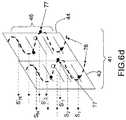
- FIG. 6 da sampling of the interference signal received on the radar antenna according to the invention for calculating the position of the aircraft in azimuth.
- FIG. 1represents an aircraft 1 in the phase of landing on a landing runway 2 .
- the aircraft 1can be guided by a device notably comprising a radar 3 , a first beacon 4 , notably active, on board the aircraft 1 , a second beacon 5 , for example passive, situated at the edge of the runway 2 .
- This guidance deviceis notably described in the French patent application No. 04 12313.
- Guiding the aircraft 1 in the landing phaseentails knowing the position of the aircraft 1 accurately and, notably, its coordinates in azimuth and in elevation.
- the radar 3emits a detection signal 6 toward the aircraft 1 , that will also hereinafter be called target 1 of the radar 3 .
- the outer skin of the aircraft 1returns the received signal 6 in the form of an echo.
- the first onboard beacon 4on detecting the signal 6 emitted by the radar 3 , also sends a response signal toward the radar 3 .
- the radar 3therefore receives a skin echo from the aircraft 1 and a signal coming from the first beacon 4 on board the aircraft 1 .
- the signal returned by the first beacon 4advantageously provides for a more accurate location of the aircraft than the echo originating from the skin of the aircraft 1 .
- the presence of the second beacon on the ground 5enables the radar 3 to perform differential measurements in order to cancel out the detection bias.
- the accuracy of the positioning measurements concerning the aircraft 1 by the radar 3is therefore advantageously improved by the presence of the second beacon 5 .
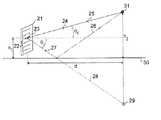
- FIG. 2diagrammatically represents a radar antenna 21 .
- the radar antenna 21is notably situated at a low height relative to the ground 30 .
- the radar antenna 21comprises P lines of independent radiating elements 22 .
- the P lines of radiating elements 22are spaced apart, regularly or not, and arranged in a substantially horizontal manner in the vertical plane of the radar antenna 21 .
- the plane of the radar antenna 21is notably substantially perpendicular to the ground 30 .
- the radar antenna 21can comprise an emission antenna and a reception antenna that are collocated.
- FIG. 2represents different signals emitted or received by the radar antenna 21 operating in signal reception mode.
- the line 23 of radiating elements 55 concernedis situated, for example, at a height h 1 from the ground 30 .
- the line 23 of radiating elementsemits a first detection signal 24 toward a target 31 .
- This target 31can, for example, be the aircraft 1 with the first beacon 4 on board.
- the target 31is situated at a height h 2 from the ground 30 and at a horizontal distance d from the radar antenna 21 .
- the first detection signal 24is then reemitted by the target 31 in the form of a second signal 25 , 26 .
- the second response signal 25 , 26can be either a skin echo from the aircraft 1 or a signal emitted by the first beacon 4 in response to the first detection signal 24 .
- the target 31is a passive source, whereas if the response comes from the first beacon 4 , the target 31 is an active source.
- the second response signal 25 , 26comprises a number of paths 25 , 26 emitted in different directions.
- a first path 25is a direct path 25 leaving from the target 31 and arriving on the line of radiating elements 23 .
- the first path 25for example forms with the horizontal an angle ⁇ c , also called elevation angle of the target 31 seen from the radar antenna 23 .
- the second path 26is emitted toward the ground 30 , or any other reflecting surface, by the target 31 .
- the second path 26is reflected in a quasi-specula manner by the ground 30 because of the low altitude of the target 31 .
- the reflection of the second path 26 on the ground 30notably gives rise to a third path 27 that is directed toward the line of radiating elements 23 .
- the third path 27can be represented by the continuation of a fourth path 28 of a third hypothetical signal 27 , 28 emitted by an image 30 , of the source 31 .
- the image 30is the orthogonal projection of the source 31 relative to the ground 30 .
- the third path 27for example forms with the horizontal an angle ⁇ i called elevation angle of the image 29 , seen from the radar antenna 23 .
- a fourth signal 25 , 27received by the line of radiating elements 23 , therefore comprises the first path 25 of the second signal 25 , 26 emitted by the target 31 and the third path 27 derived from the third hypothetical signal 27 , 28 emitted by the image 30 , of the target 31 .
- a first emitted signal 24can also comprise a number of paths, some of which can be reflected on the ground 30 . Since the phenomenon is similar, it is not represented in FIG. 2 .
- FIG. 3represents an interference diagram of the fourth signal 25 , 27 received by the antenna 21 .
- the fourth signal 25 , 27 received by the antenna 21in sinusoidal form, originates from the target-image bipole 31 , 29 as if it were a fifth signal emitted by a one-off system situated, for example, at the center of the target-image bipole 31 , 29 .
- the target 31is, for example, situated at a height h 2 relative to the ground 30 .
- the fourth composite signal 25 , 27 coming from the target 31 and from its image 30generates, on the radar antenna 21 , an interferometry figure whose frequency is 2h 2 / ⁇ d, expressed in m ⁇ 1 , in which m is used for meters, ⁇ being the wavelength of the fourth signal 25 , 27 received by the radar antenna 21 .
- the frequency of the interferometry figureis therefore independent of the value of the coefficient of reflection of the second path 26 of the second signal 25 , 26 on the ground 30 .
- FIG. 4represents a schematic diagram of a radar antenna 40 according to the invention used, for example, in a device for guiding aircraft in the landing phase.
- the radar antenna 40is notably used in the radiating band X.
- the radar antenna 40has a first reception antenna 41 which can be collocated with a second emission antenna 42 .
- the reception antenna 41comprises at least two identical columns 43 , 44 .
- Each column 43 , 44comprises N reception subarrays 46 of radiating elements 45 .
- the reception subarrays 46are, for example, distributed regularly over the entire height of the reception antenna 41 .
- the reception subarrays 46are reception channels of the reception antenna 41 .
- Each reception subarray 46notably has an aperture of 20° in azimuth and 20° in elevation. This aperture is sufficient to cover the field in which the aircraft 1 is moving during the landing phase, called field of interest.
- Each reception subarray 46covers, notably in elevation, +15° above the ground 30 and ⁇ 5° below the ground 30 in order to cover any dip in the landing runway 2 .
- the reception subarrays 46can, for example, be produced using printed circuits.
- the emission antenna 42notably comprises M emission channels or emission feeds 47 that can be identical.
- emission channels 47are represented by way of example.
- Each emission feed 47notably comprises a subarray of radiating emission elements 48 .
- Each emission subarray 48can be used to emit a first detection signal 24 notably toward the aircraft 1 to be located.
- a waveform generatornot represented in FIG. 4 , generates the first detection signal 24 emitted.
- the waveform generatorcan be produced using a frequency-controlled local oscillator.
- Each feed 47also includes an amplifier 49 to amplify the detection signal generated by the waveform generator.
- the first detection signal 24 emitted by each feed 47covers, for example, a field of 10° in elevation and 20° in azimuth.
- the field illuminated by the emission antenna 40is limited only by the aperture of an individual antenna consisting, for example, of a line of radiating elements 47 .
- the radar antenna 40 according to the inventiontherefore advantageously has watch capabilities in an extended angular field.
- One or more additional feedscan be used, aiming upward, in order to cover higher sites if necessary.
- a searchis carried out using the radar antenna 40 according to the invention to detect, initially, a target 31 in a phase of landing on the runway 2 .
- Each feed 47is, for example, activated in succession in order to detect the target 31 .
- the feed 47 that was used to detect the target 31 with a signal of maximum strengthis then used to accurately locate the target 31 .
- the radar antenna 40 according to the inventioncan be used to localize the target 31 and determine its successive positions according to the same principle as that used for the detection.
- one or more reception subarrays 46 receiving a maximum of energyare selected.
- the selection of one or more reception subarrays 46is performed by comparing the energy received by the different reception subarrays 46 . This comparison is performed either by sequentially switching the various reception subarrays 46 , or by simultaneously using the various reception subarrays 46 . Switching the reception subarrays 46 makes it possible to move the phase center over the height of the reception antenna 41 . Moving the phase center makes it possible to select one or more of the reception subarrays 46 receiving a signal of maximum energy.
- the signal of maximum energy received on one or more reception subarrays 46results in a quasi-equality of phase between the direct first path 25 and the second path reflected on the ground 26 in a third path 27 represented in FIG. 2 for example.
- the maximum energy received on the various reception subarrays 46 of the reception antenna 41can be estimated for a predefined frequency band notably corresponding to the frequency of the emission antenna 42 or of the first onboard beacon 4 .
- the detection of a signal in the presence of an image effectis therefore favored by this principle of use of the radar antenna 40 according to the invention. Furthermore, in the location phase, the detection of the target 31 is maintained permanently by selecting one or more reception subarrays 46 receiving a signal of maximum energy, which makes it possible to avoid detection dips usually observed with conventional radars in the presence of reflection on the ground or any other surface having a capacity to reflect the electromagnetic waves.
- the fourth signal 25 , 27originates from a first active beacon 4 on board the aircraft 1
- t he term I(h 1 ) of the relation (4)is used as a multiplying term in a range budget of the radar antenna 40 . If h 1 ⁇ d/4h 2 , and if the average sampling step ⁇ is sufficiently fine, then at least one of the reception subarrays 46 receives a signal whose amplitude is multiplied by 1+ ⁇ 2 +2 ⁇ , because of the reflection of the fourth signal 25 , 27 coming from the target 31 on the ground 30 .
- the radar range budgetis considered on a fourth signal 25 , 27 originating from a skin echo from the aircraft 1 , given the hypothesis that the emission 42 and reception 42 antennas are collocated, the paths of the signal then being identical when going and returning, the term I(h 1 ) of the relation (4) is then used squared in the range budget of the radar.
- the range budget obtained on the reception subarray 46 which receives the signal of maximum amplitudeis equivalent to that which would be obtained excluding reflections on the ground 30 for an antenna with a vertical dimension up to sixteen times greater than the vertical dimension of the line of radiating elements 23 .
- the gain obtained on the range budgetremains significant and the selection of the lines of radiating elements receiving the maximum signal makes it possible to avoid detection losses associated with the destructive interferences between the signals originating from the target 31 and from its image 30 , represented in FIG. 2 .
- the emission antenna 42 according to the inventioncan include one or more emission channels 47 that move vertically over the plane of the emission antenna 47 .
- the position of a emission channel or emission position 47 giving rise to a detection of the aircraft 1is selected in order to handle the location of the aircraft 1 .
- the emission channel(s)then remain positioned on the position that gave rise to the detection.
- the reception antenna 41can include one or more lines of subarrays 46 of radiating reception elements 55 moving vertically over the plane of the reception antenna 41 .
- the position of the line or lines of reception subarrays 46 giving the maximum of energythen being preferably selected in order to accurately determine the position of the target 31 .
- the phase center of the received signalis then on the reception position 46 receiving a signal of maximum energy.
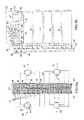
- FIGS. 5 a and 5 brepresent two possible variant embodiments of the reception antenna 41 of the radar antenna 40 according to the invention.
- the reception antenna 41 represented in FIG. 5 anotably includes two columns 43 , 44 each having, for example, twelve reception subarrays 46 of radiating elements 45 .
- the outputs 51 of the reception subarrays 46are, for example, switched at the microwave level by four microwave switches 52 each having six inputs 53 and an output 54 .
- the reception antenna 41 represented in FIG. 5 bnotably has two columns 43 , 44 each having, for example, six reception subarrays 46 of radiating elements 45 .
- Each reception subarray 46is associated with a receiver 55 .
- the receivers 55are normally used in array antennas.
- Each receiver 55can have four inputs 56 corresponding to one output of each radiating element 45 of a reception subarray 46 .
- Each receiver 55can have four reception channels each corresponding to one input 56 .
- Each reception channelnotably has a low noise amplifier 57 in order to optimize the noise factor of the fourth received signal 25 , 27 .
- Each receiver 55is linked to a local oscillator 63 notably supplying a signal to the emission antenna 42 , not represented in FIG. 5 b .
- the fourth received signal 25 , 27passes through a mixer 58 which mixes the received signal with the emitted signal.
- the signalthen passes through a set of filters and amplifiers 65 .
- Each reception channelis linked to one and the same analog coder 59 which is used to convert the received analog signal into a digital signal.
- the fourth signal received 25 , 27is then processed by a programmable component 61 which notably carries out an FFT processing operation on the fourth received signal 25 , 27 .
- a serial link 62is used to pass the fourth received signal 25 , 27 , via a connector 60 , to a computer that is not represented in FIG. 5 b which processes it.
- a regulation component 64is used to perform a filtering in order to avoid disturbances due to an electrical power supply not represented in FIG. 5 b .
- the detection methodcan be implemented by simultaneously addressing all the channels, or sequentially by switching at the level of the digital processing of the fourth received signal 25 , 27 , according to the available processing resources and the time allotted to perform the processing of the fourth received signal 25 , 27 .
- the reception subarrays 46can, for example, be selected on the receiver 55 itself, in analog or digital mode, or even by processing software.
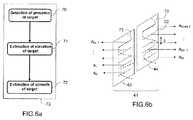
- FIG. 6 arepresents the main steps of a method 73 of locating an aircraft according to the invention.
- the method 73 of locating an aircraftis implemented using the radar antenna 40 according to the invention as represented in FIG. 4 .
- a first step 70is the detection of the target 1 by the radar antenna 40 according to the invention. This detection of the target 1 is performed by initially scanning all the reception subarrays 46 of the reception antenna 41 as described previously. Then, the reception subarray(s) 46 receiving a signal of maximum amplitude handle the detection.
- a second step 71 of the method 73 of locating an aircraftis estimating the elevation of the target 31 .
- an exemplary method of estimating the elevation of the target 31is described.
- the coefficient of reflection of the fourth received signal 25 , 27 on the groundis, for example, estimated.
- the target 31is located in elevation, for example by means of a conventional angle error measurement processing of monopulse type in signal reception mode. Upward-pointing detection signal emission feeds can in this case be used.
- a calculation of the amplitude modulation frequency of the fourth composite received signal 25 , 27 over the height of the reception antenna 41can be carried out.
- the calculation of the frequencymakes it possible to deduce the elevation of the target 31 as described hereinbelow.
- the calculationis performed by means of a spatial sampling of the amplitude of the interference signal 73 received over the height of the reception antenna 41 as represented in FIG. 6 b .
- Each sampling position A 0 , A 1 , . . . , A N ⁇ 1 , A N , A N+1 , A N+N ⁇ 1corresponds to a line of independent radiating elements 22 , of the reception antenna 41 .
- Each line of radiating elements 22corresponds to a reception subarray 46 as represented in FIG. 4 .
- the height difference ⁇ between two consecutive sampling positionsis:
- a sampling carried out in a non-constant manneris, for example, performed when there is a desire to extend the field of non-ambiguity of an elevation measurement.
- the elevation measurementbecomes ambiguous as soon as the phase difference of the sinusoid of the amplitude modulation of the fourth received signal 25 , 27 is greater than ⁇ between two lines of radiating elements 22 that are contiguous in the vertical plane of the reception antenna 41 .
- a samplingcan be carried out on positions S 0 , S 1 , . . . , S N ⁇ 1 , S N , S N+1 , . . . , S N+N ⁇ 1 in a non-periodic manner.
- Such a samplingcan be performed so that the phase difference between two successive samples varies over the height of the antenna, and so that this variation is different according to the ambiguity rank I of the modulation frequency relative to the sampling frequency.
- a progressive spacing lawcan be used from one end of the antenna 41 to the other, for example of the type: ⁇ , ⁇ + ⁇ , ⁇ +2 ⁇ , ⁇ +3 ⁇ , ⁇ +4 ⁇ , ⁇ +4 ⁇ , ⁇ +5 ⁇ , . . . , ⁇ being very small compared to ⁇ .
- the phase differences obtained between two successive samplesare respectively: I ⁇ , I ⁇ +4 ⁇ 1 / ⁇ , I ⁇ +8 ⁇ 1 / ⁇ , I ⁇ +12 ⁇ 1 / ⁇ , I ⁇ +16 ⁇ 1 / ⁇ , I ⁇ +20 ⁇ 1 / ⁇ , . . .
- This samplingmakes it possible to calculate I and ⁇ 1 from samples of the signal received and unambiguously deduces the angle of elevation therefrom.
- the elevationcan be estimated by a direct correlation calculation as described hereinbelow.
- an amplitude level S(x)can be expected to be found, said amplitude level having the form:
- 21+ ⁇ 2 ⁇ 2* ⁇ *cos(4* ⁇ * h 2 *x /( ⁇ * d )) (8)
- the level S(x)corresponds to the amplitude level defined by the relation (4), bearing in mind that the phase ⁇ of the fourth received signal 25 , 27 is ⁇ because of the horizontal polarization processing of the fourth received signal 25 , 27 .
- the angle ⁇ 1is discretized into N ⁇ angles ⁇ i of index i varying from 1 to N ⁇ , with a discretization step ⁇ ⁇ .
- An expected level for the fourth received signal 25 , 27 on the line of radiating elements 22 of rank k situated at a height x k from the groundcan then be expressed in the form:
- 21+ ⁇ 2 ⁇ 2* ⁇ *cos(4 * ⁇ *x k * ⁇ i / ⁇ ) (9)
- the next stepwill then be to maximize the function Correl( ⁇ i ) in order to obtain the maximum correlation between the functions S ⁇ i (k) and the amplitude of the fourth received signal 25 , 27 actually measured on the different lines of radiating elements 22 of the reception antenna 41 .
- the elevation heightcan then be determined for a non-flat and non-horizontal ground 30 from:
- h lrepresents the height relative to the ground 30 of the reception antenna 41
- h 2represents the estimation of the elevation height calculated in the case of a flat and horizontal ground 30 .
- are the coordinates of the point of reflection R.
- H 2h 2 +z R +(d ⁇ x R ) ⁇ R
- h 2being the calculated height of the target 31 relative to the ground in the case of a flat and horizontal ground 30 and d being the distance projected on the ground 30 from the target 31 to the reception antenna 41 .
- the ambiguity on the estimation of the height of the targetis eliminated by using a non-constant sampling over the height of the radar antenna 40 . Furthermore, it is possible to use a number of different emission frequencies to improve the location measurement generally and, more particularly, the elevation measurement.
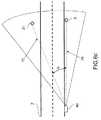
- a third step 72 of the location method 73is estimating the azimuth angle of the target 31 by monopulse phase angle error measurement.
- the angle error measurement calculationis performed by determining an angle ⁇ , represented in FIG. 6 c , between a first straight line 74 linking the radar antenna 40 and the second beacon 5 and a second straight line 75 linking the radar antenna 40 with the first onboard beacon 4 as represented in FIG. 6 c.
- the angle error measurement calculationuses the measurements performed by at least two reception subarrays 46 each situated on a column 43 , 44 of the reception antenna 41 .
- the two reception subarrays 46 usedare notably situated at one and the same height in the plane of the reception antenna 41 , and are then said to be of the same rank.
- Two samples (S 1 , S 2 , . . . , S N ) and (S′ 1 , S′ 2 , . . . , S′ N ) of values of the modulation signal 76are thus obtained.
- the values 77 retained for the azimuth angle error measurement calculationare those exhibiting a maximum amplitude of the modulation signal.
- the angle error measurement calculationcan then be performed on each pair of reception subarrays 46 of the same rank, using, for example, a phase monopulse type operator by forming sum S i +S′ i and difference S i ⁇ S′ i channels, i being between 1 and N, N being the number of reception subarrays 46 of the reception antenna 41 .
- the angle error measurement calculationcan also, in another embodiment, be performed with a weighted average of the angle error measurement estimated over all the pairs of reception subarrays 46 of the same rank. A weighting of the average obtained is then performed by using the signal-to-noise ratio observed for each of the pairs of reception subarrays 46 of the same rank.
- the antenna of the radar 40 and the location method 73 according to the inventioncan also be used in the presence of reflections on the sea for example.
- the inventioncan be applied to any communication system confronted by the problem of multiple reflections.
- the present inventioncan also be used to locate other types of mobiles, such as boats or automobiles for example.
- the radar antenna 40 according to the invention and the associated method 73 of locating the target 31advantageously constitute an alternative to the array antenna-based solutions in which the aim is to use all the feeds of the array to form a beam such that the target 31 is seen under a maximum gain, whereas the image 30 , is seen under a minimum gain.
- the measurement accuracy in elevation in the presence of an image effectis much better than that obtained by a beam-forming array antenna by calculation, given the same physical dimensions.
- the detection performed using the radar antenna 40 according to the inventionadvantageously has a performance stability in the field of angular coverage of a reception subarray 46 .
- selecting a reception subarray 46 receiving the maximum energymakes it possible to advantageously avoid the losses of targets due to the plurality of the paths of the signal emitted by the target 31 in the presence of the phenomenon of reflections on the ground 30 of the signal reemitted by the target 31 .
- the sequential switching of the various reception subarrays 46 over the height of the antennaallows for an accurate estimation of the elevation of the target 31 in the location phase, while advantageously limiting:
- the signal processing operations implemented by the radar antenna 40 according to the inventionare advantageously simple and robust: there is no need to apply complex adaptive processing operations which are o also very sensitive to the assumptions made concerning the nature of the reflections on the ground, notably.
- the radar antenna 40 according to the inventiondoes not have to know a priori the position of the target, or permanently or adaptively point a beam by electronic scanning.
- the radar antenna 40 according to the inventionalso has the benefit of allowing for a relative independence of the accuracy of the results obtained for the location in elevation with respect to inaccuracies in the inclination of the radar antenna 40 .
- the radar antenna 40 according to the inventioncan operate in degraded mode; when one or other of the reception channels 46 fails, the other channel can fulfill the function for detecting and locating the target 31 . It is also possible to deliberately reduce the number of reception channels 46 .
- Another benefit of the device 40 according to the inventionis that it can be implemented on conventional electronic scanned antennas.
Landscapes
- Engineering & Computer Science (AREA)
- Radar, Positioning & Navigation (AREA)
- Remote Sensing (AREA)
- Physics & Mathematics (AREA)
- Computer Networks & Wireless Communication (AREA)
- General Physics & Mathematics (AREA)
- Electromagnetism (AREA)
- Radar Systems Or Details Thereof (AREA)
Abstract
Description
The present application is the U.S. National Phase of International Patent Application Serial No. PCT/EP2008/053058, filed on Mar. 14, 2008, which claims the benefit of French Patent Application Serial No. 07/01926, filed on Mar. 16, 2007, both of which are hereby incorporated by reference in their entireties.
The present invention relates to a device and a method for locating a mobile approaching a surface reflecting electromagnetic waves. The invention can be used, for example, in order to determine the position of an aircraft in the final landing phase for a guidance device.
The landing of an aircraft is a very tricky phase during which the slightest positioning error can lead to major damage to the aircraft. Notably, manual guidance during the landing phase is hazardous because of the difficulties in assessing the distance of the aircraft, the presentation of the aircraft and its real speed. Thus, a number of automatic guidance systems have been implemented in order to guide aircraft during a landing phase. The automatic guidance of an aircraft involves accurately determining the current position of the aircraft in order to correct, possibly automatically, its trajectory to align it correctly with a landing runway for example. This determination of the current position of the aircraft can be performed using various systems.
Among these systems, the best known are ILS (Instrument Landing Systems). The ILS systems are instrument approach systems for aircraft that are equipped therewith. The ILS system makes it possible to indicate to the pilot the maneuvers to be carried out for a successful landing. These systems therefore require specific instrumentation on board the aircraft and detection and guidance systems on the ground. The ILS systems are divided into three categories: category one, category two and category three. Among these three categories, only category three can be used in all weathers.
Another guidance system employed at airports is the MLS, standing for Microwave Landing System. The MLS is a microwave landing system. It can be used to provide precision guidance for a landing, regardless of the meteorological conditions. The ILS and MLS systems are very heavy equipment, both on the ground and on board the aircraft. While they are suited to airport installations of wide coverage, it is totally impossible to consider equipping small aerodromes with such equipment. In addition, light aircraft cannot host the equipment needed to implement these systems, as much for reasons of cost as for lack of space.
Apart from these conventional means primarily used by commercial civilian aviation, other solutions can be envisaged.
A first solution uses the GPS system, or Global Positioning System, or even the DGPS system, standing for Digital Global Positioning System. The main drawback of the GPS systems is their lack of robustness. In practice, the GPS service is not always available. Moreover, GPS location efficiency can be degraded by multiple reflections in the vicinity of the ground.
A second solution is to use a LIDAR, or Light Detection And Ranging, system. This location system, which operates on the same principle as radar, uses electromagnetic waves in the visible range, or in the infrared range. This therefore makes it unusable when the meteorological conditions are unfavorable. In addition, the LIDAR beam is very narrow. It is therefore essential to carry out a large number of sweeps to detect a target. This makes the search time relatively lengthy in a phase during which it is important to lock onto the target as rapidly as possible. This solution also requires accurate positioning relative to the landing runway.
Another solution consists in using a highly directional millimetric wave radar. The millimetric wave radar also requires a search phase to designate the target. It must also be positioned accurately relative to the landing runway. In addition, even by using a very narrow radar beam, when the target is very close to the ground, the reflections of the waves on the ground are superimposed on the reflection of the wave emitted by the radar on the target, making the detection unreliable and imprecise. This solution is also very costly and requires a responder on board the aircraft. The responder is itself costly, bulky, heavy, and consumes a lot of energy.
Solutions commonly set up to overcome the problems of reflections on the ground consist notably in filtering, on the radar antenna, the signals reflected by the ground by minimizing the contribution of these signals through an appropriate orientation and directivity of the beam from the radar antenna.
The filtering of such signals requires highly directional antennas that are pointed very accurately. These antennas apply complex processing operations, such as high resolution adaptive processing, to the received signal. The adaptive processing operations require significant computation means while being very sensitive to the assumptions made on a propagation model of the wave to be processed. In particular, assumptions must be made as to the consistency or otherwise of the reflections with respect to the direct signal, the direct signal being the signal not reflected on the ground. These assumptions are not borne out in all cases. This makes these processing operations not very robust and difficult to implement.
The contribution of the signals reflected by the ground in the received signal can be minimized by an accurate positioning of the antenna of the radar so as, for example, to place the paths reflected by the ground in empty spaces in the pattern of the antenna. This minimizing can be done by array antennas of large dimensions that perform an appropriate spatial filtering making it possible to improve the contrast of the direct signal relative to the reflected signal while preserving an adequate gain in the direction of the direct path. The reduction in the aperture of the antenna beam that is needed for this type of processing involves increasing the dimensions of the antenna. However, the dimensions of the antenna are greatly constrained, notably by its physical location. In practice, for practical and safety reasons, it is impossible to deploy a radar antenna of large dimensions at the edge of a landing runway.
One aim of the invention is notably to overcome the abovementioned drawbacks. To this end, the subject of the invention is a device and a method for locating a mobile approaching a surface reflecting electromagnetic waves.
The location device can notably comprise:
- an emission antenna;
- a reception antenna.
The emission antenna comprises, for example, one or more emission positions. Each emission position can emits a detection signal toward the mobile. The reception antenna comprises, for example, at least one column consisting of one or more reception positions. Each reception position can receive a signal reemitted by the mobile. An emission of the detection signal is activated on each emission position. An emission position that has thus given rise to a detection by the reception antenna of the signal of maximum energy reemitted by the mobile is selected to perform a location of the mobile. One or more signals of maximum energy can be received by one or more reception positions. These signals of maximum energy can indicate the detection of the mobile. The signals of maximum energy are then preferably used to locate the mobile.
The reception positions receiving a signal of maximum energy are used for an angular location of the mobile in a plane substantially parallel to the surface reflecting the electromagnetic waves.
All the reception positions are used for an angular location of the mobile in a plane substantially perpendicular to the surface reflecting the electromagnetic waves.
The reception antenna comprises a number of reception subarrays comprising radiating elements. A reception position corresponds, for example, to the position of a fixed reception subarray. The reception subarrays can then be activated in succession.
The emission antenna comprises a number of emission channels. An emission position corresponds, for example, to the position of a fixed emission channel. The emission channels can then be activated in succession.
The reception antenna can comprise one or more reception subarrays consisting of radiating elements. The reception subarray(s) can be moved to the reception positions.
The reception subarray(s) can be moved continually.
The emission antenna can comprise one or more emission channels being moved to the emission positions.
The emission channel(s) can be moved continually.
The reception positions are, for example, spaced apart using an irregular spacing law.
The reception positions are, for example, spaced apart using a progressive spacing law.
The emission antenna and the reception antenna can be collocated.
The mobile is, for example, an aircraft.
The location method can comprise at least the following steps:
- a first step of selecting an emission position having given rise to a detection by the reception antenna of the signal of maximum level reemitted by the mobile in order to perform a location of the mobile;
- a second step of locating the mobile by using one or more signals of maximum energy received by one or more reception positions.
An angular location of the mobile in a plane substantially parallel to the surface reflecting the electromagnetic waves is performed by using one or more signals of maximum energy received by one or more reception positions.
An angular location of the mobile in a plane substantially perpendicular to the surface reflecting the electromagnetic waves is performed by using the signals received by each reception position.
The mobile is, for example, an aircraft.
The main benefits of the invention are notably that it gives a good accuracy for locating the aircraft by applying robust and simple processing operations. The radar antenna according to the invention advantageously has small dimensions and tolerates an approximate positioning without the location results being degraded.
Other features and benefits of the invention will become apparent from the following description, given by way of illustrative and nonlimiting example, and given in light of the appended drawings which represent:
Guiding theaircraft 1 in the landing phase entails knowing the position of theaircraft 1 accurately and, notably, its coordinates in azimuth and in elevation. To this end, theradar 3 emits a detection signal6 toward theaircraft 1, that will also hereinafter be calledtarget 1 of theradar 3. The outer skin of theaircraft 1 returns the received signal6 in the form of an echo. The first onboard beacon4, on detecting the signal6 emitted by theradar 3, also sends a response signal toward theradar 3. Theradar 3 therefore receives a skin echo from theaircraft 1 and a signal coming from the first beacon4 on board theaircraft 1. The signal returned by the first beacon4 advantageously provides for a more accurate location of the aircraft than the echo originating from the skin of theaircraft 1.
The presence of the second beacon on theground 5 enables theradar 3 to perform differential measurements in order to cancel out the detection bias. The accuracy of the positioning measurements concerning theaircraft 1 by theradar 3 is therefore advantageously improved by the presence of thesecond beacon 5.
In order to simplifyFIG. 2 , only the signals emitted or received by one of the lines of radiatingelements 22 of theantenna 21 are represented. Theline 23 of radiatingelements 55 concerned is situated, for example, at a height h1from theground 30.
Theline 23 of radiating elements emits afirst detection signal 24 toward atarget 31. Thistarget 31 can, for example, be theaircraft 1 with the first beacon4 on board. InFIG. 2 , thetarget 31 is situated at a height h2from theground 30 and at a horizontal distance d from theradar antenna 21.
Thefirst detection signal 24 is then reemitted by thetarget 31 in the form of asecond signal second response signal aircraft 1 or a signal emitted by the first beacon4 in response to thefirst detection signal 24. When it is a skin echo, thetarget 31 is a passive source, whereas if the response comes from the first beacon4, thetarget 31 is an active source.
Thesecond response signal paths first path 25 is adirect path 25 leaving from thetarget 31 and arriving on the line of radiatingelements 23. Thefirst path 25 for example forms with the horizontal an angle θc, also called elevation angle of thetarget 31 seen from theradar antenna 23. Thesecond path 26 is emitted toward theground 30, or any other reflecting surface, by thetarget 31. Thesecond path 26 is reflected in a quasi-specula manner by theground 30 because of the low altitude of thetarget 31. The reflection of thesecond path 26 on theground 30 notably gives rise to athird path 27 that is directed toward the line of radiatingelements 23. Thethird path 27 can be represented by the continuation of afourth path 28 of a thirdhypothetical signal image 30, of thesource 31. In the case, ofFIG. 2 , with a flat andhorizontal ground 30, theimage 30, is the orthogonal projection of thesource 31 relative to theground 30. Thethird path 27 for example forms with the horizontal an angle θicalled elevation angle of theimage 29, seen from theradar antenna 23.
The system consisting of thetarget 31 and itsimage 30, forms a target-image bipole fourth signal elements 23, therefore comprises thefirst path 25 of thesecond signal target 31 and thethird path 27 derived from the thirdhypothetical signal image 30, of thetarget 31.
The reflection phenomenon described also applies when operating the antenna in emission mode. In practice, a first emittedsignal 24 can also comprise a number of paths, some of which can be reflected on theground 30. Since the phenomenon is similar, it is not represented inFIG. 2 .
Thetarget 31 is, for example, situated at a height h2relative to theground 30. The fourthcomposite signal target 31 and from itsimage 30, generates, on theradar antenna 21, an interferometry figure whose frequency is 2h2/λd, expressed in m−1, in which m is used for meters, λ being the wavelength of thefourth signal radar antenna 21. The frequency of the interferometry figure is therefore independent of the value of the coefficient of reflection of thesecond path 26 of thesecond signal ground 30.
The physical quantities that characterize the interference diagram at a given instant are as follows:
- d: the projected distance on the
ground 30 between thetarget 31 and theradar antenna 21; - θ: the viewing angle of the line of radiating
elements 23 toward the target-image bipole ground 30; - h1: the height relative to the
ground 30 of the line of radiating elements concerned23 on theantenna 21; - h2: the height of the target relative to the
ground 30.
The amplitude interference diagram resulting from the modeling of the fifth signal emitted by the target-image bipole
|I(θ)|2=1+ρ2+2ρcos((4πh2sin(θ))/λ)+φ) (1)
in which - ρ represents the amplitude of the ground reflection coefficient,
- φ is a phase difference between the incident
third path 27 and thefirst path 25 reemitted by thetarget 31, - λ is the wavelength of the
first signal 24 emitted by theantenna 21.
Given that theradar antenna 21 is close to theground 30 and that thetarget 31 is in the landing phase, thetarget 31 is also close to theground 30. The height h2relative to theground 30 is therefore low compared to the distance d. It can therefore be considered that the angle θ has low values. This therefore makes it possible to simplify the equation (1) in order to obtain, for the interference, the following formula, by likening sin (θ) to θ:
|I(θ)|2=1+ρ2+2ρcos((4πh2θ)/λ)+φ) (2)
If h1is the height of a radiatingline 23 of theantenna 21, for low values of θ,
the following relation applies: h1=d×θ (3)
which gives, for the equation (2), the following form:
|I(h1)|2=1+ρ2+2ρcos((4πh2h1)/λd)+φ) (4)
This relation (4) expresses the appearance of the interference curve in amplitude as a function of the height h1of thefourth signal elements 23 of theradar antenna 21.
- d: the projected distance on the
Given the distances involved, the far field hypothesis is considered to be borne out, which means that the paths of the third signal lo emitted by thetarget 31 are considered to be parallel with each other, as are the paths of the fourth signal emitted by thetarget 31. This hypothesis makes it possible to have, for the difference in length between the length r1of the firstdirect path 25 and the length r2of the reflectedpaths second path 26 and thethird path 27, a good approximation which is:
r2−r1=(2×h1×h2)/d (5)
r2−r1=(2×h1×h2)/d (5)
Thereception antenna 41 comprises at least twoidentical columns column elements 45. The reception subarrays46 are, for example, distributed regularly over the entire height of thereception antenna 41. The reception subarrays46 are reception channels of thereception antenna 41. Eachreception subarray 46 notably has an aperture of 20° in azimuth and 20° in elevation. This aperture is sufficient to cover the field in which theaircraft 1 is moving during the landing phase, called field of interest. Eachreception subarray 46 covers, notably in elevation, +15° above theground 30 and −5° below theground 30 in order to cover any dip in thelanding runway 2. The reception subarrays46 can, for example, be produced using printed circuits.
Theemission antenna 42 notably comprises M emission channels or emission feeds47 that can be identical. InFIG. 4 , fouremission channels 47 are represented by way of example. Each emission feed47 notably comprises a subarray of radiatingemission elements 48. Eachemission subarray 48 can be used to emit afirst detection signal 24 notably toward theaircraft 1 to be located. A waveform generator, not represented inFIG. 4 , generates thefirst detection signal 24 emitted. The waveform generator can be produced using a frequency-controlled local oscillator. Eachfeed 47 also includes anamplifier 49 to amplify the detection signal generated by the waveform generator. Thefirst detection signal 24 emitted by eachfeed 47 covers, for example, a field of 10° in elevation and 20° in azimuth.
The field illuminated by theemission antenna 40 is limited only by the aperture of an individual antenna consisting, for example, of a line of radiatingelements 47. Theradar antenna 40 according to the invention therefore advantageously has watch capabilities in an extended angular field.
One or more additional feeds can be used, aiming upward, in order to cover higher sites if necessary.
A search is carried out using theradar antenna 40 according to the invention to detect, initially, atarget 31 in a phase of landing on therunway 2. Eachfeed 47 is, for example, activated in succession in order to detect thetarget 31. Once thetarget 31 is detected, thefeed 47 that was used to detect thetarget 31 with a signal of maximum strength is then used to accurately locate thetarget 31. When a first detection of thetarget 31 is carried out, theradar antenna 40 according to the invention can be used to localize thetarget 31 and determine its successive positions according to the same principle as that used for the detection.
In thetarget 31 detection phase and location phase, one ormore reception subarrays 46 receiving a maximum of energy are selected. The selection of one ormore reception subarrays 46 is performed by comparing the energy received by thedifferent reception subarrays 46. This comparison is performed either by sequentially switching thevarious reception subarrays 46, or by simultaneously using thevarious reception subarrays 46. Switching thereception subarrays 46 makes it possible to move the phase center over the height of thereception antenna 41. Moving the phase center makes it possible to select one or more of thereception subarrays 46 receiving a signal of maximum energy. The signal of maximum energy received on one ormore reception subarrays 46 results in a quasi-equality of phase between the directfirst path 25 and the second path reflected on theground 26 in athird path 27 represented inFIG. 2 for example. The maximum energy received on the various reception subarrays46 of thereception antenna 41 can be estimated for a predefined frequency band notably corresponding to the frequency of theemission antenna 42 or of the first onboard beacon4.
The detection of a signal in the presence of an image effect is therefore favored by this principle of use of theradar antenna 40 according to the invention. Furthermore, in the location phase, the detection of thetarget 31 is maintained permanently by selecting one ormore reception subarrays 46 receiving a signal of maximum energy, which makes it possible to avoid detection dips usually observed with conventional radars in the presence of reflection on the ground or any other surface having a capacity to reflect the electromagnetic waves.
In practice, in the case where thefourth signal aircraft 1, t he term I(h1) of the relation (4) is used as a multiplying term in a range budget of theradar antenna 40. If h1≧λd/4h2, and if the average sampling step Δ is sufficiently fine, then at least one of thereception subarrays 46 receives a signal whose amplitude is multiplied by 1+ρ2+2ρ, because of the reflection of thefourth signal target 31 on theground 30. This is therefore equivalent, for example, to a gain on the range budget of theradar antenna 40 of the order of 6 db, for afourth signal elements 23 receiving a signal of maximum amplitude is equivalent to that which would be obtained excluding reflection on a line of radiating elements approximately four times greater.
Moreover, if the radar range budget is considered on afourth signal aircraft 1, given the hypothesis that theemission 42 andreception 42 antennas are collocated, the paths of the signal then being identical when going and returning, the term I(h1) of the relation (4) is then used squared in the range budget of the radar. In this case, the range budget obtained on thereception subarray 46 which receives the signal of maximum amplitude is equivalent to that which would be obtained excluding reflections on theground 30 for an antenna with a vertical dimension up to sixteen times greater than the vertical dimension of the line of radiatingelements 23. Advantageously, even if the reflection coefficient is less than one, and even if the sampling is not performed strictly on a maximum amplitude, the gain obtained on the range budget remains significant and the selection of the lines of radiating elements receiving the maximum signal makes it possible to avoid detection losses associated with the destructive interferences between the signals originating from thetarget 31 and from itsimage 30, represented inFIG. 2 .
In another embodiment, theemission antenna 42 according to the invention can include one ormore emission channels 47 that move vertically over the plane of theemission antenna 47. Among the successive positions of the emission channel(s)47, the position of a emission channel oremission position 47 giving rise to a detection of theaircraft 1 is selected in order to handle the location of theaircraft 1. The emission channel(s) then remain positioned on the position that gave rise to the detection.
Similarly, thereception antenna 41 can include one or more lines ofsubarrays 46 of radiatingreception elements 55 moving vertically over the plane of thereception antenna 41. The position of the line or lines ofreception subarrays 46 giving the maximum of energy then being preferably selected in order to accurately determine the position of thetarget 31. The phase center of the received signal is then on thereception position 46 receiving a signal of maximum energy.
Thereception antenna 41 represented inFIG. 5 anotably includes twocolumns reception subarrays 46 of radiatingelements 45. Theoutputs 51 of thereception subarrays 46 are, for example, switched at the microwave level by fourmicrowave switches 52 each having sixinputs 53 and anoutput 54.
Thereception antenna 41 represented inFIG. 5 bnotably has twocolumns reception subarrays 46 of radiatingelements 45. Eachreception subarray 46 is associated with areceiver 55. Thereceivers 55 are normally used in array antennas. Eachreceiver 55 can have fourinputs 56 corresponding to one output of each radiatingelement 45 of areception subarray 46. Eachreceiver 55 can have four reception channels each corresponding to oneinput 56. Each reception channel notably has a low noise amplifier57 in order to optimize the noise factor of the fourth receivedsignal receiver 55 is linked to alocal oscillator 63 notably supplying a signal to theemission antenna 42, not represented inFIG. 5 b. The fourth receivedsignal mixer 58 which mixes the received signal with the emitted signal. The signal then passes through a set of filters andamplifiers 65. Each reception channel is linked to one and thesame analog coder 59 which is used to convert the received analog signal into a digital signal. The fourth signal received25,27 is then processed by aprogrammable component 61 which notably carries out an FFT processing operation on the fourth receivedsignal serial link 62 is used to pass the fourth receivedsignal connector 60, to a computer that is not represented inFIG. 5 bwhich processes it. A regulation component64 is used to perform a filtering in order to avoid disturbances due to an electrical power supply not represented inFIG. 5 b. With this type of reception antenna, the detection method can be implemented by simultaneously addressing all the channels, or sequentially by switching at the level of the digital processing of the fourth receivedsignal signal
In other embodiments, thereception subarrays 46 can, for example, be selected on thereceiver 55 itself, in analog or digital mode, or even by processing software.
Afirst step 70 is the detection of thetarget 1 by theradar antenna 40 according to the invention. This detection of thetarget 1 is performed by initially scanning all the reception subarrays46 of thereception antenna 41 as described previously. Then, the reception subarray(s)46 receiving a signal of maximum amplitude handle the detection.
Asecond step 71 of themethod 73 of locating an aircraft is estimating the elevation of thetarget 31. Hereinafter, an exemplary method of estimating the elevation of thetarget 31 is described.
Firstly, the coefficient of reflection of the fourth receivedsignal
If the reflections on theground 30 are negligible, thetarget 31 is located in elevation, for example by means of a conventional angle error measurement processing of monopulse type in signal reception mode. Upward-pointing detection signal emission feeds can in this case be used.
If there are significant reflections on theground 30, a calculation of the amplitude modulation frequency of the fourth composite receivedsignal reception antenna 41 can be carried out. The calculation of the frequency makes it possible to deduce the elevation of thetarget 31 as described hereinbelow. The calculation is performed by means of a spatial sampling of the amplitude of theinterference signal 73 received over the height of thereception antenna 41 as represented inFIG. 6 b. Each sampling position A0, A1, . . . , AN−1, AN, AN+1, AN+N−1corresponds to a line ofindependent radiating elements 22, of thereception antenna 41. Each line of radiatingelements 22 corresponds to areception subarray 46 as represented inFIG. 4 . The height difference Δ between two consecutive sampling positions is:
- either constant and small enough compared to the frequency of the fourth composite received
signal - or not constant.
- either constant and small enough compared to the frequency of the fourth composite received
A sampling carried out in a non-constant manner is, for example, performed when there is a desire to extend the field of non-ambiguity of an elevation measurement. The elevation measurement becomes ambiguous as soon as the phase difference of the sinusoid of the amplitude modulation of the fourth receivedsignal elements 22 that are contiguous in the vertical plane of thereception antenna 41.
When θ1is taken to be the angle between theground 30 and a line linking the position on the ground of theantenna 21 and the position of thetarget 31, for low values of θ1, h2=d×θ1. By using the relation (4), the phase difference between two successive lines of radiatingelements 22, whose phase centers are distant from each other by Δ, is equal to 4πΔθ1/λ. Thus, as soon as θ1>λ/4Δ, the elevation measurement is ambiguous. For example, if two lines of radiatingelements 22 abut with each other, Δ is then equal to the height of one of the two lines of radiatingelements 22 of aperture α=λ/Δ. In this case, the elevation measurement is ambiguous as soon as θ1>α/4. Notably, for α=20°, θiis ambiguous when it is 5°.
Generally, when θ1=λ/4Δ+kπ, all the samples take the same value. The amplitude modulation is then not visible on the sampling positions S0, S1, . . . , SN−1, SN, SN+1, . . . , SN+N−1.
To avoid this problem of ambiguity, a sampling can be carried out on positions S0, S1, . . . , SN−1, SN, SN+1, . . . , SN+N−1in a non-periodic manner. Such a sampling can be performed so that the phase difference between two successive samples varies over the height of the antenna, and so that this variation is different according to the ambiguity rank I of the modulation frequency relative to the sampling frequency.
For example, a progressive spacing law can be used from one end of theantenna 41 to the other, for example of the type: Δ, Δ+ε, Δ+2ε, Δ+3ε, Δ+4ε, Δ+4ε, Δ+5ε, . . . , ε being very small compared to Δ. In this way, the phase differences obtained between two successive samples are respectively: Iπ, Iπ+4πεθ1/λ, Iπ+8πεθ1/λ, Iπ+12πεθ1/λ, Iπ+16πεθ1/λ, Iπ+20πεθ1/λ, . . . This sampling makes it possible to calculate I and θ1from samples of the signal received and unambiguously deduces the angle of elevation therefrom.
The ratio between the height h2of thetarget 31 relative to theground 30 and the distance d projected on the ground between the antenna of theradar 40 and thetarget 31 can be expressed as a function of the frequency f of the interference signal calculated according to the following relation:
h2/d=λƒ/2 (6)
where λ is the wavelength of the emitted signal.
h2/d=λƒ/2 (6)
where λ is the wavelength of the emitted signal.
The elevation can be estimated by a direct correlation calculation as described hereinbelow.
Initially, a non-coherent summation of the amplitude A of thesignal 73 received on two lines of radiatingelements 22 of the same rank k, k varying from 0 to (N−1), is performed. Two lines of radiatingelements 22 of the same rank K are lines that each belong to one of thecolumns reception antenna 41, situated at one and the same height relative to the ground in the plane of thereception antenna 41. For each rank k, the following is therefore obtained:
Sbk=|Ak|2+|AN+k|2 (7)
Sbk=|Ak|2+|AN+k|2 (7)
With flat ground, on a sampling position Skcorresponding to a line of radiatingelements 22 situated at a height x from the ground, and for a height h2of the beacon4 on board thetarget 31, an amplitude level S(x) can be expected to be found, said amplitude level having the form:
|S(x)|2=1+ρ2−2*ρ*cos(4*π*h2*x/(λ*d)) (8)
The level S(x) corresponds to the amplitude level defined by the relation (4), bearing in mind that the phase φ of the fourth receivedsignal signal
|S(x)|2=1+ρ2−2*ρ*cos(4*π*h2*x/(λ*d)) (8)
The level S(x) corresponds to the amplitude level defined by the relation (4), bearing in mind that the phase φ of the fourth received
The angle θ1is discretized into Nθ angles θiof index i varying from 1 to Nθ, with a discretization step Δθ. An expected level for the fourth receivedsignal elements 22 of rank k situated at a height xkfrom the ground can then be expressed in the form:
|Sθi (k)|2=1+ρ2−2*ρ*cos(4*π*xk*θi/λ) (9)
|Sθ
Then, a correlation function Correl(θi) is used, defined as follows:
The next step will then be to maximize the function Correl(θi) in order to obtain the maximum correlation between the functions Sθi(k) and the amplitude of the fourth receivedsignal elements 22 of thereception antenna 41.
An estimation of h2/d is then deduced therefrom using the index j of the angle θifor which the function Correl(θi) is maximum, as follows:
h2/d=Δθ*j (11)
h2/d=Δθ*j (11)
The elevation height can then be determined for a non-flat andnon-horizontal ground 30 from:
- a point of reflection R of the
second path 26 reemitted by thetarget 31 toward theground 30 on the latter, - the elevation height determined for a flat and
horizontal ground 30,
the expression of the equality between the angles of incidence of the rays reemitted by the target toward theground 26 and that reflected by theground 30 with a plane tangent to the ground at the point of reflection R making it possible to obtain the coordinates (xR, zR) of the point of reflection R and the angle αRbetween the plane tangent to the ground at the point R and the horizontal from the following cost function:
- a point of reflection R of the
in which hlrepresents the height relative to the
The ambiguity on the estimation of the height of the target is eliminated by using a non-constant sampling over the height of theradar antenna 40. Furthermore, it is possible to use a number of different emission frequencies to improve the location measurement generally and, more particularly, the elevation measurement.
An accurate elevation measurement is thus obtained simply by taking into account the reflection phenomenon on the ground or any other reflecting surface, if necessary.
Athird step 72 of thelocation method 73 is estimating the azimuth angle of thetarget 31 by monopulse phase angle error measurement. The angle error measurement calculation is performed by determining an angle α, represented inFIG. 6 c, between a firststraight line 74 linking theradar antenna 40 and thesecond beacon 5 and a secondstraight line 75 linking theradar antenna 40 with the first onboard beacon4 as represented inFIG. 6 c.
The angle error measurement calculation uses the measurements performed by at least tworeception subarrays 46 each situated on acolumn reception antenna 41. The tworeception subarrays 46 used are notably situated at one and the same height in the plane of thereception antenna 41, and are then said to be of the same rank.
A sampling of themodulation signal 76 received on thereception antenna 41, and as represented inFIG. 6 d, is performed on eachreception subarray 46 of eachcolumn modulation signal 76 are thus obtained. Thevalues 77 retained for the azimuth angle error measurement calculation are those exhibiting a maximum amplitude of the modulation signal. The angle error measurement calculation can then be performed on each pair ofreception subarrays 46 of the same rank, using, for example, a phase monopulse type operator by forming sum Si+S′iand difference Si−S′ichannels, i being between 1 and N, N being the number ofreception subarrays 46 of thereception antenna 41.
The angle error measurement calculation can also, in another embodiment, be performed with a weighted average of the angle error measurement estimated over all the pairs ofreception subarrays 46 of the same rank. A weighting of the average obtained is then performed by using the signal-to-noise ratio observed for each of the pairs ofreception subarrays 46 of the same rank.
The antenna of theradar 40 and thelocation method 73 according to the invention can also be used in the presence of reflections on the sea for example. Generally, the invention can be applied to any communication system confronted by the problem of multiple reflections.
It is also possible to use the invention in the presence of reflections on a vertical or non-vertical surface.
The present invention can also be used to locate other types of mobiles, such as boats or automobiles for example.
Theradar antenna 40 according to the invention and the associatedmethod 73 of locating thetarget 31 advantageously constitute an alternative to the array antenna-based solutions in which the aim is to use all the feeds of the array to form a beam such that thetarget 31 is seen under a maximum gain, whereas theimage 30, is seen under a minimum gain.
Advantageously, the measurement accuracy in elevation in the presence of an image effect is much better than that obtained by a beam-forming array antenna by calculation, given the same physical dimensions.
The detection performed using theradar antenna 40 according to the invention advantageously has a performance stability in the field of angular coverage of areception subarray 46. In practice, there can be no widening of the associated lobe or weakening of the signal in certain directions that could bias the estimation of the angular position.
In the location phase, selecting areception subarray 46 receiving the maximum energy makes it possible to advantageously avoid the losses of targets due to the plurality of the paths of the signal emitted by thetarget 31 in the presence of the phenomenon of reflections on theground 30 of the signal reemitted by thetarget 31.
Advantageously, the sequential switching of thevarious reception subarrays 46 over the height of the antenna allows for an accurate estimation of the elevation of thetarget 31 in the location phase, while advantageously limiting:
- the number of reception channels of the location device;
- the information bit rate between the head of the radar and the receiver;
- the associated processing operations.
The signal processing operations implemented by theradar antenna 40 according to the invention are advantageously simple and robust: there is no need to apply complex adaptive processing operations which are o also very sensitive to the assumptions made concerning the nature of the reflections on the ground, notably.
Another advantage of the radar according to the invention does not have to know a priori the position of the target, or permanently or adaptively point a beam by electronic scanning. Theradar antenna 40 according to the invention also has the benefit of allowing for a relative independence of the accuracy of the results obtained for the location in elevation with respect to inaccuracies in the inclination of theradar antenna 40.
Advantageously, theradar antenna 40 according to the invention can operate in degraded mode; when one or other of thereception channels 46 fails, the other channel can fulfill the function for detecting and locating thetarget 31. It is also possible to deliberately reduce the number ofreception channels 46.
Another benefit of thedevice 40 according to the invention is that it can be implemented on conventional electronic scanned antennas.
Claims (15)
1. A location device for locating a mobile object approaching a surface that reflects electromagnetic waves, the location device comprising:
an emission antenna comprising one or more emission positions, wherein the emission antenna emits a detection signal toward the mobile object; and
a reception antenna comprising at least one column of one or more reception positions, wherein the reception antenna receives a signal transmitted by the mobile object;
wherein:
the detection signal emitted from an emission position associated with a signal of maximum energy transmitted by the mobile object, is selected to locate the mobile object, and reception positions receiving a signal of maximum energy are used for an angular location of the mobile object in a plane substantially parallel to the surface reflecting the electromagnetic waves.
2. The location device as claimed inclaim 1 , wherein all reception positions are used for an angular location of the mobile object in a plane substantially perpendicular to the surface reflecting the electromagnetic waves.
3. The location device as claimed inclaim 1 , wherein:
the reception antenna further comprises elements arranged in a predetermined number of reception subarrays, a position of a reception subarray corresponding to a reception position; and
the reception subarrays are activated in succession.
4. The location device as claimed inclaim 1 , wherein:
the emission antenna further comprises a predetermined number of emission channels, a position of an emission channel corresponding to an emission position; and
the emission channels are activated in succession.
5. The location device as claimed inclaim 1 , wherein the reception antenna comprises a plurality of elements formed into one or more reception subarrays, wherein the reception subarrays are moved to the reception positions.
6. The location device as claimed inclaim 5 , wherein the reception subarrays are moved continually.
7. The location device as claimed inclaim 1 , wherein the emission antenna comprises one or more emission channels being moved to the emission positions.
8. The location device as claimed inclaim 7 , wherein one or more emission channels are moved continually.
9. The location device as claimed inclaim 1 , wherein the reception positions are non-uniformly spaced apart.
10. The location device as claimed inclaim 1 , wherein the reception positions are progressively spaced apart.
11. The location device as claimed inclaim 1 , wherein the emission antenna and the reception antenna are collocated.
12. The location device as claimed inclaim 1 , wherein the mobile object includes an aircraft.
13. A method of locating a mobile object approaching a substantially horizontal surface reflecting electromagnetic waves produced by a location device, the location device comprising:
an emission antenna comprising one or more emission positions, wherein the emission antenna emits a detection signal toward the mobile object; and
a reception antenna comprising at least one column of one or more reception positions, wherein the reception antenna receives a signal transmitted by the mobile object;
wherein the method comprises the steps of:
selecting an emission position that produces a maximum signal level transmitted by the mobile object that is detected by the reception antenna, in order to locate the mobile object;
locating the mobile object by using one or more signals of maximum energy received by one or more reception positions; and
locating an angular position of the mobile object, in a plane substantially parallel to the surface that reflects the electromagnetic waves, by use of one or more signals of maximum energy received by one or more reception positions.
14. The location method as claimed inclaim 13 further comprising the step of locating an angular position of the mobile object, in a plane substantially perpendicular to the surface that reflects the electromagnetic waves, by use of the signals received by each reception position.
15. The location method as claimed inclaim 13 , wherein the mobile object is an aircraft.
Applications Claiming Priority (4)
| Application Number | Priority Date | Filing Date | Title |
|---|---|---|---|
| FR0701926AFR2913774B1 (en) | 2007-03-16 | 2007-03-16 | DEVICE AND METHOD FOR LOCATING A MOBILE APPROACHING A SURFACE REFLECTING THE ELECTROMAGNETIC WAVES |
| FR07/01926 | 2007-03-16 | ||
| FR0701926 | 2007-03-16 | ||
| PCT/EP2008/053058WO2008113750A1 (en) | 2007-03-16 | 2008-03-14 | Device and method for locating a mobile approaching a surface reflecting electromagnetic waves |
Publications (2)
| Publication Number | Publication Date |
|---|---|
| US20100085237A1 US20100085237A1 (en) | 2010-04-08 |
| US8378885B2true US8378885B2 (en) | 2013-02-19 |
Family
ID=38704766
Family Applications (1)
| Application Number | Title | Priority Date | Filing Date |
|---|---|---|---|
| US12/531,657ActiveUS8378885B2 (en) | 2007-03-16 | 2008-03-14 | Device and method for locating a mobile approaching a surface reflecting electromagnetic waves |
Country Status (5)
| Country | Link |
|---|---|
| US (1) | US8378885B2 (en) |
| EP (1) | EP2122388B1 (en) |
| FR (1) | FR2913774B1 (en) |
| IL (1) | IL200677A (en) |
| WO (1) | WO2008113750A1 (en) |
Cited By (4)
| Publication number | Priority date | Publication date | Assignee | Title |
|---|---|---|---|---|
| US9360554B2 (en) | 2014-04-11 | 2016-06-07 | Facet Technology Corp. | Methods and apparatus for object detection and identification in a multiple detector lidar array |
| US9866816B2 (en) | 2016-03-03 | 2018-01-09 | 4D Intellectual Properties, Llc | Methods and apparatus for an active pulsed 4D camera for image acquisition and analysis |
| US10036801B2 (en) | 2015-03-05 | 2018-07-31 | Big Sky Financial Corporation | Methods and apparatus for increased precision and improved range in a multiple detector LiDAR array |
| US10203399B2 (en) | 2013-11-12 | 2019-02-12 | Big Sky Financial Corporation | Methods and apparatus for array based LiDAR systems with reduced interference |
Families Citing this family (16)
| Publication number | Priority date | Publication date | Assignee | Title |
|---|---|---|---|---|
| US7965223B1 (en)* | 2009-02-03 | 2011-06-21 | Rockwell Collins, Inc. | Forward-looking radar system, module, and method for generating and/or presenting airport surface traffic information |
| FR2944128B1 (en) | 2009-04-03 | 2016-01-29 | Thales Sa | SYSTEM AND METHOD FOR APPROVING AN AIRCRAFT |
| FR2950147B1 (en)* | 2009-09-15 | 2012-07-13 | Thales Sa | BEAM AGILITY RADAR, IN PARTICULAR FOR THE DETECTION AND OBSTACLE REMOVAL FUNCTION |
| FR2987683B1 (en)* | 2012-03-02 | 2016-11-11 | Thales Sa | RADAR WITH LOW PROBABILITY OF INTERCEPTION |
| US9188670B2 (en)* | 2012-10-17 | 2015-11-17 | Raytheon Company | Interferometric inverse synthetic aperture radar and method |
| US9547076B2 (en) | 2012-10-17 | 2017-01-17 | Raytheon Company | Elevation monopulse antenna synthesis for azimuth connected phase array antennas and method |
| US9484624B2 (en)* | 2013-01-18 | 2016-11-01 | Perriquest Defense Research Enterprises, Llc | Reflection controller |
| US20160306037A1 (en)* | 2013-12-03 | 2016-10-20 | Edh Us Llc | Antenna with boresight optical system |
| FR3027406B1 (en)* | 2014-10-16 | 2020-10-09 | Thales Sa | ECARTOMETRY MEASUREMENT PROCESS INSENSITIVE TO PARASITE SIGNALS |
| FR3054888B1 (en) | 2016-08-02 | 2020-06-19 | Thales | METHOD FOR MEASURING THE HEIGHT OF A TARGET IN RELATION TO THE GROUND BY A MOVING RADAR, AND RADAR IMPLEMENTING SUCH A METHOD |
| US10585185B2 (en) | 2017-02-03 | 2020-03-10 | Rohde & Schwarz Gmbh & Co. Kg | Security scanning system with walk-through-gate |
| WO2020102911A1 (en)* | 2018-11-23 | 2020-05-28 | James Harvey | Air traffic control antenna and system |
| US11107360B1 (en)* | 2019-08-28 | 2021-08-31 | Amazon Technologies, Inc. | Automated air traffic control systems and methods |
| US11703565B2 (en)* | 2020-03-30 | 2023-07-18 | Raytheon Company | Methods and apparatus for identifying and preventing tracking of false primary target reports |
| CN111856440B (en)* | 2020-07-21 | 2024-04-05 | 阿波罗智联(北京)科技有限公司 | Position detection method, device, equipment and readable storage medium |
| CN112925333B (en)* | 2021-01-29 | 2022-04-15 | 涵涡智航科技(玉溪)有限公司 | High-precision aircraft guided landing system and method |
Citations (8)
| Publication number | Priority date | Publication date | Assignee | Title |
|---|---|---|---|---|
| US3737908A (en)* | 1972-04-06 | 1973-06-05 | Itt | Doppler navigation beacon system with angular filter |
| US3742505A (en) | 1971-05-27 | 1973-06-26 | Itt | Identification of elevation angle of arrival of multiple ionospheric reflections |
| US4316191A (en)* | 1980-04-14 | 1982-02-16 | The Bendix Corporation | Low angle radar processing means |
| FR2690755A1 (en) | 1992-04-30 | 1993-11-05 | Thomson Csf | Method and system for detecting one or more objects in an angular area, and applications |
| US5812091A (en) | 1996-02-01 | 1998-09-22 | Robinson; Stephen J. | Radio interferometric antenna for angle coding |
| US20040046687A1 (en)* | 2002-09-05 | 2004-03-11 | Massachusetts Institute Of Technology | Surveillance system and method for aircraft approach and landing |
| US20050046607A1 (en)* | 2003-09-02 | 2005-03-03 | Alla Volman | Ultra high resolution radar with active electronically scanned antenna (AESA) |
| WO2006053868A1 (en) | 2004-11-19 | 2006-05-26 | Thales | Method and device for positioning aircraft, such as for automatic guiding during the landing phase |
Family Cites Families (2)
| Publication number | Priority date | Publication date | Assignee | Title |
|---|---|---|---|---|
| US4837574A (en)* | 1987-04-17 | 1989-06-06 | The Boeing Company | Near-field monostatic intrusion detection system |
| US5371503A (en)* | 1993-08-05 | 1994-12-06 | Raytheon Company | Radar system and method of operating same |
- 2007
- 2007-03-16FRFR0701926Apatent/FR2913774B1/enactiveActive
- 2008
- 2008-03-14WOPCT/EP2008/053058patent/WO2008113750A1/enactiveApplication Filing
- 2008-03-14EPEP08717802.6Apatent/EP2122388B1/enactiveActive
- 2008-03-14USUS12/531,657patent/US8378885B2/enactiveActive
- 2009
- 2009-09-01ILIL200677Apatent/IL200677A/ennot_activeIP Right Cessation
Patent Citations (10)
| Publication number | Priority date | Publication date | Assignee | Title |
|---|---|---|---|---|
| US3742505A (en) | 1971-05-27 | 1973-06-26 | Itt | Identification of elevation angle of arrival of multiple ionospheric reflections |
| US3737908A (en)* | 1972-04-06 | 1973-06-05 | Itt | Doppler navigation beacon system with angular filter |
| US4316191A (en)* | 1980-04-14 | 1982-02-16 | The Bendix Corporation | Low angle radar processing means |
| FR2690755A1 (en) | 1992-04-30 | 1993-11-05 | Thomson Csf | Method and system for detecting one or more objects in an angular area, and applications |
| US5598163A (en)* | 1992-04-30 | 1997-01-28 | Thomson-Csf | Method and system for object detection within an angular zone, and its applications |
| US5812091A (en) | 1996-02-01 | 1998-09-22 | Robinson; Stephen J. | Radio interferometric antenna for angle coding |
| US20040046687A1 (en)* | 2002-09-05 | 2004-03-11 | Massachusetts Institute Of Technology | Surveillance system and method for aircraft approach and landing |
| US20050046607A1 (en)* | 2003-09-02 | 2005-03-03 | Alla Volman | Ultra high resolution radar with active electronically scanned antenna (AESA) |
| WO2006053868A1 (en) | 2004-11-19 | 2006-05-26 | Thales | Method and device for positioning aircraft, such as for automatic guiding during the landing phase |
| FR2878336A1 (en) | 2004-11-19 | 2006-05-26 | Thales Sa | METHOD AND DEVICE FOR LOCATING AIRCRAFT, IN PARTICULAR FOR THEIR AUTOMATIC LANDING PHASE GUIDANCE |
Cited By (19)
| Publication number | Priority date | Publication date | Assignee | Title |
|---|---|---|---|---|
| US12313782B2 (en) | 2013-11-12 | 2025-05-27 | Sos Lab Co., Ltd. | Methods and apparatus for array based LiDAR systems with reduced interference |
| US10203399B2 (en) | 2013-11-12 | 2019-02-12 | Big Sky Financial Corporation | Methods and apparatus for array based LiDAR systems with reduced interference |
| US12298438B2 (en) | 2013-11-12 | 2025-05-13 | Sos Lab Co., Ltd. | Methods and apparatus for array based LiDAR systems with reduced interference |
| US12078756B2 (en) | 2013-11-12 | 2024-09-03 | Sos Lab Co., Ltd. | Methods and apparatus for array based lidar systems with reduced interference |
| US11131755B2 (en) | 2013-11-12 | 2021-09-28 | Big Sky Financial Corporation | Methods and apparatus for array based LiDAR systems with reduced interference |
| US10585175B2 (en) | 2014-04-11 | 2020-03-10 | Big Sky Financial Corporation | Methods and apparatus for object detection and identification in a multiple detector lidar array |
| US11860314B2 (en) | 2014-04-11 | 2024-01-02 | Big Sky Financial Corporation | Methods and apparatus for object detection and identification in a multiple detector lidar array |
| US9360554B2 (en) | 2014-04-11 | 2016-06-07 | Facet Technology Corp. | Methods and apparatus for object detection and identification in a multiple detector lidar array |
| US11226398B2 (en) | 2015-03-05 | 2022-01-18 | Big Sky Financial Corporation | Methods and apparatus for increased precision and improved range in a multiple detector LiDAR array |
| US10036801B2 (en) | 2015-03-05 | 2018-07-31 | Big Sky Financial Corporation | Methods and apparatus for increased precision and improved range in a multiple detector LiDAR array |
| US10873738B2 (en) | 2016-03-03 | 2020-12-22 | 4D Intellectual Properties, Llc | Multi-frame range gating for lighting-invariant depth maps for in-motion applications and attenuating environments |
| US11477363B2 (en) | 2016-03-03 | 2022-10-18 | 4D Intellectual Properties, Llc | Intelligent control module for utilizing exterior lighting in an active imaging system |
| US11838626B2 (en) | 2016-03-03 | 2023-12-05 | 4D Intellectual Properties, Llc | Methods and apparatus for an active pulsed 4D camera for image acquisition and analysis |
| US10623716B2 (en) | 2016-03-03 | 2020-04-14 | 4D Intellectual Properties, Llc | Object identification and material assessment using optical profiles |
| US10382742B2 (en) | 2016-03-03 | 2019-08-13 | 4D Intellectual Properties, Llc | Methods and apparatus for a lighting-invariant image sensor for automated object detection and vision systems |
| US12096121B2 (en) | 2016-03-03 | 2024-09-17 | 4D Intellectual Properties, Llc | Precision reflectivity and ambient light removal for a geiger mode/single photon active sensor system |
| US10298908B2 (en) | 2016-03-03 | 2019-05-21 | 4D Intellectual Properties, Llc | Vehicle display system for low visibility objects and adverse environmental conditions |
| US9866816B2 (en) | 2016-03-03 | 2018-01-09 | 4D Intellectual Properties, Llc | Methods and apparatus for an active pulsed 4D camera for image acquisition and analysis |
| US12418719B2 (en) | 2016-03-03 | 2025-09-16 | 4D Intellectual Properties, Llc | Vehicle headlamp lighting control module for adas and autonomous vehicles |
Also Published As
| Publication number | Publication date |
|---|---|
| FR2913774A1 (en) | 2008-09-19 |
| US20100085237A1 (en) | 2010-04-08 |
| WO2008113750A1 (en) | 2008-09-25 |
| IL200677A (en) | 2014-07-31 |
| EP2122388B1 (en) | 2016-09-14 |
| IL200677A0 (en) | 2010-05-17 |
| FR2913774B1 (en) | 2010-11-26 |
| EP2122388A1 (en) | 2009-11-25 |
Similar Documents
| Publication | Publication Date | Title |
|---|---|---|
| US8378885B2 (en) | Device and method for locating a mobile approaching a surface reflecting electromagnetic waves | |
| JP6910557B2 (en) | Millimeter-wave communication systems and methods for determining the location of the first device based on the known location of the second device | |
| US7994964B2 (en) | Method for determining the position, notably in terms of elevation, of a target flying at very low altitude | |
| US11454702B2 (en) | Synthetic aperture radar method and synthetic aperture radar device | |
| EP1954920B1 (en) | System for identifying high-quality phase angle measurements in an interferometric radar system | |
| US8253622B2 (en) | Device and method for the improved directional estimation and decoding by means of secondary radar signals | |
| CA2475543C (en) | System and method for doppler track correlation for debris tracking | |
| US7701393B2 (en) | Radio frequency navigation using frequency response matching | |
| US8294610B2 (en) | Systems and methods for resolving interferometric angle-of-arrival ambiguities due to local multipath reflections | |
| US5615175A (en) | Passive direction finding device | |
| US20060250305A1 (en) | Method and system for determining the position of an object | |
| RU2275649C2 (en) | Method and passive radar for determination of location of radio-frequency radiation sources | |
| RU2732505C1 (en) | Method for detection and azimuth direction finding of ground-based radio-frequency sources from a flight-lifting means | |
| RU2411538C2 (en) | Method of determining error in measuring aircraft velocity with inertial navigation system and onboard navigation system for realising said method | |
| US20250130337A1 (en) | Radio frequency (rf) ranging in propagation limited rf environments utilizing aerial vehicles | |
| EP3834007B1 (en) | Over the horizon radar (oth) system and method | |
| US6724340B1 (en) | Detecting system having a coherent sparse aperture | |
| RU2735744C1 (en) | Method for survey of single-position trilateration incoherent radar ranging of aerial targets | |
| Bosse et al. | Model-based multifrequency array signal processing for low-angle tracking | |
| CN111880168A (en) | Target positioning method based on passive digital array radar | |
| Huang et al. | Array based passive radar target localization | |
| Ilčev | New aspects of progress in the modernization of the maritime radio direction finders (RDF) | |
| Fabrizio | Geolocation of HF skywave radar signals using multipath in an unknown ionosphere | |
| RU2523650C2 (en) | Method for single-step location of short-wave radiation source | |
| RU2316019C1 (en) | Method for measurement of object altitude on the basis of multichannel radar |
Legal Events
| Date | Code | Title | Description |
|---|---|---|---|
| AS | Assignment | Owner name:THALES,FRANCE Free format text:ASSIGNMENT OF ASSIGNORS INTEREST;ASSIGNORS:CORNIC, PASCAL;BARRAUX, ERIC;GARREC, PATRICK;REEL/FRAME:023526/0473 Effective date:20091116 Owner name:THALES, FRANCE Free format text:ASSIGNMENT OF ASSIGNORS INTEREST;ASSIGNORS:CORNIC, PASCAL;BARRAUX, ERIC;GARREC, PATRICK;REEL/FRAME:023526/0473 Effective date:20091116 | |
| STCF | Information on status: patent grant | Free format text:PATENTED CASE | |
| FPAY | Fee payment | Year of fee payment:4 | |
| MAFP | Maintenance fee payment | Free format text:PAYMENT OF MAINTENANCE FEE, 8TH YEAR, LARGE ENTITY (ORIGINAL EVENT CODE: M1552); ENTITY STATUS OF PATENT OWNER: LARGE ENTITY Year of fee payment:8 | |
| MAFP | Maintenance fee payment | Free format text:PAYMENT OF MAINTENANCE FEE, 12TH YEAR, LARGE ENTITY (ORIGINAL EVENT CODE: M1553); ENTITY STATUS OF PATENT OWNER: LARGE ENTITY Year of fee payment:12 |