US8372098B2 - Fluid line removal device for removing a fluid line from a body and related methods - Google Patents
Fluid line removal device for removing a fluid line from a body and related methodsDownload PDFInfo
- Publication number
- US8372098B2 US8372098B2US11/672,554US67255407AUS8372098B2US 8372098 B2US8372098 B2US 8372098B2US 67255407 AUS67255407 AUS 67255407AUS 8372098 B2US8372098 B2US 8372098B2
- Authority
- US
- United States
- Prior art keywords
- fluid line
- cutting head
- distal end
- handle
- extension member
- Prior art date
- Legal status (The legal status is an assumption and is not a legal conclusion. Google has not performed a legal analysis and makes no representation as to the accuracy of the status listed.)
- Active, expires
Links
- 239000012530fluidSubstances0.000titleclaimsabstractdescription162
- 238000000034methodMethods0.000titleclaimsdescription21
- 210000001519tissueAnatomy0.000description41
- 238000007920subcutaneous administrationMethods0.000description6
- 208000015181infectious diseaseDiseases0.000description5
- 206010033675panniculitisDiseases0.000description5
- 210000004304subcutaneous tissueAnatomy0.000description5
- 230000000740bleeding effectEffects0.000description4
- 230000033001locomotionEffects0.000description4
- 230000008901benefitEffects0.000description3
- 238000000502dialysisMethods0.000description3
- 239000004744fabricSubstances0.000description3
- 230000007774longtermEffects0.000description3
- 238000001356surgical procedureMethods0.000description3
- 230000005641tunnelingEffects0.000description3
- 239000000560biocompatible materialSubstances0.000description2
- 239000008280bloodSubstances0.000description2
- 210000004369bloodAnatomy0.000description2
- 238000001990intravenous administrationMethods0.000description2
- 238000012986modificationMethods0.000description2
- 230000004048modificationEffects0.000description2
- 239000004033plasticSubstances0.000description2
- 231100000241scarToxicity0.000description2
- 230000000087stabilizing effectEffects0.000description2
- 230000008467tissue growthEffects0.000description2
- 229920004934Dacron®Polymers0.000description1
- 208000001647Renal InsufficiencyDiseases0.000description1
- 239000012790adhesive layerSubstances0.000description1
- 238000004873anchoringMethods0.000description1
- 239000003242anti bacterial agentSubstances0.000description1
- 229940088710antibiotic agentDrugs0.000description1
- 238000002512chemotherapyMethods0.000description1
- 210000003191femoral veinAnatomy0.000description1
- 238000001631haemodialysisMethods0.000description1
- 230000000322hemodialysisEffects0.000description1
- 238000003780insertionMethods0.000description1
- 230000037431insertionEffects0.000description1
- 238000007912intraperitoneal administrationMethods0.000description1
- 210000004731jugular veinAnatomy0.000description1
- 210000003734kidneyAnatomy0.000description1
- 201000006370kidney failureDiseases0.000description1
- 230000007246mechanismEffects0.000description1
- 239000002184metalSubstances0.000description1
- 235000016709nutritionNutrition0.000description1
- 238000011176poolingMethods0.000description1
- 230000002787reinforcementEffects0.000description1
- 210000001321subclavian veinAnatomy0.000description1
- 230000036346tooth eruptionEffects0.000description1
- 238000000108ultra-filtrationMethods0.000description1
Images

Classifications
- A—HUMAN NECESSITIES
- A61—MEDICAL OR VETERINARY SCIENCE; HYGIENE
- A61B—DIAGNOSIS; SURGERY; IDENTIFICATION
- A61B17/00—Surgical instruments, devices or methods
- A61B17/32—Surgical cutting instruments
- A61B17/3205—Excision instruments
- A61B17/32053—Punch like cutting instruments, e.g. using a cylindrical or oval knife
- A—HUMAN NECESSITIES
- A61—MEDICAL OR VETERINARY SCIENCE; HYGIENE
- A61B—DIAGNOSIS; SURGERY; IDENTIFICATION
- A61B17/00—Surgical instruments, devices or methods
- A61B17/00008—Vein tendon strippers
- A—HUMAN NECESSITIES
- A61—MEDICAL OR VETERINARY SCIENCE; HYGIENE
- A61M—DEVICES FOR INTRODUCING MEDIA INTO, OR ONTO, THE BODY; DEVICES FOR TRANSDUCING BODY MEDIA OR FOR TAKING MEDIA FROM THE BODY; DEVICES FOR PRODUCING OR ENDING SLEEP OR STUPOR
- A61M25/00—Catheters; Hollow probes
- A61M25/01—Introducing, guiding, advancing, emplacing or holding catheters
- A61M25/06—Body-piercing guide needles or the like
- A61M25/0662—Guide tubes
- A—HUMAN NECESSITIES
- A61—MEDICAL OR VETERINARY SCIENCE; HYGIENE
- A61B—DIAGNOSIS; SURGERY; IDENTIFICATION
- A61B17/00—Surgical instruments, devices or methods
- A61B17/34—Trocars; Puncturing needles
- A61B17/3468—Trocars; Puncturing needles for implanting or removing devices, e.g. prostheses, implants, seeds, wires
- A—HUMAN NECESSITIES
- A61—MEDICAL OR VETERINARY SCIENCE; HYGIENE
- A61B—DIAGNOSIS; SURGERY; IDENTIFICATION
- A61B17/00—Surgical instruments, devices or methods
- A61B17/32—Surgical cutting instruments
- A61B2017/320044—Blunt dissectors
- A—HUMAN NECESSITIES
- A61—MEDICAL OR VETERINARY SCIENCE; HYGIENE
- A61M—DEVICES FOR INTRODUCING MEDIA INTO, OR ONTO, THE BODY; DEVICES FOR TRANSDUCING BODY MEDIA OR FOR TAKING MEDIA FROM THE BODY; DEVICES FOR PRODUCING OR ENDING SLEEP OR STUPOR
- A61M1/00—Suction or pumping devices for medical purposes; Devices for carrying-off, for treatment of, or for carrying-over, body-liquids; Drainage systems
- A61M1/14—Dialysis systems; Artificial kidneys; Blood oxygenators ; Reciprocating systems for treatment of body fluids, e.g. single needle systems for hemofiltration or pheresis
- A61M1/28—Peritoneal dialysis ; Other peritoneal treatment, e.g. oxygenation
- A61M1/285—Catheters therefor
- A—HUMAN NECESSITIES
- A61—MEDICAL OR VETERINARY SCIENCE; HYGIENE
- A61M—DEVICES FOR INTRODUCING MEDIA INTO, OR ONTO, THE BODY; DEVICES FOR TRANSDUCING BODY MEDIA OR FOR TAKING MEDIA FROM THE BODY; DEVICES FOR PRODUCING OR ENDING SLEEP OR STUPOR
- A61M25/00—Catheters; Hollow probes
- A61M25/01—Introducing, guiding, advancing, emplacing or holding catheters
- A61M25/06—Body-piercing guide needles or the like
- A61M25/0662—Guide tubes
- A61M25/0668—Guide tubes splittable, tear apart
Definitions
- the present inventionrelates to the field of medical devices, and, more particularly, to fluid line removal devices and related methods.
- cathetersare either used for a relatively short term (e.g., a few hours or days for surgery, etc.), or for more long-term applications.
- one long-term usageis for hemodialysis for ultra filtration of the blood for patients with renal failure.
- Another catheter useis for long-term central venous access for prolong intravenous antibiotics, difficult intravenous access, chemotherapy, peritoneal dialysis, or total parenteral nutritional.
- These cathetersare placed via entry points in the internal jugular vein, subclavian vein, femoral veins, or intraperitoneal.
- the cathetersinclude stabilizing devices to anchor the catheter to the subcutaneous tissues.
- tissue ingrowth cuffseals the opening from within the body and helps stop bleeding and prevent infection.
- tissue ingrowth cuffis typically made of Dacron® or a similar biocompatible material, and is attached by an adhesive layer to the outer surface of a catheter cannula.
- the cuffis generally located on the catheter such that when a distal portion of the catheter is in position in a location to be catheterized, the cuff is positioned external to the catheterized part of the body, but below the surface of the skin in the subcutaneous tissue.
- the cuffis positioned on the catheter such that when the distal portion of the catheter is inserted in the body part, the cuff is located in a subcutaneous tunnel.
- the tunnelis formed by a tunneling tool, such as a trocar, either before or after cannulation of the vessel with the distal portion of the catheter.
- the proximal portion of the catheter having the cuffis drawn in through the tunnel by the tool while the tool passes through the subcutaneous tissue.
- the cuffis generally sized such that when the procedure is done, the cuff will fit snugly in the tunnel or other area.
- the surrounding tissuegrows into the fabric of the cuff such that the catheter is stabilized in the catheterized location.
- the catheterized location and the subcutaneous tunnelare sealed off, preventing foreign bodies from entering the wound and blood from exiting or pooling around the catheter near the exit site, thereby preventing patient infection. While such fabric cuffs are effective at stabilizing a catheter, they are also difficult to remove.
- a practitionerIn order to remove such a cuff from ingrown subcutaneous tissue, such as a tunnel, a practitioner has to detach the cuff by cutting around the cuff with a scalpel or dissecting scissors. The practitioner has to cut the subcutaneous tissue surrounding all edges of the cuff into which tissue has grown. Tissue growth occurs substantially transverse to the longitudinal axis of the cuff around the outer circumference of the cuff. In addition, tissue growth also occurs at angles oblique to the longitudinal axis of the cuff along both of the cuff's side edges.
- the practitionermust cut around the circumference of the cuff and both side edges to detach the cuff in a relatively difficult, time-consuming surgical procedure that can increase patient bleeding and infection if the whole cuff is not removed. Such prolong surgery and increased bleeding presents several risks, including increased risk of infection.
- the proceduremay also possibly contribute to an increased chance of scar tissue build-up within the subcutaneous area such that patients requiring multiple catheterization procedures may become increasingly difficult to catheterize.
- the fabric cuffsalso pose problems in the subcutaneous tunneling procedures. Because the cuffs are sized to provide a snug fit in the subcutaneous area, they are difficult to pull smoothly through the tunnel. As the cuff fits snugly within the subcutaneous tunnel, frictional forces against the tunnel wall affect the tunneling and removal of the catheter.
- Kerris directed to a dialysis catheter assembly, but this reference also discloses a cuff removal tool that has a generally slit tubular structure with a proximal end and a distal end.
- the proximal endis configured to define a handle and is roughened or knurled to facilitate manipulation and turning of the tool.
- the distal enddefines an array of sharp cutting teeth.
- the toolis used by telescoping the proximal end of the tube over the catheter. This mounting of the tool over the catheter can be achieved by transversally moving portions of the catheter through the slit defined in the tube. The tool then is rotated so that the teeth cut the scar tissue and the catheter can be removed.
- the devicemay include a handle and a cutting head having a proximal end carried by the handle and a distal end spaced apart from the proximal end. In one embodiment, the distal end may define a cutting edge.
- a fluid line channelmay extend through the cutting head between the proximal end and the distal end for receiving the fluid line.
- the cutting headmay also include a guide carried within the fluid line channel for supporting the fluid line therein during manipulation of the handle so that the cutting head (or cutting edge) cuts body tissue away from the fluid line for removal thereof from the body.
- the fluid linemay be a catheter having a tissue ingrowth cuff carried thereon.
- the distal end of the cutting headmay have a circumference greater than a circumference of the tissue ingrowth cuff.
- the cutting headmay define a slit for inserting the fluid line in the fluid line channel.
- the cutting headmay also be openable to receive the fluid line in the fluid line channel.
- the guidemay be a cross member spanning the fluid line channel.
- the distal end of the cutting headmay be tapered, and the cutting edge of the cutting head may be serrated, for example.
- the handle of the fluid line removal devicemay comprise a grip and an extension member connected between the grip and the cutting head, and the extension member may have an arcuate cross section.
- the extension membermay also comprise a plurality of support ribs carried on an interior surface thereof. Further, the extension member may have an open sidewall portion.
- a method aspects of the inventionis for removing a fluid line from a body.
- the methodmay include providing a fluid line removal device that includes a handle and a cutting head having a proximal end carried by the handle, a distal end spaced apart from the proximal end, and a fluid line channel extending through the cutting head between the proximal end and the distal end for receiving the fluid line.
- the cutting headalso includes a guide carried within the fluid line channel. The fluid line is then inserted into the fluid line channel so that the guide supports the fluid line, and the handle is manipulated so that the cutting head cuts body tissue away from the fluid line. After cutting the body tissue, the fluid line is removed from the body.
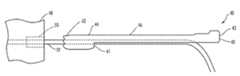
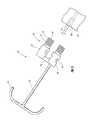
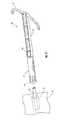
- FIGS. 1 a and 1 bare side views of a fluid line removal device in accordance with the present invention before and during removal of a fluid line from a body, respectively.
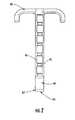
- FIG. 2is a top view of the fluid line removal device of FIG. 1 .
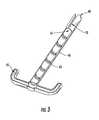
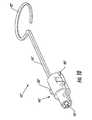
- FIG. 3is a perspective view of the fluid line removal device of FIG. 1 .
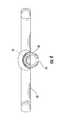
- FIG. 4is an end view of the fluid line removal device of FIG. 1 .
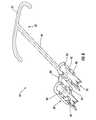
- FIG. 5is a top view of an alternative embodiment of the fluid line removal device of FIG. 1 .
- FIG. 6is a bottom perspective view of the fluid line removal device of FIG. 5 .
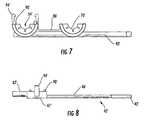
- FIG. 7is an end view of the fluid line removal device of FIG. 5 .
- FIG. 8is a side view of the fluid line removal device of FIG. 5 .
- FIG. 9is a top view of another alternative embodiment of the fluid line removal device of FIG. 1 with the openable cutting head thereof in an open position.
- FIG. 10is a perspective view of the fluid line removal device of FIG. 9 with the openable head in a closed position.
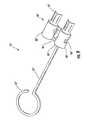
- FIG. 11is a perspective view of still another alternative embodiment of the fluid line removal device of FIG. 1 .
- a fluid line removal device 40 of the present inventionis for use in removing a fluid line 52 from a body 48 .
- the fluid line 52is a catheter with a tissue ingrowth cuff 50 carried thereon.
- the cathetercould be a catheter used in kidney dialysis but could also be other types of catheters such as those noted above.
- the device 40could also be used for removing other fluid lines or non-fluid lines, including pacemaker leads and pneumatic drivelines. It will be appreciated by those skilled in the art that the fluid line removal device 40 may be used for removing fluid lines from both human and non-human bodies in different embodiments.
- the fluid line removal device 40illustratively includes a handle 42 and a cutting head 44 .
- the handle 42illustratively includes a grip portion 43 and an extension member 46 extending between the grip portion and the cutting head 44 .
- the grip portion 43has ends that curve inward toward the cutting head 44 to facilitate gripping by the practitioner.
- the cutting head 44has a proximal end 61 (which in the illustrated embodiment is tapered) closest to the handle 42 , and a tapered distal end 62 spaced apart from the proximal end and terminating in a cutting edge 60 , as shown in FIG. 2 .
- the tapered distal end 62 of the cutting headallows the fluid line removal device to be inserted into the body 48 and around the fluid line 52 and tissue ingrowth cuff 50 , if present, while at the same time pushing the tissue further away from the fluid line using the increasing circumference of the tapered distal end (i.e., like a wedge).
- the cutting edge 60 of the cutting head 44is serrated, although in other embodiments it may simply be a sharp or thin edge.
- the extension member 46may include a plurality of support ribs 45 carried on the interior surface thereof that provide reinforcement for added strength and durability to help prevent the extension member 46 from breaking during insertion/twisting.
- the T-shaped grip portion 43may also advantageously provide stability and directional control of the device 40 .
- the fluid line removal device 40preferably has a guide carried within the fluid line channel 54 for supporting the fluid line 52 during manipulation of the fluid line removal device.
- the guideis a cross member 72 spanning the fluid line channel 54 , as perhaps best seen in FIG. 5 .
- the fluid line 52rests against the cross member 72 , which helps keep the cutting head 44 centered on the fluid line while being inserted into the body 48 .
- the guidemay take other shapes, such as a cup-shape, v-shape, curved shape, or other shapes that are suitable to help position and/or maintain the fluid line 52 within the fluid line removal device 40 , as will be understood by those skilled in the art.
- the fluid line removal device 40is then moved down the fluid line until the distal end 62 of the cutting head 44 makes contact with the exterior surface of the body 48 .
- the tissue ingrowth cuff 50need not be present in all embodiments.
- the distal end 62 of the cutting head 44preferably has a circumference greater than the tissue ingrowth cuff so that the entire tissue ingrowth cuff can be removed with the fluid line 52 .
- the circumference or shape of the fluid line channel 54 and/or cutting head 44need not be circular and may be an elliptical or other shape, as will be appreciated by those skilled in the art. Where no tissue ingrowth cuff 50 is present, the cutting head 44 need only have a circumference greater than the circumference of the fluid line 52 .
- the fluid line removal device 40is preferably made out of bio-compatible material such as bio-compatible metal or plastic. It is particularly advantageous to construct the fluid line removal device 40 from plastic in embodiments where the device is intended for one use or a very limited number of uses.
- the cutting head 44 of the fluid line removal device 40makes contact with the exterior of the body 50 and is preferably substantially perpendicular to the exterior of the body 48 .
- the fluid line removal device 40is then manipulated to separate the body tissue from the tissue ingrowth cuff 50 , if present, or from the fluid line 52 itself where a tissue ingrowth cuff is not present. This manipulation may be performed in a variety of ways.
- One approachis to use the serrated edge 60 to cut tissue away from the tissue ingrowth cuff 50 using a rotational movement (i.e., twisting).
- the fluid line removal device 40remains substantially centered on the fluid line 52 but is rotated in a circular motion allowing the teeth of the serrated edge 60 to cut through the tissue surrounding the tissue ingrowth cuff 50 or fluid line 52 .
- the circular motionmay involve one or more full 360 degree turns around the fluid line 52 in a clockwise or counter-clockwise direction, and/or back-and-forth rotations through less than 360 degrees around the fluid line 52 .
- the teeth of the serrated edge 60cut the tissue surrounding the tissue ingrowth cuff 50 or fluid line 50 and allows some portion of the cutting head 44 to penetrate into the body tissue and around the tissue ingrowth cuff 50 and fluid line 52 (or the fluid line alone) as shown in FIG. 1 b.
- a consistent sharp edgemay be used in place of the serrated edge 60 .
- user pressure exerted in the direction of the body 48may be sufficient to separate the body tissue from the tissue ingrowth cuff 50 with less rotation/twisting and still allowing the cutting head 44 to enter the body. Once the cutting head 44 or some portion thereof has penetrated into the body 48 around the tissue ingrowth cuff 50 and fluid line 52 and separated them from the body tissue, the fluid line and the tissue ingrowth cuff, if present, are removed from the body.
- the fluid line removal device 40has a slit 70 running from the distal end 62 to the proximal end 61 of the cutting head 44 .
- the slit 70is at least slightly greater in width than the diameter of the fluid line 52 to allow the fluid line to be placed in the fluid line channel 54 of the cutting head 44 .
- the slit 70may also extend through the grip portion 43 .
- the cutting head 44(as well as portions of the extension member 46 and/or grip portion 43 ) may be completely enclosed around its circumference.
- the end of the fluid line 52 furthest from the bodyis threaded through the fluid line channel 54 of the cutting head 44 .
- the fluid line removal device 40is then slid down the fluid line 52 until it makes contact with the body 48 .
- the slit 70may extend beyond the proximal end of the cutting head 44 and through some or the entire portion of the extension member 46 and/or grip portion 43 in embodiments where the extension member and/or grip portion is partially or fully enclosed.
- the openable cutting head 44 ′has a first portion 82 ′ and a second portion 84 ′ that are connected by a tab or hinge 86 ′, which allows the first and second portions to be joined together in closed position around a fluid line, 52 ′.
- the first portion 82 ′ and second portion 84 ′need not be physically connected by the tab/hinge 86 ′ while in the open state.
- one portionremains attached to the handle 42 ′ and the other portion is selectively removable from the attached portion.
- the fluid line 52 ′is then positioned in the fluid line channel 54 ′, and the selectively removable portion is then connected to the attached portion to enclose the fluid line 52 ′ within the fluid line channel.
- first and second portions 82 ′, 84 ′ of the openable cutting head 44 ′may be secured in the closed position by slidable tracks or guides. That is, one portion is slid or snapped into the other into a locked position, similar to the way in which a battery cover on a cell phone is moved into a locked position, for example.
- a number of additional ways of securing the first portion 82 ′ and second portion 84 ′ in a closed positioncan be used as will be appreciated by those skilled in the art.
- the two portions of the openable cutting head 44 ′may be held in a closed position in a variety of ways.
- clasps 94 ′ and corresponding receiving portions 96 ′may be used for securing the openable cutting head 44 ′ in the closed position.
- projections 90 ′ and corresponding holes 92 ′may be provided at positions along the first member 82 ′ and second member 84 ′.
- the pin 90 ′ and hole 92 ′ configurationmay in some embodiments be used to secure the first and second portions 82 ′, 84 ′ of the cutting head 44 ′ without the clasps/receiving portions 94 ′, 96 ′ and vice-versa.
- other suitable connection mechanismsknown to those skilled in the art may also be used.
- the distal end 62 ′ of the cutting head 44 ′has a serrated cutting surface 63 ′ to further assist in the removal of tissue from a tissue ingrowth cuff 50 ′ (or a fluid line 52 ′ if no tissue ingrowth cuff 50 ′ is present).
- the serrated cutting surface 63 ′may be used in addition to, or instead of, a sharp or serrated cutting edge 60 ′. It should also be noted that serrations may also be present on portions of the proximal end 61 ′ (or even portions of the extension member 46 ′ in some embodiments, if desired).
- a guide 70 ′ within the fluid line channel 54 ′is generally circular and surrounds the fluid line 52 ′ once the fluid line 52 ′ is closed within the fluid line channel 54 ′ (see FIG. 7 ). Also, in the present example the distal end 62 ′ is not tapered as in the above-described embodiment, although it may also be in some embodiments.
- a fluid line removal device 44 ′′includes a generally circular grip portion 43 ′′ as opposed to the T-shaped grip portions of the preceding embodiments.
- Other grip portion shapesmay be used to provide desired feel and leverage depending upon user preference and/or the particular procedure to be performed, as will be appreciated by those skilled in the art.
- FIG. 11illustrates an elongated cutting head portion 44 ′′′ with serrations along the surface thereof, and without a slit therein.
- an end of the fluid line 52 ′′′would be inserted into the fluid line channel 54 ′′′ at the distal end 62 ′′′ of the cutting head 44 ′′′, and the device 40 ′′′ would then be threaded down the fluid line until reaching the body 48 ′′′, as discussed further above.
- the various embodiments of the fluid line removal device discussed abovemay advantageously reduce the procedure time required using traditional incision/suturing techniques, which can be 20-30 minutes, for example, to a fraction of this time. Moreover, use of the fluid line removal device may also advantageously reduce the amount of bleeding and/or risk of infection, as will be appreciated by those skilled in the art. Other advantages may include the relative ease of use, relatively small size, and serrated/sharpened cutting edge which, along with the tapered distal end may advantageously help cut and push tissue away from the ingrowth cuff/fluid line.
- the device 40may be used for removing catheters and catheter tissue ingrowth cuffs 50 , as well as a wide range of other types of fluid lines 52 , from human or non-human bodies, as will be appreciated by those skilled in the art.
Landscapes
- Health & Medical Sciences (AREA)
- Life Sciences & Earth Sciences (AREA)
- Surgery (AREA)
- Veterinary Medicine (AREA)
- General Health & Medical Sciences (AREA)
- Public Health (AREA)
- Biomedical Technology (AREA)
- Heart & Thoracic Surgery (AREA)
- Engineering & Computer Science (AREA)
- Animal Behavior & Ethology (AREA)
- Nuclear Medicine, Radiotherapy & Molecular Imaging (AREA)
- Medical Informatics (AREA)
- Molecular Biology (AREA)
- Hematology (AREA)
- Anesthesiology (AREA)
- Pulmonology (AREA)
- Biophysics (AREA)
- Rheumatology (AREA)
- External Artificial Organs (AREA)
Abstract
Description
Claims (8)
Priority Applications (2)
| Application Number | Priority Date | Filing Date | Title |
|---|---|---|---|
| US11/672,554US8372098B2 (en) | 2006-02-08 | 2007-02-08 | Fluid line removal device for removing a fluid line from a body and related methods |
| PCT/US2008/057457WO2008098262A1 (en) | 2007-02-08 | 2008-03-19 | Fluid line removal device for removing a fluid line from a body and related methods |
Applications Claiming Priority (2)
| Application Number | Priority Date | Filing Date | Title |
|---|---|---|---|
| US77120806P | 2006-02-08 | 2006-02-08 | |
| US11/672,554US8372098B2 (en) | 2006-02-08 | 2007-02-08 | Fluid line removal device for removing a fluid line from a body and related methods |
Publications (2)
| Publication Number | Publication Date |
|---|---|
| US20070185510A1 US20070185510A1 (en) | 2007-08-09 |
| US8372098B2true US8372098B2 (en) | 2013-02-12 |
Family
ID=39564674
Family Applications (1)
| Application Number | Title | Priority Date | Filing Date |
|---|---|---|---|
| US11/672,554Active2031-01-18US8372098B2 (en) | 2006-02-08 | 2007-02-08 | Fluid line removal device for removing a fluid line from a body and related methods |
Country Status (2)
| Country | Link |
|---|---|
| US (1) | US8372098B2 (en) |
| WO (1) | WO2008098262A1 (en) |
Cited By (21)
| Publication number | Priority date | Publication date | Assignee | Title |
|---|---|---|---|---|
| US8961551B2 (en) | 2006-12-22 | 2015-02-24 | The Spectranetics Corporation | Retractable separating systems and methods |
| US9028520B2 (en) | 2006-12-22 | 2015-05-12 | The Spectranetics Corporation | Tissue separating systems and methods |
| US9283040B2 (en) | 2013-03-13 | 2016-03-15 | The Spectranetics Corporation | Device and method of ablative cutting with helical tip |
| US9291663B2 (en) | 2013-03-13 | 2016-03-22 | The Spectranetics Corporation | Alarm for lead insulation abnormality |
| US9413896B2 (en) | 2012-09-14 | 2016-08-09 | The Spectranetics Corporation | Tissue slitting methods and systems |
| USD765243S1 (en) | 2015-02-20 | 2016-08-30 | The Spectranetics Corporation | Medical device handle |
| US9456872B2 (en) | 2013-03-13 | 2016-10-04 | The Spectranetics Corporation | Laser ablation catheter |
| USD770616S1 (en) | 2015-02-20 | 2016-11-01 | The Spectranetics Corporation | Medical device handle |
| US9603618B2 (en) | 2013-03-15 | 2017-03-28 | The Spectranetics Corporation | Medical device for removing an implanted object |
| US9668765B2 (en) | 2013-03-15 | 2017-06-06 | The Spectranetics Corporation | Retractable blade for lead removal device |
| US9883885B2 (en) | 2013-03-13 | 2018-02-06 | The Spectranetics Corporation | System and method of ablative cutting and pulsed vacuum aspiration |
| US9925366B2 (en) | 2013-03-15 | 2018-03-27 | The Spectranetics Corporation | Surgical instrument for removing an implanted object |
| US9980743B2 (en) | 2013-03-15 | 2018-05-29 | The Spectranetics Corporation | Medical device for removing an implanted object using laser cut hypotubes |
| US10136913B2 (en) | 2013-03-15 | 2018-11-27 | The Spectranetics Corporation | Multiple configuration surgical cutting device |
| US10383691B2 (en) | 2013-03-13 | 2019-08-20 | The Spectranetics Corporation | Last catheter with helical internal lumen |
| US10405924B2 (en) | 2014-05-30 | 2019-09-10 | The Spectranetics Corporation | System and method of ablative cutting and vacuum aspiration through primary orifice and auxiliary side port |
| US10448999B2 (en) | 2013-03-15 | 2019-10-22 | The Spectranetics Corporation | Surgical instrument for removing an implanted object |
| US10835279B2 (en) | 2013-03-14 | 2020-11-17 | Spectranetics Llc | Distal end supported tissue slitting apparatus |
| US10842532B2 (en) | 2013-03-15 | 2020-11-24 | Spectranetics Llc | Medical device for removing an implanted object |
| US11076885B2 (en) | 2017-10-30 | 2021-08-03 | Ocean Medical, Llc | Catheter removal instruments and methods |
| US12053203B2 (en) | 2014-03-03 | 2024-08-06 | Spectranetics, Llc | Multiple configuration surgical cutting device |
Families Citing this family (14)
| Publication number | Priority date | Publication date | Assignee | Title |
|---|---|---|---|---|
| US20080108969A1 (en)* | 2005-11-28 | 2008-05-08 | Andrew Kerr | Dialysis Catheter |
| US7758590B2 (en)* | 2005-11-21 | 2010-07-20 | Daniele Anthony G | Cuffed-catheter removal device |
| US20070244490A1 (en)* | 2006-02-22 | 2007-10-18 | Moehle Ryan T | Growth cuff removal devices and methods of use |
| JP2008226485A (en)* | 2007-03-08 | 2008-09-25 | Sumitomo Wiring Syst Ltd | Valve socket |
| US8109939B2 (en)* | 2009-03-27 | 2012-02-07 | Hazem Barmada | System and method for removing an implanted catheter from a patient |
| US20120203240A1 (en)* | 2011-02-07 | 2012-08-09 | Jacque Delahoussaye | Cuffed-catheter remover |
| EP2717808A2 (en)* | 2011-06-09 | 2014-04-16 | Zimmer GmbH | Instruments and devices for subchondral joint repair |
| USD672040S1 (en)* | 2011-11-17 | 2012-12-04 | Jacque Delahoussaye | Cuffed-catheter remover |
| US9067043B2 (en)* | 2013-05-28 | 2015-06-30 | Smh Device Corp. | Tunneled catheter with hemostasis mechanism |
| US9308351B2 (en)* | 2013-05-28 | 2016-04-12 | Smh Device Corp. | Tunneled catheter with hemostasis mechanism |
| EP3035876B1 (en) | 2013-09-18 | 2018-11-14 | Xablecath Inc. | Device and system for crossing and treating an occlusion |
| GB2541443B (en)* | 2015-08-20 | 2017-10-04 | Munir Bashir Rassam Saad | Catheter removal device |
| US10052128B2 (en)* | 2015-08-24 | 2018-08-21 | Qathax, LLC | Catheter extraction |
| CN106175882B (en)* | 2016-07-11 | 2019-12-06 | 王治强 | rotating ring knife |
Citations (19)
| Publication number | Priority date | Publication date | Assignee | Title |
|---|---|---|---|---|
| US3653388A (en)* | 1969-12-04 | 1972-04-04 | Battelle Development Corp | Catheter insertion trocar |
| DE3006170B1 (en) | 1980-02-19 | 1981-08-27 | Aesculap-Werke Ag Vormals Jetter & Scheerer, 7200 Tuttlingen | Tendon stripper |
| US4681570A (en)* | 1985-12-26 | 1987-07-21 | Dalton Michael J | Peritoneal catheter |
| US4955890A (en)* | 1986-01-16 | 1990-09-11 | Vitaphore Corporation | Surgical skin incision device, percutaneous infection control kit and methods of use |
| US5071408A (en) | 1988-10-07 | 1991-12-10 | Ahmed Abdul Mateen | Medical valve |
| US5341816A (en)* | 1989-11-06 | 1994-08-30 | Allen William C | Biopsy device |
| US5620451A (en) | 1995-04-25 | 1997-04-15 | Intermedics, Inc. | Lead extraction system for transvenous defibrillation leads and for endocardial pacing leads |
| US5830184A (en)* | 1996-03-06 | 1998-11-03 | Medical Components, Inc. | Composite catheter stabilizing devices, methods of making the same and catheter extracting device |
| US5897561A (en)* | 1997-12-30 | 1999-04-27 | Raines; Edward P. | Coring device |
| US6206899B1 (en) | 1998-02-27 | 2001-03-27 | Cardiothoracic Systems, Inc. | Dissecting retractor for harvesting vessels |
| US6361541B1 (en)* | 1998-07-17 | 2002-03-26 | The University Of Iowa Research Foundation | Surgical instrument for extracting tissue ingrowth from a permeable member of an implanted catheter |
| WO2002043594A1 (en) | 2000-12-01 | 2002-06-06 | Angiolas International Ag | System for treating vascular adhesions |
| US6682535B2 (en) | 1999-06-16 | 2004-01-27 | Thomas Hoogland | Apparatus for decompressing herniated intervertebral discs |
| US6890308B2 (en) | 2003-06-03 | 2005-05-10 | Abul Bashar Mohammed Anwarul Islam | Bone marrow biopsy needle |
| US20060116691A1 (en) | 2003-01-17 | 2006-06-01 | Fabrice Bonacci | Guide insertion device |
| US20060129134A1 (en) | 2004-11-29 | 2006-06-15 | Andrew Kerr | Dialysis catheter |
| US7107789B1 (en) | 2005-10-17 | 2006-09-19 | Bruner Mates A | Openable ring with cooperating locking means |
| US20060264993A1 (en)* | 2005-05-04 | 2006-11-23 | Lee Thomas H | Tendon stripper |
| US20070118148A1 (en)* | 2005-11-21 | 2007-05-24 | Daniele Anthony G | Cuffed-catheter removal device |
Family Cites Families (1)
| Publication number | Priority date | Publication date | Assignee | Title |
|---|---|---|---|---|
| US6361451B1 (en)* | 1998-09-21 | 2002-03-26 | Mide Technology Corporation | Variable stiffness shaft |
- 2007
- 2007-02-08USUS11/672,554patent/US8372098B2/enactiveActive
- 2008
- 2008-03-19WOPCT/US2008/057457patent/WO2008098262A1/enactiveApplication Filing
Patent Citations (24)
| Publication number | Priority date | Publication date | Assignee | Title |
|---|---|---|---|---|
| US3653388A (en)* | 1969-12-04 | 1972-04-04 | Battelle Development Corp | Catheter insertion trocar |
| DE3006170B1 (en) | 1980-02-19 | 1981-08-27 | Aesculap-Werke Ag Vormals Jetter & Scheerer, 7200 Tuttlingen | Tendon stripper |
| US4681570A (en)* | 1985-12-26 | 1987-07-21 | Dalton Michael J | Peritoneal catheter |
| US4955890A (en)* | 1986-01-16 | 1990-09-11 | Vitaphore Corporation | Surgical skin incision device, percutaneous infection control kit and methods of use |
| US5071408A (en) | 1988-10-07 | 1991-12-10 | Ahmed Abdul Mateen | Medical valve |
| US5341816A (en)* | 1989-11-06 | 1994-08-30 | Allen William C | Biopsy device |
| US5620451A (en) | 1995-04-25 | 1997-04-15 | Intermedics, Inc. | Lead extraction system for transvenous defibrillation leads and for endocardial pacing leads |
| US5830184A (en)* | 1996-03-06 | 1998-11-03 | Medical Components, Inc. | Composite catheter stabilizing devices, methods of making the same and catheter extracting device |
| US20020032411A1 (en) | 1996-03-06 | 2002-03-14 | Medical Components, Inc. | Composite catheter stabilizing devices, methods of making the same and catheter extracting device |
| US20040199110A1 (en)* | 1996-03-06 | 2004-10-07 | Basta Michael Ignazio | Catheter extracting device |
| US6926721B2 (en) | 1996-03-06 | 2005-08-09 | Medical Components, Inc. | Catheter extracting device |
| US5897561A (en)* | 1997-12-30 | 1999-04-27 | Raines; Edward P. | Coring device |
| US6206899B1 (en) | 1998-02-27 | 2001-03-27 | Cardiothoracic Systems, Inc. | Dissecting retractor for harvesting vessels |
| US6319265B1 (en) | 1998-02-27 | 2001-11-20 | Cardiothoracic Systems, Inc. | Dissecting retractor for harvesting vessels |
| US6361541B1 (en)* | 1998-07-17 | 2002-03-26 | The University Of Iowa Research Foundation | Surgical instrument for extracting tissue ingrowth from a permeable member of an implanted catheter |
| US6682535B2 (en) | 1999-06-16 | 2004-01-27 | Thomas Hoogland | Apparatus for decompressing herniated intervertebral discs |
| WO2002043594A1 (en) | 2000-12-01 | 2002-06-06 | Angiolas International Ag | System for treating vascular adhesions |
| US20060116691A1 (en) | 2003-01-17 | 2006-06-01 | Fabrice Bonacci | Guide insertion device |
| US6890308B2 (en) | 2003-06-03 | 2005-05-10 | Abul Bashar Mohammed Anwarul Islam | Bone marrow biopsy needle |
| US20060129134A1 (en) | 2004-11-29 | 2006-06-15 | Andrew Kerr | Dialysis catheter |
| US20060264993A1 (en)* | 2005-05-04 | 2006-11-23 | Lee Thomas H | Tendon stripper |
| US7107789B1 (en) | 2005-10-17 | 2006-09-19 | Bruner Mates A | Openable ring with cooperating locking means |
| US20070118148A1 (en)* | 2005-11-21 | 2007-05-24 | Daniele Anthony G | Cuffed-catheter removal device |
| WO2007062091A2 (en) | 2005-11-21 | 2007-05-31 | Hatch Medical, L.L.C. | Cuffed-catheter removal device |
Cited By (50)
| Publication number | Priority date | Publication date | Assignee | Title |
|---|---|---|---|---|
| US10537354B2 (en) | 2006-12-22 | 2020-01-21 | The Spectranetics Corporation | Retractable separating systems and methods |
| US9808275B2 (en) | 2006-12-22 | 2017-11-07 | The Spectranetics Corporation | Retractable separating systems and methods |
| US9801650B2 (en) | 2006-12-22 | 2017-10-31 | The Spectranetics Corporation | Tissue separating systems and methods |
| US10869687B2 (en) | 2006-12-22 | 2020-12-22 | Spectranetics Llc | Tissue separating systems and methods |
| US9289226B2 (en) | 2006-12-22 | 2016-03-22 | The Spectranetics Corporation | Retractable separating systems and methods |
| US9028520B2 (en) | 2006-12-22 | 2015-05-12 | The Spectranetics Corporation | Tissue separating systems and methods |
| US8961551B2 (en) | 2006-12-22 | 2015-02-24 | The Spectranetics Corporation | Retractable separating systems and methods |
| US9763692B2 (en) | 2012-09-14 | 2017-09-19 | The Spectranetics Corporation | Tissue slitting methods and systems |
| US9413896B2 (en) | 2012-09-14 | 2016-08-09 | The Spectranetics Corporation | Tissue slitting methods and systems |
| US10368900B2 (en) | 2012-09-14 | 2019-08-06 | The Spectranetics Corporation | Tissue slitting methods and systems |
| US9949753B2 (en) | 2012-09-14 | 2018-04-24 | The Spectranetics Corporation | Tissue slitting methods and systems |
| US9724122B2 (en) | 2012-09-14 | 2017-08-08 | The Spectranetics Corporation | Expandable lead jacket |
| US10531891B2 (en) | 2012-09-14 | 2020-01-14 | The Spectranetics Corporation | Tissue slitting methods and systems |
| US11596435B2 (en) | 2012-09-14 | 2023-03-07 | Specrtranetics Llc | Tissue slitting methods and systems |
| US10485613B2 (en) | 2013-03-13 | 2019-11-26 | The Spectranetics Corporation | Device and method of ablative cutting with helical tip |
| US10265520B2 (en) | 2013-03-13 | 2019-04-23 | The Spetranetics Corporation | Alarm for lead insulation abnormality |
| US9883885B2 (en) | 2013-03-13 | 2018-02-06 | The Spectranetics Corporation | System and method of ablative cutting and pulsed vacuum aspiration |
| US9925371B2 (en) | 2013-03-13 | 2018-03-27 | The Spectranetics Corporation | Alarm for lead insulation abnormality |
| US9283040B2 (en) | 2013-03-13 | 2016-03-15 | The Spectranetics Corporation | Device and method of ablative cutting with helical tip |
| US9937005B2 (en) | 2013-03-13 | 2018-04-10 | The Spectranetics Corporation | Device and method of ablative cutting with helical tip |
| US9291663B2 (en) | 2013-03-13 | 2016-03-22 | The Spectranetics Corporation | Alarm for lead insulation abnormality |
| US10799293B2 (en) | 2013-03-13 | 2020-10-13 | The Spectranetics Corporation | Laser ablation catheter |
| US9456872B2 (en) | 2013-03-13 | 2016-10-04 | The Spectranetics Corporation | Laser ablation catheter |
| US10383691B2 (en) | 2013-03-13 | 2019-08-20 | The Spectranetics Corporation | Last catheter with helical internal lumen |
| US11925380B2 (en) | 2013-03-14 | 2024-03-12 | Spectranetics Llc | Distal end supported tissue slitting apparatus |
| US10835279B2 (en) | 2013-03-14 | 2020-11-17 | Spectranetics Llc | Distal end supported tissue slitting apparatus |
| US9603618B2 (en) | 2013-03-15 | 2017-03-28 | The Spectranetics Corporation | Medical device for removing an implanted object |
| US9980743B2 (en) | 2013-03-15 | 2018-05-29 | The Spectranetics Corporation | Medical device for removing an implanted object using laser cut hypotubes |
| US10136913B2 (en) | 2013-03-15 | 2018-11-27 | The Spectranetics Corporation | Multiple configuration surgical cutting device |
| US10314615B2 (en) | 2013-03-15 | 2019-06-11 | The Spectranetics Corporation | Medical device for removing an implanted object |
| US11925334B2 (en) | 2013-03-15 | 2024-03-12 | Spectranetics Llc | Surgical instrument for removing an implanted object |
| US9918737B2 (en) | 2013-03-15 | 2018-03-20 | The Spectranetics Corporation | Medical device for removing an implanted object |
| US10052129B2 (en) | 2013-03-15 | 2018-08-21 | The Spectranetics Corporation | Medical device for removing an implanted object |
| US9925366B2 (en) | 2013-03-15 | 2018-03-27 | The Spectranetics Corporation | Surgical instrument for removing an implanted object |
| US10448999B2 (en) | 2013-03-15 | 2019-10-22 | The Spectranetics Corporation | Surgical instrument for removing an implanted object |
| US11160579B2 (en) | 2013-03-15 | 2021-11-02 | Spectranetics Llc | Multiple configuration surgical cutting device |
| US10524817B2 (en) | 2013-03-15 | 2020-01-07 | The Spectranetics Corporation | Surgical instrument including an inwardly deflecting cutting tip for removing an implanted object |
| US10219819B2 (en) | 2013-03-15 | 2019-03-05 | The Spectranetics Corporation | Retractable blade for lead removal device |
| US9668765B2 (en) | 2013-03-15 | 2017-06-06 | The Spectranetics Corporation | Retractable blade for lead removal device |
| US10849603B2 (en) | 2013-03-15 | 2020-12-01 | Spectranetics Llc | Surgical instrument for removing an implanted object |
| US9956399B2 (en) | 2013-03-15 | 2018-05-01 | The Spectranetics Corporation | Medical device for removing an implanted object |
| US10842532B2 (en) | 2013-03-15 | 2020-11-24 | Spectranetics Llc | Medical device for removing an implanted object |
| US12053203B2 (en) | 2014-03-03 | 2024-08-06 | Spectranetics, Llc | Multiple configuration surgical cutting device |
| US10405924B2 (en) | 2014-05-30 | 2019-09-10 | The Spectranetics Corporation | System and method of ablative cutting and vacuum aspiration through primary orifice and auxiliary side port |
| USD819204S1 (en) | 2015-02-20 | 2018-05-29 | The Spectranetics Corporation | Medical device handle |
| USD765243S1 (en) | 2015-02-20 | 2016-08-30 | The Spectranetics Corporation | Medical device handle |
| USD770616S1 (en) | 2015-02-20 | 2016-11-01 | The Spectranetics Corporation | Medical device handle |
| USD806245S1 (en) | 2015-02-20 | 2017-12-26 | The Spectranetics Corporation | Medical device handle |
| USD854682S1 (en) | 2015-02-20 | 2019-07-23 | The Spectranetics Corporation | Medical device handle |
| US11076885B2 (en) | 2017-10-30 | 2021-08-03 | Ocean Medical, Llc | Catheter removal instruments and methods |
Also Published As
| Publication number | Publication date |
|---|---|
| WO2008098262A1 (en) | 2008-08-14 |
| US20070185510A1 (en) | 2007-08-09 |
Similar Documents
| Publication | Publication Date | Title |
|---|---|---|
| US8372098B2 (en) | Fluid line removal device for removing a fluid line from a body and related methods | |
| US6428513B1 (en) | Catheter hub anchoring device | |
| CA2530438C (en) | Catheter tunneler adapter | |
| US7798999B2 (en) | Adjustable length catheter | |
| US6033382A (en) | Composite catheter stabilizing devices, methods of making the same and catheter extracting device | |
| US7731697B2 (en) | Apparatus and method for percutaneous catheter implantation and replacement | |
| US7261708B2 (en) | Removable catheter hub | |
| US8021340B2 (en) | Enhanced apparatus for percutaneous catheter implantation and replacement | |
| US6013058A (en) | Device for subcutaneous accessibility | |
| US8613728B2 (en) | Removable adapter for a splittable introducer and method of use thereof | |
| US7794422B2 (en) | Catheter port assembly for extracorporeal treatment | |
| CA2608714C (en) | Catheter port assembly for extracorporeal treatment | |
| US7758590B2 (en) | Cuffed-catheter removal device | |
| US20110251450A1 (en) | Method and Device for Attachment of an Inflow Conduit to the Heart and to a Pump | |
| US20110260449A1 (en) | Apical access and control devices | |
| EP2484299A1 (en) | Cuffed-catheter remover | |
| JPH11514248A (en) | Vascular access device | |
| JP2001513000A (en) | Methods and systems for establishing vascular access | |
| US20090105545A1 (en) | Apparatus and method for facilitating the implantation of a medical device | |
| US20150257785A1 (en) | Cuffed Fluid Line Extraction Device for Extraction of Tissue Ingrowth Cuffs and Fluid Lines from a Body and Associated Methods of Use | |
| KR20240116798A (en) | Equipment and methods for securing medical devices to patients | |
| WO2008005065A1 (en) | Apparatus and method for percutaneous catheter implantation and replacement | |
| HK40021604B (en) | Introducer sheath |
Legal Events
| Date | Code | Title | Description |
|---|---|---|---|
| AS | Assignment | Owner name:TRAN PA-C, FLORIDA Free format text:ASSIGNMENT OF ASSIGNORS INTEREST;ASSIGNOR:TRAN, TRI;REEL/FRAME:018869/0827 Effective date:20070207 | |
| AS | Assignment | Owner name:TRAN HOLDINGS, LLC, FLORIDA Free format text:ASSIGNMENT OF ASSIGNORS INTEREST;ASSIGNOR:TRAN PA-C, INC.;REEL/FRAME:019877/0873 Effective date:20070918 | |
| AS | Assignment | Owner name:TRAN PA-C, INC., FLORIDA Free format text:ASSIGNMENT OF ASSIGNORS INTEREST;ASSIGNOR:TRAN HOLDINGS, LLC;REEL/FRAME:021947/0839 Effective date:20081204 | |
| AS | Assignment | Owner name:MERIT MEDICAL SYSTEMS, INC., UTAH Free format text:ASSIGNMENT OF ASSIGNORS INTEREST;ASSIGNOR:TRAN PA-C, INC.;REEL/FRAME:022061/0095 Effective date:20081112 | |
| AS | Assignment | Owner name:MERIT MEDICAL SYSTEMS, INC., UTAH Free format text:ASSIGNMENT OF ASSIGNORS INTEREST;ASSIGNOR:TRAN PA-C, INC.;REEL/FRAME:022796/0662 Effective date:20081211 | |
| STCF | Information on status: patent grant | Free format text:PATENTED CASE | |
| AS | Assignment | Owner name:WELLS FARGO BANK, NATIONAL ASSOCIATION, AS ADMINISTRATIVE AGENT, UTAH Free format text:PATENT SECURITY AGREEMENT;ASSIGNOR:MERIT MEDICAL SYSTEMS, INC.;REEL/FRAME:029698/0033 Effective date:20121219 Owner name:WELLS FARGO BANK, NATIONAL ASSOCIATION, AS ADMINIS Free format text:PATENT SECURITY AGREEMENT;ASSIGNOR:MERIT MEDICAL SYSTEMS, INC.;REEL/FRAME:029698/0033 Effective date:20121219 | |
| FPAY | Fee payment | Year of fee payment:4 | |
| FEPP | Fee payment procedure | Free format text:MAINTENANCE FEE REMINDER MAILED (ORIGINAL EVENT CODE: REM.); ENTITY STATUS OF PATENT OWNER: LARGE ENTITY | |
| FEPP | Fee payment procedure | Free format text:7.5 YR SURCHARGE - LATE PMT W/IN 6 MO, LARGE ENTITY (ORIGINAL EVENT CODE: M1555); ENTITY STATUS OF PATENT OWNER: LARGE ENTITY | |
| MAFP | Maintenance fee payment | Free format text:PAYMENT OF MAINTENANCE FEE, 8TH YEAR, LARGE ENTITY (ORIGINAL EVENT CODE: M1552); ENTITY STATUS OF PATENT OWNER: LARGE ENTITY Year of fee payment:8 | |
| MAFP | Maintenance fee payment | Free format text:PAYMENT OF MAINTENANCE FEE, 12TH YEAR, LARGE ENTITY (ORIGINAL EVENT CODE: M1553); ENTITY STATUS OF PATENT OWNER: LARGE ENTITY Year of fee payment:12 |